EP0745026B1 - Method for producing a concrete, plaster or gypsum mix and for bringing the mix to its place of use - Google Patents
Method for producing a concrete, plaster or gypsum mix and for bringing the mix to its place of use Download PDFInfo
- Publication number
- EP0745026B1 EP0745026B1 EP95900152A EP95900152A EP0745026B1 EP 0745026 B1 EP0745026 B1 EP 0745026B1 EP 95900152 A EP95900152 A EP 95900152A EP 95900152 A EP95900152 A EP 95900152A EP 0745026 B1 EP0745026 B1 EP 0745026B1
- Authority
- EP
- European Patent Office
- Prior art keywords
- mix
- mixing
- water
- aggregate
- mould
- Prior art date
- Legal status (The legal status is an assumption and is not a legal conclusion. Google has not performed a legal analysis and makes no representation as to the accuracy of the status listed.)
- Expired - Lifetime
Links
- 239000000203 mixture Substances 0.000 title claims abstract description 147
- 239000004567 concrete Substances 0.000 title claims abstract description 39
- 238000004519 manufacturing process Methods 0.000 title claims abstract description 7
- 239000011505 plaster Substances 0.000 title abstract description 3
- 229910052602 gypsum Inorganic materials 0.000 title abstract 2
- 239000010440 gypsum Substances 0.000 title abstract 2
- 238000002156 mixing Methods 0.000 claims abstract description 87
- XLYOFNOQVPJJNP-UHFFFAOYSA-N water Substances O XLYOFNOQVPJJNP-UHFFFAOYSA-N 0.000 claims abstract description 34
- 238000005266 casting Methods 0.000 claims abstract description 20
- 239000011230 binding agent Substances 0.000 claims abstract description 17
- 229910052500 inorganic mineral Inorganic materials 0.000 claims abstract description 6
- 239000011707 mineral Substances 0.000 claims abstract description 6
- 238000000034 method Methods 0.000 claims description 92
- 239000002245 particle Substances 0.000 claims description 30
- 239000004568 cement Substances 0.000 claims description 21
- VYPSYNLAJGMNEJ-UHFFFAOYSA-N Silicium dioxide Chemical compound O=[Si]=O VYPSYNLAJGMNEJ-UHFFFAOYSA-N 0.000 claims description 12
- 239000004575 stone Substances 0.000 claims description 10
- 238000009826 distribution Methods 0.000 claims description 9
- 230000035515 penetration Effects 0.000 claims description 9
- 239000000463 material Substances 0.000 claims description 8
- 239000000428 dust Substances 0.000 claims description 6
- 239000000654 additive Substances 0.000 claims description 5
- 239000000049 pigment Substances 0.000 claims description 4
- 239000000377 silicon dioxide Substances 0.000 claims description 4
- 230000008569 process Effects 0.000 claims description 3
- 239000000126 substance Substances 0.000 claims description 3
- 239000000835 fiber Substances 0.000 claims description 2
- 239000011343 solid material Substances 0.000 claims description 2
- 239000002344 surface layer Substances 0.000 claims description 2
- CURLTUGMZLYLDI-UHFFFAOYSA-N Carbon dioxide Chemical compound O=C=O CURLTUGMZLYLDI-UHFFFAOYSA-N 0.000 claims 2
- 238000001125 extrusion Methods 0.000 claims 2
- 230000000996 additive effect Effects 0.000 claims 1
- 229910002092 carbon dioxide Inorganic materials 0.000 claims 1
- 239000001569 carbon dioxide Substances 0.000 claims 1
- 238000005086 pumping Methods 0.000 claims 1
- 239000002994 raw material Substances 0.000 claims 1
- 239000012615 aggregate Substances 0.000 description 34
- 206010052904 Musculoskeletal stiffness Diseases 0.000 description 23
- 238000005259 measurement Methods 0.000 description 11
- 230000006835 compression Effects 0.000 description 7
- 238000007906 compression Methods 0.000 description 7
- 238000012360 testing method Methods 0.000 description 7
- 238000009533 lab test Methods 0.000 description 6
- 239000012530 fluid Substances 0.000 description 5
- 238000003892 spreading Methods 0.000 description 5
- 230000007480 spreading Effects 0.000 description 5
- 238000006243 chemical reaction Methods 0.000 description 4
- 239000004576 sand Substances 0.000 description 4
- 238000004140 cleaning Methods 0.000 description 3
- 239000004014 plasticizer Substances 0.000 description 3
- 239000002002 slurry Substances 0.000 description 3
- 239000007787 solid Substances 0.000 description 3
- VTYYLEPIZMXCLO-UHFFFAOYSA-L Calcium carbonate Chemical compound [Ca+2].[O-]C([O-])=O VTYYLEPIZMXCLO-UHFFFAOYSA-L 0.000 description 2
- 230000008901 benefit Effects 0.000 description 2
- 230000008859 change Effects 0.000 description 2
- 238000011437 continuous method Methods 0.000 description 2
- 238000007599 discharging Methods 0.000 description 2
- 239000010410 layer Substances 0.000 description 2
- 238000012856 packing Methods 0.000 description 2
- 238000003825 pressing Methods 0.000 description 2
- 230000003014 reinforcing effect Effects 0.000 description 2
- 238000012216 screening Methods 0.000 description 2
- 238000000926 separation method Methods 0.000 description 2
- 230000035939 shock Effects 0.000 description 2
- 238000005728 strengthening Methods 0.000 description 2
- 238000012546 transfer Methods 0.000 description 2
- 229910000019 calcium carbonate Inorganic materials 0.000 description 1
- AXCZMVOFGPJBDE-UHFFFAOYSA-L calcium dihydroxide Chemical compound [OH-].[OH-].[Ca+2] AXCZMVOFGPJBDE-UHFFFAOYSA-L 0.000 description 1
- 239000000920 calcium hydroxide Substances 0.000 description 1
- 229910001861 calcium hydroxide Inorganic materials 0.000 description 1
- 239000011362 coarse particle Substances 0.000 description 1
- 239000003086 colorant Substances 0.000 description 1
- 238000005056 compaction Methods 0.000 description 1
- 238000011109 contamination Methods 0.000 description 1
- 238000001816 cooling Methods 0.000 description 1
- 238000005520 cutting process Methods 0.000 description 1
- 238000013461 design Methods 0.000 description 1
- 230000006866 deterioration Effects 0.000 description 1
- 230000000694 effects Effects 0.000 description 1
- 239000010881 fly ash Substances 0.000 description 1
- 239000003292 glue Substances 0.000 description 1
- 238000000227 grinding Methods 0.000 description 1
- 230000036571 hydration Effects 0.000 description 1
- 238000006703 hydration reaction Methods 0.000 description 1
- 238000002347 injection Methods 0.000 description 1
- 239000007924 injection Substances 0.000 description 1
- JEIPFZHSYJVQDO-UHFFFAOYSA-N iron(III) oxide Inorganic materials O=[Fe]O[Fe]=O JEIPFZHSYJVQDO-UHFFFAOYSA-N 0.000 description 1
- 230000007246 mechanism Effects 0.000 description 1
- 239000011178 precast concrete Substances 0.000 description 1
- 230000001681 protective effect Effects 0.000 description 1
- 230000009467 reduction Effects 0.000 description 1
- 239000002893 slag Substances 0.000 description 1
- 239000007921 spray Substances 0.000 description 1
- 238000005507 spraying Methods 0.000 description 1
- 238000010561 standard procedure Methods 0.000 description 1
- 230000032258 transport Effects 0.000 description 1
- 238000005406 washing Methods 0.000 description 1
- 239000002699 waste material Substances 0.000 description 1
Images


Classifications
-
- B—PERFORMING OPERATIONS; TRANSPORTING
- B28—WORKING CEMENT, CLAY, OR STONE
- B28C—PREPARING CLAY; PRODUCING MIXTURES CONTAINING CLAY OR CEMENTITIOUS MATERIAL, e.g. PLASTER
- B28C5/00—Apparatus or methods for producing mixtures of cement with other substances, e.g. slurries, mortars, porous or fibrous compositions
-
- B—PERFORMING OPERATIONS; TRANSPORTING
- B28—WORKING CEMENT, CLAY, OR STONE
- B28B—SHAPING CLAY OR OTHER CERAMIC COMPOSITIONS; SHAPING SLAG; SHAPING MIXTURES CONTAINING CEMENTITIOUS MATERIAL, e.g. PLASTER
- B28B17/00—Details of, or accessories for, apparatus for shaping the material; Auxiliary measures taken in connection with such shaping
- B28B17/02—Conditioning the material prior to shaping
Definitions
- This invention relates to a method for producing a concrete mix according to the preamble of appended claim 1.
- the mixer After mixing, the mixer is emptied and after various transfers and transports the mix is brought into a mould. The mould is filled, vibrated and the mix is smoothed. After that, the concrete is allowed to harden. Time from the moment when the binder and water have come into contact with each other until the mix is in its final or nearly final form in the mould, is usually required at least several minutes, even hours. Because of this, the cement standards define so called minimum setting times for cements, generally 45 or 60 minutes. Finnish standard requirements are defined in standard SFS 3165.
- a drawback in prior art methods is the fact that the mix has time to somewhat stiffen until it is brought into a mould. In order to compact it in the mould, it still has to be vibrated.
- SE patent publication 32663 discloses a method in which the three components of a casting mix, that is cement, sand and water, are sprayed or thrown onto a vertical surface or into a mould from separate containers. In this way cement comes into contact with water and begins to set only at its final location. A thin layer is formed on the counter surface, and the operation is repeated several times until a sufficient material thickness has been achieved. The method is slow and applicable only for spray cast type technics or plasters with a very small maximum dimension of the particles.
- DE patent publication 545 319 discloses a method in which pressure is applied to a concrete mix immediately after mixing, before bringing it into a mould, in order to remove air and excess water. This takes place by bringing the mix from the mixer into a cylindrical pressure container where the mix is pressed with a piston. The method is not continuous, the mixing takes place in batches. Because of the pressing step carried out after mixing, it takes several minutes until the mix is brought into a mould.
- US patent publication 3 530 555 discloses injection of a slurry type concrete mix. The mixing occurs in 10 - 25 seconds, after which the slurry is injected into a mould. The method can be applied only in special cases because the mix is in slurry form.
- pin mills screw mixers, worm pumps and various hammer mill type or other rotating grinders or mixing devices can also be used for mixing concrete.
- One pin mill is described in DK patent publication 104 778.
- the grinder has pins mounted on circles rotating in opposite directions, and the material particles are hit against these pins and crushed.
- a method according to the present invention is characterized by the combination of features of the characterising portion of the appended claim 1.
- the mix is not mixed and its structure is not disturbed after the early stiffening has begun which stiffening follows immediately after the early workability.
- the said intensive mixing process can include simultaneous crushing of aggregate by adding power to reinforced mixing members.
- the invention it is possible to utilize the early age workability of the mix during the first seconds following the moment of contact between solid materials and water. For instance in laboratory tests in which the mix has been mixed continuously in about five seconds from adding water, the difference when compared to the workability and fluidity of the same mix for instance even at the age of one minute is significant, even if the mix were mixed all the time. However, when continuously mixing the mix, the stiffening of the mix due to the actual hardening reaction begins to appear at a much later moment which is defined by the setting time of the cement.
- the mix after adding water the mix is discharged from the mixer before water, binder and aggregate have had time to significantly react with each other.
- binder and aggregate When such fluid mix is brought into a mould at once, it fills the mould very tightly. Vibration and shocks are not even necessarily required for compacting and improving the cast surface. Due to this, robust moulds enduring vibration or dropping shocks, are not needed.
- the mix is mixed efficiently and rapidly so that the flow-through time is short.
- a precondition for the short flow-through time is also efficient discharging of the device.
- the device When the device is sufficiently fast, it gives time to utilize both the early workability and the early stiffness of the mix.
- Sufficient mixing power can be achived for instance by means of an impact mill of a pin mill type.
- the efficiency and power of the mixing can be adjusted by increasing the rotational speed of the device.
- the centrifugal force of the fast rotational movement also centrifuges the mix efficiently and completely off from the device. So the device is also self-cleaning.
- the process according to the invention is continuous.
- the efficient mixer is also self-cleaning, the composition of the mix can also be changed without interrupting the mixing. Nor is washing required at all.
- the cleaning of the device can be made more effective by changing the rotational direction of the mixing members. By so acting, it is possible among other things to add pigments of different colours to desired points in the product to be cast, for instance to the surface of the cast element while the inner part remains grey.
- the amount of water to be fed can be changed if the moisture of the aggregate varies. Similarly, various additives can easily be added when desired.
- Efficient mixing also secures that various agglomerates such as silica agglomerates or the ones in cement or pigment or stone dust are dispersed. In this way, a mix is achieved which is homogenous and dispersed at microlevel and in which agglomerates where particles adhering together have been dispersed and the particles are evenly distributed.
- reinforcing fibres can be added to the mix. Because the mixing time is short, the fibres are not able to form balls.
- the reinforcing can be applied exactly at a desired location in the product to be cast.
- the adding of fibres can take place by cutting fibre pieces from a continuous rope when feeding them into the mixing chamber or by using precut fibres.
- cement used as binder can be substituted also by other binder systems, such as activated slag from blast furnace or by binders containing for instance fly ash, silica, stone dust or various additives.
- the conditions are arranged to be such that the aggregate fed in is crushed to an essential extent, increase in the potential strength of the mix is achieved, and this increase for instance in respect of compression strength may reach some dozen per cent, at its best.
- the increase in strength is mainly due to the freshly formed, clean, active fracture surfaces of the aggreagate and to the breaking of weak zones.
- the form value of the aggregate improves when sharp edges and stone splinters are rounded off so that the packing becomes easier and a more compact packing than with chiplike crushed stone is achieved.
- the device used for the mixing has to be continuously operating and extremely rapidly and efficiently mixing.
- particles are ground and hit against each other and the mixing members and the walls of the device. Then besides the crushing of aggregate particles, also dust and rust stuck to the surface of them are loosened and the agglomerated particles are dispersed.
- the mixing device can be used for mixing combined with crushing by designing the mixing members suitable for and enduring crushing, and by using higher power.
- the use of a crushing mixer makes it possible to feed aggregate without dividing it into separate fractions according to particle size. It is possible to use unsorted aggregate of indefinite size in which the largest pieces can have a diameter of 100 mm, for instance. In this way, the various screening steps, storing of several different fractions and accurate portioning of different fractions in order to achieve the correct particle size distribution for compacting the concrete are avoided. It is possible to utilize even waste aggregate of poorer quality and still obtain concrete of good quality, because in crushing, the weak links of the aggregate are broken and so these do not remain in the finished concrete. In this way, savings are obtained both in material, production and investment costs.
- the final strength level is at least the strength level of a mix which has been mixed according to the standard.
- the mixing power is raised so much that the mixing energy per unit to be mixed, in other words the product of the power and the mixing time is not essentially reduced from the mixing energy used in a method according to the standard. This is necessary particularly with mixes having a low water-binder ratio and proportioned for fairly high design strength and of fairly stiff character. Sufficient mixing power can be obtained by means of a continuous method so that the amount of material momentarily contained in the mixing chamber is relatively small.
- the internal structures formed in the initial phase of the stiffening of the mix are not broken, and the stiffness rapidly increases to a high value.
- the value of the early age stiffness can be increased in a few minutes manyfold or many tenfold when compared to the stiffness level measured at the same age of a mix which has been mixed with a method according to the standard or with other prior art methods.
- the utilization of the early workability and the early stiffness in a method according to the invention makes it possible to cast the mix by using a smaller amount of compacting work than in prior art methods. Alternatively, a more compact casting result is obtained with an equal amount of compacting work.
- the upper surface of the casting can be partly loaded mechanically.
- the casting mould can also be disassembled totally or partly at a very early age counted from the mixing moment of the mix. This again improves the mould circulation and reduces the number of moulds and mould costs.
- the rapid stiffening also means that all the problems caused by the separation of components are reduced. Stones, for instance, will not have time to sink towards the bottom of the mould as tends to happen in prior art methods.
- water does not tend to separate or bleed on the surface of the product either.
- prior art methods when producing thin plates, the water accumulated on the surface together with other separation phenomenons caused the upper surfaces of the plates to shrink and so the plates to be curved.
- the mix can also be heat treated so that the early stiffening speed increases, provided that the heat transfer is sufficiently efficient in order to get the effect of the temperature raise into the mix from its first minutes.
- CO 2 can be conducted into the mix, and it displaces air in the mix and in the known way reacts with Ca(OH) 2 forming CaCO 3 and so improves the hardening of the concrete and reduces the porosity.
- aggregate, water and binder are fed into a mixer.
- the finished mixture leaves the mixing chamber through the discharge opening, and it is brought into a mould immediately.
- the discharge end of the mixing device can be connected directly to the nozzle of a slide casting device, which nozzle tapers towards its point in order to compact the mix.
- the mix can be brought into a mould in any manner differing from spraying, in which manner the mix is brought to the casting place in portions bigger than drops or in a continuous flow.
- Examples 1 and 2 relate to the measurement of the early workability, and in examples 3 and 4 also the early stiffness following the early workability has been measured.
- the reduction of the workability can be followed by means of the following modified slump test.
- Mix is allowed to run freely by dropping it from a horizontal conveying screw with a screw diameter of 100 - 200 mm from a height of 0.5 m to a horizontal plane at a production rate corresponding to 2 m 3 /h of compacted concrete, for 10 seconds. This is done at the age corresponding to the moment of bringing the mix into a mould and at the age of 5 minutes.
- the heaps so formed are compared with each other. The latter heap is at least 50 % higher than the heap formed at the age corresponding to the age of bringing the mix into a mould. If the difference is less than 50 %, the early workability is regarded to have been essentially reduced when running the first heap.
- the compression strength of the concrete which was crush mixed with the method of the present invention measured from a 15 cm test cube at the age of 28 days was about 10 % higher than the compression strength of a test cube made from previously fine crushed aggregate and mixed by means of the prior art method.
- the workability of the mix was measured at the age of about 5 seconds by means of the modified slump test carried out from a height of 0.5 m to a horizontal level.
- the dimensions of the spreading heap were: height 5 cm and diameter 57 cm.
- the dimensions of the spreading heap of the same mix at the age of 10 minutes were: height 20 cm and diameter 32 cm.
- FIG. 1 The partially overlapping various stiffness grades of a mix are shown on the left-hand side of Fig. 1.
- Reference number 1 refers to the flowing state, number 2 to the stiffening, number 3 to the setting and number 4 to the hardening.
- graph 5 illustrates the stiffness of a mix made with a method of the invention
- graph 6 illustrates the stiffness of a mix made with a traditional batch method.
- the figure is schematic.
- Fig. 1 The differences between the traditional and the new method at a very early age can be seen from Fig. 1.
- the mix which has been mixed according to the traditional method is stiffer at the casting moment and it does not begin to set until much later, depending on the setting time of the concrete.
- the concrete mixed with the new method has an essentially better early workability, and the mix is cast into a mould at this stage. Because of this, the mix can also be easily brought into its final shape.
- the mix made with this method also stiffens very rapidly, due to various early reactions. If the mixing and treating times become longer or if the mix is remixed, preconditions for the phenomenons of the early workability and the early stiffness are lost, and the mix will behave as a mix which has been mixed in a traditional way. This can be seen from Fig. 2 which shows measurement results obtained in laboratory tests.
- Fig. 2 shows measurement results obtained by measuring the stiffness of a concrete mix with a method described below.
- Graphs 7 and 8 show the stiffnesses of mixes made by means of a continuous method according to the invention.
- Graph 9 shows the stiffness measured from a mix which first was mixed very rapidly but the mixing was not stopped according to the invention.
- Fig. 10 shows the stiffness of a mix which has been mixed with a prior art batch mixing method.
- This kind of early stiffening of the fresh concrete can be observed numerically from the surface of a freshly cast concrete block, for instance by means of a device comprising a measuring press and a press needle, according to ASTM C 403-92.
- the momentaneous level of the growth of the early workability can in 10 seconds be measured for instance by means of a method according to ASTM C 403-92, with the exception that the mix is not screened. Besides, screening would in practice be impossible due to the rapid stiffness increase.
- Examples of laboratory measuring results relating to the early stiffness according to the present invention are the following comparisons of such concrete mixes with identical compositions, one of which has been batch mixed with a method according to the standard, applying a total mixing time of 120 seconds, and the other of which has been mixed and afterworked according to the present invention by using a total mixing time of 3 seconds and an afterworking time of 4 seconds.
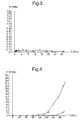
- Penetration resistances measured by a penetrometer from mixes which have been batch mixed with a method according to the standard are shown as a fucntion of the age in Figs. 3 and 4.
- the total mixing time is 120 seconds, and the afterworking time or the time taken by the compacting and settling of the mix is 30 seconds.
- the time interval is 0 - 30 minutes, and in Fig. 4 the time interval is 0 - 300 minutes.
- the 0 moment corresponds to the moment of bringing the mix into a mould.
- the lower graph represents a mix from which all aggregate over 5 mm has been screened off according to ASTM C 403-92.
- the graphs of all the other figures represent measurement results obtained by means of the modified ASTM method where the coarse aggregate has not been screened off.
- Figs. 5 and 6 represent a mixing time of 3 seconds combined with an afterworking time of 30 seconds.
- Fig. 6 represents a total mixing time of 3 seconds combined with an afterworking time of 4 seconds.
- the time intervals are 0 - 30 minutes and 0 - 300 minutes, while the resistance scales are 0 - 1.6 MPa and 0 - 30 MPa, respectively, similarly to Figs. 3 and 4.
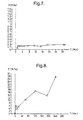
- Penetration resistances measured by a penetrometer from a mix which has been mixed with the method according to the standard are shown as a function of time in Fig. 7.
- the total mixing time is 120 seconds, and the afterworking time is 30 seconds.
- the resistances of a mix which has been mixed according to the present invention are shown in Fig. 8.
- the total mixing time is 3 seconds, and the afterworking time 4 seconds.
- the penetration resistance of a mix made with a method according to the invention is measured at the age which is 1/10 of the age corresponding to the vibration limit of a mix made with the method according to the standard.
- the afterworking time is sufficiently short according to the invention.
- the mixing device In order to achieve sufficiently aggressive mixing in which the material particles hit against counter surfaces and after that change their direction, the mixing device must have, in addition to mixing members rotating or otherwise moving in one direction, also counter members protruding into the mixing chamber. These can rotate or move in a direction opposite to the direction of the first moving members, or they can be stationary. In this way, impacts are applied to the aggregate particles breaking the weak zones in the particles and peeling off the weakly bonded surface layers of the particles.
- the mixing device In the mixing device, the mixing itself is continously operating, but the discharging may occur either continuously or in pulses.
Landscapes
- Engineering & Computer Science (AREA)
- Mechanical Engineering (AREA)
- Structural Engineering (AREA)
- Chemical & Material Sciences (AREA)
- Ceramic Engineering (AREA)
- Curing Cements, Concrete, And Artificial Stone (AREA)
- Preparation Of Clay, And Manufacture Of Mixtures Containing Clay Or Cement (AREA)
- Preparing Plates And Mask In Photomechanical Process (AREA)
Abstract
Description
| Compositon of the mix | kg/m3 |
| Crushed aggregate 11 - 16 mm | 1850 |
| Cement P40/7 | 440 |
| Water | 195 |
| |
8 |
| Composition of the mix | kg/m3 |
| Crushed aggregate 0 - 16 mm | 1700 |
| Cement P40/7 | 560 |
| Silica | 56 |
| Water | 190 |
| Plasticizers | 24 |
| Composition of the mix | kg/m3 | |
| Aggregate | ||
| Natural sand | < 0.125 mm | 115 |
| 0 - 0.6 mm | 100 | |
| 0.5 - 1 mm | 265 | |
| 2 - 3 mm | 265 | |
| 5 - 10 |
280 | |
| 8 - 16 mm | 220 | |
| Crushed aggregate | 11 - 16 mm | 640 |
| Cement P40/3 | 375 | |
| Water | 150 | |
| |
9,2 |
| Composition of the mix | kg/m3 | |
| Aggregate | ||
| Natural sand | < 0.125 mm | 115 |
| 0 - 0.6 mm | 100 | |
| 0.5 - 1 mm | 265 | |
| 2 - 3 mm | 265 | |
| 5 - 10 |
280 | |
| 8 - 16 mm | 220 | |
| Crushed aggegate | 11 - 16 mm | 640 |
| Cement P40/3 | 375 | |
| Water | 188 |
Claims (19)
- A method for producing a concrete mix by using water and binder hardening by the action of water, and mineral aggregate as well as possibly auxiliary and additive substances as components, and for bringing the mix into its place of use, in which method the components of the mix are brought into a mixing device in continuous flows and are rapidly and efficiently mixed and discharged, the mixing being done in such a way that impacts breaking agglomerates and peeling off the weakly bonded surface layers of possible aggregate particles are applied to material particles when they hit against each other and the mixing members and walls of the mixing device, whereby an essential early workability or fluidity of short duration and a subsequent early stiffening are created, characterized in that the mix is discharged by utilizing centrifugal forces and is brought directly into a casting mould or extrusion nozzle or onto a desired surface in less than 10 seconds from the point of contact between water and binder, by flowing, dropping, extruding, centrifuging, pumping or other mechanical, non-pneumatic means, and is brought into its final shape and compactness before said early stiffening begins.
- A method according to claim 1, characterized in that the mix is caused to move from the point of contact between water and binder into the casting mould or nozzle or onto the desired surface in less than 3 seconds.
- A method according to claim 1 or 2, characterized in that the mix is not mixed and its structure is not disturbed after the early stiffening immediately following the early workability has begun.
- A method according to claim 3, characterized in that the mix is not mixed and its structure is not disturbed after 30 seconds following bringing the mix into the casting mould or nozzle or onto the desired surface.
- A method according to any of claims 1 - 4, characterized in that the time the mix takes to move from the point of contact between water and binder into the casting mould or nozzle or onto the desired surface is so short that when the mix is allowed to run freely by dropping it from a horizontal conveying screw with a screw diameter of 100 - 200 mm from a height of 0.5 m into a first heap on a horizontal plane at a production rate corresponding to 2 m3/h of compacted concrete, for 10 seconds at the age corresponding to the moment of bringing the mix into the mould, nozzle or onto the desired surface; and at the age of 5 minutes after said moment onto a latter heap, the latter heap is at least 50 % higher than the first heap.
- A method according to any of claims 1 - 5, characterized in that the value of the penetration resistance of the mix measured at an age which is counted from the moment of bringing the mix into the mould, and which age is 1/10 of the age corresponding to the vibration limit of 3.5 MPa according to standard ASTM C 403-92 of a compacted comparison mix which has been mixed with a method according to standard DIN 1045 and has identical proportioning, is at least twice the value of the penetration resistance of the comparison mix at a corresponding age, measured by a penetrometer.
- A method according to any of claims 1 - 6, characterized in that the mix is heated or under-pressure is applied to it or carbon dioxide, steam and/or hot air is conducted into it.
- A method according to any of claims 1 - 7, characterized in that the water/solid material ratio of the mix is suitable for slide casting by means of an extrusion machine.
- A method according to any of claims 1 - 8, characterized in that binder the setting time of which is less than 30 minutes from adding water is used.
- A method according to any of claims 1 - 9, characterized in that casting is carried out without vibrating the mould or nozzle.
- A method according to any of claims 1 - 10, characterized in that the composition of the mix and the mixing proportions of the raw materials, including possible pigments, are changed without interrupting the continous process.
- A method according to any of claims 1 - 11, characterized in that aggregate fractions with different particle sizes are fed into the mixing chamber in such proportions that a desired particle size distribution is obtained.
- A method according to any of claims 1 - 11, characterized in that aggregate particles are crushed in the mixing device.
- A method according to claim 13, characterized in that only one aggregate fraction having an indefinite particle size is fed into the mixing chamber, and that aggregate is crushed in the mixing chamber in the presence of binder and water and possible additives and admixtures.
- A method according to claim 14, characterized in that the desired particle size distribution is obtained in connection with the crushing occuring in the mixing chamber.
- A method according to claim 15, characterized in that the particle size distribution is adjusted by changing the crushing power of the device.
- A method according to any of claims 1 - 16, characterized in that fibres are added into the mix, either precut or so that the fibre pieces are cut from a continuous rope when feeding them, the fibres being evenly dispersed in the mix.
- A method according to any of claims 1 - 17, characterized in that it produces microhomogenous mix in which cement, silica, pigment, stone dust or other agglomerates have been broken and the particles are evenly dispersed.
- A method according to any of claims 1 - 18, characterized in that the mixing device discharges either continuously or in pulses.
Applications Claiming Priority (3)
| Application Number | Priority Date | Filing Date | Title |
|---|---|---|---|
| FI935267A FI935267A0 (en) | 1993-11-26 | 1993-11-26 | Foerfarande och anordning Foer framstaellning oc gjutning av betong- ochbrukmassa |
| FI935267 | 1993-11-26 | ||
| PCT/FI1994/000505 WO1995014559A1 (en) | 1993-11-26 | 1994-11-09 | Method for producing a concrete, plaster or gypsum mix and for bringing the mix to its place of use |
Publications (2)
| Publication Number | Publication Date |
|---|---|
| EP0745026A1 EP0745026A1 (en) | 1996-12-04 |
| EP0745026B1 true EP0745026B1 (en) | 2002-09-04 |
Family
ID=8539016
Family Applications (1)
| Application Number | Title | Priority Date | Filing Date |
|---|---|---|---|
| EP95900152A Expired - Lifetime EP0745026B1 (en) | 1993-11-26 | 1994-11-09 | Method for producing a concrete, plaster or gypsum mix and for bringing the mix to its place of use |
Country Status (7)
| Country | Link |
|---|---|
| EP (1) | EP0745026B1 (en) |
| AT (1) | ATE223287T1 (en) |
| AU (1) | AU8108494A (en) |
| DE (1) | DE69431308T2 (en) |
| FI (1) | FI935267A0 (en) |
| NO (1) | NO303568B1 (en) |
| WO (1) | WO1995014559A1 (en) |
Family Cites Families (7)
| Publication number | Priority date | Publication date | Assignee | Title |
|---|---|---|---|---|
| SE32663C1 (en) * | 1912-04-17 | |||
| DK104778C (en) * | 1960-11-16 | 1966-06-27 | Johannes Alexandrovich Hint | Method and apparatus for preparing granular materials for the production of cast building elements. |
| US3530555A (en) * | 1965-03-09 | 1970-09-29 | American Cement Corp | Apparatus for casting multi-duct concrete conduits |
| US3606277A (en) * | 1969-09-22 | 1971-09-20 | Brahim Ijac Kader | Transit-mix concrete truck |
| US3779519A (en) * | 1971-06-07 | 1973-12-18 | Tetradyne Corp | Concrete placement |
| DE2316447A1 (en) * | 1973-04-02 | 1974-10-03 | Karl Weiss Kg | MIXER IN A TREATMENT PLANT FOR TRANSPORT CONCRETE |
| DE3436215A1 (en) * | 1984-10-03 | 1986-04-03 | Horst Dipl.-Ing. 2000 Hamburg Kempin | Process for hardening concrete building structures, in particular walls, pillars or the like made of crushed brick concrete and a hardening agent for this and also for producing filigreed cast stone elements with a two-phase mixture |
-
1993
- 1993-11-26 FI FI935267A patent/FI935267A0/en not_active Application Discontinuation
-
1994
- 1994-11-09 AT AT95900152T patent/ATE223287T1/en not_active IP Right Cessation
- 1994-11-09 WO PCT/FI1994/000505 patent/WO1995014559A1/en not_active Ceased
- 1994-11-09 AU AU81084/94A patent/AU8108494A/en not_active Abandoned
- 1994-11-09 EP EP95900152A patent/EP0745026B1/en not_active Expired - Lifetime
- 1994-11-09 DE DE69431308T patent/DE69431308T2/en not_active Expired - Fee Related
-
1996
- 1996-05-24 NO NO962137A patent/NO303568B1/en not_active IP Right Cessation
Also Published As
| Publication number | Publication date |
|---|---|
| ATE223287T1 (en) | 2002-09-15 |
| FI935267A0 (en) | 1993-11-26 |
| AU8108494A (en) | 1995-06-13 |
| NO303568B1 (en) | 1998-08-03 |
| DE69431308T2 (en) | 2003-05-22 |
| NO962137L (en) | 1996-05-24 |
| EP0745026A1 (en) | 1996-12-04 |
| DE69431308D1 (en) | 2002-10-10 |
| WO1995014559A1 (en) | 1995-06-01 |
| NO962137D0 (en) | 1996-05-24 |
Similar Documents
| Publication | Publication Date | Title |
|---|---|---|
| US5154874A (en) | Method of producing gypsum/fiber board, especially for floor boards | |
| US6086804A (en) | Method of making bamboo fiber and inorganic body | |
| US3497144A (en) | Apparatus for treating particulate material | |
| CN113233852B (en) | Preparation method for preparing high-strength anti-fracture concrete by using waste materials | |
| Lowke et al. | Effect of mixing energy on fresh properties of SCC | |
| KR101803964B1 (en) | A crushing system with crushing apparatus of aggregating crushing and particle-spectic collection | |
| US4004782A (en) | Machine for mixing aggregate and resin | |
| EP0395165A2 (en) | Method for disposing of rest material by incorporating it in shaped articles and shaped articles manufactured according to the method | |
| JP2024134498A (en) | Recycled fine aggregate for concrete and ready-mix concrete | |
| US6391435B1 (en) | Reinforcing bamboo fiber, manufacturing method thereof, inorganic molded body using reinforcing bamboo fiber, and manufacturing method thereof | |
| DE3321899A1 (en) | Process for the manufacture of masonry bricks | |
| CN114425813A (en) | High-strength compact phosphogypsum-based aggregate molding preparation system and preparation method | |
| EP0745026A1 (en) | Method for producing a concrete, plaster or gypsum mix and for bringing the mix to its place of use | |
| CN115287981B (en) | Asphalt pavement construction process | |
| JP2025527030A (en) | Bricks and their manufacturing method | |
| JPH04505442A (en) | Injectable cement mixture manufacturing method and manufacturing equipment | |
| JP2006306679A (en) | Method for producing cement-based composition, and cement-based composition | |
| JPH06135749A (en) | Production of concrete molded article by centrifugal force | |
| US20240391830A1 (en) | Method for recycling concrete materials to produce reclaimed concrete aggregate material for use in concrete-based materials and structures | |
| JP7165408B2 (en) | Method for producing concrete using shirasu fine aggregate and method for producing fine aggregate for concrete | |
| CN220658304U (en) | Raw material screening device | |
| SU1156811A1 (en) | Method of obtaining clayey binder for making moulds | |
| CN118184236A (en) | Fluidized solidified soil based on construction waste regenerated material and preparation method thereof | |
| JPH0262366B2 (en) | ||
| WO2025093069A2 (en) | A mixture for use in the processing of aerated concrete recyclate, an aerated concrete element produced using this mixture and a process for production thereof |
Legal Events
| Date | Code | Title | Description |
|---|---|---|---|
| PUAI | Public reference made under article 153(3) epc to a published international application that has entered the european phase |
Free format text: ORIGINAL CODE: 0009012 |
|
| 17P | Request for examination filed |
Effective date: 19960619 |
|
| AK | Designated contracting states |
Kind code of ref document: A1 Designated state(s): AT BE DE DK FR GB IE NL SE |
|
| 17Q | First examination report despatched |
Effective date: 20000419 |
|
| GRAG | Despatch of communication of intention to grant |
Free format text: ORIGINAL CODE: EPIDOS AGRA |
|
| GRAG | Despatch of communication of intention to grant |
Free format text: ORIGINAL CODE: EPIDOS AGRA |
|
| GRAH | Despatch of communication of intention to grant a patent |
Free format text: ORIGINAL CODE: EPIDOS IGRA |
|
| GRAH | Despatch of communication of intention to grant a patent |
Free format text: ORIGINAL CODE: EPIDOS IGRA |
|
| GRAA | (expected) grant |
Free format text: ORIGINAL CODE: 0009210 |
|
| AK | Designated contracting states |
Kind code of ref document: B1 Designated state(s): AT BE DE DK FR GB IE NL SE |
|
| PG25 | Lapsed in a contracting state [announced via postgrant information from national office to epo] |
Ref country code: NL Free format text: LAPSE BECAUSE OF FAILURE TO SUBMIT A TRANSLATION OF THE DESCRIPTION OR TO PAY THE FEE WITHIN THE PRESCRIBED TIME-LIMIT Effective date: 20020904 Ref country code: FR Free format text: LAPSE BECAUSE OF NON-PAYMENT OF DUE FEES Effective date: 20020904 Ref country code: BE Free format text: LAPSE BECAUSE OF FAILURE TO SUBMIT A TRANSLATION OF THE DESCRIPTION OR TO PAY THE FEE WITHIN THE PRESCRIBED TIME-LIMIT Effective date: 20020904 Ref country code: AT Free format text: LAPSE BECAUSE OF FAILURE TO SUBMIT A TRANSLATION OF THE DESCRIPTION OR TO PAY THE FEE WITHIN THE PRESCRIBED TIME-LIMIT Effective date: 20020904 |
|
| REF | Corresponds to: |
Ref document number: 223287 Country of ref document: AT Date of ref document: 20020915 Kind code of ref document: T |
|
| REG | Reference to a national code |
Ref country code: GB Ref legal event code: FG4D |
|
| REG | Reference to a national code |
Ref country code: IE Ref legal event code: FG4D |
|
| REF | Corresponds to: |
Ref document number: 69431308 Country of ref document: DE Date of ref document: 20021010 |
|
| PG25 | Lapsed in a contracting state [announced via postgrant information from national office to epo] |
Ref country code: IE Free format text: LAPSE BECAUSE OF NON-PAYMENT OF DUE FEES Effective date: 20021111 |
|
| PG25 | Lapsed in a contracting state [announced via postgrant information from national office to epo] |
Ref country code: SE Free format text: LAPSE BECAUSE OF FAILURE TO SUBMIT A TRANSLATION OF THE DESCRIPTION OR TO PAY THE FEE WITHIN THE PRESCRIBED TIME-LIMIT Effective date: 20021204 Ref country code: GB Free format text: LAPSE BECAUSE OF NON-PAYMENT OF DUE FEES Effective date: 20021204 Ref country code: DK Free format text: LAPSE BECAUSE OF FAILURE TO SUBMIT A TRANSLATION OF THE DESCRIPTION OR TO PAY THE FEE WITHIN THE PRESCRIBED TIME-LIMIT Effective date: 20021204 |
|
| NLV1 | Nl: lapsed or annulled due to failure to fulfill the requirements of art. 29p and 29m of the patents act | ||
| EN | Fr: translation not filed | ||
| PLBE | No opposition filed within time limit |
Free format text: ORIGINAL CODE: 0009261 |
|
| STAA | Information on the status of an ep patent application or granted ep patent |
Free format text: STATUS: NO OPPOSITION FILED WITHIN TIME LIMIT |
|
| GBPC | Gb: european patent ceased through non-payment of renewal fee | ||
| 26N | No opposition filed |
Effective date: 20030605 |
|
| REG | Reference to a national code |
Ref country code: IE Ref legal event code: MM4A |
|
| PGFP | Annual fee paid to national office [announced via postgrant information from national office to epo] |
Ref country code: DE Payment date: 20081124 Year of fee payment: 15 |
|
| PG25 | Lapsed in a contracting state [announced via postgrant information from national office to epo] |
Ref country code: DE Free format text: LAPSE BECAUSE OF NON-PAYMENT OF DUE FEES Effective date: 20100601 |