EP0744950B1 - Agent for prophylaxis and treatment of thromboxane a2 mediated diseases - Google Patents
Agent for prophylaxis and treatment of thromboxane a2 mediated diseases Download PDFInfo
- Publication number
- EP0744950B1 EP0744950B1 EP95909122A EP95909122A EP0744950B1 EP 0744950 B1 EP0744950 B1 EP 0744950B1 EP 95909122 A EP95909122 A EP 95909122A EP 95909122 A EP95909122 A EP 95909122A EP 0744950 B1 EP0744950 B1 EP 0744950B1
- Authority
- EP
- European Patent Office
- Prior art keywords
- pyridazinone
- pyridylmethylamino
- compound
- chlorophenyl
- bromo
- Prior art date
- Legal status (The legal status is an assumption and is not a legal conclusion. Google has not performed a legal analysis and makes no representation as to the accuracy of the status listed.)
- Expired - Lifetime
Links
Classifications
-
- A—HUMAN NECESSITIES
- A61—MEDICAL OR VETERINARY SCIENCE; HYGIENE
- A61K—PREPARATIONS FOR MEDICAL, DENTAL OR TOILETRY PURPOSES
- A61K31/00—Medicinal preparations containing organic active ingredients
- A61K31/33—Heterocyclic compounds
- A61K31/395—Heterocyclic compounds having nitrogen as a ring hetero atom, e.g. guanethidine or rifamycins
- A61K31/495—Heterocyclic compounds having nitrogen as a ring hetero atom, e.g. guanethidine or rifamycins having six-membered rings with two or more nitrogen atoms as the only ring heteroatoms, e.g. piperazine or tetrazines
- A61K31/50—Pyridazines; Hydrogenated pyridazines
- A61K31/501—Pyridazines; Hydrogenated pyridazines not condensed and containing further heterocyclic rings
-
- A—HUMAN NECESSITIES
- A61—MEDICAL OR VETERINARY SCIENCE; HYGIENE
- A61K—PREPARATIONS FOR MEDICAL, DENTAL OR TOILETRY PURPOSES
- A61K31/00—Medicinal preparations containing organic active ingredients
- A61K31/33—Heterocyclic compounds
- A61K31/395—Heterocyclic compounds having nitrogen as a ring hetero atom, e.g. guanethidine or rifamycins
- A61K31/495—Heterocyclic compounds having nitrogen as a ring hetero atom, e.g. guanethidine or rifamycins having six-membered rings with two or more nitrogen atoms as the only ring heteroatoms, e.g. piperazine or tetrazines
- A61K31/50—Pyridazines; Hydrogenated pyridazines
-
- A—HUMAN NECESSITIES
- A61—MEDICAL OR VETERINARY SCIENCE; HYGIENE
- A61P—SPECIFIC THERAPEUTIC ACTIVITY OF CHEMICAL COMPOUNDS OR MEDICINAL PREPARATIONS
- A61P11/00—Drugs for disorders of the respiratory system
- A61P11/08—Bronchodilators
-
- A—HUMAN NECESSITIES
- A61—MEDICAL OR VETERINARY SCIENCE; HYGIENE
- A61P—SPECIFIC THERAPEUTIC ACTIVITY OF CHEMICAL COMPOUNDS OR MEDICINAL PREPARATIONS
- A61P13/00—Drugs for disorders of the urinary system
- A61P13/02—Drugs for disorders of the urinary system of urine or of the urinary tract, e.g. urine acidifiers
-
- A—HUMAN NECESSITIES
- A61—MEDICAL OR VETERINARY SCIENCE; HYGIENE
- A61P—SPECIFIC THERAPEUTIC ACTIVITY OF CHEMICAL COMPOUNDS OR MEDICINAL PREPARATIONS
- A61P13/00—Drugs for disorders of the urinary system
- A61P13/12—Drugs for disorders of the urinary system of the kidneys
-
- A—HUMAN NECESSITIES
- A61—MEDICAL OR VETERINARY SCIENCE; HYGIENE
- A61P—SPECIFIC THERAPEUTIC ACTIVITY OF CHEMICAL COMPOUNDS OR MEDICINAL PREPARATIONS
- A61P15/00—Drugs for genital or sexual disorders; Contraceptives
-
- A—HUMAN NECESSITIES
- A61—MEDICAL OR VETERINARY SCIENCE; HYGIENE
- A61P—SPECIFIC THERAPEUTIC ACTIVITY OF CHEMICAL COMPOUNDS OR MEDICINAL PREPARATIONS
- A61P25/00—Drugs for disorders of the nervous system
-
- A—HUMAN NECESSITIES
- A61—MEDICAL OR VETERINARY SCIENCE; HYGIENE
- A61P—SPECIFIC THERAPEUTIC ACTIVITY OF CHEMICAL COMPOUNDS OR MEDICINAL PREPARATIONS
- A61P43/00—Drugs for specific purposes, not provided for in groups A61P1/00-A61P41/00
-
- A—HUMAN NECESSITIES
- A61—MEDICAL OR VETERINARY SCIENCE; HYGIENE
- A61P—SPECIFIC THERAPEUTIC ACTIVITY OF CHEMICAL COMPOUNDS OR MEDICINAL PREPARATIONS
- A61P7/00—Drugs for disorders of the blood or the extracellular fluid
- A61P7/02—Antithrombotic agents; Anticoagulants; Platelet aggregation inhibitors
-
- A—HUMAN NECESSITIES
- A61—MEDICAL OR VETERINARY SCIENCE; HYGIENE
- A61P—SPECIFIC THERAPEUTIC ACTIVITY OF CHEMICAL COMPOUNDS OR MEDICINAL PREPARATIONS
- A61P9/00—Drugs for disorders of the cardiovascular system
-
- A—HUMAN NECESSITIES
- A61—MEDICAL OR VETERINARY SCIENCE; HYGIENE
- A61P—SPECIFIC THERAPEUTIC ACTIVITY OF CHEMICAL COMPOUNDS OR MEDICINAL PREPARATIONS
- A61P9/00—Drugs for disorders of the cardiovascular system
- A61P9/10—Drugs for disorders of the cardiovascular system for treating ischaemic or atherosclerotic diseases, e.g. antianginal drugs, coronary vasodilators, drugs for myocardial infarction, retinopathy, cerebrovascula insufficiency, renal arteriosclerosis
Definitions
- the present invention relates to the use of a pyridazinone compound or a pharmacologically acceptable salt thereof as an active ingredient, particularly a thromboxane A 2 synthetase inhibitor for the preparation of an agent for the prophylaxis and treatment of thromboxane A 2 -mediated diseases.
- Thromboxane A 2 (TXA 2 ), is mainly produced and released from platelets, and shows strong platelet aggregating action and vasopressing action. There are many reports with regard to the pathophysiological role thereof.
- the production of TXA 2 has. been found to be accelerated in the diseases such as arterioselerosis, diabetes, ischemic heart diseases, pulmonary diseases, hypertension, shock, Kawasaki disease and alcoholic liver disease, thus indicating a high probability of TXA 2 being involved in the onset and aggravation of these diseases.
- TXA 2 synthetase inhibitors and TXA 2 antagonists such as imidazole derivatives, pyridine derivatives and imidazopyridine derivatives have been developed.
- an agent for the prophylaxis and treatment of TXA 2 -mediated diseases which has more superior effects, has beed desired.
- pyridazinone compounds have platelet aggregation inhibitory action, cardiotonic action, vasodilating action and anti-SRS-A (Slow Reacting Substances of Anaphylaxis) action (WO91/16314, US Patent No. 5202323, EP-A-482208).
- said pyridazinone compounds and pharmacologically acceptable salts thereof have an action heretofore not known, namely, prophylactic and therapeutic activities against TXA 2 -mediated diseases, particularly, TXA 2 synthetase inhibitory action.
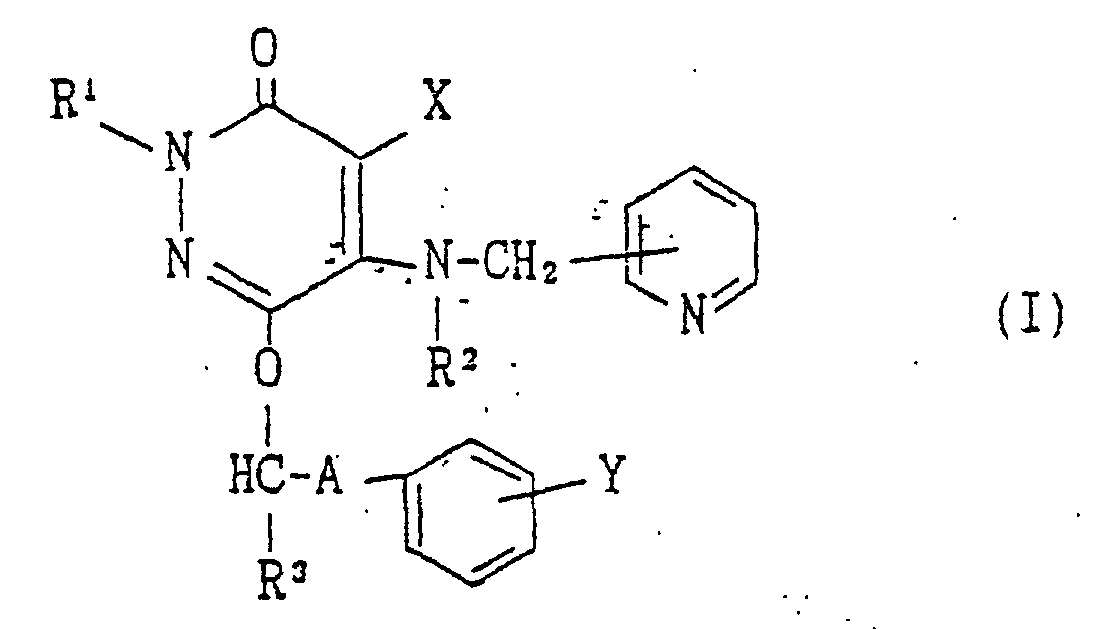
- a TXA 2 synthetase inhibitor which comprises, as an active ingredient, a pyridazinone compound of the formula (I) wherein R 1 , R 2 and R 3 are each independently a hydrogen atom or a lower alkyl, X is a halogen atom, a cyano or a hydrogen atom, Y is a halogen atom, a trifluoromethyl or a hydrogen atom and A is a C 1 -C 8 alkylene optionally substituted by hydroxyl, or a pharmacologically acceptable salt thereof.
- R 1 , R 2 and R 3 are each independently a hydrogen atom or a lower alkyl
- X is a halogen atom, a cyano or a hydrogen atom
- Y is a halogen atom, a trifluoromethyl or a hydrogen atom
- A is a C 1 -C 8 alkylene optionally substituted by hydroxyl, or a pharmacologically
- the lower alkyl for R 1 , R 2 and R 3 may be linear or branched and has 1 to 6 carbon atoms, such as methyl, ethyl, n-propyl, isopropyl, n-butyl, isobutyl, sec-butyl, t-butyl, pentyl and hexyl.
- R 1 and R 2 are each hydrogen atom, and preferable R 3 is hydrogen atom or C 1 -C 4 alkyl.
- the C 1 -C 4 alkyl for R 3 is exemplified by methyl, ethyl, n-propyl, isopropyl, n-butyl, isobutyl, sec-butyl and t-butyl.
- the halogen atom for X and Y is, for example, fluoro atom, chloro atom, bromo atom or iodo atom, with preference given to halogen atom for X, and halogen atom or hydrogen atom for Y.
- the C 1 -C 8 alkylene for A which is optionally substituted by hydroxyl, may be linear or branched and is exemplified by methylene, ethylene, propylene, butylene, pentylene, hexylene, heptylene, octylene, 2,2-dimethylethylene, 2,2-diethylethylene, 2,2-di-n-propylethylene, hydroxymethylene, 1-hydroxyethylene, 2-hydroxyethylene and 3-hydroxypropylene.
- the bonding site of methylene and pyridine ring is not particularly limited.
- Preferable site is the 3-position relative to the nitrogen atom on the pyridine ring.
- Y may be substituted at any position on the benzene ring, with preference given to the 4-position.
- a pyridazinone compound wherein, in the formula (I), R 1 and R 2 are hydrogen atoms, R 3 is a hydrogen atom or a C 1 -C 4 alkyl, X is a halogen atom, Y is a halogen atom or hydrogen atom and A is a C 1 -C 5 alkylene optionally substituted by hydroxyl is preferable.
- Examples of more preferable pyridazinone compound (I) include 4-bromo-6-(3-phenylpropoxy)-5-(3-pyridylmethylamino)-3(2H)-pyridazinone, 4-chloro-6-(3-phenylpropoxy)-5-(3-pyridylmethylamino)-3(2H)-pyridazinone, 4-chloro-6-[3-(4-chlorophenyl)propoxy]-5-(3-pyridylmethylamino)-3(2H)-pyridazinone, 4-bromo-6-[3-(4-chlorophenyl)propoxy]-5-(3-pyridylmethylamino)-3(2H)-pyridazinone, 4-bromo-6-(2,2-dimethyl-3-phenylpropoxy)-5-(3-pyridylmethylamino)-3(2H)-pyridazinone, 4-chlor
- the pyridazinone compound (I) used in the present invention includes stereo and optical isomers.
- the pyridazinone compound (I) is a known compound and can be produced by a method described in, for example, WO91/16314, US Patent No. 5202323, EP-A-482208 and International Patent Application No. PCT/JP95/69.
- the pharmacologically acceptable salts of the pyridazinone compound (I) are, for example, salts with inorganic acid (e.g. hydrochloride, hydrobromide, phosphate and sulfate) and salts with organic acid (acetate, succinate, maleate, fumarate, malate and tartrate).
- inorganic acid e.g. hydrochloride, hydrobromide, phosphate and sulfate
- organic acid acetate, succinate, maleate, fumarate, malate and tartrate
- the pyridazinone compound (I) can be converted to the aforementioned salts by a known method.
- the method for confirming the action of the compound (I) used in the present invention is subject to no particular limitation and the action can be confirmed by a known method.
- the pyridazinone compound (I) and pharmacologically acceptable salts thereof, which are the active ingredients in the present invention, are extremely low toxic and have prophylactic and therapeutic activities against TXA 2 -mediated diseases, particularly a TXA 2 synthetase inhibitory action, in mammals such as human, dog, cow, horse, rabbit, mouse and rat.
- TXA 2 -mediated diseases such as cerebral infarction, cerebral thrombosis, bronchial asthma, cerebral stroke, myocardial infarction, acute heart failure, angina pectoris, hypertension, arteriosclerosis obliterans, thromboangiitis obliterans, diabetic nephropathy, diabetic neuropathy and hypertriglyceridemia caused by diabetes, whereby the prophylaxis or treatment of arteriosclerosis obliterans, diabetic nephropathy, diabetic neuropathy and hypertriglyceridemia caused by diabetes are included in the present invention.
- the dosage form of the pyridazinone compound (I) and pharmacologically acceptable salts thereof is exemplified by non-oral administration of, for example, injection (subcutaneous, intravenous, intramuscular, intraperitoneal injections), ointment, suppository or aerosol, and oral administration of, for example, tablet, capsule, granule, pill, syrup, liquid, emulsion or suspension.
- the tablet, capsule, granule and pill for oral administration are prepared by using, for example, excipient (e.g. sucrose, lactose, glucose, starch and mannit), binder (e.g. syrup, gum arabic, gelatin, sorbit, tragacanth, methylcellulose and polyvinylpyrrolidone), disintegrator (e.g. starch, carboxymethylcellulose or calcium salt thereof, microcrystalline cellulose and polyethylene glycol) and lubricant (e.g. talc, magnesium stearate, calcium stearate, silica, sodium laurate and glycerol).
- excipient e.g. sucrose, lactose, glucose, starch and mannit
- binder e.g. syrup, gum arabic, gelatin, sorbit, tragacanth, methylcellulose and polyvinylpyrrolidone
- disintegrator e.g. starch, carboxymethylcellulose or calcium salt thereof, microcrystalline cellulose and polyethylene
- the injection, aerosole, syrup, liquid, emulsion and suspension are prepared using solvents for the active ingredient (e.g. water, ethyl alcohol, isopropyl alcohol, propylene glycol, 1,3-butylene glycol and polyethylene glycol), surfactant (e.g. sorbitan fatty acid ester, polyoxyethylenesorbitan fatty acid ester, polyoxyethylene fatty acid ester, polyoxyethylene ether of hydrogenated castor oil and lecithin), suspending agent (e.g. cellulose derivative such as methylcellulose and sodium salt of carboxymethylcellulose, and natural rubber such as tragacanth and gum arabic), preservative (e.g. p-hydroxybenzoate, benzalkonium chloride and sorbic acid salt) and the like.
- solvents for the active ingredient e.g. water, ethyl alcohol, isopropyl alcohol, propylene glycol, 1,3-butylene glycol and polyethylene glycol
- surfactant e.g.
- the dose of the pyridazinone compound (I) and pharmacologically acceptable salts thereof is appropriately determined according to age, body weight, severity of symptoms and the like of patients, and they are generally administered in 0.001-500 mg/day, preferably 0.005-100 mg/day in a single to several times divided doses to a human adult.
- Compound A 4-bromo-6-[3-(4-chlorophenyl)propoxy]-5-(3-pyridylmethylamino)-3(2H)-pyridazinone hydrochloride
- Compound B 4-bromo-6-[(3S)-(4-chlorophenyl)-3-hydroxypropoxy]-5-(3-pyridylmethylamino)-3(2H)-pyridazinone hydrochloride
- Compound C 4-bromo-6-[(3R)-(4-chlorophenyl)-3-hydroxypropoxy]-5-(3-pyridylmethylamino)-3(2H)-pyridazinone hydrochloride, which were prepared by conventional methods, were dissolved in 100% dimethyl sulfoxide (DMSO) and used as reagents on dilution with DMSO when in use.
- DMSO dimethyl sulfoxide
- EDTA ethylenediaminetetraacetic acid
- the blood was centrifuged at 1800 rpm for 8 minutes and platelet rich plasma in the supernatant was recovered, which was then centrifuged at 3200 rpm for 8 minutes.
- the sediment (platelet) was washed with Tyrode-HEPES-EDTA buffer and centrifuged at 3200 rpm for 8 minutes.
- the sediment was suspended in Tyrode-HEPES buffer to prepare washed platelets (5 ⁇ 10 8 platelets/ml).
- the homogenate was centrifuged at 8300 rpm for 15 minutes (Tomy RD-20III, No. 3N) and the supernatant was centrifuged at 1,000,000 rpm for 1 hour (Beckman TL-100, TLA100.3).
- the sediment was suspended in 0.05 M Tris-HCl buffer (1 mM EDTA, pH 7.5, one-third weight of the wet weight of platelets) to prepare a microsomal fraction. The fraction was stored at -80°C until used for the experiment.
- Tris-HCl buffer pH 7.5, 890 ⁇ l
- 100 ⁇ l of the above-mentioned microsome (85 ⁇ g protein) and 100% DMSO or the reagent (Compound A, 5 ⁇ l) were added and the mixture was preincubated at 22°C for 3 minutes.
- PGH 2 5 nmol, 5 ⁇ l
- 1N hydrochloric acid 50 ⁇ l
- 1M Tris base 55 ⁇ l was added to neutralize the reaction mixture and the mixture was centrifuged at 10,000 rpm for 5 minutes. The supernatant was recovered and stored at -20°C until used for the TXA 2 measurement.
- TXA 2 amount in the above Experimental Examples was measured as TXB 2 (stable compound thereof) amount by the EIA method using TXB 2 assay kit (manufactured by Amersham).
- IC 50 (amount necessary to inhibit 50% of TXA 2 synthesis) of TXA 2 synthetase inhibitory action, when human platelet microsome was used, was 0.010 ⁇ M for Compound A, and 0.020 ⁇ M and 0.030 ⁇ M for Compound B and Compound C as optical isomers, respectively.
- Compound A was orally administered to rats and dogs, and LD 50 was found to be not less than 2 g/kg, thus demonstrating the extremely low toxicity of the compound (I) used in the present invention.
- Compound A 10 g Lactose 20 g Starch 5 g Magnesium stearate 0.1 g Calcium carboxymethylcellulose 7 g total 42.1 g
- Compound A 10 g Lactose 20 g Crystalline cellulose 10 g Magnesium stearate 1 g total 41 g
- the pyridazinone compound (I) and pharmacologically acceptable salts thereof have prophylactic and therapeutic activities against TXA 2 -mediated diseases, particularly a TXA 2 synthetase inhibitory action, and are useful for the preparation of agents for the prophylaxis and treatment of the TXA 2 -mediated diseases arteriosclerosis obliterans, diabetic nephropathy, diabetic neuropathy and hypertriglyceridemia caused by diabetes particularly as TXA 2 synthetase inhibitors.
Landscapes
- Health & Medical Sciences (AREA)
- Pharmacology & Pharmacy (AREA)
- Veterinary Medicine (AREA)
- Public Health (AREA)
- General Health & Medical Sciences (AREA)
- Animal Behavior & Ethology (AREA)
- Chemical & Material Sciences (AREA)
- Life Sciences & Earth Sciences (AREA)
- Medicinal Chemistry (AREA)
- Engineering & Computer Science (AREA)
- Bioinformatics & Cheminformatics (AREA)
- Chemical Kinetics & Catalysis (AREA)
- Organic Chemistry (AREA)
- Nuclear Medicine, Radiotherapy & Molecular Imaging (AREA)
- General Chemical & Material Sciences (AREA)
- Epidemiology (AREA)
- Urology & Nephrology (AREA)
- Heart & Thoracic Surgery (AREA)
- Cardiology (AREA)
- Neurology (AREA)
- Reproductive Health (AREA)
- Biomedical Technology (AREA)
- Diabetes (AREA)
- Neurosurgery (AREA)
- Vascular Medicine (AREA)
- Endocrinology (AREA)
- Hematology (AREA)
- Pulmonology (AREA)
- Pharmaceuticals Containing Other Organic And Inorganic Compounds (AREA)
- Coloring Foods And Improving Nutritive Qualities (AREA)
- Acyclic And Carbocyclic Compounds In Medicinal Compositions (AREA)
- Plural Heterocyclic Compounds (AREA)
- Confectionery (AREA)
- Medicines Containing Plant Substances (AREA)
- Pyridine Compounds (AREA)
Abstract
Description
a TXA2 synthetase inhibitor, which comprises, as an active ingredient, a pyridazinone compound of the formula (I)
| TXA2 release suppressing action | TXA2 synthetase inhibitory action | ||
| stimulated with collagen | not stimulated | ||
| Compound A | 0.009 | 1.0 | 0.018 |
| Compound A | 10 g |
| Lactose | 20 g |
| Starch | 5 g |
| Magnesium stearate | 0.1 g |
| Calcium carboxymethylcellulose | 7 g |
| total | 42.1 g |
| Compound A | 10 g |
| Lactose | 20 g |
| Crystalline cellulose | 10 g |
| Magnesium stearate | 1 g |
| total | 41 g |
| Compound A | 1 g |
| Olive oil | 20 g |
| White petrolatum | 79 g |
| total | 100 g |
| (A) Compound A | 0.25wt% |
| Isopropyl myristate | 0.10wt% |
| Ethanol | 26.40wt% |
| (B) A 60wt%-40wt% mixture of 1,2-dichlorotetrafluoroethane and 1-chloropentafluoroethane | 73.25wt% |
Claims (4)
- A use of a pyridazinone compound of the formula (I)wherein R1, R2 and R3 are each independently a hydrogen atom or a lower alkyl, X is a halogen atom, a cyano or a hydrogen atom, Y is a halogen atom, a trifluoromethyl or a hydrogen atom and A is a C1-C8 alkylene optionally substituted by hydroxyl, or a pharmacologically acceptable salt thereof for the production of an agent for the prophylaxis or treatment of arteriosclerosis obliterans, diabetic nephropathy, diabetic neuropathy or hypertriglyceridemia caused by diabetes.

- The use of Claim 1, whereby the pyridazinone compound is a thromboxane A2 synthetase inhibitor.
- The use of Claim 1, wherein R1 and R2 are each a hydrogen atom, R3 is a hydrogen atom or a C1-C4 alkyl, X is a halogen atom, Y is a halogen atom or a hydrogen atom and A is a C1-C5 alkylene optionally substituted by hydroxyl.
- The use of Claim 1, wherein the pyridazinone compound of the formula (I) is a member selected from the group consisting of:4-bromo-6-(3-phenylpropoxy)-5-(3-pyridylmethylamino)-3(2H)-pyridazinone,4-chloro-6-(3-phenylpropoxy)-5-(3-pyridylmethylamino)-3(2H)-pyridazinone,4-chloro-6-[3-(4-chlorophenyl)propoxy]-5-(3-pyridylmethylamino)-3(2H)-pyridazinone,4-bromo-6-[3-(4-chlorophenyl)propoxy]-5-(3-pyridylmethylamino)-3(2H)-pyridazinone,4-bromo-6-(2,2-dimethyl-3-phenylpropoxy)-5-(3-pyridylmethyl-amino)-3(2H)-pyridazinone,4-chloro-6-(2,2-dimethyl-3-phenylpropoxy)-5-(3-pyridylmethyl-amino)-3(2H)-pyridazinone,4-bromo-6-[3-(4-chloroghenyl)-2,2-dimethylpropoxy]-5-(3-pyridyl-methylamino)-3(2H)-pyridazinone,4-chloro-6-[3-(4-chlorophenyl)-2,2-dimethylpropoxy]-5-(3-pyridylmethylamino)-3(2H)-pyridazinone,4-bromo-6-[3-(4-chlorophenyl)-3-hydroxypropoxy]-5-(3-pyridyl-methylamino)-3(2H)-pyridazinone,4-chloro-6-[3-(4-chlorophenyl)-3-hydroxypropoxy]-5-(3-pyridylmethylamino)-3(2H)-pyridazinone,4-bromo-6-[3-(4-chlorophenyl)-2-hydroxypropoxy]-5-(3-pyridylmethylamino)-3(2H)-pyridazinone and4-chloro-6-[3-(4-chlorophenyl)-2-hydroxypropoxy]-5-(3-pyridylmethylamino)-3(2H)-pyridazinone.
Applications Claiming Priority (4)
| Application Number | Priority Date | Filing Date | Title |
|---|---|---|---|
| JP2455694 | 1994-02-22 | ||
| JP24556/94 | 1994-02-22 | ||
| JP2455694 | 1994-02-22 | ||
| PCT/JP1995/000244 WO1995022329A1 (en) | 1994-02-22 | 1995-02-20 | Agent for prophylaxis and treatment of thromboxane a2-mediated diseases |
Publications (2)
| Publication Number | Publication Date |
|---|---|
| EP0744950A1 EP0744950A1 (en) | 1996-12-04 |
| EP0744950B1 true EP0744950B1 (en) | 2004-08-18 |
Family
ID=12141437
Family Applications (1)
| Application Number | Title | Priority Date | Filing Date |
|---|---|---|---|
| EP95909122A Expired - Lifetime EP0744950B1 (en) | 1994-02-22 | 1995-02-20 | Agent for prophylaxis and treatment of thromboxane a2 mediated diseases |
Country Status (16)
| Country | Link |
|---|---|
| US (1) | US5798357A (en) |
| EP (1) | EP0744950B1 (en) |
| JP (1) | JP3858279B2 (en) |
| KR (1) | KR100345187B1 (en) |
| CN (1) | CN1084620C (en) |
| AT (1) | ATE273708T1 (en) |
| AU (1) | AU1718395A (en) |
| CA (1) | CA2183234C (en) |
| DE (1) | DE69533392T2 (en) |
| DK (1) | DK0744950T3 (en) |
| ES (1) | ES2222464T3 (en) |
| FI (1) | FI116882B (en) |
| IL (1) | IL112695A (en) |
| NO (1) | NO311490B1 (en) |
| WO (1) | WO1995022329A1 (en) |
| ZA (1) | ZA951470B (en) |
Families Citing this family (8)
| Publication number | Priority date | Publication date | Assignee | Title |
|---|---|---|---|---|
| TW482675B (en) * | 1997-01-31 | 2002-04-11 | Green Cross Corp | Compositions for oral administration containing pyridazinone compounds technical field of the invention |
| DK1025847T3 (en) * | 1997-08-28 | 2006-02-13 | Nissan Chemical Ind Ltd | Neovascularization promoters and neovascularization enhancers |
| US6143113A (en) | 1998-03-02 | 2000-11-07 | Le Groupe Recherche I.D. Inc. | Repulpable corrugated boxboard |
| RU2229297C2 (en) * | 1998-09-01 | 2004-05-27 | Ниссан Кемикал Индастриз, Лтд. | Therapeutic agent for treatment of spinal channel stenosis |
| CA2353956C (en) * | 1998-12-07 | 2008-10-28 | Nissan Chemical Industries, Ltd. | Remedial agent for erectile dysfunction |
| AU2004308806B9 (en) * | 2003-12-26 | 2010-01-28 | Nissan Chemical Industries, Ltd. | Neutrophilia inhibitor |
| WO2009097406A1 (en) * | 2008-01-29 | 2009-08-06 | Indigo Pharmaceuticals | A method of administering a pde3 inhibitor via titration for the treatment of peripheral arterial disease |
| CN113546049B (en) * | 2021-04-30 | 2023-03-17 | 贵州汉方药业有限公司 | Flexible pill medicine adhesive and flexible pill prepared by using same |
Family Cites Families (5)
| Publication number | Priority date | Publication date | Assignee | Title |
|---|---|---|---|---|
| US4599336A (en) * | 1983-08-08 | 1986-07-08 | Hoffmann-La Roche Inc. | Derivatives of (E)-3-(4-oxo-4H-quinazolin-3-yl)-2-propenamide |
| EP0142057A3 (en) * | 1983-11-04 | 1988-03-30 | F. Hoffmann-La Roche Ag | Thiazoloquinazoline derivatives, their preparation and pharmaceutical compositions containing same |
| HU198696B (en) * | 1987-01-20 | 1989-11-28 | Nissan Chemical Ind Ltd | Process for producing 3/2h/-pyridazinon derivatives and pharmaceutical compositions containing them as active components |
| JPH02256668A (en) * | 1988-12-20 | 1990-10-17 | Nissan Chem Ind Ltd | Pyridazinone derivative |
| ES2149761T3 (en) * | 1990-04-25 | 2000-11-16 | Nissan Chemical Ind Ltd | DERIVED FROM PIRIDAZINONE. |
-
1995
- 1995-02-19 IL IL11269595A patent/IL112695A/en not_active IP Right Cessation
- 1995-02-20 CN CN95191744A patent/CN1084620C/en not_active Expired - Lifetime
- 1995-02-20 CA CA002183234A patent/CA2183234C/en not_active Expired - Lifetime
- 1995-02-20 AT AT95909122T patent/ATE273708T1/en active
- 1995-02-20 DE DE69533392T patent/DE69533392T2/en not_active Expired - Lifetime
- 1995-02-20 AU AU17183/95A patent/AU1718395A/en not_active Abandoned
- 1995-02-20 EP EP95909122A patent/EP0744950B1/en not_active Expired - Lifetime
- 1995-02-20 WO PCT/JP1995/000244 patent/WO1995022329A1/en not_active Ceased
- 1995-02-20 ES ES95909122T patent/ES2222464T3/en not_active Expired - Lifetime
- 1995-02-20 KR KR1019960704529A patent/KR100345187B1/en not_active Expired - Lifetime
- 1995-02-20 US US08/687,604 patent/US5798357A/en not_active Expired - Lifetime
- 1995-02-20 DK DK95909122T patent/DK0744950T3/en active
- 1995-02-21 JP JP03230095A patent/JP3858279B2/en not_active Expired - Fee Related
- 1995-02-22 ZA ZA951470A patent/ZA951470B/en unknown
-
1996
- 1996-08-20 NO NO19963463A patent/NO311490B1/en not_active IP Right Cessation
- 1996-08-21 FI FI963264A patent/FI116882B/en not_active IP Right Cessation
Also Published As
| Publication number | Publication date |
|---|---|
| ATE273708T1 (en) | 2004-09-15 |
| JPH07285869A (en) | 1995-10-31 |
| CA2183234A1 (en) | 1995-08-24 |
| AU1718395A (en) | 1995-09-04 |
| DK0744950T3 (en) | 2004-10-25 |
| US5798357A (en) | 1998-08-25 |
| WO1995022329A1 (en) | 1995-08-24 |
| DE69533392D1 (en) | 2004-09-23 |
| KR100345187B1 (en) | 2002-12-05 |
| CA2183234C (en) | 2004-05-04 |
| EP0744950A1 (en) | 1996-12-04 |
| NO311490B1 (en) | 2001-12-03 |
| CN1141590A (en) | 1997-01-29 |
| KR970701048A (en) | 1997-03-17 |
| NO963463L (en) | 1996-08-20 |
| JP3858279B2 (en) | 2006-12-13 |
| IL112695A (en) | 1999-04-11 |
| FI963264A7 (en) | 1996-08-21 |
| FI963264A0 (en) | 1996-08-21 |
| ES2222464T3 (en) | 2005-02-01 |
| DE69533392T2 (en) | 2005-09-01 |
| IL112695A0 (en) | 1995-05-26 |
| FI116882B (en) | 2006-03-31 |
| CN1084620C (en) | 2002-05-15 |
| ZA951470B (en) | 1995-12-07 |
Similar Documents
| Publication | Publication Date | Title |
|---|---|---|
| KR100559192B1 (en) | Angiogenesis and angiogenesis enhancers | |
| WO2004067003A1 (en) | Medicine for prevention of and treatment for arteriosclerosis and hypertension | |
| WO2015002118A1 (en) | Fluorene-amide compound and pharmaceutical application therefor | |
| US5798357A (en) | Agent for prophylaxis and treatment of thromboxane A2 -mediated diseases | |
| JP2010043132A (en) | Drug of combination of antithrombotic agent and pyrazolone derivative | |
| WO2015002119A1 (en) | Pyrazole-alcohol compound and pharmaceutical application therefor | |
| JPWO2004089412A1 (en) | Specific NAD (P) H oxidase inhibitor | |
| AU768825B2 (en) | Remedial agent for erectile dysfunction | |
| CA2553915C (en) | 3(2h)-pyridazinone compounds as vascular intimal hyperplasia inhibitor | |
| CN100502861C (en) | Medicament inhibiting sodium/calcium exchange system | |
| TW201031659A (en) | Novel compound having 3-(5-alkoxypyrimidin-2-yl) pyrimidin-4(3H)-on structure and medicine containg same | |
| WO2022135502A1 (en) | Multi-substituted uracil derivative and use thereof | |
| US6858617B2 (en) | Substituted imidazole compounds | |
| US9259416B2 (en) | Pyrazolone compounds useful for treatment of cerebrovascular disorders associated with ischemic stroke | |
| JP2006096664A (en) | Liver fibrosis inhibitor | |
| JP2004339214A (en) | Protein kinase stimulant | |
| JPWO2003080583A1 (en) | Medicament for prevention and / or treatment of cardiomyopathy | |
| JP2004115511A (en) | Sodium-calcium exchange inhibitor containing pyrazolone derivative as active ingredient | |
| EP0232423A1 (en) | Circulation improving agent | |
| EP2244710A1 (en) | A method of administering a pde3 inhibitor via titration for the treatment of peripheral arterial disease | |
| JPWO2008032814A1 (en) | Aspirin-containing medicine |
Legal Events
| Date | Code | Title | Description |
|---|---|---|---|
| PUAI | Public reference made under article 153(3) epc to a published international application that has entered the european phase |
Free format text: ORIGINAL CODE: 0009012 |
|
| AK | Designated contracting states |
Kind code of ref document: A1 Designated state(s): AT CH DE DK ES FR GB IT LI SE |
|
| 17P | Request for examination filed |
Effective date: 19960920 |
|
| RAP1 | Party data changed (applicant data changed or rights of an application transferred) |
Owner name: NISSAN CHEMICAL INDUSTRIES, LIMITED Owner name: YOSHITOMI PHARMACEUTICAL INDUSTRIES, LTD. |
|
| 17Q | First examination report despatched |
Effective date: 20001002 |
|
| RAP1 | Party data changed (applicant data changed or rights of an application transferred) |
Owner name: NISSAN CHEMICAL INDUSTRIES, LIMITED Owner name: WELFIDE CORPORATION |
|
| RAP1 | Party data changed (applicant data changed or rights of an application transferred) |
Owner name: NISSAN CHEMICAL INDUSTRIES, LIMITED Owner name: MITSUBISHI PHARMA CORPORATION |
|
| RAP1 | Party data changed (applicant data changed or rights of an application transferred) |
Owner name: NISSAN CHEMICAL INDUSTRIES, LIMITED |
|
| RTI1 | Title (correction) |
Free format text: AGENT FOR PROPHYLAXIS AND TREATMENT OF THROMBOXANE A2 MEDIATED DISEASES |
|
| GRAP | Despatch of communication of intention to grant a patent |
Free format text: ORIGINAL CODE: EPIDOSNIGR1 |
|
| GRAS | Grant fee paid |
Free format text: ORIGINAL CODE: EPIDOSNIGR3 |
|
| GRAA | (expected) grant |
Free format text: ORIGINAL CODE: 0009210 |
|
| AK | Designated contracting states |
Kind code of ref document: B1 Designated state(s): AT CH DE DK ES FR GB IT LI SE |
|
| REG | Reference to a national code |
Ref country code: GB Ref legal event code: FG4D |
|
| REG | Reference to a national code |
Ref country code: SE Ref legal event code: TRGR |
|
| REG | Reference to a national code |
Ref country code: CH Ref legal event code: EP |
|
| REF | Corresponds to: |
Ref document number: 69533392 Country of ref document: DE Date of ref document: 20040923 Kind code of ref document: P |
|
| REG | Reference to a national code |
Ref country code: DK Ref legal event code: T3 |
|
| REG | Reference to a national code |
Ref country code: CH Ref legal event code: NV Representative=s name: A. BRAUN, BRAUN, HERITIER, ESCHMANN AG PATENTANWAE |
|
| RAP2 | Party data changed (patent owner data changed or rights of a patent transferred) |
Owner name: NISSAN CHEMICAL INDUSTRIES, LTD. |
|
| REG | Reference to a national code |
Ref country code: ES Ref legal event code: FG2A Ref document number: 2222464 Country of ref document: ES Kind code of ref document: T3 |
|
| ET | Fr: translation filed | ||
| PLBE | No opposition filed within time limit |
Free format text: ORIGINAL CODE: 0009261 |
|
| STAA | Information on the status of an ep patent application or granted ep patent |
Free format text: STATUS: NO OPPOSITION FILED WITHIN TIME LIMIT |
|
| 26N | No opposition filed |
Effective date: 20050519 |
|
| REG | Reference to a national code |
Ref country code: CH Ref legal event code: PFA Owner name: NISSAN CHEMICAL INDUSTRIES, LTD. Free format text: NISSAN CHEMICAL INDUSTRIES, LTD.#7-1, KANDA NISHIKI-CHO 3-CHOME#CHIODA-KU, TOKYO 101-0054 (JP) -TRANSFER TO- NISSAN CHEMICAL INDUSTRIES, LTD.#7-1, KANDA NISHIKI-CHO 3-CHOME#CHIODA-KU, TOKYO 101-0054 (JP) |
|
| PGFP | Annual fee paid to national office [announced via postgrant information from national office to epo] |
Ref country code: CH Payment date: 20140212 Year of fee payment: 20 Ref country code: SE Payment date: 20140211 Year of fee payment: 20 Ref country code: DK Payment date: 20140211 Year of fee payment: 20 |
|
| PGFP | Annual fee paid to national office [announced via postgrant information from national office to epo] |
Ref country code: IT Payment date: 20140218 Year of fee payment: 20 Ref country code: FR Payment date: 20140211 Year of fee payment: 20 Ref country code: AT Payment date: 20140128 Year of fee payment: 20 Ref country code: ES Payment date: 20140113 Year of fee payment: 20 |
|
| PGFP | Annual fee paid to national office [announced via postgrant information from national office to epo] |
Ref country code: GB Payment date: 20140219 Year of fee payment: 20 |
|
| REG | Reference to a national code |
Ref country code: CH Ref legal event code: PCAR Free format text: NEW ADDRESS: HOLBEINSTRASSE 36-38, 4051 BASEL (CH) |
|
| PGFP | Annual fee paid to national office [announced via postgrant information from national office to epo] |
Ref country code: DE Payment date: 20140417 Year of fee payment: 20 |
|
| REG | Reference to a national code |
Ref country code: DE Ref legal event code: R071 Ref document number: 69533392 Country of ref document: DE |
|
| REG | Reference to a national code |
Ref country code: DK Ref legal event code: EUP Effective date: 20150220 |
|
| REG | Reference to a national code |
Ref country code: CH Ref legal event code: PL |
|
| REG | Reference to a national code |
Ref country code: GB Ref legal event code: PE20 Expiry date: 20150219 |
|
| REG | Reference to a national code |
Ref country code: SE Ref legal event code: EUG |
|
| REG | Reference to a national code |
Ref country code: AT Ref legal event code: MK07 Ref document number: 273708 Country of ref document: AT Kind code of ref document: T Effective date: 20150220 |
|
| PG25 | Lapsed in a contracting state [announced via postgrant information from national office to epo] |
Ref country code: GB Free format text: LAPSE BECAUSE OF EXPIRATION OF PROTECTION Effective date: 20150219 |
|
| REG | Reference to a national code |
Ref country code: ES Ref legal event code: FD2A Effective date: 20150826 |
|
| PG25 | Lapsed in a contracting state [announced via postgrant information from national office to epo] |
Ref country code: ES Free format text: LAPSE BECAUSE OF EXPIRATION OF PROTECTION Effective date: 20150221 |