EP0744127B1 - Method of manufacturing bread - Google Patents
Method of manufacturing bread Download PDFInfo
- Publication number
- EP0744127B1 EP0744127B1 EP95907858A EP95907858A EP0744127B1 EP 0744127 B1 EP0744127 B1 EP 0744127B1 EP 95907858 A EP95907858 A EP 95907858A EP 95907858 A EP95907858 A EP 95907858A EP 0744127 B1 EP0744127 B1 EP 0744127B1
- Authority
- EP
- European Patent Office
- Prior art keywords
- dough
- yeast
- days
- cells
- refrigeration
- Prior art date
- Legal status (The legal status is an assumption and is not a legal conclusion. Google has not performed a legal analysis and makes no representation as to the accuracy of the status listed.)
- Expired - Lifetime
Links
Classifications
-
- A—HUMAN NECESSITIES
- A21—BAKING; EDIBLE DOUGHS
- A21D—TREATMENT OF FLOUR OR DOUGH FOR BAKING, e.g. BY ADDITION OF MATERIALS; BAKING; BAKERY PRODUCTS
- A21D6/00—Other treatment of flour or dough before baking, e.g. cooling, irradiating or heating
- A21D6/001—Cooling
-
- A—HUMAN NECESSITIES
- A21—BAKING; EDIBLE DOUGHS
- A21D—TREATMENT OF FLOUR OR DOUGH FOR BAKING, e.g. BY ADDITION OF MATERIALS; BAKING; BAKERY PRODUCTS
- A21D8/00—Methods for preparing or baking dough
- A21D8/02—Methods for preparing dough; Treating dough prior to baking
- A21D8/04—Methods for preparing dough; Treating dough prior to baking treating dough with microorganisms or enzymes
- A21D8/047—Methods for preparing dough; Treating dough prior to baking treating dough with microorganisms or enzymes with yeasts
-
- C—CHEMISTRY; METALLURGY
- C12—BIOCHEMISTRY; BEER; SPIRITS; WINE; VINEGAR; MICROBIOLOGY; ENZYMOLOGY; MUTATION OR GENETIC ENGINEERING
- C12N—MICROORGANISMS OR ENZYMES; COMPOSITIONS THEREOF; PROPAGATING, PRESERVING, OR MAINTAINING MICROORGANISMS; MUTATION OR GENETIC ENGINEERING; CULTURE MEDIA
- C12N1/00—Microorganisms; Compositions thereof; Processes of propagating, maintaining or preserving microorganisms or compositions thereof; Processes of preparing or isolating a composition containing a microorganism; Culture media therefor
- C12N1/14—Fungi; Culture media therefor
- C12N1/16—Yeasts; Culture media therefor
- C12N1/18—Baker's yeast; Brewer's yeast
- C12N1/185—Saccharomyces isolates
-
- C—CHEMISTRY; METALLURGY
- C12—BIOCHEMISTRY; BEER; SPIRITS; WINE; VINEGAR; MICROBIOLOGY; ENZYMOLOGY; MUTATION OR GENETIC ENGINEERING
- C12R—INDEXING SCHEME ASSOCIATED WITH SUBCLASSES C12C - C12Q, RELATING TO MICROORGANISMS
- C12R2001/00—Microorganisms ; Processes using microorganisms
- C12R2001/645—Fungi ; Processes using fungi
- C12R2001/85—Saccharomyces
- C12R2001/865—Saccharomyces cerevisiae
Definitions
- the present invention relates to a process for making bread, specifically, a process which involves the storage of dough under freezing and then under refrigeration or the storage of dough under refrigeration and then under freezing, and further relates to a freezing and refrigeration resistant yeast to be used in the process.
- a method for making bread with frozen dough is used as one of the means of rationalization of production.
- a process for making bread is interrupted by freezing dough and the frozen dough can be baked after the final proof following thawing, which enables the control of the process.
- frozen dough endures a long-term storage, dispersion of the work in the bread-making process becomes possible.
- large-scale bakeries can send frozen dough from their factories to local bakeries, they can bake frozen dough in their ovens and offer just baked bread to the consumers at the stores.
- frozen dough has, at the same time, some defects; for example, the operation must be started earlier, because frozen dough takes much time to be completely thawed, and frozen dough must be baked soon after being thawed, because, after thawing, fermentation proceeds and dough cannot be preserved.
- a method for making bread with refrigerated dough is used.
- prepared dough is stored at a low temperature in such a range that dough may not freeze and is baked after the final proof as occasion demands.
- this method saves cost in freezing, freeze-storage, freeze-transportation, thawing, etc., and also saves time up to the step of baking, for thawing is not necessary.
- the present inventors obtained some of the yeast strains described in the above publications and measured the amount of carbon dioxide gas generated from dough containing the yeast strains after the storage under freezing and refrigeration to observe the fermentability of dough as shown in Table 1 below. However, the results were not satisfactory and the quality of the bread made from said dough was not good enough.
- FR-A-2,442,588 discloses a process which enables long storage of non-fermented dough before cooking without adverse effect on the quality of bread produced from the dough.
- the process comprises freezing, at a temperature of between -40°C and 0°C for at least about 24 hours, yeast and optionally one or more of salt and malt.
- EP-A-0 194 189 discloses a process for the production of French bread from dough comprising 300-350 W strength flour, water, salt, yeast and ascorbic acid.
- the process comprises kneading dough and allowing it to rise in conventional manner, dividing it into loaves, allowing the loaves to rest, proving the loaves in conventional manner, incising them, deep freezing the loaves and storing them at -25°C and baking the loaves straight from the freezer.
- An object of the present invention is to make bread which is excellent in specific volume, etc., even with dough containing yeast which underwent storage under freezing and refrigeration.
- the present invention relates to a process for making bread, characterized in that dough is prepared by kneading a mixture of flour or rye flour, yeast and water, and the prepared dough is frozen and then refrigerated or refrigerated and then frozen, followed by ordinary bread-making steps.
- bread as used herein includes all kinds of bread prepared by using yeast as a leavening agent such as Chinese buns and yeast doughnuts, besides so-called bread such as ordinary one-loaf bread, buns, and Danish pastries.
- the yeast used is such that the fermentability of dough containing the yeast is maintained after the storage under freezing followed by refrigeration, or the storage under refrigeration followed by freezing.
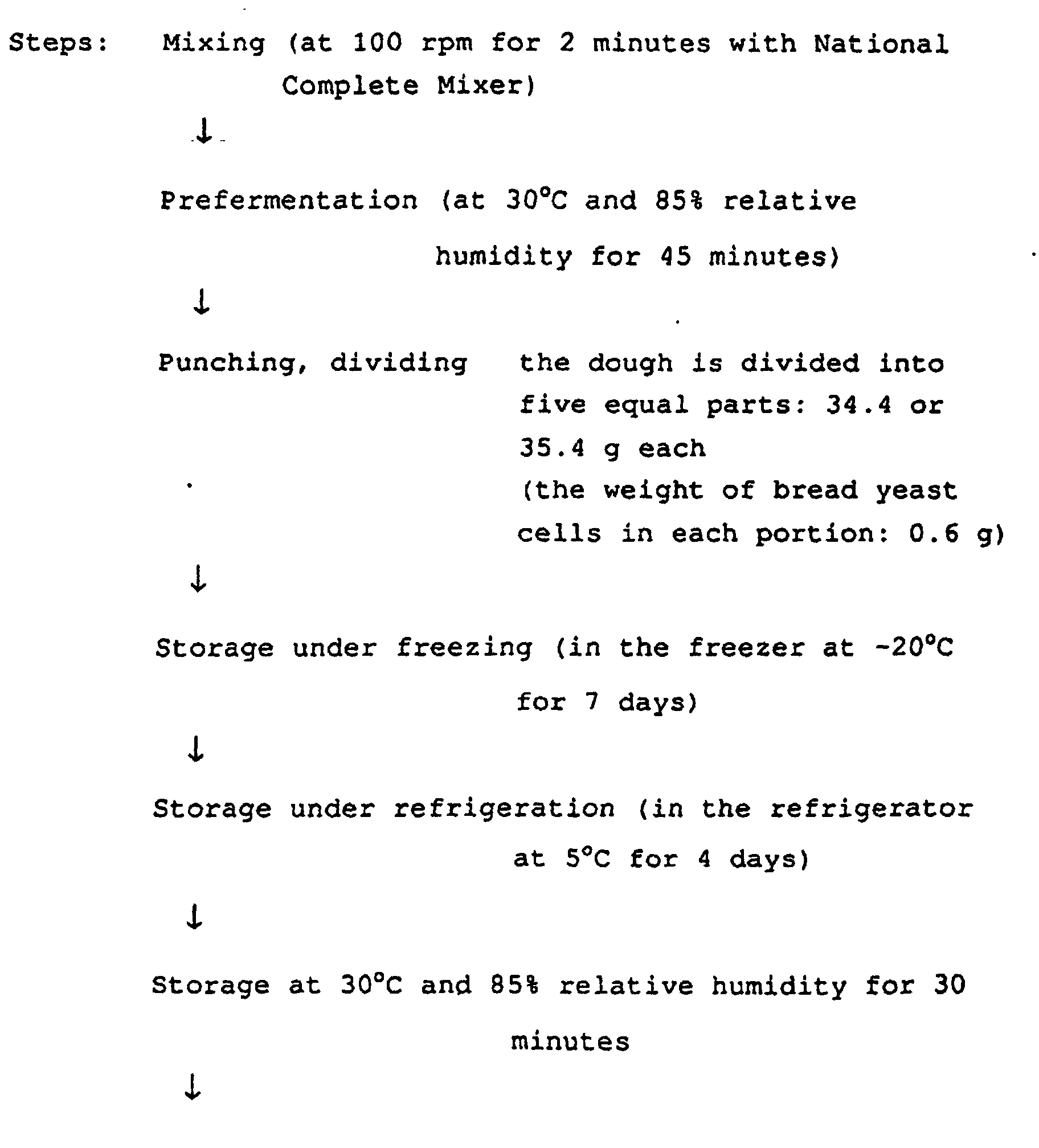
- the yeast is a strain belonging to the genus Saccharomyces which gives dough fermentability in such a degree that the dough containing the yeast and 5-15% sugar generates carbon dioxide gas in an amount of more than 100 ml/0.6 g (yeast cells at 30°C in 2 hours after the storage at -20°C for 7 days and then at 5°C for 4 days, or that the dough containing the yeast and 5-15% sugar generates carbon dioxide gas in an amount of more than 80 ml/0.6 g yeast cells at 30°C in 2 hours after the storage at 5°C for 4 days and then at -20°C for 7 days (the yeast is referred to as freezing and refrigeration resistant yeast).
- a dough containing the yeast and 5 or 15% sugar, and which may be used in the present invention, has the following composition.
- Dough Composition (Unit: g) Hard flour 100 Sugar 5 or 15 Salt 2.0 or 1.2 Water 62 or 58 Yeast cells (obtained by the cultivation described in Example 1) 3
- the freezing and refrigeration resistant yeast used in the present invention may be selected from the strains separated from nature or the strains stored at research laboratories, etc. However, they are usually obtained by mutating freezing resistant yeast as a parent strain and then by selecting mutants having the low-temperature-sensitive fermentability, or by mutating a mutant having the low-temperature-sensitive fermentability as a parent strain and then by selecting freezing resistant mutants.
- freezing and refrigeration resistant yeast can be obtained in the following manner using freezing resistant yeast as a parent strain.
- Freezing resistant yeast for example, bread yeast, sake yeast, wine yeast, beer yeast, miso and shochu yeast
- the obtained cells are brought into contact with an antibiotic (for example, antimycin and nystatin), and cultivated at a low temperature (10 to 15°C) to select the cells which show no proliferation or very poor proliferation at the low temperature (the primary selection).
- the strains selected in the primary selection include the strains which show no proliferation ability or poor proliferation ability due to the suppression of energy metabolism caused by the lack or lowering of fermentability at the low temperature, as well as the strains which show no proliferation ability or poor proliferation ability due to other causes, for example, mutation of proliferation control mechanism.
- the strains which show no fermentability or extremely low level of fermentability at a temperature of 15°C or lower are selected. Then, from the strains selected in the secondary selection, the strains are selected which recover the normal fermentability at a temperature of 20°C or higher (20 to 40°C) (the tertiary selection). Finally, from the strains selected in the tertiary selection, the strains are selected which can be used for making normal bread by a method in which freezing of dough and refrigeration of dough are combined (the quaternary selection).
- strains used in the present invention are Saccharomyces cerevisiae RRT16 (hereinafter referred to as RRT16) and FSC5531 (hereinafter referred to as FSC5531).
- FSC005 Cells of Saccharomyces cerevisiae FSC005 (hereinafter referred to as FSC005) which is bread yeast having the characteristics shown in Table 1 are cultivated at 30°C for 12 hours in YPD medium comprising 1% yeast extract, 2% polypeptone and 2% glucose, and centrifuged to collect cells. The collected cells are suspended in 0.067 M potassium dihydrogenphosphate solution to a density of 1 x 10 7 cells/ml to give the absorbance of 1.0. After this cell suspension is irradiated with ultraviolet light so that the survival rate of cells becomes 1-30%, the cells are subjected to the primary selection.
- YPD medium comprising 1% yeast extract, 2% polypeptone and 2% glucose
- the primary selection is conducted as follows.
- the cell suspension subjected to ultraviolet light treatment (200 ⁇ l) is inoculated into 5 ml of YPD medium and cultivated at 30°C for 12 hours, followed by centrifugation to collect cells.
- the collected cells are cultivated in 1 ml of nitrogen-free minimum medium comprising 0.17% Yeast Nitrogen Base w/o amino acids and ammonium sulfate (Difco Laboratories) and 1% glucose at 30°C for 12 hours, and the culture was centrifuged again to collect cells.
- the collected cells are suspended in 0.9 ml of YPD medium containing 1 x 10 -5 M antimycin, and cultivated at 10°C for 24 to 36 hours.
- nystatin 10 ⁇ g/ml nystatin, followed by cultivation at 10°C for 2 hours. After centrifugation, the collected cells are spread on YPD plate medium comprising 1% yeast extract, 2% polypeptone, 2% glucose and 2% agar, and cultivated at 30°C for 48 hours to grow colonies.
- the secondary selection is conducted as follows.
- the colonies separated in the primary selection are transferred onto YPG plate medium comprising 1% yeast extract, 2% polypeptone, 3% glycerol and 2% agar, and cultivated at 30°C for 24 hours to grow colonies.
- a pigment agar medium comprising 0.5% yeast extract, 1% peptone, 10% sucrose, 0.02% Bromocresol Purple and 1% agar is layered over the colonies, and the colonies are cultivated at 5°C for 12 hours.
- Selection can be made based on the color change at the periphery of the colonies during the cultivation, as the strains having the normal fermentability at 5°C change from purple to yellow in color, while the strains having no fermentability or low level of fermentability at 5°C do not change at all or change slightly in color.
- the tertiary selection is conducted as follows.
- the colonies selected in the secondary selection are transferred onto YPG plate medium and cultivated at 30°C for 24 hours to grow colonies.
- the above-mentioned pigment agar medium is layered over the colonies, and the colonies are cultivated at 30°C for 2 hours.
- the strains are obtained which have sufficient fermentability by selecting the strains which show the color change from purple to yellow at the periphery of colonies.
- the quaternary selection is conducted as follows.
- the strains selected in the tertiary selection are cultivated by the method described in Example 1 to obtain cells.
- Bread dough is prepared using the cells according to the following dough composition and preparation processes, and the amount of the carbon dioxide gas generated from the dough after storage under freezing and refrigeration is measured at 30°C. From the tested strains, an excellent strain is selected.
- the strain obtained by the above process was named RRT16.
- FSC5531 was obtained by selecting an excellent strain from the strains stored at Kyowa Hakko Kogyo Co., Ltd. by the same method as in the quaternary selection described above.
- the yeast strains of the present invention have higher dough fermentability as compared with the control strains, FSC005, YST, RZT3, IAM4274 and NCIMB40328-40332; that is, the amount of carbon dioxide gas generated from the dough containing RRT16 and FSC5531 (sugar content: 5 or 15%) are as much as more than 100 ml after the storage under freezing and then under refrigeration and are as much as more than 80 ml after the storage under refrigeration and then under freezing.
- yeast can be added to any dough prepared by kneading a mixture of flour or rye flour, salt and water.
- the dough prepared in the following manner is given as a representative example.
- Basic ingredients such as flour or rye flour, salt and fats are mixed with additional ingredients such as sugar, shortening, butter, skim milk, yeast food and eggs, if necessary, and then water is added to this mixture, followed by kneading.
- the dough When bread dough is stored under freezing and then under refrigeration before baking, the dough is first stored at -10 to -30°C, preferably -18 to -25°C, for 1 to 60 days, preferably 1 to 30 days, and then at -5 to 10°C, preferably 0 to 5°C, for 1 to 10 days, preferably 1 to 5 days.
- the dough When bread dough is stored under refrigeration and then under freezing, the dough is first stored at -5 to 10°C, preferably 0 to 5°C, for 1 to 10 days, preferably 1 to 5 days, and then at -10 to -30°C, preferably -18 to -25°C, for 1 to 60 days, preferably 1 to 30 days.
- the conditions for the storage under freezing and refrigeration and the storage under refrigeration and freezing may further be combined as may be appropriate.
- Yeast cells which are suitable for bread-making are obtained by cultivating yeast in an ordinary culture medium containing carbon sources, nitrogen sources, inorganic substances, amino acids and vitamins, etc. under aerobic conditions, while adjusting the temperature at 27 to 32°C, and recovering and washing the cells.
- glucose, sucrose, starch hydrolyzate, molasses, etc. can be used and especially preferred is molasses.
- ammonia ammonium chloride, ammonium sulfate, ammonium carbonate, ammonium acetate, urea, yeast extract, corn steep liquor, etc. can be used.
- Magnesium phosphate, potassium phostate, etc. can be used as the inorganic substances; glutamic acid, etc. can be used as the amino acids; and pantothenic acid, thiamine, etc. can be used as the vitamins. Feeding cultivation is desirable as the cultivation method.
- Bread dough to be used is obtained by adding salt, fat, water and the yeast obtained as above to flour or rye flour. Sugar, shortening, butter, skim milk, yeast food, eggs, etc. may be added, if necessary.
- the former is a method in which all the ingredients are mixed at a time.
- the latter is a method in which at first a sponge is made by kneading a part of flour and yeast with water, and then, after fermentation, the remaining ingredients are added to the sponge.
- ingredients such as flour or rye flour, salt, the yeast obtained as above, sugar, shortening, eggs and skim milk are kneaded with water to prepare dough, and fat such as butter and margarine is folded into the dough. Rolling and folding are repeated to make multiple layers of the dough and the fat.
- This step of folding the fat is called "roll-in", which can be carried out by two methods. In one method, the temperature of the dough to be kneaded is lowered to about 15°C, and the dough is kneaded without cooling until the intended number of layers are made. Generally, the rise of dough temperature and fat temperature during the folding step causes a difference in extensibility between dough and fat, whereby the uniformity of layers is likely to be lost.
- One platinum loopful of cells of the test yeast strain was inoculated into a 300-ml Erlenmeyer flask containing 30 ml of YPD medium, and cultivated at 30°C for 24 hours. After the cultivation, the whole culture was transferred into a 2-liter Erlenmeyer flask with a baffle containing 270 ml of molasses medium (3% molasses, 0.193% urea, 0.046% potassium dihydrogenphosphate and 2 drops of defoaming agent), and cultivated at 30°C for 24 hours. The culture was centrifuged, and the collected cells were washed twice with deionized water and dehydrated on an absorptive clay plate.
- Buns were produced by the same method as in Example 1, except that FSC5531, YST, IAM4274, RZT3 or NCIMB40329 was used as the yeast strain in the dough composition instead of RRT16.
- the specific volume of the obtained bread was measured and the appearance and the crumb properties were observed. The results are shown in Table 2.
- the present invention provides bread which is superior in specific volume, appearance and crumb properties.
Landscapes
- Life Sciences & Earth Sciences (AREA)
- Engineering & Computer Science (AREA)
- Mycology (AREA)
- Health & Medical Sciences (AREA)
- Chemical & Material Sciences (AREA)
- Bioinformatics & Cheminformatics (AREA)
- Genetics & Genomics (AREA)
- Food Science & Technology (AREA)
- Biotechnology (AREA)
- Organic Chemistry (AREA)
- Zoology (AREA)
- Wood Science & Technology (AREA)
- Microbiology (AREA)
- Tropical Medicine & Parasitology (AREA)
- Biomedical Technology (AREA)
- Virology (AREA)
- Botany (AREA)
- Biochemistry (AREA)
- General Engineering & Computer Science (AREA)
- General Health & Medical Sciences (AREA)
- Medicinal Chemistry (AREA)
- Physics & Mathematics (AREA)
- Thermal Sciences (AREA)
- Bakery Products And Manufacturing Methods Therefor (AREA)
- Micro-Organisms Or Cultivation Processes Thereof (AREA)
Abstract
Description
| Dough Composition | (Unit: g) |
| Hard flour | 100 |
| Sugar | 5 or 15 |
| Salt | 2.0 or 1.2 |
| Water | 62 or 58 |
| Yeast cells (obtained by the cultivation described in Example 1) | 3 |
| Dough Composition | (Unit: g) |
| Hard flour | 100 |
| Sugar | 5 or 15 |
| Salt | 2.0 or 1.2 |
| Water | 62 or 58 |
| Yeast cells | 3 |


| Amount of Carbon | Dioxide Gas (ml) | ||
| Strains | Dough | -20°C. 7 days (freezing) 5°C, 4 days | 5°C, 4 days (refrigeration) -20°C, 7 days (freezing) |
| RRT16 | 5% dough | 116 | 101 |
| FSC5531 | 5% dough | 115 | 81 |
| FSC005 | 5% dough | 95 | 57 |
| YST | 5% dough | 91 | 34 |
| R2T3 | 5% dough | 80 | 52 |
| IAM4274 | 5% dough | 87 | 66 |
| NCIMB40328 | 5% dough | 37 | 28 |
| NCIMB40329 | 5% dough | 83 | 74 |
| NCIMB40330 | 5% dough | 79 | 75 |
| NCIME40331 | 5% dough | 72 | 76 |
| NCIMB40332 | 5% dough | 82 | 75 |
| RRT16 | 15% dough | 112 | 89 |
| FSC5531 | 15% dough | 129 | 96 |
| FSC005 | 15% dough | 96 | 45 |
| YST | 15% dough | 94 | 14 |
| RZT3 | 15% dough | 54 | 49 |
| IAM4274 | 15% dough | 94 | 68 |
| NCIMB40328 | 15% dough | 29 | 23 |
| NCIMB40329 | 15% dough | 94 | 73 |
| NCIMB40330 | 15% dough | 84 | 72 |
| NCIMB40331 | 15% dough | 91 | 78 |
| NCIMB40332 | 15% dough | 96 | 74 |
| Dough Composition | (Parts by Weight) |
| Hard flour | 90 |
| Soft flour | 10 |
| Sugar | 25 |
| Salt | 1 |
| Whole eggs | 10 |
| Shortening | 5 |
| Yeast food (PAN DIA C-500 Kyowa Hakko Kogyo Co., Ltd.) | 0.1 |
| Dough improver (ELMIZER FT-100, Kyowa Hakko Kogyo Co., Ltd.) | 1.0 |
| Yeast cells (RRT16) | 6 |
| Water | 46 |
medium speed (190 rpm: hereinafter the same shall apply); 3 minutes
high speed (290 rpm: hereinafter the same shall apply); 1 minute
addition of shortening
low speed; 2 minutes
medium speed; 3 minutes
high speed; 3 minutes
Kneading temperature (22°C)
| Floor time | (15 minutes) |
| Dividing | (100 g) |
| Freezing | (-20°C, 7 days) |
| Refrigeration | (5°C, 4 days) |
| Benching | (room temp., 40 minutes) |
| Molding | (molder, roll shape) |
| Proofing | (40°C, 85% RH, 45 minutes) |
| Baking | (200°C, 12 minutes) |
| Examples and Comparative Examples | Strains | Specific volume (cm3/g) | Evaluation | ||
| Appearance | Crumb properties | ||||
| Examples | 1 | RRT16 | 5.42 | 3 | 3 |
| 2 | FSC5531 | 5.65 | 3 | 3 | |
| Comparative Examples | 1 | YST | 4.22 | 2 | 1 |
| 2 | IAM4274 | 2.84 | 1 | 1 | |
| 3 | RZT3 | 4.13 | 2 | 1 | |
| 4 | NCIMB40329 | 4.45 | 2 | 2 |
| Dough Composition | (Parts by Weight) |
| Hard flour | 70 |
| Soft flour | 30 |
| Sugar | 10 |
| Salt | 1.2 |
| Shortening | 6 |
| Skim milk | 3 |
| Whole eggs | 10 |
| PAN DIA C-500 | 0.1 |
| ELMIZER FT-100 | 1.0 |
| Yeast cells (RRT16) | 6 |
| Water | 50 |
| Margarine for folding | 50 |
Kneading temperature (22°C)
Floor time (20 minutes)
Dividing (1 kg x 4)
Freezing (-20°C, 30 minutes)
Roll-in [folding in three x twice (9 layers)]
(Margarine for folding: 50% of the whole flour)
Refrigeration (5°C, 2 days)
Rolling [folding in three x once (27 layers), rolling into 4 mm in thickness]
Dividing, molding (50 g roll)
Freezing (-20°C, 14 days)
Thawing (30°C, 60 minutes)
Proofing (35°C, 75% RH, 70 minutes)
Baking (200°C, 12 minutes)
| Examples and Comparative Examples | Strains | Specific volume (cm3/g) | Evaluation | ||
| Appearance | Crumb properties | ||||
| Examples | 3 | RRT16 | 5.90 | 3 | 3 |
| 4 | FSC5531 | 5.95 | 3 | 3 | |
| Comparative Examples | 5 | YST | 4.75 | 2 | 1 |
| 6 | IAM4274 | 4.87 | 2 | 1 | |
| 7 | RZT3 | 4.10 | 1 | 1 | |
| 8 | NCIMB40329 | 4.82 | 2 | 1 |
Claims (8)
- A process for making bread which comprises the steps of:wherein the yeast is a strain belonging to the genus Saccharomyces which has freeze and refrigeration resistance and gives dough fermentability whereby the dough containing the yeast and 5-15% sugar generates carbon dioxide gas in an amount of more than 100 ml/0.6 g yeast cells at 30°C in two hours after the storage at -20°C for seven days and then at 5°C for four days, or whereby the dough containing the yeast and 5-15% sugar generates carbon dioxide gas in an amount of more than 80 ml/0.6g yeast cells at 30°C in two hours after the storage at 5°C for four days and then at -20°C for seven days.(1) kneading flour, yeast and water to prepare dough;(2) storing the dough (i) under refrigeration conditions at -5 to 10°C for 1-10 days and then under freeze conditions at -10 to -30°C for 1-60 days, or (ii) under freeze conditions at -10 to -30°C for 1-60 days and then under refrigeration conditions at -5 to 10°C for 1-10 days; and(3) making bread from the dough.
- A process according to claim 1, wherein the flour is rye flour.
- Dough containing yeast belonging to the genus Saccharomyces which has freeze and refrigeration resistance and gives dough fermentability in such a degree that the dough containing the yeast and 5-15% sugar generates carbon dioxide gas in an amount of more than 100 ml/0.6g yeast cells at 30°C in two hours after the storage at -20°C for seven days and then at 5°C for four days, or that the dough containing the yeast and 5-15% sugar generates carbon dioxide gas in an amount of more than 80 ml/0.6g yeast cells at 30°C in two hours after the storage at 5°C for four days and then at -20°C for seven days.
- Saccharomyces cerevisiae which has freeze and refrigeration resistance and which gives dough fermentability in such a degree that the dough containing the yeast and 5-15% sugar generates carbon dioxide gas in an amount of more than 100 ml/0.6 g yeast cells at 30°C in two hours after the storage at -20°C for seven days and then at 5°C for four days, or that the dough containing the yeast and 5-15% sugar generates carbon dioxide gas in an amount of more than 80 ml/0.6g yeast cells at 30°C in two hours after the storage at 5°C for four days and then at -20°C for seven days.
- Saccharomyces cerevisiae according to claim 4, wherein Saccharomyces cerevisiae is Saccharomyces cerevisiae FSC5531 deposited as FERM BP-4488 or Saccharomyces cerevisiae RRT16 deposited as FERM BP-4489.
- A process according to claim 1, wherein said yeast is obtained by cultivating at 30°C for 12 hours in a medium comprising 1% yeast extract, 2% polypeptone and 2% glucose, and centrifuging to collect yeast cells, said cells are suspended in 0.067M potassium dihydrogenphosphate solution to a density of 1x10⁷ cells/ml to give an absorbance of 1.0, irradiating the cell suspension with ultraviolet light such that the survival of the cells is about 1-30%, and subjecting the cells to primary, secondary, tertiary and quaternary selection, the primary selection being to select the cells which show no proliferation or very poor proliferation at a low temperature (10 to 15°C), the secondary selection being to select the strains which show no fermentability or extremely low level of fermentability at a temperature of 15°C or lower, the tertiary selection being to select the strains which recover the normal fermentability at a temperature of 20°C or higher, and the quaternary selection being to select the strains which can be used for making normal bread by a method in which freezing of dough and refrigeration of dough are combined.
- A process according to claim 6, wherein said storing the dough under freeze conditions, and then under refrigeration conditions, includes storage under freezing in a freezer at -20°C for seven days and storage under refrigeration at 5°C for four days.
- A process according to claim 6, wherein said storing the dough under refrigeration conditions and then under freeze conditions includes the steps of storage under refrigeration at 5°C for four days, and storing under freezing in a freezer at -20°C for seven days.
Applications Claiming Priority (4)
| Application Number | Priority Date | Filing Date | Title |
|---|---|---|---|
| JP1544394 | 1994-02-09 | ||
| JP15443/94 | 1994-02-09 | ||
| JP1544394 | 1994-02-09 | ||
| PCT/JP1995/000172 WO1995021533A1 (en) | 1994-02-09 | 1995-02-08 | Method of manufacturing bread |
Publications (3)
| Publication Number | Publication Date |
|---|---|
| EP0744127A1 EP0744127A1 (en) | 1996-11-27 |
| EP0744127A4 EP0744127A4 (en) | 1999-06-09 |
| EP0744127B1 true EP0744127B1 (en) | 2003-05-14 |
Family
ID=11888957
Family Applications (1)
| Application Number | Title | Priority Date | Filing Date |
|---|---|---|---|
| EP95907858A Expired - Lifetime EP0744127B1 (en) | 1994-02-09 | 1995-02-08 | Method of manufacturing bread |
Country Status (5)
| Country | Link |
|---|---|
| EP (1) | EP0744127B1 (en) |
| AT (1) | ATE240043T1 (en) |
| AU (1) | AU693155B2 (en) |
| DE (1) | DE69530756T2 (en) |
| WO (1) | WO1995021533A1 (en) |
Families Citing this family (2)
| Publication number | Priority date | Publication date | Assignee | Title |
|---|---|---|---|---|
| ITPD20060298A1 (en) * | 2006-07-31 | 2008-02-01 | Colle Egidio Dal | PROCEDURE FOR THE PRODUCTION OF NATURAL YEAST FOR BAKERY PRODUCTS AND YEAST OBTAINED BY PROCEDURE |
| CN103429730A (en) * | 2011-03-18 | 2013-12-04 | 株式会社钟化 | New Baker's Yeast |
Family Cites Families (9)
| Publication number | Priority date | Publication date | Assignee | Title |
|---|---|---|---|---|
| JPS5016862B2 (en) * | 1972-12-08 | 1975-06-17 | ||
| FR2442588A1 (en) * | 1978-12-01 | 1980-06-27 | Nourigeon Andre | PROCESS FOR THE PREPARATION OF A LONG-LASTING BREAD AND A PRODUCT OBTAINED |
| JPS6015308B2 (en) * | 1982-03-13 | 1985-04-18 | 農林水産省食品総合研究所長 | Satsukaromyces cerevisiae FTY (FRI-413) |
| FR2577388B1 (en) * | 1985-02-20 | 1989-06-09 | Pantin Sa Grands Moulins | BREAD MAKING PROCESS |
| JPH06506349A (en) * | 1991-04-09 | 1994-07-21 | アー. フリッシュ ゲーエムベーハー ウント コンパニ カーゲー | Method for producing yeast cookies and a stretched yeast batter therefor |
| JP2970962B2 (en) * | 1991-08-14 | 1999-11-02 | 日清製粉株式会社 | Bread improver |
| JP3163363B2 (en) * | 1992-04-10 | 2001-05-08 | 味の素株式会社 | Manufacturing method of refrigerated dough for bread and bread |
| JP3170352B2 (en) * | 1992-06-10 | 2001-05-28 | 協和醗酵工業株式会社 | Bread making |
| AU682019B2 (en) * | 1993-03-12 | 1997-09-18 | Burns Philp & Company Limited | Novel yeast strains |
-
1995
- 1995-02-08 WO PCT/JP1995/000172 patent/WO1995021533A1/en not_active Ceased
- 1995-02-08 DE DE69530756T patent/DE69530756T2/en not_active Expired - Fee Related
- 1995-02-08 EP EP95907858A patent/EP0744127B1/en not_active Expired - Lifetime
- 1995-02-08 AU AU15911/95A patent/AU693155B2/en not_active Ceased
- 1995-02-08 AT AT95907858T patent/ATE240043T1/en not_active IP Right Cessation
Also Published As
| Publication number | Publication date |
|---|---|
| ATE240043T1 (en) | 2003-05-15 |
| DE69530756D1 (en) | 2003-06-18 |
| EP0744127A1 (en) | 1996-11-27 |
| WO1995021533A1 (en) | 1995-08-17 |
| AU693155B2 (en) | 1998-06-25 |
| AU1591195A (en) | 1995-08-29 |
| EP0744127A4 (en) | 1999-06-09 |
| DE69530756T2 (en) | 2004-04-29 |
Similar Documents
| Publication | Publication Date | Title |
|---|---|---|
| EP1541671B1 (en) | Novel baker's yeast strains and bread using the same | |
| US3963835A (en) | Fermented flour and method of preparation | |
| EP0667099B1 (en) | Baking process | |
| CA2143477C (en) | Low-temperature inactive industrial baker's yeast | |
| US5997914A (en) | Process for making bread | |
| US4680182A (en) | Baker's dough | |
| US5801049A (en) | Freeze-resistant baker's yeast strain having sugar resistance | |
| AU693155B2 (en) | Method of manufacturing bread | |
| JPH0779767A (en) | Novel yeast and bread dough containing the yeast | |
| US6077550A (en) | Process for making bread | |
| US7198810B2 (en) | Yeast | |
| JP3766701B2 (en) | Novel yeast, bread dough containing the yeast, and method for producing the dough | |
| US20040022897A1 (en) | Drying-resistant yeast | |
| Kyogoku et al. | Isolation of a cold-sensitive fermentation mutant of a baker's yeast strain and its use in a refrigerated dough process | |
| JPH07213277A (en) | Cold-sensitive baker's yeast and method for producing bread | |
| JP3006886B2 (en) | Bread making method | |
| CA2153559C (en) | Freeze-resistant baker's yeast having sugar resistance | |
| AU682019B2 (en) | Novel yeast strains | |
| JP3266708B2 (en) | Manufacturing method of fat and oil folded bread | |
| CA2146245C (en) | Process for making bread | |
| US5543161A (en) | Yeast strain | |
| JP3563755B2 (en) | New baker's yeast | |
| JPWO1995021533A1 (en) | Bread making method | |
| JPH0771444B2 (en) | Frozen dough | |
| Sugihara | Commercial starters in the United States |
Legal Events
| Date | Code | Title | Description |
|---|---|---|---|
| PUAI | Public reference made under article 153(3) epc to a published international application that has entered the european phase |
Free format text: ORIGINAL CODE: 0009012 |
|
| 17P | Request for examination filed |
Effective date: 19960819 |
|
| AK | Designated contracting states |
Kind code of ref document: A1 Designated state(s): AT BE CH DE DK ES FR GB GR IE IT LI LU MC NL PT SE |
|
| A4 | Supplementary search report drawn up and despatched |
Effective date: 19990427 |
|
| AK | Designated contracting states |
Kind code of ref document: A4 Designated state(s): AT BE CH DE DK ES FR GB GR IE IT LI LU MC NL PT SE |
|
| 17Q | First examination report despatched |
Effective date: 20020325 |
|
| GRAH | Despatch of communication of intention to grant a patent |
Free format text: ORIGINAL CODE: EPIDOS IGRA |
|
| GRAH | Despatch of communication of intention to grant a patent |
Free format text: ORIGINAL CODE: EPIDOS IGRA |
|
| GRAA | (expected) grant |
Free format text: ORIGINAL CODE: 0009210 |
|
| AK | Designated contracting states |
Designated state(s): AT BE CH DE DK ES FR GB GR IE IT LI LU MC NL PT SE |
|
| PG25 | Lapsed in a contracting state [announced via postgrant information from national office to epo] |
Ref country code: NL Free format text: LAPSE BECAUSE OF FAILURE TO SUBMIT A TRANSLATION OF THE DESCRIPTION OR TO PAY THE FEE WITHIN THE PRESCRIBED TIME-LIMIT Effective date: 20030514 Ref country code: LI Free format text: LAPSE BECAUSE OF FAILURE TO SUBMIT A TRANSLATION OF THE DESCRIPTION OR TO PAY THE FEE WITHIN THE PRESCRIBED TIME-LIMIT Effective date: 20030514 Ref country code: CH Free format text: LAPSE BECAUSE OF FAILURE TO SUBMIT A TRANSLATION OF THE DESCRIPTION OR TO PAY THE FEE WITHIN THE PRESCRIBED TIME-LIMIT Effective date: 20030514 Ref country code: BE Free format text: LAPSE BECAUSE OF FAILURE TO SUBMIT A TRANSLATION OF THE DESCRIPTION OR TO PAY THE FEE WITHIN THE PRESCRIBED TIME-LIMIT Effective date: 20030514 Ref country code: AT Free format text: LAPSE BECAUSE OF FAILURE TO SUBMIT A TRANSLATION OF THE DESCRIPTION OR TO PAY THE FEE WITHIN THE PRESCRIBED TIME-LIMIT Effective date: 20030514 |
|
| REG | Reference to a national code |
Ref country code: GB Ref legal event code: FG4D |
|
| REG | Reference to a national code |
Ref country code: CH Ref legal event code: EP |
|
| REG | Reference to a national code |
Ref country code: IE Ref legal event code: FG4D |
|
| REF | Corresponds to: |
Ref document number: 69530756 Country of ref document: DE Date of ref document: 20030618 Kind code of ref document: P |
|
| PG25 | Lapsed in a contracting state [announced via postgrant information from national office to epo] |
Ref country code: SE Free format text: LAPSE BECAUSE OF FAILURE TO SUBMIT A TRANSLATION OF THE DESCRIPTION OR TO PAY THE FEE WITHIN THE PRESCRIBED TIME-LIMIT Effective date: 20030814 Ref country code: PT Free format text: LAPSE BECAUSE OF FAILURE TO SUBMIT A TRANSLATION OF THE DESCRIPTION OR TO PAY THE FEE WITHIN THE PRESCRIBED TIME-LIMIT Effective date: 20030814 Ref country code: GR Free format text: LAPSE BECAUSE OF FAILURE TO SUBMIT A TRANSLATION OF THE DESCRIPTION OR TO PAY THE FEE WITHIN THE PRESCRIBED TIME-LIMIT Effective date: 20030814 Ref country code: DK Free format text: LAPSE BECAUSE OF FAILURE TO SUBMIT A TRANSLATION OF THE DESCRIPTION OR TO PAY THE FEE WITHIN THE PRESCRIBED TIME-LIMIT Effective date: 20030814 |
|
| PG25 | Lapsed in a contracting state [announced via postgrant information from national office to epo] |
Ref country code: ES Free format text: LAPSE BECAUSE OF FAILURE TO SUBMIT A TRANSLATION OF THE DESCRIPTION OR TO PAY THE FEE WITHIN THE PRESCRIBED TIME-LIMIT Effective date: 20030825 |
|
| NLV1 | Nl: lapsed or annulled due to failure to fulfill the requirements of art. 29p and 29m of the patents act | ||
| REG | Reference to a national code |
Ref country code: CH Ref legal event code: PL |
|
| PG25 | Lapsed in a contracting state [announced via postgrant information from national office to epo] |
Ref country code: LU Free format text: LAPSE BECAUSE OF NON-PAYMENT OF DUE FEES Effective date: 20040208 |
|
| PG25 | Lapsed in a contracting state [announced via postgrant information from national office to epo] |
Ref country code: IE Free format text: LAPSE BECAUSE OF NON-PAYMENT OF DUE FEES Effective date: 20040209 |
|
| PG25 | Lapsed in a contracting state [announced via postgrant information from national office to epo] |
Ref country code: MC Free format text: LAPSE BECAUSE OF NON-PAYMENT OF DUE FEES Effective date: 20040228 |
|
| ET | Fr: translation filed | ||
| PLBE | No opposition filed within time limit |
Free format text: ORIGINAL CODE: 0009261 |
|
| STAA | Information on the status of an ep patent application or granted ep patent |
Free format text: STATUS: NO OPPOSITION FILED WITHIN TIME LIMIT |
|
| 26N | No opposition filed |
Effective date: 20040217 |
|
| REG | Reference to a national code |
Ref country code: IE Ref legal event code: MM4A |
|
| REG | Reference to a national code |
Ref country code: GB Ref legal event code: 732E |
|
| REG | Reference to a national code |
Ref country code: FR Ref legal event code: TP |
|
| PGFP | Annual fee paid to national office [announced via postgrant information from national office to epo] |
Ref country code: FR Payment date: 20071212 Year of fee payment: 14 |
|
| PGFP | Annual fee paid to national office [announced via postgrant information from national office to epo] |
Ref country code: IT Payment date: 20080212 Year of fee payment: 14 Ref country code: GB Payment date: 20080214 Year of fee payment: 14 |
|
| PGFP | Annual fee paid to national office [announced via postgrant information from national office to epo] |
Ref country code: DE Payment date: 20080410 Year of fee payment: 14 |
|
| GBPC | Gb: european patent ceased through non-payment of renewal fee |
Effective date: 20090208 |
|
| REG | Reference to a national code |
Ref country code: FR Ref legal event code: ST Effective date: 20091030 |
|
| PG25 | Lapsed in a contracting state [announced via postgrant information from national office to epo] |
Ref country code: DE Free format text: LAPSE BECAUSE OF NON-PAYMENT OF DUE FEES Effective date: 20090901 |
|
| PG25 | Lapsed in a contracting state [announced via postgrant information from national office to epo] |
Ref country code: GB Free format text: LAPSE BECAUSE OF NON-PAYMENT OF DUE FEES Effective date: 20090208 Ref country code: FR Free format text: LAPSE BECAUSE OF NON-PAYMENT OF DUE FEES Effective date: 20090302 |
|
| PG25 | Lapsed in a contracting state [announced via postgrant information from national office to epo] |
Ref country code: IT Free format text: LAPSE BECAUSE OF NON-PAYMENT OF DUE FEES Effective date: 20090208 |