EP0742275A1 - Liquid crystal compound and liquid crystal composition containing the same - Google Patents
Liquid crystal compound and liquid crystal composition containing the same Download PDFInfo
- Publication number
- EP0742275A1 EP0742275A1 EP95900293A EP95900293A EP0742275A1 EP 0742275 A1 EP0742275 A1 EP 0742275A1 EP 95900293 A EP95900293 A EP 95900293A EP 95900293 A EP95900293 A EP 95900293A EP 0742275 A1 EP0742275 A1 EP 0742275A1
- Authority
- EP
- European Patent Office
- Prior art keywords
- propylcyclohexyl
- cyclohexyl
- liquid crystal
- cyclohexane
- compound
- Prior art date
- Legal status (The legal status is an assumption and is not a legal conclusion. Google has not performed a legal analysis and makes no representation as to the accuracy of the status listed.)
- Granted
Links
- 150000001875 compounds Chemical class 0.000 title claims abstract description 189
- 239000000203 mixture Substances 0.000 title claims abstract description 86
- 239000004973 liquid crystal related substance Substances 0.000 title claims abstract description 45
- 229910052731 fluorine Chemical group 0.000 claims abstract description 32
- 125000003545 alkoxy group Chemical group 0.000 claims abstract description 20
- 125000001153 fluoro group Chemical group F* 0.000 claims abstract description 16
- 229910052739 hydrogen Inorganic materials 0.000 claims abstract description 12
- 125000004435 hydrogen atom Chemical group [H]* 0.000 claims abstract description 11
- 125000000217 alkyl group Chemical group 0.000 claims description 27
- 239000007788 liquid Substances 0.000 claims description 26
- 125000004432 carbon atom Chemical group C* 0.000 claims description 25
- 125000000113 cyclohexyl group Chemical group [H]C1([H])C([H])([H])C([H])([H])C([H])(*)C([H])([H])C1([H])[H] 0.000 claims description 13
- 125000001997 phenyl group Chemical group [H]C1=C([H])C([H])=C(*)C([H])=C1[H] 0.000 claims description 10
- 125000001570 methylene group Chemical group [H]C([H])([*:1])[*:2] 0.000 claims description 6
- 125000004430 oxygen atom Chemical group O* 0.000 claims description 6
- 125000003342 alkenyl group Chemical group 0.000 claims description 4
- 125000004849 alkoxymethyl group Chemical group 0.000 claims description 4
- 125000000714 pyrimidinyl group Chemical group 0.000 claims description 4
- VDFVNEFVBPFDSB-UHFFFAOYSA-N 1,3-dioxane Chemical group C1COCOC1 VDFVNEFVBPFDSB-UHFFFAOYSA-N 0.000 claims description 2
- 230000001603 reducing effect Effects 0.000 abstract description 8
- 239000011737 fluorine Chemical group 0.000 abstract description 4
- 239000001257 hydrogen Substances 0.000 abstract 2
- 125000004400 (C1-C12) alkyl group Chemical group 0.000 abstract 1
- PXGOKWXKJXAPGV-UHFFFAOYSA-N Fluorine Chemical group FF PXGOKWXKJXAPGV-UHFFFAOYSA-N 0.000 abstract 1
- UFHFLCQGNIYNRP-UHFFFAOYSA-N Hydrogen Chemical compound [H][H] UFHFLCQGNIYNRP-UHFFFAOYSA-N 0.000 abstract 1
- QVGXLLKOCUKJST-UHFFFAOYSA-N atomic oxygen Chemical compound [O] QVGXLLKOCUKJST-UHFFFAOYSA-N 0.000 abstract 1
- 239000001301 oxygen Substances 0.000 abstract 1
- 229910052760 oxygen Inorganic materials 0.000 abstract 1
- YXFVVABEGXRONW-UHFFFAOYSA-N Toluene Chemical compound CC1=CC=CC=C1 YXFVVABEGXRONW-UHFFFAOYSA-N 0.000 description 60
- CSNNHWWHGAXBCP-UHFFFAOYSA-L Magnesium sulfate Chemical compound [Mg+2].[O-][S+2]([O-])([O-])[O-] CSNNHWWHGAXBCP-UHFFFAOYSA-L 0.000 description 47
- LFQSCWFLJHTTHZ-UHFFFAOYSA-N Ethanol Chemical compound CCO LFQSCWFLJHTTHZ-UHFFFAOYSA-N 0.000 description 33
- 238000000034 method Methods 0.000 description 31
- CSJLBAMHHLJAAS-UHFFFAOYSA-N diethylaminosulfur trifluoride Chemical compound CCN(CC)S(F)(F)F CSJLBAMHHLJAAS-UHFFFAOYSA-N 0.000 description 26
- YMWUJEATGCHHMB-UHFFFAOYSA-N Dichloromethane Chemical compound ClCCl YMWUJEATGCHHMB-UHFFFAOYSA-N 0.000 description 24
- 239000000243 solution Substances 0.000 description 21
- 239000002904 solvent Substances 0.000 description 17
- XLYOFNOQVPJJNP-UHFFFAOYSA-N water Substances O XLYOFNOQVPJJNP-UHFFFAOYSA-N 0.000 description 17
- 239000012044 organic layer Substances 0.000 description 16
- XEKOWRVHYACXOJ-UHFFFAOYSA-N Ethyl acetate Chemical compound CCOC(C)=O XEKOWRVHYACXOJ-UHFFFAOYSA-N 0.000 description 15
- 229910052943 magnesium sulfate Inorganic materials 0.000 description 15
- 235000019341 magnesium sulphate Nutrition 0.000 description 15
- 238000004519 manufacturing process Methods 0.000 description 13
- IMNFDUFMRHMDMM-UHFFFAOYSA-N N-Heptane Chemical compound CCCCCCC IMNFDUFMRHMDMM-UHFFFAOYSA-N 0.000 description 12
- 239000004988 Nematic liquid crystal Substances 0.000 description 11
- 239000007864 aqueous solution Substances 0.000 description 11
- 150000001732 carboxylic acid derivatives Chemical class 0.000 description 11
- 230000000704 physical effect Effects 0.000 description 11
- 239000000047 product Substances 0.000 description 11
- 238000010898 silica gel chromatography Methods 0.000 description 11
- VEXZGXHMUGYJMC-UHFFFAOYSA-N Hydrochloric acid Chemical compound Cl VEXZGXHMUGYJMC-UHFFFAOYSA-N 0.000 description 10
- -1 bicyclic cyclohexane type compounds Chemical class 0.000 description 10
- WVIIMZNLDWSIRH-UHFFFAOYSA-N cyclohexylcyclohexane Chemical class C1CCCCC1C1CCCCC1 WVIIMZNLDWSIRH-UHFFFAOYSA-N 0.000 description 10
- 239000005457 ice water Substances 0.000 description 10
- XDTMQSROBMDMFD-UHFFFAOYSA-N Cyclohexane Chemical compound C1CCCCC1 XDTMQSROBMDMFD-UHFFFAOYSA-N 0.000 description 9
- RTZKZFJDLAIYFH-UHFFFAOYSA-N Diethyl ether Chemical compound CCOCC RTZKZFJDLAIYFH-UHFFFAOYSA-N 0.000 description 9
- 150000001299 aldehydes Chemical class 0.000 description 9
- 239000012025 fluorinating agent Substances 0.000 description 9
- 229920006395 saturated elastomer Polymers 0.000 description 9
- 238000001228 spectrum Methods 0.000 description 9
- 239000007795 chemical reaction product Substances 0.000 description 8
- 230000003247 decreasing effect Effects 0.000 description 8
- BWHMMNNQKKPAPP-UHFFFAOYSA-L potassium carbonate Chemical compound [K+].[K+].[O-]C([O-])=O BWHMMNNQKKPAPP-UHFFFAOYSA-L 0.000 description 8
- FYSNRJHAOHDILO-UHFFFAOYSA-N thionyl chloride Chemical compound ClS(Cl)=O FYSNRJHAOHDILO-UHFFFAOYSA-N 0.000 description 8
- 238000006243 chemical reaction Methods 0.000 description 7
- JHIVVAPYMSGYDF-PTQBSOBMSA-N cyclohexanone Chemical class O=[13C]1CCCCC1 JHIVVAPYMSGYDF-PTQBSOBMSA-N 0.000 description 7
- PSHGCNJUMMECFZ-UHFFFAOYSA-N 1-(2,2-difluorobutyl)-4-(4-pentylcyclohexyl)cyclohexane Chemical compound C1CC(CCCCC)CCC1C1CCC(CC(F)(F)CC)CC1 PSHGCNJUMMECFZ-UHFFFAOYSA-N 0.000 description 6
- XXUSEPRYHRDKFV-UHFFFAOYSA-N 4-(4-propylcyclohexyl)benzonitrile Chemical compound C1CC(CCC)CCC1C1=CC=C(C#N)C=C1 XXUSEPRYHRDKFV-UHFFFAOYSA-N 0.000 description 6
- UHOVQNZJYSORNB-UHFFFAOYSA-N Benzene Chemical compound C1=CC=CC=C1 UHOVQNZJYSORNB-UHFFFAOYSA-N 0.000 description 6
- UIIMBOGNXHQVGW-UHFFFAOYSA-M Sodium bicarbonate Chemical compound [Na+].OC([O-])=O UIIMBOGNXHQVGW-UHFFFAOYSA-M 0.000 description 6
- HEMHJVSKTPXQMS-UHFFFAOYSA-M Sodium hydroxide Chemical compound [OH-].[Na+] HEMHJVSKTPXQMS-UHFFFAOYSA-M 0.000 description 6
- 239000003153 chemical reaction reagent Substances 0.000 description 6
- 239000003638 chemical reducing agent Substances 0.000 description 6
- VLKZOEOYAKHREP-UHFFFAOYSA-N n-Hexane Chemical compound CCCCCC VLKZOEOYAKHREP-UHFFFAOYSA-N 0.000 description 6
- 238000010992 reflux Methods 0.000 description 6
- FEWMLRARKGRCCE-UHFFFAOYSA-N 1,2,3-trifluoro-5-[4-(4-propylcyclohexyl)cyclohexyl]benzene Chemical compound C1CC(CCC)CCC1C1CCC(C=2C=C(F)C(F)=C(F)C=2)CC1 FEWMLRARKGRCCE-UHFFFAOYSA-N 0.000 description 5
- YDVUSMRUBCJGAV-UHFFFAOYSA-N 1,2-difluoro-4-[4-(4-pentylcyclohexyl)cyclohexyl]benzene Chemical compound C1CC(CCCCC)CCC1C1CCC(C=2C=C(F)C(F)=CC=2)CC1 YDVUSMRUBCJGAV-UHFFFAOYSA-N 0.000 description 5
- FSWZOZXLWVWJAH-UHFFFAOYSA-N 1,2-difluoro-4-[4-(4-propylcyclohexyl)cyclohexyl]benzene Chemical compound C1CC(CCC)CCC1C1CCC(C=2C=C(F)C(F)=CC=2)CC1 FSWZOZXLWVWJAH-UHFFFAOYSA-N 0.000 description 5
- OEWYIYCFTCTTSG-UHFFFAOYSA-N 1-(2-fluorobutyl)-4-(4-pentylcyclohexyl)cyclohexane Chemical compound C1CC(CCCCC)CCC1C1CCC(CC(F)CC)CC1 OEWYIYCFTCTTSG-UHFFFAOYSA-N 0.000 description 5
- YZYKLSXFNMOXIN-UHFFFAOYSA-N 1-but-3-enyl-4-[4-(3-fluoropropyl)cyclohexyl]cyclohexane Chemical compound C1CC(CCCF)CCC1C1CCC(CCC=C)CC1 YZYKLSXFNMOXIN-UHFFFAOYSA-N 0.000 description 5
- 238000005160 1H NMR spectroscopy Methods 0.000 description 5
- IBLVSWYGUFGDMF-UHFFFAOYSA-N 2-cyclohexylethylcyclohexane Chemical class C1CCCCC1CCC1CCCCC1 IBLVSWYGUFGDMF-UHFFFAOYSA-N 0.000 description 5
- WDECTZREPSJUQW-UHFFFAOYSA-N 4-[4-(4-ethylcyclohexyl)cyclohexyl]-1,2-difluorobenzene Chemical compound C1CC(CC)CCC1C1CCC(C=2C=C(F)C(F)=CC=2)CC1 WDECTZREPSJUQW-UHFFFAOYSA-N 0.000 description 5
- 150000005378 cyclohexanecarboxylic acids Chemical class 0.000 description 5
- 229940093499 ethyl acetate Drugs 0.000 description 5
- 235000019439 ethyl acetate Nutrition 0.000 description 5
- 238000002290 gas chromatography-mass spectrometry Methods 0.000 description 5
- 238000002844 melting Methods 0.000 description 5
- 230000008018 melting Effects 0.000 description 5
- 239000000126 substance Substances 0.000 description 5
- 150000007970 thio esters Chemical class 0.000 description 5
- TUJZDDRNVWOGEN-UHFFFAOYSA-N 1-(1,6-difluorocyclohexa-2,4-dien-1-yl)-4-(4-pentylcyclohexyl)benzene Chemical group C1CC(CCCCC)CCC1C1=CC=C(C2(F)C(C=CC=C2)F)C=C1 TUJZDDRNVWOGEN-UHFFFAOYSA-N 0.000 description 4
- MZALMYVRGLIRDW-UHFFFAOYSA-N 1-(1,6-difluorocyclohexa-2,4-dien-1-yl)-4-(4-propylcyclohexyl)benzene Chemical group C1CC(CCC)CCC1C1=CC=C(C2(F)C(C=CC=C2)F)C=C1 MZALMYVRGLIRDW-UHFFFAOYSA-N 0.000 description 4
- RNHPTZHUUJKBPZ-UHFFFAOYSA-N 1-(3-fluoropropoxy)-4-(4-propylcyclohexyl)cyclohexane Chemical compound C1CC(CCC)CCC1C1CCC(OCCCF)CC1 RNHPTZHUUJKBPZ-UHFFFAOYSA-N 0.000 description 4
- VUAJDLZDPGDWSC-UHFFFAOYSA-N 1-chloro-2-fluoro-4-[4-[2-(4-propylcyclohexyl)ethyl]cyclohexyl]benzene Chemical compound C1CC(CCC)CCC1CCC1CCC(C=2C=C(F)C(Cl)=CC=2)CC1 VUAJDLZDPGDWSC-UHFFFAOYSA-N 0.000 description 4
- SDESCXGEQILYTQ-UHFFFAOYSA-N 1-methyl-4-[4-(4-propylcyclohexyl)cyclohexyl]benzene Chemical compound C1CC(CCC)CCC1C1CCC(C=2C=CC(C)=CC=2)CC1 SDESCXGEQILYTQ-UHFFFAOYSA-N 0.000 description 4
- WQJVIFBSXSFHDA-UHFFFAOYSA-N 4-[4-(4-propylcyclohexyl)cyclohexyl]benzonitrile Chemical compound C1CC(CCC)CCC1C1CCC(C=2C=CC(=CC=2)C#N)CC1 WQJVIFBSXSFHDA-UHFFFAOYSA-N 0.000 description 4
- NLXLAEXVIDQMFP-UHFFFAOYSA-N Ammonia chloride Chemical compound [NH4+].[Cl-] NLXLAEXVIDQMFP-UHFFFAOYSA-N 0.000 description 4
- 150000001350 alkyl halides Chemical class 0.000 description 4
- 239000000470 constituent Substances 0.000 description 4
- HPXRVTGHNJAIIH-PTQBSOBMSA-N cyclohexanol Chemical class O[13CH]1CCCCC1 HPXRVTGHNJAIIH-PTQBSOBMSA-N 0.000 description 4
- 125000002887 hydroxy group Chemical group [H]O* 0.000 description 4
- 229910000027 potassium carbonate Inorganic materials 0.000 description 4
- 230000007704 transition Effects 0.000 description 4
- KAMYBEKPILURLI-UHFFFAOYSA-N (4-fluorophenyl) 4-(4-propylcyclohexyl)benzoate Chemical compound C1CC(CCC)CCC1C1=CC=C(C(=O)OC=2C=CC(F)=CC=2)C=C1 KAMYBEKPILURLI-UHFFFAOYSA-N 0.000 description 3
- TXHFUCYJBLLNIG-UHFFFAOYSA-N 1,2,3-trifluoro-5-[4-(4-pentylcyclohexyl)cyclohexyl]benzene Chemical compound C1CC(CCCCC)CCC1C1CCC(C=2C=C(F)C(F)=C(F)C=2)CC1 TXHFUCYJBLLNIG-UHFFFAOYSA-N 0.000 description 3
- RRKRBRVTKIRLHH-UHFFFAOYSA-N 1,2,3-trifluoro-5-[4-(4-propylcyclohexyl)phenyl]benzene Chemical group C1CC(CCC)CCC1C1=CC=C(C=2C=C(F)C(F)=C(F)C=2)C=C1 RRKRBRVTKIRLHH-UHFFFAOYSA-N 0.000 description 3
- ZYMOEIZEVBYKFK-UHFFFAOYSA-N 1,2-difluoro-4-[2-(4-pentylcyclohexyl)ethyl]benzene Chemical compound C1CC(CCCCC)CCC1CCC1=CC=C(F)C(F)=C1 ZYMOEIZEVBYKFK-UHFFFAOYSA-N 0.000 description 3
- TYTUMDURYLEHSQ-UHFFFAOYSA-N 1-(1,6-difluorocyclohexa-2,4-dien-1-yl)-4-(4-ethylcyclohexyl)benzene Chemical group C1CC(CC)CCC1C1=CC=C(C2(F)C(C=CC=C2)F)C=C1 TYTUMDURYLEHSQ-UHFFFAOYSA-N 0.000 description 3
- FAZPKGXQNYSGOX-UHFFFAOYSA-N 1-(2-fluorobutoxy)-4-(4-pentylcyclohexyl)cyclohexane Chemical compound C1CC(CCCCC)CCC1C1CCC(OCC(F)CC)CC1 FAZPKGXQNYSGOX-UHFFFAOYSA-N 0.000 description 3
- YDHVTDQHVDSMTQ-UHFFFAOYSA-N 1-(3,3-difluoropropoxy)-4-(4-propylcyclohexyl)cyclohexane Chemical compound C1CC(CCC)CCC1C1CCC(OCCC(F)F)CC1 YDHVTDQHVDSMTQ-UHFFFAOYSA-N 0.000 description 3
- ODUMHBCZWWKLFE-UHFFFAOYSA-N 1-chloro-4-(4-hexylcyclohexyl)benzene Chemical compound C1CC(CCCCCC)CCC1C1=CC=C(Cl)C=C1 ODUMHBCZWWKLFE-UHFFFAOYSA-N 0.000 description 3
- WZFHHZHDRYVMEN-UHFFFAOYSA-N 1-chloro-4-[4-(4-pentylcyclohexyl)cyclohexyl]benzene Chemical compound C1CC(CCCCC)CCC1C1CCC(C=2C=CC(Cl)=CC=2)CC1 WZFHHZHDRYVMEN-UHFFFAOYSA-N 0.000 description 3
- FQJHIVLPDQLNAL-UHFFFAOYSA-N 1-chloro-4-[4-(4-propylcyclohexyl)cyclohexyl]benzene Chemical compound C1CC(CCC)CCC1C1CCC(C=2C=CC(Cl)=CC=2)CC1 FQJHIVLPDQLNAL-UHFFFAOYSA-N 0.000 description 3
- IKODGORUTZMKPL-UHFFFAOYSA-N 1-fluoro-4-[4-(4-propylcyclohexyl)cyclohexyl]benzene Chemical compound C1CC(CCC)CCC1C1CCC(C=2C=CC(F)=CC=2)CC1 IKODGORUTZMKPL-UHFFFAOYSA-N 0.000 description 3
- WJXVHSVXCKKMEO-UHFFFAOYSA-N 3-[4-(4-propylcyclohexyl)cyclohexyl]oxypropan-1-ol Chemical compound C1CC(CCC)CCC1C1CCC(OCCCO)CC1 WJXVHSVXCKKMEO-UHFFFAOYSA-N 0.000 description 3
- KUTRRJRCMJMMIE-UHFFFAOYSA-N 3-[4-(4-propylcyclohexyl)cyclohexyl]oxypropanal Chemical compound C1CC(CCC)CCC1C1CCC(OCCC=O)CC1 KUTRRJRCMJMMIE-UHFFFAOYSA-N 0.000 description 3
- DLLIPJSMDJCZRF-UHFFFAOYSA-N 4-(4-ethylphenyl)benzonitrile Chemical group C1=CC(CC)=CC=C1C1=CC=C(C#N)C=C1 DLLIPJSMDJCZRF-UHFFFAOYSA-N 0.000 description 3
- IAZDPXIOMUYVGZ-UHFFFAOYSA-N Dimethylsulphoxide Chemical compound CS(C)=O IAZDPXIOMUYVGZ-UHFFFAOYSA-N 0.000 description 3
- LYCAIKOWRPUZTN-UHFFFAOYSA-N Ethylene glycol Chemical compound OCCO LYCAIKOWRPUZTN-UHFFFAOYSA-N 0.000 description 3
- 239000004990 Smectic liquid crystal Substances 0.000 description 3
- ZMANZCXQSJIPKH-UHFFFAOYSA-N Triethylamine Chemical compound CCN(CC)CC ZMANZCXQSJIPKH-UHFFFAOYSA-N 0.000 description 3
- 229910052799 carbon Inorganic materials 0.000 description 3
- 239000003795 chemical substances by application Substances 0.000 description 3
- 150000002148 esters Chemical class 0.000 description 3
- 230000001590 oxidative effect Effects 0.000 description 3
- 229910000030 sodium bicarbonate Inorganic materials 0.000 description 3
- 235000017557 sodium bicarbonate Nutrition 0.000 description 3
- 238000003786 synthesis reaction Methods 0.000 description 3
- DNIAPMSPPWPWGF-VKHMYHEASA-N (+)-propylene glycol Chemical compound C[C@H](O)CO DNIAPMSPPWPWGF-VKHMYHEASA-N 0.000 description 2
- NCTWNVKZQMMLIV-UHFFFAOYSA-N (4-cyanophenyl) 4-propylbenzoate Chemical compound C1=CC(CCC)=CC=C1C(=O)OC1=CC=C(C#N)C=C1 NCTWNVKZQMMLIV-UHFFFAOYSA-N 0.000 description 2
- IGUNVSCAADCNAU-UHFFFAOYSA-N 1,2,3-trifluoro-5-[2-[4-(4-pentylcyclohexyl)cyclohexyl]ethyl]benzene Chemical compound C1CC(CCCCC)CCC1C1CCC(CCC=2C=C(F)C(F)=C(F)C=2)CC1 IGUNVSCAADCNAU-UHFFFAOYSA-N 0.000 description 2
- AVKUSCNACSOWDA-UHFFFAOYSA-N 1,2,3-trifluoro-5-[2-[4-(4-propylcyclohexyl)cyclohexyl]ethyl]benzene Chemical compound C1CC(CCC)CCC1C1CCC(CCC=2C=C(F)C(F)=C(F)C=2)CC1 AVKUSCNACSOWDA-UHFFFAOYSA-N 0.000 description 2
- RMLMKEZBYQRXTB-UHFFFAOYSA-N 1,2,3-trifluoro-5-[4-[2-(4-pentylcyclohexyl)ethyl]cyclohexyl]benzene Chemical compound C1CC(CCCCC)CCC1CCC1CCC(C=2C=C(F)C(F)=C(F)C=2)CC1 RMLMKEZBYQRXTB-UHFFFAOYSA-N 0.000 description 2
- PGBOJQDLNPQVCK-UHFFFAOYSA-N 1,2,3-trifluoro-5-[4-[2-(4-propylcyclohexyl)ethyl]cyclohexyl]benzene Chemical compound C1CC(CCC)CCC1CCC1CCC(C=2C=C(F)C(F)=C(F)C=2)CC1 PGBOJQDLNPQVCK-UHFFFAOYSA-N 0.000 description 2
- YPFDHNVEDLHUCE-UHFFFAOYSA-N 1,3-propanediol Substances OCCCO YPFDHNVEDLHUCE-UHFFFAOYSA-N 0.000 description 2
- BKBPGLZLKFLDBD-UHFFFAOYSA-N 1-(1,1-difluorobutyl)-4-(4-propylcyclohexyl)cyclohexane Chemical compound C1CC(CCC)CCC1C1CCC(C(F)(F)CCC)CC1 BKBPGLZLKFLDBD-UHFFFAOYSA-N 0.000 description 2
- WTYQOBVYSGLCFB-UHFFFAOYSA-N 1-(1,1-difluoropentyl)-4-(4-propylcyclohexyl)cyclohexane Chemical compound C1CC(C(F)(F)CCCC)CCC1C1CCC(CCC)CC1 WTYQOBVYSGLCFB-UHFFFAOYSA-N 0.000 description 2
- GMFUKWFRXUDVMY-UHFFFAOYSA-N 1-(2,2-difluorobutoxy)-4-(4-pentylcyclohexyl)cyclohexane Chemical compound C1CC(CCCCC)CCC1C1CCC(OCC(F)(F)CC)CC1 GMFUKWFRXUDVMY-UHFFFAOYSA-N 0.000 description 2
- APXOMIRCITWIOF-UHFFFAOYSA-N 1-(3-fluoropropyl)-4-(4-pent-3-enylcyclohexyl)cyclohexane Chemical compound C1CC(CCC=CC)CCC1C1CCC(CCCF)CC1 APXOMIRCITWIOF-UHFFFAOYSA-N 0.000 description 2
- NNARVGZQHRJGLP-UHFFFAOYSA-N 1-(3-fluoropropyl)-4-[4-(prop-2-enoxymethyl)cyclohexyl]cyclohexane Chemical compound C1CC(CCCF)CCC1C1CCC(COCC=C)CC1 NNARVGZQHRJGLP-UHFFFAOYSA-N 0.000 description 2
- BHTWGXDSKPGUDY-UHFFFAOYSA-N 1-[2-(4-ethylphenyl)ethynyl]-2-fluoro-4-(4-propylcyclohexyl)benzene Chemical compound C1CC(CCC)CCC1C(C=C1F)=CC=C1C#CC1=CC=C(CC)C=C1 BHTWGXDSKPGUDY-UHFFFAOYSA-N 0.000 description 2
- CBZNJTPIKWQADV-UHFFFAOYSA-N 1-[4-(4-butylcyclohexyl)cyclohexyl]-4-(trifluoromethoxy)benzene Chemical compound C1CC(CCCC)CCC1C1CCC(C=2C=CC(OC(F)(F)F)=CC=2)CC1 CBZNJTPIKWQADV-UHFFFAOYSA-N 0.000 description 2
- PBIFTROFCZATFC-UHFFFAOYSA-N 1-[4-(4-ethylcyclohexyl)cyclohexyl]-4-(trifluoromethoxy)benzene Chemical compound C1CC(CC)CCC1C1CCC(C=2C=CC(OC(F)(F)F)=CC=2)CC1 PBIFTROFCZATFC-UHFFFAOYSA-N 0.000 description 2
- HQSRLFNRXRSSAP-UHFFFAOYSA-N 1-[4-(4-ethylcyclohexyl)cyclohexyl]-4-methylbenzene Chemical compound C1CC(CC)CCC1C1CCC(C=2C=CC(C)=CC=2)CC1 HQSRLFNRXRSSAP-UHFFFAOYSA-N 0.000 description 2
- CEYKVAXXLKVHOH-UHFFFAOYSA-N 1-[4-(4-pentylcyclohexyl)cyclohexyl]-4-(trifluoromethoxy)benzene Chemical compound C1CC(CCCCC)CCC1C1CCC(C=2C=CC(OC(F)(F)F)=CC=2)CC1 CEYKVAXXLKVHOH-UHFFFAOYSA-N 0.000 description 2
- ZXEIVQCPGADTJZ-UHFFFAOYSA-N 1-[4-(4-pentylcyclohexyl)cyclohexyl]butan-2-one Chemical compound C1CC(CCCCC)CCC1C1CCC(CC(=O)CC)CC1 ZXEIVQCPGADTJZ-UHFFFAOYSA-N 0.000 description 2
- UWSXAXIXKSMLNY-UHFFFAOYSA-N 1-[4-(4-pentylcyclohexyl)cyclohexyl]oxybutan-2-ol Chemical compound C1CC(CCCCC)CCC1C1CCC(OCC(O)CC)CC1 UWSXAXIXKSMLNY-UHFFFAOYSA-N 0.000 description 2
- OMEXVLPLZFPGCZ-UHFFFAOYSA-N 1-[4-(4-pentylcyclohexyl)cyclohexyl]oxybutan-2-one Chemical compound C1CC(CCCCC)CCC1C1CCC(OCC(=O)CC)CC1 OMEXVLPLZFPGCZ-UHFFFAOYSA-N 0.000 description 2
- AJQMFUYBFQQAKA-UHFFFAOYSA-N 1-[4-(4-propylcyclohexyl)cyclohexyl]-4-(trifluoromethoxy)benzene Chemical compound C1CC(CCC)CCC1C1CCC(C=2C=CC(OC(F)(F)F)=CC=2)CC1 AJQMFUYBFQQAKA-UHFFFAOYSA-N 0.000 description 2
- IOKMEXFCHJPQCT-UHFFFAOYSA-N 1-[4-(methoxymethyl)cyclohexyl]-4-propylbenzene Chemical compound C1=CC(CCC)=CC=C1C1CCC(COC)CC1 IOKMEXFCHJPQCT-UHFFFAOYSA-N 0.000 description 2
- KWDUVFPIDSFHKY-UHFFFAOYSA-N 1-[difluoro(methoxy)methyl]-4-(4-propylcyclohexyl)cyclohexane Chemical compound C1CC(CCC)CCC1C1CCC(C(F)(F)OC)CC1 KWDUVFPIDSFHKY-UHFFFAOYSA-N 0.000 description 2
- QYGWJCMCLQAINT-UHFFFAOYSA-N 1-butyl-4-(4-propylcyclohexyl)cyclohexane Chemical compound C1CC(CCCC)CCC1C1CCC(CCC)CC1 QYGWJCMCLQAINT-UHFFFAOYSA-N 0.000 description 2
- XCRWYHAISDNFBC-UHFFFAOYSA-N 1-chloro-2-fluoro-4-[4-[2-(4-pentylcyclohexyl)ethyl]cyclohexyl]benzene Chemical compound C1CC(CCCCC)CCC1CCC1CCC(C=2C=C(F)C(Cl)=CC=2)CC1 XCRWYHAISDNFBC-UHFFFAOYSA-N 0.000 description 2
- GITNUDHCNOVRFM-UHFFFAOYSA-N 1-chloro-4-(4-pentylcyclohexyl)benzene Chemical compound C1CC(CCCCC)CCC1C1=CC=C(Cl)C=C1 GITNUDHCNOVRFM-UHFFFAOYSA-N 0.000 description 2
- MUUBDVYNXNPJLQ-UHFFFAOYSA-N 1-chloro-4-(4-propylcyclohexyl)benzene Chemical compound C1CC(CCC)CCC1C1=CC=C(Cl)C=C1 MUUBDVYNXNPJLQ-UHFFFAOYSA-N 0.000 description 2
- QKBGUYQGTCHNCJ-UHFFFAOYSA-N 1-chloro-4-[4-(4-ethylcyclohexyl)cyclohexyl]benzene Chemical compound C1CC(CC)CCC1C1CCC(C=2C=CC(Cl)=CC=2)CC1 QKBGUYQGTCHNCJ-UHFFFAOYSA-N 0.000 description 2
- HTMXPQLZNILAKM-UHFFFAOYSA-N 1-chloro-4-[4-[2-(4-ethylcyclohexyl)ethyl]cyclohexyl]-2-fluorobenzene Chemical compound C1CC(CC)CCC1CCC1CCC(C=2C=C(F)C(Cl)=CC=2)CC1 HTMXPQLZNILAKM-UHFFFAOYSA-N 0.000 description 2
- OXBRRUNAAVNTOZ-UHFFFAOYSA-N 1-ethoxy-4-(4-propylcyclohexyl)benzene Chemical compound C1CC(CCC)CCC1C1=CC=C(OCC)C=C1 OXBRRUNAAVNTOZ-UHFFFAOYSA-N 0.000 description 2
- YWDALJMLXXWXFP-UHFFFAOYSA-N 1-ethyl-4-[2-(4-methoxyphenyl)ethynyl]benzene Chemical compound C1=CC(CC)=CC=C1C#CC1=CC=C(OC)C=C1 YWDALJMLXXWXFP-UHFFFAOYSA-N 0.000 description 2
- GXMLXDAPXSEBBT-UHFFFAOYSA-N 1-fluoro-4-(4-propylcyclohexyl)benzene Chemical compound C1CC(CCC)CCC1C1=CC=C(F)C=C1 GXMLXDAPXSEBBT-UHFFFAOYSA-N 0.000 description 2
- CYJOKSKCHPPDMU-UHFFFAOYSA-N 1-fluoro-4-[4-(4-pentylcyclohexyl)cyclohexyl]benzene Chemical compound C1CC(CCCCC)CCC1C1CCC(C=2C=CC(F)=CC=2)CC1 CYJOKSKCHPPDMU-UHFFFAOYSA-N 0.000 description 2
- YGBCZZWUEAKAFO-UHFFFAOYSA-N 1-methoxy-4-[4-(4-propylcyclohexyl)cyclohexyl]benzene Chemical compound C1CC(CCC)CCC1C1CCC(C=2C=CC(OC)=CC=2)CC1 YGBCZZWUEAKAFO-UHFFFAOYSA-N 0.000 description 2
- FGZGSIZFBNXBHZ-UHFFFAOYSA-N 2-[4-(4-pentylcyclohexyl)cyclohexyl]acetyl chloride Chemical compound C1CC(CCCCC)CCC1C1CCC(CC(Cl)=O)CC1 FGZGSIZFBNXBHZ-UHFFFAOYSA-N 0.000 description 2
- NBVMWEFUMLXGGK-UHFFFAOYSA-N 2-fluoro-4-(4-propylcyclohexyl)-1-[2-(4-propylphenyl)ethynyl]benzene Chemical compound C1CC(CCC)CCC1C(C=C1F)=CC=C1C#CC1=CC=C(CCC)C=C1 NBVMWEFUMLXGGK-UHFFFAOYSA-N 0.000 description 2
- WLEUNBQDHBCXML-UHFFFAOYSA-N 3-[4-(4-but-3-enylcyclohexyl)cyclohexyl]propan-1-ol Chemical compound C1CC(CCCO)CCC1C1CCC(CCC=C)CC1 WLEUNBQDHBCXML-UHFFFAOYSA-N 0.000 description 2
- QCTHAGCDRXAJND-UHFFFAOYSA-N 4-(4-but-3-enylcyclohexyl)benzonitrile Chemical compound C1CC(CCC=C)CCC1C1=CC=C(C#N)C=C1 QCTHAGCDRXAJND-UHFFFAOYSA-N 0.000 description 2
- PJPLBHHDTUICNN-UHFFFAOYSA-N 4-(4-butylphenyl)benzonitrile Chemical group C1=CC(CCCC)=CC=C1C1=CC=C(C#N)C=C1 PJPLBHHDTUICNN-UHFFFAOYSA-N 0.000 description 2
- WLPNBWHAGKJNCE-UHFFFAOYSA-N 4-(4-pent-3-enylcyclohexyl)benzonitrile Chemical compound C1CC(CCC=CC)CCC1C1=CC=C(C#N)C=C1 WLPNBWHAGKJNCE-UHFFFAOYSA-N 0.000 description 2
- FURZYCFZFBYJBT-UHFFFAOYSA-N 4-(4-pentylcyclohexyl)benzonitrile Chemical compound C1CC(CCCCC)CCC1C1=CC=C(C#N)C=C1 FURZYCFZFBYJBT-UHFFFAOYSA-N 0.000 description 2
- AKCZQKBKWXBJOF-UHFFFAOYSA-N 4-(4-propylcyclohexyl)cyclohexan-1-one Chemical compound C1CC(CCC)CCC1C1CCC(=O)CC1 AKCZQKBKWXBJOF-UHFFFAOYSA-N 0.000 description 2
- JPWFWALAPSXMKY-UHFFFAOYSA-N 4-[4-(4-ethylcyclohexyl)cyclohexyl]benzonitrile Chemical compound C1CC(CC)CCC1C1CCC(C=2C=CC(=CC=2)C#N)CC1 JPWFWALAPSXMKY-UHFFFAOYSA-N 0.000 description 2
- PWLBFFDVIJWRLJ-UHFFFAOYSA-N 4-[4-(methoxymethyl)cyclohexyl]pentylbenzene Chemical compound C1CC(COC)CCC1C(C)CCCC1=CC=CC=C1 PWLBFFDVIJWRLJ-UHFFFAOYSA-N 0.000 description 2
- HJUKAGOXFQYDDB-UHFFFAOYSA-N 5-ethyl-2-[4-(4-propylcyclohexyl)phenyl]pyrimidine Chemical compound C1CC(CCC)CCC1C1=CC=C(C=2N=CC(CC)=CN=2)C=C1 HJUKAGOXFQYDDB-UHFFFAOYSA-N 0.000 description 2
- UQCKRCVGOWCERF-UHFFFAOYSA-N 5-propyl-2-[4-(4-propylcyclohexyl)phenyl]pyrimidine Chemical compound C1CC(CCC)CCC1C1=CC=C(C=2N=CC(CCC)=CN=2)C=C1 UQCKRCVGOWCERF-UHFFFAOYSA-N 0.000 description 2
- 0 CC1CCC(*)CC1 Chemical compound CC1CCC(*)CC1 0.000 description 2
- 239000002253 acid Substances 0.000 description 2
- 150000004791 alkyl magnesium halides Chemical class 0.000 description 2
- VSCWAEJMTAWNJL-UHFFFAOYSA-K aluminium trichloride Chemical compound Cl[Al](Cl)Cl VSCWAEJMTAWNJL-UHFFFAOYSA-K 0.000 description 2
- 235000019270 ammonium chloride Nutrition 0.000 description 2
- 150000001721 carbon Chemical group 0.000 description 2
- 239000003054 catalyst Substances 0.000 description 2
- 238000001816 cooling Methods 0.000 description 2
- 239000012043 crude product Substances 0.000 description 2
- 239000013078 crystal Substances 0.000 description 2
- NZNMSOFKMUBTKW-UHFFFAOYSA-N cyclohexanecarboxylic acid Chemical compound OC(=O)C1CCCCC1 NZNMSOFKMUBTKW-UHFFFAOYSA-N 0.000 description 2
- JHIVVAPYMSGYDF-UHFFFAOYSA-N cyclohexanone Chemical compound O=C1CCCCC1 JHIVVAPYMSGYDF-UHFFFAOYSA-N 0.000 description 2
- 125000003709 fluoroalkyl group Chemical group 0.000 description 2
- 150000004820 halides Chemical class 0.000 description 2
- 230000002140 halogenating effect Effects 0.000 description 2
- 150000002576 ketones Chemical class 0.000 description 2
- FRIJBUGBVQZNTB-UHFFFAOYSA-M magnesium;ethane;bromide Chemical compound [Mg+2].[Br-].[CH2-]C FRIJBUGBVQZNTB-UHFFFAOYSA-M 0.000 description 2
- 125000000956 methoxy group Chemical group [H]C([H])([H])O* 0.000 description 2
- 239000012046 mixed solvent Substances 0.000 description 2
- 238000002156 mixing Methods 0.000 description 2
- CTSLXHKWHWQRSH-UHFFFAOYSA-N oxalyl chloride Chemical compound ClC(=O)C(Cl)=O CTSLXHKWHWQRSH-UHFFFAOYSA-N 0.000 description 2
- 229920000166 polytrimethylene carbonate Polymers 0.000 description 2
- 125000006239 protecting group Chemical group 0.000 description 2
- 150000003839 salts Chemical class 0.000 description 2
- 125000001424 substituent group Chemical group 0.000 description 2
- CDXMJQJMSJCJLU-UHFFFAOYSA-N (4-cyano-3-fluorophenyl) 4-ethylbenzoate Chemical compound C1=CC(CC)=CC=C1C(=O)OC1=CC=C(C#N)C(F)=C1 CDXMJQJMSJCJLU-UHFFFAOYSA-N 0.000 description 1
- RDPCRVRASQOZBX-UHFFFAOYSA-N (4-cyano-3-fluorophenyl) 4-propylbenzoate Chemical compound C1=CC(CCC)=CC=C1C(=O)OC1=CC=C(C#N)C(F)=C1 RDPCRVRASQOZBX-UHFFFAOYSA-N 0.000 description 1
- LSDPYLPHCDWCEQ-UHFFFAOYSA-N (4-fluorophenyl) 4-heptylcyclohexane-1-carboxylate Chemical compound C1CC(CCCCCCC)CCC1C(=O)OC1=CC=C(F)C=C1 LSDPYLPHCDWCEQ-UHFFFAOYSA-N 0.000 description 1
- MHHQNFQAYOMTRF-UHFFFAOYSA-N (4-fluorophenyl) 4-pentylcyclohexane-1-carboxylate Chemical compound C1CC(CCCCC)CCC1C(=O)OC1=CC=C(F)C=C1 MHHQNFQAYOMTRF-UHFFFAOYSA-N 0.000 description 1
- QHEALGLHEQZOBR-UHFFFAOYSA-N 1,2,3-trifluoro-5-(4-heptylcyclohexyl)benzene Chemical compound C1CC(CCCCCCC)CCC1C1=CC(F)=C(F)C(F)=C1 QHEALGLHEQZOBR-UHFFFAOYSA-N 0.000 description 1
- PRYCYWMMSZSXBK-UHFFFAOYSA-N 1,2,3-trifluoro-5-[4-(4-pentylcyclohexyl)phenyl]benzene Chemical group C1CC(CCCCC)CCC1C1=CC=C(C=2C=C(F)C(F)=C(F)C=2)C=C1 PRYCYWMMSZSXBK-UHFFFAOYSA-N 0.000 description 1
- XZJQPRYOMYTPOL-UHFFFAOYSA-N 1,2-difluoro-4-(4-heptylcyclohexyl)benzene Chemical compound C1CC(CCCCCCC)CCC1C1=CC=C(F)C(F)=C1 XZJQPRYOMYTPOL-UHFFFAOYSA-N 0.000 description 1
- SROHDLSTGUIPHS-UHFFFAOYSA-N 1,2-difluoro-4-[2-[4-(4-pentylcyclohexyl)cyclohexyl]ethyl]benzene Chemical compound C1CC(CCCCC)CCC1C1CCC(CCC=2C=C(F)C(F)=CC=2)CC1 SROHDLSTGUIPHS-UHFFFAOYSA-N 0.000 description 1
- FQZFDALKYRQQTE-UHFFFAOYSA-N 1,2-difluoro-4-[2-[4-(4-propylcyclohexyl)cyclohexyl]ethyl]benzene Chemical compound C1CC(CCC)CCC1C1CCC(CCC=2C=C(F)C(F)=CC=2)CC1 FQZFDALKYRQQTE-UHFFFAOYSA-N 0.000 description 1
- NQLHGECGZRJQLF-UHFFFAOYSA-N 1,2-difluoro-4-[4-(4-pentylcyclohexyl)phenyl]benzene Chemical group C1CC(CCCCC)CCC1C1=CC=C(C=2C=C(F)C(F)=CC=2)C=C1 NQLHGECGZRJQLF-UHFFFAOYSA-N 0.000 description 1
- VULXHDGYVHCLLN-UHFFFAOYSA-N 1,2-difluoro-4-[4-(4-propylcyclohexyl)phenyl]benzene Chemical group C1CC(CCC)CCC1C1=CC=C(C=2C=C(F)C(F)=CC=2)C=C1 VULXHDGYVHCLLN-UHFFFAOYSA-N 0.000 description 1
- LQQUELXLCCXQAX-UHFFFAOYSA-N 1,2-difluoro-4-[4-[2-(4-pentylcyclohexyl)ethyl]cyclohexyl]benzene Chemical compound C1CC(CCCCC)CCC1CCC1CCC(C=2C=C(F)C(F)=CC=2)CC1 LQQUELXLCCXQAX-UHFFFAOYSA-N 0.000 description 1
- HTAPXFSKUGZEEP-UHFFFAOYSA-N 1,2-difluoro-4-[4-[2-(4-propylcyclohexyl)ethyl]cyclohexyl]benzene Chemical compound C1CC(CCC)CCC1CCC1CCC(C=2C=C(F)C(F)=CC=2)CC1 HTAPXFSKUGZEEP-UHFFFAOYSA-N 0.000 description 1
- IMLSAISZLJGWPP-UHFFFAOYSA-N 1,3-dithiolane Chemical compound C1CSCS1 IMLSAISZLJGWPP-UHFFFAOYSA-N 0.000 description 1
- ICZAEQHKFDZKES-UHFFFAOYSA-N 1-(1,1-difluoroethyl)-4-(4-propylcyclohexyl)cyclohexane Chemical compound C1CC(CCC)CCC1C1CCC(C(C)(F)F)CC1 ICZAEQHKFDZKES-UHFFFAOYSA-N 0.000 description 1
- BGLWJBOVWINUCC-UHFFFAOYSA-N 1-(1,1-difluoropentoxy)-4-(4-propylcyclohexyl)cyclohexane Chemical compound C1CC(OC(F)(F)CCCC)CCC1C1CCC(CCC)CC1 BGLWJBOVWINUCC-UHFFFAOYSA-N 0.000 description 1
- LPILYDBVHHYUPX-UHFFFAOYSA-N 1-(1,1-difluoropropyl)-4-(4-propylcyclohexyl)cyclohexane Chemical compound C1CC(CCC)CCC1C1CCC(C(F)(F)CC)CC1 LPILYDBVHHYUPX-UHFFFAOYSA-N 0.000 description 1
- FDHNCMXQMQPFEQ-UHFFFAOYSA-N 1-(2,2-difluoropentoxy)-4-(4-propylcyclohexyl)cyclohexane Chemical compound C1CC(CCC)CCC1C1CCC(OCC(F)(F)CCC)CC1 FDHNCMXQMQPFEQ-UHFFFAOYSA-N 0.000 description 1
- VZIBOYWPIBEKNM-UHFFFAOYSA-N 1-(2-fluoroethoxy)-4-(4-pentylcyclohexyl)cyclohexane Chemical compound C1CC(CCCCC)CCC1C1CCC(OCCF)CC1 VZIBOYWPIBEKNM-UHFFFAOYSA-N 0.000 description 1
- GEQOHSUQWIXTRY-UHFFFAOYSA-N 1-(2-fluoroethoxy)-4-[2-(4-pentylcyclohexyl)ethyl]cyclohexane Chemical compound C1CC(CCCCC)CCC1CCC1CCC(OCCF)CC1 GEQOHSUQWIXTRY-UHFFFAOYSA-N 0.000 description 1
- MALUXRDXSODZPL-UHFFFAOYSA-N 1-(2-fluoroethyl)-4-(4-pent-1-enylcyclohexyl)cyclohexane Chemical compound C1CC(C=CCCC)CCC1C1CCC(CCF)CC1 MALUXRDXSODZPL-UHFFFAOYSA-N 0.000 description 1
- PJMXJNKZPJVQTP-UHFFFAOYSA-N 1-(2-fluoropentyl)-4-(4-propylcyclohexyl)cyclohexane Chemical compound C1CC(CC(F)CCC)CCC1C1CCC(CCC)CC1 PJMXJNKZPJVQTP-UHFFFAOYSA-N 0.000 description 1
- CCHQWHINTRXBJN-UHFFFAOYSA-N 1-(3,3-difluoropentoxy)-4-(4-propylcyclohexyl)cyclohexane Chemical compound C1CC(CCC)CCC1C1CCC(OCCC(F)(F)CC)CC1 CCHQWHINTRXBJN-UHFFFAOYSA-N 0.000 description 1
- CXDHUBLDSFOTPX-UHFFFAOYSA-N 1-(3-ethyl-6-phenylhex-1-ynyl)-4-methylbenzene Chemical compound CCC(CCCc1ccccc1)C#Cc1ccc(C)cc1 CXDHUBLDSFOTPX-UHFFFAOYSA-N 0.000 description 1
- ODFULAAVEPBICD-UHFFFAOYSA-N 1-(4-butoxyphenyl)-4-propylcyclohexane-1-carboxylic acid Chemical compound C1=CC(OCCCC)=CC=C1C1(C(O)=O)CCC(CCC)CC1 ODFULAAVEPBICD-UHFFFAOYSA-N 0.000 description 1
- RBNNHFCHUUKMIB-UHFFFAOYSA-N 1-(4-fluorophenyl)-4-(4-pentylcyclohexyl)cyclohexane-1-carboxylic acid Chemical compound C1CC(CCCCC)CCC1C1CCC(C=2C=CC(F)=CC=2)(C(O)=O)CC1 RBNNHFCHUUKMIB-UHFFFAOYSA-N 0.000 description 1
- MQWGCPFOIIOHRT-UHFFFAOYSA-N 1-(4-fluorophenyl)-4-(4-propylcyclohexyl)cyclohexane-1-carboxylic acid Chemical compound C1CC(CCC)CCC1C1CCC(C=2C=CC(F)=CC=2)(C(O)=O)CC1 MQWGCPFOIIOHRT-UHFFFAOYSA-N 0.000 description 1
- VNMIPLCEHLDEHV-UHFFFAOYSA-N 1-(4-fluorophenyl)-4-heptylcyclohexane-1-carboxylic acid Chemical compound C1CC(CCCCCCC)CCC1(C(O)=O)C1=CC=C(F)C=C1 VNMIPLCEHLDEHV-UHFFFAOYSA-N 0.000 description 1
- JWKNVRCKFPKZOP-UHFFFAOYSA-N 1-(4-fluorophenyl)-4-pentylcyclohexane-1-carboxylic acid Chemical compound C1CC(CCCCC)CCC1(C(O)=O)C1=CC=C(F)C=C1 JWKNVRCKFPKZOP-UHFFFAOYSA-N 0.000 description 1
- DJTBDKHUQFNZFR-UHFFFAOYSA-N 1-(4-methoxyphenyl)-4-pentylcyclohexane-1-carboxylic acid Chemical compound C1CC(CCCCC)CCC1(C(O)=O)C1=CC=C(OC)C=C1 DJTBDKHUQFNZFR-UHFFFAOYSA-N 0.000 description 1
- HYTIZXVLMQRCSP-UHFFFAOYSA-N 1-(4-pentylcyclohexyl)-4-(6-phenylhexyl)benzene Chemical compound C1CC(CCCCC)CCC1C(C=C1)=CC=C1CCCCCCC1=CC=CC=C1 HYTIZXVLMQRCSP-UHFFFAOYSA-N 0.000 description 1
- XJCDFPXBVHBNMG-UHFFFAOYSA-N 1-(4-pentylcyclohexyl)-4-[4-[2-(4-propylcyclohexyl)ethyl]phenyl]benzene Chemical group C1CC(CCCCC)CCC1C1=CC=C(C=2C=CC(CCC3CCC(CCC)CC3)=CC=2)C=C1 XJCDFPXBVHBNMG-UHFFFAOYSA-N 0.000 description 1
- DQWMHMBBTULLOG-UHFFFAOYSA-N 1-(difluoromethoxy)-4-(4-propylcyclohexyl)cyclohexane Chemical compound C1CC(CCC)CCC1C1CCC(OC(F)F)CC1 DQWMHMBBTULLOG-UHFFFAOYSA-N 0.000 description 1
- YNPUGICLXGQVLB-UHFFFAOYSA-N 1-(difluoromethoxy)-4-[4-(4-pentylcyclohexyl)cyclohexyl]benzene Chemical compound C1CC(CCCCC)CCC1C1CCC(C=2C=CC(OC(F)F)=CC=2)CC1 YNPUGICLXGQVLB-UHFFFAOYSA-N 0.000 description 1
- VGHZDKHQYLBDNZ-UHFFFAOYSA-N 1-(difluoromethoxy)-4-[4-(4-propylcyclohexyl)cyclohexyl]benzene Chemical compound C1CC(CCC)CCC1C1CCC(C=2C=CC(OC(F)F)=CC=2)CC1 VGHZDKHQYLBDNZ-UHFFFAOYSA-N 0.000 description 1
- PBWLTBIAYNKXON-UHFFFAOYSA-N 1-[2-(4-butylphenyl)ethynyl]-2-fluoro-4-(4-propylcyclohexyl)benzene Chemical compound C1=CC(CCCC)=CC=C1C#CC1=CC=C(C2CCC(CCC)CC2)C=C1F PBWLTBIAYNKXON-UHFFFAOYSA-N 0.000 description 1
- VVSFWVJTRCDPCX-UHFFFAOYSA-N 1-[2-[4-(4-propylcyclohexyl)cyclohexyl]ethyl]-4-(trifluoromethoxy)benzene Chemical compound C1CC(CCC)CCC1C1CCC(CCC=2C=CC(OC(F)(F)F)=CC=2)CC1 VVSFWVJTRCDPCX-UHFFFAOYSA-N 0.000 description 1
- KHXYDNYXOGDLRH-UHFFFAOYSA-N 1-[4-(2,2-difluoropentyl)cyclohexyl]-4-(4-propylcyclohexyl)cyclohexane Chemical compound C1CC(CCC)CCC1C1CCC(C2CCC(CC(F)(F)CCC)CC2)CC1 KHXYDNYXOGDLRH-UHFFFAOYSA-N 0.000 description 1
- CFOZWUAVMSADOE-UHFFFAOYSA-N 1-[4-(3,3-difluoropentyl)cyclohexyl]-4-(4-propylcyclohexyl)cyclohexane Chemical compound C1CC(CCC)CCC1C1CCC(C2CCC(CCC(F)(F)CC)CC2)CC1 CFOZWUAVMSADOE-UHFFFAOYSA-N 0.000 description 1
- NZIBAYNDQHZZDU-UHFFFAOYSA-N 1-[4-(4-pentylcyclohexyl)cyclohexyl]butan-2-ol Chemical compound C1CC(CCCCC)CCC1C1CCC(CC(O)CC)CC1 NZIBAYNDQHZZDU-UHFFFAOYSA-N 0.000 description 1
- CCXQVBSQUQCEEO-UHFFFAOYSA-N 1-bromobutan-2-one Chemical compound CCC(=O)CBr CCXQVBSQUQCEEO-UHFFFAOYSA-N 0.000 description 1
- JXCLLGKMBPWQLP-UHFFFAOYSA-N 1-but-1-enyl-4-[4-(3-fluoropentyl)cyclohexyl]cyclohexane Chemical compound C1CC(C=CCC)CCC1C1CCC(CCC(F)CC)CC1 JXCLLGKMBPWQLP-UHFFFAOYSA-N 0.000 description 1
- IHDADSBCBCXKQA-UHFFFAOYSA-N 1-but-1-enyl-4-[4-(3-fluoropropyl)cyclohexyl]cyclohexane Chemical compound C1CC(C=CCC)CCC1C1CCC(CCCF)CC1 IHDADSBCBCXKQA-UHFFFAOYSA-N 0.000 description 1
- NKDPOJRZWYMVNY-UHFFFAOYSA-N 1-but-3-enoxy-4-[4-(3-fluoropropyl)cyclohexyl]cyclohexane Chemical compound C1CC(CCCF)CCC1C1CCC(OCCC=C)CC1 NKDPOJRZWYMVNY-UHFFFAOYSA-N 0.000 description 1
- RCTHYEDCXUAGGS-UHFFFAOYSA-N 1-but-3-enyl-4-[4-(2-fluoroethoxy)cyclohexyl]cyclohexane Chemical compound C1CC(OCCF)CCC1C1CCC(CCC=C)CC1 RCTHYEDCXUAGGS-UHFFFAOYSA-N 0.000 description 1
- HYHGHTWSODPOEB-UHFFFAOYSA-N 1-butyl-4-(4-ethylphenyl)benzene Chemical group C1=CC(CCCC)=CC=C1C1=CC=C(CC)C=C1 HYHGHTWSODPOEB-UHFFFAOYSA-N 0.000 description 1
- RDYFQXASWFSYKV-UHFFFAOYSA-N 1-butyl-4-(6-phenylhex-1-ynyl)benzene Chemical compound C1=CC(CCCC)=CC=C1C#CCCCCC1=CC=CC=C1 RDYFQXASWFSYKV-UHFFFAOYSA-N 0.000 description 1
- ULERJJLPGXLNFM-UHFFFAOYSA-N 1-butyl-4-[2-(4-ethoxyphenyl)ethynyl]benzene Chemical compound C1=CC(CCCC)=CC=C1C#CC1=CC=C(OCC)C=C1 ULERJJLPGXLNFM-UHFFFAOYSA-N 0.000 description 1
- JYDIATQNYLATDE-UHFFFAOYSA-N 1-butyl-4-[4-(2,2-difluoro-2-methoxyethyl)cyclohexyl]cyclohexane Chemical compound C1CC(CCCC)CCC1C1CCC(CC(F)(F)OC)CC1 JYDIATQNYLATDE-UHFFFAOYSA-N 0.000 description 1
- LFGDFCLIVISJSO-UHFFFAOYSA-N 1-ethoxy-4-[2-(4-pentylcyclohexyl)ethyl]benzene Chemical compound C1CC(CCCCC)CCC1CCC1=CC=C(OCC)C=C1 LFGDFCLIVISJSO-UHFFFAOYSA-N 0.000 description 1
- APBBCFNZHALDSW-UHFFFAOYSA-N 1-ethoxy-4-[2-(4-propylcyclohexyl)ethyl]benzene Chemical compound C1CC(CCC)CCC1CCC1=CC=C(OCC)C=C1 APBBCFNZHALDSW-UHFFFAOYSA-N 0.000 description 1
- LFNSILZUJYWPJS-UHFFFAOYSA-N 1-ethyl-4-[2-(4-methylphenyl)ethynyl]benzene Chemical compound C1=CC(CC)=CC=C1C#CC1=CC=C(C)C=C1 LFNSILZUJYWPJS-UHFFFAOYSA-N 0.000 description 1
- VWBHMDVHVYVIAR-UHFFFAOYSA-N 1-ethyl-4-[2-[4-(4-propylcyclohexyl)phenyl]ethynyl]benzene Chemical compound C1CC(CCC)CCC1C1=CC=C(C#CC=2C=CC(CC)=CC=2)C=C1 VWBHMDVHVYVIAR-UHFFFAOYSA-N 0.000 description 1
- MKVLQYLIUKSYEB-UHFFFAOYSA-N 1-ethyl-4-[2-[4-[2-(4-propylcyclohexyl)ethyl]phenyl]ethynyl]benzene Chemical compound C1CC(CCC)CCC1CCC1=CC=C(C#CC=2C=CC(CC)=CC=2)C=C1 MKVLQYLIUKSYEB-UHFFFAOYSA-N 0.000 description 1
- ZPNZXIUICNXXNC-UHFFFAOYSA-N 1-fluoro-4-(4-heptylcyclohexyl)benzene Chemical compound C1CC(CCCCCCC)CCC1C1=CC=C(F)C=C1 ZPNZXIUICNXXNC-UHFFFAOYSA-N 0.000 description 1
- VCIVJVKSOMDCMN-UHFFFAOYSA-N 1-fluoro-4-(4-pentylcyclohexyl)benzene Chemical compound C1CC(CCCCC)CCC1C1=CC=C(F)C=C1 VCIVJVKSOMDCMN-UHFFFAOYSA-N 0.000 description 1
- DYBQDZYHNOGWIK-UHFFFAOYSA-N 1-fluoro-4-[4-(4-propylcyclohexyl)phenyl]benzene Chemical group C1CC(CCC)CCC1C1=CC=C(C=2C=CC(F)=CC=2)C=C1 DYBQDZYHNOGWIK-UHFFFAOYSA-N 0.000 description 1
- RYHTXGXWVOAIRE-UHFFFAOYSA-N 1-methoxy-4-(4-pentylcyclohexyl)cyclohexane Chemical compound C1CC(CCCCC)CCC1C1CCC(OC)CC1 RYHTXGXWVOAIRE-UHFFFAOYSA-N 0.000 description 1
- JMOYCPSDEMHCFG-UHFFFAOYSA-N 1-methoxy-4-(4-propylcyclohexyl)cyclohexane Chemical compound C1CC(CCC)CCC1C1CCC(OC)CC1 JMOYCPSDEMHCFG-UHFFFAOYSA-N 0.000 description 1
- ULPSMBQBIIZGAI-UHFFFAOYSA-N 1-methoxy-4-[2-(4-pentylphenyl)ethynyl]benzene Chemical compound C1=CC(CCCCC)=CC=C1C#CC1=CC=C(OC)C=C1 ULPSMBQBIIZGAI-UHFFFAOYSA-N 0.000 description 1
- NPCKVHHCQBJJIS-UHFFFAOYSA-N 1-methoxy-4-[2-(4-propylphenyl)ethynyl]benzene Chemical compound C1=CC(CCC)=CC=C1C#CC1=CC=C(OC)C=C1 NPCKVHHCQBJJIS-UHFFFAOYSA-N 0.000 description 1
- UUFQTNFCRMXOAE-UHFFFAOYSA-N 1-methylmethylene Chemical compound C[CH] UUFQTNFCRMXOAE-UHFFFAOYSA-N 0.000 description 1
- AUXIEQKHXAYAHG-UHFFFAOYSA-N 1-phenylcyclohexane-1-carbonitrile Chemical compound C=1C=CC=CC=1C1(C#N)CCCCC1 AUXIEQKHXAYAHG-UHFFFAOYSA-N 0.000 description 1
- WHCNPNKLHXTBQY-UHFFFAOYSA-N 1-propoxy-4-(4-propylcyclohexyl)cyclohexane Chemical compound C1CC(OCCC)CCC1C1CCC(CCC)CC1 WHCNPNKLHXTBQY-UHFFFAOYSA-N 0.000 description 1
- KIRZLOBNESQJMN-UHFFFAOYSA-N 1-propyl-4-[2-[4-[2-(4-propylcyclohexyl)ethyl]phenyl]ethynyl]benzene Chemical compound C1CC(CCC)CCC1CCC1=CC=C(C#CC=2C=CC(CCC)=CC=2)C=C1 KIRZLOBNESQJMN-UHFFFAOYSA-N 0.000 description 1
- WQGMAFRSIHBDRV-UHFFFAOYSA-N 1-propyl-4-[4-(4-propylcyclohexyl)cyclohexyl]benzene Chemical compound C1CC(CCC)CCC1C1CCC(C=2C=CC(CCC)=CC=2)CC1 WQGMAFRSIHBDRV-UHFFFAOYSA-N 0.000 description 1
- QNRUZYVTTFZVIM-UHFFFAOYSA-N 2-(3,4-difluorophenyl)-5-pentylpyrimidine Chemical compound N1=CC(CCCCC)=CN=C1C1=CC=C(F)C(F)=C1 QNRUZYVTTFZVIM-UHFFFAOYSA-N 0.000 description 1
- QTVOTIBHDWOQJP-UHFFFAOYSA-N 2-(3,4-difluorophenyl)-5-propylpyrimidine Chemical compound N1=CC(CCC)=CN=C1C1=CC=C(F)C(F)=C1 QTVOTIBHDWOQJP-UHFFFAOYSA-N 0.000 description 1
- RKJFCFBZTXHNAQ-UHFFFAOYSA-N 2-(4-cyanophenyl)-3-fluoro-4-(4-pentylcyclohexyl)benzoic acid Chemical compound C1CC(CCCCC)CCC1C1=CC=C(C(O)=O)C(C=2C=CC(=CC=2)C#N)=C1F RKJFCFBZTXHNAQ-UHFFFAOYSA-N 0.000 description 1
- ZEFYFIZCXMCZOG-UHFFFAOYSA-N 2-(4-cyanophenyl)-3-fluoro-4-(4-propylcyclohexyl)benzoic acid Chemical compound C1CC(CCC)CCC1C1=CC=C(C(O)=O)C(C=2C=CC(=CC=2)C#N)=C1F ZEFYFIZCXMCZOG-UHFFFAOYSA-N 0.000 description 1
- BEEMSWSWPKAIGS-UHFFFAOYSA-N 2-(4-cyanophenyl)-3-fluoro-4-pentylbenzoic acid Chemical compound CCCCCC1=CC=C(C(O)=O)C(C=2C=CC(=CC=2)C#N)=C1F BEEMSWSWPKAIGS-UHFFFAOYSA-N 0.000 description 1
- ISTJLUOIKIQEHA-UHFFFAOYSA-N 2-(4-cyanophenyl)-4-(4-ethylcyclohexyl)-3-fluorobenzoic acid Chemical compound C1CC(CC)CCC1C1=CC=C(C(O)=O)C(C=2C=CC(=CC=2)C#N)=C1F ISTJLUOIKIQEHA-UHFFFAOYSA-N 0.000 description 1
- WWMDKKZCVKLXBM-UHFFFAOYSA-N 2-(4-ethoxyphenyl)-5-ethylpyrimidine Chemical compound C1=CC(OCC)=CC=C1C1=NC=C(CC)C=N1 WWMDKKZCVKLXBM-UHFFFAOYSA-N 0.000 description 1
- NBMQVTFVZKDZFS-UHFFFAOYSA-N 2-(4-ethoxyphenyl)-5-propylpyrimidine Chemical compound N1=CC(CCC)=CN=C1C1=CC=C(OCC)C=C1 NBMQVTFVZKDZFS-UHFFFAOYSA-N 0.000 description 1
- BGEYOSFUJVDPRV-UHFFFAOYSA-N 2-(4-ethylphenyl)-5-propylpyrimidine Chemical compound N1=CC(CCC)=CN=C1C1=CC=C(CC)C=C1 BGEYOSFUJVDPRV-UHFFFAOYSA-N 0.000 description 1
- ZQLIFRNSQIGNIK-UHFFFAOYSA-N 2-(bromomethyl)-2-ethyl-1,3-dioxane Chemical compound CCC1(CBr)OCCCO1 ZQLIFRNSQIGNIK-UHFFFAOYSA-N 0.000 description 1
- GWHCDVFLIKGNGG-UHFFFAOYSA-N 2-(difluoromethoxy)-1,3-difluoro-5-[4-(4-pentylcyclohexyl)cyclohexyl]benzene Chemical compound C1CC(CCCCC)CCC1C1CCC(C=2C=C(F)C(OC(F)F)=C(F)C=2)CC1 GWHCDVFLIKGNGG-UHFFFAOYSA-N 0.000 description 1
- GMCGTWFHMSDTJZ-UHFFFAOYSA-N 2-(difluoromethoxy)-1,3-difluoro-5-[4-(4-propylcyclohexyl)cyclohexyl]benzene Chemical compound C1CC(CCC)CCC1C1CCC(C=2C=C(F)C(OC(F)F)=C(F)C=2)CC1 GMCGTWFHMSDTJZ-UHFFFAOYSA-N 0.000 description 1
- NGNBDVOYPDDBFK-UHFFFAOYSA-N 2-[2,4-di(pentan-2-yl)phenoxy]acetyl chloride Chemical compound CCCC(C)C1=CC=C(OCC(Cl)=O)C(C(C)CCC)=C1 NGNBDVOYPDDBFK-UHFFFAOYSA-N 0.000 description 1
- XVHYNKMMQRGBJQ-UHFFFAOYSA-N 2-[4-(4-pentylcyclohexyl)cyclohexyl]acetic acid Chemical compound C1CC(CCCCC)CCC1C1CCC(CC(O)=O)CC1 XVHYNKMMQRGBJQ-UHFFFAOYSA-N 0.000 description 1
- LDCWRWMZGVYAAC-UHFFFAOYSA-N 2-fluoro-3-(4-propylcyclohexyl)benzonitrile Chemical compound C(CC)C1CCC(CC1)C1=C(C(=CC=C1)C#N)F LDCWRWMZGVYAAC-UHFFFAOYSA-N 0.000 description 1
- VCWSRCGGKOGAFH-UHFFFAOYSA-N 2-fluoro-3-[4-(4-propylcyclohexyl)cyclohexyl]benzonitrile Chemical compound C1CC(CCC)CCC1C1CCC(C=2C(=C(C#N)C=CC=2)F)CC1 VCWSRCGGKOGAFH-UHFFFAOYSA-N 0.000 description 1
- SYCNHFWYTQQMNG-UHFFFAOYSA-N 2-fluoro-4-(4-pentylcyclohexyl)-1-[4-(4-propylcyclohexyl)phenyl]benzene Chemical group C1CC(CCCCC)CCC1C1=CC=C(C=2C=CC(=CC=2)C2CCC(CCC)CC2)C(F)=C1 SYCNHFWYTQQMNG-UHFFFAOYSA-N 0.000 description 1
- SRJLZDPWUSOULH-UHFFFAOYSA-N 2-fluoro-4-(4-propylcyclohexyl)-1-[4-(4-propylcyclohexyl)phenyl]benzene Chemical group C1CC(CCC)CCC1C1=CC=C(C=2C(=CC(=CC=2)C2CCC(CCC)CC2)F)C=C1 SRJLZDPWUSOULH-UHFFFAOYSA-N 0.000 description 1
- MEIZMSPIBFTTTE-UHFFFAOYSA-N 2-fluoro-4-(4-propylcyclohexyl)benzonitrile Chemical compound C1CC(CCC)CCC1C1=CC=C(C#N)C(F)=C1 MEIZMSPIBFTTTE-UHFFFAOYSA-N 0.000 description 1
- ZZTYDSMNQNLWBU-UHFFFAOYSA-N 2-fluoro-4-[4-(3-methoxypropyl)cyclohexyl]benzonitrile Chemical compound C1CC(CCCOC)CCC1C1=CC=C(C#N)C(F)=C1 ZZTYDSMNQNLWBU-UHFFFAOYSA-N 0.000 description 1
- GMUPOLFWZIYWQO-UHFFFAOYSA-N 2-fluoro-4-[4-(4-propylcyclohexyl)cyclohexyl]benzonitrile Chemical compound C1CC(CCC)CCC1C1CCC(C=2C=C(F)C(C#N)=CC=2)CC1 GMUPOLFWZIYWQO-UHFFFAOYSA-N 0.000 description 1
- MFWJJAGEEJDVMJ-UHFFFAOYSA-N 3-(4-ethylcyclohexyl)-2-fluorobenzonitrile Chemical compound C(C)C1CCC(CC1)C1=C(C(=CC=C1)C#N)F MFWJJAGEEJDVMJ-UHFFFAOYSA-N 0.000 description 1
- DOTQVTNHRFRULS-UHFFFAOYSA-N 4-(4-butylcyclohexyl)-2-(4-cyanophenyl)-3-fluorobenzoic acid Chemical compound C1CC(CCCC)CCC1C1=CC=C(C(O)=O)C(C=2C=CC(=CC=2)C#N)=C1F DOTQVTNHRFRULS-UHFFFAOYSA-N 0.000 description 1
- MIVNZGVBYWQXDZ-UHFFFAOYSA-N 4-(4-ethylcyclohexyl)-2-fluorobenzonitrile Chemical compound C1CC(CC)CCC1C1=CC=C(C#N)C(F)=C1 MIVNZGVBYWQXDZ-UHFFFAOYSA-N 0.000 description 1
- BBHJTCADCKZYSO-UHFFFAOYSA-N 4-(4-ethylcyclohexyl)benzonitrile Chemical compound C1CC(CC)CCC1C1=CC=C(C#N)C=C1 BBHJTCADCKZYSO-UHFFFAOYSA-N 0.000 description 1
- LGORKSSOIBSSJH-UHFFFAOYSA-N 4-(4-pentylcyclohexyl)cyclohexan-1-ol Chemical compound C1CC(CCCCC)CCC1C1CCC(O)CC1 LGORKSSOIBSSJH-UHFFFAOYSA-N 0.000 description 1
- XQLJCZCZTFAJNQ-UHFFFAOYSA-N 4-(4-prop-2-enylcyclohexyl)benzonitrile Chemical compound C1CC(CC=C)CCC1C1=CC=C(C#N)C=C1 XQLJCZCZTFAJNQ-UHFFFAOYSA-N 0.000 description 1
- XFMPTZWVMVMELB-UHFFFAOYSA-N 4-(4-propylphenyl)benzonitrile Chemical group C1=CC(CCC)=CC=C1C1=CC=C(C#N)C=C1 XFMPTZWVMVMELB-UHFFFAOYSA-N 0.000 description 1
- VECUBCDERJMGIW-UHFFFAOYSA-N 4-(5-propyl-1,4-dioxan-2-yl)benzonitrile Chemical compound C1OC(CCC)COC1C1=CC=C(C#N)C=C1 VECUBCDERJMGIW-UHFFFAOYSA-N 0.000 description 1
- SWRIERGHIMGMCJ-UHFFFAOYSA-N 4-[4-(2-ethoxyethoxy)cyclohexyl]benzonitrile Chemical compound C1CC(OCCOCC)CCC1C1=CC=C(C#N)C=C1 SWRIERGHIMGMCJ-UHFFFAOYSA-N 0.000 description 1
- TYZNCUASDJPXMP-UHFFFAOYSA-N 4-[4-(4-ethylcyclohexyl)phenyl]-1,2-difluorobenzene Chemical group C1CC(CC)CCC1C1=CC=C(C=2C=C(F)C(F)=CC=2)C=C1 TYZNCUASDJPXMP-UHFFFAOYSA-N 0.000 description 1
- ICUCJSRVLMXCKO-UHFFFAOYSA-N 4-[4-(4-pentylcyclohexyl)cyclohexyl]butanal Chemical compound C1CC(CCCCC)CCC1C1CCC(CCCC=O)CC1 ICUCJSRVLMXCKO-UHFFFAOYSA-N 0.000 description 1
- AITQOXOBSMXBRV-UHFFFAOYSA-N 4-[4-(4-pentylphenyl)phenyl]benzonitrile Chemical group C1=CC(CCCCC)=CC=C1C1=CC=C(C=2C=CC(=CC=2)C#N)C=C1 AITQOXOBSMXBRV-UHFFFAOYSA-N 0.000 description 1
- WBQSLPCFNYMITM-UHFFFAOYSA-N 4-[4-(methoxymethyl)cyclohexyl]benzonitrile Chemical compound C1CC(COC)CCC1C1=CC=C(C#N)C=C1 WBQSLPCFNYMITM-UHFFFAOYSA-N 0.000 description 1
- KYYJIBTUSXSVOK-UHFFFAOYSA-N 4-[4-[2-(4-ethylcyclohexyl)ethyl]cyclohexyl]-1,2-difluorobenzene Chemical compound C1CC(CC)CCC1CCC1CCC(C=2C=C(F)C(F)=CC=2)CC1 KYYJIBTUSXSVOK-UHFFFAOYSA-N 0.000 description 1
- GQJHPVOLXNKXKB-UHFFFAOYSA-N 4-[5-(4-butylphenyl)pyrimidin-2-yl]benzonitrile Chemical compound C1=CC(CCCC)=CC=C1C1=CN=C(C=2C=CC(=CC=2)C#N)N=C1 GQJHPVOLXNKXKB-UHFFFAOYSA-N 0.000 description 1
- HNIPSJSPOFYIJA-UHFFFAOYSA-N 4-butyl-1-(3,4-difluorophenyl)cyclohexane-1-carboxylic acid Chemical compound C1CC(CCCC)CCC1(C(O)=O)C1=CC=C(F)C(F)=C1 HNIPSJSPOFYIJA-UHFFFAOYSA-N 0.000 description 1
- YFSNEJLMSACUIY-UHFFFAOYSA-N 4-butyl-1-(4-ethylphenyl)cyclohexane-1-carboxylic acid Chemical compound C1CC(CCCC)CCC1(C(O)=O)C1=CC=C(CC)C=C1 YFSNEJLMSACUIY-UHFFFAOYSA-N 0.000 description 1
- HEXCETDYEYMNKS-UHFFFAOYSA-N 4-butyl-2-(4-cyanophenyl)-3-fluorobenzoic acid Chemical compound CCCCC1=CC=C(C(O)=O)C(C=2C=CC(=CC=2)C#N)=C1F HEXCETDYEYMNKS-UHFFFAOYSA-N 0.000 description 1
- HHPCNRKYVYWYAU-UHFFFAOYSA-N 4-cyano-4'-pentylbiphenyl Chemical group C1=CC(CCCCC)=CC=C1C1=CC=C(C#N)C=C1 HHPCNRKYVYWYAU-UHFFFAOYSA-N 0.000 description 1
- LEUSPXCZZQKZDL-UHFFFAOYSA-N 4-pentyl-1-(4-propoxyphenyl)cyclohexane-1-carboxylic acid Chemical compound C1CC(CCCCC)CCC1(C(O)=O)C1=CC=C(OCCC)C=C1 LEUSPXCZZQKZDL-UHFFFAOYSA-N 0.000 description 1
- VZVHAEGKJRRSKD-UHFFFAOYSA-N 5-(4-butylphenyl)-2-(4-pentylphenyl)pyrimidine Chemical compound C1=CC(CCCCC)=CC=C1C1=NC=C(C=2C=CC(CCCC)=CC=2)C=N1 VZVHAEGKJRRSKD-UHFFFAOYSA-N 0.000 description 1
- CXHUESOXZQPHHN-UHFFFAOYSA-N 5-butyl-2-(4-ethylphenyl)pyrimidine Chemical compound N1=CC(CCCC)=CN=C1C1=CC=C(CC)C=C1 CXHUESOXZQPHHN-UHFFFAOYSA-N 0.000 description 1
- VODOFAOXJAINKA-UHFFFAOYSA-N 5-butyl-2-[4-(4-propylcyclohexyl)phenyl]pyrimidine Chemical compound N1=CC(CCCC)=CN=C1C1=CC=C(C2CCC(CCC)CC2)C=C1 VODOFAOXJAINKA-UHFFFAOYSA-N 0.000 description 1
- ZWNGPISEADEUHK-UHFFFAOYSA-N 5-ethyl-2-(4-ethylphenyl)pyrimidine Chemical compound C1=CC(CC)=CC=C1C1=NC=C(CC)C=N1 ZWNGPISEADEUHK-UHFFFAOYSA-N 0.000 description 1
- CNPHGIAOWNEUAY-UHFFFAOYSA-N C(C)C1CCC(CC1)C1CCC(CC1)C1=C(C(=CC=C1)C#N)F Chemical compound C(C)C1CCC(CC1)C1CCC(CC1)C1=C(C(=CC=C1)C#N)F CNPHGIAOWNEUAY-UHFFFAOYSA-N 0.000 description 1
- JDKVTCGWISOOGH-UHFFFAOYSA-N C1CC(CCC)CCC1C1(F)C(F)CC(C(O)=O)CC1 Chemical compound C1CC(CCC)CCC1C1(F)C(F)CC(C(O)=O)CC1 JDKVTCGWISOOGH-UHFFFAOYSA-N 0.000 description 1
- AHQHOYASFHICQH-UHFFFAOYSA-N C1CC(CCCCC)CCC1(C(O)=O)C1=CC=C(F)C(F)=C1 Chemical compound C1CC(CCCCC)CCC1(C(O)=O)C1=CC=C(F)C(F)=C1 AHQHOYASFHICQH-UHFFFAOYSA-N 0.000 description 1
- OKTJSMMVPCPJKN-UHFFFAOYSA-N Carbon Chemical compound [C] OKTJSMMVPCPJKN-UHFFFAOYSA-N 0.000 description 1
- YCKRFDGAMUMZLT-UHFFFAOYSA-N Fluorine atom Chemical compound [F] YCKRFDGAMUMZLT-UHFFFAOYSA-N 0.000 description 1
- 101000619542 Homo sapiens E3 ubiquitin-protein ligase parkin Proteins 0.000 description 1
- 239000002841 Lewis acid Substances 0.000 description 1
- FYYHWMGAXLPEAU-UHFFFAOYSA-N Magnesium Chemical compound [Mg] FYYHWMGAXLPEAU-UHFFFAOYSA-N 0.000 description 1
- 229910015255 MoF6 Inorganic materials 0.000 description 1
- KEAYESYHFKHZAL-UHFFFAOYSA-N Sodium Chemical compound [Na] KEAYESYHFKHZAL-UHFFFAOYSA-N 0.000 description 1
- 238000007239 Wittig reaction Methods 0.000 description 1
- ZVQOOHYFBIDMTQ-UHFFFAOYSA-N [methyl(oxido){1-[6-(trifluoromethyl)pyridin-3-yl]ethyl}-lambda(6)-sulfanylidene]cyanamide Chemical compound N#CN=S(C)(=O)C(C)C1=CC=C(C(F)(F)F)N=C1 ZVQOOHYFBIDMTQ-UHFFFAOYSA-N 0.000 description 1
- 229910052782 aluminium Inorganic materials 0.000 description 1
- 230000015572 biosynthetic process Effects 0.000 description 1
- MOOAHMCRPCTRLV-UHFFFAOYSA-N boron sodium Chemical compound [B].[Na] MOOAHMCRPCTRLV-UHFFFAOYSA-N 0.000 description 1
- RDHPKYGYEGBMSE-UHFFFAOYSA-N bromoethane Chemical compound CCBr RDHPKYGYEGBMSE-UHFFFAOYSA-N 0.000 description 1
- 150000001728 carbonyl compounds Chemical class 0.000 description 1
- 125000002915 carbonyl group Chemical group [*:2]C([*:1])=O 0.000 description 1
- 239000012295 chemical reaction liquid Substances 0.000 description 1
- MVPPADPHJFYWMZ-UHFFFAOYSA-N chlorobenzene Substances ClC1=CC=CC=C1 MVPPADPHJFYWMZ-UHFFFAOYSA-N 0.000 description 1
- WTYGAUXICFETTC-UHFFFAOYSA-N cyclobarbital Chemical class C=1CCCCC=1C1(CC)C(=O)NC(=O)NC1=O WTYGAUXICFETTC-UHFFFAOYSA-N 0.000 description 1
- 230000007547 defect Effects 0.000 description 1
- 238000009795 derivation Methods 0.000 description 1
- 150000008049 diazo compounds Chemical class 0.000 description 1
- 125000001028 difluoromethyl group Chemical group [H]C(F)(F)* 0.000 description 1
- 239000012769 display material Substances 0.000 description 1
- 230000000694 effects Effects 0.000 description 1
- 230000005684 electric field Effects 0.000 description 1
- 230000001747 exhibiting effect Effects 0.000 description 1
- 238000003682 fluorination reaction Methods 0.000 description 1
- 125000004428 fluoroalkoxy group Chemical group 0.000 description 1
- 150000007857 hydrazones Chemical class 0.000 description 1
- 238000005984 hydrogenation reaction Methods 0.000 description 1
- UWNADWZGEHDQAB-UHFFFAOYSA-N i-Pr2C2H4i-Pr2 Natural products CC(C)CCC(C)C UWNADWZGEHDQAB-UHFFFAOYSA-N 0.000 description 1
- 230000000266 injurious effect Effects 0.000 description 1
- LZKLAOYSENRNKR-LNTINUHCSA-N iron;(z)-4-oxoniumylidenepent-2-en-2-olate Chemical compound [Fe].C\C(O)=C\C(C)=O.C\C(O)=C\C(C)=O.C\C(O)=C\C(C)=O LZKLAOYSENRNKR-LNTINUHCSA-N 0.000 description 1
- 150000007517 lewis acids Chemical class 0.000 description 1
- 239000011777 magnesium Substances 0.000 description 1
- 229910052749 magnesium Inorganic materials 0.000 description 1
- WRMRXNHPYUXUHJ-UHFFFAOYSA-N methyl 4-(4-propylcyclohexyl)cyclohexane-1-carboxylate Chemical compound C1CC(CCC)CCC1C1CCC(C(=O)OC)CC1 WRMRXNHPYUXUHJ-UHFFFAOYSA-N 0.000 description 1
- 125000002496 methyl group Chemical group [H]C([H])([H])* 0.000 description 1
- RLCOZMCCEKDUPY-UHFFFAOYSA-H molybdenum hexafluoride Chemical compound F[Mo](F)(F)(F)(F)F RLCOZMCCEKDUPY-UHFFFAOYSA-H 0.000 description 1
- OBDFQUSHNJZDSN-UHFFFAOYSA-N n-ethylethanamine;1,1,2,3,3,3-hexafluoroprop-1-ene Chemical compound CCNCC.FC(F)=C(F)C(F)(F)F OBDFQUSHNJZDSN-UHFFFAOYSA-N 0.000 description 1
- 230000003287 optical effect Effects 0.000 description 1
- 238000006053 organic reaction Methods 0.000 description 1
- 239000007800 oxidant agent Substances 0.000 description 1
- 102000045222 parkin Human genes 0.000 description 1
- PMOBWAXBGUSOPS-UHFFFAOYSA-N selenium tetrafluoride Chemical compound F[Se](F)(F)F PMOBWAXBGUSOPS-UHFFFAOYSA-N 0.000 description 1
- 239000012312 sodium hydride Substances 0.000 description 1
- 229910000104 sodium hydride Inorganic materials 0.000 description 1
- 238000003756 stirring Methods 0.000 description 1
- 125000000547 substituted alkyl group Chemical group 0.000 description 1
- 239000000725 suspension Substances 0.000 description 1
- 239000010409 thin film Substances 0.000 description 1
Classifications
-
- C—CHEMISTRY; METALLURGY
- C09—DYES; PAINTS; POLISHES; NATURAL RESINS; ADHESIVES; COMPOSITIONS NOT OTHERWISE PROVIDED FOR; APPLICATIONS OF MATERIALS NOT OTHERWISE PROVIDED FOR
- C09K—MATERIALS FOR MISCELLANEOUS APPLICATIONS, NOT PROVIDED FOR ELSEWHERE
- C09K19/00—Liquid crystal materials
- C09K19/04—Liquid crystal materials characterised by the chemical structure of the liquid crystal components, e.g. by a specific unit
- C09K19/42—Mixtures of liquid crystal compounds covered by two or more of the preceding groups C09K19/06 - C09K19/40
-
- C—CHEMISTRY; METALLURGY
- C09—DYES; PAINTS; POLISHES; NATURAL RESINS; ADHESIVES; COMPOSITIONS NOT OTHERWISE PROVIDED FOR; APPLICATIONS OF MATERIALS NOT OTHERWISE PROVIDED FOR
- C09K—MATERIALS FOR MISCELLANEOUS APPLICATIONS, NOT PROVIDED FOR ELSEWHERE
- C09K19/00—Liquid crystal materials
- C09K19/04—Liquid crystal materials characterised by the chemical structure of the liquid crystal components, e.g. by a specific unit
- C09K19/06—Non-steroidal liquid crystal compounds
- C09K19/08—Non-steroidal liquid crystal compounds containing at least two non-condensed rings
- C09K19/30—Non-steroidal liquid crystal compounds containing at least two non-condensed rings containing saturated or unsaturated non-aromatic rings, e.g. cyclohexane rings
-
- C—CHEMISTRY; METALLURGY
- C07—ORGANIC CHEMISTRY
- C07C—ACYCLIC OR CARBOCYCLIC COMPOUNDS
- C07C17/00—Preparation of halogenated hydrocarbons
- C07C17/093—Preparation of halogenated hydrocarbons by replacement by halogens
- C07C17/16—Preparation of halogenated hydrocarbons by replacement by halogens of hydroxyl groups
-
- C—CHEMISTRY; METALLURGY
- C07—ORGANIC CHEMISTRY
- C07C—ACYCLIC OR CARBOCYCLIC COMPOUNDS
- C07C17/00—Preparation of halogenated hydrocarbons
- C07C17/093—Preparation of halogenated hydrocarbons by replacement by halogens
- C07C17/18—Preparation of halogenated hydrocarbons by replacement by halogens of oxygen atoms of carbonyl groups
-
- C—CHEMISTRY; METALLURGY
- C07—ORGANIC CHEMISTRY
- C07C—ACYCLIC OR CARBOCYCLIC COMPOUNDS
- C07C22/00—Cyclic compounds containing halogen atoms bound to an acyclic carbon atom
-
- C—CHEMISTRY; METALLURGY
- C07—ORGANIC CHEMISTRY
- C07C—ACYCLIC OR CARBOCYCLIC COMPOUNDS
- C07C403/00—Derivatives of cyclohexane or of a cyclohexene or of cyclohexadiene, having a side-chain containing an acyclic unsaturated part of at least four carbon atoms, this part being directly attached to the cyclohexane or cyclohexene or cyclohexadiene rings, e.g. vitamin A, beta-carotene, beta-ionone
- C07C403/02—Derivatives of cyclohexane or of a cyclohexene or of cyclohexadiene, having a side-chain containing an acyclic unsaturated part of at least four carbon atoms, this part being directly attached to the cyclohexane or cyclohexene or cyclohexadiene rings, e.g. vitamin A, beta-carotene, beta-ionone having side-chains containing only carbon and hydrogen atoms
-
- C—CHEMISTRY; METALLURGY
- C07—ORGANIC CHEMISTRY
- C07C—ACYCLIC OR CARBOCYCLIC COMPOUNDS
- C07C43/00—Ethers; Compounds having groups, groups or groups
- C07C43/02—Ethers
- C07C43/03—Ethers having all ether-oxygen atoms bound to acyclic carbon atoms
- C07C43/04—Saturated ethers
- C07C43/12—Saturated ethers containing halogen
-
- C—CHEMISTRY; METALLURGY
- C07—ORGANIC CHEMISTRY
- C07C—ACYCLIC OR CARBOCYCLIC COMPOUNDS
- C07C43/00—Ethers; Compounds having groups, groups or groups
- C07C43/02—Ethers
- C07C43/03—Ethers having all ether-oxygen atoms bound to acyclic carbon atoms
- C07C43/14—Unsaturated ethers
- C07C43/17—Unsaturated ethers containing halogen
- C07C43/172—Unsaturated ethers containing halogen containing rings other than six-membered aromatic rings
-
- C—CHEMISTRY; METALLURGY
- C07—ORGANIC CHEMISTRY
- C07C—ACYCLIC OR CARBOCYCLIC COMPOUNDS
- C07C43/00—Ethers; Compounds having groups, groups or groups
- C07C43/02—Ethers
- C07C43/18—Ethers having an ether-oxygen atom bound to a carbon atom of a ring other than a six-membered aromatic ring
- C07C43/192—Ethers having an ether-oxygen atom bound to a carbon atom of a ring other than a six-membered aromatic ring containing halogen
-
- C—CHEMISTRY; METALLURGY
- C07—ORGANIC CHEMISTRY
- C07C—ACYCLIC OR CARBOCYCLIC COMPOUNDS
- C07C45/00—Preparation of compounds having >C = O groups bound only to carbon or hydrogen atoms; Preparation of chelates of such compounds
- C07C45/004—Preparation of compounds having >C = O groups bound only to carbon or hydrogen atoms; Preparation of chelates of such compounds by reaction with organometalhalides
-
- C—CHEMISTRY; METALLURGY
- C07—ORGANIC CHEMISTRY
- C07C—ACYCLIC OR CARBOCYCLIC COMPOUNDS
- C07C45/00—Preparation of compounds having >C = O groups bound only to carbon or hydrogen atoms; Preparation of chelates of such compounds
- C07C45/27—Preparation of compounds having >C = O groups bound only to carbon or hydrogen atoms; Preparation of chelates of such compounds by oxidation
- C07C45/29—Preparation of compounds having >C = O groups bound only to carbon or hydrogen atoms; Preparation of chelates of such compounds by oxidation of hydroxy groups
-
- C—CHEMISTRY; METALLURGY
- C07—ORGANIC CHEMISTRY
- C07C—ACYCLIC OR CARBOCYCLIC COMPOUNDS
- C07C45/00—Preparation of compounds having >C = O groups bound only to carbon or hydrogen atoms; Preparation of chelates of such compounds
- C07C45/56—Preparation of compounds having >C = O groups bound only to carbon or hydrogen atoms; Preparation of chelates of such compounds from heterocyclic compounds
- C07C45/57—Preparation of compounds having >C = O groups bound only to carbon or hydrogen atoms; Preparation of chelates of such compounds from heterocyclic compounds with oxygen as the only heteroatom
- C07C45/59—Preparation of compounds having >C = O groups bound only to carbon or hydrogen atoms; Preparation of chelates of such compounds from heterocyclic compounds with oxygen as the only heteroatom in five-membered rings
-
- C—CHEMISTRY; METALLURGY
- C09—DYES; PAINTS; POLISHES; NATURAL RESINS; ADHESIVES; COMPOSITIONS NOT OTHERWISE PROVIDED FOR; APPLICATIONS OF MATERIALS NOT OTHERWISE PROVIDED FOR
- C09K—MATERIALS FOR MISCELLANEOUS APPLICATIONS, NOT PROVIDED FOR ELSEWHERE
- C09K19/00—Liquid crystal materials
- C09K19/04—Liquid crystal materials characterised by the chemical structure of the liquid crystal components, e.g. by a specific unit
- C09K19/0403—Liquid crystal materials characterised by the chemical structure of the liquid crystal components, e.g. by a specific unit the structure containing one or more specific, optionally substituted ring or ring systems
-
- C—CHEMISTRY; METALLURGY
- C09—DYES; PAINTS; POLISHES; NATURAL RESINS; ADHESIVES; COMPOSITIONS NOT OTHERWISE PROVIDED FOR; APPLICATIONS OF MATERIALS NOT OTHERWISE PROVIDED FOR
- C09K—MATERIALS FOR MISCELLANEOUS APPLICATIONS, NOT PROVIDED FOR ELSEWHERE
- C09K19/00—Liquid crystal materials
- C09K19/04—Liquid crystal materials characterised by the chemical structure of the liquid crystal components, e.g. by a specific unit
- C09K19/06—Non-steroidal liquid crystal compounds
- C09K19/08—Non-steroidal liquid crystal compounds containing at least two non-condensed rings
- C09K19/30—Non-steroidal liquid crystal compounds containing at least two non-condensed rings containing saturated or unsaturated non-aromatic rings, e.g. cyclohexane rings
- C09K19/3001—Cyclohexane rings
-
- C—CHEMISTRY; METALLURGY
- C09—DYES; PAINTS; POLISHES; NATURAL RESINS; ADHESIVES; COMPOSITIONS NOT OTHERWISE PROVIDED FOR; APPLICATIONS OF MATERIALS NOT OTHERWISE PROVIDED FOR
- C09K—MATERIALS FOR MISCELLANEOUS APPLICATIONS, NOT PROVIDED FOR ELSEWHERE
- C09K19/00—Liquid crystal materials
- C09K19/04—Liquid crystal materials characterised by the chemical structure of the liquid crystal components, e.g. by a specific unit
- C09K19/06—Non-steroidal liquid crystal compounds
- C09K19/08—Non-steroidal liquid crystal compounds containing at least two non-condensed rings
- C09K19/30—Non-steroidal liquid crystal compounds containing at least two non-condensed rings containing saturated or unsaturated non-aromatic rings, e.g. cyclohexane rings
- C09K19/3001—Cyclohexane rings
- C09K19/3003—Compounds containing at least two rings in which the different rings are directly linked (covalent bond)
-
- C—CHEMISTRY; METALLURGY
- C09—DYES; PAINTS; POLISHES; NATURAL RESINS; ADHESIVES; COMPOSITIONS NOT OTHERWISE PROVIDED FOR; APPLICATIONS OF MATERIALS NOT OTHERWISE PROVIDED FOR
- C09K—MATERIALS FOR MISCELLANEOUS APPLICATIONS, NOT PROVIDED FOR ELSEWHERE
- C09K19/00—Liquid crystal materials
- C09K19/04—Liquid crystal materials characterised by the chemical structure of the liquid crystal components, e.g. by a specific unit
- C09K19/06—Non-steroidal liquid crystal compounds
- C09K19/08—Non-steroidal liquid crystal compounds containing at least two non-condensed rings
- C09K19/30—Non-steroidal liquid crystal compounds containing at least two non-condensed rings containing saturated or unsaturated non-aromatic rings, e.g. cyclohexane rings
- C09K19/3001—Cyclohexane rings
- C09K19/3028—Cyclohexane rings in which at least two rings are linked by a carbon chain containing carbon to carbon single bonds
-
- C—CHEMISTRY; METALLURGY
- C07—ORGANIC CHEMISTRY
- C07C—ACYCLIC OR CARBOCYCLIC COMPOUNDS
- C07C2601/00—Systems containing only non-condensed rings
- C07C2601/12—Systems containing only non-condensed rings with a six-membered ring
- C07C2601/14—The ring being saturated
-
- C—CHEMISTRY; METALLURGY
- C09—DYES; PAINTS; POLISHES; NATURAL RESINS; ADHESIVES; COMPOSITIONS NOT OTHERWISE PROVIDED FOR; APPLICATIONS OF MATERIALS NOT OTHERWISE PROVIDED FOR
- C09K—MATERIALS FOR MISCELLANEOUS APPLICATIONS, NOT PROVIDED FOR ELSEWHERE
- C09K19/00—Liquid crystal materials
- C09K19/04—Liquid crystal materials characterised by the chemical structure of the liquid crystal components, e.g. by a specific unit
- C09K19/0403—Liquid crystal materials characterised by the chemical structure of the liquid crystal components, e.g. by a specific unit the structure containing one or more specific, optionally substituted ring or ring systems
- C09K2019/0407—Liquid crystal materials characterised by the chemical structure of the liquid crystal components, e.g. by a specific unit the structure containing one or more specific, optionally substituted ring or ring systems containing a carbocyclic ring, e.g. dicyano-benzene, chlorofluoro-benzene or cyclohexanone
-
- C—CHEMISTRY; METALLURGY
- C09—DYES; PAINTS; POLISHES; NATURAL RESINS; ADHESIVES; COMPOSITIONS NOT OTHERWISE PROVIDED FOR; APPLICATIONS OF MATERIALS NOT OTHERWISE PROVIDED FOR
- C09K—MATERIALS FOR MISCELLANEOUS APPLICATIONS, NOT PROVIDED FOR ELSEWHERE
- C09K19/00—Liquid crystal materials
- C09K19/04—Liquid crystal materials characterised by the chemical structure of the liquid crystal components, e.g. by a specific unit
- C09K2019/0444—Liquid crystal materials characterised by the chemical structure of the liquid crystal components, e.g. by a specific unit characterized by a linking chain between rings or ring systems, a bridging chain between extensive mesogenic moieties or an end chain group
Definitions
- the present invention relates to a liquid crystalline compound and liquid crystal composition. More specifically, the present invention relates to a novel liquid crystalline compound having a group substituted with fluorine at the end of molecule and a liquid crystal composition containing the same.
- Liquid crystal compositions particularly nematic liquid crystal compositions are widely used for display materials, for example, in displays such as watches, tabletop calculators, word-processors, computer terminals, and televisions.
- Driving mode of liquid crystal display devices using a nematic liquid crystal composition is roughly classified into three kinds of modes such as twisted nematic (TN), super twisted nematic (STN), and thin film transistor driving.
- TN twisted nematic
- STN super twisted nematic
- thin film transistor driving thin film transistor driving.
- liquid crystal composition In order to actualize a high response speed to field, it is necessary that the viscosity of liquid crystal composition is low. That is, it is important to use a liquid crystal composition having a low viscosity.
- a bicyclohexane type compound or cyclohexylethyl cyclohexane type compound which is known as a low viscosity liquid crystal compound is used as a constituent (hereinafter referred to as viscosity decreasing agent) of liquid crystal compositions to decrease the viscosity (for example, Examined Japanese Patent Publication No. 05-020418, Examined Japanese Patent Publication No. 62-015052, Unexamined Japanese Patent Publication No.
- bicyclic cyclohexane type compounds have a disadvantage that clearing point (temperature at which a liquid crystal phase or crystal becomes an isotropic liquid) is low.
- clearing point temperature at which a liquid crystal phase or crystal becomes an isotropic liquid
- the amount of viscosity decreasing agent to be used is as much as several tens percent, and as the result, mesomorphic range of liquid crystal compositions is remarkably decreased. Consequently, it is conceivable to start from bicyclohexane type compounds or cyclohexylethyl cyclohexane type compounds having a function of decreasing viscosity and deriving them to liquid crystalline compounds which additionally have a high clearing point.
- efficient methods for the derivation has not yet been known.
- compounds in which fluorine atoms are introduced in such a group as a side chain alkyl group at the end of molecule for example, compounds in which three or more fluorine atoms are introduced in a side chain alkyl group (DE 4101600), compounds in which a plural number of difluoromethylene groups are introduced (DE 4034123), and compounds in which fluorine atoms are introduced at the central bonding part (DE 4023106 and DE 4015681) are known.
- these compounds are not related to bicyclohexane type compounds nor cyclohexylethyl cyclohexane type compounds. Besides, these compounds do not lead to a rise in the clearing point.
- An object of the present invention is to overcome the defects in the prior art mentioned above and to provide bicyclohexane type compounds or cyclohexylethyl cyclohexane compounds which can raise the clearing point of liquid crystal compositions while maintaining viscosity decreasing function when used as a component of the liquid crystal compositions, and to provide liquid crystal compositions containing the compounds.
- Liquid crystalline compounds expressed by the general formula (1) in the present invention are characterized by having a fluoroalkyl or fluoroalkoxy group expressed by the following formula at the end of molecule: (wherein m, n, p, X, and Y are the same as those mentioned above).
- the compounds of the present invention are roughly classified, in reference to the substituent at the end of the molecule mentioned above, into groups (1a) and (1e) which have a difluoromethylene group within alkyl groups or alkoxy groups; (1b) and (1f) which have a difluoromethyl group at the end; (1c) and (1g) which have a monofluoromethylene group in the substituent group, (1d) and (1h) which have a monofluoromethyl group at the end; and (1j) and (1k) which have an alkoxy substituted difluromethyl group at the end.
- the compounds of the present invention exhibit a smectic phase.
- liquid crystal compositions used for display devices are ones having a nematic phase
- the compounds of the present invention do not produce such injurious effects as of decreasing the temperature range of nematic phase.
- the compounds of the present invention are suitable and preferable as constituent for nematic liquid crystal compositions.
- the compounds of the present invention are extremely stable in chemical nature and not deteriorated by the effects of heat, ultraviolet ray, and electric field, they are preferable as an constituent of electrooptical devices.
- the compounds can be produced according to the following flow: (In the description above, l and n show the same meanings as described before.)
- n is 1 or more
- (3) is obtained by subjecting cyclohexane carboxylic acids (2) produced according to the method of Krause et al. (USP 4229315) to a carbon increasing reaction.
- a ketone body (4) is obtained by converting (3) to an acid halide with a halogenating reagent such as thionyl chloride and reacting with alkylmagnesium halide in the presence of a catalyst according to a method of Fiandaneze et al. (Tetrahedron Letters, 25 , 4805 (1984)).
- (4) is derived to a corresponding (1a) by reacting with a fluorinating agent such as DAST (W. H.
- Fluorination of carbonyl groups can also be performed by converting carbonyl compounds to more reactive derivatives for once and fluorinating them.
- (2) may be converted to a ketone body (4) by directly converting (2) to an acid halide with a halogenating reagent such as thionyl chloride and then reacting with alkylmagnesium halide in the presence of a catalyst.
- (1c) can be produced by reducing (4) with a reducing agent such as LAH and SBH to form an alcohol (5) and then fluorinating hydroxyl group with a fluorinating agent.
- a reducing agent such as LAH and SBH
- DAST and HFP-ET 2 NH are preferable as fluorinating agent to be used (N.
- (3) can also be obtained by converting a cyclohexanone body (6) to an unsaturated ester by Wittig reaction (for instance, O. Isler et al., Helvetica Chimica Acta, 40 , 1242 (1957)) or by a method of Emmons et al. (Organic Synthesis V, 547 (1973)), and then subjecting unsaturated parts to a hydrogenation.
- Wittig reaction for instance, O. Isler et al., Helvetica Chimica Acta, 40 , 1242 (1957)
- Emmons et al. Organic Synthesis V, 547 (1973)
- the compounds can be produced according to the following flow: (In the description above, l and n show the same meanings as described before.)
- (1b) is obtained be deriving a carboxylic acid (3) to an aldehyde (7) and then fluorinating it by the same method as mentioned before.
- (7) is preferably synthesized by using DAIBAL according to the method, for example, of Zakhalkin et al. (Tetrahedron Letters, 619 (1962)), it can also be obtained by reducing (3) for once to form an alcohol, and further oxidizing it with an oxidizing agent such as PCC.
- (1d) can be produced by reducing (3) with a reducing agent such as LAH and SBH to form an alcohol (8) and then fluorinating a hydroxyl group with a fluorinating agent mentioned before.
- the compounds can be produced according to the following flow: (In the description above, l, n, and q show the same meanings as described before.)
- a ketal body such as (10) is obtained by reducing a cyclohexanone derivative (6) with a reducing agent such as LAH and SBH to convert into a cyclohexal derivative (9) and then reacting with an alkyl halide.
- (1e) can be produced (when n is 1 or more) by separating a protective group to form (11) and then fluorinating it with a fluorinating agent mentioned before.
- (1g) can be produced by reducing (11) with a reducing agent such as LAH and SBH to form an alcohol (12) and then fluorinating hydroxyl group with a fluorinating agent mentioned before.
- the compounds can be produced by the following flow: (In the description above, l and n show the same meanings as described before.)
- (14) is obtained by reacting a cyclohexanol derivative (9) with an alkyl halide.
- (1f) can be produced by separating a protective group to convert it into an aldehyde (15) and then fluorinating with a fluorinating agent mentioned before.
- (1h) can be produced by reducing (15) with a reducing agent such as LAH and SBH to form an alcohol (16) and then fluorinating hydroxyl group with a fluorinating agent mentioned before.
- an alcohol (16) can be obtained by reacting a cyclohexanone derivative (6) with ethylene glycol or 1,3-propanediol to convert into a spiroketal (17) and then reducing it with LAH in the presence of a Lewis acid according to the method of Dygenote et al. (Organic Synthesis V. 303 (1973)). Further, an aldehyde (15) can be obtained by oxidizing (16) with PCC or another compound.
- the compounds can be produced by the following flow: (In the description above, l, n, and R show the same meanings as described before.)
- (20) is obtained by deriving a carboxylic acid (3) or carboxylic acid (18) obtained by oxidizing an alcohol (16) with PDC to an ester (19), and then treating it with a Lawson reagent.
- (1j) and (1k) are obtained by fluorinating (20) thus obtained with a fluorinating agent mentioned before.
- Compounds (1) of the present invention produced by such methods mentioned above are remarkably excellent as constituent for nematic liquid crystal compositions. That is, the compounds can provide nematic liquid crystal compositions suitable for electrooptical devices since the compounds have excellent characteristics mentioned before and besides, they are readily miscible with several liquid compounds.
- Such liquid crystal compositions are preferably achieved by mixing a compound optionally selected, depending on the purpose, from a group of compounds (B) having a ⁇ of ⁇ 5, a group of compounds (C) having a
- the following (C1) to (C34) can be mentioned as the compounds corresponding to (C): (In the description above, whereas Ra and Ra' independently represents an alkyl group or alkenyl group having 1 to 10 carbon atoms, respectively, one carbon atom, or two or more carbon atoms which are not adjacent to each other in the group may be substituted with oxygen atom.)
- the following (D1) to (D57) can be mentioned as the compounds corresponding to (D): (In the description above, Ra and Ra' show the same meanings as described before.)
- Liquid crystal composition of the present invention preferably contains at least one compound expressed by (1) in a ratio of 0.1 to 80 % by weight to develop excellent characteristics.
- Liquid crystal composition of the present invention has a wide mesomorphic range. Besides, when used for STN or TN liquid crystal display devices, they can achieve improvements in steepness and viewing angle. Also, since the compounds of formula (1) have a low viscosity, liquid crystal display devices using the compounds are improved in their response speed.
- liquid crystal composition of the present invention particularly as the examples of nematic liquid crystal compositions.
- No. of the compounds is the same as that shown in the Examples described below:
- composition mentioned above exhibits the value of physical properties as follows: Clearing point:80.8°C, ⁇ :4.7, ⁇ n:0.0689, viscosity:24.9 cP, threshold voltage at a cell thickness of 8.7 ⁇ :2.02 V
- composition mentioned above exhibits the values of physical properties as follows: Clearing point:71.5°C, ⁇ :4.0, ⁇ n:0.0829, viscosity:20.0 cP, threshold voltage at a cell thickness of 8.8 ⁇ :2.18 V
- composition mentioned above exhibits the values of physical properties as follows: Clearing point:77.0°C, ⁇ :4.6, ⁇ n:0.1637, viscosity:24.0 cP, threshold voltage at a cell thickness of 8.7 ⁇ :2.32 V
- composition mentioned above exhibits the values of physical properties as follows: Clearing point:75.8°C, ⁇ :2.9, ⁇ n:0.0815, viscosity:19.1 cP, threshold voltage at a cell thickness of 8.8 ⁇ :2.49 V
- composition mentioned above exhibits the values of physical properties as follows: Clearing point:78.2°C, ⁇ :3.7, ⁇ n:0.0883, viscosity:20.9 cP, threshold voltage at a cell thickness of 8.7 ⁇ :2.41 V
- composition mentioned above exhibits the values of physical properties as follows: Clearing point:79.7°C, ⁇ :6.5, ⁇ n:0.1120, viscosity:19.2 cP, threshold voltage at a cell thickness of 8.8 ⁇ :2.02 V
- composition mentioned above exhibits the values of physical properties as follows: Clearing point:99.5°C, ⁇ :7.0, ⁇ n:0.1461, Viscosity:21.0 cP, Threshold voltage at a cell thickness of 8.7 ⁇ :2.24 V
- the organic layer was washed with 6N hydrochloric acid once, with 2N aqueous solution of sodium hydroxide thrice, and with water twice, and then dried over anhydrous magnesium sulfate. After the magnesium sulfate was separated, the solvent was distilled off under a reduced pressure, and the residue thus obtained was subjected to a silica gel column chromatography (eluate: toluene) to obtain 39.8 g of a crude 4-(4-pentylcyclohexyl)-(2-oxyobutyl)cyclohexane.
- the reaction product was put in 100 ml of an ice water and then extracted with 100 ml of toluene.
- the organic layer was washed with an aqueous solution saturated with potassium carbonate once and with a salt water thrice, and dried over anhydrous magnesium sulfate.
- a solution of 25.2 g (0.1 mol) of 4-(4-pentylcyclohexyl) cyclohexanol in 50 ml of THF was added dropwise to a mixture of 5.2 g (0.11 mol) of sodium hydride and 20 ml of THF at a temperature of lower than 10°C. Then, 50 ml of DMF was further added and stirred for 1 hour at a room temperature.
- a suspension of 2.85 g (0.075 mol) of LAH in 80 ml of anhydrous diethyl ether was added dropwise to a solution of 38.4 g (0.14 mol) of anhydrous aluminum chloride in 80 ml of anhydrous diethyl ether and stirred for 30 min.
- To this solution was added dropwise a solution of 40 g (0.14 mol) of the spiroketal body obtained in the first stage and dissolved in 80 ml of anhydrous diethyl ether, and heated for 3 hours to reflux. Then, under cooling with ice, 20 ml of water was added to destroy an excess amount of the reducing agent and then put in 200 ml of an ice water.
- the reaction liquid was put in 100 ml of an aqueous solution saturated with ammonium chloride and then extracted with 200 ml of toluene.
- Nematic liquid crystal composition ZLI-1132 produced by Merck GmbH, comprising a cyanophenylcyclohexane type liquid crystal compound, and having a clearing point of 72.4°C, value of dielectric anisotropy ( ⁇ ) of 11.0, value of optical anisotropy ( ⁇ n) of 0.137, viscosity of 27.0 cP, and threshold voltage at a cell thickness of 9 ⁇ of 1.78 V was added with the compound of Example 6, 4-(4-propylcyclohexyl)-(3-fluoropropyloxy)cyclohexane in an amount of 15 % by weight to obtain a nematic liquid crystal composition.
- Each value of the physical properties were as follows:
- a nematic liquid crystal composition was obtained in the same procedures as in Example 9 except that the compound of Example 7, 4-(4-propylcyclohexyl)-(1,1-difluoro-1-methoxy) cyclohexane was used in place of the compound of Example 6.
- Each value of the physical properties were as follows:
- nematic liquid crystal compositions Sixteen kinds of nematic liquid crystal compositions were obtained in the same procedure as in Example 9 except that the compound No. 1, 2, 3, 4, 6, 7, 14, 35, 52, 53, 60, 141, 215, 226, 235, or 252 was used.
- the value of physical properties of each of the compositions were as follows:
- the compounds of the present invention when a fluorine atom was introduced in an alkyl or alkoxy group at the end of the molecule in, for example, bicyclohexane type compounds or cyclohexylethylcyclohexane type compounds, clearing point of liquid crystal compositions comprising the compound is considerably raised. Since the compounds of the present invention are also intended to be used as a viscosity decreasing agent, the compounds can usually be mixed with a liquid crystal composition in a mixing ratio of several tens % when the compounds are actually used. Thus, the difference in clearing point of a single compound exactly comes to considerably affect the clearing of compositions. In this sense, development of the compounds of the present invention which have a high clearing point are extremely useful.
- Liquid crystal compositions are provided which are suitable for using in liquid crystal display devices, have a high clearing point, and have a function of decreasing viscosity. Also, novel liquid crystalline compounds useful as a component of the liquid crystal compositions are provided.
Landscapes
- Chemical & Material Sciences (AREA)
- Organic Chemistry (AREA)
- Crystallography & Structural Chemistry (AREA)
- Engineering & Computer Science (AREA)
- Materials Engineering (AREA)
- Chemical Kinetics & Catalysis (AREA)
- Liquid Crystal Substances (AREA)
- Organic Low-Molecular-Weight Compounds And Preparation Thereof (AREA)
Abstract
Description
- The present invention relates to a liquid crystalline compound and liquid crystal composition. More specifically, the present invention relates to a novel liquid crystalline compound having a group substituted with fluorine at the end of molecule and a liquid crystal composition containing the same.
- Liquid crystal compositions, particularly nematic liquid crystal compositions are widely used for display materials, for example, in displays such as watches, tabletop calculators, word-processors, computer terminals, and televisions. Driving mode of liquid crystal display devices using a nematic liquid crystal composition is roughly classified into three kinds of modes such as twisted nematic (TN), super twisted nematic (STN), and thin film transistor driving.
- While a suitable driving mode is selected according to application, it is necessary in any method that response speed to field inversion is high to realize an excellent displaying capability.
- In order to actualize a high response speed to field, it is necessary that the viscosity of liquid crystal composition is low. That is, it is important to use a liquid crystal composition having a low viscosity. In order to achieve this object, attempts have been made in which a bicyclohexane type compound or cyclohexylethyl cyclohexane type compound which is known as a low viscosity liquid crystal compound is used as a constituent (hereinafter referred to as viscosity decreasing agent) of liquid crystal compositions to decrease the viscosity (for example, Examined Japanese Patent Publication No. 05-020418, Examined Japanese Patent Publication No. 62-015052, Unexamined Japanese Patent Publication No. 59-70624, and WO 90/01056). However, such bicyclic cyclohexane type compounds have a disadvantage that clearing point (temperature at which a liquid crystal phase or crystal becomes an isotropic liquid) is low. When the decrease in viscosity of the compositions is intended, the amount of viscosity decreasing agent to be used is as much as several tens percent, and as the result, mesomorphic range of liquid crystal compositions is remarkably decreased. Consequently, it is conceivable to start from bicyclohexane type compounds or cyclohexylethyl cyclohexane type compounds having a function of decreasing viscosity and deriving them to liquid crystalline compounds which additionally have a high clearing point. However, efficient methods for the derivation has not yet been known.
- Heretofore, compounds in which fluorine atoms are introduced in such a group as a side chain alkyl group at the end of molecule, for example, compounds in which three or more fluorine atoms are introduced in a side chain alkyl group (DE 4101600), compounds in which a plural number of difluoromethylene groups are introduced (DE 4034123), and compounds in which fluorine atoms are introduced at the central bonding part (DE 4023106 and DE 4015681) are known. However, these compounds are not related to bicyclohexane type compounds nor cyclohexylethyl cyclohexane type compounds. Besides, these compounds do not lead to a rise in the clearing point.
- Further, there have been proposed many applications in which compounds having a fluoroalkyl group are recited in their claims (for example, Unexamined Japanese Patent Publication Nos. 1-135745 and 3-153670). However, there is no cases in which such compounds are actually prepared and their physical properties of the compounds are studied.
- An object of the present invention is to overcome the defects in the prior art mentioned above and to provide bicyclohexane type compounds or cyclohexylethyl cyclohexane compounds which can raise the clearing point of liquid crystal compositions while maintaining viscosity decreasing function when used as a component of the liquid crystal compositions, and to provide liquid crystal compositions containing the compounds.
- The present invention which is to achieve the objects mentioned above and claimed by the present application is summarized as follows:
- (1) A liquid crystalline compound expressed by the general formula (1)

- (2) A liquid crystalline compound recited in (1) wherein m is 0.
- (3) A liquid crystalline compound recited in (1) wherein m is 1.
- (4) A liquid crystalline compound recited in (1) wherein Y is hydrogen atom.
- (5) A liquid crystalline compound recited in (1) wherein Y is an alkoxy group.
- (6) A liquid crystalline compound recited in (2) wherein p is 0.
- (7) A liquid crystalline compound recited in (2) wherein p is 1.
- (8) A liquid crystalline compound recited in (3) wherein p is 0.
- (9) A liquid crystalline compound recited in (3) wherein p is 1.
- (10) A liquid crystal composition comprising two or more components and containing, as component, at least one compound recited in any one of the items (1) to (9) mentioned above.
- (11) A liquid crystal composition containing, as a first component, at least one compound recited in any one of the items (1) to (9) mentioned above and containing, as a second component, one or more compounds selected from the group consisting of the following general formulas (II), (III), and (IV)

- (12) A liquid crystal composition containing, as a first component, at least one compound recited in any one of the items (1) to (9) mentioned above, and containing, as a second component, one or more compounds selected from the group consisting of the following general formulas (V), (VI), (VII), (VIII), and (IX)



R6(̵K)̵Z5(̵D)̵R7 (VIII)
(wherein R6 and R7 independently represent an alkyl group, alkoxy group, or alkoxymethyl group each having 1 to 10 carbon atoms, K represents cyclohexane ring, pyrimidine ring, or benzene ring, D represents cyclohexane ring or benzene ring, and Z5 represents - C≡C-, -COO-, -CH2CH2-, or covalent bond.)
- (13) A liquid crystal display device composed by using a liquid crystal composition comprising 2 or more components and containing, as component, at least one compound recited in any one of the items (1) to (9) mentioned above.
- (14) A liquid crystal display device composed by using a liquid crystal composition recited in any one of the items (10) to (12) mentioned above.
- Liquid crystalline compounds expressed by the general formula (1) in the present invention are characterized by having a fluoroalkyl or fluoroalkoxy group expressed by the following formula at the end of molecule:

- Clearing point is raised by introducing the group mentioned above at the end of molecule. Among the compounds of the formula (1), ones exhibiting particularly preferable characteristics are roughly classified into the following 10 groups of (1a) to (1k):


- That is, the compounds of the present invention are roughly classified, in reference to the substituent at the end of the molecule mentioned above, into groups (1a) and (1e) which have a difluoromethylene group within alkyl groups or alkoxy groups; (1b) and (1f) which have a difluoromethyl group at the end; (1c) and (1g) which have a monofluoromethylene group in the substituent group, (1d) and (1h) which have a monofluoromethyl group at the end; and (1j) and (1k) which have an alkoxy substituted difluromethyl group at the end.
- Most of the compounds of the present invention exhibit a smectic phase. Whereas liquid crystal compositions used for display devices are ones having a nematic phase, when mixed with nematic liquid crystal compounds, the compounds of the present invention do not produce such injurious effects as of decreasing the temperature range of nematic phase. Thus, the compounds of the present invention are suitable and preferable as constituent for nematic liquid crystal compositions.
- Since the compounds of the present invention are extremely stable in chemical nature and not deteriorated by the effects of heat, ultraviolet ray, and electric field, they are preferable as an constituent of electrooptical devices.
- Compounds expressed by the formula (1) in the present invention are produced by the following methods depending on the values and groups adopted for m, p, and X, respectively:
- Abbreviation used in the description hereinafter has meanings as follows:
- DAST:
- Diethylaminosulfur trifluoride
- LAH:
- Aluminum lithium hydride
- SBH:
- Sodium boron hydride
- HFP-ET2NH:
- Hexafluoropropene diethylamine
- DAIBAL:
- Aluminum diisobutyl hydride
- PCC:
- Pyridiumchlorochromate
- Lawson reagent:
- 2,4-bis(4-methoxyphenyl)-1,3-dithia-2,4-diphosphethane-2,4-disulfide
- PDC:
- Pyridiumdichromate
- Production of the compounds ((1a) and (1c)) wherein m is 0, p or q is 1 or more, Y is hydrogen atom:
- The compounds can be produced according to the following flow:

- That is, when n is 1 or more, (3) is obtained by subjecting cyclohexane carboxylic acids (2) produced according to the method of Krause et al. (USP 4229315) to a carbon increasing reaction. A ketone body (4) is obtained by converting (3) to an acid halide with a halogenating reagent such as thionyl chloride and reacting with alkylmagnesium halide in the presence of a catalyst according to a method of Fiandaneze et al. (Tetrahedron Letters, 25, 4805 (1984)). (4) is derived to a corresponding (1a) by reacting with a fluorinating agent such as DAST (W. H. Midleton et al., Journal of the Organic Chemistry, 40, 574 (1975)), MoF6 (F. Massey et al., Tetrahedron, 31, 391 (1975), SeF4 (G. A. Oller et al., Journal of the American Chemical Society, 96, 925 (1974)), SF4 (G. A. Bozwell et al., Organic Reactions, 21, 1 (1974)), and CF2BR2/Zn (C. M. Hume et al., Journal of the Chemical Society Parkin Trans, 1,335 (1993)). Fluorination of carbonyl groups can also be performed by converting carbonyl compounds to more reactive derivatives for once and fluorinating them. That is, methods passing through hydrazones (S. Rosen et al., Journal of the American Chemical Society, 109, 896 (1987), G. K. S. Plakash et al., Synlet, 594 (1990), T. B. Patrick, Journal of the Fluorine Chemistry, 157 (1983)), a method through diazo compounds (T. B. Patrick et al., Journal of the Organic Chemistry, 46, 3917 (1981)),a method through 1,3-dithiolane (S. C. Sonji et al., Journal of the Organic Chemistry, 51, 3508 (1986)), and a method through geminaldihalogen compounds (A. J. Bladworth et al., Tetrahedron Letters, 5347 (1987)) are preferably used. On the other hand, when n is 0, (2) may be converted to a ketone body (4) by directly converting (2) to an acid halide with a halogenating reagent such as thionyl chloride and then reacting with alkylmagnesium halide in the presence of a catalyst. Also, (1c) can be produced by reducing (4) with a reducing agent such as LAH and SBH to form an alcohol (5) and then fluorinating hydroxyl group with a fluorinating agent. In this case, DAST and HFP-ET2NH are preferable as fluorinating agent to be used (N. Ishikawa et al., Bulletin Chemical Society of Japan, 52, 3377 (1979). Further, (3) can also be obtained by converting a cyclohexanone body (6) to an unsaturated ester by Wittig reaction (for instance, O. Isler et al., Helvetica Chimica Acta, 40, 1242 (1957)) or by a method of Emmons et al. (Organic Synthesis V, 547 (1973)), and then subjecting unsaturated parts to a hydrogenation.
- Production of the compounds ((1b) and (1d)) wherein m is 0, p is 0, and Y is a hydrogen atom:
- The compounds can be produced according to the following flow:
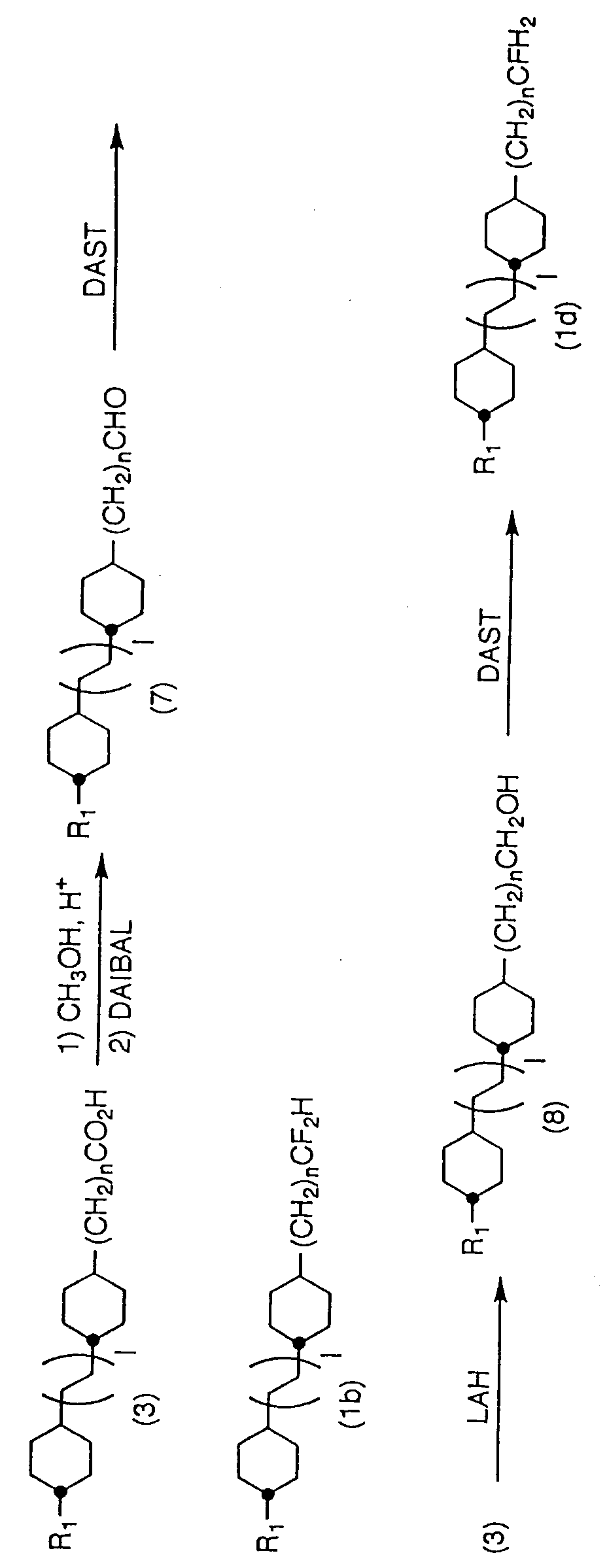
- That is, (1b) is obtained be deriving a carboxylic acid (3) to an aldehyde (7) and then fluorinating it by the same method as mentioned before. Whereas (7) is preferably synthesized by using DAIBAL according to the method, for example, of Zakhalkin et al. (Tetrahedron Letters, 619 (1962)), it can also be obtained by reducing (3) for once to form an alcohol, and further oxidizing it with an oxidizing agent such as PCC. Further, (1d) can be produced by reducing (3) with a reducing agent such as LAH and SBH to form an alcohol (8) and then fluorinating a hydroxyl group with a fluorinating agent mentioned before.
- Production of the compounds ((1e) and (1g)) wherein m is 1, p or q is 1 or more, and Y is hydrogen atom:
- The compounds can be produced according to the following flow:
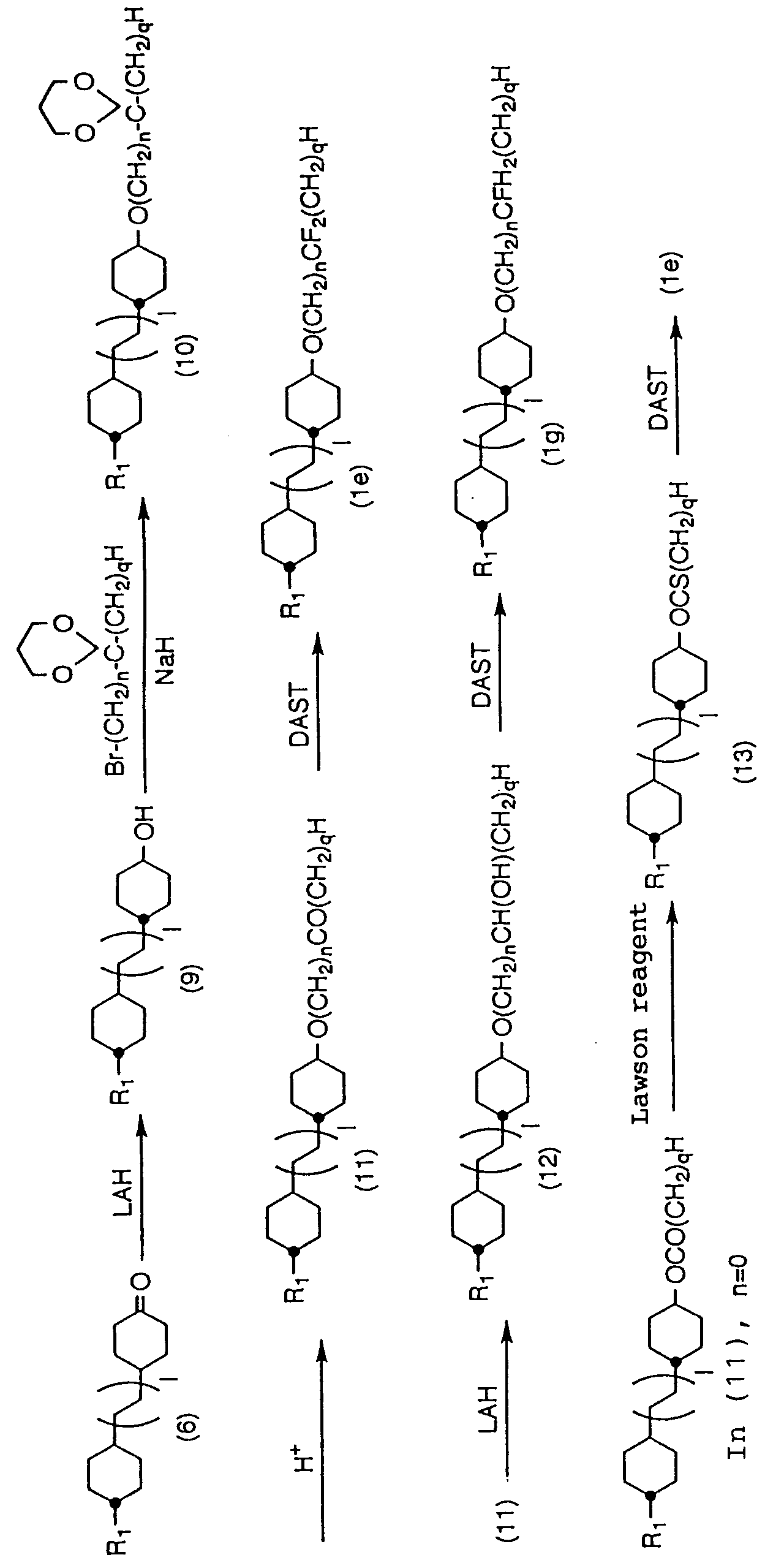
- That is, a ketal body such as (10) is obtained by reducing a cyclohexanone derivative (6) with a reducing agent such as LAH and SBH to convert into a cyclohexal derivative (9) and then reacting with an alkyl halide. (1e) can be produced (when n is 1 or more) by separating a protective group to form (11) and then fluorinating it with a fluorinating agent mentioned before. Further, (1g) can be produced by reducing (11) with a reducing agent such as LAH and SBH to form an alcohol (12) and then fluorinating hydroxyl group with a fluorinating agent mentioned before. In this case, when n is 0, since (11) is an ester, it is preferable to convert it into a thioester (13) with a Lawson reagent (Synthesis, 941 (1979)) and then fluorinating it with DAST to obtain (1e).
- Production of the compounds ((1f) and (1h)) wherein m is 1, p is 0, and Y is a hydrogen atom:
- The compounds can be produced by the following flow:

- That is, (14) is obtained by reacting a cyclohexanol derivative (9) with an alkyl halide. (1f) can be produced by separating a protective group to convert it into an aldehyde (15) and then fluorinating with a fluorinating agent mentioned before. Further, (1h) can be produced by reducing (15) with a reducing agent such as LAH and SBH to form an alcohol (16) and then fluorinating hydroxyl group with a fluorinating agent mentioned before. When n is 1 or 2 in this procedure, as a different method, an alcohol (16) can be obtained by reacting a cyclohexanone derivative (6) with ethylene glycol or 1,3-propanediol to convert into a spiroketal (17) and then reducing it with LAH in the presence of a Lewis acid according to the method of Dygenote et al. (Organic Synthesis V. 303 (1973)). Further, an aldehyde (15) can be obtained by oxidizing (16) with PCC or another compound.
- Production of the compounds ((ij) and (1k)) wherein m is 0 or 1, X is a fluorine atom, p is 0, and Y is an alkoxy group:
- The compounds can be produced by the following flow:

- That is, (20) is obtained by deriving a carboxylic acid (3) or carboxylic acid (18) obtained by oxidizing an alcohol (16) with PDC to an ester (19), and then treating it with a Lawson reagent. (1j) and (1k) are obtained by fluorinating (20) thus obtained with a fluorinating agent mentioned before.
- Compounds (1) of the present invention produced by such methods mentioned above are remarkably excellent as constituent for nematic liquid crystal compositions. That is, the compounds can provide nematic liquid crystal compositions suitable for electrooptical devices since the compounds have excellent characteristics mentioned before and besides, they are readily miscible with several liquid compounds. Such liquid crystal compositions are preferably achieved by mixing a compound optionally selected, depending on the purpose, from a group of compounds (B) having a Δε of ≧5, a group of compounds (C) having a |Δε| of <5, particularly a group of compounds (D) having a clearing point of 80°C or higher, and a group of other compounds (E) to a component (A) containing at least one compounds (1).
- Following compounds can preferably be mentioned as ones included in (B), (C), (D), or (E). That is, the following (B1) to (B13) can be stated first as the compounds included in (B):

- The following (C1) to (C34) can be mentioned as the compounds corresponding to (C):


(In the description above, whereas Ra and Ra' independently represents an alkyl group or alkenyl group having 1 to 10 carbon atoms, respectively, one carbon atom, or two or more carbon atoms which are not adjacent to each other in the group may be substituted with oxygen atom.) The following (D1) to (D57) can be mentioned as the compounds corresponding to (D):


- The following (E1) to (E18) can be mentioned as the compounds corresponding to (E):
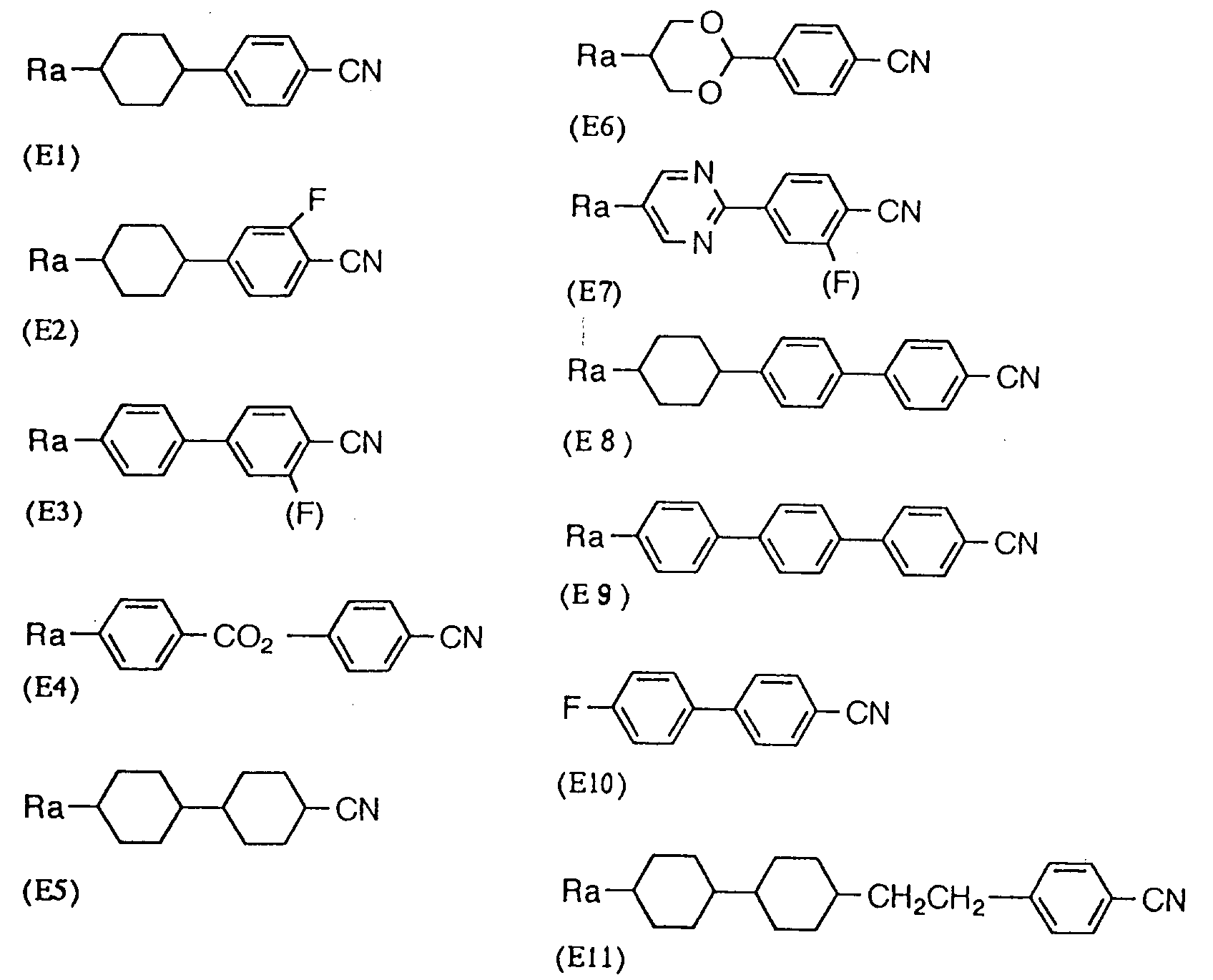

- Liquid crystal composition of the present invention preferably contains at least one compound expressed by (1) in a ratio of 0.1 to 80 % by weight to develop excellent characteristics.
- Liquid crystal composition of the present invention has a wide mesomorphic range. Besides, when used for STN or TN liquid crystal display devices, they can achieve improvements in steepness and viewing angle. Also, since the compounds of formula (1) have a low viscosity, liquid crystal display devices using the compounds are improved in their response speed.
- The followings can be mentioned as examples of the liquid crystal composition of the present invention, particularly as the examples of nematic liquid crystal compositions. In these examples of the composition, No. of the compounds is the same as that shown in the Examples described below:
- 4-(4-propylcyclohexyl)-(1,1-difluorobutyl)cyclohexane (Compound No. 3) 10 %
4-(4-propylcyclohexyl)-(1,1-difluoropentyl)cyclohexane (Compound No. 4) 10 %
1,2,3-trifluoro-5-(4-heptylcyclohexyl)benzene 5 %
1,2-difluoro-4-(4-(4-ethylcyclohexyl)cyclohexyl)benzene 7 %
1,2-difluoro-4-(4-(4-propylcyclohexyl)cyclohexyl)benzene 7 %
1,2-difluoro-4-(4-(4-pentylcyclohexyl)cyclohexyl)benzene 7 %
1,2,3-trifluoro-5-(4-(2-(4-propylcyclohexyl)ethyl) cyclohexyl)benzene 9%
1,2,3-trifluoro-5-(4-(2-(4-pentylcyclohexyl)ethyl) cyclohexyl)benzene 5 %
1,2,3-trifluoro-5-(2-(4-(4-propylcyclohexyl)cyclohexyl) ethyl)benzene 8 %
1,2,3-trifluoro-5-(2-(4-(4-pentylcyclohexyl)cyclohexyl) ethyl)benzene 7 %
1,2,3-trifluoro-5-(4-(4-propylcyclohexyl)cyclohexyl)benzene 8 %
1,2,3-trifluoro-5-(4-(4-pentylcyclohexyl)cyclohexyl)benzene 7 %
4-(4-(4-propylcyclohexyl)cyclohexyl)-fluorobenzene 5 %
4'-(4-propylcyclohexyl)-4-fluorobiphenyl 5 % - The composition mentioned above exhibits the value of physical properties as follows:
Clearing point:80.8°C, Δε :4.7, Δn:0.0689, viscosity:24.9 cP, threshold voltage at a cell thickness of 8.7 µ:2.02 V - 4-4(propylcyclohexyl)-(2,2-difluoropentyl)cyclohexane (Compound No. 6) 8 %
4-4(propylcyclohexyl)-(3,3-difluoropentyl)cyclohexane (Compound No. 7) 7 %
1,2-difluoro-4-(4-heptylcyclohexyl)benzene 5 %
1,2-difluoro-4-(2-(4-pentylcyclohexyl)ethyl)benzene 5 %
1,2-difluoro-4'-(4-ethylcyclohexyl)biphenyl 5 %
1,2-difluoro-4'-(4-propylcyclohexyl)biphenyl 5 %
1,2-difluoro-4'-(4-pentylcyclohexyl)biphenyl 10 %
1,2-difluoro-4-(4-(2-(4-ethylcyclohexyl)ethyl)cyclohexyl) benzene 10 %
1,2-difluoro-4-(4-(2-(4-propylcyclohexyl)ethyl)cyclohexyl) benzene 5 %
1,2-difluoro-4-(4-(2-(4-pentylcyclohexyl)ethyl)cyclohexyl) benzene 10 %
4-(4-pentylcylcohexyl)-chlorobenzene 5 %
4-(4-hexylcyclohexyl)-chlorobenzene 5 %
4-(4-(4-propylcyclohexyl)cyclohexyl)-chlorobenzene 5 %
4-(4-(4-pentylcyclohexyl)cyclohexyl)-chlorobenzene 5 %
1,2,3-trifluoro-5-(4-(4-propylcyclohexyl)cyclohexyl)benzene 5 %
1,2,3-trifluoro-5-(4-(4-pentylcyclohexyl)cyclohexyl)benzene 5 % - The composition mentioned above exhibits the values of physical properties as follows:
Clearing point:71.5°C, Δε:4.0, Δn:0.0829, viscosity:20.0 cP, threshold voltage at a cell thickness of 8.8 µ:2.18 V - 4-(4-pentylcyclohexyl)-(2,2-difluorobutyl)cyclohexane (Compound No. 14) 10 %
4-(4-pentylcyclohexyl)-(2-fluorobutyl)cyclohexane (Compound No. 60) 10 %
1,2-difluoro-4-(2-(4-pentylcyclohexyl)ethyl)benzene 9 %
1,2-difluoro-4-(4-(4-ethylcyclohexyl)cyclohexyl)benzene 7 %
1,2-difluoro-4-(4-(4-propylcyclohexyl)cyclohexyl)benzene 7 %
1,2-difluoro-4-(4-(4-pentylcyclohexyl)cyclohexyl)benzene 7 %
1,2-difluoro-4'-(4-ethylcyclohexyl)biphenyl 5 %
1,2-difluoro-4'-(4-propylcyclohexyl)biphenyl 5 %
1,2-difluoro-4'-(4-pentylcyclohexyl)biphenyl 10 %
4-fluorophenyl 4-pentylcyclohexylcarboxylate 7 %
4-fluorophenyl 4-heptylcyclohexylcarboxylate 8 %
4-(4-(4-propylcyclohexyl)cyclohexyl-methylbenzene 5 %
4-(4-(4-propylcyclohexyl)cyclohexyl-propylbenzene 5 %
1-chloro-2-fluoro-4-(4-(2-(4-propylcyclohexyl)ethyl) cyclohexyl)benzene 5 % - 4-(4-(1-butenyl)cyclohexyl)-1-(3-fluoropropyl)cyclohexane (Compound No. 255) 7 %
4-(4-(3-butenyl)cyclohexyl)-1-(3-fluoropropyl)cyclohexane (Compound No. 256) 8 %
1,2-difluoro-4-(4-(4-ethylcyclohexyl)cyclohexyl)benzene 7 %
1,2-difluoro-4-(4-(4-propylcyclohexyl)cyclohexyl)benzene 7 %
1,2-difluoro-4-(4-(4-pentylcyclohexyl)cyclohexyl)benzene 7 %
4'-(4-ethylcyclohexyl)-3,4-difluorobiphenyl 5 %
4'-(4-propylcyclohexyl)-3,4-difluorobiphenyl 5 %
4'-(4-pentylcyclohexyl)-3,4-difluorobiphenyl 10 %
1,2,3-trifluoro-5-(4-(4-propylcyclohexyl)cyclohexyl)benzene 9 %
1,2,3-trifluoro-5-(4-(4-pentylcyclohexyl)cyclohexyl)benzene 5 %
4'-(4-propylcyclohexyl)-3,4,5-trifluorobiphenyl 5 %
4'-(4-pentylcyclohexyl)-3,4,5-trifluorobiphenyl 5 %
1,2,3-trifluoro-5-(4-(2-(4-propylcyclohexyl)ethyl) cyclohexyl)benzene 5 %
1,2,3-trifluoro-5-(4-(2-(4-pentylcyclohexyl)ethyl) cyclohexyl)benzene 5 %
1,2,3-trifluoro-5-(2-(4-(4-propylcyclohexyl)cyclohexyl) ethyl)benzene 5 %
1,2,3-trifluoro-5-(2-(4-(4-pentylcyclohexyl)cyclohexyl) ethyl)benzene 5 % - 4-(4-propylcyclohexyl)-1-(1,1-difluoropentyloxy)cyclohexane (Compound No. 96) 10 %
4-(4-(1-butenyl)cyclohexyl)-1-(3-fluoropentyl)cyclohexane (Compound No. 255) 10 %
4-(4-propylcyclohexyl)-chlorobenzene 7 %
4-(4-pentylcyclohexyl)-chlorobenzene 7 %
4-(4-hexylcyclohexyl)-chlorobenzene 7 %
4-(4-(4-ethylcyclohexyl)cyclohexyl)-chlorobenzene 8 %
4-(4-(4-propylcyclohexyl)cyclohexyl)-chlorobenzene 8 %
4-(4-(4-pentylcyclohexyl)cyclohexyl)-chlorobenzene 8 %
1-chloro-2-fluoro-4-(4-(2-(4-ethylcyclohexyl)ethyl) cyclohexyl)benzene 7 %
1-chloro-2-fluoro-4-(4-(2-(4-propylcyclohexyl)ethyl) cyclohexyl)benzene 7 %
1-chloro-2-fluoro-4-(4-(2-(4-pentylcyclohexyl)ethyl) cyclohexyl)benzene 6 %
1,2,3-trifluoro-5-(4-(4-propylcyclohexyl)cyclohexyl)benzene 8 %
4'-(4-propylcyclohexyl)-3,4,5-trifluorobiphenyl 7 % - 4-(4-propylcyclohexyl)-1-(methoxydifluoromethyl)cyclohexane (Compound No. 231) 5 %
4-(4-butylcyclohexyl)-1-(2-methoxy-2,2-difluoroethyl) cyclohexane (Compound No. 235) 5 %
4'-ethyl-4-cyanobiphenyl 7 %
4'-butyl-4-cyanobiphenyl 8 %
4-(4-propylcyclohexyl)-cyanobenzene 10 %
4-(4-pentylcyclohexyl)-cyanobenzene 10 %
4-(4-methoxymethylcyclohexyl)-propylbenzene 10 %
4-(4-methoxymethylcyclohexyl)-pentylbenzene 10 %
4-(4-(4-ethylcyclohexyl)cyclohexyl)-methylbenzene 7 %
4-(4-(4-propylcyclohexyl)cyclohexyl)-methylbenzene 8 %
4-(4-(4-propylcyclohexyl)cyclohexyl)-cyanobenzene 5 %
4-(4-(4-propylcyclohexyl)cyclohexyl)-fluorobenzene 5 %
4-(4-(4-pentylcyclohexyl)cyclohexyl)-fluorobenzene 5 %
4-fluorophenyl-4-(4-propylcyclohexyl)benzoate 5 % - 4-(4-(3-butenyl)cyclohexyl)-1-(3-fluoropropyl)cyclohexane (Compound No. 256) 8 %
4-(4-(2-propenyloxymethyl)cyclohexyl)-1-(3-fluoropropyl) cyclohexane (Compound No. 260) 8 %
4-(4-(3-pentenyl)cyclohexyl)-1-(3-fluoropropyl)cyclohexane (Compound No. 257) 9 %
2-(3,4-difluorophenyl)-5-propylpyrimidine 5 %
2-(3,4-difluorophenyl)-5-pentylpyrimidine 5 %
4-(4-ethylcyclohexyl)-cyanobenzene 10 %
4-(4-propylcyclohexyl)-cyanobenzene 10 %
4-(4-ethylcyclohexyl)-3-fluoro-cyanobenzene 5 %
4-(4-propylcyclohexyl)-3-fluoro-cyanobenzene 5 %
4-(4-(4-ethylcyclohexyl)cyclohexyl)-cyanobenzene 5 %
4-(4-(4-propylcyclohexyl)cyclohexyl)-cyanobenzene 5 %
4-(4-(4-ethylcyclohexyl)cyclohexyl)-3-fluoro-cyanobenzene 5 %
4-(4-(4-propylcyclohexyl)cyclohexyl)-3-fluoro-cyanobenzene 5 %
2-(4'-fluorobiphenyl)-5-propylpyrimidine 5 %
2-(4'-fluorobiphenyl)-5-butylpyrimidine 5 %
4-(4-propylcyclohexyl)-ethoxybenzene 5 % - 4-(4-pentylcyclohexyl)-(2-fluorobutyl)cyclohexane (Compound No. 60) 10 %
4-(4-propylcyclohexyl)-1-(methoxydifluoromethyl)cyclohexane (Compound No. 231) 10 %
4'-ethyl-4-cyanobiphenyl 5 %
4-(4-methoxymethylcyclohexyl)-cyanobenzene 5 %
4-(4-(2-ethoxyethoxy)cyclohexyl)-cyanobenzene 5 %
4-(4-propylcyclohexyl)-cyanobenzene 10 %
2-(4-ethylphenyl)-5-ethylpyrimidine 5 %
2-(4-ethylphenyl)-5-propylpyrimidine 5 %
2-(4-ethylphenyl)-5-butylpyrimidine 5 %
2-(4-(4-propylcyclohexyl)phenyl)-5-ethylpyrimidine 5 %
2-(4-(4-propylcyclohexyl)phenyl)-5-propylpyrimidine 5 %
2-(4-(4-propylcyclohexyl)phenyl)-5-butylpyrimidine 5 %
1,2-difluoro-4-(4-(4-ethylcyclohexyl)cyclohexyl)benzene 5 %
1,2-difluoro-4-(4-(4-propylcyclohexyl)cyclohexyl)benzene 5 %
1,2-difluoro-4-(4-(4-pentylcyclohexyl)cyclohexyl)benzene 5 %
4-(4-(4-propylcyclohexyl)cyclohexyl)-methoxybenzene 5 %
4-(4-butylcyclohexyl)-propylcyclohexane 5 % - 4-(4-propylcyclohexyl)-(1,1-difluorobutyl)cyclohexane (Compound No. 3) 10 %
4-(4-propylcyclohexyl)-(1,1-difluoropentyl)cyclohexane (Compound No. 4) 10 %
4-(4-(3-butenyl)cyclohexyl)-cyanobenzene 7 %
4-(4-(3-pentenyl)cyclohexyl)-cyanobenzene 8 %
4-(4-propylcyclohexyl)-cyanobenzene 5 %
4-(2-(4-ethylphenyl)ethynyl)-methylbenzene 5 %
4-(2-(4-methylphenyl)ethynyl)-hexylbenzene 10 %
4-(2-(4-butylphenyl)ethynyl)-butylbenzene 5 %
4-(2-(2-fluoro-4-(4-propylcyclohexyl)phenyl)ethynyl)ethylbenzene 5 %
4-(2-(2-fluoro-4-(4-propylcyclohexyl)phenyl)ethynyl)propylbenzene 5 %
4-(2-(4-(2-(4-propylcyclohexyl)ethyl)phenyl)ethynyl)ethylbenzene 5 %
4-(2-(4-(2-(4-propylcyclohexyl)ethyl)phenyl)ethynyl)propylbenzene 5 %
2-(4'-fluorobiphenyl)-5-propylpyrimidine 5 %
2-(4'-fluorobiphenyl)-5-butylpyrimidine 5 %
4-(4-butylcyclohexyl)-propylcyclohexane 5 %
4-fluorophenyl-4-(4-propylcyclohexyl)benzoate 5 % - The composition mentioned above exhibits the values of physical properties as follows:
Clearing point:77.0°C, Δε :4.6, Δn:0.1637, viscosity:24.0 cP, threshold voltage at a cell thickness of 8.7 µ:2.32 V - 4-(4-pentylcyclohexyl)-(2,2-difluorobutyl)cyclohexane (Compound No. 14) 10 %
4-(4-(2-propenyloxymethyl)cyclohexyl)-1-(3-fluoropropyl) cyclohexane (Compound No. 260) 10 %
4-(4-(3-pentenyl)cyclohexyl)-1-(3-fluoropropyl)cyclohexane (Compound No. 257) 10 %
2-(4-cyanophenyl)-5-propyldioxane 10 %
4-cyanophenyl-4-propylbenzoate 10 %
4-fluorophenyl-4-(4-propylcyclohexyl)cyclohexylcarboxylate 5 %
4-fluorophenyl-4-(4-pentylcyclohexyl)cyclohexylcarboxylate 5 %
4-(2-(4-ethylphenyl)ethynyl)-methoxybenzene 2.5 %
4-(2-(4-propylphenyl)ethynyl)-methoxybenzene 2.5 %
4-(2-(4-butylphenyl)ethynyl)-ethoxybenzene 2.5 %
4-(2-(4-pentylphenyl)ethynyl)-methoxybenzene 2.5 %
2-(4-ethoxyphenyl)-5-ethylpyrimidine 5 %
2-(4-ethoxyphenyl)-5-propylpyrimidine 5 %
4-butoxyphenyl-4-propylcyclohexylcarboxylate 5 %
4-etoxycyclohexyl-4-butylcyclohexylcarboxylate 5 %
2-fluoro-4-(4-propylcyclohexyl)-cyanobenzene 5 %
2-fluoro-4-(4-(4-propylcyclohexyl)cyclohexyl)-cyanobenzene 5 % - 4-(4-propylcyclohexyl)-(2,2-difluoropentoxy)cyclohexane (Compound No. 98) 8 %
4-(4-propylcyclohexyl)-(3,3-difluoropentoxy)cyclohexane (Compound No. 100) 7 %
4-(4-propylcyclohexyl)-methoxycyclohexane 7 %
4-(4-propylcyclohexyl)-propoxycyclohexane 7 %
4-(4-pentylcyclohexyl)-methoxycyclohexane 8 %
4-(4-propylcyclohexyl)-fluorobenzene 8 %
4-(4-(4-ethylcyclohexyl)cyclohexyl)-trifluoromethoxybenzene 5 %
4-(4-(4-propylcyclohexyl)cyclohexyl)-difluoromethoxybenzene 5 %
4-(4-(4-propylcyclohexyl)cyclohexyl)-trifluoromethoxybenzene 5 %
4-(4-(4-butylcyclohexyl)cyclohexyl)-trifluoromethoxybenzene 5 %
4-(4-(4-pentylcyclohexyl)cyclohexyl)-trifluoromethoxybenzene 5 %
4-(4-(4-pentylcyclohexyl)cyclohexyl)-difluoromethoxybenzene 5 %
2,6-difluoro-4-(4-(4-propylcyclohexyl)cyclohexyl)difluoromethoxybenzene 5 %
2,6-difluoro-4-(4-(4-pentylcyclohexyl)cyclohexyl)difluoromethoxybenzene 5 %
1,2-difluoro-4-(2-(4-(4-propylcyclohexyl)cyclohexyl)ethyl) benzene 5 %
1,2-difluoro-4-(2-(4-(4-pentylcyclohexyl)cyclohexyl)ethyl) benzene 5 %
3,4-difluoro-4-(4-propylcyclohexyl)cyclohexylcarboxylate 5 % - 4-(4-(4-propylcyclohexyl)cyclohexyl)-(2,2-difluoropentyl) cyclohexane 10 %
4-(4-(4-propylcyclohexyl)cyclohexyl)-(3,3-difluoropentyl) cyclohexane 10 %
4-(4-pentylcyclohexyl)-fluorobenzene 7 %
4-(4-heptylcyclohexyl)-fluorobenzene 8 %
4-(4-(4-ethylcyclohexyl)cyclohexyl)-trifluoromethoxybenzene 7 %
4-(4-(4-propylcyclohexyl)cyclohexyl)-trifluoromethoxybenzene 8 %
4-(4-(4-butylcyclohexyl)cyclohexyl)-trifluoromethoxybenzene 7 %
4-(4-(4-pentylcyclohexyl)cyclohexyl)-trifluoromethoxybenzene 8 %
4'-(4-propylcyclohexyl)-1,2-difluorobiphenyl 7 %
4'-(4-pentylcyclohexyl)-1,2-difluorobiphenyl 8 %
4-(2-(4-(4-propylcyclohexyl)cyclohexyl)ethyl)trifluoromethoxybenzene 5 %
4'-(4-pentylcyclohexyl)-2-fluoro-ethylbenzene 5 %
2'-fluoro-4'-(4-propylcyclohexyl)-4-(4-propylcyclohexyl) biphenyl 5 %
2'-fluoro-4'-(4-pentylcyclohexyl)-4-(4-propylcyclohexyl) biphenyl 5 % - 4-(4-(3-butenyloxy)cyclohexyl)-(3-fluoropropyl)cyclohexane (Compound No. 259) 7 %
4-(4-(3-butenyl)cyclohexyl)-(2-fluoroethoxy)cyclohexane (Compound No. 217) 8 %
4-(4-(2-propenyl)cyclohexyl)-cyanobenzene 3 %
4'-butyl-4-ethylbiphenyl 3 %
4'-propyl-4-cyanobiphenyl 3 %
2-fluoro-4-(4-ethylcyclohexyl)-cyanobenzene 3 %
4-(2-(4-propylcyclohexyl)ethyl)-ethoxybenzene 3 %
4'-pentyl-4-cyanobiphenyl 5 %
4-cyanophenyl-4-propylbenzoate 5 %
4-ethylphenyl-4-butylcyclohexylcarboxylate 10 %
4-(2-(4-pentylcyclohexyl)ethyl)-ethoxybenzene 10 %
4-methoxyphenyl-4-pentylcyclohexylcarboxylate 10 %
4-propoxyphenyl-4-pentylcyclohexylcarboxylate 10 %
2-(4-cyanophenyl)-5-(4-butylphenyl)pyrimidine 4 %
4''-pentyl-4-cyanoterphenyl 4 %
4-(2-(4-(4-pentylcyclohexyl)phenyl)ethyl)-butylbenzene 4 %
2-(4-pentylphenyl)-5-(4-butylphenyl)pyrimidine 4 %
4'-(4-pentylcyclohexyl)-4-(2-(4-propylcyclohexyl)ethyl) biphenyl 4 % - 4-(4-(3-butenyl)cyclohexyl)-(3-fluoropropyl)cyclohexane (Compound No. 256) 10 %
4-(4-(1-(3-propenyloxy)methyl)cyclohexyl)-(3-fluoropropyl) cyclohexane (Compound No. 260) 10 %
3,4-difluorophenyl-4-butylcyclohexylcarboxylate 5 %
3,4-difluorophenyl-4-pentylcyclohexylcarboxylate 5 %
3-fluoro-4-cyanophenyl-4-ethylbenzoate 5 %
3-fluoro-4-cyanophenyl-4-propylbenzoate 5 %
3-fluoro-4-cyanophenyl-4-butylbenzoate 5 %
3-fluoro-4-cyanophenyl-4-pentylbenzoate 5 %
2-fluoro-4-(4-(3-methoxypropyl)cyclohexyl)-cyanobenzene 10 %
3,4-difluorophenyl-4-(4-propylcyclohexyl) cyclohexylcarboxylate 5 %
3,4-difluorophenyl-4-(4-pentylcyclohexyl) cyclohexylcarboxylate 5 %
3-fluoro-4-cyanophenyl-4-(4-ethylcyclohexyl)benzoate 5 %
3-fluoro-4-cyanophenyl-4-(4-propylcyclohexyl)benzoate 5 %
3-fluoro-4-cyanophenyl-4-(4-butylcyclohexyl)benzoate 5 %
3-fluoro-4-cyanophenyl-4-(4-pentylcyclohexyl)benzoate 5 %
4-(2-(4-(4-propylcyclohexyl)phenyl)ethynyl)-ethylbenzene 10 % - 4-(4-pentylcyclohexyl)-(2,2-difluorobutyl)cyclohexane (Compound No. 14) 10 %
4-(4-propylcyclohexyl)-(2-fluoropentyl)cyclohexane (Compound No. 52) 10 %
1,2-difluoro-4-(2-(4-pentylcyclohexyl)ethyl)benzene 9 %
1,2-difluoro-4-(4-(4-ethylcyclohexyl)cyclohexyl)benzene 7 %
1,2-difluoro-4-(4-(4-propylcyclohexyl)cyclohexyl)benzene 7 %
1,2-difluoro-4-(4-(4-pentylcyclohexyl)cyclohexyl)benzene 7 %
1,2-difluoro-4'-(4-ethylcyclohexyl)biphenyl 5 %
1,2-difluoro-4'-(4-propylcyclohexyl)biphenyl 5 %
1,2-difluoro-4'-(4-pentylcyclohexyl)biphenyl 10 %
4-fluorophenyl-4-pentylcyclohexylcarboxylate 7 %
4-fluorophenyl-4-heptylcyclohexylcarboxylate 8 %
4-(4-(4-propylcyclohexyl)cyclohexyl)-methylbenzene 5 %
4-(4-(4-propylcyclohexyl)cyclohexyl)-propylbenzene 5 %
1-chloro-2-fluoro-4-(4-(2-(4-propylcyclohexyl)ethyl) cyclohexyl)benzene 5 % - The composition mentioned above exhibits the values of physical properties as follows:
Clearing point:75.8°C, Δε:2.9, Δn:0.0815, viscosity:19.1 cP, threshold voltage at a cell thickness of 8.8 µ:2.49 V - 4-(4-propylcyclohexyl)-1-(1,1-difluoroethyl)cyclohexane (Compound No. 1) 10 %
4-(4-propylcyclohexyl)-1-(1,1-difluoropropyl)cyclohexane (Compound No. 2) 10 %
4-(4-propylcyclohexyl)-chlorobenzene 7 %
4-(4-pentylcyclohexyl)-chlorobenzene 7 %
4-(4-hexylcyclohexyl)-chlorobenzene 7 %
4-(4-(4-ethylcyclohexyl)cyclohexyl)-chlorobenzene 8 %
4-(4-(4-propylcyclohexyl)cyclohexyl)-chlorobenzene 8 %
4-(4-(4-pentylcyclohexyl)cyclohexyl)-chlorobenzene 8 %
1-chloro-2-fluoro-4-(4-(2-(4-ethylcyclohexyl)ethyl) cyclohexyl)benzene 7 %
1-chloro-2-fluoro-4-(4-(2-(4-propylcyclohexyl)ethyl) cyclohexyl)benzene 7 %
1-chloro-2-fluoro-4-(4-(2-(4-pentylcyclohexyl)ethyl) cyclohexyl)benzene 6 %
1,2,3-trifluoro-5-(4-(4-propylcyclohexyl)cyclohexyl)benzene 8 %
4'-(4-propylcyclohexyl)-3,4,5-trifluorobiphenyl 7 % - The composition mentioned above exhibits the values of physical properties as follows:
Clearing point:78.2°C, Δε:3.7, Δn:0.0883, viscosity:20.9 cP, threshold voltage at a cell thickness of 8.7 µ:2.41 V - 4-(4-pentylcyclohexyl)-1-(2-fluoroethyloxy)cyclohexane (Compound No. 215) 5 %
4-(2-(4-pentylcyclohexyl)ethyl)-1-(2-fluoroethyloxy) cyclohexane (Compound No. 226) 5 %
4'-ethyl-4-cyanobiphenyl 7 %
4'-butyl-4-cyanobiphenyl 8 %
4-(4-propylcyclohexyl)-cyanobenzene 10 %
4-(4-pentylcyclohexyl)-cyanobenzene 10 %
4-(4-methoxymethylcyclohexyl)-propylbenzene 10 %
4-(4-methoxymethylcyclohexyl)-pentylbenzene 10 %
4-(4-(4-ethylcyclohexyl)cyclohexyl)-methylbenzene 7 %
4-(4-(4-propylcyclohexyl)cyclohexyl)-methylbenzene 8 %
4-(4-(4-propylcyclohexyl)cyclohexyl)-cyanobenzene 5 %
4-(4-(4-propylcyclohexyl)cyclohexyl)-fluorobenzene 5 %
4-(4-(4-pentylcyclohexyl)cyclohexyl)-fluorobenzene 5 %
4-fluorophenyl-4-(4-propylcyclohexyl)benzoate 5 % - The composition mentioned above exhibits the values of physical properties as follows:
Clearing point:79.7°C, Δε:6.5, Δn:0.1120, viscosity:19.2 cP, threshold voltage at a cell thickness of 8.8 µ:2.02 V - 4-(4-(1-pentenyl)cyclohexyl)-1-(2-fluoroethyl)cyclohexane (Compound No. 252) 10 %
4-(4-(3-butenyl)cyclohexyl)-1-cyanobenzene 7 %
4-(4-(3-pentenyl)cyclohexyl)-1-cyanobenzene 7 %
4-(4-propylcyclohexyl)-1-cyanobenzene 16 %
4-(4-propylcyclohexyl)-1-fluorobenzene 4 %
4-(4-propylcyclohexyl)-1-ethyloxybenzene 9 %
4-(2-(4-ethylphenyl)ethynyl)-1-methyloxybenzene 5 %
4-(4-(4-propylcyclohexyl)cyclohexyl)-1-methylbenzene 7 %
4-(4-(4-propylcyclohexyl)cyclohexyl)-1-methyloxybenzene 4 %
4-(2-(2-fluoro-4-(4-propylcyclohexyl)phenyl)ethynyl)-1-ethylbenzene 5 %
4-(2-(2-fluoro-4-(4-propylcyclohexyl)phenyl)ethynyl)-1-propylbenzene 5 %
4-(2-(2-fluoro-4-(4-propylcyclohexyl)phenyl)ethynyl)-1-butylbenzene 5 %
4-(4-(4-ethylcyclohexyl)cyclohexyl)-1-cyanobenzene 5 %
4-(4-(4-propylcyclohexyl)cyclohexyl)-1-cyanobenzene 5 %
2-(4-(4-propylcyclohexyl)phenyl)-5-ethylpyrimidine 3 %
2-(4-(4-propylcyclohexyl)phenyl)-5-propylpyrimidine 3 % - The composition mentioned above exhibits the values of physical properties as follows:
Clearing point:99.5°C, Δε:7.0, Δn:0.1461, Viscosity:21.0 cP, Threshold voltage at a cell thickness of 8.7 µ:2.24 V - The present invention will be explained below in more detail with reference to Examples. In the following Examples, all of the cyclohexane rings and double bonds in compounds belong to trans-form. Cr represents crystal, SB does smectic B phase, SX does unidentified smectic phase, and Iso represents isotropic liquid, and all unit for phase transition point are °C.
- Production of 4-(4-pentylcyclohexyl)-(2,2-difluorobutyl) cyclohexane (Compound expressed by the fourmula (1) wherein R1 is C5H11, X is F, Y is H, ℓ and m are 0, n is 1, p is 2. ( Compound No. 14))
- A mixture of 50 g (0.17 mol) of 4-(4-pentylcyclohexyl) cyclohexyl acetic acid and 135 mℓ of thionyl chloride was heated for 4 hours to reflux. Excess amount of thionyl chloride was separated under a reduced pressure to obtain 4-(4-pentylcyclohexyl)cyclohexyl acetic acid chloride.
- On the other hand, a solution of 27.8 g (0.26 mol) of ethyl bromide in 50 mℓ of THF was added dropwise to a mixture of 6.2 g (0.26 mol) of magnesium and 10 mℓ of THF at a temperature of lower than 20°C and then stirred for 2 hours at a room temperature to obtain a THF solution of ethylmagnesium bromide.
- Dried toluene in an amount of 650 mℓ and 4.5 g (5 % by weight of acid chloride) of Fe(acac)3 were added to the 4-(4-pentylcyclohexyl)cyclohexyl acetic acid chloride obtained in a previous procedure and cooled down to -30°C. This solution was added dropwise with the whole amount of the solution of ethyl magnesium bromide obtained in a previous procedure at a temperature of lower than -30°C and then stirred for 15 min at the same temperature. The reaction product was put in 500 mℓ of 6N hydrochloric acid and then extracted with 150 mℓ of toluene. The organic layer was washed with 6N hydrochloric acid once, with 2N aqueous solution of sodium hydroxide thrice, and with water twice, and then dried over anhydrous magnesium sulfate. After the magnesium sulfate was separated, the solvent was distilled off under a reduced pressure, and the residue thus obtained was subjected to a silica gel column chromatography (eluate: toluene) to obtain 39.8 g of a crude 4-(4-pentylcyclohexyl)-(2-oxyobutyl)cyclohexane. This product was recrystallized from 50 mℓ of ethanol to obtain 32.1 g (yield 62 %) of 4-(4-pentylcyclohexyl)-(2-oxobutyl)cyclohexane. Melting point: 107.3 - 107.4°C
- A mixture of 10 g (33 mmol) of 4-(4-pentylcyclohexyl)-(2-oxobutyl)cyclohexane obtained in the first stage, 10.5 g (65 mmol) of DAST, and 100 mℓ of THF was heated for 90 hours to reflux. The reaction product was put in 100 mℓ of an ice water and then extracted with 100 mℓ of toluene. The organic layer was washed with an aqueous solution saturated with potassium carbonate once and with a salt water thrice, and dried over anhydrous magnesium sulfate. After the magnesium sulfate was separated, the solvent was distilled off under a reduced pressure, and the residue thus obtained was subjected to a silica gel column chromatography (eluate: heptane) to obtain 1.58 g of a crude 4-(4-pentylcyclohexyl)-(2,2-difluorobutyl) cyclohexane. This product was recrystallized from 30 mℓ of ethanol in a freezer to obtain 1.02 g (yield 10 %) of 4-(4-pentylcyclohexyl)-(2,2-difluorobutyl)cyclohexane. Several kinds of spectra well supported its structure.
1H-NMR (TMS internal standard) δ (ppm): 0.69 - 2.06 (m) GC-MS: 328 (M+)
Cr 2.3 SB 115.4 Iso (Unit is °C. The same is applied hereinafter.) - While the clearing point of the compound of the present invention was 115.4°C as mentioned above, it can be understood that the value is higher compared with the clearing point of 104 °C of the known bicyclohexane type compounds having the same structure except that the alkyl group at the end of molecule is not substituted with a fluorine atom (reference is made to Examined Japanese Patent Publication No. 5-020418).
- The following compounds (No. 1 through No. 46) were produced according to the method in Example 1. Each of the compounds are indicated by excerpting parameters R1, ℓ, and -(CH2)nCF2(CH2)pH in the compounds expressed by the general formula (1) (in the case of m=0, X=F, and Y=H in the group -(O)m-(CH2)n-CFX-(CH2)p-Y of the general formula (1)).


- Production of 4-(4-pentylcyclohexyl)-(2-fluorobutyl) cyclohexane (Compound expressed by the formula (1) wherein R1 is C5H11, X and Y are H, ℓ and m are 0, n is 1, and p is 2.( Compound No. 60))
- While keeping inside of a reaction system at a temperature of lower than 10°C, a solution of 5.0 g (16.3 mmol) of 4-(4-pentylcyclohexyl)-(oxobutyl)cyclohexane obtained in Example 1 and dissolved in 35 mℓ of THF was added dropwise to a mixture of 0.46 g (12.2 mmol) of LAH and 2.5 mℓ of THF and further stirred for 5 hours at a room temperature. Under cooled condition, 5 mℓ of ethyl acetate and then 100 mℓ of 6N hydrochloric acid were added to terminate the reaction. After extracted with 50 mℓ of ethyl acetate, the organic layer was washed with water twice and dried over anhydrous magnesium sulfate. After the magnesium sulfate was separated, the solvent was distilled off under a reduced pressure, and the residue thus obtained was recrystallized from 8 mℓ of hexane to obtain 5.0 g (yield 99 %) of 4-(4-pentylcyclohexyl)-(2-hydroxybutyl)cyclohexane. Melting point: 130.9 - 131.1°C
- A mixture of 3.32 g (10.8 mmol) of 4-(4-pentylcyclohexyl)-(2-hydorxybutyl)cyclohexane obtained in the first stage, 2.6 g (16.2 mmol) of DAST, and 30 mℓ of dichloromethane was stirred for 2 hours at a temperature of lower than 10°C. The reaction product was put in 50 mℓ of an ice water and then extracted with 50 mℓ of toluene. The organic layer was washed with an aqueous solution saturated with sodium hydrogencarbonate once and with water twice, and dried over anhydrous magnesium sulfate. After the magnesium sulfate was separated, the solvent was distilled off under a reduced pressure, and the residue thus obtained was subjected to a silica gel column chromatography (eluate: heptane) to obtain 1.3 g of a crude 4-(4-pentylcyclohexyl)-(2-fluorobutyl)cyclohexane. This product was recrystallized twice from a mixed solvent of 8 mℓ of ethanol and 2 mℓ of benzene in a freezer to obtain 0.81 g (yield 24 %) of 4-(4-pentylcyclohexyl)-(2-fluorobutyl)cyclohexane. Several kinds of spectra well supported its structure.
1H-NMR (TMS internal standard) δ (ppm): 4.51 (dm, 1H), 1.83 - 0.81 (m, 38H)
GC-MS: 310 (M+)
Cr 10.4 SB 119.9 Iso - It can be understood that the clearing point 119.9°C mentioned above is considerably higher compared with the clearing point of 104°C of the known bicyclohexane type compound having the same structure except that the alkyl group at the end of molecule is not substituted with a fluorine atom (reference is made to Examined Japanese Patent Publication No. 5-020418).
- The following compounds (No. 47 through No. 92) were produced according to the method in Example 2. Each of the compounds are indicated by excerpting parameters R1, ℓ, and - (CH2)nCFH(CH2)pH in the same way as described before.


- Production of 4-(4-pentylcyclohexyl)-(2,2-difluorobutyloxy) cyclohexane (Compound expressed by the formula (1) wherein R1 is C5H11, X is F, Y is H, ℓ is 0, m and n are 1, and p is 2. (Compound No. 106))
- A solution of 25.2 g (0.1 mol) of 4-(4-pentylcyclohexyl) cyclohexanol in 50 mℓ of THF was added dropwise to a mixture of 5.2 g (0.11 mol) of sodium hydride and 20 mℓ of THF at a temperature of lower than 10°C. Then, 50 mℓ of DMF was further added and stirred for 1 hour at a room temperature. While keeping inside of the reaction system at a temperature of lower than 0°C, a solution of 21 g (0.1 mol) of 2-bromomethyl-2-ethyl-1,3-dioxane derived from commercially available 1-bromo-2-butanone in 50 mℓ of THF was added dropwise, and stirred for 2 hours at a room temperature and then for 2 hours at 50°C. This solution was added with 50 mℓ of 6N hydrochloric acid, stirred for 1 hour at 50°C, added with 200 mℓ of toluene, and extracted. The organic layer was washed once with an aqueous solution saturated with potassium carbonate and twice with water, and dried over anhydrous magnesium sulfate. After the anhydrous magnesium sulfate was separated, the solvent was distilled off under a reduced pressure, and the residue thus obtained was subjected to a silica gel column chromatography (eluate: toluene) to obtain 20.9 g (yield 65 %) of 4-(4-pentylcyclohexyl)-(2-oxobutyloxy)cyclohexane.
- A mixture of 9.7 g (0.03 mol) of 4-(4-pentylcyclohexyl)-(2-orxobutyloxy)cyclohexane obtained in the first stage, 9.7 g (0.06 mol) of DAST, and 100 mℓ of THF was heated for 80 hours to reflux. The reaction product was put in 100 mℓ of an ice water and then extracted with 100 mℓ of toluene. The organic layer was washed with an aqueous solution saturated with potassium carbonate once and with a salt water five times, and dried over anhydrous magnesium sulfate. After the magnesium sulfate was separated, the solvent was distilled off under a reduced pressure, and the residue thus obtained was subjected to a silica gel column chromatography (eluate: heptane), and recrystallized from 45 mℓ of ethanol in a freezer to obtain 1.65 g (yield 16 %) of 4-(4-pentylcyclohexyl)-(2,2-difluorobutyloxy) cyclohexane. Several kinds of spectra well supported its structure.
- The following compounds (No. 93 through No. 138) were produced according to the method in Example 3. Each of the compounds are indicated by excerpting parameters R1, ℓ, and - O(CH2)nCF2(CH2)pH in the same way as described before.
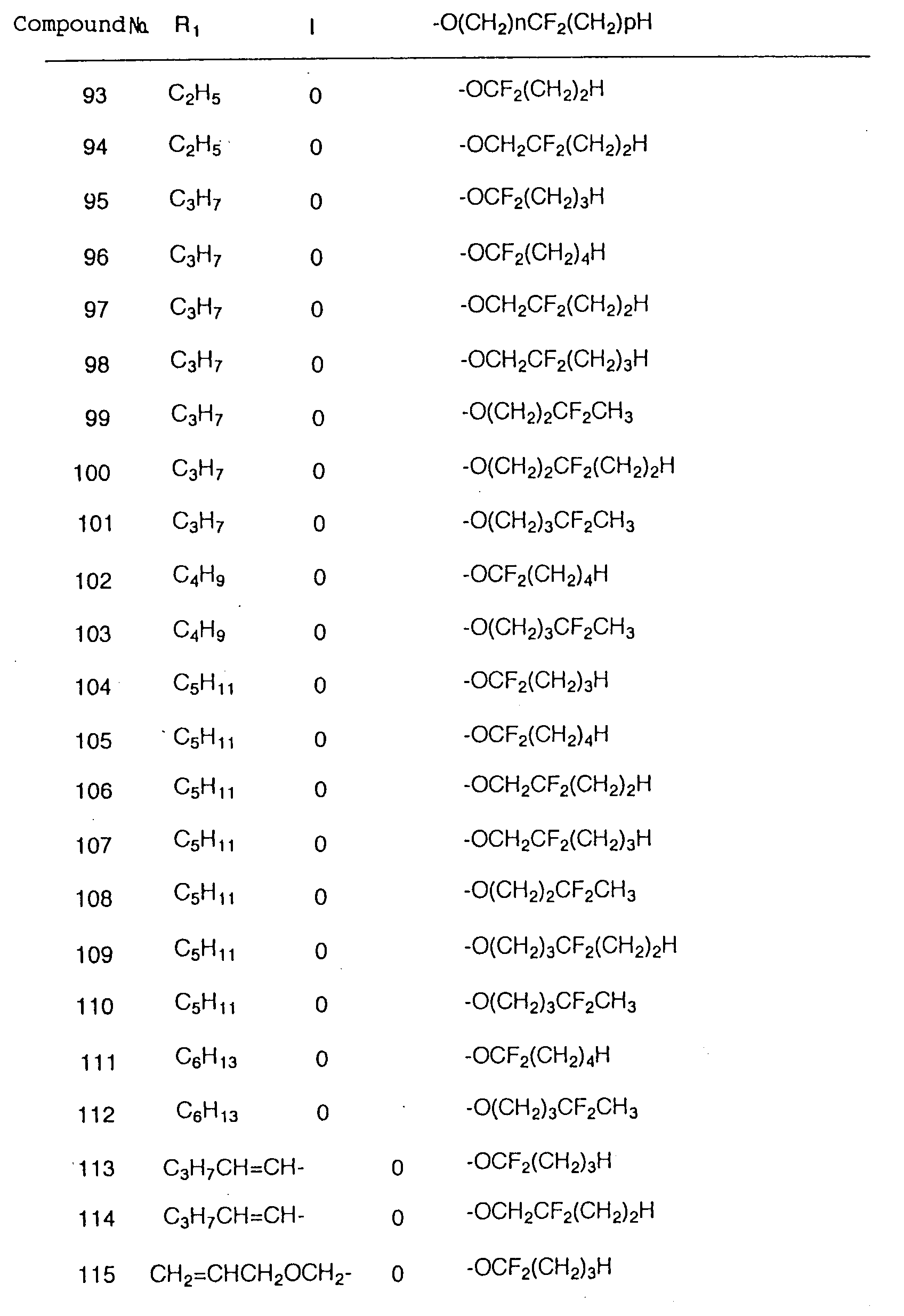

- Production of 4-(4-propylcyclohexyl)-(3,3-difluoropropyloxy)cyclohexane (Compound expressed by the formula (1) wherein R1 is C3H7, X is F, Y is H, ℓ is 0, m is 1, n is 2, and p is 0. (Compound No. 141))
- A mixture of 94.3 g (0.42 mol) of 4-(4-propylcyclohexyl) cyclohexanone, 64.5 g (0.85 mol) of 1,3-propanediol, 2 mℓ of concentrated hydrochloric acid, and 200 mℓ of toluene was heated while stirring to reflux for 3 hours while separating produced water by Dean and Stark method. The product was put in 500 mℓ of an aqueous solution saturated with sodium hydrogencarbonate, and the organic layer separated was washed with water twice and dried over anhydrous magnesium sulfate. After the magnesium sulfate was separated, the solvent was distilled off under a reduced pressure and the residue was recrystallized from 100 mℓ of ethanol to obtain 72.1 g (yield 61 %) of 4-(4-propylcyclohexyl)cyclohexanone spiroketal body. Melting point: 52.6 - 53.7°C
- A suspension of 2.85 g (0.075 mol) of LAH in 80 mℓ of anhydrous diethyl ether was added dropwise to a solution of 38.4 g (0.14 mol) of anhydrous aluminum chloride in 80 mℓ of anhydrous diethyl ether and stirred for 30 min. To this solution was added dropwise a solution of 40 g (0.14 mol) of the spiroketal body obtained in the first stage and dissolved in 80 mℓ of anhydrous diethyl ether, and heated for 3 hours to reflux. Then, under cooling with ice, 20 mℓ of water was added to destroy an excess amount of the reducing agent and then put in 200 mℓ of an ice water. It was extracted twice with 400 mℓ of ethyl acetate, and the organic layer was washed with water twice and dried over anhydrous magnesium sulfate. After the magnesium sulfate was separated, the solvent was distilled off under a reduced pressure, and the residue was recrystallized twice from 40 mℓ of heptane to obtain 20.7 g (yield 51 %) of 4- (4-propylcyclohexyl)-(3-hydroxypropyloxy)cyclohexane. Melting point: 110.4 - 111.0°C
- DMSO in an amount of 2.13 mℓ (0.03 mol) was added dropwise to a mixture of 1.74 mℓ (0.02 mol) of oxalic acid chloride and 40 mℓ of dichloromethane at -50 °C and stirred for 10 min. While keeping inside of the reaction system at -60°C, this solution was added dropwise with a solution of 2.82 g (0.01 mol) of the 4-(4-propylcyclohexyl)-(3-hydroxypropyloxy)cyclohexane obtained in the second stage and dissolved in 20 mℓ of dichloromethane and stirred for 1 hour. To this solution was added 14 mℓ of triethylamine, temperature of the solution was returned to a room temperature, stirred for 15 min, and the solution was added with 80 mℓ of an aqueous solution saturated with ammonium chloride. The organic layer was separated and dried over anhydrous magnesium sulfate. After the magnesium sulfate was separated, the solvent was distilled off under a reduced pressure, and the residue was subjected to a silica gel column chromatography (eluate: toluene /ethylacetate (9/1)) to obtain 1.93 g of a crude 4-(4-propylcyclohexyl)-(3-oxopropyoxy) cyclohexane. This product was recrystallized from 12 mℓ of ethanol to obtain 1.3 g (yield 46 %) of 4-(4-propylcyclohexyl)-(3-oxopropyloxy)cyclohexane.
- A mixture of 1.3 g (4.6 mmol) of 4-(4-propylcyclohexyl)-(3-oxopropyloxy)cyclohexane obtained in the third stage, 2.0 g (12 mmol) of DAST, and 5 mℓ of dichloromethane was stirred overnight at a room temperature. The product was put in 20 mℓ of an ice water and extracted with 20 mℓ of toluene. The organic layer was washed once with an aqueous solution saturated with potassium carbonate and then twice with water, and dried over anhydrous magnesium sulfate. After the magnesium sulfate was separated, the solvent was distilled off under a reduced pressure, and the residue thus obtained was subjected to a silica gel column chromatography (eluate: toluene) to obtain 0.78 g of a crude 4-(4-propylcyclohexyl)-(3,3-difluoropropyloxy)cyclohexane. This product was recrystallized from 3.5 mℓ of ethanol in a freezer to obtain 0.51 g (yield 17 %) of 4-(4-propylcyclohexyl)-(3,3-difluoropropyloxy)cyclohexane.
Several kinds of spectra well supported its structure.
1H-NMR (TMS internal standard) δ (ppm): 5.91 (tt, 1H), 3.56 (t, 2H), 3.05 (m, 1H), 2.31 - 0.76 (m, 28H)
GC-MS: 302 (M+)
Cr 24.3 SB 53.5 Iso - The following compounds (No. 139 through No. 160) were produced according to the method in Example 4. Each of the compounds are indicated by excerpting parameters R1, ℓ, and - O(CH2)nCF2H in the same way as described before.
Compound No. R1 l -O(CH2)nCF2H Phase transition point 139 C2H5 0 -O(CH2)2CF2H 140 C2H5 0 -O(CH2)3CF2H 141 C3H7 0 -O(CH2)2CF2H Cr 24.3 SB 53.5 Iso 142 C3H7 0 -O(CH2)3CF2H 143 C3H7 0 -O(CH2)4CF2H 144 C4H9 0 -O(CH2)2CF2H 145 C4H9 0 -O(CH2)4CF2H 146 C5H11 0 -O(CH2)2CF2H 147 C5H11 0 -O(CH2)3CF2H 148 C5H11 0 -O(CH2)4CF2H 149 CH3CH=CH(CH2)2- 0 -O(CH2)3CF2H 150 C2H5 1 -O(CH2)2CF2H 151 C2H5 1 -O(CH2)3CF2H 152 C3H7 1 -O(CH2)2CF2H 153 C3H7 1 -O(CH2)3CF2H 154 C3H7 1 -O(CH2)4CF2H 155 C4H9 1 -O(CH2)2CF2H 156 C4H9 1 -O(CH2)4CF2H 157 C5H11 1 -O(CH2)2CF2H 158 C5H11 1 -O(CH2)3CF2H 159 C5H11 1 -O(CH2)4CF2H 160 C3H7CH=CH- 1 -O(CH2)3CF2H - Production of 4-(4-pentylcyclohexyl)-(2-fluorobutyloxy) cyclohexane (Compound expressed by the formula (1) wherein R1 is C5H11, X and Y are H, ℓ is 0, m and n are 1, and p is 2. ( Compound No. 174))
- While keeping inside of a reaction system at a temperature of lower than 10°C, a solution of 5.24 g (16.3 mmol) of 4-(4-pentylcyclohexyl)-(2-oxobutyloxy)cyclohexane produced in Example 3 and dissolved in 35 mℓ of THF was added dropwise to a mixture of 0.46 g (12.2 mmol) of LAH and 2.5 mℓ of THF and further stirred for 5 hours at a room temperature. To this solution, under cooling, were added 5 mℓ of ethylacetate and then 10 mℓ of 2N aqueous solution of sodium hydroxide to terminate the reaction. After undissolved products were separated, the solvent was distilled off under a reduced pressure and the residue thus obtained was recrystallized from 15 mℓ of hexane to obtain 5.0 g (yield 95 %) of 4-(4-pentylcyclohexyl)-(2-hydroxybutyloxy)cyclohexane.
- A mixture of 3.34 g (10 mmol) of 4-(4-pentylcyclohexyl)-(2-hydroxybutyloxy)cyclohexane obtained in the first stage, 1.61 g (10 mmol) of DAST, and 30 mℓ of dichloromethane was stirred for 2 hours at a temperature of lower than 10°C. The reaction product was put in 50 mℓ of an ice water and then extracted with 50 mℓ of toluene. The organic layer was washed once with an aqueous solution saturated with sodium hydrogencarbonate and twice with water, and dried over anhydrous magnesium sulfate. After the magnesium sulfate was separated, the solvent was distilled off under a reduced pressure, and the residue thus obtained was subjected to a silica gel column chromatography (eluate: heptane) to obtain a crude product of 4-(4-pentylcyclohexyl)-(2-fluorobutyloxy)cyclohexane. This product was recrystallized from a mixed solvent of 10 mℓ of ethanol and 3 mℓ of benzene in a freezer to obtain 0.64 g (yield 20 %) of 4-(4-pentylcyclohexyl)-(2-fluorobutyloxy)cyclohexane. Several kinds of spectra well supported its structure.
- The following compounds (No. 161 through No. 207) were produced according to the method in Example 5. Each of the compounds are indicated by excerpting parameters R1, ℓ, and - O(CH2)nCFH(CH2)pH in the same way as described before.


- Production of 4-(4-propylcyclohexyl)-(3-fluoropropyloxy) cyclohexane (Compound expressed by the formula (1) wherein R1 is C3H7, X and Y are H, ℓ is 0, m is 1, n is 2, and p is 0. ( Compound No. 211))
- A mixture of 2.75 g (9.8 mmol) of 4-(4-propylcyclohexyl)-(3-hydroxypropyloxy)cyclohexane obtained in Example 4, 3.14 g (19.6 mmol) of DAST, and 25 mℓ of dichloromethane was stirred for 5 hours at a room temperature. The reaction product was put in 40 mℓ of an ice water and extracted with 40 mℓ of toluene. The organic layer was washed with water twice and dried over anhydrous magnesium sulfate. The magnesium sulfate was separated, the solvent was distilled off under a reduced pressure, and the residue thus obtained was subjected to a silica gel column chromatography (eluate: toluene) to obtain 1.87 g of a crude 4-(4-propylcyclohexyl)-(3-fluoropropyloxy) cyclohexane. This product was recrystallized twice from 6 mℓ of ethanol in a freezer to obtain 1.60 g (yield 58 %) of 4-(4-propylcyclohexyl)-(3-fluoropropyloxy)cyclohexane. Several kinds of spectra well supported its structure.
1H-NMR (TMS internal standard) δ (ppm): 4.53 (dt, 2H), 3.57 (t, 2H), 3.13 (m, 1H), 2.20 - 0.78 (m, 28H)
GC-MS: 284 (M+)
Cr 22.7 SB 64.1 Iso - The following compounds (No. 208 through No. 229) were produced according to the method in Example 6. Each of the compounds are indicated by excerpting parameters R1, ℓ, and - O(CH2)nCF2 in the same way as described before.
Compound No. R1 l -O(CH2)nCFH2 Phase transition point 208 C2H5 0 -OCH2CFH2 209 C2H5 0 -O(CH2)2CFH2 210 C3H7 0 -OCH2CFH2 Cr 53.4 Iso 211 C3H7 0 -O(CH2)2CFH2 Cr 22.7 SB 64.1 Iso 212 C3H7 0 -O(CH2)3CFH2 213 C4H9 0 -OCH2CFH2 214 C4H9 0 -O(CH2)3CFH2 215 C5H11 0 -OCH2CFH2 Cr 53.2 SB 68.1 Iso 216 C5H11 0 -O(CH2)2CFH2 217 CH2=CHC2H4- 0 -OCH2CFH2 218 C3H7CH=CH- 0 -O(CH2)2CFH2 219 C2H5 1 -OCH2CFH2 220 C2H5 1 -O(CH2)2CFH2 221 C3H7 1 -OCH2CFH2 222 C3H7 1 -O(CH2)2CFH2 223 C3H7 1 -O(CH2)3CFH2 224 C4H9 1 -OCH2CFH2 225 C4H9 1 -O(CH2)3CFH2 226 C5H11 1 -OCH2CFH2 Cr 30.4 SB 78.1 Iso 227 C5H11 1 -O(CH2)2CFH2 228 C3H7CH=CH- 1 -OCH2CFH2 229 CH2=CHCH2OCH2- 1 -O(CH2)2CFH2 - While the clearing point of the compound No. 210 was 53.4°C, it can be understood that the value is higher compared with the clearing point of 46°C of the known bicyclohexane type compound having the same structure except that the alkoxy group at the end of molecule is not substituted with a fluorine atom ( reference is made to Examined Japanese Patent Publication No. 5-020418). Also, while the clearing point of the compound No. 215 was 68.1°C, it can be understood that the value is higher compared with the clearing point of 63°C of the known bicyclohexane type compound having the same structure except that the alkoxy group at the end of molecule is not substituted with a fluorine atom (reference is made to Examined Japanese Patent Publication No. 5-020418).
- Production of 4-(4-propylcyclohexyl)-(1,1-difluoro-1-methoxy)cyclohexane (Compound expressed by the formula (1) wherein R1 is C3H7, X is F, Y is methoxy, ℓ = 0, m, n, and P are 2. (Compound No. 231))
- A mixture of 26.6 g (0.1 mole) of 4-(4-propylcyclohexyl) cyclohexane carboxylic acid methyl ester produced according to the method mentioned before, 40.4 g (0.1 mol) of Lawson reagent, and 100 mℓ of toluene was heated for 71 hours to reflux. Then, the solution was put in 100 mℓ of an ice water and the organic layer thus separated was washed with water thrice, and dried over anhydrous magnesium sulfate. After the magnesium sulfate was separated, the solvent was distilled off under a reduced pressure, and the residue thus obtained was recrystallized from 50 mℓ of ethanol to obtain 9.6 g (yield 34 %) of a thioester.
Melting point: 77.5°C - A mixture of 9.6 g (34 mmol) of the thioester obtained in the first stage, 10.9 g (68 mmol) of DAST, and 50 mℓ of dichloromethane was stirred for 4 hours at a room temperature. The reaction product was put in 100 mℓ of an ice water and then extracted with 100 mℓ of toluene. The organic layer was washed twice with water and dried over anhydrous magnesium sulfate. After the magnesium sulfate was separated, the solvent was distilled off under a reduced pressure, and the residue thus obtained was subjected to a silica gel column chromatography (eluate: heptane) to obtain a crude product of 4-(4-propylcyclohexyl)-(1,1-difluoro-1-methoxy)cyclohexane This product was recrystallized twice from 5 mℓ of ethanol in a freezer to obtain 0.58 g (yield 6 %) of 4-(4-propylcyclohexyl)-(1,1-difluoromethoxy)cyclohexane. Several kinds of spectra well supported its structure.
1H-NMR (TMS internal standard) δ (ppm): 3.51 (s, 3H), 2.05 - 0.62 (m, 27H)
GC-MS: 288 (M+)
Cr 51.5 SB 90.8 Iso - It can be understood that the clearing point 90.8°C mentioned above is considerably higher compared with the clearing point of 52.0°C of the known bicyclohexane type compound having the same structure except that the methoxy substituted alkyl group at the end of molecule is not substituted with a fluorine atom (reference is made to Examined Japanese Patent Publication No. 62-005415).
- The following compounds (No. 230 through No. 251) were produced according to the method in Example 7. Each of the compounds are indicated by excerpting parameters R1, ℓ, and - (O)m(CH2)nCF2OR in the same way as described before.
Compound No. R1 l -(O)m(CH2)nCF2OR Phase transition point 230 C2H5 0 -(CH2)2CF2OMe 231 C3H7 0 -CF2OMe Cr 51.5 SB 90.8 Iso 232 C3H7 0 -CF2OEt 233 C3H7 0 -CH2CF2OMe 234 C3H7 0 -O(CH2)2CF2OMe 235 C4H9 0 -CH2CF2OMe Cr 5.2 SB 78.1 Iso 236 C4H9 0 -(CH2)2CF2OEt 237 C5H11 0 -O(CH2)2CF2OMe 238 C5H11 0 -O(CH2)3CF2OMe 239 C5H11 0 -CH2CF2OMe 240 C3H7CH=CH- 0 -CF2OEt 241 C2H5 1 -(CH2)2CF2OMe 242 C2H5 1 -CF2OMe 243 C3H7 1 -CF2OEt 244 C3H7 1 -CH2CF2OMe 245 C3H7 1 -O(CH2)2CF2OMe 246 C4H9 1 -CH2CF2OMe 247 C4H9 1 -(CH2)2CF2OEt 248 C5H11 1 -O(CH2)2CF2OMe 249 C5H11 1 -O(CH2)3CF2OMe 250 C5H11 1 -CH2CF2OMe 251 C3H7CH=CH- 1 -CF2OEt - Production of 4-(4-(3-butenyl)cyclohexyl)-(3-fluoropropyl) cyclohexane (Compound expressed by the formula (1) wherein R1 is CH2=CHCH2CH2-, X and Y are H, ℓ and m are 0, n is 2, and p is 0. (Compound No. 256))
- A solution of DAIBAL (0.1 mol) in 100 mℓ of THF ( concentration: 1 mol/liter) was added dropwise to a solution of 30.6 g (0.1 mol) of 2-(4-(4-(3-butenyl)cyclohexyl)cyclohexyl) propionic acid methyl produced according to the method of Unexamined Japanese Patent Publication No. 1-151531 and dissolved in 100 mℓ of THF at a temperature of lower than -50°C, and stirred for 1 hour at the same temperature. The reaction liquid was put in 100 mℓ of an aqueous solution saturated with ammonium chloride and then extracted with 200 mℓ of toluene. The organic layer was washed with water thrice and dried over anhydrous magnesium sulfate. After the magnesium sulfate was separated and the solvent was distilled off under a reduced pressure, the residue was recrystallized from 60 mℓ of ethanol to obtain 25.5 g (yield 90 %) of 4-(4-(3-butenyl)cyclohexyl)-(3-hydroxypropyl)cyclohexane. Several kinds of spectra well supported its structure.
- A mixture of 2.8 g (10 mmol) of the 4-(4-(3-butenyl) cyclohexyl)-(3-hydroxypropyl)cyclohexane obtained in the first stage, 3.2 g (20 mmol) of DAST, and 20 mℓ of dichloromethane was stirred for 4 hours at a room temperature. The reaction product was put in 50 mℓ of an ice water and then extracted with 50 mℓ of toluene. The organic layer was washed twice with water and dried over anhydrous magnesium sulfate. After the magnesium sulfate was separated, the solvent was distilled off under a reduced pressure, and the residue thus obtained was subjected to a silica gel column chromatography (eluate: toluene), and recrystallized twice from 5 mℓ of ethanol in a freezer to obtain 0.64 g (yield 23 %) of 4-(4-(3-butenyl)cyclohexyl)-(3-fluoropropyl)cyclohexane. Several kinds of spectra well supported its structure.
- The following compounds (No. 252 through No. 343) were produced according to the method in Example 8. Each of the compounds are indicated by excerpting parameters R1, ℓ, and - (CH2)nCFXH in the same way as described before.
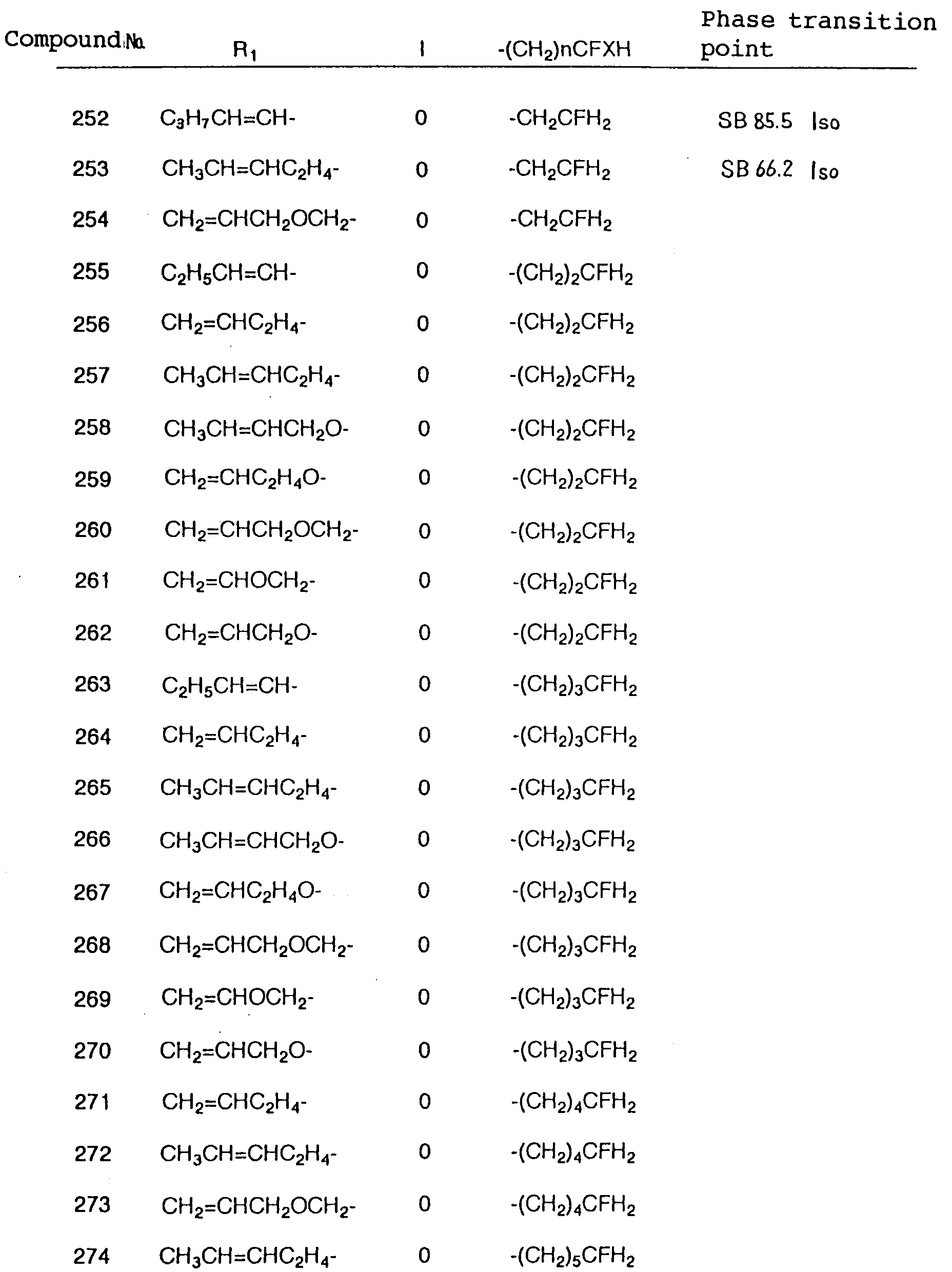


- Nematic liquid crystal composition ZLI-1132 produced by Merck GmbH, comprising a cyanophenylcyclohexane type liquid crystal compound, and having a clearing point of 72.4°C, value of dielectric anisotropy (Δε) of 11.0, value of optical anisotropy (Δn) of 0.137, viscosity of 27.0 cP, and threshold voltage at a cell thickness of 9 µ of 1.78 V was added with the compound of Example 6, 4-(4-propylcyclohexyl)-(3-fluoropropyloxy)cyclohexane in an amount of 15 % by weight to obtain a nematic liquid crystal composition. Each value of the physical properties were as follows:
- Clearing point: 66.6°C, Δε : 9.6, Δn: 0.121, viscosity: 23.6 cP, and threshold voltage at a cell thickness of 8.7 µ: 1.70 V
- A nematic liquid crystal composition was obtained in the same procedures as in Example 9 except that the compound of Example 7, 4-(4-propylcyclohexyl)-(1,1-difluoro-1-methoxy) cyclohexane was used in place of the compound of Example 6. Each value of the physical properties were as follows:
- Clearing point: 69.1°C, Δε: 9.6, Δn: 0.124, viscosity: 28.2 cP, and threshold voltage at a cell thickness of 8.7 µ: 1.75 V Example 11 (Use Example 3) through Example 26 (Use Example 18)
- Sixteen kinds of nematic liquid crystal compositions were obtained in the same procedure as in Example 9 except that the compound No. 1, 2, 3, 4, 6, 7, 14, 35, 52, 53, 60, 141, 215, 226, 235, or 252 was used. The value of physical properties of each of the compositions were as follows:
- Clearing point: 60.5°C, Δε: 9.2, Δn: 0.119, viscosity: 25.3 cP, and threshold voltage at a cell thickness of 8.7 µ: 1.59 V
- Clearing point: 66.7°C, Δε: 9.4, Δn: 0.122, and viscosity: 25.1 cP
- Clearing point: 64.4°C, Δε: 9.3, Δn: 0.119, viscosity: 25.6 cP, and threshold voltage at a cell thickness of 8.7 µ: 1.63 V
- Clearing point: 65.6°C, Δε: 9.3, Δn: 0.121, viscosity: 26.4 cP, and threshold voltage at a cell thickness of 8.7 µ: 1.66 V
- Clearing point: 68.9°C, Δε: 9.5, Δn: 0.123, viscosity: 25.6 cP, and threshold voltage at a cell thickness of 8.7 µ: 1.75 V
- Clearing point: 68.3°C, Δε: 9.6, Δn: 0.122, viscosity: 25.6 cP, and threshold voltage at a cell thickness of 8.8 µ: 1.74 V
- Clearing point: 68.7°C, Δε: 9.5, Δn: 0.122, viscosity: 24.4 cP, and threshold voltage at a cell thickness of 8.7 µ: 1.64 V
- Clearing point: 67.4°C, Δε: 9.6, Δn: 0.121, viscosity: 25.7 cP, and threshold voltage at a cell thickness of 8.8 µ: 1.72 V
- Clearing point: 72.8°C, Δε: 9.4, Δn: 0.123, viscosity: 22.9 cP, and threshold voltage at a cell thickness of 8.7 µ: 1.77 V
- Clearing point: 71.3°C, Δε: 9.4, Δn: 0.123, viscosity: 23.9 cP, and threshold voltage at a cell thickness of 8.7 µ: 1.77 V
- Clearing point: 72.3°C, Δε: 9.5, Δn: 0.122, viscosity: 23.6 cP, and threshold voltage at a cell thickness of 8.8 µ: 1.81 V
- Clearing point: 65.3°C, Δε: 10.0, Δn: 0.120, viscosity: 23.9 cP, and threshold voltage at a cell thickness of 8.8 µ: 1.76 V
- Clearing point: 67.7°C, Δε: 9.7, Δn: 0.122, viscosity: 24.6 cP, and threshold voltage at a cell thickness of 8.7 µ: 1.73 V
- Clearing point: 66.4°C, Δε: 9.6, Δn: 0.122, viscosity: 24.9 cP, and threshold voltage at a cell thickness of 8.8 µ: 1.74 V
- Clearing point: 69.1°C, Δε: 9.6, Δn: 0.124, viscosity: 28.2 cP, and threshold voltage at a cell thickness of 8.7 µ: 1.75 V
- Clearing point: 66.7°C, Δε : 9.6, Δn: 0.122, viscosity: 22.1 cP, and threshold voltage at a cell thickness of 8.7 µ: 1.69 V
- According to the present invention, when a fluorine atom was introduced in an alkyl or alkoxy group at the end of the molecule in, for example, bicyclohexane type compounds or cyclohexylethylcyclohexane type compounds, clearing point of liquid crystal compositions comprising the compound is considerably raised. Since the compounds of the present invention are also intended to be used as a viscosity decreasing agent, the compounds can usually be mixed with a liquid crystal composition in a mixing ratio of several tens % when the compounds are actually used. Thus, the difference in clearing point of a single compound exactly comes to considerably affect the clearing of compositions. In this sense, development of the compounds of the present invention which have a high clearing point are extremely useful.
- Liquid crystal compositions are provided which are suitable for using in liquid crystal display devices, have a high clearing point, and have a function of decreasing viscosity. Also, novel liquid crystalline compounds useful as a component of the liquid crystal compositions are provided.
Claims (14)
- A liquid crystalline compound expressed by the general formula (1)

- The liquid crystalline compound according to claim 1 wherein m is 0.
- The liquid crystalline compound according to claim 1 wherein m is 1.
- The liquid crystalline compound according to claim 1 wherein Y is hydrogen atom.
- The liquid crystalline compound according to claim 1 wherein Y is an alkoxy group.
- The liquid crystalline compound according to claim 2 wherein p is 0.
- The liquid crystalline compound according to claim 2 wherein p is 1.
- The liquid crystalline compound according to claim 3 wherein p is 0.
- The liquid crystalline compound according to claim 3 wherein p is 1.
- A liquid crystal composition comprising two or more components and containing, as component, at least one compound according to any one of claims 1 to 9.
- A liquid crystal composition containing, as a first component, at least one compound according to any one of claims 1 to 9 and containing, as a second component, one or more compounds selected from the group consisting of the following general formulas (II), (III), and (IV)
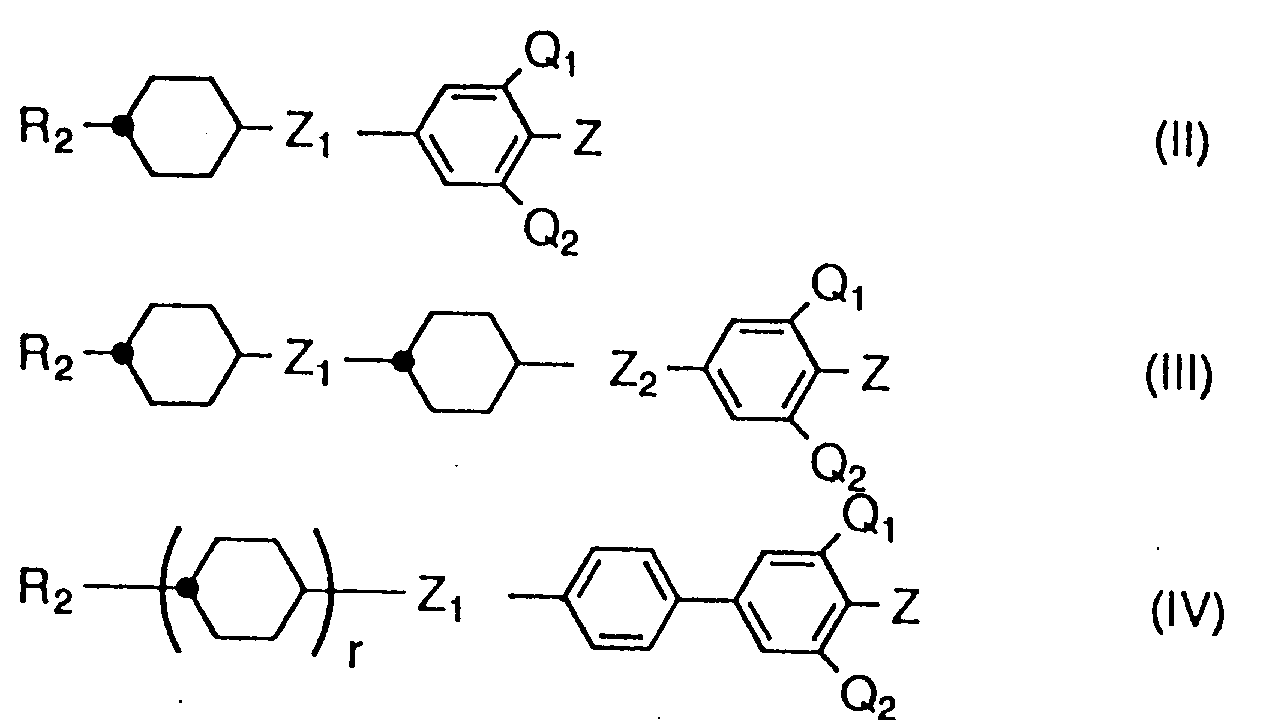
- A liquid crystal composition containing, as a first component, at least one compound according to any one of claims 1 to 9 and containing, as a second component, one or more compounds selected from the group consisting of the following general formulas (V), (VI), (VII), (VIII), and (IX)


R6(̵K)̵Z5(̵D)̵R7 (VIII)
(wherein R6 and R7 independently represent an alkyl group, alkoxy group, or alkoxymethyl group each having 1 to 10 carbon atoms, K represents cyclohexane ring, pyrimidine ring, or benzene ring, D represents cyclohexane ring or benzene ring, and Z5 represents - C≡C-, -COO-, -CH2CH2-, or covalent bond.)
- A liquid crystal display device composed by using a liquid crystal composition comprising 2 or more components and containing, as component, at least one compound according to any one of claims 1 to 9.
- A liquid crystal display device composed by using a liquid crystal composition according to any one of claims 10 to 12.
Applications Claiming Priority (7)
| Application Number | Priority Date | Filing Date | Title |
|---|---|---|---|
| JP662994 | 1994-01-25 | ||
| JP662994 | 1994-01-25 | ||
| JP6629/94 | 1994-01-25 | ||
| JP6129304A JPH1135500A (en) | 1994-01-25 | 1994-06-10 | Liquid crystalline compound and liquid crystal composition containing the same |
| JP129304/94 | 1994-06-10 | ||
| JP12930494 | 1994-06-10 | ||
| PCT/JP1994/001914 WO1995020021A1 (en) | 1994-01-25 | 1994-11-11 | Liquid crystal compound and liquid crystal composition containing the same |
Publications (3)
| Publication Number | Publication Date |
|---|---|
| EP0742275A1 true EP0742275A1 (en) | 1996-11-13 |
| EP0742275A4 EP0742275A4 (en) | 1997-05-07 |
| EP0742275B1 EP0742275B1 (en) | 2002-03-20 |
Family
ID=26340819
Family Applications (1)
| Application Number | Title | Priority Date | Filing Date |
|---|---|---|---|
| EP95900293A Expired - Lifetime EP0742275B1 (en) | 1994-01-25 | 1994-11-11 | Liquid crystal compound and liquid crystal composition containing the same |
Country Status (8)
| Country | Link |
|---|---|
| US (1) | US5779936A (en) |
| EP (1) | EP0742275B1 (en) |
| JP (1) | JPH1135500A (en) |
| KR (1) | KR970700754A (en) |
| AU (1) | AU8116394A (en) |
| DE (1) | DE69430213T2 (en) |
| TW (1) | TW348182B (en) |
| WO (1) | WO1995020021A1 (en) |
Cited By (2)
| Publication number | Priority date | Publication date | Assignee | Title |
|---|---|---|---|---|
| CN103086848A (en) * | 2013-01-28 | 2013-05-08 | 烟台德润液晶材料有限公司 | Dicyclohexylalkyl ether terminal olefines liquid crystal compound and preparation method thereof |
| EP3103856B1 (en) * | 2015-06-12 | 2019-09-18 | Samsung Display Co., Ltd. | Liquid crystal composition and liquid crystal display including the same |
Families Citing this family (15)
| Publication number | Priority date | Publication date | Assignee | Title |
|---|---|---|---|---|
| KR100740803B1 (en) * | 2002-11-05 | 2007-07-19 | 샌트랄 글래스 컴퍼니 리미티드 | Fluorine-containing vinyl ethers, their polymers, and resist compositions using such polymers |
| CN103476905A (en) * | 2011-04-18 | 2013-12-25 | 捷恩智株式会社 | Liquid crystal composition and liquid crystal display element |
| WO2013032967A1 (en) | 2011-08-29 | 2013-03-07 | Ticona Llc | Cast molded parts formed form a liquid crystalline polymer |
| CN103764793B (en) | 2011-08-29 | 2016-09-14 | 提克纳有限责任公司 | High flow liquid crystal polymer composition |
| JP2014525499A (en) | 2011-08-29 | 2014-09-29 | ティコナ・エルエルシー | Heat resistant liquid crystal polymer composition with low melting temperature |
| US9074133B2 (en) | 2011-08-29 | 2015-07-07 | Ticona Llc | Thermotropic liquid crystalline polymer with improved low shear viscosity |
| WO2013032971A1 (en) | 2011-08-29 | 2013-03-07 | Ticona Llc | Melt-extruded substrate for use in thermoformed articles |
| TW201313884A (en) | 2011-08-29 | 2013-04-01 | Ticona Llc | Solid-state polymerization of a liquid crystalline polymer |
| WO2013032973A1 (en) | 2011-08-29 | 2013-03-07 | Ticona Llc | Aromatic amide compound |
| JP2014525500A (en) | 2011-08-29 | 2014-09-29 | ティコナ・エルエルシー | Melt polymerization of low melt viscosity liquid crystal polymers |
| US9096794B2 (en) | 2011-08-29 | 2015-08-04 | Ticona Llc | High flow liquid crystalline polymer composition |
| JP6625050B2 (en) | 2013-06-07 | 2019-12-25 | ティコナ・エルエルシー | High strength thermotropic liquid crystal polymer |
| JP6319315B2 (en) * | 2013-08-28 | 2018-05-09 | Jnc株式会社 | Liquid crystal composition and liquid crystal display element |
| JP6488623B2 (en) * | 2014-02-25 | 2019-03-27 | Jnc株式会社 | Liquid crystal composition and liquid crystal display element |
| KR20170015735A (en) * | 2015-07-31 | 2017-02-09 | 삼성디스플레이 주식회사 | Liquid crystal display |
Family Cites Families (5)
| Publication number | Priority date | Publication date | Assignee | Title |
|---|---|---|---|---|
| JPS58167535A (en) * | 1982-03-26 | 1983-10-03 | Chisso Corp | Trans,trans-4-alkyl-4'-alkyloxymethylbicyclohexane |
| DE3909802A1 (en) * | 1988-07-27 | 1990-04-05 | Merck Patent Gmbh | DIFLUORMETHYLVERBINDUNGEN |
| JP2525224B2 (en) * | 1988-06-03 | 1996-08-14 | チッソ株式会社 | Liquid crystalline compound |
| JP2547857B2 (en) * | 1989-04-10 | 1996-10-23 | シャープ株式会社 | Ferroelectric liquid crystal composition |
| US5516454A (en) * | 1989-07-13 | 1996-05-14 | Merck Patent Gesellschaft Mit Beschrankter Haftung | Supertwist liquid crystal display |
-
1994
- 1994-06-10 JP JP6129304A patent/JPH1135500A/en not_active Withdrawn
- 1994-11-11 EP EP95900293A patent/EP0742275B1/en not_active Expired - Lifetime
- 1994-11-11 US US08/682,678 patent/US5779936A/en not_active Expired - Lifetime
- 1994-11-11 WO PCT/JP1994/001914 patent/WO1995020021A1/en not_active Ceased
- 1994-11-11 KR KR1019960704159A patent/KR970700754A/en not_active Withdrawn
- 1994-11-11 DE DE69430213T patent/DE69430213T2/en not_active Expired - Fee Related
- 1994-11-11 AU AU81163/94A patent/AU8116394A/en not_active Abandoned
- 1994-11-15 TW TW083110603A patent/TW348182B/en active
Non-Patent Citations (2)
| Title |
|---|
| No further relevant documents disclosed * |
| See also references of WO9520021A1 * |
Cited By (3)
| Publication number | Priority date | Publication date | Assignee | Title |
|---|---|---|---|---|
| CN103086848A (en) * | 2013-01-28 | 2013-05-08 | 烟台德润液晶材料有限公司 | Dicyclohexylalkyl ether terminal olefines liquid crystal compound and preparation method thereof |
| CN103086848B (en) * | 2013-01-28 | 2014-09-03 | 烟台德润液晶材料有限公司 | Dicyclohexylalkyl ether terminal olefines liquid crystal compound and preparation method thereof |
| EP3103856B1 (en) * | 2015-06-12 | 2019-09-18 | Samsung Display Co., Ltd. | Liquid crystal composition and liquid crystal display including the same |
Also Published As
| Publication number | Publication date |
|---|---|
| WO1995020021A1 (en) | 1995-07-27 |
| DE69430213T2 (en) | 2002-10-24 |
| US5779936A (en) | 1998-07-14 |
| EP0742275A4 (en) | 1997-05-07 |
| JPH1135500A (en) | 1999-02-09 |
| EP0742275B1 (en) | 2002-03-20 |
| TW348182B (en) | 1998-12-21 |
| DE69430213D1 (en) | 2002-04-25 |
| AU8116394A (en) | 1995-08-08 |
| KR970700754A (en) | 1997-02-12 |
Similar Documents
| Publication | Publication Date | Title |
|---|---|---|
| EP0742275B1 (en) | Liquid crystal compound and liquid crystal composition containing the same | |
| DE69527434T2 (en) | DIFLUOROXYMETHANE DERIVATIVES AND LIQUID CRYSTAL COMPOSITIONS | |
| US5858272A (en) | Phenyldioxane derivatives, liquid crystal compositions, and liquid crystal display elements | |
| EP0167912B1 (en) | Liquid crystal mixtures containing compounds with a 4-alkenyl or 2z-alkenyl lateral chain | |
| WO1999021816A1 (en) | Novel liquid-crystal compounds having large negative value of permittivity anisotropy, liquid-crystal composition, and liquid-crystal display element | |
| KR19990077385A (en) | Liquid crystal compounds, liquid crystal compositions containing these compounds, and liquid crystal display devices produced using such compositions | |
| EP0808825B1 (en) | Phenyl benzoate derivatives and liquid crystal compositions | |
| WO1998040336A1 (en) | Acetylene derivatives, and liquid crystal composition and liquid crystal display device each comprising the same | |
| DE69612527T2 (en) | Alkenylcyclohexane derivatives, liquid crystal composition and liquid crystal display element | |
| DE69614038T2 (en) | Alkenylcyclohexane derivatives and liquid crystalline compositions | |
| JP2786264B2 (en) | Alkoxymethyl- and alkenyloxymethylcyclohexanes | |
| EP0736513A1 (en) | 1-Fluorcyclohexene-difluorphenyl derivatives | |
| DE69710874T2 (en) | ALKENYL COMPOSITIONS, LIQUID CRYSTAL COMPOSITIONS, AND LIQUID CRYSTAL DISPLAY DEVICES | |
| EP0805134B1 (en) | Novel liquid-crystal compounds bearing dienyl moiety and liquid-crystal composition | |
| WO1998035924A1 (en) | Liquid-crystalline compounds having bicyclo[1.1.1]pentane structure, liquid-crystal composition, and liquid-crystal display element | |
| JPH0952851A (en) | Alkenylcyclohexane derivative and liquid crystal composition | |
| JP3134473B2 (en) | Cis-1,4-substituted 2-butene derivatives | |
| US5976408A (en) | Acrylonitrile derivative, liquid crystal composition, and liquid crystal display device | |
| JPH11106357A (en) | New liquid crystalline compound bearing trans-polyene site and liquid crystal composition | |
| EP0688754A1 (en) | Dicyclohexylethylene derivative | |
| WO1997013738A1 (en) | Fluoroalkenyl derivatives and liquid crystal compositions | |
| US5698136A (en) | Liquid crystalline alkenylcyclohexene derivative, liquid crystal composition and liquid crystal display element | |
| WO1996037451A1 (en) | Liquid crystalline compounds having exo-methylene site and liquid crystal compositions comprising the same | |
| JPH09302344A (en) | Liquid crystal composition and liquid crystal display element | |
| EP0733610B1 (en) | Liquid crystalline compound, liquid crystal composition containing the same and liquid crystal display device |
Legal Events
| Date | Code | Title | Description |
|---|---|---|---|
| PUAI | Public reference made under article 153(3) epc to a published international application that has entered the european phase |
Free format text: ORIGINAL CODE: 0009012 |
|
| 17P | Request for examination filed |
Effective date: 19960730 |
|
| AK | Designated contracting states |
Kind code of ref document: A1 Designated state(s): DE GB |
|
| A4 | Supplementary search report drawn up and despatched | ||
| AK | Designated contracting states |
Kind code of ref document: A4 Designated state(s): DE GB |
|
| 17Q | First examination report despatched |
Effective date: 19990412 |
|
| GRAG | Despatch of communication of intention to grant |
Free format text: ORIGINAL CODE: EPIDOS AGRA |
|
| GRAG | Despatch of communication of intention to grant |
Free format text: ORIGINAL CODE: EPIDOS AGRA |
|
| GRAG | Despatch of communication of intention to grant |
Free format text: ORIGINAL CODE: EPIDOS AGRA |
|
| GRAH | Despatch of communication of intention to grant a patent |
Free format text: ORIGINAL CODE: EPIDOS IGRA |
|
| GRAH | Despatch of communication of intention to grant a patent |
Free format text: ORIGINAL CODE: EPIDOS IGRA |
|
| REG | Reference to a national code |
Ref country code: GB Ref legal event code: IF02 |
|
| GRAA | (expected) grant |
Free format text: ORIGINAL CODE: 0009210 |
|
| AK | Designated contracting states |
Kind code of ref document: B1 Designated state(s): DE GB |
|
| REF | Corresponds to: |
Ref document number: 69430213 Country of ref document: DE Date of ref document: 20020425 |
|
| PLBE | No opposition filed within time limit |
Free format text: ORIGINAL CODE: 0009261 |
|
| STAA | Information on the status of an ep patent application or granted ep patent |
Free format text: STATUS: NO OPPOSITION FILED WITHIN TIME LIMIT |
|
| 26N | No opposition filed |
Effective date: 20021223 |
|
| PGFP | Annual fee paid to national office [announced via postgrant information from national office to epo] |
Ref country code: DE Payment date: 20041104 Year of fee payment: 11 |
|
| PGFP | Annual fee paid to national office [announced via postgrant information from national office to epo] |
Ref country code: GB Payment date: 20041110 Year of fee payment: 11 |
|
| PG25 | Lapsed in a contracting state [announced via postgrant information from national office to epo] |
Ref country code: GB Free format text: LAPSE BECAUSE OF NON-PAYMENT OF DUE FEES Effective date: 20051111 |
|
| PG25 | Lapsed in a contracting state [announced via postgrant information from national office to epo] |
Ref country code: DE Free format text: LAPSE BECAUSE OF NON-PAYMENT OF DUE FEES Effective date: 20060601 |
|
| GBPC | Gb: european patent ceased through non-payment of renewal fee |
Effective date: 20051111 |