EP0741971B1 - Biocidal compositions comprising mixtures of halopropynyl compounds and sulphur containing triazines - Google Patents
Biocidal compositions comprising mixtures of halopropynyl compounds and sulphur containing triazines Download PDFInfo
- Publication number
- EP0741971B1 EP0741971B1 EP96303172A EP96303172A EP0741971B1 EP 0741971 B1 EP0741971 B1 EP 0741971B1 EP 96303172 A EP96303172 A EP 96303172A EP 96303172 A EP96303172 A EP 96303172A EP 0741971 B1 EP0741971 B1 EP 0741971B1
- Authority
- EP
- European Patent Office
- Prior art keywords
- triazine
- composition
- iodopropargyl
- sulfur
- halopropynyl compound
- Prior art date
- Legal status (The legal status is an assumption and is not a legal conclusion. Google has not performed a legal analysis and makes no representation as to the accuracy of the status listed.)
- Expired - Lifetime
Links
- 239000000203 mixture Substances 0.000 title claims description 71
- 150000001875 compounds Chemical class 0.000 title claims description 46
- NINIDFKCEFEMDL-UHFFFAOYSA-N Sulfur Chemical compound [S] NINIDFKCEFEMDL-UHFFFAOYSA-N 0.000 title claims description 22
- 230000003115 biocidal effect Effects 0.000 title claims description 12
- 150000003918 triazines Chemical class 0.000 title description 3
- 239000005864 Sulphur Substances 0.000 title 1
- 229940099451 3-iodo-2-propynylbutylcarbamate Drugs 0.000 claims description 34
- WYVVKGNFXHOCQV-UHFFFAOYSA-N 3-iodoprop-2-yn-1-yl butylcarbamate Chemical group CCCCNC(=O)OCC#CI WYVVKGNFXHOCQV-UHFFFAOYSA-N 0.000 claims description 34
- -1 iodopropargyl Chemical class 0.000 claims description 34
- JIHQDMXYYFUGFV-UHFFFAOYSA-N 1,3,5-triazine Chemical compound C1=NC=NC=N1 JIHQDMXYYFUGFV-UHFFFAOYSA-N 0.000 claims description 32
- 229910052717 sulfur Inorganic materials 0.000 claims description 21
- 239000011593 sulfur Substances 0.000 claims description 21
- 239000000758 substrate Substances 0.000 claims description 11
- HDHLIWCXDDZUFH-UHFFFAOYSA-N irgarol 1051 Chemical compound CC(C)(C)NC1=NC(SC)=NC(NC2CC2)=N1 HDHLIWCXDDZUFH-UHFFFAOYSA-N 0.000 claims description 9
- 238000002156 mixing Methods 0.000 claims description 8
- 239000002904 solvent Substances 0.000 claims description 8
- 238000000034 method Methods 0.000 claims description 7
- 230000002538 fungal effect Effects 0.000 claims description 6
- 125000000217 alkyl group Chemical group 0.000 claims description 5
- 125000000753 cycloalkyl group Chemical group 0.000 claims description 5
- 239000007788 liquid Substances 0.000 claims description 5
- RCVKZMQGFZRHKO-UHFFFAOYSA-N 1-iodoprop-2-ynyl carbamate Chemical compound NC(=O)OC(I)C#C RCVKZMQGFZRHKO-UHFFFAOYSA-N 0.000 claims description 4
- 125000003118 aryl group Chemical group 0.000 claims description 4
- 125000004432 carbon atom Chemical group C* 0.000 claims description 4
- 125000004051 hexyl group Chemical group [H]C([H])([H])C([H])([H])C([H])([H])C([H])([H])C([H])([H])C([H])([H])* 0.000 claims description 4
- 125000002877 alkyl aryl group Chemical group 0.000 claims description 3
- 125000003710 aryl alkyl group Chemical group 0.000 claims description 3
- 206010061217 Infestation Diseases 0.000 claims description 2
- 125000000392 cycloalkenyl group Chemical group 0.000 claims description 2
- 229910052739 hydrogen Inorganic materials 0.000 claims description 2
- 239000001257 hydrogen Substances 0.000 claims description 2
- 125000004435 hydrogen atom Chemical class [H]* 0.000 claims description 2
- LKYMWFDXBHLYNJ-UHFFFAOYSA-N 3-iodo-3-(1-iodoprop-2-ynoxy)prop-1-yne Chemical compound C#CC(I)OC(I)C#C LKYMWFDXBHLYNJ-UHFFFAOYSA-N 0.000 claims 1
- HTDPBNONEWOVLE-UHFFFAOYSA-N OC(=O)OC(I)C#C Chemical compound OC(=O)OC(I)C#C HTDPBNONEWOVLE-UHFFFAOYSA-N 0.000 claims 1
- DHKHKXVYLBGOIT-UHFFFAOYSA-N acetaldehyde Diethyl Acetal Natural products CCOC(C)OCC DHKHKXVYLBGOIT-UHFFFAOYSA-N 0.000 claims 1
- 241000195493 Cryptophyta Species 0.000 description 28
- 241000233866 Fungi Species 0.000 description 18
- 230000002195 synergetic effect Effects 0.000 description 16
- 230000000855 fungicidal effect Effects 0.000 description 15
- VYPSYNLAJGMNEJ-UHFFFAOYSA-N Silicium dioxide Chemical compound O=[Si]=O VYPSYNLAJGMNEJ-UHFFFAOYSA-N 0.000 description 14
- 239000000417 fungicide Substances 0.000 description 14
- 239000000047 product Substances 0.000 description 14
- 230000000694 effects Effects 0.000 description 13
- 239000000123 paper Substances 0.000 description 13
- IROINLKCQGIITA-UHFFFAOYSA-N terbutryn Chemical compound CCNC1=NC(NC(C)(C)C)=NC(SC)=N1 IROINLKCQGIITA-UHFFFAOYSA-N 0.000 description 13
- 238000012360 testing method Methods 0.000 description 13
- YZRIDSPMGVSVJL-UHFFFAOYSA-N 4-ethyl-6-methylsulfanyl-1H-1,3,5-triazine-2,4-diamine Chemical compound CCC1(N)NC(N)=NC(SC)=N1 YZRIDSPMGVSVJL-UHFFFAOYSA-N 0.000 description 12
- XLYOFNOQVPJJNP-UHFFFAOYSA-N water Substances O XLYOFNOQVPJJNP-UHFFFAOYSA-N 0.000 description 12
- 238000009472 formulation Methods 0.000 description 10
- 229920001817 Agar Polymers 0.000 description 9
- 239000008272 agar Substances 0.000 description 9
- 239000004615 ingredient Substances 0.000 description 9
- 239000003973 paint Substances 0.000 description 9
- 125000000524 functional group Chemical group 0.000 description 8
- RWNUSVWFHDHRCJ-UHFFFAOYSA-N 1-butoxypropan-2-ol Chemical compound CCCCOCC(C)O RWNUSVWFHDHRCJ-UHFFFAOYSA-N 0.000 description 7
- 241000223602 Alternaria alternata Species 0.000 description 7
- 230000002363 herbicidal effect Effects 0.000 description 7
- 241000223678 Aureobasidium pullulans Species 0.000 description 6
- KXDHJXZQYSOELW-UHFFFAOYSA-M Carbamate Chemical compound NC([O-])=O KXDHJXZQYSOELW-UHFFFAOYSA-M 0.000 description 6
- DNIAPMSPPWPWGF-UHFFFAOYSA-N Propylene glycol Chemical compound CC(O)CO DNIAPMSPPWPWGF-UHFFFAOYSA-N 0.000 description 6
- 239000003139 biocide Substances 0.000 description 6
- 238000000576 coating method Methods 0.000 description 6
- 150000002148 esters Chemical class 0.000 description 6
- 239000004009 herbicide Substances 0.000 description 6
- 239000000377 silicon dioxide Substances 0.000 description 6
- 239000011885 synergistic combination Substances 0.000 description 6
- 239000002023 wood Substances 0.000 description 6
- 240000009108 Chlorella vulgaris Species 0.000 description 5
- 230000002353 algacidal effect Effects 0.000 description 5
- 150000004657 carbamic acid derivatives Chemical class 0.000 description 5
- 239000002270 dispersing agent Substances 0.000 description 5
- 239000006185 dispersion Substances 0.000 description 5
- 239000000080 wetting agent Substances 0.000 description 5
- ARXJGSRGQADJSQ-UHFFFAOYSA-N 1-methoxypropan-2-ol Chemical compound COCC(C)O ARXJGSRGQADJSQ-UHFFFAOYSA-N 0.000 description 4
- 125000003542 3-methylbutan-2-yl group Chemical group [H]C([H])([H])C([H])(*)C([H])(C([H])([H])[H])C([H])([H])[H] 0.000 description 4
- IJGRMHOSHXDMSA-UHFFFAOYSA-N Atomic nitrogen Chemical compound N#N IJGRMHOSHXDMSA-UHFFFAOYSA-N 0.000 description 4
- 241001148696 Stichococcus Species 0.000 description 4
- 241000719320 Trentepohlia aurea Species 0.000 description 4
- 239000003619 algicide Substances 0.000 description 4
- 230000008901 benefit Effects 0.000 description 4
- 125000001559 cyclopropyl group Chemical group [H]C1([H])C([H])([H])C1([H])* 0.000 description 4
- 125000001449 isopropyl group Chemical group [H]C([H])([H])C([H])(*)C([H])([H])[H] 0.000 description 4
- 239000000463 material Substances 0.000 description 4
- 241000894007 species Species 0.000 description 4
- 150000003467 sulfuric acid derivatives Chemical class 0.000 description 4
- 125000000999 tert-butyl group Chemical group [H]C([H])([H])C(*)(C([H])([H])[H])C([H])([H])[H] 0.000 description 4
- 239000004753 textile Substances 0.000 description 4
- HPGGRRWTQXPMHJ-UHFFFAOYSA-N 3-iodoprop-1-ynyl carbamate Chemical compound NC(=O)OC#CCI HPGGRRWTQXPMHJ-UHFFFAOYSA-N 0.000 description 3
- 241000228245 Aspergillus niger Species 0.000 description 3
- 241000196324 Embryophyta Species 0.000 description 3
- 241000719329 Trentepohlia Species 0.000 description 3
- 238000001035 drying Methods 0.000 description 3
- 125000001495 ethyl group Chemical group [H]C([H])([H])C([H])([H])* 0.000 description 3
- 239000012634 fragment Substances 0.000 description 3
- 230000012010 growth Effects 0.000 description 3
- 239000002054 inoculum Substances 0.000 description 3
- 238000002386 leaching Methods 0.000 description 3
- 239000012669 liquid formulation Substances 0.000 description 3
- 239000000565 sealant Substances 0.000 description 3
- 239000000243 solution Substances 0.000 description 3
- 238000010186 staining Methods 0.000 description 3
- 239000004575 stone Substances 0.000 description 3
- 239000000725 suspension Substances 0.000 description 3
- 238000005406 washing Methods 0.000 description 3
- JYEUMXHLPRZUAT-UHFFFAOYSA-N 1,2,3-triazine Chemical compound C1=CN=NN=C1 JYEUMXHLPRZUAT-UHFFFAOYSA-N 0.000 description 2
- 229910002012 Aerosil® Inorganic materials 0.000 description 2
- KXDHJXZQYSOELW-UHFFFAOYSA-N Carbamic acid Chemical group NC(O)=O KXDHJXZQYSOELW-UHFFFAOYSA-N 0.000 description 2
- OKTJSMMVPCPJKN-UHFFFAOYSA-N Carbon Chemical compound [C] OKTJSMMVPCPJKN-UHFFFAOYSA-N 0.000 description 2
- 101710184216 Cardioactive peptide Proteins 0.000 description 2
- RTZKZFJDLAIYFH-UHFFFAOYSA-N Diethyl ether Chemical compound CCOCC RTZKZFJDLAIYFH-UHFFFAOYSA-N 0.000 description 2
- 241000607479 Yersinia pestis Species 0.000 description 2
- YKTSYUJCYHOUJP-UHFFFAOYSA-N [O--].[Al+3].[Al+3].[O-][Si]([O-])([O-])[O-] Chemical compound [O--].[Al+3].[Al+3].[O-][Si]([O-])([O-])[O-] YKTSYUJCYHOUJP-UHFFFAOYSA-N 0.000 description 2
- 239000004480 active ingredient Substances 0.000 description 2
- 239000013543 active substance Substances 0.000 description 2
- QVGXLLKOCUKJST-UHFFFAOYSA-N atomic oxygen Chemical compound [O] QVGXLLKOCUKJST-UHFFFAOYSA-N 0.000 description 2
- LLEMOWNGBBNAJR-UHFFFAOYSA-N biphenyl-2-ol Chemical compound OC1=CC=CC=C1C1=CC=CC=C1 LLEMOWNGBBNAJR-UHFFFAOYSA-N 0.000 description 2
- 229910052799 carbon Inorganic materials 0.000 description 2
- 239000003795 chemical substances by application Substances 0.000 description 2
- 239000004927 clay Substances 0.000 description 2
- 239000011248 coating agent Substances 0.000 description 2
- 125000000113 cyclohexyl group Chemical group [H]C1([H])C([H])([H])C([H])([H])C([H])(*)C([H])([H])C1([H])[H] 0.000 description 2
- 230000006378 damage Effects 0.000 description 2
- 230000007613 environmental effect Effects 0.000 description 2
- 230000002209 hydrophobic effect Effects 0.000 description 2
- 244000005700 microbiome Species 0.000 description 2
- 238000012986 modification Methods 0.000 description 2
- 230000004048 modification Effects 0.000 description 2
- PSZYNBSKGUBXEH-UHFFFAOYSA-N naphthalene-1-sulfonic acid Chemical class C1=CC=C2C(S(=O)(=O)O)=CC=CC2=C1 PSZYNBSKGUBXEH-UHFFFAOYSA-N 0.000 description 2
- 150000002790 naphthalenes Chemical class 0.000 description 2
- 229910052757 nitrogen Inorganic materials 0.000 description 2
- 229910052760 oxygen Inorganic materials 0.000 description 2
- 239000001301 oxygen Substances 0.000 description 2
- 125000001147 pentyl group Chemical group C(CCCC)* 0.000 description 2
- 239000000843 powder Substances 0.000 description 2
- 238000002360 preparation method Methods 0.000 description 2
- 125000001436 propyl group Chemical group [H]C([*])([H])C([H])([H])C([H])([H])[H] 0.000 description 2
- 230000004044 response Effects 0.000 description 2
- 235000012239 silicon dioxide Nutrition 0.000 description 2
- 229920001909 styrene-acrylic polymer Polymers 0.000 description 2
- 239000008399 tap water Substances 0.000 description 2
- 235000020679 tap water Nutrition 0.000 description 2
- 239000002562 thickening agent Substances 0.000 description 2
- 230000003442 weekly effect Effects 0.000 description 2
- 125000006528 (C2-C6) alkyl group Chemical group 0.000 description 1
- 125000005913 (C3-C6) cycloalkyl group Chemical group 0.000 description 1
- 125000005918 1,2-dimethylbutyl group Chemical group 0.000 description 1
- YYTSGNJTASLUOY-UHFFFAOYSA-N 1-chloropropan-2-ol Chemical compound CC(O)CCl YYTSGNJTASLUOY-UHFFFAOYSA-N 0.000 description 1
- GQCZPFJGIXHZMB-UHFFFAOYSA-N 1-tert-Butoxy-2-propanol Chemical compound CC(O)COC(C)(C)C GQCZPFJGIXHZMB-UHFFFAOYSA-N 0.000 description 1
- BPCDFPIPLVMCLV-UHFFFAOYSA-N 1-tert-butyl-2-n-cyclopropyl-6-methylsulfanyl-2h-1,3,5-triazine-2,4-diamine Chemical compound CC(C)(C)N1C(SC)=NC(N)=NC1NC1CC1 BPCDFPIPLVMCLV-UHFFFAOYSA-N 0.000 description 1
- KJUGUADJHNHALS-UHFFFAOYSA-N 1H-tetrazole Substances C=1N=NNN=1 KJUGUADJHNHALS-UHFFFAOYSA-N 0.000 description 1
- CUDYYMUUJHLCGZ-UHFFFAOYSA-N 2-(2-methoxypropoxy)propan-1-ol Chemical compound COC(C)COC(C)CO CUDYYMUUJHLCGZ-UHFFFAOYSA-N 0.000 description 1
- XNWFRZJHXBZDAG-UHFFFAOYSA-N 2-METHOXYETHANOL Chemical compound COCCO XNWFRZJHXBZDAG-UHFFFAOYSA-N 0.000 description 1
- HUHGPYXAVBJSJV-UHFFFAOYSA-N 2-[3,5-bis(2-hydroxyethyl)-1,3,5-triazinan-1-yl]ethanol Chemical compound OCCN1CN(CCO)CN(CCO)C1 HUHGPYXAVBJSJV-UHFFFAOYSA-N 0.000 description 1
- 125000001494 2-propynyl group Chemical group [H]C#CC([H])([H])* 0.000 description 1
- ZCYVEMRRCGMTRW-UHFFFAOYSA-N 7553-56-2 Chemical compound [I] ZCYVEMRRCGMTRW-UHFFFAOYSA-N 0.000 description 1
- 241001621841 Alopecurus myosuroides Species 0.000 description 1
- 235000007089 Chlorella vulgaris Nutrition 0.000 description 1
- SNRUBQQJIBEYMU-UHFFFAOYSA-N Dodecane Natural products CCCCCCCCCCCC SNRUBQQJIBEYMU-UHFFFAOYSA-N 0.000 description 1
- 241000220485 Fabaceae Species 0.000 description 1
- WLFDQEVORAMCIM-UHFFFAOYSA-N Metobromuron Chemical compound CON(C)C(=O)NC1=CC=C(Br)C=C1 WLFDQEVORAMCIM-UHFFFAOYSA-N 0.000 description 1
- 239000005581 Metobromuron Substances 0.000 description 1
- SECXISVLQFMRJM-UHFFFAOYSA-N N-Methylpyrrolidone Chemical compound CN1CCCC1=O SECXISVLQFMRJM-UHFFFAOYSA-N 0.000 description 1
- CCGPUGMWYLICGL-UHFFFAOYSA-N Neburon Chemical compound CCCCN(C)C(=O)NC1=CC=C(Cl)C(Cl)=C1 CCGPUGMWYLICGL-UHFFFAOYSA-N 0.000 description 1
- YPWFISCTZQNZAU-UHFFFAOYSA-N Thiane Chemical compound C1CCSCC1 YPWFISCTZQNZAU-UHFFFAOYSA-N 0.000 description 1
- 241000209140 Triticum Species 0.000 description 1
- 235000021307 Triticum Nutrition 0.000 description 1
- 239000012963 UV stabilizer Substances 0.000 description 1
- 150000001241 acetals Chemical class 0.000 description 1
- 230000009471 action Effects 0.000 description 1
- 239000000654 additive Substances 0.000 description 1
- 239000000853 adhesive Substances 0.000 description 1
- 230000001070 adhesive effect Effects 0.000 description 1
- 235000011037 adipic acid Nutrition 0.000 description 1
- 150000001279 adipic acids Chemical class 0.000 description 1
- 239000002671 adjuvant Substances 0.000 description 1
- 230000002411 adverse Effects 0.000 description 1
- 239000000443 aerosol Substances 0.000 description 1
- 239000003570 air Substances 0.000 description 1
- 125000004171 alkoxy aryl group Chemical group 0.000 description 1
- 150000001408 amides Chemical class 0.000 description 1
- 150000001412 amines Chemical class 0.000 description 1
- 150000003863 ammonium salts Chemical class 0.000 description 1
- 230000000845 anti-microbial effect Effects 0.000 description 1
- 238000013459 approach Methods 0.000 description 1
- 239000007864 aqueous solution Substances 0.000 description 1
- 230000001580 bacterial effect Effects 0.000 description 1
- 239000011324 bead Substances 0.000 description 1
- IOJUPLGTWVMSFF-UHFFFAOYSA-N benzothiazole Chemical class C1=CC=C2SC=NC2=C1 IOJUPLGTWVMSFF-UHFFFAOYSA-N 0.000 description 1
- 125000001797 benzyl group Chemical group [H]C1=C([H])C([H])=C(C([H])=C1[H])C([H])([H])* 0.000 description 1
- 239000011230 binding agent Substances 0.000 description 1
- 125000000484 butyl group Chemical group [H]C([*])([H])C([H])([H])C([H])([H])C([H])([H])[H] 0.000 description 1
- 235000013877 carbamide Nutrition 0.000 description 1
- 150000004649 carbonic acid derivatives Chemical class 0.000 description 1
- 150000003857 carboxamides Chemical class 0.000 description 1
- 239000011111 cardboard Substances 0.000 description 1
- 235000013339 cereals Nutrition 0.000 description 1
- 238000006243 chemical reaction Methods 0.000 description 1
- 125000000068 chlorophenyl group Chemical group 0.000 description 1
- 229940127555 combination product Drugs 0.000 description 1
- 230000000052 comparative effect Effects 0.000 description 1
- 239000012141 concentrate Substances 0.000 description 1
- 239000000470 constituent Substances 0.000 description 1
- 238000001816 cooling Methods 0.000 description 1
- 230000007797 corrosion Effects 0.000 description 1
- 238000005260 corrosion Methods 0.000 description 1
- 125000001995 cyclobutyl group Chemical group [H]C1([H])C([H])([H])C([H])(*)C1([H])[H] 0.000 description 1
- 125000001511 cyclopentyl group Chemical group [H]C1([H])C([H])([H])C([H])([H])C([H])(*)C1([H])[H] 0.000 description 1
- 125000002704 decyl group Chemical group [H]C([H])([H])C([H])([H])C([H])([H])C([H])([H])C([H])([H])C([H])([H])C([H])([H])C([H])([H])C([H])([H])C([H])([H])* 0.000 description 1
- 230000001066 destructive effect Effects 0.000 description 1
- 230000006866 deterioration Effects 0.000 description 1
- 150000001991 dicarboxylic acids Chemical class 0.000 description 1
- 239000003085 diluting agent Substances 0.000 description 1
- 238000010790 dilution Methods 0.000 description 1
- 239000012895 dilution Substances 0.000 description 1
- 238000002845 discoloration Methods 0.000 description 1
- 238000009826 distribution Methods 0.000 description 1
- 125000003438 dodecyl group Chemical group [H]C([H])([H])C([H])([H])C([H])([H])C([H])([H])C([H])([H])C([H])([H])C([H])([H])C([H])([H])C([H])([H])C([H])([H])C([H])([H])C([H])([H])* 0.000 description 1
- 239000000975 dye Substances 0.000 description 1
- 239000003995 emulsifying agent Substances 0.000 description 1
- 239000000839 emulsion Substances 0.000 description 1
- 239000003623 enhancer Substances 0.000 description 1
- 150000002170 ethers Chemical class 0.000 description 1
- LYCAIKOWRPUZTN-UHFFFAOYSA-N ethylene glycol Natural products OCCO LYCAIKOWRPUZTN-UHFFFAOYSA-N 0.000 description 1
- 239000013020 final formulation Substances 0.000 description 1
- 239000012467 final product Substances 0.000 description 1
- 239000000834 fixative Substances 0.000 description 1
- 230000009969 flowable effect Effects 0.000 description 1
- 239000012530 fluid Substances 0.000 description 1
- 239000011521 glass Substances 0.000 description 1
- 150000002311 glutaric acids Chemical class 0.000 description 1
- 238000000227 grinding Methods 0.000 description 1
- 229910052736 halogen Inorganic materials 0.000 description 1
- 150000002367 halogens Chemical class 0.000 description 1
- 125000003187 heptyl group Chemical group [H]C([*])([H])C([H])([H])C([H])([H])C([H])([H])C([H])([H])C([H])([H])C([H])([H])[H] 0.000 description 1
- WGCNASOHLSPBMP-UHFFFAOYSA-N hydroxyacetaldehyde Natural products OCC=O WGCNASOHLSPBMP-UHFFFAOYSA-N 0.000 description 1
- 238000010348 incorporation Methods 0.000 description 1
- 239000003112 inhibitor Substances 0.000 description 1
- 230000002401 inhibitory effect Effects 0.000 description 1
- 230000005764 inhibitory process Effects 0.000 description 1
- 229910052740 iodine Inorganic materials 0.000 description 1
- 239000011630 iodine Substances 0.000 description 1
- 125000001972 isopentyl group Chemical group [H]C([H])([H])C([H])(C([H])([H])[H])C([H])([H])C([H])([H])* 0.000 description 1
- 239000000314 lubricant Substances 0.000 description 1
- 238000004519 manufacturing process Methods 0.000 description 1
- 238000005555 metalworking Methods 0.000 description 1
- 125000002496 methyl group Chemical group [H]C([H])([H])* 0.000 description 1
- 230000002906 microbiologic effect Effects 0.000 description 1
- 125000004108 n-butyl group Chemical group [H]C([H])([H])C([H])([H])C([H])([H])C([H])([H])* 0.000 description 1
- XITQUSLLOSKDTB-UHFFFAOYSA-N nitrofen Chemical compound C1=CC([N+](=O)[O-])=CC=C1OC1=CC=C(Cl)C=C1Cl XITQUSLLOSKDTB-UHFFFAOYSA-N 0.000 description 1
- 125000001400 nonyl group Chemical group [H]C([*])([H])C([H])([H])C([H])([H])C([H])([H])C([H])([H])C([H])([H])C([H])([H])C([H])([H])C([H])([H])[H] 0.000 description 1
- 125000002347 octyl group Chemical group [H]C([*])([H])C([H])([H])C([H])([H])C([H])([H])C([H])([H])C([H])([H])C([H])([H])C([H])([H])[H] 0.000 description 1
- 239000003921 oil Substances 0.000 description 1
- 150000002894 organic compounds Chemical class 0.000 description 1
- 230000005789 organism growth Effects 0.000 description 1
- 235000010292 orthophenyl phenol Nutrition 0.000 description 1
- TWSRVQVEYJNFKQ-UHFFFAOYSA-N pentyl propanoate Chemical compound CCCCCOC(=O)CC TWSRVQVEYJNFKQ-UHFFFAOYSA-N 0.000 description 1
- 150000002989 phenols Chemical class 0.000 description 1
- 125000001997 phenyl group Chemical group [H]C1=C([H])C([H])=C(*)C([H])=C1[H] 0.000 description 1
- 230000029553 photosynthesis Effects 0.000 description 1
- 238000010672 photosynthesis Methods 0.000 description 1
- 239000000049 pigment Substances 0.000 description 1
- 239000004033 plastic Substances 0.000 description 1
- 229920003023 plastic Polymers 0.000 description 1
- 239000004014 plasticizer Substances 0.000 description 1
- 238000012545 processing Methods 0.000 description 1
- 230000009467 reduction Effects 0.000 description 1
- 125000002914 sec-butyl group Chemical group [H]C([H])([H])C([H])([H])C([H])(*)C([H])([H])[H] 0.000 description 1
- 239000002689 soil Substances 0.000 description 1
- 238000001228 spectrum Methods 0.000 description 1
- 125000004079 stearyl group Chemical group [H]C([*])([H])C([H])([H])C([H])([H])C([H])([H])C([H])([H])C([H])([H])C([H])([H])C([H])([H])C([H])([H])C([H])([H])C([H])([H])C([H])([H])C([H])([H])C([H])([H])C([H])([H])C([H])([H])C([H])([H])C([H])([H])[H] 0.000 description 1
- 239000000126 substance Substances 0.000 description 1
- 125000001424 substituent group Chemical group 0.000 description 1
- 150000003444 succinic acids Chemical class 0.000 description 1
- NVBFHJWHLNUMCV-UHFFFAOYSA-N sulfamide Chemical class NS(N)(=O)=O NVBFHJWHLNUMCV-UHFFFAOYSA-N 0.000 description 1
- 150000003457 sulfones Chemical class 0.000 description 1
- 125000003375 sulfoxide group Chemical group 0.000 description 1
- 150000003536 tetrazoles Chemical class 0.000 description 1
- 150000003573 thiols Chemical class 0.000 description 1
- 125000003944 tolyl group Chemical group 0.000 description 1
- 238000012546 transfer Methods 0.000 description 1
- ZSDSQXJSNMTJDA-UHFFFAOYSA-N trifluralin Chemical compound CCCN(CCC)C1=C([N+]([O-])=O)C=C(C(F)(F)F)C=C1[N+]([O-])=O ZSDSQXJSNMTJDA-UHFFFAOYSA-N 0.000 description 1
- 150000003672 ureas Chemical class 0.000 description 1
- 239000004563 wettable powder Substances 0.000 description 1
Classifications
-
- A—HUMAN NECESSITIES
- A01—AGRICULTURE; FORESTRY; ANIMAL HUSBANDRY; HUNTING; TRAPPING; FISHING
- A01N—PRESERVATION OF BODIES OF HUMANS OR ANIMALS OR PLANTS OR PARTS THEREOF; BIOCIDES, e.g. AS DISINFECTANTS, AS PESTICIDES OR AS HERBICIDES; PEST REPELLANTS OR ATTRACTANTS; PLANT GROWTH REGULATORS
- A01N29/00—Biocides, pest repellants or attractants, or plant growth regulators containing halogenated hydrocarbons
-
- A—HUMAN NECESSITIES
- A01—AGRICULTURE; FORESTRY; ANIMAL HUSBANDRY; HUNTING; TRAPPING; FISHING
- A01N—PRESERVATION OF BODIES OF HUMANS OR ANIMALS OR PLANTS OR PARTS THEREOF; BIOCIDES, e.g. AS DISINFECTANTS, AS PESTICIDES OR AS HERBICIDES; PEST REPELLANTS OR ATTRACTANTS; PLANT GROWTH REGULATORS
- A01N47/00—Biocides, pest repellants or attractants, or plant growth regulators containing organic compounds containing a carbon atom not being member of a ring and having no bond to a carbon or hydrogen atom, e.g. derivatives of carbonic acid
- A01N47/08—Biocides, pest repellants or attractants, or plant growth regulators containing organic compounds containing a carbon atom not being member of a ring and having no bond to a carbon or hydrogen atom, e.g. derivatives of carbonic acid the carbon atom having one or more single bonds to nitrogen atoms
- A01N47/10—Carbamic acid derivatives, i.e. containing the group —O—CO—N<; Thio analogues thereof
- A01N47/12—Carbamic acid derivatives, i.e. containing the group —O—CO—N<; Thio analogues thereof containing a —O—CO—N< group, or a thio analogue thereof, neither directly attached to a ring nor the nitrogen atom being a member of a heterocyclic ring
-
- A—HUMAN NECESSITIES
- A01—AGRICULTURE; FORESTRY; ANIMAL HUSBANDRY; HUNTING; TRAPPING; FISHING
- A01N—PRESERVATION OF BODIES OF HUMANS OR ANIMALS OR PLANTS OR PARTS THEREOF; BIOCIDES, e.g. AS DISINFECTANTS, AS PESTICIDES OR AS HERBICIDES; PEST REPELLANTS OR ATTRACTANTS; PLANT GROWTH REGULATORS
- A01N43/00—Biocides, pest repellants or attractants, or plant growth regulators containing heterocyclic compounds
- A01N43/64—Biocides, pest repellants or attractants, or plant growth regulators containing heterocyclic compounds having rings with three nitrogen atoms as the only ring hetero atoms
Definitions
- This invention is directed to a biocidal composition and particularly a synergistic mixture or combination of a halopropynyl compound and a sulfur-containing s-triazine.
- Materials which need protection with a suitable antimicrobial composition controlling both fungal and algael microorganisms and their adverse effects include paints, coatings, stucco, concrete, stone, cementaceous surfaces, wood, caulking, sealants, and textiles as well as materials and other substances which may be attacked by fungi and/or algae.
- a broad spectrum biocide composition highly effective against both fungi and algae, and which is essentially unaffected by leaching with water, in an environmentally, toxicologically suitable liquid media has many advantages and is desirable for a wide number of uses in industry.
- compositions and/or mixtures methods of manufacture and/or uses and applications of combinations of fungicides and algaecides, the prior art and references describing these combinations is limited.
- IPBC 3-iodo-2 propynyl butyl carbamate
- IPBC 3-iodo-2 propynyl butyl carbamate
- IPBC also has been associated with algaecidal activity.
- Great Britain Patent 2,138,292 and U.S. Patents 4,915,909 and 5,082,722 contain such disclosures.
- IPBC is a highly active broad spectrum fungicide. Nevertheless, its spectrum of action is sometimes incomplete against the broad range of naturally occurring fungal species. For this reason, U.S. Patent 5,389,300 describes using a phenol derivative, such as o-phenylphenol, with an iodopropargyl compound, such as IPBC, for protecting freshly sawn timber from such pests.
- Certain s-triazines are known for their algaecidal activity. They have been found to be especially effective for use in agricultural applications.
- One such example of this algaecide is N 2 tertbutyl-N 4 -ethyl-6-methylthio-1,3,5-triazine-2,4 diyldiamine and a second such example is 2-methylthio-4-tert-butylamino-6-cyclopropylamino-s-triazine.
- Patent 4,710,220 for example, describes formulations containing a polyethoxylated compound and certain s-triazines, with N 2 -tert-butyl-N 4 -ethyl-6-methylthio-1,3,5-triazine-2,4-diyldiamine, hereafter referred to as Terbutryn, as one example. Even so, Terbutryn is probably more widely known as a herbicide, and in particular, is widely disclosed for use as a herbicide in combination with a variety of other compounds. For example, in U.S. 3,957,481 it is used in combination with metobromuron for controlling weeds when cultivating leguminosae and solana; in U.S.
- Patent 4,640,705 and Great England Patent 2,126,092 it is used in combination with trifluralin and ethylfluralin respectively, for preemergent control of weeds, particularly blackgrass, in cereal crops and in French Patent 2,438,970 it is used with neburon and nitrofen to control weeds in winter wheat. Nowhere, however, has it been suggested to combine Terbutryn with a halopropynyl compound and particularly a haloalkynyl carbamate fungicide for any purpose.
- the present invention is based on the surprising synergistic effect that a combination of a halopropynyl compound, and particularly a halopropynyl carbamate fungicide, and a sulfur-containing s-triazine algaecide has on the increased efficacy of the resulting combined product, especially against fungi and algae.
- synergistic combinations containing in particular both the fungicide, 3-iodo-2-propynyl butyl carbamate (IPBC) and either, N 2 -tertbutyl-N 4 -ethyl-6-methylthio-1,3,5-triazine-2,4 diyldiamine (Terbutryn) or 2-methylthio-4-tert-butylamino-6-cyclopropylamino-s-triazine (Irgarol 1071) give a surprising and unexpected biocidal effect against algae, including Stichococcus basillaris , Chlorella Vulgaris var. viridis , Trentepohlia sp . and Trentepohlia aurea .
- Relative proportions of the two components in compositions according to the present invention may be varied widely since the combination also provides excellent algaecidal properties. Depending on the degree of environmental pressure on the exposed area, it can be an advantage to select and adjust the proportions of the two components relevant to and depending upon which organism is more problematic to control and for which maximum protection is desired.
- the present invention is directed to a synergistic combination of a halopropynyl compound, particularly a halopropynyl carbamate such as IPBC, and a sulfur-containing s-triazine, particularly Terbutryn and Irgarol 1071.
- a halopropynyl compound particularly a halopropynyl carbamate such as IPBC
- a sulfur-containing s-triazine particularly Terbutryn and Irgarol 1071.
- a halopropynyl compound for use in the present invention can be identified by the following structure: YC ⁇ C - CH 2 X wherein Y is a halogen, preferably iodine and X can be (1) oxygen which is part of an organic functional group; (2) nitrogen which is an organic functional group; (3) sulfur which is part of an organic functional group; or (4) carbon which is part of an organic functional group.
- the functional group of which oxygen is a part is preferably an ether, ester, or carbamate group.
- the functional group of which nitrogen is a part is preferably an amine, amide, or carbamate group.
- the functional group of which sulfur is a part is preferably a thiol, thiane, sulfone, or sulfoxide group.
- the organic functional group of which carbon is a part is preferably an ester, carbamate or alkyl group.
- Examples of compounds which may be used as the halopropynyl compound fungicide of this invention are especially the fungicidally active iodopropargyl (iodopropynyl) derivatives.
- iodopropargyl iodopropynyl
- iodopropynyl derivatives include compounds derived from propargyl or iodopropargyl alcohols such as the esters, ethers, acetals, carbamates and carbonates and the iodopropargyl derivatives of pyrimidines, tiazolinones, tetrazoles, triazinones, sulfamides, benzothiazoles, ammonium salts, carboxamides, hydroxamates, and ureas.
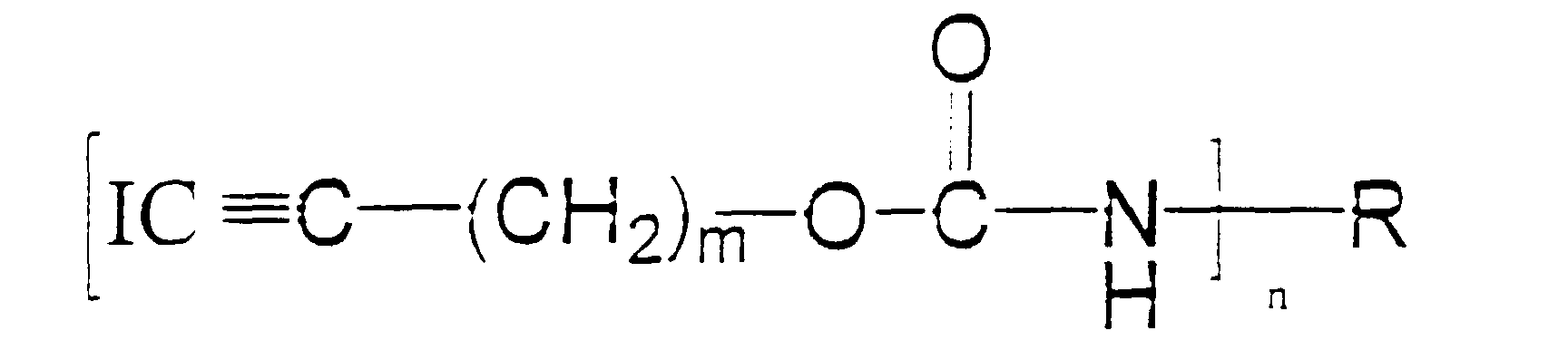
- Preferred among these compounds is the halopropynyl carbamate, 3-iodo-2-propynyl butyl carbamate. This compound is included within the broadly useful class of compounds having the generic formula:
- R is selected from the group consisting of hydrogen, substituted and unsubstituted alkyl, aryl, alkylaryl, and aralkyl groups having from 1 to 20 carbon atoms or from cycloalkyl and cycloalkenyl groups of 3 to 10 carbon atoms, and m and n are independently integers from 1 to 3, i.e., not necessarily the same.
- Suitable R substituents include alkyls such as methyl, ethyl, propyl, n-butyl, t-butyl, pentyl, hexyl, heptyl, octyl, nonyl, decyl, dodecyl, octadecyl, cycloalkyls such as cyclohexyl, aryls, alkaryls and aralkyls such as phenyl, benzyl, tolyl, cumyl, halogenated alkyls and aryls, such as chlorobutryl and chlorophenyl, and alkoxy aryls such as ethoxyphenyl and the like.
- iodopropargyl carbamates as 3-iodo-2-propynyl propyl carbamate, 3-iodo-2-propynyl butyl carbamate, 3-iodo-2-propynyl hexyl carbamate, 3-iodo-2-propynyl cyclohexyl carbamate, 3-iodo-2-propynyl phenyl carbamate, and mixtures thereof.
- Examples of compounds which may be used as the sulfur-containing s-triazine component of this invention include the known, algaecidally active s-triazine compounds. Those included, without limitation thereto, are N 2 -tert-butyl-N 4 -ethyl-7-methylthio-1,3,5-triazine-2,4-diyldiamine and 2-methylthio-4-tert-butylamino-6-cyclopropylamino-s-triazine. These compounds are represented by the generic formula: in which R 1 , and R 2 independently of one another are each a C 2 to C 6 alkyl group or a C 3 to C 6 cycloalkyl.
- R 1 and R 2 are for example: ethyl, propyl, isopropyl, butyl, secbutyl, pentyl, isopentyl, hexyl, 1,2-dimethylpropyl, 1,2-dimethylbutyl or 2,3-dimethylbutyl.
- Particularly preferred are branched-chain C 3 -C 6 -alkyl groups, for example isopropyl, 1,2-dimethylpropyl or tert-butyl.
- R 1 and R 2 are for example: cyclopropyl, cyclobutyl, cyclopentyl or cyclohexyl, cyclopropyl being preferred.
- Preferred sulfur-containing s-triazines of the formula are those wherein R 1 is a branched-chain C 3 -C 6 -alkyl, for example isopropyl, 1,2-dimethylpropyl or tert-butyl; or wherein R 1 is cyclopropyl.
- R 1 is ethyl or cyclopropyl
- R 2 is tert-butyl, 1,2-dimethylpropyl or isopropyl
- Relative proportions of the halopropynyl compound and the sulfur-containing s-triazine in the composition can vary widely and an optimum proportion likely will be affected by the intended application and the particular compounds selected. In any event, it is expected that compositions containing a little as 1 part of the halopropynyl compound to 25 parts of the s-triazine and conversely as little as 1 part of the s-triazine to 25 parts of the halopropynyl compound will be useful, more usually as little as 1 part of the halopropynyl compound to 9 parts of the s-triazine and conversely as little as 1 part of the s-triazine to 9 parts of the halopropynyl compound will be useful. Typically, useful compositions will contain from 2:1 to 1:2 parts of the halopropynyl compound to the s-triazine and more usually from 2:1 to 1:1 relative parts by weight.
- the combined fungicidal and algaecidal constituents can be included in a final formulation for use in such end use applications as paints, coatings, stucco, concrete, stone, cementaceous surfaces, wood, caulking, sealants, textiles, and the like, in a broad range from about 0.004% to 2.0% active concentration.
- Such compositions can be prepared from highly concentrated compositions of the active ingredients by appropriate dilution. The optimum useful range is about 0.1% to 0.3% of combined products in the final formulations for such end use systems. With the use of such modified formulations in end use systems, it is possible to protect surfaces as well as other substrates for extended periods of time against growth from both algae and fungi.
- compositions of the present invention will generally be formulated by mixing the two active ingredients in a selected proportion with a liquid vehicle for dissolving or suspending the active components.
- the vehicle may contain a diluent, an emulsifier and a wetting-agent.
- Expected uses of the biocidal compositions include protection of wood, paint, coatings, adhesives, paper, textiles, plastics, cardboard, lubricants, caulkings. An extensive list of potential industries and applications for the present invention can be found in U.S. Pat. No. 5,209,930.
- the synergistic combinations of the halopropynyl compound fungicide, particularly a halo-propynyl carbamate, and the sulfur-containing s-triazine are preferably formulated as liquid mixtures, but may be provided as wettable powders, dispersions, or in any other suitable product type which is desirable and most useful, provided that the synergistic fungicidal and algaecidal activity are not affected.
- the composition of the present invention can be provided as a ready-for-use product in the form of aqueous solutions and dispersions, oil solutions and dispersions, emulsions, aerosol preparations and the like or as a concentrate.
- Useful solvents for the halopropynyl compound, particularly the preferred iodopropynyl butyl carbamate, and sulfur-containing s-triazine, especially Terbutryn or Irgarol 1071, combination are several glycol ethers and esters like propylene glycol n-butyl ether, propylene glycol tert-butyl ether, 2(2-methoxymethylethoxy)-tripropylene glycol methyl ether, propylene glycol methyl ether, dipropyleneglycol methyl ether, tripropylenelene glycol methyl ether, propylene glycol n-butyl ether and the esters of the previously mentioned compounds.
- Other useful solvents are n-methyl pyrrolidone, n-pentyl propionate and dibasic esters of several dicarboxylic acids and mixes thereof.
- the preferred solvents for these products are propylene glycol n-butyl ether, 1-methoxy-2-propanol, and the dibasic isobutyl ester blend of succinic, glutaric and adipic acids.
- the composition also will likely be provided with other adjuvants conventionally employed in compositions intended for such applications such as organic binding agents, additional fungicides, auxiliary solvents, processing additives, fixatives, plasticizers, UV-stabilizers or stability enhancers, water soluble or water insoluble dyes, color pigments, siccatives, corrosion inhibitors, antisettlement agents, anti-skinning agents and the like.
- additional fungicides used in the composition are preferably soluble in the liquid vehicle.
- substrates are protected from infestation by fungal and algael organisms simply by treating said substrate with a composition of the present invention.
- Such treating may involve mixing the composition with the substrate, coating or otherwise contacting the substrate with the composition and the like.
- a surprising aspect of the invention was found to be that the mixtures of a halopropynyl compound, and particularly a iodopropynyl carbamate and a sulfur-containing s-triazine are especially efficacious in controlling the mold and blue stain fungi Aureobasidium pullulans and Alternaria alternata .
- These two organisms are both generally present in air, soil and water, and appear on most surfaces when moisture is present. Accordingly, these two fungi are a major commercial problem on surfaces coated with paints and other wood protection products and on other treated surfaces since in a short time, they can create a very heavy, dark staining which not only discolors the surface but attacks the coating and destroys it as well. Thus, such pests have a very destructive overall effect and a method for their control has long been sought.
- novel compositions of the invention contain, at least, one herbicide from the sulfur-containing s-triazine group which is not presently known to have any fungicidal effect. However, they are highly efficacious against algae growing on the same areas as the mold fungi.
- the halopropynyl compound, and particularly the iodopropynyl carbamate is a fungicide used for protection against staining organisms and wood destroying fungi. With the combination of these two biocides: a herbicide and fungicide it would be expected to obtain a product active against algae and fungi simultaneously.
- the present invention is directed to synergistic mixtures of one herbicide from the sulfur-containing s-triazine group and a halopropynyl compound.
- a synergistic effect is generally regarded as the response of a mixture of two or more components that is greater than the sum of the response of the individual components.
- SI for a composition is less than one ( ⁇ 1), that composition exhibits synergistic behavior.
- compositions of the invention were found to be effective against both algae and fungi.
- algae and fungi which may be inhibited include without limitation, Stichococcus basillaris , Chlorella vulgaris , Chlorella vulgaris var. viridis , Trentepohlia aurea , Aspergillus niger , Aureobasidium pullulans , Alternaria alternata.
- the preferred combination of compounds, including an iodopropynyl carbamate and a sulfur-containing s-triazine were tested in various ratios from 2:1 to 1:6.
- an algae inoculum was prepared by washing a one-week old plate of each species into 100 ml isotonic water. The active formulations were applied on filter paper at the rate of 225 g/m 2 . After a drying time of one week, the filter paper was divided into two parts, one part was immersed into tap water at room temperature, leached for 24 hours and then dried. The other part was allowed to remain unleached. 1.26cm 2 discs were cut from the leached and unleached filter paper and placed on the agar plates. A suspension of 0.5 ml algae was spread over the plate and the test paper with an appropriate spatula.
- the plates were incubated at 15°C and evaluated after 2 weeks.
- each sample was coated upon filter paper in duplicate, and then air dried for 1 week.
- One of the filter papers was exposed (leached) for 24 hours in room temperature tap water and air dried for 24 hours.
- Each sample was then cut into 1 inch squares of which 2 were placed in petri dishes containing solidified Malt Agar and seeded with Aspergillus niger , conidia and hypha fragments; 2 were placed in petri dishes containing solidified Malt Agar and seeded with Aureobasidium pullulans , conidia and hypha fragments, and 2 were placed in petri dishes containing solidified Malt Agar and seeded with Alternaria alternata , conidia and hypha fragments. The petri dishes were incubated for a period of 3 weeks at 28 degrees C.
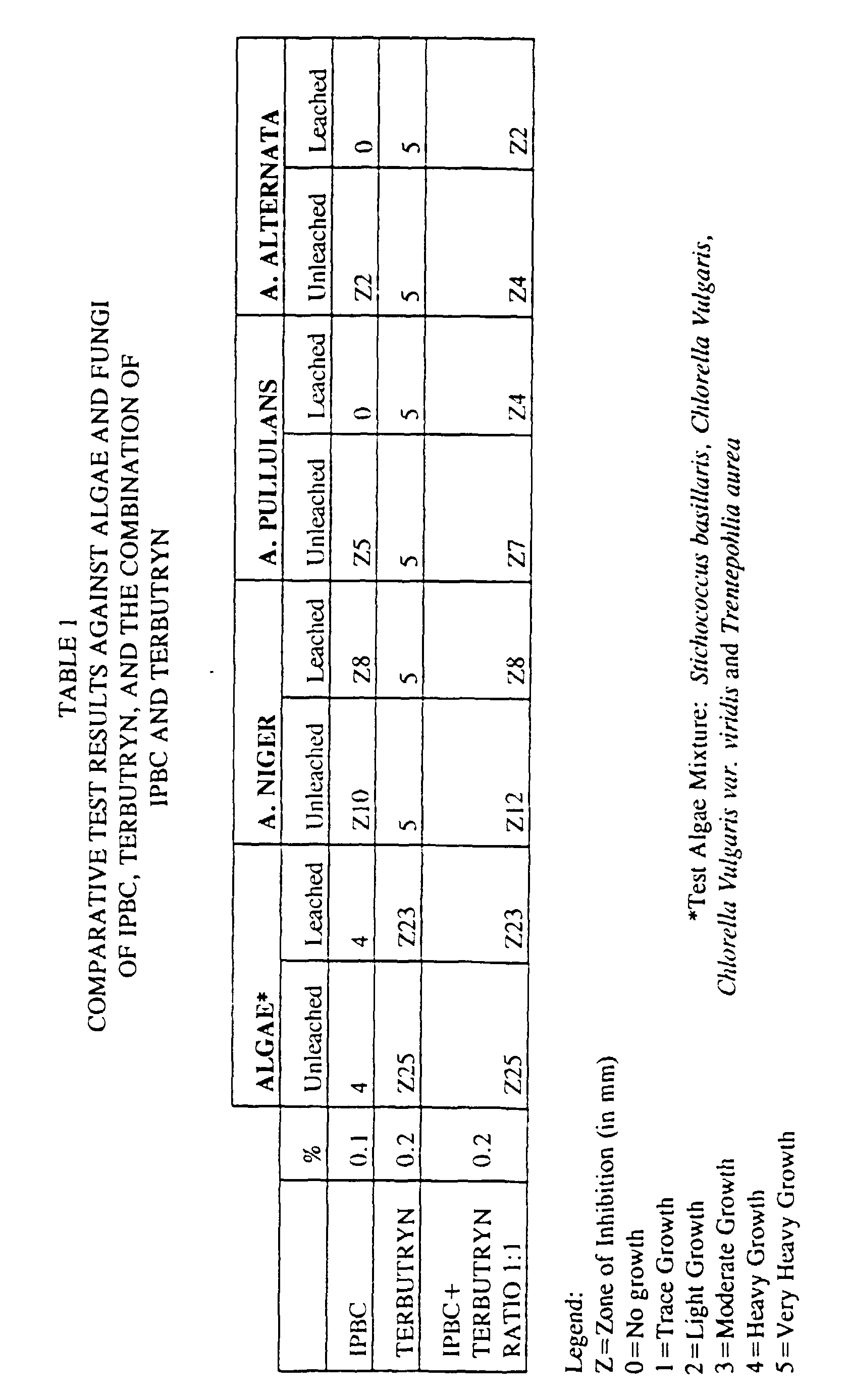
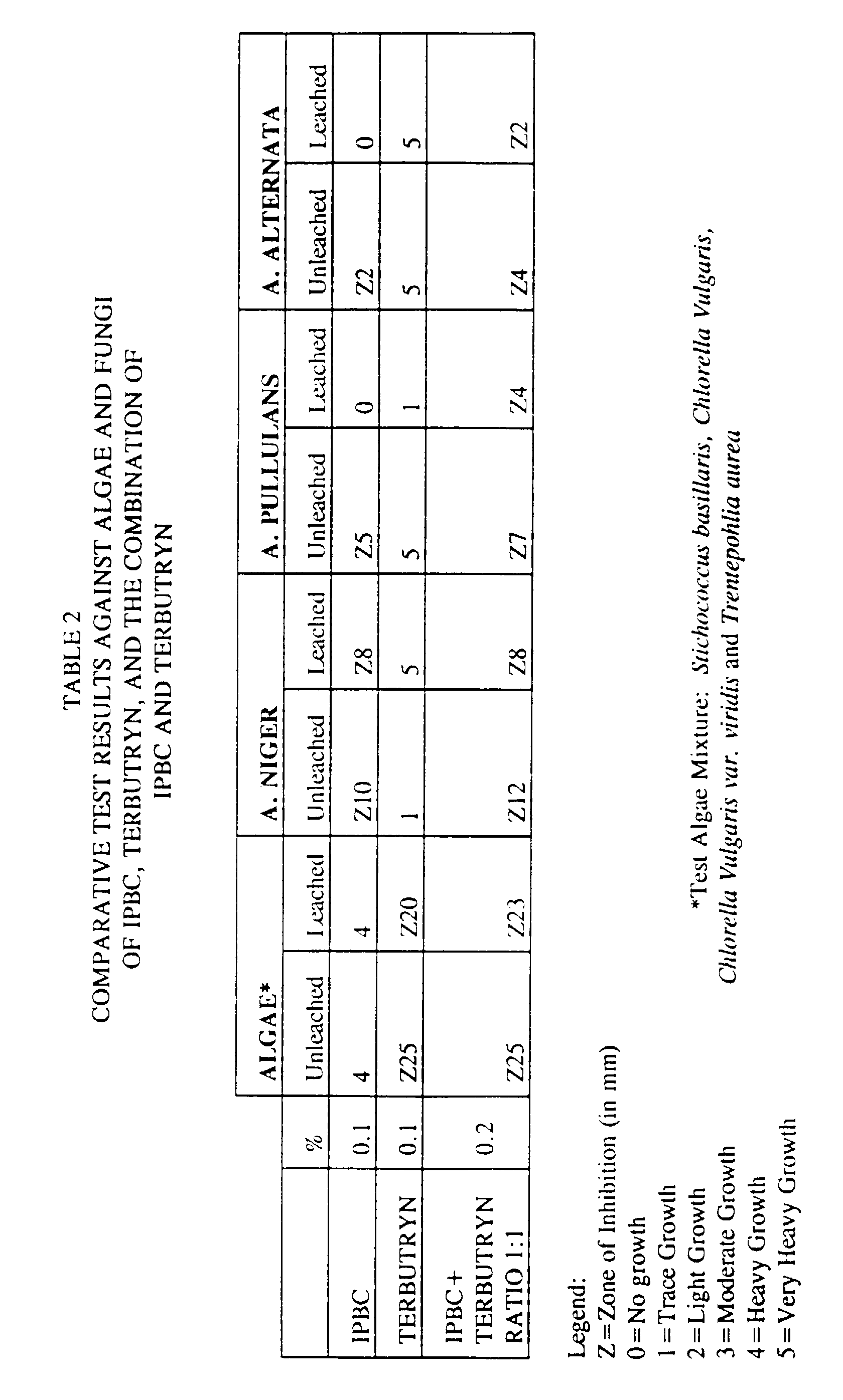
- Tables 1 and 2 show the results of the comparative tests which were carried out as described above.
- the formulations tested were comprised of 0.1% of 3-iodo-2-propynyl-butylcarbamate (IPBC), 0.1% and 0.2% of N 2 tertbutyl-N 4 -ethyl-6-methylthio-1,3,5-triazine-2,4 diyldiamine (Terbutryn) and mixtures of 0.1% IPBC and 0.1% Terbutryn.
- IPBC 3-iodo-2-propynyl-butylcarbamate
- Tebutryn N 2 tertbutyl-N 4 -ethyl-6-methylthio-1,3,5-triazine-2,4 diyldiamine
- Test results actually show that unexpected synergistic results in inhibition and growth reduction were obtained with the tested mixtures as compared with effects to be expected or predicted from the individual ingredients when tested against fungi, i.e ., Aspergillus niger , Aureobasidium pullulans and Alternaria alternata .
- a suitable reaction vessel equipped with an appropriate mixing unit is charged with the indicated amounts of solvents in Examples 2A through 2D of Table 3.
- the mixing unit is started and the indicated amounts of the carbamate and triazine compounds were added. Mixing was continued until the biocides were completely dissolved. The mixture was then filtered (with filter-aid) before transfer to appropriate containers.
- Ingredient % W/W A 1:1 combination 3-iodo-2-propynyl butyl carbamate 20 N 2 -tertbutyl-N 4 -ethyl-6-methylthio-1,3,5-triazine-2,4-diyldiamine 20 DBE dibasic ester 3 propylene glycol n-butyl ether 57 B.
- Example 3A Ingredient Parts/Wt 3-iodo-2-propynyl butyl carbamate (IPBC) 520 Silicon dioxide (silica) 50 Aluminum-Silicate (Clay) 363 Sulphonated Naphthalene Condensate (Dispersant) 60 Alkylated Naphthalene Sulphonate (Dispersant) 7 TOTAL 1000
- Example 3B Ingredients Parts/Wt.
- biocide formulation was incorporated into a styrene-acrylic paint formulation and tested according to the method described in Example 1 with similar synergistic results obtained.
- a mixture of A and B was made by combining the ingredients in a ratio of 1:1 to produce a synergistic combination product of the algaecide and the fungicide.
- This example illustrates the synergistic performance of a combination of IPBC (3-iodo-2-propynyl butyl carbamate) and Terbutryn (N 2 -tertbutyl-N 4 -ethyl-6-methylthio-1,3,5-triazine-2,4-diyldiamine) against algae.
- the algae included a mixture of Stichococcus basillaris (CCAP 379/1A ), Chlorella Vulgaris var. viridis (ATCC# 16487), Trentepohlia sp . (Göttingen #117-80) and Trentepohlia aurea (Göttingen #483-1)
- Algae cells were cultivated on agar plates and the cells were kept in a young state by transferring them to new agar plates weekly.
- the algae inoculum was prepared by washing a one week old plate of each species down into 100 ml sterile isotonic water.
- This example illustrates the synergistic performance of a combination of IPBC (3-iodo-2-propynyl butyl carbamate) and Irgarol 1071 (2-methylthio-4-tert-butylamino-6-cyclopropylamino-s-triazine, alternatively named N-cyclopropyl-N 1 -(1,1dimethylethyl)-6-(methylthio)-1,3,5-triazine-2,4-diamine) against algae.
- the algae included a mixture of Stichococcus basillaris (CCAP 379/ lA ), Chlorella Vulgaris var. viridis (ATCC# 16487), Trentepohlia sp. (Göttingen #117-80) and Trentepohlia aurea (Göttingen #483-1)
- Algae cells were cultivated on agar plates and the cells were kept in a young state by transferring them to new agar plates weekly.
- the algae inoculum was prepared by washing a one week old plate of each species down into 100 ml sterile isotonic water.
Landscapes
- Life Sciences & Earth Sciences (AREA)
- Zoology (AREA)
- Pest Control & Pesticides (AREA)
- Health & Medical Sciences (AREA)
- Engineering & Computer Science (AREA)
- Dentistry (AREA)
- General Health & Medical Sciences (AREA)
- Wood Science & Technology (AREA)
- Agronomy & Crop Science (AREA)
- Environmental Sciences (AREA)
- Plant Pathology (AREA)
- Agricultural Chemicals And Associated Chemicals (AREA)
- Paints Or Removers (AREA)
Description
- This invention is directed to a biocidal composition and particularly a synergistic mixture or combination of a halopropynyl compound and a sulfur-containing s-triazine.
- Both exterior and interior surfaces and substrates of all types, when exposed to common environmental conditions, e.g. moisture, are prone to attack, discoloration and various kinds of destruction by fungal and algael organisms. As a result, there is a great need and requirement for an effective and economical means to protect for extended periods of time both exterior and interior surfaces and various type substrates from the deterioration and destruction caused by such microorganisms.
- Materials which need protection with a suitable antimicrobial composition controlling both fungal and algael microorganisms and their adverse effects include paints, coatings, stucco, concrete, stone, cementaceous surfaces, wood, caulking, sealants, and textiles as well as materials and other substances which may be attacked by fungi and/or algae.
- Commercial products designed for the simultaneous control of fungi and algae on such substrates are available, but such products suffer from a number of disadvantages and especially their inability to maintain sufficient activity after leaching by water.
- In addition, such products currently available in the marketplace are generally supplied as normally water-insoluble powders, as pastes, or as flowable dispersions which are difficult to incorporate in a manner to insure maximum effectiveness. On the other hand, an effective composition in the form of a solution would be highly desirable having advantages for ease of handling and incorporation in end use products and to insure proper distribution of the biocide on or in the surfaces and substrates to be protected, thus maximizing microbiological performance.
- Thus, a broad spectrum biocide composition highly effective against both fungi and algae, and which is essentially unaffected by leaching with water, in an environmentally, toxicologically suitable liquid media has many advantages and is desirable for a wide number of uses in industry.
- With respect to compositions and/or mixtures, methods of manufacture and/or uses and applications of combinations of fungicides and algaecides, the prior art and references describing these combinations is limited.
- There are a number of organic compounds and especially certain carbamates, such as the halopropynyl carbamates which are known primarily for their fungicidal activity. 3-iodo-2 propynyl butyl carbamate, hereinafter referred to as IPBC, is the best known and the most widely used of the known haloalkynyl carbamate fungicides. In addition to its fungicidal activity, IPBC also has been associated with algaecidal activity. In this regard, Great Britain Patent 2,138,292 and U.S. Patents 4,915,909 and 5,082,722 contain such disclosures. IPBC is a highly active broad spectrum fungicide. Nevertheless, its spectrum of action is sometimes incomplete against the broad range of naturally occurring fungal species. For this reason, U.S. Patent 5,389,300 describes using a phenol derivative, such as o-phenylphenol, with an iodopropargyl compound, such as IPBC, for protecting freshly sawn timber from such pests.
- Certain s-triazines are known for their algaecidal activity. They have been found to be especially effective for use in agricultural applications. One such example of this algaecide is N2 tertbutyl-N4-ethyl-6-methylthio-1,3,5-triazine-2,4 diyldiamine and a second such example is 2-methylthio-4-tert-butylamino-6-cyclopropylamino-s-triazine. U.S. Patent 4,710,220 for example, describes formulations containing a polyethoxylated compound and certain s-triazines, with N2-tert-butyl-N4-ethyl-6-methylthio-1,3,5-triazine-2,4-diyldiamine, hereafter referred to as Terbutryn, as one example. Even so, Terbutryn is probably more widely known as a herbicide, and in particular, is widely disclosed for use as a herbicide in combination with a variety of other compounds. For example, in U.S. 3,957,481 it is used in combination with metobromuron for controlling weeds when cultivating leguminosae and solana; in U.S. Patent 4,640,705 and Great Britain Patent 2,126,092 it is used in combination with trifluralin and ethylfluralin respectively, for preemergent control of weeds, particularly blackgrass, in cereal crops and in French Patent 2,438,970 it is used with neburon and nitrofen to control weeds in winter wheat. Nowhere, however, has it been suggested to combine Terbutryn with a halopropynyl compound and particularly a haloalkynyl carbamate fungicide for any purpose.
- In this regard, while U.S. Patent 4,721,523 describes a herbicidal combination of certain widely-known carbamate derivatives with a photosynthesis-inhibiting compound, including as one of nine possible compound classes certain triazine derivatives (identifying Terbutryn as one of a dozen examples), the disclosed carbamates do not include the haloalkynyl carbamates.
- In a similar fashion, while U.S. Patent 5,374,631 describes using a mixture of an iodopropargyl compound, including IPBC, with an s-triazine to control fungal and bacterial growth in metalworking fluids, the only triazine identified is hexahydro-1,3,5-tris(2-hydroxyethyl)-s-triazine.
- Thus, the prior art has completely failed to appreciate any benefit from combining a halopropynyl compound and particularly a haloalkynyl carbamate with a sulfur-containing s-triazine.
- The present invention is based on the surprising synergistic effect that a combination of a halopropynyl compound, and particularly a halopropynyl carbamate fungicide, and a sulfur-containing s-triazine algaecide has on the increased efficacy of the resulting combined product, especially against fungi and algae.
- In accordance with a preferred embodiment of the invention, it has now been discovered that synergistic combinations containing in particular both the fungicide, 3-iodo-2-propynyl butyl carbamate (IPBC) and the herbicide, N2-tertbutyl-N4-ethyl-6-methylthio-1,3,5-triazine-2,4 diyldiamine (Terbutryn) gives a surprising and unexpected biocidal effect against mold and blue-stain fungi. This increased biocidal effect has especially been shown to occur when the product is used against the fungi Aureobasidium pullulans and Alternaria alternata. This discovery is of outstanding commercial importance because the increased effect has especially been demonstrated after the test samples have been exposed to leaching with water. Particularly surprising is the good effect against Alternaria alternata, which often is found to be very difficult to control on exposed surfaces such as paints, coatings, stucco, concrete stone, cementaceous surfaces, wood, caulking, sealants, textiles, and the like.
- In accordance with another preferred embodiment of the invention, it also has been discovered that synergistic combinations containing in particular both the fungicide, 3-iodo-2-propynyl butyl carbamate (IPBC) and either, N2-tertbutyl-N4-ethyl-6-methylthio-1,3,5-triazine-2,4 diyldiamine (Terbutryn) or 2-methylthio-4-tert-butylamino-6-cyclopropylamino-s-triazine (Irgarol 1071) give a surprising and unexpected biocidal effect against algae, including Stichococcus basillaris, Chlorella Vulgaris var. viridis, Trentepohlia sp. and Trentepohlia aurea.
- Relative proportions of the two components in compositions according to the present invention may be varied widely since the combination also provides excellent algaecidal properties. Depending on the degree of environmental pressure on the exposed area, it can be an advantage to select and adjust the proportions of the two components relevant to and depending upon which organism is more problematic to control and for which maximum protection is desired.
- The present invention is directed to a synergistic combination of a halopropynyl compound, particularly a halopropynyl carbamate such as IPBC, and a sulfur-containing s-triazine, particularly Terbutryn and Irgarol 1071.
- A halopropynyl compound for use in the present invention can be identified by the following structure:
- The functional group of which oxygen is a part is preferably an ether, ester, or carbamate group. The functional group of which nitrogen is a part is preferably an amine, amide, or carbamate group. The functional group of which sulfur is a part is preferably a thiol, thiane, sulfone, or sulfoxide group. The organic functional group of which carbon is a part is preferably an ester, carbamate or alkyl group.
- Examples of compounds which may be used as the halopropynyl compound fungicide of this invention are especially the fungicidally active iodopropargyl (iodopropynyl) derivatives. In this regard, please see U.S. Pat. Nos. 3,923,870, 4,259,350, 4,592,773, 4,616,004, 4,719,227, and 4,945,109. These iodopropynyl derivatives include compounds derived from propargyl or iodopropargyl alcohols such as the esters, ethers, acetals, carbamates and carbonates and the iodopropargyl derivatives of pyrimidines, tiazolinones, tetrazoles, triazinones, sulfamides, benzothiazoles, ammonium salts, carboxamides, hydroxamates, and ureas. Preferred among these compounds is the halopropynyl carbamate, 3-iodo-2-propynyl butyl carbamate. This compound is included within the broadly useful class of compounds having the generic formula:

- Wherein R is selected from the group consisting of hydrogen, substituted and unsubstituted alkyl, aryl, alkylaryl, and aralkyl groups having from 1 to 20 carbon atoms or from cycloalkyl and cycloalkenyl groups of 3 to 10 carbon atoms, and m and n are independently integers from 1 to 3, i.e., not necessarily the same.
- Suitable R substituents include alkyls such as methyl, ethyl, propyl, n-butyl, t-butyl, pentyl, hexyl, heptyl, octyl, nonyl, decyl, dodecyl, octadecyl, cycloalkyls such as cyclohexyl, aryls, alkaryls and aralkyls such as phenyl, benzyl, tolyl, cumyl, halogenated alkyls and aryls, such as chlorobutryl and chlorophenyl, and alkoxy aryls such as ethoxyphenyl and the like.
- Especially preferred are such iodopropargyl carbamates as 3-iodo-2-propynyl propyl carbamate, 3-iodo-2-propynyl butyl carbamate, 3-iodo-2-propynyl hexyl carbamate, 3-iodo-2-propynyl cyclohexyl carbamate, 3-iodo-2-propynyl phenyl carbamate, and mixtures thereof.
- Examples of compounds which may be used as the sulfur-containing s-triazine component of this invention include the known, algaecidally active s-triazine compounds. Those included, without limitation thereto, are N2-tert-butyl-N4-ethyl-7-methylthio-1,3,5-triazine-2,4-diyldiamine and 2-methylthio-4-tert-butylamino-6-cyclopropylamino-s-triazine. These compounds are represented by the generic formula:in which R1, and R2 independently of one another are each a C2 to C6 alkyl group or a C3 to C6 cycloalkyl.

- As C2-C6-alkyl, R1 and R2 are for example: ethyl, propyl, isopropyl, butyl, secbutyl, pentyl, isopentyl, hexyl, 1,2-dimethylpropyl, 1,2-dimethylbutyl or 2,3-dimethylbutyl. Particularly preferred are branched-chain C3-C6-alkyl groups, for example isopropyl, 1,2-dimethylpropyl or tert-butyl.
- As C3-C6-cycloalkyl, R1 and R2 are for example: cyclopropyl, cyclobutyl, cyclopentyl or cyclohexyl, cyclopropyl being preferred.
- Preferred sulfur-containing s-triazines of the formula are those wherein R1 is a branched-chain C3-C6-alkyl, for example isopropyl, 1,2-dimethylpropyl or tert-butyl; or wherein R1 is cyclopropyl.
- Likewise preferred are compounds of the formula wherein R1 is ethyl or cyclopropyl, and wherein R2 is tert-butyl, 1,2-dimethylpropyl or isopropyl.
- Relative proportions of the halopropynyl compound and the sulfur-containing s-triazine in the composition can vary widely and an optimum proportion likely will be affected by the intended application and the particular compounds selected. In any event, it is expected that compositions containing a little as 1 part of the halopropynyl compound to 25 parts of the s-triazine and conversely as little as 1 part of the s-triazine to 25 parts of the halopropynyl compound will be useful, more usually as little as 1 part of the halopropynyl compound to 9 parts of the s-triazine and conversely as little as 1 part of the s-triazine to 9 parts of the halopropynyl compound will be useful. Typically, useful compositions will contain from 2:1 to 1:2 parts of the halopropynyl compound to the s-triazine and more usually from 2:1 to 1:1 relative parts by weight.
- In accordance with the invention, the combined fungicidal and algaecidal constituents can be included in a final formulation for use in such end use applications as paints, coatings, stucco, concrete, stone, cementaceous surfaces, wood, caulking, sealants, textiles, and the like, in a broad range from about 0.004% to 2.0% active concentration. Such compositions can be prepared from highly concentrated compositions of the active ingredients by appropriate dilution. The optimum useful range is about 0.1% to 0.3% of combined products in the final formulations for such end use systems. With the use of such modified formulations in end use systems, it is possible to protect surfaces as well as other substrates for extended periods of time against growth from both algae and fungi.
- Compositions of the present invention will generally be formulated by mixing the two active ingredients in a selected proportion with a liquid vehicle for dissolving or suspending the active components. The vehicle may contain a diluent, an emulsifier and a wetting-agent. Expected uses of the biocidal compositions include protection of wood, paint, coatings, adhesives, paper, textiles, plastics, cardboard, lubricants, caulkings. An extensive list of potential industries and applications for the present invention can be found in U.S. Pat. No. 5,209,930. The synergistic combinations of the halopropynyl compound fungicide, particularly a halo-propynyl carbamate, and the sulfur-containing s-triazine are preferably formulated as liquid mixtures, but may be provided as wettable powders, dispersions, or in any other suitable product type which is desirable and most useful, provided that the synergistic fungicidal and algaecidal activity are not affected. In this regard, the composition of the present invention can be provided as a ready-for-use product in the form of aqueous solutions and dispersions, oil solutions and dispersions, emulsions, aerosol preparations and the like or as a concentrate.
- Useful solvents for the halopropynyl compound, particularly the preferred iodopropynyl butyl carbamate, and sulfur-containing s-triazine, especially Terbutryn or Irgarol 1071, combination are several glycol ethers and esters like propylene glycol n-butyl ether, propylene glycol tert-butyl ether, 2(2-methoxymethylethoxy)-tripropylene glycol methyl ether, propylene glycol methyl ether, dipropyleneglycol methyl ether, tripropylenelene glycol methyl ether, propylene glycol n-butyl ether and the esters of the previously mentioned compounds. Other useful solvents are n-methyl pyrrolidone, n-pentyl propionate and dibasic esters of several dicarboxylic acids and mixes thereof.
- The preferred solvents for these products are propylene glycol n-butyl ether, 1-methoxy-2-propanol, and the dibasic isobutyl ester blend of succinic, glutaric and adipic acids.
- When preparing formulations of the present invention for specific applications, the composition also will likely be provided with other adjuvants conventionally employed in compositions intended for such applications such as organic binding agents, additional fungicides, auxiliary solvents, processing additives, fixatives, plasticizers, UV-stabilizers or stability enhancers, water soluble or water insoluble dyes, color pigments, siccatives, corrosion inhibitors, antisettlement agents, anti-skinning agents and the like. Additional fungicides used in the composition are preferably soluble in the liquid vehicle.
- According to the present invention, substrates are protected from infestation by fungal and algael organisms simply by treating said substrate with a composition of the present invention. Such treating may involve mixing the composition with the substrate, coating or otherwise contacting the substrate with the composition and the like.
- A surprising aspect of the invention was found to be that the mixtures of a halopropynyl compound, and particularly a iodopropynyl carbamate and a sulfur-containing s-triazine are especially efficacious in controlling the mold and blue stain fungi Aureobasidium pullulans and Alternaria alternata. These two organisms are both generally present in air, soil and water, and appear on most surfaces when moisture is present. Accordingly, these two fungi are a major commercial problem on surfaces coated with paints and other wood protection products and on other treated surfaces since in a short time, they can create a very heavy, dark staining which not only discolors the surface but attacks the coating and destroys it as well. Thus, such pests have a very destructive overall effect and a method for their control has long been sought.
- The fungi used in the tests, presented hereinafter, were selected because they are among the most problematic staining organisms which occur on exposed surfaces. While synergistic effects have been demonstrated against the specific organisms shown below in Tables 1, 2, 6 and 7, many other fungi and algae can be controlled by these novel biocidal compositions.
- The novel compositions of the invention contain, at least, one herbicide from the sulfur-containing s-triazine group which is not presently known to have any fungicidal effect. However, they are highly efficacious against algae growing on the same areas as the mold fungi. The halopropynyl compound, and particularly the iodopropynyl carbamate is a fungicide used for protection against staining organisms and wood destroying fungi. With the combination of these two biocides: a herbicide and fungicide it would be expected to obtain a product active against algae and fungi simultaneously. Surprisingly, it was found that the activity against the fungi Aureobasidium pullulans and Alternaria alternata was stronger than would be expected from any known data. The data obtained from a solution in which the two compounds have been combined clearly shows that a synergistic and unexpected effect between the two compounds occurs.
- The present invention is directed to synergistic mixtures of one herbicide from the sulfur-containing s-triazine group and a halopropynyl compound. A synergistic effect is generally regarded as the response of a mixture of two or more components that is greater than the sum of the response of the individual components. A mathematical approach for assessing synergy, as reported by F.C. Kull, P.C. Elisman, H.D. Sylwestrowicz and P.K. Mayer, in Applied Microbiology, 9:538(1961) can be applied to binary mixtures using the following equation:
- Qa = the quantity of component A used in a ternary mixture that gives the desired effect (such as no target organism growth),
- QA = the quantity of component A which when used alone gives the desired effect,
- Qb = the quantity of component B used in a ternary mixture that gives the desired effect, and
- QB = the quantity of component B which when used alone gives the desired effect.
-
- If the SI for a composition is less than one (<1), that composition exhibits synergistic behavior.
- The following examples are presented to illustrate and explain the invention. Unless otherwise indicated, all references to parts and percentages are based on weight.
- The compositions of the invention were found to be effective against both algae and fungi. Specifically, algae and fungi which may be inhibited include without limitation, Stichococcus basillaris, Chlorella vulgaris, Chlorella vulgaris var. viridis, Trentepohlia aurea, Aspergillus niger, Aureobasidium pullulans, Alternaria alternata. The preferred combination of compounds, including an iodopropynyl carbamate and a sulfur-containing s-triazine were tested in various ratios from 2:1 to 1:6.
- The biological tests were carried out separately for algae and for fungi. Detailed descriptions of the tests are outlined below.
- In the algae test, an algae inoculum was prepared by washing a one-week old plate of each species into 100 ml isotonic water. The active formulations were applied on filter paper at the rate of 225 g/m2. After a drying time of one week, the filter paper was divided into two parts, one part was immersed into tap water at room temperature, leached for 24 hours and then dried. The other part was allowed to remain unleached. 1.26cm2 discs were cut from the leached and unleached filter paper and placed on the agar plates. A suspension of 0.5 ml algae was spread over the plate and the test paper with an appropriate spatula.
- The plates were incubated at 15°C and evaluated after 2 weeks.
- When the combination samples were tested against fungi, each sample was coated upon filter paper in duplicate, and then air dried for 1 week. One of the filter papers was exposed (leached) for 24 hours in room temperature tap water and air dried for 24 hours. Each sample was then cut into 1 inch squares of which 2 were placed in petri dishes containing solidified Malt Agar and seeded with Aspergillus niger, conidia and hypha fragments; 2 were placed in petri dishes containing solidified Malt Agar and seeded with Aureobasidium pullulans, conidia and hypha fragments, and 2 were placed in petri dishes containing solidified Malt Agar and seeded with Alternaria alternata, conidia and hypha fragments. The petri dishes were incubated for a period of 3 weeks at 28 degrees C.
- Tables 1 and 2 show the results of the comparative tests which were carried out as described above. The formulations tested were comprised of 0.1% of 3-iodo-2-propynyl-butylcarbamate (IPBC), 0.1% and 0.2% of N2 tertbutyl-N4-ethyl-6-methylthio-1,3,5-triazine-2,4 diyldiamine (Terbutryn) and mixtures of 0.1% IPBC and 0.1% Terbutryn. Test results actually show that unexpected synergistic results in inhibition and growth reduction were obtained with the tested mixtures as compared with effects to be expected or predicted from the individual ingredients when tested against fungi, i.e., Aspergillus niger, Aureobasidium pullulans and Alternaria alternata.
- A suitable reaction vessel equipped with an appropriate mixing unit is charged with the indicated amounts of solvents in Examples 2A through 2D of Table 3. The mixing unit is started and the indicated amounts of the carbamate and triazine compounds were added. Mixing was continued until the biocides were completely dissolved. The mixture was then filtered (with filter-aid) before transfer to appropriate containers.
Ingredient % W/W A. 1:1 combination 3-iodo-2-propynyl butyl carbamate 20 N2-tertbutyl-N4-ethyl-6-methylthio-1,3,5-triazine-2,4-diyldiamine 20 DBE dibasic ester 3 propylene glycol n-butyl ether 57 B. 1:1 combination 3-iodo-2-propynyl butyl carbamate 20 N2-tertbutyl-N4-ethyl-6-methylthio-1,3,5-triazine-2,4-diyldiamine 20 Propylene glycol n-butyl ether 60 C. 2:1 combination 3-iodo-2-propynyl butyl carbamate 26.6 N2-tertbutyl-N4-ethyl-6-methylthio-1,3,5-triazin-2,4-diyldiamine 13.4 Propylene glycol n-butyl ether 60 D. 1:2 combination 3-iodo-2-propynyl butyl carbamate 13.4 N 2 -tertbutyl-N 4 -ethyl-6-methylthio-1,3,5-triazine-2,4-diyldiamine 26.6 Propylene glycol n-butyl ether 60 - A number of liquid formulations were prepared as described above and were then incorporated into paints by mixing. The precise composition of biocides are set forth in detail in Table 3. They were tested according to the method as described in Example 1. The test results showed synergistic activity against algae and fungi when the combinations of two ingredients of carbamate and triazine were used at 0.1 total active level. Shown in Table 3 are examples of the preferred solvents used in the preparation of liquid formulations.
- A mixture was prepared as reported as Example 3A and Example 3B in ratio 1:1, using a shaker such as that used for similar paint products to produce a final product with 50% (w/w) activity.
WETTABLE POWDER Example 3A - Ingredient Parts/Wt 3-iodo-2-propynyl butyl carbamate (IPBC) 520 Silicon dioxide (silica) 50 Aluminum-Silicate (Clay) 363 Sulphonated Naphthalene Condensate (Dispersant) 60 Alkylated Naphthalene Sulphonate (Dispersant) 7 TOTAL 1000 Example 3B - Ingredients Parts/Wt. N2-tertbutyl-N4-ethyl-6-methylthio-1,3,5-triazine-2,4-diyldiamine (Terbutryn) 520 Silicon dioxide (silica) 50 Aluminum-Silicate (clay) 363 Sulphonated Naphthalene Condensate (Dispersant) 60 Alkylated Naphthalene Sulphonate (Dispersant) 7 TOTAL 1000 - The biocide formulation was incorporated into a styrene-acrylic paint formulation and tested according to the method described in Example 1 with similar synergistic results obtained.
- Ingredients A and B as shown in Table 5 were made using a dispersing mill (with cooling mantle) and using 1 mm glass beads to a fineness grind 5 microns or less. Some of the water may be omitted in order to obtain a thicker grinding paste as desired.
DISPERSION Ingredient A Part/Wt. Ingredient B Part/Wt Propylene glycol 7 Propylene glycol 7 3-iodo-2-propynyl butyl carbamate (IPBC) 42 N2-tertbutyl-N4-ethyl-6-methylthio-1,3,5-triazine-2,4-diyldiamine (Terbutryn) 42 Aerosil (Hydrophobic Silica) 1 Aerosil (Hydrophobic Silica) 1 Mix Dispersant (Nonylethoxylate) 2.0 2.0 Wetting Agent (Ethoxylated Sulphate) 1.0 Wetting Agent (Ethoxylated Sulphate) 1.0 Wetting Agent (Ethoxylated Sulphate) 1.0 Wetting Agent (Ethoxylated Sulphate) 1.0 Water 34.40 Water 34.40 Thickener 1.0 Thickener 1.0 100 100 - A mixture of A and B was made by combining the ingredients in a ratio of 1:1 to produce a synergistic combination product of the algaecide and the fungicide.
- This product was then mixed into a styrene-acrylic paint using a laboratory mixer for a 5 minute mixing period. It was tested as described in Example 1 with similar results.
- This example illustrates the synergistic performance of a combination of IPBC (3-iodo-2-propynyl butyl carbamate) and Terbutryn (N2-tertbutyl-N4-ethyl-6-methylthio-1,3,5-triazine-2,4-diyldiamine) against algae. The algae included a mixture of Stichococcus basillaris (CCAP 379/1A), Chlorella Vulgaris var. viridis (ATCC# 16487), Trentepohlia sp. (Göttingen #117-80) and Trentepohlia aurea (Göttingen #483-1)
- Algae cells were cultivated on agar plates and the cells were kept in a young state by transferring them to new agar plates weekly. The algae inoculum was prepared by washing a one week old plate of each species down into 100 ml sterile isotonic water.
- Each tested formulation was applied onto filter paper at a rate of 225 g/m2. After drying for one week, discs having an area of 0.316 cm2 were cut from the filter paper and placed on an agar plate. A 0.5 ml portion of the above prepared algae suspension was spread over the plate and the test paper disc with a "Drigalski" spatula. The agar plate was incubated for two weeks (15° C, 52% R.H., Light: 600 lux) and then evaluated. The results are reported below in Table 6.
Test Material Minimum Amount Effective Against Algae (As % Active Substance) Synergistic Ratio IPBC 1.0 - Terbutryn 0.05 - Terbutryn + IPBC 0.0402 + 0.798 0.8838 - This example illustrates the synergistic performance of a combination of IPBC (3-iodo-2-propynyl butyl carbamate) and Irgarol 1071 (2-methylthio-4-tert-butylamino-6-cyclopropylamino-s-triazine, alternatively named N-cyclopropyl-N1-(1,1dimethylethyl)-6-(methylthio)-1,3,5-triazine-2,4-diamine) against algae. The algae included a mixture of Stichococcus basillaris (CCAP 379/lA), Chlorella Vulgaris var. viridis (ATCC# 16487), Trentepohlia sp. (Göttingen #117-80) and Trentepohlia aurea (Göttingen #483-1)
- Algae cells were cultivated on agar plates and the cells were kept in a young state by transferring them to new agar plates weekly. The algae inoculum was prepared by washing a one week old plate of each species down into 100 ml sterile isotonic water.
- Each tested formulation was applied onto filter paper at a rate of 225 g/m2. After drying for one week, discs having an area of 0.316 cm2 were cut from the filter paper and placed on an agar plate. A 0.5 ml portion of the above prepared algae suspension was spread over the plate and the test paper disc with a "Drigalski" spatula. The agar plate was incubated for two weeks (15° C, 52% R.H., Light: 600 lux) and then evaluated. The results are reported below in Table 7.
Test Material Minimum Amount Effective Against Algae (As % Active Substance) Synergistic Ratio IPBC 1.0 - Irgarol 1071 0.05 - Irgarol 1071 + IPBC 0.03 + 0.06 0.66 - While certain specific embodiments of the invention have been described with particularity herein, it will be recognized that various modifications thereof will occur to those skilled in the art and it is to be understood that such modifications and variations are to be included within the preview of this application and the appended claims.
Claims (11)
- A biocidal composition comprising a mixture of a halopropynyl compound and a sulfur-containing s-triazine.
- The composition of claim 1 containing from about 0.004% to 2.0% of the mixture of said halopropynyl compound and said s-triazine.
- A biocidal composition comprising a solution of a halopropynyl compound and a sulfur-containing s-triazine in a suitable solvent.
- The composition of any preceding claim wherein the halopropynyl compound is an iodopropargyl derivative selected from an iodopropargyl ester, an iodopropargyl ether, an iodopropargyl acetal, an iodopropargyl carbamate and an iodopropargyl carbonate.
- The composition of any preceding claim wherein the sulfur-containing s-triazine has the formula:wherein R1, and R2 are independently selected from a C2 to C6 alkyl group and a C3 to C6 cycloalkyl group.

- The composition of claim 5 wherein the halopropynyl compound is an iodopropargyl carbamate of the formula:wherein R is selected from the group consisting, of hydrogen, substituted and unsubstituted alkyl, aryl, alkylaryl, and aralkyl groups having from 1 to 20 carbon atoms and cycloalkyl and cycloalkenyl groups of 3 to 10 carbon atoms, and m and n are independent integers from 1 to 3.
- The composition of claim 6 wherein the iodopropargyl carbamate is 3-iodo-2-propynylbutyl carbamate and the s-triazine is selected from (2-methylthio-4-tert-butylamino-6-cyclopropylamino-s-triazine and N2-tert-butyl-N4-ethyl-7-methylthio-1,3,5-triazine-2,4-diyldiamine.
- The composition of claim 7 wherein the halopropynyl compound and the sulfur-containing s-triazine are present in a proportion of from about 1 part halopropynyl compound to 25 parts s-triazine to about 25 parts halopropynyl compound to 1 part s-triazine.
- A method of preparing the composition of claim 1 comprising mixing said halopropynyl compound and said sulfur-containing s-triazine in a liquid vehicle.
- A method of preparing the composition of claim 3 comprising dissolving said halopropynyl compound and said sulfur-containing s-triazine in a solvent.
- A method for protecting a substrate from fungal or algael infestation comprising treating said substrate with an effective amount of the composition of any of claims 1 to 8.
Priority Applications (1)
| Application Number | Priority Date | Filing Date | Title |
|---|---|---|---|
| SI9630263T SI0741971T1 (en) | 1995-05-08 | 1996-05-07 | Biocidal compositions comprising mixtures of halopropynyl compounds and sulphur containing triazines |
Applications Claiming Priority (2)
| Application Number | Priority Date | Filing Date | Title |
|---|---|---|---|
| US08/436,554 US5707929A (en) | 1995-05-08 | 1995-05-08 | Biocidal compositions comprising mixtures of haloproynyl compounds and sulfur containing triazines |
| US436554 | 1995-05-08 |
Publications (3)
| Publication Number | Publication Date |
|---|---|
| EP0741971A2 EP0741971A2 (en) | 1996-11-13 |
| EP0741971A3 EP0741971A3 (en) | 1998-03-04 |
| EP0741971B1 true EP0741971B1 (en) | 2000-11-08 |
Family
ID=23732877
Family Applications (1)
| Application Number | Title | Priority Date | Filing Date |
|---|---|---|---|
| EP96303172A Expired - Lifetime EP0741971B1 (en) | 1995-05-08 | 1996-05-07 | Biocidal compositions comprising mixtures of halopropynyl compounds and sulphur containing triazines |
Country Status (30)
| Country | Link |
|---|---|
| US (2) | US5707929A (en) |
| EP (1) | EP0741971B1 (en) |
| JP (1) | JP3488015B2 (en) |
| KR (1) | KR100356184B1 (en) |
| CN (1) | CN1070689C (en) |
| AR (1) | AR001875A1 (en) |
| AT (1) | ATE197370T1 (en) |
| AU (1) | AU706623B2 (en) |
| BR (1) | BR9602190A (en) |
| CA (1) | CA2175936C (en) |
| CZ (1) | CZ291554B6 (en) |
| DE (2) | DE69610871T2 (en) |
| DK (1) | DK0741971T3 (en) |
| EG (1) | EG22151A (en) |
| ES (1) | ES2153538T3 (en) |
| GR (1) | GR3035312T3 (en) |
| HU (1) | HU218042B (en) |
| MX (1) | MX9601706A (en) |
| MY (1) | MY113125A (en) |
| NO (1) | NO315891B1 (en) |
| NZ (1) | NZ286517A (en) |
| PL (1) | PL185566B1 (en) |
| PT (1) | PT741971E (en) |
| RO (1) | RO114935B1 (en) |
| RU (1) | RU2158084C2 (en) |
| SG (1) | SG54333A1 (en) |
| SI (1) | SI0741971T1 (en) |
| SK (1) | SK281821B6 (en) |
| TR (1) | TR199600367A2 (en) |
| UA (1) | UA41380C2 (en) |
Families Citing this family (26)
| Publication number | Priority date | Publication date | Assignee | Title |
|---|---|---|---|---|
| US5707929A (en) * | 1995-05-08 | 1998-01-13 | Troy Chemical Corporation | Biocidal compositions comprising mixtures of haloproynyl compounds and sulfur containing triazines |
| US6017562A (en) * | 1997-04-28 | 2000-01-25 | Arch Chemicals, Inc. | Non-spherical and non-platelet crystalline forms of pyrithione salts |
| US6242007B1 (en) | 1997-04-28 | 2001-06-05 | Arch Chemicals, Inc. | Non-spherical and non-platelet forms of pyrithione salts and methods of making same |
| US6121198A (en) * | 1999-05-24 | 2000-09-19 | Creanova Inc. | Synergistic composition of biocides |
| US6121197A (en) * | 1999-05-24 | 2000-09-19 | Creanova Inc. | Biocidal composition |
| JP4849743B2 (en) * | 2001-06-26 | 2012-01-11 | 日本エンバイロケミカルズ株式会社 | Industrial composition |
| RU2235695C2 (en) * | 2002-10-07 | 2004-09-10 | Белгородский государственный технологический университет им. В.Г.Шухова | Fungicidal modifier of mineral construction compositions |
| US7056919B2 (en) | 2003-01-24 | 2006-06-06 | Kopcoat, Inc. | Synergistic combination of fungicides to protect wood and wood-based products and wood treated by such combination as well as methods of making the same |
| JP2004307482A (en) * | 2003-04-07 | 2004-11-04 | Rohm & Haas Co | Microbicidal composition |
| JP2004315507A (en) * | 2003-04-07 | 2004-11-11 | Rohm & Haas Co | Microbicidal composition |
| US20040241294A1 (en) * | 2003-05-31 | 2004-12-02 | Barabolak Roman M. | Edible films including aspartame and methods of making same |
| JP4681565B2 (en) | 2004-02-04 | 2011-05-11 | ジヤンセン・フアーマシユーチカ・ナームローゼ・フエンノートシヤツプ | Synergistic antibacterial and antifungal DDAC composition |
| AU2005282582B2 (en) * | 2004-09-03 | 2010-04-08 | Microban Products Company | Antimicrobial cementitious compositions |
| AU2006269657B2 (en) * | 2005-05-24 | 2012-04-19 | Selenbio, Inc. | Selenium-based biocidal formulations and methods of use thereof |
| US20100158966A1 (en) * | 2005-05-24 | 2010-06-24 | Ted Reid | Selenium-based biocidal formulations and methods of use thereof |
| US20100158967A1 (en) * | 2005-05-24 | 2010-06-24 | Ted Reid | Selenium-based biocidal formulations and methods of use thereof |
| US9370187B2 (en) | 2005-05-24 | 2016-06-21 | Selenium, Ltd. | Selenium-based biocidal formulations and methods of use thereof |
| CA2659908C (en) * | 2005-06-15 | 2014-07-29 | Rohm And Haas Company | Antimicrobial composition useful for preserving wood comprising a copper alkyldimethylammmonium salt and 2-n-octyl-4-isolthiazolin-3-one |
| ATE515942T1 (en) | 2006-05-02 | 2011-07-15 | Janssen Pharmaceutica Nv | BIOCIDE COMBINATIONS CONTAINING IMAZALIL |
| WO2010080086A1 (en) * | 2009-01-12 | 2010-07-15 | Selenium, Ltd. | Anti-microbial orthodontic compositions and appliances and methods of production and use thereof |
| CN105472984B (en) * | 2012-11-30 | 2017-07-18 | 罗门哈斯公司 | The lenacil and IPBC synergistic combination protected for dry film |
| EP2925133B1 (en) * | 2012-11-30 | 2016-11-02 | Rohm and Haas Company | Synergistic combination of lenacil and terbutryn for dry film protection |
| CN103262850B (en) * | 2013-01-16 | 2014-06-11 | 长沙理工大学 | Lycoris radiata herb growth promoter and application method thereof |
| KR102001097B1 (en) | 2015-02-03 | 2019-07-18 | 청호환경개발주식회사 | Algicidal bacteria for the prevention of algal bloom |
| CN105566185B (en) * | 2016-01-26 | 2017-10-10 | 华中师范大学 | Suppress compound of algal grown and preparation method thereof and algicide and their application |
| MX2018015198A (en) * | 2016-06-30 | 2019-04-22 | Dow Global Technologies Llc | Synergistic combination of 3-iodo-2-propynyl-butylcarbamate and diamine. |
Family Cites Families (25)
| Publication number | Priority date | Publication date | Assignee | Title |
|---|---|---|---|---|
| ZA715333B (en) * | 1970-08-26 | 1972-09-27 | Rohm & Haas | Weed control |
| FR2187220B1 (en) * | 1972-06-09 | 1978-12-08 | Ciba Geigy Ag | |
| US3923870A (en) * | 1973-07-11 | 1975-12-02 | Troy Chemical Corp | Urethanes of 1-halogen substituted alkynes |
| US4259350A (en) * | 1978-03-15 | 1981-03-31 | Sankyo Company Limited | Iodopropargyl derivatives, their use and preparation |
| FR2438970A1 (en) * | 1978-10-19 | 1980-05-16 | Ugine Kuhlmann | Terbutryne and neburon synergistic herbicide compsn. - used to treat cereal crops by application as aq. suspension |
| EP0253374A1 (en) * | 1982-07-07 | 1988-01-20 | Agan Chemical Manufacturers Ltd. | A method for combatting blackgrass in cereal crops and compositions therefor |
| HU187405B (en) * | 1982-08-24 | 1986-01-28 | Budapesti Vegyimuevek,Hu | Herbicidal compositions with synergic action |
| CA1259626A (en) * | 1983-04-18 | 1989-09-19 | William Singer | Carbamates of iodo substituted alkynes and fungicidal preparations thereof |
| IL75979A (en) * | 1984-08-10 | 1988-10-31 | Mitsui Toatsu Chemicals | Propargyloxyacetonitrile derivatives,their preparation and fungicidal and herbicidal compositions containing them |
| DE3433541A1 (en) * | 1984-09-13 | 1986-03-20 | Bayer Ag, 5090 Leverkusen | HERBICIDES CONTAINING PHOTOSYNTHESIS INHIBITOR HERBICIDES IN COMBINATION WITH CARBAMATE DERIVATIVES |
| US4616004A (en) * | 1984-09-27 | 1986-10-07 | Chevron Research Company | 1-iodopropargyl-3,4-disubstituted-Δ2 -1,2,4-triazolidin-5-one fungicides |
| US4710220A (en) * | 1984-11-07 | 1987-12-01 | Ciba-Geigy Corp. | Biocidal paste |
| AU5042585A (en) * | 1984-12-10 | 1986-07-17 | Dow Chemical Company, The | Wood fungicides containing chlorpyrifos |
| DE3510203A1 (en) * | 1985-03-21 | 1986-09-25 | Bayer Ag, 5090 Leverkusen | NEW IODOPROPARGYL ETHER, A METHOD FOR THE PRODUCTION AND THEIR USE |
| US5082722A (en) * | 1988-01-20 | 1992-01-21 | Guglielmo Richard J Sr | Process for treating netting with an antifouling composition and product produced thereby. |
| US4945109A (en) * | 1988-08-24 | 1990-07-31 | Buckman Laboratories International, Inc. | Ester of carbamic acid useful as a microbicide and a preservative |
| US4915909A (en) * | 1988-10-05 | 1990-04-10 | Nalco Chemical Company | Method of controlling algae growth |
| US5071479A (en) * | 1990-01-22 | 1991-12-10 | Troy Chemical Corporation | Biocidal compositions |
| JPH0761921B2 (en) * | 1990-09-21 | 1995-07-05 | ナガセ化成工業株式会社 | Anti-algal and anti-mildew formulation |
| ZA918514B (en) * | 1990-10-31 | 1992-11-25 | Buckman Labor Inc | Synergistic combinations of idopropargyl compounds with hexahydro-1,3,5-tris(2-hydroxyethyl)-s-triazine in controlling fungal and bacterial growth in metalworking fluids |
| US5219875A (en) * | 1990-11-27 | 1993-06-15 | Rohm And Haas Company | Antimicrobial compositions comprising iodopropargyl butylcarbamate and 1,2-benzisothiazolin-3-one and methods of controlling microbes |
| US5209930A (en) * | 1990-12-10 | 1993-05-11 | Rohm And Haas Company | Preparation and use of n-iodopropargyl oxycarbonyl amino acid esters and derivatives as antimicrobial agents |
| ZA926535B (en) * | 1991-11-07 | 1994-09-30 | Buckman Laboraties Internation | Synergistic combinations of iodopropargyl compounds with 1,2-benzisothiazolin-3-one in controlling fungal and bacterial growth in aqueous fluids |
| DE4217523A1 (en) * | 1992-05-27 | 1993-12-02 | Bayer Ag | Means for protecting sawn timber |
| US5707929A (en) * | 1995-05-08 | 1998-01-13 | Troy Chemical Corporation | Biocidal compositions comprising mixtures of haloproynyl compounds and sulfur containing triazines |
-
1995
- 1995-05-08 US US08/436,554 patent/US5707929A/en not_active Expired - Lifetime
-
1996
- 1996-05-03 MY MYPI96001671A patent/MY113125A/en unknown
- 1996-05-05 UA UA96051775A patent/UA41380C2/en unknown
- 1996-05-06 SK SK572-96A patent/SK281821B6/en not_active IP Right Cessation
- 1996-05-06 AU AU52117/96A patent/AU706623B2/en not_active Expired
- 1996-05-06 NZ NZ286517A patent/NZ286517A/en not_active IP Right Cessation
- 1996-05-06 CZ CZ19961308A patent/CZ291554B6/en not_active IP Right Cessation
- 1996-05-07 NO NO19961839A patent/NO315891B1/en not_active IP Right Cessation
- 1996-05-07 CA CA002175936A patent/CA2175936C/en not_active Expired - Lifetime
- 1996-05-07 DK DK96303172T patent/DK0741971T3/en active
- 1996-05-07 MX MX9601706A patent/MX9601706A/en unknown
- 1996-05-07 DE DE69610871T patent/DE69610871T2/en not_active Expired - Lifetime
- 1996-05-07 PT PT96303172T patent/PT741971E/en unknown
- 1996-05-07 EP EP96303172A patent/EP0741971B1/en not_active Expired - Lifetime
- 1996-05-07 HU HU9601212A patent/HU218042B/en unknown
- 1996-05-07 SG SG1996009740A patent/SG54333A1/en unknown
- 1996-05-07 ES ES96303172T patent/ES2153538T3/en not_active Expired - Lifetime
- 1996-05-07 KR KR1019960014893A patent/KR100356184B1/en not_active Expired - Lifetime
- 1996-05-07 DE DE0741971T patent/DE741971T1/en active Pending
- 1996-05-07 RU RU96109054/04A patent/RU2158084C2/en active
- 1996-05-07 RO RO96-00935A patent/RO114935B1/en unknown
- 1996-05-07 SI SI9630263T patent/SI0741971T1/en unknown
- 1996-05-07 EG EG39396D patent/EG22151A/en active
- 1996-05-07 AR AR33642896A patent/AR001875A1/en active IP Right Grant
- 1996-05-07 AT AT96303172T patent/ATE197370T1/en active
- 1996-05-08 CN CN96110724A patent/CN1070689C/en not_active Expired - Lifetime
- 1996-05-08 BR BR9602190A patent/BR9602190A/en not_active IP Right Cessation
- 1996-05-08 PL PL96314123A patent/PL185566B1/en unknown
- 1996-05-08 JP JP11387496A patent/JP3488015B2/en not_active Expired - Lifetime
- 1996-05-08 TR TR96/00367A patent/TR199600367A2/en unknown
-
1997
- 1997-12-16 US US08/991,565 patent/US5948730A/en not_active Expired - Lifetime
-
2001
- 2001-01-29 GR GR20010400138T patent/GR3035312T3/en unknown
Also Published As
Similar Documents
| Publication | Publication Date | Title |
|---|---|---|
| CA2175936C (en) | Biocidal compositions comprising mixtures of halopropynyl compounds and sulfur containing triazines | |
| US6059991A (en) | Stabilized composition containing halopropynyl compounds | |
| EP1082015B1 (en) | Stabilized antimicrobial compositions containing halopropynyl compounds | |
| EP1389424B1 (en) | Aqueous dispersion with fungicidal and algicidal action | |
| PL199673B1 (en) | Antibacterial mixtures widely applicable | |
| US6274535B1 (en) | Defoliant | |
| AU662581B2 (en) | Combinations of herbicides and crop-protecting substances | |
| MXPA96001706A (en) | Biocidal compositions comprising mixtures of halopropinyl compounds and sulfur with triaci content | |
| EP1111994B1 (en) | Use of derivatives of methylene-bis-oxazolidine and compositions thereof | |
| EP0979033B1 (en) | Algicidal and fungicidal preservative with alternaria-activity | |
| EP1312261B1 (en) | Aqueous compositions containing a haloalkynyl compound and a buffer for providing biocidal activity and for stabilising end-use formulations | |
| JP4065323B2 (en) | Algide combination | |
| US7981838B2 (en) | Defoliant | |
| JP3849040B2 (en) | Plant protectant | |
| CA1058903A (en) | Herbicidal compositions | |
| SI9400304A (en) | Herbicide composition,activity-promoting agent for improving the efficacy of the herbicide, and a method for treating cultivated plants. | |
| CA3149341C (en) | Synergistic wood preservative composition comprising polymeric betaine and carbamate | |
| JP2002212012A (en) | Paddy herbicide | |
| HU187288B (en) | Synergetic herbicide compositions | |
| JPH07157405A (en) | Agent for controlling rice blast | |
| MXPA00005231A (en) | Stabilized composition containing halopropynyl compounds | |
| MXPA00002508A (en) | Defoliant | |
| JPH10158109A (en) | Herbicide composition for paddy field |
Legal Events
| Date | Code | Title | Description |
|---|---|---|---|
| PUAI | Public reference made under article 153(3) epc to a published international application that has entered the european phase |
Free format text: ORIGINAL CODE: 0009012 |
|
| AK | Designated contracting states |
Kind code of ref document: A2 Designated state(s): AT BE CH DE DK ES FI FR GB GR IE IT LI LU MC NL PT SE |
|
| AX | Request for extension of the european patent |
Free format text: AL PAYMENT 960729;LT PAYMENT 960729;LV PAYMENT 960729;SI PAYMENT 960729 |
|
| RAX | Requested extension states of the european patent have changed |
Free format text: AL PAYMENT 960729;LT PAYMENT 960729;LV PAYMENT 960729;SI PAYMENT 960729 |
|
| PUAL | Search report despatched |
Free format text: ORIGINAL CODE: 0009013 |
|
| AK | Designated contracting states |
Kind code of ref document: A3 Designated state(s): AT BE CH DE DK ES FI FR GB GR IE IT LI LU MC NL PT SE |
|
| AX | Request for extension of the european patent |
Free format text: AL PAYMENT 960729;LT PAYMENT 960729;LV PAYMENT 960729;SI PAYMENT 960729 |
|
| 17P | Request for examination filed |
Effective date: 19980904 |
|
| GRAG | Despatch of communication of intention to grant |
Free format text: ORIGINAL CODE: EPIDOS AGRA |
|
| RAP1 | Party data changed (applicant data changed or rights of an application transferred) |
Owner name: TROY TECHNOLOGY CORPORATION, INC. |
|
| 17Q | First examination report despatched |
Effective date: 20000303 |
|
| GRAG | Despatch of communication of intention to grant |
Free format text: ORIGINAL CODE: EPIDOS AGRA |
|
| GRAH | Despatch of communication of intention to grant a patent |
Free format text: ORIGINAL CODE: EPIDOS IGRA |
|
| DET | De: translation of patent claims | ||
| GRAH | Despatch of communication of intention to grant a patent |
Free format text: ORIGINAL CODE: EPIDOS IGRA |
|
| GRAA | (expected) grant |
Free format text: ORIGINAL CODE: 0009210 |
|
| AK | Designated contracting states |
Kind code of ref document: B1 Designated state(s): AT BE CH DE DK ES FI FR GB GR IE IT LI LU MC NL PT SE |
|
| AX | Request for extension of the european patent |
Free format text: AL PAYMENT 19960729;LT PAYMENT 19960729;LV PAYMENT 19960729;SI PAYMENT 19960729 |
|
| LTIE | Lt: invalidation of european patent or patent extension | ||
| REF | Corresponds to: |
Ref document number: 197370 Country of ref document: AT Date of ref document: 20001111 Kind code of ref document: T |
|
| REG | Reference to a national code |
Ref country code: CH Ref legal event code: EP |
|
| REG | Reference to a national code |
Ref country code: IE Ref legal event code: FG4D |
|
| REF | Corresponds to: |
Ref document number: 69610871 Country of ref document: DE Date of ref document: 20001214 |
|
| REG | Reference to a national code |
Ref country code: DK Ref legal event code: T3 |
|
| ITF | It: translation for a ep patent filed | ||
| ET | Fr: translation filed | ||
| REG | Reference to a national code |
Ref country code: CH Ref legal event code: NV Representative=s name: BRAUN & PARTNER PATENT-, MARKEN-, RECHTSANWAELTE |
|
| REG | Reference to a national code |
Ref country code: ES Ref legal event code: FG2A Ref document number: 2153538 Country of ref document: ES Kind code of ref document: T3 |
|
| REG | Reference to a national code |
Ref country code: PT Ref legal event code: SC4A Free format text: AVAILABILITY OF NATIONAL TRANSLATION Effective date: 20010123 |
|
| PG25 | Lapsed in a contracting state [announced via postgrant information from national office to epo] |
Ref country code: LU Free format text: LAPSE BECAUSE OF NON-PAYMENT OF DUE FEES Effective date: 20010507 |
|
| PG25 | Lapsed in a contracting state [announced via postgrant information from national office to epo] |
Ref country code: MC Free format text: LAPSE BECAUSE OF NON-PAYMENT OF DUE FEES Effective date: 20010531 |
|
| PLBQ | Unpublished change to opponent data |
Free format text: ORIGINAL CODE: EPIDOS OPPO |
|
| PLBI | Opposition filed |
Free format text: ORIGINAL CODE: 0009260 |
|
| PLBF | Reply of patent proprietor to notice(s) of opposition |
Free format text: ORIGINAL CODE: EPIDOS OBSO |
|
| 26 | Opposition filed |
Opponent name: ROHM AND HAAS COMPANY EUROPEAN OPERATIONS AND PATE Effective date: 20010731 |
|
| NLR1 | Nl: opposition has been filed with the epo |
Opponent name: ROHM AND HAAS COMPANY EUROPEAN OPERATIONS AND PATE |
|
| REG | Reference to a national code |
Ref country code: GB Ref legal event code: IF02 |
|
| REG | Reference to a national code |
Ref country code: CH Ref legal event code: PL |
|
| REG | Reference to a national code |
Ref country code: CH Ref legal event code: AEN Free format text: LE BREVET A ETE REACTIVE SELON LA DEMANDE DE POURSUITE DE LA PROCEDURE DU 11.01.2002. |
|
| PLBF | Reply of patent proprietor to notice(s) of opposition |
Free format text: ORIGINAL CODE: EPIDOS OBSO |
|
| PLBF | Reply of patent proprietor to notice(s) of opposition |
Free format text: ORIGINAL CODE: EPIDOS OBSO |
|
| PLAY | Examination report in opposition despatched + time limit |
Free format text: ORIGINAL CODE: EPIDOSNORE2 |
|
| PLBC | Reply to examination report in opposition received |
Free format text: ORIGINAL CODE: EPIDOSNORE3 |
|
| PLCK | Communication despatched that opposition was rejected |
Free format text: ORIGINAL CODE: EPIDOSNREJ1 |
|
| PLBN | Opposition rejected |
Free format text: ORIGINAL CODE: 0009273 |
|
| STAA | Information on the status of an ep patent application or granted ep patent |
Free format text: STATUS: OPPOSITION REJECTED |
|
| 27O | Opposition rejected |
Effective date: 20040516 |
|
| NLR2 | Nl: decision of opposition |
Effective date: 20040516 |
|
| REG | Reference to a national code |
Ref country code: SI Ref legal event code: IF |
|
| PLAB | Opposition data, opponent's data or that of the opponent's representative modified |
Free format text: ORIGINAL CODE: 0009299OPPO |
|
| REG | Reference to a national code |
Ref country code: FR Ref legal event code: PLFP Year of fee payment: 20 |
|
| PGFP | Annual fee paid to national office [announced via postgrant information from national office to epo] |
Ref country code: CH Payment date: 20150512 Year of fee payment: 20 Ref country code: ES Payment date: 20150413 Year of fee payment: 20 Ref country code: DK Payment date: 20150512 Year of fee payment: 20 Ref country code: PT Payment date: 20150504 Year of fee payment: 20 Ref country code: FI Payment date: 20150512 Year of fee payment: 20 Ref country code: DE Payment date: 20150428 Year of fee payment: 20 Ref country code: GB Payment date: 20150506 Year of fee payment: 20 Ref country code: SE Payment date: 20150512 Year of fee payment: 20 |
|
| PGFP | Annual fee paid to national office [announced via postgrant information from national office to epo] |
Ref country code: FR Payment date: 20150508 Year of fee payment: 20 Ref country code: NL Payment date: 20150510 Year of fee payment: 20 Ref country code: GR Payment date: 20150416 Year of fee payment: 20 Ref country code: IT Payment date: 20150515 Year of fee payment: 20 Ref country code: BE Payment date: 20150514 Year of fee payment: 20 Ref country code: IE Payment date: 20150512 Year of fee payment: 20 Ref country code: AT Payment date: 20150427 Year of fee payment: 20 |
|
| REG | Reference to a national code |
Ref country code: DE Ref legal event code: R071 Ref document number: 69610871 Country of ref document: DE |
|
| REG | Reference to a national code |
Ref country code: DK Ref legal event code: EUP Effective date: 20160507 |
|
| REG | Reference to a national code |
Ref country code: NL Ref legal event code: MK Effective date: 20160506 |
|
| REG | Reference to a national code |
Ref country code: CH Ref legal event code: PL |
|
| REG | Reference to a national code |
Ref country code: PT Ref legal event code: MM4A Free format text: MAXIMUM VALIDITY LIMIT REACHED Effective date: 20160507 |
|
| REG | Reference to a national code |
Ref country code: GB Ref legal event code: PE20 Expiry date: 20160506 |
|
| REG | Reference to a national code |
Ref country code: AT Ref legal event code: MK07 Ref document number: 197370 Country of ref document: AT Kind code of ref document: T Effective date: 20160507 |
|
| REG | Reference to a national code |
Ref country code: IE Ref legal event code: MK9A |
|
| PG25 | Lapsed in a contracting state [announced via postgrant information from national office to epo] |
Ref country code: IE Free format text: LAPSE BECAUSE OF EXPIRATION OF PROTECTION Effective date: 20160507 Ref country code: GB Free format text: LAPSE BECAUSE OF EXPIRATION OF PROTECTION Effective date: 20160506 |
|
| REG | Reference to a national code |
Ref country code: ES Ref legal event code: FD2A Effective date: 20160826 |
|
| PG25 | Lapsed in a contracting state [announced via postgrant information from national office to epo] |
Ref country code: PT Free format text: LAPSE BECAUSE OF EXPIRATION OF PROTECTION Effective date: 20160516 |
|
| REG | Reference to a national code |
Ref country code: GR Ref legal event code: MA Ref document number: 20010400138 Country of ref document: GR Effective date: 20160508 |
|
| PG25 | Lapsed in a contracting state [announced via postgrant information from national office to epo] |
Ref country code: ES Free format text: LAPSE BECAUSE OF EXPIRATION OF PROTECTION Effective date: 20160508 |