EP0740357B1 - Battery grids, manufacturing method and apparatus - Google Patents
Battery grids, manufacturing method and apparatus Download PDFInfo
- Publication number
- EP0740357B1 EP0740357B1 EP96106406A EP96106406A EP0740357B1 EP 0740357 B1 EP0740357 B1 EP 0740357B1 EP 96106406 A EP96106406 A EP 96106406A EP 96106406 A EP96106406 A EP 96106406A EP 0740357 B1 EP0740357 B1 EP 0740357B1
- Authority
- EP
- European Patent Office
- Prior art keywords
- web
- grid
- cast
- thickness
- positive
- Prior art date
- Legal status (The legal status is an assumption and is not a legal conclusion. Google has not performed a legal analysis and makes no representation as to the accuracy of the status listed.)
- Expired - Lifetime
Links
Images


Classifications
-
- H—ELECTRICITY
- H01—ELECTRIC ELEMENTS
- H01M—PROCESSES OR MEANS, e.g. BATTERIES, FOR THE DIRECT CONVERSION OF CHEMICAL ENERGY INTO ELECTRICAL ENERGY
- H01M4/00—Electrodes
- H01M4/02—Electrodes composed of, or comprising, active material
- H01M4/64—Carriers or collectors
- H01M4/70—Carriers or collectors characterised by shape or form
- H01M4/72—Grids
- H01M4/73—Grids for lead-acid accumulators, e.g. frame plates
-
- H—ELECTRICITY
- H01—ELECTRIC ELEMENTS
- H01M—PROCESSES OR MEANS, e.g. BATTERIES, FOR THE DIRECT CONVERSION OF CHEMICAL ENERGY INTO ELECTRICAL ENERGY
- H01M4/00—Electrodes
- H01M4/02—Electrodes composed of, or comprising, active material
- H01M4/64—Carriers or collectors
- H01M4/82—Multi-step processes for manufacturing carriers for lead-acid accumulators
- H01M4/84—Multi-step processes for manufacturing carriers for lead-acid accumulators involving casting
-
- Y—GENERAL TAGGING OF NEW TECHNOLOGICAL DEVELOPMENTS; GENERAL TAGGING OF CROSS-SECTIONAL TECHNOLOGIES SPANNING OVER SEVERAL SECTIONS OF THE IPC; TECHNICAL SUBJECTS COVERED BY FORMER USPC CROSS-REFERENCE ART COLLECTIONS [XRACs] AND DIGESTS
- Y02—TECHNOLOGIES OR APPLICATIONS FOR MITIGATION OR ADAPTATION AGAINST CLIMATE CHANGE
- Y02E—REDUCTION OF GREENHOUSE GAS [GHG] EMISSIONS, RELATED TO ENERGY GENERATION, TRANSMISSION OR DISTRIBUTION
- Y02E60/00—Enabling technologies; Technologies with a potential or indirect contribution to GHG emissions mitigation
- Y02E60/10—Energy storage using batteries
-
- Y—GENERAL TAGGING OF NEW TECHNOLOGICAL DEVELOPMENTS; GENERAL TAGGING OF CROSS-SECTIONAL TECHNOLOGIES SPANNING OVER SEVERAL SECTIONS OF THE IPC; TECHNICAL SUBJECTS COVERED BY FORMER USPC CROSS-REFERENCE ART COLLECTIONS [XRACs] AND DIGESTS
- Y10—TECHNICAL SUBJECTS COVERED BY FORMER USPC
- Y10T—TECHNICAL SUBJECTS COVERED BY FORMER US CLASSIFICATION
- Y10T29/00—Metal working
- Y10T29/10—Battery-grid making
-
- Y—GENERAL TAGGING OF NEW TECHNOLOGICAL DEVELOPMENTS; GENERAL TAGGING OF CROSS-SECTIONAL TECHNOLOGIES SPANNING OVER SEVERAL SECTIONS OF THE IPC; TECHNICAL SUBJECTS COVERED BY FORMER USPC CROSS-REFERENCE ART COLLECTIONS [XRACs] AND DIGESTS
- Y10—TECHNICAL SUBJECTS COVERED BY FORMER USPC
- Y10T—TECHNICAL SUBJECTS COVERED BY FORMER US CLASSIFICATION
- Y10T29/00—Metal working
- Y10T29/49—Method of mechanical manufacture
- Y10T29/49002—Electrical device making
- Y10T29/49108—Electric battery cell making
- Y10T29/49115—Electric battery cell making including coating or impregnating
Definitions
- This invention relates to lead-acid batteries and more particularly to cast grids for these batteries and a method and apparatus of making continuously cast grids.
- the lead grids of the positive plates are subject to far more corrosion and growth than are the grids of the negative plates.
- the lead in the positive plates corrodes or erodes away and disappears which decreases and eventually ends the useful life or life cycle of the battery.
- the lead grids of the positive plates also grow and expand or elongate, particularly in length and height, on the order of 5% to 15% of their original length and height. This tends to cause the positive grid plates to pierce their separators or envelopes and short or ground out with an adjacent negative plate. This growth also tends to limit the design or pattern of the wires of the positive grids because diagonal wires are longer and hence have a greater absolute increase in length and hence a greater tendency to pierce a separator and short out.
- lead battery grids may be made by (1) continuous casting of a web having a plurality of interconnected grids which are subsequently separated, (2) book molding or casting an individual grid or a panel of two grids in a mold usually of cast iron or steel which is water cooled or (3.) by an expanded metal process.
- the latter process means making an aloy strip and subsequently expanding to battery grids (US 4,228,580).
- a binary lead-tin alloy for battery grids with about 0.3 to 0.9 per cent tin, the balance being lead without calcium or antimony, impurities not more than 0.01 per cent of the alloy is known from US-A-5,120,620.
- cold working is applied to an ingot of the cast alloy.
- Objects, features and advantages of this invention are to provide continuously cast battery positive grids which have greatly improved corrosion resistance and significantly reduced growth in use, and to provide continuously cast positive and negative grids which have substantially increased tensile strength, a longer in service useful life, fewer short outs and premature failures, require less lead, can be readily produced with a wide variety of wire configurations, have improved tolerances and dimensional control, are produced with less scrap, improved quality, and at higher production rates, can be easily produced by automated manufacturing processes and equipment, and are stable, rugged, durable, reliable and of relatively simple design, economical manufacture and assembly.
- a battery positive grid is continuously cast of lead and thereafter reduced in cross sectional thickness and elongated to change the microstructure of the lead and provide enhanced corrosion resistance and other properties needed for positive grids.
- the as cast thickness of the positive grids is reduced by at least 1/2 or 2 to 1, preferably about 3/4 or 4 to 1, and may be reduced about 7/8 or 8 to 1 to produce the desired microstructure of relatively small and relatively uniform size compared to the as continuous cast microstructure, and other desirable properties, including increased tensile strength after age hardening of the lead.
- a battery negative grid is continuously cast of lead and thereafter reduced in cross sectional thickness and elongated to increase the ultimate tensile strength needed for a lighter negative grid.
- the as cast thickness of the negative grids is reduced in the range of about 1.5:1 to 2.8:1 to produce the desired properties for negative grids after age hardening.
- the positive and negative grids are made by continuous casting an elongate web of a plurality of either positive or negative grids, preferably washing the web to remove molding compounds, and then passing the web through the nip of one or more pairs of compression rollers to reduce the thickness of the web.
- the thickness of the web is usually reduced within 24 hours, desirably within 12 hours, preferably within 4 hours and more preferably right after being continuously cast and washed or cleaned. This reduction in thickness also significantly increases the length of the web and grid wires extending parallel to the direction of travel of the web through the rollers and substantially increases the width of the grid wires extending transversely to the direction of travel of the web through the rollers.
- the web is pasted, preferably cut into wet pasted grids or plates, dried to remove moisture and at least begin curing the paste, preferably at an elevated temperature in a drying oven, and usually stacked in piles for subsequent assembly as positive and negative plates or electrodes of a lead acid battery.
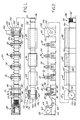
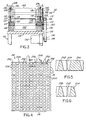
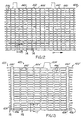
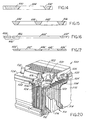
- FIGS. 1 and 2 illustrate a production line 20 -for utilizing the method of this invention to make battery positive grids 22 (FIG. 7) and negative grids 422 (FIG.13), and battery plates or electrodes of this invention.
- a web 24 of a plurality of interconnected successive grid blanks 26 (FIG. 4) is continuously cast from a molten lead composition by a continuous casting machine 28, and cleaned to remove molding compounds in a washing machine 30.
- the moving web 24 is reduced in cross section and elongated in the direction of travel by a series of compression roller machines 32, 34, 36 & 38 and wound on a drum or reel in a coiling machine 40 for inspection, handling and any storage before further processing.
- the web is unwound from the reel in an uncoiling machine 42, passes through a continuous pasting machine 44, which applies battery paste to the web and a cutting machine 46 which cuts individual pasted grids or plates from the web.
- the individual pasted plates pass in succession through a drying oven 48 which removes moisture from the paste and through a stacking machine 50 which deposits the individual plates in piles or stacks 52 which are removed for any further processing and assembly into a lead-acid battery as plates or electrodes of the battery.
- the casting machine 28 casts the web 24 of lead with a plurality of successive grid blanks 26 in a continuous manner.
- molten lead is supplied to a mold cavity in a rotating cylindrical drum 60 under superatmospheric pressure through an orifice slot 62 in a shoe 64 with an arcuate segment bearing on the peripheral surface of the drum.
- a grid pattern is machined in the peripheral surface of the drum 60 to form a mold cavity in which the lead rapidly solidifies as it is advanced beyond the orifice slot 62 which opens onto the drum.
- the solidified web 24 is stripped from the rotating drum and preferably passed through a water bath 66 to rapidly quench and cool it and under a guide roller 68.
- the web is continuously cast at a rate of about 15-60 m/min (50 to 200 lineal feet per minute).
- Suitable continuous casting machines are disclosed in U.S. Patents 4,415,016; 4,509,581; 4,534,404 and 4,544,014, the disclosures of which are incorporated herein by reference and hence will not be described in further detail.
- the moving web passes through the nip of a pair of rollers 80 corotated at the same surface speed by an electric motor 82 and passes generally horizontally through a spray enclosure 84.
- water or a cleaning solution is discharged under pressure from a spray head 86 onto the web as it passes through the booth.
- the water or cleaning solution is collected in the bottom of the booth, filtered or processed to remove contaminants, and then recirculated through the spray head 86 by a suitable pump 88.
- rollers 80 are journalled for rotation by bearings received in a carrier stand 90 received on a support frame 92 and typically have a mechanism 94 for adjusting the height of the nip or minimum gap between the rollers so that they firmly frictionally engage the web to drive or advance it.
- the cross sectional thickness of the web 24 is reduced and the web is elongated in its direction of travel in each of the succeeding roller stands 32, 34, 36 and 38. Since each of the roller stands has essentially the same construction and arrangement, only the first roller stand 32 will be described in detail.
- each stand has a pair of compression rollers 100 and 102 journalled for rotation in bearings received in carrier blocks 104 and 106 with gibs 108 slidably received in ways or grooves 110 in upstanding end plates 112 fixed to a mounting plate 114 on a frame 116 of the stand.
- the nip or minimum vertical clearance between the rollers can be adjusted by a jack screw 118 with a head 120 received in a recess or slot 122 in the bearing block 106 and a threaded shank 124 received in a complementarily threaded bore 126 through the bearing block 104.
- a hand wheel 128 is fixed to the other end of the jack screw for manually rotating it.
- the lower roller 102 is driven by an electric motor 130 through a timing belt 132 and complementary cog pullies 134 and 136 mounted on the motor drive shaft 138 and the roller shaft 140.
- the upper roller 100 is driven by a gear 142 mounted on a roller shaft 144 which is driven by a complimentary gear 146 mounted on the roller shaft 140.
- the motor 130 is a variable speed electric motor to facilitate driving the lower roller 102 at the proper peripheral surface speed to feed the web 24 through the nip of the compression rollers.
- This surface speed differs for each stand 32-38 because each time the web is reduced in thickness, it is elongated in the direction of travel of the web thereby requiring that the rollers be driven at a higher peripheral surface speed in each succeeding stand.
- the rollers 100 and 102 are driven at a constant peripheral surface speed substantially equal to the speed of the web as it enters the stand.
- the upper roller 100 is driven by the lower roller 102 thru the pair of gears 142 and 146.
- the moving web After the moving web emerges from the last roller stand 38, it enters a coiler machine 40.
- the reduced web 24' passes over a guide roller 150 and is wound in a coil on a reel 154 received on a pair of arbors 156 carried by a pair of upright end plates 158 fixed to the base 160 of the coiler machine.
- the reel 154 is rotated by a variable speed electric motor 162 at a rotary speed which decreases as the diameter of the coil 152 increases to take up the reduced web 24' as it emerges from the last roller stand 38.
- the uncoiling machine 42 has essentially the same construction as the coiler 40 with a coil 170 of a reduced web 24' wound on a reel 154 which is received on arbors 156 in the unwinder.
- the reel is rotated to unwind the coil 170 by a variable speed motor 172.
- the motor 172 increases the speed at which the reel is rotated as the coil 170 unwinds and hence its diameter decreases.
- a web coiler 40 and uncoiler 42 are used in the production line so that the casting, washing and rolling steps can be carried out independently of the pasting, cutting, drying and stacking steps.
- This provides greater flexibility in production operations and readily accommodates the differential between the lineal speed at which the reduced web 241 emerges from the last roller stand 38 30,5 - 76,2 m/min (100 to 250 lineal feet per minute) relative to the much slower speed at which it is supplied to the pasting machine 15,2- 61 m/min (typically 50-200 lineal feet per minute).
- This also permits inspection, storage, and, if desired, age hardening of the reduced web 24' before it is further processed.
- This also permits either portion of the line to be repaired or serviced while the other portion is in production and either portion to be idle when it is not needed for production.
- An electro-chemically active paste is applied to the reduced web 24' as it passes through the pasting machine 44. All of the interstices or open spaces between the wires of the web are filled with the paste, and preferably the web is "over pasted" so that the wires are completely embedded in and surrounded by the paste and the paste extends outwardly from both the top and bottom faces of the web and has a thickness greater than the thickness of the web.
- the paster applies a strip of paper to both the top and bottom exposed faces of the paste which prevents the paste from sticking to the equipment and facilitates downstream handling and processing of the pasted web 24".
- a suitable machine for continuously pasting the web is disclosed in US-A-4,606,383, the disclosure of which is incorporated herein by reference and hence the paster 44 will not be described in greater detail.
- the pasted web 24" is advanced by a powered belt conveyor 180 into the cutting machine 46 which cuts or severs the pasted web 24" into individual pasted plates.
- the cutter has appropriate synchronizing circuitry so that the web is cut through the center of a double width transversely extending frame wire to produce, as shown FIG. 7, the trailing frame wire 182 of the grid 22 of one pasted plate and the leading frame wire 184 of the grid 22 of the immediately succeeding pasted grid.
- the individual pasted plates 22 are received on a belt conveyor 190 which moves them through the flash drying oven 48.
- the conveyor 190 is driven at a greater lineal speed than the lineal speed of the individual plates 22 emerging from the cutting machine 46.
- oven 48 merely dries or removes moisture from the outer layer or skin of the faces of the paste which temporarily strengthens and solidifies the skins while the central portion of the paste remains relatively soft and pliable and retains substantial moisture.
- this oven is optional.
- this is a direct flame gas fired convection oven which may be of conventional construction and hence will not be described in further detail.
- the individual plates emerging from the oven 48 are advanced by an entry conveyor 192 into the stacker mechanism 50.
- a stream of successive individual pasted positive plates 194 moving at a high rate of speed are continuously piled in stacks 52 each having a plurality of superimposed plates.
- the stacks of plates are removed and subsequently assembled as positive plates or electrodes in lead-acid batteries.
- a suitable battery plate stacker is disclosed in U.S. Patent 4,973,218, the disclosure of which is incorporated herein by reference and hence the stacker 50 will not be described in greater detail.
- the desired properties of continuously cast positive grids are achieved when the thickness of the as cast web 24 is reduced at least 70% or about 31 to 1 and preferably about 75% or 4 to 1. Somewhat lesser but still satisfactory properties are achieved when the thickness is reduced up to about 90% or 10 to 1.
- the final thickness of continuously cast positive grids after reduction is desirably not greater than 0,5588 mm (0.022 of an inch) and preferably not greater than 0,508 mm (0.020 of an inch).
- the rollers When the as cast thickness is reduced by passing the web through the nip of compressing rollers, there is a decided tendency for the rollers to slip so that the web is not fed at a uniform or substantially constant speed if the attempted reduction in thickness is greater than about 45 % to 50 %.
- the maximum reduction in thickness is not greater than about 35% for each pass through one pair of rollers. Therefore, to achieve an overall reduction ratio of about 4 to 1, it is preferable to reduce the as cast web in at least four passes and preferably through four successive pairs of rollers.
- the first and second reductions can be 0,508 mm (0.020 of an inch) each and the third and fourth reductions 0,254 mm (0.010 of an inch) each.
- These four reductions can be accomplished by passing the web through the successive roller stands 32, 34, 36 & 38 to reduce the web thickness respectively to 1,524; 1,016; 0,762 and 0,508 mm (0.060, 0.040, 0.030 and 0.020 of an inch).
- the length of the web increases in the direction of rolling or longitudinally of the web.
- the overall length of the web increases about 2 to 1 to 2.5 to 1 in the direction of rolling.
- Rolling to reduce the thickness of the web has little affect on its transverse width which usually increases less than 1%.
- Aging of as cast webs before rolling has an affect on the ratio and particularly the uniformity of the increase in length of the webs when they are being rolled to reduce their thickness.
- the increase in length is larger and significantly more variable if as cast webs are aged for more than 36 hours before rolling.
- an as cast web should be rolled to reduce its thickness within 24 hours after continuous casting, desirably within 4 hours after continuous casting, preferably within 30 minutes after continuous casting, and most preferably within 15 minutes after continuous casting.
- Suitable rollers for reducing the web thickness may have a diameter of at least 63,5 mm (2.5 inches) and be made of hardened and ground tool steel with a surface finish of about 0,38-0,50 mm (15-20 micro inches) and a peripheral surface hardness of about 64-65 Rockwell on the C Scale.
- the continuously cast and rolled positive grids may be made from a lead alloy containing about 0. 06% to 0. 07% calcium and about 1.3% to 1.7% tin.
- a lead alloy containing about 0. 06% to 0. 07% calcium and about 1.3% to 1.7% tin.
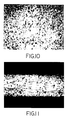
- webs and grids of this lead alloy have a large, random and non-uniform grain microstructure as shown in FIG. 10, a tensile strength of about 422-457 x 10 5 Pa (6,000 to 6,500 psi) after age hardening for 30 days at room temperature, and relatively poor corrosion resistance and significant growth in use as grids of positive plates in a lead acid battery.
- continuously cast webs and grids which were reduced in thickness by 80 % or a ratio 4 to 1 by cold working utilizing the process of this invention have a microstructure with much smaller and more uniform grains which appear to be oriented and aligned essentially parallel to the direction of deformation and travel of the web during rolling as shown in FIG. 11.
- These webs and grids of this alloy as produced by this process have greatly increased tensile strength of about 10,300 to 11,000 psi after full age hardening and greatly improved corrosion resistance and reduced growth in use as grids of positive plates in a lead-acid battery.
- Webs and grids of this lead alloy as produced by this process also have maximum rupture strength after full age hardening at room temperature which is dramatically greater than the rupture strength of webs and grids of this alloy as continuously cast and aged for at least 30 days at room temperature.
- continuously cast negative grids are achieved utilizing essentially the same process as described for making positive grids with the exception of the differences described below.
- the desired properties of continuously cast negative grids are achieved when the thickness of the as cast web 24 is reduced at least 50 % or about 2 : 1 and preferably about 60 % or 2.5 : 1. Though the microstructure grain begins to align, satisfactory results occur until reduction of the as cast web approaches 66 % or 3 : 1.
- the as cast web thickness is reduced by more than about 3:1, the grain size of the lead starts to decrease, the density of the as cast lead material is increased and the ultimate tensile strength is reduced.
- the increased density is not desirable for the negative grids since the primary benefit of reducing the thickness of the as cast web for use in negative battery plates is to achieve a stronger cold worked grid with a higher tensile strength permitting a thinner, and hence, a lighter weight negative grid while still maintaining sufficient strength and stiffness to permit subsequent handling, pasting, processing and assembly into lead-acid batteries.
- the final thickness of continuously cast negative grids after reduction is desirably not greater than 0,5588 mm (0.022 of an inch), preferably not greater than 0,508 mm (0.020 of an inch), and in many applications most preferably about 0,254 mm (0.010 of an inch).
- the maximum reduction in thickness through any pair of rollers is not greater than about 35 %. Therefore, to achieve an overall reduction ratio of about 2.5 : 1 or about 60 %, it is preferable to reduce the as cast web in at least two passes and preferably through at least two successive pairs of rollers.
- the first reduction is preferably about 0,2286 mm (0.009 of an inch) and the second reduction is about 0,1524 mm (0.006 of an inch) for a desired total reduction of 0,381 mm (0.015 of an inch) resulting in the final thickness of 0,254 mm (0.010 of an inch).
- the length of the web increases in the direction of rolling of the web for each reduction in thickness.
- the length of the web increases about 1.55 to 1 in the direction of rolling.
- the length and thickness of the as cast negative grid blanks of the web will be different than for the as cast positive grid blanks of the web such that the post process negative grids will have substantially the same overall length and width as the post process positive grids.
- the negative as cast web be rolled to reduce its thickness within 24 hours after continuous casting and most preferably within 15 minutes after continuous casting.
- the temperature range for the cold working process for the negative web should also be in the same range as for the positive web and preferably about 10°C to 27°C (50°F to 80°F).
- a cold worked as cast web having a 2:1 reduced thickness provides a negative grid of equivalent strength, stiffness and durability and about 20% to 25% lighter, and also thinner than a negative grid that is simply continuous cast and age hardened for at least 30 days.
- a 2.5:1 thickness reduction provides an equivalent negative about 25% to 30% lighter, and also thinner than simply a continuous cast and age hardened negative grid.
- the continuously cast and rolled negative grids may be made from a lead alloy similar to the material used to produce the positive grids according to this invention.
- the process yields an ultimate tensile strength of about 720-745x10 5 Pa (10,250 to 10,600 psi) after full age hardening at room temperature.
- Webs and grids of this lead alloy as produced by this process for negative grids also have maximum rupture strength after full age hardening at room temperature. This is dramatically greater than the rupture strength of webs and grids of this alloy merely continuously cast and aged for 30 days at room temperature.
- FIG. 20 A lead-acid battery 500 embodying the grids and plates of this invention is shown in FIG. 20.
- the battery 500 has an outer rectangular case 502 and a top cover 504 constructed from a material such as polypropylene. Within the case are a number of integrally molded battery cell dividers 506 defining a number of separate battery cell wells 508.
- the outer case construction herein described is merely for illustrative purposes and may take on a number of configurations and constructions without departing from the scope and spirit of the invention.
- a battery cell 510 is disposed within each of the wells 508 between the cell dividers 506 within the case 502.
- a battery cell 510 has a set of positive plates 512 constructed as previously described and a set of negative plates 514 also constructed as previously described.
- the battery plates 512, 514 of the cell are assembled in a plate book positioned in an alternating sequence of positive and negative plates.
- a separator 516 constructed from a microporous electrically insulating material is disposed between each positive and negative plate for preventing plates of different polarity from touching, thereby preventing a short circuit within any particular cell 510 of the battery 500.
- the separator 516 sometimes takes the form of an envelope, as shown, into which each positive plate 512 or negative plate 514 is placed.
- each cell 510 has a positive strap 520 and a negative strap 522 disposed on top of the plate book.
- an intercell connector 526 made of lead is disposed between each cell 510 for connecting the positive plate straps 520 and negative plate straps 522 of adjoining cells in series.
- the positive strap 520 of the first cell is connected to a positive lead battery post 530 and the negative strap 522 of the last cell is connected to negative lead battery post 532, respectively, forming the positive and negative lead-acid battery terminals.
- a dilute sulfuric acid solution fills a majority of the remaining space to the desired level within each well 508 and is the electrolyte necessary to produce the chemical reactions which take place within each battery cell 510.
- a typical battery such as an automotive type battery has six of such cells each producing a potential of about two volts of electrical energy thereby forming a typical 12 volt battery as depicted in FIG. 20.
- a battery having plates constructed according to this invention is lighter in weight than prior art batteries and has improved battery life in that the positive plates have improved corrosion resistance.
Landscapes
- Chemical & Material Sciences (AREA)
- Chemical Kinetics & Catalysis (AREA)
- Electrochemistry (AREA)
- General Chemical & Material Sciences (AREA)
- Cell Electrode Carriers And Collectors (AREA)
- Superconductors And Manufacturing Methods Therefor (AREA)
- Battery Electrode And Active Subsutance (AREA)
- Hybrid Cells (AREA)
Abstract
Description
Claims (61)
- A method of making a positive grid (22) for a positive plate (512) of a lead-acid battery (500) comprising,
continuous casting of molten lead an elongate web (24) having a plurality of successive grid blanks (26) each as cast having a plurality of spaced apart and interconnected cast wires (202) of substantially uniform thickness and as cast having intrices or open spaces between them,
cold working the grid blanks (26) of the continuous cast web (24) to reduce the total thickness of the as cast wires (202) of the cast web in the range of 3:1 to 10:1 to produce a web with cast and cold worked wires (202') having a thickness of 1/3 to 1/10 of the thickness of the as cast wires (202), and
cutting positive grids (22) from the cold worked web (24') to provide positive grids (22) with cast and cold worked wires (202') having substantially increased corrosion resistance in use in positive plates (512) in a lead-acid battery (500) and increased tensile strength after age hardening for 30 days compared to as continuous cast grids. - The method as defined in claim 1 wherein the cold worked and reduced thickness positive grid (22') has a microstructure with a smaller average grain size and a more uniform grain structure than that of the as continuous cast web (22).
- The method as defined in claim 1 or 2 wherein cold working the continuous cast web (24) reduces the thickness of the cast web (24) in the range of 3.5:1 to 10:1.
- The method as def ined in claim 1 or 2 wherein cold working the continuous cast web (24) reduces the thickness of the cast web in the range of 3.5:1 to 5:1.
- The method as defined in any of claims 1-4 which also comprises cold working the continuous cast web (24) to increase the longitudinal length of the cast web at least 2:1.
- The method as defined in any of claims 1-4 which also comprises cold working the continuous cast web (24) to increase the longitudinal length of the cast web in the range of about 2:1 to 1.5:1.
- The method as def ined in claim 1 wherein cold working the continuous cast web (24) produces positive grids (22) having a tensile strength of at least 630x105 Pa (9,000 psi) after fully age hardening at room temperature.
- The method as defined in claim 4 wherein cold working the continuous cast web (24) produces positive grids (22) having a tensilestrength of at least (700x105 Pa (10,000 psi) after fully age hardening at room temperature.
- The method as defined in any of claims 1-8 wherein the cold working of the continuous cast web (24) occurs at a peak metal temperature in the range of about 2°C to 82°C (35° F. to 180° F).
- The method as defined in any of claims 1-8 wherein the cold working of the continuous cast web (24) occurs at a peak metal temperature in the range of about 10°C to 32°C (50° F. to 90° F).
- The method as defined in any of claims 1-10 wherein cold working to reduce the thickness of the cast web (24) at least 3:1 occurs within 24 hours of continuous casting of the web.
- The method as defined in any of claims 1-10 wherein cold working to reduce the thickness of the cast web (24) at least 3:1 occurs within 4 hours of continuous casting of the web.
- The method as defined in any of claims 1-10 wherein cold working to reduce the thickness of the cast web (24) occurs within 1/2 hour of continuous casting of the web.
- The method as defined in any of claims 1-10 wherein cold working to reduce the thickness of the cast web (24) occurs within 1/4 hour of continuous casting of the web.
- The method as defined in any of claims 1-14 which also comprises applying electro-chemically active paste to the web (24') to at least substantially fill the interstices with the paste after the cold working of the web (24').
- The method as defined in any of claims 1-14 which also comprises applying electro-chemically active paste to the web (24') to at least substantially fill the interstices of the web with the paste after the cold working of the cast web, and cutting the positive grids (22) from the pasted web (24") to provide positive plates (512) for lead-acid batteries (500).
- The method as defined in any of claims 1-16 wherein cold working to reduce the thickness of the continuous cast web (24) comprises passing the cast web through the nip of at least one pair of compression rollers (100, 102) to reduce the thickness of the web.
- The method as defined in any of claims 1-16 wherein cold working to reduce the thickness of the continuous cast web (24) comprises passing the web serratum through the nip of each of at least three pairs (32, 34, 36) of compression rollers (100, 102) to reduce the thickness of the web as it passes through the nip of each pair of rollers.
- The method as defined in claim 18 wherein the cast web (24) is reduced in thickness by not more than about 40% as the web passes through the nip of each pair of rollers (100, 102).
- The method as defined in any of claims 1-19 wherein the cold worked and reduced thickness positive grid (22) is reduced in thickness to a value of not greater than about 0,5588 mm (0.022 of an inch).
- The method as defined in any of claims 1-19 wherein the cold worked and reduced thickness positive grid (22) is reduced in thickness to a value of not greater than about 0,508 mm (0.020 of an inch).
- A positive grid (22) for a positive plate (512) of a lead-acid battery (500) comprising a grid (26) continuous cast of molten lead as part of a web (24) and each grid (26) as cast having a plurality of spaced apart and interconnected cast wires (202) of substantially uniform thickness and as cast having interstices between them, and the grid (26) being cold worked to reduce the total thickness of the as cast wires (202) of the grid (26) in the range of 3 : 1 to 10 : 1 to produce a grid (22) with cast and cold worked wires (202') having a thickness of 1/3 to 1/10 of the thickness of the as cast wires (202) to provide a continuous cast positive grid (22) for a positive plate (512) of a lead-acid battery (500) having substantially increased corrosion resistance and increased tensile strength after age hardening for 30 days.
- The positive grid as defined in claim 22 wherein the cold worked and reduced thickness positive grid (22) has a microstructure with a substantially smaller grain size and a more uniform grain structure than that of the as cast continuous grid (26)of the web (24).
- The positive grid as defined in claim 22 or 23 wherein the thickness of the as cast grid (26) has been reduced in the range of 3,5:1 to 10:1.
- The positive grid as defined in claim 22 or 23 wherein the thickness of the as cast grid (26) has been reduced in the range of 3,5:1 to 5:1.
- The positive grid as defined in any of claims 22-25 which also comprises the grid (22) being cold worked to increase the longitudinal length of the cast grid (26) at least 2:1.
- The positive grid as defined in any of claims 22-26 wherein the cold worked positive grid (22) has a tensile strength of at least 630x105 Pa (9,000 psi) after age hardening at room temperature after being cold worked.
- The positive grid as defined in any of claims 22-27 wherein the grid has been cold worked to reduce the thickness of the grid (22) within 24 hours of the continuous casting of the grid.
- The positive grid as defined in any of claims 22-28 which also comprises electro-chemically active paste applied to the reduced grid (22) to at least substantially fill the interstices with the paste.
- The positive grid as defined in any of claims 22-29 wherein the cold worked and reduced thickness positive grid (22) has a thickness of not greater than about 0,5588 mm (0.022 of an inch).
- The positive grid as defined in any of claims 22-29 wherein the cold worked and reduced thickness positive grid (22) has a thickness of not greater than about 0,508 mm (0.020 of an inch).
- A method of making a negative grid (422') for a negative plate (514)of a lead-acid battery comprising,
continuous casting of molten lead an elongate web (424) having a plurality of successive grid blanks (426) each as cast having a plurality of spaced apart and interconnected wires (422) of a substantially uniform thickness which as cast have interstices between them, cold working the continuous cast web (424) to reduce the total thickness of the as cast wires (442) of each grid blank (426) of the cast web (424) in the range of about 1.5:1 to 2.8:1 to produce cast and cold worked wires (442') having a thickness of 2/3 to 5/14 of the thickness of the as cast wires (442) and cutting negative grids (422') from the cold worked web to provide negative grids (422') having increased tensile strength after age hardening for at least 30 days compared to as continuous cast grids. - The method as defined in claim 32 wherein cold working the continuous cast web (424) reduces the thickness of the cast web in the range of 2:1 to 2.5:1.
- The method as defined in claim 32 or 33 which also comprises cold working the continuous cast web (424) to increase the longitudinal length of the cast web at most 1.8:1.
- The method as defined in claim 32 or 33 which also comprises cold working the continuous cast web (424) to increase the longitudinal length of the cast web in the range of about 1.1:1 to 1.8:1.
- The method as defined in any of claims 32-35 wherein cold working the continuous cast web (424) produces negative grids (514) having an
ultimate tensile strength of at least 720x105 Pa (10,300 psi) after full age hardening at room temperature. - The method as defined in any of claims 32-35 wherein cold working the continuous cast web (424) produces negative grids (514) having an ultimate tensile strength of at least 730x105 Pa (10,500 psi) after full age hardening at room temperature.
- The method as defined in any of claims 32-37 wherein the cold working of the continuous cast web (424) occurs at a peak metal temperature in the range of about 2°C to 82°C (35°F to 180°F).
- The method as defined in any of claims 32-37 wherein the cold working of the continuous cast web (424) occurs at a peak metal temperature in the range of about 10°C to 32°C (50°F to 90°F).
- The method as defined in any of claims 32-39 wherein cold working to reduce the thickness of the as cast web (424) occurs within 24 hours of continuous casting of the web.
- The method as defined in any of claims 32-39 wherein cold working to reduce the thickness of the as cast web (424) occurs within 4 hours of continuous casting of the web.
- The method as defined in any of claims 32-39 wherein cold working to reduce the thickness of the as cast web (424) occurs within 1/2 hour of continuous casting of the web.
- The method as defined in any of claims 32-39 wherein cold working to reduce the thickness of the as cast web (424) occurs within 1/4 hour of continuous casting of the web.
- The method as defined in any of claims 32-43 which also comprises
applying electro-chemically active paste to the web to at least substantially fill the interstices with the paste after the cold working of the web. - The method as defined in any of claims 32-43 which also comprises applying electro-chemically active paste to the web to at least substantially fill the interstices of the web with the paste after the cold working of the cast web, and cutting the negative grids from the pasted web to provide negative plates (514) for lead-acid batteries.
- The method as defined in any of claims 32-45 wherein cold working to reduce the thickness of the continuous cast web comprises passing the cast web (424) through the nip of at least one pair (30) of compression rollers (100, 102) to reduce the thickness of the web.
- The method as def ined in any of claims 32-45 wherein cold working to reduce the thickness of the continuous cast web (424) comprises passing the web serratum through the nip of each of at least two pairs (30, 32) of compression rollers (100, 102) to reduce the thickness of the web as it passes through the nip of each pair of rollers.
- The method as defined in claim 47 wherein the cast web (424) is reduced in thickness by not more than about 40% as the web passes through the nip of each pair of rollers.
- The method as defined in any of claims 32-48 wherein the cold worked and reduced thickness negative grid is reduced in thickness to a value of not greater than about 0,5588 mm (0.022 of an inch).
- The method as defined in any of claims 32-48 wherein the cold worked and reduced thickness negative grid is reduced in thickness to a value of not greater than about 0,508 mm (0.020 of an inch).
- The method as defined in any of claims 32-48 wherein the cold worked and reduced thickness negative grid is reduced in thickness to a value of about 0,254 mm (0.010 of an inch).
- A negative grid (422) for a negative plate (514) of a lead-acid battery (500) comprising a grid blank (426) continuous cast of molten lead as part of a web (424) and having as cast a plurality of spaced apart and interconnected cast wires (442) of substantially uniform thickness and as cast having interstices between them, and the grid blank (426) having been cold worked to reduce the total thickness of the cast wires (442) of the grid blank in the range of about 1.5 : 1 to 2.8 : 1 to produce cast and cold worked wires (442') having a thickness of 2/3 to 5/14 of the thickness of the as cast wires (442), and to provide a continuous cast negative grid (422') having increased tensile strength after full age hardening at room temperature.
- The negative grid as defined in claim (52) wherein the thickness of the as cast grid (426) is reduced in the range of 2:1 to 2.5:1.
- The negative grid as defined in claim 52 or 53 which also comprises the grid being cold worked to increase the longitudinal length of the cast grid (426) at most 1.8 : 1 or at least 1.1 : 1.
- The negative grid as defined in any of claims 52 or 53 wherein the cold worked negative grid has an ultimate tensile strength of at least 720 x 105 Pa (10,300 psi) or at least 730 x 105 Pa (10,500 psi) after full age hardening at room temperature after being cold worked.
- The negative grid as defined in any of claims 52-55 wherein the grid has been cold worked to reduce the thickness of the grid within 24 hours of the continuous casting of the grid.
- The negative grid as defined in any of claims 52-56 which also comprises electro-chemically active paste applied to the reduced grid to at least substantially fill the interstices with the paste.
- The negative grid as defined in any of claims 52-57 wherein the cold worked and reduced thickness negative grid has a thickness of not greater than about 0,5588 mm (0.022 of an inch).
- The negative grid as defined in any of claims 52-57 wherein the cold worked and reduced thickness negative grid has a thickness of not greater than about 0,508 mm (o.020 of an inch).
- The negative grid as defined in any of claims 52-57 wherein the cold worked and reduced thickness negative grid has a thickness of about 0,254 mm (0.010 of an inch).
- A lead-acid battery (500) comprising,
a casing (502)
a plurality of separate cells (510) within said casing, each cell comprising a book of positive plates (512) and negative plates (514), insulating separators (516) disposed between adjacent plates of different polarity, an active paste applied to said plates (512, 514), positive connectors (520) joining each of said positive plates (512) of a cell together, the positive plates (512) of one cell being connected to a positive battery terminal (530), negative connectors (522) joining each of said negative plates (514) of a cell together, the negative plates of another cell being connected to a negative battery terminal (532), the connectors (520, 522) of opposite polarity of adjacent cells (510) between said one cell connected to the positive battery terminal (530) and said another cell connected to the negative battery terminal (532) being interconnected (526), said plates (512, 514) comprising the features of any of claims 22 through 31 and/or claims 52 through 60.
Applications Claiming Priority (2)
| Application Number | Priority Date | Filing Date | Title |
|---|---|---|---|
| US430224 | 1995-04-28 | ||
| US08/430,224 US5611128A (en) | 1995-04-28 | 1995-04-28 | Battery grids, method and apparatus |
Publications (2)
| Publication Number | Publication Date |
|---|---|
| EP0740357A1 EP0740357A1 (en) | 1996-10-30 |
| EP0740357B1 true EP0740357B1 (en) | 2002-07-17 |
Family
ID=23706607
Family Applications (1)
| Application Number | Title | Priority Date | Filing Date |
|---|---|---|---|
| EP96106406A Expired - Lifetime EP0740357B1 (en) | 1995-04-28 | 1996-04-24 | Battery grids, manufacturing method and apparatus |
Country Status (9)
| Country | Link |
|---|---|
| US (2) | US5611128A (en) |
| EP (1) | EP0740357B1 (en) |
| JP (1) | JPH08315826A (en) |
| KR (1) | KR960039464A (en) |
| AT (1) | ATE220823T1 (en) |
| AU (1) | AU696820B2 (en) |
| DE (1) | DE69622312T2 (en) |
| ES (1) | ES2177694T3 (en) |
| TW (1) | TW299507B (en) |
Cited By (1)
| Publication number | Priority date | Publication date | Assignee | Title |
|---|---|---|---|---|
| CN104109746A (en) * | 2014-06-24 | 2014-10-22 | 沭阳锦泳机械设备科技有限公司 | Self uniform heating and hardening technology for grid |
Families Citing this family (41)
| Publication number | Priority date | Publication date | Assignee | Title |
|---|---|---|---|---|
| US20040112486A1 (en) * | 1996-03-01 | 2004-06-17 | Aust Karl T. | Thermo-mechanical treated lead and lead alloys especially for current collectors and connectors in lead-acid batteries |
| JP3481797B2 (en) * | 1996-10-03 | 2003-12-22 | 片山特殊工業株式会社 | Method for manufacturing battery electrode substrate and battery electrode substrate |
| FR2766622B1 (en) * | 1997-07-25 | 1999-10-22 | Metaleurop Sa | PROCESS FOR THE CONTINUOUS MANUFACTURE OF POSITIVE BATTERY GRIDS, AND POSITIVE GRID OBTAINED ACCORDING TO SUCH A METHOD |
| US6074774A (en) * | 1998-06-03 | 2000-06-13 | Electrosource, Inc. | Sealed recharge battery plenum stabilized with state changeable substance |
| US6274274B1 (en) * | 1999-07-09 | 2001-08-14 | Johnson Controls Technology Company | Modification of the shape/surface finish of battery grid wires to improve paste adhesion |
| AU777119B2 (en) * | 1999-07-30 | 2004-09-30 | Wirtz Manufacturing Co., Inc. | Battery grids |
| US6802917B1 (en) | 2000-05-26 | 2004-10-12 | Integran Technologies Inc. | Perforated current collectors for storage batteries and electrochemical cells, having improved resistance to corrosion |
| US6953641B2 (en) | 2001-01-05 | 2005-10-11 | Johnson Controls Technology Company | Battery grid |
| CA2338168A1 (en) * | 2001-02-26 | 2002-08-26 | Kenneth Henning Runo Gustavsson | Continuous extruded lead alloy strip for battery electrodes |
| KR100434605B1 (en) * | 2001-12-14 | 2004-06-07 | 한국타이어 주식회사 | lead storage battery spine-grid manufacturing equipment and manufacturing method there of |
| US6749950B2 (en) * | 2002-03-28 | 2004-06-15 | Delphi Technologies, Inc. | Expanded grid |
| US6833218B2 (en) * | 2002-08-23 | 2004-12-21 | Delphi Technologies, Inc. | Direct cast lead alloy strip for expanded metal battery plate grids |
| DE10302382B4 (en) * | 2003-01-22 | 2005-03-31 | Franz Xaver Mittermaier | Devices for producing electrodes for lead-acid batteries |
| US20060216595A1 (en) * | 2005-03-22 | 2006-09-28 | Holliday Rex W | Battery assembly having improved lug profile |
| EP3035422B1 (en) | 2005-05-23 | 2019-02-20 | Johnson Controls Technology Company | Battery grid |
| AT501904B1 (en) * | 2005-05-25 | 2006-12-15 | Banner Gmbh | GRID |
| DE102007002308A1 (en) * | 2007-01-16 | 2008-07-17 | Franz Xaver Mittermaier | Method for producing a grid electrode for a lead-acid battery |
| RU2477549C2 (en) * | 2007-03-02 | 2013-03-10 | Джонсон Кэнтрэулз Текнолэджи Кампэни | Accumulator negative grid manufacture method |
| US8875361B2 (en) | 2008-05-21 | 2014-11-04 | Wirtz Manufacturing Co., Inc. | Reformed battery grids |
| WO2010051848A1 (en) * | 2008-11-07 | 2010-05-14 | H. Folke Sandelin Ab | Methods and system for manufacturing lead battery plates |
| US8533973B2 (en) * | 2008-12-02 | 2013-09-17 | Mac Engineering And Equipment Company, Inc. | Contact flash dryer and method of contact flash drying |
| KR101037761B1 (en) * | 2009-07-16 | 2011-05-27 | 김부용 | Molding apparatus for grid production of batteries |
| MX338843B (en) | 2010-03-03 | 2016-05-03 | Johnson Controls Tech Co | Battery grids and methods for manufacturing same. |
| US9748578B2 (en) | 2010-04-14 | 2017-08-29 | Johnson Controls Technology Company | Battery and battery plate assembly |
| KR101831423B1 (en) | 2010-04-14 | 2018-02-22 | 존슨 컨트롤스 테크놀러지 컴퍼니 | Battery, battery plate assembly, and method of assembly |
| CN102640334B (en) * | 2010-10-18 | 2014-09-17 | 新神户电机株式会社 | Lead storage battery |
| US9761883B2 (en) | 2011-11-03 | 2017-09-12 | Johnson Controls Technology Company | Battery grid with varied corrosion resistance |
| DE202013012569U1 (en) | 2013-10-08 | 2017-07-17 | Johnson Controls Autobatterie Gmbh & Co. Kgaa | Grid arrangement for a plate-shaped battery electrode of an electrochemical accumulator and accumulator |
| DE102013111667A1 (en) | 2013-10-23 | 2015-04-23 | Johnson Controls Autobatterie Gmbh & Co. Kgaa | Grid arrangement for a plate-shaped battery electrode and accumulator |
| US12451493B2 (en) | 2017-01-27 | 2025-10-21 | Cps Technology Holdings Llc | Battery grid |
| SI3624963T1 (en) | 2017-05-19 | 2022-01-31 | IQ Power Licencing AG | Device for casting electrode supports for lead-acid batteries |
| BR112020021969A2 (en) * | 2018-04-27 | 2021-01-26 | Wirtz Manufacturing Company, Inc | battery machine tool method and system |
| JP7185981B2 (en) * | 2018-05-23 | 2022-12-08 | 昭和電工マテリアルズ株式会社 | Grids and lead-acid batteries |
| CN109465427A (en) * | 2018-12-27 | 2019-03-15 | 天能电池(芜湖)有限公司 | A kind of control method promoting casting rate |
| CN110640121A (en) * | 2019-10-24 | 2020-01-03 | 保定金阳光能源装备科技有限公司 | Grid continuous casting and coating production line |
| CN110653359B (en) * | 2019-10-24 | 2025-07-01 | 保定金阳光能源装备科技有限公司 | A grid continuous casting production line |
| CN110666140A (en) * | 2019-10-25 | 2020-01-10 | 保定金阳光能源装备科技有限公司 | Continuous casting machine for plate grid |
| CN112743302B (en) * | 2020-12-29 | 2022-05-13 | 天津航天长征火箭制造有限公司 | Method for controlling forming precision of large-diameter-thickness-ratio non-uniform sunken milling grid wallboard |
| WO2023193902A1 (en) | 2022-04-06 | 2023-10-12 | Hoppecke Batterien Gmbh & Co. Kg | Mesh for an electrode of a lead-acid battery |
| CN115608976B (en) * | 2022-11-22 | 2023-03-07 | 河北利通行汽车配件有限公司 | Forming device for electrode column of automobile battery |
| EP4659294A1 (en) * | 2023-01-30 | 2025-12-10 | Wirtz Manufacturing Co., Inc. | Method of making plates with pure lead grids for lead-acid battery manufacture |
Family Cites Families (14)
| Publication number | Priority date | Publication date | Assignee | Title |
|---|---|---|---|---|
| US3051030A (en) * | 1956-09-27 | 1962-08-28 | Herbert C Winkel | Battery grid casting and trimming method and machine |
| US4109358A (en) * | 1971-04-21 | 1978-08-29 | Esb Ray-O-Vac Management Corporation | Method for making storage battery grid from lead-tin-zinc alloy |
| US4228580A (en) * | 1978-09-11 | 1980-10-21 | General Motors Corporation | Process for making wrought, lead-calcium battery grid alloy having high temperature tensile strength stability |
| US4279977A (en) * | 1978-09-11 | 1981-07-21 | General Motors Corporation | Lead-calcium-tin battery grid |
| GB2082092B (en) * | 1980-08-21 | 1985-01-30 | Chloride Group Ltd | Method of making battery plates |
| US4544014A (en) * | 1982-05-20 | 1985-10-01 | Wirtz Manufacturing Company, Inc. | Machine for continuously casting battery grids |
| US4534404A (en) * | 1982-05-20 | 1985-08-13 | Wirtz Manufacturing Company, Inc. | Machine for continuously casting battery grids |
| US4509581A (en) * | 1982-05-20 | 1985-04-09 | Wirtz Manufacturing Company, Inc. | Machine for continuously casting battery grids |
| US4415016A (en) * | 1982-05-20 | 1983-11-15 | Wirtz Manufacturing Company, Inc. | Machine for continuously casting battery grids |
| US4606383A (en) * | 1983-12-15 | 1986-08-19 | Wirtz Manufacturing Company, Inc. | Battery grid pasting machine |
| US4543863A (en) * | 1984-01-16 | 1985-10-01 | Wirtz Manufacturing Company, Inc. | Controlled severing of a continuous web |
| US4583437A (en) * | 1984-04-02 | 1986-04-22 | Rader Robert R | Rotary cutter |
| US4805277A (en) * | 1986-06-05 | 1989-02-21 | Matsushita Electric Industrial Co., Ltd. | Process for producing a grid for use in lead acid batteries |
| US5120620A (en) * | 1990-08-24 | 1992-06-09 | Gates Energy Products, Inc. | Binary lead-tin alloy substrate for lead-acid electrochemical cells |
-
1995
- 1995-04-28 US US08/430,224 patent/US5611128A/en not_active Expired - Lifetime
- 1995-11-16 US US08/558,784 patent/US5604058A/en not_active Expired - Lifetime
- 1995-12-20 AU AU40546/95A patent/AU696820B2/en not_active Ceased
-
1996
- 1996-01-10 TW TW085100218A patent/TW299507B/zh active
- 1996-03-26 JP JP8096074A patent/JPH08315826A/en active Pending
- 1996-04-01 KR KR1019960009741A patent/KR960039464A/en not_active Abandoned
- 1996-04-24 DE DE69622312T patent/DE69622312T2/en not_active Expired - Fee Related
- 1996-04-24 EP EP96106406A patent/EP0740357B1/en not_active Expired - Lifetime
- 1996-04-24 AT AT96106406T patent/ATE220823T1/en not_active IP Right Cessation
- 1996-04-24 ES ES96106406T patent/ES2177694T3/en not_active Expired - Lifetime
Cited By (2)
| Publication number | Priority date | Publication date | Assignee | Title |
|---|---|---|---|---|
| CN104109746A (en) * | 2014-06-24 | 2014-10-22 | 沭阳锦泳机械设备科技有限公司 | Self uniform heating and hardening technology for grid |
| CN104109746B (en) * | 2014-06-24 | 2016-03-30 | 宿迁琛博信息科技有限公司 | A kind of grid is from homogeneous heating hardening process |
Also Published As
| Publication number | Publication date |
|---|---|
| US5604058A (en) | 1997-02-18 |
| AU696820B2 (en) | 1998-09-17 |
| EP0740357A1 (en) | 1996-10-30 |
| TW299507B (en) | 1997-03-01 |
| ATE220823T1 (en) | 2002-08-15 |
| DE69622312T2 (en) | 2003-01-30 |
| AU4054695A (en) | 1996-11-07 |
| JPH08315826A (en) | 1996-11-29 |
| ES2177694T3 (en) | 2002-12-16 |
| DE69622312D1 (en) | 2002-08-22 |
| US5611128A (en) | 1997-03-18 |
| KR960039464A (en) | 1996-11-25 |
Similar Documents
| Publication | Publication Date | Title |
|---|---|---|
| EP0740357B1 (en) | Battery grids, manufacturing method and apparatus | |
| US6895644B2 (en) | Battery grids | |
| US8875361B2 (en) | Reformed battery grids | |
| US12132209B2 (en) | Battery grid with varied corrosion resistance | |
| US5948566A (en) | Method for making lead-acid grids and cells and batteries using such grids | |
| KR100758351B1 (en) | Continuous extruded lead alloy strip for battery electrodes | |
| US5762654A (en) | Method for making lead-acid grids and cells and batteries using such grids | |
| US20240313231A1 (en) | Method of making plates with pure lead grids for lead-acid battery manufacture | |
| CA2438307C (en) | Continuous extruded lead alloy strip for battery electrodes | |
| JPH1058008A (en) | Method for producing lithium metal foil or lithium alloy foil | |
| RU2299499C2 (en) | Method for continuous production of lead-acid battery leads | |
| JP2004319166A (en) | Manufacturing method of grid for storage battery | |
| CN120734105A (en) | Microporous lithium-boron alloy belt production device and method |
Legal Events
| Date | Code | Title | Description |
|---|---|---|---|
| PUAI | Public reference made under article 153(3) epc to a published international application that has entered the european phase |
Free format text: ORIGINAL CODE: 0009012 |
|
| AK | Designated contracting states |
Kind code of ref document: A1 Designated state(s): AT CH DE ES FR GB IT LI |
|
| 17P | Request for examination filed |
Effective date: 19970122 |
|
| 17Q | First examination report despatched |
Effective date: 19970613 |
|
| GRAG | Despatch of communication of intention to grant |
Free format text: ORIGINAL CODE: EPIDOS AGRA |
|
| GRAG | Despatch of communication of intention to grant |
Free format text: ORIGINAL CODE: EPIDOS AGRA |
|
| GRAH | Despatch of communication of intention to grant a patent |
Free format text: ORIGINAL CODE: EPIDOS IGRA |
|
| GRAH | Despatch of communication of intention to grant a patent |
Free format text: ORIGINAL CODE: EPIDOS IGRA |
|
| GRAA | (expected) grant |
Free format text: ORIGINAL CODE: 0009210 |
|
| AK | Designated contracting states |
Kind code of ref document: B1 Designated state(s): AT CH DE ES FR GB IT LI |
|
| REF | Corresponds to: |
Ref document number: 220823 Country of ref document: AT Date of ref document: 20020815 Kind code of ref document: T |
|
| REG | Reference to a national code |
Ref country code: GB Ref legal event code: FG4D |
|
| REG | Reference to a national code |
Ref country code: CH Ref legal event code: EP |
|
| REF | Corresponds to: |
Ref document number: 69622312 Country of ref document: DE Date of ref document: 20020822 |
|
| REG | Reference to a national code |
Ref country code: CH Ref legal event code: NV Representative=s name: BOVARD AG PATENTANWAELTE |
|
| ET | Fr: translation filed | ||
| REG | Reference to a national code |
Ref country code: ES Ref legal event code: FG2A Ref document number: 2177694 Country of ref document: ES Kind code of ref document: T3 |
|
| PLBE | No opposition filed within time limit |
Free format text: ORIGINAL CODE: 0009261 |
|
| STAA | Information on the status of an ep patent application or granted ep patent |
Free format text: STATUS: NO OPPOSITION FILED WITHIN TIME LIMIT |
|
| 26N | No opposition filed |
Effective date: 20030422 |
|
| PGFP | Annual fee paid to national office [announced via postgrant information from national office to epo] |
Ref country code: AT Payment date: 20050401 Year of fee payment: 10 |
|
| PGFP | Annual fee paid to national office [announced via postgrant information from national office to epo] |
Ref country code: FR Payment date: 20050418 Year of fee payment: 10 |
|
| PGFP | Annual fee paid to national office [announced via postgrant information from national office to epo] |
Ref country code: GB Payment date: 20050420 Year of fee payment: 10 |
|
| PGFP | Annual fee paid to national office [announced via postgrant information from national office to epo] |
Ref country code: CH Payment date: 20050421 Year of fee payment: 10 |
|
| PGFP | Annual fee paid to national office [announced via postgrant information from national office to epo] |
Ref country code: ES Payment date: 20050512 Year of fee payment: 10 |
|
| PGFP | Annual fee paid to national office [announced via postgrant information from national office to epo] |
Ref country code: DE Payment date: 20050531 Year of fee payment: 10 |
|
| PG25 | Lapsed in a contracting state [announced via postgrant information from national office to epo] |
Ref country code: GB Free format text: LAPSE BECAUSE OF NON-PAYMENT OF DUE FEES Effective date: 20060424 Ref country code: AT Free format text: LAPSE BECAUSE OF NON-PAYMENT OF DUE FEES Effective date: 20060424 |
|
| PG25 | Lapsed in a contracting state [announced via postgrant information from national office to epo] |
Ref country code: ES Free format text: LAPSE BECAUSE OF NON-PAYMENT OF DUE FEES Effective date: 20060425 |
|
| PG25 | Lapsed in a contracting state [announced via postgrant information from national office to epo] |
Ref country code: LI Free format text: LAPSE BECAUSE OF NON-PAYMENT OF DUE FEES Effective date: 20060430 Ref country code: CH Free format text: LAPSE BECAUSE OF NON-PAYMENT OF DUE FEES Effective date: 20060430 |
|
| PGFP | Annual fee paid to national office [announced via postgrant information from national office to epo] |
Ref country code: IT Payment date: 20060430 Year of fee payment: 11 |
|
| PG25 | Lapsed in a contracting state [announced via postgrant information from national office to epo] |
Ref country code: DE Free format text: LAPSE BECAUSE OF NON-PAYMENT OF DUE FEES Effective date: 20061101 |
|
| REG | Reference to a national code |
Ref country code: CH Ref legal event code: PL |
|
| GBPC | Gb: european patent ceased through non-payment of renewal fee |
Effective date: 20060424 |
|
| REG | Reference to a national code |
Ref country code: FR Ref legal event code: ST Effective date: 20061230 |
|
| REG | Reference to a national code |
Ref country code: ES Ref legal event code: FD2A Effective date: 20060425 |
|
| PG25 | Lapsed in a contracting state [announced via postgrant information from national office to epo] |
Ref country code: FR Free format text: LAPSE BECAUSE OF NON-PAYMENT OF DUE FEES Effective date: 20060502 |
|
| PG25 | Lapsed in a contracting state [announced via postgrant information from national office to epo] |
Ref country code: IT Free format text: LAPSE BECAUSE OF NON-PAYMENT OF DUE FEES Effective date: 20070424 |