EP0739866B1 - Piezoelectric ceramics - Google Patents
Piezoelectric ceramics Download PDFInfo
- Publication number
- EP0739866B1 EP0739866B1 EP96106134A EP96106134A EP0739866B1 EP 0739866 B1 EP0739866 B1 EP 0739866B1 EP 96106134 A EP96106134 A EP 96106134A EP 96106134 A EP96106134 A EP 96106134A EP 0739866 B1 EP0739866 B1 EP 0739866B1
- Authority
- EP
- European Patent Office
- Prior art keywords
- ceramic
- piezoelectric ceramic
- type structure
- piezoelectric
- spinel type
- Prior art date
- Legal status (The legal status is an assumption and is not a legal conclusion. Google has not performed a legal analysis and makes no representation as to the accuracy of the status listed.)
- Expired - Lifetime
Links
- 239000000919 ceramic Substances 0.000 title claims description 98
- 229910052596 spinel Inorganic materials 0.000 claims description 31
- 239000011029 spinel Substances 0.000 claims description 31
- 239000006104 solid solution Substances 0.000 claims description 11
- 229910020698 PbZrO3 Inorganic materials 0.000 claims description 10
- SZVJSHCCFOBDDC-UHFFFAOYSA-N ferrosoferric oxide Chemical compound O=[Fe]O[Fe]O[Fe]=O SZVJSHCCFOBDDC-UHFFFAOYSA-N 0.000 claims description 6
- AMWRITDGCCNYAT-UHFFFAOYSA-L manganese oxide Inorganic materials [Mn].O[Mn]=O.O[Mn]=O AMWRITDGCCNYAT-UHFFFAOYSA-L 0.000 claims description 3
- 229910003080 TiO4 Inorganic materials 0.000 claims 2
- 239000000203 mixture Substances 0.000 description 18
- 239000000843 powder Substances 0.000 description 11
- 239000013078 crystal Substances 0.000 description 7
- 230000010355 oscillation Effects 0.000 description 7
- 230000008859 change Effects 0.000 description 6
- 238000000034 method Methods 0.000 description 5
- 230000010287 polarization Effects 0.000 description 5
- 230000000052 comparative effect Effects 0.000 description 4
- 230000008569 process Effects 0.000 description 4
- 229910003781 PbTiO3 Inorganic materials 0.000 description 3
- 238000002441 X-ray diffraction Methods 0.000 description 3
- 239000000654 additive Substances 0.000 description 3
- 238000005245 sintering Methods 0.000 description 3
- 239000007858 starting material Substances 0.000 description 3
- 229910019653 Mg1/3Nb2/3 Inorganic materials 0.000 description 2
- GWEVSGVZZGPLCZ-UHFFFAOYSA-N Titan oxide Chemical compound O=[Ti]=O GWEVSGVZZGPLCZ-UHFFFAOYSA-N 0.000 description 2
- RTAQQCXQSZGOHL-UHFFFAOYSA-N Titanium Chemical compound [Ti] RTAQQCXQSZGOHL-UHFFFAOYSA-N 0.000 description 2
- MCMNRKCIXSYSNV-UHFFFAOYSA-N Zirconium dioxide Chemical compound O=[Zr]=O MCMNRKCIXSYSNV-UHFFFAOYSA-N 0.000 description 2
- 229910010293 ceramic material Inorganic materials 0.000 description 2
- RKTYLMNFRDHKIL-UHFFFAOYSA-N copper;5,10,15,20-tetraphenylporphyrin-22,24-diide Chemical compound [Cu+2].C1=CC(C(=C2C=CC([N-]2)=C(C=2C=CC=CC=2)C=2C=CC(N=2)=C(C=2C=CC=CC=2)C2=CC=C3[N-]2)C=2C=CC=CC=2)=NC1=C3C1=CC=CC=C1 RKTYLMNFRDHKIL-UHFFFAOYSA-N 0.000 description 2
- 230000008878 coupling Effects 0.000 description 2
- 238000010168 coupling process Methods 0.000 description 2
- 238000005859 coupling reaction Methods 0.000 description 2
- NUJOXMJBOLGQSY-UHFFFAOYSA-N manganese dioxide Chemical compound O=[Mn]=O NUJOXMJBOLGQSY-UHFFFAOYSA-N 0.000 description 2
- 238000004519 manufacturing process Methods 0.000 description 2
- 239000000463 material Substances 0.000 description 2
- 238000002360 preparation method Methods 0.000 description 2
- 229910000859 α-Fe Inorganic materials 0.000 description 2
- 229910019714 Nb2O3 Inorganic materials 0.000 description 1
- BQCADISMDOOEFD-UHFFFAOYSA-N Silver Chemical compound [Ag] BQCADISMDOOEFD-UHFFFAOYSA-N 0.000 description 1
- XTXRWKRVRITETP-UHFFFAOYSA-N Vinyl acetate Chemical compound CC(=O)OC=C XTXRWKRVRITETP-UHFFFAOYSA-N 0.000 description 1
- 230000008901 benefit Effects 0.000 description 1
- 239000011230 binding agent Substances 0.000 description 1
- 150000004649 carbonic acid derivatives Chemical class 0.000 description 1
- 150000001875 compounds Chemical class 0.000 description 1
- 239000000839 emulsion Substances 0.000 description 1
- 238000010304 firing Methods 0.000 description 1
- 239000008187 granular material Substances 0.000 description 1
- HFGPZNIAWCZYJU-UHFFFAOYSA-N lead zirconate titanate Chemical compound [O-2].[O-2].[O-2].[O-2].[O-2].[Ti+4].[Zr+4].[Pb+2] HFGPZNIAWCZYJU-UHFFFAOYSA-N 0.000 description 1
- YEXPOXQUZXUXJW-UHFFFAOYSA-N lead(II) oxide Inorganic materials [Pb]=O YEXPOXQUZXUXJW-UHFFFAOYSA-N 0.000 description 1
- XMFOQHDPRMAJNU-UHFFFAOYSA-N lead(II,IV) oxide Inorganic materials O1[Pb]O[Pb]11O[Pb]O1 XMFOQHDPRMAJNU-UHFFFAOYSA-N 0.000 description 1
- 238000005259 measurement Methods 0.000 description 1
- 230000007246 mechanism Effects 0.000 description 1
- 239000002994 raw material Substances 0.000 description 1
- 229910052709 silver Inorganic materials 0.000 description 1
- 239000004332 silver Substances 0.000 description 1
- 238000010897 surface acoustic wave method Methods 0.000 description 1
Images


Classifications
-
- H—ELECTRICITY
- H10—SEMICONDUCTOR DEVICES; ELECTRIC SOLID-STATE DEVICES NOT OTHERWISE PROVIDED FOR
- H10N—ELECTRIC SOLID-STATE DEVICES NOT OTHERWISE PROVIDED FOR
- H10N30/00—Piezoelectric or electrostrictive devices
- H10N30/80—Constructional details
- H10N30/85—Piezoelectric or electrostrictive active materials
- H10N30/853—Ceramic compositions
-
- H—ELECTRICITY
- H10—SEMICONDUCTOR DEVICES; ELECTRIC SOLID-STATE DEVICES NOT OTHERWISE PROVIDED FOR
- H10N—ELECTRIC SOLID-STATE DEVICES NOT OTHERWISE PROVIDED FOR
- H10N30/00—Piezoelectric or electrostrictive devices
- H10N30/80—Constructional details
- H10N30/85—Piezoelectric or electrostrictive active materials
- H10N30/853—Ceramic compositions
- H10N30/8548—Lead-based oxides
- H10N30/8554—Lead-zirconium titanate [PZT] based
-
- C—CHEMISTRY; METALLURGY
- C04—CEMENTS; CONCRETE; ARTIFICIAL STONE; CERAMICS; REFRACTORIES
- C04B—LIME, MAGNESIA; SLAG; CEMENTS; COMPOSITIONS THEREOF, e.g. MORTARS, CONCRETE OR LIKE BUILDING MATERIALS; ARTIFICIAL STONE; CERAMICS; REFRACTORIES; TREATMENT OF NATURAL STONE
- C04B35/00—Shaped ceramic products characterised by their composition; Ceramics compositions; Processing powders of inorganic compounds preparatory to the manufacturing of ceramic products
- C04B35/01—Shaped ceramic products characterised by their composition; Ceramics compositions; Processing powders of inorganic compounds preparatory to the manufacturing of ceramic products based on oxide ceramics
- C04B35/48—Shaped ceramic products characterised by their composition; Ceramics compositions; Processing powders of inorganic compounds preparatory to the manufacturing of ceramic products based on oxide ceramics based on zirconium or hafnium oxides, zirconates, zircon or hafnates
- C04B35/49—Shaped ceramic products characterised by their composition; Ceramics compositions; Processing powders of inorganic compounds preparatory to the manufacturing of ceramic products based on oxide ceramics based on zirconium or hafnium oxides, zirconates, zircon or hafnates containing also titanium oxides or titanates
- C04B35/491—Shaped ceramic products characterised by their composition; Ceramics compositions; Processing powders of inorganic compounds preparatory to the manufacturing of ceramic products based on oxide ceramics based on zirconium or hafnium oxides, zirconates, zircon or hafnates containing also titanium oxides or titanates based on lead zirconates and lead titanates, e.g. PZT
- C04B35/493—Shaped ceramic products characterised by their composition; Ceramics compositions; Processing powders of inorganic compounds preparatory to the manufacturing of ceramic products based on oxide ceramics based on zirconium or hafnium oxides, zirconates, zircon or hafnates containing also titanium oxides or titanates based on lead zirconates and lead titanates, e.g. PZT containing also other lead compounds
Definitions
- the present invention relates to piezoelectric ceramics and more particularly to piezoelectric ceramics used for ceramic filters, ceramic oscillators, discriminators, surface acoustic wave resonators or the like.
- a piezoelectric ceramic having a lead titanate zirconate (PbTiO3-PbZrO3; hereinafter referred to as PZT”) as a main component has been widely used as a ceramic material having piezoelectric properties (piezoelectric ceramic) employed, for instance, in ceramic filters and ceramic oscillators.
- PZT lead titanate zirconate
- piezoelectric ceramics to which various third components or additives are added have been proposed in order to improve the piezoelectric characteristic.
- One such piezoelectric ceramic is where Pb(Mn 1/3 Nb 2/3 )O 3 , Pb(Mg 1/3 Nb 2/3 )O 3 or the like is solid-solubilized as the third component.
- the crystal structure of a piezoelectric ceramic containing such PZT as the main component changes depending on the ratio of PbTiO 3 /PbZrO 3 and takes either a rhombohedral crystal structure or a tetragonal crystal structure.
- the phase boundary between the rhombohedral structure and the tetragonal structure is called the Morphotropic Phase Boundary ("MPB"). It is known that excellent piezoelectric properties can be obtained in a composition having the ratio of PbTiO 3 /PbZrO 3 realizing a structure close to MPB ("MPB structure"). For example, when a piezoelectric ceramic having a composition realizing the MPB structure is used as a band-pass filter, the band width of the filter is broader.
- a PZT system piezoelectric ceramic having a composition realizing the MPB structure has a problem in that the temperature dependency of a resonant frequency and anti-resonant frequency is high.
- the pass-band of a ceramic filter using such piezoelectric ceramic depends significantly on the temperature.
- the band-pass filter using the PZT system piezoelectric ceramic having the composition realizing the MPB structure has the aforementioned advantage, its use is limited because the temperature dependency of the frequency is significant.
- GB-A-1184888 discloses a piezoelectric ceramic comprising a solid solution expressed by the general expression xPbTiO 3 - (1-x)PbZrO 3 as its main component, said solid solution having morphotropic phase boundary structure.
- the composition of the ceramic body is made of the three components Pb(Mn 1/3 Ta 2/3 )O 3 , PbTiO 3 and PbZrO 3 , respectively.
- the crystal structures of these three components are all perovskite structure, and the composition of the ceramic body has pervoskite structure as well.
- DE-A-179 6 226 discloses a piezoelectric ceramic, comprising a solid solution expressed by the general expression xPbTiO 3 - (1-x)PbZrO 3 as its main component, said solid solution having morphotropic phase boundary structure.
- EP-A-033 8 799 discloses a method of making a ceramic material, selected from a titanate ceramic having perovskite-type structure and a ferrite ceramic having spinel-type structure. The purpose of this method is to obtain a titanate ceramic having a pervoskite-type structure or a ferrite ceramic having a spinel-type structure each of which has excellent homogeneity.
- This publication does not, however, disclose a ceramic having spinel-type structure dispersed in a piezoelectric ceramic having morphotropic phase boundary structure.
- JP-A-63-185080 discloses a piezoelectric ceramic which is obtained by sintering.
- a complex oxide of a perovskite structure as a basic composition is uniformely mixed with an oxide having a spinel structure which is integrated with the basic composition so that a complex oxide of perovskite structure is formed.
- a piezoelectric ceramic having a solid solution expressed by a general expression: xPbTiO 3 (1-x) PbZrO 3 as its main component, wherein x in the above general expression has a value which causes the piezoelectric ceramic to have a composition in the vicinity of the MPB and in which a ceramic having a spinel type structure exists within the structure thereof.
- the content of the ceramic having the spinel type structure existing in the structure is set at about 5 volume % or less, preferably about 0.1 to 4.8 %.
- At least one of Co2TiO4, Mn3O4, Fe3O4, Mg2TiO4 and a spinel type structure solid solution of them is used as the ceramic having the spinel type structure.
- spinel ceramic the ceramic having the spinel type structure (hereinafter referred simply as "spinel ceramic") existing within the piezoelectric ceramic is kept in a range of about 5 volume % or less is because the specific resistance of the obtained piezoelectric ceramic is lowered and it becomes difficult to implement a polarization process if the amount of the spinel ceramic exceeds 5 volume %.
- inventive piezoelectric ceramic can achieve the excellent thermal stability while maintaining a high piezoelectric property in a composition range in the vicinity of the MPB because a spinel phase which differs from a perovskite phase is formed during the sintering process of the piezoelectric ceramic and it cancels the instability of the crystal structure caused by phase change in a singular phase of the perovskite phase by some means.
- Powders of PbO or Pb3O4, TiO2, ZrO2, MnO2 and Nb2O3 were prepared as starting raw materials. Those materials were weighed so that the value of x in the general expression (1) takes the value shown in Table 1 below, wet mixed using a ball mill, dehydrated, dried, calcined for two hours in 850 to 1000°C and then ground to obtain calcined piezoelectric ceramic powder A. Sample No.
- the starting materials of the calcined powder A have been used as the starting materials of the calcined powder A in the embodiment described above, the starting materials are not limited only to those and various materials such as carbonates which become the above-mentioned oxide may be used.
- CoO and TO 2 powders were prepared as starting materials of the spinel ceramic powder to be mixed with the above-mentioned calcined piezoelectric ceramic powder A, were weighed so as to meet the composition of the above-mentioned general expression (2), wet mixed using a ball mill, dehydrated, dried, calcined for two hours in 850 to 1000°C and ground to obtain calcined spinel ceramic powder B.
- the piezoelectric ceramic powder A and the spinel ceramic power B prepared as described above were mixed in the ratio as shown in Table 1 above, ground together with an organic binder such as vinyl acetate emulsion, mixed and dried to form a granulate. Then, the granular powder thus obtained was molded into a disc having a 12 mm diameter and 1 mm thickness under a pressure of about 1000 kg/cm 2 .
- a piezoelectric ceramic was obtained by firing the molded disc for two hours in 1150 to 1300°C. Silver electrodes were baked on the both sides of the piezoelectric ceramic and a polarization process was implemented under the conditions of 60 to 200°C of temperature and 1.5 to 5 kV/mm for five to 30 minutes.
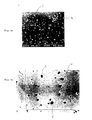
- FIGs. 1a and 1b are SEM pictures of a polished plane showing the crystal structure of the piezoelectric ceramic sample No. 7 thus obtained.
- dark portions 1 through 5 and others are ceramics having the spinel type structure.
- FIG. 2 is an X-ray diffraction chart of the piezoelectric ceramic sample No. 7.
- peaks marked with O are those of PZT and peaks marked with X are those of the ceramic having the spinel type structure.
- each composition has the MBP structure.
- a composition whose x value is about 0.52 can be defined as one having the MPB structure.
- the x value which realizes the MPB structure may vary in accordance with the amount of the additives.
- the x value realizing the MPB structure is determined by a X-ray analysis in which structures of a series of compositions having various x values are observed.
- Characteristics of the piezoelectric ceramic to which the polarization process was implemented as described above were measured with respect to dielectric constant ( ⁇ ), an electromechanical coupling factor (kp) of radial oscillation and a temperature coefficient (Cfr.p) of the resonant frequency of the radial oscillation. Table 1 above shows the results. It is noted that in Table 1, those sample Nos. marked with *" are comparative examples which are outside of the scope of the present invention and the other samples are embodiments within the scope of the present invention.
- FIG. 3 shows the relation between temperature and percentage of resonant frequency change of radial oscillation of a sample (sample No. 2) of the comparative example and samples (sample Nos. 3 and 5) of the invention.
- Samples Nos. 12, 13 and 14 could not be polarized because the specific resistance of the samples were small.
- the ⁇ set forth is the value prior to polarization.
- the piezoelectric ceramic of the present invention is not confined only to that. That is, it is possible to apply the present invention to various piezoelectric ceramics including the MPB composition such as a two component PZT system or two component PZT system to which Pb(Mg1/3Nb2/3)O3 or Pb(Ni1/3Nb2/3)O3 has been solid-solubilized.
- the type of the ceramic having the spinel type structure which exists in the piezoelectric ceramic of the present invention is also not confined only to the Co2TiO4 described above. That is, it is possible to use Mn3O4, Fe3O4, Mg2TiO4 or the like and it is also possible to use a ceramic having a compound spinel type structure which is a solid solution of two or more of them.
- the present invention not only the temperature dependence of the resonant frequency of the radial oscillation of the disc piezoelectric ceramic described above, but also the temperature dependence of the resonant frequency of perpendicular oscillation and thickness sliding oscillation may be reduced.
- the present invention is not limited to the embodiment described above in other aspects. That is, it may be applied or modified in various ways in terms of the manufacturing conditions such as the sintering temperature and time and the shape and dimensions of the piezoelectric ceramic within the scope of the spirit of the present invention.
- a ceramic having the spinel type structure exists within the structure of the PZT system piezoelectric ceramic which is expressed by xPbTiO 3 - (1-x) PbZrO3 and in which x, i.e. the ratio of Ti/Zr, has a value which realizes a structure including MPB structure, the temperature dependence of the resonant frequency in the piezoelectric ceramic of the present invention is reduced while maintaining the high piezoelectric property of the composition.
Landscapes
- Chemical & Material Sciences (AREA)
- Engineering & Computer Science (AREA)
- Ceramic Engineering (AREA)
- Composite Materials (AREA)
- Manufacturing & Machinery (AREA)
- Materials Engineering (AREA)
- Structural Engineering (AREA)
- Organic Chemistry (AREA)
- Compositions Of Oxide Ceramics (AREA)
Description
- The present invention relates to piezoelectric ceramics and more particularly to piezoelectric ceramics used for ceramic filters, ceramic oscillators, discriminators, surface acoustic wave resonators or the like.
- A piezoelectric ceramic having a lead titanate zirconate (PbTiO3-PbZrO3; hereinafter referred to as PZT") as a main component has been widely used as a ceramic material having piezoelectric properties (piezoelectric ceramic) employed, for instance, in ceramic filters and ceramic oscillators.
- Recently, a number of piezoelectric ceramics to which various third components or additives are added have been proposed in order to improve the piezoelectric characteristic. One such piezoelectric ceramic is where Pb(Mn1/3Nb2/3)O3, Pb(Mg1/3Nb2/3)O3 or the like is solid-solubilized as the third component.
- The crystal structure of a piezoelectric ceramic containing such PZT as the main component changes depending on the ratio of PbTiO3/PbZrO3 and takes either a rhombohedral crystal structure or a tetragonal crystal structure.
- The phase boundary between the rhombohedral structure and the tetragonal structure is called the Morphotropic Phase Boundary ("MPB"). It is known that excellent piezoelectric properties can be obtained in a composition having the ratio of PbTiO3/PbZrO3 realizing a structure close to MPB ("MPB structure"). For example, when a piezoelectric ceramic having a composition realizing the MPB structure is used as a band-pass filter, the band width of the filter is broader.
- However, a PZT system piezoelectric ceramic having a composition realizing the MPB structure has a problem in that the temperature dependency of a resonant frequency and anti-resonant frequency is high. For example, the pass-band of a ceramic filter using such piezoelectric ceramic depends significantly on the temperature.
- Accordingly, even though the band-pass filter using the PZT system piezoelectric ceramic having the composition realizing the MPB structure has the aforementioned advantage, its use is limited because the temperature dependency of the frequency is significant.
- GB-A-1184888 discloses a piezoelectric ceramic comprising a solid solution expressed by the general expression xPbTiO3 - (1-x)PbZrO3 as its main component, said solid solution having morphotropic phase boundary structure. The composition of the ceramic body is made of the three components Pb(Mn1/3Ta2/3)O3, PbTiO3 and PbZrO3, respectively.
- The crystal structures of these three components are all perovskite structure, and the composition of the ceramic body has pervoskite structure as well.
- DE-A-179 6 226 discloses a piezoelectric ceramic, comprising a solid solution expressed by the general expression xPbTiO3 - (1-x)PbZrO3 as its main component, said solid solution having morphotropic phase boundary structure.
- EP-A-033 8 799 discloses a method of making a ceramic material, selected from a titanate ceramic having perovskite-type structure and a ferrite ceramic having spinel-type structure. The purpose of this method is to obtain a titanate ceramic having a pervoskite-type structure or a ferrite ceramic having a spinel-type structure each of which has excellent homogeneity. This publication does not, however, disclose a ceramic having spinel-type structure dispersed in a piezoelectric ceramic having morphotropic phase boundary structure.
- JP-A-63-185080 discloses a piezoelectric ceramic which is obtained by sintering. A complex oxide of a perovskite structure as a basic composition is uniformely mixed with an oxide having a spinel structure which is integrated with the basic composition so that a complex oxide of perovskite structure is formed.
- It is an object of the present invention to solve the aforementioned problem by providing a piezoelectric ceramic in which the dependency of pass-band to temperature change is reduced while having a composition realizing the MPB structure and an excellent piezoelectric property and which may be suitably used for a ceramic filter whose pass-band depends less on temperature and a ceramic oscillator having a stable oscillating frequency.
- In order to achieve the aforementioned object, according to the present invention, there is provided a piezoelectric ceramic having a solid solution expressed by a general expression: xPbTiO3 (1-x) PbZrO3 as its main component, wherein x in the above general expression has a value which causes the piezoelectric ceramic to have a composition in the vicinity of the MPB and in which a ceramic having a spinel type structure exists within the structure thereof.
- According to one aspect of the present invention, the content of the ceramic having the spinel type structure existing in the structure is set at about 5 volume % or less, preferably about 0.1 to 4.8 %.
- According to another aspect of the present invention, at least one of Co2TiO4, Mn3O4, Fe3O4, Mg2TiO4 and a spinel type structure solid solution of them is used as the ceramic having the spinel type structure.
- The reason why the amount of the ceramic having the spinel type structure (hereinafter referred simply as "spinel ceramic") existing within the piezoelectric ceramic is kept in a range of about 5 volume % or less is because the specific resistance of the obtained piezoelectric ceramic is lowered and it becomes difficult to implement a polarization process if the amount of the spinel ceramic exceeds 5 volume %.
- It is noted that although a detailed mechanism for bringing about a stability of temperature coefficient of the resonant frequency is not necessarily clear in the inventive piezoelectric ceramic, it is believed that the inventive piezoelectric ceramic can achieve the excellent thermal stability while maintaining a high piezoelectric property in a composition range in the vicinity of the MPB because a spinel phase which differs from a perovskite phase is formed during the sintering process of the piezoelectric ceramic and it cancels the instability of the crystal structure caused by phase change in a singular phase of the perovskite phase by some means.
- The above and other related objects and features of the invention will be apparent from a reading of the following description and the accompanying drawings.
-
- FIGs. 1a and 1b are electron microscope (SEM) pictures of a polished plane of a piezoelectric ceramic showing the crystal structure thereof according to one embodiment of the present invention, which differ in that the FIG. 1b magnification is greater than that of FIG. 1a;
- FIG. 2 is an X-ray diffraction chart of the piezoelectric ceramic of one embodiment of the present invention; and
- FIG. 3 is a graph showing the relationship between temperature and rate of change of resonant frequency of radial oscillation of a sample (sample No. 2) of a comparative example and those of the invention (sample Nos. 3 and 5).
-
- The present invention will be explained below more concretely by showing a preferred embodiment thereof.
- It is noted that the present embodiment will be explained by exemplifying a piezoelectric ceramic containing, as a third component, Pb(Mn1/3Nb2/3)O3 expressed by the following general expression (1):
- Powders of PbO or Pb3O4, TiO2, ZrO2, MnO2 and Nb2O3 were prepared as starting raw materials. Those materials were weighed so that the value of x in the general expression (1) takes the value shown in Table 1 below, wet mixed using a ball mill, dehydrated, dried, calcined for two hours in 850 to 1000°C and then ground to obtain calcined piezoelectric ceramic powder A.
Sample No. Composition *ε kp (%) Cfr.p (ppm/°C) Spinel Type Structure Ceramic (volume %) X Spinel Type Structure Ceramic (weight %) *1 0.46 0.0 1390 56.3 -169 0.0 *2 0.47 0.0 1580 53.7 265 0.0 3 0.47 0.1 1230 58.1 62 0.1 4 0.48 0.2 1430 58.7 36 0.3 5 0.48 0.4 1330 58.6 31 0.6 6 0.48 0.8 1360 56.2 -9 0.9 7 0.49 0.8 1410 57.3 20 1.1 8 0.49 1.5 1110 56.3 -10 2.0 9 0.50 1.5 1450 57.4 8 2.1 10 0.51 3.0 1360 55.9 -3 4.8 11 0.52 3.0 1190 54.0 12 4.8 *12 0.52 4.0 680 - - 5.8 *13 0.53 4.0 700 - - 5.6 *14 0.53 5.0 490 - - 7.2 - It is to be noted that although the above-mentioned oxides have been used as the starting materials of the calcined powder A in the embodiment described above, the starting materials are not limited only to those and various materials such as carbonates which become the above-mentioned oxide may be used.
- CoO and TO2 powders were prepared as starting materials of the spinel ceramic powder to be mixed with the above-mentioned calcined piezoelectric ceramic powder A, were weighed so as to meet the composition of the above-mentioned general expression (2), wet mixed using a ball mill, dehydrated, dried, calcined for two hours in 850 to 1000°C and ground to obtain calcined spinel ceramic powder B.
- The piezoelectric ceramic powder A and the spinel ceramic power B prepared as described above were mixed in the ratio as shown in Table 1 above, ground together with an organic binder such as vinyl acetate emulsion, mixed and dried to form a granulate. Then, the granular powder thus obtained was molded into a disc having a 12 mm diameter and 1 mm thickness under a pressure of about 1000 kg/cm2.
- A piezoelectric ceramic was obtained by firing the molded disc for two hours in 1150 to 1300°C. Silver electrodes were baked on the both sides of the piezoelectric ceramic and a polarization process was implemented under the conditions of 60 to 200°C of temperature and 1.5 to 5 kV/mm for five to 30 minutes.
- FIGs. 1a and 1b are SEM pictures of a polished plane showing the crystal structure of the piezoelectric ceramic sample No. 7 thus obtained. In FIGs. 1a and 1b,
dark portions 1 through 5 and others are ceramics having the spinel type structure. - FIG. 2 is an X-ray diffraction chart of the piezoelectric ceramic sample No. 7. In FIG. 2, peaks marked with O are those of PZT and peaks marked with X are those of the ceramic having the spinel type structure.
- It can be seen from FIGs. 1a and 1b and FIG. 2 described above that a ceramic having a spinel type structure exists within the obtained piezoelectric ceramic.
- In this embodiment, each composition has the MBP structure. In a pure PZT, it is known that a composition whose x value is about 0.52 can be defined as one having the MPB structure. When additives such as the third component or the spinel structure are present, the x value which realizes the MPB structure may vary in accordance with the amount of the additives.
- The x value realizing the MPB structure is determined by a X-ray analysis in which structures of a series of compositions having various x values are observed.
- Characteristics of the piezoelectric ceramic to which the polarization process was implemented as described above were measured with respect to dielectric constant (ε), an electromechanical coupling factor (kp) of radial oscillation and a temperature coefficient (Cfr.p) of the resonant frequency of the radial oscillation. Table 1 above shows the results. It is noted that in Table 1, those sample Nos. marked with *" are comparative examples which are outside of the scope of the present invention and the other samples are embodiments within the scope of the present invention.
- FIG. 3 shows the relation between temperature and percentage of resonant frequency change of radial oscillation of a sample (sample No. 2) of the comparative example and samples (sample Nos. 3 and 5) of the invention.
- Samples Nos. 12, 13 and 14 could not be polarized because the specific resistance of the samples were small. The ε set forth is the value prior to polarization.
- As it is apparent from Table 1 and FIG. 3, while the percentage of the resonant frequency change increases in the piezoelectric ceramic of the comparative example, the change is reduced in the piezoelectric ceramic of the present invention without lowering the electromechanical coupling factor.
- It is noted that although the ceramic having PZT-Pb(Mn1/3Nb2/3)O3 as the main and third components has been explained in the embodiment described above, the piezoelectric ceramic of the present invention is not confined only to that. That is, it is possible to apply the present invention to various piezoelectric ceramics including the MPB composition such as a two component PZT system or two component PZT system to which Pb(Mg1/3Nb2/3)O3 or Pb(Ni1/3Nb2/3)O3 has been solid-solubilized.
- Further, the type of the ceramic having the spinel type structure which exists in the piezoelectric ceramic of the present invention is also not confined only to the Co2TiO4 described above. That is, it is possible to use Mn3O4, Fe3O4, Mg2TiO4 or the like and it is also possible to use a ceramic having a compound spinel type structure which is a solid solution of two or more of them.
- Further, according to the present invention, not only the temperature dependence of the resonant frequency of the radial oscillation of the disc piezoelectric ceramic described above, but also the temperature dependence of the resonant frequency of perpendicular oscillation and thickness sliding oscillation may be reduced.
- The present invention is not limited to the embodiment described above in other aspects. That is, it may be applied or modified in various ways in terms of the manufacturing conditions such as the sintering temperature and time and the shape and dimensions of the piezoelectric ceramic within the scope of the spirit of the present invention.
- As described above, because a ceramic having the spinel type structure exists within the structure of the PZT system piezoelectric ceramic which is expressed by xPbTiO3 - (1-x) PbZrO3 and in which x, i.e. the ratio of Ti/Zr, has a value which realizes a structure including MPB structure, the temperature dependence of the resonant frequency in the piezoelectric ceramic of the present invention is reduced while maintaining the high piezoelectric property of the composition.
- While a preferred embodiment has been described, variations thereto will occur to those skilled in the art within the scope of the present invention which are defined by the following claims.
Claims (8)
- A piezoelectric ceramic, comprisingcharacterized in thata solid solution expressed by the general expression xPbTiO3 - (1-x)PbZrO3 as its main component,said solid solution having morphotropic phase boundary structure,
a ceramic having spinel type structure is dispersed within said solid solution having morphotropic phase boundary structure. - The piezoelectric ceramic according to Claim 1, wherein said ceramic having the spinel type structure is about 5 volume % or less.
- The piezoelectric ceramic according to Claim 2, wherein said ceramic having the spinel type structure is at least one member of the group consisting of Co2TiO4, Mn3O4, Fe3O4, Mg2TiO4 and a spinel type structure ceramic which is a solid solution of two or more of the group members.
- The piezoelectric ceramic according to Claim 3, wherein said ceramic having the spinel type structure is about 0.1 to 4.8 volume %.
- The piezoelectric ceramic according to Claim 1, wherein said ceramic having the spinel type structure is about 0.1 to 4.8 volume %.
- The piezoelectric ceramic according to Claim 5, wherein said ceramic having the spinel type structure is Co2TiO4.
- The piezoelectric ceramic according to Claim 6, wherein x is about 0.47 to 0.52.
- The piezoelectric ceramic according to Claim 1, wherein said ceramic having the spinel type structure includes at least Co2TiO4.
Applications Claiming Priority (3)
| Application Number | Priority Date | Filing Date | Title |
|---|---|---|---|
| JP12092995 | 1995-04-21 | ||
| JP120929/95 | 1995-04-21 | ||
| JP07120929A JP3125624B2 (en) | 1995-04-21 | 1995-04-21 | Piezoelectric ceramic |
Publications (2)
| Publication Number | Publication Date |
|---|---|
| EP0739866A1 EP0739866A1 (en) | 1996-10-30 |
| EP0739866B1 true EP0739866B1 (en) | 2000-01-05 |
Family
ID=14798474
Family Applications (1)
| Application Number | Title | Priority Date | Filing Date |
|---|---|---|---|
| EP96106134A Expired - Lifetime EP0739866B1 (en) | 1995-04-21 | 1996-04-18 | Piezoelectric ceramics |
Country Status (7)
| Country | Link |
|---|---|
| US (1) | US5833875A (en) |
| EP (1) | EP0739866B1 (en) |
| JP (1) | JP3125624B2 (en) |
| KR (1) | KR0144694B1 (en) |
| CN (1) | CN1063162C (en) |
| DE (1) | DE69605966T2 (en) |
| TW (1) | TW303529B (en) |
Families Citing this family (6)
| Publication number | Priority date | Publication date | Assignee | Title |
|---|---|---|---|---|
| TW555895B (en) * | 2000-09-11 | 2003-10-01 | Ii Vi Inc | Single crystals of lead magnesium niobate-lead titanate |
| CA2440389A1 (en) | 2001-03-09 | 2002-10-03 | Ortho-Mcneil Pharmaceutical, Inc. | Aminopyrrolidine sulfonamides as serine protease inhibitors |
| WO2009070047A1 (en) * | 2007-11-26 | 2009-06-04 | Elizaveta Arkadievna Nenasheva | Low dielectric loss ceramic ferroelectric composite material |
| CN102607305B (en) * | 2012-04-01 | 2013-12-18 | 大连海事大学 | A plate type pulsating heat pipe heat transfer system with electronically controlled piezoelectric ceramic blocks fixed on the side |
| CN102620586B (en) * | 2012-04-01 | 2013-12-18 | 大连海事大学 | A pulsating heat pipe heat transfer system with electronically controlled piezoelectric ceramic blocks |
| US9938197B2 (en) | 2013-03-29 | 2018-04-10 | Ngk Spark Plug Co., Ltd. | Unleaded piezoelectric ceramic composition, piezoelectric element using same, device, and method for manufacturing unleaded piezoelectric ceramic composition |
Family Cites Families (7)
| Publication number | Priority date | Publication date | Assignee | Title |
|---|---|---|---|---|
| US3652413A (en) * | 1967-10-27 | 1972-03-28 | Matsushita Electric Industrial Co Ltd | Piezoelectric ceramic compositions |
| DE1796226C3 (en) * | 1968-09-25 | 1975-10-23 | Siemens Ag, 1000 Berlin Und 8000 Muenchen | Method for stabilizing the temperature dependence of the frequency constants of piezoelectric ceramics |
| CN86201450U (en) * | 1985-04-01 | 1987-04-22 | 清华大学 | Low temperature sintered monolithic piezoelectric ceramic transformer |
| JPS63185080A (en) * | 1987-01-28 | 1988-07-30 | Denki Kagaku Kogyo Kk | Lead ziroconate titanate composition for piezoelectric body |
| GB8809608D0 (en) * | 1988-04-22 | 1988-05-25 | Alcan Int Ltd | Sol-gel method of making ceramics |
| DE4325167C1 (en) * | 1993-07-27 | 1994-09-22 | Fraunhofer Ges Forschung | Process for the preparation of PZT layers |
| CN1069615C (en) * | 1996-04-04 | 2001-08-15 | 西安交通大学 | Temperature stabilizing composite ferroelectric ceramics and its preparation |
-
1995
- 1995-04-21 JP JP07120929A patent/JP3125624B2/en not_active Expired - Fee Related
-
1996
- 1996-04-18 EP EP96106134A patent/EP0739866B1/en not_active Expired - Lifetime
- 1996-04-18 DE DE69605966T patent/DE69605966T2/en not_active Expired - Lifetime
- 1996-04-19 TW TW085104753A patent/TW303529B/zh not_active IP Right Cessation
- 1996-04-20 CN CN96106151A patent/CN1063162C/en not_active Expired - Fee Related
- 1996-04-22 KR KR1019960012176A patent/KR0144694B1/en not_active Expired - Fee Related
-
1997
- 1997-10-10 US US08/949,210 patent/US5833875A/en not_active Expired - Lifetime
Also Published As
| Publication number | Publication date |
|---|---|
| TW303529B (en) | 1997-04-21 |
| KR0144694B1 (en) | 1998-07-15 |
| JP3125624B2 (en) | 2001-01-22 |
| CN1140157A (en) | 1997-01-15 |
| DE69605966T2 (en) | 2000-12-07 |
| DE69605966D1 (en) | 2000-02-10 |
| US5833875A (en) | 1998-11-10 |
| KR960037612A (en) | 1996-11-19 |
| JPH08293635A (en) | 1996-11-05 |
| CN1063162C (en) | 2001-03-14 |
| EP0739866A1 (en) | 1996-10-30 |
Similar Documents
| Publication | Publication Date | Title |
|---|---|---|
| Kelly et al. | Effect of composition on the electromechanical properties of (1‐x) Pb (Mg1/3Nb2/3) O3− XPbTiO3 ceramics | |
| Hirose et al. | Piezoelectric properties of SrBi4Ti4O15-based ceramics | |
| US6426018B1 (en) | Piezoelectric ceramic compositions | |
| KR100282598B1 (en) | Piezoelectric Ceramic Composition | |
| US6391814B1 (en) | Piezoelectric ceramic and piezoelectric device using same | |
| JP2002068835A (en) | Piezoelectric ceramic composition | |
| EP0982782B1 (en) | Piezoelectric ceramics | |
| JP3570294B2 (en) | Piezoelectric ceramic material and piezoelectric ceramic sintered body obtained using the same | |
| US6080327A (en) | Piezoelectric ceramic composition | |
| US6503416B2 (en) | Piezoelectric ceramic composition and piezoelectric ceramic element using the same | |
| Oka et al. | Thickness-shear vibration mode characteristics of SrBi4Ti4O15-based ceramics | |
| US5833875A (en) | Piezoelectric ceramics | |
| CA2027922C (en) | Ferroelectric ceramics | |
| JP2007145650A (en) | Piezoelectric ceramic composition and piezoelectric ceramic | |
| JP2002255641A (en) | Piezoelectric ceramics and piezoelectric elements | |
| US20090065731A1 (en) | Method for producing piezoelectric ceramic | |
| EP1302454A1 (en) | Piezoelectric ceramic composition and piezoelectric element using the same | |
| JP4449331B2 (en) | Piezoelectric ceramic and piezoelectric ceramic element using the same | |
| US20080258100A1 (en) | Piezoelectric ceramic composition and resonator | |
| Okazaki | Recent developments in piezoelectric ceramics in japan | |
| KR910006709B1 (en) | Oxide piezo-electric material | |
| JPH11209176A (en) | Piezoelectric ceramic composition and method for producing the same | |
| JP2001089232A (en) | Porcelain composition | |
| EP1083611A2 (en) | Piezoelectric ceramic material and monolithic piezoelectric transducer employing the ceramic material | |
| JP2002137966A (en) | Piezoelectric ceramics and piezoelectric elements |
Legal Events
| Date | Code | Title | Description |
|---|---|---|---|
| PUAI | Public reference made under article 153(3) epc to a published international application that has entered the european phase |
Free format text: ORIGINAL CODE: 0009012 |
|
| AK | Designated contracting states |
Kind code of ref document: A1 Designated state(s): DE FR GB |
|
| 17P | Request for examination filed |
Effective date: 19960911 |
|
| 17Q | First examination report despatched |
Effective date: 19961218 |
|
| GRAG | Despatch of communication of intention to grant |
Free format text: ORIGINAL CODE: EPIDOS AGRA |
|
| GRAG | Despatch of communication of intention to grant |
Free format text: ORIGINAL CODE: EPIDOS AGRA |
|
| GRAH | Despatch of communication of intention to grant a patent |
Free format text: ORIGINAL CODE: EPIDOS IGRA |
|
| GRAH | Despatch of communication of intention to grant a patent |
Free format text: ORIGINAL CODE: EPIDOS IGRA |
|
| GRAA | (expected) grant |
Free format text: ORIGINAL CODE: 0009210 |
|
| AK | Designated contracting states |
Kind code of ref document: B1 Designated state(s): DE FR GB |
|
| REF | Corresponds to: |
Ref document number: 69605966 Country of ref document: DE Date of ref document: 20000210 |
|
| ET | Fr: translation filed | ||
| PLBE | No opposition filed within time limit |
Free format text: ORIGINAL CODE: 0009261 |
|
| STAA | Information on the status of an ep patent application or granted ep patent |
Free format text: STATUS: NO OPPOSITION FILED WITHIN TIME LIMIT |
|
| 26N | No opposition filed | ||
| REG | Reference to a national code |
Ref country code: GB Ref legal event code: IF02 |
|
| PGFP | Annual fee paid to national office [announced via postgrant information from national office to epo] |
Ref country code: DE Payment date: 20120425 Year of fee payment: 17 |
|
| PGFP | Annual fee paid to national office [announced via postgrant information from national office to epo] |
Ref country code: FR Payment date: 20120504 Year of fee payment: 17 Ref country code: GB Payment date: 20120418 Year of fee payment: 17 |
|
| GBPC | Gb: european patent ceased through non-payment of renewal fee |
Effective date: 20130418 |
|
| PG25 | Lapsed in a contracting state [announced via postgrant information from national office to epo] |
Ref country code: GB Free format text: LAPSE BECAUSE OF NON-PAYMENT OF DUE FEES Effective date: 20130418 Ref country code: DE Free format text: LAPSE BECAUSE OF NON-PAYMENT OF DUE FEES Effective date: 20131101 |
|
| REG | Reference to a national code |
Ref country code: FR Ref legal event code: ST Effective date: 20131231 |
|
| REG | Reference to a national code |
Ref country code: DE Ref legal event code: R119 Ref document number: 69605966 Country of ref document: DE Effective date: 20131101 |
|
| PG25 | Lapsed in a contracting state [announced via postgrant information from national office to epo] |
Ref country code: FR Free format text: LAPSE BECAUSE OF NON-PAYMENT OF DUE FEES Effective date: 20130430 |