EP0739361B1 - Amido siladiyl bridged catalyst components, methods of making and using - Google Patents
Amido siladiyl bridged catalyst components, methods of making and using Download PDFInfo
- Publication number
- EP0739361B1 EP0739361B1 EP94925817A EP94925817A EP0739361B1 EP 0739361 B1 EP0739361 B1 EP 0739361B1 EP 94925817 A EP94925817 A EP 94925817A EP 94925817 A EP94925817 A EP 94925817A EP 0739361 B1 EP0739361 B1 EP 0739361B1
- Authority
- EP
- European Patent Office
- Prior art keywords
- catalyst
- transition metal
- same
- zrcl
- substituted
- Prior art date
- Legal status (The legal status is an assumption and is not a legal conclusion. Google has not performed a legal analysis and makes no representation as to the accuracy of the status listed.)
- Expired - Lifetime
Links
- 239000003054 catalyst Substances 0.000 title claims abstract description 87
- 238000000034 method Methods 0.000 title claims description 35
- 125000003368 amide group Chemical group 0.000 title description 3
- 239000000203 mixture Substances 0.000 claims abstract description 20
- 150000001336 alkenes Chemical class 0.000 claims abstract description 8
- 238000006116 polymerization reaction Methods 0.000 claims description 38
- 150000003624 transition metals Chemical class 0.000 claims description 31
- 229910052723 transition metal Inorganic materials 0.000 claims description 30
- 229910007928 ZrCl2 Inorganic materials 0.000 claims description 29
- -1 hydrogen halogen Chemical class 0.000 claims description 25
- 239000000243 solution Substances 0.000 claims description 24
- 239000000178 monomer Substances 0.000 claims description 21
- IJGRMHOSHXDMSA-UHFFFAOYSA-N Atomic nitrogen Chemical compound N#N IJGRMHOSHXDMSA-UHFFFAOYSA-N 0.000 claims description 17
- 150000001875 compounds Chemical class 0.000 claims description 15
- AQZWEFBJYQSQEH-UHFFFAOYSA-N 2-methyloxaluminane Chemical compound C[Al]1CCCCO1 AQZWEFBJYQSQEH-UHFFFAOYSA-N 0.000 claims description 14
- 239000003446 ligand Substances 0.000 claims description 13
- 125000001183 hydrocarbyl group Chemical group 0.000 claims description 12
- 125000000058 cyclopentadienyl group Chemical group C1(=CC=CC1)* 0.000 claims description 11
- 229910052757 nitrogen Inorganic materials 0.000 claims description 11
- 229910052710 silicon Inorganic materials 0.000 claims description 11
- 230000003213 activating effect Effects 0.000 claims description 9
- YBYIRNPNPLQARY-UHFFFAOYSA-N 1H-indene Natural products C1=CC=C2CC=CC2=C1 YBYIRNPNPLQARY-UHFFFAOYSA-N 0.000 claims description 8
- 125000002877 alkyl aryl group Chemical group 0.000 claims description 8
- 125000005018 aryl alkenyl group Chemical group 0.000 claims description 8
- 125000003710 aryl alkyl group Chemical group 0.000 claims description 8
- 229910052736 halogen Inorganic materials 0.000 claims description 8
- 239000010703 silicon Substances 0.000 claims description 8
- 125000003837 (C1-C20) alkyl group Chemical group 0.000 claims description 7
- 239000000654 additive Substances 0.000 claims description 7
- 125000003118 aryl group Chemical group 0.000 claims description 7
- 239000004711 α-olefin Substances 0.000 claims description 7
- 125000003358 C2-C20 alkenyl group Chemical group 0.000 claims description 6
- 230000000996 additive effect Effects 0.000 claims description 6
- 125000003545 alkoxy group Chemical group 0.000 claims description 6
- 150000001450 anions Chemical class 0.000 claims description 6
- 125000004432 carbon atom Chemical group C* 0.000 claims description 6
- 150000002367 halogens Chemical class 0.000 claims description 6
- 239000001257 hydrogen Substances 0.000 claims description 6
- 229910052739 hydrogen Inorganic materials 0.000 claims description 6
- 125000003454 indenyl group Chemical group C1(C=CC2=CC=CC=C12)* 0.000 claims description 6
- MAUMSNABMVEOGP-UHFFFAOYSA-N (methyl-$l^{2}-azanyl)methane Chemical compound C[N]C MAUMSNABMVEOGP-UHFFFAOYSA-N 0.000 claims description 5
- ZOXJGFHDIHLPTG-UHFFFAOYSA-N Boron Chemical compound [B] ZOXJGFHDIHLPTG-UHFFFAOYSA-N 0.000 claims description 4
- VYPSYNLAJGMNEJ-UHFFFAOYSA-N Silicium dioxide Chemical group O=[Si]=O VYPSYNLAJGMNEJ-UHFFFAOYSA-N 0.000 claims description 4
- PNEYBMLMFCGWSK-UHFFFAOYSA-N aluminium oxide Inorganic materials [O-2].[O-2].[O-2].[Al+3].[Al+3] PNEYBMLMFCGWSK-UHFFFAOYSA-N 0.000 claims description 4
- 229910052796 boron Inorganic materials 0.000 claims description 4
- 230000003197 catalytic effect Effects 0.000 claims description 4
- 150000001993 dienes Chemical class 0.000 claims description 4
- 239000007789 gas Substances 0.000 claims description 4
- 125000004435 hydrogen atom Chemical class [H]* 0.000 claims description 4
- 125000002496 methyl group Chemical group [H]C([H])([H])* 0.000 claims description 4
- 125000000129 anionic group Chemical group 0.000 claims description 3
- 125000004104 aryloxy group Chemical group 0.000 claims description 3
- 150000002576 ketones Chemical class 0.000 claims description 3
- 230000003647 oxidation Effects 0.000 claims description 3
- 238000007254 oxidation reaction Methods 0.000 claims description 3
- 239000002685 polymerization catalyst Substances 0.000 claims description 3
- 125000004469 siloxy group Chemical group [SiH3]O* 0.000 claims description 3
- 239000002002 slurry Substances 0.000 claims description 3
- 125000001424 substituent group Chemical group 0.000 claims description 3
- OBAJXDYVZBHCGT-UHFFFAOYSA-N tris(pentafluorophenyl)borane Chemical compound FC1=C(F)C(F)=C(F)C(F)=C1B(C=1C(=C(F)C(F)=C(F)C=1F)F)C1=C(F)C(F)=C(F)C(F)=C1F OBAJXDYVZBHCGT-UHFFFAOYSA-N 0.000 claims description 3
- XBPCUCUWBYBCDP-UHFFFAOYSA-N Dicyclohexylamine Chemical compound C1CCCCC1NC1CCCCC1 XBPCUCUWBYBCDP-UHFFFAOYSA-N 0.000 claims description 2
- 125000000484 butyl group Chemical group [H]C([*])([H])C([H])([H])C([H])([H])C([H])([H])[H] 0.000 claims description 2
- 150000002681 magnesium compounds Chemical class 0.000 claims description 2
- 150000003377 silicon compounds Chemical class 0.000 claims description 2
- 239000000377 silicon dioxide Substances 0.000 claims description 2
- 230000000379 polymerizing effect Effects 0.000 claims 1
- 238000007334 copolymerization reaction Methods 0.000 abstract 1
- RTZKZFJDLAIYFH-UHFFFAOYSA-N Diethyl ether Chemical compound CCOCC RTZKZFJDLAIYFH-UHFFFAOYSA-N 0.000 description 54
- OFBQJSOFQDEBGM-UHFFFAOYSA-N Pentane Chemical compound CCCCC OFBQJSOFQDEBGM-UHFFFAOYSA-N 0.000 description 34
- YXFVVABEGXRONW-UHFFFAOYSA-N Toluene Chemical compound CC1=CC=CC=C1 YXFVVABEGXRONW-UHFFFAOYSA-N 0.000 description 24
- 229920000642 polymer Polymers 0.000 description 18
- YMWUJEATGCHHMB-UHFFFAOYSA-N Dichloromethane Chemical compound ClCCl YMWUJEATGCHHMB-UHFFFAOYSA-N 0.000 description 15
- 239000000843 powder Substances 0.000 description 15
- 238000003756 stirring Methods 0.000 description 15
- 239000002904 solvent Substances 0.000 description 13
- 239000007787 solid Substances 0.000 description 11
- NNBZCPXTIHJBJL-UHFFFAOYSA-N decalin Chemical compound C1CCCC2CCCCC21 NNBZCPXTIHJBJL-UHFFFAOYSA-N 0.000 description 10
- IMNFDUFMRHMDMM-UHFFFAOYSA-N N-Heptane Chemical compound CCCCCCC IMNFDUFMRHMDMM-UHFFFAOYSA-N 0.000 description 9
- 239000012190 activator Substances 0.000 description 9
- 241000349731 Afzelia bipindensis Species 0.000 description 8
- 239000004743 Polypropylene Substances 0.000 description 8
- XUIMIQQOPSSXEZ-UHFFFAOYSA-N Silicon Chemical compound [Si] XUIMIQQOPSSXEZ-UHFFFAOYSA-N 0.000 description 8
- 229910007932 ZrCl4 Inorganic materials 0.000 description 8
- HQQADJVZYDDRJT-UHFFFAOYSA-N ethene;prop-1-ene Chemical compound C=C.CC=C HQQADJVZYDDRJT-UHFFFAOYSA-N 0.000 description 8
- IHLVCKWPAMTVTG-UHFFFAOYSA-N lithium;carbanide Chemical compound [Li+].[CH3-] IHLVCKWPAMTVTG-UHFFFAOYSA-N 0.000 description 8
- 238000004519 manufacturing process Methods 0.000 description 8
- VLKZOEOYAKHREP-UHFFFAOYSA-N n-Hexane Chemical compound CCCCCC VLKZOEOYAKHREP-UHFFFAOYSA-N 0.000 description 8
- 229920001155 polypropylene Polymers 0.000 description 8
- DUNKXUFBGCUVQW-UHFFFAOYSA-J zirconium tetrachloride Chemical compound Cl[Zr](Cl)(Cl)Cl DUNKXUFBGCUVQW-UHFFFAOYSA-J 0.000 description 8
- 238000006243 chemical reaction Methods 0.000 description 7
- 238000001704 evaporation Methods 0.000 description 7
- 230000008020 evaporation Effects 0.000 description 7
- 238000002474 experimental method Methods 0.000 description 7
- 238000000746 purification Methods 0.000 description 7
- 229910003910 SiCl4 Inorganic materials 0.000 description 6
- 230000008018 melting Effects 0.000 description 6
- 238000002844 melting Methods 0.000 description 6
- 229910052751 metal Inorganic materials 0.000 description 6
- 238000002360 preparation method Methods 0.000 description 6
- FDNAPBUWERUEDA-UHFFFAOYSA-N silicon tetrachloride Chemical compound Cl[Si](Cl)(Cl)Cl FDNAPBUWERUEDA-UHFFFAOYSA-N 0.000 description 6
- PXXNTAGJWPJAGM-UHFFFAOYSA-N vertaline Natural products C1C2C=3C=C(OC)C(OC)=CC=3OC(C=C3)=CC=C3CCC(=O)OC1CC1N2CCCC1 PXXNTAGJWPJAGM-UHFFFAOYSA-N 0.000 description 6
- 239000002184 metal Substances 0.000 description 5
- XKRFYHLGVUSROY-UHFFFAOYSA-N Argon Chemical compound [Ar] XKRFYHLGVUSROY-UHFFFAOYSA-N 0.000 description 4
- QIGBRXMKCJKVMJ-UHFFFAOYSA-N Hydroquinone Chemical compound OC1=CC=C(O)C=C1 QIGBRXMKCJKVMJ-UHFFFAOYSA-N 0.000 description 4
- ZSWFCLXCOIISFI-UHFFFAOYSA-N endo-cyclopentadiene Natural products C1C=CC=C1 ZSWFCLXCOIISFI-UHFFFAOYSA-N 0.000 description 4
- 239000007788 liquid Substances 0.000 description 4
- 239000003921 oil Substances 0.000 description 4
- 239000012071 phase Substances 0.000 description 4
- 239000000047 product Substances 0.000 description 4
- QQONPFPTGQHPMA-UHFFFAOYSA-N propylene Natural products CC=C QQONPFPTGQHPMA-UHFFFAOYSA-N 0.000 description 4
- 125000004805 propylene group Chemical group [H]C([H])([H])C([H])([*:1])C([H])([H])[*:2] 0.000 description 4
- 238000001644 13C nuclear magnetic resonance spectroscopy Methods 0.000 description 3
- WHXSMMKQMYFTQS-UHFFFAOYSA-N Lithium Chemical compound [Li] WHXSMMKQMYFTQS-UHFFFAOYSA-N 0.000 description 3
- RWRDLPDLKQPQOW-UHFFFAOYSA-N Pyrrolidine Chemical compound C1CCNC1 RWRDLPDLKQPQOW-UHFFFAOYSA-N 0.000 description 3
- 150000001412 amines Chemical group 0.000 description 3
- 125000004429 atom Chemical group 0.000 description 3
- 230000015572 biosynthetic process Effects 0.000 description 3
- 239000013078 crystal Substances 0.000 description 3
- 239000003085 diluting agent Substances 0.000 description 3
- 238000001914 filtration Methods 0.000 description 3
- 229910052744 lithium Inorganic materials 0.000 description 3
- 238000005259 measurement Methods 0.000 description 3
- 239000011541 reaction mixture Substances 0.000 description 3
- 238000010992 reflux Methods 0.000 description 3
- 239000011734 sodium Substances 0.000 description 3
- 238000003786 synthesis reaction Methods 0.000 description 3
- JREYOWJEWZVAOR-UHFFFAOYSA-N triazanium;[3-methylbut-3-enoxy(oxido)phosphoryl] phosphate Chemical compound [NH4+].[NH4+].[NH4+].CC(=C)CCOP([O-])(=O)OP([O-])([O-])=O JREYOWJEWZVAOR-UHFFFAOYSA-N 0.000 description 3
- LIKMAJRDDDTEIG-UHFFFAOYSA-N 1-hexene Chemical compound CCCCC=C LIKMAJRDDDTEIG-UHFFFAOYSA-N 0.000 description 2
- KWKAKUADMBZCLK-UHFFFAOYSA-N 1-octene Chemical compound CCCCCCC=C KWKAKUADMBZCLK-UHFFFAOYSA-N 0.000 description 2
- JWVVFPXYZALZDT-UHFFFAOYSA-N 2-methyl-1,3-dihydroinden-2-ol Chemical compound C1=CC=C2CC(C)(O)CC2=C1 JWVVFPXYZALZDT-UHFFFAOYSA-N 0.000 description 2
- YSAXEHWHSLANOM-UHFFFAOYSA-N 2-methyl-1h-indene Chemical compound C1=CC=C2CC(C)=CC2=C1 YSAXEHWHSLANOM-UHFFFAOYSA-N 0.000 description 2
- WSSSPWUEQFSQQG-UHFFFAOYSA-N 4-methyl-1-pentene Chemical compound CC(C)CC=C WSSSPWUEQFSQQG-UHFFFAOYSA-N 0.000 description 2
- CSCPPACGZOOCGX-UHFFFAOYSA-N Acetone Chemical compound CC(C)=O CSCPPACGZOOCGX-UHFFFAOYSA-N 0.000 description 2
- 125000006374 C2-C10 alkenyl group Chemical group 0.000 description 2
- 125000000041 C6-C10 aryl group Chemical group 0.000 description 2
- OKTJSMMVPCPJKN-UHFFFAOYSA-N Carbon Chemical compound [C] OKTJSMMVPCPJKN-UHFFFAOYSA-N 0.000 description 2
- TWRXJAOTZQYOKJ-UHFFFAOYSA-L Magnesium chloride Chemical compound [Mg+2].[Cl-].[Cl-] TWRXJAOTZQYOKJ-UHFFFAOYSA-L 0.000 description 2
- MZRVEZGGRBJDDB-UHFFFAOYSA-N N-Butyllithium Chemical compound [Li]CCCC MZRVEZGGRBJDDB-UHFFFAOYSA-N 0.000 description 2
- PPBRXRYQALVLMV-UHFFFAOYSA-N Styrene Chemical compound C=CC1=CC=CC=C1 PPBRXRYQALVLMV-UHFFFAOYSA-N 0.000 description 2
- 125000000217 alkyl group Chemical group 0.000 description 2
- 230000029936 alkylation Effects 0.000 description 2
- 238000005804 alkylation reaction Methods 0.000 description 2
- 229910052786 argon Inorganic materials 0.000 description 2
- 239000012298 atmosphere Substances 0.000 description 2
- QVGXLLKOCUKJST-UHFFFAOYSA-N atomic oxygen Chemical compound [O] QVGXLLKOCUKJST-UHFFFAOYSA-N 0.000 description 2
- 229910052799 carbon Inorganic materials 0.000 description 2
- 239000007795 chemical reaction product Substances 0.000 description 2
- 229920001577 copolymer Polymers 0.000 description 2
- HGCIXCUEYOPUTN-UHFFFAOYSA-N cyclohexene Chemical compound C1CCC=CC1 HGCIXCUEYOPUTN-UHFFFAOYSA-N 0.000 description 2
- 238000009826 distribution Methods 0.000 description 2
- 238000001035 drying Methods 0.000 description 2
- 238000000605 extraction Methods 0.000 description 2
- BHEPBYXIRTUNPN-UHFFFAOYSA-N hydridophosphorus(.) (triplet) Chemical compound [PH] BHEPBYXIRTUNPN-UHFFFAOYSA-N 0.000 description 2
- DWWZPYPYUFXZTL-UHFFFAOYSA-N lithium;2h-inden-2-ide Chemical compound [Li+].C1=CC=C2[CH-]C=CC2=C1 DWWZPYPYUFXZTL-UHFFFAOYSA-N 0.000 description 2
- 239000000463 material Substances 0.000 description 2
- 125000004433 nitrogen atom Chemical group N* 0.000 description 2
- 239000012074 organic phase Substances 0.000 description 2
- 229910052760 oxygen Inorganic materials 0.000 description 2
- 239000001301 oxygen Substances 0.000 description 2
- 229920000098 polyolefin Polymers 0.000 description 2
- XOJVVFBFDXDTEG-UHFFFAOYSA-N pristane Chemical compound CC(C)CCCC(C)CCCC(C)CCCC(C)C XOJVVFBFDXDTEG-UHFFFAOYSA-N 0.000 description 2
- 150000003254 radicals Chemical class 0.000 description 2
- 229910052708 sodium Inorganic materials 0.000 description 2
- 229910001220 stainless steel Inorganic materials 0.000 description 2
- 239000010935 stainless steel Substances 0.000 description 2
- 239000000126 substance Substances 0.000 description 2
- JOXIMZWYDAKGHI-UHFFFAOYSA-N toluene-4-sulfonic acid Chemical compound CC1=CC=C(S(O)(=O)=O)C=C1 JOXIMZWYDAKGHI-UHFFFAOYSA-N 0.000 description 2
- XLYOFNOQVPJJNP-UHFFFAOYSA-N water Substances O XLYOFNOQVPJJNP-UHFFFAOYSA-N 0.000 description 2
- RASGVORPWAYILQ-UHFFFAOYSA-N 1-azabicyclo[3.2.2]nonane Chemical compound C1CC2CCN1CCC2 RASGVORPWAYILQ-UHFFFAOYSA-N 0.000 description 1
- BEKNOGMQVKBMQN-UHFFFAOYSA-N 2-methyl-2,3-dihydroinden-1-one Chemical compound C1=CC=C2C(=O)C(C)CC2=C1 BEKNOGMQVKBMQN-UHFFFAOYSA-N 0.000 description 1
- WXACXMWYHXOSIX-UHFFFAOYSA-N 5-propan-2-ylidenecyclopenta-1,3-diene Chemical compound CC(C)=C1C=CC=C1 WXACXMWYHXOSIX-UHFFFAOYSA-N 0.000 description 1
- MZJNLFJJQLRMAJ-UHFFFAOYSA-N 6-methyl-1,2,3,4-tetrahydropyridine Chemical compound CC1=CCCCN1 MZJNLFJJQLRMAJ-UHFFFAOYSA-N 0.000 description 1
- 0 C*([C@@](C**IP)OC)N Chemical compound C*([C@@](C**IP)OC)N 0.000 description 1
- DYBHFWDLCFPBLI-UHFFFAOYSA-N CC=1CC2=CC=CC=C2C1.CC=1C(C2=CC=CC=C2C1)[Li] Chemical compound CC=1CC2=CC=CC=C2C1.CC=1C(C2=CC=CC=C2C1)[Li] DYBHFWDLCFPBLI-UHFFFAOYSA-N 0.000 description 1
- VEASVTGAVXKHHM-UHFFFAOYSA-N CC[N](C)(O)[IH]C Chemical compound CC[N](C)(O)[IH]C VEASVTGAVXKHHM-UHFFFAOYSA-N 0.000 description 1
- 239000004215 Carbon black (E152) Substances 0.000 description 1
- PXXNTAGJWPJAGM-VCOUNFBDSA-N Decaline Chemical compound C=1([C@@H]2C3)C=C(OC)C(OC)=CC=1OC(C=C1)=CC=C1CCC(=O)O[C@H]3C[C@H]1N2CCCC1 PXXNTAGJWPJAGM-VCOUNFBDSA-N 0.000 description 1
- VGGSQFUCUMXWEO-UHFFFAOYSA-N Ethene Chemical compound C=C VGGSQFUCUMXWEO-UHFFFAOYSA-N 0.000 description 1
- 239000005977 Ethylene Substances 0.000 description 1
- DGAQECJNVWCQMB-PUAWFVPOSA-M Ilexoside XXIX Chemical compound C[C@@H]1CC[C@@]2(CC[C@@]3(C(=CC[C@H]4[C@]3(CC[C@@H]5[C@@]4(CC[C@@H](C5(C)C)OS(=O)(=O)[O-])C)C)[C@@H]2[C@]1(C)O)C)C(=O)O[C@H]6[C@@H]([C@H]([C@@H]([C@H](O6)CO)O)O)O.[Na+] DGAQECJNVWCQMB-PUAWFVPOSA-M 0.000 description 1
- VQTUBCCKSQIDNK-UHFFFAOYSA-N Isobutene Chemical group CC(C)=C VQTUBCCKSQIDNK-UHFFFAOYSA-N 0.000 description 1
- 239000009566 Mao-to Substances 0.000 description 1
- 239000004698 Polyethylene Substances 0.000 description 1
- PMZURENOXWZQFD-UHFFFAOYSA-L Sodium Sulfate Chemical compound [Na+].[Na+].[O-]S([O-])(=O)=O PMZURENOXWZQFD-UHFFFAOYSA-L 0.000 description 1
- HMDDXIMCDZRSNE-UHFFFAOYSA-N [C].[Si] Chemical compound [C].[Si] HMDDXIMCDZRSNE-UHFFFAOYSA-N 0.000 description 1
- LEVVHYCKPQWKOP-UHFFFAOYSA-N [Si].[Ge] Chemical compound [Si].[Ge] LEVVHYCKPQWKOP-UHFFFAOYSA-N 0.000 description 1
- 230000002411 adverse Effects 0.000 description 1
- 229910052782 aluminium Inorganic materials 0.000 description 1
- 238000004458 analytical method Methods 0.000 description 1
- 239000012296 anti-solvent Substances 0.000 description 1
- RWCCWEUUXYIKHB-UHFFFAOYSA-N benzophenone Chemical compound C=1C=CC=CC=1C(=O)C1=CC=CC=C1 RWCCWEUUXYIKHB-UHFFFAOYSA-N 0.000 description 1
- 239000012965 benzophenone Substances 0.000 description 1
- 239000003795 chemical substances by application Substances 0.000 description 1
- 239000000356 contaminant Substances 0.000 description 1
- 238000002425 crystallisation Methods 0.000 description 1
- 230000008025 crystallization Effects 0.000 description 1
- URYYVOIYTNXXBN-UPHRSURJSA-N cyclooctene Chemical compound C1CCC\C=C/CC1 URYYVOIYTNXXBN-UPHRSURJSA-N 0.000 description 1
- 239000004913 cyclooctene Substances 0.000 description 1
- 238000006073 displacement reaction Methods 0.000 description 1
- 239000000835 fiber Substances 0.000 description 1
- 239000000706 filtrate Substances 0.000 description 1
- 125000003983 fluorenyl group Chemical group C1(=CC=CC=2C3=CC=CC=C3CC12)* 0.000 description 1
- 238000005194 fractionation Methods 0.000 description 1
- 229910052732 germanium Inorganic materials 0.000 description 1
- GNPVGFCGXDBREM-UHFFFAOYSA-N germanium atom Chemical compound [Ge] GNPVGFCGXDBREM-UHFFFAOYSA-N 0.000 description 1
- 125000005842 heteroatom Chemical group 0.000 description 1
- 229930195733 hydrocarbon Natural products 0.000 description 1
- 150000002430 hydrocarbons Chemical class 0.000 description 1
- 239000012535 impurity Substances 0.000 description 1
- 239000004615 ingredient Substances 0.000 description 1
- 238000001746 injection moulding Methods 0.000 description 1
- 229910003480 inorganic solid Inorganic materials 0.000 description 1
- LQJIDIOGYJAQMF-UHFFFAOYSA-N lambda2-silanylidenetin Chemical compound [Si].[Sn] LQJIDIOGYJAQMF-UHFFFAOYSA-N 0.000 description 1
- 229910003002 lithium salt Inorganic materials 0.000 description 1
- 159000000002 lithium salts Chemical class 0.000 description 1
- JUJWWFXGMQILNM-UHFFFAOYSA-N lithium;2-methyl-1h-inden-1-ide Chemical compound [Li+].C1=CC=C2[CH-]C(C)=CC2=C1 JUJWWFXGMQILNM-UHFFFAOYSA-N 0.000 description 1
- 229910001629 magnesium chloride Inorganic materials 0.000 description 1
- NXPHGHWWQRMDIA-UHFFFAOYSA-M magnesium;carbanide;bromide Chemical compound [CH3-].[Mg+2].[Br-] NXPHGHWWQRMDIA-UHFFFAOYSA-M 0.000 description 1
- 150000002739 metals Chemical class 0.000 description 1
- NFWSQSCIDYBUOU-UHFFFAOYSA-N methylcyclopentadiene Chemical compound CC1=CC=CC1 NFWSQSCIDYBUOU-UHFFFAOYSA-N 0.000 description 1
- 238000012544 monitoring process Methods 0.000 description 1
- TVMXDCGIABBOFY-UHFFFAOYSA-N n-Octanol Natural products CCCCCCCC TVMXDCGIABBOFY-UHFFFAOYSA-N 0.000 description 1
- 230000007935 neutral effect Effects 0.000 description 1
- 230000003472 neutralizing effect Effects 0.000 description 1
- 239000012299 nitrogen atmosphere Substances 0.000 description 1
- QJGQUHMNIGDVPM-UHFFFAOYSA-N nitrogen group Chemical group [N] QJGQUHMNIGDVPM-UHFFFAOYSA-N 0.000 description 1
- JFNLZVQOOSMTJK-KNVOCYPGSA-N norbornene Chemical compound C1[C@@H]2CC[C@H]1C=C2 JFNLZVQOOSMTJK-KNVOCYPGSA-N 0.000 description 1
- 230000000269 nucleophilic effect Effects 0.000 description 1
- JRZJOMJEPLMPRA-UHFFFAOYSA-N olefin Natural products CCCCCCCC=C JRZJOMJEPLMPRA-UHFFFAOYSA-N 0.000 description 1
- 125000002097 pentamethylcyclopentadienyl group Chemical group 0.000 description 1
- 230000000737 periodic effect Effects 0.000 description 1
- 229920000573 polyethylene Polymers 0.000 description 1
- 239000002952 polymeric resin Substances 0.000 description 1
- 238000000425 proton nuclear magnetic resonance spectrum Methods 0.000 description 1
- 239000002516 radical scavenger Substances 0.000 description 1
- 230000035484 reaction time Effects 0.000 description 1
- 238000001953 recrystallisation Methods 0.000 description 1
- 150000003839 salts Chemical class 0.000 description 1
- 238000005070 sampling Methods 0.000 description 1
- 125000003808 silyl group Chemical group [H][Si]([H])([H])[*] 0.000 description 1
- URGAHOPLAPQHLN-UHFFFAOYSA-N sodium aluminosilicate Chemical class [Na+].[Al+3].[O-][Si]([O-])=O.[O-][Si]([O-])=O URGAHOPLAPQHLN-UHFFFAOYSA-N 0.000 description 1
- 229910052938 sodium sulfate Inorganic materials 0.000 description 1
- 235000011152 sodium sulphate Nutrition 0.000 description 1
- 241000894007 species Species 0.000 description 1
- 239000000725 suspension Substances 0.000 description 1
- 229920003002 synthetic resin Polymers 0.000 description 1
- 229920000576 tactic polymer Polymers 0.000 description 1
- 150000003623 transition metal compounds Chemical class 0.000 description 1
- VOITXYVAKOUIBA-UHFFFAOYSA-N triethylaluminium Chemical compound CC[Al](CC)CC VOITXYVAKOUIBA-UHFFFAOYSA-N 0.000 description 1
- MCULRUJILOGHCJ-UHFFFAOYSA-N triisobutylaluminium Chemical compound CC(C)C[Al](CC(C)C)CC(C)C MCULRUJILOGHCJ-UHFFFAOYSA-N 0.000 description 1
- 238000005406 washing Methods 0.000 description 1
Images

Classifications
-
- C—CHEMISTRY; METALLURGY
- C08—ORGANIC MACROMOLECULAR COMPOUNDS; THEIR PREPARATION OR CHEMICAL WORKING-UP; COMPOSITIONS BASED THEREON
- C08F—MACROMOLECULAR COMPOUNDS OBTAINED BY REACTIONS ONLY INVOLVING CARBON-TO-CARBON UNSATURATED BONDS
- C08F10/00—Homopolymers and copolymers of unsaturated aliphatic hydrocarbons having only one carbon-to-carbon double bond
-
- C—CHEMISTRY; METALLURGY
- C07—ORGANIC CHEMISTRY
- C07F—ACYCLIC, CARBOCYCLIC OR HETEROCYCLIC COMPOUNDS CONTAINING ELEMENTS OTHER THAN CARBON, HYDROGEN, HALOGEN, OXYGEN, NITROGEN, SULFUR, SELENIUM OR TELLURIUM
- C07F17/00—Metallocenes
-
- C—CHEMISTRY; METALLURGY
- C08—ORGANIC MACROMOLECULAR COMPOUNDS; THEIR PREPARATION OR CHEMICAL WORKING-UP; COMPOSITIONS BASED THEREON
- C08F—MACROMOLECULAR COMPOUNDS OBTAINED BY REACTIONS ONLY INVOLVING CARBON-TO-CARBON UNSATURATED BONDS
- C08F4/00—Polymerisation catalysts
- C08F4/42—Metals; Metal hydrides; Metallo-organic compounds; Use thereof as catalyst precursors
- C08F4/44—Metals; Metal hydrides; Metallo-organic compounds; Use thereof as catalyst precursors selected from light metals, zinc, cadmium, mercury, copper, silver, gold, boron, gallium, indium, thallium, rare earths or actinides
- C08F4/60—Metals; Metal hydrides; Metallo-organic compounds; Use thereof as catalyst precursors selected from light metals, zinc, cadmium, mercury, copper, silver, gold, boron, gallium, indium, thallium, rare earths or actinides together with refractory metals, iron group metals, platinum group metals, manganese, rhenium technetium or compounds thereof
- C08F4/62—Refractory metals or compounds thereof
- C08F4/64—Titanium, zirconium, hafnium or compounds thereof
- C08F4/659—Component covered by group C08F4/64 containing a transition metal-carbon bond
- C08F4/65908—Component covered by group C08F4/64 containing a transition metal-carbon bond in combination with an ionising compound other than alumoxane, e.g. (C6F5)4B-X+
-
- C—CHEMISTRY; METALLURGY
- C08—ORGANIC MACROMOLECULAR COMPOUNDS; THEIR PREPARATION OR CHEMICAL WORKING-UP; COMPOSITIONS BASED THEREON
- C08F—MACROMOLECULAR COMPOUNDS OBTAINED BY REACTIONS ONLY INVOLVING CARBON-TO-CARBON UNSATURATED BONDS
- C08F4/00—Polymerisation catalysts
- C08F4/42—Metals; Metal hydrides; Metallo-organic compounds; Use thereof as catalyst precursors
- C08F4/44—Metals; Metal hydrides; Metallo-organic compounds; Use thereof as catalyst precursors selected from light metals, zinc, cadmium, mercury, copper, silver, gold, boron, gallium, indium, thallium, rare earths or actinides
- C08F4/60—Metals; Metal hydrides; Metallo-organic compounds; Use thereof as catalyst precursors selected from light metals, zinc, cadmium, mercury, copper, silver, gold, boron, gallium, indium, thallium, rare earths or actinides together with refractory metals, iron group metals, platinum group metals, manganese, rhenium technetium or compounds thereof
- C08F4/62—Refractory metals or compounds thereof
- C08F4/64—Titanium, zirconium, hafnium or compounds thereof
- C08F4/659—Component covered by group C08F4/64 containing a transition metal-carbon bond
- C08F4/65912—Component covered by group C08F4/64 containing a transition metal-carbon bond in combination with an organoaluminium compound
-
- C—CHEMISTRY; METALLURGY
- C08—ORGANIC MACROMOLECULAR COMPOUNDS; THEIR PREPARATION OR CHEMICAL WORKING-UP; COMPOSITIONS BASED THEREON
- C08F—MACROMOLECULAR COMPOUNDS OBTAINED BY REACTIONS ONLY INVOLVING CARBON-TO-CARBON UNSATURATED BONDS
- C08F4/00—Polymerisation catalysts
- C08F4/42—Metals; Metal hydrides; Metallo-organic compounds; Use thereof as catalyst precursors
- C08F4/44—Metals; Metal hydrides; Metallo-organic compounds; Use thereof as catalyst precursors selected from light metals, zinc, cadmium, mercury, copper, silver, gold, boron, gallium, indium, thallium, rare earths or actinides
- C08F4/60—Metals; Metal hydrides; Metallo-organic compounds; Use thereof as catalyst precursors selected from light metals, zinc, cadmium, mercury, copper, silver, gold, boron, gallium, indium, thallium, rare earths or actinides together with refractory metals, iron group metals, platinum group metals, manganese, rhenium technetium or compounds thereof
- C08F4/62—Refractory metals or compounds thereof
- C08F4/64—Titanium, zirconium, hafnium or compounds thereof
- C08F4/659—Component covered by group C08F4/64 containing a transition metal-carbon bond
- C08F4/6592—Component covered by group C08F4/64 containing a transition metal-carbon bond containing at least one cyclopentadienyl ring, condensed or not, e.g. an indenyl or a fluorenyl ring
-
- C—CHEMISTRY; METALLURGY
- C08—ORGANIC MACROMOLECULAR COMPOUNDS; THEIR PREPARATION OR CHEMICAL WORKING-UP; COMPOSITIONS BASED THEREON
- C08F—MACROMOLECULAR COMPOUNDS OBTAINED BY REACTIONS ONLY INVOLVING CARBON-TO-CARBON UNSATURATED BONDS
- C08F4/00—Polymerisation catalysts
- C08F4/42—Metals; Metal hydrides; Metallo-organic compounds; Use thereof as catalyst precursors
- C08F4/44—Metals; Metal hydrides; Metallo-organic compounds; Use thereof as catalyst precursors selected from light metals, zinc, cadmium, mercury, copper, silver, gold, boron, gallium, indium, thallium, rare earths or actinides
- C08F4/60—Metals; Metal hydrides; Metallo-organic compounds; Use thereof as catalyst precursors selected from light metals, zinc, cadmium, mercury, copper, silver, gold, boron, gallium, indium, thallium, rare earths or actinides together with refractory metals, iron group metals, platinum group metals, manganese, rhenium technetium or compounds thereof
- C08F4/62—Refractory metals or compounds thereof
- C08F4/64—Titanium, zirconium, hafnium or compounds thereof
- C08F4/659—Component covered by group C08F4/64 containing a transition metal-carbon bond
- C08F4/6592—Component covered by group C08F4/64 containing a transition metal-carbon bond containing at least one cyclopentadienyl ring, condensed or not, e.g. an indenyl or a fluorenyl ring
- C08F4/65922—Component covered by group C08F4/64 containing a transition metal-carbon bond containing at least one cyclopentadienyl ring, condensed or not, e.g. an indenyl or a fluorenyl ring containing at least two cyclopentadienyl rings, fused or not
- C08F4/65927—Component covered by group C08F4/64 containing a transition metal-carbon bond containing at least one cyclopentadienyl ring, condensed or not, e.g. an indenyl or a fluorenyl ring containing at least two cyclopentadienyl rings, fused or not two cyclopentadienyl rings being mutually bridged
-
- Y—GENERAL TAGGING OF NEW TECHNOLOGICAL DEVELOPMENTS; GENERAL TAGGING OF CROSS-SECTIONAL TECHNOLOGIES SPANNING OVER SEVERAL SECTIONS OF THE IPC; TECHNICAL SUBJECTS COVERED BY FORMER USPC CROSS-REFERENCE ART COLLECTIONS [XRACs] AND DIGESTS
- Y10—TECHNICAL SUBJECTS COVERED BY FORMER USPC
- Y10S—TECHNICAL SUBJECTS COVERED BY FORMER USPC CROSS-REFERENCE ART COLLECTIONS [XRACs] AND DIGESTS
- Y10S526/00—Synthetic resins or natural rubbers -- part of the class 520 series
- Y10S526/943—Polymerization with metallocene catalysts
Definitions
- This invention relates generally to bridged catalyst systems and more particularly to bridged transition metal catalyst components having mono or diamido siladiyl bridging groups.
- the invention also relates to methods of making and using the catalyst components.
- Hoechst AG discloses carbon bridged indenyl catalyst components which are chiral and useful for the production of high molecular weight isotactic polypropylene (“IPP") (EPA 413,326; EPA 485,822; EPA 485,823; US 4,769,510 and US 5,145,819).
- IPP isotactic polypropylene
- EPA 485,821 discloses indenyl catalyst components bridged with carbon-silicon, germanium-silicon, or tin-silicon combination of atoms. These catalyst components are useful in the production of IPP having a melting point of 150°C or greater.
- EP-A-0 344 887 discloses polymerization catalysts comprising silicon bridged transition metal compounds but does not describe such compounds with amido siladiyl bridged groups.
- Catalyst components having mono or diamido siladiyl bridging cyclopentadienyl groups are not well known. Jutzi, et al., disclosed in Chemical Ber , 1988, 121 , 1299 preparation of a siladiyl-amine-bridge pentamethyl cyclopentadienyl derivative. However, this derivative is not a catalyst component, nor can it be converted to a cyclopentadienyl catalyst component since no transition metal is present.
- the present invention provides transition metal catalyst component comprising mono-or diamido-siladiyl bridged compositions useful as catalyst components for the polymerization of monomers, especially olefinic monomers.
- This invention provides a method for preparing such catalyst compositions.
- the inventive catalyst component is useful for the production of homo- or copolymers having varying molecular weights and melting points.
- the catalyst components yidd polymers of relatively narrow molecular weight distribution.
- the catalyst component comprises a bridging group having at least one nitrogen bonded to a silicon atom, which silicon atom is bonded to at least one ligand coordinated with a transition metal.
- the invention concerns generally metallocenes containing silyl bridged structures, preferably with single silicon atom bridges, and at least one amine functionality attached thereto.
- the invention more particularly concerns metallocenes with silyl bridges substituted with one or two nitrogen atom(s).
- the bridge may extend from one cyclopentadienyl moiety to another, or to another ligand connected to the transition metal, such as a heteroatom.
- the cyclopentadienyl moiety may be mono- or polynuclear structures and may be derivatives of cyclopentadienyl, such as indenyl or benzindenyl structures.
- the catalyst composition is preferably represented by the general formula wherein L is an anionic ligand and can be the same or different
- the catalyst composition is converted to a catalyst system by reaction with a catalyst activating compound, such as alumoxane (AO), or methylalumoxane (MAO).
- a catalyst activating compound such as alumoxane (AO), or methylalumoxane (MAO).
- the catalyst composition is converted to a catalyst system by combining with a single or mixed compound that will form a charge balanced catalytic species. Examples of these compounds are tris(pentafluorophenyl)borane, or an ionic complex comprising a non-coordinating anion.
- the catalyst composition or catalyst system may be placed on a support, and optionally prepolymerized before use.
- the catalyst system may be used in the polymerization of monomers such as alpha olefins, olefins, diolefins, cyclic olefins or acetylenically unsaturated monomer(s) for the production of polymers.
- Polymerization may occur via known techniques such as gas phase, bulk, solution, slurry or high pressure polymerization.
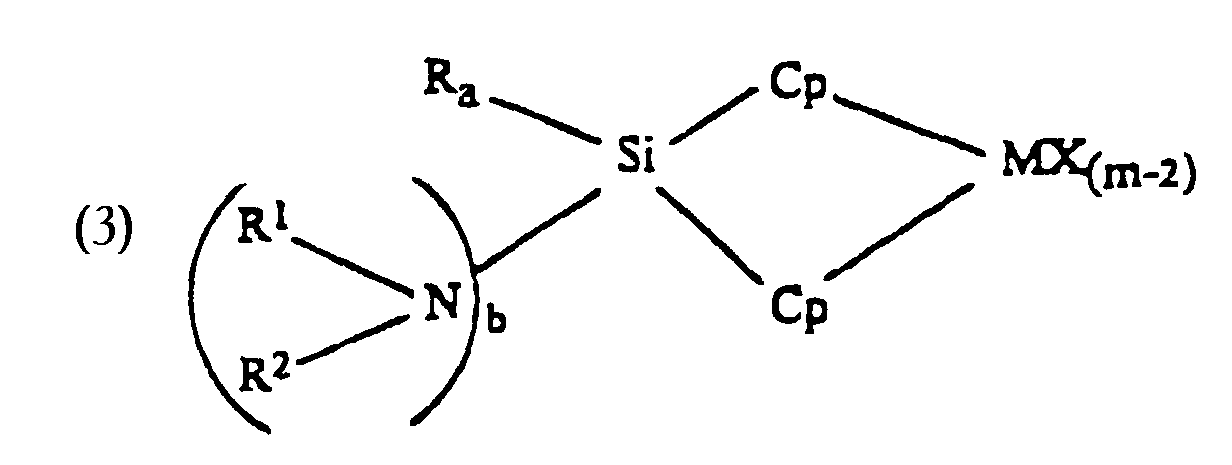
- the present invention provides novel mono- or diamido-siladiyl bridged catalyst components represented by general formulae (1) (2) and (3) above.
- the catalyst component may contain ligands which are asymmetrically or symmetrically associated with the metal center. Prefered substituted or unsubstituted ligands. L, on the catalyst component include the same or different cyclopentadienyl, indenyl, tetrahydroindenyl, fluorenyl, oxygen, nitrogen, phosphorous, and the like, or derivatives thereof.
- Prefered silicon bridging group substituents, R, R 1 , R 2 , R 3 , R 4 which are exemplified include: H, halogen, C 1-20 alkyl, (CH 3 ) 2 N,
- the individual ingredients as well as the recovered components are protected from oxygen and moisture. Therefore, the reactions must be performed in an atmosphere free of these contaminants. Preferably the reactions are performed in the presence of an inert dry gas, such as nitrogen or argon.
- the recovered catalyst component is maintained in an inert atmosphere, such as nitrogen or argon.
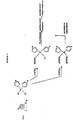
- Figure 1 illustrates a typical synthesis for the production of transition metal components.
- the route generally involves reaction of a substituted dihalosiladiyl radical with a lithiated cyclopentadienyl moeity. The reaction product therefrom is reacted with an additional lithiated alkyl compound and finally with a transition metal halide to form the transition metal catalyst component of interest.
- the silicon bridged catalyst compositions of the present invention arc generally prepared by first building the ligand structure through alkylation/silanylation steps, and then inserting the transition metal using a metal tetrahalide.
- Lithium and sodium alkyls are preferably used for alkylation steps, however other Group 1 or 2 metals may be employed.
- Figure 2 illustrates the route employed for the production of the inventive catalyst component and illustrates a synthesis where the Cp groups are the same.
- the reaction of SiCl 4 can be carried out in two steps using different lithiated Cp moieties if the desire is to form a catalyst with different Cp rings. If it is desired to form mono Cp or no Cp transition metal structures, the reader is refered to US 5,055,438.
- a method to make the inventive catalyst components described herein comprises the steps of reacting a silicon compound with an amine salt and a charged ligand, L - . More specifically, a method comprises:
- step (b) the product of step (b) is reacted with at least 2 moles of an alkyl metal to form a dianion which is then further reacted with a transition metal.
- the catalyst component may be employed without purification, purification enhances catalytic performance.
- the racemic form may be generally separated from the meso form by crystallization from a solvent such as methylene dichloride using a hydrocarbon diluent, e.g. pentane, as an antisolvent, and recovering the crystallized racemic transition metal component by filtration from the solution in which the meso form generally remains soluble.
- the bridged and chiral catalyst components described generally have utility in stereoregular polymerization of alpha olefins. Moreover, these catalyst components are broadly useful in the polymerization of monomers such as olefins, including cyclic olefins. They may be used alone, but preferably are reacted with an activating cocatalyst or compound. Depending on the ligand, L, employed in the catalyst system, the catalyst system may be useful in the preparation of high molecular weight and/or high melting point polymer. Generally the bridged catalyst system is useful in the preparation of isotactic polypropropylene. The polymer resin obtained may be subsequently employed in the production of fibers, films, sheets or in injection molding applications.
- the activating compound may include alumoxane, methylalumoxane, a boron containing activator such as tris(pentafluorophenyl)borane, or a compound comprising a non-coordinating anion such as tetra(pentafluorophenyl)boron.
- boron containing compounds as catalyst activators, see EP 277003-A, EP 520732-A, and US 5,198,401.
- non-coordinating anion(s) as activators include chemically stable, non-nucleophilic anion, sufficiently labile to permit displacement by an olefin, diolefin, and/or acetylenically unsaturated monomer during polymerization.
- the activating compound may be used in ratios of transition metal to activator or activating complex known in the art.
- alumoxane is employed as an activator
- a molar ratio of A1 in the alumoxane solution to metal in the transition metal component in the range of 100,000:0.5 to 10:1, preferably between 1000:1 to 20:1 can be employed.
- an activating system which results in a catalyst system comprising a non coordinating anion is employed, a molar ratio of activator to metal of 10:1 to 1:1, preferably 3:1 to 1:1 can be employed.
- the catalyst system which comprises the siladiyl amine composition with an activator component may optionally be placed on a support (or carrier), according to known techniques, such as those described in US 4,808,561 (Welborn), US 4,871,705 (Hoel) or US 5,240,894 (Burkhardt),
- Supports include organic or inorganic solids.
- Exemplary supports include silica, alumina and silica-alumina, or combinations thereof.
- the support may be a magnesium compound, such as MgCl 2 . Any support material is acceptable provided it does not adversely interfere with the catalyst component or catalyst system.
- the catalyst may optionally be prepolymerized by techniques known in the art with olefinic monomer containing between 2 to 20 carbon atoms.
- the catalyst system in accordance with this invention may be used to produce homo- or copolymers of polyolefins such as polyethylene, polypropylene, blends of ethylene/propylene or ethylene and higher alpha olefins (e.g., C 4 -C 20 ) or stereoregular polymers such as isotactic polypropylene.
- polyolefins such as polyethylene, polypropylene, blends of ethylene/propylene or ethylene and higher alpha olefins (e.g., C 4 -C 20 ) or stereoregular polymers such as isotactic polypropylene.
- Monomers containing between 2 to 20 carbon atoms under suitable polymerization conditions may be employed.
- the monomers may be alpha olefins, olefins, diolefins, cyclic olefins or acetylenically unsaturated monomer(s).
- Preferred olefins include ethylene, propylene, 1-butene, isobutylene, 4-methyl-1-pentene, 1-hexene, 1-octene and mixtures thereof.
- Vinylidcne monomers may also be employed, examples which include styrene, cyclohexene, cyclooctene, norbornene or ring alkyl or ring aryl derivatives.
- the polymerization is carried out in bulk, gas, slurry, solution and high pressure phase reactors.
- the polymerization process is carried out with a pressure of from 70 to 7000 kPa (10 to 1000 psi), most preferably from 275 to 4100 kPa (40 to 600 psi).
- the polymerization diluent is maintained at a temperature of from -10°C to 150°C, preferably from 20°C to 100°C, and most preferably from 30°C to 90°C.
- the catalyst system may also be employed in a high temperature/high pressure polymerization process where the presure can range from 35 MPa to 275 MPa (5,000-40,000 psi) and the temperature can range from 120 to 300°C.
- the polymerization may be carried out as a batch or continuation process.
- an additive may be employed during the polymerization to enhance catalytic performance by neutralizing impurities capable of deactivating the catalyst.
- exemplary additives which generally serve as scavengers in the polymerization process, include aluminum alkyls such as triethylaluminum or triisobutylaluminum. Methylalumoxane may also serve as an additive in the polymerization process.
- the amount of additive to employ may be easily determined by monitoring the level of monomer consumption while adding the additive compound to the polymerization diluent. Additive is added to the reactor in an amount sufficient to optimize the rate at which the monitored monomer is consumed in the polymerization reaction.
- One or more activator component(s) may be employed during polymerization. Activators are prepared and employed in accordance with techniques known in the art.
- amido siladiyl bridged catalyst composition of the present invention and use thereof are illustrated by way of the examples that follow.
- Example 1-7 The catalyst components of Examples 1-7 were reacted with MAO to form an active catalyst. Polymerization results employing these catalysts are in Table 2.
- the polymerization procedure, which employed a bulk phase reactor, at a pressure of about 30 kg/cm 2 is as follows. In a clean, dry two liter stainless steel autoclave which had been flushed with propylene vapor, MAO (1.0 ml, 10% in toluene) was added and then the reactor closed and filled with 750 ml liquid propylene.
- the reactor was heated to the desired temperature, generally about 40°C, and the catalyst, prepared by reacting the transition metal component (10mg in 1.0 ml toluene) with MAO (1.25ml, 10% MAO in toluene), was washed in via an addition tube with 250 ml propylene. After the desired reaction time, usually about 30 minutes, the reactor was cooled and the excess propylene vented. The polymer was removed and dried.
- Mw refers to weight average molecular weight
- MP refers to melting point
- the polymer obtained from Example 5 was fractionated using decalin.
- the decalin insoluble fraction was 35 wt%.
Landscapes
- Chemical & Material Sciences (AREA)
- Organic Chemistry (AREA)
- Health & Medical Sciences (AREA)
- Chemical Kinetics & Catalysis (AREA)
- Medicinal Chemistry (AREA)
- Polymers & Plastics (AREA)
- Transition And Organic Metals Composition Catalysts For Addition Polymerization (AREA)
- Catalysts (AREA)
- Low-Molecular Organic Synthesis Reactions Using Catalysts (AREA)
Abstract
Description
- This invention relates generally to bridged catalyst systems and more particularly to bridged transition metal catalyst components having mono or diamido siladiyl bridging groups. The invention also relates to methods of making and using the catalyst components.
- Polymers made employing catalyst systems having bridging atom(s) of one or more carbon, silicon, germanium, phosphorous, or nitrogen atom(s) are known (US 4,985,576, EPA 129368). Most typical are ethylene-bridged systems in which two carbon atoms link substituted or unsubstituted cyclopentadienyl or indcnyl moieties. (US 4,931,417; EPA 485,820; US 5,017,714).
- For example, Hoechst AG, of Germany, discloses carbon bridged indenyl catalyst components which are chiral and useful for the production of high molecular weight isotactic polypropylene ("IPP") (EPA 413,326; EPA 485,822; EPA 485,823; US 4,769,510 and US 5,145,819). EPA 485,821 discloses indenyl catalyst components bridged with carbon-silicon, germanium-silicon, or tin-silicon combination of atoms. These catalyst components are useful in the production of IPP having a melting point of 150°C or greater.
- EP-A-0 344 887 discloses polymerization catalysts comprising silicon bridged transition metal compounds but does not describe such compounds with amido siladiyl bridged groups.
- Catalyst components having mono or diamido siladiyl bridging cyclopentadienyl groups are not well known. Jutzi, et al., disclosed in Chemical Ber, 1988, 121, 1299 preparation of a siladiyl-amine-bridge pentamethyl cyclopentadienyl derivative. However, this derivative is not a catalyst component, nor can it be converted to a cyclopentadienyl catalyst component since no transition metal is present.
- It would be desirable to provide a novel catalyst component which can be useful for the polymerization of olefins or alpha-olefins wherein the catalyst component compnses mono- or diamido-siladiyl bridging atoms.
- Accordingly, the present invention provides transition metal catalyst component comprising mono-or diamido-siladiyl bridged compositions useful as catalyst components for the polymerization of monomers, especially olefinic monomers. This invention provides a method for preparing such catalyst compositions. The inventive catalyst component is useful for the production of homo- or copolymers having varying molecular weights and melting points. The catalyst components yidd polymers of relatively narrow molecular weight distribution. The catalyst component comprises a bridging group having at least one nitrogen bonded to a silicon atom, which silicon atom is bonded to at least one ligand coordinated with a transition metal.
- The invention concerns generally metallocenes containing silyl bridged structures, preferably with single silicon atom bridges, and at least one amine functionality attached thereto. The invention more particularly concerns metallocenes with silyl bridges substituted with one or two nitrogen atom(s). The bridge may extend from one cyclopentadienyl moiety to another, or to another ligand connected to the transition metal, such as a heteroatom. The cyclopentadienyl moiety may be mono- or polynuclear structures and may be derivatives of cyclopentadienyl, such as indenyl or benzindenyl structures.
- The catalyst composition is preferably represented by the general formulawherein L is an anionic ligand and can be the same or different

- (i) Cp;
- (ii) O; or
- (iii) NR3; wherein:
- M is a Group 3-6 transition metal, preferably Group 4;
- X is same or different hydrogen, halogen, hydrocarbyl, substituted hydrocarbyl, halocarbyl, substituted halocarbyl, C1-20 alkyl, C2-20 alkenyl, preferably C2-10 alkenyl, C6-20 aryl, preferably C6-10 aryl, C7-40 alkylaryl, preferably C7-20 alkylaryl, C7-40 arylalkyl, preferably C7-20 arylalkyl, C8-40 arylalkenyl, preferably C8-20 arylalkenyl, alkoxy, aryloxy, siloxy, amide radicals or combinations thereof;
- Cp is the same or different cyclopentadienyl ring substituted with from zero to four substitutent groups, each group being, independently, the same or different hydrocarbyl, substituted hydrocarbyl, silahydrocarbyl, halocarbyl, substituted halocarbyl, or taken together, two or more adjacent substitutents form a ring structure preferably having between 2 and 10 carbons;
- m is equal to or greater than 2 and is the oxidation state of the transition metal;
- R, R1, R2, R3 are the same or different hydrogen halogen C1-20 alkyl, C2-20 alkenyl, preferably C2-10 alkenyl, C6-20 aryl, preferably C6-10 aryl, C7-40 alkylaryl, preferably C7-20 alkylaryl, C7-40 arylalkyl, preferably C7-20 arylalkyl, C8-40 arylalkenyl, preferably C8-20 arylalkenyl, alkoxy, ketones, SiR, SiOR, NR, SR, AIR or PR;
- Si is silicon;
- N is nitrogen;
- a=b=1, or a=0 and b=2;
-
- The catalyst composition is converted to a catalyst system by reaction with a catalyst activating compound, such as alumoxane (AO), or methylalumoxane (MAO). Alternatively, the catalyst composition is converted to a catalyst system by combining with a single or mixed compound that will form a charge balanced catalytic species. Examples of these compounds are tris(pentafluorophenyl)borane, or an ionic complex comprising a non-coordinating anion.
- The catalyst composition or catalyst system may be placed on a support, and optionally prepolymerized before use.
- The catalyst system, supported or in homogeneous form, may be used in the polymerization of monomers such as alpha olefins, olefins, diolefins, cyclic olefins or acetylenically unsaturated monomer(s) for the production of polymers. Polymerization may occur via known techniques such as gas phase, bulk, solution, slurry or high pressure polymerization.
- The present invention provides novel mono- or diamido-siladiyl bridged catalyst components represented by general formulae (1) (2) and (3) above.
- Any reference to Group or Groups shall refer to Groups as listed in the Periodic Table of Elements as described in the New IUPAC notation in Hawley's Condensed Chemical Dictionary, Eleventh Edition. revised by Sax and Lewis. Van Nostrand Reinhold, New York, 1987.
- The catalyst component may contain ligands which are asymmetrically or symmetrically associated with the metal center. Prefered substituted or unsubstituted ligands. L, on the catalyst component include the same or different cyclopentadienyl, indenyl, tetrahydroindenyl, fluorenyl, oxygen, nitrogen, phosphorous, and the like, or derivatives thereof.
- Prefered silicon bridging group substituents, R, R1, R2, R3, R4 which are exemplified include:
H, halogen, C1-20 alkyl, (CH3)2N,
- Prefered catalyst components found to be useful for the production of stereoregular alpha-olefin polymers include

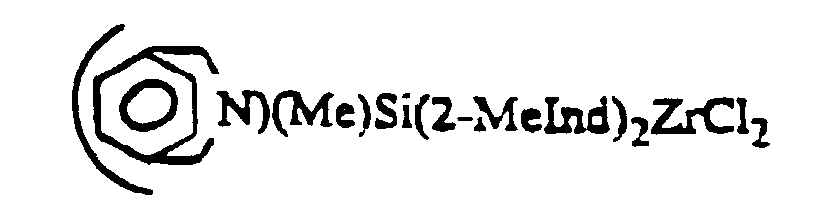
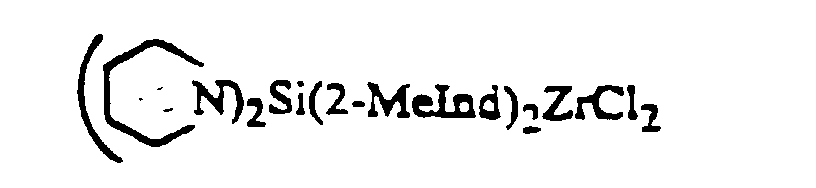
wherein Me=methyl, Ind=indenyl, Bu=butyl. - At all times, the individual ingredients as well as the recovered components are protected from oxygen and moisture. Therefore, the reactions must be performed in an atmosphere free of these contaminants. Preferably the reactions are performed in the presence of an inert dry gas, such as nitrogen or argon. The recovered catalyst component is maintained in an inert atmosphere, such as nitrogen or argon.
- Figure 1 illustrates a typical synthesis for the production of transition metal components. The route generally involves reaction of a substituted dihalosiladiyl radical with a lithiated cyclopentadienyl moeity. The reaction product therefrom is reacted with an additional lithiated alkyl compound and finally with a transition metal halide to form the transition metal catalyst component of interest.
- The silicon bridged catalyst compositions of the present invention arc generally prepared by first building the ligand structure through alkylation/silanylation steps, and then inserting the transition metal using a metal tetrahalide. Lithium and sodium alkyls are preferably used for alkylation steps, however
other Group 1 or 2 metals may be employed. - Figure 2 illustrates the route employed for the production of the inventive catalyst component and illustrates a synthesis where the Cp groups are the same. Alternatively, the reaction of SiCl4 can be carried out in two steps using different lithiated Cp moieties if the desire is to form a catalyst with different Cp rings. If it is desired to form mono Cp or no Cp transition metal structures, the reader is refered to US 5,055,438.
- A method to make the inventive catalyst components described herein comprises the steps of reacting a silicon compound with an amine salt and a charged ligand, L-. More specifically, a method comprises:
- a) forming a reaction product of at least one mole of a lithitated salt of ligand L (or a lithiated Cp radical) with a silicon tetrahalide; and
- b) reacting the product of (a) with at least one mole of a lithium salt of an amine and optionally further reacting With additional amine salt to form the neutral ligand.
-
- To form the desired transition metal component, the product of step (b) is reacted with at least 2 moles of an alkyl metal to form a dianion which is then further reacted with a transition metal.
- Although the catalyst component may be employed without purification, purification enhances catalytic performance. For example, in chiral catalyst components, the racemic form may be generally separated from the meso form by crystallization from a solvent such as methylene dichloride using a hydrocarbon diluent, e.g. pentane, as an antisolvent, and recovering the crystallized racemic transition metal component by filtration from the solution in which the meso form generally remains soluble.
- The bridged and chiral catalyst components described generally have utility in stereoregular polymerization of alpha olefins. Moreover, these catalyst components are broadly useful in the polymerization of monomers such as olefins, including cyclic olefins. They may be used alone, but preferably are reacted with an activating cocatalyst or compound. Depending on the ligand, L, employed in the catalyst system, the catalyst system may be useful in the preparation of high molecular weight and/or high melting point polymer. Generally the bridged catalyst system is useful in the preparation of isotactic polypropropylene. The polymer resin obtained may be subsequently employed in the production of fibers, films, sheets or in injection molding applications.
- The activating compound may include alumoxane, methylalumoxane, a boron containing activator such as tris(pentafluorophenyl)borane, or a compound comprising a non-coordinating anion such as tetra(pentafluorophenyl)boron. For use of boron containing compounds as catalyst activators, see EP 277003-A, EP 520732-A, and US 5,198,401. Generally, non-coordinating anion(s) as activators include chemically stable, non-nucleophilic anion, sufficiently labile to permit displacement by an olefin, diolefin, and/or acetylenically unsaturated monomer during polymerization.
- The activating compound may be used in ratios of transition metal to activator or activating complex known in the art. For example, if alumoxane is employed as an activator, a molar ratio of A1 in the alumoxane solution to metal in the transition metal component in the range of 100,000:0.5 to 10:1, preferably between 1000:1 to 20:1 can be employed. If an activating system which results in a catalyst system comprising a non coordinating anion is employed, a molar ratio of activator to metal of 10:1 to 1:1, preferably 3:1 to 1:1 can be employed.
- The catalyst system which comprises the siladiyl amine composition with an activator component may optionally be placed on a support (or carrier), according to known techniques, such as those described in US 4,808,561 (Welborn), US 4,871,705 (Hoel) or US 5,240,894 (Burkhardt), Supports include organic or inorganic solids. Exemplary supports include silica, alumina and silica-alumina, or combinations thereof. Alternatively, the support may be a magnesium compound, such as MgCl2. Any support material is acceptable provided it does not adversely interfere with the catalyst component or catalyst system.
- The catalyst may optionally be prepolymerized by techniques known in the art with olefinic monomer containing between 2 to 20 carbon atoms.
- The catalyst system in accordance with this invention may be used to produce homo- or copolymers of polyolefins such as polyethylene, polypropylene, blends of ethylene/propylene or ethylene and higher alpha olefins (e.g., C4-C20) or stereoregular polymers such as isotactic polypropylene. Monomers containing between 2 to 20 carbon atoms under suitable polymerization conditions may be employed. The monomers may be alpha olefins, olefins, diolefins, cyclic olefins or acetylenically unsaturated monomer(s). Preferred olefins include ethylene, propylene, 1-butene, isobutylene, 4-methyl-1-pentene, 1-hexene, 1-octene and mixtures thereof. Vinylidcne monomers may also be employed, examples which include styrene, cyclohexene, cyclooctene, norbornene or ring alkyl or ring aryl derivatives. Generally the polymerization is carried out in bulk, gas, slurry, solution and high pressure phase reactors. Generally, the polymerization process is carried out with a pressure of from 70 to 7000 kPa (10 to 1000 psi), most preferably from 275 to 4100 kPa (40 to 600 psi). The polymerization diluent is maintained at a temperature of from -10°C to 150°C, preferably from 20°C to 100°C, and most preferably from 30°C to 90°C. The catalyst system may also be employed in a high temperature/high pressure polymerization process where the presure can range from 35 MPa to 275 MPa (5,000-40,000 psi) and the temperature can range from 120 to 300°C. The polymerization may be carried out as a batch or continuation process.
- If desired, an additive may be employed during the polymerization to enhance catalytic performance by neutralizing impurities capable of deactivating the catalyst. Exemplary additives, which generally serve as scavengers in the polymerization process, include aluminum alkyls such as triethylaluminum or triisobutylaluminum. Methylalumoxane may also serve as an additive in the polymerization process.
- The amount of additive to employ may be easily determined by monitoring the level of monomer consumption while adding the additive compound to the polymerization diluent. Additive is added to the reactor in an amount sufficient to optimize the rate at which the monitored monomer is consumed in the polymerization reaction.
- One or more activator component(s) may be employed during polymerization. Activators are prepared and employed in accordance with techniques known in the art.
- The preparation of the amido siladiyl bridged catalyst composition of the present invention and use thereof are illustrated by way of the examples that follow.
- All experiments were carried out in nitrogen purged dry boxes. Solvents were purchased from commercial sources, nitrogen purged and dried over activated molecular sieves. ZrCl4 was purchased from commercial sources and used as received. MAO was purchased as 10 or 30 wt % (in toluene). All transition metal components were characterized by proton and/or carbon NMR.
- The catalyst components of Examples 1-7 were reacted with MAO to form an active catalyst. Polymerization results employing these catalysts are in Table 2. The polymerization procedure, which employed a bulk phase reactor, at a pressure of about 30 kg/cm2 is as follows. In a clean, dry two liter stainless steel autoclave which had been flushed with propylene vapor, MAO (1.0 ml, 10% in toluene) was added and then the reactor closed and filled with 750 ml liquid propylene. The reactor was heated to the desired temperature, generally about 40°C, and the catalyst, prepared by reacting the transition metal component (10mg in 1.0 ml toluene) with MAO (1.25ml, 10% MAO in toluene), was washed in via an addition tube with 250 ml propylene. After the desired reaction time, usually about 30 minutes, the reactor was cooled and the excess propylene vented. The polymer was removed and dried.
- Polymer analysis was carried out as described in US 5,026,798 and US 5,017,714. Tacticity measurements were determined by 13C NMR as described in "Polymer Sequence Distributions", J. C. Randall, Academic Press, New York, (1986). DSC melting points were determined on commercial DSC instruments and are reported as the second melting point.
- Mw refers to weight average molecular weight, MP refers to melting point.
-
- Part 1, t-BuCpLi MeLi (0.183 mol in ether) was added dropwise over 30 min to 6,6-dimethylfulvene (19.466 g, 0.183 mol) dissolved in ether (500 ml, dried over Na and freshly distilled) and cooled to 0°C. After stirring at room temperature for 3 days, the solvent was removed under vacuum. The residual solid was washed twice with n-pentane (200 ml) and dried under vacuum. (t-butylC5H4)Li (20g, 90%) was obtained as a white powder.
-
Part 2, Cl2Si(3-t-BuCp)2 To SiCl4 (1.989 g, 0.0117 mol) dissolved in THF (200 ml), t-BuCpLi (3g, 0.0234 mol) slurried in THF (50 ml) was added dropwise. After stirring at room temperature for 1.5 hrs, the solvent was removed under vacuum, and the residue extracted with n-pentane (200 ml). Cl2Si(3-t-BuCp)2 (4.0g, 100%) was obtained as a yellowish liquid after evaporation of the n-pentane. - Part 3, (C8H14N)Li To azabicyclo[3,2,2]nonane (5.0g) dissolved in ether (200 ml), a solution of MeLi (0.04 mol) was added dropwise with stirring at room temperature. After stirring overnight, the solvent was removed under vacuum. The residual solid was washed twice with n-pentane (200 ml) and dried under vacuum. C8H14NLi (3.8g,73%) was obtained as a white powder.
- Part 4, (C8H14N)(Cl)Si(3-t-BuCp)2 To Cl2Si(t-BuCp)2 (2g) dissolved in ether (200 ml) C8H14NLi (0.769g) dissolved ether (100 ml) was added dropwise. After stirring overnight at room temperature the solvent was removed under vacuum. and the residue extracted with n-pentane (200 ml). (C8H14N)(Cl)Si(3-t-BuCp)2 (2.35 g, 93%) was obtained as a yellow, clear oil.
- Part 5, (C8H14N)(Me)Si(3 t-BuCp)2ZrCl2 To (C8H14N)(Cl)Si(3-t-BuCp)2 (2.35g, 5.46 x 10⁻³ mol) dissolved in ether (200 ml) an ether solution of MeLi (0.0164 mol) was added dropwise. After stirring overnight at room temperature, the solution was cooled to 0°C and ZrCl4 (1.273g) was added. After stirring overnight, evaporation of ether, extraction with n-pentane, and recrystallization at -20°C, (C8H14N)(Me)Si(3-t-BuCp)2ZrCl2, was obtained (0.1 g).
-
- Polymerization experiments obtained isotactic polypropylene having a MP = 142.5 °C and a weight average molecular weight of 4800.
-
- Part 1, Indenyl Lithium ("INDLi") To Indene (14.52g) dissolved in ether (250 ml), n-Buthyl Lithium (50 ml, 2.5 mol/l in hexane solution) was added dropwise. By repeating the purification procedure of t-BuCpLi in Example 1, Part 1, indenyl lithium (13.5 g, INDLi) was recovered.
-
Part 2, Cl2Si(C9H7)2 To SiCl4 (5.56 g) dissolved in ether (200ml), INDLi (8 g) in ether was added dropwise and stirred overnight. By repeating the purification procedure in Example 1,Part 2, Cl2Si(C9H7)2 (10.3 g,96%) was obtained as a yellowish oily solid. - Part 3, (C8H14N)(Cl)Si(C9H7)2 To Cl2Si(C9H7)2 (5.9 g) dissolved in ether (200 ml) an ether solution of C8H14NLi (2.35 g) was added. After stirring overnight at room temperature, the same purification procedure in Example 1, Part 4, was used. (C8H14N)(Cl)Si(C9H7)2 (7 g, 93%) was obtained as a yellowish white waxy solid.
- Part 4, (C8H14N)(Me)Si(C9H7Li)2 To (C8H14N)(Cl)Si(C9H7)2 (3 g) dissolved in ether (200 ml), MeLi (0.0216 mol) was added dropwise and stirred overnight. The purification procedure for t-BuCpLi in Example 1, Part 1, was used to give (C8H14N)(Me)Si(C9H6Li)2 (3.17 g,100%) as a pale pink powder.
- Part 5, (C8H14N)(Me)Si(C9H6)2ZrCl2 To (C8H14N)(Me)Si(C9H6Li)2 (3.17 g) dissolved in ether (200 ml) and cooled to 0°C, ZrCl4 (1.807 g) was added and stirred at room temperature overnight. After evaporation of the ether, the residual solid was extracted with CH2Cl2 (200 ml). Evaporation and twice washing with n-pentane (100 ml) gave (C8H14N)(Me)Si(C9H6)2ZrCl2 (2.4 g, 56%) as an orange/brown solid.
-
- Polymerization experiments obtained isotactic polypropylene having a MP = 138 and a Mw = 50,000.
-
- Part 1: (MeCpLi) To freshly distilled methyl cyclopentadiene monomer (30 g) dissolved in ether (600 ml), n-buthyl lithium (150 ml, 2.5 M in hexanes) was added dropwise over one hour. After stirring 3 days, the solids were collected by filtration, washed twice with pentane (200 ml), and dried to give MeCpLi (29.5 g, 92%) as a white powder.
- Part 2: (Cl2Si(MeCp)2) To a solution of SiCl4 (2.965 g) in THF (200 ml) MeCpLi (3 g) in THF was added dropwise over 30 minutes. After stirring for 90 minutes, the THF was evaporated under vacuum. The residue was extracted with n-pentane (200 ml). From the n-pentane solution Cl2Si(3-MeCp)2 (4.06 g, 90%) was recovered.
- Part 3: (Me2N)2Si(3-MeCp)2 To Cl2Si(MeCp)2 (2 g) dissolved in ether (200 ml),
Me2NLi (0.794 g suspended in 50 ml of ether) was slowly added. After stirring
overnight, the same purification procedure in Example 1,
Part 2, was used to give (Me2N)2Si(3-MeCp)2 (2.0 g,94%) as a yellow, oily liquid. - Part 4: (Me2N)2Si(3-MeCpLi)2 To (Me2N)2Si(3-MeCp)2 (2.0 g) dissolved in ether (200 ml), MeLi (0.0146 mol) in ether was added dropwise. After stirring overnight, the solvent was evaporated. The residual solid was washed twice with n-pentane (100 ml) and dried under vacuum to give ((Me2N)2Si(3-MeCpLi)2 (2.1 g) as a white powder.
- Part 5: (Me2N)2Si(3-MeCp)2ZrCl2 To (Me2N)2Si(3-MeCpLi)2 (2.1 g) dissolved in ether (200 ml) and cooled to 0°C, ZrCl4 (1.705 g) was added, and the reaction mixture stirred for 3 days at ambient temperature. After evaporation of the solvent, the residue was extracted with pentane to give (Me2N)2Si(MeCp)2ZrCl2 (0.96g).
-
- Polymerization experiment obtained polyproylene with a Mw = 6000. The material was too amorphous to obtain a meaningful MP.
-
- Part 1: 2-methylindene To an ether solution of MeMgBr (260 ml, 3M) diluted with ether (300ml) and cooled to 0°C, 2-methylindanone (99.16 g) was added dropwise as an ether solution over 2.5 hours. After stirring 2.0 hours, the reaction mixture was hydrolyzed with aqueous HCl. The water phase was separated and extracted twice with ether (300 ml). The combined organic phases were dried over sodium sulfate. Evaporation of the solvent gave a crude brown product (107 g) which was distilled under reduced pressure to give 2-methyl-2-indanol (66.2 g) as a white crystalline solid. 2-Methyl-2-indanol (66.2 g) was dissolved in toluene (500 ml) in a 1 liter flask equipped with a Dean-Stark trap. To this solution p-toluene sulfonic acid (2 g) and a small amount of hydroquinone were added, and the mixture was refluxed for 2.5 hours. After 8 ml of H2O was generated, the reaction mixture was cooled to 0°C and H2O (1 liter), also cooled to 0°C, was added. The organic phase was separated and washed three times with water (500 ml). The toluene was evaporated and the residue (with trace of hydroquinone added) was distilled at reduced pressure to give 2-methylindene (47.2 g, 48%) as clear slightly green liquid.
- Part 2: 2-methylindenyl lithium 2-methylindene (47.2 g) was dissolved in ether (400 ml) and n-butyl lithium (145.2 ml, 2.5 M in Hexane) was added dropwise over 3 hours. The mixture was stirred for 2.5 hours. After evaporation of the solvent, the residual solid was washed twice with n-pentane (400 ml). Drying under vacuum gave 2-methylindenyl lithium (42 g, 85%) as a pale brown powder.
- Part 3: Cl2Si(2-Me-IND)2 The procedure of Example 1,
Part 2, was followed except using SiCl4 (2.5 g) and 2-MeINDLi (4 g). Cl2Si(2-MeIND)2 (4.79 g, 91%)) was obtained as a yellowish, slightly waxy solid. - Part 4: (C8H14N)(Me)Si(2-Me-INDLi)2 The preparation procedures Example 2, Part 3, and Part 4 was repeated except using Cl2Si(2-Me-IND)2 (4.79 g) in place of Cl2Si(IND)2. (C8H14N)(Me)Si(2-Me-INDLi)2 (5,55 g) was recovered as a pale yellow powder.
- Part 5: (C8H14N)(Me)Si(2-Me-IND)2 ZrCl2 ZrCl4 (2.635 g) was suspended in CH2Cl2 (300 ml) and cooled to -78°C. To this suspension, (C8H14N)(Me)Si(2-MeIND)2 (5.55 g) was added and stirred at -78°C for 8 hours. After raising to -30°C, the mixture was allowed to warm to room temperature overnight. The mixture was dried, and the residue extracted with CH2Cl2 for six days to give [(C8H14N)(Me)Si(2-Me-IND)2 ZrCl2] as an orange powder (3.7 g).
-
- Polymerization experiment obtained isotactic polypropylene having MP = 149°C and a Mw = 300,000.
-
- Part 1: (Cl2Si(2-Me-IND)2 The procedure in Example 4, Part 3, was repeated except using SiCl4 (5 g) and 2-MeINDLi (8 g) to gave Cl2Si(2-methylIND)2 (9.36g, 89%).
- Part 2: (Me2N)2 Si(2-Me-IND)2 Following the procedure in Example 3, Part 3, except using Cl2Si(2-Me-IND)2 (4.73 g) and Me2NLi (1.42g), gave (Me2N)2Si(2-MeIND)2 (4g) as a yellow oil.
- Part 3: Me2N)2Si(2-Me-INDLi)2 Following the procedure of Example 3, Part 4, except using (Me2N)2Si(2-MeIND)2 (4g), and MeLi (0.0216 mol) gave (Me2N)2 Si(2-Me-INDLi)2 (4g, 97%) as a white powder.
- Part 4: (Me2N)2Si(2-Me-IND)2ZrCl2 Following the procedure of Example 4, Part 5 was repeated except using (Me2N)Si(2-Me-INDLi) (4g) and ZrCl4 (2.425g). The CH2Cl2 solution was filtered and evaporated. The residue was washed with n-pentane (100ml) and dried to gave a yellow powder (4.6g, 83%).
-
- The polymer (9.17g) obtained from the polymerization run of Example 5 and 300ml of n-heptane were introduced to a 500ml round bottom flask connected with a reflux condenser. After 2 hours of reflux, the solution was decanted while hot. 300ml of fresh n-heptane were introduced to the residual polymer and the 2 hour reflux repeated. After filtration and drying, 2.7g of n-heptane insoluble polymer was recovered. From the n-hcptane solution, a total of 6.2g of gummy polymer was recovered (Tm= 147,5°C, Mw = 480,000, Mw/Mn = 2.6).
- The polymer obtained from Example 5 was fractionated using decalin. The decalin insoluble fraction was 35 wt%. 13C-NMR measurements were carried out for the whole polymer (before decalin fractionation), decalin insoluble fraction and decalin soluble fraction. The results are shown in Table 1 which indicate the insoluble polymer is highly isotactic and having a MP = 152°C and a Mw = 500,000.
-
- Part 1: (C4H8NLi) The procedure of Example 1, Part 3, was repeated except using pyrrolidine (5g) to give C4H8NLi (5.1g) as a white powder.
- Part 2: (C4H8N)2Si(2-ME-IND)2 The procedure of Example 5,
Part 2, was repeated except with Cl2Si(2-Me-IND)2 (4.6g) and C8H14NLi (1.99g) to give (C4H8N)2Si(2-MeIND)2 (5.72g) as an oil. - Part 3: (C4H8N)2 Si(2-Me-INDLi)2 The procedure of Example 3, Part 4, as repeated except with (C4H8N)2Si(2-Me-IND)2 (5.72g) and MeLi (0.0258 mol) to give (C4H8N)2Si(2-Me-INDLi)2 (5.42g, 96%) as pale yellow powder.
- Part 4: (C4H8N)2Si(2-Me-IND)2ZrCl2 The procedure in Example 5, Part 4, was repeated except using ZrCl4 (2.9 g) to give (C4H8N)2Si(2-Me-IND)2ZrCl2 as a yellow-orange powder (5.6g).
-
- 1 gram of (C4H8N)2Si(2-Me-IND)2ZrCl2 having 68% rac content was dissolved in 30 mls of methylene chloride solvent. 10 mls of n-pentane was added to the solution and stirred for 15 minutes. The solvent was stripped off via vacuum until crystals begun to appear at which point the mixture was placed in freezer and chilled at -30°C for about 1 hr. The crystals were isolated in a frit, washed with cold pentane and collected. The procedure was repeated utilizing the collected filtrate until no further crystals appeared (0.7g, 92% rac content).
- Polymerization experiment obtained isotactic polypropylene having MP = 149°C and Mw = 600,000.
-
- A. Catalyst Prcparation: The catalyst component of Example 6 (4.8 mg., 8.19 x 10⁻³ mmoles) was pre-activated just prior to the polymerization run with 2.0 mls of a 1M MAO/toluene solution. An additional 10.2 mls of the MAO solution was prepared separately.
- B. Polymerization Procedure: Toluene, 400 ml., distilled from benzophenone/sodium then passed through an alumina column while under a nitrogen atmosphere, was added to a 1-liter zipperclave reactor at room temperature. The reactor was then cooled to 0°C, using an IPA bath chiller. A 1M MAO solution (10.2 ml.) was then cannulated into the reactor and allowed to stir for approximately 30 seconds. The pre-activated catalyst solution then followed in the same manner. While stirring this solution a 60/40 EP monomer mixture (11.08 g.) was allowed to flow into the reactor at a rate of approximately 6.8 kPa/sec (about 1 psi/second). The EP mixture was premixed in a 1 liter stainless steel vessel. Samples were taken at various intervals via a sampling tube connected to the reactor vessel. The reaction was allowed to proceed for 45 minutes at which a conversion of 38.3% was yielded. There was no exotherm during the polymerization. The recovered EP polymer was precipitated in acetone and was completely amorphous.
-
-
- Part 1: Cl2Si(2-Me-IND)2 The procedure in Example 5, Part 1 was repeated to give Cl2Si(2-Me-IND)2 (10.3 g, 98%).
- Part 2: (c-C6H11)2N](Cl)Si(2-Me-IND)2 The procedure of (C4H8N)2Si(2-ME-IND)2 in Example 6 was repeated employing 5.14 g of Cl2Si(2-Me-Ind)2 and 2.70g of (C6H11)2NLi, A brown product was obtained. (7.92 g, 110%).
- Part 3: The above procedure was repeated using (C6H11)2NLi (1.348 g) to give [c-C6H11)2N](Cl)Si(2-Mc-IND)2 and CH2Cl2 as extraction solvent to give brown oil (4.66 g). (Yield = 100%)
- Part 4: [(C6H11)2N]2Si(2-Me-IND)2)Li2 The procedure Example 6, Part 4, was repeated except using (C6H11N)2 Si(2-MeIND)2 (4.66g) and MeLi (0.0145 mol) to give a light brown powder (2.6g, 55%)
- Part 5: [(C6H11)2N]2Si(2-Me-IND)2ZrCl2 The procedure in Example 5, Part 4, was repeated except using [(C6H11)2N]2Si(2-Me-IND)2 Li (2.6 g) and ZrCl4 (1.7g) to give [(C6H11)2N]2Si(2-MeIND)2ZrCl2 as a brown powder (2.6 g).
-
- Polymerization experiment obtained isotactic polypropylene having MP = 147°C and Mw = 300,000.
Tacticity Measurements for decaline fractionated Polymer of Example 5 Label Col. Whole Polymer Insoluble (IPP region) Soluble (atacfic region) [mm] 0.498 0.947 0.243 [mr] 0.364 0.034 0.496 [rr] 0.138 0.019 0.260 Results of Polymerization Runs with Catalyt Component of Ex. 1-7 DSC MP (°C) Mw (x 103) EXAMPLE 1 142.5 48 EXAMPLE 2 138.3 50 EXAMPLE 3 - 6 EXAMPLE 4 149.2 300 EXAMPLE 5 152.6 500 EXAMPLE 6 149.5 600 EXAMPLE 7 147.5 300 Conditions: 750 ml liq. C3=, 40°C, 1.0 ml 10% MAO as scavenger, 10 mg transition metal catalyst component mixed with 1.25 ml 10% MAO

Claims (18)
- A polymerization catalyst system comprising a transition metal catalyst component represented by the formulae:or
 wherein L is an anionic ligand and can be the same or different
 wherein:(i) Cp;(ii) O; or(iii) NR3;and a catalyst activating compound.M is a Group 3-6 transition metal;X is same or different hydrogen, halogen, hydrocarbyl, substituted hydrocarbyl, halocarbyl, substituted halocarbyl, C1-20 alkyl, C2-20 alkenyl, C6-20 aryl, C7-40 alkylaryl, C7-40 arylalkyl, C8-40 arylalkenyl, alkoxy, aryloxy, siloxy, amide radicals or combinations thereof;Cp is the same or different cyclopentadienyl ring substituted with from zero to four substitutent groups, each group being, independently, the same or different hydrocarbyl, substituted hydrocarbyl, silahydrocarbyl, halocarbyl, substituted halocarbyl, or taken together, two or more adjacent substituents form a ring structure;m is equal to or greater than 2 and is the oxidation state of the transition metal:R, R1, R2, R3, R4 are the same or different hydrogen, halogen, C1-20 alkyl, C2-20 alkenyl, C6-20 aryl, C7-40 alkylaryl, C7-40 arylalkyl, C8-40 arylalkenyl, alkoxy, ketones, SiR, SiOR , NR, SR, AlR, or PR;Si is silicon;N is nitrogen;a=b=1, or a=0 when b=2:
 - The catalyst system of claim 1 wherein the transition metal catalyst component is represented by the formula

- The catalyst system of any preceding claim wherein M is Group 4 transition metal.
- The catalyst system of any preceding claim wherein R1, R2, R3, and R4 are each independently selected from the group consisting of C1-20 alkyl, H, and halogen,

- The catalyst sytem of any preceding claim wherein the transition metal catalyst component is selected from
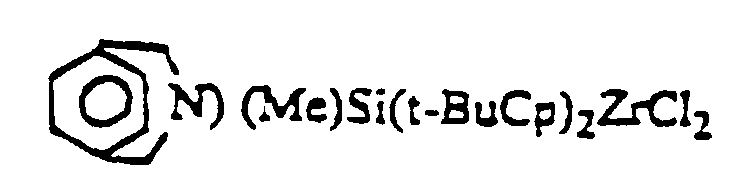


wherein Me=methyl, Ind=indenyl, and Bu=butyl. - The catalyst system of any preceding claim wherein the catalyst activating compound is alumoxane, methylalumoxane, a single or mixed compound that will form a charge balanced catalytic species, a compound comprising a non coordinating anion, tetra(pentafluorophenyl)boron, or tris(pentafluorophenyl)borane.
- The catalyst system of any preceding claim placed on a support.
- The catalyst system of claim 7 wherein the support is silica, alumina, a magnesium compound, or combinations thereof.
- The composition of claim 7 or 8 prepolymerized with olefinic monomer having from 2 to 20 carbon atoms.
- A transition metal catalyst component having the general formulaeor
 wherein L is an anionic ligand and can be the same or different
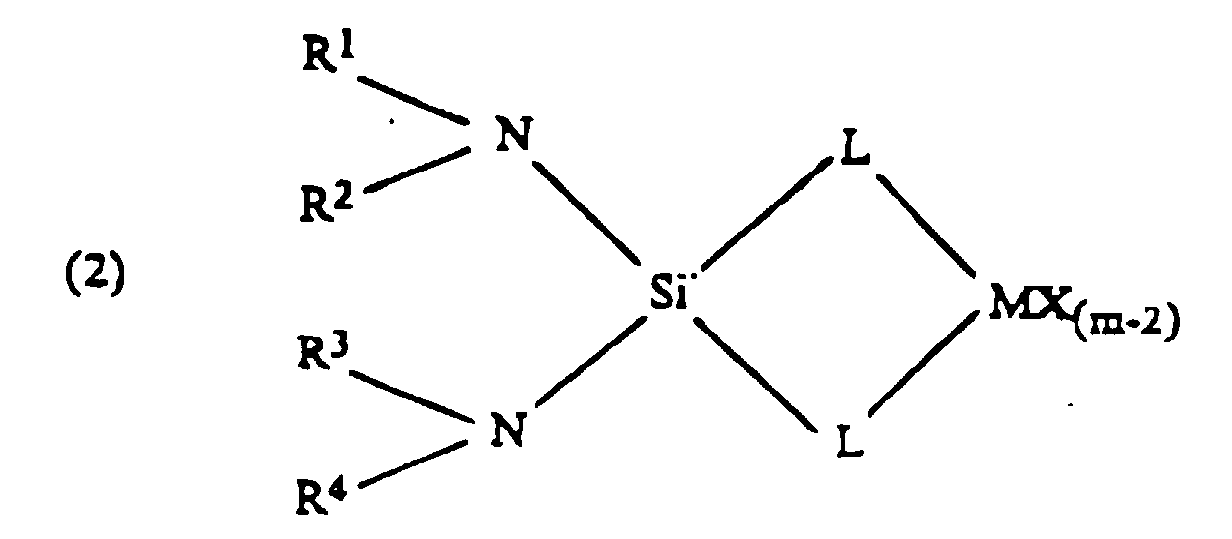 wherein:(i) Cp;(ii) O; or(iii) NR3;M is a Group 3-6 transition metal, preferably Group 4;X is same or different hydrogen halogen, hydrocarbyl, substituted hydrocarbyl, halocarbyl, substituted halocarbyl, C1-20 alkyl, C2-20 alkenyl, C6-20 aryl, C7-40 alkylaryl, C7-40 arylalkyl, C8-40 arylalkenyl, alkoxy, aryloxy, siloxy, amide radicals or combinations thereof;Cp is the same or different cyclopentadienyl ring substituted with from zero to four substitutent groups, each group being, independently, the same or different hydrocarbyl, substituted hydrocarbyl, silahydrocarbyl, halocarbyl, substituted halocarbyl, or taken together, two or more adjacent substituents form a ring structure;m is equal to or greater than 2 and is the oxidation state of the transition metal;R, R1, R2, R3, R4 are the same or different hydrogen, halogen, C1-20 alkyl, C2-20 alkenyl, C6-20 aryl, C7-40 alkylaryl, C7-40 arylalkyl, C8-40 arylalkenyl, alkoxy, ketones, SiR, SiOR, NR, SR, AlR, or PR;Si is silicon;N is nitrogen;a=b=1, or a=0 when b=2.
 - The transition metal catalyst component of claim 10 having the formulaeor

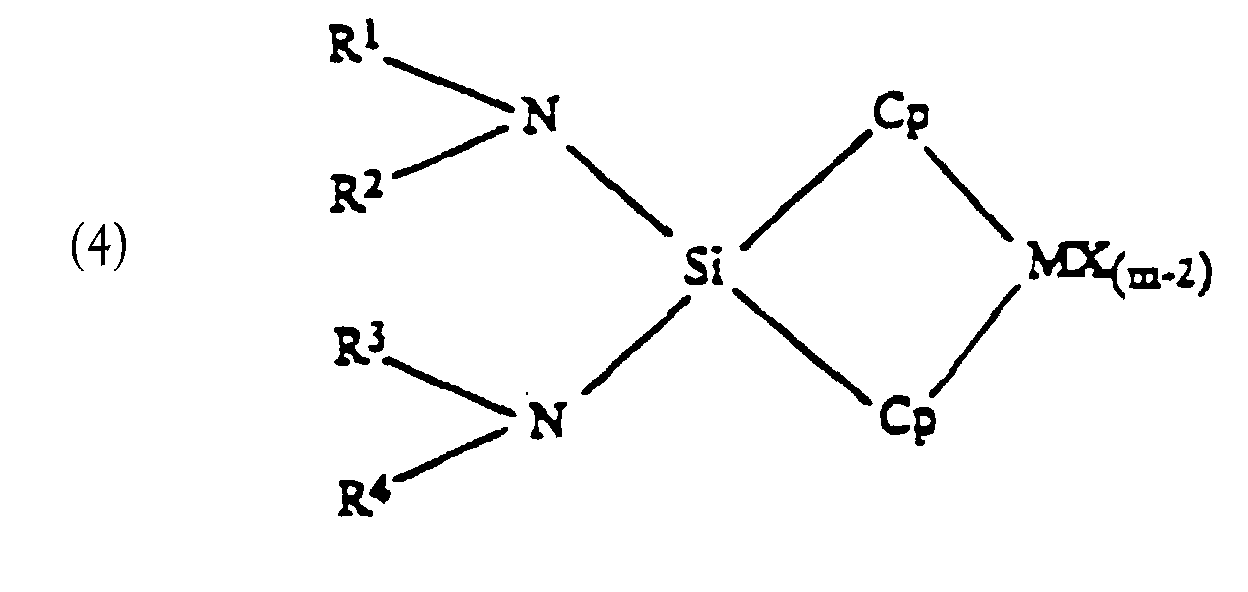
- A method for preparing a polymerization catalyst system comprising reacting at least one transition metal component in accordance with claim 10 or 11 with a catalyst activating compound.
- A method for preparing the catalyst component of any of the preceding claims comprising reacting a silicon compound. an amine salt. and a charged ligand, L.
- A process for polymerizing one or more monomers having between 2 to 20 carbon atoms comprising contacting the monomer(s) under suitable polymerization conditions with the any of the catalyst systems of claim 1 - 9, or 12.
- The process of claim 14 wherein the monomers are alpha olefins, olefins, diolefins, cyclic olefins or acetylenically unsaturated monomer(s).
- The process of claims 14 or 15 wherein an additive is employed during polymerization.
- The process according to any of claims 14, 15, or 16 wherein polymerization conditions are selected from bulk, gas, slurry, solution and high pressure phase polymerization.
- Use of the catalyst component of claim 1 under suitable polymerization conditions to polymerize one or more monomers having between 2 and 20 carbon atoms.
Applications Claiming Priority (3)
| Application Number | Priority Date | Filing Date | Title |
|---|---|---|---|
| US112491 | 1993-08-26 | ||
| US08/112,491 US5486585A (en) | 1993-08-26 | 1993-08-26 | Amidosilyldiyl bridged catalysts and method of polymerization using said catalysts. |
| PCT/US1994/009054 WO1995006071A1 (en) | 1993-08-26 | 1994-08-10 | Amido siladiyl bridged catalyst components, methods of making and using |
Publications (2)
| Publication Number | Publication Date |
|---|---|
| EP0739361A1 EP0739361A1 (en) | 1996-10-30 |
| EP0739361B1 true EP0739361B1 (en) | 1999-09-29 |
Family
ID=22344175
Family Applications (1)
| Application Number | Title | Priority Date | Filing Date |
|---|---|---|---|
| EP94925817A Expired - Lifetime EP0739361B1 (en) | 1993-08-26 | 1994-08-10 | Amido siladiyl bridged catalyst components, methods of making and using |
Country Status (7)
| Country | Link |
|---|---|
| US (2) | US5486585A (en) |
| EP (1) | EP0739361B1 (en) |
| AT (1) | ATE185154T1 (en) |
| DE (1) | DE69420975T2 (en) |
| ES (1) | ES2139094T3 (en) |
| GR (1) | GR3032161T3 (en) |
| WO (1) | WO1995006071A1 (en) |
Families Citing this family (37)
| Publication number | Priority date | Publication date | Assignee | Title |
|---|---|---|---|---|
| US5466766A (en) * | 1991-05-09 | 1995-11-14 | Phillips Petroleum Company | Metallocenes and processes therefor and therewith |
| DE69521984T2 (en) | 1994-11-22 | 2002-04-04 | Atofina Research, Seneffe | BRIDGED METALLOCENES FOR USE IN CATALYST SYSTEMS FOR THE POLYMERIZATION OF OLEFINS |
| ES2124054T3 (en) * | 1995-06-12 | 1999-01-16 | Targor Gmbh | TRANSITIONAL METAL COMPOUND. |
| AT403376B (en) * | 1995-07-03 | 1998-01-26 | Danubia Petrochem Polymere | METALLOCENES WITH SILYL-SUBSTITUTED BRIDGES AND THEIR USE FOR OLEFIN POLYMERIZATION |
| KR19990067026A (en) * | 1995-10-27 | 1999-08-16 | 그레이스 스티븐 에스. | Metal complexes that can be easily supported |
| CA2229545C (en) * | 1995-10-27 | 2009-05-12 | The Dow Chemical Company | Supportable biscyclopentadienyl metal complexes |
| IT1276084B1 (en) * | 1995-11-07 | 1997-10-24 | Enichem Spa | CYCLOPENTADIENIL BRIDGED DERIVATIVES AND PROCEDURE FOR THEIR PREPARATION |
| US6066588A (en) * | 1995-11-22 | 2000-05-23 | Fina Research, S.A. | Bridged metallocenes catalyst for polymerization of olefins |
| US5679814A (en) * | 1995-12-11 | 1997-10-21 | Albemarle Corporation | Purification of metallocenes |
| US5744417A (en) * | 1996-05-02 | 1998-04-28 | Lyondell Petrochemical Company | Supported catalyst |
| US6077806A (en) * | 1997-03-06 | 2000-06-20 | Equistar Chemicals, Lp | Catalyst system containing reaction product of liquid silicone and polyamine |
| US5710299A (en) * | 1996-06-27 | 1998-01-20 | Albemarle Corporation | Production of bridged metallocene complexes and intermediates therefor |
| US6207608B1 (en) * | 1996-08-09 | 2001-03-27 | University Of Iowa Research Foundation | Olefin polymerization with direct use of ansa-metallocene amide complexes as catalysts |
| US5760262A (en) * | 1996-09-17 | 1998-06-02 | Albemarle Corporation | Enhanced production of bridged hafnocenes |
| DE19642354A1 (en) * | 1996-10-14 | 1998-04-16 | Basf Ag | Metal complexes with an adamantane-like structure |
| DE19642353A1 (en) * | 1996-10-14 | 1998-04-16 | Basf Ag | Catalyst systems containing metal complexes with an adamantane-like structure |
| US5936108A (en) * | 1996-10-17 | 1999-08-10 | Albemarle Corporation | Metallocene synthesis |
| US6100354A (en) * | 1997-02-24 | 2000-08-08 | Exxon Chemical Patents Inc. | Olefin copolymers from bridged bis(arylamido) Group 4 catalyst compounds |
| AU6953898A (en) * | 1997-04-04 | 1998-10-30 | Damon R. Click | Polymerization catalysts containing electron-withdrawing amide ligands |
| ES2214750T3 (en) | 1997-12-08 | 2004-09-16 | Albemarle Corporation | IMPROVED PRODUCTIVITY CATALYST COMPOUNDS. |
| US6551955B1 (en) | 1997-12-08 | 2003-04-22 | Albemarle Corporation | Particulate group 4 metallocene-aluminoxane catalyst compositions devoid of preformed support, and their preparation and their use |
| US6677265B1 (en) | 1997-12-08 | 2004-01-13 | Albemarle Corporation | Process of producing self-supported catalysts |
| UA57864C2 (en) * | 1998-10-08 | 2003-07-15 | Бп Кемікалз Лімітед | A PROCESS FOR POLYMERIZATION OF OLEFINS USING bridging metal complexes |
| CN1406241A (en) * | 2000-02-08 | 2003-03-26 | 埃克森美孚化学专利公司 | Method of preparing group 14 bridged biscyclopentadienyl ligands |
| WO2003010207A1 (en) | 2001-07-23 | 2003-02-06 | Shanghai Institute Of Organic Chemistry, Chinese Academy Of Sciences | Catalyst for polymerization or copolymerization of olefins, preparation and use of the same |
| US7241500B2 (en) | 2003-10-06 | 2007-07-10 | Certainteed Corporation | Colored roofing granules with increased solar heat reflectance, solar heat-reflective shingles, and process for producing same |
| FR2884111B1 (en) | 2005-04-07 | 2007-05-18 | Saint Gobain Mat Constr Sas | BIOCIDAL GRANULE, IN PARTICULAR FOR THE MANUFACTURE OF ASPHALT SHINGLE |
| US9044921B2 (en) | 2005-09-07 | 2015-06-02 | Certainteed Corporation | Solar heat reflective roofing membrane and process for making the same |
| US7422989B2 (en) * | 2005-09-07 | 2008-09-09 | Certainteed Corporation | Solar heat reflective roofing membrane and process for making the same |
| US7749593B2 (en) * | 2006-07-07 | 2010-07-06 | Certainteed Corporation | Solar heat responsive exterior surface covering |
| US8361597B2 (en) | 2007-04-02 | 2013-01-29 | Certainteed Corporation | Solar heat-reflective roofing granules, solar heat-reflective shingles, and process for producing same |
| CA2688340C (en) | 2007-05-24 | 2016-02-09 | Certainteed Corporation | Roofing granules with high solar reflectance, roofing products with high solar reflectance, and processes for preparing same |
| US8491985B2 (en) * | 2008-03-31 | 2013-07-23 | Certainteed Corporation | Coating compositions for roofing granules, dark colored roofing granules with increased solar heat reflectance, solar heat-reflective shingles, and process for producing the same |
| US8394498B2 (en) * | 2008-12-16 | 2013-03-12 | Certainteed Corporation | Roofing granules with high solar reflectance, roofing materials with high solar reflectance, and the process of making the same |
| WO2014169017A1 (en) * | 2013-04-11 | 2014-10-16 | Exxonmobil Chemical Patents Inc. | Process of producing polyolefins using metallocene polymerization catalysts and copolymers therefrom |
| US10730799B2 (en) | 2016-12-31 | 2020-08-04 | Certainteed Corporation | Solar reflective composite granules and method of making solar reflective composite granules |
| KR20220094212A (en) * | 2019-10-30 | 2022-07-05 | 차이나 페트로리움 앤드 케미컬 코포레이션 | Metallocene compound, and method and application thereof |
Family Cites Families (27)
| Publication number | Priority date | Publication date | Assignee | Title |
|---|---|---|---|---|
| ZA844157B (en) * | 1983-06-06 | 1986-01-29 | Exxon Research Engineering Co | Process and catalyst for polyolefin density and molecular weight control |
| DE3443087A1 (en) * | 1984-11-27 | 1986-05-28 | Hoechst Ag, 6230 Frankfurt | METHOD FOR PRODUCING POLYOLEFINES |
| US4808561A (en) * | 1985-06-21 | 1989-02-28 | Exxon Chemical Patents Inc. | Supported polymerization catalyst |
| US5198401A (en) * | 1987-01-30 | 1993-03-30 | Exxon Chemical Patents Inc. | Ionic metallocene catalyst compositions |
| PL276385A1 (en) * | 1987-01-30 | 1989-07-24 | Exxon Chemical Patents Inc | Method for polymerization of olefines,diolefins and acetylene unsaturated compounds |
| US5055438A (en) * | 1989-09-13 | 1991-10-08 | Exxon Chemical Patents, Inc. | Olefin polymerization catalysts |
| US4931417A (en) * | 1987-11-09 | 1990-06-05 | Chisso Corporation | Transition-metal compound having a bis-substituted-cyclopentadienyl ligand of bridged structure |
| IL89525A0 (en) * | 1988-03-21 | 1989-09-10 | Exxon Chemical Patents Inc | Silicon-bridged transition metal compounds |
| US5017714A (en) * | 1988-03-21 | 1991-05-21 | Exxon Chemical Patents Inc. | Silicon-bridged transition metal compounds |
| US4871705A (en) * | 1988-06-16 | 1989-10-03 | Exxon Chemical Patents Inc. | Process for production of a high molecular weight ethylene a-olefin elastomer with a metallocene alumoxane catalyst |
| US4892851A (en) * | 1988-07-15 | 1990-01-09 | Fina Technology, Inc. | Process and catalyst for producing syndiotactic polyolefins |
| US5225500A (en) * | 1988-07-15 | 1993-07-06 | Fina Technology, Inc. | Process and catalyst for producing syndiotactic polyolefins |
| DE3844282A1 (en) * | 1988-12-30 | 1990-07-05 | Hoechst Ag | BISINDENYL DERIVATIVE AND METHOD FOR THE PRODUCTION THEREOF |
| DE3927257A1 (en) * | 1989-08-18 | 1991-02-21 | Hoechst Ag | METHOD FOR PRODUCING A POLYOLEFIN |
| NZ235032A (en) * | 1989-08-31 | 1993-04-28 | Dow Chemical Co | Constrained geometry complexes of titanium, zirconium or hafnium comprising a substituted cyclopentadiene ligand; use as olefin polymerisation catalyst component |
| US5026798A (en) * | 1989-09-13 | 1991-06-25 | Exxon Chemical Patents Inc. | Process for producing crystalline poly-α-olefins with a monocyclopentadienyl transition metal catalyst system |
| US5036034A (en) * | 1989-10-10 | 1991-07-30 | Fina Technology, Inc. | Catalyst for producing hemiisotactic polypropylene |
| EP0485820B1 (en) * | 1990-11-12 | 1996-08-21 | Hoechst Aktiengesellschaft | Process for preparing olefin polymers |
| ES2071888T3 (en) * | 1990-11-12 | 1995-07-01 | Hoechst Ag | BISINDENILMETALOCENOS SUBSTITUTED IN POSITION 2, PROCEDURE FOR ITS PREPARATION AND USE AS CATALYSTS IN THE POLYMERIZATION OF OLEFINS. |
| ES2091273T3 (en) * | 1990-11-12 | 1996-11-01 | Hoechst Ag | PROCEDURE FOR THE PREPARATION OF A HIGH MOLECULAR WEIGHT OLEPHINIC POLYMER. |
| DE59107926D1 (en) * | 1990-11-12 | 1996-07-18 | Hoechst Ag | Metallocenes with ligands from 2-substituted indenyl derivatives, processes for their preparation and their use as catalysts |
| ES2085000T3 (en) * | 1990-12-27 | 1996-05-16 | Exxon Chemical Patents Inc | A TRANSITIONAL AMIDO-METAL COMPOUND AND A CATALYTIC SYSTEM FOR THE PRODUCTION OF ISOTACTIC POLYPROPYLENE. |
| US5721185A (en) * | 1991-06-24 | 1998-02-24 | The Dow Chemical Company | Homogeneous olefin polymerization catalyst by abstraction with lewis acids |
| TW300901B (en) * | 1991-08-26 | 1997-03-21 | Hoechst Ag | |
| EP0544308B1 (en) * | 1991-11-28 | 1998-02-18 | Showa Denko Kabushikikaisha | Novel metallocene and process for producing polyolefin using the same |
| JP3197314B2 (en) * | 1992-02-24 | 2001-08-13 | 三井化学株式会社 | Method for producing polyolefin having wide molecular weight distribution |
| US5240894A (en) * | 1992-05-18 | 1993-08-31 | Exxon Chemical Patents Inc. | Method for making and using a supported metallocene catalyst system |
-
1993
- 1993-08-26 US US08/112,491 patent/US5486585A/en not_active Expired - Lifetime
-
1994
- 1994-08-10 AT AT94925817T patent/ATE185154T1/en not_active IP Right Cessation
- 1994-08-10 DE DE69420975T patent/DE69420975T2/en not_active Expired - Fee Related
- 1994-08-10 EP EP94925817A patent/EP0739361B1/en not_active Expired - Lifetime
- 1994-08-10 ES ES94925817T patent/ES2139094T3/en not_active Expired - Lifetime
- 1994-08-10 WO PCT/US1994/009054 patent/WO1995006071A1/en not_active Ceased
-
1995
- 1995-08-16 US US08/515,627 patent/US5541350A/en not_active Expired - Lifetime
-
1999
- 1999-12-15 GR GR990403247T patent/GR3032161T3/en unknown
Also Published As
| Publication number | Publication date |
|---|---|
| ATE185154T1 (en) | 1999-10-15 |
| US5486585A (en) | 1996-01-23 |
| GR3032161T3 (en) | 2000-04-27 |
| WO1995006071A1 (en) | 1995-03-02 |
| ES2139094T3 (en) | 2000-02-01 |
| DE69420975T2 (en) | 2000-05-11 |
| US5541350A (en) | 1996-07-30 |
| DE69420975D1 (en) | 1999-11-04 |
| EP0739361A1 (en) | 1996-10-30 |
Similar Documents
| Publication | Publication Date | Title |
|---|---|---|
| US5486585A (en) | Amidosilyldiyl bridged catalysts and method of polymerization using said catalysts. | |
| KR100536961B1 (en) | New homogeneous olefin polymerization catalyst composition | |
| US6117957A (en) | Process for polymerization of olefins with silicon bridged metallocene catalyst systems | |
| RU2155774C2 (en) | Catalysis and methods of polymerization of olefins | |
| JP3234876B2 (en) | Bridged chiral metallocenes, process for their preparation and their use as catalysts | |
| US5585448A (en) | Process for the preparation of ethylene polymers and products obtained therefrom | |
| EP1214364B1 (en) | Catalyst system and process for the polymerization of olefins | |
| US5945496A (en) | Atactic polypropylene | |
| KR100682115B1 (en) | Substituted metallocene compounds for olefin polymerization catalyst system, intermediates thereof and preparation method thereof | |
| EP0748822B1 (en) | Catalyst component useful for the polymerization of olefins | |
| US6111046A (en) | Atactic copolymers of propylene with ethylene | |
| PT752428E (en) | METALOCENE CATALYST FOR A (CO) POLYMERIZATION OF ALPHA-OLEFINS | |
| KR19990082158A (en) | Heteroatom-substituted metallocene compounds for olefin polymerization catalyst systems and process for their preparation | |
| KR100265507B1 (en) | Metallocenes, their preparation and use in the polymerization of alpha-olefins | |
| US6046287A (en) | Process for the preparation of elastomeric copolymers of ethylene | |
| JPWO2003014166A1 (en) | Method for producing polymer | |
| US6084043A (en) | Catalyst component for polymerization of alpha-olefins and process for producing alpha-olefin polymers using the same | |
| US5457171A (en) | Catalyst systems for the polymerization of C2 -C10 -alkenes | |
| JP3340064B2 (en) | Organometallic catalysts for the polymerization and copolymerization of α-olefins | |
| US6583304B2 (en) | Metallocene compounds, metallocene catalysts including the compounds and methods of polymerizing olefins with the catalysts | |
| JP3202358B2 (en) | Catalyst for .ALPHA.-olefin polymerization and method for producing .ALPHA.-olefin polymer using the catalyst | |
| JPH06287224A (en) | Novel transition metal compound and olefin polymerization method using the same | |
| US7332456B2 (en) | Alpha olefin catalyst systems | |
| RU2172746C2 (en) | Catalysis for polymerization of alpha-olefins, method of homo-and copolymerization of alpha-olefins and method of preparing elastomeric ethylene copolymers | |
| JPH08291203A (en) | Olefin polymerization catalyst and process for producing olefin polymer using the same |
Legal Events
| Date | Code | Title | Description |
|---|---|---|---|
| PUAI | Public reference made under article 153(3) epc to a published international application that has entered the european phase |
Free format text: ORIGINAL CODE: 0009012 |
|
| 17P | Request for examination filed |
Effective date: 19960322 |
|
| AK | Designated contracting states |
Kind code of ref document: A1 Designated state(s): AT BE CH DE DK ES FR GB GR IE IT LI LU MC NL PT SE |
|
| 17Q | First examination report despatched |
Effective date: 19970325 |
|
| GRAG | Despatch of communication of intention to grant |
Free format text: ORIGINAL CODE: EPIDOS AGRA |
|
| GRAG | Despatch of communication of intention to grant |
Free format text: ORIGINAL CODE: EPIDOS AGRA |
|
| GRAG | Despatch of communication of intention to grant |
Free format text: ORIGINAL CODE: EPIDOS AGRA |
|
| GRAH | Despatch of communication of intention to grant a patent |
Free format text: ORIGINAL CODE: EPIDOS IGRA |
|
| GRAH | Despatch of communication of intention to grant a patent |
Free format text: ORIGINAL CODE: EPIDOS IGRA |
|
| GRAA | (expected) grant |
Free format text: ORIGINAL CODE: 0009210 |
|
| AK | Designated contracting states |
Kind code of ref document: B1 Designated state(s): AT BE CH DE DK ES FR GB GR IE IT LI LU MC NL PT SE |
|
| PG25 | Lapsed in a contracting state [announced via postgrant information from national office to epo] |
Ref country code: AT Free format text: LAPSE BECAUSE OF FAILURE TO SUBMIT A TRANSLATION OF THE DESCRIPTION OR TO PAY THE FEE WITHIN THE PRESCRIBED TIME-LIMIT Effective date: 19990929 |
|
| REF | Corresponds to: |
Ref document number: 185154 Country of ref document: AT Date of ref document: 19991015 Kind code of ref document: T |
|
| REG | Reference to a national code |
Ref country code: CH Ref legal event code: EP |
|
| REF | Corresponds to: |
Ref document number: 69420975 Country of ref document: DE Date of ref document: 19991104 |
|
| REG | Reference to a national code |
Ref country code: IE Ref legal event code: FG4D |
|
| ITF | It: translation for a ep patent filed | ||
| PG25 | Lapsed in a contracting state [announced via postgrant information from national office to epo] |
Ref country code: DK Free format text: LAPSE BECAUSE OF FAILURE TO SUBMIT A TRANSLATION OF THE DESCRIPTION OR TO PAY THE FEE WITHIN THE PRESCRIBED TIME-LIMIT Effective date: 19991229 |
|
| ET | Fr: translation filed | ||
| REG | Reference to a national code |
Ref country code: CH Ref legal event code: NV Representative=s name: E. BLUM & CO. PATENTANWAELTE |
|
| REG | Reference to a national code |
Ref country code: ES Ref legal event code: FG2A Ref document number: 2139094 Country of ref document: ES Kind code of ref document: T3 |
|
| REG | Reference to a national code |
Ref country code: PT Ref legal event code: SC4A Free format text: AVAILABILITY OF NATIONAL TRANSLATION Effective date: 19991215 |
|
| PLBE | No opposition filed within time limit |
Free format text: ORIGINAL CODE: 0009261 |
|
| STAA | Information on the status of an ep patent application or granted ep patent |
Free format text: STATUS: NO OPPOSITION FILED WITHIN TIME LIMIT |
|
| PG25 | Lapsed in a contracting state [announced via postgrant information from national office to epo] |
Ref country code: LU Free format text: LAPSE BECAUSE OF NON-PAYMENT OF DUE FEES Effective date: 20000810 Ref country code: IE Free format text: LAPSE BECAUSE OF NON-PAYMENT OF DUE FEES Effective date: 20000810 |
|
| PG25 | Lapsed in a contracting state [announced via postgrant information from national office to epo] |
Ref country code: SE Free format text: LAPSE BECAUSE OF NON-PAYMENT OF DUE FEES Effective date: 20000811 |
|
| PG25 | Lapsed in a contracting state [announced via postgrant information from national office to epo] |
Ref country code: MC Free format text: THE PATENT HAS BEEN ANNULLED BY A DECISION OF A NATIONAL AUTHORITY Effective date: 20000831 Ref country code: LI Free format text: LAPSE BECAUSE OF NON-PAYMENT OF DUE FEES Effective date: 20000831 Ref country code: GR Free format text: LAPSE BECAUSE OF NON-PAYMENT OF DUE FEES Effective date: 20000831 Ref country code: CH Free format text: LAPSE BECAUSE OF NON-PAYMENT OF DUE FEES Effective date: 20000831 |
|
| 26N | No opposition filed | ||
| PG25 | Lapsed in a contracting state [announced via postgrant information from national office to epo] |
Ref country code: PT Free format text: LAPSE BECAUSE OF NON-PAYMENT OF DUE FEES Effective date: 20010228 |
|
| REG | Reference to a national code |
Ref country code: CH Ref legal event code: PL |
|
| EUG | Se: european patent has lapsed |
Ref document number: 94925817.2 |
|
| REG | Reference to a national code |
Ref country code: IE Ref legal event code: MM4A |
|
| REG | Reference to a national code |
Ref country code: PT Ref legal event code: MM4A Free format text: LAPSE DUE TO NON-PAYMENT OF FEES Effective date: 20010228 |
|
| REG | Reference to a national code |
Ref country code: GB Ref legal event code: IF02 |
|
| PGFP | Annual fee paid to national office [announced via postgrant information from national office to epo] |
Ref country code: ES Payment date: 20080821 Year of fee payment: 15 Ref country code: DE Payment date: 20080829 Year of fee payment: 15 |
|
| PGFP | Annual fee paid to national office [announced via postgrant information from national office to epo] |
Ref country code: IT Payment date: 20080816 Year of fee payment: 15 Ref country code: FR Payment date: 20080807 Year of fee payment: 15 |
|
| PGFP | Annual fee paid to national office [announced via postgrant information from national office to epo] |
Ref country code: GB Payment date: 20080708 Year of fee payment: 15 |
|
| PGFP | Annual fee paid to national office [announced via postgrant information from national office to epo] |
Ref country code: BE Payment date: 20080828 Year of fee payment: 15 |
|
| BERE | Be: lapsed |
Owner name: *EXXON CHEMICAL PATENTS INC. Effective date: 20090831 |
|
| GBPC | Gb: european patent ceased through non-payment of renewal fee |
Effective date: 20090810 |
|
| REG | Reference to a national code |
Ref country code: FR Ref legal event code: ST Effective date: 20100430 |
|
| PG25 | Lapsed in a contracting state [announced via postgrant information from national office to epo] |
Ref country code: BE Free format text: LAPSE BECAUSE OF NON-PAYMENT OF DUE FEES Effective date: 20090831 |
|
| PG25 | Lapsed in a contracting state [announced via postgrant information from national office to epo] |
Ref country code: FR Free format text: LAPSE BECAUSE OF NON-PAYMENT OF DUE FEES Effective date: 20090831 Ref country code: DE Free format text: LAPSE BECAUSE OF NON-PAYMENT OF DUE FEES Effective date: 20100302 |
|
| REG | Reference to a national code |
Ref country code: ES Ref legal event code: FD2A Effective date: 20090811 |
|
| PG25 | Lapsed in a contracting state [announced via postgrant information from national office to epo] |
Ref country code: GB Free format text: LAPSE BECAUSE OF NON-PAYMENT OF DUE FEES Effective date: 20090810 |
|
| PG25 | Lapsed in a contracting state [announced via postgrant information from national office to epo] |
Ref country code: IT Free format text: LAPSE BECAUSE OF NON-PAYMENT OF DUE FEES Effective date: 20090810 |
|
| PG25 | Lapsed in a contracting state [announced via postgrant information from national office to epo] |
Ref country code: ES Free format text: LAPSE BECAUSE OF NON-PAYMENT OF DUE FEES Effective date: 20090811 |
|
| PGFP | Annual fee paid to national office [announced via postgrant information from national office to epo] |
Ref country code: NL Payment date: 20130813 Year of fee payment: 20 |
|
| REG | Reference to a national code |
Ref country code: NL Ref legal event code: V4 Effective date: 20140810 |