EP0739359B1 - Free radical polymerisation process - Google Patents
Free radical polymerisation process Download PDFInfo
- Publication number
- EP0739359B1 EP0739359B1 EP95903859A EP95903859A EP0739359B1 EP 0739359 B1 EP0739359 B1 EP 0739359B1 EP 95903859 A EP95903859 A EP 95903859A EP 95903859 A EP95903859 A EP 95903859A EP 0739359 B1 EP0739359 B1 EP 0739359B1
- Authority
- EP
- European Patent Office
- Prior art keywords
- group
- alkyl
- formula
- independently
- aryl
- Prior art date
- Legal status (The legal status is an assumption and is not a legal conclusion. Google has not performed a legal analysis and makes no representation as to the accuracy of the status listed.)
- Expired - Lifetime
Links
Classifications
-
- C—CHEMISTRY; METALLURGY
- C07—ORGANIC CHEMISTRY
- C07F—ACYCLIC, CARBOCYCLIC OR HETEROCYCLIC COMPOUNDS CONTAINING ELEMENTS OTHER THAN CARBON, HYDROGEN, HALOGEN, OXYGEN, NITROGEN, SULFUR, SELENIUM OR TELLURIUM
- C07F5/00—Compounds containing elements of Groups 3 or 13 of the Periodic Table
- C07F5/02—Boron compounds
- C07F5/022—Boron compounds without C-boron linkages
-
- C—CHEMISTRY; METALLURGY
- C08—ORGANIC MACROMOLECULAR COMPOUNDS; THEIR PREPARATION OR CHEMICAL WORKING-UP; COMPOSITIONS BASED THEREON
- C08F—MACROMOLECULAR COMPOUNDS OBTAINED BY REACTIONS ONLY INVOLVING CARBON-TO-CARBON UNSATURATED BONDS
- C08F2/00—Processes of polymerisation
- C08F2/38—Polymerisation using regulators, e.g. chain terminating agents, e.g. telomerisation
Definitions
- the present invention relates to a process for the free-radical initiated polymerisation of olefinically unsaturated monomer(s) in which molecular weight control is achieved by the presence of certain cobalt chelate complexes.
- oligomers Polymers of low molecular weight, known as oligomers, are often desired for various applications such as coating compositions either in their own right or as precursors for other polymers. In order to form oligomers it is necessary to control appropriately the polymerisation process being used to yield the desired type of product.
- free-radical polymerisations which are widely used for polymerising olefinically unsaturated monomers, various conventional means are employed for controlling and limiting the molecular weight of the growing polymer chains. Of these, the addition of thiol compounds to the polymerisation has probably been used the most extensively; the thiol acts as an effective chain transfer agent but unfortunately contaminates the system to which it has been added by virtue of its distinctive and persistent odour.
- transition metal complexes particularly cobalt chelate complexes
- chain transfer agents for use in controlling molecular weight when radically polymerising olefinically unsaturated monomers.
- a process for the free-radical polymerisation of olefinically unsaturated monomer(s) (especially methacrylate monomer(s))using a free-radical initiator the polymerisation being performed in the presence of a compound for effecting molecular weight control, the molecular weight control compound being a CoII chelate of the following formula I: wherein each group R is an organic group and each group R is
- the groups Q are preferably all the same and more preferably are all F.
- the invention also provides a CoII chelate of the following formula I: wherein each group R is
- the defined Co chelates are found to be very effective as molecular weight control compounds; also the presence of the heteroatom(s) may in many cases allow one to control the solubility of the chelates in an organic or aqueous polymerisation medium, some chelates, e.g. in comparison to analogous compounds lacking the heteroatom(s) or the substituent(s) comprising the heteroatom(s), exhibiting enhanced solubility or decreased solubility in an aqueous or organic medium. Additionally, the use of the defined Co chelates in suspension polymerisation allows the incorporation of glycidyl methacrylate into the oligomers. This monomer is incompatible with thio-containing chain transfer agents owing to the reaction of the epoxide ring.
- one R 1 group of each aromatic ring to be a heterosubstituent which is a C 1-12 alkoxy group, with the remaining groups in each heterosubstituted ring being hydrogen.
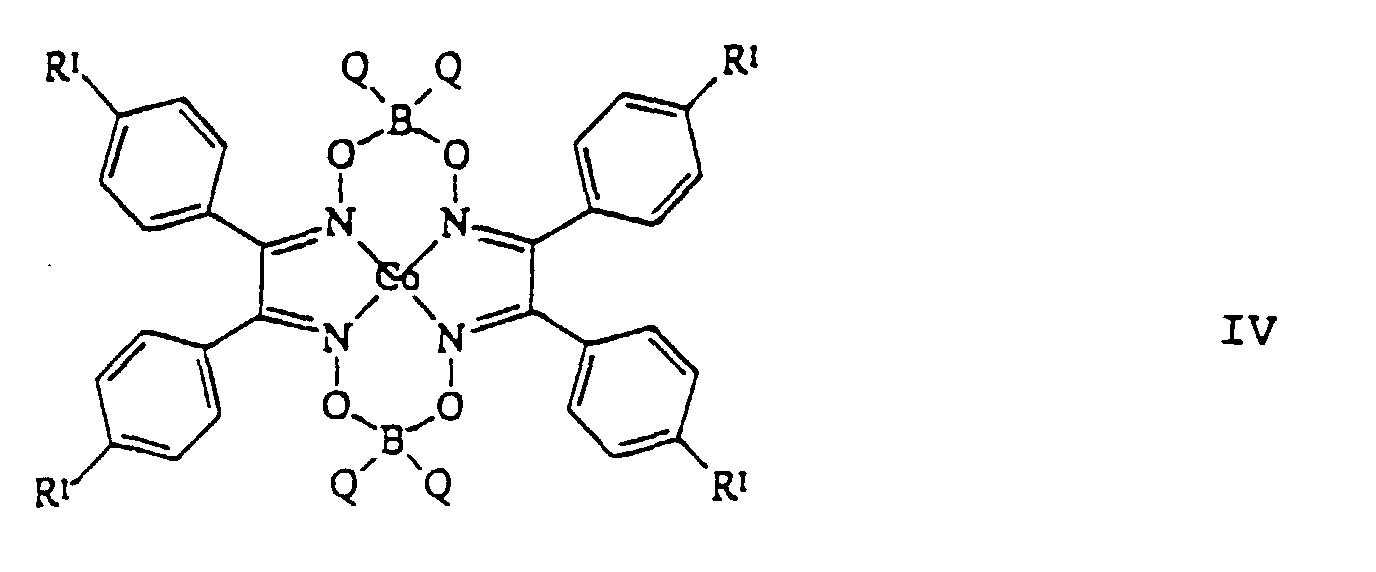
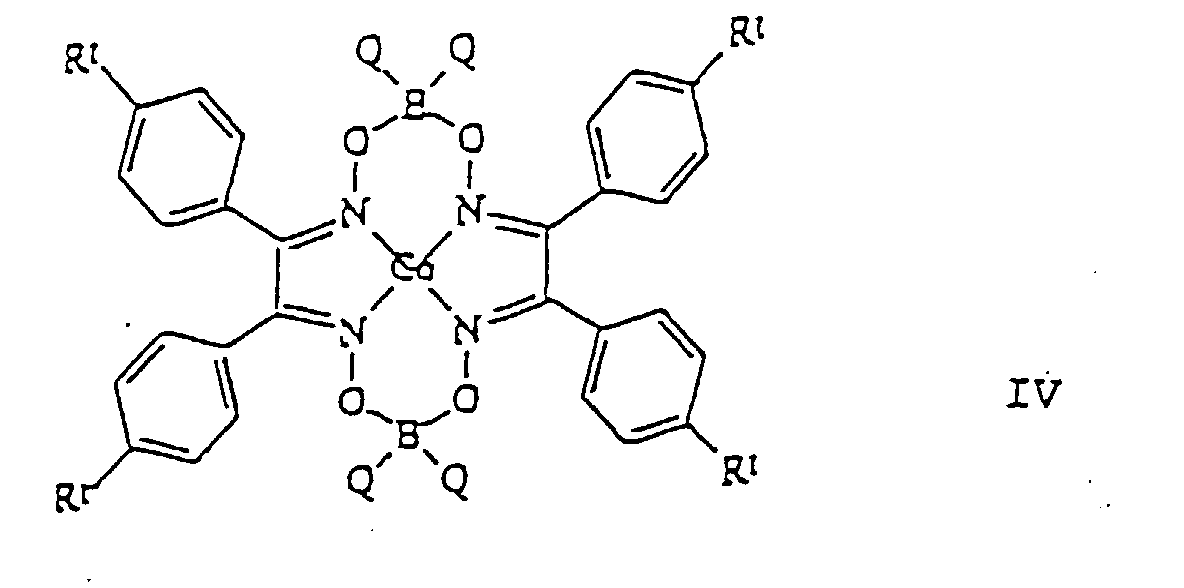
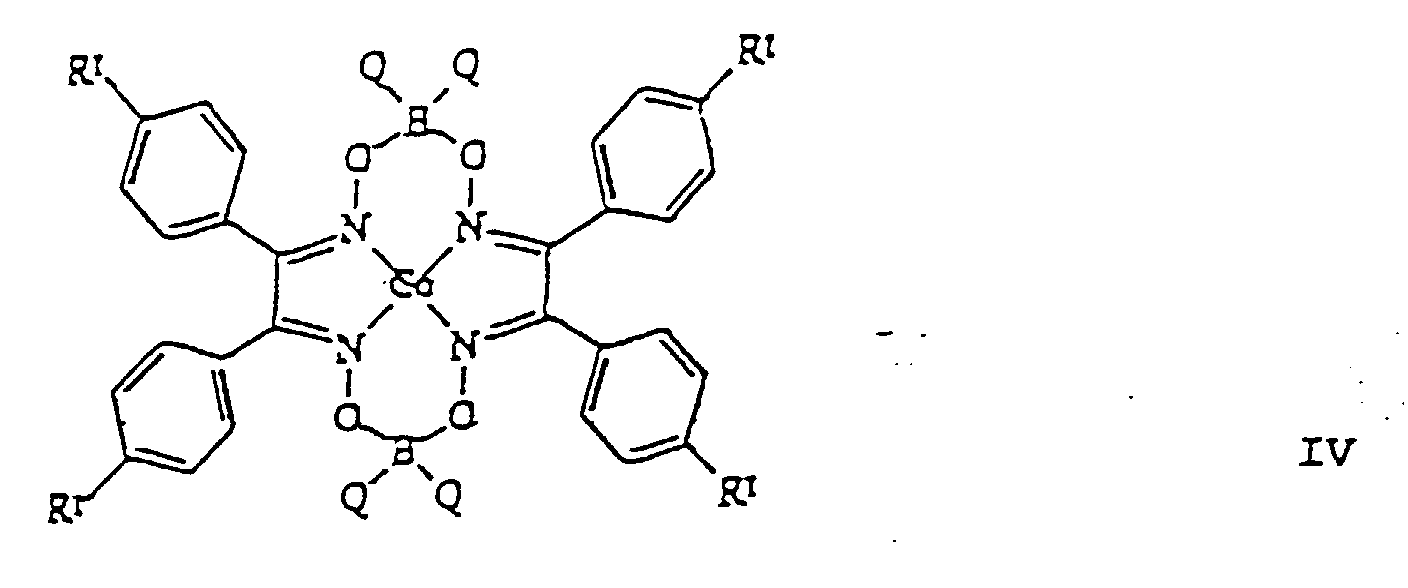
- at least two rings have a heterosubstituent in the 4-position, with the remaining groups in the heterosubstituted rings being hydrogen, such a chelate having the following formula IV: where each of the R 1 groups is a heterosubstituent which is a C 1-12 alkoxy group, and Q is as defined supra.
- R 1 may for example be OCH 3 .
- Q is preferably F. In most cases R 1 will be the same heterosubstituent in each of the rings.
- each of at least two R 1 groups is methoxy and Q is F. Even more preferably each of the R 1 groups which may be methoxy is substituted at the 4-position. Specific such compounds which we have found may give excellent results are those in which all R 1 groups are methoxy groups.
- chelates show enhanced or decreased solubility in aqueous or organic media, allowing one to readily control the solubility of the catalyst in the polymerisation medium.
- many of the -SO 3 substituted compounds show enhanced solubility in water and methanol while many -Br, -OCH 3 and -NO 2 substituted chelates show reduced solubility in water and methanol.
- cobalt complexes as defined supra additionally to have further ligands coordinated to the Co atom (presumably axially), which do not alter the Co valency state.
- ligands coordinated to the Co atom (presumably axially), which do not alter the Co valency state.
- These may be derived en passant from the reaction medium used in the preparation of the Co complex or from the polymerisation medium used in the polymerisation process, or may be derived by deliberately adding a compound which will provide such ligands, and it is often the case that the coordinated presence thereof in the complex will ameliorate the latter's effectiveness.
- they are not essential to the invention, and for convenience they have not been shown in the various formulae.
- Typical of such additional ligands are weakly basic tertiary amines such as pyridine (or their substituted derivatives), trialkyl amines, dialkylamines, ethers such as tetrahydrofuran and diethyl ether, alkanols such as methanol, and also optionally substituted trialkyl, triaryl or tri(alkyl/aryl) phosphines (or analogous compounds such as corresponding alkoxy or aryloxy phosphines).
- the alkyl groups mentioned above preferably, and independently, are of 1-14 carbons and the aryl groups preferably, and independently, are of 6-10 carbons, more preferably phenyl).
- One or more water molecules could also be coordinated to the Co complex.
- the Co chelates of the invention are electrically neutral, the surrounding ligands providing a double negative charge to balance the Co 2+ charge.
- the negative charges are believed to be delocalised rather than being on any particular atoms.
- the defined cobalt chelate complexes allow the efficient production of oligomers and are likely to be functioning as catalytic chain transfer agents (CCTAs), and are sometimes referred to as such in this specification.
- CCTAs catalytic chain transfer agents
- the degree of polymerisation of such oligomers will usually be within the range 2 to about 1000 (i.e. 2 to 1000 polymerised units), preferably 10 to 750, and more preferably 10 to 130.
- the polymerisation process can be carried out in the presence of a polymerisation medium (acting as a carrier medium for the components and as a heat transfer medium) or in the absence of such a medium (i.e. in bulk).
- a polymerisation medium acting as a carrier medium for the components and as a heat transfer medium
- the polymerisation may be e.g. a solution, suspension or emulsion polymerisation.
- Typical organic solvents which may be used as the medium for the polymerisation include aromatic hydrocarbons such as benzene, toluene, and the xylenes; ethers such as diethyl ether, tetrahydrofuran, alkoxylated ethylene glycol or polyethyleneglycol; alcohols such as methanol, ethanol, propanol and butanol and their esters with carboxylic acids such as acetic, propionic and butyric acids; ketones such as acetone or methyl ethyl ketone; and liquid tertiary amines such as pyridine. Mixtures of solvents may be used.
- Water may also be used as a polymerisation medium (sometimes in combination with a solvent(s) such as described above) as in suspension or emulsion polymerisations, and for such processes conventional emulsifying or suspension agents may be employed.
- emulsifiers which may be used are non-ionic or anionic surfactants such as the Na, K and ammonium salts of dialkylsulphosuccinates, Na, K and ammonium salts of sulphonated oils, Na, K and NH 4 , salts of fatty acids.
- cationic emulsifiers such as hexadecyltrimethyl ammonium bromide and nonionic surfactants based on e.g.
- ethoxylated compounds may also be used.
- the amount used is usually 0.2 to 15% by weight, preferably 0.2 to 5% by weight based on the total monomer(s) charged.
- Suspension polymerisation may employ as stabilisers protective colloids such as partially hydrolysed polyvinyl acetate (various degrees of hydrolysis), cellulose derivatives, gelatin, polyvinyl chloride, and polyacrylic acid.
- the amount used is usually 0.1 to 8%, calculated on monomer weight. Salts such as Na 2 SO 4 are also often included for reducing monomer solubility in the aqueous phase and to improve stabilisation.
- the polymerisations are usually performed at a temperature within the range of 25 to 160°C (more usually 45 to 90°C).
- Any suitable free radical yielding initiator appropriate to the type of polymerisation system being employed may be used in the process of the invention, the usual criteria being that it has acceptable solubility in one or more of the other polymerisation components (e.g. solvent, monomers, or water), is sufficiently active at the polymerisation temperature (usually having a half life within the range 0.5 to 5 hours), and does not unacceptably affect the stability of the Co chelate.
- the other polymerisation components e.g. solvent, monomers, or water
- free-radical-yielding initiators examples include azo compounds as 2,2'-azobis(isobutyronitrile), 2,2'-azobis-(2-methyl)butanenitrile,4,4'-azobis(4-cyanovaleric acid), 2-(t-butylazo)-2-cyanopropane, 2,2'-azobis[2-methyl-N-(1,1)-bis(hydroxymethyl)-2-hydroxethyl]-propionamide, and 2,2'-azobis[2-methyl-N-hydroxyethyl)]-propionamide.
- azo compounds as 2,2'-azobis(isobutyronitrile), 2,2'-azobis-(2-methyl)butanenitrile,4,4'-azobis(4-cyanovaleric acid), 2-(t-butylazo)-2-cyanopropane, 2,2'-azobis[2-methyl-N-(1,1)-bis(hydroxymethyl)-2-hydroxethyl]-propionamide, and 2,2'-azo
- soluble free radical initiators may also be used, examples of which include peroxy compounds such as benzoyl peroxide, lauroyl peroxide, hydrogen peroxide, and Na, K, and NH 4 persulphates.
- Redox initiator systems can also be used, examples of which include redox pairs such as NH 4 persulphate and Na metabisulphite.
- Co chelates as molecular weight control compounds in the invention process avoids the requirement to use conventional chain transfer agents which often have disadvantages of one sort or another.
- chain transfer agents such as bromoform or carbon tetrachloride
- ⁇ -Methyl styrene another known chain transfer agent
- styrene is considerably more expensive than methyl methacrylate and often has to be used at very high levels, e.g. up to 35 weight % (although its deliberate use as a comonomer is not of course precluded; similarly the use of styrene itself as a comonomer is not precluded).
- the defined Co chelate acting to control molecular weight, may be used in a low amount (because it acts in a catalytic manner) in comparison to conventional chain transfer agents for achieving comparable molecular weight reduction. This allows much purer product to be made.
- the defined Co chelate is, if an appropriate solubilising hetero-containing group is chosen, in particular, unexpectedly effective in suspension polymerisations in that it is not necessary to employ high levels of suspension agents (for stabilisation).
- an appropriate solubilising hetero-containing group is chosen, in particular, unexpectedly effective in suspension polymerisations in that it is not necessary to employ high levels of suspension agents (for stabilisation).
- EP-A-0199436 discloses the use of BF 2 -bridged cobaloxime chelates not having heteroatom-containing substituents as defined herein as molecular weight control compounds in free-radical polymerisation
- the amount of suspending agent used in the general procedure for suspension polymerisation disclosed in EP-A-0199436 is equivalent to about 15g per lOOg of monomer.
- efficient stabilization can be achieved using a CCTA in accordance with the invention and a suspending agent in an amount of as little as up to 8g per lOOg of monomer, more preferably from 0.1 to 5g, especially 2 to 4g, per lOOg monomer.
- excellent results both in terms of stability and effective catalytic activity can be achieved for suspension polymerisation using as little as at least 5 times less than the amount used in the process of EP-A-0199436.
- the invention process may be carried out using an "all-in-one" batch process in which all components are present in the reaction medium at the start of polymerisation or a semi batch process in which one or more of the components employed (usually at least one of the monomers) is wholly or partially fed to the polymerisation medium during the polymerisation.
- the chelates used in the process may be prepared beforehand or may be formed in-situ from the appropriate reactants.
- the level of the cobalt chelate used in the polymerisation process will be such that the ratio of monomer(s)/initiator (molar basis) is within the range of from 20 to 500, more usually 40 to 300.
- the level of cobalt employed will be such that the ratio of cobalt chelate to tree-radical initiator (molar basis) is often within the range of 0.001 to 0.1, more usually 0.003 to 0.08.
- the molar ratio of monomer(s) to cobalt chelate will often be in the range of from 5,000/1 to 2,000,000/1.
- the process of the invention is most effectively applied to the homo-or copolymerisation of methacrylate esters and styrenes, although acrylate esters can also be polymerised effectively if included as comonomers.
- Preferred monomers are C 1-10 alkyl methacrylates and acrylates, hydroxy C 1-14 alkyl methacrylates and acrylates, epoxy C 1-14 alkyl methacrylates and acrylates, methacrylic acid, styrene and styrene derivatives.
- Benzil-4-sulphonic acid (23.2g; 0.080 mols); hydroxylamine hydrochloride (17.10g; 0.25 mols) and sodium carbonate(9.08g; 0.086 mols) were stirred together in water (200cm 3 ). A yellow solution was formed and effervescence was observed. The clear solution was heated with stirring until reflux temperature (102°C) was obtained. The mixture was heated under reflex for 90 minutes. During this reflux period the colour of the solution slowly changed to pink. The mixture was cooled to ambient temperature and the pH adjusted with hydrochloric acid (3 cm 3 of 30% (w/v)) until it reached 2. A white solid precipitate was formed. This was removed by filtration, dried at ambient temperature in vacu.
- Cobalt acetate .4 H 2 O (0.75g; 0.0030 mols) was dissolved in methanol (30 cm 3 ).
- the mono sodium salt of 4,4-dimethoxy benzil dioxime (2.0g; 0.0062 mols) was added and the mixture stirred at ambient temperature. A bright red crystalline precipitate (needle) was formed.
- the mixture was stirred for 100 minutes and then filtered.
- the solid was washed with methanol (20 cm 3 ) and then pumped to dryness. Diethyl ether (30 cm 3 ) was added followed by boron trifluoride etherate (20 cm 3 ). A red solution was formed, momentarily, at this point then (within 2 minutes) a red/orange precipitate was observed.
- Example polymerisation procedures follow. Examples 1 to 5, 12 to 14, 22 to 25 and 35 to 38 are in accordance with the presently claimed invention; other examples are included for explanatory purposes.
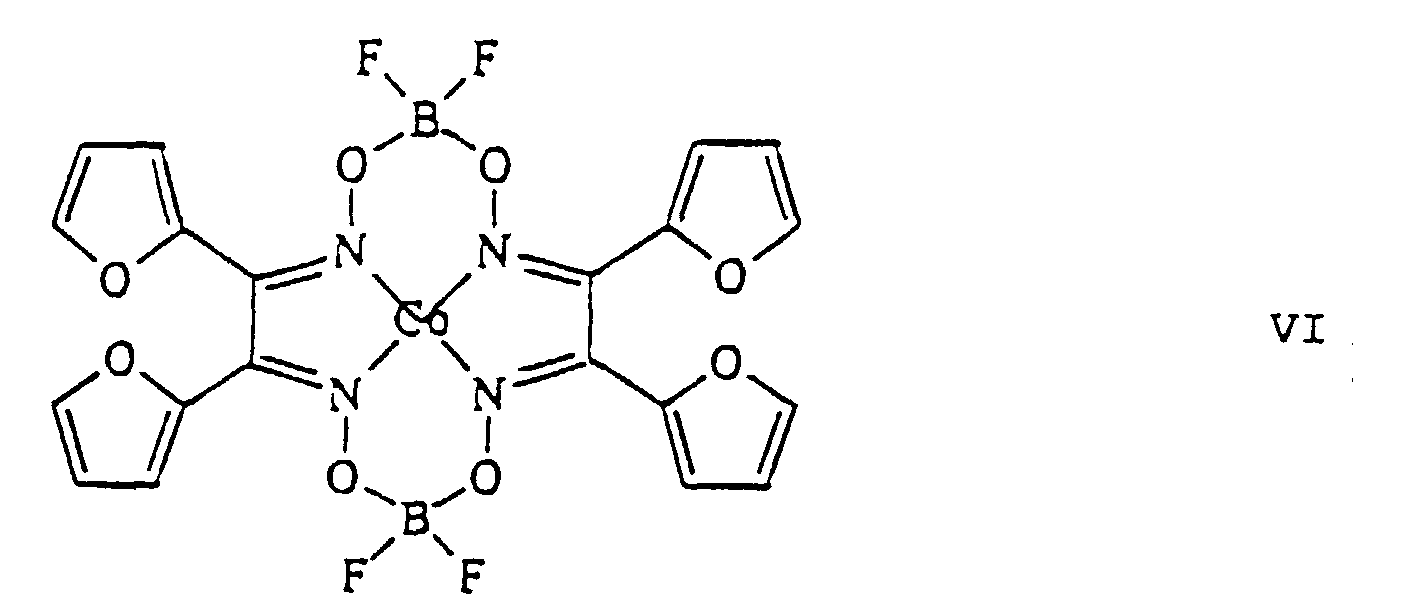
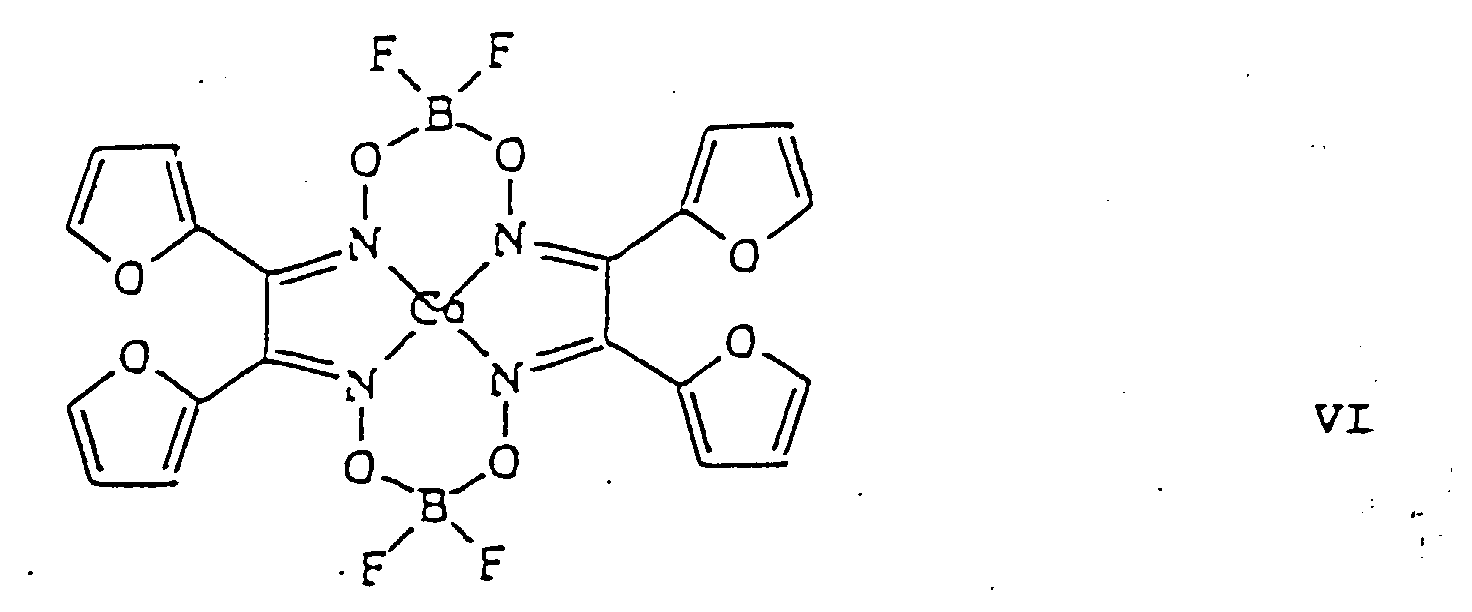
- Cobalt alpha furildioxime-diboronfluoride (formula VI) was synthesised by the reaction of alpha-furildioxime (2 mole equivalent), cobalt acetate tetrahydrate (1 mole equivalent) and BF 3 OEt 2 (10 mole equivalent) in degassed diethyl ether.
- [MMA]/[Co] means the mole ratio of MMA to Co catalyst. Molecular weights were measured after 1 hr. reaction time.
- Mn was typically 55000 and Mw/Mn 2.0.
- the catalyst was synthesised as described above.
- the general procedure for suspension polymerisation described above was followed, with the ratio of MMA to the cobalt catalyst being 2000:1 w/w.
- the molecular weight (Mn) was typically 60,000.
- the general procedure used was exactly as for the general procedure for solution polymerisation already described, except that either (1) in the examples in Table 3 below with cobalt (4,4'dimethoxybenzildioximediborondifluoride) and cobalt (4,4'dibromobenzildioximediborondifluoride) as the chain transfer agent the stock solution of the catalyst was made up (roughly 0.2mM) in methyl methacrylate (MMA) rather than in the solvent used for the reaction, or (2) in the examples in Table 3 below with cobalt (4, 4'dinitrobenzildioxime) as the chain transfer agent.
- the catalyst was added directly as a solid to a solution of monomer, initiator and solvent.
Landscapes
- Chemical & Material Sciences (AREA)
- Organic Chemistry (AREA)
- Health & Medical Sciences (AREA)
- Chemical Kinetics & Catalysis (AREA)
- Medicinal Chemistry (AREA)
- Polymers & Plastics (AREA)
- Addition Polymer Or Copolymer, Post-Treatments, Or Chemical Modifications (AREA)
- Organic Low-Molecular-Weight Compounds And Preparation Thereof (AREA)
Description

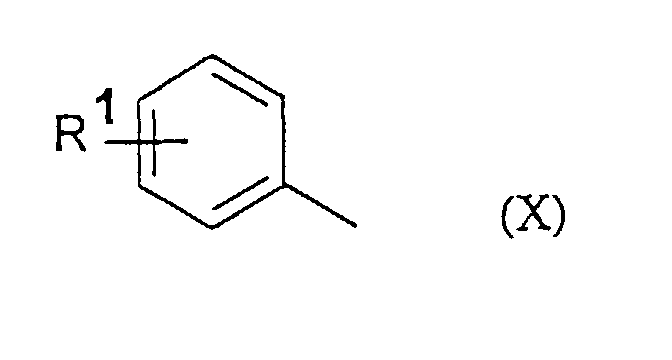
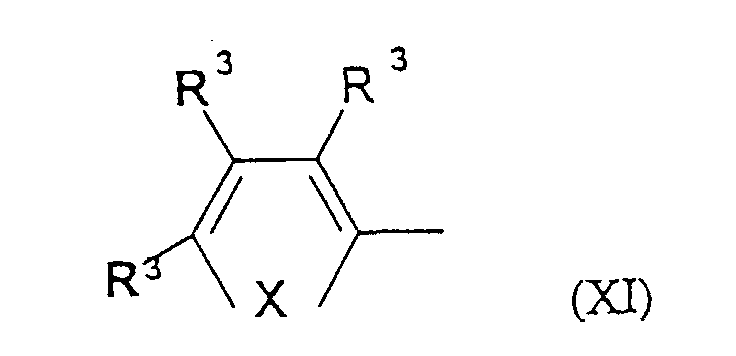
wherein each R3 is selected, independently, from hydrogen, C1-12 alkyl, optionally substituted C6-10 aryl, OH, OR2, NH2, NHR2, NR2 2, SO3H, SO3M (where M is a cationic radical), SO3R2, SO2NH2, SO2NHR2, CO2H, CO2R2, NO2, CN, C(=O)H, C(=O)R2, halogen, SH, and SR2, wherein R2 is a C1-12 alkyl or (CH2CH2-O-)nT where n is 1 to 40 and T is H or a capping group selected from C1-10 alkyl, C2-11 acyl and (meth)acryloyl and wherein each X is selected, independently from O, S, NH and NR4 where R4 is C1-8 alkyl, C6-10 aryl or C6-10 cycloalkyl; and each group Q is independently selected from F, Cl, Br, OH, C1-12 alkoxy and C1-12 alkyl.


wherein each R3 is selected, independently, from hydrogen, C1-12 alkyl, optionally substituted C6-10 aryl, OH, OR2, NH2, NHR2, NR2 2, SO3H, SO3M (where M is a cationic radical), SO3R2, SO2NH2, SO2NHR2, CO2H, CO2R2, NO2, CN, C(=O)H, C(=O)R2, halogen, SH, and SR2, wherein R2 is a C1-12 alkyl or (CH2CH2-O-)nT where n is 1 to 40 and T is H or a capping group selected from C1-10 alkyl, C2-11 acyl and (meth) acryloyl and wherein each X is selected, independently from O, S, NH and NR4 where R4 is C1-8 alkyl, C6-10 aryl or C6-10 cycloalkyl; and


Micro analysis: %Th(found) C 35.5, (34.4); H 2.4, (2.3); N 5.5, (5.5); B 2.2, (2.0); Co 5.8, (5.8) for C28H16N4O4Br2F4Co.2MeOH.
The other cobalt oxime complexes were prepared according to a similar procedure.
Examples 1 to 5, 12 to 14, 22 to 25 and 35 to 38 are in accordance with the presently claimed invention; other examples are included for explanatory purposes.
| Example | [MMA]/[Co] | Mn | Mw/Mn |
| 1 | 150,000 | 2,300 | 2.22 |
| 2 | 200,000 | 3,322 | 2.3 |
| 3 | 250,000 | 3,470 | 2.3 |
| 4 | 300,000 | 4,065 | 2.4 |
| 4 | 300,000 | 4,065 | 2.4 |
| Example No | Catalyst | [Monomer]/[Catalyst] | solvent | Mn | Mw/Mn |
| 6 | Form IV, each Q=F, each R1=NO2 | 200,000 | THF | 3,736 | 2.3 |
| 7 | " | 300,000 | " | 5,662 | 2.4 |
| 8 | " | 400,000 | " | 7,984 | 2.4 |
| 9 | Form IV, each Q=F, each R1=Br | 200,000 | THF | 5,418 | 1.8 |
| 10 | " | 300,000 | " | 6,998 | 2.1 |
| 11 | " | 400,000 | " | 8,475 | 2 |
| 12 | Form IV, each Q=F, each R1=CH3O | 200,000 | THF | 3,349 | 1.9 |
| 13 | " | 300,000 | " | 4,100 | 2 |
| 14 | " | 400,000 | " | 5,297 | 2.3 |
| 15 | Form IV, each Q=F, top R1,s resp. SO3H and H, bottom R1,s H and SO3H | 50,000 | MeOH | 938 | 1.6 |
| 16 | " | 100,000 | " | 1,705 | 2.9 |
| 17 | " | 250,000 | " | 3,444 | 2.9 |
| Example | Catalyst | [Monomer]/[Catalyst] | Mn | Mw/Mn |
| 18 | Form IV, each Q=F; R1=Br | 1,000,000 | 6,820 | 2.2 |
| 19 | " | 800,000 | 5,388 | 2.1 |
| 20 | " | 600,000 | 3,808 | 2.7 |
| 21 | " | 400,000 | 3,154 | 2 |
| 22 | Form IV, each Q=F; R1=OCH3 | 1,000000 | 7,262 | 2.1 |
| 23 | " | 800,000 | 5,402 | 2 |
| 24 | " | 600,000 | 4,114 | 1.9 |
| 25 | " | 400,000 | 2,186 | 1.9 |
| 26 | Form IV, each Q=F; R1=NO2 | 100,000 | 2,266 | 1.6 |
| 27 | " | 50,000 | 1,352 | 1.3 |
| Example | Catalyst | Catalyst/g | Monomer | Mn | Mw/Mn |
| 28 | Form IV, each Q=F, each R1=NO2 | 0.02 | MMA | 14,970 | 3.7 |
| 29 | " | 0.02 | MMA(96)/MAA(4) | 24,080 | 2.8 |
| 30 | " | 0.02 | MMA(92)/MAA(8) | 20,610 | 2.8 |
| 31 | " | 0.02 | MMA(80)/BA(20) | 45,170 | 2.9 |
| 32 | " | 0.02 | MMA(60)/MAA(40) | 70,500 | 5.8 |
| 33 | Form IV, each Q=F. each R1=Br | 0.01 | MMA | 24,160 | 2.7 |
| 34 | " | 0.01 | MMA(92)/MAA(8) | 15,970 | 2.5 |
| 35 | Form IV, each Q=F, each R | 0.01 | MMA | 3,481 | 2.4 |
| 36 | " | 0.01 | MMA(92)/MAA(8) | 3,205 | 2 |
| 37 | Form VI | 0.05 | MMA(71.9)/BA(28.2) | 10,762 | 2.53 |
| 38 | " | 0.03 | MMA(96)/MAA(4) | 19,870 | 3 |
Claims (16)
- A process for the free-radical polymerization of at least one olefinically unsaturated monomer in the presence of a compound for effecting molecular weight control, wherein the molecular weight control compound is a CoII chelate of the following formula I:wherein each group R is an organic group and each group R is
 (a) the groupwherein R1 is a C1-12 alkoxy group; or
 (b) the groupor corresponding compounds in which at least one of the 5-membered ring groups is joined at the 3 position instead of the 2 position (as shown above in XI) in which case R3 is attached to a 2-position;
wherein each R3 is selected, independently, from hydrogen, C1-12 alkyl, optionally substituted C6-10 aryl, OH, OR2, NH2, NHR2, NR2 2, SO3H, SO3M (where M is a cationic radical), SO3R2, SO2NH2, SO2NHR2, CO2H, CO2R2, NO2, CN, C(=O)H, C(=O)R2, halogen, SH, and SR2, wherein R2 is a C1-12 alkyl or (CH2CH2-O-)nT where n is 1 to 40 and T is H or a capping group selected from C1-10 alkyl, C2-11 acyl and (meth)acryloyl and wherein each X is selected, independently from O, S, NH and NR4 where R4 is C1-8 alkyl, C6-10 aryl or C6-10 cycloalkyl; and
each group Q is independently selected from F, Cl, Br, OH, C1-12 alkoxy and C1-12 alkyl. - A process according to claim 1, wherein each Q is F.
- A process according to claim 1 or claim 2, wherein each group R is a group of the formula (X), given and defined in claim 1, and each R1 is a methoxy group.
- A process according to claim 1 or claim 2, wherein the CoII chelate has the formula IV:wherein each R1 is methoxy and each Q is as defined in claim 1.
- A process according to claim 1 or claim 2, wherein in the CoII chelate of the formula (I), R is a group of the formula (XI), such that the CoII chelate has the formulaor corresponding compounds in which at least one of the 5-membered ring groups is joined at the 3 position instead of the 2 position (as shown above in V) in which case R3 is attached to a 2-position;

wherein each R3 is selected, independently, from hydrogen, C1-12 alkyl, optionally substituted C6-10 aryl, OH, OR2, NH2, NHR2, NR2 2, SO3H, SO3M, SO3R2, SO2NH2, SO2NHR2, CO2H, CO2R2, NO2, CN, C(=O)H, C(=O)R2, halogen, SH, and SR2, wherein R2 and M are as defined in claim 1 and wherein each X is selected, independently from O, S, NH and NR4 where R4 is C1-8 alkyl, C6-10 aryl or C6-10 cycloalkyl, and Q is as defined in claim 1. - A process according to claim 5, wherein the CoII chelate has the formula VI:
- A process according to any preceding claim, wherein the polymerization is carried out in the presence of a suspending agent.
- A process according to claim 7, wherein the suspending agent is present in an amount of up to 8g per 100g of monomer.
- A process according to claim 8, wherein the suspending agent is present in an amount of from 0.1 to 5g per 100g of monomer.
- A process according to any preceding claim, wherein at least one said olefinically unsaturated monomer is a methacrylic monomer.
- A CoII chelate of the following formula I:wherein each group R is
 (a) the groupwherein R1 is a C1-12 alkoxy group; or
 (b) the groupor corresponding compounds in which at least one of the 5-membered ring groups is joined at the 3 position instead of the 2 position (as shown above in XI) in which case R3 is attached to a 2-position;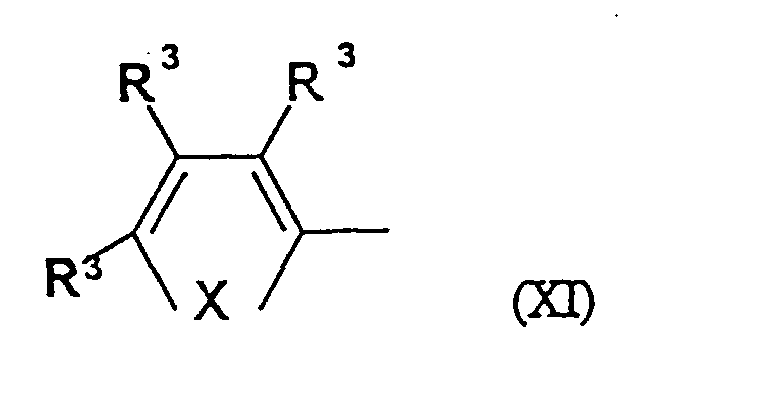
wherein each R3 is selected, independently, from hydrogen, C1-12 alkyl, optionally substituted C6-10 aryl, OH, OR2, NH2, NHR2, NH2 2, SO3H, SO3M (where M is a cationic radical), SO3R2, SO2NH2, SO2NHR2, CO2H, CO2R2, NO2, CN, C(=O)H, C(=O)R2, halogen, SH, and SR2, wherein R2 is a C1-12 alkyl or (CH2CH2-O-)nT where n is 1 to 40 and T is H or a capping group selected from C1-10 alkyl, C2-11 acyl and (meth)acryloyl and wherein each X is selected, independently from O, S, NH and NR4 where R4 is C1-8 alkyl, C6-10 aryl or C6-10 cycloalkyl; and
each group Q is independently selected from F, Cl, Br, OH, C1-12 alkoxy and C1-12 alkyl. - A compound according to claim 11, wherein each Q is F.
- A compound according to claim 11 or claim 12, wherein each group R is a group of the formula (X), given and defined in claim 11 and each R1 is a methoxy group.
- A CoII chelate of the formula IV:where each R1 is methoxy and each Q is as defined in claim 11.
- A CoII chelate of the formulaor corresponding compounds in which at least one of the 5-membered ring groups is joined at the 3 position instead of the 2 position (as shown above in V) in which case R3 is attached to a 2-position;

wherein each R3 is selected, independently, from hydrogen, C1-12 alkyl, optionally substituted C6-10 aryl, OH, OR2, NH2, NHR2, NR2 2, SO3H, SO3M, SO3R2, SO2NH2, SO2NHR2, CO2H, CO2R2, NO2, CN, C(=O)H, C(=O)R2, halogen, SH, and SR2, wherein R2 and M are as defined in claim 11 and wherein each X is selected, independently from O, S, NH and NR4 where R4 is C1-8 alkyl, C6-10 aryl or C6-10 cycloalkyl, and Q is as defined in claim 11. - A CoII chelate of the formula VI:

Applications Claiming Priority (5)
| Application Number | Priority Date | Filing Date | Title |
|---|---|---|---|
| GB9325950 | 1993-12-20 | ||
| GB939325950A GB9325950D0 (en) | 1993-12-20 | 1993-12-20 | Free radical polymerisation process |
| GB9420448 | 1994-10-11 | ||
| GB9420448A GB9420448D0 (en) | 1994-10-11 | 1994-10-11 | Free radical polymerisation process |
| PCT/GB1994/002769 WO1995017435A1 (en) | 1993-12-20 | 1994-12-20 | Free radical polymerisation process |
Publications (2)
| Publication Number | Publication Date |
|---|---|
| EP0739359A1 EP0739359A1 (en) | 1996-10-30 |
| EP0739359B1 true EP0739359B1 (en) | 2000-03-22 |
Family
ID=26304050
Family Applications (1)
| Application Number | Title | Priority Date | Filing Date |
|---|---|---|---|
| EP95903859A Expired - Lifetime EP0739359B1 (en) | 1993-12-20 | 1994-12-20 | Free radical polymerisation process |
Country Status (5)
| Country | Link |
|---|---|
| US (1) | US5770665A (en) |
| EP (1) | EP0739359B1 (en) |
| AU (1) | AU1276695A (en) |
| DE (1) | DE69423653T2 (en) |
| WO (1) | WO1995017435A1 (en) |
Families Citing this family (26)
| Publication number | Priority date | Publication date | Assignee | Title |
|---|---|---|---|---|
| EP0788518B1 (en) * | 1994-10-28 | 1999-06-02 | Zeneca Limited | Free radical polymerisation process |
| AUPM930494A0 (en) * | 1994-11-09 | 1994-12-01 | Commonwealth Scientific And Industrial Research Organisation | Polymerization in aqueous media |
| CA2247837A1 (en) * | 1996-02-23 | 1997-08-28 | E.I. Du Pont De Nemours And Company | Catalytic polymerization process |
| US6624261B1 (en) | 1997-02-18 | 2003-09-23 | E. I. Du Pont Nemours And Company | Catalytic polymerization process |
| US6121181A (en) * | 1998-08-07 | 2000-09-19 | Equistar Chemicals, L.P. | Cyclic oligomeric oxo- and imido- metal complexes as olefin polymerization catalysts |
| US6602960B1 (en) | 1999-02-26 | 2003-08-05 | The University Of Akron | Polymers and copolymers prepared or modified by using cobalt complexes |
| JP2001131472A (en) | 1999-11-01 | 2001-05-15 | Kansai Paint Co Ltd | Resin composition for cationic electrodeposition coating |
| US6644309B2 (en) * | 2001-01-12 | 2003-11-11 | Becton, Dickinson And Company | Medicament respiratory delivery device and method |
| US20040220329A1 (en) * | 2003-04-29 | 2004-11-04 | Solomon Robert David | Aqueous polymer composition and coating produced therefrom |
| US7022792B2 (en) * | 2004-03-16 | 2006-04-04 | E. I. Dupont De Nemours And Company | Initiation of polymerization by hydrogen atom donation |
| GB0409448D0 (en) * | 2004-04-28 | 2004-06-02 | Avecia Bv | Free radical polymerisation process |
| JP5465397B2 (en) | 2007-07-12 | 2014-04-09 | ローム アンド ハース カンパニー | Polymer film |
| EP2982720A1 (en) | 2009-12-17 | 2016-02-10 | DSM IP Assets B.V. | Polymeric composition |
| EP2655443A1 (en) | 2010-12-20 | 2013-10-30 | DSM IP Assets B.V. | Bio-renewable vinyl beads |
| TWI529209B (en) * | 2011-12-14 | 2016-04-11 | 三菱麗陽股份有限公司 | Methacrylate polymer, manufacturing method thereof, active energy ray curable resin composition and optical recording medium |
| US20150005442A1 (en) | 2012-02-03 | 2015-01-01 | Dsm Ip Assets B.V. | Polymer, process and composition |
| AU2013214126A1 (en) | 2012-02-03 | 2014-08-07 | Dsm Ip Assets B.V. | Use of a polymer composition |
| US9580529B2 (en) * | 2013-01-04 | 2017-02-28 | Evonik Oil Additives Gmbh | Preparation of low-viscosity polymers |
| BR112015024405A2 (en) * | 2013-03-28 | 2017-07-18 | Saudi Basic Ind Corp | high pressure polymerization process for the preparation of polyethylene |
| WO2021193613A1 (en) | 2020-03-26 | 2021-09-30 | 三菱ケミカル株式会社 | Copolymer, resin composition, shaped object, filmy shaped object, and method for producing copolymer |
| WO2022114157A1 (en) | 2020-11-30 | 2022-06-02 | 三菱ケミカル株式会社 | Resin composition, molded article, and macromonomer copolymer |
| CN115637106B (en) * | 2021-07-19 | 2025-06-13 | 安徽顺彤包装材料有限公司 | Anti-counterfeiting film with color-changing effect and preparation method thereof |
| EP4421120A4 (en) | 2021-10-22 | 2025-10-29 | Mitsubishi Chem Corp | Resin composition, manufacturing process for resin composition, molding compound and articles |
| CN118541443A (en) | 2022-02-15 | 2024-08-23 | 三菱化学株式会社 | Thermoplastic resin composition, molding material, and molded article |
| KR20260020948A (en) | 2023-06-21 | 2026-02-12 | 미쯔비시 케미컬 주식회사 | Resin compositions, molding materials and molded articles |
| WO2025063040A1 (en) | 2023-09-19 | 2025-03-27 | 三菱ケミカル株式会社 | Resin composition, molding material, resin molded body and film, and method for producing same |
Family Cites Families (7)
| Publication number | Priority date | Publication date | Assignee | Title |
|---|---|---|---|---|
| US4694054A (en) * | 1985-03-01 | 1987-09-15 | E. I. Du Pont De Nemours And Company | Cobalt(II) chelates as chain transfer agents in free radical polymerizations |
| US4886861A (en) * | 1985-04-23 | 1989-12-12 | E. I. Dupont De Nemours And Company | Molecular weight control in free radical polymerizations |
| US4746713A (en) * | 1985-11-13 | 1988-05-24 | E. I. Du Pont De Nemours And Company | Bimetallic catalytic chain transfer agents for molecular weight control in free radical polymerization |
| US4722984A (en) * | 1985-12-03 | 1988-02-02 | E. I. Du Pont De Nemours And Company | Pentacyanocobaltate(II) catalytic chain transfer agents for molecular weight control in free radical polymerization |
| US4680354A (en) * | 1986-05-21 | 1987-07-14 | The Glidden Company | Low molecular weight polymers and copolymers |
| US5028677A (en) * | 1986-09-23 | 1991-07-02 | E. I. Du Pont De Nemours And Company | Novel macromonomer compositions |
| JPH0236259A (en) * | 1988-06-16 | 1990-02-06 | Mitsui Petrochem Ind Ltd | Polyester resin composition |
-
1994
- 1994-12-20 DE DE69423653T patent/DE69423653T2/en not_active Expired - Fee Related
- 1994-12-20 US US08/663,218 patent/US5770665A/en not_active Expired - Fee Related
- 1994-12-20 AU AU12766/95A patent/AU1276695A/en not_active Abandoned
- 1994-12-20 EP EP95903859A patent/EP0739359B1/en not_active Expired - Lifetime
- 1994-12-20 WO PCT/GB1994/002769 patent/WO1995017435A1/en not_active Ceased
Also Published As
| Publication number | Publication date |
|---|---|
| US5770665A (en) | 1998-06-23 |
| WO1995017435A1 (en) | 1995-06-29 |
| DE69423653D1 (en) | 2000-04-27 |
| DE69423653T2 (en) | 2000-07-20 |
| EP0739359A1 (en) | 1996-10-30 |
| AU1276695A (en) | 1995-07-10 |
Similar Documents
| Publication | Publication Date | Title |
|---|---|---|
| US5770665A (en) | Free radical polymerization process | |
| EP0788518B1 (en) | Free radical polymerisation process | |
| US5602220A (en) | Free radical polymerisation process | |
| US5264530A (en) | Process of polymerization in an aqueous system | |
| US4694054A (en) | Cobalt(II) chelates as chain transfer agents in free radical polymerizations | |
| US5324879A (en) | Oligomerization process | |
| MXPA97002791A (en) | Polymerization process of radicals lib | |
| CA2231398C (en) | Control of molecular weight and end-group functionality in polymers | |
| US5028677A (en) | Novel macromonomer compositions | |
| JP2004518773A (en) | Living type free radical polymerization controller, polymerization method, emulsion and polymer using the same | |
| US9777082B2 (en) | Synthesis of hyperbranched polyacrylates by emulsion polymerizsation of inimers | |
| WO2004081020A1 (en) | Transition metal complexes, especially iron complexes, used as a catalyst component in the polymerisation of olefins | |
| US4319014A (en) | Acid stable surfactant | |
| JP4593786B2 (en) | Method for producing a polymer containing N → O end groups | |
| KR100250892B1 (en) | Polymerization in Aqueous Medium | |
| EP0755411B1 (en) | Free radical polymerisation process | |
| EP1217010B1 (en) | Method of emulsion polymerization | |
| US5756605A (en) | Polymerization in aqueous media | |
| CA1313922C (en) | Macromonomer compositions | |
| US20120035316A1 (en) | Macromonomers and graft copolymers prepared by emulsion polymerization with a cobalt chelate chain transfer agent | |
| JPH055009A (en) | Method for polymerizing vinyl monomer | |
| JPH06228249A (en) | Graft copolymer with improved phase bonding | |
| JPWO2012014446A1 (en) | Maleimide copolymer and method for producing maleimide copolymer | |
| KR20000057461A (en) | Anionic polymerisation of acrylates and methacrylates | |
| RU2062273C1 (en) | Method for production of polyalkyl(meth)acrylates |
Legal Events
| Date | Code | Title | Description |
|---|---|---|---|
| PUAI | Public reference made under article 153(3) epc to a published international application that has entered the european phase |
Free format text: ORIGINAL CODE: 0009012 |
|
| 17P | Request for examination filed |
Effective date: 19960709 |
|
| AK | Designated contracting states |
Kind code of ref document: A1 Designated state(s): DE ES FR GB IT NL SE |
|
| 17Q | First examination report despatched |
Effective date: 19970402 |
|
| GRAG | Despatch of communication of intention to grant |
Free format text: ORIGINAL CODE: EPIDOS AGRA |
|
| GRAG | Despatch of communication of intention to grant |
Free format text: ORIGINAL CODE: EPIDOS AGRA |
|
| GRAH | Despatch of communication of intention to grant a patent |
Free format text: ORIGINAL CODE: EPIDOS IGRA |
|
| GRAH | Despatch of communication of intention to grant a patent |
Free format text: ORIGINAL CODE: EPIDOS IGRA |
|
| RAP1 | Party data changed (applicant data changed or rights of an application transferred) |
Owner name: AVECIA LIMITED |
|
| GRAA | (expected) grant |
Free format text: ORIGINAL CODE: 0009210 |
|
| AK | Designated contracting states |
Kind code of ref document: B1 Designated state(s): DE ES FR GB IT NL SE |
|
| PG25 | Lapsed in a contracting state [announced via postgrant information from national office to epo] |
Ref country code: SE Free format text: THE PATENT HAS BEEN ANNULLED BY A DECISION OF A NATIONAL AUTHORITY Effective date: 20000322 Ref country code: IT Free format text: LAPSE BECAUSE OF FAILURE TO SUBMIT A TRANSLATION OF THE DESCRIPTION OR TO PAY THE FEE WITHIN THE PRE;WARNING: LAPSES OF ITALIAN PATENTS WITH EFFECTIVE DATE BEFORE 2007 MAY HAVE OCCURRED AT ANY TIME BEFORE 2007. THE CORRECT EFFECTIVE DATE MAY BE DIFFERENT FROM THE ONE RECORDED.SCRIBED TIME-LIMIT Effective date: 20000322 Ref country code: ES Free format text: THE PATENT HAS BEEN ANNULLED BY A DECISION OF A NATIONAL AUTHORITY Effective date: 20000322 |
|
| REF | Corresponds to: |
Ref document number: 69423653 Country of ref document: DE Date of ref document: 20000427 |
|
| ET | Fr: translation filed | ||
| PLBE | No opposition filed within time limit |
Free format text: ORIGINAL CODE: 0009261 |
|
| STAA | Information on the status of an ep patent application or granted ep patent |
Free format text: STATUS: NO OPPOSITION FILED WITHIN TIME LIMIT |
|
| 26N | No opposition filed | ||
| REG | Reference to a national code |
Ref country code: GB Ref legal event code: IF02 |
|
| REG | Reference to a national code |
Ref country code: FR Ref legal event code: TP |
|
| NLS | Nl: assignments of ep-patents |
Owner name: DSM IP ASSETS B.V. Effective date: 20060227 |
|
| REG | Reference to a national code |
Ref country code: GB Ref legal event code: 732E |
|
| PGFP | Annual fee paid to national office [announced via postgrant information from national office to epo] |
Ref country code: NL Payment date: 20081223 Year of fee payment: 15 |
|
| PGFP | Annual fee paid to national office [announced via postgrant information from national office to epo] |
Ref country code: DE Payment date: 20090202 Year of fee payment: 15 |
|
| PGFP | Annual fee paid to national office [announced via postgrant information from national office to epo] |
Ref country code: GB Payment date: 20081229 Year of fee payment: 15 |
|
| PGFP | Annual fee paid to national office [announced via postgrant information from national office to epo] |
Ref country code: FR Payment date: 20081217 Year of fee payment: 15 |
|
| REG | Reference to a national code |
Ref country code: NL Ref legal event code: V1 Effective date: 20100701 |
|
| GBPC | Gb: european patent ceased through non-payment of renewal fee |
Effective date: 20091220 |
|
| REG | Reference to a national code |
Ref country code: FR Ref legal event code: ST Effective date: 20100831 |
|
| PG25 | Lapsed in a contracting state [announced via postgrant information from national office to epo] |
Ref country code: NL Free format text: LAPSE BECAUSE OF NON-PAYMENT OF DUE FEES Effective date: 20100701 Ref country code: FR Free format text: LAPSE BECAUSE OF NON-PAYMENT OF DUE FEES Effective date: 20091231 |
|
| PG25 | Lapsed in a contracting state [announced via postgrant information from national office to epo] |
Ref country code: DE Free format text: LAPSE BECAUSE OF NON-PAYMENT OF DUE FEES Effective date: 20100701 |
|
| PG25 | Lapsed in a contracting state [announced via postgrant information from national office to epo] |
Ref country code: GB Free format text: LAPSE BECAUSE OF NON-PAYMENT OF DUE FEES Effective date: 20091220 |