EP0738281B1 - Peptides and their uses against psoriasis - Google Patents
Peptides and their uses against psoriasis Download PDFInfo
- Publication number
- EP0738281B1 EP0738281B1 EP95909258A EP95909258A EP0738281B1 EP 0738281 B1 EP0738281 B1 EP 0738281B1 EP 95909258 A EP95909258 A EP 95909258A EP 95909258 A EP95909258 A EP 95909258A EP 0738281 B1 EP0738281 B1 EP 0738281B1
- Authority
- EP
- European Patent Office
- Prior art keywords
- cells
- psoriasis
- cell receptor
- fragment
- sequence
- Prior art date
- Legal status (The legal status is an assumption and is not a legal conclusion. Google has not performed a legal analysis and makes no representation as to the accuracy of the status listed.)
- Expired - Lifetime
Links
Images

Classifications
-
- A—HUMAN NECESSITIES
- A61—MEDICAL OR VETERINARY SCIENCE; HYGIENE
- A61K—PREPARATIONS FOR MEDICAL, DENTAL OR TOILETRY PURPOSES
- A61K39/00—Medicinal preparations containing antigens or antibodies
- A61K39/0005—Vertebrate antigens
- A61K39/0008—Antigens related to auto-immune diseases; Preparations to induce self-tolerance
-
- A—HUMAN NECESSITIES
- A61—MEDICAL OR VETERINARY SCIENCE; HYGIENE
- A61P—SPECIFIC THERAPEUTIC ACTIVITY OF CHEMICAL COMPOUNDS OR MEDICINAL PREPARATIONS
- A61P17/00—Drugs for dermatological disorders
-
- A—HUMAN NECESSITIES
- A61—MEDICAL OR VETERINARY SCIENCE; HYGIENE
- A61P—SPECIFIC THERAPEUTIC ACTIVITY OF CHEMICAL COMPOUNDS OR MEDICINAL PREPARATIONS
- A61P17/00—Drugs for dermatological disorders
- A61P17/06—Antipsoriatics
-
- A—HUMAN NECESSITIES
- A61—MEDICAL OR VETERINARY SCIENCE; HYGIENE
- A61P—SPECIFIC THERAPEUTIC ACTIVITY OF CHEMICAL COMPOUNDS OR MEDICINAL PREPARATIONS
- A61P37/00—Drugs for immunological or allergic disorders
-
- A—HUMAN NECESSITIES
- A61—MEDICAL OR VETERINARY SCIENCE; HYGIENE
- A61P—SPECIFIC THERAPEUTIC ACTIVITY OF CHEMICAL COMPOUNDS OR MEDICINAL PREPARATIONS
- A61P37/00—Drugs for immunological or allergic disorders
- A61P37/02—Immunomodulators
-
- C—CHEMISTRY; METALLURGY
- C07—ORGANIC CHEMISTRY
- C07K—PEPTIDES
- C07K14/00—Peptides having more than 20 amino acids; Gastrins; Somatostatins; Melanotropins; Derivatives thereof
- C07K14/435—Peptides having more than 20 amino acids; Gastrins; Somatostatins; Melanotropins; Derivatives thereof from animals; from humans
- C07K14/705—Receptors; Cell surface antigens; Cell surface determinants
- C07K14/70503—Immunoglobulin superfamily
- C07K14/7051—T-cell receptor (TcR)-CD3 complex
-
- C—CHEMISTRY; METALLURGY
- C07—ORGANIC CHEMISTRY
- C07K—PEPTIDES
- C07K16/00—Immunoglobulins [IG], e.g. monoclonal or polyclonal antibodies
- C07K16/18—Immunoglobulins [IG], e.g. monoclonal or polyclonal antibodies against material from animals or humans
- C07K16/28—Immunoglobulins [IG], e.g. monoclonal or polyclonal antibodies against material from animals or humans against receptors, cell surface antigens or cell surface determinants
- C07K16/2803—Immunoglobulins [IG], e.g. monoclonal or polyclonal antibodies against material from animals or humans against receptors, cell surface antigens or cell surface determinants against the immunoglobulin superfamily
- C07K16/2809—Immunoglobulins [IG], e.g. monoclonal or polyclonal antibodies against material from animals or humans against receptors, cell surface antigens or cell surface determinants against the immunoglobulin superfamily against the T-cell receptor (TcR)-CD3 complex
-
- C—CHEMISTRY; METALLURGY
- C07—ORGANIC CHEMISTRY
- C07K—PEPTIDES
- C07K16/00—Immunoglobulins [IG], e.g. monoclonal or polyclonal antibodies
- C07K16/42—Immunoglobulins [IG], e.g. monoclonal or polyclonal antibodies against immunoglobulins
- C07K16/4208—Immunoglobulins [IG], e.g. monoclonal or polyclonal antibodies against immunoglobulins against an idiotypic determinant on Ig
- C07K16/4241—Immunoglobulins [IG], e.g. monoclonal or polyclonal antibodies against immunoglobulins against an idiotypic determinant on Ig against anti-human or anti-animal Ig
- C07K16/4258—Immunoglobulins [IG], e.g. monoclonal or polyclonal antibodies against immunoglobulins against an idiotypic determinant on Ig against anti-human or anti-animal Ig against anti-receptor Ig
-
- G—PHYSICS
- G01—MEASURING; TESTING
- G01N—INVESTIGATING OR ANALYSING MATERIALS BY DETERMINING THEIR CHEMICAL OR PHYSICAL PROPERTIES
- G01N33/00—Investigating or analysing materials by specific methods not covered by groups G01N1/00 - G01N31/00
- G01N33/48—Biological material, e.g. blood, urine; Haemocytometers
- G01N33/50—Chemical analysis of biological material, e.g. blood, urine; Testing involving biospecific ligand binding methods; Immunological testing
- G01N33/53—Immunoassay; Biospecific binding assay; Materials therefor
- G01N33/569—Immunoassay; Biospecific binding assay; Materials therefor for microorganisms, e.g. protozoa, bacteria, viruses
- G01N33/56966—Animal cells
- G01N33/56972—White blood cells
-
- A—HUMAN NECESSITIES
- A61—MEDICAL OR VETERINARY SCIENCE; HYGIENE
- A61K—PREPARATIONS FOR MEDICAL, DENTAL OR TOILETRY PURPOSES
- A61K39/00—Medicinal preparations containing antigens or antibodies
- A61K2039/51—Medicinal preparations containing antigens or antibodies comprising whole cells, viruses or DNA/RNA
- A61K2039/53—DNA (RNA) vaccination
-
- A—HUMAN NECESSITIES
- A61—MEDICAL OR VETERINARY SCIENCE; HYGIENE
- A61K—PREPARATIONS FOR MEDICAL, DENTAL OR TOILETRY PURPOSES
- A61K38/00—Medicinal preparations containing peptides
-
- A—HUMAN NECESSITIES
- A61—MEDICAL OR VETERINARY SCIENCE; HYGIENE
- A61K—PREPARATIONS FOR MEDICAL, DENTAL OR TOILETRY PURPOSES
- A61K39/00—Medicinal preparations containing antigens or antibodies
-
- A—HUMAN NECESSITIES
- A61—MEDICAL OR VETERINARY SCIENCE; HYGIENE
- A61K—PREPARATIONS FOR MEDICAL, DENTAL OR TOILETRY PURPOSES
- A61K48/00—Medicinal preparations containing genetic material which is inserted into cells of the living body to treat genetic diseases; Gene therapy
-
- G—PHYSICS
- G01—MEASURING; TESTING
- G01N—INVESTIGATING OR ANALYSING MATERIALS BY DETERMINING THEIR CHEMICAL OR PHYSICAL PROPERTIES
- G01N2800/00—Detection or diagnosis of diseases
- G01N2800/28—Neurological disorders
- G01N2800/285—Demyelinating diseases; Multipel sclerosis
Definitions
- This invention relates to the immune system and, more specifically, to methods of modifying pathological immune responses in psoriasis.
- lymphocytes B lymphocytes
- T lymphocytes T cells
- T cells are involved in the cell-mediated response. Some induce particular B cell clones to proliferate and produce antibodies specific for the antigen. Others recognize and destroy cells presenting foreign antigens on their surfaces. Certain T cells regulate the response by either stimulating or suppressing other cells.
- T cells as the primary regulators of the immune system, directly or indirectly effect such autoimmune pathologies.
- Psoriasis is characterized by epidermal keratinocyte hyperproliferation, coupled with an inflammatory infiltrate.
- the pathogenesis of this disease is not fully understood.
- T cell activation appears to play a vital role in triggering and/or maintaining the disease.
- cyclosporin A works effectively on improving the patient's condition.
- the present invention satisfies this need and provides related advantages as well.
- This invention provides the use of a peptide having substantially the amino acid sequence of a V ⁇ 3, V ⁇ 13.1 or V ⁇ 17-containing T cell receptor present on the surface of T cells mediating psoriasis, or a fragment thereof, which is capable of causing an effect on the immune system to regulate the T cells, for the preparation of a medicament for preventing or reducing the severity of psoriasis in an individual.
- This invention provides the use of a peptide having substantially the amino acid sequence of a non-conserved region of a V ⁇ 3, V ⁇ 13.1 or V ⁇ 17-containing T cell receptor present on the surface of T cells mediating psoriasis, or a fragment thereof, wherein the peptide or fragment is capable of causing an effect on the immune system to regulate the T cells, for the preparation of a medicament for preventing or reducing the severity of psoriasis in an individual.
- this invention concerns the use of a T cell receptor binding partner for a V ⁇ 3, V ⁇ 13.1 or V ⁇ 17-containing T cell receptor present on the surface of T cells mediating psoriasis for the preparation of a medicament for preventing the proliferation of T cells associated with psoriasis in an individual.
- the invention involves preventing or reducing the severity of psoriasis by inhibiting the binding of a T cell receptor to its TCR binding partner in order to prevent the proliferation of T cells associated with psoriasis.
- This invention also relates to the use of a cytotoxic or cytostatic agent specifically reactive with T cells to inhibit their activity, which T cells are characterized by V ⁇ 3, V ⁇ 13.1 or V ⁇ 17-containing T cell receptors on the surface of these T cells, for preparing a medicament for preventing or reducing the severity of psoriasis in an individual.
- the invention further provides in vitro methods for detecting T cells having a V ⁇ 3, V ⁇ 13.1 or V ⁇ 17-containing T cell receptor associated with psoriasis for use in diagnosing or predicting susceptibility to psoriasis in an individual by testing a sample from the individual for the presence of T cells having a V ⁇ 3, V ⁇ 13.1 or V ⁇ 17-containing T cell receptor, the presence of abnormal expression of T cells containing the T cell receptor indicating the pathology or susceptibility to psoriasis.
- This invention provides the use of said peptides or fragments for preparing a medicament for preventing or reducing the severity of psoriasis in an individual by preventing the attachment of a psoriasis-associated T cell receptor to its binding partner.
- Another embodiment of this invention involves the use of a vector having an expression control sequence operatively linked to a nucleic acid encoding substantially a peptide having substantially the sequence of a non-conserved region of a V ⁇ 3, V ⁇ 13.1 or V ⁇ 17-containing T cell receptor present on the surface of T cells mediating psoriasis, or a fragment thereof, wherein the peptide or fragment is capable of causing an effect on the immune system to regulate the T cells, for the preparation of a medicament for preventing or reducing the severity of psoriasis in an individual.
- This invention also provides vectors having an expression control sequence operatively linked to a nucleic acid encoding a peptide having substantially the sequence of a non-conserved region of a V ⁇ 3, V ⁇ 13.1 or V ⁇ 17-containing T cell receptor present on the surface of T cells mediating psoriasis, or a fragment thereof.
- Figure 1 shows the variable region sequences of V ⁇ 3, V ⁇ 13.1 and V ⁇ 17.
- the underlined segments depict the CDR1, CDR2 and CDR4 hypervariable regions of each V ⁇ chain.
- the sequences between the CDR2 and CDR4 regions represent an overlap between these two hypervariable regions.
- This invention provides compositions and the use of specific peptides or fragments for the preparation of medicaments for preventing or reducing the severity of psoriasis.
- the invention results from the discovery that psoriasis is characterized by the predominant usage of certain T cell receptors in the psoriatic plaque lesion.
- V ⁇ 3, V ⁇ 13.1 and V ⁇ 17 predominate.
- Treatment in the context of the invention provides a specific and sustained amelioration which avoids problems associated with other potential avenues of therapy.
- substantially the amino acid sequence or “substantially the sequence” when referring to an amino acid sequence means the described sequence or other sequences having any additions, deletions or substitutions that do not substantially effect the ability of the sequence to cause an effect on the immune system which regulates T cells having the desired T cell receptor. Such sequences commonly have many other sequences adjacent to the described sequence.
- a portion or segment of the described sequence can be used so long as it is sufficiently characteristic of the desired T cell receptor or fragment thereof to cause an effect on the immune system which regulates T cells having the desired T cell receptors, but not against T cells not having desired T cell receptors.
- Such variations in the sequence can easily be made, for example by synthesizing an alternative sequence.
- the alternate sequence can then be tested, for example by administration to a vertebrate, to determine its effectiveness.
- fragment means a subset of the non-conserved amino acid sequence of a TCR that can cause an effect on the immune system which regulates T cells.
- non-conserved region refers to variable and VDJ regions. The term is intended to include such fragments in conjunction with or combined with additional sequences or moieties, as for example where the peptide is coupled to other amino acid sequences or to a carrier.
- fragment and peptide can, therefore, be used interchangeably since a peptide will be the most common fragment of the T cell receptor.
- Each fragment of the invention can have an altered sequence, as described above for the term “substantially the sequence.”
- the phrase to "cause an effect on the immune system which regulates T cells” means to cause the immune system to modify the activity in. response to their ligands of T cells bearing particular T cell receptors.
- Such an effect can include either wholly or partially a T cell response.
- the down regulation of an autoreactive T cell may be a result of the recognition by a regulatory T cell of the T cell receptor peptide in the groove of an MHC molecule on the surface of an autoreactive T cell.
- the regulatory effect can be caused by the interference by a T cell receptor peptide of the interaction of a T cell recptor on an autoreactive T cell and its MHC/peptide ligand.
- Such modification of activity can be evidenced by amelioration of the severity of inflammation in the target tissue.
- the amount of such a peptide necessary to cause such an effect will vary between species and individuals depending on many factors which one skilled in the art can determine.
- binding partner means a compound which is reactive with a TCR.
- this compound will be a Major Histocompatibility Antigen (MHC) but can be any compound capable of directly or indirectly stimulating T cell activation or proliferation when bound to the TCR.
- MHC Major Histocompatibility Antigen
- Such compounds can also be, for example, a superantigen that binds to a superantigen binding site on the TCR.
- superantigens means antigens or fragments thereof that bind preferentially to T cells at specific sites on the ⁇ chain of a TCR and stimulate T cells at very high frequency rate. Such superantigens can be endogenous or exogenous. "Frequency” refers to the proportion of T cells responding to antigens and ranges from about 1/5 to 1/100 in response to superantigens. Thus, superantigens are distinguishable from conventional antigens, which have a much lower T cell response frequency rate ranging from about 1/10 4 to 1/10 6 . Superantigens activate T cells by binding to specific V ⁇ s. The superantigen binding sites of various TCRs have been distinguished from the conventional hypervariable regions (CDRs) of TCRs. These CDRs represent the regions of TCRs thought to be responsible for binding conventional antigens that are complexed to MHC.
- CDRs hypervariable regions
- ligand means any molecule that reacts with another molecule to form a complex.
- selective binding means that a molecule binds to one type of molecule or related group of molecules, but not substantially to other types of molecules.
- selective binding indicates binding to TCRs or fragments thereof containing a specific V ⁇ without substantial cross-reactivity with other TCRs that lack the specific V ⁇ .
- individual means any vertebrate, including human, capable of having psoriasis.
- reduce the severity of psoriasis means improving the condition of psoriatic lesions or decreasing the percentage of T cells in a lesion bearing a preferential T cell receptor.
- the immune system is the primary biological defense of the host (self) against potentially pernicious agents (non-self). These pernicious agents may be pathogens, such as bacteria or viruses, as well as modified self cells, including virus-infected cells, tumor cells or other abnormal cells of the host. Collectively, these targets of the immune system are referred to as antigens. The recognition of antigen by the immune system rapidly mobilizes immune mechanisms to destroy that antigen, thus preserving the sanctity of the host environment.
- T cells owe their antigen specificity to the T cell receptor (TCR) which is expressed on the cell surface.
- TCR T cell receptor
- the TCR is a heterodimeric glycoprotein, composed of two polypeptide chains, each with a molecular weight of approximately 45 kD. Two forms of the TCR have been identified. One is composed of an alpha chain and a beta chain, while the second consists of a gamma chain and a delta chain. Each of these four TCR polypeptide chains is encoded by a distinct genetic locus containing multiple discontinuous gene segments. These include variable (V) region gene segments, joining (J) region gene segments and constant (C) region gene segments. Beta and delta chains contain an additional element termed the diversity (D) gene segment.
- V variable
- J joining
- C constant
- Beta and delta chains contain an additional element termed the diversity (D) gene segment.
- V(D)J refers either to VDJ sequences of chains which have a D region or refers to VJ sequences of chains lacking D regions.
- variable region of the beta chain referred to as a V ⁇
- the nomenclature used herein to identify specific V ⁇ s follows that of Kimura et al., Eur. J. Immuno. 17:375-383 (1987).
- V, (D) and J gene segments are rearranged to form a functional gene that determines the amino acid sequence of the TCR expressed by that cell. Since the pool of V, (D) and J genes which may be rearranged is multi-membered and since individual members of these pools may be rearranged in virtually any combination, the complete TCR repertoire is highly diverse and capable of specifically recognizing and binding the vast array of binding partners to which an organism may be exposed. However, a particular T cell will have only one TCR molecule and that TCR molecule, to a large degree if not singly, determines the specificity of that T cell for its binding partner.
- EAE experimental allergic encephalomyelitis
- MBP myelin basic protein
- the disease is characterized clinically by paralysis and mild wasting and histologically by a perivascular mononuclear cell infiltration of the central nervous system parenchyma.
- the disease pathogenesis is mediated by T cells having specificity for MBP. Multiple clones of MBP-specific T cells have been isolated from animals suffering from EAE and have been propagated in continuous culture. After in vitro stimulation with MBP, these T cell clones rapidly induce EAE when adoptively transferred to healthy hosts.
- EAE-inducing T cells are specific not only for the same antigen (MBP), but usually also for a single epitope on that antigen.
- TCRs of EAE-inducing T cells has revealed restricted heterogeneity in the structure of these disease-associated receptors.
- 33 MBP-reactive T cells only two alpha chain V region gene segments and a single alpha chain J region gene segment were found. Similar restriction of beta chain TCR gene usage was also observed in this T cell population. Only two beta chain V region segments and two J region gene segments were found. More importantly, approximately eighty percent of the T cell clones had identical amino acid sequences across the region of beta chain V-D-J joining.
- the present invention provides compositions and the use of specific peptides and fragments for the preparation of medicaments for effective immunotherapy for psoriasis which avoids many of the problems associated with previously suggested method of treatment.
- the host's own immune system is mobilized to suppress the autoaggressive T cells.
- the suppression is persistent and may involve any or all immunological mechanisms in effecting that suppression.
- This multi-faceted response is more effective than the uni-dimensional suppression achieved by passive administration of monoclonal antibodies or ex vivo - derived regulatory T cell clones which requires a highly individualized therapeutic approach because of MHC non-identity among humans in order to avoid graft versus host reactions.
- compositions or medicaments of the present invention are also more effective than vaccination with attenuated disease-inducing T cells that lack specificity for the protective antigen on the surface of a particular T cell as well as the variable induction of immunity to that antigen.
- vaccination with attenuated T cells is plagued by the same labor intensiveness and need for individualized therapies as noted above for ex vivo derived regulatory T cell clones.
- compositions of the present invention comprise TCR fragments from specific T cells that mediate psoriasis.
- the peptides can be whole TCRs substantially purified from T cell clones, individual T cell receptor chains (for example, alpha, beta, etc.) or portions of such chains, either alone or in combination.
- the compositions can be homogenous, for example, a single peptide, or can be composed of more than one type of peptide, each of which corresponds to a different portion of the TCR. Further, these peptides can be from different TCRs that contribute to psoriasis.
- These peptides can be of variable length so long as they can elicit or affect a regulatory response. Preferably, such peptides are between about 5 - 100 amino acids in length, and more preferably between about 6 - 25 amino acids in length.
- T cell receptors or fragments of TCRs that contain V ⁇ 3, V ⁇ 13.1 or V ⁇ 17 can be used for the preparation of medicaments for administration to an individual having psoriasis.
- the effect on the immune system generated in the individual can neutralize or kill T cells having V ⁇ 3, V ⁇ 13.1 or V ⁇ 17 and, thus, prevent or treat the deleterious effects of such V ⁇ -bearing T cells.
- V ⁇ 3 refers to a family of specific human ⁇ -chain variable region. V ⁇ 3 has the following amino acid sequence: DVKVTQSSRY LVKRTGEKVF LECVQDMDHE NMFWYRQDPG LGLRLIYFSY DVKMKEKGDI PEGYSVSREK KERFSLILES ASTNQTSMYL CASS. Kimura, N. et al., Eur. J. Immunol. 17:375-383 (1987).
- V ⁇ 13.1 refers to a specific human ⁇ -chain variable region.
- V ⁇ 13.1 has the following amino acid sequence NAGVTQTPKF QVLKTGQSMT LQCAQDMNHE YMSWYRQDPG MGLRLIHYSV GAGITDQGEV PNGYNVSRST TEDFPLRLLS AAPSQTSVYF CASS. Li, Y. et al., J. Exp . Medicine, 174:1537-1547 (1991).
- V ⁇ 17 refers to a specific human ⁇ -chain variable region of three T cell receptors. V ⁇ 17 has the following amino acid sequence: DGGITQSPKY LFRKEGQNVT LSCEQNLNHD AMYWYRQDPG QGLRLIYYSQ IVNDFQKGDI AEGYSVSREK KESFPLTVTS AQKNPTAFYL CASS. Kimura, N. et al., Eur. J. Immunol ., 17:375-383 (1987).
- hypervariable or junctional regions are useful for the compositions of the present invention.
- Hypervariable regions useful in the present invention include CDR1, CDR2, CDR3 and CDR4.
- the amino acid sequences of the CDR1, CDR2 and CDR4 hypervariable regions for V ⁇ 3, V ⁇ 13.1 and V ⁇ 17 are shown in Figure 1.
- the CDR3 also known as the V(D)J region, is useful as a composition of the present invention since T cell immunity elicited by peptides corresponding to this region is expected to be highly specific for a particular antigen. Due to the recombination of the V, D and J region genes prior to maturation, the amino acid sequence across these regions is virtually unique to each T cell and its clones.
- the CDR2 region is also useful in psoriasis.
- the results indicate a limited number of V ⁇ s among the activated T cells infiltrating the epidermis.
- peptides corresponding to the CDR2 region are viable alternatives for use as compositions of the present invention.
- V ⁇ 3 DPGLGLRLIY FSYDVKMKEK G (fragment of the above-referenced V ⁇ 3 sequence), of V ⁇ 13.1: DPGMGLRLIH YSVGAGITDQ G (fragment of the above-referenced V ⁇ 13.1 sequence), or of V ⁇ 17: DPGQGLRLIY YSQIVNKFQK G (fragment of the above-referenced V ⁇ 17 sequence), can be used.
- Modifications in these sequences chat do not affect the ability of the receptor or a fragment thereof to act as an immunogen to stimulate the desired effect on the immune system are contemplated and are included in the definition of TCR fragment.
- the variable region can be joined with any D and J segment of the TCR.
- representative fragments of V ⁇ 3, V ⁇ 13.1 and V ⁇ 17 are also included in the definition of "V ⁇ 3,” “V ⁇ 13.1” and “V ⁇ 17,” respectively.
- peptides can correspond to the V ⁇ regions that contain sequences of high homology which are conserved among pathogenic TCRs. These regions of conserved homology include the conventional CDRs, such as CDR1 and CDR2, which are common to T cells bearing the same V ⁇ , and also the superantigen binding site, which can be common to pathogenic TCRs bearing different V ⁇ s. The superantigen binding site is also known to be in or around the CDR4 hypervariable region.
- compositions of the present invention comprise peptides of varying lengths corresponding to the TCR or fragments thereof capable of causing an effect on the immune system.
- the peptides can correspond to regions of the TCR which distinguish that TCR from other nonpathogenic TCRs. Such specific regions can, for example, be located within the various region(s) of the respective TCR polypeptide chains, for example, a short sequence spanning the V(D)J junction, thus restricting the effect on the immune system solely to those T cells bearing this single determinant.
- compositions are administrable to an individual exhibiting or at risk of exhibiting psoriasis.
- Definite clinical diagnosis of psoriasis warrants the administration of the relevant disease-specific TCR compositions.
- Prophylactic applications are warranted in diseases where the autoimmune mechanisms precede the onset of overt clinical disease.
- individuals with familial history of disease and predicted to be at risk by reliable prognostic indicators could be treated prophylactically to interdict autoimmune mechanisms prior to their onset.
- TCR peptides can be administered in many possible formulations, including pharmaceutically acceptable media.
- the peptide can be conjugated to a carrier, such as KLH, in order to increase its ability to cause an effect on the immune system.
- the composition can include or be administered in conjunction with an adjuvant, of which several are known to those skilled in the art. After initial immunization with the vaccine, further boosters can be provided.
- the compositions are administered by conventional methods, in dosages which are sufficient to cause an effect on the immune system. Such dosages can be easily determined by those skilled in the art.
- Appropriate peptides to be used for administration can be determined as follows. Disease-inducing T cell clones reactive with the target antigens are isolated from affected individuals. Such T cells are obtained preferably from the site of active autoaggressive activity such as a psoriatic lesion. Alternatively, such T cells can be obtained from blood of affected individuals. The TCR genes from these autoaggressive T cells are then sequenced. Polypeptides corresponding to TCRs or portions thereof that are selectively represented among disease inducing T cells (relative to non-pathogenic T cells) can then be selected as vaccines and made and used as described above. An alternative method for isolating pathogenic T cells is provided by Albertini in PCT Publication No. WO88/10314, published on December 29, 1988.
- compositions can comprise anti-idiotypic antibodies which are internal images of the peptides described above.
- Methods of making, selecting and administering such anti-idiotype vaccines are well known in the art. See, for example, Eichmann, et al., CRC Critical Reviews in Immunology 7:193-227 (1987).
- a T cell receptor binding partner for a V ⁇ 3, V ⁇ 13.1 or V ⁇ 17-containing TCR is determined and used for the preparation of medicaments for preventing the proliferation of T cells associated with psoriasis.
- the medicament contains an effective amount of such binding partner in an appropriate form to prevent the proliferation of the T cells.
- the medicament can be used, for example, to build a tolerance to self antigens as in the case of an autoimmune disease.
- the present invention also relates to the use of ligands that are reactive with T cell receptor or its binding partner at binding sites that inhibit the T cell receptor attachment to the binding partner for the preparation of medicaments for preventing or reducing the severity of psoriasis by inhibiting the binding of a T cell receptor to its TCR binding partner in order to prevent the proliferation of T cells associated with psoriasis.
- ligands can be, for example, antibodies having specificity for the T cell receptor or its binding partner.
- the invention also provides the use of a cytotoxic or cytostatic agent that is specifically reacitve with T cells, which are characterized by V ⁇ 3, V ⁇ 13.1 or V ⁇ 17-containing T cell receptors on the surface of these T cells, or that selectively binds to the V ⁇ region of said T cell receptor that mediates psoriasis for preparing a medicament for preventing or reducing the severity of psoriasis in an individual.
- the agent can be an antibody attached to a radioactive or chemotherapeutic moiety. Such attachment and effective agents are well known in the art. See, for example, Harlow, E. and Lane, Antibodies. A Laboratory Manual , Cold Spring Harbor Laboratory (1988).
- the invention provides the discovery that specific variable regions of the ⁇ -chains of three TCRs, designated V ⁇ 3, V ⁇ 13.1, and V ⁇ 17, are closely associated with psoriasis in human subjects. This discovery allows for the detection, prevention and treatment of psoriasis using the methodology set out in this invention.
- the invention provides an in vitro method for use in diagnosing or predicting susceptibility to psoriasis in an individual. Specifically, it is a method for detecting T cells having the ⁇ -chain variable region from V ⁇ 3, V ⁇ 13.1 or V ⁇ 17, comprising testing a sample from the individual for the presence of T cells having a V ⁇ 3, V ⁇ 13.1 or V ⁇ 17-containing T cell receptor, the presence of abnormal levels of such V ⁇ -containing T cells indicating the pathology or susceptibility to the pathology.
- the V ⁇ -containing T cells can be qualitatively or quantitatively compared to that of normal individuals.
- Such diagnosis can be performed, for example, by detecting a portion of the V ⁇ s that does not occur on non-psoriasis associated ⁇ -chain variable region T-cell receptors.
- the V ⁇ s of the present invention can be detected, for example, by contacting the V ⁇ s with a detectable ligand capable of specifically binding to the individual V ⁇ s.
- detectable ligands are known in the art, e.g. an enzyme linked antibody.
- nucleotide probes, complementary to the individual V ⁇ of interest, encoding nucleic acid sequences can be utilized to detect such V ⁇ -containing T cells.
- the invention also relates to the use of a ligand to V ⁇ 3, V ⁇ 13.1 or V ⁇ 17 or a ligand to the V ⁇ 3, V ⁇ 13.1 or V ⁇ 17 binding partner for preparing a medicament for preventing or reducing the severity of psoriasis, wherein the ligand prevents the attachment of a V ⁇ 3-, V ⁇ 13.1- or V ⁇ 17-containing T cell receptor to its binding partner.
- a ligand to V ⁇ 3, V ⁇ 13.1 or V ⁇ 17, or to the V ⁇ 3, V ⁇ 13.1 or V ⁇ 17 binding partner attachment can be prevented by known uses, e.g. the use of an antibody for the preparation of a medicament for binding to the individual V ⁇ s or to its binding partner in order to physically block attachment.
- the present invention further relates to the use of specific nucleic acids for preparing medicaments for preventing or reducing the severity of psoriasis by gene therapy.
- the nucleic acid molecule can be DNA or RNA.
- the polypeptide can be a TCR or a fragment thereof capable of causing an effect on the immune system, or an anti-idiotype antibody that can be used as a composition in the present invention.
- DNA or RNA can be isolated by standard methods known in the art. The isolated nucleic acid can then be inserted into a suitable vector by known methods.
- An expression control sequence is operatively linked to a nucleic acid molecule when it directs the transcription and translation of that molecule in an appropriate host cell. This includes provision of appropriate start and stop codons.
- Expression vectors and their use are well known to the art. Such methods are described, for example, in Sambrook et al., Molecular Cloning -- A Laboratory Manual, Cold Spring Harbor Laboratory, Cold Spring Harbor, NY, (1989).
- the vector is subsequently administrable directly into a tissue of an individual.
- the DNA or RNA-containing vector is injected into the skeletal muscle of the individual.
- a 1.5 cm incision can be made to expose the quadricep muscles of the subject.
- a 0.1 ml solution containing from 10-100 ⁇ g of a DNA or RNA plasmid and 5-20% sucrose is injected over 1 minute into the exposed quadricep muscles about 0.2 cm deep.
- the skin is thereafter closed.
- the amount of DNA or RNA vector can range from 10 to 100 ⁇ l of hypotonic, isotonic or hypertonic sucrose solutions or sucrose solutions containing 2 mM CaCl 3 .
- the plasmid containing solutions can also be administered over a longer period of time, for example, 20 minutes, by infusion.
- the in vivo expression of the desired gene can be tested by determining an increased production of the encoded polypeptide by the subject according to methods known in the art or as described, for example, in Wolff et al., Science 247:1465-1468 (1990).
- the treated cells will respond to the direct injection of DNA or RNA by expressing the encoded polypeptide for at least about 60 days.
- the desired TCR, fragment capable of causing an effect on the immune system or anti-idiotype antibody can be effectively expressed by the cells of the individual as an alternative to vaccinating with such polypeptides.
- the present invention also relates to vectors useful in the gene therapy methods and can be prepared by methods known in the art. Compositions containing such vectors and a pharmaceutically acceptable medium are also provided.
- the pharmaceutically acceptable medium should not contain elements that would degrade the desired nucleic acids.
- Lymphocyte enriched population was stained with monoclonal mouse anti-human CD4, CD8, CD25 antibodies and sorted on FACStar Plus (Becton-Dickinson, Mountain View, CA). Cytochrome conjugate normal mouse immunoglobulins were used as control antibodies to set the gates.
- CD8 + (or CD8 + CD25 + ), CD4 + (or CD4 + CD25 + ) cells were collected, spun down and to the pellet RNazol was added, samples vortexed and then frozen at -70°C.
- RNazol B Biotecx Laboratories, Inc., Houston, TX
- cDNA synthesis was performed in a 10 ⁇ l volume using an antisense C ⁇ primer, GCGGCTGCT CAGGCAGTA, which binds approximately 220 nucleotides downstream from the J ⁇ ) at a final concentration of 100 nM.
- the Superscript Preamplification System was used for all cDNA syntheses as suggested by the manufacturer (BRL, Gaithersburg, MD) Since such small amounts of RNA cannot be quantitated by absorbance at 260 nm, blood lymphocyte RNA sample was equilibrated to contain the same amount of cell-equivalent's worth of total RNA as that in skin in order to compare the relative signals obtained in the PCR.
- RNA extraction and further analysis was performed on only samples that contained at least 1000 sorted cells.
- PCR amplifications of cDNA for the skin and blood samples were prepared and run simultaneously in the same block using a Perkin Elmer Cetus Thermal cycler (Perkin Elmer Cetus, Norwalk, CT). "Water blank" controls were included to run through the PCR and all previous protocols to ensure no contamination.
- V ⁇ PCR products PUC18 plasmid was used and dideoxy cycle sequencing was performed as suggested by the manufacturers (Applied Biosystems Inc., Foster City, CA) using the ABI 373 Sequencer (Applied Biosystems, Foster City, CA). Each sequence obtained was scanned against the panel of known human V ⁇ and J ⁇ genes to establish identity using PC Gene (Intelligenetics, Mountainview, CA). Each nucleotide sequence was translated and reported as the predicted amino acid sequence.
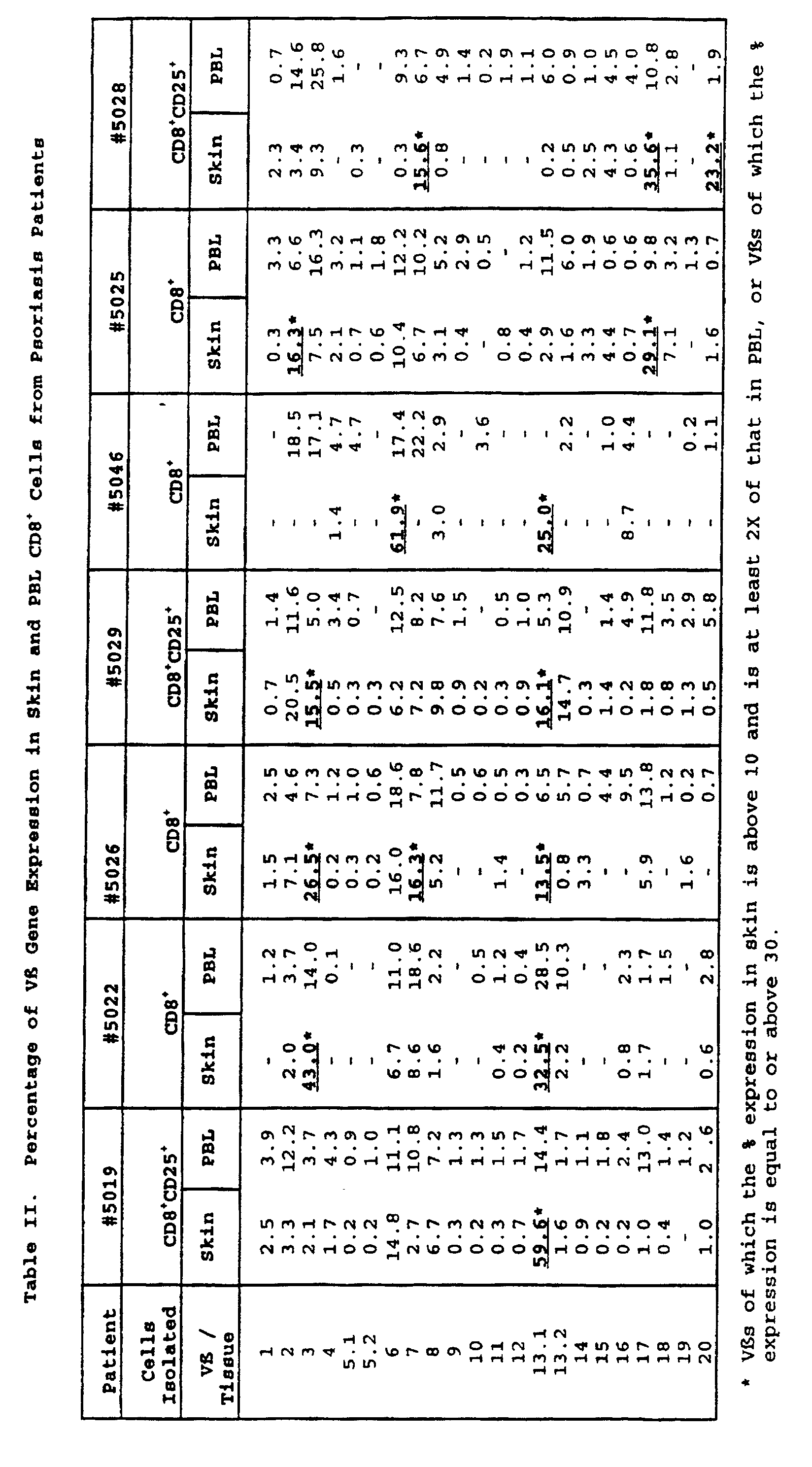
- V ⁇ 1 to V ⁇ 20 the percent of expression of V ⁇ 1 to V ⁇ 20 was determined as described above. It is reasoned that T cells which are involved in plaque formation should be stimulated in situ by antigen or superantigen on the skin elements. Therefore, one criteria for preferential usage of a V ⁇ in the skin was that it had to represent at least 10% of the total V ⁇ s in the skin and its relative expression of skin to PBL levels was at least 2.
- V ⁇ s of which the expression was very high (greater than 30%) in the skin although the relative expression of skin to PBL level was less than 2 as a result of an unusually high expression in the PBL.
- V ⁇ s were included since otherwise an active systemic response to superantigens, relevant or irrelevant to psoriasis, would mask the significance of a highly expressed V ⁇ in the skin.
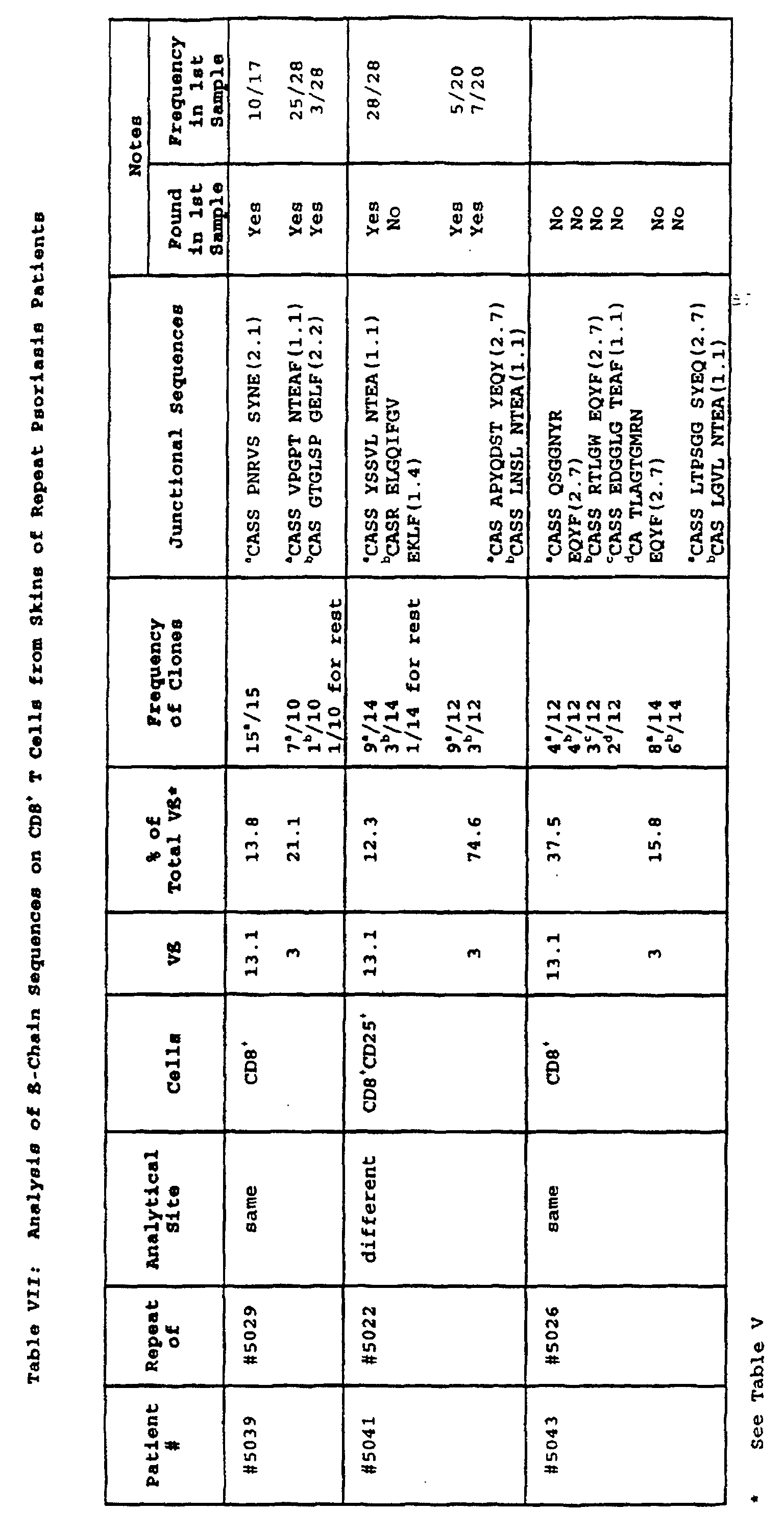
- V ⁇ 3 sequences in the skin were less oligoclonal than V ⁇ 13.1 sequences.
- skin antigen rather than superantigen still seems to be responsible for the in situ expansion of V ⁇ 3-bearing CD8 + T cells since superantigen would have also stimulated V ⁇ -bearing CD4 + T cells, (Kotzin, B. L. et al., Proc. Natl. Acad. Sci. (USA) , 88:9161-9165 (1991);
- Mcke T., et al., Int. J. Med. Microbiol ., 275:264-268 (1991) in the skin, in contrast to our finding, as shown in Table VI.
Landscapes
- Health & Medical Sciences (AREA)
- Life Sciences & Earth Sciences (AREA)
- Immunology (AREA)
- Chemical & Material Sciences (AREA)
- Organic Chemistry (AREA)
- Medicinal Chemistry (AREA)
- General Health & Medical Sciences (AREA)
- Engineering & Computer Science (AREA)
- Molecular Biology (AREA)
- Cell Biology (AREA)
- Biochemistry (AREA)
- Hematology (AREA)
- Proteomics, Peptides & Aminoacids (AREA)
- Pharmacology & Pharmacy (AREA)
- Public Health (AREA)
- Veterinary Medicine (AREA)
- Animal Behavior & Ethology (AREA)
- Biophysics (AREA)
- Genetics & Genomics (AREA)
- Microbiology (AREA)
- Nuclear Medicine, Radiotherapy & Molecular Imaging (AREA)
- Chemical Kinetics & Catalysis (AREA)
- Bioinformatics & Cheminformatics (AREA)
- Zoology (AREA)
- General Chemical & Material Sciences (AREA)
- Urology & Nephrology (AREA)
- Biomedical Technology (AREA)
- Analytical Chemistry (AREA)
- Rheumatology (AREA)
- Virology (AREA)
- Food Science & Technology (AREA)
- Physics & Mathematics (AREA)
- Tropical Medicine & Parasitology (AREA)
- General Physics & Mathematics (AREA)
- Pathology (AREA)
- Dermatology (AREA)
- Biotechnology (AREA)
- Mycology (AREA)
- Epidemiology (AREA)
- Toxicology (AREA)
Abstract
Description
Kimura, N. et al., Eur. J. Immunol., 17:375-383 (1987).




| TcR Vβ Gene Usage by Skin and PBL CD8+T Cells from Atopic Dermatitis Patients | ||||
| Patient | #5034 | #5035 | ||
| Cells Isolated | CD8+CD25+ | CD8+CD25+ | ||
| Vβ / Tissue | Skin | PBL | Skin | PBL |
| 1 | 1.9 | - | 1.6 | - |
| 2 | 15.6 | 26.4 | 11.4 | 6.9 |
| 3 | 5.6 | 24.8 | 16.1 | 44.6 |
| 4 | 0.3 | 4.4 | 4.9 | 2.2 |
| 5.1 | 1.1 | 0.1 | 0.6 | - |
| 5.2 | - | - | - | - |
| 6 | 10.2 | 6.5 | 17.6 | 9.2 |
| 7 | 27.6 | 19.4 | 10.1 | 5.5 |
| 8 | 5.6 | 2.6 | - | 3.8 |
| 9 | - | 1.2 | - | 0.6 |
| 10 | - | - | 6.0 | 0.3 |
| 11 | 2.7 | - | - | - |
| 12 | - | - | 2.0 | 0.8 |
| 13.1 | 4.1 | 3.5 | 8.8 | 8.2 |
| 13.2 | 2.1 | 6.8 | - | 3.5 |
| 14 | - | 0.4 | - | - |
| 15 | 0.5 | - | - | 0.9 |
| 16 | 1.9 | 0.5 | - | 3.9 |
| 17 | 1.3 | 1.5 | 2.9 | 6.1 |
| 18 | 5.1 | - | 17.9 | 0.6 |
| 19 | 2.0 | - | - | 1.2 |
| 20 | 12.4 | 1.9 | - | 1.9 |


Claims (19)
- Use of a peptide having substantially the amino acid sequence of a Vβ3, Vβ13.1 or Vβ17-containing T cell receptor present on the surface of T cells mediating psoriasis, or a fragment thereof, for the preparation of a medicament for preventing or reducing the severity of psoriasis in an individual.
- Use of a peptide having substantially the amino acid sequence of a non-conserved region of a Vβ3, Vβ13.1 or Vβ17-containing T cell receptor present on the surface of T cells mediating psoriasis, or a fragment thereof, for the preparation of a medicament for preventing or reducing the severity of psoriasis in an individual.
- The use of claims 1 or 2, wherein the peptide comprises substantially the amino acid sequence of the CDR1, CDR2 or CDR4 region of the β-chain variable region of the T cell receptor.
- The use of claim 3, wherein the peptide comprises substantially the Vβ3 sequence DPGLGLRLIYFSYDVKMKEKG or a fragment thereof.
- The use of claim 3, wherein the peptide comprises substantially the Vβ13.1 sequence DPGMGLRLIHYSVGAGITDQG or a fragment thereof.
- The use of claim 3, wherein the peptide comprises substantially the Vβ17 sequence DPGQGLRLIYYSQIVNDFQKG or a fragment thereof.
- The use of claim 2, wherein the peptide comprises substantially the amino acid sequence of the CDR3 region of a β-chain of the T cell receptor.
- A composition for preventing or reducing the severity of psoriasis in an individual comprising a peptide having substantially the amino acid sequence of a non-conserved region of a Vβ13.1-containing T cell receptor present on the surface of T cells mediating psoriasis, or a fragment thereof, and a peptide having substantially the amino acid sequence of a non-conserved region of a Vβ3-containing T cell receptor present on the surface of T cells mediating psoriasis, or a fragment thereof.
- Use of a T cell receptor binding partner for a Vβ3, Vβ13.1 or Vβ17-containing T cell receptor present on the surface of T cells mediating psoriasis for the preparation of a medicament for preventing the proliferation of T cells associated with psoriasis in an individual.
- Use of a cytotoxic or cytostatic agent specifically reactive with T cells, which are characterized by Vβ3, Vβ13.1 or Vβ17-containing T cell receptors on the surface of these T cells for preparing a medicament for preventing or reducing the severity of psoriasis in an individual.
- The use of claim 10, wherein the agent is an antibody attached to a moiety selected from the group consisting of radioactive moieties, chemotherapeutic moieties and chemotoxic moieties.
- An in vitro method for detecting T cells having a Vβ3, Vβ13.1 or Vβ17-containing T cell receptor for use in diagnosing or predicting susceptibility to psoriasis in an individual, comprising testing a sample from the individual for the presence of T cells having a Vβ3, Vβ13.1 or a Vβ17-containing T cell receptor, the presence of abnormal expression of T cells containing the T cell receptor indicating the pathology or susceptibility to psoriasis.
- Use of a vector comprising an expression control sequence operatively linked to a nucleic acid encoding substantially a peptide having substantially the amino acid sequence of a non-conserved region of a Vβ3, Vβ13.1 or Vβ17-containing T cell receptor present on the surface of T cells mediating psoriasis, or a fragment thereof, for the preparation of a medicament for preventing or reducing the severity of psoriasis in an individual.
- The use of claim 13, wherein the peptide comprises substantially the amino acid sequence of the CDR1, CDR2 or CDR4 region of the β-chain variable region of the T-cell receptor.
- The use of claim 14, wherein the peptide comprises substantially the Vβ3 sequence DPGLGLRLIYFSYDVKMKEKG or a fragment thereof.
- The use of claim 14, wherein the peptide comprises substantially the Vβ13.1 sequence DPGMGLRLIHYSVGAGITDQG or a fragment thereof.
- The use of claim 14, wherein the peptide comprises substantially the Vβ17 sequence DPGQGLRLIYYSQIVNDFQKG or a fragment thereof.
- The use of claim 13, wherein the peptide comprises substantially the amino acid sequence of the CDR3 region of a β-chain of the T cell receptor.
- A vector comprising an expression control sequence operatively linked to a nucleic acid encoding a peptide comprising substantially the amino acid sequence of a non-conserved region sequence of a Vβ3, Vβ13.1 or Vβ17-containing T cell receptor present on the surface of T cells mediating psoriasis, or a fragment thereof.
Applications Claiming Priority (3)
| Application Number | Priority Date | Filing Date | Title |
|---|---|---|---|
| US182967 | 1994-01-14 | ||
| US08/182,967 US6413516B1 (en) | 1989-03-21 | 1994-01-14 | Peptides and methods against psoriasis |
| PCT/US1995/000658 WO1995019375A1 (en) | 1994-01-14 | 1995-01-13 | Peptides and methods against psoriasis |
Publications (2)
| Publication Number | Publication Date |
|---|---|
| EP0738281A1 EP0738281A1 (en) | 1996-10-23 |
| EP0738281B1 true EP0738281B1 (en) | 2002-11-13 |
Family
ID=22670842
Family Applications (1)
| Application Number | Title | Priority Date | Filing Date |
|---|---|---|---|
| EP95909258A Expired - Lifetime EP0738281B1 (en) | 1994-01-14 | 1995-01-13 | Peptides and their uses against psoriasis |
Country Status (14)
| Country | Link |
|---|---|
| US (1) | US6413516B1 (en) |
| EP (1) | EP0738281B1 (en) |
| JP (2) | JPH09508112A (en) |
| CN (1) | CN1138865A (en) |
| AT (1) | ATE227738T1 (en) |
| BR (1) | BR9506511A (en) |
| CA (1) | CA2179280A1 (en) |
| DE (1) | DE69528817T2 (en) |
| ES (1) | ES2184791T3 (en) |
| FI (1) | FI962836A7 (en) |
| MX (1) | MX9602473A (en) |
| NO (1) | NO962943L (en) |
| NZ (1) | NZ279987A (en) |
| WO (1) | WO1995019375A1 (en) |
Families Citing this family (8)
| Publication number | Priority date | Publication date | Assignee | Title |
|---|---|---|---|---|
| GB0408164D0 (en) | 2004-04-13 | 2004-05-19 | Immune Targeting Systems Ltd | Antigen delivery vectors and constructs |
| GB0716992D0 (en) | 2007-08-31 | 2007-10-10 | Immune Targeting Systems Its L | Influenza antigen delivery vectors and constructs |
| JP2009266963A (en) * | 2008-04-23 | 2009-11-12 | Sumitomo Electric Ind Ltd | Nitride-based light emitting device, and method of manufacturing semiconductor light emitting device |
| CN113874400B (en) | 2019-03-11 | 2025-02-07 | 詹森生物科技公司 | Anti-Vβ17/anti-CD123 bispecific antibody |
| AU2021339754A1 (en) * | 2020-09-11 | 2023-05-25 | Janssen Biotech, Inc. | Methods and compositions for modulating beta chain mediated immunity |
| US12448449B2 (en) | 2020-09-11 | 2025-10-21 | Janssen Biotech, Inc. | Immune targeting molecules and uses thereof |
| WO2023111695A1 (en) | 2021-12-16 | 2023-06-22 | Ramakrishna Reddy Isanaka | A stable anti-angiogenic and anti-inflammatory pharmaceutical formulation and pharmaceutical combination for treatment and prevention of psoriasis |
| CN116466095B (en) * | 2023-06-15 | 2023-09-01 | 朗肽生物制药股份有限公司 | A kind of polypeptide and its application |
Family Cites Families (6)
| Publication number | Priority date | Publication date | Assignee | Title |
|---|---|---|---|---|
| DE570027T1 (en) * | 1984-03-01 | 1994-11-17 | Univ Leland Stanford Junior | T cell receptor, specific for antigen polypeptides and related polynucleotides. |
| US4886743A (en) * | 1985-04-24 | 1989-12-12 | California Institute Of Technology | Diagnostic reagents based on unique sequences within the variable region of the T cell receptor and uses thereof |
| DK0552142T3 (en) * | 1989-07-19 | 1998-09-07 | Connetics Corp | T cell receptor peptides and therapeutics for autoimmune and malignant diseases |
| CA2072356A1 (en) * | 1989-12-29 | 1991-06-30 | James L. Urban | Diagnosis and treatment of diseases |
| WO1993006135A1 (en) | 1991-09-23 | 1993-04-01 | Genentech, Inc. | Diagnosing and treating autoimmune disorders |
| AU3418893A (en) * | 1991-12-24 | 1993-07-28 | Immune Response Corporation, The | Vaccination and methods against diseases resulting from pathogenic responses by specific t cell populations |
-
1994
- 1994-01-14 US US08/182,967 patent/US6413516B1/en not_active Expired - Fee Related
-
1995
- 1995-01-13 NZ NZ279987A patent/NZ279987A/en unknown
- 1995-01-13 WO PCT/US1995/000658 patent/WO1995019375A1/en not_active Ceased
- 1995-01-13 ES ES95909258T patent/ES2184791T3/en not_active Expired - Lifetime
- 1995-01-13 AT AT95909258T patent/ATE227738T1/en not_active IP Right Cessation
- 1995-01-13 CA CA002179280A patent/CA2179280A1/en not_active Abandoned
- 1995-01-13 MX MX9602473A patent/MX9602473A/en not_active Application Discontinuation
- 1995-01-13 CN CN95191213A patent/CN1138865A/en active Pending
- 1995-01-13 JP JP7519192A patent/JPH09508112A/en not_active Withdrawn
- 1995-01-13 BR BR9506511A patent/BR9506511A/en not_active Application Discontinuation
- 1995-01-13 FI FI962836A patent/FI962836A7/en unknown
- 1995-01-13 DE DE69528817T patent/DE69528817T2/en not_active Expired - Fee Related
- 1995-01-13 EP EP95909258A patent/EP0738281B1/en not_active Expired - Lifetime
-
1996
- 1996-07-12 NO NO962943A patent/NO962943L/en not_active Application Discontinuation
-
2001
- 2001-02-28 JP JP2001055930A patent/JP2001288108A/en active Pending
Also Published As
| Publication number | Publication date |
|---|---|
| AU1728295A (en) | 1995-08-01 |
| JP2001288108A (en) | 2001-10-16 |
| MX9602473A (en) | 1997-05-31 |
| NZ279987A (en) | 1999-09-29 |
| CA2179280A1 (en) | 1995-07-20 |
| NO962943D0 (en) | 1996-07-12 |
| AU697910B2 (en) | 1998-10-22 |
| FI962836L (en) | 1996-07-12 |
| NO962943L (en) | 1996-09-13 |
| BR9506511A (en) | 1997-09-09 |
| WO1995019375A1 (en) | 1995-07-20 |
| DE69528817D1 (en) | 2002-12-19 |
| CN1138865A (en) | 1996-12-25 |
| JPH09508112A (en) | 1997-08-19 |
| DE69528817T2 (en) | 2003-09-11 |
| US6413516B1 (en) | 2002-07-02 |
| ATE227738T1 (en) | 2002-11-15 |
| FI962836A0 (en) | 1996-07-12 |
| FI962836A7 (en) | 1996-07-12 |
| ES2184791T3 (en) | 2003-04-16 |
| EP0738281A1 (en) | 1996-10-23 |
Similar Documents
| Publication | Publication Date | Title |
|---|---|---|
| EP0463101B1 (en) | Vaccination and methods against diseases resulting from pathogenic responses by specific t cell populations | |
| EP0722738A2 (en) | Vaccination and methods against diseases resulting from pathogenic responses by specific T cell populations | |
| US6207645B1 (en) | Vaccination and methods against diseases resulting from pathogenic responses by specific T cell populations | |
| US6464978B1 (en) | Vaccination and methods against multiple sclerosis resulting from pathogenic responses by specific T cell populations | |
| US6221352B1 (en) | Method of preventing the proliferation of Vβ14 or Vβ17-Expressing T cells | |
| WO1993012814A2 (en) | Vaccination and methods against diseases resulting from pathogenic responses by specific t cell populations | |
| US6413516B1 (en) | Peptides and methods against psoriasis | |
| US6113903A (en) | Peptides and methods against diabetes | |
| US5837246A (en) | Vaccination and methods against diseases resulting from pathogenic responses by specific T cell populations | |
| AU697910C (en) | Peptides and methods against psoriasis | |
| WO1999027957A1 (en) | Vaccination and methods against multiple sclerosis using specific tcr vbeta peptides | |
| AU648753C (en) | Vaccination and methods against diseases resulting from pathogenic responses by specific T cell populations | |
| LINDER | Peripheral Blood T-Cell Receptor β-Chain V-Repertoire in Atopic Dermatitis Patients After In Vitro Exposure toPityrosporum orbiculare Extract. | |
| AU6440999A (en) | Composition for preventing or treating a T-cell mediated pathology |
Legal Events
| Date | Code | Title | Description |
|---|---|---|---|
| PUAI | Public reference made under article 153(3) epc to a published international application that has entered the european phase |
Free format text: ORIGINAL CODE: 0009012 |
|
| 17P | Request for examination filed |
Effective date: 19960702 |
|
| AK | Designated contracting states |
Kind code of ref document: A1 Designated state(s): AT BE CH DE DK ES FR GB GR IE IT LI LU MC NL PT SE |
|
| 17Q | First examination report despatched |
Effective date: 19970731 |
|
| GRAG | Despatch of communication of intention to grant |
Free format text: ORIGINAL CODE: EPIDOS AGRA |
|
| RIC1 | Information provided on ipc code assigned before grant |
Free format text: 7C 07K 14/725 A, 7A 61K 38/17 B, 7G 01N 33/68 B, 7A 61P 17/06 B |
|
| RTI1 | Title (correction) |
Free format text: PEPTIDES AND THEIR USES AGAINST PSORIASIS |
|
| GRAG | Despatch of communication of intention to grant |
Free format text: ORIGINAL CODE: EPIDOS AGRA |
|
| GRAH | Despatch of communication of intention to grant a patent |
Free format text: ORIGINAL CODE: EPIDOS IGRA |
|
| GRAH | Despatch of communication of intention to grant a patent |
Free format text: ORIGINAL CODE: EPIDOS IGRA |
|
| GRAA | (expected) grant |
Free format text: ORIGINAL CODE: 0009210 |
|
| AK | Designated contracting states |
Kind code of ref document: B1 Designated state(s): AT BE CH DE DK ES FR GB GR IE IT LI LU MC NL PT SE |
|
| PG25 | Lapsed in a contracting state [announced via postgrant information from national office to epo] |
Ref country code: NL Free format text: LAPSE BECAUSE OF FAILURE TO SUBMIT A TRANSLATION OF THE DESCRIPTION OR TO PAY THE FEE WITHIN THE PRESCRIBED TIME-LIMIT Effective date: 20021113 Ref country code: LI Free format text: LAPSE BECAUSE OF FAILURE TO SUBMIT A TRANSLATION OF THE DESCRIPTION OR TO PAY THE FEE WITHIN THE PRESCRIBED TIME-LIMIT Effective date: 20021113 Ref country code: GR Free format text: LAPSE BECAUSE OF FAILURE TO SUBMIT A TRANSLATION OF THE DESCRIPTION OR TO PAY THE FEE WITHIN THE PRESCRIBED TIME-LIMIT Effective date: 20021113 Ref country code: CH Free format text: LAPSE BECAUSE OF FAILURE TO SUBMIT A TRANSLATION OF THE DESCRIPTION OR TO PAY THE FEE WITHIN THE PRESCRIBED TIME-LIMIT Effective date: 20021113 Ref country code: BE Free format text: LAPSE BECAUSE OF FAILURE TO SUBMIT A TRANSLATION OF THE DESCRIPTION OR TO PAY THE FEE WITHIN THE PRESCRIBED TIME-LIMIT Effective date: 20021113 Ref country code: AT Free format text: LAPSE BECAUSE OF FAILURE TO SUBMIT A TRANSLATION OF THE DESCRIPTION OR TO PAY THE FEE WITHIN THE PRESCRIBED TIME-LIMIT Effective date: 20021113 |
|
| REF | Corresponds to: |
Ref document number: 227738 Country of ref document: AT Date of ref document: 20021115 Kind code of ref document: T |
|
| REG | Reference to a national code |
Ref country code: GB Ref legal event code: FG4D |
|
| REG | Reference to a national code |
Ref country code: CH Ref legal event code: EP |
|
| REG | Reference to a national code |
Ref country code: IE Ref legal event code: FG4D |
|
| REF | Corresponds to: |
Ref document number: 69528817 Country of ref document: DE Date of ref document: 20021219 |
|
| PG25 | Lapsed in a contracting state [announced via postgrant information from national office to epo] |
Ref country code: LU Free format text: LAPSE BECAUSE OF NON-PAYMENT OF DUE FEES Effective date: 20030113 Ref country code: IE Free format text: LAPSE BECAUSE OF NON-PAYMENT OF DUE FEES Effective date: 20030113 |
|
| PG25 | Lapsed in a contracting state [announced via postgrant information from national office to epo] |
Ref country code: MC Free format text: LAPSE BECAUSE OF NON-PAYMENT OF DUE FEES Effective date: 20030131 |
|
| PG25 | Lapsed in a contracting state [announced via postgrant information from national office to epo] |
Ref country code: SE Free format text: LAPSE BECAUSE OF FAILURE TO SUBMIT A TRANSLATION OF THE DESCRIPTION OR TO PAY THE FEE WITHIN THE PRESCRIBED TIME-LIMIT Effective date: 20030213 Ref country code: PT Free format text: LAPSE BECAUSE OF FAILURE TO SUBMIT A TRANSLATION OF THE DESCRIPTION OR TO PAY THE FEE WITHIN THE PRESCRIBED TIME-LIMIT Effective date: 20030213 Ref country code: DK Free format text: LAPSE BECAUSE OF FAILURE TO SUBMIT A TRANSLATION OF THE DESCRIPTION OR TO PAY THE FEE WITHIN THE PRESCRIBED TIME-LIMIT Effective date: 20030213 |
|
| NLV1 | Nl: lapsed or annulled due to failure to fulfill the requirements of art. 29p and 29m of the patents act | ||
| REG | Reference to a national code |
Ref country code: ES Ref legal event code: FG2A Ref document number: 2184791 Country of ref document: ES Kind code of ref document: T3 |
|
| REG | Reference to a national code |
Ref country code: CH Ref legal event code: PL |
|
| ET | Fr: translation filed | ||
| PLBE | No opposition filed within time limit |
Free format text: ORIGINAL CODE: 0009261 |
|
| STAA | Information on the status of an ep patent application or granted ep patent |
Free format text: STATUS: NO OPPOSITION FILED WITHIN TIME LIMIT |
|
| 26N | No opposition filed |
Effective date: 20030814 |
|
| REG | Reference to a national code |
Ref country code: IE Ref legal event code: MM4A |
|
| PGFP | Annual fee paid to national office [announced via postgrant information from national office to epo] |
Ref country code: GB Payment date: 20070110 Year of fee payment: 13 |
|
| PGFP | Annual fee paid to national office [announced via postgrant information from national office to epo] |
Ref country code: DE Payment date: 20070111 Year of fee payment: 13 |
|
| PGFP | Annual fee paid to national office [announced via postgrant information from national office to epo] |
Ref country code: ES Payment date: 20070220 Year of fee payment: 13 |
|
| PGFP | Annual fee paid to national office [announced via postgrant information from national office to epo] |
Ref country code: IT Payment date: 20070611 Year of fee payment: 13 |
|
| PGFP | Annual fee paid to national office [announced via postgrant information from national office to epo] |
Ref country code: FR Payment date: 20070109 Year of fee payment: 13 |
|
| GBPC | Gb: european patent ceased through non-payment of renewal fee |
Effective date: 20080113 |
|
| PG25 | Lapsed in a contracting state [announced via postgrant information from national office to epo] |
Ref country code: DE Free format text: LAPSE BECAUSE OF NON-PAYMENT OF DUE FEES Effective date: 20080801 |
|
| REG | Reference to a national code |
Ref country code: FR Ref legal event code: ST Effective date: 20081029 |
|
| PG25 | Lapsed in a contracting state [announced via postgrant information from national office to epo] |
Ref country code: GB Free format text: LAPSE BECAUSE OF NON-PAYMENT OF DUE FEES Effective date: 20080113 |
|
| REG | Reference to a national code |
Ref country code: ES Ref legal event code: FD2A Effective date: 20080114 |
|
| PG25 | Lapsed in a contracting state [announced via postgrant information from national office to epo] |
Ref country code: FR Free format text: LAPSE BECAUSE OF NON-PAYMENT OF DUE FEES Effective date: 20080131 |
|
| PG25 | Lapsed in a contracting state [announced via postgrant information from national office to epo] |
Ref country code: ES Free format text: LAPSE BECAUSE OF NON-PAYMENT OF DUE FEES Effective date: 20080114 |
|
| PG25 | Lapsed in a contracting state [announced via postgrant information from national office to epo] |
Ref country code: IT Free format text: LAPSE BECAUSE OF NON-PAYMENT OF DUE FEES Effective date: 20080113 |