EP0736539B1 - Mesoporous crystalline acid composition of a diphosphonate-phosphite of a tetravalent metal which can be used as a catalyst - Google Patents
Mesoporous crystalline acid composition of a diphosphonate-phosphite of a tetravalent metal which can be used as a catalyst Download PDFInfo
- Publication number
- EP0736539B1 EP0736539B1 EP96104486A EP96104486A EP0736539B1 EP 0736539 B1 EP0736539 B1 EP 0736539B1 EP 96104486 A EP96104486 A EP 96104486A EP 96104486 A EP96104486 A EP 96104486A EP 0736539 B1 EP0736539 B1 EP 0736539B1
- Authority
- EP
- European Patent Office
- Prior art keywords
- acid
- tetravalent metal
- phosphonic
- diphosphonate
- phosphite
- Prior art date
- Legal status (The legal status is an assumption and is not a legal conclusion. Google has not performed a legal analysis and makes no representation as to the accuracy of the status listed.)
- Expired - Lifetime
Links
- 239000002253 acid Substances 0.000 title claims abstract description 41
- 229910052751 metal Inorganic materials 0.000 title claims abstract description 36
- 239000002184 metal Substances 0.000 title claims abstract description 36
- 239000000203 mixture Substances 0.000 title claims abstract description 32
- 239000003054 catalyst Substances 0.000 title claims description 16
- 239000007787 solid Substances 0.000 claims abstract description 38
- 238000000034 method Methods 0.000 claims abstract description 19
- 229910018828 PO3H2 Inorganic materials 0.000 claims abstract description 16
- 238000006243 chemical reaction Methods 0.000 claims abstract description 15
- 239000003795 chemical substances by application Substances 0.000 claims abstract description 9
- 238000006277 sulfonation reaction Methods 0.000 claims abstract description 8
- 229930195733 hydrocarbon Natural products 0.000 claims abstract description 4
- 150000002430 hydrocarbons Chemical class 0.000 claims abstract description 4
- XLYOFNOQVPJJNP-UHFFFAOYSA-N water Substances O XLYOFNOQVPJJNP-UHFFFAOYSA-N 0.000 claims description 18
- 239000011148 porous material Substances 0.000 claims description 17
- KRHYYFGTRYWZRS-UHFFFAOYSA-N Fluorane Chemical compound F KRHYYFGTRYWZRS-UHFFFAOYSA-N 0.000 claims description 16
- RYHBNJHYFVUHQT-UHFFFAOYSA-N 1,4-Dioxane Chemical compound C1COCCO1 RYHBNJHYFVUHQT-UHFFFAOYSA-N 0.000 claims description 13
- ISIJQEHRDSCQIU-UHFFFAOYSA-N tert-butyl 2,7-diazaspiro[4.5]decane-7-carboxylate Chemical compound C1N(C(=O)OC(C)(C)C)CCCC11CNCC1 ISIJQEHRDSCQIU-UHFFFAOYSA-N 0.000 claims description 12
- XQRLCLUYWUNEEH-UHFFFAOYSA-L diphosphonate(2-) Chemical compound [O-]P(=O)OP([O-])=O XQRLCLUYWUNEEH-UHFFFAOYSA-L 0.000 claims description 11
- 150000001875 compounds Chemical class 0.000 claims description 10
- XQRLCLUYWUNEEH-UHFFFAOYSA-N diphosphonic acid Chemical compound OP(=O)OP(O)=O XQRLCLUYWUNEEH-UHFFFAOYSA-N 0.000 claims description 10
- BDERNNFJNOPAEC-UHFFFAOYSA-N propan-1-ol Chemical compound CCCO BDERNNFJNOPAEC-UHFFFAOYSA-N 0.000 claims description 10
- QCWXUUIWCKQGHC-UHFFFAOYSA-N Zirconium Chemical compound [Zr] QCWXUUIWCKQGHC-UHFFFAOYSA-N 0.000 claims description 9
- 229910052726 zirconium Inorganic materials 0.000 claims description 9
- QLZHNIAADXEJJP-UHFFFAOYSA-N Phenylphosphonic acid Chemical compound OP(O)(=O)C1=CC=CC=C1 QLZHNIAADXEJJP-UHFFFAOYSA-N 0.000 claims description 8
- 239000002904 solvent Substances 0.000 claims description 8
- RCJVRSBWZCNNQT-UHFFFAOYSA-N dichloridooxygen Chemical compound ClOCl RCJVRSBWZCNNQT-UHFFFAOYSA-N 0.000 claims description 5
- 239000003960 organic solvent Substances 0.000 claims description 5
- 229910006251 ZrOCl2.8H2O Inorganic materials 0.000 claims description 4
- 125000001931 aliphatic group Chemical group 0.000 claims description 4
- 238000002360 preparation method Methods 0.000 claims description 4
- IPCAPQRVQMIMAN-UHFFFAOYSA-L zirconyl chloride Chemical compound Cl[Zr](Cl)=O IPCAPQRVQMIMAN-UHFFFAOYSA-L 0.000 claims description 4
- JHDJUJAFXNIIIW-UHFFFAOYSA-N (4-phosphonophenyl)phosphonic acid Chemical compound OP(O)(=O)C1=CC=C(P(O)(O)=O)C=C1 JHDJUJAFXNIIIW-UHFFFAOYSA-N 0.000 claims description 3
- 229910006080 SO2X Inorganic materials 0.000 claims description 3
- 125000002947 alkylene group Chemical group 0.000 claims description 3
- 125000003118 aryl group Chemical group 0.000 claims description 3
- 125000000732 arylene group Chemical group 0.000 claims description 3
- 230000001588 bifunctional effect Effects 0.000 claims description 3
- OHCHUOJTZGEAIB-UHFFFAOYSA-N chlorosulfonylphosphonic acid Chemical compound OP(O)(=O)S(Cl)(=O)=O OHCHUOJTZGEAIB-UHFFFAOYSA-N 0.000 claims description 3
- 239000002808 molecular sieve Substances 0.000 claims description 3
- URGAHOPLAPQHLN-UHFFFAOYSA-N sodium aluminosilicate Chemical compound [Na+].[Al+3].[O-][Si]([O-])=O.[O-][Si]([O-])=O URGAHOPLAPQHLN-UHFFFAOYSA-N 0.000 claims description 3
- AKEJUJNQAAGONA-UHFFFAOYSA-N sulfur trioxide Inorganic materials O=S(=O)=O AKEJUJNQAAGONA-UHFFFAOYSA-N 0.000 claims description 3
- JKTORXLUQLQJCM-UHFFFAOYSA-N 4-phosphonobutylphosphonic acid Chemical compound OP(O)(=O)CCCCP(O)(O)=O JKTORXLUQLQJCM-UHFFFAOYSA-N 0.000 claims description 2
- OGBVRMYSNSKIEF-UHFFFAOYSA-N Benzylphosphonic acid Chemical compound OP(O)(=O)CC1=CC=CC=C1 OGBVRMYSNSKIEF-UHFFFAOYSA-N 0.000 claims description 2
- OYTBLOLBENUVGR-UHFFFAOYSA-N OP(O)=O.C1=CC=CC=C1C1=CC=CC=C1 Chemical compound OP(O)=O.C1=CC=CC=C1C1=CC=CC=C1 OYTBLOLBENUVGR-UHFFFAOYSA-N 0.000 claims description 2
- ATJFFYVFTNAWJD-UHFFFAOYSA-N Tin Chemical compound [Sn] ATJFFYVFTNAWJD-UHFFFAOYSA-N 0.000 claims description 2
- RTAQQCXQSZGOHL-UHFFFAOYSA-N Titanium Chemical compound [Ti] RTAQQCXQSZGOHL-UHFFFAOYSA-N 0.000 claims description 2
- 229910006213 ZrOCl2 Inorganic materials 0.000 claims description 2
- 239000003125 aqueous solvent Substances 0.000 claims description 2
- JDRCQIRZJMJGMW-UHFFFAOYSA-N benzhydrylphosphonic acid Chemical compound C=1C=CC=CC=1C(P(O)(=O)O)C1=CC=CC=C1 JDRCQIRZJMJGMW-UHFFFAOYSA-N 0.000 claims description 2
- 125000004432 carbon atom Chemical group C* 0.000 claims description 2
- 239000011973 solid acid Substances 0.000 claims description 2
- 229910052718 tin Inorganic materials 0.000 claims description 2
- 229910052719 titanium Inorganic materials 0.000 claims description 2
- 239000010936 titanium Substances 0.000 claims description 2
- PBNUXBQPKDSKLC-UHFFFAOYSA-N tritylphosphonic acid Chemical compound C=1C=CC=CC=1C(C=1C=CC=CC=1)(P(O)(=O)O)C1=CC=CC=C1 PBNUXBQPKDSKLC-UHFFFAOYSA-N 0.000 claims description 2
- OJMIONKXNSYLSR-UHFFFAOYSA-N phosphorous acid Chemical group OP(O)O OJMIONKXNSYLSR-UHFFFAOYSA-N 0.000 claims 4
- 125000000816 ethylene group Chemical group [H]C([H])([*:1])C([H])([H])[*:2] 0.000 claims 2
- 239000003377 acid catalyst Substances 0.000 claims 1
- 150000004689 octahydrates Chemical class 0.000 claims 1
- 238000009826 distribution Methods 0.000 abstract description 10
- 229910006069 SO3H Inorganic materials 0.000 abstract description 9
- 238000004519 manufacturing process Methods 0.000 abstract description 3
- 239000011949 solid catalyst Substances 0.000 abstract description 2
- 239000000243 solution Substances 0.000 description 22
- 239000000463 material Substances 0.000 description 12
- DLYUQMMRRRQYAE-UHFFFAOYSA-N tetraphosphorus decaoxide Chemical compound O1P(O2)(=O)OP3(=O)OP1(=O)OP2(=O)O3 DLYUQMMRRRQYAE-UHFFFAOYSA-N 0.000 description 10
- KWYUFKZDYYNOTN-UHFFFAOYSA-M Potassium hydroxide Chemical compound [OH-].[K+] KWYUFKZDYYNOTN-UHFFFAOYSA-M 0.000 description 9
- IJGRMHOSHXDMSA-UHFFFAOYSA-N Atomic nitrogen Chemical compound N#N IJGRMHOSHXDMSA-UHFFFAOYSA-N 0.000 description 6
- ABLZXFCXXLZCGV-UHFFFAOYSA-N Phosphorous acid Chemical class OP(O)=O ABLZXFCXXLZCGV-UHFFFAOYSA-N 0.000 description 6
- 238000005119 centrifugation Methods 0.000 description 6
- 238000005259 measurement Methods 0.000 description 6
- 230000015572 biosynthetic process Effects 0.000 description 5
- 238000007306 functionalization reaction Methods 0.000 description 5
- 238000004448 titration Methods 0.000 description 5
- IAZDPXIOMUYVGZ-UHFFFAOYSA-N Dimethylsulphoxide Chemical compound CS(C)=O IAZDPXIOMUYVGZ-UHFFFAOYSA-N 0.000 description 4
- 229910005948 SO2Cl Inorganic materials 0.000 description 4
- RAHZWNYVWXNFOC-UHFFFAOYSA-N Sulphur dioxide Chemical compound O=S=O RAHZWNYVWXNFOC-UHFFFAOYSA-N 0.000 description 4
- WYURNTSHIVDZCO-UHFFFAOYSA-N Tetrahydrofuran Chemical compound C1CCOC1 WYURNTSHIVDZCO-UHFFFAOYSA-N 0.000 description 4
- BWTHBHVOONSAJC-UHFFFAOYSA-M hydroxy-(2-phosphonophenyl)phosphinate;zirconium(4+);phosphite Chemical compound [Zr+4].[O-]P([O-])[O-].OP(O)(=O)C1=CC=CC=C1P(O)([O-])=O BWTHBHVOONSAJC-UHFFFAOYSA-M 0.000 description 4
- 239000000843 powder Substances 0.000 description 4
- 238000001179 sorption measurement Methods 0.000 description 4
- NNJPAMQRBHASEV-UHFFFAOYSA-N (2-phosphonophenyl)phosphonic acid Chemical compound OP(O)(=O)C1=CC=CC=C1P(O)(O)=O NNJPAMQRBHASEV-UHFFFAOYSA-N 0.000 description 3
- IAZDPXIOMUYVGZ-WFGJKAKNSA-N Dimethyl sulfoxide Chemical compound [2H]C([2H])([2H])S(=O)C([2H])([2H])[2H] IAZDPXIOMUYVGZ-WFGJKAKNSA-N 0.000 description 3
- 238000005481 NMR spectroscopy Methods 0.000 description 3
- 238000002441 X-ray diffraction Methods 0.000 description 3
- 150000007513 acids Chemical class 0.000 description 3
- 238000004458 analytical method Methods 0.000 description 3
- 229910052757 nitrogen Inorganic materials 0.000 description 3
- 239000007858 starting material Substances 0.000 description 3
- 238000003756 stirring Methods 0.000 description 3
- 238000004679 31P NMR spectroscopy Methods 0.000 description 2
- VEXZGXHMUGYJMC-UHFFFAOYSA-M Chloride anion Chemical compound [Cl-] VEXZGXHMUGYJMC-UHFFFAOYSA-M 0.000 description 2
- YQKRHTAZPLCKFD-UHFFFAOYSA-M P([O-])([O-])[O-].P(=O)([O-])OP(=O)O.[Zr+4] Chemical compound P([O-])([O-])[O-].P(=O)([O-])OP(=O)O.[Zr+4] YQKRHTAZPLCKFD-UHFFFAOYSA-M 0.000 description 2
- 238000002083 X-ray spectrum Methods 0.000 description 2
- 230000003197 catalytic effect Effects 0.000 description 2
- 125000002091 cationic group Chemical group 0.000 description 2
- 239000003153 chemical reaction reagent Substances 0.000 description 2
- 238000003795 desorption Methods 0.000 description 2
- 238000001914 filtration Methods 0.000 description 2
- 150000002739 metals Chemical class 0.000 description 2
- 238000012986 modification Methods 0.000 description 2
- 230000004048 modification Effects 0.000 description 2
- 239000011541 reaction mixture Substances 0.000 description 2
- 150000003839 salts Chemical class 0.000 description 2
- 238000001228 spectrum Methods 0.000 description 2
- 239000000725 suspension Substances 0.000 description 2
- YLQBMQCUIZJEEH-UHFFFAOYSA-N tetrahydrofuran Natural products C=1C=COC=1 YLQBMQCUIZJEEH-UHFFFAOYSA-N 0.000 description 2
- 238000000954 titration curve Methods 0.000 description 2
- 238000005406 washing Methods 0.000 description 2
- HNSDLXPSAYFUHK-UHFFFAOYSA-N 1,4-bis(2-ethylhexyl) sulfosuccinate Chemical compound CCCCC(CC)COC(=O)CC(S(O)(=O)=O)C(=O)OCC(CC)CCCC HNSDLXPSAYFUHK-UHFFFAOYSA-N 0.000 description 1
- 0 C*C*[N+]([O-])O[N+](*C**=*)[O-] Chemical compound C*C*[N+]([O-])O[N+](*C**=*)[O-] 0.000 description 1
- 229910019142 PO4 Inorganic materials 0.000 description 1
- 238000007171 acid catalysis Methods 0.000 description 1
- 230000029936 alkylation Effects 0.000 description 1
- 238000005804 alkylation reaction Methods 0.000 description 1
- 239000007864 aqueous solution Substances 0.000 description 1
- 238000009835 boiling Methods 0.000 description 1
- 238000004587 chromatography analysis Methods 0.000 description 1
- 238000001816 cooling Methods 0.000 description 1
- 238000013461 design Methods 0.000 description 1
- VPCDHAPSEZNONV-UHFFFAOYSA-J dioxido-oxo-phenyl-$l^{5}-phosphane;zirconium(4+) Chemical compound [Zr+4].[O-]P([O-])(=O)C1=CC=CC=C1.[O-]P([O-])(=O)C1=CC=CC=C1 VPCDHAPSEZNONV-UHFFFAOYSA-J 0.000 description 1
- 238000006266 etherification reaction Methods 0.000 description 1
- 238000000605 extraction Methods 0.000 description 1
- 239000011521 glass Substances 0.000 description 1
- 238000010438 heat treatment Methods 0.000 description 1
- BHEPBYXIRTUNPN-UHFFFAOYSA-N hydridophosphorus(.) (triplet) Chemical compound [PH] BHEPBYXIRTUNPN-UHFFFAOYSA-N 0.000 description 1
- 230000007062 hydrolysis Effects 0.000 description 1
- 238000006460 hydrolysis reaction Methods 0.000 description 1
- 239000012442 inert solvent Substances 0.000 description 1
- 238000006317 isomerization reaction Methods 0.000 description 1
- 150000002605 large molecules Chemical class 0.000 description 1
- 229920002521 macromolecule Polymers 0.000 description 1
- 238000003760 magnetic stirring Methods 0.000 description 1
- FUBACIUATZGHAC-UHFFFAOYSA-N oxozirconium;octahydrate;dihydrochloride Chemical compound O.O.O.O.O.O.O.O.Cl.Cl.[Zr]=O FUBACIUATZGHAC-UHFFFAOYSA-N 0.000 description 1
- 239000010452 phosphate Substances 0.000 description 1
- AQSJGOWTSHOLKH-UHFFFAOYSA-N phosphite(3-) Chemical class [O-]P([O-])[O-] AQSJGOWTSHOLKH-UHFFFAOYSA-N 0.000 description 1
- 150000003009 phosphonic acids Chemical class 0.000 description 1
- 238000000746 purification Methods 0.000 description 1
- 239000012429 reaction media Substances 0.000 description 1
- 229920013730 reactive polymer Polymers 0.000 description 1
- 238000011160 research Methods 0.000 description 1
- 238000003786 synthesis reaction Methods 0.000 description 1
Images







Classifications
-
- C—CHEMISTRY; METALLURGY
- C07—ORGANIC CHEMISTRY
- C07F—ACYCLIC, CARBOCYCLIC OR HETEROCYCLIC COMPOUNDS CONTAINING ELEMENTS OTHER THAN CARBON, HYDROGEN, HALOGEN, OXYGEN, NITROGEN, SULFUR, SELENIUM OR TELLURIUM
- C07F9/00—Compounds containing elements of Groups 5 or 15 of the Periodic Table
- C07F9/02—Phosphorus compounds
- C07F9/28—Phosphorus compounds with one or more P—C bonds
- C07F9/38—Phosphonic acids [RP(=O)(OH)2]; Thiophosphonic acids ; [RP(=X1)(X2H)2(X1, X2 are each independently O, S or Se)]
- C07F9/3804—Phosphonic acids [RP(=O)(OH)2]; Thiophosphonic acids ; [RP(=X1)(X2H)2(X1, X2 are each independently O, S or Se)] not used, see subgroups
- C07F9/3839—Polyphosphonic acids
-
- B—PERFORMING OPERATIONS; TRANSPORTING
- B01—PHYSICAL OR CHEMICAL PROCESSES OR APPARATUS IN GENERAL
- B01J—CHEMICAL OR PHYSICAL PROCESSES, e.g. CATALYSIS OR COLLOID CHEMISTRY; THEIR RELEVANT APPARATUS
- B01J31/00—Catalysts comprising hydrides, coordination complexes or organic compounds
- B01J31/16—Catalysts comprising hydrides, coordination complexes or organic compounds containing coordination complexes
- B01J31/1691—Coordination polymers, e.g. metal-organic frameworks [MOF]
-
- B—PERFORMING OPERATIONS; TRANSPORTING
- B01—PHYSICAL OR CHEMICAL PROCESSES OR APPARATUS IN GENERAL
- B01J—CHEMICAL OR PHYSICAL PROCESSES, e.g. CATALYSIS OR COLLOID CHEMISTRY; THEIR RELEVANT APPARATUS
- B01J31/00—Catalysts comprising hydrides, coordination complexes or organic compounds
- B01J31/16—Catalysts comprising hydrides, coordination complexes or organic compounds containing coordination complexes
- B01J31/18—Catalysts comprising hydrides, coordination complexes or organic compounds containing coordination complexes containing nitrogen, phosphorus, arsenic or antimony as complexing atoms, e.g. in pyridine ligands, or in resonance therewith, e.g. in isocyanide ligands C=N-R or as complexed central atoms
- B01J31/1845—Catalysts comprising hydrides, coordination complexes or organic compounds containing coordination complexes containing nitrogen, phosphorus, arsenic or antimony as complexing atoms, e.g. in pyridine ligands, or in resonance therewith, e.g. in isocyanide ligands C=N-R or as complexed central atoms the ligands containing phosphorus
- B01J31/185—Phosphites ((RO)3P), their isomeric phosphonates (R(RO)2P=O) and RO-substitution derivatives thereof
-
- B—PERFORMING OPERATIONS; TRANSPORTING
- B01—PHYSICAL OR CHEMICAL PROCESSES OR APPARATUS IN GENERAL
- B01J—CHEMICAL OR PHYSICAL PROCESSES, e.g. CATALYSIS OR COLLOID CHEMISTRY; THEIR RELEVANT APPARATUS
- B01J35/00—Catalysts, in general, characterised by their form or physical properties
- B01J35/60—Catalysts, in general, characterised by their form or physical properties characterised by their surface properties or porosity
- B01J35/61—Surface area
- B01J35/615—100-500 m2/g
-
- B—PERFORMING OPERATIONS; TRANSPORTING
- B01—PHYSICAL OR CHEMICAL PROCESSES OR APPARATUS IN GENERAL
- B01J—CHEMICAL OR PHYSICAL PROCESSES, e.g. CATALYSIS OR COLLOID CHEMISTRY; THEIR RELEVANT APPARATUS
- B01J35/00—Catalysts, in general, characterised by their form or physical properties
- B01J35/60—Catalysts, in general, characterised by their form or physical properties characterised by their surface properties or porosity
- B01J35/64—Pore diameter
- B01J35/647—2-50 nm
-
- B—PERFORMING OPERATIONS; TRANSPORTING
- B01—PHYSICAL OR CHEMICAL PROCESSES OR APPARATUS IN GENERAL
- B01J—CHEMICAL OR PHYSICAL PROCESSES, e.g. CATALYSIS OR COLLOID CHEMISTRY; THEIR RELEVANT APPARATUS
- B01J2231/00—Catalytic reactions performed with catalysts classified in B01J31/00
- B01J2231/50—Redistribution or isomerisation reactions of C-C, C=C or C-C triple bonds
- B01J2231/52—Isomerisation reactions
-
- B—PERFORMING OPERATIONS; TRANSPORTING
- B01—PHYSICAL OR CHEMICAL PROCESSES OR APPARATUS IN GENERAL
- B01J—CHEMICAL OR PHYSICAL PROCESSES, e.g. CATALYSIS OR COLLOID CHEMISTRY; THEIR RELEVANT APPARATUS
- B01J2531/00—Additional information regarding catalytic systems classified in B01J31/00
- B01J2531/40—Complexes comprising metals of Group IV (IVA or IVB) as the central metal
- B01J2531/42—Tin
-
- B—PERFORMING OPERATIONS; TRANSPORTING
- B01—PHYSICAL OR CHEMICAL PROCESSES OR APPARATUS IN GENERAL
- B01J—CHEMICAL OR PHYSICAL PROCESSES, e.g. CATALYSIS OR COLLOID CHEMISTRY; THEIR RELEVANT APPARATUS
- B01J2531/00—Additional information regarding catalytic systems classified in B01J31/00
- B01J2531/40—Complexes comprising metals of Group IV (IVA or IVB) as the central metal
- B01J2531/46—Titanium
-
- B—PERFORMING OPERATIONS; TRANSPORTING
- B01—PHYSICAL OR CHEMICAL PROCESSES OR APPARATUS IN GENERAL
- B01J—CHEMICAL OR PHYSICAL PROCESSES, e.g. CATALYSIS OR COLLOID CHEMISTRY; THEIR RELEVANT APPARATUS
- B01J2531/00—Additional information regarding catalytic systems classified in B01J31/00
- B01J2531/40—Complexes comprising metals of Group IV (IVA or IVB) as the central metal
- B01J2531/48—Zirconium
-
- B—PERFORMING OPERATIONS; TRANSPORTING
- B01—PHYSICAL OR CHEMICAL PROCESSES OR APPARATUS IN GENERAL
- B01J—CHEMICAL OR PHYSICAL PROCESSES, e.g. CATALYSIS OR COLLOID CHEMISTRY; THEIR RELEVANT APPARATUS
- B01J2540/00—Compositional aspects of coordination complexes or ligands in catalyst systems
- B01J2540/30—Non-coordinating groups comprising sulfur
- B01J2540/32—Sulfonic acid groups or their salts
-
- B—PERFORMING OPERATIONS; TRANSPORTING
- B01—PHYSICAL OR CHEMICAL PROCESSES OR APPARATUS IN GENERAL
- B01J—CHEMICAL OR PHYSICAL PROCESSES, e.g. CATALYSIS OR COLLOID CHEMISTRY; THEIR RELEVANT APPARATUS
- B01J2540/00—Compositional aspects of coordination complexes or ligands in catalyst systems
- B01J2540/50—Non-coordinating groups comprising phosphorus
- B01J2540/52—Phosphorus acid or phosphorus acid ester groups
- B01J2540/525—Phosphorus acid or phosphorus acid ester groups being phosphorous acid (-ester) groups ((RO)P(OR')2) or the isomeric phosphonic acid (-ester) groups (R(R'O)2P=O), i.e. R= C, R'= C, H
-
- B—PERFORMING OPERATIONS; TRANSPORTING
- B01—PHYSICAL OR CHEMICAL PROCESSES OR APPARATUS IN GENERAL
- B01J—CHEMICAL OR PHYSICAL PROCESSES, e.g. CATALYSIS OR COLLOID CHEMISTRY; THEIR RELEVANT APPARATUS
- B01J31/00—Catalysts comprising hydrides, coordination complexes or organic compounds
- B01J31/02—Catalysts comprising hydrides, coordination complexes or organic compounds containing organic compounds or metal hydrides
- B01J31/06—Catalysts comprising hydrides, coordination complexes or organic compounds containing organic compounds or metal hydrides containing polymers
- B01J31/069—Hybrid organic-inorganic polymers, e.g. silica derivatized with organic groups
-
- B—PERFORMING OPERATIONS; TRANSPORTING
- B01—PHYSICAL OR CHEMICAL PROCESSES OR APPARATUS IN GENERAL
- B01J—CHEMICAL OR PHYSICAL PROCESSES, e.g. CATALYSIS OR COLLOID CHEMISTRY; THEIR RELEVANT APPARATUS
- B01J31/00—Catalysts comprising hydrides, coordination complexes or organic compounds
- B01J31/02—Catalysts comprising hydrides, coordination complexes or organic compounds containing organic compounds or metal hydrides
- B01J31/06—Catalysts comprising hydrides, coordination complexes or organic compounds containing organic compounds or metal hydrides containing polymers
- B01J31/08—Ion-exchange resins
- B01J31/10—Ion-exchange resins sulfonated
Definitions
- the present invention relates to a solid mesoporous crystalline composition of diphosphonate-phosphite of a tetravalent metal, with a limited distribution of mesopores, the process for its production and its uses.
- the present invention also relates to a solid catalyst containing -SO 3 H acid groups which can be obtained from the above solid mesoporous crystalline composition, active in conversion processes of hydrocarbons.
- lamellar phosphonates can be represented with the general formula M(RPO 3 ) 2 , wherein M is a tetravalent metal and R is an organic radical.
- M is a tetravalent metal
- R is an organic radical.
- zirconium benzene-phosphonate whose structure is shown in fig.1.
- compositions of the pillared type are described, obtained by reactions between salts of tetravalent metals and diphosphonic acids, with the formula M IV [R(PO 3 ) 2 ], (wherein M is a tetravalent metal and R is a bivalent organic radical), whose structure is schematically shown in fig.2.
- M is a tetravalent metal and R is a bivalent organic radical
- a microcavity in an idealized composition by the introduction of phosphite groups, is shown schematically in fig.3.
- the dimensions of the cavity basically depend on the length of the pillar R(PO 3 ) 2 and the spacing between the pillars.
- composition of the present invention is a diphosphonate of a tetravalent metal containing acid phosphite groups and diphosphonate groups anchored to the surface, which can be defined with the general formula (I) M[(O 3 P-R-PO 3 ) 1-x-y (HPO 3 ) 2x (O 3 P-R-PO 3 H 2 ) 2y ] wherein:
- M is a tetravalent metal which can be conveniently selected from zirconium, titanium and tin, and is preferably zirconium owing to the greater stability to hydrolysis of the relativeadso composition.
- the bivalent organic radical R is conveniently a very short radical so that micropores will be formed in the interstratum region which are so small as to be inaccessible to common molecules.
- non-rigid R radicals can be used, such as for example aliphatic chains which tend to occupy the spaces created by the HPO 3 groups with small dimensions, with a consequent decrease in the interstratum distance.
- R is selected from aliphatic bivalent organic radicals containing from 2 to 10 carbon atoms in the molecule, or aromatic radicals containing from 1 to 2 non-condensed rings, or from alkylaromatic radicals.
- R radical are: -CH 2 CH 2 -, -CH 2 -(CH 2 ) 2 -CH 2 -, -CH 2 -(CH 2 ) 4 -CH 2 -, -C 6 H 4 -, -C 6 H 4 -C 6 H 4 -, -CH 2 -C 6 H 4 -CH 2 -, -CH 2 -C 6 H 4 -C 6 H 4 -CH 2 -.
- R radical are -C 6 H 4 - and -CH 2 (CH 2 ) 2 -CH 2 -.
- the specific value of the interstratum distance depends on the R radical and, in relation to the particular R radical selected, the composition may or may not have a microporosity in the interstratum region.
- the value of 2y refers to the quantity of acid diphosphonate groups present at the surface, and the specific value of y depends on the surface area.
- the composition of the present invention is a crystalline solid in which x varies from 0.3 to 0.6, and the groups present on the surface can either be phosphites themselves or diphosphonates.
- the latter differ from the internal ones as they have one of the phosphonic groups in acid form and their presence makes the total phosphorous/zirconium (or other tetravalent metal) ratio higher than 2, this being the typical value of lamellar compounds of the ⁇ type.
- the quantity of acid diphosphonate groups depends on the surface extension and can be determined by titrating the crystalline solid, dispersed in a solution of KCl (0.1-1 M) with potassium hydroxide up to pH 7.
- the values of y vary from 0.05 to 0.3 depending on the surface extension.
- the composition is a lamellar solid of the ⁇ type with an interstratum distance of between 7.4 and 20 ⁇ or more, depending on the dimensions of the R radical, with a B.E.T. surface area of between 250 and 400 m 2 /g, with a porosity within the range of mesopores and with at least 50% of the pores having a diameter greater than 30 ⁇ and less than or equal to 50 ⁇ .
- a porosity in the range of mesopores with at least 50% of the pores with a diameter greater than 30 ⁇ and less than 40 ⁇ .
- the composition depending on the R radical used, may or may not have a microporosity in the interstratum region.
- the present invention also relates to a process for the preparation of the composition having formula (I) described above which comprises reacting a diphosphonic acid R(PO 3 H 2 ) 2 , phosphorous acid H 3 PO 3 , an oxychloride of a tetravalent metal MOCl 2 , in a solvent selected from n-propanol or water containing hydrofluoric acid: 1-x-y (PO 3 H 2 ) 2 + 2x H 3 PO 3 + MOCl 2 ⁇ M[(O 3 P-R-PO 3 ) 1-x-y (HPO 3 ) 2x (O 3 P-R-PO 3 H 2 ) 2y ]+2HCl+H 2 O wherein R, M, x and y have the meaning defined above.
- the process is carried out with a molar ratio between diphosphonic acid and phosphorous acid of between 1/2 and 1/20, with a molar ratio between hydrofluoric acid and tetravalent metal of between 5/1 and 30/1 and with a molar ratio between diphosphonic acid and tetravalent metal of between 0.5 and 2, at a temperature of between 10 and 130°C and for a time of between 1 and 100 hours.
- the hydrofluoric acid is used as a concentrated aqueous solution.
- diphosphonic acids R(PO 3 H 2 ) 2 suitable for the purposes are: 1,4-benzene diphosphonic acid and 1,4-butane diphosphonic acid.
- the preferred oxychloride of a tetravalent metal is selected from zirconyl chloride octahydrate ZrOCl 2 .8H 2 O and zirconyl chloride monohydrate ZrOCl 2 .H 2 O.
- the reaction medium is important in the process of the present invention.
- a mixture of water/dimethylsulfoxide is described in the prior art (US 5166380) as producing a porosity in the range of mesopores of between 20 and 30 ⁇ , whereas if n-propylic alcohol or water are used, under suitable conditions, a porosity in the range of mesopores with at least 50% of the pores having a diameter greater than 30 ⁇ and less than or equal to 50 ⁇ , is surprisingly obtained.
- the compound can be recovered from the reaction mixture by filtration or centrifugation, washed with the same solvent used for the synthesis and dried.
- the solid, crystalline compositions of the present invention are of great interest as molecular sieves for large molecules.
- diphosphonate surface groups have a -PO 3 H 2 acid group, not involved in the binding with the metal, which gives acid characteristics to the material useful in catalytic processes.
- a further object of the present invention therefore relates to a solid acid catalyst based on a diphosphonate-phosphite of a tetravalent metal which can be obtained with a process in which a diphosphonate-phosphite of a tetravalent metal, which can be defined with the following formula (I) M[(O 3 P-R-PO 3 ) 1-x-y (HPO 3 ) 2x (O 3 P-R-PO 3 H 2 ) 2y ] wherein:
- M preferably represents zirconium and R preferably represents a radical selected from those which can be defined with the formulae: -CH 2 CH 2 -, -CH 2 -(CH 2 ) 2 -CH 2 -, -CH 2 -(CH 2 ) 4 -CH 2 -, -C 6 H 4 -, -C 6 H 4 -C 6 H 4 -, -CH 2 -C 6 H 4 -CH 2 -, -CH 2 -C 6 H 4 -C 6 H 4 -CH 2 -.
- Preferred examples of the R radical are -C 6 H 4 - and -CH 2 (CH 2 ) 2 -CH 2 -.
- the compound (I) is subjected to topotactic exchange with a bifunctional phosphonic-sulfonic acid or with an arylphosphonic acid.
- topotactic exchange means a reaction wherein a group (for example HPO 3 ) present in a solid compound is substituted by another group (for example Ar-PO 3 ) without the structure of the compound undergoing any particular variations.
- phosphonic-sulfonic acids which are suitable for the purpose are those which can be defined with the formula H 2 O 3 P-R'-SO 2 X, wherein R' indicates a bivalent organic radical such as arylene, alkylene, or a combination thereof, and X indicates a monovalent group such as OH or Cl.
- Examples of these phosphonic-sulfonic acids are phenylene-1-chlorosulfonyl-3-phosphonic acid and phenylenephosphonic-sulfonic acid.
- Arylphosphonic acids which are suitable for the purpose are those in which the -PO 3 H 2 group is bound directly or by other arylenic or alkylenic groups, to one or more phenylic groups, such as for example phenylphosphonic acid, biphenyl phosphonic acid, phenyl methyl phosphonic acid, diphenyl methylphosphonic acid, triphenyl methyl phosphonic acid. Phenylphosphonic acid is preferably used.
- a phosphonic-sulfonic acid or an arylphosphonic acid selected from those indicated above, are dissolved in a solvent, at a concentration of between 0.01 and 2 M and the solution thus obtained is put in contact with the solid compound (I), for the exchange of the surface groups.
- the operating temperature generally varies from 20 to 100°C and the contact time is between 1 and 72 hours.
- the exchanged solid (I) is separated from the suspension, for example by filtration or centrifugation, washed with the same solvent used for the topotactic exchange reaction and dried.
- the product (I) exchanged is further subjected to sulfonation treatment with a sulfonating agent, in order to insert sulfonic groups onto the arylic portion introduced for the topotactic exchange.
- a sulfonating agent which is particularly suitable for the purpose is sulfuric anhydride, which can be conveniently used in the form of a solution in an inert solvent, such as sulfur dioxide.
- the sulfonation can be carried out at a temperature of between -30 and 50°C, for a time of between 10 minutes and 20 hours, operating in the presence of an excess of sulfonating agent.
- the exchanged and sulfonated product (I) is finally separated from the reaction mixture and subjected to purification treatment, for example by washing with an organic solvent such as tetrahydrofuran.
- the catalyst can be used in reactions which require an acid catalysis, in particular in the conversions of hydrocarbons, such as for example alkylation, etherification, isomerization reactions.
- the solution is maintained at 80°C for 8 hours, ensuring that the volume remains constant. After this period the microcrystalline solid formed is separated from the solution by centrifugation, washed three times with about 500 ml of n-propanol and finally dried in an oven at 60°C.
- the solid zirconium diphosphonate-phosphite thus obtained is kept in a vacuum drier containing phosphoric anhydride.
- the solid is first degassed at a temperature of 150°C and at a pressure of 5 x 10 -3 mmHg for 6 hours.
- a measurement of the surface area is then carried out by adsorption of nitrogen using the Carlo Erba instrument Sorptomatic 1800.
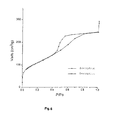
- the adsorption and desorption isotherm, shown in figure 6, shows a hysteresis loop which is typical of mesoporous solids.
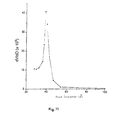
- the mathematical treatment of the isotherm according to the B.E.T. theory provides a specific surface area of 390 m 2 /g and the pore distribution curve shows a single strong pick corresponding to pores with a diameter of 40 ⁇ . From this curve it is calculated that 70% of the total porosity is between 30 and 50 ⁇ in diameter (see figure 7).
- the solution is maintained at 80°C for 8 hours, ensuring that the volume remains constant. After this period the microcrystalline solid formed is separated from the solution by centrifugation, washed three times with about 50 ml of water and finally dried in an oven at 60°C.
- the solid zirconium diphosphonate-phosphite thus obtained is kept in a vacuum drier containing phosphoric anhydride.
- the X-ray diffraction spectrum of the powders is similar to that of the previous example.
- the molar ratio diphosphonic acid/phosphorous acid in the solid, obtained as in the previous example, is 1.09:1.
- the measurement of the specific surface area by the adsorption of nitrogen gives a value of 295 m 2 /g and the pore distribution curve shows only one strong pick corresponding to pores having a diameter of 50 ⁇ .
- the container is maintained under stirring at a temperature of 75°C for 2 days.
- the solid is then separated by centrifugation, washed 3 times with 50 ml of dioxane, dried at 75°C in an oven and conserved in a vacuum drier containing phosphoric anhydride.
- the X-ray spectrum of the powders does not show particular modifications with respect to the starting material.
- NMR analysis was used with Fourier transform at 31 P, carried out under proton decoupling conditions by a sequence of impulses called "inverse gated decoupling", to ensure a quantitative measurement. These ratios are 1.20:0.56:1 (see figure 8).
- the measurement of the surface area gives a value of 220 m 2 /g, with a pore distribution curve centred on the diameter of 38 ⁇ .
- the container is maintained under stirring at a temperature of 75°C for 2 days.
- the solid is then separated by centrifugation, washed 3 times with 500 ml of dioxane.
- the dioxane is then eliminated by heating to 75°C in an oven, the product is exposed to the air for 2 - 8 hours to allow the conversion of the -SO 2 Cl groups into -SO 3 H groups, and finally conserved in a vacuum drier containing phosphoric anhydride.
- the X-ray spectrum of the powders does not show particular modifications with respect to the starting material.
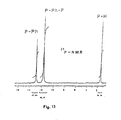
- the 31 P NMR analysis provides the following molar ratios between phenylenediphosphonic acid, phenylphosphonic acid and phosphorous acid: 0.79:0.67:1 (see figure 13).
- the surface area measurement gives the value of 327 m 2 /g with a limited pore distribution centred on a diameter of 42 ⁇ .
- XRD analysis shows a profile which is basically unchanged with respect to the starting compound, with an interstratum distance of 9.6 ⁇ .
Landscapes
- Chemical & Material Sciences (AREA)
- Organic Chemistry (AREA)
- Engineering & Computer Science (AREA)
- Materials Engineering (AREA)
- Chemical Kinetics & Catalysis (AREA)
- Inorganic Chemistry (AREA)
- Health & Medical Sciences (AREA)
- Life Sciences & Earth Sciences (AREA)
- Biochemistry (AREA)
- General Health & Medical Sciences (AREA)
- Molecular Biology (AREA)
- Catalysts (AREA)
- Low-Molecular Organic Synthesis Reactions Using Catalysts (AREA)
Abstract
Description
- The present invention relates to a solid mesoporous crystalline composition of diphosphonate-phosphite of a tetravalent metal, with a limited distribution of mesopores, the process for its production and its uses. The present invention also relates to a solid catalyst containing -SO3H acid groups which can be obtained from the above solid mesoporous crystalline composition, active in conversion processes of hydrocarbons.
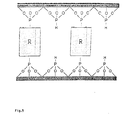
- G. Alberti, S. Allulli, U. Costantino and N. Tomassini, in J. Inorg. Nucl. Chem., 40, 1113 (1978), described the production of lamellar compounds, with a structure similar to that of zirconium α-phosphate [α-Zr(HPO4)2.H2O], for reactions between phosphonic acids and the salts of tetravalent metals. These lamellar phosphonates can be represented with the general formula M(RPO3)2, wherein M is a tetravalent metal and R is an organic radical. A specific example is zirconium benzene-phosphonate, whose structure is shown in fig.1.
- After this basic discovery, a great deal of research was carried out in this field for the considerable applicative potentialities of the compounds obtained and in particular the following technical and patent literature can be mentioned: G: Alberti, U. Costantino and M.L. Luciani, J. Chromatog., 180, 45(1979); G. Alberti and U. Costantino, J. Mol. Catal., 27, 235(1984); G. Alberti, U. Costantino, J. Korney and M.L. Luciani, Reactive Polymers, 4, 1(1985); G. Alberti, U. Costantino and G.Perego, J. Solid State Chem., 63, 455(1986); EP 10.366; EP 10.857; M.B. Dines and P.M. Di Giacomo, Inorg. Chem. 20, 92(1981); P.M. Di Giacomo and M.B. Dines, Polyhedron, 1, 61(1982); M.B. Dines, P.M. Di Giacomo, K.P. Collahan, P.C. Griffith, R.H. Lane and R.E. Cooksey, A.C.S. Series 192,
Chap 13, ACS, Washington DC, 1982; M.B. Dines, R.E. Cooksey, P.C. Griffith and R.H. Lane, Inorg. Chem. 22, 1003 (1983); M.B. Dines and P.C. Griffith, Polyhedron 2 607(1983); C.Y. Ortiz-Avila and A. Clearfield, Inorg. Chem. 24, 1773(1985); A. Clearfield, Design of New Materials, Plenum Press, New York (1987), pages 121-134; and A. Clearfield; Chem.Rev.88, 125(1988). - In EP 0010366 and EP0010857 some compositions of the pillared type are described, obtained by reactions between salts of tetravalent metals and diphosphonic acids, with the formula MIV[R(PO3)2], (wherein M is a tetravalent metal and R is a bivalent organic radical), whose structure is schematically shown in fig.2. Unfortunately, owing to the α structure of the layers, the distance between the central axes of the adjacent pillars is only 5.3 Å. Considering that the average Van der Waals diameter is about 4.4 Å for the pillars consisting of aliphatic chains and about 3.7 Å for the pillars consisting of aromatic rings, it can be deduced that the free intercolumn space is smaller than the diameter of the molecules and consequently the compositions obtained cannot be used as molecular sieves. To introduce a certain degree of microporosity between the layers a proposal was made to dilute the pillars by partially replacing them with very small groups of the R'-PO3 type, for example H-PO3, HO-PO3 and CH3-PO3 (see for example Clearfield, mentioned above). The formation of a microcavity in an idealized composition, by the introduction of phosphite groups, is shown schematically in fig.3. In these compositions the dimensions of the cavity basically depend on the length of the pillar R(PO3)2 and the spacing between the pillars.
- US 5166380 subsequently described that it is possible to prepare a diphosphonate-phosphite of a tetravalent metal, in crystalline form, under such conditions that the HPO3 groups, in addition to the possible formation of micropores in the interstratum region, also induce the formation of a mesoporisity, which cannot be attributed to the formation of cavities in the interstratum region, and which has a rather limited distribution with the majority of the pores being within the range of 20-30 Å. This material is prepared by the reaction between a diphosphonic acid, phosphorous acid and oxychloride of a tetravalent metal, operating in a solvent consisting of dimethylsulfoxide/water containing hydrofluoric acid.
- We have now surprisingly found a new solid mesoporous crystalline composition of diphosphonate-phosphite of a tetravalent metal with a porosity within the range of mesopores, with at least 50% of the pores having a diameter greater than 30 Å and less than or equal to 50 Å.
- In particular the composition of the present invention is a diphosphonate of a tetravalent metal containing acid phosphite groups and diphosphonate groups anchored to the surface, which can be defined with the general formula (I)
- M is a tetravalent metal
- R is a bivalent organic radical
- x varies from 0.3 to 0.6
- y varies from 0.05 to 0.3. the composition being in the form of a crystalline solid having the following characteristics:
-
- lamellar structure of the α type with an interstratum distance of between 7.4 and 20 Å;
- B.E.T. surface area of between 250 and 400 m2/g
- porosity in the range of mesopores, with at least 50% of the pores having a diamter greater than 30 Å and less than or equal to 50 Å.
- In particular, in the above formula, M is a tetravalent metal which can be conveniently selected from zirconium, titanium and tin, and is preferably zirconium owing to the greater stability to hydrolysis of the relativeadso composition.
- The bivalent organic radical R is conveniently a very short radical so that micropores will be formed in the interstratum region which are so small as to be inaccessible to common molecules.
Alternatively non-rigid R radicals can be used, such as for example aliphatic chains which tend to occupy the spaces created by the HPO3 groups with small dimensions, with a consequent decrease in the interstratum distance. In accordance with this R is selected from aliphatic bivalent organic radicals containing from 2 to 10 carbon atoms in the molecule, or aromatic radicals containing from 1 to 2 non-condensed rings, or from alkylaromatic radicals. Specific examples of R radical are: -CH2CH2-, -CH2-(CH2)2-CH2-, -CH2-(CH2)4-CH2-, -C6H4-, -C6H4-C6H4-, -CH2-C6H4-CH2-, -CH2-C6H4-C6H4-CH2-. - Preferred examples of the R radical are -C6H4- and -CH2(CH2)2-CH2-.
- In the composition of the present invention the specific value of the interstratum distance depends on the R radical and, in relation to the particular R radical selected, the composition may or may not have a microporosity in the interstratum region. In addition, in the above formula the value of 2y refers to the quantity of acid diphosphonate groups present at the surface, and the specific value of y depends on the surface area.
- More specifically, the composition of the present invention is a crystalline solid in which x varies from 0.3 to 0.6, and the groups present on the surface can either be phosphites themselves or diphosphonates. The latter differ from the internal ones as they have one of the phosphonic groups in acid form and their presence makes the total phosphorous/zirconium (or other tetravalent metal) ratio higher than 2, this being the typical value of lamellar compounds of the α type. The quantity of acid diphosphonate groups depends on the surface extension and can be determined by titrating the crystalline solid, dispersed in a solution of KCl (0.1-1 M) with potassium hydroxide up to
pH 7. The values of y vary from 0.05 to 0.3 depending on the surface extension. In addition the composition is a lamellar solid of the α type with an interstratum distance of between 7.4 and 20 Å or more, depending on the dimensions of the R radical, with a B.E.T. surface area of between 250 and 400 m2/g, with a porosity within the range of mesopores and with at least 50% of the pores having a diameter greater than 30 Å and less than or equal to 50 Å. For example it is possible to have a porosity in the range of mesopores, with at least 50% of the pores with a diameter greater than 30 Å and less than 40 Å. The composition, depending on the R radical used, may or may not have a microporosity in the interstratum region. - The present invention also relates to a process for the preparation of the composition having formula (I) described above which comprises reacting a diphosphonic acid R(PO3H2)2, phosphorous acid H3PO3, an oxychloride of a tetravalent metal MOCl2, in a solvent selected from n-propanol or water containing hydrofluoric acid:
- The process is carried out with a molar ratio between diphosphonic acid and phosphorous acid of between 1/2 and 1/20, with a molar ratio between hydrofluoric acid and tetravalent metal of between 5/1 and 30/1 and with a molar ratio between diphosphonic acid and tetravalent metal of between 0.5 and 2, at a temperature of between 10 and 130°C and for a time of between 1 and 100 hours. The hydrofluoric acid is used as a concentrated aqueous solution.
- Specific examples of diphosphonic acids R(PO3H2)2 suitable for the purposes are: 1,4-benzene diphosphonic acid and 1,4-butane diphosphonic acid.
- The preferred oxychloride of a tetravalent metal is selected from zirconyl chloride octahydrate ZrOCl2.8H2O and zirconyl chloride monohydrate ZrOCl2.H2O.
- The reaction medium is important in the process of the present invention. In fact, a mixture of water/dimethylsulfoxide is described in the prior art (US 5166380) as producing a porosity in the range of mesopores of between 20 and 30 Å, whereas if n-propylic alcohol or water are used, under suitable conditions, a porosity in the range of mesopores with at least 50% of the pores having a diameter greater than 30 Å and less than or equal to 50 Å, is surprisingly obtained.
- At the end of the reaction the compound can be recovered from the reaction mixture by filtration or centrifugation, washed with the same solvent used for the synthesis and dried.
- Owing to the limited distribution of mesopores in the region of 30-50 Å, the solid, crystalline compositions of the present invention are of great interest as molecular sieves for large molecules.
- In these materials, in addition to the groups present on the surface, there can also be both diphosphonate and phosphite surface groups: the diphosphonate surface groups have a -PO3H2 acid group, not involved in the binding with the metal, which gives acid characteristics to the material useful in catalytic processes.
- We have also found that it is possible to increase the surface acidity of these compounds obtaining materials with improved catalytic behaviour. In particular we have found that it is possible to exchange the diphosphonate and phosphite surface groups of these materials with phosphonic-sulfonic groups by topotactic exchange with a phosphonic-sulfonic acid. We have additionally found that the introduction of phosphonic-sulfonic groups can also be obtained by a preliminary topotactic exchange with arylphosphonic acid and the subsequent sulfonation of these groups with normal sulfonating agents.
- A further object of the present invention therefore relates to a solid acid catalyst based on a diphosphonate-phosphite of a tetravalent metal which can be obtained with a process in which a diphosphonate-phosphite of a tetravalent metal, which can be defined with the following formula (I)
- M is a tetravalent metal
- R is a bivalent organic radical
- x varies from 0.3 to 0.6
- y varies from 0.05 to 0.3, having a lamellar structure of the α type with an interstratum distance of between 7.4 and 20 Å, a B.E.T. surface area of between 250 and 400 m2/g, porosity in the range of mesopores, with at least 50% of the pores having a diameter greater than 30 Å and less than or equal to 50 Å, is put in contact with a solution, in an aqueous and/or organic solvent, of:
-
- a bifunctional phosphonic-sulfonic acid having general formula H2O3P-R'-SO2X, wherein R' is a bivalent organic radical such as alkylene, arylene or a combination thereof, and X is a monovalent group such as OH or Cl; or
- an arylphosphonic acid containing one or more aromatic
rings;
for a time which is sufficient to at least partially exchange the diphosphonate and phosphite surface groups of the diphosphonate-phosphite of the tetravalent metal with phosphonic-sulfonic groups or respectively with arylphosphonic groups; - and, only in the case of the product exchanged with arylphosphonic acid, subjecting this solid to sulfonation with a sulfonating agent.
- In formula (I) above, M preferably represents zirconium and R preferably represents a radical selected from those which can be defined with the formulae: -CH2CH2-, -CH2-(CH2)2-CH2-, -CH2-(CH2)4-CH2-, -C6H4-, -C6H4-C6H4-, -CH2-C6H4-CH2-, -CH2-C6H4-C6H4-CH2-. Preferred examples of the R radical are -C6H4- and -CH2(CH2)2-CH2-.
- According to this aspect of the present invention the compound (I) is subjected to topotactic exchange with a bifunctional phosphonic-sulfonic acid or with an arylphosphonic acid. In the present invention, "topotactic exchange" means a reaction wherein a group (for example HPO3) present in a solid compound is substituted by another group (for example Ar-PO3) without the structure of the compound undergoing any particular variations.
- As already indicated above, phosphonic-sulfonic acids which are suitable for the purpose are those which can be defined with the formula H2O3P-R'-SO2X, wherein R' indicates a bivalent organic radical such as arylene, alkylene, or a combination thereof, and X indicates a monovalent group such as OH or Cl.
- Examples of these phosphonic-sulfonic acids are phenylene-1-chlorosulfonyl-3-phosphonic acid and phenylenephosphonic-sulfonic acid.
- Arylphosphonic acids which are suitable for the purpose are those in which the -PO3H2 group is bound directly or by other arylenic or alkylenic groups, to one or more phenylic groups, such as for example phenylphosphonic acid, biphenyl phosphonic acid, phenyl methyl phosphonic acid, diphenyl methylphosphonic acid, triphenyl methyl phosphonic acid.
Phenylphosphonic acid is preferably used. - In the embodiment of this aspect of the present invention, a phosphonic-sulfonic acid or an arylphosphonic acid, selected from those indicated above, are dissolved in a solvent, at a concentration of between 0.01 and 2 M and the solution thus obtained is put in contact with the solid compound (I), for the exchange of the surface groups.
The solvent used for this solution is water, or an organic solvent, or a mixed water/organic solvent, preferably dioxane for the use of chlorosulfonyl-phosphonic acid (X=Cl), dioxane/water at 90% in volume of dioxane for the use of phosphonic-sulfonic acid (X=OH), or water for the use of an arylphosphonic acid. - In particular, in the topotactic exchange reaction, the operating temperature generally varies from 20 to 100°C and the contact time is between 1 and 72 hours. At the end of this period of time, the exchanged solid (I) is separated from the suspension, for example by filtration or centrifugation, washed with the same solvent used for the topotactic exchange reaction and dried.
- When a chlorosulfonyl-phosphonic acid (X=Cl) is used, the exchanged solid must be briefly exposed to the air to enable the -SO2Cl groups present to be completely converted into -SO3H acid groups according to the reaction:
- When an arylphosphonic acid is used, the product (I) exchanged is further subjected to sulfonation treatment with a sulfonating agent, in order to insert sulfonic groups onto the arylic portion introduced for the topotactic exchange. A sulfonating agent which is particularly suitable for the purpose is sulfuric anhydride, which can be conveniently used in the form of a solution in an inert solvent, such as sulfur dioxide. The sulfonation can be carried out at a temperature of between -30 and 50°C, for a time of between 10 minutes and 20 hours, operating in the presence of an excess of sulfonating agent. The exchanged and sulfonated product (I) is finally separated from the reaction mixture and subjected to purification treatment, for example by washing with an organic solvent such as tetrahydrofuran.
- Owing to its acid characteristics, the catalyst can be used in reactions which require an acid catalysis, in particular in the conversions of hydrocarbons, such as for example alkylation, etherification, isomerization reactions.
- The following experimental examples provide a better understanding of the present invention.
- 7.14 g of 1,4-phenylenediphoshonic acid and 11.48 g of phosphorous acid (reagent Carlo Erba RPE), are dissolved in 700 ml of n-propanol (Carlo Erba RPE), kept in a plastic container. 16.11 g of ZrOCl2.8H2O (Merck, proanalysis) dissolved in 34.5 ml of concentrated HF (50% by weight, Carlo Erba RPE) and 65.5 ml of n-propanol are added to the limpid solution, maintained at 80°C. The solution thus obtained has the following composition: [C6H4(PO3H2)2]=0.038 M, [H3PO3] = 0.175 M, [ZrIV]=0.063M, [HF]=1.25 M. The solution is maintained at 80°C for 8 hours, ensuring that the volume remains constant. After this period the microcrystalline solid formed is separated from the solution by centrifugation, washed three times with about 500 ml of n-propanol and finally dried in an oven at 60°C. The solid zirconium diphosphonate-phosphite thus obtained is kept in a vacuum drier containing phosphoric anhydride.
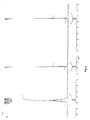
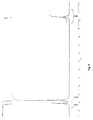
- From the X-ray diffraction spectrum of the powders, shown in figure 4, an interstratum distance of 9.6 Å can be deduced. To determine the molar ratio diphosphonic acid/phosphorous acid in the solid, the nuclear magnetic resonance technique at 31P is used. About 20 mg of solid are dissolved in a few drops of concentrated hydrofluoric acid, added tol ml of deuterated dimethylsulfoxide (DMSO-d6, Carlo Erba RPE) and analyzed with a Bruker AC200 spectrometre. The molar ratio, which can be calculated from figure 5, is equal to 0.87:1. To obtain the porosity characteristics, the solid is first degassed at a temperature of 150°C and at a pressure of 5 x 10⁻³ mmHg for 6 hours. A measurement of the surface area is then carried out by adsorption of nitrogen using the Carlo Erba instrument Sorptomatic 1800. The adsorption and desorption isotherm, shown in figure 6, shows a hysteresis loop which is typical of mesoporous solids. The mathematical treatment of the isotherm according to the B.E.T. theory provides a specific surface area of 390 m2/g and the pore distribution curve shows a single strong pick corresponding to pores with a diameter of 40 Å. From this curve it is calculated that 70% of the total porosity is between 30 and 50 Å in diameter (see figure 7).
- Preparation of mesoporous zirconium phenylenediphosphonate-phosphite 1.03 g of 1,4-phenylenediphosphonic acid and 2.34 g of phosphorous acid are dissolved in 35 ml of water, kept in a plastic container. 2.15 g of ZrOCl2.8H2O dissolved in 1.15 ml of concentrated HF and 4 ml of water are added to the limpid solution, maintained at 80°C. The solution thus obtained has the following composition: [C6H4(PO3H2)2]=0.1 M, [H3PO3]=0.71 M, [ZrIV]=0.17 M, [HF]=0.83 M. The solution is maintained at 80°C for 8 hours, ensuring that the volume remains constant. After this period the microcrystalline solid formed is separated from the solution by centrifugation, washed three times with about 50 ml of water and finally dried in an oven at 60°C. The solid zirconium diphosphonate-phosphite thus obtained is kept in a vacuum drier containing phosphoric anhydride.
- The X-ray diffraction spectrum of the powders is similar to that of the previous example. The molar ratio diphosphonic acid/phosphorous acid in the solid, obtained as in the previous example, is 1.09:1. The measurement of the specific surface area by the adsorption of nitrogen gives a value of 295 m2/g and the pore distribution curve shows only one strong pick corresponding to pores having a diameter of 50 Å.
- 1 g of the material obtained in example 1 is added to 58.5 ml of an 0.1 M solution of phenylene-1-phosphonic-3-sulfonic acid in dioxane at 90% in volume, i.e. consisting of 52.5 ml of dioxane, 6 ml of water and 1.5 g of phenylene-1-phosphonic-3-sulfonic acid.
- The container is maintained under stirring at a temperature of 75°C for 2 days. The solid is then separated by centrifugation, washed 3 times with 50 ml of dioxane, dried at 75°C in an oven and conserved in a vacuum drier containing phosphoric anhydride. The X-ray spectrum of the powders does not show particular modifications with respect to the starting material.
- To determine the relative ratios between phenylenediphosphonic acid, phenylenephosphonic-sulfonic acid and phosphorous acid in the solid, NMR analysis was used with Fourier transform at 31P, carried out under proton decoupling conditions by a sequence of impulses called "inverse gated decoupling", to ensure a quantitative measurement. These ratios are 1.20:0.56:1 (see figure 8).
- The measurement of the surface area gives a value of 220 m2/g, with a pore distribution curve centred on the diameter of 38 Å.
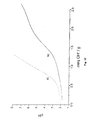
- The increase in the acid groups and acid force of the solid after the topotactic exchange was shown by titration, with a solution of KOH 0.1 M, of 0.300 g of a sample dispersed in 15 ml of a solution of KCl 1M. A Mettler DL40 automatic titrator was used for the purpose, with the "equilibrium" titration method. On comparing (see figure 9) the titration curves of the material before (curve a) and after the functionalization (curve b), both an increase in the cationic exchange capacity of the solid, due to the increase in the number of acid groups, and a lowering of the titration pH, which can be attributed to the increase in acid force due to the presence of the exchanged -SO3H groups, can be observed.
- 10 g of the material obtained in example 1 are added to 585 ml of an 0.1 M solution of phenylene-1-chlorosulfonyl-3-phosphonic acid in dioxane, i.e. consisting of 585 ml of dioxane and 15 g of phenylene-1-chlorosulfonyl-3-phosphonic acid.
- The container is maintained under stirring at a temperature of 75°C for 2 days. The solid is then separated by centrifugation, washed 3 times with 500 ml of dioxane. The dioxane is then eliminated by heating to 75°C in an oven, the product is exposed to the air for 2 - 8 hours to allow the conversion of the -SO2Cl groups into -SO3H groups, and finally conserved in a vacuum drier containing phosphoric anhydride.
- The X-ray spectrum of the powders does not show particular modifications with respect to the starting material.
- The NMR analyses at 31P, carried out under the conditions described in example 3, provided the following relative molar ratios between phenylenediphosphonic acid, phenylenephosphonic-sulfonic acid and phosphorous acid in the solid: 1.57:0.92:1.
- The measurement of the surface area gives a value of 260 m2/g, with a pore distribution curve centred on the diameter of 38 Å. Figure 10 shows the adsorption and desorption isotherm and figure 11 the pore distribution curve of the exchanged product.
- The increase in the acid groups and acid force of the solid after the topotactic exchange was shown by its titration under the conditions described in example 3. On comparing (see figure 12) the titration curves of the material before (curve a) and after the functionalization (curve b), both an increase in the cationic exchange capacity of the solid, due to the increase in the number of acid groups, and a lowering of the titration pH, which can be attributed to the increase in acid force due to the presence of the exchanged -SO3H groups, can be observed.
- To ensure that the -SO2Cl groups of the functionalizing agent are completely converted into -SO3H groups, a portion of the sample was dispersed in an appropriate volume of a solution of KOH 0.1 M, and maintained at boiling point for 3 hours to completely hydrolyze any chlorosulfonic groups still possibly present in the solid; the concentration of chloride ions present in this solution was then analyzed by ionic chromatography, using a Dionex 2000i/SP instrument. A negligible concentration of chloride ions is calculated from the chromatogram.
- On comparing figures 9b and 12b, it should be noted that the topotactic exchange with phenylene-chlorosulfonyl-phosphonic acid, relating to the present example, provides a better result than that obtained with the use of phenylenephosphonic-sulfonic acid relating to the previous example.
- 10 g of the material obtained according to example 1 are put in contact with 350 ml of a 1M water solution of phenylphosphonic acid, i.e. consisting of 55.3 g of phenylphosphonic acid and 350 ml of water. The suspension is maintained at a temperature of 70°C for three days under stirring, is then washed five times with 100 ml of water, dried in an oven and conserved in a vacuum drier containing phosphoric anhydride.
- The 31P NMR analysis provides the following molar ratios between phenylenediphosphonic acid, phenylphosphonic acid and phosphorous acid: 0.79:0.67:1 (see figure 13). The surface area measurement gives the value of 327 m2/g with a limited pore distribution centred on a diameter of 42 Å.
- 1 g of the product obtained as described above, is placed in a glass reactor equipped with magnetic stirring, cooling bath, internal thermometre with thermocouple, manometre and safety valve. The material is put in contact, at a temperature of -24°C and under anhydrous conditions, with a solution at 10% (w/w) of SO3 in SO2. After 10 minutes of reaction the temperature is raised to 17°C and left under these conditions for a further 30 minutes. The mixture is then heated to 33°C and degassed, eliminating the unaltered sulfonating reagent. After repeated washings with nitrogen, the residue is recovered as a dark solid and purified by extraction in Soxhlet with tetrahydrofuran.
- XRD analysis shows a profile which is basically unchanged with respect to the starting compound, with an interstratum distance of 9.6 Å.
- From the 31P NMR analysis of the solid in a solution of HF-H2O (see figure 14) the following formula is obtained:
Claims (26)
- Composition of a diphosphonate of a tetravalent metal containing acid phosphite groups and diphosphonate groups anchored to the surface, which can be defined by the general formula (I)the composition being in the form of a crystalline solid having the following characteristics:M is a tetravalent metalR is a bivalent organic radicalx varies from 0.3 to 0.6y varies from 0.05 to 0.3,lamellar structure of the α type with an interstratum distance of between 7.4 and 20 Å;B.E.T. surface area of between 250 and 400 m2/gporosity in the range of mesopores, with at least 50% of the pores having a diameter greater than 30 Å and less than or equal to 50 Å.
- Composition according to claim 1, characterized in that in the formula M is a tetravalent metal selected from zirconium, titanium and tin.
- Composition according to claim 2, wherein M is zirconium.
- Composition according to claim 1, characterized in that in the formula (I) R is selected from aliphatic bivalent organic radicals containing from 2 to 10 carbon atoms in the molecule, or aromatic radicals with from 1 to 2 non-condensed rings, or alkylaromatic radicals.
- Composition according to claim 4, characterized in that the radical R is selected from: CH2CH2-, -CH2-(CH2)2-CH2-, -CH2-(CH2)4-CH2-, -C6H4-, -C6H4-C6H4-, -CH2-C6H4-C6H4-CH2-.
- Composition according to claim 5 wherein R is selected from -C6H4- and -CH2-(CH2)2-CH2-.
- Process for the preparation of the composition according to claims 1 to 6 characterized in that a diphosphonic acid R(PO3H2)2, a phosphorous acid H3PO3, an oxychloride of a tetravalent metal MOCl2, are reacted in a solvent selected from n-propanol or water containing hydrofluoric acid, according to the equation:M is a tetravalent metalR is a bivalent organic radicalx varies from 0.3 to 0.6y varies from 0.05 to 0.3.
- Process according to claim 7 characterized in that the molar ratio between diphosphonic acid and phosphorous acid is between 1/2 and 1/20.
- Process according to claim 7 characterized in that the molar ratio between hydrofluoric acid and tetravalent metal is between 5/1 and 30/1.
- Process according to claim 7 characterized in that the molar ratio between diphosphonic acid and tetravalent metal is between 0.5 and 2.
- Process according to claim 7 characterized in that the operating temperature is between 10 and 130°C and the time between 1 and 100 hours.
- Process according to claim 7 characterized in that the diphosphonic acid is selected from: 1,4-benzene diphosphonic acid and 1,4-butane diphosphonic acid
- Process according to claim 7, characterized in that the oxychloride of the tetravalent metal is selected from zirconyl octahydrate ZrOCl2.8H2O and zirconyl chloride monohydrate ZrOCl2.H2O.
- Solid acid catalyst based on a diphosphonate-phosphite of a tetravalent metal which can be obtained with a process in which a diphosphonate-phosphite of a tetravalent metal which can be defined with the following formulahaving a lamellar structure of the α type with an interstratum distance of between 7.4 and 20 Å, a B.E.T. surface area of between 250 and 400 m2/g, porosity in the range of mesopores, with at least 50% of the pores having a diameter greater than 30 Å and less than or equal to 50 Å,M is a tetravalent metalR is a bivalent organic radicalx varies from 0.3 to 0.6y varies from 0.05 to 0.3,
is put in contact with a solution, in an aqueous and/or organic solvent, of:for a time which is sufficient to at least partially exchange the diphosphonate and phosphite surface groups of the diphosphonate-phosphite of the tetravalent metal with phosphonic-sulfonic groups or respectively with arylphosphonic groups;a bifunctional phosphonic-sulfonic acid having general formula H2O3P-R'-SO2X, wherein R' is a bivalent organic radical such as alkylene, arylene or a combination thereof, and X is a monovalent group such as OH or Cl; oran arylphosphonic acid containing one or more aromatic rings;and, only in the case of the product exchanged with arylphosphonic acid, subjecting the solid to sulfonation with a sulfonating agent. - Catalyst according to claim 14 wherein M is zirconium.
- Catalyst according to claim 14 wherein R is selected from: CH2CH2-, -CH2-(CH2)2-CH2-, -CH2-(CH2)4-CH2-, -C6H4-, -C6H4-C6H4-, -CH2-C6H4-CH2-, -CH2-C6H4-C6H4-CH2-.
- Catalyst according to claim 14 wherein R is selected from -C6H4- and -CH2-(CH2)2-CH2-.
- Catalyst according to claim 14 wherein the phosphonic-sulfonic acid is phenylene-1-chlorosulfonyl-3-phosphonic acid.
- Catalyst according to claim 14 wherein the arylphosphonic acid is selected from phenylphosphonic acid, biphenyl phosphonic acid, phenyl methyl phosphonic acid, diphenyl methyl phosphonic acid, triphenyl methyl phosphonic acid.
- Catalyst according to claim 19 wherein the arylsulfonic acid is phenylphosphonic acid.
- Catalyst according to claim 14 wherein an aqueous and/or organic solution of sulfonic-phosphonic acid or arylphosphonic acid is put in contact with the solid compound (I) at a temperature of between 20 and 100°C, for a time of between 1 and 72 hours.
- Catalyst according to claim 14 wherein a solution from 0.01 M to 2 M of sulfonic-phosphonic or arylphosphonic acid is used.
- Catalyst according to claim 14 wherein the solvent used for this solution is dioxane for the use of chlorosulfonyl-phosphonic acid, dioxane/water at 90% in volume of dioxane for the use of phosphonic-sulfonic acid, or water for the use of an arylphosphonic acid.
- Catalyst according to claim 14 characterized in that the sulfonating agent is sulfuric anhydride, and the sulfonation is carried out at a temperature of between -30°C and 50°C, for a time of between 10 minutes and 20 hours.
- Use of the catalyst according to claim 1 as molecular sieve.
- Use of the catalyst according to claim 14 as acid catalyst in conversion processes of hydrocarbons.
Priority Applications (1)
| Application Number | Priority Date | Filing Date | Title |
|---|---|---|---|
| SI9630266T SI0736539T1 (en) | 1995-04-07 | 1996-03-21 | Mesoporous crystalline acid composition of a diphosphonate-phosphite of a tetravalent metal which can be used as a catalyst |
Applications Claiming Priority (2)
| Application Number | Priority Date | Filing Date | Title |
|---|---|---|---|
| ITMI950710A IT1273512B (en) | 1995-04-07 | 1995-04-07 | MESOPOROUS CRYSTALLINE ACID COMPOSITION OF A DIPHOSPHONATE-PHOSPHITE OF A TETRAVALENT METAL USEFUL AS A CATALYST |
| ITMI950710 | 1995-04-07 |
Publications (3)
| Publication Number | Publication Date |
|---|---|
| EP0736539A2 EP0736539A2 (en) | 1996-10-09 |
| EP0736539A3 EP0736539A3 (en) | 1997-04-02 |
| EP0736539B1 true EP0736539B1 (en) | 2000-12-20 |
Family
ID=11371248
Family Applications (1)
| Application Number | Title | Priority Date | Filing Date |
|---|---|---|---|
| EP96104486A Expired - Lifetime EP0736539B1 (en) | 1995-04-07 | 1996-03-21 | Mesoporous crystalline acid composition of a diphosphonate-phosphite of a tetravalent metal which can be used as a catalyst |
Country Status (10)
| Country | Link |
|---|---|
| US (1) | US5892080A (en) |
| EP (1) | EP0736539B1 (en) |
| JP (1) | JPH0920507A (en) |
| AT (1) | ATE198204T1 (en) |
| DE (1) | DE69611260T2 (en) |
| DK (1) | DK0736539T3 (en) |
| ES (1) | ES2152446T3 (en) |
| GR (1) | GR3035182T3 (en) |
| IT (1) | IT1273512B (en) |
| SI (1) | SI0736539T1 (en) |
Families Citing this family (19)
| Publication number | Priority date | Publication date | Assignee | Title |
|---|---|---|---|---|
| IT1289904B1 (en) * | 1997-01-16 | 1998-10-19 | Eniricerche Spa | MESOPOROUS CRYSTALLINE COMPOSITION WITH A HIGH SURFACE AREA OF A TETRAVALENT METAL USEFUL AS A CATALYST |
| ITPG20020015A1 (en) * | 2002-03-22 | 2003-09-22 | Giulio Alberti | AN INNOVATIVE METHOD FOR THE PREPARATION OF PROTONIC NANOPOLYMER MEMBRANES FOR USE IN FUEL CELLS OR IN AC REACTORS |
| ITPG20030005A1 (en) * | 2003-02-19 | 2004-08-20 | Giulio Alberti | PREPARATION OF NEW ACID PHOSPHATES OF TETRAVALENT METALS |
| US7589041B2 (en) | 2004-04-23 | 2009-09-15 | Massachusetts Institute Of Technology | Mesostructured zeolitic materials, and methods of making and using the same |
| ES2319007B1 (en) * | 2006-12-07 | 2010-02-16 | Rive Technology, Inc. | METHODS FOR MANUFACTURING MESOSTRUCTURED ZEOLITICAL MATERIALS. |
| US7973109B2 (en) | 2007-03-29 | 2011-07-05 | Kabushiki Kaisha Toyota Chuo Kenkyusho | Crosslinked type layered metal phosphonate compound, production process therefor, non-crosslinked type layered metal phosphonate compound, production process therefor, as well as stock solution |
| US8206498B2 (en) * | 2007-10-25 | 2012-06-26 | Rive Technology, Inc. | Methods of recovery of pore-forming agents for mesostructured materials |
| ES2875884T3 (en) | 2009-01-19 | 2021-11-11 | Grace W R & Co | Introduction of mesoporosity in zeolites with low Si / A1 content |
| US8524625B2 (en) * | 2009-01-19 | 2013-09-03 | Rive Technology, Inc. | Compositions and methods for improving the hydrothermal stability of mesostructured zeolites by rare earth ion exchange |
| US8685875B2 (en) * | 2009-10-20 | 2014-04-01 | Rive Technology, Inc. | Methods for enhancing the mesoporosity of zeolite-containing materials |
| US20110171121A1 (en) * | 2010-01-08 | 2011-07-14 | Rive Technology, Inc. | Compositions and methods for making stabilized mesoporous materials |
| AU2012240093B2 (en) | 2011-04-08 | 2015-06-11 | W. R. Grace & Co.-Conn. | Mesoporous framework-modified zeolites |
| CN102838098A (en) * | 2011-06-24 | 2012-12-26 | 中国科学技术大学苏州研究院 | Rare earth metal hypophosphite and preparation method and application of rare earth metal hypophosphite |
| AU2013207736B2 (en) | 2012-01-13 | 2015-04-09 | Rive Technology, Inc. | Introduction of mesoporosity into low silica zeolites |
| US9376324B2 (en) | 2012-01-13 | 2016-06-28 | Rive Technology, Inc. | Introduction of mesoporosity into zeolite materials with sequential acid, surfactant, and base treatment |
| US8765660B1 (en) | 2013-03-08 | 2014-07-01 | Rive Technology, Inc. | Separation of surfactants from polar solids |
| US9662640B2 (en) | 2013-12-27 | 2017-05-30 | Rive Technology, Inc. | Introducing mesoporosity into zeolite materials with a modified acid pre-treatment step |
| WO2016094816A1 (en) | 2014-12-11 | 2016-06-16 | Rive Technology, Inc. | Preparation of mesoporous zeolites with reduced processing |
| US10626019B2 (en) | 2014-12-30 | 2020-04-21 | W. R. Grace & Co.-Conn. | Methods for preparing zeolites with surfactant-templated mesoporosity and tunable aluminum content |
Family Cites Families (2)
| Publication number | Priority date | Publication date | Assignee | Title |
|---|---|---|---|---|
| IT1243781B (en) * | 1990-08-03 | 1994-06-28 | Eniricerche Spa | MESOPOROUS CRYSTALLINE SOLID COMPOSITION OF DIPHOSPHONATE-PHOSPHITE OF A TETRAVALENT METAL, WITH A CLOSE DISTRIBUTION OF MESOPORI |
| IT1244485B (en) * | 1990-12-21 | 1994-07-15 | Eniricerche Spa | MICROPOROUS CRYSTALLINE SOLID COMPOSITION OF DIPHOSPHONATE-PHOSPHITE OF A TETRAVALENT METAL WITH A NARROW DISTRIBUTION OF MICROPORES |
-
1995
- 1995-04-07 IT ITMI950710A patent/IT1273512B/en active IP Right Grant
-
1996
- 1996-03-21 SI SI9630266T patent/SI0736539T1/en unknown
- 1996-03-21 DE DE69611260T patent/DE69611260T2/en not_active Expired - Fee Related
- 1996-03-21 ES ES96104486T patent/ES2152446T3/en not_active Expired - Lifetime
- 1996-03-21 AT AT96104486T patent/ATE198204T1/en not_active IP Right Cessation
- 1996-03-21 DK DK96104486T patent/DK0736539T3/en active
- 1996-03-21 EP EP96104486A patent/EP0736539B1/en not_active Expired - Lifetime
- 1996-04-08 JP JP8085504A patent/JPH0920507A/en active Pending
-
1997
- 1997-10-02 US US08/942,484 patent/US5892080A/en not_active Expired - Fee Related
-
2001
- 2001-01-02 GR GR20010400001T patent/GR3035182T3/en not_active IP Right Cessation
Also Published As
| Publication number | Publication date |
|---|---|
| ITMI950710A1 (en) | 1996-10-07 |
| US5892080A (en) | 1999-04-06 |
| IT1273512B (en) | 1997-07-08 |
| JPH0920507A (en) | 1997-01-21 |
| EP0736539A2 (en) | 1996-10-09 |
| DE69611260D1 (en) | 2001-01-25 |
| ES2152446T3 (en) | 2001-02-01 |
| DK0736539T3 (en) | 2001-03-19 |
| DE69611260T2 (en) | 2001-05-03 |
| ITMI950710A0 (en) | 1995-04-07 |
| ATE198204T1 (en) | 2001-01-15 |
| SI0736539T1 (en) | 2001-04-30 |
| EP0736539A3 (en) | 1997-04-02 |
| GR3035182T3 (en) | 2001-04-30 |
Similar Documents
| Publication | Publication Date | Title |
|---|---|---|
| US5892080A (en) | Mesoporous crystalline acid composition of a diphosphonate-phosphite of a tetravalent metal which can be used as a catalyst | |
| Clearfield et al. | Organically pillared microporous zirconium phosphonates | |
| Poojary et al. | Synthesis and X-ray powder structures of covalently pillared lamellar zinc bis (phosphonates) | |
| Shiralkar et al. | Synthesis and characterization of CoAPO-5, a cobalt-containing AlPO4-5 | |
| Zhang et al. | Synthesis and characterization of layered zinc biphenylylenebis (phosphonate) and three mixed-component arylenebis (phosphonate)/phosphates | |
| EP0855217B1 (en) | Mesoporous crystalline composition with a high surface area of a tetravalent metal which can be used as catalyst | |
| EP0333816A4 (en) | CRYSTALLINE ALUMINUM PHOSPHATE PREPARATIONS. | |
| Alberti et al. | Preparation and characterization of zirconium phosphate phosphonates, ZrPO4 (H2PO4) 1-x (RPO2OH) x. nH2O, with. gamma.-layer structure (R= CH3, C3H7, C6H11) | |
| Alberti et al. | Preparation and characterization of zirconium phosphate diphosphonates with the γ-structure: a new class of covalently pillared compounds | |
| Segawa et al. | Catalyst design of two-dimensional zirconium phosphonates | |
| Alberti et al. | Preparation and some properties of γ-zirconium phosphate benzenephosphonate | |
| US5166380A (en) | Mesoporous crystalline solid compound of a diphosphonate/phosphite of a tetravalent metal, with a narrow distribution of mesopores | |
| US5290746A (en) | Tetravalent metal diphosphonate-phosphite composition in microporous solid crystalline form, with a narrow micropore distribution | |
| Bissinger et al. | Preparation and Crystal Structures of 2‐Aminoethyl Phosphate Complexes of Magnesium, Calcium, and Zinc | |
| EP1818335B1 (en) | Phosphorylcholine group-containing compound and method for producing same | |
| EP0134157B1 (en) | Layered vanadium compounds containing phosphorus or arsenic and pendant organic groups | |
| Alberti et al. | Preparation Of Zirconium Diphosphonate-Phosphites With A Narrow Distribution Of Mesopores. | |
| Costantino et al. | Amino Acid Derivatives of Layered Zirconium Phosphates–α‐Zirconium L‐(+)‐Serinephosphate and Zirconium L‐(+)‐Serinephosphate Phosphates | |
| JPH02103208A (en) | Preparation of ion exchange resin | |
| Alberti et al. | Ion-exchange properties of γ-titanium phosphate and its monosodium forms towards Mg2+ and Ca2+ ions | |
| Gupta et al. | Mechanism of some alkylammonium-ion exchanges by α-zirconium bis-(monohydrogenorthophosphate) monohydrate | |
| US5047567A (en) | Heteropolyoxo vanadium compounds containing molecular anions and their structure | |
| JP3985326B2 (en) | Ion exchange composite and method for producing the same | |
| Herman et al. | Crystalline cerium (IV) phosphates—II: The ion exchange characteristics with alkali metal ions | |
| King et al. | Aspects of the Synthesis of Aryl Sulfonic Acid Mels® Catalysts |
Legal Events
| Date | Code | Title | Description |
|---|---|---|---|
| PUAI | Public reference made under article 153(3) epc to a published international application that has entered the european phase |
Free format text: ORIGINAL CODE: 0009012 |
|
| AK | Designated contracting states |
Kind code of ref document: A2 Designated state(s): AT BE CH DE DK ES FI FR GB GR IE LI LU MC NL PT SE |
|
| AX | Request for extension of the european patent |
Free format text: LT PAYMENT 960321;LV PAYMENT 960321;SI PAYMENT 960321 |
|
| RAX | Requested extension states of the european patent have changed |
Free format text: LT PAYMENT 960321;LV PAYMENT 960321;SI PAYMENT 960321 |
|
| PUAL | Search report despatched |
Free format text: ORIGINAL CODE: 0009013 |
|
| AK | Designated contracting states |
Kind code of ref document: A3 Designated state(s): AT BE CH DE DK ES FI FR GB GR IE LI LU MC NL PT SE |
|
| AX | Request for extension of the european patent |
Free format text: LT PAYMENT 960321;LV PAYMENT 960321;SI PAYMENT 960321 |
|
| 17P | Request for examination filed |
Effective date: 19970811 |
|
| RAP1 | Party data changed (applicant data changed or rights of an application transferred) |
Owner name: ENITECNOLOGIE S.P.A. |
|
| GRAG | Despatch of communication of intention to grant |
Free format text: ORIGINAL CODE: EPIDOS AGRA |
|
| GRAG | Despatch of communication of intention to grant |
Free format text: ORIGINAL CODE: EPIDOS AGRA |
|
| GRAH | Despatch of communication of intention to grant a patent |
Free format text: ORIGINAL CODE: EPIDOS IGRA |
|
| 17Q | First examination report despatched |
Effective date: 20000427 |
|
| GRAH | Despatch of communication of intention to grant a patent |
Free format text: ORIGINAL CODE: EPIDOS IGRA |
|
| GRAA | (expected) grant |
Free format text: ORIGINAL CODE: 0009210 |
|
| PGFP | Annual fee paid to national office [announced via postgrant information from national office to epo] |
Ref country code: IE Payment date: 20001212 Year of fee payment: 6 |
|
| AK | Designated contracting states |
Kind code of ref document: B1 Designated state(s): AT BE CH DE DK ES FI FR GB GR IE LI LU MC NL PT SE |
|
| AX | Request for extension of the european patent |
Free format text: LT PAYMENT 19960321;LV PAYMENT 19960321;SI PAYMENT 19960321 |
|
| REF | Corresponds to: |
Ref document number: 198204 Country of ref document: AT Date of ref document: 20010115 Kind code of ref document: T |
|
| PGFP | Annual fee paid to national office [announced via postgrant information from national office to epo] |
Ref country code: MC Payment date: 20001221 Year of fee payment: 6 |
|
| PGFP | Annual fee paid to national office [announced via postgrant information from national office to epo] |
Ref country code: PT Payment date: 20001229 Year of fee payment: 6 |
|
| REG | Reference to a national code |
Ref country code: CH Ref legal event code: EP |
|
| PGFP | Annual fee paid to national office [announced via postgrant information from national office to epo] |
Ref country code: GR Payment date: 20010102 Year of fee payment: 6 |
|
| PGFP | Annual fee paid to national office [announced via postgrant information from national office to epo] |
Ref country code: ES Payment date: 20010108 Year of fee payment: 6 |
|
| PGFP | Annual fee paid to national office [announced via postgrant information from national office to epo] |
Ref country code: FR Payment date: 20010112 Year of fee payment: 6 |
|
| PGFP | Annual fee paid to national office [announced via postgrant information from national office to epo] |
Ref country code: AT Payment date: 20010122 Year of fee payment: 6 |
|
| REG | Reference to a national code |
Ref country code: IE Ref legal event code: FG4D |
|
| REF | Corresponds to: |
Ref document number: 69611260 Country of ref document: DE Date of ref document: 20010125 |
|
| REG | Reference to a national code |
Ref country code: ES Ref legal event code: FG2A Ref document number: 2152446 Country of ref document: ES Kind code of ref document: T3 |
|
| PGFP | Annual fee paid to national office [announced via postgrant information from national office to epo] |
Ref country code: SE Payment date: 20010202 Year of fee payment: 6 |
|
| REG | Reference to a national code |
Ref country code: CH Ref legal event code: NV Representative=s name: PATENTANWAELTE SCHAAD, BALASS, MENZL & PARTNER AG |
|
| ET | Fr: translation filed | ||
| PGFP | Annual fee paid to national office [announced via postgrant information from national office to epo] |
Ref country code: BE Payment date: 20010219 Year of fee payment: 6 |
|
| PGFP | Annual fee paid to national office [announced via postgrant information from national office to epo] |
Ref country code: DE Payment date: 20010226 Year of fee payment: 6 |
|
| PGFP | Annual fee paid to national office [announced via postgrant information from national office to epo] |
Ref country code: LU Payment date: 20010228 Year of fee payment: 6 |
|
| PGFP | Annual fee paid to national office [announced via postgrant information from national office to epo] |
Ref country code: FI Payment date: 20010315 Year of fee payment: 6 |
|
| PGFP | Annual fee paid to national office [announced via postgrant information from national office to epo] |
Ref country code: GB Payment date: 20010316 Year of fee payment: 6 Ref country code: DK Payment date: 20010316 Year of fee payment: 6 |
|
| REG | Reference to a national code |
Ref country code: DK Ref legal event code: T3 |
|
| PGFP | Annual fee paid to national office [announced via postgrant information from national office to epo] |
Ref country code: CH Payment date: 20010330 Year of fee payment: 6 |
|
| PGFP | Annual fee paid to national office [announced via postgrant information from national office to epo] |
Ref country code: NL Payment date: 20010331 Year of fee payment: 6 |
|
| PLBE | No opposition filed within time limit |
Free format text: ORIGINAL CODE: 0009261 |
|
| STAA | Information on the status of an ep patent application or granted ep patent |
Free format text: STATUS: NO OPPOSITION FILED WITHIN TIME LIMIT |
|
| 26N | No opposition filed | ||
| REG | Reference to a national code |
Ref country code: GB Ref legal event code: IF02 |
|
| LTLA | Lt: lapse of european patent or patent extension | ||
| PG25 | Lapsed in a contracting state [announced via postgrant information from national office to epo] |
Ref country code: MC Free format text: LAPSE BECAUSE OF NON-PAYMENT OF DUE FEES Effective date: 20020321 Ref country code: LU Free format text: LAPSE BECAUSE OF NON-PAYMENT OF DUE FEES Effective date: 20020321 Ref country code: IE Free format text: LAPSE BECAUSE OF NON-PAYMENT OF DUE FEES Effective date: 20020321 Ref country code: GB Free format text: LAPSE BECAUSE OF NON-PAYMENT OF DUE FEES Effective date: 20020321 Ref country code: FI Free format text: LAPSE BECAUSE OF NON-PAYMENT OF DUE FEES Effective date: 20020321 Ref country code: AT Free format text: LAPSE BECAUSE OF NON-PAYMENT OF DUE FEES Effective date: 20020321 |
|
| PG25 | Lapsed in a contracting state [announced via postgrant information from national office to epo] |
Ref country code: SE Free format text: LAPSE BECAUSE OF NON-PAYMENT OF DUE FEES Effective date: 20020322 Ref country code: ES Free format text: LAPSE BECAUSE OF NON-PAYMENT OF DUE FEES Effective date: 20020322 |
|
| PG25 | Lapsed in a contracting state [announced via postgrant information from national office to epo] |
Ref country code: LI Free format text: LAPSE BECAUSE OF NON-PAYMENT OF DUE FEES Effective date: 20020331 Ref country code: CH Free format text: LAPSE BECAUSE OF NON-PAYMENT OF DUE FEES Effective date: 20020331 Ref country code: BE Free format text: LAPSE BECAUSE OF NON-PAYMENT OF DUE FEES Effective date: 20020331 |
|
| PG25 | Lapsed in a contracting state [announced via postgrant information from national office to epo] |
Ref country code: DK Free format text: LAPSE BECAUSE OF NON-PAYMENT OF DUE FEES Effective date: 20020402 |
|
| BERE | Be: lapsed |
Owner name: *ENITECNOLOGIE S.P.A. Effective date: 20020331 |
|
| PG25 | Lapsed in a contracting state [announced via postgrant information from national office to epo] |
Ref country code: NL Free format text: LAPSE BECAUSE OF NON-PAYMENT OF DUE FEES Effective date: 20021001 Ref country code: DE Free format text: LAPSE BECAUSE OF NON-PAYMENT OF DUE FEES Effective date: 20021001 |
|
| PG25 | Lapsed in a contracting state [announced via postgrant information from national office to epo] |
Ref country code: GR Free format text: LAPSE BECAUSE OF NON-PAYMENT OF DUE FEES Effective date: 20021007 |
|
| EUG | Se: european patent has lapsed |
Ref document number: 96104486.4 |
|
| GBPC | Gb: european patent ceased through non-payment of renewal fee |
Effective date: 20020321 |
|
| REG | Reference to a national code |
Ref country code: CH Ref legal event code: PL |
|
| PG25 | Lapsed in a contracting state [announced via postgrant information from national office to epo] |
Ref country code: FR Free format text: LAPSE BECAUSE OF NON-PAYMENT OF DUE FEES Effective date: 20021129 |
|
| NLV4 | Nl: lapsed or anulled due to non-payment of the annual fee |
Effective date: 20021001 |
|
| REG | Reference to a national code |
Ref country code: DK Ref legal event code: EBP |
|
| REG | Reference to a national code |
Ref country code: IE Ref legal event code: MM4A |
|
| REG | Reference to a national code |
Ref country code: FR Ref legal event code: ST |
|
| REG | Reference to a national code |
Ref country code: ES Ref legal event code: FD2A Effective date: 20030410 |
|
| PG25 | Lapsed in a contracting state [announced via postgrant information from national office to epo] |
Ref country code: PT Free format text: LAPSE BECAUSE OF NON-PAYMENT OF DUE FEES Effective date: 20041015 |
|
| PG25 | Lapsed in a contracting state [announced via postgrant information from national office to epo] |
Ref country code: PT Free format text: LAPSE BECAUSE OF NON-PAYMENT OF DUE FEES Effective date: 20020321 |