EP0736533A1 - Intermediates and process for the preparation of an antiviral agent - Google Patents
Intermediates and process for the preparation of an antiviral agent Download PDFInfo
- Publication number
- EP0736533A1 EP0736533A1 EP96302173A EP96302173A EP0736533A1 EP 0736533 A1 EP0736533 A1 EP 0736533A1 EP 96302173 A EP96302173 A EP 96302173A EP 96302173 A EP96302173 A EP 96302173A EP 0736533 A1 EP0736533 A1 EP 0736533A1
- Authority
- EP
- European Patent Office
- Prior art keywords
- formula
- optically active
- product
- give
- treating
- Prior art date
- Legal status (The legal status is an assumption and is not a legal conclusion. Google has not performed a legal analysis and makes no representation as to the accuracy of the status listed.)
- Ceased
Links
Classifications
-
- C—CHEMISTRY; METALLURGY
- C07—ORGANIC CHEMISTRY
- C07C—ACYCLIC OR CARBOCYCLIC COMPOUNDS
- C07C49/00—Ketones; Ketenes; Dimeric ketenes; Ketonic chelates
- C07C49/385—Saturated compounds containing a keto group being part of a ring
- C07C49/39—Saturated compounds containing a keto group being part of a ring of a three- or four-membered ring
-
- C—CHEMISTRY; METALLURGY
- C07—ORGANIC CHEMISTRY
- C07D—HETEROCYCLIC COMPOUNDS
- C07D473/00—Heterocyclic compounds containing purine ring systems
-
- C—CHEMISTRY; METALLURGY
- C07—ORGANIC CHEMISTRY
- C07C—ACYCLIC OR CARBOCYCLIC COMPOUNDS
- C07C43/00—Ethers; Compounds having groups, groups or groups
- C07C43/02—Ethers
- C07C43/03—Ethers having all ether-oxygen atoms bound to acyclic carbon atoms
- C07C43/14—Unsaturated ethers
- C07C43/178—Unsaturated ethers containing hydroxy or O-metal groups
- C07C43/1788—Unsaturated ethers containing hydroxy or O-metal groups containing six-membered aromatic rings and other rings
-
- C—CHEMISTRY; METALLURGY
- C07—ORGANIC CHEMISTRY
- C07C—ACYCLIC OR CARBOCYCLIC COMPOUNDS
- C07C43/00—Ethers; Compounds having groups, groups or groups
- C07C43/02—Ethers
- C07C43/20—Ethers having an ether-oxygen atom bound to a carbon atom of a six-membered aromatic ring
- C07C43/23—Ethers having an ether-oxygen atom bound to a carbon atom of a six-membered aromatic ring containing hydroxy or O-metal groups
-
- C—CHEMISTRY; METALLURGY
- C07—ORGANIC CHEMISTRY
- C07C—ACYCLIC OR CARBOCYCLIC COMPOUNDS
- C07C69/00—Esters of carboxylic acids; Esters of carbonic or haloformic acids
- C07C69/003—Esters of saturated alcohols having the esterified hydroxy group bound to an acyclic carbon atom
-
- C—CHEMISTRY; METALLURGY
- C07—ORGANIC CHEMISTRY
- C07C—ACYCLIC OR CARBOCYCLIC COMPOUNDS
- C07C69/00—Esters of carboxylic acids; Esters of carbonic or haloformic acids
- C07C69/76—Esters of carboxylic acids having a carboxyl group bound to a carbon atom of a six-membered aromatic ring
- C07C69/78—Benzoic acid esters
-
- C—CHEMISTRY; METALLURGY
- C07—ORGANIC CHEMISTRY
- C07D—HETEROCYCLIC COMPOUNDS
- C07D317/00—Heterocyclic compounds containing five-membered rings having two oxygen atoms as the only ring hetero atoms
- C07D317/08—Heterocyclic compounds containing five-membered rings having two oxygen atoms as the only ring hetero atoms having the hetero atoms in positions 1 and 3
- C07D317/72—Heterocyclic compounds containing five-membered rings having two oxygen atoms as the only ring hetero atoms having the hetero atoms in positions 1 and 3 spiro-condensed with carbocyclic rings
-
- C—CHEMISTRY; METALLURGY
- C07—ORGANIC CHEMISTRY
- C07F—ACYCLIC, CARBOCYCLIC OR HETEROCYCLIC COMPOUNDS CONTAINING ELEMENTS OTHER THAN CARBON, HYDROGEN, HALOGEN, OXYGEN, NITROGEN, SULFUR, SELENIUM OR TELLURIUM
- C07F7/00—Compounds containing elements of Groups 4 or 14 of the Periodic Table
- C07F7/02—Silicon compounds
- C07F7/08—Compounds having one or more C—Si linkages
- C07F7/18—Compounds having one or more C—Si linkages as well as one or more C—O—Si linkages
- C07F7/1804—Compounds having Si-O-C linkages
-
- C—CHEMISTRY; METALLURGY
- C07—ORGANIC CHEMISTRY
- C07F—ACYCLIC, CARBOCYCLIC OR HETEROCYCLIC COMPOUNDS CONTAINING ELEMENTS OTHER THAN CARBON, HYDROGEN, HALOGEN, OXYGEN, NITROGEN, SULFUR, SELENIUM OR TELLURIUM
- C07F7/00—Compounds containing elements of Groups 4 or 14 of the Periodic Table
- C07F7/02—Silicon compounds
- C07F7/08—Compounds having one or more C—Si linkages
- C07F7/18—Compounds having one or more C—Si linkages as well as one or more C—O—Si linkages
- C07F7/1804—Compounds having Si-O-C linkages
- C07F7/1872—Preparation; Treatments not provided for in C07F7/20
- C07F7/1892—Preparation; Treatments not provided for in C07F7/20 by reactions not provided for in C07F7/1876 - C07F7/1888
-
- C—CHEMISTRY; METALLURGY
- C07—ORGANIC CHEMISTRY
- C07C—ACYCLIC OR CARBOCYCLIC COMPOUNDS
- C07C2601/00—Systems containing only non-condensed rings
- C07C2601/02—Systems containing only non-condensed rings with a three-membered ring
-
- Y—GENERAL TAGGING OF NEW TECHNOLOGICAL DEVELOPMENTS; GENERAL TAGGING OF CROSS-SECTIONAL TECHNOLOGIES SPANNING OVER SEVERAL SECTIONS OF THE IPC; TECHNICAL SUBJECTS COVERED BY FORMER USPC CROSS-REFERENCE ART COLLECTIONS [XRACs] AND DIGESTS
- Y02—TECHNOLOGIES OR APPLICATIONS FOR MITIGATION OR ADAPTATION AGAINST CLIMATE CHANGE
- Y02P—CLIMATE CHANGE MITIGATION TECHNOLOGIES IN THE PRODUCTION OR PROCESSING OF GOODS
- Y02P20/00—Technologies relating to chemical industry
- Y02P20/50—Improvements relating to the production of bulk chemicals
- Y02P20/55—Design of synthesis routes, e.g. reducing the use of auxiliary or protecting groups
Definitions
- This invention is directed to an improved process for converting the optically active compound of the formula to the optically active cyclobutanone of the formula
- the 3-methylene starting material of formula I is oxidized to the diol of the formula
- a suitable oxidizing reagent for this reaction is osmium tetroxide.
- the diol of formula II is converted to the cyclic orthoester of the formula This conversion is performed by treating the diol of formula II with a trimethyl or triethyl orthoester in the presence of a weak acid catalyst.
- the cyclic orthoester of formula III is then converted to the optically active cyclobutanone of formula IV by treating with a Lewis acid catalyst.
- R 1 in the above formulas is a hydroxy protecting group.
- Suitable hydroxy protecting groups include silyl groups such as t-butyldimethylsilyl, t-butyldiphenylsilyl, (triphenylmethyl)dimethylsilyl, methyldiisopropylsilyl, and triisopropylsilyl, benzyl and substituted benzyl grous such as p-methoxybenzyl, triphenylmethyl and substituted triphenylmethyl groups such as 4-methoxy substituted triphenylmethyl and 4,4-dimethylsubstituted triphenylmethyl, and acyl groups of the formula wherein R 2 is straight or branched chain alkyl of 1 to 6 carbons or phenyl.
- R 3 is methyl or ethyl.
- R 4 is straight or branched chain alkyl of 1 to 6 carbons or phenyl.
- This invention is also directed to the novel intermediates of formulas II and III shown above.
- a solution of the diprotected resolved compound of formula I in an organic solvent is treated with a oxidizing agent to give the diol of formula II.
- the preferred oxidizing agent is osmium tetroxide employed in an aqueous solution.
- Suitable organic solvents for the diprotected resolved compound of formula I include acetone, which is preferred, ethyl acetate, dichloromethane, etc.
- the osmium tetroxide may be employed in catalytic amounts by including a cooxidant in the reaction mixture to regenerate the spent osmium tetroxide.
- a cooxidant in the reaction mixture to regenerate the spent osmium tetroxide.
- 4-Methylmorpholine N-oxide is the preferred cooxidant.
- the osmium tetroxide is utilized in an aqueous solution containing from about 0.2 mole percent to about 0.8 mole percent, preferably about 0.5 mole percent.
- the reaction of diprotected resolved compound of formula I to the diol of formula II may be performed at room temperature.
- the diol of formula II is converted to the spiro compound of formula III.
- a solution of the diol of formula II in an organic solvent such toluene, which is preferred, benzene, etc. may be treated with a trimethyl or triethyl orthoester of the formula R 4 -C-(OR 3 ) 3 such as trimethyl orthoacetate, which is preferred, trimethyl orthobenzoate, trimethyl orthobutyrate, triethyl orthoacetate, triethyl orthopropionate, trimethyl orthovalerate, etc.
- the reaction is performed in the presence of a weak acid catalyst such as pyridium p-toluenesulfonate.
- reaction of the diol of formula II to the spiro compound of formula III may be performed at room temperature preferably under an inert atmosphere.
- the spiro compound of formula III is converted to the optically active diprotected cyclobutanone of formula IV.
- a solution of the spiro compound of formula III in an organic solvent such as toluene, ethylacetate, or dichloromethane, which is preferred, may be treated with a Lewis acid catalyst.
- Suitable Lewis acid catalysts for this reaction include boron trifluoride etherate, which is preferred, trimethylsilyl trifluoromethanesulfonate, boron trichloride, boron tribromide, diethylaluminum chloride, ethylaluminum dichloride, aluminum trichloride, titanium tetrachoride, tin tetrachloride, tin trichloride, etc.
- the reaction of the spiro compound of formula III and the Lewis acid catalyst may be performed at low temperatures, preferably at about 0°C.
- the spiro compound of formula III can be utilized in crude form.
- the resulting diprotected optically active cyclobutanone product of formula IV may be purified by conventional techniques following completion of the reaction.
- the diprotected dimethanol compound of formula I may be prepared by treating (1R-trans)-3-methylene-1,2-cyclopropanedimethanol with a protecting agent such as a chloride of the formula (V) R 1 -Cl when R 1 is benzyl, substituted benzyl, triphenylmethyl, substituted triphenylmethyl, a hindered silyl, or an acyl group of the formula or by treating with an anhydride of the formula
- the preferred R 1 protecting group in the compound of formula I is benzoyl which may be prepared by reacting (1R-trans)-3-methylene-1,2-cyclopropane-dimethanol with benzoic anhydride as described in Example 1(c) of U.S. Patent 5,185,463.
- optically active cyclobutanone of formula IV can be converted to the antiviral agent [1R-(1 ⁇ ,2 ⁇ ,3 ⁇ )]-2-amino-9-[2,3-bis(hydroxymethyl)-cyclobutyl]-1,9-dihydro-6H-purin-6-one by known methods.
- the optically active cyclobutanone of formula IV can be treated with a reducing agent to give the optically active cyclobutanol of the formula
- Suitable reducing reagents include hydride reagents such as lithium tri-sec-butylborohydride, lithium trisianylborohydride, diisobutylaluminum hydride and the like, hindered borane reducing agents such as dicyclohexylborane, disiamylborane, and the like, dialkylaluminum chlorides such as diisobutylaluminum chloride, alkylaluminum dichlorides such as isobutylaluminum dichloride, trialkylaluminum compounds such as triisolbutylaluminum and iridium tetrachloride in the presence of phosphorous acid.
- hydride reagents such as lithium tri-sec-butylborohydride, lithium trisianylborohydride, diisobutylalumin
- optically active cyclobutanol of formula VIII may then be converted to the optically active compound of the formula wherein X is a leaving group such as chloro, bromo, iodo, an aryl sulfonyloxy group such as p-toluenesulfonyloxy, an alkyl sulfonyloxy group such as methanesulfonyloxy, a substituted alkyl sulfonyloxy group, preferably a perfluoroalkanesulfonyloxy group such as trifluoromethanesulfonyloxy, a nitro substituted aryl sulfonyloxy group such as p-nitrobenzenesulfonyloxy, or fluorosulfonyloxy as taught by Bisacchi et al.
- X is a leaving group such as chloro, bromo, iodo, an aryl sulfonyloxy group such
- X is a nitro-substituted aryl sulfonyloxy group as p-nitrobenzenesulfonyloxy
- the cyclobutanol of formula VIII is reacted with a nitro-substituted aryl sulfonating reagent such as p-nitrobenzenesulfonyl chloride in pyridine or in an inert solvent such as dichloromethane or chloroform containing a base such as pyridine or triethylamine.
- the cyclobutanol of formula VIII is reacted with fluorosulfonic anhydride in pyridine or in an inert solvent such as dichloromethane or chloroform containing a base such as pyridine or triethylamine.
- optically active compound of formula IX can then be treated with a protected guanine such as 2-amino-6-benzyloxypurine, 2-amino-6-methoxyethoxypurine, 2-amino-6-chloropurine as taught by Bisacchi et al. in U.S. Patent 5,064,961 to give the optically active compound of the formula wherein R 5 is a group which can be converted into a 6-oxo-substituent such as a protected hydroxy or a chloro.
- a protected guanine such as 2-amino-6-benzyloxypurine, 2-amino-6-methoxyethoxypurine, 2-amino-6-chloropurine as taught by Bisacchi et al. in U.S. Patent 5,064,961 to give the optically active compound of the formula wherein R 5 is a group which can be converted into a 6-oxo-substituent such as a protected hydroxy or a chloro.
- R 1 protecting groups Removal of the R 1 protecting groups and conversion of R 5 to a 6-oxo gives the desired antiviral agent [1R-(1 ⁇ ,2 ⁇ ,3 ⁇ )]-2-amino-9-[2,3-bis(hydroxymethyl)cyclobutyl]-1,9-dihydro-6H-purin-6-one.
- the R 1 groups are benzoyl and R 3 is benzyloxy and the intermediate of formula X is treated with a solution of sodium methoxide in methanol to remove the R 1 benzoyl groups and then treated with hydrochloric acid in aqueous methanol to remove the 6-benzyl protecting group and give the desired product.
- the purine salt of formula XI is 6-iodo-9H-purin-2-amine, ion (1-), triethyl(phenylmethyl)ammonium (1:1) salt or 6-iodo-9H-purin-2-amine, ion (1-), tetrabutylammonium (1:1) salt
- R 1 is benzoyl
- the intermediate of formula XII is treated with a solution of sodium methoxide in methanol to remove the R 1 protecting groups and convert the 6-iodo to a 6-methoxy followed by treatment with hydrochloric acid to convert the 6-methoxy to a 6-oxo.
- the resulting mixture was stirred at room temperature under argon in the dark.
- the reaction was monitored by TLC analysis. After stirring at room temperature for 22 hours, water (15 ml) was added, followed by sodium metabisulfite (8.0 g, 42.08 mmole). After stirring for about 10 minutes, magnesium silicate (6 g) was added. After stirring for about 15 minutes, the resulting mixture was filtered through a bed of magnesium silicate (18 g) and the filter bed was thoroughly washed with acetone and ethyl acetate. The filtrate was partially concentrated and additional ethyl acetate was added (final volume about 400 ml).
Landscapes
- Chemical & Material Sciences (AREA)
- Organic Chemistry (AREA)
- Chemical Kinetics & Catalysis (AREA)
- Organic Low-Molecular-Weight Compounds And Preparation Thereof (AREA)
- Pharmaceuticals Containing Other Organic And Inorganic Compounds (AREA)
- Heterocyclic Compounds That Contain Two Or More Ring Oxygen Atoms (AREA)
- Low-Molecular Organic Synthesis Reactions Using Catalysts (AREA)
Abstract
Description
- This invention is directed to an improved process for converting the optically active compound of the formula


- In the first step of the process of this invention, the 3-methylene starting material of formula I is oxidized to the diol of the formula
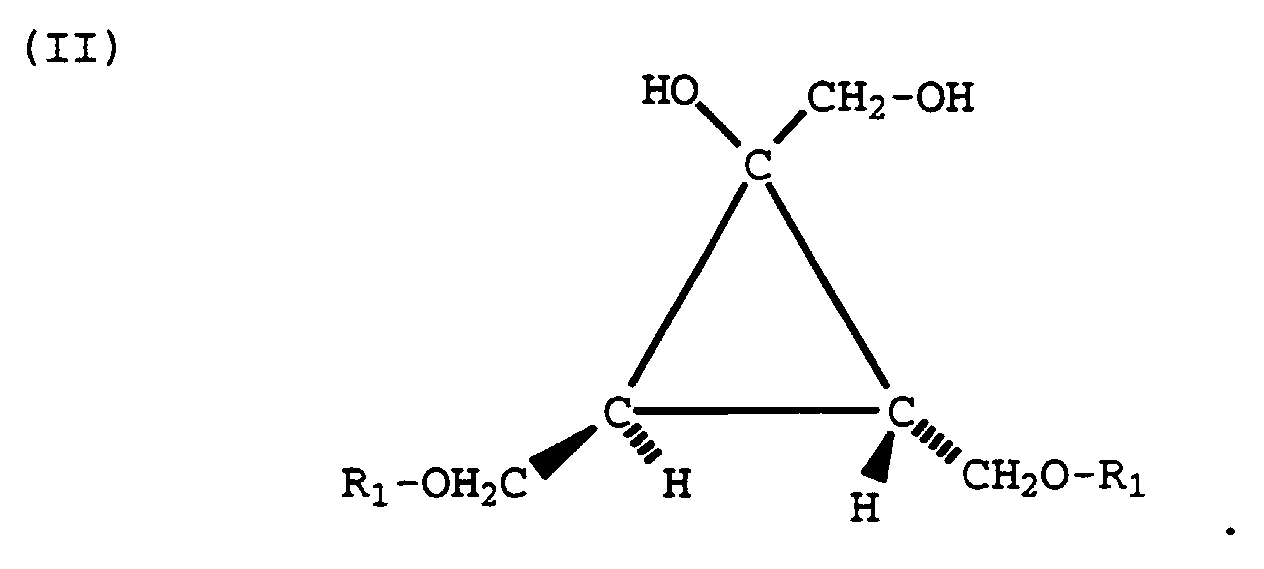
- In the next step of the process of this invention, the diol of formula II is converted to the cyclic orthoester of the formula

- The cyclic orthoester of formula III is then converted to the optically active cyclobutanone of formula IV by treating with a Lewis acid catalyst.
- R1 in the above formulas is a hydroxy protecting group. Suitable hydroxy protecting groups include silyl groups such as t-butyldimethylsilyl, t-butyldiphenylsilyl, (triphenylmethyl)dimethylsilyl, methyldiisopropylsilyl, and triisopropylsilyl, benzyl and substituted benzyl grous such as p-methoxybenzyl, triphenylmethyl and substituted triphenylmethyl groups such as 4-methoxy substituted triphenylmethyl and 4,4-dimethylsubstituted triphenylmethyl, and acyl groups of the formula

- R3 is methyl or ethyl.
- R4 is straight or branched chain alkyl of 1 to 6 carbons or phenyl.
- This invention is also directed to the novel intermediates of formulas II and III shown above.
- According to the process of this invention a solution of the diprotected resolved compound of formula I in an organic solvent is treated with a oxidizing agent to give the diol of formula II. The preferred oxidizing agent is osmium tetroxide employed in an aqueous solution. Suitable organic solvents for the diprotected resolved compound of formula I include acetone, which is preferred, ethyl acetate, dichloromethane, etc.
- Preferred features of the process will now be described. The osmium tetroxide may be employed in catalytic amounts by including a cooxidant in the reaction mixture to regenerate the spent osmium tetroxide. 4-Methylmorpholine N-oxide is the preferred cooxidant. When the cooxidant is employed, the osmium tetroxide is utilized in an aqueous solution containing from about 0.2 mole percent to about 0.8 mole percent, preferably about 0.5 mole percent.
- The reaction of diprotected resolved compound of formula I to the diol of formula II may be performed at room temperature.
- In the next step of the process of this invention, the diol of formula II is converted to the spiro compound of formula III. A solution of the diol of formula II in an organic solvent such toluene, which is preferred, benzene, etc. , may be treated with a trimethyl or triethyl orthoester of the formula
R4-C-(OR3)3
such as trimethyl orthoacetate, which is preferred, trimethyl orthobenzoate, trimethyl orthobutyrate, triethyl orthoacetate, triethyl orthopropionate, trimethyl orthovalerate, etc. Preferably, the reaction is performed in the presence of a weak acid catalyst such as pyridium p-toluenesulfonate. - The reaction of the diol of formula II to the spiro compound of formula III may be performed at room temperature preferably under an inert atmosphere.
- In the next step of the process of this invention, the spiro compound of formula III is converted to the optically active diprotected cyclobutanone of formula IV. A solution of the spiro compound of formula III in an organic solvent such as toluene, ethylacetate, or dichloromethane, which is preferred, may be treated with a Lewis acid catalyst.
- Suitable Lewis acid catalysts for this reaction include boron trifluoride etherate, which is preferred, trimethylsilyl trifluoromethanesulfonate, boron trichloride, boron tribromide, diethylaluminum chloride, ethylaluminum dichloride, aluminum trichloride, titanium tetrachoride, tin tetrachloride, tin trichloride, etc.
- The reaction of the spiro compound of formula III and the Lewis acid catalyst may be performed at low temperatures, preferably at about 0°C. The spiro compound of formula III can be utilized in crude form. The resulting diprotected optically active cyclobutanone product of formula IV may be purified by conventional techniques following completion of the reaction.
- The diprotected dimethanol compound of formula I may be prepared by treating (1R-trans)-3-methylene-1,2-cyclopropanedimethanol with a protecting agent such as a chloride of the formula
(V) R1-Cl
when R1 is benzyl, substituted benzyl, triphenylmethyl, substituted triphenylmethyl, a hindered silyl, or an acyl group of the formula

- The preferred R1 protecting group in the compound of formula I is benzoyl which may be prepared by reacting (1R-trans)-3-methylene-1,2-cyclopropane-dimethanol with benzoic anhydride as described in Example 1(c) of U.S. Patent 5,185,463.
- The optically active cyclobutanone of formula IV can be converted to the antiviral agent [1R-(1α,2β,3α)]-2-amino-9-[2,3-bis(hydroxymethyl)-cyclobutyl]-1,9-dihydro-6H-purin-6-one by known methods.
- As taught by Bisacchi et al. in U.S. Patent 5,064,961 and Singh et al. in European Patent Application 572,209, the optically active cyclobutanone of formula IV can be treated with a reducing agent to give the optically active cyclobutanol of the formula

- The optically active cyclobutanol of formula VIII may then be converted to the optically active compound of the formula

- The optically active compound of formula IX can then be treated with a protected guanine such as 2-amino-6-benzyloxypurine, 2-amino-6-methoxyethoxypurine, 2-amino-6-chloropurine as taught by Bisacchi et al. in U.S. Patent 5,064,961 to give the optically active compound of the formula

- An alternate procedure for converting the optically active intermediate of formula IX to the desired antiviral agent is taught by Bisacchi et al. in European Patent Application 579,421. In this procedure, the intermediate of formula IX is treated with a purine salt of the formula


- The following example is illustative of the invention.
- Water (9.6 ml) was added to a solution of (1R-trans)-3-methylene-1,2-cyclopropanedimethanol, dibenzoate in acetone (80 ml) at room temperature under an argon atmosphere. To the resulting solution was added a 60 weight percent aqueous solution of 4-methylmorpholine N-oxide (8.1 ml, about 9.15 g. of solution containing about 5.49 g of 4-methylmorpholine N-oxide, 46.87 mmole) followed by a 4% aqueous solution osmium tetroxide (0.98 ml, about 0.154 mmole, 0.005 eq., 0.5 mole%). The resulting mixture was stirred at room temperature under argon in the dark. The reaction was monitored by TLC analysis. After stirring at room temperature for 22 hours, water (15 ml) was added, followed by sodium metabisulfite (8.0 g, 42.08 mmole). After stirring for about 10 minutes, magnesium silicate (6 g) was added. After stirring for about 15 minutes, the resulting mixture was filtered through a bed of magnesium silicate (18 g) and the filter bed was thoroughly washed with acetone and ethyl acetate. The filtrate was partially concentrated and additional ethyl acetate was added (final volume about 400 ml). The resulting solution was washed with water: 1N hydrochloric acid (5:2, 70 ml), 1N hydrochloric acid (3 x 50 ml), 1N sodium bicarbonate (50 ml) and brine. After drying over magnesium sulfate, the solvent was removed at reduced pressure to give the desired product as a pale yellow solid which was dried under vacuum (11.05 g).
- To a suspension of the product from part (a) (1.07 g, 3.0 mmole) in anhydrous toluene (10 ml) at room temperature under argon was added trimethyl orthoacetate (0.57 ml, 4.5 mmole, 1.5 eq.) and pyridinium p-toluenesulfonate (11.5 mg, 0.046 mmole, 1.52 mole %). The resulting suspension was stirred at room temperature for 70 minutes, a clear solution was obtained after about 30 minutes. The resulting mixture was concentrated at reduced pressure to give crude (1S,2S)-5-methoxy-5-methyl-4,6-dioxaspiro-[2.4]heptane-1,2-dimethanol, dibenzoate as a nearly colorless oil.
- The crude product from part (b) was dissolved in anhydrous dichloromethane (10 ml). After cooling to about 0°C (ice bath), boron trifluoride etherate (40 µl, 0.325 mmol, 0.108 eq.) was added. After stirring at about 0°C for one hour, the reaction mixture was diluted with ethyl acetate. The resulting solution was washed with 1N hydrochloric acid, 1N sodium bicarbonate, and brine. After drying over magnesium sulfate, the solvent was removed at reduced pressure to give 960 mg of crude product as a colorless solid.
- This crude product was dissolved with heating in 2-propanol (5 ml). After cooling to room temperature, the mixture was placed in a refrigerator (about 4°C). After standing in the cold for 4 hours, ice cold 2-propanol (5 ml) was added so as to obtain a pourable mixture. The product was collected by filtration, washed with ice cold 2-propanol, and dried under vacuum to give 890 mg of pure (2S-trans)-2,3-bis[(benzoyloxy)methyl]cyclobutanone as a colorless, fluffly solid. TLC (silica gel, ethyl ether: hexane (6:4) Rf = 0.32; (silica gel, toluene: ethyl ether, 84:16) Rf = 0.41.
Claims (10)
- A process for preparing the optically active cyclobutanone of the formula
 a) oxidizing the optically active 3-methylene compound of the formula
 b) converting the diol product from step (a) to the cyclic orthoester of the formula
R4-C-(O-R3)3
in the presence of a weak acid catalyst wherein R3 is methyl or ethyl and R4 is straight or branched chain alkyl of 1 to 6 carbons or phenyl; andc) treating the cyclic orthoester product from step (b) with a Lewis acid catalyst to give the desired optically active cyclobutanone. - The process of Claim 1 wherein the osmium tetroxide in step (a) is employed in catalytic amounts by including 4-methylmorpholine, N-oxide as a cooxidant; the trimethyl or triethyl orthoester in step(b) is trimethyl orthoacetate; the weak acid catalyst is step (b) is pyridium p-toluenesulfonate; and the Lewis acid catalyst in step (c) is boron trifluoride etherate, trimethylsilyl trifluoromethanesulfonate, boron trichloride, boron tribromide, diethylaluminum chloride, ethylaluminum dichloride, aluminum trichloride, titanium tetrachloride, tin tetrachloride, or tin trichloride.
- The process of Claim 1 or 2 wherein the Lewis acid catalyst in step (c) is boron trifluoride etherate.
- A process for preparing the optically active cyclobutanone of the formula
 a) oxidizing the optically active 3-methylene compound of the formula
 b) converting the diol product from step (a) to the cyclic orthoester of the formula
 c) treating the cyclic orthoester product from step (b) with boron trifluoride etherate to give the desired optically active cyclobutanone.
 - A process for preparing the antiviral agent [1R-(1α,2β,3α)]-2-amino-9-[2,3-bis(hydroxymethyl)cyclobutyl]-1,9-dihydro-6H-purine-6-one which comprises:a) oxidizing the optically active 3-methylene compound of the formula

 b) converting the diol product from step (a) to the cyclic orthoester of the formula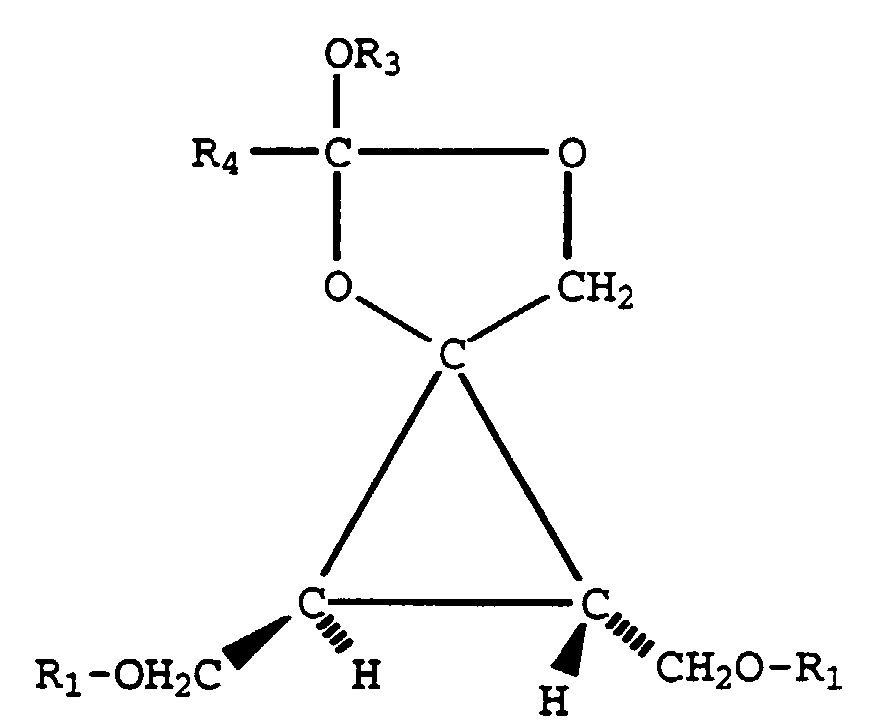
R4-C-(O-R3)3
in the presence of a weak acid catalyst wherein R3 is methyl or ethyl and R4 is straight or branched chain alkyl or 1 to 6 carbons or phenyl;c) treating the cyclic orthoester product from step (b) with a Lewis acid catalyst to give the optically active cyclobutanone of the formula d) treating the optically active cyclobutanone product from step (c) with a reducing agent to give the optically active cyclobutanol of the formula
 e) converting the optically active cyclobutanol product from step (d) to the optically active cyclobutane compound of the formula
 f) reacting the product from step (e) with the purine of the formula
 g) treating the product step (f) to remove the R1 hydroxy protecting groups and to convert the R5 group to a 6-oxo.
 - A process for preparing the antiviral agent [1R-(1α,2β,3α)]-2-amino-9-[2,3-bis(hydroxymethyl)cyclobutyl]-1,9-dihydro-6H-purin-6-one which comprises:a) oxidizing the optically active 3-methylene compound of the formula

 b) converting the diol product from step (a) to the cyclic orthoester of the formula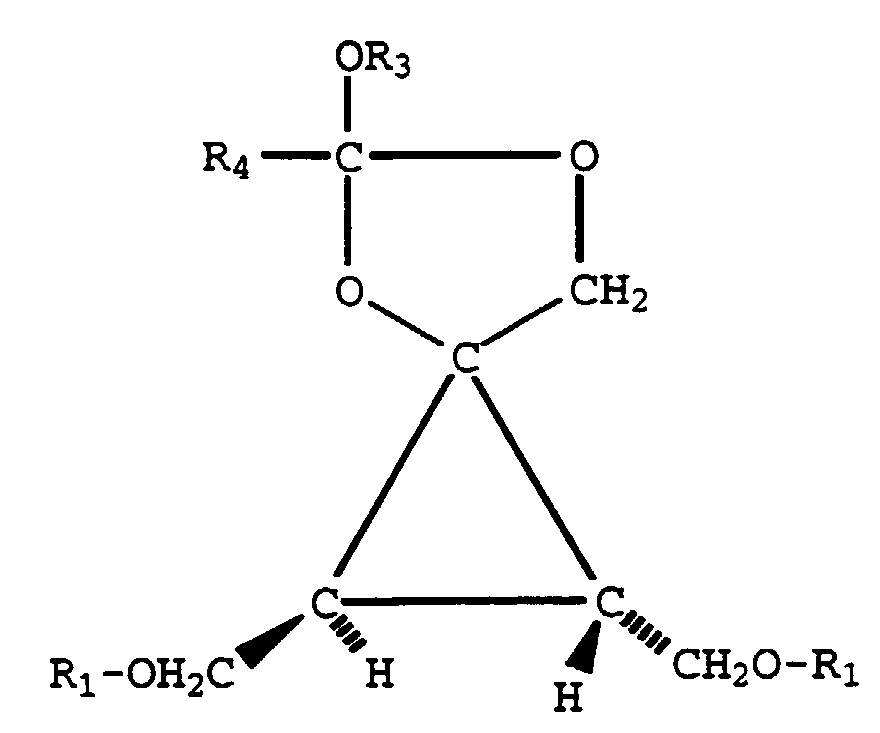
R4-C-(O-R3)3
in the presence of a weak acid catalyst wherein R3 is methyl or ethyl and R4 is straight or branched chain alkyl of 1 to 6 carbons or phenyl;c) treating the cyclic orthoester product from step (b) with a Lewis acid catalyst to give the optically active cyclobutanone of the formula d) treating the optically active cyclobutanone product from step (c) with a reducing agent to give the optically active cyclobutanol of the formula
 e) converting the optically active cyclobutanol product from step (d) to the optically active cyclobutane compound of the formula
 f) reacting the product from step (e) with the purine salt of the formula
 g) treating the product step (f) to remove the R1 hydroxy protecting groups and to convert the Y1 group to a 6-oxo.
 - A compound of the formula


- The compound of Claim 7, (1S-trans)-3-hydroxy-1,2,3-cyclopropanetrimethanol, α1, α2,-dibenzoate.
- A compound of the formula
 R2 is straight or branched chain alkyl of 1 to 6 carbons or phenyl;R3 is methyl or ethyl; andR4 is straight or branched chain alkyl of 1 to 6 carbons or phenyl.
 - The compound of Claim 9, (1S,2S)-5-methoxy-5-methyl-4,6-dioxaspiro[2.4]heptane-1,2-dimethanol, dibenzoate.
Applications Claiming Priority (2)
| Application Number | Priority Date | Filing Date | Title |
|---|---|---|---|
| US41640395A | 1995-04-03 | 1995-04-03 | |
| US416403 | 1995-04-03 |
Publications (1)
| Publication Number | Publication Date |
|---|---|
| EP0736533A1 true EP0736533A1 (en) | 1996-10-09 |
Family
ID=23649835
Family Applications (1)
| Application Number | Title | Priority Date | Filing Date |
|---|---|---|---|
| EP96302173A Ceased EP0736533A1 (en) | 1995-04-03 | 1996-03-28 | Intermediates and process for the preparation of an antiviral agent |
Country Status (10)
| Country | Link |
|---|---|
| US (1) | US5773614A (en) |
| EP (1) | EP0736533A1 (en) |
| JP (1) | JPH08283276A (en) |
| KR (1) | KR960037634A (en) |
| CN (1) | CN1151982A (en) |
| AU (1) | AU706900B2 (en) |
| CA (1) | CA2172660A1 (en) |
| HU (1) | HUP9600852A2 (en) |
| IL (1) | IL117574A0 (en) |
| SG (1) | SG44742A1 (en) |
Cited By (9)
| Publication number | Priority date | Publication date | Assignee | Title |
|---|---|---|---|---|
| WO2004085406A1 (en) | 2003-03-24 | 2004-10-07 | F. Hoffmann-La Roche Ag | Benzyl-pyridazinons as reverse transcriptase inhibitors |
| WO2007045573A1 (en) | 2005-10-19 | 2007-04-26 | F. Hoffmann-La Roche Ag | Phenyl-acetamide nnrt inhibitors |
| WO2008019968A1 (en) | 2006-08-16 | 2008-02-21 | F. Hoffmann-La Roche Ag | Non-nucleoside reverse transcriptase inhibitors |
| WO2008071587A2 (en) | 2006-12-13 | 2008-06-19 | F. Hoffmann-La Roche Ag | 2-(piperidin-4-yl)-4-phenoxy- or phenylamino-pyrimidine derivatives as non-nucleoside reverse transcriptase inhibitors |
| WO2008145562A1 (en) | 2007-05-30 | 2008-12-04 | F. Hoffmann-La Roche Ag | Non-nucleoside reverse transcriptase inhibitors |
| WO2009080534A1 (en) | 2007-12-21 | 2009-07-02 | F. Hoffmann-La Roche Ag | Heterocyclic antiviral compounds |
| WO2011077100A1 (en) | 2009-12-24 | 2011-06-30 | Cipla Limited | Antiretroviral composition |
| US8524651B2 (en) | 2003-10-24 | 2013-09-03 | Immunaid Pty Ltd. | Method of therapy |
| US9122778B2 (en) | 2009-05-27 | 2015-09-01 | Biotempus Limited | Methods of treating diseases |
Families Citing this family (5)
| Publication number | Priority date | Publication date | Assignee | Title |
|---|---|---|---|---|
| US6353122B1 (en) | 1997-02-26 | 2002-03-05 | Bristol-Myers Squibb Company | Method for epoxidation of 3-methylenecyclopropanes |
| JP2009505947A (en) * | 2005-06-23 | 2009-02-12 | エモリー・ユニバーシティ | Imaging agent |
| AU2006262425C1 (en) * | 2005-06-23 | 2012-06-21 | Emory University | Stereoselective synthesis of amino acid analogs for tumor imaging |
| US8246752B2 (en) | 2008-01-25 | 2012-08-21 | Clear Catheter Systems, Inc. | Methods and devices to clear obstructions from medical tubes |
| CN115181013B (en) * | 2022-07-22 | 2023-08-08 | 北京先通国际医药科技股份有限公司 | Preparation method and application of key intermediate of modified fatty acid type PET reagent precursor |
Citations (13)
| Publication number | Priority date | Publication date | Assignee | Title |
|---|---|---|---|---|
| EP0322854A1 (en) * | 1987-12-28 | 1989-07-05 | E.R. Squibb & Sons, Inc. | Purinyl cyclobutanes |
| EP0335355A2 (en) * | 1988-03-30 | 1989-10-04 | E.R. Squibb & Sons, Inc. | Bis-(hydroxymethyl) cyclobutyl purines and pyrimidines |
| EP0433897A2 (en) * | 1989-12-18 | 1991-06-26 | E.R. SQUIBB & SONS, INC. | Process for preparing an optically active cyclobutane nucleoside |
| EP0444597A1 (en) * | 1990-03-01 | 1991-09-04 | Nippon Kayaku Kabushiki Kaisha | Novel cyclobutane derivative |
| EP0452729A1 (en) * | 1990-04-16 | 1991-10-23 | Bristol-Myers Squibb Company | Process for preparing substituted cyclobutanes |
| EP0458363A1 (en) * | 1990-05-24 | 1991-11-27 | E.R. SQUIBB & SONS, INC. | Fluorinated bis(hydroxymethyl) cyclobutyl purines and pyrimidines |
| EP0484843A1 (en) * | 1990-11-05 | 1992-05-13 | E.R. SQUIBB & SONS, INC. | An optically active cyclobutyl pyrimidine |
| US5185463A (en) * | 1991-10-02 | 1993-02-09 | E. R. Squibb & Sons, Inc. | Process for the preparation of an antiviral agent |
| JPH05103679A (en) * | 1991-10-09 | 1993-04-27 | Nippon Kayaku Co Ltd | New production of cyclobutanol |
| EP0572209A2 (en) * | 1992-05-26 | 1993-12-01 | E.R. Squibb & Sons, Inc. | Process for preparing diprotected 2,3-hydroxymethyl cyclobutanol |
| EP0579421A2 (en) * | 1992-07-13 | 1994-01-19 | E.R. Squibb & Sons, Inc. | Process for preparing guanine-containing antiviral agents and purinyl salts useful in such process |
| JPH06107589A (en) * | 1992-09-25 | 1994-04-19 | Nippon Kayaku Co Ltd | Production of cyclobutanone derivative |
| US5664961A (en) * | 1994-01-27 | 1997-09-09 | Yazaki Corporation | Connector housing with lock |
Family Cites Families (4)
| Publication number | Priority date | Publication date | Assignee | Title |
|---|---|---|---|---|
| US5126345A (en) * | 1988-03-30 | 1992-06-30 | E. R. Squibb & Sons, Inc. | Bis (hydroxymethyl) cyclobutyl triazolopyrimidines |
| AU622926B2 (en) * | 1988-09-09 | 1992-04-30 | Nippon Kayaku Kabushiki Kaisha | Pyrimidine or purine cyclobutane derivatives |
| US5153352A (en) * | 1988-10-25 | 1992-10-06 | Bristol-Myers Squibb Company | Process for preparation of intermediates of carbocyclic nucleoside analogs |
| US5233076A (en) * | 1990-05-24 | 1993-08-03 | E. R. Squibb & Sons, Inc. | Process for preparing an optically active cyclobutanone, an intermediate in the synthesis of an optically active cyclobutane nucleoside |
-
1996
- 1996-03-20 IL IL11757496A patent/IL117574A0/en unknown
- 1996-03-26 SG SG1996006701A patent/SG44742A1/en unknown
- 1996-03-26 CA CA002172660A patent/CA2172660A1/en not_active Abandoned
- 1996-03-28 EP EP96302173A patent/EP0736533A1/en not_active Ceased
- 1996-04-01 JP JP8078890A patent/JPH08283276A/en active Pending
- 1996-04-02 AU AU50438/96A patent/AU706900B2/en not_active Ceased
- 1996-04-02 HU HU9600852A patent/HUP9600852A2/en unknown
- 1996-04-02 KR KR1019960009829A patent/KR960037634A/en not_active Withdrawn
- 1996-04-03 CN CN96108092A patent/CN1151982A/en active Pending
- 1996-09-13 US US08/713,333 patent/US5773614A/en not_active Expired - Fee Related
Patent Citations (14)
| Publication number | Priority date | Publication date | Assignee | Title |
|---|---|---|---|---|
| EP0322854A1 (en) * | 1987-12-28 | 1989-07-05 | E.R. Squibb & Sons, Inc. | Purinyl cyclobutanes |
| EP0335355A2 (en) * | 1988-03-30 | 1989-10-04 | E.R. Squibb & Sons, Inc. | Bis-(hydroxymethyl) cyclobutyl purines and pyrimidines |
| EP0433897A2 (en) * | 1989-12-18 | 1991-06-26 | E.R. SQUIBB & SONS, INC. | Process for preparing an optically active cyclobutane nucleoside |
| EP0444597A1 (en) * | 1990-03-01 | 1991-09-04 | Nippon Kayaku Kabushiki Kaisha | Novel cyclobutane derivative |
| EP0452729A1 (en) * | 1990-04-16 | 1991-10-23 | Bristol-Myers Squibb Company | Process for preparing substituted cyclobutanes |
| EP0458363A1 (en) * | 1990-05-24 | 1991-11-27 | E.R. SQUIBB & SONS, INC. | Fluorinated bis(hydroxymethyl) cyclobutyl purines and pyrimidines |
| EP0484843A1 (en) * | 1990-11-05 | 1992-05-13 | E.R. SQUIBB & SONS, INC. | An optically active cyclobutyl pyrimidine |
| US5185463A (en) * | 1991-10-02 | 1993-02-09 | E. R. Squibb & Sons, Inc. | Process for the preparation of an antiviral agent |
| EP0535448A2 (en) * | 1991-10-02 | 1993-04-07 | E.R. SQUIBB & SONS, INC. | Process and intermediates for the preparation of an antiviral agent containing a cyclobutyl group |
| JPH05103679A (en) * | 1991-10-09 | 1993-04-27 | Nippon Kayaku Co Ltd | New production of cyclobutanol |
| EP0572209A2 (en) * | 1992-05-26 | 1993-12-01 | E.R. Squibb & Sons, Inc. | Process for preparing diprotected 2,3-hydroxymethyl cyclobutanol |
| EP0579421A2 (en) * | 1992-07-13 | 1994-01-19 | E.R. Squibb & Sons, Inc. | Process for preparing guanine-containing antiviral agents and purinyl salts useful in such process |
| JPH06107589A (en) * | 1992-09-25 | 1994-04-19 | Nippon Kayaku Co Ltd | Production of cyclobutanone derivative |
| US5664961A (en) * | 1994-01-27 | 1997-09-09 | Yazaki Corporation | Connector housing with lock |
Non-Patent Citations (2)
| Title |
|---|
| CHEMICAL ABSTRACTS, vol. 119, no. 13, 27 September 1993, Columbus, Ohio, US; abstract no. 137552b, page 721; column r; XP002007761 * |
| CHEMICAL ABSTRACTS, vol. 121, no. 13, 26 September 1994, Columbus, Ohio, US; abstract no. 157191c, page 980; column l; XP002007760 * |
Cited By (12)
| Publication number | Priority date | Publication date | Assignee | Title |
|---|---|---|---|---|
| WO2004085406A1 (en) | 2003-03-24 | 2004-10-07 | F. Hoffmann-La Roche Ag | Benzyl-pyridazinons as reverse transcriptase inhibitors |
| US8524651B2 (en) | 2003-10-24 | 2013-09-03 | Immunaid Pty Ltd. | Method of therapy |
| WO2007045573A1 (en) | 2005-10-19 | 2007-04-26 | F. Hoffmann-La Roche Ag | Phenyl-acetamide nnrt inhibitors |
| WO2008019968A1 (en) | 2006-08-16 | 2008-02-21 | F. Hoffmann-La Roche Ag | Non-nucleoside reverse transcriptase inhibitors |
| WO2008071587A2 (en) | 2006-12-13 | 2008-06-19 | F. Hoffmann-La Roche Ag | 2-(piperidin-4-yl)-4-phenoxy- or phenylamino-pyrimidine derivatives as non-nucleoside reverse transcriptase inhibitors |
| WO2008145562A1 (en) | 2007-05-30 | 2008-12-04 | F. Hoffmann-La Roche Ag | Non-nucleoside reverse transcriptase inhibitors |
| WO2009080534A1 (en) | 2007-12-21 | 2009-07-02 | F. Hoffmann-La Roche Ag | Heterocyclic antiviral compounds |
| US9122778B2 (en) | 2009-05-27 | 2015-09-01 | Biotempus Limited | Methods of treating diseases |
| US9239904B2 (en) | 2009-05-27 | 2016-01-19 | Biotempus Limited | Computer systems for treating diseases |
| US9268908B2 (en) | 2009-05-27 | 2016-02-23 | Biotempus Limited | Computer systems for treating diseases |
| US10714208B2 (en) | 2009-05-27 | 2020-07-14 | Biotempus Pty Ltd | Computer systems for treating diseases |
| WO2011077100A1 (en) | 2009-12-24 | 2011-06-30 | Cipla Limited | Antiretroviral composition |
Also Published As
| Publication number | Publication date |
|---|---|
| AU706900B2 (en) | 1999-07-01 |
| CA2172660A1 (en) | 1996-10-04 |
| KR960037634A (en) | 1996-11-19 |
| IL117574A0 (en) | 1996-07-23 |
| AU5043896A (en) | 1996-10-17 |
| MX9601180A (en) | 1997-02-01 |
| US5773614A (en) | 1998-06-30 |
| SG44742A1 (en) | 1997-12-19 |
| CN1151982A (en) | 1997-06-18 |
| HUP9600852A2 (en) | 1996-12-30 |
| HU9600852D0 (en) | 1996-05-28 |
| JPH08283276A (en) | 1996-10-29 |
Similar Documents
| Publication | Publication Date | Title |
|---|---|---|
| US5773614A (en) | Process for the preparation of an antiviral agent | |
| EP0433897B1 (en) | Process for preparing an optically active cyclobutane nucleoside | |
| EP2594569B1 (en) | Entecavir synthesis method and intermediate compound thereof | |
| EP0285884A2 (en) | Process to produce 2', 3'-Dideoxynucleosides | |
| EP0502690B1 (en) | Cyclopropane derivative | |
| US20080176813A1 (en) | Carbocyclic nucleosides and process for obtaining such | |
| US5608064A (en) | Purinyl salts useful for preparing guanine containing antiviral agents | |
| JPH10506621A (en) | Intermediates for dinucleotide and oligonucleotide analogs | |
| HK1002390A (en) | Intermediates and process for the preparation of an antiviral agent | |
| US5516903A (en) | Process for preparing [IR-(1α,2β-3α)]-2-amino-9-[2,3-bis(hydroxymethyl)cyclobutyl]-1,9-dihydro-6H-purin-6-one | |
| AU2018253555B2 (en) | Process for the preparation of 4-amino-1-((1S,4R,5S)-2-fluoro-4,5-dihydroxy-3-hydroxymethyl-cyclopent-2-enyl)-1H-pyrimidin-2-one | |
| JP3119367B2 (en) | Manufacturing method of cyanohydantoin | |
| HK40081537A (en) | Process for the preparation of 4-amino-1-((1s,4r,5s)-2-fluoro-4,5-dihidroxy-3-hydroxy-methyl-cyclopent-2-enyl)-1h-pyrimidin-2-one | |
| EP0514036A2 (en) | Preparation of thionucleosides | |
| HK1261333B (en) | Process for the preparation of 4-amino-1-((1s,4r,5s)-2-fluoro-4,5-dihidroxy-3-hydroxy-methyl-cyclopent-2-enyl)-1h-pyrimidin-2-one | |
| HK1261333A1 (en) | Process for the preparation of 4-amino-1-((1s,4r,5s)-2-fluoro-4,5-dihidroxy-3-hydroxy-methyl-cyclopent-2-enyl)-1h-pyrimidin-2-one | |
| JPH072846A (en) | Tetrahydrofurfuryl alcohol derivative | |
| WO1998038184A1 (en) | A method for epoxidation of 3-methylenecyclopropanes | |
| HK1002109A (en) | Process for preparing guanine-containing antiviral agents and purinyl salts useful in such process |
Legal Events
| Date | Code | Title | Description |
|---|---|---|---|
| PUAI | Public reference made under article 153(3) epc to a published international application that has entered the european phase |
Free format text: ORIGINAL CODE: 0009012 |
|
| AK | Designated contracting states |
Kind code of ref document: A1 Designated state(s): AT BE CH DE DK ES FI FR GB GR IE IT LI LU MC NL PT SE |
|
| RIN1 | Information on inventor provided before grant (corrected) |
Inventor name: MUELLER, RICHARD H. Inventor name: GODFREY, JOLLIE D., FR. |
|
| 17P | Request for examination filed |
Effective date: 19970319 |
|
| 17Q | First examination report despatched |
Effective date: 19990119 |
|
| GRAG | Despatch of communication of intention to grant |
Free format text: ORIGINAL CODE: EPIDOS AGRA |
|
| STAA | Information on the status of an ep patent application or granted ep patent |
Free format text: STATUS: THE APPLICATION HAS BEEN REFUSED |
|
| 18R | Application refused |
Effective date: 20000301 |
|
| REG | Reference to a national code |
Ref country code: HK Ref legal event code: WD Ref document number: 1002390 Country of ref document: HK |