EP0736047B1 - Process for preparing carbamates - Google Patents
Process for preparing carbamates Download PDFInfo
- Publication number
- EP0736047B1 EP0736047B1 EP95905100A EP95905100A EP0736047B1 EP 0736047 B1 EP0736047 B1 EP 0736047B1 EP 95905100 A EP95905100 A EP 95905100A EP 95905100 A EP95905100 A EP 95905100A EP 0736047 B1 EP0736047 B1 EP 0736047B1
- Authority
- EP
- European Patent Office
- Prior art keywords
- carbon atoms
- polyolefin
- formula
- group containing
- substituted
- Prior art date
- Legal status (The legal status is an assumption and is not a legal conclusion. Google has not performed a legal analysis and makes no representation as to the accuracy of the status listed.)
- Expired - Lifetime
Links
Classifications
-
- C—CHEMISTRY; METALLURGY
- C10—PETROLEUM, GAS OR COKE INDUSTRIES; TECHNICAL GASES CONTAINING CARBON MONOXIDE; FUELS; LUBRICANTS; PEAT
- C10L—FUELS NOT OTHERWISE PROVIDED FOR; NATURAL GAS; SYNTHETIC NATURAL GAS OBTAINED BY PROCESSES NOT COVERED BY SUBCLASSES C10G OR C10K; LIQUIFIED PETROLEUM GAS; USE OF ADDITIVES TO FUELS OR FIRES; FIRE-LIGHTERS
- C10L1/00—Liquid carbonaceous fuels
- C10L1/10—Liquid carbonaceous fuels containing additives
- C10L1/14—Organic compounds
- C10L1/22—Organic compounds containing nitrogen
- C10L1/234—Macromolecular compounds
- C10L1/238—Macromolecular compounds obtained otherwise than by reactions involving only carbon-to-carbon unsaturated bonds
- C10L1/2383—Polyamines or polyimines, or derivatives thereof (poly)amines and imines; derivatives thereof (substituted by a macromolecular group containing 30C)
- C10L1/2387—Polyoxyalkyleneamines (poly)oxyalkylene amines and derivatives thereof (substituted by a macromolecular group containing 30C)
-
- C—CHEMISTRY; METALLURGY
- C08—ORGANIC MACROMOLECULAR COMPOUNDS; THEIR PREPARATION OR CHEMICAL WORKING-UP; COMPOSITIONS BASED THEREON
- C08F—MACROMOLECULAR COMPOUNDS OBTAINED BY REACTIONS ONLY INVOLVING CARBON-TO-CARBON UNSATURATED BONDS
- C08F8/00—Chemical modification by after-treatment
- C08F8/10—Acylation
-
- C—CHEMISTRY; METALLURGY
- C10—PETROLEUM, GAS OR COKE INDUSTRIES; TECHNICAL GASES CONTAINING CARBON MONOXIDE; FUELS; LUBRICANTS; PEAT
- C10L—FUELS NOT OTHERWISE PROVIDED FOR; NATURAL GAS; SYNTHETIC NATURAL GAS OBTAINED BY PROCESSES NOT COVERED BY SUBCLASSES C10G OR C10K; LIQUIFIED PETROLEUM GAS; USE OF ADDITIVES TO FUELS OR FIRES; FIRE-LIGHTERS
- C10L1/00—Liquid carbonaceous fuels
- C10L1/10—Liquid carbonaceous fuels containing additives
- C10L1/14—Organic compounds
- C10L1/22—Organic compounds containing nitrogen
- C10L1/234—Macromolecular compounds
- C10L1/238—Macromolecular compounds obtained otherwise than by reactions involving only carbon-to-carbon unsaturated bonds
-
- C—CHEMISTRY; METALLURGY
- C10—PETROLEUM, GAS OR COKE INDUSTRIES; TECHNICAL GASES CONTAINING CARBON MONOXIDE; FUELS; LUBRICANTS; PEAT
- C10L—FUELS NOT OTHERWISE PROVIDED FOR; NATURAL GAS; SYNTHETIC NATURAL GAS OBTAINED BY PROCESSES NOT COVERED BY SUBCLASSES C10G OR C10K; LIQUIFIED PETROLEUM GAS; USE OF ADDITIVES TO FUELS OR FIRES; FIRE-LIGHTERS
- C10L1/00—Liquid carbonaceous fuels
- C10L1/10—Liquid carbonaceous fuels containing additives
- C10L1/14—Organic compounds
- C10L1/22—Organic compounds containing nitrogen
- C10L1/234—Macromolecular compounds
- C10L1/238—Macromolecular compounds obtained otherwise than by reactions involving only carbon-to-carbon unsaturated bonds
- C10L1/2383—Polyamines or polyimines, or derivatives thereof (poly)amines and imines; derivatives thereof (substituted by a macromolecular group containing 30C)
-
- C—CHEMISTRY; METALLURGY
- C10—PETROLEUM, GAS OR COKE INDUSTRIES; TECHNICAL GASES CONTAINING CARBON MONOXIDE; FUELS; LUBRICANTS; PEAT
- C10L—FUELS NOT OTHERWISE PROVIDED FOR; NATURAL GAS; SYNTHETIC NATURAL GAS OBTAINED BY PROCESSES NOT COVERED BY SUBCLASSES C10G OR C10K; LIQUIFIED PETROLEUM GAS; USE OF ADDITIVES TO FUELS OR FIRES; FIRE-LIGHTERS
- C10L10/00—Use of additives to fuels or fires for particular purposes
- C10L10/04—Use of additives to fuels or fires for particular purposes for minimising corrosion or incrustation
Definitions
- the present invention relates to a process for preparing carbamates, and in particular polyolefin-N-substituted-carbamates suitable for use as gasoline additives.
- additives which can be added to hydrocarbon fuels to attempt to prevent or reduce deposit formation or remove or modify formed deposits in the combustion chamber and adjacent surfaces, such as valves, ports and spark plugs, in order to reduce octane requirement.
- EP-A-414 963 and EP-A-533 278 that polyolefin-N-substituted carbamates are gasoline additives which are helpful in preventing, or reducing the accumulation of engine deposits. They may thereby be effective in controlling octane requirement increase.
- known methods of making such additives result in comparatively low yields.
- the test used in EP-A-414 963 to determine yield was based on Basic N content before and after reaction (see EP-A-414963, Example 1).
- Basic N content assessment has subsequently been found to be an invalid test for determining yield. This is due to the reaction of an alkyl chloride with one of the Basic N's in the starting amine.
- Alkyl chlorides result from dissociation of chloroformates used as reagent to place a carboxyl group on one of the nitrogens in the starting amine.
- a process for preparing a carbanate which comprises contacting in the presence of a base a polyolefin-secondary-amine with a chloroformate compound of the formula IV in which R 1 is a hydrocarbyl or substituted hydrocarbyl group containing up to 20 carbon atoms, thereby producing a polyolefin-N-substituted-carbamate of formula I in which R is a polyolefin radical having an average molecular weight in the range from 500 to 9,900, R 1 is a hydrocarbyl or substituted hydrocarbyl group containing up to 20 carbon atoms, and A is derived from an N-substituted amino group in which the substituent is a hydrocarbyl or substituted hydrocarbyl group containing up to 20 carbon atoms, and removing hydrogen chloride formed in producing the carbamate of formula I as a salt.
- the moiety A of the polyolefin-N-sustituted carbamates of formula I is derived from an N-substituted monoamine or from a polyamine having from 2 to 10 amine nitrogen atoms. This amine can contain up to 20 carbon atoms.
- the hydrocarbyl and substituted hydrocarbyl groups of the amine include aliphatic, alicyclic, aromatic or hetrocyclic groups.
- the substituted hydrocarbyl group includes those hydrocarbyl groups substituted by one or more non-interfering atoms or substituents, including ring oxygen and keto, hydroxy, nitro, cyano, alkoxy and acyl, particularly alkanoyl.
- the hydrocarbyl groups are preferably relatively free of aliphatic unsaturation.
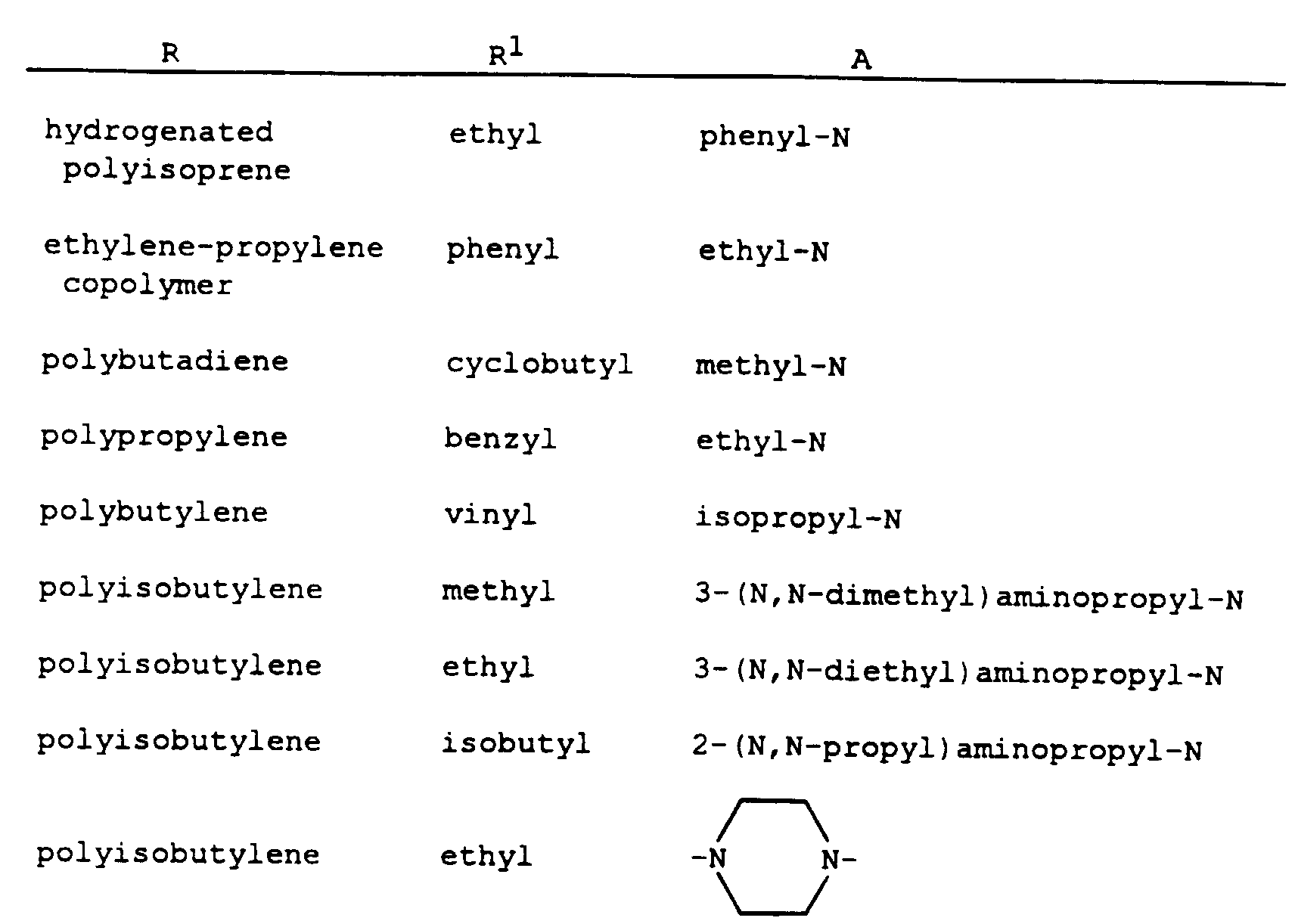
- Non-limiting illustrative compounds of formula I include those wherein:
- the hydrocarbyl and substituted hydrocarbyl groups of R 1 in formula IV may conveniently include aliphatic, alicyclic, aromatic or heterocyclic groups optionally substituted by one or more non-interfering atoms or substituents including ring-O, ring-N and keto, hydroxy, nitro, cyano, alkoxy and acyl groups.
- the compounds of formula IV are generally available in the art.
- Preferred compounds of formual IV include those compounds wherein R 1 is an alkyl group containing from 1 to 10 carbon atoms, an alkenyl group containing from 2 to 7 carbon atoms, a cycloalkyl group containing from 3 to 7 ring carbons and a total of 3 to 10 carbon atoms or an aryl, aralkyl or alkaryl group containing from 6 to 10 total carbon atoms.
- R 1 is an alkenyl group containing 1 to 4 carbon atoms, such as methyl, ethyl, n-propyl, isopropyl, n-butyl or isobutyl.
- R 1 is methyl, ethyl, n-butyl or isobutyl.
- the yield of the poly(olefin)-N-substituted carbamate of formula I may be as high as 70% by weight, or even 80% by weight or more.
- Preferred polyolefin-N-substituted-carbamates contain at least one olefinic polymer chain and include those of the formula II wherein R is an polyolefin radical having an average molecular weight in the range 500 to 9,900; R 1 is hydrocarbyl group containing up to 20 carbon atoms; and R 2 is hydrocarbyl group or a hydrocarbylaminohydrocarbyl group, each containing up to 20 total carbon atoms in the hydrocarbyl group(s).
- Preferred compounds of formula I of the invention include those compounds wherein R is a polyolefin radical having an average molecular weight in the range 550 to 4,900, preferably 600 to 1300.
- R 1 is preferably an alkyl group containing from 1 to 10 carbon atoms, an alkenyl group containing from 2 to 7 carbon atoms, a cycloalkyl group containing from 3 to 7 ring carbon atoms and a total of 3 to 10 carbon atoms or an aryl, aralkyl or alkaryl group containing from 6 to 10 total carbon atoms.
- R 1 is preferably an alkyl group containing 1 to 4 carbon atoms.
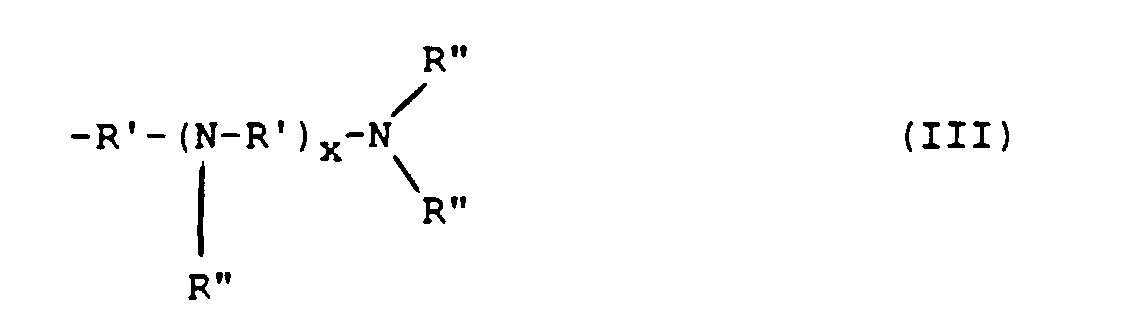
- R 2 is preferably an alkyl group containing from 1 to 10 carbon atoms, an alkenyl group containing from 2 to 7 carbon atoms, a cycloalkyl group containing from 3 to 7 ring carbon atoms and a total of 3 to 10 carbon atoms or an aryl, aralkyl or alkaryl group containng from 6 to 10 total carbon atoms, or more preferably, a group of formula III wherein each R' is independently an alkylene group containing from 1 to 8 carbon atoms, prferably from 1 to 4 carbon atoms, more preferably propylene; and each R" is independently a hydrogen atom, a group - COOR 1 , where R 1 is as defined above, provided that no N atom bears two -COOR 1 groups, or an alkyl group containing from 1 to 7 carbon atoms, preferably from 1 to 4 carbon atoms, more preferably a methyl group; and x is 0 to 23, preferably 0 to 20, more preferably 0
- each R" independently to represent a hydrogen atom or an alkyl group of 1 to 7 carbon atoms.
- each R' is an alkylene group containing from 1 to 4 carbon atoms; each R" is independently an alkyl group containing from 1 to 4 carbon atoms and x is 0 to 5, e.g. 0 to 2, preferably O or 1.
- R' to be propylene each R" to be a methyl group and x to be from 0 to 5, preferably 0.
- the resulting compound of formula I or II it is preferred for the resulting compound of formula I or II to contain a single NCOOR 1 moiety, and in order to achieve this it is preferred that the molar ratio polyolefin-secondary-amine:chloroformate compound of formula IV is greater than 1:1, e.g. in the range 1.05:1 to 1.3:1.
- the polyolefin-secondary amine intermediates can be prepared by reacting olefinic polymers with amines employing conventional procedures, e.g. as described in EP-A-414 963.
- oil-soluble polyolefin-secondary amine intermediates have at least one polymer chain having a molecular weight in the range from 500 to 9,900 and preferably from 550 to 4,900, and particularly from 600 to 1,300, which can be saturated or unsaturated and straight or branch chain and is/are attached to a nitrogen and/or a carbon atom of the amine.
- Preferred polyolefin-N-substituted-secondary-amine intermediates are polyalkylene polyamines having the structural formula V wherein R represents a polyolefin radical having a molecular weight in the range 500 to 9,900, each R' is an alkylene radical having from 1 to 8 carbon atoms, preferably 1 to 4 carbon atoms, each R" is independently hydrogen or lower alkyl containing 1 to 7 carbon atoms and x is from 0 to 5.
- R represents a polyolefin radical having a molecular weight in the range 500 to 9,900
- each R' is an alkylene radical having from 1 to 8 carbon atoms, preferably 1 to 4 carbon atoms
- each R" is independently hydrogen or lower alkyl containing 1 to 7 carbon atoms
- x is from 0 to 5.
- Preferred is a polyamine wherein R is a branch-chain polyolefin radical in the molecular weight range of 550 to 4,900, with a molecular weight range
- polyolefins which give rise to R in formulae I, II and V are reacted with amines to form the polyolefin-N-substituted-secondary-amine intermediates of the present invention by methods which are known in the art, e.g. from U.S. Patent No. 4,357,148, and include polyolefins derived from alkanes or alkenes with straight or branched chains, which may nor may not have aromatic or cycloaliphatic substituents, for instance, groups derived from polymers or copolymers of olefins which may or may not have a double bond.
- non-substituted alkenyl and alkyl groups are polyethylene groups, polypropylene groups, polybutylene groups, polyisobutylene groups, polyethylene-polypropylene groups, polyethylene-polyalphamethyl styrene groups and the corresponding groups without double bonds. Particularly preferred are polypropylene and polyisobutylene groups. Polyisobutylene groups are conveniently effective.
- the R" group can be hydrogen but is preferably lower alkyl, i.e. containing up to 7 carbon atoms and more preferably an alkyl group containing from 1 to 4 carbon atoms, e.g. methyl, ethyl, propyl or butyl.
- Suitable amine reactants are broadly referred to as (poly)amines to include both polyamines and monoamines as hereinafter more fully described.
- the (poly)amines used to react with the polyolefins to form the polyolefin-N-substituted-secondary-amine intermediates include aliphatic, alicyclic, aromatic or heterocyclic monoamines or polyamines. A variety of such amines is well documented in the art including U.S. Patent No. 4,191,537.
- the amines can contain other non-reactive substitutes.
- Suitable substituents for such amines include alkyls such as methyl, ethyl, propyl, butyl, isobutyl, pentyl, hexyl and octyl; alkenyls such as propenyl, isobutenyl, hexenyl and octenyl; hydroxyalkyls, such as 2-hydroxyethyl, 3-hydroxypropyl, hydroxy-isopropyl and 4-hydroxybutyl; ketoalkyls, such as 2-ketopropyl and 6-ketooctyl; alkoxy and lower alkenoxyalkyls, such as ethoxyethyl, ethoxypropyl, propoxyethyl, propoxypropyl, 2-(2-ethoxyethoxy)ethyl, and acyl groups such as propionyl and acetyl groups.
- Preferred substituents are C 1 -C 6 alkyl groups.
- Heterocyclic amines can be saturated, unsaturated and substituted or unsubstituted.
- Suitable heterocyclic amines include piperazines, such as 2-methylpiperazine, N-(2-hydroxy-ethyl)-piperazine, 1,2-bis-(N-piperazinyl)ethane, and N,N'-bis-(N-piperazinyl)piperazine, 2-methylimidazoline, 3-amino-piperidine, 2-aminopyridine, 2-(3-aminoethyl)-3-pyrroline, 3-aminopyrrolidine, N-(3-aminopropyl)morpholine, and the like.
- the piperazines are preferred.
- the amine reactants include mixtures of compounds, such as mono and polysubstituted polyamines or isomers.
- the polyamines used to form the preferred polyolefin polyamine intermediate compounds of this invention include low molecular weight aliphatic polyamines such as ethylene diamine, diethylene triamine, triethylene tetramine, propylene diamine, butylene diamine, trimethyl trimethylene diamine, tetramethylene diamine, diaminopentane or pentamethylene diamine, hexamethylene diamine, heptamethylene diamine, diaminooctane, decamethylene diamine, and higher homologues up to 18 carbon atoms.
- low molecular weight aliphatic polyamines such as ethylene diamine, diethylene triamine, triethylene tetramine, propylene diamine, butylene diamine, trimethyl trimethylene diamine, tetramethylene diamine, diaminopentane or pentamethylene diamine, hexamethylene diamine, heptamethylene diamine, diaminooctane, decamethylene diamine, and higher homo
- the polyamine starting materials from which the polyamine groups can be derived can also be a cyclic polyamine, for instance, the cyclic polyamines formed when aliphatic polyamines with nitrogen atoms separated by ethylene groups are heated in the presence of hydrogen chloride.
- Monoamines which can be used to prepare the polyolefin secondary-amines include monoamines in which the hydrocarbyl groups contain from 1 to 14 carbon atoms.
- each hydrocarbyl group is independently selected from an alkyl group containing from 1 to 10 carbon atoms, an alkenyl group containing from 2 to 7 carbon atoms, a cycloalkyl group containing from 3 to 7 ring carbon atoms and a total of 3 to 10 carbon atoms, and aryl, aralkyl and alkaryl groups containing from 6 to 10 total carbon atoms.
- the hydrocarbyl groups are independently selected from an alkyl group containing from 1 to 4 carbon atoms, e.g., ethyl or propyl.
- the reaction between compound of formula IV and polyolefin-secondary amine is preferably effected at a temperature less than 90°C, preferably from 60°C to 70°C, in the presence of a solvent and a base. Reaction may conveniently be effected at atmospheric pressure.
- a convenient solvent for use in the method of this invention has a boiling point in the range from about 130°C to about 150°C.
- xylenes are an appropriate solvent and have boiling points in the range 137 to 144°C.
- the polyolefin carbamate product of formula I is recovered by conventional techniques, such as drying by stripping water or by using anhydrous sodium sulfate.
- the solvent is usually removed, e.g., by stripping, for neat analysis. However, for practical applications some or all of the solvent can be retained as a diluent.
- Unreacted amine can aid in the effects of the polyolefin-N-substituted-carbamates of the invention by acting as a carrier, assisting in enhancing the preventing, removing or retarding of engine deposits (particularly when the carbamate is of methyl or a non-beta hydrogen group) or by providing their known fuel detergents properties.
- the function of the base during the reaction is to neutralize HCl. This is because HCl catalyzes the decomposition of chloroformates to alkyl chlorides. Formation of alkyl chlorides is undesirable since they alkylate the Basic N moieties in the polyolefin-secondary-amine.
- the alkyl chlorides may thereby prevent N-H moieties of the starting amine reactant from reacting as desired with the cloroformates so as to form an N-COOR 1 moiety.
- the alkyl chlorides may also react with other Basic N moieties, e.g. -N(CH 3 ) 2 groups, where it is preferred that such other Basic N moieties should not react at all during the process. This is because it may be desired to have a remaining Basic N in the additive to neutralize acids in the gasoline or acids resulting from combustion of the gasoline.
- the base used in the method of this invention is one having a strong enough basicity to neutralize HCl and a low enough nucleophilicity so as not to react with chloroformate.
- Such base is needed since it will neutralize the HCl and thus prevent the HCl from catalyzing the disassociation of chloroformates. At the same time such a base will not itself react with the chloroformate.
- Suitable bases include basic alkali metal compounds, such as alkali metal carbonates, bicarbonates or alkanoates, e.g. acetates, or mixtures thereof, e.g., sodium or potassium carbonate, sodium or potassium bicarbonate, sodium acetate, or mixtures thereof.
- Sodium and potassium bicarbonates are preferred bases since they result in less solid waste, a solid waste having a low pH and a higher yield of product.
- the base is preferably granular in form and more preferably less than about 100 microns. The less the diameter the higher the surface area. Higher surface areas permit smaller reaction vessels.
- the salt waste produced has a pH less than about 10. Such low pH levels are deemed non-hazardous in some environmental regulations.
- the reaction produces less than about 10% by weight of the waste based on the weight of the waste and carbamate produced.
- the term "waste" includes alkali metal chloride, such as NaCl, and excess unreacted base, e.g., sodium bicarbonate.
- average molecular weight signifies number average molecular weight (Mn).
- the reaction flask was heated to 160°C after the addition was completed and maintained at that temperature for 1 hour.
- the addition funnel was removed and replaced with a powder funnel. Through this latter funnel was added a solution of 44.0 grams of sodium bicarbonate in 177 grams of water. Upon completion of the addition, the flask was heated to 100°C for one hour.
- the contents of the reaction flask were transferred to a 2000 ml separatory funnel where the layers were separated and the lower water layer was removed. The remaining layer was treated three times with 150 ml of water. The water was removed and the contents of the funnel were transferred to a 2000 ml Erlenmeyer flask. Five hundred ml of toluene were added to the flask together with anhydrous sodium sulfate. After one hour of stirring, the contents of the Erlenmeyer flask were filtered and solvent removed by rotary evaporation. Evaluation of the neat material revealed a 60% molar conversion.
Landscapes
- Chemical & Material Sciences (AREA)
- Oil, Petroleum & Natural Gas (AREA)
- Organic Chemistry (AREA)
- Chemical Kinetics & Catalysis (AREA)
- Engineering & Computer Science (AREA)
- General Chemical & Material Sciences (AREA)
- Medicinal Chemistry (AREA)
- Polymers & Plastics (AREA)
- Health & Medical Sciences (AREA)
- Combustion & Propulsion (AREA)
- Addition Polymer Or Copolymer, Post-Treatments, Or Chemical Modifications (AREA)
- Organic Low-Molecular-Weight Compounds And Preparation Thereof (AREA)
- Polyurethanes Or Polyureas (AREA)
Abstract
Description




| Comparative Results With and Without a Base Present During Reaction | ||||
| Sodium Bicarbonate (g) | Temp (°C) | Conversion (mol %) | Waste pH | |
| With Base (Ex. 1) | 44 | 70 | 85 | 8.6 |
| Without Base (Comp. Ex. A) | -------- | 160 | 60 | 10.3 |
Claims (10)
- A process for preparing a carbamate which comprises contacting in the presence of a base a polyolefin-secondary-amine with a chloroformate compound of the formula IVin which R1 is a hydrocarbyl or substituted hydrocarbyl group containing up to 20 carbon atoms, thereby producing a polyolefin-N-substituted-carbamate of formula I
 in which R is a polyolefin radical having an average molecular weight in the range from 500 to 9,900, R1 is a hydrocarbyl or substituted hydrocarbyl group containing up to 20 carbon atoms, and A is derived from an N-substituted amino group in which the substituent is a hydrocarbyl or substituted hydrocarbyl group containing up to 20 carbon atoms, and removing hydrogen chloride formed in producing the carbamate of formula I as a salt.
- A process according to Claim 1 wherein the base is sodium carbonate, sodium bicarbonate, or a mixture thereof.
- A process according to Claim 2 wherein the base is sodium bicarbonate.
- A process according to any one of Claims 1 to 3 wherein R1 in formula IV represents an aliphatic, alicyclic, aromatic, or heterocyclic group optionally substituted by one or more substituents independently selected from ring-O, ring-N and keto, hydroxy, nitro, cyano, alkoxy, and acyl groups.
- A process according to Claim 4 wherein R1 is an alkyl group containing from 1 to 10 carbon atoms, an alkenyl group containing from 2 to 7 carbon atoms, a cycloalkyl group containing from 3 to 7 ring carbon atoms and a total of 3 to 10 carbon atoms, or an aryl, aralkyl or alkaryl group containing from 6 to 10 total carbon atoms.
- A process according to any one of Claims 1 to 5 wherein the polyolefin-N-substituted-secondary-amine comprises a polyalkylene polyamine having the structural formula Vwherein R represents a polyolefin radical having a molecular weight in the range 500 to 9,900, each R' is an alkylene radical having from 1 to 8 carbon atoms, each R" is independently hydrogen or a lower alkyl containing from 1 to 7 carbon atoms, and x is from 0 to 5.

- A process according to Claim 6 wherein R of formula V is a branch-chain polyolefin radical having a molecular weight from 600 to 1300.
- A process according to Claim 6 or 7 wherein each alkylene radical R' has from 1 to 4 carbon atoms.
- A process according to any one of Claims 1 to 8 wherein reaction is effected at a temperature less than 90°C in the presence of a solvent.
- A process according to any one of Claims 1 to 9 wherein the molar ratio polyolefin-secondary amine: chloroformate compound of formula IV is greater than 1:1.
Applications Claiming Priority (3)
| Application Number | Priority Date | Filing Date | Title |
|---|---|---|---|
| US17237193A | 1993-12-22 | 1993-12-22 | |
| US172371 | 1993-12-22 | ||
| PCT/EP1994/004269 WO1995017439A2 (en) | 1993-12-22 | 1994-12-21 | Process for preparing carbamates |
Publications (2)
| Publication Number | Publication Date |
|---|---|
| EP0736047A1 EP0736047A1 (en) | 1996-10-09 |
| EP0736047B1 true EP0736047B1 (en) | 1998-03-04 |
Family
ID=22627444
Family Applications (1)
| Application Number | Title | Priority Date | Filing Date |
|---|---|---|---|
| EP95905100A Expired - Lifetime EP0736047B1 (en) | 1993-12-22 | 1994-12-21 | Process for preparing carbamates |
Country Status (5)
| Country | Link |
|---|---|
| EP (1) | EP0736047B1 (en) |
| JP (1) | JPH09506920A (en) |
| AU (1) | AU1384795A (en) |
| DE (1) | DE69408873T2 (en) |
| WO (1) | WO1995017439A2 (en) |
Families Citing this family (10)
| Publication number | Priority date | Publication date | Assignee | Title |
|---|---|---|---|---|
| FR2960875B1 (en) | 2010-06-04 | 2012-12-28 | Sanofi Aventis | HEXAFLUOROISOPROPYL CARBAMATE DERIVATIVES, THEIR PREPARATION AND THEIR THERAPEUTIC APPLICATION |
| MX350788B (en) | 2012-01-06 | 2017-09-13 | Abide Therapeutics Inc | Carbamate compounds and of making and using same. |
| WO2016149401A2 (en) | 2015-03-18 | 2016-09-22 | Abide Therapeutics, Inc. | Piperazine carbamates and methods of making and using same |
| US10450302B2 (en) | 2015-05-11 | 2019-10-22 | Lundbeck La Jolla Research Center, Inc. | Methods of treating inflammation or neuropathic pain |
| US10463753B2 (en) | 2016-02-19 | 2019-11-05 | Lundbeck La Jolla Research Center, Inc. | Radiolabeled monoacylglycerol lipase occupancy probe |
| CN109996790B (en) | 2016-09-19 | 2023-05-16 | H.隆德贝克有限公司 | Piperazine carbamates and methods for their preparation and use |
| JOP20190106A1 (en) | 2016-11-16 | 2019-05-09 | Lundbeck La Jolla Research Center Inc | Magl inhibitors |
| JOP20190105A1 (en) | 2016-11-16 | 2019-05-09 | Lundbeck La Jolla Research Center Inc | Magl inhibitors |
| EP3793547A4 (en) | 2018-05-15 | 2021-11-17 | H. Lundbeck A/S | MAGL INHIBITORS |
| AU2021259496A1 (en) | 2020-04-21 | 2022-11-10 | H. Lundbeck A/S | Synthesis of a monoacylglycerol lipase inhibitor |
Family Cites Families (3)
| Publication number | Priority date | Publication date | Assignee | Title |
|---|---|---|---|---|
| US4936868A (en) * | 1988-07-29 | 1990-06-26 | Shell Oil Company | Fuel composition |
| US5167670A (en) * | 1991-09-20 | 1992-12-01 | Shell Oil Company | Fuel compositions |
| DE4137852A1 (en) * | 1991-11-16 | 1993-05-19 | Basf Ag | CARBAMID ACID ESTERS, PROCESS FOR THEIR PRODUCTION AND FUELS AND LUBRICANTS, CONTAINING THE CARBAMID ACID ESTERS |
-
1994
- 1994-12-21 AU AU13847/95A patent/AU1384795A/en not_active Abandoned
- 1994-12-21 JP JP7517197A patent/JPH09506920A/en active Pending
- 1994-12-21 DE DE69408873T patent/DE69408873T2/en not_active Expired - Fee Related
- 1994-12-21 EP EP95905100A patent/EP0736047B1/en not_active Expired - Lifetime
- 1994-12-21 WO PCT/EP1994/004269 patent/WO1995017439A2/en not_active Ceased
Also Published As
| Publication number | Publication date |
|---|---|
| AU1384795A (en) | 1995-07-10 |
| WO1995017439A3 (en) | 1995-07-13 |
| JPH09506920A (en) | 1997-07-08 |
| EP0736047A1 (en) | 1996-10-09 |
| DE69408873D1 (en) | 1998-04-09 |
| WO1995017439A2 (en) | 1995-06-29 |
| DE69408873T2 (en) | 1998-07-09 |
Similar Documents
| Publication | Publication Date | Title |
|---|---|---|
| EP0202024B1 (en) | Additive for lubricating oils and hydrocarbon fuels | |
| CA1085410A (en) | Amine-alkenylsuccinic acid or anhydride reaction product | |
| US4617137A (en) | Glycidol modified succinimides | |
| US4617138A (en) | Modified succinimides (II) | |
| US4584117A (en) | Dispersant additives for lubricating oils and fuels | |
| US4668246A (en) | Modified succinimides (IV) | |
| US6069281A (en) | Process for producing organic nitrogen compounds, special organic nitrogen compounds and mixtures of such compounds and their use as fuel and lubricant additives | |
| AU614872B2 (en) | N-subsituted carbamates and their use as fuel additives | |
| US4624681A (en) | Dispersant additives for lubricating oils and fuels | |
| WO1995017439A2 (en) | Process for preparing carbamates | |
| US4713188A (en) | Carbonate treated hydrocarbyl-substituted amides | |
| EP0404876B1 (en) | Long-chain aliphatic hydrocarbyl amine additives having an oxy-carbonyl connecting group | |
| US4631070A (en) | Glycidol modified succinimides and fuel compositions containing the same | |
| US5053056A (en) | Hydroxyimidazolines and polyamine fuel additive compositions | |
| US4946473A (en) | Fuel composition | |
| US4702851A (en) | Dispersant additives for lubricating oils and fuels | |
| EP0230382B1 (en) | Additive for lubricating oils and hydrocarbon fuels | |
| US4946982A (en) | Fuel composition | |
| US4747963A (en) | Lubricating oil compositions containing modified succinimides (VII) | |
| AU653258B2 (en) | Polyolefin-polyamine-N-substituted poly-carbamates | |
| US5472457A (en) | Gasoline additives containing alkoxylated imidazo-oxazoles | |
| JP2768753B2 (en) | N-substituted carbamates and the use of the carbamates as fuel additives | |
| US5962738A (en) | Polymeric-amine fuel and lubricant additive | |
| CA1270255A (en) | Modified succinimides (v) | |
| US4783275A (en) | Modified succinimides (IV) |
Legal Events
| Date | Code | Title | Description |
|---|---|---|---|
| PUAI | Public reference made under article 153(3) epc to a published international application that has entered the european phase |
Free format text: ORIGINAL CODE: 0009012 |
|
| 17P | Request for examination filed |
Effective date: 19960621 |
|
| AK | Designated contracting states |
Kind code of ref document: A1 Designated state(s): BE DE FR GB NL |
|
| GRAG | Despatch of communication of intention to grant |
Free format text: ORIGINAL CODE: EPIDOS AGRA |
|
| 17Q | First examination report despatched |
Effective date: 19970415 |
|
| GRAG | Despatch of communication of intention to grant |
Free format text: ORIGINAL CODE: EPIDOS AGRA |
|
| GRAH | Despatch of communication of intention to grant a patent |
Free format text: ORIGINAL CODE: EPIDOS IGRA |
|
| GRAH | Despatch of communication of intention to grant a patent |
Free format text: ORIGINAL CODE: EPIDOS IGRA |
|
| GRAA | (expected) grant |
Free format text: ORIGINAL CODE: 0009210 |
|
| AK | Designated contracting states |
Kind code of ref document: B1 Designated state(s): BE DE FR GB NL |
|
| REF | Corresponds to: |
Ref document number: 69408873 Country of ref document: DE Date of ref document: 19980409 |
|
| ET | Fr: translation filed | ||
| PLBE | No opposition filed within time limit |
Free format text: ORIGINAL CODE: 0009261 |
|
| STAA | Information on the status of an ep patent application or granted ep patent |
Free format text: STATUS: NO OPPOSITION FILED WITHIN TIME LIMIT |
|
| 26N | No opposition filed | ||
| PGFP | Annual fee paid to national office [announced via postgrant information from national office to epo] |
Ref country code: FR Payment date: 20001113 Year of fee payment: 7 |
|
| PGFP | Annual fee paid to national office [announced via postgrant information from national office to epo] |
Ref country code: GB Payment date: 20001120 Year of fee payment: 7 |
|
| PGFP | Annual fee paid to national office [announced via postgrant information from national office to epo] |
Ref country code: DE Payment date: 20001122 Year of fee payment: 7 |
|
| PGFP | Annual fee paid to national office [announced via postgrant information from national office to epo] |
Ref country code: NL Payment date: 20001123 Year of fee payment: 7 |
|
| PGFP | Annual fee paid to national office [announced via postgrant information from national office to epo] |
Ref country code: BE Payment date: 20001218 Year of fee payment: 7 |
|
| PG25 | Lapsed in a contracting state [announced via postgrant information from national office to epo] |
Ref country code: GB Free format text: LAPSE BECAUSE OF NON-PAYMENT OF DUE FEES Effective date: 20011221 |
|
| PG25 | Lapsed in a contracting state [announced via postgrant information from national office to epo] |
Ref country code: BE Free format text: LAPSE BECAUSE OF NON-PAYMENT OF DUE FEES Effective date: 20011231 |
|
| REG | Reference to a national code |
Ref country code: GB Ref legal event code: IF02 |
|
| BERE | Be: lapsed |
Owner name: SHELL INTERNATIONALE RESEARCH MAATSCHAPPIJ B.V. Effective date: 20011231 |
|
| PG25 | Lapsed in a contracting state [announced via postgrant information from national office to epo] |
Ref country code: NL Free format text: LAPSE BECAUSE OF NON-PAYMENT OF DUE FEES Effective date: 20020701 |
|
| PG25 | Lapsed in a contracting state [announced via postgrant information from national office to epo] |
Ref country code: DE Free format text: LAPSE BECAUSE OF NON-PAYMENT OF DUE FEES Effective date: 20020702 |
|
| GBPC | Gb: european patent ceased through non-payment of renewal fee |
Effective date: 20011221 |
|
| PG25 | Lapsed in a contracting state [announced via postgrant information from national office to epo] |
Ref country code: FR Free format text: LAPSE BECAUSE OF NON-PAYMENT OF DUE FEES Effective date: 20020830 |
|
| NLV4 | Nl: lapsed or anulled due to non-payment of the annual fee |
Effective date: 20020701 |
|
| REG | Reference to a national code |
Ref country code: FR Ref legal event code: ST |