EP0735900B1 - Paramagnetic diagnostic formulations and their method of use - Google Patents
Paramagnetic diagnostic formulations and their method of use Download PDFInfo
- Publication number
- EP0735900B1 EP0735900B1 EP95903299A EP95903299A EP0735900B1 EP 0735900 B1 EP0735900 B1 EP 0735900B1 EP 95903299 A EP95903299 A EP 95903299A EP 95903299 A EP95903299 A EP 95903299A EP 0735900 B1 EP0735900 B1 EP 0735900B1
- Authority
- EP
- European Patent Office
- Prior art keywords
- paramagnetic
- complexes
- complex
- tetramethyl
- water
- Prior art date
- Legal status (The legal status is an assumption and is not a legal conclusion. Google has not performed a legal analysis and makes no representation as to the accuracy of the status listed.)
- Expired - Lifetime
Links
- 230000005298 paramagnetic effect Effects 0.000 title claims description 23
- 238000000034 method Methods 0.000 title description 10
- 239000000203 mixture Substances 0.000 title description 2
- 238000009472 formulation Methods 0.000 title 1
- 239000000126 substance Substances 0.000 claims description 18
- 238000005481 NMR spectroscopy Methods 0.000 claims description 10
- 229910021645 metal ion Inorganic materials 0.000 claims description 9
- 238000003384 imaging method Methods 0.000 claims description 8
- 239000002738 chelating agent Substances 0.000 claims description 5
- -1 Co+ Chemical compound 0.000 claims description 4
- VTLYFUHAOXGGBS-UHFFFAOYSA-N Fe3+ Chemical compound [Fe+3] VTLYFUHAOXGGBS-UHFFFAOYSA-N 0.000 claims description 4
- 239000002616 MRI contrast agent Substances 0.000 claims description 4
- 239000002253 acid Substances 0.000 claims description 4
- 150000007513 acids Chemical class 0.000 claims description 4
- 210000000056 organ Anatomy 0.000 claims description 4
- 238000002360 preparation method Methods 0.000 claims description 4
- PQMFVUNERGGBPG-UHFFFAOYSA-N (6-bromopyridin-2-yl)hydrazine Chemical compound NNC1=CC=CC(Br)=N1 PQMFVUNERGGBPG-UHFFFAOYSA-N 0.000 claims description 2
- 239000007983 Tris buffer Substances 0.000 claims description 2
- 239000004327 boric acid Substances 0.000 claims description 2
- 150000003839 salts Chemical class 0.000 claims description 2
- 239000013522 chelant Substances 0.000 claims 1
- 150000007529 inorganic bases Chemical class 0.000 claims 1
- 150000007530 organic bases Chemical class 0.000 claims 1
- HEMHJVSKTPXQMS-UHFFFAOYSA-M Sodium hydroxide Chemical compound [OH-].[Na+] HEMHJVSKTPXQMS-UHFFFAOYSA-M 0.000 description 21
- XLYOFNOQVPJJNP-UHFFFAOYSA-N water Substances O XLYOFNOQVPJJNP-UHFFFAOYSA-N 0.000 description 18
- 239000000243 solution Substances 0.000 description 13
- 150000001875 compounds Chemical class 0.000 description 12
- 239000002872 contrast media Substances 0.000 description 9
- 238000002595 magnetic resonance imaging Methods 0.000 description 9
- 238000001228 spectrum Methods 0.000 description 9
- 230000001419 dependent effect Effects 0.000 description 4
- 238000001727 in vivo Methods 0.000 description 4
- 229910052751 metal Inorganic materials 0.000 description 4
- 239000002184 metal Substances 0.000 description 4
- 239000000047 product Substances 0.000 description 4
- 239000000523 sample Substances 0.000 description 4
- 239000003579 shift reagent Substances 0.000 description 4
- UFHFLCQGNIYNRP-UHFFFAOYSA-N Hydrogen Chemical compound [H][H] UFHFLCQGNIYNRP-UHFFFAOYSA-N 0.000 description 3
- 230000008901 benefit Effects 0.000 description 3
- 238000000921 elemental analysis Methods 0.000 description 3
- 238000001914 filtration Methods 0.000 description 3
- 229910052739 hydrogen Inorganic materials 0.000 description 3
- 239000001257 hydrogen Substances 0.000 description 3
- 230000003993 interaction Effects 0.000 description 3
- 230000005291 magnetic effect Effects 0.000 description 3
- 125000002496 methyl group Chemical group [H]C([H])([H])* 0.000 description 3
- 238000004611 spectroscopical analysis Methods 0.000 description 3
- GAWAYYRQGQZKCR-REOHCLBHSA-N (S)-2-chloropropanoic acid Chemical compound C[C@H](Cl)C(O)=O GAWAYYRQGQZKCR-REOHCLBHSA-N 0.000 description 2
- LFQSCWFLJHTTHZ-UHFFFAOYSA-N Ethanol Chemical compound CCO LFQSCWFLJHTTHZ-UHFFFAOYSA-N 0.000 description 2
- YCKRFDGAMUMZLT-UHFFFAOYSA-N Fluorine atom Chemical compound [F] YCKRFDGAMUMZLT-UHFFFAOYSA-N 0.000 description 2
- MBBZMMPHUWSWHV-BDVNFPICSA-N N-methylglucamine Chemical class CNC[C@H](O)[C@@H](O)[C@H](O)[C@H](O)CO MBBZMMPHUWSWHV-BDVNFPICSA-N 0.000 description 2
- 238000004458 analytical method Methods 0.000 description 2
- 239000012141 concentrate Substances 0.000 description 2
- 239000000470 constituent Substances 0.000 description 2
- 238000002059 diagnostic imaging Methods 0.000 description 2
- 239000003814 drug Substances 0.000 description 2
- 230000007613 environmental effect Effects 0.000 description 2
- 230000029142 excretion Effects 0.000 description 2
- 229910052731 fluorine Inorganic materials 0.000 description 2
- 239000011737 fluorine Substances 0.000 description 2
- 239000003446 ligand Substances 0.000 description 2
- WTWWXOGTJWMJHI-UHFFFAOYSA-N perflubron Chemical compound FC(F)(F)C(F)(F)C(F)(F)C(F)(F)C(F)(F)C(F)(F)C(F)(F)C(F)(F)Br WTWWXOGTJWMJHI-UHFFFAOYSA-N 0.000 description 2
- 239000002244 precipitate Substances 0.000 description 2
- 235000020046 sherry Nutrition 0.000 description 2
- 231100000331 toxic Toxicity 0.000 description 2
- 230000002588 toxic effect Effects 0.000 description 2
- QBPPRVHXOZRESW-UHFFFAOYSA-N 1,4,7,10-tetraazacyclododecane Chemical compound C1CNCCNCCNCCN1 QBPPRVHXOZRESW-UHFFFAOYSA-N 0.000 description 1
- 238000005160 1H NMR spectroscopy Methods 0.000 description 1
- CAKZCCWLOCDNJK-UHFFFAOYSA-N 2,2,3,3,5,5,6,6,8,8,9,9,11,11,12,12,14,14,15,15-icosafluoro-1,4,7,10,13-pentaoxacyclopentadecane Chemical compound FC1(F)OC(F)(F)C(F)(F)OC(F)(F)C(F)(F)OC(F)(F)C(F)(F)OC(F)(F)C(F)(F)OC1(F)F CAKZCCWLOCDNJK-UHFFFAOYSA-N 0.000 description 1
- PLIXOQYCVZTQMW-UHFFFAOYSA-N 4,4,5-trifluoro-5-[4,5,5-trifluoro-2,2-bis(trifluoromethyl)-1,3-dioxolan-4-yl]-2,2-bis(trifluoromethyl)-1,3-dioxolane Chemical compound O1C(C(F)(F)F)(C(F)(F)F)OC(F)(F)C1(F)C1(F)C(F)(F)OC(C(F)(F)F)(C(F)(F)F)O1 PLIXOQYCVZTQMW-UHFFFAOYSA-N 0.000 description 1
- 229910016644 EuCl3 Inorganic materials 0.000 description 1
- 229910052693 Europium Inorganic materials 0.000 description 1
- 150000000921 Gadolinium Chemical class 0.000 description 1
- 239000000729 antidote Substances 0.000 description 1
- 229940075522 antidotes Drugs 0.000 description 1
- 238000013459 approach Methods 0.000 description 1
- 239000003633 blood substitute Substances 0.000 description 1
- 230000008859 change Effects 0.000 description 1
- 239000013626 chemical specie Substances 0.000 description 1
- 239000003795 chemical substances by application Substances 0.000 description 1
- 239000008139 complexing agent Substances 0.000 description 1
- 229940039231 contrast media Drugs 0.000 description 1
- 150000004696 coordination complex Chemical class 0.000 description 1
- 238000003745 diagnosis Methods 0.000 description 1
- 239000000032 diagnostic agent Substances 0.000 description 1
- 229940039227 diagnostic agent Drugs 0.000 description 1
- 238000002405 diagnostic procedure Methods 0.000 description 1
- 230000005292 diamagnetic effect Effects 0.000 description 1
- 239000006185 dispersion Substances 0.000 description 1
- 229940079593 drug Drugs 0.000 description 1
- 238000000909 electrodialysis Methods 0.000 description 1
- 150000002148 esters Chemical class 0.000 description 1
- OGPBJKLSAFTDLK-UHFFFAOYSA-N europium atom Chemical compound [Eu] OGPBJKLSAFTDLK-UHFFFAOYSA-N 0.000 description 1
- NNMXSTWQJRPBJZ-UHFFFAOYSA-K europium(iii) chloride Chemical compound Cl[Eu](Cl)Cl NNMXSTWQJRPBJZ-UHFFFAOYSA-K 0.000 description 1
- 238000011156 evaluation Methods 0.000 description 1
- 150000002221 fluorine Chemical class 0.000 description 1
- 125000001153 fluoro group Chemical group F* 0.000 description 1
- 230000037406 food intake Effects 0.000 description 1
- 238000007306 functionalization reaction Methods 0.000 description 1
- KIPXHMTXCBHELI-UHFFFAOYSA-N gadolinium;2-[4,7,10-tris(carboxymethyl)-1,4,7,10-tetrazacyclododec-1-yl]acetic acid Chemical compound [Gd].OC(=O)CN1CCN(CC(O)=O)CCN(CC(O)=O)CCN(CC(O)=O)CC1 KIPXHMTXCBHELI-UHFFFAOYSA-N 0.000 description 1
- IZOOGPBRAOKZFK-UHFFFAOYSA-K gadopentetate Chemical compound [Gd+3].OC(=O)CN(CC([O-])=O)CCN(CC([O-])=O)CCN(CC(O)=O)CC([O-])=O IZOOGPBRAOKZFK-UHFFFAOYSA-K 0.000 description 1
- LGMLJQFQKXPRGA-VPVMAENOSA-K gadopentetate dimeglumine Chemical compound [Gd+3].CNC[C@H](O)[C@@H](O)[C@H](O)[C@H](O)CO.CNC[C@H](O)[C@@H](O)[C@H](O)[C@H](O)CO.OC(=O)CN(CC([O-])=O)CCN(CC([O-])=O)CCN(CC(O)=O)CC([O-])=O LGMLJQFQKXPRGA-VPVMAENOSA-K 0.000 description 1
- RYHQMKVRYNEBNJ-BMWGJIJESA-K gadoterate meglumine Chemical compound [Gd+3].CNC[C@H](O)[C@@H](O)[C@H](O)[C@H](O)CO.OC(=O)CN1CCN(CC([O-])=O)CCN(CC([O-])=O)CCN(CC([O-])=O)CC1 RYHQMKVRYNEBNJ-BMWGJIJESA-K 0.000 description 1
- 238000004128 high performance liquid chromatography Methods 0.000 description 1
- 230000006872 improvement Effects 0.000 description 1
- 238000012623 in vivo measurement Methods 0.000 description 1
- 238000011835 investigation Methods 0.000 description 1
- 150000002500 ions Chemical class 0.000 description 1
- CZMAIROVPAYCMU-UHFFFAOYSA-N lanthanum(3+) Chemical compound [La+3] CZMAIROVPAYCMU-UHFFFAOYSA-N 0.000 description 1
- 229940078497 paramagnetic contrast media Drugs 0.000 description 1
- 230000001575 pathological effect Effects 0.000 description 1
- 229960001217 perflubron Drugs 0.000 description 1
- 239000008194 pharmaceutical composition Substances 0.000 description 1
- 239000000825 pharmaceutical preparation Substances 0.000 description 1
- 230000010349 pulsation Effects 0.000 description 1
- 229910052761 rare earth metal Chemical class 0.000 description 1
- 150000002910 rare earth metals Chemical class 0.000 description 1
- 230000009467 reduction Effects 0.000 description 1
- 210000002966 serum Anatomy 0.000 description 1
- 239000007787 solid Substances 0.000 description 1
- 230000003595 spectral effect Effects 0.000 description 1
- 239000003381 stabilizer Substances 0.000 description 1
- 125000001424 substituent group Chemical group 0.000 description 1
- 239000000758 substrate Substances 0.000 description 1
- 231100000419 toxicity Toxicity 0.000 description 1
- 230000001988 toxicity Effects 0.000 description 1
- 238000012546 transfer Methods 0.000 description 1
- 229910052723 transition metal Inorganic materials 0.000 description 1
- 150000003624 transition metals Chemical class 0.000 description 1
- CKLHRQNQYIJFFX-UHFFFAOYSA-K ytterbium(III) chloride Chemical compound [Cl-].[Cl-].[Cl-].[Yb+3] CKLHRQNQYIJFFX-UHFFFAOYSA-K 0.000 description 1
Images


Classifications
-
- A—HUMAN NECESSITIES
- A61—MEDICAL OR VETERINARY SCIENCE; HYGIENE
- A61K—PREPARATIONS FOR MEDICAL, DENTAL OR TOILETRY PURPOSES
- A61K49/00—Preparations for testing in vivo
- A61K49/06—Nuclear magnetic resonance [NMR] contrast preparations; Magnetic resonance imaging [MRI] contrast preparations
-
- A—HUMAN NECESSITIES
- A61—MEDICAL OR VETERINARY SCIENCE; HYGIENE
- A61P—SPECIFIC THERAPEUTIC ACTIVITY OF CHEMICAL COMPOUNDS OR MEDICINAL PREPARATIONS
- A61P43/00—Drugs for specific purposes, not provided for in groups A61P1/00-A61P41/00
Definitions
- This invention refers to the use according to claim 1 for the preparation of an MRI contrast agent for a method for Magnetic Resonance Imaging (MRI) using proton signals of paramagnetic metal-ion complexes, based on the use of Chemical Shift Imaging (CSI) techniques, as well as Magnetic Resonance Spectroscopy (MRS) for the control and recording of biological parameters.
- MRI Magnetic Resonance Imaging
- CSI Chemical Shift Imaging
- MRS Magnetic Resonance Spectroscopy
- Physiologically tolerable complexes formed by chelating agents and bi- or trivalent metal ions are used as diagnostic agents in imaging techniques such as X-ray, nuclear magnetic resonance (NMR) and scintigraphy.
- MRI magnetic resonance imaging
- paramagnetic pharmaceutical compositions preferably containing chelated complexes of bi- or trivalent paramagnetic metal ions, usually belonging to the class of transition metals, or rare earth, with aminopolycarboxylic acids and/or their derivatives or analogues.
- the images are the result of a complex interaction of different parameters, such as proton density and T 1 and T 2 relaxation times.
- a contrast enhancement can be obtained through the administration of exogenous chemical substances which significantly change the resonance properties of nearby water protons (see Lauffer, R.B. Chem. Rev. 1987,87,901).
- Paramagnetic contrast media used in MRI modify the relaxation times of water protons in tissues, in which said contrast medium concentrates, and therefore can enhance the differences among different tissues, or between healthy and pathological tissues.
- gadolinium complexes Due to the high capacity of gadolinium complexes of reducing the relaxation times of hydrogen nuclei of nearby water molecules through dipolar interaction, scientists have investigated, patented and published some works on these complexes (see Lauffer). And some of them have been approved as MRI contrast media (Gd-DTPA-DImeg, N-methylglucamine salt of gadolinium diethylenetriaminepentaacetic acid, MAGNEVIST®, Schering; Gd-DOTA-DImeg, N-methylglucamine salt of gadolinium 1,4,7,10-tetraazacyclododecan-1,4,7,10-tetracetic acid, DOTAREM®, Guerbet).
- MRI contrast media Gd-DTPA-DImeg, N-methylglucamine salt of gadolinium diethylenetriaminepentaacetic acid, MAGNEVIST®, Schering
- Gd-DOTA-DImeg N-methylglucamine salt of gadolinium 1,4,
- EP 95124 discloses in vivo NMR-measurement of temperature or pH by NMR-contrast agents using diamagnetic substances.
- Chem. Abstr. 116:169116, EP-A-135125 and US-A-4915933 disclose imaging methods using paramagnetic complexes which, when applied in vivo shift the resonance of selected endogenous species to be detected.
- WO 94/27977 and WO 94/27978 published after the priority date, disclose macrocyclic paramagnetic metal complexes which may be used as chemical shift contrast agents.
- the choice of the suitable compound is based on the evaluation of different parameters such as relaxivity, toxicity, distribution in the human body, excretion and so on.
- Three important properties are needed to use a complex, i.e. Gd (3+) , as a potential MRI contrast agent.
- Gd (3+) a complex
- a high thermodynamic stability and possibly kinetic
- free Gd (3+) ion highly toxic in vivo.
- a high water solubility ⁇ 0.5 M).
- the paramagnetic complexes which up to now have been preferably used as contrast agents in MRI medical diagnosis, are chelated complexes of aminopolycarboxylic acids and/or their derivatives or analogues, with Mn (2+) , Fe (3+) and Gd (3+) ions, which are the most widely investigated since they better meet the above mentioned needs.
- the other paramagnetic metal ions are not so efficient as relaxation agents, due to their very short relaxation times.
- a characteristic NMR property of complexes of these ions is the very high chemical shift of the magnetically active nuclei in the ligand. This property is partly transferred to the resonance characteristic of chemical species which interact with these complexes.
- shift reagents When used for this aim in high-resolution spectroscopy, these complexes are called shift reagents (SR). Introduced during the '70s, basically as Eu (3+) and Yb (3+) complexes, they played a relevant role in the definition of organic molecule structures in solution since they produce a shift of nearby nuclei resonance values, and therefore a consequent easier reading of spectra data. Fluorinated compounds can represent an alternative approach to the diagnostic imaging through magnetic resonance in comparison to the a.m. Gd (3+) ,Mn (2+) and Fe (3+) paramagnetic compounds.
- fluorinated substances used for the diagnostic imaging have some advantages: a) the absence, in fluorine spectral range, of signals coming from endogenous substances (fluorine is practically absent in biological systems); b) natural abundance (100%) and nuclear spin of 19 F (I-1/2). But these advantages are heavily limited by an important factor: the quite long relaxation times of fluorine nucleus, which causes a severe reduction of signal/noise ratio (S/N) of the obtainable image and/or a remarkable delay of analysis times.
- S/N signal/noise ratio
- PFOB perfluorooctylbromide
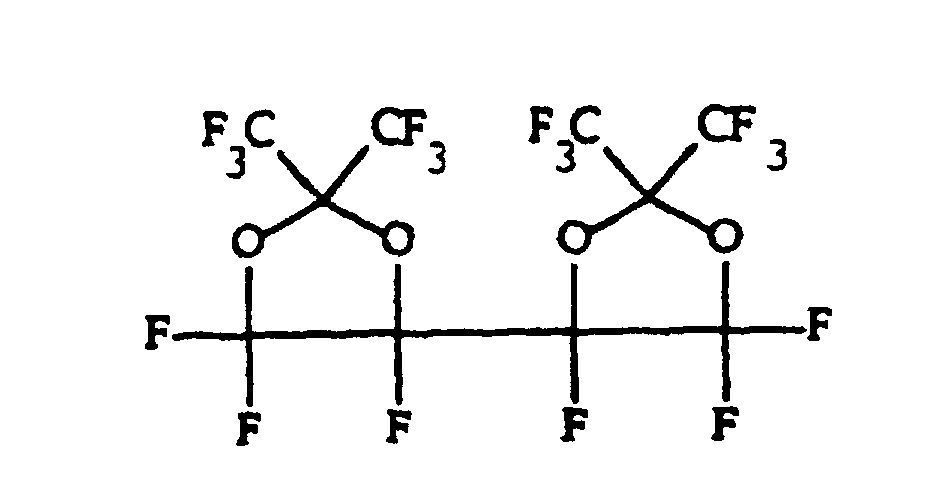
- PFBD perfluoro-2,2,2',2'-tetramethyl-4,4'-bis(1,3-dioxolane) (C 10 F 18 O 4 ) has been prepared, having the following formula: [Magn. Reson. Med., 20 , 188 (1993)]
- fluorinated compounds have been proposed as diagnostic probes in MR spectroscopy (MRS).
- MRS MR spectroscopy
- they are compounds containing at least two different kinds of fluorine atoms, whose different resonancesl can be used as chemical sensors of biological parameters, such as pH, pO 2 , pCO 2 , T, or more generally of the chemico-physical environment of organs or tissues.
- patent applications EP-A-447013 and AU 633850 claim fluorinated compounds of the following type: [Book of Abstracts, XI th Meeting SMRM, p.3413] to be used as sensors for measuring the pH in living tissues.
- the paramagnetic shift can be made dependent from pH or from specific interactions with the substrates presenting the organs or tissues under exam.
- This invention refers to a method of use of proton signals of paramagnetic metal-ion complexes in MRI, thanks to the use of Chemical Shift Imaging techniques, as well as in MRS for the control and recording of biological parameters.
- the metal outdistances the signal of the four methyls of the propionic chain from water protons by about 20 ppm, so that the hydrogen nuclei of these methyls are made "different" from the hydrogen nuclei of bulk water, making this difference exploitable with CSI.
- the same complex can be used in MRS techniques as probe for determining for instance the temperature of the district where the complex accumulates. For instance the chemical shift difference among non-equivalent protons such as H(1) and H(5) is dependent from the temperature of biological districts under exam. Therefore very interesting and useful information can be gathered by comparing the different proton resonances, thanks to the use of this technique.
- Suitable paramagnetic complexes of this invention are substantially constituted by: a) a paramagnetic metal ion with atomic number selected between 21 and 29, 42, 44 and between 58 and 83 except for 64 and 71; b) a chelating agent selected from [ ⁇ R*( ⁇ R*, ⁇ 'R*, ⁇ ''R*, ⁇ ''R*)]-( ⁇ , ⁇ ', ⁇ '', ⁇ ''')-tetramethyl-1,4,7,10-tetraazacyclododecan-1,4,7,10-tetraacetic acid, bis[tris(l-pyrazoil)boric acid, tris-N,N-dithiocarbamic acid and their salts having chemical shifts different from those of nearby water and being outside the range of the proton signals of the constituents of biological systems (said interval is usually between 0 and 10 ppm).
- paramagnetic complexes can be neutralized with organic and/or inorganic physiologically compatible bases or acids.
- Particularly preferred metal ion are V 3+ , Mn 3+ , Fe 2+ , Fe 3+ , Co + , Co 2+ , Ni 2+ , Mo 3+ , Ru 3+ , W 3+ , Re 3+ , Os 3+ , Yb 3+ , Dy 3+ .
- 2N NaOH is dropwise added to the mixture up to pH 5.
- the solution is kept at a constant pH (pH 6.5) by addition of 4ml of 2N NaOH (0.008 mol) during 10 h.
- the solution is taken to pH 6.5 through 1N NaOH and concentrated to dryness. 1.65 g (0.00253 mol) of the desired compound are obtained. Yield 51% m.p. >250°C K.F. 2.89% (w/w) Elemental Analysis C H N Na Yb Cl % calc. 36.81 4.94 8.59 3.52 26.52 % found 36.05 5.15 8.49 3.02 25.18 ⁇ 0.10 1 H-RMN, 13 C-RMN, IR and MS spectra are consistent with the indicated structure.
Landscapes
- Health & Medical Sciences (AREA)
- Veterinary Medicine (AREA)
- Public Health (AREA)
- Nuclear Medicine, Radiotherapy & Molecular Imaging (AREA)
- Life Sciences & Earth Sciences (AREA)
- Animal Behavior & Ethology (AREA)
- General Health & Medical Sciences (AREA)
- Chemical & Material Sciences (AREA)
- Epidemiology (AREA)
- Radiology & Medical Imaging (AREA)
- Engineering & Computer Science (AREA)
- Bioinformatics & Cheminformatics (AREA)
- Chemical Kinetics & Catalysis (AREA)
- General Chemical & Material Sciences (AREA)
- Medicinal Chemistry (AREA)
- Organic Chemistry (AREA)
- Pharmacology & Pharmacy (AREA)
- Medicines Containing Antibodies Or Antigens For Use As Internal Diagnostic Agents (AREA)
- Magnetic Resonance Imaging Apparatus (AREA)
Description
Fluorinated compounds can represent an alternative approach to the diagnostic imaging through magnetic resonance in comparison to the a.m. Gd(3+) ,Mn(2+) and Fe(3+) paramagnetic compounds.


to be used as sensors for measuring the pH in living tissues.

| Yield | 28% | m.p. | > 250°C |
| K.F. | 0.30% (w/w) | ||
| HPLC | 98.2% (% area) | ||
| 0.1N NaOH | 99.0% (w/w) |
| Elemental Analysis | C | H | N |
| % calc. | 52.16 | 7.88 | 12.17 |
| % found | 51.91 | 7.90 | 12.12 |
| Yield | 51% | m.p. | >250°C |
| K.F. | 2.89% (w/w) |
| Elemental Analysis | C | H | N | Na | Yb | Cl |
| % calc. | 36.81 | 4.94 | 8.59 | 3.52 | 26.52 | |
| % found | 36.05 | 5.15 | 8.49 | 3.02 | 25.18 | <0.10 |
| Yield | 47% | m.p. | >250°C (dec.) |
| K.F. | 3.06% (w/w) |
| Elemental Analysis | C | H | Eu | N | Na | Cl |
| % calc. | 38.04 | 5.11 | 24.06 | 8.87 | 3.64 | |
| % found | 37.00 | 5.69 | 23.26 | 8.63 | 3.04 | <0.10 |
Claims (3)
- The use of a paramagnetic chelating agent complex wherein the paramagnetic metal ion is selected from those having atomic number between 21 and 29, 42, 44 and between 58 and 83 except for 64 and 71 and wherein the chelating agent is selected from [αR*(αR*, α'R*, α''R*, α'''R*)]-(α,α',α'',α''')-tetramethyl-1,4,7,10-tetraazacyclododecan-1,4,7,10-tetraacetic acid, bis-[tris(1-pyrazoil)boric acid, tris-N,N-dithiocarbamic acid and their salts, for the preparation of an MRI contrast agent for obtaining images of organs, tissues, biological districts of human or animal body through nuclear magnetic resonance (NMR), by chemical shift imaging techniques.
- The use according to claim 1 wherein the paramagnetic metal ion is selected from V3+, Mn3+, Fe2+, Fe3+, Co+, Co2+, Ni2+, Mo3+, Ru3+, W3+, Re3+, Os3+, Yb3+, Dy3+.
- The use according to claim 1 or 2 wherein the paramagnetic chelate/complex is salified with physiologically tolerable organic and/or inorganic bases or acids.
Applications Claiming Priority (3)
| Application Number | Priority Date | Filing Date | Title |
|---|---|---|---|
| ITMI932728 | 1993-12-24 | ||
| IT93MI002728A IT1265440B1 (en) | 1993-12-24 | 1993-12-24 | PARAMAGNETIC DIAGNOSTIC FORMULATIONS AND METHOD OF USE OF THEM |
| PCT/EP1994/003944 WO1995017910A2 (en) | 1993-12-24 | 1994-11-28 | Paramagnetic diagnostic formulations and their method of use |
Publications (2)
| Publication Number | Publication Date |
|---|---|
| EP0735900A1 EP0735900A1 (en) | 1996-10-09 |
| EP0735900B1 true EP0735900B1 (en) | 2002-06-05 |
Family
ID=11367404
Family Applications (1)
| Application Number | Title | Priority Date | Filing Date |
|---|---|---|---|
| EP95903299A Expired - Lifetime EP0735900B1 (en) | 1993-12-24 | 1994-11-28 | Paramagnetic diagnostic formulations and their method of use |
Country Status (5)
| Country | Link |
|---|---|
| EP (1) | EP0735900B1 (en) |
| JP (1) | JPH09502734A (en) |
| DE (1) | DE69430758T2 (en) |
| IT (1) | IT1265440B1 (en) |
| WO (1) | WO1995017910A2 (en) |
Families Citing this family (9)
| Publication number | Priority date | Publication date | Assignee | Title |
|---|---|---|---|---|
| DK81095A (en) * | 1995-07-11 | 1997-01-12 | Henrik S Thomsen | Oral MR contrast agent for liver and upper intestinal tract |
| US5834456A (en) * | 1996-02-23 | 1998-11-10 | The Dow Chemical Company | Polyazamacrocyclofluoromonoalkylphosphonic acids, and their complexes, for use as contrast agents |
| ES2123449B1 (en) * | 1997-03-06 | 1999-09-16 | Univ Madrid Nac Educacion | PROCEDURE FOR OBTAINING IMAGES AND SPECTRUMS OF THE EXTRACELLULAR PH BY MAGNETIC RESONANCE WITH EXTRINSIC INDICATORS CONTAINING 1H OR 19F. |
| AU4656400A (en) | 1999-04-21 | 2000-11-17 | Government of The United States of America, as represented by The Secretary Department of Health & Human Services, The National Institutes of Health, The | Method for enhancing contrast produced by mri |
| DE10135356C1 (en) * | 2001-07-20 | 2003-04-17 | Schering Ag | Macrocyclic metal complexes and their use for the preparation of conjugates with biomolecules |
| FR2848750B1 (en) * | 2002-12-13 | 2007-02-09 | Centre Nat Rech Scient | METHOD FOR ACQUIRING ELECTROMAGNETIC SIGNALS AND CONTRAST PRODUCT FOR SUCH ACQUISITION |
| FR2867473B1 (en) * | 2004-03-12 | 2006-06-23 | Guerbet Sa | PORPHYRINE COMPOUND AND HIGH FIELD USE IN MRI |
| JP5858515B2 (en) * | 2011-02-28 | 2016-02-10 | 杏林製薬株式会社 | Method for measuring partition coefficient using quantitative analysis by NMR |
| JP6032729B2 (en) * | 2012-05-08 | 2016-11-30 | 国立研究開発法人理化学研究所 | Imaging markers and their use |
Family Cites Families (6)
| Publication number | Priority date | Publication date | Assignee | Title |
|---|---|---|---|---|
| DE3219832A1 (en) * | 1982-05-26 | 1983-12-01 | Bruker Medizintechnik Gmbh, 7512 Rheinstetten | METHOD FOR NON-INVASIVELY DETERMINING MEASURED VALUES WITHIN A LIVING BODY |
| US4558279A (en) * | 1983-03-07 | 1985-12-10 | University Of Cincinnati | Methods for detecting and imaging a temperature of an object by nuclear magnetic resonance |
| CA1242643A (en) * | 1983-08-12 | 1988-10-04 | Eric T. Fossel | Nmr imaging utilizing chemical shift reagents |
| US4915933A (en) * | 1986-06-26 | 1990-04-10 | The University Of New Mexico | Mixed complexes as shift and contrast reagents in NMR imaging and spectroscopy |
| DE4317588C2 (en) * | 1993-05-24 | 1998-04-16 | Schering Ag | Macrocyclic metal complexes containing fluorine, process for their preparation and their use |
| DE4318369C1 (en) * | 1993-05-28 | 1995-02-09 | Schering Ag | Use of macrocyclic metal complexes as temperature probes |
-
1993
- 1993-12-24 IT IT93MI002728A patent/IT1265440B1/en active IP Right Grant
-
1994
- 1994-11-28 DE DE69430758T patent/DE69430758T2/en not_active Expired - Fee Related
- 1994-11-28 WO PCT/EP1994/003944 patent/WO1995017910A2/en not_active Ceased
- 1994-11-28 EP EP95903299A patent/EP0735900B1/en not_active Expired - Lifetime
- 1994-11-28 JP JP7517742A patent/JPH09502734A/en not_active Ceased
Also Published As
| Publication number | Publication date |
|---|---|
| EP0735900A1 (en) | 1996-10-09 |
| ITMI932728A1 (en) | 1995-06-24 |
| DE69430758T2 (en) | 2002-09-19 |
| ITMI932728A0 (en) | 1993-12-24 |
| JPH09502734A (en) | 1997-03-18 |
| WO1995017910A3 (en) | 1995-07-27 |
| IT1265440B1 (en) | 1996-11-22 |
| WO1995017910A2 (en) | 1995-07-06 |
| DE69430758D1 (en) | 2002-07-11 |
Similar Documents
| Publication | Publication Date | Title |
|---|---|---|
| DE69625595T2 (en) | MRI AGENTS FOR DETECTING PHYSIOLOGICAL AGENTS | |
| Le Fur et al. | The biological fate of gadolinium-based MRI contrast agents: a call to action for bioinorganic chemists | |
| EP0414700B1 (en) | Contrast agents for magnetic resonance imaging | |
| Aime et al. | Lanthanide (III) chelates for NMR biomedical applications | |
| JP2815556B2 (en) | Nonionic paramagnetic ionic complex and complexing agent for forming the same | |
| US8318134B2 (en) | Responsive paramagnetic MRI contrast agents | |
| Hamm et al. | Phase I clinical evaluation of Gd-EOB-DTPA as a hepatobiliary MR contrast agent: safety, pharmacokinetics, and MR imaging. | |
| US5077037A (en) | Novel compositions for magnetic resonance imaging | |
| JPH0768193B2 (en) | Physiologically tolerable NMR-complex for contrast media | |
| JPH03502338A (en) | paramagnetic compound | |
| US4909257A (en) | Method for attaining in vivo tissue-specific contrast by nuclear magnetic resonance imaging | |
| TW201825480A (en) | New high relaxivity gadolinium chelate compounds for use in magnetic resonance imaging | |
| WO1995017910A2 (en) | Paramagnetic diagnostic formulations and their method of use | |
| US7608249B2 (en) | Enhanced substrate imaging by reversible binding to a paramagnetic complex | |
| US5368839A (en) | Insoluble salts of lanthanides for the visual display using nuclear magnetic resonance, of the gastro-intestinal tract | |
| EP1163231A1 (en) | Perfluoroalkylamide, the production thereof and the use thereof in diagnostics | |
| WO1993000931A1 (en) | Novel compositions for magnetic resonance imaging | |
| Pujales-Paradela et al. | Transition Metal-based T1 Contrast Agents | |
| Gu et al. | Gd-complexes of 1, 4, 7, 10-Tetraazacyclododecane-N, N′, N′′, N′′′-1, 4, 7, 10-tetraacetic acid (DOTA) conjugates of tranexamates as a new class of blood-pool magnetic resonance imaging contrast agents | |
| La Cava et al. | Synthesis, characterization, and biodistribution of a dinuclear gadolinium complex with improved properties as a blood pool MRI agent | |
| US5516503A (en) | Diagnostic composition comprising a binuclear complex, its method of preparation and its use in magnetic resonance imaging | |
| JP2023510935A (en) | Iron complexes and their salts as contrast agents for MRI | |
| Gong et al. | A Macrocyclic Gadolinium Contrast Agent Bearing Assemblydissociable Feature with albumin for Enhanced Magnetic Resonance Imaging and in-vivo Profiles | |
| Mo et al. | Dual-Site Chiral Engineering of a Fully Alkyl-Substituted Gd-DOTA Yields a High-Performance and Safe Hepatobiliary MRI Contrast Agent | |
| EP2833924B1 (en) | Hyperpolarized amino acids |
Legal Events
| Date | Code | Title | Description |
|---|---|---|---|
| PUAI | Public reference made under article 153(3) epc to a published international application that has entered the european phase |
Free format text: ORIGINAL CODE: 0009012 |
|
| 17P | Request for examination filed |
Effective date: 19960607 |
|
| AK | Designated contracting states |
Kind code of ref document: A1 Designated state(s): DE FR GB IE |
|
| 17Q | First examination report despatched |
Effective date: 20000727 |
|
| GRAG | Despatch of communication of intention to grant |
Free format text: ORIGINAL CODE: EPIDOS AGRA |
|
| RIC1 | Information provided on ipc code assigned before grant |
Free format text: 7A 61K 49/00 A, 7A 61P 43/00 B |
|
| GRAG | Despatch of communication of intention to grant |
Free format text: ORIGINAL CODE: EPIDOS AGRA |
|
| GRAH | Despatch of communication of intention to grant a patent |
Free format text: ORIGINAL CODE: EPIDOS IGRA |
|
| RAP1 | Party data changed (applicant data changed or rights of an application transferred) |
Owner name: BRACCO IMAGING S.P.A. Owner name: BRACCO S.P.A. |
|
| GRAH | Despatch of communication of intention to grant a patent |
Free format text: ORIGINAL CODE: EPIDOS IGRA |
|
| GRAA | (expected) grant |
Free format text: ORIGINAL CODE: 0009210 |
|
| AK | Designated contracting states |
Kind code of ref document: B1 Designated state(s): DE FR GB IE |
|
| REG | Reference to a national code |
Ref country code: GB Ref legal event code: FG4D |
|
| REG | Reference to a national code |
Ref country code: IE Ref legal event code: FG4D |
|
| REF | Corresponds to: |
Ref document number: 69430758 Country of ref document: DE Date of ref document: 20020711 |
|
| ET | Fr: translation filed | ||
| PG25 | Lapsed in a contracting state [announced via postgrant information from national office to epo] |
Ref country code: IE Free format text: LAPSE BECAUSE OF NON-PAYMENT OF DUE FEES Effective date: 20021128 |
|
| PLBE | No opposition filed within time limit |
Free format text: ORIGINAL CODE: 0009261 |
|
| STAA | Information on the status of an ep patent application or granted ep patent |
Free format text: STATUS: NO OPPOSITION FILED WITHIN TIME LIMIT |
|
| 26N | No opposition filed |
Effective date: 20030306 |
|
| REG | Reference to a national code |
Ref country code: IE Ref legal event code: MM4A |
|
| PGFP | Annual fee paid to national office [announced via postgrant information from national office to epo] |
Ref country code: FR Payment date: 20031029 Year of fee payment: 10 |
|
| PGFP | Annual fee paid to national office [announced via postgrant information from national office to epo] |
Ref country code: GB Payment date: 20031110 Year of fee payment: 10 |
|
| PGFP | Annual fee paid to national office [announced via postgrant information from national office to epo] |
Ref country code: DE Payment date: 20031211 Year of fee payment: 10 |
|
| PG25 | Lapsed in a contracting state [announced via postgrant information from national office to epo] |
Ref country code: GB Free format text: LAPSE BECAUSE OF NON-PAYMENT OF DUE FEES Effective date: 20041128 |
|
| PG25 | Lapsed in a contracting state [announced via postgrant information from national office to epo] |
Ref country code: DE Free format text: LAPSE BECAUSE OF NON-PAYMENT OF DUE FEES Effective date: 20050601 |
|
| GBPC | Gb: european patent ceased through non-payment of renewal fee |
Effective date: 20041128 |
|
| PG25 | Lapsed in a contracting state [announced via postgrant information from national office to epo] |
Ref country code: FR Free format text: LAPSE BECAUSE OF NON-PAYMENT OF DUE FEES Effective date: 20050729 |
|
| REG | Reference to a national code |
Ref country code: FR Ref legal event code: ST |