EP0735459B1 - Fuzzy processor with improved architecture - Google Patents
Fuzzy processor with improved architecture Download PDFInfo
- Publication number
- EP0735459B1 EP0735459B1 EP95830117A EP95830117A EP0735459B1 EP 0735459 B1 EP0735459 B1 EP 0735459B1 EP 95830117 A EP95830117 A EP 95830117A EP 95830117 A EP95830117 A EP 95830117A EP 0735459 B1 EP0735459 B1 EP 0735459B1
- Authority
- EP
- European Patent Office
- Prior art keywords
- fuzzy
- memory
- internal
- processor according
- control unit
- Prior art date
- Legal status (The legal status is an assumption and is not a legal conclusion. Google has not performed a legal analysis and makes no representation as to the accuracy of the status listed.)
- Expired - Lifetime
Links
Images
Classifications
-
- G—PHYSICS
- G06—COMPUTING OR CALCULATING; COUNTING
- G06N—COMPUTING ARRANGEMENTS BASED ON SPECIFIC COMPUTATIONAL MODELS
- G06N7/00—Computing arrangements based on specific mathematical models
- G06N7/02—Computing arrangements based on specific mathematical models using fuzzy logic
- G06N7/04—Physical realisation
Definitions
- the present invention relates to a fuzzy processor with improved architecture.
- fuzzy processors there are various kinds of fuzzy processors.
- An example of a classic fuzzy processor is the MB94110 processor by Fujitsu, comprising a block that performs fuzzy instructions.
- Another example is the SAE81C99 processor by Siemens, which can also load various knowledge bases from an external memory, although this is not possible conditionally or concurrently with normal fuzzy processing.
- known fuzzy processors only process fuzzy instructions and cannot integrate fuzzy control with the processing of classic instructions such as shift, rotate, compare, or arithmetic/logic instructions, and also have no signals such as interrupt, stack, etcetera. Accordingly, it is not possible to perform any kind of arithmetic/logic processing on the inputs and on the outputs of the fuzzy controller.
- All known fuzzy control units furthermore perform control by processing the fuzzy instructions sequentially, with no possibility of jumping from one instruction to another.
- fuzzy processors process a fixed number of inputs and of fuzzy rules. A certain number of membership functions is associated with each fuzzy input, and the set of these functions is termed knowledge base. Both the set of fuzzy rules and the knowledge base remain unchanged throughout processing.
- fuzzy inference and fuzzy inference processor discloses a fuzzy processor comprising a fuzzy rule processor with an arithmetic-logic unit, and a control unit adapted to execute non-fuzzy instructions.
- the aim of the present invention is to provide a fuzzy processor with improved architecture that is more versatile than known fuzzy processors.
- an object of the present invention is to provide a fuzzy .processor with improved architecture that is capable of handling inputs and outputs.
- Another object of the present invention is to provide a fuzzy processor with improved architecture capable of loading various knowledge bases or sets of fuzzy rules from outside during normal operation.
- Another object of the present invention is to provide a fuzzy processor with improved architecture capable of changing the knowledge base or the set of fuzzy rules to be processed during normal processing, conditionally or unconditionally, the conditions occurring on the inputs or on the outputs.
- Another object of the present invention is to provide a fuzzy processor with improved architecture capable of performing arithmetic/logic processing of the inputs and outputs of the fuzzy controller, of processing non-fuzzy instructions, and of handling interrupt signals.
- Another object of the present invention is to provide a fuzzy processor with improved architecture capable of performing conditional or unconditional jumps within fuzzy instructions.
- Another object of the present invention is to provide a processor that is highly reliable, relatively easy to manufacture, and at competitive costs.
- fuzzy processors Since known fuzzy processors only process fuzzy instructions and cannot integrate fuzzy control with the processing of classic instructions such as shift, rotate, compare, or of arithmetic-logic instructions, and also have no signals such as interrupt, stack, etcetera.
- the fuzzy processor according to the present invention is provided with an arithmetic/logic unit (ALU), with a direct memory access control unit (DMA), with a timer, with an interrupt handler, with interfaces for the buses, and other components.
- the fuzzy instructions are integrated with non-fuzzy instructions, such as arithmetic/logic instructions, shift, rotate, etcetera, according to a definable hierarchy, that is to say, all the instructions that also allow non-fuzzy processing of input and/or output data.
- the fuzzy control unit according to the present invention can use internal registers of the chip as inputs of the fuzzy section and can also use them as buffer registers for the output of the fuzzy section, and preprocessings on the inputs and postprocessings on the outputs can be performed in these registers.
- adders, subtracters, multipliers, and dividers are already present in the classic architecture of a fuzzy control unit and are used for fuzzification and defuzzification, the present invention proposes the concept of arithmetic/logic processing of the inputs and of the outputs, the execution of non-fuzzy instructions, and the handling of interrupt signals; these functions can be performed by using appropriately modified existing blocks or specifically designed circuitry. In particular, input and output processing can be performed almost entirely by existing blocks.
- interrupt control By means of the interrupt signals it is possible, if required, to interrupt control to perform emergency, control, or system management operations by means of non-fuzzy instructions.
- fuzzy control units perform control by processing the fuzzy instructions sequentially, without being able to jump from one fuzzy instruction to another.
- the fuzzy processor proposes the insertion, among fuzzy rules, of the conditional or unconditional jump instructions, in which the optional condition will have to occur on the inputs or on the outputs.
- fuzzy control units process a fixed number of inputs and of fuzzy rules. A certain number of membership functions is associated with each input.
- the set of membership functions is termed knowledge base. Both the set of rules and the knowledge base are invariant throughout processing.
- the processor according to the present invention is able to change the knowledge base and/or the set of fuzzy rules during normal processing. This is performed by means of a buffer memory, where the next knowledge base and/or set of fuzzy rules to be processed is loaded during normal operation, so that the base or set can be swapped by virtue of an instruction for conditional or unconditional swapping of the rule set or of the knowledge base.
- the conditions can be imposed on the inputs or on the outputs.
- the characteristics that are innovative with respect to known fuzzy processors are the possibility of loading from outside the fuzzy rule memory and the knowledge base memory (the membership functions) concurrently (and transparently) with respect to instruction processing; the possibility of processing both fuzzy rules and non-fuzzy instructions (shift, rotate, arithmetic/logic operations, etcetera); the possibility of conditional or unconditional jumps within the set of fuzzy rules that is being processed; and finally, the possibility of conditionally or unconditionally swapping the knowledge base or the set of rules to be processed.
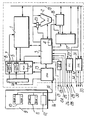
- the reference numeral 1 designates the classic fuzzy rule processor, which executes fuzzy rules.
- An arithmetic/logic unit (ALU) 2 has been included in the processor according to the present invention to perform the arithmetic/logic processing of the inputs and of the outputs.
- a control unit 3 is furthermore connected to the ALU 2 and is adapted to perform non-fuzzy instructions.
- An interrupt handler 4 is located inside the control unit 3.
- the control unit 3 is furthermore connected directly to the fuzzy rule processor 1.
- control unit 3 and the ALU 2 are connected to internal registers 17, which are in turn connected to a data memory 18 that acts as a buffer for the internal registers 17.
- the control unit 3 is also connected to the data memory 18.
- the internal registers 17, the data memory 18, the ALU 2, and the fuzzy rule processor 1 are connected to a data bus 19.
- the data bus 19 is connected to the ALU 2 by means of two lines, a direct one and a line that passes through a multiplexer 20 which performs a selection so that the second input of the ALU 2 arrives from the data bus or from the control unit 3.
- An external control line IF/MC 21 is connected to the control unit 3 and sends a signal externally if the processor is executing fuzzy or non-fuzzy instructions.
- a conventional timer 22 is furthermore connected to the control unit 3 and has its own output line 23.
- the interrupt signals are sent to the control unit 3 and to the interrupt handler 4 located therein by means of an interrupt line 24.
- the reset signals are sent to the control unit by means of a reset line 25.
- the clock signal is sent to the control unit 3 by means of a clock line 26.
- a data input control unit 27 is furthermore connected to the data bus 19 and to the control unit 3.
- the control unit 27 is connected to the outside by means of a handshake line 28, an input data line 29, and an input number selection line 30 for selecting an input among the multiple available inputs.
- a data output control unit 31 is furthermore likewise connected to the data bus 19 and to the control unit 3. Said control unit is connected to the outside by means of a handshake line 32, an output data line 33, and an output number selection line 34 for externally indicating which among the plurality of available outputs is on the output data line 33.
- the processor according to the present invention is furthermore provided with an internal RAM memory 5 directly connected to the fuzzy rule processor 1 and to the control unit 3.
- the RAM memory 5 furthermore internally comprises, besides other components, a microcode memory (MCM) 6.
- MCM microcode memory
- Said microcode memory 6 stores all the non-fuzzy instructions and is directly connected to the control unit 3, so that said instructions are executed by said control unit.
- the internal RAM memory 5 furthermore includes a fuzzy instruction memory 7 (IFM) that is conveniently divided into two parts, IFM 1 and IFM2.
- FIM fuzzy instruction memory 7
- Said fuzzy instruction memory 7 comprises all the fuzzy instructions that must be executed by the fuzzy rule processor 1 to which the memory 7 is directly connected.
- the internal RAM memory 5 furthermore comprises a knowledge base memory 8 that is conveniently divided into two parts ADM1 and AMD2 (Antecedent Data Memory) and is directly connected to the fuzzy rule processor 1.
- An external memory 9 is furthermore associated with the processor according to the present invention and can advantageously be an internal one; it comprises an external knowledge base memory 10, an external fuzzy rule memory 11, and an external microcode memory 12.
- the external knowledge base memory 10 is divided into multiple banks, each of which contains a knowledge base, from bank 1 to bank i, and the external fuzzy rule memory 11 is also divided into multiple banks, each bank containing a different set of rules, from bank 1 to bank n.
- the external memory 9, with its respective internal memories 10, 11, and 12, is connected to the internal RAM memory 5 by means of a direct memory access control unit (DMA) 13 and a demultiplexer 14.
- the memories 10, 11, and 12 are connected to the DMA 13 by means of a data line 15, whereas the DMA 13 is connected to the external memory by means of a memory address line 16.
- DMA direct memory access control unit
- the DMA allows us to load knowledge bases and sets of fuzzy instructions in the corresponding buffer memories concurrently with normal processing.
- the arithmetic/logic unit 2 performs the arithmetic/logic processing, whereas the non-fuzzy instructions are performed by the control unit 3.
- the non-fuzzy instructions reside in the microcode memory 6 and are performed directly by the control unit 3, whereas the fuzzy rules are stored in the fuzzy instruction memory 7, and the task of processing the fuzzy rules is assigned to the fuzzy rule processor 1.
- the control unit 3 can order the execution of a certain number n of fuzzy instructions processed by the fuzzy processor 1 and then resume control.
- Interrupts are requested by means of the interrupt line 24 and performed by the interrupt handler 4 located inside the control unit 3.
- the non-fuzzy instructions also include the instruction ordering processing of the fuzzy instructions in a continuous cycle (as in classic fuzzy control units) and can be interrupted only by an intervening interrupt.
- the fuzzy rules can process the inputs taken directly from the outside by means of the data input control unit 27 or the inputs residing in the internal registers 17, which in this case may have been preprocessed by the control unit 3.
- the outputs of the fuzzy rule processor 1 can furthermore be sent immediately outside by means of the data output control unit 31 or placed in the internal registers 17, so that they can be postprocessed by the control unit 3 before being sent outside the processor.
- a jump instruction has been inserted among the fuzzy instructions contained in the fuzzy instruction memory 7; as an alternative, this can be done by means of the fuzzy control unit.
- the possibility of changing the knowledge base or the set of fuzzy rules to be processed during normal processing is provided by means of the DMA 13, which transparently loads from the external memory 9 the new knowledge base and/or the set of rules to be processed.
- the internal knowledge base memory 8 and the internal fuzzy instruction memory 7 inside the internal RAM memory 5 are duplicated in memories ADM1-ADM2 and IFM1-IFM2 respectively, since while the fuzzy rule processor 1 processes rules residing in one of the fuzzy instruction memories IFM by using the knowledge base that resides in a knowledge base memory ADM, the DMA 13 can load the other memories (by taking the data from the external memory 9), and therefore the instruction for swapping the knowledge base or the set of fuzzy rules to be processed simply swaps the internal memories to be processed.
- This last instruction can be conditional or unconditional, and the conditions to be verified may occur on the inputs and on the outputs of the fuzzy rule processor 1 or also on the non-fuzzy processing value.
Landscapes
- Engineering & Computer Science (AREA)
- Software Systems (AREA)
- Theoretical Computer Science (AREA)
- General Physics & Mathematics (AREA)
- Physics & Mathematics (AREA)
- Computational Mathematics (AREA)
- Evolutionary Computation (AREA)
- Molecular Biology (AREA)
- Fuzzy Systems (AREA)
- Biomedical Technology (AREA)
- Algebra (AREA)
- Artificial Intelligence (AREA)
- Health & Medical Sciences (AREA)
- Data Mining & Analysis (AREA)
- General Health & Medical Sciences (AREA)
- Automation & Control Theory (AREA)
- Mathematical Analysis (AREA)
- Mathematical Optimization (AREA)
- Pure & Applied Mathematics (AREA)
- Computing Systems (AREA)
- General Engineering & Computer Science (AREA)
- Mathematical Physics (AREA)
- Life Sciences & Earth Sciences (AREA)
- Feedback Control In General (AREA)
Description
Claims (12)
- A fuzzy processor, comprising a fuzzy rule processor (1), an internal memory (5) comprising a fuzzy instruction memory (7) and an internal knowledge base memory (8), an arithmetic/logic unit (2), and a control unit (3) adapted to execute non-fuzzy instructions that are typical of conventional microprocessors and fuzzy instructions, characterized in that said internal memory (5) further comprising an internal microcode memory (6) for storing non-fuzzy instructions, and in that it further comprises an external memory (9) comprising an external knowledge base memory (10), an external fuzzy instruction memory (11), and an external non-fuzzy instruction memory (12), said control unit having direct memory access and being adapted to transparently swap data between said external memories (10, 11, 12) and said internal memories (6, 7, 8).
- The fuzzy processor according to claim 1, characterized in that said control unit (3) internally comprises an interrupt handler ((4).
- The fuzzy processor according to claim 1, characterized in that said internal knowledge base memory (8) and said internal fuzzy instruction memory (7) are both composed of a first and of a second parts (ADM1, ADM2; IFM1, IFM2).
- The fuzzy processor according to claim 1, characterized in that it comprises internal registers (17) associated with said control unit (3) and said arithmetic/logic unit (2).
- The fuzzy processor according to claim 4, characterized in that it comprises a data memory (18) associated with said internal registers (17).
- The fuzzy processor according to claim 1, characterized in that it comprises a data input unit (27) and a data output unit (31).
- The fuzzy processor according to. claim 1, characterized in that said internal fuzzy instruction memory (7) comprises at least one jump instruction.
- The fuzzy processor according to claim 7, characterized in that said at least one jump instruction is a conditional jump instruction.
- The fuzzy processor according to claim 1, characterized in that it comprises a clock associated with said control unit (3).
- The fuzzy processor according to one or more of the preceding claims, characterized in that it comprises a data bus (19) connected to said control unit (3), to said fuzzy rule processor (1), to said arithmetic/logic unit (2), to said data input unit (27), to said data output unit (31), and to said internal registers (17).
- The fuzzy processor according to one or more of the preceding claims, characterized in that it processes an unlimited number of inputs and/or fuzzy rules and/or performs time-sharing control of a plurality of processes and/or adaptive control.
- The fuzzy processor according to claim 7, characterized in that said at least one jump instruction is a unconditional jump instruction.
Priority Applications (4)
| Application Number | Priority Date | Filing Date | Title |
|---|---|---|---|
| DE69531772T DE69531772D1 (en) | 1995-03-30 | 1995-03-30 | Fuzzy processor architecture |
| EP95830117A EP0735459B1 (en) | 1995-03-30 | 1995-03-30 | Fuzzy processor with improved architecture |
| JP8074074A JPH08286921A (en) | 1995-03-30 | 1996-03-28 | Fuzzy processor and method for execution of fuzzy logic processing |
| US08/623,617 US6385598B1 (en) | 1995-03-30 | 1996-03-29 | Fuzzy processor with architecture for non-fuzzy processing |
Applications Claiming Priority (1)
| Application Number | Priority Date | Filing Date | Title |
|---|---|---|---|
| EP95830117A EP0735459B1 (en) | 1995-03-30 | 1995-03-30 | Fuzzy processor with improved architecture |
Publications (2)
| Publication Number | Publication Date |
|---|---|
| EP0735459A1 EP0735459A1 (en) | 1996-10-02 |
| EP0735459B1 true EP0735459B1 (en) | 2003-09-17 |
Family
ID=8221881
Family Applications (1)
| Application Number | Title | Priority Date | Filing Date |
|---|---|---|---|
| EP95830117A Expired - Lifetime EP0735459B1 (en) | 1995-03-30 | 1995-03-30 | Fuzzy processor with improved architecture |
Country Status (4)
| Country | Link |
|---|---|
| US (1) | US6385598B1 (en) |
| EP (1) | EP0735459B1 (en) |
| JP (1) | JPH08286921A (en) |
| DE (1) | DE69531772D1 (en) |
Families Citing this family (4)
| Publication number | Priority date | Publication date | Assignee | Title |
|---|---|---|---|---|
| IT1310756B1 (en) * | 1999-11-30 | 2002-02-22 | St Microelectronics Srl | CIRCUIT OF THE CALCULATION OF THE LOGICAL OPERATIONS OF UNION AND FUZZY INTERSECTION. |
| US7185192B1 (en) * | 2000-07-07 | 2007-02-27 | Emc Corporation | Methods and apparatus for controlling access to a resource |
| EP1334583A2 (en) * | 2000-10-26 | 2003-08-13 | General Instrument Corporation | Enforcement of content rights and conditions for multimedia content |
| US9542651B2 (en) | 2014-01-23 | 2017-01-10 | Healthtrust Purchasing Group, Lp | Fuzzy inference deduction using rules and hierarchy-based item assignments |
Family Cites Families (8)
| Publication number | Priority date | Publication date | Assignee | Title |
|---|---|---|---|---|
| US5261036A (en) * | 1989-10-24 | 1993-11-09 | Mitsubishi Denki K.K. | Programmable controller with fuzzy control function, fuzzy control process and fuzzy control monitoring process |
| US5305424A (en) * | 1990-07-26 | 1994-04-19 | Apt Instruments (N.A.) Inc. | Data forming method for a multi-stage fuzzy processing system |
| EP0516161A3 (en) * | 1991-05-31 | 1993-10-13 | Kabushiki Kaisha Toshiba | Fuzzy rule-based system formed in a chip |
| US5285376A (en) * | 1991-10-24 | 1994-02-08 | Allen-Bradley Company, Inc. | Fuzzy logic ladder diagram program for a machine or process controller |
| US5263125A (en) * | 1992-06-17 | 1993-11-16 | Motorola, Inc. | Circuit and method for evaluating fuzzy logic rules |
| US5430828A (en) * | 1992-06-26 | 1995-07-04 | Matsushita Electric Industrial Co., Ltd. | Arithmetic and logic unit, storage unit and computer system for fuzzy set processing |
| US5524174A (en) * | 1993-04-14 | 1996-06-04 | Siemens Aktiengesellschaft | Apparatus for inference formation and defuzzification in a high-definition fuzzy logic co-processor |
| EP0636967A1 (en) * | 1993-07-29 | 1995-02-01 | STMicroelectronics S.r.l. | Method and apparatus for storing membership functions |
-
1995
- 1995-03-30 EP EP95830117A patent/EP0735459B1/en not_active Expired - Lifetime
- 1995-03-30 DE DE69531772T patent/DE69531772D1/en not_active Expired - Lifetime
-
1996
- 1996-03-28 JP JP8074074A patent/JPH08286921A/en active Pending
- 1996-03-29 US US08/623,617 patent/US6385598B1/en not_active Expired - Lifetime
Also Published As
| Publication number | Publication date |
|---|---|
| JPH08286921A (en) | 1996-11-01 |
| DE69531772D1 (en) | 2003-10-23 |
| US6385598B1 (en) | 2002-05-07 |
| EP0735459A1 (en) | 1996-10-02 |
Similar Documents
| Publication | Publication Date | Title |
|---|---|---|
| US4794524A (en) | Pipelined single chip microprocessor having on-chip cache and on-chip memory management unit | |
| AU618142B2 (en) | Tightly coupled multiprocessor instruction synchronization | |
| US5125092A (en) | Method and apparatus for providing multiple condition code fields to to allow pipelined instructions contention free access to separate condition codes | |
| US4648034A (en) | Busy signal interface between master and slave processors in a computer system | |
| US5812868A (en) | Method and apparatus for selecting a register file in a data processing system | |
| US4367524A (en) | Microinstruction execution unit for use in a microprocessor | |
| EP0554917A2 (en) | Digital signal processor | |
| KR100446564B1 (en) | Data processing system and how to run calculations on it | |
| US4308581A (en) | Single step system for a microcomputer | |
| US20080046697A1 (en) | Data processor | |
| JPS5911943B2 (en) | Trap mechanism for data processing equipment | |
| EP0016523A1 (en) | Data processing unit and data processing system comprising a plurality of such data processing units | |
| US5696939A (en) | Apparatus and method using a semaphore buffer for semaphore instructions | |
| EP0125044A1 (en) | Microcomputer with interprocess communication | |
| EP0239078B1 (en) | Register saving/restoring system | |
| US4792894A (en) | Arithmetic computation modifier based upon data dependent operations for SIMD architectures | |
| US6026486A (en) | General purpose processor having a variable bitwidth | |
| EP0516161A2 (en) | Fuzzy rule-based system formed in a chip | |
| US5991872A (en) | Processor | |
| US4631672A (en) | Arithmetic control apparatus for a pipeline processing system | |
| US6385598B1 (en) | Fuzzy processor with architecture for non-fuzzy processing | |
| US4837688A (en) | Multi-channel shared resource processor | |
| US20030037227A1 (en) | Processor enabling exception handling to be set by program | |
| CA2036855C (en) | Processor with data format-independent instructions | |
| AU626067B2 (en) | Apparatus and method for control of asynchronous program interrupt events in a data processing system |
Legal Events
| Date | Code | Title | Description |
|---|---|---|---|
| PUAI | Public reference made under article 153(3) epc to a published international application that has entered the european phase |
Free format text: ORIGINAL CODE: 0009012 |
|
| AK | Designated contracting states |
Kind code of ref document: A1 Designated state(s): DE FR GB IT |
|
| 17P | Request for examination filed |
Effective date: 19970325 |
|
| 17Q | First examination report despatched |
Effective date: 20010430 |
|
| GRAH | Despatch of communication of intention to grant a patent |
Free format text: ORIGINAL CODE: EPIDOS IGRA |
|
| GRAH | Despatch of communication of intention to grant a patent |
Free format text: ORIGINAL CODE: EPIDOS IGRA |
|
| GRAA | (expected) grant |
Free format text: ORIGINAL CODE: 0009210 |
|
| AK | Designated contracting states |
Kind code of ref document: B1 Designated state(s): DE FR GB IT |
|
| REG | Reference to a national code |
Ref country code: GB Ref legal event code: FG4D |
|
| REF | Corresponds to: |
Ref document number: 69531772 Country of ref document: DE Date of ref document: 20031023 Kind code of ref document: P |
|
| PG25 | Lapsed in a contracting state [announced via postgrant information from national office to epo] |
Ref country code: DE Free format text: LAPSE BECAUSE OF FAILURE TO SUBMIT A TRANSLATION OF THE DESCRIPTION OR TO PAY THE FEE WITHIN THE PRESCRIBED TIME-LIMIT Effective date: 20031218 |
|
| PG25 | Lapsed in a contracting state [announced via postgrant information from national office to epo] |
Ref country code: GB Free format text: LAPSE BECAUSE OF NON-PAYMENT OF DUE FEES Effective date: 20040330 |
|
| ET | Fr: translation filed | ||
| PLBE | No opposition filed within time limit |
Free format text: ORIGINAL CODE: 0009261 |
|
| STAA | Information on the status of an ep patent application or granted ep patent |
Free format text: STATUS: NO OPPOSITION FILED WITHIN TIME LIMIT |
|
| 26N | No opposition filed |
Effective date: 20040618 |
|
| GBPC | Gb: european patent ceased through non-payment of renewal fee |
Effective date: 20040330 |
|
| PG25 | Lapsed in a contracting state [announced via postgrant information from national office to epo] |
Ref country code: IT Free format text: LAPSE BECAUSE OF NON-PAYMENT OF DUE FEES;WARNING: LAPSES OF ITALIAN PATENTS WITH EFFECTIVE DATE BEFORE 2007 MAY HAVE OCCURRED AT ANY TIME BEFORE 2007. THE CORRECT EFFECTIVE DATE MAY BE DIFFERENT FROM THE ONE RECORDED. Effective date: 20050330 |
|
| PGFP | Annual fee paid to national office [announced via postgrant information from national office to epo] |
Ref country code: FR Payment date: 20060329 Year of fee payment: 12 |
|
| REG | Reference to a national code |
Ref country code: FR Ref legal event code: ST Effective date: 20071130 |
|
| PG25 | Lapsed in a contracting state [announced via postgrant information from national office to epo] |
Ref country code: FR Free format text: LAPSE BECAUSE OF NON-PAYMENT OF DUE FEES Effective date: 20070402 |