EP0734724B1 - Process for the preparation of a phencynonate hydrochloride of alpha-configuration - Google Patents
Process for the preparation of a phencynonate hydrochloride of alpha-configuration Download PDFInfo
- Publication number
- EP0734724B1 EP0734724B1 EP94930141A EP94930141A EP0734724B1 EP 0734724 B1 EP0734724 B1 EP 0734724B1 EP 94930141 A EP94930141 A EP 94930141A EP 94930141 A EP94930141 A EP 94930141A EP 0734724 B1 EP0734724 B1 EP 0734724B1
- Authority
- EP
- European Patent Office
- Prior art keywords
- pharmaceutical composition
- configuration
- hydrochloride
- compound
- formula
- Prior art date
- Legal status (The legal status is an assumption and is not a legal conclusion. Google has not performed a legal analysis and makes no representation as to the accuracy of the status listed.)
- Expired - Lifetime
Links
- 238000000034 method Methods 0.000 title claims abstract description 30
- AUKYHFFECJXLHI-HCMPJQJDSA-N [(1s,5r)-3-methyl-3-azabicyclo[3.3.1]nonan-9-yl] 2-cyclopentyl-2-hydroxy-2-phenylacetate;hydrochloride Chemical compound Cl.C1([C@@H]2CCC[C@H]1CN(C2)C)OC(=O)C(O)(C=1C=CC=CC=1)C1CCCC1 AUKYHFFECJXLHI-HCMPJQJDSA-N 0.000 title claims description 31
- 238000002360 preparation method Methods 0.000 title claims description 12
- 239000008194 pharmaceutical composition Substances 0.000 claims abstract description 42
- 208000011580 syndromic disease Diseases 0.000 claims abstract description 20
- VEXZGXHMUGYJMC-UHFFFAOYSA-N Hydrochloric acid Chemical compound Cl VEXZGXHMUGYJMC-UHFFFAOYSA-N 0.000 claims abstract description 16
- 201000003152 motion sickness Diseases 0.000 claims description 42
- YXFVVABEGXRONW-UHFFFAOYSA-N Toluene Chemical compound CC1=CC=CC=C1 YXFVVABEGXRONW-UHFFFAOYSA-N 0.000 claims description 30
- 150000001875 compounds Chemical class 0.000 claims description 21
- IMNFDUFMRHMDMM-UHFFFAOYSA-N N-Heptane Chemical group CCCCCCC IMNFDUFMRHMDMM-UHFFFAOYSA-N 0.000 claims description 16
- ZMXDDKWLCZADIW-UHFFFAOYSA-N N,N-Dimethylformamide Chemical compound CN(C)C=O ZMXDDKWLCZADIW-UHFFFAOYSA-N 0.000 claims description 9
- 230000002265 prevention Effects 0.000 claims description 9
- KEAYESYHFKHZAL-UHFFFAOYSA-N Sodium Chemical compound [Na] KEAYESYHFKHZAL-UHFFFAOYSA-N 0.000 claims description 7
- 229910000104 sodium hydride Inorganic materials 0.000 claims description 7
- 239000012312 sodium hydride Substances 0.000 claims description 7
- UHOVQNZJYSORNB-UHFFFAOYSA-N Benzene Chemical compound C1=CC=CC=C1 UHOVQNZJYSORNB-UHFFFAOYSA-N 0.000 claims description 6
- WQDUMFSSJAZKTM-UHFFFAOYSA-N Sodium methoxide Chemical compound [Na+].[O-]C WQDUMFSSJAZKTM-UHFFFAOYSA-N 0.000 claims description 6
- WYURNTSHIVDZCO-UHFFFAOYSA-N Tetrahydrofuran Chemical compound C1CCOC1 WYURNTSHIVDZCO-UHFFFAOYSA-N 0.000 claims description 6
- 239000003054 catalyst Substances 0.000 claims description 5
- 238000002156 mixing Methods 0.000 claims description 4
- DGAQECJNVWCQMB-PUAWFVPOSA-M Ilexoside XXIX Chemical compound C[C@@H]1CC[C@@]2(CC[C@@]3(C(=CC[C@H]4[C@]3(CC[C@@H]5[C@@]4(CC[C@@H](C5(C)C)OS(=O)(=O)[O-])C)C)[C@@H]2[C@]1(C)O)C)C(=O)O[C@H]6[C@@H]([C@H]([C@@H]([C@H](O6)CO)O)O)O.[Na+] DGAQECJNVWCQMB-PUAWFVPOSA-M 0.000 claims description 3
- PFKFTWBEEFSNDU-UHFFFAOYSA-N carbonyldiimidazole Chemical compound C1=CN=CN1C(=O)N1C=CN=C1 PFKFTWBEEFSNDU-UHFFFAOYSA-N 0.000 claims description 3
- 229910052751 metal Inorganic materials 0.000 claims description 3
- 239000002184 metal Substances 0.000 claims description 3
- 229910052708 sodium Inorganic materials 0.000 claims description 3
- 239000011734 sodium Substances 0.000 claims description 3
- YLQBMQCUIZJEEH-UHFFFAOYSA-N tetrahydrofuran Natural products C=1C=COC=1 YLQBMQCUIZJEEH-UHFFFAOYSA-N 0.000 claims description 3
- 239000002775 capsule Substances 0.000 claims description 2
- 235000015218 chewing gum Nutrition 0.000 claims description 2
- 238000002347 injection Methods 0.000 claims description 2
- 239000007924 injection Substances 0.000 claims description 2
- 239000000546 pharmaceutical excipient Substances 0.000 claims description 2
- QDRKDTQENPPHOJ-UHFFFAOYSA-N sodium ethoxide Chemical compound [Na+].CC[O-] QDRKDTQENPPHOJ-UHFFFAOYSA-N 0.000 claims description 2
- 238000013268 sustained release Methods 0.000 claims description 2
- 239000012730 sustained-release form Substances 0.000 claims description 2
- 239000003960 organic solvent Substances 0.000 claims 3
- 125000001495 ethyl group Chemical group [H]C([H])([H])C([H])([H])* 0.000 claims 1
- 125000002496 methyl group Chemical group [H]C([H])([H])* 0.000 claims 1
- 229940079593 drug Drugs 0.000 abstract description 24
- 239000003814 drug Substances 0.000 abstract description 24
- 230000002093 peripheral effect Effects 0.000 abstract description 4
- OEYIOHPDSNJKLS-UHFFFAOYSA-N choline Chemical compound C[N+](C)(C)CCO OEYIOHPDSNJKLS-UHFFFAOYSA-N 0.000 abstract description 2
- 229960001231 choline Drugs 0.000 abstract description 2
- 150000002148 esters Chemical class 0.000 abstract description 2
- 230000004064 dysfunction Effects 0.000 abstract 1
- 125000001997 phenyl group Chemical group [H]C1=C([H])C([H])=C(*)C([H])=C1[H] 0.000 abstract 1
- 230000000694 effects Effects 0.000 description 19
- OGAKLTJNUQRZJU-UHFFFAOYSA-N diphenidol Chemical compound C=1C=CC=CC=1C(C=1C=CC=CC=1)(O)CCCN1CCCCC1 OGAKLTJNUQRZJU-UHFFFAOYSA-N 0.000 description 15
- 229960003520 diphenidol Drugs 0.000 description 13
- RTZKZFJDLAIYFH-UHFFFAOYSA-N Diethyl ether Chemical compound CCOCC RTZKZFJDLAIYFH-UHFFFAOYSA-N 0.000 description 12
- 229930000680 A04AD01 - Scopolamine Natural products 0.000 description 9
- STECJAGHUSJQJN-GAUPFVANSA-N Hyoscine Natural products C1([C@H](CO)C(=O)OC2C[C@@H]3N([C@H](C2)[C@@H]2[C@H]3O2)C)=CC=CC=C1 STECJAGHUSJQJN-GAUPFVANSA-N 0.000 description 9
- STECJAGHUSJQJN-UHFFFAOYSA-N N-Methyl-scopolamin Natural products C1C(C2C3O2)N(C)C3CC1OC(=O)C(CO)C1=CC=CC=C1 STECJAGHUSJQJN-UHFFFAOYSA-N 0.000 description 9
- 238000002329 infrared spectrum Methods 0.000 description 9
- 229960002646 scopolamine Drugs 0.000 description 9
- STECJAGHUSJQJN-FWXGHANASA-N scopolamine Chemical compound C1([C@@H](CO)C(=O)O[C@H]2C[C@@H]3N([C@H](C2)[C@@H]2[C@H]3O2)C)=CC=CC=C1 STECJAGHUSJQJN-FWXGHANASA-N 0.000 description 9
- 239000000902 placebo Substances 0.000 description 8
- 229940068196 placebo Drugs 0.000 description 8
- LFQSCWFLJHTTHZ-UHFFFAOYSA-N Ethanol Chemical compound CCO LFQSCWFLJHTTHZ-UHFFFAOYSA-N 0.000 description 7
- 208000032140 Sleepiness Diseases 0.000 description 7
- 206010041349 Somnolence Diseases 0.000 description 7
- 238000002844 melting Methods 0.000 description 7
- 230000008018 melting Effects 0.000 description 7
- FGMUSNHTKNGVQD-UHFFFAOYSA-N methyl 2-cyclopentyl-2-hydroxy-2-phenylacetate Chemical compound C=1C=CC=CC=1C(O)(C(=O)OC)C1CCCC1 FGMUSNHTKNGVQD-UHFFFAOYSA-N 0.000 description 7
- 239000000203 mixture Substances 0.000 description 7
- 238000000655 nuclear magnetic resonance spectrum Methods 0.000 description 7
- 239000000243 solution Substances 0.000 description 7
- GTSORJFWHKEXQH-UHFFFAOYSA-N 3-methyl-3-azabicyclo[3.3.1]nonan-9-ol Chemical compound C1CCC2CN(C)CC1C2O GTSORJFWHKEXQH-UHFFFAOYSA-N 0.000 description 6
- 241000282326 Felis catus Species 0.000 description 6
- OKKJLVBELUTLKV-UHFFFAOYSA-N Methanol Chemical compound OC OKKJLVBELUTLKV-UHFFFAOYSA-N 0.000 description 6
- 241000699670 Mus sp. Species 0.000 description 6
- 230000001133 acceleration Effects 0.000 description 6
- 241000283973 Oryctolagus cuniculus Species 0.000 description 5
- 238000006243 chemical reaction Methods 0.000 description 5
- 239000008187 granular material Substances 0.000 description 5
- 238000003756 stirring Methods 0.000 description 5
- XLYOFNOQVPJJNP-UHFFFAOYSA-N water Substances O XLYOFNOQVPJJNP-UHFFFAOYSA-N 0.000 description 5
- HEDRZPFGACZZDS-MICDWDOJSA-N Trichloro(2H)methane Chemical compound [2H]C(Cl)(Cl)Cl HEDRZPFGACZZDS-MICDWDOJSA-N 0.000 description 4
- 230000002401 inhibitory effect Effects 0.000 description 4
- 238000009101 premedication Methods 0.000 description 4
- 230000002829 reductive effect Effects 0.000 description 4
- 239000007787 solid Substances 0.000 description 4
- 210000002784 stomach Anatomy 0.000 description 4
- -1 3-methyl-3-azabicyclo(3,3,1)non-9-yl Chemical group 0.000 description 3
- QTBSBXVTEAMEQO-UHFFFAOYSA-N Acetic acid Chemical compound CC(O)=O QTBSBXVTEAMEQO-UHFFFAOYSA-N 0.000 description 3
- 229930003347 Atropine Natural products 0.000 description 3
- 229940122041 Cholinesterase inhibitor Drugs 0.000 description 3
- RKUNBYITZUJHSG-UHFFFAOYSA-N Hyosciamin-hydrochlorid Natural products CN1C(C2)CCC1CC2OC(=O)C(CO)C1=CC=CC=C1 RKUNBYITZUJHSG-UHFFFAOYSA-N 0.000 description 3
- 230000002411 adverse Effects 0.000 description 3
- 230000003042 antagnostic effect Effects 0.000 description 3
- 229960000396 atropine Drugs 0.000 description 3
- RKUNBYITZUJHSG-SPUOUPEWSA-N atropine Chemical compound O([C@H]1C[C@H]2CC[C@@H](C1)N2C)C(=O)C(CO)C1=CC=CC=C1 RKUNBYITZUJHSG-SPUOUPEWSA-N 0.000 description 3
- 239000000544 cholinesterase inhibitor Substances 0.000 description 3
- ZSWFCLXCOIISFI-UHFFFAOYSA-N cyclopentadiene Chemical compound C1C=CC=C1 ZSWFCLXCOIISFI-UHFFFAOYSA-N 0.000 description 3
- 238000002474 experimental method Methods 0.000 description 3
- 230000033001 locomotion Effects 0.000 description 3
- 239000002904 solvent Substances 0.000 description 3
- 230000000638 stimulation Effects 0.000 description 3
- 238000012360 testing method Methods 0.000 description 3
- 238000005303 weighing Methods 0.000 description 3
- WSLDOOZREJYCGB-UHFFFAOYSA-N 1,2-Dichloroethane Chemical compound ClCCCl WSLDOOZREJYCGB-UHFFFAOYSA-N 0.000 description 2
- VSEJVKWSUFFPCR-UHFFFAOYSA-N 2-cyclopentyl-2-hydroxy-2-phenylacetic acid;hydrochloride Chemical compound Cl.C=1C=CC=CC=1C(O)(C(=O)O)C1CCCC1 VSEJVKWSUFFPCR-UHFFFAOYSA-N 0.000 description 2
- HEDRZPFGACZZDS-UHFFFAOYSA-N Chloroform Chemical compound ClC(Cl)Cl HEDRZPFGACZZDS-UHFFFAOYSA-N 0.000 description 2
- 206010010904 Convulsion Diseases 0.000 description 2
- IAZDPXIOMUYVGZ-UHFFFAOYSA-N Dimethylsulphoxide Chemical compound CS(C)=O IAZDPXIOMUYVGZ-UHFFFAOYSA-N 0.000 description 2
- 239000007818 Grignard reagent Substances 0.000 description 2
- IWYDHOAUDWTVEP-UHFFFAOYSA-N R-2-phenyl-2-hydroxyacetic acid Natural products OC(=O)C(O)C1=CC=CC=C1 IWYDHOAUDWTVEP-UHFFFAOYSA-N 0.000 description 2
- 206010039424 Salivary hypersecretion Diseases 0.000 description 2
- UIIMBOGNXHQVGW-UHFFFAOYSA-M Sodium bicarbonate Chemical compound [Na+].OC([O-])=O UIIMBOGNXHQVGW-UHFFFAOYSA-M 0.000 description 2
- 206010047700 Vomiting Diseases 0.000 description 2
- 239000000556 agonist Substances 0.000 description 2
- 238000004458 analytical method Methods 0.000 description 2
- 230000001078 anti-cholinergic effect Effects 0.000 description 2
- HJJPJSXJAXAIPN-UHFFFAOYSA-N arecoline Chemical compound COC(=O)C1=CCCN(C)C1 HJJPJSXJAXAIPN-UHFFFAOYSA-N 0.000 description 2
- 230000004071 biological effect Effects 0.000 description 2
- 230000015572 biosynthetic process Effects 0.000 description 2
- 238000009835 boiling Methods 0.000 description 2
- 230000001713 cholinergic effect Effects 0.000 description 2
- 230000036461 convulsion Effects 0.000 description 2
- 238000001816 cooling Methods 0.000 description 2
- MUCZHBLJLSDCSD-UHFFFAOYSA-N diisopropyl fluorophosphate Chemical compound CC(C)OP(F)(=O)OC(C)C MUCZHBLJLSDCSD-UHFFFAOYSA-N 0.000 description 2
- 238000004090 dissolution Methods 0.000 description 2
- 238000001035 drying Methods 0.000 description 2
- 238000001914 filtration Methods 0.000 description 2
- 229960005051 fluostigmine Drugs 0.000 description 2
- 230000000147 hypnotic effect Effects 0.000 description 2
- 239000012535 impurity Substances 0.000 description 2
- 239000012442 inert solvent Substances 0.000 description 2
- 238000010255 intramuscular injection Methods 0.000 description 2
- 239000007927 intramuscular injection Substances 0.000 description 2
- 230000004807 localization Effects 0.000 description 2
- HQKMJHAJHXVSDF-UHFFFAOYSA-L magnesium stearate Chemical compound [Mg+2].CCCCCCCCCCCCCCCCCC([O-])=O.CCCCCCCCCCCCCCCCCC([O-])=O HQKMJHAJHXVSDF-UHFFFAOYSA-L 0.000 description 2
- YLHXLHGIAMFFBU-UHFFFAOYSA-N methyl phenylglyoxalate Chemical compound COC(=O)C(=O)C1=CC=CC=C1 YLHXLHGIAMFFBU-UHFFFAOYSA-N 0.000 description 2
- 230000002911 mydriatic effect Effects 0.000 description 2
- 206010029864 nystagmus Diseases 0.000 description 2
- 230000008506 pathogenesis Effects 0.000 description 2
- 229960001412 pentobarbital Drugs 0.000 description 2
- WEXRUCMBJFQVBZ-UHFFFAOYSA-N pentobarbital Chemical compound CCCC(C)C1(CC)C(=O)NC(=O)NC1=O WEXRUCMBJFQVBZ-UHFFFAOYSA-N 0.000 description 2
- 239000013641 positive control Substances 0.000 description 2
- 230000003389 potentiating effect Effects 0.000 description 2
- 230000003449 preventive effect Effects 0.000 description 2
- 239000000047 product Substances 0.000 description 2
- 239000002994 raw material Substances 0.000 description 2
- 239000011541 reaction mixture Substances 0.000 description 2
- 230000002441 reversible effect Effects 0.000 description 2
- 208000026451 salivation Diseases 0.000 description 2
- 230000028327 secretion Effects 0.000 description 2
- 208000024891 symptom Diseases 0.000 description 2
- 238000003786 synthesis reaction Methods 0.000 description 2
- 230000001225 therapeutic effect Effects 0.000 description 2
- 238000002211 ultraviolet spectrum Methods 0.000 description 2
- SNICXCGAKADSCV-JTQLQIEISA-N (-)-Nicotine Chemical compound CN1CCC[C@H]1C1=CC=CN=C1 SNICXCGAKADSCV-JTQLQIEISA-N 0.000 description 1
- QBYIENPQHBMVBV-HFEGYEGKSA-N (2R)-2-hydroxy-2-phenylacetic acid Chemical compound O[C@@H](C(O)=O)c1ccccc1.O[C@@H](C(O)=O)c1ccccc1 QBYIENPQHBMVBV-HFEGYEGKSA-N 0.000 description 1
- 0 *N1CC(CCC2)*(CO)C2C1 Chemical compound *N1CC(CCC2)*(CO)C2C1 0.000 description 1
- 238000001644 13C nuclear magnetic resonance spectroscopy Methods 0.000 description 1
- 238000005160 1H NMR spectroscopy Methods 0.000 description 1
- XKZQKPRCPNGNFR-UHFFFAOYSA-N 2-(3-hydroxyphenyl)phenol Chemical compound OC1=CC=CC(C=2C(=CC=CC=2)O)=C1 XKZQKPRCPNGNFR-UHFFFAOYSA-N 0.000 description 1
- WFLUEQCOAQCQLP-UHFFFAOYSA-N 2-cyclopentyl-2-hydroxy-2-phenylacetic acid Chemical compound C=1C=CC=CC=1C(O)(C(=O)O)C1CCCC1 WFLUEQCOAQCQLP-UHFFFAOYSA-N 0.000 description 1
- 206010001497 Agitation Diseases 0.000 description 1
- VHUUQVKOLVNVRT-UHFFFAOYSA-N Ammonium hydroxide Chemical compound [NH4+].[OH-] VHUUQVKOLVNVRT-UHFFFAOYSA-N 0.000 description 1
- IJGRMHOSHXDMSA-UHFFFAOYSA-N Atomic nitrogen Chemical compound N#N IJGRMHOSHXDMSA-UHFFFAOYSA-N 0.000 description 1
- 108010009685 Cholinergic Receptors Proteins 0.000 description 1
- 206010009866 Cold sweat Diseases 0.000 description 1
- 229920001353 Dextrin Polymers 0.000 description 1
- 239000004375 Dextrin Substances 0.000 description 1
- 108090000371 Esterases Proteins 0.000 description 1
- 208000034347 Faecal incontinence Diseases 0.000 description 1
- FYYHWMGAXLPEAU-UHFFFAOYSA-N Magnesium Chemical compound [Mg] FYYHWMGAXLPEAU-UHFFFAOYSA-N 0.000 description 1
- 239000004677 Nylon Substances 0.000 description 1
- 241000283977 Oryctolagus Species 0.000 description 1
- RSDOPYMFZBJHRL-UHFFFAOYSA-N Oxotremorine Chemical compound O=C1CCCN1CC#CCN1CCCC1 RSDOPYMFZBJHRL-UHFFFAOYSA-N 0.000 description 1
- 206010033546 Pallor Diseases 0.000 description 1
- PIJVFDBKTWXHHD-UHFFFAOYSA-N Physostigmine Natural products C12=CC(OC(=O)NC)=CC=C2N(C)C2C1(C)CCN2C PIJVFDBKTWXHHD-UHFFFAOYSA-N 0.000 description 1
- 239000007868 Raney catalyst Substances 0.000 description 1
- NPXOKRUENSOPAO-UHFFFAOYSA-N Raney nickel Chemical compound [Al].[Ni] NPXOKRUENSOPAO-UHFFFAOYSA-N 0.000 description 1
- 229910000564 Raney nickel Inorganic materials 0.000 description 1
- VYPSYNLAJGMNEJ-UHFFFAOYSA-N Silicium dioxide Chemical compound O=[Si]=O VYPSYNLAJGMNEJ-UHFFFAOYSA-N 0.000 description 1
- GRXKLBBBQUKJJZ-UHFFFAOYSA-N Soman Chemical compound CC(C)(C)C(C)OP(C)(F)=O GRXKLBBBQUKJJZ-UHFFFAOYSA-N 0.000 description 1
- 229920002472 Starch Polymers 0.000 description 1
- 206010044565 Tremor Diseases 0.000 description 1
- 206010046543 Urinary incontinence Diseases 0.000 description 1
- 210000001015 abdomen Anatomy 0.000 description 1
- 102000034337 acetylcholine receptors Human genes 0.000 description 1
- 235000011114 ammonium hydroxide Nutrition 0.000 description 1
- 238000010171 animal model Methods 0.000 description 1
- 229940065524 anticholinergics inhalants for obstructive airway diseases Drugs 0.000 description 1
- 229940125715 antihistaminic agent Drugs 0.000 description 1
- 239000000739 antihistaminic agent Substances 0.000 description 1
- 238000003556 assay Methods 0.000 description 1
- 230000002146 bilateral effect Effects 0.000 description 1
- 239000008280 blood Substances 0.000 description 1
- 210000004369 blood Anatomy 0.000 description 1
- 210000004556 brain Anatomy 0.000 description 1
- RDHPKYGYEGBMSE-UHFFFAOYSA-N bromoethane Chemical compound CCBr RDHPKYGYEGBMSE-UHFFFAOYSA-N 0.000 description 1
- 210000001168 carotid artery common Anatomy 0.000 description 1
- 239000000969 carrier Substances 0.000 description 1
- 238000013216 cat model Methods 0.000 description 1
- 239000000812 cholinergic antagonist Substances 0.000 description 1
- 208000013114 circling movement Diseases 0.000 description 1
- 238000007796 conventional method Methods 0.000 description 1
- 235000019425 dextrin Nutrition 0.000 description 1
- 230000000916 dilatatory effect Effects 0.000 description 1
- 229910001873 dinitrogen Inorganic materials 0.000 description 1
- 238000004821 distillation Methods 0.000 description 1
- 208000002173 dizziness Diseases 0.000 description 1
- 239000002552 dosage form Substances 0.000 description 1
- 206010013781 dry mouth Diseases 0.000 description 1
- 206010016256 fatigue Diseases 0.000 description 1
- 230000002550 fecal effect Effects 0.000 description 1
- 239000000706 filtrate Substances 0.000 description 1
- 150000004795 grignard reagents Chemical class 0.000 description 1
- 238000005984 hydrogenation reaction Methods 0.000 description 1
- 230000005764 inhibitory process Effects 0.000 description 1
- 229910052749 magnesium Inorganic materials 0.000 description 1
- 239000011777 magnesium Substances 0.000 description 1
- 235000019359 magnesium stearate Nutrition 0.000 description 1
- 206010025482 malaise Diseases 0.000 description 1
- 229960002510 mandelic acid Drugs 0.000 description 1
- 239000000463 material Substances 0.000 description 1
- 239000012046 mixed solvent Substances 0.000 description 1
- 238000010172 mouse model Methods 0.000 description 1
- 229960002715 nicotine Drugs 0.000 description 1
- SNICXCGAKADSCV-UHFFFAOYSA-N nicotine Natural products CN1CCCC1C1=CC=CN=C1 SNICXCGAKADSCV-UHFFFAOYSA-N 0.000 description 1
- 229920001778 nylon Polymers 0.000 description 1
- 239000003961 penetration enhancing agent Substances 0.000 description 1
- 239000000825 pharmaceutical preparation Substances 0.000 description 1
- 229960001697 physostigmine Drugs 0.000 description 1
- PIJVFDBKTWXHHD-HIFRSBDPSA-N physostigmine Chemical compound C12=CC(OC(=O)NC)=CC=C2N(C)[C@@H]2[C@@]1(C)CCN2C PIJVFDBKTWXHHD-HIFRSBDPSA-N 0.000 description 1
- 238000003825 pressing Methods 0.000 description 1
- 210000001747 pupil Anatomy 0.000 description 1
- 238000011555 rabbit model Methods 0.000 description 1
- 238000011160 research Methods 0.000 description 1
- 230000000630 rising effect Effects 0.000 description 1
- 229910002027 silica gel Inorganic materials 0.000 description 1
- 239000000741 silica gel Substances 0.000 description 1
- 238000010898 silica gel chromatography Methods 0.000 description 1
- 229960001866 silicon dioxide Drugs 0.000 description 1
- 229910000030 sodium bicarbonate Inorganic materials 0.000 description 1
- 235000017557 sodium bicarbonate Nutrition 0.000 description 1
- 239000007779 soft material Substances 0.000 description 1
- 239000008107 starch Substances 0.000 description 1
- 235000019698 starch Nutrition 0.000 description 1
- 239000000126 substance Substances 0.000 description 1
- 239000003826 tablet Substances 0.000 description 1
- 238000004809 thin layer chromatography Methods 0.000 description 1
- 238000009423 ventilation Methods 0.000 description 1
- 230000001720 vestibular Effects 0.000 description 1
- 230000000007 visual effect Effects 0.000 description 1
- 238000005406 washing Methods 0.000 description 1
Classifications
-
- C—CHEMISTRY; METALLURGY
- C07—ORGANIC CHEMISTRY
- C07D—HETEROCYCLIC COMPOUNDS
- C07D221/00—Heterocyclic compounds containing six-membered rings having one nitrogen atom as the only ring hetero atom, not provided for by groups C07D211/00 - C07D219/00
- C07D221/02—Heterocyclic compounds containing six-membered rings having one nitrogen atom as the only ring hetero atom, not provided for by groups C07D211/00 - C07D219/00 condensed with carbocyclic rings or ring systems
- C07D221/22—Bridged ring systems
-
- A—HUMAN NECESSITIES
- A61—MEDICAL OR VETERINARY SCIENCE; HYGIENE
- A61K—PREPARATIONS FOR MEDICAL, DENTAL OR TOILETRY PURPOSES
- A61K31/00—Medicinal preparations containing organic active ingredients
- A61K31/33—Heterocyclic compounds
- A61K31/395—Heterocyclic compounds having nitrogen as a ring hetero atom, e.g. guanethidine or rifamycins
- A61K31/435—Heterocyclic compounds having nitrogen as a ring hetero atom, e.g. guanethidine or rifamycins having six-membered rings with one nitrogen as the only ring hetero atom
-
- A—HUMAN NECESSITIES
- A61—MEDICAL OR VETERINARY SCIENCE; HYGIENE
- A61K—PREPARATIONS FOR MEDICAL, DENTAL OR TOILETRY PURPOSES
- A61K31/00—Medicinal preparations containing organic active ingredients
- A61K31/33—Heterocyclic compounds
- A61K31/395—Heterocyclic compounds having nitrogen as a ring hetero atom, e.g. guanethidine or rifamycins
- A61K31/435—Heterocyclic compounds having nitrogen as a ring hetero atom, e.g. guanethidine or rifamycins having six-membered rings with one nitrogen as the only ring hetero atom
- A61K31/439—Heterocyclic compounds having nitrogen as a ring hetero atom, e.g. guanethidine or rifamycins having six-membered rings with one nitrogen as the only ring hetero atom the ring forming part of a bridged ring system, e.g. quinuclidine
Definitions
- the present invention relates to a process for the preparation of phencynonate hydrochloride of ⁇ -configuration, which is useful for the prevention and treatment of motion sickness syndrome, and a process of preparation of a pharmaceutical composition containing this active component.
- the motion sickness syndrome is a special syndrome occurring in man under the circumstances of motion, bump or rotation. Its main manifestations are dizziness, pallor, cold sweat, nausea and vomiting.
- the motion sickness syndrome is frequently seen in the operators and passengers of spacecrafts, seagoing vessels, automobiles and trains. According to the statistics, on an average, 10-30% of the persons during common sea voyage, 1% of the persons during civil aviation and 50-60% of the persons during space flight have motion sickness syndrome in varying degrees.
- the pathogenesis of motion sickness syndrome is still being studied further, but at present, the recognized chief pathogenesis is a series of central and peripheral cholinergic hyperfunction resulting from hyperexcitation of vestibular cholinergic system of man stimulated by the motion environment.
- the drugs of these two groups have certain therapeutic effectiveness at their effective dosages, the somnolence side effect is present to a certain degree.
- Somnolence is a serious potential threat to the operators of spacecrafts, airplanes, seagoing vessels, vehicles and ships, such as being a hidden danger of accident, and also brings about much inconvenience to the passengers or tourists taking these drugs, such as causing lassitude. It is therefore still necessary to develop an anti-motion sickness drug with high therapeutic effectiveness and minimal side effects.
- the object of the present invention is to provide a process for the preparation of phencynonate hydrochloride of ⁇ -configuration, an anti-motion sickness drug having high anti-motion sickness effectiveness and minimal side effects, i.e. enabling the patient to keep clear mind while maintaining the anti-motion sickness effectiveness, and overcoming the most obvious side effect of the available anti-motion sickness drugs - somnolence.
- a pharmaceutical composition containing phencynonate hydrochloride of ⁇ -configuration [(3-methyl-3-azabicyclo(3,3,1)non-9 ⁇ -yl) 2-phenyl-2-cyclopentyl-2-hydroxy-acetate] shown in following formula (I) as the active component has excellent anti-motion sickness effectiveness and obviously lower side effect than all the known anti-motion sickness drugs. (Chinese Journal of Clinical Pharmacology, 1993, 9(2):65-74).
- Spanish patent No. 549496 reported a process of preparation of mandelic acid (hydroxy phenylacetic acid) derivatives. Although the compounds prepared by this process contained (3-methyl-3-azabicyclo(3,3,1)non-9-yl) 2-cyclopentyl-2-hydroxy phenylacetate, the spatial configuration of azabicyclic ester was not involved and their effectiveness in treatment of motion sickness syndrome was not mentioned. Moreover, Zhang Qi-Kai et al.
- the first object of the present invention relates to a process for the preparation of phencynonate hydrochloride of ⁇ -configuration in formula (I), which has excellent anti-motion sickness efficacy and obviously lower side effect (such as somnolence) than all known anti-motion sickness drugs.
- Said process includes:
- the alkaline catalyst in (i) was selected from sodium hydride, metal sodium, sodium methoxide and sodium ethoxide.
- the formula (II) compound can be prepared by a known method [see U.S. patent No. 3,381,017 (1968)] and the formula (III) compound can also be prepared by a known method [see House H.O. et al : J. Org. Chem. 28, 2407 (1983)].
- the molar ratio of formula (II) compound to formula (III) compound is 1:1 - 1:5 and the reaction temperature is 20-100 °C .
- the pharmaceutical composition containing phencynonate hydrochloride of ⁇ -configuration has excellent efficacy in prevention and treatment of motion sickness syndrome with a total effective rate higher than 80% in prevention of carsickness and seasickness.
- the said pharmaceutical composition could reduce significantly the changes of the above indices with a p value ⁇ 0.01 by statistical treatment, while the placebo control group had no change in the above indices.
- the incidence of somnolence after administration of the said pharmaceutical composition for prevention of carsickness and seasickness was 10%, that after diphenidol was 18.7%, p ⁇ 0.05, and that after placebo was 22.4%, p ⁇ 0.01.
- the pharmaceutical composition has high biological activity on central and peripheral cholinergic receptors.
- its potency in antagonizing the central tremor induced by arecoline, a M agonist is 1.1 times higher than that of atropine and that in antagonizing the central convulsion induced by nicotine, a N agonist, is 6.7 times higher than that of atropine; it has good effectiveness in antagonizing the convulsion induced by soman, a cholinesterase inhibitor, while atropine has no such action; its potency in dilating the pupil, inhibiting the salivary secretion and central inhibition is 1/13, 1/8 and 1/4 of that of scopolamine, respectively.
- the pharmaceutical composition containing phencynonate hydrochloride of ⁇ -configuration has obvious anti-motion sickness effectiveness, while its side effect (mainly somnolence) is significantly lower than that of the known drugs.
- the second object of the present invention is directed to the preparation of such a pharmaceutical composition.
- the pharmaceutical composition can be treated with the conventional methods for preparing the pharmaceutical preparations in this art by mixing the compound of formula (I) prepared by the method described above and the excipients or carriers commonly used in pharmaceutical art to form the dosage forms needed.
- the pharmaceutical composition can be processed to form tablets, capsules, sustained release patches, chewing gums, injections, among which tablets are preferred.
- the pharmaceutical composition contains 0.05%-7% (by weight) of the formula (I) compound.
- the routes of administration of the pharmaceutical composition include oral administration, patch sticking, intramuscular injection and oral administration is recommended preferentially.
- 1 tablet of the pharmaceutical composition can be administered orally half an hour before motion.
- Each tablet contains 1-4 mg of formula (I) compound and its action lasts 4-5 h.
Landscapes
- Health & Medical Sciences (AREA)
- Chemical & Material Sciences (AREA)
- Organic Chemistry (AREA)
- Animal Behavior & Ethology (AREA)
- Epidemiology (AREA)
- Life Sciences & Earth Sciences (AREA)
- Pharmacology & Pharmacy (AREA)
- General Health & Medical Sciences (AREA)
- Public Health (AREA)
- Veterinary Medicine (AREA)
- Medicinal Chemistry (AREA)
- Pharmaceuticals Containing Other Organic And Inorganic Compounds (AREA)
- Medicinal Preparation (AREA)
- Acyclic And Carbocyclic Compounds In Medicinal Compositions (AREA)
Abstract
Description
- The present invention relates to a process for the preparation of phencynonate hydrochloride of α-configuration, which is useful for the prevention and treatment of motion sickness syndrome, and a process of preparation of a pharmaceutical composition containing this active component.
- The motion sickness syndrome is a special syndrome occurring in man under the circumstances of motion, bump or rotation. Its main manifestations are dizziness, pallor, cold sweat, nausea and vomiting. The motion sickness syndrome is frequently seen in the operators and passengers of spacecrafts, seagoing vessels, automobiles and trains. According to the statistics, on an average, 10-30% of the persons during common sea voyage, 1% of the persons during civil aviation and 50-60% of the persons during space flight have motion sickness syndrome in varying degrees. The pathogenesis of motion sickness syndrome is still being studied further, but at present, the recognized chief pathogenesis is a series of central and peripheral cholinergic hyperfunction resulting from hyperexcitation of vestibular cholinergic system of man stimulated by the motion environment.
- For many years, extensive researches have been carried out for prevention and treatment of motion sickness syndrome and some drugs have been developed. These drugs can be divided mainly into two groups, i.e. central anti-cholinergics and antihistamines. The representative drug is scopolamine.
- Although the drugs of these two groups have certain therapeutic effectiveness at their effective dosages, the somnolence side effect is present to a certain degree.
- Somnolence is a serious potential threat to the operators of spacecrafts, airplanes, seagoing vessels, vehicles and ships, such as being a hidden danger of accident, and also brings about much inconvenience to the passengers or tourists taking these drugs, such as causing lassitude. It is therefore still necessary to develop an anti-motion sickness drug with high therapeutic effectiveness and minimal side effects.
- The object of the present invention is to provide a process for the preparation of phencynonate hydrochloride of α-configuration, an anti-motion sickness drug having high anti-motion sickness effectiveness and minimal side effects, i.e. enabling the patient to keep clear mind while maintaining the anti-motion sickness effectiveness, and overcoming the most obvious side effect of the available anti-motion sickness drugs - somnolence.
- A pharmaceutical composition containing phencynonate hydrochloride of α-configuration [(3-methyl-3-azabicyclo(3,3,1)non-9α-yl) 2-phenyl-2-cyclopentyl-2-hydroxy-acetate] shown in following formula (I) as the active component has excellent anti-motion sickness effectiveness and obviously lower side effect than all the known anti-motion sickness drugs. (Chinese Journal of Clinical Pharmacology, 1993, 9(2):65-74).

- Spanish patent No. 549496 reported a process of preparation of mandelic acid (hydroxy phenylacetic acid) derivatives. Although the compounds prepared by this process contained (3-methyl-3-azabicyclo(3,3,1)non-9-yl) 2-cyclopentyl-2-hydroxy phenylacetate, the spatial configuration of azabicyclic ester was not involved and their effectiveness in treatment of motion sickness syndrome was not mentioned. Moreover, Zhang Qi-Kai et al. reported the synthesis and anticholinergic activity of a series of α and β isomers of 3-methyl-3-azabicyclo(3,3,1)non-9-yl esters in Acta Pharmaceutica Sinica 1984, 19:748-754, but they did not report the structure of the compound involved in the present invention.
- The first object of the present invention relates to a process for the preparation of phencynonate hydrochloride of α-configuration in formula (I), which has excellent anti-motion sickness efficacy and obviously lower side effect (such as somnolence) than all known anti-motion sickness drugs.
- Said process includes:
- (i) reacting the formula (II) compound (the R in the formula is CH3 or C2H5) with the
formula (III) compound in an inert solvent in the presence of alkaline catalyst, followed by
addition of hydrochloric acid
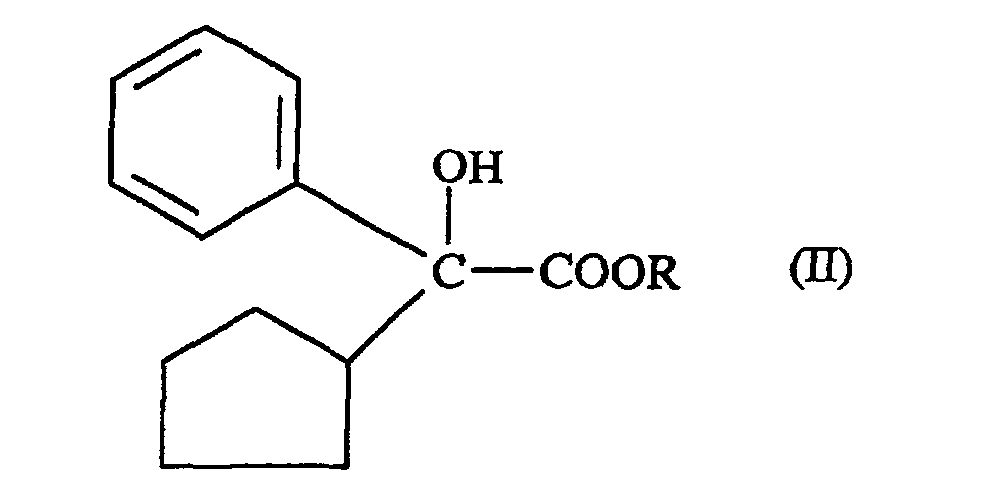 or
or
- (ii) reacting the formula (IV) compound with formula (III) compound in an inert
solvent in the presence of carbonyl diimidazole, followed by addition of hydrochloric acid.
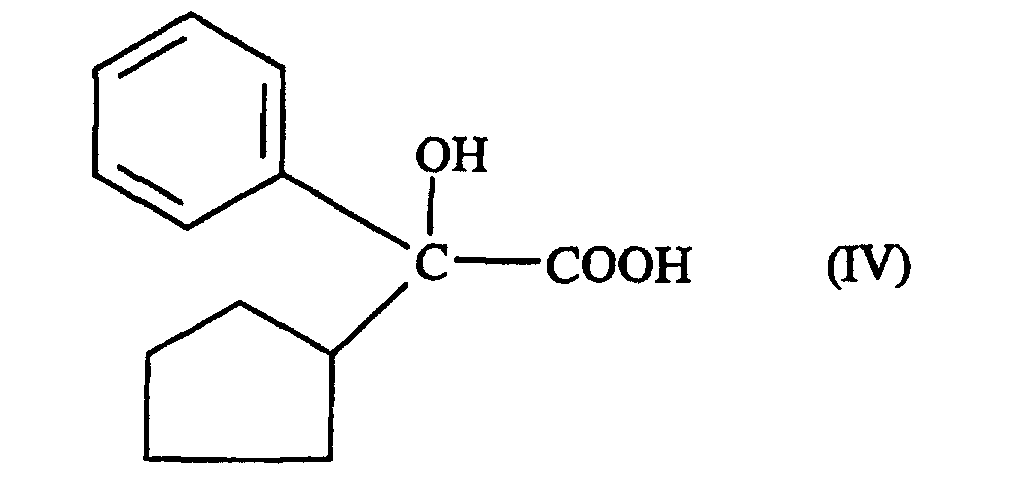
-
- According to the process in the present invention, the alkaline catalyst in (i) was selected from sodium hydride, metal sodium, sodium methoxide and sodium ethoxide. The formula (II) compound can be prepared by a known method [see U.S. patent No. 3,381,017 (1968)] and the formula (III) compound can also be prepared by a known method [see House H.O. et al : J. Org. Chem. 28, 2407 (1983)]. The molar ratio of formula (II) compound to formula (III) compound is 1:1 - 1:5 and the reaction temperature is 20-100 °C .
- The pharmaceutical composition containing phencynonate hydrochloride of α-configuration, has excellent efficacy in prevention and treatment of motion sickness syndrome with a total effective rate higher than 80% in prevention of carsickness and seasickness. In regard to the efficacy in reducing the changes of electronystagmogram caused by acceleration of rotation and the changes of electrogram of body and antrum of stomach caused by Coriolis acceleration, the said pharmaceutical composition could reduce significantly the changes of the above indices with a p value < 0.01 by statistical treatment, while the placebo control group had no change in the above indices.
- In respect to the main side effect -somnolence, the incidence of somnolence after administration of the said pharmaceutical composition for prevention of carsickness and seasickness was 10%, that after diphenidol was 18.7%, p<0.05, and that after placebo was 22.4%, p<0.01.
- Furthermore, the pharmaceutical composition has high biological activity on central and peripheral cholinergic receptors. For example, its potency in antagonizing the central tremor induced by arecoline, a M agonist, is 1.1 times higher than that of atropine and that in antagonizing the central convulsion induced by nicotine, a N agonist, is 6.7 times higher than that of atropine; it has good effectiveness in antagonizing the convulsion induced by soman, a cholinesterase inhibitor, while atropine has no such action; its potency in dilating the pupil, inhibiting the salivary secretion and central inhibition is 1/13, 1/8 and 1/4 of that of scopolamine, respectively.
- Therefore, the pharmaceutical composition containing phencynonate hydrochloride of α-configuration has obvious anti-motion sickness effectiveness, while its side effect (mainly somnolence) is significantly lower than that of the known drugs.
- The second object of the present invention is directed to the preparation of such a pharmaceutical composition. The pharmaceutical composition can be treated with the conventional methods for preparing the pharmaceutical preparations in this art by mixing the compound of formula (I) prepared by the method described above and the excipients or carriers commonly used in pharmaceutical art to form the dosage forms needed.
- According to the present invention, the pharmaceutical composition can be processed to form tablets, capsules, sustained release patches, chewing gums, injections, among which tablets are preferred. According to the present invention, the pharmaceutical composition contains 0.05%-7% (by weight) of the formula (I) compound.
- The routes of administration of the pharmaceutical composition include oral administration, patch sticking, intramuscular injection and oral administration is recommended preferentially. For example, 1 tablet of the pharmaceutical composition can be administered orally half an hour before motion. Each tablet contains 1-4 mg of formula (I) compound and its action lasts 4-5 h.
- The following examples are used to describe further the present invention in detail, but it should be made clear that these examples do not mean any restriction on the present invention.
-
- (1) 228 g (0.974 mol, n25 D 1.5205) of methyl 2-phenyl-2-cyclopentyl-2-hydroxy-acetate,
141 g (0.910 mol, mp 94-5°C ) of 3-methyl-3-azabicyclo(3,3,1) nonan-9α-ol, 2500
ml of anhydrous n-heptane and sodium hydride (8.2 g, assay 80%) were added
successively into a 5-liter three-necked flask and the mixture was heated in an oil bath
with stirring to distil out methanol slowly. After reaction for 3 h, the solvent was removed
under reduced pressure and the mixture was cooled at room temperature. 2 N
hydrochloric acid was added dropwise with stirring and a white solid was isolated. After
filtration, the solid obtained was washed with iced water after drying by pressing, dried in
air and recrystallized from 800 ml of 95% ethanol. After filtration and drying, 232 g of [3-methyl-3-azabicyclo(3,3,1)non-9α-yl]
2-phenyl-2-cyclopentyl-2hydroxyacetate
hydrochloride were obtained in 65% yield, mp 202-5°C (decomposing while melting).
Element analysis : C22H31NO3HCl = 393.93 Calculated value % C 67.07; H 8.19; N 3.56; Cl 9.01 Found value % C 67.00; H 8.08; N 3.46; Cl 8.93
Ultraviolet spectra (UV) λmax 257.6 (ε 234, H2O)
1H nuclear magnetic resonance spectra (1H NMR), CDCl3, δ, TMS, 10.96 (s, b, 1H), 7.63 (d, 2H, J = 7), 7.36 (t, 1H, J = 7), 7.28 (m , 2H, J = 7), 4.97 (s, 1H), 3.82 (d, 1H, J= 12.7), 3.87 (d, 1H, J= 12.7), 3.20-3.02 (m, 3H), 2.88 (d, 3H, J = 4.4), 2.28-1.36 (m. 16H).13C NMR, CDCl3, δ, 175.14 1C 31.58 1C 141.18 1C 31.16 1C 128.28 2C 26.96 1C 127.83 1C 26.64 1C 126.00 2C 26.52 1C 79.40 1C 26.10 1C 72.01 1C 22.90 1C 58.59 1C 22.55 1C 47.67 1C 17.94 1C 46.41 2C - (2) Using the same procedure as described in example 1 above, the differences were adding successively 18 g (0.0654 mol) of methyl 2-phenyl-2-cyclopentyl-2-hydroxy-acetate, 10 g (0.0646 mol) of 3-methyl-3-azabicyclo(3,3,1)nonan-9α-ol, 250 ml of n-heptane and replacing sodium hydride by 0.2 g (0.0087 mol) of metal sodium. 7.6 g of the target compound were obtained in 29.8% yield, mp 202-204°C (decomposing while melting). The data of infrared and nuclear magnetic resonance spectra were the same as those in (1) above.
- (3) Using the same method as described for (1) above the differences were adding successively 20 g (0.0858 mol) of methyl 2-phenyl-2-cyclopentyl-2-hydroxy-acetate, 11 g (0.0715 mol) of 3-methyl-3-azabicyclo(3,3,1)nonan-9α-ol, 300 ml of n-heptane and replacing sodium hydride by 1.62 g (0.03 mol) of sodium methoxide. 17.2 g of the target compound were obtained in 61% yield, mp 202-4°C (decomposing while melting). The data of infrared and nuclear magnetic resonance spectra were the same as those in (1) above.
- (4) Using the same method as described for (1) above, the differences were adding successively 5 g (0.0214 mol) of methyl 2-phenyl-2-cyclopentyl-2-hydroxy-acetate, 2.76 g (0.078 mol) of 3-methyl-3-azabicyclo(3,3,1)nonan-9α-ol, 0.534 g (0.0178 mol) of 80% sodium hydride and replacing n-heptane by 150 ml of anhydrous toluene. 3.0 g of the target compound were obtained in 42.5% yield, mp 202-4°C (decomposing while melting). The data of infrared and nuclear magnetic resonance spectra were the same as those in (1) above.
- (5) Using the same method as described for (1) above, the differences were adding successively 5 g (0.0214 mol) of methyl 2-phenyl-2-cyclopentyl-2-hydroxy-acetate, 2.76 g (0.78 mol) of 3-methyl-3-azabicyclo(3,3,1)nonan-9 α-ol and 0.534 g (0.0178 mol) of 80% sodium hydride and replacing n-heptane by 150 ml of anhydrous benzene. 4.0 g the target compound were obtained in 57% yield, mp 202-4°C (decomposing while melting). The data of infrared and nuclear magnetic resonance spectra were the same as those in (1) above.
-
-
- (1) 0.7 g (0.00318 mol, mp 144-6°C) of 2-phenyl-2-cyclopentyl-2-hydroxy-acetic
acid, 0.33 g (0.00318 mol, mp 94-5°C) of 3-methyl-3-azabicyclo(3,3,1)nonan-9α-ol, 0.515
g (0.0318 mol) of carbonyl diimidazole, 30 ml of anhydrous tetrahydrofuran were added
into a 50-ml reaction flask. The mixture was stirred for 24 h at room temperature and the
solvent was removed under reduced pressure to give an oily residue which was separated
by silicagel column chromatography. The column was eluted with a mixed solvent of
chloroform, methanol and ammonia water (85 : 14 : 1). The solvent in the eluate was
removed. After the residue was dissolved in ether, an appropriate amount of 2N
hydrochloric acid was added to isolate the solid, which was recrystallised from 95%
ethanol to give 0.639 g of phencynonate hydrochloride in 51% yield, mp 203-5°C
(decomposing while melting). The data of infrared spectra and nuclear magnetic
resonance spectra were the same as those in (1) of example 1.
Element analysis : C22H31NO3HCl = 393.93 Calculated value % C 67.07; H 8.19; N 3.56 Found value % C 67.24; H 8.29; N 3.45 - (2) Using the same method as described for (1) of example 2, raw materials of equal weight were added successively. The difference was replacing tetrahydrofuran by anhydrous dimethyl formamide (DMF). 0.542 g of phencynonate hydrochloride of α-configuration was obtained in 43.3% yield, mp 203-5°C (decomposing while melting). The data of infrared spectra and nuclear magnetic resonance spectra were the same as those in (1) of example 1.
-
-
- (1) Preparation of methyl 2-phenyl-2-cyclopentyl-2-hydroxyacetate 22 g (0.90 mol, grade 4) of magnesium filings and 250 ml of absolute ether were added into a three-necked flask. 110 g (1.0 mol, grade 3) of ethyl bromide in 250 ml of absolute ether solution were added dropwise to form a Grignard reagent. Dry nitrogen gas was bubbled and ether was evaporated. When the inner temperature rose to 60°C, 200 ml of anhydrous toluene were added and ether was distilled continuously until the inner temperature rose to 95°C. 60 g (0.9 mol) of cyclopentadiene (industrial grade, freshly distilled, boiling point 40-41°C ) in 250 ml of anhydrous toluene solution were added dropwise with stirring. After the addition the temperature was reduced to 80°C and a distilling apparatus was used. 20 ml of ether were added and the mixture was distilled at an inner temperature rising to 100°C. After cooling the reaction mixture to -5-0°C, a toluene solution of 82 g (0.50 mol) of methyl phenylglyoxylate was added dropwise. After the addition, the reaction mixture was stirred for 10 min and the ice bath was removed, followed by stirring for 50 min at room temperature (21-23°C) and cooling. 300 ml of 30% acetic acid and 25 ml of concentrated hydrochloric acid were added dropwise with stirring to dissolve all solid. The toluene layer was separated and washed successively with water, sodium bicarbonate solution and water. The toluene solution was transferred into a hydrogenator and 20 g of T-1-type Raney nickel were added. Reaction proceeded at room temperature until hydrogenation slowed down obviously. The material was taken out and the catalyst was filtered off. The residue was washed with toluene. The washings and the filtrate were put together and toluene was evaporated, followed by distillation under reduced pressure. The fraction at 82-5°C / 0.03 mm Hg was collected to obtain 96 g of the product in 82% yield, n25 D 1.5205, IR : νOH 3535 cm-1, νC=O 1725 cm-1.Thin layer chromatography was used to control the quality of the product. The method was as follows : GF 254 thin layer plate; developer : 1,2-dichloroethane; ultraviolet 254 nm fluorescence localization; main spot: Rf = 0.72, without impurity spot.
- (2) Using the same method as described for (1) of example 3, raw materials at equal weight were added successively. The difference was using a reaction temperature of -10 to -6°C during the dropwise addition of the toluene solution of 82 g of methyl phenylglyoxylate to cyclopentadiene Grignard reagent. 90 g of methyl 2-phenyl-2-cyclopentyl-2-hydroxy-acetate were obtained in 76.9% yield, n25 D 1.5203, boiling point 82-5°C / 0.03 mmHg. Silicagel GF 254 thin layer plate; developer : 1,2-dichloroethane, ultraviolet 254 nm fluorescence localization, main spot: Rf = 0.72, without impurity spot.
-
- 2.0 g of phencynonate hydrochloride of α-configuration were dissolved in absolute ethanol. The solution was added slowly to a mixture of starch (3.5-5 g) and dextrin (50 g) already sifted through 80-mesh sieve. After mixing, the mixture was sifted through 20-mesh nylon sieve. An appropriate amount of 50% ethanol was sprayed to form a soft material which was sifted through 20-mesh sieve and was used to prepare granules through 20 mesh sieve. The granules were dried at 50-60°C with ventilation. Magnesium stearate was added to the dried granules and 14-mesh sieve was used to make the granules. After mixing, the granules were compressed into 6.5 mm tablets to give α-configuration phencynonate hydrochloride tablets. Each tablet weighed 88 mg. Their dissolution rate was measured with drug dissolution apparatus model R (II) manufactured by Tianjin university and was found to be higher than 80 % in 20 min.
-
- 1. The anti-motion sickness effectiveness and side effects of the pharmaceutical
composition (in the form of a tablet) as compared with those of scopolamine and
diphenidol.
Rabbit model of adverse circling syndrome and cat model of motion sickness-like
syndrome were used to observe the effectiveness of the pharmaceutical composition
prepared according to the present invention and its control drugs, diphenidol and
scopolamine, in preventing motion sickness-like syndrome. Experimental method : the
rabbit (Japanese white rabbit weighing 1.7-2.6 kg) model of adverse circling syndrome
was established by placing the reversible cholinesterase inhibitor diisopropyl
fluorophosphate (DFP) and penetration enhancer dimethyl sulfoxide at the right common
carotid artery of a conscious rabbit to inhibit choline esterase in the right side of brain
(including vestibule) and to destroy the balance function of bilateral vestibules after these
chemicals permeated into the blood, thus causing forced leftward circling movement. The
cat (domestic cat weighing 1.4-3 kg) model of motion sickness-like syndrome was
established by intramuscular injection of reversible cholinesterase inhibitor eserine to a
conscious cat to induce motion sickness-like symptoms such as salivation, fecal and
urinary incontinence, abdomen touching the ground, nausea and vomiting. Using the
above animal models, the pharmaceutical composition containing phencynonate
hydrochloride of α-configuration, diphenidol and scopolamine at three dosages of each
(each dosage group consisted of 8 rabbits or cats) were given intragastrically to rabbits
and / or cats respectively to prevent motion sickness-like symptoms and ED50 values of
preventive efficacy of the three drugs were measured respectively. The results are shown
in Table 1. In addition, in order to assess the side effects of the pharmaceutical
composition, the above 3 drugs were tested in 3 mouse models, namely the model of
potentiating the effect of subthreshold hypnotic dose of sodium pentobarbital (reflecting
central inhibitory effect), the model of mydriatic effect (reflecting the side effect of visual
accomodation disturbance) and the model of inhibiting oxotremorine induced salivation
(reflecting the side effect of dry mouth). The mice used were Kunming species mice
weighing 18-22 g. Five dosage groups were used for each drug and each group consisted
of 10 mice of equal number for both sexes. ED50 values of these 3 drugs were measured
and the ratios of ED50 of the pharmaceutical composition containing phencynonate
hydrochloride of α-configuration to that of diphenidol and to that of scopolamine were
calculated. The results are shown in Table 1.
Comparison of anti-motion sickness efficacy and side effects between the pharmaceutical composition containing phencynonate hydrochloride of α-configuration and its control drugs Equivalent dose (ED50 mg/kg) Pharmaceutical composition containing phencynonate hydrochloride of α-configuration Scopolamine Diphenidol A B C B/A C/A 1. Anti-motion sickness efficacy a. Preventing adverse circling syndrome in rabbits 0.434 0.129 >50 0.30 >115 B. Preventing motion sickness-like syndrome in cats 0.211 0.059 20.18 0.30 91.3 2. Side effects a. potentiating the effect of sub-threshold hypnotic dose of sodium pentobarbital in mice 4.15 0.99 4.2 0.24 6.9 b. Inhibiting salivary secretion in mice 3.74 0.47 8.0 0.13 13.6 c. Mydriatic effect in mice 0.911 0.066 13.8 0.072 10.5 - 2. Efficacy of the pharmaceutical composition containing phencynonate
hydrochloride of α-configuration in prevention of seasickness and carsickness
Using double bind, parallel, randomly controlled method, 90 sailor volunteers with
history of seasickness and 165 medical worker volunteers with history of carsickness
were divided into 3 equal groups each (each group consisted of 30 persons with history of
seasickness or 55 persons with history of carsickness). Thirty minutes before sailing or
starting a car, the pharmaceutical composition containing phencynonate hydrochloride of
α-configuration (2.0 mg/person), placebo and diphenidol (25 mg/person) were given orally
to different groups respectively. The ship sailed on the sea with grade 5 wave and grade
4 surge and the bus bumped up and down on the rough road with abrupt turns for 2-4 h.
The preventive efficacy was observed and the results are shown in Table 2.
Efficacy of the pharmaceutical composition containing phencynonate hydrochloride of α-configuration, placebo and diphenidol in preventing seasickness and carsickness in a double blind, parallel, controlled trial Prevention efficacy Group Pharmaceutical composition containing phencynonate hydrochloride of α-configuration Placebo Diphenol n % n % n % Total effective rate Ship 24 80.0 0 0 23 76.7 Bus 48 87.3Δ 9 16.4 35 63.6 Significantly effective rate Ship 20 66.7 0 0 20 66.7 Bus 33 60.0 3 5.5 27 49.1 Ineffective rate Ship 3 10.0 27 90.0 3 10.0 Bus 6 9.1 33 60.0 10 18.2 - 3. Efficacy of the pharmaceutical composition containing phencynonate hydrochloride of α-configuration in preventing the changes in electronystagmogram induced by revolving chair and the changes in electrogastrogram induced by Coriolis acceleration stimulation.
-
- Using the double-blind parallelly controlled experimental method and oral administration of same doses of the 3 drugs as described for "2" 1 h before rotation, 90 volunteers divided into 3 drug groups underwent revolving chair rotation test and Coriolis acceleration test in laboratory. Rotation of the revolving chair was accelerated from 0 to 90°/s2 at a rate of 1°/s2 and the electronystagmogram was observed during and after rotation. In Coriolis acceleration test, the electrogastrograms of body and antrum of stomach were recorded for 2 min during 2 min stimulation. The results are shown in Table 3.
Efficacy of the pharmaceutical composition containing phencynonate hydrochloride of α-configuration in preventing changes in electronystagmogram induced by revolving chair and changes in electrogastrogram induced by Coriolis acceleration stimulation Drug Group Nystagmus during rotation
(degree/s)Nystagmus after rotation
(degree/s)Amplitude of electrogastrogram of body of stomach
(µV)Amplitude of electrogastrogram of antrum of stomach
(µV)Pharmaceutical Premedication 10.2 ± 3.3 18.5 ± 8.5 540 ± 304 539 ± 301 composition containing phencynonate hydrochloride of α-configuration Postmedication 6.6 ±3.9 11.2 ±6.2 346 ± 178 369 ±184 Placebo Premedication 8.7±4.1 17.2±5.5 506±212 518±216 Postmedication 7.6 ± 3.9 15.8 ± 5.5 457 ± 246 457 ± 257 Diphenidol Premedication 8.9 ± 3.6 15.9 ± 6.2 563 ±329 559 ±333 Postmedication 6.9 ± 3.4 11.2 ± 6.2 396 ± 227 414 ± 265 - It can be seen from Table 3 that both the pharmaceutical composition containing phencynonate hydrochloride of α-configuration and the positive control drug diphenidol showed obvious efficacy in reducing the changes of electronystagmogram and amplitude of electrogastrogram in experiment on prevention of rotation effect. The statistical result of the difference between premedication and postmedication values was P < 0.01 for the group receiving the said pharmaceutical composition of the present invention, P < 0.05 for diphenidol group and P > 0.05, i.e. no significant difference, for placebo group.
Claims (7)
- A method for the preparation of phencynonate hydrochloride of α-configuration [(3-methyl-3-azabicyclo(3,3,1)non-9α-yl)-2-phenyl-2-cyclo-pentyl-2-hydroxyacetate hydrochloride] which comprises the steps of :(i) reacting a compound of formula (II) in which R is methyl or ethyl with a compound of formula (III) at a molar ratio of 1:1-1:5 in inert organic solvent in the presence of an alkaline catalyst at 50-110°C, then adding hydrochloric acid
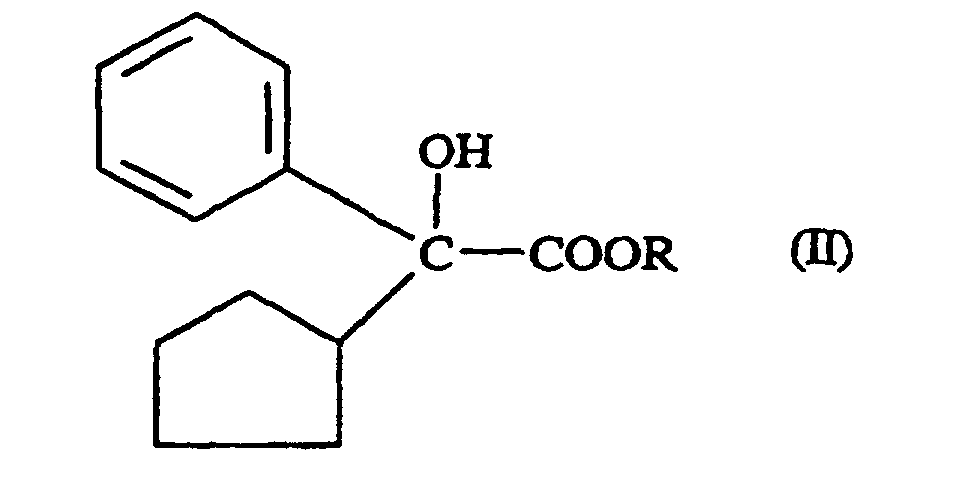 or
or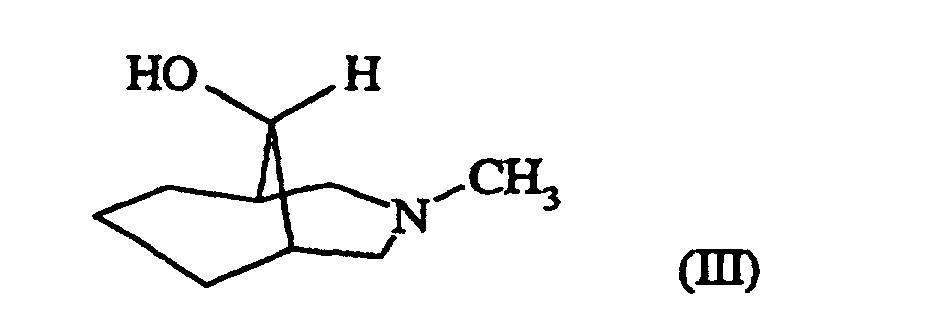 (ii) reacting a compound of formula (IV) with a compound of formula (III) at a molar ratio of 1:1-1:5 in an inert organic solvent in the presence of carbonyl diimidazole at 20-100°C, then adding hydrochloric acid
- The method as claimed in claim 1, in which said alkaline catalyst in step (i) is selected from sodium hydride, metal sodium, sodium methoxide and sodium ethoxide.
- The method as claimed in claim 1 or 2, in which said inert organic solvent is selected from n-heptane, benzene, toluene, tetrahydrofuran and dimethylformamide.
- A method for the preparation of a pharmaceutical composition for the treatment and/or prevention of motion sickness syndrome which comprises the steps of:(i) preparing phencynonate hydrochloride of α-configuration by the method of any one of claims 1 to 3, and(ii) mixing said phencynonate hydrochloride of α-configuration with pharmaceutically acceptable excipients.
- The method as claimed in claim 4, in which the pharmaceutical composition is formulated into tablets, capsules, chewing gums, sustained release patches or injections.
- The method as claimed in claim 5, in which the pharmaceutical composition is formulated into tablets.
- A method as claimed in any one of claims 4 to 6 in which the pharmaceutical composition contains 0.05 wt% - 7 wt% of phencynonate hydrochloride of α-configuration.
Applications Claiming Priority (3)
| Application Number | Priority Date | Filing Date | Title |
|---|---|---|---|
| CN93119491 | 1993-10-22 | ||
| CN93119491A CN1039623C (en) | 1993-10-22 | 1993-10-22 | Pharmaceutical composition for preventing and treating motion sickness syndrome and preparation method thereof |
| PCT/CN1994/000080 WO1995011025A1 (en) | 1993-10-22 | 1994-10-22 | A composition for preventing and treating kinetotia syndrome |
Publications (3)
| Publication Number | Publication Date |
|---|---|
| EP0734724A1 EP0734724A1 (en) | 1996-10-02 |
| EP0734724A4 EP0734724A4 (en) | 1998-02-04 |
| EP0734724B1 true EP0734724B1 (en) | 2003-08-20 |
Family
ID=4992957
Family Applications (1)
| Application Number | Title | Priority Date | Filing Date |
|---|---|---|---|
| EP94930141A Expired - Lifetime EP0734724B1 (en) | 1993-10-22 | 1994-10-22 | Process for the preparation of a phencynonate hydrochloride of alpha-configuration |
Country Status (8)
| Country | Link |
|---|---|
| US (1) | US6028198A (en) |
| EP (1) | EP0734724B1 (en) |
| JP (1) | JP3395843B2 (en) |
| CN (1) | CN1039623C (en) |
| AU (1) | AU7936194A (en) |
| DE (2) | DE4497905B4 (en) |
| GB (1) | GB2297255B (en) |
| WO (1) | WO1995011025A1 (en) |
Families Citing this family (36)
| Publication number | Priority date | Publication date | Assignee | Title |
|---|---|---|---|---|
| US6461812B2 (en) * | 1998-09-09 | 2002-10-08 | Agilent Technologies, Inc. | Method and multiple reservoir apparatus for fabrication of biomolecular arrays |
| CN1141098C (en) * | 2001-02-28 | 2004-03-10 | 中国人民解放军军事医学科学院毒物药物研究所 | New application of benzene ring pelargonate hydrochloride |
| CN1158077C (en) * | 2001-02-28 | 2004-07-21 | 中国人民解放军军事医学科学院毒物药物研究所 | New application of benzene ring pelargonate hydrochloride |
| CN100378064C (en) * | 2004-03-26 | 2008-04-02 | 中国人民解放军军事医学科学院毒物药物研究所 | Active metabolites of phencyclononate and their medicinal uses |
| CN100434422C (en) * | 2004-03-26 | 2008-11-19 | 中国人民解放军军事医学科学院毒物药物研究所 | Optical isomer of phencynonate and its use in preparing medicine |
| CN100341850C (en) * | 2004-11-30 | 2007-10-10 | 中国人民解放军军事医学科学院毒物药物研究所 | Salts of demethyl phencynonate isomer and N-para-methyl-phenyl-sulfuryl glutamic acid optical isomer and their preparing method and use |
| CN100420674C (en) * | 2004-11-30 | 2008-09-24 | 中国人民解放军军事医学科学院毒物药物研究所 | Preparation method of phencyclononate optical isomer |
| CN101209994B (en) | 2006-12-30 | 2010-12-22 | 中国人民解放军军事医学科学院毒物药物研究所 | Selective M4 receptor antagonist and its medical use |
| CN103127106B (en) * | 2011-12-05 | 2015-01-07 | 中国人民解放军军事医学科学院毒物药物研究所 | Purpose of phencynonate hydrochloride for treating or relieving myocardial damage induced by myocardial ischemia reperfusion and pharmaceutical compositions including phencynonate hydrochloride |
| CN103284974B (en) * | 2013-04-03 | 2016-01-20 | 中国人民解放军广州军区武汉总医院 | Benzene ring nonyl ester double-layer osmotic pump controlled-release tablet and preparation method thereof |
| KR102160389B1 (en) | 2013-08-05 | 2020-09-28 | 트위스트 바이오사이언스 코포레이션 | De novo synthesized gene libraries |
| CA2975855C (en) | 2015-02-04 | 2025-09-23 | Twist Bioscience Corporation | Compositions and methods for synthetic gene assembly |
| CA2975852A1 (en) | 2015-02-04 | 2016-08-11 | Twist Bioscience Corporation | Methods and devices for de novo oligonucleic acid assembly |
| WO2016172377A1 (en) | 2015-04-21 | 2016-10-27 | Twist Bioscience Corporation | Devices and methods for oligonucleic acid library synthesis |
| KR20180050411A (en) | 2015-09-18 | 2018-05-14 | 트위스트 바이오사이언스 코포레이션 | Oligonucleotide mutant library and its synthesis |
| WO2017053450A1 (en) | 2015-09-22 | 2017-03-30 | Twist Bioscience Corporation | Flexible substrates for nucleic acid synthesis |
| EP3384077A4 (en) | 2015-12-01 | 2019-05-08 | Twist Bioscience Corporation | FUNCTIONALIZED SURFACES AND THEIR PREPARATION |
| WO2018038772A1 (en) | 2016-08-22 | 2018-03-01 | Twist Bioscience Corporation | De novo synthesized nucleic acid libraries |
| EP4664304A3 (en) | 2016-09-21 | 2026-01-21 | Atlas Data Storage, Inc. | Nucleic acid based data storage |
| GB2573069A (en) | 2016-12-16 | 2019-10-23 | Twist Bioscience Corp | Variant libraries of the immunological synapse and synthesis thereof |
| WO2018156792A1 (en) | 2017-02-22 | 2018-08-30 | Twist Bioscience Corporation | Nucleic acid based data storage |
| CA3056388A1 (en) | 2017-03-15 | 2018-09-20 | Twist Bioscience Corporation | Variant libraries of the immunological synapse and synthesis thereof |
| IL271205B2 (en) | 2017-06-12 | 2025-02-01 | Twist Bioscience Corp | Methods for seamless nucleic acid assembly |
| WO2018231864A1 (en) | 2017-06-12 | 2018-12-20 | Twist Bioscience Corporation | Methods for seamless nucleic acid assembly |
| CN111566125A (en) | 2017-09-11 | 2020-08-21 | 特韦斯特生物科学公司 | GPCR binding proteins and synthesis thereof |
| CN111565834B (en) | 2017-10-20 | 2022-08-26 | 特韦斯特生物科学公司 | Heated nanopores for polynucleotide synthesis |
| IL312616B2 (en) | 2018-01-04 | 2025-08-01 | Twist Bioscience Corp | DNA-based digital information storage |
| EP3814497A4 (en) | 2018-05-18 | 2022-03-02 | Twist Bioscience Corporation | POLYNUCLEOTIDES, REAGENTS, AND METHODS FOR NUCLEIC ACID HYBRIDIZATION |
| EP3902816A4 (en) | 2018-12-26 | 2022-09-14 | Twist Bioscience Corporation | HIGHLY ACCURATE POLYNUCLEOTIDE DE NOVO SYNTHESIS |
| KR20210144698A (en) | 2019-02-26 | 2021-11-30 | 트위스트 바이오사이언스 코포레이션 | Variant Nucleic Acid Libraries for Antibody Optimization |
| CA3131689A1 (en) | 2019-02-26 | 2020-09-03 | Twist Bioscience Corporation | Variant nucleic acid libraries for glp1 receptor |
| EP3987019A4 (en) | 2019-06-21 | 2023-04-19 | Twist Bioscience Corporation | BARCODE-BASED NUCLEIC ACID SEQUENCE ARRANGEMENT |
| CN115023440B (en) | 2019-09-23 | 2025-09-12 | 特韦斯特生物科学公司 | Antibodies that bind to CD3ε |
| US12091777B2 (en) | 2019-09-23 | 2024-09-17 | Twist Bioscience Corporation | Variant nucleic acid libraries for CRTH2 |
| AU2020400030B2 (en) | 2019-12-09 | 2026-05-21 | Twist Bioscience Corporation | Variant nucleic acid libraries for adenosine receptors |
| CN114324720A (en) * | 2021-12-27 | 2022-04-12 | 兰晟生物医药(苏州)有限公司 | Method for detecting isomer in levo-hydrochloric acid demethyl phencynonate |
Family Cites Families (7)
| Publication number | Priority date | Publication date | Assignee | Title |
|---|---|---|---|---|
| EP0385517B1 (en) * | 1985-03-14 | 1993-04-14 | BEECHAM GROUP plc | Medicaments for the treatment of emesis |
| DE3687080T2 (en) * | 1985-04-27 | 1993-03-25 | Beecham Group Plc | AZABICYCLONONYL INDAZOL CARBOXAMIDE WITH 5-HT ANTAGONISTIC EFFECT. |
| ES8605273A1 (en) * | 1985-12-10 | 1986-03-16 | Lazlo Int Sa | Mandelic acid derivs. |
| US4713391A (en) * | 1986-04-17 | 1987-12-15 | The United States Of America As Represented By The Secretary Of The Army | Azabicyloalkane phenyl substituted alkane carboxylates, their preparation and use as anticholinergic agents |
| US5053412A (en) * | 1990-04-10 | 1991-10-01 | Israel Institute For Biological Research | Spiro nitrogen-bridged heterocyclic compounds |
| US5073560A (en) * | 1990-07-20 | 1991-12-17 | Fisons Corporation | Spiro-isoxazolidine derivatives as cholinergic agents |
| US5647835A (en) * | 1995-06-22 | 1997-07-15 | Martineau; Michael | Method for preventing motion sickness |
-
1993
- 1993-10-22 CN CN93119491A patent/CN1039623C/en not_active Expired - Lifetime
-
1994
- 1994-10-22 JP JP51114595A patent/JP3395843B2/en not_active Expired - Fee Related
- 1994-10-22 DE DE4497905A patent/DE4497905B4/en not_active Expired - Fee Related
- 1994-10-22 US US08/632,504 patent/US6028198A/en not_active Expired - Fee Related
- 1994-10-22 WO PCT/CN1994/000080 patent/WO1995011025A1/en not_active Ceased
- 1994-10-22 AU AU79361/94A patent/AU7936194A/en not_active Abandoned
- 1994-10-22 DE DE4497905T patent/DE4497905T1/en active Pending
- 1994-10-22 EP EP94930141A patent/EP0734724B1/en not_active Expired - Lifetime
- 1994-10-22 GB GB9608317A patent/GB2297255B/en not_active Expired - Fee Related
Also Published As
| Publication number | Publication date |
|---|---|
| GB2297255A (en) | 1996-07-31 |
| EP0734724A4 (en) | 1998-02-04 |
| JPH09509396A (en) | 1997-09-22 |
| DE4497905B4 (en) | 2009-01-29 |
| AU7936194A (en) | 1995-05-08 |
| CN1039623C (en) | 1998-09-02 |
| JP3395843B2 (en) | 2003-04-14 |
| US6028198A (en) | 2000-02-22 |
| GB2297255B (en) | 1998-01-07 |
| CN1089838A (en) | 1994-07-27 |
| WO1995011025A1 (en) | 1995-04-27 |
| GB9608317D0 (en) | 1996-06-26 |
| EP0734724A1 (en) | 1996-10-02 |
| DE4497905T1 (en) | 1996-10-31 |
Similar Documents
| Publication | Publication Date | Title |
|---|---|---|
| US6028198A (en) | Pharmaceutical composition for prevention and treatment of motion sickness syndrome | |
| RU2407743C2 (en) | Pharmaceutical compounds | |
| EP0532348B1 (en) | A tramadol N-oxide material, enantiomers and compositions thereof, and their use | |
| EP3224261B1 (en) | Opioid receptor modulators | |
| GB2463452A (en) | Desmethyl derivatives of tetrabenazine and pharmaceutical compositions thereof | |
| JP2015529252A (en) | Fluoroalkyl-1,4-benzodiazepinone compounds | |
| EA023751B1 (en) | Kit, composition, product or medicament for treating cognitive impairment | |
| US4985434A (en) | 7-substituted derivatives of 2-amino-3H,5H-pyrrolo(3,2-d)pyrimidin-4-ones and pharamceutical uses and compositions containing the same | |
| AU2006268098A1 (en) | Use of 3,1IB-CIS-dihydrotetrabenazine for the treatment of symptoms of Huntington's disease | |
| US20250268883A1 (en) | Therapeutic methods and compositions for treating movement disorders | |
| SK282061B6 (en) | MAKROLIDES, METHODS OF PREPARATION AND PHARMACEUTICAL PRODUCT | |
| US5008265A (en) | 2-amino-7-(alicyclomethyl)-3H,5H,-pyrrolo[3,2-d]pyrimidin-4-ones and pharmaceutical uses and compositions containing the same | |
| US4104397A (en) | Spiro (1,3-dioxolane-4,3') quinuclidine compounds | |
| JP2906339B2 (en) | Memory enhancing and anti-dementia agent containing dehydroevodiamine-HCl as active ingredient | |
| AU613009B2 (en) | 4-(3-phosphono-2-propenyl)-2- piperazinecarboxylic acid | |
| Cannon et al. | p-Dimethoxy-substituted trans-octahydrobenzo [f]-and-[g] quinolines: synthesis and assessment of dopaminergic agonist effects | |
| EP0491549B1 (en) | Novel 15-nitro-2beta, 3beta-dihydro- and 15-nitro-2beta,3beta,6,7-tetrahydrotabersonine derivatives, pharmaceutical compositions containing them and process for preparing same | |
| Law et al. | Rigid analogs of dopamine: synthesis and interaction of 6-exo-and 6-endo-(3', 4'-dihydroxyphenyl)-2-azabicyclo [2.2. 2] octanes with dopamine uptake sites and receptors | |
| MXPA00012248A (en) | Acetylcholine enhancers. | |
| JP3251954B2 (en) | Azabicyclo derivatives | |
| EP0504180B1 (en) | Glycyl-p-amino-pyridine for the treatment of senile dementia states | |
| AU652009B2 (en) | Use of certain esters of hexahydro-8-hydroxy-2,6-methano- 2H-quinolizin-3(4H)-one and related compounds for treating cognitive disorders | |
| EP0460358B1 (en) | Agent for treating disorders from cerebral neuro-degeneration | |
| Voith et al. | Neuroleptics related to butaclamol. Synthesis and some psychopharmacological effects of a series of 3-aryl analogues | |
| WO2026096951A1 (en) | Therapeutic methods and compositions for treating movement disorders |
Legal Events
| Date | Code | Title | Description |
|---|---|---|---|
| PUAI | Public reference made under article 153(3) epc to a published international application that has entered the european phase |
Free format text: ORIGINAL CODE: 0009012 |
|
| 17P | Request for examination filed |
Effective date: 19960522 |
|
| AK | Designated contracting states |
Kind code of ref document: A1 Designated state(s): FR IT |
|
| A4 | Supplementary search report drawn up and despatched |
Effective date: 19971218 |
|
| AK | Designated contracting states |
Kind code of ref document: A4 Designated state(s): FR IT |
|
| 17Q | First examination report despatched |
Effective date: 20010110 |
|
| GRAH | Despatch of communication of intention to grant a patent |
Free format text: ORIGINAL CODE: EPIDOS IGRA |
|
| RIC1 | Information provided on ipc code assigned before grant |
Ipc: 7C 07D 221/22 B Ipc: 7A 61K 31/435 B Ipc: 7A 61K 31/445 A |
|
| RIC1 | Information provided on ipc code assigned before grant |
Ipc: 7A 61K 31/435 B Ipc: 7A 61K 31/445 B Ipc: 7C 07D 221/22 A |
|
| RTI1 | Title (correction) |
Free format text: PROCESS FOR THE PREPARATION OF A PHENCYNONATE HYDROCHLORIDE OF ALPHA-CONFIGURATION |
|
| GRAH | Despatch of communication of intention to grant a patent |
Free format text: ORIGINAL CODE: EPIDOS IGRA |
|
| GRAA | (expected) grant |
Free format text: ORIGINAL CODE: 0009210 |
|
| AK | Designated contracting states |
Designated state(s): FR IT |
|
| ET | Fr: translation filed | ||
| PLBE | No opposition filed within time limit |
Free format text: ORIGINAL CODE: 0009261 |
|
| STAA | Information on the status of an ep patent application or granted ep patent |
Free format text: STATUS: NO OPPOSITION FILED WITHIN TIME LIMIT |
|
| 26N | No opposition filed |
Effective date: 20040524 |
|
| PG25 | Lapsed in a contracting state [announced via postgrant information from national office to epo] |
Ref country code: IT Free format text: LAPSE BECAUSE OF NON-PAYMENT OF DUE FEES;WARNING: LAPSES OF ITALIAN PATENTS WITH EFFECTIVE DATE BEFORE 2007 MAY HAVE OCCURRED AT ANY TIME BEFORE 2007. THE CORRECT EFFECTIVE DATE MAY BE DIFFERENT FROM THE ONE RECORDED. Effective date: 20051022 |
|
| PGFP | Annual fee paid to national office [announced via postgrant information from national office to epo] |
Ref country code: IT Payment date: 20061031 Year of fee payment: 13 |
|
| PGRI | Patent reinstated in contracting state [announced from national office to epo] |
Ref country code: IT Effective date: 20080301 |
|
| REG | Reference to a national code |
Ref country code: FR Ref legal event code: ST Effective date: 20090630 |
|
| PGRI | Patent reinstated in contracting state [announced from national office to epo] |
Ref country code: IT Effective date: 20080301 |
|
| PG25 | Lapsed in a contracting state [announced via postgrant information from national office to epo] |
Ref country code: FR Free format text: LAPSE BECAUSE OF NON-PAYMENT OF DUE FEES Effective date: 20081031 |
|
| REG | Reference to a national code |
Ref country code: FR Ref legal event code: RN Ref country code: FR Ref legal event code: FC |
|
| PGRI | Patent reinstated in contracting state [announced from national office to epo] |
Ref country code: FR Effective date: 20100609 |
|
| PGFP | Annual fee paid to national office [announced via postgrant information from national office to epo] |
Ref country code: FR Payment date: 20101105 Year of fee payment: 17 |
|
| REG | Reference to a national code |
Ref country code: FR Ref legal event code: ST Effective date: 20120629 |
|
| PG25 | Lapsed in a contracting state [announced via postgrant information from national office to epo] |
Ref country code: FR Free format text: LAPSE BECAUSE OF NON-PAYMENT OF DUE FEES Effective date: 20111102 |