EP0733126B1 - Immobilized mismatch binding protein for detection or purification of mutations or polymorphisms - Google Patents
Immobilized mismatch binding protein for detection or purification of mutations or polymorphisms Download PDFInfo
- Publication number
- EP0733126B1 EP0733126B1 EP95901158A EP95901158A EP0733126B1 EP 0733126 B1 EP0733126 B1 EP 0733126B1 EP 95901158 A EP95901158 A EP 95901158A EP 95901158 A EP95901158 A EP 95901158A EP 0733126 B1 EP0733126 B1 EP 0733126B1
- Authority
- EP
- European Patent Office
- Prior art keywords
- dna
- mismatch
- binding protein
- immobilized
- binding
- Prior art date
- Legal status (The legal status is an assumption and is not a legal conclusion. Google has not performed a legal analysis and makes no representation as to the accuracy of the status listed.)
- Expired - Lifetime
Links
Images


Classifications
-
- C—CHEMISTRY; METALLURGY
- C12—BIOCHEMISTRY; BEER; SPIRITS; WINE; VINEGAR; MICROBIOLOGY; ENZYMOLOGY; MUTATION OR GENETIC ENGINEERING
- C12Q—MEASURING OR TESTING PROCESSES INVOLVING ENZYMES, NUCLEIC ACIDS OR MICROORGANISMS; COMPOSITIONS OR TEST PAPERS THEREFOR; PROCESSES OF PREPARING SUCH COMPOSITIONS; CONDITION-RESPONSIVE CONTROL IN MICROBIOLOGICAL OR ENZYMOLOGICAL PROCESSES
- C12Q1/00—Measuring or testing processes involving enzymes, nucleic acids or microorganisms; Compositions therefor; Processes of preparing such compositions
- C12Q1/68—Measuring or testing processes involving enzymes, nucleic acids or microorganisms; Compositions therefor; Processes of preparing such compositions involving nucleic acids
- C12Q1/6844—Nucleic acid amplification reactions
- C12Q1/6858—Allele-specific amplification
-
- C—CHEMISTRY; METALLURGY
- C12—BIOCHEMISTRY; BEER; SPIRITS; WINE; VINEGAR; MICROBIOLOGY; ENZYMOLOGY; MUTATION OR GENETIC ENGINEERING
- C12Q—MEASURING OR TESTING PROCESSES INVOLVING ENZYMES, NUCLEIC ACIDS OR MICROORGANISMS; COMPOSITIONS OR TEST PAPERS THEREFOR; PROCESSES OF PREPARING SUCH COMPOSITIONS; CONDITION-RESPONSIVE CONTROL IN MICROBIOLOGICAL OR ENZYMOLOGICAL PROCESSES
- C12Q1/00—Measuring or testing processes involving enzymes, nucleic acids or microorganisms; Compositions therefor; Processes of preparing such compositions
- C12Q1/68—Measuring or testing processes involving enzymes, nucleic acids or microorganisms; Compositions therefor; Processes of preparing such compositions involving nucleic acids
- C12Q1/6813—Hybridisation assays
- C12Q1/6827—Hybridisation assays for detection of mutation or polymorphism
Definitions
- the invention in the fields of molecular biology and medicine relates to a method for detecting mutations involving as little as one base change or a single base addition to, or deletion from, the wild-type DNA sequence, as well as methods for removing mismatch-containing DNA from batches of amplified DNA.
- Nucleic acid detection assays can be based on any of a number of characteristics of a nucleic acid molecule, such as its size, sequence, susceptibility to digestion by restriction endonucleases, etc.
- the sensitivity of such assays may be increased by altering the manner in which detection is reported or signaled to the observer.
- assay sensitivity can be increased through the use of detectably labeled reagents, wherein the labels may be enzymes (Kourilsky et al ., U.S. Patent 4,581,333), radioisotopes (Falkow et al ., U.S. Patent 4,358,535; Berninger, U.S.
- Patent 4,446,237 fluorescent labels (Albarella et al ., EP 144914), chemical labels (Sheldon III et al ., U.S. Patent 4,582,789; Albarella et al ., U.S. Patent 4,563,417), modified bases (Miyoshi et al ., EP 119448), and the like.
- Mismatch-containing DNA duplexes have also been distinguished from perfectly matched duplexes by means of denaturing gel electrophoresis.
- duplexes are run on a polyacrylamide gel in a denaturing gradient under conditions where mismatch-containing DNA denatures more readily than the identical duplex lacking a mismatch, such that the two kinds of duplexes migrate differently.
- This method while sensitive and accurate, is extremely laborious and requires a high level of technical sophistication.
- Two other methods of mutation detection depend on the failure to extend or join fragments of DNA when mismatches are present. Both require the use of standard DNA oligonucleotides that end precisely at the site of the mutation in question such that, when annealed to test DNA, it is the last base of the oligonucleotide which is mismatched. Mismatch detection depends either on (a) the inability of DNA polymerase to extend an oligonucleotide with a mismatched terminal base or (b) the inability of DNA ligase to join two oligonucleotides when there is a mismatch at the joint between them. Fragment length is determined by gel electrophoresis.
- a chemical method for cleavage of mismatched DNA is based on chemical cleavage at a mismatch site in a DNA-DNA heteroduplex, using a number of agents, in particular osmium tetroxide and hydroxylamine.
- DNA probes are prepared by restriction enzyme cleavage of DNA of interest. Plasmid DNA containing the sequence of interest is hybridized to labeled probe DNA (either end-labeled or internally labeled with 32 P).
- ssDNA single stranded DNA
- a high-affinity ssDNA-binding protein such as a topoisomerase or a DNA unwinding protein which itself can be bound to a label, such as ⁇ -D-galactosidase.
- DNA mismatch repair systems employ a family of proteins including proteins which recognize and bind to mismatch-containing DNA, which are designated mismatch binding proteins (MBPs).
- MBPs mismatch binding proteins
- the MutS protein was identified as such a component of the E. coli mismatch repair system. See, for example, Lahue, R.S. et al., Science 245 :160-164 (1989); Jiricny, J.
- MutS protein binds DNA containing mispaired bases, but does not bind DNA without mismatches or single-stranded DNA.
- the MutS-DNA interaction does not result in any degradation or modification of the DNA. None of the above references disclose the possibility of using a MBP or immobilized MBP as part of a mutation detection assay or for purposes of removing mismatched DNA from amplified DNA samples.
- WO-A-95/12688 (US Biochemical Corporation), published on 11 May 1995, refers to a diagnostic method for detecting a base pair mismatch in a DNA duplex, where a first DNA molecule is contacted with a second DNA molecule to form a duplex and detecting any base pair mismatches using a mispair recognition protein in solution.
- Jiricny et al Nucleic Acids Research, 16(16):7843-7853(1988) refers to studies into the binding of a mutS gene product to a series of synthetic DNA duplexes containing mismatches or mismatch analogues of the purine/pyrimidine type.
- WO-A-93/02216 (Upstate Biotechnology) refers to methods of detecting mutations using the DNA mismatch-binding protein, MutS, wherein a heteroduplex DNA molecule is immobilized on a solid phase prior to exposure to a mismatch-binding protein.
- the present inventor has conceived of the use of immobilized mismatch binding protein (MBP), for example, the MutS protein of E. coli, for (1) the detection of genetic mutations or genomic polymorphisms, (2) the purification of amplified DNA samples by removing contaminating sequences and sequences containing errors introduced during the amplification processes, and (3) the identification of specific alleles in multi-allelic systems.
- MBP immobilized mismatch binding protein
- the nucleic acid, preferably DNA, being analyzed can be obtained from any source, including blood cells, tumor tissues, cells in culture or any tissue, and can be obtained from any species including humans.
- the DNA may be labeled by any of a variety of well-known methods, using colorimetric, chemiluminescent or radioactive markers. In fact, it is not necessary to label test DNA at all.
- the assay can be performed with a labeled competing oligonucleotide.
- a labeled competing oligonucleotide For purification of amplified DNA, no label is required.
- the label For allele identification, the label must be in a synthesized single-stranded oligonucleotide probe.
- the methods of the present invention depend on the creation of mismatches in the test DNA which are revealed by denaturing the test DNA and allowing it to reanneal.
- the test DNA can simply be self-annealed, resulting in formation of mismatches when the single strands reanneal with a strand descended from the other parental chromosome. If no heterozygosity exists, no mismatches will be formed.
- the label can be in the primers used for amplification or may be added to the termini of the test DNA if amplification is not required.
- a similar procedure and labeling scheme is used to remove sequences containing errors introduced during amplification of DNA or minority sequence species.
- the material which does not bind to the MBP is recovered, and contains only those duplex sequences without mismatches. These sequences will therefore be greatly enriched for the majority sequence in the amplified population.
- the starting material contains only one sequence, the unbound material will contain those sequences which are identical to the starting material, while those sequences containing errors introduced during amplification will, provided they are relatively rare, have formed mismatches which are retained by the immobilized MBP.
- the probe sequence must be identical to the allele of interest such that no mismatches are formed when it anneals to DNA of that allele.
- the sequence of the probe is selected so that it forms mismatches when annealed to the DNA of any other allele.
- the present invention is directed to a method for detecting a mutation from a non-mutated sequence of a double stranded target DNA in a sample, comprising:
- a preferred MBP in the above methods is the E. coli MutS protein or a functional derivative thereof.
- Preferred solid supports on which the mismatch binding protein is immobilized include, but are not limited to, modified cellulose, polystyrene, polypropylene, polyethylene, dextran, nylon, polyacrylamide and agarose.
- a most preferred solid support is a nitrocellulose membrane.
- a preferred detectable label for the detectably labeled DNA in the above methods is biotin.
- a method for identifying a specific allele in a multi-allelic system in a sample of amplified DNA comprising:
- the immobilized MBP may be (a) in a form which is removable by centrifugation, or (b) immobilized onto a column support material wherein the flow through material is devoid of mismatch-containing duplexes, or (c) immobilized on a filter support such the filtrate is devoid of mismatch-containing duplexes.
- the present invention is also directed to a kit useful for detecting a mutation from a non-mutated sequence of a target DNA sequence in a sample, the kit comprising:
- kits useful for detecting a mutation from a non-mutated sequence of a target DNA sequence in a sample comprising:
- the MBP is preferably MutS or a functional derivative thereof.
- the solid support is preferably selected from the group consisting of natural cellulose, modified cellulose, most preferably nitrocellulose, or polystyrene, polypropylene, polyethylene, dextran, nylon, polyacrylamide and agarose.
- mismatch binding protein preferably the MutS protein or a functional derivative thereof, immobilized on a solid support, such that said immobilized mismatch binding protein is capable of binding to mismatch-containing polynucleotide molecules.
- Figure 1 shows the results of a direct assay of mismatches using nitrocellulose-bound MutS. Increasing amounts of biotinylated mismatch-containing DNA (upper 2 lines) or mismatch-free DNA (lower 2 lines) were added to the reaction mixtures.
- Figure 2 shows the results of a competition assay of mismatched duplexes using nitrocellulose-bound MutS protein. Increasing amounts of unlabeled mismatch-containing 30-mer (upper 2 lines) or mismatch-free 30-mer (lower 2 lines) were added to 5 ng biotinylated mismatch-containing 30-mer. The far right column on the figure represents wells which contained no MutS.
- Figure 3 shows the results of binding of mismatch containing DNA to E. coli mutS immobilized on nitrocellulose.
- Mismatch-containing DNA duplexes (2157 and Bio-Het+) show darker (or visible bands) at concentrations where homoduplex DNA shows lighter (or no) bands.
- Figure 4 shows the nucleotide sequences of synthetic oligonucleotides (30mers) prepared with a single mismatch at position 15 or 16 or with 1 - 4 unpaired bases between positions 15 and 16. Mismatched or unpaired bases are shown in boldface. Results of studies detecting these mismatches or unpaired bases are shown in Figure 5.
- Figure 5 shows the results of binding of DNA duplexes containing the indicated mismatches, or unpaired bases, to E. coli mutS immobilized on nitrocellulose.
- the present inventor conceived of a new, broadly applicable and relatively simple method for detecting a single base change in a DNA sequence or several such base changes. This method is based upon the formation of a mismatch-containing heteroduplex when a strand of mutant DNA and a "complementary" strand of wild-type DNA hybridize.
- the presence of the mismatch is detected in a highly specific manner by first allowing the DNA to bind to an immobilized mismatch-binding protein (MBP), such as the MutS protein of E. coli .
- MBP mismatch-binding protein
- the presence of DNA bound to the MBP is then detected in any of a number of ways, depending on the label used and whether the assay is a direct assay or a competitive assay. This method stands in stark contrast to methods of the prior art which employ mismatch cutting nuclease enzymes capable of breaking DNA at or near a mispaired base pair.
- the methods described herein provide a mutation/polymorphism detection system having the advantages of (a) simplicity, (b) accuracy, (c) ability to be used without radioactivity, (d) ability to detect all single base substitution mutations and addition or deletion mutations of 1-4 bases.
- Standard reference works setting forth the general principles of recombinant DNA technology and cell biology, and describing conditions for isolation and handling of nucleic acids, denaturing and annealing nucleic acids, hybridization assays, and the like, include: Sambrook, J. et al., MOLECULAR CLONING: A LABORATORY MANUAL , 2nd Edition, Cold Spring Harbor Press, Cold Spring Harbor, NY, 1989; Albers, B.
- MBPs are proteins of around 100 kDa, have been identified in and isolated from both bacteria and higher organisms and selectively bind DNA containing mismatched bases. MBPs have been found in yeast (Valle G et al ., 1991 Yeast 7 :981-988; Miret J.J. et al., 1993, J. Biol Chem. 268 :3507-3513), as well as in humans (Stephenson, C. et al ., 1989, J. Biol. Chem. 264 :21177-21782; Karran, P et al ., 1990, Mutat. Res. 236 :269-275; Hughes M.J. et al., 1992, J. Biol. Chem.
- a preferred MBP is characterized by its ability to bind DNA-DNA (or DNA-RNA or RNA-RNA) duplexes containing mispaired or unpaired bases, to the significant exclusion of single stranded polynucleotides or perfectly matched duplexes.
- the intact native MutS protein from E. coli is used.
- the term "mismatch binding protein” or “MBP” is intended to encompass a functional derivative of the intact, native protein.
- “functional derivative” is meant a "fragment,” “variant,” “analog,” or “chemical derivative” of the protein which retains the ability to bind to a mismatch-containing nucleic acid heteroduplex, which permits its utility in accordance with the present invention.
- a “fragment” of a MBP refers to any subset of the molecule, that is, a shorter peptide.
- a “variant” of the protein refers to a molecule substantially similar to either the entire protein or a DNA-hybrid-binding fragment thereof.
- a variant of a mismatch-binding protein, for example, of MutS may be prepared by recombinant DNA methods well-known in the art.
- a preferred functional derivative of MutS is a homologue of E. coli MutS in another species, such as the MutS protein of Salmonella typhimurium (Lu, A.L. et al., supra; Haber L.T. et al., supra; Pang, P.P. et al., supra) or the hexA protein of Streptococcus pneumoniae (Priebe S.D. et al., supra; Haber et al., supra).
- possible eukaryotic homologues of MutS or HexA can also be used, such as those encoded by the homologous sequences identified in human, mouse, frog or hamster DNA (Shimada, T. et al., J.
- a "chemical derivative" of the MBP contains additional chemical moieties not normally a part of the protein, including additional stretches of amino acids as in a fusion protein.
- Covalent modifications of the peptide are included within the scope of this invention. Such modifications may be introduced into the molecule by reacting targeted amino acid residues of the protein with an organic derivatizing agent that is capable of reacting with selected side chains or terminal residues.
- assays can be performed by one of ordinary skill in the art using conventional methods.
- a mismatch binding assay such as that described for MutS by Jiricny et al.
- a filter binding assay is used.
- an oligonucleotide preferably of about 16 bases is labeled with 32 P using a kinase reaction and ⁇ - 32 P-ATP using a kinase such as T4-polynucleotide kinase.
- the 5'-labeled oligonucleotide (which can be stored at -20°C) is then annealed with a complementary oligonucleotide having a single base pair mismatch under standard conditions.
- the annealed 16 base pair heteroduplex is mixed with an excess of the protein being tested and kept on ice for 30 minutes.
- the mixture is then applied to a nitrocellulose filter which has been prewetted in the assay buffer. Gentle suction is applied for several seconds, and the filter is washed extensively with ice-cold assay buffer.
- the filter is then dried in air, suspended in scintillation fluid and counted.
- any counts on the filter can be attributed to binding to the putative MBP.
- the labeled oligonucleotide heteroduplex will pass through the filter.
- the MBP is immobilized to a solid support or carrier.
- solid support or “carrier” is intended any support capable of binding a protein.
- supports or carriers include natural cellulose, modified cellulose such as nitrocellulose, polystyrene, polypropylene, polyethylene, dextran, nylon, polyacrylamide, and agarose or Sepharose®. Also useful are magnetic beads.
- the support material may have virtually any possible structural configuration so long as the immobilized MBP is capable of binding to the target nucleic acid molecule.
- the support configuration can include microparticles, beads, porous and impermeable strips and membranes, the interior surface of a reaction vessel such as test tubes and microtiter plates, and the like.
- Preferred supports include nitrocellulose disks or strips. Those skilled in the art will know many other suitable carriers for binding the MBP or will be able to ascertain these by routine experimentation.
- a solid support to which the MBP is attached or fixed by covalent or noncovalent bonds.
- noncovalent attachment is by adsorption using methods that provide for a suitably stable and strong attachment.
- the MBP is immobilized using methods well-known in the art appropriate to the particular solid support, providing that the ability of the MBP to bind mismatch-containing DNA is not destroyed.
- the immobilized MBP is then easily used to detect heterozygosity (or polymorphism) as well as single base mutations, or to isolate mismatch-containing DNA from a mixture, or to rid a mixture of mismatch-containing DNA.
- the surface of polystyrene or other plastic multiwell plates serves as the solid support.
- a solid support to which the MBP is bound is affixed to the bottom of wells of multiwell plates.
- the immobilization and DNA binding can be performed in a 96 well blotting apparatus and the resulting sheet of nitrocellulose (or other support) paper can be removed to evaluate reactions.
- nitrocellulose or other support
- color development on the nitrocellulose can be used to evaluate binding based on an enzyme as part of the detection system and a chromogenic or chemiluminescent substrate for the enzyme serving as the precursor of the color reactions.
- the support is treated ("blocked") to prevent further binding of proteins or nucleic acids, using methods and reagents well-known in the art.
- the immobilized MBP is contacted with and allowed to bind (to saturation) small oligonucleotide heteroduplex molecules.
- the oligonucleotides preferably have about 30 base pairs.
- a DNA duplex containing a mismatch which is well recognized ( i.e. , bound) by the MBP is used.
- oligonucleotides are prepared using a nucleotide modified at the 5' end with a detectable label such that they can be quantitatively detected by appropriate detection methods, preferably spectrophotometry or chemiluminescence.
- the oligonucleotide is biotin-modified, and is detectable using a detection system based on avidin or streptavidin which binds with high affinity to biotin.
- the streptavidin can be conjugated to an enzyme, the presence of which is detected using a chromogenic substrate and measuring the color developed.
- Examples of useful enzymes in the methods of the present invention are horseradish peroxidase, alkaline phosphatase, glucose-6-phosphate dehydrogenase, malate dehydrogenase, staphylococcal nuclease, delta-V-steroid isomerase, yeast alcohol dehydrogenase, ⁇ -glycerophosphate dehydrogenase, triose phosphate isomerase, asparaginase, glucose oxidase, ⁇ -galacto-sidase, ribonuclease, urease, catalase, glucoamylase and acetylcholinesterase.
- the detectable label may also be a radioisotope which can be detected by such means as the use of a gamma counter or a scintillation counter or by autoradiography.
- the detectable label may also be a fluorescent compound.
- the fluorescently labeled molecule When the fluorescently labeled molecule is exposed to light of the proper wave length, its presence can then be detected due to fluorescence using microscopy or fluorometry.
- fluorescent labelling compounds are fluorescein isothiocyanate, rhodamine, phycoerythrin, phycocyanin, allophycocyanin, o -phthaldehyde and fluorescamine.
- the detectable label may be a fluorescence emitting metal such as 152 Eu, or others of the lanthanide series. These metals can be attached to the oligonucleotide using metal chelating groups such as diethylenetriaminepentaacetic acid or ethylenediaminetetraacetic acid.
- the detectable label may be a chemiluminescent compound.
- the presence of the chemiluminescent-tagged molecule is then determined by detecting the presence of luminescence that arises during the course of a chemical reaction.
- particularly useful chemiluminescent labeling compounds are luminol, isoluminol, theromatic acridinium ester, imidazole, acridinium salt and oxalate ester.
- a bioluminescent compound may be used to label the oligonucleotide.
- Bioluminescence is a type of chemiluminescence found in biological systems in which a catalytic protein increases the efficiency of the chemiluminescent reaction. The presence of a bioluminescent protein is determined by detecting the presence of luminescence.
- Important bioluminescent compounds for purposes of labeling are luciferin, luciferase and aequorin.
- a MBP bound to the DNA-DNA, DNA-RNA or RNA-RNA hybrid can be detected either directly or indirectly.
- the poly- or oligonucleotide duplex is detectably labeled using labels as discussed herein.
- the assay utilizes competition of binding to the MBP of the test DNA with an already bound or a contemporaneously exposed mismatch-containing duplex.
- a labeled mismatch-containing oligonucleotide is pre-bound to the MBP or is incubated together with the MBP and test DNA. The more mismatch-containing DNA in the test sample, the less binding of the labeled oligonucleotide to the MBP will occur.
- test sample to be assayed can be in any medium of interest, and will generally be a sample of medical, veterinary, environmental, nutritional, or industrial significance.
- Human and animal specimens and body fluids particularly can be assayed by the present method, providing that they contain cells from which nucleic acids can be prepared.
- Preferred sources include blood, sperm, other tissue, milk, urine, cerebrospinal fluid, sputum, fecal matter, lung aspirates, throat swabs, genital swabs and exudates, rectal swabs, and nasopharyngeal aspirates.
- test DNA is preferably prepared by denaturing and annealing PCR-amplified DNA from a diploid organism.
- the test DNA is prepared with labeled primers, annealed and added to a well or other reaction vessel which contains immobilized MBP already bound to mismatched oligonucleotides.
- test DNA can be mixed with mismatched oligonucleotides and the mixture added to a well or other vessel containing immobilized MBP
- a spectrophotometric reading is made at the wavelength appropriate for quantitative detection of the test DNA. After an incubation period suitable to allow either (1) binding of the test DNA to the immobilized MBP or (2) displacement of the mismatched oligonucleotide from the immobilized MBP, the DNA solution is removed, the well washed, and a spectrophotometric reading made at the wavelength appropriate for quantitative detection of the bound mismatched oligonucleotide.
- the ratio of the reading for test DNA to the reading for the mismatched oligonucleotide will be vastly different for mismatch-containing and mismatch-free test DNA over a wide range of DNA concentrations.
- Standard curves are prepared using known quantities of DNA to allow characterization of test DNA as homozygous or heterozygous without having to quantitate the test DNA prior to the assay.
- a single DNA sample is sufficient to determine heterozygosity and a single 96 well microplate will allow the testing of at least about 80 different DNA samples.
- test DNA containing a mutation will form mismatch-containing DNA that can compete with the mismatched oligonucleotide for binding to the immobilized MBP.
- the method of the present invention can be used with (a) only the mismatched oligonucleotide labeled or (b) only the test DNA labeled.
- both of these methods require that the nucleic acid concentration be determined and that the test be performed at several different test DNA concentrations.
- test is based on competition with several different concentrations of test DNA and comparison of the resulting curve (with concentration expressed as moles of duplex molecules) with standard curves for mismatched and non-mismatched standards.
- test DNA When the test DNA is labeled, the test involves measuring the extent of binding to the MBP of several concentrations below saturation and comparison of the resulting curve with standard curves for mismatched and non-mismatched standards.
- PCR polymerase chain reaction
- PCR suffers from an inherent tendency of the polymerases to make mistakes by inserting incorrect, non-complementary bases during synthesis.
- the fidelity of most replicative polymerases in vivo is such that they insert only one incorrect base for every 10 10 bases replicated
- polymerases used in PCR can have error rates as high as one incorrect base for every 10 4 bases replicated. This high an error rate can mean that a significant fraction of the amplified molecules will not be identical in sequence with the starting material.
- the present methods are useful for purifying amplified DNA samples using an immobilized MBP to remove minority sequences and molecules containing sequence alterations introduced by the amplification process. For example, if a DNA segment is amplified through 20 rounds of replication (a common amount of amplification), a significant fraction of the final molecules may contain one or more incorrect bases. In cloning experiments, this greatly increases the risk of cloning a nucleotide sequence different from the starting sequence.
- Immobilized MBP can be used to purify amplified DNA samples.
- MBP is immobilized by binding to solid phase supports, preferably nitrocellulose filters, sepharose beads or magnetic beads.
- the filters or beads are treated, if necessary, to prevent the binding of double-stranded DNA.
- the amplified DNA sample is denatured, by heating, and allowed to reanneal. Given the random nature of PCR mistakes, virtually all incorrect bases will be found in mismatched base pairs after annealing.
- the immobilized MBP is added to the sample and the solution mixed by gentle shaking.
- the immobilized MBP, and any bound mismatch-containing DNA is removed, for example, by removing the filter, by allowing the beads to settle out of solution or by removing the beads magnetically, depending on the nature of the solid support used. This leaves behind precisely matched DNA duplexes.
- purification using an immobilized MBP is used to enrich for majority sequences when samples of diverged, repeated DNA sequences, such as of immunoglobulin genes, are being examined.
- the present method can be used to purify sequences from both homozygous and heterozygous amplified sequences, since half of the parental sequences in a heterozygous sample will anneal to the complementary strand of the same parental heritage and thus form a molecule without mismatches.
- half of the annealed molecules will be removed from the sample because they contain a mismatch due to differences in the starting sequences.
- half the annealed molecules will not contain such mismatches and so will be removed from the sample only if they contain mismatches which were created as a result of errors during amplification.
- mutation detection assays will require a second round of denaturing and annealing.
- Immobilized MBPs provide a simple and straightforward means of allele identification.
- oligonucleotide probes are prepared for each allele of a given gene, such that the probe is perfectly complementary to only one allele, i.e. , the probe will form one or more mismatches when paired with an incorrect allele.
- the probe is mixed with an excess of amplified test DNA such that, after denaturing and annealing, every copy of the probe will be found in duplex. The process is repeated with probes for every allele in question.
- the annealed DNA mixture is then either:
- the present invention is also directed to a kit or reagent system useful for practicing the methods described herein.
- a kit will contain a reagent combination comprising the essential elements required to conduct an assay according to the methods disclosed herein.
- the reagent system is presented in a commercially packaged form, as a composition or admixture where the compatibility of the reagents will allow, in a test device configuration, or more typically as a test kit, i.e. , a packaged combination of one or more containers, devices, or the like holding the necessary reagents, and usually including written instructions for the performance of assays.
- the kit of the present invention may include any configurations and compositions for performing the various assay formats described herein.
- the reagent system will comprise (1) an immobilizable or immobilized MBP or functional derivative, preferably mutS, and (2) additional reagents useful in carrying out the assay.
- the kit may optionally contain labeled mismatch-containing oligonucleotides.
- a kit may also contain labelled primers for carrying out a PCR.
- a kit according to the present invention can additionally include ancillary chemicals such as the components of the solution in which binding of duplexes to the immobilized MBP takes place.
- a nitrocellulose sheet (0.45 ⁇ m, Schleicher & Schull) was wet with reaction buffer (20mM Tris pH 7.6, 0.01 mM EDTA, 5 mM MgCl 2 , 0.1 mM DTT) and placed in a dot blot apparatus (Bio-Rad).
- the nitrocellulose filter was blocked with bovine serum albumin (BSA) to prevent the binding of other proteins or nucleic acids.
- Reaction buffer 200 ⁇ l
- Reaction buffer 200 ⁇ l
- Reaction buffer 200 ⁇ l
- Reaction buffer 200 ⁇ l
- Reaction buffer 200 ⁇ l
- Reaction buffer 200 ⁇ l
- Reaction buffer 200 ⁇ l
- Reaction buffer 200 ⁇ l
- Reaction buffer 200 ⁇ l
- 2 x 100 ⁇ l reaction buffer by adding the solution to the well and then pouring it out. After the second wash, the remaining liquid was pulled through with vacuum.
- the sequence of the oligonucleotides used in these studies was taken from the 30 base region surrounding the site of the sickle cell mutation in the human ⁇ -globin gene.
- the mismatch is at the site of the sickle cell mutation, although the mutant sequence used to form the mismatch is not the sickle cell mutation (the actual sickle cell mutation is an A:T ⁇ T:A transversion).
- Biotinylated oligonucleotides were biotinylated on the 5' end of the mutant strand. Biotinylation is accomplished during synthesis by adding a biotin-modified nucleotide to the 5' end of the oligonucleotides.
- Biotinylated oligonucleotides in 20 ⁇ l reaction buffer containing 1% BSA, were added to each well. After 30 minutes at room temperature, remaining liquid was poured out. Each well was washed with 5 x 100 ⁇ l reaction buffer by adding the solution to the well and then pouring it out. After the fifth wash, the remaining solution was pulled through by vacuum.
- nitrocellulose sheet was removed from dot blot apparatus and washed 3 times in a petri dish with 10 ml reaction buffer. Five ml ECL development solution (Amersham) was poured over the nitrocellulose. The substrate for HRP in this reagent is a chemiluminescent compound. After 1 minute, the solution was removed. The nitrocellulose was blotted dry and placed between 2 clear plastic sheets. The nitrocellulose thus protected was exposed to X-ray film in the dark for varying periods of time. In the experiments reported here, the exposure time was 1 minute.
- Figure 1 shows the results (in duplicate) of adding increasing amounts of biotinylated mismatch-containing DNA (upper 2 lines) or mismatch-free DNA (lower 2 lines).
- the immobilized MBP can detect as little as 0.2 ng of mismatch-containing 30-mer, whereas no detectable binding of mismatch-free 30-mer was observed even with 200 ng of DNA. (The lines around the lower spots were artifacts of incomplete washing.)
- Figure 2 shows the results (in duplicate) of adding increasing amounts of unlabeled mismatch-containing 30-mer (upper 2 lines) or mismatch-free 30-mer (lower 2 lines) to 5 ng biotinylated mismatch-containing 30-mer. Although competition was clearly visible with 50 ng of mismatch-containing DNA, the mismatch-free DNA did not compete until 500 ng, if at all. The far right column on the figure contains no MBP.
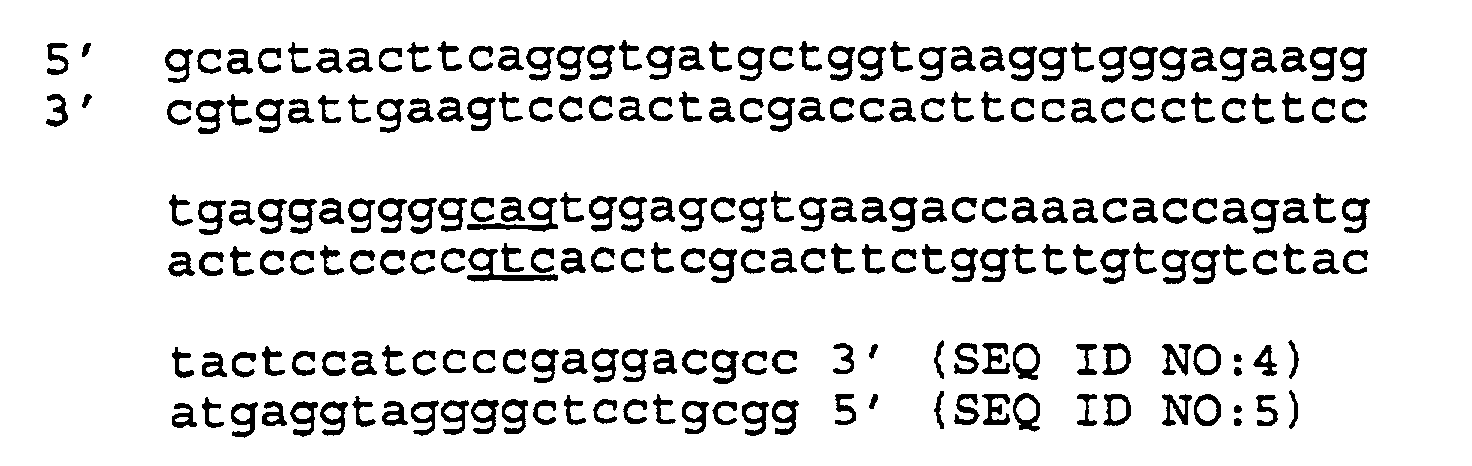
- the C of the underlined CAG codon was mutated to T.
- the DNA sequences tested were PCR amplified from genomic DNA obtained from: (1) a known heterozygote at that position, (2) a known homozygote at that position and (3) a presumed homozygote at that position.
- Test DNAs were denatured, by heating, allowed to reanneal and tested for the presence of mismatches (i.e. , heterozygotes) by testing their binding in an immobilized mismatch binding protein assay according to the present invention, utilizing E. coli MutS.
- the primers obtained from Operon were HPLC purified and had the following sequences, corresponding to the 5' termini of the two DNA strands SEQ ID NO:4 and SEQ ID NO:5:
- PCR Primer #1 contained biotin bound at the 5' end to allow detection in the ECL detection system described below.
- Primer #2 was radioactively labeled with a 5-' 32 P-phosphate to allow quantitation of the different amplification products after removal of unused primers.
- Primer #2 was 32 P labeled using a kinase reaction prior to use in amplification.
- the kinase reaction mix contained: 70mM Tris HCl, pH 7.6; 10 mM mgCl 2 ; 5mM DTT; 20 ⁇ Ci 32 P-ATP; 30 units T4 polynucleotide kinase; and 500ng DNA (primer #2).
- the kinase reaction was performed in a 20 ⁇ l reaction volume at 37°C for 30 min. Kinase was inactivated by heating at 70°C for 10 min. DNA was stored at -20°C.
- the PCR reaction included: 10mM Tris HCl pH 8.3; 50 mM KCl; 1.5mM MgCl 2 ; 0.001% gelatin (w/v); 0.05mM dATP; 0.05mM dTTP; 0.05mM dGTP; 0.05mM dCTP; 0.1 ⁇ M primer #1; 0.075 ⁇ M primer #2; 0.025 ⁇ M 32 P primer #2; 200ng template DNA; and 2.5 units AmpliTaq® DNA polymerase (Perkin-Elmer). Reaction volume was 100 ⁇ l. Amplification was carried out for 30 cycles in a Perkin-Elmer thermocycler by denaturing at 90°C for 1 min., annealing at 55°C for 1 min. and extension at 72°C 2 min.
- DNA was denatured and annealed (in Perkin-Elmer thermocycler) according to the following schedule: 100°C for 4 min; 50°C for 1 hour; 75°C for 4 min; 50°C for 30 min, followed by cooling to room temperature.
- a nitrocellulose sheet (0.45Mm, Schleicher and Schuell, BA85) was wet by floating in reaction buffer (20mM Tris HCl, pH 7.6; 5mM MgCl 2 ; 0.1mM DTT; 0.01mM EDTA) and placed in a slot blot apparatus (Hoefer Scientific Instruments) over 3 sheets of blotting paper (Schleicher and Schuell GB002). 100 ⁇ l of reaction buffer was added to each well. After 5 min at room temperature, any remaining buffer was pulled through by vacuum. MutS (500 ng in 20 ⁇ l reaction buffer) was added to each well. The same volume of reaction buffer was added to "No MutS" wells. The apparatus was kept at room temperature for 20 min before proceeding to the next step.
- the nitrocellulose was blocked by adding 200 ⁇ l of HRP-free BSA to each well. After 1 hr at room temperature, any remaining solution was pulled through by vacuum.
- DNA preparations were added in 20 ⁇ l reaction buffer containing 3% HRP-free BSA. After 30 min at room temperature, wells were washed 5 times with 100 ⁇ l reaction buffer by adding the solution to the wells and decanting it.
- biotin-labeled DNA bound on the nitrocellulose sheet was detected by visualizing the binding of streptavidin to biotin.
- 100 ⁇ l streptavidin-HRP in reaction buffer containing 3% HRP-free BSA was added to each well. After 20 min at room temperature, any remaining solution was decanted. Wells were washed 5 times with 100 ⁇ l reaction buffer by adding solution to each well and then decanting. Any solution remaining after the fifth wash was removed by vacuum.
- the nitrocellulose sheet was removed from the apparatus and washed 4 times for 1 min with 50 ml reaction buffer in a small tray. Nitrocellulose was blotted dry and immersed in 10 ml of ECL development solution (Amersham). After 1 min, the nitrocellulose sheet was removed, blotted dry and placed between two clear plastic sheets. The nitrocellulose thus protected was exposed to X-ray film in the dark for 30 sec.
- Bio-Het refers to a synthetic 30mer duplex of SEQ ID NO:1 and SEQ ID NO:3. This duplex contains a G:T mismatch at position 15.
- Bio-Homo refers to a synthetic 30mer duplex of SEQ ID NO:1 and SEQ ID NO:2, which lacks the mismatch at position 15. No binding of Bio-Homo was detected even at 10ng of DNA whereas Bio-Het was detected at amounts as low as 0.1ng. No binding was observed in the absence of MutS ("no MutS" columns) indicating that all DNA binding observed is MutS dependent.
- immobilized mismatch binding protein assays for mutation, heterozygosity or polymorphism detection are limited only by the ability to provide substrates free of random mismatches, such as those produced by polymerase errors during PCR amplification.
- the oligonucleotides were prepared with a 5' biotin label (to allow detection by the ECL detection system) and were annealed to unlabeled oligonucleotides such that only one strand of each duplex was labeled.
- the duplexes were used in a mismatch detection assay using immobilized mismatch binding protein (MutS), essentially as described above in the previous Examples.
- MotS immobilized mismatch binding protein
- Oligonucleotides were diluted in TNE buffer (10mM Tris HCl, pH 8.0; 0.01M NaCl, 1mM EDTA). Biotin labeled oligonucleotides were diluted to 10 mg/ ⁇ l and unlabeled oligonucleotides to 100 ng/ ⁇ l. Equal volumes of diluted oligonucleotides were mixed and annealed at 70°C for 10 min, room temperature for 30 min, followed by quenching on ice and were stored at -20°C. The unlabeled oligonucleotides were in 10-fold excess to assure that all biotin-labeled strands were in duplexes.
- Heteroduplexes with 1 - 4 unpaired bases were also detected. A heteroduplex with two unpaired bases was more easily detected than a heteroduplex with one unpaired base. Heteroduplexes with three unpaired bases were less well detected than any of the detectable mismatches, and heteroduplexes with four unpaired bases were even less well detected.
Landscapes
- Chemical & Material Sciences (AREA)
- Life Sciences & Earth Sciences (AREA)
- Organic Chemistry (AREA)
- Engineering & Computer Science (AREA)
- Zoology (AREA)
- Wood Science & Technology (AREA)
- Proteomics, Peptides & Aminoacids (AREA)
- Health & Medical Sciences (AREA)
- Molecular Biology (AREA)
- General Engineering & Computer Science (AREA)
- Immunology (AREA)
- Microbiology (AREA)
- Biophysics (AREA)
- Analytical Chemistry (AREA)
- Physics & Mathematics (AREA)
- Genetics & Genomics (AREA)
- Biochemistry (AREA)
- Bioinformatics & Cheminformatics (AREA)
- Biotechnology (AREA)
- General Health & Medical Sciences (AREA)
- Chemical Kinetics & Catalysis (AREA)
- Measuring Or Testing Involving Enzymes Or Micro-Organisms (AREA)
- Peptides Or Proteins (AREA)
- Saccharide Compounds (AREA)
Abstract
Description




G:T > G:G > C:T > A:C > T:T > A:A = A:G > C:C.
Claims (13)
- A method of detecting a mutation from a non-mutated sequence of a double stranded target DNA in a sample, the method comprising:wherein the presence of a mutation in the double stranded target DNA of the sample results in a decrease in the binding of the detectably labelled DNA to the mismatch-binding protein.(a) denaturing any double stranded DNA in the sample into single strands and allowing the single strands to reanneal into duplexes;(b) incubating the denatured and reannealed duplexes of step (a) with a mismatch-binding protein immobilized by adsorption on a solid support, either(i) in the presence of a detectably labelled DNA having a mismatch and capable of binding to the mismatch binding protein; or(ii) wherein the mismatch-binding protein was preincubated with and allowed to bind a detectably labelled DNA having a mismatch; and(c) detecting the amount of detectably labelled DNA having a mismatch bound to the mismatch-binding protein,
- A method according to claim 1 wherein the solid support is natural cellulose, modified cellulose, polystyrene, polypropylene, polyethylene, dextran, nylon, polyacrylamide or agarose.
- A method according to claim 2 wherein the solid support is a nitrocellulose membrane.
- A method for the removal from an amplified DNA sample of minority sequences and sequences containing sequence errors introduced during the process of amplification, the method comprising:thereby removing the sequence containing sequence errors.(a) subjecting the amplified DNA sample to conditions of denaturation followed by reannealing, such that minority sequence or error-containing sequences form mismatch-containing DNA duplexes, thereby generating a mixture containing mismatched duplexes;(b) incubating the mixture of step (a) with an immobilized mismatch-binding protein, which protein is immobilized by adsorption on a solid support, so that mismatched duplexes bind to the mismatch-binding protein; and(c) removing the immobilized mismatch-binding protein to which mismatch-containing DNA has bound from the amplified DNA sample,
- A method for identifying a specific allele in a multi-allelic system in a sample of amplified DNA, the method comprising:wherein the presence of labelled DNA in the sample indicates that the probe is perfectly complementary to an allele in the test DNA.(a) mixing a detectably labelled DNA probe which is perfectly complementary to a DNA sequence of the specific allele with an excess of amplified test DNA under conditions of denaturation followed by annealing such that, after denaturing and annealing, every copy of the DNA probe is in a duplex DNA;(b) incubating the mixture formed in step (a) with an excess of immobilized mismatch-binding protein, which protein is immobilized by adsorption on a solid support, such that all DNA having a mismatch is retained on the immobilized mismatch binding protein;(c) removing the immobilized mismatch-binding protein to which has bound any mismatch-containing DNA from the amplified test DNA; and(d) detecting the presence of the detectably labelled DNA probe in the sample from which the immobilized mismatch-binding protein has been removed,
- A kit useful for detecting a mutation from a non-mutated sequence of a target DNA sequence in a sample, the kit comprising:(a) a first container containing a mismatch-binding protein immobilized by adsorption on a solid support, which protein retains the ability to bind DNA having a mismatch;(b) a second container containing a DNA duplex having a mismatch; and(c) a third container or a plurality of containers containing a reagent or reagents capable of detecting the binding of the DNA having a mismatch to the mismatch-binding protein.
- A kit useful for detecting a mutation from a non-mutated sequence of a target DNA sequence in a sample, the kit comprising:(a) a first container containing a mismatch-binding protein immobilized by adsorption on a solid support, which protein retains the ability to bind DNA having a mismatch; and(b) a second container or a plurality of containers containing a reagent or reagents capable of detecting the binding of the DNA having a mismatch to the mismatch-binding protein.
- A kit according to claim 6 or 7 wherein the mismatch-binding protein is a MutS protein or a functional derivative thereof.
- A kit according to any of claims 6 to 8 wherein the solid support is natural cellulose, modified cellulose, polystyrene, polypropylene, polyethylene, dextran, nylon, polyacrylamide or agarose.
- A kit according to claim 9 wherein the solid support is a nitrocellulose membrane.
- A kit according to claim 6 wherein the DNA having a mismatch is detectably labelled.
- A method according to claim 1, 4 or 5 wherein the mismatch-binding protein is a MutS protein or a functional derivative thereof.
- A method according to claim 1 or 5 wherein the detectably labelled DNA is labelled with a chromogenic compound, a chemiluminescent compound, a bioluminescent compound, a fluorescent compound, a radio label or biotin.
Applications Claiming Priority (3)
| Application Number | Priority Date | Filing Date | Title |
|---|---|---|---|
| US08/147,785 US6027877A (en) | 1993-11-04 | 1993-11-04 | Use of immobilized mismatch binding protein for detection of mutations and polymorphisms, purification of amplified DNA samples and allele identification |
| US147785 | 1993-11-04 | ||
| PCT/US1994/012768 WO1995012689A1 (en) | 1993-11-04 | 1994-11-04 | Immobilized mismatch binding protein for detection or purification of mutations or polymorphisms |
Publications (3)
| Publication Number | Publication Date |
|---|---|
| EP0733126A1 EP0733126A1 (en) | 1996-09-25 |
| EP0733126A4 EP0733126A4 (en) | 1999-03-03 |
| EP0733126B1 true EP0733126B1 (en) | 2002-04-24 |
Family
ID=22522893
Family Applications (1)
| Application Number | Title | Priority Date | Filing Date |
|---|---|---|---|
| EP95901158A Expired - Lifetime EP0733126B1 (en) | 1993-11-04 | 1994-11-04 | Immobilized mismatch binding protein for detection or purification of mutations or polymorphisms |
Country Status (8)
| Country | Link |
|---|---|
| US (2) | US6027877A (en) |
| EP (1) | EP0733126B1 (en) |
| JP (1) | JPH09504699A (en) |
| AT (1) | ATE216727T1 (en) |
| AU (1) | AU700959B2 (en) |
| CA (1) | CA2175222A1 (en) |
| DE (1) | DE69430485T2 (en) |
| WO (1) | WO1995012689A1 (en) |
Cited By (4)
| Publication number | Priority date | Publication date | Assignee | Title |
|---|---|---|---|---|
| US8105780B2 (en) | 2003-09-22 | 2012-01-31 | Agency For Science, Technology And Research | Device and method of detecting mutations and polymorphisms in DNA |
| EP4667693A1 (en) | 2024-06-18 | 2025-12-24 | VKR Holding A/S | Roof window with a lifting device with a top bearing fitting |
| EP4667694A1 (en) | 2024-06-18 | 2025-12-24 | VKR Holding A/S | Roof window with an adjustment system comprising a worm gear |
| EP4667695A1 (en) | 2024-06-18 | 2025-12-24 | VKR Holding A/S | Roof window with a lifting device with a sledge guide having a rail forming part of a side frame reinforcement |
Families Citing this family (91)
| Publication number | Priority date | Publication date | Assignee | Title |
|---|---|---|---|---|
| US6120992A (en) | 1993-11-04 | 2000-09-19 | Valigene Corporation | Use of immobilized mismatch binding protein for detection of mutations and polymorphisms, and allele identification in a diseased human |
| US6406855B1 (en) | 1994-02-17 | 2002-06-18 | Maxygen, Inc. | Methods and compositions for polypeptide engineering |
| US6335160B1 (en) | 1995-02-17 | 2002-01-01 | Maxygen, Inc. | Methods and compositions for polypeptide engineering |
| US5877280A (en) * | 1995-06-06 | 1999-03-02 | The Mount Sinai School Of Medicine Of The City University Of New York | Thermostable muts proteins |
| ATE236270T1 (en) * | 1995-12-15 | 2003-04-15 | Univ Duke | METHOD FOR DETECTION AND REMOVAL OF MUTANT SEQUENCES FORMED DURING ENZYMATIC AMPLIFICATION |
| SE9602062D0 (en) * | 1996-05-29 | 1996-05-29 | Pharmacia Biotech Ab | Method for detection of mutations |
| DE19708758A1 (en) * | 1997-03-04 | 1998-09-17 | Christoph Prof Dr Wagener | Procedure for the detection of mutant alleles |
| US6599704B2 (en) | 1997-03-04 | 2003-07-29 | Christoph Wagener | Method for detecting mutated alleles |
| JP3318579B2 (en) | 1997-07-07 | 2002-08-26 | 理化学研究所 | DNA sequencing method |
| GB9724480D0 (en) * | 1997-11-19 | 1998-01-14 | Hexagen Technology Limited | Screening process |
| US6221585B1 (en) | 1998-01-15 | 2001-04-24 | Valigen, Inc. | Method for identifying genes underlying defined phenotypes |
| US6297010B1 (en) | 1998-01-30 | 2001-10-02 | Genzyme Corporation | Method for detecting and identifying mutations |
| US6214552B1 (en) * | 1998-09-17 | 2001-04-10 | Igen International, Inc. | Assays for measuring nucleic acid damaging activities |
| US6703228B1 (en) * | 1998-09-25 | 2004-03-09 | Massachusetts Institute Of Technology | Methods and products related to genotyping and DNA analysis |
| DK1117774T3 (en) * | 1998-10-09 | 2010-05-03 | Medical Res Council | Process for diversity generation |
| US7122339B2 (en) | 1998-10-09 | 2006-10-17 | Medical Research Council | Method for generating diversity |
| DE69929542T2 (en) | 1998-10-27 | 2006-09-14 | Affymetrix, Inc., Santa Clara | COMPLEXITY MANAGEMENT AND ANALYSIS OF GENOMIC DNA |
| US7166432B2 (en) | 1999-03-12 | 2007-01-23 | Integragen | Compositions and methods for genetic analysis |
| DE19911130A1 (en) * | 1999-03-12 | 2000-09-21 | Hager Joerg | Methods for identifying chromosomal regions and genes |
| EP1169473B1 (en) * | 1999-04-14 | 2006-11-22 | THE GOVERNMENT OF THE UNITED STATES OF AMERICA, as represented by THE SECRETARY, DEPARTMENT OF HEALTH AND HUMAN SERVICES | High sensitivity phage display biomolecule detection |
| JP2000300265A (en) * | 1999-04-19 | 2000-10-31 | Amersham Pharmacia Biotech Kk | Method for detecting mismatch in double-stranded nucleic acid, method for detecting nucleic acid having mutation, and method for separating double-stranded nucleic acid having mismatch |
| US6958225B2 (en) | 1999-10-27 | 2005-10-25 | Affymetrix, Inc. | Complexity management of genomic DNA |
| AU2001227679A1 (en) * | 2000-02-25 | 2001-09-03 | General Atomics | Mutant nucleic binding enzymes and use thereof in diagnostic, detection and purification methods |
| US6365355B1 (en) * | 2000-03-28 | 2002-04-02 | The Regents Of The University Of California | Chimeric proteins for detection and quantitation of DNA mutations, DNA sequence variations, DNA damage and DNA mismatches |
| US6340566B1 (en) * | 2000-03-28 | 2002-01-22 | The Regents Of The University Of California | Detection and quantitation of single nucleotide polymorphisms, DNA sequence variations, DNA mutations, DNA damage and DNA mismatches |
| WO2001083825A2 (en) * | 2000-05-04 | 2001-11-08 | The Center For Blood Research, Inc. | Colloid compositions for solid phase biomolecular analytical systems |
| US20030228600A1 (en) * | 2000-07-14 | 2003-12-11 | Eppendorf 5 Prime, Inc. | DNA isolation method and kit |
| DE10038237A1 (en) * | 2000-08-04 | 2002-02-14 | Aventis Res & Tech Gmbh & Co | Procedure for the detection of mutations in nucleotide sequences |
| US6632610B2 (en) * | 2000-10-12 | 2003-10-14 | Gensat S.A. | Methods of identification and isolation of polynucleotides containing nucleic acid differences |
| US20040146875A1 (en) * | 2001-02-19 | 2004-07-29 | Cotton Richard Graham Hay | Method of identifying differences between nucleic acid molecules |
| JP2005526230A (en) * | 2001-09-13 | 2005-09-02 | ジーンバーティック ピーティーワイ リミテッド | Methods for detecting nucleic acid duplex conformational changes by exposure to environmental or chemical conditions by treatment with oxidizing agents or reagents |
| JP2005514927A (en) * | 2002-01-14 | 2005-05-26 | ディヴァーサ コーポレイション | Method for producing polynucleotide and method for purifying double-stranded polynucleotide |
| US20040009498A1 (en) * | 2002-01-14 | 2004-01-15 | Diversa Corporation | Chimeric antigen binding molecules and methods for making and using them |
| US20030215837A1 (en) * | 2002-01-14 | 2003-11-20 | Diversa Corporation | Methods for purifying double-stranded nucleic acids lacking base pair mismatches or nucleotide gaps |
| US6673552B2 (en) * | 2002-01-14 | 2004-01-06 | Diversa Corporation | Methods for purifying annealed double-stranded oligonucleotides lacking base pair mismatches or nucleotide gaps |
| JP4455061B2 (en) * | 2002-02-28 | 2010-04-21 | ウイスコンシン アラムニ リサーチ ファンデーション | Methods for reducing errors in nucleic acid populations |
| US7998699B2 (en) | 2002-08-15 | 2011-08-16 | University Of South Florida | Early detection of pathogens in blood |
| US7563600B2 (en) | 2002-09-12 | 2009-07-21 | Combimatrix Corporation | Microarray synthesis and assembly of gene-length polynucleotides |
| US7879580B2 (en) * | 2002-12-10 | 2011-02-01 | Massachusetts Institute Of Technology | Methods for high fidelity production of long nucleic acid molecules |
| US7452699B2 (en) * | 2003-01-15 | 2008-11-18 | Dana-Farber Cancer Institute, Inc. | Amplification of DNA in a hairpin structure, and applications |
| PT2103694E (en) | 2003-08-15 | 2011-07-26 | Univ South Florida | Materials and methods for capture of pathogens and removal of aurintricarboxylic acid from a sample |
| JP3897805B2 (en) | 2003-12-25 | 2007-03-28 | 独立行政法人理化学研究所 | Nucleic acid amplification method and mutant nucleic acid detection method using the same |
| EP1623996A1 (en) * | 2004-08-06 | 2006-02-08 | Deutsches Krebsforschungszentrum Stiftung des öffentlichen Rechts | Improved method of selecting a desired protein from a library |
| CA2578564C (en) * | 2004-08-27 | 2013-05-28 | Wisconsin Alumni Research Foundation | Method of error reduction in nucleic acid populations |
| AU2005295351A1 (en) * | 2004-10-18 | 2006-04-27 | Codon Devices, Inc. | Methods for assembly of high fidelity synthetic polynucleotides |
| US20070122817A1 (en) * | 2005-02-28 | 2007-05-31 | George Church | Methods for assembly of high fidelity synthetic polynucleotides |
| KR100681945B1 (en) | 2005-08-18 | 2007-02-12 | 학교법인 포항공과대학교 | Method for Detecting Mismatched DNA Using Fluorescence Changes of a Mutus Mutant-Fluorescent Conjugate |
| US20070196834A1 (en) * | 2005-09-09 | 2007-08-23 | Francesco Cerrina | Method and system for the generation of large double stranded DNA fragments |
| CA2637600A1 (en) | 2006-01-17 | 2007-07-26 | Health Research, Inc. | Heteroduplex tracking assay |
| US20070231805A1 (en) * | 2006-03-31 | 2007-10-04 | Baynes Brian M | Nucleic acid assembly optimization using clamped mismatch binding proteins |
| US20090087840A1 (en) * | 2006-05-19 | 2009-04-02 | Codon Devices, Inc. | Combined extension and ligation for nucleic acid assembly |
| US8053191B2 (en) | 2006-08-31 | 2011-11-08 | Westend Asset Clearinghouse Company, Llc | Iterative nucleic acid assembly using activation of vector-encoded traits |
| JP5675109B2 (en) | 2007-02-20 | 2015-02-25 | アナプティスバイオ インコーポレイティッド | Library generation method and use thereof |
| CA2622649C (en) | 2007-03-09 | 2018-04-24 | Riken | Nucleic acid amplification method using primer exhibiting exciton effect |
| US9388457B2 (en) | 2007-09-14 | 2016-07-12 | Affymetrix, Inc. | Locus specific amplification using array probes |
| US9074244B2 (en) | 2008-03-11 | 2015-07-07 | Affymetrix, Inc. | Array-based translocation and rearrangement assays |
| US20110236900A1 (en) * | 2008-11-27 | 2011-09-29 | Riken | Novel muts protein and method for determing mutation using the same |
| WO2012064975A1 (en) | 2010-11-12 | 2012-05-18 | Gen9, Inc. | Protein arrays and methods of using and making the same |
| CA2817697C (en) | 2010-11-12 | 2021-11-16 | Gen9, Inc. | Methods and devices for nucleic acids synthesis |
| US8672333B2 (en) * | 2011-06-13 | 2014-03-18 | John Hartman | Torque transmitting apparatus for a wheel |
| JP2014526899A (en) | 2011-08-26 | 2014-10-09 | ジェン9・インコーポレイテッド | Compositions and methods for high fidelity assembly of nucleic acids |
| US9150853B2 (en) | 2012-03-21 | 2015-10-06 | Gen9, Inc. | Methods for screening proteins using DNA encoded chemical libraries as templates for enzyme catalysis |
| CA2871505C (en) | 2012-04-24 | 2021-10-12 | Gen9, Inc. | Methods for sorting nucleic acids and multiplexed preparative in vitro cloning |
| WO2014004393A1 (en) | 2012-06-25 | 2014-01-03 | Gen9, Inc. | Methods for nucleic acid assembly and high throughput sequencing |
| US9279146B2 (en) * | 2012-12-21 | 2016-03-08 | Roche Molecular Systems, Inc. | Compounds and methods for the enrichment of mutated nucleic acid from a mixture |
| KR102160389B1 (en) | 2013-08-05 | 2020-09-28 | 트위스트 바이오사이언스 코포레이션 | De novo synthesized gene libraries |
| CA2975852A1 (en) | 2015-02-04 | 2016-08-11 | Twist Bioscience Corporation | Methods and devices for de novo oligonucleic acid assembly |
| CA2975855C (en) | 2015-02-04 | 2025-09-23 | Twist Bioscience Corporation | Compositions and methods for synthetic gene assembly |
| WO2016172377A1 (en) | 2015-04-21 | 2016-10-27 | Twist Bioscience Corporation | Devices and methods for oligonucleic acid library synthesis |
| KR20180050411A (en) | 2015-09-18 | 2018-05-14 | 트위스트 바이오사이언스 코포레이션 | Oligonucleotide mutant library and its synthesis |
| WO2017053450A1 (en) | 2015-09-22 | 2017-03-30 | Twist Bioscience Corporation | Flexible substrates for nucleic acid synthesis |
| EP3384077A4 (en) | 2015-12-01 | 2019-05-08 | Twist Bioscience Corporation | FUNCTIONALIZED SURFACES AND THEIR PREPARATION |
| WO2018038772A1 (en) | 2016-08-22 | 2018-03-01 | Twist Bioscience Corporation | De novo synthesized nucleic acid libraries |
| EP4664304A3 (en) | 2016-09-21 | 2026-01-21 | Atlas Data Storage, Inc. | Nucleic acid based data storage |
| GB2573069A (en) | 2016-12-16 | 2019-10-23 | Twist Bioscience Corp | Variant libraries of the immunological synapse and synthesis thereof |
| WO2018156792A1 (en) | 2017-02-22 | 2018-08-30 | Twist Bioscience Corporation | Nucleic acid based data storage |
| CA3056388A1 (en) | 2017-03-15 | 2018-09-20 | Twist Bioscience Corporation | Variant libraries of the immunological synapse and synthesis thereof |
| IL271205B2 (en) | 2017-06-12 | 2025-02-01 | Twist Bioscience Corp | Methods for seamless nucleic acid assembly |
| WO2018231864A1 (en) | 2017-06-12 | 2018-12-20 | Twist Bioscience Corporation | Methods for seamless nucleic acid assembly |
| CN111566125A (en) | 2017-09-11 | 2020-08-21 | 特韦斯特生物科学公司 | GPCR binding proteins and synthesis thereof |
| CN111565834B (en) | 2017-10-20 | 2022-08-26 | 特韦斯特生物科学公司 | Heated nanopores for polynucleotide synthesis |
| IL312616B2 (en) | 2018-01-04 | 2025-08-01 | Twist Bioscience Corp | DNA-based digital information storage |
| EP3814497A4 (en) | 2018-05-18 | 2022-03-02 | Twist Bioscience Corporation | POLYNUCLEOTIDES, REAGENTS, AND METHODS FOR NUCLEIC ACID HYBRIDIZATION |
| EP3902816A4 (en) | 2018-12-26 | 2022-09-14 | Twist Bioscience Corporation | HIGHLY ACCURATE POLYNUCLEOTIDE DE NOVO SYNTHESIS |
| CA3131689A1 (en) | 2019-02-26 | 2020-09-03 | Twist Bioscience Corporation | Variant nucleic acid libraries for glp1 receptor |
| KR20210144698A (en) | 2019-02-26 | 2021-11-30 | 트위스트 바이오사이언스 코포레이션 | Variant Nucleic Acid Libraries for Antibody Optimization |
| EP3987019A4 (en) | 2019-06-21 | 2023-04-19 | Twist Bioscience Corporation | BARCODE-BASED NUCLEIC ACID SEQUENCE ARRANGEMENT |
| US12091777B2 (en) | 2019-09-23 | 2024-09-17 | Twist Bioscience Corporation | Variant nucleic acid libraries for CRTH2 |
| CN115023440B (en) | 2019-09-23 | 2025-09-12 | 特韦斯特生物科学公司 | Antibodies that bind to CD3ε |
| AU2020400030B2 (en) | 2019-12-09 | 2026-05-21 | Twist Bioscience Corporation | Variant nucleic acid libraries for adenosine receptors |
| CN114457067B (en) * | 2022-02-10 | 2024-10-25 | 中国科学院天津工业生物技术研究所 | A low-cost and rapid method to remove errors in DNA synthesis |
Family Cites Families (5)
| Publication number | Priority date | Publication date | Assignee | Title |
|---|---|---|---|---|
| US5556750A (en) * | 1989-05-12 | 1996-09-17 | Duke University | Methods and kits for fractionating a population of DNA molecules based on the presence or absence of a base-pair mismatch utilizing mismatch repair systems |
| US5459039A (en) * | 1989-05-12 | 1995-10-17 | Duke University | Methods for mapping genetic mutations |
| JPH07500493A (en) * | 1991-07-19 | 1995-01-19 | バリジーン・コーポレーション | Mutation detection methods |
| AU3919293A (en) * | 1992-03-27 | 1993-11-08 | University Of Maryland At Baltimore | Detection of gene mutations with mismatch repair enzymes |
| US5750335A (en) * | 1992-04-24 | 1998-05-12 | Massachusetts Institute Of Technology | Screening for genetic variation |
-
1993
- 1993-11-04 US US08/147,785 patent/US6027877A/en not_active Expired - Fee Related
-
1994
- 1994-11-04 CA CA002175222A patent/CA2175222A1/en not_active Abandoned
- 1994-11-04 WO PCT/US1994/012768 patent/WO1995012689A1/en not_active Ceased
- 1994-11-04 AU AU10508/95A patent/AU700959B2/en not_active Ceased
- 1994-11-04 DE DE69430485T patent/DE69430485T2/en not_active Expired - Fee Related
- 1994-11-04 AT AT95901158T patent/ATE216727T1/en not_active IP Right Cessation
- 1994-11-04 EP EP95901158A patent/EP0733126B1/en not_active Expired - Lifetime
- 1994-11-04 JP JP7513451A patent/JPH09504699A/en active Pending
-
1995
- 1995-04-28 US US08/431,081 patent/US6114115A/en not_active Expired - Fee Related
Cited By (4)
| Publication number | Priority date | Publication date | Assignee | Title |
|---|---|---|---|---|
| US8105780B2 (en) | 2003-09-22 | 2012-01-31 | Agency For Science, Technology And Research | Device and method of detecting mutations and polymorphisms in DNA |
| EP4667693A1 (en) | 2024-06-18 | 2025-12-24 | VKR Holding A/S | Roof window with a lifting device with a top bearing fitting |
| EP4667694A1 (en) | 2024-06-18 | 2025-12-24 | VKR Holding A/S | Roof window with an adjustment system comprising a worm gear |
| EP4667695A1 (en) | 2024-06-18 | 2025-12-24 | VKR Holding A/S | Roof window with a lifting device with a sledge guide having a rail forming part of a side frame reinforcement |
Also Published As
| Publication number | Publication date |
|---|---|
| DE69430485T2 (en) | 2002-12-19 |
| EP0733126A1 (en) | 1996-09-25 |
| AU700959B2 (en) | 1999-01-14 |
| EP0733126A4 (en) | 1999-03-03 |
| CA2175222A1 (en) | 1995-05-11 |
| JPH09504699A (en) | 1997-05-13 |
| DE69430485D1 (en) | 2002-05-29 |
| US6114115A (en) | 2000-09-05 |
| WO1995012689A1 (en) | 1995-05-11 |
| ATE216727T1 (en) | 2002-05-15 |
| US6027877A (en) | 2000-02-22 |
| AU1050895A (en) | 1995-05-23 |
Similar Documents
| Publication | Publication Date | Title |
|---|---|---|
| AU700959B2 (en) | Immobilized mismatch binding protein for detection or purification of mutations or polymorphisms | |
| US6238866B1 (en) | Detector for nucleic acid typing and methods of using the same | |
| JP3421036B2 (en) | Chemical methods for analysis of DNA sequences | |
| US5512441A (en) | Quantative method for early detection of mutant alleles and diagnostic kits for carrying out the method | |
| US6004783A (en) | Cleaved amplified RFLP detection methods | |
| US9677127B2 (en) | Method of detecting gene mutation | |
| EP1241266A1 (en) | Method of detecting nucleotide polymorphism | |
| US20030148301A1 (en) | Method of detecting nucleotide polymorphism | |
| US20050191636A1 (en) | Detection of STRP, such as fragile X syndrome | |
| US6329147B1 (en) | Methods for detection of a triplet repeat block and a functional mismatch binding protein in a biological fluid sample | |
| EP2476760A1 (en) | Method for analyzing nucleic acid mutation using array comparative genomic hybridization technique | |
| WO1999010540A1 (en) | Dna methyltransferase genotyping | |
| JP2004521634A (en) | Mutation detection using MutS and RecA | |
| US9175339B2 (en) | Method for detection of target nucleic acid | |
| EP1101824A2 (en) | Detection of sequence variation of nucleic acid by shifted termination analysis | |
| EP1327001B1 (en) | Method of amplifying nucleic acids providing means for strand separation and universal sequence tags | |
| EP1300473B1 (en) | Method of detecting nucleotide polymorphism | |
| AU9607698A (en) | Immobilized mismatch binding protein for detection or purification of mutations or polymorphisms | |
| US20080318215A1 (en) | Apparatus, methods and products for detecting genetic mutation | |
| JP2002209584A (en) | Methods for detecting nucleotide polymorphisms | |
| US20030148288A1 (en) | Colorimetric genetic test for clinically significant TNF polymorphism and methods of use thereof | |
| JP2003135069A (en) | Method for identifying nucleotide polymorphism |
Legal Events
| Date | Code | Title | Description |
|---|---|---|---|
| PUAI | Public reference made under article 153(3) epc to a published international application that has entered the european phase |
Free format text: ORIGINAL CODE: 0009012 |
|
| 17P | Request for examination filed |
Effective date: 19960603 |
|
| AK | Designated contracting states |
Kind code of ref document: A1 Designated state(s): AT BE CH DE DK ES FR GB GR IE IT LI LU MC NL PT SE |
|
| A4 | Supplementary search report drawn up and despatched | ||
| AK | Designated contracting states |
Kind code of ref document: A4 Designated state(s): AT BE CH DE DK ES FR GB GR IE IT LI LU MC NL PT SE |
|
| RAP1 | Party data changed (applicant data changed or rights of an application transferred) |
Owner name: VALIGENE CORPORATION |
|
| 17Q | First examination report despatched |
Effective date: 19991006 |
|
| GRAG | Despatch of communication of intention to grant |
Free format text: ORIGINAL CODE: EPIDOS AGRA |
|
| GRAG | Despatch of communication of intention to grant |
Free format text: ORIGINAL CODE: EPIDOS AGRA |
|
| GRAH | Despatch of communication of intention to grant a patent |
Free format text: ORIGINAL CODE: EPIDOS IGRA |
|
| RAP1 | Party data changed (applicant data changed or rights of an application transferred) |
Owner name: VALIGEN (US), INC. |
|
| REG | Reference to a national code |
Ref country code: GB Ref legal event code: IF02 |
|
| GRAH | Despatch of communication of intention to grant a patent |
Free format text: ORIGINAL CODE: EPIDOS IGRA |
|
| GRAA | (expected) grant |
Free format text: ORIGINAL CODE: 0009210 |
|
| AK | Designated contracting states |
Kind code of ref document: B1 Designated state(s): AT BE CH DE DK ES FR GB GR IE IT LI LU MC NL PT SE |
|
| PG25 | Lapsed in a contracting state [announced via postgrant information from national office to epo] |
Ref country code: NL Free format text: LAPSE BECAUSE OF FAILURE TO SUBMIT A TRANSLATION OF THE DESCRIPTION OR TO PAY THE FEE WITHIN THE PRESCRIBED TIME-LIMIT Effective date: 20020424 Ref country code: IT Free format text: LAPSE BECAUSE OF FAILURE TO SUBMIT A TRANSLATION OF THE DESCRIPTION OR TO PAY THE FEE WITHIN THE PRE;WARNING: LAPSES OF ITALIAN PATENTS WITH EFFECTIVE DATE BEFORE 2007 MAY HAVE OCCURRED AT ANY TIME BEFORE 2007. THE CORRECT EFFECTIVE DATE MAY BE DIFFERENT FROM THE ONE RECORDED.SCRIBED TIME-LIMIT Effective date: 20020424 Ref country code: GR Free format text: LAPSE BECAUSE OF FAILURE TO SUBMIT A TRANSLATION OF THE DESCRIPTION OR TO PAY THE FEE WITHIN THE PRESCRIBED TIME-LIMIT Effective date: 20020424 Ref country code: BE Free format text: LAPSE BECAUSE OF FAILURE TO SUBMIT A TRANSLATION OF THE DESCRIPTION OR TO PAY THE FEE WITHIN THE PRESCRIBED TIME-LIMIT Effective date: 20020424 Ref country code: AT Free format text: LAPSE BECAUSE OF FAILURE TO SUBMIT A TRANSLATION OF THE DESCRIPTION OR TO PAY THE FEE WITHIN THE PRESCRIBED TIME-LIMIT Effective date: 20020424 |
|
| REF | Corresponds to: |
Ref document number: 216727 Country of ref document: AT Date of ref document: 20020515 Kind code of ref document: T |
|
| REG | Reference to a national code |
Ref country code: GB Ref legal event code: FG4D |
|
| REG | Reference to a national code |
Ref country code: CH Ref legal event code: EP |
|
| REF | Corresponds to: |
Ref document number: 69430485 Country of ref document: DE Date of ref document: 20020529 |
|
| REG | Reference to a national code |
Ref country code: IE Ref legal event code: FG4D |
|
| PG25 | Lapsed in a contracting state [announced via postgrant information from national office to epo] |
Ref country code: SE Free format text: LAPSE BECAUSE OF FAILURE TO SUBMIT A TRANSLATION OF THE DESCRIPTION OR TO PAY THE FEE WITHIN THE PRESCRIBED TIME-LIMIT Effective date: 20020724 Ref country code: PT Free format text: LAPSE BECAUSE OF FAILURE TO SUBMIT A TRANSLATION OF THE DESCRIPTION OR TO PAY THE FEE WITHIN THE PRESCRIBED TIME-LIMIT Effective date: 20020724 Ref country code: DK Free format text: LAPSE BECAUSE OF FAILURE TO SUBMIT A TRANSLATION OF THE DESCRIPTION OR TO PAY THE FEE WITHIN THE PRESCRIBED TIME-LIMIT Effective date: 20020724 |
|
| REG | Reference to a national code |
Ref country code: CH Ref legal event code: NV Representative=s name: PATENTANWAELTE SCHAAD, BALASS, MENZL & PARTNER AG |
|
| NLV1 | Nl: lapsed or annulled due to failure to fulfill the requirements of art. 29p and 29m of the patents act | ||
| PG25 | Lapsed in a contracting state [announced via postgrant information from national office to epo] |
Ref country code: ES Free format text: LAPSE BECAUSE OF FAILURE TO SUBMIT A TRANSLATION OF THE DESCRIPTION OR TO PAY THE FEE WITHIN THE PRESCRIBED TIME-LIMIT Effective date: 20021030 |
|
| PG25 | Lapsed in a contracting state [announced via postgrant information from national office to epo] |
Ref country code: LU Free format text: LAPSE BECAUSE OF NON-PAYMENT OF DUE FEES Effective date: 20021104 Ref country code: IE Free format text: LAPSE BECAUSE OF NON-PAYMENT OF DUE FEES Effective date: 20021104 Ref country code: GB Free format text: LAPSE BECAUSE OF NON-PAYMENT OF DUE FEES Effective date: 20021104 |
|
| PG25 | Lapsed in a contracting state [announced via postgrant information from national office to epo] |
Ref country code: LI Free format text: LAPSE BECAUSE OF NON-PAYMENT OF DUE FEES Effective date: 20021130 Ref country code: CH Free format text: LAPSE BECAUSE OF NON-PAYMENT OF DUE FEES Effective date: 20021130 |
|
| PLBE | No opposition filed within time limit |
Free format text: ORIGINAL CODE: 0009261 |
|
| 26N | No opposition filed |
Effective date: 20030127 |
|
| PG25 | Lapsed in a contracting state [announced via postgrant information from national office to epo] |
Ref country code: MC Free format text: LAPSE BECAUSE OF NON-PAYMENT OF DUE FEES Effective date: 20030601 |
|
| PG25 | Lapsed in a contracting state [announced via postgrant information from national office to epo] |
Ref country code: DE Free format text: LAPSE BECAUSE OF NON-PAYMENT OF DUE FEES Effective date: 20030603 |
|
| GBPC | Gb: european patent ceased through non-payment of renewal fee | ||
| REG | Reference to a national code |
Ref country code: CH Ref legal event code: PL |
|
| PG25 | Lapsed in a contracting state [announced via postgrant information from national office to epo] |
Ref country code: FR Free format text: LAPSE BECAUSE OF NON-PAYMENT OF DUE FEES Effective date: 20030731 |
|
| REG | Reference to a national code |
Ref country code: IE Ref legal event code: MM4A |
|
| REG | Reference to a national code |
Ref country code: FR Ref legal event code: ST |