EP0733035B1 - Tricyclic derivatives, pharmaceutical compositions containing them - Google Patents
Tricyclic derivatives, pharmaceutical compositions containing them Download PDFInfo
- Publication number
- EP0733035B1 EP0733035B1 EP95903619A EP95903619A EP0733035B1 EP 0733035 B1 EP0733035 B1 EP 0733035B1 EP 95903619 A EP95903619 A EP 95903619A EP 95903619 A EP95903619 A EP 95903619A EP 0733035 B1 EP0733035 B1 EP 0733035B1
- Authority
- EP
- European Patent Office
- Prior art keywords
- compound
- compound according
- alkyl
- added
- alkenyl
- Prior art date
- Legal status (The legal status is an assumption and is not a legal conclusion. Google has not performed a legal analysis and makes no representation as to the accuracy of the status listed.)
- Expired - Lifetime
Links
- 0 CCCC1(CCC*)c2ccccc2CCc2ccccc12 Chemical compound CCCC1(CCC*)c2ccccc2CCc2ccccc12 0.000 description 13
- VAXAGLKJAQFWPP-UHFFFAOYSA-N C=CCC1(CCN)c2cc(Cl)ccc2CCc2ccccc12 Chemical compound C=CCC1(CCN)c2cc(Cl)ccc2CCc2ccccc12 VAXAGLKJAQFWPP-UHFFFAOYSA-N 0.000 description 1
- PMUCRXCNQZCRFI-UHFFFAOYSA-N CC1(CCN)c2ccccc2CCc2ccccc12 Chemical compound CC1(CCN)c2ccccc2CCc2ccccc12 PMUCRXCNQZCRFI-UHFFFAOYSA-N 0.000 description 1
- LSRHXURZRCRTNP-HZHRSRAPSA-N CCCC1(CC/C=N/O)c2ccccc2CCC2=C1CC(C)C=C2 Chemical compound CCCC1(CC/C=N/O)c2ccccc2CCC2=C1CC(C)C=C2 LSRHXURZRCRTNP-HZHRSRAPSA-N 0.000 description 1
- WJJKYXRSDZXVFU-UHFFFAOYSA-N CCCC1(CCN)c2cc(Cl)ccc2CCc2ccccc12 Chemical compound CCCC1(CCN)c2cc(Cl)ccc2CCc2ccccc12 WJJKYXRSDZXVFU-UHFFFAOYSA-N 0.000 description 1
- RDBSCXOGOLUBKC-UHFFFAOYSA-N CCOC(CCN(C)C(c1ccc(C(O)O)cc1)O)(c1ccccc1CC1)c2c1cccc2 Chemical compound CCOC(CCN(C)C(c1ccc(C(O)O)cc1)O)(c1ccccc1CC1)c2c1cccc2 RDBSCXOGOLUBKC-UHFFFAOYSA-N 0.000 description 1
- KHLJGMXXZCFJNW-UHFFFAOYSA-N CCOC(CCN(C)I)(C1=C(CC2)C=CCC1)c1c2cccc1 Chemical compound CCOC(CCN(C)I)(C1=C(CC2)C=CCC1)c1c2cccc1 KHLJGMXXZCFJNW-UHFFFAOYSA-N 0.000 description 1
- OAUXPJKFUDGNJW-UHFFFAOYSA-N CCOC1(CC=O)c(cccc2)c2OCc2ccccc12 Chemical compound CCOC1(CC=O)c(cccc2)c2OCc2ccccc12 OAUXPJKFUDGNJW-UHFFFAOYSA-N 0.000 description 1
- BYNQUPPOVSPZSB-UHFFFAOYSA-N CCOC1(CCN(C)C)c2ccccc2CCc2ccccc12 Chemical compound CCOC1(CCN(C)C)c2ccccc2CCc2ccccc12 BYNQUPPOVSPZSB-UHFFFAOYSA-N 0.000 description 1
- YGKUNISXQBENTA-UHFFFAOYSA-N CCOC1(CCN2CCCC2)c(cccc2)c2OCc2ccccc12 Chemical compound CCOC1(CCN2CCCC2)c(cccc2)c2OCc2ccccc12 YGKUNISXQBENTA-UHFFFAOYSA-N 0.000 description 1
- FGDFYZDTKRCELJ-UHFFFAOYSA-N CCOC1(CCNC=[IH])c2ccccc2CCc2ccccc12 Chemical compound CCOC1(CCNC=[IH])c2ccccc2CCc2ccccc12 FGDFYZDTKRCELJ-UHFFFAOYSA-N 0.000 description 1
- DWRGSQJXIYRBNR-UHFFFAOYSA-N CCOC1(CCO)c(cccc2)c2OCc2ccccc12 Chemical compound CCOC1(CCO)c(cccc2)c2OCc2ccccc12 DWRGSQJXIYRBNR-UHFFFAOYSA-N 0.000 description 1
- PSLCZSWTYFRWLS-UHFFFAOYSA-N CCOCc1c(CCc(cccc2)c2NCCN(C)C(c(cc2)ccc2C(OC)=O)=O)cccc1 Chemical compound CCOCc1c(CCc(cccc2)c2NCCN(C)C(c(cc2)ccc2C(OC)=O)=O)cccc1 PSLCZSWTYFRWLS-UHFFFAOYSA-N 0.000 description 1
- TUCDREFAMFDQAC-UHFFFAOYSA-N CCO[N]1(CCN(C)S(C)(=O)=O)c2ccccc2CCc2ccccc12 Chemical compound CCO[N]1(CCN(C)S(C)(=O)=O)c2ccccc2CCc2ccccc12 TUCDREFAMFDQAC-UHFFFAOYSA-N 0.000 description 1
- LXXHGUGUHXFVTF-UHFFFAOYSA-N CNCCC1(CC=C)c2ccccc2C=Cc2ccccc12 Chemical compound CNCCC1(CC=C)c2ccccc2C=Cc2ccccc12 LXXHGUGUHXFVTF-UHFFFAOYSA-N 0.000 description 1
- WMAHCNWOYYCBEC-UHFFFAOYSA-N C[N](C)(C)CCC1(COC)c2ccccc2CCc2ccccc12 Chemical compound C[N](C)(C)CCC1(COC)c2ccccc2CCc2ccccc12 WMAHCNWOYYCBEC-UHFFFAOYSA-N 0.000 description 1
- YXFVVABEGXRONW-UHFFFAOYSA-N Cc1ccccc1 Chemical compound Cc1ccccc1 YXFVVABEGXRONW-UHFFFAOYSA-N 0.000 description 1
Classifications
-
- C—CHEMISTRY; METALLURGY
- C07—ORGANIC CHEMISTRY
- C07D—HETEROCYCLIC COMPOUNDS
- C07D295/00—Heterocyclic compounds containing polymethylene-imine rings with at least five ring members, 3-azabicyclo [3.2.2] nonane, piperazine, morpholine or thiomorpholine rings, having only hydrogen atoms directly attached to the ring carbon atoms
- C07D295/02—Heterocyclic compounds containing polymethylene-imine rings with at least five ring members, 3-azabicyclo [3.2.2] nonane, piperazine, morpholine or thiomorpholine rings, having only hydrogen atoms directly attached to the ring carbon atoms containing only hydrogen and carbon atoms in addition to the ring hetero elements
- C07D295/027—Heterocyclic compounds containing polymethylene-imine rings with at least five ring members, 3-azabicyclo [3.2.2] nonane, piperazine, morpholine or thiomorpholine rings, having only hydrogen atoms directly attached to the ring carbon atoms containing only hydrogen and carbon atoms in addition to the ring hetero elements containing only one hetero ring
- C07D295/03—Heterocyclic compounds containing polymethylene-imine rings with at least five ring members, 3-azabicyclo [3.2.2] nonane, piperazine, morpholine or thiomorpholine rings, having only hydrogen atoms directly attached to the ring carbon atoms containing only hydrogen and carbon atoms in addition to the ring hetero elements containing only one hetero ring with the ring nitrogen atoms directly attached to acyclic carbon atoms
-
- A—HUMAN NECESSITIES
- A61—MEDICAL OR VETERINARY SCIENCE; HYGIENE
- A61K—PREPARATIONS FOR MEDICAL, DENTAL OR TOILETRY PURPOSES
- A61K31/00—Medicinal preparations containing organic active ingredients
-
- A—HUMAN NECESSITIES
- A61—MEDICAL OR VETERINARY SCIENCE; HYGIENE
- A61K—PREPARATIONS FOR MEDICAL, DENTAL OR TOILETRY PURPOSES
- A61K31/00—Medicinal preparations containing organic active ingredients
- A61K31/13—Amines
- A61K31/135—Amines having aromatic rings, e.g. ketamine, nortriptyline
-
- A—HUMAN NECESSITIES
- A61—MEDICAL OR VETERINARY SCIENCE; HYGIENE
- A61P—SPECIFIC THERAPEUTIC ACTIVITY OF CHEMICAL COMPOUNDS OR MEDICINAL PREPARATIONS
- A61P29/00—Non-central analgesic, antipyretic or antiinflammatory agents, e.g. antirheumatic agents; Non-steroidal antiinflammatory drugs [NSAID]
-
- A—HUMAN NECESSITIES
- A61—MEDICAL OR VETERINARY SCIENCE; HYGIENE
- A61P—SPECIFIC THERAPEUTIC ACTIVITY OF CHEMICAL COMPOUNDS OR MEDICINAL PREPARATIONS
- A61P31/00—Antiinfectives, i.e. antibiotics, antiseptics, chemotherapeutics
- A61P31/04—Antibacterial agents
-
- A—HUMAN NECESSITIES
- A61—MEDICAL OR VETERINARY SCIENCE; HYGIENE
- A61P—SPECIFIC THERAPEUTIC ACTIVITY OF CHEMICAL COMPOUNDS OR MEDICINAL PREPARATIONS
- A61P35/00—Antineoplastic agents
-
- A—HUMAN NECESSITIES
- A61—MEDICAL OR VETERINARY SCIENCE; HYGIENE
- A61P—SPECIFIC THERAPEUTIC ACTIVITY OF CHEMICAL COMPOUNDS OR MEDICINAL PREPARATIONS
- A61P37/00—Drugs for immunological or allergic disorders
- A61P37/08—Antiallergic agents
-
- A—HUMAN NECESSITIES
- A61—MEDICAL OR VETERINARY SCIENCE; HYGIENE
- A61P—SPECIFIC THERAPEUTIC ACTIVITY OF CHEMICAL COMPOUNDS OR MEDICINAL PREPARATIONS
- A61P43/00—Drugs for specific purposes, not provided for in groups A61P1/00-A61P41/00
-
- C—CHEMISTRY; METALLURGY
- C07—ORGANIC CHEMISTRY
- C07C—ACYCLIC OR CARBOCYCLIC COMPOUNDS
- C07C211/00—Compounds containing amino groups bound to a carbon skeleton
- C07C211/01—Compounds containing amino groups bound to a carbon skeleton having amino groups bound to acyclic carbon atoms
- C07C211/26—Compounds containing amino groups bound to a carbon skeleton having amino groups bound to acyclic carbon atoms of an unsaturated carbon skeleton containing at least one six-membered aromatic ring
- C07C211/31—Compounds containing amino groups bound to a carbon skeleton having amino groups bound to acyclic carbon atoms of an unsaturated carbon skeleton containing at least one six-membered aromatic ring the six-membered aromatic ring being part of a condensed ring system formed by at least three rings
- C07C211/32—Compounds containing amino groups bound to a carbon skeleton having amino groups bound to acyclic carbon atoms of an unsaturated carbon skeleton containing at least one six-membered aromatic ring the six-membered aromatic ring being part of a condensed ring system formed by at least three rings containing dibenzocycloheptane or dibenzocycloheptene ring systems or condensed derivatives thereof
-
- C—CHEMISTRY; METALLURGY
- C07—ORGANIC CHEMISTRY
- C07C—ACYCLIC OR CARBOCYCLIC COMPOUNDS
- C07C217/00—Compounds containing amino and etherified hydroxy groups bound to the same carbon skeleton
- C07C217/52—Compounds containing amino and etherified hydroxy groups bound to the same carbon skeleton having etherified hydroxy groups or amino groups bound to carbon atoms of rings other than six-membered aromatic rings of the same carbon skeleton
-
- C—CHEMISTRY; METALLURGY
- C07—ORGANIC CHEMISTRY
- C07C—ACYCLIC OR CARBOCYCLIC COMPOUNDS
- C07C229/00—Compounds containing amino and carboxyl groups bound to the same carbon skeleton
- C07C229/02—Compounds containing amino and carboxyl groups bound to the same carbon skeleton having amino and carboxyl groups bound to acyclic carbon atoms of the same carbon skeleton
- C07C229/04—Compounds containing amino and carboxyl groups bound to the same carbon skeleton having amino and carboxyl groups bound to acyclic carbon atoms of the same carbon skeleton the carbon skeleton being acyclic and saturated
- C07C229/06—Compounds containing amino and carboxyl groups bound to the same carbon skeleton having amino and carboxyl groups bound to acyclic carbon atoms of the same carbon skeleton the carbon skeleton being acyclic and saturated having only one amino and one carboxyl group bound to the carbon skeleton
- C07C229/10—Compounds containing amino and carboxyl groups bound to the same carbon skeleton having amino and carboxyl groups bound to acyclic carbon atoms of the same carbon skeleton the carbon skeleton being acyclic and saturated having only one amino and one carboxyl group bound to the carbon skeleton the nitrogen atom of the amino group being further bound to acyclic carbon atoms or to carbon atoms of rings other than six-membered aromatic rings
- C07C229/14—Compounds containing amino and carboxyl groups bound to the same carbon skeleton having amino and carboxyl groups bound to acyclic carbon atoms of the same carbon skeleton the carbon skeleton being acyclic and saturated having only one amino and one carboxyl group bound to the carbon skeleton the nitrogen atom of the amino group being further bound to acyclic carbon atoms or to carbon atoms of rings other than six-membered aromatic rings to carbon atoms of carbon skeletons containing rings
-
- C—CHEMISTRY; METALLURGY
- C07—ORGANIC CHEMISTRY
- C07C—ACYCLIC OR CARBOCYCLIC COMPOUNDS
- C07C233/00—Carboxylic acid amides
- C07C233/01—Carboxylic acid amides having carbon atoms of carboxamide groups bound to hydrogen atoms or to acyclic carbon atoms
- C07C233/16—Carboxylic acid amides having carbon atoms of carboxamide groups bound to hydrogen atoms or to acyclic carbon atoms having the nitrogen atom of at least one of the carboxamide groups bound to a carbon atom of a hydrocarbon radical substituted by singly-bound oxygen atoms
- C07C233/17—Carboxylic acid amides having carbon atoms of carboxamide groups bound to hydrogen atoms or to acyclic carbon atoms having the nitrogen atom of at least one of the carboxamide groups bound to a carbon atom of a hydrocarbon radical substituted by singly-bound oxygen atoms with the substituted hydrocarbon radical bound to the nitrogen atom of the carboxamide group by an acyclic carbon atom
- C07C233/18—Carboxylic acid amides having carbon atoms of carboxamide groups bound to hydrogen atoms or to acyclic carbon atoms having the nitrogen atom of at least one of the carboxamide groups bound to a carbon atom of a hydrocarbon radical substituted by singly-bound oxygen atoms with the substituted hydrocarbon radical bound to the nitrogen atom of the carboxamide group by an acyclic carbon atom having the carbon atom of the carboxamide group bound to a hydrogen atom or to a carbon atom of an acyclic saturated carbon skeleton
-
- C—CHEMISTRY; METALLURGY
- C07—ORGANIC CHEMISTRY
- C07C—ACYCLIC OR CARBOCYCLIC COMPOUNDS
- C07C233/00—Carboxylic acid amides
- C07C233/64—Carboxylic acid amides having carbon atoms of carboxamide groups bound to carbon atoms of six-membered aromatic rings
- C07C233/67—Carboxylic acid amides having carbon atoms of carboxamide groups bound to carbon atoms of six-membered aromatic rings having the nitrogen atom of at least one of the carboxamide groups bound to a carbon atom of a hydrocarbon radical substituted by singly-bound oxygen atoms
- C07C233/68—Carboxylic acid amides having carbon atoms of carboxamide groups bound to carbon atoms of six-membered aromatic rings having the nitrogen atom of at least one of the carboxamide groups bound to a carbon atom of a hydrocarbon radical substituted by singly-bound oxygen atoms with the substituted hydrocarbon radical bound to the nitrogen atom of the carboxamide group by an acyclic carbon atom
- C07C233/73—Carboxylic acid amides having carbon atoms of carboxamide groups bound to carbon atoms of six-membered aromatic rings having the nitrogen atom of at least one of the carboxamide groups bound to a carbon atom of a hydrocarbon radical substituted by singly-bound oxygen atoms with the substituted hydrocarbon radical bound to the nitrogen atom of the carboxamide group by an acyclic carbon atom of a carbon skeleton containing six-membered aromatic rings
-
- C—CHEMISTRY; METALLURGY
- C07—ORGANIC CHEMISTRY
- C07C—ACYCLIC OR CARBOCYCLIC COMPOUNDS
- C07C251/00—Compounds containing nitrogen atoms doubly-bound to a carbon skeleton
- C07C251/32—Oximes
- C07C251/34—Oximes with oxygen atoms of oxyimino groups bound to hydrogen atoms or to carbon atoms of unsubstituted hydrocarbon radicals
- C07C251/36—Oximes with oxygen atoms of oxyimino groups bound to hydrogen atoms or to carbon atoms of unsubstituted hydrocarbon radicals with the carbon atoms of the oxyimino groups bound to hydrogen atoms or to acyclic carbon atoms
- C07C251/40—Oximes with oxygen atoms of oxyimino groups bound to hydrogen atoms or to carbon atoms of unsubstituted hydrocarbon radicals with the carbon atoms of the oxyimino groups bound to hydrogen atoms or to acyclic carbon atoms to carbon atoms of an unsaturated carbon skeleton
-
- C—CHEMISTRY; METALLURGY
- C07—ORGANIC CHEMISTRY
- C07C—ACYCLIC OR CARBOCYCLIC COMPOUNDS
- C07C271/00—Derivatives of carbamic acids, i.e. compounds containing any of the groups, the nitrogen atom not being part of nitro or nitroso groups
- C07C271/06—Esters of carbamic acids
- C07C271/08—Esters of carbamic acids having oxygen atoms of carbamate groups bound to acyclic carbon atoms
- C07C271/10—Esters of carbamic acids having oxygen atoms of carbamate groups bound to acyclic carbon atoms with the nitrogen atoms of the carbamate groups bound to hydrogen atoms or to acyclic carbon atoms
- C07C271/12—Esters of carbamic acids having oxygen atoms of carbamate groups bound to acyclic carbon atoms with the nitrogen atoms of the carbamate groups bound to hydrogen atoms or to acyclic carbon atoms to hydrogen atoms or to carbon atoms of unsubstituted hydrocarbon radicals
-
- C—CHEMISTRY; METALLURGY
- C07—ORGANIC CHEMISTRY
- C07C—ACYCLIC OR CARBOCYCLIC COMPOUNDS
- C07C271/00—Derivatives of carbamic acids, i.e. compounds containing any of the groups, the nitrogen atom not being part of nitro or nitroso groups
- C07C271/06—Esters of carbamic acids
- C07C271/08—Esters of carbamic acids having oxygen atoms of carbamate groups bound to acyclic carbon atoms
- C07C271/10—Esters of carbamic acids having oxygen atoms of carbamate groups bound to acyclic carbon atoms with the nitrogen atoms of the carbamate groups bound to hydrogen atoms or to acyclic carbon atoms
- C07C271/16—Esters of carbamic acids having oxygen atoms of carbamate groups bound to acyclic carbon atoms with the nitrogen atoms of the carbamate groups bound to hydrogen atoms or to acyclic carbon atoms to carbon atoms of hydrocarbon radicals substituted by singly-bound oxygen atoms
-
- C—CHEMISTRY; METALLURGY
- C07—ORGANIC CHEMISTRY
- C07C—ACYCLIC OR CARBOCYCLIC COMPOUNDS
- C07C311/00—Amides of sulfonic acids, i.e. compounds having singly-bound oxygen atoms of sulfo groups replaced by nitrogen atoms, not being part of nitro or nitroso groups
- C07C311/01—Sulfonamides having sulfur atoms of sulfonamide groups bound to acyclic carbon atoms
- C07C311/02—Sulfonamides having sulfur atoms of sulfonamide groups bound to acyclic carbon atoms of an acyclic saturated carbon skeleton
- C07C311/03—Sulfonamides having sulfur atoms of sulfonamide groups bound to acyclic carbon atoms of an acyclic saturated carbon skeleton having the nitrogen atoms of the sulfonamide groups bound to hydrogen atoms or to acyclic carbon atoms
- C07C311/04—Sulfonamides having sulfur atoms of sulfonamide groups bound to acyclic carbon atoms of an acyclic saturated carbon skeleton having the nitrogen atoms of the sulfonamide groups bound to hydrogen atoms or to acyclic carbon atoms to acyclic carbon atoms of hydrocarbon radicals substituted by singly-bound oxygen atoms
-
- C—CHEMISTRY; METALLURGY
- C07—ORGANIC CHEMISTRY
- C07C—ACYCLIC OR CARBOCYCLIC COMPOUNDS
- C07C311/00—Amides of sulfonic acids, i.e. compounds having singly-bound oxygen atoms of sulfo groups replaced by nitrogen atoms, not being part of nitro or nitroso groups
- C07C311/15—Sulfonamides having sulfur atoms of sulfonamide groups bound to carbon atoms of six-membered aromatic rings
- C07C311/16—Sulfonamides having sulfur atoms of sulfonamide groups bound to carbon atoms of six-membered aromatic rings having the nitrogen atom of at least one of the sulfonamide groups bound to hydrogen atoms or to an acyclic carbon atom
- C07C311/17—Sulfonamides having sulfur atoms of sulfonamide groups bound to carbon atoms of six-membered aromatic rings having the nitrogen atom of at least one of the sulfonamide groups bound to hydrogen atoms or to an acyclic carbon atom to an acyclic carbon atom of a hydrocarbon radical substituted by singly-bound oxygen atoms
-
- C—CHEMISTRY; METALLURGY
- C07—ORGANIC CHEMISTRY
- C07D—HETEROCYCLIC COMPOUNDS
- C07D221/00—Heterocyclic compounds containing six-membered rings having one nitrogen atom as the only ring hetero atom, not provided for by groups C07D211/00 - C07D219/00
- C07D221/02—Heterocyclic compounds containing six-membered rings having one nitrogen atom as the only ring hetero atom, not provided for by groups C07D211/00 - C07D219/00 condensed with carbocyclic rings or ring systems
- C07D221/04—Ortho- or peri-condensed ring systems
- C07D221/06—Ring systems of three rings
- C07D221/16—Ring systems of three rings containing carbocyclic rings other than six-membered
-
- C—CHEMISTRY; METALLURGY
- C07—ORGANIC CHEMISTRY
- C07D—HETEROCYCLIC COMPOUNDS
- C07D295/00—Heterocyclic compounds containing polymethylene-imine rings with at least five ring members, 3-azabicyclo [3.2.2] nonane, piperazine, morpholine or thiomorpholine rings, having only hydrogen atoms directly attached to the ring carbon atoms
- C07D295/04—Heterocyclic compounds containing polymethylene-imine rings with at least five ring members, 3-azabicyclo [3.2.2] nonane, piperazine, morpholine or thiomorpholine rings, having only hydrogen atoms directly attached to the ring carbon atoms with substituted hydrocarbon radicals attached to ring nitrogen atoms
- C07D295/08—Heterocyclic compounds containing polymethylene-imine rings with at least five ring members, 3-azabicyclo [3.2.2] nonane, piperazine, morpholine or thiomorpholine rings, having only hydrogen atoms directly attached to the ring carbon atoms with substituted hydrocarbon radicals attached to ring nitrogen atoms substituted by singly bound oxygen or sulfur atoms
- C07D295/084—Heterocyclic compounds containing polymethylene-imine rings with at least five ring members, 3-azabicyclo [3.2.2] nonane, piperazine, morpholine or thiomorpholine rings, having only hydrogen atoms directly attached to the ring carbon atoms with substituted hydrocarbon radicals attached to ring nitrogen atoms substituted by singly bound oxygen or sulfur atoms with the ring nitrogen atoms and the oxygen or sulfur atoms attached to the same carbon chain, which is not interrupted by carbocyclic rings
- C07D295/092—Heterocyclic compounds containing polymethylene-imine rings with at least five ring members, 3-azabicyclo [3.2.2] nonane, piperazine, morpholine or thiomorpholine rings, having only hydrogen atoms directly attached to the ring carbon atoms with substituted hydrocarbon radicals attached to ring nitrogen atoms substituted by singly bound oxygen or sulfur atoms with the ring nitrogen atoms and the oxygen or sulfur atoms attached to the same carbon chain, which is not interrupted by carbocyclic rings with aromatic radicals attached to the chain
-
- C—CHEMISTRY; METALLURGY
- C07—ORGANIC CHEMISTRY
- C07D—HETEROCYCLIC COMPOUNDS
- C07D313/00—Heterocyclic compounds containing rings of more than six members having one oxygen atom as the only ring hetero atom
- C07D313/02—Seven-membered rings
- C07D313/06—Seven-membered rings condensed with carbocyclic rings or ring systems
- C07D313/10—Seven-membered rings condensed with carbocyclic rings or ring systems condensed with two six-membered rings
- C07D313/12—[b,e]-condensed
-
- C—CHEMISTRY; METALLURGY
- C07—ORGANIC CHEMISTRY
- C07C—ACYCLIC OR CARBOCYCLIC COMPOUNDS
- C07C2601/00—Systems containing only non-condensed rings
- C07C2601/02—Systems containing only non-condensed rings with a three-membered ring
-
- C—CHEMISTRY; METALLURGY
- C07—ORGANIC CHEMISTRY
- C07C—ACYCLIC OR CARBOCYCLIC COMPOUNDS
- C07C2603/00—Systems containing at least three condensed rings
- C07C2603/02—Ortho- or ortho- and peri-condensed systems
- C07C2603/04—Ortho- or ortho- and peri-condensed systems containing three rings
- C07C2603/30—Ortho- or ortho- and peri-condensed systems containing three rings containing seven-membered rings
- C07C2603/32—Dibenzocycloheptenes; Hydrogenated dibenzocycloheptenes
Definitions
- the present invention relates to tricyclic derivatives, pharmaceutical compositions and methods of using such derivatives.
- the compounds of the present invention inhibit tumor necrosis factor ⁇ ("TNF- ⁇ ").
- Tumor necrosis factor ⁇ is a polypeptide cytokine known to induce a variety of inflammatory and metabolic processes in vivo. See, e,g., Ann. Rev. Immunol. 7:625 (1989). However, overproduction or inappropriate production of TNF- ⁇ has been shown to be involved in several pathological conditions, including septic shock and various allergic diseases and inflammatory conditions. See, e.g., Immunol Res. 10:122 (1991), Science 229:869 (1985) and Proc. Natl. Acad. Sci. 89:7375 (1992). Thus, compounds that could inhibit TNF- ⁇ would be quite valuable in treating these conditions.
- Formula I is as follows: or a pharmaceutically acceptable salt or solvate thereof, wherein:
- More preferred compounds of this invention are represented by Formula I wherein R 3 is alkoxy and more preferably wherein R 3 is ethoxy.
- More preferred compounds also include those of Formula I wherein R 3 is alkyl.
- R 3 is alkyl, R 3 is preferably an alkyl group other than -CH 3 , more preferably an alkyl group having from two to six carbon atoms, and more preferably still, R 3 is propyl.
- More preferred compounds also include those of Formula I wherein R 3 is cyclopropylmethyl, and more preferred compounds also include those of Formula I wherein R 3 is allyl.
- R 7 and R 8 are independently H, alkyl, alkenyl, alkynyl, aryl, alkaryl, or aralkyl.
- R 7 and R 8 and N taken together form either a five-membered ring, a six-membered ring, or a five-membered ring fused to a benzene ring
- the portion of the 5- or 6-membered ring represented by R 7 and R 8 is preferably carbocyclic optionally having a nitrogen atom substituted for one of the carbon atoms.
- Representative compounds of this invention include, but are not limited to:
- This invention also provides a pharmaceutical composition
- a pharmaceutical composition comprising an effective amount of a compound of Formula I in combination with a pharmaceutically acceptable carrier.
- this invention provides a method for inhibiting TNF- ⁇ in a mammal comprising administering to the mammal an amount of a compound of Formula I effective to inhibit TNF- ⁇ .
- this invention provides the following:
- Certain compounds of the invention may exist in different isomeric (e.g., enantiomers and diastereoisomers) as well as conformational forms.
- the invention contemplates all such isomers both in pure form and in admixture, including racemic mixtures. Tautomeric forms are also included.
- the compounds of Formula I can exist in unsolvated as well as solvated forms, including hydrated forms, e.g., hemi-hydrate.
- solvated forms including hydrated forms, e.g., hemi-hydrate.
- pharmaceutically acceptable solvents such as water, ethanol and the like are equivalent to the unsolvated forms for purposes of the invention.
- Lines drawn into the ring systems indicate that the indicated bond may be attached to any of the substitutable ring carbon atoms.
- Certain compounds of the invention will be acidic in nature, e.g. those compounds which possess a carboxyl or phenolic hydroxyl group. These compounds may form pharmaceutically acceptable salts. Examples of such salts may include sodium, potassium, calcium, aluminum, gold and silver salts. Also contemplated are salts formed with pharmaceutically acceptable amines such as ammonia, alkyl amines, hydroxyalkylamines, N-methylglucamine and the like.
- Certain basic compounds of the invention also form pharmaceutically acceptable salts, e.g., acid addition salts.
- the pyrido-nitrogen atoms may form salts with strong acid, while compounds having basic substituents such as amino groups also form salts with weaker acids.
- suitable acids for salt formation are hydrochloric, sulfuric, phosphoric, acetic, citric, oxalic, malonic, salicylic, malic, fumaric, succinic, ascorbic, maleic, methanesulfonic and other mineral and carboxylic acids well known to those skilled in the art.
- the salts are prepared by contacting the free base form with a sufficient amount of the desired acid to produce a salt in the conventional manner.
- the free base forms may be regenerated by treating the salt with a suitable dilute aqueous base solution such as dilute aqueous sodium hydroxide, potassium carbonate, ammonia and sodium bicarbonate.
- a suitable dilute aqueous base solution such as dilute aqueous sodium hydroxide, potassium carbonate, ammonia and sodium bicarbonate.
- the free base forms differ from their respective salt forms somewhat in certain physical properties, such as solubility in polar solvents, but the acid and base salts are otherwise equivalent to their respective free base forms for purposes of the invention.
- the process is preferably carried out by treating the aldehyde with a hydroxyl amine derivative in an inert solvent such as chlorinated hydrocarbons (e.g. dichloromethane, 1,2-dichloroethane, or chloroform) at ambient temperature.
- an inert solvent such as chlorinated hydrocarbons (e.g. dichloromethane, 1,2-dichloroethane, or chloroform) at ambient temperature.
- chlorinated hydrocarbons e.g. dichloromethane, 1,2-dichloroethane, or chloroform
- the acid can be neutralized by the addition of an amine base such as pyridine, collidine, or triethylamine.
- the process is preferably carried out by first adding a strong base (e.g. n-butyl lithium, sec-butyl lithium, sodium amide, potassium amide, lithium diisopropylamide, or potassium bis(trimethylsilyl)amide) to the tricyclic compound in an inert solvent (e.g. ether such as diethyl ether, tetrahydrofuran, or dioxane, or polar solvent such as ammonia, N,N-dimethylformamide, or N,N-dimethylacetamide) under an inert atmosphere (nitrogen or argon).
- the alkylating agent is added wherein L represents a good leaving group, e.g. L can be chloride, bromide, iodide, mesylate, or tosylate. Any suitable temperature can be used with preferable temperatures between -78°C and 0°C.
- the reductive amination process is preferably carried out by treating the aldehyde with an amine (usually as a salt) in the presence of a reducing agent such as sodium cyanoborohydride and sieves in a suitable solvent mixture of ether (e.g. diethyl ether, tetrahydrofuran, or dioxane) and protic solvent (e.g. methanol or ethanol) at ambient temperature.
- a reducing agent such as sodium cyanoborohydride and sieves
- a suitable solvent mixture of ether e.g. diethyl ether, tetrahydrofuran, or dioxane
- protic solvent e.g. methanol or ethanol
- the process is preferably carried out by first adding an amine base (e.g. pyridine, collidine, or triethylamine) in an inert solvent such as chlorinated hydrocarbons (e.g. dichloromethane, 1,2-dichloroethane, or chloroform) or a strong base (n-butyl lithium, sodium hydride, potassium hydride, lithium diisopropyl amide, or potassium bis(trimethylsilyl)amide) in an inert solvent such as ether (e.g. diethyl ether, tetrahydrofuran, or dioxane) or polar aprotic solvent (e.g.
- an amine base e.g. pyridine, collidine, or triethylamine
- an inert solvent such as chlorinated hydrocarbons (e.g. dichloromethane, 1,2-dichloroethane, or chloroform) or a strong base (n-butyl lithium, sodium hydride,
- L represents a good leaving group, e.g. L can be chloride, bromide, iodide, mesylate, or tosylate. Any suitable temperature can be used between -78°C and 80°C.
- the process is preferably carried out with any suitable reducing agent (e.g. lithium aluminum hydride, alane, borane, or trichlorosilane) in an inert solvent such as ether (e.g. diethyl ether, tetrahydrofuran, or dioxane) at temperatures between 0°C and 60°C.
- a suitable reducing agent e.g. lithium aluminum hydride, alane, borane, or trichlorosilane
- ether e.g. diethyl ether, tetrahydrofuran, or dioxane
- the process is preferably carried out by treating the amide or carbamate compound under basic (e.g. sodium hydroxide, potassium hydroxide, or sodium peroxide in water with ethylene glycol, methanol, ethanol, tetrahydrofuran, dioxane, or diglyme) or acidic (e.g. hydrochloric acid, sulfuric acid, or tosic acid in water with tetrahydrofuran, dioxane, or diglyme) conditions.
- basic e.g. sodium hydroxide, potassium hydroxide, or sodium peroxide in water with ethylene glycol, methanol, ethanol, tetrahydrofuran, dioxane, or diglyme
- acidic e.g. hydrochloric acid, sulfuric acid, or tosic acid in water with tetrahydrofuran, dioxane, or diglyme
- Any suitable temperature can be used with preferable temperatures between 60°C and 150°C.
- the process is preferably carried out by treating the tricyclic ester compound with a base (e.g. sodium hydroxide or potassium hydroxide) in water with tetrahydrofuran, dioxane, or diglyme.
- a base e.g. sodium hydroxide or potassium hydroxide
- Any suitable temperature can be used with preferable temperatures between 25°C and 100°C.
- the process is preferably carried out by first adding a strong base (e.g. potassium t-butoxide, sodium hydride, potassium hydride, n-butyl lithium, lithium diisopropylamide, or potassium bis(trimethylsilyl)amide) to the tricyclic alcohol in an inert solvent (e.g. ether such as tetrahydrofuran, dioxane, or diglyme or polar aprotic solvent such as N,N-dimethylformamide or N,N-dimethylacetamide) under an inert atmosphere (nitrogen or argon).
- a strong base e.g. potassium t-butoxide, sodium hydride, potassium hydride, n-butyl lithium, lithium diisopropylamide, or potassium bis(trimethylsilyl)amide
- an inert solvent e.g. ether such as tetrahydrofuran, dioxane, or diglyme or polar aprotic solvent such as N
- the process is preferably carried out by treating the tricyclic alkene with a catalyst (e.g. palladium on carbon, platinum oxide, or raney nickel) under a hydrogen atmosphere in an inert solvent (e.g. methanol, ethanol,or ethyl acetate) at ambient temperature.
- a catalyst e.g. palladium on carbon, platinum oxide, or raney nickel
- an inert solvent e.g. methanol, ethanol,or ethyl acetate
- Washed sodium hydride (1.72 g of 60 weight% in oil, 0.0429 mol) two times with hexane under a nitrogen atmosphere. Added 100 mL of dry THF, and cooled to 0°C. Added trimethyl phosphonoacetate (7.81 g, 6.9 mL, 0.0429 mol) dissolved in 15 mL of dry THF dropwise via addition funnel. Hydrogen evolution was observed. Added 50 mL of dry DMF, and stirred at room temperature for 30 mins.
- Dissolved 10,11-dihydro-5-(2-propenyl)-5H-dibenzo[a,d]cyclohepten-5-nitrile (4.68 g, 0.018 mol) is 150 mL of absolute ethanol, and added sodium borohydride (1.70 g, 0.045 mol). Stirred at room temperature for 15 mins then cooled to 0°C. Added cobalt (II) chloride (4.29 g, 0.018 mol) portionwise. Stirred at room temperature for 30 mins then added additional sodium borohydride (1.70 g, 0.045 mol). Stirred at room temperature for 16 hours. Evaporated, and added 0.5 N HCI.
- Washed sodium hydride (5.71 g of 60 wt%, 0.143 mol) two times with hexane under a nitrogen atmosphere. Added 170 mL of dry DMF, and cooled to 0°C. Added trimethyl phosphonoacetate (25.99 g, 0.143 mol) dropwise via addition funnel. Hydrogen evolution was observed. Stirred at 0°C for 15 mins. then at room temperature for 15 mins. Added 6,11-dihydro-dibenz[b,e]oxepin-11-one (15.00 g, 0.0714 mol) dissolved in 70 mL of dry DMF, and heated reaction mixture in a 80°C oil bath for 45 hours.
- Washed sodium hydride (0.36 g, 9 mmol, 60 weight % in oil) two times with hexane under a nitrogen atmosphere.
- the compounds of formula I exhibit good anti-TNF- ⁇ activity.
- the compounds of the invention are, therefore, useful when TNF- ⁇ activity is a factor in a given disease or disorder such as in the case of septic shock and various allergic diseases and inflammatory conditions.
- the anti-TNF- ⁇ properties of the compounds of the present invention may be demonstrated by use of a standard in vitro pharmacological testing procedure as described below. This test procedure is a standard test used to determine anti-TNF- ⁇ activity and to evaluate the usefulness of said compounds for counteracting the biological effects of TNF- ⁇ .
- the following in vivo test was also performed on several of the compounds of the present invention. Although the individual reported values may be subject to a wide margin of error, collectively the in vivo data demonstrates that the compounds of the invention are inhibitors of TNF- ⁇ in a mammalian species.
- the effect of the compounds of the present invention against septic shock may be demonstrated by use of a standard pharmacological testing procedure as described below.
- This test procedure is a standard test used to determine activity against septic shock.
- inert, pharmaceutically acceptable carriers can be either solid or liquid.
- Solid form preparations include powders, tablets, dispersible granules, capsules, cachets and suppositories.
- the powders and tablets may be comprised of from about 5 to about 70 percent active ingredient.
- Suitable solid carriers are known in the art, e.g. magnesium carbonate, magnesium stearate, talc, sugar, lactose. Tablets, powders, cachets and capsules can be used as solid dosage forms suitable for oral administration.
- a low melting wax such as a mixture of fatty acid glycerides or cocoa butter is first melted, and the active ingredient is dispersed homogeneously therein as by stirring. The molten homogeneous mixture is then poured into convenient sized molds, allowed to cool and thereby solidify.
- Liquid form preparations include solutions, suspensions and emulsions. As an example may be mentioned water or water-propylene glycol solutions for parenteral injection.
- Liquid form preparations may also include solutions for intranasal administration.
- Aerosol preparations suitable for inhalation may include solutions and solids in powder form, which may be in combination with a pharmaceutically acceptable carrier, such as an inert compressed gas.
- a pharmaceutically acceptable carrier such as an inert compressed gas.
- solid form preparations which are intended to be converted, shortly before use, to liquid form preparations for either oral or parenteral administration.
- liquid forms include solutions, suspensions and emulsions.
- the compounds of the invention may also be deliverable transdermally.
- the transdermal compositions can take the form of creams, lotions, aerosols and/or emulsions and can be included in a transdermal patch of the matrix or reservoir type as are conventional in the art for this purpose.
- the compound is administered orally.
- the pharmaceutical preparation is in unit dosage form.
- the preparation is subdivided into unit doses containing appropriate quantities of the active component, e.g., an effective amount to achieve the desired purpose.
- the quantity of active compound in a unit dose of preparation may be varied or adjusted from about 0.1 mg to 1000 mg, more preferably from about 11mg. to 300 mg, according to the particular application.
- the actual dosage employed may be varied depending upon the requirements of the patient and the severity of the condition being treated. Determination of the proper dosage for a particular situation is within the skill of the art. Generally, treatment is initiated with smaller dosages which are less than the optimum dose of the compound. Thereafter, the dosage is increased by small increments until the optimum effect under the circumstances is reached. For convenience, the total daily dosage may be divided and administered in portions during the day if desired.
- a typical recommended dosage regimen is oral administration of from 10 mg to 2000 mg/day preferably 10 to 1000 mg/day, in two to four divided doses to achieve relief of the symptoms.
Landscapes
- Chemical & Material Sciences (AREA)
- Organic Chemistry (AREA)
- Health & Medical Sciences (AREA)
- Animal Behavior & Ethology (AREA)
- Medicinal Chemistry (AREA)
- Pharmacology & Pharmacy (AREA)
- Life Sciences & Earth Sciences (AREA)
- General Health & Medical Sciences (AREA)
- Public Health (AREA)
- Veterinary Medicine (AREA)
- Nuclear Medicine, Radiotherapy & Molecular Imaging (AREA)
- General Chemical & Material Sciences (AREA)
- Chemical Kinetics & Catalysis (AREA)
- Epidemiology (AREA)
- Engineering & Computer Science (AREA)
- Bioinformatics & Cheminformatics (AREA)
- Pulmonology (AREA)
- Oncology (AREA)
- Immunology (AREA)
- Communicable Diseases (AREA)
- Pain & Pain Management (AREA)
- Rheumatology (AREA)
- Pharmaceuticals Containing Other Organic And Inorganic Compounds (AREA)
- Nitrogen Condensed Heterocyclic Rings (AREA)
- Acyclic And Carbocyclic Compounds In Medicinal Compositions (AREA)
- Pyrane Compounds (AREA)
- Pyridine Compounds (AREA)
- Organic Low-Molecular-Weight Compounds And Preparation Thereof (AREA)
- Heterocyclic Carbon Compounds Containing A Hetero Ring Having Nitrogen And Oxygen As The Only Ring Hetero Atoms (AREA)
- Plural Heterocyclic Compounds (AREA)
- Pyrrole Compounds (AREA)
- Indole Compounds (AREA)
- Medicinal Preparation (AREA)
- Nitrogen And Oxygen Or Sulfur-Condensed Heterocyclic Ring Systems (AREA)
Abstract
Description
- The present invention relates to tricyclic derivatives, pharmaceutical compositions and methods of using such derivatives. The compounds of the present invention inhibit tumor necrosis factor α ("TNF-α").
- Tumor necrosis factor α ("TNF-α") is a polypeptide cytokine known to induce a variety of inflammatory and metabolic processes in vivo. See, e,g., Ann. Rev. Immunol. 7:625 (1989). However, overproduction or inappropriate production of TNF-α has been shown to be involved in several pathological conditions, including septic shock and various allergic diseases and inflammatory conditions. See, e.g., Immunol Res. 10:122 (1991), Science 229:869 (1985) and Proc. Natl. Acad. Sci. 89:7375 (1992). Thus, compounds that could inhibit TNF-α would be quite valuable in treating these conditions.
- In view of the substantial interest in agents that inhibit TNF-α, the identification of compounds having anti-TNF-α activity would be a valuable contribution to the art. This invention provides just such a contribution by providing novel compounds having anti-TNF-α activity. In addition, this invention provides methods of using such compounds.
- We have now unexpectedly found that compounds having the general formula I (set forth below) provide surprisingly good activity as inhibitors of tumor necrosis factor α (TNF-α). More specifically, we believe that the compounds of formula I provide this activity by inhibiting the biosynthesis of TNF-α. In view of this surprising anti-TNF-α activity, it is believed that compounds of formula I are useful in the relief of septic shock, allergic diseases, and inflammatory conditions.
- Formula I is as follows:or a pharmaceutically acceptable salt or solvate thereof, wherein:
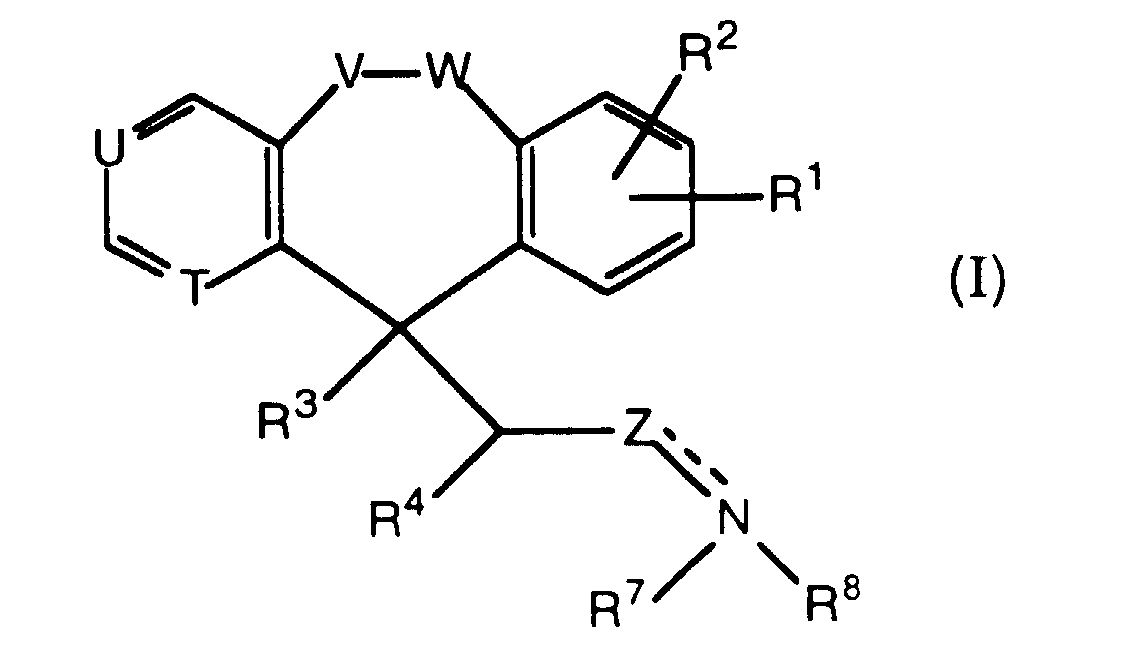
- one of T and U represents N and the other represents =CH; or each of T and U represents =CH-;
- one of V and W represents oxygen and the other represents -CH2-; or each of V and W represents -CH2-;
- R1 and R2 are each independently selected from the group consisting of H and halogen;
- R3 is alkyl, alkenyl, alkynyl, aryl, alkaryl, aralkyl, cycloalkyl, acyloxymethyl, alkoxy, alkoxymethyl, or alkyl substituted with cycloalkyl;
- R4 is H, alkyl, alkenyl, alkoxy, or -OH;
- Z-----N represents an optional double bond; when Z-----N is a double bond, Z represents -CH=, or -CH2C(R5)=, wherein R5 is H or lower alkyl; and R7 and R8 together represent OR9;
- when Z-----N represents a single bond, Z represents a direct
bond, -CH2-, -CH=CH-, or -CH2C(R5)(R6)-, wherein R5 and R6 are
independently H or lower alkyl (provided that, when R3 is -CH3, Z is not
-(CH2)2-); and R7 and R8 are independently H, alkyl, alkenyl, alkynyl,
aryl, alkaryl, aralkyl, cycloalkyl, -OR9; -C(O)OR10; -CH2C(O)OR9;
-C(O)R10; -SO2R10; -CO-4-pyridyl-N-oxide; -(CH2)n-N(CH3)2, where n is
2 to 4; -(CH2)mO(CH2)jOH, where m and j are independently 2 or 3;
or R7 and R8 together form either a five-membered or a six-membered ring optionally substituted with COOR9; a six-membered ring containing NR10; or a five-membered ring fused to a benzene ring;

- R9 is H or lower alkyl; and
- R10 is alkyl or aryl.
- with the proviso that where U represents -CH=; T represents N; R1, R2, R3 and R4 represent H; Z represents CH2; and R7 and R8 each represents methyl; then one of V and W represents oxygen and the other represents -CH2-.
-
- More preferred compounds of this invention are represented by Formula I wherein R3 is alkoxy and more preferably wherein R3 is ethoxy.
- More preferred compounds also include those of Formula I wherein R3 is alkyl. When R3 is alkyl, R3 is preferably an alkyl group other than -CH3, more preferably an alkyl group having from two to six carbon atoms, and more preferably still, R3 is propyl.
- More preferred compounds also include those of Formula I wherein R3 is cyclopropylmethyl, and more preferred compounds also include those of Formula I wherein R3 is allyl.
- More preferred compounds also include those of Formula I wherein each of T and U represent =CH-.
- Preferably, R7 and R8 are independently H, alkyl, alkenyl, alkynyl, aryl, alkaryl, or aralkyl. When R7 and R8 and N taken together form either a five-membered ring, a six-membered ring, or a five-membered ring fused to a benzene ring, the portion of the 5- or 6-membered ring represented by R7 and R8 is preferably carbocyclic optionally having a nitrogen atom substituted for one of the carbon atoms.
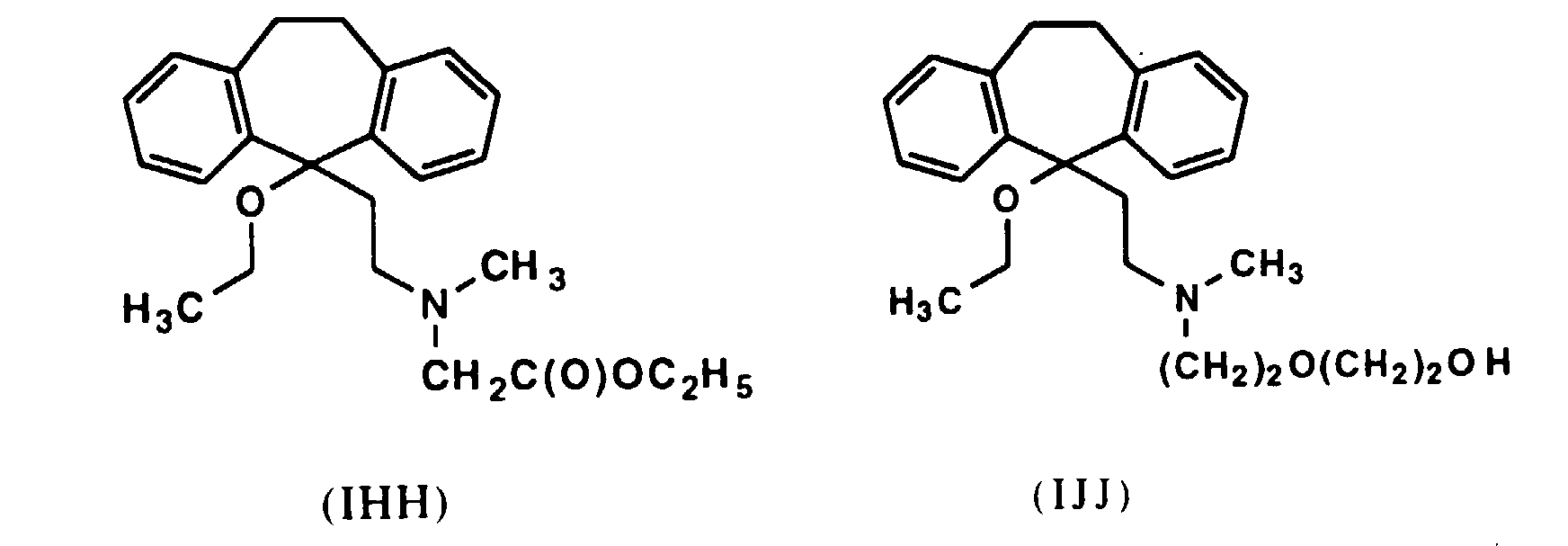
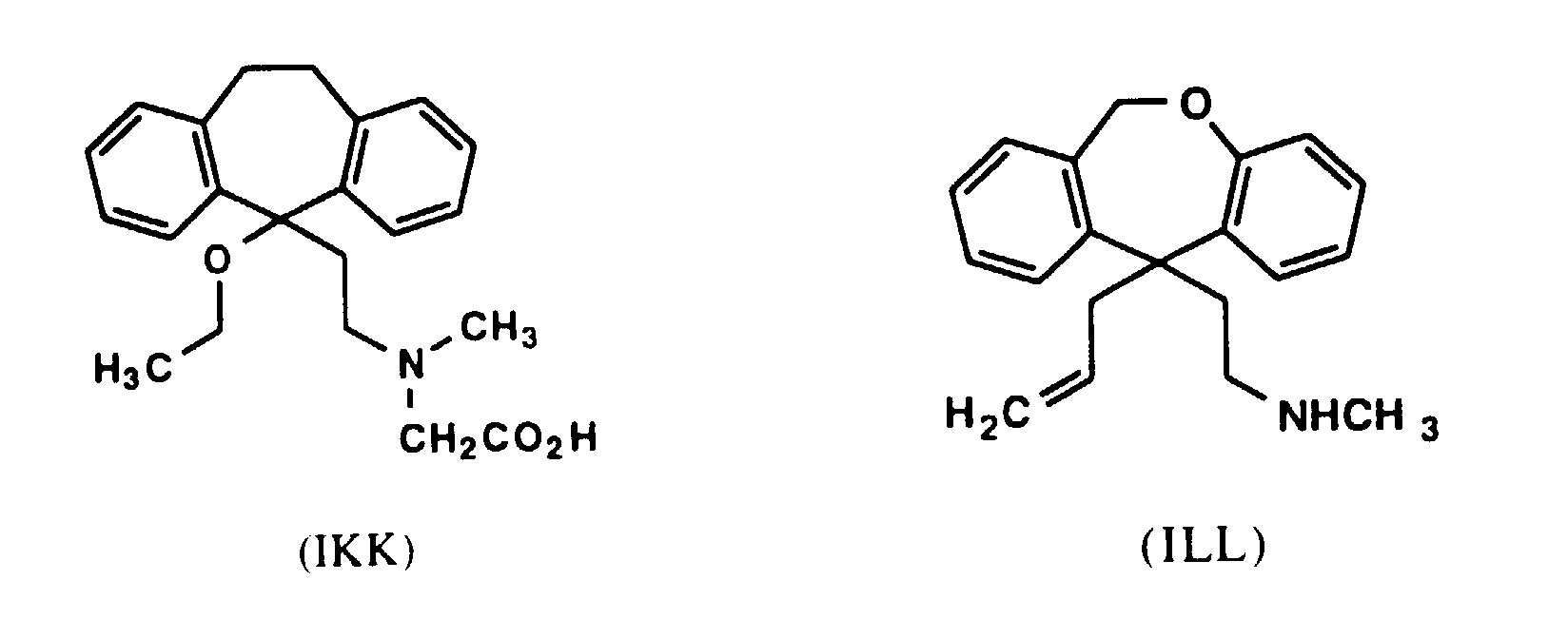
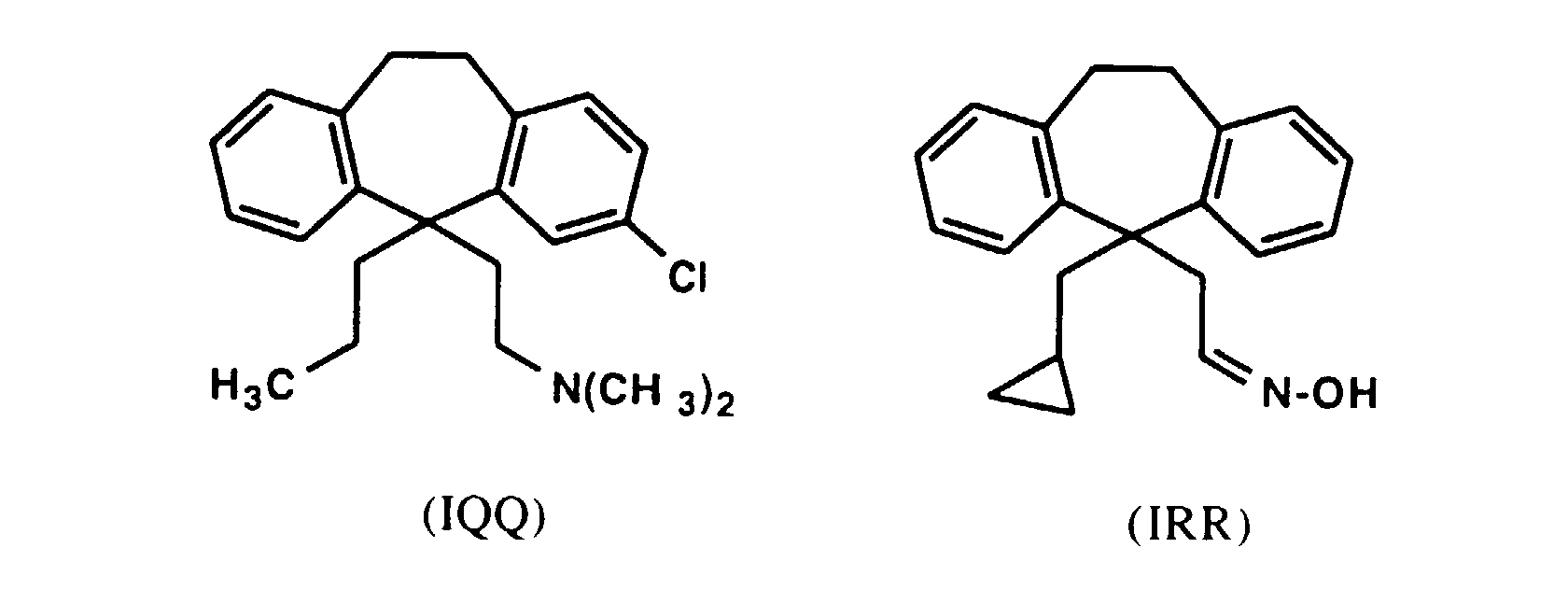
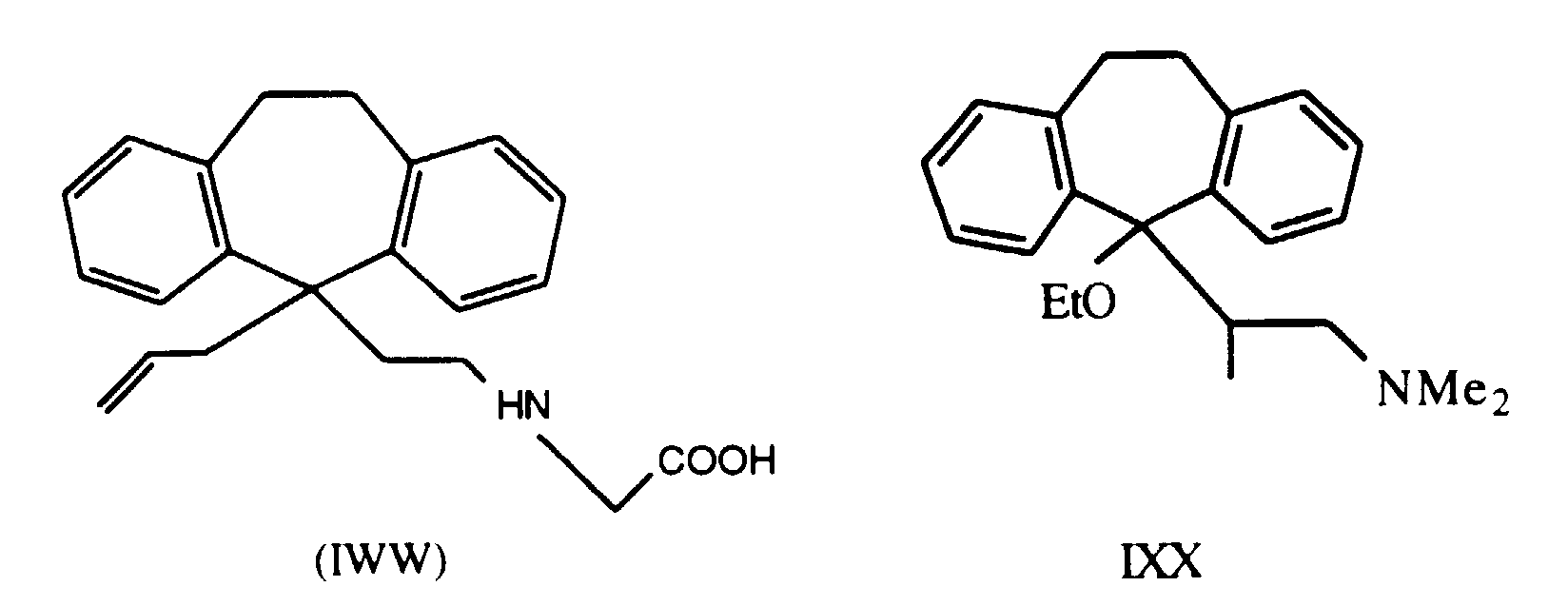
- Representative compounds of this invention include, but are not limited to:


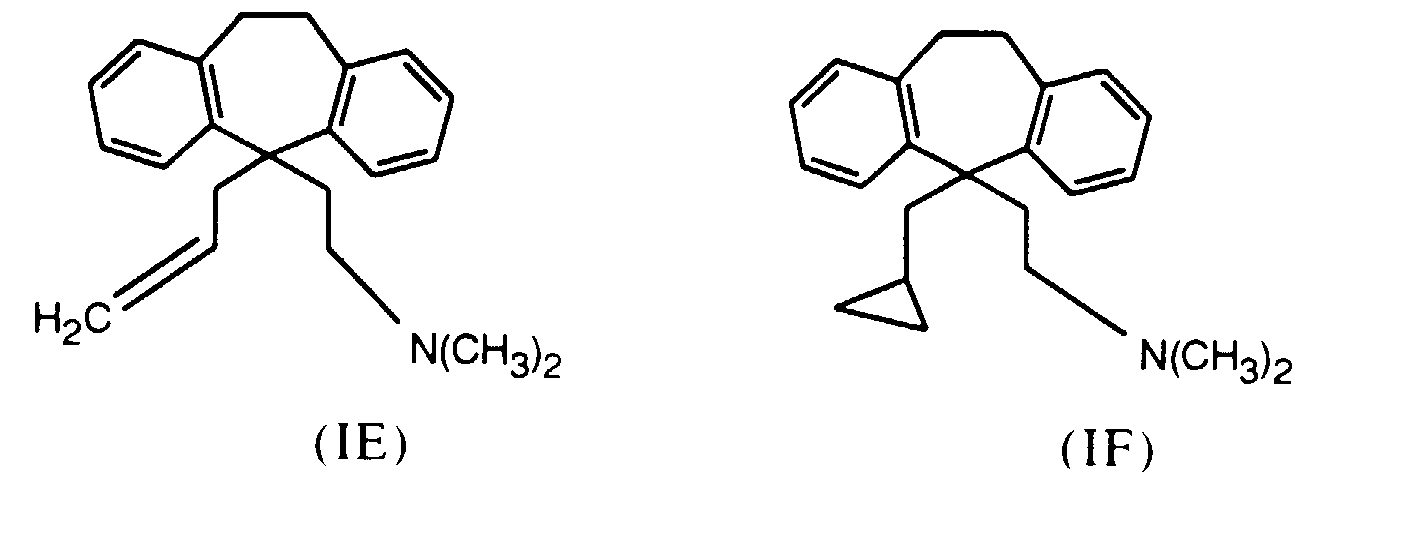
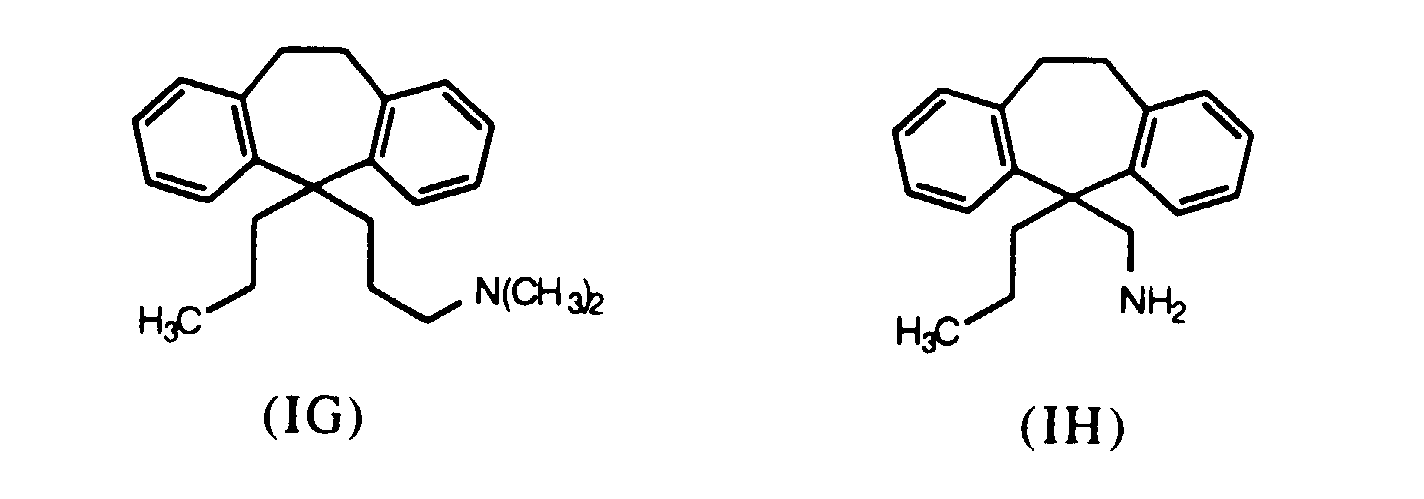

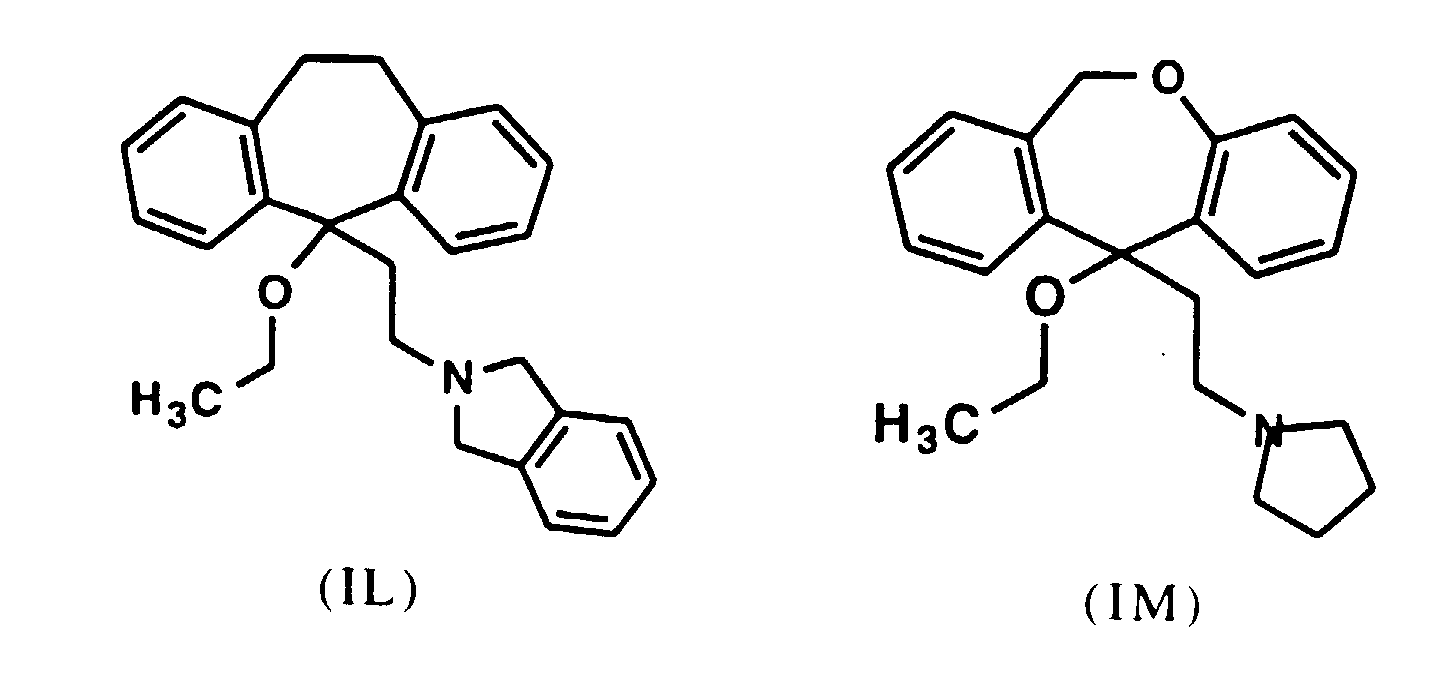

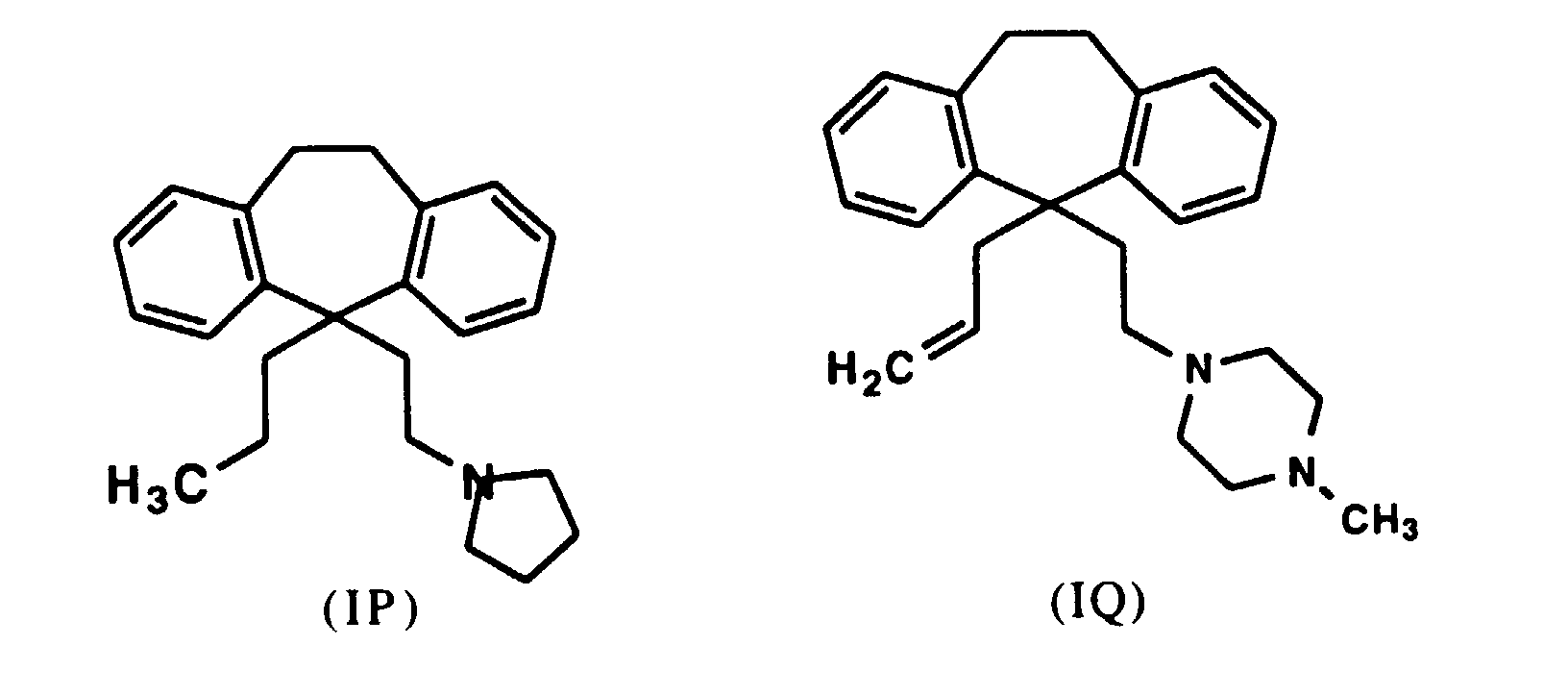

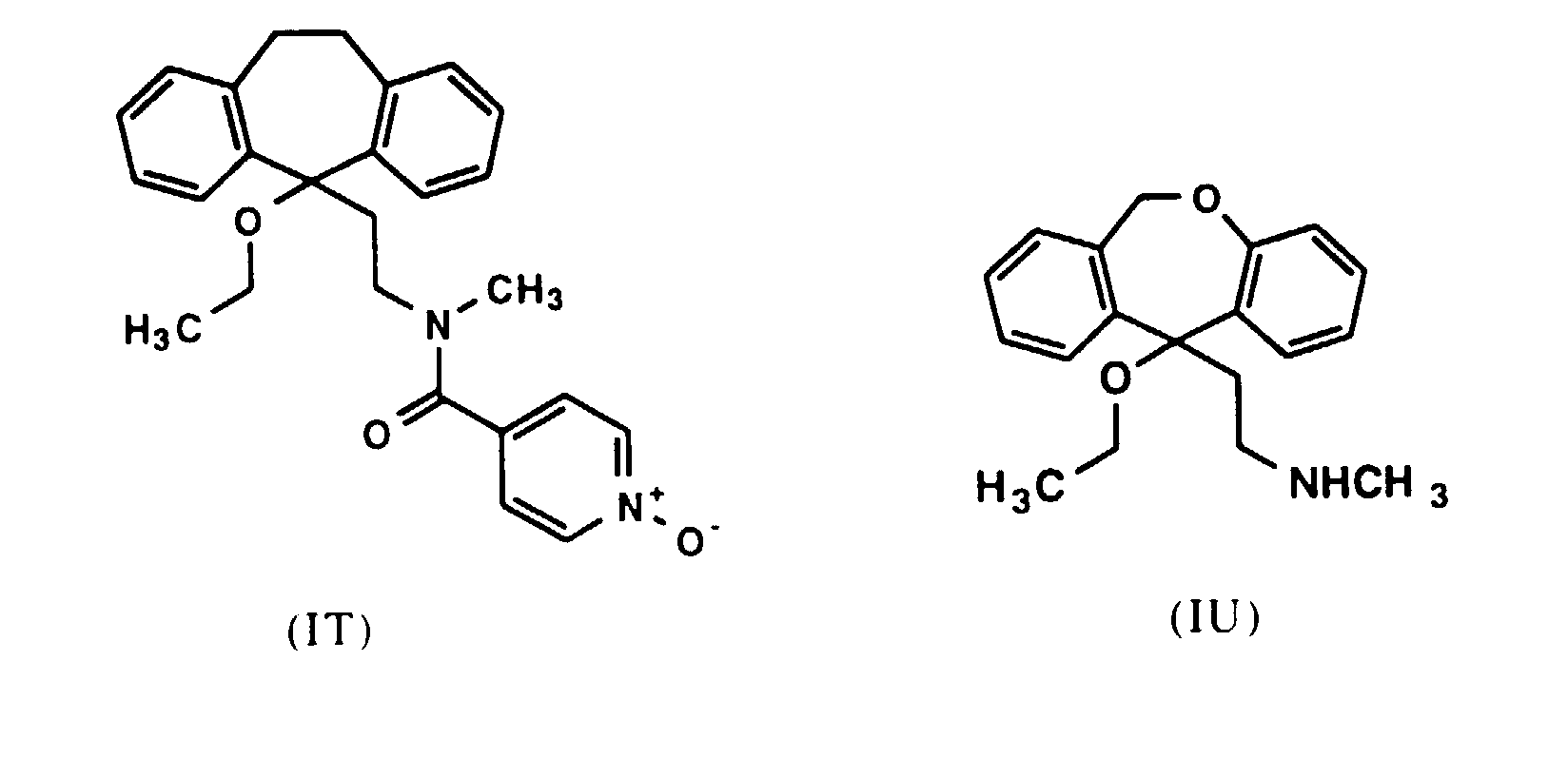
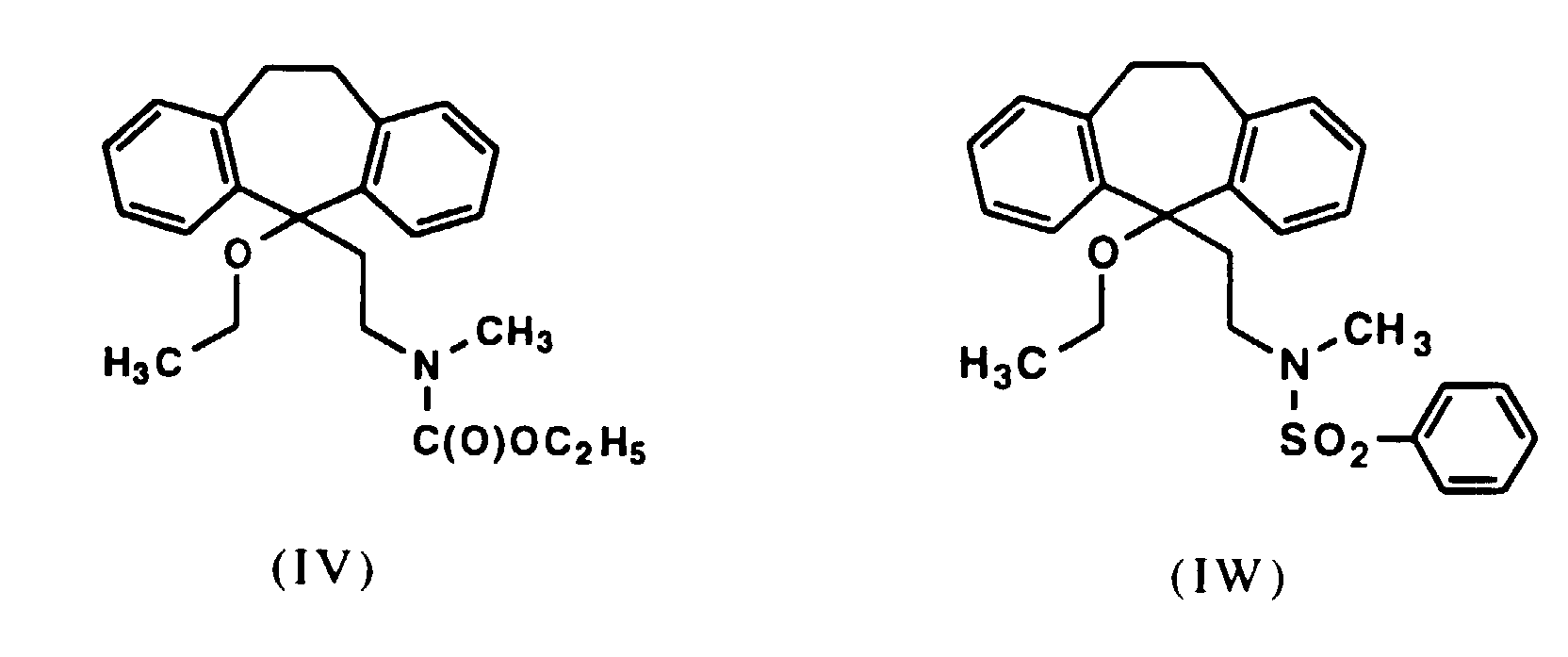


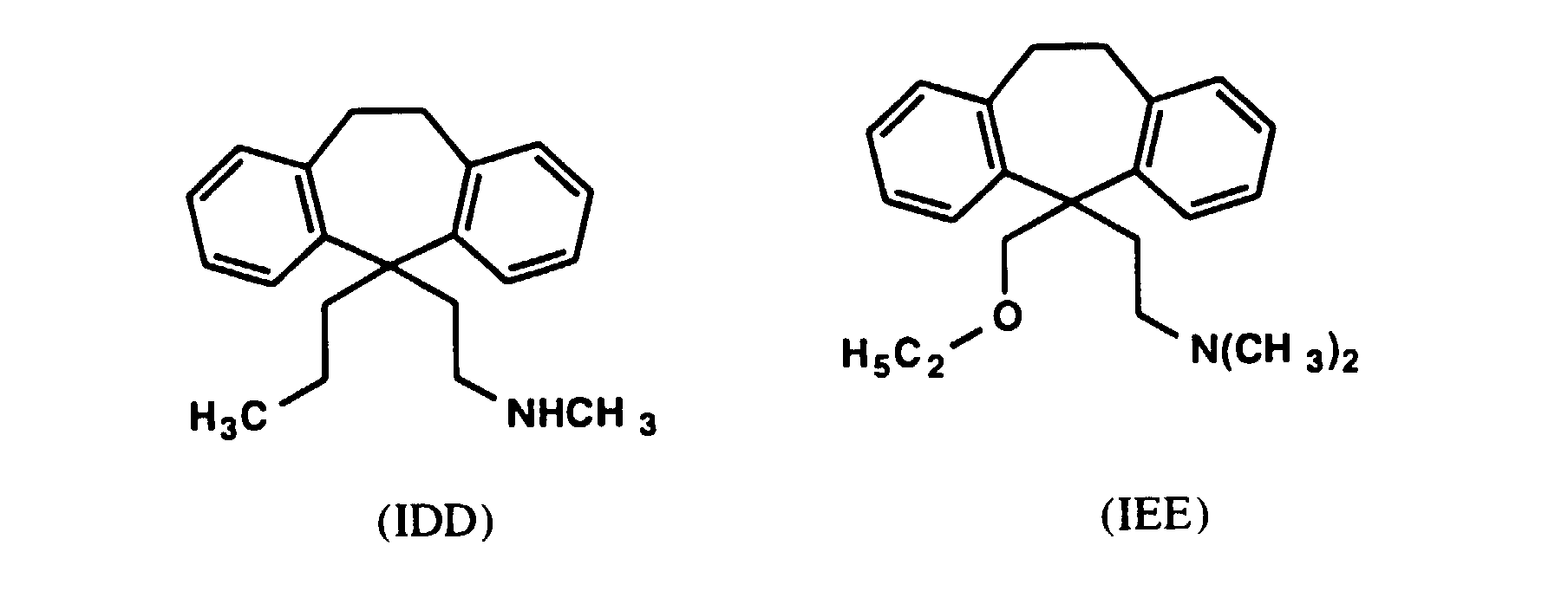






- This invention also provides a pharmaceutical composition comprising an effective amount of a compound of Formula I in combination with a pharmaceutically acceptable carrier.
- In addition, this invention provides a method for inhibiting TNF-α in a mammal comprising administering to the mammal an amount of a compound of Formula I effective to inhibit TNF-α.
- In view of the surprising anti-TNF-α activity of compounds of formula I, this invention provides the following:
- a compound of Formula I for use as a medicament for treating inflammation in a mammal comprising administering to the mammal an effective anti-inflammatory amount of said compound.
- a compound of Formula I for use as a medicament for treating septic shock in a mammal comprising administering to the mammal an effective anti-septic shock amount of said compound ; and
- a compound of Formula I for use as a medicament for treating allergic reaction in a mammal comprising administering to the mammal an effective anti-allergic amount of said compound.
- As used herein, the following terms are used as defined below unless otherwise indicated:
- alkyl - (including the alkyl portions of alkoxy and cycloalkyl) - represents straight and branched carbon chains and contains from one to twenty carbon atoms, preferably one to six carbon atoms;
- alkenyl - (including the alkenyl portions of cycloalkenyl) represents straight and branched carbon chains having at least one carbon to carbon double bond and containing from 2 to 12 carbon atoms, preferably from 2 to 6 carbon atoms;
- alkynyl - represents straight and branched carbon chains having at least one carbon to carbon triple bond and containing from 2 to 12 carbon atoms, preferably from 2 to 6 carbon atoms;
- aryl - represents a carbocyclic group (preferably phenyl or substituted phenyl) containing from 6 to 14 carbon atoms and having at least one phenyl or fused phenylene ring, with all available substitutable carbon atoms of the carbocyclic group being intended as possible points of attachment, said carbocyclic group being optionally substituted with one or more of halo, alkyl, hydroxy, alkoxy, phenoxy, cyano, cycloalkyl, alkenyloxy, alkynyloxy, -SH, -S(O)eR12 (wherein e is 1 or 2 and R12 is alkyl or aryl), -CF3, amino, alkylamino, dialkylamino, -COOR12 or -NO2;
- acyl - (including the acyl portions of acyloxy) represents -C(O)-alkyl, -C(O)-alkenyl, -C(O)-alkynyl, -C(O)-cycloalkyl, -C(O)-cycloalkenyl or -C(O)-cycloalkynyl;
- alkaryl - represents an aryl group, as defined above, in which an alkyl group, as defined above, is substituted for one of the aryl H atoms;
- alkoxy - represents an alkyl group, as defined above, attached to a molecule through an oxygen molecule (-O-alkyl);
- alkoxymethyl - represents an alkoxy group as defined above attached to a molecule through a methylene group;
- aralkyl - represents an alkyl group, as defined above, in which an aryl group, as defined above, is substituted for one of the alkyl H atoms;
- and halo - represents fluoro, chloro, bromo and iodo.
-
- Certain compounds of the invention may exist in different isomeric (e.g., enantiomers and diastereoisomers) as well as conformational forms. The invention contemplates all such isomers both in pure form and in admixture, including racemic mixtures. Tautomeric forms are also included.
- The compounds of Formula I can exist in unsolvated as well as solvated forms, including hydrated forms, e.g., hemi-hydrate. In general, the solvated forms, with pharmaceutically acceptable solvents such as water, ethanol and the like are equivalent to the unsolvated forms for purposes of the invention.
- Lines drawn into the ring systems indicate that the indicated bond may be attached to any of the substitutable ring carbon atoms.
- Certain compounds of the invention will be acidic in nature, e.g. those compounds which possess a carboxyl or phenolic hydroxyl group. These compounds may form pharmaceutically acceptable salts. Examples of such salts may include sodium, potassium, calcium, aluminum, gold and silver salts. Also contemplated are salts formed with pharmaceutically acceptable amines such as ammonia, alkyl amines, hydroxyalkylamines, N-methylglucamine and the like.
- Certain basic compounds of the invention also form pharmaceutically acceptable salts, e.g., acid addition salts. For example, the pyrido-nitrogen atoms may form salts with strong acid, while compounds having basic substituents such as amino groups also form salts with weaker acids. Examples of suitable acids for salt formation are hydrochloric, sulfuric, phosphoric, acetic, citric, oxalic, malonic, salicylic, malic, fumaric, succinic, ascorbic, maleic, methanesulfonic and other mineral and carboxylic acids well known to those skilled in the art. The salts are prepared by contacting the free base form with a sufficient amount of the desired acid to produce a salt in the conventional manner. The free base forms may be regenerated by treating the salt with a suitable dilute aqueous base solution such as dilute aqueous sodium hydroxide, potassium carbonate, ammonia and sodium bicarbonate. The free base forms differ from their respective salt forms somewhat in certain physical properties, such as solubility in polar solvents, but the acid and base salts are otherwise equivalent to their respective free base forms for purposes of the invention.
- All such acid and base salts are intended to be pharmaceutically acceptable salts within the scope of the invention and all acid and base salts are considered equivalent to the free forms of the corresponding compounds for purposes of the invention.
- The invention disclosed herein is exemplified by the following preparative examples, which should not be construed to limit the scope of the disclosure. Alternative synthetic pathways and analogous structures within the scope of the invention may be apparent to those of ordinary skill in the art. Further, those skilled in the art will recognize that the reactions are conducted under conditions, e.g., temperature, that will allow the reaction to proceed at a reasonable rate to completion. Unless indicated otherwise, the substituents for the formulas given hereinafter have the same definition as those of Formula I.
-

- Step 1: This step is preferably carried out by first adding a strong base (e.g. lithium diisopropylamide, potassium bis(trimethylsilyl)amide, sodium hydride, or potassium hydride) in an inert solvent (e.g. ether such as diethyl ether, tetrahydrofuran, or dioxane) with a cosolvent if necessary (e.g. N,N-dimethylformamide, 1,3-dimethyl-3,4,5,6-tetrahydro-2(1H)-pyrimidinone, or hexamethylphosphoramide) under an inert atmosphere (nitrogen or argon). Subsequently, the alkylating agent R3L is added wherein L represents a good leaving group, e.g. L can be chloride, bromide, iodide, mesylate, or tosylate. Any suitable temperature can be used with preferable temperatures for the deprotonation between -78°C and 0°C and for the alkylation between 25°C and 70°C.
- Step 2: This step is preferably carried out with any suitable reducing agent (e.g. diisobutylaluminum hydride, lithium triethoxyaluminum hydride, or sodium aluminum hydride) in an inert solvent such as ether (e.g. diethyl ether, tetrahydrofuran, or dioxane) at temperatures preferably between -78°C and 25°C under an inert atmosphere (nitrogen or argon).
- Step 3: This step is preferably carried out with the reagent diethyl N-benzylidenaminoalkylphosphonate and two equivalents of n-butyl lithium in an inert solvent such as ether (e.g. diethyl ether, tetrahydrofuran, or dioxane) under an inert atmosphere (nitrogen or argon) to generate a metalloenamine. The metalloenamine is alkylated at temperatures preferably between -78°C and 25°C with R3L wherein L represents a good leaving group, e.g. L can be chloride, bromide, iodide, mesylate, or tosylate. Subsequent acid hydrolysis of the enamine gives the aldehyde product.
- Step 4: This step is preferably carried out with the reagent diethyl [(2-tetrahydropyranyloxy)methyl]phosphonate and lithium diisopropylamide in an inert solvent such as ether (e.g. diethyl ether, tetrahydrofuran, or dioxane) under an inert atmosphere (nitrogen or argon). Preferred temperature range is -78°C to 0°C for addition of the phosphonate reagent and 25°C to 70°C for elimination of the phosphonate reagent.
- Step 5: This step is preferably carried out with acid (e.g. hydrochloric acid, acetic acid, or tosic acid) in an inert solvent such as ether (e.g. diethyl ether, tetrahydrofuran, or dioxane) with water. Preferred temperature range is 25°C to 70°C.
- Step 6: This step is preferably carried out with a suitably
substituted amine (usually as its acid salt e.g. hydrochloride or maleate)
and sodium cyanoborohydride in a solvent mixture of ether (e.g. diethyl
ether, tetrahydrofuran, or dioxane) and protic solvent (e.g. methanol or
ethanol) with 3A sieves. Preferred temperature range is 25°C to 70°C.

- Step 7: This step is preferably carried out with the reagent trimethyl phosphonoacetate and sodium hydride in a polar aprotic solvent (e.g. N,N-dimethylformamide, N,N-dimethylacetamide, or dimethylsulfoxide) under an inert atmosphere (nitrogen or argon). Preferred temperature range is 25°C to 80°C.
- Step 8: This step is preferably carried out with any suitable reducing agent (e.g. diisobutylaluminum hydride, aluminum hydride, or lithium trimethoxyaluminum hydride) in an inert solvent such as ether (e.g. diethyl ether, tetrahydrofuran, or dioxane) at temperatures preferably between -78°C and 25°C under an inert atmosphere (nitrogen or argon).
- Step 9: This step is preferably carried out with N-bromosuccinimide and R3 as a nucleophile such as methanol, ethanol, or propanol in an inert solvent such as chlorinated hydrocarbons (e.g. dichloromethane, 1,2-dichloroethane, or chloroform) at temperatures between 0°C and 25°C.
- Step 10: This step is preferably carried out with a suitable reducing agent such as tri-n-butyl tin hydride or triphenyl tin hydride and a radical initiator such as azobisisobutyronitrile in an inert solvent (e.g. benzene or toluene). Preferred temperature range is between 80°C and 110°C.
- Step 11: This step is preferably carried out with a suitable oxidizing agent (e.g. pyridinium chlorochromate, chromium trioxide-pyridine, pyridinium dichromate, oxalyl chloride-dimethylsulfoxide, acetic anhydride-dimethylsulfoxide, dicyclohexylcarbodiimide-dimethylsulfoxide, or periodinane) in an inert solvent such as chlorinated hydrocarbons (e.g. dichloromethane, 1,2-dichloroethane, or chloroform). Preferred temperature range is between -78°C and 25°C.
- Step 6: This step is described above for Scheme 1.

- Step 12: This step is preferably carried out with the reagent methyltriphenylphosphonium bromide and base (e.g. sodium hydride or potassium hydride) in dimethylsulfoxide with a temperature range of 50°C to 80°C under an inert atmosphere (nitrogen or argon). This step can also be carried out by addition of a Grignard reagent (e.g. methyl magnesium chloride, bromide, or iodide) in an inert solvent such as ether (e.g. diethyl ether, tetrahydrofuran, or dioxane) with preferable temperatures between 0°C and 25°C. Elimination to give the alkene is catalyzed by a crystal of iodine with sublimation or carried out with acetic anhydride, acetyl chloride, and acetic acid with preferable temperatures between 60°C and 100°C.
- Step 13: This step is preferably carried out with a suitably substituted hydroxylamine, paraformaldehyde, (and a base (e.g. triethylamine or 1,8-diazabicyclo-[5.4.0]undec-7-ene) if the hydroxylamine exists as a salt) in a protic solvent (e.g. ethanol, isopropanol, or butanol) with preferable temperatures between 80°C and 120°C.
- Step 14: This step is preferably carried out with zinc in acetic acid or with zinc and ammonium chloride in an inert solvent (e.g. ether such as tetrahydrofuran or dioxane) with water at a preferred temperature range of 50°C to 90°C. Alternatively, this step can be carried out with aluminum-nickel alloy and aqueous base (sodium hydroxide or potassium hydroxide) in a protic solvent (e.g. methanol, ethanol, or isopropanol) or by hydrogenation with ammonium formate and palladium on carbon in a protic solvent (e.g. methanol, ethanol, or isopropanol) at a preferred temperature of 25°C.
- Step 15: This step is preferably carried out with an alkylating or acylating agent R8L wherein L represents a good leaving group (e.g. L can be chloride or R8L can be an anhydride) and a base (e.g. pyridine, triethylamine, collidine, or 1,8-diazabicyclo-[5.4.0]undec-7-ene) in an inert solvent such as chlorinated hydrocarbons (e.g. dichloromethane, 1,2-dichloroethane, or chloroform) under an inert atmosphere (nitrogen or argon). Preferred temperature range is 25°C to 80°C.
- Step 16: This step is preferably carried out by first adding a base (e.g. sodium hydride or potassium hydride) in an inert solvent (e.g. ether such as tetrahydrofuran, dioxane, diglyme) under an inert atmosphere (nitrogen or argon). Subsequently, the alkylating agent R9L is added wherein L represents a good leaving group, e.g. L can be chloride, bromide, iodide, mesylate, or tosylate. Preferred temperature range is 70°C to 160°C .
-
- Additional general processes for making compounds of the present invention are as follows:
- Preparation of a compound of formula I wherein
Z-----N represents a double bond: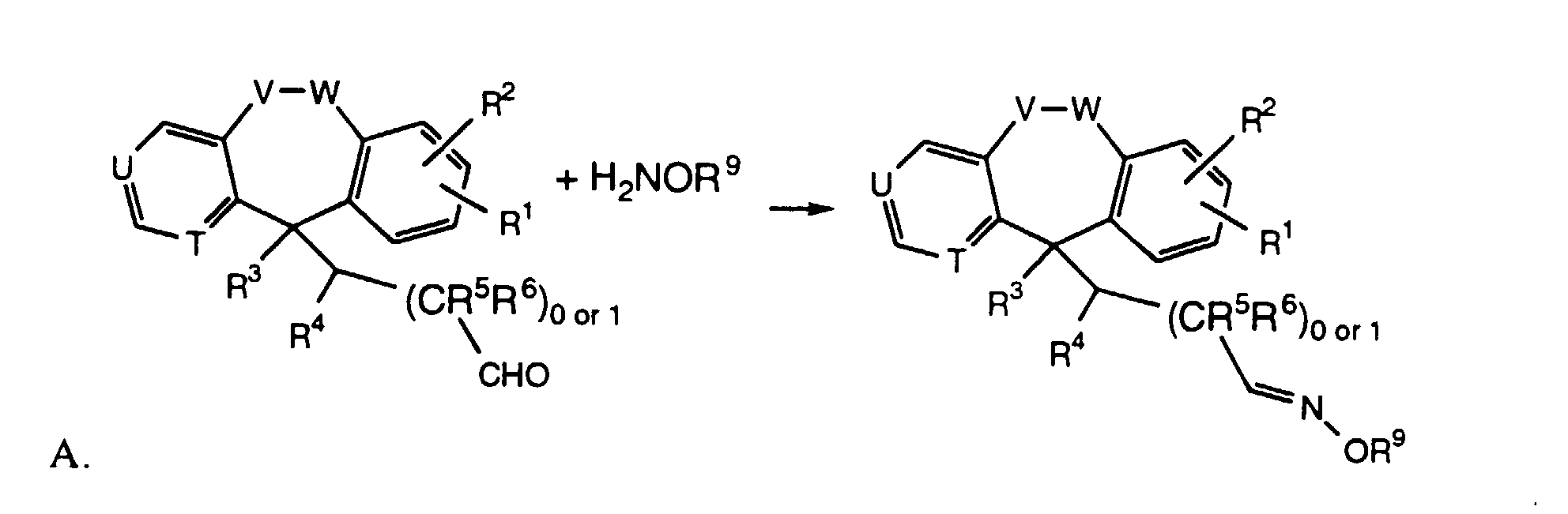
- The process is preferably carried out by treating the aldehyde with a hydroxyl amine derivative in an inert solvent such as chlorinated hydrocarbons (e.g. dichloromethane, 1,2-dichloroethane, or chloroform) at ambient temperature. If the hydroxyl amine derivative exists as a salt, the acid can be neutralized by the addition of an amine base such as pyridine, collidine, or triethylamine.
- Preparation of a compound of formula I wherein Z-----N represents a single bond:
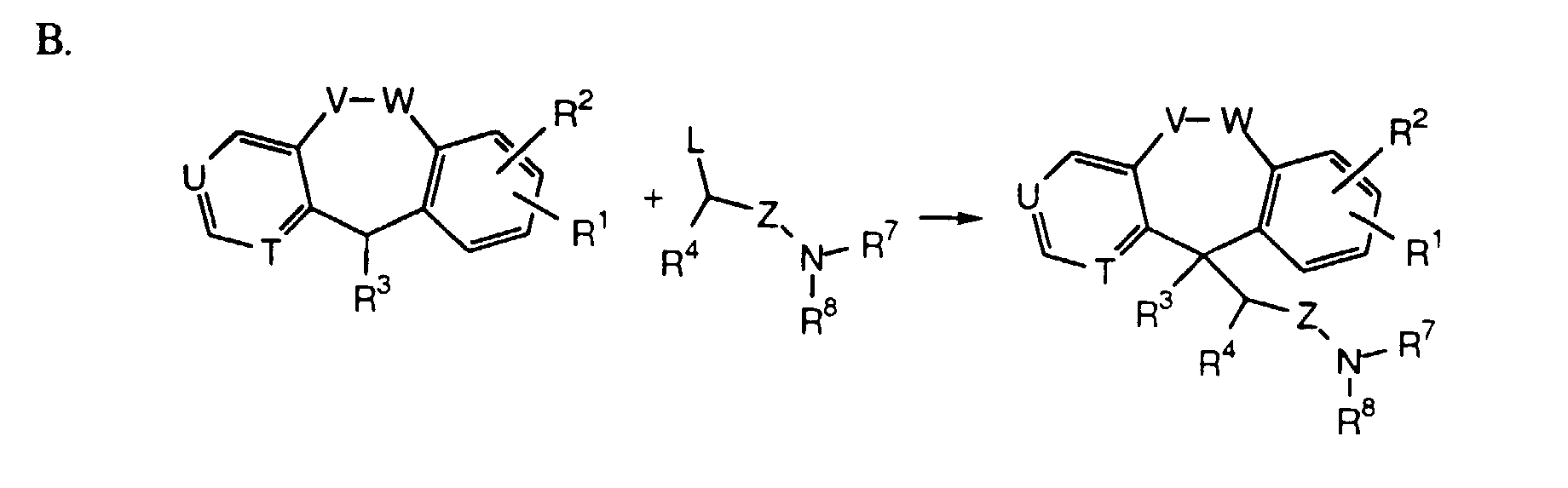
- The process is preferably carried out by first adding a strong base (e.g. n-butyl lithium, sec-butyl lithium, sodium amide, potassium amide, lithium diisopropylamide, or potassium bis(trimethylsilyl)amide) to the tricyclic compound in an inert solvent (e.g. ether such as diethyl ether, tetrahydrofuran, or dioxane, or polar solvent such as ammonia, N,N-dimethylformamide, or N,N-dimethylacetamide) under an inert atmosphere (nitrogen or argon). Subsequently, the alkylating agent is added wherein L represents a good leaving group, e.g. L can be chloride, bromide, iodide, mesylate, or tosylate. Any suitable temperature can be used with preferable temperatures between -78°C and 0°C.

- The reductive amination process is preferably carried out by treating the aldehyde with an amine (usually as a salt) in the presence of a reducing agent such as sodium cyanoborohydride and sieves in a suitable solvent mixture of ether (e.g. diethyl ether, tetrahydrofuran, or dioxane) and protic solvent (e.g. methanol or ethanol) at ambient temperature.

- The process is preferably carried out by first adding an amine base (e.g. pyridine, collidine, or triethylamine) in an inert solvent such as chlorinated hydrocarbons (e.g. dichloromethane, 1,2-dichloroethane, or chloroform) or a strong base (n-butyl lithium, sodium hydride, potassium hydride, lithium diisopropyl amide, or potassium bis(trimethylsilyl)amide) in an inert solvent such as ether (e.g. diethyl ether, tetrahydrofuran, or dioxane) or polar aprotic solvent (e.g. N,N-dimethylformamide or N,N-dimethylacetamide) to the tricyclic amine under an inert atmosphere (nitrogen or argon). Subsequently, the alkylating or acylating agent R8L is added wherein L represents a good leaving group, e.g. L can be chloride, bromide, iodide, mesylate, or tosylate. Any suitable temperature can be used between -78°C and 80°C.

- The process is preferably carried out with any suitable reducing agent (e.g. lithium aluminum hydride, alane, borane, or trichlorosilane) in an inert solvent such as ether (e.g. diethyl ether, tetrahydrofuran, or dioxane) at temperatures between 0°C and 60°C.

- The process is preferably carried out by treating the amide or carbamate compound under basic (e.g. sodium hydroxide, potassium hydroxide, or sodium peroxide in water with ethylene glycol, methanol, ethanol, tetrahydrofuran, dioxane, or diglyme) or acidic (e.g. hydrochloric acid, sulfuric acid, or tosic acid in water with tetrahydrofuran, dioxane, or diglyme) conditions. Any suitable temperature can be used with preferable temperatures between 60°C and 150°C.
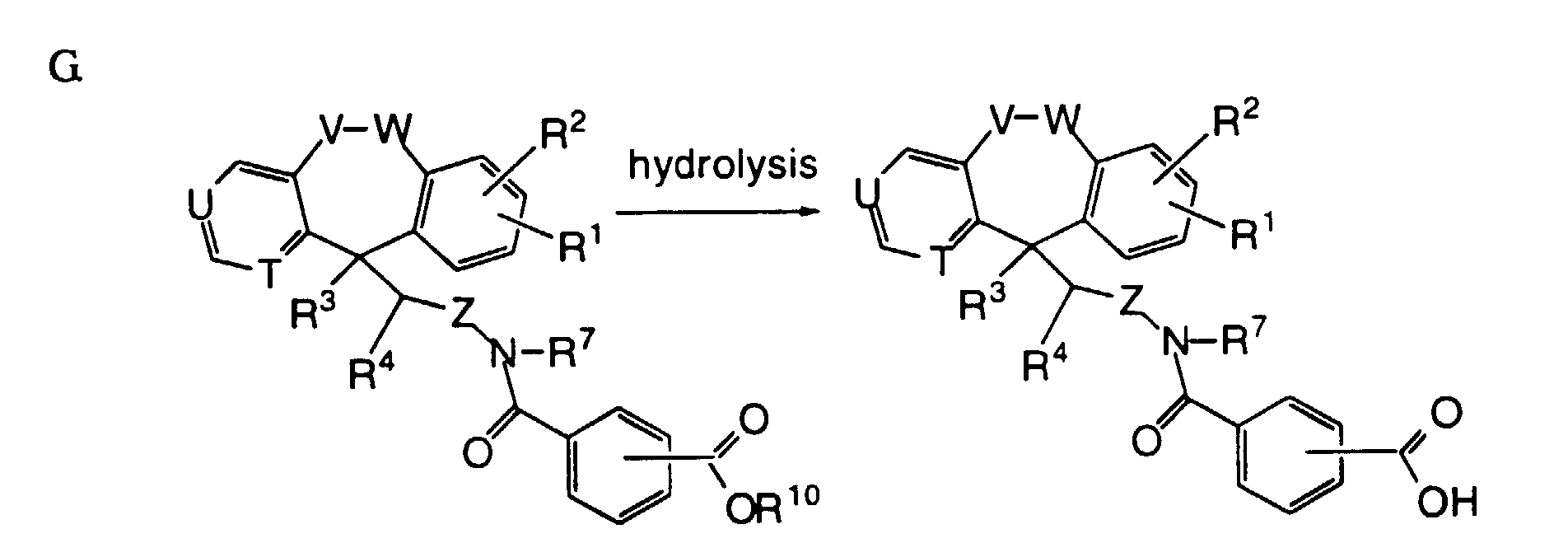
- The process is preferably carried out by treating the tricyclic ester compound with a base (e.g. sodium hydroxide or potassium hydroxide) in water with tetrahydrofuran, dioxane, or diglyme. Any suitable temperature can be used with preferable temperatures between 25°C and 100°C.
- Preparation of a compound of formula I wherein
Z-----N represents a single bond and
R3=alkoxy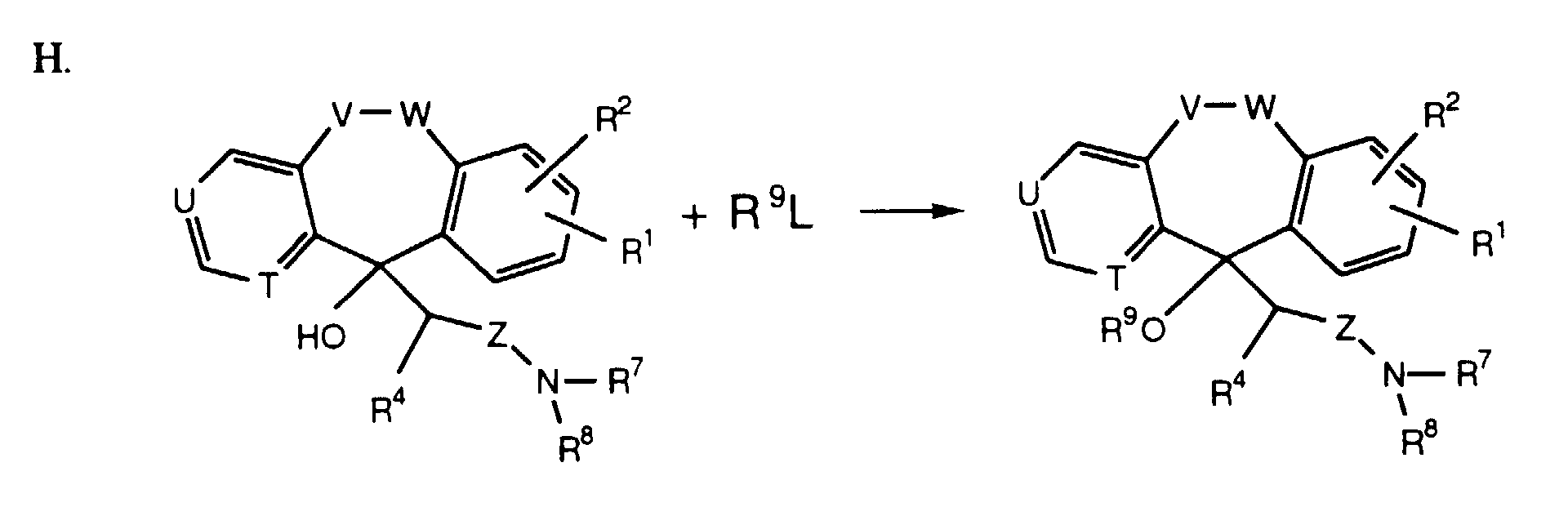
- The process is preferably carried out by first adding a strong base (e.g. potassium t-butoxide, sodium hydride, potassium hydride, n-butyl lithium, lithium diisopropylamide, or potassium bis(trimethylsilyl)amide) to the tricyclic alcohol in an inert solvent (e.g. ether such as tetrahydrofuran, dioxane, or diglyme or polar aprotic solvent such as N,N-dimethylformamide or N,N-dimethylacetamide) under an inert atmosphere (nitrogen or argon). Subsequently, the alkylating agent R9L is added wherein L represents a good leaving group, e.g. L can be chloride, bromide, iodide, mesylate, or tosylate. Any suitable temperature can be used with preferable temperatures between 60°C and 150°C.
- Preparation of a compound of formula I wherein
Z-----N represents a single bond and
R3=alkyl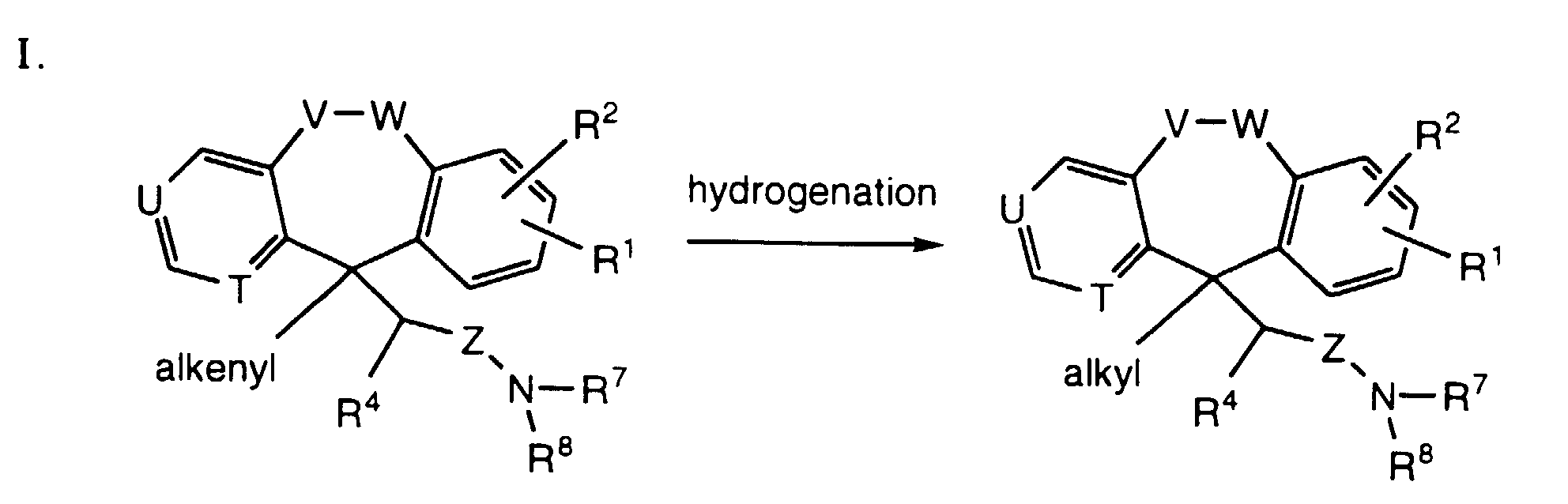
- The process is preferably carried out by treating the tricyclic alkene with a catalyst (e.g. palladium on carbon, platinum oxide, or raney nickel) under a hydrogen atmosphere in an inert solvent (e.g. methanol, ethanol,or ethyl acetate) at ambient temperature.
-

- Added potassium metal (8.6 g, 0.26 mol) portionwise to 1.0 liter of liquid ammonia with a catalytic amount of iron (III) oxide. Allowed to stir at -33°C until blue color disappeared to give a gray solution. Added 5-ethoxy-dibenzosuberone (47.66 g, 0.20 mol) dissolved in 200 mL of ether dropwise via addition funnel. Stirred at -33°C for 30 mins then added N,N-dimethylaminoethylchloride dissolved in 200 mL of ether dropwise via addition funnel. Warmed gently on steam bath to reflux for 16 hours. Poured onto 1.0 liter of ice, and extracted with ether. Dried combined organic extracts with MgSO4, filtered, and evaporated. Purified crude product by flash chromatography on silica gel eluting with ethyl acetate. Combined appropriate fractions and evaporated to give 29.6 g (48% yield) of 5-ethoxy-5-dimethylaminoethyl-10,11-dihydro-5H-dibenzo[a,d]cycloheptene. Dissolved free base in ethyl acetate, and added one equivalent of maleic acid dissolved in ethanol. Added ether to precipitate the maleate salt.
mp=124-125°C
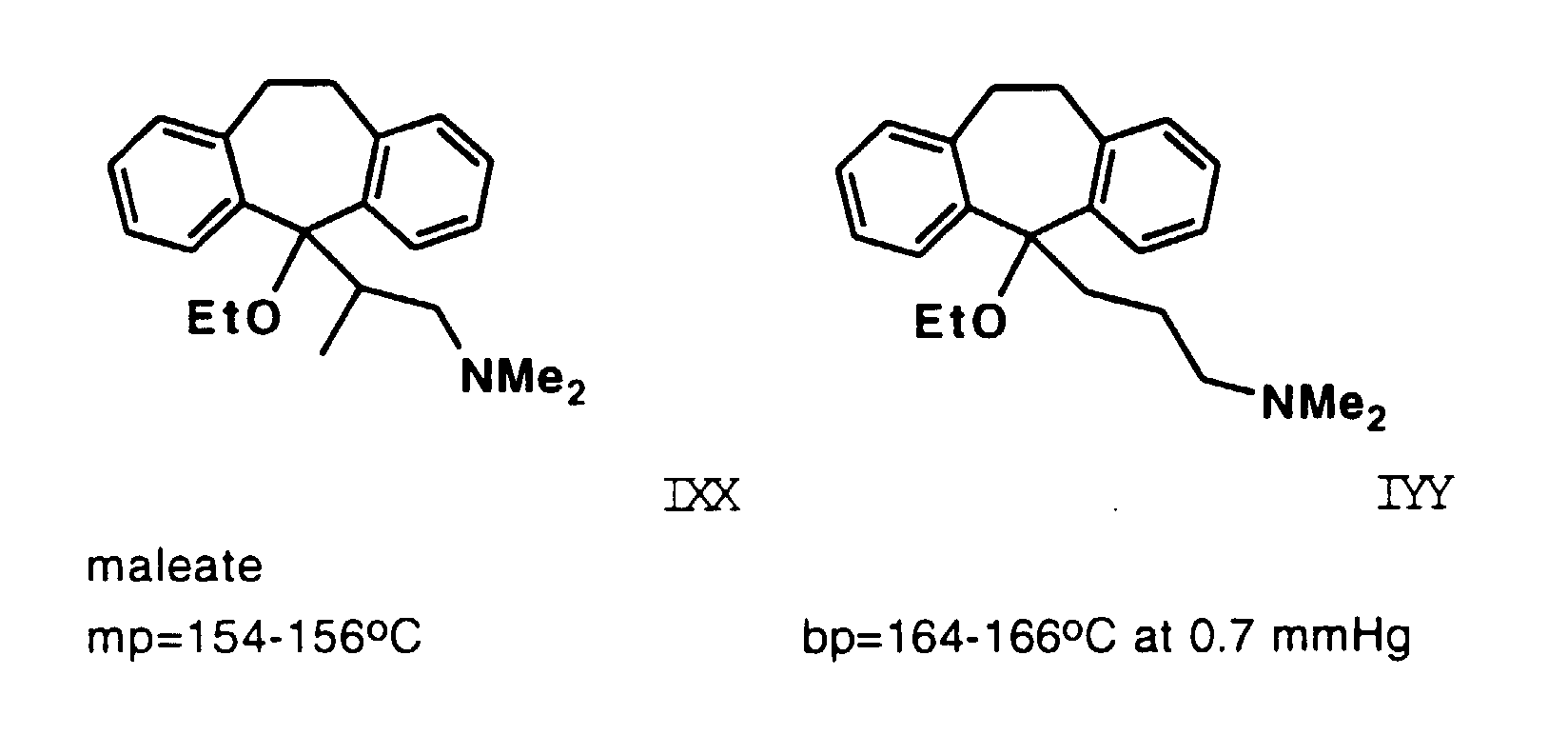
mass spectrum: (Cl, CH4) m/e 310 (M+1 for free base) - The following compounds were obtained according to a similar manner:


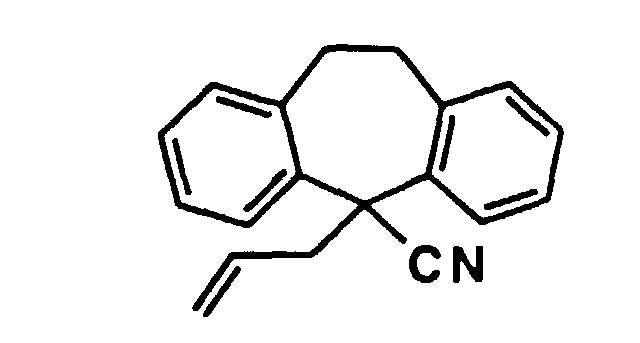
- Dissolved diisopropylamine (11.07 g, 0.109 mol) in 150 mL of dry THF and cooled to 0°C under a nitrogen atmosphere. Added 40.1 mL (0.100 mol) of 2.5 M n-butyl lithium in hexane dropwise via addition funnel. Stirred at 0°C for 10 mins then cooled to -78°C. Added 10,11-dihydro-5H-dibenzo[a,d]cyclohepten-5-nitrile (20.00 g, 0.0912 mol) dissolved in 100 mL of dry THF dropwise via addition funnel. Stirred at -78°C for 45 mins. Added allyl bromide (14.34 g, 0.119 mol) via syringe, and allowed reaction mixture to warm slowly to room temperature. Stirred at room temperature for 90 mins. Added 250 mL of 0.5 N HCI, and separated layers. Extracted aqueous solution with ethyl acetate. Washed combined organic extracts with saturated NaCI, dried with MgSO4, filtered, and evaporated. Purified crude product by flash chromatography on silica gel eluting with 5% ethyl acetate-hexane then 10% ethyl acetate-hexane. Combined appropriate fractions and evaporated to give 23.65 g (100% yield) of 10,11-dihydro-5-(2-propenyl)-5H-dibenzo[a,d]cyclohepten-5-nitrile.
mp=51-53°C
mass spectrum: (FAB) m/e 233 (M-CN)
- Dissolved 10,11-dihydro-5-(2-propenyl)-5H-dibenzo[a,d]cyclohepten-5-nitrile (24.94 g, 0.0962 mol) in 200 mL of dry dichloromethane, and cooled to -78°C under a nitrogen atmosphere. Added 1 M diisobutylaluminum hydride in dichloromethane (106 mL, 0.106 mol) dropwise via addition funnel. Stirred at -78°C for 60 mins. then at 0°C for 2.5 hours. Carefully added 200 mL of 1 N HCI then 100 mL of 2 N HCI. Stirred at room temperature for 30 mins. Separated layers, and extracted aqueous solution with dichloromethane. Washed combined organic extracts with 1 N HCI, saturated NaCI, dried with MgSO4, filtered, and evaporated. Purified crude product by flash chromatography on silica gel eluting with 10% ethyl acetate-hexane. Combined appropriate fractions and evaporated to give 21.62 (86% yield) of 10,11-dihydro-5-(2-propenyl)-5H-dibenzo[a,d]cyclohepten-5-carboxaldehyde.
mass spectrum: (El) m/e 221 (M-allyl)
- Dissolved diisopropylamine (9.2 g, 0.0910 mol) in 200 mL of dry THF. Cooled to 0°C under a nitrogen atmosphere. Added 2.5 M n-butyl lithium in hexane (35.2 mL, 0.0880 mol) via syringe. Stirred at 0°C for 10 mins then cooled to -78°C. Added diethyl [(2-tetrahydropyranyloxy)methyl] phosphonate in 45 mL of dry THF via addition funnel. Stirred at -78°C for 1 hour. Added 10,11-dihydro-5-(2-propenyl)-5H-dibenzo[a,d]cyclohepten-5-carboxaldehyde in 100 mL of dry THF via addition funnel. Warmed to room temperature then refluxed for 16 hours. Cooled to room temperature, and added 500 mL of saturated NH4Cl. Separated layers, and extracted aqueous solution with ether. Washed combined organic extracts with saturated NaHCO3, dried with MgSO4, filtered, and evaporated. Purified crude product by flash chromatography on silica gel eluting with 3% ether-hexane then 5% ether-hexane. Combined appropriate fractions and evaporated to give 12.7 g (46% yield) of 10,11-dihydro-5-(2-propenyl)-5H-dibenzo[a,d]cyclohepten-5-yl-(2-tetrahydropyranyloxy-ethene).
mass spectrum: (Cl, CH4) m/e 361 (M+1)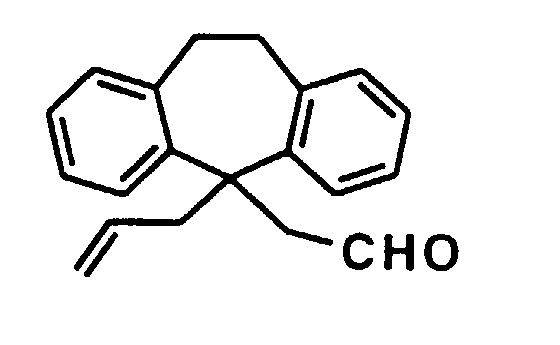
- Dissolved 10,11 -dihydro-5-(2-propenyl)-5H-dibenzo[a,d]cyclohepten 5-yl-(2-tetrahydropyranyloxy-ethene) (4.82 g, 13.37 mmol) in 50 mL of THF. Added 50 mL of 0.2 N HCl, and refluxed for 18 hours. Cooled to room temperature, and added 150 mL of saturated NaHCO3. Extracted with ethyl acetate. Washed combined organic extracts with saturated NaCl, dried (MgSO4), filtered, and evaporated. Purified crude product by flash chromatography on silica gel eluting with 10% ethyl acetate-hexane. Combined appropriate fractions and evaporated to give 3.32 g (90% yield) of 2-[10,11-dihydro-5-(2-propenyl)-5H-dibenzo[a,d]cyclohepten-5-yl]-ethanal).
mass spectrum: (Cl, CH4) m/e 235 (M-allyl)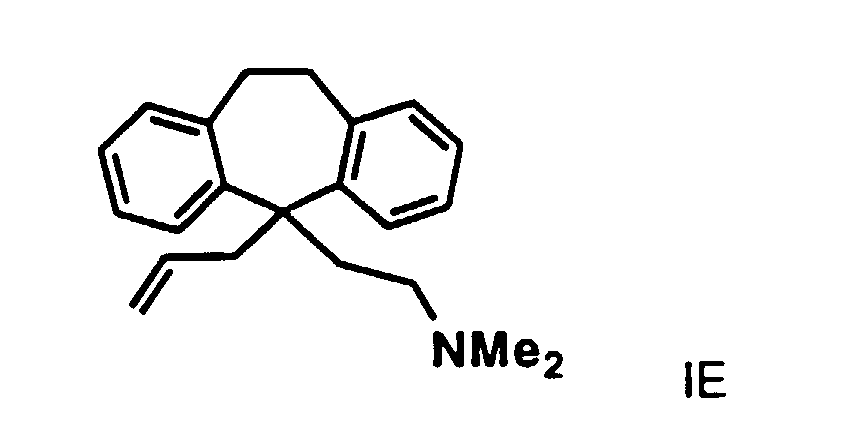
- Dissolved 2-[10,11-dihydro-5-(2-propenyl)-5H-dibenzo[a,d]cyclohepten-5-yl]-ethanal (1.79 g, 6.48 mmol) in 7 mL of dry THF and 21 mL of dry MeOH. Added 3 A sieves, dimethylamine hydrochloride (2.64 g, 32.38 mmol), and sodium cyanoborohydride (0.407 g, 6.48 mmol). Stirred at room temperature for 72 hours. Added 50 mL of saturated NaHCO3 and 50 mL of dichloromethane. Filtered through celite, and separated layers. Extracted aqueous solution with dichloromethane. Dried combined organic extracts with MgSO4, filtered, and evaporated. Purified crude product by flash chromatography on silica gel eluting with a gradient of 3% MeOH-CH2Cl2, 5% MeOH-CH2Cl2, then 10% MeOH-CH2Cl2. Combined appropriate fractions and evaporated to give 1.41 g (69% yield) of 10,11-dihydro-N,N-dimethyl-5-(2-propenyl)-5H-dibenzo[a,d]cycloheptene-5-(2-ethanamine). Dissolved free base in ethyl acetate and added one equivalent of maleic acid dissolved in ethanol. Evaporated. Added dichloromethane and evaporated. Added ether to precipitate maleate salt.
mp=122-124°C
mass spectrum: (Cl, CH4) m/e 306 (M+1 for free base)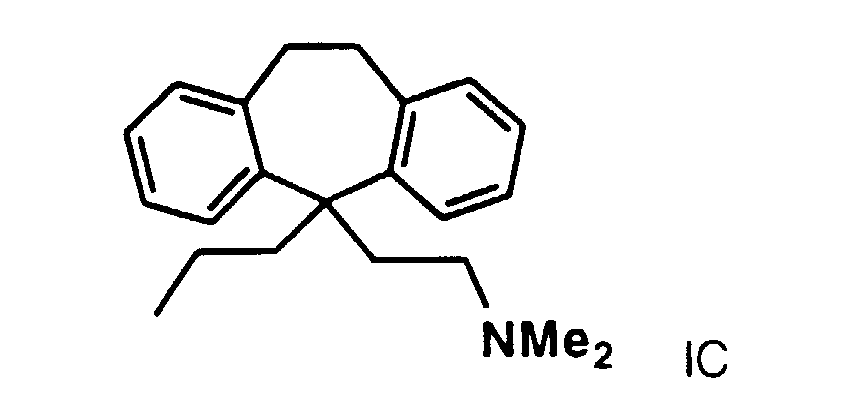
- Dissolved 10,11 -dihydro-N,N-dimethyl-5-(2-propenyl)-5H-dibenzo[a,d]cycloheptene-5-(2-ethanamine) (1.06 g, 3.47 mmol) in 20 mL of absolute ethanol. Added 10 wt% of palladium on carbon catalyst (0.10 g), and shook on Paar shaker at 55 psi of hydrogen pressure for 19 hours. Filtered, and washed catalyst with ethyl acetate. Evaporated filtrate to give 0.973 g (91% yield) of 10,11-dihydro-N,N-dimethyl-5-propyl-5H-dibenzo[a,d]cycloheptene-5-(2-ethanamine). Dissolved free base in ethyl acetate, and added one equivalent of maleic acid dissolved in ethanol. Evaporated. Added minimal dichloromethane then diethyl ether to precipitate maleate salt.
mp=70-75°C (soften and foam)
mass spectrum: (Cl, CH4) m/e 308 (M+1 for free base) The following compounds were obtained according to a similar manner: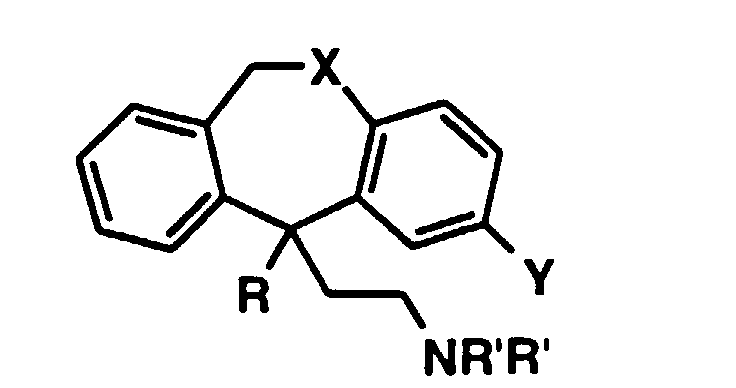
X Y R NR'R" salt Mass Spectrum C H allyl pyrrolidine maleate (Cl, CH4) m/e 332 (M+) C H allyl NHMe HCl (Cl, CH4) m/e 292 (M+1) C H allyl NH(CH2)3NMe2 maleate (Cl, CH4) m/e 363 (M+1) C H allyl N-Me-piperazine maleate (Cl, CH4) m/e 361 (M+1) C H allyl t-Bu-glycine maleate (Cl, CH4) m/e 392 (M+1) C H allyl t-Bu-proline maleate (Cl, CH4) m/e 432 (M+1) C H propyl NHMe maleate (Cl, CH4) m/e 294 (M+1) C H propyl pyrrolidine (Cl, CH4) m/e 334 (M+) C H EtOCH2 NHMe maleate (FAB) m/e 310 (M+1) C H EtOCH2 NMe2 maleate (Cl, CH4) m/e 324 (M+1) C H methyl NMe2 HCl (Cl, CH4) m/e 280 (M+1) C H cyclopropyl methyl NMe2 HCl (FAB) m/e 320 (M+1) C H hexyl NMe2 HCl (Cl, CH4) m/e 350 (M+) C H hexyl NHMe maleate (Cl, CH4) m/e 336 (M+1) C H hexyl pyrrolidine maleate (Cl, CH4) m/e 376 (M+1) C H 1-butenyl NMe2 HCl (Cl, CH4) m/e 320 (M+1) C Cl allyl NMe2 maleate (Cl, CH4) m/e 340 (M+1) C Cl propyl NMe2 maleate (Cl, CH4) m/e 342 (M+1) O H allyl NHMe HCl (Cl, CH4) m/e 294 (M+1) O H allyl NMe2 maleate (Cl, CH4) m/e 308 (M+1) O H propyl NMe2 HCl (Cl, CH4) m/e 310 (M+1) 
- Dissolved 1,1-dimethylethyl 1-[2-[10,11-dihydro-5-(2-propenyl)-5H-dibenzo[a,d]cyclohepten-5-yl]ethyl]-2-pyrrolidinecarboxylate (2.40 g, 5.56 mmol) in 30 mL of dry THF. Added 25 mL of 4.0 M HCI in dioxane, and refluxed for 16 hours on steam bath. Cooled to room temperature, and evaporated. Purified crude product by flash chromatography on silica gel eluting with 5% MeOH-CH2Cl2. Combined appropriate fractions and evaporated to give 0.80 g (40% yield) of 1-[2-[10,11-dihydro-5-(2-propenyl)-5H-dibenzo[a,d]cyclohepten-5-yl]ethyl]-2-pyrrolidinecarboxylic acid. Dissolved free base in dichloromethane, and added 3.4 M HCI in ether to pH=2. Evaporated, and added ether to precipitate hydrochloride salt.
mp=soften at 125°C
mass spectrum: (Cl, CH4) m/e 376 (M+1 for free base) - The following compound was obtained according to a similar manner:

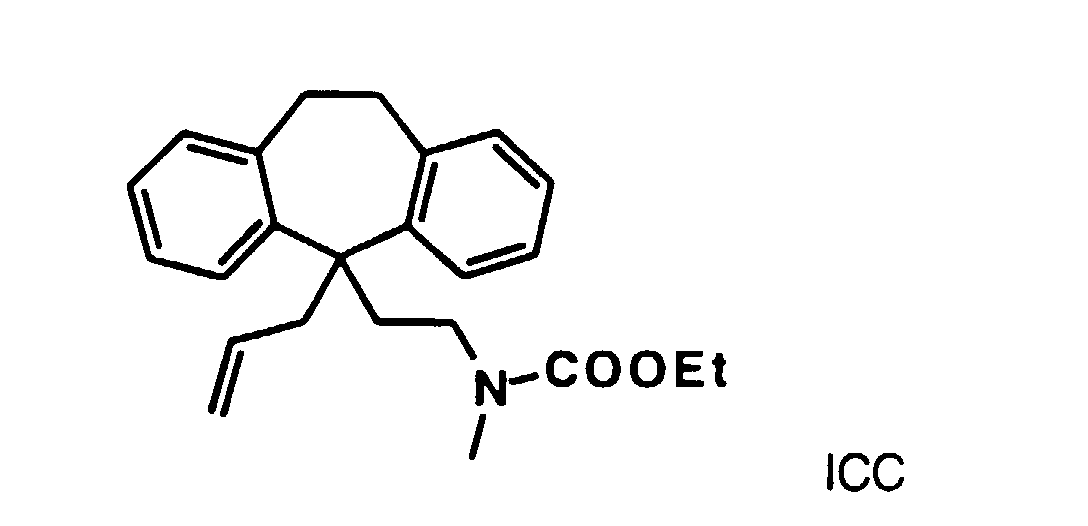
- Dissolved 10,11-dihydro-N-methyl-5-(2-propenyl)-5H-dibenzo[a,d]cycloheptene-5-ethanamine (0.50 g, 1.72 mmol) in 20 mL of dry THF. Added triethylamine (0.29 mL, 0.21 g, 2.06 mmol) and ethyl chloroformate (0.18 mL, 0.20 g, 1.88 mmol). Stirred at room temperature for 5 hours. Added 50 mL of water, and extracted with dichloromethane. Dried combined organic extracts with MgSO4, filtered, and evaporated. Purified crude product by flash chromatography on silica gel eluting with dichloromethane. Combined appropriate fractions, and evaporated to give 0.50 g (81% yield) of ethyl N-[2-[10,11-dihydro-5-(2-propenyl)-5H-dibenzo[a,d]cyclohepten-5-yl]ethyl-N-methylcarbamate.
mass spectrum: (FAB) m/e 364 (M+1) - The following compound was obtained according to a similar manner:


- Dissolved 2-[10,11-dihydro-5-(2-propenyl)-5H-dibenzo[a,d]cyclohepten-5-yl]-ethanal (1.00 g, 3.62 mmol) in 10 mL of dry dichloromethane under a nitrogen atmosphere. Added 3A sieves, hydroxylamine hydrochloride (0.38 g, 5.43 mmol), and pyridine (0.58 mL, 0.57 g, 7.24 mmol). Stirred at room temperature for 16 hours. Filtered to remove sieve dust, and washed solid with water and dichloromethane. Separated layers of filtrate. Dried organic solution with MgSO4, filtered, and evaporated. Purified crude product by flash chromatography on silica gel eluting with 20% EtOAc-CH2Cl2. Combined appropriate fractions and evaporated to give 0.65 g (62% yield) of 2-[10,11-dihydro-5-(2-propenyl)-5H-dibenzo[a,d]cyclohepten-5-yl]-ethanone oxime as a colorless oil.
mass spectrum: (Cl, CH4) m/e 291 (M+1) - The following compounds were obtained according to a similar manner:

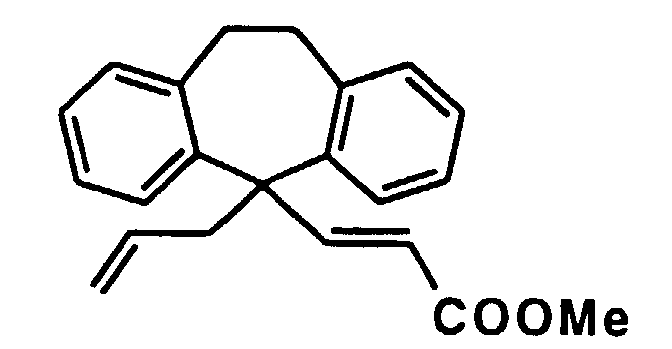
- Washed sodium hydride (1.72 g of 60 weight% in oil, 0.0429 mol) two times with hexane under a nitrogen atmosphere. Added 100 mL of dry THF, and cooled to 0°C. Added trimethyl phosphonoacetate (7.81 g, 6.9 mL, 0.0429 mol) dissolved in 15 mL of dry THF dropwise via addition funnel. Hydrogen evolution was observed. Added 50 mL of dry DMF, and stirred at room temperature for 30 mins. Added 10,11 -dihydro-5-(2-propenyl)-5H-dibenzo[a,d]cyclohepten-5-carboxaldehyde (7.50 g, 0.0286 mol) dissolved in 25 mL of dry DMF dropwise via addition funnel. Stirred at room temperature for 45 mins then heated at 75°C for 16 hours. Cooled to room temperature, and added 0.5 N NaOH. Extracted with ethyl acetate. Washed combined organic extracts with 0.5 N HCI and saturated NaCl, dried with MgSO4, filtered, and evaporated. Purified crude product by flash chromatography on silica gel eluting with 2% ethyl acetate-hexane, 5% ethyl acetate-hexane, then 10% ethyl acetate-hexane. Combined appropriate fractions, and evaporated to give 6.03 g (66% yield) of methyl 3-[10,11-dihydro-5-(2-propenyl)-5H-dibenzo[a,d]cyclohepten-5-yl]-propenoate as a colorless oil.
mass spectrum: (FAB) m/e 319 (M+1)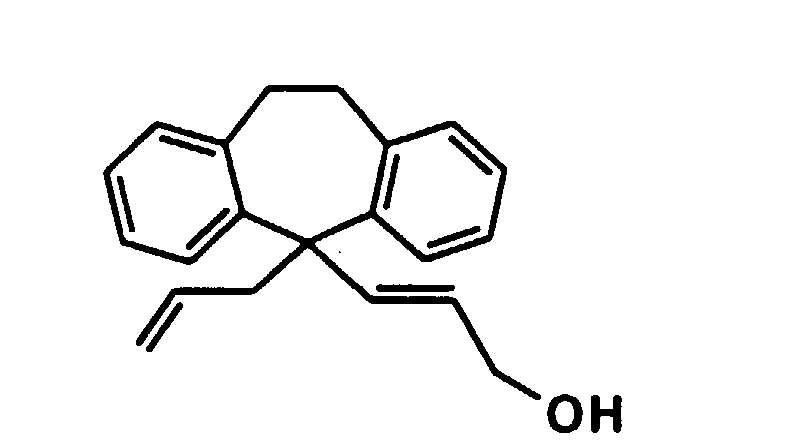
- Dissolved methyl 3-[10,11-dihydro-5-(2-propenyl)-5H-dibenzo[a,d]cyclohepten-5-yl]-propenoate (6.00 g, 0.0188 mol) in 80 mL of dry THF. Cooled to 0°C under a nitrogen atmosphere, and added lithium aluminum hydride (18.8 mL of 1.0 M in THF, 0.018 mol) via syringe. Warmed slowly to room temperature and stirred for 20 hours. Recooled to 0°C, and carefully added 0.8 mL water, 0.8 mL of 1 N NaOH, and then 2.5 mL of water in sequence. Stirred at room temperature for 1 hour, and filtered through celite. Washed filtrate with saturated NH4CI, dried with MgSO4, filtered, and evaporated. Purified crude product by flash chromatography on silica gel eluting with 1:4 ethyl acetate:hexane then 1:2 ethyl acetate:hexane. Combined appropriate fractions, and evaporated to give 4.87 g (89% yield) of 3-[10,11-dihydro-5-(2-propenyl)-5H-dibenzo[a,d]cyclohepten-5-yl]-prop-2-en-1-ol as a colorless oil.
mass spectrum: (Cl, CH4) m/e 291 (M+1)
- Dissolved 3-[10,11 -dihydro-5-(2-propenyl)-5H-dibenzo[a,d]cyclohepten-5-yl]-prop-2-en-1-ol (4.85 g, 16.70 mmol) in 75 mL of absolute ethanol. Added 10% palladium on carbon catalyst (1.20 g), and hydrogenated on Paar shaker at 58 psi of hydrogen pressure for 16 hours. Filtered to remove catalyst, and evaporated filtrate to give 4.43 g (90% yield) of 3-[10,11-dihydro-5-propyl-5H-dibenzo[a,d]cyclohepten-5-yl]-propanol as a colorless oil.
mass spectrum: (Cl, isobutane) m/e 295 (M+1)
- Dissolved oxalyl chloride (1.6 mL, 2.38 g, 0.0187 mol) in 40 mL of dry dichloromethane, and cooled to -78°C under a nitrogen atmosphere. Added dimethylsulfoxide (2.7 mL, 2.93 g, 0.0374 mol) dissolved in 10 mL of dry dichloromethane dropwise via addition funnel. Stirred for 15 mins at -78°C, and then added 3-[10,11-dihydro-5-propyl-5H-dibenzo[a,d]cyclohepten-5-yl]-propanol (4.41 g, 0.0150 mol) dissolved in 25 mL of dry dichloromethane dropwise via addition funnel. Stirred for 20 mins at -78°C, and then added triethylamine (6.3 mL, 4.55 g, 0.0449 mol). Warmed slowly to room temperature. Added water, and extracted with dichloromethane. Washed combined organic extracts with 0.5 N HCI and saturated NaCI, dried with MgSO4, filtered, and evaporated. Purified crude product by flash chromatography on silica gel eluting with 3% ethyl acetate-hexane, 6% ethyl acetate-hexane, and then 10% ethyl acetate-hexane. Combined appropriate fractions, and evaporated to give 3.85 g (88% yield) of 3-[10,11-dihydro-5-propyl-5H-dibenzo[a,d]cyclohepten-5-yl]-propanal as a colorless oil.
mass spectrum: (Cl, CH4) m/e 293 (M+1)
- Dissolved 3-[10,11-dihydro-5-propyl-5H-dibenzo[a,d]cyclohepten-5-yl]-propanal (0.75 g, 2.56 mmol) in 5 mL of dry THF and 10 mL of dry methanol. Added 3A sieves, dimethylamine hydrochloride (1.05 g, 12.82 mmol), and sodium cyanoborohydride (0.161 g, 2.56 mmol). Stirred to room temperature for 24 hours. Added saturated NaHCO3, and filtered through celite. Extracted filtrate with dichloromethane. Dried combined organic extracts with MgSO4, filtered, and evaporated. Purified crude product by flash chromatography on silica gel eluting with 3% MeOH-CH2Cl2 then 10% MeOH-CH2Cl2. Combined appropriate fractions, and evaporated to give 0.53 g (65% yield) of 10,11-dihydro-N,N-dimethyl-5-propyl-5H-dibenzo[a,d]cycloheptenepropanamine as an oil. Dissolved free base in dichloromethane, and added 28.8 weight% HCI-ethanol until acidic. Evaporated to give hydrochloride salt as a foam.
mass spectrum: (Cl, CH4) m/e 322 (M+1 for free base)
- Dissolved 10,11-dihydro-5-(2-propenyl)-5H-dibenzo[a,d]cyclohepten-5-nitrile (4.68 g, 0.018 mol) is 150 mL of absolute ethanol, and added sodium borohydride (1.70 g, 0.045 mol). Stirred at room temperature for 15 mins then cooled to 0°C. Added cobalt (II) chloride (4.29 g, 0.018 mol) portionwise. Stirred at room temperature for 30 mins then added additional sodium borohydride (1.70 g, 0.045 mol). Stirred at room temperature for 16 hours. Evaporated, and added 0.5 N HCI. Washed with ethyl acetate, and extracted organic solution with 1.0 N HCI. Combined acidic aqueous extracts, and made basic with 25 weight% NaOH. Extracted basic solution with dichloromethane. Dried combined organic extracts with MgSO4, filtered, and evaporated. Purified by flash chromatography on silica gel eluting with ethyl acetate. Combined appropriate fractions, and evaporated to give 1.4 g (30% yield) of 10,11-dihydro-5-propyl-5H-dibenzo[a,d]cycloheptene-5-methanamine as an oil. Dissolved free base in ethyl acetate, and added one equivalent of maleic acid dissolved in ethanol. Added ether to precipitate maleate salt.
mp=174-175°C
mass spectrum: (Cl, CH4) m/e 266 (M+1 for free base)
- Dissolved 10,11-dihydro-5-propyl-5H-dibenzo[a,d]cycloheptene-5-methanamine (1.0 g, 3.8 mmol) in 3.5 mL of 96% formic acid. Added 37% aqueous formaldehyde (1.4 mL, 0.57 g, 19.0 mmol). Heated at 100°C for 23 hours. Cooled to room temperature, and added 25 weight% NaOH. Extracted with dichloromethane. Dried combined organic extracts with MgSO4, filtered, and evaporated. Purified crude product by flash chromatography on silica gel eluting with 5% MeOH-CH2Cl2. Combined appropriate fractions, and evaporated to give 0.90 g (82% yield) of 10,11-dihydro-N,N-dimethyl-5-propyl-5H-dibenzo[a,d]cyclohepten-5-methanamine as an oil. Dissolved free base in ethanol, and added 28 weight% HCI-ethanol until acidic. Added hexane to precipitate hydrochloride salt. Recrystallized salt from ethanol-ether.
mp=220-221°C
mass spectrum: (Cl, CH4) m/e 294 (M+1 for free base)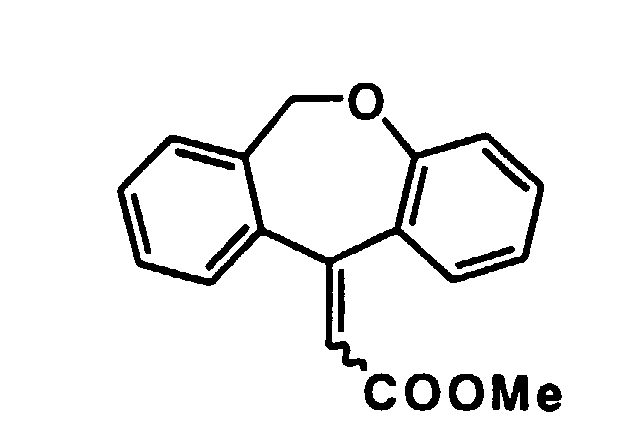
- Washed sodium hydride (5.71 g of 60 wt%, 0.143 mol) two times with hexane under a nitrogen atmosphere. Added 170 mL of dry DMF, and cooled to 0°C. Added trimethyl phosphonoacetate (25.99 g, 0.143 mol) dropwise via addition funnel. Hydrogen evolution was observed. Stirred at 0°C for 15 mins. then at room temperature for 15 mins. Added 6,11-dihydro-dibenz[b,e]oxepin-11-one (15.00 g, 0.0714 mol) dissolved in 70 mL of dry DMF, and heated reaction mixture in a 80°C oil bath for 45 hours. Cooled to room temperature, and added 250 mL of half saturated NH4CI. Extracted with ethyl acetate. Washed combined organic extracts with saturated NaHCO3, saturated NaCI, dried with MgSO4, filtered, and evaporated. Purified crude product by flash chromatography on silica gel eluting with a gradient of 5% ethyl acetate-hexane, 7% ethyl acetate-hexane, then 20% ethyl acetate-hexane. Combined appropriate fractions and evaporated to give 3.16 g (21% yield) of starting ketone and 13.16 g (69% yield) of methyl 6,11-dihydro-dibenz[b,e]oxepin-11-ylidene acetate.
mass spectrum: (Cl, isobutane) m/e 267 (M+1)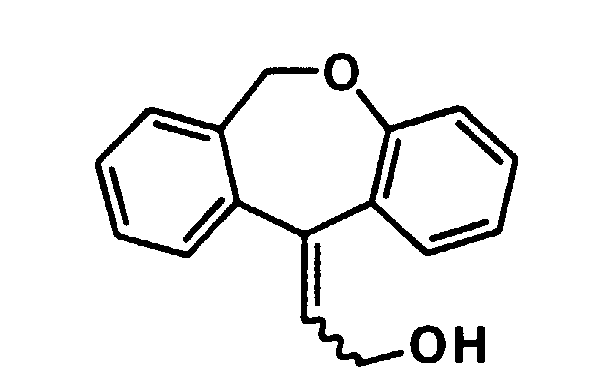
- Dissolved methyl 6,11-dihydro-dibenz[b,e]oxepin-11-ylidene acetate (12.68 g, 0.0476 mol) in 100 mL of dry dichloromethane, and cooled to -78°C under a nitrogen atmosphere. Added 1 M diisobutylaluminum hydride in dichloromethane (104.8 mL, 0.105 mol) dropwise via addition funnel over 30 mins. Stirred at -78°C for 45 mins. then at 0°C, and warmed slowly to room temperature. Recooled to 0°C, and carefully added 200 mL of 1N HCI. Separated layers, and extracted aqueous solution with dichloromethane. Washed combined organic extracts with saturated NaCI, dried with MgSO4, filtered, and evaporated. Purified crude product by flash chromatography on silica gel eluting with 1:2 ethyl acetate:hexane. Combined appropriate fractions, and evaporated to give 11.17 g (98% yield) of 2-[6,11-dihydro-dibenz[b,e]oxepin-11-ylidene]-ethanol as a yellow oil.
mass spectrum: (FAB) m/e 238 (M+)
- Dissolved 2-[6,11-dihydro-dibenz[b,e]oxepin-11-ylidene]-ethanol (10.90 g, 0.0457 mol) in 175 mL of dichloromethane. Added ethanol (21.07 g, 26.8 mL, 0.457 mol), and cooled to 0°C under a nitrogen atmosphere. Added N-bromosuccinimide (8.96 g, 0.0503 mol) portionwise. Warmed slowly to room temperature over 60 mins. Added 200 mL of saturated NaHCO3, and separated layers. Extracted aqueous solution with dichloromethane. Dried combined organic extracts with MgSO4, filtered, and evaporated. Purified crude product by flash chromatography on silica gel eluting with 1:4 ethyl acetate:hexane. Combined appropriate fractions, and evaporated to give 14.35 g (86% yield) of 2-bromo-2-[6,11-dihydro-11-ethoxy-dibenz[b,e]oxepin-11-yl]-ethanol as a light yellow oil.
mass spectrum: (Cl, isobutane) m/e 363 (M+)
- Dissolved 2-bromo-2-[6,11-dihydro-11-ethoxy-dibenz[b,e]oxepin-11-yl]-ethanol (14.34 g, 0.0395 mol) in 150 mL of dry toluene. Added tri-n-butyl tin hydride (17.24 g, 15.9 mL, 0.0592 mol) and AIBN (0.324 g, 0.00197 mol). Refluxed under a nitrogen atmosphere for 18 hours. Cooled to room temperature, and evaporated. Dissolved residue in 300 mL of acetonitrile, and washed with hexane to remove tin by-products. Dried acetonitrile solution with MgSO4, filtered, and evaporated. Purified crude product by flash chromatography on silica gel eluting with 1:4 ethyl acetate:hexane then 1:3 ethyl acetate:hexane. Combined appropriate fractions, and evaporated to give 6.22 g (55% yield) of 2-[6,11-dihydro-11-ethoxy-dibenz[b,e]oxepin-11-yl]-ethanol as a colorless oil.
mass spectrum: (FAB) m/e 284 (M+)
- Dissolved oxalyl chloride (3.62 g, 2.5 mL, 0.0285 mol) in 30 mL of dry dichloromethane, and cooled to -78°C under a nitrogen atmosphere. Added dimethylsulfoxide (4.45 g, 4.0 mL, 0.0570 mol) in 10 mL of dry dichloromethane dropwise via addition funnel. Carbon monoxide and carbon dioxide evolution observed. Stiired at -78°C for 15 mins. Added 2-[6,11-dihydro-11-ethoxy-dibenz[b,e]oxepin-11-yl]-ethanol (6.75 g, 0.0237 mol) dissolved in 30 mL of dry dichloromethane dropwise via addition funnel. Stirred at -78°C for 15 mins. then added triethylamine (7.21 g, 9.9 mL, 0.0712 mol). Warmed slowly to room temperature. Added 150 mL of water, and separated layers. Extracted aqueous solution with dichloromethane. Washed combined organic extracts with 0.5 N HCI and then saturated NaCI, dried with MgSO4, filtered, and evaporated. Purified crude product by flash chromatography on silica gel eluting with 5% ethyl acetate-hexane then 10% ethyl acetate-hexane. Combined appropriate fractions, and evaporated to give 3.47 g (52% yield) of 2-[6,11-dihydro-11-ethoxy-dibenz[b,e]oxepin-11-yl]-ethanal as a colorless oil.
mass spectrum: (FAB) m/e 282 (M+)
- Dissolved 2-[6,11-dihydro-11-ethoxy-dibenz[b,e]oxepin-11-yl]-ethanal (500 mg, 1.77 mmol) in 2 mL of dry THF and 6 mL of dry methanol. Added 3 A sieves, pyrrolidine hydrochloride (952 mg, 8.85 mmol), and then sodium cyanoborohydride (111 mg, 1.77 mmol). Stirred at room temperature under a drying tube for 24 hours. Added 30 mL of saturated K2CO3 and 15 mL of dichloromethane. Filtered through celite, and separated layers. Extracted aqueous solution with dichloromethane. Dried combined organic extracts with MgSO4, filtered, and evaporated. Purified crude product by flash chromatography on silica gel eluting with 3% MeOH-CH2Cl2 then 10% MeOH-CH2Cl2. Combined appropriate fractions, and evaporated to give 0.21 g (35% yield) of 1-[2-(11-ethoxy-6,11-dihydrodibenz[b,e]oxepin-11-yl)ethyl]pyrrolidine as a colorless oil. Dissolved free base in ethyl acetate, and added one equivalent of maleic acid dissolved in ethanol. Evaporated, added ethyl acetate, and evaporated again. Added ether to precipitate maleate salt.
mp=108-110°C (foams)
mass spectrum: (FAB) m/e 338 (M+1 for free base) - The following compounds were obtained according to a similar manner:
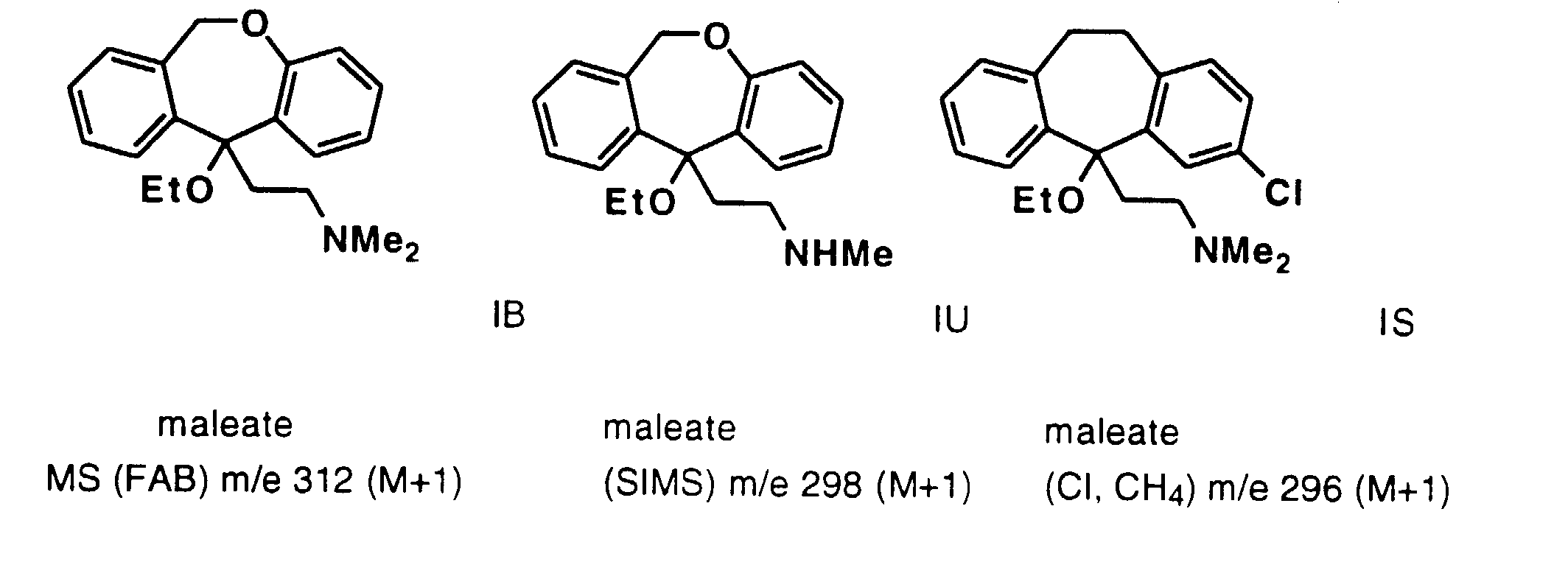
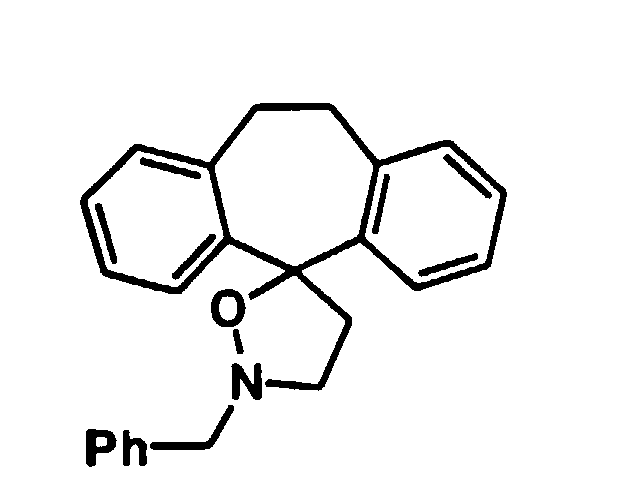
- Dissolved 1-methylene-2,3,6,7-dibenzo-2,6-cyclopheptadiene (2.0 g, 9.7 mmol), N-benzylhydroxylamine hydrochloride (1.91 g, 12.0 mmol), triethylamine (1.21 g, 1.7 mL, 12.0 mmol), and paraformaldehyde (0.36 g, 12.0 mmol) in 40 mL of absolute ethanol. Refluxed reaction mixture for 75 hours, and cooled to room temperature. Evaporated, and added water. Extracted aqueous solution with dichloromethane. Dried combined organic extracts with MgSO4, filtered, and evaporated. Purified crude product by flash chromatography on silica gel eluting with 10% CH2Cl2-hexane. Combined appropriate fractions, and evaporated to give 2.7 g (82% yield) of 10,11-dihydro-2'-phenylmethylspiro[5H-dibenzo[a,d]cycloheptene-5,5'-isoxazolidine as a white solid.
mp=108-111°C
mass spectrum: (FAB) m/e 342 (M+1)
- Suspended 10,11-dihydro-2'-phenylmethylspiro[5H-dibenzo[a,d]cycloheptene-5,5'-isoxazolidine (4.1 g, 11.7 mmol) in 400 mL of methanol. Added 10% palladium on carbon (2.0 g) and ammonium formate (3.8 g, 60.3 mmol) dissolved in 100 mL of methanol. Heated reaction mixture at 70°C for 3 hours. Filtered reaction mixture while hot, and washed catalyst with methanol. Evaporated filtrate, and added saturated NaHCO3. Extracted aqueous solution with dichloromethane. Dried combined organic extracts with MgSO4, filtered, and evaporated. Purified crude product by flash chromatography on silica gel eluting with acetonitrile. Combined appropriate fractions, and evaporated to give 2.20 g (72% yield) of 10,11 -dihydro-5-(2-aminoethyl)-5H-dibenzo[a,d]cyclohepten-5-ol as a white solid.
mp=104-107°C
mass spectrum: (electrospray) m/e 254 (M+1)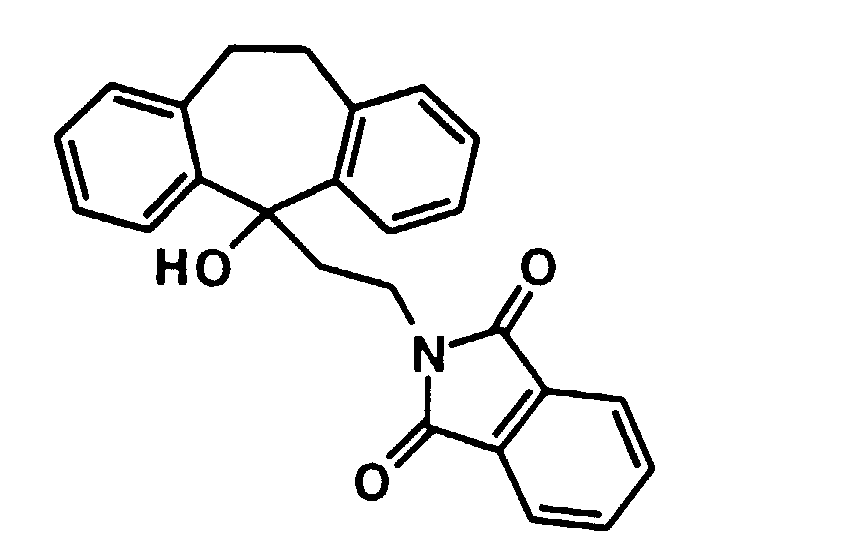
- Dissolved 10,11-dihydro-5-(2-aminoethyl)-5H-dibenzo[a,d]cyclohepten-5-ol (3.58 g, 14.1 mmol) and phthalic anhydride (2.1 g, 14.1 mmol) in 30 mL of pyridine, and refluxed for 15 hours. Removed pyridine by evaporation, and added saturated NaHCO3. Extracted aqueous solution with dichloromethane. Washed the combined organic extracts with 1 N HCI and then water, dried with MgSO4, filtered, and evaporated. Crystallized product from ether to give 4.50 g (83% yield) of 6-[2-(10,11-dihydro-5-hydroxy-5H-dibenz[a,d]cyclohepten-5-yl)ethyl]-5H-[pyrrolo[3,4-b]pyridine-5,7(6H)-dione as a white solid.
mp=152-154°C
mass spectrum: (FAB) m/e 384 (M+1)
- Washed sodium hydride (0.36 g, 9 mmol, 60 weight % in oil) two times with hexane under a nitrogen atmosphere. Added 5 mL of dry dioxane and then 6-[2-(10,11-dihydro-5-hydroxy-5H-dibenz[a,d]cyclohepten-5-yl)ethyl]-5H-[pyrrolo[3,4-b]pyridine-5,7(6H)-dione (1.15 g, 3 mmol) dissolved in 30 mL of dry dioxane dropwise. Refluxed the reaction mixture for 1 hour. Added ethyl iodide (1.4 g, 0.72 mL, 9 mmol) via syringe, and refluxed for 15 hours. Cooled to room temperature, and evaporated. Added water, and extracted with dichloromethane. Washed combined organic extracts with saturated NaCI, dried with MgSO4, filtered, and evaporated. Purified crude product by chromatography on silica gel eluting with dichloromethane. Combined appropriate fractions, and evaporated to give 0.37 g (30% yield) of 6-[2-(10,11-dihydro-5-ethoxy-5H-dibenz[a,d]cyclohepten-5-yl)ethyl]-5H-[pyrrolo[3,4-b]pyridine-5,7(6H)-dione.
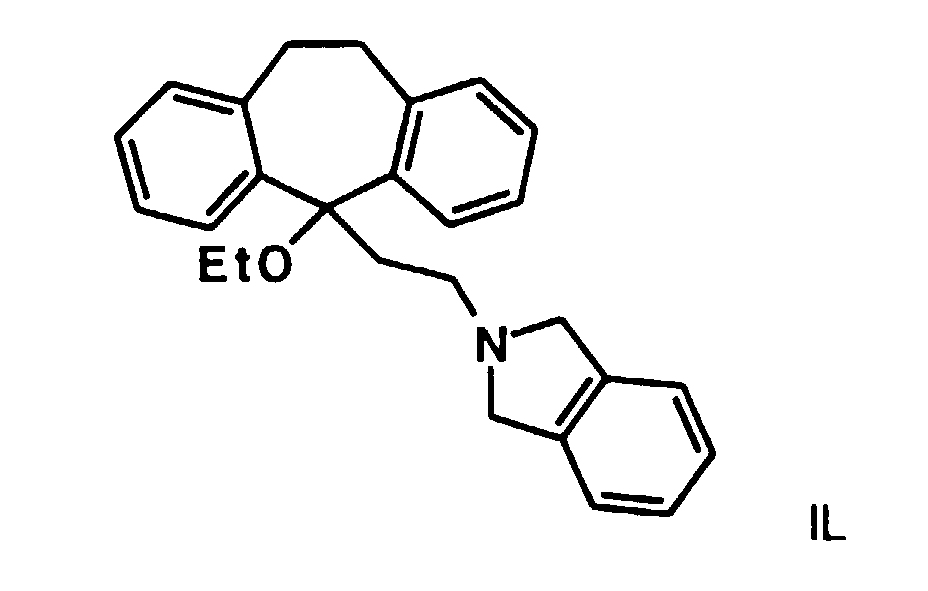
- Dissolved lithium aluminum hydride (0.15 g, 3.95 mmol) in 5 mL of dry tetrahydrofuran under a nitrogen atmosphere. Added 6-[2-(10,11-dihydro-5-ethoxy-5H-dibenz[a,d]cyclohepten-5-yl)ethyl]-5H-[pyrrolo[3,4-b]pyridine-5,7(6H)-dione (0.35 g, 0.85 mmol) dissolved in 20 mL of dry tetrahydrofuran dropwise via addition funnel. Refluxed reaction mixture for 8 hours, and then cooled to 0°C. Carefully added 0.2 mL of water, 0.2 mL of 15 weight % NaOH, and then 0.6 mL of water to precipitate the aluminum salts. Filtered precipitate, and washed with tetrahydrofuran. Evaporated filtrate. Purified crude product by flash chromatography on silica gel eluting with CH2Cl2 then 3% MeOH-CH2Cl2. Combined appropriate fractions and evaporated to give 0.19 g (59% yield) of 2-[2-[5-ethoxy-10,11-dihydro-5H-dibenzo[a,d]cyclohepten-5-yl]ethyl]-1,3-dihydro-2H-isoindole as a pink solid.
mp=101-104°C
mass spectrum: (Cl, CH4) m/e 384 (M+1) - The following compound was obtained according to a similar manner:
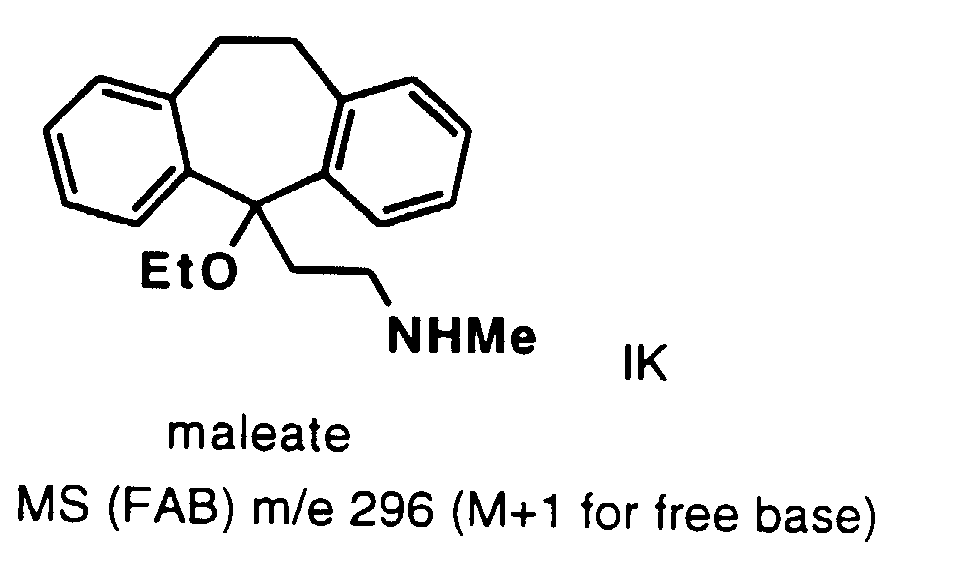
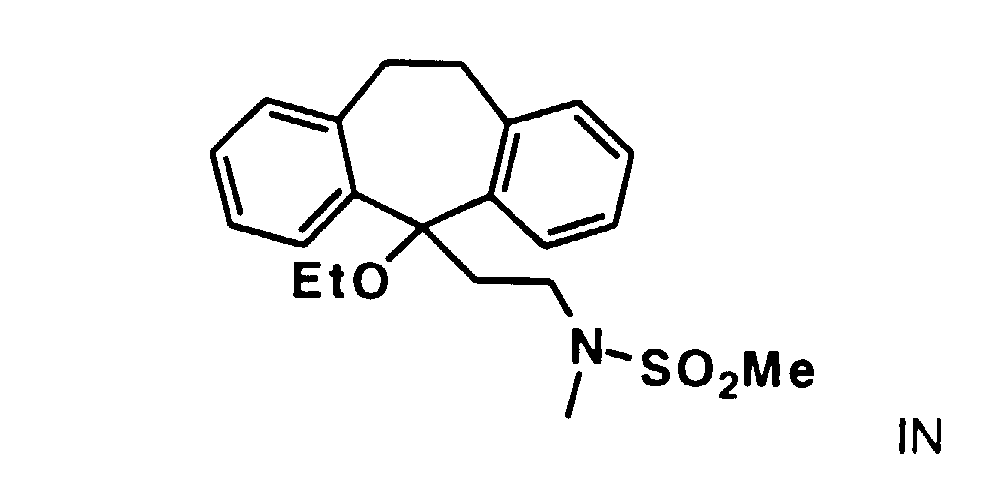
- Dissolved N-[2-(5-ethoxy-10,11-dihydro-5H-dibenzo[a,d]cyclohepten-5-yl)ethyl]-N-methylamine (150 mg, 0.508 mmol) in 5 mL of dry dichloromethane. Cooled to 0°C under a nitrogen atmosphere, and added triethylamine (0.14 mL, 0.10 g, 1.0 mmol) and then methanesulfonyl chloride (0.06 mL, 0.089 g, 0.76 mmol) dropwise via syringe. Stirred at 0°C for 90 mins. Added water, and extracted with dichloromethane. Washed the combined organic extracts with sodium phosphate monobasic, 1 N NaOH, and then saturated NaCI. Dried with MgSO4, filtered, and evaporated. Purified crude product by flash chromatography eluting with 9:1 hexane:ethyl acetate. Combined appropriate fractions, and evaporated to solid. Recrystallized from ethyl acetate-hexane to give 92 mg (48% yield) of N-[2-(5-ethoxy-10,11-dihydro-5H-dibenzo[a,d]cycloheptenyl)ethyl]-N-methylmethanesulfonamide as a white solid.
mp=72.5-73.5°C
mass spectrum: (FAB) m/e 396 (M+1+Na) - The following compounds were obtained according to a similar manner:

R mp Mass Spectrum SO2Ph oil (FAB) m/e 436 (M+1) COMe 106-109°C (FAB) m/e 338 (M+1) COOEt oil (FAB) m/e 368 (M+1) CH2COOEt oil (Cl, CH4) m/e 382 (M+1) CH2CH2OCH2CH2OH oil (Cl, NH3) m/e 384 (M+1) COPh(4-COOMe) oil (FAB) m/e 458 (M+1) CO(4-pyridine-N-oxide) oil (FAB) m/e 417 (M+1) 
- Dissolved N-[2-[5-ethoxy-10,11-dihydro-5H-dibenzo[a,d]cyclohepten-5-yl]ethyl]-N-methyl-4-methoxycarbonylbenzamide (145 mg, 0.32 mmol) in 12 mL of methanol. Added 12 mL of 2 N KOH, and stirred at room temperature for 60 mins. Added sodium phosphate monobasic, and extracted with ethyl acetate. Washed combined organic extracts with saturated NaCI, dried with MgSO4, filtered, and evaporated to give 113 mg (80% yield) of 4-[[N-[2-[5-ethoxy-10,11-dihydro-5H-dibenzo[a,d]cyclohepten-5-yl]ethyl]-N-methyl]oxo]benzoic acid as a white solid.
mp=148-150°C
mass spectrum: (FAB) m/e 444 (M+1) - The following compound was obtained according to a similar manner:
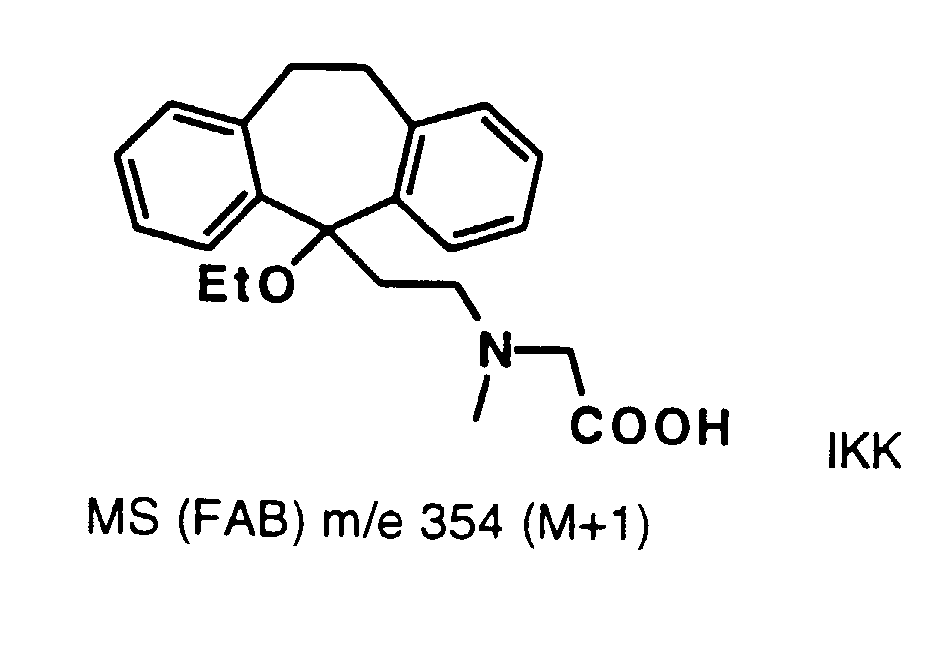
- As mentioned above, the compounds of formula I exhibit good anti-TNF-α activity. The compounds of the invention are, therefore, useful when TNF-α activity is a factor in a given disease or disorder such as in the case of septic shock and various allergic diseases and inflammatory conditions.
- The anti-TNF-α properties of the compounds of the present invention may be demonstrated by use of a standard in vitro pharmacological testing procedure as described below. This test procedure is a standard test used to determine anti-TNF-α activity and to evaluate the usefulness of said compounds for counteracting the biological effects of TNF-α.
-
- 1) Cells (obtained from cell cultures containing ≤106 cells/ml) are suspended at 0.2x10⁶ cells/ml in complete medium (RPMI1640, with 10% FCS, 10-5 M 2-ME, 2 mM glutamine and 10 mM HEPES buffer) and plated in CoStar 24 well plates (1.0 ml/well).
- 2) Compounds are dissolved in the appropriate vehicle at 400 times the concentration to be tested, and 5 µl of compound is added to the wells.
- 3) LPS (from E. coli 0111:84) is diluted to 6 µg/ml and 1.0 ml is added to wells.
- 4) Plates are incubated 20-24 hours in 37° CO2 incubator.
- 5) Supernatant fluids are collected and analyzed for TNF content as described in J. Immunol., 142:3884.
-
- The results of this procedure are shown in TABLE 1 below.
COMPOUND % INHIBITION AT 10µM IA 51 IB 33 IC 60 ID 62 IE 67 IF 68 IG 60 IH 77 IJ 48 IK 60 IL 53 IM 54 IN 19 IO 66 IP 44 IQ 68 IR 61 IT 14 IU 25 IV 34 IW 47 IX 29 IY 17 IZ 37 IAA 56 IBB 45 ICC 42 IDD 59 IEE 23 IFF 44 IGG 4 IHH 40 IJJ 53 IKK 13 ILL 50 IMM 70 INN 75 IOO 16 IPP 52 IQQ 42 IRR 48 ISS 67 ITT 4 IUU 29 IVV 14 - in addition to the in vitro test described above, the following in vivo test was also performed on several of the compounds of the present invention. Although the individual reported values may be subject to a wide margin of error, collectively the in vivo data demonstrates that the compounds of the invention are inhibitors of TNF-α in a mammalian species.
-
- 1) Mice (C57BI/6J males, 6 - 8 weeks of age) are dosed with the indicated compound (dissolved in CMC suspension vehicle; compounds are given orally or i.p. one hour before LPS challenge).
- 2) Mice are challenged with LPS (from E. coli 0111:B4; 50 µg i.p.).
- 3) Mice are bled 90 min after LPS challenge.
- 4) Sera are analyzed for TNF content by ELISA as described in J. Immunol. 142:3884.
-
- Results are shown in TABLE 2 below.
Compound % of inhibition at 25 mg/kg IA 69 IB 70 IC 65 ID 67 IE 48 IF 34 IK 40 IM 58 IO 47 IP 52 IR 36 IU 21 IX 3 IZ 0 IAA 38 IBB 34 IDD 31 IEE 38 IFF 0 IGG 0 ILL 44 IMM 32 IRR 38 - The effect of the compounds of the present invention against septic shock may be demonstrated by use of a standard pharmacological testing procedure as described below. This test procedure is a standard test used to determine activity against septic shock.
-
- 1) Mice (C57BI/6J males, 6 - 8 weeks of age) are dosed with the indicated compound (dissolved in CMC suspension vehicle; compounds are given orally or i.p. one hour before challenge with LPS and d-galactosamine).
- 2) Mice are challenged i.p. with a mixture of LPS (from E. coli 0111:B4; 100 ng) and d-galactosamine (8 mg).
- 3) Survival is determined 24 hours after challenge. See procedure published in J. Exp. Med. 165:657 (1987)
-
- Results are shown in TABLE 3 below.
Compound # dead/total at 25 mg/kg IA 0/8 IB 0/9 IC 1/9 IE 0/9 IJ 8/8 IK 0/9 IM 1/8 IN 6/9 IO 5/9 IP 9/9 IS 3/10 IT 9/9 IU 8/9 IW 8/10 IX 9/10 IZ 8/10 IAA 5/10 IBB 10/10 IDD 9/10 IEE 8/10 IFF 9/9 IGG 10/10 ILL 3/10 IMM 0/10 - For preparing pharmaceutical compositions from the compounds described by this invention, inert, pharmaceutically acceptable carriers can be either solid or liquid. Solid form preparations include powders, tablets, dispersible granules, capsules, cachets and suppositories. The powders and tablets may be comprised of from about 5 to about 70 percent active ingredient. Suitable solid carriers are known in the art, e.g. magnesium carbonate, magnesium stearate, talc, sugar, lactose. Tablets, powders, cachets and capsules can be used as solid dosage forms suitable for oral administration.
- For preparing suppositories, a low melting wax such as a mixture of fatty acid glycerides or cocoa butter is first melted, and the active ingredient is dispersed homogeneously therein as by stirring. The molten homogeneous mixture is then poured into convenient sized molds, allowed to cool and thereby solidify.
- Liquid form preparations include solutions, suspensions and emulsions. As an example may be mentioned water or water-propylene glycol solutions for parenteral injection.
- Liquid form preparations may also include solutions for intranasal administration.
- Aerosol preparations suitable for inhalation may include solutions and solids in powder form, which may be in combination with a pharmaceutically acceptable carrier, such as an inert compressed gas.
- Also included are solid form preparations which are intended to be converted, shortly before use, to liquid form preparations for either oral or parenteral administration. Such liquid forms include solutions, suspensions and emulsions.
- The compounds of the invention may also be deliverable transdermally. The transdermal compositions can take the form of creams, lotions, aerosols and/or emulsions and can be included in a transdermal patch of the matrix or reservoir type as are conventional in the art for this purpose.
- Preferably the compound is administered orally.
- Preferably, the pharmaceutical preparation is in unit dosage form. In such form, the preparation is subdivided into unit doses containing appropriate quantities of the active component, e.g., an effective amount to achieve the desired purpose.
- The quantity of active compound in a unit dose of preparation may be varied or adjusted from about 0.1 mg to 1000 mg, more preferably from about 11mg. to 300 mg, according to the particular application.
- The actual dosage employed may be varied depending upon the requirements of the patient and the severity of the condition being treated. Determination of the proper dosage for a particular situation is within the skill of the art. Generally, treatment is initiated with smaller dosages which are less than the optimum dose of the compound. Thereafter, the dosage is increased by small increments until the optimum effect under the circumstances is reached. For convenience, the total daily dosage may be divided and administered in portions during the day if desired.
- The amount and frequency of administration of the compounds of the invention and the pharmaceutically acceptable salts thereof will be regulated according to the judgment of the attending clinician considering such factors as age, condition and size of the patient as well as severity of the symptoms being treated. A typical recommended dosage regimen is oral administration of from 10 mg to 2000 mg/day preferably 10 to 1000 mg/day, in two to four divided doses to achieve relief of the symptoms.
- The following are examples of pharmaceutical dosage forms which contain a compound of the invention. As used therein, the term "active compound" is used to designate the compound
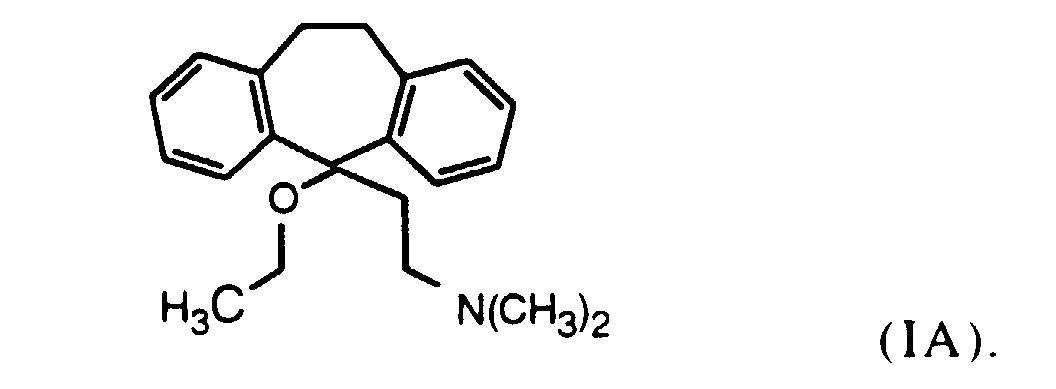
- The scope of the invention in its pharmaceutical composition aspect is not to be limited by the examples provided, since any other compound of Formula I can be substituted into the pharmaceutical composition examples.
-
Tablets No. Ingredients mg/tablet mg/tablet 1. Active compound 100 500 2. Lactose USP 122 113 3. Corn Starch, Food Grade, as a 10% paste in Purified Water 30 40 4. Corn Starch, Food Grade 45 40 5. Magnesium Stearate 3 7 Total 300 700 - Mix Item Nos. 11and 2 in a suitable mixer for 10-15 minutes. Granulate the mixture with Item No. 3. Mill the damp granules through a coarse screen (e.g., 1/4", 0.63 cm) if necessary. Dry the damp granules. Screen the dried granules if necessary and mix with Item No. 4 and mix for 10-15 minutes. Add Item No. 5 and mix for 1-3 minutes. Compress the mixture to appropriate size and weigh on a suitable tablet machine.
-
Capsules No. Ingredient mg/capsule mg/capsule 1. Active compound 100 500 2. Lactose USP 106 123 3. Corn Starch, Food Grade 40 70 4. Magnesium Stearate NF 7 7 Total 253 700 - Mix Item Nos. 1, 2 and 3 in a suitable blender for 10-15 minutes. Add Item No. 4 and mix for 1-3 minutes. Fill the mixture into suitable two-piece hard gelatin capsules on a suitable encapsulating machine.
Claims (32)
- A compound of Formula I:or a pharmaceutically acceptable salt or solvate thereof, wherein:
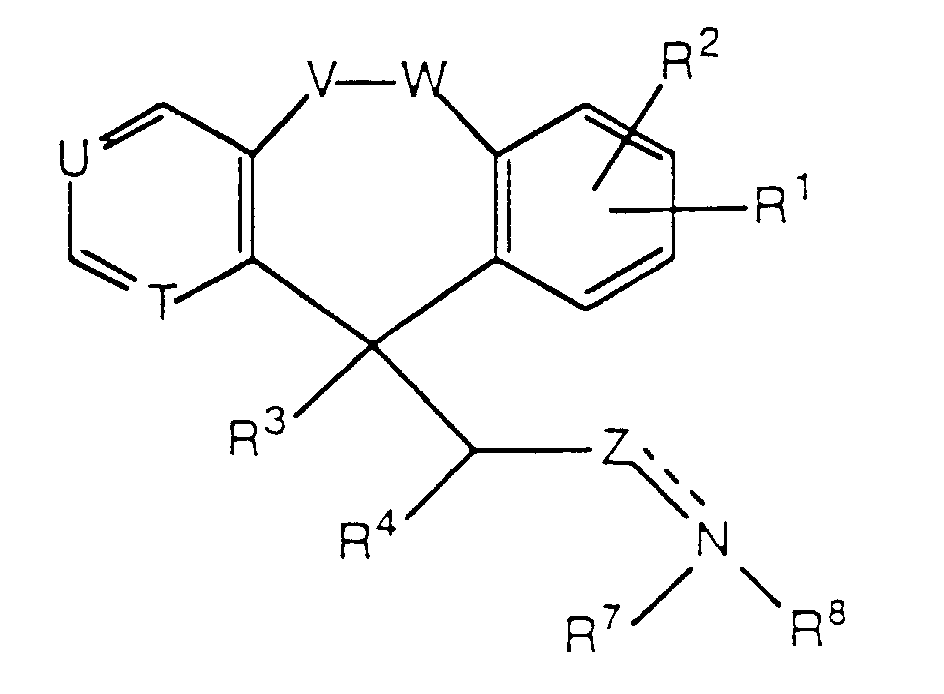 wherein, unless otherwise specified, the following terms are defined as follows:one of T and U represents N and the other represents =CH ; or each of T and U represents =CH-;one of V and W represents oxygen and the other represents -CH2-; or each of V and W represents -CH2-;R1 and R2 are each independently selected from the group consisting of H and halogen;R3 is alkyl, alkenyl, alkynyl, aryl, alkaryl, aralkyl, cycloalkyl, acyloxymethyl, alkoxy, alkoxymethyl, or alkyl substituted with cycloalkyl;R4 is H, alkyl, alkenyl, alkoxy, or -OH;Z--------N represents an optional double bond; when Z--------N is a double bond, Z represents -CH =, or -CH2C(R5)=, wherein R5 is H or lower alkyl; and R7 and R8 together represent OR9;when Z--------N represents a single bond, Z represents a direct bond, -CH2, -CH=CH-, or -CH2C(R5)(R6)-, wherein R5 and R6 are independently H or C1 to C6 lower alkyl (provided that, when R3 is -CH3, Z is not -(CH2)2-); and R7 and R8 are independently H, alkyl, alkenyl, alkynyl, aryl, alkaryl, aralkyl, cycloalkyl, -OR9; -C(O)OR10; -CH2C(O)OR9; -C(O)R10; -SO2R10; -CO-4-pyridyl-N-oxide; -(CH2)n-N(CH3)2, where n is 2 to 4; -(CH2)mO(CH2)jOH, where m and j are independently 2 or 3;or R7 and R8 together form either a five-membered or a six-membered ring optionally substituted with COOR9; a six-membered ring containing NR10; or a five-membered ring fused to a benzene ring;
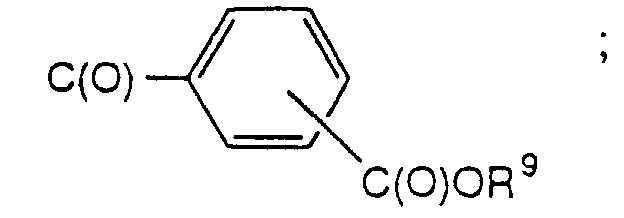 R9 is H or C1 to C6 lower alkyl; andR10 is alkyl or aryl;with the proviso that where U represents -CH =; T represents N; R1, R2, R3 and R4 represent H; Z represents CH2; and R7 and R8 each represents methyl; then one of V and W represents oxygen and the other represents -CH2-.alkyl (including alkyl portions of alkoxy and cycloalkyl) represents straight and branched carbon chains and contains from one to twenty carbon atomsalkenyl (including alkenyl portions of cycloalkenyl) represents straight and branched carbon chains having at least one carbon to carbon double bond and containing from 2 to 12 carbon atomsalkynyl represents straight and branched carbon chains having at least one carbon to carbon triple bond and containing from 2 to 12 carbon atoms;
 - A compound according to Claim 1, wherein R3 is alkoxy.
- A compound according to Claim 2, wherein R3 is ethoxy.
- A compound according to Claim 3, wherein R7 and R8 are independently H, alkyl, alkenyl, alkynyl, aryl, alkaryl, or aralkyl.
- A compound according to Claim 4 having the following structure:

- A compound according to Claim 4 having the following structure:
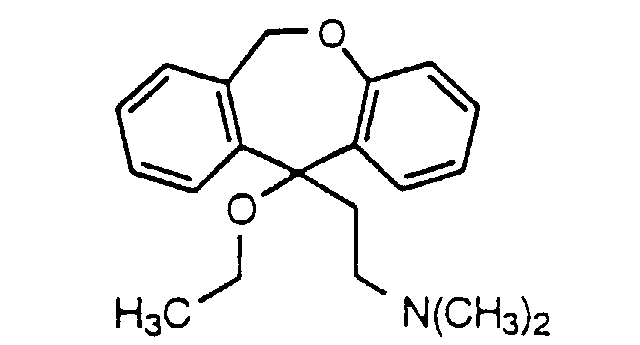
- A compound according to Claim 1, wherein R3 is alkyl.
- A compound according to Claim 7, wherein R3 is alkyl having from two to six carbon atoms.
- A compound according to Claim 8, wherein R3 is propyl.
- A compound according to Claim 9, wherein R7 and R8 are independently H, alkyl, alkenyl, alkynyl, aryl, alkaryl, or aralkyl.
- A compound according to Claim 10 having the following structure:

- A compound according to Claim 10 having the following structure:

- A compound according to Claim 1, wherein R3 is allyl.
- A compound according to Claim 13, wherein R7 and R8 are independently H, alkyl, alkenyl, alkynyl, aryl, alkaryl, or aralkyl.
- A compound according to Claim 14 having the following structure:

- A compound according to Claim 1, wherein R3 is cyclopropylmethyl.
- A compound according to Claim 16 having the following structure:

- A compound according to Claim 1, wherein R3 is alkoxy, Z--------N represents a single bond, and Z is -CH2-.
- A compound according to Claim 1, wherein R3 is alkyl, Z--------N represents a single bond, and Z is -CH2-.
- A compound according to Claim 1, wherein R3 is allyl, Z--------N represents a single bond, and Z is -CH2-.
- A compound according to Claim 1, wherein each of and U represents =CH-.
- A pharmaceutical composition comprising an effective amount of a compound of Claim 1 in combination with a pharmaceutically acceptable carrier.
- A compound as claimed in Claim 1 for use as a medicament for inhibiting tumor necrosis factor-α.
- A compound as claimed in Claim 1 for use as a medicament for treating inflammation.
- A compound as claimed in Claim 1 for use as a medicament for treating septic shock.
- A compound as claimed in Claim 1 for use as a medicament for treating allergy.
- A pharmaceutical composition according to Claim 22 comprising an effective amount of a compound of the following structure IA in combination with a pharmaceutically acceptable carrier:
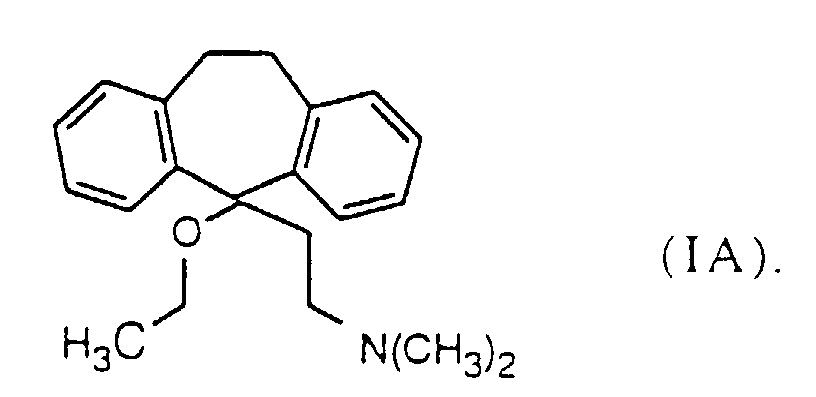
- A compound having the structure IA as defined in Claim 27 for use as a medicament for inhibiting tumor necrosis factor-α.
- A compound having the structure IA as defined in Claim 27 for use as a medicament for treating inflammation.
- A compound having the structure IA as defined in Claim 27 for use as a medicament for treating septic shock.
- A compound having the structure IA as defined in Claim 27 for use as a medicament for treating allergy.
- A compound according to Claim 1 having a structure selected from the group of structures consisting of:
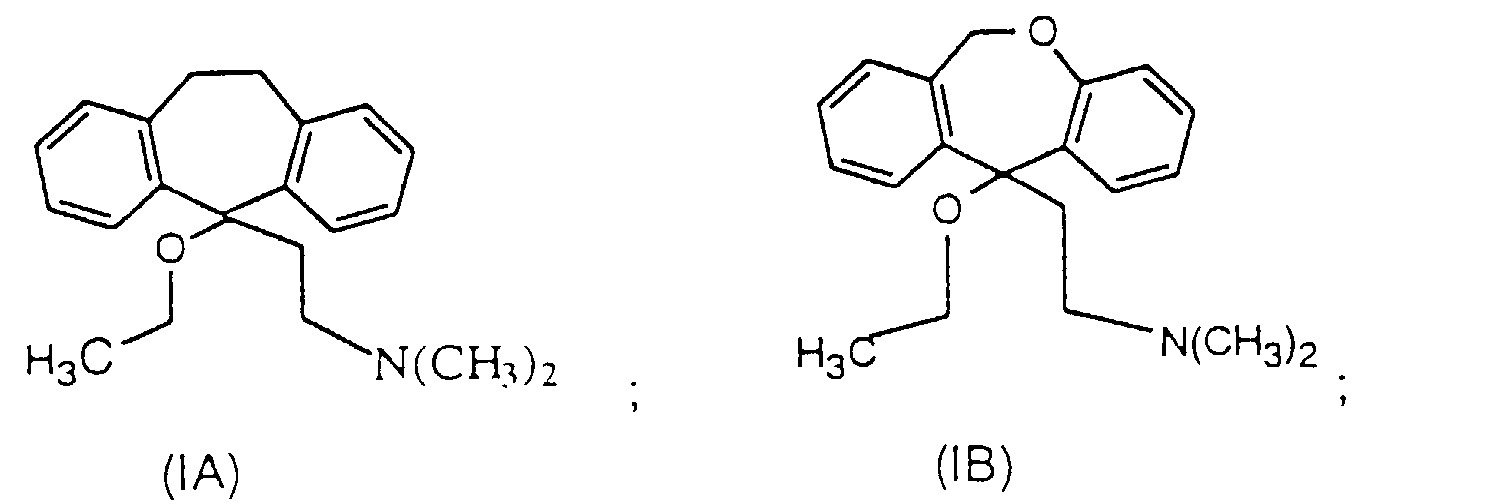

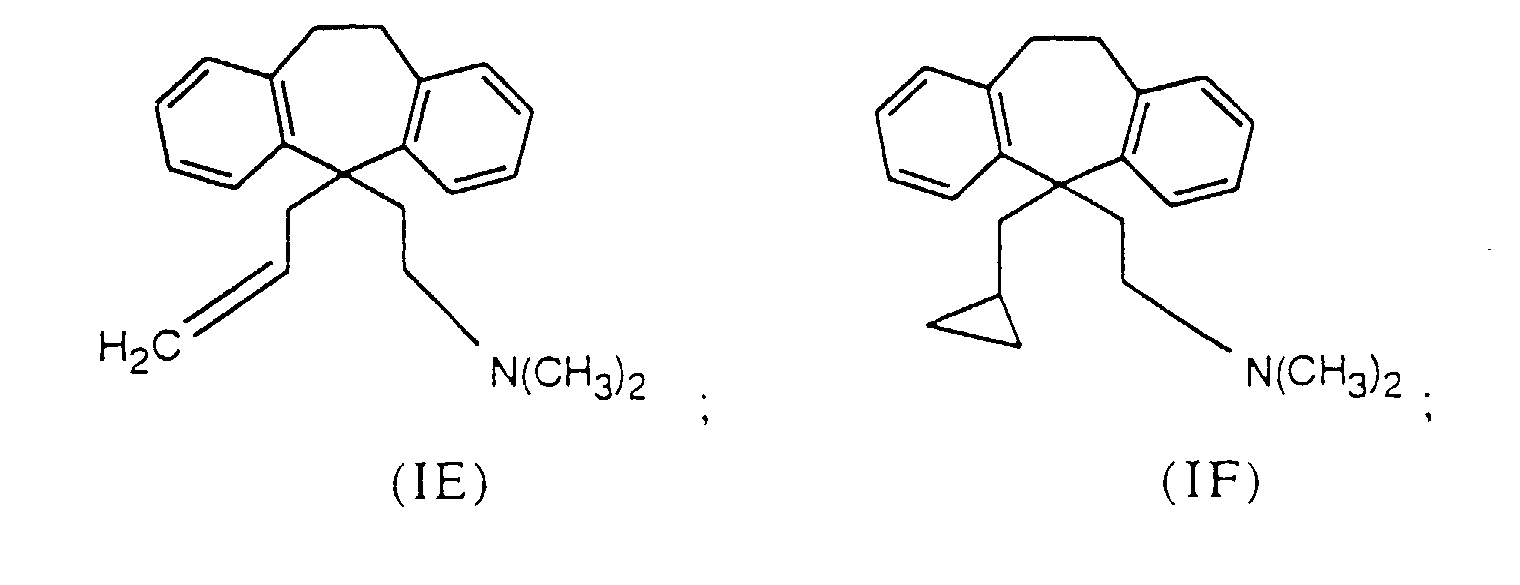
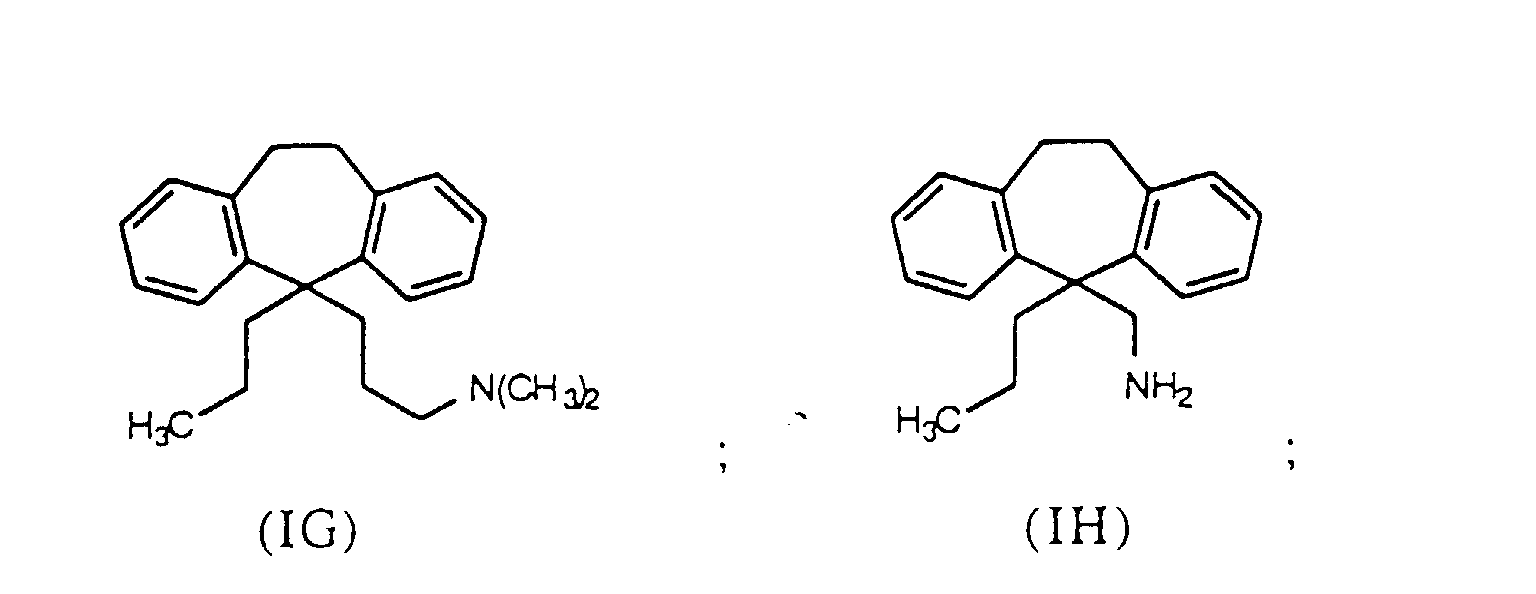


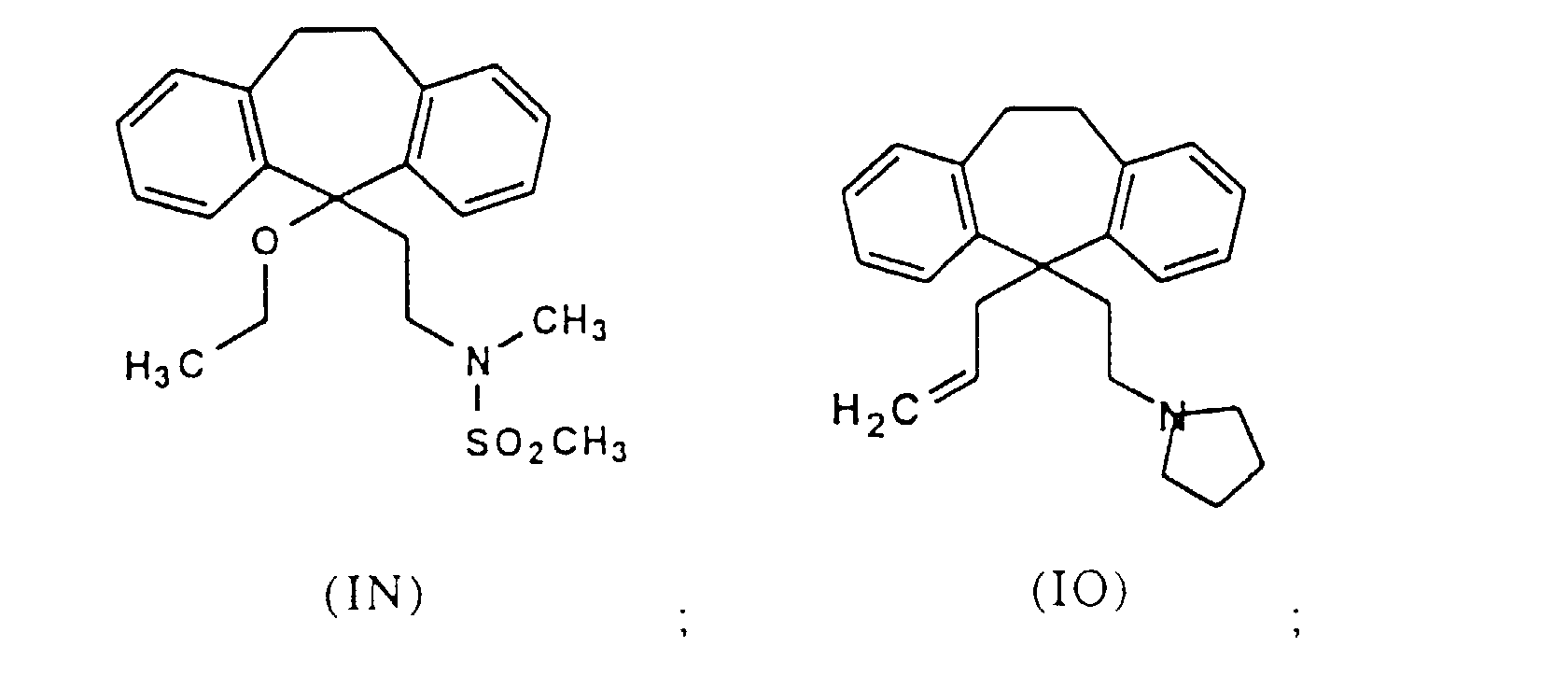

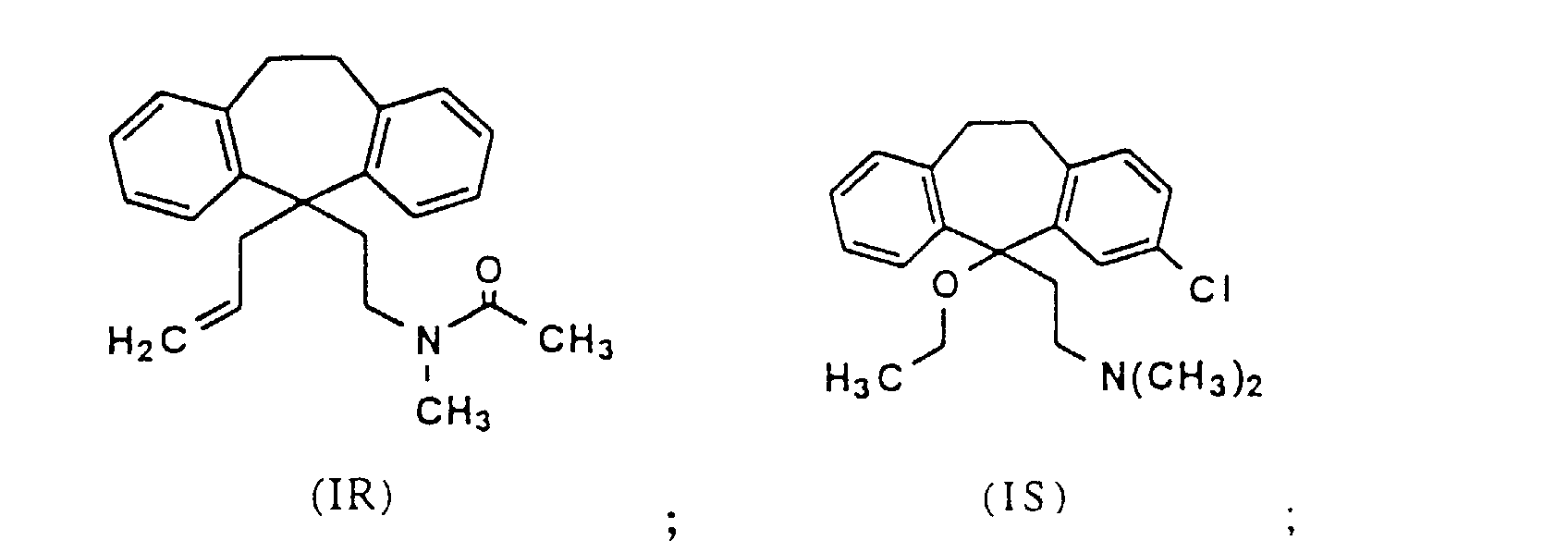


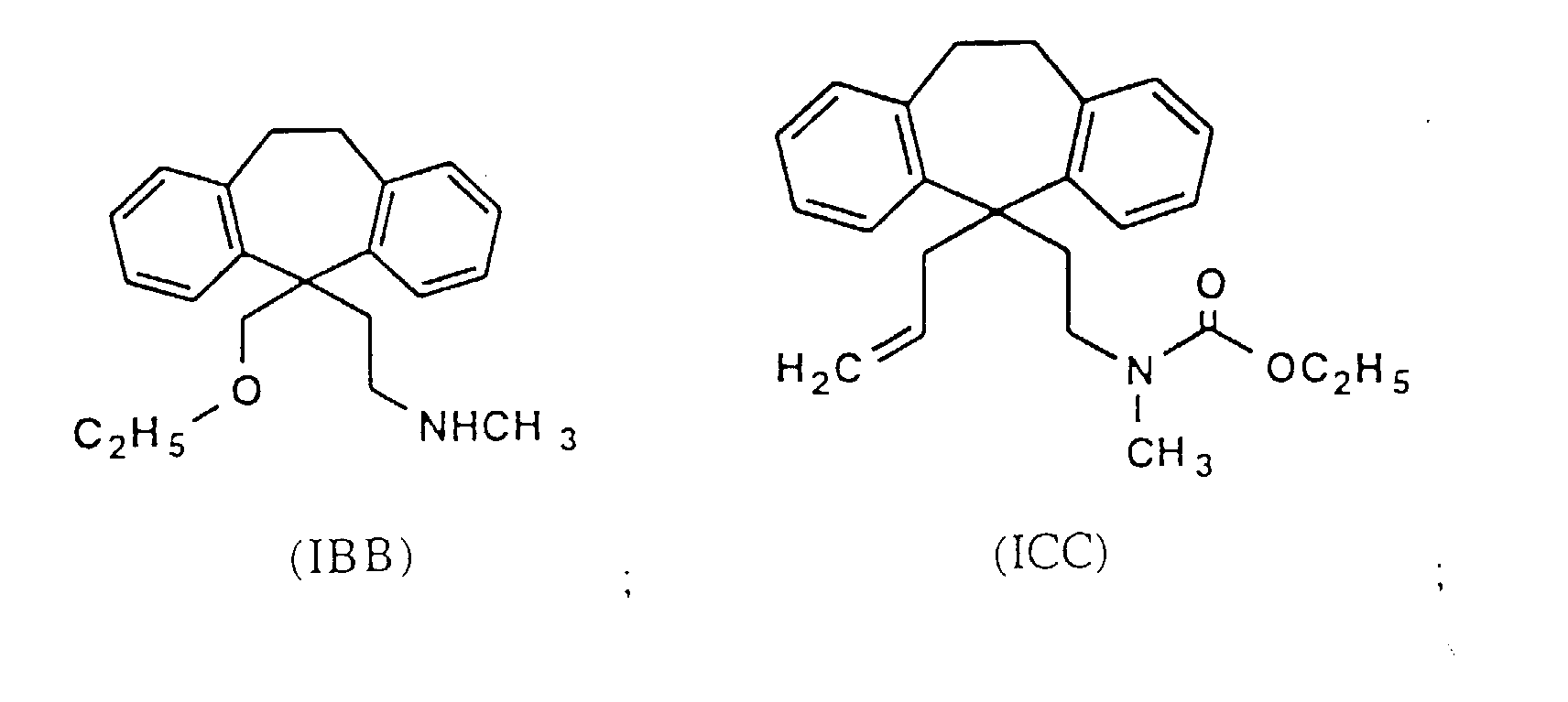


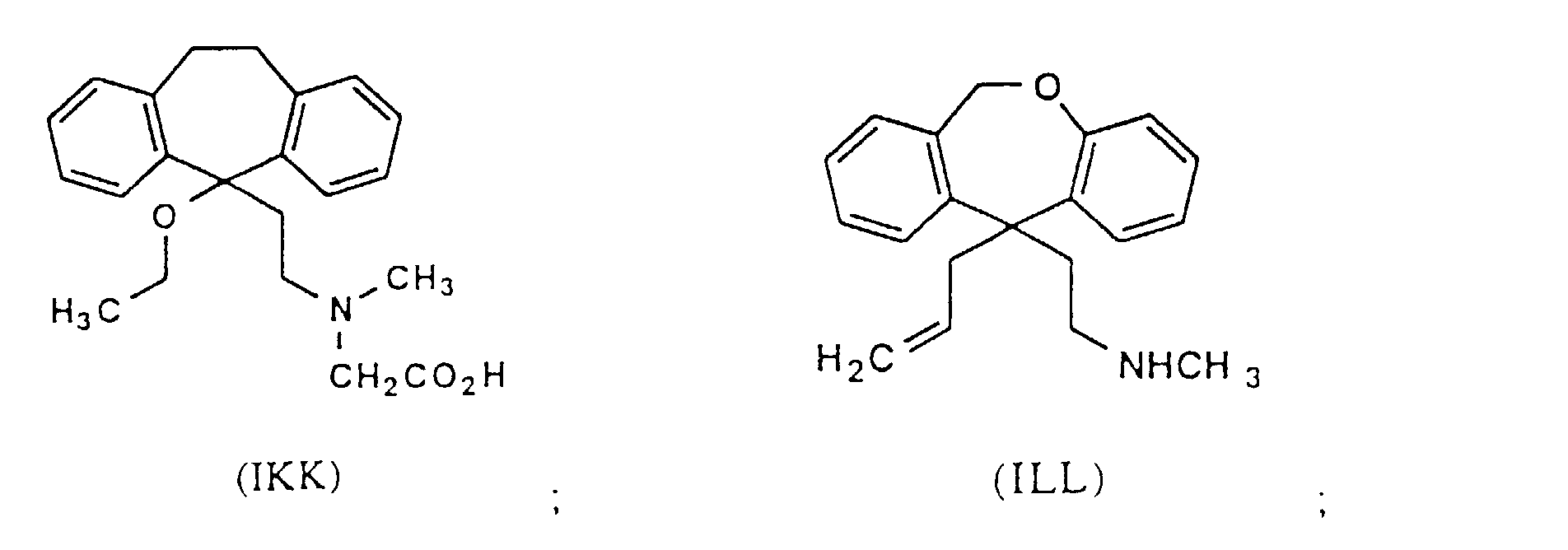


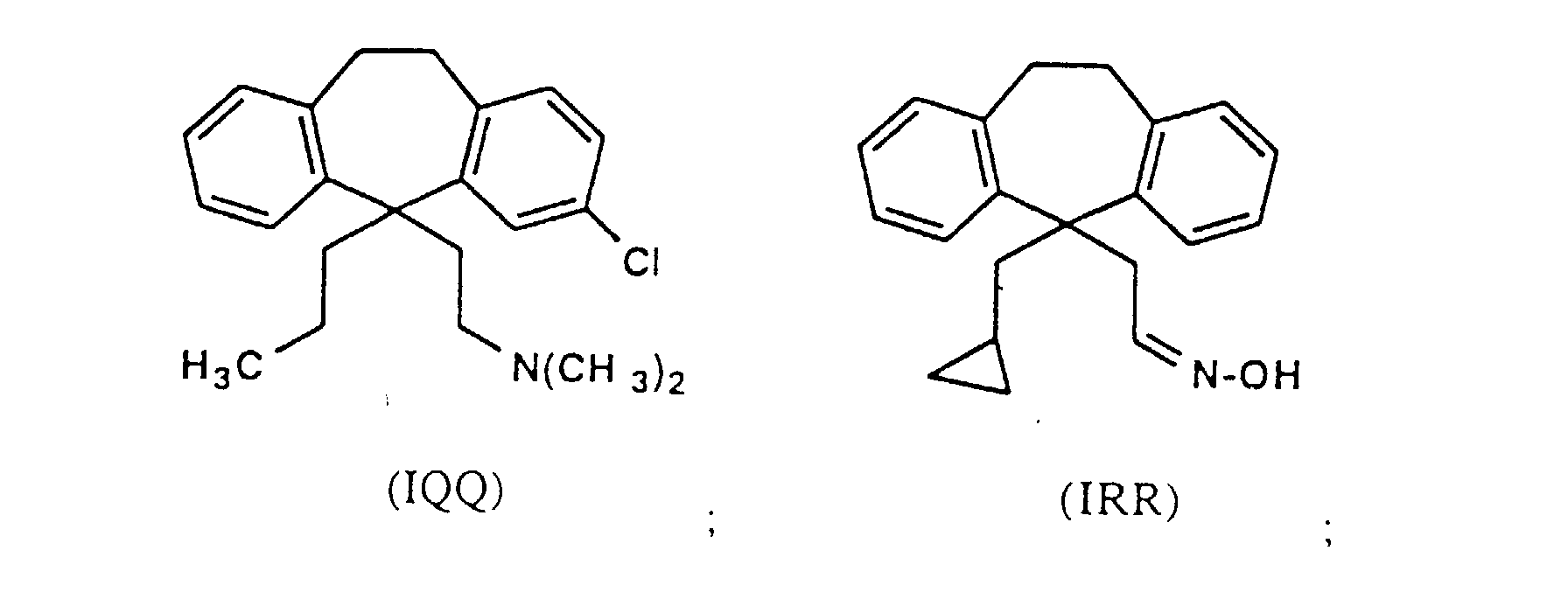
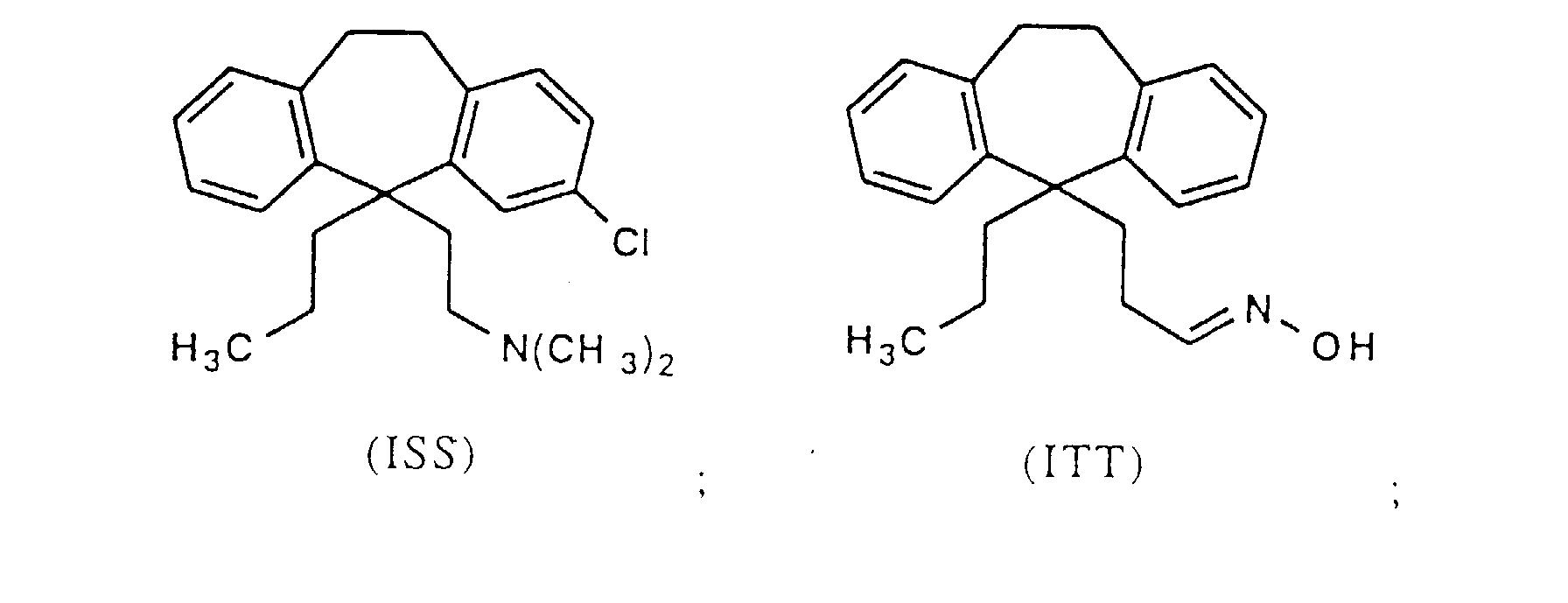
 and
and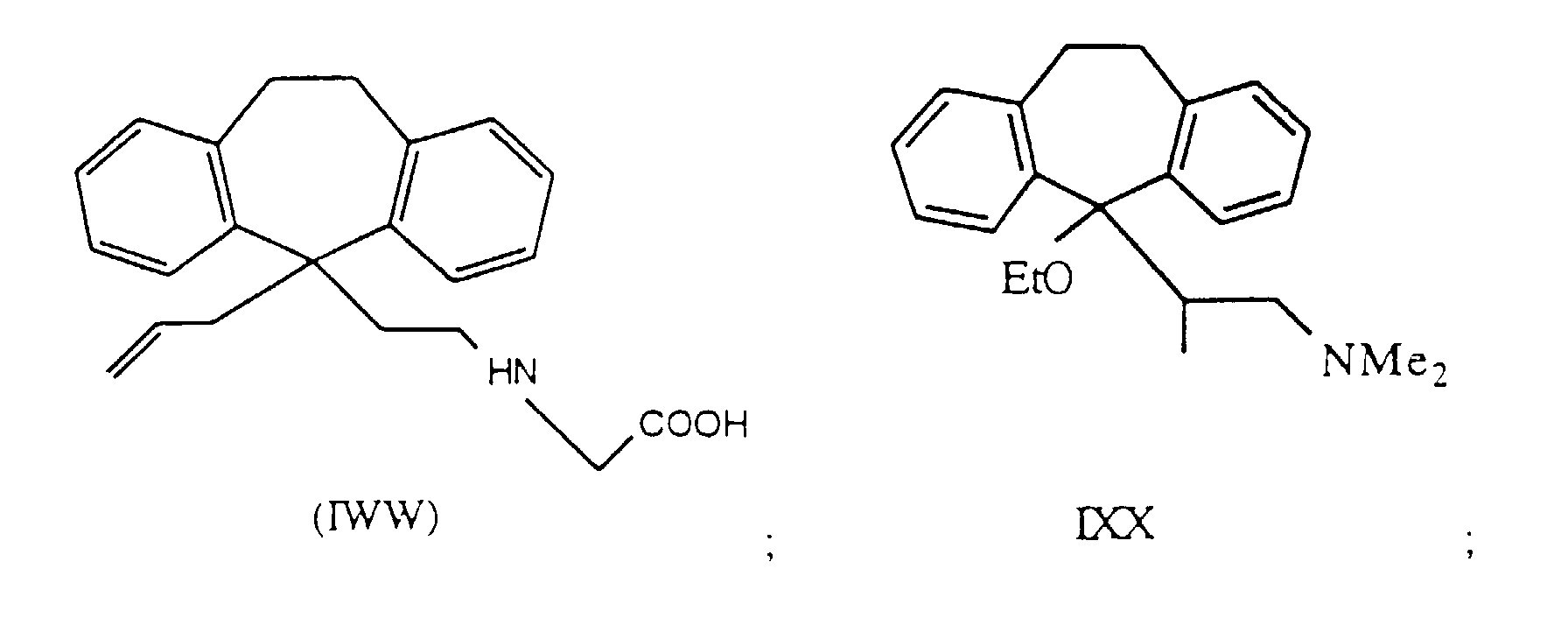
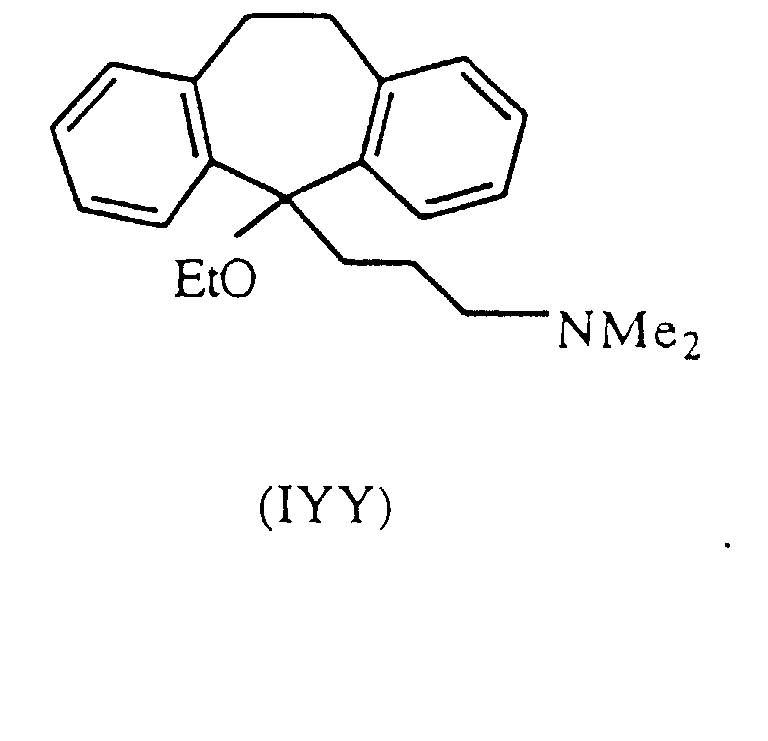
Applications Claiming Priority (3)
| Application Number | Priority Date | Filing Date | Title |
|---|---|---|---|
| US08/162,744 US5538986A (en) | 1993-12-06 | 1993-12-06 | Tricyclic derivatives, compositions and methods of use |
| US162744 | 1993-12-06 | ||
| PCT/US1994/013662 WO1995015939A1 (en) | 1993-12-06 | 1994-12-05 | Tricyclic derivatives, pharmaceutical compositions containing them |
Publications (2)
| Publication Number | Publication Date |
|---|---|
| EP0733035A1 EP0733035A1 (en) | 1996-09-25 |
| EP0733035B1 true EP0733035B1 (en) | 1999-03-31 |
Family
ID=22586964
Family Applications (1)
| Application Number | Title | Priority Date | Filing Date |
|---|---|---|---|
| EP95903619A Expired - Lifetime EP0733035B1 (en) | 1993-12-06 | 1994-12-05 | Tricyclic derivatives, pharmaceutical compositions containing them |
Country Status (9)
| Country | Link |
|---|---|
| US (2) | US5538986A (en) |
| EP (1) | EP0733035B1 (en) |
| JP (1) | JP2793915B2 (en) |
| AT (1) | ATE178313T1 (en) |
| DE (1) | DE69417573T2 (en) |
| DK (1) | DK0733035T3 (en) |
| ES (1) | ES2131300T3 (en) |
| GR (1) | GR3030034T3 (en) |
| WO (1) | WO1995015939A1 (en) |
Families Citing this family (12)
| Publication number | Priority date | Publication date | Assignee | Title |
|---|---|---|---|---|
| MY113463A (en) * | 1994-01-04 | 2002-03-30 | Novo Nordisk As | Novel heterocyclic compounds |
| FR2739855B1 (en) * | 1995-10-13 | 1997-11-14 | Adir | NOVEL TERTIARY HETEROCYCLIC AMINES, PROCESS FOR THEIR PREPARATION AND THE PHARMACEUTICAL COMPOSITIONS CONTAINING THEM |
| US6323206B1 (en) * | 1996-07-12 | 2001-11-27 | Millennium Pharmaceuticals, Inc. | Chemokine receptor antagonists and methods of use therefor |
| BR9808552A (en) * | 1997-04-15 | 2000-05-23 | Kyowa Hakko Kogyo Kk | Tricyclic compound or a pharmaceutically acceptable salt thereof, and pharmaceutical composition |
| US6613905B1 (en) | 1998-01-21 | 2003-09-02 | Millennium Pharmaceuticals, Inc. | Chemokine receptor antagonists and methods of use therefor |
| US6509346B2 (en) | 1998-01-21 | 2003-01-21 | Millennium Pharmaceuticals, Inc. | Chemokine receptor antagonists and methods of use therefor |
| WO1999037619A1 (en) | 1998-01-21 | 1999-07-29 | Millennium Pharmaceuticals, Inc. | Chemokine receptor antagonists and methods of use therefor |
| ATE309249T1 (en) | 1998-01-21 | 2005-11-15 | Millennium Pharm Inc | CHEMOKINE RECEPTOR ANTAGONISTS AND USES |
| US7271176B2 (en) * | 1998-09-04 | 2007-09-18 | Millennium Pharmaceuticals, Inc. | Chemokine receptor antagonists and methods of use thereof |
| US7541365B2 (en) | 2001-11-21 | 2009-06-02 | Millennium Pharmaceuticals, Inc. | Chemokine receptor antagonists and methods of use therefor |
| TWI291467B (en) | 2002-11-13 | 2007-12-21 | Millennium Pharm Inc | CCR1 antagonists and methods of use therefor |
| EP2076134A4 (en) * | 2006-10-10 | 2020-07-29 | President and Fellows of Harvard College | CONNECTIONS, SCREENS AND TREATMENT METHODS THEREFOR |
Family Cites Families (16)
| Publication number | Priority date | Publication date | Assignee | Title |
|---|---|---|---|---|
| US3304307A (en) * | 1963-09-12 | 1967-02-14 | Ciba Geigy Corp | Dibenzocycloalkadienes |
| US3304037A (en) * | 1965-05-21 | 1967-02-14 | Candela Frank | Mounting base for marine antennas |
| NL130988C (en) * | 1966-07-21 | Boehringer Mannheim Gmbh | ||
| US3595865A (en) * | 1968-09-12 | 1971-07-27 | Searle & Co | 5-(4-pyridyl)-5h-dibenzo(a,b)cycloheptenes |
| DE2335943C3 (en) * | 1973-07-14 | 1979-08-09 | Boehringer Mannheim Gmbh, 6800 Mannheim | Tricyclically substituted amino alcohols and their non-toxic salts, processes for their preparation and their use in combating heart and circulatory diseases |
| US4626542A (en) * | 1984-04-05 | 1986-12-02 | Merck & Co., Inc. | 4-(5H-dibenzo[a,d]cyclohepten-5-yl)piperidine compounds, pharmaceutical compositions and methods |
| US4826853A (en) * | 1986-10-31 | 1989-05-02 | Schering Corporation | 6,11-Dihydro-11-(N-substituted-4-piperidylidene)-5H-benzo(5,6)cyclohepta(1,2-B)pyridines and compositions and methods of use |
| US5438062A (en) * | 1986-10-31 | 1995-08-01 | Schering Corporation | Benzo(5,6)cycloheptapyridines, compositions and methods of use |
| US5089496A (en) * | 1986-10-31 | 1992-02-18 | Schering Corporation | Benzo[5,6]cycloheptapyridine compounds, compositions and method of treating allergies |
| CA1341044C (en) * | 1988-04-28 | 2000-07-04 | Frank J. Villani | Benzopyrido piperidine, piperidylidene and peperazine compounds, compositions, methods of manufacture and methods of use |
| EP0339978B1 (en) * | 1988-04-28 | 1996-08-21 | Schering Corporation | Fused polycyclic compounds, compositions, methods of manufacture, and their use as PAF antagonists, antihistamines and/or antiinflammatory agents |
| US5104876A (en) * | 1988-04-28 | 1992-04-14 | Schering Corporation | Benzopyrido piperidine, piperidylidene and piperazine compounds, compositions, methods of manufacture and methods of use |
| US4996321A (en) * | 1990-02-26 | 1991-02-26 | Merck & Co., Inc. | Dibenzo[a,d]cycloheptenylidene compounds |
| JPH04225953A (en) * | 1990-05-07 | 1992-08-14 | Shionogi & Co Ltd | Spiro dibenzosuberane derivative |
| EP0586560A1 (en) * | 1991-05-23 | 1994-03-16 | Schering Corporation | Novel benzopyrido piperidylidene compounds, compositions, methods of manufacture and methods of use |
| JPH06509341A (en) * | 1991-07-23 | 1994-10-20 | シェリング・コーポレーション | Novel benzopyridopiperidylidene compounds, compositions, manufacturing methods and methods of use |
-
1993
- 1993-12-06 US US08/162,744 patent/US5538986A/en not_active Expired - Fee Related
-
1994
- 1994-12-05 DE DE69417573T patent/DE69417573T2/en not_active Expired - Fee Related
- 1994-12-05 EP EP95903619A patent/EP0733035B1/en not_active Expired - Lifetime
- 1994-12-05 JP JP7516223A patent/JP2793915B2/en not_active Expired - Fee Related
- 1994-12-05 DK DK95903619T patent/DK0733035T3/en active
- 1994-12-05 WO PCT/US1994/013662 patent/WO1995015939A1/en not_active Ceased
- 1994-12-05 ES ES95903619T patent/ES2131300T3/en not_active Expired - Lifetime
- 1994-12-05 AT AT95903619T patent/ATE178313T1/en not_active IP Right Cessation
-
1995
- 1995-06-06 US US08/479,418 patent/US5767120A/en not_active Expired - Lifetime
-
1999
- 1999-04-23 GR GR990401111T patent/GR3030034T3/en unknown
Also Published As
| Publication number | Publication date |
|---|---|
| DE69417573T2 (en) | 1999-08-12 |
| GR3030034T3 (en) | 1999-07-30 |
| JP2793915B2 (en) | 1998-09-03 |
| US5767120A (en) | 1998-06-16 |
| JPH09500656A (en) | 1997-01-21 |
| DE69417573D1 (en) | 1999-05-06 |
| WO1995015939A1 (en) | 1995-06-15 |
| DK0733035T3 (en) | 1999-10-18 |
| ATE178313T1 (en) | 1999-04-15 |
| EP0733035A1 (en) | 1996-09-25 |
| US5538986A (en) | 1996-07-23 |
| ES2131300T3 (en) | 1999-07-16 |
Similar Documents
| Publication | Publication Date | Title |
|---|---|---|
| JP2799242B2 (en) | Anti-hyperlipidemic and anti-atherosclerotic urea compounds | |
| US5019588A (en) | 1-oxaspiro[4,5] decane-7,8-diaminoarylamides | |
| US5688805A (en) | Tricyclic derivatives, compositions and methods of use | |
| EP1720872B1 (en) | Aryl and heteroaryl-piperidinecarboxylate derivatives, the preparation and the use thereof in the form of faah enzyme inhibitors | |
| EP1019358B2 (en) | 3,3-diarylpropylamines , their use and preparation | |
| JP2000504739A (en) | Tropane-derivatives, their preparation and use | |
| EP1527048B1 (en) | N-[phenyl(piperidin-2-yl)methyl]benzamide derivatives, preparation thereof, and use thereof in therapy | |
| US5767120A (en) | Tricyclic derivatives, compositions and methods of use | |
| FR2539129A1 (en) | 7-OXABICYCLOHEPTANE-SUBSTITUTED PROSTAGLANDIN AMINO ANALOGS USEFUL AS CARDIOVASCULAR MEDICAMENTS | |
| HK31097A (en) | Imidazoylalkyl substituted with a six membered nitrogen containing heterocyclic ring | |
| JP2021506920A (en) | Crystalline Substituted Cyclohexylpyrazolo [1,5-a] pyrimidinylcarboxamide compounds and their therapeutic use | |
| HK185696A (en) | Imidazolyl-alkyl-piperazine and -diazepine derivatives as histamine H3 agonists/antagonists | |
| EP0733049B1 (en) | Tricyclic derivatives and their use in pharmaceuticals | |
| JPH04321676A (en) | Hexahydroazepine derivatives, method of manufacturing same and medicinal composition containing same | |
| US20060264490A1 (en) | Compounds, Compositions Containing Them, Preparation Thereof and Uses Thereof I | |
| US5294638A (en) | Phenyalkylaminoalkyl compounds and pharmaceutical compositions containing them | |
| HK1000541B (en) | Benzene derivates, their preparation and pharmaceutical compositions containing them | |
| EP0635012B1 (en) | Unbridged bis-aryl carbinol derivatives, compositions and methods of use | |
| DE69608888T2 (en) | SUBSTITUTED DIBENZA [a, f] AZULENES AND METHOD FOR THE PRODUCTION THEREOF | |
| DE69633289T2 (en) | 4-ACYLAMINO (HALOGEN) ALKYL-CHINOLINE DERIVATIVES, THEIR PREPARATION AND THEIR USE AS MELATONIN AGONISTS | |
| DE60112917T2 (en) | NEW POLYCYCLIC INDANYLIMIDAZOLE WITH ALPHA2 ADRENERGIC ACTIVITY | |
| CA2175287A1 (en) | Tricyclic derivatives, compositions and methods of use | |
| EP2409966A1 (en) | Aminocyclitol compounds, procedure for the obtainment and uses | |
| EP1334086B1 (en) | Phenoxyphenyl alkane sulfonates | |
| JPS63192740A (en) | Cycloalkyl-substituted 4-aminophenyl halo derivative and method for producing the same |
Legal Events
| Date | Code | Title | Description |
|---|---|---|---|
| PUAI | Public reference made under article 153(3) epc to a published international application that has entered the european phase |
Free format text: ORIGINAL CODE: 0009012 |
|
| 17P | Request for examination filed |
Effective date: 19960524 |
|
| AK | Designated contracting states |
Kind code of ref document: A1 Designated state(s): AT BE CH DE DK ES FR GB GR IE IT LI LU NL PT SE |
|
| 17Q | First examination report despatched |
Effective date: 19970711 |
|
| GRAG | Despatch of communication of intention to grant |
Free format text: ORIGINAL CODE: EPIDOS AGRA |
|
| GRAG | Despatch of communication of intention to grant |
Free format text: ORIGINAL CODE: EPIDOS AGRA |
|
| GRAH | Despatch of communication of intention to grant a patent |
Free format text: ORIGINAL CODE: EPIDOS IGRA |
|
| GRAH | Despatch of communication of intention to grant a patent |
Free format text: ORIGINAL CODE: EPIDOS IGRA |
|
| GRAA | (expected) grant |
Free format text: ORIGINAL CODE: 0009210 |
|
| AK | Designated contracting states |
Kind code of ref document: B1 Designated state(s): AT BE CH DE DK ES FR GB GR IE IT LI LU NL PT SE |
|
| REF | Corresponds to: |
Ref document number: 178313 Country of ref document: AT Date of ref document: 19990415 Kind code of ref document: T |
|
| REG | Reference to a national code |
Ref country code: CH Ref legal event code: NV Representative=s name: HUG INTERLIZENZ AG Ref country code: CH Ref legal event code: EP |
|
| REG | Reference to a national code |
Ref country code: IE Ref legal event code: FG4D |
|
| REF | Corresponds to: |
Ref document number: 69417573 Country of ref document: DE Date of ref document: 19990506 |
|
| ITF | It: translation for a ep patent filed | ||
| REG | Reference to a national code |
Ref country code: ES Ref legal event code: FG2A Ref document number: 2131300 Country of ref document: ES Kind code of ref document: T3 |
|
| ET | Fr: translation filed | ||
| REG | Reference to a national code |
Ref country code: PT Ref legal event code: SC4A Free format text: AVAILABILITY OF NATIONAL TRANSLATION Effective date: 19990614 |
|
| REG | Reference to a national code |
Ref country code: DK Ref legal event code: T3 |
|
| PLBE | No opposition filed within time limit |
Free format text: ORIGINAL CODE: 0009261 |
|
| STAA | Information on the status of an ep patent application or granted ep patent |
Free format text: STATUS: NO OPPOSITION FILED WITHIN TIME LIMIT |
|
| 26N | No opposition filed | ||
| REG | Reference to a national code |
Ref country code: GB Ref legal event code: IF02 |
|
| REG | Reference to a national code |
Ref country code: CH Ref legal event code: NV Representative=s name: E. BLUM & CO. PATENTANWAELTE |
|
| PGFP | Annual fee paid to national office [announced via postgrant information from national office to epo] |
Ref country code: PT Payment date: 20050923 Year of fee payment: 12 |
|
| PGFP | Annual fee paid to national office [announced via postgrant information from national office to epo] |
Ref country code: LU Payment date: 20050926 Year of fee payment: 12 |
|
| PGFP | Annual fee paid to national office [announced via postgrant information from national office to epo] |
Ref country code: GR Payment date: 20051024 Year of fee payment: 12 |
|
| PGFP | Annual fee paid to national office [announced via postgrant information from national office to epo] |
Ref country code: IE Payment date: 20051026 Year of fee payment: 12 |
|
| PGFP | Annual fee paid to national office [announced via postgrant information from national office to epo] |
Ref country code: GB Payment date: 20051104 Year of fee payment: 12 Ref country code: AT Payment date: 20051104 Year of fee payment: 12 |
|
| PGFP | Annual fee paid to national office [announced via postgrant information from national office to epo] |
Ref country code: DK Payment date: 20051107 Year of fee payment: 12 |
|
| PGFP | Annual fee paid to national office [announced via postgrant information from national office to epo] |
Ref country code: NL Payment date: 20051109 Year of fee payment: 12 |
|
| PGFP | Annual fee paid to national office [announced via postgrant information from national office to epo] |
Ref country code: FR Payment date: 20051201 Year of fee payment: 12 |
|
| PGFP | Annual fee paid to national office [announced via postgrant information from national office to epo] |
Ref country code: SE Payment date: 20051202 Year of fee payment: 12 |
|
| PGFP | Annual fee paid to national office [announced via postgrant information from national office to epo] |
Ref country code: ES Payment date: 20051215 Year of fee payment: 12 |
|
| PGFP | Annual fee paid to national office [announced via postgrant information from national office to epo] |
Ref country code: CH Payment date: 20051216 Year of fee payment: 12 |
|
| PGFP | Annual fee paid to national office [announced via postgrant information from national office to epo] |
Ref country code: DE Payment date: 20051230 Year of fee payment: 12 |
|
| PGFP | Annual fee paid to national office [announced via postgrant information from national office to epo] |
Ref country code: BE Payment date: 20060113 Year of fee payment: 12 |
|
| PG25 | Lapsed in a contracting state [announced via postgrant information from national office to epo] |
Ref country code: IE Free format text: LAPSE BECAUSE OF NON-PAYMENT OF DUE FEES Effective date: 20061205 |
|
| PG25 | Lapsed in a contracting state [announced via postgrant information from national office to epo] |
Ref country code: SE Free format text: LAPSE BECAUSE OF NON-PAYMENT OF DUE FEES Effective date: 20061206 |
|
| PG25 | Lapsed in a contracting state [announced via postgrant information from national office to epo] |
Ref country code: LI Free format text: LAPSE BECAUSE OF NON-PAYMENT OF DUE FEES Effective date: 20061231 Ref country code: CH Free format text: LAPSE BECAUSE OF NON-PAYMENT OF DUE FEES Effective date: 20061231 Ref country code: BE Free format text: LAPSE BECAUSE OF NON-PAYMENT OF DUE FEES Effective date: 20061231 |
|
| PGFP | Annual fee paid to national office [announced via postgrant information from national office to epo] |
Ref country code: IT Payment date: 20061231 Year of fee payment: 13 |
|
| PG25 | Lapsed in a contracting state [announced via postgrant information from national office to epo] |
Ref country code: PT Free format text: LAPSE BECAUSE OF NON-PAYMENT OF DUE FEES Effective date: 20070605 |
|
| REG | Reference to a national code |
Ref country code: PT Ref legal event code: MM4A Free format text: LAPSE DUE TO NON-PAYMENT OF FEES Effective date: 20070605 |
|
| PG25 | Lapsed in a contracting state [announced via postgrant information from national office to epo] |
Ref country code: NL Free format text: LAPSE BECAUSE OF NON-PAYMENT OF DUE FEES Effective date: 20070701 |
|
| PG25 | Lapsed in a contracting state [announced via postgrant information from national office to epo] |
Ref country code: DE Free format text: LAPSE BECAUSE OF NON-PAYMENT OF DUE FEES Effective date: 20070703 |
|
| REG | Reference to a national code |
Ref country code: DK Ref legal event code: EBP |
|
| REG | Reference to a national code |
Ref country code: CH Ref legal event code: PL |
|
| EUG | Se: european patent has lapsed | ||
| GBPC | Gb: european patent ceased through non-payment of renewal fee |
Effective date: 20061205 |
|
| NLV4 | Nl: lapsed or anulled due to non-payment of the annual fee |
Effective date: 20070701 |
|
| REG | Reference to a national code |
Ref country code: IE Ref legal event code: MM4A |
|
| REG | Reference to a national code |
Ref country code: FR Ref legal event code: ST Effective date: 20070831 |
|
| PG25 | Lapsed in a contracting state [announced via postgrant information from national office to epo] |
Ref country code: GB Free format text: LAPSE BECAUSE OF NON-PAYMENT OF DUE FEES Effective date: 20061205 Ref country code: AT Free format text: LAPSE BECAUSE OF NON-PAYMENT OF DUE FEES Effective date: 20061205 |
|
| BERE | Be: lapsed |
Owner name: *SCHERING CORP. Effective date: 20061231 |
|
| PG25 | Lapsed in a contracting state [announced via postgrant information from national office to epo] |
Ref country code: DK Free format text: LAPSE BECAUSE OF NON-PAYMENT OF DUE FEES Effective date: 20070102 |
|
| REG | Reference to a national code |
Ref country code: ES Ref legal event code: FD2A Effective date: 20061207 |
|
| PG25 | Lapsed in a contracting state [announced via postgrant information from national office to epo] |
Ref country code: FR Free format text: LAPSE BECAUSE OF NON-PAYMENT OF DUE FEES Effective date: 20070102 Ref country code: ES Free format text: LAPSE BECAUSE OF NON-PAYMENT OF DUE FEES Effective date: 20061207 |
|
| PG25 | Lapsed in a contracting state [announced via postgrant information from national office to epo] |
Ref country code: LU Free format text: LAPSE BECAUSE OF NON-PAYMENT OF DUE FEES Effective date: 20061205 |
|
| PG25 | Lapsed in a contracting state [announced via postgrant information from national office to epo] |
Ref country code: GR Free format text: LAPSE BECAUSE OF NON-PAYMENT OF DUE FEES Effective date: 20070704 |
|
| PG25 | Lapsed in a contracting state [announced via postgrant information from national office to epo] |
Ref country code: IT Free format text: LAPSE BECAUSE OF NON-PAYMENT OF DUE FEES Effective date: 20071205 |