EP0731131B1 - Heat-curable silicone rubber compositions - Google Patents
Heat-curable silicone rubber compositions Download PDFInfo
- Publication number
- EP0731131B1 EP0731131B1 EP95301464A EP95301464A EP0731131B1 EP 0731131 B1 EP0731131 B1 EP 0731131B1 EP 95301464 A EP95301464 A EP 95301464A EP 95301464 A EP95301464 A EP 95301464A EP 0731131 B1 EP0731131 B1 EP 0731131B1
- Authority
- EP
- European Patent Office
- Prior art keywords
- parts
- ammonia
- weight
- silicone rubber
- total
- Prior art date
- Legal status (The legal status is an assumption and is not a legal conclusion. Google has not performed a legal analysis and makes no representation as to the accuracy of the status listed.)
- Expired - Lifetime
Links
- QGZKDVFQNNGYKY-UHFFFAOYSA-N Ammonia Chemical compound N QGZKDVFQNNGYKY-UHFFFAOYSA-N 0.000 claims 58
- 229910021529 ammonia Inorganic materials 0.000 claims 29
- IJGRMHOSHXDMSA-UHFFFAOYSA-N Atomic nitrogen Chemical compound N#N IJGRMHOSHXDMSA-UHFFFAOYSA-N 0.000 claims 16
- 229920002379 silicone rubber Polymers 0.000 claims 11
- 239000004945 silicone rubber Substances 0.000 claims 11
- BASFCYQUMIYNBI-UHFFFAOYSA-N platinum Chemical compound [Pt] BASFCYQUMIYNBI-UHFFFAOYSA-N 0.000 claims 10
- 239000002243 precursor Substances 0.000 claims 9
- XUIMIQQOPSSXEZ-UHFFFAOYSA-N Silicon Chemical group [Si] XUIMIQQOPSSXEZ-UHFFFAOYSA-N 0.000 claims 8
- 229910052757 nitrogen Inorganic materials 0.000 claims 8
- 229910052710 silicon Inorganic materials 0.000 claims 8
- VYPSYNLAJGMNEJ-UHFFFAOYSA-N Silicium dioxide Chemical compound O=[Si]=O VYPSYNLAJGMNEJ-UHFFFAOYSA-N 0.000 claims 6
- 239000003054 catalyst Substances 0.000 claims 6
- 229920006136 organohydrogenpolysiloxane Polymers 0.000 claims 6
- 229920001296 polysiloxane Polymers 0.000 claims 6
- 125000003342 alkenyl group Chemical group 0.000 claims 5
- 238000000034 method Methods 0.000 claims 5
- 229910052697 platinum Inorganic materials 0.000 claims 5
- 125000004435 hydrogen atom Chemical group [H]* 0.000 claims 4
- 238000006243 chemical reaction Methods 0.000 claims 2
- 229910021485 fumed silica Inorganic materials 0.000 claims 2
- 239000000377 silicon dioxide Substances 0.000 claims 2
- 238000005979 thermal decomposition reaction Methods 0.000 claims 2
- 239000000654 additive Substances 0.000 claims 1
- 230000000996 additive effect Effects 0.000 claims 1
- 150000003863 ammonium salts Chemical class 0.000 claims 1
- 230000006835 compression Effects 0.000 claims 1
- 238000007906 compression Methods 0.000 claims 1
- 238000001723 curing Methods 0.000 claims 1
- 229920001971 elastomer Polymers 0.000 claims 1
- 238000013007 heat curing Methods 0.000 claims 1
- 150000002897 organic nitrogen compounds Chemical class 0.000 claims 1
- 238000004073 vulcanization Methods 0.000 claims 1
Classifications
-
- C—CHEMISTRY; METALLURGY
- C08—ORGANIC MACROMOLECULAR COMPOUNDS; THEIR PREPARATION OR CHEMICAL WORKING-UP; COMPOSITIONS BASED THEREON
- C08L—COMPOSITIONS OF MACROMOLECULAR COMPOUNDS
- C08L83/00—Compositions of macromolecular compounds obtained by reactions forming in the main chain of the macromolecule a linkage containing silicon with or without sulfur, nitrogen, oxygen or carbon only; Compositions of derivatives of such polymers
- C08L83/04—Polysiloxanes
-
- C—CHEMISTRY; METALLURGY
- C08—ORGANIC MACROMOLECULAR COMPOUNDS; THEIR PREPARATION OR CHEMICAL WORKING-UP; COMPOSITIONS BASED THEREON
- C08K—Use of inorganic or non-macromolecular organic substances as compounding ingredients
- C08K3/00—Use of inorganic substances as compounding ingredients
- C08K3/28—Nitrogen-containing compounds
-
- C—CHEMISTRY; METALLURGY
- C08—ORGANIC MACROMOLECULAR COMPOUNDS; THEIR PREPARATION OR CHEMICAL WORKING-UP; COMPOSITIONS BASED THEREON
- C08K—Use of inorganic or non-macromolecular organic substances as compounding ingredients
- C08K5/00—Use of organic ingredients
- C08K5/16—Nitrogen-containing compounds
- C08K5/17—Amines; Quaternary ammonium compounds
-
- C—CHEMISTRY; METALLURGY
- C08—ORGANIC MACROMOLECULAR COMPOUNDS; THEIR PREPARATION OR CHEMICAL WORKING-UP; COMPOSITIONS BASED THEREON
- C08K—Use of inorganic or non-macromolecular organic substances as compounding ingredients
- C08K5/00—Use of organic ingredients
- C08K5/16—Nitrogen-containing compounds
- C08K5/21—Urea; Derivatives thereof, e.g. biuret
-
- C—CHEMISTRY; METALLURGY
- C08—ORGANIC MACROMOLECULAR COMPOUNDS; THEIR PREPARATION OR CHEMICAL WORKING-UP; COMPOSITIONS BASED THEREON
- C08K—Use of inorganic or non-macromolecular organic substances as compounding ingredients
- C08K5/00—Use of organic ingredients
- C08K5/54—Silicon-containing compounds
- C08K5/544—Silicon-containing compounds containing nitrogen
- C08K5/5455—Silicon-containing compounds containing nitrogen containing at least one group
-
- C—CHEMISTRY; METALLURGY
- C08—ORGANIC MACROMOLECULAR COMPOUNDS; THEIR PREPARATION OR CHEMICAL WORKING-UP; COMPOSITIONS BASED THEREON
- C08G—MACROMOLECULAR COMPOUNDS OBTAINED OTHERWISE THAN BY REACTIONS ONLY INVOLVING UNSATURATED CARBON-TO-CARBON BONDS
- C08G77/00—Macromolecular compounds obtained by reactions forming a linkage containing silicon with or without sulfur, nitrogen, oxygen or carbon in the main chain of the macromolecule
- C08G77/04—Polysiloxanes
- C08G77/12—Polysiloxanes containing silicon bound to hydrogen
-
- C—CHEMISTRY; METALLURGY
- C08—ORGANIC MACROMOLECULAR COMPOUNDS; THEIR PREPARATION OR CHEMICAL WORKING-UP; COMPOSITIONS BASED THEREON
- C08G—MACROMOLECULAR COMPOUNDS OBTAINED OTHERWISE THAN BY REACTIONS ONLY INVOLVING UNSATURATED CARBON-TO-CARBON BONDS
- C08G77/00—Macromolecular compounds obtained by reactions forming a linkage containing silicon with or without sulfur, nitrogen, oxygen or carbon in the main chain of the macromolecule
- C08G77/04—Polysiloxanes
- C08G77/20—Polysiloxanes containing silicon bound to unsaturated aliphatic groups
Definitions
- This invention relates to heat-curable silicone rubber compositions which cures into a silicone rubber having low compression set.
- Silicone rubber compositions are well known which comprise a vinyl-containing organopolysiloxane, an organohydrogenpolysiloxane containing a hydrogen atom bonded to a silicon atom, a platinum catalyst, and an inorganic filler and which cure through addition reaction between the vinyl group and the hydrogen atom bonded to a silicon atom. Since these compositions are easy to mold and offer molded silicone rubber parts having excellent properties including heat resistance and electrical insulation, they are widely used in the application where such properties are required.
- molded silicone rubber parts of this type are less resistant to compression as such and thus have deficiencies for molded parts which are subject to compressive deformation for a long time, for example, rolls and connectors for automotive parts.
- One prior art technique for overcoming this drawback is by molding parts by press molding, injection molding or transfer molding and subjecting them to heat treatment or secondary vulcanization at a high temperature of 150 to 250°C, thereby improving compression resistance.
- This technique is based on the belief that molded silicone rubber parts can be improved in compression resistance by reducing the amount of unreacted functional groups remaining therein. This technique is low in operation efficiency because it requires the steps of placing once molded silicone rubber parts into a hot oven and heating for a long time. The final molded parts become costly.
- JP-A-5/9388 and CA-A-2071787 disclose the addition of NC-(CH 2 ) n -CN to a silicone rubber composition to a silicone rubber having minimized compression set.
- NC-(CH 2 ) n -CN because of the harmful NC-(CH 2 ) n -CN, the resulting silicone rubber has only limited use.
- JP-A-4/139258 (corresponding to CA 2052410A and EP477984A) discloses a crosslinking between an organopolysiloxane having alkenyl groups at its side chains and an organohydrogenpolysiloxane having SiH groups at both ends thereby obtaining a silicone rubber having minimized compression set.
- a general aim herein is to provide new and useful silicone rubber compositions, methods of preparing and using them, and new ways of reducing compression set in addition curing rubber.
- the present invention concerns heat-curable silicone rubber compositions comprising (a) organopolysiloxane having at least two alkenyl groups each bonded to a silicon atom in a molecule, (b) organohydrogenpolysiloxane having at least two hydrogen atoms each bonded to a silicon atom in a molecule, crosslinked using (C) platinum catalyst.
- a) organopolysiloxane having at least two alkenyl groups each bonded to a silicon atom in a molecule (b) organohydrogenpolysiloxane having at least two hydrogen atoms each bonded to a silicon atom in a molecule, crosslinked using (C) platinum catalyst.
- cured product compression set can be reduced.
- component (d) is added so that ammonia is present in an amount of 10 to 500 parts by weight of nitrogen per million parts by weight of the total of components (a), (b) and (c) upon vulcanization of the heat-curable silicone rubber composition.
- the resulting silicone rubber may have increased compression resistance without carrying out secondary vulcanization after curing.
- one aspect of the present invention provides a heat - curable silicone rubber composition
- a heat - curable silicone rubber composition comprising
- the invention provides a heat - curable silicone rubber composition
- a heat - curable silicone rubber composition comprising
- the invention provides a method of vulcanizing a heat - curable silicone rubber composition comprising
- the invention provides a method of vulcanizing a heat - curable silicone rubber composition comprising
- the invention provides in a method of making an addition-cured silicone rubber from an organopolysiloxane including alkenyl moieties and an organohydrogenpolysiloxane, in the presence of platinum catalyst, the use of ammonia or an ammonia precursor as an additive in the rubber composition at heat-curing thereof, to reduce compression set of the resulting cured rubber, the ammonia or ammonia precursor being present at curing at an amount corresponding to from 10 to 500 parts by weight of N to a million parts by weight total of said organopolysiloxane, organohydrogenpolysiloxane and catalyst.
- the heat - curable silicone rubber composition of the present invention includes as major components (a) organopolysiloxane having at least two alkenyl groups each bonded to a silicon atom in a molecule, (b) organohydrogenpolysiloxane having at least two hydrogen atoms each bonded to a silicon atom in a molecule, and (c) platinum catalyst.
- Components (a), (b), and (c) may be selected from known ones.
- the organopolysiloxane as component (a) is a main component of the curable silicone rubber composition and should have at least two alkenyl groups each bonded to a silicon atom in a molecule.
- Organopolysiloxane (a) preferably has the following average compositional formula (1): R 1 / aSiO (4-a)/2 wherein R 1 represents substituted or unsubstituted monovalent hydrocarbon groups, which may be identical or different, having 1 to 10 carbon atoms, preferably 1 to 8 carbon atoms, and letter a is a positive number of 1.5 to 2.8, preferably 1.8 to 2.5.
- Examples of the substituted or unsubstituted monovalent hydrocarbon groups each bonded to a silicon atom in a molecule represented by R 1 include alkyl groups such as methyl, ethyl, propyl, isopropyl, butyl, isobutyl, tert-butyl, pentyl, neopentyl, hexyl, cyclohexyl, octyl, nonyl and decyl, aryl groups such as phenyl, tolyl, xylyl and naphthyl, aralkyl groups such as benzyl, phenylethyl and phenylpropyl, alkenyl groups such as vinyl, allyl, propenyl, isopropenyl, butenyl, isobutenyl, hexenyl, cyclohexenyl and octenyl, and substituted ones of these groups wherein some or all of the hydrogen
- Typical substituents are halogen atoms, e.g. fluorine, bromine and chlorine, and cyano groups.
- substituted groups are chloromethyl, chloropropyl, bromoethyl, trifluoropropyl and cyanoethyl groups.
- the organopolysiloxane should have at least two alkenyl groups preferably having 2 to 8 carbon atoms, more preferably having 2 to 6 carbon atoms.
- the amount of alkenyl group contained is preferably 1.0 ⁇ 10 -5 to 20 mol%, more preferably 1.0 ⁇ 10 -4 to 10 mol% of the entire organic groups bonded to silicon atoms in a molecule.
- the aliphatic unsaturated hydrocarbon groups may be bonded to silicon atoms at the terminals or the intermediate of the chain, although the organopolysiloxane preferably has at least two alkenyl groups bonded to silicon atoms at both terminals of the chain from the viewpoint of the curing rate of the composition and the properties of the cured product.
- the organopolysiloxane (a) generally has a straight chain structure basically composed of the repeated diorganosiloxane units of R 1 / 2SiO 2/2 and end-blocked with triorganosiloxy units of R 1 / 3SiO 1/2 or both ends although it may partially have branching structure, i.e. mono-organosiloxane units of R 1 SiO 3/2 or may be cyclic in molecular structure. Its molecular weight is not critical.
- Liquid ones having a low viscosity to raw rubber-like ones having a high viscosity are acceptable although organopolysiloxanes having a viscosity of at least 100 mPa ⁇ s (100 centipoises), usually having 100 to 1 x 10 6 mPa ⁇ s (100 to 1,000,000 centipoises), preferably 1 x 10 3 to 1 x 10 5 mPa ⁇ s (1,000 to 100,000 centipoises) at 25°C are preferred in order that they cure into rubbery elastomers.
- the organohydrogenpolysiloxane of component (b) is a crosslinking agent for the curable silicone rubber composition of the invention.
- a platinum catalyst as component (c) addition reaction occurs between a hydrogen atom bonded to a silicon atom, i.e. SiH group in component (b) and an alkenyl group bonded to a silicon atom in component (a), inducing crosslinking and curing.
- the organohydrogenpolysiloxane of component (b) should have at least two, preferably 2 to 100, more preferably 3 to 50 hydrogen atoms each bonded to a silicon atom in a molecule.
- the organohydrogenpolysiloxane (b) preferably has the following average compositional formula (2): R 2 / bH c SiO (4-b-c)/2 wherein R 2 represents substituted or unsubstituted monovalent hydrocarbon groups, which may be identical or different, having 1 to 10, preferably 1 to 8 carbon atoms, and letters b and c are positive numbers satisfying the following ranges: 1.5 ⁇ b ⁇ 2.8, preferably 1.6 ⁇ b ⁇ 2.5, 0.003 ⁇ c ⁇ 1.0, preferably 0.02 ⁇ c ⁇ 1.0, and 1.5 ⁇ b + c ⁇ 3.0, preferably 1.6 ⁇ b + c ⁇ 2.8.
- the monovalent hydrocarbon groups preferably do not have aliphatic unsaturated bonds.
- Examples of the substituted or unsubstituted monovalent hydrocarbon groups each bonded to a silicon atom in a molecule represented by R 2 can be cited as those of R 1 described above and include alkyl groups such as methyl, ethyl, propyl, isopropyl, butyl, isobutyl, tert-butyl, pentyl, neopentyl, hexyl, cyclohexyl, octyl, nonyl and decyl, aryl groups such as phenyl, tolyl, xylyl and naphtyl, aralkyl groups such as benzyl, phenylethyl and phenylpropyl, alkenyl groups such as vinyl, allyl, propenyl, isopropenyl, butenyl, isobutenyl, hexeny
- halogen atoms for example, fluorine, bromine and chlorine, or cyano groups, such as chloromethyl, chloropropyl, bromoethyl, trifluoropropyl and cyanoethyl groups.
- the hydrogen atoms directly bonded to silicon atoms may be bonded to silicon atoms at the terminal or the intermediate of the chain. Its molecular weight is not critical although it should preferably have a viscosity of 1 to 10,000 centipoises, particularly 3 to 1,000 centipoises at 25°C.
- Component (b) is preferably blended such that the moles of hydrogen atom bonded to silicon atom and the moles of alkenyl group bonded to silicon atom are in a ratio of from 0.5:1 to 20:1 more preferably from 1:1 to 3:1.
- Curable organopolysiloxane compositions wherein less than 0.5 mole of the hydrogen atom bonded to a silicon atom is present per mole of the alkenyl group bonded to a silicon atom may not thoroughly cure.
- Curable organopolysiloxane compositions wherein more than 20 moles of the hydrogen atom bonded to a silicon atom is present per mole of the alkenyl group bonded to a silicon atom may expand.
- Component (c) is a platinum catalyst for curing the curable silicone rubber composition.
- platinum catalyst for curing the curable silicone rubber composition.
- examples include chloroplatinic acid, alcohol solutions of chloroplatinic acid, complexes of chloroplatinic acid with olefins, platinum black, and platinum carried on supports.
- the platinum catalyst is preferably added such that there is available 0.1 to 500 parts, more preferably 1 to 50 parts by weight of platinum per million parts by weight of components (a) and (b) combined. Less than 0.1 ppm of platinum may be insufficient for curing to proceed whereas more than 500 ppm of platinum is uneconomical.
- component (d) ammonia or an ammonia precursor which will generate ammonia through thermal decomposition or chemical reaction is blended in a silicone rubber composition comprising components (a), (b), and (c).
- the ammonia or ammonia precursor is blended in such amounts (NH 3 being otherwise a poison to the catalyst for addition reaction) that it functions to reduce compression set without destroying curability.
- the component (d) is preferably blended so as to be present in an amount of 10 to 500 parts, more preferably 20 to 200 parts by weight calculated as nitrogen per million parts by weight of components (a), (b) and (c) combined in the cured product of the composition.
- ammonia precursor which will generate ammonia through thermal decomposition or chemical reaction within the system may be used.
- Typical examples are inorganic ammonium salts such as ammonium acetate, ammonium chloride, ammonium hydroxide, ammonium sulfate, and ammonium carbonate, organic nitrogen compounds such as urea, organosilazane compounds, for example, organodisilazanes such as hexamethyldisilazane and divinyltetramethyldisilazane.
- the silicone rubber composition may have blended therein any of various additives which e.g. as conventionally blended in this type of composition.
- a filler such as pulverized quartz, diatomaceous earth, calcium carbonate, alumina, carbon black and reinforcing silica powder can be blended in order to impart strength to a silicone rubber.
- reinforcing fillers include hydrophilic silicas such as Aerosil® 130, 200 and 300 manufactured by Japan Aerosil K.K. and Degussa, Cabosil® MS-5 and MS-7 manufactured by Cabot, Rheorosil® QS-102 and 103 manufactured by Tokuyama Sada K.K.
- Nippon Silica K.K. and hydrophobic silicas such as Aerosil® R-812, R-812S, R-972 and R-974 manufactured by Degussa, Rheorosil® MT-10 manufactured by Tokuyama Soda K.K. and Nipsil® SS series manufactured by Nippon Silica K.K.
- the filler may be blended in an amount of 10 to 150 parts by weight per 100 parts by weight of components (a), (b) and (c) combined.
- An agent for controlling curing time may also be blended.
- the control agent include vinyl group-containing organopolysiloxane (such as vinylcyclotetrasiloxane), triallylisocyanurate, alkyl maleate, acetylene alcohol (such as ethynylcyclohexanol), silane or siloxane-modified acetylene alcohol, hydroperoxide, tetramethyl ethylenediamine, benzotriazole and mixtures thereof.
- Colouring agents such as inorganic pigments (such as cobalt blue) and organic dyes, flame retardants (such as cerium oxide, zinc carbonate, manganese carbonate, red oxide and titanium oxide) may be optionally blended.
- the silicone rubber composition may be prepared in a generally conventional manner, ammonia or ammonia precursor being added at any stage.
- such a silicone rubber composition is prepared by at first mixing the organopolysiloxane (a) and a filler for 10 minutes to 8 hours at from room temperature (for example, 10 to 30°C) to 280°C, preferably 80 to 200°C and then adding to the mixture the organohydrogenpolysiloxane (b) and the platinum catalyst (c) at room temperature (usually 10 to 30°C). Ammonia or the ammonia precursor is added with the organosiloxane (a) and the filler or with the organohydrogenpolysiloxane (b) and the platinum catalyst (c).
- ammonia or ammonia precursor may be added in a larger amount (over 10 to 500 ppm as nitrogen atom per the total amount of components (a), (b) and (c)) because ammonia would be evaporated away in the mixing step for 10 minutes to 8 hours at from room temperature (for example, 10 to 30°C) to 280°C, preferably 80 to 200°C.
- Ammonia or ammonia precursor may also be added to the composition prepared including components (a), (b) and (c) as well as the filler or other agents, before curing.
- Ammonia is preferably present in an amount of 10 to 500 ppm as nitrogen atom in the composition at the curing step, to prepare a cured product (silicone rubber) having low compression set without a need for secondary vulcanization. If ammonia is over that upper value, curing may be adversely affected. If the amount of ammonia is lower than the lower value, the desired technical effect may be insignificant. However, empirical variations may be exploited.
- the silicone rubber composition is generally cured by primarily vulcanizing at room temperature, for example, 10 to 30°C to about 250°C for about ten seconds to about 120 minutes.
- the resulting cured product has a low compression set without secondary vulcanization. This eliminates a need for secondary vulcanization after curing.
- a liquid silicone rubber base was prepared by agitating 100 parts of a dimethylpolysiloxane (A) blocked with a dimethylvinylsiloxy group at either end and having a viscosity of 1 x 10 4 mm 2 /s (10,000 centistokes) at 25°C, 40 parts of wet silica (Nipsil LP®, Nippon Silica Industry K.K.), 3 parts of hexamethyldisilazane, and 1 part of water in a kneader mixer at room temperature, i.e. at 25°C for 1 hour, then heating to an internal temperature of 150°C, and continuing agitation for a further 3 hours.
- A dimethylpolysiloxane
- A dimethylvinylsiloxy group
- the composition was cured at 150°C while being examined for curing using a rheometer. The results are shown in Table 1. T10 and T90 are times taken until the torque reaches 10% and 90% of the torque recorded after 2 minutes of curing, respectively. Separately, the composition was press molded at 120°C for 10 minutes into a rubber sheet of 2 mm gage. The rubber sheet was measured for residual nitrogen and various physical properties. The sheet was subject to a compression set test at 150°C for 22 hours according to JIS K-6301. The results are also shown in Table 1.
- a liquid silicone rubber base was prepared by agitating 100 parts of a dimethylpolysiloxane blocked with a dimethylvinylsiloxy group at either end and having a viscosity of 1 x 10 4 mm 2 /s (10,000 centistokes) at 25°C, 40 parts of wet silica (Nipsil LP), and 3 parts of 29% aqueous ammonia in a kneader mixer at room temperature, i.e. at 25°C for 1 hour, then heating to an internal temperature of 150°C, and continuing agitation for a further 3 hours.
- a liquid silicone rubber base was prepared by combining 100 parts of a dimethylpolysiloxane blocked with a dimethylvinylsiloxy group at either end and having a viscosity of 10,000 centistokes at 25°C with 40 parts of wet silica (Nipsil LP), 3 parts of dimethoxydimethylsilane, and 1 part of water and agitating the ingredients in a kneader mixer as in Example 1.
- a liquid silicone rubber base was prepared by combining 100 parts of a dimethylpolysiloxane blocked with a dimethylvinylsiloxy group at either end and having a viscosity of 10,000 centistokes at 25°C with 40 parts of wet silica (Nipsil LP), 3 parts of dimethoxydimethylsilane, 1 part of water, and 5 parts of ammonium carbonate and agitating the ingredients in a kneader mixer as in Example 1.
- a liquid silicone rubber base was prepared by agitating 100 parts of a dimethylpolysiloxane blocked with a dimethylvinylsiloxy group at either end and having a viscosity of 1 x 10 4 mm 2 /s (10,000 centistokes) at 25°C with 40 parts of fumed silica having a specific surface area of 200 m 2 /g, 6 parts of hexamethyldisilazane, and 2 parts of water in a kneader mixer at room temperature, i.e. at 25°C for 1 hour, then heating to an internal temperature of 150°C, and continuing agitation for a further 3 hours. To the mixture was added 2 parts of aqueous ammonia.
- a liquid rubber compound base was prepared by mixing 100 parts of a dimethylpolysiloxane blocked with a dimethylvinylsiloxy group at either end and having a viscosity of 10,000 centistokes at 25°C with 40 parts of wet silica (Nipsil LP), 1.5 parts of hexamethyldisilazane, and 0.5 part of water in a Henschel mixer for 10 minutes, transferring the mixture to a twin roll continuous milling extruder, and extruding at an internal temperature of 200°C for a residence time of 80 to 100 seconds.
- a crosslinking agent, catalyst and reaction control agent were added to the liquid rubber compound base as in Example 1, obtaining an addition type silicone rubber composition.
- a rubber compound base was prepared by agitating 100 parts of a dimethylpolysiloxane blocked with a dimethylvinylsiloxy group at either end and having a viscosity of 1 x 10 4 mm 2 /s (10,000 centistokes) at 25°C, 40 parts of wet silica (Nipsil LP), 3 parts of dimethoxydimethylsilane, and 1 part of water in a kneader mixer at room temperature, i.e. at 25°C for 1 hour, then heating to an internal temperature of 150°C, and continuing agitation for a further 3 hours.
- a liquid rubber compound base was prepared by agitating 100 parts of a dimethylpolysiloxane blocked with a dimethylvinylsiloxy group at either end and having a viscosity of 1 x 10 4 mm 2 /s (10,000 centistokes) at 25°C, 40 parts of wet silica (Nipsil LP), 3 parts of hexamethyldisilazane, and 1 part of water in a kneader mixer at room temperature, i.e. at 25°C for 1 hour, then heating to an internal temperature of 110 °C, and continuing agitation at 100°C for a further 1 hour.
- a liquid rubber compound base was prepared by agitating 100 parts of a dimethylpolysiloxane blocked with a dimethylvinylsiloxy group at either end and having a viscosity of 1 x 10 4 mm 2 /s (10,000 centistokes) at 25°C, 40 parts of wet silica (Nipsil LP), 3 parts of hexamethyldisilazane, and 1 part of water in a kneader mixer at room temperature, i.e. at 25°C for 1 hour, then heating to an internal temperature of 150°C, and continuing agitation for a further 18 hours.
- a liquid rubber compound base was prepared by adding 40 parts of fumed silica having a specific surface area of 200 m 2 /g, 6 parts of hexamethyldisilazane, and 2 parts of water to 100 parts of a dimethylpolysiloxane blocked with a dimethylvinylsiloxy group at either end and having a viscosity of 1 x 10 4 mm 2 /s (10,000 centistokes) at 25°C, agitating the ingredients at room temperature, i.e. at 25°C for 1 hour, then heating to temperature of 150°C, and continuing agitation for a further 3 hours.
- a rubber compound base was prepared by charging a kneader mixer with 80 parts of a dimethylpolysiloxane blocked with a trivinylsiloxy group at either end and having a viscosity of 1 x 10 4 mm 2 /s (10,000 centistokes) at 25°C, 20 parts of a dimethylpolysiloxane blocked with a dimethylvinylsiloxy group at either end and having a viscosity of 10,000 centistokes at 25°C, 40 parts of wet silica (Nipsil LP), 3 parts of hexamethyldisilazane, and 1 part of water, agitating the ingredients at room temperature, i.e.
- Comparative Example 5 was repeated except that hexamethyldisilazane was replaced by dimethoxydimethylsilane.
- ammonia content at curing showed significant dependency on the mixing time and temperature, starting from a given preliminary mixture composition. Compare e.g. Example 1 with Comparative Examples 2 and 3.
- the nitrogen content is not difficult to determine, however, so mixing temperature and time for a desired ammonia content can correspondingly be determined without difficulty.
Landscapes
- Chemical & Material Sciences (AREA)
- Health & Medical Sciences (AREA)
- Chemical Kinetics & Catalysis (AREA)
- Medicinal Chemistry (AREA)
- Polymers & Plastics (AREA)
- Organic Chemistry (AREA)
- Compositions Of Macromolecular Compounds (AREA)
Description
- This invention relates to heat-curable silicone rubber compositions which cures into a silicone rubber having low compression set.
- Silicone rubber compositions are well known which comprise a vinyl-containing organopolysiloxane, an organohydrogenpolysiloxane containing a hydrogen atom bonded to a silicon atom, a platinum catalyst, and an inorganic filler and which cure through addition reaction between the vinyl group and the hydrogen atom bonded to a silicon atom. Since these compositions are easy to mold and offer molded silicone rubber parts having excellent properties including heat resistance and electrical insulation, they are widely used in the application where such properties are required.
- However, molded silicone rubber parts of this type are less resistant to compression as such and thus have deficiencies for molded parts which are subject to compressive deformation for a long time, for example, rolls and connectors for automotive parts. One prior art technique for overcoming this drawback is by molding parts by press molding, injection molding or transfer molding and subjecting them to heat treatment or secondary vulcanization at a high temperature of 150 to 250°C, thereby improving compression resistance. This technique is based on the belief that molded silicone rubber parts can be improved in compression resistance by reducing the amount of unreacted functional groups remaining therein. This technique is low in operation efficiency because it requires the steps of placing once molded silicone rubber parts into a hot oven and heating for a long time. The final molded parts become costly.
- Therefore, it is desired to have a silicone rubber exhibiting high compression resistance without the above-mentioned problem, that is, without a need for secondary vulcanization.
- JP-A-5/9388 and CA-A-2071787 disclose the addition of NC-(CH2)n-CN to a silicone rubber composition to a silicone rubber having minimized compression set. However, because of the harmful NC-(CH2)n-CN, the resulting silicone rubber has only limited use.
- JP-A-4/139258 (corresponding to CA 2052410A and EP477984A) discloses a crosslinking between an organopolysiloxane having alkenyl groups at its side chains and an organohydrogenpolysiloxane having SiH groups at both ends thereby obtaining a silicone rubber having minimized compression set. However, this would often cause an insufficient curing property and give an inferior physical property of the resulting silicone rubber.
- A general aim herein is to provide new and useful silicone rubber compositions, methods of preparing and using them, and new ways of reducing compression set in addition curing rubber.
- It would be desirable to achieve high compression resistance without the need for secondary vulcanization.
- It would also be desirable to provide a method of vulcanizing a silicone rubber composition for providing a silicone rubber having minimized compression set without secondary vulcanization.
- The present invention concerns heat-curable silicone rubber compositions comprising (a) organopolysiloxane having at least two alkenyl groups each bonded to a silicon atom in a molecule, (b) organohydrogenpolysiloxane having at least two hydrogen atoms each bonded to a silicon atom in a molecule, crosslinked using (C) platinum catalyst. We have found that by including (d) ammonia, or an ammonia precursor which will generate ammonia through thermal decomposition or chemical reaction, cured product compression set can be reduced. Preferably component (d) is added so that ammonia is present in an amount of 10 to 500 parts by weight of nitrogen per million parts by weight of the total of components (a), (b) and (c) upon vulcanization of the heat-curable silicone rubber composition.
- In particular the resulting silicone rubber may have increased compression resistance without carrying out secondary vulcanization after curing.
- Accordingly, one aspect of the present invention provides a heat - curable silicone rubber composition comprising
- (a) organopolysiloxane having at least two alkenyl groups each bonded to a silicon atom in a molecule,
- (b) organohydrogenpolysiloxane having at least two hydrogen atoms each bonded to a silicon atom in a molecule,
- (c) platinum catalyst,
- (d) ammonia, or ammonia precursor to generate ammonia through thermal decomposition or chemical reaction, and
- (e) wet silica in an amount of 10 to 150 parts by weight per 100 parts by weight of the total of components (a) , (b) and (c), said ammonia or ammonia precursor being blended so that ammonia is present in an amount of 10 to 200 parts by weight of nitrogen per million parts by weight of the total of components (a), (b) and (c) in a cured product of the heat - curable silicone rubber composition.
-
- In a second aspect, the invention provides a heat - curable silicone rubber composition comprising
- (a) organopolysiloxane having at least two alkenyl groups each bonded to a silicon atom in a molecule,
- (b) organohydrogenpolysiloxane having at least two hydrogen atoms each bonded to a silicon atom in a molecule,
- (c) platinum catalyst,
- (d) ammonia, or ammonia precursor to generate ammonia through thermal decomposition or chemical reaction, and
- (e) fumed silica in an amount of 10 to 150 parts by weight per 10 parts by weight of the total of components (a), (b) and (c), said ammonia or ammonia precursor being blended so that ammonia is present in an amount of 10 to 500 parts by weight of nitrogen per million parts by weight of the total of components (a), (b) and (c) in a cured product of the heat - curable silicone rubber composition.
-
- In a third aspect, the invention provides a method of vulcanizing a heat - curable silicone rubber composition comprising
- (a) organopolysiloxane having at least two alkenyl groups each bonded to a silicon atom in a molecule,
- (b) organohydrogenpolysiloxane having at least two hydrogen atoms each bonded to a silicon atom in a molecule,
- (c) platinum catalyst, and
- (d) wet silica in an amount of 10 to 150 parts by weight per 100 parts by weight of the total of components (a), (b) and (c), characterized in that the composition is cured in the presence of ammonia in an amount of 10 to 200 parts by weight of nitrogen per million parts by weight of the total of components (a), (b) and (c).
-
- In a fourth aspect, the invention provides a method of vulcanizing a heat - curable silicone rubber composition comprising
- (a) organopolysiloxane having at least two alkenyl groups each bonded to a silicon atom in a molecule,
- (b) organohydrogenpolysiloxane having at least two hydrogen atoms each bonded to a silicon atom in a molecule,
- (c) platinum catalyst, and
- (d) fumed silica in an amount of 10 to 150 parts per weight of the total of components (a), (b) and (c), characterized in that the composition is cured in the presence of ammonia in an amount of 10 to 500 parts by weight of nitrogen per million parts by weight of the total of components (a), (b) and ) (c).
-
- In a fifth aspect, the invention provides in a method of making an addition-cured silicone rubber from an organopolysiloxane including alkenyl moieties and an organohydrogenpolysiloxane, in the presence of platinum catalyst,
the use of ammonia or an ammonia precursor as an additive in the rubber composition at heat-curing thereof, to reduce compression set of the resulting cured rubber, the ammonia or ammonia precursor being present at curing at an amount corresponding to from 10 to 500 parts by weight of N to a million parts by weight total of said organopolysiloxane, organohydrogenpolysiloxane and catalyst. - The heat - curable silicone rubber composition of the present invention includes as major components (a) organopolysiloxane having at least two alkenyl groups each bonded to a silicon atom in a molecule, (b) organohydrogenpolysiloxane having at least two hydrogen atoms each bonded to a silicon atom in a molecule, and (c) platinum catalyst. Components (a), (b), and (c) may be selected from known ones.
- More particularly, the organopolysiloxane as component (a) is a main component of the curable silicone rubber composition and should have at least two alkenyl groups each bonded to a silicon atom in a molecule.
- Organopolysiloxane (a) preferably has the following average compositional formula (1):
- Examples of the substituted or unsubstituted monovalent hydrocarbon groups each bonded to a silicon atom in a molecule represented by R1 include alkyl groups such as methyl, ethyl, propyl, isopropyl, butyl, isobutyl, tert-butyl, pentyl, neopentyl, hexyl, cyclohexyl, octyl, nonyl and decyl, aryl groups such as phenyl, tolyl, xylyl and naphthyl, aralkyl groups such as benzyl, phenylethyl and phenylpropyl, alkenyl groups such as vinyl, allyl, propenyl, isopropenyl, butenyl, isobutenyl, hexenyl, cyclohexenyl and octenyl, and substituted ones of these groups wherein some or all of the hydrogen atoms are replaced by substituents. These substitution options are routine and a skilled person is well aware of the wide range of possibilities. Typical substituents are halogen atoms, e.g. fluorine, bromine and chlorine, and cyano groups. Examples of substituted groups are chloromethyl, chloropropyl, bromoethyl, trifluoropropyl and cyanoethyl groups.
- The organopolysiloxane should have at least two alkenyl groups preferably having 2 to 8 carbon atoms, more preferably having 2 to 6 carbon atoms. The amount of alkenyl group contained is preferably 1.0 × 10⁻⁵ to 20 mol%, more preferably 1.0 × 10⁻⁴ to 10 mol% of the entire organic groups bonded to silicon atoms in a molecule. The aliphatic unsaturated hydrocarbon groups may be bonded to silicon atoms at the terminals or the intermediate of the chain, although the organopolysiloxane preferably has at least two alkenyl groups bonded to silicon atoms at both terminals of the chain from the viewpoint of the curing rate of the composition and the properties of the cured product.
- The organopolysiloxane (a) generally has a straight chain structure basically composed of the repeated diorganosiloxane units of R 1 / 2SiO2/2 and end-blocked with triorganosiloxy units of R 1 / 3SiO1/2 or both ends although it may partially have branching structure, i.e. mono-organosiloxane units of R1SiO3/2 or may be cyclic in molecular structure. Its molecular weight is not critical. Liquid ones having a low viscosity to raw rubber-like ones having a high viscosity are acceptable although organopolysiloxanes having a viscosity of at least 100 mPa·s (100 centipoises), usually having 100 to 1 x 10⁶ mPa·s (100 to 1,000,000 centipoises), preferably 1 x 10³ to 1 x 10⁵ mPa·s (1,000 to 100,000 centipoises) at 25°C are preferred in order that they cure into rubbery elastomers.
- The organohydrogenpolysiloxane of component (b) is a crosslinking agent for the curable silicone rubber composition of the invention. In the presence of a platinum catalyst as component (c), addition reaction occurs between a hydrogen atom bonded to a silicon atom, i.e. SiH group in component (b) and an alkenyl group bonded to a silicon atom in component (a), inducing crosslinking and curing.
- The organohydrogenpolysiloxane of component (b) should have at least two, preferably 2 to 100, more preferably 3 to 50 hydrogen atoms each bonded to a silicon atom in a molecule.
- The organohydrogenpolysiloxane (b) preferably has the following average compositional formula (2):
- The monovalent hydrocarbon groups preferably do not have aliphatic unsaturated bonds. Examples of the substituted or unsubstituted monovalent hydrocarbon groups each bonded to a silicon atom in a molecule represented by R2 can be cited as those of R1 described above and include alkyl groups such as methyl, ethyl, propyl, isopropyl, butyl, isobutyl, tert-butyl, pentyl, neopentyl, hexyl, cyclohexyl, octyl, nonyl and decyl, aryl groups such as phenyl, tolyl, xylyl and naphtyl, aralkyl groups such as benzyl, phenylethyl and phenylpropyl, alkenyl groups such as vinyl, allyl, propenyl, isopropenyl, butenyl, isobutenyl, hexenyl, cyclohexenyl and octenyl, and substituted ones as aforesaid e.g. wherein some or all of the hydrogen atoms are replaced by halogen atoms, for example, fluorine, bromine and chlorine, or cyano groups, such as chloromethyl, chloropropyl, bromoethyl, trifluoropropyl and cyanoethyl groups.
- The organopolysiloxane generally has a straight chain structure basically composed of the repeated difunctional siloxane units (=SiO2/2) and having monofunctional siloxane units (≡SiO1/2) at both ends although it may be a branched, cyclic or three-dimensional network structure.
- The hydrogen atoms directly bonded to silicon atoms (SiH groups) may be bonded to silicon atoms at the terminal or the intermediate of the chain. Its molecular weight is not critical although it should preferably have a viscosity of 1 to 10,000 centipoises, particularly 3 to 1,000 centipoises at 25°C.
- Component (b) is preferably blended such that the moles of hydrogen atom bonded to silicon atom and the moles of alkenyl group bonded to silicon atom are in a ratio of from 0.5:1 to 20:1 more preferably from 1:1 to 3:1. Curable organopolysiloxane compositions wherein less than 0.5 mole of the hydrogen atom bonded to a silicon atom is present per mole of the alkenyl group bonded to a silicon atom may not thoroughly cure. Curable organopolysiloxane compositions wherein more than 20 moles of the hydrogen atom bonded to a silicon atom is present per mole of the alkenyl group bonded to a silicon atom may expand.
- Component (c) is a platinum catalyst for curing the curable silicone rubber composition. These may be conventional: examples include chloroplatinic acid, alcohol solutions of chloroplatinic acid, complexes of chloroplatinic acid with olefins, platinum black, and platinum carried on supports. The platinum catalyst is preferably added such that there is available 0.1 to 500 parts, more preferably 1 to 50 parts by weight of platinum per million parts by weight of components (a) and (b) combined. Less than 0.1 ppm of platinum may be insufficient for curing to proceed whereas more than 500 ppm of platinum is uneconomical.
- According to our present proposals component (d), ammonia or an ammonia precursor which will generate ammonia through thermal decomposition or chemical reaction is blended in a silicone rubber composition comprising components (a), (b), and (c). The ammonia or ammonia precursor is blended in such amounts (NH3 being otherwise a poison to the catalyst for addition reaction) that it functions to reduce compression set without destroying curability. The component (d) is preferably blended so as to be present in an amount of 10 to 500 parts, more preferably 20 to 200 parts by weight calculated as nitrogen per million parts by weight of components (a), (b) and (c) combined in the cured product of the composition.
- Any ammonia precursor which will generate ammonia through thermal decomposition or chemical reaction within the system may be used. Typical examples are inorganic ammonium salts such as ammonium acetate, ammonium chloride, ammonium hydroxide, ammonium sulfate, and ammonium carbonate, organic nitrogen compounds such as urea, organosilazane compounds, for example, organodisilazanes such as hexamethyldisilazane and divinyltetramethyldisilazane.
- In addition to the above components, the silicone rubber composition may have blended therein any of various additives which e.g. as conventionally blended in this type of composition.
- Typically, a filler such as pulverized quartz, diatomaceous earth, calcium carbonate, alumina, carbon black and reinforcing silica powder can be blended in order to impart strength to a silicone rubber. Examples of reinforcing fillers include hydrophilic silicas such as Aerosil® 130, 200 and 300 manufactured by Japan Aerosil K.K. and Degussa, Cabosil® MS-5 and MS-7 manufactured by Cabot, Rheorosil® QS-102 and 103 manufactured by Tokuyama Sada K.K. and Nipsil® LP manufactured by Nippon Silica K.K., and hydrophobic silicas such as Aerosil® R-812, R-812S, R-972 and R-974 manufactured by Degussa, Rheorosil® MT-10 manufactured by Tokuyama Soda K.K. and Nipsil® SS series manufactured by Nippon Silica K.K.
- The filler may be blended in an amount of 10 to 150 parts by weight per 100 parts by weight of components (a), (b) and (c) combined.
- An agent for controlling curing time may also be blended. Examples of the control agent include vinyl group-containing organopolysiloxane (such as vinylcyclotetrasiloxane), triallylisocyanurate, alkyl maleate, acetylene alcohol (such as ethynylcyclohexanol), silane or siloxane-modified acetylene alcohol, hydroperoxide, tetramethyl ethylenediamine, benzotriazole and mixtures thereof.
- Colouring agents such as inorganic pigments (such as cobalt blue) and organic dyes, flame retardants (such as cerium oxide, zinc carbonate, manganese carbonate, red oxide and titanium oxide) may be optionally blended.
- The silicone rubber composition may be prepared in a generally conventional manner, ammonia or ammonia precursor being added at any stage.
- Typically such a silicone rubber composition is prepared by at first mixing the organopolysiloxane (a) and a filler for 10 minutes to 8 hours at from room temperature (for example, 10 to 30°C) to 280°C, preferably 80 to 200°C and then adding to the mixture the organohydrogenpolysiloxane (b) and the platinum catalyst (c) at room temperature (usually 10 to 30°C). Ammonia or the ammonia precursor is added with the organosiloxane (a) and the filler or with the organohydrogenpolysiloxane (b) and the platinum catalyst (c). In the former case, ammonia or ammonia precursor may be added in a larger amount (over 10 to 500 ppm as nitrogen atom per the total amount of components (a), (b) and (c)) because ammonia would be evaporated away in the mixing step for 10 minutes to 8 hours at from room temperature (for example, 10 to 30°C) to 280°C, preferably 80 to 200°C. Ammonia or ammonia precursor may also be added to the composition prepared including components (a), (b) and (c) as well as the filler or other agents, before curing.
- Ammonia is preferably present in an amount of 10 to 500 ppm as nitrogen atom in the composition at the curing step, to prepare a cured product (silicone rubber) having low compression set without a need for secondary vulcanization. If ammonia is over that upper value, curing may be adversely affected. If the amount of ammonia is lower than the lower value, the desired technical effect may be insignificant. However, empirical variations may be exploited.
- The silicone rubber composition is generally cured by primarily vulcanizing at room temperature, for example, 10 to 30°C to about 250°C for about ten seconds to about 120 minutes. The resulting cured product has a low compression set without secondary vulcanization. This eliminates a need for secondary vulcanization after curing.
- There has been described a heat-curable silicone rubber composition which can be molded and cured into silicone rubber parts having low compression set, without secondary vulcanization. The resulting silicone rubber parts are well suited as roll members, connectors for automotive parts, packing keyboards on microwave ovens and microwave jars, watch parts, camera parts, and O-rings.
- Examples are given below by way of illustration and not by way of limitation. All parts are by weight.
- A liquid silicone rubber base was prepared by agitating 100 parts of a dimethylpolysiloxane (A) blocked with a dimethylvinylsiloxy group at either end and having a viscosity of 1 x 104 mm2/s (10,000 centistokes) at 25°C, 40 parts of wet silica (Nipsil LP®, Nippon Silica Industry K.K.), 3 parts of hexamethyldisilazane, and 1 part of water in a kneader mixer at room temperature, i.e. at 25°C for 1 hour, then heating to an internal temperature of 150°C, and continuing agitation for a further 3 hours.
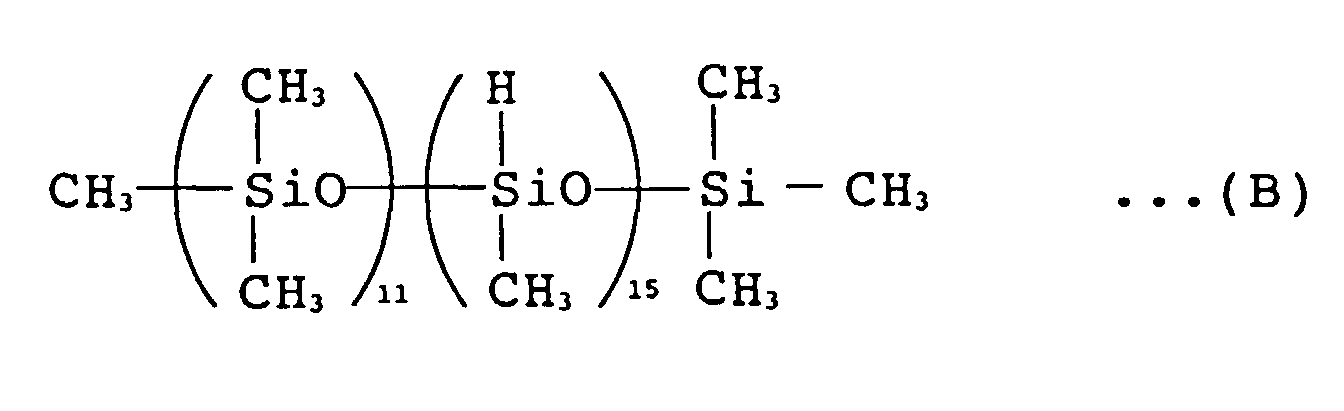
- To 100 parts of the liquid silicone rubber base were added 30 parts of the same dimethylpolysiloxane (A) as above, 1.1 parts of a methylhydrogenpolysiloxane consisting of dimethylsiloxane-methylhydrogensiloxane copolymer (B) of the following formula having a viscosity of 15 centistokes at 25°C as a crosslinking agent, 0.1 part of a 1% isopropyl alcohol solution of chloroplatinic acid, and 0.05 part of ethynyl cyclohexanol as a reaction control agent. The ingredients were uniformly mixed.
- The composition was cured at 150°C while being examined for curing using a rheometer. The results are shown in Table 1. T10 and T90 are times taken until the torque reaches 10% and 90% of the torque recorded after 2 minutes of curing, respectively. Separately, the composition was press molded at 120°C for 10 minutes into a rubber sheet of 2 mm gage. The rubber sheet was measured for residual nitrogen and various physical properties. The sheet was subject to a compression set test at 150°C for 22 hours according to JIS K-6301. The results are also shown in Table 1.
- A liquid silicone rubber base was prepared by agitating 100 parts of a dimethylpolysiloxane blocked with a dimethylvinylsiloxy group at either end and having a viscosity of 1 x 104 mm2/s (10,000 centistokes) at 25°C, 40 parts of wet silica (Nipsil LP), and 3 parts of 29% aqueous ammonia in a kneader mixer at room temperature, i.e. at 25°C for 1 hour, then heating to an internal temperature of 150°C, and continuing agitation for a further 3 hours. To 100 parts of the liquid silicone rubber base were added 300 parts of the dimethylpolysiloxane (A) used in Example 1, 1.1 parts of methylhydrogenpolysiloxane (B), 0.1 part of a 1% isopropyl alcohol solution of chloroplatinic acid, and 0.05 part of ethynyl cyclohexanol as a reaction control agent. There was obtained an addition type silicone rubber composition.
- The composition was tested as in Example 1, with the results shown in Table 1.
- A liquid silicone rubber base was prepared by combining 100 parts of a dimethylpolysiloxane blocked with a dimethylvinylsiloxy group at either end and having a viscosity of 10,000 centistokes at 25°C with 40 parts of wet silica (Nipsil LP), 3 parts of dimethoxydimethylsilane, and 1 part of water and agitating the ingredients in a kneader mixer as in Example 1. To 100 parts of the liquid silicone rubber base were added 30 parts of the dimethylpolysiloxane (A) used in Example 1, 1.1 parts of methylhydrogenpolysiloxane (B), 0.1 part of a 1% isopropyl alcohol solution of chloroplatinic acid, and 0.05 part of ethynyl cyclohexanol as a reaction control agent. Thereafter, 0.0045 part of 29% aqueous ammonia was added thereto, obtaining an addition type silicone rubber composition.
- The composition was tested as in Example 1, with the results shown in Table 1.
- A liquid silicone rubber base was prepared by combining 100 parts of a dimethylpolysiloxane blocked with a dimethylvinylsiloxy group at either end and having a viscosity of 10,000 centistokes at 25°C with 40 parts of wet silica (Nipsil LP), 3 parts of dimethoxydimethylsilane, 1 part of water, and 5 parts of ammonium carbonate and agitating the ingredients in a kneader mixer as in Example 1. To 100 parts of the liquid silicone rubber base were added 30 parts of the dimethylpolysiloxane (A) used in Example 1, 1.1 parts of methylhydrogenpolysiloxane (B), 0.1 part of a 1% isopropyl alcohol solution of chloroplatinic acid, and 0.05 part of ethynyl cyclohexanol as a reaction control agent. There was obtained an addition type silicone rubber composition.
- The composition was tested as in Example 1, with the results shown in Table 1.
- A liquid silicone rubber base was prepared by agitating 100 parts of a dimethylpolysiloxane blocked with a dimethylvinylsiloxy group at either end and having a viscosity of 1 x 104 mm2/s (10,000 centistokes) at 25°C with 40 parts of fumed silica having a specific surface area of 200 m2/g, 6 parts of hexamethyldisilazane, and 2 parts of water in a kneader mixer at room temperature, i.e. at 25°C for 1 hour, then heating to an internal temperature of 150°C, and continuing agitation for a further 3 hours. To the mixture was added 2 parts of aqueous ammonia. With agitation continued, the mixture was cooled down to room temperature. To 100 parts of the liquid silicone rubber base were added 30 parts of the dimethylpolysiloxane (A) used in Example 1, 1.1 parts of methylhydrogenpolysiloxane copolymer (B), 0.1 part of a 1% isopropyl alcohol solution of chloroplatinic acid, and 0.05 part of ethynyl cyclohexanol as a reaction control agent. There was obtained an addition type silicone rubber composition.
- The composition was tested as in Example 1, with the results shown in Table 1.
- A liquid rubber compound base was prepared by mixing 100 parts of a dimethylpolysiloxane blocked with a dimethylvinylsiloxy group at either end and having a viscosity of 10,000 centistokes at 25°C with 40 parts of wet silica (Nipsil LP), 1.5 parts of hexamethyldisilazane, and 0.5 part of water in a Henschel mixer for 10 minutes, transferring the mixture to a twin roll continuous milling extruder, and extruding at an internal temperature of 200°C for a residence time of 80 to 100 seconds. A crosslinking agent, catalyst and reaction control agent were added to the liquid rubber compound base as in Example 1, obtaining an addition type silicone rubber composition.
- The composition was tested as in Example 1, with the results shown in Table 1.
- A rubber compound base was prepared by agitating 100 parts of a dimethylpolysiloxane blocked with a dimethylvinylsiloxy group at either end and having a viscosity of 1 x 104 mm2/s (10,000 centistokes) at 25°C, 40 parts of wet silica (Nipsil LP), 3 parts of dimethoxydimethylsilane, and 1 part of water in a kneader mixer at room temperature, i.e. at 25°C for 1 hour, then heating to an internal temperature of 150°C, and continuing agitation for a further 3 hours. To 100 parts of the rubber compound base were added 30 parts of the dimethylpolysiloxane (A) used in Example 1, 1.1 parts of methylhydrogenpolysiloxane (B), 0.1 part of a 1% isopropyl alcohol solution of chloroplatinic acid, and 0.05 part of ethynyl cyclohexanol as a reaction control agent. There was obtained an addition type silicone rubber composition.
- The composition was tested as in Example 1, with the results shown in Table 1.
- A liquid rubber compound base was prepared by agitating 100 parts of a dimethylpolysiloxane blocked with a dimethylvinylsiloxy group at either end and having a viscosity of 1 x 104 mm2/s (10,000 centistokes) at 25°C, 40 parts of wet silica (Nipsil LP), 3 parts of hexamethyldisilazane, and 1 part of water in a kneader mixer at room temperature, i.e. at 25°C for 1 hour, then heating to an internal temperature of 110 °C, and continuing agitation at 100°C for a further 1 hour.
- To 100 parts of the liquid rubber compound base were added 30 parts of the dimethylpolysiloxane (A) used in Example 1, 1.1 parts of methylhydrogenpolysiloxane (B), 0.1 part of a 1% isopropyl alcohol solution of chloroplatinic acid, and 0.05 part of ethynyl cyclohexanol as a reaction control agent. There was obtained an addition type silicone rubber composition.
- The composition was tested as in Example 1, with the results shown in Table 1.
- A liquid rubber compound base was prepared by agitating 100 parts of a dimethylpolysiloxane blocked with a dimethylvinylsiloxy group at either end and having a viscosity of 1 x 104 mm2/s (10,000 centistokes) at 25°C, 40 parts of wet silica (Nipsil LP), 3 parts of hexamethyldisilazane, and 1 part of water in a kneader mixer at room temperature, i.e. at 25°C for 1 hour, then heating to an internal temperature of 150°C, and continuing agitation for a further 18 hours.
- To 100 parts of the liquid rubber compound base were added 30 parts of the dimethylpolysiloxane (A) used in Example 1, 1.1 parts of methylhydrogenpolysiloxane (B), 0.1 part of a 1% isopropyl alcohol solution of chloroplatinic acid, and 0.05 part of ethynyl cyclohexanol as a reaction control agent. There was obtained an addition type silicone rubber composition.
- The composition was tested as in Example 1, with the results shown in Table 1.
- A liquid rubber compound base was prepared by adding 40 parts of fumed silica having a specific surface area of 200 m2/g, 6 parts of hexamethyldisilazane, and 2 parts of water to 100 parts of a dimethylpolysiloxane blocked with a dimethylvinylsiloxy group at either end and having a viscosity of 1 x 104 mm2/s (10,000 centistokes) at 25°C, agitating the ingredients at room temperature, i.e. at 25°C for 1 hour, then heating to temperature of 150°C, and continuing agitation for a further 3 hours.
- To 100 parts of the liquid rubber compound base were added 30 parts of the dimethylpolysiloxane (A) used in Example 1, 1.1 parts of methylhydrogenpolysiloxane (B), 0.1 part of a 1% isopropyl alcohol solution of chloroplatinic acid, and 0.05 part of ethynyl cyclohexanol as a reaction control agent. There was obtained an addition type silicone rubber composition.
- The composition was tested as in Example 1, with the results shown in Table 1.
- A rubber compound base was prepared by charging a kneader mixer with 80 parts of a dimethylpolysiloxane blocked with a trivinylsiloxy group at either end and having a viscosity of 1 x 104 mm2/s (10,000 centistokes) at 25°C, 20 parts of a dimethylpolysiloxane blocked with a dimethylvinylsiloxy group at either end and having a viscosity of 10,000 centistokes at 25°C, 40 parts of wet silica (Nipsil LP), 3 parts of hexamethyldisilazane, and 1 part of water, agitating the ingredients at room temperature, i.e. at 25°C for 1 hour, then heating to a temperature of 150°C, and continuing agitation for a further 3 hours. To 100 parts of the rubber compound base were added 30 parts of the dimethylpolysiloxane (A) used in Example 1 and 0.6 part of t-butylperoxyisopropyl carbonate, obtaining a peroxide curing type silicone rubber composition.
- The composition was tested as in Example 1, with the results shown in Table 1.
- Comparative Example 5 was repeated except that hexamethyldisilazane was replaced by dimethoxydimethylsilane.
- The composition was tested as in Example 1, with the results shown in Table 1.
- From the examples it will be noted that the ammonia content at curing showed significant dependency on the mixing time and temperature, starting from a given preliminary mixture composition. Compare e.g. Example 1 with Comparative Examples 2 and 3. The nitrogen content is not difficult to determine, however, so mixing temperature and time for a desired ammonia content can correspondingly be determined without difficulty.

Claims (11)
- A heat - curable silicone rubber composition comprisingsaid ammonia or ammonia precursor being blended so that ammonia is present in an amount of 10 to 200 parts by weight of nitrogen per million parts by weight of the total of components (a), (b) and (c) in a cured product of the heat - curable silicone rubber composition.(a) organopolysiloxane having at least two alkenyl groups each bonded to a silicon atom in a molecule,(b) organohydrogenpolysiloxane having at least two hydrogen atoms each bonded to a silicon atom in a molecule,(c) platinum catalyst,(d) ammonia, or ammonia precursor to generate ammonia through thermal decomposition or chemical reaction, and(e) wet silica in an amount of 10 to 150 parts by weight per 100 parts by weight of the total of components (a), (b) and (c),
- A heat - curable silicone rubber composition of claim 1 wherein ammonia or ammonia precursor is blended so that ammonia is present in an amount of at least 20 parts by weight of nitrogen per million parts by weight of the total of components (a), (b) and (c) in the cured product of the heat - curable silicone rubber composition.
- A heat - curable silicone rubber composition comprisingsaid ammonia or ammonia precursor being blended so that ammonia is present in an amount of 10 to 500 parts by weight of nitrogen per million parts by weight of the total of components (a), (b) and (c) in a cured product of the heat - curable silicone rubber composition.(a) organopolysiloxane having at least two alkenyl groups each bonded to a silicon atom in a molecule,(b) organohydrogenpolysiloxane having at least two hydrogen atoms each bonded to a silicon atom in a molecule,(c) platinum catalyst,(d) ammonia, or ammonia precursor to generate ammonia through thermal decomposition or chemical reaction, and(e) fumed silica in an amount of 10 to 150 parts by weight per 10 parts by weight of the total of components (a) , (b) and (c),
- A heat - curable silicone rubber composition or claim 3 wherein ammonia or ammonia precursor is blended so that ammonia is present in an amount of 20 to 200 parts by weight of nitrogen per million parts by weight of the total of components (a), (b) and (c) in the cured product of the heat - curable silicone rubber composition.
- A method of vulcanizing a heat - curable silicone rubber composition comprisingcharacterized in that the composition is cured in the presence of ammonia in an amount of 10 to 200 parts by weight of nitrogen per million parts by weight of the total of components (a), (b) and (c).(a) organopolysiloxane having at least two alkenyl groups each bonded to a silicon atom in a molecule,(b) organohydrogenpolysiloxane having at least two hydrogen atoms each bonded to a silicon atom in a molecule,(c) platinum catalyst, and(d) wet silica in an amount of 10 to 150 parts by weight per 100 parts by weight of the total of components (a), (b) and (c),
- A method of claim 5 wherein the composition is cured in the presence of ammonia in an amount of at least 20 parts by weight of nitrogen per million parts by weight of the total of components (a), (b) and (c).
- A method of vulcanizing a heat - curable silicone rubber composition comprising(a) organopolysiloxane having at least two alkenyl groups each bonded to a silicon atom in a molecule,(b) organohydrogenpolysiloxane having at least two hydrogen atoms each bonded to a silicon atom in a molecule,(c) platinum catalyst, and(d) fumed silica in an amount of 10 to 150 parts per weight of the total of components (a), (b) and (c), characterized in that the composition is cured in the presence of ammonia in an amount of 10 to 500 parts by weight of nitrogen per million parts by weight of the total of components (a), (b) and ) (c).
- A method of claim 7 wherein the composition is cured in the presence of ammonia in an amount of 20 to 200 parts by weight of nitrogen per million parts by weight of the total of components (a), (b) and (c).
- A method according to any of claims 5 to 8 which does not include secondary vulcanization.
- Use of ammonia or an ammonia precursor as an additive at heat-curing of an addition cured silicone rubber from an organopolysiloxane including alkenyl moieties and an organohydrogenpolysiloxane, in the presence of platinum catalyst, to reduce compression set of the resulting cured rubber, the ammonia or ammonia precursor being present at curing at an amount corresponding to from 10 to 500 parts by weight of N to a million parts by weight total of said organopolysiloxane, organohydrogenpolysiloxane and catalyst.
- Use according to claim 10 in which the ammonia or ammonia precursor is blended as ammonia, as an inorganic ammonium salt, as an organic nitrogen compound or as an organosilazane.
Priority Applications (3)
| Application Number | Priority Date | Filing Date | Title |
|---|---|---|---|
| JP27698894A JP3189601B2 (en) | 1993-10-21 | 1994-10-17 | Heat-curable silicone rubber composition and curing method thereof |
| EP95301464A EP0731131B1 (en) | 1994-10-17 | 1995-03-07 | Heat-curable silicone rubber compositions |
| DE1995620035 DE69520035T2 (en) | 1995-03-07 | 1995-03-07 | Thermosetting silicone rubber compositions |
Applications Claiming Priority (2)
| Application Number | Priority Date | Filing Date | Title |
|---|---|---|---|
| JP27698894A JP3189601B2 (en) | 1993-10-21 | 1994-10-17 | Heat-curable silicone rubber composition and curing method thereof |
| EP95301464A EP0731131B1 (en) | 1994-10-17 | 1995-03-07 | Heat-curable silicone rubber compositions |
Publications (2)
| Publication Number | Publication Date |
|---|---|
| EP0731131A1 EP0731131A1 (en) | 1996-09-11 |
| EP0731131B1 true EP0731131B1 (en) | 2001-01-31 |
Family
ID=26140067
Family Applications (1)
| Application Number | Title | Priority Date | Filing Date |
|---|---|---|---|
| EP95301464A Expired - Lifetime EP0731131B1 (en) | 1993-10-21 | 1995-03-07 | Heat-curable silicone rubber compositions |
Country Status (1)
| Country | Link |
|---|---|
| EP (1) | EP0731131B1 (en) |
Families Citing this family (6)
| Publication number | Priority date | Publication date | Assignee | Title |
|---|---|---|---|---|
| DE19614343A1 (en) * | 1996-04-11 | 1997-10-16 | Wacker Chemie Gmbh | Silicone rubbers with improved skin strength and low compression set |
| DE19751523A1 (en) * | 1997-11-20 | 1999-07-29 | Wacker Chemie Gmbh | Addition-crosslinked silicone rubbers with low compression set |
| US5998516A (en) * | 1997-12-29 | 1999-12-07 | General Electric Company | Liquid injection molding silcone elastomers having low compression set |
| DE102005045336A1 (en) * | 2005-09-22 | 2007-03-29 | Wacker Chemie Ag | Silicone compounds with excellent viscosity stability |
| JP5219367B2 (en) | 2006-12-27 | 2013-06-26 | 東レ・ダウコーニング株式会社 | Addition-curing silicone rubber composition and molded article thereof |
| WO2024086137A1 (en) * | 2022-10-19 | 2024-04-25 | Dow Silicones Corporation | Liquid silicone rubber composition |
Citations (5)
| Publication number | Priority date | Publication date | Assignee | Title |
|---|---|---|---|---|
| EP0415180A2 (en) * | 1989-08-28 | 1991-03-06 | General Electric Company | Low compression set, oil and fuel resistant, liquid injection moldable, silicone rubber |
| EP0489518A1 (en) * | 1990-12-05 | 1992-06-10 | Dow Corning Corporation | Extrudable curable organosiloxane compositions exhibiting reduced compression set |
| EP0489391A2 (en) * | 1990-12-03 | 1992-06-10 | Dow Corning Corporation | Extrudable curable organosiloxane compositions |
| EP0622421A2 (en) * | 1993-04-30 | 1994-11-02 | General Electric Company | Liquid injection moldable silicone compositions |
| EP0691373A1 (en) * | 1994-07-08 | 1996-01-10 | Dow Corning Corporation | Method for preparing organopolysiloxane bases and compositions therefrom |
Family Cites Families (1)
| Publication number | Priority date | Publication date | Assignee | Title |
|---|---|---|---|---|
| CA2098634A1 (en) * | 1992-06-30 | 1993-12-31 | James E. Doin | Addition cured platinum catalyzed elastomer compositions with precipitated silica |
-
1995
- 1995-03-07 EP EP95301464A patent/EP0731131B1/en not_active Expired - Lifetime
Patent Citations (5)
| Publication number | Priority date | Publication date | Assignee | Title |
|---|---|---|---|---|
| EP0415180A2 (en) * | 1989-08-28 | 1991-03-06 | General Electric Company | Low compression set, oil and fuel resistant, liquid injection moldable, silicone rubber |
| EP0489391A2 (en) * | 1990-12-03 | 1992-06-10 | Dow Corning Corporation | Extrudable curable organosiloxane compositions |
| EP0489518A1 (en) * | 1990-12-05 | 1992-06-10 | Dow Corning Corporation | Extrudable curable organosiloxane compositions exhibiting reduced compression set |
| EP0622421A2 (en) * | 1993-04-30 | 1994-11-02 | General Electric Company | Liquid injection moldable silicone compositions |
| EP0691373A1 (en) * | 1994-07-08 | 1996-01-10 | Dow Corning Corporation | Method for preparing organopolysiloxane bases and compositions therefrom |
Also Published As
| Publication number | Publication date |
|---|---|
| EP0731131A1 (en) | 1996-09-11 |
Similar Documents
| Publication | Publication Date | Title |
|---|---|---|
| EP0415180B1 (en) | Low compression set, oil and fuel resistant, liquid injection moldable, silicone rubber | |
| EP1785454B1 (en) | Addition curable liquid silicone rubber composition for injection molding, method of regulating fluidity of the composition, and method of injection molding silicone rubber composition | |
| EP0489391B1 (en) | Extrudable curable organosiloxane compositions | |
| EP0640663A2 (en) | Silicone rubber composition for injection molding | |
| EP0651021A2 (en) | Low viscosity curable organosiloxane compositions | |
| US5569688A (en) | Heat-curable silicone rubber compositions | |
| US5610230A (en) | Liquid silicone rubber compositions | |
| KR101502587B1 (en) | Addition curable silicone rubber composition and silicone rubber cured product | |
| JPS5930746B2 (en) | Silicone rubber composition and its manufacturing method | |
| EP0826734B1 (en) | Method for the preparation of silicone rubber | |
| EP0444960B1 (en) | Curable organopolysiloxane composition | |
| JPH06207104A (en) | Conjugate body of silicone resin and silicone rubber and its production | |
| EP0636663A2 (en) | Blends of fluoroorganic and organosiloxane rubbers | |
| EP0731131B1 (en) | Heat-curable silicone rubber compositions | |
| US5635547A (en) | Process for preparing silicone rubber composition | |
| JP3189601B2 (en) | Heat-curable silicone rubber composition and curing method thereof | |
| EP0477984B1 (en) | Use of a compression-resistant silicone rubber composition | |
| JP5014532B2 (en) | Method for producing liquid addition-curable silicone rubber composition | |
| JP3482834B2 (en) | Method for producing silicone rubber | |
| JPH09165515A (en) | Addition-type heat-curable silicone elastomer composition for fixing roll and method for producing the same | |
| JP3121772B2 (en) | Method for producing thermosetting silicone rubber composition | |
| US5631321A (en) | Sealing component for connector waterproofing | |
| EP0379340B1 (en) | Heat-curable silicone rubber compositions | |
| JP3611025B2 (en) | Silicone rubber composition | |
| JPH08208994A (en) | Liquid silicone rubber composition and method for producing the same |
Legal Events
| Date | Code | Title | Description |
|---|---|---|---|
| PUAI | Public reference made under article 153(3) epc to a published international application that has entered the european phase |
Free format text: ORIGINAL CODE: 0009012 |
|
| AK | Designated contracting states |
Kind code of ref document: A1 Designated state(s): DE FR GB |
|
| 17P | Request for examination filed |
Effective date: 19970108 |
|
| 17Q | First examination report despatched |
Effective date: 19971223 |
|
| GRAG | Despatch of communication of intention to grant |
Free format text: ORIGINAL CODE: EPIDOS AGRA |
|
| GRAG | Despatch of communication of intention to grant |
Free format text: ORIGINAL CODE: EPIDOS AGRA |
|
| GRAH | Despatch of communication of intention to grant a patent |
Free format text: ORIGINAL CODE: EPIDOS IGRA |
|
| GRAH | Despatch of communication of intention to grant a patent |
Free format text: ORIGINAL CODE: EPIDOS IGRA |
|
| GRAA | (expected) grant |
Free format text: ORIGINAL CODE: 0009210 |
|
| AK | Designated contracting states |
Kind code of ref document: B1 Designated state(s): DE FR GB |
|
| REF | Corresponds to: |
Ref document number: 69520035 Country of ref document: DE Date of ref document: 20010308 |
|
| ET | Fr: translation filed | ||
| PLBE | No opposition filed within time limit |
Free format text: ORIGINAL CODE: 0009261 |
|
| STAA | Information on the status of an ep patent application or granted ep patent |
Free format text: STATUS: NO OPPOSITION FILED WITHIN TIME LIMIT |
|
| REG | Reference to a national code |
Ref country code: GB Ref legal event code: IF02 |
|
| 26N | No opposition filed | ||
| PGFP | Annual fee paid to national office [announced via postgrant information from national office to epo] |
Ref country code: GB Payment date: 20070307 Year of fee payment: 13 |
|
| REG | Reference to a national code |
Ref country code: GB Ref legal event code: 711B |
|
| REG | Reference to a national code |
Ref country code: GB Ref legal event code: 711L |
|
| REG | Reference to a national code |
Ref country code: GB Ref legal event code: S117 Ref country code: GB Ref legal event code: 711G |
|
| PGFP | Annual fee paid to national office [announced via postgrant information from national office to epo] |
Ref country code: FR Payment date: 20070308 Year of fee payment: 13 |
|
| GBPC | Gb: european patent ceased through non-payment of renewal fee |
Effective date: 20080307 |
|
| REG | Reference to a national code |
Ref country code: FR Ref legal event code: ST Effective date: 20081125 |
|
| PG25 | Lapsed in a contracting state [announced via postgrant information from national office to epo] |
Ref country code: FR Free format text: LAPSE BECAUSE OF NON-PAYMENT OF DUE FEES Effective date: 20080331 |
|
| PG25 | Lapsed in a contracting state [announced via postgrant information from national office to epo] |
Ref country code: GB Free format text: LAPSE BECAUSE OF NON-PAYMENT OF DUE FEES Effective date: 20080307 |
|
| PGFP | Annual fee paid to national office [announced via postgrant information from national office to epo] |
Ref country code: DE Payment date: 20100318 Year of fee payment: 16 |
|
| PG25 | Lapsed in a contracting state [announced via postgrant information from national office to epo] |
Ref country code: DE Free format text: LAPSE BECAUSE OF NON-PAYMENT OF DUE FEES Effective date: 20111001 |
|
| REG | Reference to a national code |
Ref country code: DE Ref legal event code: R119 Ref document number: 69520035 Country of ref document: DE Effective date: 20111001 |