EP0729962B1 - A boronic acid compound having a binaphthyl group - Google Patents
A boronic acid compound having a binaphthyl group Download PDFInfo
- Publication number
- EP0729962B1 EP0729962B1 EP95309507A EP95309507A EP0729962B1 EP 0729962 B1 EP0729962 B1 EP 0729962B1 EP 95309507 A EP95309507 A EP 95309507A EP 95309507 A EP95309507 A EP 95309507A EP 0729962 B1 EP0729962 B1 EP 0729962B1
- Authority
- EP
- European Patent Office
- Prior art keywords
- compound
- saccharide
- boronic acid
- glucose
- formula
- Prior art date
- Legal status (The legal status is an assumption and is not a legal conclusion. Google has not performed a legal analysis and makes no representation as to the accuracy of the status listed.)
- Expired - Lifetime
Links
- 0 Oc(ccc1c2cccc1)c2-c1c(cccc2)c2ccc1OC*I Chemical compound Oc(ccc1c2cccc1)c2-c1c(cccc2)c2ccc1OC*I 0.000 description 5
- WDNAHZARDLAENM-UHFFFAOYSA-N CC1(C)COS(c2c(CS)cccc2)OC1 Chemical compound CC1(C)COS(c2c(CS)cccc2)OC1 WDNAHZARDLAENM-UHFFFAOYSA-N 0.000 description 1
- BJAADAKPADTRCH-UHFFFAOYSA-N COc(ccc1ccccc11)c1-c1c(cccc2)c2ccc1OC Chemical compound COc(ccc1ccccc11)c1-c1c(cccc2)c2ccc1OC BJAADAKPADTRCH-UHFFFAOYSA-N 0.000 description 1
Images

Classifications
-
- C—CHEMISTRY; METALLURGY
- C07—ORGANIC CHEMISTRY
- C07F—ACYCLIC, CARBOCYCLIC OR HETEROCYCLIC COMPOUNDS CONTAINING ELEMENTS OTHER THAN CARBON, HYDROGEN, HALOGEN, OXYGEN, NITROGEN, SULFUR, SELENIUM OR TELLURIUM
- C07F5/00—Compounds containing elements of Groups 3 or 13 of the Periodic Table
- C07F5/02—Boron compounds
- C07F5/025—Boronic and borinic acid compounds
-
- G—PHYSICS
- G01—MEASURING; TESTING
- G01N—INVESTIGATING OR ANALYSING MATERIALS BY DETERMINING THEIR CHEMICAL OR PHYSICAL PROPERTIES
- G01N33/00—Investigating or analysing materials by specific methods not covered by groups G01N1/00 - G01N31/00
- G01N33/48—Biological material, e.g. blood, urine; Haemocytometers
- G01N33/50—Chemical analysis of biological material, e.g. blood, urine; Testing involving biospecific ligand binding methods; Immunological testing
- G01N33/66—Chemical analysis of biological material, e.g. blood, urine; Testing involving biospecific ligand binding methods; Immunological testing involving blood sugars, e.g. galactose
Definitions
- the present invention relates to a boronic acid compound, and particularly to a novel chiral boronic acid compound capable of binding to polyols, particularly to saccharides, which compound is suitable for use in analysis or separation of the polyols.
- Polyols as typified by saccharides, occur widely in nature and play an important role in living organisms. They are also one of the key materials used in industry. Polyols are characterized by their complexity and variety. In particular, a saccharide is composed of the D-form and L-form, which are known as optical isomers. The separation of such isomers (optical resolution) is of great importance in many fields, such as in synthesizing pharmaceutical substances. The contamination by an undesired optical isomer may cause not only a lowering of the pharmaceutical efficacy but also serious side-effects in the patient. However optical isomers are difficult to selectively isolate or detect, since they have identical physical properties such as boiling point and melting point.
- One possible approach for the separation and/or analysis of polyols such as saccharides would be the utilization of a substance capable of selectively binding to a target polyol in which the binding can be externally quantified.
- Binding of a saccharide using boronic acids is also disclosed in DE 3720736, but no chiral discrimination is possible using the systems described.
- R 1 and R 2 are generally the same, but may be different.
- R 1 and R 2 are selected from the group consisting of alkoxy groups having 1 to 4 carbon atoms and OH (hydroxyl group), with methoxy, ethoxy or OH being particularly preferred.
- n+m is 2 or 3 and x+y is 2 or 3, in which each of n, m, x and y may be zero.
- n and x are generally the same but may be different.
- m and y are generally the same but may be different.
- Most generally, each of n, m, x and y is 1.
- the boronic acid compound having a binaphthyl group of the present invention as expressed by the aforesaid formulas (1) and (2) has a chiral structure, i.e. a mirror-image (enantiomer) structure consisting of R-form (R-isomer) and S-form (S-isomer).
- the formula(1) (or formula(2)) expresses either R-form or S-form of the compound.
- the boronic acid compound of the present invention is characterized by the fact that the R-form and S-form thereof each exhibits an extremely high selectivity to one of the enantiomers of a polyol, particularly of a saccharide.
- the R-form of the boronic acid compound of the following formula(3) has a high selectivity to D-form of a monosaccharide such as glucose and fructose, and emits an increased fluorescence upon binding to such D-form, while the S-form of the same compound exhibits a high selectivity to L-form of the monosaccharide and emits an increased fluorescence upon binding to the L-form.
- a boronic acid compound having a binaphthyl group of the present invention can be used for the separation and analysis of a specific polyol including saccharides since it is capable of binding to such polyol where the binding with the polyol can be read out as fluorescence.
- the binding between the polyol (saccharide) and the fluorescent compound can easily be cleaved by changing the pH of the system through an appropriate acid, thereby restoring the saccharide.
- a saccharide-detecting kit comprising the R-form and/or S-form of a fluorescent compound defined by any of the aforesaid formulas in a solid (powdery) or crystalline state, a buffer solution and a set of standard solutions.
- the standard solutions are varied concentrations of the saccharide to be detected.
- the calibration of a spectrophotometer for the detection is conducted by dissolving the compound of the invention in the standard solutions with the buffer solution and measuring fluorescent intensity against varied saccharide solutions.
- kits composed of the R-form of the compound of the formula(3) are effectively utilized.
- a kit composed of the S-form of the compound(3) is effective for detecting L-glucose or L-fructose.
- the compounds of the present invention can be applied to the detection of a racemic mixture.
- kits composed of R-form and/or S-form of the compound of the formula(3) is used in which the fluorescent intensity of the R-form of the compound increases with increasing D-glucose and decreases with increasing L-glucose, and vice versa for the S-form of the same compound.
- the compound of the present invention may be used in a chromatographic detection method for saccharide.
- the compound is carried on an appropriate support and packed in a column.
- a saccharide-containing sample passes through the column, a complex will form between the compound and the saccharide emitting fluorescence measurable by a suitable means.
- Figure 1 is a scheme illustrating the synthesis of a boronic acid of the present invention, in which Me represents methyl.
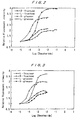
- Figure 2 demonstrates fluorescence intensities of the R-isomer of the boronic acid compound of the present invention in the presence of monosaccharides.
- Figure 3 demonstrates fluorescence intensities of the S-isomer of the boronic acid compound of the present invention in the presence of monosaccharides.
- the boronic acid compound can be prepared by synthetic routes as exemplified in Fig.1, in which each of n, m, x and y is 1.
- Fig.1 in which each of n, m, x and y is 1.
- carbon atoms and hydrogen atoms are not shown as conventionally done.
- the OH groups at the 1 and 1' positions of binaphthol are alkoxylated.
- the alkoxylation may be conducted, in the presence of an alkali such as potassium carbonate, using methyl iodide in the case of R 1 and R 2 being methoxy as in Fig.1, and using ethyl bromide, propyl bromide and butyl bromide in the case where both R 1 and R 2 are ethoxy, propoxy and butoxy groups, respectively (route i).
- the route(i) is omitted when R 1 and R 2 are OH.
- the crude aldehyde 5g was then purified by column chromatography (silica gel). The product was eluted by 10% ethyl acetone / dichloromethane. The starting material and monoaldehyde were removed by 50% hexane / dichloromethane and 100% dichloromethane respectively. The yield of the dialdehyde was 3g.
- the mass of the diglycerol boronate ester is 780.
- the R-isomer and S-isomer of the boronic acid compound of the formula(3) as prepared in Example 1 were measured for fluorescence in the presence of saccharides in order to evaluate characteristic properties thereof.
- the R-isomer and the S-isomer were each resolved at a concentration of 0.00001M in a 33.3% methanol aqueous solution with a pH of 7.77 (buffered with 0.01M KCl, 0.002642M KH 2 PO 4 , 0.00264M Na 2 HPO 4 ).
- To the solution were added dropwise portions of saccharide (D-glucose, L-glucose, D-fructose or L-fructose) and fluorescence intensity was measured on a Hitachi F-4500 fluorospectrophotometer with a Hewlett Pachard VETRA 286/12 computer.
- the wavelength for excitation is 289nm, while the wavelength for emission is 358nm.
- Fig.2 results are shown in Fig.2 for the R-isomer and in Fig.3 for the S-isomer.
- the R-isomer exhibits much higher fluorescence intensities in the presence of D-glucose or D-fructose than in the presence of L-glucose and L-fructose (Fig.2).
- the S-isomer shows higher fluorescence intensities in the presence of L-glucose or L-fructose than in the presence of D-glucose or D-fructose (Fig.3).
- the stability constants(K) were also determined from the titration curves in terms of fluorescence intensity versus saccharide concentration assuming that a 1:1 complex is formed between the boronic acid compound and the saccharide.
- the values of log K are 3.3 with D-glucose, 3.1 with L-glucose, 4.0 with D-fructose and 3.5 with L-fructose, all being higher with D-isomer of saccharide.
- the values of log K are 3.4 with D-glucose, 3.5 with L-glucose, 3.7 with D-fructose and 4.0 with L-fructose, all being higher with D-isomer of saccharide.
- the boronic acid compound having a binaphthyl group as expressed by the formula(3) has a high selectivity to the D-isomer of a monosaccharide when it is in the form of R-isomer, while it exhibits a high selectivity to the L-isomer of the monosaccharide when in the form of S-isomer, all emitting strong fluorescence upon binding to the respective saccharide isomers.
Landscapes
- Health & Medical Sciences (AREA)
- Chemical & Material Sciences (AREA)
- Life Sciences & Earth Sciences (AREA)
- Hematology (AREA)
- Engineering & Computer Science (AREA)
- Molecular Biology (AREA)
- Biomedical Technology (AREA)
- Organic Chemistry (AREA)
- Immunology (AREA)
- Urology & Nephrology (AREA)
- Medicinal Chemistry (AREA)
- Microbiology (AREA)
- Diabetes (AREA)
- Food Science & Technology (AREA)
- Biotechnology (AREA)
- Physics & Mathematics (AREA)
- Analytical Chemistry (AREA)
- Biochemistry (AREA)
- General Health & Medical Sciences (AREA)
- General Physics & Mathematics (AREA)
- Pathology (AREA)
- Cell Biology (AREA)
- Luminescent Compositions (AREA)
Description
- The present invention relates to a boronic acid compound, and particularly to a novel chiral boronic acid compound capable of binding to polyols, particularly to saccharides, which compound is suitable for use in analysis or separation of the polyols.
- Polyols, as typified by saccharides, occur widely in nature and play an important role in living organisms. They are also one of the key materials used in industry. Polyols are characterized by their complexity and variety. In particular, a saccharide is composed of the D-form and L-form, which are known as optical isomers. The separation of such isomers (optical resolution) is of great importance in many fields, such as in synthesizing pharmaceutical substances. The contamination by an undesired optical isomer may cause not only a lowering of the pharmaceutical efficacy but also serious side-effects in the patient. However optical isomers are difficult to selectively isolate or detect, since they have identical physical properties such as boiling point and melting point. If it should be possible to selectively detect or isolate a polyol of a specific structure, that is, to selectively detect or isolate the D-form or L-form of isomers, it would not only make a great contribution to the world of science but also give rise to a variety of industrial applications. However, no practical measures seem to be available for this purpose.
- One possible approach for the separation and/or analysis of polyols such as saccharides would be the utilization of a substance capable of selectively binding to a target polyol in which the binding can be externally quantified.
- It is well known that a boronic acid group, B(OH)2, covalently reacts with OH groups present in such compounds as saccharides. Based on this phenomenon, the present inventors previously created a novel phenylboronic acid compound which emits strong fluorescence when combined with glucose (Japanese Patent Application No.147061/1994, equivalent to GB 2284809). While the compound is suitable for use in the detection of a specific saccharide, it is unable to discriminate between the D-form and L-form of the saccharide.
- Binding of a saccharide using boronic acids is also disclosed in DE 3720736, but no chiral discrimination is possible using the systems described.
- The present inventors have now succeeded in synthesizing for the first time a novel boronic acid compound which is able to discriminate between the D-form and L-form of a saccharide when necessary. In particular, work involving the use of compounds of formula(2), below, for this purpose was published by the inventors after the priority date of this application (Nature, Vol. 374, pages 345-347, 23 March 1995).
- Thus, according to the present invention there is provided a novel chiral boronic acid compound having a binaphthyl group which can be expressed by the following general formula(1):
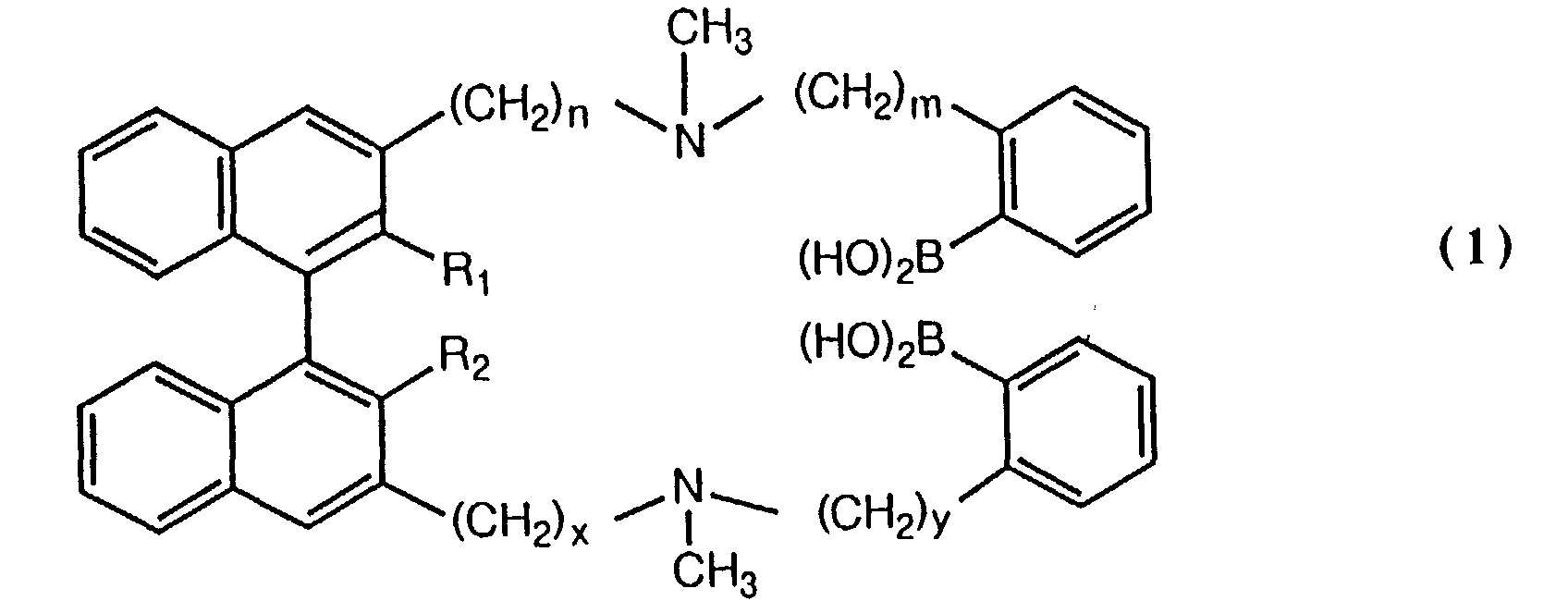
- In formula(1), R1 and R2 are generally the same, but may be different. R1 and R2 are selected from the group consisting of alkoxy groups having 1 to 4 carbon atoms and OH (hydroxyl group), with methoxy, ethoxy or OH being particularly preferred.
- In the above formula(1), n+m is 2 or 3 and x+y is 2 or 3, in which each of n, m, x and y may be zero. n and x are generally the same but may be different. m and y are generally the same but may be different. Most generally, each of n, m, x and y is 1. Thus, a preferred example of the compounds falling within the definition of the formula(1) can be expressed by the following formula (2):
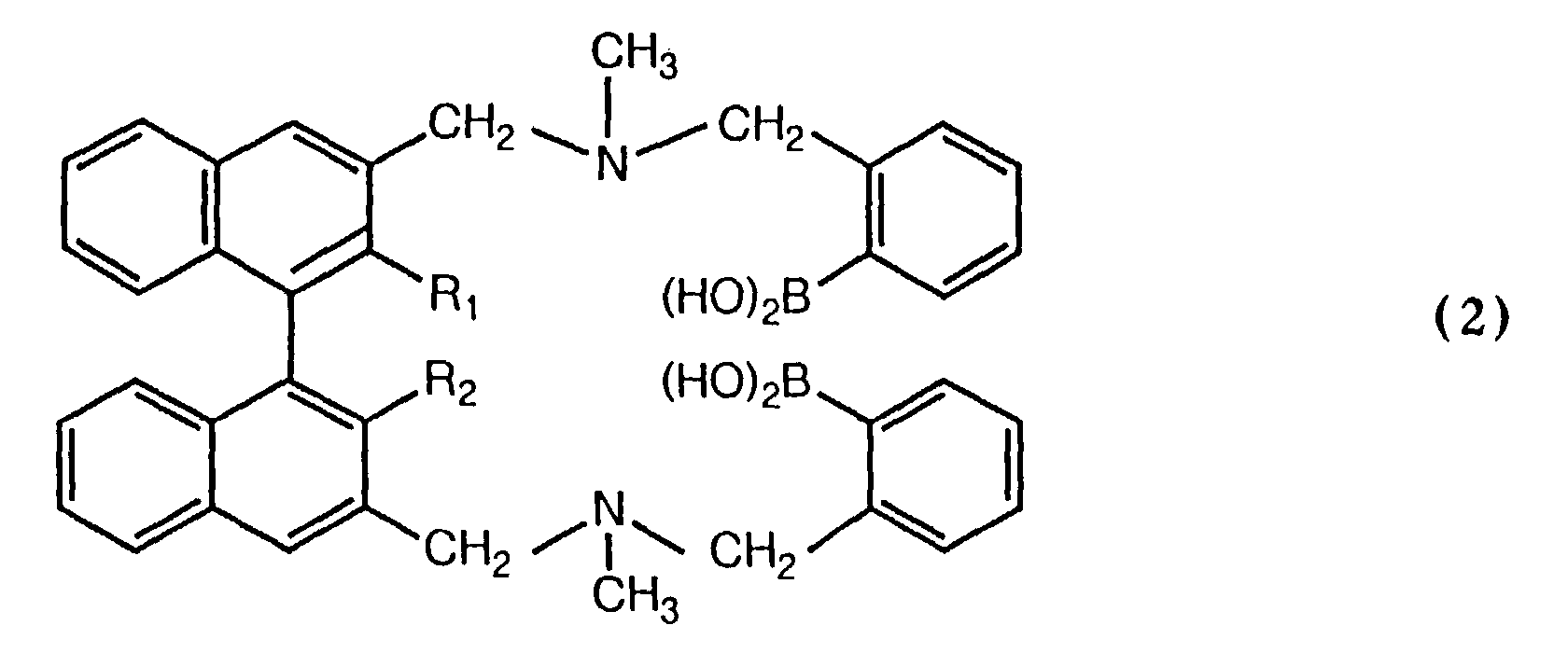
- The boronic acid compound having a binaphthyl group of the present invention as expressed by the aforesaid formulas (1) and (2) has a chiral structure, i.e. a mirror-image (enantiomer) structure consisting of R-form (R-isomer) and S-form (S-isomer). Thus, the formula(1) (or formula(2)) expresses either R-form or S-form of the compound. The boronic acid compound of the present invention is characterized by the fact that the R-form and S-form thereof each exhibits an extremely high selectivity to one of the enantiomers of a polyol, particularly of a saccharide.
- Specifically, the R-form of the boronic acid compound of the following formula(3) has a high selectivity to D-form of a monosaccharide such as glucose and fructose, and emits an increased fluorescence upon binding to such D-form, while the S-form of the same compound exhibits a high selectivity to L-form of the monosaccharide and emits an increased fluorescence upon binding to the L-form.

- Thus, a boronic acid compound having a binaphthyl group of the present invention can be used for the separation and analysis of a specific polyol including saccharides since it is capable of binding to such polyol where the binding with the polyol can be read out as fluorescence. The binding between the polyol (saccharide) and the fluorescent compound can easily be cleaved by changing the pH of the system through an appropriate acid, thereby restoring the saccharide.
- Analysis or detection of polyols (saccharides) may be conveniently carried out with a kit composed of the above-mentioned boronic acid compound(s). Thus, another aspect of the present invention provides a saccharide-detecting kit comprising the R-form and/or S-form of a fluorescent compound defined by any of the aforesaid formulas in a solid (powdery) or crystalline state, a buffer solution and a set of standard solutions. The standard solutions are varied concentrations of the saccharide to be detected. The calibration of a spectrophotometer for the detection is conducted by dissolving the compound of the invention in the standard solutions with the buffer solution and measuring fluorescent intensity against varied saccharide solutions. Thus, in the detection of D-glucose or D-fructose, for example, such a kit composed of the R-form of the compound of the formula(3) is effectively utilized. On the other hand, a kit composed of the S-form of the compound(3) is effective for detecting L-glucose or L-fructose. Furthermore, the compounds of the present invention can be applied to the detection of a racemic mixture. For example, in the detection of a racemic mixture of D-glucose and L-glucose, a kit composed of R-form and/or S-form of the compound of the formula(3) is used in which the fluorescent intensity of the R-form of the compound increases with increasing D-glucose and decreases with increasing L-glucose, and vice versa for the S-form of the same compound.
- As another embodiment, the compound of the present invention may be used in a chromatographic detection method for saccharide. The compound is carried on an appropriate support and packed in a column. When a saccharide-containing sample passes through the column, a complex will form between the compound and the saccharide emitting fluorescence measurable by a suitable means.
- Figure 1 is a scheme illustrating the synthesis of a boronic acid of the present invention, in which Me represents methyl.
- Figure 2 demonstrates fluorescence intensities of the R-isomer of the boronic acid compound of the present invention in the presence of monosaccharides.
- Figure 3 demonstrates fluorescence intensities of the S-isomer of the boronic acid compound of the present invention in the presence of monosaccharides.
- The boronic acid compound can be prepared by synthetic routes as exemplified in Fig.1, in which each of n, m, x and y is 1. In the chemical formulas herein provided including those in Fig.1, carbon atoms and hydrogen atoms are not shown as conventionally done.
- Referring to Fig.1, the OH groups at the 1 and 1' positions of binaphthol (commercially available) are alkoxylated. The alkoxylation may be conducted, in the presence of an alkali such as potassium carbonate, using methyl iodide in the case of R1 and R2 being methoxy as in Fig.1, and using ethyl bromide, propyl bromide and butyl bromide in the case where both R1 and R2 are ethoxy, propoxy and butoxy groups, respectively (route i). The route(i) is omitted when R1 and R2 are OH.
- Then, the 3 and 3' positions of the resulting compound are formylated in the manner as detailed later in the working example (route ii), followed by the formation of a Schiff's base using methylamine (route iii). The imine thus obtained is allowed to react with NaBH4 to form 3,3'-bis(N-methylaminomethyl) derivative (route iv). Finally, all alkylation reaction is conducted using 2-bromomethylphenyl boronic acid (protected with 2,2'-dimethyl-1,3-propanediol) to form the desired boronic acid having a naphthyl group (route v).
- The invention will now be illustrated by the following examples.
- The compound of the above-mentioned formula, i.e., a boronic acid compound falling within the general formula(2) in which R1=R2=methoxy, was prepared by the synthetic routes (i) to (iv) as shown in Fig.1.
- (i) 25g of R- or S-binaphthol, commercially available from Tokyo Kasei Co. (Tokyo, Japan), 24.6g of methyl iodide and 24.1g of potassium carbonate in 500ml of acetone were refluxed for 3 days. After the solvent was removed, the solid was extracted with dichloromethane/water. The organic layer was then washed with water (3x200ml) to obtain the desired dimethylether.
- (ii) 20g of the dimethylether of R- or S-binaphthol and 31.2ml of TMEDA (tetramethylethylenediamine : 1,2-bis (dimethylamino)ethane) were mixed in 400ml of benzene. 130ml of 15% butyllithium was then added dropwise to the mixture. The resulting mixture was then stirred at room temperature for 18 hours. 17.1ml of anhydrous DMF was then dropped into the mixture, which was stirred for further 30 minutes. Then, 200ml of 50% hydrochloric acid was added dropwise under cooling. The organic phase was then washed with 100ml brine two times, while the aqueous phase was washed with 100ml of methylene chloride two times. The organic phase was then dried over magnesium sulfate and the solvent was removed to give the crude aldehyde.
-
- The crude aldehyde 5g was then purified by column chromatography (silica gel). The product was eluted by 10% ethyl acetone / dichloromethane. The starting material and monoaldehyde were removed by 50% hexane / dichloromethane and 100% dichloromethane respectively. The yield of the dialdehyde was 3g.
- (iii) 3g of the dialdehyde was then dissolved in 100ml of 40% methylene / methanol and stirred overnight at room temperature. The solvent was removed to give the desired imine.
- (iv) The imine obtained in the route(iii) was dissolved in 50ml of anhydrous methanol and 2g of sodium borohydride(NaBH4) was added under cooling. The resulting mixture was stirred at room temperature for 15 hours. The solvent was removed and the solid was extracted with dichloromethane / water. The organic phase was washed with 100ml of distilled water three times. The solvent was then removed to give the desired amine quantitatively.
- (v) The 1g of the amine as obtained in the above, 1.7g of the bromomethyl protected boronic acid and lg of potassium carbonate were mixed in 100ml of 50% acetonitrile / THF (tetrahydrofuran). The resulting mixture was refluxed overnight and filtered, and then the solvent was removed. The solid was washed with hexane and triturated with ethylacetate. Yield was 300mg.
-
- The percentage enantiomeric excess (ee) and optical rotation for the boronic acid product of the formula(3) are: >94% ee and [α] 25 / D = +12.7 ° (c 0.272, in methanol ) for R-form (R-isomer), and >99% ee and [α] 25 / D = -13.1° (c 0.4, in methanol) for S-form (S-isomer). The result of mass spectrometric analysis for both R-form and S-form of the boronic acid compound is: m/z= 781[m+1] (SIMS(+), glycerol). The mass of the diglycerol boronate ester is 780.
- Two boronic acid compounds were prepared in which R1=R2=OH and R1=R2=ethoxy in the aforesaid general formula (2), respectively. The compounds were prepared in the manner as described in Example 1, except that step (i) was omitted for the compound of R1=R2=OH and ethyl bromide was used in step (i) instead of methyl iodide for the compound of R1=R2= ethoxy.
- The mass spectrometric analysis of the compounds showed that m/z (SIMS(+)) are 777 in the case of R1 and R2 being Oil and 833 in the case of R1 and R2 being ethoxy, respectively, indicating that the desired boronic acid compounds were successfully obtained.
- The R-isomer and S-isomer of the boronic acid compound of the formula(3) as prepared in Example 1 were measured for fluorescence in the presence of saccharides in order to evaluate characteristic properties thereof.
- The R-isomer and the S-isomer were each resolved at a concentration of 0.00001M in a 33.3% methanol aqueous solution with a pH of 7.77 (buffered with 0.01M KCl, 0.002642M KH2PO4, 0.00264M Na2HPO4). To the solution were added dropwise portions of saccharide (D-glucose, L-glucose, D-fructose or L-fructose) and fluorescence intensity was measured on a Hitachi F-4500 fluorospectrophotometer with a Hewlett Pachard VETRA 286/12 computer. The wavelength for excitation is 289nm, while the wavelength for emission is 358nm.
- The results are shown in Fig.2 for the R-isomer and in Fig.3 for the S-isomer. As can be seen from the figures, the R-isomer exhibits much higher fluorescence intensities in the presence of D-glucose or D-fructose than in the presence of L-glucose and L-fructose (Fig.2). In contrast, the S-isomer shows higher fluorescence intensities in the presence of L-glucose or L-fructose than in the presence of D-glucose or D-fructose (Fig.3).
- The stability constants(K) were also determined from the titration curves in terms of fluorescence intensity versus saccharide concentration assuming that a 1:1 complex is formed between the boronic acid compound and the saccharide. For R-isomers, the values of log K are 3.3 with D-glucose, 3.1 with L-glucose, 4.0 with D-fructose and 3.5 with L-fructose, all being higher with D-isomer of saccharide. For S-isomers the values of log K are 3.4 with D-glucose, 3.5 with L-glucose, 3.7 with D-fructose and 4.0 with L-fructose, all being higher with D-isomer of saccharide.
- From these results it is understood that the boronic acid compound having a binaphthyl group as expressed by the formula(3) has a high selectivity to the D-isomer of a monosaccharide when it is in the form of R-isomer, while it exhibits a high selectivity to the L-isomer of the monosaccharide when in the form of S-isomer, all emitting strong fluorescence upon binding to the respective saccharide isomers.
Claims (7)
- A fluorescent compound of the following general formula:in which R1 and R2 are generally the same but may be different and each selected from the group consisting of alkoxy groups having 1 to 4 carbon atoms, n+m is 2 or 3, x+y is 2 or 3 in which each of n, m, x and y may be zero, and the above formula expresses either R-form or S-form of the compound.

- A fluorescent compound of the following general formula:in which R1 and R2 are generally the same but may be different and each selected from the group consisting of alkoxy groups having 1 to 4 carbon atoms, and the formula expresses either R-form or S-form of the compound.

- A fluorescent compound of the following formula:in which the formula expresses either R-form or S-form of the compound.

- A saccharide-detecting kit comprising R-form and/or S-form of a fluorescent compound of claim 1 in a solid or crystalline state, a buffer solution and a set of standard solution, the standard solutions being ones at varied concentrations of the saccharide to be detected.
- The saccharide-detecting kit of claim 4 wherein the fluorescent compound is the R-form of the compound of claim 3 and the kit is suitable for use in the detection of D-glucose or D-fructose.
- The saccharide-detecting kit of claim 4 wherein the fluorescent compound is the S-form of the compound of claim 3 and the kit is suitable for use in the detection of L-glucose or L-fructose.
- The saccharide-detecting kit of claim 4 wherein the fluorescent compound is R-form and S-form of the compound of claim 3 and the kit is suitable for the use in the detection of a racemic mixture of glucose or fructose.
Applications Claiming Priority (4)
| Application Number | Priority Date | Filing Date | Title |
|---|---|---|---|
| JP70638/95 | 1995-03-03 | ||
| JP7070638A JP2799837B2 (en) | 1995-03-03 | 1995-03-03 | Boronic acid compounds having a binaphthyl group |
| JP7063895 | 1995-03-03 | ||
| US08/580,307 US5763238A (en) | 1995-03-03 | 1995-12-28 | Boronic acid compound having a binaphthyl group |
Publications (2)
| Publication Number | Publication Date |
|---|---|
| EP0729962A1 EP0729962A1 (en) | 1996-09-04 |
| EP0729962B1 true EP0729962B1 (en) | 2001-03-14 |
Family
ID=26411769
Family Applications (1)
| Application Number | Title | Priority Date | Filing Date |
|---|---|---|---|
| EP95309507A Expired - Lifetime EP0729962B1 (en) | 1995-03-03 | 1995-12-28 | A boronic acid compound having a binaphthyl group |
Country Status (4)
| Country | Link |
|---|---|
| US (1) | US5763238A (en) |
| EP (1) | EP0729962B1 (en) |
| JP (1) | JP2799837B2 (en) |
| DE (1) | DE69520347T2 (en) |
Cited By (1)
| Publication number | Priority date | Publication date | Assignee | Title |
|---|---|---|---|---|
| US6387672B1 (en) | 2000-12-04 | 2002-05-14 | Beckman Coulter, Inc. | Photo-induced electron transfer fluorescent sensor molecules |
Families Citing this family (39)
| Publication number | Priority date | Publication date | Assignee | Title |
|---|---|---|---|---|
| US6766183B2 (en) | 1995-11-22 | 2004-07-20 | Medtronic Minimed, Inc. | Long wave fluorophore sensor compounds and other fluorescent sensor compounds in polymers |
| EP0862648B1 (en) | 1995-11-22 | 2004-10-06 | Medtronic MiniMed, Inc. | Detection of biological molecules using chemical amplification and optical sensors |
| US6002954A (en) * | 1995-11-22 | 1999-12-14 | The Regents Of The University Of California | Detection of biological molecules using boronate-based chemical amplification and optical sensors |
| WO1998022820A1 (en) | 1996-11-21 | 1998-05-28 | Lawrence Livermore National Laboratory | Detection of biological molecules using boronate-based chemical amplification and optical sensors |
| US6582837B1 (en) | 1997-07-14 | 2003-06-24 | Nec Corporation | Organic electroluminescence device |
| GB9919129D0 (en) * | 1999-08-13 | 1999-10-13 | Avecia Ltd | Detection of polyhydroxyl compounds |
| US6673625B2 (en) | 1999-09-15 | 2004-01-06 | The Regents Of The University Of California | Saccharide sensing molecules having enhanced fluorescent properties |
| US6682938B1 (en) | 1999-09-15 | 2004-01-27 | The Regents Of The University Of California | Glucose sensing molecules having selected fluorescent properties |
| AU7582200A (en) * | 1999-09-15 | 2001-04-17 | Midtronic Minimed, Inc. | Glucose sensing molecules having selected fluorescent properties |
| AU2001251210A1 (en) * | 2000-04-04 | 2001-10-15 | Medtronic Minimed, Inc. | Saccharide sensing molecules having enhanced fluorescent properties |
| US6627177B2 (en) * | 2000-12-05 | 2003-09-30 | The Regents Of The University Of California | Polyhydroxyl-substituted organic molecule sensing optical in vivo method utilizing a boronic acid adduct and the device thereof |
| US6653141B2 (en) | 2000-12-05 | 2003-11-25 | The Regents Of The University Of California | Polyhydroxyl-substituted organic molecule sensing method and device |
| US7470420B2 (en) | 2000-12-05 | 2008-12-30 | The Regents Of The University Of California | Optical determination of glucose utilizing boronic acid adducts |
| DE10063983A1 (en) * | 2000-12-14 | 2002-07-04 | Iom Innovative Optische Mestec | New method for determining sugar concentration in solution, useful for e.g. monitoring diabetes, comprises using a matrix containing sugar-sensitive luminescent dye, irradiating and analyzing the luminescent signal |
| US6800451B2 (en) | 2001-01-05 | 2004-10-05 | Sensors For Medicine And Science, Inc. | Detection of glucose in solutions also containing an alpha-hydroxy acid or a beta-diketone |
| US20020119581A1 (en) * | 2001-01-05 | 2002-08-29 | Daniloff George Y. | Detection of analytes |
| US20020127626A1 (en) * | 2001-01-05 | 2002-09-12 | Sensors For Medicine And Science, Inc. | Detection of glucose in solutions also containing an alpha-hydroxy acid or a beta-diketone |
| US7195923B2 (en) * | 2001-01-31 | 2007-03-27 | Scripps Laboratories, Inc. | Ratiometric determination of glycated protein |
| AU2002251944A1 (en) * | 2001-02-15 | 2002-09-04 | Medtronic Minimed, Inc. | Polymers functionalized with fluorescent boronate motifs |
| US7045361B2 (en) | 2001-09-12 | 2006-05-16 | Medtronic Minimed, Inc. | Analyte sensing via acridine-based boronate biosensors |
| US20030092008A1 (en) * | 2001-11-14 | 2003-05-15 | Bell Michael L. | Method and apparatus for multiplex flow cytometry analysis of diverse mixed analytes from bodily fluid samples |
| US6872475B2 (en) * | 2002-12-03 | 2005-03-29 | Canon Kabushiki Kaisha | Binaphthalene derivatives for organic electro-luminescent devices |
| US7358094B2 (en) * | 2003-05-01 | 2008-04-15 | Bell Michael L | Sensor system for saccharides |
| ATE514755T1 (en) * | 2006-07-25 | 2011-07-15 | Glumetrics Inc | FLUORESCENT DYES FOR USE IN GLUCOSE DETECTION |
| AU2008213677A1 (en) | 2007-02-06 | 2008-08-14 | Glumetrics, Inc. | Optical systems and methods for rationmetric measurement of blood glucose concentration |
| US7751863B2 (en) | 2007-02-06 | 2010-07-06 | Glumetrics, Inc. | Optical determination of ph and glucose |
| EP2150814A2 (en) * | 2007-05-10 | 2010-02-10 | Glumetrics, Inc. | Device and methods for calibrating analyte sensors |
| JP5517919B2 (en) * | 2007-05-10 | 2014-06-11 | グルメトリクス、 インク. | Balanced non-consumable fluorescent sensor for immediate intravascular glucose measurement |
| JP5675350B2 (en) | 2007-07-11 | 2015-02-25 | メドトロニック ミニメド インコーポレイテッド | Polyviologen compound, method for synthesizing the compound, glucose sensor, and composition for measuring glucose |
| EP3078714A1 (en) | 2007-08-06 | 2016-10-12 | Medtronic Minimed, Inc. | Hpts-mono and bis cys-ma polymerizable fluorescent dyes for use in analyte sensors |
| WO2009067626A1 (en) | 2007-11-21 | 2009-05-28 | Glumetrics, Inc. | Use of an equilibrium intravascular sensor to achieve tight glycemic control |
| WO2009129186A2 (en) | 2008-04-17 | 2009-10-22 | Glumetrics, Inc. | Sensor for percutaneous intravascular deployment without an indwelling cannula |
| EP2483679A4 (en) | 2009-09-30 | 2013-04-24 | Glumetrics Inc | Sensors with thromboresistant coating |
| US8467843B2 (en) | 2009-11-04 | 2013-06-18 | Glumetrics, Inc. | Optical sensor configuration for ratiometric correction of blood glucose measurement |
| JP2013519101A (en) | 2010-02-08 | 2013-05-23 | グルメトリクス, インコーポレイテッド | Antioxidant protection of chemical sensors |
| EP2545373B1 (en) * | 2010-03-11 | 2022-08-24 | Medtronic Minimed, Inc. | Measuring analyte concentration incorporating temperature and ph correction |
| US9051598B2 (en) * | 2011-05-02 | 2015-06-09 | The Hong Kong University Of Science And Technology | Specific detection of D-glucose by a tetraphenylethene-base fluorescent sensor |
| DK2769226T3 (en) | 2011-07-15 | 2017-09-11 | Medtronic Minimed Inc | COMBINATIONS OF FLUORPHORES AND PYRIDINIUM BORIC ACID QUENCHERS FOR USE IN ANALYTICAL SENSORS |
| US8834401B2 (en) | 2012-11-26 | 2014-09-16 | Becton, Dickinson And Company | Glucose management and dialysis method and apparatus |
Family Cites Families (3)
| Publication number | Priority date | Publication date | Assignee | Title |
|---|---|---|---|---|
| DE3720736A1 (en) * | 1987-06-23 | 1989-01-05 | Erwin Dr Schleicher | Method, reagents and equipment for the simple determination of non-enzymatically glycosylated proteins in body fluids |
| JP2883824B2 (en) * | 1993-11-07 | 1999-04-19 | 科学技術振興事業団 | Fluorescent compound having a boronic acid group |
| GB2284809B (en) * | 1993-11-07 | 1998-04-29 | Japan Res Dev Corp | A fluorescent phenylboronic acid suitable for use in the detection of saccharides |
-
1995
- 1995-03-03 JP JP7070638A patent/JP2799837B2/en not_active Expired - Fee Related
- 1995-12-28 EP EP95309507A patent/EP0729962B1/en not_active Expired - Lifetime
- 1995-12-28 DE DE69520347T patent/DE69520347T2/en not_active Expired - Lifetime
- 1995-12-28 US US08/580,307 patent/US5763238A/en not_active Expired - Lifetime
Cited By (2)
| Publication number | Priority date | Publication date | Assignee | Title |
|---|---|---|---|---|
| US6387672B1 (en) | 2000-12-04 | 2002-05-14 | Beckman Coulter, Inc. | Photo-induced electron transfer fluorescent sensor molecules |
| US6740257B2 (en) | 2000-12-04 | 2004-05-25 | Beckman Coulter, Inc. | Photo-induced electron transfer fluorescent sensor molecules |
Also Published As
| Publication number | Publication date |
|---|---|
| DE69520347T2 (en) | 2001-09-27 |
| DE69520347D1 (en) | 2001-04-19 |
| EP0729962A1 (en) | 1996-09-04 |
| JPH08245643A (en) | 1996-09-24 |
| JP2799837B2 (en) | 1998-09-21 |
| US5763238A (en) | 1998-06-09 |
Similar Documents
| Publication | Publication Date | Title |
|---|---|---|
| US5763238A (en) | Boronic acid compound having a binaphthyl group | |
| Reetz et al. | 2, 15-Dihydroxy-hexahelicene (HELIXOL): synthesis and use as an enantioselective fluorescent sensor | |
| US5503770A (en) | Fluorescent compound suitable for use in the detection of saccharides | |
| JPH115796A (en) | Indacene derivatives | |
| Meyers et al. | Resolution of. alpha.-substituted mandelic acids via chiral oxazolines using pressurized chromatography | |
| Bernard et al. | Syntheses of ethyl retinoate with polymer-supported Wittig reagents | |
| CN108484478A (en) | A kind of novel carbazoles fluorescence mercaptan labelled reagent and its synthetic method and application | |
| Hodgson et al. | Improved Cr (II)-mediated synthesis of E-alkenyl-stannanes from aldehydes using Bu3SnCHI2 in DMF | |
| Biedrzycki et al. | Derivatives of tetrahedral boronic acids | |
| CN119101029B (en) | A photochromic diarylethene compound and its preparation method and application | |
| Yamamoto et al. | Chirality control of a Cu (I)·(phenanthroline) 2 complex by a sugar–boronic acid interaction. A preliminary step toward the total chain helicity control by a chain-end sugar-binding | |
| Kato et al. | Twist along Central C− C Bonds in a Series of Fully π‐Fused Propellanes | |
| Kell et al. | Towards more chemically robust polymer-supported chiral catalysts: α, α–diphenyl-l-prolinol based catalysts for the reduction of prochiral ketones with borane | |
| US20090203923A1 (en) | Boron-dipyrrin compounds comprising thienyl groups, preparation method thereof and chemosensor comprising the same | |
| CN118772426A (en) | Preparation and application of a high-performance chiral MOF-based fluorescent probe | |
| CN118561886A (en) | Preparation and detection method of a fluorescent probe for identifying chiral glucose | |
| Nardello et al. | [5] Measurement of photogenerated singlet oxygen in aqueous media | |
| Touchard | Phosphonate Modification for a Highly (Z)‐Selective Synthesis of Unsaturated Esters by Horner–Wadsworth–Emmons Olefination | |
| CN118724934A (en) | Mechanochemical Synthesis of α-Halogenated Alkyl Boron Esters | |
| JP3950117B2 (en) | Molecular wire fluorescent chiral sensor | |
| US20160052942A1 (en) | Trifluoroborate mass spectrometric tags | |
| JP4545370B2 (en) | Chiral sensor | |
| Kuroda et al. | Fluorescence labeling method for aryl halides with 4-(4, 5-diphenyl-1H-imidazol-2-yl) phenylboronic acid based on Suzuki coupling reaction | |
| US6586256B1 (en) | Chemical sensors and method of use | |
| Linnane et al. | The synthesis and properties of a calixarene-based ‘sugar bowl’ |
Legal Events
| Date | Code | Title | Description |
|---|---|---|---|
| PUAI | Public reference made under article 153(3) epc to a published international application that has entered the european phase |
Free format text: ORIGINAL CODE: 0009012 |
|
| AK | Designated contracting states |
Kind code of ref document: A1 Designated state(s): CH DE FR GB LI NL |
|
| 17P | Request for examination filed |
Effective date: 19970207 |
|
| 17Q | First examination report despatched |
Effective date: 19990917 |
|
| GRAG | Despatch of communication of intention to grant |
Free format text: ORIGINAL CODE: EPIDOS AGRA |
|
| GRAG | Despatch of communication of intention to grant |
Free format text: ORIGINAL CODE: EPIDOS AGRA |
|
| GRAH | Despatch of communication of intention to grant a patent |
Free format text: ORIGINAL CODE: EPIDOS IGRA |
|
| GRAH | Despatch of communication of intention to grant a patent |
Free format text: ORIGINAL CODE: EPIDOS IGRA |
|
| GRAA | (expected) grant |
Free format text: ORIGINAL CODE: 0009210 |
|
| AK | Designated contracting states |
Kind code of ref document: B1 Designated state(s): CH DE FR GB LI NL |
|
| REG | Reference to a national code |
Ref country code: CH Ref legal event code: NV Representative=s name: A. BRAUN, BRAUN, HERITIER, ESCHMANN AG PATENTANWAE Ref country code: CH Ref legal event code: EP |
|
| REF | Corresponds to: |
Ref document number: 69520347 Country of ref document: DE Date of ref document: 20010419 |
|
| ET | Fr: translation filed | ||
| REG | Reference to a national code |
Ref country code: GB Ref legal event code: IF02 |
|
| PLBE | No opposition filed within time limit |
Free format text: ORIGINAL CODE: 0009261 |
|
| STAA | Information on the status of an ep patent application or granted ep patent |
Free format text: STATUS: NO OPPOSITION FILED WITHIN TIME LIMIT |
|
| 26N | No opposition filed | ||
| REG | Reference to a national code |
Ref country code: CH Ref legal event code: PFA Owner name: RESEARCH DEVELOPMENT CORPORATION OF JAPAN Free format text: RESEARCH DEVELOPMENT CORPORATION OF JAPAN#4-1-8, HON-CHO#KAWAGUCHI-SHI, SAITAMA-KEN 332 (JP) -TRANSFER TO- RESEARCH DEVELOPMENT CORPORATION OF JAPAN#4-1-8, HON-CHO#KAWAGUCHI-SHI, SAITAMA-KEN 332 (JP) |
|
| PGFP | Annual fee paid to national office [announced via postgrant information from national office to epo] |
Ref country code: CH Payment date: 20091224 Year of fee payment: 15 |
|
| PGFP | Annual fee paid to national office [announced via postgrant information from national office to epo] |
Ref country code: NL Payment date: 20091222 Year of fee payment: 15 |
|
| PGFP | Annual fee paid to national office [announced via postgrant information from national office to epo] |
Ref country code: GB Payment date: 20091218 Year of fee payment: 15 Ref country code: FR Payment date: 20100108 Year of fee payment: 15 |
|
| PGFP | Annual fee paid to national office [announced via postgrant information from national office to epo] |
Ref country code: DE Payment date: 20091222 Year of fee payment: 15 |
|
| REG | Reference to a national code |
Ref country code: NL Ref legal event code: V1 Effective date: 20110701 |
|
| REG | Reference to a national code |
Ref country code: CH Ref legal event code: PL |
|
| GBPC | Gb: european patent ceased through non-payment of renewal fee |
Effective date: 20101228 |
|
| REG | Reference to a national code |
Ref country code: FR Ref legal event code: ST Effective date: 20110831 |
|
| PG25 | Lapsed in a contracting state [announced via postgrant information from national office to epo] |
Ref country code: CH Free format text: LAPSE BECAUSE OF NON-PAYMENT OF DUE FEES Effective date: 20101231 Ref country code: LI Free format text: LAPSE BECAUSE OF NON-PAYMENT OF DUE FEES Effective date: 20101231 Ref country code: FR Free format text: LAPSE BECAUSE OF NON-PAYMENT OF DUE FEES Effective date: 20110103 |
|
| REG | Reference to a national code |
Ref country code: DE Ref legal event code: R119 Ref document number: 69520347 Country of ref document: DE Effective date: 20110701 |
|
| PG25 | Lapsed in a contracting state [announced via postgrant information from national office to epo] |
Ref country code: DE Free format text: LAPSE BECAUSE OF NON-PAYMENT OF DUE FEES Effective date: 20110701 Ref country code: GB Free format text: LAPSE BECAUSE OF NON-PAYMENT OF DUE FEES Effective date: 20101228 |
|
| PG25 | Lapsed in a contracting state [announced via postgrant information from national office to epo] |
Ref country code: NL Free format text: LAPSE BECAUSE OF NON-PAYMENT OF DUE FEES Effective date: 20110701 |