EP0729381B1 - A method for separation and synthetic polymers that can be used as separation media in the method - Google Patents
A method for separation and synthetic polymers that can be used as separation media in the method Download PDFInfo
- Publication number
- EP0729381B1 EP0729381B1 EP95901673A EP95901673A EP0729381B1 EP 0729381 B1 EP0729381 B1 EP 0729381B1 EP 95901673 A EP95901673 A EP 95901673A EP 95901673 A EP95901673 A EP 95901673A EP 0729381 B1 EP0729381 B1 EP 0729381B1
- Authority
- EP
- European Patent Office
- Prior art keywords
- groups
- vinyl ether
- poly
- group
- polymer
- Prior art date
- Legal status (The legal status is an assumption and is not a legal conclusion. Google has not performed a legal analysis and makes no representation as to the accuracy of the status listed.)
- Expired - Lifetime
Links
- 238000000926 separation method Methods 0.000 title claims abstract description 25
- 238000000034 method Methods 0.000 title claims description 35
- 229920001059 synthetic polymer Polymers 0.000 title description 2
- QYKIQEUNHZKYBP-UHFFFAOYSA-N Vinyl ether Chemical compound C=COC=C QYKIQEUNHZKYBP-UHFFFAOYSA-N 0.000 claims abstract description 29
- 239000001257 hydrogen Substances 0.000 claims abstract description 18
- 229910052739 hydrogen Inorganic materials 0.000 claims abstract description 18
- UFHFLCQGNIYNRP-UHFFFAOYSA-N Hydrogen Chemical compound [H][H] UFHFLCQGNIYNRP-UHFFFAOYSA-N 0.000 claims abstract description 14
- 125000000962 organic group Chemical group 0.000 claims abstract description 8
- 125000002496 methyl group Chemical group [H]C([H])([H])* 0.000 claims abstract description 6
- -1 poly(vinylether) Polymers 0.000 claims description 125
- 229920000642 polymer Polymers 0.000 claims description 93
- 239000011159 matrix material Substances 0.000 claims description 34
- 239000007788 liquid Substances 0.000 claims description 26
- 239000000126 substance Substances 0.000 claims description 23
- RTZKZFJDLAIYFH-UHFFFAOYSA-N Diethyl ether Chemical compound CCOCC RTZKZFJDLAIYFH-UHFFFAOYSA-N 0.000 claims description 21
- XLYOFNOQVPJJNP-UHFFFAOYSA-N water Substances O XLYOFNOQVPJJNP-UHFFFAOYSA-N 0.000 claims description 21
- 125000002924 primary amino group Chemical group [H]N([H])* 0.000 claims description 20
- 229910052799 carbon Inorganic materials 0.000 claims description 17
- 238000006116 polymerization reaction Methods 0.000 claims description 17
- 229910052757 nitrogen Inorganic materials 0.000 claims description 15
- 229910052760 oxygen Inorganic materials 0.000 claims description 15
- 239000001301 oxygen Substances 0.000 claims description 15
- 125000002887 hydroxy group Chemical group [H]O* 0.000 claims description 14
- 125000004433 nitrogen atom Chemical group N* 0.000 claims description 14
- 229920002554 vinyl polymer Polymers 0.000 claims description 14
- 230000027455 binding Effects 0.000 claims description 13
- 230000002209 hydrophobic effect Effects 0.000 claims description 13
- 239000003446 ligand Substances 0.000 claims description 13
- 102000004169 proteins and genes Human genes 0.000 claims description 12
- 108090000623 proteins and genes Proteins 0.000 claims description 12
- OKTJSMMVPCPJKN-UHFFFAOYSA-N Carbon Chemical compound [C] OKTJSMMVPCPJKN-UHFFFAOYSA-N 0.000 claims description 10
- 125000004432 carbon atom Chemical group C* 0.000 claims description 10
- 125000001183 hydrocarbyl group Chemical group 0.000 claims description 10
- 125000001165 hydrophobic group Chemical group 0.000 claims description 10
- 238000005342 ion exchange Methods 0.000 claims description 10
- 125000000391 vinyl group Chemical group [H]C([*])=C([H])[H] 0.000 claims description 10
- 150000001721 carbon Chemical group 0.000 claims description 9
- 238000005192 partition Methods 0.000 claims description 9
- MYMOFIZGZYHOMD-UHFFFAOYSA-N Dioxygen Chemical compound O=O MYMOFIZGZYHOMD-UHFFFAOYSA-N 0.000 claims description 8
- QVGXLLKOCUKJST-UHFFFAOYSA-N atomic oxygen Chemical compound [O] QVGXLLKOCUKJST-UHFFFAOYSA-N 0.000 claims description 7
- 239000013522 chelant Substances 0.000 claims description 7
- 230000000977 initiatory effect Effects 0.000 claims description 7
- 229910052751 metal Inorganic materials 0.000 claims description 7
- 239000002184 metal Substances 0.000 claims description 7
- 125000003277 amino group Chemical group 0.000 claims description 6
- 125000000217 alkyl group Chemical group 0.000 claims description 5
- 230000001747 exhibiting effect Effects 0.000 claims description 5
- 108091034117 Oligonucleotide Chemical group 0.000 claims description 4
- 238000005119 centrifugation Methods 0.000 claims description 4
- 238000004132 cross linking Methods 0.000 claims description 4
- 229910021645 metal ion Inorganic materials 0.000 claims description 4
- 150000007523 nucleic acids Chemical group 0.000 claims description 4
- 239000002773 nucleotide Substances 0.000 claims description 4
- 125000003729 nucleotide group Chemical group 0.000 claims description 4
- 125000003396 thiol group Chemical group [H]S* 0.000 claims description 4
- 125000003342 alkenyl group Chemical group 0.000 claims description 3
- 125000002877 alkyl aryl group Chemical group 0.000 claims description 3
- 125000003710 aryl alkyl group Chemical group 0.000 claims description 3
- 125000004435 hydrogen atom Chemical group [H]* 0.000 claims description 3
- 125000004430 oxygen atom Chemical group O* 0.000 claims description 3
- 210000004896 polypeptide structure Anatomy 0.000 claims description 3
- 238000013375 chromatographic separation Methods 0.000 claims description 2
- 238000010668 complexation reaction Methods 0.000 claims description 2
- 238000005374 membrane filtration Methods 0.000 claims description 2
- 238000001556 precipitation Methods 0.000 claims description 2
- 238000004062 sedimentation Methods 0.000 claims description 2
- 229960000834 vinyl ether Drugs 0.000 claims 7
- 125000003275 alpha amino acid group Chemical group 0.000 claims 2
- 125000000837 carbohydrate group Chemical group 0.000 claims 2
- 125000003473 lipid group Chemical group 0.000 claims 2
- 125000002345 steroid group Chemical group 0.000 claims 2
- 241000947840 Alteromonadales Species 0.000 claims 1
- 125000000467 secondary amino group Chemical group [H]N([*:1])[*:2] 0.000 claims 1
- 238000001179 sorption measurement Methods 0.000 abstract description 5
- 229920001289 polyvinyl ether Polymers 0.000 abstract 2
- 239000000243 solution Substances 0.000 description 31
- HEMHJVSKTPXQMS-UHFFFAOYSA-M Sodium hydroxide Chemical compound [OH-].[Na+] HEMHJVSKTPXQMS-UHFFFAOYSA-M 0.000 description 24
- YMWUJEATGCHHMB-UHFFFAOYSA-N Dichloromethane Chemical compound ClCCl YMWUJEATGCHHMB-UHFFFAOYSA-N 0.000 description 21
- 238000006243 chemical reaction Methods 0.000 description 20
- OKKJLVBELUTLKV-UHFFFAOYSA-N Methanol Chemical compound OC OKKJLVBELUTLKV-UHFFFAOYSA-N 0.000 description 18
- 230000015572 biosynthetic process Effects 0.000 description 15
- 229920002684 Sepharose Polymers 0.000 description 13
- 150000001875 compounds Chemical class 0.000 description 13
- YXFVVABEGXRONW-UHFFFAOYSA-N Toluene Chemical compound CC1=CC=CC=C1 YXFVVABEGXRONW-UHFFFAOYSA-N 0.000 description 12
- 238000002523 gelfiltration Methods 0.000 description 12
- 239000000178 monomer Substances 0.000 description 12
- 238000003786 synthesis reaction Methods 0.000 description 12
- 238000004587 chromatography analysis Methods 0.000 description 11
- 239000000047 product Substances 0.000 description 11
- 239000011541 reaction mixture Substances 0.000 description 10
- 238000005033 Fourier transform infrared spectroscopy Methods 0.000 description 9
- 230000001588 bifunctional effect Effects 0.000 description 9
- 239000012153 distilled water Substances 0.000 description 9
- 239000000499 gel Substances 0.000 description 9
- 239000002904 solvent Substances 0.000 description 9
- DYHSDKLCOJIUFX-UHFFFAOYSA-N tert-butoxycarbonyl anhydride Chemical compound CC(C)(C)OC(=O)OC(=O)OC(C)(C)C DYHSDKLCOJIUFX-UHFFFAOYSA-N 0.000 description 9
- VUIWJRYTWUGOOF-UHFFFAOYSA-N 2-ethenoxyethanol Chemical compound OCCOC=C VUIWJRYTWUGOOF-UHFFFAOYSA-N 0.000 description 8
- RLJPTOIWHAUUBO-UHFFFAOYSA-N 2-ethenoxyethyl acetate Chemical compound CC(=O)OCCOC=C RLJPTOIWHAUUBO-UHFFFAOYSA-N 0.000 description 8
- CSNNHWWHGAXBCP-UHFFFAOYSA-L Magnesium sulfate Chemical compound [Mg+2].[O-][S+2]([O-])([O-])[O-] CSNNHWWHGAXBCP-UHFFFAOYSA-L 0.000 description 8
- WYURNTSHIVDZCO-UHFFFAOYSA-N Tetrahydrofuran Chemical compound C1CCOC1 WYURNTSHIVDZCO-UHFFFAOYSA-N 0.000 description 8
- 238000005859 coupling reaction Methods 0.000 description 8
- 238000005227 gel permeation chromatography Methods 0.000 description 8
- 230000003993 interaction Effects 0.000 description 8
- 229920006395 saturated elastomer Polymers 0.000 description 8
- 229910015900 BF3 Inorganic materials 0.000 description 7
- BWGNESOTFCXPMA-UHFFFAOYSA-N Dihydrogen disulfide Chemical compound SS BWGNESOTFCXPMA-UHFFFAOYSA-N 0.000 description 7
- 230000008878 coupling Effects 0.000 description 7
- 238000010168 coupling process Methods 0.000 description 7
- 238000003760 magnetic stirring Methods 0.000 description 7
- 125000006239 protecting group Chemical group 0.000 description 7
- ZMXDDKWLCZADIW-UHFFFAOYSA-N N,N-Dimethylformamide Chemical compound CN(C)C=O ZMXDDKWLCZADIW-UHFFFAOYSA-N 0.000 description 6
- 239000012505 Superdex™ Substances 0.000 description 6
- HEDRZPFGACZZDS-MICDWDOJSA-N Trichloro(2H)methane Chemical compound [2H]C(Cl)(Cl)Cl HEDRZPFGACZZDS-MICDWDOJSA-N 0.000 description 6
- WTEOIRVLGSZEPR-UHFFFAOYSA-N boron trifluoride Substances FB(F)F WTEOIRVLGSZEPR-UHFFFAOYSA-N 0.000 description 6
- 238000010538 cationic polymerization reaction Methods 0.000 description 6
- 150000001768 cations Chemical class 0.000 description 6
- IKDUDTNKRLTJSI-UHFFFAOYSA-N hydrazine hydrate Chemical compound O.NN IKDUDTNKRLTJSI-UHFFFAOYSA-N 0.000 description 6
- PUVAFTRIIUSGLK-UHFFFAOYSA-M trimethyl(oxiran-2-ylmethyl)azanium;chloride Chemical compound [Cl-].C[N+](C)(C)CC1CO1 PUVAFTRIIUSGLK-UHFFFAOYSA-M 0.000 description 6
- 238000005160 1H NMR spectroscopy Methods 0.000 description 5
- 239000002841 Lewis acid Substances 0.000 description 5
- 238000001816 cooling Methods 0.000 description 5
- 238000010511 deprotection reaction Methods 0.000 description 5
- 239000003999 initiator Substances 0.000 description 5
- 230000002441 reversible effect Effects 0.000 description 5
- 238000000108 ultra-filtration Methods 0.000 description 5
- REEBWSYYNPPSKV-UHFFFAOYSA-N 3-[(4-formylphenoxy)methyl]thiophene-2-carbonitrile Chemical compound C1=CC(C=O)=CC=C1OCC1=C(C#N)SC=C1 REEBWSYYNPPSKV-UHFFFAOYSA-N 0.000 description 4
- NNPLPIIEFPCNST-UHFFFAOYSA-N 4-(2-ethenoxyethyl)isoindole-1,3-dione Chemical compound C=COCCC1=CC=CC2=C1C(=O)NC2=O NNPLPIIEFPCNST-UHFFFAOYSA-N 0.000 description 4
- QGZKDVFQNNGYKY-UHFFFAOYSA-N Ammonia Chemical compound N QGZKDVFQNNGYKY-UHFFFAOYSA-N 0.000 description 4
- IJGRMHOSHXDMSA-UHFFFAOYSA-N Atomic nitrogen Chemical compound N#N IJGRMHOSHXDMSA-UHFFFAOYSA-N 0.000 description 4
- VMHLLURERBWHNL-UHFFFAOYSA-M Sodium acetate Chemical compound [Na+].CC([O-])=O VMHLLURERBWHNL-UHFFFAOYSA-M 0.000 description 4
- 239000002253 acid Substances 0.000 description 4
- 238000001042 affinity chromatography Methods 0.000 description 4
- 150000001450 anions Chemical class 0.000 description 4
- 125000003118 aryl group Chemical group 0.000 description 4
- 239000011324 bead Substances 0.000 description 4
- 239000007853 buffer solution Substances 0.000 description 4
- 239000000969 carrier Substances 0.000 description 4
- 235000011167 hydrochloric acid Nutrition 0.000 description 4
- 150000007517 lewis acids Chemical class 0.000 description 4
- 229910052943 magnesium sulfate Inorganic materials 0.000 description 4
- 235000019341 magnesium sulphate Nutrition 0.000 description 4
- 239000012528 membrane Substances 0.000 description 4
- 150000003839 salts Chemical group 0.000 description 4
- 239000001632 sodium acetate Substances 0.000 description 4
- 235000017281 sodium acetate Nutrition 0.000 description 4
- 238000004448 titration Methods 0.000 description 4
- 229920000936 Agarose Polymers 0.000 description 3
- 108010039627 Aprotinin Proteins 0.000 description 3
- 108091003079 Bovine Serum Albumin Proteins 0.000 description 3
- 229920002307 Dextran Polymers 0.000 description 3
- LFQSCWFLJHTTHZ-UHFFFAOYSA-N Ethanol Chemical compound CCO LFQSCWFLJHTTHZ-UHFFFAOYSA-N 0.000 description 3
- XEKOWRVHYACXOJ-UHFFFAOYSA-N Ethyl acetate Chemical compound CCOC(C)=O XEKOWRVHYACXOJ-UHFFFAOYSA-N 0.000 description 3
- 238000005377 adsorption chromatography Methods 0.000 description 3
- 229960004405 aprotinin Drugs 0.000 description 3
- 239000012300 argon atmosphere Substances 0.000 description 3
- 229940098773 bovine serum albumin Drugs 0.000 description 3
- 150000001720 carbohydrates Chemical group 0.000 description 3
- 239000002131 composite material Substances 0.000 description 3
- 239000012043 crude product Substances 0.000 description 3
- 238000004821 distillation Methods 0.000 description 3
- 238000001962 electrophoresis Methods 0.000 description 3
- 125000001033 ether group Chemical group 0.000 description 3
- 125000000524 functional group Chemical group 0.000 description 3
- ZPNFWUPYTFPOJU-LPYSRVMUSA-N iniprol Chemical compound C([C@H]1C(=O)NCC(=O)NCC(=O)N[C@H]2CSSC[C@H]3C(=O)N[C@@H](CCCCN)C(=O)N[C@@H](C)C(=O)N[C@@H](CCCNC(N)=N)C(=O)N[C@H](C(N[C@H](C(=O)N[C@@H](CCCNC(N)=N)C(=O)N[C@@H](CC=4C=CC(O)=CC=4)C(=O)N[C@@H](CC=4C=CC=CC=4)C(=O)N[C@@H](CC=4C=CC(O)=CC=4)C(=O)N[C@@H](CC(N)=O)C(=O)N[C@@H](C)C(=O)N[C@@H](CCCCN)C(=O)N[C@@H](C)C(=O)NCC(=O)N[C@@H](CC(C)C)C(=O)N[C@@H](CSSC[C@H](NC(=O)[C@H](CC(O)=O)NC(=O)[C@H](CCC(O)=O)NC(=O)[C@H](C)NC(=O)[C@H](CO)NC(=O)[C@H](CCCCN)NC(=O)[C@H](CC=4C=CC=CC=4)NC(=O)[C@H](CC(N)=O)NC(=O)[C@H](CC(N)=O)NC(=O)[C@H](CCCNC(N)=N)NC(=O)[C@H](CCCCN)NC(=O)[C@H](C)NC(=O)[C@H](CCCNC(N)=N)NC2=O)C(=O)N[C@@H](CCSC)C(=O)N[C@@H](CCCNC(N)=N)C(=O)N[C@@H]([C@@H](C)O)C(=O)N[C@@H](CSSC[C@H](NC(=O)[C@H](CC=2C=CC=CC=2)NC(=O)[C@H](CC(O)=O)NC(=O)[C@H]2N(CCC2)C(=O)[C@@H](N)CCCNC(N)=N)C(=O)N[C@@H](CC(C)C)C(=O)N[C@@H](CCC(O)=O)C(=O)N2[C@@H](CCC2)C(=O)N2[C@@H](CCC2)C(=O)N[C@@H](CC=2C=CC(O)=CC=2)C(=O)N[C@@H]([C@@H](C)O)C(=O)NCC(=O)N2[C@@H](CCC2)C(=O)N3)C(=O)NCC(=O)NCC(=O)N[C@@H](C)C(O)=O)C(=O)N[C@@H](CCC(N)=O)C(=O)N[C@H](C(=O)N[C@@H](CC=2C=CC=CC=2)C(=O)N[C@H](C(=O)N1)C(C)C)[C@@H](C)O)[C@@H](C)CC)=O)[C@@H](C)CC)C1=CC=C(O)C=C1 ZPNFWUPYTFPOJU-LPYSRVMUSA-N 0.000 description 3
- 238000004255 ion exchange chromatography Methods 0.000 description 3
- 150000002500 ions Chemical class 0.000 description 3
- 238000010552 living cationic polymerization reaction Methods 0.000 description 3
- 239000000463 material Substances 0.000 description 3
- 239000000203 mixture Substances 0.000 description 3
- VLKZOEOYAKHREP-UHFFFAOYSA-N n-Hexane Chemical compound CCCCCC VLKZOEOYAKHREP-UHFFFAOYSA-N 0.000 description 3
- 108020004707 nucleic acids Proteins 0.000 description 3
- 102000039446 nucleic acids Human genes 0.000 description 3
- 239000002245 particle Substances 0.000 description 3
- 229920002223 polystyrene Polymers 0.000 description 3
- FYRHIOVKTDQVFC-UHFFFAOYSA-M potassium phthalimide Chemical compound [K+].C1=CC=C2C(=O)[N-]C(=O)C2=C1 FYRHIOVKTDQVFC-UHFFFAOYSA-M 0.000 description 3
- 238000000746 purification Methods 0.000 description 3
- 238000010526 radical polymerization reaction Methods 0.000 description 3
- SQGYOTSLMSWVJD-UHFFFAOYSA-N silver(1+) nitrate Chemical compound [Ag+].[O-]N(=O)=O SQGYOTSLMSWVJD-UHFFFAOYSA-N 0.000 description 3
- YBJHBAHKTGYVGT-ZKWXMUAHSA-N (+)-Biotin Chemical compound N1C(=O)N[C@@H]2[C@H](CCCCC(=O)O)SC[C@@H]21 YBJHBAHKTGYVGT-ZKWXMUAHSA-N 0.000 description 2
- 238000001644 13C nuclear magnetic resonance spectroscopy Methods 0.000 description 2
- CEYHHQSTMVVZQP-UHFFFAOYSA-N 2-ethenoxyethanamine Chemical compound NCCOC=C CEYHHQSTMVVZQP-UHFFFAOYSA-N 0.000 description 2
- 125000003903 2-propenyl group Chemical group [H]C([*])([H])C([H])=C([H])[H] 0.000 description 2
- CSDQQAQKBAQLLE-UHFFFAOYSA-N 4-(4-chlorophenyl)-4,5,6,7-tetrahydrothieno[3,2-c]pyridine Chemical compound C1=CC(Cl)=CC=C1C1C(C=CS2)=C2CCN1 CSDQQAQKBAQLLE-UHFFFAOYSA-N 0.000 description 2
- 102000000119 Beta-lactoglobulin Human genes 0.000 description 2
- 230000005526 G1 to G0 transition Effects 0.000 description 2
- 241000295146 Gallionellaceae Species 0.000 description 2
- OAKJQQAXSVQMHS-UHFFFAOYSA-N Hydrazine Chemical compound NN OAKJQQAXSVQMHS-UHFFFAOYSA-N 0.000 description 2
- XEEYBQQBJWHFJM-UHFFFAOYSA-N Iron Chemical compound [Fe] XEEYBQQBJWHFJM-UHFFFAOYSA-N 0.000 description 2
- 108010060630 Lactoglobulins Proteins 0.000 description 2
- 239000002879 Lewis base Substances 0.000 description 2
- 108010058846 Ovalbumin Proteins 0.000 description 2
- 239000004793 Polystyrene Substances 0.000 description 2
- 108010083644 Ribonucleases Proteins 0.000 description 2
- 102000006382 Ribonucleases Human genes 0.000 description 2
- VYPSYNLAJGMNEJ-UHFFFAOYSA-N Silicium dioxide Chemical compound O=[Si]=O VYPSYNLAJGMNEJ-UHFFFAOYSA-N 0.000 description 2
- DWAQJAXMDSEUJJ-UHFFFAOYSA-M Sodium bisulfite Chemical compound [Na+].OS([O-])=O DWAQJAXMDSEUJJ-UHFFFAOYSA-M 0.000 description 2
- FAPWRFPIFSIZLT-UHFFFAOYSA-M Sodium chloride Chemical compound [Na+].[Cl-] FAPWRFPIFSIZLT-UHFFFAOYSA-M 0.000 description 2
- 102000004338 Transferrin Human genes 0.000 description 2
- 108090000901 Transferrin Proteins 0.000 description 2
- 229930003779 Vitamin B12 Natural products 0.000 description 2
- JLCPHMBAVCMARE-UHFFFAOYSA-N [3-[[3-[[3-[[3-[[3-[[3-[[3-[[3-[[3-[[3-[[3-[[5-(2-amino-6-oxo-1H-purin-9-yl)-3-[[3-[[3-[[3-[[3-[[3-[[5-(2-amino-6-oxo-1H-purin-9-yl)-3-[[5-(2-amino-6-oxo-1H-purin-9-yl)-3-hydroxyoxolan-2-yl]methoxy-hydroxyphosphoryl]oxyoxolan-2-yl]methoxy-hydroxyphosphoryl]oxy-5-(5-methyl-2,4-dioxopyrimidin-1-yl)oxolan-2-yl]methoxy-hydroxyphosphoryl]oxy-5-(6-aminopurin-9-yl)oxolan-2-yl]methoxy-hydroxyphosphoryl]oxy-5-(6-aminopurin-9-yl)oxolan-2-yl]methoxy-hydroxyphosphoryl]oxy-5-(6-aminopurin-9-yl)oxolan-2-yl]methoxy-hydroxyphosphoryl]oxy-5-(6-aminopurin-9-yl)oxolan-2-yl]methoxy-hydroxyphosphoryl]oxyoxolan-2-yl]methoxy-hydroxyphosphoryl]oxy-5-(5-methyl-2,4-dioxopyrimidin-1-yl)oxolan-2-yl]methoxy-hydroxyphosphoryl]oxy-5-(4-amino-2-oxopyrimidin-1-yl)oxolan-2-yl]methoxy-hydroxyphosphoryl]oxy-5-(5-methyl-2,4-dioxopyrimidin-1-yl)oxolan-2-yl]methoxy-hydroxyphosphoryl]oxy-5-(5-methyl-2,4-dioxopyrimidin-1-yl)oxolan-2-yl]methoxy-hydroxyphosphoryl]oxy-5-(6-aminopurin-9-yl)oxolan-2-yl]methoxy-hydroxyphosphoryl]oxy-5-(6-aminopurin-9-yl)oxolan-2-yl]methoxy-hydroxyphosphoryl]oxy-5-(4-amino-2-oxopyrimidin-1-yl)oxolan-2-yl]methoxy-hydroxyphosphoryl]oxy-5-(4-amino-2-oxopyrimidin-1-yl)oxolan-2-yl]methoxy-hydroxyphosphoryl]oxy-5-(4-amino-2-oxopyrimidin-1-yl)oxolan-2-yl]methoxy-hydroxyphosphoryl]oxy-5-(6-aminopurin-9-yl)oxolan-2-yl]methoxy-hydroxyphosphoryl]oxy-5-(4-amino-2-oxopyrimidin-1-yl)oxolan-2-yl]methyl [5-(6-aminopurin-9-yl)-2-(hydroxymethyl)oxolan-3-yl] hydrogen phosphate Polymers Cc1cn(C2CC(OP(O)(=O)OCC3OC(CC3OP(O)(=O)OCC3OC(CC3O)n3cnc4c3nc(N)[nH]c4=O)n3cnc4c3nc(N)[nH]c4=O)C(COP(O)(=O)OC3CC(OC3COP(O)(=O)OC3CC(OC3COP(O)(=O)OC3CC(OC3COP(O)(=O)OC3CC(OC3COP(O)(=O)OC3CC(OC3COP(O)(=O)OC3CC(OC3COP(O)(=O)OC3CC(OC3COP(O)(=O)OC3CC(OC3COP(O)(=O)OC3CC(OC3COP(O)(=O)OC3CC(OC3COP(O)(=O)OC3CC(OC3COP(O)(=O)OC3CC(OC3COP(O)(=O)OC3CC(OC3COP(O)(=O)OC3CC(OC3COP(O)(=O)OC3CC(OC3COP(O)(=O)OC3CC(OC3COP(O)(=O)OC3CC(OC3CO)n3cnc4c(N)ncnc34)n3ccc(N)nc3=O)n3cnc4c(N)ncnc34)n3ccc(N)nc3=O)n3ccc(N)nc3=O)n3ccc(N)nc3=O)n3cnc4c(N)ncnc34)n3cnc4c(N)ncnc34)n3cc(C)c(=O)[nH]c3=O)n3cc(C)c(=O)[nH]c3=O)n3ccc(N)nc3=O)n3cc(C)c(=O)[nH]c3=O)n3cnc4c3nc(N)[nH]c4=O)n3cnc4c(N)ncnc34)n3cnc4c(N)ncnc34)n3cnc4c(N)ncnc34)n3cnc4c(N)ncnc34)O2)c(=O)[nH]c1=O JLCPHMBAVCMARE-UHFFFAOYSA-N 0.000 description 2
- BHELZAPQIKSEDF-UHFFFAOYSA-N allyl bromide Chemical compound BrCC=C BHELZAPQIKSEDF-UHFFFAOYSA-N 0.000 description 2
- 150000001413 amino acids Chemical class 0.000 description 2
- 229910021529 ammonia Inorganic materials 0.000 description 2
- 238000005349 anion exchange Methods 0.000 description 2
- 238000009835 boiling Methods 0.000 description 2
- 239000012267 brine Substances 0.000 description 2
- CREMABGTGYGIQB-UHFFFAOYSA-N carbon carbon Chemical group C.C CREMABGTGYGIQB-UHFFFAOYSA-N 0.000 description 2
- 239000011203 carbon fibre reinforced carbon Chemical group 0.000 description 2
- 125000002915 carbonyl group Chemical group [*:2]C([*:1])=O 0.000 description 2
- 125000002091 cationic group Chemical group 0.000 description 2
- 239000012501 chromatography medium Substances 0.000 description 2
- AGVAZMGAQJOSFJ-WZHZPDAFSA-M cobalt(2+);[(2r,3s,4r,5s)-5-(5,6-dimethylbenzimidazol-1-yl)-4-hydroxy-2-(hydroxymethyl)oxolan-3-yl] [(2r)-1-[3-[(1r,2r,3r,4z,7s,9z,12s,13s,14z,17s,18s,19r)-2,13,18-tris(2-amino-2-oxoethyl)-7,12,17-tris(3-amino-3-oxopropyl)-3,5,8,8,13,15,18,19-octamethyl-2 Chemical compound [Co+2].N#[C-].[N-]([C@@H]1[C@H](CC(N)=O)[C@@]2(C)CCC(=O)NC[C@@H](C)OP(O)(=O)O[C@H]3[C@H]([C@H](O[C@@H]3CO)N3C4=CC(C)=C(C)C=C4N=C3)O)\C2=C(C)/C([C@H](C\2(C)C)CCC(N)=O)=N/C/2=C\C([C@H]([C@@]/2(CC(N)=O)C)CCC(N)=O)=N\C\2=C(C)/C2=N[C@]1(C)[C@@](C)(CC(N)=O)[C@@H]2CCC(N)=O AGVAZMGAQJOSFJ-WZHZPDAFSA-M 0.000 description 2
- 230000000295 complement effect Effects 0.000 description 2
- 229920001577 copolymer Polymers 0.000 description 2
- 238000001212 derivatisation Methods 0.000 description 2
- 150000002019 disulfides Chemical class 0.000 description 2
- 238000001035 drying Methods 0.000 description 2
- 238000000921 elemental analysis Methods 0.000 description 2
- 150000002148 esters Chemical class 0.000 description 2
- FJKIXWOMBXYWOQ-UHFFFAOYSA-N ethenoxyethane Chemical compound CCOC=C FJKIXWOMBXYWOQ-UHFFFAOYSA-N 0.000 description 2
- 238000011156 evaluation Methods 0.000 description 2
- 238000001704 evaporation Methods 0.000 description 2
- 230000008020 evaporation Effects 0.000 description 2
- 238000001914 filtration Methods 0.000 description 2
- 239000012634 fragment Substances 0.000 description 2
- 238000001641 gel filtration chromatography Methods 0.000 description 2
- 239000011521 glass Substances 0.000 description 2
- 150000004676 glycans Chemical class 0.000 description 2
- 230000003301 hydrolyzing effect Effects 0.000 description 2
- SHFJWMWCIHQNCP-UHFFFAOYSA-M hydron;tetrabutylazanium;sulfate Chemical compound OS([O-])(=O)=O.CCCC[N+](CCCC)(CCCC)CCCC SHFJWMWCIHQNCP-UHFFFAOYSA-M 0.000 description 2
- 229920001477 hydrophilic polymer Polymers 0.000 description 2
- 125000003010 ionic group Chemical group 0.000 description 2
- 150000007527 lewis bases Chemical class 0.000 description 2
- 150000002632 lipids Chemical class 0.000 description 2
- 125000000325 methylidene group Chemical group [H]C([H])=* 0.000 description 2
- 239000012074 organic phase Substances 0.000 description 2
- 229940092253 ovalbumin Drugs 0.000 description 2
- 239000012071 phase Substances 0.000 description 2
- 229920001282 polysaccharide Polymers 0.000 description 2
- 239000005017 polysaccharide Substances 0.000 description 2
- 238000001223 reverse osmosis Methods 0.000 description 2
- 238000012552 review Methods 0.000 description 2
- 235000010267 sodium hydrogen sulphite Nutrition 0.000 description 2
- HPALAKNZSZLMCH-UHFFFAOYSA-M sodium;chloride;hydrate Chemical compound O.[Na+].[Cl-] HPALAKNZSZLMCH-UHFFFAOYSA-M 0.000 description 2
- 239000007787 solid Substances 0.000 description 2
- 150000003431 steroids Chemical class 0.000 description 2
- BDHFUVZGWQCTTF-UHFFFAOYSA-N sulfonic acid Chemical compound OS(=O)=O BDHFUVZGWQCTTF-UHFFFAOYSA-N 0.000 description 2
- 229910052717 sulfur Inorganic materials 0.000 description 2
- VNSVPNQSMVDCIQ-UHFFFAOYSA-N tert-butyl 2-ethenoxyethyl carbonate Chemical compound CC(C)(C)OC(=O)OCCOC=C VNSVPNQSMVDCIQ-UHFFFAOYSA-N 0.000 description 2
- JRMUNVKIHCOMHV-UHFFFAOYSA-M tetrabutylammonium bromide Chemical compound [Br-].CCCC[N+](CCCC)(CCCC)CCCC JRMUNVKIHCOMHV-UHFFFAOYSA-M 0.000 description 2
- DPKBAXPHAYBPRL-UHFFFAOYSA-M tetrabutylazanium;iodide Chemical compound [I-].CCCC[N+](CCCC)(CCCC)CCCC DPKBAXPHAYBPRL-UHFFFAOYSA-M 0.000 description 2
- YLQBMQCUIZJEEH-UHFFFAOYSA-N tetrahydrofuran Natural products C=1C=COC=1 YLQBMQCUIZJEEH-UHFFFAOYSA-N 0.000 description 2
- 239000012581 transferrin Substances 0.000 description 2
- 230000009466 transformation Effects 0.000 description 2
- 235000019163 vitamin B12 Nutrition 0.000 description 2
- 239000011715 vitamin B12 Substances 0.000 description 2
- RAGSWDIQBBZLLL-UHFFFAOYSA-N 2-chloroethyl(diethyl)azanium;chloride Chemical compound Cl.CCN(CC)CCCl RAGSWDIQBBZLLL-UHFFFAOYSA-N 0.000 description 1
- 125000004105 2-pyridyl group Chemical group N1=C([*])C([H])=C([H])C([H])=C1[H] 0.000 description 1
- XUKWFDWKURBTFK-UHFFFAOYSA-N 3-ethenoxypropanoic acid Chemical compound OC(=O)CCOC=C XUKWFDWKURBTFK-UHFFFAOYSA-N 0.000 description 1
- 125000000339 4-pyridyl group Chemical group N1=C([H])C([H])=C([*])C([H])=C1[H] 0.000 description 1
- ZCYVEMRRCGMTRW-UHFFFAOYSA-N 7553-56-2 Chemical compound [I] ZCYVEMRRCGMTRW-UHFFFAOYSA-N 0.000 description 1
- 108090001008 Avidin Proteins 0.000 description 1
- LSNNMFCWUKXFEE-UHFFFAOYSA-M Bisulfite Chemical compound OS([O-])=O LSNNMFCWUKXFEE-UHFFFAOYSA-M 0.000 description 1
- ZOXJGFHDIHLPTG-UHFFFAOYSA-N Boron Chemical compound [B] ZOXJGFHDIHLPTG-UHFFFAOYSA-N 0.000 description 1
- KZMGYPLQYOPHEL-UHFFFAOYSA-N Boron trifluoride etherate Chemical compound FB(F)F.CCOCC KZMGYPLQYOPHEL-UHFFFAOYSA-N 0.000 description 1
- WKBOTKDWSSQWDR-UHFFFAOYSA-N Bromine atom Chemical compound [Br] WKBOTKDWSSQWDR-UHFFFAOYSA-N 0.000 description 1
- 229920002134 Carboxymethyl cellulose Polymers 0.000 description 1
- RYGMFSIKBFXOCR-UHFFFAOYSA-N Copper Chemical compound [Cu] RYGMFSIKBFXOCR-UHFFFAOYSA-N 0.000 description 1
- 241000031711 Cytophagaceae Species 0.000 description 1
- YZCKVEUIGOORGS-UHFFFAOYSA-N Hydrogen atom Chemical compound [H] YZCKVEUIGOORGS-UHFFFAOYSA-N 0.000 description 1
- 229920001612 Hydroxyethyl starch Polymers 0.000 description 1
- 102000028555 IgG binding proteins Human genes 0.000 description 1
- 108091009325 IgG binding proteins Proteins 0.000 description 1
- 102000009786 Immunoglobulin Constant Regions Human genes 0.000 description 1
- 108010009817 Immunoglobulin Constant Regions Proteins 0.000 description 1
- 102000004856 Lectins Human genes 0.000 description 1
- 108090001090 Lectins Proteins 0.000 description 1
- GRYLNZFGIOXLOG-UHFFFAOYSA-N Nitric acid Chemical compound O[N+]([O-])=O GRYLNZFGIOXLOG-UHFFFAOYSA-N 0.000 description 1
- ABLZXFCXXLZCGV-UHFFFAOYSA-N Phosphorous acid Chemical compound OP(O)=O ABLZXFCXXLZCGV-UHFFFAOYSA-N 0.000 description 1
- OFOBLEOULBTSOW-UHFFFAOYSA-N Propanedioic acid Natural products OC(=O)CC(O)=O OFOBLEOULBTSOW-UHFFFAOYSA-N 0.000 description 1
- YZCKVEUIGOORGS-IGMARMGPSA-N Protium Chemical compound [1H] YZCKVEUIGOORGS-IGMARMGPSA-N 0.000 description 1
- KEAYESYHFKHZAL-UHFFFAOYSA-N Sodium Chemical compound [Na] KEAYESYHFKHZAL-UHFFFAOYSA-N 0.000 description 1
- 239000004280 Sodium formate Substances 0.000 description 1
- NINIDFKCEFEMDL-UHFFFAOYSA-N Sulfur Chemical compound [S] NINIDFKCEFEMDL-UHFFFAOYSA-N 0.000 description 1
- 241001061127 Thione Species 0.000 description 1
- XTXRWKRVRITETP-UHFFFAOYSA-N Vinyl acetate Chemical compound CC(=O)OC=C XTXRWKRVRITETP-UHFFFAOYSA-N 0.000 description 1
- HCHKCACWOHOZIP-UHFFFAOYSA-N Zinc Chemical compound [Zn] HCHKCACWOHOZIP-UHFFFAOYSA-N 0.000 description 1
- 150000001241 acetals Chemical group 0.000 description 1
- 235000011054 acetic acid Nutrition 0.000 description 1
- 230000021736 acetylation Effects 0.000 description 1
- 238000006640 acetylation reaction Methods 0.000 description 1
- 125000003668 acetyloxy group Chemical group [H]C([H])([H])C(=O)O[*] 0.000 description 1
- 230000002378 acidificating effect Effects 0.000 description 1
- 239000003463 adsorbent Substances 0.000 description 1
- 230000000274 adsorptive effect Effects 0.000 description 1
- 239000011543 agarose gel Substances 0.000 description 1
- 230000001476 alcoholic effect Effects 0.000 description 1
- 150000001350 alkyl halides Chemical class 0.000 description 1
- 150000001408 amides Chemical class 0.000 description 1
- 238000004458 analytical method Methods 0.000 description 1
- 238000005571 anion exchange chromatography Methods 0.000 description 1
- 125000000129 anionic group Chemical group 0.000 description 1
- 239000000427 antigen Substances 0.000 description 1
- 102000036639 antigens Human genes 0.000 description 1
- 108091007433 antigens Proteins 0.000 description 1
- 239000012736 aqueous medium Substances 0.000 description 1
- 239000002585 base Substances 0.000 description 1
- 229920005601 base polymer Polymers 0.000 description 1
- 229920001222 biopolymer Polymers 0.000 description 1
- 229960002685 biotin Drugs 0.000 description 1
- 235000020958 biotin Nutrition 0.000 description 1
- 239000011616 biotin Substances 0.000 description 1
- 229910052796 boron Inorganic materials 0.000 description 1
- GDTBXPJZTBHREO-UHFFFAOYSA-N bromine Substances BrBr GDTBXPJZTBHREO-UHFFFAOYSA-N 0.000 description 1
- 229910052794 bromium Inorganic materials 0.000 description 1
- 239000000872 buffer Substances 0.000 description 1
- 238000012662 bulk polymerization Methods 0.000 description 1
- 239000006227 byproduct Substances 0.000 description 1
- 150000001718 carbodiimides Chemical class 0.000 description 1
- 235000014633 carbohydrates Nutrition 0.000 description 1
- PFKFTWBEEFSNDU-UHFFFAOYSA-N carbonyldiimidazole Chemical compound C1=CN=CN1C(=O)N1C=CN=C1 PFKFTWBEEFSNDU-UHFFFAOYSA-N 0.000 description 1
- 125000003178 carboxy group Chemical group [H]OC(*)=O 0.000 description 1
- 239000001768 carboxy methyl cellulose Substances 0.000 description 1
- 235000010948 carboxy methyl cellulose Nutrition 0.000 description 1
- 239000008112 carboxymethyl-cellulose Substances 0.000 description 1
- 229940105329 carboxymethylcellulose Drugs 0.000 description 1
- 238000005341 cation exchange Methods 0.000 description 1
- 239000001913 cellulose Substances 0.000 description 1
- 229920002678 cellulose Polymers 0.000 description 1
- 239000003610 charcoal Substances 0.000 description 1
- 239000003153 chemical reaction reagent Substances 0.000 description 1
- 238000011098 chromatofocusing Methods 0.000 description 1
- 239000012504 chromatography matrix Substances 0.000 description 1
- 239000010941 cobalt Substances 0.000 description 1
- 229910017052 cobalt Inorganic materials 0.000 description 1
- GUTLYIVDDKVIGB-UHFFFAOYSA-N cobalt atom Chemical compound [Co] GUTLYIVDDKVIGB-UHFFFAOYSA-N 0.000 description 1
- FDJOLVPMNUYSCM-UVKKECPRSA-L cobalt(3+);[(2r,3s,4r,5s)-5-(5,6-dimethylbenzimidazol-1-yl)-4-hydroxy-2-(hydroxymethyl)oxolan-3-yl] [(2r)-1-[3-[(2r,3r,4z,7s,9z,12s,13s,14z,17s,18s,19r)-2,13,18-tris(2-amino-2-oxoethyl)-7,12,17-tris(3-amino-3-oxopropyl)-3,5,8,8,13,15,18,19-octamethyl-2,7, Chemical compound [Co+3].N#[C-].C1([C@H](CC(N)=O)[C@@]2(C)CCC(=O)NC[C@@H](C)OP([O-])(=O)O[C@H]3[C@H]([C@H](O[C@@H]3CO)N3C4=CC(C)=C(C)C=C4N=C3)O)[N-]\C2=C(C)/C([C@H](C\2(C)C)CCC(N)=O)=N/C/2=C\C([C@H]([C@@]/2(CC(N)=O)C)CCC(N)=O)=N\C\2=C(C)/C2=N[C@]1(C)[C@@](C)(CC(N)=O)[C@@H]2CCC(N)=O FDJOLVPMNUYSCM-UVKKECPRSA-L 0.000 description 1
- 230000000052 comparative effect Effects 0.000 description 1
- 239000000356 contaminant Substances 0.000 description 1
- 229910052802 copper Inorganic materials 0.000 description 1
- 239000010949 copper Substances 0.000 description 1
- 239000003431 cross linking reagent Substances 0.000 description 1
- ATDGTVJJHBUTRL-UHFFFAOYSA-N cyanogen bromide Chemical compound BrC#N ATDGTVJJHBUTRL-UHFFFAOYSA-N 0.000 description 1
- 125000004122 cyclic group Chemical group 0.000 description 1
- 238000010612 desalination reaction Methods 0.000 description 1
- 238000011161 development Methods 0.000 description 1
- 229960002086 dextran Drugs 0.000 description 1
- 238000010790 dilution Methods 0.000 description 1
- 239000012895 dilution Substances 0.000 description 1
- 150000002009 diols Chemical group 0.000 description 1
- 239000006185 dispersion Substances 0.000 description 1
- 125000002228 disulfide group Chemical group 0.000 description 1
- 230000000694 effects Effects 0.000 description 1
- 239000012039 electrophile Substances 0.000 description 1
- 230000008030 elimination Effects 0.000 description 1
- 238000003379 elimination reaction Methods 0.000 description 1
- 239000003480 eluent Substances 0.000 description 1
- 238000010828 elution Methods 0.000 description 1
- 125000004185 ester group Chemical group 0.000 description 1
- 238000010931 ester hydrolysis Methods 0.000 description 1
- YWHSNDBPBWRVKY-UHFFFAOYSA-N ethyl 2-(2-ethenoxyethoxy)acetate Chemical compound CCOC(=O)COCCOC=C YWHSNDBPBWRVKY-UHFFFAOYSA-N 0.000 description 1
- 238000002474 experimental method Methods 0.000 description 1
- 238000007306 functionalization reaction Methods 0.000 description 1
- 238000007429 general method Methods 0.000 description 1
- 229910052736 halogen Inorganic materials 0.000 description 1
- 125000005843 halogen group Chemical group 0.000 description 1
- 150000002367 halogens Chemical group 0.000 description 1
- 150000003944 halohydrins Chemical class 0.000 description 1
- 239000005556 hormone Substances 0.000 description 1
- 229940088597 hormone Drugs 0.000 description 1
- 150000002431 hydrogen Chemical class 0.000 description 1
- 230000007062 hydrolysis Effects 0.000 description 1
- 238000006460 hydrolysis reaction Methods 0.000 description 1
- 238000004191 hydrophobic interaction chromatography Methods 0.000 description 1
- 125000004356 hydroxy functional group Chemical group O* 0.000 description 1
- 125000002768 hydroxyalkyl group Chemical group 0.000 description 1
- 229940050526 hydroxyethylstarch Drugs 0.000 description 1
- 238000003018 immunoassay Methods 0.000 description 1
- 239000003112 inhibitor Substances 0.000 description 1
- 238000011835 investigation Methods 0.000 description 1
- 229910052740 iodine Inorganic materials 0.000 description 1
- 239000011630 iodine Substances 0.000 description 1
- 239000012500 ion exchange media Substances 0.000 description 1
- 229910052742 iron Inorganic materials 0.000 description 1
- 239000002523 lectin Substances 0.000 description 1
- 238000004811 liquid chromatography Methods 0.000 description 1
- 239000007791 liquid phase Substances 0.000 description 1
- 239000002480 mineral oil Substances 0.000 description 1
- 235000010446 mineral oil Nutrition 0.000 description 1
- 229910017604 nitric acid Inorganic materials 0.000 description 1
- QJGQUHMNIGDVPM-UHFFFAOYSA-N nitrogen group Chemical group [N] QJGQUHMNIGDVPM-UHFFFAOYSA-N 0.000 description 1
- 239000012038 nucleophile Substances 0.000 description 1
- 230000000269 nucleophilic effect Effects 0.000 description 1
- SBOJXQVPLKSXOG-UHFFFAOYSA-N o-amino-hydroxylamine Chemical compound NON SBOJXQVPLKSXOG-UHFFFAOYSA-N 0.000 description 1
- 150000002924 oxiranes Chemical class 0.000 description 1
- XKJCHHZQLQNZHY-UHFFFAOYSA-N phthalimide Chemical compound C1=CC=C2C(=O)NC(=O)C2=C1 XKJCHHZQLQNZHY-UHFFFAOYSA-N 0.000 description 1
- 229920003023 plastic Polymers 0.000 description 1
- 239000004033 plastic Substances 0.000 description 1
- 229920001390 poly(hydroxyalkylmethacrylate) Polymers 0.000 description 1
- 230000000379 polymerizing effect Effects 0.000 description 1
- 229920001184 polypeptide Polymers 0.000 description 1
- 229920002451 polyvinyl alcohol Polymers 0.000 description 1
- 239000011148 porous material Substances 0.000 description 1
- 239000002244 precipitate Substances 0.000 description 1
- 238000002360 preparation method Methods 0.000 description 1
- 108090000765 processed proteins & peptides Proteins 0.000 description 1
- 102000004196 processed proteins & peptides Human genes 0.000 description 1
- 230000001902 propagating effect Effects 0.000 description 1
- 238000001742 protein purification Methods 0.000 description 1
- 230000009257 reactivity Effects 0.000 description 1
- 238000001953 recrystallisation Methods 0.000 description 1
- 238000009877 rendering Methods 0.000 description 1
- 238000004366 reverse phase liquid chromatography Methods 0.000 description 1
- 150000003335 secondary amines Chemical class 0.000 description 1
- 238000007086 side reaction Methods 0.000 description 1
- 239000012279 sodium borohydride Substances 0.000 description 1
- 229910000033 sodium borohydride Inorganic materials 0.000 description 1
- 239000011780 sodium chloride Substances 0.000 description 1
- HLBBKKJFGFRGMU-UHFFFAOYSA-M sodium formate Chemical compound [Na+].[O-]C=O HLBBKKJFGFRGMU-UHFFFAOYSA-M 0.000 description 1
- 235000019254 sodium formate Nutrition 0.000 description 1
- 239000012312 sodium hydride Substances 0.000 description 1
- 229910000104 sodium hydride Inorganic materials 0.000 description 1
- 229940079827 sodium hydrogen sulfite Drugs 0.000 description 1
- 239000001488 sodium phosphate Substances 0.000 description 1
- 229910000162 sodium phosphate Inorganic materials 0.000 description 1
- 239000010935 stainless steel Substances 0.000 description 1
- 229910001220 stainless steel Inorganic materials 0.000 description 1
- 238000010561 standard procedure Methods 0.000 description 1
- 238000003756 stirring Methods 0.000 description 1
- 125000001424 substituent group Chemical group 0.000 description 1
- 125000001273 sulfonato group Chemical group [O-]S(*)(=O)=O 0.000 description 1
- 239000011593 sulfur Substances 0.000 description 1
- 125000004434 sulfur atom Chemical group 0.000 description 1
- 230000009897 systematic effect Effects 0.000 description 1
- 150000003568 thioethers Chemical class 0.000 description 1
- 230000034005 thiol-disulfide exchange Effects 0.000 description 1
- RYFMWSXOAZQYPI-UHFFFAOYSA-K trisodium phosphate Chemical compound [Na+].[Na+].[Na+].[O-]P([O-])([O-])=O RYFMWSXOAZQYPI-UHFFFAOYSA-K 0.000 description 1
- 239000011345 viscous material Substances 0.000 description 1
- 229940045999 vitamin b 12 Drugs 0.000 description 1
- 239000003643 water by type Substances 0.000 description 1
- 229920003169 water-soluble polymer Polymers 0.000 description 1
- 229910052725 zinc Inorganic materials 0.000 description 1
- 239000011701 zinc Substances 0.000 description 1
Classifications
-
- B—PERFORMING OPERATIONS; TRANSPORTING
- B01—PHYSICAL OR CHEMICAL PROCESSES OR APPARATUS IN GENERAL
- B01J—CHEMICAL OR PHYSICAL PROCESSES, e.g. CATALYSIS OR COLLOID CHEMISTRY; THEIR RELEVANT APPARATUS
- B01J39/00—Cation exchange; Use of material as cation exchangers; Treatment of material for improving the cation exchange properties
- B01J39/08—Use of material as cation exchangers; Treatment of material for improving the cation exchange properties
- B01J39/16—Organic material
- B01J39/18—Macromolecular compounds
- B01J39/20—Macromolecular compounds obtained by reactions only involving unsaturated carbon-to-carbon bonds
-
- B—PERFORMING OPERATIONS; TRANSPORTING
- B01—PHYSICAL OR CHEMICAL PROCESSES OR APPARATUS IN GENERAL
- B01D—SEPARATION
- B01D15/00—Separating processes involving the treatment of liquids with solid sorbents; Apparatus therefor
- B01D15/08—Selective adsorption, e.g. chromatography
- B01D15/26—Selective adsorption, e.g. chromatography characterised by the separation mechanism
- B01D15/32—Bonded phase chromatography
- B01D15/325—Reversed phase
- B01D15/327—Reversed phase with hydrophobic interaction
-
- B—PERFORMING OPERATIONS; TRANSPORTING
- B01—PHYSICAL OR CHEMICAL PROCESSES OR APPARATUS IN GENERAL
- B01D—SEPARATION
- B01D15/00—Separating processes involving the treatment of liquids with solid sorbents; Apparatus therefor
- B01D15/08—Selective adsorption, e.g. chromatography
- B01D15/26—Selective adsorption, e.g. chromatography characterised by the separation mechanism
- B01D15/36—Selective adsorption, e.g. chromatography characterised by the separation mechanism involving ionic interaction, e.g. ion-exchange, ion-pair, ion-suppression or ion-exclusion
- B01D15/361—Ion-exchange
-
- B—PERFORMING OPERATIONS; TRANSPORTING
- B01—PHYSICAL OR CHEMICAL PROCESSES OR APPARATUS IN GENERAL
- B01D—SEPARATION
- B01D15/00—Separating processes involving the treatment of liquids with solid sorbents; Apparatus therefor
- B01D15/08—Selective adsorption, e.g. chromatography
- B01D15/26—Selective adsorption, e.g. chromatography characterised by the separation mechanism
- B01D15/38—Selective adsorption, e.g. chromatography characterised by the separation mechanism involving specific interaction not covered by one or more of groups B01D15/265 and B01D15/30 - B01D15/36, e.g. affinity, ligand exchange or chiral chromatography
- B01D15/3804—Affinity chromatography
-
- B—PERFORMING OPERATIONS; TRANSPORTING
- B01—PHYSICAL OR CHEMICAL PROCESSES OR APPARATUS IN GENERAL
- B01D—SEPARATION
- B01D71/00—Semi-permeable membranes for separation processes or apparatus characterised by the material; Manufacturing processes specially adapted therefor
- B01D71/06—Organic material
- B01D71/38—Polyalkenylalcohols; Polyalkenylesters; Polyalkenylethers; Polyalkenylaldehydes; Polyalkenylketones; Polyalkenylacetals; Polyalkenylketals
-
- B—PERFORMING OPERATIONS; TRANSPORTING
- B01—PHYSICAL OR CHEMICAL PROCESSES OR APPARATUS IN GENERAL
- B01J—CHEMICAL OR PHYSICAL PROCESSES, e.g. CATALYSIS OR COLLOID CHEMISTRY; THEIR RELEVANT APPARATUS
- B01J20/00—Solid sorbent compositions or filter aid compositions; Sorbents for chromatography; Processes for preparing, regenerating or reactivating thereof
- B01J20/22—Solid sorbent compositions or filter aid compositions; Sorbents for chromatography; Processes for preparing, regenerating or reactivating thereof comprising organic material
- B01J20/26—Synthetic macromolecular compounds
-
- B—PERFORMING OPERATIONS; TRANSPORTING
- B01—PHYSICAL OR CHEMICAL PROCESSES OR APPARATUS IN GENERAL
- B01J—CHEMICAL OR PHYSICAL PROCESSES, e.g. CATALYSIS OR COLLOID CHEMISTRY; THEIR RELEVANT APPARATUS
- B01J20/00—Solid sorbent compositions or filter aid compositions; Sorbents for chromatography; Processes for preparing, regenerating or reactivating thereof
- B01J20/30—Processes for preparing, regenerating, or reactivating
- B01J20/32—Impregnating or coating ; Solid sorbent compositions obtained from processes involving impregnating or coating
- B01J20/3202—Impregnating or coating ; Solid sorbent compositions obtained from processes involving impregnating or coating characterised by the carrier, support or substrate used for impregnation or coating
- B01J20/3206—Organic carriers, supports or substrates
- B01J20/3208—Polymeric carriers, supports or substrates
- B01J20/321—Polymeric carriers, supports or substrates consisting of a polymer obtained by reactions involving only carbon to carbon unsaturated bonds
-
- B—PERFORMING OPERATIONS; TRANSPORTING
- B01—PHYSICAL OR CHEMICAL PROCESSES OR APPARATUS IN GENERAL
- B01J—CHEMICAL OR PHYSICAL PROCESSES, e.g. CATALYSIS OR COLLOID CHEMISTRY; THEIR RELEVANT APPARATUS
- B01J20/00—Solid sorbent compositions or filter aid compositions; Sorbents for chromatography; Processes for preparing, regenerating or reactivating thereof
- B01J20/30—Processes for preparing, regenerating, or reactivating
- B01J20/32—Impregnating or coating ; Solid sorbent compositions obtained from processes involving impregnating or coating
- B01J20/3202—Impregnating or coating ; Solid sorbent compositions obtained from processes involving impregnating or coating characterised by the carrier, support or substrate used for impregnation or coating
- B01J20/3206—Organic carriers, supports or substrates
- B01J20/3208—Polymeric carriers, supports or substrates
- B01J20/3212—Polymeric carriers, supports or substrates consisting of a polymer obtained by reactions otherwise than involving only carbon to carbon unsaturated bonds
-
- B—PERFORMING OPERATIONS; TRANSPORTING
- B01—PHYSICAL OR CHEMICAL PROCESSES OR APPARATUS IN GENERAL
- B01J—CHEMICAL OR PHYSICAL PROCESSES, e.g. CATALYSIS OR COLLOID CHEMISTRY; THEIR RELEVANT APPARATUS
- B01J20/00—Solid sorbent compositions or filter aid compositions; Sorbents for chromatography; Processes for preparing, regenerating or reactivating thereof
- B01J20/30—Processes for preparing, regenerating, or reactivating
- B01J20/32—Impregnating or coating ; Solid sorbent compositions obtained from processes involving impregnating or coating
- B01J20/3214—Impregnating or coating ; Solid sorbent compositions obtained from processes involving impregnating or coating characterised by the method for obtaining this coating or impregnating
- B01J20/3217—Resulting in a chemical bond between the coating or impregnating layer and the carrier, support or substrate, e.g. a covalent bond
- B01J20/3219—Resulting in a chemical bond between the coating or impregnating layer and the carrier, support or substrate, e.g. a covalent bond involving a particular spacer or linking group, e.g. for attaching an active group
-
- B—PERFORMING OPERATIONS; TRANSPORTING
- B01—PHYSICAL OR CHEMICAL PROCESSES OR APPARATUS IN GENERAL
- B01J—CHEMICAL OR PHYSICAL PROCESSES, e.g. CATALYSIS OR COLLOID CHEMISTRY; THEIR RELEVANT APPARATUS
- B01J20/00—Solid sorbent compositions or filter aid compositions; Sorbents for chromatography; Processes for preparing, regenerating or reactivating thereof
- B01J20/30—Processes for preparing, regenerating, or reactivating
- B01J20/32—Impregnating or coating ; Solid sorbent compositions obtained from processes involving impregnating or coating
- B01J20/3231—Impregnating or coating ; Solid sorbent compositions obtained from processes involving impregnating or coating characterised by the coating or impregnating layer
- B01J20/3242—Layers with a functional group, e.g. an affinity material, a ligand, a reactant or a complexing group
- B01J20/3268—Macromolecular compounds
- B01J20/327—Polymers obtained by reactions involving only carbon to carbon unsaturated bonds
-
- B—PERFORMING OPERATIONS; TRANSPORTING
- B01—PHYSICAL OR CHEMICAL PROCESSES OR APPARATUS IN GENERAL
- B01J—CHEMICAL OR PHYSICAL PROCESSES, e.g. CATALYSIS OR COLLOID CHEMISTRY; THEIR RELEVANT APPARATUS
- B01J20/00—Solid sorbent compositions or filter aid compositions; Sorbents for chromatography; Processes for preparing, regenerating or reactivating thereof
- B01J20/30—Processes for preparing, regenerating, or reactivating
- B01J20/32—Impregnating or coating ; Solid sorbent compositions obtained from processes involving impregnating or coating
- B01J20/3231—Impregnating or coating ; Solid sorbent compositions obtained from processes involving impregnating or coating characterised by the coating or impregnating layer
- B01J20/3242—Layers with a functional group, e.g. an affinity material, a ligand, a reactant or a complexing group
- B01J20/3268—Macromolecular compounds
- B01J20/3276—Copolymers
-
- B—PERFORMING OPERATIONS; TRANSPORTING
- B01—PHYSICAL OR CHEMICAL PROCESSES OR APPARATUS IN GENERAL
- B01J—CHEMICAL OR PHYSICAL PROCESSES, e.g. CATALYSIS OR COLLOID CHEMISTRY; THEIR RELEVANT APPARATUS
- B01J20/00—Solid sorbent compositions or filter aid compositions; Sorbents for chromatography; Processes for preparing, regenerating or reactivating thereof
- B01J20/30—Processes for preparing, regenerating, or reactivating
- B01J20/32—Impregnating or coating ; Solid sorbent compositions obtained from processes involving impregnating or coating
- B01J20/3231—Impregnating or coating ; Solid sorbent compositions obtained from processes involving impregnating or coating characterised by the coating or impregnating layer
- B01J20/3242—Layers with a functional group, e.g. an affinity material, a ligand, a reactant or a complexing group
- B01J20/3268—Macromolecular compounds
- B01J20/3278—Polymers being grafted on the carrier
-
- B—PERFORMING OPERATIONS; TRANSPORTING
- B01—PHYSICAL OR CHEMICAL PROCESSES OR APPARATUS IN GENERAL
- B01J—CHEMICAL OR PHYSICAL PROCESSES, e.g. CATALYSIS OR COLLOID CHEMISTRY; THEIR RELEVANT APPARATUS
- B01J20/00—Solid sorbent compositions or filter aid compositions; Sorbents for chromatography; Processes for preparing, regenerating or reactivating thereof
- B01J20/30—Processes for preparing, regenerating, or reactivating
- B01J20/32—Impregnating or coating ; Solid sorbent compositions obtained from processes involving impregnating or coating
- B01J20/3231—Impregnating or coating ; Solid sorbent compositions obtained from processes involving impregnating or coating characterised by the coating or impregnating layer
- B01J20/3242—Layers with a functional group, e.g. an affinity material, a ligand, a reactant or a complexing group
- B01J20/3268—Macromolecular compounds
- B01J20/328—Polymers on the carrier being further modified
- B01J20/3282—Crosslinked polymers
-
- B—PERFORMING OPERATIONS; TRANSPORTING
- B01—PHYSICAL OR CHEMICAL PROCESSES OR APPARATUS IN GENERAL
- B01J—CHEMICAL OR PHYSICAL PROCESSES, e.g. CATALYSIS OR COLLOID CHEMISTRY; THEIR RELEVANT APPARATUS
- B01J41/00—Anion exchange; Use of material as anion exchangers; Treatment of material for improving the anion exchange properties
- B01J41/08—Use of material as anion exchangers; Treatment of material for improving the anion exchange properties
- B01J41/12—Macromolecular compounds
- B01J41/14—Macromolecular compounds obtained by reactions only involving unsaturated carbon-to-carbon bonds
-
- B—PERFORMING OPERATIONS; TRANSPORTING
- B01—PHYSICAL OR CHEMICAL PROCESSES OR APPARATUS IN GENERAL
- B01J—CHEMICAL OR PHYSICAL PROCESSES, e.g. CATALYSIS OR COLLOID CHEMISTRY; THEIR RELEVANT APPARATUS
- B01J47/00—Ion-exchange processes in general; Apparatus therefor
- B01J47/011—Ion-exchange processes in general; Apparatus therefor using batch processes
-
- G—PHYSICS
- G01—MEASURING; TESTING
- G01N—INVESTIGATING OR ANALYSING MATERIALS BY DETERMINING THEIR CHEMICAL OR PHYSICAL PROPERTIES
- G01N25/00—Investigating or analyzing materials by the use of thermal means
- G01N25/14—Investigating or analyzing materials by the use of thermal means by using distillation, extraction, sublimation, condensation, freezing, or crystallisation
-
- G—PHYSICS
- G01—MEASURING; TESTING
- G01N—INVESTIGATING OR ANALYSING MATERIALS BY DETERMINING THEIR CHEMICAL OR PHYSICAL PROPERTIES
- G01N27/00—Investigating or analysing materials by the use of electric, electrochemical, or magnetic means
- G01N27/26—Investigating or analysing materials by the use of electric, electrochemical, or magnetic means by investigating electrochemical variables; by using electrolysis or electrophoresis
- G01N27/416—Systems
- G01N27/447—Systems using electrophoresis
- G01N27/44704—Details; Accessories
- G01N27/44747—Composition of gel or of carrier mixture
Definitions
- the present invention concerns media for separations that involve partition of a desired substance or group of substances between a polymer and a liquid.
- the polymers used are normally called separation media and may be soluble or insoluble in the liquid.
- the liquid is often aqueous.
- the polymer is a hydrophilic poly(vinyl ether).
- insoluble separation media are based on hydrophilic porous matrixes built up of a synthetic polymer or a biopolymer, for instance poly(hydroxyalkyl methacrylate), dextran or agarose.
- the matrixes have been in form of beads, particles or monoliths (continuous forms).
- the surface of the matrix has been modified with a specific functionality in order to provide the actual interaction between solute molecules and ligands immobilised on the matrix.
- EP-A-10425 describes purification of liquids using a semipermeable composite membrane and reverse osmosis.
- the membrane comprises a polymeric material with sidechains crosslinked with a compound having 2 functional groups.
- ion exchange is the most frequently used chromatographic technique for the separation of biomolecules.
- Other important techniques are gel filtration, hydrophobic interaction, reversed phase, metal chelate chromatography, covalent chromatography, and affinity chromatography.
- the adsorption principles of these techniques have also been applied to other separation methodologies, for instance batch procedures, electrophoresis, centrifugation, etc.
- Vinyl ethers have been suggested as monomers in radical polymerizations in order to synthesize chromatographic support particles 16,17) .
- vinyl ethers are not susceptible to radical polymerization, which indicates that poly (vinyl ethers) are not enabled from this type of publications.
- Poly(vinyl alcohols) are prepared by radical polymerization of vinyl acetate with subsequent ester hydrolysis. Due to hydrogen radical abstraction and head to head polymerization a significant amount of unstable/destabilized configurations such as vicinal diols and carbon-carbon branchings [-CH 3-n (-C(-) 3 ) n , where n is 2 or 3] will be introduced.
- Polymers having chains -(CH 2 CH 2 -) n in which one hydrogen in each subunit is replaced by a methylene, an ether, and/or a carbonyl function, which in turn are attached to more or less hydrophilic groups have been described 23) .
- the use has been in semipermeable membranes primarily for desalination of brackish water by reverse osmosis.
- the actual matrixes (separation media) to which a water-soluble substance is to be partitioned have to expose a high hydrophilicity towards an aqueous liquid, low unspecific interaction with proteins, pH-stability in the range of 2-14, etc. Improvements relative these variables are desirable. Moreover, it is of great interest to improve parameters related to surface chemistry including gel capacity and kinetics, which will give considerably higher productivity in a separation.
- hydrophilic poly(vinyl ethers) will comply with the above-mentioned criteria.
- the preferred synthesis is cationic polymerization 2) .
- living cationic polymerization is likely to be extremely efficient because it may lead to polymers containing well-defined blocks and sequences of monomers within the polymer chain.
- a first aspect of the invention is a novel chromatographic separation method utilizing certain types of hydrophilic vinyl ether polymers. The method is defined under heading 2.5.
- a second aspect is novel hydrophilic vinyl ether polymers.
- hydrophilic poly(vinyl ethers) that can be used in the inventive separatin method.
- the groups R are selected so that the polymer becomes hydrophilic.
- the polymer chain is essentially free from carbon-carbon branches and/or vicinal ether groups formed during the polymerization reaction [-CH 3-n (-C(-) 3 ) n where n is 2 or 3].
- X and Y may be identical or different and are selected among hydrogen and methyl. In case one of them is methyl, it is preferred to be X.
- R is selected among organic groups that provide an aromatic or saturated carbon atom attached directly to the oxygen atom. Appropriate organic groups are hydrophobic groups and hydrophilic groups. By saturated carbon is meant throughout the specification an sp 3 -hybridized carbon atom only binding carbon and/or hydrogen and at most one oxygen or nitrogen or sulfur.
- the hydrophobic groups R are hydrocarbyl groups that are saturated or contain unsaturated structures, such as aromatic rings and other unsaturated carbon-carbon bonds etc. More specific they are alkyl, arylalkyl, alkylaryl, or alkenyl. Preferably the hydrocarbyl groups have 1-25, such as 1, 2, 3, 4 etc up to 20 or up to 15 carbon atoms.
- One or more hydrogen(s) of the hydrocarbyl group may be replaced with a functional group, preferably non-ionic, e.g. an alcoholic or a phenolic hydroxyl, an ester, an ether, a thioether etc.
- the molar ratio C/(O+N+S) usually is greater than 5.
- Hyrophilic groups (R) contains a straight, branched or cyclic chain of sp 3 -hybridized carbon atoms (saturated), to which chain hydrogens, saturated carbons and at least one hydroxy and/or amino group are bound.
- the chain may, at one or more positions, be broken by an oxygen or a nitrogen atom. There is at most one oxygen or nitrogen atom bound to one and the same carbon atom.
- the molar ratio (O+N)/C is greater than or equal to 0.5.
- the oxygen or nitrogen atom through which these groups are attached to the polymeric carbon skeleton is included in the sum (O+N).
- Illustrative examples are groups of 2 - 15 carbon atoms.
- R is R'-B- where B is a hydrophilic organic bridge that consists of a straight, branched or cyclic saturated carbon chain of 2-24, such as 2-12 sp 3 -hybridized carbons.
- the chain may, at one or more positions, be broken by an oxygen or a nitrogen atom and/or contain at least one hydroxy and/or at least one primary amino (NH 2 ) group bound directly to one of said sp 3 -hybridized carbon atoms. There is at most one oxygen or nitrogen atom bound to one and the same carbon atom.
- the molar ratio (O+N)/C is greater than or equal to 0.5.
- the oxygen or nitrogen atom through which these groups are attached to the polymeric carbon skeleton is included in the sum (O+N).
- Illustrative examples are groups of 2 - 15 carbon atoms.
- a particularly preferred group R is R'-B- where B is a hydrophilic organic bridge that may consist of a straight, branched or cyclic saturated carbon chain of 2-24, such as 2-12 sp 3 -hybridized carbons.
- the chain may, at one or more positions, be broken by an oxygen or a nitrogen atom and/or contain at least one hydroxy and/or at least one primary amino (NH 2 ) group bound directly to one of said sp 3 -hybridized carbon atoms. There is at most one oxygen or nitrogen atom bound to one and the same carbon atom in the chain.
- the molar ratio (O+N)/C in B is greater than or equal to 0.5.
- B complies with the formula [(CH 2 ) n -O] m where n is an integer that may be 2-4 and m is an integer that may be 1-10.
- R' in R'-B- is selected from OH, NH 2 and substituted forms thereof in which one respective one or two hydrogens has/have been replaced with an organic residue R''.
- substituted forms of OH and NH 2 groups they preferably exist as an ether respective a secondary, tertiary or quaternary amine, i.e. the organic residue R'' provides a saturated or aromatic carbon atom directly attached to the oxygen or nitrogen.
- Thioether bonds are known to have about the same hydrolytic stability and basicity as ether bonds. Therefore, in the context of the present invention, thioether bonds are likely to function equivalently to ether bonds. This also implies that OH can be replaced by SH.
- the organic residue R'' may be selected from: (A) groups comprising affinity ligands; (B) groups enabling reversible disulfide binding of thiol compounds to the poly(vinyl ether) (e.g. covalent chromatography); (C) pronounced hydrophilic groups; and (D) groups rendering the poly(vinyl ether) insoluble in aqueous liquids (e.g. water).
- a and/or B groups are present in the poly(vinyl ether) according to the second aspect of the invention.
- affinity ligands are:
- the poly(vinyl ether) may be insoluble in aqueous liquid media. Insolubility may be caused by the presence of subunits of formula 1 wherein R' is a substituted form of OH or NH 2 in which at least one hydrogen is replaced with an organic residue (R'') selected among:
- Insolubility may also be caused by the presence of subunits of formula 1 in which
- insolubility is caused by covalent attachment via a substituted form of said OH or NH 2 group (g above).
- Insolubility may also be caused by attachment to matrix carriers at positions other than those explicitly mentioned above, for instance at a terminal position of the linear polymer chain (see below).
- Water-insoluble matrix carriers may be of different physical forms such as beads, monoliths, balls, particles, tube walls, membranes etc.
- the matrix carriers may by organic or inorganic. They may be porous or non-porous.
- the material of the matrix carriers may be hydrophilic and based on insoluble polysaccharides like agarose or crosslinked dextran.
- the matrix carrier may also be hydrophobic, e.g. by being made from polystyren.
- the poly(vinyl ether) used in the present invention is represented by Formula 2: where the free terminal valences binds to groups that have been introduced via the initiation and termination, respectively, of the polymerization, including derivatized such groups.
- the free valence to the left may bind to a hydrogen 5 or a carbon of an initiating carbocation.
- the free valence to the right may bind to a vinyl group (loss of hydrogen (H + ) from the lastly added monomer) or to a group formed by reaction of the carbocationic center of the propagating chain with a Lewis base, such as a carbanion [ - C(-) 3 , where (-) 3 represents bonds to groups that enables the formation of the carbanion] and an alcohol and the corresponding alkoxide ion.
- m'+1 indicates that it is s a rightly positioned terminal subunit.
- Lewis bases such as ammonia and primary amines result in instable end groups. Terminal groups introduced due to the initiation and/or termination reactions may in many cases be further processed and employed for specific purposes.
- -CY m'+1 (OR m'+1 )CH(COOR a ) 2 may be hydrolysed to -CY m'+1 (OR m'+1 )CH(COOH) 2 which in turn may be decarboxylated to -CY m'+1 (OR m'+1 )CH 2 COOH and subsequently covalently attached to a matrix carrier carrying hydroxyl or amino groups.
- X 1 , X 2 , X 3 ??X m and Y 1 , Y 2 , Y 3 ??Y m are selected in the same manner as X and Y above.
- n m is an integer giving the number of blocks containing identical repeating vinyl subunits.
- X, Y and R differs from its counterpart in the closest neighbouring block(s).
- n is preferably ⁇ 20 000, such as ⁇ 15 000.
- n > 150 such as > 200 or > 300 or > 500 or > 1000.
- the lower limit may potentially be equal to 10, 50, 100, 200, 300, 500 or 1000.
- B may be uniform for essentially all vinyl subunits in which R complies with R'-B-.
- a plurality, preferably at least 5%, such as at least 25%, of the vinyl subunits of the linear polymer chain have R groups selected among the above-mentioned hydrophilic groups.
- Suitable Rs are selected among HO-B-, H 2 N-B- and substituted forms thereof in which a hydroxy hydrogen or an amino hydrogen is replaced with the above-mentioned hydrophilic group (organic residue, R'').
- the corresponding upper limit is often 75% and in some cases essentially 100%.
- Polymers defined in formula 2 (with vinyl subunits as defined in formula 1 and n > 150) in which OH and/or NH 2 are present together with substituted forms thereof according to at least one of a, b, c, d, e, f, g, h and i are novel as such.
- a particular embodiment of the invention is the complex formed during a separation (as defined under subheading 2.5) between the vinyl polymer and the substance to be partitioned to the polymer.
- substances that may complex with polymers of the present invention are bio-organic molecules, such as proteins and polypeptides, lipids, carbohydrates, nucleic acids, oligonucleotides, nucleotides, steroids, amino acids etc.
- the substance is complexed to the vinyl polymer due to (a) disulfide linked groups introduced by the use of thiol exchange reactions as defined above for reversible disulfide binding or (b) organic residues R'' exhibiting groups selected from affinity groups (e.g. bioaffinity groups, ion exchange groups, metal chelate groups, hydrophobic groups as defined above).
- Vinyl ethers as such are well adapted to cationic polymerization.
- the present invention requires introduction of nucleophilic/hydrophilic groups, the presence of which is forbidden during cationic polymerization.
- protecting groups have to be introduced into the monomers to be used.
- AcOVE may also be obtained by acetylation of 2-hydroxyethyl vinyl ether (HEVE).
- HEVE 2-hydroxyethyl vinyl ether
- a convenient protecting group may be introduced by the reaction of HEVE with di-tert-butyl dicarbonate ( Formula 4):
- Formulae 3 and 4 give two protecting groups which have different inherent stability towards acid and base.
- the acetoxy group may be removed under alkaline conditions while the t-BOC group may be removed by acid 4) .
- the t-BOC protecting group is advantageous in our case because it will undergoes acid-catalyzed elimination to give gaseous side products and the desired vinyl hydroxyalkyl ether polymer in solution 5-6) .
- the reaction will be (Formula 5) :
- a third protecting group that can be used is the t-butyl dimethyl siloxyl group.
- Phthalimide as protecting group has been described by Higashimura et al. 7) ( Formula 6) :
- Vinyl ethers ( Formula 7 ) which have a strongly electron-donating alkoxy substituent, readily form polymers on treatment with an acid, i.e. the chain growth is activated by an acidic initiator, such as a 5 protonic acid, Lewis acid or more recently by different "Living Systems” 8) .
- Wislicenus reported 1878 the transformation of ethyl vinyl ether into a viscous material when iodine was present 9) .
- the first systematic investigations of vinyl ether polymerization began in 1928 at I.G. Maschinenindustrie in Germany. For a review see Schildknecht et al 10) .
- Schildknecht et al 11 recognized that poly(isobutyl vinyl ether) obtained with the Lewis acid boron trifluoride or its etherate (BF 3 OEt 2 ), is either crystalline (nontacky) or amorphous (tacky) depending on the polymerization conditions.
- MtX n metal including boron
- X halogen
- n a figure that makes MtX n a Lewis acid
- Lewis acid is BF 3 O(Et) 2 , which gives an initiating proton when reacting with traces of water present in the polymerization system.
- the methods comprise contacting a poly(vinyl ether) of formula 2 exhibiting HO- and/or -NH 2 groups with a bifunctional compound A-(bridge) n -C under conditions permitting formation of a covalent link between A and an HO- or H 2 N-group of the poly(vinyl ether), followed, if necessary, by transformation of C to the desired group and deprotection and derivatization of further HO- and/or NH 2 -groups to introduce other organic residues R''.
- A is selected so that an ether or amino (secondary, tertiary or quartenary) linkage is created.
- Illustrative examples of A are epoxides and the analogous nitrogen group (in which -O- is replaced with -NH-), halohydrins, vicinal alkyl dihalides, alkyl halides in which the halo atom is ⁇ to an sp 2 -carbon, and certain C-C double bonds that are directly attached to a strongly electron-withdrawing substituent.
- the organic bridge is inert, preferably containing only hydrocarbyl groups, ether groups and other groups hard to hydrolyse.
- inert preferably containing only hydrocarbyl groups, ether groups and other groups hard to hydrolyse.
- the group C is selected among the same reactive groups as A.
- C may in addition be a matrix carrier (including soluble and insoluble polymers) which have been activated to contain the reactive group A.
- Certain bifunctional reagents are structurally monofunctional but with a reactive function that enables them to react twice with nucleophiles. Examples are CNBr, carbodiimides, and carbonyl diimidazole. For this special type of reagents n equals 0 and A becomes structurally non-distinctive from C.
- Ion exchanging polymers of formula 2 can be obtained by reacting a bifunctional compound A-(bridge) n -C as defined above in which C is an anion or cation exchanging group or a group transformable to such a group, with a polymer of formula 2 containing HO- and/or NH 2 -groups.
- the reaction conditions applied, selection of starting poly(vinyl ether), possible subsequent steps to introduce other organic residues R'' bound to said HO- and/or NH 2 -groups, and preferred options among these variables are as outlined under subheading 2.4 above.
- One suitable mode is to start with a water-soluble poly(vinyl ether), introduce the ion exchange organic residue, and in a subsequent reaction attach the derivatized ion exchange vinyl ether polymer to a matrix carrier (support).
- bifunctional compounds are allyl halides (that after reaction with the polymer may be further processed with bisulfite or primary or secondary amines to introduce sulphonic acid groups or amino groups, respectively), N,N-diethyl aminoethyl chloride hydrochloride, glycidyl trimethylammonium chloride, ⁇ -halo acetic acids etc.
- the number of ion exchanging groups introduced is controlled by the relative amount of free (deprotected) OH- and NH 2 -groups in the starting polymer, the relative amount of added bifunctional compound (A-(bridge) n -C) and the reactivity and selectivity of the reactive group A etc.
- the attachment reaction is carried out by the standard procedures outlined above under heading 2.4.
- the starting poly(vinyl ether) exhibits HO- and/or H 2 N-groups as defined for formula 1 and may be either water-soluble or water-insoluble.
- the polymer may in addition exhibit vinyl subunits carrying organic residues R'' according to at least one of a-f of formula 1, with preference for residues carrying ion exchange or hydrophobic groups.
- the group A and "bridge" have the same meaning as indicated under heading 2.4.
- the group C is restricted to comprise a matrix carrier or a group that can form a hydrophobic adsorptive link or a covalent link to a matrix carrier.
- the attachment reaction comprises reacting the bifunctional compound A-(bridge) n -C with a polymer as defined in formula 2 under conditions allowing formation of a covalent bond between A and the polymer, whereafter, if C does not comprise a matrix carrier, binding of C to a matrix carrier.
- the vinyl ether polymer may be further derivatized for instance by introduction of one or more organic residues R''.
- the polymer may also be adsorbed physically to the matrix carrier, for instance the poly(vinyl ether) exhibits hydrocarbyl groups and the matrix carrier is hydrophobic.
- the matrix carrier (support) may be soluble or insoluble in aqueous media like water.
- the inventive polymer may also form its own insoluble matrix carrier by being crosslinked by the aid of a bifunctional compound A-(bridge) n -C in which both A and C are capable of forming covalent bonds with OH- or NH 2 -groups.
- poly(vinyl ether) described herein may be used according to separation principles comprising the steps:
- the substance(s) partitioned to the polymer may be contaminants that are to be removed or substance(s) that one desires to isolate. In the former case, working up is continued with the remaining aqueous liquid. In the latter case working up is continued with the polymer.
- the aqueous liquid is often water.
- the general method comprises different chromatographic procedures, batch procedures, electrophoresis in gels and other suitable matrixes, adsorptions performed in immunoassays, centrifugations utilizing partition into polymers, membrane filtrations, separation methods based on complexation, precipitation and sedimentation by the aid of a polymer.
- the characteristic feature is that the polymer complies with formula 2, i.e. a polymer having vinyl ether subunits as defined in formula 1, and that this polymer is in direct contact with the aqueous liquid media during the partition step (step a above).
- Separation by chromatography depends on the differential partition of biomolecules between a stationary phase (the chromatographic media) and a mobile phase (the buffer solution, aqueous liquid phase).
- a stationary phase the chromatographic media
- a mobile phase the buffer solution, aqueous liquid phase
- binding/partition principle is applicable also to other separation techniques such as batch procedures, electrophoresis, centrifugations etc.
- the inventive method is particularly adapted for the separation of compounds exhibiting protein or polypeptide structure, lipid structure, carbohydrate structure, nucleic acid or oligonucleotide or nucleotide structure, steroid structure, amino acid structure etc.
- Suitable media have a carefully controlled pore range size and are often formed by crosslinking a suitable hydrophilic polymer to a three-dimensional net-work.
- Composite gels may be prepared by grafting a second polymer onto a pre-formed matrix.
- Superdex® dextran chains are covalently bonded to a highly cross-linked agarose gel matrix (Superdex® and Superose® (below) are trademarks of Pharmacia BioTech AB, Sweden)
- Adsorption chromatography depends upon interactions of different types between solute molecules and ligands immobilized on a chromatographic matrix.
- Affinity chromatography, ion exchange chromatography, covalent chromatography, metal chelate chromatography and hydrophobic interaction chromatography are illustrative examples of adsorption chromatography.
- 2-Chloroethyl vinyl ether (98%), allyl bromide (98%) and boron trifluoride ethyl etherate (48% BF 3 (O(C 2 H 5 ) 2 )) were purchased from Fluka (Schweiz).
- 2-hydroxyethyl vinyl ether (98.5%) was from Nisso Marutzen (Japan).
- Sodium acetate, tetra-n-butylammonium hydrogen sulphate (98%), magnesium sulphate (anhydrous) and Celite 545 were all from Merck Germany).
- Di-tert-butyl dicarbonate (97%), tetra-n-butylammonium iodide (98%), tetra-n-butylammonium bromide (99%), potassium phthalimide (99%) and hydrazine monohydrate (99%) were purchased from Janssen (Belgium).
- Sodium hydride (80% dispersion in mineral oil), sodium bisulfite and calcium hydride (95+%) were from Aldrich (Germany).
- Transferrin, ovalbumin, ⁇ -lactoglobulin, ribonuclease, aprotinin and Vitamin B12 were all from Sigma (U.S.A.).
- Glycidyltrimethylammonium chloride was supplied by Pharmacia AB (Sweden). The chemicals were used without further purification.
- the synthesized monomers and polymers were characterized by FTIR using a Perkin Elmer 16PC FTIR and by 1 H and 13 C NMR using a JEOL EX270.
- the elemental analysis was conducted by Mikro-Kemi AB in Uppsala, Sweden.
- the MWD of the polymers were determined by gel permeation chromatography (GPC) in THF on a Waters GPC-system equipped with two polystyrene gel columns (Ultrastyragel® 10 4 ⁇ and Ultrastyragel® 10 3 ⁇ ; 7.8 x 300 mm each (U.S.A.)).
- the number-average molecular weight (M n ) and the polydispersity ratio (M w /M n ) were calculated from GPC curves on the basis of a polystyrene calibration.
- Ultrafiltration was carried out on a Filtron Ultrapump II equipped with Ultrasette filters 8K and 30K respectively.
- the gel filtration was carried out on a Liquid Chromatography system.
- the glass column had an inner diameter of 10 mm and the bead height was 30 cm.
- the eluent flow was 0.5 cm/min.
- the detector was a single path monitor UV 1® at 280 nm (Pharmacia AB, Sweden).
- Example 6 Poly(2-vinyloxyethyl phthalimide).
- 2-vinyloxyethyl phthalimide 50 g, 230 mmol was dissolved in dichloromethane and the solution was cooled to -30°C.
- To the cooled monomer solution 2.5 ml (gives 2.5 ⁇ 10 -1 mmol BF 3 (O(C 2 H 5 ) 2 ) of a pre-cooled initiator/dichloromethane solution was added. After this the temperature was allowed to increase up to -20°C which was the polymerization temperature. Finally the reaction was terminated after one hour with a cold methanol.
- Example 7 Poly(2-vinyloxyethyl phthalimide-co-2-acetoxyethyl vinyl ether).
- 2-vinyloxyethyl phthalimide (10 g, 46 mmol) and 2-acetoxyethyl vinyl ether (6 ml, 47 mmol) was dissolved in 60 ml dichloromethane and the solution was cooled to -30°C.
- 600 ml gives 6 ⁇ 10 -2 mmol BF 3 (O(C 2 H 5 ) 2 ) of a pre-cooled initiator/dichloromethane solution was added. After this the temperature was allowed to increase up to -20°C which was the polymerization temperature. Finally the reaction was terminated after one hour with a cooled solution of 7 N ammonia in methanol.
- the poly(2-acetoxyethyl vinyl ether) from example 4 was dissolved in 200 ml tetrahydrofuran. To this solution, 138 ml 1M NaOH(aq) was added in portions over a six hour period and the solution was allowed to stand for 48 hours at room temperature, with magnetic stirring. After this the reaction mixture was neutralized with 2 M HCl(aq). The solvent was evaporated and further ultrafiltration removed the salt residues and also polymers/oligomers of molecular weights approximately below 30 000. Finally the pure product was freeze dried. The polymer was identified by FTIR (the carbonyl peak at 1736cm -1 disappeared).
- the poly(2-vinyloxyethyl phthalimide) from example 6 was dissolved in 600 ml dichloromethane and 250 ml methanol. To this solution, 24 ml hydrazine monohydrate was added. The reaction mixture was allowed to stand for 14 hours at room temperature with magnetic stirring. After this all of the solvent was evaporated and 500 ml of distilled water and 250 ml 2 M HCl(aq), was added. This solution was refluxed for 45 minutes. After cooling the solid residue was filtrated and the remaining solution was neutralized with 2 M NaOH(aq). The solution was now concentrated and further ultrafiltration removed the salt residue and also polymers/oligomers of molecular weights approximately below 8 000. Finally the pure product was freeze dried. The polymer was identified by FTIR (the peaks at 1772 and 1708cm -1 disappeared.
- Example 10 Poly(2-aminoethyl vinyl ether-co-2-hydroxyethyl vinyl ether).
- the poly(2-vinyloxyethyl phthalimide-co-2-acetoxyethyl vinyl ether) from example 7 was dissolved in 200 ml tetrahydrofuran. To this solution, 138 ml 1 M NaOH(aq) was added in portions over a six hour period and the solution was allowed to stand for 48 hours at room temperature, with magnetic stirring. After this the reaction mixture was neutralized with 2 M HCl(aq). The solvent was evaporated and further ultrafiltration removed the salt residues and also polymers/oligomers of molecular weights approximately below 8 000.
- Example 11 Poly(2-aminoethyl vinyl ether-co-2-hydroxyethyl vinyl ether) functionalized with glycidyltrimethylammonium chloride.
- GMAC glycidyltrimethylammonium chloride
- the GMAC concentration was kept at 75% level of the primary amino groups of the polymer.
- the reaction mixture was allowed to stand for 5 hours and the product in solution was used directly for the subsequent coupling reaction.
- Example 12 Poly(2-hydroxyethyl vinyl ether-co-2-allyloxyethyl vinyl ether).
- the poly(2-hydroxyethyl vinyl ether) (2 g, 22 mmol OH-groups) from example 8 was dissolved in 50 ml NaOH(aq) (30% w/w) and allylbromide (2.8 g, 24 mmol) was added. The reaction mixture was allowed to react at 60 °C for 4 hours. After cooling, the polymer which was now insoluble in water, was separated and vacuum dried at room temperature overnight. The polymer was characterized by 13 C NMR, 1 H NMR, FTIR and GPC for each specific case and typically the allyl content was 50%.
- Example 14 Coupling of poly(2-hydroxyethyl vinyl ether) (hydrophilic polymer).
- Allyl-functionalized Sepharose® HP 40 g was suspended in 20 ml distilled water and 1.25 g of sodium acetate was added. The gel was activated with bromine until a slightly yellow colour stays. Sodium formate was added until the gel turns white again. This is solution 2.
- the solutions were thermostated to a constant temperature of 30°C and mixed and stirred for one hour. 5 g of NaOH and 0.1 g of NaBH 4 were added and after continuing stirring at 30 °C for 17 h, the solution was neutralized and the matrix was washed with water/ethanol/water.
- Example 15 Coupling of cation exchanger .
- the anion exchanger matrix was suspended in 0.5 M HCl and further saturated with 1 mM HCl. Next, 1 ml gel matrix was transferred to a titration vessel by using a small amount of distilled water. After dilution to a convenient volume for the subsequent titration, "2 drops" of concentrated HNO 3 was added. This solution was titrated with AgNO 3 . Typically the Cl - capacity was determined to 0.16 mmol/ml gel for the ion exchanger prepared in example 16.
- the product from example 14 i.e. poly(2-hydroxyethyl vinyl ether) covalently attached to a Sepharose® HP matrix, was compared with Superdex® 30 PG in a representative protein separation.
- the proteins were dissolved in the buffer solution and the gel filtration gave the K av - values for bovine serum albumin (BSA), ribonuclease, aprotinin and vitamin B 12 respectively, as shown in table 1.
- BSA bovine serum albumin
- ribonuclease ribonuclease
- aprotinin vitamin B 12
- the product from example 16 i.e. anion exchange polymer of example 11 covalently attached to a Sepharose® HP matrix, was compared with Q Sepharose® HP in a representative protein separation. Proteins (transferrin, ovalbumin and ⁇ -lactoglobulin) were dissolved in a buffer solution and applied to columns packed with the matrixes. The two chromatograms showed closely related elution profiles for the mixture of proteins.
Landscapes
- Chemical & Material Sciences (AREA)
- Chemical Kinetics & Catalysis (AREA)
- Analytical Chemistry (AREA)
- Organic Chemistry (AREA)
- Life Sciences & Earth Sciences (AREA)
- Health & Medical Sciences (AREA)
- General Health & Medical Sciences (AREA)
- Biochemistry (AREA)
- Physics & Mathematics (AREA)
- General Physics & Mathematics (AREA)
- Immunology (AREA)
- Pathology (AREA)
- Molecular Biology (AREA)
- Dispersion Chemistry (AREA)
- Electrochemistry (AREA)
- Addition Polymer Or Copolymer, Post-Treatments, Or Chemical Modifications (AREA)
- Solid-Sorbent Or Filter-Aiding Compositions (AREA)
- Separation, Recovery Or Treatment Of Waste Materials Containing Plastics (AREA)
Abstract
Description
- The present invention concerns media for separations that involve partition of a desired substance or group of substances between a polymer and a liquid. The polymers used are normally called separation media and may be soluble or insoluble in the liquid. For the separation of biomolecules the liquid is often aqueous. According to the inventive concept, the polymer is a hydrophilic poly(vinyl ether).
- Typically, insoluble separation media are based on hydrophilic porous matrixes built up of a synthetic polymer or a biopolymer, for instance poly(hydroxyalkyl methacrylate), dextran or agarose. The matrixes have been in form of beads, particles or monoliths (continuous forms). Often the surface of the matrix has been modified with a specific functionality in order to provide the actual interaction between solute molecules and ligands immobilised on the matrix.
- EP-A-10425 describes purification of liquids using a semipermeable composite membrane and reverse osmosis. The membrane comprises a polymeric material with sidechains crosslinked with a compound having 2 functional groups.
- Today, ion exchange is the most frequently used chromatographic technique for the separation of biomolecules. Other important techniques are gel filtration, hydrophobic interaction, reversed phase, metal chelate chromatography, covalent chromatography, and affinity chromatography. For a review se J-C. Janson et al1). The adsorption principles of these techniques have also been applied to other separation methodologies, for instance batch procedures, electrophoresis, centrifugation, etc.
- Vinyl ethers have been suggested as monomers in radical polymerizations in order to synthesize chromatographic support particles16,17). However, vinyl ethers are not susceptible to radical polymerization, which indicates that poly (vinyl ethers) are not enabled from this type of publications.
- Poly(vinyl alcohols) are prepared by radical polymerization of vinyl acetate with subsequent ester hydrolysis. Due to hydrogen radical abstraction and head to head polymerization a significant amount of unstable/destabilized configurations such as vicinal diols and carbon-carbon branchings [-CH3-n(-C(-)3)n, where n is 2 or 3] will be introduced.
- The synthesis of essentially linear poly(vinyl ethers) containing a low number of vinyl ether subunits by living cationic polymerization has previously been described18-21) for alkyl vinyl ether, 2-acetoxyethyl vinyl ether, 2-hydroxyethyl vinyl ether, 2-aminoethyl vinyl ether, 3-dikarboxypropyl vinyl ether and esters and amides thereof, 2-carboxyethyl vinyl ether etc. See also citations made in refs. 18-21. The publications discuss the amphiphilic properties of the oligomers.
- Living cationic polymerization of ethyl 2-(vinyloxy)ethoxy-acetate with subsequent hydrolysis of pendant ester groups has enabled linear poly(vinyl ethers) containing a high number of vinyl ether subunits. The pendant group in the final polymer has uniformly been-OCH2CH2OCH2COOH22).
- Polymers having chains -(CH2CH2-)n in which one hydrogen in each subunit is replaced by a methylene, an ether, and/or a carbonyl function, which in turn are attached to more or less hydrophilic groups have been described23). The use has been in semipermeable membranes primarily for desalination of brackish water by reverse osmosis.
- The actual matrixes (separation media) to which a water-soluble substance is to be partitioned have to expose a high hydrophilicity towards an aqueous liquid, low unspecific interaction with proteins, pH-stability in the range of 2-14, etc. Improvements relative these variables are desirable. Moreover, it is of great interest to improve parameters related to surface chemistry including gel capacity and kinetics, which will give considerably higher productivity in a separation.
- The above-mentioned improvements may be accomplished by utilizing separation matrixes providing surfaces with well-adsorption (hydrophobic bonds) or covalent bonds (with preference for amino, ether and thioether bonds).
- The appropriate monomers and polymerization conditions will enable control of the reaction to the effect that one reproducibly obtains well-characterized polymers that are optimal for the intended application (gel filtration media, affinity media, ion exchange media, polymer to be functionalized with various predetermined groups etc).
- We have now realized that hydrophilic poly(vinyl ethers) will comply with the above-mentioned criteria. The preferred synthesis is cationic polymerization2). For our purpose "living cationic polymerization" is likely to be extremely efficient because it may lead to polymers containing well-defined blocks and sequences of monomers within the polymer chain.
- A first aspect of the invention is a novel chromatographic separation method utilizing certain types of hydrophilic vinyl ether polymers. The method is defined under heading 2.5. A second aspect is novel hydrophilic vinyl ether polymers.
- The characteristic feature of theses polymers is that they comprise a poly(vinyl ether) chain containing identical or different vinyl subunits. The subunits comply with Formula 1:

- In order to be useful in water and other aqueous liquids the groups R are selected so that the polymer becomes hydrophilic. The polymer chain is essentially free from carbon-carbon branches and/or vicinal ether groups formed during the polymerization reaction [-CH3-n(-C(-)3)n where n is 2 or 3].
X and Y may be identical or different and are selected among hydrogen and methyl. In case one of them is methyl, it is preferred to be X.
R is selected among organic groups that provide an aromatic or saturated carbon atom attached directly to the oxygen atom. Appropriate organic groups are hydrophobic groups and hydrophilic groups. By saturated carbon is meant throughout the specification an sp3-hybridized carbon atom only binding carbon and/or hydrogen and at most one oxygen or nitrogen or sulfur. - The hydrophobic groups R are hydrocarbyl groups that are saturated or contain unsaturated structures, such as aromatic rings and other unsaturated carbon-carbon bonds etc. More specific they are alkyl, arylalkyl, alkylaryl, or alkenyl. Preferably the hydrocarbyl groups have 1-25, such as 1, 2, 3, 4 etc up to 20 or up to 15 carbon atoms. One or more hydrogen(s) of the hydrocarbyl group may be replaced with a functional group, preferably non-ionic, e.g. an alcoholic or a phenolic hydroxyl, an ester, an ether, a thioether etc. The molar ratio C/(O+N+S) usually is greater than 5.
- Hyrophilic groups (R) contains a straight, branched or cyclic chain of sp3-hybridized carbon atoms (saturated), to which chain hydrogens, saturated carbons and at least one hydroxy and/or amino group are bound. The chain may, at one or more positions, be broken by an oxygen or a nitrogen atom. There is at most one oxygen or nitrogen atom bound to one and the same carbon atom. The molar ratio (O+N)/C is greater than or equal to 0.5. The oxygen or nitrogen atom through which these groups are attached to the polymeric carbon skeleton is included in the sum (O+N). Illustrative examples are groups of 2 - 15 carbon atoms.
- R is R'-B- where B is a hydrophilic organic bridge that consists of a straight, branched or cyclic saturated carbon chain of 2-24, such as 2-12 sp3-hybridized carbons. The chain may, at one or more positions, be broken by an oxygen or a nitrogen atom and/or contain at least one hydroxy and/or at least one primary amino (NH2) group bound directly to one of said sp3-hybridized carbon atoms. There is at most one oxygen or nitrogen atom bound to one and the same carbon atom. The molar ratio (O+N)/C is greater than or equal to 0.5. The oxygen or nitrogen atom through which these groups are attached to the polymeric carbon skeleton is included in the sum (O+N). Illustrative examples are groups of 2 - 15 carbon atoms.
- A particularly preferred group R is R'-B- where B is a hydrophilic organic bridge that may consist of a straight, branched or cyclic saturated carbon chain of 2-24, such as 2-12 sp3-hybridized carbons. The chain may, at one or more positions, be broken by an oxygen or a nitrogen atom and/or contain at least one hydroxy and/or at least one primary amino (NH2) group bound directly to one of said sp3-hybridized carbon atoms. There is at most one oxygen or nitrogen atom bound to one and the same carbon atom in the chain. The molar ratio (O+N)/C in B is greater than or equal to 0.5. The sum (O+N) includes oxygen and nitrogen atoms binding directly to terminal positions of B. Preferably B complies with the formula [(CH2)n-O]m where n is an integer that may be 2-4 and m is an integer that may be 1-10.
- R' (in R'-B-) is selected from OH, NH2 and substituted forms thereof in which one respective one or two hydrogens has/have been replaced with an organic residue R''. In case high hydrolytic stability is required for the substituted forms of OH and NH2 groups, they preferably exist as an ether respective a secondary, tertiary or quaternary amine, i.e. the organic residue R'' provides a saturated or aromatic carbon atom directly attached to the oxygen or nitrogen.
- Thioether bonds are known to have about the same hydrolytic stability and basicity as ether bonds. Therefore, in the context of the present invention, thioether bonds are likely to function equivalently to ether bonds. This also implies that OH can be replaced by SH.
- The organic residue R'' may be selected from: (A) groups comprising affinity ligands; (B) groups enabling reversible disulfide binding of thiol compounds to the poly(vinyl ether) (e.g. covalent chromatography); (C) pronounced hydrophilic groups; and (D) groups rendering the poly(vinyl ether) insoluble in aqueous liquids (e.g. water). A and/or B groups are present in the poly(vinyl ether) according to the second aspect of the invention.
- Illustrative examples of affinity ligands are:
- a. A member in a pair of compounds that exert biospecific affinity for each other (bioaffinity ligands). Examples of such pairs are antigens/haptens and antibody active entities (intact antibodies and their antibody active fragments (Fab, Fv, F(ab)2 etc)); hormones and their receptors; IgG-binding proteins (Protein A, G and L) and IgG including fragments containing an Ig-constant region; complementary nucleic acids; complementary oligonucleotides; lectins and compounds containing carbohydrate structures; biotin and (strep)avidin etc.
- b. Ion exchange groups selected among carboxy (-COO- bound to carbon), sulphonic acid (-SO3 - bound to carbon), phosphonic acid (-PO3 2- bound to carbon), primary, sec-ondary, tertiary or quartenary amino (positively charged forms), zwitter ionic group containing both negatively and positively charged groups selected among the ones previously mentioned, and amphiphilic groups containing separate hydrophobic and ionic parts. The carbon atoms to which -COO-, -SO3 - and -PO3 2- are attached are preferably saturated although they may also be aromatic. In addition to the ionic group these carbons only carry hydrogen and carbon.
- c. Hydrophobic groups as defined for R above.
- d. Chelate groups comprising a strongly chelated metal ion, e.g. the appropriate ions of zinc, iron, copper, cobalt etc.
- e. Organic residues R'' that enable reversible disulfide binding exhibit a functional group that is selected among: thiol (HS-), reactive disulfides (R1-S-S-), thiolsulfonates (R2-SO2-S-) and thiolsulfenates (R3-SO-S-), all of which with their free valence bound directly to a saturated carbon. R1 is selected so that R1-S-S-reacts quantitatively with thiol compounds in a thiol-disulfide exchange reaction with release of a thiol (R1-SH) that essentially quantitatively tautomerize to the corresponding thione (HR'1=S). Typical examples of R1 are 2-pyridyl and 4-pyridyl. R2 and R3 are in principle any organic group that provides a carbon (preferably saturated) next to the sulfur atom, which means that R2-SO2-S- and R3-SO-S- analogously to R1-S-S- will form disulfides with thiol compounds. The expression "reversible disulfide binding" means that the disulfide is able to be split by the presence of an excess of a low molecular weight thiol compound.
- f. Hyrophilic groups as defined for R above. Additional examples are polymeric residues of water-soluble polymers, for instance polysaccharides, such as dextran, hydroxyethyl starch, carboxy methyl cellulose etc. Polymeric residues R'' may also comprise one or more repeating subunits of formula I linked to the oxygen or nitrogen atom of HO-B- or NH2-B-, respectively.
-
- The poly(vinyl ether) may be insoluble in aqueous liquid media. Insolubility may be caused by the presence of subunits of formula 1 wherein R' is a substituted form of OH or NH2 in which at least one hydrogen is replaced with an organic residue (R'') selected among:
- g. groups that are covalent attached to a support (matrix carrier) that is insoluble in the aqueous liquid media; and
- h. groups providing insolubility by inter- and/or intramolecular crosslinking of the poly(vinyl ether) chain.
-
- Insolubility may also be caused by the presence of subunits of formula 1 in which
- i. hydrophobic groups R or hydrophobic organic residues R'' in R' are physically adsorbed to a hydrophobic support (matrix carrier) that is insoluble in the aqueous liquid media.
-
- Preferably insolubility is caused by covalent attachment via a substituted form of said OH or NH2 group (g above).
- Insolubility may also be caused by attachment to matrix carriers at positions other than those explicitly mentioned above, for instance at a terminal position of the linear polymer chain (see below).
- Water-insoluble matrix carriers may be of different physical forms such as beads, monoliths, balls, particles, tube walls, membranes etc. The matrix carriers may by organic or inorganic. They may be porous or non-porous. The material of the matrix carriers may be hydrophilic and based on insoluble polysaccharides like agarose or crosslinked dextran. The matrix carrier may also be hydrophobic, e.g. by being made from polystyren.
- The poly(vinyl ether) used in the present invention is represented by Formula 2:where the free terminal valences binds to groups that have been introduced via the initiation and termination, respectively, of the polymerization, including derivatized such groups. The free valence to the left may bind to a hydrogen 5 or a carbon of an initiating carbocation. The free valence to the right may bind to a vinyl group (loss of hydrogen (H+) from the lastly added monomer) or to a group formed by reaction of the carbocationic center of the propagating chain with a Lewis base, such as a carbanion [-C(-)3, where (-)3 represents bonds to groups that enables the formation of the carbanion] and an alcohol and the corresponding alkoxide ion. Alkoxide ions give acetal end groups (Ym'+1 = hydrogen) or ketal end groups (Ym'+1 = methyl), and carbanion gives ether functions [-C(ORm'+1)Ym'+1-C(-)3]. "m'+1" indicates that it is s a rightly positioned terminal subunit. A typical example of a useful carbanion is malonic acid diester anion [-CH(COORa)2 with Ra = alkyl or aryl)] that gives -CYm'+1(ORm'+1)CH(COORa)2 as the end group. Lewis bases such as ammonia and primary amines result in instable end groups. Terminal groups introduced due to the initiation and/or termination reactions may in many cases be further processed and employed for specific purposes. For instance -CYm'+1(ORm'+1)CH(COORa)2 may be hydrolysed to -CYm'+1(ORm'+1)CH(COOH)2 which in turn may be decarboxylated to -CYm'+1(ORm'+1)CH2COOH and subsequently covalently attached to a matrix carrier carrying hydroxyl or amino groups.

- R1, R2....Rm. are groups selected in the same manner as R (in formula 1 above). They are selected, for instance, among (i) hydrophobic groups, such as hydrocarbyl groups, and hydrophilic groups, and (ii) R1 = R'1-B1-, R2 = R'2-B2-....Rm' = R'm'-Bm'-. R'1, R'2....R'm' and B1, B2 ....Bm' are selected in the same way as R' and B, respectively.
- X1, X2, X3.....Xm and Y1, Y2, Y3.....Ym are selected in the same manner as X and Y above.
- nm, is an integer giving the number of blocks containing identical repeating vinyl subunits. For any given block at least one of X, Y and R differs from its counterpart in the closest neighbouring block(s).
- n1, n2,....nm' are integers greater than zero and n1 + n2 + ... + nm' = n, where n is the number of vinyl ether subunits in the linear polymer chain. n is preferably < 20 000, such as < 15 000. For the polymer as such novelty exist for longer chains, i.e. n > 150, such as > 200 or > 300 or > 500 or > 1000. For the separation method defined under subheading 2.5, the lower limit may potentially be equal to 10, 50, 100, 200, 300, 500 or 1000.
- B may be uniform for essentially all vinyl subunits in which R complies with R'-B-.
- In order to provide the sufficient hydrophilicity, a plurality, preferably at least 5%, such as at least 25%, of the vinyl subunits of the linear polymer chain have R groups selected among the above-mentioned hydrophilic groups. Suitable Rs (R1, R2.... Rm) are selected among HO-B-, H2N-B- and substituted forms thereof in which a hydroxy hydrogen or an amino hydrogen is replaced with the above-mentioned hydrophilic group (organic residue, R''). The corresponding upper limit is often 75% and in some cases essentially 100%.
- Organic residues R'' in accordance with alternatives a, b, c, d, e, g, h or i is present in at least one R. Illustrative upper limits for each of these alternatives are 50% or 75%. In the second aspect of the invention there is always present R'' groups that (A) comprises affinity ligands, and/or (B) enables reversible disulfide binding of thiol compounds to the poly(vinyl ether).
- Polymers defined in formula 2 (with vinyl subunits as defined in formula 1 and n > 150) in which OH and/or NH2 are present together with substituted forms thereof according to at least one of a, b, c, d, e, f, g, h and i are novel as such.
- A particular embodiment of the invention is the complex formed during a separation (as defined under subheading 2.5) between the vinyl polymer and the substance to be partitioned to the polymer. Examples of substances that may complex with polymers of the present invention are bio-organic molecules, such as proteins and polypeptides, lipids, carbohydrates, nucleic acids, oligonucleotides, nucleotides, steroids, amino acids etc. The substance is complexed to the vinyl polymer due to (a) disulfide linked groups introduced by the use of thiol exchange reactions as defined above for reversible disulfide binding or (b) organic residues R'' exhibiting groups selected from affinity groups (e.g. bioaffinity groups, ion exchange groups, metal chelate groups, hydrophobic groups as defined above).
- Vinyl ethers as such are well adapted to cationic polymerization. However, the present invention requires introduction of nucleophilic/hydrophilic groups, the presence of which is forbidden during cationic polymerization. As a consequence protecting groups have to be introduced into the monomers to be used.
- It has been shown by Sawamoto et al.3) that 2-acetoxyethyl vinyl ether (AcOVE) may be synthesized by the route (Formula 3):

- AcOVE may also be obtained by acetylation of 2-hydroxyethyl vinyl ether (HEVE).
- A convenient protecting group may be introduced by the reaction of HEVE with di-tert-butyl dicarbonate (Formula 4):

- Formulae 3 and 4 give two protecting groups which have different inherent stability towards acid and base. The acetoxy group may be removed under alkaline conditions while the t-BOC group may be removed by acid4). The t-BOC protecting group is advantageous in our case because it will undergoes acid-catalyzed elimination to give gaseous side products and the desired vinyl hydroxyalkyl ether polymer in solution5-6). The reaction will be (Formula 5) :
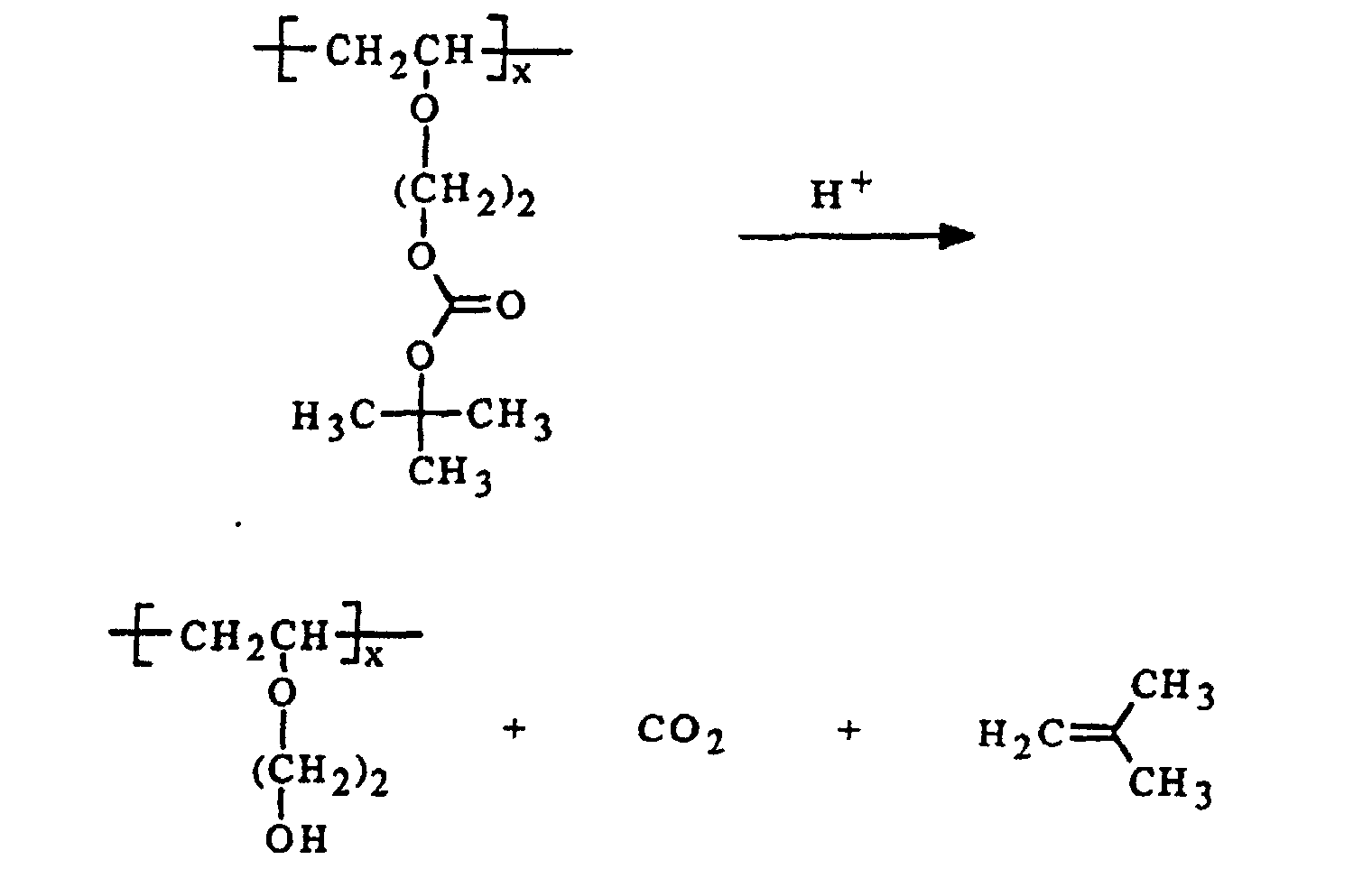
- A third protecting group that can be used is the t-butyl dimethyl siloxyl group.
- Phthalimide as protecting group has been described by Higashimura et al.7) (Formula 6) :

- After polymerization the deprotection is accomplished by hydrazine and poly(2-aminoethyl vinyl ether) is obtained.
- Further protecting groups for amino and hydroxy groups are given in text-books. See Protective Groups in Organic Chemistry (T W Greene, John Wiley & Sons, 1981).
- Polymerizations are considered "cationic" when they involve a positively charged active species acting as an electrophile towards the monomer. Vinyl ethers (Formula 7)which have a strongly electron-donating alkoxy substituent, readily form polymers on treatment with an acid, i.e. the chain growth is activated by an acidic initiator, such as a 5 protonic acid, Lewis acid or more recently by different "Living Systems"8).

- Wislicenus reported 1878 the transformation of ethyl vinyl ether into a viscous material when iodine was present9). The first systematic investigations of vinyl ether polymerization began in 1928 at I.G. Farbenindustrie in Germany. For a review see Schildknecht et al10). Two decades later, in 1947, Schildknecht et al11) recognized that poly(isobutyl vinyl ether) obtained with the Lewis acid boron trifluoride or its etherate (BF3OEt2), is either crystalline (nontacky) or amorphous (tacky) depending on the polymerization conditions.
- Up to know various Lewis acids have been used for the initiation of cationic polymerizations. A representative formula is MtXn (Mt = metal including boron; X = halogen; and n is a figure that makes MtXn a Lewis acid).
- At the priority date our choice of Lewis acid is BF3O(Et)2, which gives an initiating proton when reacting with traces of water present in the polymerization system.
- A general polymerization route for a vinyl ether is (Formula 8):

 The steps in the reaction are: (1) = initiation; (2) = propagation; (3) = termination.
- By using protected forms of 2-aminoethyl vinyl ether and 2-hydroxyethyl vinyl ether, polymerizing and finally deprotection, we have been able to synthesize poly(2-hydroxyethyl vinyl ether), poly(2-aminoethyl vinyl ether) and the analogous copolymers containing both amino and hydroxy groups in predetermined ratios. By adding vinyl hydrocarbyl ethers to the polymerization mixture, blocks of subunits where R is a purely hydrophobic group may be introduced into the chain.
- Deprotection leads to introduction of OH- and/or NH2-groups allowing attachment of various organic residues R''.
- Methods for attaching an organic residue R'' to OH and/or NH2 groups in a polymer are well known in the prior art. They often make use of bifunctional compounds A-(bridge)n-C where
- (a) n may be 1 or 0,
- (b) A is a reactive function that is capable of forming a covalent link to an amino group or hydroxy group (for instance HO-B- or H2N-B-) of the base polymer (of formula 2),
- (c) the term "bridge" represents an organic bridge, and
- (d) C is a group possessing the property/function that is to be linked to the vinyl polymer or a group that may be transformed to said function/property.
-
- The methods comprise contacting a poly(vinyl ether) of formula 2 exhibiting HO- and/or -NH2 groups with a bifunctional compound A-(bridge)n-C under conditions permitting formation of a covalent link between A and an HO- or H2N-group of the poly(vinyl ether), followed, if necessary, by transformation of C to the desired group and deprotection and derivatization of further HO- and/or NH2-groups to introduce other organic residues R''.
- Preferably A is selected so that an ether or amino (secondary, tertiary or quartenary) linkage is created. Illustrative examples of A are epoxides and the analogous nitrogen group (in which -O- is replaced with -NH-), halohydrins, vicinal alkyl dihalides, alkyl halides in which the halo atom is α to an sp2-carbon, and certain C-C double bonds that are directly attached to a strongly electron-withdrawing substituent.
- The organic bridge is inert, preferably containing only hydrocarbyl groups, ether groups and other groups hard to hydrolyse. By the term "inert" is contemplated that, under the conditions employed, the bridge does not detoriate or participate in side reactions. For n = 0 the meaning of "bridge" becomes redundant.
- The group C is selected among the same reactive groups as A. C may in addition be a matrix carrier (including soluble and insoluble polymers) which have been activated to contain the reactive group A.
- Certain bifunctional reagents are structurally monofunctional but with a reactive function that enables them to react twice with nucleophiles. Examples are CNBr, carbodiimides, and carbonyl diimidazole. For this special type of reagents n equals 0 and A becomes structurally non-distinctive from C.
- Ion exchanging polymers of formula 2 can be obtained by reacting a bifunctional compound A-(bridge)n-C as defined above in which C is an anion or cation exchanging group or a group transformable to such a group, with a polymer of formula 2 containing HO- and/or NH2-groups. The reaction conditions applied, selection of starting poly(vinyl ether), possible subsequent steps to introduce other organic residues R'' bound to said HO- and/or NH2-groups, and preferred options among these variables are as outlined under subheading 2.4 above. One suitable mode is to start with a water-soluble poly(vinyl ether), introduce the ion exchange organic residue, and in a subsequent reaction attach the derivatized ion exchange vinyl ether polymer to a matrix carrier (support).
- Illustrative examples of bifunctional compounds are allyl halides (that after reaction with the polymer may be further processed with bisulfite or primary or secondary amines to introduce sulphonic acid groups or amino groups, respectively), N,N-diethyl aminoethyl chloride hydrochloride, glycidyl trimethylammonium chloride, α-halo acetic acids etc.
- The number of ion exchanging groups introduced is controlled by the relative amount of free (deprotected) OH- and NH2-groups in the starting polymer, the relative amount of added bifunctional compound (A-(bridge)n-C) and the reactivity and selectivity of the reactive group A etc.
- The general principle for introduction of organic residues R'' outlined in subheading 2.4 above is applicable, except for the bifunctional compound A-(bridge)n-C now being selected so that C contains a group according to a-e above or a group that is transformable to a group containing one of these groups. The reaction conditions applied, selection of starting poly(vinyl ether), and possible subsequent steps to introduce other organic residues are in analogy with what has been said under subheading 2.4 above.
- The attachment reaction is carried out by the standard procedures outlined above under heading 2.4. The starting poly(vinyl ether) exhibits HO- and/or H2N-groups as defined for formula 1 and may be either water-soluble or water-insoluble. The polymer may in addition exhibit vinyl subunits carrying organic residues R'' according to at least one of a-f of formula 1, with preference for residues carrying ion exchange or hydrophobic groups. In the bifunctional compound A-(bridge)n-C the group A and "bridge" have the same meaning as indicated under heading 2.4. The group C is restricted to comprise a matrix carrier or a group that can form a hydrophobic adsorptive link or a covalent link to a matrix carrier.
- The attachment reaction comprises reacting the bifunctional compound A-(bridge)n-C with a polymer as defined in formula 2 under conditions allowing formation of a covalent bond between A and the polymer, whereafter, if C does not comprise a matrix carrier, binding of C to a matrix carrier. The vinyl ether polymer may be further derivatized for instance by introduction of one or more organic residues R''.
- In the alternative the polymer may also be adsorbed physically to the matrix carrier, for instance the poly(vinyl ether) exhibits hydrocarbyl groups and the matrix carrier is hydrophobic.
- The matrix carrier (support) may be soluble or insoluble in aqueous media like water.
- The inventive polymer may also form its own insoluble matrix carrier by being crosslinked by the aid of a bifunctional compound A-(bridge)n-C in which both A and C are capable of forming covalent bonds with OH- or NH2-groups.
- The poly(vinyl ether) described herein may be used according to separation principles comprising the steps:
- a. contacting an aqueous liquid that in dissolved form contains a substance (including a group of substances) that is to be enriched with a polymer under conditions allowing selective partition to said polymer of said substance or group of substances, whereafter
- b. said polymer or part thereof containing the substance or group of substances is removed from said aqueous liquid.
-
- Previously used polymers in this type of separations have been soluble or insoluble in the aqueous liquids used.
- The substance(s) partitioned to the polymer may be contaminants that are to be removed or substance(s) that one desires to isolate. In the former case, working up is continued with the remaining aqueous liquid. In the latter case working up is continued with the polymer.
- The aqueous liquid is often water.
- The general method comprises different chromatographic procedures, batch procedures, electrophoresis in gels and other suitable matrixes, adsorptions performed in immunoassays, centrifugations utilizing partition into polymers, membrane filtrations, separation methods based on complexation, precipitation and sedimentation by the aid of a polymer.
- According to the inventive concept, the characteristic feature is that the polymer complies with formula 2, i.e. a polymer having vinyl ether subunits as defined in formula 1, and that this polymer is in direct contact with the aqueous liquid media during the partition step (step a above).
- Subaspects of this aspect of the invention utilize
- A. the polymer of formula 2 as a matrix for gel filtration (the subunits exhibit free OH groups including organic residues according to f and optionally also groups/residues according to g, h and i as defined for formula 1), or
- B. adsorption/partition techniques based on that the vinyl polymer of formula 2 carries at least one type of organic residues R'' which provides for binding/interaction between the substance to be separated and the polymer (the subunits exhibit e.g. groups a, b, c, d and e as defined for formula 1).
-
- For illustrative purposes separation by chromatography will be discussed in detail.
- Separation by chromatography depends on the differential partition of biomolecules between a stationary phase (the chromatographic media) and a mobile phase (the buffer solution, aqueous liquid phase). Normally the stationary phase is packed into a vertical column of plastic, glass or stainless steel, whereas the buffer is passed through this column.
- Since the development of the first cellulose ion exchangers by Peterson and Sober12) and of the first practical gel filtration media by Porath and Flodin13,14) a variety of adsorbents has been introduced which exploit various properties of proteins. Important properties and corresponding chromatographic methods are:
a. Size and shape - Gel Filtration b. Net charge - Ion Exchange Chromatography c. Isoelectric point - Chromatofocusing d. Hydrophobicity - Hydrophic Interaction Chromatography Reversed Phase Chromatography e. Metal binding - Metal Ion Affinity Chromatography f. Content of exposed - thiol groups Covalent Chromatography g. Biospecific affinities for ligands, inhibitors, receptors, antibodies etc. - Affinity Chromatography - The underlying binding/partition principle is applicable also to other separation techniques such as batch procedures, electrophoresis, centrifugations etc.
- The inventive method is particularly adapted for the separation of compounds exhibiting protein or polypeptide structure, lipid structure, carbohydrate structure, nucleic acid or oligonucleotide or nucleotide structure, steroid structure, amino acid structure etc.
- The evaluation of the new polymers described in this work has so far been performed by Gel Filtration and Ion Exchange Chromatography.
- In gel filtration, molecules in solution are separated according to differences in their sizes as they pass through a column packed with a gel chromatographic media. Suitable media have a carefully controlled pore range size and are often formed by crosslinking a suitable hydrophilic polymer to a three-dimensional net-work.
- Composite gels may be prepared by grafting a second polymer onto a pre-formed matrix. In Superdex® dextran chains are covalently bonded to a highly cross-linked agarose gel matrix (Superdex® and Superose® (below) are trademarks of Pharmacia BioTech AB, Sweden)
- We have grafted poly(2-hydroxyethyl vinyl ether) onto Sepharose® HP (based on cross-linked agarose) and evaluated the product obtained by comparison with Superdex® 30 PG. This type of composite matrix will lead to a more well-defined system, because the synthetically made vinyl ether-based polymers may be varied in composition practically as desired. Polymer parameters to be varied are the molecular weight and its distribution, hydrodynamic volume which depend on the side groups of the polymer etc.
- The comparison has involved parameters such as tendency for undesirable interactions and selectivity curves. It has been clearly shown that poly(2-hydroxyethyl vinyl ether) attached to Sepharose® HP possesses the same or better characteristics as Superdex® 30 PG in a representative gel filtration application.
- Adsorption chromatography depends upon interactions of different types between solute molecules and ligands immobilized on a chromatographic matrix. Affinity chromatography, ion exchange chromatography, covalent chromatography, metal chelate chromatography and hydrophobic interaction chromatography are illustrative examples of adsorption chromatography.
- In this work the synthetically made cation exchange polymer of formula 10 grafted onto Sepharose® HP, and the anion exchange polymer of formula 9 grafted onto Sepharose® HP were compared with representative commercial products from Pharmacia AB.
- The best experimental results so far has been accomplished with the chromatographic supports presented in the experimental part. However the inventors believe that better results will be obtained with poly(vinyl ethers) produced by the so called "living" or "controlled" cationic polymerization.
- 2-Chloroethyl vinyl ether (98%), allyl bromide (98%) and boron trifluoride ethyl etherate (48% BF3(O(C2H5)2)) were purchased from Fluka (Schweiz). 2-hydroxyethyl vinyl ether (98.5%) was from Nisso Marutzen (Japan). Sodium acetate, tetra-n-butylammonium hydrogen sulphate (98%), magnesium sulphate (anhydrous) and Celite 545 were all from Merck Germany). Di-tert-butyl dicarbonate (97%), tetra-n-butylammonium iodide (98%), tetra-n-butylammonium bromide (99%), potassium phthalimide (99%) and hydrazine monohydrate (99%) were purchased from Janssen (Belgium). Sodium hydride (80% dispersion in mineral oil), sodium bisulfite and calcium hydride (95+%) were from Aldrich (Germany). Transferrin, ovalbumin, β-lactoglobulin, ribonuclease, aprotinin and Vitamin B12 were all from Sigma (U.S.A.). Glycidyltrimethylammonium chloride was supplied by Pharmacia AB (Sweden). The chemicals were used without further purification.
- Toluene, hexane and methylene chloride used for the polymerizations, were from Aldrich (U.S.A.) and supplied in sure seal bottles. Dimethylformamide (99.5%) was from Jansen (Belgium). The other solvents were purchased from Labkemi (Sweden). The solvents were used without further purification.
- The synthesized monomers and polymers were characterized by FTIR using a Perkin Elmer 16PC FTIR and by 1H and 13C NMR using a JEOL EX270. The elemental analysis was conducted by Mikro-Kemi AB in Uppsala, Sweden. The MWD of the polymers were determined by gel permeation chromatography (GPC) in THF on a Waters GPC-system equipped with two polystyrene gel columns (Ultrastyragel® 104 Å and Ultrastyragel® 103 Å; 7.8 x 300 mm each (U.S.A.)). The number-average molecular weight (Mn) and the polydispersity ratio (Mw/Mn) were calculated from GPC curves on the basis of a polystyrene calibration. Ultrafiltration was carried out on a Filtron Ultrapump II equipped with Ultrasette filters 8K and 30K respectively. The gel filtration was carried out on a Liquid Chromatography system. The glass column had an inner diameter of 10 mm and the bead height was 30 cm. The eluent flow was 0.5 cm/min. The buffer solution was 50 mM sodium phosphate + 100 mM sodium chloride which gives a pH = 7.4. The detector was a single path monitor UV 1® at 280 nm (Pharmacia AB, Sweden).
- A 1000 ml three-necked flask was charged with sodium acetate (164 g, 2 mol), 2-chloroethyl vinyl ether (250 ml, 2 mol), 2-chloroethyl vinyl ether/2-acetoxyethyl vinyl ether (1/1) (200 ml) and tetra-n-butylammonium iodide (2 g). The reaction mixture was refluxed overnight (approximately 12 hours), with magnetic stirring and under argon atmosphere. After cooling to room temperature 250 ml distilled water and 300 ml diethyl ether were added. The organic phase was further washed with 3x100 ml distilled water, 3x150 ml 1M HCl, 5x100 ml distilled water and 4x100 ml brine. Drying with magnesium sulphate, filtration through Celite 545, evaporation of the solvent and finally distillation gave 200 g of the crude product as a slightly yellow liquid. An additional distillation over calcium hydride gave 160 g (yield 62% based on sodium acetate) of pure 2-hydroxyethyl vinyl ether as a colourless liquid. Boiling point 75° C/35mbar. The product was confirmed by 1H NMR (CDCl3) δ (ppm) = 2.1 (s,3H), 3.90(m,2H), 4.05(d,1H), 4.20(d,1H), 4.30(m,2H), 6.47(m,1H).
- Di-tert-butyl dicarbonate (51.3 g, 235 mmol), 2-hydroxyethyl vinyl ether (20 g, 227 mmol) and tetra-butylammonium hydrogen sulphate (2.8 g, 8 mmol) was dissolved in 200 ml methylene chloride. At 0°C, a prechilled sodium hydroxide (30%, w/w) solution was added dropwise with vigorous magnetic stirring for 5 hours. The organic phase was washed with 3x100 ml brine, dried with magnesium sulphate and evaporation of the solvent gave the crude product as a colourless liquid.
- Distillation gave 26 g (yield 61% based on di-tert-butyl dicarbonate) of the pure 2-(tert-butoxycarbonyloxy)ethyl vinyl ether as a colourless liquid. Boiling point 69°C/2mbar. The product was confirmed by 1H NMR (CDCl3) δ (ppm) = 1.5 (s,9H), 3.90(m,2H), 4.05(d,1H), 4.20(d,1H), 4.30(m,2H), 6.47(m,1H).
- A 1000 ml three-necked flask was charged with potassium phthalimide (100 g, 540 mmol), 2-chloroethyl vinyl ether (100 g, 940 mmol), tetra-n-butylammonium bromide (2 g) and 250 ml dimethylformamide. The reaction mixture was refluxed at 100°C overnight (approximately 12 hours), with magnetic stirring and under argon atmosphere. After cooling to room temperature, the reaction mixture was poured into 1000 ml of distilled water which precipitates the crude product. Filtration and recrystallization from 3x500 ml methanol and 2x500 ml 5 ethyl acetate with charcoal treatment and drying in the last step with magnesium sulphate gave 55 g (47% based on potassium phthalimide) of the pure 2-vinyloxyethyl phthalimide as slightly yellowish needles. The product was confirmed by 1H NMR (CDCl3) δ (ppm)= 3.95 (s,2H+2H+1H), 4.20(d,1H), 6.40(m,1H), 7.70(m,2H), 7.85(m,2H).
- All of the equipment used in these polymerizations were dried at 110°c overnight, and kept under argon atmosphere during the experimental procedures.
- In a representative example a solution of 2-acetoxyethyl vinyl ether(15 ml, 118 mmol) and 50 ml toluene was cooled to -45°C. To the cooled monomer solution, 600 ml (gives 6 · 10-2 mmol BF3(O(C2H5)2) of a pre-cooled initiator/toluene solution was added. After this the temperature was allowed to increase up to -20°C which was the polymerization temperature. Finally the reaction was terminated after one hour with methanol. The polymer was characterized by FTIR: (1736, 1380, 1234, 1116 and 1054 cm-1), GPC (Mw = 200 000; Mn = 80 000; H = 2.5) and DSC (Tg = - 25°C).
- In a representative example 2-(tert-butoxycarbonyloxyethy) vinyl ether (0.5 ml, 2.7 mmol) was cooled to 0°C and 10 µl (gives 1·10-3 mmol BF3O(C2H5)2 of a pre-cooled initiator/toluene solution was added. The bulk polymerization was terminated after one hour with cold methanol. The polymer was characterized by FTIR: (1750, 1370, 1220, and 1076 cm-1), GPC (Mw = 429 000; Mn = 110 000; H = 3.9).
- Typically, 2-vinyloxyethyl phthalimide (50 g, 230 mmol) was dissolved in dichloromethane and the solution was cooled to -30°C. To the cooled monomer solution, 2.5 ml (gives 2.5 · 10-1 mmol BF3(O(C2H5)2) of a pre-cooled initiator/dichloromethane solution was added. After this the temperature was allowed to increase up to -20°C which was the polymerization temperature. Finally the reaction was terminated after one hour with a cold methanol. The solvent was evaporated and the polymer was characterized by FTIR: (1772, 1708, 1390, and 1320 cm-1), GPC (Mw = 27 000; Mn = 17 000; H = 1.6) and DSC (Tg = 64°C).
- Typically, 2-vinyloxyethyl phthalimide (10 g, 46 mmol) and 2-acetoxyethyl vinyl ether (6 ml, 47 mmol) was dissolved in 60 ml dichloromethane and the solution was cooled to -30°C. To the cooled monomer solution, 600 ml (gives 6 · 10-2 mmol BF3(O(C2H5)2) of a pre-cooled initiator/dichloromethane solution was added. After this the temperature was allowed to increase up to -20°C which was the polymerization temperature. Finally the reaction was terminated after one hour with a cooled solution of 7 N ammonia in methanol. The solvent was evaporated and the polymer was characterized by elemental analysis (Ctheoretical = 62, Cobtained = 61.8; Ot = 28, Oo = 29.0; Nt = 4; No = 3.6; Ht = 6; Ho = 6.4; GPC (Mw = 67 000; Mn = 27 900; H = 2.4) and DSC (Tg = 22°C).
- The poly(2-acetoxyethyl vinyl ether) from example 4 was dissolved in 200 ml tetrahydrofuran. To this solution, 138 ml 1M NaOH(aq) was added in portions over a six hour period and the solution was allowed to stand for 48 hours at room temperature, with magnetic stirring. After this the reaction mixture was neutralized with 2 M HCl(aq). The solvent was evaporated and further ultrafiltration removed the salt residues and also polymers/oligomers of molecular weights approximately below 30 000. Finally the pure product was freeze dried. The polymer was identified by FTIR (the carbonyl peak at 1736cm-1 disappeared).
- The poly(2-vinyloxyethyl phthalimide) from example 6 was dissolved in 600 ml dichloromethane and 250 ml methanol. To this solution, 24 ml hydrazine monohydrate was added. The reaction mixture was allowed to stand for 14 hours at room temperature with magnetic stirring. After this all of the solvent was evaporated and 500 ml of distilled water and 250 ml 2 M HCl(aq), was added. This solution was refluxed for 45 minutes. After cooling the solid residue was filtrated and the remaining solution was neutralized with 2 M NaOH(aq). The solution was now concentrated and further ultrafiltration removed the salt residue and also polymers/oligomers of molecular weights approximately below 8 000. Finally the pure product was freeze dried. The polymer was identified by FTIR (the peaks at 1772 and 1708cm-1 disappeared.
- The poly(2-vinyloxyethyl phthalimide-co-2-acetoxyethyl vinyl ether) from example 7 was dissolved in 200 ml tetrahydrofuran. To this solution, 138 ml 1 M NaOH(aq) was added in portions over a six hour period and the solution was allowed to stand for 48 hours at room temperature, with magnetic stirring. After this the reaction mixture was neutralized with 2 M HCl(aq). The solvent was evaporated and further ultrafiltration removed the salt residues and also polymers/oligomers of molecular weights approximately below 8 000.
- This partly deprotected polymer was dissolved in 50 ml distilled water and 4.4 ml hydrazine monohydrate. The reaction mixture was allowed to stand for 14 hours at room temperature with magnetic stirring. After this the pH was lowered to approximately 1-2 by the addition of 2 M HCl(aq). This solution was refluxed for 45 minutes. After cooling the solid residues were filtrated off and the remaining solution was neutralized with 2 M NaOH(aq). The solution was now concentrated and further ultrafiltration removed the salt residues and also polymers/oligomers of molecular weights approximately below 8 000. Finally the pure product was freeze dried. The polymer was identified by FTIR (the peaks at 1772, 1736 and 1708 cm-1, respectively, disappeared,
- Formula 9. Reaction formula for the synthesis of a anion exchanging polymer.

- The copolymer from example 10 was dissolved in water together with glycidyltrimethylammonium chloride (GMAC) at pH = 10 at room temperature. The GMAC concentration was kept at 75% level of the primary amino groups of the polymer. The reaction mixture was allowed to stand for 5 hours and the product in solution was used directly for the subsequent coupling reaction.
- Reaction formula (Formula 10) for the synthesis of a cation exchanging polymer.

- In a representative example the poly(2-hydroxyethyl vinyl ether) (2 g, 22 mmol OH-groups) from example 8 was dissolved in 50 ml NaOH(aq) (30% w/w) and allylbromide (2.8 g, 24 mmol) was added. The reaction mixture was allowed to react at 60 °C for 4 hours. After cooling, the polymer which was now insoluble in water, was separated and vacuum dried at room temperature overnight. The polymer was characterized by 13C NMR, 1H NMR, FTIR and GPC for each specific case and typically the allyl content was 50%.
- The poly(2-hydroxyethyl vinyl ether-co-2-allyloxyethyl vinyl ether) from example 12 was dissolved in 100 ml water/THF (1:1), treated with sodium hydrogen sulfite (13 g, 125 mmol) at pH = 6 (45% NaOH(aq was used). The reaction mixture was allowed to react for 12 hours. The amount of sulfonate groups was determined by titration and was in accordance with the allyl groups present in the beginning of the reaction. The remaining hydroxyl groups were used in one typical example for the covalent coupling of the cation exchanger functionalized polymer to Sepharose HP beads.
- 23g of poly(2-hydroxyethyl vinyl ether) from example 7 was dissolved in 40 ml distilled water (solution 1).
- Allyl-functionalized Sepharose® HP 40 g was suspended in 20 ml distilled water and 1.25 g of sodium acetate was added. The gel was activated with bromine until a slightly yellow colour stays. Sodium formate was added until the gel turns white again. This is solution 2.
- The solutions were thermostated to a constant temperature of 30°C and mixed and stirred for one hour. 5 g of NaOH and 0.1 g of NaBH4 were added and after continuing stirring at 30 °C for 17 h, the solution was neutralized and the matrix was washed with water/ethanol/water.
- The same conditions as in example 14 was applied to the coupling of the polymer from example 13 to epoxy-functionalized Sepharose HP.
- The same conditions as in example 14 was applied to the coupling of the polymer from example 11 to epoxy-functionalized Sepharose HP.
- In a typical procedure the anion exchanger matrix was suspended in 0.5 M HCl and further saturated with 1 mM HCl. Next, 1 ml gel matrix was transferred to a titration vessel by using a small amount of distilled water. After dilution to a convenient volume for the subsequent titration, "2 drops" of concentrated HNO3 was added. This solution was titrated with AgNO3. Typically the Cl- capacity was determined to 0.16 mmol/ml gel for the ion exchanger prepared in example 16.
- The product from example 14, i.e. poly(2-hydroxyethyl vinyl ether) covalently attached to a Sepharose® HP matrix, was compared with Superdex® 30 PG in a representative protein separation. The proteins were dissolved in the buffer solution and the gel filtration gave the Kav- values for bovine serum albumin (BSA), ribonuclease, aprotinin and vitamin B 12 respectively, as shown in table 1.
Kav-values from a typical comparative gel filtration procedure. Protein Mw Sepharose® HP Superdex® PG Sepharose® HP polymerodified Kav Kav Kav BSA 67 000 0.661 0.026 0.035 - 13 600 0.795 0.156 0.204 Ribonucleas Aprotinin 6500 0.364 0.359 Vitamin B12 1400 0.708 0.768 - It is clearly shown from this table that this new polymer is well suited for the preparation of gel filtration media.
- The product from example 16, i.e. anion exchange polymer of example 11 covalently attached to a Sepharose® HP matrix, was compared with Q Sepharose® HP in a representative protein separation. Proteins (transferrin, ovalbumin and β-lactoglobulin) were dissolved in a buffer solution and applied to columns packed with the matrixes. The two chromatograms showed closely related elution profiles for the mixture of proteins.
-
- 1) J-C. Janson et al., in "Protein Purification" VCH Publishers, Inc., 1989
- 2) T. Higashimura et al., Compr. Polym. Sci., 3, 673 (1989)
- 3) Sawamoto et al., Macromolecules, 18, 2097 (1985)
- 4) M. Bodansky et al., "The Practice of Peptide Synthesis", Springer-Verlag, Berlin, 1984
- 5) J.M.J. Fréchet et al., Polym. J., 19, 31 (1987)
- 6) J. Ericsson et al., Makromol. Chem., 192, 1621 (1991)
- 7) T. Hashimoto et al., J. Polym. Sci.: Part A: Polym. Chem., 26, 3361 (1988).
- 8) J.P Kennedy/Béla Iván, Design Polymers by Carbocationic Macromolecular Engineering: Theory and Practice, Carl Hanser Verlag, Munich, Germany)
- 9) J. Wislicenus, Justus Liebigs Ann. Chem., 92, 106 (1878)
- 10) C.E. Schildknecht, "Vinyl and Related Polymers", Wiley, New York, 593 (1952).
- 11) C.E. Schildknecht et al., Ind Eng. Chem., 39, 180 (1947)
- 12) E.A. Peterson et al., J. Am. Chem. Soc., 78, 751 (1956)
- 13) J. Porath et al., Nature, 183, 1657 (1959).
- 14) J-C. Janson, Chromatographia, 23, 361 (1987).
- 15) J. Bonnerjera et al., Biotechnology, 4, 954 (1986).
- 16) Hitachi Chemical KK, Derwent Abstract 92-111582/14 (1992)
- 17) Hitachi Chemical KK, e.g. Derwent Abstract 92-111583/14 (1992)
- 18) S. Kanaoka et al., Macromolecules 24(21) (1991) 5741-5745
- 19) M. Minoda et al., Macromolecules 23(7) (1990) 1897-1901
- 20) M. Minoda et al., Macromolecules 25 (1992) 2796-2801
- 21) S. Kanaoka et al., J. Polym. Sci. 28 (1990) 1127-1136
- 22) E. Takeuchi et al., J. Polym. Sci. 27 (1989) 3303-3314
- 23) Hayashi et al., Teijin Limited, EP 010425
-
Claims (15)
- A chromatographic separation method comprising the steps of:characterized in that said polymer is a poly(vinylether) comprising different or identical vinyl ether subunits of the structure (Formula 1)i. contacting an aqueous liquid, which contains a dissolved substance that is to be enriched, with a polymer to provide selective partition of said substance to said polymer, whereafterii. said polymer or part thereof containing said substance is removed from said aqueous liquid;where
 with the proviso that R in at least 5 % of the vinyl ether subunits is equal to a hydrophilic organic group, which has a molar ratio (O+N)/C that is greater than 0.5 and which comprises at least one hydroxy and/or primary amino group (H2N-),a. X and Y are selected among hydrogen and methyl; andb. R is selected among organic groups providing a carbon attached directly to the oxygen atom;
and wherein R is selected among(a) hydrophobic hydrocarbyl groups selected from the group that consists of alkyl, arylalkyl, alkylaryl, and alkenyl, and(b) hydrophilic groups having the formula
B is a hydrophilic organic bridge that consists of a straight, branched or cyclic carbon chain of sp3-hybridised carbons, said chain being broken at one or more positions by an oxygen or a nitrogen atom and also containing at least one hydroxy and/or at least one primary amino (NH2) group bound directly to one of said sp3-hybridised carbon atoms, with the provisos that there is at most one oxygen or nitrogen atom bound to one and the same carbon atom in the chain and that the molar ratio (O+N)/C in B is greater than or equal to 0.5. - The method according to claim 1, characterized in that R comprises at least one hydroxy and/or primary amino group (H2N-) together with at least one group selected from ether (-O-) group, secondary amino group andtertiary amino group.
- The method according to any of claims 1-2, characterized in that the poly(vinyl ether) has > 10 subunits complying with formula 1 consecutively linked to each other.
- The method according to any of claims 1-3, characterized in that at least one of the vinyl ether subunits carries the organic residue R'' and that this residue is selected among:a. groups comprising affinity ligands that enables binding between the substance and the polymer; andb. hydrophilic organic groups.
- The method according to claim 4, characterized in that at least one of the vinyl ether subunits carries an affinity ligand selected among:a. bioaffinity ligands;b. ion exchange groups,c. hydrocarbyl groups;d. chelate groups comprising a chelated metal ion.
- The method according to any of claims 2-5, characterized in that the hydrophilic organic bridge complies with the formula ((CH2)n-O)m where n is an integer that is 2, 3 or 4, and m is an integer that may be 1-10.
- The method according to any of claims 2-6, characterized in that the poly(vinyl ether) is insoluble in the aqueous liquid bya. at least one of said organic residues R'' being covalently attached to a support matrix that is insoluble in the aqueous liquid;b. a plurality of said organic residues R'' participating in inter- and/or intramolecular cross-linking of the poly(vinyl ether); orc. a plurality of said R groups comprising hydrophobic groups that are physically adsorbed to a hydrophobic support.
- The method according to any of claims 1-7, characterized in that the separation method is selected among chromatographic procedures, batch procedures, electophoresis procedures, centrifugation methods utilizing partition into polymers, membrane filtrations, and methods based on complexation, precipitation or sedimentation by the aid of said polymer.
- The method according to any of claims 1-8, characterized in that said substance exhibiting a structure selected among protein structure, polypeptide structure, lipid structure, carbohydrate structure, nucleic acid structure, oligonucleotide structure, nucleotide structure, steroid structure, and amino acid structure,
- The method according to any of claims 1-9, characterized in that the method exploits one or more of the following properties of the substance: size and shape, net charge, isoelectric point, hydrophobicity, metal binding, presence of thiol groups, and biospecific affinity.
- A poly(vinyl ether) suitable for use in a method according to any one of claims 1-10, which poly(vinyl ether) comprises a chain of repeating vinyl ether subunits and has the structurewhere
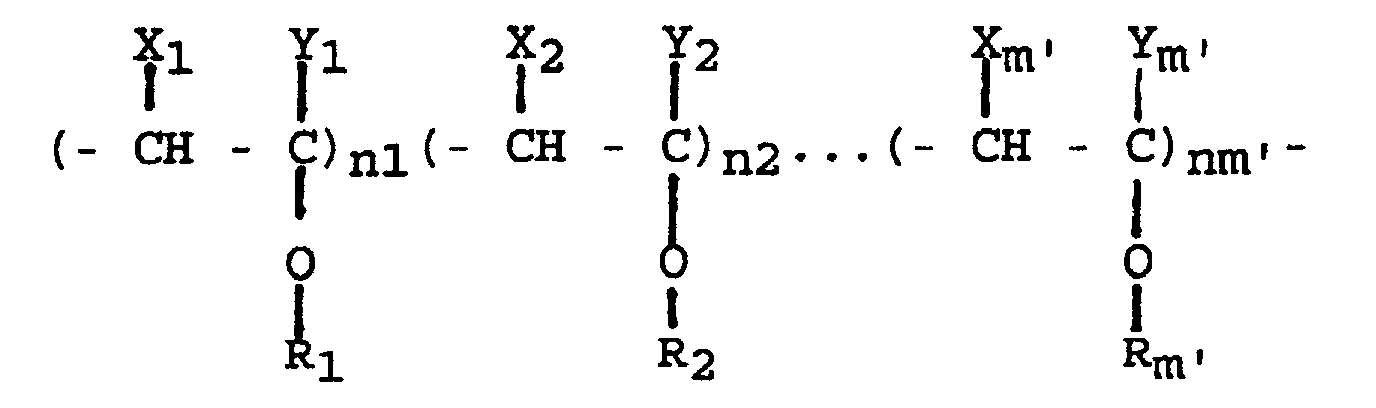 with the proviso that at least 5 % of the vinyl ether subunits carry R1, R2.....or Rm' that are selected among HO-B- or H2N-B- or forms thereof in which a hydroxy hydrogen or an amino hydrogen is sub-stituted by a hydrophilic organic group.a. the free terminal valences bind to groups derived from the termination or initiation of the polymerization reaction used to synthesize the poly(vinyl ether);b. X1, X2, X3.....Xm and Y1, Y2, Y3.....Ym are selected among hydrogen and methyl, with preference for all Xs and Ys being hydrogens;c. R1, R2....Rm' are groups selected amongA. hydrophobic hydrocarbyl groups selected from the group that consists of alkyl, arylalkyl, alkylaryl, and alkenyl, andB. hydrophilic groups having the formulas R1 = R'1-B1-, R2 = R'2-B2- ....Rm' = R'm'-Bm'- where R'1, R'2 ....R'm' in turn are selected among OH, NH2 and substituted forms thereof in which a hydrogen has been replaced by an organic residue R'', and B1, B2 ....Bm' (= B) are hydrophilic organic bridges, respectively, R'' being present on at least one vinyl ether subunit and selected among groups comprising affinity ligands selected from the group comprised of bioaffinity ligands; ion exchange groups; hydrocarbyl groups; and chelate groups comprising a chelated metal ion;d. m' is an integer giving the number of blocks containing identical repeating vinyl subunits.e. n1, n2,....nm'. are integers greater than zero and n1 + n2 + ... + nm' = n, where n is the number of vinyl subunits in the chain,
 - The poly(vinyl ether) according to claim 11, characterized in that each of the hydrophilic organic bridges (B1, B2 .....Bm') consists of a straight, branched or cyclic saturated carbon chain of sp3-hybridized carbon atoms, said chain optionally being broken at one or more positions by an oxygen atom or a nitrogen atom and/or optionally also containing at least one hydroxy and/or at least one primary amino (NH2) group bound directly to one of said sp3-hybridized carbon atoms, with the provisos that(a) there is at most one oxygen or nitrogen atom bound to one and the same carbon atom in the chain, and(b) the molar ratio (O+N)/C in B is greater than or equal to 0.5.
- The poly(vinyl ether) according to any of claims 11-12, characterized in that each of the organic bridges B1, B2.....Bm' complies with the formula [(CH2)n-O]m where n is an integer that is 2, 3 or 4 and m is an integer that may be 1-10.
- The poly(vinyl ether) according to any of claims 11-13, characterized in that said poly(vinyl ether) is insoluble in water or aqueous liquids bya. at least one of said organic residues R'' being covalent attached to a support (matrix carrier) insoluble in the aqueous liquid;b. a plurality of said organic residues R'' participating in inter- and/or intramolecular cross-linking of the poly(vinyl ether); orc. the presence of a plurality of hydrophobic R groups that are physically adsorbed to a hydrophobic support (matrix carrier).
- The poly(vinyl ether) according to any of claims 11-14, characterized in that said poly(vinyl ether) is complexed to a bioorganic molecule selected among substances exhibiting: polypeptide structure, carbohydrate structures, lipid structures, steroid structure, nucleotide structure and amino acid structure.
Applications Claiming Priority (3)
| Application Number | Priority Date | Filing Date | Title |
|---|---|---|---|
| SE9303790A SE9303790D0 (en) | 1993-11-17 | 1993-11-17 | A method for separation and synthetic polymers that can be used as separation media in the method |
| SE9303790 | 1993-11-17 | ||
| PCT/SE1994/001090 WO1995013861A1 (en) | 1993-11-17 | 1994-11-17 | A method for separation and synthetic polymers that can be used as separation media in the method |
Publications (2)
| Publication Number | Publication Date |
|---|---|
| EP0729381A1 EP0729381A1 (en) | 1996-09-04 |
| EP0729381B1 true EP0729381B1 (en) | 2003-11-05 |
Family
ID=20391773
Family Applications (1)
| Application Number | Title | Priority Date | Filing Date |
|---|---|---|---|
| EP95901673A Expired - Lifetime EP0729381B1 (en) | 1993-11-17 | 1994-11-17 | A method for separation and synthetic polymers that can be used as separation media in the method |
Country Status (9)
| Country | Link |
|---|---|
| US (2) | US5759404A (en) |
| EP (1) | EP0729381B1 (en) |
| JP (1) | JPH09505844A (en) |
| AT (1) | ATE253402T1 (en) |
| AU (1) | AU1081595A (en) |
| DE (1) | DE69433303T2 (en) |
| ES (1) | ES2210277T3 (en) |
| SE (1) | SE9303790D0 (en) |
| WO (1) | WO1995013861A1 (en) |
Families Citing this family (19)
| Publication number | Priority date | Publication date | Assignee | Title |
|---|---|---|---|---|
| US6077940A (en) * | 1997-12-24 | 2000-06-20 | Genentech, Inc. | Free solution ligand interaction molecular separation method |
| WO1999034810A1 (en) * | 1998-01-12 | 1999-07-15 | Her Majesty In Right Of Canada As Represented By The Minister Of Agriculture And Agri-Food Canada | A process for the isolation, recovery and purification of non-polar extractives |
| US6780327B1 (en) * | 1999-02-25 | 2004-08-24 | Pall Corporation | Positively charged membrane |
| SE0004808D0 (en) * | 2000-12-20 | 2000-12-20 | Apbiotech Ab | Method for the purification of an enzyme |
| SE0103403D0 (en) * | 2001-10-12 | 2001-10-12 | Protista Internat Ab | Separation medium, ITS preparation and ITS use |
| JP2005510609A (en) * | 2001-11-26 | 2005-04-21 | アメルシャム・バイオサイエンシーズ・アクチボラグ | Post-modification of porous support |
| CA2464302A1 (en) * | 2001-11-26 | 2003-06-05 | Amersham Biosciences Ab | Post-modification of a porous support |
| SE0201623D0 (en) | 2002-05-30 | 2002-05-30 | Amersham Biosciences Ab | Macroporous cross-linked polymer particles |
| EP1754534A1 (en) | 2005-08-03 | 2007-02-21 | MERCK PATENT GmbH | Crosslinked hydrophile polymer |
| WO2007014591A1 (en) | 2005-08-03 | 2007-02-08 | Merck Patent Gmbh | Hydrophilic crosslinked polymer |
| EP2571591B1 (en) * | 2010-05-19 | 2017-08-02 | Dionex Corporation | Functionalized substrates with aromatic stacking properties |
| EP2570182A1 (en) | 2011-09-15 | 2013-03-20 | InstrAction GmbH | Sorbent comprising on its surface a cationic or protonizable aliphatic residue for the purification of organic molecules |
| ES2920381T3 (en) * | 2014-08-15 | 2022-08-03 | Merck Patent Gmbh | Purification of immunoglobulins from plasma |
| CN104479009A (en) * | 2014-11-24 | 2015-04-01 | 江南大学 | Technology for separating phycocyanin in spirulina by using polyvinyl ether carboxylate through two aqueous phase extraction |
| CN104387468A (en) * | 2014-11-24 | 2015-03-04 | 江南大学 | Technology for separating phycocyanin in spirulina by using polyvinyl ether alcohol amine through two aqueous phase extraction |
| CN104387469A (en) * | 2014-11-24 | 2015-03-04 | 江南大学 | Technology for separating phycocyanin in spirulina by using polyvinyl ether phosphate through two aqueous phase extraction |
| US20170066839A1 (en) † | 2015-09-08 | 2017-03-09 | Merck Patent Gmbh | Novel affinity chromatography media for removal of anti-a and/or anti-b antibodies |
| JP7700092B2 (en) | 2019-07-03 | 2025-06-30 | メルク パテント ゲゼルシャフト ミット ベシュレンクテル ハフツング | Glycoform purification |
| CA3145763A1 (en) * | 2019-07-03 | 2021-01-07 | Merck Patent Gmbh | Antibody drug conjugate purification |
Family Cites Families (11)
| Publication number | Priority date | Publication date | Assignee | Title |
|---|---|---|---|---|
| US2933460A (en) * | 1956-05-29 | 1960-04-19 | Rohm & Haas | Ion-exchange fibers, films and the like from sulfur containing alkoxymethyl monomers |
| US3247133A (en) * | 1956-06-18 | 1966-04-19 | American Mach & Foundry | Method of forming graft copolymer ion exchange membranes |
| SE328716B (en) * | 1961-12-15 | 1970-09-21 | Rio Rad Lab | |
| US3450630A (en) * | 1963-02-07 | 1969-06-17 | Yeda Res & Dev | Method of separating metal ions |
| US3645890A (en) * | 1969-05-06 | 1972-02-29 | Hercules Inc | Reverse osmosis membranes from crystalline polymers of vinyl methyl ether |
| JPS5554004A (en) * | 1978-10-18 | 1980-04-21 | Teijin Ltd | Selective permeable membrane and its manufacturing |
| CA1329800C (en) * | 1987-12-29 | 1994-05-24 | Hiroaki Takayanagi | Composite separating agent |
| DE4024517C1 (en) * | 1990-08-02 | 1991-11-21 | Metallgesellschaft Ag, 6000 Frankfurt, De | |
| WO1992014783A1 (en) * | 1991-02-13 | 1992-09-03 | Mitsubishi Rayon Co., Ltd. | Hydrophilic polymer alloy, fiber and porous film produced therefrom, and production of the same |
| US5470463A (en) * | 1992-06-19 | 1995-11-28 | Sepracor Inc. | Passivated porous supports and methods for the preparation and use of same |
| DE4309081A1 (en) * | 1993-03-20 | 1994-09-22 | Basf Ag | Adhesives based on polyvinyl ether copolymers |
-
1993
- 1993-11-17 SE SE9303790A patent/SE9303790D0/en unknown
-
1994
- 1994-11-17 JP JP7514398A patent/JPH09505844A/en active Pending
- 1994-11-17 US US08/648,108 patent/US5759404A/en not_active Expired - Fee Related
- 1994-11-17 AT AT95901673T patent/ATE253402T1/en not_active IP Right Cessation
- 1994-11-17 AU AU10815/95A patent/AU1081595A/en not_active Abandoned
- 1994-11-17 EP EP95901673A patent/EP0729381B1/en not_active Expired - Lifetime
- 1994-11-17 DE DE69433303T patent/DE69433303T2/en not_active Expired - Fee Related
- 1994-11-17 ES ES95901673T patent/ES2210277T3/en not_active Expired - Lifetime
- 1994-11-17 WO PCT/SE1994/001090 patent/WO1995013861A1/en not_active Ceased
-
1998
- 1998-03-25 US US09/047,469 patent/US6143853A/en not_active Expired - Fee Related
Also Published As
| Publication number | Publication date |
|---|---|
| ES2210277T3 (en) | 2004-07-01 |
| WO1995013861A1 (en) | 1995-05-26 |
| US5759404A (en) | 1998-06-02 |
| DE69433303D1 (en) | 2003-12-11 |
| DE69433303T2 (en) | 2004-09-09 |
| SE9303790D0 (en) | 1993-11-17 |
| US6143853A (en) | 2000-11-07 |
| AU1081595A (en) | 1995-06-06 |
| EP0729381A1 (en) | 1996-09-04 |
| JPH09505844A (en) | 1997-06-10 |
| ATE253402T1 (en) | 2003-11-15 |
Similar Documents
| Publication | Publication Date | Title |
|---|---|---|
| US5759404A (en) | Method for separation and synthetic polymers that can be used as separation media in the method | |
| US20070193954A1 (en) | Method of preparing a separation matrix | |
| US6884345B1 (en) | Chromatography method and a column material useful in said method | |
| EP2265129B1 (en) | Chromatography purification of antibodies | |
| EP2841177B1 (en) | Separation method and separation matrix | |
| US8092682B2 (en) | Matrix for separation of polyethers and method of separation | |
| US10807069B2 (en) | Hydrophobic monomers, hydrophobically-derivatized supports, and methods of making and using the same | |
| WO1995023022A1 (en) | Covalently bonded coating | |
| JPH08502534A (en) | Pore size selective modification method for porous materials | |
| EP3762121B1 (en) | Composite material for bioseparations | |
| AU610734B2 (en) | Polyethyleneimine matrixes for affinity chromatography | |
| JP2003501521A (en) | Surface modification method, novel matrix and use of the matrix | |
| Li et al. | Protein A-connected SMA-modified PVDF membranes for high-selectivity IgG capture | |
| NZ229613A (en) | Polyethyleneamine matrix for chromatography |
Legal Events
| Date | Code | Title | Description |
|---|---|---|---|
| PUAI | Public reference made under article 153(3) epc to a published international application that has entered the european phase |
Free format text: ORIGINAL CODE: 0009012 |
|
| 17P | Request for examination filed |
Effective date: 19960430 |
|
| AK | Designated contracting states |
Kind code of ref document: A1 Designated state(s): AT BE CH DE DK ES FR GB GR IE IT LI LU MC NL PT SE |
|
| 17Q | First examination report despatched |
Effective date: 20001011 |
|
| RAP1 | Party data changed (applicant data changed or rights of an application transferred) |
Owner name: APBIOTECH AKTIEBOLAG |
|
| GRAH | Despatch of communication of intention to grant a patent |
Free format text: ORIGINAL CODE: EPIDOS IGRA |
|
| GRAH | Despatch of communication of intention to grant a patent |
Free format text: ORIGINAL CODE: EPIDOS IGRA |
|
| GRAA | (expected) grant |
Free format text: ORIGINAL CODE: 0009210 |
|
| AK | Designated contracting states |
Kind code of ref document: B1 Designated state(s): AT BE CH DE DK ES FR GB GR IE IT LI LU MC NL PT SE |
|
| PG25 | Lapsed in a contracting state [announced via postgrant information from national office to epo] |
Ref country code: BE Free format text: LAPSE BECAUSE OF FAILURE TO SUBMIT A TRANSLATION OF THE DESCRIPTION OR TO PAY THE FEE WITHIN THE PRESCRIBED TIME-LIMIT Effective date: 20031105 Ref country code: AT Free format text: LAPSE BECAUSE OF FAILURE TO SUBMIT A TRANSLATION OF THE DESCRIPTION OR TO PAY THE FEE WITHIN THE PRESCRIBED TIME-LIMIT Effective date: 20031105 |
|
| REG | Reference to a national code |
Ref country code: GB Ref legal event code: FG4D |
|
| REG | Reference to a national code |
Ref country code: CH Ref legal event code: EP |
|
| PG25 | Lapsed in a contracting state [announced via postgrant information from national office to epo] |
Ref country code: LU Free format text: LAPSE BECAUSE OF NON-PAYMENT OF DUE FEES Effective date: 20031117 Ref country code: IE Free format text: LAPSE BECAUSE OF NON-PAYMENT OF DUE FEES Effective date: 20031117 |
|
| PG25 | Lapsed in a contracting state [announced via postgrant information from national office to epo] |
Ref country code: MC Free format text: LAPSE BECAUSE OF NON-PAYMENT OF DUE FEES Effective date: 20031130 |
|
| REF | Corresponds to: |
Ref document number: 69433303 Country of ref document: DE Date of ref document: 20031211 Kind code of ref document: P |
|
| REG | Reference to a national code |
Ref country code: IE Ref legal event code: FG4D |
|
| PG25 | Lapsed in a contracting state [announced via postgrant information from national office to epo] |
Ref country code: GR Free format text: LAPSE BECAUSE OF FAILURE TO SUBMIT A TRANSLATION OF THE DESCRIPTION OR TO PAY THE FEE WITHIN THE PRESCRIBED TIME-LIMIT Effective date: 20040205 Ref country code: DK Free format text: LAPSE BECAUSE OF FAILURE TO SUBMIT A TRANSLATION OF THE DESCRIPTION OR TO PAY THE FEE WITHIN THE PRESCRIBED TIME-LIMIT Effective date: 20040205 |
|
| REG | Reference to a national code |
Ref country code: SE Ref legal event code: TRGR |
|
| REG | Reference to a national code |
Ref country code: CH Ref legal event code: NV Representative=s name: ISLER & PEDRAZZINI AG |
|
| REG | Reference to a national code |
Ref country code: ES Ref legal event code: FG2A Ref document number: 2210277 Country of ref document: ES Kind code of ref document: T3 |
|
| ET | Fr: translation filed | ||
| REG | Reference to a national code |
Ref country code: IE Ref legal event code: MM4A |
|
| PLBE | No opposition filed within time limit |
Free format text: ORIGINAL CODE: 0009261 |
|
| STAA | Information on the status of an ep patent application or granted ep patent |
Free format text: STATUS: NO OPPOSITION FILED WITHIN TIME LIMIT |
|
| 26N | No opposition filed |
Effective date: 20040806 |
|
| PGFP | Annual fee paid to national office [announced via postgrant information from national office to epo] |
Ref country code: ES Payment date: 20051124 Year of fee payment: 12 |
|
| PGFP | Annual fee paid to national office [announced via postgrant information from national office to epo] |
Ref country code: SE Payment date: 20051125 Year of fee payment: 12 |
|
| REG | Reference to a national code |
Ref country code: CH Ref legal event code: PFA Owner name: GE HEALTHCARE BIO-SCIENCES AB Free format text: APBIOTECH AKTIEBOLAG##751 84 UPPSALA (SE) -TRANSFER TO- GE HEALTHCARE BIO-SCIENCES AB##751 84 UPPSALA (SE) |
|
| NLT1 | Nl: modifications of names registered in virtue of documents presented to the patent office pursuant to art. 16 a, paragraph 1 |
Owner name: GE HEALTHCARE BIO-SCIENCES AB Owner name: AMERSHAM PHARMACIA BIOTECH AKTIEBOLAG Owner name: AMERSHAM BIOSCIENCES AKTIEBOLAG |
|
| REG | Reference to a national code |
Ref country code: FR Ref legal event code: CD |
|
| PGFP | Annual fee paid to national office [announced via postgrant information from national office to epo] |
Ref country code: FR Payment date: 20061117 Year of fee payment: 13 |
|
| PG25 | Lapsed in a contracting state [announced via postgrant information from national office to epo] |
Ref country code: SE Free format text: LAPSE BECAUSE OF NON-PAYMENT OF DUE FEES Effective date: 20061118 |
|
| PGFP | Annual fee paid to national office [announced via postgrant information from national office to epo] |
Ref country code: NL Payment date: 20061121 Year of fee payment: 13 |
|
| PGFP | Annual fee paid to national office [announced via postgrant information from national office to epo] |
Ref country code: GB Payment date: 20061122 Year of fee payment: 13 |
|
| PGFP | Annual fee paid to national office [announced via postgrant information from national office to epo] |
Ref country code: CH Payment date: 20061124 Year of fee payment: 13 |
|
| PGFP | Annual fee paid to national office [announced via postgrant information from national office to epo] |
Ref country code: IT Payment date: 20061130 Year of fee payment: 13 |
|
| PGFP | Annual fee paid to national office [announced via postgrant information from national office to epo] |
Ref country code: DE Payment date: 20070102 Year of fee payment: 13 |
|
| EUG | Se: european patent has lapsed | ||
| REG | Reference to a national code |
Ref country code: CH Ref legal event code: PCAR Free format text: ISLER & PEDRAZZINI AG;POSTFACH 1772;8027 ZUERICH (CH) |
|
| PG25 | Lapsed in a contracting state [announced via postgrant information from national office to epo] |
Ref country code: PT Free format text: LAPSE BECAUSE OF NON-PAYMENT OF DUE FEES Effective date: 20040405 |
|
| REG | Reference to a national code |
Ref country code: ES Ref legal event code: FD2A Effective date: 20061118 |
|
| PG25 | Lapsed in a contracting state [announced via postgrant information from national office to epo] |
Ref country code: ES Free format text: LAPSE BECAUSE OF NON-PAYMENT OF DUE FEES Effective date: 20061118 |
|
| GBPC | Gb: european patent ceased through non-payment of renewal fee |
Effective date: 20071117 |
|
| PG25 | Lapsed in a contracting state [announced via postgrant information from national office to epo] |
Ref country code: LI Free format text: LAPSE BECAUSE OF NON-PAYMENT OF DUE FEES Effective date: 20071130 Ref country code: CH Free format text: LAPSE BECAUSE OF NON-PAYMENT OF DUE FEES Effective date: 20071130 |
|
| REG | Reference to a national code |
Ref country code: CH Ref legal event code: PL |
|
| NLV4 | Nl: lapsed or anulled due to non-payment of the annual fee |
Effective date: 20080601 |
|
| PG25 | Lapsed in a contracting state [announced via postgrant information from national office to epo] |
Ref country code: NL Free format text: LAPSE BECAUSE OF NON-PAYMENT OF DUE FEES Effective date: 20080601 Ref country code: DE Free format text: LAPSE BECAUSE OF NON-PAYMENT OF DUE FEES Effective date: 20080603 |
|
| REG | Reference to a national code |
Ref country code: FR Ref legal event code: ST Effective date: 20080930 |
|
| PG25 | Lapsed in a contracting state [announced via postgrant information from national office to epo] |
Ref country code: GB Free format text: LAPSE BECAUSE OF NON-PAYMENT OF DUE FEES Effective date: 20071117 |
|
| PG25 | Lapsed in a contracting state [announced via postgrant information from national office to epo] |
Ref country code: FR Free format text: LAPSE BECAUSE OF NON-PAYMENT OF DUE FEES Effective date: 20071130 |
|
| PG25 | Lapsed in a contracting state [announced via postgrant information from national office to epo] |
Ref country code: IT Free format text: LAPSE BECAUSE OF NON-PAYMENT OF DUE FEES Effective date: 20071117 |