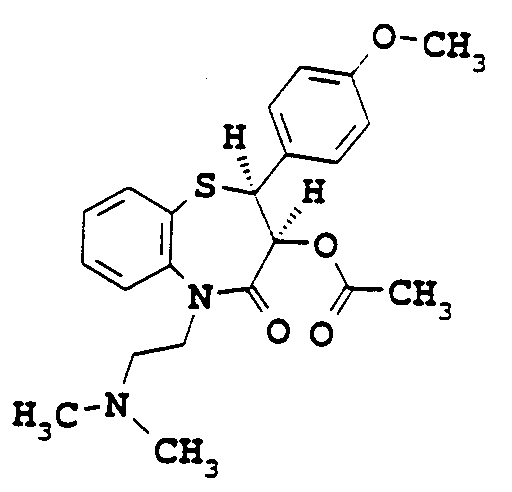
EP0728751A2 - Process for the manufacture of diltiazem - Google Patents
Process for the manufacture of diltiazem Download PDFInfo
- Publication number
- EP0728751A2 EP0728751A2 EP96102348A EP96102348A EP0728751A2 EP 0728751 A2 EP0728751 A2 EP 0728751A2 EP 96102348 A EP96102348 A EP 96102348A EP 96102348 A EP96102348 A EP 96102348A EP 0728751 A2 EP0728751 A2 EP 0728751A2
- Authority
- EP
- European Patent Office
- Prior art keywords
- toluene
- formula
- mixture
- reaction
- diltiazem
- Prior art date
- Legal status (The legal status is an assumption and is not a legal conclusion. Google has not performed a legal analysis and makes no representation as to the accuracy of the status listed.)
- Ceased
Links
- HSUGRBWQSSZJOP-RTWAWAEBSA-N diltiazem Chemical compound C1=CC(OC)=CC=C1[C@H]1[C@@H](OC(C)=O)C(=O)N(CCN(C)C)C2=CC=CC=C2S1 HSUGRBWQSSZJOP-RTWAWAEBSA-N 0.000 title claims abstract description 12
- 229960004166 diltiazem Drugs 0.000 title claims abstract description 11
- 238000004519 manufacturing process Methods 0.000 title claims abstract description 5
- 238000000034 method Methods 0.000 title claims description 29
- YXFVVABEGXRONW-UHFFFAOYSA-N Toluene Chemical compound CC1=CC=CC=C1 YXFVVABEGXRONW-UHFFFAOYSA-N 0.000 claims abstract description 74
- SECXISVLQFMRJM-UHFFFAOYSA-N N-Methylpyrrolidone Chemical compound CN1CCCC1=O SECXISVLQFMRJM-UHFFFAOYSA-N 0.000 claims abstract description 24
- CDBYLPFSWZWCQE-UHFFFAOYSA-L Sodium Carbonate Chemical compound [Na+].[Na+].[O-]C([O-])=O CDBYLPFSWZWCQE-UHFFFAOYSA-L 0.000 claims abstract description 20
- 239000000203 mixture Substances 0.000 claims abstract description 15
- 150000001875 compounds Chemical class 0.000 claims abstract description 14
- 229910000029 sodium carbonate Inorganic materials 0.000 claims abstract description 10
- XLYOFNOQVPJJNP-UHFFFAOYSA-N water Substances O XLYOFNOQVPJJNP-UHFFFAOYSA-N 0.000 claims description 22
- 239000002904 solvent Substances 0.000 claims description 16
- 238000006243 chemical reaction Methods 0.000 claims description 15
- WFDIJRYMOXRFFG-UHFFFAOYSA-N Acetic anhydride Chemical compound CC(=O)OC(C)=O WFDIJRYMOXRFFG-UHFFFAOYSA-N 0.000 claims description 12
- 238000004821 distillation Methods 0.000 claims description 7
- 150000003839 salts Chemical class 0.000 claims description 6
- 238000000926 separation method Methods 0.000 claims description 5
- 239000002253 acid Substances 0.000 claims description 3
- 125000001495 ethyl group Chemical group [H]C([H])([H])C([H])([H])* 0.000 claims description 3
- 239000011541 reaction mixture Substances 0.000 claims description 3
- 239000002245 particle Substances 0.000 claims description 2
- 239000003795 chemical substances by application Substances 0.000 abstract description 3
- 239000013067 intermediate product Substances 0.000 abstract description 2
- 229940100198 alkylating agent Drugs 0.000 abstract 1
- 239000002168 alkylating agent Substances 0.000 abstract 1
- CSCPPACGZOOCGX-UHFFFAOYSA-N Acetone Chemical compound CC(C)=O CSCPPACGZOOCGX-UHFFFAOYSA-N 0.000 description 14
- 239000000047 product Substances 0.000 description 8
- 239000000463 material Substances 0.000 description 7
- IAZDPXIOMUYVGZ-UHFFFAOYSA-N Dimethylsulphoxide Chemical compound CS(C)=O IAZDPXIOMUYVGZ-UHFFFAOYSA-N 0.000 description 6
- LFQSCWFLJHTTHZ-UHFFFAOYSA-N Ethanol Chemical compound CCO LFQSCWFLJHTTHZ-UHFFFAOYSA-N 0.000 description 6
- XEKOWRVHYACXOJ-UHFFFAOYSA-N Ethyl acetate Chemical compound CCOC(C)=O XEKOWRVHYACXOJ-UHFFFAOYSA-N 0.000 description 6
- 238000007126 N-alkylation reaction Methods 0.000 description 6
- 239000002585 base Substances 0.000 description 6
- BWHMMNNQKKPAPP-UHFFFAOYSA-L potassium carbonate Chemical compound [K+].[K+].[O-]C([O-])=O BWHMMNNQKKPAPP-UHFFFAOYSA-L 0.000 description 6
- LQLJZSJKRYTKTP-UHFFFAOYSA-N 2-dimethylaminoethyl chloride hydrochloride Chemical compound Cl.CN(C)CCCl LQLJZSJKRYTKTP-UHFFFAOYSA-N 0.000 description 4
- VEXZGXHMUGYJMC-UHFFFAOYSA-N Hydrochloric acid Chemical compound Cl VEXZGXHMUGYJMC-UHFFFAOYSA-N 0.000 description 3
- ZMXDDKWLCZADIW-UHFFFAOYSA-N N,N-Dimethylformamide Chemical compound CN(C)C=O ZMXDDKWLCZADIW-UHFFFAOYSA-N 0.000 description 3
- KWYUFKZDYYNOTN-UHFFFAOYSA-M Potassium hydroxide Chemical compound [OH-].[K+] KWYUFKZDYYNOTN-UHFFFAOYSA-M 0.000 description 3
- 238000005804 alkylation reaction Methods 0.000 description 3
- 229910000027 potassium carbonate Inorganic materials 0.000 description 3
- 230000035484 reaction time Effects 0.000 description 3
- WQMAANNAZKNUDL-UHFFFAOYSA-N 2-dimethylaminoethyl chloride Chemical compound CN(C)CCCl WQMAANNAZKNUDL-UHFFFAOYSA-N 0.000 description 2
- QCQCHGYLTSGIGX-GHXANHINSA-N 4-[[(3ar,5ar,5br,7ar,9s,11ar,11br,13as)-5a,5b,8,8,11a-pentamethyl-3a-[(5-methylpyridine-3-carbonyl)amino]-2-oxo-1-propan-2-yl-4,5,6,7,7a,9,10,11,11b,12,13,13a-dodecahydro-3h-cyclopenta[a]chrysen-9-yl]oxy]-2,2-dimethyl-4-oxobutanoic acid Chemical compound N([C@@]12CC[C@@]3(C)[C@]4(C)CC[C@H]5C(C)(C)[C@@H](OC(=O)CC(C)(C)C(O)=O)CC[C@]5(C)[C@H]4CC[C@@H]3C1=C(C(C2)=O)C(C)C)C(=O)C1=CN=CC(C)=C1 QCQCHGYLTSGIGX-GHXANHINSA-N 0.000 description 2
- 238000003820 Medium-pressure liquid chromatography Methods 0.000 description 2
- KEAYESYHFKHZAL-UHFFFAOYSA-N Sodium Chemical compound [Na] KEAYESYHFKHZAL-UHFFFAOYSA-N 0.000 description 2
- -1 alkyl acetate Chemical compound 0.000 description 2
- 150000001412 amines Chemical class 0.000 description 2
- 229940093499 ethyl acetate Drugs 0.000 description 2
- 235000019439 ethyl acetate Nutrition 0.000 description 2
- 238000000655 nuclear magnetic resonance spectrum Methods 0.000 description 2
- 239000003444 phase transfer catalyst Substances 0.000 description 2
- 238000002360 preparation method Methods 0.000 description 2
- 239000012312 sodium hydride Substances 0.000 description 2
- 229910000104 sodium hydride Inorganic materials 0.000 description 2
- 231100000331 toxic Toxicity 0.000 description 2
- 230000002588 toxic effect Effects 0.000 description 2
- 0 *N(CCN(c1ccccc1S[C@]([C@]1O*)c(cc2)ccc2O*)C1=O)*I Chemical compound *N(CCN(c1ccccc1S[C@]([C@]1O*)c(cc2)ccc2O*)C1=O)*I 0.000 description 1
- RYHBNJHYFVUHQT-UHFFFAOYSA-N 1,4-Dioxane Chemical compound C1COCCO1 RYHBNJHYFVUHQT-UHFFFAOYSA-N 0.000 description 1
- 206010002383 Angina Pectoris Diseases 0.000 description 1
- DGAQECJNVWCQMB-PUAWFVPOSA-M Ilexoside XXIX Chemical compound C[C@@H]1CC[C@@]2(CC[C@@]3(C(=CC[C@H]4[C@]3(CC[C@@H]5[C@@]4(CC[C@@H](C5(C)C)OS(=O)(=O)[O-])C)C)[C@@H]2[C@]1(C)O)C)C(=O)O[C@H]6[C@@H]([C@H]([C@@H]([C@H](O6)CO)O)O)O.[Na+] DGAQECJNVWCQMB-PUAWFVPOSA-M 0.000 description 1
- CTQNGGLPUBDAKN-UHFFFAOYSA-N O-Xylene Chemical compound CC1=CC=CC=C1C CTQNGGLPUBDAKN-UHFFFAOYSA-N 0.000 description 1
- 230000010933 acylation Effects 0.000 description 1
- 238000005917 acylation reaction Methods 0.000 description 1
- 230000029936 alkylation Effects 0.000 description 1
- 238000009835 boiling Methods 0.000 description 1
- 230000000711 cancerogenic effect Effects 0.000 description 1
- 231100000315 carcinogenic Toxicity 0.000 description 1
- 239000003183 carcinogenic agent Substances 0.000 description 1
- 238000004587 chromatography analysis Methods 0.000 description 1
- 238000011097 chromatography purification Methods 0.000 description 1
- 238000002425 crystallisation Methods 0.000 description 1
- 230000008025 crystallization Effects 0.000 description 1
- 230000002526 effect on cardiovascular system Effects 0.000 description 1
- 230000007613 environmental effect Effects 0.000 description 1
- 238000001704 evaporation Methods 0.000 description 1
- 230000008020 evaporation Effects 0.000 description 1
- 238000004880 explosion Methods 0.000 description 1
- 239000012458 free base Substances 0.000 description 1
- 239000012535 impurity Substances 0.000 description 1
- 238000009533 lab test Methods 0.000 description 1
- 238000010979 pH adjustment Methods 0.000 description 1
- 238000000746 purification Methods 0.000 description 1
- 230000008929 regeneration Effects 0.000 description 1
- 238000011069 regeneration method Methods 0.000 description 1
- 229910052708 sodium Inorganic materials 0.000 description 1
- 239000011734 sodium Substances 0.000 description 1
- ODZPKZBBUMBTMG-UHFFFAOYSA-N sodium amide Chemical compound [NH2-].[Na+] ODZPKZBBUMBTMG-UHFFFAOYSA-N 0.000 description 1
- 238000002560 therapeutic procedure Methods 0.000 description 1
- 125000003944 tolyl group Chemical group 0.000 description 1
- 231100000167 toxic agent Toxicity 0.000 description 1
- 239000003440 toxic substance Substances 0.000 description 1
- 238000010977 unit operation Methods 0.000 description 1
- 238000005406 washing Methods 0.000 description 1
- 239000002699 waste material Substances 0.000 description 1
- 238000005303 weighing Methods 0.000 description 1
- 239000008096 xylene Substances 0.000 description 1
Classifications
-
- C—CHEMISTRY; METALLURGY
- C07—ORGANIC CHEMISTRY
- C07D—HETEROCYCLIC COMPOUNDS
- C07D281/00—Heterocyclic compounds containing rings of more than six members having one nitrogen atom and one sulfur atom as the only ring hetero atoms
- C07D281/02—Seven-membered rings
- C07D281/04—Seven-membered rings having the hetero atoms in positions 1 and 4
- C07D281/08—Seven-membered rings having the hetero atoms in positions 1 and 4 condensed with carbocyclic rings or ring systems
- C07D281/10—Seven-membered rings having the hetero atoms in positions 1 and 4 condensed with carbocyclic rings or ring systems condensed with one six-membered ring
-
- A—HUMAN NECESSITIES
- A61—MEDICAL OR VETERINARY SCIENCE; HYGIENE
- A61P—SPECIFIC THERAPEUTIC ACTIVITY OF CHEMICAL COMPOUNDS OR MEDICINAL PREPARATIONS
- A61P9/00—Drugs for disorders of the cardiovascular system
-
- A—HUMAN NECESSITIES
- A61—MEDICAL OR VETERINARY SCIENCE; HYGIENE
- A61P—SPECIFIC THERAPEUTIC ACTIVITY OF CHEMICAL COMPOUNDS OR MEDICINAL PREPARATIONS
- A61P9/00—Drugs for disorders of the cardiovascular system
- A61P9/06—Antiarrhythmics
-
- A—HUMAN NECESSITIES
- A61—MEDICAL OR VETERINARY SCIENCE; HYGIENE
- A61P—SPECIFIC THERAPEUTIC ACTIVITY OF CHEMICAL COMPOUNDS OR MEDICINAL PREPARATIONS
- A61P9/00—Drugs for disorders of the cardiovascular system
- A61P9/14—Vasoprotectives; Antihaemorrhoidals; Drugs for varicose therapy; Capillary stabilisers
Definitions
- the present invention relates to a process for preparing cis-(+)-hydroxy-5-[2-(dimethylamino)ethyl]-2,3-dihydro-2-(4-methoxyphenyl)-benzothiazepin-4(5H)-one having the structure (I); cis-(+)-hydroxy-5-[2-(dimethylamino)ethyl]-2,3-dihydro-2-(4-methoxyphenyl)-benzothiazepin-4(5H)-one is a useful intermediate in the preparation of diltiazem (II). Diltiazem is used currently in cardiovascular therapy, in particular in the treatment of angina pectoris.
- Dimethyl sulfoxide, toluene, xylene, and dioxane are described as possible solvents in this N-alkylation reaction.
- the base used in the reaction described in patent US 3,582,257 is metallic sodium, sodium amide or sodium hydride. According to the patent, in particular dimethyl sulfoxide together with sodium hydride is especially well suited for this reaction. In connection with this reaction there is an evident risk of explosion (Chem. Eng. News, 44 (15), 48 (1966)) and, furthermore, dimethyl sulfoxide is difficult to regenerate, since it dissolves completely in water and its boiling point is high.
- Patent EP 81234 describes an improved N-alkylation process, by which the disadvantages of the method according to the above-mentioned patent are avoided.
- compound (III) reacts with compound (IV), thereby forming compound (I).
- the reaction is carried out in the presence of potassium hydroxide in acetone or in the presence of potassium carbonate in a solvent which has been selected from among acetone, a lower alkyl acetate, a mixture of water and acetone, or a mixture of a lower alkyl acetate and water.
- a solvent which has been selected from among acetone, a lower alkyl acetate, a mixture of water and acetone, or a mixture of a lower alkyl acetate and water.
- this process has severe disadvantages.
- the product is crystallized out, after a plurality of treatment steps, as its hydrochloride from ethanol in order that a sufficiently pure intermediate should be obtained.
- acetone used as the solvent
- the after-treatment is complicated, since acetone is completely miscible with water and conventional removal of the salts cannot be carried out using water.
- the solvent must first be replaced with, for example, toluene, which is further, after the washing out of the salts, replaced with ethanol in order that the product could be crystallized and thereby freed of impurities.
- solvent is used in the alkylation reaction in an 8- to 10-fold amount in milliliters per one gram of the initial material to be alkylated.
- the amount of solvent is limited to 5- to 15-fold in proportion to the initial material.
- the solvent is acetone or ethyl acetate and the base is potassium carbonate do not work repeatably.
- the reaction time in the examples of the patent varies from three hours in Example 2 to 30 hours in Example 7. If the time required by the reaction, the amount of solvent used in the reaction, and the cumbersome and complicated after-treatment are taken into consideration, these processes require a great deal of production capacity, working hours, and energy. Furthermore, ethylacetate hydrolyzes in alkaline conditions, and therefore its regeneration for reuse is problematic.
- N-alkylation reaction proceeds rapidly and with an excellent yield when the solvent is a mixture of toluene and N-methylpyrrolidin-2-one and the base is finely-divided sodium carbonate.
- Toluene is needed in an amount only four-fold in proportion to the initial material.
- the water formed in the reaction is removed from the mixture by water separation.
- the reaction time is 1 ⁇ 2 - 7 h, depending on the temperature at which the reaction is performed.
- N-methyl-pyrrolidin-2-one is needed for dissolving the 2-chloroethyldimethylamine and for ensuring rapid proceeding of the reaction, in an amount of 0.5 grams per one gram of the initial material.
- the process according to the invention is characterized in that a compound according to Formula III is allowed to react with a compound according to Formula (IV) in a mixture of toluene and N-methylpyrrolidin-2-one in the presence of finely-divided sodium carbonate, whereby the desired intermediate product (I) is obtained from which diltiazem (II) can be prepared directly by allowing the intermediate (I) to react, after the removal of the solvent, directly with an acylating agent, preferably acetic acid anhydride.
- an acylating agent preferably acetic acid anhydride.
- compound (III) is allowed to react with compound (IV) in a mixture of N-methylpyrrolidin-2-one and toluene, which contains toluene in an amount of 50-95 %, preferably 88 %, and N-methylpyrrolidin-2-one in an amount of 5-50 %, preferably 12 %, in the presence of finely-divided sodium carbonate having a particle size of 2-30 ⁇ m, preferably 8 ⁇ m, at a temperature of 80-120 °C, preferably 115 °C, the reaction time being 1 ⁇ 2-7 h, most preferably 1 h.
- the solvent of the N-alkylation reaction can be removed by distillation, and the distillation residue is allowed to react with the acylation agent, e.g. with acetic acid anhydride, without a solvent, to form diltiazem (II), from which the corresponding hydrochloride salt or other pharmaceutically acceptable acid addition salts can further be prepared by a known method.
- the acylation agent e.g. with acetic acid anhydride
- diltiazem (II) from which the corresponding hydrochloride salt or other pharmaceutically acceptable acid addition salts can further be prepared by a known method.
- the process according to the invention does not require a separate unit operation for releasing the 2-chloroethyldimethylamine hydrochloride, in contrast to patent application EP 594101, in which this carcinogenic and highly toxic substance is released as a free base from its hydrochloride salt in a separate reactor before the actual performing of the N-alkylation reaction.
- the said compound is extracted, after pH adjustment, into toluene from water, in which a portion of this toxic and highly water-soluble chlorinated amine will inevitably remain and cause considerable problems of waste treatment.
- only the necessary amount of amine is batched as its hydrochloride directly into the reaction vessel.
- this carcinogenic substance is needed in an amount almost 70 % more per one kilo of the initial material than in the process according to the present invention, and likewise sodium carbonate is also needed in an amount approximately 60 % more per one kilo of the initial material. Furthermore, the process according to the present invention requires 45 % less toluene. Thus the process according to the invention is, from the viewpoints of economy, capacity requirement and environmental protection, superior to the process mentioned in the foregoing.
- toluene is needed in an amount 125 % greater than in the process according to the invention, and furthermore, toxic 2-chloroethyldimethylamine hydrochloride is needed in an amount 15 % greater.
- This process presupposes the use of an expensive phase transfer catalyst.
- the product is in the toluene layer, which is washed once more with water.
- the process is continued by distilling out the toluene for reuse and by adding acetic acid anhydride to the distillation residue.
- the product is extracted into toluene, from which it is crystallized out by adding a solution of ethanol and HCl.
- the product (I) of the alkylation reaction was not isolated, but the precise yield was determined.
- 121.2 g of intermediate was left. From this, a 2-gram sample was weighed with precision, and this sample was purified by MPLC chromatography. The yield of pure product was 1.825 g (93.2 %).
- the purity of the intermediate was checked by means of NMR spectra.
- Example 1 The yield of the reaction was determined in the same manner as in Example 1, by weighing out from the evaporation residue, which was 40.73 g, precisely 2 grams for MPLC purification. The yield of pure intermediate after chromatographic purification was 1.827 g (94.1 %). The purity of the intermediate was checked by means of NMR spectra.
Landscapes
- Health & Medical Sciences (AREA)
- Organic Chemistry (AREA)
- Chemical & Material Sciences (AREA)
- Bioinformatics & Cheminformatics (AREA)
- Engineering & Computer Science (AREA)
- Chemical Kinetics & Catalysis (AREA)
- Life Sciences & Earth Sciences (AREA)
- General Chemical & Material Sciences (AREA)
- Medicinal Chemistry (AREA)
- Heart & Thoracic Surgery (AREA)
- Cardiology (AREA)
- Animal Behavior & Ethology (AREA)
- Nuclear Medicine, Radiotherapy & Molecular Imaging (AREA)
- Pharmacology & Pharmacy (AREA)
- General Health & Medical Sciences (AREA)
- Public Health (AREA)
- Veterinary Medicine (AREA)
- Vascular Medicine (AREA)
- Nitrogen- Or Sulfur-Containing Heterocyclic Ring Compounds With Rings Of Six Or More Members (AREA)
- Pharmaceuticals Containing Other Organic And Inorganic Compounds (AREA)
- Steroid Compounds (AREA)
Abstract

Description
- The present invention relates to a process for preparing cis-(+)-hydroxy-5-[2-(dimethylamino)ethyl]-2,3-dihydro-2-(4-methoxyphenyl)-benzothiazepin-4(5H)-one having the structure (I);


- The preparation of diltiazem is described in patent US 3,582,257, wherein the initial material used is cis-(+)-3-hydroxy-2-(4-methoxyphenyl)-2,3-dihydro-1,5-benzothiazepin-4(5H)-one (III).

- In the process described in the said patent, this compound reacts with 2-chloroethyldimethylamine (IV), forming the intermediate (I) as described on page 5.

- Dimethyl sulfoxide, toluene, xylene, and dioxane are described as possible solvents in this N-alkylation reaction. The base used in the reaction described in patent US 3,582,257 is metallic sodium, sodium amide or sodium hydride. According to the patent, in particular dimethyl sulfoxide together with sodium hydride is especially well suited for this reaction. In connection with this reaction there is an evident risk of explosion (Chem. Eng. News, 44 (15), 48 (1966)) and, furthermore, dimethyl sulfoxide is difficult to regenerate, since it dissolves completely in water and its boiling point is high.
- Patent EP 81234 describes an improved N-alkylation process, by which the disadvantages of the method according to the above-mentioned patent are avoided. In this process, compound (III) reacts with compound (IV), thereby forming compound (I). The reaction is carried out in the presence of potassium hydroxide in acetone or in the presence of potassium carbonate in a solvent which has been selected from among acetone, a lower alkyl acetate, a mixture of water and acetone, or a mixture of a lower alkyl acetate and water. However, when applied on an industrial scale, this process has severe disadvantages. In all of the processes described in the examples, the product is crystallized out, after a plurality of treatment steps, as its hydrochloride from ethanol in order that a sufficiently pure intermediate should be obtained. When acetone is used as the solvent, the after-treatment is complicated, since acetone is completely miscible with water and conventional removal of the salts cannot be carried out using water. The solvent must first be replaced with, for example, toluene, which is further, after the washing out of the salts, replaced with ethanol in order that the product could be crystallized and thereby freed of impurities. In all of the examples described in the patent, solvent is used in the alkylation reaction in an 8- to 10-fold amount in milliliters per one gram of the initial material to be alkylated. In the description section of the patent, the amount of solvent is limited to 5- to 15-fold in proportion to the initial material. On the basis of our laboratory experiments, those examples according to the patent in which the solvent is acetone or ethyl acetate and the base is potassium carbonate do not work repeatably. The reaction time in the examples of the patent varies from three hours in Example 2 to 30 hours in Example 7. If the time required by the reaction, the amount of solvent used in the reaction, and the cumbersome and complicated after-treatment are taken into consideration, these processes require a great deal of production capacity, working hours, and energy. Furthermore, ethylacetate hydrolyzes in alkaline conditions, and therefore its regeneration for reuse is problematic.
- In patent US 3,582,257, the alkylation of intermediate (III) takes place by the use of a base form of compound (IV), as also in patent application EP 594101, in which the N-alkylation reaction is carried out in toluene with sodium carbonate serving as the base.
- This reaction is also described in patent application WO 92/10485, in which the solvent is toluene together with an auxiliary solvent, dimethyl formamide or N-methyl-pyrrolidin-2-one and water, and the base is potassium carbonate. However, the reaction requires the use of a phase transfer catalyst.
- We have observed, surprisingly, that in the process according to the present invention the N-alkylation reaction proceeds rapidly and with an excellent yield when the solvent is a mixture of toluene and N-methylpyrrolidin-2-one and the base is finely-divided sodium carbonate. Toluene is needed in an amount only four-fold in proportion to the initial material. The water formed in the reaction is removed from the mixture by water separation. The reaction time is ½ - 7 h, depending on the temperature at which the reaction is performed. N-methyl-pyrrolidin-2-one is needed for dissolving the 2-chloroethyldimethylamine and for ensuring rapid proceeding of the reaction, in an amount of 0.5 grams per one gram of the initial material. The treatment after the reaction is decisively easier, since the salts can be washed out of the reaction mixture simply by adding water to the reaction mixture and by separating the layers. This procedure is possible, since toluene separates from water, contrary to acetone. It is also advantageous that the intermediate (I) obtained as the product is very pure, and no separate crystallization is needed; it is possible, after the separation of the water layer, to continue directly from intermediate (I) by distilling out the toluene for reuse and by then allowing the distillation residue to react with an acetic acid anhydride to form diltiazem, without a solvent.
- The process according to the invention is characterized in that a compound according to Formula III


- When compound (I) is prepared by the process according to the invention, compound (III) is allowed to react with compound (IV) in a mixture of N-methylpyrrolidin-2-one and toluene, which contains toluene in an amount of 50-95 %, preferably 88 %, and N-methylpyrrolidin-2-one in an amount of 5-50 %, preferably 12 %, in the presence of finely-divided sodium carbonate having a particle size of 2-30 µm, preferably 8 µm, at a temperature of 80-120 °C, preferably 115 °C, the reaction time being ½-7 h, most preferably 1 h.
- The solvent of the N-alkylation reaction can be removed by distillation, and the distillation residue is allowed to react with the acylation agent, e.g. with acetic acid anhydride, without a solvent, to form diltiazem (II), from which the corresponding hydrochloride salt or other pharmaceutically acceptable acid addition salts can further be prepared by a known method.
- The process according to the invention does not require a separate unit operation for releasing the 2-chloroethyldimethylamine hydrochloride, in contrast to patent application EP 594101, in which this carcinogenic and highly toxic substance is released as a free base from its hydrochloride salt in a separate reactor before the actual performing of the N-alkylation reaction. In this latter case the said compound is extracted, after pH adjustment, into toluene from water, in which a portion of this toxic and highly water-soluble chlorinated amine will inevitably remain and cause considerable problems of waste treatment. In the process according to our invention, only the necessary amount of amine is batched as its hydrochloride directly into the reaction vessel. In the process according to patent application EP 594101, this carcinogenic substance is needed in an amount almost 70 % more per one kilo of the initial material than in the process according to the present invention, and likewise sodium carbonate is also needed in an amount approximately 60 % more per one kilo of the initial material. Furthermore, the process according to the present invention requires 45 % less toluene. Thus the process according to the invention is, from the viewpoints of economy, capacity requirement and environmental protection, superior to the process mentioned in the foregoing.
- In the process according to patent application WO 92/10485, toluene is needed in an amount 125 % greater than in the process according to the invention, and furthermore, toxic 2-chloroethyldimethylamine hydrochloride is needed in an amount 15 % greater. This process presupposes the use of an expensive phase transfer catalyst.
- The following examples will illustrate the invention:
- A mixture containing 96 g of cis-(+)-(4-methoxyphenyl)-3-hydroxy-2,3-dihydro-1,5-benzothiazepin-4(5H)-one, 52.8 g of 2-chloroethyldimethylamine hydrochloride, 90 g of finely-divided sodium carbonate, 384 ml of toluene, and 48 ml of N-methylpyrrolidin-2-one is heated, with water separation, to +115 °C, and the mixture is stirred at that temperature for 1 h, whereafter the mixture is cooled to 40 °C, and thereafter 240 ml of water is added to it and the layers are separated. The water layer is rejected. The product is in the toluene layer, which is washed once more with water. The process is continued by distilling out the toluene for reuse and by adding acetic acid anhydride to the distillation residue. After the treatment with acetic acid anhydride the product is extracted into toluene, from which it is crystallized out by adding a solution of ethanol and HCl. The product (I) of the alkylation reaction was not isolated, but the precise yield was determined. After the distillation out of toluene, 121.2 g of intermediate was left. From this, a 2-gram sample was weighed with precision, and this sample was purified by MPLC chromatography. The yield of pure product was 1.825 g (93.2 %). The purity of the intermediate was checked by means of NMR spectra.
- A mixture containing 32 g of cis-(+)-(4-methoxyphenyl)-3-hydroxy-2,3-dihydro-1,5-benzothiazepin-4(5H)-one, 17.6 g of 2-chloroethyldimethylamine hydrochloride, 30 g of finely-divided sodium carbonate, 128 ml of toluene, and 16 ml of N-methylpyrrolidin-2-one is heated under a vacuum of -0.42 bar to +93 °C, whereupon the mixture boils, with water separation. Thereafter the vacuum is switched off, the mixture is cooled to +40 °C and is stirred at that temperature for 3 h, 84 ml of water is added, and the layers are separated. The water layer is rejected. The product is in the toluene layer, which is washed once more with water. The process is continued as in Example 1. The yield of the reaction was determined in the same manner as in Example 1, by weighing out from the evaporation residue, which was 40.73 g, precisely 2 grams for MPLC purification. The yield of pure intermediate after chromatographic purification was 1.827 g (94.1 %). The purity of the intermediate was checked by means of NMR spectra.
Claims (4)
- A process for preparing diltiazem according to Formula (II),


- A process according to Claim 1, characterized in that the mixture of toluene and N-methylpyrrolidin-2-one contains toluene 50-95 % and N-methylpyrrolidin-2-one 5-50 %.
- A process according to Claims 1-2, characterized in that the finely-divided sodium carbonate has a particle size of 2-30 µm.
- A process according to Claims 1-3, characterized in that the reaction temperature is 80-120 °C.
Applications Claiming Priority (2)
| Application Number | Priority Date | Filing Date | Title |
|---|---|---|---|
| FI950719A FI97725C (en) | 1995-02-17 | 1995-02-17 | Process for the preparation of diltiazem |
| FI950719 | 1995-02-17 |
Publications (2)
| Publication Number | Publication Date |
|---|---|
| EP0728751A2 true EP0728751A2 (en) | 1996-08-28 |
| EP0728751A3 EP0728751A3 (en) | 1996-10-23 |
Family
ID=8542879
Family Applications (1)
| Application Number | Title | Priority Date | Filing Date |
|---|---|---|---|
| EP96102348A Ceased EP0728751A3 (en) | 1995-02-17 | 1996-02-16 | Process for the preparation of diltiazem |
Country Status (18)
| Country | Link |
|---|---|
| US (1) | US5644054A (en) |
| EP (1) | EP0728751A3 (en) |
| JP (1) | JPH08253464A (en) |
| BA (1) | BA96073A (en) |
| CA (1) | CA2169717A1 (en) |
| CZ (1) | CZ287706B6 (en) |
| EE (1) | EE9600007A (en) |
| FI (1) | FI97725C (en) |
| HR (1) | HRP960079A2 (en) |
| HU (1) | HU218609B (en) |
| IL (1) | IL117084A (en) |
| LV (1) | LV11466B (en) |
| PL (1) | PL312826A1 (en) |
| RU (1) | RU2139853C1 (en) |
| SI (1) | SI9600051A (en) |
| SK (1) | SK20696A3 (en) |
| YU (1) | YU8996A (en) |
| ZA (1) | ZA961120B (en) |
Cited By (2)
| Publication number | Priority date | Publication date | Assignee | Title |
|---|---|---|---|---|
| WO2016146836A2 (en) | 2015-03-19 | 2016-09-22 | Universite Claude Bernard Lyon 1 | Novel antiviral compositions for treating the flu |
| US12594280B2 (en) | 2015-03-19 | 2026-04-07 | Universite Claude Bernard Lyon 1 | Antiviral compositions for treating the flu |
Family Cites Families (12)
| Publication number | Priority date | Publication date | Assignee | Title |
|---|---|---|---|---|
| US3582257A (en) * | 1968-05-10 | 1971-06-01 | Monsanto Co | Soil and stain resistance and soil and stain release properties in textile articles |
| JPS5899471A (en) * | 1981-12-07 | 1983-06-13 | Tanabe Seiyaku Co Ltd | Novel preparation of benzothiazepin derivative |
| SE449611B (en) * | 1982-07-09 | 1987-05-11 | Tanabe Seiyaku Co | SET TO MAKE 1,5-BENZOTIAZEPINE DERIVATIVES |
| FR2624117B1 (en) * | 1987-12-08 | 1991-02-22 | Synthelabo | HYDROXY-3 (METHOXY-4 PHENYL) -2 (METHYLAMINO-2 ETHYL) -5 DIHYDRO-2,3 5H-BENZOTHIAZEPINE-1,5 ONE-4 DERIVATIVES, THEIR PREPARATION AND THEIR THERAPEUTIC APPLICATION |
| FR2630109B1 (en) * | 1988-04-19 | 1991-11-29 | Synthelabo | DERIVATIVES OF ((N- (2-AMINO-2 OXO-2 ETHYL) METHYLAMINO) -2 ETHYL) -5 HYDROXY-3 (METHOXY-4 PHENYL) -2 DIHYDRO-2,3 5H-BENZOTHIAZEPINE-1,5 ONE-4, THEIR PREPARATION AND THEIR APPLICATION IN THERAPEUTICS |
| US4908469A (en) * | 1988-05-18 | 1990-03-13 | Marion Laboratories, Inc. | 2-Hydroxy-propanoic acid acyclic alkyl esters for benzothiazepines |
| US5002942A (en) * | 1988-07-25 | 1991-03-26 | Sankyo Company, Limited | 1,5-benzothiazepine derivatives, their preparation and their use in the treatment of cardiovascular disorders |
| FR2653122B1 (en) * | 1989-10-17 | 1994-04-15 | Synthelabo | DERIVATIVES OF 5- [2 - [[2-AMINO-2-OXOETHYL] METHYLAMINO] ETHYL] -2,3-DIHYDRO-3-HYDROXY-2- (4-METHOXYPHENYL) -1.5 (5H) -BENZOTHIAZEPINE-4 -ONE, THEIR PREPARATION AND THEIR APPLICATION IN THERAPEUTICS. |
| IT1240686B (en) * | 1990-04-27 | 1993-12-17 | Luso Farmaco Inst | 1,5-BENZOTHIAZEPINONIC DERIVATIVES, THEIR PREPARATION AND PHARMACEUTICAL USE |
| IT1244878B (en) * | 1990-12-11 | 1994-09-12 | Lusochimica Spa | PROCESS FOR THE PREPARATION OF (+) - CIS-3- (ACETOXY) -5-! 2- (DIMETHYLAMINE) ETHYL! -2,3-DIHYDRO-2- (4-METOXYPHENYL) -1,5-BENZOTHIAZEPIN- 4- (5H) -ONE HYDROCHLORIDE |
| IT1255545B (en) * | 1992-10-23 | 1995-11-09 | PROCEDURE FOR THE PREPARATION OF DILTIAZEM | |
| FI93741C (en) * | 1993-03-24 | 1995-05-26 | Orion Yhtymae Oy | Process for the preparation of optically pure (2S, 3S) and (2R, 3R) -threoalkyl-2-hydroxy-3- (4-methoxyphenyl) -3- (2-X-phenylthio) propionates or similar acylated compounds |
-
1995
- 1995-02-17 FI FI950719A patent/FI97725C/en active
-
1996
- 1996-02-08 IL IL11708496A patent/IL117084A/en not_active IP Right Cessation
- 1996-02-12 ZA ZA961120A patent/ZA961120B/en unknown
- 1996-02-14 US US08/601,182 patent/US5644054A/en not_active Expired - Fee Related
- 1996-02-15 PL PL96312826A patent/PL312826A1/en unknown
- 1996-02-15 SK SK206-96A patent/SK20696A3/en unknown
- 1996-02-15 EE EE9600007A patent/EE9600007A/en unknown
- 1996-02-15 CZ CZ1996454A patent/CZ287706B6/en not_active IP Right Cessation
- 1996-02-16 BA BA960073A patent/BA96073A/en unknown
- 1996-02-16 RU RU96102864A patent/RU2139853C1/en active
- 1996-02-16 JP JP8029609A patent/JPH08253464A/en active Pending
- 1996-02-16 HR HR950719A patent/HRP960079A2/en not_active Application Discontinuation
- 1996-02-16 SI SI9600051A patent/SI9600051A/en unknown
- 1996-02-16 YU YU8996A patent/YU8996A/en unknown
- 1996-02-16 EP EP96102348A patent/EP0728751A3/en not_active Ceased
- 1996-02-16 CA CA002169717A patent/CA2169717A1/en not_active Abandoned
- 1996-02-16 HU HU9700350A patent/HU218609B/en not_active IP Right Cessation
- 1996-02-16 LV LVP-96-47A patent/LV11466B/en unknown
Cited By (3)
| Publication number | Priority date | Publication date | Assignee | Title |
|---|---|---|---|---|
| WO2016146836A2 (en) | 2015-03-19 | 2016-09-22 | Universite Claude Bernard Lyon 1 | Novel antiviral compositions for treating the flu |
| US11351180B2 (en) | 2015-03-19 | 2022-06-07 | Universite Claude Bernard Lyon 1 | Antiviral compositions for treating the flu |
| US12594280B2 (en) | 2015-03-19 | 2026-04-07 | Universite Claude Bernard Lyon 1 | Antiviral compositions for treating the flu |
Also Published As
| Publication number | Publication date |
|---|---|
| CZ287706B6 (en) | 2001-01-17 |
| LV11466A (en) | 1996-08-20 |
| BA96073A (en) | 2001-09-14 |
| SI9600051A (en) | 1996-08-31 |
| EP0728751A3 (en) | 1996-10-23 |
| YU8996A (en) | 1998-08-14 |
| IL117084A (en) | 2001-03-19 |
| CA2169717A1 (en) | 1996-08-18 |
| FI950719L (en) | 1996-08-18 |
| HU218609B (en) | 2000-10-28 |
| FI950719A0 (en) | 1995-02-17 |
| LV11466B (en) | 1996-12-20 |
| HRP960079A2 (en) | 1997-10-31 |
| CZ45496A3 (en) | 1996-09-11 |
| PL312826A1 (en) | 1996-08-19 |
| FI97725C (en) | 1997-02-10 |
| RU2139853C1 (en) | 1999-10-20 |
| ZA961120B (en) | 1996-08-20 |
| US5644054A (en) | 1997-07-01 |
| IL117084A0 (en) | 1996-06-18 |
| HU9600350D0 (en) | 1996-04-29 |
| EE9600007A (en) | 1996-10-15 |
| FI97725B (en) | 1996-10-31 |
| SK20696A3 (en) | 1997-05-07 |
| JPH08253464A (en) | 1996-10-01 |
| HUP9600350A1 (en) | 1997-04-28 |
Similar Documents
| Publication | Publication Date | Title |
|---|---|---|
| EP0098892B1 (en) | Process for preparing 1,5-benzothiazepine derivatives | |
| EP0081234B1 (en) | Novel method of preparing benzothiazepine derivatives | |
| US5644054A (en) | Process for preparing diltiazem | |
| EP0702009B1 (en) | Method for the preparation of pharmaceutically active benzothiazepine derivatives | |
| EP0594101B1 (en) | A process for the preparation of diltiazem | |
| EP1948628A1 (en) | Quetiapine hemifumarate purification by crystallization | |
| WO2000000494A1 (en) | Preparation of (s)-n-tert-butyl-1,2,3,4-tetrahydroisoquinoline-3-carboxyamide | |
| EP0778273B1 (en) | Process for preparing optically active 3-hydroxy-1,5-benzothiazepine derivative and intermediate therefor | |
| KR910002879B1 (en) | Method for preparing 1,5-benzothiazepine derivative | |
| CA1337346C (en) | Process for preparing 1,5-benzothiazepine derivatives | |
| EP0320532A1 (en) | Novel optically active carboxylic acid derivative l-lysine salt and process for production thereof | |
| CS269330B1 (en) | Method of producing diltlazem | |
| HU226423B1 (en) | Process for producing a 1(2h)-naphtalene-1-ylidene derivative | |
| HK95588A (en) | Process for preparing 1,5-benzothiazepine derivatives | |
| IL153085A (en) | Enantiomer separation of piperidone derivatives with simultaneous in situ racemization of the unwanted enantiomer |
Legal Events
| Date | Code | Title | Description |
|---|---|---|---|
| PUAI | Public reference made under article 153(3) epc to a published international application that has entered the european phase |
Free format text: ORIGINAL CODE: 0009012 |
|
| AK | Designated contracting states |
Kind code of ref document: A2 Designated state(s): AT BE CH DE DK ES FR GB GR IE IT LI NL PT SE |
|
| AX | Request for extension of the european patent |
Free format text: LT PAYMENT 960314 |
|
| RAX | Requested extension states of the european patent have changed |
Free format text: LT PAYMENT 960314 |
|
| PUAL | Search report despatched |
Free format text: ORIGINAL CODE: 0009013 |
|
| AK | Designated contracting states |
Kind code of ref document: A3 Designated state(s): AT BE CH DE DK ES FR GB GR IE IT LI NL PT SE |
|
| AX | Request for extension of the european patent |
Free format text: LT PAYMENT 960314 |
|
| 17P | Request for examination filed |
Effective date: 19970422 |
|
| 17Q | First examination report despatched |
Effective date: 19990511 |
|
| GRAG | Despatch of communication of intention to grant |
Free format text: ORIGINAL CODE: EPIDOS AGRA |
|
| STAA | Information on the status of an ep patent application or granted ep patent |
Free format text: STATUS: THE APPLICATION HAS BEEN REFUSED |
|
| 18R | Application refused |
Effective date: 20010121 |