EP0727431B1 - Process for preparing alkylsubtituted cyclopentadienyl metallocene compounds - Google Patents
Process for preparing alkylsubtituted cyclopentadienyl metallocene compounds Download PDFInfo
- Publication number
- EP0727431B1 EP0727431B1 EP96100767A EP96100767A EP0727431B1 EP 0727431 B1 EP0727431 B1 EP 0727431B1 EP 96100767 A EP96100767 A EP 96100767A EP 96100767 A EP96100767 A EP 96100767A EP 0727431 B1 EP0727431 B1 EP 0727431B1
- Authority
- EP
- European Patent Office
- Prior art keywords
- isomers
- process according
- endo
- exo
- metallocene
- Prior art date
- Legal status (The legal status is an assumption and is not a legal conclusion. Google has not performed a legal analysis and makes no representation as to the accuracy of the status listed.)
- Expired - Lifetime
Links
- ZSWFCLXCOIISFI-UHFFFAOYSA-N endo-cyclopentadiene Natural products C1C=CC=C1 ZSWFCLXCOIISFI-UHFFFAOYSA-N 0.000 title claims description 20
- 150000001875 compounds Chemical class 0.000 title claims description 9
- 125000000058 cyclopentadienyl group Chemical group C1(=CC=CC1)* 0.000 title claims description 8
- 238000004519 manufacturing process Methods 0.000 title description 4
- 239000003446 ligand Substances 0.000 claims description 30
- 238000000034 method Methods 0.000 claims description 21
- 229910052751 metal Inorganic materials 0.000 claims description 16
- 239000002184 metal Substances 0.000 claims description 16
- 238000006243 chemical reaction Methods 0.000 claims description 14
- 239000000203 mixture Substances 0.000 claims description 14
- 150000003839 salts Chemical class 0.000 claims description 13
- 229910052768 actinide Inorganic materials 0.000 claims description 12
- 230000007704 transition Effects 0.000 claims description 12
- 239000003795 chemical substances by application Substances 0.000 claims description 11
- -1 actinide metal compound Chemical class 0.000 claims description 10
- 238000010537 deprotonation reaction Methods 0.000 claims description 7
- 238000004821 distillation Methods 0.000 claims description 7
- 239000002904 solvent Substances 0.000 claims description 7
- 150000001255 actinides Chemical class 0.000 claims description 5
- 125000000217 alkyl group Chemical group 0.000 claims description 4
- 230000005595 deprotonation Effects 0.000 claims description 4
- 229910052735 hafnium Inorganic materials 0.000 claims description 4
- 229910052719 titanium Inorganic materials 0.000 claims description 4
- UFSFPZACYBLGSF-UHFFFAOYSA-N 1-butyl-3-methylcyclopenta-1,3-diene Chemical compound CCCCC1=CC(C)=CC1 UFSFPZACYBLGSF-UHFFFAOYSA-N 0.000 claims description 3
- 230000003647 oxidation Effects 0.000 claims description 3
- 238000007254 oxidation reaction Methods 0.000 claims description 3
- 229910052726 zirconium Inorganic materials 0.000 claims description 3
- 125000002015 acyclic group Chemical group 0.000 claims description 2
- 150000001338 aliphatic hydrocarbons Chemical class 0.000 claims description 2
- 150000004945 aromatic hydrocarbons Chemical class 0.000 claims description 2
- 150000004292 cyclic ethers Chemical class 0.000 claims description 2
- 150000004820 halides Chemical class 0.000 claims 2
- RTAQQCXQSZGOHL-UHFFFAOYSA-N Titanium Chemical group [Ti] RTAQQCXQSZGOHL-UHFFFAOYSA-N 0.000 claims 1
- QCWXUUIWCKQGHC-UHFFFAOYSA-N Zirconium Chemical compound [Zr] QCWXUUIWCKQGHC-UHFFFAOYSA-N 0.000 claims 1
- VBJZVLUMGGDVMO-UHFFFAOYSA-N hafnium atom Chemical compound [Hf] VBJZVLUMGGDVMO-UHFFFAOYSA-N 0.000 claims 1
- 239000011877 solvent mixture Substances 0.000 claims 1
- 239000010936 titanium Substances 0.000 claims 1
- 239000000047 product Substances 0.000 description 20
- YXFVVABEGXRONW-UHFFFAOYSA-N Toluene Chemical compound CC1=CC=CC=C1 YXFVVABEGXRONW-UHFFFAOYSA-N 0.000 description 15
- RTZKZFJDLAIYFH-UHFFFAOYSA-N Diethyl ether Chemical compound CCOCC RTZKZFJDLAIYFH-UHFFFAOYSA-N 0.000 description 13
- VLKZOEOYAKHREP-UHFFFAOYSA-N n-Hexane Chemical class CCCCCC VLKZOEOYAKHREP-UHFFFAOYSA-N 0.000 description 12
- 238000005160 1H NMR spectroscopy Methods 0.000 description 9
- 239000012535 impurity Substances 0.000 description 7
- 239000000243 solution Substances 0.000 description 7
- IJGRMHOSHXDMSA-UHFFFAOYSA-N Atomic nitrogen Chemical compound N#N IJGRMHOSHXDMSA-UHFFFAOYSA-N 0.000 description 6
- MZRVEZGGRBJDDB-UHFFFAOYSA-N N-Butyllithium Chemical compound [Li]CCCC MZRVEZGGRBJDDB-UHFFFAOYSA-N 0.000 description 6
- 229910007932 ZrCl4 Inorganic materials 0.000 description 5
- 239000006227 byproduct Substances 0.000 description 5
- DUNKXUFBGCUVQW-UHFFFAOYSA-J zirconium tetrachloride Chemical compound Cl[Zr](Cl)(Cl)Cl DUNKXUFBGCUVQW-UHFFFAOYSA-J 0.000 description 5
- 150000002736 metal compounds Chemical class 0.000 description 4
- 239000003054 catalyst Substances 0.000 description 3
- 239000012043 crude product Substances 0.000 description 3
- 229910001507 metal halide Inorganic materials 0.000 description 3
- 229910052757 nitrogen Inorganic materials 0.000 description 3
- 238000000746 purification Methods 0.000 description 3
- 239000007818 Grignard reagent Substances 0.000 description 2
- CSNNHWWHGAXBCP-UHFFFAOYSA-L Magnesium sulfate Chemical compound [Mg+2].[O-][S+2]([O-])([O-])[O-] CSNNHWWHGAXBCP-UHFFFAOYSA-L 0.000 description 2
- IMNFDUFMRHMDMM-UHFFFAOYSA-N N-Heptane Chemical compound CCCCCCC IMNFDUFMRHMDMM-UHFFFAOYSA-N 0.000 description 2
- OFBQJSOFQDEBGM-UHFFFAOYSA-N Pentane Chemical compound CCCCC OFBQJSOFQDEBGM-UHFFFAOYSA-N 0.000 description 2
- 229910052770 Uranium Inorganic materials 0.000 description 2
- 239000002253 acid Substances 0.000 description 2
- 229910052783 alkali metal Inorganic materials 0.000 description 2
- 125000004429 atom Chemical group 0.000 description 2
- 239000007810 chemical reaction solvent Substances 0.000 description 2
- 229910052804 chromium Inorganic materials 0.000 description 2
- FJBFPHVGVWTDIP-UHFFFAOYSA-N dibromomethane Chemical compound BrCBr FJBFPHVGVWTDIP-UHFFFAOYSA-N 0.000 description 2
- 150000004795 grignard reagents Chemical class 0.000 description 2
- KWGKDLIKAYFUFQ-UHFFFAOYSA-M lithium chloride Chemical compound [Li+].[Cl-] KWGKDLIKAYFUFQ-UHFFFAOYSA-M 0.000 description 2
- 238000003760 magnetic stirring Methods 0.000 description 2
- 150000005309 metal halides Chemical class 0.000 description 2
- 238000001465 metallisation Methods 0.000 description 2
- 238000002360 preparation method Methods 0.000 description 2
- 239000012266 salt solution Substances 0.000 description 2
- 229910052720 vanadium Inorganic materials 0.000 description 2
- VQGOUCKJQJGDBV-UHFFFAOYSA-N 1-methyl-3-propylcyclopenta-1,3-diene Chemical compound CCCC1=CCC(C)=C1 VQGOUCKJQJGDBV-UHFFFAOYSA-N 0.000 description 1
- VVNYDCGZZSTUBC-UHFFFAOYSA-N 5-amino-2-[(2-methylpropan-2-yl)oxycarbonylamino]-5-oxopentanoic acid Chemical compound CC(C)(C)OC(=O)NC(C(O)=O)CCC(N)=O VVNYDCGZZSTUBC-UHFFFAOYSA-N 0.000 description 1
- HFBCYXNOCJBZLG-UHFFFAOYSA-N C(C)OCl.CC=1C(C=CC1)(C)[Zr]C1(C(=CC=C1)C)C Chemical compound C(C)OCl.CC=1C(C=CC1)(C)[Zr]C1(C(=CC=C1)C)C HFBCYXNOCJBZLG-UHFFFAOYSA-N 0.000 description 1
- LJQFFPVJZHPQAM-UHFFFAOYSA-L CS(=O)(=O)[O-].CS(=O)(=O)[O-].CC=1C(C=CC1)(CCCC)[Zr+2]C1(C(=CC=C1)C)CCCC Chemical compound CS(=O)(=O)[O-].CS(=O)(=O)[O-].CC=1C(C=CC1)(CCCC)[Zr+2]C1(C(=CC=C1)C)CCCC LJQFFPVJZHPQAM-UHFFFAOYSA-L 0.000 description 1
- 239000004215 Carbon black (E152) Substances 0.000 description 1
- XDTMQSROBMDMFD-UHFFFAOYSA-N Cyclohexane Chemical compound C1CCCCC1 XDTMQSROBMDMFD-UHFFFAOYSA-N 0.000 description 1
- RLDRTUVKNZCTJB-UHFFFAOYSA-L FC(S(=O)(=O)[O-])(F)F.FC(S(=O)(=O)[O-])(F)F.CC=1C(C=CC1)(C)[Zr+2]C1(C(=CC=C1)C)C Chemical compound FC(S(=O)(=O)[O-])(F)F.FC(S(=O)(=O)[O-])(F)F.CC=1C(C=CC1)(C)[Zr+2]C1(C(=CC=C1)C)C RLDRTUVKNZCTJB-UHFFFAOYSA-L 0.000 description 1
- 229910052776 Thorium Inorganic materials 0.000 description 1
- 229910007928 ZrCl2 Inorganic materials 0.000 description 1
- ZKDLNIKECQAYSC-UHFFFAOYSA-L [Cl-].[Cl-].C1=CC(CCCC2)=C2C1[Zr+2]C1C=CC2=C1CCCC2 Chemical compound [Cl-].[Cl-].C1=CC(CCCC2)=C2C1[Zr+2]C1C=CC2=C1CCCC2 ZKDLNIKECQAYSC-UHFFFAOYSA-L 0.000 description 1
- SLARNVPEXUQXLR-UHFFFAOYSA-L [Cl-].[Cl-].CC1=C(C)C(C)([Zr++]C2(C)C=CC(C)=C2C)C=C1 Chemical compound [Cl-].[Cl-].CC1=C(C)C(C)([Zr++]C2(C)C=CC(C)=C2C)C=C1 SLARNVPEXUQXLR-UHFFFAOYSA-L 0.000 description 1
- GKFSPWMTVLCETR-UHFFFAOYSA-L [Cl-].[Cl-].CCC1=CC=CC1(C)[Zr++]C1(C)C=CC=C1CC Chemical compound [Cl-].[Cl-].CCC1=CC=CC1(C)[Zr++]C1(C)C=CC=C1CC GKFSPWMTVLCETR-UHFFFAOYSA-L 0.000 description 1
- ACOKIRHTRHLRIL-UHFFFAOYSA-L [Cl-].[Cl-].CCCC1=CC=CC1(C)[Zr++]C1(C)C=CC=C1CCC Chemical compound [Cl-].[Cl-].CCCC1=CC=CC1(C)[Zr++]C1(C)C=CC=C1CCC ACOKIRHTRHLRIL-UHFFFAOYSA-L 0.000 description 1
- OCQLRVFGIINPTO-UHFFFAOYSA-L [Cl-].[Cl-].CCCCC1=CC=CC1(C)[Zr++]C1(C)C=CC=C1CCCC Chemical compound [Cl-].[Cl-].CCCCC1=CC=CC1(C)[Zr++]C1(C)C=CC=C1CCCC OCQLRVFGIINPTO-UHFFFAOYSA-L 0.000 description 1
- YDGGYYCJFZIZMD-UHFFFAOYSA-L [Cl-].[Cl-].C[Si](=[Zr+2](C1(C(=C(C=C1)C)C)C)C1(C(=C(C=C1)C)C)C)C Chemical compound [Cl-].[Cl-].C[Si](=[Zr+2](C1(C(=C(C=C1)C)C)C)C1(C(=C(C=C1)C)C)C)C YDGGYYCJFZIZMD-UHFFFAOYSA-L 0.000 description 1
- JLPISSRBFBDDRM-UHFFFAOYSA-L [Cl-].[Cl-].C[Si](=[Zr+2](C1(C(=CC=C1)C)C)C1(C(=CC=C1)C)C)C Chemical compound [Cl-].[Cl-].C[Si](=[Zr+2](C1(C(=CC=C1)C)C)C1(C(=CC=C1)C)C)C JLPISSRBFBDDRM-UHFFFAOYSA-L 0.000 description 1
- JQHPURQXTURPDS-UHFFFAOYSA-L [Cl-].[Cl-].C[Si](C)=[Zr++]([C@H]1C=CC2=C1CCCC2)[C@@H]1C=CC2=C1CCCC2 Chemical compound [Cl-].[Cl-].C[Si](C)=[Zr++]([C@H]1C=CC2=C1CCCC2)[C@@H]1C=CC2=C1CCCC2 JQHPURQXTURPDS-UHFFFAOYSA-L 0.000 description 1
- 150000001340 alkali metals Chemical class 0.000 description 1
- 150000001336 alkenes Chemical class 0.000 description 1
- 230000015572 biosynthetic process Effects 0.000 description 1
- 125000000484 butyl group Chemical group [H]C([*])([H])C([H])([H])C([H])([H])C([H])([H])[H] 0.000 description 1
- 125000004432 carbon atom Chemical group C* 0.000 description 1
- 239000003153 chemical reaction reagent Substances 0.000 description 1
- 125000000753 cycloalkyl group Chemical group 0.000 description 1
- 125000000113 cyclohexyl group Chemical group [H]C1([H])C([H])([H])C([H])([H])C([H])(*)C([H])([H])C1([H])[H] 0.000 description 1
- MIILMDFFARLWKZ-UHFFFAOYSA-L dichlorozirconium;1,2,3,4,5-pentamethylcyclopentane Chemical compound [Cl-].[Cl-].CC1=C(C)C(C)=C(C)C1(C)[Zr+2]C1(C)C(C)=C(C)C(C)=C1C MIILMDFFARLWKZ-UHFFFAOYSA-L 0.000 description 1
- 150000002170 ethers Chemical class 0.000 description 1
- 125000001495 ethyl group Chemical group [H]C([H])([H])C([H])([H])* 0.000 description 1
- 238000002474 experimental method Methods 0.000 description 1
- 238000001914 filtration Methods 0.000 description 1
- 229910052736 halogen Inorganic materials 0.000 description 1
- 125000005843 halogen group Chemical group 0.000 description 1
- 150000005826 halohydrocarbons Chemical class 0.000 description 1
- 125000003187 heptyl group Chemical group [H]C([*])([H])C([H])([H])C([H])([H])C([H])([H])C([H])([H])C([H])([H])C([H])([H])[H] 0.000 description 1
- 125000004051 hexyl group Chemical group [H]C([H])([H])C([H])([H])C([H])([H])C([H])([H])C([H])([H])C([H])([H])* 0.000 description 1
- 229930195733 hydrocarbon Natural products 0.000 description 1
- 150000002430 hydrocarbons Chemical class 0.000 description 1
- 125000001183 hydrocarbyl group Chemical group 0.000 description 1
- 125000000959 isobutyl group Chemical group [H]C([H])([H])C([H])(C([H])([H])[H])C([H])([H])* 0.000 description 1
- 125000001972 isopentyl group Chemical group [H]C([H])([H])C([H])(C([H])([H])[H])C([H])([H])C([H])([H])* 0.000 description 1
- 125000001449 isopropyl group Chemical group [H]C([H])([H])C([H])(*)C([H])([H])[H] 0.000 description 1
- UBJFKNSINUCEAL-UHFFFAOYSA-N lithium;2-methylpropane Chemical compound [Li+].C[C-](C)C UBJFKNSINUCEAL-UHFFFAOYSA-N 0.000 description 1
- WGOPGODQLGJZGL-UHFFFAOYSA-N lithium;butane Chemical compound [Li+].CC[CH-]C WGOPGODQLGJZGL-UHFFFAOYSA-N 0.000 description 1
- 229910052943 magnesium sulfate Inorganic materials 0.000 description 1
- 150000002739 metals Chemical class 0.000 description 1
- 125000002496 methyl group Chemical group [H]C([H])([H])* 0.000 description 1
- DVSDBMFJEQPWNO-UHFFFAOYSA-N methyllithium Chemical compound C[Li] DVSDBMFJEQPWNO-UHFFFAOYSA-N 0.000 description 1
- 125000004108 n-butyl group Chemical group [H]C([H])([H])C([H])([H])C([H])([H])C([H])([H])* 0.000 description 1
- 125000000740 n-pentyl group Chemical group [H]C([H])([H])C([H])([H])C([H])([H])C([H])([H])C([H])([H])* 0.000 description 1
- 125000004123 n-propyl group Chemical group [H]C([H])([H])C([H])([H])C([H])([H])* 0.000 description 1
- 125000001400 nonyl group Chemical group [H]C([*])([H])C([H])([H])C([H])([H])C([H])([H])C([H])([H])C([H])([H])C([H])([H])C([H])([H])C([H])([H])[H] 0.000 description 1
- 125000002347 octyl group Chemical group [H]C([*])([H])C([H])([H])C([H])([H])C([H])([H])C([H])([H])C([H])([H])C([H])([H])C([H])([H])[H] 0.000 description 1
- JRZJOMJEPLMPRA-UHFFFAOYSA-N olefin Natural products CCCCCCCC=C JRZJOMJEPLMPRA-UHFFFAOYSA-N 0.000 description 1
- NHKJPPKXDNZFBJ-UHFFFAOYSA-N phenyllithium Chemical compound [Li]C1=CC=CC=C1 NHKJPPKXDNZFBJ-UHFFFAOYSA-N 0.000 description 1
- 238000006116 polymerization reaction Methods 0.000 description 1
- 239000000843 powder Substances 0.000 description 1
- 239000002244 precipitate Substances 0.000 description 1
- 125000001436 propyl group Chemical group [H]C([*])([H])C([H])([H])C([H])([H])[H] 0.000 description 1
- 239000011541 reaction mixture Substances 0.000 description 1
- 239000002002 slurry Substances 0.000 description 1
- 239000007787 solid Substances 0.000 description 1
- 125000000547 substituted alkyl group Chemical group 0.000 description 1
- 125000000999 tert-butyl group Chemical group [H]C([H])([H])C(*)(C([H])([H])[H])C([H])([H])[H] 0.000 description 1
- 238000005292 vacuum distillation Methods 0.000 description 1
- 238000010626 work up procedure Methods 0.000 description 1
- VPGLGRNSAYHXPY-UHFFFAOYSA-L zirconium(2+);dichloride Chemical compound Cl[Zr]Cl VPGLGRNSAYHXPY-UHFFFAOYSA-L 0.000 description 1
Classifications
-
- C—CHEMISTRY; METALLURGY
- C07—ORGANIC CHEMISTRY
- C07F—ACYCLIC, CARBOCYCLIC OR HETEROCYCLIC COMPOUNDS CONTAINING ELEMENTS OTHER THAN CARBON, HYDROGEN, HALOGEN, OXYGEN, NITROGEN, SULFUR, SELENIUM OR TELLURIUM
- C07F17/00—Metallocenes
Definitions
- This invention relates generally to the preparation of metallocene compounds and more specifically to a process for preparing metallocenes of improved purity from alkylcyclopentadiene ligands which are mixtures of endo- and exo-isomers.
- Metallocenes of the formula ML x where M is a transition or actinide metal, L represents ligands coordinated with the metal atom, at least one of the ligands having a cyclopentadienyl skeleton, and x is the oxidation number of the metal, are known in the art to be useful in forming catalysts for olefin polymerization.
- the metallocenes can be prepared by deprotonating a cyclopentadienyl containing ligand with a deprotonating agent such as an alkali metal, an alkali metal alkyl, or.a Grignard reagent and then reacting the resulting ligand salt with the transition or actinide metal compound.
- a deprotonating agent such as an alkali metal, an alkali metal alkyl, or.a Grignard reagent
- a corresponding process is e.g. disclosed in US-A-5 200 537.
- the metallocene product can contain significant amounts of by-product impurities, including the exo-isomers which remain unreacted.
- attempts to purify the product using an acid wash will cause the exo-isomers to oligomerize and the oligomer must then be removed from the product which requires additional purification steps.
- a process for making a metallocene comprising the steps of (a) reacting an alkylsubstituted cyclopentadiene ligand, which contains a mixture of endo- and exo-isomers, with up to about a 10% excess over a stoichiometric amount of a deprotonation agent based on the amount of endo-isomers, so as to form a salt of said endo-isomers, (b) reacting the endo-isomer salt with a transition or actinide metal compound so as to form said metallocene and (c) optionally separating said exo-isomers from said metallocene by distillation.
- metallocene which contains a ligand which comprises a polyalkylsubstituted cyclopentadienyl skeleton, which metallocene is substantially free of exo-isomers of polyalkylsubstituted cyclopentadienes and oligomers thereof.
- the process of the invention is useful in making metallocenes by deprotonating a ligand which contains a cyclopentadienyl moiety in which the cyclopentadienyl ring is substituted in a manner such that it contains a mixture of endo- and exo-isomers and then reacting the deprotonated ligand with a transition or actinide metal compound.
- Such metallocenes can be represented by the formula ML x , where M is a transition or actinide metal, L represents ligands coordinated with the metal atom, at least one of the ligands having a polyalkyl substituted cyclopentadienyl skeleton, and x is the oxidation number of the metal.
- the ligands which are mixtures of endo- and exo-isomers are those in which the cyclopentadiene ring is substituted with at least two alkyl or substituted alkyl groups, where two adjacent groups can be joined to form a C 4 -C 6 ring and where the groups contain from 1 to about 30 carbon atoms.
- Non-limiting examples of such groups include methyl, ethyl, n-propyl, isopropyl, n-butyl, isobutyl, tert-butyl, amyl, isoamyl, hexyl, cyclohexyl, heptyl, octyl, nonyl, 1,2-dimethylene, 1,2-trimethylene, and 1,2-tetramethylene.
- transition and actinide metals include Ti, Zr, Hf, V, Cr, Th, and U.
- Preferred for catalyst use are the Group IVB metals Ti, Zr and Hf.
- Examples of specific metallocenes which can be made by the process of the invention include:
- the di-substituted cyclopentadienyl ring includes 1,2- and 1,3-substituted compounds
- the tri-substituted cyclopentadienyl ring includes 1,2,3- and 1,2,4-substituted compounds.
- the alkyl groups such as propyl or butyl include isomers such as n-, i-, sec-, and tert-alkyl groups.
- An example of a typical ligand which is a mixture of endo- and exo- isomers is 1-methyl-3-n-propyl-cyclopentadiene.
- the amount of deprotonation agent to be used based on only the amount of endo-isomers which are present, the amount of by-product impurities is reduced such that a highly pure metallocene product can be produced.
- the amount of metal salt used for the metallization reaction is also preferably based on the endo-isomer content such that remaining unreacted metal salt in the product is minimized.
- the exo-isomer remains stable under these reaction parameters and can be easily removed from the product by vacuum distillation.
- Suitable deprotonating agents include, for example, Na powder, RLi, NaH, LiH or a Grignard reagent (RMgX, where R is C 1 to C 10 hydrocarbyl and X is halogen).
- R is C 1 to C 10 hydrocarbyl and X is halogen.
- alkyllithium compounds such as methyllithium, n-butyllithium, s-butyllithium, t-butyllithium, and phenyllithium.
- Suitable reaction solvents are aliphatic or aromatic hydrocarbon or halohydrocarbon solvents and ethers, including mixtures of these solvents.
- the deprotonating agent contained in a hydrocarbon solvent such as hexanes, cyclohexane, heptane, pentane, and toluene like is added to an acyclic or cyclic ether solution of the ligand.
- the deprotonating agent in hexanes or a mixture of hexanes and toluene can be added to the dry ligand, with diethyl ether or THF being added, if necessary, to provide a thinner, more workable solution.
- Reaction temperatures can range from -20 to 120°C. and preferably from 0 to 60°C.
- the ligand salt from the deprotonation reaction is reacted with a transition or actinide metal compound and, preferably a metal halide, in order to form the metallocene.
- the metal compound is preferably used in the form of its ether or THF complex; although it can be used directly as a metal halide.
- the ligand salt need not be recovered from the deprotonation reaction mixture prior to the metallization reaction and can be added to the metal compound or vise versa.
- the reaction solvents and temperatures can be the same as for the deprotonation reaction. At higher temperatures, a closed system is conveniently used to avoid the loss of solvent and, especially, ether.
- the by-product metal halide salts which precipitate can be either removed by filtration or the product solution decanted off.
- the solvents can be removed, for example, at ⁇ 40°C.and 70-80 mm Hg and the exo-isomer distilled off, for example, at ⁇ 10 mm Hg and ⁇ 80°C.
- the yield of crude product is > 95% based on endo-isomers and the purity > 95% with ⁇ 5% ligand oligomer such that the product metallocene can be used in catalyst manufacture without any purification other than the above stripping of solvent and exo-isomers.
- the distillation of exo-isomers will also remove any trace amounts of unreacted endo-isomers.
- exo-isomers and non-reacted endo-isomers can be removed by distillation as described in Example 1. Also, any hydrolyzed product (oxo compound) can be converted back to the product by a HCl wash. Because the exo-isomers have previously been removed by distillation, the problem of oligomer formation due to the acid wash is eliminated.
Landscapes
- Chemical & Material Sciences (AREA)
- Organic Chemistry (AREA)
- Organic Low-Molecular-Weight Compounds And Preparation Thereof (AREA)
Description
- This invention relates generally to the preparation of metallocene compounds and more specifically to a process for preparing metallocenes of improved purity from alkylcyclopentadiene ligands which are mixtures of endo- and exo-isomers.
- Metallocenes of the formula MLx, where M is a transition or actinide metal, L represents ligands coordinated with the metal atom, at least one of the ligands having a cyclopentadienyl skeleton, and x is the oxidation number of the metal, are known in the art to be useful in forming catalysts for olefin polymerization.
- The metallocenes can be prepared by deprotonating a cyclopentadienyl containing ligand with a deprotonating agent such as an alkali metal, an alkali metal alkyl, or.a Grignard reagent and then reacting the resulting ligand salt with the transition or actinide metal compound. A corresponding process is e.g. disclosed in US-A-5 200 537. Usually about a stoichiometric to about a 10% excess of deprotonating agent is used based on the total amount of ligand. It has been found that when the ligand is substituted with at least two groups which are individually alkyl or together form a cycloalkyl ring, such that the ligand contains both endo- and exo-isomers, then the metallocene product can contain significant amounts of by-product impurities, including the exo-isomers which remain unreacted. Furthermore, attempts to purify the product using an acid wash will cause the exo-isomers to oligomerize and the oligomer must then be removed from the product which requires additional purification steps. We have now dis covered a process which results in the direct production of metallocene products of high purity without expensive purification procedures.
- In accordance with this invention there is provided a process for making a metallocene, said process comprising the steps of (a) reacting an alkylsubstituted cyclopentadiene ligand, which contains a mixture of endo- and exo-isomers, with up to about a 10% excess over a stoichiometric amount of a deprotonation agent based on the amount of endo-isomers, so as to form a salt of said endo-isomers, (b) reacting the endo-isomer salt with a transition or actinide metal compound so as to form said metallocene and (c) optionally separating said exo-isomers from said metallocene by distillation.
- Also provided is a metallocene which contains a ligand which comprises a polyalkylsubstituted cyclopentadienyl skeleton, which metallocene is substantially free of exo-isomers of polyalkylsubstituted cyclopentadienes and oligomers thereof.
- As indicated above, the process of the invention is useful in making metallocenes by deprotonating a ligand which contains a cyclopentadienyl moiety in which the cyclopentadienyl ring is substituted in a manner such that it contains a mixture of endo- and exo-isomers and then reacting the deprotonated ligand with a transition or actinide metal compound. Such metallocenes can be represented by the formula MLx, where M is a transition or actinide metal, L represents ligands coordinated with the metal atom, at least one of the ligands having a polyalkyl substituted cyclopentadienyl skeleton, and x is the oxidation number of the metal. Examples of the ligands which are mixtures of endo- and exo-isomers are those in which the cyclopentadiene ring is substituted with at least two alkyl or substituted alkyl groups, where two adjacent groups can be joined to form a C4-C6 ring and where the groups contain from 1 to about 30 carbon atoms. Non-limiting examples of such groups include methyl, ethyl, n-propyl, isopropyl, n-butyl, isobutyl, tert-butyl, amyl, isoamyl, hexyl, cyclohexyl, heptyl, octyl, nonyl, 1,2-dimethylene, 1,2-trimethylene, and 1,2-tetramethylene.
- Non-limiting examples of transition and actinide metals include Ti, Zr, Hf, V, Cr, Th, and U. Preferred for catalyst use are the Group IVB metals Ti, Zr and Hf.
- Examples of specific metallocenes which can be made by the process of the invention include:
- Bis(4,5,6,7-tetrahydroindenyl)zirconium dichloride,
- Ethylenebis(4,5,6,7-tetrahydroindenyl)zirconium dichloride,
- Dimethylsilylenebis(dimethylcyclopentadienyl)zirconium dichloride,
- Dimethylsilylenebis(trimethylcyclopentadienyl)zirconium dichloride,
- Dimethylsilylenebis(4,5,6,7-tetrahydroindenyl)zirconium dichloride,
- Bis(dimethylcyclopentadienyl)zirconium ethoxychloride,
- Bis(dimethylcyclopentadienyl)zirconium bis(trifluoromethanesulfonate),
- Bis(methylethylcyclopentadienyl)zirconium chloride,
- Bis(methylpropylcyclopentadienyl)zirconium dichloride,
- Bis(methylbutylcyclopentadienyl)zirconium dichloride,
- Bis(methylbutylcyclopentadienyl)zirconium bis(methanesulfonate),
- Bis(trimethylcyclopentadienyl)zirconium dichloride,
- Bis(tetramethylcyclopentadienyl)zirconium dichloride,
- Bis(pentamethylcyclopentadienyl)zirconium dichloride.
-
- In the compounds exemplified above, the di-substituted cyclopentadienyl ring includes 1,2- and 1,3-substituted compounds, and the tri-substituted cyclopentadienyl ring includes 1,2,3- and 1,2,4-substituted compounds. Further, the alkyl groups such as propyl or butyl include isomers such as n-, i-, sec-, and tert-alkyl groups.
- Similar specific compounds include the above named compounds in which Zr is replaced by Ti, Hf, V, Cr, U and Th.
- An example of a typical ligand which is a mixture of endo- and exo- isomers is 1-methyl-3-n-propyl-cyclopentadiene.
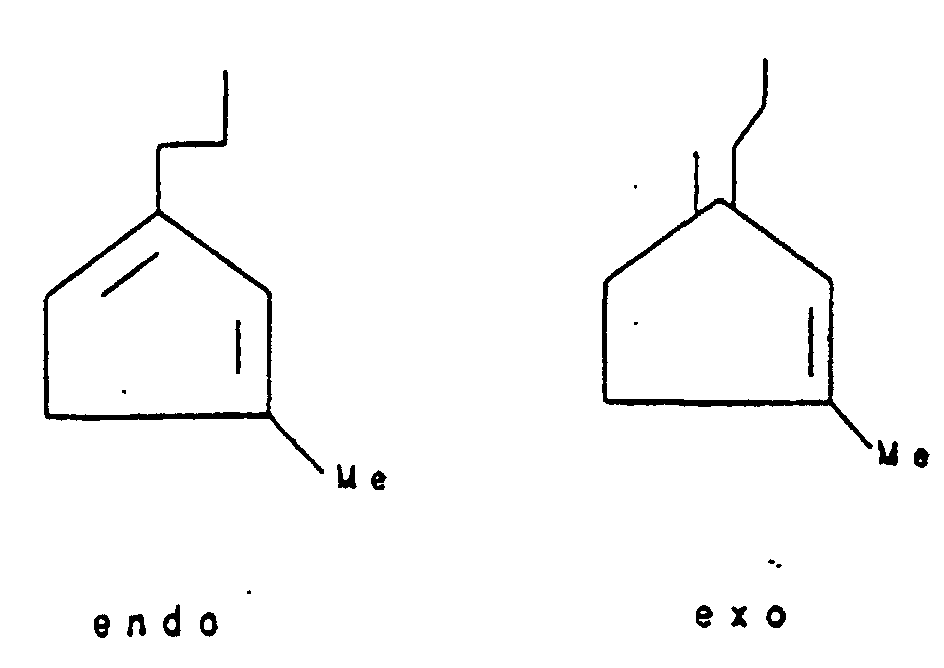
- In theory there are 5 possible stable endo-isomers and 3 possible stable exo-isomers. The structure of one isomer of each type is illustrated below:
- A suitable procedure of the preparation of dialkylsubstituted cyclopentadiene ligands is described, for example, in copending allowed application SN 08/137,683. The process gives improved yields of the endo-isomers, but the product still contains 25 to 30 percent of the exo-isomers.
- In accordance with the invention we have found that by selecting the amount of deprotonation agent to be used based on only the amount of endo-isomers which are present, the amount of by-product impurities is reduced such that a highly pure metallocene product can be produced. Likewise, the amount of metal salt used for the metallization reaction is also preferably based on the endo-isomer content such that remaining unreacted metal salt in the product is minimized. At the same time, the exo-isomer remains stable under these reaction parameters and can be easily removed from the product by vacuum distillation. In contrast experiments of the applicant have shown that, when the stoichiometry is chosen based on the total amount of both endo- and exo-isomers in accordance with the prior art, the product is impure and requires expensive work-up procedures to remove the impurities. If the reagents were pure, then only stoichiometric amounts could be used, based on the amount of endo-isomers. However, because of impurities and/or moisture, as a practical matter, up to about a 10 percent excess over the stoichiometric amounts of deprotonating agent and metal compound based on the amount of endo-isomers, is preferably used. This gives a good yield of product while still minimizing the amount of by-product impurities. For example, in forming an unbridged bis-cyclopentadienyl metallocene, about 1.1 mole of deprotonating agent and about 0.55 mol of metal compound per mol of endo-isomer are preferably used.
- Suitable deprotonating agents include, for example, Na powder, RLi, NaH, LiH or a Grignard reagent (RMgX, where R is C1 to C10 hydrocarbyl and X is halogen). Preferred are alkyllithium compounds such as methyllithium, n-butyllithium, s-butyllithium, t-butyllithium, and phenyllithium.
- Suitable reaction solvents are aliphatic or aromatic hydrocarbon or halohydrocarbon solvents and ethers, including mixtures of these solvents. For example the deprotonating agent, contained in a hydrocarbon solvent such as hexanes, cyclohexane, heptane, pentane, and toluene like is added to an acyclic or cyclic ether solution of the ligand. Alternatively, the deprotonating agent in hexanes or a mixture of hexanes and toluene can be added to the dry ligand, with diethyl ether or THF being added, if necessary, to provide a thinner, more workable solution. Reaction temperatures can range from -20 to 120°C. and preferably from 0 to 60°C.
- The ligand salt from the deprotonation reaction is reacted with a transition or actinide metal compound and, preferably a metal halide, in order to form the metallocene. The metal compound is preferably used in the form of its ether or THF complex; although it can be used directly as a metal halide. The ligand salt need not be recovered from the deprotonation reaction mixture prior to the metallization reaction and can be added to the metal compound or vise versa. The reaction solvents and temperatures can be the same as for the deprotonation reaction. At higher temperatures, a closed system is conveniently used to avoid the loss of solvent and, especially, ether. The by-product metal halide salts which precipitate can be either removed by filtration or the product solution decanted off. The solvents can be removed, for example, at ≤ 40°C.and 70-80 mm Hg and the exo-isomer distilled off, for example, at ≤ 10 mm Hg and ≤ 80°C. The yield of crude product is > 95% based on endo-isomers and the purity > 95% with < 5% ligand oligomer such that the product metallocene can be used in catalyst manufacture without any purification other than the above stripping of solvent and exo-isomers. The distillation of exo-isomers will also remove any trace amounts of unreacted endo-isomers.
- The invention is further illustrated by, but is not intended to be limited to, the following examples.
- Freshly distilled and dried (over MgSO4) 1-n-butyl-3-methylcyclopentadiene ligand (6.80 g, 50 mmol, containing 38.5 mmol of endo-isomers and 10 mmol of exo-isomers, remainder impurities) and Et2O (20.4 g) were charged under nitrogen into a 100-mL, 3-necked, round-bottom flask equipped with a thermometer, magnetic stirring bar, and an addition funnel. BuLi (2.5 M in hexanes, 16.0 ml, 40 mmol) was added at 22 to 35°C. over a period of 60 minutes (to react with the endo-isomers and impurities to form a very thick Li ligand salt solution (Et2O is added to keep it workable if needed). The mixture was stirred overnight and checked by 1H NMR. A 10% excess (based on endo-isomers) of BuLi was then added to balance the stoichiometry. The mixture was stirred for additional 4 hours and 1H NMR indicated a > 95% conversion of endo-isomers. The exo-isomers were found stable under these reaction conditions. ZrCl4 (18 mmol, 4.19 g) was added at 22 to 35°C. slowly over a period of 30 minutes. The product mixture was stirred overnight, checked by 1H NMR, and then up to 2 mmol of ZrCl4 were added to balance the stoichiometry. This product mixture was stirred overnight. The 1H NMR indicated a complete conversion of Li ligand salt. The exo-isomers were found stable under these reaction conditions. The dark orange/red solution of bis(1-n-butyl-3-methylcyclopentadienyl)ZrCl2 product was decanted. The wet cake was rinsed and decanted twice with Et2O to give a total of 66.14 g of solution. 1H NMR (with CH2Br2 as internal standard) indicated a 97.4% yield of product. Et2O and hexanes were removed at ≤ 40°C. and 70-80 mm Hg to give 9.55 g of oily residue which solidified at 22°C. Exo-isomers were distilled off at ≤ 1 mm Hg and ≤ 80°C. to give 8.17 g of crude product which solidified at 22°C. 1H NMR indicated that the crude product was > 95% pure (< 5% oligomer was detected). The yield is > 95% based on endo-isomers. The purity of the distilled exo-isomers is up to 97% pure by CG and 1H NMR. Zr wt % = 20.9 (21.06 in theory) and Cl wt % = 17.1 (16.4 in theory); Li level = 234 ppm.
- Freshly distilled and dried (via azeotropic toluene strip) 1-n-butyl-3-methylcyclopentadiene (14.53 g, 52.3 weight percent in toluene, 71.6% endo-isomers, 40.0 mmol exo-isomers, 15.9 mmol) and Et2O (22.8 g) were charged under nitrogen into a 100 mL, 3-necked, round-bottom flask equipped with a thermometer, magnetic stirring bar, and an addition funnel. BuLi (2.5 M in hexanes, 16.0 ml, 40.0 mmol) was added at 22 to 35°C. over a period of 30 minutes to form a thick Li solution. This mixture was stirred overnight. 1H NMR indicated a > 90% conversion of endo-isomers. Additional BuLi (2.5 mol) was added to give > 95% conversion of endo-isomers. The exo-isomers were found to be stable under these reaction conditions. Toluene (10.0 g) and ZrCl4 (4.95 g, 21.25 mmol) were stirred under nitrogen in a 100-mL flask. Et2O (3.7 g, 50 mmol) was slowly added into above slurry at 22 to 30°C. to form ZrCl4•2Et2O. The Li ligand salt solution was slowly added into the ZrCl4•2Et2O solution over a period of 30 minutes at 22 to 30°C. to form an orange product mixture and by-product LiCl solids. The 1H NMR of a 5-hour sample (with CH2Br2 as internal standard) indicated a complete conversion of Li ligand salt and a > 90% yield of product. The exo-isomers and a trace of unreacted endo-isomers were found to be stable under these reaction conditions.
- The exo-isomers and non-reacted endo-isomers can be removed by distillation as described in Example 1. Also, any hydrolyzed product (oxo compound) can be converted back to the product by a HCl wash. Because the exo-isomers have previously been removed by distillation, the problem of oligomer formation due to the acid wash is eliminated.
Claims (12)
- A process for making a metallocene, said process comprising the steps of (a) reacting an alkylsubstituted cyclopentadiene ligand, which contains a mixture of endo and exo isomers, with up to about a 10% excess over a stoichiometric amount of a deprotonation agent, based on the amount of endo-isomers, so as to form a salt of said endo-isomers, (b) reacting the endo-isomer salt with a transition or actinide metal compound so as to form said metallocene and (c) optionally separating said exo-isomer from said metallocene by distillation.
- The process according to claim 1 wherein said exo-isomers are separated from said metallocene by distillation.
- The process according to claim 1 wherein said endo-isomer salt is reacted with up to about a 10% excess over a stoichiometric amount of transition or actinide metal salt.
- The process according to claim 3 wherein said exo-isomers are separated from said metallocene by distillation.
- The process according to claim 1 wherein said alkylsubstituted cyclopentadiene is a 1,2-dialkylsubstituted cyclopentadiene.
- The process according to claim 1 wherein said alkylsubstituted cyclopentadiene is a 1,3-dialkyl substituted cyclopentadiene.
- The process according to claim 1 wherein said transition or actinide metal compound is a halide of said transition or actinide metal.
- The process according to claim 1 wherein said metallocene has the formula MLx, where M is a transition or actinide metal, L represents ligands coordinated with the metal, at least one of the ligands having cyclopentadienyl skeleton which is substituted with at least two alkyl groups which may be joined to form a C4-C6 ring, and x is the oxidation number of the metal.
- The process according to Claim 1 wherein the reaction of (a) is conducted in a solvent mixture comprised of an aliphatic or aromatic hydrocarbon solvent and an acyclic or cyclic ether.
- The process according to Claim 1 wherein said deprotonation agent is an alkyllithium compound.
- The process according to Claim 6 wherein said 1,3-dialkyl substituted cyclopentadiene is 1-n-butyl-3-methylcyclopentadiene.
- The process according to Claim 7 wherein the metal of said halide is titanium, zirconium, or hafnium.
Applications Claiming Priority (2)
| Application Number | Priority Date | Filing Date | Title |
|---|---|---|---|
| US08/376,973 US5569746A (en) | 1995-01-23 | 1995-01-23 | Process for preparing alkylsubstituted cyclopentadienyl metallocene compounds |
| US376973 | 1995-01-23 |
Publications (3)
| Publication Number | Publication Date |
|---|---|
| EP0727431A2 EP0727431A2 (en) | 1996-08-21 |
| EP0727431A3 EP0727431A3 (en) | 1998-08-19 |
| EP0727431B1 true EP0727431B1 (en) | 2002-10-02 |
Family
ID=23487252
Family Applications (1)
| Application Number | Title | Priority Date | Filing Date |
|---|---|---|---|
| EP96100767A Expired - Lifetime EP0727431B1 (en) | 1995-01-23 | 1996-01-19 | Process for preparing alkylsubtituted cyclopentadienyl metallocene compounds |
Country Status (5)
| Country | Link |
|---|---|
| US (1) | US5569746A (en) |
| EP (1) | EP0727431B1 (en) |
| JP (1) | JP3693403B2 (en) |
| CA (1) | CA2164914A1 (en) |
| DE (1) | DE69624018T2 (en) |
Families Citing this family (8)
| Publication number | Priority date | Publication date | Assignee | Title |
|---|---|---|---|---|
| DE19523595A1 (en) * | 1995-06-30 | 1997-01-02 | Hoechst Ag | Process for the preparation of a carbon-bridged biscyclopentadiene compound |
| JPH11512391A (en) * | 1995-09-07 | 1999-10-26 | メルク エンド カンパニー インコーポレーテッド | Method for producing dimethyl titanocene |
| US5679814A (en) * | 1995-12-11 | 1997-10-21 | Albemarle Corporation | Purification of metallocenes |
| US5710299A (en) * | 1996-06-27 | 1998-01-20 | Albemarle Corporation | Production of bridged metallocene complexes and intermediates therefor |
| US5760262A (en) * | 1996-09-17 | 1998-06-02 | Albemarle Corporation | Enhanced production of bridged hafnocenes |
| US5936108A (en) * | 1996-10-17 | 1999-08-10 | Albemarle Corporation | Metallocene synthesis |
| WO2000024723A1 (en) | 1998-10-28 | 2000-05-04 | Merck & Co., Inc. | Stabilization of the reagent dimethyl titanocene |
| US8962893B2 (en) | 2012-08-28 | 2015-02-24 | Rohm And Haas Electronic Materials Llc | Organometallic compound purification |
Citations (1)
| Publication number | Priority date | Publication date | Assignee | Title |
|---|---|---|---|---|
| EP0648722A1 (en) * | 1993-10-15 | 1995-04-19 | Albemarle Corporation | Preparation of alkylcyclopentadienes |
Family Cites Families (5)
| Publication number | Priority date | Publication date | Assignee | Title |
|---|---|---|---|---|
| US4874880A (en) * | 1987-03-10 | 1989-10-17 | Chisso Corporation | Bis(di-, tri- or tetra-substituted-cyclopentadienyl)-zirconium dihalides |
| US5302733A (en) * | 1992-03-30 | 1994-04-12 | Ethyl Corporation | Preparation of metallocenes |
| US5200537A (en) * | 1992-08-03 | 1993-04-06 | Ethyl Corporation | Process for preparing metallocenes |
| JPH06100614A (en) * | 1992-08-06 | 1994-04-12 | Mitsui Petrochem Ind Ltd | Olefin polymerization catalyst and olefin polymerization method using the same |
| US5359105A (en) * | 1993-11-01 | 1994-10-25 | Albemarle Corporation | Deprotonation of cyclopentadienyl derivatives |
-
1995
- 1995-01-23 US US08/376,973 patent/US5569746A/en not_active Expired - Lifetime
- 1995-12-11 CA CA002164914A patent/CA2164914A1/en not_active Abandoned
-
1996
- 1996-01-19 DE DE69624018T patent/DE69624018T2/en not_active Expired - Lifetime
- 1996-01-19 EP EP96100767A patent/EP0727431B1/en not_active Expired - Lifetime
- 1996-01-22 JP JP02625396A patent/JP3693403B2/en not_active Expired - Lifetime
Patent Citations (1)
| Publication number | Priority date | Publication date | Assignee | Title |
|---|---|---|---|---|
| EP0648722A1 (en) * | 1993-10-15 | 1995-04-19 | Albemarle Corporation | Preparation of alkylcyclopentadienes |
Also Published As
| Publication number | Publication date |
|---|---|
| JPH08231572A (en) | 1996-09-10 |
| CA2164914A1 (en) | 1996-07-24 |
| DE69624018D1 (en) | 2002-11-07 |
| EP0727431A3 (en) | 1998-08-19 |
| EP0727431A2 (en) | 1996-08-21 |
| US5569746A (en) | 1996-10-29 |
| JP3693403B2 (en) | 2005-09-07 |
| DE69624018T2 (en) | 2003-08-14 |
Similar Documents
| Publication | Publication Date | Title |
|---|---|---|
| EP0574597B1 (en) | Process for the preparation of bridged, chiral metallocene catalysts of the bisindenyl type | |
| EP0920406B1 (en) | 2-substituted 7-haloindenes and methods for synthesizing | |
| CA2347116A1 (en) | 2-alkyl-4-(2,6-dialkylphenyl) indenes | |
| EP0722949B1 (en) | Process for the preparation of cyclopentadienyl compounds and compounds obtained therefrom | |
| US5569746A (en) | Process for preparing alkylsubstituted cyclopentadienyl metallocene compounds | |
| US5336795A (en) | Process for the preparation of transition metal complexes having monosubstituted cyclopentadienyl ligands | |
| US5556997A (en) | Enhanced synthesis of racemic metallocenes | |
| EP0582114B1 (en) | Process for preparing metallocenes | |
| US5523435A (en) | Process for the synthesis of monomethylmetallocenes and dimethylmetallocenes and their solutions specifically for use in the polymerization of olefins | |
| JP3641659B2 (en) | Method for producing metallocene in a single reaction step | |
| GB2276385A (en) | Preparation of alkali metal alkyls | |
| US4128501A (en) | Process for the preparation of organo-magnesium complexes | |
| WO1996019488A1 (en) | A method of preparing high purity racemic metallocene alkyls and use thereof | |
| EP0525881B1 (en) | Catalyzed hydrocarbyllithium process | |
| RU2290406C1 (en) | Method for preparing 2,3,4,5-tetraalkylmagnesa-cyclopenta-2,4-dienes | |
| US6180810B1 (en) | Silyl amines | |
| US4855523A (en) | Catalyst and process for the selective dimerization of propylene to 4-methyl-1-pentene | |
| US5081231A (en) | Uranium (III) catalyst for the selective dimerization of propylene to 4-methyl-1-pentene | |
| US3067226A (en) | Preparation of organotin compounds | |
| US5708150A (en) | Process for preparing transition metal complexes containing disubstituted cyclopentadienyl ligands | |
| MXPA05002338A (en) | Preparation of partially hydrogenated rac-ansa-metallocene complexes. | |
| CA2166753C (en) | Process for preparing transition metal complexes containing 1,3-disubstituted cyclopentadienyl ligands | |
| CA2308160A1 (en) | Process for preparing group vi metal-based olefin polymerization catalyst component | |
| US20060154804A1 (en) | Preparation of dialkyl-ansa-metallocenes | |
| CA2299536A1 (en) | Production of bridged hafnocenes |
Legal Events
| Date | Code | Title | Description |
|---|---|---|---|
| PUAI | Public reference made under article 153(3) epc to a published international application that has entered the european phase |
Free format text: ORIGINAL CODE: 0009012 |
|
| AK | Designated contracting states |
Kind code of ref document: A2 Designated state(s): BE DE FR GB IT NL |
|
| PUAL | Search report despatched |
Free format text: ORIGINAL CODE: 0009013 |
|
| AK | Designated contracting states |
Kind code of ref document: A3 Designated state(s): BE DE FR GB IT NL |
|
| 17P | Request for examination filed |
Effective date: 19990217 |
|
| 17Q | First examination report despatched |
Effective date: 20010119 |
|
| GRAG | Despatch of communication of intention to grant |
Free format text: ORIGINAL CODE: EPIDOS AGRA |
|
| GRAG | Despatch of communication of intention to grant |
Free format text: ORIGINAL CODE: EPIDOS AGRA |
|
| GRAG | Despatch of communication of intention to grant |
Free format text: ORIGINAL CODE: EPIDOS AGRA |
|
| GRAH | Despatch of communication of intention to grant a patent |
Free format text: ORIGINAL CODE: EPIDOS IGRA |
|
| GRAH | Despatch of communication of intention to grant a patent |
Free format text: ORIGINAL CODE: EPIDOS IGRA |
|
| GRAA | (expected) grant |
Free format text: ORIGINAL CODE: 0009210 |
|
| AK | Designated contracting states |
Kind code of ref document: B1 Designated state(s): BE DE FR GB IT NL |
|
| REG | Reference to a national code |
Ref country code: GB Ref legal event code: FG4D |
|
| REF | Corresponds to: |
Ref document number: 69624018 Country of ref document: DE Date of ref document: 20021107 |
|
| ET | Fr: translation filed | ||
| PLBE | No opposition filed within time limit |
Free format text: ORIGINAL CODE: 0009261 |
|
| STAA | Information on the status of an ep patent application or granted ep patent |
Free format text: STATUS: NO OPPOSITION FILED WITHIN TIME LIMIT |
|
| 26N | No opposition filed |
Effective date: 20030703 |
|
| PGFP | Annual fee paid to national office [announced via postgrant information from national office to epo] |
Ref country code: IT Payment date: 20100128 Year of fee payment: 15 Ref country code: FR Payment date: 20100205 Year of fee payment: 15 |
|
| PGFP | Annual fee paid to national office [announced via postgrant information from national office to epo] |
Ref country code: GB Payment date: 20100125 Year of fee payment: 15 Ref country code: DE Payment date: 20100127 Year of fee payment: 15 Ref country code: BE Payment date: 20100121 Year of fee payment: 15 |
|
| PGFP | Annual fee paid to national office [announced via postgrant information from national office to epo] |
Ref country code: NL Payment date: 20100124 Year of fee payment: 15 |
|
| BERE | Be: lapsed |
Owner name: *ALBEMARLE CORP. Effective date: 20110131 |
|
| REG | Reference to a national code |
Ref country code: NL Ref legal event code: V1 Effective date: 20110801 |
|
| GBPC | Gb: european patent ceased through non-payment of renewal fee |
Effective date: 20110119 |
|
| REG | Reference to a national code |
Ref country code: FR Ref legal event code: ST Effective date: 20110930 |
|
| PG25 | Lapsed in a contracting state [announced via postgrant information from national office to epo] |
Ref country code: FR Free format text: LAPSE BECAUSE OF NON-PAYMENT OF DUE FEES Effective date: 20110131 |
|
| PG25 | Lapsed in a contracting state [announced via postgrant information from national office to epo] |
Ref country code: GB Free format text: LAPSE BECAUSE OF NON-PAYMENT OF DUE FEES Effective date: 20110119 Ref country code: BE Free format text: LAPSE BECAUSE OF NON-PAYMENT OF DUE FEES Effective date: 20110131 |
|
| REG | Reference to a national code |
Ref country code: DE Ref legal event code: R119 Ref document number: 69624018 Country of ref document: DE Effective date: 20110802 |
|
| PG25 | Lapsed in a contracting state [announced via postgrant information from national office to epo] |
Ref country code: IT Free format text: LAPSE BECAUSE OF NON-PAYMENT OF DUE FEES Effective date: 20110119 Ref country code: NL Free format text: LAPSE BECAUSE OF NON-PAYMENT OF DUE FEES Effective date: 20110801 |
|
| PG25 | Lapsed in a contracting state [announced via postgrant information from national office to epo] |
Ref country code: DE Free format text: LAPSE BECAUSE OF NON-PAYMENT OF DUE FEES Effective date: 20110802 |