EP0726891B1 - A method for preparing tert-leucine and analogues thereof in enantiomeric form, and intermediates therein - Google Patents
A method for preparing tert-leucine and analogues thereof in enantiomeric form, and intermediates therein Download PDFInfo
- Publication number
- EP0726891B1 EP0726891B1 EP94931136A EP94931136A EP0726891B1 EP 0726891 B1 EP0726891 B1 EP 0726891B1 EP 94931136 A EP94931136 A EP 94931136A EP 94931136 A EP94931136 A EP 94931136A EP 0726891 B1 EP0726891 B1 EP 0726891B1
- Authority
- EP
- European Patent Office
- Prior art keywords
- leucine
- tert
- process according
- azlactone
- amino
- Prior art date
- Legal status (The legal status is an assumption and is not a legal conclusion. Google has not performed a legal analysis and makes no representation as to the accuracy of the status listed.)
- Expired - Lifetime
Links
- 238000000034 method Methods 0.000 title claims description 16
- NPDBDJFLKKQMCM-UHFFFAOYSA-N tert-butylglycine Chemical compound CC(C)(C)C(N)C(O)=O NPDBDJFLKKQMCM-UHFFFAOYSA-N 0.000 title description 7
- 239000000543 intermediate Substances 0.000 title description 2
- IEJPPSMHUUQABK-UHFFFAOYSA-N 2,4-diphenyl-4h-1,3-oxazol-5-one Chemical compound O=C1OC(C=2C=CC=CC=2)=NC1C1=CC=CC=C1 IEJPPSMHUUQABK-UHFFFAOYSA-N 0.000 claims abstract description 11
- 150000001413 amino acids Chemical class 0.000 claims abstract description 8
- 230000036983 biotransformation Effects 0.000 claims abstract description 7
- 125000004432 carbon atom Chemical group C* 0.000 claims abstract description 5
- 230000002255 enzymatic effect Effects 0.000 claims abstract description 4
- 238000004519 manufacturing process Methods 0.000 claims description 7
- 125000001997 phenyl group Chemical group [H]C1=C([H])C([H])=C(*)C([H])=C1[H] 0.000 claims description 6
- 125000001797 benzyl group Chemical group [H]C1=C([H])C([H])=C(C([H])=C1[H])C([H])([H])* 0.000 claims description 5
- 125000001424 substituent group Chemical group 0.000 claims description 5
- 125000000217 alkyl group Chemical group 0.000 claims description 3
- 125000003710 aryl alkyl group Chemical group 0.000 claims description 3
- 125000003118 aryl group Chemical group 0.000 claims description 3
- 125000003545 alkoxy group Chemical group 0.000 claims description 2
- 125000004104 aryloxy group Chemical group 0.000 claims description 2
- 125000000051 benzyloxy group Chemical group [H]C1=C([H])C([H])=C(C([H])=C1[H])C([H])([H])O* 0.000 claims description 2
- 125000000951 phenoxy group Chemical group [H]C1=C([H])C([H])=C(O*)C([H])=C1[H] 0.000 claims description 2
- 125000004213 tert-butoxy group Chemical group [H]C([H])([H])C(O*)(C([H])([H])[H])C([H])([H])[H] 0.000 claims 1
- 239000001257 hydrogen Substances 0.000 abstract description 2
- 229910052739 hydrogen Inorganic materials 0.000 abstract description 2
- UFHFLCQGNIYNRP-UHFFFAOYSA-N Hydrogen Chemical compound [H][H] UFHFLCQGNIYNRP-UHFFFAOYSA-N 0.000 abstract 1
- 150000001875 compounds Chemical class 0.000 abstract 1
- XEKOWRVHYACXOJ-UHFFFAOYSA-N Ethyl acetate Chemical compound CCOC(C)=O XEKOWRVHYACXOJ-UHFFFAOYSA-N 0.000 description 24
- HEMHJVSKTPXQMS-UHFFFAOYSA-M Sodium hydroxide Chemical compound [OH-].[Na+] HEMHJVSKTPXQMS-UHFFFAOYSA-M 0.000 description 12
- 239000007787 solid Substances 0.000 description 10
- WFDIJRYMOXRFFG-UHFFFAOYSA-N Acetic anhydride Chemical compound CC(=O)OC(C)=O WFDIJRYMOXRFFG-UHFFFAOYSA-N 0.000 description 9
- OKKJLVBELUTLKV-UHFFFAOYSA-N Methanol Chemical compound OC OKKJLVBELUTLKV-UHFFFAOYSA-N 0.000 description 9
- ZMANZCXQSJIPKH-UHFFFAOYSA-N Triethylamine Chemical compound CCN(CC)CC ZMANZCXQSJIPKH-UHFFFAOYSA-N 0.000 description 8
- NHTMVDHEPJAVLT-UHFFFAOYSA-N Isooctane Chemical compound CC(C)CC(C)(C)C NHTMVDHEPJAVLT-UHFFFAOYSA-N 0.000 description 7
- YXFVVABEGXRONW-UHFFFAOYSA-N Toluene Chemical compound CC1=CC=CC=C1 YXFVVABEGXRONW-UHFFFAOYSA-N 0.000 description 7
- 238000001914 filtration Methods 0.000 description 7
- XLYOFNOQVPJJNP-UHFFFAOYSA-N water Substances O XLYOFNOQVPJJNP-UHFFFAOYSA-N 0.000 description 7
- QTBSBXVTEAMEQO-UHFFFAOYSA-N Acetic acid Chemical compound CC(O)=O QTBSBXVTEAMEQO-UHFFFAOYSA-N 0.000 description 6
- 108090000790 Enzymes Proteins 0.000 description 6
- 102000004190 Enzymes Human genes 0.000 description 6
- LRHPLDYGYMQRHN-UHFFFAOYSA-N N-Butanol Chemical compound CCCCO LRHPLDYGYMQRHN-UHFFFAOYSA-N 0.000 description 6
- 238000006243 chemical reaction Methods 0.000 description 6
- JVSWJIKNEAIKJW-UHFFFAOYSA-N dimethyl-hexane Natural products CCCCCC(C)C JVSWJIKNEAIKJW-UHFFFAOYSA-N 0.000 description 6
- VLKZOEOYAKHREP-UHFFFAOYSA-N n-Hexane Chemical compound CCCCCC VLKZOEOYAKHREP-UHFFFAOYSA-N 0.000 description 6
- VEXZGXHMUGYJMC-UHFFFAOYSA-N Hydrochloric acid Chemical compound Cl VEXZGXHMUGYJMC-UHFFFAOYSA-N 0.000 description 5
- 239000002904 solvent Substances 0.000 description 5
- ROHFNLRQFUQHCH-YFKPBYRVSA-N L-leucine Chemical compound CC(C)C[C@H](N)C(O)=O ROHFNLRQFUQHCH-YFKPBYRVSA-N 0.000 description 4
- 108010048733 Lipozyme Proteins 0.000 description 4
- 239000013078 crystal Substances 0.000 description 4
- 238000001704 evaporation Methods 0.000 description 4
- 230000008020 evaporation Effects 0.000 description 4
- FCCDDURTIIUXBY-UHFFFAOYSA-N lipoamide Chemical group NC(=O)CCCCC1CCSS1 FCCDDURTIIUXBY-UHFFFAOYSA-N 0.000 description 4
- 239000000203 mixture Substances 0.000 description 4
- DANDTMGGYNCQLG-UHFFFAOYSA-N 4h-1,3-oxazol-5-one Chemical class O=C1CN=CO1 DANDTMGGYNCQLG-UHFFFAOYSA-N 0.000 description 3
- KWYUFKZDYYNOTN-UHFFFAOYSA-M Potassium hydroxide Chemical compound [OH-].[K+] KWYUFKZDYYNOTN-UHFFFAOYSA-M 0.000 description 3
- 239000010410 layer Substances 0.000 description 3
- 239000000047 product Substances 0.000 description 3
- 238000005406 washing Methods 0.000 description 3
- QBZAPERNRVJFDT-UHFFFAOYSA-N 2-benzamido-3,3-dimethylbutanoic acid Chemical compound CC(C)(C)C(C(O)=O)NC(=O)C1=CC=CC=C1 QBZAPERNRVJFDT-UHFFFAOYSA-N 0.000 description 2
- CNAOYIPUUSAXFK-UHFFFAOYSA-N 3,3-dimethyl-2-[(2-phenylacetyl)amino]butanoic acid Chemical compound CC(C)(C)C(C(O)=O)NC(=O)CC1=CC=CC=C1 CNAOYIPUUSAXFK-UHFFFAOYSA-N 0.000 description 2
- CSCPPACGZOOCGX-UHFFFAOYSA-N Acetone Chemical compound CC(C)=O CSCPPACGZOOCGX-UHFFFAOYSA-N 0.000 description 2
- LFQSCWFLJHTTHZ-UHFFFAOYSA-N Ethanol Chemical compound CCO LFQSCWFLJHTTHZ-UHFFFAOYSA-N 0.000 description 2
- 108090001060 Lipase Proteins 0.000 description 2
- 239000004367 Lipase Substances 0.000 description 2
- 102000004882 Lipase Human genes 0.000 description 2
- 241000235395 Mucor Species 0.000 description 2
- IMNFDUFMRHMDMM-UHFFFAOYSA-N N-Heptane Chemical compound CCCCCCC IMNFDUFMRHMDMM-UHFFFAOYSA-N 0.000 description 2
- VYPSYNLAJGMNEJ-UHFFFAOYSA-N Silicium dioxide Chemical compound O=[Si]=O VYPSYNLAJGMNEJ-UHFFFAOYSA-N 0.000 description 2
- 150000003862 amino acid derivatives Chemical class 0.000 description 2
- 230000015572 biosynthetic process Effects 0.000 description 2
- 238000004440 column chromatography Methods 0.000 description 2
- 238000004821 distillation Methods 0.000 description 2
- 239000003480 eluent Substances 0.000 description 2
- 235000019421 lipase Nutrition 0.000 description 2
- 238000010899 nucleation Methods 0.000 description 2
- 239000012044 organic layer Substances 0.000 description 2
- 239000003208 petroleum Substances 0.000 description 2
- 238000002360 preparation method Methods 0.000 description 2
- 239000011541 reaction mixture Substances 0.000 description 2
- 238000010992 reflux Methods 0.000 description 2
- 238000007142 ring opening reaction Methods 0.000 description 2
- 238000003756 stirring Methods 0.000 description 2
- 230000009466 transformation Effects 0.000 description 2
- SJHPCNCNNSSLPL-CSKARUKUSA-N (4e)-4-(ethoxymethylidene)-2-phenyl-1,3-oxazol-5-one Chemical compound O1C(=O)C(=C/OCC)\N=C1C1=CC=CC=C1 SJHPCNCNNSSLPL-CSKARUKUSA-N 0.000 description 1
- RYHBNJHYFVUHQT-UHFFFAOYSA-N 1,4-Dioxane Chemical compound C1COCCO1 RYHBNJHYFVUHQT-UHFFFAOYSA-N 0.000 description 1
- VMZCDNSFRSVYKQ-UHFFFAOYSA-N 2-phenylacetyl chloride Chemical compound ClC(=O)CC1=CC=CC=C1 VMZCDNSFRSVYKQ-UHFFFAOYSA-N 0.000 description 1
- 0 CC*C(*)(*C*)[C@@](C1*C1)NI Chemical compound CC*C(*)(*C*)[C@@](C1*C1)NI 0.000 description 1
- 108090000371 Esterases Proteins 0.000 description 1
- 101710123388 Penicillin G acylase Proteins 0.000 description 1
- 108091005804 Peptidases Proteins 0.000 description 1
- 102000035195 Peptidases Human genes 0.000 description 1
- 239000004365 Protease Substances 0.000 description 1
- 239000002253 acid Substances 0.000 description 1
- 150000001408 amides Chemical class 0.000 description 1
- QVGXLLKOCUKJST-UHFFFAOYSA-N atomic oxygen Chemical compound [O] QVGXLLKOCUKJST-UHFFFAOYSA-N 0.000 description 1
- PASDCCFISLVPSO-UHFFFAOYSA-N benzoyl chloride Chemical compound ClC(=O)C1=CC=CC=C1 PASDCCFISLVPSO-UHFFFAOYSA-N 0.000 description 1
- 125000004106 butoxy group Chemical group [*]OC([H])([H])C([H])([H])C(C([H])([H])[H])([H])[H] 0.000 description 1
- ZYILKYMISIEIIA-CQSZACIVSA-N butyl (2s)-2-benzamido-3,3-dimethylbutanoate Chemical compound CCCCOC(=O)[C@H](C(C)(C)C)NC(=O)C1=CC=CC=C1 ZYILKYMISIEIIA-CQSZACIVSA-N 0.000 description 1
- GDORIGRKBNEXSQ-UHFFFAOYSA-N butyl 3,3-dimethyl-2-[(2-phenylacetyl)amino]butanoate Chemical compound CCCCOC(=O)C(C(C)(C)C)NC(=O)CC1=CC=CC=C1 GDORIGRKBNEXSQ-UHFFFAOYSA-N 0.000 description 1
- 150000001732 carboxylic acid derivatives Chemical class 0.000 description 1
- 230000003197 catalytic effect Effects 0.000 description 1
- 238000004587 chromatography analysis Methods 0.000 description 1
- 230000000052 comparative effect Effects 0.000 description 1
- 238000001816 cooling Methods 0.000 description 1
- 239000013058 crude material Substances 0.000 description 1
- 238000004090 dissolution Methods 0.000 description 1
- 230000000694 effects Effects 0.000 description 1
- 230000007071 enzymatic hydrolysis Effects 0.000 description 1
- 238000006047 enzymatic hydrolysis reaction Methods 0.000 description 1
- 238000006911 enzymatic reaction Methods 0.000 description 1
- 238000010931 ester hydrolysis Methods 0.000 description 1
- 150000002148 esters Chemical class 0.000 description 1
- 238000002474 experimental method Methods 0.000 description 1
- 238000010438 heat treatment Methods 0.000 description 1
- 125000004435 hydrogen atom Chemical class [H]* 0.000 description 1
- 230000007062 hydrolysis Effects 0.000 description 1
- 238000006460 hydrolysis reaction Methods 0.000 description 1
- XLYOFNOQVPJJNP-UHFFFAOYSA-M hydroxide Chemical compound [OH-] XLYOFNOQVPJJNP-UHFFFAOYSA-M 0.000 description 1
- 239000000463 material Substances 0.000 description 1
- QJGQUHMNIGDVPM-UHFFFAOYSA-N nitrogen group Chemical group [N] QJGQUHMNIGDVPM-UHFFFAOYSA-N 0.000 description 1
- 239000001301 oxygen Substances 0.000 description 1
- 229910052760 oxygen Inorganic materials 0.000 description 1
- 239000002244 precipitate Substances 0.000 description 1
- 239000002243 precursor Substances 0.000 description 1
- 230000006340 racemization Effects 0.000 description 1
- 239000012066 reaction slurry Substances 0.000 description 1
- 238000011084 recovery Methods 0.000 description 1
- 239000000377 silicon dioxide Substances 0.000 description 1
- 239000000725 suspension Substances 0.000 description 1
- 238000003786 synthesis reaction Methods 0.000 description 1
- -1 t-butoxy Chemical group 0.000 description 1
Classifications
-
- C—CHEMISTRY; METALLURGY
- C07—ORGANIC CHEMISTRY
- C07D—HETEROCYCLIC COMPOUNDS
- C07D263/00—Heterocyclic compounds containing 1,3-oxazole or hydrogenated 1,3-oxazole rings
- C07D263/02—Heterocyclic compounds containing 1,3-oxazole or hydrogenated 1,3-oxazole rings not condensed with other rings
- C07D263/30—Heterocyclic compounds containing 1,3-oxazole or hydrogenated 1,3-oxazole rings not condensed with other rings having two or three double bonds between ring members or between ring members and non-ring members
- C07D263/34—Heterocyclic compounds containing 1,3-oxazole or hydrogenated 1,3-oxazole rings not condensed with other rings having two or three double bonds between ring members or between ring members and non-ring members with hetero atoms or with carbon atoms having three bonds to hetero atoms with at the most one bond to halogen, e.g. ester or nitrile radicals, directly attached to ring carbon atoms
- C07D263/44—Two oxygen atoms
-
- C—CHEMISTRY; METALLURGY
- C07—ORGANIC CHEMISTRY
- C07C—ACYCLIC OR CARBOCYCLIC COMPOUNDS
- C07C233/00—Carboxylic acid amides
- C07C233/64—Carboxylic acid amides having carbon atoms of carboxamide groups bound to carbon atoms of six-membered aromatic rings
- C07C233/81—Carboxylic acid amides having carbon atoms of carboxamide groups bound to carbon atoms of six-membered aromatic rings having the nitrogen atom of at least one of the carboxamide groups bound to a carbon atom of a hydrocarbon radical substituted by carboxyl groups
- C07C233/82—Carboxylic acid amides having carbon atoms of carboxamide groups bound to carbon atoms of six-membered aromatic rings having the nitrogen atom of at least one of the carboxamide groups bound to a carbon atom of a hydrocarbon radical substituted by carboxyl groups with the substituted hydrocarbon radical bound to the nitrogen atom of the carboxamide group by an acyclic carbon atom
- C07C233/83—Carboxylic acid amides having carbon atoms of carboxamide groups bound to carbon atoms of six-membered aromatic rings having the nitrogen atom of at least one of the carboxamide groups bound to a carbon atom of a hydrocarbon radical substituted by carboxyl groups with the substituted hydrocarbon radical bound to the nitrogen atom of the carboxamide group by an acyclic carbon atom of an acyclic saturated carbon skeleton
-
- C—CHEMISTRY; METALLURGY
- C07—ORGANIC CHEMISTRY
- C07D—HETEROCYCLIC COMPOUNDS
- C07D263/00—Heterocyclic compounds containing 1,3-oxazole or hydrogenated 1,3-oxazole rings
- C07D263/02—Heterocyclic compounds containing 1,3-oxazole or hydrogenated 1,3-oxazole rings not condensed with other rings
- C07D263/30—Heterocyclic compounds containing 1,3-oxazole or hydrogenated 1,3-oxazole rings not condensed with other rings having two or three double bonds between ring members or between ring members and non-ring members
- C07D263/34—Heterocyclic compounds containing 1,3-oxazole or hydrogenated 1,3-oxazole rings not condensed with other rings having two or three double bonds between ring members or between ring members and non-ring members with hetero atoms or with carbon atoms having three bonds to hetero atoms with at the most one bond to halogen, e.g. ester or nitrile radicals, directly attached to ring carbon atoms
- C07D263/36—One oxygen atom
- C07D263/42—One oxygen atom attached in position 5
-
- C—CHEMISTRY; METALLURGY
- C12—BIOCHEMISTRY; BEER; SPIRITS; WINE; VINEGAR; MICROBIOLOGY; ENZYMOLOGY; MUTATION OR GENETIC ENGINEERING
- C12P—FERMENTATION OR ENZYME-USING PROCESSES TO SYNTHESISE A DESIRED CHEMICAL COMPOUND OR COMPOSITION OR TO SEPARATE OPTICAL ISOMERS FROM A RACEMIC MIXTURE
- C12P41/00—Processes using enzymes or microorganisms to separate optical isomers from a racemic mixture
- C12P41/003—Processes using enzymes or microorganisms to separate optical isomers from a racemic mixture by ester formation, lactone formation or the inverse reactions
Definitions
- This invention relates to a method for preparing tert -leucine and analogues thereof in enantiomeric form, and intermediates therein, including enantiomeric azlactones.
- US-A-5219731 discloses a process for preparing optically-active amino acid derivatives comprising enantioselective enzymatic hydrolysis of oxazolone precursors, e.g. 5(4H)-oxazolone.
- This invention is based on the discovery of a process for the manufacture of amino-acids of formula ( 1 ), as shown in Scheme 1 below, or their derivatives, in single enantiomer form.
- a process for preparing a N-acyl-amino-acid of formula ( 2 ), comprises biotransformation, using suitable enzymatic activity and in the presence of YH, of the azlactone of formula ( 3 ), wherein R 1 , R 2 and R 3 are each a substituent that is not H and any combination of R 1 , R 2 and R 3 may be joined together to form a ring or rings, X is a substituent, and Y is -OH, -Oalkyl or -Nalkyl.
- a process for preparing an amino-acid of formula ( 1 ), or a N-acyl derivative thereof, or the opposite enantiomer comprises carrying out a process according to the first aspect of the present invention, and converting Y to OH and removing X-CO-, as appropriate.
- the amino-acids of formula ( 1 ) include three substituents R 1 , R 2 and R 3 which are each any group except hydrogen, such as alkyl, aryl, or an oxygen or nitrogen function, e.g. tert -leucine; it will be readily understood that this definition includes any combination of R 1 , R 2 and R 3 being joined together to form a ring or rings.
- This restriction i.e. that none of R 1 , R 2 and R 3 is H, applies since the group R 1 R 2 R 3 C must be bulky for the methodology- to give a single enantiomer. In principle, it could be used to produce ( 1 ) as either enantiomer.
- the process is represented by Scheme 1.
- the starting azlactone is made by a method known for amino-acids such as cyclisation of the N -acylated amino-acid with acetic anhydride.
- the azlactone is then biotransformed by means of an appropriate enzyme, typically selected from esterases, lipases and proteases.
- the final step involves removal of the group X-CO-.
- X is chosen with regard to both biotransformation and ease of removal. Acid may remove X-CO-, as shown in Scheme 1; hydroxide ester hydrolysis may be used first. Alternatively, an enzymatic reaction may be used, e.g. with Penicillin G amidase (see EP-A-0137372) ; this is particularly suitable when X is aralkyl, e.g. benzyl.
- R, X and Y are not critical. Generally, each comprises no more than 10 or, possibly, 20 C atoms.
- X can be aryl such as phenyl or substituted phenyl, aralkyl such as benzyl, alkyl, alkoxy such as t -butoxy or benzyloxy, or aryloxy such as phenoxy.
- X is benzyl or phenyl.
- Y can be -OH, -Oalkyl or -Nalkyl, giving respectively carboxylic acid, ester or amide, and is preferably -Oalkyl having at least two carbon atoms, and is more preferably butoxy.
- enzymatic activity is readily available or can be determined by simple experiment.
- Preferential transformation of one enantiomer of the azlactone yields one enantiomer of the amino-acid derivative.
- a resolution process on a racemate can only yield a maximum of 50% of one isomer; however, in the process of the invention the starting azlactone undergoes racemisation such that all the material can in principle convert to one enantiomer.
- a base e.g. triethylamine
- Ethyl acetate (2.25 1) was added and the pH adjusted to 1.5 using 6M hydrochloric acid (460 ml) keeping the temperature between 5-10°C.
- a white solid was precipitated which was dissolved by heating the mixture to 40°C.
- the two layers were separated and the organic layer concentrated to about 1 l.
- On cooling a white solid crystallised which was collected by filtration, washing with cold ethyl acetate, and dried (466 g, 79%). A second crop of crystals was recovered (56.0 g, 10 %).
- N-benzoyl-DL- tert -leucine (157.5 g, 0.67 mol) was suspended in 2,2,4-trimethylpentane (isooctane) (250 ml) and acetic anhydride (102 g, 1 mol) was added. The mixture was heated to reflux for 1.5 h and then switched to distillation. Isooctane was added 200 ml at a time and distilled off, removing isooctane/acetic acid azeotrope, until the still head temperature reached 99 °C. The solution was then allowed to cool.
- Enzyme can be re-used 3 times.
- N-Benzoyl-L- tert -leucine butyl ester (582 g, 200 mmol) was dissolved in methanol (200 ml). A solution of sodium hydroxide (47%, 30ml, 500 mmol) in water (30 ml) was added over 15 minutes raising the reaction temperature to 34°C. The temperature was then kept at 35°C for 3 hours.
- N-benzoyl-L- tert -leucine (31.5 g, 133 mmol) was suspended in water (250 ml) and potassium hydroxide (56 g, 1 mol) was added.
- N-phenylacetyl-DL- tert -leucine 400 mg, 1.6 mmol was suspended in acetic anhydride: dioxan (5 ml, 1:1 v/v) and heated for 40 min at 70°C after which a clear solution resulted. The solution was allowed to cool to room temperature followed by removal of the solvent under reduced pressure. Traces of acetic acid were removed by re-dissolving the residue in hexane followed by evaporation affording an oil which was purified by chromatography on silica to yield the product as a clear oil (295 mg, 80%).
Landscapes
- Chemical & Material Sciences (AREA)
- Organic Chemistry (AREA)
- Wood Science & Technology (AREA)
- Zoology (AREA)
- Life Sciences & Earth Sciences (AREA)
- Engineering & Computer Science (AREA)
- Biotechnology (AREA)
- General Health & Medical Sciences (AREA)
- Microbiology (AREA)
- Chemical Kinetics & Catalysis (AREA)
- Analytical Chemistry (AREA)
- Health & Medical Sciences (AREA)
- Biochemistry (AREA)
- Bioinformatics & Cheminformatics (AREA)
- General Engineering & Computer Science (AREA)
- General Chemical & Material Sciences (AREA)
- Genetics & Genomics (AREA)
- Preparation Of Compounds By Using Micro-Organisms (AREA)
- Heterocyclic Carbon Compounds Containing A Hetero Ring Having Nitrogen And Oxygen As The Only Ring Hetero Atoms (AREA)
- Organic Low-Molecular-Weight Compounds And Preparation Thereof (AREA)
- Peptides Or Proteins (AREA)
- Enzymes And Modification Thereof (AREA)
- Nitrogen And Oxygen Or Sulfur-Condensed Heterocyclic Ring Systems (AREA)
Abstract
Description
- This invention relates to a method for preparing tert-leucine and analogues thereof in enantiomeric form, and intermediates therein, including enantiomeric azlactones.
- Various processes for preparing tert-leucine, e.g. L-tert-leucine (Scheme 1, formula 1: R1 = R2 = R3 = Me) are known. See, for example, EP-A-0137372, EP-A-0248357, EP-A-0494716 and JP-A-63/211248.
- Bevinakatti et al, J. Chem. Soc. Chem. Comm. (1990) 1091, and Tet. Asym. 3:1505 (1992), disclose enantioselective ring-opening of oxazolin-5-ones, and the effect of solvent on the ring-opening.
- Sih et al, Tet. Lett. 33:1953 (1992), and J. Org. Chem. 58:3252 (1993), describe the enantioselective hydrolysis of oxazolin-5-ones and thiazolin-5-ones, in the context of asymmetric amino-acid synthesis.
- US-A-5219731 discloses a process for preparing optically-active amino acid derivatives comprising enantioselective enzymatic hydrolysis of oxazolone precursors, e.g. 5(4H)-oxazolone.
- This invention is based on the discovery of a process for the manufacture of amino-acids of formula (1), as shown in Scheme 1 below, or their derivatives, in single enantiomer form.
- According to a first aspect of the present invention, a process for preparing a N-acyl-amino-acid of formula (2), comprises biotransformation, using suitable enzymatic activity and in the presence of YH, of the azlactone of formula (3), wherein R1, R2 and R3 are each a substituent that is not H and any combination of R1, R2 and R3 may be joined together to form a ring or rings, X is a substituent, and Y is -OH, -Oalkyl or -Nalkyl.
- According to a second aspect of the present invention, a process for preparing an amino-acid of formula (1), or a N-acyl derivative thereof, or the opposite enantiomer, comprises carrying out a process according to the first aspect of the present invention, and converting Y to OH and removing X-CO-, as appropriate.
- The amino-acids of formula (1) include three substituents R1, R2 and R3 which are each any group except hydrogen, such as alkyl, aryl, or an oxygen or nitrogen function, e.g. tert-leucine; it will be readily understood that this definition includes any combination of R1, R2 and R3 being joined together to form a ring or rings. This restriction, i.e. that none of R1, R2 and R3 is H, applies since the group R1R2R3C must be bulky for the methodology- to give a single enantiomer. In principle, it could be used to produce (1) as either enantiomer.
- The process is represented by Scheme 1. The starting azlactone is made by a method known for amino-acids such as cyclisation of the N-acylated amino-acid with acetic anhydride. The azlactone is then biotransformed by means of an appropriate enzyme, typically selected from esterases, lipases and proteases. The final step involves removal of the group X-CO-.
- X is chosen with regard to both biotransformation and ease of removal. Acid may remove X-CO-, as shown in Scheme 1; hydroxide ester hydrolysis may be used first. Alternatively, an enzymatic reaction may be used, e.g. with Penicillin G amidase (see EP-A-0137372) ; this is particularly suitable when X is aralkyl, e.g. benzyl.
- Provided that they permit the reactions to run, the nature of the groups R, X and Y is not critical. Generally, each comprises no more than 10 or, possibly, 20 C atoms. For instance, X can be aryl such as phenyl or substituted phenyl, aralkyl such as benzyl, alkyl, alkoxy such as t-butoxy or benzyloxy, or aryloxy such as phenoxy. Preferably, X is benzyl or phenyl. Y can be -OH, -Oalkyl or -Nalkyl, giving respectively carboxylic acid, ester or amide, and is preferably -Oalkyl having at least two carbon atoms, and is more preferably butoxy.
- For the biotransformations, suitable enzymatic activity is readily available or can be determined by simple experiment. Preferential transformation of one enantiomer of the azlactone yields one enantiomer of the amino-acid derivative. Normally a resolution process on a racemate can only yield a maximum of 50% of one isomer; however, in the process of the invention the starting azlactone undergoes racemisation such that all the material can in principle convert to one enantiomer. In order for this racemization to be efficient at relatively low concentrations of azlactone, e.g. on a non-production scale, a base (e.g. triethylamine) is preferably added to the reaction mixture in catalytic quantities.
- A particular example of the invention is the case where R1 = R2 = R3 = Me, X = Ph and Y = CH3CH2CH2O-, which gives L-tert-leucine in more than 97% enantiomeric excess. It is noteworthy when the enzyme is LipozymeR (Mucor meiheii lipase) and the reaction is carried out in toluene solvent in the case where R1=R2=Me and R3=H that while transformation takes place, the resulting product does not have sufficient enantiomeric excess.
- The following Examples further illustrate the invention.
- 2-phenyl-4-tert-butyloxazolin-5(4H)-one (100 mg, 0.45 mmol) was shaken at 30°C, 220 rpm with LipozymeR (100 mg, immobilised Mucor meiheii), n-butanol (190 µl, 0.98 mmol) and triethylamine (15 µl, 0.2 µmol) in toluene (8ml), for 13 days. After this time the enzyme was filtered off and the solvent removed by evaporation under reduced pressure. The resulting oil was purified by column chromatography (eluent light petroleum: ethyl acetate [8:2]) to yield N-benzoyl tert-leucine butyl ester (85 mg, 66%).
- A suspension of DL-tert-leucine (327.5 g, 2.5 mol) in water (833 ml) was cooled to 5°C. A solution of sodium hydroxide (220 g, 5.5 mol) in water (833 ml) was added dropwise over 90 min maintaining the temperature at about 5 °C. After a further 30 min stirring benzoyl chloride (386 g, 2.75 mol) was added dropwise over 2.5 h keeping the temperature at about 5°C. The temperature was then allowed to warm slowly to 10 °C over 3 hours until the reaction was complete.
- Ethyl acetate (2.25 1) was added and the pH adjusted to 1.5 using 6M hydrochloric acid (460 ml) keeping the temperature between 5-10°C. A white solid was precipitated which was dissolved by heating the mixture to 40°C. The two layers were separated and the organic layer concentrated to about 1 l. On cooling a white solid crystallised which was collected by filtration, washing with cold ethyl acetate, and dried (466 g, 79%). A second crop of crystals was recovered (56.0 g, 10 %).
- N-benzoyl-DL-tert-leucine (157.5 g, 0.67 mol) was suspended in 2,2,4-trimethylpentane (isooctane) (250 ml) and acetic anhydride (102 g, 1 mol) was added. The mixture was heated to reflux for 1.5 h and then switched to distillation. Isooctane was added 200 ml at a time and distilled off, removing isooctane/acetic acid azeotrope, until the still head temperature reached 99 °C. The solution was then allowed to cool.
- The azlactone solution in isooctane (calculated to contain 138 g (0.64 mol) of azlactone in 350 ml of isooctane) was added to isooctane (340 ml) at 50 °C. Butan-1-ol (87 ml, 0.95 mol) was added to the solution followed by Novo Lipozyme® IM (138 g). The reaction slurry was stirred at 50 °C for 24 h. The enzyme was removed by filtration, washing with isooctane (2 x 200 ml). The combined organic solutions were concentrated by distillation and allowed to cool, seeding with crystals of >99% e.e. The resulting white crystals were collected by filtration to give N-benzoyl-L-tert-leucine butyl ester.
- NB. Enzyme can be re-used 3 times.
- N-benzoyl-L-tert-leucine butyl ester (404.5 g) was dissolved in heptane (250 ml) and hexane (250 ml) and the resulting solution allowed to cool with stirring and seeding with crystals of >99% e.e. Recovery = 246.5 g, 61%, e.e. >99%.
- N-Benzoyl-L-tert-leucine butyl ester (582 g, 200 mmol) was dissolved in methanol (200 ml). A solution of sodium hydroxide (47%, 30ml, 500 mmol) in water (30 ml) was added over 15 minutes raising the reaction temperature to 34°C. The temperature was then kept at 35°C for 3 hours.
- The solution was concentrated to remove the methanol, and ethyl acetate (200 ml) was added. The pH was adjusted to 2 with 6M hydrochloric acid and then the two layers were separated. The aqueous layer was re-extracted with ethyl acetate (100 ml). The combined organic layers were evaporated to give a white solid. This was dissolved in hot ethyl acetate (100 ml) and after filtering the solution was allowed to cool. A white crystalline solid formed which was collected by filtration, washing with cold ethyl acetate, and dried to give N-benzoyl-L-tert-leucine (40.96 g, 87%).
- N-benzoyl-L-tert-leucine (31.5 g, 133 mmol) was suspended in water (250 ml) and potassium hydroxide (56 g, 1 mol) was added.
- The mixture was then heated to reflux for 114 h at which point 91% conversion had been achieved. The solution was concentrated to 100 ml and acetone (500 ml) was added. The mixture was filtered and the solid obtained was added to hot methanol (250 ml). The undissolved solid was filtered off and the solvent evaporated to yield a white solid. This was added to water (50 ml) and the undissolved solid filtered off. Evaporation of the water gave a white solid identified by 1H nmr as tert-leucine, e.e. = 99.4% L-tert-leucine.
- To a solution of DL-tert-leucine (2g, 15.3 mmol) in aqueous sodium hydroxide (2 M, 25 ml) was added dropwise phenylacetyl chloride (646 mg, 20.8 mmol), simultaneously with sodium hydroxide (2 M, 25 ml), at 0°C over a period of 5 min. The solution was allowed to warm to room temperature and stirred for an additional 60 min until complete dissolution occurred. The reaction was then cooled to 0°C, acidified to pH 4 with conc. HCl, and stirred for 30 min. The resulting precipitate was collected by filtration, dried, and recrystallised from ethanol/water (1:1 v/v) to yield the product as a white solid (2.06 g, 54%).
- N-phenylacetyl-DL-tert-leucine (400 mg, 1.6 mmol) was suspended in acetic anhydride: dioxan (5 ml, 1:1 v/v) and heated for 40 min at 70°C after which a clear solution resulted. The solution was allowed to cool to room temperature followed by removal of the solvent under reduced pressure. Traces of acetic acid were removed by re-dissolving the residue in hexane followed by evaporation affording an oil which was purified by chromatography on silica to yield the product as a clear oil (295 mg, 80%).
- To a solution of 2-benzyl-4-tert-butyloxazolin-5(4H)-one in toluene was added LipozymeR, n-butanol and Et3N. The reaction mixture was shaken in an orbital incubator at 30°C and 220 r.p.m. for 5 days. After removal of the enzyme by filtration, the solvent was removed by evaporation under reduced pressure and the crude material purified by column chromatography (eluent light petroleum:ethyl acetate [4:1]), to N-phenylacetyl-DL-tert-leucine butyl ester (yield range 37-46%, 97% e,e).

Claims (8)
- A process for preparing a N-acyl-amino-acid derivative of formula (2)comprising biotransformation, using suitable enzymatic activity and in the presence of YH, of an azlactone of formula (3)
 wherein R1, R2 and R3 are each a substituent that is not H and any combination of R1, R2 and R3 may be joined together to form a ring or rings, X is a substituent, and Y is -OH, -Oalkyl or -Nalkyl.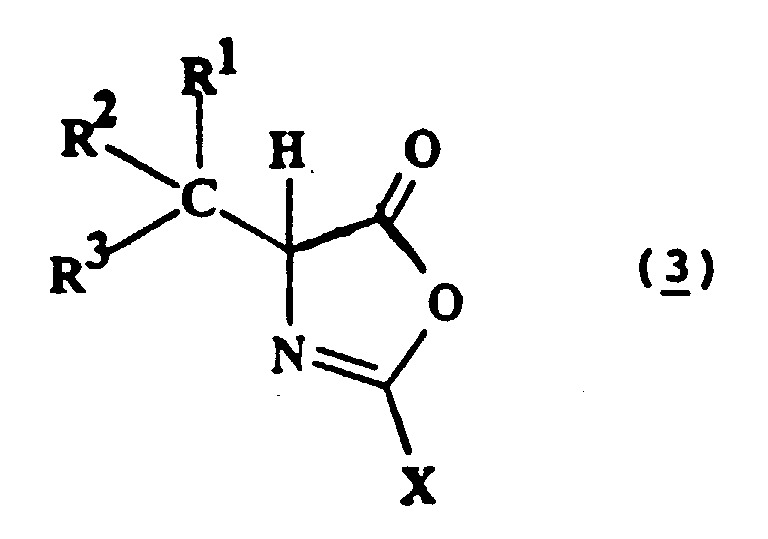
- A process according to claim 1, wherein X is aryl such as phenyl or substituted phenyl, aralkyl such as benzyl, alkyl, alkoxy such as tert-butoxy or benzyloxy, or aryloxy such as phenoxy.
- A process according to claim 2, wherein X is benzyl.
- A process according to claim 2, wherein X is phenyl.
- A process according to any preceding claim, wherein R1=R2=R3=Me.
- A process according to any preceding claim, wherein Y is R4O where R4 has at least 2 carbon atoms.
- A process according to any of claims 1 to 5, wherein Y=CH3CH2CH2CH2O.
- A process for preparing an amino-acid of formula (1), or a N-acyl derivative thereof,or the opposite enantiomer, comprising carrying out the process according to any preceding claim and converting Y to OH and removing X-CO-, as appropriate.

Applications Claiming Priority (3)
| Application Number | Priority Date | Filing Date | Title |
|---|---|---|---|
| GB939322472A GB9322472D0 (en) | 1993-11-01 | 1993-11-01 | Chiral compounds and their preparation |
| GB9322472 | 1993-11-01 | ||
| PCT/GB1994/002392 WO1995012573A1 (en) | 1993-11-01 | 1994-11-01 | A method for preparing tert-leucine and analogues thereof in enantiomeric form, and intermediates therein |
Publications (2)
| Publication Number | Publication Date |
|---|---|
| EP0726891A1 EP0726891A1 (en) | 1996-08-21 |
| EP0726891B1 true EP0726891B1 (en) | 1999-02-03 |
Family
ID=10744442
Family Applications (1)
| Application Number | Title | Priority Date | Filing Date |
|---|---|---|---|
| EP94931136A Expired - Lifetime EP0726891B1 (en) | 1993-11-01 | 1994-11-01 | A method for preparing tert-leucine and analogues thereof in enantiomeric form, and intermediates therein |
Country Status (10)
| Country | Link |
|---|---|
| US (1) | US6180374B1 (en) |
| EP (1) | EP0726891B1 (en) |
| JP (1) | JPH09504304A (en) |
| AT (1) | ATE176461T1 (en) |
| AU (1) | AU676786B2 (en) |
| CA (1) | CA2173205A1 (en) |
| DE (1) | DE69416424T2 (en) |
| ES (1) | ES2128592T3 (en) |
| GB (1) | GB9322472D0 (en) |
| WO (1) | WO1995012573A1 (en) |
Families Citing this family (9)
| Publication number | Priority date | Publication date | Assignee | Title |
|---|---|---|---|---|
| DE19529211C2 (en) * | 1995-08-09 | 1999-01-14 | Degussa | Process for the preparation of (R) tertiary leucine |
| CA2250417A1 (en) * | 1996-04-02 | 1997-10-09 | Bayer Aktiengesellschaft | Substituted phenyl keto enols as pesticides and herbicides |
| GB9607458D0 (en) * | 1996-04-10 | 1996-06-12 | Zeneca Ltd | Enzymatic process for stereoselective preparation of therapeutic amides |
| US6130337A (en) * | 1997-04-11 | 2000-10-10 | Board Of Trustees Of Leland Stanford Junior University | Enantiomerically enriched α,α-distributed amino acids and method |
| JP2000319241A (en) * | 1999-04-28 | 2000-11-21 | Ihara Chem Ind Co Ltd | Method for producing phenylalkanoic acid amide compound |
| WO2009063804A1 (en) | 2007-11-16 | 2009-05-22 | Kaneka Corporation | Process for production of n-carbamoyl-tert-leucine |
| EP2238242B9 (en) | 2008-01-03 | 2015-06-10 | BASF Enzymes LLC | Transferases and oxidoreductases, nucleic acids encoding them and methods for making and using them |
| KR20120026024A (en) | 2009-04-24 | 2012-03-16 | 가부시키가이샤 가네카 | Process for production of n-alkoxycarbonyl-tert-leucines |
| US8835676B2 (en) | 2011-03-21 | 2014-09-16 | Divi's Laboratories Ltd. | Process for the preparation of enantiomerically pure tert-leucine |
Family Cites Families (2)
| Publication number | Priority date | Publication date | Assignee | Title |
|---|---|---|---|---|
| US5541080A (en) | 1991-11-01 | 1996-07-30 | Wisconsin Alumni Research Fdn. | Method for preparing L-alpha-amino acids |
| US5219731A (en) * | 1991-11-01 | 1993-06-15 | Wisconsin Alumni Research Foundation | Method for preparing optically-active amino acid derivatives |
-
1993
- 1993-11-01 GB GB939322472A patent/GB9322472D0/en active Pending
-
1994
- 1994-11-01 AT AT94931136T patent/ATE176461T1/en not_active IP Right Cessation
- 1994-11-01 ES ES94931136T patent/ES2128592T3/en not_active Expired - Lifetime
- 1994-11-01 JP JP7513079A patent/JPH09504304A/en active Pending
- 1994-11-01 WO PCT/GB1994/002392 patent/WO1995012573A1/en not_active Ceased
- 1994-11-01 EP EP94931136A patent/EP0726891B1/en not_active Expired - Lifetime
- 1994-11-01 CA CA002173205A patent/CA2173205A1/en not_active Abandoned
- 1994-11-01 AU AU80012/94A patent/AU676786B2/en not_active Ceased
- 1994-11-01 DE DE69416424T patent/DE69416424T2/en not_active Expired - Fee Related
-
1998
- 1998-08-10 US US09/131,466 patent/US6180374B1/en not_active Expired - Fee Related
Also Published As
| Publication number | Publication date |
|---|---|
| AU676786B2 (en) | 1997-03-20 |
| DE69416424D1 (en) | 1999-03-18 |
| ES2128592T3 (en) | 1999-05-16 |
| ATE176461T1 (en) | 1999-02-15 |
| GB9322472D0 (en) | 1993-12-22 |
| CA2173205A1 (en) | 1995-05-11 |
| EP0726891A1 (en) | 1996-08-21 |
| JPH09504304A (en) | 1997-04-28 |
| DE69416424T2 (en) | 1999-06-10 |
| WO1995012573A1 (en) | 1995-05-11 |
| US6180374B1 (en) | 2001-01-30 |
| AU8001294A (en) | 1995-05-23 |
Similar Documents
| Publication | Publication Date | Title |
|---|---|---|
| JP3789938B2 (en) | Racemic resolution of primary and secondary heteroatom-substituted amines by enzyme-catalyzed acylation | |
| US12365679B2 (en) | Process for producing acyloxymethyl esters of (4S)-(4-cyano-2-methoxyphenyl)-5-ethoxy-2,8-dimethyl-1,4-dihydro-1,6-naphthyridin-3-carboxylic acid | |
| EP0424064A1 (en) | Chiral azabicyloheptanone and a process for their preparation | |
| US6180374B1 (en) | Method for preparing tert-leucine and analogues thereof in enantiomeric form and intermediates therein | |
| JP2010116397A (en) | Process for preparing (1s, 4r)- or (1r, 4s)-4-(2-amino-6-chloro-9h-purine-9-yl)-2-cyclopentene-1-methanol | |
| US5420337A (en) | Enzymatic reduction method for the preparation of compounds useful for preparing taxanes | |
| JP2735326B2 (en) | Method for producing 3-pyrrolidinol | |
| US3887606A (en) | Process for the preparation of DL-phenylglycine esters | |
| CA2065433C (en) | Synthesis of aryl alkanediols having high optical purity | |
| EP0222561B1 (en) | Process for enzymatic separation of optical isomers of 2-aminobutanol | |
| US6465689B1 (en) | Stereoselective processes for the preparation of gabapentin analogues | |
| JP2003512034A (en) | Method for producing chiral ester | |
| EP0373949A1 (en) | Mono esters of dicarboxylic acids, their preparation and use | |
| US8008062B2 (en) | Production of (R)- and (S)-4-(1-aminoethyl) benzoic acid methyl ester sulfate by lipase acylation of racemic 4-(1-aminoethyl) benzoic acid methyl ester and sulfuric acid precipitation | |
| EP0239122A2 (en) | Process for the enzymatic resolution of racemic 2-amino-1-alkanols | |
| CN101321875B (en) | Preparation of (R)- and (S)-4-(1- Ammonium ethyl) methyl benzoate sulfate method | |
| JPH1175889A (en) | Production method and purification method of optically active α-trifluoromethyl lactic acid and its enantiomer ester | |
| WO2010019469A2 (en) | Preparation of (s)-2-aminobutyric acid | |
| US5573949A (en) | Enzymatic process for the preparation of optically active Tetrahydro-2-naphthoic acids | |
| CA2217880C (en) | Synthesis of optically active aminoindanol | |
| JPS63123399A (en) | Production of optically active alcohol and ester | |
| EP0375394B1 (en) | Process for preparing leukotriene antagonists | |
| JPH08322588A (en) | Production of optically active aliphatic unsaturated alcohol | |
| JP2003512035A (en) | Method for producing chiral ester | |
| JPH1198999A (en) | Production of optically active 2-alkanol |
Legal Events
| Date | Code | Title | Description |
|---|---|---|---|
| PUAI | Public reference made under article 153(3) epc to a published international application that has entered the european phase |
Free format text: ORIGINAL CODE: 0009012 |
|
| 17P | Request for examination filed |
Effective date: 19960517 |
|
| AK | Designated contracting states |
Kind code of ref document: A1 Designated state(s): AT BE CH DE DK ES FR GB GR IE IT LI LU NL PT SE |
|
| 17Q | First examination report despatched |
Effective date: 19970523 |
|
| GRAG | Despatch of communication of intention to grant |
Free format text: ORIGINAL CODE: EPIDOS AGRA |
|
| GRAG | Despatch of communication of intention to grant |
Free format text: ORIGINAL CODE: EPIDOS AGRA |
|
| GRAG | Despatch of communication of intention to grant |
Free format text: ORIGINAL CODE: EPIDOS AGRA |
|
| GRAH | Despatch of communication of intention to grant a patent |
Free format text: ORIGINAL CODE: EPIDOS IGRA |
|
| GRAH | Despatch of communication of intention to grant a patent |
Free format text: ORIGINAL CODE: EPIDOS IGRA |
|
| RAP1 | Party data changed (applicant data changed or rights of an application transferred) |
Owner name: CHIROTECH TECHNOLOGY LIMITED |
|
| GRAA | (expected) grant |
Free format text: ORIGINAL CODE: 0009210 |
|
| AK | Designated contracting states |
Kind code of ref document: B1 Designated state(s): AT BE CH DE DK ES FR GB GR IE IT LI LU NL PT SE |
|
| PG25 | Lapsed in a contracting state [announced via postgrant information from national office to epo] |
Ref country code: NL Free format text: LAPSE BECAUSE OF FAILURE TO SUBMIT A TRANSLATION OF THE DESCRIPTION OR TO PAY THE FEE WITHIN THE PRESCRIBED TIME-LIMIT Effective date: 19990203 Ref country code: GR Free format text: LAPSE BECAUSE OF NON-PAYMENT OF DUE FEES Effective date: 19990203 Ref country code: BE Free format text: LAPSE BECAUSE OF FAILURE TO SUBMIT A TRANSLATION OF THE DESCRIPTION OR TO PAY THE FEE WITHIN THE PRESCRIBED TIME-LIMIT Effective date: 19990203 Ref country code: AT Free format text: LAPSE BECAUSE OF FAILURE TO SUBMIT A TRANSLATION OF THE DESCRIPTION OR TO PAY THE FEE WITHIN THE PRESCRIBED TIME-LIMIT Effective date: 19990203 |
|
| REF | Corresponds to: |
Ref document number: 176461 Country of ref document: AT Date of ref document: 19990215 Kind code of ref document: T |
|
| REG | Reference to a national code |
Ref country code: CH Ref legal event code: EP |
|
| REG | Reference to a national code |
Ref country code: IE Ref legal event code: FG4D |
|
| REF | Corresponds to: |
Ref document number: 69416424 Country of ref document: DE Date of ref document: 19990318 |
|
| ITF | It: translation for a ep patent filed | ||
| PG25 | Lapsed in a contracting state [announced via postgrant information from national office to epo] |
Ref country code: PT Free format text: LAPSE BECAUSE OF FAILURE TO SUBMIT A TRANSLATION OF THE DESCRIPTION OR TO PAY THE FEE WITHIN THE PRESCRIBED TIME-LIMIT Effective date: 19990503 Ref country code: DK Free format text: LAPSE BECAUSE OF FAILURE TO SUBMIT A TRANSLATION OF THE DESCRIPTION OR TO PAY THE FEE WITHIN THE PRESCRIBED TIME-LIMIT Effective date: 19990503 |
|
| REG | Reference to a national code |
Ref country code: ES Ref legal event code: FG2A Ref document number: 2128592 Country of ref document: ES Kind code of ref document: T3 |
|
| ET | Fr: translation filed | ||
| REG | Reference to a national code |
Ref country code: CH Ref legal event code: NV Representative=s name: MOINAS SAVOYE & CRONIN |
|
| NLV1 | Nl: lapsed or annulled due to failure to fulfill the requirements of art. 29p and 29m of the patents act | ||
| PG25 | Lapsed in a contracting state [announced via postgrant information from national office to epo] |
Ref country code: LU Free format text: LAPSE BECAUSE OF NON-PAYMENT OF DUE FEES Effective date: 19991101 Ref country code: IE Free format text: LAPSE BECAUSE OF NON-PAYMENT OF DUE FEES Effective date: 19991101 |
|
| PGFP | Annual fee paid to national office [announced via postgrant information from national office to epo] |
Ref country code: SE Payment date: 19991104 Year of fee payment: 6 |
|
| PGFP | Annual fee paid to national office [announced via postgrant information from national office to epo] |
Ref country code: CH Payment date: 19991111 Year of fee payment: 6 |
|
| PGFP | Annual fee paid to national office [announced via postgrant information from national office to epo] |
Ref country code: ES Payment date: 19991130 Year of fee payment: 6 |
|
| PLBE | No opposition filed within time limit |
Free format text: ORIGINAL CODE: 0009261 |
|
| STAA | Information on the status of an ep patent application or granted ep patent |
Free format text: STATUS: NO OPPOSITION FILED WITHIN TIME LIMIT |
|
| 26N | No opposition filed | ||
| REG | Reference to a national code |
Ref country code: IE Ref legal event code: MM4A |
|
| PG25 | Lapsed in a contracting state [announced via postgrant information from national office to epo] |
Ref country code: ES Free format text: LAPSE BECAUSE OF NON-PAYMENT OF DUE FEES Effective date: 20001102 |
|
| PG25 | Lapsed in a contracting state [announced via postgrant information from national office to epo] |
Ref country code: SE Free format text: THE PATENT HAS BEEN ANNULLED BY A DECISION OF A NATIONAL AUTHORITY Effective date: 20001129 |
|
| PG25 | Lapsed in a contracting state [announced via postgrant information from national office to epo] |
Ref country code: LI Free format text: LAPSE BECAUSE OF NON-PAYMENT OF DUE FEES Effective date: 20001130 Ref country code: CH Free format text: LAPSE BECAUSE OF NON-PAYMENT OF DUE FEES Effective date: 20001130 |
|
| REG | Reference to a national code |
Ref country code: CH Ref legal event code: PL |
|
| EUG | Se: european patent has lapsed |
Ref document number: 94931136.9 |
|
| PGFP | Annual fee paid to national office [announced via postgrant information from national office to epo] |
Ref country code: FR Payment date: 20011113 Year of fee payment: 8 |
|
| PGFP | Annual fee paid to national office [announced via postgrant information from national office to epo] |
Ref country code: DE Payment date: 20011119 Year of fee payment: 8 |
|
| PGFP | Annual fee paid to national office [announced via postgrant information from national office to epo] |
Ref country code: GB Payment date: 20011212 Year of fee payment: 8 |
|
| REG | Reference to a national code |
Ref country code: GB Ref legal event code: IF02 |
|
| PG25 | Lapsed in a contracting state [announced via postgrant information from national office to epo] |
Ref country code: GB Free format text: LAPSE BECAUSE OF NON-PAYMENT OF DUE FEES Effective date: 20021101 |
|
| PG25 | Lapsed in a contracting state [announced via postgrant information from national office to epo] |
Ref country code: DE Free format text: LAPSE BECAUSE OF NON-PAYMENT OF DUE FEES Effective date: 20030603 |
|
| GBPC | Gb: european patent ceased through non-payment of renewal fee | ||
| PG25 | Lapsed in a contracting state [announced via postgrant information from national office to epo] |
Ref country code: FR Free format text: LAPSE BECAUSE OF NON-PAYMENT OF DUE FEES Effective date: 20030731 |
|
| REG | Reference to a national code |
Ref country code: FR Ref legal event code: ST |
|
| REG | Reference to a national code |
Ref country code: ES Ref legal event code: FD2A Effective date: 20011214 |
|
| PG25 | Lapsed in a contracting state [announced via postgrant information from national office to epo] |
Ref country code: IT Free format text: LAPSE BECAUSE OF NON-PAYMENT OF DUE FEES Effective date: 20051101 |