EP0726461B1 - Ultrasonic direct fixing of reagent layer and method for preparing peel type test piece - Google Patents
Ultrasonic direct fixing of reagent layer and method for preparing peel type test piece Download PDFInfo
- Publication number
- EP0726461B1 EP0726461B1 EP96101847A EP96101847A EP0726461B1 EP 0726461 B1 EP0726461 B1 EP 0726461B1 EP 96101847 A EP96101847 A EP 96101847A EP 96101847 A EP96101847 A EP 96101847A EP 0726461 B1 EP0726461 B1 EP 0726461B1
- Authority
- EP
- European Patent Office
- Prior art keywords
- reagent layer
- layer
- base plate
- reagent
- porous matrix
- Prior art date
- Legal status (The legal status is an assumption and is not a legal conclusion. Google has not performed a legal analysis and makes no representation as to the accuracy of the status listed.)
- Expired - Lifetime
Links
- 239000003153 chemical reaction reagent Substances 0.000 title claims description 174
- 238000000034 method Methods 0.000 title claims description 42
- 238000012360 testing method Methods 0.000 title claims description 25
- 238000004458 analytical method Methods 0.000 claims description 66
- 229920005992 thermoplastic resin Polymers 0.000 claims description 42
- 239000011159 matrix material Substances 0.000 claims description 37
- 230000004927 fusion Effects 0.000 claims description 29
- 238000002360 preparation method Methods 0.000 claims description 21
- 239000012815 thermoplastic material Substances 0.000 claims description 21
- -1 polyethylene terephthalate Polymers 0.000 claims description 19
- 239000007788 liquid Substances 0.000 claims description 15
- 229920000139 polyethylene terephthalate Polymers 0.000 claims description 13
- 239000005020 polyethylene terephthalate Substances 0.000 claims description 13
- 239000004744 fabric Substances 0.000 claims description 9
- 239000000919 ceramic Substances 0.000 claims description 7
- 239000011521 glass Substances 0.000 claims description 7
- 239000000463 material Substances 0.000 claims description 6
- 238000003825 pressing Methods 0.000 claims description 6
- 239000003365 glass fiber Substances 0.000 claims description 5
- 239000011148 porous material Substances 0.000 claims description 5
- 239000012528 membrane Substances 0.000 claims description 4
- 239000004698 Polyethylene Substances 0.000 claims description 3
- 239000004743 Polypropylene Substances 0.000 claims description 3
- 239000004793 Polystyrene Substances 0.000 claims description 3
- 229920002678 cellulose Polymers 0.000 claims description 3
- 238000001914 filtration Methods 0.000 claims description 3
- 229910052751 metal Inorganic materials 0.000 claims description 3
- 239000002184 metal Substances 0.000 claims description 3
- 239000011325 microbead Substances 0.000 claims description 3
- 239000004745 nonwoven fabric Substances 0.000 claims description 3
- 229920000515 polycarbonate Polymers 0.000 claims description 3
- 239000004417 polycarbonate Substances 0.000 claims description 3
- 229920000573 polyethylene Polymers 0.000 claims description 3
- 229920000642 polymer Polymers 0.000 claims description 3
- 229920001155 polypropylene Polymers 0.000 claims description 3
- 229920002223 polystyrene Polymers 0.000 claims description 3
- 229920002689 polyvinyl acetate Polymers 0.000 claims description 3
- 239000011118 polyvinyl acetate Substances 0.000 claims description 3
- 229920000915 polyvinyl chloride Polymers 0.000 claims description 3
- 239000004800 polyvinyl chloride Substances 0.000 claims description 3
- 239000002023 wood Substances 0.000 claims description 3
- 239000002759 woven fabric Substances 0.000 claims description 3
- 239000010408 film Substances 0.000 description 45
- 239000000853 adhesive Substances 0.000 description 21
- 230000001070 adhesive effect Effects 0.000 description 21
- 239000002390 adhesive tape Substances 0.000 description 12
- 229920005989 resin Polymers 0.000 description 11
- 239000011347 resin Substances 0.000 description 11
- 239000000203 mixture Substances 0.000 description 9
- 239000000126 substance Substances 0.000 description 8
- 239000004831 Hot glue Substances 0.000 description 7
- 210000004369 blood Anatomy 0.000 description 7
- 239000008280 blood Substances 0.000 description 7
- 238000005520 cutting process Methods 0.000 description 7
- 239000011248 coating agent Substances 0.000 description 6
- 238000000576 coating method Methods 0.000 description 6
- 230000000694 effects Effects 0.000 description 6
- 230000009467 reduction Effects 0.000 description 6
- 239000010409 thin film Substances 0.000 description 6
- 238000002525 ultrasonication Methods 0.000 description 6
- 210000002700 urine Anatomy 0.000 description 6
- 238000006243 chemical reaction Methods 0.000 description 5
- 238000001035 drying Methods 0.000 description 5
- LFQSCWFLJHTTHZ-UHFFFAOYSA-N Ethanol Chemical compound CCO LFQSCWFLJHTTHZ-UHFFFAOYSA-N 0.000 description 4
- 238000004873 anchoring Methods 0.000 description 4
- 230000008901 benefit Effects 0.000 description 4
- 230000015572 biosynthetic process Effects 0.000 description 4
- 239000004014 plasticizer Substances 0.000 description 4
- 229920005596 polymer binder Polymers 0.000 description 4
- 239000002491 polymer binding agent Substances 0.000 description 4
- 239000002904 solvent Substances 0.000 description 4
- 229920002799 BoPET Polymers 0.000 description 3
- 102000001554 Hemoglobins Human genes 0.000 description 3
- 108010054147 Hemoglobins Proteins 0.000 description 3
- OKKJLVBELUTLKV-UHFFFAOYSA-N Methanol Chemical compound OC OKKJLVBELUTLKV-UHFFFAOYSA-N 0.000 description 3
- 239000004677 Nylon Substances 0.000 description 3
- 238000001514 detection method Methods 0.000 description 3
- 238000009472 formulation Methods 0.000 description 3
- 229920001778 nylon Polymers 0.000 description 3
- 229920001169 thermoplastic Polymers 0.000 description 3
- 239000004416 thermosoftening plastic Substances 0.000 description 3
- KDYVCOSVYOSHOL-UHFFFAOYSA-N 7-methylquinoline Chemical compound C1=CC=NC2=CC(C)=CC=C21 KDYVCOSVYOSHOL-UHFFFAOYSA-N 0.000 description 2
- 102000004190 Enzymes Human genes 0.000 description 2
- 108090000790 Enzymes Proteins 0.000 description 2
- IOVCWXUNBOPUCH-UHFFFAOYSA-M Nitrite anion Chemical compound [O-]N=O IOVCWXUNBOPUCH-UHFFFAOYSA-M 0.000 description 2
- 230000002411 adverse Effects 0.000 description 2
- 239000000427 antigen Substances 0.000 description 2
- 102000036639 antigens Human genes 0.000 description 2
- 108091007433 antigens Proteins 0.000 description 2
- 238000004159 blood analysis Methods 0.000 description 2
- 210000001124 body fluid Anatomy 0.000 description 2
- 239000010839 body fluid Substances 0.000 description 2
- 230000000052 comparative effect Effects 0.000 description 2
- 238000007796 conventional method Methods 0.000 description 2
- 238000004925 denaturation Methods 0.000 description 2
- 230000036425 denaturation Effects 0.000 description 2
- 238000003018 immunoassay Methods 0.000 description 2
- 230000006872 improvement Effects 0.000 description 2
- 238000005259 measurement Methods 0.000 description 2
- 230000002093 peripheral effect Effects 0.000 description 2
- 239000003381 stabilizer Substances 0.000 description 2
- 239000002699 waste material Substances 0.000 description 2
- UAIUNKRWKOVEES-UHFFFAOYSA-N 3,3',5,5'-tetramethylbenzidine Chemical compound CC1=C(N)C(C)=CC(C=2C=C(C)C(N)=C(C)C=2)=C1 UAIUNKRWKOVEES-UHFFFAOYSA-N 0.000 description 1
- FRIBMENBGGCKPD-UHFFFAOYSA-N 3-(2,3-dimethoxyphenyl)prop-2-enal Chemical compound COC1=CC=CC(C=CC=O)=C1OC FRIBMENBGGCKPD-UHFFFAOYSA-N 0.000 description 1
- ZGTMUACCHSMWAC-UHFFFAOYSA-L EDTA disodium salt (anhydrous) Chemical compound [Na+].[Na+].OC(=O)CN(CC([O-])=O)CCN(CC(O)=O)CC([O-])=O ZGTMUACCHSMWAC-UHFFFAOYSA-L 0.000 description 1
- CTQNGGLPUBDAKN-UHFFFAOYSA-N O-Xylene Chemical compound CC1=CC=CC=C1C CTQNGGLPUBDAKN-UHFFFAOYSA-N 0.000 description 1
- DBMJMQXJHONAFJ-UHFFFAOYSA-M Sodium laurylsulphate Chemical compound [Na+].CCCCCCCCCCCCOS([O-])(=O)=O DBMJMQXJHONAFJ-UHFFFAOYSA-M 0.000 description 1
- 238000010521 absorption reaction Methods 0.000 description 1
- 239000004480 active ingredient Substances 0.000 description 1
- 229960002685 biotin Drugs 0.000 description 1
- 239000011616 biotin Substances 0.000 description 1
- 210000001175 cerebrospinal fluid Anatomy 0.000 description 1
- 238000003776 cleavage reaction Methods 0.000 description 1
- 239000008199 coating composition Substances 0.000 description 1
- 238000004737 colorimetric analysis Methods 0.000 description 1
- 238000000354 decomposition reaction Methods 0.000 description 1
- 239000002274 desiccant Substances 0.000 description 1
- 238000003745 diagnosis Methods 0.000 description 1
- 201000010099 disease Diseases 0.000 description 1
- 208000037265 diseases, disorders, signs and symptoms Diseases 0.000 description 1
- 239000006185 dispersion Substances 0.000 description 1
- 238000007429 general method Methods 0.000 description 1
- 239000012943 hotmelt Substances 0.000 description 1
- 230000008105 immune reaction Effects 0.000 description 1
- 238000005470 impregnation Methods 0.000 description 1
- 238000004519 manufacturing process Methods 0.000 description 1
- 238000004452 microanalysis Methods 0.000 description 1
- 238000012986 modification Methods 0.000 description 1
- 230000004048 modification Effects 0.000 description 1
- 239000000178 monomer Substances 0.000 description 1
- QQZOPKMRPOGIEB-UHFFFAOYSA-N n-butyl methyl ketone Natural products CCCCC(C)=O QQZOPKMRPOGIEB-UHFFFAOYSA-N 0.000 description 1
- 150000002826 nitrites Chemical class 0.000 description 1
- 239000003960 organic solvent Substances 0.000 description 1
- 230000010355 oscillation Effects 0.000 description 1
- 238000005375 photometry Methods 0.000 description 1
- 239000003505 polymerization initiator Substances 0.000 description 1
- IWZKICVEHNUQTL-UHFFFAOYSA-M potassium hydrogen phthalate Chemical compound [K+].OC(=O)C1=CC=CC=C1C([O-])=O IWZKICVEHNUQTL-UHFFFAOYSA-M 0.000 description 1
- 238000004321 preservation Methods 0.000 description 1
- 238000012545 processing Methods 0.000 description 1
- 102000004169 proteins and genes Human genes 0.000 description 1
- 108090000623 proteins and genes Proteins 0.000 description 1
- 210000003296 saliva Anatomy 0.000 description 1
- 230000007017 scission Effects 0.000 description 1
- 230000035945 sensitivity Effects 0.000 description 1
- 210000002966 serum Anatomy 0.000 description 1
- 230000035939 shock Effects 0.000 description 1
- 235000019333 sodium laurylsulphate Nutrition 0.000 description 1
- 230000003595 spectral effect Effects 0.000 description 1
- 238000003756 stirring Methods 0.000 description 1
- 239000000758 substrate Substances 0.000 description 1
- FDDDEECHVMSUSB-UHFFFAOYSA-N sulfanilamide Chemical compound NC1=CC=C(S(N)(=O)=O)C=C1 FDDDEECHVMSUSB-UHFFFAOYSA-N 0.000 description 1
- 229940124530 sulfonamide Drugs 0.000 description 1
- YNJBWRMUSHSURL-UHFFFAOYSA-N trichloroacetic acid Chemical compound OC(=O)C(Cl)(Cl)Cl YNJBWRMUSHSURL-UHFFFAOYSA-N 0.000 description 1
- 238000005353 urine analysis Methods 0.000 description 1
- 229920002554 vinyl polymer Polymers 0.000 description 1
- 230000000007 visual effect Effects 0.000 description 1
- 238000007704 wet chemistry method Methods 0.000 description 1
- 239000000080 wetting agent Substances 0.000 description 1
- 239000008096 xylene Substances 0.000 description 1
Images


Classifications
-
- G—PHYSICS
- G01—MEASURING; TESTING
- G01N—INVESTIGATING OR ANALYSING MATERIALS BY DETERMINING THEIR CHEMICAL OR PHYSICAL PROPERTIES
- G01N33/00—Investigating or analysing materials by specific methods not covered by groups G01N1/00 - G01N31/00
- G01N33/48—Biological material, e.g. blood, urine; Haemocytometers
- G01N33/50—Chemical analysis of biological material, e.g. blood, urine; Testing involving biospecific ligand binding methods; Immunological testing
- G01N33/52—Use of compounds or compositions for colorimetric, spectrophotometric or fluorometric investigation, e.g. use of reagent paper and including single- and multilayer analytical elements
- G01N33/525—Multi-layer analytical elements
-
- B—PERFORMING OPERATIONS; TRANSPORTING
- B29—WORKING OF PLASTICS; WORKING OF SUBSTANCES IN A PLASTIC STATE IN GENERAL
- B29C—SHAPING OR JOINING OF PLASTICS; SHAPING OF MATERIAL IN A PLASTIC STATE, NOT OTHERWISE PROVIDED FOR; AFTER-TREATMENT OF THE SHAPED PRODUCTS, e.g. REPAIRING
- B29C65/00—Joining or sealing of preformed parts, e.g. welding of plastics materials; Apparatus therefor
- B29C65/02—Joining or sealing of preformed parts, e.g. welding of plastics materials; Apparatus therefor by heating, with or without pressure
- B29C65/08—Joining or sealing of preformed parts, e.g. welding of plastics materials; Apparatus therefor by heating, with or without pressure using ultrasonic vibrations
-
- B—PERFORMING OPERATIONS; TRANSPORTING
- B29—WORKING OF PLASTICS; WORKING OF SUBSTANCES IN A PLASTIC STATE IN GENERAL
- B29C—SHAPING OR JOINING OF PLASTICS; SHAPING OF MATERIAL IN A PLASTIC STATE, NOT OTHERWISE PROVIDED FOR; AFTER-TREATMENT OF THE SHAPED PRODUCTS, e.g. REPAIRING
- B29C65/00—Joining or sealing of preformed parts, e.g. welding of plastics materials; Apparatus therefor
- B29C65/02—Joining or sealing of preformed parts, e.g. welding of plastics materials; Apparatus therefor by heating, with or without pressure
- B29C65/08—Joining or sealing of preformed parts, e.g. welding of plastics materials; Apparatus therefor by heating, with or without pressure using ultrasonic vibrations
- B29C65/081—Joining or sealing of preformed parts, e.g. welding of plastics materials; Apparatus therefor by heating, with or without pressure using ultrasonic vibrations having a component of vibration not perpendicular to the welding surface
- B29C65/082—Angular, i.e. torsional ultrasonic welding
-
- B—PERFORMING OPERATIONS; TRANSPORTING
- B29—WORKING OF PLASTICS; WORKING OF SUBSTANCES IN A PLASTIC STATE IN GENERAL
- B29C—SHAPING OR JOINING OF PLASTICS; SHAPING OF MATERIAL IN A PLASTIC STATE, NOT OTHERWISE PROVIDED FOR; AFTER-TREATMENT OF THE SHAPED PRODUCTS, e.g. REPAIRING
- B29C66/00—General aspects of processes or apparatus for joining preformed parts
- B29C66/01—General aspects dealing with the joint area or with the area to be joined
- B29C66/05—Particular design of joint configurations
- B29C66/10—Particular design of joint configurations particular design of the joint cross-sections
- B29C66/11—Joint cross-sections comprising a single joint-segment, i.e. one of the parts to be joined comprising a single joint-segment in the joint cross-section
- B29C66/112—Single lapped joints
- B29C66/1122—Single lap to lap joints, i.e. overlap joints
-
- B—PERFORMING OPERATIONS; TRANSPORTING
- B29—WORKING OF PLASTICS; WORKING OF SUBSTANCES IN A PLASTIC STATE IN GENERAL
- B29C—SHAPING OR JOINING OF PLASTICS; SHAPING OF MATERIAL IN A PLASTIC STATE, NOT OTHERWISE PROVIDED FOR; AFTER-TREATMENT OF THE SHAPED PRODUCTS, e.g. REPAIRING
- B29C66/00—General aspects of processes or apparatus for joining preformed parts
- B29C66/40—General aspects of joining substantially flat articles, e.g. plates, sheets or web-like materials; Making flat seams in tubular or hollow articles; Joining single elements to substantially flat surfaces
- B29C66/47—Joining single elements to sheets, plates or other substantially flat surfaces
- B29C66/472—Joining single elements to sheets, plates or other substantially flat surfaces said single elements being substantially flat
-
- B—PERFORMING OPERATIONS; TRANSPORTING
- B29—WORKING OF PLASTICS; WORKING OF SUBSTANCES IN A PLASTIC STATE IN GENERAL
- B29C—SHAPING OR JOINING OF PLASTICS; SHAPING OF MATERIAL IN A PLASTIC STATE, NOT OTHERWISE PROVIDED FOR; AFTER-TREATMENT OF THE SHAPED PRODUCTS, e.g. REPAIRING
- B29C66/00—General aspects of processes or apparatus for joining preformed parts
- B29C66/70—General aspects of processes or apparatus for joining preformed parts characterised by the composition, physical properties or the structure of the material of the parts to be joined; Joining with non-plastics material
- B29C66/73—General aspects of processes or apparatus for joining preformed parts characterised by the composition, physical properties or the structure of the material of the parts to be joined; Joining with non-plastics material characterised by the intensive physical properties of the material of the parts to be joined, by the optical properties of the material of the parts to be joined, by the extensive physical properties of the parts to be joined, by the state of the material of the parts to be joined or by the material of the parts to be joined being a thermoplastic or a thermoset
- B29C66/739—General aspects of processes or apparatus for joining preformed parts characterised by the composition, physical properties or the structure of the material of the parts to be joined; Joining with non-plastics material characterised by the intensive physical properties of the material of the parts to be joined, by the optical properties of the material of the parts to be joined, by the extensive physical properties of the parts to be joined, by the state of the material of the parts to be joined or by the material of the parts to be joined being a thermoplastic or a thermoset characterised by the material of the parts to be joined being a thermoplastic or a thermoset
- B29C66/7392—General aspects of processes or apparatus for joining preformed parts characterised by the composition, physical properties or the structure of the material of the parts to be joined; Joining with non-plastics material characterised by the intensive physical properties of the material of the parts to be joined, by the optical properties of the material of the parts to be joined, by the extensive physical properties of the parts to be joined, by the state of the material of the parts to be joined or by the material of the parts to be joined being a thermoplastic or a thermoset characterised by the material of the parts to be joined being a thermoplastic or a thermoset characterised by the material of at least one of the parts being a thermoplastic
-
- B—PERFORMING OPERATIONS; TRANSPORTING
- B29—WORKING OF PLASTICS; WORKING OF SUBSTANCES IN A PLASTIC STATE IN GENERAL
- B29C—SHAPING OR JOINING OF PLASTICS; SHAPING OF MATERIAL IN A PLASTIC STATE, NOT OTHERWISE PROVIDED FOR; AFTER-TREATMENT OF THE SHAPED PRODUCTS, e.g. REPAIRING
- B29C66/00—General aspects of processes or apparatus for joining preformed parts
- B29C66/70—General aspects of processes or apparatus for joining preformed parts characterised by the composition, physical properties or the structure of the material of the parts to be joined; Joining with non-plastics material
- B29C66/74—Joining plastics material to non-plastics material
- B29C66/748—Joining plastics material to non-plastics material to natural products or their composites, not provided for in groups B29C66/742 - B29C66/746
- B29C66/7487—Wood
-
- B—PERFORMING OPERATIONS; TRANSPORTING
- B29—WORKING OF PLASTICS; WORKING OF SUBSTANCES IN A PLASTIC STATE IN GENERAL
- B29C—SHAPING OR JOINING OF PLASTICS; SHAPING OF MATERIAL IN A PLASTIC STATE, NOT OTHERWISE PROVIDED FOR; AFTER-TREATMENT OF THE SHAPED PRODUCTS, e.g. REPAIRING
- B29C65/00—Joining or sealing of preformed parts, e.g. welding of plastics materials; Apparatus therefor
- B29C65/02—Joining or sealing of preformed parts, e.g. welding of plastics materials; Apparatus therefor by heating, with or without pressure
- B29C65/06—Joining or sealing of preformed parts, e.g. welding of plastics materials; Apparatus therefor by heating, with or without pressure using friction, e.g. spin welding
- B29C65/0609—Joining or sealing of preformed parts, e.g. welding of plastics materials; Apparatus therefor by heating, with or without pressure using friction, e.g. spin welding characterised by the movement of the parts to be joined
- B29C65/0618—Linear
-
- B—PERFORMING OPERATIONS; TRANSPORTING
- B29—WORKING OF PLASTICS; WORKING OF SUBSTANCES IN A PLASTIC STATE IN GENERAL
- B29C—SHAPING OR JOINING OF PLASTICS; SHAPING OF MATERIAL IN A PLASTIC STATE, NOT OTHERWISE PROVIDED FOR; AFTER-TREATMENT OF THE SHAPED PRODUCTS, e.g. REPAIRING
- B29C66/00—General aspects of processes or apparatus for joining preformed parts
- B29C66/01—General aspects dealing with the joint area or with the area to be joined
- B29C66/05—Particular design of joint configurations
- B29C66/20—Particular design of joint configurations particular design of the joint lines, e.g. of the weld lines
- B29C66/21—Particular design of joint configurations particular design of the joint lines, e.g. of the weld lines said joint lines being formed by a single dot or dash or by several dots or dashes, i.e. spot joining or spot welding
-
- B—PERFORMING OPERATIONS; TRANSPORTING
- B29—WORKING OF PLASTICS; WORKING OF SUBSTANCES IN A PLASTIC STATE IN GENERAL
- B29C—SHAPING OR JOINING OF PLASTICS; SHAPING OF MATERIAL IN A PLASTIC STATE, NOT OTHERWISE PROVIDED FOR; AFTER-TREATMENT OF THE SHAPED PRODUCTS, e.g. REPAIRING
- B29C66/00—General aspects of processes or apparatus for joining preformed parts
- B29C66/01—General aspects dealing with the joint area or with the area to be joined
- B29C66/05—Particular design of joint configurations
- B29C66/303—Particular design of joint configurations the joint involving an anchoring effect
-
- B—PERFORMING OPERATIONS; TRANSPORTING
- B29—WORKING OF PLASTICS; WORKING OF SUBSTANCES IN A PLASTIC STATE IN GENERAL
- B29C—SHAPING OR JOINING OF PLASTICS; SHAPING OF MATERIAL IN A PLASTIC STATE, NOT OTHERWISE PROVIDED FOR; AFTER-TREATMENT OF THE SHAPED PRODUCTS, e.g. REPAIRING
- B29C66/00—General aspects of processes or apparatus for joining preformed parts
- B29C66/01—General aspects dealing with the joint area or with the area to be joined
- B29C66/05—Particular design of joint configurations
- B29C66/303—Particular design of joint configurations the joint involving an anchoring effect
- B29C66/3032—Particular design of joint configurations the joint involving an anchoring effect making use of protrusions or cavities belonging to at least one of the parts to be joined
- B29C66/30325—Particular design of joint configurations the joint involving an anchoring effect making use of protrusions or cavities belonging to at least one of the parts to be joined making use of cavities belonging to at least one of the parts to be joined
- B29C66/30326—Particular design of joint configurations the joint involving an anchoring effect making use of protrusions or cavities belonging to at least one of the parts to be joined making use of cavities belonging to at least one of the parts to be joined in the form of porosity
-
- B—PERFORMING OPERATIONS; TRANSPORTING
- B29—WORKING OF PLASTICS; WORKING OF SUBSTANCES IN A PLASTIC STATE IN GENERAL
- B29C—SHAPING OR JOINING OF PLASTICS; SHAPING OF MATERIAL IN A PLASTIC STATE, NOT OTHERWISE PROVIDED FOR; AFTER-TREATMENT OF THE SHAPED PRODUCTS, e.g. REPAIRING
- B29C66/00—General aspects of processes or apparatus for joining preformed parts
- B29C66/70—General aspects of processes or apparatus for joining preformed parts characterised by the composition, physical properties or the structure of the material of the parts to be joined; Joining with non-plastics material
- B29C66/71—General aspects of processes or apparatus for joining preformed parts characterised by the composition, physical properties or the structure of the material of the parts to be joined; Joining with non-plastics material characterised by the composition of the plastics material of the parts to be joined
-
- B—PERFORMING OPERATIONS; TRANSPORTING
- B29—WORKING OF PLASTICS; WORKING OF SUBSTANCES IN A PLASTIC STATE IN GENERAL
- B29C—SHAPING OR JOINING OF PLASTICS; SHAPING OF MATERIAL IN A PLASTIC STATE, NOT OTHERWISE PROVIDED FOR; AFTER-TREATMENT OF THE SHAPED PRODUCTS, e.g. REPAIRING
- B29C66/00—General aspects of processes or apparatus for joining preformed parts
- B29C66/70—General aspects of processes or apparatus for joining preformed parts characterised by the composition, physical properties or the structure of the material of the parts to be joined; Joining with non-plastics material
- B29C66/72—General aspects of processes or apparatus for joining preformed parts characterised by the composition, physical properties or the structure of the material of the parts to be joined; Joining with non-plastics material characterised by the structure of the material of the parts to be joined
- B29C66/723—General aspects of processes or apparatus for joining preformed parts characterised by the composition, physical properties or the structure of the material of the parts to be joined; Joining with non-plastics material characterised by the structure of the material of the parts to be joined being multi-layered
-
- B—PERFORMING OPERATIONS; TRANSPORTING
- B29—WORKING OF PLASTICS; WORKING OF SUBSTANCES IN A PLASTIC STATE IN GENERAL
- B29C—SHAPING OR JOINING OF PLASTICS; SHAPING OF MATERIAL IN A PLASTIC STATE, NOT OTHERWISE PROVIDED FOR; AFTER-TREATMENT OF THE SHAPED PRODUCTS, e.g. REPAIRING
- B29C66/00—General aspects of processes or apparatus for joining preformed parts
- B29C66/70—General aspects of processes or apparatus for joining preformed parts characterised by the composition, physical properties or the structure of the material of the parts to be joined; Joining with non-plastics material
- B29C66/72—General aspects of processes or apparatus for joining preformed parts characterised by the composition, physical properties or the structure of the material of the parts to be joined; Joining with non-plastics material characterised by the structure of the material of the parts to be joined
- B29C66/727—General aspects of processes or apparatus for joining preformed parts characterised by the composition, physical properties or the structure of the material of the parts to be joined; Joining with non-plastics material characterised by the structure of the material of the parts to be joined being porous, e.g. foam
-
- B—PERFORMING OPERATIONS; TRANSPORTING
- B29—WORKING OF PLASTICS; WORKING OF SUBSTANCES IN A PLASTIC STATE IN GENERAL
- B29C—SHAPING OR JOINING OF PLASTICS; SHAPING OF MATERIAL IN A PLASTIC STATE, NOT OTHERWISE PROVIDED FOR; AFTER-TREATMENT OF THE SHAPED PRODUCTS, e.g. REPAIRING
- B29C66/00—General aspects of processes or apparatus for joining preformed parts
- B29C66/70—General aspects of processes or apparatus for joining preformed parts characterised by the composition, physical properties or the structure of the material of the parts to be joined; Joining with non-plastics material
- B29C66/72—General aspects of processes or apparatus for joining preformed parts characterised by the composition, physical properties or the structure of the material of the parts to be joined; Joining with non-plastics material characterised by the structure of the material of the parts to be joined
- B29C66/729—Textile or other fibrous material made from plastics
-
- B—PERFORMING OPERATIONS; TRANSPORTING
- B29—WORKING OF PLASTICS; WORKING OF SUBSTANCES IN A PLASTIC STATE IN GENERAL
- B29C—SHAPING OR JOINING OF PLASTICS; SHAPING OF MATERIAL IN A PLASTIC STATE, NOT OTHERWISE PROVIDED FOR; AFTER-TREATMENT OF THE SHAPED PRODUCTS, e.g. REPAIRING
- B29C66/00—General aspects of processes or apparatus for joining preformed parts
- B29C66/70—General aspects of processes or apparatus for joining preformed parts characterised by the composition, physical properties or the structure of the material of the parts to be joined; Joining with non-plastics material
- B29C66/73—General aspects of processes or apparatus for joining preformed parts characterised by the composition, physical properties or the structure of the material of the parts to be joined; Joining with non-plastics material characterised by the intensive physical properties of the material of the parts to be joined, by the optical properties of the material of the parts to be joined, by the extensive physical properties of the parts to be joined, by the state of the material of the parts to be joined or by the material of the parts to be joined being a thermoplastic or a thermoset
- B29C66/739—General aspects of processes or apparatus for joining preformed parts characterised by the composition, physical properties or the structure of the material of the parts to be joined; Joining with non-plastics material characterised by the intensive physical properties of the material of the parts to be joined, by the optical properties of the material of the parts to be joined, by the extensive physical properties of the parts to be joined, by the state of the material of the parts to be joined or by the material of the parts to be joined being a thermoplastic or a thermoset characterised by the material of the parts to be joined being a thermoplastic or a thermoset
- B29C66/7392—General aspects of processes or apparatus for joining preformed parts characterised by the composition, physical properties or the structure of the material of the parts to be joined; Joining with non-plastics material characterised by the intensive physical properties of the material of the parts to be joined, by the optical properties of the material of the parts to be joined, by the extensive physical properties of the parts to be joined, by the state of the material of the parts to be joined or by the material of the parts to be joined being a thermoplastic or a thermoset characterised by the material of the parts to be joined being a thermoplastic or a thermoset characterised by the material of at least one of the parts being a thermoplastic
- B29C66/73921—General aspects of processes or apparatus for joining preformed parts characterised by the composition, physical properties or the structure of the material of the parts to be joined; Joining with non-plastics material characterised by the intensive physical properties of the material of the parts to be joined, by the optical properties of the material of the parts to be joined, by the extensive physical properties of the parts to be joined, by the state of the material of the parts to be joined or by the material of the parts to be joined being a thermoplastic or a thermoset characterised by the material of the parts to be joined being a thermoplastic or a thermoset characterised by the material of at least one of the parts being a thermoplastic characterised by the materials of both parts being thermoplastics
-
- B—PERFORMING OPERATIONS; TRANSPORTING
- B29—WORKING OF PLASTICS; WORKING OF SUBSTANCES IN A PLASTIC STATE IN GENERAL
- B29K—INDEXING SCHEME ASSOCIATED WITH SUBCLASSES B29B, B29C OR B29D, RELATING TO MOULDING MATERIALS OR TO MATERIALS FOR MOULDS, REINFORCEMENTS, FILLERS OR PREFORMED PARTS, e.g. INSERTS
- B29K2313/00—Use of textile products or fabrics as reinforcement
-
- B—PERFORMING OPERATIONS; TRANSPORTING
- B29—WORKING OF PLASTICS; WORKING OF SUBSTANCES IN A PLASTIC STATE IN GENERAL
- B29K—INDEXING SCHEME ASSOCIATED WITH SUBCLASSES B29B, B29C OR B29D, RELATING TO MOULDING MATERIALS OR TO MATERIALS FOR MOULDS, REINFORCEMENTS, FILLERS OR PREFORMED PARTS, e.g. INSERTS
- B29K2705/00—Use of metals, their alloys or their compounds, for preformed parts, e.g. for inserts
-
- B—PERFORMING OPERATIONS; TRANSPORTING
- B29—WORKING OF PLASTICS; WORKING OF SUBSTANCES IN A PLASTIC STATE IN GENERAL
- B29K—INDEXING SCHEME ASSOCIATED WITH SUBCLASSES B29B, B29C OR B29D, RELATING TO MOULDING MATERIALS OR TO MATERIALS FOR MOULDS, REINFORCEMENTS, FILLERS OR PREFORMED PARTS, e.g. INSERTS
- B29K2709/00—Use of inorganic materials not provided for in groups B29K2703/00 - B29K2707/00, for preformed parts, e.g. for inserts
- B29K2709/02—Ceramics
-
- B—PERFORMING OPERATIONS; TRANSPORTING
- B29—WORKING OF PLASTICS; WORKING OF SUBSTANCES IN A PLASTIC STATE IN GENERAL
- B29K—INDEXING SCHEME ASSOCIATED WITH SUBCLASSES B29B, B29C OR B29D, RELATING TO MOULDING MATERIALS OR TO MATERIALS FOR MOULDS, REINFORCEMENTS, FILLERS OR PREFORMED PARTS, e.g. INSERTS
- B29K2709/00—Use of inorganic materials not provided for in groups B29K2703/00 - B29K2707/00, for preformed parts, e.g. for inserts
- B29K2709/08—Glass
-
- B—PERFORMING OPERATIONS; TRANSPORTING
- B29—WORKING OF PLASTICS; WORKING OF SUBSTANCES IN A PLASTIC STATE IN GENERAL
- B29K—INDEXING SCHEME ASSOCIATED WITH SUBCLASSES B29B, B29C OR B29D, RELATING TO MOULDING MATERIALS OR TO MATERIALS FOR MOULDS, REINFORCEMENTS, FILLERS OR PREFORMED PARTS, e.g. INSERTS
- B29K2711/00—Use of natural products or their composites, not provided for in groups B29K2601/00 - B29K2709/00, for preformed parts, e.g. for inserts
-
- B—PERFORMING OPERATIONS; TRANSPORTING
- B29—WORKING OF PLASTICS; WORKING OF SUBSTANCES IN A PLASTIC STATE IN GENERAL
- B29K—INDEXING SCHEME ASSOCIATED WITH SUBCLASSES B29B, B29C OR B29D, RELATING TO MOULDING MATERIALS OR TO MATERIALS FOR MOULDS, REINFORCEMENTS, FILLERS OR PREFORMED PARTS, e.g. INSERTS
- B29K2711/00—Use of natural products or their composites, not provided for in groups B29K2601/00 - B29K2709/00, for preformed parts, e.g. for inserts
- B29K2711/12—Paper, e.g. cardboard
-
- B—PERFORMING OPERATIONS; TRANSPORTING
- B29—WORKING OF PLASTICS; WORKING OF SUBSTANCES IN A PLASTIC STATE IN GENERAL
- B29K—INDEXING SCHEME ASSOCIATED WITH SUBCLASSES B29B, B29C OR B29D, RELATING TO MOULDING MATERIALS OR TO MATERIALS FOR MOULDS, REINFORCEMENTS, FILLERS OR PREFORMED PARTS, e.g. INSERTS
- B29K2711/00—Use of natural products or their composites, not provided for in groups B29K2601/00 - B29K2709/00, for preformed parts, e.g. for inserts
- B29K2711/14—Wood, e.g. woodboard or fibreboard
Definitions
- the present invention relates to a method for fixing a reagent layer to a supporting base in the preparation of a dry analysis kit for determining a specific component in a liquid specimen.
- a dry analysis kit for determining a specific component in a liquid specimen.
- Such a kit is usually used in the field of clinical examinations, such as an urine analysis, a serum analysis, a whole blood analysis, and an immunoassay.
- the present invention relates also to a method for preparing a peel type test piece, which is a dry analysis kit for determining a specific component in whole blood, usually used in a whole blood analysis in the field of clinical examination.
- analyses of various components in body fluids such as blood, urine, saliva, cerebrospinal fluid, etc., offer guides to diagnosis of many diseases or objective judgement of the efficacy of a treatment.
- a general method of these analyses is one called wet chemistry, in which a body fluid (specimen) and a reagent solution are put in a cuvette and stirred, the cuvette is incubated at 37°C for a given period of time, and a substance produced by the reaction of a specific component of the specimen is determined with an absorption photometer, a fluorophotometer, a turbidimeter, etc.
- dry chemistry an analytical method called dry chemistry is being developed. This method is advantageous in that a reagent is supplied as a dry state, preparation of a reagent on analyses is not at all necessary, stirring is not necessary, no waste liquid occurs, and a very small amount of a specimen would be enough for analyses of many items. Dry chemistry has been made use of for instantaneous examinations in emergency laboratories of hospitals, nurses' offices in hospitals at night, or doctor's offices.
- the dry analysis kit used in dry chemistry generally comprises a reagent layer and a supporting base plate.
- the reagent layer is prepared by infiltrating a reagent capable of reacting with a component in a specimen into a porous matrix such as paper, cloth, nonwoven cloth, meshes, membrane filters, sinters, and ceramics, followed by drying, or by applying a mixture of the reagent and a polymer binder kneaded with a solvent to a thin resin film, followed by drying.
- reagent layer cut into strips can be used as such, where an expensive reagent, such as an enzyme, a substrate, or a color former, is used, use of the strip as having a large effective area would be uneconomical, leading to a great increase in cost.
- a reagent layer is cut into 4 to 10 mm squares or rectangles, taking into consideration the size allowing visual colorimetry, the diameter of a light beam used in reflective photometry, accuracy of measurement, and ease in handling in the preparation or on use.
- the cut reagent layer is fixed onto a base serving as base or grip with an adhesive, e.g., a double-sided adhesive tape, a paste adhesive or an instantaneous adhesive or a hot melt resin.
- a so-called peel type test piece comprising a base having thereon a reagent layer and a releasable film layer having a sample measuring function in this order is used in some cases.
- the film layer is stripped off to observe the coloration of the reagent layer.
- a film layer capable of filtering out corpuscles of whole blood and measuring out an adequate amount of a specimen to the reagent layer is laminated on a reagent layer prepared by impregnating a matrix made of a thermoplastic resin or a non-thermoplastic substance with a reagent.
- a specimen whole blood
- the corpuscles and excess blood are wiped off the surface of the film layer
- the film layer is stripped to expose the reagent layer to observe the degree of coloration of the reagent layer. In some cases, the film layer is stripped without being wiped.
- double-sided adhesive tapes usually use polyacrylic resins, which contain no small amounts of polymerization initiators, monomers, stabilizers, plasticizers and wetting agents. On contact with the reagent layer, these components tend to react with the reagent in the reagent layer resulting in coloration or decomposition of the active ingredient. Therefore, strict selection of a double-sided adhesive tape has been required for each item.
- fixation with a double-sided adhesive tape has been accompanied with such disadvantages that the adhesive adheres to a processing machine to cause machine trouble and that the adhesive adheres to the surface of a reagent layer to make a part of the reagent layer unreactive with a specimen, resulting in unevenness of color formation.
- a hot-melt adhesive an adhesive consisting of a thermoplastic resin which softens at 80 to 150°C
- the whole reagent layer must be kept at 100 to 110°C for several seconds to melt the hot-melt adhesive, which entertains a fear of denaturation of the reagent, particularly proteins, such as an enzyme, an antibody and an antigen.
- the hot-melt adhesives contain plasticizers, stabilizers, and the like similarly to the double-sided adhesive tapes, and these components have adverse influences on the reagent.
- JP-B-53-6551 the term "JP-B” as used herein means an "examined published Japanese patent application”).
- the method consisting of enveloping a reagent layer in a nylon mesh and bonding both sides thereof with a hot-melt adhesive succeeds in solving the above-described two problems.
- the method is troublesome and costly.
- JP-B-6-68488 discloses a method for preparing a composition for detection, which comprises interposing a thermoplastic resin layer between a reagent layer and a base and cutting the laminate by means of a laser beam or ultrasonic waves to fix the cut area through fusion.
- This technique is for preparing a multi-layer kit for dry analysis without using an adhesive.
- the kit prepared is of the type that it is held by a clamping rod serving as a grip or placed on a holder on use. Further, margins cut off by a laser beam or ultrasonic waves go to waste.
- a machine generating a laser beam or ultrasonic waves of sufficient power for cutting the laminate is required, and such a machine is generally expensive.
- a reagent layer to be fixed on a base is glass fiber filter paper, etc. having chemically bonded thereto an antibody, an antigen, an antibody-avidin-biotin complex, etc., which is used for microanalysis utilizing immune reaction (so-called dry immunoassay)
- use of a double-sided adhesive tape or a hot-melt adhesive gives rise to not only the above-mentioned problems but another problem that an unreacted component or a substance having an influence on the reaction is non-specifically adsorbed on the glass fiber filter paper to cause a great error.
- JP-A-01027928 describes that when two sheets of a thermoplastic resin are put on each other using ultrasonic wave, a string like substance is intercalated between the two sheets to avoid unsticking or cleavage.
- the preparation process is troublesome because of involvement of two steps; one for adhering the first layer to the second layer, and then one for adhering the third layer to the second layer.
- the adhesive strength between the reagent layer and the base should be stronger than the adhesive strength (hereinafter referred to as "interlaminar strength") between the reagent layer and the film layer. To make a difference in interlaminar strenth between the two adhesive interfaces is troublesome.
- the three layers laid one on the other can be adhered at a time while making a difference in interlaminar strength between the two adhesive interfaces by use of two kinds of adhesives.
- components used in adhesives tend to give adverse influences to the reagent in the reagent layer as mentioned above. Therefore, use of adhesives is not-favorable.
- thermoplastic resin as material of either one or both of a reagent layer and a supporting base plate and externally applying torsional ultrasonic vibration and pressure to a combination of the reagent layer and the supporting base plate to generate frictional heat.
- An ultrasonic fusion technique used in the present invention has the following advantages.
- thermoplastic resin constituting a layer(s) is fused and fixed by frictional heat generated by ultrasonic waves. Therefore, the reagent in a reagent layer undergoes no influence of plasticizers or solvents present in adhesives. Since the heat is generated instantaneously on the surface of the layer and abated rapidly, the reagent in the reagent layer does not undergo denaturation.
- the method is economical; for the reagent layer and the base are directly fixed together so that there is no margin to be cut off. Since the ultrasonic vibration used in the present invention is directly transmitted to the reagent layer, a relatively cheap ultrasonic oscillator will do.
- the present invention thus provides quite a new method for preparing a dry analysis kit and a peel type test piece, which method is free from the disadvantages associated with conventional techniques while making effective use of all the advantages of ultrasonic fusion.
- the object of the present invention is a method for fixing a reagent layer directly onto a supporting base plate in the preparation of a dry analysis kit for determining a specific component in a liquid specimen wherein at least one of the reagent layer and the base plate is a thermoplastic resin, and which comprises the steps as outlined in claim 1.
- fixation method according to the present invention can take various embodiments. Illustrative embodiments are shown below with reference numbers according to the accompanying drawings.
- a method for fixing a reagent layer directly onto a supporting base plate in the preparation of a dry analysis kit for determining a specific component in a liquid specimen which comprises the steps of:
- either one of supporting base (2) and reagent layer (1) is made of a thermoplastic resin, while the other is a porous matrix made of non-thermoplastic material.
- embodiment (1) includes two types; in one type base (2) is a thermoplastic resin plate while reagent layer (1) is a porous matrix made of non-thermoplastic material coated or impregnated with a reagent; and in the other type base (2) is a plate formed of a porous matrix made of non-thermoplastic material while reagent layer (1) is a thermoplastic resin film coated with a reagent.
- both a supporting base plate and a reagent layer may be made of thermoplastic resins as described below with reference numbers of the accompanying drawings.
- a method for fixing a reagent layer directly onto a supporting base in the preparation of a dry analysis kit for determining a specific component in a liquid specimen which comprises the steps of:
- both base (5) serving as a supporting base plate and reagent layer (4) are made of thermoplastic resins.
- Reagent layer (4) may take two forms; a porous matrix impregnated or coated with a reagent, and a thin resin film coated with a reagent.
- the integrated part of base (5) and reagent layer (4) is indicated by reference number (6) in Fig. 3.
- a method for fixing a reagent layer comprising a thermoplastic resin film having a thickness of 10 to 50 ⁇ m coated with a reagent directly onto a supporting base in the preparation of a dry analysis kit for determining a specific component in a liquid specimen, which comprises the steps of:
- torsional ultrasonic waves denotes a concept characterized the most by having transverse vibration.
- the concept represented by this terminology makes contrast to that of the generally used terminology “ultrasonic waves” which means vertical vibration.
- torsional ultrasonic waves would be understood easily by visualizing the scene of a glass's (having a circular mouth) being pressed to a plane with its mouth down while being rotated at a fixed position.
- the brim of the glass corresponds to a horn of an ultrasonic oscillator, and the torsional movement corresponds to transverse vibration.
- the base should have such a thickness that ensures sufficient strength for supporting a reagent layer to be fixed thereon. Such a thickness is decided in the same manner as with usual dry analysis kits.
- the base thickness is usually 0.1 to 0.4 mm.
- the non-thermoplastic material include three-dimension lattice structural materials such as paper (filter), wood, nonwoven fabric such as a membrane filter, woven fabric, knit fabric, glass such as glass fiber filter, a sinter, ceramics such as porous ceramic sheet, metal cloth and polymer microbeads. It is preferable that these are porous matrix. It is essential that the material should not be fused by heat.
- thermoplastic resins which can be used in the supporting base plate or reagent layer can be selected from those generally employed in dry analysis kits of this kind.
- Preferable examples are polyethylene terephthalate (sometimes abbreviated as PET), polycarbonate, polypropylene, polyethylene, polystyrene, polyvinyl acetate, polyvinyl chloride and a cellulose ester.
- PET polyethylene terephthalate
- polycarbonate polypropylene
- polyethylene polyethylene
- polystyrene polyvinyl acetate
- polyvinyl chloride polyvinyl chloride
- cellulose ester cellulose ester
- Impregnation or coating of a porous matrix with a reagent and coating of a thermoplastic resin film with a reagent can be carried out in a conventionally employed method for the preparation of dry analysis kits. That is, a reagent of a given amount necessary for analysis is dissolved or dispersed in a solvent, and the solution or dispersion is infiltrated into a porous matrix by means of an impregnating apparatus, etc., or a reagent is kneaded with a solvent and a polymer binder, and the mixture is applied to a film by means of a coating apparatus and dried in a drier.
- a reagent layer and a supporting base plate are superposed, and torsional ultrasonic vibration and a pressure are applied for several 10 -1 seconds.
- the ultrasonic vibration having a frequency of 20 kHz and a pressure of 60 to 80 kg/cm 2 are preferable.
- the ultrasonic vibration was stopped, and the pressure application is continued for an additional period of several 10 -1 seconds and then the pressure is removed.
- the reagent layer and the supporting base plate can thus be fixed together.
- the reagent layer and the base are fusion bonded not over the entire surface of the reagent layer but at a plurality of spots. It can be avoided by, for example, applying ultrasonication only to the peripheral portion of the reagent layer in streaks or spots while avoiding the central portion.
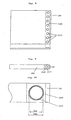
- An example of such spot fusion is shown in Fig. 7.
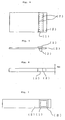
- An example of such streaks fusion is shown in Figs. 4 and 5.
- the dry analysis kit according to Embodiment 1 can be prepared by, for example, impregnating filter paper with a reagent capable of color formation upon specific reaction with a substance under analysis in a liquid specimen, drying the impregnated filter paper to obtain a reagent layer, putting the reagent layer on a polyethylene terephthalate plate as a supporting base plate, and imposing pressure while applying ultrasonic waves, whereby the molten polyethylene terephthalate of the supporting base plate side bites the reagent layer to achieve complete fixation through what we call an anchoring effect.
- the reagent layer is prepared by, for example, coating a thin polyethylene terephthalate film with a kneaded mixture of a reagent capable of color formation upon specific reaction with a substance under analysis contained in a liquid specimen and a polymer binder, followed by drying.
- the reagent layer is put on a base made of a non-thermoplastic porous matrix, such as filter paper, and subjected to ultrasonication. It is the surface of the reagent layer thin film in contact with the base that is melted by ultrasonication.
- the molten polyethylene terephthalate bites the supporting base plate to achieve complete fixation through a so-called anchoring effect.
- the thin polyethylene terephthalate film used for providing a reagent layer can have a thickness of 50 to 150 ⁇ m, which is usually used in the art.
- the dry analysis kit according to Embodiment 2 can be prepared by, for example, coating a thin polyethylene terephthalate film with a kneaded mixture of a reagent capable of color formation upon specific reaction with a substance under analysis contained in a liquid specimen and a polymer binder, followed by drying to prepare a reagent layer, putting the reagent layer on a polyethylene terephthalate plate, and imposing pressure while applying ultrasonic waves.
- the molten polyethylene terephthalate of the reagent layer side and that of the base side are brought into contact and thus integrated. On temperature drop, the both are completely fixed together.
- Embodiment 3 in using a supporting base plate made of a thermoplastic resin, the molten resin of a reagent layer is integrated with a similarly ultrasonication-molten resin of the supporting base plate and thus fixed thereto.
- the molten resin of a reagent layer bites into the pores of a supporting base plate to achieve fixation through a so-called anchoring effect.
- a reagent layer and a supporting base plate are superposed, and torsional ultrasonic vibration and a pressure are applied for several 10 -1 seconds.
- the torsional ultrasonic vibration having a frequency of 40 kHz and a pressure of 60 to 80 kg/cm 2 are preferable.
- the ultrasonic vibration was then stopped, and the pressure application is continued for an additional period of several 10 -1 seconds and then the pressure is removed.
- the reagent layer and the supporting base plate can thus be fixed together.
- thermoplastic resin film has a thickness of 10 to 50 ⁇ m.
- Embodiment 4 of the present invention is a method for preparing a peel type test piece comprising a supporting base plate having thereon a reagent layer and further having thereon a releasable film layer having a sample measuring function.
- the material of each layer will be specified later.
- thermoplastic resin layer and a porous matrix made of a non-thermoplastic material are adjacent to each other, it is an essential condition that the thermoplastic resin on the surface section of the former layer is melted by ultrasonic waves and the molten resin is made to bite the pores of the latter layer to achieve fixation by a so-called anchoring effect.
- two adjacent layers are both made of a thermoplastic resin and the surface resin of both the two layers is melted, it is an essential condition that the resins on the surface of the two layers are integrated into one body to achieve fixation.
- thermoplastic resins it is essential that (1) all of them are made of thermoplastic resins, (2) two of them are made of thermoplastic resins, with the remaining one being a porous matrix made of non-thermoplastic material, or (3) the intermediate one of them is made of a thermoplastic resin, with the upper and lower layers being a porous matrix made of non-thermoplastic material.
- the peel type test piece of the present invention using a porous matrix as reagent layer embraces the following layer structures.
- the film layer is a matrix having a plurality of pores for securing an ability of filtering blood or an ability of retaining liquid.
- the film layer itself does not have pores but is equipped with a part having an ability of measuring out a specimen or retaining a specimen.
- a dry analysis kit for the detection of occult blood in urine was prepared as an example according to the following prescription.
- Second impregnating solution Potassium hydrogenphthalate buffer (0.5 M; pH 5.3) 150 ml Ethanol 100 ml Sodium lauryl sulfate 200 mg Ethylenediaminetetraacetic Acid Disodium Salt 20 mg Cumene hydroperoxide 20 ml Second impregnating solution: Ethanol 80 ml.
- Xylene 120 ml 7-Methylquinoline 1 ml 3,3',5,5'-Tetramethylbenzidine 1 g
- Porous matrix 2Chr Filter Paper produced by Whatman Base: 0.3 mm thick PET film
- the porous matrix was dipped in the first impregnating solution prepared according to the above formulation and dried, and subsequently dipped in the second impregnating solution and dried to obtain a reagent layer.
- the resulting reagent layer was placed on the base, and ultrasonic vibration at a frequency of 20 kHz and a pressure of 70 kg/cm 2 were applied thereto for 0.2 second. The ultrasonication was stopped, and pressure application was continued for an additional period of 0.2 second and removed.
- the ultrasonic vibration was applied in streaks.
- the fusion condition is shown in Figs. 4 and 5.
- the porous matrix having the reagent thus fixed thereto was slit to prescribed widths of 5 mm to obtain dry analysis kits as shown in Fig. 6.
- a reagent layer prepared according to the same formulation as in Example 1 was adhered to the base via a double-sided adhesive tape and cut to a prescribed size to obtain dry analysis kits.
- Each of the dry analysis kits prepared above was put in a glass bottle and sealed together with a desiccant.
- the glass bottle was preserved at 50°C for a prescribed period of time to conduct an accelerated test.
- two beforehand prepared control urine preparations having different hemoglobin levels (0 mg/dl, designated preparation 1; and 0.2 mg/dl, designated preparation 2) were analyzed by means of an exclusive reflective photometer (spectral differential colorimeter SZ- ⁇ 80, manufactured by Nippon Denshoku Kogyo K.K.). The results obtained are shown in Table 1 below.
- the reduction in stability is caused by the influences of components contained in the double-sided adhesive tape which make the analytical composition instable, such as an organic solvent and a plasticizer.
- the reagent layer fixed by ultrasonic fusion is not influenced by such components nor by the heat of fusion.
- a reagent layer prepared and cut into strips in the same manner as in Example 1 but not fixed on a supporting base plate was prepared as a dry analysis kit and compared with the dry analysis kit of the present invention in the case where all the contact area between a reagent layer and a base plate.
- a beforehand prepared control urine preparation having a hemoglobin level of 0.2 mg/dl was analyzed as a specimen by means of an exclusive reflective photometer. Measurement was made 5 times for each dry analysis kit, and the results obtained are shown in Table 2 below. Reflectance (R%) 1 2 3 4 5 Average Ultrasonic fused dry analysis kit 19.5 20.2 18.5 17.3 19.5 19.0 Dry analysis kit with no supporting base plate 18.3 16.8 19.2 18.9 19.3 18.5
- a dry analysis kit for the detection of nitrites in urine was prepared as an example according to the following prescription.
- a coating composition was prepared according to the above formulation and applied to the film with a coating machine to a thickness of 400 ⁇ m and dried in hot air to prepare a reagent layer (reagent layer (10)).
- Reagent layer (10) was placed on base (9), and torsional ultrasonic vibration at a frequency of 40 kHz and a pressure of 70 kg/cm 2 were applied thereto for 0.2 second. The vibration was ceased, and pressure application was continued for an additional period of 0.2 second and then released.
- the ultrasonic oscillation horn used had a cylindrical shape having an outer diameter of 6 mm and an inner diameter of 4 mm.
- the reagent layer was fixed by fusion in a circle in the peripheral portion thereof so as to avoid the central portion.
- the circle had an outer diameter of 6 mm and an inner diameter of 4 mm.
- the dry analysis kit On being dipped in nitrite-containing urine, the dry analysis kit satisfactorily assumed a red color in accordance with the nitrite content.
- a peel type test piece was prepared as an example according to the following technique.
- a 7 mm wide reagent layer tape and a 10 mm wide film layer tape were placed on a 70 mm x 360 mm base in the order described as shown in Fig. 11.
- Ultrasonic vibration having a frequency of 20 kHz and a pressure of 70 kg/cm 2 were imposed to the base side for 0.2 second. After stopping application of ultrasonic vibration, pressure application was further continued for an additional period of 0.2 second and then released. The ultrasonic and pressure application was made in a streak form.
- the fixed part is shown by reference number (15) in Fig. 11. Thereafter, the fixed layers were cut to 7 mm widths to obtain peel type test pieces shown in Fig. 12.
- test pieces Twenty test pieces were prepared. The film layer of each test piece was spotted with 10 ⁇ l of blue ink (aqueous ink for fountain pen) and wiped immediately after spotting. Sixty seconds later, the sample measuring layer (film layer) was peeled off.
- blue ink aqueous ink for fountain pen
- the method of the present invention uses no adhesive (a double-sided adhesive tape, a hot-melt adhesive, etc.), no chemical influence is exerted on a reagent, and improvement in performance can be expected. Neither does the reagent undergo physical damage due to adhesion of a paste adhesive, etc. To use no adhesive results in cost reduction. From the standpoint of productive equipment, because a cheap ultrasonic oscillator may be used, the machinery can be made simpler and less expensive, and the steps involved are simplified, thus realizing reduction of production cost.
- the method of the present invention achieves ultrasonic fusion securely.
- the present invention makes it possible to fix three layers at a time without the aid of an adhesive while giving a difference between interfaces in interlaminar strength to prepare a peel type test piece. That is, the present invention provides quite a new method for preparing a peel type test piece, which method is free from the disadvantages associated with conventional techniques while making effective use of all the advantages of ultrasonic fusion.
Landscapes
- Engineering & Computer Science (AREA)
- Mechanical Engineering (AREA)
- Life Sciences & Earth Sciences (AREA)
- Health & Medical Sciences (AREA)
- Hematology (AREA)
- Immunology (AREA)
- Chemical & Material Sciences (AREA)
- Urology & Nephrology (AREA)
- Biomedical Technology (AREA)
- Molecular Biology (AREA)
- Food Science & Technology (AREA)
- General Health & Medical Sciences (AREA)
- Cell Biology (AREA)
- Medicinal Chemistry (AREA)
- Physics & Mathematics (AREA)
- Analytical Chemistry (AREA)
- Biochemistry (AREA)
- Microbiology (AREA)
- General Physics & Mathematics (AREA)
- Pathology (AREA)
- Biotechnology (AREA)
- Wood Science & Technology (AREA)
- Composite Materials (AREA)
- Investigating Or Analyzing Non-Biological Materials By The Use Of Chemical Means (AREA)
- Investigating Or Analysing Biological Materials (AREA)
Description
- (1)
- Reagent layer of Embodiment 1 (porous matrix coated or impregnated with a reagent) or Embodiment 3 (very thin layer coated with a reagent)
- (2)
- Base (thermoplastic resin plate or a porous matrix made of non-thermoplastic material)
- (3)
- Molten part of the base (resin)
- (4)
- Reagent layer of Embodiment 2 (thermoplastic resin film coated with a reagent)
- (5)
- Base (thermoplastic resin plate)
- (6)
- The molten parts of (4) and (5)
- (7)
- Fusion bonded part (streaks)
- (8)
- Fusion bonded part (spots avoiding the central portion of a reagent layer).
- (9)
- Supporting base plate (base)
- (10)
- Reagent layer (very thin thermoplastic resin film)
- (11)
- Fusion bonded part.
- (12)
- Supporting base plate (base)
- (13)
- Reagent layer (porous matrix)
- (14)
- Film layer
- (15)
- Ultrasonic fusion bonded part (streak).
| First impregnating solution: | |
| Potassium hydrogenphthalate buffer (0.5 M; pH 5.3) | 150 ml |
| Ethanol | 100 ml |
| Sodium lauryl sulfate | 200 mg |
| Ethylenediaminetetraacetic Acid Disodium Salt | 20 mg |
| Cumene hydroperoxide | 20 ml |
| Second impregnating solution: | |
| Ethanol | 80 ml. |
| Xylene | 120 ml |
| 7- |
1 |
| 3,3',5,5'-Tetramethylbenzidine | 1 g |
| Porous matrix: 2Chr Filter Paper produced by Whatman | |
| Base: 0.3 mm thick PET film |
| Reflectance (R %) | ||||||
| Hemoglobin Level | ||||||
| (Preparation 1) 0 mg/dl | (Preparation 2) 0.2 mg/dl | |||||
| Days of Preservation | 0 (initial) | 7 | 14 | 0 (initial) | 7 | 14 |
| Ultrasonic Fusion | 97.4 | 96.0 | 94.5 | 19.0 | 20.8 | 22.2 |
| Double-sided Adhesive Tape | 97.8 | 89.2 | 81.8 | 18.8 | 35.7 | 48.2 |
| Reflectance (R%) | ||||||
| 1 | 2 | 3 | 4 | 5 | Average | |
| Ultrasonic fused dry analysis kit | 19.5 | 20.2 | 18.5 | 17.3 | 19.5 | 19.0 |
| Dry analysis kit with no supporting base plate | 18.3 | 16.8 | 19.2 | 18.9 | 19.3 | 18.5 |
| d-Naphthylamine | 1.0 g |
| Sulfanilamide | 2.5 g |
| Trichloroacetic acid | 3.0 g |
| Polyvinyl butylacetal | 20.0 g |
| Methanol | 100 ml |
Thermoplastic resin film (used as reagent layer (10)) ... 1 cm wide and 20 µm thick PET film tape)
Ultrasonic oscillator ... 900 Series, Model 947M, manufactured by Emerson Japan Ltd.
0.3 mm thick white polyethylene terephthalate film, produced by Teijin Ltd. (shown by reference number (12) in Fig. 11)
0.3 mm thick filter paper, 3MMChr produced by Whatman (shown by reference number (13) in Fig. 11)
Claims (11)
- A method for fixing a reagent layer directly onto a supporting base plate in the preparation of a dry analysis kit for determining a specific component in a liquid specimen which comprises the steps ofwherein the reagent layer is a thermoplastic resin film having a thickness of 10 to 50 µm, and the base plate is non-thermoplastic material.placing the reagent layer in contact with the base plate and externally applying torsional ultrasonic vibration and pressure to the reagent layer and the base plate to generate functional heat thereby to melt the surface of the reagent layer,removing the torsional ultrasonic vibration,applying pressure to make the molten surface of the reagent layer bite the base plate, andremoving the pressure,
- A method for fixing a reagent layer directly onto a supporting base plate in the preparation of a dry analysis kit for determining a specific component in a liquid specimen which comprises the steps ofwherein the reagent layer is a thermoplastic resin film having a thickness of 10 to 50 µm, and the base plate is a thermoplastic resin.placing the reagent layer in contact with the base plate and externally applying torsional ultrasonic vibration and pressure to the reagent layer and the base plate to generate functional heat thereby to melt the surfaces of the reagent layer and the base plate,removing the torsional ultrasonic vibration,applying pressure to integrate the surfaces of the reagent layer and the base plate, andremoving the pressure,
- A method according to claim 1 wherein said base plate is a porous matrix.
- A method according to claim 1 or 2 wherein said thermoplastic resin is selected from polyethylene terephthalate, polycarbonate, polypropylene, polyethylene, polystyrene, polyvinyl acetate, polyvinyl chloride and a cellulose ester.
- A method according to claim 3 wherein said porous matrix is selected from paper (filter), wood, non-woven fabric such as a membrane filter, woven fabric, knit fabric, glass such as glass fiber filter, a sinter, ceramics such as porous ceramic sheet, metal cloth and polymer microbeads.
- A method according to claim 1 or 2, wherein said reagent layer and said base plate are fusion bonded not over the entire surface of the reagent layer but at a plurality of spots.
- A method for preparing a peel type test piece for dry analysis for determining a specific component in a liquid specimen comprising a supporting base plate having thereon a reagent layer comprising a porous matrix impregnated with a reagent and further having thereon a releasable film layer having a function of filtering out corpuscles, the releasable film layer being to be stripped after application of a specimen to observe coloration of the reagent layer, said base plate, said reagent layer, and said film layer are made of either a thermoplastic resin or a porous matrix made of non-thermoplastic material in such a manner that a layer made of a porous matrix made of non-thermoplastic material may not be adjacent to another layer made of a porous matrix made of non-thermoplastic material which comprises the steps of:superposing the reagent layer and the film layer on the supporting base plate in this order in mutual contact and applying ultrasonic vibration from the supporting base plate side;removing the ultrasonic vibration;applying pressure to make the surface of a molten layer bite the surface of an adjacent non-molten layer or to integrate the surface material of a molten layer with the surface of an adjacent layer; andremoving the pressure.
- A method according to claim 7 wherein said film layer has a plurality of pores and has itself a measuring function or is equipped with a sample measuring part.
- A method according to claim 7 wherein said thermoplastic resin is selected from polyethylene terephthalate, polycarbonate, polypropylene, polyethylene, polystyrene, polyvinyl acetate, polyvinyl chloride and a cellulose ester.
- A method according to claim 7 wherein said porous matrix made of non-thermoplastic material is selected from paper (filter), wood, non-woven fabric such as a membrane filter, woven fabric, knit fabric, glass such as glass fiber filter, a sinter, ceramics such as porous ceramic sheet, metal cloth and polymer microbeads.
- A method according to claim 7 wherein the support base plate, the reagent layer and the releasable film layer are bonded to each other in a streaky manner, or at a plurality of discrete points.
Applications Claiming Priority (9)
| Application Number | Priority Date | Filing Date | Title |
|---|---|---|---|
| JP5964395 | 1995-02-10 | ||
| JP59643/95 | 1995-02-10 | ||
| JP05964395A JP3438050B2 (en) | 1995-02-10 | 1995-02-10 | Direct fixation of reagent layer by ultrasonic |
| JP08064895A JP3624201B2 (en) | 1995-03-01 | 1995-03-01 | Direct fixation of reagent layer by torsional ultrasound |
| JP80648/95 | 1995-03-01 | ||
| JP8064895 | 1995-03-01 | ||
| JP10990195 | 1995-03-30 | ||
| JP10990195A JP3438842B2 (en) | 1995-03-30 | 1995-03-30 | Method of making peelable test piece |
| JP109901/95 | 1995-03-30 |
Publications (2)
| Publication Number | Publication Date |
|---|---|
| EP0726461A1 EP0726461A1 (en) | 1996-08-14 |
| EP0726461B1 true EP0726461B1 (en) | 2005-10-19 |
Family
ID=27296950
Family Applications (1)
| Application Number | Title | Priority Date | Filing Date |
|---|---|---|---|
| EP96101847A Expired - Lifetime EP0726461B1 (en) | 1995-02-10 | 1996-02-08 | Ultrasonic direct fixing of reagent layer and method for preparing peel type test piece |
Country Status (3)
| Country | Link |
|---|---|
| US (2) | US5846359A (en) |
| EP (1) | EP0726461B1 (en) |
| DE (1) | DE69635291T2 (en) |
Cited By (1)
| Publication number | Priority date | Publication date | Assignee | Title |
|---|---|---|---|---|
| US8480941B2 (en) | 2008-03-13 | 2013-07-09 | Fraunhofer-Gesellschaft zur Förderung der angewandten Forschung e.V. | Method for producing a 3-dimensional molded body comprising polymer-containing material and a method for producing an adhesive bond between a polymer-containing material and a three-dimensional molded body |
Families Citing this family (7)
| Publication number | Priority date | Publication date | Assignee | Title |
|---|---|---|---|---|
| US5846359A (en) * | 1995-02-10 | 1998-12-08 | Kyoto Daiichi Kagaku Co., Ltd. | Ultrasonic direct fixing of reagent layer and method for preparing peel type test piece |
| GB9801983D0 (en) * | 1998-01-30 | 1998-03-25 | Young Michael J R | Welding polymer fabrics using ultrasound |
| CN1277670C (en) * | 2002-01-09 | 2006-10-04 | 旭化成医疗株式会社 | Welding of non-porous body and porous body |
| US7972866B2 (en) * | 2007-06-18 | 2011-07-05 | Nipro Diagnostics, Inc. | Biosensor and ultrasonic method of making a biosensor |
| JP5793075B2 (en) | 2009-04-09 | 2015-10-14 | アークレイ株式会社 | Specimen analysis tool, method for producing specimen analysis tool, and method for suppressing liquid permeability reduction of deployment member |
| EP2269807A1 (en) * | 2009-06-30 | 2011-01-05 | Telsonic Holding AG | Device, use of the device and method for torsional ultrasound welding |
| AU2017212742A1 (en) | 2016-01-27 | 2018-07-26 | Undercover Colors, Inc. | Wearable apparatus for detecting a target substance in a liquid |
Family Cites Families (8)
| Publication number | Priority date | Publication date | Assignee | Title |
|---|---|---|---|---|
| US3505136A (en) * | 1966-09-19 | 1970-04-07 | Union Special Machine Co | Method and apparatus for bonding thermoplastic sheet materials |
| DE2118455B1 (en) * | 1971-04-16 | 1972-09-21 | Boehringer Mannheim Gmbh | Test strips |
| JPS536551A (en) * | 1976-07-07 | 1978-01-21 | Matsushita Electric Ind Co Ltd | Piezo electric vibrator |
| JPS60113133A (en) * | 1983-11-24 | 1985-06-19 | Konishiroku Photo Ind Co Ltd | Production of slide for chemical analysis |
| US4776904A (en) * | 1985-07-19 | 1988-10-11 | Miles Inc. | Multilayer analytical element and method of making, using ultrasonic or laser energy |
| JPS6427928A (en) * | 1987-07-24 | 1989-01-30 | Terumo Corp | Ultrasonic fusion welding of sheet material |
| JP2869273B2 (en) * | 1992-06-20 | 1999-03-10 | 三洋電機株式会社 | Seek control device |
| US5846359A (en) * | 1995-02-10 | 1998-12-08 | Kyoto Daiichi Kagaku Co., Ltd. | Ultrasonic direct fixing of reagent layer and method for preparing peel type test piece |
-
1996
- 1996-02-08 US US08/598,528 patent/US5846359A/en not_active Expired - Fee Related
- 1996-02-08 DE DE69635291T patent/DE69635291T2/en not_active Expired - Fee Related
- 1996-02-08 EP EP96101847A patent/EP0726461B1/en not_active Expired - Lifetime
-
1998
- 1998-09-21 US US09/157,530 patent/US6022433A/en not_active Expired - Lifetime
Cited By (1)
| Publication number | Priority date | Publication date | Assignee | Title |
|---|---|---|---|---|
| US8480941B2 (en) | 2008-03-13 | 2013-07-09 | Fraunhofer-Gesellschaft zur Förderung der angewandten Forschung e.V. | Method for producing a 3-dimensional molded body comprising polymer-containing material and a method for producing an adhesive bond between a polymer-containing material and a three-dimensional molded body |
Also Published As
| Publication number | Publication date |
|---|---|
| DE69635291D1 (en) | 2005-11-24 |
| US6022433A (en) | 2000-02-08 |
| EP0726461A1 (en) | 1996-08-14 |
| DE69635291T2 (en) | 2006-08-10 |
| US5846359A (en) | 1998-12-08 |
Similar Documents
| Publication | Publication Date | Title |
|---|---|---|
| CA1267596A (en) | Multilayer analytical element and method of making, using ultrasonic or laser energy | |
| US4631174A (en) | Multilayer chemical analysis member having an outer waterproof layer | |
| CA1115186A (en) | Multilayered test device for determining the presence of a liquid sample component, and method of use | |
| US5260221A (en) | Sample pad assay initiation device | |
| US5409664A (en) | Laminated assay device | |
| US4959324A (en) | Sample pad assay initiation device and method of making | |
| US4780280A (en) | Test carrier | |
| EP0238012B1 (en) | Element for immunoassay and process of using the same | |
| JP3542999B2 (en) | Biosensor and manufacturing method thereof | |
| JPS63274839A (en) | Test device with volumetric capillary gap | |
| MXPA97005534A (en) | Diagnostic test carrier with multiple layer test field and method in which it is used to determine an analyst or substance going to anali | |
| US5958339A (en) | Format for immunoassay in thin film | |
| US5340539A (en) | Non-instrumented cholesterol assay | |
| JP3476828B2 (en) | Multilayer test device and method for assaying fructosamine | |
| US5846359A (en) | Ultrasonic direct fixing of reagent layer and method for preparing peel type test piece | |
| RU2278612C2 (en) | Immune sensor | |
| CA2590925A1 (en) | Automated immunoassay cassette, apparatus and method | |
| EP0427534B1 (en) | Improvement in non-instrumental diagnostic assay distance determination | |
| WO1994012879A1 (en) | Dry reagent three element analyte detection system | |
| JP3438050B2 (en) | Direct fixation of reagent layer by ultrasonic | |
| JP3624201B2 (en) | Direct fixation of reagent layer by torsional ultrasound | |
| JPS61245058A (en) | Reagent test device with sealed reagent matrix and method for manufacturing the same | |
| JP2005257468A (en) | Biosensor | |
| JPH0526876A (en) | Dry process analysis element for analyzing whole blood sample | |
| JP3147560B2 (en) | Multi-item analysis method |
Legal Events
| Date | Code | Title | Description |
|---|---|---|---|
| PUAI | Public reference made under article 153(3) epc to a published international application that has entered the european phase |
Free format text: ORIGINAL CODE: 0009012 |
|
| AK | Designated contracting states |
Kind code of ref document: A1 Designated state(s): DE FR GB IT |
|
| 17P | Request for examination filed |
Effective date: 19961007 |
|
| 17Q | First examination report despatched |
Effective date: 19990705 |
|
| GRAP | Despatch of communication of intention to grant a patent |
Free format text: ORIGINAL CODE: EPIDOSNIGR1 |
|
| GRAS | Grant fee paid |
Free format text: ORIGINAL CODE: EPIDOSNIGR3 |
|
| GRAA | (expected) grant |
Free format text: ORIGINAL CODE: 0009210 |
|
| AK | Designated contracting states |
Kind code of ref document: B1 Designated state(s): DE FR GB IT |
|
| REG | Reference to a national code |
Ref country code: GB Ref legal event code: FG4D |
|
| REF | Corresponds to: |
Ref document number: 69635291 Country of ref document: DE Date of ref document: 20051124 Kind code of ref document: P |
|
| REG | Reference to a national code |
Ref country code: FR Ref legal event code: CD |
|
| ET | Fr: translation filed | ||
| PLBE | No opposition filed within time limit |
Free format text: ORIGINAL CODE: 0009261 |
|
| STAA | Information on the status of an ep patent application or granted ep patent |
Free format text: STATUS: NO OPPOSITION FILED WITHIN TIME LIMIT |
|
| 26N | No opposition filed |
Effective date: 20060720 |
|
| PGFP | Annual fee paid to national office [announced via postgrant information from national office to epo] |
Ref country code: DE Payment date: 20090219 Year of fee payment: 14 |
|
| PGFP | Annual fee paid to national office [announced via postgrant information from national office to epo] |
Ref country code: GB Payment date: 20090219 Year of fee payment: 14 |
|
| PGFP | Annual fee paid to national office [announced via postgrant information from national office to epo] |
Ref country code: IT Payment date: 20090221 Year of fee payment: 14 |
|
| PGFP | Annual fee paid to national office [announced via postgrant information from national office to epo] |
Ref country code: FR Payment date: 20090213 Year of fee payment: 14 |
|
| GBPC | Gb: european patent ceased through non-payment of renewal fee |
Effective date: 20100208 |
|
| REG | Reference to a national code |
Ref country code: FR Ref legal event code: ST Effective date: 20101029 |
|
| PG25 | Lapsed in a contracting state [announced via postgrant information from national office to epo] |
Ref country code: FR Free format text: LAPSE BECAUSE OF NON-PAYMENT OF DUE FEES Effective date: 20100301 |
|
| PG25 | Lapsed in a contracting state [announced via postgrant information from national office to epo] |
Ref country code: DE Free format text: LAPSE BECAUSE OF NON-PAYMENT OF DUE FEES Effective date: 20100901 |
|
| PG25 | Lapsed in a contracting state [announced via postgrant information from national office to epo] |
Ref country code: GB Free format text: LAPSE BECAUSE OF NON-PAYMENT OF DUE FEES Effective date: 20100208 Ref country code: IT Free format text: LAPSE BECAUSE OF NON-PAYMENT OF DUE FEES Effective date: 20100208 |