EP0725676B1 - Dispersions of polydimethylsiloxanes - Google Patents
Dispersions of polydimethylsiloxanes Download PDFInfo
- Publication number
- EP0725676B1 EP0725676B1 EP94931999A EP94931999A EP0725676B1 EP 0725676 B1 EP0725676 B1 EP 0725676B1 EP 94931999 A EP94931999 A EP 94931999A EP 94931999 A EP94931999 A EP 94931999A EP 0725676 B1 EP0725676 B1 EP 0725676B1
- Authority
- EP
- European Patent Office
- Prior art keywords
- polydimethylsiloxane
- composition
- poloxamer surfactant
- microns
- nonionic poloxamer
- Prior art date
- Legal status (The legal status is an assumption and is not a legal conclusion. Google has not performed a legal analysis and makes no representation as to the accuracy of the status listed.)
- Expired - Lifetime
Links
- -1 polydimethylsiloxanes Polymers 0.000 title claims abstract description 87
- 229920000435 poly(dimethylsiloxane) Polymers 0.000 title claims abstract description 83
- 239000006185 dispersion Substances 0.000 title claims abstract description 27
- 235000013870 dimethyl polysiloxane Nutrition 0.000 title abstract description 45
- 239000004205 dimethyl polysiloxane Substances 0.000 claims abstract description 67
- 239000004094 surface-active agent Substances 0.000 claims abstract description 49
- RVGRUAULSDPKGF-UHFFFAOYSA-N Poloxamer Chemical compound C1CO1.CC1CO1 RVGRUAULSDPKGF-UHFFFAOYSA-N 0.000 claims abstract description 39
- 229920001983 poloxamer Polymers 0.000 claims abstract description 35
- 229960000502 poloxamer Drugs 0.000 claims abstract description 33
- 239000002245 particle Substances 0.000 claims abstract description 26
- XLYOFNOQVPJJNP-UHFFFAOYSA-N water Substances O XLYOFNOQVPJJNP-UHFFFAOYSA-N 0.000 claims abstract description 21
- 239000006184 cosolvent Substances 0.000 claims abstract description 6
- 239000000758 substrate Substances 0.000 claims abstract description 5
- 239000002356 single layer Substances 0.000 claims abstract description 4
- 239000000203 mixture Substances 0.000 claims description 50
- 239000007788 liquid Substances 0.000 claims description 15
- 239000000126 substance Substances 0.000 claims description 11
- 125000002496 methyl group Chemical group [H]C([H])([H])* 0.000 claims description 8
- VTYYLEPIZMXCLO-UHFFFAOYSA-L Calcium carbonate Chemical class [Ca+2].[O-]C([O-])=O VTYYLEPIZMXCLO-UHFFFAOYSA-L 0.000 claims description 7
- 229940069428 antacid Drugs 0.000 claims description 7
- 239000003159 antacid agent Substances 0.000 claims description 7
- 230000001458 anti-acid effect Effects 0.000 claims description 7
- 238000000034 method Methods 0.000 claims description 7
- 229920001400 block copolymer Polymers 0.000 claims description 6
- LFQSCWFLJHTTHZ-UHFFFAOYSA-N Ethanol Chemical compound CCO LFQSCWFLJHTTHZ-UHFFFAOYSA-N 0.000 claims description 5
- 229910007161 Si(CH3)3 Inorganic materials 0.000 claims description 5
- 239000003795 chemical substances by application Substances 0.000 claims description 5
- 229920002503 polyoxyethylene-polyoxypropylene Polymers 0.000 claims description 5
- 239000007787 solid Substances 0.000 claims description 5
- 239000000606 toothpaste Substances 0.000 claims description 5
- QVGXLLKOCUKJST-UHFFFAOYSA-N atomic oxygen Chemical group [O] QVGXLLKOCUKJST-UHFFFAOYSA-N 0.000 claims description 4
- 239000000314 lubricant Substances 0.000 claims description 4
- 239000004014 plasticizer Substances 0.000 claims description 4
- 241000628997 Flos Species 0.000 claims description 3
- 235000015218 chewing gum Nutrition 0.000 claims description 3
- 235000009508 confectionery Nutrition 0.000 claims description 3
- 239000002537 cosmetic Substances 0.000 claims description 3
- 239000002324 mouth wash Substances 0.000 claims description 3
- 229940034610 toothpaste Drugs 0.000 claims description 3
- 229940112822 chewing gum Drugs 0.000 claims description 2
- 230000009969 flowable effect Effects 0.000 claims description 2
- 239000007789 gas Substances 0.000 claims description 2
- 239000006072 paste Substances 0.000 claims description 2
- 238000002525 ultrasonication Methods 0.000 claims description 2
- 238000010438 heat treatment Methods 0.000 claims 1
- 238000004519 manufacturing process Methods 0.000 claims 1
- 239000000839 emulsion Substances 0.000 abstract description 23
- 239000004530 micro-emulsion Substances 0.000 abstract description 18
- 238000000576 coating method Methods 0.000 abstract description 10
- 238000009826 distribution Methods 0.000 abstract description 5
- 239000000243 solution Substances 0.000 abstract description 4
- 230000000704 physical effect Effects 0.000 abstract 1
- 239000002736 nonionic surfactant Substances 0.000 description 11
- 239000012071 phase Substances 0.000 description 7
- 239000011248 coating agent Substances 0.000 description 6
- 239000002518 antifoaming agent Substances 0.000 description 5
- VYPSYNLAJGMNEJ-UHFFFAOYSA-N Silicium dioxide Chemical compound O=[Si]=O VYPSYNLAJGMNEJ-UHFFFAOYSA-N 0.000 description 4
- 230000000694 effects Effects 0.000 description 4
- 239000000375 suspending agent Substances 0.000 description 4
- 239000012530 fluid Substances 0.000 description 3
- 229920000642 polymer Polymers 0.000 description 3
- 229920001296 polysiloxane Polymers 0.000 description 3
- 229920004511 Dow Corning® 200 Fluid Polymers 0.000 description 2
- KFZMGEQAYNKOFK-UHFFFAOYSA-N Isopropanol Chemical compound CC(C)O KFZMGEQAYNKOFK-UHFFFAOYSA-N 0.000 description 2
- 239000008199 coating composition Substances 0.000 description 2
- 150000001875 compounds Chemical class 0.000 description 2
- AMTWCFIAVKBGOD-UHFFFAOYSA-N dioxosilane;methoxy-dimethyl-trimethylsilyloxysilane Chemical compound O=[Si]=O.CO[Si](C)(C)O[Si](C)(C)C AMTWCFIAVKBGOD-UHFFFAOYSA-N 0.000 description 2
- 238000012377 drug delivery Methods 0.000 description 2
- 239000010410 layer Substances 0.000 description 2
- 239000007791 liquid phase Substances 0.000 description 2
- 239000006082 mold release agent Substances 0.000 description 2
- 229920001993 poloxamer 188 Polymers 0.000 description 2
- 239000000377 silicon dioxide Substances 0.000 description 2
- 229940083037 simethicone Drugs 0.000 description 2
- 239000002904 solvent Substances 0.000 description 2
- 229920005682 EO-PO block copolymer Polymers 0.000 description 1
- 229920002359 Tetronic® Polymers 0.000 description 1
- 239000000654 additive Substances 0.000 description 1
- 238000013019 agitation Methods 0.000 description 1
- 230000003444 anaesthetic effect Effects 0.000 description 1
- 239000003945 anionic surfactant Substances 0.000 description 1
- 238000010923 batch production Methods 0.000 description 1
- 230000015572 biosynthetic process Effects 0.000 description 1
- 239000008280 blood Substances 0.000 description 1
- 210000004369 blood Anatomy 0.000 description 1
- 239000012459 cleaning agent Substances 0.000 description 1
- 238000010924 continuous production Methods 0.000 description 1
- 239000004148 curcumin Substances 0.000 description 1
- 239000010730 cutting oil Substances 0.000 description 1
- 239000012895 dilution Substances 0.000 description 1
- 238000010790 dilution Methods 0.000 description 1
- 239000003974 emollient agent Substances 0.000 description 1
- 238000004945 emulsification Methods 0.000 description 1
- 239000003995 emulsifying agent Substances 0.000 description 1
- 238000005516 engineering process Methods 0.000 description 1
- 239000003623 enhancer Substances 0.000 description 1
- 230000005183 environmental health Effects 0.000 description 1
- BEFDCLMNVWHSGT-UHFFFAOYSA-N ethenylcyclopentane Chemical compound C=CC1CCCC1 BEFDCLMNVWHSGT-UHFFFAOYSA-N 0.000 description 1
- 239000010419 fine particle Substances 0.000 description 1
- 210000003128 head Anatomy 0.000 description 1
- 238000000265 homogenisation Methods 0.000 description 1
- 239000004615 ingredient Substances 0.000 description 1
- 238000002156 mixing Methods 0.000 description 1
- 210000000214 mouth Anatomy 0.000 description 1
- QIQXTHQIDYTFRH-UHFFFAOYSA-N octadecanoic acid Chemical compound CCCCCCCCCCCCCCCCCC(O)=O QIQXTHQIDYTFRH-UHFFFAOYSA-N 0.000 description 1
- 239000003921 oil Substances 0.000 description 1
- 239000003973 paint Substances 0.000 description 1
- 229920001992 poloxamer 407 Polymers 0.000 description 1
- 239000011148 porous material Substances 0.000 description 1
- 239000002453 shampoo Substances 0.000 description 1
- 229940075582 sorbic acid Drugs 0.000 description 1
- 235000010199 sorbic acid Nutrition 0.000 description 1
- 239000004334 sorbic acid Substances 0.000 description 1
- 238000009495 sugar coating Methods 0.000 description 1
- 239000002700 tablet coating Substances 0.000 description 1
- 238000009492 tablet coating Methods 0.000 description 1
- 230000000699 topical effect Effects 0.000 description 1
- 238000009736 wetting Methods 0.000 description 1
Images
Classifications
-
- C—CHEMISTRY; METALLURGY
- C08—ORGANIC MACROMOLECULAR COMPOUNDS; THEIR PREPARATION OR CHEMICAL WORKING-UP; COMPOSITIONS BASED THEREON
- C08J—WORKING-UP; GENERAL PROCESSES OF COMPOUNDING; AFTER-TREATMENT NOT COVERED BY SUBCLASSES C08B, C08C, C08F, C08G or C08H
- C08J3/00—Processes of treating or compounding macromolecular substances
- C08J3/02—Making solutions, dispersions, lattices or gels by other methods than by solution, emulsion or suspension polymerisation techniques
- C08J3/03—Making solutions, dispersions, lattices or gels by other methods than by solution, emulsion or suspension polymerisation techniques in aqueous media
-
- A—HUMAN NECESSITIES
- A61—MEDICAL OR VETERINARY SCIENCE; HYGIENE
- A61K—PREPARATIONS FOR MEDICAL, DENTAL OR TOILETRY PURPOSES
- A61K8/00—Cosmetics or similar toiletry preparations
- A61K8/02—Cosmetics or similar toiletry preparations characterised by special physical form
- A61K8/04—Dispersions; Emulsions
- A61K8/06—Emulsions
-
- A—HUMAN NECESSITIES
- A61—MEDICAL OR VETERINARY SCIENCE; HYGIENE
- A61K—PREPARATIONS FOR MEDICAL, DENTAL OR TOILETRY PURPOSES
- A61K8/00—Cosmetics or similar toiletry preparations
- A61K8/18—Cosmetics or similar toiletry preparations characterised by the composition
- A61K8/72—Cosmetics or similar toiletry preparations characterised by the composition containing organic macromolecular compounds
- A61K8/84—Cosmetics or similar toiletry preparations characterised by the composition containing organic macromolecular compounds obtained by reactions otherwise than those involving only carbon-carbon unsaturated bonds
- A61K8/89—Polysiloxanes
- A61K8/891—Polysiloxanes saturated, e.g. dimethicone, phenyl trimethicone, C24-C28 methicone or stearyl dimethicone
-
- A—HUMAN NECESSITIES
- A61—MEDICAL OR VETERINARY SCIENCE; HYGIENE
- A61K—PREPARATIONS FOR MEDICAL, DENTAL OR TOILETRY PURPOSES
- A61K8/00—Cosmetics or similar toiletry preparations
- A61K8/18—Cosmetics or similar toiletry preparations characterised by the composition
- A61K8/72—Cosmetics or similar toiletry preparations characterised by the composition containing organic macromolecular compounds
- A61K8/90—Block copolymers
-
- A—HUMAN NECESSITIES
- A61—MEDICAL OR VETERINARY SCIENCE; HYGIENE
- A61Q—SPECIFIC USE OF COSMETICS OR SIMILAR TOILETRY PREPARATIONS
- A61Q11/00—Preparations for care of the teeth, of the oral cavity or of dentures; Dentifrices, e.g. toothpastes; Mouth rinses
-
- C—CHEMISTRY; METALLURGY
- C08—ORGANIC MACROMOLECULAR COMPOUNDS; THEIR PREPARATION OR CHEMICAL WORKING-UP; COMPOSITIONS BASED THEREON
- C08L—COMPOSITIONS OF MACROMOLECULAR COMPOUNDS
- C08L83/00—Compositions of macromolecular compounds obtained by reactions forming in the main chain of the macromolecule a linkage containing silicon with or without sulfur, nitrogen, oxygen or carbon only; Compositions of derivatives of such polymers
- C08L83/04—Polysiloxanes
-
- C—CHEMISTRY; METALLURGY
- C09—DYES; PAINTS; POLISHES; NATURAL RESINS; ADHESIVES; COMPOSITIONS NOT OTHERWISE PROVIDED FOR; APPLICATIONS OF MATERIALS NOT OTHERWISE PROVIDED FOR
- C09K—MATERIALS FOR MISCELLANEOUS APPLICATIONS, NOT PROVIDED FOR ELSEWHERE
- C09K23/00—Use of substances as emulsifying, wetting, dispersing, or foam-producing agents
- C09K23/42—Ethers, e.g. polyglycol ethers of alcohols or phenols
-
- C—CHEMISTRY; METALLURGY
- C11—ANIMAL OR VEGETABLE OILS, FATS, FATTY SUBSTANCES OR WAXES; FATTY ACIDS THEREFROM; DETERGENTS; CANDLES
- C11D—DETERGENT COMPOSITIONS; USE OF SINGLE SUBSTANCES AS DETERGENTS; SOAP OR SOAP-MAKING; RESIN SOAPS; RECOVERY OF GLYCEROL
- C11D1/00—Detergent compositions based essentially on surface-active compounds; Use of these compounds as a detergent
- C11D1/66—Non-ionic compounds
- C11D1/76—Synthetic resins containing no nitrogen
-
- C—CHEMISTRY; METALLURGY
- C11—ANIMAL OR VEGETABLE OILS, FATS, FATTY SUBSTANCES OR WAXES; FATTY ACIDS THEREFROM; DETERGENTS; CANDLES
- C11D—DETERGENT COMPOSITIONS; USE OF SINGLE SUBSTANCES AS DETERGENTS; SOAP OR SOAP-MAKING; RESIN SOAPS; RECOVERY OF GLYCEROL
- C11D17/00—Detergent materials or soaps characterised by their shape or physical properties
- C11D17/0008—Detergent materials or soaps characterised by their shape or physical properties aqueous liquid non soap compositions
- C11D17/0017—Multi-phase liquid compositions
-
- C—CHEMISTRY; METALLURGY
- C11—ANIMAL OR VEGETABLE OILS, FATS, FATTY SUBSTANCES OR WAXES; FATTY ACIDS THEREFROM; DETERGENTS; CANDLES
- C11D—DETERGENT COMPOSITIONS; USE OF SINGLE SUBSTANCES AS DETERGENTS; SOAP OR SOAP-MAKING; RESIN SOAPS; RECOVERY OF GLYCEROL
- C11D3/00—Other compounding ingredients of detergent compositions covered in group C11D1/00
- C11D3/16—Organic compounds
- C11D3/37—Polymers
- C11D3/3703—Macromolecular compounds obtained otherwise than by reactions only involving carbon-to-carbon unsaturated bonds
- C11D3/3707—Polyethers, e.g. polyalkyleneoxides
-
- C—CHEMISTRY; METALLURGY
- C11—ANIMAL OR VEGETABLE OILS, FATS, FATTY SUBSTANCES OR WAXES; FATTY ACIDS THEREFROM; DETERGENTS; CANDLES
- C11D—DETERGENT COMPOSITIONS; USE OF SINGLE SUBSTANCES AS DETERGENTS; SOAP OR SOAP-MAKING; RESIN SOAPS; RECOVERY OF GLYCEROL
- C11D3/00—Other compounding ingredients of detergent compositions covered in group C11D1/00
- C11D3/16—Organic compounds
- C11D3/37—Polymers
- C11D3/3703—Macromolecular compounds obtained otherwise than by reactions only involving carbon-to-carbon unsaturated bonds
- C11D3/373—Macromolecular compounds obtained otherwise than by reactions only involving carbon-to-carbon unsaturated bonds containing silicones
-
- C—CHEMISTRY; METALLURGY
- C08—ORGANIC MACROMOLECULAR COMPOUNDS; THEIR PREPARATION OR CHEMICAL WORKING-UP; COMPOSITIONS BASED THEREON
- C08G—MACROMOLECULAR COMPOUNDS OBTAINED OTHERWISE THAN BY REACTIONS ONLY INVOLVING UNSATURATED CARBON-TO-CARBON BONDS
- C08G77/00—Macromolecular compounds obtained by reactions forming a linkage containing silicon with or without sulfur, nitrogen, oxygen or carbon in the main chain of the macromolecule
- C08G77/04—Polysiloxanes
-
- C—CHEMISTRY; METALLURGY
- C08—ORGANIC MACROMOLECULAR COMPOUNDS; THEIR PREPARATION OR CHEMICAL WORKING-UP; COMPOSITIONS BASED THEREON
- C08J—WORKING-UP; GENERAL PROCESSES OF COMPOUNDING; AFTER-TREATMENT NOT COVERED BY SUBCLASSES C08B, C08C, C08F, C08G or C08H
- C08J2383/00—Characterised by the use of macromolecular compounds obtained by reactions forming in the main chain of the macromolecule a linkage containing silicon with or without sulfur, nitrogen, oxygen, or carbon only; Derivatives of such polymers
- C08J2383/04—Polysiloxanes
-
- Y—GENERAL TAGGING OF NEW TECHNOLOGICAL DEVELOPMENTS; GENERAL TAGGING OF CROSS-SECTIONAL TECHNOLOGIES SPANNING OVER SEVERAL SECTIONS OF THE IPC; TECHNICAL SUBJECTS COVERED BY FORMER USPC CROSS-REFERENCE ART COLLECTIONS [XRACs] AND DIGESTS
- Y10—TECHNICAL SUBJECTS COVERED BY FORMER USPC
- Y10S—TECHNICAL SUBJECTS COVERED BY FORMER USPC CROSS-REFERENCE ART COLLECTIONS [XRACs] AND DIGESTS
- Y10S516/00—Colloid systems and wetting agents; subcombinations thereof; processes of
- Y10S516/924—Significant dispersive or manipulative operation or step in making or stabilizing colloid system
- Y10S516/929—Specified combination of agitation steps, e.g. mixing to make subcombination composition followed by homogenization
Definitions
- the present invention relates to unique compositions comprising a dispersion of certain polydimethylsiloxanes in certain nonionic poloxamer surfactants. When added to water these dispersions are stable and are distinct from solutions, emulsions and microemulsions. These dispersions are referred to hereinafter as ultramulsions. These ultramulsions offer excellent utility in a broad range of coating applications, which are described in detail below.
- a system When a system consists of a single liquid phase it is described as a solution.
- a system containing two or more liquid phases is described as a multiphase solution or emulsion.
- an emulsion is an unstable heterogeneous system in which the diameters of the dispersed droplets in general exceed 1000 ⁇ .
- emulsion is a system containing two liquid phases, one of which is dispersed as globules in the other.
- the liquid which is broken up into globules is termed the dispersed or discontinuous phase, while the liquid surrounding the globules is known as the continuous phase or dispersing medium
- Clayton, W. The Theory of Emulsions and Their Technical Treatment , 4th Ed. page 1, the Blakiston Co., Philadelphia, 1943. It is well accepted that, mechanical work is required to effect such an emulsion, see Bancroft W. D., J. Phys. Chem., 17 : 501 (1913).
- an emulsion may be defined as a dispersion of two (or more) mutually insoluble liquids, one in the other. Because of the surface tension forces at play between the two liquids, the dispersed phase consists of spherical droplets. Prince, L.M., Microemulsion Theory & Practice, pg. 2, Academic Press Inc., New York, NY (1977). See also Prince, L.M. in Biological Horizons in Surface Science, pg. 361, Academic Press Inc., New York, NY (1973).
- Emulsions are generally not stable and upon standing or after centrifuging tend to separate into two or more liquid layers.
- emulsions set forth above share one common attribute, that is, mechanical work must be put into the emulsions described in order to disperse one liquid in the other in the form of droplets.
- This mechanical work can be in the form of agitation, homogenization, ultrasonication, etc.
- microemulsions dispersions of very small droplet sizes which are formed spontaneously without the input of any mechanical work are called microemulsions. See Prince 1977, p. 3.
- two surfactants are used in forming microemulsions, i.e. a water soluble surfactant and a co-surfactant such as alcohol, where one phase of the microemulsion is generally water.
- a water soluble surfactant i.e. a water soluble surfactant and a co-surfactant such as alcohol
- one phase of the microemulsion is generally water.
- the ratio of surfactant to dispersed phase in microemulsions is much higher than that of emulsions.
- Microemulsions are further characterized as optically clear or opalescent and when spun in a laboratory centrifuge for 5 minutes at 100 G's, the dispersion remains stable and does not separate.
- a water-free, co-solvent free, composition comprising a dispersion of polydimethylsiloxane in a nonionic poloxamer surfactant wherein:
- compositions (ultramulsions) of the present invention combine certain characteristics of emulsions with certain features of microemulsions. That is, like emulsions, they are two phase systems comprising a polydiemthylsiloxane dispersed in a continuous nonionic, surfactant phase, wherein the polydimethylsiloxane is insoluble in the surfactant. Unlike emulsions, but like microemulsions, these dispersions are stable. Unlike microemulsions, but like emulsions, mechanical work is required to form the ultramulsions. Like microemulsions, but unlike emulsions, these ultramulsions are not formed spontaneously. Like emulsions, the ultramulsions do not contain a cosolvent commonly found in microemulsions. Of course, the ultramulsions of the present invention can be dispersed in various liquids such as water as stable dispersions.
- the preferred dispersions of ultramulsions in water have excellent utility in various aqueous based uses; including for instance, toothpastes, alcohol free mouthwashes, dental floss coatings, sugar coatings (confectionery), chewing gum coatings, antacid tablet coatings, antacid liquids, non-volatile mold release agents, lubricants for medical, dental and veterinary instruments, plasticizers, antifoam agents, drug delivery vehicles (topical, oral, etc.), cleaning agent aids, cosmetic mixtures, skin care products, and the like, See, e.g., Tables 1 and 2.
- plaque reduction effect for a toothpaste made using the ultramulsion of the present invention unexpectedly increases as the viscosity of the polydimethylsilozane (PDMS) in the ultramulsion is increased This improved level of plaque reduction is believed due to the enhanced substantivity of the ultramulsion to the oral cavity.
- PDMS polydimethylsilozane
- the dispersed polydimethyl-siloxanes in the ultramulsions of the present invention are oriented with their polar moieties in one general plane and their hydrophilic moieties in a plane approximately opposite that of the polar moieties. This orientation promotes bonding between the polar or hydrophilic moieties and various substrates thereby effecting oriented, monolayer coatings of the polydimethylsiloxane onto various substrates.
- These oriented dispersions of polydimethylsiloxanes thus have a very broad range of utility as detailed below in Tables 1 and 2.
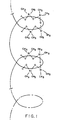
- Fig. 1 illustrates the accepted "coiled" configuration advanced for polydimethylsiloxanes, wherein the methyl moieties are oriented outward while the oxygen moieties are oriented inward towards the axis of the coil or helix. This configuration does not readily promote “bonding" between the oxygen moieties and compatible surfaces.
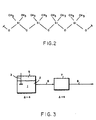
- Fig. 2 illustrates the "uncoiled oriented" configuration proposed for polydimethylsiloxanes that have been dispersed in the stable, ultramulsions of the present invention, wherein the oxygen moieties are generally oriented in one plane distinct from that of the methyl moieties.
- This proposed uncoiled oriented configuration appears to support the unique and unexpected "bonding" properties of the ultramulsions of the present invention, as evidenced by the various coating applications of these ultramulsions. See Tables I and 2.
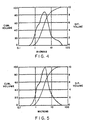
- Fig. 3 illustrates the ultramulsion process of the present invention wherein a nonionic surfactant and a polydimethylsiloxane 1, substantially free from water and co-solvent, are mixed in vessel 2, provided with mixing means 3, heat source 4, and inert head space 5.
- the heated and mixed surfactant/polydimethylsiloxane 6, is then subjected to high shear dispersion at an elevated temperature in dispersing means 7, to produce the ultramulsion 8, of the invention.
- Fig. 4 is a chart describing the particle size distribution of an ultramulsion of the invention containing 50% by weight nonionic surfactant and 50% by weight polydimethylsiloxane (12,500 cs) produced in a continuous process with an IKA Work dispersing means, (high shear dispersing) with an inlet temperature of 140° C and an outlet temperature of 210° C.
- Fig. 5 is a chart describing the particle size distribution of an ultramulsion of the invention containing 50% by weight nonionic surfactant and 50% by weight polydimethylsiloxane (12,500 cs) produced in a batch process with a Ross M/E 100 LC dispersing means fitted with a 850 ⁇ m pore size (20 mesh) screen, operated at a temperature from 120 to 160° C.
- Emulsions of various coating substances including polydimethylsiloxanes in various surfactants including nonionic surfactants are disclosed and claimed in U.S. Patent Nos. 4,911,927; 4,942,034; 4,950,479; 5,009,881; 5,032,387; 5,057,306; 5,057,307; 5,057,308; 5,057,309; ,057,310; 5,098,711 and 5,165,913.
- these emulsions are stable nor that the "coating" substances are oriented as they are in the ultramulsions of the present invention.
- the ultramulsions of the present invention have utility in a broad range of coating applications such as: anti-gas/antacid products, plaque control agents, medical lubricants, mold release agents, plasticizers, antifoam agents, polishes, paints, cutting oils, cleaners, emollients, drug delivery vehicles, anesthetic enhancers, blood additives, etc. Many of these uses are detailed in Table I and 2 below.
- polydimethylsiloxanes useful in the compositions of the present invention are described as polydimethylsiloxanes with the chemical composition (CH 3 ) 3 SiO[SiO(CH 3 ) 2 ] n Si(CH 3 ) 3 , wherein n is a whole number, which preferably ranges from 10 to 400.
- polydimethylsiloxanes have viscosities ranging from 100 to 100,000 cs. and are generally described as having molecular weights from 800 to 30,000.
- the preferred nonionic poloxamer surfactants useful in the coating compositions of the present invention are described as polyoxyethylene-polyoxypropylene block copolymers such as Pluronic F-68, F-88, F-108 and F-127 (BASF) which have molecular weights of at least about 1000 such as described in U.S. Patent Nos. 4,343,785; 4,465,663; 4,511,563 and 4,476,107.
- Pluronic F-68, F-88, F-108 and F-127 BASF
- surfactants range from solids to liquids at room temperature and are generally described as having molecular weights from 1,100 to 150,000.
- the ratio of surfactant to polydimethylsiloxane in the ultramulsion coating compositions of the present invention can range from 400:1 to 1:2. In a preferred embodiment of the invention the ratio of surfactant to polydimethylsiloxane is from 25:1 to 1:2. See Tables I and 2.
- ultramulsions of the present invention are solid at room temperature. At elevated temperature the viscosity of these ultramulsions can range from 8,000 to 40,000 cs at 130° C. In a preferred embodiment of the invention the viscosity of these ultramulsions at 130° C can range from 10,000 to 25,000 cs. See also Table 1.
- the particle size of the polydimethylsiloxane in the ultramulsions of the present invention can range from 0.1 to 10 microns. In a preferred embodiment of the present invention the particle size of the polydimethylsiloxane in the ultramulsion ranges from 1 to 5 microns.
- the particle size distribution of the polydimethylsiloxane in the ultramulsions of the present invention generally range from 80 to 95% of the particles under 10 microns. See Figs. 4 and 5. In a preferred embodiment of the present invention, from 80 to 95% of the particles are under 5 microns. See also Table 2.
- the ultramulsions of the present invention are prepared as follows:
- the nonionic surfactant is heated to a temperature at which it becomes a liquid.
- the polydimethylsiloxane is dispersed in the heated surfactant with various high shear dispersing means.
- the molten surfactant is mechanically stirred along with the silicone fluid.
- This mixture is subjected to high-shear dispersions with a means such as the IKA-WORKS DISPAX-Reactor with at least one superfine generator, alternatively, a Ross Model M.E, 100 LC fitted with a 850 ⁇ m (20 mesh) screen or a ultrasonicator such as MEDSONIC XL2010 fitted with 800-C Flow Cell & 800-21CT 19 mm (3/4 inch) flanged horn can be used.
- a means such as the IKA-WORKS DISPAX-Reactor with at least one superfine generator, alternatively, a Ross Model M.E, 100 LC fitted with a 850 ⁇ m (20 mesh) screen or a ultrasonicator such as MEDSONIC XL2010 fitted with 800-C Flow Cell & 800-21CT 19 mm (3/4 inch) flanged horn can be used.
- Example 1 Dow Corning® Medical Antifoam AF Emulsion, comprised of 30% simethicone, 14% stearate emulsifier, 6.075% sorbic acid and approximately 56% water was dispersed in water at 0.5% and 0.16% and centrifuged for 15 minutes at 3450 RPM (International Clinical Centrifuge Model CL).
- the polydimethylsiloxane completely separates some to the top 1/10 of the tube (the silica containing portion), some to the bottom 1/10 (polydimethylsiloxane only), leaving the intervening water layer completely free of polydimethylsiloxane.
- Examples 2 through 20 are set forth in Table 1 below, while Examples 21 through 32 are set forth in Table 2 below.
Landscapes
- Chemical & Material Sciences (AREA)
- Life Sciences & Earth Sciences (AREA)
- Health & Medical Sciences (AREA)
- Organic Chemistry (AREA)
- Chemical Kinetics & Catalysis (AREA)
- Engineering & Computer Science (AREA)
- Public Health (AREA)
- Wood Science & Technology (AREA)
- Animal Behavior & Ethology (AREA)
- General Health & Medical Sciences (AREA)
- Oil, Petroleum & Natural Gas (AREA)
- Veterinary Medicine (AREA)
- Birds (AREA)
- Epidemiology (AREA)
- Dispersion Chemistry (AREA)
- Medicinal Chemistry (AREA)
- Polymers & Plastics (AREA)
- Oral & Maxillofacial Surgery (AREA)
- Materials Engineering (AREA)
- Compositions Of Macromolecular Compounds (AREA)
- Cosmetics (AREA)
- Medicinal Preparation (AREA)
- Superconductors And Manufacturing Methods Therefor (AREA)
- Detergent Compositions (AREA)
- Colloid Chemistry (AREA)
- Silicon Polymers (AREA)
- Paints Or Removers (AREA)
Abstract
Description
- The present invention relates to unique compositions comprising a dispersion of certain polydimethylsiloxanes in certain nonionic poloxamer surfactants. When added to water these dispersions are stable and are distinct from solutions, emulsions and microemulsions. These dispersions are referred to hereinafter as ultramulsions. These ultramulsions offer excellent utility in a broad range of coating applications, which are described in detail below.
- The uniqueness and novelty of the ultramulsions of the invention are more readily appreciated when these compositions are compared to other dispersions such as emulsions and microemulsions.
- When a system consists of a single liquid phase it is described as a solution. A system containing two or more liquid phases is described as a multiphase solution or emulsion.
- According to Becher, an emulsion is an unstable heterogeneous system in which the diameters of the dispersed droplets in general exceed 1000Å. Becher P. in "Emulsions, Theory & Practice", (P. Becher, Ed.)
page 2, Rheinhold, New York, 1965. - A more comprehensive definition of emulsion is advanced by Clayton: "An emulsion is a system containing two liquid phases, one of which is dispersed as globules in the other. The liquid which is broken up into globules is termed the dispersed or discontinuous phase, while the liquid surrounding the globules is known as the continuous phase or dispersing medium" Clayton, W., The Theory of Emulsions and Their Technical Treatment, 4th Ed. page 1, the Blakiston Co., Philadelphia, 1943. It is well accepted that, mechanical work is required to effect such an emulsion, see Bancroft W. D., J. Phys. Chem., 17: 501 (1913).
- According to Prince, an emulsion may be defined as a dispersion of two (or more) mutually insoluble liquids, one in the other. Because of the surface tension forces at play between the two liquids, the dispersed phase consists of spherical droplets. Prince, L.M., Microemulsion Theory & Practice, pg. 2, Academic Press Inc., New York, NY (1977). See also Prince, L.M. in Biological Horizons in Surface Science, pg. 361, Academic Press Inc., New York, NY (1973).
- Emulsions, are generally not stable and upon standing or after centrifuging tend to separate into two or more liquid layers.
- The three definitions of emulsions set forth above share one common attribute, that is, mechanical work must be put into the emulsions described in order to disperse one liquid in the other in the form of droplets. This mechanical work can be in the form of agitation, homogenization, ultrasonication, etc.
- In contrast, dispersions of very small droplet sizes which are formed spontaneously without the input of any mechanical work are called microemulsions. See Prince 1977, p. 3. Generally, two surfactants are used in forming microemulsions, i.e. a water soluble surfactant and a co-surfactant such as alcohol, where one phase of the microemulsion is generally water. Thus, dilution or adulteration of the dispersed phase by the co-solvent generally accompanies microemulsion formation. The ratio of surfactant to dispersed phase in microemulsions is much higher than that of emulsions. Microemulsions are further characterized as optically clear or opalescent and when spun in a laboratory centrifuge for 5 minutes at 100 G's, the dispersion remains stable and does not separate.
- Thus, fine particle sizes, exceptional stability and rheological properties that can easily be adjusted, distinguish microemulsions from emulsions. Moreover, to date, no microemulsions have appeared in which one of the mutually insoluble liquids is not water. See Prince, page 34, (1977).
- U.S. patents Nos. 4,741,855, 4,704,272 and 4,788,006 disclose combinations of various non-volatile silicones, anionic surfactants and suspension agents therefor, useful as shampoos. There is no teaching or suggestion therein that the suspension agents can be omitted, as in each case, this is referred to as an essential ingredient of the composition. Surprisingly, it has been found that by using the ultramulsion technology described and claimed herein, no such suspension agent is necessary, and similar products can be formed without the added expense of using such suspension agents.
- According to the present invention there is provided a water-free, co-solvent free, composition, comprising a dispersion of polydimethylsiloxane in a nonionic poloxamer surfactant wherein:
- a. said polydimethylsiloxane has the chemical composition (CH3)3SiO[SiO(CH3)2]nSi(CH3)3, wherein n is a whole number from 10 to 400;
- b. said nonionic poloxamer surfactant has the chemical composition:
wherein x, y and x' are whole numbers sufficient to provide a molecular weight from 1,100 to 150,000;

- c. the viscosity of the polydimethylsiloxane ranges from 100 to 100,000 cs;
- d. the particle size of most of the polydimethylsiloxane in the composition is from 0.5 to 10 microns;
- e. from 80% to 95% of said polydimethylsiloxane particles in the composition are from 1 to 10 microns;
- f. the nonionic poloxamer is a polyoxyethylene-polyoxypropylene block copolymer having a molecular weight from 1,100 to 150,000;
- g. the ratio of nonionic poloxamer surfactant to polydimethylsiloxane is from 400:1 to 1:2;
- h. the viscosity of the composition is from 8,000 to 40,000 cs at 130°C; and
- i. the composition dispersed in water is stable.
-
- The compositions (ultramulsions) of the present invention combine certain characteristics of emulsions with certain features of microemulsions. That is, like emulsions, they are two phase systems comprising a polydiemthylsiloxane dispersed in a continuous nonionic, surfactant phase, wherein the polydimethylsiloxane is insoluble in the surfactant. Unlike emulsions, but like microemulsions, these dispersions are stable. Unlike microemulsions, but like emulsions, mechanical work is required to form the ultramulsions. Like microemulsions, but unlike emulsions, these ultramulsions are not formed spontaneously. Like emulsions, the ultramulsions do not contain a cosolvent commonly found in microemulsions. Of course, the ultramulsions of the present invention can be dispersed in various liquids such as water as stable dispersions.
- The preferred dispersions of ultramulsions in water have excellent utility in various aqueous based uses; including for instance, toothpastes, alcohol free mouthwashes, dental floss coatings, sugar coatings (confectionery), chewing gum coatings, antacid tablet coatings, antacid liquids, non-volatile mold release agents, lubricants for medical, dental and veterinary instruments, plasticizers, antifoam agents, drug delivery vehicles (topical, oral, etc.), cleaning agent aids, cosmetic mixtures, skin care products, and the like, See, e.g., Tables 1 and 2.
- It has surprisingly been found that plaque reduction effect for a toothpaste made using the ultramulsion of the present invention unexpectedly increases as the viscosity of the polydimethylsilozane (PDMS) in the ultramulsion is increased This improved level of plaque reduction is believed due to the enhanced substantivity of the ultramulsion to the oral cavity.
- While not wishing to be bound by theory, it is hypothesized that unlike either emulsions or microemulsions, the dispersed polydimethyl-siloxanes in the ultramulsions of the present invention are oriented with their polar moieties in one general plane and their hydrophilic moieties in a plane approximately opposite that of the polar moieties. This orientation promotes bonding between the polar or hydrophilic moieties and various substrates thereby effecting oriented, monolayer coatings of the polydimethylsiloxane onto various substrates. These oriented dispersions of polydimethylsiloxanes thus have a very broad range of utility as detailed below in Tables 1 and 2.
- For purposes of the present invention:
- a. polydimethylsiloxane means a clear, colorless liquid such as Dow Corning® 360 medical fluid; a water-dilutable, nonionic emulsion containing 30% by weight Dow Corning® medical Antifoam A compound (Simethicone USP); Dow Corning® 1500 Silicone Antifoam which is an opaque grey to white, pourable liquid containing silica filled polydimethylsiloxanes, Dow Corning® 200 fluids, 60,000 to 100,000 centistokes (cs) which are high viscosity polydimethylsiloxane polymers manufactured to yield linear polymers with average kinematic viscosities from 60,000 to 100,000 cs. Preferred polydimethylsiloxanes suitable for the present invention are described in various publicly available product brochures published by Dow Corning Corporation, Midland, Michigan under product designations such as Dow Corning® , 360 Medical Fluid, Dow Corning® 200 Fluids, etc. See also, Tables 1 and 2 below.
- b. nonionic poloxamer surfactant means block copolymers of ethylene
oxide and propylene oxide ranging from flowable liquids of varying viscosities, to
paste, prills and cast solids with molecular weights from 1,100 to 150,000. Suitable
nonionic surfactants are manufactured and marketed by BASF Corporation under the
trademarks Pluronic® . Particularly preferred nonionic surfactants are Pluronic F-68,
F-88, F-108 and Pluronic F-127. These are described in a BASF brochure entitled
"Pluronic® and Tetronic Block Copolymer Surfactant." These nonionic surfactants
suitable for the present invention can be described by the following structure:
where x, y and x' are whole numbers (as defined in the BASF brochure and/or in BASF patents thereon) thereby providing these compounds with a molecular weight ranging from 1,100 to 150,000. Surprisingly, the nonionic surfactants of choice for the ultramulsions of the present invention are reported in the referenced brochure to have marginal detergency, emulsification and wetting properties. See Tables 1 and 2.

- c. stable is defined as, a dispersion of the ultramulsion in water when subjected to centrifuging in a 100° C environment for 5 minutes, less than about 10% by weight of the ultramulsion separates from the continuous water phase. See Table 2.
- d. water-free means, that the ultramulsion of polydimethylsiloxane and nonionic surfactant is substantially free from water.
- e. solvent free means, that the ultramulsion of polydimethylsiloxane and nonionic surfactant is substantially free from co-solvents such as ethanol, isopropanol, etc.
- f. oriented means, that the polar moieties of the "uncoiled" polydimethylsiloxane in the ultramulsion are generally aligned in one plane with the hydrophilic oil seeking moieties aligned in a second plane generally 180° from the polar moieties such as illustrated in Fig. 2.
- g. monolayer means, that a monomolecular film of the ultramulsion of the invention when dispersed in water is attracted to a substrate by secondary bonding force to form a coating thereon.
-
-
- Fig. 1 illustrates the "coiled" molecular configuration of polydimethylsiloxanes.
- Fig. 2 illustrates the molecular configuration of oriented polydimethylsiloxanes after ultramulsion processing; and
- Fig. 3 illustrates schematically an ultramulsion process of the invention.
- Figs. 4 and 5 illustrate that the ultramulsions of the invention produced via various high shear dispersions have particle size distribution of 80+ % under 10 microns.
-
- Referring to the drawings, Fig. 1 illustrates the accepted "coiled" configuration advanced for polydimethylsiloxanes, wherein the methyl moieties are oriented outward while the oxygen moieties are oriented inward towards the axis of the coil or helix. This configuration does not readily promote "bonding" between the oxygen moieties and compatible surfaces.
- Fig. 2 illustrates the "uncoiled oriented" configuration proposed for polydimethylsiloxanes that have been dispersed in the stable, ultramulsions of the present invention, wherein the oxygen moieties are generally oriented in one plane distinct from that of the methyl moieties. This proposed uncoiled oriented configuration appears to support the unique and unexpected "bonding" properties of the ultramulsions of the present invention, as evidenced by the various coating applications of these ultramulsions. See Tables I and 2.
- Fig. 3 illustrates the ultramulsion process of the present invention wherein a nonionic surfactant and a polydimethylsiloxane 1, substantially free from water and co-solvent, are mixed in
vessel 2, provided with mixing means 3,heat source 4, andinert head space 5. The heated and mixed surfactant/polydimethylsiloxane 6, is then subjected to high shear dispersion at an elevated temperature in dispersing means 7, to produce theultramulsion 8, of the invention. - Fig. 4 is a chart describing the particle size distribution of an ultramulsion of the invention containing 50% by weight nonionic surfactant and 50% by weight polydimethylsiloxane (12,500 cs) produced in a continuous process with an IKA Work dispersing means, (high shear dispersing) with an inlet temperature of 140° C and an outlet temperature of 210° C.
- Fig. 5 is a chart describing the particle size distribution of an ultramulsion of the invention containing 50% by weight nonionic surfactant and 50% by weight polydimethylsiloxane (12,500 cs) produced in a batch process with a Ross M/
E 100 LC dispersing means fitted with a 850 µm pore size (20 mesh) screen, operated at a temperature from 120 to 160° C. - To illustrate the increase in plaque reduction effect for a toothpaste made with the ultramulsion of the present invention, as viscosity of the polydimethylsilozane (PDMS) in the ultramulsion is increased, four samples were prepared and their effect on plaque reduction was analyzed. At a PDMS viscosity of about 1,000 (1E3) the plaque reduction was only about 10%. At a PDMS viscosity of about 10,000 (1E4) the percentage of plaque reduction was about 15%. At a PDMS viscosity of about 100,000 (1E5) the percentage of plaque reduction was about 20%. Finally, at a PDMS viscosity of about 1,000,000 (1E6) the percentage of plaque reduction was about 25%.
- Emulsions of various coating substances including polydimethylsiloxanes in various surfactants including nonionic surfactants are disclosed and claimed in U.S. Patent Nos. 4,911,927; 4,942,034; 4,950,479; 5,009,881; 5,032,387; 5,057,306; 5,057,307; 5,057,308; 5,057,309; ,057,310; 5,098,711 and 5,165,913. There is no teaching in these references that these emulsions are stable nor that the "coating" substances are oriented as they are in the ultramulsions of the present invention.
- The ultramulsions of the present invention have utility in a broad range of coating applications such as: anti-gas/antacid products, plaque control agents, medical lubricants, mold release agents, plasticizers, antifoam agents, polishes, paints, cutting oils, cleaners, emollients, drug delivery vehicles, anesthetic enhancers, blood additives, etc. Many of these uses are detailed in Table I and 2 below.
- The safety of polydimethylsiloxanes for use in these various products is well documented. See Rowe et al., Journal of Industrial Hygiene, Vol. 30, No. 6, 332-352, Nov. 1948. See also Calandra et al., ACS Polymer Preprints, 17: 1-4 (1976) and Kennedy et al., J. Toxicol. & Environmental Health, 1: 909-920 (1976).
- As noted above, the polydimethylsiloxanes useful in the compositions of the present invention are described as polydimethylsiloxanes with the chemical composition (CH3)3SiO[SiO(CH3)2]nSi(CH3)3, wherein n is a whole number, which preferably ranges from 10 to 400.
- These polydimethylsiloxanes have viscosities ranging from 100 to 100,000 cs. and are generally described as having molecular weights from 800 to 30,000.
- As noted above, the preferred nonionic poloxamer surfactants useful in the coating compositions of the present invention are described as polyoxyethylene-polyoxypropylene block copolymers such as Pluronic F-68, F-88, F-108 and F-127 (BASF) which have molecular weights of at least about 1000 such as described in U.S. Patent Nos. 4,343,785; 4,465,663; 4,511,563 and 4,476,107.
- These surfactants range from solids to liquids at room temperature and are generally described as having molecular weights from 1,100 to 150,000.
- The ratio of surfactant to polydimethylsiloxane in the ultramulsion coating compositions of the present invention can range from 400:1 to 1:2. In a preferred embodiment of the invention the ratio of surfactant to polydimethylsiloxane is from 25:1 to 1:2. See Tables I and 2.
- Some of the ultramulsions of the present invention are solid at room temperature. At elevated temperature the viscosity of these ultramulsions can range from 8,000 to 40,000 cs at 130° C. In a preferred embodiment of the invention the viscosity of these ultramulsions at 130° C can range from 10,000 to 25,000 cs. See also Table 1.
- The particle size of the polydimethylsiloxane in the ultramulsions of the present invention can range from 0.1 to 10 microns. In a preferred embodiment of the present invention the particle size of the polydimethylsiloxane in the ultramulsion ranges from 1 to 5 microns. The particle size distribution of the polydimethylsiloxane in the ultramulsions of the present invention generally range from 80 to 95% of the particles under 10 microns. See Figs. 4 and 5. In a preferred embodiment of the present invention, from 80 to 95% of the particles are under 5 microns. See also Table 2.
- The ultramulsions of the present invention are prepared as follows:
- Generally, the nonionic surfactant is heated to a temperature at which it becomes a liquid. The polydimethylsiloxane is dispersed in the heated surfactant with various high shear dispersing means.
- Specifically the molten surfactant is mechanically stirred along with the silicone fluid. This mixture is subjected to high-shear dispersions with a means such as the IKA-WORKS DISPAX-Reactor with at least one superfine generator, alternatively, a Ross Model M.E, 100 LC fitted with a 850µm (20 mesh) screen or a ultrasonicator such as MEDSONIC XL2010 fitted with 800-C Flow Cell & 800-21CT 19 mm (3/4 inch) flanged horn can be used.
- Various ultramulsions which were prepared and analyzed are described in detail in the examples below.
- Example 1: Dow Corning® Medical Antifoam AF Emulsion, comprised of 30% simethicone, 14% stearate emulsifier, 6.075% sorbic acid and approximately 56% water was dispersed in water at 0.5% and 0.16% and centrifuged for 15 minutes at 3450 RPM (International Clinical Centrifuge Model CL). The polydimethylsiloxane completely separates some to the top 1/10 of the tube (the silica containing portion), some to the bottom 1/10 (polydimethylsiloxane only), leaving the intervening water layer completely free of polydimethylsiloxane.
- Examples 2 through 20 are set forth in Table 1 below, while Examples 21 through 32 are set forth in Table 2 below.


- The present invention has been described in detail, including the preferred embodiments thereof.
Claims (20)
- Water-free, co-solvent free, compositions comprising a dispersion of polydimethylsiloxane in a nonionic poloxamer surfactant with the polydimethylsiloxane being insoluble in said surfactant, wherein:a. said polydimethylsiloxane has the chemical composition (CH3)3SiO[SiO(CH3)2]nSi(CH3)3, wherein n is a whole number from 10 to 400;b. said nonionic poloxamer surfactant has the chemical composition:wherein x, y, and x' are whole numbers sufficient to provide a molecular weight of from 1,100 to 150,000;
 c. the viscosity of the polydimethylsiloxane ranges from 100 to 100,000 cs;d. the particle size of most of the polydimethylsiloxane in the composition is from 0.5 to 10 microns;e. from 80% to 95% of said polydimethylsiloxane particles in the compositions are from 1 to 10 microns;f. the nonionic poloxamer surfactant is a polyoxyethylenepolyoxypropylene block copolymer having a molecular weight from 1, 100 to 150,000;g. the ratio of nonionic poloxamer surfactant to polydimethylsiloxane is from 400:1 to 1:2; [and]h. the viscosity of the composition is from 8,000 to 40,000 cs at 130°C, andi. the composition dispersed in water is stable.
 - A method of manufacturing compositions as described in claim 1 comprising, heating said nonionic poloxamer surfactant and polydimethylsiloxane mixture in a heated, stirred vessel substantially free from water, followed by subjecting said mixture to high shear dispersion with high shear dispersing means.
- A method according to claim 2, wherein the heated vessel is provided with an inert head of gas.
- A method according to claim 2, wherein said high shear dispersing means is fitted with a small orifice.
- A method according to claim 2 wherein said high shear dispersing means is an ultrasonication means.
- A stable aqueous dispersion comprising water and dispersed therein a composition comprising a dispersion of polydimethylsiloxane in a monionic poloxamer surfactant, with the polydimethylsiloxane being insoluble in said nonionic poloxamer surfactant, wherein:a. said polydimethylsiloxane has the chemical composition (CH3)3SiO[SiO(CH3)2]Si(CH3)3, wherein n is a whole number from 10 to 400;b. said nonionic poloxamer surfactant has the chemical compositionwherein x, y, and x' are whole numbers;
 c. the viscosity of the polydimethylsiloxane ranges from 100 to 100,000 cs;d. the particle size of most of the polydimethylsiloxane in the composition is from 0.5 to 10 microns;e. from 80% to 95% of said polydimethylsiloxane particles in the compositions are from 1 to 10 microns;f. the nonionic poloxamer surfactant is a polyoxyethylenepolyoxypropylene block copolymer having a molecular weight from 1,100 to 150,000;g. the ratio of nonionic poloxamer surfactant to polydimethylsiloxane is from 400:1 to 1:2; andh. the viscosity of the composition is from 8,000 to 40,000 cs at 130° C, andi. the composition dispersed in water is stable.
 - A composition according to claim 1, wherein the ratio of said nonionic poloxamer surfactant to said polydimethylsiloxane is 9:1 and 90% of the polydimethylsiloxane particles are from 1 to 3 microns.
- A composition according to claim 1, wherein the ratio of said nonionic poloxamer surfactant to said polydimethylsiloxane is 2:1 and 100% of the polydimethylsiloxane dispersion is less than 10 microns.
- A composition according to claim 1, wherein the ratio of said nonionic poloxamer surfactant to said polydimethylsiloxane is 1:1 and the polydimethylsiloxane particles in said composition are less than 10 microns.
- A method of preparing products selected from the group consisting of akhohol free, aqueous based mouth rinses; toothpastes; dental floss; confectioneries, coared chewing gums; antacid tablets; antacid liquids; mold/release agents; lubricants for medical instruments; plasticizers; cleaners; cosmetic and skin care products; comprising formulating said products in a composition comprising a dispersion of polydimethylsiloxane in a nonionic poloxamer surfactant, with the polydimethylsiloxane being insoluble in said nonionic poloxamer surfactant wherein:useful in various products selected from the group consisting of alcohol free, aqueous based mouthrinse; toothpaste, dental floss; confectioneries, coated chewing gum; antacid tablet, antacid liquid, mold/release agent lubricants for medical instruments, plasticizers, cleaners, cosmetic and skin care products.a. said polydlmethylsiloxane has the chemical composaiion (CH3)3SiO[SiO(CH3)2]nSi(CH3)3, wherein n is a whole number from 10 to 400;b. said nonionic poloxamer surfactant has the chemical compositionwherein x, y, and x' are whole numbers;
 c. the viscosity of the polydimethylsiloxane ranges from 200 to 100,000 cs;d. the particle size of most of the polydimethylsiloxane in the composition is from 0.5 to 10 microns;e. from 80% to 95% of said polydimethylsiloxane particles in the compositions are from 1 to 10 microns;f. the nonionic poloxamer surfactant is a polyoxyethylenepolyoxypropylene block copolymer having a molecular weight from 1,100 to 150,000;g. the ratio of nonionic poloxamer surfactant to polydimethylsiloxane is from 400:1 to 1:2; andh. the viscosity of the composition is from 8,000 to 40,000 cs at 130° C. andi. the composition dispersed in water is stable;
 - A composition according to claim 1, wherein the polydimethylsiloxane is uncoiled and oriented wherein the oxygen moieties are generally oriented in a plane distinet from that of the methyl/moieties.
- A composition according to claim 1, wherein the nonionic poloxamer surfactant is selected from the group consisting of, flowable liquids of varying viscosities, pastes, prills and cast solids.
- A stable aqueous dispersion according to claim 6, wherein the dispersed polydimethylsiloxane forms monolayer films suitable for secondary bonding on receptive substrates.
- A method according to claim 2, wherein the high shear dispersion is achieved with dispersing means selected from the group consisting of an IKA-WORKS DISPAX REACTOR fitted with at least one superfine generator, a ROSS MODEL M.E. 100 2C fitted with a 850 µm (20 mesh) screen, and a ultrasonic MEDSONIC XL2010 fitted with 800-C flow cell and 800 21CT 19mm (3/4 inch) flanged born.
- A composition according to claim 1, wherein the ratio of nonionic poloxamer surfactant to polydimethylsiloxane is 1:1 and at least 80% of the polydimethylsiloxane dispersed particles are between I and 9 microns.
- A composition according to claim 1, wherein the ratio of nonionic poloxamer surfactant to polydimethylsiloxane is 9:1 and about 90% of the polydimethylsiloxane dispersed particles are between I and 3 microns.
- A composition according to claim 1, wherein the ratio of nonionic poloxamer surfactant to polydimethylsiloxane is 2:1 and about 90% of the polydimethylsiloxane dispersed particles are between 1 and 3 microns.
- A composition according to claim 1, wherein the ratio of nonionic poloxamer surfactant to polydimethylsiloxane is 4:1 and about 90% of the polydimethylsiloxane dispersed particles are between I and 9 microns.
- A composition according to claim 1, wherein the ratio of nonionic poloxamer surfactant to polydimethylsiloxane is 9.5 : 0.5 and about 100% of the polydimethylsiloxane dispersed particles are between 1 and 9 microns.
- A composition according to claim 1, wherein the polydimethylsiloxane has a viscosity of 12,500 cs and the nonionic poloxamer surfactant is a solid at room temperature.
Applications Claiming Priority (3)
| Application Number | Priority Date | Filing Date | Title |
|---|---|---|---|
| US144778 | 1993-10-28 | ||
| US08/144,778 US5538667A (en) | 1993-10-28 | 1993-10-28 | Ultramulsions |
| PCT/US1994/012159 WO1995011746A1 (en) | 1993-10-28 | 1994-10-25 | Ultramulsions |
Publications (3)
| Publication Number | Publication Date |
|---|---|
| EP0725676A1 EP0725676A1 (en) | 1996-08-14 |
| EP0725676A4 EP0725676A4 (en) | 1997-09-17 |
| EP0725676B1 true EP0725676B1 (en) | 2001-12-12 |
Family
ID=22510090
Family Applications (1)
| Application Number | Title | Priority Date | Filing Date |
|---|---|---|---|
| EP94931999A Expired - Lifetime EP0725676B1 (en) | 1993-10-28 | 1994-10-25 | Dispersions of polydimethylsiloxanes |
Country Status (10)
| Country | Link |
|---|---|
| US (1) | US5538667A (en) |
| EP (1) | EP0725676B1 (en) |
| JP (1) | JP3747060B2 (en) |
| AT (1) | ATE210495T1 (en) |
| AU (1) | AU684570B2 (en) |
| CA (1) | CA2175245C (en) |
| DE (1) | DE69429444T2 (en) |
| DK (1) | DK0725676T3 (en) |
| ES (1) | ES2170108T3 (en) |
| WO (1) | WO1995011746A1 (en) |
Families Citing this family (65)
| Publication number | Priority date | Publication date | Assignee | Title |
|---|---|---|---|---|
| CA2143037C (en) * | 1994-05-02 | 2002-04-30 | Atma Chaudhari | Alcohol free mouthwash |
| US5665374A (en) * | 1995-06-05 | 1997-09-09 | Whitehill Oral Technologies, Inc. | Ultramulsion containing interdental delivery devices |
| US5730967A (en) * | 1995-06-05 | 1998-03-24 | Whitehill Oral Technologies, Inc. | Ultramulsion based skin care compositions |
| US5733529A (en) * | 1995-06-05 | 1998-03-31 | Whitehill Oral Technologies, Inc. | Ultramulsion based antigingivitis toothpaste compositions |
| US5733536A (en) * | 1995-06-05 | 1998-03-31 | Whitehill Oral Technologies, Inc. | Ultramulsion based hair care compositions |
| WO1996039114A1 (en) * | 1995-06-05 | 1996-12-12 | Whitehill Oral Technologies, Inc. | Hair and skin ultramulsion based products |
| WO1996039249A1 (en) * | 1995-06-05 | 1996-12-12 | Whitehill Oral Technologies, Inc. | Ultramulsion based paint and coating products |
| US5759208A (en) * | 1996-02-29 | 1998-06-02 | The Procter & Gamble Company | Laundry detergent compositions containing silicone emulsions |
| US5723426A (en) * | 1996-02-29 | 1998-03-03 | Zhen; Yueqian | Liquid laundry detergent compositions containing surfactants and silicone emulsions |
| KR19980076072A (en) * | 1997-04-04 | 1998-11-16 | 이명환 | Mouthwash |
| CN1214149C (en) * | 1999-05-21 | 2005-08-10 | 荷兰联合利华有限公司 | fabric softening composition |
| US6258419B1 (en) | 1999-09-02 | 2001-07-10 | Micron Technology, Inc. | Sonication of monolayer films |
| WO2002011682A2 (en) * | 2000-08-07 | 2002-02-14 | Unilever N.V. | Oral composition comprising a silicone and a water-insoluble active agent |
| EP1311206A4 (en) * | 2000-08-23 | 2008-01-02 | Ira D Hill | Monofilament dental tapes with substantive coatings |
| WO2002045611A2 (en) * | 2000-12-08 | 2002-06-13 | Brown, Dale, G. | Biofilm therapy process and elements |
| ATE396614T1 (en) * | 2001-01-04 | 2008-06-15 | Byotrol Plc | ANTIMICROBIAL COMPOSITION |
| AU2001286633B2 (en) * | 2001-01-22 | 2005-06-09 | Dale G. Brown | Non-crystalline saliva-soluble coatings for elastomeric monofilament dental tapes |
| US7017591B2 (en) * | 2001-08-23 | 2006-03-28 | International Tape Partners Llc | Particulate coated monofilament devices |
| US20060243297A1 (en) * | 2005-04-29 | 2006-11-02 | Brown Dale G | Coated monofilament oriented HDPE dental tapes |
| US20060201531A1 (en) * | 2001-12-04 | 2006-09-14 | Brown Dale G | Methods for coating dental devices with sialagogue emulsions |
| US20070107747A1 (en) * | 2001-12-04 | 2007-05-17 | Whitehill Oral Technologies, Inc. | Cleaning perception oral care products |
| US7025986B2 (en) * | 2002-02-11 | 2006-04-11 | International Tape Partners Llc | Micromesh interproximal devices |
| US7152611B2 (en) * | 2002-12-30 | 2006-12-26 | International Tape Partners, Llc | Coated multifilament dental devices overcoated with imbedded particulate |
| US20040156884A1 (en) * | 2003-02-10 | 2004-08-12 | Brown Dale G. | Emulsion impregnated rawhide chews with antimicrobially active chlorhexidine |
| US20050147719A1 (en) * | 2003-02-10 | 2005-07-07 | Hill Ira D. | Impregnated, flexible, rawhide pet chews containing ingestible, therapeutic ingredients |
| US7147888B2 (en) * | 2003-02-10 | 2006-12-12 | Whitehill Oral Technologies, Inc. | Emulsion impregnated rawhide chews |
| US20050064019A1 (en) * | 2003-02-10 | 2005-03-24 | Hill Ira D. | Impregnated, flexible, rawhide pet chews containing antimicrobially active chlorhexdine |
| US20060105025A1 (en) * | 2004-11-15 | 2006-05-18 | Hill Ira D | Recovery pet chews |
| US20070190090A1 (en) * | 2006-02-07 | 2007-08-16 | Whitehill Oral Technologies, Inc. | Sialagogue based oral care products |
| GB0713799D0 (en) | 2007-07-17 | 2007-08-22 | Byotrol Llc | Anti-microbial compositions |
| CA2699696C (en) | 2007-09-17 | 2018-04-03 | Byotrol Plc | Anti-microbial compositions comprising a non-ionic surfactant |
| US20090188520A1 (en) * | 2008-01-30 | 2009-07-30 | Whitehill Oral Technologies, Inc. | Coated dental devices with ablative abrasives |
| CA2738578C (en) | 2008-09-23 | 2021-05-04 | Quantalife, Inc. | Droplet-based assay system |
| US9598725B2 (en) | 2010-03-02 | 2017-03-21 | Bio-Rad Laboratories, Inc. | Emulsion chemistry for encapsulated droplets |
| US12162008B2 (en) | 2008-09-23 | 2024-12-10 | Bio-Rad Laboratories, Inc. | Partition-based method of analysis |
| US11130128B2 (en) | 2008-09-23 | 2021-09-28 | Bio-Rad Laboratories, Inc. | Detection method for a target nucleic acid |
| US9764322B2 (en) | 2008-09-23 | 2017-09-19 | Bio-Rad Laboratories, Inc. | System for generating droplets with pressure monitoring |
| US9156010B2 (en) | 2008-09-23 | 2015-10-13 | Bio-Rad Laboratories, Inc. | Droplet-based assay system |
| US8633015B2 (en) | 2008-09-23 | 2014-01-21 | Bio-Rad Laboratories, Inc. | Flow-based thermocycling system with thermoelectric cooler |
| US9132394B2 (en) | 2008-09-23 | 2015-09-15 | Bio-Rad Laboratories, Inc. | System for detection of spaced droplets |
| US10512910B2 (en) | 2008-09-23 | 2019-12-24 | Bio-Rad Laboratories, Inc. | Droplet-based analysis method |
| US9417190B2 (en) | 2008-09-23 | 2016-08-16 | Bio-Rad Laboratories, Inc. | Calibrations and controls for droplet-based assays |
| US8951939B2 (en) | 2011-07-12 | 2015-02-10 | Bio-Rad Laboratories, Inc. | Digital assays with multiplexed detection of two or more targets in the same optical channel |
| US12090480B2 (en) | 2008-09-23 | 2024-09-17 | Bio-Rad Laboratories, Inc. | Partition-based method of analysis |
| US9492797B2 (en) | 2008-09-23 | 2016-11-15 | Bio-Rad Laboratories, Inc. | System for detection of spaced droplets |
| US8709762B2 (en) | 2010-03-02 | 2014-04-29 | Bio-Rad Laboratories, Inc. | System for hot-start amplification via a multiple emulsion |
| CA2767056C (en) | 2009-09-02 | 2018-12-04 | Bio-Rad Laboratories, Inc. | System for mixing fluids by coalescence of multiple emulsions |
| US20110266198A1 (en) * | 2009-11-17 | 2011-11-03 | H R D Corporation | Bitumen extraction and asphaltene removal from heavy crude using high shear |
| EP2556170A4 (en) | 2010-03-25 | 2014-01-01 | Quantalife Inc | Droplet transport system for detection |
| CA2767113A1 (en) | 2010-03-25 | 2011-09-29 | Bio-Rad Laboratories, Inc. | Detection system for droplet-based assays |
| CA2767182C (en) | 2010-03-25 | 2020-03-24 | Bio-Rad Laboratories, Inc. | Droplet generation for droplet-based assays |
| WO2012018750A1 (en) * | 2010-08-03 | 2012-02-09 | Dow Corning Corporation | Silicone gum emulsions |
| SG190074A1 (en) | 2010-11-01 | 2013-06-28 | Bio Rad Laboratories | System for forming emulsions |
| US12097495B2 (en) | 2011-02-18 | 2024-09-24 | Bio-Rad Laboratories, Inc. | Methods and compositions for detecting genetic material |
| AU2012231098B2 (en) | 2011-03-18 | 2016-09-29 | Bio-Rad Laboratories, Inc. | Multiplexed digital assays with combinatorial use of signals |
| WO2012149042A2 (en) | 2011-04-25 | 2012-11-01 | Bio-Rad Laboratories, Inc. | Methods and compositions for nucleic acid analysis |
| WO2013019751A1 (en) | 2011-07-29 | 2013-02-07 | Bio-Rad Laboratories, Inc., | Library characterization by digital assay |
| US9877929B2 (en) | 2011-10-13 | 2018-01-30 | Premier Dental Products Company | Topical vitamin D and ubiquinol oral supplement compositions |
| BR112014018927A8 (en) * | 2012-02-08 | 2017-07-11 | Dow Corning | SUBSTRATE IN POWDER OR FIBER FORM |
| EP2811986A1 (en) * | 2012-02-08 | 2014-12-17 | Dow Corning Corporation | Silicone emulsions for delivery of healthcare actives |
| WO2013155531A2 (en) | 2012-04-13 | 2013-10-17 | Bio-Rad Laboratories, Inc. | Sample holder with a well having a wicking promoter |
| US9877930B2 (en) | 2012-10-12 | 2018-01-30 | Premier Dental Products Company | Topical ubiquinol oral supplement compositions with amorphous calcium phosphate |
| US9724542B2 (en) | 2012-10-12 | 2017-08-08 | Premier Dental Products Company | Remineralizing and desensitizing compositions, treatments and methods of manufacture |
| CN104902906A (en) * | 2012-10-12 | 2015-09-09 | 第一牙科产品公司 | Topical vitamin D and panthenol oral supplement composition |
| CN111303456A (en) * | 2020-02-21 | 2020-06-19 | 南方科技大学 | Organosilicon nano-particles and preparation method and application thereof |
Family Cites Families (10)
| Publication number | Priority date | Publication date | Assignee | Title |
|---|---|---|---|---|
| US2702276A (en) * | 1951-04-10 | 1955-02-15 | Du Pont | Water-dispersible emulsions of polysiloxanes |
| AT332351B (en) * | 1970-06-30 | 1976-09-27 | Pfersee Chem Fab | PROCESS FOR THE PRODUCTION OF EMULSIONS OF ORGANOPOLYSILOXANES CONTAINING HYDROGEN ATOMS BONDED TO SILICON |
| US3962119A (en) * | 1971-08-06 | 1976-06-08 | Drew Chemical Corporation | Non-foaming dispersing composition |
| US4039469A (en) * | 1975-06-20 | 1977-08-02 | General Electric Company | Process for the preparation of aqueous antifoam compositions |
| GR75649B (en) * | 1980-07-28 | 1984-08-02 | Procter & Gamble | |
| US4950479A (en) * | 1986-11-06 | 1990-08-21 | Hill Ira D | Method of interrupting the formation of plaque |
| US4780245A (en) * | 1986-03-19 | 1988-10-25 | Basf Corporation | Solubilization of dimethyl polysiloxanes |
| US5032387A (en) * | 1986-11-06 | 1991-07-16 | Princeton Pharmaceutical Inc. | Dental and oral hygiene preparations |
| JPS63125530A (en) * | 1986-11-13 | 1988-05-28 | Shin Etsu Chem Co Ltd | Production of organopolysiloxane emulsion |
| US5071573A (en) * | 1990-07-23 | 1991-12-10 | The Procter & Gamble Company | Microemulsified silicones in liquid fabric care compositions containing dye |
-
1993
- 1993-10-28 US US08/144,778 patent/US5538667A/en not_active Expired - Lifetime
-
1994
- 1994-10-25 ES ES94931999T patent/ES2170108T3/en not_active Expired - Lifetime
- 1994-10-25 DE DE69429444T patent/DE69429444T2/en not_active Expired - Fee Related
- 1994-10-25 WO PCT/US1994/012159 patent/WO1995011746A1/en not_active Ceased
- 1994-10-25 JP JP51275395A patent/JP3747060B2/en not_active Expired - Fee Related
- 1994-10-25 AT AT94931999T patent/ATE210495T1/en not_active IP Right Cessation
- 1994-10-25 AU AU80882/94A patent/AU684570B2/en not_active Ceased
- 1994-10-25 EP EP94931999A patent/EP0725676B1/en not_active Expired - Lifetime
- 1994-10-25 CA CA002175245A patent/CA2175245C/en not_active Expired - Fee Related
- 1994-10-25 DK DK94931999T patent/DK0725676T3/en active
Also Published As
| Publication number | Publication date |
|---|---|
| AU684570B2 (en) | 1997-12-18 |
| JPH09504229A (en) | 1997-04-28 |
| ES2170108T3 (en) | 2002-08-01 |
| WO1995011746A1 (en) | 1995-05-04 |
| DK0725676T3 (en) | 2002-04-15 |
| DE69429444T2 (en) | 2002-08-01 |
| EP0725676A4 (en) | 1997-09-17 |
| DE69429444D1 (en) | 2002-01-24 |
| EP0725676A1 (en) | 1996-08-14 |
| JP3747060B2 (en) | 2006-02-22 |
| US5538667A (en) | 1996-07-23 |
| ATE210495T1 (en) | 2001-12-15 |
| CA2175245C (en) | 2004-04-13 |
| AU8088294A (en) | 1995-05-22 |
| CA2175245A1 (en) | 1995-05-04 |
Similar Documents
| Publication | Publication Date | Title |
|---|---|---|
| AU684570B2 (en) | Ultramulsions | |
| EP0969804B1 (en) | Process for preparing silicone elastomer compositions | |
| EP0596304B1 (en) | Cosmetic and pharmaceutical compositions | |
| AU671540B2 (en) | Silicone containing personal care products | |
| EP0579455B1 (en) | Silicone emulsion for personal care application | |
| EP0200916B1 (en) | Emulsification process and emulsions therefrom | |
| PL199975B1 (en) | Antiperspirant compositions | |
| JPS6336620B2 (en) | ||
| US5711936A (en) | Ultramulsion based ingestible compositions | |
| EP0861063A1 (en) | Three-phase emulsion cosmetic composition | |
| JP6143681B2 (en) | Bimodal emulsion | |
| JP2013539485A (en) | Silicone rubber emulsion | |
| JP7284148B2 (en) | Oil-in-water fine emulsion cosmetics | |
| EP1756226B1 (en) | Silicone vesicles | |
| US20070243241A1 (en) | Silicone Vesicles Containing Actives | |
| JP3794542B2 (en) | Oil-in-water emulsified multilayer cosmetic | |
| US6683130B2 (en) | Metal oxide dispersions | |
| US12509582B2 (en) | Silicone emulsion and method for producing same | |
| JPH0349307B2 (en) | ||
| US8012387B2 (en) | Silicone vesicles | |
| WO1996039249A1 (en) | Ultramulsion based paint and coating products | |
| JPH08245364A (en) | W/o/w-type emulsion cosmetic |
Legal Events
| Date | Code | Title | Description |
|---|---|---|---|
| PUAI | Public reference made under article 153(3) epc to a published international application that has entered the european phase |
Free format text: ORIGINAL CODE: 0009012 |
|
| 17P | Request for examination filed |
Effective date: 19960426 |
|
| AK | Designated contracting states |
Kind code of ref document: A1 Designated state(s): AT BE CH DE DK ES FR GB GR IE IT LI LU NL PT SE |
|
| RIN1 | Information on inventor provided before grant (corrected) |
Inventor name: BROWN, DALE, GORDON Inventor name: HILL, IRA, D. |
|
| A4 | Supplementary search report drawn up and despatched |
Effective date: 19970801 |
|
| AK | Designated contracting states |
Kind code of ref document: A4 Designated state(s): AT BE CH DE DK ES FR GB GR IE IT LI LU NL PT SE |
|
| 17Q | First examination report despatched |
Effective date: 19990726 |
|
| GRAG | Despatch of communication of intention to grant |
Free format text: ORIGINAL CODE: EPIDOS AGRA |
|
| RTI1 | Title (correction) |
Free format text: DISPERSIONS OF POLYDIMETHYLSILOXANES |
|
| GRAG | Despatch of communication of intention to grant |
Free format text: ORIGINAL CODE: EPIDOS AGRA |
|
| GRAH | Despatch of communication of intention to grant a patent |
Free format text: ORIGINAL CODE: EPIDOS IGRA |
|
| GRAH | Despatch of communication of intention to grant a patent |
Free format text: ORIGINAL CODE: EPIDOS IGRA |
|
| GRAA | (expected) grant |
Free format text: ORIGINAL CODE: 0009210 |
|
| AK | Designated contracting states |
Kind code of ref document: B1 Designated state(s): AT BE CH DE DK ES FR GB GR IE IT LI LU NL PT SE |
|
| PG25 | Lapsed in a contracting state [announced via postgrant information from national office to epo] |
Ref country code: IT Free format text: LAPSE BECAUSE OF FAILURE TO SUBMIT A TRANSLATION OF THE DESCRIPTION OR TO PAY THE FEE WITHIN THE PRE;WARNING: LAPSES OF ITALIAN PATENTS WITH EFFECTIVE DATE BEFORE 2007 MAY HAVE OCCURRED AT ANY TIME BEFORE 2007. THE CORRECT EFFECTIVE DATE MAY BE DIFFERENT FROM THE ONE RECORDED.SCRIBED TIME-LIMIT Effective date: 20011212 Ref country code: GR Free format text: LAPSE BECAUSE OF FAILURE TO SUBMIT A TRANSLATION OF THE DESCRIPTION OR TO PAY THE FEE WITHIN THE PRESCRIBED TIME-LIMIT Effective date: 20011212 |
|
| REF | Corresponds to: |
Ref document number: 210495 Country of ref document: AT Date of ref document: 20011215 Kind code of ref document: T |
|
| REG | Reference to a national code |
Ref country code: CH Ref legal event code: EP |
|
| REG | Reference to a national code |
Ref country code: GB Ref legal event code: IF02 |
|
| REG | Reference to a national code |
Ref country code: IE Ref legal event code: FG4D |
|
| REF | Corresponds to: |
Ref document number: 69429444 Country of ref document: DE Date of ref document: 20020124 |
|
| PG25 | Lapsed in a contracting state [announced via postgrant information from national office to epo] |
Ref country code: PT Free format text: LAPSE BECAUSE OF FAILURE TO SUBMIT A TRANSLATION OF THE DESCRIPTION OR TO PAY THE FEE WITHIN THE PRESCRIBED TIME-LIMIT Effective date: 20020312 |
|
| REG | Reference to a national code |
Ref country code: DK Ref legal event code: T3 Ref country code: CH Ref legal event code: NV Representative=s name: RITSCHER & PARTNER AG PATENTANWAELTE |
|
| ET | Fr: translation filed | ||
| REG | Reference to a national code |
Ref country code: ES Ref legal event code: FG2A Ref document number: 2170108 Country of ref document: ES Kind code of ref document: T3 |
|
| PLBE | No opposition filed within time limit |
Free format text: ORIGINAL CODE: 0009261 |
|
| STAA | Information on the status of an ep patent application or granted ep patent |
Free format text: STATUS: NO OPPOSITION FILED WITHIN TIME LIMIT |
|
| PG25 | Lapsed in a contracting state [announced via postgrant information from national office to epo] |
Ref country code: LU Free format text: LAPSE BECAUSE OF NON-PAYMENT OF DUE FEES Effective date: 20021025 |
|
| 26N | No opposition filed | ||
| PGFP | Annual fee paid to national office [announced via postgrant information from national office to epo] |
Ref country code: ES Payment date: 20071120 Year of fee payment: 14 |
|
| REG | Reference to a national code |
Ref country code: CH Ref legal event code: PCAR Free format text: RITSCHER & PARTNER AG;RESIRAIN 1;8125 ZOLLIKERBERG (CH) |
|
| PGFP | Annual fee paid to national office [announced via postgrant information from national office to epo] |
Ref country code: NL Payment date: 20081026 Year of fee payment: 15 |
|
| PGFP | Annual fee paid to national office [announced via postgrant information from national office to epo] |
Ref country code: IE Payment date: 20081029 Year of fee payment: 15 Ref country code: DK Payment date: 20081029 Year of fee payment: 15 Ref country code: DE Payment date: 20081103 Year of fee payment: 15 Ref country code: CH Payment date: 20081031 Year of fee payment: 15 |
|
| PGFP | Annual fee paid to national office [announced via postgrant information from national office to epo] |
Ref country code: AT Payment date: 20081029 Year of fee payment: 15 |
|
| PGFP | Annual fee paid to national office [announced via postgrant information from national office to epo] |
Ref country code: BE Payment date: 20081110 Year of fee payment: 15 Ref country code: SE Payment date: 20081031 Year of fee payment: 15 |
|
| PGFP | Annual fee paid to national office [announced via postgrant information from national office to epo] |
Ref country code: FR Payment date: 20081030 Year of fee payment: 15 |
|
| PGFP | Annual fee paid to national office [announced via postgrant information from national office to epo] |
Ref country code: GB Payment date: 20081022 Year of fee payment: 15 |
|
| REG | Reference to a national code |
Ref country code: ES Ref legal event code: FD2A Effective date: 20081027 |
|
| PG25 | Lapsed in a contracting state [announced via postgrant information from national office to epo] |
Ref country code: ES Free format text: LAPSE BECAUSE OF NON-PAYMENT OF DUE FEES Effective date: 20081027 |
|
| BERE | Be: lapsed |
Owner name: *WHITEHILL ORAL TECHNOLOGIES INC. Effective date: 20091031 |
|
| REG | Reference to a national code |
Ref country code: NL Ref legal event code: V1 Effective date: 20100501 |
|
| REG | Reference to a national code |
Ref country code: CH Ref legal event code: PL |
|
| EUG | Se: european patent has lapsed | ||
| REG | Reference to a national code |
Ref country code: DK Ref legal event code: EBP |
|
| REG | Reference to a national code |
Ref country code: IE Ref legal event code: MM4A |
|
| REG | Reference to a national code |
Ref country code: FR Ref legal event code: ST Effective date: 20100630 |
|
| PG25 | Lapsed in a contracting state [announced via postgrant information from national office to epo] |
Ref country code: NL Free format text: LAPSE BECAUSE OF NON-PAYMENT OF DUE FEES Effective date: 20100501 Ref country code: FR Free format text: LAPSE BECAUSE OF NON-PAYMENT OF DUE FEES Effective date: 20091102 Ref country code: DE Free format text: LAPSE BECAUSE OF NON-PAYMENT OF DUE FEES Effective date: 20100501 |
|
| PG25 | Lapsed in a contracting state [announced via postgrant information from national office to epo] |
Ref country code: AT Free format text: LAPSE BECAUSE OF NON-PAYMENT OF DUE FEES Effective date: 20091025 |
|
| PG25 | Lapsed in a contracting state [announced via postgrant information from national office to epo] |
Ref country code: LI Free format text: LAPSE BECAUSE OF NON-PAYMENT OF DUE FEES Effective date: 20091031 Ref country code: IE Free format text: LAPSE BECAUSE OF NON-PAYMENT OF DUE FEES Effective date: 20091026 Ref country code: CH Free format text: LAPSE BECAUSE OF NON-PAYMENT OF DUE FEES Effective date: 20091031 Ref country code: BE Free format text: LAPSE BECAUSE OF NON-PAYMENT OF DUE FEES Effective date: 20091031 |
|
| PG25 | Lapsed in a contracting state [announced via postgrant information from national office to epo] |
Ref country code: GB Free format text: LAPSE BECAUSE OF NON-PAYMENT OF DUE FEES Effective date: 20091025 |
|
| PG25 | Lapsed in a contracting state [announced via postgrant information from national office to epo] |
Ref country code: DK Free format text: LAPSE BECAUSE OF NON-PAYMENT OF DUE FEES Effective date: 20091031 |
|
| PG25 | Lapsed in a contracting state [announced via postgrant information from national office to epo] |
Ref country code: SE Free format text: LAPSE BECAUSE OF NON-PAYMENT OF DUE FEES Effective date: 20091026 |