EP0725174B1 - Modified polyolefin fibers and a non-woven fabric using the same - Google Patents
Modified polyolefin fibers and a non-woven fabric using the same Download PDFInfo
- Publication number
- EP0725174B1 EP0725174B1 EP96100081A EP96100081A EP0725174B1 EP 0725174 B1 EP0725174 B1 EP 0725174B1 EP 96100081 A EP96100081 A EP 96100081A EP 96100081 A EP96100081 A EP 96100081A EP 0725174 B1 EP0725174 B1 EP 0725174B1
- Authority
- EP
- European Patent Office
- Prior art keywords
- acid
- woven fabric
- fibers
- polyolefin fibers
- modified polyolefin
- Prior art date
- Legal status (The legal status is an assumption and is not a legal conclusion. Google has not performed a legal analysis and makes no representation as to the accuracy of the status listed.)
- Expired - Lifetime
Links
- 239000000835 fiber Substances 0.000 title claims description 70
- 239000004745 nonwoven fabric Substances 0.000 title claims description 66
- 229920000098 polyolefin Polymers 0.000 title claims description 38
- 239000002253 acid Substances 0.000 claims description 31
- -1 polypropylene Polymers 0.000 claims description 30
- 150000002148 esters Chemical class 0.000 claims description 25
- 229920001155 polypropylene Polymers 0.000 claims description 24
- 239000004743 Polypropylene Substances 0.000 claims description 23
- 239000008041 oiling agent Substances 0.000 claims description 18
- QQONPFPTGQHPMA-UHFFFAOYSA-N propylene Natural products CC=C QQONPFPTGQHPMA-UHFFFAOYSA-N 0.000 claims description 14
- 125000004805 propylene group Chemical group [H]C([H])([H])C([H])([*:1])C([H])([H])[*:2] 0.000 claims description 14
- 125000001931 aliphatic group Chemical group 0.000 claims description 11
- VXNZUUAINFGPBY-UHFFFAOYSA-N 1-Butene Chemical compound CCC=C VXNZUUAINFGPBY-UHFFFAOYSA-N 0.000 claims description 10
- VGGSQFUCUMXWEO-UHFFFAOYSA-N Ethene Chemical compound C=C VGGSQFUCUMXWEO-UHFFFAOYSA-N 0.000 claims description 9
- 239000005977 Ethylene Substances 0.000 claims description 9
- 229920001897 terpolymer Polymers 0.000 claims description 7
- KKEYFWRCBNTPAC-UHFFFAOYSA-N Terephthalic acid Chemical compound OC(=O)C1=CC=C(C(O)=O)C=C1 KKEYFWRCBNTPAC-UHFFFAOYSA-N 0.000 claims description 6
- WNLRTRBMVRJNCN-UHFFFAOYSA-N adipic acid Chemical compound OC(=O)CCCCC(O)=O WNLRTRBMVRJNCN-UHFFFAOYSA-N 0.000 claims description 6
- 150000001336 alkenes Chemical class 0.000 claims description 6
- GHVNFZFCNZKVNT-UHFFFAOYSA-N decanoic acid Chemical compound CCCCCCCCCC(O)=O GHVNFZFCNZKVNT-UHFFFAOYSA-N 0.000 claims description 6
- POULHZVOKOAJMA-UHFFFAOYSA-N dodecanoic acid Chemical compound CCCCCCCCCCCC(O)=O POULHZVOKOAJMA-UHFFFAOYSA-N 0.000 claims description 6
- IPCSVZSSVZVIGE-UHFFFAOYSA-N hexadecanoic acid Chemical compound CCCCCCCCCCCCCCCC(O)=O IPCSVZSSVZVIGE-UHFFFAOYSA-N 0.000 claims description 6
- WWZKQHOCKIZLMA-UHFFFAOYSA-N octanoic acid Chemical compound CCCCCCCC(O)=O WWZKQHOCKIZLMA-UHFFFAOYSA-N 0.000 claims description 6
- JRZJOMJEPLMPRA-UHFFFAOYSA-N olefin Natural products CCCCCCCC=C JRZJOMJEPLMPRA-UHFFFAOYSA-N 0.000 claims description 6
- XNGIFLGASWRNHJ-UHFFFAOYSA-N phthalic acid Chemical compound OC(=O)C1=CC=CC=C1C(O)=O XNGIFLGASWRNHJ-UHFFFAOYSA-N 0.000 claims description 6
- KDYFGRWQOYBRFD-UHFFFAOYSA-N succinic acid Chemical compound OC(=O)CCC(O)=O KDYFGRWQOYBRFD-UHFFFAOYSA-N 0.000 claims description 6
- 239000005632 Capric acid (CAS 334-48-5) Substances 0.000 claims description 3
- 239000005635 Caprylic acid (CAS 124-07-2) Substances 0.000 claims description 3
- 239000005639 Lauric acid Substances 0.000 claims description 3
- 235000021314 Palmitic acid Nutrition 0.000 claims description 3
- OFOBLEOULBTSOW-UHFFFAOYSA-N Propanedioic acid Natural products OC(=O)CC(O)=O OFOBLEOULBTSOW-UHFFFAOYSA-N 0.000 claims description 3
- 235000021355 Stearic acid Nutrition 0.000 claims description 3
- 239000001361 adipic acid Substances 0.000 claims description 3
- 235000011037 adipic acid Nutrition 0.000 claims description 3
- VZCYOOQTPOCHFL-UPHRSURJSA-N maleic acid Chemical compound OC(=O)\C=C/C(O)=O VZCYOOQTPOCHFL-UPHRSURJSA-N 0.000 claims description 3
- 239000011976 maleic acid Substances 0.000 claims description 3
- WQEPLUUGTLDZJY-UHFFFAOYSA-N n-Pentadecanoic acid Natural products CCCCCCCCCCCCCCC(O)=O WQEPLUUGTLDZJY-UHFFFAOYSA-N 0.000 claims description 3
- QIQXTHQIDYTFRH-UHFFFAOYSA-N octadecanoic acid Chemical compound CCCCCCCCCCCCCCCCCC(O)=O QIQXTHQIDYTFRH-UHFFFAOYSA-N 0.000 claims description 3
- OQCDKBAXFALNLD-UHFFFAOYSA-N octadecanoic acid Natural products CCCCCCCC(C)CCCCCCCCC(O)=O OQCDKBAXFALNLD-UHFFFAOYSA-N 0.000 claims description 3
- 229960002446 octanoic acid Drugs 0.000 claims description 3
- 239000008117 stearic acid Substances 0.000 claims description 3
- 239000001384 succinic acid Substances 0.000 claims description 3
- TUNFSRHWOTWDNC-HKGQFRNVSA-N tetradecanoic acid Chemical compound CCCCCCCCCCCCC[14C](O)=O TUNFSRHWOTWDNC-HKGQFRNVSA-N 0.000 claims description 3
- VZCYOOQTPOCHFL-UHFFFAOYSA-N trans-butenedioic acid Natural products OC(=O)C=CC(O)=O VZCYOOQTPOCHFL-UHFFFAOYSA-N 0.000 claims description 3
- 238000012545 processing Methods 0.000 description 36
- 238000000034 method Methods 0.000 description 18
- 238000010438 heat treatment Methods 0.000 description 13
- 239000010410 layer Substances 0.000 description 7
- 229920005604 random copolymer Polymers 0.000 description 6
- 238000009987 spinning Methods 0.000 description 6
- 239000004698 Polyethylene Substances 0.000 description 5
- 229920000573 polyethylene Polymers 0.000 description 5
- 229920000642 polymer Polymers 0.000 description 5
- 206010016322 Feeling abnormal Diseases 0.000 description 4
- 239000004831 Hot glue Substances 0.000 description 4
- 230000000052 comparative effect Effects 0.000 description 4
- 239000012792 core layer Substances 0.000 description 4
- 238000004519 manufacturing process Methods 0.000 description 4
- 239000000463 material Substances 0.000 description 4
- OKKJLVBELUTLKV-UHFFFAOYSA-N Methanol Chemical compound OC OKKJLVBELUTLKV-UHFFFAOYSA-N 0.000 description 3
- 238000009960 carding Methods 0.000 description 3
- 239000003795 chemical substances by application Substances 0.000 description 3
- 229920001577 copolymer Polymers 0.000 description 3
- 235000014113 dietary fatty acids Nutrition 0.000 description 3
- 239000004744 fabric Substances 0.000 description 3
- 229930195729 fatty acid Natural products 0.000 description 3
- 239000000194 fatty acid Substances 0.000 description 3
- 238000001179 sorption measurement Methods 0.000 description 3
- 238000012360 testing method Methods 0.000 description 3
- RTZKZFJDLAIYFH-UHFFFAOYSA-N Diethyl ether Chemical compound CCOCC RTZKZFJDLAIYFH-UHFFFAOYSA-N 0.000 description 2
- FLIACVVOZYBSBS-UHFFFAOYSA-N Methyl palmitate Chemical compound CCCCCCCCCCCCCCCC(=O)OC FLIACVVOZYBSBS-UHFFFAOYSA-N 0.000 description 2
- 150000007513 acids Chemical class 0.000 description 2
- 150000005690 diesters Chemical class 0.000 description 2
- 238000004049 embossing Methods 0.000 description 2
- YRHYCMZPEVDGFQ-UHFFFAOYSA-N methyl decanoate Chemical compound CCCCCCCCCC(=O)OC YRHYCMZPEVDGFQ-UHFFFAOYSA-N 0.000 description 2
- 230000000149 penetrating effect Effects 0.000 description 2
- 230000035515 penetration Effects 0.000 description 2
- 239000002861 polymer material Substances 0.000 description 2
- 238000006116 polymerization reaction Methods 0.000 description 2
- 230000000379 polymerizing effect Effects 0.000 description 2
- 239000002994 raw material Substances 0.000 description 2
- 238000005096 rolling process Methods 0.000 description 2
- DNIAPMSPPWPWGF-GSVOUGTGSA-N (R)-(-)-Propylene glycol Chemical compound C[C@@H](O)CO DNIAPMSPPWPWGF-GSVOUGTGSA-N 0.000 description 1
- MQIUGAXCHLFZKX-UHFFFAOYSA-N Di-n-octyl phthalate Natural products CCCCCCCCOC(=O)C1=CC=CC=C1C(=O)OCCCCCCCC MQIUGAXCHLFZKX-UHFFFAOYSA-N 0.000 description 1
- 206010015535 Euphoric mood Diseases 0.000 description 1
- 239000002202 Polyethylene glycol Substances 0.000 description 1
- 239000012773 agricultural material Substances 0.000 description 1
- 150000008052 alkyl sulfonates Chemical class 0.000 description 1
- 239000002216 antistatic agent Substances 0.000 description 1
- 239000011230 binding agent Substances 0.000 description 1
- 230000015572 biosynthetic process Effects 0.000 description 1
- KZBSIGKPGIZQJQ-UHFFFAOYSA-N bis(2-butoxyethyl) decanedioate Chemical compound CCCCOCCOC(=O)CCCCCCCCC(=O)OCCOCCCC KZBSIGKPGIZQJQ-UHFFFAOYSA-N 0.000 description 1
- BJQHLKABXJIVAM-UHFFFAOYSA-N bis(2-ethylhexyl) phthalate Chemical compound CCCCC(CC)COC(=O)C1=CC=CC=C1C(=O)OCC(CC)CCCC BJQHLKABXJIVAM-UHFFFAOYSA-N 0.000 description 1
- ZFMQKOWCDKKBIF-UHFFFAOYSA-N bis(3,5-difluorophenyl)phosphane Chemical compound FC1=CC(F)=CC(PC=2C=C(F)C=C(F)C=2)=C1 ZFMQKOWCDKKBIF-UHFFFAOYSA-N 0.000 description 1
- 239000003054 catalyst Substances 0.000 description 1
- 238000009792 diffusion process Methods 0.000 description 1
- POULHZVOKOAJMA-UHFFFAOYSA-M dodecanoate Chemical compound CCCCCCCCCCCC([O-])=O POULHZVOKOAJMA-UHFFFAOYSA-M 0.000 description 1
- 238000001035 drying Methods 0.000 description 1
- 230000005611 electricity Effects 0.000 description 1
- 239000003995 emulsifying agent Substances 0.000 description 1
- 229920005674 ethylene-propylene random copolymer Polymers 0.000 description 1
- 238000011156 evaluation Methods 0.000 description 1
- 150000004665 fatty acids Chemical class 0.000 description 1
- 239000012770 industrial material Substances 0.000 description 1
- 229940070765 laurate Drugs 0.000 description 1
- 230000014759 maintenance of location Effects 0.000 description 1
- 238000005259 measurement Methods 0.000 description 1
- 238000002844 melting Methods 0.000 description 1
- 230000008018 melting Effects 0.000 description 1
- 210000004914 menses Anatomy 0.000 description 1
- 239000012046 mixed solvent Substances 0.000 description 1
- 239000003208 petroleum Substances 0.000 description 1
- 230000000704 physical effect Effects 0.000 description 1
- 230000010287 polarization Effects 0.000 description 1
- 229920001223 polyethylene glycol Polymers 0.000 description 1
- 230000001737 promoting effect Effects 0.000 description 1
- 229920001384 propylene homopolymer Polymers 0.000 description 1
- 238000010992 reflux Methods 0.000 description 1
- 238000011160 research Methods 0.000 description 1
- 239000007787 solid Substances 0.000 description 1
- 239000002904 solvent Substances 0.000 description 1
- 239000007921 spray Substances 0.000 description 1
- 230000003068 static effect Effects 0.000 description 1
- 239000002344 surface layer Substances 0.000 description 1
- 239000004711 α-olefin Substances 0.000 description 1
Classifications
-
- D—TEXTILES; PAPER
- D06—TREATMENT OF TEXTILES OR THE LIKE; LAUNDERING; FLEXIBLE MATERIALS NOT OTHERWISE PROVIDED FOR
- D06M—TREATMENT, NOT PROVIDED FOR ELSEWHERE IN CLASS D06, OF FIBRES, THREADS, YARNS, FABRICS, FEATHERS OR FIBROUS GOODS MADE FROM SUCH MATERIALS
- D06M13/00—Treating fibres, threads, yarns, fabrics or fibrous goods made from such materials, with non-macromolecular organic compounds; Such treatment combined with mechanical treatment
- D06M13/10—Treating fibres, threads, yarns, fabrics or fibrous goods made from such materials, with non-macromolecular organic compounds; Such treatment combined with mechanical treatment with compounds containing oxygen
- D06M13/224—Esters of carboxylic acids; Esters of carbonic acid
- D06M13/2246—Esters of unsaturated carboxylic acids
-
- D—TEXTILES; PAPER
- D01—NATURAL OR MAN-MADE THREADS OR FIBRES; SPINNING
- D01F—CHEMICAL FEATURES IN THE MANUFACTURE OF ARTIFICIAL FILAMENTS, THREADS, FIBRES, BRISTLES OR RIBBONS; APPARATUS SPECIALLY ADAPTED FOR THE MANUFACTURE OF CARBON FILAMENTS
- D01F6/00—Monocomponent artificial filaments or the like of synthetic polymers; Manufacture thereof
- D01F6/02—Monocomponent artificial filaments or the like of synthetic polymers; Manufacture thereof from homopolymers obtained by reactions only involving carbon-to-carbon unsaturated bonds
- D01F6/04—Monocomponent artificial filaments or the like of synthetic polymers; Manufacture thereof from homopolymers obtained by reactions only involving carbon-to-carbon unsaturated bonds from polyolefins
- D01F6/06—Monocomponent artificial filaments or the like of synthetic polymers; Manufacture thereof from homopolymers obtained by reactions only involving carbon-to-carbon unsaturated bonds from polyolefins from polypropylene
-
- D—TEXTILES; PAPER
- D04—BRAIDING; LACE-MAKING; KNITTING; TRIMMINGS; NON-WOVEN FABRICS
- D04H—MAKING TEXTILE FABRICS, e.g. FROM FIBRES OR FILAMENTARY MATERIAL; FABRICS MADE BY SUCH PROCESSES OR APPARATUS, e.g. FELTS, NON-WOVEN FABRICS; COTTON-WOOL; WADDING ; NON-WOVEN FABRICS FROM STAPLE FIBRES, FILAMENTS OR YARNS, BONDED WITH AT LEAST ONE WEB-LIKE MATERIAL DURING THEIR CONSOLIDATION
- D04H1/00—Non-woven fabrics formed wholly or mainly of staple fibres or like relatively short fibres
- D04H1/40—Non-woven fabrics formed wholly or mainly of staple fibres or like relatively short fibres from fleeces or layers composed of fibres without existing or potential cohesive properties
- D04H1/42—Non-woven fabrics formed wholly or mainly of staple fibres or like relatively short fibres from fleeces or layers composed of fibres without existing or potential cohesive properties characterised by the use of certain kinds of fibres insofar as this use has no preponderant influence on the consolidation of the fleece
- D04H1/4282—Addition polymers
- D04H1/4291—Olefin series
-
- D—TEXTILES; PAPER
- D04—BRAIDING; LACE-MAKING; KNITTING; TRIMMINGS; NON-WOVEN FABRICS
- D04H—MAKING TEXTILE FABRICS, e.g. FROM FIBRES OR FILAMENTARY MATERIAL; FABRICS MADE BY SUCH PROCESSES OR APPARATUS, e.g. FELTS, NON-WOVEN FABRICS; COTTON-WOOL; WADDING ; NON-WOVEN FABRICS FROM STAPLE FIBRES, FILAMENTS OR YARNS, BONDED WITH AT LEAST ONE WEB-LIKE MATERIAL DURING THEIR CONSOLIDATION
- D04H1/00—Non-woven fabrics formed wholly or mainly of staple fibres or like relatively short fibres
- D04H1/40—Non-woven fabrics formed wholly or mainly of staple fibres or like relatively short fibres from fleeces or layers composed of fibres without existing or potential cohesive properties
- D04H1/54—Non-woven fabrics formed wholly or mainly of staple fibres or like relatively short fibres from fleeces or layers composed of fibres without existing or potential cohesive properties by welding together the fibres, e.g. by partially melting or dissolving
- D04H1/542—Adhesive fibres
- D04H1/544—Olefin series
-
- D—TEXTILES; PAPER
- D06—TREATMENT OF TEXTILES OR THE LIKE; LAUNDERING; FLEXIBLE MATERIALS NOT OTHERWISE PROVIDED FOR
- D06M—TREATMENT, NOT PROVIDED FOR ELSEWHERE IN CLASS D06, OF FIBRES, THREADS, YARNS, FABRICS, FEATHERS OR FIBROUS GOODS MADE FROM SUCH MATERIALS
- D06M13/00—Treating fibres, threads, yarns, fabrics or fibrous goods made from such materials, with non-macromolecular organic compounds; Such treatment combined with mechanical treatment
- D06M13/10—Treating fibres, threads, yarns, fabrics or fibrous goods made from such materials, with non-macromolecular organic compounds; Such treatment combined with mechanical treatment with compounds containing oxygen
- D06M13/224—Esters of carboxylic acids; Esters of carbonic acid
-
- D—TEXTILES; PAPER
- D06—TREATMENT OF TEXTILES OR THE LIKE; LAUNDERING; FLEXIBLE MATERIALS NOT OTHERWISE PROVIDED FOR
- D06M—TREATMENT, NOT PROVIDED FOR ELSEWHERE IN CLASS D06, OF FIBRES, THREADS, YARNS, FABRICS, FEATHERS OR FIBROUS GOODS MADE FROM SUCH MATERIALS
- D06M7/00—Treating fibres, threads, yarns, fabrics, or fibrous goods made of other substances with subsequent freeing of the treated goods from the treating medium, e.g. swelling, e.g. polyolefins
-
- D—TEXTILES; PAPER
- D06—TREATMENT OF TEXTILES OR THE LIKE; LAUNDERING; FLEXIBLE MATERIALS NOT OTHERWISE PROVIDED FOR
- D06M—TREATMENT, NOT PROVIDED FOR ELSEWHERE IN CLASS D06, OF FIBRES, THREADS, YARNS, FABRICS, FEATHERS OR FIBROUS GOODS MADE FROM SUCH MATERIALS
- D06M2101/00—Chemical constitution of the fibres, threads, yarns, fabrics or fibrous goods made from such materials, to be treated
- D06M2101/16—Synthetic fibres, other than mineral fibres
- D06M2101/18—Synthetic fibres consisting of macromolecular compounds obtained by reactions only involving carbon-to-carbon unsaturated bonds
- D06M2101/20—Polyalkenes, polymers or copolymers of compounds with alkenyl groups bonded to aromatic groups
-
- D—TEXTILES; PAPER
- D06—TREATMENT OF TEXTILES OR THE LIKE; LAUNDERING; FLEXIBLE MATERIALS NOT OTHERWISE PROVIDED FOR
- D06M—TREATMENT, NOT PROVIDED FOR ELSEWHERE IN CLASS D06, OF FIBRES, THREADS, YARNS, FABRICS, FEATHERS OR FIBROUS GOODS MADE FROM SUCH MATERIALS
- D06M2200/00—Functionality of the treatment composition and/or properties imparted to the textile material
- D06M2200/40—Reduced friction resistance, lubricant properties; Sizing compositions
-
- Y—GENERAL TAGGING OF NEW TECHNOLOGICAL DEVELOPMENTS; GENERAL TAGGING OF CROSS-SECTIONAL TECHNOLOGIES SPANNING OVER SEVERAL SECTIONS OF THE IPC; TECHNICAL SUBJECTS COVERED BY FORMER USPC CROSS-REFERENCE ART COLLECTIONS [XRACs] AND DIGESTS
- Y10—TECHNICAL SUBJECTS COVERED BY FORMER USPC
- Y10T—TECHNICAL SUBJECTS COVERED BY FORMER US CLASSIFICATION
- Y10T428/00—Stock material or miscellaneous articles
- Y10T428/29—Coated or structually defined flake, particle, cell, strand, strand portion, rod, filament, macroscopic fiber or mass thereof
- Y10T428/2913—Rod, strand, filament or fiber
- Y10T428/2933—Coated or with bond, impregnation or core
- Y10T428/2964—Artificial fiber or filament
- Y10T428/2967—Synthetic resin or polymer
Definitions
- This invention relates to modified polyolefin fibers preferred as a raw material for a hot-melt-adhesive polyolefin non-woven fabric and the non-woven fabric. More particularly, it relates to modified polyolefin fibers having a superior card-passing through property at the time of processing a non-woven fabric, and a low temperature adhesion and a broad width of processing temperature, and also having superior working characteristics on heating rolls, and a non-woven fabric.
- Hot-melt-adhesive type non-woven fabrics have been broadly used in view of advantages of provisions, economy, hygienics, etc., because the fabrics do not require any binder.
- polyolefin non-woven fabrics are superior in the properties and economy; hence they have been used in many fields such as those of surface materials for paper diaper, goods for menses, etc., medical or hygienic materials for operating gown, etc., civil engineering materials, agricultural materials, industrial materials, etc., and conjugate fibers of polyethylene/polypropylene and single fibers of polypropylene, etc. have been used as raw material fibers therefor.
- the method for processing hot-melt-adhesive non-woven fabrics is roughly classified into an air-through process using hot air and heating roll process.
- the air-through process is applied to polyethylene/polypropylene conjugate fibers.
- Non-woven fabric obtained according to the air-through process is strong and soft, but the processing speed is slower than that by means of heating roll process and the processing is inferior in the productivity.
- polyethylene/polypropylene conjugate fibers are used, there is a drawback of a waxy feeling specific of polyethylene.
- heating roll process has a high processing speed and a high productivity, and hot-melt-adhesion is carried out; hence even when polypropylene single fibers are used, it is possible to make a non-woven fabric from the fibers, and there is an advantage that there is no waxy feeling due to polyethylene.
- Japanese patent application laid-open No. Sho 62-156310 proposes, as polypropylene fibers suitable to heat-rolling process, polypropylene fibers composed of ethylene-propylene random copolymer containing a definite quantity of ethylene and having a softening point of 132°C or lower.
- the fibers have drawbacks that they have hard feeling and the processing temperature range wherein it is possible to produce a non-woven fabric provided with both of strength suitable to practical uses and feeling, is very narrow.
- Japanese patent application laid-open No. Hei 2-112456 discloses a non-woven fabric composed of fibers of polypropylene having a specified isotactic pentad fraction.
- This non-woven fabric has a good feeling, but its strength is insufficient.
- the fibers composed of such a low stereoregular polypropylene have inferior carding characteristics; hence the fibers have drawbacks such that a serious problem occurs in the intrinsic production of non-woven fabric.
- Japanese patent application laid-open No. Hei 2-264012 proposes polypropylene fibers having 1,3,5-trimethyl-2,4,6-trisbenzene and dimyristyl-3,3'-thiodipropionic acid ester blended therein, but the feeling and tenacity thereof are both insufficient.
- EP-A-0 632 148 discloses a fiber for nonwoven fabrics comprising an olefin polymer material containing (by weight) :
- EP-A-0 557 889 relates to a hotmelt-adhesive fiber sheet having a superior adhesion and sheet-form retainability, which sheet is composed of substantially unstretched fibers of an average fiber diameter of 10 ⁇ m or less composed of an olefinic copolymer or terpolymer composed mainly of propylene, the fiber contact points of the fiber sheet being hotmelt-adhered.
- the present inventors have made strenuous research in order to solve the above problems, and as a result, have found that a product obtained by adhering an oiling agent composed mainly of a dibasic acid ester and/or a fatty acid ester onto polyolefin fibers of low orientation having an index of birefringence of 0.054 or less exhibits the aimed high strength of non-woven fabric and softness even within a low processing temperature range, and have completed the present invention.
- the object of the present invention is to provide superior polyolefin fibers capable of easily producing a soft and high feeling polyolefin non-woven fabric, and having a broad processing temperature range and being suitable to heating roll processing.
- This invention has the following constitutions (1) to (4) :
- the polyolefin fibers of the present invention refer to not only those of 100% propylene polymer but also those of olefin bipolymer or terpolymer composed mainly of propylene.
- the olefin bipolymer composed mainly of propylene referred to in the present invention is directed to a random copolymer consisting of propylene of less than 100% and 85% or more and ethylene of more than 0% and less than 15%, or a random copolymer consisting of propylene of less than 100% and more than 50% and butene-1 of more than 0% and less than 50%.
- the olefin terpolymer composed mainly of propylene refers to a random copolymer consisting of propylene of more than 85% and less than 100%, ethylene of more than 0% and less than 10% and butene-1 of more than 0% and less than of 15%.
- the above olefin bipolymer or terpolymer composed mainly of propylene is a solid polymer obtained by polymerizing propylene, ethylene and butene-1 in the presence of a conventional Ziegler-Natta type catalyst so as to give the above respective component contents, and it is essentially a random copolymer.
- Such polymers may be obtained according to a process of polymerizing mixed gas from the beginning, and besides, in order to improve the productivity, according to a polymerization process of obtaining 20% or less of polymer based upon the total polymer by propylene single polymerization, followed by feeding mixed gas of the respective components to polymerize them.
- the above bipolymer, terpolymer, etc. may have another polyolefin component capable of being blended, or a component other than polyolefin component, blended therewith, in a small quantity.
- Such low orientation properties are obtained by suppressing the stretching ratio employed at the time of spinning down to a stretching ratio (3 times or less) lower than that conventionally employed (about 4 times or more), and the stretching ratio is preferably 2.5 times or less, more preferably 2.0 times or less. If the stretching ratio exceeds 3.0 times, the molecular orientation is elevated, so that the heat-softening point and melting point rise and the hot-melt-adhesion lowers. Furthermore, it is impossible to obtain a sufficient function and effectiveness of penetration and adsorption of an oiling agent into the fibers as described later.
- dibasic acid ester as a main component of the oiling agent used in the present invention, diesters of at least one member selected from the group of acids consisting of adipic acid, sebasic acid, phthalic acid, terephthalic acid, succinic acid and maleic acid, with an aliphatic alcohol can be exemplified.
- Particularly preferable examples are dioctyl adipate, dibutoxyethyl sebacate and dioctyl phthalate.
- esters of at least one member of acids selected from the group consisting of caprylic acid, capric acid, lauric acid, myristic acid, palmitic acid, and stearic acid can be exemplified.
- Particularly preferable examples are methyl caprate, oclyl laurate and methyl palmitate.
- the main component referred to herein means that it occupies 15% of the oiling agent.
- the dibasic acid ester and the aliphatic acid ester can be adhered onto the polyolefin fibers, each alone or in mixed state.
- antistatic agent, emulsifying agent, etc. as components other than the dibasic acid ester and aliphatic acid ester may be blended, within a range of quantity not obstructing the effectiveness of the present invention.
- these agents polyethylene glycol monoester or diester, Na alkylsulfonate, fatty acid amide, etc. are mentioned.
- the percentage of the oiling agent adhered onto the polyolefin fibers in the present invention is within a range of 0.1 to 1.0% by weight, preferably 0.2 to 0.5% by weight. If the percentage of the oiling agent adhered is less than 0.1% by weight, the antistatic property at the carding process becomes inferior so that a formation unevenness occurs on the web; but it is impossible to make the line speed high in order to avoid the occurrence.
- the penetration and adsorption of the agent into the surface part of the polyolefin fibers for promoting adhesion are insufficient so that it becomes difficult to form a skin layer having adsorbed the dibasic acid ester or aliphatic acid ester; hence improvement in the hot-melt-adhesion is obstructed.
- the upper limit value of the percentage of the oiling agent adhered is preferred to be 1.0% by weight. Even if the percentage exceeds 1.0% by weight, no problem is raised upon antistatic properties, but such a percentage is undesirable since the excess penetrating adsorption into fibers lowers the fiber tenacity, and lowers the crimp retention, and the card-passing properties because of softening of the fiber surface becomes inferior.
- a known process may be employed, such as a process by means of touch roll during the fiber-spinning step, a process by means of touch roll during the stretching step, a process of spray adhesion after mechanical crimp process, etc.
- the tensile strength of non-woven fabric obtained by heating roll process when the bonding points of fibers are sufficiently tight, the strength usually depends greatly upon the single filament tenacity. On the other hand, when the bonding points are brittle, since the breaking of non-woven fabric occurs due to breakage of bonding points, the tensile strength of non-woven fabric is almost not influenced by single fiber tenacity, and yet the value is very small.
- the dibasic acid ester and/or aliphatic acid ester are transferred by diffusion, from the polyolefin fiber surface to the surface layer part to form a skin layer having adsorbed the dibasic acid ester and/or aliphatic acid ester.
- the skin layer is swelled by the dibasic acid ester and/or aliphatic acid ester so that the skin layer has a lower density than that of the core layer and also has a lower softening point than that of the core layer.
- tight fiber bonding points can be prepared at a low processing temperature to exhibit a high non-woven fabric strength.
- Fibers were melt-spun, using a polypropylene component of MFR 25 and at a spinning temperature of 310°C.
- oiling agents described in Table 1 were adhered by means of touch roll.
- fibers were stretched to 1.5 times by a hot roll at 40°C, followed by imparting mechanical crimps by means of stuffing box, drying and cut-treating to prepare polypropylene short fibers of 2d ⁇ 38 mm.
- the short fibers were carded at a speed of 20 m/min. by a roller carding machine, to prepare a web having a basis weight of 20 g/m 2 , followed by processing the web into a non-woven fabric by means of an embossing roll having an adhesion area percentage of 24% at the same speed.
- the heating temperature of the embossing roll was nicked each 0.5 (deg) within a range of 130° to 145°C. From the non-woven fabrics obtained at the respective heating temperatures, definite test pieces were prepared and the strength and softness thereof were measured. From the results, the strength, processing temperature and processing temperature width of the non-woven fabric at the time of low temperature processing at 134°C (softness 24 mm) were sought.
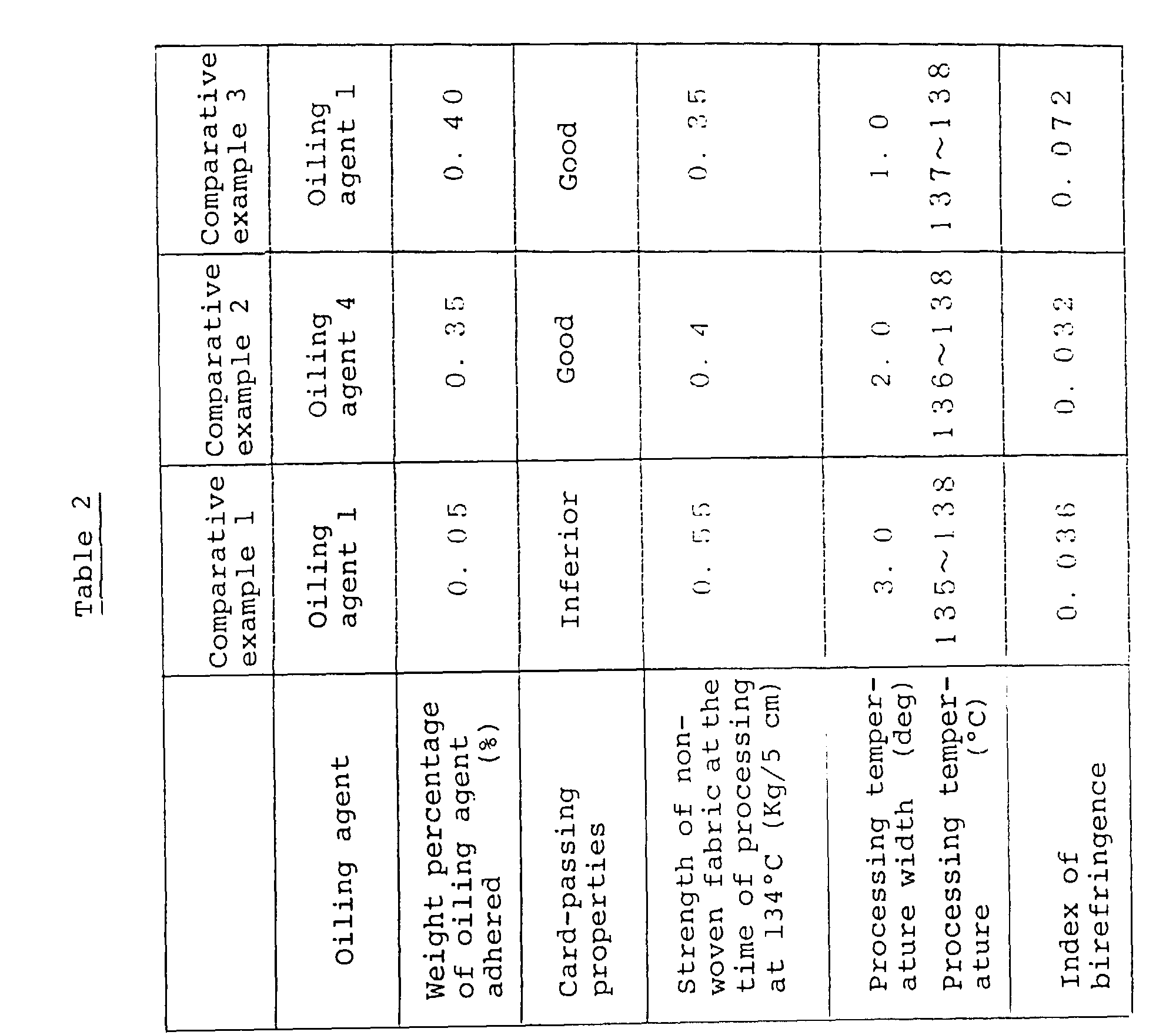
- the values of the respective examples are shown in Tables 1 and 2 together with card-passing properties.
- Comparative example 1 the strength of the non-woven fabric at 134°C (softness: 24 mm) was low, and the processing temperature width was narrow. The card-passing properties were inferior due to notable occurrence of static electricity.
- a non-woven fabric was prepared in the same manner as in Example 1 except that an oiling agent shown in Table 2 was used instead, and its characteristics were measured.
- the resulting non-woven fabric had a low strength and either of feeling, card-passing properties and processing temperature width were unsatisfactory.
- a non-woven fabric was prepared in the same manner as in Example 1 except that the stretching ratio was made 3 times, and its characteristics were measured.
- the non-woven fabric exhibited a high strength, and either of feeling, card-passing properties and processing temperature width were satisfactory.
- a non-woven fabric was prepared in the same manner as in Example 1 except that the stretching ratio was made 4 times, and its characteristics were measured.
- the same oiling agent as in Example 1 was adhered, but the index of birefringence was 0.072; no skin layer was formed due to high degree of orientation; the strength of the non-woven fabric was low; and the processing temperature width was narrow.
- a non-woven fabric was prepared in the same manner as in Example 1, except that a random copolymer of 99.8% of propylene with 0.2% of ethylene having an MFR of 25, and its characteristics were measured.
- the resulting non-woven fabric exhibited a high strength, and either of feeling, card-passing properties and processing temperature width were satisfactory.
- a non-woven fabric was prepared in the same manner as in Example 1, except that an oiling agent 2 shown in Table 1 was used instead, and its characteristics were measured.
- the resulting non-woven fabric exhibited a high strength and either of feeling, card-passing properties and processing temperature width were satisfactory.
- a non-woven fabric was prepared in the same manner as in Example 1, except that an oiling agent 3 shown in Table 1 was used instead, and its characteristics were measured.
- the resulting non-woven fabric exhibited a high strength and either of feeling, card-passing properties and processing temperature width were satisfactory.
- the modified polyolefin fibers of the present invention By subjecting the modified polyolefin fibers of the present invention to heating roll processing, it is possible to produce a polyolefin non-woven fabric having a high strength and a soft feeling. Further, the non-woven fabric has a higher strength at the time of low temperature processing, as compared with conventional non-woven fabric, and since its processing temperature has a broad width, it is possible to easily produce the non-woven fabric.
Landscapes
- Engineering & Computer Science (AREA)
- Textile Engineering (AREA)
- Chemical & Material Sciences (AREA)
- Chemical Kinetics & Catalysis (AREA)
- General Chemical & Material Sciences (AREA)
- Treatments For Attaching Organic Compounds To Fibrous Goods (AREA)
- Nonwoven Fabrics (AREA)
- Chemical Treatment Of Fibers During Manufacturing Processes (AREA)
- Artificial Filaments (AREA)
Description
- This invention relates to modified polyolefin fibers preferred as a raw material for a hot-melt-adhesive polyolefin non-woven fabric and the non-woven fabric. More particularly, it relates to modified polyolefin fibers having a superior card-passing through property at the time of processing a non-woven fabric, and a low temperature adhesion and a broad width of processing temperature, and also having superior working characteristics on heating rolls, and a non-woven fabric.
- Hot-melt-adhesive type non-woven fabrics have been broadly used in view of advantages of provisions, economy, hygienics, etc., because the fabrics do not require any binder. Among the fabrics, polyolefin non-woven fabrics are superior in the properties and economy; hence they have been used in many fields such as those of surface materials for paper diaper, goods for menses, etc., medical or hygienic materials for operating gown, etc., civil engineering materials, agricultural materials, industrial materials, etc., and conjugate fibers of polyethylene/polypropylene and single fibers of polypropylene, etc. have been used as raw material fibers therefor.
- The method for processing hot-melt-adhesive non-woven fabrics is roughly classified into an air-through process using hot air and heating roll process. Among these, the air-through process is applied to polyethylene/polypropylene conjugate fibers. Non-woven fabric obtained according to the air-through process is strong and soft, but the processing speed is slower than that by means of heating roll process and the processing is inferior in the productivity. Further, since polyethylene/polypropylene conjugate fibers are used, there is a drawback of a waxy feeling specific of polyethylene.
- On the other hand, heating roll process has a high processing speed and a high productivity, and hot-melt-adhesion is carried out; hence even when polypropylene single fibers are used, it is possible to make a non-woven fabric from the fibers, and there is an advantage that there is no waxy feeling due to polyethylene.
- However, it has been regarded as difficult to produce a polypropylene non-woven fabric provided with both of strength and a soft feeling according to heating roll process. The reason is as follows:
- In order to produce the polypropylene non-woven fabric by means of heating roll, it is necessary to improve the hot-melt-adhesion between polypropylene fibers, and it is therefor necessary to produce the non-woven fabric at a high temperature at which the polypropylene fibers sufficiently soften at the time of hot-melt-adhesion bonding thereof.
- However, when the non-woven fabric is produced at such a high temperature, the hot-melt-adhesion bonded points are deformed into a film form, and the polypropylene fibers other than the bonded points are also affected by heat, so that the feeling becomes inferior. Further, when processing is carried out at a low temperature, hot-melt-adhesion at the bonded points is insufficient, and strength endurable to practical uses cannot be obtained. Thus, the range of production conditions under which a propylene non-woven fabric being strong and having a soft feeling can be obtained, is very narrow, so that there has been raised a problem of production that strength lowers due to a small change in the processing temperature and the feeling becomes hard. Thus, it has been awaited to develop polypropylene fibers having a broad processing temperature for obtaining a soft and strong polypropylene non-woven fabric, and suitable to heat-rolling process.
- Japanese patent application laid-open No. Sho 62-156310 proposes, as polypropylene fibers suitable to heat-rolling process, polypropylene fibers composed of ethylene-propylene random copolymer containing a definite quantity of ethylene and having a softening point of 132°C or lower. However, the fibers have drawbacks that they have hard feeling and the processing temperature range wherein it is possible to produce a non-woven fabric provided with both of strength suitable to practical uses and feeling, is very narrow.
- Further, Japanese patent application laid-open No. Hei 2-112456 discloses a non-woven fabric composed of fibers of polypropylene having a specified isotactic pentad fraction. This non-woven fabric has a good feeling, but its strength is insufficient. Further, in general, the fibers composed of such a low stereoregular polypropylene have inferior carding characteristics; hence the fibers have drawbacks such that a serious problem occurs in the intrinsic production of non-woven fabric.
- Further, Japanese patent application laid-open No. Hei 2-264012 proposes polypropylene fibers having 1,3,5-trimethyl-2,4,6-trisbenzene and dimyristyl-3,3'-thiodipropionic acid ester blended therein, but the feeling and tenacity thereof are both insufficient.
- EP-A-0 632 148 discloses a fiber for nonwoven fabrics comprising an olefin polymer material containing (by weight) :
- 1) from 50 to 80 parts of a propylene homopolymer having an isotactic index greater than 90, or a random copolymer of propylene with ethylene and/or a C4-C8 α-olefin; and
- 2)from 20 to 50 parts of a heterophasic polymer comprising a copolymer containing from 40 to 70% of ethylene, and having an intrinsic viscosity lower than or equal to 1.5 dl/g, or said copolymer containing less than 40% of ethylene and having an intrinsic viscosity lower than or equal to 2.3 dl/g; said fiber being obtained by spinning the above olefin polymer material and then drawing it out with a draw-ratio equal to or lower than 1.8.
-
- EP-A-0 557 889 relates to a hotmelt-adhesive fiber sheet having a superior adhesion and sheet-form retainability, which sheet is composed of substantially unstretched fibers of an average fiber diameter of 10 µm or less composed of an olefinic copolymer or terpolymer composed mainly of propylene, the fiber contact points of the fiber sheet being hotmelt-adhered.
- As described above, a number of attempts to provide a polypropylene non-woven fabric having superior strength and feeling according to heating roll processing have been carried out, but the properties of the produced non-woven fabrics are insufficient, and the processing temperature ranqe at the time of production thereof is narrow; thus, satisfactory polypropylene fibers have not yet been developed.
- The present inventors have made strenuous research in order to solve the above problems, and as a result, have found that a product obtained by adhering an oiling agent composed mainly of a dibasic acid ester and/or a fatty acid ester onto polyolefin fibers of low orientation having an index of birefringence of 0.054 or less exhibits the aimed high strength of non-woven fabric and softness even within a low processing temperature range, and have completed the present invention.
- As apparent from the foregoing, the object of the present invention is to provide superior polyolefin fibers capable of easily producing a soft and high feeling polyolefin non-woven fabric, and having a broad processing temperature range and being suitable to heating roll processing.
- This invention has the following constitutions (1) to (4) :
- (1) Modified polyolefin fibers having 0.1 to 1.0% by weight of an oiling agent comprising a dibasic acid ester of at least one member selected from the group consisting of adipic acid, sebasic acid, phthalic acid, terephthalic acid, succinic acid and maleic acid, or an aliphatic acid ester of at least one acid selected from the group consisting of caprylic acid, capric acid, lauric acid, myristic acid, palmitic acid and stearic acid, or said dibasic acid ester and said aliphatic acid ester, adhered onto polyolefin fibers having an index of birefringence of 0.054 or less.
- (2) Modified polyolefin fibers according to item (1), wherein the polyolefin fibers are polypropylene fibers.
- (3) Modified polyolefin fibers according to item (1) or (2), wherein the polyolefin fibers are those of an olefin bipolymer or terpolymer, composed of propylene as main component and ethylene or butene-1.
- (4) A modified polyolefin non-woven fabric characterized by using modified polyolefin fibers set forth in either one one of items (1) to (3).
-
- The present invention will be described in more detail.
- The polyolefin fibers of the present invention refer to not only those of 100% propylene polymer but also those of olefin bipolymer or terpolymer composed mainly of propylene.
- The olefin bipolymer composed mainly of propylene referred to in the present invention is directed to a random copolymer consisting of propylene of less than 100% and 85% or more and ethylene of more than 0% and less than 15%, or a random copolymer consisting of propylene of less than 100% and more than 50% and butene-1 of more than 0% and less than 50%. The olefin terpolymer composed mainly of propylene refers to a random copolymer consisting of propylene of more than 85% and less than 100%, ethylene of more than 0% and less than 10% and butene-1 of more than 0% and less than of 15%.
- The above olefin bipolymer or terpolymer composed mainly of propylene is a solid polymer obtained by polymerizing propylene, ethylene and butene-1 in the presence of a conventional Ziegler-Natta type catalyst so as to give the above respective component contents, and it is essentially a random copolymer. Such polymers may be obtained according to a process of polymerizing mixed gas from the beginning, and besides, in order to improve the productivity, according to a polymerization process of obtaining 20% or less of polymer based upon the total polymer by propylene single polymerization, followed by feeding mixed gas of the respective components to polymerize them.
- Further, it does not matter if the above bipolymer, terpolymer, etc. may have another polyolefin component capable of being blended, or a component other than polyolefin component, blended therewith, in a small quantity.
- The modified polyolefin fibers of the present invention are produced so as to afford low orientation properties (index of birefringence = 0.054 or less). Such low orientation properties are obtained by suppressing the stretching ratio employed at the time of spinning down to a stretching ratio (3 times or less) lower than that conventionally employed (about 4 times or more), and the stretching ratio is preferably 2.5 times or less, more preferably 2.0 times or less. If the stretching ratio exceeds 3.0 times, the molecular orientation is elevated, so that the heat-softening point and melting point rise and the hot-melt-adhesion lowers. Furthermore, it is impossible to obtain a sufficient function and effectiveness of penetration and adsorption of an oiling agent into the fibers as described later.
- As the dibasic acid ester as a main component of the oiling agent used in the present invention, diesters of at least one member selected from the group of acids consisting of adipic acid, sebasic acid, phthalic acid, terephthalic acid, succinic acid and maleic acid, with an aliphatic alcohol can be exemplified. Particularly preferable examples are dioctyl adipate, dibutoxyethyl sebacate and dioctyl phthalate.
- As the aliphatic acid ester, esters of at least one member of acids selected from the group consisting of caprylic acid, capric acid, lauric acid, myristic acid, palmitic acid, and stearic acid can be exemplified. Particularly preferable examples are methyl caprate, oclyl laurate and methyl palmitate.
- The main component referred to herein means that it occupies 15% of the oiling agent. Further, the dibasic acid ester and the aliphatic acid ester can be adhered onto the polyolefin fibers, each alone or in mixed state. In addition, antistatic agent, emulsifying agent, etc. as components other than the dibasic acid ester and aliphatic acid ester may be blended, within a range of quantity not obstructing the effectiveness of the present invention. Among these agents, polyethylene glycol monoester or diester, Na alkylsulfonate, fatty acid amide, etc. are mentioned.
- The percentage of the oiling agent adhered onto the polyolefin fibers in the present invention is within a range of 0.1 to 1.0% by weight, preferably 0.2 to 0.5% by weight. If the percentage of the oiling agent adhered is less than 0.1% by weight, the antistatic property at the carding process becomes inferior so that a formation unevenness occurs on the web; but it is impossible to make the line speed high in order to avoid the occurrence. If the quantity of the agent adhered is reduced, the penetration and adsorption of the agent into the surface part of the polyolefin fibers for promoting adhesion are insufficient so that it becomes difficult to form a skin layer having adsorbed the dibasic acid ester or aliphatic acid ester; hence improvement in the hot-melt-adhesion is obstructed.
- The upper limit value of the percentage of the oiling agent adhered is preferred to be 1.0% by weight. Even if the percentage exceeds 1.0% by weight, no problem is raised upon antistatic properties, but such a percentage is undesirable since the excess penetrating adsorption into fibers lowers the fiber tenacity, and lowers the crimp retention, and the card-passing properties because of softening of the fiber surface becomes inferior.
- As for the process for adhering the oiling agent to fibers, a known process may be employed, such as a process by means of touch roll during the fiber-spinning step, a process by means of touch roll during the stretching step, a process of spray adhesion after mechanical crimp process, etc.
- As to the tensile strength of non-woven fabric obtained by heating roll process, when the bonding points of fibers are sufficiently tight, the strength usually depends greatly upon the single filament tenacity. On the other hand, when the bonding points are brittle, since the breaking of non-woven fabric occurs due to breakage of bonding points, the tensile strength of non-woven fabric is almost not influenced by single fiber tenacity, and yet the value is very small.
- In the case of the modified polyolefin fibers of the present invention, by suppressing the molecular orientation of the fibers in a low stretching ratio of three times or less (an index of birefringence = 0.54 or less), the penetrating function of the adhered oiling agent into the skin layer is promoted. As a result, since the swelled skin layer is easier in the heat softening as compared with the core layer, the heat softness is improved, so that it is possible to hot-melt-adhere the fiber bonding points at a low processing temperature which has no influence upon the core layer.
- According to the present invention, by imparting an oiling agent composed mainly of a dibasic acid ester and/or a fatty acid ester to polyolefin fibers having the molecular orientation suppressed in a low stretching ratio of three times or less (an index of birefringence = 0.054 or less), the dibasic acid ester and/or aliphatic acid ester are transferred by diffusion, from the polyolefin fiber surface to the surface layer part to form a skin layer having adsorbed the dibasic acid ester and/or aliphatic acid ester. The skin layer is swelled by the dibasic acid ester and/or aliphatic acid ester so that the skin layer has a lower density than that of the core layer and also has a lower softening point than that of the core layer. As a result, tight fiber bonding points can be prepared at a low processing temperature to exhibit a high non-woven fabric strength.
- The present invention will be concretely described by way of Examples, but it should not be construed to be limited only to Examples.
- In addition, the various values of physical properties described in Examples were measured according to the following methods:
- Melt flow rate (MFR): Measured according to the condition (L) of ASTM D 1238.
- Strength of non-woven fabric: A test piece of 5 cm long and 15 cm lateral was cut off from a non-woven fabric having a basis weight of 20 g/m2 and its breaking strength was measured by means of a tensile strength tester, under conditions of a test piece-gripping distance of 10 cm and a tensile speed of 10 cm/min.
- Softness:
Measured according to JIS L1018 (item 6.21A). A non-woven fabric of 5 cm long and 15 cm laterial, cut off from a non-woven fabric having a basis weight of 20 g/m2 was placed on a horizontal table (Cantilever type tester) having one smooth side slanted at 45° and having a scale graduated, so as to correspond to the scale, followed by softly sliding the non-woven fabric manually in the slant direction, and reading the delivery at the time of contact of one end of the non-woven fabric with the slant surface, in a unit of mm, to render the numeral value of the delivery, as an indication of the softness. The smaller the value, the better the softness of the non-woven fabric. When the value of softness is 30 mm or less, the feeling of the non-woven fabric is good. If the value of softness exceeds 30 mm, the feeling of the non-woven fabric is hard; hence it is impossible to use the fabric to use application of hygienic materials used in direct contact with the skin. - Processing temperature width: This refers to a temperature width of a heating roll affording a non-woven fabric furnished with properties of a softness of 30 mm or less and a strength of 0.6 Kg/5 cm or higher, and it is evaluation standards of low temperature adhesiveness and high processing temperature width. For example, if a non-woven fabric satisfying the conditions within a temperature range of 130° to 140°C, the processing temperature width is 10 (deg).
- Low temperature processability:
This was evaluated by the strength of a non-woven
fabric processed at 134°C (softness: 24 mm).
A non-woven fabric having a higher strength is good. - Percentage of oiling agent adhered: A sample (10 g) was extracted with a mixed solvent of methanol with petroleum ether (1:1) using a Soxhlet extractor, under reflux for 3 hours, followed by removing the solvent and measuring the weight.
- Index of birefringence: Its measurement was carried out by using a polarization microscope and by means of Babinet's compensator.
- Fibers were melt-spun, using a polypropylene component of MFR 25 and at a spinning temperature of 310°C. At the drawing step just after spinning, oiling agents described in Table 1 were adhered by means of touch roll. After spinning, fibers were stretched to 1.5 times by a hot roll at 40°C, followed by imparting mechanical crimps by means of stuffing box, drying and cut-treating to prepare polypropylene short fibers of 2d × 38 mm.
- The short fibers were carded at a speed of 20 m/min. by a roller carding machine, to prepare a web having a basis weight of 20 g/m2, followed by processing the web into a non-woven fabric by means of an embossing roll having an adhesion area percentage of 24% at the same speed. The heating temperature of the embossing roll was nicked each 0.5 (deg) within a range of 130° to 145°C. From the non-woven fabrics obtained at the respective heating temperatures, definite test pieces were prepared and the strength and softness thereof were measured. From the results, the strength, processing temperature and processing temperature width of the non-woven fabric at the time of low temperature processing at 134°C (softness 24 mm) were sought. The values of the respective examples are shown in Tables 1 and 2 together with card-passing properties.
- In Examples 1 and 2, the strength of the non-woven fabric at the time of low temperature processing at 134°C (softness: 24 mm) was high, the processing temperature width was broad and the card-passing properties were good.
- In Comparative example 1, the strength of the non-woven fabric at 134°C (softness: 24 mm) was low, and the processing temperature width was narrow. The card-passing properties were inferior due to notable occurrence of static electricity.
- A non-woven fabric was prepared in the same manner as in Example 1 except that an oiling agent shown in Table 2 was used instead, and its characteristics were measured. The resulting non-woven fabric had a low strength and either of feeling, card-passing properties and processing temperature width were unsatisfactory.
- A non-woven fabric was prepared in the same manner as in Example 1 except that the stretching ratio was made 3 times, and its characteristics were measured. The non-woven fabric exhibited a high strength, and either of feeling, card-passing properties and processing temperature width were satisfactory.
- A non-woven fabric was prepared in the same manner as in Example 1 except that the stretching ratio was made 4 times, and its characteristics were measured. The same oiling agent as in Example 1 was adhered, but the index of birefringence was 0.072; no skin layer was formed due to high degree of orientation; the strength of the non-woven fabric was low; and the processing temperature width was narrow.
- Thus, a satisfactory non-woven fabric was not obtained.
- A non-woven fabric was prepared in the same manner as in Example 1, except that a random copolymer of 99.8% of propylene with 0.2% of ethylene having an MFR of 25, and its characteristics were measured. The resulting non-woven fabric exhibited a high strength, and either of feeling, card-passing properties and processing temperature width were satisfactory.
- A non-woven fabric was prepared in the same manner as in Example 1, except that an oiling agent 2 shown in Table 1 was used instead, and its characteristics were measured. The resulting non-woven fabric exhibited a high strength and either of feeling, card-passing properties and processing temperature width were satisfactory.
- A non-woven fabric was prepared in the same manner as in Example 1, except that an oiling agent 3 shown in Table 1 was used instead, and its characteristics were measured. The resulting non-woven fabric exhibited a high strength and either of feeling, card-passing properties and processing temperature width were satisfactory.


- By subjecting the modified polyolefin fibers of the present invention to heating roll processing, it is possible to produce a polyolefin non-woven fabric having a high strength and a soft feeling. Further, the non-woven fabric has a higher strength at the time of low temperature processing, as compared with conventional non-woven fabric, and since its processing temperature has a broad width, it is possible to easily produce the non-woven fabric.
Claims (4)
- Modified polyolefin fibers having 0.1 to 1.0% by weight of an oiling agent comprising a dibasic acid ester of at least one member selected from the group consisting of adipic acid, sebasic acid, phthalic acid, terephthalic acid, succinic acid and maleic acid, or an aliphatic acid ester of at least one acid selected from the group consisting of caprylic acid, capric acid, lauric acid, myristic acid, palmitic acid and stearic acid, or said dibasic acid ester and said aliphatic acid ester, adhered onto polyolefin fibers having an index of birefringence of 0.054 or less.
- Modified polyolefin fibers according to claim 1, wherein the polyolefin fibers are polypropylene fibers.
- Modified polyolefin fibers according to claim 1 or 2, wherein the polyolefin fibers are those of an olefin bipolymer or terpolymer, composed of propylene as main component and ethylene or butene-1.
- A modified polyolefin non-woven fabric characterized by using modified polyolefin fibers set forth in either one of claims 1 to 3.
Applications Claiming Priority (2)
| Application Number | Priority Date | Filing Date | Title |
|---|---|---|---|
| JP39138/95 | 1995-02-02 | ||
| JP03913895A JP3525536B2 (en) | 1995-02-02 | 1995-02-02 | Modified polyolefin fiber and nonwoven fabric using the same |
Publications (2)
| Publication Number | Publication Date |
|---|---|
| EP0725174A1 EP0725174A1 (en) | 1996-08-07 |
| EP0725174B1 true EP0725174B1 (en) | 1999-03-24 |
Family
ID=12544755
Family Applications (1)
| Application Number | Title | Priority Date | Filing Date |
|---|---|---|---|
| EP96100081A Expired - Lifetime EP0725174B1 (en) | 1995-02-02 | 1996-01-04 | Modified polyolefin fibers and a non-woven fabric using the same |
Country Status (5)
| Country | Link |
|---|---|
| US (1) | US5981068A (en) |
| EP (1) | EP0725174B1 (en) |
| JP (1) | JP3525536B2 (en) |
| CN (1) | CN1070546C (en) |
| DE (1) | DE69601817T2 (en) |
Families Citing this family (7)
| Publication number | Priority date | Publication date | Assignee | Title |
|---|---|---|---|---|
| JP3662455B2 (en) * | 1999-11-22 | 2005-06-22 | ユニ・チャーム株式会社 | Polypropylene nonwoven fabric and method for producing the same |
| ES2365698T3 (en) * | 2001-03-26 | 2011-10-10 | Tyco Healthcare Group Lp | OIL COVERED SUTURES. |
| US20020177876A1 (en) * | 2001-03-26 | 2002-11-28 | Tyco Healthcare Group Lp | Polyolefin sutures having improved processing and handling characteristics |
| US20050106982A1 (en) * | 2003-11-17 | 2005-05-19 | 3M Innovative Properties Company | Nonwoven elastic fibrous webs and methods for making them |
| EP2379785A1 (en) | 2008-12-30 | 2011-10-26 | 3M Innovative Properties Company | Elastic nonwoven fibrous webs and methods of making and using |
| CN105579075A (en) | 2013-08-01 | 2016-05-11 | 宝洁公司 | Articles comprising malodor reducing compositions |
| MY207502A (en) | 2021-06-30 | 2025-02-28 | Mitsui Chemicals Asahi Life Mat Co Ltd | Nonwoven fabric, use of same, and method for producing nonwoven fabric |
Family Cites Families (11)
| Publication number | Priority date | Publication date | Assignee | Title |
|---|---|---|---|---|
| JPS62156310A (en) * | 1985-12-28 | 1987-07-11 | Ube Nitto Kasei Kk | Polypropylene adhesive fiber |
| JPH0672352B2 (en) * | 1988-10-18 | 1994-09-14 | チッソ株式会社 | Non-woven polypropylene |
| JP2613798B2 (en) * | 1988-12-08 | 1997-05-28 | チッソ株式会社 | Durable hydrophilic fiber |
| JP2739230B2 (en) * | 1989-04-03 | 1998-04-15 | チッソ株式会社 | Polypropylene fiber |
| JP2754262B2 (en) * | 1989-10-02 | 1998-05-20 | チッソ株式会社 | Processable fiber and molded article using the same |
| JP2829147B2 (en) * | 1991-03-12 | 1998-11-25 | 出光石油化学株式会社 | Nonwoven fabric manufacturing method |
| JP3261728B2 (en) * | 1992-02-18 | 2002-03-04 | チッソ株式会社 | Thermal adhesive fiber sheet |
| DK24893D0 (en) * | 1993-03-05 | 1993-03-05 | Danaklon As | FIBERS AND MANUFACTURING THEREOF |
| IT1264841B1 (en) * | 1993-06-17 | 1996-10-17 | Himont Inc | FIBERS SUITABLE FOR THE PRODUCTION OF NON-WOVEN FABRICS WITH IMPROVED TENACITY AND SOFTNESS CHARACTERISTICS |
| KR100290614B1 (en) * | 1994-01-14 | 2001-10-24 | 다나클론에이/에스 | Cardable hydrophobic polyolefin fibers with cationic radioemulsion |
| US5460884A (en) * | 1994-08-25 | 1995-10-24 | Kimberly-Clark Corporation | Soft and strong thermoplastic polymer fibers and nonwoven fabric made therefrom |
-
1995
- 1995-02-02 JP JP03913895A patent/JP3525536B2/en not_active Expired - Fee Related
-
1996
- 1996-01-04 DE DE69601817T patent/DE69601817T2/en not_active Expired - Fee Related
- 1996-01-04 EP EP96100081A patent/EP0725174B1/en not_active Expired - Lifetime
- 1996-02-02 CN CN96102565A patent/CN1070546C/en not_active Expired - Fee Related
-
1997
- 1997-03-26 US US08/824,572 patent/US5981068A/en not_active Expired - Fee Related
Also Published As
| Publication number | Publication date |
|---|---|
| CN1135540A (en) | 1996-11-13 |
| CN1070546C (en) | 2001-09-05 |
| DE69601817T2 (en) | 1999-08-05 |
| US5981068A (en) | 1999-11-09 |
| JPH08209533A (en) | 1996-08-13 |
| JP3525536B2 (en) | 2004-05-10 |
| EP0725174A1 (en) | 1996-08-07 |
| DE69601817D1 (en) | 1999-04-29 |
Similar Documents
| Publication | Publication Date | Title |
|---|---|---|
| US6458726B1 (en) | Polypropylene fibers and items made therefrom | |
| US5985193A (en) | Process of making polypropylene fibers | |
| EP1709225B2 (en) | Soft extensible nonwoven webs containing fibers with high melt flow rates | |
| US10174442B2 (en) | Polypropylene fibers and fabrics | |
| US9382411B2 (en) | Propylene polymers | |
| EP1257703B1 (en) | Biodegradable thermoplastic nonwoven webs for fluid management | |
| US6548432B1 (en) | Polyethylene nonwoven fabric and nonwoven fabric laminate containing the same | |
| EP0269051B1 (en) | Method for making nonwoven fabrics | |
| CA2116608C (en) | Nonwoven fabrics having durable wettability | |
| EP1369518A1 (en) | Non-woven fabrics of wind-shrink fiber and laminates thereof | |
| KR100265450B1 (en) | Hotmelt-adhesive fiber sheet and process for producing the same | |
| KR100231347B1 (en) | Low temperature adhesive fiber and nonwoven fabric using same | |
| MXPA06012585A (en) | Improved fibers for polyethylene nonwoven fabric. | |
| US5981068A (en) | Modified polyolefin fibers and a non-woven fabric using the same | |
| JP2001040531A (en) | Latent crimping conjugate fiber and nonwoven fabric using the same | |
| JP2005531699A (en) | Spinneret and fiber manufacturing method | |
| JP2872543B2 (en) | Thermally bonded nonwoven fabric and method for producing the same | |
| JP3345764B2 (en) | Polypropylene fiber | |
| US20030124348A1 (en) | High elongation, low denier fibers using high extrusion rate spinning | |
| JPH02154053A (en) | Production of continuous filament nonwoven fabric for sanitary purpose | |
| JPH02216251A (en) | Nonwoven fabric composed of heat-bonding conjugate fiber | |
| JPH02264016A (en) | Thermally adhesive conjugated fiber | |
| HK1015424B (en) | Polypropylene fibers and items made therefrom | |
| MXPA00006103A (en) | Nonwoven webs having improved softness and barrier properties |
Legal Events
| Date | Code | Title | Description |
|---|---|---|---|
| PUAI | Public reference made under article 153(3) epc to a published international application that has entered the european phase |
Free format text: ORIGINAL CODE: 0009012 |
|
| AK | Designated contracting states |
Kind code of ref document: A1 Designated state(s): DE FR GB |
|
| 17P | Request for examination filed |
Effective date: 19960916 |
|
| 17Q | First examination report despatched |
Effective date: 19971120 |
|
| GRAG | Despatch of communication of intention to grant |
Free format text: ORIGINAL CODE: EPIDOS AGRA |
|
| GRAG | Despatch of communication of intention to grant |
Free format text: ORIGINAL CODE: EPIDOS AGRA |
|
| GRAH | Despatch of communication of intention to grant a patent |
Free format text: ORIGINAL CODE: EPIDOS IGRA |
|
| GRAH | Despatch of communication of intention to grant a patent |
Free format text: ORIGINAL CODE: EPIDOS IGRA |
|
| GRAA | (expected) grant |
Free format text: ORIGINAL CODE: 0009210 |
|
| AK | Designated contracting states |
Kind code of ref document: B1 Designated state(s): DE FR GB |
|
| REF | Corresponds to: |
Ref document number: 69601817 Country of ref document: DE Date of ref document: 19990429 |
|
| ET | Fr: translation filed | ||
| PLBE | No opposition filed within time limit |
Free format text: ORIGINAL CODE: 0009261 |
|
| STAA | Information on the status of an ep patent application or granted ep patent |
Free format text: STATUS: NO OPPOSITION FILED WITHIN TIME LIMIT |
|
| 26N | No opposition filed | ||
| REG | Reference to a national code |
Ref country code: GB Ref legal event code: IF02 |
|
| PGFP | Annual fee paid to national office [announced via postgrant information from national office to epo] |
Ref country code: GB Payment date: 20020102 Year of fee payment: 7 |
|
| PGFP | Annual fee paid to national office [announced via postgrant information from national office to epo] |
Ref country code: FR Payment date: 20020110 Year of fee payment: 7 |
|
| PG25 | Lapsed in a contracting state [announced via postgrant information from national office to epo] |
Ref country code: GB Free format text: LAPSE BECAUSE OF NON-PAYMENT OF DUE FEES Effective date: 20030104 |
|
| GBPC | Gb: european patent ceased through non-payment of renewal fee |
Effective date: 20030104 |
|
| PG25 | Lapsed in a contracting state [announced via postgrant information from national office to epo] |
Ref country code: FR Free format text: LAPSE BECAUSE OF NON-PAYMENT OF DUE FEES Effective date: 20030930 |
|
| REG | Reference to a national code |
Ref country code: FR Ref legal event code: ST |
|
| PGFP | Annual fee paid to national office [announced via postgrant information from national office to epo] |
Ref country code: DE Payment date: 20061229 Year of fee payment: 12 |
|
| PG25 | Lapsed in a contracting state [announced via postgrant information from national office to epo] |
Ref country code: DE Free format text: LAPSE BECAUSE OF NON-PAYMENT OF DUE FEES Effective date: 20080801 |