EP0723973B1 - Nucleoside phosphorothioate derivatives, synthesis and use thereof - Google Patents

Nucleoside phosphorothioate derivatives, synthesis and use thereof Download PDF

Info

Publication number
EP0723973B1
EP0723973B1 EP96300390A EP96300390A EP0723973B1 EP 0723973 B1 EP0723973 B1 EP 0723973B1 EP 96300390 A EP96300390 A EP 96300390A EP 96300390 A EP96300390 A EP 96300390A EP 0723973 B1 EP0723973 B1 EP 0723973B1
Authority
EP
European Patent Office
Prior art keywords
phosphorothioate
see
mmol
phenylxanthen
nucleoside
Prior art date
Legal status (The legal status is an assumption and is not a legal conclusion. Google has not performed a legal analysis and makes no representation as to the accuracy of the status listed.)
Expired - Lifetime
Application number
EP96300390A
Other languages
German (de)
French (fr)
Other versions
EP0723973A1 (en
Inventor
Colin Bernard Reese
Current Assignee (The listed assignees may be inaccurate. Google has not performed a legal analysis and makes no representation or warranty as to the accuracy of the list.)
Kings College London
Original Assignee
Kings College London
Priority date (The priority date is an assumption and is not a legal conclusion. Google has not performed a legal analysis and makes no representation as to the accuracy of the date listed.)
Filing date
Publication date
Application filed by Kings College London filed Critical Kings College London
Publication of EP0723973A1 publication Critical patent/EP0723973A1/en
Application granted granted Critical
Publication of EP0723973B1 publication Critical patent/EP0723973B1/en
Anticipated expiration legal-status Critical
Expired - Lifetime legal-status Critical Current

Links

Images

Classifications

    • CCHEMISTRY; METALLURGY
    • C07ORGANIC CHEMISTRY
    • C07DHETEROCYCLIC COMPOUNDS
    • C07D209/00Heterocyclic compounds containing five-membered rings, condensed with other rings, with one nitrogen atom as the only ring hetero atom
    • C07D209/02Heterocyclic compounds containing five-membered rings, condensed with other rings, with one nitrogen atom as the only ring hetero atom condensed with one carbocyclic ring
    • C07D209/44Iso-indoles; Hydrogenated iso-indoles
    • C07D209/48Iso-indoles; Hydrogenated iso-indoles with oxygen atoms in positions 1 and 3, e.g. phthalimide
    • CCHEMISTRY; METALLURGY
    • C07ORGANIC CHEMISTRY
    • C07DHETEROCYCLIC COMPOUNDS
    • C07D207/00Heterocyclic compounds containing five-membered rings not condensed with other rings, with one nitrogen atom as the only ring hetero atom
    • C07D207/46Heterocyclic compounds containing five-membered rings not condensed with other rings, with one nitrogen atom as the only ring hetero atom with hetero atoms directly attached to the ring nitrogen atom
    • C07D207/48Sulfur atoms
    • CCHEMISTRY; METALLURGY
    • C07ORGANIC CHEMISTRY
    • C07HSUGARS; DERIVATIVES THEREOF; NUCLEOSIDES; NUCLEOTIDES; NUCLEIC ACIDS
    • C07H21/00Compounds containing two or more mononucleotide units having separate phosphate or polyphosphate groups linked by saccharide radicals of nucleoside groups, e.g. nucleic acids
    • YGENERAL TAGGING OF NEW TECHNOLOGICAL DEVELOPMENTS; GENERAL TAGGING OF CROSS-SECTIONAL TECHNOLOGIES SPANNING OVER SEVERAL SECTIONS OF THE IPC; TECHNICAL SUBJECTS COVERED BY FORMER USPC CROSS-REFERENCE ART COLLECTIONS [XRACs] AND DIGESTS
    • Y02TECHNOLOGIES OR APPLICATIONS FOR MITIGATION OR ADAPTATION AGAINST CLIMATE CHANGE
    • Y02PCLIMATE CHANGE MITIGATION TECHNOLOGIES IN THE PRODUCTION OR PROCESSING OF GOODS
    • Y02P20/00Technologies relating to chemical industry
    • Y02P20/50Improvements relating to the production of bulk chemicals
    • Y02P20/55Design of synthesis routes, e.g. reducing the use of auxiliary or protecting groups

Definitions

  • This invention relates to nucleoside phosphorothioate derivatives, synthesis and use thereof.
  • one embodiment of the present invention relates to the improved production of nucleoside phosphorothioate derivatives corresponding to the following general formula (I): wherein
  • nucleoside phosphorothioate derivatives (I) could also be used in the synthesis of per-S-alkyl, -aralkyl and -alkenyl esters of oligonucleotide phosphorothioates that would have enhanced lipophilicity, thereby facilitating cellular uptake.
  • Particularly preferred thiol transfer agents (III) include N-(2-cyanoethylmercapto)phthalimide and the corresponding succinimide compound. A further embodiment of the present invention is directed accordingly.
  • nucleoside phosphorothioate derivatives which may be prepared by the present advantageous process are particularly suitable for use as building blocks for the large-scale production of phosphorothioate analogues of oligonucleotides by the phosphotriester approach, preferably in solution. Another embodiment of the present invention is directed accordingly.
  • the phosphotriester approach in solution might prove to be a superior method for the synthesis of large quantities of specific oligonucleotides and analogues thereof.
  • the most obvious merits of the phosphotriester approach are (i) that scale-up should not present a problem, (ii) that only a relatively small (say, 25-50%) excess of building block is likely to be required, (see, for example, Reese, C. B., and Zhang Pei-Zhuo, J. Chem.
  • step i involves coupling (effected by a condensing agent; see below) between a protected monomer or oligomer 2 terminating in an S -protected 3'-phosphorothioate diester and a protected monomer or oligomer 3 terminating in a 5'-hydroxy function to give the fully-protected phosphorothioate triester 4 . It is essential that the 3'-phosphorothioate 2 should be protected on sulfur. If 2 were replaced by the corresponding O -protected phosphorothioate 6 and activation by the condensing agent occurred on sulfur, loss of sulfur would occur during the coupling reaction.
  • R the protecting group for the internucleotide linkages.
  • R must fulfil at least three main criteria. Firstly, it must be such that pure phosphodiester intermediates 2 are readily accessible in high yields. Secondly, it must remain completely intact during the assembly of the required fully-protected oligonucleotide sequences 4 . Thirdly, it must be easily removable [Scheme 1, step ii] in such a way that only unprotected oligonucleotide analogues with exclusively phosphorothioate internucleotide linkages are obtained. In order to meet this last criterion, the protecting group R must clearly be removed by cleavage of the R- S rather than the S -phosphoryl bond.
  • substituted benzyl protecting groups such as 2,4-dichlorobenzyl, (see, for example, Nielsen, J., et al , Tet. Lett., 29 , 2911, 1988), (as in 8a ) and 2,4-dinitrobenzyl, (see, for example, Porritt, G.M., and Reese, C. B., Tet. Lett., 31 , 1319, 1990), (as in 8b ), have been used in the preparation of phosphorodithioate analogues of oligonucleotides.
  • Such protecting groups may be removed by the nucleophilic attack of thiolate ions (e.g.
  • di-(2,4-dinitrobenzyl) disulfide 19 (see, for example, Zhao, loc cit ), which was easily prepared in good yield by the iodine-promoted oxidation [Scheme 3(c) and Experimental below] of the mercaptan 17b, proved (see below) to be an equally effective reagent for the required purpose.
  • 2-cyanoethyl mercaptan 20 (see, for example, Bauer, L., and Welsh, T.L., J. Org. Chem., 26, 1443, 1961) was converted (see, for example, Behforouz, M., and Kerwood, J. E., J. Org.
  • the reaction proceeds by the electrophilic attack of the succinimide derivative 18 on an intermediate bis-(trimethylsilyl) phosphite (such as 25 ).
  • the S -(2,4-dinitrobenzyl)phosphorothioate 24b was similarly prepared from the H -phosphonate 23 , di-(2,4-dinitrobenzyl) disulfide 19 , chlorotrimethylsilane and 4-methylmorpholine.
  • the benzylic protons of 2,4-dinitrobenzyl derivatives are likely to be particularly acidic, it is advisable to avoid the use of strong bases such as triethylamine.
  • the desired product 24b was isolated as a precipitated solid in 67% yield.
  • the S -(2-cyanoethyl) phosphorothioate 24c was prepared in the same way from the H -phosphonate 23 , N -(2-cyanoethylmercapto)phthalimide 21 , chlorotrimethylsilane and 4-methylmorpholine; it was isolated as a pure ( 31 P NMR and HPLC, see Table 1 below) precipitated solid in 92% yield. This represents a considerable improvement both in methodology and yield over a previously reported, (see, for example, Cosstick and Williams, loc cit ) preparation of a related 2'-deoxynucleoside 3'- S -(2-cyanoethyl) phosphorothioate derivative.
  • the 2,4-dinitrobenzyl protecting group also proved to be unsuitable in that the NT 27 / MSC1-promoted coupling reaction (Scheme 5) between 5'- O -(9-phenylxanthen-9-yl)thymidine 3'-phosphorothioate S -(2,4-dinitrobenzyl) ester 24b and 3'- O -acetylthymidine 26 did not lead to a detectable quantity of the desired fully-protected dinucleoside phosphate 28b.
  • the S -(2,4-dinitrobenzyl) group is known (see, for example, Porritt and Reese, loc cit ).
  • (DMTr) groups would be expected to be equally suitable.
  • the 9-phenylxanthen-9-yl (Px) protecting group has the advantage that its use generally leads, (see, for example, Chattopadhyaya and Reese, loc cit ), to crystalline nucleoside derivatives.
  • Liquid chromatography was carried out on a Jones Apex Octyl 10 ⁇ column which was eluted with 0.1 mol dm -3 triethylammonium acetate buffer/acetonitrile mixtures: programme 1 involved a linear gradient over 10 min (flow rate 1.5 cm 3 min -1 ) starting with buffer-acetonitrile (7:3 v/v) and ending with buffer-acetonitrile (3:7 v/v); programme 2 involved a linear gradient over 20 min (flow rate 1.5 cm 3 min -1 ) starting with buffer-acetonitrile (19:1 v/v) and ending with buffer-acetonitrile (4:1 v/v).
  • Di-(2,4-dinitrobenzyl) disulfide 19 (see, for example, Zhao, loc cit ). Redistilled thioacetic acid (25.73 cm 3 , 0.36 mol) and then dry pyridine (19.9 cm 3 , 0.246 mol) were added to a stirred solution of 2,4-dinitrobenzyl chloride (13.0 g, 60.0 mmol) in dry THF (180 cm 3 ) at room temperature. After 2 h, the products were filtered and the filtrate was concentrated under reduced pressure.
  • Triethylamine (9.04 cm 3 , 65.0 mmol) and phosphorus trichloride (1.75 cm 3 , 20.1 mmol) were added to a stirred solution of 1,2,4-1 H -triazole (4.14 g, 60.0 mmol; recrystallized from dry acetonitrile) in dry THF (120 cm 3 ) at -35°C (methanol-dry ice bath). After 15 min, a solution of 5'- O -(9-phenylxanthen-9-yl)thymidine, (see, for example, Chattopadhyaya and Reese, loc cit ), (2.49 g, 5.0 mmol) in THF (100 cm 3 ) was added.
  • ⁇ H [(CD 3 ) 2 SO] includes the following signals: 1.40 (3 H, s), 2.25 (2 H, m), 3.08 (1 H, dd, J 3.2 and 10.6), 3.97 (1 H, m), 4.11 (2 H, m), 4.65 (1 H, m), 6.08 (1 H, t, J 7.2), 6.95 - 7.5 (13 H, m), 7.53 (1 H, s), 7.92 (1 H, d, J 8.6), 8.41 (1 H, dd, J 2.4 and 8.5), 8.63 (1 H, d, J 2.4), 11.36 (1 H, br s); ⁇ P
  • ⁇ H [(CD 3 ) 2 SO] includes the following signals: 1.41 (3 H, d, J 0.7), 2.40 (2 H, m), 2.67 (2 H, m), 2.84 (2 H, m), 3.14 (1 H, dd, J 3.6 and 10.2), 3.19 (1 H, dd, J 3.0 and 10.2), 4.15 (1 H, m), 4.81 (1 H, m), 6.21 (1 H, dd, J 6.1 and 8.2), 7.05 - 7.5 (13 H, m), 7.59 (1 H, m), 11.41 (1 H, s); ⁇ P [(CD 3 ) 2 SO] 12.7.
  • the two lower R t components were believed to be the desired diastereoisomeric partially-protected dinucleoside phosphorothioates 29 and the other two components ( R t s 11.87 and 12.05 min) corresponded to 5'- O -(9-phenylxanthen-9-yl)thymidine 3'-phosphorothioate S-(4-nitrobenzyl) ester 24a and 3'- O -acetyl-5'- S -(4-methylphenyl)-5'-thiothymidine 31 , respectively.
  • 3'- O -acetyl-5'- S -(4-methylphenyl)-5'-thiothymidine 31 A solution of 3'- O -acetylthymidine 26 (0.511 g, 1.8 mmol) and toluene-4-sulfonyl chloride (0.514 g, 2.7 mmol) in dry pyridine (3 cm 3 ) was stirred at room temperature. After 16 h, saturated aqueous sodium hydrogen carbonate (2 cm 3 ) was added and, after a further 10 min, the products were partitioned between chloroform (50 cm 3 ) and saturated aqueous sodium hydrogen carbonate (50 cm 3 ). The dried (MgSO 4 ) organic layer was concentrated under reduced pressure.
  • the residue was fractionated by short column chromatography on silica gel: the appropriate fractions, eluted with chloroform-methanol (99:1 v/v), were combined and evaporated under reduced pressure.
  • the residue was dissolved in acetonitrile (2.5 cm 3 ) at room temperature and triethylamine (0.90 cm 3 , 6.5 mmol) and toluene-4-thiol (0.805 g, 6.5 mmol) were added to the stirred solution which was kept under an atmosphere of argon.
  • Triethylammonium salt of O -[thymidin-5-yl] O -[thymidin-3-yl] phosphorothioate 30 The triethylammonium salt of O -[3'- O -acetylthymidin-5-yl] O -[5'- O -(9-phenylxanthen-9-yl)thymidin-3-yl] phosphorothioate 29 (0.036 g, ca. 0.037 mmol), prepared from its S- (2-cyanoethyl) ester 28c , was dissolved in concentrated aqueous ammonia (d 0.88, 4 cm 3 ) at room temperature.
  • ⁇ H [D 2 O] includes the following signals: 1.82 (3 H, s), 1.87 and 1.88 (3 H, 2 s), 2.32 (3 H, m), 2.50 (1 H, m), 3.78 (2 H, m), 4.13 (4 H, m), 4.54 (1 H, m), 4.91 (1 H, m), 6.16 (1 H, m), 6.27 (1 H, t, J 6.9), 7.62 (1 H, s), 7.68 (1 H, s); ⁇ P [D 2 O] 56.36, 56.00.
  • ⁇ H [(CD 3 ) 2 SO] includes the following signals: 1.28 (9 H, s), 2.56 (1 H, m), 3.09 (1 H, dd, J 5.6 and 10.0), 3.28 (1 H, dd, J 4.4 and 10), 4.17 (1 H, m), 4.93 (1 H, m), 6.41 (1 H, t, J 6.7), 6.67 (1 H, d, J P,H 590), 6.82 - 7.45 (13 H, m), 8.50 (1 H, s), 8.52 (1 H, s), 10.21 (1 H, s); ⁇ P [(CD 3 ) 2 SO] 0.9 (d, J P,H 587).
  • This compound was prepared in the same way as the corresponding thymidine derivative 24c described above.
  • This compound was prepared on the same scale and in precisely the same way as the simple thymidine derivative 23 described above.
  • ⁇ H [(CD 3 ) 2 SO + D 2 O] includes the following signals: 2.33 (1 H, m), 2.59 (1 H, m), 3.12 (1 H, dd, J 3.8 and 10.6), 3.25 (1 H, dd, J 3.2 and 10.6), 4.14 (1 H, m), 4.75 (1 H, m), 6.13 (1 H, t, J 5.9), 6.60 (1 H, d, J P,H 597), 7.1 - 7.5 (14 H, m), 7.54 (2 H, m), 7.63 (1 H, m), 8.00 (2 H, m), 8.27 (1 H, m); ⁇ P [(CD 3 ) 2 SO] 0.6 (d, J P,H 597).
  • This compound was prepared in the same way as the corresponding thymidine derivative 24c described above.
  • ⁇ H [(CD 3 ) 2 SO] includes the following signals: 2.28 (1 H, m), 2.67 (3 H, m), 2.85 (2 H, m), 3.14 (1 H, dd, J 4.4 and 10.4), 3.23 (1 H, dd, J 3.2 and 10.4), 4.27 (1 H, m), 4.73 (1 H, m), 6.14 (1 H, t, J 6.4), 7.1 - 7.65 (17 H, m), 8.02 (2 H, d, J 7.4), 8.17 (1 H, d, J 7.5), 11.33 (1 H, br.s); ⁇ P [(CD 3 ) 2 SO] 12.8.
  • This compound was prepared on the same scale and in precisely the same way as the simple thymidine derivative 23 described above.
  • ⁇ H [(CD 3 ) 2 SO] includes the following signals: 2.55 (1 H, m), 2.75 (1 H, m), 3.15 (2 H, m), 3.80 (2 H, s), 4.15 (1 H, m), 4.85 (1 H, m), 6.23 (1 H, t, J 6.4), 6.70 (1 H, d, J P,H 596), 6.85 - 7.45 (18 H, m), 8.01 (1 H, s); ⁇ P [(CD 3 ) 2 SO] 0.4 (d, J P,H 593).
  • This compound was prepared in the same way as the corresponding thymidine derivative 24c described above.
  • ⁇ H [(CD 3 ) 2 SO] includes the following signals: 2.55 - 2.95 (10 H, m), 3.17 (2 H, m), 3.80 (2 H, s), 4.24 (1 H, m), 4.85 (1 H, m), 6.25 (1 H, t, J 6.9), 6.9 - 7.45 (18 H, m), 8.01 (1 H, s); ⁇ P [(CD 3 ) 2 SO] 12.6.

Landscapes

  • Chemical & Material Sciences (AREA)
  • Organic Chemistry (AREA)
  • Health & Medical Sciences (AREA)
  • Life Sciences & Earth Sciences (AREA)
  • Biochemistry (AREA)
  • Molecular Biology (AREA)
  • Engineering & Computer Science (AREA)
  • Biotechnology (AREA)
  • General Health & Medical Sciences (AREA)
  • Genetics & Genomics (AREA)
  • Saccharide Compounds (AREA)

Description

This invention relates to nucleoside phosphorothioate derivatives, synthesis and use thereof.
More particularly, one embodiment of the present invention relates to the improved production of nucleoside phosphorothioate derivatives corresponding to the following general formula (I):
Figure 00010001
wherein
  • M+ represents a suitable counter-cation, such as Et3NH+;
  • R1 represents an appropriate nucleoside or nucleoside analogue; and
  • R2 represents a protecting group, which is removed by cleavage of its bond to the sulfur atom. The nucleoside or nucleoside analogue R1 includes a suitably protected sugar and/or base residue as appropriate. R1 may be derived from a natural 2'-deoxyribo- or ribo-nucleoside or an analogue thereof. The protecting group R2 may be alkyl, such as methyl, substituted alkyl, such as 2-cyanoethyl, aralkyl, such as benzyl, which may be mono- or di-nitro-substituted, alkenyl, such as allyl, or substituted alkenyl.
  • For example, such nucleoside phosphorothioate derivatives (I) could also be used in the synthesis of per-S-alkyl, -aralkyl and -alkenyl esters of oligonucleotide phosphorothioates that would have enhanced lipophilicity, thereby facilitating cellular uptake.
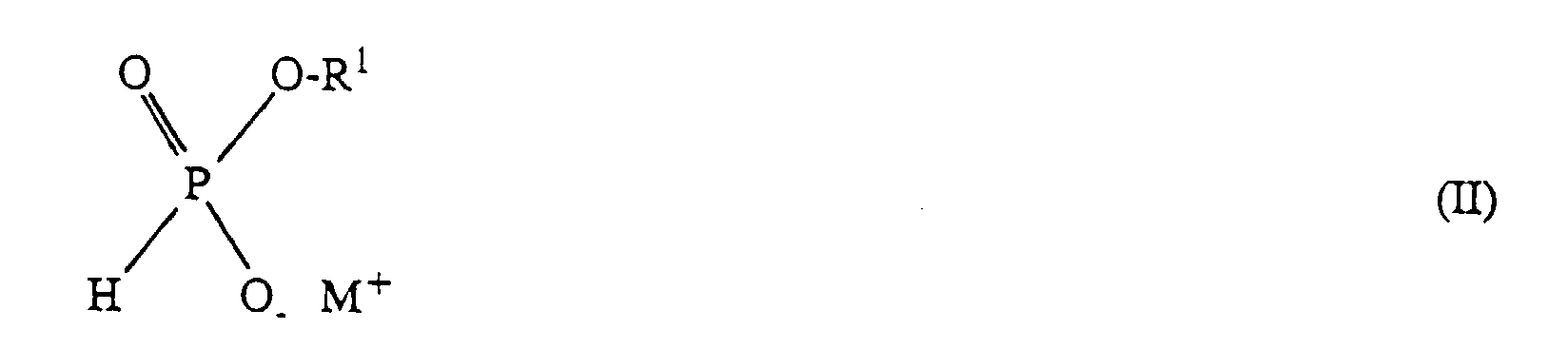
    An appropriate salt of a nucleoside H-phosphonate corresponding to the following general formula (II):
    Figure 00020001
    is reacted with a suitable thiol transfer agent corresponding to the following general formula (III): R2-S-X wherein X represents a leaving group, such as the conjugate base of succinimide or phthalimide, either of which may be substituted; in the presence of a silylating agent, such as chlorotrimethylsilane, and a base, such as triethylamine or 4-methylmorpholine, in a suitable solvent, such as dichloromethane. The reaction mixture is then worked-up to isolate the products and the counter-cation changed as desired. For example, the products may be poured into aqueous triethylammonium hydrogen carbonate and the resulting mixture extracted with dichloromethane.
    Particularly preferred thiol transfer agents (III) include N-(2-cyanoethylmercapto)phthalimide and the corresponding succinimide compound. A further embodiment of the present invention is directed accordingly.
    The nucleoside phosphorothioate derivatives which may be prepared by the present advantageous process are particularly suitable for use as building blocks for the large-scale production of phosphorothioate analogues of oligonucleotides by the phosphotriester approach, preferably in solution. Another embodiment of the present invention is directed accordingly.
    Having indicated some aspects of the present invention in general terms, such will now be illustrated in more detail.
    The potential importance of antisense chemotherapy (see, for example, Oligonucleotides: Antisense Inhibitors of Gene Expression, Ed. Cohen, J. S., Macmillan, London, 1989) has stimulated organic chemists to undertake the synthesis of a variety of oligonucleotide analogues and especially those analogues in which the internucleotide linkages and sugar residues are modified. Perhaps the most widely investigated analogues in this context are oligodeoxyribonucleotide phosphorothioates, (see, for example, the above mentioned reference; Zon G., and Stec W. J., Oligonucleotides and Analogues - A Practical Approach, Ed. Eckstein, F., IRL Press, Oxford, 87-108, 1991; and Zon G., Methods in Molecular Biology, Vol 20, Protocols for Oligonucleotides and Analogs, Ed. Agrawal, S., Humana, Totowa, 165-189, 1993), e.g. 1:
    Figure 00040001
    Indeed, it is believed, (see, for example, Stec, W. J., and Wilk, A., Angew. Chem. Int. Ed. Engl., 33, 709, 1994), that several such sequences are presently undergoing clinical trials. By far the most convenient method of preparing small (say, of the order of 10-6 mol) quantities of the latter analogues is by automated solid phase synthesis using standard phosphoramidite building blocks, (see, for example, Beaucage, S. L., Methods in Molecular Biology, Vol 20, Protocols for Oligonucleotides and Analogs, Ed. Agrawal, S., Humana, Totowa, 33-61, 1993), and replacing the normal iodine-promoted oxidation by a sulfur-transfer step, (see, for example, Zon and Stec, and Zon, loc cit). Although this approach does not lead to control of the stereochemistry of the chiral phosphorothioate internucleotide linkages, the synthetic analogues appear to have satisfactory hybridisation properties, (see, for example, Ghosh, M. K., et al, Nucleic Acids Res., 21, 5761, 1993).
    It would appear from the literature, (see, for example, Zon, loc cit, that attempts to address the potential need for much larger (say, of the order of 10-3 mol or possibly considerably more) quantities of specific oligodeoxyribonucleotide phosphorothioates have mainly involved the scale-up of phosphoramidite-based solid phase synthesis. The particular advantages of solid phase synthesis, at least on the 10-6 molar scale, are that it may readily be automated, coupling reactions are generally very fast and efficient and that it is very flexible in that, as only one nucleotide residue is added at a time, the target sequence may very easily be changed. However, when the large-scale synthesis of a specific oligonucleotide sequence is to be undertaken, there will be a number of drawbacks to the use of solid phase synthesis. For example, a relatively large excess of phosphoramidite building block is generally required, (see, for example, Sinha, N. D., Methods in Molecular Biology, Vol 20, Protocols for Oligonucleotides and Analogs, Ed. Agrawal, S., Humana, Totowa, 437-463, 1993), in each coupling step and coupling efficiencies may well fall as the scale increases. Furthermore, the addition of more than one nucleotide in each coupling step would probably be costly and perhaps also inconvenient. For such reasons, the phosphotriester approach in solution, (see, for example, Reese, C.B., Tetrahedron, 34, 3143, 1978), might prove to be a superior method for the synthesis of large quantities of specific oligonucleotides and analogues thereof. The most obvious merits of the phosphotriester approach are (i) that scale-up should not present a problem, (ii) that only a relatively small (say, 25-50%) excess of building block is likely to be required, (see, for example, Reese, C. B., and Zhang Pei-Zhuo, J. Chem. Soc., Perkin Trans 1, 2291, 1993), in each coupling step, and (iii) that the addition of two or more nucleotide residues at a time (i.e. block synthesis) would be a routine operation. It was decided to investigate the feasibility of the large-scale synthesis of oligonucleotide phosphorothioates by the phosphotriester approach in solution. As indicated above, the present invention may be regarded as being particularly concerned with the choice of a protecting group for the internucleotide linkages and the preparation of suitable monomeric building blocks.
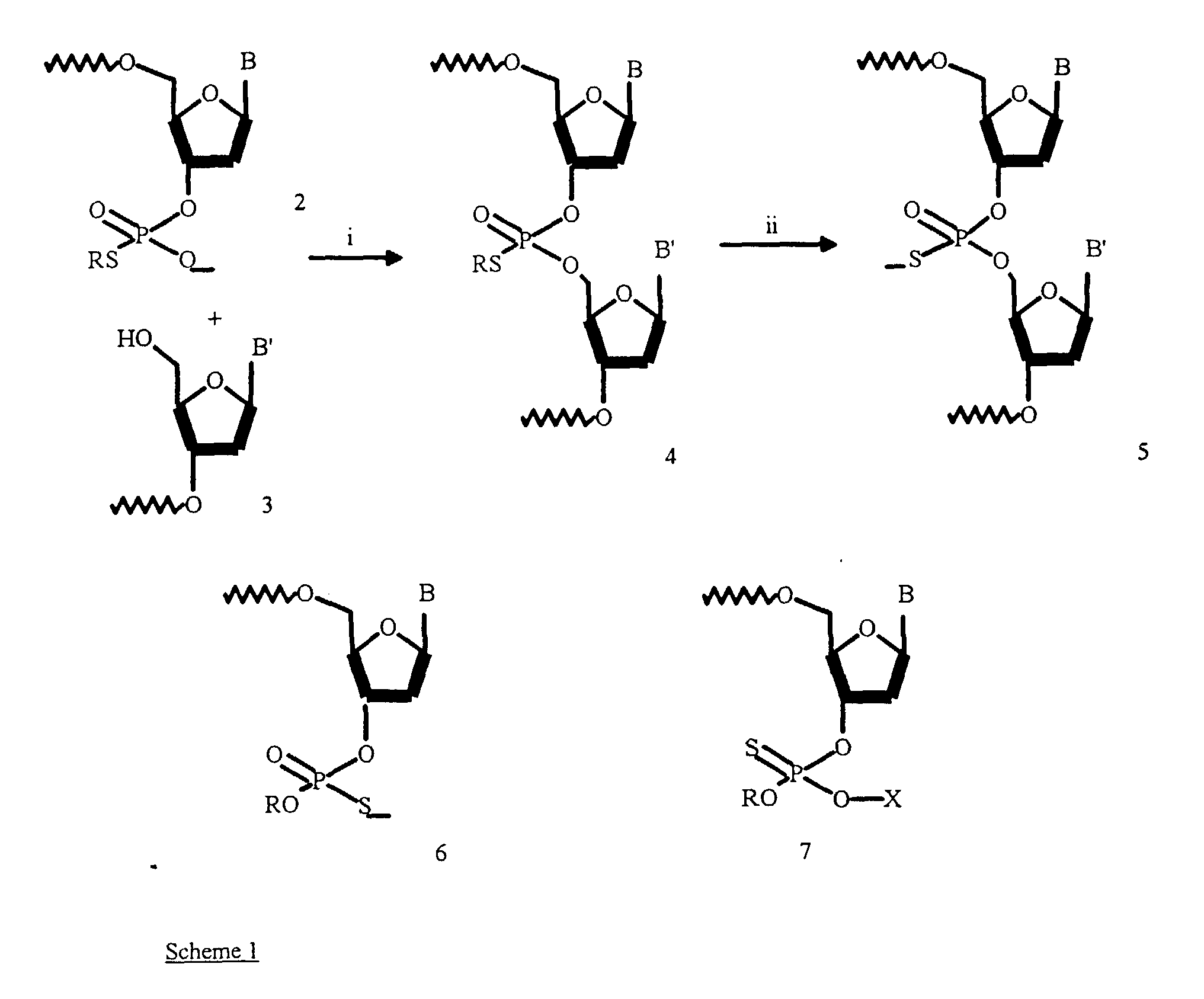
    A general strategy for the synthesis of oligodeoxyribonucleotide phosphorothioates by the phosphotriester approach is indicated in outline in Scheme 1:
    Figure 00060001
    The key step (step i) involves coupling (effected by a condensing agent; see below) between a protected monomer or oligomer 2 terminating in an S-protected 3'-phosphorothioate diester and a protected monomer or oligomer 3 terminating in a 5'-hydroxy function to give the fully-protected phosphorothioate triester 4. It is essential that the 3'-phosphorothioate 2 should be protected on sulfur. If 2 were replaced by the corresponding O-protected phosphorothioate 6 and activation by the condensing agent occurred on sulfur, loss of sulfur would occur during the coupling reaction. However, even if activation of 6 occurred entirely on oxygen (to give an intermediate such as 7 containing a P-S double bond), the ensuing phosphorylation reaction might proceed relatively slowly and then be accompanied by the concomitant direct attack of the condensing agent on the 5'-hydroxy function of 3, thereby leading to a diminished yield of the required product 4.
    A crucial decision to be made at the outset is the choice of the protecting group R (Scheme 1) for the internucleotide linkages. For the present purposes, it was decided that R must fulfil at least three main criteria. Firstly, it must be such that pure phosphodiester intermediates 2 are readily accessible in high yields. Secondly, it must remain completely intact during the assembly of the required fully-protected oligonucleotide sequences 4. Thirdly, it must be easily removable [Scheme 1, step ii] in such a way that only unprotected oligonucleotide analogues with exclusively phosphorothioate internucleotide linkages are obtained. In order to meet this last criterion, the protecting group R must clearly be removed by cleavage of the R-S rather than the S-phosphoryl bond.
    Figure 00080001
    Recently, substituted benzyl protecting groups, such as 2,4-dichlorobenzyl, (see, for example, Nielsen, J., et al, Tet. Lett., 29, 2911, 1988), (as in 8a) and 2,4-dinitrobenzyl, (see, for example, Porritt, G.M., and Reese, C. B., Tet. Lett., 31, 1319, 1990), (as in 8b), have been used in the preparation of phosphorodithioate analogues of oligonucleotides. Such protecting groups may be removed by the nucleophilic attack of thiolate ions (e.g. the conjugate bases of thiophenol, (see, for example, Nielsen et al, loc cit), and p-thiocresol, (see, for example, Porritt and Reese, loc cit) on the benzylic CH2 groups. As carbon-oxygen bonds are much more readily cleaved by this process than carbon-sulfur bonds, (see, for example, Miller, B., Proc. Chem. Soc., 303, 1962), , there is a real danger of concomitant nucleophilic attack occurring, (see, for example, Reese, C.B., et al, J. Chem. Soc., Perkin Trans. 1, 2451, 1981), on the 5'-carbon atoms adjacent to the internucleotide linkages (as indicated by the arrow in 8), resulting in internucleotide cleavage. In order to avoid this most undesirable side-reaction, (see, for example, Reese, et al, loc cit), it is essential that a particularly labile benzyl group (such as 2,4-dinitrobenzyl as in 8b) should be used. 2-Nitrobenzyl, (see, for example, Lesnikowski, Z. J., and Jaworska, M. M., Tet. Lett., 30, 3821, 1989), (as in 8c) and 2-cyanoethyl, (see, for example, Burgers, P. M. J., and Eckstein, F., Biochemistry, 18, 592, 1979; and Cosstick, R., and Williams, D. M., Nucleic Acids Res., 15, 9921, 1987), (as in 9) have been suggested as S-protecting groups in the synthesis of phosphorothioate analogues of oligonucleotides. The latter (i.e. 2-cyanoethyl) protecting group may be removed by a base-catalyzed β-elimination process. Largely with a consideration of the ease of unblocking the internucleotide linkages (Scheme 1, step ii) in mind, this investigation of possible protecting groups (R, Scheme 1) has concentrated on 4-nitrobenzyl (as in 8d) which seemed likely, (see, for example, Christodoulou, C., and Reese, C. B., Tet. Lett., 24, 951, 1983), to be more readily removable by thiolate ion attack than 2-nitrobenzyl (as in 8c), 2,4-dinitrobenzyl (as in 8, X = O, R1 = R2 = NO2) and 2-cyanoethyl (as in 9).
    Figure 00090001
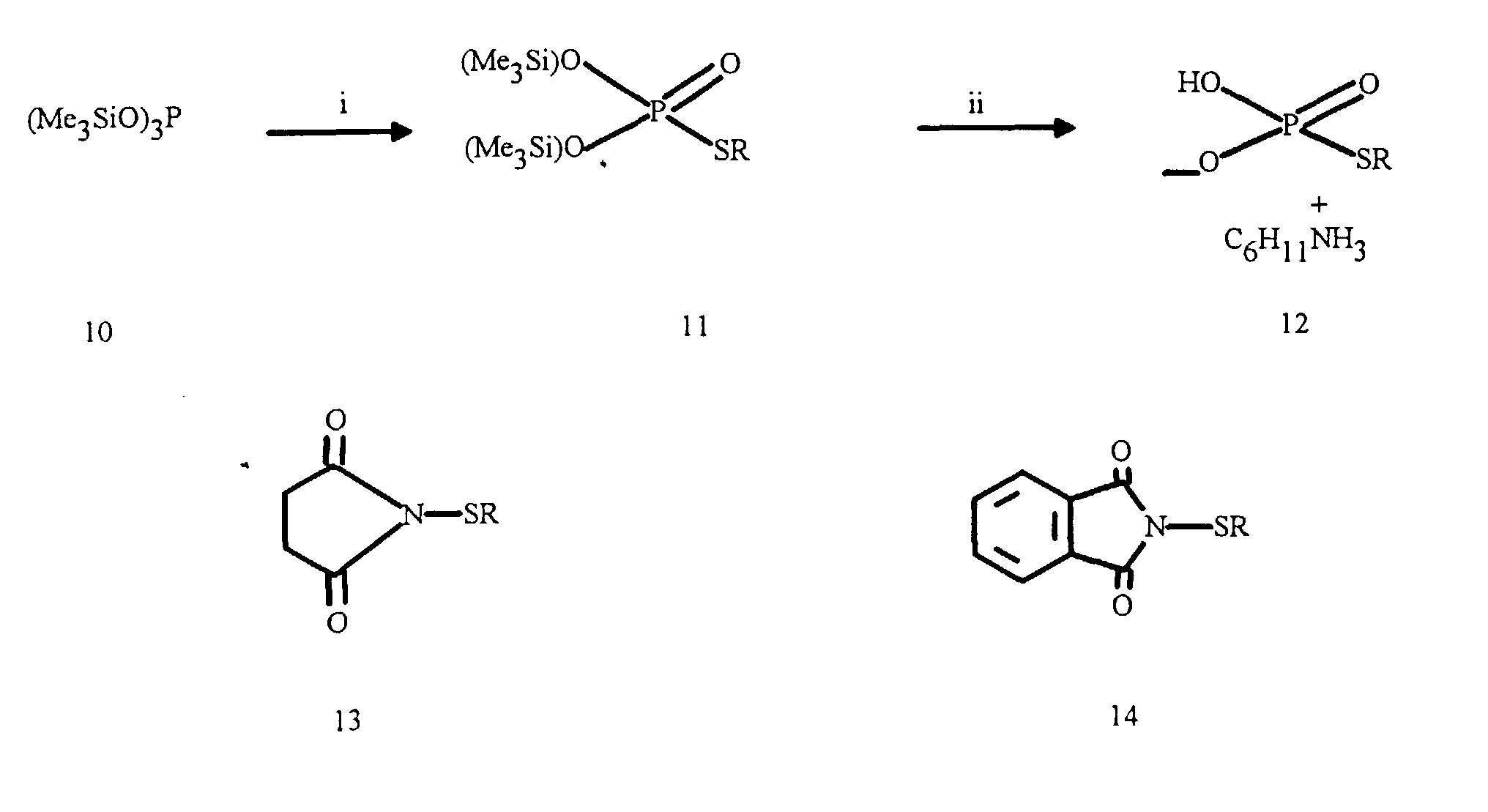
    Scheme 2 Reagents and conditions: i, 13 (R = alkyl or aryl) or 14 (R = alkyl or aryl); ii, a, hydrolysis, b, cyclohexylamine.
    It has recently been reported, (see, for example, Muller, C. E., and Roth, H. J., Tet. Lett., 31, 501, 1990), that tris(trimethylsilyl) phosphite 10 reacted rapidly with N-(alkylmercapto)-and N-(arylmercapto)-succinimides 13 to give (Scheme 2) the corresponding bis(trimethylsilyl) S-alkyl and S-aryl phosphorothioates 11, respectively, and that the latter products readily underwent hydrolysis to give S-alkyl and S-aryl phosphorothioates 12; it was also reported that, (see, for example, Müller and Roth, loc cit), N-(alkylmercapto)- and N-arylmercapto)-phthalimides 14 could be used instead of the corresponding succinimide derivatives 13. It was then shown, (see, for example Dreef, C.E., et al, Synlett., 481, 1990), that dinucleoside H-phosphonates may be converted into S-benzyl and S-phenyl esters of dinucleoside phosphorothioates by treatment with N-(benzylmercapto)- and N-(phenylmercapto)-succinimides (13, R = PhCH2 and 13, R = Ph, respectively) in the presence of di-isopropylethylamine. It was decided to attempt to prepare the monomeric S-alkyl phosphorothioate building blocks that are required (see below) for the synthesis of phosphorothioate analogues of oligonucleotides by the phosphotriester approach in solution, by using a modification of the above method, (see, for example, Müller and Roth, loc cit). There were therefore needed N-(alkylmercapto)-succinimide or -phthalimide derivatives (13 or 14) or equivalents thereof derived from 4-nitrobenzyl, 2,4-dinitrobenzyl and 2-cyanoethyl mercaptans (17a, 17b and 20, respectively).
    Figure 00110001
    Figure 00110002
    Figure 00110003
    Figure 00110004
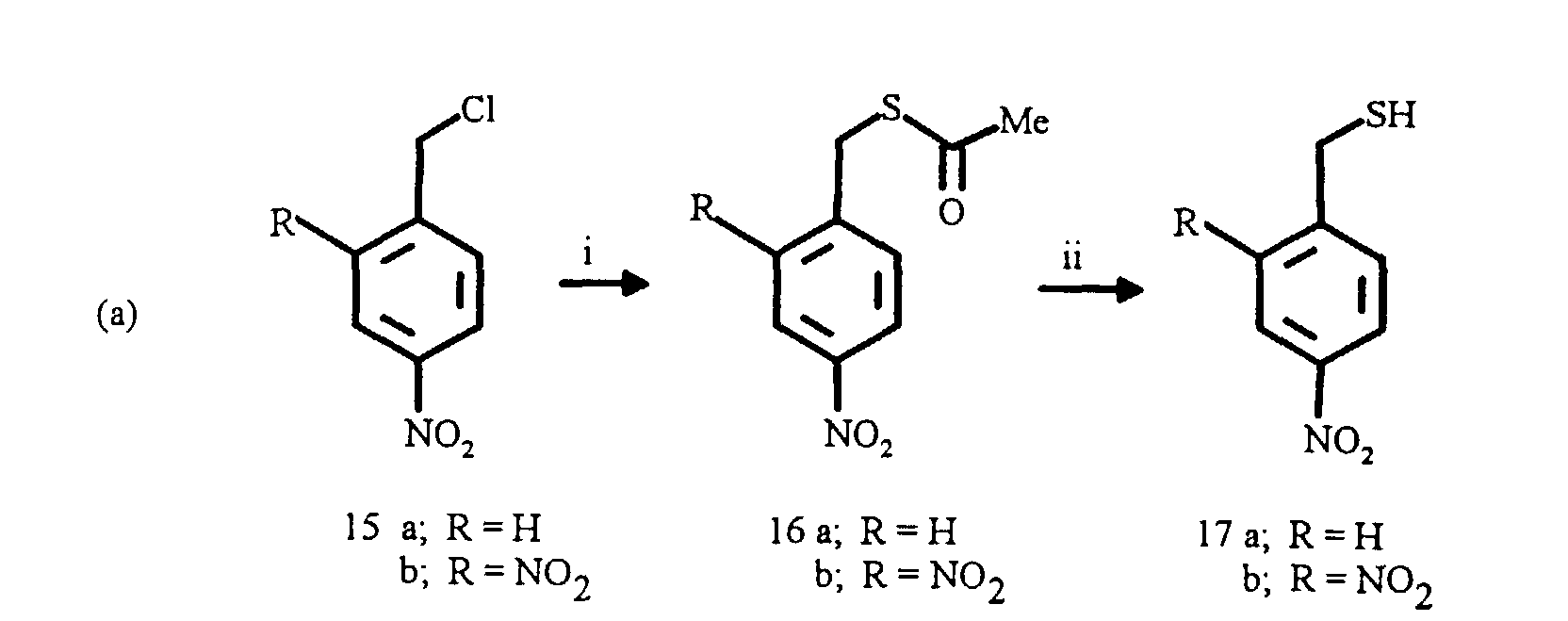
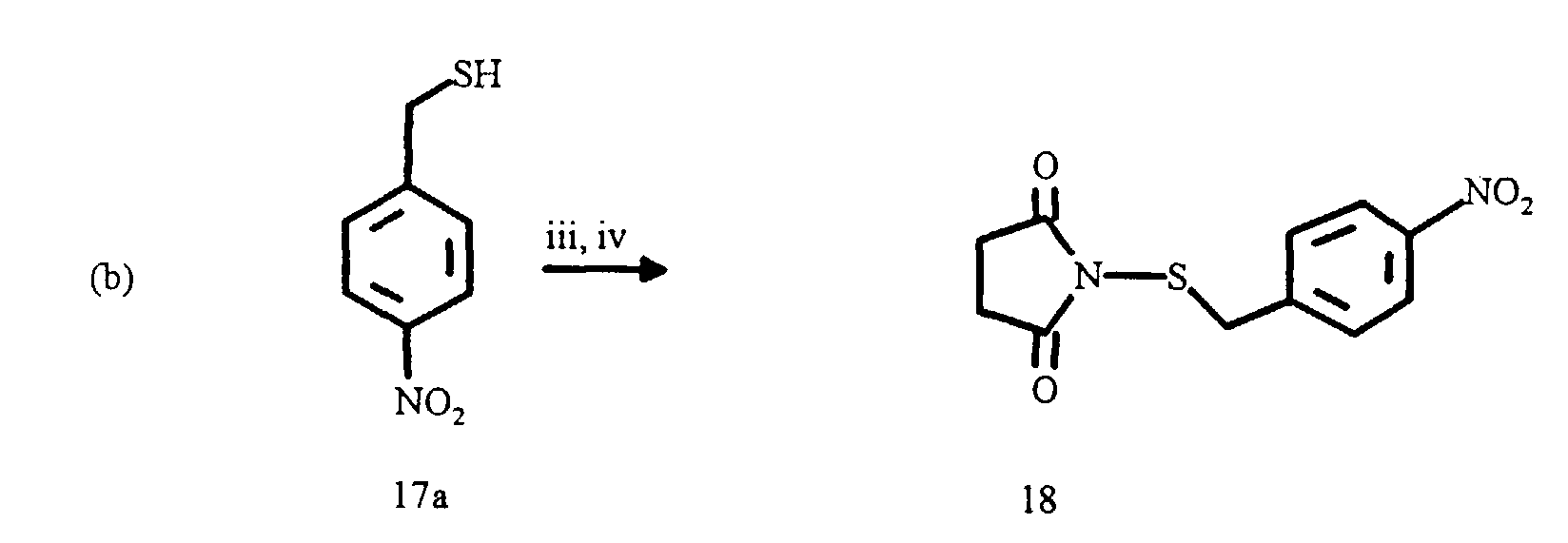
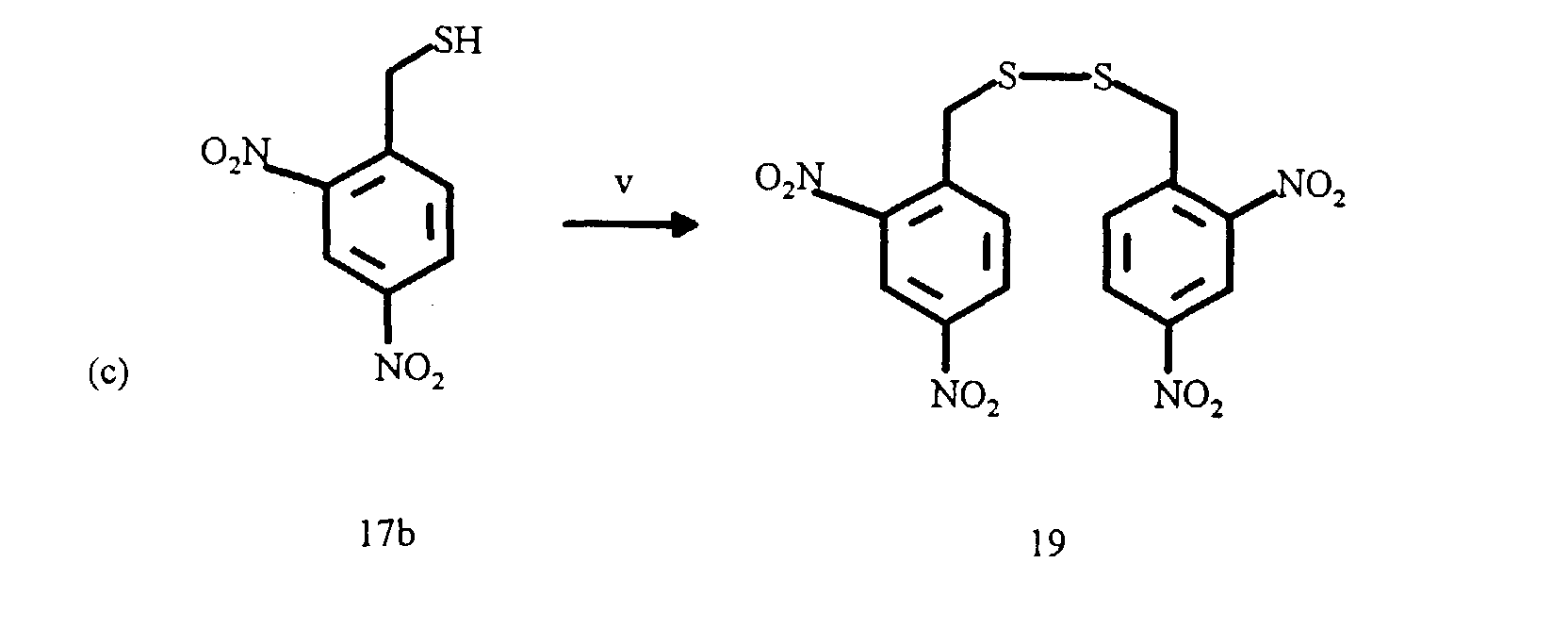
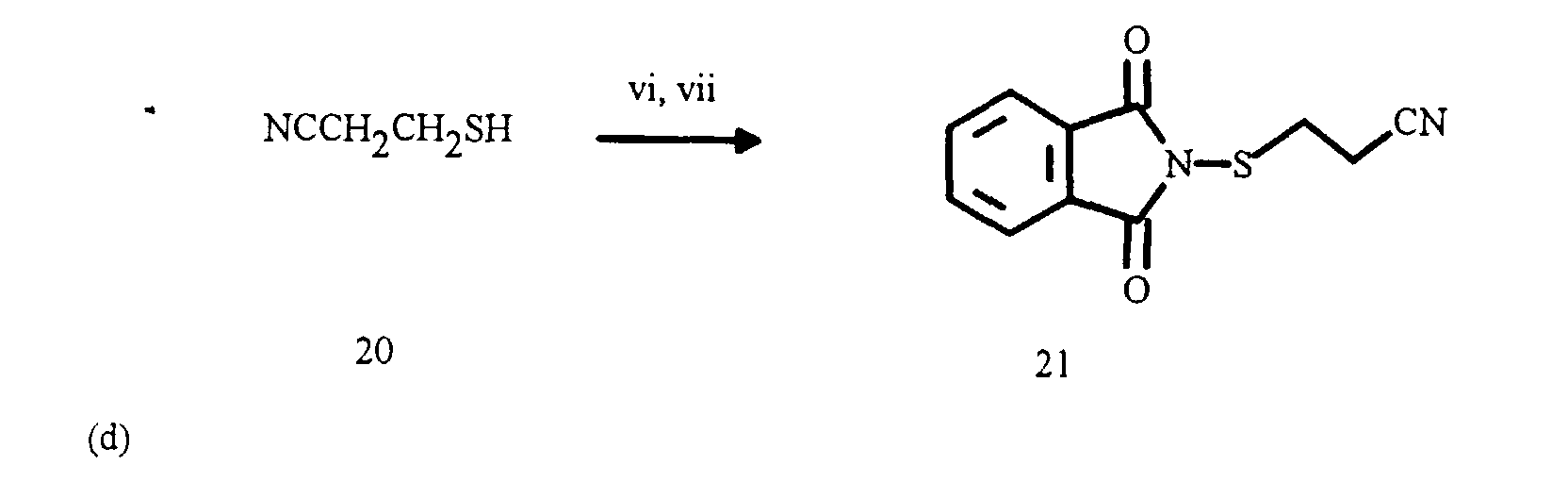
    Scheme 3 Reagents and conditions: i, CH3C(O)SH, C5H5N, THF; ii, H2SO4-H2O (1:1 v/v), reflux; iii, Pb(OAc)2, MeOH, RT; iv, NBS, C6H6, 50°C, 14 h; v, I2, CH2Cl2, RT, 16 h; vi, Cl2, CH2Cl2, 0°C, 20 min; vii, phthalimide, Et3N, hexane, 0°C to RT.
    The two step procedure for the preparation of 4-nitrobenzyl, (see, for example, Horn, W.J., J. Am. Chem. Soc., 43, 2603, 1921), and 2,4-dinitrobenzyl, (see, for example, Zhao, Z., Ph.D. Thesis, London University, 181-182, 1993), mercaptans (17a and 17b, respectively) is indicated in outline in Scheme 3(a). Thus, when 4-nitrobenzyl chloride 15a was treated with an excess both of thioacetic acid and pyridine in THF solution at 50°C, 4-nitrobenzyl thioacetate 16a was obtained in 77% yield. When the latter compound 16a was heated, under reflux, in sulfuric acid - water (1:1 v/v), 4-nitrobenzyl mercaptan 17a was obtained in almost quantitative yield. 2,4-dinitrobenzyl mercaptan, (see, for example, Zhao, loc cit), 17b was similarly prepared from 2,4-dinitrobenzyl chloride, (see, for example, Cohn, P., and Friedländer, P., Ber., 35, 1265, 1902) 15b in 73% overall yield. N-(4-nitrobenzylmercapto)succinimide 18 was prepared [Scheme 3(b) and Experimental below] in 65% yield by heating a suspension of the lead(II) salt, (see, for example, Pant, B. C., and Noltes, J. G., Inorg. Nucl. Chem. Lett., 7, 63, 1971), of the mercaptan 17a with N-bromosuccinimide (NBS) in benzene. Preliminary attempts to convert 2,4-dinitrobenzyl mercaptan 17b into the corresponding succinimide and phthalimide derivatives (13 and 14, R = 2,4-(O2N)2C6H3) were unsuccessful. However, di-(2,4-dinitrobenzyl) disulfide 19, (see, for example, Zhao, loc cit), which was easily prepared in good yield by the iodine-promoted oxidation [Scheme 3(c) and Experimental below] of the mercaptan 17b, proved (see below) to be an equally effective reagent for the required purpose. Finally, 2-cyanoethyl mercaptan 20, (see, for example, Bauer, L., and Welsh, T.L., J. Org. Chem., 26, 1443, 1961) was converted (see, for example, Behforouz, M., and Kerwood, J. E., J. Org. Chem., 34, 51, 1969), [Scheme 3(d) and Experimental below] via a putative intermediate sulfenyl chloride into N-(2-cyanoethylmercapto)phthalimide 21 which was isolated without chromatography as a crystalline solid in 58% yield.
    Figure 00130001
    Scheme 4 Reagents and conditions: i, a, PCl3, 1,2,4-1H-triazole, Et3N, THF, -35°C, b, Et3N, H2O, RT; ii, for 24a : 18, Me3SiCl, Et3N, CH2Cl2, RT, for 24b : 19, Me3SiCl, 4-methylmorpholine, CH2Cl2, RT, for 24c : 21, Me3SiCl, 4-methylmorpholine, CH2Cl2, RT; iii, aq. Et3NH+ HCO3 -.
    It was decided in the first instance to convert 5'-O-(9-phenylxanthen-9-yl)thymidine 22, (see, for example, Chattopadhyaya, J. B., and Reese, C. B., J. Chem. Soc., Chem. Commun., 639, 1978), into the three S-alkyl phosphorothioate building blocks 24a, 24b and 24c (Scheme 4). The nucleoside derivative 22 was treated with a ca. fourfold excess of the reagent derived from phosphorus trichloride and three molecular equivalents each of 1,2,4-1H-triazole and triethylamine in dry THF at -35°C, and the intermediate was hydrolysed with 0.5 mol dm-3 aqueous triethylammonium bicarbonate to give, (see, for example, Froehler, B.C., et al, Nucleic Acids Res., 14, 5399, 1986) the triethylammonium salt of the 3'-(H-phosphonate) 23. Following chromatography of the products on silica gel, the latter material 23 was isolated as a colourless solid precipitate in almost quantitative yield (Table 1 below). When a dry solution of the latter H-phosphonate 23 and a slight excess of N-(4-nitrobenzylmercapto)succinimide 18 in dichloromethane was treated with ca.4 molecular equivalents of chlorotrimethylsilane and ca. 6 molecular equivalents of triethylamine at room temperature for 2.5 h and the products worked up with aqueous triethylammonium bicarbonate buffer, the S-(4-nitrobenzyl) phosphorothioate 24 was obtained. Following chromatography of the products on silica gel, the latter compound 24 was isolated as a pale yellow precipitated solid in 86% yield. It may be assumed that the reaction proceeds by the electrophilic attack of the succinimide derivative 18 on an intermediate bis-(trimethylsilyl) phosphite (such as 25). The S-(2,4-dinitrobenzyl)phosphorothioate 24b was similarly prepared from the H-phosphonate 23, di-(2,4-dinitrobenzyl) disulfide 19, chlorotrimethylsilane and 4-methylmorpholine. As the benzylic protons of 2,4-dinitrobenzyl derivatives are likely to be particularly acidic, it is advisable to avoid the use of strong bases such as triethylamine. The desired product 24b was isolated as a precipitated solid in 67% yield. Finally, the S-(2-cyanoethyl) phosphorothioate 24c was prepared in the same way from the H-phosphonate 23, N-(2-cyanoethylmercapto)phthalimide 21, chlorotrimethylsilane and 4-methylmorpholine; it was isolated as a pure (31P NMR and HPLC, see Table 1 below) precipitated solid in 92% yield. This represents a considerable improvement both in methodology and yield over a previously reported, (see, for example, Cosstick and Williams, loc cit) preparation of a related 2'-deoxynucleoside 3'-S-(2-cyanoethyl) phosphorothioate derivative.
    The comparative suitabilities of the above three phosphorothioate S-alkyl protecting groups (R in Schemes 4 and 5) were examined by undertaking the synthesis of the simple dinucleoside phosphorothioate 30 (Scheme 5).
    Figure 00150001
    Px = 9-phenylxanthen-9-yl; Thy = thymin-1-yl; a, R = 4-(O2N)C6H4.CH2; b, R = 2,4(O2N)2C6H3.CH2; c, R = CH2CH2CN
    Scheme 5 Reagents and conditions; i, NT 27, mesitylene-2-sulfonyl chloride (MSCl), C5H5N, RT, 50 min; ii, 4-MeC6H4SH, Et3N, MeCN, RT, 4.5 h; iii, t-BuNH2, C5H5N, RT, 100 min; iv, conc. aq. NH3 (d 0.88), RT, 40 min; v, H2O-AcOH (96:4, v/v), RT, 4 h.
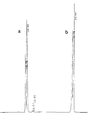
    First, the triethylammonium salt of 5'-O-(9-phenylxanthen-9-yl)thymidine 3'-phosphorothioate S-(4-nitrobenzyl) ester 24a and 3'-O-acetylthymidine 26, (see, for example, Horwitz, J.P., et al, J. Org. Chem., 27, 3300, 1962) were coupled together in the presence of mesitylene-2-sulfonyl chloride (MSC1) and 3-nitro-1,2,4-1H-triazole (NT) 27, (see, for example, Jones, S.S., et al, Tetrahedron, 36, 3075, 1980), in pyridine solution to give the fully-protected dinucleoside phosphate 28a. The latter material was isolated in 85% yield and characterized on the basis of NMR spectroscopic data (particularly 31P : δP[(CD3)2SO] 27.47, 27.61). When an acetonitrile solution (ca. 0.02 mol dm-3) of 28a was treated (see, for example, Christodoulou and Reese, loc cit) at room temperature with ca. 10 molecular equivalents of toluene-4-thiol and ca. 5 molecular equivalents of triethylamine, the main products (ca. 98%) were the diastereoisomeric partially-protected dinucleoside phosphorothioates 29 (see accompanying Figure 1a, R t 10.73, 10.98 min). However, two other products (ca. 0.8 and 1.1%) which corresponded to 5'-O-(9-phenylxanthen-9-yl)thymidine 3'-phosphorothioate S-(4-nitrobenzyl ester) 24a (R t 11.87 min) and 3'-O-acetyl-5'-S-(4-methylphenyl)-5'-thiothymidine 31 (R t12.05 min), respectively, were detected by HPLC (see accompanying Figure 1a). It seems reasonable to conclude that the latter products resulted (see, for example, Reese, et al, loc cit), from the attack of toluene-4-thiolate ions at C-5' adjacent to the internucleotide linkage (as indicated by the arrow in 28). A level of ca. 2% cleavage per internucleotide linkage would be quite unacceptable if the synthesis of an oligonucleotide phosphorothioate even of moderate size were undertaken. It was therefore concluded that the 4-nitrobenzyl protecting group was unsuitable for the present purposes.
    Unfortunately, the 2,4-dinitrobenzyl protecting group also proved to be unsuitable in that the NT 27 / MSC1-promoted coupling reaction (Scheme 5) between 5'-O-(9-phenylxanthen-9-yl)thymidine 3'-phosphorothioate S-(2,4-dinitrobenzyl) ester 24b and 3'-O-acetylthymidine 26 did not lead to a detectable quantity of the desired fully-protected dinucleoside phosphate 28b. Although the S-(2,4-dinitrobenzyl) group is known (see, for example, Porritt and Reese, loc cit). to be particularly susceptible to nucleophilic attack, this was still a surprising result. However, the NT 27 / MSC1-promoted coupling reaction between 5'-O-(9-phenylxanthen-9-yl)thymidine 3'-phosphorothioate S-cyanoethyl ester 24c and 3'-O-acetylthymidine 26 proceeded satisfactorily to give the fully-protected dinucleoside phosphorothioate 28c. When the latter product 28c, which was isolated as a colourless precipitated solid (δP[(CD3)2SO] 27.62, 27.94) in 90% yield, was treated with a large excess of tert-butylamine (see, for example, Cosstick and Williams, loc cit), in pyridine solution at room temperature, it was cleanly unblocked to give the expected diastereoisomeric mixture of partially-protected dinucleoside phosphorothioates 29P[(CD3)2SO] 55.96, 56.29) as the sole (see accompanying Figure 1b for HPLC profile) nucleotide products. Further unblocking of this material 29 to give the fully-unprotected mixture of diastereoisomeric dinucleoside phosphorothioates 30 was readily effected (Scheme 5, steps iv and v) by treatment at room temperature first with concentrated aqueous ammonia and then with 4% acetic acid. The high purity of the unprotected dinucleoside phosphorothioate 30 obtained was established, (see, for example, Kemal, O., et al, J. Chem. Soc., Chem. Commun., 591, 1983), on the basis of NMR spectroscopic (δP[(CD3)2SO] 56.00, 56.36) and HPLC data.
    Figure 00180001
    Scheme 6 Reagents and conditions: i, a, PCl3, 1,2,4-1H-triazole, Et3N, THF, -35°C, b, Et3N, H2O, RT; ii, 21, Me3SiCl, 4-methylmorpholine, CH2Cl2, RT; iii, aq. Et3NH+ HCO3 -
    The above studies led to the conclusion that the 2-cyanoethyl group was likely to be suitable for the protection of the internucleotide linkages in the large-scale synthesis of oligodeoxyribonucleotide phosphorothioates by the phosphotriester approach in solution. The preparation of the required monomeric phosphorothioate building blocks derived from 2'-deoxyadenosine, 2'-deoxycytidine and 2'-deoxyguanosine was then undertaken. 5'-O-(9-phenylxanthen-9-yl)-6-N-pivaloyl-2'-deoxyadenosine, (see, for example, Rao, M.V., and Reese, C.B., Nucleic Acids Res., 17, 8221, 1989), 32a was converted (Scheme 6) via an intermediate H-phosphonate 33a into the triethylammonium salt of its 3'-phosphorothioate S-(2-cyanoethyl) ester 34a by the same procedure as was used (Scheme 4) for the conversion of 5 '-O-(9-phenylxanthen-9-yl)thymidine 22 into the corresponding monomeric building block 24c. It may be seen from Table 1 below that good yields both of the H-phosphonate 33a (entry no. 3) and the phosphorothioate 34a (entry no. 4) were obtained. Furthermore, the high purity of both products was established by HPLC and NMR spectroscopy (Table 1 below). In the same way, 4-N-benzoyl-5'-O-(9-phenylxanthen-9-yl)-2'-deoxycytidine, (see, for example, Chattopadhyaya and Reese, loc cit), 32b and 2-N-phenylacetyl-5'-O-(9-phenylxanthen-9-yl)-2'-deoxyguanosine, (see, for example, Benseler, F., and McLaughlin, L. W., Synthesis, 45, 1986) 32c were converted via intermediate 3'-(H-phosphonates) 33b and 33c (entries nos. 5 and 7, respectively) into the required 3'-phosphorothioate S-(2-cyanoethyl) esters 34b and 34c (entries nos. 6 and 8, respectively). All of the products were isolated as pure (HPLC, NMR) precipitated solids, and all of the yields except that of the protected 2'-deoxyguanosine 3'-(H-phosphonate) 33c (entry no. 7) were very satisfactory.
    Figure 00200001
    Px = 9-phenylxanthen-9-yl; DMTr = di-(p-anisyl)phenylmethyl.
    Earlier studies had suggested that, in the synthesis of oligonucleotides by the phosphotriester approach in solution, it is probably desirable, (see, for example, Reese, C.B., and Skone, P.A., J. Chem. Soc., Perkin Trans. 1, 1263, 1984), to protect thymine (uracil) residues and to protect guanine residues both on the 2-amino and on the 1,6-lactam functions. It may therefore be desirable to replace the monomeric phosphorothioate building blocks 24c and 34c by the corresponding building blocks 38 and 39, respectively, using essentially an aglycone protecting group strategy, (see, for example, Kamimura, T., et al, J. Am. Chem. Soc., 106, 4552, 1984). Studies have shown that both of the latter monomers 38 and 39 are readily accessible in good yields. As indicated above, there has now been completed an informed first stage of a general strategy for the synthesis of oligonucleotide phosphorothioates in solution in that a suitable protecting group for the internucleotide linkages has been identified and methods for the preparation of the required monomeric building blocks (i.e. 34) have been developed. Furthermore, alternative monomeric building blocks of general structure 40 in which the 5'-hydroxy functions are protected with di-(p-anisyl)phenylmethyl, (see, for example, Schaller, H., et al, J. Am. Chem. Soc., 85, 3821, 1963), (DMTr) groups would be expected to be equally suitable. The 9-phenylxanthen-9-yl (Px) protecting group has the advantage that its use generally leads, (see, for example, Chattopadhyaya and Reese, loc cit), to crystalline nucleoside derivatives.
    Data relating to protected 2'-deoxynucleoside 3'-(H-phosphonates) and 2'-deoxynucleoside 3'-phosphorothioate S-(2-cyanoethyl) esters
    Entry No. Compound % Yield 31P NMR R t (min)
    1 23 98 1.0 (d, J P,H 592) 9.42
    2 24c 92 12.7 (s) 10.43
    3 33a 98 0.9 (d, J P,H 587) 10.05
    4 34a 88 12.7(s) 11.01
    5 33b 86 0.6 (d, J P,H 597) 11.36
    6 34b 92 12.8 (s) 12.29
    7 33c 72 0.4 (d, J P,H 593) 10.31
    8 34c 93 12.6(s) 11.13
    Accompanying Figure 1.
    HPLC profiles [Jones APEX Octyl 10µ column eluted with 0.1 mol dm-3 triethylammonium acetate (pH 7.0)/acetonitrile according to programme 1 (see Experimental below)] of the triethylammonium salt of O-[3'-O-acetylthymidin -5 -yl] O-[5'-O-(9-phenylxanthen-9-yl)thymidin-3-yl] phosphorothioate 29 generated (a) by the action of toluene-4-thiol and triethylamine on the fully-protected dinucleoside phosphorothioate S-(4-nitrobenzyl) ester 28a in acetonitrile solution and (b) the action of tert-butylamine on the fully-protected dinucleoside phosphorothioate S-(2-cyanoethyl) ester 28c in dry pyridine solution.
    The following further illustrates the present invention:
    Experimental
    1H and 13C NMR spectra were measured, unless otherwise stated, at 360.1 and 90.6 MHz, respectively, using a Bruker AM 360 spectrometer; tetramethylsilane was used as internal standard. 31P NMR spectra were measured at 145.8 MHz using the same spectrometer. Merck silica gel 60 F254 pre-coated plates (Art 5715 and 5642), which, unless otherwise indicated, were developed in solvent system A [ chloroform-methanol (9:1 v/v)], were used for thin layer chromatography (TLC). Liquid chromatography (HPLC) was carried out on a Jones Apex Octyl 10µ column which was eluted with 0.1 mol dm-3 triethylammonium acetate buffer/acetonitrile mixtures: programme 1 involved a linear gradient over 10 min (flow rate 1.5 cm3 min-1) starting with buffer-acetonitrile (7:3 v/v) and ending with buffer-acetonitrile (3:7 v/v); programme 2 involved a linear gradient over 20 min (flow rate 1.5 cm3 min-1) starting with buffer-acetonitrile (19:1 v/v) and ending with buffer-acetonitrile (4:1 v/v). Merck Kieselgel H (Art 7736) silica gel was used for short column chromatography. Acetonitrile, pyridine, tetrahydrofuran (THF) and triethylamine were dried by heating, under reflux, with calcium hydride for 3-5 h; dichloromethane was dried by heating, under reflux, over phosphorus pentoxide. These solvents were then distilled at atmospheric pressure and stored over molecular sieves (no. 4A).
    N -(4-nitrobenzylmercapto)succinimide 18.
    Thioacetic acid (20 cm3, 0.28 mol) and anhydrous pyridine (15.2 cm3, 0.188 mol) were added to a solution of 4-nitrobenzyl chloride (12.0 g, 70 mmol) in anhydrous tetrahydrofuran (200 cm3). The stirred reactants were heated at 50°C for 24 h. The cooled products were filtered and the filtrate was evaporated under reduced pressure. The residue was dissolved in dichloromethane (300 cm3) and the resulting solution was washed with saturated aqueous sodium hydrogen carbonate (2 × 250 cm3), dried (MgSO4) and concentrated under reduced pressure. The residue was crystallized from ethyl acetate - petroleum ether (bp 60-80°C) to give 4-nitrobenzyl thioacetate 16a (11.43 g, 77%) as pale yellow needles, m.p. 55.5 - 57.5 °C.
    Concentrated sulfuric acid - water (1:1 v/v; 17 cm3) was added to a stirred suspension of 4-nitrobenzyl thioacetate (8.0 g, 37.9 mmol) in methanol (150 cm3) and the reactants were heated, under reflux, for 3 h. The cooled products were poured into water (1.0 dm3) and the resulting mixture was extracted with diethyl ether (2 × 400 cm3). The combined organic extracts were washed with water (2 × 200 cm3), dried (MgSO4) and evaporated under reduced pressure to give 4-nitrobenzyl mercaptan 17a as a pale yellow solid (6.31 g, 98%).
    Lead (II) acetate trihydrate (0.759 g, 2.0 mmol) and 4-nitrobenzyl mercaptan (0.745 g, 4.4 mmol) were stirred together in methanol (24 cm3) solution at room temperature. After 1 h, the products were filtered and the residue was washed with a small volume of cold methanol. The residue was dried in vacuo over calcium chloride and then suspended in dry acetonitrile (20 cm3). Following the evaporation of the solvent under reduced pressure, the residue was suspended in dry benzene (20 cm3) and the solvent was again evaporated under reduced pressure. Finally, the residue was re-suspended in dry benzene (64 cm3) and N-bromosuccinimide (0.783 g, 4.4 mmol) was added in three portions over a period of 45 min to the stirred suspension at room temperature. The reactants were then heated at 50°C, under an atmosphere of argon, for 14 h. The cooled products were filtered and the filtrate was evaporated under reduced pressure to give a solid. The latter material was crystallized from ethyl acetate - hexane to give N-(4-nitrobenzylmercapto)succinimide 18 (0.76 g, 65%) (Found: C, 49.85; H, 3.8; N, 10.4. C11H10N2O4S requires: C, 49.6; H, 3.8; N, 10.5%), m.p. 146-148°C; δH[CDCl3] 2.73 (4 H, s), 4.18 (2 H, s), 7.50 (2 H, m), 8.17 (2 H, m); δC[CDCl3] 28.4, 40.5, 123.8, 130.3, 141.9, 147.5, 176.2.
    Di-(2,4-dinitrobenzyl) disulfide 19, (see, for example, Zhao, loc cit). Redistilled thioacetic acid (25.73 cm3, 0.36 mol) and then dry pyridine (19.9 cm3, 0.246 mol) were added to a stirred solution of 2,4-dinitrobenzyl chloride (13.0 g, 60.0 mmol) in dry THF (180 cm3) at room temperature. After 2 h, the products were filtered and the filtrate was concentrated under reduced pressure. The residual solid obtained was dissolved in dichloromethane (300 cm3) and the resulting solution was washed in turn with saturated aqueous sodium hydrogen carbonate (300 cm3), 1.0 mol dm-3 sulfuric acid (200 cm3) and saturated aqueous sodium hydrogen carbonate (200 cm3). The dried (MgSO4) organic layer was evaporated under reduced pressure and the residue was crystallized from ethyl acetate - petroleum ether (b.p. 60-80° C) to give S-(2,4-dinitrobenzyl) thioacetate 16b as a pale yellow solid (12.32 g, 80%) (Found: C, 42.3; H, 3.1; N, 10.9. C9H8N2O5S requires: C, 42.2; H, 3.15; N, 10.9%), m.p. 78-79°C; δH[CDCl3] 2.35 (3 H, s), 4.49 (2 H, s), 7.91 (1 H, d, J 8.5), 8.41 (1 H, dd, J 2.4 and 8.5), 8.88 (1 H, d, J 2.3); δC[CDCl3] 30.2, 30.7, 120.7, 127.6, 134.2, 140.6, 147.1, 148.0, 194.7.
    A stirred suspension of S-(2,4-dinitrobenzyl) thioacetate 16b (8.2 g, 32 mmol) in concentrated sulfuric acid - water (1:1 v/v; 14.08 cm3) and methanol (128 cm3) was heated, under reflux, for 1.5 h. The cooled products were poured into water (300 cm3) and the resulting mixture was extracted with ether (2 × 400 cm3). The combined organic extracts were washed with water (300 cm3), dried (MgSO4) and evaporated under reduced pressure to give 2,4-dinitrobenzyl mercaptan 17b as a yellow oil (6.75 g, 98%) (Found: M+ = 214.0084 12C7 1H6 14N2 16O4 32S requires: 214.0048); δH[CDCl3] 2.21 (1 H, t, J 8.7), 4.10 (2 H, d, J 8.7), 7.75 (1 H, d, J 8.7), 8.44 (1 H, dd, J 2.4 and 8.5), 8.77 (1 H, d, J 2.4); δC[CDCl3] 26.2, 121.0, 127.8, 133.0, 143.6, 146.9, 148.0.
    A solution of iodine (0.321 g, 1.26 mmol) and 2,4-dinitrobenzyl mercaptan (0.493 g, 2.3 mmol) in dichloromethane (25 cm3) was stirred at room temperature overnight. More dichloromethane (25 cm3) was added and the products were washed with 0.2 mol dm-3 sodium hydrogen sulfite (20 cm3), water (20 cm3) and saturated aqueous sodium hydrogen carbonate (20 cm3). The dried (MgSO4) organic layer was concentrated under reduced pressure and the residue was crystallized from absolute ethanol to give di-(2,4-dinitrobenzyl) disulfide 19 (0.402 g, 82%) (Found: C, 39.4; H, 2.4; N, 13.0. C14H10N4O8S2 requires: C, 39.4; H, 2.4; N, 13.1%), m.p. 108-109°C; δH[CDCl3] 4.22 (4 H, s), 7.66 (2 H, d, J 8.5), 8.46 (2 H, dd, J 2.4 and 8.4), 8.91 (2H, d, J 2.4); δC[CDCl3] 40.0, 121.1, 127.5, 133.9, 139.4, 147.4, 148.0.
    N -(2-cyanoethylmercaptolphthalimide 21.
    A solution of chlorine in dichloromethane (1.4 mol dm-3, 10.0 cm3, 14.0 mmol) was added dropwise to a stirred solution of 2-cyanoethyl mercaptan, (see, for example, Bauer and Welsh, loc cit), (1.22 g, 14.0 mmol) in dichloromethane (21 cm3) at 0°C (ice-water bath). After the products had been allowed to warm to room temperature, they were added dropwise to a stirred slurry of phthalimide (1.47 g, 10.0 mmol) and triethylamine (1.94 cm3, 14.0 mmol) in dry DMF (12 cm3) at 0°C (ice-water bath). The stirred reactants were allowed to warm to room temperature. After 2 h, the products were poured into saturated aqueous sodium hydrogen carbonate (25 cm3) and the resulting mixture was extracted with dichloromethane (2 × 50 cm3). The combined organic layers were dried (MgSO4) and concentrated under reduced pressure. The residue was crystallized from ethanol to give N-(2-cyanoethylmercapto)phthalimide 21 as colourless needles (1.345 g, 58%) (Found: C, 57.0; H, 3.4; N, 11.8. C11H8N2O2S requires: C, 56.9; H, 3.5; N, 12.1%), m.p. 162-164°C; δH[CDCl3] 2.79 (2 H, t, J 7.2), 3.12 (2 H, t, J 7.2), 7.83 (2 H, m), 7.95 (2 H, m); δC[CDCl3] 18.7, 34.5, 117.5, 124.1, 131.7, 134.9, 168.1.
    Triethylammonium salt of 5'- O -(9-phenylxanthen-9-yl)thymidine 3'-( H -phosphonate) 23.
    Triethylamine (9.04 cm3, 65.0 mmol) and phosphorus trichloride (1.75 cm3, 20.1 mmol) were added to a stirred solution of 1,2,4-1H-triazole (4.14 g, 60.0 mmol; recrystallized from dry acetonitrile) in dry THF (120 cm3) at -35°C (methanol-dry ice bath). After 15 min, a solution of 5'-O-(9-phenylxanthen-9-yl)thymidine, (see, for example, Chattopadhyaya and Reese, loc cit), (2.49 g, 5.0 mmol) in THF (100 cm3) was added. After a further period of 15 min, triethylamine-water (1:1 v/v; 25 cm3) was added and the reactants were allowed to warm to room temperature. The products were then evaporated under reduced pressure. The residue was dissolved in chloroform (300 cm3) and the solution was washed with 0.5 mol dm-3 triethylammonium bicarbonate buffer (pH 7.5, 2 × 150 cm3). The organic layer was dried (MgSO4) and evaporated under reduced pressure. Toluene (25 cm3) was added and then removed by evaporation to give a glass that was then fractionated by short column chromatography on silica gel: appropriate fractions, which were eluted with chloroform-methanol (90:10 - 85:15 v/v), were combined and evaporated under reduced pressure. A solution of the residue in chloroform (30 cm3) was added dropwise with stirring to light petroleum (b.p. 30-40°C) (750 cm3) to give the triethylammonium salt of 5'-O-(9-phenylxanthen-9-yl)thymidine 3'-(H-phosphonate) 23 (3.273g, 98%) as a colourless precipitated solid; R t 9.42 min (programme 1); δH[(CD3)2SO] includes the following signals: 1.42 (3 H, s), 2.38 (2 H, m), 3.13 (1 H, dd, J = 3.5 and 10.3), 3.19 (1 H, dd, J = 3.1 and 10.3), 4.04 (1 H, m), 4.76 (1 H, m), 6.19 (1 H, t, J = 6.8), 6.62 (1 H, d, J P,H 592), 7.05 - 7.45 (13 H, m), 7.57 (1 H, s), 11.41 (1 H, s); δP[(CD3)2SO] 1.0 (d, J P,H 592).
    Triethylammonium salt of 5'- O -(9-phenylxanthen-9-yl)thymidine 3'-phosphorothioate S-4-nitrobenzyl)ester 24a.
    A solution of the triethylammonium salt of 5'-O-(9-phenylxanthen-9-yl)thymidine 3'-(H-phosphonate) 23 (0.664 g, 1.0 mmol) and N-(4-nitrobenzylmercapto)succinimide (0.346 g, 1.3 mmol) in dichloromethane-acetonitrile (2:1 v/v; 15 cm3) was evaporated to dryness under reduced pressure. The residue was redissolved in dichloromethane-acetonitrile (2:1 v/v; 15 cm3) and the solution was again evaporated under reduced pressure. The residue was then dissolved in dry dichloromethane (20 cm3), and triethylamine (0.835 cm3, 6.0 mmol) and chlorotrimethylsilane (0.508 cm3, 4.0 mmol) were added to the stirred solution at room temperature. After 2.5 h, the products were poured into 0.2 mol dm-3 aqueous triethylammonium hydrogen carbonate (200 cm3), and the resulting mixture was extracted with dichloromethane (200 cm3, followed by 2 × 100 cm3). The dried (MgSO4) combined organic extracts were concentrated under reduced pressure and the residue was fractionated by short column chromatography on silica gel: the appropriate fractions, eluted with chloroform-methanol (88:12 v/v), were combined and evaporated under reduced pressure. A solution of the residue in chloroform (6 cm3) was added dropwise to stirred petroleum ether (b.p. 30-40°C, 150 cm3) at room temperature to give the triethylammonium salt of 5'-O-(9-phenylxanthen-9-yl)thymidine 3'-phosphorothioate S-(4-nitrobenzyl) ester 24a as a pale yellow solid (0.72 g, 86%); R t 11.87 min (programme 1); δH[(CD3)2SO] includes the following signals: 1.39 (3 H, d, J 0.8), 2.15 - 2.4 (2 H, m), 2.91 (1H, dd, J = 3.5 and 10.2), 3.82 (2 H, m), 3.92 (1 H, m), 4.68 (1 H, m), 6.14 (1 H, dd, J = 5.8 and 8.6), 7.0 - 7.45 (13 H, m), 7.50 (2 H, m), 7.54 (1 H, m), 8.03 (2 H, m), 11.37 (1 H, s), δP[(CD3)2SO] 13.4.
    Triethylammonium salt of 5'- O -(9-phenylxanthen-9-yl)thymidine 3'-phosphorothioate S -(2,4-dinitrobenzyl) ester 24b.
    A solution of the triethylammonium salt of 5'-O-(9-phenylxanthen-9-yl)thymidine 3'-(H-phosphonate) (0.199 g, 0.3 mmol) and di-(2,4-dinitrobenzyl) disulfide (0.153 g, 0.36 mmol) in dichloromethane-acetonitrile (1:1 v/v, 6 cm3) was evaporated to dryness under reduced pressure. The residue was dissolved in the same solvent mixture (6 cm3), and the solution was again evaporated under reduced pressure. The residue was then dissolved in dry dichloromethane (6 cm3), and 4-methylmorpholine (0.34 cm3, 3.1 mmol) and chlorotrimethylsilane (0.15 cm3, 1.2 mmol) were added to the stirred solution at room temperature. After 3 h, the products were poured into 0.5 mol dm-3 aqueous triethylammonium hydrogen carbonate (50 cm3), and the resulting mixture was extracted with dichloromethane (2 × 50 cm3). The dried (MgSO4) combined organic extracts were concentrated under reduced pressure and the residue was fractionated by short column chromatography on silica gel: the appropriate fractions, eluted with chloroform-methanol (9:1 v/v) were combined and evaporated under reduced pressure. A solution of the residue in chloroform (2 cm3) was added dropwise to stirred petroleum ether (b.p. 30-40°C, 50 cm3) at room temperature to give the triethylammonium salt of 5'-O-(9-phenylxanthen-9-yl)thymidine 3'-phosphorothioate S-(2,4-dinitrobenzyl) ester 24b (0.177 g, 67%); R t 10.17 min (programme 1); δH[(CD3)2SO] includes the following signals: 1.40 (3 H, s), 2.25 (2 H, m), 3.08 (1 H, dd, J 3.2 and 10.6), 3.97 (1 H, m), 4.11 (2 H, m), 4.65 (1 H, m), 6.08 (1 H, t, J 7.2), 6.95 - 7.5 (13 H, m), 7.53 (1 H, s), 7.92 (1 H, d, J 8.6), 8.41 (1 H, dd, J 2.4 and 8.5), 8.63 (1 H, d, J 2.4), 11.36 (1 H, br s); δP[(CD3)2SO] 12.4.
    Triethylammonium salt of 5'-O-(9-phenylxanthen-9-yl)thymidine 3'-phosphorothioate S-(2-cyanoethyl)ester 24c.
    A solution of the triethylammonium salt of 5'-O-(9-phenylxanthen-9-yl)thymidine 3'-(H-phosphonate) 23 (0.199 g, 0.3 mmol) and N-(2-cyanoethylmercapto)phthalimide (0.091 g, 0.4 mmol) in dichloromethane-acetonitrile (2:1 v/v, 6 cm3) was evaporated to dryness under reduced pressure. The residue was dissolved in the same solvent mixture (6 cm3), and the solution was again evaporated under reduced pressure. The residue was then dissolved in dry dichloromethane (6 cm3), and 4-methylmorpholine (0.206 cm3, 1.9 mmol) and chlorotrimethylsilane (0.15 cm3, 1.2 mmol) were added to the stirred solution at room temperature. After 3 h, the products were worked up, and purified as in the above preparation of the corresponding S-(2,4-dinitrobenzyl) ester. The triethylammonium salt of 5'-O-(9-phenylxanthen-9-yl)thymidine 3'-phosphorothioate S-(2-cyanoethyl) ester 24c was isolated as a colourless precipitated solid (0.208 g, 92%); R t 10.43 min (programme 1); δH[(CD3)2SO] includes the following signals: 1.41 (3 H, d, J 0.7), 2.40 (2 H, m), 2.67 (2 H, m), 2.84 (2 H, m), 3.14 (1 H, dd, J 3.6 and 10.2), 3.19 (1 H, dd, J 3.0 and 10.2), 4.15 (1 H, m), 4.81 (1 H, m), 6.21 (1 H, dd, J 6.1 and 8.2), 7.05 - 7.5 (13 H, m), 7.59 (1 H, m), 11.41 (1 H, s); δP[(CD3)2SO] 12.7.
    Triethylammonium salt of O -[3'- O -acetylthymidin-5-yl] O -[5'- O -(9-phenylxanthen-9-yl)thymidin-3-yl] phosphorothioate 29.
    (a) A solution of the triethylammonium salt of 5'-O-(9-phenylxanthen-9-yl)thymidine 3'-phosphorothioate S-(4-nitrobenzyl) ester 24a (0.299 g, 0.36 mmol), 3'-O-acetylthymidine, (see, for example, Horwitz, et al, loc cit), 26 (0.085 g, 0.3 mmol) and 3-nitro-1,2,4-1H-triazole, (see, for example, Jones, et al, loc cit), (0.171 g, 1.5 mmol) in dry pyridine (5 cm3) was evaporated under reduced pressure. The residue was redissolved in dry pyridine (5 cm3) and the solution was re-evaporated. After this process had been repeated once more, the residue was dissolved in dry pyridine (3 cm3) and solid mesitylene-2-sulfonyl chloride (0.229 g, 1.05 mmol) was added. After the reaction solution had been stirred at room temperature for 50 min, saturated aqueous sodium hydrogen carbonate (0.5 cm3) was added and the products were partitioned between dichloromethane (20 cm3) and 0.2 mol dm-3 aqueous triethylammonium hydrogen carbonate. The layers were separated and the aqueous layer was extracted with dichloromethane (2 × 10 cm3). The combined organic layers were dried (MgSO4) and concentrated under reduced pressure. The residue was coevaporated with toluene (5 cm3) and the residue was fractionated by short column chromatography on silica gel: appropriate fractions, which were eluted with chloroform-methanol (99:1 to 98:2 v/v), were combined and evaporated under reduced pressure. A solution of the residue in chloroform (2 cm3) was added dropwise with stirring to petroleum ether (b.p. 30-40°C, 50 cm3) to give the fully-protected dinucleoside phosphorothioate S-(4-nitrobenzyl) ester 28a as a precipitated solid (0.254 g, 85%); δP[(CD3)2SO] 27.47, 27.61. Toluene-4-thiol (0.062 g, 0.5 mmol) and then triethylamine (0.035 cm3, 0.25 mmol) were added to a stirred solution of the latter material (0.50 g, 0.05 mmol) in dry acetonitrile (2.8 cm3) at room temperature. After 4.5 h, allyl chloride (0.5 cm3, 6.1 mmol) was added and, after a further period of 5 min, the products were evaporated under reduced pressure. HPLC analysis revealed no starting material 28a and four nucleotide or nucleoside products with the following R ts (programme 1): 10.73 (37.5%), 10.98 (60.55%), 11.87 (0.8%), 12.05 min (1.14%). The two lower R t components were believed to be the desired diastereoisomeric partially-protected dinucleoside phosphorothioates 29 and the other two components (R ts 11.87 and 12.05 min) corresponded to 5'-O-(9-phenylxanthen-9-yl)thymidine 3'-phosphorothioate S-(4-nitrobenzyl) ester 24a and 3'-O-acetyl-5'-S-(4-methylphenyl)-5'-thiothymidine 31, respectively. The products were fractionated by short column chromatography on silica gel: appropriate fractions, which were eluted with chloroform-methanol (85:15 v/v), were combined and evaporated under reduced pressure. A solution of the residue in chloroform (1 cm3) was added to stirred petroleum ether (b.p. 30-40°C, 50 cm3) to give the triethylammonium salt of O-[3'-O-acetylthymidin-5-yl] O-[5'-O-(9-phenylxanthen-9-yl)thymidin-3-yl] phosphorothioate 29 (0.047 g, 97%) as a colourless precipitate; δP[(CD3)2SO] 53.99, 54.07.
    (b) A dry solution of the triethylammonium salt of 5'-O-(9-phenylxanthen-9-yl)thymidine 3'-phosphorothioate S-(2-cyanoethyl) ester 24c (0.269 g, 0.36 mmol), 3'-O-acetylthymidine 26 (0.085 g, 0.3 mmol) and 3-nitro-1,2,4-1H-triazole (0.239 g, 2.1 mmol) in pyridine (3 cm3) was prepared by the procedure described in section (a) above. Mesitylene-2-sulfonyl chloride (0.229 g, 1.05 mmol) was added to the stirred solution at room temperature and the reaction was allowed to proceed for 40 min. The products were then worked-up and fractionated according to the above procedure [section (a)] to give the fully-protected dinucleoside phosphorothioate S-(2-cyanoethyl) ester 28c which was isolated as a colourless precipitated solid (0.246 g, 90%); δP[(CD3)2SO] 27.62, 27.94. t-butylamine (0.20 cm3, 1.9 mmol) was added to a stirred solution of the latter material (0.046 g, 0.05 mmol) in dry pyridine (0.8 cm3) at room temperature. After 100 min, the products were evaporated under reduced pressure, redissolved in chloroform (25 cm3) and the resulting solution was washed with 0.5 mol dm-3 triethylammonium hydrogen carbonate (2 × 15 cm3). The dried (MgSO4) organic layer was filtered and concentrated under reduced pressure. A solution of the residue in chloroform (1 cm3) was added to stirred petroleum ether (b.p. 30-40°C, 50 cm3) to give the triethylammonium salt of O-[3'-O-acetylthymidin-5-yl] O-[5'-O-(9-phenylxanthen-9-yl)thymidin-3-yl] phosphorothioate 29 (0.048 g, 99%) as a colourless precipitated solid; R t (programme 1) 10.69, 10.93 min; δP[(CD3)2SO] 54.60, 54.94.
    3'- O -acetyl-5'- S -(4-methylphenyl)-5'-thiothymidine 31. A solution of 3'-O-acetylthymidine 26 (0.511 g, 1.8 mmol) and toluene-4-sulfonyl chloride (0.514 g, 2.7 mmol) in dry pyridine (3 cm3) was stirred at room temperature. After 16 h, saturated aqueous sodium hydrogen carbonate (2 cm3) was added and, after a further 10 min, the products were partitioned between chloroform (50 cm3) and saturated aqueous sodium hydrogen carbonate (50 cm3). The dried (MgSO4) organic layer was concentrated under reduced pressure. The residue was fractionated by short column chromatography on silica gel: the appropriate fractions, eluted with chloroform-methanol (99:1 v/v), were combined and evaporated under reduced pressure. The residue was dissolved in acetonitrile (2.5 cm3) at room temperature and triethylamine (0.90 cm3, 6.5 mmol) and toluene-4-thiol (0.805 g, 6.5 mmol) were added to the stirred solution which was kept under an atmosphere of argon. After 60 h, the products were concentrated under reduced pressure and the residue was fractionated by short column chromatography on silica gel: the appropriate fractions, eluted with chloroform-methanol (99:1 v/v) were combined and evaporated under reduced pressure to give 3'-O-acetyl-5'-S-(4-methylphenyl)-5'-thiothymidine 31 as a colourless glass (0.60 g, 85% based on 3'-O-acetylthymidine) (Found: M+ = 390.1249. 12C19 1H22 14N2 16O5 32S requires: 390.1249); R t 12.05 min (programme 1); δH[(CD3)2SO] 1.76 (3 H, d, J 0.9), 2.05 (3 H, s), 2.25 (1 H, m), 2.26 (3 H, s), 2.49 (1 H, m), 3.32 (2 H, m), 4.02 (1 H, m), 5.18(1 H, m), 6.13 (1 H, dd, J 6.0, 8.6), 7.14 (2 H, d, J 7.9), 7.29 (2 H, d, J 8.2), 7.51 (1 H, m), 11.38 (1 H, br s); δC[(CD3)2SO] 12.1, 20.5, 20.8, 35.2, 35.4, 75.7, 81.9, 83.9, 110.0, 129.1, 129.7, 131.6, 135.7, 136.0, 150.5, 163.6, 169.9.
    Triethylammonium salt of O -[thymidin-5-yl] O -[thymidin-3-yl] phosphorothioate 30. The triethylammonium salt of O-[3'-O-acetylthymidin-5-yl] O-[5'-O-(9-phenylxanthen-9-yl)thymidin-3-yl] phosphorothioate 29 (0.036 g, ca. 0.037 mmol), prepared from its S-(2-cyanoethyl) ester 28c, was dissolved in concentrated aqueous ammonia (d 0.88, 4 cm3) at room temperature. The solution was stirred for 40 min and was then evaporated under reduced pressure. The residue was dissolved in methanol (5 cm3) and the solution was evaporated under reduced pressure. After this process had been repeated with ethanol (3 × 5 cm3), the residue was dissolved in acetic acid-water (4:96 v/v, 4 cm3) at room temperature. After 4 h, the products were evaporated under reduced pressure and the residue was partitioned between chloroform (10 cm3) and water (5 cm3). The aqueous layer was separated, extracted with chloroform (10 cm3) and then evaporated under reduced pressure. The residue was fractionated on a column (17 cm × 2 cm diameter) of DEAE Sephadex A-25 which was eluted with a linear gradient of aqueous triethylammonium hydrogen carbonate buffer (pH 7.5, 0.001 - 1.0 mol dm-3 over 1000 cm3): the appropriate fractions (eluted with an average buffer concentration of 0.28 mol dm-3) were combined and evaporated under reduced pressure. The residue was re-evaporated from ethanol (2 × 10 cm3) solution to give the triethylammonium salt of O-(thymidin-5-yl) O-(thymidin-3-yl) phosphorothioate 30 (554 A265 units) as a colourless solid; R t (programme 2) 14.98, 15.85 min; δH[D2O] includes the following signals: 1.82 (3 H, s), 1.87 and 1.88 (3 H, 2 s), 2.32 (3 H, m), 2.50 (1 H, m), 3.78 (2 H, m), 4.13 (4 H, m), 4.54 (1 H, m), 4.91 (1 H, m), 6.16 (1 H, m), 6.27 (1 H, t, J 6.9), 7.62 (1 H, s), 7.68 (1 H, s); δP[D2O] 56.36, 56.00.
    Triethylammonium salt of 5'- O -(9-phenylxanthen-9-yl)-6- N -pivaloyl-2'-deoxyadenosine 3'-( H -phosphonate) 33a.
    This compound was prepared on the same scale and in precisely the same way as the simple thymidine derivative 23 described above. 5'-O-(9-phenylxanthen-9-yl)-6-N-pivaloyl-2'-deoxyadenosine, (see for example, Rao and Reese, loc cit), (2.96 g, 5.0 mmol) was converted into the triethylammonium salt of 5'-O-(9-phenylxanthen-9-yl)-6-N-pivaloyl-2'-deoxyadenosine 3'-(H-phosphonate) 33a (3.67 g, 98%). This product was isolated as a colourless precipitated solid; R t 10.05 min (programme 1); δH[(CD3)2SO] includes the following signals: 1.28 (9 H, s), 2.56 (1 H, m), 3.09 (1 H, dd, J 5.6 and 10.0), 3.28 (1 H, dd, J 4.4 and 10), 4.17 (1 H, m), 4.93 (1 H, m), 6.41 (1 H, t, J 6.7), 6.67 (1 H, d, JP,H 590), 6.82 - 7.45 (13 H, m), 8.50 (1 H, s), 8.52 (1 H, s), 10.21 (1 H, s); δP[(CD3)2SO] 0.9 (d, J P,H 587).
    Triethylammonium salt of 5'- O -(9-phenylxanthan-9-yl)-6- N -pivaloyl-2'-deoxyadenosine 3'-phosphorothioate S -(2-cyanoethyl) ester 34a. This compound was prepared in the same way as the corresponding thymidine derivative 24c described above. The triethylammonium salt of 5'-O-(9-phenylxanthen-9-yl)-6-N-pivaloyl-2'-deoxyadenosine 3'-(H-phosphonate) 33a (1.14 g, 1.5 mmol) was converted into the triethylammonium salt of 5'-O-(9-phenylxanthen-9-yl)-6-N-pivaloyl-2'-deoxyadenosine 3'-phosphorothioate S-(2-cyanoethyl) ester 34a (1.12 g, 88%). The product was isolated as a colourless precipitated solid; R t 11.01 min; δH[(CD3)2SO] includes the following signals: 1.29 (9 H, s), 2.63 (1 H, m), 2.76 (2 H, m), 2.90 (2 H, m), 3.33 (1 H, m), 4.27 (1 H, m), 4.98 (1 H, m), 6.42 (1 H, t, J = 6.9), 6.85 - 7.45 (13 H, m), 8.51 (1 H, s), 8.53 (1 H, s), 10.20 (1 H, s); δP[(CD3)2SO] 12.7.
    Triethylammonium salt of 4-N-benzoyl-5'-O-(9-phenylxanthen-9-yl)-2'-deoxycytidine 3'-(H-phosphonate) 33b. This compound was prepared on the same scale and in precisely the same way as the simple thymidine derivative 23 described above. 4-N-benzoyl-5'-O-(9-phenylxanthen-9-yl)-2'-deoxycytidine. (see, for example, Chattopadhyaya and Reese, loc cit), (2.94 g, 5.0 mmol) was converted into the triethylammonium salt of 4-N-benzoyl-5'-O-(9-phenylxanthen-9-yl)-2'-deoxycytidine 3'-(H-phosphonate) 33b (3.25 g, 86%). The product was isolated as a colourless precipitated solid; R t 11.36 min (programme 1); δH[(CD3)2SO + D2O] includes the following signals: 2.33 (1 H, m), 2.59 (1 H, m), 3.12 (1 H, dd, J 3.8 and 10.6), 3.25 (1 H, dd, J 3.2 and 10.6), 4.14 (1 H, m), 4.75 (1 H, m), 6.13 (1 H, t, J 5.9), 6.60 (1 H, d, J P,H 597), 7.1 - 7.5 (14 H, m), 7.54 (2 H, m), 7.63 (1 H, m), 8.00 (2 H, m), 8.27 (1 H, m); δP[(CD3)2SO] 0.6 (d, JP,H 597).
    Triethylammonium salt of 4- N -benzoyl-5'- O -(9-phenylxanthen-9-yl)-2'-deoxycytidine 3'-phosphorothioate S -(2-cyanoethyl) ester 34b. This compound was prepared in the same way as the corresponding thymidine derivative 24c described above. The triethylammonium salt of 4-N-benzoyl-5'-O-(9-phenylxanthen-9-yl)-2'-deoxycytidine 3'-(H-phosphonate) 33b (1.13 g, 1.5 mmol) was converted into the triethylammonium salt of 4-N-benzoyl-5'-O-(9-phenylxanthen-9-yl)-2'-deoxycytidine 3'-phosphorothioate S-(2-cyanoethyl) ester 34b (1.16 g, 92%). The product was isolated as a colourless precipitated solid; R t 12.29 min (programme 1); δH[(CD3)2SO] includes the following signals: 2.28 (1 H, m), 2.67 (3 H, m), 2.85 (2 H, m), 3.14 (1 H, dd, J 4.4 and 10.4), 3.23 (1 H, dd, J 3.2 and 10.4), 4.27 (1 H, m), 4.73 (1 H, m), 6.14 (1 H, t, J 6.4), 7.1 - 7.65 (17 H, m), 8.02 (2 H, d, J 7.4), 8.17 (1 H, d, J 7.5), 11.33 (1 H, br.s); δP[(CD3)2SO] 12.8.
    Triethylammonium salt of 2- N -phenylacetyl-5'- O -(9-phenylxanthen-9-yl)-2'-deoxyguanosine 3'-( H -phosphonates 33c. This compound was prepared on the same scale and in precisely the same way as the simple thymidine derivative 23 described above. 2-N-phenylacetyl-5'-O-(9-phenylxanthen-9-yl)-2'-deoxyguanosine,(see, for example, Benseler and McLaughlin, loc cit), (3.21 g, 5.0 mmol) was converted into the triethylammonium salt of 2-N-phenylacetyl-5'-O-(9-phenylxanthen-9-yl)-2'-deoxyguanosine 3'-(H-phosphonate) 33c (2.92 g, 72 %). The product was isolated as a colourless precipitated solid; R t 10.31 min (programme 1); δH[(CD3)2SO] includes the following signals: 2.55 (1 H, m), 2.75 (1 H, m), 3.15 (2 H, m), 3.80 (2 H, s), 4.15 (1 H, m), 4.85 (1 H, m), 6.23 (1 H, t, J 6.4), 6.70 (1 H, d, J P,H 596), 6.85 - 7.45 (18 H, m), 8.01 (1 H, s); δP[(CD3)2SO] 0.4 (d, J P,H 593).
    Triethylammonium salt of 2- N -phenylacetyl-5'- O -(9-phenylxanthen-9-yl)-2'-deoxyguanosine 3'-phosphorothioate S -(2-cyanoethyl) ester 34c. This compound was prepared in the same way as the corresponding thymidine derivative 24c described above. The triethylammonium salt of 2-N-phenylacetyl-5'-O-(9-phenylxanthen-9-yl)-2'-deoxyguanosine 3'-(H-phosphonate) 33c (1.21 g, 1.5 mmol) was converted into the triethylammonium salt of 2-N-phenylacetyl-5'-O-(9-phenylxanthen-9-yl)-2'-deoxyguanosine 3'-phosphorothioate S-(2-cyanoethyl) ester 34c (1.25 g, 93%). The product was isolated as a colourless precipitated solid; R t 11.13 min (programme 1); δH[(CD3)2SO] includes the following signals: 2.55 - 2.95 (10 H, m), 3.17 (2 H, m), 3.80 (2 H, s), 4.24 (1 H, m), 4.85 (1 H, m), 6.25 (1 H, t, J 6.9), 6.9 - 7.45 (18 H, m), 8.01 (1 H, s); δP[(CD3)2SO] 12.6.

    Claims (6)

    1. A process for the production of a nucleoside phosphorothioate derivative corresponding to the following general formula (I):
      Figure 00370001
      characterised in that it comprises reacting a salt of a nucleoside H-phosphonate corresponding to the following general formula (II):
      Figure 00370002
      with a thiol transfer agent corresponding to the following general formula (III): R2-S-X in the presence of a silylating agent and a base in a suitable solvent; and working-up the reaction mixture to isolate the product and change the counter-cation as desired;
      wherein
      M+ represents a suitable counter-cation;
      R1 represents an appropriate nucleoside or nucleoside analogue;
      R2 represents a protecting group, which is removed by cleavage of its bond to the sulfur atom;
      and
      X represents a leaving group.
    2. A process as claimed in claim 1 wherein R2 represents alkyl, substituted alkyl, aralkyl, substituted aralkyl, alkenyl or substituted alkenyl.
    3. A process as claimed in claim 1 or claim 2 wherein R2 represents methyl, 2-cyanoethyl, benzyl, mononitrobenzyl, dinitrobenzyl or allyl.
    4. A process as claimed in any of claims 1 to 3 wherein X represents the conjugate base of succinimide or phthalimide, either of which may be substituted.
    5. A thiol transfer agent (In) characterised in that it is N-(2-cyanoethylmercapto)phthalimide or -succinimide.
    6. A process for the production of an oligonucleotide phosphorothioate analogue characterised in that a nucleoside phosphorothioate derivative (I) produced by a process as claimed in any of claims 1 to 4 is used in the phosphotriester method.
    EP96300390A 1995-01-25 1996-01-19 Nucleoside phosphorothioate derivatives, synthesis and use thereof Expired - Lifetime EP0723973B1 (en)

    Applications Claiming Priority (2)

    Application Number Priority Date Filing Date Title
    GB9501465 1995-01-25
    GBGB9501465.0A GB9501465D0 (en) 1995-01-25 1995-01-25 Nucleoside phosphorothioate derivatives,synthesis and use thereof

    Publications (2)

    Publication Number Publication Date
    EP0723973A1 EP0723973A1 (en) 1996-07-31
    EP0723973B1 true EP0723973B1 (en) 1998-10-21

    Family

    ID=10768560

    Family Applications (1)

    Application Number Title Priority Date Filing Date
    EP96300390A Expired - Lifetime EP0723973B1 (en) 1995-01-25 1996-01-19 Nucleoside phosphorothioate derivatives, synthesis and use thereof

    Country Status (5)

    Country Link
    US (1) US5708161A (en)
    EP (1) EP0723973B1 (en)
    DE (1) DE69600799T2 (en)
    ES (1) ES2124062T3 (en)
    GB (1) GB9501465D0 (en)

    Families Citing this family (76)

    * Cited by examiner, † Cited by third party
    Publication number Priority date Publication date Assignee Title
    US5726301A (en) * 1992-04-24 1998-03-10 Beckman Instruments, Inc. CAC H-phosphonate and its use in the synthesis of oligonucleotides
    GB9717158D0 (en) * 1997-08-13 1997-10-22 King S College London Solution synthesis of oligonucleotides and their phosphorothioate analogues
    GB0004889D0 (en) 2000-03-01 2000-04-19 Avecia Ltd Synthesis of oligonucleotides
    AU2002339175A1 (en) * 2001-11-21 2003-06-10 Avecia Biotechnology Inc. Coupling reagent for h-phosphonate chemistry
    US20040198640A1 (en) * 2003-04-02 2004-10-07 Dharmacon, Inc. Stabilized polynucleotides for use in RNA interference
    US7480382B2 (en) * 2003-09-30 2009-01-20 Microsoft Corporation Image file container
    EP2123759B1 (en) * 2004-02-06 2014-01-15 Thermo Fisher Scientific Biosciences Inc. Stabilized RNAS as transfection controls and silencing reagents
    US20090280567A1 (en) * 2004-02-06 2009-11-12 Dharmacon, Inc. Stabilized sirnas as transfection controls and silencing reagents
    KR101147147B1 (en) * 2004-04-01 2012-05-25 머크 샤프 앤드 돔 코포레이션 Modified polynucleotides for reducing off-target effects in rna interference
    US7935811B2 (en) * 2004-11-22 2011-05-03 Dharmacon, Inc. Apparatus and system having dry gene silencing compositions
    US7923207B2 (en) 2004-11-22 2011-04-12 Dharmacon, Inc. Apparatus and system having dry gene silencing pools
    US20060166234A1 (en) * 2004-11-22 2006-07-27 Barbara Robertson Apparatus and system having dry control gene silencing compositions
    US20060223777A1 (en) * 2005-03-29 2006-10-05 Dharmacon, Inc. Highly functional short hairpin RNA
    JP5713377B2 (en) * 2005-12-28 2015-05-07 ザ スクリプス リサーチ インスティテュート Natural antisense and non-coding RNA transcripts as drug targets
    US8809514B2 (en) * 2006-09-22 2014-08-19 Ge Healthcare Dharmacon, Inc. Tripartite oligonucleotide complexes and methods for gene silencing by RNA interference
    US7845686B2 (en) * 2007-12-17 2010-12-07 S & B Technical Products, Inc. Restrained pipe joining system for plastic pipe
    US8188060B2 (en) 2008-02-11 2012-05-29 Dharmacon, Inc. Duplex oligonucleotides with enhanced functionality in gene regulation
    CA2739464C (en) * 2008-10-03 2020-03-31 Curna, Inc. Treatment of apolipoprotein-a1 related diseases by inhibition of natural antisense transcript to apolipoprotein-a1
    SG171914A1 (en) 2008-12-02 2011-07-28 Chiralgen Ltd Method for the synthesis of phosphorus atom modified nucleic acids
    KR101866152B1 (en) 2008-12-04 2018-06-08 큐알엔에이, 인크. Treatment of tumor suppressor gene related diseases by inhibition of natural antisense transcript to the gene
    MX2011005912A (en) 2008-12-04 2011-06-17 Opko Curna Llc Treatment of vascular endothelial growth factor (vegf) related diseases by inhibition of natural antisense transcript to vegf.
    KR101829469B1 (en) 2008-12-04 2018-03-30 큐알엔에이, 인크. Treatment of erythropoietin (epo) related diseases by inhibition of natural antisense transcript to epo
    WO2010093904A2 (en) 2009-02-12 2010-08-19 Curna, Inc. Treatment of brain derived neurotrophic factor (bdnf) related diseases by inhibition of natural antisense transcript to bdnf
    EP2408919B1 (en) 2009-03-16 2017-10-18 CuRNA, Inc. Treatment of nuclear factor (erythroid-derived 2)-like 2 (nrf2) related diseases by inhibition of natural antisense transcript to nrf2
    EP2408920B1 (en) 2009-03-17 2017-03-08 CuRNA, Inc. Treatment of delta-like 1 homolog (dlk1) related diseases by inhibition of natural antisense transcript to dlk1
    CN102459596B (en) 2009-05-06 2016-09-07 库尔纳公司 Treatment of Lipid Transport and Metabolism Gene-Associated Diseases by Inhibition of Natural Antisense Transcripts Targeting Lipid Transport and Metabolism Genes
    WO2010129746A2 (en) 2009-05-06 2010-11-11 Curna, Inc. Treatment of tristetraproline (ttp) related diseases by inhibition of natural antisense transcript to ttp
    WO2010129861A2 (en) 2009-05-08 2010-11-11 Curna, Inc. Treatment of dystrophin family related diseases by inhibition of natural antisense transcript to dmd family
    WO2010135329A2 (en) 2009-05-18 2010-11-25 Curna, Inc. Treatment of reprogramming factor related diseases by inhibition of natural antisense transcript to a reprogramming factor
    CN102549158B (en) 2009-05-22 2017-09-26 库尔纳公司 By suppressing to treat the disease that TFE3 is related to IRS albumen 2 (IRS2) for transcription factor E3 (TFE3) natural antisense transcript
    CA2764683A1 (en) 2009-05-28 2010-12-02 Joseph Collard Treatment of antiviral gene related diseases by inhibition of natural antisense transcript to an antiviral gene
    CN102612560B (en) 2009-06-16 2017-10-17 库尔纳公司 By suppressing to treat the related diseases of PON1 for the natural antisense transcript of PON1 (PON1)
    JP5944311B2 (en) 2009-06-16 2016-07-05 クルナ・インコーポレーテッド Treatment of collagen gene-related diseases by suppression of natural antisense transcripts against collagen genes
    US8859515B2 (en) 2009-06-24 2014-10-14 Curna, Inc. Treatment of tumor necrosis factor receptor 2 (TNFR2) related diseases by inhibition of natural antisense transcript to TNFR2
    CA2765815A1 (en) 2009-06-26 2010-12-29 Opko Curna, Llc Treatment of down syndrome gene related diseases by inhibition of natural antisense transcript to a down syndrome gene
    EP2451461A4 (en) 2009-07-06 2013-05-29 Ontorii Inc NOVEL NUCLEIC ACID PRECURSORS AND THEIR METHODS OF USE
    US20120252869A1 (en) 2009-07-24 2012-10-04 Opko Curna, Llc Treatment of sirtuin (sirt) related diseases by inhibition of natural antisense transcript to a sirtuin (sirt)
    JP6128848B2 (en) 2009-08-05 2017-05-17 クルナ・インコーポレーテッド Treatment of insulin gene (INS) -related diseases by suppression of natural antisense transcripts against the insulin gene (INS)
    CA2770104C (en) 2009-08-11 2019-03-19 Opko Curna, Llc Treatment of adiponectin (adipoq) related diseases by inhibition of natural antisense transcript to an adiponectin (adipoq)
    WO2011022606A2 (en) 2009-08-21 2011-02-24 Curna, Inc. Treatment of 'c terminus of hsp70-interacting protein' (chip) related diseases by inhibition of natural antisense transcript to chip
    KR101892760B1 (en) 2009-08-25 2018-08-28 큐알엔에이, 인크. Treatment of 'iq motif containing gtpase activating protein' (iqgap) related diseases by inhibition of natural antisense transcript to iqgap
    KR101802540B1 (en) 2009-09-25 2017-11-28 큐알엔에이, 인크. Treatment of filaggrin (flg) related diseases by modulation of flg expression and activity
    WO2011084455A2 (en) 2009-12-16 2011-07-14 Opko Curna, Llc. Treatment of membrane bound transcription factor peptidase, site 1 (mbtps1) related diseases by inhibition of natural antisense transcript to mbtps1
    JP6031356B2 (en) 2009-12-23 2016-11-24 カッパーアールエヌエー,インコーポレイテッド Treatment of uncoupling protein 2 (UCP2) -related diseases by inhibition of natural antisense transcripts against UCP2.
    ES2661387T3 (en) 2009-12-23 2018-03-28 Curna, Inc. Treatment of diseases related to hepatocyte growth factor (hgf) by inhibition of the natural antisense transcript to hgf
    KR101838305B1 (en) 2009-12-29 2018-03-13 큐알엔에이, 인크. Treatment of nuclear respiratory factor 1 (nrf1) related diseases by inhibition of natural antisense transcript to nrf1
    US8962585B2 (en) 2009-12-29 2015-02-24 Curna, Inc. Treatment of tumor protein 63 (p63) related diseases by inhibition of natural antisense transcript to p63
    DK2519632T3 (en) 2009-12-31 2018-07-23 Curna Inc TREATMENT OF INSULIN RECEPTOR SUBSTRATE 2- (IRS2) RELATED DISEASES BY INHIBITION OF NATURAL ANTISENSE TRANSCRIPTION TO IRS2 AND TRANSCRIPTION FACTOR E3 (TFE3)
    EP2521784B1 (en) 2010-01-04 2017-12-06 CuRNA, Inc. Treatment of interferon regulatory factor 8 (irf8) related diseases by inhibition of natural antisense transcript to irf8
    CN102822342B (en) 2010-01-06 2017-05-10 库尔纳公司 Treatment of Pancreatic Developmental Gene-Related Diseases by Inhibiting Natural Antisense Transcripts of Pancreatic Developmental Genes
    US9200277B2 (en) 2010-01-11 2015-12-01 Curna, Inc. Treatment of sex hormone binding globulin (SHBG) related diseases by inhibition of natural antisense transcript to SHBG
    CN102782135A (en) 2010-01-25 2012-11-14 库尔纳公司 Treatment of RNase H1 related diseases by inhibition of natural antisense transcript to RNase H1
    WO2011103528A2 (en) 2010-02-22 2011-08-25 Opko Curna Llc Treatment of pyrroline-5-carboxylate reductase 1 (pycr1) related diseases by inhibition of natural antisense transcript to pycr1
    CA2795145C (en) 2010-04-02 2019-01-22 Curna, Inc. Treatment of colony-stimulating factor 3 (csf3) related diseases by inhibition of natural antisense transcript to csf3
    KR101900962B1 (en) 2010-04-09 2018-09-20 큐알엔에이, 인크. Treatment of fibroblast growth factor 21 (fgf21) related diseases by inhibition of natural antisense transcript to fgf21
    WO2011139387A1 (en) 2010-05-03 2011-11-10 Opko Curna, Llc Treatment of sirtuin (sirt) related diseases by inhibition of natural antisense transcript to a sirtuin (sirt)
    TWI531370B (en) 2010-05-14 2016-05-01 可娜公司 Treatment of PAR4-related diseases by inhibiting PAR4 natural anti-strand transcript
    CA2799207C (en) 2010-05-26 2019-03-26 Curna, Inc. Treatment of atonal homolog 1 (atoh1) related diseases by inhibition of natural antisense transcript to atoh1
    RU2620978C2 (en) 2010-05-26 2017-05-30 Курна, Инк. Treatment of diseases associated with methionine sulfoxide reductase a (msra), by msra natural antisense transcript inhibition
    KR101914309B1 (en) 2010-06-23 2018-11-02 큐알엔에이, 인크. Treatment of sodium channel voltage-gated, alpha subunit (scna) related diseases by inhibition of natural abtisense transcript to scna
    NO2593547T3 (en) 2010-07-14 2018-04-14
    DK2620428T3 (en) 2010-09-24 2019-07-01 Wave Life Sciences Ltd Asymmetric help group
    CA2813901C (en) 2010-10-06 2019-11-12 Curna, Inc. Treatment of sialidase 4 (neu4) related diseases by inhibition of natural antisense transcript to neu4
    JP6049623B2 (en) 2010-10-22 2016-12-21 カッパーアールエヌエー,インコーポレイテッド Treatment of IDUA-related diseases by inhibition of natural antisense transcripts to α-L-iduronidase (IDUA)
    US10000752B2 (en) 2010-11-18 2018-06-19 Curna, Inc. Antagonat compositions and methods of use
    WO2012071238A2 (en) 2010-11-23 2012-05-31 Opko Curna Llc Treatment of nanog related diseases by inhibition of natural antisense transcript to nanog
    RU2620980C2 (en) 2011-06-09 2017-05-30 Курна, Инк. Treatment of diseases associated with frataxin (fxn), by inhibiting natural antisense fxn transcript
    US9605019B2 (en) 2011-07-19 2017-03-28 Wave Life Sciences Ltd. Methods for the synthesis of functionalized nucleic acids
    US10583128B2 (en) 2011-09-06 2020-03-10 Curna, Inc. Treatment of diseases related to alpha subunits of sodium channels, voltage-gated (SCNxA) with small molecules
    JP6246121B2 (en) 2012-07-13 2017-12-13 株式会社新日本科学 Chiral nucleic acid adjuvant
    CN112007045B (en) 2012-07-13 2026-01-06 波涛生命科学有限公司 Chiral control
    DK2872485T3 (en) 2012-07-13 2021-03-08 Wave Life Sciences Ltd ASYMMETRIC ASSISTANCE GROUP
    WO2015108048A1 (en) 2014-01-15 2015-07-23 株式会社新日本科学 Chiral nucleic acid adjuvant having antitumor effect and antitumor agent
    US10322173B2 (en) 2014-01-15 2019-06-18 Shin Nippon Biomedical Laboratories, Ltd. Chiral nucleic acid adjuvant having anti-allergic activity, and anti-allergic agent
    EP3095461A4 (en) 2014-01-15 2017-08-23 Shin Nippon Biomedical Laboratories, Ltd. Chiral nucleic acid adjuvant having immunity induction activity, and immunity induction activator
    KR102423317B1 (en) 2014-01-16 2022-07-22 웨이브 라이프 사이언시스 리미티드 Chiral design

    Family Cites Families (2)

    * Cited by examiner, † Cited by third party
    Publication number Priority date Publication date Assignee Title
    GB9127243D0 (en) * 1991-12-23 1992-02-19 King S College London Synthesis of phosphorothioate analogues of oligonucleotides
    US5571902A (en) * 1993-07-29 1996-11-05 Isis Pharmaceuticals, Inc. Synthesis of oligonucleotides

    Also Published As

    Publication number Publication date
    EP0723973A1 (en) 1996-07-31
    GB9501465D0 (en) 1995-03-15
    DE69600799D1 (en) 1998-11-26
    DE69600799T2 (en) 1999-03-11
    ES2124062T3 (en) 1999-01-16
    US5708161A (en) 1998-01-13

    Similar Documents

    Publication Publication Date Title
    US5708161A (en) Nucleoside phosphorothioate derivatives, synthesis and use thereof
    US5959099A (en) Protecting group for synthesizing oligonucleotide analogs
    US5554746A (en) Lactam nucleic acids
    US5644048A (en) Process for preparing phosphorothioate oligonucleotides
    EP1212339B1 (en) 2'-o-acetamido modified monomers and oligomers
    US6596857B1 (en) Preparation of phosphorothioate oligomers
    Reese et al. Solution phase synthesis of ISIS 2922 (Vitravene) by the modified H-phosphonate approach
    WO1994019363A1 (en) Process for preparing phosphorothioate oligonucleotides
    WO1990012020A1 (en) Coumarin derivatives for use as nucleotide crosslinking reagents
    NZ239544A (en) Linking nucleosides with a siloxane by reacting a 3'-silylated-5-'-protected nucleoside with an unprotected nucleoside in the presence of a base catalyst
    MXPA96004355A (en) Oligonucleotides and used modified intermediaries in nucleic acids therapeuti
    US5071974A (en) Compositions and methods for the synthesis of oligonucleotides having 5'-phosphorylated termini
    WO1991016331A1 (en) Method of synthesizing sulfurized oligonucleotide analogs
    JPH08511002A (en) Non-nucleoside coumarin derivatives as polynucleotide cross-linking agents
    Efimov et al. Application of new catalytic phosphate protecting groups for the highly efficient phosphotriester oligonucleotide synthesis
    AU711814B2 (en) Nucleoside derivatives with photolabile protective groups
    CA2421489A1 (en) Synthons for oligonucleotide synthesis
    Fustinoni Stereoselective synthesis of cyclic dinucloetide phosphorothioates
    Schirmeister et al. Nucleotides Part XL. Synthesis and Characterization of Modified 2′–5′ Adenylate Trimers–Potential Antiviral Agents
    US4419509A (en) Process for de-cyanoethylating blocked nucleotides
    Avino et al. Use of Npe-protecting groups for the preparation of oligonucleotides without using nucleophiles during the final deprotection
    US6303799B1 (en) Polynucleotide crosslinking agents
    Liu et al. Synthesis of S-alkyl esters of protected 2′-deoxyribonucleoside 3′-phosphorothioates. Building blocks for the large-scale synthesis of phosphorothioate analogues of oligodeoxyribonucleotides by the phosphotriester approach in solution
    US4426517A (en) Process for de-cyanoethylating blocked nucleotides
    Van Boom et al. Synthesis of oltgonucleotides with sequences identical with or analogous to the 3′-end of 16S ribosomal RNA of Es cherichia coli: preparation of m62A-CCUCC and ACCUC-m42C via phosphotriester intermediates1

    Legal Events

    Date Code Title Description
    PUAI Public reference made under article 153(3) epc to a published international application that has entered the european phase

    Free format text: ORIGINAL CODE: 0009012

    AK Designated contracting states

    Kind code of ref document: A1

    Designated state(s): CH DE ES FR GB IT LI SE

    17P Request for examination filed

    Effective date: 19961115

    17Q First examination report despatched

    Effective date: 19970127

    GRAG Despatch of communication of intention to grant

    Free format text: ORIGINAL CODE: EPIDOS AGRA

    GRAG Despatch of communication of intention to grant

    Free format text: ORIGINAL CODE: EPIDOS AGRA

    GRAH Despatch of communication of intention to grant a patent

    Free format text: ORIGINAL CODE: EPIDOS IGRA

    GRAH Despatch of communication of intention to grant a patent

    Free format text: ORIGINAL CODE: EPIDOS IGRA

    GRAA (expected) grant

    Free format text: ORIGINAL CODE: 0009210

    AK Designated contracting states

    Kind code of ref document: B1

    Designated state(s): CH DE ES FR GB IT LI SE

    REG Reference to a national code

    Ref country code: CH

    Ref legal event code: NV

    Representative=s name: KIRKER & CIE SA

    Ref country code: CH

    Ref legal event code: EP

    REF Corresponds to:

    Ref document number: 69600799

    Country of ref document: DE

    Date of ref document: 19981126

    ET Fr: translation filed
    REG Reference to a national code

    Ref country code: ES

    Ref legal event code: FG2A

    Ref document number: 2124062

    Country of ref document: ES

    Kind code of ref document: T3

    PLBE No opposition filed within time limit

    Free format text: ORIGINAL CODE: 0009261

    STAA Information on the status of an ep patent application or granted ep patent

    Free format text: STATUS: NO OPPOSITION FILED WITHIN TIME LIMIT

    26N No opposition filed
    REG Reference to a national code

    Ref country code: GB

    Ref legal event code: IF02

    PGFP Annual fee paid to national office [announced via postgrant information from national office to epo]

    Ref country code: SE

    Payment date: 20050107

    Year of fee payment: 10

    PGFP Annual fee paid to national office [announced via postgrant information from national office to epo]

    Ref country code: FR

    Payment date: 20050110

    Year of fee payment: 10

    PGFP Annual fee paid to national office [announced via postgrant information from national office to epo]

    Ref country code: DE

    Payment date: 20050113

    Year of fee payment: 10

    PGFP Annual fee paid to national office [announced via postgrant information from national office to epo]

    Ref country code: CH

    Payment date: 20050117

    Year of fee payment: 10

    PGFP Annual fee paid to national office [announced via postgrant information from national office to epo]

    Ref country code: GB

    Payment date: 20050119

    Year of fee payment: 10

    PGFP Annual fee paid to national office [announced via postgrant information from national office to epo]

    Ref country code: ES

    Payment date: 20050211

    Year of fee payment: 10

    PG25 Lapsed in a contracting state [announced via postgrant information from national office to epo]

    Ref country code: GB

    Free format text: LAPSE BECAUSE OF NON-PAYMENT OF DUE FEES

    Effective date: 20060119

    PG25 Lapsed in a contracting state [announced via postgrant information from national office to epo]

    Ref country code: SE

    Free format text: LAPSE BECAUSE OF NON-PAYMENT OF DUE FEES

    Effective date: 20060120

    Ref country code: ES

    Free format text: LAPSE BECAUSE OF NON-PAYMENT OF DUE FEES

    Effective date: 20060120

    PG25 Lapsed in a contracting state [announced via postgrant information from national office to epo]

    Ref country code: LI

    Free format text: LAPSE BECAUSE OF NON-PAYMENT OF DUE FEES

    Effective date: 20060131

    Ref country code: FR

    Free format text: LAPSE BECAUSE OF NON-PAYMENT OF DUE FEES

    Effective date: 20060131

    Ref country code: CH

    Free format text: LAPSE BECAUSE OF NON-PAYMENT OF DUE FEES

    Effective date: 20060131

    PGFP Annual fee paid to national office [announced via postgrant information from national office to epo]

    Ref country code: IT

    Payment date: 20060131

    Year of fee payment: 11

    PG25 Lapsed in a contracting state [announced via postgrant information from national office to epo]

    Ref country code: DE

    Free format text: LAPSE BECAUSE OF NON-PAYMENT OF DUE FEES

    Effective date: 20060801

    REG Reference to a national code

    Ref country code: CH

    Ref legal event code: PL

    EUG Se: european patent has lapsed
    GBPC Gb: european patent ceased through non-payment of renewal fee

    Effective date: 20060119

    REG Reference to a national code

    Ref country code: FR

    Ref legal event code: ST

    Effective date: 20060929

    REG Reference to a national code

    Ref country code: ES

    Ref legal event code: FD2A

    Effective date: 20060120

    PG25 Lapsed in a contracting state [announced via postgrant information from national office to epo]

    Ref country code: IT

    Free format text: LAPSE BECAUSE OF NON-PAYMENT OF DUE FEES

    Effective date: 20070119