EP0723878B1 - Folientasche zur Aufnahme eines Dokumentes - Google Patents
Folientasche zur Aufnahme eines Dokumentes Download PDFInfo
- Publication number
- EP0723878B1 EP0723878B1 EP19950110183 EP95110183A EP0723878B1 EP 0723878 B1 EP0723878 B1 EP 0723878B1 EP 19950110183 EP19950110183 EP 19950110183 EP 95110183 A EP95110183 A EP 95110183A EP 0723878 B1 EP0723878 B1 EP 0723878B1
- Authority
- EP
- European Patent Office
- Prior art keywords
- foil
- case according
- layer
- coating
- outermost layer
- Prior art date
- Legal status (The legal status is an assumption and is not a legal conclusion. Google has not performed a legal analysis and makes no representation as to the accuracy of the status listed.)
- Expired - Lifetime
Links
- 239000011888 foil Substances 0.000 claims description 49
- 239000011248 coating agent Substances 0.000 claims description 23
- 238000000576 coating method Methods 0.000 claims description 23
- 238000004049 embossing Methods 0.000 claims description 8
- 239000000463 material Substances 0.000 claims description 8
- GWEVSGVZZGPLCZ-UHFFFAOYSA-N Titan oxide Chemical compound O=[Ti]=O GWEVSGVZZGPLCZ-UHFFFAOYSA-N 0.000 claims description 4
- NIXOWILDQLNWCW-UHFFFAOYSA-M Acrylate Chemical compound [O-]C(=O)C=C NIXOWILDQLNWCW-UHFFFAOYSA-M 0.000 claims description 2
- 238000003475 lamination Methods 0.000 claims description 2
- 239000004408 titanium dioxide Substances 0.000 claims description 2
- 239000012780 transparent material Substances 0.000 claims description 2
- 239000000853 adhesive Substances 0.000 claims 3
- 230000001070 adhesive effect Effects 0.000 claims 3
- 239000000155 melt Substances 0.000 claims 2
- 239000012815 thermoplastic material Substances 0.000 claims 1
- 229920006352 transparent thermoplastic Polymers 0.000 claims 1
- 239000010410 layer Substances 0.000 description 38
- 229910052782 aluminium Inorganic materials 0.000 description 8
- XAGFODPZIPBFFR-UHFFFAOYSA-N aluminium Chemical compound [Al] XAGFODPZIPBFFR-UHFFFAOYSA-N 0.000 description 8
- 239000004831 Hot glue Substances 0.000 description 7
- HEMHJVSKTPXQMS-UHFFFAOYSA-M Sodium hydroxide Chemical compound [OH-].[Na+] HEMHJVSKTPXQMS-UHFFFAOYSA-M 0.000 description 6
- 239000003522 acrylic cement Substances 0.000 description 3
- 238000010030 laminating Methods 0.000 description 3
- 229920000139 polyethylene terephthalate Polymers 0.000 description 3
- 239000005020 polyethylene terephthalate Substances 0.000 description 3
- 230000000007 visual effect Effects 0.000 description 3
- 229920002799 BoPET Polymers 0.000 description 2
- NIXOWILDQLNWCW-UHFFFAOYSA-N acrylic acid group Chemical group C(C=C)(=O)O NIXOWILDQLNWCW-UHFFFAOYSA-N 0.000 description 2
- 239000004033 plastic Substances 0.000 description 2
- 229920003023 plastic Polymers 0.000 description 2
- 239000000126 substance Substances 0.000 description 2
- 239000004698 Polyethylene Substances 0.000 description 1
- 239000004743 Polypropylene Substances 0.000 description 1
- 239000004793 Polystyrene Substances 0.000 description 1
- 229910004298 SiO 2 Inorganic materials 0.000 description 1
- 229910010413 TiO 2 Inorganic materials 0.000 description 1
- 230000006750 UV protection Effects 0.000 description 1
- 239000012790 adhesive layer Substances 0.000 description 1
- 230000005540 biological transmission Effects 0.000 description 1
- 238000004140 cleaning Methods 0.000 description 1
- 238000009826 distribution Methods 0.000 description 1
- 230000000694 effects Effects 0.000 description 1
- 239000012943 hotmelt Substances 0.000 description 1
- 238000004519 manufacturing process Methods 0.000 description 1
- 229910044991 metal oxide Inorganic materials 0.000 description 1
- 150000004706 metal oxides Chemical class 0.000 description 1
- 229910052976 metal sulfide Inorganic materials 0.000 description 1
- 238000000034 method Methods 0.000 description 1
- 239000003973 paint Substances 0.000 description 1
- -1 polyethylene terephthalate Polymers 0.000 description 1
- 239000004800 polyvinyl chloride Substances 0.000 description 1
- 230000004224 protection Effects 0.000 description 1
- 230000003252 repetitive effect Effects 0.000 description 1
- 239000002356 single layer Substances 0.000 description 1
- 229920001169 thermoplastic Polymers 0.000 description 1
- 239000004416 thermosoftening plastic Substances 0.000 description 1
- 239000002966 varnish Substances 0.000 description 1
Images
Classifications
-
- B—PERFORMING OPERATIONS; TRANSPORTING
- B32—LAYERED PRODUCTS
- B32B—LAYERED PRODUCTS, i.e. PRODUCTS BUILT-UP OF STRATA OF FLAT OR NON-FLAT, e.g. CELLULAR OR HONEYCOMB, FORM
- B32B37/00—Methods or apparatus for laminating, e.g. by curing or by ultrasonic bonding
- B32B37/14—Methods or apparatus for laminating, e.g. by curing or by ultrasonic bonding characterised by the properties of the layers
- B32B37/142—Laminating of sheets, panels or inserts, e.g. stiffeners, by wrapping in at least one outer layer, or inserting into a preformed pocket
-
- B—PERFORMING OPERATIONS; TRANSPORTING
- B42—BOOKBINDING; ALBUMS; FILES; SPECIAL PRINTED MATTER
- B42F—SHEETS TEMPORARILY ATTACHED TOGETHER; FILING APPLIANCES; FILE CARDS; INDEXING
- B42F7/00—Filing appliances without fastening means
- B42F7/02—Filing appliances comprising only one pocket or compartment, e.g. single gussetted pockets
-
- B—PERFORMING OPERATIONS; TRANSPORTING
- B32—LAYERED PRODUCTS
- B32B—LAYERED PRODUCTS, i.e. PRODUCTS BUILT-UP OF STRATA OF FLAT OR NON-FLAT, e.g. CELLULAR OR HONEYCOMB, FORM
- B32B2425/00—Cards, e.g. identity cards, credit cards
Definitions
- the invention relates to a film bag for receiving and subsequent lamination of a document, e.g. one ID document, between two connected by a fold, the foil sheet forming the bag from a transparent, thermoplastic.
- a film bag is known from U.S. Patent 3,221,428.
- Such foil bags serve to protect the laminated or sealed document not only from external influences but also before manipulation of the ordinary personal data and other authenticity features (such as Photo and / or signature) on the document.
- the document usually consists of paper and is a so-called paper inlay a few millimeters smaller than the film pouch.
- This in turn consists of at least one layer Foil from e.g. PE, PP, PS, PVC, PET etc. with a softening temperature generally between 60 and 80 ° C.
- the initially loose overall network from the Foil bag and between the two foil sheets inserted paper inlay then passes through a so-called roll laminator, the rollers heated to approx. 130 ° C the foil sheets at their edges against themselves and for the rest weld against the surface of the paper inlays.
- EP 0 440 045 A2 describes a data carrier, e.g. Security, with a hologram applied to the surface and an additional printed image.
- the surface of the data carrier is smoother in the area of the hologram executed than in the remaining area.
- the invention has for its object a film pouch to create that on the premise of a controlled Distribution channel complete counterfeit laminated or sealed documents impossible.
- At least one of the foil sheets from a multilayer foil exists, the outermost layer of which is at least 20 ° C softening temperature above the laminating temperature has an embossed hologram on the inside, and that the innermost layer of the foil sheet from a Hot melt adhesive film with a softening temperature lower or equal to the laminating temperature.
- the above multilayer film is only two Layers includes what is usually sufficient the embossed hologram is on the inside of the outside Layer and the above-mentioned hot melt adhesive film forms the inner layer.
- the proposed solution has the advantage that the Security feature with known embossing hologram reasonable effort is not imitable and also not by means of a color copier and / or by photographic means lets pretend.
- a sealed document can be however, using a film pouch according to the present Make the proposal in the usual way and offers the usual appearance.
- Embossed holograms i.e. high-resolution diffraction gratings (with e.g. 1200 lines / mm) as well as the technical processes their generation is known.
- white light transmission embossed holograms are particularly suitable, a single picture motif or a Scattering motif, i.e. numerous repetitive and possibly in turn motifs forming a certain pattern, the subject can have.
- the embossed hologram preferably takes at least the predominant one Part of the surface of the sheet of film (claim 3).
- the Embossed hologram only on a small area of the foil sheet however, it is not recommended to apply it, because then the embossed hologram could e.g. cut out and in a counterfeit using a commercially available film bag to get integrated.
- the embossed hologram can be used as an additional security feature machine-readable identification, e.g. in shape a barcode, comprise (claim 4).
- a simple embossing of a transparent film with a die Surface relief containing holographic information enough for a reconstruction of the holographic information, that is, the visual recognizability of the image motif, not out. Rather, additional measures are required for this.
- a first option is to use the embossed hologram bearing surface of the outermost layer of the foil sheet to provide a coating of a transparent material, whose refractive index by at least 20%, preferably by at least 30%, greater than the refractive index of the is the outermost layer forming film material (claim 6).
- a transparent material whose refractive index by at least 20%, preferably by at least 30%, greater than the refractive index of the is the outermost layer forming film material (claim 6).
- Most considered as a film material upcoming substances have a refractive index between 1.4 and 1.6.
- PET polyethylene terephthalate
- the coating should therefore have a refractive index of at least 1.8 (but preferably more than 2.0) to have.
- the layer thickness of the transparent coating aligns the degree of transparency of the material in question and can be between 10 and 100 nm, preferably between 15 and 25 nm, are (claim 7).
- metal oxides which can be vapor-deposited or sputtered on, are suitable as the coating material.
- Some metal sulfides such as ZnS, CdS and Sb 2 S 3 are also suitable.
- the refractive indices range from 1.9 (SiO 2 ) to 3.0 (Sb 2 S 3 ). TiO 2 with a refractive index of 2.3 has proven particularly useful.
- Another way to have good visual recognition to ensure the image motif contained in the embossed hologram consists of the one bearing the embossed hologram Surface of the outermost layer of the foil sheet with a coating made of a reflective material in one To provide coverage that contributes to the legibility of the document normal lighting conditions not yet affected (claim 9).
- the reflective material can in particular Be aluminum.
- the layer thickness of the reflective coating be smaller than 20 nm (claim 10).
- Adequate transparency can alternatively or additionally also achieve that the layer thickness of the reflective coating at least in parts of the Area is more than 20 nm and that this coating consists at least partially of a grid, the Coverage ratio is between 15 and 40% (claim 11).
- the reflective coating e.g. consists of aluminum
- leaves generate the desired grid by using the first full-surface aluminum-coated carrier layer or Passes film under a roller that the desired Grid as surface relief and their raised structures are moistened with 20% sodium hydroxide solution.
- a subordinate Cleaning roller then removes the aluminum reacted with the sodium hydroxide solution.
- Demetalization gives the desired grid and has the further advantage that the transparent Areas with tiny aluminum traces a reproduction of one in such a film pouch sealed document, for example using a color copier make it even more difficult because those who are left behind Traces of aluminum reflect the incident light and thus interfere with the creation of an image of the document.
- the reflective coating only needs a part to cover the surface of the outermost layer of the foil sheet (Claim 12).
- the covered area does not have to necessarily be self-contained but the covered ones Subareas, which in turn are different Can have degrees of coverage, a total of additional non-holographic image, possibly also in halftone, produce.
- the reflective coating can also be a include visual and / or machine-readable identification (Claim 13).
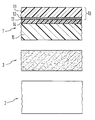
- a section of a film bag according to the invention with ID document inserted is schematic in the drawing shown.
- the foil pouch consists of the top foil sheet 1 and the lower foil sheet 2. In between the paper inlay 3 forming the document.
- the upper film sheet 1 is essentially a two-layer one Foil, the outer layer 10 in turn multilayer and a first layer 11 of e.g. 50 ⁇ m strong PET film.
- the inside of the PET film 11 a coating 12 made of an acrylic varnish with a thickness from e.g. 5 ⁇ m.
- this acrylic paint layer 12 is in Drawing not recognizable diffraction grating embossed, the contains the hologram motif. That embossed into layer 12 Relief can go up to the inner surface of the layer 11 or even reach into it. If for the outer layer 11 a plastic is used, the one has a lower softening point than PET Layer 12 can also be dispensed with.
- Layer 13 which is a transparent coating made of titanium dioxide or around reflective coating, preferably an aluminum layer, each with one Layer thickness of 20 nm, for example, can act. If the layer 13 consists of aluminum, the diffraction grating also in this layer instead of in layers 11 or 12 can be shaped. The layers 11 to 13 are functional however, to be considered as a single layer 10.
- a cross-linked, strapless Acrylate adhesive layer 14 a hot melt adhesive film 15, the is also referred to as hot-melt film or melt film, laminated without bubbles.
- the thickness of the acrylic adhesive layer 14 is, for example, 20 ⁇ m and that of the hot-melt adhesive film 15 for example 100 microns.
- the purpose of the acrylic adhesive layer 14 is to use the hot-melt adhesive film 15 machine laminate against the outer layer 10 to be able to.
- the hot melt adhesive film 15 is necessary to upper foil sheet 1 against the paper inlay 3 and in the edge area the foil bag also against the lower foil sheet 2 to be able to laminate using a conventional roll laminator, that works with temperatures from 120 to 140 ° C.
- a plastic must a softening temperature can be used that by at least 20 ° C higher than the working temperature of the roll laminator, otherwise the embossed hologram during the Laminating the paper inlay 3 would be destroyed.
- the lower film sheet 2 can, if desired, in principle same, but with respect to the paper inlay 3 but mirror images Have the same structure as the top sheet 1.
Landscapes
- Laminated Bodies (AREA)
- Holo Graphy (AREA)
- Credit Cards Or The Like (AREA)
Description
Claims (13)
- Folientasche zur Aufnahme und nachfolgenden Einlaminierung eines Dokumentes (3), z B. eines Ausweisdokumentes, zwischen zwei über einen Falz verbundene, die Tasche bildende Folienblätter (1, 2) aus einem transparenten, thermoplastischen Kunststoff, in einem Laminator dadurch gekennzeichnet, daß mindestens eines der Folienblätter aus einer Mehrschichtfolie besteht, deren äußerste Schicht (10) eine um mindestens 20° C über der Arbeitstemperatur des Laminator liegende Erweichungstemperatur hat und die innenseitig ein Prägehologramm trägt, und daß die innerste Schicht des Folienblatts (1) aus einer Schmelzklebefolie (15) mit einer Erweichungstemperatur kleiner oder gleich der Arbeitstemperatur des Laminator besteht.
- Folientasche nach Anspruch 1, dadurch gekennzeichnet, daß die Schmelzklebefolie (15) über einen kreuzvernetzten, trägerlosen Acrylatkleber (14) gegen die das Prägehologramm tragende Schicht kaschiert ist.
- Folientasche nach Anspruch 1 oder 2, dadurch gekennzeichnet, daß das Prägehologramm zumindest den überwiegenden Teil der Fläche des Folienblatts (1) einnimmt.
- Folientasche nach einem der Ansprüche 1 bis 3, dadurch gekennzeichnet, daß das Prägehologramm eine maschinenlesbare Kennzeichnung umfaßt.
- Folientasche nach einem der Ansprüche 1 bis 4, dadurch gekennzeichnet, daß die äußerste Schicht (10) der Mehrschichtfolie zusätzlich innenseitig konventionell bedruckt ist.
- Folientasche nach einem der Ansprüche 1 bis 5, dadurch gekennzeichnet, daß die das Prägehologramm tragende Fläche der äußersten Schicht (10) des Folienblatts (1) mit einer Beschichtung (13) aus einem transparenten Material versehen ist, dessen Brechungsindex um mindestens 20 %, vorzugsweise um mindestens 30 %, größer als der Brechungsindex des die äußerste Schicht bildenden Folienwerkstoffs (11, 12) ist.
- Folientasche nach Anspruch 6, dadurch gekennzeichnet, daß die Schichtstärke der transparenten Beschichtung (13) zwischen 10 und 100 nm, vorzugsweise zwischen 15 und 25 nm, beträgt.
- Folientasche nach Anspruch 6 oder 7, dadurch gekennzeichnet, daß die transparente Beschichtung aus Titandioxid besteht.
- Folientasche nach einem der Ansprüche 1 bis 5, dadurch gekennzeichnet, daß die das Prägehologramm tragende Fläche der äußersten Schicht (10) des Folienblatts (1) mit einer Beschichtung (13) aus einem reflektierenden Material in einer Deckung versehen ist, die die Lesbarkeit des Dokumentes bei normalen Lichtverhältnissen noch nicht beeinträchtigt.
- Folientasche nach Anspruch 9, dadurch gekennzeichnet, daß die Schichtstärke der reflektierenden Beschichtung (13) kleiner als 20 nm ist.
- Folientasche nach Anspruch 9 oder 10, dadurch gekennzeichnet, daß die Schichtstärke der reflektierenden Beschichtung (13) mehr als 20 nm beträgt und daß die reflektierende Beschichtung zumindest teilweise aus einem Raster besteht, dessen Deckungsgrad zwischen 15 und 40% liegt.
- Folientasche nach einem der Ansprüche 9 bis 11, dadurch gekennzeichnet, daß die reflektierende Beschichtung (13) lediglich einen Teil der Fläche der äußersten Schicht des Folienblatts bedeckt.
- Folientasche nach einem der Ansprüche 9 bis 12, dadurch gekennzeichnet, daß die reflektierende Beschichtung (13) eine visuell und/oder maschinenlesbare Kennzeichnung enthält.
Applications Claiming Priority (2)
| Application Number | Priority Date | Filing Date | Title |
|---|---|---|---|
| DE1995102418 DE19502418C1 (de) | 1995-01-26 | 1995-01-26 | Folientasche zur Aufnahme eines Dokumentes |
| DE19502418 | 1995-01-26 |
Publications (2)
| Publication Number | Publication Date |
|---|---|
| EP0723878A1 EP0723878A1 (de) | 1996-07-31 |
| EP0723878B1 true EP0723878B1 (de) | 1999-03-17 |
Family
ID=7752387
Family Applications (1)
| Application Number | Title | Priority Date | Filing Date |
|---|---|---|---|
| EP19950110183 Expired - Lifetime EP0723878B1 (de) | 1995-01-26 | 1995-06-29 | Folientasche zur Aufnahme eines Dokumentes |
Country Status (3)
| Country | Link |
|---|---|
| EP (1) | EP0723878B1 (de) |
| DE (1) | DE19502418C1 (de) |
| ES (1) | ES2131237T3 (de) |
Cited By (2)
| Publication number | Priority date | Publication date | Assignee | Title |
|---|---|---|---|---|
| US6459514B2 (en) | 1995-06-26 | 2002-10-01 | 3M Innovative Properties Company | Multilayer polymer film with additional coatings or layers |
| US7637537B2 (en) | 2000-02-21 | 2009-12-29 | Giesecke & Devrient Gmbh | Laminated multi-layer card with an inlaid security element in the form of relief structures |
Families Citing this family (2)
| Publication number | Priority date | Publication date | Assignee | Title |
|---|---|---|---|---|
| DE19618673A1 (de) * | 1996-05-09 | 1997-11-13 | Herbert Mischke | Vorrichtung zum Halten von Preislisten, Fahrplänen und anderen Vorlagen durch eine Tasche aus klarer Polyesterfolie |
| DE102008019871B3 (de) * | 2008-04-17 | 2009-11-05 | Bundesdruckerei Gmbh | Mehrschichtiges Sicherheitsdokument und Verfahren zu dessen Herstellung |
Family Cites Families (2)
| Publication number | Priority date | Publication date | Assignee | Title |
|---|---|---|---|---|
| US3221428A (en) * | 1963-03-19 | 1965-12-07 | Robert M Fischler | Transparent encasement for documents and the like |
| DE4002979A1 (de) * | 1990-02-01 | 1991-08-08 | Gao Ges Automation Org | Wertpapier mit optisch variablem sicherheitselement |
-
1995
- 1995-01-26 DE DE1995102418 patent/DE19502418C1/de not_active Expired - Fee Related
- 1995-06-29 EP EP19950110183 patent/EP0723878B1/de not_active Expired - Lifetime
- 1995-06-29 ES ES95110183T patent/ES2131237T3/es not_active Expired - Lifetime
Cited By (3)
| Publication number | Priority date | Publication date | Assignee | Title |
|---|---|---|---|---|
| US6459514B2 (en) | 1995-06-26 | 2002-10-01 | 3M Innovative Properties Company | Multilayer polymer film with additional coatings or layers |
| US7637537B2 (en) | 2000-02-21 | 2009-12-29 | Giesecke & Devrient Gmbh | Laminated multi-layer card with an inlaid security element in the form of relief structures |
| EP1259383B2 (de) † | 2000-02-21 | 2012-03-07 | Giesecke & Devrient GmbH | Mehrschichtige, laminierte karte mit eingelagertem, reliefstrukturen aufweisenden sicherheitselement |
Also Published As
| Publication number | Publication date |
|---|---|
| DE19502418C1 (de) | 1996-02-22 |
| HK1008320A1 (en) | 1999-05-07 |
| ES2131237T3 (es) | 1999-07-16 |
| EP0723878A1 (de) | 1996-07-31 |
Similar Documents
| Publication | Publication Date | Title |
|---|---|---|
| DE69212596T2 (de) | Artikel | |
| EP2459389B1 (de) | Identifikationsdokument mit einer personalisierten visuellen kennzeichnung sowie verfahren zu dessen herstellung | |
| EP2091756B1 (de) | Durchsichtssicherheitselement mit mikrostrukturen | |
| EP2310211B1 (de) | Sicherheitselement sowie verfahren zu seiner herstellung | |
| EP1827864B1 (de) | Sicherheitselement mit einer optisch variablen schicht und verfahren zu seiner herstellung | |
| DE10064616C2 (de) | Dekorfolie und Verfahren zum Beschriften der Dekorfolie | |
| EP1274585B2 (de) | Verfahren zur herstellung laserbeschriftbarer datenträger und damit hergestellte datenträger | |
| EP1171319B1 (de) | Dekorationsfolie | |
| DE102007039996B4 (de) | Sicherheitselement für ein Sicherheitsdokument und Verfahren zu seiner Herstellung | |
| DE60003641T2 (de) | Sicherheitselemente | |
| EP2448767B1 (de) | Sicherheitselement und herstellungsverfahren dafür | |
| EP1930176B1 (de) | Substrat mit einem streifenförmingen Sicherheitselement | |
| CH701875A2 (de) | Verfahren zur Herstellung eines mehrschichtigen Datenträgers sowie nach diesem Verfahren hergestellter Datenträger. | |
| EP3288772B1 (de) | Sicherheitselement mit zwei aneinander angrenzenden sicherheitsmerkmalen | |
| EP2522529B1 (de) | Sicherheitselement und mit demselben ausgestatteter Datenträger | |
| WO2008131710A1 (de) | Volumenhologramm, master zur herstellung der standardelemente des volumenhologramms und verfahren zur nachträglichen hologrammindividualisierung bei der applikation auf personal- und wertdokumente | |
| EP2448766B1 (de) | Sicherheitselement und herstellungsverfahren dafür | |
| EP3774375A1 (de) | Sicherheitselement, verfahren zum herstellen desselben und mit dem sicherheitselement ausgestatteter datenträger | |
| WO2016066264A1 (de) | Sicherheitselement mit farbkippendem dünnschichtelement | |
| DE19502418C1 (de) | Folientasche zur Aufnahme eines Dokumentes | |
| DE3835998A1 (de) | Ausweiskarte und verfahren zum herstellen einer ausweiskarte | |
| EP1651449B1 (de) | Sicherheitspapier zur herstellung von wertdokumenten | |
| EP3414100B1 (de) | Datenträger | |
| EP2085948A1 (de) | Sicherheitselemente mit integrierten Mattstrukturen | |
| EP4263233A1 (de) | Datenträger mit verbundsubstrat mit einem in einem durchsichtsbereich angeordneten sicherheitselement |
Legal Events
| Date | Code | Title | Description |
|---|---|---|---|
| PUAI | Public reference made under article 153(3) epc to a published international application that has entered the european phase |
Free format text: ORIGINAL CODE: 0009012 |
|
| AK | Designated contracting states |
Kind code of ref document: A1 Designated state(s): ES FR GB IE IT PT |
|
| 17P | Request for examination filed |
Effective date: 19961121 |
|
| RAP1 | Party data changed (applicant data changed or rights of an application transferred) |
Owner name: TOPAC MULTIMEDIAPRINT GMBH |
|
| 17Q | First examination report despatched |
Effective date: 19980121 |
|
| GRAG | Despatch of communication of intention to grant |
Free format text: ORIGINAL CODE: EPIDOS AGRA |
|
| GRAG | Despatch of communication of intention to grant |
Free format text: ORIGINAL CODE: EPIDOS AGRA |
|
| GRAH | Despatch of communication of intention to grant a patent |
Free format text: ORIGINAL CODE: EPIDOS IGRA |
|
| GRAH | Despatch of communication of intention to grant a patent |
Free format text: ORIGINAL CODE: EPIDOS IGRA |
|
| GRAA | (expected) grant |
Free format text: ORIGINAL CODE: 0009210 |
|
| ITF | It: translation for a ep patent filed | ||
| AK | Designated contracting states |
Kind code of ref document: B1 Designated state(s): ES FR GB IE IT PT |
|
| REG | Reference to a national code |
Ref country code: IE Ref legal event code: FG4D Free format text: GERMAN |
|
| ET | Fr: translation filed | ||
| GBT | Gb: translation of ep patent filed (gb section 77(6)(a)/1977) |
Effective date: 19990602 |
|
| REG | Reference to a national code |
Ref country code: ES Ref legal event code: FG2A Ref document number: 2131237 Country of ref document: ES Kind code of ref document: T3 |
|
| PLBQ | Unpublished change to opponent data |
Free format text: ORIGINAL CODE: EPIDOS OPPO |
|
| PLBI | Opposition filed |
Free format text: ORIGINAL CODE: 0009260 |
|
| PLBF | Reply of patent proprietor to notice(s) of opposition |
Free format text: ORIGINAL CODE: EPIDOS OBSO |
|
| 26 | Opposition filed |
Opponent name: DORNED B.V. Effective date: 19991217 |
|
| PLBF | Reply of patent proprietor to notice(s) of opposition |
Free format text: ORIGINAL CODE: EPIDOS OBSO |
|
| PLBO | Opposition rejected |
Free format text: ORIGINAL CODE: EPIDOS REJO |
|
| PLBN | Opposition rejected |
Free format text: ORIGINAL CODE: 0009273 |
|
| STAA | Information on the status of an ep patent application or granted ep patent |
Free format text: STATUS: OPPOSITION REJECTED |
|
| REG | Reference to a national code |
Ref country code: GB Ref legal event code: IF02 |
|
| 27O | Opposition rejected |
Effective date: 20010827 |
|
| REG | Reference to a national code |
Ref country code: PT Ref legal event code: PC4A Free format text: SVEN DEUTSCHMANN DE Effective date: 20031103 |
|
| PG25 | Lapsed in a contracting state [announced via postgrant information from national office to epo] |
Ref country code: FR Free format text: LAPSE BECAUSE OF NON-PAYMENT OF DUE FEES Effective date: 20040227 |
|
| REG | Reference to a national code |
Ref country code: FR Ref legal event code: ST |
|
| PGFP | Annual fee paid to national office [announced via postgrant information from national office to epo] |
Ref country code: PT Payment date: 20040526 Year of fee payment: 10 |
|
| REG | Reference to a national code |
Ref country code: FR Ref legal event code: RN |
|
| REG | Reference to a national code |
Ref country code: FR Ref legal event code: D3 |
|
| PG25 | Lapsed in a contracting state [announced via postgrant information from national office to epo] |
Ref country code: PT Free format text: LAPSE BECAUSE OF NON-PAYMENT OF DUE FEES Effective date: 20051229 |
|
| PGFP | Annual fee paid to national office [announced via postgrant information from national office to epo] |
Ref country code: ES Payment date: 20080617 Year of fee payment: 14 |
|
| PGFP | Annual fee paid to national office [announced via postgrant information from national office to epo] |
Ref country code: IT Payment date: 20080620 Year of fee payment: 14 |
|
| PGFP | Annual fee paid to national office [announced via postgrant information from national office to epo] |
Ref country code: IE Payment date: 20080622 Year of fee payment: 14 |
|
| PGFP | Annual fee paid to national office [announced via postgrant information from national office to epo] |
Ref country code: FR Payment date: 20080626 Year of fee payment: 14 |
|
| PGFP | Annual fee paid to national office [announced via postgrant information from national office to epo] |
Ref country code: GB Payment date: 20080630 Year of fee payment: 14 |
|
| GBPC | Gb: european patent ceased through non-payment of renewal fee |
Effective date: 20090629 |
|
| REG | Reference to a national code |
Ref country code: FR Ref legal event code: ST Effective date: 20100226 |
|
| REG | Reference to a national code |
Ref country code: IE Ref legal event code: MM4A |
|
| PG25 | Lapsed in a contracting state [announced via postgrant information from national office to epo] |
Ref country code: IE Free format text: LAPSE BECAUSE OF NON-PAYMENT OF DUE FEES Effective date: 20090629 |
|
| PG25 | Lapsed in a contracting state [announced via postgrant information from national office to epo] |
Ref country code: GB Free format text: LAPSE BECAUSE OF NON-PAYMENT OF DUE FEES Effective date: 20090629 |
|
| REG | Reference to a national code |
Ref country code: ES Ref legal event code: FD2A Effective date: 20090630 |
|
| PG25 | Lapsed in a contracting state [announced via postgrant information from national office to epo] |
Ref country code: ES Free format text: LAPSE BECAUSE OF NON-PAYMENT OF DUE FEES Effective date: 20090630 |
|
| PG25 | Lapsed in a contracting state [announced via postgrant information from national office to epo] |
Ref country code: IT Free format text: LAPSE BECAUSE OF NON-PAYMENT OF DUE FEES Effective date: 20090629 |
|
| PG25 | Lapsed in a contracting state [announced via postgrant information from national office to epo] |
Ref country code: FR Free format text: LAPSE BECAUSE OF NON-PAYMENT OF DUE FEES Effective date: 20090630 |