EP0722437B1 - Cycloalkanediols and their use in preparing chiral compounds - Google Patents
Cycloalkanediols and their use in preparing chiral compounds Download PDFInfo
- Publication number
- EP0722437B1 EP0722437B1 EP94928493A EP94928493A EP0722437B1 EP 0722437 B1 EP0722437 B1 EP 0722437B1 EP 94928493 A EP94928493 A EP 94928493A EP 94928493 A EP94928493 A EP 94928493A EP 0722437 B1 EP0722437 B1 EP 0722437B1
- Authority
- EP
- European Patent Office
- Prior art keywords
- acetonide
- carboxamide
- dihydroxylation
- compound according
- pct
- Prior art date
- Legal status (The legal status is an assumption and is not a legal conclusion. Google has not performed a legal analysis and makes no representation as to the accuracy of the status listed.)
- Expired - Lifetime
Links
- 150000001875 compounds Chemical class 0.000 title claims description 16
- 238000005906 dihydroxylation reaction Methods 0.000 claims abstract description 12
- 238000000034 method Methods 0.000 claims abstract description 10
- QWOJMRHUQHTCJG-UHFFFAOYSA-N CC([CH2-])=O Chemical compound CC([CH2-])=O QWOJMRHUQHTCJG-UHFFFAOYSA-N 0.000 claims description 26
- 238000006243 chemical reaction Methods 0.000 claims description 10
- 229910000489 osmium tetroxide Inorganic materials 0.000 claims description 6
- KDCGOANMDULRCW-UHFFFAOYSA-N Purine Natural products N1=CNC2=NC=NC2=C1 KDCGOANMDULRCW-UHFFFAOYSA-N 0.000 claims description 5
- 125000001495 ethyl group Chemical group [H]C([H])([H])C([H])([H])* 0.000 claims description 4
- 125000000217 alkyl group Chemical group 0.000 claims description 3
- 125000000962 organic group Chemical group 0.000 claims description 3
- 239000012286 potassium permanganate Substances 0.000 claims description 3
- -1 tert-butoxycarboxyl Chemical group 0.000 claims description 3
- CZPWVGJYEJSRLH-UHFFFAOYSA-N Pyrimidine Chemical group C1=CN=CN=C1 CZPWVGJYEJSRLH-UHFFFAOYSA-N 0.000 claims description 2
- 230000000903 blocking effect Effects 0.000 claims description 2
- 238000004519 manufacturing process Methods 0.000 claims description 2
- 238000002360 preparation method Methods 0.000 claims description 2
- 150000003839 salts Chemical class 0.000 claims description 2
- 125000001584 benzyloxycarbonyl group Chemical group C(=O)(OCC1=CC=CC=C1)* 0.000 claims 1
- 239000003814 drug Substances 0.000 claims 1
- UYWQUFXKFGHYNT-UHFFFAOYSA-N phenylmethyl ester of formic acid Natural products O=COCC1=CC=CC=C1 UYWQUFXKFGHYNT-UHFFFAOYSA-N 0.000 claims 1
- 125000000561 purinyl group Chemical group N1=C(N=C2N=CNC2=C1)* 0.000 claims 1
- 229940124597 therapeutic agent Drugs 0.000 claims 1
- 230000000707 stereoselective effect Effects 0.000 abstract description 2
- VYPSYNLAJGMNEJ-UHFFFAOYSA-N Silicium dioxide Chemical compound O=[Si]=O VYPSYNLAJGMNEJ-UHFFFAOYSA-N 0.000 description 17
- CSCPPACGZOOCGX-UHFFFAOYSA-N Acetone Chemical compound CC(C)=O CSCPPACGZOOCGX-UHFFFAOYSA-N 0.000 description 12
- HEDRZPFGACZZDS-MICDWDOJSA-N Trichloro(2H)methane Chemical compound [2H]C(Cl)(Cl)Cl HEDRZPFGACZZDS-MICDWDOJSA-N 0.000 description 12
- 239000000203 mixture Substances 0.000 description 10
- 238000010992 reflux Methods 0.000 description 8
- 239000000377 silicon dioxide Substances 0.000 description 8
- 239000007858 starting material Substances 0.000 description 8
- HEWZVZIVELJPQZ-UHFFFAOYSA-N 2,2-dimethoxypropane Chemical compound COC(C)(C)OC HEWZVZIVELJPQZ-UHFFFAOYSA-N 0.000 description 5
- XEKOWRVHYACXOJ-UHFFFAOYSA-N Ethyl acetate Chemical compound CCOC(C)=O XEKOWRVHYACXOJ-UHFFFAOYSA-N 0.000 description 5
- OFBQJSOFQDEBGM-UHFFFAOYSA-N Pentane Chemical compound CCCCC OFBQJSOFQDEBGM-UHFFFAOYSA-N 0.000 description 5
- IMNFDUFMRHMDMM-UHFFFAOYSA-N anhydrous n-heptane Natural products CCCCCCC IMNFDUFMRHMDMM-UHFFFAOYSA-N 0.000 description 5
- 150000003857 carboxamides Chemical group 0.000 description 5
- 238000004587 chromatography analysis Methods 0.000 description 5
- 239000012285 osmium tetroxide Substances 0.000 description 5
- 239000002904 solvent Substances 0.000 description 5
- XLYOFNOQVPJJNP-UHFFFAOYSA-N water Substances O XLYOFNOQVPJJNP-UHFFFAOYSA-N 0.000 description 5
- LFTLOKWAGJYHHR-UHFFFAOYSA-N N-methylmorpholine N-oxide Chemical compound CN1(=O)CCOCC1 LFTLOKWAGJYHHR-UHFFFAOYSA-N 0.000 description 4
- 150000002009 diols Chemical class 0.000 description 4
- 239000007787 solid Substances 0.000 description 4
- 125000000999 tert-butyl group Chemical group [H]C([H])([H])C(*)(C([H])([H])[H])C([H])([H])[H] 0.000 description 4
- JOXIMZWYDAKGHI-UHFFFAOYSA-N toluene-4-sulfonic acid Chemical compound CC1=CC=C(S(O)(=O)=O)C=C1 JOXIMZWYDAKGHI-UHFFFAOYSA-N 0.000 description 4
- DWAQJAXMDSEUJJ-UHFFFAOYSA-M Sodium bisulfite Chemical compound [Na+].OS([O-])=O DWAQJAXMDSEUJJ-UHFFFAOYSA-M 0.000 description 3
- 150000001336 alkenes Chemical class 0.000 description 3
- 125000002619 bicyclic group Chemical group 0.000 description 3
- 230000015572 biosynthetic process Effects 0.000 description 3
- 125000006260 ethylaminocarbonyl group Chemical group [H]N(C(*)=O)C([H])([H])C([H])([H])[H] 0.000 description 3
- 238000001914 filtration Methods 0.000 description 3
- 239000002243 precursor Substances 0.000 description 3
- 235000010267 sodium hydrogen sulphite Nutrition 0.000 description 3
- 239000004289 sodium hydrogen sulphite Substances 0.000 description 3
- 238000003786 synthesis reaction Methods 0.000 description 3
- FKHIFSZMMVMEQY-UHFFFAOYSA-N talc Chemical compound [Mg+2].[O-][Si]([O-])=O FKHIFSZMMVMEQY-UHFFFAOYSA-N 0.000 description 3
- 150000001408 amides Chemical class 0.000 description 2
- LPIQUOYDBNQMRZ-UHFFFAOYSA-N cyclopentene Chemical compound C1CC=CC1 LPIQUOYDBNQMRZ-UHFFFAOYSA-N 0.000 description 2
- 125000002496 methyl group Chemical group [H]C([H])([H])* 0.000 description 2
- 230000003287 optical effect Effects 0.000 description 2
- 239000000047 product Substances 0.000 description 2
- DDUFYKNOXPZZIW-UHFFFAOYSA-N 3-azabicyclo[2.2.1]hept-5-en-2-one Chemical compound C1C2C(=O)NC1C=C2 DDUFYKNOXPZZIW-UHFFFAOYSA-N 0.000 description 1
- QUSNBJAOOMFDIB-UHFFFAOYSA-N Ethylamine Chemical compound CCN QUSNBJAOOMFDIB-UHFFFAOYSA-N 0.000 description 1
- ZLMJMSJWJFRBEC-UHFFFAOYSA-N Potassium Chemical compound [K] ZLMJMSJWJFRBEC-UHFFFAOYSA-N 0.000 description 1
- 230000009435 amidation Effects 0.000 description 1
- 238000007112 amidation reaction Methods 0.000 description 1
- 150000001412 amines Chemical class 0.000 description 1
- 150000001413 amino acids Chemical class 0.000 description 1
- 125000004432 carbon atom Chemical group C* 0.000 description 1
- 125000005392 carboxamide group Chemical group NC(=O)* 0.000 description 1
- 150000001732 carboxylic acid derivatives Chemical class 0.000 description 1
- 239000003054 catalyst Substances 0.000 description 1
- 238000005833 cis-dihydroxylation reaction Methods 0.000 description 1
- 238000007796 conventional method Methods 0.000 description 1
- DSLSPCZKJILYBT-UHFFFAOYSA-N cyclopentene-1-carboxamide Chemical compound NC(=O)C1=CCCC1 DSLSPCZKJILYBT-UHFFFAOYSA-N 0.000 description 1
- 125000001511 cyclopentyl group Chemical group [H]C1([H])C([H])([H])C([H])([H])C([H])(*)C1([H])[H] 0.000 description 1
- RIFGWPKJUGCATF-UHFFFAOYSA-N ethyl chloroformate Chemical compound CCOC(Cl)=O RIFGWPKJUGCATF-UHFFFAOYSA-N 0.000 description 1
- 239000000706 filtrate Substances 0.000 description 1
- 125000001183 hydrocarbyl group Chemical group 0.000 description 1
- 125000004435 hydrogen atom Chemical group [H]* 0.000 description 1
- 125000002887 hydroxy group Chemical group [H]O* 0.000 description 1
- 238000011835 investigation Methods 0.000 description 1
- 150000004702 methyl esters Chemical group 0.000 description 1
- 125000004458 methylaminocarbonyl group Chemical group [H]N(C(*)=O)C([H])([H])[H] 0.000 description 1
- 238000000655 nuclear magnetic resonance spectrum Methods 0.000 description 1
- RGSFGYAAUTVSQA-UHFFFAOYSA-N pentamethylene Natural products C1CCCC1 RGSFGYAAUTVSQA-UHFFFAOYSA-N 0.000 description 1
- 229910052700 potassium Inorganic materials 0.000 description 1
- 239000011591 potassium Substances 0.000 description 1
- 125000000714 pyrimidinyl group Chemical group 0.000 description 1
- 239000011541 reaction mixture Substances 0.000 description 1
- HRZFUMHJMZEROT-UHFFFAOYSA-L sodium disulfite Chemical compound [Na+].[Na+].[O-]S(=O)S([O-])(=O)=O HRZFUMHJMZEROT-UHFFFAOYSA-L 0.000 description 1
- 235000010262 sodium metabisulphite Nutrition 0.000 description 1
- 239000004296 sodium metabisulphite Substances 0.000 description 1
- 238000006467 substitution reaction Methods 0.000 description 1
- DYHSDKLCOJIUFX-UHFFFAOYSA-N tert-butoxycarbonyl anhydride Chemical compound CC(C)(C)OC(=O)OC(=O)OC(C)(C)C DYHSDKLCOJIUFX-UHFFFAOYSA-N 0.000 description 1
- 230000001225 therapeutic effect Effects 0.000 description 1
- 230000000304 vasodilatating effect Effects 0.000 description 1
Classifications
-
- C—CHEMISTRY; METALLURGY
- C07—ORGANIC CHEMISTRY
- C07C—ACYCLIC OR CARBOCYCLIC COMPOUNDS
- C07C271/00—Derivatives of carbamic acids, i.e. compounds containing any of the groups, the nitrogen atom not being part of nitro or nitroso groups
- C07C271/06—Esters of carbamic acids
- C07C271/08—Esters of carbamic acids having oxygen atoms of carbamate groups bound to acyclic carbon atoms
- C07C271/24—Esters of carbamic acids having oxygen atoms of carbamate groups bound to acyclic carbon atoms with the nitrogen atom of at least one of the carbamate groups bound to a carbon atom of a ring other than a six-membered aromatic ring
-
- C—CHEMISTRY; METALLURGY
- C07—ORGANIC CHEMISTRY
- C07C—ACYCLIC OR CARBOCYCLIC COMPOUNDS
- C07C237/00—Carboxylic acid amides, the carbon skeleton of the acid part being further substituted by amino groups
- C07C237/24—Carboxylic acid amides, the carbon skeleton of the acid part being further substituted by amino groups having the carbon atom of at least one of the carboxamide groups bound to a carbon atom of a ring other than a six-membered aromatic ring of the carbon skeleton
-
- C—CHEMISTRY; METALLURGY
- C07—ORGANIC CHEMISTRY
- C07D—HETEROCYCLIC COMPOUNDS
- C07D317/00—Heterocyclic compounds containing five-membered rings having two oxygen atoms as the only ring hetero atoms
- C07D317/08—Heterocyclic compounds containing five-membered rings having two oxygen atoms as the only ring hetero atoms having the hetero atoms in positions 1 and 3
- C07D317/44—Heterocyclic compounds containing five-membered rings having two oxygen atoms as the only ring hetero atoms having the hetero atoms in positions 1 and 3 ortho- or peri-condensed with carbocyclic rings or ring systems
-
- C—CHEMISTRY; METALLURGY
- C08—ORGANIC MACROMOLECULAR COMPOUNDS; THEIR PREPARATION OR CHEMICAL WORKING-UP; COMPOSITIONS BASED THEREON
- C08G—MACROMOLECULAR COMPOUNDS OBTAINED OTHERWISE THAN BY REACTIONS ONLY INVOLVING UNSATURATED CARBON-TO-CARBON BONDS
- C08G73/00—Macromolecular compounds obtained by reactions forming a linkage containing nitrogen with or without oxygen or carbon in the main chain of the macromolecule, not provided for in groups C08G12/00 - C08G71/00
- C08G73/02—Polyamines
- C08G73/0206—Polyalkylene(poly)amines
-
- D—TEXTILES; PAPER
- D06—TREATMENT OF TEXTILES OR THE LIKE; LAUNDERING; FLEXIBLE MATERIALS NOT OTHERWISE PROVIDED FOR
- D06M—TREATMENT, NOT PROVIDED FOR ELSEWHERE IN CLASS D06, OF FIBRES, THREADS, YARNS, FABRICS, FEATHERS OR FIBROUS GOODS MADE FROM SUCH MATERIALS
- D06M13/00—Treating fibres, threads, yarns, fabrics or fibrous goods made from such materials, with non-macromolecular organic compounds; Such treatment combined with mechanical treatment
- D06M13/322—Treating fibres, threads, yarns, fabrics or fibrous goods made from such materials, with non-macromolecular organic compounds; Such treatment combined with mechanical treatment with compounds containing nitrogen
- D06M13/402—Amides imides, sulfamic acids
- D06M13/432—Urea, thiourea or derivatives thereof, e.g. biurets; Urea-inclusion compounds; Dicyanamides; Carbodiimides; Guanidines, e.g. dicyandiamides
-
- D—TEXTILES; PAPER
- D06—TREATMENT OF TEXTILES OR THE LIKE; LAUNDERING; FLEXIBLE MATERIALS NOT OTHERWISE PROVIDED FOR
- D06M—TREATMENT, NOT PROVIDED FOR ELSEWHERE IN CLASS D06, OF FIBRES, THREADS, YARNS, FABRICS, FEATHERS OR FIBROUS GOODS MADE FROM SUCH MATERIALS
- D06M15/00—Treating fibres, threads, yarns, fabrics, or fibrous goods made from such materials, with macromolecular compounds; Such treatment combined with mechanical treatment
- D06M15/19—Treating fibres, threads, yarns, fabrics, or fibrous goods made from such materials, with macromolecular compounds; Such treatment combined with mechanical treatment with synthetic macromolecular compounds
- D06M15/37—Macromolecular compounds obtained otherwise than by reactions only involving carbon-to-carbon unsaturated bonds
- D06M15/564—Polyureas, polyurethanes or other polymers having ureide or urethane links; Precondensation products forming them
-
- D—TEXTILES; PAPER
- D06—TREATMENT OF TEXTILES OR THE LIKE; LAUNDERING; FLEXIBLE MATERIALS NOT OTHERWISE PROVIDED FOR
- D06M—TREATMENT, NOT PROVIDED FOR ELSEWHERE IN CLASS D06, OF FIBRES, THREADS, YARNS, FABRICS, FEATHERS OR FIBROUS GOODS MADE FROM SUCH MATERIALS
- D06M15/00—Treating fibres, threads, yarns, fabrics, or fibrous goods made from such materials, with macromolecular compounds; Such treatment combined with mechanical treatment
- D06M15/19—Treating fibres, threads, yarns, fabrics, or fibrous goods made from such materials, with macromolecular compounds; Such treatment combined with mechanical treatment with synthetic macromolecular compounds
- D06M15/37—Macromolecular compounds obtained otherwise than by reactions only involving carbon-to-carbon unsaturated bonds
- D06M15/59—Polyamides; Polyimides
-
- D—TEXTILES; PAPER
- D06—TREATMENT OF TEXTILES OR THE LIKE; LAUNDERING; FLEXIBLE MATERIALS NOT OTHERWISE PROVIDED FOR
- D06M—TREATMENT, NOT PROVIDED FOR ELSEWHERE IN CLASS D06, OF FIBRES, THREADS, YARNS, FABRICS, FEATHERS OR FIBROUS GOODS MADE FROM SUCH MATERIALS
- D06M15/00—Treating fibres, threads, yarns, fabrics, or fibrous goods made from such materials, with macromolecular compounds; Such treatment combined with mechanical treatment
- D06M15/19—Treating fibres, threads, yarns, fabrics, or fibrous goods made from such materials, with macromolecular compounds; Such treatment combined with mechanical treatment with synthetic macromolecular compounds
- D06M15/37—Macromolecular compounds obtained otherwise than by reactions only involving carbon-to-carbon unsaturated bonds
- D06M15/61—Polyamines polyimines
-
- D—TEXTILES; PAPER
- D06—TREATMENT OF TEXTILES OR THE LIKE; LAUNDERING; FLEXIBLE MATERIALS NOT OTHERWISE PROVIDED FOR
- D06M—TREATMENT, NOT PROVIDED FOR ELSEWHERE IN CLASS D06, OF FIBRES, THREADS, YARNS, FABRICS, FEATHERS OR FIBROUS GOODS MADE FROM SUCH MATERIALS
- D06M16/00—Biochemical treatment of fibres, threads, yarns, fabrics, or fibrous goods made from such materials, e.g. enzymatic
-
- C—CHEMISTRY; METALLURGY
- C07—ORGANIC CHEMISTRY
- C07C—ACYCLIC OR CARBOCYCLIC COMPOUNDS
- C07C2601/00—Systems containing only non-condensed rings
- C07C2601/06—Systems containing only non-condensed rings with a five-membered ring
- C07C2601/08—Systems containing only non-condensed rings with a five-membered ring the ring being saturated
Definitions
- This invention relates to cycloalkanediols and their use in preparing chiral compounds.
- the invention relates also to a process whereby a desired diol can be prepared stereoselectively.
- 2,3- cis -Dihydoxycyclopentane-1-carboxamides linked at the 5-position to a purine or pyrimidine have therapeutic utility. See, for example, EP-A-0368640. In the synthesis of such compounds, control of the chiral centres on the cyclopentane ring is essential.
- a process for the preparation of a 2,3-dihydroxycycloalkene-1-carboxamide e.g. of formula (1) and most preferably the diol corresponding to the acetonide shown in Scheme 1, comprises stereoselective dihydroxylation of the olefinic precursor thereof. Dihydroxylation takes place anti to the carboxamide function.
- the process can be used to prepare a substantially pure diastereomer, either as a single enantiomer, or in racemic form. Indeed, the optical purity of the product will reflect the optical composition of the starting cyclopentene.
- R 1 and R 2 are not critical;
- R 1 is preferably H, but may be any organic, e.g. hydrocarbyl group, e.g. of up to 20 C atoms.
- R 2 may be the same or a different organic group, e.g. alkyl such as ethyl. It is most preferred that R 1 is H, methyl or ethyl and R 2 is methyl or ethyl.
- R 3 and R 4 are each H or a removable blocking group such as tert-butoxycarboxyl or benzyloxycarboxyl.
- Scheme 2 An example of the process of the invention is shown in Scheme 2.
- Starting material is depicted as a salt, but can be in the form of an amino-acid.
- Introduction of the ethylamido group into the starting material is relatively easy compared with its introduction in Scheme 1 which, as mentioned above, requires a pressure reaction. It may be achieved using (i) (tBuO 2 C) 2 O and OH - , and (ii) EtOCOCl and EtNH 2 .
- Conversion of the cyclopentene-carboxamide, the olefinic precursor of the diol is by cis-dihydroxylation across the double bond, for example by using osmium tetroxide or (potassium) permanganate.
- osmium tetroxide that may be used as a catalyst, with stoichiometric N-methyl morpholine-N-oxide and aqueous acetone.
- trans -cyclopentene gave predominantly (rather than exclusively) the dihydroxylation anti to the carboxamide. This shows that the carboxamide controls the stereoselectivity, although the degree of exclusivity depends on the configuration at the other chiral centre. See Example 4, below.
- N-Methylmorpholine-N-oxide (0.438 g, 3.74 mmol) was added in one portion to a stirred solution of [1(S),4(R)]-4-(t-butoxycarbonylamino)-N,N-dimethyl-2-cyclopentenecarboxamide (0.545 g, 2.15 mmol) and osmium tetroxide (0.5 ml of 4% wt aq. soln,) in 5:1 acetone/water (12 ml) and the resulting mixture was heated at reflux for 8 h. The reaction was quenched by the addition of 10% sodium bisulphite (10 ml) and Florisil (5 g).
- Nmethylmorpholine-N-oxide (0.60 g, 5.12 mmol) was added to a solution of the alkenes (1.5 : 1 cis/trans; 1.22 g, 4.73 mmol) and osmium tetroxide (1 ml of 0.5% solution in acetone/water 5:1 70 ml) and the resulting solution heated at reflux for 4 h. The reaction was allowed to cool to room temperature. 10% Sodium bisulphite (20 ml) and Florisil (20 g) were added and the solids removed by filtration.
Landscapes
- Chemical & Material Sciences (AREA)
- Organic Chemistry (AREA)
- Chemical Kinetics & Catalysis (AREA)
- Engineering & Computer Science (AREA)
- Textile Engineering (AREA)
- Health & Medical Sciences (AREA)
- Medicinal Chemistry (AREA)
- Polymers & Plastics (AREA)
- Life Sciences & Earth Sciences (AREA)
- Biochemistry (AREA)
- General Chemical & Material Sciences (AREA)
- Microbiology (AREA)
- Organic Low-Molecular-Weight Compounds And Preparation Thereof (AREA)
- Steroid Compounds (AREA)
- Nitrogen And Oxygen Or Sulfur-Condensed Heterocyclic Ring Systems (AREA)
- Low-Molecular Organic Synthesis Reactions Using Catalysts (AREA)
Abstract
Description
- This invention relates to cycloalkanediols and their use in preparing chiral compounds. The invention relates also to a process whereby a desired diol can be prepared stereoselectively.
- 2,3-cis-Dihydoxycyclopentane-1-carboxamides linked at the 5-position to a purine or pyrimidine have therapeutic utility. See, for example, EP-A-0368640. In the synthesis of such compounds, control of the chiral centres on the cyclopentane ring is essential.
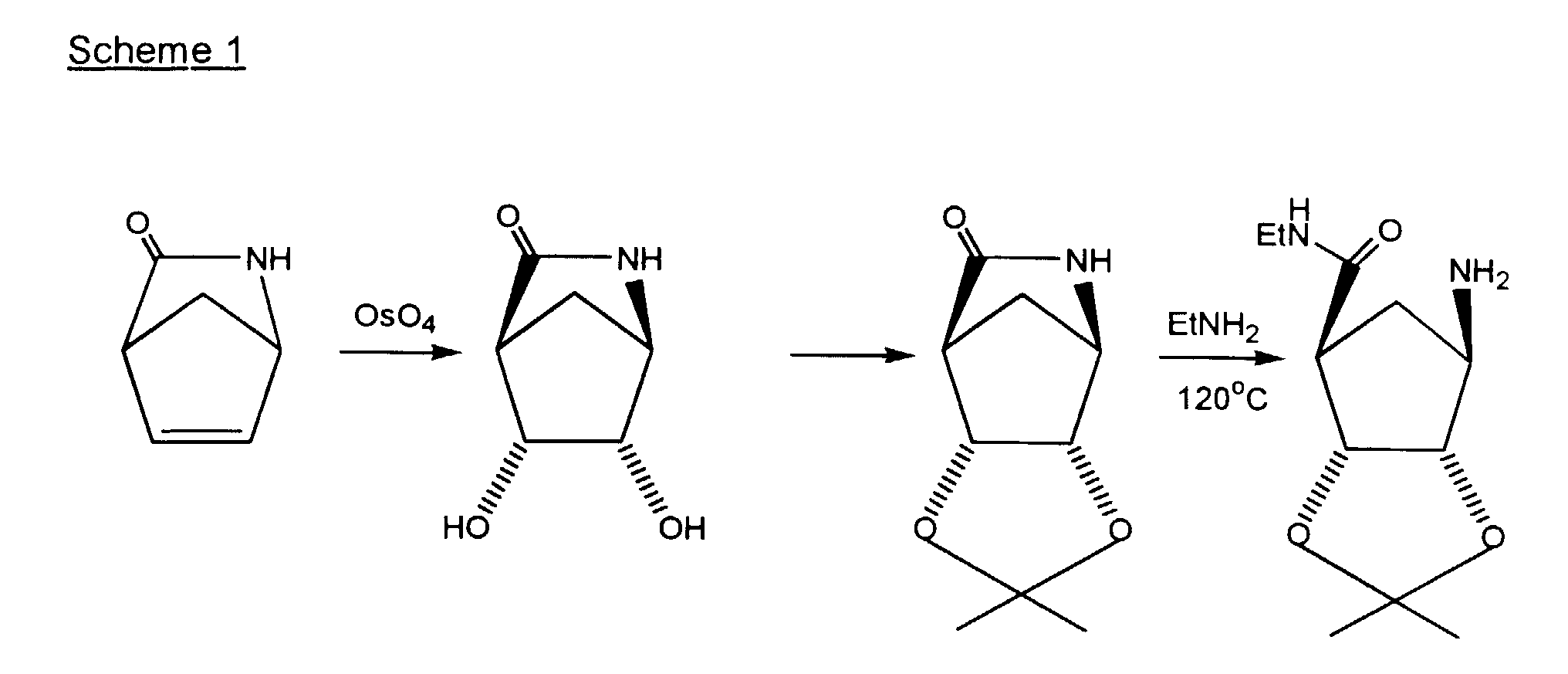
- An important intermediate in such a synthesis, which is protected at the hydroxyl groups as an acetonide, is the final compound in Scheme 1, below; this compound is useful as a synthon for the manufacture of carbocylic compounds having vasodilatory activity, see Chen et al, Tetrahedron Lett, 30:5543-6 (1989). An established route for the synthesis of the acetonide is also shown in Scheme 1.
- The geometric constraints provided by the bicyclic nature of the starting material, 2-azabicyclo[2.2.1]hept-5-en-3-one, are thought to be the reason for the high stereocontrol of the dihydroxylation onto the exo-face of the starting material. One disadvantage, however, with this route is the need for a pressure reaction to open the amide linkage.
- However, despite these disadvantages, it is generally considered that opening of the amide linkage of the starting material results in a loss of the stereocontrol of the dihydroxylation so that a mixture of stereoisomers of the diol results. This is undesirable.
- According to the present invention, a process for the preparation of a 2,3-dihydroxycycloalkene-1-carboxamide, e.g. of formula (1) and most preferably the diol corresponding to the acetonide shown in Scheme 1, comprises stereoselective dihydroxylation of the olefinic precursor thereof. Dihydroxylation takes place anti to the carboxamide function.
- The process can be used to prepare a substantially pure diastereomer, either as a single enantiomer, or in racemic form. Indeed, the optical purity of the product will reflect the optical composition of the starting cyclopentene.
- In view of the understanding in the art as to the importance of a bicyclic structure for achieving high stereocontrol of a reaction of this nature, it is surprising that the process of the invention, i.e. without a bicyclic starting material, achieves just this.
- In compounds of formula (1), the nature of R1 and R2 is not critical; R1 is preferably H, but may be any organic, e.g. hydrocarbyl group, e.g. of up to 20 C atoms. R2 may be the same or a different organic group, e.g. alkyl such as ethyl. It is most preferred that R1 is H, methyl or ethyl and R2 is methyl or ethyl. R3 and R4 are each H or a removable blocking group such as tert-butoxycarboxyl or benzyloxycarboxyl.
- Compounds of formula (1) are prepared by dihydroxylation of the corresponding cycloalkene-1-carboxamide. This starting material can be obtained by conventional methods such as amidation of the corresponding carboxylic acid or by treatment of an N-acyl-2-azabicyclo[2.2.1]hept-5-en-3-one with an amine.
- An example of the process of the invention is shown in Scheme 2. Starting material is depicted as a salt, but can be in the form of an amino-acid. Introduction of the ethylamido group into the starting material is relatively easy compared with its introduction in Scheme 1 which, as mentioned above, requires a pressure reaction. It may be achieved using (i) (tBuO2C)2O and OH-, and (ii) EtOCOCl and EtNH2. Conversion of the cyclopentene-carboxamide, the olefinic precursor of the diol, is by cis-dihydroxylation across the double bond, for example by using osmium tetroxide or (potassium) permanganate. In the case of osmium tetroxide, that may be used as a catalyst, with stoichiometric N-methyl morpholine-N-oxide and aqueous acetone.
- Further investigation into the surprising stereo selectivity observed in Scheme 2 has indicated that the origin of that stereoselectivity lies with the presence of the carboxamide functionality. When Scheme 2 is carried out with the corresponding olefinic precursor in which the carboxamide is replaced by a methyl ester function, a mixture of stereoisomers, in a ratio of about 1:1 is observed. For the given reaction, a substantially single diastereomer of the required configuration (endo or exo) is attained.
- The trans-cyclopentene gave predominantly (rather than exclusively) the dihydroxylation anti to the carboxamide. This shows that the carboxamide controls the stereoselectivity, although the degree of exclusivity depends on the configuration at the other chiral centre. See Example 4, below.
- It is to be noted that the process of the invention works regardless of the enantiomeric composition of the starting material, i.e. whether racemic, enantiomerically-enriched or enantiopure.
- Compounds of formula (1), if used as synthons, are preferably protected as the acetonide. This may be achieved by the addition of any suitably protected alkanediol, e.g. 2,2-dimethoxypropane. The synthon may then be used, by appropriate reaction with the NR3R4 group, to introduce a purine or pyrimidine ring, and also removal or substitution of the carboxamide group, e.g. to give a hydrogen atom or alkyl group at that position. All these reactions may be conducted under conditions known to those skilled in the art.
- The following Examples illustrate the invention. The following Table gives the products of the Examples, with reference to formula (3).
R1 R2 R3 R4 (3a) -CONHEt -H -NHCO2 tBu -H (3b) -CONMe2 -H -NHCO2 tBu -H (3c) -CONHMe -H -NHCO2 tBu -H (3d) -CONHEt -H -NHCOPh -H (3e) -H -NHCOPh -CONHEt -H (3f) -H -CONHEt -NHCOPh -H - A solution of [1(S),4(R)]-4-(t-butoxycarbonylamino)-N-ethyl-2-cyclopentenecarboxamide (4.82 g, 18.8 mmol), osmium tetroxide (1.5 ml of 0.5% wt aq. soln,) and N-methylmorpholine-N-oxide (2.28 g, 19.5 mmol) in 4:1 acetone/water (100 ml) was heated at reflux for 8 h. Florisil (15 g) and 10% sodium bisulphite (20 ml) were added. The solids were removed by filtration and the solution concentrated under reduced pressure. The residue was taken up in 2,2-dimethoxypropane (150 ml) containing 4-toluenesulphonic acid (20 mg) and the mixture heated at reflux for 4 hrs, cooled to room temperature and filtered through silica. The solvent was removed under reduced pressure and the residue purified by chromatography (silica; 3:1 ethyl acetate/pentane to give the title acetonide (3a; 2.24 g): NMR (CDCl3): δ 6.5 (1H, d, NHBOC), 5.9 (1H, br. s, NHEt), 4.7 (1H, d, J=6 Hz, H-1), 4.5 (1H, d, J=6 Hz, H-5), 4.2 (1H, apparent t, H-6), 3.3 (2H, m, CH 2Me), 2.7 (1H, m, H-7), 1.4 (12H, s, Me3C and Me acetonide), 1.3 (3H, s, Me acetonide), 1.1 (3H, t, CH 3CH2).
- N-Methylmorpholine-N-oxide (0.438 g, 3.74 mmol) was added in one portion to a stirred solution of [1(S),4(R)]-4-(t-butoxycarbonylamino)-N,N-dimethyl-2-cyclopentenecarboxamide (0.545 g, 2.15 mmol) and osmium tetroxide (0.5 ml of 4% wt aq. soln,) in 5:1 acetone/water (12 ml) and the resulting mixture was heated at reflux for 8 h. The reaction was quenched by the addition of 10% sodium bisulphite (10 ml) and Florisil (5 g). The solids were removed by filtration and the solution concentrated under reduced pressure. The residue was taken up in 2,2-dimethoxypropane (20 ml) containing 4-toluenesulphonic acid (50 mg) and the mixture heated at reflux for 12 hrs. The resulting solution was filtered through a pad of silica and the solvent was removed under reduced pressure. The residue was purified by chromatography (silica; 1:1 to 3:1 ethyl acetate/pentane to give the title acetonide (3b; 0.32 g):
NMR (CDCl3): δ 6.3 (1H, d, NHBOC), 4.7 and 4.5 ( each 1H, d, J=6 Hz, H-1 and H-5), 4.1 (1H, apparent t, H-6), 3.2 (4H, H-8 and MeN)), 3.0 (3H, s, MeN), 2.4 (1H, m, H-7), 1.8 (1H, m, H-7), 1.4 and 1.2 (15H, s, t-Bu and 2 x acetonide Me). - This was carried out as for Example 2 but using the alkene [1(S),4(R)]-4-(t-butoxycarbonylamino)-N-methyl-2-cyclopentenecarboxamide (0.631 g, 2.63 mmol) and N-methylmorpholine-N-oxide (0.40 g) at reflux for 2 h. The title acetonide was isolated by chromatography (silica 1:1 to 3:1 ethyl acetate / pentane) as a solid.
NMR (CDCl3): δ 6.5 (1H, d, NHBOC), 5.9 (1H, br. s, NHEt), 4.7 (1H, d, J=6 Hz, H-1), 4.5 (1H, d, J=6 Hz, H-5), 4.2 (1H, apparent t, H-6), 3.3 (2H, m, CH 2Me), 2.7 (1H, m, H-7), 1.4 (12H, s, Me3C and Me acetonide), 1.3 (3H, s, Me acetonide), 1.1 (3H, t, CH 3CH2). - Nmethylmorpholine-N-oxide (0.60 g, 5.12 mmol) was added to a solution of the alkenes (1.5 : 1 cis/trans; 1.22 g, 4.73 mmol) and osmium tetroxide (1 ml of 0.5% solution in acetone/water 5:1 70 ml) and the resulting solution heated at reflux for 4 h. The reaction was allowed to cool to room temperature. 10% Sodium bisulphite (20 ml) and Florisil (20 g) were added and the solids removed by filtration. The residue was taken up in 2:1 2,2-dimethoxypropane/acetone (150 ml) containing p-toluenesulphonic acid (50 mg) and the resulting mixture heated at reflux for 5 h. The solvent was removed under reduced pressure and the residue purified by chromatography (silica 2:1 then 3:1 ethyl acetate / pentane) to give the acetonides (3d, 0.53g; 3e, 0.35g; 3f, 0.15g).
NMR (3d) (CDCl3): δ 8.9 (1H, d, NH), 7.9 (2H, m, ArH), 7.4 (3H, m, ArH), 6.1 (1H,
br. t, NH), 5.65 (3H, H-1, H-5 and H-6), 3.3 (2H, m, CH 2Me), 2.9 (1H, d, H-8), 2.5 (1H, m, H-7), 1.9 (1H, d, H-7), 1.4 (3H,s, Me acetonide), 1.2 (3H, s, Me acetonide), 1.1 (3H, t, J=8Hz, CH 3CH2);
(3e) (CDCl3): δ 7.8 (2H, m, ArH), 7.4 (3H, m, ArH), 6.7 (1H, br. d, NH), 5.6 (1H, br.t, NH), 4.9 (1H, d, J=7Hz, H-1), 4.7 (2H, m, H-5, H-6), 3.3 (2H, m, CH 2Me), 2.7 (1H, d, J=12Hz, H-8), 2.3 (1H, m, H-7), 1.9 (1H, m, H-7), 1.8 (3H,s, Me acetonide), 1.6 (3H, s, Me acetonide), 1.1 (3H, t, J=8Hz, CH 3CH2); (3f) (CDCl3): δ 7.8 (2H, m, ArH), 7.4 (3H, m, ArH), 7.1 (1H, br. d, NH), 6.7 (1H, br.t, NH), 4.7 (2H, m, H-1 anf H-5), 4.3 (1H, apparent t, H-6), 3.1 (3H, m, CH 3CH2 and H-8) 2.2 (2H, br.m, 2 x H-7), 1.5 (3H,s, Me acetonide), 1.3 (3H, s, Me acetonide), 1.1 (3H, t, J=8Hz, CH 3CH2). - A solution of potassium permanganate (2.39 g, 15.1 mmol) in water (100 ml) was added dropwise over 30 min to a stirred solution of the alkene [1(S),4(R)]-4-benzoylamino-N-ethylcyclopent-2-enecarboxamide (3.58 g, 13.9 mmol) in 1:3 water/acetone (100 ml) over 30 min. The reaction mixture was then filtered through Celite and the filtrate treated with sodium metabisulphite until clear. The solvent was removed under reduced pressure and the residue taken up in 2,2-dimethoxypropane (150 ml) containg p-toluenesulphonic acid (50 mg). The resulting mixture was heated at reflux for 5 h, allowed to cool to room temperature, filtered through silica and the solvents removed under reduced pressure and the residue purified by chromatography (silica 2:1 to 3:1 ethyl acetate / pentane to give the acetonide (3d; 0.34 g), having the NMR spectrum as detailed in Example 4.

Claims (9)
- A compound having the formula (1)wherein R1 is an organic group, R2 is H or an organic group, and R3 and R4 are independently selected from H and removable blocking groups, or a salt thereof.

- A compound according to claim 1, in the form of a substantially single diastereomer.
- A compound according to claim 1 or claim 2, wherein R1 is alkyl such as ethyl.
- A compound according to any of claims 1 to 3, wherein R3 is H and R4 is H or a removable function such as tert-butoxycarboxyl or benzyloxycarbonyl.
- A compound according to any preceding claim, wherein R2 is H.
- A process for the preparation of a compound according to any preceding claim, which comprises dihydroxylation of the corresponding cycloalkene-1-carboxamide.
- A process according to claim 6, wherein the dihydroxylation is conducted using OsO4 or KMnO4.
- A process according to claim 6 or 7, which additionally comprises reaction of the product with an alkanediol, to give the corresponding acetonide.
- Use of a compound according to any of claims 1 to 5, for the manufacture of a corresponding therapeutic agent in which NR3R4 is a purine or pyrimidine.
Applications Claiming Priority (3)
| Application Number | Priority Date | Filing Date | Title |
|---|---|---|---|
| GB939320643A GB9320643D0 (en) | 1993-10-07 | 1993-10-07 | Preparation of chiral compounds |
| GB9320643 | 1993-10-07 | ||
| PCT/GB1994/002194 WO1995009839A1 (en) | 1993-10-07 | 1994-10-07 | Cycloalkanediols and their use in preparing chiral compounds |
Publications (2)
| Publication Number | Publication Date |
|---|---|
| EP0722437A1 EP0722437A1 (en) | 1996-07-24 |
| EP0722437B1 true EP0722437B1 (en) | 1999-08-25 |
Family
ID=10743134
Family Applications (1)
| Application Number | Title | Priority Date | Filing Date |
|---|---|---|---|
| EP94928493A Expired - Lifetime EP0722437B1 (en) | 1993-10-07 | 1994-10-07 | Cycloalkanediols and their use in preparing chiral compounds |
Country Status (10)
| Country | Link |
|---|---|
| US (1) | US5739332A (en) |
| EP (1) | EP0722437B1 (en) |
| JP (1) | JPH09505280A (en) |
| AT (1) | ATE183736T1 (en) |
| AU (1) | AU683500B2 (en) |
| CA (1) | CA2172805A1 (en) |
| DE (1) | DE69420276T2 (en) |
| ES (1) | ES2134958T3 (en) |
| GB (1) | GB9320643D0 (en) |
| WO (1) | WO1995009839A1 (en) |
Family Cites Families (2)
| Publication number | Priority date | Publication date | Assignee | Title |
|---|---|---|---|---|
| GB8826205D0 (en) * | 1988-11-09 | 1988-12-14 | Wellcome Found | Heterocyclic compounds |
| US5217982A (en) * | 1990-09-25 | 1993-06-08 | Rhone-Poulenc Rorer Pharmaceuticals Inc. | Compounds having antihypertensive properties |
-
1993
- 1993-10-07 GB GB939320643A patent/GB9320643D0/en active Pending
-
1994
- 1994-10-07 DE DE69420276T patent/DE69420276T2/en not_active Expired - Fee Related
- 1994-10-07 US US08/615,180 patent/US5739332A/en not_active Expired - Fee Related
- 1994-10-07 ES ES94928493T patent/ES2134958T3/en not_active Expired - Lifetime
- 1994-10-07 CA CA002172805A patent/CA2172805A1/en not_active Abandoned
- 1994-10-07 AU AU77910/94A patent/AU683500B2/en not_active Ceased
- 1994-10-07 AT AT94928493T patent/ATE183736T1/en not_active IP Right Cessation
- 1994-10-07 WO PCT/GB1994/002194 patent/WO1995009839A1/en not_active Ceased
- 1994-10-07 EP EP94928493A patent/EP0722437B1/en not_active Expired - Lifetime
- 1994-10-07 JP JP7510703A patent/JPH09505280A/en active Pending
Also Published As
| Publication number | Publication date |
|---|---|
| ATE183736T1 (en) | 1999-09-15 |
| GB9320643D0 (en) | 1993-11-24 |
| JPH09505280A (en) | 1997-05-27 |
| EP0722437A1 (en) | 1996-07-24 |
| AU683500B2 (en) | 1997-11-13 |
| WO1995009839A1 (en) | 1995-04-13 |
| CA2172805A1 (en) | 1995-04-13 |
| DE69420276D1 (en) | 1999-09-30 |
| ES2134958T3 (en) | 1999-10-16 |
| US5739332A (en) | 1998-04-14 |
| AU7791094A (en) | 1995-05-01 |
| DE69420276T2 (en) | 1999-12-09 |
Similar Documents
| Publication | Publication Date | Title |
|---|---|---|
| US4981992A (en) | Process for preparing optically active 3-hydroxybutanoic acid | |
| TWI383975B (en) | Method for preparing (3R, 3aS, 6aR) hexahydro-furo[2,3-b]furan-3-ol | |
| KR20000064735A (en) | New asymmetric synthesis method of R-α-propyl-piperonyl amine and analogs thereof | |
| KR940007529B1 (en) | Process for preparation of sulfonic acid esters | |
| KR100812046B1 (en) | PROCESS FOR PREPARATION OF 1-2S,3S-2-BENZHYDRYL-N-5-tert-BUTYL-2-METHOXYBENZYLQUINUCLIDIN-3-AMINE | |
| Alcaraz et al. | Asymmetric syntheses of 1-amino-2-phenyl (alkyl) cyclopropanecarboxylic acids by diastereoselective cyclopropanation of highly functionalized monochiral olefines | |
| US5808093A (en) | L-tartaric acid salt of a (1R) diastereomer of a 2-azadihydroxybicyclo 2.2.1!heptane compound and the preparation of 2-azabicyclo 2.2.1!heptane compounds | |
| GB1598667A (en) | 1,3-dioxolane derivatives and their use in the preparation of 1-amino-3-aryloxy-2-propanols | |
| AU683500B2 (en) | Cycloalkanediols and their use in preparing chiral compounds | |
| US5516943A (en) | Process for preparing cyclic CIS-1-amino-2-alkanols | |
| EP3344605B1 (en) | Method for the production of praziquantel and precursors thereof | |
| KR100519691B1 (en) | Method for Preparing Alkyloxy Furanone Derivatives, Compounds Obtained by said Method and Use of said Compounds | |
| CA1037047A (en) | 2-hydroxymethyl-3-hydroxy-6-(1-hydroxy-2-t-butylaminoethyl)pyridine preparation and intermediate compounds | |
| GB1571835A (en) | Aminocyclols | |
| CA2016706A1 (en) | Chiral synthesis for producing 1-azabicyclo¬2.2.1|heptane-3-carboxylates | |
| US6593489B1 (en) | Substituted cyclopentenes, their preparation and their use for chiral scaffolds | |
| US5670653A (en) | Process for the manufacture of (4,5)-trans-oxazolidines | |
| DE69311725T2 (en) | METHOD FOR PRODUCING OPTICALLY ACTIVE AMINODIOL | |
| EP0781270B1 (en) | Ring-opening amidation process | |
| JP2739506B2 (en) | Novel hydroxypyrrolidine compounds, intermediates for their production and methods for their production | |
| JP2905931B2 (en) | Process for producing optically active 2-cyclopentenones | |
| JP2739505B2 (en) | Method for producing optically active 3,4-dehydropyrrolidine compound | |
| KR0145799B1 (en) | Method for preparing optically pure monovalent amine | |
| JP2818890B2 (en) | Method for producing allylamine compound and method for producing intermediate for producing same | |
| JPH0977723A (en) | Process for producing optically active 1,2-diphenylethylenediamine |
Legal Events
| Date | Code | Title | Description |
|---|---|---|---|
| PUAI | Public reference made under article 153(3) epc to a published international application that has entered the european phase |
Free format text: ORIGINAL CODE: 0009012 |
|
| 17P | Request for examination filed |
Effective date: 19960419 |
|
| AK | Designated contracting states |
Kind code of ref document: A1 Designated state(s): AT BE CH DE DK ES FR GB GR IE IT LI LU NL PT SE |
|
| 17Q | First examination report despatched |
Effective date: 19970228 |
|
| GRAG | Despatch of communication of intention to grant |
Free format text: ORIGINAL CODE: EPIDOS AGRA |
|
| RAP1 | Party data changed (applicant data changed or rights of an application transferred) |
Owner name: CHIROTECH TECHNOLOGY LIMITED |
|
| GRAG | Despatch of communication of intention to grant |
Free format text: ORIGINAL CODE: EPIDOS AGRA |
|
| GRAH | Despatch of communication of intention to grant a patent |
Free format text: ORIGINAL CODE: EPIDOS IGRA |
|
| GRAH | Despatch of communication of intention to grant a patent |
Free format text: ORIGINAL CODE: EPIDOS IGRA |
|
| GRAA | (expected) grant |
Free format text: ORIGINAL CODE: 0009210 |
|
| AK | Designated contracting states |
Kind code of ref document: B1 Designated state(s): AT BE CH DE DK ES FR GB GR IE IT LI LU NL PT SE |
|
| PG25 | Lapsed in a contracting state [announced via postgrant information from national office to epo] |
Ref country code: GR Free format text: LAPSE BECAUSE OF NON-PAYMENT OF DUE FEES Effective date: 19990825 |
|
| REF | Corresponds to: |
Ref document number: 183736 Country of ref document: AT Date of ref document: 19990915 Kind code of ref document: T |
|
| REG | Reference to a national code |
Ref country code: CH Ref legal event code: EP |
|
| ITF | It: translation for a ep patent filed | ||
| REF | Corresponds to: |
Ref document number: 69420276 Country of ref document: DE Date of ref document: 19990930 |
|
| PG25 | Lapsed in a contracting state [announced via postgrant information from national office to epo] |
Ref country code: LU Free format text: LAPSE BECAUSE OF NON-PAYMENT OF DUE FEES Effective date: 19991007 |
|
| PGFP | Annual fee paid to national office [announced via postgrant information from national office to epo] |
Ref country code: AT Payment date: 19991013 Year of fee payment: 6 |
|
| REG | Reference to a national code |
Ref country code: ES Ref legal event code: FG2A Ref document number: 2134958 Country of ref document: ES Kind code of ref document: T3 |
|
| PGFP | Annual fee paid to national office [announced via postgrant information from national office to epo] |
Ref country code: ES Payment date: 19991020 Year of fee payment: 6 |
|
| PGFP | Annual fee paid to national office [announced via postgrant information from national office to epo] |
Ref country code: IE Payment date: 19991027 Year of fee payment: 6 |
|
| PGFP | Annual fee paid to national office [announced via postgrant information from national office to epo] |
Ref country code: NL Payment date: 19991029 Year of fee payment: 6 |
|
| REG | Reference to a national code |
Ref country code: IE Ref legal event code: FG4D |
|
| PG25 | Lapsed in a contracting state [announced via postgrant information from national office to epo] |
Ref country code: PT Free format text: LAPSE BECAUSE OF FAILURE TO SUBMIT A TRANSLATION OF THE DESCRIPTION OR TO PAY THE FEE WITHIN THE PRESCRIBED TIME-LIMIT Effective date: 19991125 Ref country code: DK Free format text: LAPSE BECAUSE OF FAILURE TO SUBMIT A TRANSLATION OF THE DESCRIPTION OR TO PAY THE FEE WITHIN THE PRESCRIBED TIME-LIMIT Effective date: 19991125 |
|
| ET | Fr: translation filed | ||
| PGFP | Annual fee paid to national office [announced via postgrant information from national office to epo] |
Ref country code: BE Payment date: 19991221 Year of fee payment: 6 |
|
| REG | Reference to a national code |
Ref country code: CH Ref legal event code: NV Representative=s name: MOINAS SAVOYE & CRONIN |
|
| PLBE | No opposition filed within time limit |
Free format text: ORIGINAL CODE: 0009261 |
|
| STAA | Information on the status of an ep patent application or granted ep patent |
Free format text: STATUS: NO OPPOSITION FILED WITHIN TIME LIMIT |
|
| 26N | No opposition filed | ||
| PG25 | Lapsed in a contracting state [announced via postgrant information from national office to epo] |
Ref country code: IE Free format text: LAPSE BECAUSE OF NON-PAYMENT OF DUE FEES Effective date: 20001007 Ref country code: AT Free format text: LAPSE BECAUSE OF NON-PAYMENT OF DUE FEES Effective date: 20001007 |
|
| PG25 | Lapsed in a contracting state [announced via postgrant information from national office to epo] |
Ref country code: ES Free format text: LAPSE BECAUSE OF NON-PAYMENT OF DUE FEES Effective date: 20001008 |
|
| PG25 | Lapsed in a contracting state [announced via postgrant information from national office to epo] |
Ref country code: BE Free format text: LAPSE BECAUSE OF NON-PAYMENT OF DUE FEES Effective date: 20001031 |
|
| BERE | Be: lapsed |
Owner name: CHIROTECH TECHNOLOGY LTD Effective date: 20001031 |
|
| PG25 | Lapsed in a contracting state [announced via postgrant information from national office to epo] |
Ref country code: NL Free format text: LAPSE BECAUSE OF NON-PAYMENT OF DUE FEES Effective date: 20010501 |
|
| NLV4 | Nl: lapsed or anulled due to non-payment of the annual fee |
Effective date: 20010501 |
|
| REG | Reference to a national code |
Ref country code: IE Ref legal event code: MM4A |
|
| REG | Reference to a national code |
Ref country code: GB Ref legal event code: IF02 |
|
| PGFP | Annual fee paid to national office [announced via postgrant information from national office to epo] |
Ref country code: GB Payment date: 20021002 Year of fee payment: 9 |
|
| PGFP | Annual fee paid to national office [announced via postgrant information from national office to epo] |
Ref country code: SE Payment date: 20021004 Year of fee payment: 9 |
|
| PGFP | Annual fee paid to national office [announced via postgrant information from national office to epo] |
Ref country code: FR Payment date: 20021008 Year of fee payment: 9 |
|
| PGFP | Annual fee paid to national office [announced via postgrant information from national office to epo] |
Ref country code: DE Payment date: 20021011 Year of fee payment: 9 |
|
| PGFP | Annual fee paid to national office [announced via postgrant information from national office to epo] |
Ref country code: CH Payment date: 20021016 Year of fee payment: 9 |
|
| PG25 | Lapsed in a contracting state [announced via postgrant information from national office to epo] |
Ref country code: GB Free format text: LAPSE BECAUSE OF NON-PAYMENT OF DUE FEES Effective date: 20031007 |
|
| PG25 | Lapsed in a contracting state [announced via postgrant information from national office to epo] |
Ref country code: SE Free format text: LAPSE BECAUSE OF NON-PAYMENT OF DUE FEES Effective date: 20031008 |
|
| PG25 | Lapsed in a contracting state [announced via postgrant information from national office to epo] |
Ref country code: LI Free format text: LAPSE BECAUSE OF NON-PAYMENT OF DUE FEES Effective date: 20031031 Ref country code: CH Free format text: LAPSE BECAUSE OF NON-PAYMENT OF DUE FEES Effective date: 20031031 |
|
| PG25 | Lapsed in a contracting state [announced via postgrant information from national office to epo] |
Ref country code: DE Free format text: LAPSE BECAUSE OF NON-PAYMENT OF DUE FEES Effective date: 20040501 |
|
| REG | Reference to a national code |
Ref country code: ES Ref legal event code: FD2A Effective date: 20011113 |
|
| GBPC | Gb: european patent ceased through non-payment of renewal fee |
Effective date: 20031007 |
|
| EUG | Se: european patent has lapsed | ||
| REG | Reference to a national code |
Ref country code: CH Ref legal event code: PL |
|
| PG25 | Lapsed in a contracting state [announced via postgrant information from national office to epo] |
Ref country code: FR Free format text: LAPSE BECAUSE OF NON-PAYMENT OF DUE FEES Effective date: 20040630 |
|
| REG | Reference to a national code |
Ref country code: FR Ref legal event code: ST |
|
| PG25 | Lapsed in a contracting state [announced via postgrant information from national office to epo] |
Ref country code: IT Free format text: LAPSE BECAUSE OF NON-PAYMENT OF DUE FEES Effective date: 20051007 |