EP0720600B1 - 3-(3,4-dioxyphenyl)-pyrrolidines as type iv phosphodiesterase inhibitors for the treatment of inflammatory diseases - Google Patents
3-(3,4-dioxyphenyl)-pyrrolidines as type iv phosphodiesterase inhibitors for the treatment of inflammatory diseases Download PDFInfo
- Publication number
- EP0720600B1 EP0720600B1 EP94929281A EP94929281A EP0720600B1 EP 0720600 B1 EP0720600 B1 EP 0720600B1 EP 94929281 A EP94929281 A EP 94929281A EP 94929281 A EP94929281 A EP 94929281A EP 0720600 B1 EP0720600 B1 EP 0720600B1
- Authority
- EP
- European Patent Office
- Prior art keywords
- methoxyphenyl
- cyclopentoxy
- pyrrolidine
- trans
- methoxycarbonyl
- Prior art date
- Legal status (The legal status is an assumption and is not a legal conclusion. Google has not performed a legal analysis and makes no representation as to the accuracy of the status listed.)
- Expired - Lifetime
Links
- 208000027866 inflammatory disease Diseases 0.000 title claims abstract 4
- 229940082638 cardiac stimulant phosphodiesterase inhibitors Drugs 0.000 title 1
- 239000002571 phosphodiesterase inhibitor Substances 0.000 title 1
- 208000037265 diseases, disorders, signs and symptoms Diseases 0.000 claims abstract 4
- 201000010099 disease Diseases 0.000 claims abstract 3
- 238000000034 method Methods 0.000 claims abstract 3
- 102000004127 Cytokines Human genes 0.000 claims abstract 2
- 108090000695 Cytokines Proteins 0.000 claims abstract 2
- 102000004861 Phosphoric Diester Hydrolases Human genes 0.000 claims abstract 2
- 108090001050 Phosphoric Diester Hydrolases Proteins 0.000 claims abstract 2
- 150000001875 compounds Chemical class 0.000 claims 35
- 125000000217 alkyl group Chemical group 0.000 claims 32
- RWRDLPDLKQPQOW-UHFFFAOYSA-N Pyrrolidine Chemical compound C1CCNC1 RWRDLPDLKQPQOW-UHFFFAOYSA-N 0.000 claims 30
- 125000000753 cycloalkyl group Chemical group 0.000 claims 21
- 241000124008 Mammalia Species 0.000 claims 15
- 239000003814 drug Substances 0.000 claims 15
- 238000004519 manufacturing process Methods 0.000 claims 15
- 125000003710 aryl alkyl group Chemical group 0.000 claims 13
- 125000003118 aryl group Chemical group 0.000 claims 11
- -1 aralkoxy Chemical group 0.000 claims 10
- 125000001188 haloalkyl group Chemical group 0.000 claims 7
- 125000003545 alkoxy group Chemical group 0.000 claims 6
- 125000005160 aryl oxy alkyl group Chemical group 0.000 claims 6
- 125000003178 carboxy group Chemical group [H]OC(*)=O 0.000 claims 6
- 125000001072 heteroaryl group Chemical group 0.000 claims 6
- 229910052736 halogen Inorganic materials 0.000 claims 5
- 150000002367 halogens Chemical class 0.000 claims 5
- 125000004475 heteroaralkyl group Chemical group 0.000 claims 4
- 229910052739 hydrogen Inorganic materials 0.000 claims 4
- 239000001257 hydrogen Substances 0.000 claims 4
- 125000004435 hydrogen atom Chemical group [H]* 0.000 claims 4
- 125000006273 (C1-C3) alkyl group Chemical group 0.000 claims 3
- 206010040070 Septic Shock Diseases 0.000 claims 3
- 125000002496 methyl group Chemical group [H]C([H])([H])* 0.000 claims 3
- 125000005592 polycycloalkyl group Polymers 0.000 claims 3
- 125000004191 (C1-C6) alkoxy group Chemical group 0.000 claims 2
- 125000004442 acylamino group Chemical group 0.000 claims 2
- 125000004644 alkyl sulfinyl group Chemical group 0.000 claims 2
- 125000004390 alkyl sulfonyl group Chemical group 0.000 claims 2
- 125000004414 alkyl thio group Chemical group 0.000 claims 2
- 208000006673 asthma Diseases 0.000 claims 2
- 238000006243 chemical reaction Methods 0.000 claims 2
- 125000002887 hydroxy group Chemical group [H]O* 0.000 claims 2
- XRUNGFIMYAZVGB-IRXDYDNUSA-N methyl (3s,4r)-3-acetyl-4-(3-cyclopentyloxy-4-methoxyphenyl)pyrrolidine-1-carboxylate Chemical compound C1N(C(=O)OC)C[C@@H](C(C)=O)[C@@H]1C1=CC=C(OC)C(OC2CCCC2)=C1 XRUNGFIMYAZVGB-IRXDYDNUSA-N 0.000 claims 2
- 125000004430 oxygen atom Chemical group O* 0.000 claims 2
- 125000001997 phenyl group Chemical group [H]C1=C([H])C([H])=C(*)C([H])=C1[H] 0.000 claims 2
- 230000002685 pulmonary effect Effects 0.000 claims 2
- 125000001424 substituent group Chemical group 0.000 claims 2
- 125000002023 trifluoromethyl group Chemical group FC(F)(F)* 0.000 claims 2
- MYFOUWTVGYONNR-UONOGXRCSA-N (3s,4r)-1-carbamoyl-4-(3-cyclopentyloxy-4-methoxyphenyl)pyrrolidine-3-carboxylic acid Chemical compound COC1=CC=C([C@H]2[C@@H](CN(C2)C(N)=O)C(O)=O)C=C1OC1CCCC1 MYFOUWTVGYONNR-UONOGXRCSA-N 0.000 claims 1
- AKCDPLCUZBFYGH-RBUKOAKNSA-N (3s,4r)-1-methoxycarbonyl-4-[4-methoxy-3-(3-phenoxypropoxy)phenyl]pyrrolidine-3-carboxylic acid Chemical compound C1N(C(=O)OC)C[C@@H](C(O)=O)[C@@H]1C1=CC=C(OC)C(OCCCOC=2C=CC=CC=2)=C1 AKCDPLCUZBFYGH-RBUKOAKNSA-N 0.000 claims 1
- MRPROSGBPDUGHZ-DLBZAZTESA-N (3s,4r)-4-(3-cyclopentyloxy-4-methoxyphenyl)-1-[(2-methylpropan-2-yl)oxycarbonyl]pyrrolidine-3-carboxylic acid Chemical compound COC1=CC=C([C@H]2[C@@H](CN(C2)C(=O)OC(C)(C)C)C(O)=O)C=C1OC1CCCC1 MRPROSGBPDUGHZ-DLBZAZTESA-N 0.000 claims 1
- JPGJXOONJIHINE-LSDHHAIUSA-N (3s,4r)-4-(3-cyclopentyloxy-4-methoxyphenyl)-1-formylpyrrolidine-3-carboxylic acid Chemical compound COC1=CC=C([C@H]2[C@@H](CN(C2)C=O)C(O)=O)C=C1OC1CCCC1 JPGJXOONJIHINE-LSDHHAIUSA-N 0.000 claims 1
- MCFIRFCWQQLTDR-LSDHHAIUSA-N (3s,4r)-4-(3-cyclopentyloxy-4-methoxyphenyl)-1-methoxycarbonylpyrrolidine-3-carboxylic acid Chemical compound C1N(C(=O)OC)C[C@@H](C(O)=O)[C@@H]1C1=CC=C(OC)C(OC2CCCC2)=C1 MCFIRFCWQQLTDR-LSDHHAIUSA-N 0.000 claims 1
- XBHMIUPVMRSSPN-LEWJYISDSA-N (3s,4r)-4-(3-cyclopentyloxy-4-methoxyphenyl)-1-phenylmethoxycarbonylpyrrolidine-3-carboxylic acid Chemical compound COC1=CC=C([C@H]2[C@@H](CN(C2)C(=O)OCC=2C=CC=CC=2)C(O)=O)C=C1OC1CCCC1 XBHMIUPVMRSSPN-LEWJYISDSA-N 0.000 claims 1
- DGJMHIBNPNWEJC-DLBZAZTESA-N (3s,4r)-4-(3-cyclopentyloxy-4-methoxyphenyl)-1-propan-2-yloxycarbonylpyrrolidine-3-carboxylic acid Chemical compound COC1=CC=C([C@H]2[C@@H](CN(C2)C(=O)OC(C)C)C(O)=O)C=C1OC1CCCC1 DGJMHIBNPNWEJC-DLBZAZTESA-N 0.000 claims 1
- 125000006583 (C1-C3) haloalkyl group Chemical group 0.000 claims 1
- JQZURBCFOSEZKI-UHFFFAOYSA-N 1-[1-benzoyl-4-(3-cyclopentyloxy-4-methoxyphenyl)-3-methylpyrrolidin-3-yl]ethanone Chemical compound COC1=CC=C(C2C(CN(C2)C(=O)C=2C=CC=CC=2)(C)C(C)=O)C=C1OC1CCCC1 JQZURBCFOSEZKI-UHFFFAOYSA-N 0.000 claims 1
- VTUQZYDPBIFJRW-UHFFFAOYSA-N 1-[3-acetyl-4-(3-cyclopentyloxy-4-methoxyphenyl)-3-methylpyrrolidin-1-yl]propan-1-one Chemical compound CC(=O)C1(C)CN(C(=O)CC)CC1C1=CC=C(OC)C(OC2CCCC2)=C1 VTUQZYDPBIFJRW-UHFFFAOYSA-N 0.000 claims 1
- PTQHMJVVVHYTAT-FCHUYYIVSA-N 1-o-benzyl 3-o-methyl (3s,4r)-4-(3-cyclopentyloxy-4-methoxyphenyl)pyrrolidine-1,3-dicarboxylate Chemical compound C=1C([C@@H]2CN(C[C@H]2C(=O)OC)C(=O)OCC=2C=CC=CC=2)=CC=C(OC)C=1OC1CCCC1 PTQHMJVVVHYTAT-FCHUYYIVSA-N 0.000 claims 1
- UAPJDAVIAHKJHI-ZWKOTPCHSA-N 1-o-methyl 3-o-propan-2-yl (3s,4r)-4-(3-cyclopentyloxy-4-methoxyphenyl)pyrrolidine-1,3-dicarboxylate Chemical compound C1N(C(=O)OC)C[C@@H](C(=O)OC(C)C)[C@@H]1C1=CC=C(OC)C(OC2CCCC2)=C1 UAPJDAVIAHKJHI-ZWKOTPCHSA-N 0.000 claims 1
- IRLOZYMIVQBQPA-UONOGXRCSA-N 1-o-tert-butyl 3-o-methyl (3s,4r)-4-(3,4-dimethoxyphenyl)pyrrolidine-1,3-dicarboxylate Chemical compound COC(=O)[C@@H]1CN(C(=O)OC(C)(C)C)C[C@H]1C1=CC=C(OC)C(OC)=C1 IRLOZYMIVQBQPA-UONOGXRCSA-N 0.000 claims 1
- RANNMNVOFBNEQA-ZWKOTPCHSA-N 1-o-tert-butyl 3-o-methyl (3s,4r)-4-(3-cyclopentyloxy-4-methoxyphenyl)pyrrolidine-1,3-dicarboxylate Chemical compound COC(=O)[C@@H]1CN(C(=O)OC(C)(C)C)C[C@H]1C1=CC=C(OC)C(OC2CCCC2)=C1 RANNMNVOFBNEQA-ZWKOTPCHSA-N 0.000 claims 1
- SGWDWXVUTVSKRO-FCHUYYIVSA-N 1-o-tert-butyl 3-o-methyl (3s,4r)-4-[4-methoxy-3-(3-phenoxypropoxy)phenyl]pyrrolidine-1,3-dicarboxylate Chemical compound COC(=O)[C@@H]1CN(C(=O)OC(C)(C)C)C[C@H]1C1=CC=C(OC)C(OCCCOC=2C=CC=CC=2)=C1 SGWDWXVUTVSKRO-FCHUYYIVSA-N 0.000 claims 1
- KNXKNSNMKZDVFG-UHFFFAOYSA-N 1-o-tert-butyl 3-o-methyl 4-(3-cyclopentyloxy-4-methoxyphenyl)-3-methylpyrrolidine-1,3-dicarboxylate Chemical compound COC(=O)C1(C)CN(C(=O)OC(C)(C)C)CC1C1=CC=C(OC)C(OC2CCCC2)=C1 KNXKNSNMKZDVFG-UHFFFAOYSA-N 0.000 claims 1
- UVJMVEXVQZBBHX-DLBZAZTESA-N 3-o-ethyl 1-o-methyl (3s,4r)-4-(3-cyclopentyloxy-4-methoxyphenyl)pyrrolidine-1,3-dicarboxylate Chemical compound CCOC(=O)[C@@H]1CN(C(=O)OC)C[C@H]1C1=CC=C(OC)C(OC2CCCC2)=C1 UVJMVEXVQZBBHX-DLBZAZTESA-N 0.000 claims 1
- YOXYJRZVIGXUHE-UHFFFAOYSA-N 3-o-ethyl 1-o-methyl 4-(3-cyclopentyloxy-4-methoxyphenyl)-3-methylpyrrolidine-1,3-dicarboxylate Chemical compound CCOC(=O)C1(C)CN(C(=O)OC)CC1C1=CC=C(OC)C(OC2CCCC2)=C1 YOXYJRZVIGXUHE-UHFFFAOYSA-N 0.000 claims 1
- TVEMHHMOFUAKMT-ZWKOTPCHSA-N 3-o-methyl 1-o-propan-2-yl (3s,4r)-4-(3-cyclopentyloxy-4-methoxyphenyl)pyrrolidine-1,3-dicarboxylate Chemical compound COC(=O)[C@@H]1CN(C(=O)OC(C)C)C[C@H]1C1=CC=C(OC)C(OC2CCCC2)=C1 TVEMHHMOFUAKMT-ZWKOTPCHSA-N 0.000 claims 1
- KBPCDSUDLQCWON-ZWKOTPCHSA-N 3-o-tert-butyl 1-o-methyl (3s,4r)-4-(3-cyclopentyloxy-4-methoxyphenyl)pyrrolidine-1,3-dicarboxylate Chemical compound C1N(C(=O)OC)C[C@@H](C(=O)OC(C)(C)C)[C@@H]1C1=CC=C(OC)C(OC2CCCC2)=C1 KBPCDSUDLQCWON-ZWKOTPCHSA-N 0.000 claims 1
- NVCJRVUVAFVNGX-UHFFFAOYSA-N 3-o-tert-butyl 1-o-methyl 4-(3-cyclopentyloxy-4-methoxyphenyl)-3-methylpyrrolidine-1,3-dicarboxylate Chemical compound CC(C)(C)OC(=O)C1(C)CN(C(=O)OC)CC1C1=CC=C(OC)C(OC2CCCC2)=C1 NVCJRVUVAFVNGX-UHFFFAOYSA-N 0.000 claims 1
- 125000002373 5 membered heterocyclic group Chemical group 0.000 claims 1
- 125000004070 6 membered heterocyclic group Chemical group 0.000 claims 1
- 125000003341 7 membered heterocyclic group Chemical group 0.000 claims 1
- ZCYVEMRRCGMTRW-UHFFFAOYSA-N 7553-56-2 Chemical compound [I] ZCYVEMRRCGMTRW-UHFFFAOYSA-N 0.000 claims 1
- 208000030507 AIDS Diseases 0.000 claims 1
- 206010001052 Acute respiratory distress syndrome Diseases 0.000 claims 1
- 208000023275 Autoimmune disease Diseases 0.000 claims 1
- UHOVQNZJYSORNB-UHFFFAOYSA-N Benzene Chemical group C1=CC=CC=C1 UHOVQNZJYSORNB-UHFFFAOYSA-N 0.000 claims 1
- 241000237519 Bivalvia Species 0.000 claims 1
- WKBOTKDWSSQWDR-UHFFFAOYSA-N Bromine atom Chemical compound [Br] WKBOTKDWSSQWDR-UHFFFAOYSA-N 0.000 claims 1
- ZAMOUSCENKQFHK-UHFFFAOYSA-N Chlorine atom Chemical compound [Cl] ZAMOUSCENKQFHK-UHFFFAOYSA-N 0.000 claims 1
- 206010009900 Colitis ulcerative Diseases 0.000 claims 1
- 208000011231 Crohn disease Diseases 0.000 claims 1
- 206010014824 Endotoxic shock Diseases 0.000 claims 1
- PXGOKWXKJXAPGV-UHFFFAOYSA-N Fluorine Chemical compound FF PXGOKWXKJXAPGV-UHFFFAOYSA-N 0.000 claims 1
- UFHFLCQGNIYNRP-UHFFFAOYSA-N Hydrogen Chemical compound [H][H] UFHFLCQGNIYNRP-UHFFFAOYSA-N 0.000 claims 1
- 208000022559 Inflammatory bowel disease Diseases 0.000 claims 1
- 206010028980 Neoplasm Diseases 0.000 claims 1
- 208000001132 Osteoporosis Diseases 0.000 claims 1
- 208000013616 Respiratory Distress Syndrome Diseases 0.000 claims 1
- 206010040047 Sepsis Diseases 0.000 claims 1
- 206010053879 Sepsis syndrome Diseases 0.000 claims 1
- 201000010001 Silicosis Diseases 0.000 claims 1
- 206010051379 Systemic Inflammatory Response Syndrome Diseases 0.000 claims 1
- 206010044248 Toxic shock syndrome Diseases 0.000 claims 1
- 231100000650 Toxic shock syndrome Toxicity 0.000 claims 1
- 206010052779 Transplant rejections Diseases 0.000 claims 1
- 201000006704 Ulcerative Colitis Diseases 0.000 claims 1
- 102100026383 Vasopressin-neurophysin 2-copeptin Human genes 0.000 claims 1
- 208000011341 adult acute respiratory distress syndrome Diseases 0.000 claims 1
- 201000000028 adult respiratory distress syndrome Diseases 0.000 claims 1
- 230000002917 arthritic effect Effects 0.000 claims 1
- 125000005325 aryloxy aryl group Chemical group 0.000 claims 1
- 125000004104 aryloxy group Chemical group 0.000 claims 1
- 125000002619 bicyclic group Chemical group 0.000 claims 1
- GDTBXPJZTBHREO-UHFFFAOYSA-N bromine Substances BrBr GDTBXPJZTBHREO-UHFFFAOYSA-N 0.000 claims 1
- 229910052794 bromium Inorganic materials 0.000 claims 1
- 201000011510 cancer Diseases 0.000 claims 1
- 125000003917 carbamoyl group Chemical group [H]N([H])C(*)=O 0.000 claims 1
- 125000002837 carbocyclic group Chemical group 0.000 claims 1
- 229910052799 carbon Inorganic materials 0.000 claims 1
- 230000020411 cell activation Effects 0.000 claims 1
- 239000003153 chemical reaction reagent Substances 0.000 claims 1
- 229910052801 chlorine Inorganic materials 0.000 claims 1
- 239000000460 chlorine Substances 0.000 claims 1
- 230000001684 chronic effect Effects 0.000 claims 1
- 235000020639 clam Nutrition 0.000 claims 1
- 125000001559 cyclopropyl group Chemical group [H]C1([H])C([H])([H])C1([H])* 0.000 claims 1
- 201000010064 diabetes insipidus Diseases 0.000 claims 1
- NTLYPZFCKUCUQO-ZWKOTPCHSA-N dimethyl (3s,4r)-4-(4-methoxy-3-phenylmethoxyphenyl)pyrrolidine-1,3-dicarboxylate Chemical compound COC(=O)[C@@H]1CN(C(=O)OC)C[C@H]1C1=CC=C(OC)C(OCC=2C=CC=CC=2)=C1 NTLYPZFCKUCUQO-ZWKOTPCHSA-N 0.000 claims 1
- IFDFVIOYPGTRGN-VQTJNVASSA-N dimethyl (3s,4r)-4-[4-methoxy-3-(3-phenoxypropoxy)phenyl]pyrrolidine-1,3-dicarboxylate Chemical compound COC(=O)[C@@H]1CN(C(=O)OC)C[C@H]1C1=CC=C(OC)C(OCCCOC=2C=CC=CC=2)=C1 IFDFVIOYPGTRGN-VQTJNVASSA-N 0.000 claims 1
- GVLQLBNMZUZFAS-UHFFFAOYSA-N dimethyl 4-(3-cyclopentyloxy-4-methoxyphenyl)-3-methylpyrrolidine-1,3-dicarboxylate Chemical compound COC(=O)C1(C)CN(C(=O)OC)CC1C1=CC=C(OC)C(OC2CCCC2)=C1 GVLQLBNMZUZFAS-UHFFFAOYSA-N 0.000 claims 1
- 229910052731 fluorine Inorganic materials 0.000 claims 1
- 239000011737 fluorine Substances 0.000 claims 1
- 150000002430 hydrocarbons Chemical group 0.000 claims 1
- CBOIHMRHGLHBPB-UHFFFAOYSA-N hydroxymethyl Chemical compound O[CH2] CBOIHMRHGLHBPB-UHFFFAOYSA-N 0.000 claims 1
- 210000004969 inflammatory cell Anatomy 0.000 claims 1
- 230000005764 inhibitory process Effects 0.000 claims 1
- 229910052740 iodine Inorganic materials 0.000 claims 1
- 239000011630 iodine Substances 0.000 claims 1
- 206010025135 lupus erythematosus Diseases 0.000 claims 1
- NDNYOPPCSGVZBY-HOCLYGCPSA-N methyl (3r,4s)-3-(3-cyclopentyloxy-4-methoxyphenyl)-4-(hydroxymethyl)pyrrolidine-1-carboxylate Chemical compound C1N(C(=O)OC)C[C@@H](CO)[C@@H]1C1=CC=C(OC)C(OC2CCCC2)=C1 NDNYOPPCSGVZBY-HOCLYGCPSA-N 0.000 claims 1
- FGEBOXRJNOIGGF-RDJZCZTQSA-N methyl (3r,4s)-3-(3-cyclopentyloxy-4-methoxyphenyl)-4-(methoxymethyl)pyrrolidine-1-carboxylate Chemical compound COC[C@@H]1CN(C(=O)OC)C[C@H]1C1=CC=C(OC)C(OC2CCCC2)=C1 FGEBOXRJNOIGGF-RDJZCZTQSA-N 0.000 claims 1
- XNOQHNXYNADYBE-LSDHHAIUSA-N methyl (3r,4s)-3-(3-cyclopentyloxy-4-methoxyphenyl)-4-nitropyrrolidine-1-carboxylate Chemical compound [O-][N+](=O)[C@@H]1CN(C(=O)OC)C[C@H]1C1=CC=C(OC)C(OC2CCCC2)=C1 XNOQHNXYNADYBE-LSDHHAIUSA-N 0.000 claims 1
- IFLMZCFBAJHZEP-DLBZAZTESA-N methyl (3r,4s)-3-(3-cyclopentyloxy-4-methoxyphenyl)-4-propanoylpyrrolidine-1-carboxylate Chemical compound CCC(=O)[C@@H]1CN(C(=O)OC)C[C@H]1C1=CC=C(OC)C(OC2CCCC2)=C1 IFLMZCFBAJHZEP-DLBZAZTESA-N 0.000 claims 1
- HYCYPVULXAUDIS-RBUKOAKNSA-N methyl (3r,4s)-3-[4-methoxy-3-(3-phenoxypropoxy)phenyl]-4-nitropyrrolidine-1-carboxylate Chemical compound [O-][N+](=O)[C@@H]1CN(C(=O)OC)C[C@H]1C1=CC=C(OC)C(OCCCOC=2C=CC=CC=2)=C1 HYCYPVULXAUDIS-RBUKOAKNSA-N 0.000 claims 1
- HXVBKWMAEHAPPR-DLBZAZTESA-N methyl (3s,4r)-1-acetyl-4-(3-cyclopentyloxy-4-methoxyphenyl)pyrrolidine-3-carboxylate Chemical compound COC(=O)[C@@H]1CN(C(C)=O)C[C@H]1C1=CC=C(OC)C(OC2CCCC2)=C1 HXVBKWMAEHAPPR-DLBZAZTESA-N 0.000 claims 1
- VUVAXWZQOZIXEJ-LSDHHAIUSA-N methyl (3s,4r)-1-carbamothioyl-4-(3-cyclopentyloxy-4-methoxyphenyl)pyrrolidine-3-carboxylate Chemical compound COC(=O)[C@@H]1CN(C(S)=N)C[C@H]1C1=CC=C(OC)C(OC2CCCC2)=C1 VUVAXWZQOZIXEJ-LSDHHAIUSA-N 0.000 claims 1
- IIBXETZKBWPFME-LSDHHAIUSA-N methyl (3s,4r)-1-carbamoyl-4-(3-cyclopentyloxy-4-methoxyphenyl)pyrrolidine-3-carboxylate Chemical compound COC(=O)[C@@H]1CN(C(N)=O)C[C@H]1C1=CC=C(OC)C(OC2CCCC2)=C1 IIBXETZKBWPFME-LSDHHAIUSA-N 0.000 claims 1
- YWGBWAQBDQVAMG-JKSUJKDBSA-N methyl (3s,4r)-1-cyano-4-(3-cyclopentyloxy-4-methoxyphenyl)pyrrolidine-3-carboxylate Chemical compound COC(=O)[C@@H]1CN(C#N)C[C@H]1C1=CC=C(OC)C(OC2CCCC2)=C1 YWGBWAQBDQVAMG-JKSUJKDBSA-N 0.000 claims 1
- RJNJOKKKLRIHCV-VQTJNVASSA-N methyl (3s,4r)-1-formyl-4-[4-methoxy-3-(3-phenoxypropoxy)phenyl]pyrrolidine-3-carboxylate Chemical compound COC(=O)[C@@H]1CN(C=O)C[C@H]1C1=CC=C(OC)C(OCCCOC=2C=CC=CC=2)=C1 RJNJOKKKLRIHCV-VQTJNVASSA-N 0.000 claims 1
- PRKHRIWJSQKGKV-LEWJYISDSA-N methyl (3s,4r)-3-benzoyl-4-(3-cyclopentyloxy-4-methoxyphenyl)pyrrolidine-1-carboxylate Chemical compound C=1C([C@H]2[C@@H](CN(C2)C(=O)OC)C(=O)C=2C=CC=CC=2)=CC=C(OC)C=1OC1CCCC1 PRKHRIWJSQKGKV-LEWJYISDSA-N 0.000 claims 1
- WCPSCCFXTKQZTC-LSDHHAIUSA-N methyl (3s,4r)-3-carbamoyl-4-(3-cyclopentyloxy-4-methoxyphenyl)pyrrolidine-1-carboxylate Chemical compound C1N(C(=O)OC)C[C@@H](C(N)=O)[C@@H]1C1=CC=C(OC)C(OC2CCCC2)=C1 WCPSCCFXTKQZTC-LSDHHAIUSA-N 0.000 claims 1
- LITCGJWHJXCYGN-ZBFHGGJFSA-N methyl (3s,4r)-3-cyano-4-(3-cyclopentyloxy-4-methoxyphenyl)pyrrolidine-1-carboxylate Chemical compound C1N(C(=O)OC)C[C@@H](C#N)[C@@H]1C1=CC=C(OC)C(OC2CCCC2)=C1 LITCGJWHJXCYGN-ZBFHGGJFSA-N 0.000 claims 1
- PZXWZYSFUSUXKO-ZWKOTPCHSA-N methyl (3s,4r)-4-(3-cyclopentyloxy-4-methoxyphenyl)-1-(imidazole-1-carbonyl)pyrrolidine-3-carboxylate Chemical compound C=1C([C@@H]2CN(C[C@H]2C(=O)OC)C(=O)N2C=NC=C2)=CC=C(OC)C=1OC1CCCC1 PZXWZYSFUSUXKO-ZWKOTPCHSA-N 0.000 claims 1
- GJNGWOXXNOTIEU-JKSUJKDBSA-N methyl (3s,4r)-4-(3-cyclopentyloxy-4-methoxyphenyl)-1-formylpyrrolidine-3-carboxylate Chemical compound COC(=O)[C@@H]1CN(C=O)C[C@H]1C1=CC=C(OC)C(OC2CCCC2)=C1 GJNGWOXXNOTIEU-JKSUJKDBSA-N 0.000 claims 1
- QAPZHNDHJZHKPX-DLBZAZTESA-N methyl (3s,4r)-4-(3-cyclopentyloxy-4-methoxyphenyl)-1-propanoylpyrrolidine-3-carboxylate Chemical compound C1N(C(=O)CC)C[C@@H](C(=O)OC)[C@@H]1C1=CC=C(OC)C(OC2CCCC2)=C1 QAPZHNDHJZHKPX-DLBZAZTESA-N 0.000 claims 1
- YTFBNFMILWHYAP-UHFFFAOYSA-N methyl 3-acetyl-4-(3-cyclopentyloxy-4-methoxyphenyl)-3-methylpyrrolidine-1-carboxylate Chemical compound CC(=O)C1(C)CN(C(=O)OC)CC1C1=CC=C(OC)C(OC2CCCC2)=C1 YTFBNFMILWHYAP-UHFFFAOYSA-N 0.000 claims 1
- 125000002950 monocyclic group Chemical group 0.000 claims 1
- 201000008482 osteoarthritis Diseases 0.000 claims 1
- 229910052760 oxygen Inorganic materials 0.000 claims 1
- 239000008194 pharmaceutical composition Substances 0.000 claims 1
- 125000003367 polycyclic group Chemical group 0.000 claims 1
- 206010039073 rheumatoid arthritis Diseases 0.000 claims 1
- 229930195734 saturated hydrocarbon Natural products 0.000 claims 1
- 230000036303 septic shock Effects 0.000 claims 1
- 229910052717 sulfur Inorganic materials 0.000 claims 1
- 230000001629 suppression Effects 0.000 claims 1
- UZQOGLDISFVTJE-WMZOPIPTSA-N tert-butyl (3r,4s)-3-(3-cyclopentyloxy-4-methoxyphenyl)-4-(hydroxymethyl)pyrrolidine-1-carboxylate Chemical compound COC1=CC=C([C@H]2[C@@H](CN(C2)C(=O)OC(C)(C)C)CO)C=C1OC1CCCC1 UZQOGLDISFVTJE-WMZOPIPTSA-N 0.000 claims 1
- YJJLYWUWBVCWPH-DLBZAZTESA-N tert-butyl (3s,4r)-3-carbamoyl-4-(3-cyclopentyloxy-4-methoxyphenyl)pyrrolidine-1-carboxylate Chemical compound COC1=CC=C([C@H]2[C@@H](CN(C2)C(=O)OC(C)(C)C)C(N)=O)C=C1OC1CCCC1 YJJLYWUWBVCWPH-DLBZAZTESA-N 0.000 claims 1
- 210000003169 central nervous system Anatomy 0.000 abstract 2
- 230000002401 inhibitory effect Effects 0.000 abstract 1
- 150000003235 pyrrolidines Chemical class 0.000 abstract 1
- 0 CC*C[C@](CC1=CC=I(COC2CCCC2)=C1)C(OC)=O Chemical compound CC*C[C@](CC1=CC=I(COC2CCCC2)=C1)C(OC)=O 0.000 description 2
Classifications
-
- C—CHEMISTRY; METALLURGY
- C07—ORGANIC CHEMISTRY
- C07D—HETEROCYCLIC COMPOUNDS
- C07D207/00—Heterocyclic compounds containing five-membered rings not condensed with other rings, with one nitrogen atom as the only ring hetero atom
- C07D207/02—Heterocyclic compounds containing five-membered rings not condensed with other rings, with one nitrogen atom as the only ring hetero atom with only hydrogen or carbon atoms directly attached to the ring nitrogen atom
- C07D207/04—Heterocyclic compounds containing five-membered rings not condensed with other rings, with one nitrogen atom as the only ring hetero atom with only hydrogen or carbon atoms directly attached to the ring nitrogen atom having no double bonds between ring members or between ring members and non-ring members
- C07D207/08—Heterocyclic compounds containing five-membered rings not condensed with other rings, with one nitrogen atom as the only ring hetero atom with only hydrogen or carbon atoms directly attached to the ring nitrogen atom having no double bonds between ring members or between ring members and non-ring members with hydrocarbon radicals, substituted by hetero atoms, attached to ring carbon atoms
-
- A—HUMAN NECESSITIES
- A61—MEDICAL OR VETERINARY SCIENCE; HYGIENE
- A61P—SPECIFIC THERAPEUTIC ACTIVITY OF CHEMICAL COMPOUNDS OR MEDICINAL PREPARATIONS
- A61P1/00—Drugs for disorders of the alimentary tract or the digestive system
- A61P1/04—Drugs for disorders of the alimentary tract or the digestive system for ulcers, gastritis or reflux esophagitis, e.g. antacids, inhibitors of acid secretion, mucosal protectants
-
- A—HUMAN NECESSITIES
- A61—MEDICAL OR VETERINARY SCIENCE; HYGIENE
- A61P—SPECIFIC THERAPEUTIC ACTIVITY OF CHEMICAL COMPOUNDS OR MEDICINAL PREPARATIONS
- A61P11/00—Drugs for disorders of the respiratory system
-
- A—HUMAN NECESSITIES
- A61—MEDICAL OR VETERINARY SCIENCE; HYGIENE
- A61P—SPECIFIC THERAPEUTIC ACTIVITY OF CHEMICAL COMPOUNDS OR MEDICINAL PREPARATIONS
- A61P11/00—Drugs for disorders of the respiratory system
- A61P11/06—Antiasthmatics
-
- A—HUMAN NECESSITIES
- A61—MEDICAL OR VETERINARY SCIENCE; HYGIENE
- A61P—SPECIFIC THERAPEUTIC ACTIVITY OF CHEMICAL COMPOUNDS OR MEDICINAL PREPARATIONS
- A61P11/00—Drugs for disorders of the respiratory system
- A61P11/08—Bronchodilators
-
- A—HUMAN NECESSITIES
- A61—MEDICAL OR VETERINARY SCIENCE; HYGIENE
- A61P—SPECIFIC THERAPEUTIC ACTIVITY OF CHEMICAL COMPOUNDS OR MEDICINAL PREPARATIONS
- A61P13/00—Drugs for disorders of the urinary system
- A61P13/02—Drugs for disorders of the urinary system of urine or of the urinary tract, e.g. urine acidifiers
-
- A—HUMAN NECESSITIES
- A61—MEDICAL OR VETERINARY SCIENCE; HYGIENE
- A61P—SPECIFIC THERAPEUTIC ACTIVITY OF CHEMICAL COMPOUNDS OR MEDICINAL PREPARATIONS
- A61P17/00—Drugs for dermatological disorders
- A61P17/02—Drugs for dermatological disorders for treating wounds, ulcers, burns, scars, keloids, or the like
-
- A—HUMAN NECESSITIES
- A61—MEDICAL OR VETERINARY SCIENCE; HYGIENE
- A61P—SPECIFIC THERAPEUTIC ACTIVITY OF CHEMICAL COMPOUNDS OR MEDICINAL PREPARATIONS
- A61P17/00—Drugs for dermatological disorders
- A61P17/06—Antipsoriatics
-
- A—HUMAN NECESSITIES
- A61—MEDICAL OR VETERINARY SCIENCE; HYGIENE
- A61P—SPECIFIC THERAPEUTIC ACTIVITY OF CHEMICAL COMPOUNDS OR MEDICINAL PREPARATIONS
- A61P19/00—Drugs for skeletal disorders
-
- A—HUMAN NECESSITIES
- A61—MEDICAL OR VETERINARY SCIENCE; HYGIENE
- A61P—SPECIFIC THERAPEUTIC ACTIVITY OF CHEMICAL COMPOUNDS OR MEDICINAL PREPARATIONS
- A61P19/00—Drugs for skeletal disorders
- A61P19/02—Drugs for skeletal disorders for joint disorders, e.g. arthritis, arthrosis
-
- A—HUMAN NECESSITIES
- A61—MEDICAL OR VETERINARY SCIENCE; HYGIENE
- A61P—SPECIFIC THERAPEUTIC ACTIVITY OF CHEMICAL COMPOUNDS OR MEDICINAL PREPARATIONS
- A61P25/00—Drugs for disorders of the nervous system
-
- A—HUMAN NECESSITIES
- A61—MEDICAL OR VETERINARY SCIENCE; HYGIENE
- A61P—SPECIFIC THERAPEUTIC ACTIVITY OF CHEMICAL COMPOUNDS OR MEDICINAL PREPARATIONS
- A61P25/00—Drugs for disorders of the nervous system
- A61P25/24—Antidepressants
-
- A—HUMAN NECESSITIES
- A61—MEDICAL OR VETERINARY SCIENCE; HYGIENE
- A61P—SPECIFIC THERAPEUTIC ACTIVITY OF CHEMICAL COMPOUNDS OR MEDICINAL PREPARATIONS
- A61P25/00—Drugs for disorders of the nervous system
- A61P25/28—Drugs for disorders of the nervous system for treating neurodegenerative disorders of the central nervous system, e.g. nootropic agents, cognition enhancers, drugs for treating Alzheimer's disease or other forms of dementia
-
- A—HUMAN NECESSITIES
- A61—MEDICAL OR VETERINARY SCIENCE; HYGIENE
- A61P—SPECIFIC THERAPEUTIC ACTIVITY OF CHEMICAL COMPOUNDS OR MEDICINAL PREPARATIONS
- A61P27/00—Drugs for disorders of the senses
- A61P27/02—Ophthalmic agents
-
- A—HUMAN NECESSITIES
- A61—MEDICAL OR VETERINARY SCIENCE; HYGIENE
- A61P—SPECIFIC THERAPEUTIC ACTIVITY OF CHEMICAL COMPOUNDS OR MEDICINAL PREPARATIONS
- A61P27/00—Drugs for disorders of the senses
- A61P27/16—Otologicals
-
- A—HUMAN NECESSITIES
- A61—MEDICAL OR VETERINARY SCIENCE; HYGIENE
- A61P—SPECIFIC THERAPEUTIC ACTIVITY OF CHEMICAL COMPOUNDS OR MEDICINAL PREPARATIONS
- A61P29/00—Non-central analgesic, antipyretic or antiinflammatory agents, e.g. antirheumatic agents; Non-steroidal antiinflammatory drugs [NSAID]
-
- A—HUMAN NECESSITIES
- A61—MEDICAL OR VETERINARY SCIENCE; HYGIENE
- A61P—SPECIFIC THERAPEUTIC ACTIVITY OF CHEMICAL COMPOUNDS OR MEDICINAL PREPARATIONS
- A61P31/00—Antiinfectives, i.e. antibiotics, antiseptics, chemotherapeutics
- A61P31/04—Antibacterial agents
-
- A—HUMAN NECESSITIES
- A61—MEDICAL OR VETERINARY SCIENCE; HYGIENE
- A61P—SPECIFIC THERAPEUTIC ACTIVITY OF CHEMICAL COMPOUNDS OR MEDICINAL PREPARATIONS
- A61P31/00—Antiinfectives, i.e. antibiotics, antiseptics, chemotherapeutics
- A61P31/12—Antivirals
- A61P31/14—Antivirals for RNA viruses
- A61P31/18—Antivirals for RNA viruses for HIV
-
- A—HUMAN NECESSITIES
- A61—MEDICAL OR VETERINARY SCIENCE; HYGIENE
- A61P—SPECIFIC THERAPEUTIC ACTIVITY OF CHEMICAL COMPOUNDS OR MEDICINAL PREPARATIONS
- A61P33/00—Antiparasitic agents
- A61P33/02—Antiprotozoals, e.g. for leishmaniasis, trichomoniasis, toxoplasmosis
- A61P33/06—Antimalarials
-
- A—HUMAN NECESSITIES
- A61—MEDICAL OR VETERINARY SCIENCE; HYGIENE
- A61P—SPECIFIC THERAPEUTIC ACTIVITY OF CHEMICAL COMPOUNDS OR MEDICINAL PREPARATIONS
- A61P35/00—Antineoplastic agents
-
- A—HUMAN NECESSITIES
- A61—MEDICAL OR VETERINARY SCIENCE; HYGIENE
- A61P—SPECIFIC THERAPEUTIC ACTIVITY OF CHEMICAL COMPOUNDS OR MEDICINAL PREPARATIONS
- A61P37/00—Drugs for immunological or allergic disorders
- A61P37/02—Immunomodulators
-
- A—HUMAN NECESSITIES
- A61—MEDICAL OR VETERINARY SCIENCE; HYGIENE
- A61P—SPECIFIC THERAPEUTIC ACTIVITY OF CHEMICAL COMPOUNDS OR MEDICINAL PREPARATIONS
- A61P37/00—Drugs for immunological or allergic disorders
- A61P37/08—Antiallergic agents
-
- A—HUMAN NECESSITIES
- A61—MEDICAL OR VETERINARY SCIENCE; HYGIENE
- A61P—SPECIFIC THERAPEUTIC ACTIVITY OF CHEMICAL COMPOUNDS OR MEDICINAL PREPARATIONS
- A61P43/00—Drugs for specific purposes, not provided for in groups A61P1/00-A61P41/00
-
- A—HUMAN NECESSITIES
- A61—MEDICAL OR VETERINARY SCIENCE; HYGIENE
- A61P—SPECIFIC THERAPEUTIC ACTIVITY OF CHEMICAL COMPOUNDS OR MEDICINAL PREPARATIONS
- A61P9/00—Drugs for disorders of the cardiovascular system
- A61P9/10—Drugs for disorders of the cardiovascular system for treating ischaemic or atherosclerotic diseases, e.g. antianginal drugs, coronary vasodilators, drugs for myocardial infarction, retinopathy, cerebrovascula insufficiency, renal arteriosclerosis
-
- C—CHEMISTRY; METALLURGY
- C07—ORGANIC CHEMISTRY
- C07D—HETEROCYCLIC COMPOUNDS
- C07D207/00—Heterocyclic compounds containing five-membered rings not condensed with other rings, with one nitrogen atom as the only ring hetero atom
- C07D207/02—Heterocyclic compounds containing five-membered rings not condensed with other rings, with one nitrogen atom as the only ring hetero atom with only hydrogen or carbon atoms directly attached to the ring nitrogen atom
- C07D207/04—Heterocyclic compounds containing five-membered rings not condensed with other rings, with one nitrogen atom as the only ring hetero atom with only hydrogen or carbon atoms directly attached to the ring nitrogen atom having no double bonds between ring members or between ring members and non-ring members
- C07D207/10—Heterocyclic compounds containing five-membered rings not condensed with other rings, with one nitrogen atom as the only ring hetero atom with only hydrogen or carbon atoms directly attached to the ring nitrogen atom having no double bonds between ring members or between ring members and non-ring members with hetero atoms or with carbon atoms having three bonds to hetero atoms with at the most one bond to halogen, e.g. ester or nitrile radicals, directly attached to ring carbon atoms
-
- C—CHEMISTRY; METALLURGY
- C07—ORGANIC CHEMISTRY
- C07D—HETEROCYCLIC COMPOUNDS
- C07D207/00—Heterocyclic compounds containing five-membered rings not condensed with other rings, with one nitrogen atom as the only ring hetero atom
- C07D207/02—Heterocyclic compounds containing five-membered rings not condensed with other rings, with one nitrogen atom as the only ring hetero atom with only hydrogen or carbon atoms directly attached to the ring nitrogen atom
- C07D207/04—Heterocyclic compounds containing five-membered rings not condensed with other rings, with one nitrogen atom as the only ring hetero atom with only hydrogen or carbon atoms directly attached to the ring nitrogen atom having no double bonds between ring members or between ring members and non-ring members
- C07D207/10—Heterocyclic compounds containing five-membered rings not condensed with other rings, with one nitrogen atom as the only ring hetero atom with only hydrogen or carbon atoms directly attached to the ring nitrogen atom having no double bonds between ring members or between ring members and non-ring members with hetero atoms or with carbon atoms having three bonds to hetero atoms with at the most one bond to halogen, e.g. ester or nitrile radicals, directly attached to ring carbon atoms
- C07D207/14—Nitrogen atoms not forming part of a nitro radical
-
- C—CHEMISTRY; METALLURGY
- C07—ORGANIC CHEMISTRY
- C07D—HETEROCYCLIC COMPOUNDS
- C07D207/00—Heterocyclic compounds containing five-membered rings not condensed with other rings, with one nitrogen atom as the only ring hetero atom
- C07D207/02—Heterocyclic compounds containing five-membered rings not condensed with other rings, with one nitrogen atom as the only ring hetero atom with only hydrogen or carbon atoms directly attached to the ring nitrogen atom
- C07D207/04—Heterocyclic compounds containing five-membered rings not condensed with other rings, with one nitrogen atom as the only ring hetero atom with only hydrogen or carbon atoms directly attached to the ring nitrogen atom having no double bonds between ring members or between ring members and non-ring members
- C07D207/10—Heterocyclic compounds containing five-membered rings not condensed with other rings, with one nitrogen atom as the only ring hetero atom with only hydrogen or carbon atoms directly attached to the ring nitrogen atom having no double bonds between ring members or between ring members and non-ring members with hetero atoms or with carbon atoms having three bonds to hetero atoms with at the most one bond to halogen, e.g. ester or nitrile radicals, directly attached to ring carbon atoms
- C07D207/16—Carbon atoms having three bonds to hetero atoms with at the most one bond to halogen, e.g. ester or nitrile radicals
Definitions
- the present invention relates to novel pyrrolidine compounds which are useful for inhibiting the function of Type IV phosphodiesterase (PDE-IV) as well as methods for making the same and their applications in treating inflammatory diseases and other diseases involving elevated levels of cytokines, as well as central nervous system (CNS) disorders.
- PDE-IV Type IV phosphodiesterase
- CNS central nervous system
- Sites of chronic inflammation are characterized by the presence and activation of multiple types of inflammatory cells, particularly cells of lymphoid lineage (including T lymphocytes) and myeloid lineage (including granulocytes, macrophages and monocytes).
- Pro-inflammatory mediators including cytokines such as tumor necrosis factor (TNF) and interleukin-1 (IL-1), are produced by these activated cells.
- TNF tumor necrosis factor
- IL-1 interleukin-1
- Cyclic AMP has been shown to be a second messenger which mediates the biologic responses of cells to a wide range of extracellular stimuli.
- adenylate cyclase is activated to convert ATP to cAMP.
- the actions of cAMP are terminated by cyclic nucleotide phosphodiesterases (PDEs) which hydrolyze the 3'-phosphodiesterase bond to form 5'-AMP, an inactive metabolite.
- PDEs cyclic nucleotide phosphodiesterases
- the intracellular enzyme family of PDEs regulates the level of cAMP in cells.
- PDE-IV Type IV cAMP phosphodiesterase
- PDE-IV Type IV cAMP phosphodiesterase
- PDE-IV inhibitors have been shown to inhibit production of TNF ⁇ and partially inhibit IL-1 ⁇ release by monocytes (see Semmler, et al, The specific type-IV phosphodiesterase inhibitor rolipram suppresses TNF ⁇ production by human mononuclear cells, Int J Immunopharmacol 15:409-413, 1993; Molnar-Kimber, et al, Differential regulation of TNF- ⁇ and IL-1 ⁇ production from endotoxin stimulated human monocytes by phosphodiesterase inhibitors, Mediators of Inflammation 1:411-417, 1992).
- PDE-IV inhibitors have also been shown to inhibit the production of super oxide radicals from human polymorphonuclear leukocytes [see Verghese, et al, J Mol Cell Cardiol 12 (Suppl. II), sS.61; Nielson, et al, Effects of selective phosphodiesterase inhibitors on the polymorphonuclear leukocyte respiratory burst, J Allergy Clin Immunol 86:801-808, 1990]; to inhibit the release of vasoactive amines and prostanoids from human basophils (see Peachell, et.
- Inflammatory cell activation and excessive or unregulated cytokine (e.g., TNF ⁇ and IL-1 ⁇ ) production are implicated in allergic, autoimmune or inflammatory diseases or disorders, such as rheumatoid arthritis, osteoarthritis, gouty arthritis, spondylitis, sepsis, septic shock, endotoxic shock, gram negative sepsis, gram positive sepsis, toxic shock syndrome, asthma, chronic bronchitis, allergic rhinitis, allergic conjunctivitis, vernal conjunctivitis, eosinophilic granuloma, adult respiratory distress syndrome, chronic pulmonary inflammatory disease, silicosis, pulmonary sarcoidosis, reperfusion injury of the myocardium, brain or extremities, fibrosis, cystic fibrosis, keloid formation, scar formation, atherosclerosis, transplant rejection disorders such as graft vs.
- cytokine e.g., TNF ⁇ and
- cytokine levels include cachexia, cachexia secondary to infection or malignancy, cachexia secondary to acquired immune deficiency syndrome (AIDS), ARC (AIDS related complex), AIDA, fever and myalgias due to infection, cerebral malaria, osteoporosis and bone resorption diseases, keloid formation, scar tissue formation or pyrexia.
- AIDS acquired immune deficiency syndrome
- ARC AIDS related complex
- AIDA fever and myalgias due to infection, cerebral malaria, osteoporosis and bone resorption diseases, keloid formation, scar tissue formation or pyrexia.
- TNF ⁇ has been implicated in various roles with respect to human acquired immune deficiency syndrome (AIDS).
- AIDS results from the infection of T-lymphocytes with Human Immunodeficiency Virus (HIV), although HIV also infects and is maintained in myeloid lineage cells.
- HIV Human Immunodeficiency Virus
- TNF has been shown to upregulate HIV infection in T-lymphocytic and monocytic cells (see Poli, et at, Tumor necrosis factor alpha functions in an autocrine manner in the induction of human immunodeficiency virus expression, Proc Natl Acad Sci 87:782-785, 1990).
- TNF ⁇ has recently been directly implicated in the promotion of growth and metastasis of tumor cells (see Orosz, et al, Enhancement of experimental metastasis by tumor necrosis factor, J Exp Med 177:1391-1398, 1993).
- PDE-IV inhibitors would be useful for treatment of diseases which are associated with elevated cAMP levels or PDE-IV function in a particular target tissue.
- PDE-IV inhibitors could be used in the treatment of diabetes insipidus (Kidney Int. 37:362, 1990; Kidney Int. 35:494, 1989) and central nervous system disorders, such as depression and multi-infarct dementia (see Eckman, et at, Curr. Ther. Res. 43:291, 1988; Nicholson, Psychopharmacology 101:147, 1990).
- Another application involving the use of PDE-IV inhibitors concerns modulating bronchodilatory activity via direct action on bronchial smooth muscle cells for the treatment of asthma.
- WO-A-87/06576 discloses anti-depressant agents having formula (I), wherein R 1 is a polycycloalkyl group; R 2 is methyl or ethyl, X is O or NH; and Y comprises a 5- or 6- membered heterocyclic ring having one or two nitrogens; or fused bicyclic heterocyclic rings having a total of three nitrogen atoms, one in each ring and one angular nitrogen.
- J . Med . Chem ., 1989, 32, 1450-1457 discloses the inhibition of cyclic adenosine-3', 5'-monophosphate phosphodiesterase from vascular smooth muscle by Rolipram [( R , S ,) - 4- [3-(cyclopentyloxy) - 4 - methoxyphenyl] - 2 - pyrrolidone] analogs (substituted either at the pyrrolidinone or at the aromatic ring).
- WO-A-92/19594 discloses certain pyrrolidinones which inhibit PDE IV and TNF.
- the present invention comprises the genus of compounds represented by Formula (I): wherein
- Exemplary alkyl groups include methyl, ethyl, n-propyl, isopropyl, isobutyl, n-butyl, n-hexyl and the like.
- Exemplary cycloalkyl radicals include cyclopropyl, cyclobutyl, cyclobutyl, and cyclopentyl.
- alkoxy groups include methoxy, ethoxy, n-propoxy, isopropoxy, isobutoxy, n-butoxy, and the like.
- Exemplary aryl groups include phenyl, 2-chlorophenyl, 3-chlorophenyl, 4-chlorophenyl, 2-methylphenyl, 4-methoxyphenyl, 3-trifluoromethylphenyl, 4-nitrophenyl, and the like.
- Exemplary aralkoxy groups include phenylmethoxy, phenylethoxy, phenylpropoxy and the like.
- Exemplary bridged polycycloalkyl groups include bridged bicycloalkyls such as bicyclo[2.2.1]heptyl, bicyclo[2.2.2]octyl and bicyclo[3.2.1]octyl.
- stereocenters exist in compounds of Formula (I). Accordingly, the present invention includes all possible stereoisomers and geometric isomers of Formula (I) and includes not only racemic compounds but also the optically active isomers as well.
- positions 3 and 4 of the pyrrolidine ring of the compounds of Formula (I) are both chiral.
- the compounds of Formula (I) can exist in both cis and trans forms and each of these forms may comprise two enantiomers. Accordingly, each compound of Formula (I) may exist as one of four diastereoisomers.
- Formula (I) does not show either the relative or absolute configuration of the 4 substituents at positions 3 and 4 of the pyrrolidine ring.
- a compound of Formula (I) When a compound of Formula (I) is desired as a single enantiomer, it may be obtained either by resolution of the final product or by stereospecific synthesis from either isomerically pure starting material or any convenient intermediate. Resolution of the final product, an intermediate or a starting material may be effected by any suitable method known in the art. See, for example, Stereochemistry of Carbon Compounds by E. L Eliel (Mcgraw Hill, 1962) and Tables of Resolving Agents by S. H. Wilen. Additionally, in situations where tautomers of the compounds of Formula (I) are possible, the present invention is intended to include all tautomeric forms of the compounds.
- R 1 is cyclopentyl
- compounds of Formula (I) can be prepared according to the following synthesis schemes. In all of the schemes described below, it is well understood in the art that protecting groups are employed where necessary in accordance with general principles of chemistry. These protecting groups are removed in the final steps of the synthesis under basic, acidic, or hydrogenolytic conditions which will be readily apparent to those skilled in the art. By employing appropriate manipulation and protection of any chemical functionalities, synthesis of any compounds of the Formula (I) not specifically set forth herein can be accomplished by methods analogous to the schemes set forth below as well as those described in the Example section.
- One method for the preparation of compounds having Formula (I) uses an azomethine ylide cycloaddition reaction for the synthesis of the pyrrolidine ring.
- N -benzyl- N -methoxymethyl- N -trimethylsilylmethylamine prepared by the procedure described by Padwa and coworkers ( J . Org . Chem . 1987 , 52 , 235), is reacted with an appropriately substituted olefin according to the procedure of Achiwa and coworkers ( Chem . Pharm . Bull . 1985 , 33 , 2762).
- Such a cycloaddition reaction proceeds with aryl-substituted olefins bearing an electron-withdrawing group.
- the olefin can be prepared by any of a number of methods available including Horner-Emmons and Wittig chemistry.
- the preferred process for the cycloaddition reaction is in an inert solvent (e.g. methylene chloride, dioxane, tetrahydrofuran, toluene) under the influence of a suitable acid, such as trifluoroacetic acid, at temperatures ranging from -20-30 °C.
- a suitable acid such as trifluoroacetic acid
- R* and R** are intended only to designate examples of functional groups that can be used to facilitate the cycloaddition reaction.
- R* and R** are acceptable and that appropriate manipulation of R* and R** may be required to complete the synthesis of compounds of Formula (I).
- the pyrrolidines obtained from the azomethine ylide cycloaddition can be converted into compounds of Formula (I) by methods available to one who is skilled in the art of organic synthesis.
- Reductive debenzylation of the pyrrolidine can be carried out by transfer hydrogenation (4% HCO 2 H/MeOH; 10% Pd/C) at room temperature.
- Other suitable methods for debenzylation (10% Pd/C, 50 psi H 2 , acetic acid) can also be used.
- the free pyrrolidine can then be acylated under the influence of a suitable base and acylating reagent.
- debenzylation/N-acylation can be affected in one operation by reacting the 1-(phenylmethyl)pyrrolidine with a chloroformate in a suitable solvent (e.g., dichloroethane, acetonitrile, etc.) at temperatures between 30-100 °C.
- a suitable solvent e.g., dichloroethane, acetonitrile, etc.
- Compounds of Formula (I) in which R 3 is COOH may be obtained by saponification of the corresponding alkyl ester.
- the preferred method for saponification uses an alkali metal hydroxide (e.g., LiOH) at 0-23 °C in an aqueous ethereal solvent system (e.g., 1:1, 1,4-dioxane:H 2 O).
- an alkali metal hydroxide e.g., LiOH
- aqueous ethereal solvent system e.g., 1:1, 1,4-dioxane:H 2 O.
- Compounds of Formula (I) in which R 3 is CH 2 OH can be obtained by a hydride reduction (e.g, LiAlH 4 ) of a 3-alkoxycarbonyl-4-aryl-1-(phenylmethyl)pyrrolidine or a 3-alkoxycarbonyl-4-arylpyrrolidine in an ethereal solvent (e.g., THF) at temperatures ranging from -10-30 °C.
- a hydride reduction e.g, LiAlH 4
- THF ethereal solvent
- the 3-aryl-4-(hydroxymethyl)pyrrolidines can be selectively N -acylated according to standard procedures known to those skilled in the art of organic synthesis (e.g., Scho
- Compounds of Formula (I) where R 5 is CN are prepared by one of two methods.
- the free pyrrolidine can be N -cyanated by treatment with cyanogen bromide (BrCN) in a suitable solvent (e.g., acetonitrile) in the presence of a base.
- cyanogen bromide BrCN
- a suitable solvent e.g., acetonitrile
- the N -phenylmethylpyrrolidine obtained directly from the azomethine ylide cycloaddition can be treated with cyanogen bromide to affect an N -dealkylative cyanation reaction (von Braun reaction).
- the present invention generally contemplates a process for the preparation of a compound of Formula (I) wherein a compound of Formula (II) with a reagent R 5 -Y where Y is an appropriate leaving group. Additionally, it will be further appreciated that the present invention generally contemplates a process for the interconversion of one compound of Formula (I) to another compound of Formula (I).
- trans-3-(3-Cyclopentoxy-4-methoxyphenyl)-4-hydroxymethyl-1-(phenylmethyl)pyrrolidine 200 mg, 0.53 mmol was dissolved in 5 mL of 4% HCO 2 H:methanol. While stirring at room temperature, 10% Pd/C (30 mg) was added. After 4 hr the reaction was diluted with methanol. Filtration through Celite followed by concentration under reduced pressure yielded an oil residue. To this residue dissolved in 2 mL of CH 2 Cl 2 at 0 °C was added 4-dimethylaminopyridine (64 mg, 0.5 mmol), followed by di-t-butyl-dicarbonate (126 mg, 0.58 mmol).
- N-methoxymethyl-N-(phenylmethyl)trimethylsilylmethylamine (1.44 g, 6.08 mmol) and (E)-4-(3-cyclopentoxy-4-methoxyphenyl)-3-methyl-but-3-en-2-one (832 mg, 3.04 mmol) in 6 mL of CH 2 Cl 2 cooled to 0 °C was added a 0.6 mL of a 1M solution of trifluoroacetic acid. Stirring was continued for 2 days at room temperature, at which time an additional 0.7 g of N-methoxymethyl-N-(phenylmethyl)trimethylsilylmethylamine was added. The solution was brought to reflux and maintained at that temperature for 4 hr.
- This oil was dissolved in 1 mL of CH 2 Cl 2 and treated with triethylamine (103 mg, 1.01 mmol), followed by methanesulfonyl chloride (40 mg, 0.31 mmol). The solution was stirred for 12 hr, diluted with ethyl acetate, washed with 1M H 3 PO 4 , dried over MgSO 4 , filtered, and concentrated under reduced pressure.
- This oil was dissolved in 1 mL of CH 2 Cl 2 and treated with triethylamine (103 mg, 1.01 mmol), followed by phenylsulfonyl chloride (54 mg, 0.31 mmol). The solution was stirred for 12 hr, diluted with ethyl acetate, washed with 1M H 3 PO 4 , dried over MgSO 4 , filtered, and concentrated under reduced pressure.
- trans-3-(3-Cyclopentoxy-4-methoxyphenyl)-4-methoxycarbonyl-1-(phenylmethyl)pyrrolidine (3.1 g, 7.5 mmol) was dissolved in 50 mL of 4% HCO 2 H:methanol. While stirring at room temperature, 10% Pd/C (400 mg) was added in small portions. After 16 hrs the reaction was diluted with methanol. Filtration through Celite followed by concentration under reduced pressure yielded a yellow oil residue. This residue was dissolved in CH 2 Cl 2 and DMAP (1.19 g, 9.75 mmol) and benzyl chloroformate (1.5 g, 8.2 mmol) were added. The resulting solution was stirred at room temperature.
- Compounds of Formula (I) which contain acidic moieties may form pharmaceutically acceptable salts with suitable cations.
- suitable pharmaceutically acceptable cations include alkali metal (e.g., sodium or potassium) and alkaline earth metal (e.g., calcium or magnesium) cations.
- alkali metal e.g., sodium or potassium
- alkaline earth metal e.g., calcium or magnesium
- the compounds of the present invention are useful for inhibiting PDE-IV activity in a mammal.
- PDE-IV inhibitors are useful in the treatment of a variety of allergic, autoimmune and inflammatory diseases. Inflammation is a localized, protective response elicited by injury or destruction of tissues, which serves to destroy, dilute or wall off (sequester) both the injurious agent and the injured tissue (see Dorland's Medical Dictionary).
- inflammatory disease as set forth herein, is intended to mean any disease in which an excessive or unregulated inflammatory response leads to excessive inflammatory symptoms, host tissue damage or loss of tissue function.
- autoimmune disease is intended to mean any group of disorders in which tissue injury is associated with humoral or cell-mediated responses to the body's own constutuents (Id.).
- allergic disease is intended to mean any symptoms, tissue damage or loss of tissue function resulting from allergy (a hypersensitive state of the immune system brought about by exposure to a particular substance which biochemically interacts with an organism resulting in a change in the organism's capacity to immunologically react with the substance) (Id.).
- arthritis disease is intended to mean any of a large family of diseases all of which are characterized by inflammatory lesions of the joints attributable to a variety of etiologies.
- dermatitis is intended to mean any of a large family of diseases of the skin which are characterized by inflammation of the skin attributable to a variety of etiologies (Id.).
- transplant rejection is intended to mean any immune reaction directed against grafted tissue [including organ and cell (e.g., bone marrow)] and characterized by a loss of function of the grafted and surrounding tissues, pain, swelling, leukocytoisis and thrombocytopenia (Id.).
- the present invention also provides a method for modulating cAMP levels in a mammal as well as a method for treating diseases characterized by elevated cytokine levels.
- cytokine is intended to mean any secreted polypeptide that affects the functions of other cells, and is a molecule which modulates interactions between cells in the immune or inflammatory response.
- a cytokine includes, but is not limited to monokines and lymphokines regardless of which cells produce them.
- a monokine is generally referred to as being produced and secreted by a monocyte however many other cells produce monokines, such as natural killer cells, fibroblasts, basophils, neutrophils, endothelial cells, brain astrocytes, bone marrow stromal cells, epidermal keratinocytes, and B-lymphocytes.
- Lymphokines are generally referred to as being produced by lymphocyte cells.
- cytokines examples include, but are not limited to Interleukin-1 (IL-1), Interleukin-6 (IL-6), Tumor Necrosis Factor-alpha (TNF ⁇ ) and Tumor Necrosis Factor beta (TNF ⁇ ).
- IL-1 Interleukin-1
- IL-6 Interleukin-6
- TNF ⁇ Tumor Necrosis Factor-alpha
- TNF ⁇ Tumor Necrosis Factor beta
- the present invention provides a method for reducing TNF levels in a mammal which comprises administering an effective amount of a compound of Formula (I).
- reducing TNF levels as set forth herein, is intended to mean either:
- inflammatory cell activation is intended to mean the induction by a stimulus (including but not limited to cytokines, antigens or auto-antibodies) of a proliferative cellular response, the production of soluble mediators (including but not limited to cytokines, oxygen radicals, enzymes, prostanoids, or vasoactive amines), or cell surface expression of new or increased numbers of mediators (including but not limited to major histocompatability antigens or cell adhesion molecules) in inflammatory cells (including but not limited to monocytes, macrophages, T lymphocytes, B lymphocytes, granulocytes, polymorphonuclear leukocytes, mast cells, basophils, eosinophils and endothelial cells). It will be appreciated by those schooled in the art that the activation of one or a combination of these phenotypes in these cells can contribute to the initiation of cytokines, antigens or auto-antibodies
- soluble mediators including but not limited to cyto
- the compounds of the present invention are useful in causing airway smooth muscle relaxation (see Giebycz and Barnes, Biochem Pharmacol 42:663, 1991), bronchodilation (see Heaslip er al, J Pharmac exp Ther 257:741, 1991) and prevention of bronchoconstriction (see Small, et al, Eur J Pharmacol 192:417, 1991; Giebycz and Barnes, Biochem Pharmacol 42:663, 1991).
- Some examples of diseases for which the compounds of the present invention are useful in treating include arthritic diseases such as rheumatoid arthritis, osteoarthritis, gouty arthritis and spondylitis.
- arthritic diseases such as rheumatoid arthritis, osteoarthritis, gouty arthritis and spondylitis.
- diseases include sepsis, septic shock, endotoxic shock, gram negative sepsis, gram positive sepsis, toxic shock syndrome, asthma, chronic bronchitis, allergic rhinitis, allergic conjunctivitis, vernal conjunctivitis, eosinophilic granuloma, adult respiratory distress syndrome, chronic pulmonary inflammatory disease, silicosis, pulmonary sarcoidosis, reperfusion injury of the myocardium, brain or extremities, fibrosis including cystic fibrosis, keloid formation, scar formation, atherosclerosis, autoimmune diseases such as lupus erythe
- graft vs. host reaction and allograft rejection chronic granulonephritis
- chronic granulonephritis inflammatory bowel diseases such as Crohn's disease and ulcerative colitis
- inflammatory dermatoses such as atopic dermatitis, psoriasis or urticaria.
- diseases or related conditions include pyrexia, cachexia, cachexia secondary to infection or malignancy, cachexia secondary to acquired immune deficiency syndrome (AIDS), ARC (AIDS related complex), AIDS, cerebral malaria, osteoporosis and bone resorption diseases, keloid formation, scar tissue formation and fever and myalgias due to infection.
- AIDS acquired immune deficiency syndrome
- ARC AIDS related complex
- keloid formation keloid formation
- scar tissue formation and fever and myalgias due to infection.
- myalgias due to infection pyrexia, cachexia, cachexia secondary to infection or malignancy, cachexia secondary to acquired immune deficiency syndrome (AIDS), ARC (AIDS related complex), AIDS, cerebral malaria, osteoporosis and bone resorption diseases, keloid formation, scar tissue formation and fever and myalgias due to infection.
- the compounds of the present invention are useful in the treatment of diabetes insipidus and central nervous system disorders, such as depression and multi-infarc
- treatment extends to prophylaxis as well as the treatment of established diseases or symptoms. It will further be appreciated that the amount of a compound of the invention required for use in treatment will vary with the nature of the condition being treated and the age and the condition of the patient and will be ultimately at the discretion of the attendant physician or veterinarian. In general, however, doses employed for adult human treatment will typically be in the range of .001 mg/kg to about 100 mg/kg per day. The desired dose may conveniently be presented in a single dose or as divided doses administered at appropriate intervals, for example as two, three, four or more sub-doses per day.
- the compounds of the present invention are conveniently administered in unit dosage forms, for example, containing 10 to 1500mg, conveniently 20 to 1000mg, and most conveniently 50 to 700mg of active ingredient per unit dosage form.
- a compound of the invention may be administered as the raw chemical, it is preferable to present the active ingredient as a pharmaceutical formulation.
- the invention therefore further provides a pharmaceutical formulation comprising a compound of Formula (I) or a pharmaceutically acceptable salt or derivative thereof, together with one or more pharmaceutically acceptable carriers and, optionally, other therapeutic and/or prophylactic ingredients.
- the carrier(s) must be "acceptable” in the sense of being compatible with the other ingredients of the formulation and not deleterious to the recipient thereof.
- compositions include those suitable for oral, rectal, nasal, topical (including buccal and sub-lingual), vaginal or parenteral (including intramuscular, sub-cutaneous and intravenous) administration or in a form suitable for administration by inhalation or insufflation.
- the formulations may, where appropriate, be conveniently presented in discrete dosage units and may be prepared by any of the methods known in the art of pharmacy. All methods include the step of bringing into association the active compound with liquid carriers or finely divided solid carriers or both and then, if necessary, shaping the product into the desired formulation.
- compositions suitable for oral administration may be conveniently presented as discrete units such as capsules, cachets or tablets, each containing a predetermined amount of the active ingredient as a powder or in granules or as a solution, a suspension or an emulsion.
- the active ingredient may also be presented as a bolus, electuary or paste.
- Tablets and capsules for oral administration may contain conventional excipients such as binding agents, fillers, lubricants, disintegrants or wetting agents.
- the tablets may be coated according to methods known in the art.
- Oral liquid preparations may be in the form of, for example, aqueous or oily suspensions, solutions, emulsions, syrups or elixirs, or may be presented as a dry product for constitution with water or other suitable vehicle before use.
- Such liquid preparations may contain conventional additives such as suspending agents, emulsifying agents, non-aqueous vehicles (which may include edible oils) or preservatives.
- the compounds according to the invention may also be formulated for parenteral administration (e.g. by injection, for example bolus injection or continuous infusion) and may be presented in unit dose form in ampoules, pre-filled syringes, small volume infusion or in multi-dose containers with an added preservative.
- the compositions may take such forms as suspensions, solutions or emulsions in oily or aqueous vehicles and may contain formulatory agents such as suspending, stabilizing and/or dispersing agents.
- the active ingredient may be in powder form, obtained by aseptic isolation of sterile solid or by lyophilization from solution, for constitution with a suitable vehicle, e.g. sterile, pyrogen-free water, before use.
- the compounds according to the invention may be formulated as ointments, creams or lotions, or as a transdermal patch.
- Ointments and creams may, for example, be formulated with an aqueous or oily base with the addition of suitable thickening and/or gelling agents.
- Lotions may be formulated with an aqueous or oily base and may contain one or more emulsifying agents, stabilizing agents, dispersing agents, suspending agents, thickening agents or coloring agents.
- formulations suitable for topical administration in the mouth include lozenges comprising active ingredient in a flavored base, usually sucrose and acacia or tragacanth; pastilles comprising the active ingredient in an inert base such as gelatin and glycerin or sucrose and acacia; and mouthwashes comprising the active ingredient in a suitable liquid carrier.
- Examples of pharmaceutical formulations suitable for rectal administration include forms wherein the carrier is a solid, most preferably presented as unit dose suppositories.
- Suitable carriers include cocoa buffer and other materials commonly used in the art and the suppositories may be conveniently formed by admixture of the active compound with the softened or melted carrier(s) followed by chilling and shaping in moulds.
- formulations suitable for vaginal administration may be presented as pessaries, tampons, creams, gels, pastes, foams or sprays containing in addition to the active ingredient such carriers as are known in the art to be appropriate.
- the compounds may be administered in the form of a solution or a suspension or as a dry powder.
- Solutions and suspensions will generally be aqueous for example prepared from water alone (for example sterile or pyrogen-free water) or water and a physiologically acceptable co-solvent (for example ethanol, propylene glycol, polyethlene glycols such as PEG 400).
- a physiologically acceptable co-solvent for example ethanol, propylene glycol, polyethlene glycols such as PEG 400.
- Such solutions or suspensions may additionally contain other excipients such as preservatives (e.g. benzalkonium chloride), solubilising agents/surfactants such as polysorbates (e.g. Tween 80, Span 80, benzalkonium chloride), buffering agents, isotonicity-adjusting agents (for example sodium chloride), absorption enhancers and viscosity enhancers.
- Suspensions may additionally contain suspending agents (for example microcrystalline cellulose, carboxymethyl cellulose sodium).
- Administration by inhalation may also be achieved by means of an aerosol formulation in which the compound is provided in a pressurized pack with a suitable propellant such as a chlorofluorocarbon (CFC).
- a suitable propellant such as a chlorofluorocarbon (CFC).
- propellants include, for example, dichlorodifluoromethane, trichlorofluoromethane or, dichlorotetrafluroroethane, 1,1,1,2-tetrafluoroethane (P134a), 1,1,1,2,3,3,3-heptafluoropropane (P227), carbon dioxide or other suitable gas.
- the aerosol may conveniently also contain a surfactant such as lecithin.
- the dose of drug may be controlled by providing a metered valve.
- the compounds may be provided in the form of a dry powder, for example a powder mix of the compound in a suitable powder base such as lactose, starch, starch derivatives such as hydroxypropylmethyl cellulose and polyvinylpyrrolidine (PVP).
- a powder base such as lactose, starch, starch derivatives such as hydroxypropylmethyl cellulose and polyvinylpyrrolidine (PVP).
- the powder carrier will form a gel in the nasal cavity.
- the powder composition may be presented in unit dose form such as capsules or cartridges of, for example, gelatin or blister packs from which the powder may be administered by means of an inhaler.
- Formulations of the present invention may be administered in standard manner for the treatment of the indicated diseases, such as orally, parenterally, sublingually, transdermally, rectally, via inhalation or via buccal administration.
- the composition may take the form of tablets or lozenges formulated in conventional manner.
- tablets and capsules for oral administration may contain conventional excipients such as binding agents, (for example, syrup, accacia, gelatin, sorbitol, tragacanth, mucilage of starch or polyvinylpyrrolidone), fillers (for example, lactose, sugar, microcrystalline cellulose, maize-starch, calcium phosphate or sorbitol), lubricants (for example, magnesium stearate, stearic acid, talc, polyethylene glycol or silica), disintegrants (for example, potato starch or sodium starch glycollate) or wetting agents, such as sodium lauryl sulphate.
- binding agents for example, syrup, accacia, gelatin, sorbitol, tragacanth, mucilage of starch or polyvinylpyrrolidone
- fillers for example, lactose, sugar, microcrystalline cellulose, maize-starch, calcium phosphate or sorbitol
- lubricants for example
- PDE-IV cyclic AMP-specific Type IV phosphodiesterase
- hPDE-IV human PDE-IV
- Previous PDE activity data has shown that dibutyryl cyclic AMP (dbcAMP)-differentiated HL-60 cells (ATCC,CCL 240; Verghese, M. unpublished results). Therefore, a cDNA library constructed from dbcAMP-treated HL 60 mRNA was screened to isolate a PDE-IV clone.
- dbcAMP dibutyryl cyclic AMP
- a lambda gt10 dibutyryl cAMP-stimulated HL-60 cDNA library obtained from Dr. R. Snyderman, Duke University Medical Center was screened first by the polymerase chain reaction (PCR) technique (see “PCR Protocols, A guide to Methods and Application” Eds. Innis, M.A. et al ., Academic Press Inc. (1990) with rat PDE-IV primers in order to obtain partial hPDE-IV sequence.
- PCR polymerase chain reaction
- hPDE-R and PDE-M Two cDNA clones, hPDE-R and PDE-M, were obtained by conventional hybridization screening (in "Molecular Cloning, A Laboratory Manual” Volume 2, Eds. Sambrook, J., et al ., Cold Spring Harbor Laboratory Press (1989)) of the HL-60 cDNA library.
- the cDNA inserts of hPDE-M and hPDE-R were subcloned into M13mp18a (Messing J., Methods of Enzymology, 101:20 (1983)) and sequenced. Sequence analysis showed regions of perfect homology between hPDE-M and hPDE-R with divergent sequences at both the 5' and 3' ends (see Figure 1).
- Fig. 1 sets forth the EcoRI cDNA inserts from the Lambda gt10 cDNA library, identified as hPDE-M and hPDE-R. These were subcloned into M13, generating the constructs M13mp18a PDE-M and M13mp18a PDE-R, and sequenced. Sequence analysis found regions of perfect homology between hPDE-M and hPDE-R (hatched box) with divergent sequences at both the 5' and 3' ends. Clone hPDE-R started internally in the coding region, diverged from PDE-M (open box), contained a stop codon (TAA), and ended with a 3' untranslated region (thin bar).
- TAA stop codon
- Clone PDE-M began with an intron, contained an internal intron (loop), as well as a 3' region that diverged from PDE-R and is a potential intron (bold box and bar). PDE-M also contained a continuation of the coding sequence (checkered box). An in-frame methionine codon (ATG) was located that had stop codons in all three reading frames, 5' to this methionine.
- hPDE-M and hPDE-R were modified by site directed mutagenesis in order to join sequences from the 5' region of hPDE-M to the 3' region of hPDE-R (see Figure 2).
- the restriction fragments were ligated into the pET vector expression system (obtained from Novagen Inc.) which places a coding region under the control of the bacteriophage T7 promoter.
- the resulting clone, pIP595, and intermediates were characterized by sequence analysis during mutagenesis and assembly.
- Fig. 2 illustrates how hPDE-IV was generated by modifying hPDE-M and hPDE-R by site-directed mutagenesis to add restriction sites to assemble hPDE-IV.
- hPDE-M was modified by adding an NdeI site at the start codon(ATG 441) and an EcoRV site at by 605,5' to the internal intron (see Figure 1).
- hPDE-R was modified by adding an EcoRV site at bp 603 and a BamHI site directly 3' to the stop codon at position 1900 bp, 3' of the stop codon (TGA 1890). The EcoRV site was chosen at this position because it could be introduced without altering any amino acids in the translated peptide.
- the NdeI to EcoRV fragment from hPDE-M and the EcoRV to BamHI fragment from hPDE-R were purified and ligated into the PET vector plasmid pET11b digested with NdeI and BamHI to produce a functional expression construct, pIP595, of hPDE-IV.
- This construct was used to express hPDE-IV in E.coli .
- the additional restriction sites EcoRI, SstI, PstI, NcoI, and HindIII, are included.
- the Amp resistance gene (Amp), the Lac I gene (Lac I), the orgin of replication (ori) and the T7 transcription unit (T7 pro and stippled arrow on plasmid) for pET11b are also shown.
- the GRI-PDE-IV protein was also placed into a baculovirus expression system.
- Site directed mutagenesis was used to make a similar construct as in pIP595 in the vector pJP10Z (Vialard, J., Journal of Virology 64:37 (1990)) used for baculovirus expression (see Figure 3).
- This vector places a coding region under the control of the polyhedron promoter for constitutive high levels of expression.
- the resulting clone, pIP596, and intermediates were also characterized by sequence analysis during mutagenesis and assembly.
- a recombinant baculovirus was obtained after co-transfection of the pIP596 construct with wild type virus. This recombinant virus was used to express large amounts of this protein in SF9 insect cells.
- Fig. 3 illustrates how hPDE-IV was generated by modifying hPDE-M and hPDE-R as in Fig. 2 by site-directed mutagenesis to add restriction sites to assemble hPDE-IV for baculovirus expression.
- hPDE-M was modified by adding an NheI site at the start codon and an EcoRV site at bp 605, 5' to the internal intron.
- hPDE-R was modified by adding an EcoRV site at bp 603 and a NheI site directly 3' to the stop codon.
- the NheI to EcoRV fragment from hPDE-M and the EcoRV to NheI fragment from hPDE-R were ligated into the baculovirus vector plasmid pJVP10Z digested with NheI to produce the construct pIP596 of hPDE-IC.
- This construct was used to co-transfect SF9 insect cells along with wild type baculovirus to generate recombinant virus for expression human recombinant PDE-IV (hrPDE-IV).
- the additional restriction sites EcoRI, SstI, PstI, NcoI, and HindIII, are included.
- AMP Amp resistance gene
- P10 Promoter the P10 promoter and the Lac Z gene
- ori the origin of replication
- Polyhedron transcription unit Polyhedron Promoter and stippled arrow on plasmid
- hrPDE-IV activity converts [ 3 H]cAMP to [ 3 H]AMP in proportion to the amount of hrPDE-IV activity present.
- [ 3 H]AMP is then completely convened to [ 3 H]adenosine by excess 5'-nucleotidase.
- the amount of [ 3 H]adenosine liberated is therefore directly proporational to the hrPDE-IV activity.
- [ 14 C]adenosine is used as an internal control.
- the assay is performed at 30°C in a 50 ⁇ l reaction mixture containing: 1mM Tris-HCl (pH 7.5), 1mM MgCl 2 , 0.1 mM EDTA, 0.33 ⁇ g/ ⁇ l BSA, 0.5 ⁇ g 5'-nucleotidase, 0.1 ⁇ M 3 H-cAMP, 1 ⁇ M 14 C-Ad, hrPDE IV stock solution, and the desired concentration of test compound.
- the PDE IV reaction was stopped with 200 ⁇ l of a slurry containing 50% Sephadex A-25 and 5mM CAPS (pH 10).
- the mixture of [ 3 H]adenosine and [ 14 C]adenosine was eluted batchwise from the slurry, the amount of radioactivity is determined and the hrPDE-IV activity is calculated.
- the Ki's of compounds set forth in the Examples were determined by measuring the inhibition of cAMP hydrolysis as a function of the concentration of the test compound over the range of 0 to 100 ⁇ M.
- the Ki's of the compounds tested in the aforementioned assay ranged from about 100pM to about 20 ⁇ M.
- Reaction termination brain homogenate-after 60 min at room temperature the reaction mixture is filtered onto polyethyleneimine treated (0.3%, >3 hours) glass fiber filters; recombinant PDE IV-after 60 min on ice, hydroxyapatite is added (final HAP is 2.5% w/v) with vigorous mixing to adsorb the ligand/receptor complex prior to filtration onto glass fiber filters as described above. Radioactivity is quantitated by liquid scintillation counting. IC50 values for test compound competition for rolipram binding are estimated from concentration/response curves and converted to Ki values using the Cheng-Prusoff correction. The Ki's of the compounds tested in the aforementioned assay ranged from about 1nM to about 20 ⁇ M.
- mice female C3H mice, 15-20 gm body weight
- mice were injected intraperitoneally with 2 mL of 5mM sodium periodate solution. Five days later, animals were sacrificed under CO 2 and the cells recovered as follows. Ten mL of cold phosphate buffered saline (PBS) was injected into the peritoneal cavity, the abdomen massaged, and fluid recovered.
- PBS cold phosphate buffered saline
- DMSO dimethylsulfoxide
- mice Female C3H mice, 20-25 gm body weight were fasted overnight and dosed orally with test compound in appropriate vehicle 30 minutes before LPS injection. Five ⁇ g of LPS was then injected intraperitoneally into the mice. Exactly 90 minutes after LPS injection, mice were bled from the heart. Blood was allowed to clot overnight at 4° C. Samples were centrifuged for 10 minutes in a micro centrifuge and the serum removed and stored at -20°C until analysis.
- Serum levels of TNF ⁇ were subsequently measured using a commercially available ELISA kit (Genzyme) following the protocol enclosed in the kit. The percent of inhibition of serum TNF ⁇ levels caused by the compound was determined relative to serum TNF ⁇ levels in control mice receiving vehicle alone.
- PG-PS peptidoglycan-polysaccharide
- PG-PS was purified from group A streptococcal cell walls by exhaustive extraction with detergents, sonicated and fractionated by differential centrifugation. PG-PS fragments sedimenting at 100,000 x g, but not at 10,000 x g, were used (PG-PS 100P fraction). The rhamnose content of the PG-PS 100P was determined by standard colorimetric assay for methylpentose (see Dische and Shettles, J Biol Chem 175:590, 1948). All PG-PS doses were based on rhamnose equivalent. Female Lewis rats (ca. 150 g) were primed in the right ankle with an intraarticular injection of 2.5 ⁇ g PG-PS 100P.
- rats are injected intravenously with 150 ⁇ g PG-PS 100P. This induces a reactivation of arthritis in the primed ankles which peaks in severity in 48 to 72 hours. This reactivation of arthritis is quantified by determining the increase in swelling of the ankle joint immediately before to 48 hours after the intravenous PG-PS injection.
- Compounds in an appropriate vehicle usually methyl cellulose or cottonseed oil
- Joint swelling is measured at 48 hours and % inhibition caused by the comound is determined relative to control arthritic rats which were treated with vehicle alone.
- the active ingredient is sieved through a suitable sieve, blended with the excipients and compressed using 7mm diameter punches.
- Tablets of other strengths may be prepared by altering the ratio of active ingredient to microcrystalline cellulose or the compression weight and using suitable punches.
- the active ingredient is sieved through a suitable sieve and blended with lactose, starch and pregelatinised maize starch. Suitable volumes of purified water are added and the powders are granulated. After drying, the granules are screened and blended with the magnesium stearate. The granules are then compressed into tablets using 7mm diameter punches.
- Tablets of other strengths may be prepared by altering the ratio of active ingredient to lactose or the compression weight and using suitable punches.
- the active ingredient is sieved through a suitable sieve and blended with the lactose, sucrose and hydroxypropylmethylcellulose. Suitable volumes of purified water are added and the powders are granulated. After drying, the granules are screened and blended with the magnesium stearate. The granules are then compressed into tablets using suitable punches.
- the tablets may be film coated with suitable film forming materials, such as hydroxypropylmethylcellulose, using standard techniques. Alternatively, the tablets may be sugar coated.
- Capsules mg/capsule Active ingredient 2.0 Starch 1500 97.0 Magnesium Stearate BP 1.0 Fill Weight 100.0
- the active ingredient is sieved and blended with the excipients.
- the mix is filled into size No. 2 hard gelatin capsules using suitable machinery.
- Other doses may be prepared by altering the fill weight and, if necessary, changing to a suitable capsule size.
- This may be either a sucrose or sucrose-free presentation.
- the active ingredient, buffer, flavor, color and preservative are dissolved in some of the water and glycerine is added. The remainder of the water is heated to dissolve the sucrose and is then cooled. The two solutions are combined, adjusted to volume and mixed. The syrup produced is clarified by filtration.
- the hydroxypropylmethylcellulose is dispersed in hot water, cooled and then mixed with an aqueous solution containing the active ingredient and the other components of the formulation.
- the resultant solution is adjusted to volume and mixed.
- the syrup is clarified by filtration.
- the active ingredient is micronized in a fluid energy mill to a fine particle size range.
- the oleic acid is mixed with the trichlorofluoromethane at a temperature of 10 - 15°C and the micronised drug is mixed into the solution with a high shear mixer.
- the suspension is metered into aluminium aerosol cans and suitable metering valves delivering 85mg of suspension are crimped onto the cans and the dichlorodifluoromethane is pressure filled into the cans through the valves.
- Oleic acid BP or a suitable surfactant, e.g. Span 85 (sorbitan trioleate) may also be included.
- Span 85 sorbitan trioleate
- the active ingredient is dissolved in the ethanol together with the oleic acid or surfactant if used.
- the alcoholic solution is metered into suitable aerosol containers followed by dichlorotetrafluoroethane. Suitable metering valves are crimped onto the containers and dichlorodifluoromethane is pressure filled into them through the valves.
- Injection for Intravenous Administration mg/ml Active ingredient 0.5mg Sodium chloride BP as required Water for Injection BP to 1.0ml
- Sodium chloride may be added to adjust the tonicity of the solution and the pH may be adjusted, using acid or alkali, to that of optimum stability and/or to facilitate solution of the active ingredient.
- suitable buffer salts may be used.
- the solution is prepared, clarified and filled into appropriate size ampoules sealed by fusion of the glass.
- the injection is sterilized by heating in an autoclave using one of the acceptable cycles.
- the solution may be sterilized by filtration and filled into sterile ampoules under aseptic conditions.
- the solution may be packed under an inert atmosphere of nitrogen or other suitable gas.
- Inhalation Cartridges mg/cartridge Active ingredient micronised 0.200 Lactose BP to 25.0
- the active ingredient is micronized in a fluid energy mill to a fine particular size range prior to blending with normal tablet grade lactose in a high energy mixer.
- the powder blend is filled into No. 3 hard gelatin capsules on a suitable encapsulating machine.
- the contents of the cartridges are administered using a powder inhaler, such as the Glaxo Rotahaler.
- a suspension of the active ingredient in molten Witepsol is prepared and filled, using suitable machinery, into 1g size suppository moulds.
Landscapes
- Health & Medical Sciences (AREA)
- Organic Chemistry (AREA)
- Chemical & Material Sciences (AREA)
- Life Sciences & Earth Sciences (AREA)
- Veterinary Medicine (AREA)
- Nuclear Medicine, Radiotherapy & Molecular Imaging (AREA)
- Medicinal Chemistry (AREA)
- Pharmacology & Pharmacy (AREA)
- General Chemical & Material Sciences (AREA)
- Animal Behavior & Ethology (AREA)
- General Health & Medical Sciences (AREA)
- Public Health (AREA)
- Chemical Kinetics & Catalysis (AREA)
- Engineering & Computer Science (AREA)
- Bioinformatics & Cheminformatics (AREA)
- Pulmonology (AREA)
- Neurology (AREA)
- Biomedical Technology (AREA)
- Neurosurgery (AREA)
- Immunology (AREA)
- Tropical Medicine & Parasitology (AREA)
- Urology & Nephrology (AREA)
- Communicable Diseases (AREA)
- Oncology (AREA)
- Dermatology (AREA)
- Physical Education & Sports Medicine (AREA)
- Virology (AREA)
- Pain & Pain Management (AREA)
- Rheumatology (AREA)
- Psychiatry (AREA)
- Heart & Thoracic Surgery (AREA)
- AIDS & HIV (AREA)
- Ophthalmology & Optometry (AREA)
- Hospice & Palliative Care (AREA)
- Molecular Biology (AREA)
- Orthopedic Medicine & Surgery (AREA)
- Cardiology (AREA)
- Vascular Medicine (AREA)
- Pharmaceuticals Containing Other Organic And Inorganic Compounds (AREA)
- Pyrrole Compounds (AREA)
Abstract
Description
- The present invention relates to novel pyrrolidine compounds which are useful for inhibiting the function of Type IV phosphodiesterase (PDE-IV) as well as methods for making the same and their applications in treating inflammatory diseases and other diseases involving elevated levels of cytokines, as well as central nervous system (CNS) disorders.
- Sites of chronic inflammation are characterized by the presence and activation of multiple types of inflammatory cells, particularly cells of lymphoid lineage (including T lymphocytes) and myeloid lineage (including granulocytes, macrophages and monocytes). Pro-inflammatory mediators, including cytokines such as tumor necrosis factor (TNF) and interleukin-1 (IL-1), are produced by these activated cells. Accordingly, an agent which suppresses the activation of these cells or their production of pro-inflammatory cytokines would be useful in the therapeutic treatment of inflammatory diseases or other diseases involving elevated levels of cytokines.
- Cyclic AMP has been shown to be a second messenger which mediates the biologic responses of cells to a wide range of extracellular stimuli. When the appropriate agonist binds to specific cell surface receptors, adenylate cyclase is activated to convert ATP to cAMP. The actions of cAMP are terminated by cyclic nucleotide phosphodiesterases (PDEs) which hydrolyze the 3'-phosphodiesterase bond to form 5'-AMP, an inactive metabolite. In short, the intracellular enzyme family of PDEs regulates the level of cAMP in cells. Accordingly, the inhibition of PDE function would prevent the conversion of cAMP to the inactive metabolite 5'-AMP and, consequently, maintain higher cAMP levels (see Beavo and Houslay, Cyclic Nucleotide Phosphodiesterases: Structure, Regulation and Drug Action, Wiley, Chichester, pgs 3-14, 1990).
- Elevated levels of cAMP in human myeloid and lymphoid lineage cells are associated with the suppression of cell activation. Type IV cAMP phosphodiesterase (PDE-IV) is a predominant PDE isotype in these cells and is thus a major mechanism of cAMP degradation. It is now recognized that inhibiting PDE-IV function can cause elevation of cAMP in these cells and suppression of cell activation (for review, see Torphy, et al, Novel phosphodiesterase inhibitors for the therapy of asthma, Drug News and Perspectives 6:203-214; Giembycz and Dent, Prospects for selective cyclic nucleotide phosphodiesterase inhibitors in the treatment of bronchial asthma, Clin Exp Allergy 22:337-344).
- In particular, PDE-IV inhibitors have been shown to inhibit production of TNFα and partially inhibit IL-1β release by monocytes (see Semmler, et al, The specific type-IV phosphodiesterase inhibitor rolipram suppresses TNFα production by human mononuclear cells, Int J Immunopharmacol 15:409-413, 1993; Molnar-Kimber, et al, Differential regulation of TNF-α and IL-1β production from endotoxin stimulated human monocytes by phosphodiesterase inhibitors, Mediators of Inflammation 1:411-417, 1992). PDE-IV inhibitors have also been shown to inhibit the production of super oxide radicals from human polymorphonuclear leukocytes [see Verghese, et al, J Mol Cell Cardiol 12 (Suppl. II), sS.61; Nielson, et al, Effects of selective phosphodiesterase inhibitors on the polymorphonuclear leukocyte respiratory burst, J Allergy Clin Immunol 86:801-808, 1990]; to inhibit the release of vasoactive amines and prostanoids from human basophils (see Peachell, et. al., Preliminary identification and role of phosphodiesterase isozymes in human basophils, J Immunol 148:2503-2510, 1992); to inhibit respiratory bursts in eosinophils (see Dent, et el, Inhibition of eosinophil cyclic nucleotide PDE activity and opsonized zymosan stimulated respiratory burst by type IV-selective PDE inhibitors, Br J Pharmacol 103:1339-1346, 1991); and to inhibit the activation of human T-lymphocytes (see Robicsek, et. al., Multiple high-affinity cAMP-phosphodiesterases in human T-lymphocytes, Biochem Pharmacol 42:869-877, 1991).
- Inflammatory cell activation and excessive or unregulated cytokine (e.g., TNFα and IL-1β) production are implicated in allergic, autoimmune or inflammatory diseases or disorders, such as rheumatoid arthritis, osteoarthritis, gouty arthritis, spondylitis, sepsis, septic shock, endotoxic shock, gram negative sepsis, gram positive sepsis, toxic shock syndrome, asthma, chronic bronchitis, allergic rhinitis, allergic conjunctivitis, vernal conjunctivitis, eosinophilic granuloma, adult respiratory distress syndrome, chronic pulmonary inflammatory disease, silicosis, pulmonary sarcoidosis, reperfusion injury of the myocardium, brain or extremities, fibrosis, cystic fibrosis, keloid formation, scar formation, atherosclerosis, transplant rejection disorders such as graft vs. host reaction and allograft rejection, chronic granulonephritis, lupus, inflammatory bowel disease such as Crohn's disease and ulcerative colitis and inflammatory dermatoses such as atopic dermatitis, psoriasis or urticaria. Other conditions characterized by elevated cytokine levels include cachexia, cachexia secondary to infection or malignancy, cachexia secondary to acquired immune deficiency syndrome (AIDS), ARC (AIDS related complex), AIDA, fever and myalgias due to infection, cerebral malaria, osteoporosis and bone resorption diseases, keloid formation, scar tissue formation or pyrexia.
- In particular, TNFα has been implicated in various roles with respect to human acquired immune deficiency syndrome (AIDS). AIDS results from the infection of T-lymphocytes with Human Immunodeficiency Virus (HIV), although HIV also infects and is maintained in myeloid lineage cells. TNF has been shown to upregulate HIV infection in T-lymphocytic and monocytic cells (see Poli, et at, Tumor necrosis factor alpha functions in an autocrine manner in the induction of human immunodeficiency virus expression, Proc Natl Acad Sci 87:782-785, 1990).
- Several properties of TNFα such as stimulation of collagenases, stimulation of angiogenesis in vivo, stimulation of bone resorption and ability to increase the adherence of tumor cells to endothelium are consistent with a role for TNF in the development and metastatic spread of cancer in the host. TNFα has recently been directly implicated in the promotion of growth and metastasis of tumor cells (see Orosz, et al, Enhancement of experimental metastasis by tumor necrosis factor, J Exp Med 177:1391-1398, 1993).
- Accordingly, chemical compounds which selectively inhibit PDE-IV would be useful in the treatment of allergic or inflammatory diseases or other diseases associated with excessive or unregulated production of cytokines, such as TNF. In addition, PDE-IV inhibitors would be useful for treatment of diseases which are associated with elevated cAMP levels or PDE-IV function in a particular target tissue. For example, PDE-IV inhibitors could be used in the treatment of diabetes insipidus (Kidney Int. 37:362, 1990; Kidney Int. 35:494, 1989) and central nervous system disorders, such as depression and multi-infarct dementia (see Eckman, et at, Curr. Ther. Res. 43:291, 1988; Nicholson, Psychopharmacology 101:147, 1990). Another application involving the use of PDE-IV inhibitors concerns modulating bronchodilatory activity via direct action on bronchial smooth muscle cells for the treatment of asthma.
- WO-A-87/06576 discloses anti-depressant agents having formula (I),wherein R1 is a polycycloalkyl group; R2 is methyl or ethyl, X is O or NH; and Y comprises a 5- or 6- membered heterocyclic ring having one or two nitrogens; or fused bicyclic heterocyclic rings having a total of three nitrogen atoms, one in each ring and one angular nitrogen.
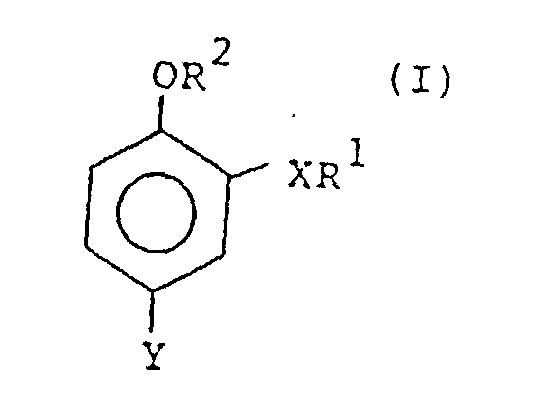
- J. Med. Chem., 1989, 32, 1450-1457 discloses the inhibition of cyclic adenosine-3', 5'-monophosphate phosphodiesterase from vascular smooth muscle by Rolipram [(R, S,) - 4- [3-(cyclopentyloxy) - 4 - methoxyphenyl] - 2 - pyrrolidone] analogs (substituted either at the pyrrolidinone or at the aromatic ring).
- J. Org. Chem., 1993, 58, 3857 - 3868 discloses the synthesis of certain 3, 3-and 3, 4- di-substituted pyrrolidines.
- Chemical Abstracts, Vol 86, No. 11, Abstract No. 72427 discloses pyrrolidinones having the formula I:-wherein R = alkyl, R6 R7 R8 C6 H2 (R6, R7, R8 = H, halo, alkyl, alkoxy, R6 R7 = CH2OCH2); Z = alkylene; R1 = alkyl; R2, R3, R4 = H, halo. alky,l alkoxy, R2 R3 = CH2OCH2; R5 = H, alkyl, R2 R3 R4 C6 H2 Z; Z1 = O,S.
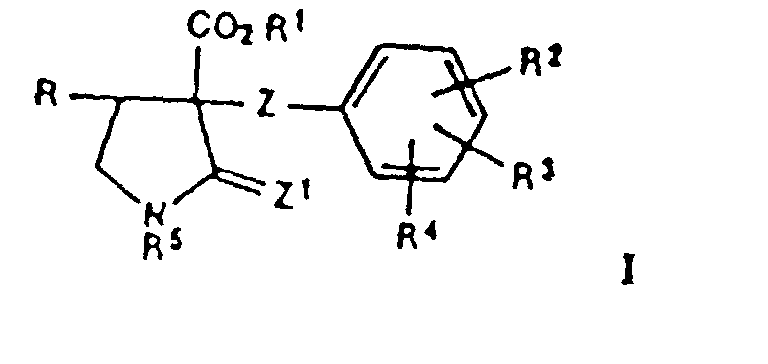
- WO-A-92/19594 discloses certain pyrrolidinones which inhibit PDE IV and TNF.
-
- Fig. 1 sets forth the DNA sequence analysis of hPDE-M and hPDE-R.
- Fig. 2 sets forth the site directed mutagenesis and assembly of PDE-IV E.coli expression construction.
- Fig. 3 sets forth the site directed mutagenesis and assembly of PDE-IV baculovirus expression construction.
-
- The present invention comprises the genus of compounds represented by Formula (I):wherein
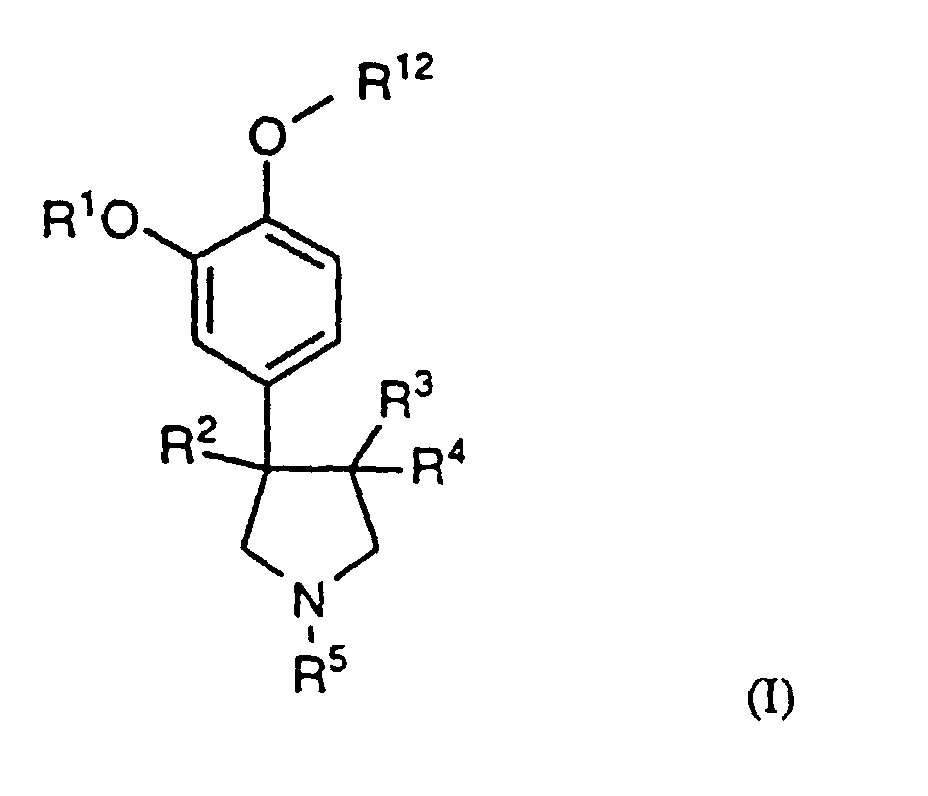
- R1 is alkyl, haloalkyl, cycloalkyl, bridged polycycloalkyl, aryl, heteroaryl, aralkyl, heteroaralkyl or aryloxyalkyl;
- R2 is H, alkyl, haloalkyl, cycloalkyl, aryl, -CO-alkyl, -CO-cycloalkyl, -CO-aryl, -COO-alkyl, -COO-cycloalkyl, -COO-aryl, CH2OH, CH2-O-alkyl, -CHO, -CN, -NO2 or SO2R10 ;
- R3 is H, -CO-alkyl, -CO-haloalkyl, -CO-cycloalkyl, -COO-alkyl, -COO-cycloalkyl, -COOH, -CO-aryl, -CONR6R7, -CH2OH, -CH2O-alkyl, -CHO, -CN, -NO2, -NR8COR9, -NR8SO2R10 or -SO2R10 ;
- R4 is H, alkyl, haloalkyl, cycloalkyl, -CO-alkyl, -CO-haloalkyl, -CO-cycloalkyl, -COO-alkyl, -COO-cycloalkyl, -COOH, -CO-aryl, -CONR6R7, -CN, -CHO or SO2R10;
- R5 is -CN or -C(X)-R11 or SO2R10;
- R6 and R7 are independently selected from H, alkyl, cycloalkyl, aryl or aralkyl or R6 and R7 together form a 4- to 7-membered heterocyclic or carbocyclic ring;
- R8 is H, alkyl or cycloalkyl;
- R9 is alkyl, cycloalkyl, aryl, alkoxy, aralkoxy or -NR6R7;
- R10 is alkyl, cycloalkyl, trifluoromethyl, aryl, aralkyl or -NR6R7;
- R11 is H, alkyl, haloalkyl, cycloalkyl, aryl, aralkyl, heteroaryl, C1-6alkoxy, aralkoxy, aryloxy or -NR6R7;
- R12 is C1-3alkyl, cyclopropyl or C1-3haloalkyl;
- X is O or S; and wherein
- the term "alkyl", alone or in combination, is defined as a straight chain or branched chain saturated hydrocarbon group from C1 - C7;
- the term "lower alkyl" is defined as C1 - C4;
- the term "haloalkyl" is defined as a lower alkyl substituted with one or more halogens;
- the term "cycloalkyl" is defined as a cyclic hydrocarbon radical from C3-C7;
- the term "alkoxy", alone or in combination, is defined as an alkyl group, as defined earlier, which is attached through an oxygen atom to the parent molecular subunit;
- the term "aryl", alone or in combination, is defined as a monocyclic or bicyclic group, which is unsubstituted, or substituted with one to three substitutuents selected from halogen, alkyl, hydroxy, alkoxy, haloalkyl, nitro, amino, acylamino, alkylthio, alkylsulfinyl and alkylsulfonyl;
- the term "aralkyl" is defined as an alkyl group, as defined earlier, in which one of the hydrogen atoms is replaced by a phenyl group, an aryl or heteroaryl group, as defined earlier, or a phenyl group carrying one or more substituents selected from halogen, alkyl and alkoxy;
- the term "aralkoxy", alone or in combination, is defined as an aralkyl group, as defined earlier, which is attached through an oxygen atom to the parent molecular subunit;
- the term "heteroaryl" is defined as a 5-membered or 6-membered heterocyclic aromatic group, optionally carrying a fused benzyne ring, and which is unsubstituted, or substituted with one to three substituents selected from halogen, alkyl, hydroxy, alkoxy, haloalkyl, nitro, amino, acylamino, alkylthio, alkylsulfinyl, and alkylsulfonyl;
- the term "halogen" is defined as fluorine, chlorine, bromine or iodine;
- the term "heteroaralkyl" is defined as the term "aralkyl", except for the replacement of the aryl group with a heteroaryl group; and
- the term "bridged polycycloalkyl" is defined as a bridged polycyclic of 6 to 12 carbons.
-
- Exemplary alkyl groups include methyl, ethyl, n-propyl, isopropyl, isobutyl, n-butyl, n-hexyl and the like.
- Exemplary cycloalkyl radicals include cyclopropyl, cyclobutyl, cyclobutyl, and cyclopentyl.
- Exemplary alkoxy groups include methoxy, ethoxy, n-propoxy, isopropoxy, isobutoxy, n-butoxy, and the like.
- Exemplary aryl groups include phenyl, 2-chlorophenyl, 3-chlorophenyl, 4-chlorophenyl, 2-methylphenyl, 4-methoxyphenyl, 3-trifluoromethylphenyl, 4-nitrophenyl, and the like.
- Exemplary aralkoxy groups include phenylmethoxy, phenylethoxy, phenylpropoxy and the like.
- Exemplary bridged polycycloalkyl groups include bridged bicycloalkyls such as bicyclo[2.2.1]heptyl, bicyclo[2.2.2]octyl and bicyclo[3.2.1]octyl.
- Those skilled in the art will recognize that stereocenters exist in compounds of Formula (I). Accordingly, the present invention includes all possible stereoisomers and geometric isomers of Formula (I) and includes not only racemic compounds but also the optically active isomers as well. In particular, it will be appreciated that positions 3 and 4 of the pyrrolidine ring of the compounds of Formula (I) are both chiral. Thus, the compounds of Formula (I) can exist in both cis and trans forms and each of these forms may comprise two enantiomers. Accordingly, each compound of Formula (I) may exist as one of four diastereoisomers. It will be further appreciated that Formula (I) does not show either the relative or absolute configuration of the 4 substituents at positions 3 and 4 of the pyrrolidine ring.
- When a compound of Formula (I) is desired as a single enantiomer, it may be obtained either by resolution of the final product or by stereospecific synthesis from either isomerically pure starting material or any convenient intermediate. Resolution of the final product, an intermediate or a starting material may be effected by any suitable method known in the art. See, for example, Stereochemistry of Carbon Compounds by E. L Eliel (Mcgraw Hill, 1962) and Tables of Resolving Agents by S. H. Wilen. Additionally, in situations where tautomers of the compounds of Formula (I) are possible, the present invention is intended to include all tautomeric forms of the compounds.
- In one preferred sub-class of compounds of Formula (I):
- R1 is alkyl, cycloalkyl, aralkyl or aryloxyaryl;
- R2 is hydrogen;
- R3 is -CO-alkyl, -COO-alkyl, -COOH, -CO-aryl, -CONR6R7, -CN, -NO2, -NR8COR9 or -NR8SO2R10;
- R4 is hydrogen, alkyl or -CO-alkyl;
- R5 is CN or C(X)R11; and
- R12 is C1-3alkyl.
-
- In another preferred sub-class of compounds of Formula (I):
- R1 is cycloalkyl, in particular cyclopentyl;
- R2 is hydrogen;
- R3 is COalkyl, CO2H or CO2alkyl, in particular COCH3;
- R4 is hydrogen or, particularly, alkyl such as methyl;
- R5 is CO2alkyl, in particular CO2CH3; and
- R12 is C1-3alkyl, in particular methyl.
-
- Particularly preferred are compounds as defined above in which R1 is cyclopentyl.
- Some specific compounds of Formula (I) are listed below, the synthesis of which was performed in accordance with the Example section set forth below.
- cis-3-(3-cyclopentoxy-4-methoxyphenyl)-1-(1,1-dimethylethoxycarbonyl)-4-(methoxycarbonyl)pyrrolidine;
- trans-3-(3-cyclopentoxy-4-methoxyphenyl)-1-(1,1-dimethylethoxycarbonyl)-4-(methoxycarbonyl)pyrrolidine;
- trans-3-methoxycarbonyl-1-(1,1-dimethylethoxycarbonyl)-4-[3-(3-phenoxypropoxy)-4-methoxyphenyl]pyrrolidine;
- trans-3-(3,4-dimethoxyphenyl)-1-(1,1-dimethylethoxycarbonyl)-4-(methoxycarbonyl)pyrrolidine;
- trans-3-(3-cyclopentoxy-4-methoxyphenyl)-1-(1,1-dimethylethoxycarbonyl)-4-(hydroxymethyl)pyrrolidine;
- trans-3-(3-cyclopentoxy-4-methoxyphenyl)-4-hydroxymethyl-1-(methoxycarbonyl)pyrrolidine;
- trans-1-aminocarbonyl-3-(3-cyclopentoxy-4-methoxyphenyl)-4-(methoxycarbonyl)pyrrolidine;
- cis-1-aminocarbonyl-3-(3-cyclopentoxy-4-methoxyphenyl)-4-(methoxycarbonyl)pyrrolidine;
- trans-1-methoxycarbonyl-3-methoxycarbonyl-4-(3-phenylmethoxy-4-methoxyphenyl)pyrrolidine;
- -3-(3-cyclopentoxy-4-methoxyphenyl)-1-methoxycarbonyl-4-methyl-4-(methylcarbonyl)pyrrolidine;
- trans-3-(3-cyclopentoxy-4-methoxyphenyl)-4-(1,1-dimethylethoxycarbonyl)-1-(methoxycarbonyl)pyrrolidine;
- 3-(3-cyclopentoxy-4-methoxyphenyl)-4-(1,1-dimethylethoxycarbonyl)-1-methoxycarbonyl-4-methylpyrrolidine;
- trans-3-(3-cyclopentoxy-4-methoxyphenyl)-4-ethylcarbonyl-1-(methoxycarbonyl)pyrrolidine;
- trans-1-methoxycarbonyl-3-nitro-4-[3-(3-phenoxypropoxy)-4-methoxyphenyl]pyrrolidine;
- trans-3-cyano-4-(3-cyclopentoxy-4-methoxyphenyl)-1-(methoxycarbonyl)pyrrolidine;
- trans-3-(3-cyclopentoxy-4-methoxyphenyl)-1-methoxycarbonyl-4-nitropyrrolidine;
- trans-3-(3-cyclopentoxy-4-methoxyphenyl)-1-methoxycarbonyl-4-(methylcarbonyl)pyrrolidine;
- trans-3-(3-cyclopentoxy-4-methoxyphenyl)-1-methoxycarbonyl-4-(phenylcarbonyl)pyrrolidine;
- trans-1-methoxycarbonyl-3-methoxycarbonyl-4-[3-(3-phenoxypropoxy)-4-methoxyphenyl]pyrrolidine;
- 3-(3-cyclopentoxy-4-methoxyphenyl)-4-ethoxycarbonyl-1-methoxycarbonyl-4-methylpyrrolidine;
- 3-(3-cyclopentoxy-4-methoxyphenyl)-4-methoxycarbonyl-1-methoxycarbonyl-4-methylpyrrolidine;
- trans-3-(3-cyclopentoxy-4-methoxyphenyl)-1-methoxycarbonyl-4-(methylcarbonyl)pyrrolidine;
- trans-3-(3-cyclopentoxy-4-methoxyphenyl)-4-methoxycarbonyl-1-(methylcarbonyl)pyrrolidine;
- trans-3-(3-cyclopentoxy-4-methoxyphenyl)-1-ethylcarbonyl-4-(methoxycarbonyl)pyrrolidine;
- trans-3-(3-cyclopentoxy-4-methoxyphenyl)-1-(1-imidazolylcarbonyl)-4-(methoxycarbonyl)pyrrolidine;
- trans-3-(3-cyclopentoxy-4-methoxyphenyl)-1-formyl-4-(methoxycarbonyl)pyrrolidine;
- trans-1-formyl-3-methoxycarbonyl-4-[3-(3-phenoxypropoxy)-4-methoxyphenyl]pyrrolidine;
- trans-3-(3-cyclopentoxy-4-methoxyphenyl)-1-methoxycarbonyl-4-(1-methylethoxycarbonyl)pyrrolidine;
- trans-3-(3-cyclopentoxy-4-methoxyphenyl)-4-ethoxycarbonyl-1-(methoxycarbonyl)pyrrolidine;
- trans-3-carboxy-4-(3-cyclopentoxy-4-methoxyphenyl)-1-(1,1-dimethylethoxycarbonyl)pyrrolidine;
- trans-3-carboxy-4-(3-cyclopentoxy-4-methoxyphenyl)-1-(methoxycarbonyl)pyrrolidine;
- trans-3-carboxy-4-(3-cyclopentoxy-4-methoxyphenyl)-1-(phenylmethoxycarbonyl)pyrrolidine;
- trans-3-carboxy-4-(3-cyclopentoxy-4-methoxyphenyl)-1-(1-methylethoxycarbonyl)pyrrolidine;
- trans-3-carboxy-1-(methoxycarbonyl)-4-[3-(3-phenoxypropoxy)-4-methoxyphenyl]pyrrolidine;
- trans-3-carboxy-4-(3-cyclopentoxy-4-methoxyphenyl)-1-formylpyrrolidine;
- trans-1-aminocarbonyl-3-carboxy-4-(3-cyclopentoxy-4-methoxyphenyl)pyrrolidine;
- trans-3-aminocarbonyl-4-(3-cyclopentoxy-4-methoxyphenyl)-1-(methoxycarbonyl)pyrrolidine;
- trans-3-aminocarbonyl-4-(3-cyclopentoxy-4-methoxyphenyl)-1-(1,1-dimethylethoxycarbonyl)pyrrolidine;
- trans-3-(3-cyclopentoxy-4-methoxyphenyl)-1-(1,1-dimethylethoxycarbonyl)-4-[(N-phenylmethyl)aminocarbonyl]pyrrolidine;
- trans-3-(3-cyclopentoxy-4-methoxyphenyl)-4-N-(1,1-dimethylethoxycarbonyl)-1-(1,1-dimethylethoxycarbonyl)pyrrolidine;
- trans-3-(3-cyclopentoxy-4-methoxyphenyl)-4-N-(1,1-dimethylethoxycarbonyl)-1-(methoxycarbonyl)pyrrolidine;
- trans-3-(3-cyclopentoxy-4-methoxyphenyl)-4-N-(1,1-dimethylethoxycarbonyl)-1-(phenylmethoxycarbonyl)pyrrolidine;
- trans-3-(3-cyclopentoxy-4-methoxyphenyl)-4-[N-(1,1-dimethylethoxycarbonyl)-N-methyl]-1-(phenylmethoxycarbonyl)pyrrolidine;
- trans-3-(3-cyclopentoxy-4-methoxyphenyl)-4-N-(methylsulfonyl)-1-(phenylmethoxycarbonyl)pyrrolidine;
- trans-3-(3-cyclopentoxy-4-methoxyphenyl)-1-(phenylmethoxycarbonyl)-4-N-(trifluoromethylsulfonyl)pyrrolidine;
- trans-3-(3-cyclopentoxy-4-methoxyphenyl)-4-N-(phenylsulfonyl)-1-(phenylmethoxycarbonyl)pyrrolidine;
- trans-3-(3-cyclopentoxy-4-methoxy)phenyl)-1-methoxycarbonyl-4-N-(methoxycarbonyl)pyrrolidine;
- trans-1-aminocarbonyl-3-(3-cyclopentoxy-4-methoxyphenyl)-4-N-(1,1-dimethylethoxycarbonyl)pyrrolidine;
- trans-1-aminothiocarbonyl-3-(3-cyclopentoxy-4-methoxyphenyl)-4-(methoxycarbonyl)pyrrolidine;
- trans-1-cyano-3-(3-cyclopentoxy-4-methoxyphenyl)-4-(methoxycarbonyl)pyrrolidine;
- trans-3-(3-cyclopentoxy-4-methoxyphenyl)-4-methoxycarbonyl-1-(phenylmethoxycarbonyl)pyrrolidine;
- trans-3-(3-cyclopentoxy-4-methoxyphenyl)-4-methoxycarbonyl-1-(methylethoxycarbonyl)pyrrolidine;
- 53-(3-cyclopentoxy-4-methoxyphenyl)-1-(1,1-dimethylethoxycarbonyl)-4-methoxycarbonyl-4-methylpyrrolidine;
- trans-3-(3-cyclopentoxy-4-methoxyphenyl)-1-methoxycarbonyl-4-(methoxymethyl)pyrrolidine.
- 3-(3-cyclopentoxy-4-methoxyphenyl)-4-methyl-4-methylcarbonyl-1-(phenylcarbonyl) pyrrolidine:
- 3-(3-cyclopentoxy-4-methoxypheny)-1-(4-methoxy phenylcarbonyl)-4-methyl-4-(methylcarbonyl) pyrrolidine
- 1-(4-chlorophenylcarbonyl)-3-(3-cyclopentoxy-4-methoxyphenyl)-4-methyl-4-(methylcarbonyl) pyrrolidine
- 3-3-cyclopentoxy-methoxyphenyl)-1-(2-furyl carbonyl)-4-methyl-4-(methylcarbonyl) pyrrolidine
- 3-(3-cyclopentoxy-4-methoxyphenyl)-1-(4-iodo phenylcarbonyl)-4-methyl-4-(methylcarbonyl) pyrrolidine
- 3-(3-cyclopentoxy-4-methoxyphenyl)-1-ethoxycarbonyl-4-methyl-4-(methylcarbonyl) pyrrolidine
- 3-(3-cyclopentoxy-4-methoxyphenyl)-1-(1,1-dimethyl ethoxycarbonyl)-4-methyl-4-(methylcarbonyl) pyrrolidine
- 3-(3-cyclopentoxy-4-methoxyphenyl)-1-formyl-4-methyl-4-(methylcarbonyl) pyrrolidine
- 3-(3-cyclopentoxy-4-methoxyphenyl)-4-methyl-4-methylcarbonyl-1-(methylsulfonyl) pyrrolidine
- 3-(3-cyclopentoxy-4-methoxyphenyl)-1-(1-imidazolyl carbonyl)-4-methyl-4-(methylcarbonyl) pyrrolidine
- 1-aminocarbonyl-3-(3-cyclopentoxy-4-methoxyphenyl)-4-methyl-4-(methylcarbonyl) pyrrolidine
- 3-(3-cyclopentoxy-4-methoxyphenyl)-1-ethylcarbonyl-4-methyl-4-(methylcarbonyl) pyrrolidine
-
- Generally, compounds of Formula (I) can be prepared according to the following synthesis schemes. In all of the schemes described below, it is well understood in the art that protecting groups are employed where necessary in accordance with general principles of chemistry. These protecting groups are removed in the final steps of the synthesis under basic, acidic, or hydrogenolytic conditions which will be readily apparent to those skilled in the art. By employing appropriate manipulation and protection of any chemical functionalities, synthesis of any compounds of the Formula (I) not specifically set forth herein can be accomplished by methods analogous to the schemes set forth below as well as those described in the Example section.
- One method for the preparation of compounds having Formula (I) uses an azomethine ylide cycloaddition reaction for the synthesis of the pyrrolidine ring. N-benzyl-N-methoxymethyl-N-trimethylsilylmethylamine, prepared by the procedure described by Padwa and coworkers (J. Org. Chem. 1987, 52, 235), is reacted with an appropriately substituted olefin according to the procedure of Achiwa and coworkers (Chem. Pharm. Bull. 1985, 33, 2762).
- Such a cycloaddition reaction proceeds with aryl-substituted olefins bearing an electron-withdrawing group. The olefin can be prepared by any of a number of methods available including Horner-Emmons and Wittig chemistry. The preferred process for the cycloaddition reaction is in an inert solvent (e.g. methylene chloride, dioxane, tetrahydrofuran, toluene) under the influence of a suitable acid, such as trifluoroacetic acid, at temperatures ranging from -20-30 °C. Alternatively, one can affect the cycloaddition under the influence of lithium fluoride and sonication (Padwa, vide supra). For example, one particular approach for the cycloaddition reaction is shown below.(R* and R** are intended only to designate examples of functional groups that can be used to facilitate the cycloaddition reaction. One skilled in the art of organic synthesis will appreciate that other functional groups at R* and R** are acceptable and that appropriate manipulation of R* and R** may be required to complete the synthesis of compounds of Formula (I).)
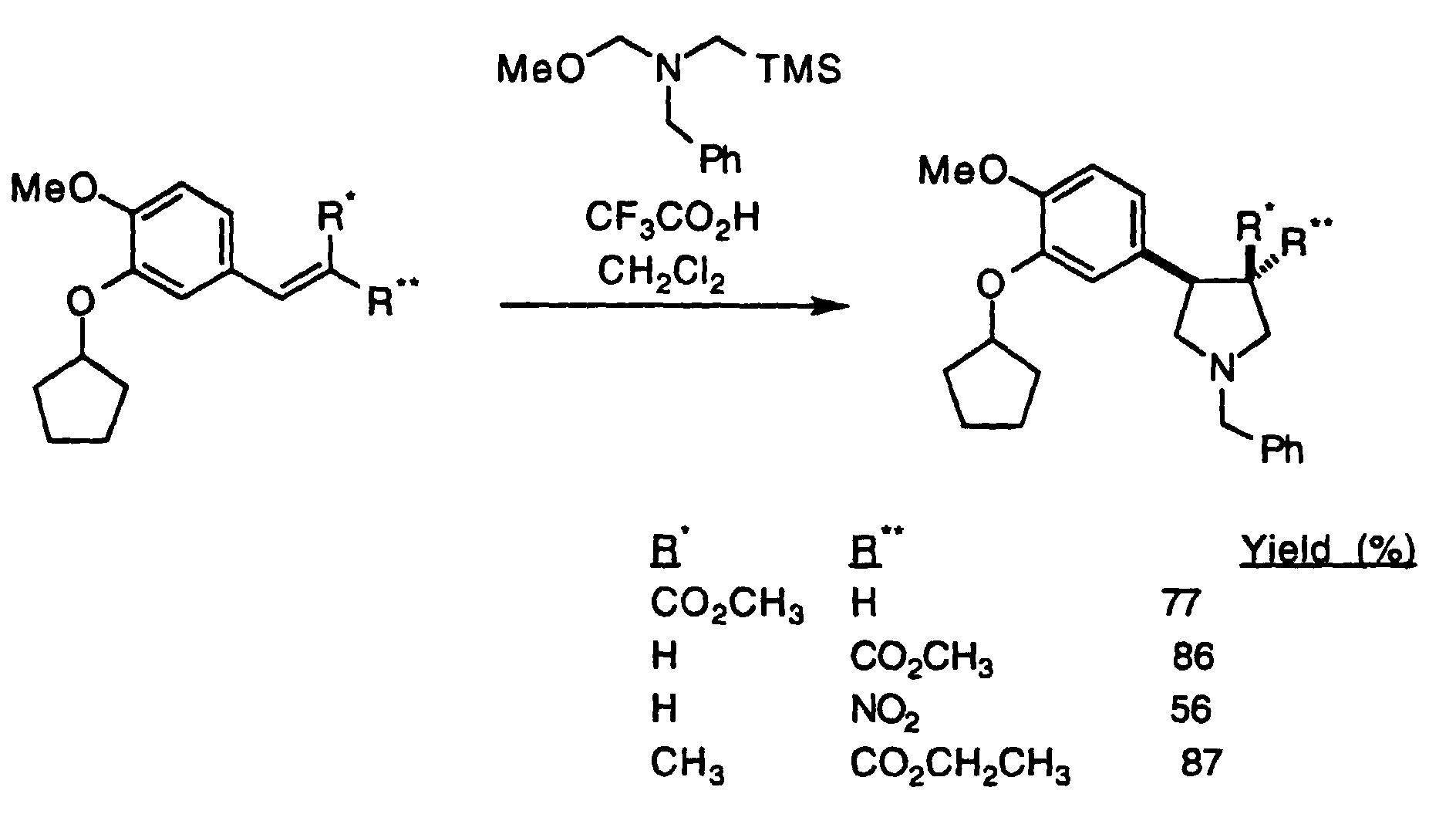
- The pyrrolidines obtained from the azomethine ylide cycloaddition can be converted into compounds of Formula (I) by methods available to one who is skilled in the art of organic synthesis. Reductive debenzylation of the pyrrolidine can be carried out by transfer hydrogenation (4% HCO2H/MeOH; 10% Pd/C) at room temperature. Other suitable methods for debenzylation (10% Pd/C, 50 psi H2, acetic acid) can also be used. The free pyrrolidine can then be acylated under the influence of a suitable base and acylating reagent. Alternatively, debenzylation/N-acylation can be affected in one operation by reacting the 1-(phenylmethyl)pyrrolidine with a chloroformate in a suitable solvent (e.g., dichloroethane, acetonitrile, etc.) at temperatures between 30-100 °C. Some specific examples of these methods are shown below.
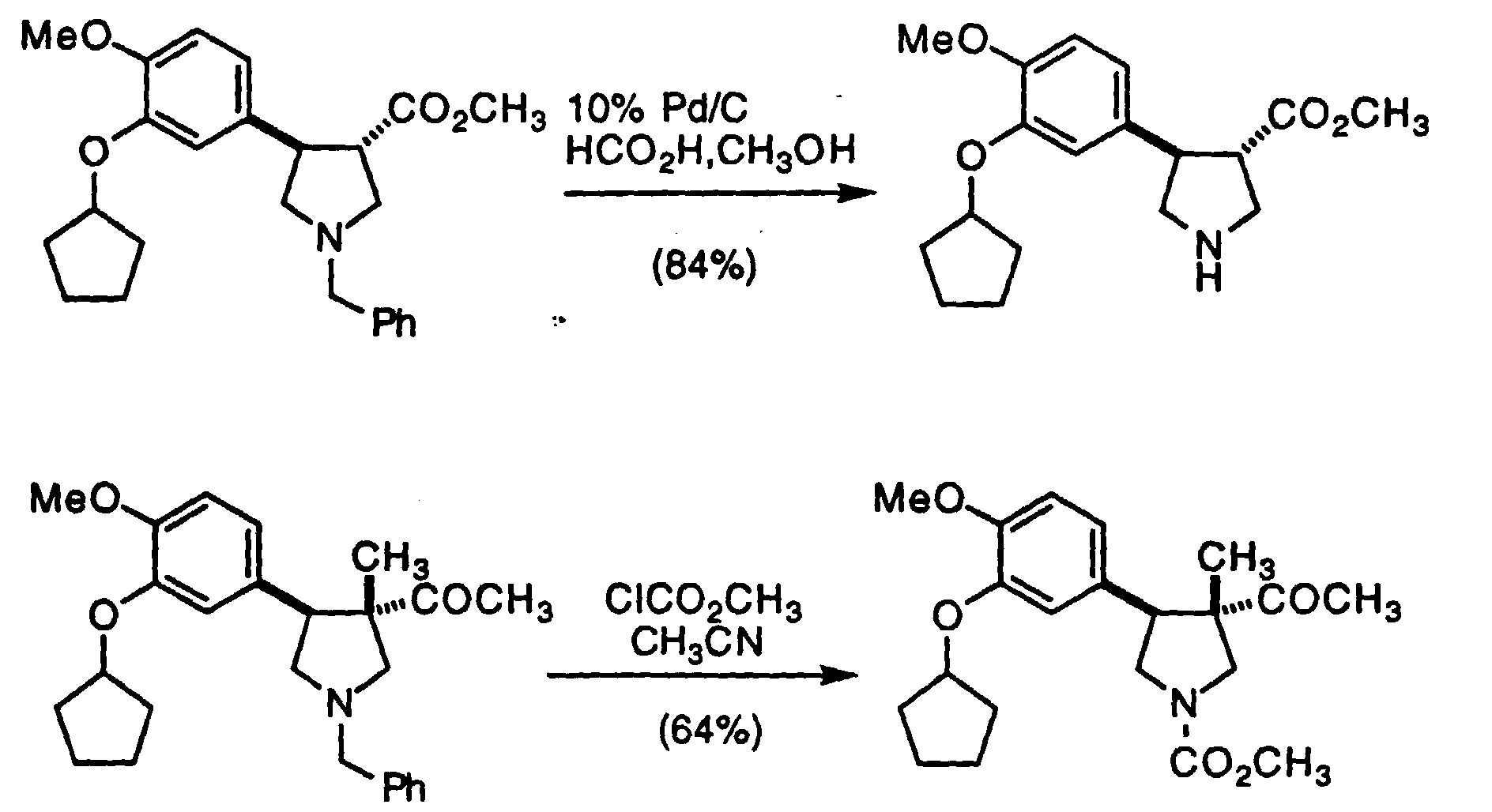
- Compounds of Formula (I) in which R3 is COOH may be obtained by saponification of the corresponding alkyl ester. The preferred method for saponification uses an alkali metal hydroxide (e.g., LiOH) at 0-23 °C in an aqueous ethereal solvent system (e.g., 1:1, 1,4-dioxane:H2O). A specific example of this chemistry is shown below.
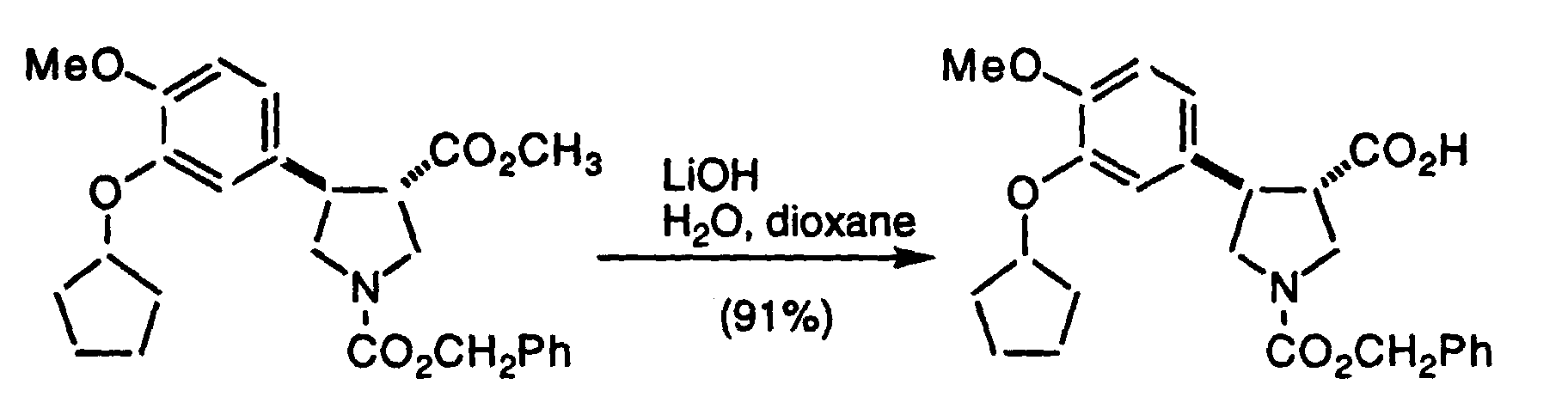
- Compounds of Formula (I) in which R3 is CH2OH can be obtained by a hydride reduction (e.g, LiAlH4) of a 3-alkoxycarbonyl-4-aryl-1-(phenylmethyl)pyrrolidine or a 3-alkoxycarbonyl-4-arylpyrrolidine in an ethereal solvent (e.g., THF) at temperatures ranging from -10-30 °C. The 3-aryl-4-(hydroxymethyl)pyrrolidines can be selectively N-acylated according to standard procedures known to those skilled in the art of organic synthesis (e.g., Schotten-Baumann conditions). Specific examples of this chemistry are shown below.

- Compounds of Formula (I) in which R3 is CONR6R7 can be obtained from the corresponding carboxylic acid. Treatment of the carboxylic acid with an activating reagent, such as 1,1'-carbonyldiimidazole (CDI), in a chlorinated solvent (e.g., CH2Cl2) followed by addition of an amine afforded, after purification of the amides. Specific examples of this chemistry are shown below.
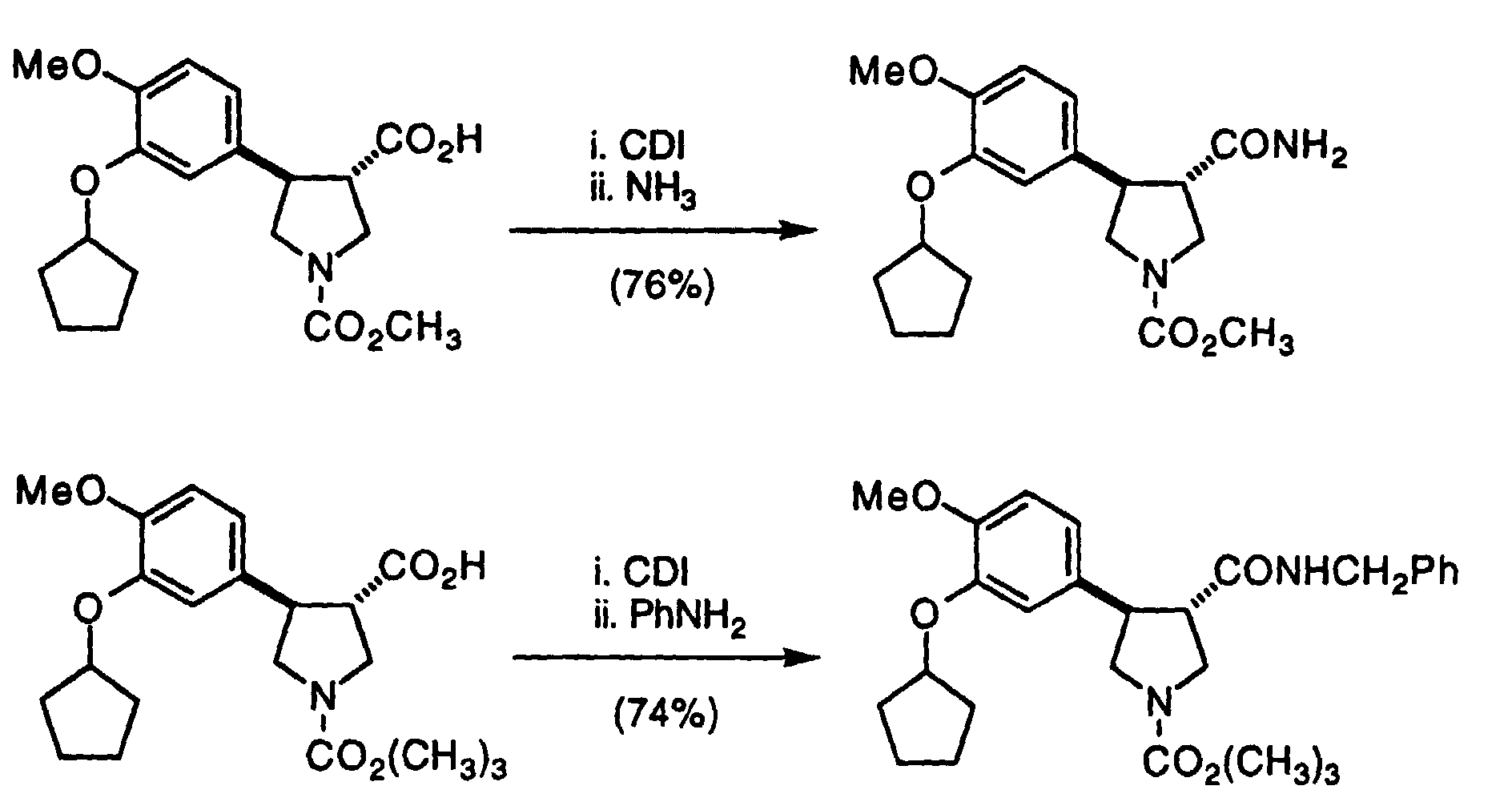
- Compounds of Formula (I) where R5 is CN are prepared by one of two methods. The free pyrrolidine can be N-cyanated by treatment with cyanogen bromide (BrCN) in a suitable solvent (e.g., acetonitrile) in the presence of a base. Alternatively, the N-phenylmethylpyrrolidine obtained directly from the azomethine ylide cycloaddition can be treated with cyanogen bromide to affect an N-dealkylative cyanation reaction (von Braun reaction). These two methods are illustrated below.

- 3-Amino-1-acylpyrrolidine derivatives (Formula (I) wherein R3/R4 is NR8COR9/NR8SO2R10) were synthesized from the carboxylic acids by use of a Curtius rearrangement. Preferred conditions use diphenylphosphoryl azide (DPPA) in t-butanol at elevated temperature. The resulting t-butyl carbamate provides entry into the compounds of Formula (I). Solvolytic removal of the t-butyl carbamate under acidic conditions [e.g., trifluoroacetic acid (TFA)], followed by acylation of the resulting primary amine affords the compound of Formula (I). Specific examples of this chemistry are shown below.

- In light of the foregoing synthesis schemes, it will be appreciated that the present invention generally contemplates a process for the preparation of a compound of Formula (I) wherein a compound of Formula (II)with a reagent R5-Y where Y is an appropriate leaving group. Additionally, it will be further appreciated that the present invention generally contemplates a process for the interconversion of one compound of Formula (I) to another compound of Formula (I).

- Unless otherwise noted all starting materials were obtained from commercial suppliers and used without further purification. All reactions involving oxygen- or moisture-sensitive compounds were performed under a dry N2 atmosphere. All reactions and chromatography fractions were analyzed by thin-layer chromatography on 250-mm silica gel plates, visualized with UV light and I2 stain. Flash column chromatography was carried out using Merck silica gel 60 (230-400 mesh).
- 1H-NMR spectra were measured in CDCl3 using either a Varian VXZ-300 or a Varian Unity-300 instrument. J values are reported in Hertz. Chemical shifts are expressed in ppm downfield from internal tetramethylsilane. Apparent multiplicities are designated as s, singlet; d, doublet; t, triplet; q, quartet; m, multiplet; b, broad. All mass spectra were taken in the positive ion mode under electrospray ionization (ESI), chemical ionization (CI), electron impact (EI), or by fast-atom bombardment (FAB). Melting points were determined on a Thomas-Hoover Capillary Melting Point Apparatus and are uncorrected. Elemental analyses were performed by Atlantic Microlab, Norcross, GA.
- The following section describes the preparation of intermediates that may be used in the synthesis of compounds of Formula (I).
- (A). (E)-Methyl-3-(3-cyclopentoxy-4-methoxyphenyl)-prop-2-en-oate To a solution of trimethylphosphonoacetate (13 mL, 82 mmol) in 36 mL of THF at 0 °C was added lithium bis(trimethylsilyl)amide (82 mL of 1M THF solution, 82 mmol). This solution was stirred for 20 min, and a solution of 3-cyclopentoxy-4-methoxybenzaldehyde (15 g, 68 mmol) in 30 mL of THF was then added dropwise via addition funnel. When reaction was judged complete by TLC analysis, the reaction was diluted with ethyl acetate:hexanes (1:1), and the organic layer was washed with H2O and brine. The organic layer was dried over MgSO4, filtered, and concentrated under reduced pressure to afford (E)-methyl-3-(3-cyclopentoxy-4-methoxyphenyl)-prop-2-en-oate as a pale yellow solid (17.2 g, 92%). 1H-NMR (300 MHz): δ 3.79 (s, 3), 3.86 (s, 3), 6.28 (d, 1, J = 16), 7.52 (d, 1, J = 16). The following compounds were prepared according to the general procedure set forth above.
- (B). (E)-methyl-3-[3-(3-phenoxypropoxy)-4-methoxyphenyl]-prop-2-en-oate:
- 100%; 1H-NMR (300 MHz): δ 2.33 (q, 2, J = 6.1), 3.79 (s, 3), 3.87 (s, 3), 4.19 (t, 2, J = 6.1), 4.25 (t, 2, J = 6.1), 6.29 (d, 1, J = 16), 7.61 (d, 1, J = 16).
- (C). (E)-1,1-Dimethylethyl-3-(3-cyclopentoxy-4-methoxyphenyl)-prop-2-en-oate To a solution of t-butyl diethylphosphonoacetate (5.0 g, 19.8 mmol) in 15 mL of THF at 0 °C was added lithium bis(trimethylsilyl)amide (19.8 mL of 1M THF solution, 19.8 mmol). This solution was stirred for 20 min, and a solution of 3-cyclopentoxy-4-methoxybenzaldehyde (3.64 g, 16.5 mmol) in 15 mL of THF was then added dropwise via addition funnel. After 1 hr the reaction was judged complete by TLC analysis and was diluted with ether. The organic layer was washed with H2O and brine, dried over MgSO4, filtered, and concentrated under reduced pressure to an oil. Silica gel chromatography (6:1:1, hexanes:ethyl acetate:CH2Cl2) provided an oil which was further chromatographed (8:1:1, hexanes:ethyl acetate:CH2Cl2) to afford (E)-1,1-dimethylethyl-3-(3-cyclopentoxy-4-methoxyphenyl)-prop-2-en-oate (5.0 g, 95%) as a pale yellow oil. 1H-NMR (300 MHz): δ 1.52 (s, 9), 3.86 (s, 3). Anal. Calcd for C19H26O4: C, 71.67; H, 8.23. Found: C, 71.70; H, 8.25.
- (D). (E)-1,1-Dimethylethyl-3-(3-cyclopentoxy-4-methoxyphenyl)-2-methyl-prop-2-en-oate To a solution of t-butyl diethylphosphonoacetate (5.0 g, 19.8 mmol) in 40 mL of THF at -23 °C (ice:acetone) was added lithium bis(trimethylsilyl)amide (19.8 mL of 1 M THF solution, 19.8 mmol). This solution was stirred for 15 min, and CH3I (2.8 g, 21.8 mmol). After 24 hr the reaction was diluted with ether and washed successively with 1M H3PO4, H2O, and brine. The solution was dried (MgSO4), filtered and concentrated under reduced pressure to an oil (5.4 g). 1H-NMR analysis indicated an approximate 1:1 mixture of starting phosphonoacetate and the monomethylated derivative, which was taken on without further purification.The phosphonoacetate mixture described above was dissolved in THF (20 mL) and cooled to 0 °C. To this solution was added lithium bis(trimethylsilyl)amide (19.8 mL of 1M THF solution, 19.8 mmol). After 15 min., a solution of 3-cyclopentoxy-4-methoxybenzaldehyde (3.64 g, 16.5 mmol) in THF (20 mL) was then added dropwise via addition funnel. When the reaction was judged complete by TLC analysis, the reaction mixture was diluted with ether. The organic layer was washed with H2O and brine, dried over MgSO4, filtered and concentrated under reduced pressure to an oil (6.5 g). Silica gel chromatography (10:1, hexanes:ethyl acetate) provided (E)-1,1-dimethylethyl-3-(3-cyclopentoxy-4-methoxyphenyl)-2-methyl-prop-2-en-oate as an oil (797 mg, 12%). The remaining chromatography fractions contained product mixtures. Anal. Calcd for C20H28O4: C, 72.26; H, 8.49 Found: C, 72.31; H, 8.56.
- (E). (E)-Ethyl-3-(3-cyclopentoxy-4-methoxyphenyl)-2-methyl-prop-2-en-oate To a solution of triethyl 2-methylphosphonopropionate (3.6 g, 15 mmol) in 30 mL of THF at 0 °C was added lithium bis(trimethylsilyl)amide (18 mL of 1M THF solution, 18 mmol). This solution was stirred for 30 min, and a solution of 3-cyclopentoxy-4-methoxybenzaldehyde (2.75 g, 12.5 mmol) in 5 mL of THF was then added dropwise. After 4 hr the reaction was judged complete by TLC analysis and was diluted with ethyl acetate:hexanes (1:1). The organic layer was washed with H2O and brine, dried over MgSO4, filtered, and concentrated under reduced pressure. Silica gel chromatography (4:1, hexanes:ethyl acetate) provided (E)-ethyl-3-(3-cyclopentoxy-4-methoxyphenyl)-2-methyl-prop-2-en-oate (2.75 g, 72%) as a colorless oil that solidified on standing. 1H-NMR (300 MHz): δ 1.35 (t, 3, J = 7.1), 2.14 (s, 3), 3.88 (s, 3), 4.27 (q, 2, J = 7.3), 7.62 (s, 1). Anal. Calcd for C18H24O4: C, 71.03; H, 7.95. Found: C, 70.88; H, 7.99.
- (F). (E)-Methyl-3-(3-cyclopentoxy-4-methoxyphenyl)-2-methyl-prop-2-en-oate To a solution of (E)-ethyl-3-(3-cyclopentoxy-4-methoxyphenyl)-2-methyl-prop-2-en-oate (970 mg, 3.2 mmol) in 3 mL of 1,4-dioxane was added a solution of LiOH·H2O (156 mg, 3.8 mmol) in 3 mL of H2O. The resulting mixture was heated at 80 °C for 2 hr and 45 °C for 16 hr. The resulting solution was diluted with ether and poured into 1M H3PO4. The aqueous layer was extracted with ethyl acetate (2X), washed with brine, dried (MgSO4), filtered, and concentrated under reduced pressure. Silica gel chromatography (95:5, CH2Cl:methanol) provided (E)-3-(3-cyclopentoxy-4-methoxyphenyl)-2-methyl-prop-2-enoic acid as a colorless solid (700 mg, 79%). Anal. Calcd for C16H20O4: C, 69.55; H, 7.29. Found: C, 69.39; H, 7.29.The carboxylic acid thus obtained (610 mg, 2.2 mmol) was dissolved in 10 mL of methanol and 3 drops of con. H2SO4 was added. The resulting solution was heated to reflux for 20 hr, cooled to room temperature, and partitioned between sat. NaHCO3 and CH2Cl2. The aqueous layer was extracted with CH2Cl2 (2X) and the combined organic layers were dried (MgSO4), filtered, and concentrated under reduced pressure to an oil. Silica gel chromatography (4:1, hexanes:ethyl acetate) afforded (E)-methyl-3-(3-cyclopentoxy-4-methoxyphenyl)-2-methyl-prop-2-en-oate as a colorless solid (610 mg, 96%). 1H-NMR (300 MHz): d 2.15 (d, 3, J = 1.2), 3.81 (s, 3), 3.88 (s, 3), 7.63 (s, 1). Anal. Calcd for C17H22O4: C, 70.32; H, 7.64. Found: C, 70.44; H, 7.72.
- (G). (E)-4-(3-Cyclopentoxy-4-methoxyphenyl)-3-methyl-but-3-en-2-one To a solution of (E)-3-(3-cyclopentoxy-4-methoxyphenyl)-2-methyl-prop-2-enoic acid (2.21 g, 8.0 mmol) in CH2Cl2 (16 mL) was added 1,1'-carbonyldiimidazole (8.8 mmol, 1.43 g). The resulting solution was stirred for 10 min and NH(CH3)OCH3·HCl (12 mmol, 1.16 g) was added. The mixture was stirred at rt for 16 hr, and triethylamine (800 mg) was added. This was stirred an additional 30 min. The solution was diluted with CH2Cl2 and washed successively with 1M H3PO4 and H2O. The organic layers were dried (K2CO3), filtered and evaporated to a yellow oil. Silica gel chromatography (6:4:1, hexanes:ethyl acetate:CH2Cl2) provided the N-methyl-N-methoxyamide as a pale yellow oil (2.1 g, 82%). Anal. Calcd for C18H25NO4: C, 67.69; H, 7.89; N, 4.39. Found: C, 67.48; H, 7.95; N, 4.35.The amide thus obtained (1.01 g, 3.17 mmol) was dissolved in THF (6 mL), cooled to 0 °C and treated dropwise with CH3Li (4.0 mL of a 1.4 M ether solution). The yellow solution was stirred for 15 min, diluted with ether and washed successively with 1M H3PO4 and brine. The solution was dried (MgSO4), filtered and concentrated under reduced pressure to afford (E)-4-(3-cyclopentoxy-4-methoxyphenyl)-3-methyl-but-3-en-2-one as a yellow oil (832 mg, 96%). 1H-NMR (300 MHz): δ 2.09 (d, 3, J = 1.2), 2.46 (s, 3), 3.89 (s, 3), 7.47 (s, 1).
- (H). (Z)-Methyl-3-(3-cyclopentoxy-4-methoxyphenyl)-prop-2-enoate To a solution of 18-crown-6 (17 g, 64 mmol) and bis(2,2,2-trifluoroethyl)(methoxycarbonylmethyl)phosphonate (4.5 g, 14 mmol) in 200 mL of THF was added potassium bis(trimethylsilyl)amide (31 mL of 0.5M THF solution, 15.5 mmol). After 15 min a solution of 3-cyclopentoxy-4-methoxybenzaldehyde (2.8 g, 13 mmol) in 5 mL of THF was then added dropwise. The resulting solution was stirred at -78 °C for 30 min and quenched with sat NH4Cl. The mixture was diluted with ether and washed with 1M H3PO4, H2O, and brine. The organic layer was dried over MgSO4, filtered, and concentrated under reduced pressure. Silica gel chromatography (3:1, hexanes:ethyl acetate) provided (Z)-methyl-3-(3-cyclopentoxy-4-methoxyphenyl)-prop-2-enoate (3.1 g, 87%), containing a trace amount of the E-isomer. 1H-NMR (300 MHz): δ 3.74 (s, 3), 3.89 (s, 3), 5.82 (d, 1, J = 13).
- (I). (E)-3-Cyclopentoxy-4-methoxycinnamonitrile To a slurry of NaH (1.1 g, 27.5 mmol) in 80 mL of THF at 0 °C was added dropwise a solution of diethyl cyanomethylphosphonate (4.42 g, 24.9 mmol) in 20 mL of THF. The mixture was stirred for 30 min, and a solution of 3-cyclopentoxy-4-methoxybenzaldehyde (5.0 g, 22.7 mmol) in 20 mL of THF was then added dropwise. The mixture was for 2 hr and then diluted with ether. The mixture was washed with 1M H3PO4, H2O, and brine. The organic layer was dried over MgSO4. filtered, and concentrated under reduced pressure to yield 3-cyclopentoxy-4-methoxycinnamonitrile (4.8 g, 87%) as a yellow oil, which was carried on without further purification. 1H-NMR (300 MHz): δ 3.89 (s, 3), 5.69 (d, 1, J = 16.6).
- (J). (E)-N-Methyl-N-methoxy-3-(3-cyclopentoxy-4-methoxyphenyl)-prop-2-enamide To a solution of 3-cyclopentoxy-4-methoxybenzaldehyde (2.2 g, 10 mmol) in 15 mL of CH2Cl2 was added N-methoxy-N-methyl-2-(triphenylphosphoranylidene)acetamide (7.2 g, 20 mmol). The resulting solution was stirred for 12 hr at room temperature. Concentration under reduced pressure followed by silica gel chromatography (6:4:1, hexanes:ethyl acetate:CH2Cl2) provided (E)-N-methyl-N-methoxy-3-(3-cyclopentoxy-4-methoxyphenyl)-prop-2-enamide as a pale yellow oil (2.6 g, 87%). 1H-NMR (300 MHz): δ 3.31 (s, 3), 3.77 (s, 3), 3.88 (s, 3).
- (K). (E)-4-(3-Cyclopentoxy-4-methoxyphenyl)-but-3-en-2-one To a solution of (E)-N-methoxy-N-methyl-3-(3-cyclopentoxy-4-methoxyphenyl)-prop-2-enamide (318 mg, 1.05 mmol) in 2.5 mL of THF cooled to 0 °C was added CH3Li (1.5 mL of 1.4 M ether solution). The resulting solution was stirred for 5 min, diluted with ether and transferred to a separatory funnel. After washing with H2O, 1M H3PO4, and brine, the organic layer was dried over MgSO4, filtered, and concentrated under reduced pressure. Silica gel chromatography (3:1, hexanes:ethyl acetate) provided (E)-4-(3-cyclopentoxy-4-methoxyphenyl)-but-3-en-2-one as a white solid (234 mg, 90%). 1H-NMR (300 MHz): δ 2.38 (s, 3), 3.89 (s, 3), 6.59 (d, 1, J = 16), 7.46 (d, 1, J = 16).
- (L). (E)-5-(3-Cyclopentoxy-4-methoxyphenyl)-pent-4-en-3-one To a solution of (E)-N-methoxy-N-methyl-3-(3-cyclopentoxy-4-methoxyphenyl)-prop-2-enamide (1.33 g, 4.36 mmol) in 8.0 mL of THF cooled to 0 °C was added CH3CH2MgBr (9 mL of 1.0 M THF solution). The resulting solution was stirred for 30 min, diluted with ether and transferred to a separatory funnel. After washing with H2O, 1M H3PO4, and brine, the organic layer was dried over MgSO4, filtered, and concentrated under reduced pressure. Silica gel chromatography (4:1, hexanes:ethyl acetate) provided (E)-5-(3-cyclopentoxy-4-methoxyphenyl)-pent-4-en-3-one as a white solid (400 mg, 34%). 1H-NMR (300 MHz): δ 1.17 (t, 3, J = 7.6), 2.69 (q, 2, J = 7.3), 3.89 (s, 3), 6.59 (d, 1, J = 16), 7.50 (d, 1, J = 16). Anal. Calcd for C17H22O3: C, 74.42; H, 8.08. Found: C, 74.52; H, 8.13.
- (M). (E)-3-(3-Cyclopentoxy-4-methoxyphenyl)-1-phenylprop-2-enone To a solution of (E)-N-methoxy-N-methyl-3-(3-cyclopentoxya-4-methoxyphenyl)-prop-2-enamide (1.25 g, 4.0 mmol) in 10 mL of THF cooled to 0 °C was added PhLi (2.5 mL of 1.8 M ether/cyclohexane solution). The resulting solution was stirred at 0 °C for 1 hr, at which time an additional 0.5 mL of PhLi was added. After 10 min the solution was diluted with ether and treated with 5 mL of 1N HCl. After washing with H2O and brine, the organic layer was dried over MgSO4, filtered, and concentrated under reduced pressure. Silica gel chromatography (3:1, hexanes:ethyl acetate) provided (E)-3-(3-cyclopentoxy-4-methoxyphenyl)-1-phenylprop-2-enone as a yellow oil (808 mg, 62%).
- (N). trans-3-(3-Cyclopentoxy-4-methoxyphenyl)-4-methoxycarbonyl-1-(phenylmethyl)pyrrolidine To a solution of N-methoxymethyl-N-(phenylmethyl)trimethylsilylmethylamine (2.84 g, 12 mmol) and (E)-methyl 3-(3-cyclopentoxy-4-methoxyphenyl)prop-2-enoate (2.76 g, 10 mmol) in 20 mL of CH2Cl2 cooled to 0 °C was added a 1 mL of a 1M solution of trifluoroacetic acid. Stirring was continued for 12 hr, and the solution was partitioned between ether and sat. NaHCO3. The layers were separated and the aqueous layer was extracted ethyl acetate (2X). The combined organic layers were dried (K2CO3), filtered, and concentrated under reduced pressure to a pale yellow oil. Chromatography on silica gel (3:1, hexanes:ethyl acetate) provided trans-3-(3-cyclopentoxy-4-methoxyphenyl)-4-methoxycarbonyl-1-(phenylmethyl)pyrrolidine (3.5 g, 86%) as a colorless oil. 1H-NMR (300 MHz): δ 2.74-3.09 (m, 5), 3.67 (s, 3), 3.81 (s, 3), 4.75 (m, 1).The following compounds were prepared according to the general procedure as set forth above.
- (O). cis-3-(3-cyclopentoxy-4-methoxyphenyl)-4-methoxycarbonyl-1-(phenylmethyl)pyrrolidine:
- 77%; 1H-NMR (300 MHz): δ 3.2 (s, 3), 3.75 (s, 2), 3.8 (s, 3).
- (P). trans-3-methoxycarbonyl-4-[3-(3-phenoxypropoxy)-4-methoxyphenyl]-1-(phenylmethyl)pyrrolidine:
- 98%; Anal. Calcd for C29H33NO5: C, 73.24; H, 6.99; N, 2.95. Found: C, 73.17; H, 7.02; N, 2.99.
- (Q). trans-3-methoxycarbonyl-4-(3-phenylmethoxy-4-methoxyphenyl)-1-(phenylmethyl)pyrrolidine:
- 46%; 1H-NMR (300 MHz): δ 2.65-3.06 (m, 5), 3.63 (s, 3), 3.85 (s, 3), 5.13 (s, 2).
- (R). trans-3-(3-cyclopentoxy-4-methoxyphenyl)-4-(1,1-dimethylethoxycarbonyl)-1-(phenylmethyl)pyrrolidine:
- 88%. Anal. Calcd for C28H37NO4: C, 74.47; H, 8.26; N, 3.10. Found: C, 74.29; H, 8.33; N, 3.06.
- (S). 3-(3-cyclopentoxy-4-methoxyphenyl)-4-(1,1-dimethylethoxycarbonyl)-4-methyl-1-(phenylmethyl)pyrrolidine:
- 24%. Anal. Calcd for C28H37NO4·0.5 H2O: C, 73.39; H, 8.49; N, 2.95. Found: C, 73.36; H, 8.35; N, 2.99.
- (T). trans-3-cyano-4-(3-cyclopentoxy-4-methoxyphenyl)-1-(phenylmethyl)pyrrolidine:
- 80%; 1H-NMR (300 MHz): δ 2.77-3.18 (m, 5), 3.70 (q, 2, J = 13), 3.83 (s, 3), 6.80-7.37 (m, 8).
- (U). trans-3-(3-cyclopentoxy-4-methoxyphenyl)-4-nitro-1-(phenylmethyl)pyrrolidine:
- 56%; 1H-NMR (300 MHz): δ 3.11-3.36 (m, 3), 3.82 (s, 3), 4.75 (m, 1), 4.88 (m, 1).
- (V). 3-(3-cyclopentoxy-4-methoxyphenyl)-4-ethoxycarbonyl-4-methyl-1-(phenylmethyl)pyrrolidine:
- 87%.
- (W). 3-(3-cyclopentoxy-4-methoxyphenyl)-4-methoxycarbonyl-4-methyl-1-(phenylmethyl)pyrrolidine:
- 99%. Anal. Calcd for C26H33NO4: C, 73.73; H, 7.85; N, 3.31. Found: C, 73.46; H, 7.90; N, 3.28.
- (X). 3-(3-Cyclopentoxy-4-methoxyphenyl)-3-methoxycarbonyl-1-(phenylmethyl)pyrrolidine To a solution of N-methoxymethyl-N-(phenylmethyl)trimethylsilylmethylamine (1.42 g, 6.0 mmol) and methyl 2-(3-cyclopentoxy-4-methoxyphenyl)prop-2-enoate (1.38 g, 5.0 mmol) in 10 mL of CH2Cl2 cooled to 0 °C was added a 0.7 mL of a 1M solution of trifluoroacetic acid. Stirring was continued for 12 hr, and the solution was partitioned between ether and sat. NaHCO3. The layers were separated and the aqueous layer was extracted ethyl acetate (2X). The combined organic layers were dried (K2CO3), filtered, and concentrated under reduced pressure to a pale yellow oil. Chromatography on silica gel (3:1, hexanes:ethyl acetate) provided 3-(3-cyclopentoxy-4-methoxyphenyl)-3-methoxycarbonyl-1-(phenylmethyl)pyrrolidine (2.0 g, 99%) as a colorless oil. 1H-NMR (300 MHz): δ 2.75 (d, 1, J = 9), 3.54 (d, 1, J = 9), 3.67 (s, 3), 3.69 (s, 2), 3.81 (s, 3). Anal. Calcd for C25H31NO4: C, 73.32; H, 7.63; N, 3.42. Found: C, 73.25; H, 7.65; N, 3.40.
- (Y). trans-3-(3-Cyclopentoxy-4-methoxyphenyl)-4-phenylcarbonyl-1-(phenylmethyl)pyrrolidine To a solution of N-methoxymethyl-N-(phenylmethyl)trimethylsilylmethylamine (713 mg, 3.01 mmol) and (E)-3-(3-cyclopentoxy-4-methoxyphenyl)-1-phenylprop-2-enone (808 mg, 2.51 mmol) in 6 mL of CH2Cl2 cooled to 0 °C was added a 1 mL of a 1M solution of trifluoroacetic acid. Stirring was continued for 1 hr at 0 °C and 2 hr at room temperature. The solution was then partitioned between ether and sat. NaHCO3. The layers were separated and the aqueous layer was extracted ethyl acetate (2X). The combined organic layers were dried (K2CO3), filtered, and concentrated under reduced pressure to a pale yellow oil. Chromatography on silica gel (3:1, hexanes:ethyl acetate) provided trans-3-(3-cyclopentoxy-4-methoxyphenyl)-4-phenylcarbonyl-1-(phenylmethyl)pyrrolidine (1.10 g, 96%) as a pale yellow oil. 1H-NMR (300 MHz): δ 2.81-3.25 (m, 4), 3.81 (s, 3), 3.97 (m, 1), 6.73-7.80 (m, 13).The following compounds were prepared according to the general procedure as set forth above.
- (Z). trans-3-(3-cyclopentoxy-4-methoxyphenyl)-4-ethylcarbonyl-1-(phenylmethyl)pyrrolidine:
- 95%; Anal. Calcd for C26H33NO3: C, 76.63; H, 8.16; N, 3.44. Found: C, 76.58; H, 8.17; N, 3.39.
- (AA). trans-3-(3-cyclopentoxy-4-methoxyphenyl)-4-methylcarbonyl-1-(phenylmethyl)pyrrolidine:
- 95%; 1H-NMR (300 MHz): δ 2.08 (s, 3), 2.71-3.20 (m, 5), 3.65 (q, 2, J = 13), 3.82 (s, 3), 6.76-7.37 (m, 8).
- (BB). trans-3-(3-Cyclopentoxy-4-methoxyphenyl)-4-(methoxycarbonyl)pyrrolidine trans-3-(3-Cyclopentoxy-4-methoxyphenyl)-4-methoxycarbonyl-1-(phenylmethyl)pyrrolidine (3.5 g, 8.6 mmol) was dissolved in 20 mL of 4% HCO2H:methanol. While stirring at room temperature, 10% Pd/C (450 mg) was added in small portions. After several hours the reaction was diluted with methanol. Filtration through Celite followed by concentration under reduced pressure yielded a yellow oil residue. This residue was partitioned between CH2Cl2 and sat. NaHCO3. The layers were separated and the aqueous layer was extracted with CH2Cl2 (2X). The organic layers were combined, dried (K2CO3), filtered, and concentrated under reduced pressure to afford a pale oil. Chromatography on silica gel (8:1:1, CH2Cl2:ethyl acetate:methanol) provided trans-3-(3-cyclopentoxy-4-methoxyphenyl)-4-(methoxycarbonyl)pyrrolidine as a colorless oil (2.3 g, 84%). 1H-NMR (300 MHz): δ 2.86-3.04 (m, 2), 3.29-3.52 (m, 4), 3.68 (s, 3), 3.83 (s, 3).The following compounds were prepared according to the general procedure as set forth above.
- (CC). trans-3-methoxycarbonyl-4-[3-(3-phenoxypropoxy)-4-methoxyphenyl]pyrrolidine:
- 82%; 1H-NMR (300 MHz): δ 2.31 (m, 1), 2.89-3.04 (m, 2), 3.31-3.51 (m, 4), 3.67 (s, 3), 3.83 (s, 3), 6.81-7.31 (m, 8).
- (DD). 3-(3-cyclopentoxy-4-methoxyphenyl)-4-ethoxycarbonyl-4-methylpyrrolidine:
- 92%; 1H-NMR (300 MHz): δ 0.92 (s, 3), 2.87 (d, 1, J = 11.7), 3.59 (d, 1, J = 11.7), 3.83 (s, 3), 4.20 (q, 2, J = 7.1), 6.71-6.82 (m, 3).
- (EE). 3-(3-cyclopentoxy-4-methoxyphenyl)-4-methoxycarbonyl-4-methylpyrrolidine:
- 80%; 1H-NMR (300 MHz): δ 0.93 (s, 3), 2.88 (d, 1, J = 12), 3.60 (d, 1, J = 12), 3.75 (s, 3), 3.83 (s, 3), 6.71-6.82 (m, 3).
- (FF). trans-3-(3-Cyclopentoxy-4-methoxyphenyl)-4-(hydroxymethyl)pyrrolidine To a solution of trans-3-(3-cyclopentoxy-4-methoxyphenyl)-4-(methoxycarbonyl)pyrrolidine (500 mg, 1.57 mmol) in 7 mL of THF at 0 °C was added LiAlH4 (60 mg, 1.57 mmol). The resulting mixture was stirred for 15 min at 0°C and then allowed to stir at room temperature for 20 min. The mixture was then successively treated dropwise with H2O (0.06 mL), 15% NaOH (0.06 mL), and H2O (0.18 mL). The resulting suspension was then stirred for 1 hr, filtered through Celite, and concentrated under reduced pressure to an oil. Silica gel chromatography (1:1 CHCl3:methanol) provided trans-3-(3-cyclopentoxy-4-methoxyphenyl)-4-(hydroxymethyl)pyrrolidine as a pale yellow oil (329 mg, 72%). 1H-NMR (300 MHz): δ 2.35 (m, 1), 2.90-3.08 (m, 3), 3.30-3.76 (m, 4), 3.82 (s, 3).
- (GG). trans-3-(3-Cyclopentoxy-4-methoxyphenyl)-4-hydroxymethyl-1-(phenylmethyl)pyrrolidine To a solution of trans-3-(3-Cyclopentoxy-4-methoxyphenyl)-4-methoxycarbonyl-1-(phenylmethyl)pyrrolidine (2.7 g, 6.6 mmol) in 27 mL of THF at 0 °C was added LiAlH4 (4.0 mmol, 4 mL of 1M toluene solution). After stirring for 2 hr the reaction mixture was then successively treated dropwise with H2O (0.15 mL), 15% NaOH (0.15 mL), and H2O (0.46 mL). The resulting suspension was diluted with ether, stirred for 1 hr, filtered through Celite, and concentrated under reduced pressure to an oil. Silica gel chromatography (graded elution: CH2Cl2 then 9:1, CH2Cl2:methanol) provided trans-3-(3-cyclopentoxy-4-methoxyphenyl)-4-hydroxymethyl-1-(phenylmethyl)pyrrolidine (2.0 g, 80%) as an oil.
-
- cis-3-(3-Cyclopentoxy-4-methoxyphenyl)-4-methoxycarbonyl-1-(phenylmethyl)pyrrolidine (1.66 g, 4.1 mmol) was dissolved in 30 mL of 4% HCO2H:methanol. While stirring at room temperature, 10% Pd/C (166 mg) was added in small portions. After 12 hr the reaction was diluted with methanol. Filtration through Celite followed by concentration under reduced pressure yielded a greenish oil residue, which was twice again concentrated from toluene. To this residue in 15 mL of CH2Cl2 at 0 °C was added 4-dimethylaminopyridine (650 mg, 5.33 mmol), followed by di-t-butyl-dicarbonate (1.07 g, 4.92 mmol). The bath was removed, and the mixture was stirred at room temperature. After 45 min the reaction mixture was diluted with CH2Cl2, washed with 1M H3PO4, dried over MgSO4, filtered, and concentrated under reduced pressure. Silica gel chromatography (2:1, hexanes:ethyl acetate) provided cis-3-(3-cyclopentoxy-4-methoxyphenyl)-1-(1,1-dimethylethoxycarbonyl)-4-(methoxycarbonyl)pyrrolidine as a colorless oil (1.1 g, 64%), m.p. 85-87 °C. 1H-NMR (300 MHz): δ 1.50 (s, 9), 3.44 (s, 3), 3.82 (s, 3), 4.72 (bs, 1). Anal. Calcd for C23H33NO6: C, 65.85; H, 7.93; N, 3.34. Found: C, 65.93; H, 7.95; N, 3.32.
- The following compounds were prepared according to the general procedure set forth above in Example 1:
-
- 38%; 1H-NMR (300 MHz): δ 1.48 (s, 9), 3.64 (s, 3), 3.83 (s, 3), 4.76 (bs, 1). Anal. Calcd for C23H33NO6: C, 65.85; H, 7.93; N, 3.34. Found: C, 65.73; H, 7.93; N, 3.29.
-
-
- 42%; Anal. Calcd for C27H35NO7: C, 66.79; H, 7.27; N, 2.89. Found: C, 66.63; H, 7.33; N, 2.80.
-
-
- 71%; Anal. Calcd. for C19H27NO6:C, 62.45; H, 7.45; N, 3.83. Found: C, 62.24; H, 7.48; N. 3.81.
-
- 3-(3-Cyclopentoxy-4-methoxyphenyl)-3-methoxycarbonyl-1-(phenylmethyl)pyrrolidine (1.6 g, 3.9 mmol) was dissolved in 40 mL of 4% HCO2H:methanol. While stirring at room temperature, 10% Pd/C (160 mg) was added in small portions. After 12 hr the reaction was diluted with methanol. Filtration through Celite followed by concentration under reduced pressure yielded a greenish oil residue, which was twice again concentrated from toluene. To this residue in 10 mL of CH2Cl2 at 0 °C was added 4-dimethylaminopyridine (620 mg, 5.0 mmol), followed by di-t-butyl-dicarbonate (1.02 g, 4.7 mmol). The bath was removed, and the mixture was stirred at room temperature. After 3 hr the reaction mixture was diluted with CH2Cl2, washed with 1M H3PO4, dried over MgSO4, filtered, and concentrated under reduced pressure. Silica gel chromatography (5:1, hexanes:ethyl acetate) provided 3-(3-cyclopentoxy-4-methoxyphenyl)-1-(1,1-dimethylethoxycarbonyl)-3-(methoxycarbonyl)pyrrolidine as a colorless oil (1.2 g, 70%). 1H-NMR indicates a 1:1 mixture of rotamers. Anal. Calcd for C23H33NO6: C, 65.85; H, 7.93; N, 3.34. Found: C, 65.66; H, 8.01; N, 3.26.
- trans-3-(3-Cyclopentoxy-4-methoxyphenyl)-4-hydroxymethyl-1-(phenylmethyl)pyrrolidine (200 mg, 0.53 mmol) was dissolved in 5 mL of 4% HCO2H:methanol. While stirring at room temperature, 10% Pd/C (30 mg) was added. After 4 hr the reaction was diluted with methanol. Filtration through Celite followed by concentration under reduced pressure yielded an oil residue. To this residue dissolved in 2 mL of CH2Cl2 at 0 °C was added 4-dimethylaminopyridine (64 mg, 0.5 mmol), followed by di-t-butyl-dicarbonate (126 mg, 0.58 mmol). The bath was removed, and the mixture was stirred at room temperature for 15 hr. The reaction mixture was then diluted with CH2Cl2, washed with 1M H3PO4, dried over MgSO4, filtered, and concentrated under reduced pressure. Silica gel chromatography (1:1, hexanes:ethyl acetate) provided 3-(3-cyclopentoxy-4-methoxyphenyl)-1-(1,1-dimethylethoxycarbonyl)-4-(hydroxymethyl)pyrrolidine as a colorless oil (130 mg, 63%). Anal. Calcd for C22H33NO5: C, 67.49; H, 8.49; N, 3.58. Found: C, 67.23; H, 8.58; N, 3.49.
- To a vigorously stirring mixture of 3-(3-cyclopentoxy-4-methoxyphenyl)-4-(hydroxymethyl)pyrrolidine (328 mg, 1.13 mmol) in 4 mL of 1:1 ethyl acetate:sat aq NaHCO3 was added methyl chloroformate (138 mg, 1.47 mmol). When TLC analysis indicated a complete reaction the mixture was diluted with ethyl acetate, and the layers were separated. The organic layer was dried over K2CO3, filtered, and concentrated under reduced pressure to provide 3-(3-cyclopentoxy-4-methoxyphenyl)-4-hydroxymethyl-1-(methoxycarbonyl)pyrrolidine as a colorless viscous oil (273 mg, 69%). Anal. Calcd for C19H27NO5·0.5 H2O: C, 63.67; H, 7.87; N, 3.91. Found: C, 63.30; H, 7.75; N, 3.92.
- To a solution of trans-3-(3-cyclopentoxy-4-methoxyphenyl)-1-(1,1-dimethylethoxycarbonyl)-4-(methoxycarbonyl)pyrrolidine (419 mg, 1.0 mmol) in 2 mL of CH2Cl2 at 0 °C was added 2.3 mL of trifluoroacetic acid. The solution was stirred for 12 hr at room temperature, and concentrated to an oil. The oil was dissolved in 2 mL of CH2Cl2 and 4-dimethylaminopyridine 366 mg, 3.0 mmol) was added. To this solution at 0 °C was added trimethylsilylisocyanate (1.15 g, 10.0 mmol). The bath was removed and the resulting mixture was allowed to stir for 60 hr. After dilution with CH2Cl2, the reaction mixture was washed with 1M H3PO4 and brine. The organic layer was dried over MgSO4, filtered, and concentrated under reduced pressure. Silica gel chromatography (9:1, CH2Cl2:methanol) provided a foam. Crystallization with diisopropyl ether afforded trans-1-aminocarbonyl-3-(3-cyclopentoxy-4-methoxyphenyl)-4-(methoxycarbonyl)pyrrolidine as a white solid (243 mg, 67%), m.p. 127-129 °C. Anal. Calcd for C19H26N2O5: C, 62.97; H, 7.23; N, 7.73. Found: C, 63.07; H, 7.20; N, 7.76.
- The following compounds were prepared according to the general procedure set forth above in Example 8:
-
- 81%; m.p. 133-35 °C. Anal. Calcd for C19H26N2O5: C, 62.97; H, 7.23; N, 7.73. Found: C, 62.82; H, 7.27; N, 7.71.
-
-
- 95%: 1H-NMR (300 MHz): δ 2.94 (m, 1), 3.38-3.59 (m, 2), 3.67 (s, 3), 3.84 (s, 3), 6.83 (s, 3). Anal. Calcd for C19H26N2O5: C, 62.97; H, 7.23; N, 7.73. Found: C, 62.87; H, 7.27; N, 7.66.
-
- To a solution of 3-methoxycarbonyl-4-[3-(3-phenylmethoxy)-4-methoxyphenyl]-1-(phenylmethyl)pyrrolidine (3.0 g, 6.95 mmol) in 14 mL of CH3CN was added methyl chloroformate (1.31 g, 13.9 mmol). The resulting solution was heated to reflux. After 1.5 hr an additional 650 mg of methyl chloroformate was added. After 4 hr the solution was concentrated. Silica gel chromatography of the residue (2:1, hexanes:ethyl acetate) yielded trans-1-methoxycarbonyl-3-methoxycarbonyl-4-(3-phenylmethoxy-4-methoxyphenyl)pyrrolidine as a cloudy, colorless oil (2.61 g, 94%). Anal. Calcd for C22H25NO6: C, 66.15; H, 6.31; N, 3.51. Found: C, 65.92; H, 6.38; N, 3.41.
- To a solution of (E)-3-(3-cyclopentoxy-4-methoxyphenyl)-2-methyl-prop-2-enoic acid (2.21 g, 8.0 mmol) in CH2Cl2 (16 mL) was added 1,1'-carbonyldiimidazole (8.8 mmol, 1.43 g). The resulting solution was stirred for 10 min and NH(CH3)OCH3·HCl (12 mmol, 1.16 g) was added. The mixture was stirred at rt for 16 hr, and triethylamine (800 mg) was added. This was stirred an additional 30 min. The solution was diluted with CH2Cl2 and washed successively with 1M H3PO4 and H2O. The organic layers were dried (K2CO3), filtered, and evaporated to a yellow oil. Silica gel chromatography (6:4:1, hexanes:ethyl acetate:CH2Cl2) provided the N-methyl-N-methoxyamide as a pale yellow oil (2.1 g, 82%).
- Anal. Calcd for C18H25NO4: C, 67.69; H, 7.89; N, 4.39. Found: C, 67.48; H, 7.95; N, 4.35.
-
- The amide thus obtained (1.01 g, 3.17 mmol) was dissolved in THF (6 mL), cooled to 0 °C, and treated dropwise with CH3Li (4.0 mL of a 1.4 M ether solution). The yellow solution was stirred for 15 min, diluted with ether, and washed successively with 1M H3PO4 and brine. The solution was dried (MgSO4), filtered, and concentrated under reduced pressure to afford (E)-4-(3-cyclopentoxy-4-methoxyphenyl)-3-methyl-but-3-en-2-one as a yellow oil (832 mg, 96%).
- 1H-NMR (300 MHz): d 2.09 (d, 3, J = 1.2), 2.46 (s, 3), 3.89 (s, 3), 7.47 (s, 1).
-
- To a solution of N-methoxymethyl-N-(phenylmethyl)trimethylsilylmethylamine (1.44 g, 6.08 mmol) and (E)-4-(3-cyclopentoxy-4-methoxyphenyl)-3-methyl-but-3-en-2-one (832 mg, 3.04 mmol) in 6 mL of CH2Cl2 cooled to 0 °C was added a 0.6 mL of a 1M solution of trifluoroacetic acid. Stirring was continued for 2 days at room temperature, at which time an additional 0.7 g of N-methoxymethyl-N-(phenylmethyl)trimethylsilylmethylamine was added. The solution was brought to reflux and maintained at that temperature for 4 hr. The solution was cooled to rt, and partitioned between ether and sat. NaHCO3. The layers were separated and the aqueous layer was extracted with ethyl acetate (2X). The combined organic layers were dried (K2CO3), filtered, and concentrated under reduced pressure to a pale yellow oil. Chromatography on silica gel (95:5 dichloromethane:ether) provided (±)-3-(3-cyclopentoxy-4-methoxyphenyl)-4-methyl-4-methylcarbonyl-1-(phenylmethyl)pyrrolidine (714 mg, 58%) as a colorless oil.
- 1H-NMR (300 MHz): d 0.83 (s, 3), 1.57-1.96 (m, 8), 2.24 (s, 3), 2.42 (d, 1, J = 9.8), 2.81-3.09 (m, 2), 3.14 (d, 1, J = 9.6), 3.59-3.85 (m, 3), 3.82 (s, 3), 4.73-4.76 (m, 1), 6.71-6.82 (m, 3), 6.88 (s, 1), 7.24-7.40 (m, 5).
-
- To a solution of (±)-3-(3-cyclopentoxy-4-methoxyphenyl)-4-methyl-4-methylcarbonyl-1-(phenylmethyl)pyrrolidine (316 mg, 0.78 mmol) in 3 mL of CH3CN was added methyl chloroformate (370 mg, 3.9 mmol). The resulting solution was heated at 80 °C for 2 hr and then maintained at 50 °C for an additional 14 hr. The solution was then cooled to rt and concentrated under reduced pressure to a yellow oil. Silica gel chromatography (2:1, hexanes:ethyl acetate) provided (±)-3-(3-cyclopentoxy-4-methoxyphenyl)-4-methyl-4-methylcarbonyl-1-(methoxycarbonyl)pyrrolidine as a colorless oil, which solidified on standing (187 mg, 64%).
- 1H-NMR (300 MHz, mixture of rotamers, diagnostic peaks only): d 1.02 and 1.03 (s, 3), 2.15 and 2.17 (s, 3), 3.29 and 3.38 (d, 1, J = 11.0), 3.75 (s, 3), 3.84 (s, 3), 4.73 (bs, 1), 6.67-6.82 (m, 3). Anal. Calcd for C21H29NO5: C, 67.18; H, 7.79; N, 3.73. Found: C, 67.00; H, 7.78; N, 3.66.
-
- The following compounds were prepared according to the general procedure set forth above in Example 11:
-
- 80%; Anal. Calcd for C23H33NO6: C, 65.85; H, 7.93; N, 3.34. Found: C, 65.73; H, 8.03; N, 3.27.
-
-
- 79%; Anal. Calcd for C24H35NO6·0.5 H2O: C, 65.14; H, 8.20; N, 3.17. Found: C, 65.11; H, 8.00; N, 3.13.
-
-
- 67%; Anal. Calcd for C21H29NO5: C, 67.18; H, 7.79; N, 3.73. Found: C, 67.14; H, 7.86; N, 3.73.
-
-
- 26%: Anal. Calcd for C22H26N2O7: C, 61.39; H, 6.09; N, 6.51. Found: C, 61.23; H, 6.16; N, 6.43.
-
- To a solution of 3-cyano-4-(3-cyclopentoxy-4-methoxyphenyl)-1-(phenylmethyl)pyrrolidine (300 mg, 0.79 mmol) in 2 mL of CH3CN in a thick-walled glass sealable tube was added methyl chloroformate (300 mg, 3.19 mmol). The tube was sealed and the resulting solution was heated to 80 °C for 12 hr. After cooling to room temperature, the solution was concentrated. Silica gel chromatography of the residue (2:1, hexanes:ethyl acetate) provided trans-3-cyano-4-(3-cyclopentoxy-4-methoxyphenyl)-1-(methoxycarbonyl)pyrrolidine as a white solid (233 mg, 85%), m.p. 101-104 °C. Anal. Calcd for C19H24N2O4: C, 66.26; H, 7.02; N, 8.13. Found: C, 66.14; H, 7.06; N, 8.10.
- The following compound was prepared according to the general procedure set forth above in Example 17:
-
- 1H-NMR (300 MHz): δ 3.76 (s, 3), 3.82 (s, 3), 4.73 (m, 1), 4.93 (m, 1). Anal. Calcd for C18H24N2O6: C, 59.33; H, 6.68; N, 7.69. Found: C, 59.28; H, 6.66; N, 7.62.
-
- To a solution of trans-3-(3-cyclopentoxy-4-methoxyphenyl)-4-methylcarbonyl-1-(phenylmethyl)pyrrolidine (703 mg, 1.78 mmol) in 3.5 mL of dichloroethane in a thick-walled glass sealable tube was added methyl chloroformate (336 mg, 3.56 mmol). The tube was sealed and the resulting solution was heated to 80 °C for 8 hr. After cooling to room temperature, the solution was concentrated. Silica gel chromatography of the residue (6:3:1, hexanes:ethyl acetate:CH2Cl2) provided trans-3-(3-cyclopentoxy-4-methoxyphenyl)-1-methoxycarbonyl-4-(methylcarbonyl)pyrrolidine as a viscous oil (350 mg, 54%). Anal. Calcd for C20H27NO5: C, 66.46; H, 7.53; N, 3.88. Found: C, 66.24; H, 7.60; N, 3.79.
- The following compound was prepared according to the general procedure set forth above in Example 19:
-
- 59%; Anal. Calcd for C25H29NO5: C, 70.90; H, 6.90; N, 3.31. Found: C, 70.72; H, 6.95; N, 3.25.
-
- To a solution of 3-methoxycarbonyl-4-[3-(3-phenoxypropoxy)-4-methoxyphenyl]pyrrolidine (720 mg, 1.87 mmol) in 5 mL of CH2Cl2 at 0 °C was added DMAP (275 mg, 2.25 mmol), followed by methyl chloroformate (213 mg, 2.25 mmol). The solution was stirred for 2 hr, diluted with ether, and washed with 1M H3PO4. The aqueous layer was extracted with ether (2X) and ethyl acetate (1X). The combined organic layers were dried over MgSO4, filtered and concentrated to a colorless oil. Silica gel chromatography (4:2:1, hexanes:ethyl acetate:CH2Cl2) provided trans-1-methoxycarbonyl-3-methoxycarbonyl-4-[3-(3-phenoxypropoxy)-4-methoxyphenyl]pyrrolidine as a colorless oil (634 mg, 77%). Anal. Calcd for C24H29NO7: C, 64.99; H, 6.59; N, 3.16. Found: C, 64.85; H, 6.57; N, 3.15.
- The following compounds were prepared according to the general procedure set forth above in Example 21:
-
- 85%; Anal. Calcd for C22H31NO6: C, 65.17; H, 7.71; N, 3.45. Found: C, 65.19; H, 7.71; N, 3.35
-
-
- 75%; Anal. Calcd for C21H29NO6: C, 64.43; H, 7.47; N, 3.58. Found: C, 63.64; H, 7.48; N, 3.54.
-
-
- 96%; 1H-NMR (300 MHz): δ 3.65 (s, 3), 3.73 (s, 3), 3.82 (s, 3).
-
- To a solution of trans-3-(3-cyclopentoxy-4-methoxyphenyl)-4-(methoxycarbonyl)pyrrolidine (605 mg, 1.89 mmol) in 5 mL of CH2Cl2 was added 4-dimethylaminopyridine (347 mg, 2.84 mmol), followed by 1 mL of acetic anhydride After 12 hr the reaction was diluted with CH2Cl2 and washed with 1M H3PO4. The organic layer was dried over MgSO4, filtered, and concentrated under reduced pressure. Silica gel chromatography (2:1, hexanes:ethyl acetate) provided trans-3-(3-cyclopentoxy-4-methoxyphenyl)-4-methoxycarbonyl-1-(methylcarbonyl)pyrrolidine as a viscous oil (370 mg, 54%). 1H-NMR (300 MHz) analysis indicates a 1:1 mixture of amide rotamers (δ 2.07 and 2.09 singlets). Anal. Calcd for C20H27NO5: C, 66.46; H, 7.53; N, 3.88. Found: C, 66.19; H, 7.58; N, 3.82.
- To a solution of trans-3-(3-cyclopentoxy-4-methoxyphenyl)-4-(methoxycarbonyl)pyrrolidine (300 mg, 0.94 mmol) in 3 mL of CH2Cl2 at 0 °C was added 4-dimethylaminopyridine (149 mg, 1.22 mmol), followed by propionic anhydride (135 mg, 1.03 mmol). After 5 hr the reaction was diluted with CH2Cl2 and washed with 1M H3PO4. The organic layer was dried over MgSO4, filtered, and concentrated under reduced pressure. Silica gel chromatography (1:1, hexanes:ethyl acetate) provided trans-3-(3-cyclopentoxy-4-methoxyphenyl)-1-ethylcarbonyl-4-(methoxycarbonyl)pyrrolidine as a viscous oil (197 mg, 56%). Anal. Calcd for C21H29NO5·0.25 H2O: C, 66.38; H, 7.83; N, 3.69. Found: C, 66.48; H, 7.87; N, 3.65.
- To a solution of trans-3-(3-cyclopentoxy-4-methoxyphenyl)-4-(methoxycarbonyl)pyrrolidine (400 mg, 1.25 mmol) in 3 mL of CH2Cl2 cooled to 0 °C was added 1,1'-carbonyldiimidazole (223 mg, 1.38 mmol). After 30 min the reaction was diluted with CH2Cl2 and washed with H2O. The organic layer was dried over K2CO3, filtered, and concentrated under reduced pressure. Silica gel chromatography of the foamy solid (9:1, CH2Cl2:methanol) provided trans-3-(3-cyclopentoxy-4-methoxyphenyl)-1-imidazolylcarbonyl-4-(methoxycarbonyl)pyrrolidine as a white solid (504 mg, 97%), m.p. 40-45 °C. Anal. Calcd for C22H27N3O5: C, 63.91; H, 6.58; N, 10.16. Found: C, 63.11; H, 6.60; N, 10.09.
- A solution of trans-3-(3-cyclopentoxy-4-methoxyphenyl)-4-(methoxycarbonyl)pyrrolidine (620 mg, 1.94 mmol) in 5 mL of ethyl formate was heated at reflux for 3 hr. The reaction was diluted with ether and concentrated. The residue was dissolved in ether and washed with 1M H3PO4. The organic layer was dried over MgSO4, filtered, and concentrated under reduced pressure. Silica gel chromatography (2:1, ethyl acetate:hexanes) provided trans-3-(3-cyclopentoxy-4-methoxyphenyl)-1-formyl-4-(methoxycarbonyl)pyrrolidine as a colorless oil (567 mg, 84%). 1H-NMR (300 MHz): δ 3.11-3.21 (1, m), 3.65 (s, 3), 3.82 (s, 3), 6.73-6.82 (m, 3), 8.26 (s, 1).
- The following compound was prepared according to the general procedure set forth above in Example 28:
-
- Anal. Calcd for C23H27NO6: C, 66.81; H, 6.58; N, 3.39. Found: C, 66.72; H, 6.59; N, 3.41.
-
- To a solution of trans-3-carboxy-4-[(3-cyclopentoxy-4-methoxy)phenyl]-1-(methoxycarbonyl)pyrrolidine (200 mg, 0.55 mmol) in 3 mL of 2-propanol was added 2 drops of concentrated H2SO4, and the solution was heated to reflux for 36 hr. The solution was cooled to room temperature, diluted with CH2Cl2 and washed with sat. NaHCO3. The organic layer was dried over MgSO4, filtered, and concentrated under reduced pressure to a yellow oil. Silica gel chromatography (3:1, hexanes:ethyl acetate) provided trans-3-(3-cyclopentoxy-4-methoxyphenyl)-1-methoxycarbonyl-4-(methylethoxycarbonyl)pyrrolidine as a viscous, pale yellow oil (126 mg, 56%). Anal. Calcd for C22H31NO6: C, 65.17; H, 7.71; N, 3.45. Found: C, 64.89; H, 7.73; N, 3.38.
- To a solution of trans-3-carboxy-4-[(3-cyclopentoxy-4-methoxy)phenyl]-1-(methoxycarbonyl)pyrrolidine (300 mg, 0.83 mmol) in 5 mL of ethanol was added 2 drops of concentrated H2SO4, and the solution was heated to reflux for 3 hr. The solution was cooled to room temperature and concentrated under reduced pressure. The residue was dissolved in CH2Cl2 and washed with sat. NaHCO3. The organic layer was dried over MgSO4, filtered, and concentrated under reduced pressure to a yellow oil. Silica gel chromatography (2:1, hexanes:ethyl acetate) provided trans-3-(3-cyclopentoxy-4-methoxyphenyl)-4-ethoxycarbonyl-1-(methoxycarbonyl)pyrrolidine as a pale yellow oil (200 mg, 62%). Anal. Calcd for C21H29NO6: C, 64.43; H, 7.47; N, 3.58. Found: C, 64.37; H, 7.51; N, 3.52.
- To a solution of trans-3-(3-cyclopentoxy-4-methoxyphenyl-1-(1,1-dimethylethoxycarbonyl)-4-(methoxycarbonyl)pyrrolidine (680 mg, 1.63 mmol) in 2 mL of 1,4-dioxane at 0 °C was added LiOH·H2O (82 mg, 1.96 mmol) dissolved in 5 mL of H2O. Stirring was continued at 0 °C for 1 hr, at which time the resulting solution was diluted with ether and poured into 1M H3PO4. The aqueous layer was extracted with ether (3X), washed with brine, dried (MgSO4), filtered, and concentrated under reduced pressure to give trans-3-carboxy-4-[(3-cyclopentoxy-4-methoxy)phenyl]-1-(1,1-dimethylethoxycarbonyl)pyrrolidine, which solidified to a colorless foamy solid under high vacuum (640 mg, 94%). Anal. Calcd for C22H31NO6: C, 65.17; H, 7.71; N, 3.45. Found: C, 65.11; H, 7.87; N, 3.28.
- The following compounds were prepared according to the general procedure set forth above in Example 32:
-
- 83%; 1H-NMR (300 MHz): δ 3.13 (m, 1), 3.72 (s, 3), 3.82 (s, 3), 6.76-6.83 (m, 3).
-
-
- 91%; Anal. Calcd for C25H29NO6: C, 68.32; H, 6.65; N, 3.19. Found: C, 68.04; H, 6.79; N, 3.01.
-
-
- 80%; 1H-NMR (300MHz): δ 1.26 (bs, 6), 3.82 (s, 3), 4.94 (m, 1), 6.73-6.83 (m, 3).
-
-
- 89%; Anal. Calcd for C23H27NO7·0.25 H2O: C, 63.66; H, 6.39; N, 3.23. Found: C, 63.77; H, 6.65; N, 3.21.
-
-
- Anal. Calcd for C18H23NO5: C, 64.85; H, 6.95; N, 4.20. Found: C, 64.76; H, 6.93; N, 4.09.
-
-
- 68%; m.p. 199-209 °C.
-
- To a solution of trans-3-carboxy-4-(3-cyclopentoxy-4-methoxyphenyl)-1-(methoxycarbonyl)pyrrolidine (1.5 g, 4.1 mmol) in 11 mL of CH2Cl2 at 0 °C was added 1,1'-carbonyldiimidazole (736 mg, 4.5 mmol) in portions. The cooling bath was removed, and the solution was stirred at room temperature for 20 min. Ammonia gas was passed over the stirring solution for 4 min, and stirring was continued an additional 15 min. The solution was diluted with CH2Cl2 and poured into 1M H3PO4. The aqueous layer was extracted with CH2Cl2 (2X), and the combined organic layers were washed with brine, dried (MgSO4), filtered, and concentrated under reduced pressure to a pale yellow foam. Silica gel chromatography (8:1:1, CH2Cl2:ethyl acetate:methanol) provided trans-3-aminocarbonyl-4-(3-cyclopentoxy-4-methoxyphenyl)-1-(methoxycarbonyl)pyrrolidine as a white solid (1.1 g, 76%), m.p. 130-32 °C. Anal. Calcd for C19H26N2O5: C, 62.97; H, 7.23; N, 7.73. Found: C, 63.03; H, 7.28; N, 7.65.
- To a solution of trans-3-carboxy-4-[(3-cyclopentoxy-4-methoxy)phenyl]-1-(1,1-dimethylethoxycarbonyl)pyrrolidine (400 mg, 0.98 mmol) in 4 mL of CH2Cl2 at 0 °C was added 1,1'-carbonyldiimidazole (154 mg, 1.0 mmol). The solution was stirred for 20 min. Ammonia gas was then passed over the stirring solution for 3 min, and stirring was continued an additional 30 min. The solution was diluted with CH2Cl2 and poured into 1M H3PO4. The aqueous layer was extracted with CH2Cl2 (2X), and the combined organic layers were washed with brine, dried (MgSO4), filtered, and concentrated under reduced pressure to a pale yellow foam. Silica gel chromatography (9:1, CH2Cl2:methanol) provided trans-3-aminocarbonyl-4-(3-cyclopentoxy-4-methoxyphenyl)-1-(1,1-dimethylethoxycarbonyl)pyrrolidine as a tacky white solid (275 mg, 74%). Anal. Calcd for C22H32N2O5: C, 65.33; H, 7.97; N, 6.93. Found: C, 65.07; H, 8.07; N, 6.85.
- To a solution of trans-3-carboxy-4-(3-cyclopentoxy-4-methoxyphenyl)-1-(1,1-dimethylethoxycarbonyl)pyrrolidine (300 mg, 0.75 mmol) in 2 mL of CH2Cl2 at 0 °C was added 1,1'-carbonyldiimidazole (120 mg, 0.75 mmol). The cooling bath was removed, and the solution was stirred at room temperature for 30 min. Benzylamine (150 mg, 1.5 mmol) was added and stirring was continued for 1 hr. The solution was diluted with ether and poured into 1M H3PO4. The aqueous layer was extracted with CH2Cl2 (2X), and the combined organic layers were washed with brine, dried (MgSO4), filtered, and concentrated under reduced pressure to a pale yellow foam. Silica gel chromatography (1:1, hexanes:ethyl acetate) provided trans-3-(3-cyclopentoxy-4-methoxyphenyl)-1-(1,1-dimethylethoxycarbonyl)-4-[(N-phenylmethyl)aminocarbonyl]pyrrolidine as a tacky white solid (275 mg, 74%). Anal. Calcd for C29H38N2O5: C, 70.42; H, 7.74; N, 5.66. Found: C, 70.42; H, 7.80; N, 5.67.
- A solution of trans-3-carboxy-4-(3-cyclopentoxy-4-methoxyphenyl)-1-(1,1-dimethylethoxycarbonyl)pyrrolidine (1.00 g, 2.47 mmol), triethylamine (274 mg, 2.72 mmol), and diphenylphosphoryl azide (744 mg, 2.72 mmol) in 10 mL of t-butanol was heated to 90 °C for 12 hr. The resulting solution was concentrated, and the residue was partitioned between ether and 1M H3PO4. The organic layer was washed with 2N NaOH and brine, dried over MgSO4, filtered, and concentrated to a colorless foam. Silica gel chromatography (5:2, hexanes:ethyl acetate) provided trans-3-[(3-cyclopentoxy-4-methoxy)phenyl]-4-N-(1,1-dimethylethoxycarbonyl)-1-(1,1-dimethylethoxycarbonyl)pyrrolidine as a white solid (658 mg, 56%): m.p. 65-69 °C. Anal. Calcd for C26H40N2O6: C, 65.52; H, 8.46; N, 5.88. Found: C, 65.34; H, 8.43; N, 5.98.
- The following compounds were prepared according to the general procedure set forth above in Example 42:
-
- 35%; Anal. Calcd for C23H34N2O6: C, 63.58; H, 7.89; N, 6.45. Found: C, 63.35; H, 7.91; N, 6.40.
-
-
- 41%; Anal. Calcd for C29H38N2O6: C, 68.21; H, 7.50; N, 5.49. Found: C, 67.96; H, 7.44; N, 5.63.
-
- To a solution of trans-3-(3-cyclopentoxy-4-methoxyphenyl)-4-N-(1,1-dimethylethoxycarbonyl)-1-(phenylmethoxycarbonyl)pyrrolidine (200 mg, 0.39 mmol) in 3 mL of DMF was added sodium bis(trimethylsilyl)amide (0.43 mL, 0.43 mmol). After 5 min methyl iodide (111 mg, 0.78 mmol) was added. The reaction mixture was stirred until TLC analysis indicated complete reaction. The reaction was diluted with ether and washed with 1M H3PO4 and brine. The organic layer was dried over MgSO4, filtered, and concentrated under reduced pressure. Silica gel chromatography (2:1, hexanes:ethyl acetate), performed twice, provided trans-3-(3-cyclopentoxy-4-methoxyphenyl)-4-[N-(1,1-dimethylethoxycarbonyl)-N-methyl]-1-(phenylmethoxycarbonyl)pyrrolidine as a white solid (110 mg, 54%), m.p. 44-47 °C. Anal. Calcd for C30H40N2O6: C, 68.68; H, 7.68; N, 5.34. Found: C, 68.55; H, 7.69; N, 5.35.
- To a solution of trans-3-(3-cyclopentoxy-4-methoxyphenyl)-4-N-(1,1-dimethylethoxycarbonyl)-1-(phenylmethoxycarbonyl)pyrrolidine (130 mg, 0.26 mmol) in 0.5 mL of CH2Cl2 was added 0.5 mL of trifluoroacetic acid. When the reaction was judged complete by TLC analysis, the reaction was diluted with CH2Cl2 and treated with 2N NaOH. The organic layer was dried over K2CO3, filtered, and concentrated under reduced pressure to an oil. This oil was dissolved in 1 mL of CH2Cl2 and treated with triethylamine (103 mg, 1.01 mmol), followed by methanesulfonyl chloride (40 mg, 0.31 mmol). The solution was stirred for 12 hr, diluted with ethyl acetate, washed with 1M H3PO4, dried over MgSO4, filtered, and concentrated under reduced pressure. Silica gel chromatography (9:1, CH2Cl2:ethyl acetate) provided trans-3-(3-cyclopentoxy-4-methoxyphenyl)-4-N-(methylsulfonyl)-1-(phenylmethoxycarbonyl)pyrrolidine as a foamy white solid (98 mg, 79%). Anal. Calcd for C25H32N2O6S: C, 61.46; H, 6.60; N, 5.73. Found: C, 61.56; H, 6.68; N, 5.78.
- To a solution of trans-3-[(3-cyclopentoxy-4-methoxy)phenyl]-4-N-(1,1-dimethylethoxycarbonyl)-1-(phenylmethoxycarbonyl)pyrrolidine (201 mg, 0.39 mmol) in 0.5 mL of CH2Cl2 at 0 °C was added 1.5 mL of trifluoroacetic acid. When the reaction was judged complete by TLC analysis, the reaction was diluted with CH2Cl2 and treated with 2N NaOH. The organic layer was dried over K2CO3, filtered, and concentrated under reduced pressure to an oil. This oil was dissolved in 1.5 mL of CH2Cl2 and treated with triethylamine (159 mg, 1.58 mmol), followed by trifluoromethanesulfonic anhydride (134 mg, 0.47 mmol). The solution was stirred for 4 hr, diluted with ethyl acetate, washed successively with 1M H3PO4, sat NaHCO3, and brine. The organic layer was dried over MgSO4, filtered, and concentrated under reduced pressure. Silica gel chromatography (3:1:1, hexanes:CH2Cl2:ethyl acetate) provided trans-3-(3-cyclopentoxy-4-methoxyphenyl)-1-(phenylmethoxycarbonyl)-4-N-(trifluoromethylsulfonyl)pyrrolidine as a foamy white solid (75 mg, 35%). Anal. Calcd for C25H29F3N2O6S: C, 55.34; H, 5.39; N, 5.16. Found: C, 55.31; H, 5.71; N, 4.74.
- To a solution of trans-3-(3-cyclopentoxy-4-methoxyphenyl)-4-N-(1,1-dimethylethoxycarbonyl)-1-(phenylmethoxycarbonyl)pyrrolidine (130 mg, 0.26 mmol) in 0.5 mL of CH2Cl2 was added 0.5 mL of trifluoroacetic acid. When the reaction was judged complete by TLC analysis, the reaction was diluted with CH2Cl2 and treated with 2N NaOH. The organic layer was dried over K2CO3, filtered, and concentrated under reduced pressure to an oil. This oil was dissolved in 1 mL of CH2Cl2 and treated with triethylamine (103 mg, 1.01 mmol), followed by phenylsulfonyl chloride (54 mg, 0.31 mmol). The solution was stirred for 12 hr, diluted with ethyl acetate, washed with 1M H3PO4, dried over MgSO4, filtered, and concentrated under reduced pressure. Silica gel chromatography (9:1, CH2Cl2:ethyl acetate) provided trans-3-(3-cyclopentoxy-4-methoxyphenyl)-4-N-(methylsulfonyl)-1-(phenylmethoxycarbonyl)pyrrolidine as a foamy white solid (121 mg, 86%). Anal. Calcd for C30H34N2O6S: C, 65.43; H, 6.22; N, 5.09. Found: C, 65.57; H, 6.30; N, 5.04.
- To a solution of trans-3-(3-cyclopentoxy-4-methoxyphenyl)-4-N-(1,1-dimethylethoxycarbonyl)-1-(1,1-dimethylethoxycarbonyl)pyrrolidine (200 mg, 0.42 mmol) in 0.5 mL of CH2Cl2 was added 1.5 mL of trifluoroacetic acid. When the reaction was judged complete by TLC analysis, the reaction was diluted with CH2Cl2 and treated with 2N NaOH. The organic layer was dried over K2CO3, filtered, and concentrated under reduced pressure to an oil. This oil was dissolved in 3 mL of CH2Cl2, cooled to 0 °C and treated with DMAP (112 mg, 0.92 mmol), followed by methyl chloroformate (217 mg, 2.31 mmol). The solution was stirred for 2 hr, diluted with ethyl acetate, washed with 1M H3PO4, dried over MgSO4, filtered, and concentrated under reduced pressure. Silica gel chromatography (9:1, CH2Cl2:ethyl acetate) provided trans-3-(3-cyclopentoxy-4-methoxyphenyl)-1-methoxycarbonyl-4-N-(methoxycarbonyl)pyrrolidine as a foamy white solid (100 mg). Anal. Calcd for C20H28N2O6·0.25 H2O: C, 60.52; H, 7.24; N, 7.06. Found: C, 60.37; H, 7.28; N, 6.97.
- To a solution of trans-3-(3-cyclopentoxy-4-methoxyphenyl)-4-N-(1,1-dimethylethoxycarbonyl)-1-(phenylmethoxycarbonyl)pyrrolidine (116 mg, 0.23 mmol) in 3 mL of 4% HCO2H:methanol was added 10% Pd-C (13 mg). A balloon of H2 gas was then attached and the reaction suspension was stirred at room temperature under an atmosphere of H2.When the reaction was judged complete by TLC analysis, the reaction was diluted with methanol and filtered through a plug of Celite. Concentation under reduced pressure led to an off-white solid, which was partitioned between CH2Cl2 and sat. NaHCO3. The organic layer was dried over K2CO3, filtered and concentrated under reduced pressure. The resulting product was dissolved in 1 mL of CH2Cl2 and treated at 0 °C with DMAP (85 mg) and trimethylsilyl isocyanate (280 mg). The solution was stirred for 72 hr, diluted with CH2Cl2, washed successively with 1M H3PO4, sat NaHCO3, and brine. The organic layer was dried over K2CO3, filtered, and concentrated under reduced pressure. Silica gel chromatography (9:1, CH2Cl2:methanol) provided trans-1-aminocarbonyl-3-(3-cyclopentoxy-4-methoxyphenyl)-4-N-(1,1-dimethylethoxycarbonyl)pyrrolidine as a white solid (57 mg, 60%). Anal. Calcd for C22H33N3O5: C, 62.99; H, 7.93; N, 10.02. Found: C, 62.81; H, 7.95; N, 9.97.
- To a solution of trans-3-(3-cyclopentoxy-4-methoxyphenyl)-4-(methoxycarbonyl)pyrrolidine (250 mg, 0.78 mmol) in 2 mL of CH2Cl2 at 0 °C was added DMAP (286 mg, 2.34 mmol), followed by trimethylsilyl isothiocyanate (1.09 mL, 7.8 mmol). The solution was stirred for 72 hr, diluted with CH2Cl2, and washed with 1M H3PO4. The aqueous layer was extracted with CH2Cl2 (2X). The combined organic layers were dried over MgSO4, filtered and concentrated to a colorless oil. Silica gel chromatography (9:1, CH2Cl2:methanol), followed again by silica gel chromatography (1:1, hexanes:ethyl acetate) provided trans-1-aminothiacarbonyl-3-(3-cyclopentoxy-4-methoxyphenyl)-4-(methoxycarbonyl)pyrrolidine as a foamy white solid (215 mg, 73%). Anal. Calcd for C19H26N2O4S: C, 60.29; H, 6.92; N, 7.40. Found: C, 60.31; H, 6.95; N, 7.34.
- To a solution of trans-3-(3-cyclopentoxy-4-methoxyphenyl)-4-(methoxycarbonyl)pyrrolidine (300 mg, 0.94 mmol) and K2CO3 (195 mg, 1.5 mmol) in 5 mL of CH3CN at 0 °C was added cyanogen bromide (120 mg, 1.13 mmol). The solution was stirred for 24 hr, diluted with H2O and ethyl acetate, and washed with brine. The combined organic layers were dried over MgSO4, filtered and concentrated to an oil. Silica gel chromatography (3:1, hexanes:ethyl acetate) provided trans-1-cyano-3-(3-cyclopentoxy-4-methoxyphenyl)-4-(methoxycarbonyl)pyrrolidine as a white solid (166 mg, 51%).m.p. 78-80 °C. Anal. Calcd for C19H24N2O4: C, 66.26; H, 7.02; N, 8.13. Found: C, 66.30; H, 7.04; N, 8.15.
- trans-3-(3-Cyclopentoxy-4-methoxyphenyl)-4-methoxycarbonyl-1-(phenylmethyl)pyrrolidine (3.1 g, 7.5 mmol) was dissolved in 50 mL of 4% HCO2H:methanol. While stirring at room temperature, 10% Pd/C (400 mg) was added in small portions. After 16 hrs the reaction was diluted with methanol. Filtration through Celite followed by concentration under reduced pressure yielded a yellow oil residue. This residue was dissolved in CH2Cl2 and DMAP (1.19 g, 9.75 mmol) and benzyl chloroformate (1.5 g, 8.2 mmol) were added. The resulting solution was stirred at room temperature. When reaction was judged complete by TLC analysis the mixture was partitioned between CH2Cl2 and 1M H3PO4. The layers were separated and the aqueous layer was extracted with CH2Cl2 (2X). The organic layers were combined, dried (MgSO4), filtered, and concentrated under reduced pressure to afford a pale oil. Chromatography on silica gel (3:2, hexanes:ethyl acetate) provided trans-3-(3-cyclopentoxy-4-methoxyphenyl)-4-methoxycarbonyl-1-(phenylmethoxycarbonyl)pyrrolidine as a white solid (1.34 g, 40%). m.p. 85 °C. Anal. Calcd for C26H31NO6: C, 68.86; H, 6.89; N, 3.09. Found: C, 68.81; H, 6.94; N, 2.99.
- To a solution of trans-3-(3-cyclopentoxy-4-methoxyphenyl)-4-(methoxycarbonyl)pyrrolidine (500 mg, 1.57 mmol) in 4 mL of CH2Cl2 was added at 0 °C 4-dimethylaminopyridine (250 mg, 2.04 mmol), followed by isopropyl chloroformate (1.7 mL of a 1M toluene solution). After 16 hr the reaction was diluted with CH2Cl2 and washed with 1M H3PO4. The organic layer was dried over MgSO4, filtered, and concentrated under reduced pressure. Silica gel chromatography (2:1, hexanes:ethyl acetate) provided trans-3-(3-cyclopentoxy-4-methoxyphenyl)-4-methoxycarbonyl-1-(methylethoxycarbonyl)pyrrolidine as a white solid (280 mg, 44%). Anal. Calcd for C22H29NO6: C, 65.17; H, 7.71; N, 3.45. Found: C, 65.16; H, 7.69; N, 3.43.
- To a solution of trans-3-(3-cyclopentoxy-4-methoxyphenyl)-4-methoxycarbonyl-4-methylpyrrolidine (317 mg, 0.90 mmol) in 1.5 mL of CH2Cl2 at 0 °C was added 4-dimethylaminopyridine (145 mg, 1.17 mmol), followed by di-t-butyl dicarbonate (259 mg, 1.17 mmol). After 12 hr the reaction was diluted with ether and washed with 1M H3PO4. The organic layer was dried over MgSO4, filtered, and concentrated under reduced pressure. Silica gel chromatography (5:2, hexanes:ethyl acetate) provided trans-3-(3-cyclopentoxy-4-methoxyphenyl)-1-(1,1-dimethylethoxycarbonyl)-4-ethoxycarbonyl-4-methylpyrrolidine as a viscous oil (358 mg, 87%). Anal. Calcd for C25H37NO6: C, 67.09; H, 8.33; N, 3.13. Found: C, 66.95; H, 8.36; N, 3.06.
- To a solution of trans-3-(-cyclopentoxy-4-methoxyphenyl)-4-hydroxymethyl-1-(methoxycarbonyl)pyrrolidine (250 mg, 0.72 mmol) and methyl iodide (3.60 mmol, 0.22 mL) in 1.5 mL of THF was added sodium hydride (86.4 mg of 60% oil dispersion, 2.16 mmol). After 10 min an additional 0.22 mL of methyl iodide and 58 mg of sodium hydride were added. After 15 min H2O was added dropwise until bubbling ceased. The mixture was diluted with CH2Cl2 and washed with H2O. The aqueous layer was extracted with CH2Cl2 (3X). The organic layers were dried (K2CO3), filtered and concentrated under reduced pressure to an oil. Silica gel chromatography (2:1, hexanes:ethyl acetate) provided trans-3-(3-cyclopentoxy-4-methoxyphenyl)-1-methoxycarbonyl-4-(methoxymethyl)pyrrolidine as a colorless oil (234 mg, 89%). 1H-NMR (300 MHz): δ 3.29 (s, 3), 3.72 (s, 3), 3.83 (s, 3).
- To a cooled (0°C) solution of 3-(3-cyclopentoxy-4-methoxyphenyl)-4-methyl-4-(methylcarbonyl) pyrrolidine (350 mg, 1.1. mmol) in CH2Cl2 (3 ml) was added 4-dimethylaminopyridine (175 mg, 1-4 mmol), followed by dropwise addition of benzoyl chloride (170 mg. 1.2 mmol). The resulting mixture was allowed to stir at room temperature for 16 hr. and then was diluted with CH2Cl2. The solution was washed sequentially with 1 M H3PO4 and brine, dried over MgSO4, filtered and concentrated under reduced pressure to afford a thick oil. Silica gel chromatography (1:1, hexanes: ethylacetate) provided 3-(3-cyclopentoxy-4-methoxyphenyl)-4-methyl-4-methylcarbonyl-1-(phenylcarbonyl) pyrrolidine as a white foamy solid (361 mg, 78%).
Anal. Calcd for C26H31NO4: C, 74.08; H, 7.41; N, 3.32. Found: C, 74.08; H, 7.43; N, 3.28. - The following compounds were prepared according to the general procedure set forth above in Example 57:
-
Anal. Calcd for C27 H33 NO5: C, 71.82; H, 7.37; N, 3.10. Found: C, 71.62; H, 7.41; N, 3.05. -
Anal. Calcd for C26 H30 ClNO4: C, 68.49; H, 6.63; N, 3.07. Found: C, 68.20; H, 6.59; N, 3.02. -
Anal. Calcd for C24H29NO5: C, 70.05; H, 7.10; N, 3.40. Found: C, 69.83; H, 7.08; N, 3.38. - To a cooled (0°C) solution of 3-(3-cyclopentoxy-4-methoxyphenyl)-4-methyl-4-(methylcarbonyl) pyrrolidine (350 mg, 1.1 mmol) and 4-dimethylaminopyridine (175 mg, 1.4 mmol) was added dropwise ethyl chloroformate (131 mg, 1.2 mmol). The mixture was stirred at room temperature for 16 hours, diluted with CH2Cl2 and washed with 1M H3PO4 and brine. The organic layer was dried over MgSO4, filtered, and concentrated under reduced pressure to a yellow oil. Silica gel chromatography (2:1, hexanes: ethyl acetate provided 3-(3-cyclopentoxy-4-methoxyphenyl)-1-ethoxycarbonyl-4-methyl-4-(methylcarbonyl) pyrrolidine as a colorless oil (291 mg, 68%).
Anal. Calcd for C22 H31 NO5: C, 67.84; H, 8.02; N, 3.59. Found: C, 67.68; H, 8.04; N, 3.57. - The following compound was prepared according to the general procedure set forth above in Example 55:
-
Anal. Calcd for C24 H35 NO5: C, 69.04; H, 8.45; N, 3.36 Found: C, 69.12; H, 8.48, N, 3.40 - The following compound was prepared according to the general procedure set forth above in Example 28:
-
Anal. Calcd for C20 H27 NO4: C, 69.54; H, 7.88; N, 4.06. Found: C, 69.43: H, 7.92; N, 3.98 - To a cooled (0°C) solution of 3-(3-cyclopentoxy-4-methoxyphenyl)-4-methyl-4-(methylcarbonyl) pyrrolidine (497 mg, 1.57 mmol), triethylamine (158 mg, 1.72 mmol), and 4-dimethylaminopyridine (19 mg, 0.16 mmol) in CH2Cl2 (4.0 ml) was added dropwise methanesulfonyl chloride (189 mg. 1.65 mmol). After addition an additional 3 ml of CH2Cl2 was added. The mixture was stirred for 30 minutes and then partitioned between CH2Cl2 and 1M H3PO4. The organic layer was washed with brine, dried over MgSO4, filtered, and concentrated under reduced pressure to a yellow oil, which solidified on standing. Trituration with methanol provided the title compound 3-(3-cyclopentoxy-4-methoxyphenyl)-4-methyl-4-methylcarbonyl-1-(methylsulfonyl) pyrrolidine as a tan solid (590 mg, 95%).
Anal. Calcd for C20 H29 NO5S: C, 60.74; H, 7.39, N, 3.54. Found: C, 60.54; H, 7.48; N, 3.50. - The following compound was prepared according to the general procedure set forth above in Example 27:
-
Anal. Calcd for C23 H29 N3 O4: C, 67.13; H, 7.10; N, 10.21. Found: C, 66.85; H, 7.15; N, 10.14. - To a cooled (0°C) solution of 3-(3-cyclopentoxy-4-methoxyphenyl)-4-methyl-4-(methylcarbonyl) pyrrolidine (500 mg, 1.6 mmol) and 4-dimethylaminopyridine (586 mg, 4.8 mmol) in CH2Cl2 (3.2 ml) was added trimethylsilylisocyanate (3.3 ml, 16 mmol). After 3 hours, the cloudy mixture was diluted with CH2Cl2 and washed with 1MH3PO4 and brine. The organic layer was dried over MgSO4, filtered, and concentrated under reduced pressure to foamy solid. Silica gel chromatography (15:1, CH2Cl2: methanol) provided 1-aminocarbonly-3-(3-cyclopentoxy-4-methoxyphenyl)-4-methyl-4-(methylcarbonyl) pyrrolidine as a foamy white solid (400 mg, 69%). Elemental analysis calculated with 0.35 mmol H2O.
- The following compound was prepared according to the general procedure set forth above in Example 26:
-
Anal. cald. for C22H31NO4: C, 70.75; H, 8.37; N, 3.75. Found: C, 70.86; H, 8.41; N, 3.80 - Compounds of Formula (I) which contain acidic moieties may form pharmaceutically acceptable salts with suitable cations. Suitable pharmaceutically acceptable cations include alkali metal (e.g., sodium or potassium) and alkaline earth metal (e.g., calcium or magnesium) cations. In light of the foregoing, any reference to compounds of the present invention appearing herein is intended to include both compounds of Formula (I) as well as pharmaceutically acceptable salts and solvates thereof.
- As previously mentioned, the compounds of the present invention are useful for inhibiting PDE-IV activity in a mammal. For example, PDE-IV inhibitors are useful in the treatment of a variety of allergic, autoimmune and inflammatory diseases. Inflammation is a localized, protective response elicited by injury or destruction of tissues, which serves to destroy, dilute or wall off (sequester) both the injurious agent and the injured tissue (see Dorland's Medical Dictionary). The term "inflammatory disease", as set forth herein, is intended to mean any disease in which an excessive or unregulated inflammatory response leads to excessive inflammatory symptoms, host tissue damage or loss of tissue function. Additionally, the term "autoimmune disease", as set forth herein, is intended to mean any group of disorders in which tissue injury is associated with humoral or cell-mediated responses to the body's own constutuents (Id.). The term "allergic disease" is intended to mean any symptoms, tissue damage or loss of tissue function resulting from allergy (a hypersensitive state of the immune system brought about by exposure to a particular substance which biochemically interacts with an organism resulting in a change in the organism's capacity to immunologically react with the substance) (Id.). The term "arthritic disease" is intended to mean any of a large family of diseases all of which are characterized by inflammatory lesions of the joints attributable to a variety of etiologies. The term "dermatitis" is intended to mean any of a large family of diseases of the skin which are characterized by inflammation of the skin attributable to a variety of etiologies (Id.). The term "transplant rejection", as set forth herein, is intended to mean any immune reaction directed against grafted tissue [including organ and cell (e.g., bone marrow)] and characterized by a loss of function of the grafted and surrounding tissues, pain, swelling, leukocytoisis and thrombocytopenia (Id.).
- The present invention also provides a method for modulating cAMP levels in a mammal as well as a method for treating diseases characterized by elevated cytokine levels.
- The term "cytokine", as set forth herein, is intended to mean any secreted polypeptide that affects the functions of other cells, and is a molecule which modulates interactions between cells in the immune or inflammatory response. A cytokine includes, but is not limited to monokines and lymphokines regardless of which cells produce them. For instance, a monokine is generally referred to as being produced and secreted by a monocyte however many other cells produce monokines, such as natural killer cells, fibroblasts, basophils, neutrophils, endothelial cells, brain astrocytes, bone marrow stromal cells, epidermal keratinocytes, and B-lymphocytes. Lymphokines are generally referred to as being produced by lymphocyte cells. Examples of cytokines for the present invention include, but are not limited to Interleukin-1 (IL-1), Interleukin-6 (IL-6), Tumor Necrosis Factor-alpha (TNFα) and Tumor Necrosis Factor beta (TNFβ).
- Additionally, the present invention provides a method for reducing TNF levels in a mammal which comprises administering an effective amount of a compound of Formula (I). The term "reducing TNF levels", as set forth herein, is intended to mean either:
- a) decreasing excessive in vivo TNF levels in a mammal to normal levels or below normal levels by inhibition of the in vivo release of TNF by all cells, including but not limited to monocytes or macrophages; or
- b) inducing a down regulation, at the translational or transcription level, of excessive in vivo TNF levels in a mammal to normal levels or below normal levels; or
- c) inducing a down regulation, by inhibition of the direct synthesis of TNF as a postranslational event.
-
- Moreover, the compounds of the present invention are useful in suppressing inflammatory cell activation. The term "inflammatory cell activation", as set forth herein, is intended to mean the induction by a stimulus (including but not limited to cytokines, antigens or auto-antibodies) of a proliferative cellular response, the production of soluble mediators (including but not limited to cytokines, oxygen radicals, enzymes, prostanoids, or vasoactive amines), or cell surface expression of new or increased numbers of mediators (including but not limited to major histocompatability antigens or cell adhesion molecules) in inflammatory cells (including but not limited to monocytes, macrophages, T lymphocytes, B lymphocytes, granulocytes, polymorphonuclear leukocytes, mast cells, basophils, eosinophils and endothelial cells). It will be appreciated by those schooled in the art that the activation of one or a combination of these phenotypes in these cells can contribute to the initiation, perpetuation or exacerbation of an inflammatory condition.
- Furthermore, the compounds of the present invention are useful in causing airway smooth muscle relaxation (see Giebycz and Barnes, Biochem Pharmacol 42:663, 1991), bronchodilation (see Heaslip er al, J Pharmac exp Ther 257:741, 1991) and prevention of bronchoconstriction (see Small, et al, Eur J Pharmacol 192:417, 1991; Giebycz and Barnes, Biochem Pharmacol 42:663, 1991).
- Some examples of diseases for which the compounds of the present invention are useful in treating include arthritic diseases such as rheumatoid arthritis, osteoarthritis, gouty arthritis and spondylitis. Examples of other such diseases include sepsis, septic shock, endotoxic shock, gram negative sepsis, gram positive sepsis, toxic shock syndrome, asthma, chronic bronchitis, allergic rhinitis, allergic conjunctivitis, vernal conjunctivitis, eosinophilic granuloma, adult respiratory distress syndrome, chronic pulmonary inflammatory disease, silicosis, pulmonary sarcoidosis, reperfusion injury of the myocardium, brain or extremities, fibrosis including cystic fibrosis, keloid formation, scar formation, atherosclerosis, autoimmune diseases such as lupus erythematosus and transplant rejection disorders (e.g. graft vs. host reaction and allograft rejection), chronic granulonephritis, inflammatory bowel diseases such as Crohn's disease and ulcerative colitis and inflammatory dermatoses such as atopic dermatitis, psoriasis or urticaria.
- Other examples of such diseases or related conditions include pyrexia, cachexia, cachexia secondary to infection or malignancy, cachexia secondary to acquired immune deficiency syndrome (AIDS), ARC (AIDS related complex), AIDS, cerebral malaria, osteoporosis and bone resorption diseases, keloid formation, scar tissue formation and fever and myalgias due to infection. In addition, the compounds of the present invention are useful in the treatment of diabetes insipidus and central nervous system disorders, such as depression and multi-infarct dementia.
- It will be appreciated by those skilled in the art that reference herein to treatment extends to prophylaxis as well as the treatment of established diseases or symptoms. It will further be appreciated that the amount of a compound of the invention required for use in treatment will vary with the nature of the condition being treated and the age and the condition of the patient and will be ultimately at the discretion of the attendant physician or veterinarian. In general, however, doses employed for adult human treatment will typically be in the range of .001 mg/kg to about 100 mg/kg per day. The desired dose may conveniently be presented in a single dose or as divided doses administered at appropriate intervals, for example as two, three, four or more sub-doses per day.
- The compounds of the present invention are conveniently administered in unit dosage forms, for example, containing 10 to 1500mg, conveniently 20 to 1000mg, and most conveniently 50 to 700mg of active ingredient per unit dosage form.
- While it is possible for use in therapy that a compound of the invention may be administered as the raw chemical, it is preferable to present the active ingredient as a pharmaceutical formulation.
- The invention therefore further provides a pharmaceutical formulation comprising a compound of Formula (I) or a pharmaceutically acceptable salt or derivative thereof, together with one or more pharmaceutically acceptable carriers and, optionally, other therapeutic and/or prophylactic ingredients. The carrier(s) must be "acceptable" in the sense of being compatible with the other ingredients of the formulation and not deleterious to the recipient thereof.
- Pharmaceutical formulations include those suitable for oral, rectal, nasal, topical (including buccal and sub-lingual), vaginal or parenteral (including intramuscular, sub-cutaneous and intravenous) administration or in a form suitable for administration by inhalation or insufflation. The formulations may, where appropriate, be conveniently presented in discrete dosage units and may be prepared by any of the methods known in the art of pharmacy. All methods include the step of bringing into association the active compound with liquid carriers or finely divided solid carriers or both and then, if necessary, shaping the product into the desired formulation.
- Pharmaceutical formulations suitable for oral administration may be conveniently presented as discrete units such as capsules, cachets or tablets, each containing a predetermined amount of the active ingredient as a powder or in granules or as a solution, a suspension or an emulsion. The active ingredient may also be presented as a bolus, electuary or paste. Tablets and capsules for oral administration may contain conventional excipients such as binding agents, fillers, lubricants, disintegrants or wetting agents. The tablets may be coated according to methods known in the art. Oral liquid preparations may be in the form of, for example, aqueous or oily suspensions, solutions, emulsions, syrups or elixirs, or may be presented as a dry product for constitution with water or other suitable vehicle before use. Such liquid preparations may contain conventional additives such as suspending agents, emulsifying agents, non-aqueous vehicles (which may include edible oils) or preservatives.
- The compounds according to the invention may also be formulated for parenteral administration (e.g. by injection, for example bolus injection or continuous infusion) and may be presented in unit dose form in ampoules, pre-filled syringes, small volume infusion or in multi-dose containers with an added preservative. The compositions may take such forms as suspensions, solutions or emulsions in oily or aqueous vehicles and may contain formulatory agents such as suspending, stabilizing and/or dispersing agents. Alternatively, the active ingredient may be in powder form, obtained by aseptic isolation of sterile solid or by lyophilization from solution, for constitution with a suitable vehicle, e.g. sterile, pyrogen-free water, before use.
- For topical administration to the epidermis, the compounds according to the invention may be formulated as ointments, creams or lotions, or as a transdermal patch. Ointments and creams may, for example, be formulated with an aqueous or oily base with the addition of suitable thickening and/or gelling agents. Lotions may be formulated with an aqueous or oily base and may contain one or more emulsifying agents, stabilizing agents, dispersing agents, suspending agents, thickening agents or coloring agents.
- Examples of formulations suitable for topical administration in the mouth include lozenges comprising active ingredient in a flavored base, usually sucrose and acacia or tragacanth; pastilles comprising the active ingredient in an inert base such as gelatin and glycerin or sucrose and acacia; and mouthwashes comprising the active ingredient in a suitable liquid carrier.
- Examples of pharmaceutical formulations suitable for rectal administration include forms wherein the carrier is a solid, most preferably presented as unit dose suppositories. Suitable carriers include cocoa buffer and other materials commonly used in the art and the suppositories may be conveniently formed by admixture of the active compound with the softened or melted carrier(s) followed by chilling and shaping in moulds.
- Examples of formulations suitable for vaginal administration may be presented as pessaries, tampons, creams, gels, pastes, foams or sprays containing in addition to the active ingredient such carriers as are known in the art to be appropriate.
- In examples of formulations suitable for administration by inhalation or insufflation, the compounds may be administered in the form of a solution or a suspension or as a dry powder.
- Solutions and suspensions will generally be aqueous for example prepared from water alone (for example sterile or pyrogen-free water) or water and a physiologically acceptable co-solvent (for example ethanol, propylene glycol, polyethlene glycols such as PEG 400).
- Such solutions or suspensions may additionally contain other excipients such as preservatives (e.g. benzalkonium chloride), solubilising agents/surfactants such as polysorbates (e.g. Tween 80, Span 80, benzalkonium chloride), buffering agents, isotonicity-adjusting agents (for example sodium chloride), absorption enhancers and viscosity enhancers. Suspensions may additionally contain suspending agents (for example microcrystalline cellulose, carboxymethyl cellulose sodium).
- Administration by inhalation may also be achieved by means of an aerosol formulation in which the compound is provided in a pressurized pack with a suitable propellant such as a chlorofluorocarbon (CFC). Such propellants include, for example, dichlorodifluoromethane, trichlorofluoromethane or, dichlorotetrafluroroethane, 1,1,1,2-tetrafluoroethane (P134a), 1,1,1,2,3,3,3-heptafluoropropane (P227), carbon dioxide or other suitable gas. The aerosol may conveniently also contain a surfactant such as lecithin. The dose of drug may be controlled by providing a metered valve.
- Alternatively the compounds may be provided in the form of a dry powder, for example a powder mix of the compound in a suitable powder base such as lactose, starch, starch derivatives such as hydroxypropylmethyl cellulose and polyvinylpyrrolidine (PVP). Conveniently the powder carrier will form a gel in the nasal cavity. The powder composition may be presented in unit dose form such as capsules or cartridges of, for example, gelatin or blister packs from which the powder may be administered by means of an inhaler.
- Formulations of the present invention may be administered in standard manner for the treatment of the indicated diseases, such as orally, parenterally, sublingually, transdermally, rectally, via inhalation or via buccal administration. For buccal administration, the composition may take the form of tablets or lozenges formulated in conventional manner. For example, tablets and capsules for oral administration may contain conventional excipients such as binding agents, (for example, syrup, accacia, gelatin, sorbitol, tragacanth, mucilage of starch or polyvinylpyrrolidone), fillers (for example, lactose, sugar, microcrystalline cellulose, maize-starch, calcium phosphate or sorbitol), lubricants (for example, magnesium stearate, stearic acid, talc, polyethylene glycol or silica), disintegrants (for example, potato starch or sodium starch glycollate) or wetting agents, such as sodium lauryl sulphate. The tablets may be coated according to methods well-known in the art.
- The biological activity of the compounds of Formula (I) was evaluated according to the following protocols with appropriate data provided below.
- In order to obtain large quantities of cyclic AMP-specific Type IV phosphodiesterase (PDE-IV) protein to screen inhibitors, the cloning and expression of a human PDE-IV (hPDE-IV) from myelocytic lineage cells was performed. Previous PDE activity data has shown that dibutyryl cyclic AMP (dbcAMP)-differentiated HL-60 cells (ATCC,CCL 240; Verghese, M. unpublished results). Therefore, a cDNA library constructed from dbcAMP-treated HL 60 mRNA was screened to isolate a PDE-IV clone.
- A lambda gt10 dibutyryl cAMP-stimulated HL-60 cDNA library (obtained from Dr. R. Snyderman, Duke University Medical Center) was screened first by the polymerase chain reaction (PCR) technique (see "PCR Protocols, A guide to Methods and Application" Eds. Innis, M.A. et al., Academic Press Inc. (1990) with rat PDE-IV primers in order to obtain partial hPDE-IV sequence. Three sets of sense and antisense primers were made to the conserved region of PDE-IV from rat (Colicelli, J., et al., PNAS 86:3599 (1989), Swinnen, J.V., et al., PNAS 86:5325 (1989)). The primers were used in various combinations to amplify a set of PCR fragments and show that the library contained PDE-IV inserts. The resulting PCR fragments were subcloned and sequenced (Sanger, F., et al., PNAS 74:5463 (1977) and found to contain extensive homology with the kPDE-IV sequence from rat. Two of the primers from the primer sets that were found to have 100% homology with sequence from the PCR fragments were used to screen the cDNA library.
- Two cDNA clones, hPDE-R and PDE-M, were obtained by conventional hybridization screening (in "Molecular Cloning, A Laboratory Manual" Volume 2, Eds. Sambrook, J., et al., Cold Spring Harbor Laboratory Press (1989)) of the HL-60 cDNA library. The cDNA inserts of hPDE-M and hPDE-R were subcloned into M13mp18a (Messing J., Methods of Enzymology, 101:20 (1983)) and sequenced. Sequence analysis showed regions of perfect homology between hPDE-M and hPDE-R with divergent sequences at both the 5' and 3' ends (see Figure 1). These cDNAs also had regions of extensive homology with the rat PDE-IV. Analysis of all the sequence information from both clones hPDE-R and hPDE-M resulted in the identification of an open reading frame of 1462 bases which should code for a protein of approximately 55 kD.
- In particular, Fig. 1 sets forth the EcoRI cDNA inserts from the Lambda gt10 cDNA library, identified as hPDE-M and hPDE-R. These were subcloned into M13, generating the constructs M13mp18a PDE-M and M13mp18a PDE-R, and sequenced. Sequence analysis found regions of perfect homology between hPDE-M and hPDE-R (hatched box) with divergent sequences at both the 5' and 3' ends. Clone hPDE-R started internally in the coding region, diverged from PDE-M (open box), contained a stop codon (TAA), and ended with a 3' untranslated region (thin bar). Clone PDE-M began with an intron, contained an internal intron (loop), as well as a 3' region that diverged from PDE-R and is a potential intron (bold box and bar). PDE-M also contained a continuation of the coding sequence (checkered box). An in-frame methionine codon (ATG) was located that had stop codons in all three reading frames, 5' to this methionine.
- To express this PDE-IV in E. coli, hPDE-M and hPDE-R were modified by site directed mutagenesis in order to join sequences from the 5' region of hPDE-M to the 3' region of hPDE-R (see Figure 2). The restriction fragments were ligated into the pET vector expression system (obtained from Novagen Inc.) which places a coding region under the control of the bacteriophage T7 promoter. The resulting clone, pIP595, and intermediates were characterized by sequence analysis during mutagenesis and assembly. The plasmid, pIP595, yielded a high level of an approximately 55 kD protein, denoted herein as GRI-PDE-IV, which was purified, sequenced and characterized in order to verify that it was an active PDE-IV.
- In particular, Fig. 2 illustrates how hPDE-IV was generated by modifying hPDE-M and hPDE-R by site-directed mutagenesis to add restriction sites to assemble hPDE-IV. hPDE-M was modified by adding an NdeI site at the start codon(ATG 441) and an EcoRV site at by 605,5' to the internal intron (see Figure 1). hPDE-R was modified by adding an EcoRV site at bp 603 and a BamHI site directly 3' to the stop codon at position 1900 bp, 3' of the stop codon (TGA 1890). The EcoRV site was chosen at this position because it could be introduced without altering any amino acids in the translated peptide. The NdeI to EcoRV fragment from hPDE-M and the EcoRV to BamHI fragment from hPDE-R were purified and ligated into the PET vector plasmid pET11b digested with NdeI and BamHI to produce a functional expression construct, pIP595, of hPDE-IV. This construct was used to express hPDE-IV in E.coli. The additional restriction sites EcoRI, SstI, PstI, NcoI, and HindIII, are included. The Amp resistance gene (Amp), the Lac I gene (Lac I), the orgin of replication (ori) and the T7 transcription unit (T7 pro and stippled arrow on plasmid) for pET11b are also shown.
- The GRI-PDE-IV protein was also placed into a baculovirus expression system. Site directed mutagenesis was used to make a similar construct as in pIP595 in the vector pJP10Z (Vialard, J., Journal of Virology 64:37 (1990)) used for baculovirus expression (see Figure 3). This vector places a coding region under the control of the polyhedron promoter for constitutive high levels of expression. The resulting clone, pIP596, and intermediates were also characterized by sequence analysis during mutagenesis and assembly. A recombinant baculovirus was obtained after co-transfection of the pIP596 construct with wild type virus. This recombinant virus was used to express large amounts of this protein in SF9 insect cells.
- In particular, Fig. 3 illustrates how hPDE-IV was generated by modifying hPDE-M and hPDE-R as in Fig. 2 by site-directed mutagenesis to add restriction sites to assemble hPDE-IV for baculovirus expression. hPDE-M was modified by adding an NheI site at the start codon and an EcoRV site at bp 605, 5' to the internal intron. hPDE-R was modified by adding an EcoRV site at bp 603 and a NheI site directly 3' to the stop codon. The NheI to EcoRV fragment from hPDE-M and the EcoRV to NheI fragment from hPDE-R were ligated into the baculovirus vector plasmid pJVP10Z digested with NheI to produce the construct pIP596 of hPDE-IC. This construct was used to co-transfect SF9 insect cells along with wild type baculovirus to generate recombinant virus for expression human recombinant PDE-IV (hrPDE-IV). The additional restriction sites EcoRI, SstI, PstI, NcoI, and HindIII, are included. The Amp resistance gene (AMP), the P10 promoter and the Lac Z gene (P10 Promoter, Lac Z), the origin of replication (ori), and the Polyhedron transcription unit (Polyhedron Promoter and stippled arrow on plasmid) for pJVP10Z are also shown.
- The following assay was employed to assess the ability of the compounds of the invention to inhibit hrPDE IV. Baculovirus expressed hrPDE-IV was assayed using a modified version of the coupled enzyme protocol described by Kono. See Kono, T. (1984) in Methods in Diabetes Research, Vol. I (Lamer, J., and Pehl, S. L., eds.), pp. 83-91, John Wiley & Sons, New York. In this assay, hrPDE-IV activity converts [3H]cAMP to [3H]AMP in proportion to the amount of hrPDE-IV activity present. The [3H]AMP is then completely convened to [3H]adenosine by excess 5'-nucleotidase. The amount of [3H]adenosine liberated is therefore directly proporational to the hrPDE-IV activity. [14C]adenosine is used as an internal control. The assay is performed at 30°C in a 50 µl reaction mixture containing: 1mM Tris-HCl (pH 7.5), 1mM MgCl2, 0.1 mM EDTA, 0.33 µg/µl BSA, 0.5 µg 5'-nucleotidase, 0.1 µM 3H-cAMP, 1 µM 14C-Ad, hrPDE IV stock solution, and the desired concentration of test compound. The PDE IV reaction was stopped with 200 µl of a slurry containing 50% Sephadex A-25 and 5mM CAPS (pH 10). The mixture of [3H]adenosine and [14C]adenosine was eluted batchwise from the slurry, the amount of radioactivity is determined and the hrPDE-IV activity is calculated.
- The Ki's of compounds set forth in the Examples were determined by measuring the inhibition of cAMP hydrolysis as a function of the concentration of the test compound over the range of 0 to 100 µM. The Ki's of the compounds tested in the aforementioned assay ranged from about 100pM to about 20µM.
- The binding of [3H]rolipram to hrPDE-IV was assessed using a modified version of the protocol described by Schneider, et al (see Schneider, et al, Eur J Pharmacol 127:105, 1986). hrPDE IV is incubated with [3H]rolipram (e-9M final) and test compounds (e-11 thru e-4M) in a volume of 1.0 mL containing (mM): NaCl (100), Tris-HCl (25), MgCl2 (10), CaCl2 (1) dithiothreitol (1) and BSA (0.25%) pH 7.4. Reaction termination: brain homogenate-after 60 min at room temperature the reaction mixture is filtered onto polyethyleneimine treated (0.3%, >3 hours) glass fiber filters; recombinant PDE IV-after 60 min on ice, hydroxyapatite is added (final HAP is 2.5% w/v) with vigorous mixing to adsorb the ligand/receptor complex prior to filtration onto glass fiber filters as described above. Radioactivity is quantitated by liquid scintillation counting. IC50 values for test compound competition for rolipram binding are estimated from concentration/response curves and converted to Ki values using the Cheng-Prusoff correction. The Ki's of the compounds tested in the aforementioned assay ranged from about 1nM to about 20µM.
- In order to assess the ability of a compound to reduce TNFα secretion in elicited mouse peritoneal macrophages, the following protocol was employed. It will be appreciated by those skilled in the art that previous studies have demonstrated that incubation of human or mouse monocytes with cAMP elevating agents, such as prostaglandin E2 (PGE2), forskolin or dbcAMP, inhibit lipopolysaccharide (LPS)-induced secretion of TNFα. (See Scales, W. E., S. W. Chensuc, I. Otterness and S. L. Kunkel, 1989, Regulation of monokine gene expression: Prostaglandin E2 suppresses tumor necrosis factor but not interleukin-1a or b-mRNA and cell-associated bioactivity, J. Leukocytc Biology 45:416-421.). (See also Renz, H., J-H. Gong, A. Schmidt, M. Nain and Diethard Gemsa, 1988, Release of tumor necrosis factor-a from macrophages. Enhancement and suppression are dose-dependently regulated by prostaglandin E2 and cyclic nucleotides, J. Immunol. 141:2388-2393). Accordingly, preliminary experiments were performed to demonstrate that rolipram, a type IV specific phosphodiesterase inhibitor, inhibited LPS induced TNFα secretion from murine macrophages. (See Noel, L. S., M. Verghese, K. M. Connolly, L. J. Sekut and S. A. Stimpson, 1992, Type IV-specific phosphodiesterase (PDE) inhibitors suppress murine TNFα expression in vitro and in vivo--(abstract)--6th International Conference, Inflammation Research Association). TNFα secretion from murine elicited peritoneal macrophages was used as a readout for a compound's ability to raise cAMP, and/or inhibit phosphodiesterase within a cell.
- Mice (female C3H mice, 15-20 gm body weight) were injected intraperitoneally with 2 mL of 5mM sodium periodate solution. Five days later, animals were sacrificed under CO2 and the cells recovered as follows. Ten mL of cold phosphate buffered saline (PBS) was injected into the peritoneal cavity, the abdomen massaged, and fluid recovered. Cells were washed 2 times with cold PBS containing 5mM EDTA, centrifuged at 1100 X g for 7 min and resuspended in warm RPMI medium (GIBCO RPMI Medium 1604 containing 25mM HEPES, L-glutamine, 1% Hyclone fetal bovine serum, penicillin and streptomycin) at a concentration of 5 X 10⁵ cells/mL. One mL of cells was placed into each well of a 24-well tissue culture plate. Cells were incubated 2 to 2.5 hours at 37°C under 7% CO2. Wells were gently washed 2 times with warm PBS, without EDTA. The remaining, adherent cells are approximately 95% macrophages. Compounds were dissolved in dimethylsulfoxide (DMSO) to a concentration of 10mM. These stock solutions were then diluted into RPMI medium. Compounds were added to wells approximately 10 min. before LPS addition (the time necessary to prepare and add LPS). DMSO similarly diluted in medium was used as a negative control. Cells were cultured 16 hours at 37°C, 7% CO2. Following incubation, 0.7 mL of supernatant was removed to polypropylene tubes for TNFα measurement. TNFα protein in the supernatant fluids was measured using a commercially available enzyme-linked immunosorbant assay (ELISA) (Genzyme).
- In order to assess the ability of a compound to reduce serum TNFα levels in mammals, the following protocol was employed. It will be appreciated by those skilled in the art that previous studies have demonstrated that incubation of LPS-activated human monocytes with agents that can elevate cAMP, like PGE2, forskolin and dbcAMP, inhibited secretion of TNFα. PDE-IV inhibitors like rolipram, which also elevate cAMP, have been found to inhibit serum TNFα as well. Rolipram has also been found to inhibit secretion of TNFα from LPS-activated mouse macrophages. Accordingly, in vivo efficacy of a PDE-IV reducing compound was shown by dosing with compound and measuring reduction of serum TNFα levels in LPS-injected mice. Female C3H mice, 20-25 gm body weight were fasted overnight and dosed orally with test compound in appropriate vehicle 30 minutes before LPS injection. Five µg of LPS was then injected intraperitoneally into the mice. Exactly 90 minutes after LPS injection, mice were bled from the heart. Blood was allowed to clot overnight at 4° C. Samples were centrifuged for 10 minutes in a micro centrifuge and the serum removed and stored at -20°C until analysis. Serum levels of TNFα were subsequently measured using a commercially available ELISA kit (Genzyme) following the protocol enclosed in the kit. The percent of inhibition of serum TNFα levels caused by the compound was determined relative to serum TNFα levels in control mice receiving vehicle alone.
- The ability of a compound to inhibit experimental arthritis in rats was determined using the reactivation of peptidoglycan-polysaccharide (PG-PS)-induced monarthritis model (see Stimpson, S. A., and J. H. Schwab, 1989, Chronic remittent erosive arthritis induced by bacterial peptidoglycan-polysaccaride structures, as referenced in Pharmacological Methods in the Control of Inflammation, J. Chang and A. S. Lewis, eds., Alan R. Liss, Inc., New York, pp. 381-394). The following protocol was employed. PG-PS was purified from group A streptococcal cell walls by exhaustive extraction with detergents, sonicated and fractionated by differential centrifugation. PG-PS fragments sedimenting at 100,000 x g, but not at 10,000 x g, were used (PG-PS 100P fraction). The rhamnose content of the PG-PS 100P was determined by standard colorimetric assay for methylpentose (see Dische and Shettles, J Biol Chem 175:590, 1948). All PG-PS doses were based on rhamnose equivalent. Female Lewis rats (ca. 150 g) were primed in the right ankle with an intraarticular injection of 2.5 µg PG-PS 100P. This causes an acute inflammatory reaction which peaks within 24 hours and gradually wanes, leaving a mild chronic inflammation of the ankle. Two weeks later (day 0), rats are injected intravenously with 150 µg PG-PS 100P. This induces a reactivation of arthritis in the primed ankles which peaks in severity in 48 to 72 hours. This reactivation of arthritis is quantified by determining the increase in swelling of the ankle joint immediately before to 48 hours after the intravenous PG-PS injection. Compounds in an appropriate vehicle (usually methyl cellulose or cottonseed oil) are administered orally at -1, 6,24 and 30 hours relative to the intravenous PG-PS injection. Joint swelling is measured at 48 hours and % inhibition caused by the comound is determined relative to control arthritic rats which were treated with vehicle alone.
- The following are examples of suitable formulations of compounds of the invention. The term "active ingredient" is used herein to represent a compound of the invention.
- These may be prepared by normal methods such as wet granulation or direct compression.
A. Direct Compression mg/tablet Active ingredient 2.0 Microcrystalline Cellulose USP 196.5 Magnesium Stearate BP 1.5 Compression Weight 200.0 - The active ingredient is sieved through a suitable sieve, blended with the excipients and compressed using 7mm diameter punches.
- Tablets of other strengths may be prepared by altering the ratio of active ingredient to microcrystalline cellulose or the compression weight and using suitable punches.
B. Wet Granulation mg/tablet Active ingredient 2.0 Lactoss BP 151.5 Starch BP 30.0 Pregelatinised Maize Starch BP 15.0 Magnesium StearateBP 1.5 Compression 200.0 - The active ingredient is sieved through a suitable sieve and blended with lactose, starch and pregelatinised maize starch. Suitable volumes of purified water are added and the powders are granulated. After drying, the granules are screened and blended with the magnesium stearate. The granules are then compressed into tablets using 7mm diameter punches.
- Tablets of other strengths may be prepared by altering the ratio of active ingredient to lactose or the compression weight and using suitable punches.
C. For Buccal Administration mg/tablet Active ingredient 2.0 Lactose BP 94.8 Sucrose BP 86.7 Hydroxypropylmethylcellulose 15.0 Magnesium Stearate BP 1.5 Compression Weight 200.0 - The active ingredient is sieved through a suitable sieve and blended with the lactose, sucrose and hydroxypropylmethylcellulose. Suitable volumes of purified water are added and the powders are granulated. After drying, the granules are screened and blended with the magnesium stearate. The granules are then compressed into tablets using suitable punches.
- The tablets may be film coated with suitable film forming materials, such as hydroxypropylmethylcellulose, using standard techniques. Alternatively, the tablets may be sugar coated.
Capsules mg/capsule Active ingredient 2.0 Starch 1500 97.0 Magnesium Stearate BP 1.0 Fill Weight 100.0 - The active ingredient is sieved and blended with the excipients. The mix is filled into size No. 2 hard gelatin capsules using suitable machinery. Other doses may be prepared by altering the fill weight and, if necessary, changing to a suitable capsule size.
- This may be either a sucrose or sucrose-free presentation.

- The active ingredient, buffer, flavor, color and preservative are dissolved in some of the water and glycerine is added. The remainder of the water is heated to dissolve the sucrose and is then cooled. The two solutions are combined, adjusted to volume and mixed. The syrup produced is clarified by filtration.

- The hydroxypropylmethylcellulose is dispersed in hot water, cooled and then mixed with an aqueous solution containing the active ingredient and the other components of the formulation. The resultant solution is adjusted to volume and mixed. The syrup is clarified by filtration.
-
A. Suspension Aerosol mg/metered dose per can Active ingredient micronised 0.100 13.20mg Oleic Acid BP 0.010 2.64mg Trichlorofluoromethane BP 23.64 5.67mg Dichlorodifluoromethane BP 61.25 14.70g - The active ingredient is micronized in a fluid energy mill to a fine particle size range. The oleic acid is mixed with the trichlorofluoromethane at a temperature of 10 - 15°C and the micronised drug is mixed into the solution with a high shear mixer. The suspension is metered into aluminium aerosol cans and suitable metering valves delivering 85mg of suspension are crimped onto the cans and the dichlorodifluoromethane is pressure filled into the cans through the valves.
B. Solution Aerosol mg/metered dose per can Active ingredient 0.055 13.20mg Ethanol BP 11.100 2.66g Dichlorotetrafluoroethane BP 25.160 6.04g Dichlorodifluoromethane BP 37.740 9.06g - Oleic acid BP, or a suitable surfactant, e.g. Span 85 (sorbitan trioleate) may also be included.
- The active ingredient is dissolved in the ethanol together with the oleic acid or surfactant if used. The alcoholic solution is metered into suitable aerosol containers followed by dichlorotetrafluoroethane. Suitable metering valves are crimped onto the containers and dichlorodifluoromethane is pressure filled into them through the valves.
Injection for Intravenous Administration mg/ml Active ingredient 0.5mg Sodium chloride BP as required Water for Injection BP to 1.0ml - Sodium chloride may be added to adjust the tonicity of the solution and the pH may be adjusted, using acid or alkali, to that of optimum stability and/or to facilitate solution of the active ingredient. Alternatively, suitable buffer salts may be used.
- The solution is prepared, clarified and filled into appropriate size ampoules sealed by fusion of the glass. The injection is sterilized by heating in an autoclave using one of the acceptable cycles. Alternatively, the solution may be sterilized by filtration and filled into sterile ampoules under aseptic conditions. The solution may be packed under an inert atmosphere of nitrogen or other suitable gas.
Inhalation Cartridges mg/cartridge Active ingredient micronised 0.200 Lactose BP to 25.0 - The active ingredient is micronized in a fluid energy mill to a fine particular size range prior to blending with normal tablet grade lactose in a high energy mixer. The powder blend is filled into No. 3 hard gelatin capsules on a suitable encapsulating machine. The contents of the cartridges are administered using a powder inhaler, such as the Glaxo Rotahaler.
Suppositories Active ingredient 2.0mg Witepsol H15 1.0g - A suspension of the active ingredient in molten Witepsol is prepared and filled, using suitable machinery, into 1g size suppository moulds.
Claims (31)
- A compound of Formula (I)wherein:
 R1 is alkyl, haloalkyl, cycloalkyl, bridged polycycloalkyl, aryl, heteroaryl, aralkyl, heteroaralkyl or aryloxyalkyl;R2 is H, alkyl, haloalkyl, cycloalkyl, aryl, -CO-alkyl, -CO-cycloalkyl, -CO-aryl, -COO-alkyl, -COO-cycloalkyl, -COO-aryl, CH2OH, CH2-O-alkyl, -CHO, -CN, -NO2 or SO2R10 ;R3 is H, -CO-alkyl, -CO-haloalkyl, -CO-cycloalkyl, -COO-alkyl, -COO-cycloalkyl, -COOH, -CO-aryl, -CONR6R7, -CH2OH, -CH2O-alkyl, -CHO, -CN, -NO2, -NR8COR9, -NR8SO2R10 or -SO2R10 ;R4 is H, alkyl, haloalkyl, cycloalkyl, -CO-alkyl, -CO-haloalkyl, -CO-cycloalkyl, -COO-alkyl, -COO-cycloalkyl, -COOH, -CO-aryl, -CONR6R7, -CN, -CHO or SO2R10;R5 is -CN or -C(X)-R11 or SO2R10 ;R6 and R7 are independently selected from H, alkyl, cycloalkyl, aryl or aralkyl or R6 and R7 together form a 4- to 7-membered heterocyclic or carbocyclic ring;R8 is H, alkyl or cycloalkyl;R9 is alkyl, cycloalkyl, aryl, alkoxy, aralkoxy or -NR6R7; R10 is alkyl, cycloalkyl, trifluoromethyl, aryl, aralkyl or -NR6R7;R11 is H, alkyl, haloalkyl, cycloalkyl, aryl, aralkyl, heteroaryl, C1-6 alkoxy, aralkoxy, aryloxy or -NR6R7;R12 is C1-3 alkyl, cyclopropyl or C1-3 haloalkyl;X is O or S; and whereinthe term "alkyl", alone or in combination, is defined as a straight chain or branched chain saturated hydrocarbon group from C1 - C7;the term "lower alkyl" is defined as C1 - C4;the term "haloalkyl" is defined as a lower alkyl substituted with one or more halogens;the term "cycloalkyl" is defined as a cyclic hydrocarbon radical from C3-C7;the term "alkoxy", alone or in combination, is defined as an alkyl group, as defined earlier, which is attached through an oxygen atom to the parent molecular subunit;the term "aryl", alone or in combination, is defined as a monocyclic or bicyclic group, which is unsubstituted, or substituted with one to three substitutuents selected from halogen, alkyl, hydroxy, alkoxy, haloalkyl, nitro, amino, acylamino, alkylthio, alkylsulfinyl and alkylsulfonyl;the term "aralkyl" is defined as an alkyl group, as defined earlier, in which one of the hydrogen atoms is replaced by a phenyl group, an aryl or heteroaryl group, as defined earlier; or a phenyl group carrying one or more substituents selected from halogen, alkyl and alkoxy;the term "aralkoxy", alone or in combination, is defined as an aralkyl group, as defined earlier, which is attached through an oxygen atom to the parent molecular subunit;the term "heteroaryl" is defined as a 5-membered or 6-membered heterocyclic aromatic group, optionally carring a fused benzyne ring, and which is unsubstituted, or substituted with one to three substituents selected from halogen, alkyl, hydroxy, alkoxy, haloalkyl, nitro, amino, acylamino, alkylthio, alkylsulfinyl, and alkylsulfonyl;the term "halogen" is defined as fluorine, chlorine, bromine or iodine;the term "heteroaralkyl" is defined as the term "aralkyl", except for the replacement of the aryl group with a heteroaryl group; andthe term "bridged polycycloalkyl" is defined as a bridged polycyclic of 6 to 12 carbons.
 - A compound according to Claim 1 wherein R12 is methyl.
- A compound according to Claim 2 wherein R5 is -C(X)-R11 and X is O.
- A compound according to Claim 3 wherein R1 is further selected from alkyl, cycloalkyl, bridged polycyloalkyl, aryl, aralkyl, heteroaralkyl or aryloxyalkyl.
- A compound according to Claim 4 wherein R1 is further selected from alkyl, cycloalkyl, bridged polycloalkyl, aralkyl, heteroaralkyl or aryloxyalkyl.
- A compound according to Claim 5 wherein R1 is further selected from alkyl, cycloalkyl, bridged polycycloalkyl, aralkyl or aryloxyalkyl.
- A compound according to Claim 7 wherein R1 is further selected from alkyl, cycloalkyl, aralkyl or aryloxyalkyl.
- A compound according to Claim 3 wherein R2 is further selected from H, alkyl, cycloalkyl, -CO-alkyl, -CO-cycloalkyl, -CO-aryl, -COO-alkyl, -COO-cycloalkyl, -COO-aryl, -CN or SO2R10.
- A compound according to Claim 3 wherein R4 is further selected from H, alkyl, cycloalkyl, -CO-alkyl, -CO-cycloalkyl, -COO-alkyl, -COO-cycloalkyl, -COOH, -CONR6R7, -CN or SO2R10, provided that when R2 is -COO-alkyl, -COOH, -CO-alkyl or -CO-aryl, R4 is H.
- A compound according to Claim 3 wherein R9 is further selected from alkyl, cycloalkyl, alkoxy or aralkoxy.
- A compound according to Claim 1 wherein:R1 is alkyl, cycloalkyl, aralkyl or aryloxyaryl;R2 is hydrogen;R3 is -CO-alkyl, -COO-alkyl, -COOH, -CO-aryl, -CONR6R7, -CN, -NO2, -NR8COR9 or -NR8SO2R10;R4 is hydrogen, alkyl or -CO-alkyl;R5 is CN or C(X)R11; andR12 is C1-3alkyl.
- A compound according to Claim 1 wherein:R1 is cycloalkyl,R2 is hydrogen;R3 is COalkyl, CO2H or CO2alkyl;R4is hydrogen or methyl;R5 is CO2alkyl; and,R12 is C1-3alkyl.
- A compound according to Claim 1 wherein:R1 is further selected from alkyl, cycloalkyl, aralkyl or aryloxyalkyl;R2 is further selected from H, -COO-alkyl, -COO-cycloalkyl or SO2R10;R4 is further selected from H, alkyl, cycloalkyl or SO2R10;R5 is -C(X)-R11;R6 and R7 are further independently selected from H or alkyl;R8 is H, alkyl or cycloalkyl;R9 is alkyl; andR10 is further selected from alkyl, trifluoromethyl or aryl;R11 is further selected from H, alkyl, heteroaryl, C1-6alkoxy, aralkoxy or -NR6R7;R12 is methyl; andX is O.
- A compound according to Claim 1 wherein the compound is selected from one of the following:cis-3-(3-cyclopentoxy-4-methoxyphenyl)-1-(1,1-dimethylethoxycarbonyl)-4-(methoxycarbonyl)pyrrolidine;trans-3-(3-cyclopentoxy-4-methoxyphenyl)-1-(1,1-dimethylethoxycarbonyl)-4-(methoxycarbonyl)pyrrolidine;trans-3-methoxycarbonyl-1-(1,1-dimethylethoxycarbonyl)-4-[3-(3-phenoxypropoxy)-4-methoxyphenyl]pyrrolidine;trans-3-(3,4-dimethoxyphenyl)-1-(1,1-dimethylethoxycarbonyl)-4-(methoxycarbonyl)pyrrolidine;trans-3-(3-cyclopentoxy-4-methoxyphenyl)-1-(1,1-dimethylethoxycarbonyl)-4-(hydroxymethyl)pyrrolidine;trans-3-(3-cyclopentoxy-4-methoxyphenyl)-4-hydroxymethyl-1-(methoxycarbonyl)pyrrolidine;trans-1-aminocarbonyl-3-(3-cyclopentoxy-4-methoxyphenyl)-4-(methoxycarbonyl)pyrrolidine;cis-1-aminocarbonyl-3-(3-cyclopentoxy-4-methoxyphenyl)-4-(methoxycarbonyl)pyrrolidine;trans-1-methoxycarbonyl-3-methoxycarbonyl-4-(3-phenylmethoxy-4-methoxyphenyl)pyrrolidine;3-(3-cyclopentoxy-4-methoxyphenyl)-1-methoxycarbonyl-4-methyl-4-(methylcarbonyl)pyrrolidine;trans-3-(3-cyclopentoxy-4-methoxyphenyl)-4-(1,1-dimethylethoxycarbonyl)-1-(methoxycarbonyl)pyrrolidine;3-(3-cyclopentoxy-4-methoxyphenyl)-4-(1,1-dimethylethoxycarbonyl)-1-methoxycarbonyl-4-methylpyrrolidine;trans-3-(3-cyclopentoxy-4-methoxyphenyl)-4-ethylcarbonyl-1-(methoxycarbonyl)pyrrolidine;trans-1-methoxycarbonyl-3-nitro-4-[3-(3-phenoxypropoxy)-4-methoxyphenyl]pyrrolidine;trans-3-cyano-4-(3-cyclopentoxy-4-methoxyphenyl)-1-(methoxycarbonyl)pyrrolidine;trans-3-(3-cyclopentoxy-4-methoxyphenyl)-1-methoxycarbonyl-4-nitropyrrolidine;trans-3-(3-cyclopentoxy-4-methoxyphenyl)-1-methoxycarbonyl-4-(methylcarbonyl)pyrrolidine;trans-3-(3-cyclopentoxy-4-methoxyphenyl)-1-methoxycarbonyl-4-(phenylcarbonyl)pyrrolidine;trans-1-methoxycarbonyl-3-methoxycarbonyl-4-[3-(3-phenoxypropoxy)-4-methoxyphenyl]pyrrolidine;3-(3-cyclopentoxy-4-methoxyphenyl)-4-ethoxycarbonyl-1-methoxycarbonyl-4-methylpyrrolidine;3-(3-cyclopentoxy-4-methoxyphenyl)-4-methoxycarbonyl-1-methoxycarbonyl-4-methylpyrrolidine;trans-3-(3-cyclopentoxy-4-methoxyphenyl)-1-methoxycarbonyl-4-(methylcarbonyl)pyrrolidine;trans-3-(3-cyclopentoxy-4-methoxyphenyl)-4-methoxycarbonyl-1-(methylcarbonyl)pyrrolidine;trans-3-(3-cyclopentoxy-4-methoxyphenyl)-1-ethylcarbonyl-4-(methoxycarbonyl)pyrrolidine;trans-3-(3-cyclopentoxy-4-methoxyphenyl)-1-(1-imidazolylcarbonyl)-4-(methoxycarbonyl)pyrrolidine;trans-3-(3-cyclopentoxy-4-methoxyphenyl)-1-formyl-4-(methoxycarbonyl)pyrrolidine;trans-1-formyl-3-methoxycarbonyl-4-[3-(3-phenoxypropoxy)-4-methoxyphenyl]pyrrolidine;trans-3-(3-cyclopentoxy-4-methoxyphenyl)-1-methoxycarbonyl-4-(1-methylethoxycarbonyl)pyrrolidine;trans-3-(3-cyclopentoxy-4-methoxyphenyl)-4-ethoxycarbonyl-1-(methoxycarbonyl)pyrrolidine;trans-3-carboxy-4-(3-cyclopentoxy-4-methoxyphenyl)-1-(1,1-dimethylethoxycarbonyl)pyrrolidine;trans-3-carboxy-4-(3-cyclopentoxy-4-methoxyphenyl)-1-(methoxycarbonyl)pyrrolidine;trans-3-carboxy-4-(3-cyclopentoxy-4-methoxyphenyl)-1-(phenylmethoxycarbonyl)pyrrolidine;trans-3-carboxy-4-(3-cyclopentoxy-4-methoxyphenyl)-1-(1-methylethoxycarbonyl)pyrrolidine;trans-3-carboxy-1-(methoxycarbonyl)-4-[3-(3-phenoxypropoxy)-4-methoxyphenyl]pyrrolidine;trans-3-carboxy-4-(3-cyclopentoxy-4-methoxyphenyl)-1-formylpyrrolidine;trans-1-aminocarbonyl-3-carboxy-4-(3-cyclopentoxy-4-methoxyphenyl)pyrrolidine;trans-3-aminocarbonyl-4-(3-cyclopentoxy-4-methoxyphenyl)-1-(methoxycarbonyl)pyrrolidine;trans-3-aminocarbonyl-4-(3-cyclopentoxy-4-methoxyphenyl)-1-(1,1-dimethylethoxycarbonyl)pyrrolidine;trans-3-(3-cyclopentoxy-4-methoxyphenyl)-1-(1,1-dimethylethoxycarbonyl)-4-[(N-phenylmethyl)aminocarbonyl]pyrrolidine;trans-3-(3-cyclopentoxy-4-methoxyphenyl)-4-N-(1,1-dimethylethoxycarbonyl)-1-(1,1-dimethylethoxycarbonyl)pyrrolidine;trans-3-(3-cyclopentoxy-4-methoxyphenyl)-4-N-(1,1-dimethylethoxycarbonyl)-1-(methoxycarbonyl)pyrrolidine;trans-3-(3-cyclopentoxy-4-methoxyphenyl)-4-N-(1,1-dimethylethoxycarbonyl)-1-(phenylmethoxycarbonyl)pyrrolidine;trans-3-(3-cyclopentoxy-4-methoxyphenyl)-4-[N-(1,1-dimethylethoxycarbonyl)-N-methyl]-1-(phenylmethoxycarbonyl)pyrrolidine;trans-3-(3-cyclopentoxy-4-methoxyphenyl)-4-N-(methylsulfonyl)-1-(phenylmethoxycarbonyl)pyrrolidine;trans-3-(3-cyclopentoxy-4-methoxyphenyl)-1-(phenylmethoxycarbonyl)-4-N-(trifluoromethylsulfonyl)pyrrolidine;trans-3-(3-cyclopentoxy-4-methoxyphenyl)-4-N-(phenylsulfonyl)-1-(phenylmethoxycarbonyl)pyrrolidine;trans-3-(3-cyclopentoxy-4-methoxy)phenyl)-1-methoxycarbonyl-4-N-(methoxycarbonyl)pyrrolidine;trans-1-aminocarbonyl-3-(3-cyclopentoxy-4-methoxyphenyl)-4-N-(1,1-dimethylethoxycarbonyl)pyrrolidine;trans-1-aminothiocarbonyl-3-(3-cyclopentoxy-4-methoxyphenyl)-4-(methoxycarbonyl)pyrrolidine;trans-1-cyano-3-(3-cyclopentoxy-4-methoxyphenyl)-4-(methoxycarbonyl)pyrrolidine;trans-3-(3-cyclopentoxy-4-methoxyphenyl)-4-methoxycarbonyl-1-(phenylmethoxycarbonyl)pyrrolidine;trans-3-(3-cyclopentoxy-4-methoxyphenyl)-4-methoxycarbonyl-1-(methylethoxycarbonyl)pyrrolidine;3-(3-cyclopentoxy-4-methoxyphenyl)-1-(1,1-dimethylethoxycarbonyl)-4-methoxycarbonyl-4-methylpyrrolidine; andtrans-3-(3-cyclopentoxy-4-methoxyphenyl)-1-methoxycarbonyl-4-(methoxymethyl)pyrrolidine.3-(3-cyclopentoxy-4-methoxyphenyl)-4-methyl-4-methylcarbonyl-1-(phenylcarbonyl) pyrrolidine;3-(3-cyclopentoxy-4-methoxypheny)-1-(4-methoxy phenylcarbonyl)-4-methyl-4-(methylcarbonyl) pyrrolidine1-(4-chlorophenylcarbonyl)-3-(3-cyclopentoxy-4-methoxyphenyl)-4-methyl-4-(methylcarbonyl) pyrrolidine3-3-cyclopentoxy-methoxyphenyl)-1-(2-furyl carbonyl)-4-methyl-4-(methylcarbonyl) pyrrolidine3-(3-cyclopentoxy-4-methoxyphenyl)-1-(4-iodo phenylcarbonyl)-4-methyl-4-(methylcarbonyl) pyrrolidine3-(3-cyclopentoxy-4-methoxyphenyl)-1-ethoxycarbonyl-4-methyl-4-(methylcarbonyl) pyrrolidine3-(3-cyclopentoxy-4-methoxyphenyl)-1-(1,1-dimethyl ethoxycarbonyl)-4-methyl-4-(methylcarbonyl) pyrrolidine3-(3-cyclopentoxy-4-methoxyphenyl)-1-formyl-4-methyl-4-(methylcarbonyl) pyrrolidine3-(3-cyclopentoxy-4-methoxyphenyl)-4-methyl-4-methylcarbonyl-1-(methylsulfonyl) pyrrolidine3-(3-cyclopentoxy-4-methoxyphenyl)-1-(1-imidazolyl carbonyl)-4-methyl-4-(methylcarbonyl) pyrrolidine1-aminocarbonyl-3-(3-cyclopentoxy-4-methoxyphenyl)-4-methyl-4-(methylcarbonyl) pyrrolidine3-(3-cyclopentoxy-4-methoxyphenyl)-1-ethylcarbonyl-4-methyl-4-(methylcarbonyl) pyrrolidine.
- The use of a compound according to any one of claims 1 to 14 in the manufacture of a medicament for the treatment of a mammal for inflammatory diseases.
- The use of a compound according to any one of claims 1 to 14 in the manufacture of a medicament for the treatment of a mammal for arthritic diseases including osteoarthritis and rheumatoid arthritis.
- The use of a compound according to any one of claims 1 to 14 in the manufacture of a medicament for the treatment of a mammal for sepsis, septic shock, endotoxic shock and gram negative or gram positive sepsis or toxic shock syndrome.
- The use of a compound according to any one of claims 1 to 14 in the manufacture of a medicament for the treatment of a mammal for adult respiratory distress syndrome, chronic pulmonary inflammatory disease, asthma, silicosis or pulmonary sacroidosis.
- The use of a compound according to any one of claims 1 to 14 in the manufacture of a medicament for the treatment of a mammal for asthma.
- The use of a compound according to any one of claims 1 to 14 in the manufacture of a medicament for the treatment of a mammal for autoimmune diseases including lupus erythematosus, inflammatory bowel disease, Crohn's disease, ulcerative colitis and transplant rejection.
- The use of a compound according to any one of claims 1 to 14 in the manufacture of a medicament for the treatment of a mammal for diseases characterised by elevated cytokine levels.
- The use of a compound according to any one of claims 1 to 14 in the manufacture of a medicament for the treatment of a mammal for diabetes insipidus.
- The use of a compound according to any one of claims 1 to 14 in the manufacture of a medicament for the treatment of a mammal for osteoporosis.
- The use of a compound according to any one of claims 1 to 14 in the manufacture of a medicament for the treatment of a mammal for cancer.
- The use of a compound according to any one of claims 1 to 14 in the manufacture of a medicament for the treatment of a mammal for AIDS and ARC.
- The use of a compound according to any one of claims 1 to 14 in the manufacture of a medicament for the suppression of inflammatory cell activation in a mammal.
- The use of a compound according to any one of claims 1 to 14 in the manufacture of a medicament for the reduction of TNF levels in a mammal.
- The use of a compound according to any one of claims 1 to 14 in the manufacture of a medicament for the inhibition of phosphodiesterase Type IV function in a mammal.
- The use of a compound according to any one of claims 1 to 14 in the manufacture of a medicament for the modulation of cAMP levels in a mammal.
- A pharmaceutical composition comprising a compound of any one of Clams 1-14 and a pharmaceutically acceptible carrier.
- A process for the preparation of a compound of Formula (I) as defined in Claim 1 which process comprises:(A) Reaction of a compound of Formula (II)with a reagent R5-Y where Y is an appropriate leaving group; or
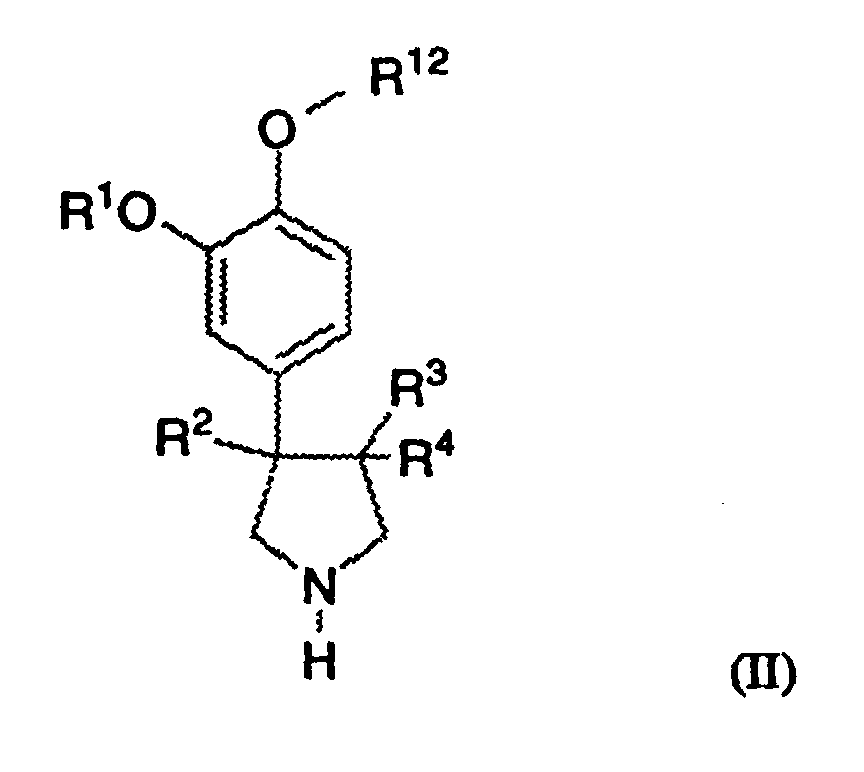 (B) Inter conversion of one compound of Formula (I) to another compound of Formula (I).
Applications Claiming Priority (3)
| Application Number | Priority Date | Filing Date | Title |
|---|---|---|---|
| US123837 | 1993-09-20 | ||
| US08/123,837 US5665754A (en) | 1993-09-20 | 1993-09-20 | Substituted pyrrolidines |
| PCT/US1994/010678 WO1995008534A1 (en) | 1993-09-20 | 1994-09-20 | 3-(3,4-dioxyphenyl)-pyrrolidines as type iv phosphodiesterase inhibitors for the treatment of inflammatory diseases |
Publications (2)
| Publication Number | Publication Date |
|---|---|
| EP0720600A1 EP0720600A1 (en) | 1996-07-10 |
| EP0720600B1 true EP0720600B1 (en) | 2000-07-12 |
Family
ID=22411191
Family Applications (1)
| Application Number | Title | Priority Date | Filing Date |
|---|---|---|---|
| EP94929281A Expired - Lifetime EP0720600B1 (en) | 1993-09-20 | 1994-09-20 | 3-(3,4-dioxyphenyl)-pyrrolidines as type iv phosphodiesterase inhibitors for the treatment of inflammatory diseases |
Country Status (10)
| Country | Link |
|---|---|
| US (1) | US5665754A (en) |
| EP (1) | EP0720600B1 (en) |
| JP (2) | JP3847333B2 (en) |
| AT (1) | ATE194593T1 (en) |
| AU (1) | AU685170B2 (en) |
| CA (1) | CA2171448A1 (en) |
| DE (1) | DE69425267T2 (en) |
| ES (1) | ES2149888T3 (en) |
| NZ (1) | NZ274381A (en) |
| WO (1) | WO1995008534A1 (en) |
Families Citing this family (91)
| Publication number | Priority date | Publication date | Assignee | Title |
|---|---|---|---|---|
| US5665754A (en) * | 1993-09-20 | 1997-09-09 | Glaxo Wellcome Inc. | Substituted pyrrolidines |
| US6448235B1 (en) | 1994-07-11 | 2002-09-10 | University Of Virginia Patent Foundation | Method for treating restenosis with A2A adenosine receptor agonists |
| US6514949B1 (en) | 1994-07-11 | 2003-02-04 | University Of Virginia Patent Foundation | Method compositions for treating the inflammatory response |
| US5877180A (en) * | 1994-07-11 | 1999-03-02 | University Of Virginia Patent Foundation | Method for treating inflammatory diseases with A2a adenosine receptor agonists |
| US6372770B1 (en) | 1994-10-12 | 2002-04-16 | Euro-Celtique, S.A. | Benzoxazoles |
| DE69630214T2 (en) | 1995-03-10 | 2004-07-15 | Berlex Laboratories, Inc., Richmond | BENZAMIDINE DERIVATIVES, THEIR PRODUCTION AND THEIR USE AS ANTI-COAGULANTS |
| US5612353A (en) * | 1995-06-07 | 1997-03-18 | Rhone-Poulenc Rorer Pharmaceuticals Inc. | Substituted (sulfinic acid, sulfonic acid, sulfonylamino or sulfinylamino) N-[(aminoiminomethyl)phenylalkyl]-azaheterocyclylamide compounds |
| JP4017214B2 (en) | 1996-06-11 | 2007-12-05 | 興和創薬株式会社 | 5-Phenyl-3-pyridazinone derivatives |
| JP4373497B2 (en) | 1996-06-19 | 2009-11-25 | ローン−プーラン・ロレ・リミテツド | Substituted azabicyclo compounds and their use as inhibitors of TNF and cyclic AMP phosphodiesterase production |
| WO1998004534A1 (en) | 1996-07-31 | 1998-02-05 | Nikken Chemicals Co., Ltd. | 6-phenyltetrahydro-1,3-oxazin-2-one derivatives and medicinal compositions containing the same |
| US6265402B1 (en) | 1996-08-27 | 2001-07-24 | Nikken Chemicals Co., Ltd. | Use of 2-phenylmorpholin-5-one derivatives |
| US5922557A (en) * | 1997-01-09 | 1999-07-13 | Merck & Co., Inc. | System for stably expressing a high-affinity camp phosphodiesterase and use thereof |
| CA2295106C (en) | 1997-06-24 | 2007-03-13 | Nikken Chemicals Co., Ltd. | 3-anilino-2-cycloalkenone derivatives |
| US6117878A (en) * | 1998-02-24 | 2000-09-12 | University Of Virginia | 8-phenyl- or 8-cycloalkyl xanthine antagonists of A2B human adenosine receptors |
| JP4518587B2 (en) * | 1998-03-09 | 2010-08-04 | 興和創薬株式会社 | 2-Phenylmorpholine derivative |
| US20030232777A1 (en) * | 2002-06-18 | 2003-12-18 | Marcusson Eric G. | Phosphatidylinositol-4-phosphate 5-kinase, type II beta inhibitors for inhibiting angiogenesis |
| US20030232775A1 (en) * | 2002-06-18 | 2003-12-18 | Isis Pharmaceuticals Inc. | Antisense modulation of phosphatidylinositol-4-phosphate 5-kinase, type II beta expression |
| AU6047099A (en) * | 1998-09-24 | 2000-04-10 | Boston Medical Center Corporation | Compositions and methods for the treatment of chronic lymphocytic leukemia |
| US7427606B2 (en) * | 1999-02-01 | 2008-09-23 | University Of Virginia Patent Foundation | Method to reduce inflammatory response in transplanted tissue |
| US6232297B1 (en) * | 1999-02-01 | 2001-05-15 | University Of Virginia Patent Foundation | Methods and compositions for treating inflammatory response |
| US7378400B2 (en) * | 1999-02-01 | 2008-05-27 | University Of Virginia Patent Foundation | Method to reduce an inflammatory response from arthritis |
| US6322771B1 (en) | 1999-06-18 | 2001-11-27 | University Of Virginia Patent Foundation | Induction of pharmacological stress with adenosine receptor agonists |
| CA2715683A1 (en) | 1999-08-21 | 2001-03-01 | Nycomed Gmbh | Synergistic combination |
| US6680336B2 (en) * | 1999-12-15 | 2004-01-20 | Icos Corporation | Cyclic AMP-specific phosphodiesterase inhibitors |
| US6376489B1 (en) | 1999-12-23 | 2002-04-23 | Icos Corporation | Cyclic AMP-specific phosphodiesterase inhibitors |
| US6313156B1 (en) | 1999-12-23 | 2001-11-06 | Icos Corporation | Thiazole compounds as cyclic-AMP-specific phosphodiesterase inhibitors |
| US6348602B1 (en) | 1999-12-23 | 2002-02-19 | Icos Corporation | Cyclic AMP-specific phosphodiesterase inhibitors |
| US6258833B1 (en) | 1999-12-23 | 2001-07-10 | Icos Corporation | Cyclic AMP-specific phosphodiesterase inhibitors |
| US6372777B1 (en) | 1999-12-23 | 2002-04-16 | Icos Corporation | Cyclic AMP-specific phosphodiesterase inhibitors |
| US6569885B1 (en) * | 1999-12-23 | 2003-05-27 | Icos Corporation | Cyclic AMP-specific phosphodiesterase inhibitors |
| US6294561B1 (en) | 1999-12-23 | 2001-09-25 | Icos Corporation | Cyclic AMP-specific phosphodiesterase inhibitors |
| US6362213B1 (en) | 1999-12-23 | 2002-03-26 | Icos Corporation | Cyclic AMP-specific phosphodiesterase inhibitors |
| WO2001096307A2 (en) * | 2000-06-15 | 2001-12-20 | Pharmacia Corporation | Cycloalkyl alkanoic acids as integrin receptor antagonists |
| IT1317049B1 (en) * | 2000-06-23 | 2003-05-26 | Sigma Tau Ind Farmaceuti | USEFUL COMPOUNDS FOR THE PREPARATION OF MEDICATIONS FOR PHOSPHODIESTERASE INHIBITING ACTIVITIES IV. |
| US6670334B2 (en) | 2001-01-05 | 2003-12-30 | University Of Virginia Patent Foundation | Method and compositions for treating the inflammatory response |
| WO2002094320A1 (en) | 2001-05-23 | 2002-11-28 | Tanabe Seiyaku Co., Ltd. | Therapeutic compositions for repairing chondropathy |
| WO2002094321A1 (en) * | 2001-05-23 | 2002-11-28 | Tanabe Seiyaku Co., Ltd. | Compositions for promoting healing of bone fracture |
| US20040043988A1 (en) * | 2001-06-15 | 2004-03-04 | Khanna Ish Kurmar | Cycloalkyl alkanoic acids as intergrin receptor antagonists |
| SG176313A1 (en) * | 2001-10-01 | 2011-12-29 | Univ Virginia Patent Found | 2-propynyl adenosine analogs having a2a agonist activity and compositions thereof |
| CA2463469A1 (en) * | 2001-10-16 | 2003-04-24 | Memory Pharmaceuticals Corporation | 4-(4-alkoxy-3-hydroxyphenyl)-2-pyrrolidone derivatives as pde-4 inhibitors for the treatment of neurological syndromes |
| US7498171B2 (en) * | 2002-04-12 | 2009-03-03 | Anthrogenesis Corporation | Modulation of stem and progenitor cell differentiation, assays, and uses thereof |
| WO2003087333A2 (en) * | 2002-04-12 | 2003-10-23 | Celgene Corporation | Modulation of stem and progenitor cell differentiation, assays, and uses thereof |
| US7772188B2 (en) | 2003-01-28 | 2010-08-10 | Ironwood Pharmaceuticals, Inc. | Methods and compositions for the treatment of gastrointestinal disorders |
| EA200501548A1 (en) | 2003-04-01 | 2006-02-24 | Апплайд Резеч Системз Арс Холдинг Н.В. | PHOSPHODYSTERASE INHIBITORS FOR INFERTILITY |
| CA2552965A1 (en) * | 2004-01-14 | 2005-07-28 | Takeda Pharmaceutical Company Limited | Carboxamide derivative and use thereof |
| US20060025468A1 (en) * | 2004-07-29 | 2006-02-02 | Whitten Jeffrey P | Chiral pyrrolidine derivatives, and methods for preparing compounds thereof |
| CA2576826C (en) * | 2004-08-02 | 2014-09-30 | University Of Virginia Patent Foundation | 2-propynyl adenosine analogs with modified 5'-ribose groups having a2a agonist activity |
| WO2006023272A1 (en) * | 2004-08-02 | 2006-03-02 | University Of Virginia Patent Foundation | 2-polycyclic propynyl adenosine analogs having a2a agonist activity |
| US7576069B2 (en) * | 2004-08-02 | 2009-08-18 | University Of Virginia Patent Foundation | 2-polycyclic propynyl adenosine analogs having A2A agonist activity |
| US20070270471A1 (en) * | 2004-08-09 | 2007-11-22 | Glaxo Group Limited | Compounds Which Potentiate Glutamate Receptor and Uses Thereof in Medicine |
| US20080051379A1 (en) * | 2004-12-01 | 2008-02-28 | Trustees Of Boston University | Compositions and Methods for the Treatment of Peripheral B-Cell Neoplasms |
| EP2258359A3 (en) | 2005-08-26 | 2011-04-06 | Braincells, Inc. | Neurogenesis by muscarinic receptor modulation with sabcomelin |
| JP2009506069A (en) | 2005-08-26 | 2009-02-12 | ブレインセルス,インコーポレイティド | Neurogenesis through modulation of muscarinic receptors |
| US7985756B2 (en) | 2005-10-21 | 2011-07-26 | Braincells Inc. | Modulation of neurogenesis by PDE inhibition |
| WO2007053596A1 (en) | 2005-10-31 | 2007-05-10 | Braincells, Inc. | Gaba receptor mediated modulation of neurogenesis |
| US20080027022A1 (en) * | 2006-02-08 | 2008-01-31 | Linden Joel M | Method to treat gastric lesions |
| US8178509B2 (en) | 2006-02-10 | 2012-05-15 | University Of Virginia Patent Foundation | Method to treat sickle cell disease |
| US20100216734A1 (en) | 2006-03-08 | 2010-08-26 | Braincells, Inc. | Modulation of neurogenesis by nootropic agents |
| WO2007134077A2 (en) | 2006-05-09 | 2007-11-22 | Braincells, Inc. | 5 ht receptor mediated neurogenesis |
| WO2007134136A2 (en) | 2006-05-09 | 2007-11-22 | Braincells, Inc. | Neurogenesis by modulating angiotensin |
| US8188063B2 (en) * | 2006-06-19 | 2012-05-29 | University Of Virginia Patent Foundation | Use of adenosine A2A modulators to treat spinal cord injury |
| EP2068872A1 (en) | 2006-09-08 | 2009-06-17 | Braincells, Inc. | Combinations containing a 4-acylaminopyridine derivative |
| US20100184806A1 (en) | 2006-09-19 | 2010-07-22 | Braincells, Inc. | Modulation of neurogenesis by ppar agents |
| MX2009013293A (en) | 2007-06-04 | 2010-02-15 | Synergy Pharmaceuticals Inc | Agonists of guanylate cyclase useful for the treatment of gastrointestinal disorders, inflammation, cancer and other disorders. |
| US8969514B2 (en) | 2007-06-04 | 2015-03-03 | Synergy Pharmaceuticals, Inc. | Agonists of guanylate cyclase useful for the treatment of hypercholesterolemia, atherosclerosis, coronary heart disease, gallstone, obesity and other cardiovascular diseases |
| US8188301B2 (en) * | 2007-06-05 | 2012-05-29 | Nsab, Filial Af Neurosearch Sweden Ab, Sverige | Disubstituted phenylpyrrolidines as modulators of cortical catecholaminergic neurotransmission |
| US8058259B2 (en) * | 2007-12-20 | 2011-11-15 | University Of Virginia Patent Foundation | Substituted 4-{3-[6-amino-9-(3,4-dihydroxy-tetrahydro-furan-2-yl)-9H-purin-2-yl]-prop-2-ynyl}-piperidine-1-carboxylic acid esters as A2AR agonists |
| EP2810951B1 (en) | 2008-06-04 | 2017-03-15 | Synergy Pharmaceuticals Inc. | Agonists of guanylate cyclase useful for the treatment of gastrointestinal disorders, inflammation, cancer and other disorders |
| CA2730603C (en) | 2008-07-16 | 2019-09-24 | Synergy Pharmaceuticals Inc. | Agonists of guanylate cyclase useful for the treatment of gastrointestinal disorders, inflammation, cancer and other disorders |
| WO2010099217A1 (en) | 2009-02-25 | 2010-09-02 | Braincells, Inc. | Modulation of neurogenesis using d-cycloserine combinations |
| CA2762022A1 (en) | 2009-05-15 | 2010-11-18 | Redx Pharma Limited | Redox drug derivatives |
| GB201000499D0 (en) * | 2010-01-13 | 2010-03-03 | Fleet George W J | Treatment of cystic fibrosis |
| US9616097B2 (en) | 2010-09-15 | 2017-04-11 | Synergy Pharmaceuticals, Inc. | Formulations of guanylate cyclase C agonists and methods of use |
| CA3100941C (en) | 2011-03-01 | 2024-03-05 | Synergy Pharmaceuticals Inc. | Process of preparing guanylate cyclase c agonists |
| EP2804603A1 (en) | 2012-01-10 | 2014-11-26 | President and Fellows of Harvard College | Beta-cell replication promoting compounds and methods of their use |
| EP3718557A3 (en) | 2013-02-25 | 2020-10-21 | Bausch Health Ireland Limited | Guanylate cyclase receptor agonist sp-333 for use in colonic cleansing |
| TWI617553B (en) * | 2013-03-13 | 2018-03-11 | 美國禮來大藥廠 | Azetidinyloxyphenylpyrrolidine compound |
| JP2016514670A (en) | 2013-03-15 | 2016-05-23 | シナジー ファーマシューティカルズ インコーポレイテッド | Guanylate cyclase receptor agonists in combination with other drugs |
| JP2016514671A (en) | 2013-03-15 | 2016-05-23 | シナジー ファーマシューティカルズ インコーポレイテッド | Guanylate cyclase agonists and uses thereof |
| EA201592263A1 (en) | 2013-06-05 | 2016-05-31 | Синерджи Фармасьютикалз, Инк. | ULTRASCULAR AGONISTS OF GUANYLACYCLASE C, METHOD OF THEIR RECEIVING AND USING |
| KR20160042039A (en) | 2013-08-09 | 2016-04-18 | 알데릭스, 인코포레이티드 | Compounds and methods for inhibiting phosphate transport |
| GB201416754D0 (en) * | 2014-09-23 | 2014-11-05 | Mission Therapeutics Ltd | Novel compounds |
| MY188957A (en) | 2015-03-30 | 2022-01-14 | Mission Therapeutics Ltd | 1-cyano-pyrrolidine compounds as usp30 inhibitors |
| GB201521109D0 (en) | 2015-11-30 | 2016-01-13 | Mission Therapeutics Ltd | Novel compounds |
| WO2017163078A1 (en) | 2016-03-24 | 2017-09-28 | Mission Therapeutics Limited | 1-cyano-pyrrolidine derivatives as dbu inhibitors |
| US10526320B2 (en) * | 2016-07-12 | 2020-01-07 | Guangdong Raynovent Biotech Co., Ltd. | Pyrrolidine derivatives as PPAR agonists |
| GB201616511D0 (en) | 2016-09-29 | 2016-11-16 | Mission Therapeutics Limited | Novel compounds |
| WO2018089406A1 (en) * | 2016-11-10 | 2018-05-17 | Bristol-Myers Squibb Company | Ror gamma modulators |
| WO2020237096A1 (en) | 2019-05-21 | 2020-11-26 | Ardelyx, Inc. | Combination for lowering serum phosphate in a patient |
| CN113563246B (en) * | 2020-04-29 | 2025-01-17 | 广东东阳光药业股份有限公司 | Substituted nitrogen five-membered ring derivatives and their application in medicine |
| WO2022192340A1 (en) * | 2021-03-10 | 2022-09-15 | University Of Pittsburgh - Of The Commonwealth System Of Higher Education | Small molecule allosteric modulators of class b gpcr, the pthr, and method to identify them |
Family Cites Families (36)
| Publication number | Priority date | Publication date | Assignee | Title |
|---|---|---|---|---|
| US3647790A (en) * | 1969-04-08 | 1972-03-07 | American Home Prod | Ouinoxalinyl-oxazolidines and -oxazines |
| US3644398A (en) * | 1969-04-11 | 1972-02-22 | Robins Co Inc A H | 1-carbamoyl-3-phenylpyrrolidines |
| JPS4916872B1 (en) * | 1970-05-12 | 1974-04-25 | ||
| GB1350582A (en) * | 1970-07-24 | 1974-04-18 | Ucb Sa | Cerivatives of 2-pyrrolidinone |
| BE804701A (en) * | 1972-09-11 | 1974-03-11 | Sandoz Sa | 3-Substd phenyl-3-substd alkyl-butyrophenone derivs - useful as anal-gesics, prepd eg by oxidn of corresp alcohols |
| DE2413935A1 (en) * | 1974-03-20 | 1975-10-16 | Schering Ag | 4- (POLYALCOXY-PHENYL) -2-PYRROLIDONE |
| JPS5182258A (en) * | 1974-04-25 | 1976-07-19 | Yoshitomi Pharmaceutical | PIRORIJINON JUDOTAINO SEIZOHO |
| DE2541855A1 (en) * | 1975-09-18 | 1977-03-31 | Schering Ag | 4- (POLYALCOXY-PHENYL) -2-PYRROLIDONE II |
| JPS52156859A (en) * | 1976-06-18 | 1977-12-27 | Yoshitomi Pharmaceut Ind Ltd | Heterocyclic amide derivatives |
| GB1561411A (en) * | 1977-02-25 | 1980-02-20 | Science Union & Cie | 2-phenoxyphenyl pyrrolidines and pharmaceutical compositions containing them |
| GB1593888A (en) * | 1977-12-22 | 1981-07-22 | Wyeth John & Brother Ltd | Hexahydroazepine piperidine and pyrrolidine derivatives |
| US4219560A (en) * | 1978-04-17 | 1980-08-26 | Sandoz, Inc. | Piperidine and pyrrolidine alcohols |
| JPS584711B2 (en) * | 1978-08-02 | 1983-01-27 | 参天製薬株式会社 | Pyrrolidine derivative |
| DE3069897D1 (en) * | 1979-07-03 | 1985-02-14 | Wyeth John & Brother Ltd | Method of preparing 2-oxo- and 2-unsubstituted-hexahydroazepine derivatives |
| DE3104435A1 (en) * | 1981-02-03 | 1982-11-11 | Schering Ag, 1000 Berlin Und 4619 Bergkamen | Combination of active substances |
| US4584313A (en) * | 1984-05-07 | 1986-04-22 | Warner-Lambert Company | (Substituted-phenyl)-5-oxo-2-pyrrolidinepropanoic acids and esters thereof, and use for reversing electroconvulsive shock-induced amnesia |
| SU1298204A1 (en) * | 1985-11-21 | 1987-03-23 | МГУ им.М.В.Ломоносова | Method for producing 3,4-diaryl-gamma-aminobutyric acids or cyclic amides thereof |
| HU215433B (en) * | 1986-04-29 | 2000-05-28 | Pfizer Inc. | A method for preparing novel 2-oxo-5-phenylpyrimidine derivatives |
| DE3732930A1 (en) * | 1987-09-30 | 1989-04-20 | Basf Ag | FUNGICIDAL N-SUBSTITUTED 3-ARYL-PYRROLIDINE DERIVATIVES |
| DE3732910A1 (en) * | 1987-09-30 | 1989-04-20 | Basf Ag | FUNGICIDAL N-SUBSTITUTED 3-ALKYL-4-ARYL-PYRROLIDINE DERIVATIVES |
| US4960457A (en) * | 1988-12-27 | 1990-10-02 | Ici Americas Inc. | Substituted 1,3-diphenyl pyrrolidones and their use as herbicides |
| US5444083A (en) * | 1989-02-03 | 1995-08-22 | Eisai Co., Ltd. | Pyrrolidine compound and pharmaceutical use |
| DD299058A5 (en) * | 1990-01-31 | 1992-03-26 | Arzneimittelwerk Dresden Gmbh,De | PROCESS FOR THE PREPARATION OF N-ACYL-4-PHENYL-PYRROLIDIN-2-ONES WITH CEREBROPROTECTIVE EFFECT |
| GB9009395D0 (en) * | 1990-04-26 | 1990-06-20 | Orion Yhtymae Oy | Cyclic hydroxamic acids and their use |
| MC2311A1 (en) * | 1990-07-10 | 1993-09-27 | Smithkline Beecham Corp | OXAMIDES |
| DE69128627T2 (en) * | 1990-08-03 | 1998-07-02 | Smithkline Beecham Corp Philad | TNF INHIBITORS |
| US5124455A (en) * | 1990-08-08 | 1992-06-23 | American Home Products Corporation | Oxime-carbamates and oxime-carbonates as bronchodilators and anti-inflammatory agents |
| CA2095429A1 (en) * | 1990-11-06 | 1992-05-07 | Paul E. Bender | Imidazolidinone compounds |
| IE71647B1 (en) * | 1991-01-28 | 1997-02-26 | Rhone Poulenc Rorer Ltd | Benzamide derivatives |
| US5270328A (en) * | 1991-03-29 | 1993-12-14 | Eli Lilly And Company | Peripherally selective piperidine opioid antagonists |
| US5191084A (en) * | 1991-05-01 | 1993-03-02 | American Home Products Corporation | Phenyl pyrazolidinones as bronchodilators and anti-inflammatory agents |
| PT100441A (en) * | 1991-05-02 | 1993-09-30 | Smithkline Beecham Corp | PIRROLIDINONES, ITS PREPARATION PROCESS, PHARMACEUTICAL COMPOSITIONS THAT CONTAIN THEM AND USE |
| EP0642489A1 (en) * | 1991-10-02 | 1995-03-15 | Smithkline Beecham Corporation | Cyclopentane and cyclopentene derivatives with antiallergic antiinflammatory and tumor necrosis factor inhibiting activity |
| JP3245165B2 (en) * | 1991-10-09 | 2002-01-07 | シンテックス(ユー・エス・エイ)・インコーポレイテッド | Pyridopyridazinone and pyridazinethione compounds |
| WO1993007141A1 (en) * | 1991-10-11 | 1993-04-15 | Smithkline Beecham Corporation | Heterocyclic 3-phenylpyrrolidin-2-ones, their preparation and use for the manufacture of a medicament for inhibiting tumor necrosis factor production |
| US5665754A (en) * | 1993-09-20 | 1997-09-09 | Glaxo Wellcome Inc. | Substituted pyrrolidines |
-
1993
- 1993-09-20 US US08/123,837 patent/US5665754A/en not_active Expired - Fee Related
-
1994
- 1994-09-20 ES ES94929281T patent/ES2149888T3/en not_active Expired - Lifetime
- 1994-09-20 JP JP50990795A patent/JP3847333B2/en not_active Expired - Fee Related
- 1994-09-20 WO PCT/US1994/010678 patent/WO1995008534A1/en not_active Ceased
- 1994-09-20 AT AT94929281T patent/ATE194593T1/en active
- 1994-09-20 AU AU78396/94A patent/AU685170B2/en not_active Ceased
- 1994-09-20 CA CA002171448A patent/CA2171448A1/en not_active Abandoned
- 1994-09-20 DE DE69425267T patent/DE69425267T2/en not_active Expired - Fee Related
- 1994-09-20 EP EP94929281A patent/EP0720600B1/en not_active Expired - Lifetime
- 1994-09-20 NZ NZ274381A patent/NZ274381A/en not_active IP Right Cessation
-
2006
- 2006-05-29 JP JP2006148897A patent/JP2006225404A/en not_active Withdrawn
Also Published As
| Publication number | Publication date |
|---|---|
| AU685170B2 (en) | 1998-01-15 |
| JP3847333B2 (en) | 2006-11-22 |
| CA2171448A1 (en) | 1995-03-30 |
| NZ274381A (en) | 1998-02-26 |
| HK1011972A1 (en) | 1999-07-23 |
| JPH09502979A (en) | 1997-03-25 |
| EP0720600A1 (en) | 1996-07-10 |
| ES2149888T3 (en) | 2000-11-16 |
| JP2006225404A (en) | 2006-08-31 |
| WO1995008534A1 (en) | 1995-03-30 |
| DE69425267T2 (en) | 2001-01-18 |
| US5665754A (en) | 1997-09-09 |
| ATE194593T1 (en) | 2000-07-15 |
| DE69425267D1 (en) | 2000-08-17 |
| AU7839694A (en) | 1995-04-10 |
Similar Documents
| Publication | Publication Date | Title |
|---|---|---|
| AU685170B2 (en) | 3-(3,4-dioxyphenyl)-pyrrolidines as type IV phosphodiesterase inhibitors for the treatment of inflammatory diseases | |
| JP4294903B2 (en) | Pyrrolidine derivatives as cyclic AMP specific phosphodiesterase inhibitors | |
| AU778717B2 (en) | Hydrazone and oxime derivatives of pyrrolidine as AMP-specific phosphodiesterase inhibitors | |
| US6376489B1 (en) | Cyclic AMP-specific phosphodiesterase inhibitors | |
| BRPI0618051A2 (en) | pharmaceutical use of substituted amides | |
| WO2006104280A1 (en) | Prophylactic/therapeutic agent for diabetes | |
| AU2005287637A1 (en) | Carbonyl compound-containing drug and the use thereof | |
| AU748469B2 (en) | Endothelin antagonists | |
| US6680336B2 (en) | Cyclic AMP-specific phosphodiesterase inhibitors | |
| HK1011972B (en) | 3-(3,4-dioxyphenyl)-pyrrolidines as type iv phosphodiesterase inhibitors for the treatment of inflammatory diseases | |
| HK1159627A (en) | 2-phenoxy-and 2-phenylsulfomamide derivatives with ccr3 antagonistic activity for the treatment of asthma and other inflammatory or immunological disorders | |
| HK1093317B (en) | 2-phenoxy-and 2-phenylsulfomamide derivatives with ccr3 antagonistic activity for the treatment of asthma and other inflammatory or immunological disorders | |
| HK1093317A1 (en) | 2-phenoxy-and 2-phenylsulfomamide derivatives with ccr3 antagonistic activity for the treatment of asthma and other inflammatory or immunological disorders |
Legal Events
| Date | Code | Title | Description |
|---|---|---|---|
| PUAI | Public reference made under article 153(3) epc to a published international application that has entered the european phase |
Free format text: ORIGINAL CODE: 0009012 |
|
| 17P | Request for examination filed |
Effective date: 19960313 |
|
| AK | Designated contracting states |
Kind code of ref document: A1 Designated state(s): AT BE CH DE DK ES FR GB GR IE IT LI LU MC NL PT SE |
|
| AX | Request for extension of the european patent |
Free format text: LT PAYMENT 960313;SI PAYMENT 960313 |
|
| RAX | Requested extension states of the european patent have changed |
Free format text: LT PAYMENT 960313;SI PAYMENT 960313 |
|
| 17Q | First examination report despatched |
Effective date: 19960814 |
|
| RAP1 | Party data changed (applicant data changed or rights of an application transferred) |
Owner name: ICOS CORPORATION |
|
| GRAG | Despatch of communication of intention to grant |
Free format text: ORIGINAL CODE: EPIDOS AGRA |
|
| GRAG | Despatch of communication of intention to grant |
Free format text: ORIGINAL CODE: EPIDOS AGRA |
|
| GRAG | Despatch of communication of intention to grant |
Free format text: ORIGINAL CODE: EPIDOS AGRA |
|
| GRAH | Despatch of communication of intention to grant a patent |
Free format text: ORIGINAL CODE: EPIDOS IGRA |
|
| GRAH | Despatch of communication of intention to grant a patent |
Free format text: ORIGINAL CODE: EPIDOS IGRA |
|
| GRAA | (expected) grant |
Free format text: ORIGINAL CODE: 0009210 |
|
| AK | Designated contracting states |
Kind code of ref document: B1 Designated state(s): AT BE CH DE DK ES FR GB GR IE IT LI LU MC NL PT SE |
|
| AX | Request for extension of the european patent |
Free format text: LT PAYMENT 19960313;SI PAYMENT 19960313 |
|
| LTIE | Lt: invalidation of european patent or patent extension | ||
| PG25 | Lapsed in a contracting state [announced via postgrant information from national office to epo] |
Ref country code: LI Free format text: LAPSE BECAUSE OF FAILURE TO SUBMIT A TRANSLATION OF THE DESCRIPTION OR TO PAY THE FEE WITHIN THE PRESCRIBED TIME-LIMIT Effective date: 20000712 Ref country code: GR Free format text: LAPSE BECAUSE OF NON-PAYMENT OF DUE FEES Effective date: 20000712 Ref country code: CH Free format text: LAPSE BECAUSE OF FAILURE TO SUBMIT A TRANSLATION OF THE DESCRIPTION OR TO PAY THE FEE WITHIN THE PRESCRIBED TIME-LIMIT Effective date: 20000712 Ref country code: AT Free format text: LAPSE BECAUSE OF FAILURE TO SUBMIT A TRANSLATION OF THE DESCRIPTION OR TO PAY THE FEE WITHIN THE PRESCRIBED TIME-LIMIT Effective date: 20000712 |
|
| REF | Corresponds to: |
Ref document number: 194593 Country of ref document: AT Date of ref document: 20000715 Kind code of ref document: T |
|
| REG | Reference to a national code |
Ref country code: CH Ref legal event code: EP |
|
| REG | Reference to a national code |
Ref country code: IE Ref legal event code: FG4D |
|
| REF | Corresponds to: |
Ref document number: 69425267 Country of ref document: DE Date of ref document: 20000817 |
|
| ET | Fr: translation filed | ||
| PG25 | Lapsed in a contracting state [announced via postgrant information from national office to epo] |
Ref country code: LU Free format text: LAPSE BECAUSE OF NON-PAYMENT OF DUE FEES Effective date: 20000920 Ref country code: IE Free format text: LAPSE BECAUSE OF NON-PAYMENT OF DUE FEES Effective date: 20000920 |
|
| PG25 | Lapsed in a contracting state [announced via postgrant information from national office to epo] |
Ref country code: MC Free format text: THE PATENT HAS BEEN ANNULLED BY A DECISION OF A NATIONAL AUTHORITY Effective date: 20000930 |
|
| ITF | It: translation for a ep patent filed | ||
| PG25 | Lapsed in a contracting state [announced via postgrant information from national office to epo] |
Ref country code: SE Free format text: LAPSE BECAUSE OF FAILURE TO SUBMIT A TRANSLATION OF THE DESCRIPTION OR TO PAY THE FEE WITHIN THE PRESCRIBED TIME-LIMIT Effective date: 20001012 Ref country code: PT Free format text: LAPSE BECAUSE OF FAILURE TO SUBMIT A TRANSLATION OF THE DESCRIPTION OR TO PAY THE FEE WITHIN THE PRESCRIBED TIME-LIMIT Effective date: 20001012 Ref country code: DK Free format text: LAPSE BECAUSE OF FAILURE TO SUBMIT A TRANSLATION OF THE DESCRIPTION OR TO PAY THE FEE WITHIN THE PRESCRIBED TIME-LIMIT Effective date: 20001012 |
|
| REG | Reference to a national code |
Ref country code: ES Ref legal event code: FG2A Ref document number: 2149888 Country of ref document: ES Kind code of ref document: T3 |
|
| REG | Reference to a national code |
Ref country code: CH Ref legal event code: PL |
|
| PLBE | No opposition filed within time limit |
Free format text: ORIGINAL CODE: 0009261 |
|
| STAA | Information on the status of an ep patent application or granted ep patent |
Free format text: STATUS: NO OPPOSITION FILED WITHIN TIME LIMIT |
|
| 26N | No opposition filed | ||
| REG | Reference to a national code |
Ref country code: IE Ref legal event code: MM4A |
|
| REG | Reference to a national code |
Ref country code: GB Ref legal event code: IF02 |
|
| REG | Reference to a national code |
Ref country code: GB Ref legal event code: 732E |
|
| PGFP | Annual fee paid to national office [announced via postgrant information from national office to epo] |
Ref country code: DE Payment date: 20070913 Year of fee payment: 14 |
|
| PGFP | Annual fee paid to national office [announced via postgrant information from national office to epo] |
Ref country code: GB Payment date: 20070919 Year of fee payment: 14 |
|
| PGFP | Annual fee paid to national office [announced via postgrant information from national office to epo] |
Ref country code: NL Payment date: 20070903 Year of fee payment: 14 Ref country code: IT Payment date: 20070926 Year of fee payment: 14 Ref country code: ES Payment date: 20071024 Year of fee payment: 14 |
|
| PGFP | Annual fee paid to national office [announced via postgrant information from national office to epo] |
Ref country code: BE Payment date: 20071120 Year of fee payment: 14 |
|
| PGFP | Annual fee paid to national office [announced via postgrant information from national office to epo] |
Ref country code: FR Payment date: 20070914 Year of fee payment: 14 |
|
| BERE | Be: lapsed |
Owner name: *ICOS CORP. Effective date: 20080930 |
|
| GBPC | Gb: european patent ceased through non-payment of renewal fee |
Effective date: 20080920 |
|
| PG25 | Lapsed in a contracting state [announced via postgrant information from national office to epo] |
Ref country code: NL Free format text: LAPSE BECAUSE OF NON-PAYMENT OF DUE FEES Effective date: 20090401 |
|
| NLV4 | Nl: lapsed or anulled due to non-payment of the annual fee |
Effective date: 20090401 |
|
| REG | Reference to a national code |
Ref country code: FR Ref legal event code: ST Effective date: 20090529 |
|
| PG25 | Lapsed in a contracting state [announced via postgrant information from national office to epo] |
Ref country code: BE Free format text: LAPSE BECAUSE OF NON-PAYMENT OF DUE FEES Effective date: 20080930 |
|
| PG25 | Lapsed in a contracting state [announced via postgrant information from national office to epo] |
Ref country code: IT Free format text: LAPSE BECAUSE OF NON-PAYMENT OF DUE FEES Effective date: 20080920 Ref country code: DE Free format text: LAPSE BECAUSE OF NON-PAYMENT OF DUE FEES Effective date: 20090401 |
|
| PG25 | Lapsed in a contracting state [announced via postgrant information from national office to epo] |
Ref country code: FR Free format text: LAPSE BECAUSE OF NON-PAYMENT OF DUE FEES Effective date: 20080930 |
|
| REG | Reference to a national code |
Ref country code: ES Ref legal event code: FD2A Effective date: 20080922 |
|
| PG25 | Lapsed in a contracting state [announced via postgrant information from national office to epo] |
Ref country code: GB Free format text: LAPSE BECAUSE OF NON-PAYMENT OF DUE FEES Effective date: 20080920 |
|
| PG25 | Lapsed in a contracting state [announced via postgrant information from national office to epo] |
Ref country code: ES Free format text: LAPSE BECAUSE OF NON-PAYMENT OF DUE FEES Effective date: 20080922 |