EP0718346A1 - Dispersing solid additives in polymers - Google Patents
Dispersing solid additives in polymers Download PDFInfo
- Publication number
- EP0718346A1 EP0718346A1 EP94309600A EP94309600A EP0718346A1 EP 0718346 A1 EP0718346 A1 EP 0718346A1 EP 94309600 A EP94309600 A EP 94309600A EP 94309600 A EP94309600 A EP 94309600A EP 0718346 A1 EP0718346 A1 EP 0718346A1
- Authority
- EP
- European Patent Office
- Prior art keywords
- additive
- ptfe
- polymer
- composition
- thermoplastic
- Prior art date
- Legal status (The legal status is an assumption and is not a legal conclusion. Google has not performed a legal analysis and makes no representation as to the accuracy of the status listed.)
- Withdrawn
Links
- 239000000654 additive Substances 0.000 title claims abstract description 47
- 229920000642 polymer Polymers 0.000 title claims abstract description 30
- 239000007787 solid Substances 0.000 title claims abstract description 20
- 239000000203 mixture Substances 0.000 claims abstract description 82
- 239000004810 polytetrafluoroethylene Substances 0.000 claims abstract description 82
- 229920001343 polytetrafluoroethylene Polymers 0.000 claims abstract description 82
- 239000004417 polycarbonate Substances 0.000 claims abstract description 81
- 229920000515 polycarbonate Polymers 0.000 claims abstract description 67
- 238000000034 method Methods 0.000 claims abstract description 59
- 230000000996 additive effect Effects 0.000 claims abstract description 34
- 229920005989 resin Polymers 0.000 claims abstract description 28
- 239000011347 resin Substances 0.000 claims abstract description 28
- 239000012530 fluid Substances 0.000 claims abstract description 17
- 229920005992 thermoplastic resin Polymers 0.000 claims abstract description 16
- -1 polyethylene Polymers 0.000 claims description 45
- 230000008569 process Effects 0.000 claims description 45
- 239000002245 particle Substances 0.000 claims description 35
- 229920001169 thermoplastic Polymers 0.000 claims description 22
- 125000003118 aryl group Chemical group 0.000 claims description 15
- 239000002904 solvent Substances 0.000 claims description 15
- 238000000465 moulding Methods 0.000 claims description 10
- 229920001955 polyphenylene ether Polymers 0.000 claims description 10
- 238000000975 co-precipitation Methods 0.000 claims description 8
- 229920000098 polyolefin Polymers 0.000 claims description 7
- PPBRXRYQALVLMV-UHFFFAOYSA-N Styrene Chemical compound C=CC1=CC=CC=C1 PPBRXRYQALVLMV-UHFFFAOYSA-N 0.000 claims description 6
- 239000006082 mold release agent Substances 0.000 claims description 6
- 239000003381 stabilizer Substances 0.000 claims description 6
- 239000004416 thermosoftening plastic Substances 0.000 claims description 6
- 239000004698 Polyethylene Substances 0.000 claims description 5
- 229920000570 polyether Polymers 0.000 claims description 5
- 229920000573 polyethylene Polymers 0.000 claims description 5
- VGGSQFUCUMXWEO-UHFFFAOYSA-N Ethene Chemical compound C=C VGGSQFUCUMXWEO-UHFFFAOYSA-N 0.000 claims description 4
- 239000005977 Ethylene Substances 0.000 claims description 4
- 229920002292 Nylon 6 Polymers 0.000 claims description 4
- 239000004793 Polystyrene Substances 0.000 claims description 4
- 229920001577 copolymer Polymers 0.000 claims description 4
- 229920000058 polyacrylate Polymers 0.000 claims description 4
- 229920002223 polystyrene Polymers 0.000 claims description 4
- 229920001291 polyvinyl halide Polymers 0.000 claims description 4
- 229920006214 polyvinylidene halide Polymers 0.000 claims description 4
- 229920001283 Polyalkylene terephthalate Polymers 0.000 claims description 3
- 239000003795 chemical substances by application Substances 0.000 claims description 3
- 229920001059 synthetic polymer Polymers 0.000 claims description 3
- 239000004609 Impact Modifier Substances 0.000 claims description 2
- 239000006057 Non-nutritive feed additive Substances 0.000 claims description 2
- 239000003963 antioxidant agent Substances 0.000 claims description 2
- 239000003086 colorant Substances 0.000 claims description 2
- 239000000945 filler Substances 0.000 claims description 2
- 239000004014 plasticizer Substances 0.000 claims description 2
- 238000012216 screening Methods 0.000 claims description 2
- 230000002195 synergetic effect Effects 0.000 claims description 2
- 239000011342 resin composition Substances 0.000 claims 3
- XECAHXYUAAWDEL-UHFFFAOYSA-N acrylonitrile butadiene styrene Chemical compound C=CC=C.C=CC#N.C=CC1=CC=CC=C1 XECAHXYUAAWDEL-UHFFFAOYSA-N 0.000 claims 1
- 229920000122 acrylonitrile butadiene styrene Polymers 0.000 claims 1
- 239000004676 acrylonitrile butadiene styrene Substances 0.000 claims 1
- 239000012141 concentrate Substances 0.000 abstract description 21
- 239000006185 dispersion Substances 0.000 abstract description 18
- 230000000704 physical effect Effects 0.000 abstract description 8
- 101100323621 Drosophila melanogaster Drip gene Proteins 0.000 abstract description 5
- 238000001556 precipitation Methods 0.000 abstract description 5
- 239000003112 inhibitor Substances 0.000 abstract description 3
- 239000004615 ingredient Substances 0.000 abstract description 2
- 239000011159 matrix material Substances 0.000 abstract 2
- 238000009757 thermoplastic moulding Methods 0.000 abstract 1
- XLYOFNOQVPJJNP-UHFFFAOYSA-N water Substances O XLYOFNOQVPJJNP-UHFFFAOYSA-N 0.000 description 23
- 239000000843 powder Substances 0.000 description 19
- 239000004431 polycarbonate resin Substances 0.000 description 18
- 229920005668 polycarbonate resin Polymers 0.000 description 18
- 238000009472 formulation Methods 0.000 description 17
- 125000004432 carbon atom Chemical group C* 0.000 description 16
- YMWUJEATGCHHMB-UHFFFAOYSA-N Dichloromethane Chemical compound ClCCl YMWUJEATGCHHMB-UHFFFAOYSA-N 0.000 description 15
- 239000000839 emulsion Substances 0.000 description 14
- BVKZGUZCCUSVTD-UHFFFAOYSA-L Carbonate Chemical compound [O-]C([O-])=O BVKZGUZCCUSVTD-UHFFFAOYSA-L 0.000 description 12
- 239000000243 solution Substances 0.000 description 12
- 239000000047 product Substances 0.000 description 11
- IISBACLAFKSPIT-UHFFFAOYSA-N bisphenol A Chemical compound C=1C=C(O)C=CC=1C(C)(C)C1=CC=C(O)C=C1 IISBACLAFKSPIT-UHFFFAOYSA-N 0.000 description 10
- 238000012360 testing method Methods 0.000 description 10
- 230000000052 comparative effect Effects 0.000 description 9
- 150000002989 phenols Chemical class 0.000 description 9
- 238000006243 chemical reaction Methods 0.000 description 8
- 229920002313 fluoropolymer Polymers 0.000 description 8
- 239000004811 fluoropolymer Substances 0.000 description 8
- 239000004816 latex Substances 0.000 description 8
- 229920000126 latex Polymers 0.000 description 8
- 239000002243 precursor Substances 0.000 description 8
- YGYAWVDWMABLBF-UHFFFAOYSA-N Phosgene Chemical compound ClC(Cl)=O YGYAWVDWMABLBF-UHFFFAOYSA-N 0.000 description 7
- 239000002253 acid Substances 0.000 description 7
- 125000000217 alkyl group Chemical group 0.000 description 7
- 238000005345 coagulation Methods 0.000 description 7
- 230000015271 coagulation Effects 0.000 description 7
- 239000002952 polymeric resin Substances 0.000 description 7
- 238000006116 polymerization reaction Methods 0.000 description 7
- 229920003002 synthetic resin Polymers 0.000 description 7
- 239000004215 Carbon black (E152) Substances 0.000 description 6
- RTZKZFJDLAIYFH-UHFFFAOYSA-N Diethyl ether Chemical compound CCOCC RTZKZFJDLAIYFH-UHFFFAOYSA-N 0.000 description 6
- 229920004142 LEXAN™ Polymers 0.000 description 6
- ISWSIDIOOBJBQZ-UHFFFAOYSA-N Phenol Chemical compound OC1=CC=CC=C1 ISWSIDIOOBJBQZ-UHFFFAOYSA-N 0.000 description 6
- KKEYFWRCBNTPAC-UHFFFAOYSA-N Terephthalic acid Chemical compound OC(=O)C1=CC=C(C(O)=O)C=C1 KKEYFWRCBNTPAC-UHFFFAOYSA-N 0.000 description 6
- 230000002411 adverse Effects 0.000 description 6
- 229930195733 hydrocarbon Natural products 0.000 description 6
- QQVIHTHCMHWDBS-UHFFFAOYSA-N isophthalic acid Chemical compound OC(=O)C1=CC=CC(C(O)=O)=C1 QQVIHTHCMHWDBS-UHFFFAOYSA-N 0.000 description 6
- 238000002360 preparation method Methods 0.000 description 6
- 239000000376 reactant Substances 0.000 description 6
- LYCAIKOWRPUZTN-UHFFFAOYSA-N Ethylene glycol Chemical compound OCCO LYCAIKOWRPUZTN-UHFFFAOYSA-N 0.000 description 5
- 239000003063 flame retardant Substances 0.000 description 5
- 229910052739 hydrogen Inorganic materials 0.000 description 5
- 239000001257 hydrogen Substances 0.000 description 5
- 239000012071 phase Substances 0.000 description 5
- 229920001707 polybutylene terephthalate Polymers 0.000 description 5
- QIGBRXMKCJKVMJ-UHFFFAOYSA-N Hydroquinone Chemical compound OC1=CC=C(O)C=C1 QIGBRXMKCJKVMJ-UHFFFAOYSA-N 0.000 description 4
- 238000012695 Interfacial polymerization Methods 0.000 description 4
- OFOBLEOULBTSOW-UHFFFAOYSA-N Malonic acid Chemical compound OC(=O)CC(O)=O OFOBLEOULBTSOW-UHFFFAOYSA-N 0.000 description 4
- KZTYYGOKRVBIMI-UHFFFAOYSA-N diphenyl sulfone Chemical compound C=1C=CC=CC=1S(=O)(=O)C1=CC=CC=C1 KZTYYGOKRVBIMI-UHFFFAOYSA-N 0.000 description 4
- 150000002148 esters Chemical class 0.000 description 4
- 229910052736 halogen Chemical group 0.000 description 4
- 150000002367 halogens Chemical group 0.000 description 4
- 229920005669 high impact polystyrene Polymers 0.000 description 4
- 239000004797 high-impact polystyrene Substances 0.000 description 4
- 125000004435 hydrogen atom Chemical group [H]* 0.000 description 4
- 238000002156 mixing Methods 0.000 description 4
- 125000000843 phenylene group Chemical group C1(=C(C=CC=C1)*)* 0.000 description 4
- ARCGXLSVLAOJQL-UHFFFAOYSA-N trimellitic acid Chemical compound OC(=O)C1=CC=C(C(O)=O)C(C(O)=O)=C1 ARCGXLSVLAOJQL-UHFFFAOYSA-N 0.000 description 4
- YXFVVABEGXRONW-UHFFFAOYSA-N Toluene Chemical compound CC1=CC=CC=C1 YXFVVABEGXRONW-UHFFFAOYSA-N 0.000 description 3
- ZMANZCXQSJIPKH-UHFFFAOYSA-N Triethylamine Chemical compound CCN(CC)CC ZMANZCXQSJIPKH-UHFFFAOYSA-N 0.000 description 3
- 125000003545 alkoxy group Chemical group 0.000 description 3
- 125000002947 alkylene group Chemical group 0.000 description 3
- 125000001118 alkylidene group Chemical group 0.000 description 3
- 239000002585 base Substances 0.000 description 3
- 229940106691 bisphenol a Drugs 0.000 description 3
- 239000003054 catalyst Substances 0.000 description 3
- 238000001246 colloidal dispersion Methods 0.000 description 3
- 150000001875 compounds Chemical class 0.000 description 3
- 150000001991 dicarboxylic acids Chemical class 0.000 description 3
- 239000000835 fiber Substances 0.000 description 3
- 150000002430 hydrocarbons Chemical group 0.000 description 3
- 230000003993 interaction Effects 0.000 description 3
- 230000000670 limiting effect Effects 0.000 description 3
- 238000001694 spray drying Methods 0.000 description 3
- BDHFUVZGWQCTTF-UHFFFAOYSA-M sulfonate Chemical compound [O-]S(=O)=O BDHFUVZGWQCTTF-UHFFFAOYSA-M 0.000 description 3
- 150000003462 sulfoxides Chemical class 0.000 description 3
- RNFJDJUURJAICM-UHFFFAOYSA-N 2,2,4,4,6,6-hexaphenoxy-1,3,5-triaza-2$l^{5},4$l^{5},6$l^{5}-triphosphacyclohexa-1,3,5-triene Chemical compound N=1P(OC=2C=CC=CC=2)(OC=2C=CC=CC=2)=NP(OC=2C=CC=CC=2)(OC=2C=CC=CC=2)=NP=1(OC=1C=CC=CC=1)OC1=CC=CC=C1 RNFJDJUURJAICM-UHFFFAOYSA-N 0.000 description 2
- VPWNQTHUCYMVMZ-UHFFFAOYSA-N 4,4'-sulfonyldiphenol Chemical class C1=CC(O)=CC=C1S(=O)(=O)C1=CC=C(O)C=C1 VPWNQTHUCYMVMZ-UHFFFAOYSA-N 0.000 description 2
- BRPSWMCDEYMRPE-UHFFFAOYSA-N 4-[1,1-bis(4-hydroxyphenyl)ethyl]phenol Chemical compound C=1C=C(O)C=CC=1C(C=1C=CC(O)=CC=1)(C)C1=CC=C(O)C=C1 BRPSWMCDEYMRPE-UHFFFAOYSA-N 0.000 description 2
- QGZKDVFQNNGYKY-UHFFFAOYSA-N Ammonia Chemical compound N QGZKDVFQNNGYKY-UHFFFAOYSA-N 0.000 description 2
- PAYRUJLWNCNPSJ-UHFFFAOYSA-N Aniline Chemical compound NC1=CC=CC=C1 PAYRUJLWNCNPSJ-UHFFFAOYSA-N 0.000 description 2
- 229920000305 Nylon 6,10 Polymers 0.000 description 2
- 229920002302 Nylon 6,6 Polymers 0.000 description 2
- 229930040373 Paraformaldehyde Natural products 0.000 description 2
- 239000004721 Polyphenylene oxide Chemical class 0.000 description 2
- XUIMIQQOPSSXEZ-UHFFFAOYSA-N Silicon Chemical compound [Si] XUIMIQQOPSSXEZ-UHFFFAOYSA-N 0.000 description 2
- NINIDFKCEFEMDL-UHFFFAOYSA-N Sulfur Chemical compound [S] NINIDFKCEFEMDL-UHFFFAOYSA-N 0.000 description 2
- UCKMPCXJQFINFW-UHFFFAOYSA-N Sulphide Chemical compound [S-2] UCKMPCXJQFINFW-UHFFFAOYSA-N 0.000 description 2
- 239000012963 UV stabilizer Substances 0.000 description 2
- 150000007513 acids Chemical class 0.000 description 2
- 125000002877 alkyl aryl group Chemical group 0.000 description 2
- 150000003974 aralkylamines Chemical class 0.000 description 2
- 150000001491 aromatic compounds Chemical class 0.000 description 2
- 125000003710 aryl alkyl group Chemical group 0.000 description 2
- QMKYBPDZANOJGF-UHFFFAOYSA-N benzene-1,3,5-tricarboxylic acid Chemical compound OC(=O)C1=CC(C(O)=O)=CC(C(O)=O)=C1 QMKYBPDZANOJGF-UHFFFAOYSA-N 0.000 description 2
- FDQSRULYDNDXQB-UHFFFAOYSA-N benzene-1,3-dicarbonyl chloride Chemical compound ClC(=O)C1=CC=CC(C(Cl)=O)=C1 FDQSRULYDNDXQB-UHFFFAOYSA-N 0.000 description 2
- 125000002529 biphenylenyl group Chemical group C1(=CC=CC=2C3=CC=CC=C3C12)* 0.000 description 2
- PXKLMJQFEQBVLD-UHFFFAOYSA-N bisphenol F Chemical compound C1=CC(O)=CC=C1CC1=CC=C(O)C=C1 PXKLMJQFEQBVLD-UHFFFAOYSA-N 0.000 description 2
- GDTBXPJZTBHREO-UHFFFAOYSA-N bromine Substances BrBr GDTBXPJZTBHREO-UHFFFAOYSA-N 0.000 description 2
- 229910052794 bromium Inorganic materials 0.000 description 2
- 125000002915 carbonyl group Chemical group [*:2]C([*:1])=O 0.000 description 2
- MVPPADPHJFYWMZ-UHFFFAOYSA-N chlorobenzene Chemical compound ClC1=CC=CC=C1 MVPPADPHJFYWMZ-UHFFFAOYSA-N 0.000 description 2
- 125000000753 cycloalkyl group Chemical group 0.000 description 2
- 230000007547 defect Effects 0.000 description 2
- 150000004985 diamines Chemical class 0.000 description 2
- 150000005205 dihydroxybenzenes Chemical class 0.000 description 2
- 238000001035 drying Methods 0.000 description 2
- 229920001971 elastomer Polymers 0.000 description 2
- 150000004820 halides Chemical class 0.000 description 2
- 125000005067 haloformyl group Chemical group 0.000 description 2
- 239000008240 homogeneous mixture Substances 0.000 description 2
- ZHQLTKAVLJKSKR-UHFFFAOYSA-N homophthalic acid Chemical compound OC(=O)CC1=CC=CC=C1C(O)=O ZHQLTKAVLJKSKR-UHFFFAOYSA-N 0.000 description 2
- 229920001519 homopolymer Polymers 0.000 description 2
- 230000002401 inhibitory effect Effects 0.000 description 2
- 238000005259 measurement Methods 0.000 description 2
- YDSWCNNOKPMOTP-UHFFFAOYSA-N mellitic acid Chemical compound OC(=O)C1=C(C(O)=O)C(C(O)=O)=C(C(O)=O)C(C(O)=O)=C1C(O)=O YDSWCNNOKPMOTP-UHFFFAOYSA-N 0.000 description 2
- 125000004957 naphthylene group Chemical group 0.000 description 2
- 150000002894 organic compounds Chemical class 0.000 description 2
- 125000000962 organic group Chemical group 0.000 description 2
- 229920000620 organic polymer Polymers 0.000 description 2
- 239000003960 organic solvent Substances 0.000 description 2
- XNGIFLGASWRNHJ-UHFFFAOYSA-N phthalic acid Chemical compound OC(=O)C1=CC=CC=C1C(O)=O XNGIFLGASWRNHJ-UHFFFAOYSA-N 0.000 description 2
- 229920003229 poly(methyl methacrylate) Polymers 0.000 description 2
- 229920000139 polyethylene terephthalate Polymers 0.000 description 2
- 239000005020 polyethylene terephthalate Substances 0.000 description 2
- 239000004926 polymethyl methacrylate Substances 0.000 description 2
- 229920006324 polyoxymethylene Polymers 0.000 description 2
- XAEFZNCEHLXOMS-UHFFFAOYSA-M potassium benzoate Chemical compound [K+].[O-]C(=O)C1=CC=CC=C1 XAEFZNCEHLXOMS-UHFFFAOYSA-M 0.000 description 2
- 239000002244 precipitate Substances 0.000 description 2
- CYIDZMCFTVVTJO-UHFFFAOYSA-N pyromellitic acid Chemical compound OC(=O)C1=CC(C(O)=O)=C(C(O)=O)C=C1C(O)=O CYIDZMCFTVVTJO-UHFFFAOYSA-N 0.000 description 2
- GHMLBKRAJCXXBS-UHFFFAOYSA-N resorcinol Chemical compound OC1=CC=CC(O)=C1 GHMLBKRAJCXXBS-UHFFFAOYSA-N 0.000 description 2
- 150000003839 salts Chemical class 0.000 description 2
- 229910052710 silicon Inorganic materials 0.000 description 2
- 239000010703 silicon Substances 0.000 description 2
- 150000003457 sulfones Chemical class 0.000 description 2
- 229910052717 sulfur Inorganic materials 0.000 description 2
- 239000011593 sulfur Substances 0.000 description 2
- 238000010998 test method Methods 0.000 description 2
- SRPWOOOHEPICQU-UHFFFAOYSA-N trimellitic anhydride Chemical compound OC(=O)C1=CC=C2C(=O)OC(=O)C2=C1 SRPWOOOHEPICQU-UHFFFAOYSA-N 0.000 description 2
- MIZLGWKEZAPEFJ-UHFFFAOYSA-N 1,1,2-trifluoroethene Chemical group FC=C(F)F MIZLGWKEZAPEFJ-UHFFFAOYSA-N 0.000 description 1
- WSLDOOZREJYCGB-UHFFFAOYSA-N 1,2-Dichloroethane Chemical compound ClCCCl WSLDOOZREJYCGB-UHFFFAOYSA-N 0.000 description 1
- VLDPXPPHXDGHEW-UHFFFAOYSA-N 1-chloro-2-dichlorophosphoryloxybenzene Chemical compound ClC1=CC=CC=C1OP(Cl)(Cl)=O VLDPXPPHXDGHEW-UHFFFAOYSA-N 0.000 description 1
- AYNPIRVEWMUJDE-UHFFFAOYSA-N 2,5-dichlorohydroquinone Chemical compound OC1=CC(Cl)=C(O)C=C1Cl AYNPIRVEWMUJDE-UHFFFAOYSA-N 0.000 description 1
- ZKZKMLKTQUCSNX-UHFFFAOYSA-N 2,6-dibromo-4-(3,5-dibromo-4-hydroxyphenyl)sulfinylphenol Chemical compound C1=C(Br)C(O)=C(Br)C=C1S(=O)C1=CC(Br)=C(O)C(Br)=C1 ZKZKMLKTQUCSNX-UHFFFAOYSA-N 0.000 description 1
- TXYQFJWVHVYIHB-UHFFFAOYSA-N 2,6-dichloro-4-(3,5-dichloro-4-hydroxyphenoxy)phenol Chemical compound C1=C(Cl)C(O)=C(Cl)C=C1OC1=CC(Cl)=C(O)C(Cl)=C1 TXYQFJWVHVYIHB-UHFFFAOYSA-N 0.000 description 1
- XKZQKPRCPNGNFR-UHFFFAOYSA-N 2-(3-hydroxyphenyl)phenol Chemical compound OC1=CC=CC(C=2C(=CC=CC=2)O)=C1 XKZQKPRCPNGNFR-UHFFFAOYSA-N 0.000 description 1
- MMEDJBFVJUFIDD-UHFFFAOYSA-N 2-[2-(carboxymethyl)phenyl]acetic acid Chemical compound OC(=O)CC1=CC=CC=C1CC(O)=O MMEDJBFVJUFIDD-UHFFFAOYSA-N 0.000 description 1
- GDYYIJNDPMFMTB-UHFFFAOYSA-N 2-[3-(carboxymethyl)phenyl]acetic acid Chemical compound OC(=O)CC1=CC=CC(CC(O)=O)=C1 GDYYIJNDPMFMTB-UHFFFAOYSA-N 0.000 description 1
- SLWIPPZWFZGHEU-UHFFFAOYSA-N 2-[4-(carboxymethyl)phenyl]acetic acid Chemical compound OC(=O)CC1=CC=C(CC(O)=O)C=C1 SLWIPPZWFZGHEU-UHFFFAOYSA-N 0.000 description 1
- VEORPZCZECFIRK-UHFFFAOYSA-N 3,3',5,5'-tetrabromobisphenol A Chemical compound C=1C(Br)=C(O)C(Br)=CC=1C(C)(C)C1=CC(Br)=C(O)C(Br)=C1 VEORPZCZECFIRK-UHFFFAOYSA-N 0.000 description 1
- VWGKEVWFBOUAND-UHFFFAOYSA-N 4,4'-thiodiphenol Chemical compound C1=CC(O)=CC=C1SC1=CC=C(O)C=C1 VWGKEVWFBOUAND-UHFFFAOYSA-N 0.000 description 1
- KXYDGGNWZUHESZ-UHFFFAOYSA-N 4-(2,2,4-trimethyl-3h-chromen-4-yl)phenol Chemical compound C12=CC=CC=C2OC(C)(C)CC1(C)C1=CC=C(O)C=C1 KXYDGGNWZUHESZ-UHFFFAOYSA-N 0.000 description 1
- UITKHKNFVCYWNG-UHFFFAOYSA-N 4-(3,4-dicarboxybenzoyl)phthalic acid Chemical compound C1=C(C(O)=O)C(C(=O)O)=CC=C1C(=O)C1=CC=C(C(O)=O)C(C(O)=O)=C1 UITKHKNFVCYWNG-UHFFFAOYSA-N 0.000 description 1
- SUCTVKDVODFXFX-UHFFFAOYSA-N 4-(4-hydroxy-3,5-dimethylphenyl)sulfonyl-2,6-dimethylphenol Chemical compound CC1=C(O)C(C)=CC(S(=O)(=O)C=2C=C(C)C(O)=C(C)C=2)=C1 SUCTVKDVODFXFX-UHFFFAOYSA-N 0.000 description 1
- NZGQHKSLKRFZFL-UHFFFAOYSA-N 4-(4-hydroxyphenoxy)phenol Chemical compound C1=CC(O)=CC=C1OC1=CC=C(O)C=C1 NZGQHKSLKRFZFL-UHFFFAOYSA-N 0.000 description 1
- RQCACQIALULDSK-UHFFFAOYSA-N 4-(4-hydroxyphenyl)sulfinylphenol Chemical compound C1=CC(O)=CC=C1S(=O)C1=CC=C(O)C=C1 RQCACQIALULDSK-UHFFFAOYSA-N 0.000 description 1
- QHPQWRBYOIRBIT-UHFFFAOYSA-N 4-tert-butylphenol Chemical compound CC(C)(C)C1=CC=C(O)C=C1 QHPQWRBYOIRBIT-UHFFFAOYSA-N 0.000 description 1
- VQVIHDPBMFABCQ-UHFFFAOYSA-N 5-(1,3-dioxo-2-benzofuran-5-carbonyl)-2-benzofuran-1,3-dione Chemical compound C1=C2C(=O)OC(=O)C2=CC(C(C=2C=C3C(=O)OC(=O)C3=CC=2)=O)=C1 VQVIHDPBMFABCQ-UHFFFAOYSA-N 0.000 description 1
- 229930185605 Bisphenol Natural products 0.000 description 1
- WKBOTKDWSSQWDR-UHFFFAOYSA-N Bromine atom Chemical compound [Br] WKBOTKDWSSQWDR-UHFFFAOYSA-N 0.000 description 1
- KXDHJXZQYSOELW-UHFFFAOYSA-N Carbamic acid Chemical group NC(O)=O KXDHJXZQYSOELW-UHFFFAOYSA-N 0.000 description 1
- ZAMOUSCENKQFHK-UHFFFAOYSA-N Chlorine atom Chemical compound [Cl] ZAMOUSCENKQFHK-UHFFFAOYSA-N 0.000 description 1
- 239000004593 Epoxy Substances 0.000 description 1
- LFQSCWFLJHTTHZ-UHFFFAOYSA-N Ethanol Chemical compound CCO LFQSCWFLJHTTHZ-UHFFFAOYSA-N 0.000 description 1
- 229920006358 Fluon Polymers 0.000 description 1
- 229920004466 Fluon® PCTFE Polymers 0.000 description 1
- PXGOKWXKJXAPGV-UHFFFAOYSA-N Fluorine Chemical compound FF PXGOKWXKJXAPGV-UHFFFAOYSA-N 0.000 description 1
- UFHFLCQGNIYNRP-UHFFFAOYSA-N Hydrogen Chemical compound [H][H] UFHFLCQGNIYNRP-UHFFFAOYSA-N 0.000 description 1
- 229920001410 Microfiber Polymers 0.000 description 1
- AFBPFSWMIHJQDM-UHFFFAOYSA-N N-methylaniline Chemical group CNC1=CC=CC=C1 AFBPFSWMIHJQDM-UHFFFAOYSA-N 0.000 description 1
- 229920007019 PC/ABS Polymers 0.000 description 1
- 229910019142 PO4 Inorganic materials 0.000 description 1
- 239000004697 Polyetherimide Substances 0.000 description 1
- BLRPTPMANUNPDV-UHFFFAOYSA-N Silane Chemical compound [SiH4] BLRPTPMANUNPDV-UHFFFAOYSA-N 0.000 description 1
- 239000004809 Teflon Substances 0.000 description 1
- 229920006362 Teflon® Polymers 0.000 description 1
- KYPYTERUKNKOLP-UHFFFAOYSA-N Tetrachlorobisphenol A Chemical compound C=1C(Cl)=C(O)C(Cl)=CC=1C(C)(C)C1=CC(Cl)=C(O)C(Cl)=C1 KYPYTERUKNKOLP-UHFFFAOYSA-N 0.000 description 1
- DHKHKXVYLBGOIT-UHFFFAOYSA-N acetaldehyde Diethyl Acetal Chemical group CCOC(C)OCC DHKHKXVYLBGOIT-UHFFFAOYSA-N 0.000 description 1
- 125000002777 acetyl group Chemical group [H]C([H])([H])C(*)=O 0.000 description 1
- 125000001931 aliphatic group Chemical group 0.000 description 1
- 150000001338 aliphatic hydrocarbons Chemical class 0.000 description 1
- 229910052783 alkali metal Inorganic materials 0.000 description 1
- 150000001340 alkali metals Chemical class 0.000 description 1
- 125000004849 alkoxymethyl group Chemical group 0.000 description 1
- 150000001412 amines Chemical class 0.000 description 1
- 229910021529 ammonia Inorganic materials 0.000 description 1
- 150000003868 ammonium compounds Chemical class 0.000 description 1
- 229910000410 antimony oxide Inorganic materials 0.000 description 1
- 159000000032 aromatic acids Chemical class 0.000 description 1
- 150000004982 aromatic amines Chemical class 0.000 description 1
- 150000004945 aromatic hydrocarbons Chemical class 0.000 description 1
- 125000004104 aryloxy group Chemical group 0.000 description 1
- 125000004429 atom Chemical group 0.000 description 1
- 230000005540 biological transmission Effects 0.000 description 1
- 230000015572 biosynthetic process Effects 0.000 description 1
- 235000010290 biphenyl Nutrition 0.000 description 1
- 239000004305 biphenyl Substances 0.000 description 1
- MOIPGXQKZSZOQX-UHFFFAOYSA-N carbonyl bromide Chemical compound BrC(Br)=O MOIPGXQKZSZOQX-UHFFFAOYSA-N 0.000 description 1
- 125000003178 carboxy group Chemical group [H]OC(*)=O 0.000 description 1
- 150000007942 carboxylates Chemical group 0.000 description 1
- 150000001244 carboxylic acid anhydrides Chemical class 0.000 description 1
- 150000001735 carboxylic acids Chemical class 0.000 description 1
- 239000003518 caustics Substances 0.000 description 1
- 230000008859 change Effects 0.000 description 1
- 239000000460 chlorine Substances 0.000 description 1
- 229910052801 chlorine Inorganic materials 0.000 description 1
- 239000004927 clay Substances 0.000 description 1
- 230000001427 coherent effect Effects 0.000 description 1
- 238000013329 compounding Methods 0.000 description 1
- 239000000470 constituent Substances 0.000 description 1
- 238000011109 contamination Methods 0.000 description 1
- 238000005520 cutting process Methods 0.000 description 1
- MIHINWMALJZIBX-UHFFFAOYSA-N cyclohexa-2,4-dien-1-ol Chemical class OC1CC=CC=C1 MIHINWMALJZIBX-UHFFFAOYSA-N 0.000 description 1
- 125000000113 cyclohexyl group Chemical group [H]C1([H])C([H])([H])C([H])([H])C([H])(*)C([H])([H])C1([H])[H] 0.000 description 1
- FNIATMYXUPOJRW-UHFFFAOYSA-N cyclohexylidene Chemical group [C]1CCCCC1 FNIATMYXUPOJRW-UHFFFAOYSA-N 0.000 description 1
- 125000001511 cyclopentyl group Chemical group [H]C1([H])C([H])([H])C([H])([H])C([H])(*)C1([H])[H] 0.000 description 1
- 230000001419 dependent effect Effects 0.000 description 1
- 229910052731 fluorine Inorganic materials 0.000 description 1
- 239000011737 fluorine Substances 0.000 description 1
- 238000004108 freeze drying Methods 0.000 description 1
- 125000000524 functional group Chemical group 0.000 description 1
- 150000002334 glycols Chemical class 0.000 description 1
- 239000012760 heat stabilizer Substances 0.000 description 1
- 239000007970 homogeneous dispersion Substances 0.000 description 1
- 125000002887 hydroxy group Chemical group [H]O* 0.000 description 1
- WGCNASOHLSPBMP-UHFFFAOYSA-N hydroxyacetaldehyde Natural products OCC=O WGCNASOHLSPBMP-UHFFFAOYSA-N 0.000 description 1
- 150000003949 imides Chemical class 0.000 description 1
- 238000010348 incorporation Methods 0.000 description 1
- 230000005764 inhibitory process Effects 0.000 description 1
- 238000002347 injection Methods 0.000 description 1
- 239000007924 injection Substances 0.000 description 1
- 150000002576 ketones Chemical class 0.000 description 1
- 238000011068 loading method Methods 0.000 description 1
- 238000004519 manufacturing process Methods 0.000 description 1
- NNYHMCFMPHPHOQ-UHFFFAOYSA-N mellitic anhydride Chemical compound O=C1OC(=O)C2=C1C(C(OC1=O)=O)=C1C1=C2C(=O)OC1=O NNYHMCFMPHPHOQ-UHFFFAOYSA-N 0.000 description 1
- 239000000155 melt Substances 0.000 description 1
- 229910044991 metal oxide Inorganic materials 0.000 description 1
- 150000004706 metal oxides Chemical class 0.000 description 1
- 239000003658 microfiber Substances 0.000 description 1
- 238000012986 modification Methods 0.000 description 1
- 230000004048 modification Effects 0.000 description 1
- KYTZHLUVELPASH-UHFFFAOYSA-N naphthalene-1,2-dicarboxylic acid Chemical class C1=CC=CC2=C(C(O)=O)C(C(=O)O)=CC=C21 KYTZHLUVELPASH-UHFFFAOYSA-N 0.000 description 1
- 150000002825 nitriles Chemical group 0.000 description 1
- 125000000449 nitro group Chemical group [O-][N+](*)=O 0.000 description 1
- QJGQUHMNIGDVPM-UHFFFAOYSA-N nitrogen group Chemical group [N] QJGQUHMNIGDVPM-UHFFFAOYSA-N 0.000 description 1
- 239000003921 oil Substances 0.000 description 1
- VTRUBDSFZJNXHI-UHFFFAOYSA-N oxoantimony Chemical compound [Sb]=O VTRUBDSFZJNXHI-UHFFFAOYSA-N 0.000 description 1
- 125000001820 oxy group Chemical group [*:1]O[*:2] 0.000 description 1
- QBDSZLJBMIMQRS-UHFFFAOYSA-N p-Cumylphenol Chemical compound C=1C=C(O)C=CC=1C(C)(C)C1=CC=CC=C1 QBDSZLJBMIMQRS-UHFFFAOYSA-N 0.000 description 1
- NKTOLZVEWDHZMU-UHFFFAOYSA-N p-cumyl phenol Natural products CC1=CC=C(C)C(O)=C1 NKTOLZVEWDHZMU-UHFFFAOYSA-N 0.000 description 1
- 150000008379 phenol ethers Chemical class 0.000 description 1
- ZUOUZKKEUPVFJK-UHFFFAOYSA-N phenylbenzene Natural products C1=CC=CC=C1C1=CC=CC=C1 ZUOUZKKEUPVFJK-UHFFFAOYSA-N 0.000 description 1
- 239000010452 phosphate Substances 0.000 description 1
- 229920003023 plastic Polymers 0.000 description 1
- 239000004033 plastic Substances 0.000 description 1
- 229920002493 poly(chlorotrifluoroethylene) Polymers 0.000 description 1
- 229920001230 polyarylate Polymers 0.000 description 1
- 229920000728 polyester Polymers 0.000 description 1
- 229920001601 polyetherimide Polymers 0.000 description 1
- 229920013636 polyphenyl ether polymer Polymers 0.000 description 1
- 229920002620 polyvinyl fluoride Polymers 0.000 description 1
- 229920002981 polyvinylidene fluoride Polymers 0.000 description 1
- 150000003141 primary amines Chemical class 0.000 description 1
- 239000011164 primary particle Substances 0.000 description 1
- 238000012545 processing Methods 0.000 description 1
- 150000003856 quaternary ammonium compounds Chemical class 0.000 description 1
- 150000004023 quaternary phosphonium compounds Chemical class 0.000 description 1
- 239000011541 reaction mixture Substances 0.000 description 1
- 238000011084 recovery Methods 0.000 description 1
- 230000000979 retarding effect Effects 0.000 description 1
- 229920006395 saturated elastomer Polymers 0.000 description 1
- 150000003335 secondary amines Chemical class 0.000 description 1
- 238000005204 segregation Methods 0.000 description 1
- 238000000926 separation method Methods 0.000 description 1
- 238000010008 shearing Methods 0.000 description 1
- 229910000077 silane Inorganic materials 0.000 description 1
- 125000004469 siloxy group Chemical group [SiH3]O* 0.000 description 1
- 239000007962 solid dispersion Substances 0.000 description 1
- 239000008247 solid mixture Substances 0.000 description 1
- 239000007790 solid phase Substances 0.000 description 1
- 239000011877 solvent mixture Substances 0.000 description 1
- 239000007921 spray Substances 0.000 description 1
- 229910001220 stainless steel Inorganic materials 0.000 description 1
- 239000010935 stainless steel Substances 0.000 description 1
- 230000003068 static effect Effects 0.000 description 1
- 125000001424 substituent group Chemical group 0.000 description 1
- 239000004094 surface-active agent Substances 0.000 description 1
- 239000000454 talc Substances 0.000 description 1
- 229910052623 talc Inorganic materials 0.000 description 1
- 238000009864 tensile test Methods 0.000 description 1
- LXEJRKJRKIFVNY-UHFFFAOYSA-N terephthaloyl chloride Chemical compound ClC(=O)C1=CC=C(C(Cl)=O)C=C1 LXEJRKJRKIFVNY-UHFFFAOYSA-N 0.000 description 1
- 150000003512 tertiary amines Chemical class 0.000 description 1
- 125000001302 tertiary amino group Chemical group 0.000 description 1
- BFKJFAAPBSQJPD-UHFFFAOYSA-N tetrafluoroethene Chemical group FC(F)=C(F)F BFKJFAAPBSQJPD-UHFFFAOYSA-N 0.000 description 1
- 150000003568 thioethers Chemical class 0.000 description 1
- CNHDIAIOKMXOLK-UHFFFAOYSA-N toluquinol Chemical compound CC1=CC(O)=CC=C1O CNHDIAIOKMXOLK-UHFFFAOYSA-N 0.000 description 1
- NJMOHBDCGXJLNJ-UHFFFAOYSA-N trimellitic anhydride chloride Chemical compound ClC(=O)C1=CC=C2C(=O)OC(=O)C2=C1 NJMOHBDCGXJLNJ-UHFFFAOYSA-N 0.000 description 1
- 238000009736 wetting Methods 0.000 description 1
Classifications
-
- C—CHEMISTRY; METALLURGY
- C08—ORGANIC MACROMOLECULAR COMPOUNDS; THEIR PREPARATION OR CHEMICAL WORKING-UP; COMPOSITIONS BASED THEREON
- C08L—COMPOSITIONS OF MACROMOLECULAR COMPOUNDS
- C08L67/00—Compositions of polyesters obtained by reactions forming a carboxylic ester link in the main chain; Compositions of derivatives of such polymers
- C08L67/02—Polyesters derived from dicarboxylic acids and dihydroxy compounds
-
- C—CHEMISTRY; METALLURGY
- C08—ORGANIC MACROMOLECULAR COMPOUNDS; THEIR PREPARATION OR CHEMICAL WORKING-UP; COMPOSITIONS BASED THEREON
- C08J—WORKING-UP; GENERAL PROCESSES OF COMPOUNDING; AFTER-TREATMENT NOT COVERED BY SUBCLASSES C08B, C08C, C08F, C08G or C08H
- C08J3/00—Processes of treating or compounding macromolecular substances
- C08J3/005—Processes for mixing polymers
-
- C—CHEMISTRY; METALLURGY
- C08—ORGANIC MACROMOLECULAR COMPOUNDS; THEIR PREPARATION OR CHEMICAL WORKING-UP; COMPOSITIONS BASED THEREON
- C08J—WORKING-UP; GENERAL PROCESSES OF COMPOUNDING; AFTER-TREATMENT NOT COVERED BY SUBCLASSES C08B, C08C, C08F, C08G or C08H
- C08J3/00—Processes of treating or compounding macromolecular substances
- C08J3/20—Compounding polymers with additives, e.g. colouring
- C08J3/205—Compounding polymers with additives, e.g. colouring in the presence of a continuous liquid phase
- C08J3/21—Compounding polymers with additives, e.g. colouring in the presence of a continuous liquid phase the polymer being premixed with a liquid phase
- C08J3/215—Compounding polymers with additives, e.g. colouring in the presence of a continuous liquid phase the polymer being premixed with a liquid phase at least one additive being also premixed with a liquid phase
-
- C—CHEMISTRY; METALLURGY
- C08—ORGANIC MACROMOLECULAR COMPOUNDS; THEIR PREPARATION OR CHEMICAL WORKING-UP; COMPOSITIONS BASED THEREON
- C08L—COMPOSITIONS OF MACROMOLECULAR COMPOUNDS
- C08L69/00—Compositions of polycarbonates; Compositions of derivatives of polycarbonates
-
- C—CHEMISTRY; METALLURGY
- C08—ORGANIC MACROMOLECULAR COMPOUNDS; THEIR PREPARATION OR CHEMICAL WORKING-UP; COMPOSITIONS BASED THEREON
- C08J—WORKING-UP; GENERAL PROCESSES OF COMPOUNDING; AFTER-TREATMENT NOT COVERED BY SUBCLASSES C08B, C08C, C08F, C08G or C08H
- C08J2367/00—Characterised by the use of polyesters obtained by reactions forming a carboxylic ester link in the main chain; Derivatives of such polymers
- C08J2367/02—Polyesters derived from dicarboxylic acids and dihydroxy compounds
-
- C—CHEMISTRY; METALLURGY
- C08—ORGANIC MACROMOLECULAR COMPOUNDS; THEIR PREPARATION OR CHEMICAL WORKING-UP; COMPOSITIONS BASED THEREON
- C08J—WORKING-UP; GENERAL PROCESSES OF COMPOUNDING; AFTER-TREATMENT NOT COVERED BY SUBCLASSES C08B, C08C, C08F, C08G or C08H
- C08J2369/00—Characterised by the use of polycarbonates; Derivatives of polycarbonates
-
- C—CHEMISTRY; METALLURGY
- C08—ORGANIC MACROMOLECULAR COMPOUNDS; THEIR PREPARATION OR CHEMICAL WORKING-UP; COMPOSITIONS BASED THEREON
- C08J—WORKING-UP; GENERAL PROCESSES OF COMPOUNDING; AFTER-TREATMENT NOT COVERED BY SUBCLASSES C08B, C08C, C08F, C08G or C08H
- C08J2371/00—Characterised by the use of polyethers obtained by reactions forming an ether link in the main chain; Derivatives of such polymers
- C08J2371/08—Polyethers derived from hydroxy compounds or from their metallic derivatives
- C08J2371/10—Polyethers derived from hydroxy compounds or from their metallic derivatives from phenols
- C08J2371/12—Polyphenylene oxides
-
- C—CHEMISTRY; METALLURGY
- C08—ORGANIC MACROMOLECULAR COMPOUNDS; THEIR PREPARATION OR CHEMICAL WORKING-UP; COMPOSITIONS BASED THEREON
- C08K—Use of inorganic or non-macromolecular organic substances as compounding ingredients
- C08K9/00—Use of pretreated ingredients
- C08K9/10—Encapsulated ingredients
-
- C—CHEMISTRY; METALLURGY
- C08—ORGANIC MACROMOLECULAR COMPOUNDS; THEIR PREPARATION OR CHEMICAL WORKING-UP; COMPOSITIONS BASED THEREON
- C08L—COMPOSITIONS OF MACROMOLECULAR COMPOUNDS
- C08L27/00—Compositions of homopolymers or copolymers of compounds having one or more unsaturated aliphatic radicals, each having only one carbon-to-carbon double bond, and at least one being terminated by a halogen; Compositions of derivatives of such polymers
- C08L27/02—Compositions of homopolymers or copolymers of compounds having one or more unsaturated aliphatic radicals, each having only one carbon-to-carbon double bond, and at least one being terminated by a halogen; Compositions of derivatives of such polymers not modified by chemical after-treatment
- C08L27/12—Compositions of homopolymers or copolymers of compounds having one or more unsaturated aliphatic radicals, each having only one carbon-to-carbon double bond, and at least one being terminated by a halogen; Compositions of derivatives of such polymers not modified by chemical after-treatment containing fluorine atoms
- C08L27/18—Homopolymers or copolymers or tetrafluoroethene
-
- C—CHEMISTRY; METALLURGY
- C08—ORGANIC MACROMOLECULAR COMPOUNDS; THEIR PREPARATION OR CHEMICAL WORKING-UP; COMPOSITIONS BASED THEREON
- C08L—COMPOSITIONS OF MACROMOLECULAR COMPOUNDS
- C08L55/00—Compositions of homopolymers or copolymers, obtained by polymerisation reactions only involving carbon-to-carbon unsaturated bonds, not provided for in groups C08L23/00 - C08L53/00
- C08L55/02—ABS [Acrylonitrile-Butadiene-Styrene] polymers
Definitions
- the invention relates to processes for dispersing solid additives in mixtures with synthetic, thermoplastic, polymer and to products prepared therewith.
- One embodiment concerns dispersing solid additives into particulated polycarbonates or blending the additives and particulated polycarbonates with other thermoplastic resins.
- each particle of resin powder has a defined saturation potential for water, this will result in each resin powder particle only reacting with the water in a very small, defined amount of emulsion. This means that there is a forcing of coagulation of the PTFE emulsion on a distance scale determined by the water wetting characteristics of the resin powder. It also means that this will provide an extraordinary lack of dispersion of the PTFE because as soon as the surface of a particle of resin powder has been saturated or wetted out by water it no longer will have any capability to cause the coagulation of any more PTFE emulsion. This then becomes a physical limiting factor that will guarantee that the PTFE will be dispersed in the powder at a distance scale corresponding to the size of the PTFE emulsion size.
- the process of the present invention is particularly advantageous in that the variables for controlling dispersion are limited.
- the process of our invention is simple, resulting in consistently good high dispersions on a scale not previously experienced.
- the highly homogeneous dispersions obtained produce products of a unique character and with superior properties.
- High proportions of additive are uniformly dispersed, without sacrificing mechanical properties.
- higher concentrations of the PTFE can be dispersed without difficulty and without compromising mechanical properties.
- the process of the present invention incorporates PTFE into the particle structure of porous polycarbonate resins.
- Early processes for incorporating PTFE into polycarbonate resins included admixture and processing of the polycarbonate and the PTFE (in a latex) in a ball mill, a rubber mill, an extruder or a Banbury mixer; see for example the description in U.S. Patents 3,294,871 and 3,290,795.
- U.S. Patent 3,005,795 it is suggested that admixture of the PTFE and the polycarbonate resin take place in "highly-fluid solutions and melts" of the base resin.
- an aqueous dispersion of PTFE is admixed with a solution of polycarbonate resin and caused to co-precipitate by the addition of an ester, aromatic hydrocarbon, aliphatic hydrocarbon, alcohol, carbonate, ether or ketone.
- the coprecipitate then needs to be isolated, washed and dried in a somewhat costly recovery.
- the invention comprises a process for incorporating a solid form of an additive in a highly dispersed manner into particles of a thermoplastic synthetic polymer, which comprises; providing a fluid mixture of the additive; providing a solution of the polymer resin; admixing the additive mixture with the polymer resin solution; and removing the fluid and the solvent from the admixture simultaneously, whereby there is a co-precipitation of the additive and the polymer resin powder from the admixture.
- the invention also comprises the thermoplastic composition products of the process of the invention, blends thereof with thermoplastic resins and articles molded therefrom.
- the process of the invention may be employed to highly disperse solid additives in a wide variety of synthetic thermoplastic polymers.
- organic polymers available in particle forms, characterized by chains of carbon atoms which may also contain polar groups as connecting links in the chains.
- Illustrative of such polymers are those of the general formula:- wherein n is an integer, greater than about 50.
- A is a divalent hydrocarbon moiety having a formula selected from wherein m is an integer of between 1 and 20 and Z' and Z'' are each selected from hydrogen and alkyl; and B is a divalent connecting link selected from radicals which are represented by the formulae: wherein X is selected from the group consisting of hydrogen, alkyl, aryl, and halogen, Y is selected from hydrogen, halogen, nitrile, carboxylate ester, alkoxy and acetal, and R is selected from hydrogen, alkyl, aryl, alkaryl, and alkoxymethyl.
- thermoplastic polymers included within this definition include hydrocarbon polymers such as polyethylene, other polyolefins and copolymers of ethylene and 1-olefins, polystyrene, polyvinyl halides, polyvinylidene halides, polyacrylates, including inter alia polymethylmethacrylate, linear polycarbonamides made by the intermolecular polymerization of linear diamines containing from 6 to 10 carbon atoms and their amide-forming derivatives and the superpolyamides made by the intramolecular polymerization of omega-amino acids containing from 4 to 12 carbon atoms and their amide-forming derivatives, such as polyhexamethyleneadipamide, polyhexamethylenesebacamide, and polycaprolactam, polycarbonimides, polyethers, polycarbonates and polyoxyalkalenes, particularly high molecular weight, thermally-stable polyoxymethylene, polyphenylene ether, modified polyphenylene ether resins such as a blend of polyphenylene
- Polycarbonates and copolyester-carbonates are well known polymers and are commercially available. Methods of preparing polycarbonates by interfacial polymer- ization are also well known; see for example the details provided in the U.S. Patents 3,028,365; 3,334,154; 3,275,601; 3,915,926; 3,030,331; 3,169,121; 3,027,814; and 4,188,314, all of which are incorporated herein by reference thereto.
- the method of interfacial polymerization comprises the reaction of a dihydric phenol with a carbonyl halide (the carbonate precursor).
- reaction conditions of the preparative processes may vary, several of the referred processes typically involve dissolving or dispersing the diphenol reactants in aqueous caustic, adding the resulting mixture to a suitable water immiscible solvent medium and contacting the reactants with the carbonate precursor, such as phosgene, in the presence of a suitable catalyst and under controlled Ph conditions.
- suitable water immiscible solvents include methylene chloride, 1,2-dichloroethane, chlorobenzene, toluene, and the like.
- the catalyst employed accelerates the rate of polymerization of the dihydric phenol reactant with the carbonate precursor.
- Representative catalysts include but are not limited to tertiary amines such as triethylamine, quaternary phosphonium compounds, quaternary ammonium compounds, and the like.
- the preferred process for preparing polycarbonate resins comprises a phosgenation reaction.
- the temperature at which the phosgenation reaction proceeds may vary from below 0°C, to above 100°C.
- the phosgenation reaction preferably proceeds at temperatures of from room temperatures (25°C) to 50°C. Since the reaction is exothermic, the rate of phosgene addition may be used to control the reaction temperature.
- the amount of phosgene required will generally depend upon the amount of the dihydric phenols.
- the dihydric phenols employed are known, and the reactive groups are the two phenolic hydroxyl groups.
- Some of the dihydric phenols are represented by the general formula: wherein A is a divalent hydrocarbon radical containing from 1 to about 15 carbon atoms; a substituted divalent hydrocarbon radical containing from 1 to about 15 carbon atoms and substituent groups such as halogen; -S- ; -SS-; -S(O)- ; -S(O)2- ; -O- : or -C- ; each X is independently selected from the group consisting of hydrogen, halogen, and a monovalent hydrocarbon radical such as an alkyl group of from 1 to about 8 carbon atoms, an aryl group of from 6-18 carbon atoms, an aralkyl group of from 7 to about 14 carbon atoms, an alkaryl group of from 7 to about 14 carbon atoms, an alkoxy group of from 1 to about 8 carbon atoms, or an aryloxy group
- dihydric phenols such as bis(4-hydroxyphenyl)methane, 2,2-bis(4-hydroxyphenyl)propane (also known as bisphenol-A), 2,2-bis(4-hydroxy-3,5-dibromophenyl)-propane; dihydric phenol ethers such as bis(4-hydroxyphenyl) ether, bis(3,5-dichloro-4-hydroxyphenyl) ether; dihydroxydiphenyls such as p,p'-dihydroxydiphenyl, 3,3'-dichloro-4,4'-dihydroxydiphenyl; dihydroxyaryl sulfones such as bis(4-hydroxyphenyl) sulfone, bis (3,5-dimethyl-4-hydroxyphenyl) sulfone, dihydroxybenzenes such as resorcinol, hydroquinone, halo- and alkylsubstituted dihydroxybenzenes such as
- the carbonate precursor can be either a carbonyl halide, a diarylcarbonate or a bishaloformate.
- the carbonyl halides include carbonyl bromide, carbonyl chloride, and mixtures thereof.
- the bishaloformates include the bishaloformates of dihydric phenols such as bischloroformates of 2,2-bis(4-hydroxyphenyl)-propane, 2,2-bis(4-hydroxy-3,5-dichlorophenyl)-propane, hydroquinone, and the like, or bishaloformates of glycols such as bishaloformates of ethylene glycol, and the like. While all of the above carbonate precursors are useful, carbonyl chloride, also known as phosgene, is preferred.
- thermoplastic randomly branched polycarbonates are also included within the scope of polycarbonates. These randomly branched polycarbonates are prepared by co-reacting a polyfunctional organic compound with the aforedescribed dihydric phenols and carbonate precursor.
- the polyfunctional organic compounds useful in making the branched polycarbonates are set forth in U.S. Pat. Nos. 3,635,895 and 4,001,184 which are incorporated herein by reference. These polyfunctional compounds are generally aromatic and contain at least three functional groups which are carboxyl, carboxylic anhydrides, phenols, haloformyls or mixtures thereof.
- polyfunctional aromatic compounds include 1,1,1-tri(4-hydroxyphenyl) ethane, trimellitic anhydride, trimellitic acid, trimellitoyl trichloride, 4-chloroformyl phthalic anhydride, pyromellitic acid, pyromellitic dianhydride, mellitic acid, mellitic anhydride, trimesic acid, benzophenonetetracarboxylic acid, benzophenonetetracarboxylic anhydride, and the like.
- the preferred polyfunctional aromatic compounds are 1,1,1-tri(4-hydroxyphenyl)ethane, trimellitic anhydride or trimellitic acid or their haloformyl derivatives. Also included herein are blends of a linear polycarbonate and a branched polycarbonate.
- the polycarbonate treated in the process of the invention may be of relatively low weight average molecular weight or of relatively high weight average molecular weight (M w ).
- M w weight average molecular weight
- the lower M w resins are generally end-capped polycarbonates.
- end-capped polycarbonates are prepared by the above-described procedures of producing aromatic carbonate polymers, wherein the reaction mixture includes small amounts of molecular weight regulators or chain terminators to provide end or terminal groups on the carbonate polymer and thereby control the molecular weight of the polycarbonate.
- a molecular weight regulator i.e.; a chain Stopper, is generally added to the reactants prior to or during the contacting of them with the carbonate precursor.
- Useful molecular weight regulators include, but are not limited to, monohydric phenols such as phenol, chroman-I, paratertiarybutylphenol, p-cumylphenol and the like.
- Aromatic polycarbonates having carbamate end groups are disclosed in U.S. Pat. No. 4,111,910. These polycarbonates are prepared using a terminating amount of ammonia, ammonium compounds, primary cycloalkyl, aliphatic or aralkyl amines and secondary cycloalkyl, alkyl or aralkyl amines.
- polyestercarbonates also known as copolyester-polycarbonates, i.e., resins which contain, in addition to recurring polycarbonate chain units of the formula: wherein D is a divalent aromatic radical of the dihydric phenol employed in the polymerization reaction, repeating or recurring carboxylate units, for example of the formula: ⁇ C(O) - R1 - C(O) - O - D - O ⁇ (IIb) wherein D is as defined above and R1 is as defined below.
- D is a divalent aromatic radical of the dihydric phenol employed in the polymerization reaction, repeating or recurring carboxylate units, for example of the formula: ⁇ C(O) - R1 - C(O) - O - D - O ⁇ (IIb) wherein D is as defined above and R1 is as defined below.
- copolyester-polycarbonate resins are also prepared by interfacial polymerization technique, well known to those skilled in the art; see for example the U.S. patents 3,169,121 and 4,487,896.
- copolyester-polycarbonate resins are prepared as described above for the preparation of polycarbonate homopolymers, but by the added presence of a dicarboxylic acid (ester precursor) in the water immiscible solvent.
- any dicarboxylic acid conventionally used in the preparation of linear polyesters may be utilized in the preparation of the copolyester-carbonate resins.
- the dicarboxylic acids which may be utilized include the aliphatic dicarboxylic acids, the aromatic dicarboxylic acids, and the aliphatic-aromatic dicarboxylic acids. These acids are well known and are disclosed for example in U.S. Pat. No. 3,169,121 which is hereby incorporated herein by reference.
- aromatic dicarboxylic acids are those represented by the general formula: HOOC - R1 - COOH (III) wherein R1 represents an aromatic radical such as phenylene, naphthylene, biphenylene, substituted phenylene and the like; a divalent aliphaticaromatic hydrocarbon radical such as an aralkyl or alkaryl radical; or two or more aromatic groups connected through non-aromatic linkages of the formula: - E - wherein E is a divalent alkylene or alkylidene group.
- E may also consist of two or more alkylene or alkylidene groups, connected by a non-alkylene or alkylidene group, such as an aromatic linkage, a tertiary amino linkage, an ether linkage, a carbonyl linkage, a silicon-containing linkage, or by a sulfur-containing linkage such as sulfide, sulfoxide, sulfone and the like.
- E may be a cycloaliphatic group of five to seven carbon atoms, inclusive, (e.g. cyclopentyl, cyclohexyl), or a cycloalkylidene of five to seven carbon atoms, inclusive, such as cyclohexylidene.
- E may also be a carbon-free sulfur-containing linkage, such as sulfide, sulfoxide or sulfone; an ether linkage; a carbonyl group; a direct bond; a tertiary nitrogen group; or a silicon-containing linkage such as silane or siloxy.
- Other groups which E may represent will occur to those skilled in the art.
- the aromatic dicarboxylic acids are preferred.
- R1 is an aromatic radical such as phenylene, biphenylene, naphthylene, or substituted phenylene.
- aromatic dicarboxylic acids which may be used in preparing the poly(ester-carbonate) or polyarylate resins of the instant invention include phthalic acid, isophthalic acid, terephthalic acid, homophthalic acid, o-, m-, and p-phenylenediacetic acid, and the polynuclear aromatic acids such as diphenyl dicarboxylic acid, and isomeric naphthalene dicarboxylic acids.
- aromatics may be substituted with an inorganic atom such as chlorine, bromine, fluorine and the like; an organic group such as the nitro group; an organic group such as alkyl; or an oxy group such as alkoxy, it being only necessary that the group be inert to and unaffected by the reactants and the reaction conditions.
- Particularly useful aromatic dicarboxylic acids are those represented by the general formula:- wherein j is a positive whole integer having a value of from 0 to 4 inclusive; and each R3 is independently selected from the group consisting of alkyl radicals, preferably lower alkyl (1 to about 6 carbon atoms).
- dicarboxylic acid is used herein it is to be understood that this term includes mixtures of two or more dicarboxylic acids.
- aromatic dicarboxylic acids are isophthalic acid, terephthalic acid, and mixtures thereof.
- the reactive derivatives of said acid Rather than utilizing the dicarboxylic acid per se, it is possible, and sometimes even preferred, to employ the reactive derivatives of said acid.
- Illustrative of these reactive derivatives are the acid halides.
- the preferred acid halides are the acid dichlorides and the acid dibromides.
- isophthaloyl dichloride, terephthaloyl dichloride, and mixtures thereof instead of using isophthalic acid, terephthalic acid or mixtures thereof, it is possible to employ isophthaloyl dichloride, terephthaloyl dichloride, and mixtures thereof.
- the proportions of reactants employed to prepare the copolyester-carbonates will vary in accordance with the proposed use of the blends of the invention containing this product resin. Those skilled in the art are aware of useful proportions, as described in the U.S. patents referred to above.
- the amount of the ester bonds may be from about 5 to about 90 mole percent, relative to the carbonate bonds. For example, 5 moles of bisphenol A reacting completely with 4 moles of isophthaloyl dichloride and 1 mole of phosgene would give a copolyester-carbonate of 80 mole percent ester bonds.
- the process of the invention employs the organic polymer in solution.
- the solvent mixture is advantageously a water immiscible solvent such as methylene chloride but any solvent for the resin may be employed.
- concentration of polycarbonate in the solution is not critical, but may be within the range of from about 1 to about 25 weight percent (as an example).
- additives may be dispersed in the synthetic polymers by the process of the invention.
- additives which are generally conventionally used in the art of thermoplastics compounding, can include fillers (such as clay or talc), supplementary delustrants, impact modifiers, antistats, antioxidants, plasticizers, flow promoters and other processing aids, stabilizers, colorants, mold release agents, supplementary or synergistic flame retardants such as metal oxides, salts and the like, ultraviolet screening agents, and the like.
- fillers such as clay or talc
- supplementary delustrants such as clay or talc
- impact modifiers such as clay or talc
- antistats such as antioxidants, plasticizers
- flow promoters and other processing aids such as metal oxides, salts and the like
- supplementary or synergistic flame retardants such as metal oxides, salts and the like, ultraviolet screening agents, and the like.
- the only requirement for an additive is that it can be provided as a solid dispersion, colloidal
- fluoropolymers i.e.; fluorinated polyolefins, provided in aqueous colloidal dispersion (latexes).
- the fluoropolymers function as a fire-retardant and drip-inhibitor when added to polycarbonate resin molding compositions.
- the partially fluorinated polyolefins include, but are not limited to, poly(vinylidene fluoride), poly(vinyl fluoride), poly(trifluoroethylene), poly(chlorotrifluoroethylene) and poly(trifluoroethylene alkali metal sulfonate).
- the polytetrafluoroethylene (PTFE) resin is preferred and preferably is of a fibrillar form for use in the process and compositions of this invention.
- PTFE is a finely-divided powder or fluff as obtained from the preparative polymerization reaction.
- a mass of this finely-divided, untreated polytetrafluoroethylene resin of average particle size 0.1 to 0.2 micron such as that illustrated in Figures 1 and 2 of the article "Teflon”; Tetrafluoroethylene Resin Dispersion by J.F. Lontz and W. B. Happoldt, Jr. in Ind. and Eng. Chem. vol. 44, p. 1800, 1952, is sheared by rubbing in the hands, the particles tend to stick together and form a coherent mass. If this mass is drawn out and examined with a microscope at 50-100X, it shows fibers of various sizes.
- PTFE polymer encapsulated polytetrafluoroethylene particles
- the polytetrafluoroethylene particles can be given a micro-fibrous structure before incorporation in the base resin by subjecting them to high rates of shear when dispersed in suitable medium such as oil, or in a process such as water-cutting, whereby microfibers having diameters of less than 2 microns are obtained.
- the amount of fluoropolymer which is incorporated into the polycarbonate by the process of the invention may be within the range of from about 0.01 to about 70% by weight, preferably from about 5 to about 40% and more preferably from about 15 to about 30% parts by weight.
- the fluoropolymer is preferably used as an aqueous dispersion or latex thereof, the dispersed particles having a preferred size (diameter) of from 0.05 to 0.5 microns (average).
- Addition of poorly dispersed PTFE to polycarbonate resin molding compositions adversely affects many other physical properties of the articles molded from them.
- the properties that can be adversely affected include impact resistance and appearance.
- One of the primary adverse defects that can occur is due to the presence of poorly dispersed large PTFE particles. These poorly dispersed particles can 1). act as flaws to initiate crack propagation, 2). give poor impact resistance, 3). act as large optically opaque second phase particles that appear as black spec contamination when viewed in transmission, or 4). appear at the surface of a molded article as surface appearance defects. It is this last problem which apparently was solved by the method described by Kress et al., described above. However, the first three problems have remained as difficulties in the art, until the present process was discovered.
- the resulting polymer-additive compositions are concentrates useful when blended with polycarbonate resin molding compositions as a fire-retarding, drip-inhibiting additive, or with any other polymeric molding composition as for example hydrocarbon polymers such as polyethylene, other polyolefins and copolymers of ethylene and 1-olefins, polystyrene, polyvinyl halides, polyvinylidene halides, polyacrylates, including inter alia polymethylmethacrylate, linear polycarbonamides made by the intermolecular polymerization of linear diamines containing from 6 to 10 carbon atoms and their amide-forming derivatives and the superpolyamides made by the intramolecular polymerization of omega-amino acids containing from 4 to 12 carbon atoms and their amide-forming derivatives, such as polyhexamethyleneadipamide, polyhexamethylenesebacamide, and polycaprolactam, polycarbonimides, polyethers, polycarbonates and polyoxyalkalenes
- the two components i.e., fluids containing the polycarbonate and separately the fluoropolymer are mixed together for example, in a continuous tubular mixer optionally equipped with a static mixer at ambient or elevated temperatures.
- the rate at which the two fluids are brought in contact with each other is not critical to the process of the invention.
- the rate at which the two components are brought in contact with each other is advantageously at a substantially uniform rate over a given period of time.
- the proportions of the two components may be in a weight ratio of from 70:30 to .01:99.99 (PTFE: polymer resin), preferably 40:60 to 5:95 and most preferably 30:70 to 15:85.
- co-precipitation of the polymer and the additive is effected by simultaneous removal of the carrier for the additive and the solvent for the polymer. This may be accomplished by volatilization of both the carrier for the additive (such as water) and the solvent for the polymer (such as an organic solvent). Volatilization can be achieved by subjecting the mixture to spray drying, to achieve a dryness of about 1.0 percent or less of moisture.
- co-precipitation of the polymer and the additive is carried out by steam precipitation, i.e.; simultaneous removal of water and solvent by injection and release of steam into the mixture of ingredients, to achieve volatilization.
- Procedure 94-5VA is a bar specimen and procedure 94-5VB is a plaque specimen.
- Dynatup impact measurements were made in a Dynatup autoloader machine using 125 mil thick by 10.16 cm discs.
- the tup impact velocity was 12.2 ft/sec giving an impact energy of 148 ft-lb.
- the average energy to maximum load of three measurements was reported.
- PTFE as a drip inhibitor
- a polycarbonate Lixan® 125, a homopolymer prepared by phosgenation of bisphenol-A, General Electric Company, Mount Vernon, Indiana, U.S.A., having an intrinsic viscosity of from about 0.4 to 0.5 deciliters/gram.
- the PTFE is added as a 60% PTFE aqueous latex supplied by ICI as Fluon AD-1.
- the polycarbonate is in the form of a 10% methylene chloride solution.
- the PTFE latex and polycarbonate solution are metered in concurrently from pressurized stainless steel vessels 10, 12 into the tubular mixer 14 as shown in the drawing.
- the polycarbonate solution was added at 1.5L per min. through flow meter 15 and the PTFE latex was added through meter 16 at a rate to give between 5 and 25 wt percent PTFE in the polycarbonate solution.
- the fluid streams were mixed in a multielement stationary mixer 18.
- the mixed fluids then enter a steam precipitation nozzle 20 where high pressure super heated steam (80 psi) is added at a rate of 80 lbs/hr. from source 21.
- the high pressure (live) steam simultaneously vaporizes methylene chloride solvent and water carrier and the polycarbonate encapsulates the PTFE as they coprecipitate in conduit 22 where particle formation is completed to obtain a PTFE/polycarbonate concentrate.
- particle size ranging from 5 micron to 5 millimeter is typical and acceptable for this inventive process.
- a cyclone separator 26 then separates the concentrate powder from the bulk of the water and methylene chloride vapors.
- the precipitated powder is vacuum dried in a dryer 28 at 100®C and 60 mm Hg for 48 hrs. to obtain a free-flowing powder with less than 1% moisture. It will be seen that separation and clean-up of the desired product is relatively simple and easy to carry out.
- PTFE concentrates at PTFE loadings of 24% and 8% by weight were prepared. Each sample was used as a flame-retarding, drip-inhibiting additive in polycarbonate molding formulations in order to evaluate the influence of the PTFE on physical properties and flame retardant performance.
- Table I summarizes the formulations made. The formulations as shown in the Table I were blended, extruded and thermoplastically molded into test parts under the same molding conditions. Test results observed from molded parts are also given in the Table I . Also included is a control formulation which uses the PTFE concentrate prepared by adding PTFE latex to polycarbonate powder followed by blending and drying without coprecipitation by volatilization of fluids with steam.
- Table I shows that formulations containing the PTFE concentrate prepared according to the invention give molded parts that are superior in physical properties. Moreover, there is practically no adverse change in properties when the PTFE level is raised from 0.24% to 0.84% in the concentrates prepared according to the invention (compare examples 1,3 with 2,4). That an additive does not adversely affect the physical property of a polymer is highly desirable.
- the increase in PTFE level allows achievement of the desirable UL94 5V performance (Examples 1 and 3) while preserving the good physical properties.
- formulations as described above were prepared, except that the PTFE was added to the polycarbonate by simply blending the PTFE latex with the powdered polycarbonate, followed by drying.
- a dry powder of PTFE instead of PTFE in a latex, a dry powder of PTFE (Fluon®, CD-1, ICI) was blended with a resin powder of the polycarbonate.
- Examples 13-14 were repeated except that in place of the PC/ABS composition, a polyphenylene-ether/high impact polystyrene blend composition is employed herein.
- Table IV Formulation (% by wt) 5 Examples 15 Comp H PPE 49.20 40.20 HIPS 25.26 25.26 FR 20 20 SPTFE/PC concentrate 1.0 (0.2/0.8) PTFE/PC blend 1.0 (0.2/0.8) Stabilizer 2.15 2.15 Test Results: NI (ft-lb/in) 5.4 5 Dynatup (total energy ft-lb) 37.3 29.7 PPEO - polyphenylene ether from General Electric Company HIPS - high impact polystyrene Stabilizer - same as on Table III except contains polyethylene All others are the same as in Table III
- the process of the present invention permits one to achieve high weights of additive dispersion in a polymer resin, without substantial loss of physical properties associated with the polymer.
- the process allows for raising the level of PTFE in a polycarbonate formulation to enhance drip inhibition performance, without sacrificing mechanical properties in articles molded from the formulations.
- the solid particles such as PTFE are individually encapsulated in the thermoplastic resin with which they have been co-precipitated.
- the present invention co-precipitates a particle comprised of a solid core such as PTFE and a shell of a thermoplastic resin such as polycarbonate.
- This concentrate may then be further blended with a thermoplastic resin which forms a continuous phase surrounding the individually encapsulated particles of solid additive.
- the term "individually encapsulated” refers to the particle comprised of a solid additive core and a shell of a thermoplastic resin which may or may not be further surrounded by a continuous phase resin.
Landscapes
- Chemical & Material Sciences (AREA)
- Health & Medical Sciences (AREA)
- Chemical Kinetics & Catalysis (AREA)
- Medicinal Chemistry (AREA)
- Polymers & Plastics (AREA)
- Organic Chemistry (AREA)
- Processes Of Treating Macromolecular Substances (AREA)
- Compositions Of Macromolecular Compounds (AREA)
Abstract
A method for dispersing solid forms of additives in polymers involves adding dispersions or solutions of additive(s) to a solution of polymer in a tubular mixer (preferably in the presence of a stationary mixer). The mixer leads to a steam precipitation step wherein all fluid ingredients in the mixture are volatilized leaving the solid additive and resin in the desired ratio. This results in a uniform dispersion of the additives in the polymer matrix. As a result of the high dispersion, physical properties of a thermoplastic resin, to which the polymer matrix has been added are preserved. In one illustration, PTFE as a drip inhibitor additive, is added to polycarbonate to obtain a highly dispersed PTFE concentrate of improved drip-inhibition without loss of mechanical properties when added to a thermoplastic molding resin.
Description
- The invention relates to processes for dispersing solid additives in mixtures with synthetic, thermoplastic, polymer and to products prepared therewith. One embodiment concerns dispersing solid additives into particulated polycarbonates or blending the additives and particulated polycarbonates with other thermoplastic resins.
- The patent literature is replete with descriptions of methods and processes for preparing homogeneous mixtures of synthetic polymeric resins with a wide variety of solid phase additives. Representative of such descriptions is that set forth in the U.S. Patent 4,649,168 (Kress et al.) issued on March 10, 1987. Kress et al. disperses particles of polytetrafluoroethylene (hereinafter referred to for convenience as "PTFE") in aromatic polycarbonate resin based molding compositions. The dispersion is carried out, in brief, by admixture of aqueous emulsions of the two components followed by coagulation of the emulsion mixture. Coagulation may be carried out by spray-drying, freeze-drying or the addition of inorganic or organic salts, acids, bases or organic solvents which are miscible with water.
- The process described by Kress et al. does result in fine dispersions of the PTFE in the polycarbonate resin, but the degree of dispersion is dependent upon a number of variables, which require close control. For example, when two aqueous emulsions are mixed together, the way that these two emulsions will mix will be predominantly determined by the interactions of each of the suspended particulates with the water phase that they are emulsified with. This means that the surfactants necessarily used in each phase become dominant factors. During the process of coagulation, control of the dispersion of these two emulsions will become increasingly controlled by the interactions of the surfaces of the PTFE particle with the polymer resin particle. Since it is well known that like tends to repel like, there is an inherent driving force to cause segregation of these two mixed emulsions during coagulation.
- Furthermore, when water is added to a resin powder the water becomes physically bound to and wets the surface of the powder. The amount of water that will be physically bound to this surface will be determined by the free energy characteristics of the powder surfaces, the amount of surface area available, and the free energy of interaction between water and this surface. Adding a water based emulsion of PTFE to an insufficiently wetted powder will result in the water immediately being stripped from the added emulsion, as long as the amount of water added is less than the saturation capability of the powder. This will result in an effective coagulation of the PTFE emulsion, because the emulsion cannot exist when the water is stripped from it. Since each particle of resin powder has a defined saturation potential for water, this will result in each resin powder particle only reacting with the water in a very small, defined amount of emulsion. This means that there is a forcing of coagulation of the PTFE emulsion on a distance scale determined by the water wetting characteristics of the resin powder. It also means that this will provide an extraordinary lack of dispersion of the PTFE because as soon as the surface of a particle of resin powder has been saturated or wetted out by water it no longer will have any capability to cause the coagulation of any more PTFE emulsion. This then becomes a physical limiting factor that will guarantee that the PTFE will be dispersed in the powder at a distance scale corresponding to the size of the PTFE emulsion size.
- The process of the present invention is particularly advantageous in that the variables for controlling dispersion are limited. The process of our invention is simple, resulting in consistently good high dispersions on a scale not previously experienced. The highly homogeneous dispersions obtained produce products of a unique character and with superior properties. High proportions of additive are uniformly dispersed, without sacrificing mechanical properties. For example in regard to dispersing PTFE in polycarbonate resins, higher concentrations of the PTFE can be dispersed without difficulty and without compromising mechanical properties.
- The process of the present invention incorporates PTFE into the particle structure of porous polycarbonate resins. Early processes for incorporating PTFE into polycarbonate resins included admixture and processing of the polycarbonate and the PTFE (in a latex) in a ball mill, a rubber mill, an extruder or a Banbury mixer; see for example the description in U.S. Patents 3,294,871 and 3,290,795. In U.S. Patent 3,005,795, it is suggested that admixture of the PTFE and the polycarbonate resin take place in "highly-fluid solutions and melts" of the base resin.
- More recently, it has been found advantageous to combine the PTFE and a polycarbonate resin by co-precipitation of the two resins. This was said to result in the ultimate in dispersion of the PTFE into the polycarbonate resin; see the description in the U.S. Patent 4,753,994 (Carter, Jr. et al., issued June 28, 1988).
- In this teaching, an aqueous dispersion of PTFE is admixed with a solution of polycarbonate resin and caused to co-precipitate by the addition of an ester, aromatic hydrocarbon, aliphatic hydrocarbon, alcohol, carbonate, ether or ketone. The coprecipitate then needs to be isolated, washed and dried in a somewhat costly recovery.
- However, these prior art processes do not yield products with the unique properties, especially in maintaining mechanical properties, associated with the products of our inventive process which is inherently simpler, less time consuming and less costly.
- The invention comprises a process for incorporating a solid form of an additive in a highly dispersed manner into particles of a thermoplastic synthetic polymer, which comprises;
providing a fluid mixture of the additive;
providing a solution of the polymer resin;
admixing the additive mixture with the polymer resin solution; and
removing the fluid and the solvent from the admixture simultaneously, whereby there is a
co-precipitation of the additive and the polymer resin powder from the admixture. - The invention also comprises the thermoplastic composition products of the process of the invention, blends thereof with thermoplastic resins and articles molded therefrom.
- The process of the invention may be employed to highly disperse solid additives in a wide variety of synthetic thermoplastic polymers. Representative of such polymers are organic polymers available in particle forms, characterized by chains of carbon atoms which may also contain polar groups as connecting links in the chains. Illustrative of such polymers are those of the general formula:-

wherein n is an integer, greater than about 50. A is a divalent hydrocarbon moiety having a formula selected from
wherein m is an integer of between 1 and 20 and Z' and Z'' are each selected from hydrogen and alkyl; and B is a divalent connecting link selected from radicals which are represented by the formulae:
wherein X is selected from the group consisting of hydrogen, alkyl, aryl, and halogen, Y is selected from hydrogen, halogen, nitrile, carboxylate ester, alkoxy and acetal, and R is selected from hydrogen, alkyl, aryl, alkaryl, and alkoxymethyl. The thermoplastic polymers included within this definition include hydrocarbon polymers such as polyethylene, other polyolefins and copolymers of ethylene and 1-olefins, polystyrene, polyvinyl halides, polyvinylidene halides, polyacrylates, including inter alia polymethylmethacrylate, linear polycarbonamides made by the intermolecular polymerization of linear diamines containing from 6 to 10 carbon atoms and their amide-forming derivatives and the superpolyamides made by the intramolecular polymerization of omega-amino acids containing from 4 to 12 carbon atoms and their amide-forming derivatives, such as polyhexamethyleneadipamide, polyhexamethylenesebacamide, and polycaprolactam, polycarbonimides, polyethers, polycarbonates and polyoxyalkalenes, particularly high molecular weight, thermally-stable polyoxymethylene, polyphenylene ether, modified polyphenylene ether resins such as a blend of polyphenylene ether and a styrene polymer, blends of polycarbonate and acrylonitrile-butadine-styrene, polyalkylene terephthalates such as polyethylene terephthalate, polybutylene terephthalate, polypropylene terephthalate and blends thereof, polyetherimide esters, polyether esters, and blends thereof, and blends with the product prepared by the process of this invention, namely steam, co-precipitated PTFE and polycarbonate. - Although the process of the invention is applicable to the wide variety of thermoplastic polymers mentioned above, the remaining description will be confined to a discussion of aromatic polycarbonates as illustrative, for the purpose of convenience and simplicity. The process is particularly advantageous when used to process aromatic polycarbonates, including copolyester-carbonates.
- Polycarbonates and copolyester-carbonates are well known polymers and are commercially available. Methods of preparing polycarbonates by interfacial polymer- ization are also well known; see for example the details provided in the U.S. Patents 3,028,365; 3,334,154; 3,275,601; 3,915,926; 3,030,331; 3,169,121; 3,027,814; and 4,188,314, all of which are incorporated herein by reference thereto.
- In general, the method of interfacial polymerization comprises the reaction of a dihydric phenol with a carbonyl halide (the carbonate precursor).
- Although the reaction conditions of the preparative processes may vary, several of the referred processes typically involve dissolving or dispersing the diphenol reactants in aqueous caustic, adding the resulting mixture to a suitable water immiscible solvent medium and contacting the reactants with the carbonate precursor, such as phosgene, in the presence of a suitable catalyst and under controlled Ph conditions. The most commonly used water immiscible solvents include methylene chloride, 1,2-dichloroethane, chlorobenzene, toluene, and the like.
- The catalyst employed accelerates the rate of polymerization of the dihydric phenol reactant with the carbonate precursor. Representative catalysts include but are not limited to tertiary amines such as triethylamine, quaternary phosphonium compounds, quaternary ammonium compounds, and the like. The preferred process for preparing polycarbonate resins comprises a phosgenation reaction. The temperature at which the phosgenation reaction proceeds may vary from below 0°C, to above 100°C. The phosgenation reaction preferably proceeds at temperatures of from room temperatures (25°C) to 50°C. Since the reaction is exothermic, the rate of phosgene addition may be used to control the reaction temperature. The amount of phosgene required will generally depend upon the amount of the dihydric phenols.
- The dihydric phenols employed are known, and the reactive groups are the two phenolic hydroxyl groups. Some of the dihydric phenols are represented by the general formula:

wherein A is a divalent hydrocarbon radical containing from 1 to about 15 carbon atoms; a substituted divalent hydrocarbon radical containing from 1 to about 15 carbon atoms and substituent groups such as halogen; -S- ; -SS-; -S(O)- ; -S(O)₂- ; -O- : or -C- ; each X is independently selected from the group consisting of hydrogen, halogen, and a monovalent hydrocarbon radical such as an alkyl group of from 1 to about 8 carbon atoms, an aryl group of from 6-18 carbon atoms, an aralkyl group of from 7 to about 14 carbon atoms, an alkaryl group of from 7 to about 14 carbon atoms, an alkoxy group of from 1 to about 8 carbon atoms, or an aryloxy group of from 6 to 18 carbon atoms; and m is zero or 1 and n is an integer of from 0 to 4. - Typical of some of the dihydric phenols employed are bis-phenols such as bis(4-hydroxyphenyl)methane, 2,2-bis(4-hydroxyphenyl)propane (also known as bisphenol-A), 2,2-bis(4-hydroxy-3,5-dibromophenyl)-propane; dihydric phenol ethers such as bis(4-hydroxyphenyl) ether, bis(3,5-dichloro-4-hydroxyphenyl) ether; dihydroxydiphenyls such as p,p'-dihydroxydiphenyl, 3,3'-dichloro-4,4'-dihydroxydiphenyl; dihydroxyaryl sulfones such as bis(4-hydroxyphenyl) sulfone, bis (3,5-dimethyl-4-hydroxyphenyl) sulfone, dihydroxybenzenes such as resorcinol, hydroquinone, halo- and alkylsubstituted dihydroxybenzenes such as 1,4-dihydroxy-2,5-dichlorobenzene, 1,4-dihydroxy-3-methylbenzene; and dihydroxydiphenyl sulfides and sulfoxides such as bis(4-hydroxyphenyl) sulfide, bis(4-hydroxyphenyl) sulfoxide and bis(3,5-dibromo-4-hydroxyphenyl) sulfoxide. A variety of additional dihydric phenols are available and are disclosed in U.S. Pat. Nos. 2,999,835; 3,028,365 and 3,153,008; all of which are incorporated herein by reference. It is, of course, possible to employ two or more different dihydric phenols or a combination of a dihydric phenol with glycol.
- The carbonate precursor can be either a carbonyl halide, a diarylcarbonate or a bishaloformate. The carbonyl halides include carbonyl bromide, carbonyl chloride, and mixtures thereof. The bishaloformates include the bishaloformates of dihydric phenols such as bischloroformates of 2,2-bis(4-hydroxyphenyl)-propane, 2,2-bis(4-hydroxy-3,5-dichlorophenyl)-propane, hydroquinone, and the like, or bishaloformates of glycols such as bishaloformates of ethylene glycol, and the like. While all of the above carbonate precursors are useful, carbonyl chloride, also known as phosgene, is preferred.
- Also included within the scope of polycarbonates are the high molecular weight thermoplastic randomly branched polycarbonates. These randomly branched polycarbonates are prepared by co-reacting a polyfunctional organic compound with the aforedescribed dihydric phenols and carbonate precursor. The polyfunctional organic compounds useful in making the branched polycarbonates are set forth in U.S. Pat. Nos. 3,635,895 and 4,001,184 which are incorporated herein by reference. These polyfunctional compounds are generally aromatic and contain at least three functional groups which are carboxyl, carboxylic anhydrides, phenols, haloformyls or mixtures thereof. Some non-limiting examples of these polyfunctional aromatic compounds include 1,1,1-tri(4-hydroxyphenyl) ethane, trimellitic anhydride, trimellitic acid, trimellitoyl trichloride, 4-chloroformyl phthalic anhydride, pyromellitic acid, pyromellitic dianhydride, mellitic acid, mellitic anhydride, trimesic acid, benzophenonetetracarboxylic acid, benzophenonetetracarboxylic anhydride, and the like. The preferred polyfunctional aromatic compounds are 1,1,1-tri(4-hydroxyphenyl)ethane, trimellitic anhydride or trimellitic acid or their haloformyl derivatives. Also included herein are blends of a linear polycarbonate and a branched polycarbonate.
- The polycarbonate treated in the process of the invention may be of relatively low weight average molecular weight or of relatively high weight average molecular weight (Mw). The lower Mw resins are generally end-capped polycarbonates.
- The so-called "end-capped" polycarbonates are prepared by the above-described procedures of producing aromatic carbonate polymers, wherein the reaction mixture includes small amounts of molecular weight regulators or chain terminators to provide end or terminal groups on the carbonate polymer and thereby control the molecular weight of the polycarbonate.
- A molecular weight regulator, i.e.; a chain Stopper, is generally added to the reactants prior to or during the contacting of them with the carbonate precursor. Useful molecular weight regulators include, but are not limited to, monohydric phenols such as phenol, chroman-I, paratertiarybutylphenol, p-cumylphenol and the like.
- Other compounds that act as chain terminators for the carbonate polymers are also known. Thus, U.S. Pat. No. 3,085,992 discloses alkanol amines as chain terminators; U.S. Pat. No. 3,399,172 teaches imides as chain terminators; U.S. Pat. No. 3,275,601 discloses that aniline and methyl aniline function as chain terminators in the interfacial polymerization process for producing polycarbonates; and U.S. Pat. No. 4,011,184 discloses primary and secondary amines as molecular weight regulators for polycarbonate. Furthermore, U.S. Pat. No. 3,028,365 discloses that aromatic amines and other monofunctional compounds can be used to control or regulate the molecular weight of the polycarbonates, thereby forming aryl carbamate terminal groups. Aromatic polycarbonates having carbamate end groups are disclosed in U.S. Pat. No. 4,111,910. These polycarbonates are prepared using a terminating amount of ammonia, ammonium compounds, primary cycloalkyl, aliphatic or aralkyl amines and secondary cycloalkyl, alkyl or aralkyl amines.
- As mentioned above the aromatic carbonate polymers treated by the process of the invention include polyestercarbonates, also known as copolyester-polycarbonates, i.e., resins which contain, in addition to recurring polycarbonate chain units of the formula:

wherein D is a divalent aromatic radical of the dihydric phenol employed in the polymerization reaction, repeating or recurring carboxylate units, for example of the formula:
⁅ C(O) - R¹ - C(O) - O - D - O ⁆ (IIb)
wherein D is as defined above and R¹ is as defined below. - The copolyester-polycarbonate resins are also prepared by interfacial polymerization technique, well known to those skilled in the art; see for example the U.S. patents 3,169,121 and 4,487,896.
- In general the copolyester-polycarbonate resins are prepared as described above for the preparation of polycarbonate homopolymers, but by the added presence of a dicarboxylic acid (ester precursor) in the water immiscible solvent.
- In general, any dicarboxylic acid conventionally used in the preparation of linear polyesters may be utilized in the preparation of the copolyester-carbonate resins. Generally, the dicarboxylic acids which may be utilized include the aliphatic dicarboxylic acids, the aromatic dicarboxylic acids, and the aliphatic-aromatic dicarboxylic acids. These acids are well known and are disclosed for example in U.S. Pat. No. 3,169,121 which is hereby incorporated herein by reference. Representative of such aromatic dicarboxylic acids are those represented by the general formula:
HOOC - R¹ - COOH (III)
wherein R¹ represents an aromatic radical such as phenylene, naphthylene, biphenylene, substituted phenylene and the like; a divalent aliphaticaromatic hydrocarbon radical such as an aralkyl or alkaryl radical; or two or more aromatic groups connected through non-aromatic linkages of the formula:
- E -
wherein E is a divalent alkylene or alkylidene group. E may also consist of two or more alkylene or alkylidene groups, connected by a non-alkylene or alkylidene group, such as an aromatic linkage, a tertiary amino linkage, an ether linkage, a carbonyl linkage, a silicon-containing linkage, or by a sulfur-containing linkage such as sulfide, sulfoxide, sulfone and the like. In addition, E may be a cycloaliphatic group of five to seven carbon atoms, inclusive, (e.g. cyclopentyl, cyclohexyl), or a cycloalkylidene of five to seven carbon atoms, inclusive, such as cyclohexylidene. E may also be a carbon-free sulfur-containing linkage, such as sulfide, sulfoxide or sulfone; an ether linkage; a carbonyl group; a direct bond; a tertiary nitrogen group; or a silicon-containing linkage such as silane or siloxy. Other groups which E may represent will occur to those skilled in the art. For purposes of the present invention, the aromatic dicarboxylic acids are preferred. Thus, in the preferred aromatic difunctional carboxylic acids of the formula (III), R¹ is an aromatic radical such as phenylene, biphenylene, naphthylene, or substituted phenylene. Some non-limiting examples of aromatic dicarboxylic acids which may be used in preparing the poly(ester-carbonate) or polyarylate resins of the instant invention include phthalic acid, isophthalic acid, terephthalic acid, homophthalic acid, o-, m-, and p-phenylenediacetic acid, and the polynuclear aromatic acids such as diphenyl dicarboxylic acid, and isomeric naphthalene dicarboxylic acids. The aromatics may be substituted with an inorganic atom such as chlorine, bromine, fluorine and the like; an organic group such as the nitro group; an organic group such as alkyl; or an oxy group such as alkoxy, it being only necessary that the group be inert to and unaffected by the reactants and the reaction conditions. Particularly useful aromatic dicarboxylic acids are those represented by the general formula:-
wherein j is a positive whole integer having a value of from 0 to 4 inclusive; and each R³ is independently selected from the group consisting of alkyl radicals, preferably lower alkyl (1 to about 6 carbon atoms). - Mixtures of these dicarboxylic acids may be employed. Therefore, where the term dicarboxylic acid is used herein it is to be understood that this term includes mixtures of two or more dicarboxylic acids.
- Most preferred as aromatic dicarboxylic acids are isophthalic acid, terephthalic acid, and mixtures thereof.
- Rather than utilizing the dicarboxylic acid per se, it is possible, and sometimes even preferred, to employ the reactive derivatives of said acid. Illustrative of these reactive derivatives are the acid halides. The preferred acid halides are the acid dichlorides and the acid dibromides. Thus, for example instead of using isophthalic acid, terephthalic acid or mixtures thereof, it is possible to employ isophthaloyl dichloride, terephthaloyl dichloride, and mixtures thereof.
- The proportions of reactants employed to prepare the copolyester-carbonates will vary in accordance with the proposed use of the blends of the invention containing this product resin. Those skilled in the art are aware of useful proportions, as described in the U.S. patents referred to above. In general, the amount of the ester bonds may be from about 5 to about 90 mole percent, relative to the carbonate bonds. For example, 5 moles of bisphenol A reacting completely with 4 moles of isophthaloyl dichloride and 1 mole of phosgene would give a copolyester-carbonate of 80 mole percent ester bonds.
- The process of the invention employs the organic polymer in solution. In the instance of a polycarbonate, the solvent mixture is advantageously a water immiscible solvent such as methylene chloride but any solvent for the resin may be employed. The concentration of polycarbonate in the solution is not critical, but may be within the range of from about 1 to about 25 weight percent (as an example).
- A wide variety of solid forms of additives may be dispersed in the synthetic polymers by the process of the invention. These additives, which are generally conventionally used in the art of thermoplastics compounding, can include fillers (such as clay or talc), supplementary delustrants, impact modifiers, antistats, antioxidants, plasticizers, flow promoters and other processing aids, stabilizers, colorants, mold release agents, supplementary or synergistic flame retardants such as metal oxides, salts and the like, ultraviolet screening agents, and the like. The only requirement for an additive is that it can be provided as a solid dispersion, colloidal dispersion, or as a solution, for precipitation when the carrier or solvent, such as water, is removed.
- Particularly useful in the process of the invention as applied to polycarbonates are additive fluoropolymers, i.e.; fluorinated polyolefins, provided in aqueous colloidal dispersion (latexes). The fluoropolymers function as a fire-retardant and drip-inhibitor when added to polycarbonate resin molding compositions.
- The partially fluorinated polyolefins include, but are not limited to, poly(vinylidene fluoride), poly(vinyl fluoride), poly(trifluoroethylene), poly(chlorotrifluoroethylene) and poly(trifluoroethylene alkali metal sulfonate).
- The fluorinated polyolefins which are most useful in the present invention, as well as methods for their preparation, are described inter alia in Billmeyer, Fred W., Jr. Textbook of Polymer Science, Interscience Publishers, New York, N.Y., 1966, pp. 425-427; Monermoso, J.C., Rubber Chem. Tech., 34, 1521 (1961); and Rudner, M.A. Fluorocarbons, Reinhold Publishing Corp., New York, N.Y., and U.S. Patent 4,663,391 which is incorporated herein by reference.
- The polytetrafluoroethylene (PTFE) resin is preferred and preferably is of a fibrillar form for use in the process and compositions of this invention.
- PTFE is a finely-divided powder or fluff as obtained from the preparative polymerization reaction. When a mass of this finely-divided, untreated polytetrafluoroethylene resin of average particle size 0.1 to 0.2 micron, such as that illustrated in Figures 1 and 2 of the article "Teflon"; Tetrafluoroethylene Resin Dispersion by J.F. Lontz and W. B. Happoldt, Jr. in Ind. and Eng. Chem. vol. 44, p. 1800, 1952, is sheared by rubbing in the hands, the particles tend to stick together and form a coherent mass. If this mass is drawn out and examined with a microscope at 50-100X, it shows fibers of various sizes. Examination with an electron microscope shows that these fibers are bundles of smaller fibers, many of which consist of strings of the primary particles held together by very fine fibrils having diameters from one-fourth to one-tenth or less of the diameter of the particles. Polytetrafluoroethylene which has the ability of causing the particles to adhere and draw out into ultra fine fibrils when they are rubbed together with mechanical shearing, is preferred for use in the practice of this invention.
- Microscopic examination of a product of the process of this invention reveals the presence of polymer encapsulated polytetrafluoroethylene particles (PTFE). This is believed to be the result of simultaneously removing the fluid and/or solvent from the admixture of thermoplastic polymer and additive such as PTFE. The resulting solid mixture shows the PTFE to be encapsulated by the thermoplastic polymer. If desired, the polytetrafluoroethylene particles can be given a micro-fibrous structure before incorporation in the base resin by subjecting them to high rates of shear when dispersed in suitable medium such as oil, or in a process such as water-cutting, whereby microfibers having diameters of less than 2 microns are obtained.
- The amount of fluoropolymer which is incorporated into the polycarbonate by the process of the invention may be within the range of from about 0.01 to about 70% by weight, preferably from about 5 to about 40% and more preferably from about 15 to about 30% parts by weight.
- The fluoropolymer is preferably used as an aqueous dispersion or latex thereof, the dispersed particles having a preferred size (diameter) of from 0.05 to 0.5 microns (average). Addition of poorly dispersed PTFE to polycarbonate resin molding compositions adversely affects many other physical properties of the articles molded from them. The properties that can be adversely affected include impact resistance and appearance. One of the primary adverse defects that can occur is due to the presence of poorly dispersed large PTFE particles. These poorly dispersed particles can 1). act as flaws to initiate crack propagation, 2). give poor impact resistance, 3). act as large optically opaque second phase particles that appear as black spec contamination when viewed in transmission, or 4). appear at the surface of a molded article as surface appearance defects. It is this last problem which apparently was solved by the method described by Kress et al., described above. However, the first three problems have remained as difficulties in the art, until the present process was discovered.
- We have discovered a process of introducing PTFE into polycarbonate resin molding compositions, which advantageously results in articles molded therefrom having defect-free surfaces and improved mechanical flammability characteristics. The method accomplishes the advantages, apparently, by encapsulating the PTFE with the polymer composition, while forming relatively small and uniform particles of both polymer and additive. The resulting polymer-additive compositions are concentrates useful when blended with polycarbonate resin molding compositions as a fire-retarding, drip-inhibiting additive, or with any other polymeric molding composition as for example hydrocarbon polymers such as polyethylene, other polyolefins and copolymers of ethylene and 1-olefins, polystyrene, polyvinyl halides, polyvinylidene halides, polyacrylates, including inter alia polymethylmethacrylate, linear polycarbonamides made by the intermolecular polymerization of linear diamines containing from 6 to 10 carbon atoms and their amide-forming derivatives and the superpolyamides made by the intramolecular polymerization of omega-amino acids containing from 4 to 12 carbon atoms and their amide-forming derivatives, such as polyhexamethyleneadipamide, polyhexamethylenesebacamide, and polycaprolactam, polycarbonimides, polyethers, polycarbonates and polyoxyalkalenes, particularly high molecular weight, thermally-stable polyoxymethylene, polyphenylene ether, modified polyphenylene ether resins such as a blend of polyphenylene ether and a styrene polymer, blends of polycarbonate and acrylonitrile-butadine-styrene, polyalkylene terephthalates such as polyethylene terephthalate, polybutylene terephthalate, polypropylene terephthalate and blends thereof, polyetherimide-esters, polyether-esters, and blends thereof, and blends with the product prepared by the process of this invention, namely steam, co-precipitated PTFE and polycarbonate. as can be seen from the Examples of this invention, the concentrate consisting of the additive and thermoplastic resin co-precipitated together does not adversely affect the impact or other properties of the molding composition to which the concentrate is added.
- In accordance with the process of the invention, the two components, i.e., fluids containing the polycarbonate and separately the fluoropolymer are mixed together for example, in a continuous tubular mixer optionally equipped with a static mixer at ambient or elevated temperatures.
- The rate at which the two fluids are brought in contact with each other is not critical to the process of the invention. However, the rate at which the two components are brought in contact with each other is advantageously at a substantially uniform rate over a given period of time. One advantageously avoids a "dumping" of the fluoropolymer into the polycarbonate, but instead seeks to achieve a metering of the fluoropolymer into the polycarbonate, to obtain a homogeneous mixture. The proportions of the two components may be in a weight ratio of from 70:30 to .01:99.99 (PTFE: polymer resin), preferably 40:60 to 5:95 and most preferably 30:70 to 15:85.
- After admixture of the two fluid streams, co-precipitation of the polymer and the additive is effected by simultaneous removal of the carrier for the additive and the solvent for the polymer. This may be accomplished by volatilization of both the carrier for the additive (such as water) and the solvent for the polymer (such as an organic solvent). Volatilization can be achieved by subjecting the mixture to spray drying, to achieve a dryness of about 1.0 percent or less of moisture.
- Devices for spray drying fluid dispersions of solid particles are generally well known; see for example the sprayers described in the U.S. Patents 1,140,453; 2,249,359; 2,325,112; 2,647,796; 3,452,931; 3,581,997, and 3,901,449. Both compressed air operated sprayer devices or the "airless" spray devices may be used. In general, it is advantageous to employ the air-driven type of sprayer for relatively dilute fluoropolymer latexes (less than 30 percent solids content). Higher solids contents are preferably sprayed from the airless sprayers.
- In a preferred embodiment process of the invention, co-precipitation of the polymer and the additive is carried out by steam precipitation, i.e.; simultaneous removal of water and solvent by injection and release of steam into the mixture of ingredients, to achieve volatilization.
- The invention will be better understood with reference to the following preparations and examples, which are presented for purposes of illustration rather than for limitation, and which set forth the best mode contemplated for carrying out the invention.
- Where reported, the following test procedures were followed:
- Impact on 125 mil thick molded samples was determined according to ASTM D-256; all specimens were 100% ductile at failure, unless otherwise noted.
- Determined in accordance with the UL-94 5VA and UL-94 5VB method of Underwriter's Laboratory. Briefly, the procedures are 94-5VA and 94-5VB wherein the specimen that does not exhibit burn through (hole) is classified as 94-5VA and the specimen that exhibits burn through (hole) is classified as 94-5VB. Procedure 94-5VA is a bar specimen and procedure 94-5VB is a plaque specimen.
- Dynatup impact measurements were made in a Dynatup autoloader machine using 125 mil thick by 10.16 cm discs. The tup impact velocity was 12.2 ft/sec giving an impact energy of 148 ft-lb. The average energy to maximum load of three measurements was reported.
- Tensile break and tensile elongation were determined in accordance with ASTM D-638.
- All parts are by weight unless otherwise stated. The term "phr" means parts per hundred of resin.
- With reference to the accompanying drawing, a number of preparations are carried out to add PTFE (as a drip inhibitor) to a polycarbonate (Lexan® 125, a homopolymer prepared by phosgenation of bisphenol-A, General Electric Company, Mount Vernon, Indiana, U.S.A., having an intrinsic viscosity of from about 0.4 to 0.5 deciliters/gram).
- The PTFE is added as a 60% PTFE aqueous latex supplied by ICI as Fluon AD-1.. The polycarbonate is in the form of a 10% methylene chloride solution. The PTFE latex and polycarbonate solution are metered in concurrently from pressurized stainless steel vessels 10, 12 into the tubular mixer 14 as shown in the drawing. The polycarbonate solution was added at 1.5L per min. through flow meter 15 and the PTFE latex was added through meter 16 at a rate to give between 5 and 25 wt percent PTFE in the polycarbonate solution. The fluid streams were mixed in a multielement stationary mixer 18. The mixed fluids then enter a steam precipitation nozzle 20 where high pressure super heated steam (80 psi) is added at a rate of 80 lbs/hr. from source 21. The high pressure (live) steam simultaneously vaporizes methylene chloride solvent and water carrier and the polycarbonate encapsulates the PTFE as they coprecipitate in conduit 22 where particle formation is completed to obtain a PTFE/polycarbonate concentrate. By this mode of coprecipitation, particle size ranging from 5 micron to 5 millimeter is typical and acceptable for this inventive process. A cyclone separator 26 then separates the concentrate powder from the bulk of the water and methylene chloride vapors. The precipitated powder is vacuum dried in a dryer 28 at 100®C and 60 mm Hg for 48 hrs. to obtain a free-flowing powder with less than 1% moisture. It will be seen that separation and clean-up of the desired product is relatively simple and easy to carry out.
- Two PTFE concentrates at PTFE loadings of 24% and 8% by weight were prepared. Each sample was used as a flame-retarding, drip-inhibiting additive in polycarbonate molding formulations in order to evaluate the influence of the PTFE on physical properties and flame retardant performance. The following Table I summarizes the formulations made. The formulations as shown in the Table I were blended, extruded and thermoplastically molded into test parts under the same molding conditions. Test results observed from molded parts are also given in the Table I. Also included is a control formulation which uses the PTFE concentrate prepared by adding PTFE latex to polycarbonate powder followed by blending and drying without coprecipitation by volatilization of fluids with steam. By this latter method, the PTFE has been found to be poorly dispersed in comparison to the products of the process of the invention and this poor dispersion is reflected in the physical properties of articles molded.
Table I Formulation (% by wt) Examples 1 2 3 4 Control Lexan® 125, supra 96.5 99.05 89.53 97.0 98.0 SPTFE/PC concentrate 3.5 (0.84/2.68) 1.0 (0.24/0.76) SPTFE/PC concentrate 10.5 (0.84/9.66) 3.0 (0.24/2.76) PTFE/PC blend 2.0 (0.4/1.6) Mold release agent (phr) 0.3 0.3 0.3 0.3 0.3 KSS (A) (phr) 0.05 0.05 0.05 0.05 0.05 Test Results: NI (kg/cm²) 1.08 1.02 1.08 0.98 1.00 (% ductility) 100 100 100 100 100 Dynatup (kg/cm²) 2.81 2.96 3.02 2.96 2.39 (% ductility) 100 100 100 100 100 Tensile Elongation (%) 104 105 109 96 63 UL94 5V (3.2 mm) pass fail pass fail fail (A) Potassium salt of diphenylsulfone sulfonate, a fire retarding additive.
SPTF/PC - steam precipitated PTFE and polycarbonate
SPTFE/PC - mechanical blend of powdered PTFE and powdered polycarbonate - The Table I shows that formulations containing the PTFE concentrate prepared according to the invention give molded parts that are superior in physical properties. Moreover, there is practically no adverse change in properties when the PTFE level is raised from 0.24% to 0.84% in the concentrates prepared according to the invention (compare examples 1,3 with 2,4). That an additive does not adversely affect the physical property of a polymer is highly desirable. The increase in PTFE level allows achievement of the desirable UL94 5V performance (Examples 1 and 3) while preserving the good physical properties.
- The process of the invention according to Examples 1-4, supra. is repeated, using a variety of proportions of PTFE and Lexan® 125, polycarbonate, supra. The resulting admixtures of polycarbonate and PTFE were then formulated with 0.3 parts of a mold release agent and 0.05 parts of a heat stabilizer. Potassium salt of diphenylsulfone sulfonate fire retardant was added to some of the blends. Upon testing, the physical results obtained were reported in Table II, below, under Examples 5-12.
- For purposes of comparison, formulations as described above were prepared, except that the PTFE was added to the polycarbonate by simply blending the PTFE latex with the powdered polycarbonate, followed by drying. In one example (comparative Example E), instead of PTFE in a latex, a dry powder of PTFE (Fluon®, CD-1, ICI) was blended with a resin powder of the polycarbonate. The test results and formulations are set forth also in the Table II, below, under comparative Examples A-E.
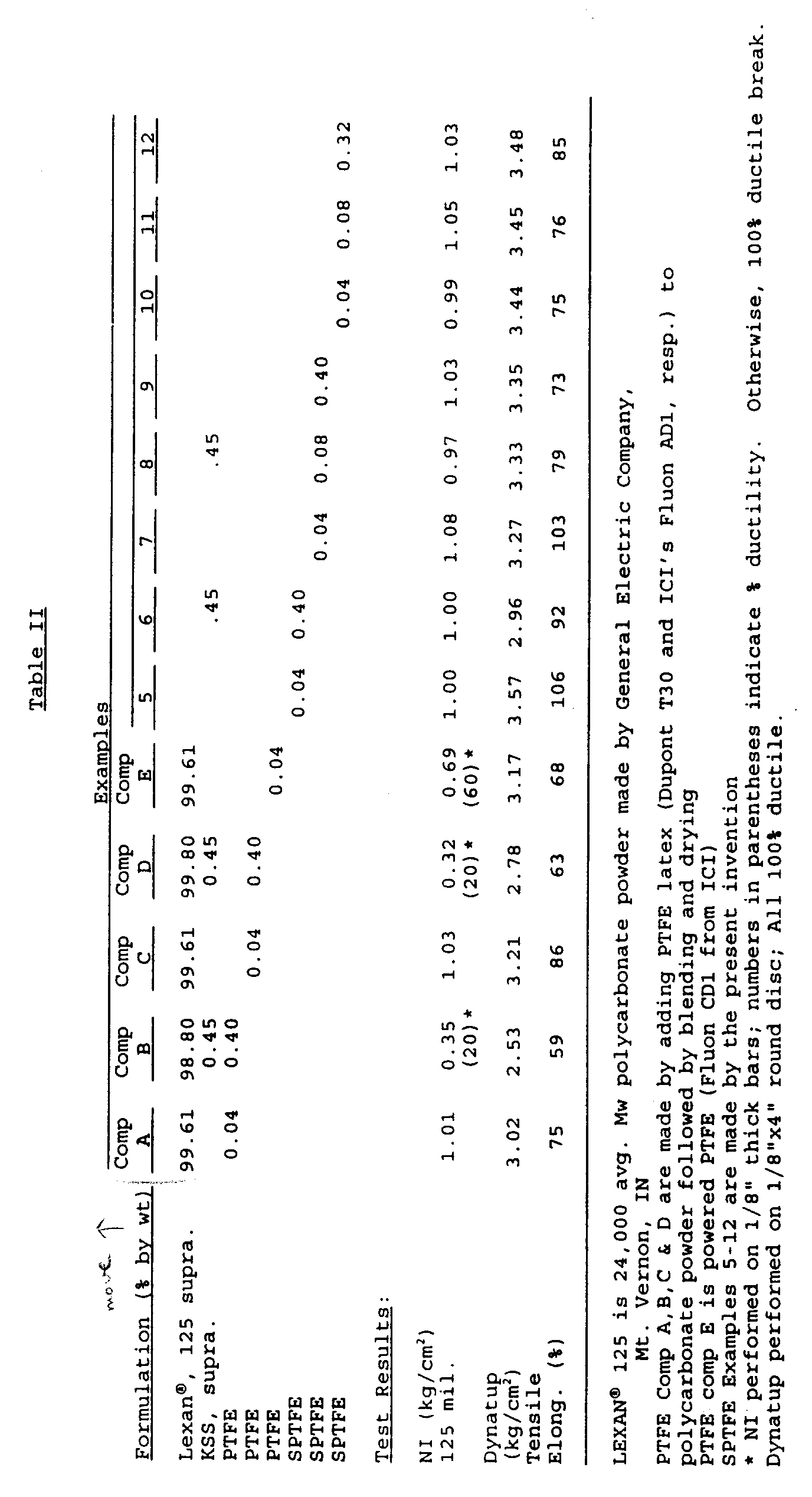
- These Examples described the properties obtained with the concentrate of this invention when employed with a polycarbonate resin (LEXAN® 125) and an acrylonitrile-butadine-styrene resin (ABS). The PTFE/PC concentrate employed herein is the same prepared by the process of Examples 1-4 except that the concentrate is a 20%by weight of PTFE in polycarbonate. The comparative straight blend of PTFE/polycarbonate is also a 20% by weight of PTFE and 80% by weight of polycarbonate. Test specimens are prepared and tested in accordance with the same test procedure set forth in Examples 1-12, Control Example of Table I and Comparative Examples A-E of Table II. The results obtained were reported on Table III below:
Table III Formulation (% by wt) 5 Examples Comp F 13 Comp G 14 Lexan®, 125 79.75 79.75 77.75 77.75 ABS 10.5 10.5 10.5 10.5 FR 8.0 8.0 8.0 8.0 PTFE/PC blend 1.0 (0.2/0.8) 3.0 (0.6/2.4) SPTFE/PC concentrate 1.0 (0.2/0.8) 3.0 (0.6/2.4) Stabilizer 0.75 0.75 0.75 0.75 Test Results: NI (ft-lb/in) 9 11.5 8.6 12 Dynatup (total energy ft-lb) 33.8 36.3 31.2 39.4 UL94 5VA (pass thickness mm) 3.2 3.2 3.2 2.8 UL94 5VB (pass thickness mm) 2.5 2.3 2.5 2.3 LEXAN® 125 is 24,000 avg. Mw polycarbonate powder made by General Electric Company, Mt. Vernon, In.
ABS - acrylonitrile-butadine-styrene
FR - Phosphate flame retardant by AKZO
SPTFE/PC - steam precipitated polycarbonate/PTFE per this invention
PTFE/PC - straight blend of PTFE and polycarbonate as used in Examples 1-4
Stabilizer - combination of mold release agent and UV stabilizer - Examples 13-14 were repeated except that in place of the PC/ABS composition, a polyphenylene-ether/high impact polystyrene blend composition is employed herein.
- The results obtained are reported in Table IV below:
Table IV Formulation (% by wt) 5 Examples 15 Comp H PPE 49.20 40.20 HIPS 25.26 25.26 FR 20 20 SPTFE/PC concentrate 1.0 (0.2/0.8) PTFE/PC blend 1.0 (0.2/0.8) Stabilizer 2.15 2.15 Test Results: NI (ft-lb/in) 5.4 5 Dynatup (total energy ft-lb) 37.3 29.7 PPEO - polyphenylene ether from General Electric Company
HIPS - high impact polystyrene
Stabilizer - same as on Table III except contains polyethylene
All others are the same as in Table III - Examples 13-14 and Comparative Examples F-G were repeated except that in place of the polycarbonate/ABS system, a polybutylene terephthalate resin system was employed herein. The results obtained were reported in Table V below:
Table V Formulation (% by Wgt) 5 Examples 16 17 18 Comp I Comp J Comp K PBT 77.25 76.25 75.25 77.25 76.25 75.25 FR 20.0 20.0 20.0 20.0 20.0 20.0 SPTFE/PC concentrate PTFE/PC blend 1 2 3 1 2 3 Additive 1.75 1.75 1.75 1.75 1.75 1.75 Test Results: NI (ft-lb/inch) 1 1 1 1 1.2 1.3 1/8" Unotched Izod (ft-lb/inch) 34.8 39.2 40 15.8 24.4 32.7 % ductibility of Unotched Izod 100 100 100 20 40 20 Tensile Break TYPE V 1/8" 9235 60440 116,100 2992 4114 34260 Tensile Elongation (%) TYPE V 1/8" 150 165 178 63 121 138 PBT - VALOX® polymer manufactured by General Electric Company, Mt. Vernon, IN
FR - Bromine epoxy antimony oxide
Additive - blend of mold release agent and UV stabilizer
All other constituents of the Formulation are the same as in Table I-IV - As may be observed from Table II, above, the process of the present invention permits one to achieve high weights of additive dispersion in a polymer resin, without substantial loss of physical properties associated with the polymer. In particular, the process allows for raising the level of PTFE in a polycarbonate formulation to enhance drip inhibition performance, without sacrificing mechanical properties in articles molded from the formulations.
- Note that the PTFE concentrate used in comp. B is the same as that used in the control formulation in Table I. It can be seen that the mechanical properties of these 2 formulations in Tables I and II are different. This inconsistent behavior is very typical when poorly dispersed PTFE is used in plastics formulations.
- As observed from Table III, IV and V, impact resistance is increased with compositions employing the concentrate prepared by the process of this invention. Also, flame resistance is increased as shown in Table III wherein thinner sections are burned through by the UL tests (note Examples 13 and 14 vs. Comp Examples F and G for 5VB and Example 14 vs. Comp Example G for 5Va). Further, note that tensile break and tensile elongation are greatly increased.
- Those skilled in the art will appreciate that many modifications may be made to the process of the invention as described above in relation to the dispersion of PTFE in a polycarbonate resin, without departing from the spirit and the scope of the invention. For example, two or more additives may be dispersed in a given resin simultaneously. In general, any additives may be so dispersed, particularly if they are capable of being carried in a solid or colloidal dispersion or as a solution for use in the process of the invention. Variables such as steam precipitation nozzle sizes, steam pressures, particle sizes, and ratios of components may all be adjusted to optimize results. The mixing of fluid streams and coprecipitation step may both be carried out at ambient temperatures and under atmospheric pressures although higher temperatures and pressures are not excluded.
- It is interesting to note that the solid particles such as PTFE are individually encapsulated in the thermoplastic resin with which they have been co-precipitated. In other words, the present invention co-precipitates a particle comprised of a solid core such as PTFE and a shell of a thermoplastic resin such as polycarbonate. This concentrate may then be further blended with a thermoplastic resin which forms a continuous phase surrounding the individually encapsulated particles of solid additive. Thus, the term "individually encapsulated" refers to the particle comprised of a solid additive core and a shell of a thermoplastic resin which may or may not be further surrounded by a continuous phase resin.
Claims (10)
- A process for incorporating a solid form of an additive in a highly dispersed manner into particles of a thermoplastic synthetic polymer, which comprises;
providing a fluid mixture of the additive; providing a solution of the thermoplastic polymer;
admixing the additive mixture with the thermoplastic polymer solution; and
removing the fluid and the solvent from the admixture simultaneously, whereby there is a co-precipitation of the additive and the thermoplastic polymer from the admixture. - A thermoplastic resin molding composition, which comprises;
a thermoplastic resin; and
the product of the process of claim 1. - The thermoplastic resin composition of claim 2 wherein the thermoplastic resin is a blend of an aromatic polycarbonate and an acrylonitrile-butadiene-styrene polymer.
- The thermoplastic resin composition of claim 2 wherein the thermoplastic resin is a polyalkylene terephthalate resin.
- The thermoplastic resin composition of claim 2 wherein the thermoplastic resin is a blend of a polyphenylene ether and a styrene polymer.
- A composition comprising:(A) a thermoplastic polymer, and(B)solid particles of an additive, wherein said solid particles are highly dispersed and encapsulated within said thermoplastic polymer; wherein said particles are encapsulated through the simultaneous removal of both fluid and solvent from the admixture of said thermoplastic polymer and said particles of additive whereby said additive and said thermoplastic polymer are simultaneously co-precipitated from said fluid and solvent admixture.
- The composition of claim 6, wherein said thermoplastic polymer is selected from polyethylene, other polyolefins and copolymers of ethylene and 1-olefins; polystyrene; polyvinyl halides; polyvinylidene halides; polyacrylates; linear polycarbonamides; superpolyamides; polycaprolactams; polycarbonimides; polyethers; polycarbonates; or polyoxyalkylenes.
- The composition of claim 6, where said additive is selected from the group comprising fillers; supplementary delustrants; impact modifiers; antistaic agent; antioxidants; plasticizers; flow promoters and other processing aids; stabilizers; colorants; mold release agents; supplementary or synergistic flam retardants; or ultraviolet screening agents.
- A composition comprising solid, steam co-precipitated particles of highly dispersed polytetrafluoroethylene individually encapsulated within a thermoplastic polymer wherein said particles comprise about 0.01 to about 70% by weight of said composition and said thermoplastic polymer comprises from about 30 to about 99.99% by weight of said composition.
- The composition of Claim 9, wherein said thermoplastic polymer is selected from polyethylene, other polyolefins and copolymers of ethylene and 1-olefins; polystyrene; polyvinyl halides; polyvinylidene halides; polyacrylates; linear polycarbonamides; superpolyamides; polycaprolactams; polycarbonimides; polyethers; polycarbonates; or polyoxalkylenes.
Priority Applications (2)
| Application Number | Priority Date | Filing Date | Title |
|---|---|---|---|
| EP94309600A EP0718346A1 (en) | 1994-12-21 | 1994-12-21 | Dispersing solid additives in polymers |
| CN95101314.9A CN1127269A (en) | 1994-12-21 | 1995-01-19 | Method of dispersing solid additives in polymers and products made therewith |
Applications Claiming Priority (2)
| Application Number | Priority Date | Filing Date | Title |
|---|---|---|---|
| EP94309600A EP0718346A1 (en) | 1994-12-21 | 1994-12-21 | Dispersing solid additives in polymers |
| CN95101314.9A CN1127269A (en) | 1994-12-21 | 1995-01-19 | Method of dispersing solid additives in polymers and products made therewith |
Publications (1)
| Publication Number | Publication Date |
|---|---|
| EP0718346A1 true EP0718346A1 (en) | 1996-06-26 |
Family
ID=37102005
Family Applications (1)
| Application Number | Title | Priority Date | Filing Date |
|---|---|---|---|
| EP94309600A Withdrawn EP0718346A1 (en) | 1994-12-21 | 1994-12-21 | Dispersing solid additives in polymers |
Country Status (2)
| Country | Link |
|---|---|
| EP (1) | EP0718346A1 (en) |
| CN (1) | CN1127269A (en) |
Cited By (4)
| Publication number | Priority date | Publication date | Assignee | Title |
|---|---|---|---|---|
| EP0838503A1 (en) * | 1996-10-25 | 1998-04-29 | General Electric Company | Flame retardant composition of polyerstercarbonate, halogenated polycarbonate, potassium diphenylsulfone sulfonate and polytetrafluoroethylene |
| NL1006913C2 (en) * | 1997-09-02 | 1999-03-04 | Dsm Nv | Process for the preparation of a polymer composition. |
| US6117542A (en) * | 1997-02-17 | 2000-09-12 | Asahi Kasei Kogyo Kabushiki Kaisha | Flame retardant resin composition |
| US6911488B2 (en) | 2000-09-27 | 2005-06-28 | Shamrock Technologies, Inc. | Physical methods of dispersing characteristic use particles and compositions thereof |
Families Citing this family (4)
| Publication number | Priority date | Publication date | Assignee | Title |
|---|---|---|---|---|
| US20090264594A1 (en) * | 2005-12-05 | 2009-10-22 | Solvay (Societe Anonyme) | Aromatic Sulfone Polymer Composition Comprising Tetrafluoroethylene Polymer Particles |
| CN110139954B (en) * | 2016-12-27 | 2023-05-12 | Sabic环球技术有限责任公司 | Fibers comprising fibrillated reinforcement |
| CN110655665B (en) * | 2019-09-23 | 2022-09-09 | 铨盛聚碳科技股份有限公司 | Polytetrafluoroethylene anti-dripping agent, preparation method and application thereof |
| CN114426688B (en) * | 2020-10-15 | 2024-07-02 | 中国石油化工股份有限公司 | Method for preparing rubber auxiliary agent dispersion liquid, brominated butyl rubber and preparation method thereof |
Citations (5)
| Publication number | Priority date | Publication date | Assignee | Title |
|---|---|---|---|---|
| FR890326A (en) * | 1943-01-22 | 1944-02-04 | High inert matter molding powder and method of manufacture | |
| US3215663A (en) * | 1961-06-23 | 1965-11-02 | Mineral Pigments Corp | Process for pigment dispersion |
| US4153639A (en) * | 1975-07-18 | 1979-05-08 | General Electric Company | Process for intimately blending thermoplastic resins with additives |
| EP0269950A2 (en) * | 1986-12-02 | 1988-06-08 | Bayer Ag | A process for incorporation of fluoropolymers into polycarbonates |
| EP0598603A1 (en) * | 1992-11-17 | 1994-05-25 | General Electric Company | Method of dispersing solid additives in polymeric resins |
-
1994
- 1994-12-21 EP EP94309600A patent/EP0718346A1/en not_active Withdrawn
-
1995
- 1995-01-19 CN CN95101314.9A patent/CN1127269A/en active Pending
Patent Citations (5)
| Publication number | Priority date | Publication date | Assignee | Title |
|---|---|---|---|---|
| FR890326A (en) * | 1943-01-22 | 1944-02-04 | High inert matter molding powder and method of manufacture | |
| US3215663A (en) * | 1961-06-23 | 1965-11-02 | Mineral Pigments Corp | Process for pigment dispersion |
| US4153639A (en) * | 1975-07-18 | 1979-05-08 | General Electric Company | Process for intimately blending thermoplastic resins with additives |
| EP0269950A2 (en) * | 1986-12-02 | 1988-06-08 | Bayer Ag | A process for incorporation of fluoropolymers into polycarbonates |
| EP0598603A1 (en) * | 1992-11-17 | 1994-05-25 | General Electric Company | Method of dispersing solid additives in polymeric resins |
Cited By (6)
| Publication number | Priority date | Publication date | Assignee | Title |
|---|---|---|---|---|
| EP0838503A1 (en) * | 1996-10-25 | 1998-04-29 | General Electric Company | Flame retardant composition of polyerstercarbonate, halogenated polycarbonate, potassium diphenylsulfone sulfonate and polytetrafluoroethylene |
| US6117542A (en) * | 1997-02-17 | 2000-09-12 | Asahi Kasei Kogyo Kabushiki Kaisha | Flame retardant resin composition |
| DE19806573C5 (en) * | 1997-02-17 | 2004-07-01 | Asahi Kasei Kabushiki Kaisha | Process for producing a flame retardant resin composition |
| NL1006913C2 (en) * | 1997-09-02 | 1999-03-04 | Dsm Nv | Process for the preparation of a polymer composition. |
| EP0900641A1 (en) * | 1997-09-02 | 1999-03-10 | Dsm N.V. | Process for the preparation of a polymer composition |
| US6911488B2 (en) | 2000-09-27 | 2005-06-28 | Shamrock Technologies, Inc. | Physical methods of dispersing characteristic use particles and compositions thereof |
Also Published As
| Publication number | Publication date |
|---|---|
| CN1127269A (en) | 1996-07-24 |
Similar Documents
| Publication | Publication Date | Title |
|---|---|---|
| US5521230A (en) | Method of dispersing solid additives in polymers and products made therewith | |
| EP0598603B1 (en) | Method of dispersing solid polytetrafluoroethylene in polymeric resins | |
| US6005025A (en) | Method of dispersing solid additives in polymers and products made therewith | |
| JPH08188653A (en) | Method for dispersing solid additives in polymers and products obtained thereby | |
| DE3885816T2 (en) | Mixtures of polycarbonate and siloxane-polyetherimide copolymer. | |
| DE69333205T2 (en) | Ductile mixtures of polyester carbonates with polyimide resins | |
| CA1282197C (en) | Process for incorporation of fluoropolymers into polycarbonates | |
| DE69028152T2 (en) | Process for the preparation of polycarbonate-polysiloxane block copolymers | |
| EP0711810A1 (en) | Autoclave resistant blends of poly(ester-carbonate) and polyetherimide resins | |
| DE69312681T2 (en) | FLAME RETARDANT THERMOFORMABLE MIXTURES MADE OF COPOLYMERS RESIN | |
| EP0483510A2 (en) | Polycarbonate compositions with improved appearance and flammability characteristics | |
| DE3785049T2 (en) | FLAME RESISTANT POLYIMIDE RESIN COMPOSITION. | |
| EP0519657A1 (en) | Ductile, non-halogenated flame retardant ternary blends of polyetherimide, siloxane polyetherimide copolymer and polycarbonate | |
| JPH10273591A (en) | Transparent blend of polyetherimide resin | |
| US4885336A (en) | Low gloss polycarbonate blend | |
| US5102696A (en) | Method of dispersing fluoropolymers on polycarbonate resins | |
| EP0916685B1 (en) | Branching agents for reactive extrusion | |
| US4918125A (en) | Flame retardant carbonate polymer blends | |
| EP0375932A2 (en) | Low-gloss aromatic carbonate polymer blend | |
| US5274017A (en) | Flame retardant carbonate polymer containing selected metal oxides | |
| JPH11140296A (en) | Polycarbonate molding composition | |
| US6087468A (en) | Method of branching and cross-linking a polycarbonate resin | |
| CN1127269A (en) | Method of dispersing solid additives in polymers and products made therewith | |
| NL1006913C2 (en) | Process for the preparation of a polymer composition. | |
| EP0141268A2 (en) | Composition of polycarbonate |
Legal Events
| Date | Code | Title | Description |
|---|---|---|---|
| PUAI | Public reference made under article 153(3) epc to a published international application that has entered the european phase |
Free format text: ORIGINAL CODE: 0009012 |
|
| AK | Designated contracting states |
Kind code of ref document: A1 Designated state(s): DE ES FR GB IT NL |
|
| 17P | Request for examination filed |
Effective date: 19961227 |
|
| 17Q | First examination report despatched |
Effective date: 19991015 |
|
| STAA | Information on the status of an ep patent application or granted ep patent |
Free format text: STATUS: THE APPLICATION IS DEEMED TO BE WITHDRAWN |
|
| 18D | Application deemed to be withdrawn |
Effective date: 20011012 |