EP0718281B1 - Cyclohexanediurea derivative and process for producing the same - Google Patents
Cyclohexanediurea derivative and process for producing the same Download PDFInfo
- Publication number
- EP0718281B1 EP0718281B1 EP94926366A EP94926366A EP0718281B1 EP 0718281 B1 EP0718281 B1 EP 0718281B1 EP 94926366 A EP94926366 A EP 94926366A EP 94926366 A EP94926366 A EP 94926366A EP 0718281 B1 EP0718281 B1 EP 0718281B1
- Authority
- EP
- European Patent Office
- Prior art keywords
- cyclohexane
- nch
- bis
- methyl
- brs
- Prior art date
- Legal status (The legal status is an assumption and is not a legal conclusion. Google has not performed a legal analysis and makes no representation as to the accuracy of the status listed.)
- Expired - Lifetime
Links
- 238000000034 method Methods 0.000 title claims abstract description 134
- 150000003839 salts Chemical class 0.000 claims abstract description 113
- 125000000217 alkyl group Chemical group 0.000 claims abstract description 19
- 125000000753 cycloalkyl group Chemical group 0.000 claims abstract description 14
- 125000001997 phenyl group Chemical group [H]C1=C([H])C([H])=C(*)C([H])=C1[H] 0.000 claims abstract description 9
- 125000002541 furyl group Chemical group 0.000 claims abstract description 8
- 125000001041 indolyl group Chemical group 0.000 claims abstract description 6
- 125000005956 isoquinolyl group Chemical group 0.000 claims abstract description 6
- 125000004076 pyridyl group Chemical group 0.000 claims abstract description 6
- 125000005493 quinolyl group Chemical group 0.000 claims abstract description 6
- 125000003710 aryl alkyl group Chemical group 0.000 claims abstract description 3
- 150000001875 compounds Chemical class 0.000 claims description 170
- -1 4-dimethylaminophenyl Chemical group 0.000 claims description 59
- YMHQVDAATAEZLO-UHFFFAOYSA-N cyclohexane-1,1-diamine Chemical class NC1(N)CCCCC1 YMHQVDAATAEZLO-UHFFFAOYSA-N 0.000 claims description 12
- 125000000113 cyclohexyl group Chemical group [H]C1([H])C([H])([H])C([H])([H])C([H])(*)C([H])([H])C1([H])[H] 0.000 claims description 9
- SIHFCVXQGXGQQO-UHFFFAOYSA-N 1-cyclohexyl-1-[[4-[[cyclohexyl-[[4-(dimethylamino)phenyl]carbamoyl]amino]methyl]cyclohexyl]methyl]-3-[4-(dimethylamino)phenyl]urea Chemical compound C1=CC(N(C)C)=CC=C1NC(=O)N(C1CCCCC1)CC1CCC(CN(C2CCCCC2)C(=O)NC=2C=CC(=CC=2)N(C)C)CC1 SIHFCVXQGXGQQO-UHFFFAOYSA-N 0.000 claims description 6
- 201000001320 Atherosclerosis Diseases 0.000 claims description 6
- 208000031226 Hyperlipidaemia Diseases 0.000 claims description 6
- 102000001494 Sterol O-Acyltransferase Human genes 0.000 claims description 5
- 108010054082 Sterol O-acyltransferase Proteins 0.000 claims description 5
- GDTBXPJZTBHREO-UHFFFAOYSA-N bromine Chemical compound BrBr GDTBXPJZTBHREO-UHFFFAOYSA-N 0.000 claims description 5
- 125000004432 carbon atom Chemical group C* 0.000 claims description 5
- 239000008194 pharmaceutical composition Substances 0.000 claims description 5
- 150000003672 ureas Chemical class 0.000 claims description 5
- AMVRQBWUVQGWSF-UEOVJWFCSA-N C1(CCCCCC1)N(C(=O)NC1=CC=C(C=C1)N(C)C)C[C@@H]1CC[C@H](CC1)CN(C(=O)NC1=CC=C(C=C1)N(C)C)C1CCCCCC1 Chemical compound C1(CCCCCC1)N(C(=O)NC1=CC=C(C=C1)N(C)C)C[C@@H]1CC[C@H](CC1)CN(C(=O)NC1=CC=C(C=C1)N(C)C)C1CCCCCC1 AMVRQBWUVQGWSF-UEOVJWFCSA-N 0.000 claims description 4
- POSDUKVHMNEPRB-BOLQZFTNSA-N C1CC(C)CCC1N(C(=O)NC=1C=CC(=CC=1)N(C)C)C[C@@H]1CC[C@@H](CN(C2CCC(C)CC2)C(=O)NC=2C=CC(=CC=2)N(C)C)CC1 Chemical compound C1CC(C)CCC1N(C(=O)NC=1C=CC(=CC=1)N(C)C)C[C@@H]1CC[C@@H](CN(C2CCC(C)CC2)C(=O)NC=2C=CC(=CC=2)N(C)C)CC1 POSDUKVHMNEPRB-BOLQZFTNSA-N 0.000 claims description 4
- 239000003937 drug carrier Substances 0.000 claims description 4
- 239000002532 enzyme inhibitor Substances 0.000 claims description 4
- ZCYVEMRRCGMTRW-UHFFFAOYSA-N 7553-56-2 Chemical group [I] ZCYVEMRRCGMTRW-UHFFFAOYSA-N 0.000 claims description 3
- HWWCMZWQNLDIAE-AQOCXMLWSA-N C([C@@H]1CC[C@@H](CN(C2CCCCC2)C(=O)NC=2C=CC(=CC=2)N2CCCC2)CC1)N(C1CCCCC1)C(=O)NC(C=C1)=CC=C1N1CCCC1 Chemical compound C([C@@H]1CC[C@@H](CN(C2CCCCC2)C(=O)NC=2C=CC(=CC=2)N2CCCC2)CC1)N(C1CCCCC1)C(=O)NC(C=C1)=CC=C1N1CCCC1 HWWCMZWQNLDIAE-AQOCXMLWSA-N 0.000 claims description 3
- ZLLRJWZHXVROLV-INUXSMKFSA-N C([C@@H]1CC[C@@H](CN(C2CCCCC2)C(=O)NC=2C=CC(=CC=2)N2CCCCC2)CC1)N(C1CCCCC1)C(=O)NC(C=C1)=CC=C1N1CCCCC1 Chemical compound C([C@@H]1CC[C@@H](CN(C2CCCCC2)C(=O)NC=2C=CC(=CC=2)N2CCCCC2)CC1)N(C1CCCCC1)C(=O)NC(C=C1)=CC=C1N1CCCCC1 ZLLRJWZHXVROLV-INUXSMKFSA-N 0.000 claims description 3
- HLKRMEXUBHSXOR-GTXVXJEKSA-N C([C@@H]1CC[C@@H](CN(C2CCCCCC2)C(=O)NC=2C=CC(=CC=2)N2CCCCC2)CC1)N(C1CCCCCC1)C(=O)NC(C=C1)=CC=C1N1CCCCC1 Chemical compound C([C@@H]1CC[C@@H](CN(C2CCCCCC2)C(=O)NC=2C=CC(=CC=2)N2CCCCC2)CC1)N(C1CCCCCC1)C(=O)NC(C=C1)=CC=C1N1CCCCC1 HLKRMEXUBHSXOR-GTXVXJEKSA-N 0.000 claims description 3
- JEOFMJIBQBDRJJ-QVYRIUEQSA-N C1(CCCC1)N(C(=O)NC1=CC=C(C=C1)N(C)C)C[C@@H]1CC[C@H](CC1)CN(C(=O)NC1=CC=C(C=C1)N(C)C)C1CCCC1 Chemical compound C1(CCCC1)N(C(=O)NC1=CC=C(C=C1)N(C)C)C[C@@H]1CC[C@H](CC1)CN(C(=O)NC1=CC=C(C=C1)N(C)C)C1CCCC1 JEOFMJIBQBDRJJ-QVYRIUEQSA-N 0.000 claims description 3
- NFEPQEJKROIKMY-AQOCXMLWSA-N C1(CCCCC1)N(C(=O)NC1=CC=C(C=C1)N(CC)CC)C[C@@H]1CC[C@H](CC1)CN(C(=O)NC1=CC=C(C=C1)N(CC)CC)C1CCCCC1 Chemical compound C1(CCCCC1)N(C(=O)NC1=CC=C(C=C1)N(CC)CC)C[C@@H]1CC[C@H](CC1)CN(C(=O)NC1=CC=C(C=C1)N(CC)CC)C1CCCCC1 NFEPQEJKROIKMY-AQOCXMLWSA-N 0.000 claims description 3
- BEVAWTLWLYYSNE-INUXSMKFSA-N C1(CCCCCC1)N(C(=O)NC1=CC=C(C=C1)N(CC)CC)C[C@@H]1CC[C@H](CC1)CN(C(=O)NC1=CC=C(C=C1)N(CC)CC)C1CCCCCC1 Chemical compound C1(CCCCCC1)N(C(=O)NC1=CC=C(C=C1)N(CC)CC)C[C@@H]1CC[C@H](CC1)CN(C(=O)NC1=CC=C(C=C1)N(CC)CC)C1CCCCCC1 BEVAWTLWLYYSNE-INUXSMKFSA-N 0.000 claims description 3
- XWDSANOZCVYTAA-INUXSMKFSA-N C1(CCCCCC1)N(C(=O)NC1=CC=C(C=C1)N1CCCC1)C[C@@H]1CC[C@H](CC1)CN(C(=O)NC1=CC=C(C=C1)N1CCCC1)C1CCCCCC1 Chemical compound C1(CCCCCC1)N(C(=O)NC1=CC=C(C=C1)N1CCCC1)C[C@@H]1CC[C@H](CC1)CN(C(=O)NC1=CC=C(C=C1)N1CCCC1)C1CCCCCC1 XWDSANOZCVYTAA-INUXSMKFSA-N 0.000 claims description 3
- 229910052794 bromium Inorganic materials 0.000 claims description 3
- 239000000460 chlorine Substances 0.000 claims description 3
- 229910052801 chlorine Inorganic materials 0.000 claims description 3
- 125000001511 cyclopentyl group Chemical group [H]C1([H])C([H])([H])C([H])([H])C([H])(*)C1([H])[H] 0.000 claims description 3
- 229940125532 enzyme inhibitor Drugs 0.000 claims description 3
- 229910052740 iodine Inorganic materials 0.000 claims description 3
- 239000004480 active ingredient Substances 0.000 claims description 2
- 125000001995 cyclobutyl group Chemical group [H]C1([H])C([H])([H])C([H])(*)C1([H])[H] 0.000 claims description 2
- 125000006527 (C1-C5) alkyl group Chemical group 0.000 claims 1
- KZBUYRJDOAKODT-UHFFFAOYSA-N Chlorine Chemical compound ClCl KZBUYRJDOAKODT-UHFFFAOYSA-N 0.000 claims 1
- 125000001424 substituent group Chemical group 0.000 abstract description 7
- 238000004519 manufacturing process Methods 0.000 abstract description 3
- IAZDPXIOMUYVGZ-WFGJKAKNSA-N Dimethyl sulfoxide Chemical compound [2H]C([2H])([2H])S(=O)C([2H])([2H])[2H] IAZDPXIOMUYVGZ-WFGJKAKNSA-N 0.000 description 234
- 238000005481 NMR spectroscopy Methods 0.000 description 117
- 238000000921 elemental analysis Methods 0.000 description 117
- 238000004992 fast atom bombardment mass spectroscopy Methods 0.000 description 117
- 235000002639 sodium chloride Nutrition 0.000 description 117
- 125000002147 dimethylamino group Chemical group [H]C([H])([H])N(*)C([H])([H])[H] 0.000 description 89
- 239000002253 acid Substances 0.000 description 88
- 125000002496 methyl group Chemical group [H]C([H])([H])* 0.000 description 82
- XDTMQSROBMDMFD-UHFFFAOYSA-N Cyclohexane Chemical compound C1CCCCC1 XDTMQSROBMDMFD-UHFFFAOYSA-N 0.000 description 64
- XLYOFNOQVPJJNP-ZSJDYOACSA-N heavy water Substances [2H]O[2H] XLYOFNOQVPJJNP-ZSJDYOACSA-N 0.000 description 51
- HVYWMOMLDIMFJA-DPAQBDIFSA-N cholesterol Chemical compound C1C=C2C[C@@H](O)CC[C@]2(C)[C@@H]2[C@@H]1[C@@H]1CC[C@H]([C@H](C)CCCC(C)C)[C@@]1(C)CC2 HVYWMOMLDIMFJA-DPAQBDIFSA-N 0.000 description 44
- 125000001951 carbamoylamino group Chemical group C(N)(=O)N* 0.000 description 40
- XLYOFNOQVPJJNP-UHFFFAOYSA-N water Substances O XLYOFNOQVPJJNP-UHFFFAOYSA-N 0.000 description 29
- UHOVQNZJYSORNB-UHFFFAOYSA-N Benzene Chemical compound C1=CC=CC=C1 UHOVQNZJYSORNB-UHFFFAOYSA-N 0.000 description 27
- YXFVVABEGXRONW-UHFFFAOYSA-N Toluene Chemical compound CC1=CC=CC=C1 YXFVVABEGXRONW-UHFFFAOYSA-N 0.000 description 27
- 239000002904 solvent Substances 0.000 description 25
- HEDRZPFGACZZDS-UHFFFAOYSA-N Chloroform Chemical compound ClC(Cl)Cl HEDRZPFGACZZDS-UHFFFAOYSA-N 0.000 description 24
- WYURNTSHIVDZCO-UHFFFAOYSA-N Tetrahydrofuran Chemical compound C1CCOC1 WYURNTSHIVDZCO-UHFFFAOYSA-N 0.000 description 22
- YMWUJEATGCHHMB-UHFFFAOYSA-N Dichloromethane Chemical compound ClCCl YMWUJEATGCHHMB-UHFFFAOYSA-N 0.000 description 21
- ZMXDDKWLCZADIW-UHFFFAOYSA-N N,N-Dimethylformamide Chemical compound CN(C)C=O ZMXDDKWLCZADIW-UHFFFAOYSA-N 0.000 description 21
- 235000012000 cholesterol Nutrition 0.000 description 21
- 238000006243 chemical reaction Methods 0.000 description 20
- RTZKZFJDLAIYFH-UHFFFAOYSA-N Diethyl ether Chemical compound CCOCC RTZKZFJDLAIYFH-UHFFFAOYSA-N 0.000 description 18
- ZMANZCXQSJIPKH-UHFFFAOYSA-N Triethylamine Chemical compound CCN(CC)CC ZMANZCXQSJIPKH-UHFFFAOYSA-N 0.000 description 18
- 230000000694 effects Effects 0.000 description 16
- 238000012360 testing method Methods 0.000 description 15
- 102000004190 Enzymes Human genes 0.000 description 14
- 108090000790 Enzymes Proteins 0.000 description 14
- VLKZOEOYAKHREP-UHFFFAOYSA-N n-Hexane Chemical compound CCCCCC VLKZOEOYAKHREP-UHFFFAOYSA-N 0.000 description 14
- WEVYAHXRMPXWCK-UHFFFAOYSA-N Acetonitrile Chemical compound CC#N WEVYAHXRMPXWCK-UHFFFAOYSA-N 0.000 description 12
- OAKJQQAXSVQMHS-UHFFFAOYSA-N Hydrazine Chemical compound NN OAKJQQAXSVQMHS-UHFFFAOYSA-N 0.000 description 12
- 239000003795 chemical substances by application Substances 0.000 description 11
- 239000011541 reaction mixture Substances 0.000 description 11
- YLQBMQCUIZJEEH-UHFFFAOYSA-N tetrahydrofuran Natural products C=1C=COC=1 YLQBMQCUIZJEEH-UHFFFAOYSA-N 0.000 description 11
- UIIMBOGNXHQVGW-UHFFFAOYSA-M Sodium bicarbonate Chemical compound [Na+].OC([O-])=O UIIMBOGNXHQVGW-UHFFFAOYSA-M 0.000 description 10
- 230000015572 biosynthetic process Effects 0.000 description 10
- QYQADNCHXSEGJT-UHFFFAOYSA-N cyclohexane-1,1-dicarboxylate;hydron Chemical compound OC(=O)C1(C(O)=O)CCCCC1 QYQADNCHXSEGJT-UHFFFAOYSA-N 0.000 description 10
- 125000001570 methylene group Chemical group [H]C([H])([*:1])[*:2] 0.000 description 10
- 239000000243 solution Substances 0.000 description 10
- 238000003786 synthesis reaction Methods 0.000 description 10
- VZCYOOQTPOCHFL-UHFFFAOYSA-N trans-butenedioic acid Natural products OC(=O)C=CC(O)=O VZCYOOQTPOCHFL-UHFFFAOYSA-N 0.000 description 10
- KWYUFKZDYYNOTN-UHFFFAOYSA-M Potassium hydroxide Chemical compound [OH-].[K+] KWYUFKZDYYNOTN-UHFFFAOYSA-M 0.000 description 9
- HEMHJVSKTPXQMS-UHFFFAOYSA-M Sodium hydroxide Chemical compound [OH-].[Na+] HEMHJVSKTPXQMS-UHFFFAOYSA-M 0.000 description 9
- 238000007796 conventional method Methods 0.000 description 9
- 150000002513 isocyanates Chemical class 0.000 description 9
- IAZDPXIOMUYVGZ-UHFFFAOYSA-N Dimethylsulphoxide Chemical compound CS(C)=O IAZDPXIOMUYVGZ-UHFFFAOYSA-N 0.000 description 8
- CDBYLPFSWZWCQE-UHFFFAOYSA-L Sodium Carbonate Chemical compound [Na+].[Na+].[O-]C([O-])=O CDBYLPFSWZWCQE-UHFFFAOYSA-L 0.000 description 8
- 150000001412 amines Chemical class 0.000 description 8
- 238000001816 cooling Methods 0.000 description 8
- 239000013078 crystal Substances 0.000 description 8
- 230000002829 reductive effect Effects 0.000 description 8
- 150000004985 diamines Chemical class 0.000 description 7
- 210000001589 microsome Anatomy 0.000 description 7
- RYHBNJHYFVUHQT-UHFFFAOYSA-N 1,4-Dioxane Chemical compound C1COCCO1 RYHBNJHYFVUHQT-UHFFFAOYSA-N 0.000 description 6
- 0 CC1(C*(*)CCCCC1)N Chemical compound CC1(C*(*)CCCCC1)N 0.000 description 6
- JUJWROOIHBZHMG-UHFFFAOYSA-N Pyridine Chemical compound C1=CC=NC=C1 JUJWROOIHBZHMG-UHFFFAOYSA-N 0.000 description 6
- KRKNYBCHXYNGOX-UHFFFAOYSA-N citric acid Chemical compound OC(=O)CC(O)(C(O)=O)CC(O)=O KRKNYBCHXYNGOX-UHFFFAOYSA-N 0.000 description 6
- 239000003814 drug Substances 0.000 description 6
- 150000002148 esters Chemical class 0.000 description 6
- 230000002401 inhibitory effect Effects 0.000 description 6
- BWHMMNNQKKPAPP-UHFFFAOYSA-L potassium carbonate Chemical compound [K+].[K+].[O-]C([O-])=O BWHMMNNQKKPAPP-UHFFFAOYSA-L 0.000 description 6
- 210000002966 serum Anatomy 0.000 description 6
- XMKLTEGSALONPH-UHFFFAOYSA-N 1,2,4,5-tetrazinane-3,6-dione Chemical class O=C1NNC(=O)NN1 XMKLTEGSALONPH-UHFFFAOYSA-N 0.000 description 5
- AKJWTZIUYIFCCS-UHFFFAOYSA-N 1-cycloheptyl-1-[[3-[[cycloheptyl-[[4-(dimethylamino)phenyl]carbamoyl]amino]methyl]phenyl]methyl]-3-[4-(dimethylamino)phenyl]urea;dihydrochloride Chemical compound Cl.Cl.C1=CC(N(C)C)=CC=C1NC(=O)N(C1CCCCCC1)CC1=CC=CC(CN(C2CCCCCC2)C(=O)NC=2C=CC(=CC=2)N(C)C)=C1 AKJWTZIUYIFCCS-UHFFFAOYSA-N 0.000 description 5
- 241000283973 Oryctolagus cuniculus Species 0.000 description 5
- OFOBLEOULBTSOW-UHFFFAOYSA-N Propanedioic acid Natural products OC(=O)CC(O)=O OFOBLEOULBTSOW-UHFFFAOYSA-N 0.000 description 5
- 239000000872 buffer Substances 0.000 description 5
- 210000004027 cell Anatomy 0.000 description 5
- 150000001470 diamides Chemical class 0.000 description 5
- 239000012948 isocyanate Substances 0.000 description 5
- 210000004185 liver Anatomy 0.000 description 5
- 239000000203 mixture Substances 0.000 description 5
- 238000002360 preparation method Methods 0.000 description 5
- 238000000746 purification Methods 0.000 description 5
- 229910000030 sodium bicarbonate Inorganic materials 0.000 description 5
- 235000017557 sodium bicarbonate Nutrition 0.000 description 5
- 239000003381 stabilizer Substances 0.000 description 5
- JOYRKODLDBILNP-UHFFFAOYSA-N urethane group Chemical group NC(=O)OCC JOYRKODLDBILNP-UHFFFAOYSA-N 0.000 description 5
- VTYYLEPIZMXCLO-UHFFFAOYSA-L Calcium carbonate Chemical compound [Ca+2].[O-]C([O-])=O VTYYLEPIZMXCLO-UHFFFAOYSA-L 0.000 description 4
- QOSSAOTZNIDXMA-UHFFFAOYSA-N Dicylcohexylcarbodiimide Chemical compound C1CCCCC1N=C=NC1CCCCC1 QOSSAOTZNIDXMA-UHFFFAOYSA-N 0.000 description 4
- LFQSCWFLJHTTHZ-UHFFFAOYSA-N Ethanol Chemical compound CCO LFQSCWFLJHTTHZ-UHFFFAOYSA-N 0.000 description 4
- VZCYOOQTPOCHFL-OWOJBTEDSA-N Fumaric acid Chemical compound OC(=O)\C=C\C(O)=O VZCYOOQTPOCHFL-OWOJBTEDSA-N 0.000 description 4
- VEXZGXHMUGYJMC-UHFFFAOYSA-N Hydrochloric acid Chemical compound Cl VEXZGXHMUGYJMC-UHFFFAOYSA-N 0.000 description 4
- NBIIXXVUZAFLBC-UHFFFAOYSA-N Phosphoric acid Chemical compound OP(O)(O)=O NBIIXXVUZAFLBC-UHFFFAOYSA-N 0.000 description 4
- FAPWRFPIFSIZLT-UHFFFAOYSA-M Sodium chloride Chemical compound [Na+].[Cl-] FAPWRFPIFSIZLT-UHFFFAOYSA-M 0.000 description 4
- 125000003282 alkyl amino group Chemical group 0.000 description 4
- 125000003277 amino group Chemical group 0.000 description 4
- 239000003638 chemical reducing agent Substances 0.000 description 4
- 239000000796 flavoring agent Substances 0.000 description 4
- 235000019634 flavors Nutrition 0.000 description 4
- 235000013305 food Nutrition 0.000 description 4
- 239000012442 inert solvent Substances 0.000 description 4
- 239000002674 ointment Substances 0.000 description 4
- 238000001953 recrystallisation Methods 0.000 description 4
- 210000000813 small intestine Anatomy 0.000 description 4
- 229910000029 sodium carbonate Inorganic materials 0.000 description 4
- QTBSBXVTEAMEQO-UHFFFAOYSA-N Acetic acid Chemical compound CC(O)=O QTBSBXVTEAMEQO-UHFFFAOYSA-N 0.000 description 3
- WFDIJRYMOXRFFG-UHFFFAOYSA-N Acetic anhydride Chemical compound CC(=O)OC(C)=O WFDIJRYMOXRFFG-UHFFFAOYSA-N 0.000 description 3
- RGJOEKWQDUBAIZ-IBOSZNHHSA-N CoASH Chemical compound O[C@@H]1[C@H](OP(O)(O)=O)[C@@H](COP(O)(=O)OP(O)(=O)OCC(C)(C)[C@@H](O)C(=O)NCCC(=O)NCCS)O[C@H]1N1C2=NC=NC(N)=C2N=C1 RGJOEKWQDUBAIZ-IBOSZNHHSA-N 0.000 description 3
- XEKOWRVHYACXOJ-UHFFFAOYSA-N Ethyl acetate Chemical compound CCOC(C)=O XEKOWRVHYACXOJ-UHFFFAOYSA-N 0.000 description 3
- OKKJLVBELUTLKV-UHFFFAOYSA-N Methanol Chemical compound OC OKKJLVBELUTLKV-UHFFFAOYSA-N 0.000 description 3
- JLTDJTHDQAWBAV-UHFFFAOYSA-N N,N-dimethylaniline Chemical compound CN(C)C1=CC=CC=C1 JLTDJTHDQAWBAV-UHFFFAOYSA-N 0.000 description 3
- MUBZPKHOEPUJKR-UHFFFAOYSA-N Oxalic acid Chemical compound OC(=O)C(O)=O MUBZPKHOEPUJKR-UHFFFAOYSA-N 0.000 description 3
- 229920002472 Starch Polymers 0.000 description 3
- 125000004442 acylamino group Chemical group 0.000 description 3
- 239000000654 additive Substances 0.000 description 3
- 125000003545 alkoxy group Chemical group 0.000 description 3
- 125000004453 alkoxycarbonyl group Chemical group 0.000 description 3
- 125000005196 alkyl carbonyloxy group Chemical group 0.000 description 3
- 125000001797 benzyl group Chemical group [H]C1=C([H])C([H])=C(C([H])=C1[H])C([H])([H])* 0.000 description 3
- RGJOEKWQDUBAIZ-UHFFFAOYSA-N coenzime A Natural products OC1C(OP(O)(O)=O)C(COP(O)(=O)OP(O)(=O)OCC(C)(C)C(O)C(=O)NCCC(=O)NCCS)OC1N1C2=NC=NC(N)=C2N=C1 RGJOEKWQDUBAIZ-UHFFFAOYSA-N 0.000 description 3
- 239000005516 coenzyme A Substances 0.000 description 3
- 229940093530 coenzyme a Drugs 0.000 description 3
- 238000004440 column chromatography Methods 0.000 description 3
- KDTSHFARGAKYJN-UHFFFAOYSA-N dephosphocoenzyme A Natural products OC1C(O)C(COP(O)(=O)OP(O)(=O)OCC(C)(C)C(O)C(=O)NCCC(=O)NCCS)OC1N1C2=NC=NC(N)=C2N=C1 KDTSHFARGAKYJN-UHFFFAOYSA-N 0.000 description 3
- 239000002552 dosage form Substances 0.000 description 3
- 230000032050 esterification Effects 0.000 description 3
- 238000005886 esterification reaction Methods 0.000 description 3
- 125000001495 ethyl group Chemical group [H]C([H])([H])C([H])([H])* 0.000 description 3
- 238000000605 extraction Methods 0.000 description 3
- 239000001530 fumaric acid Substances 0.000 description 3
- 238000002347 injection Methods 0.000 description 3
- 239000007924 injection Substances 0.000 description 3
- 125000001449 isopropyl group Chemical group [H]C([H])([H])C([H])(*)C([H])([H])[H] 0.000 description 3
- 239000012280 lithium aluminium hydride Substances 0.000 description 3
- 239000011976 maleic acid Substances 0.000 description 3
- 238000005259 measurement Methods 0.000 description 3
- 239000002609 medium Substances 0.000 description 3
- 229910000027 potassium carbonate Inorganic materials 0.000 description 3
- 239000000843 powder Substances 0.000 description 3
- UMJSCPRVCHMLSP-UHFFFAOYSA-N pyridine Natural products COC1=CC=CN=C1 UMJSCPRVCHMLSP-UHFFFAOYSA-N 0.000 description 3
- 239000011780 sodium chloride Substances 0.000 description 3
- 239000008107 starch Substances 0.000 description 3
- 235000019698 starch Nutrition 0.000 description 3
- 239000000126 substance Substances 0.000 description 3
- 239000000829 suppository Substances 0.000 description 3
- JRMUNVKIHCOMHV-UHFFFAOYSA-M tetrabutylammonium bromide Chemical compound [Br-].CCCC[N+](CCCC)(CCCC)CCCC JRMUNVKIHCOMHV-UHFFFAOYSA-M 0.000 description 3
- JOXIMZWYDAKGHI-UHFFFAOYSA-N toluene-4-sulfonic acid Chemical compound CC1=CC=C(S(O)(=O)=O)C=C1 JOXIMZWYDAKGHI-UHFFFAOYSA-N 0.000 description 3
- XSQUKJJJFZCRTK-UHFFFAOYSA-N urea group Chemical group NC(=O)N XSQUKJJJFZCRTK-UHFFFAOYSA-N 0.000 description 3
- BHQCQFFYRZLCQQ-UHFFFAOYSA-N (3alpha,5alpha,7alpha,12alpha)-3,7,12-trihydroxy-cholan-24-oic acid Natural products OC1CC2CC(O)CCC2(C)C2C1C1CCC(C(CCC(O)=O)C)C1(C)C(O)C2 BHQCQFFYRZLCQQ-UHFFFAOYSA-N 0.000 description 2
- LMDZBCPBFSXMTL-UHFFFAOYSA-N 1-Ethyl-3-(3-dimethylaminopropyl)carbodiimide Substances CCN=C=NCCCN(C)C LMDZBCPBFSXMTL-UHFFFAOYSA-N 0.000 description 2
- ASOKPJOREAFHNY-UHFFFAOYSA-N 1-Hydroxybenzotriazole Chemical compound C1=CC=C2N(O)N=NC2=C1 ASOKPJOREAFHNY-UHFFFAOYSA-N 0.000 description 2
- PMNLUUOXGOOLSP-UHFFFAOYSA-N 2-mercaptopropanoic acid Chemical compound CC(S)C(O)=O PMNLUUOXGOOLSP-UHFFFAOYSA-N 0.000 description 2
- FPQQSJJWHUJYPU-UHFFFAOYSA-N 3-(dimethylamino)propyliminomethylidene-ethylazanium;chloride Chemical compound Cl.CCN=C=NCCCN(C)C FPQQSJJWHUJYPU-UHFFFAOYSA-N 0.000 description 2
- GUBGYTABKSRVRQ-XLOQQCSPSA-N Alpha-Lactose Chemical compound O[C@@H]1[C@@H](O)[C@@H](O)[C@@H](CO)O[C@H]1O[C@@H]1[C@@H](CO)O[C@H](O)[C@H](O)[C@H]1O GUBGYTABKSRVRQ-XLOQQCSPSA-N 0.000 description 2
- 241000283690 Bos taurus Species 0.000 description 2
- PAAIGYOISBBNPB-DIVCQZSQSA-N C1=CC(N)=CC=C1NC(=O)N(C1CCCCC1)C[C@@H]1CC[C@@H](CN(C2CCCCC2)C(=O)NC=2C=CC(N)=CC=2)CC1 Chemical compound C1=CC(N)=CC=C1NC(=O)N(C1CCCCC1)C[C@@H]1CC[C@@H](CN(C2CCCCC2)C(=O)NC=2C=CC(N)=CC=2)CC1 PAAIGYOISBBNPB-DIVCQZSQSA-N 0.000 description 2
- 239000004380 Cholic acid Substances 0.000 description 2
- FEWJPZIEWOKRBE-JCYAYHJZSA-N Dextrotartaric acid Chemical compound OC(=O)[C@H](O)[C@@H](O)C(O)=O FEWJPZIEWOKRBE-JCYAYHJZSA-N 0.000 description 2
- 108010010803 Gelatin Proteins 0.000 description 2
- WQZGKKKJIJFFOK-GASJEMHNSA-N Glucose Natural products OC[C@H]1OC(O)[C@H](O)[C@@H](O)[C@@H]1O WQZGKKKJIJFFOK-GASJEMHNSA-N 0.000 description 2
- UFHFLCQGNIYNRP-UHFFFAOYSA-N Hydrogen Chemical compound [H][H] UFHFLCQGNIYNRP-UHFFFAOYSA-N 0.000 description 2
- GUBGYTABKSRVRQ-QKKXKWKRSA-N Lactose Natural products OC[C@H]1O[C@@H](O[C@H]2[C@H](O)[C@@H](O)C(O)O[C@@H]2CO)[C@H](O)[C@@H](O)[C@H]1O GUBGYTABKSRVRQ-QKKXKWKRSA-N 0.000 description 2
- CSNNHWWHGAXBCP-UHFFFAOYSA-L Magnesium sulfate Chemical compound [Mg+2].[O-][S+2]([O-])([O-])[O-] CSNNHWWHGAXBCP-UHFFFAOYSA-L 0.000 description 2
- AFVFQIVMOAPDHO-UHFFFAOYSA-N Methanesulfonic acid Chemical compound CS(O)(=O)=O AFVFQIVMOAPDHO-UHFFFAOYSA-N 0.000 description 2
- RJECHNNFRHZQKU-UHFFFAOYSA-N Oelsaeurecholesterylester Natural products C12CCC3(C)C(C(C)CCCC(C)C)CCC3C2CC=C2C1(C)CCC(OC(=O)CCCCCCCC=CCCCCCCCC)C2 RJECHNNFRHZQKU-UHFFFAOYSA-N 0.000 description 2
- KDLHZDBZIXYQEI-UHFFFAOYSA-N Palladium Chemical compound [Pd] KDLHZDBZIXYQEI-UHFFFAOYSA-N 0.000 description 2
- 239000002202 Polyethylene glycol Substances 0.000 description 2
- 229930006000 Sucrose Natural products 0.000 description 2
- CZMRCDWAGMRECN-UGDNZRGBSA-N Sucrose Chemical compound O[C@H]1[C@H](O)[C@@H](CO)O[C@@]1(CO)O[C@@H]1[C@H](O)[C@@H](O)[C@H](O)[C@@H](CO)O1 CZMRCDWAGMRECN-UGDNZRGBSA-N 0.000 description 2
- QAOWNCQODCNURD-UHFFFAOYSA-N Sulfuric acid Chemical compound OS(O)(=O)=O QAOWNCQODCNURD-UHFFFAOYSA-N 0.000 description 2
- FEWJPZIEWOKRBE-UHFFFAOYSA-N Tartaric acid Natural products [H+].[H+].[O-]C(=O)C(O)C(O)C([O-])=O FEWJPZIEWOKRBE-UHFFFAOYSA-N 0.000 description 2
- 238000009825 accumulation Methods 0.000 description 2
- 150000007513 acids Chemical class 0.000 description 2
- 125000005194 alkoxycarbonyloxy group Chemical group 0.000 description 2
- 229910000147 aluminium phosphate Inorganic materials 0.000 description 2
- OGBUMNBNEWYMNJ-UHFFFAOYSA-N batilol Chemical compound CCCCCCCCCCCCCCCCCCOCC(O)CO OGBUMNBNEWYMNJ-UHFFFAOYSA-N 0.000 description 2
- HTZCNXWZYVXIMZ-UHFFFAOYSA-M benzyl(triethyl)azanium;chloride Chemical compound [Cl-].CC[N+](CC)(CC)CC1=CC=CC=C1 HTZCNXWZYVXIMZ-UHFFFAOYSA-M 0.000 description 2
- 239000011230 binding agent Substances 0.000 description 2
- 210000004369 blood Anatomy 0.000 description 2
- 239000008280 blood Substances 0.000 description 2
- 238000009835 boiling Methods 0.000 description 2
- 125000000484 butyl group Chemical group [H]C([*])([H])C([H])([H])C([H])([H])C([H])([H])[H] 0.000 description 2
- 229910000019 calcium carbonate Inorganic materials 0.000 description 2
- 235000010216 calcium carbonate Nutrition 0.000 description 2
- 235000019416 cholic acid Nutrition 0.000 description 2
- BHQCQFFYRZLCQQ-OELDTZBJSA-N cholic acid Chemical compound C([C@H]1C[C@H]2O)[C@H](O)CC[C@]1(C)[C@@H]1[C@@H]2[C@@H]2CC[C@H]([C@@H](CCC(O)=O)C)[C@@]2(C)[C@@H](O)C1 BHQCQFFYRZLCQQ-OELDTZBJSA-N 0.000 description 2
- 229960002471 cholic acid Drugs 0.000 description 2
- 239000006071 cream Substances 0.000 description 2
- 125000004122 cyclic group Chemical group 0.000 description 2
- 125000000582 cycloheptyl group Chemical group [H]C1([H])C([H])([H])C([H])([H])C([H])([H])C([H])(*)C([H])([H])C1([H])[H] 0.000 description 2
- NZNMSOFKMUBTKW-UHFFFAOYSA-N cyclohexanecarboxylic acid Chemical compound OC(=O)C1CCCCC1 NZNMSOFKMUBTKW-UHFFFAOYSA-N 0.000 description 2
- KXGVEGMKQFWNSR-UHFFFAOYSA-N deoxycholic acid Natural products C1CC2CC(O)CCC2(C)C2C1C1CCC(C(CCC(O)=O)C)C1(C)C(O)C2 KXGVEGMKQFWNSR-UHFFFAOYSA-N 0.000 description 2
- 208000037265 diseases, disorders, signs and symptoms Diseases 0.000 description 2
- 229940079593 drug Drugs 0.000 description 2
- NUVBSKCKDOMJSU-UHFFFAOYSA-N ethylparaben Chemical compound CCOC(=O)C1=CC=C(O)C=C1 NUVBSKCKDOMJSU-UHFFFAOYSA-N 0.000 description 2
- 238000001914 filtration Methods 0.000 description 2
- 239000008273 gelatin Substances 0.000 description 2
- 229920000159 gelatin Polymers 0.000 description 2
- 235000019322 gelatine Nutrition 0.000 description 2
- 235000011852 gelatine desserts Nutrition 0.000 description 2
- 239000008103 glucose Substances 0.000 description 2
- 125000005843 halogen group Chemical group 0.000 description 2
- 239000001257 hydrogen Substances 0.000 description 2
- 229910052739 hydrogen Inorganic materials 0.000 description 2
- 230000031891 intestinal absorption Effects 0.000 description 2
- 125000000959 isobutyl group Chemical group [H]C([H])([H])C([H])(C([H])([H])[H])C([H])([H])* 0.000 description 2
- 239000008101 lactose Substances 0.000 description 2
- 150000002632 lipids Chemical class 0.000 description 2
- 239000003589 local anesthetic agent Substances 0.000 description 2
- 239000000314 lubricant Substances 0.000 description 2
- 238000002844 melting Methods 0.000 description 2
- 230000008018 melting Effects 0.000 description 2
- 210000004877 mucosa Anatomy 0.000 description 2
- 125000001971 neopentyl group Chemical group [H]C([*])([H])C(C([H])([H])[H])(C([H])([H])[H])C([H])([H])[H] 0.000 description 2
- 239000004006 olive oil Substances 0.000 description 2
- 235000008390 olive oil Nutrition 0.000 description 2
- 239000003002 pH adjusting agent Substances 0.000 description 2
- 125000001147 pentyl group Chemical group C(CCCC)* 0.000 description 2
- 239000002304 perfume Substances 0.000 description 2
- 230000000144 pharmacologic effect Effects 0.000 description 2
- 229920001223 polyethylene glycol Polymers 0.000 description 2
- 239000003755 preservative agent Substances 0.000 description 2
- 150000003141 primary amines Chemical class 0.000 description 2
- 125000001436 propyl group Chemical group [H]C([*])([H])C([H])([H])C([H])([H])[H] 0.000 description 2
- 230000005855 radiation Effects 0.000 description 2
- 238000006722 reduction reaction Methods 0.000 description 2
- 125000002914 sec-butyl group Chemical group [H]C([H])([H])C([H])([H])C([H])(*)C([H])([H])[H] 0.000 description 2
- 238000000926 separation method Methods 0.000 description 2
- 238000010898 silica gel chromatography Methods 0.000 description 2
- 239000001509 sodium citrate Substances 0.000 description 2
- NLJMYIDDQXHKNR-UHFFFAOYSA-K sodium citrate Chemical compound O.O.[Na+].[Na+].[Na+].[O-]C(=O)CC(O)(CC([O-])=O)C([O-])=O NLJMYIDDQXHKNR-UHFFFAOYSA-K 0.000 description 2
- 238000012453 sprague-dawley rat model Methods 0.000 description 2
- 239000007858 starting material Substances 0.000 description 2
- UCSJYZPVAKXKNQ-HZYVHMACSA-N streptomycin Chemical compound CN[C@H]1[C@H](O)[C@@H](O)[C@H](CO)O[C@H]1O[C@@H]1[C@](C=O)(O)[C@H](C)O[C@H]1O[C@@H]1[C@@H](NC(N)=N)[C@H](O)[C@@H](NC(N)=N)[C@H](O)[C@H]1O UCSJYZPVAKXKNQ-HZYVHMACSA-N 0.000 description 2
- 239000000758 substrate Substances 0.000 description 2
- 239000005720 sucrose Substances 0.000 description 2
- 239000006188 syrup Substances 0.000 description 2
- 235000020357 syrup Nutrition 0.000 description 2
- 239000011975 tartaric acid Substances 0.000 description 2
- 235000002906 tartaric acid Nutrition 0.000 description 2
- 125000000999 tert-butyl group Chemical group [H]C([H])([H])C(*)(C([H])([H])[H])C([H])([H])[H] 0.000 description 2
- 125000001973 tert-pentyl group Chemical group [H]C([H])([H])C([H])([H])C(*)(C([H])([H])[H])C([H])([H])[H] 0.000 description 2
- FYSNRJHAOHDILO-UHFFFAOYSA-N thionyl chloride Chemical compound ClS(Cl)=O FYSNRJHAOHDILO-UHFFFAOYSA-N 0.000 description 2
- LNAZSHAWQACDHT-XIYTZBAFSA-N (2r,3r,4s,5r,6s)-4,5-dimethoxy-2-(methoxymethyl)-3-[(2s,3r,4s,5r,6r)-3,4,5-trimethoxy-6-(methoxymethyl)oxan-2-yl]oxy-6-[(2r,3r,4s,5r,6r)-4,5,6-trimethoxy-2-(methoxymethyl)oxan-3-yl]oxyoxane Chemical compound CO[C@@H]1[C@@H](OC)[C@H](OC)[C@@H](COC)O[C@H]1O[C@H]1[C@H](OC)[C@@H](OC)[C@H](O[C@H]2[C@@H]([C@@H](OC)[C@H](OC)O[C@@H]2COC)OC)O[C@@H]1COC LNAZSHAWQACDHT-XIYTZBAFSA-N 0.000 description 1
- 125000006376 (C3-C10) cycloalkyl group Chemical group 0.000 description 1
- WRIDQFICGBMAFQ-UHFFFAOYSA-N (E)-8-Octadecenoic acid Natural products CCCCCCCCCC=CCCCCCCC(O)=O WRIDQFICGBMAFQ-UHFFFAOYSA-N 0.000 description 1
- BJEPYKJPYRNKOW-REOHCLBHSA-N (S)-malic acid Chemical compound OC(=O)[C@@H](O)CC(O)=O BJEPYKJPYRNKOW-REOHCLBHSA-N 0.000 description 1
- WORJRXHJTUTINR-UHFFFAOYSA-N 1,4-dioxane;hydron;chloride Chemical compound Cl.C1COCCO1 WORJRXHJTUTINR-UHFFFAOYSA-N 0.000 description 1
- PKYQKBUSUDKZLC-FNHAMILPSA-N 1-(3-bicyclo[2.2.1]heptanyl)-1-[[(1s,3s)-3-[[3-bicyclo[2.2.1]heptanyl-[[4-(dimethylamino)phenyl]carbamoyl]amino]methyl]cyclohexyl]methyl]-3-[4-(dimethylamino)phenyl]urea Chemical compound C1=CC(N(C)C)=CC=C1NC(=O)N(C1C2CCC(C2)C1)C[C@@H]1C[C@@H](CN(C2C3CCC(C3)C2)C(=O)NC=2C=CC(=CC=2)N(C)C)CCC1 PKYQKBUSUDKZLC-FNHAMILPSA-N 0.000 description 1
- VIOGPXZZQBSWEH-HEVIKAOCSA-N 1-(cyclohexylmethyl)-1-[[(1s,3s)-3-[[cyclohexylmethyl-[[4-(dimethylamino)phenyl]carbamoyl]amino]methyl]cyclohexyl]methyl]-3-[4-(dimethylamino)phenyl]urea Chemical compound C1=CC(N(C)C)=CC=C1NC(=O)N(C[C@@H]1C[C@@H](CN(CC2CCCCC2)C(=O)NC=2C=CC(=CC=2)N(C)C)CCC1)CC1CCCCC1 VIOGPXZZQBSWEH-HEVIKAOCSA-N 0.000 description 1
- BTALATWAFCNCED-ZPGRZCPFSA-N 1-[2-(cyclohexen-1-yl)ethyl]-1-[[(1s,3s)-3-[[2-(cyclohexen-1-yl)ethyl-[[4-(dimethylamino)phenyl]carbamoyl]amino]methyl]cyclohexyl]methyl]-3-[4-(dimethylamino)phenyl]urea Chemical compound C1=CC(N(C)C)=CC=C1NC(=O)N(C[C@@H]1C[C@@H](CN(CCC=2CCCCC=2)C(=O)NC=2C=CC(=CC=2)N(C)C)CCC1)CCC1=CCCCC1 BTALATWAFCNCED-ZPGRZCPFSA-N 0.000 description 1
- XWYZXYRSDTZILB-HEVIKAOCSA-N 1-benzyl-1-[[(1r,2r)-2-[[benzyl-[[4-(dimethylamino)phenyl]carbamoyl]amino]methyl]cyclohexyl]methyl]-3-[4-(dimethylamino)phenyl]urea Chemical compound C1=CC(N(C)C)=CC=C1NC(=O)N(CC=1C=CC=CC=1)C[C@H]1[C@H](CN(CC=2C=CC=CC=2)C(=O)NC=2C=CC(=CC=2)N(C)C)CCCC1 XWYZXYRSDTZILB-HEVIKAOCSA-N 0.000 description 1
- LVKJYVAVSCWYDE-HEVIKAOCSA-N 1-benzyl-1-[[(1s,3s)-3-[[benzyl-[[4-(dimethylamino)phenyl]carbamoyl]amino]methyl]cyclohexyl]methyl]-3-[4-(dimethylamino)phenyl]urea Chemical compound C1=CC(N(C)C)=CC=C1NC(=O)N(CC=1C=CC=CC=1)C[C@@H]1C[C@@H](CN(CC=2C=CC=CC=2)C(=O)NC=2C=CC(=CC=2)N(C)C)CCC1 LVKJYVAVSCWYDE-HEVIKAOCSA-N 0.000 description 1
- CWIQWDVXPKKKIM-ACHIHNKUSA-N 1-cycloheptyl-1-[[(1r,2r)-2-[[cycloheptyl-[[4-(dimethylamino)phenyl]carbamoyl]amino]methyl]cyclohexyl]methyl]-3-[4-(dimethylamino)phenyl]urea Chemical compound C1=CC(N(C)C)=CC=C1NC(=O)N(C1CCCCCC1)C[C@H]1[C@H](CN(C2CCCCCC2)C(=O)NC=2C=CC(=CC=2)N(C)C)CCCC1 CWIQWDVXPKKKIM-ACHIHNKUSA-N 0.000 description 1
- JWUWMWWQCWUIBQ-ACHIHNKUSA-N 1-cycloheptyl-1-[[(1s,3s)-3-[[cycloheptyl-[[4-(dimethylamino)phenyl]carbamoyl]amino]methyl]cyclohexyl]methyl]-3-[4-(dimethylamino)phenyl]urea Chemical compound C1=CC(N(C)C)=CC=C1NC(=O)N(C1CCCCCC1)C[C@@H]1C[C@@H](CN(C2CCCCCC2)C(=O)NC=2C=CC(=CC=2)N(C)C)CCC1 JWUWMWWQCWUIBQ-ACHIHNKUSA-N 0.000 description 1
- KUHTZCUTEAHEER-KYJUHHDHSA-N 1-cyclohexyl-1-[[(1r,2r)-2-[[cyclohexyl-[[4-(dimethylamino)phenyl]carbamoyl]amino]methyl]cyclohexyl]methyl]-3-[4-(dimethylamino)phenyl]urea Chemical compound C1=CC(N(C)C)=CC=C1NC(=O)N(C1CCCCC1)C[C@H]1[C@H](CN(C2CCCCC2)C(=O)NC=2C=CC(=CC=2)N(C)C)CCCC1 KUHTZCUTEAHEER-KYJUHHDHSA-N 0.000 description 1
- MGYIAEBEBVSDRY-KYJUHHDHSA-N 1-cyclohexyl-1-[[(1s,3s)-3-[[cyclohexyl-[[4-(dimethylamino)phenyl]carbamoyl]amino]methyl]cyclohexyl]methyl]-3-[4-(dimethylamino)phenyl]urea Chemical compound C1=CC(N(C)C)=CC=C1NC(=O)N(C1CCCCC1)C[C@@H]1C[C@@H](CN(C2CCCCC2)C(=O)NC=2C=CC(=CC=2)N(C)C)CCC1 MGYIAEBEBVSDRY-KYJUHHDHSA-N 0.000 description 1
- KFZGFPBVMXMWNF-NSOVKSMOSA-N 1-cyclopentyl-1-[[(1s,3s)-3-[[cyclopentyl-[[4-(dimethylamino)phenyl]carbamoyl]amino]methyl]cyclohexyl]methyl]-3-[4-(dimethylamino)phenyl]urea Chemical compound C1=CC(N(C)C)=CC=C1NC(=O)N(C1CCCC1)C[C@@H]1C[C@@H](CN(C2CCCC2)C(=O)NC=2C=CC(=CC=2)N(C)C)CCC1 KFZGFPBVMXMWNF-NSOVKSMOSA-N 0.000 description 1
- PAQZREGHAWUUMU-ZAQUEYBZSA-N 1-decyl-1-[[(1s,3s)-3-[[decyl-[[4-(dimethylamino)phenyl]carbamoyl]amino]methyl]cyclohexyl]methyl]-3-[4-(dimethylamino)phenyl]urea Chemical compound C([C@H]1CCC[C@@H](C1)CN(CCCCCCCCCC)C(=O)NC=1C=CC(=CC=1)N(C)C)N(CCCCCCCCCC)C(=O)NC1=CC=C(N(C)C)C=C1 PAQZREGHAWUUMU-ZAQUEYBZSA-N 0.000 description 1
- 125000006219 1-ethylpentyl group Chemical group [H]C([H])([H])C([H])([H])C([H])([H])C([H])([H])C([H])(*)C([H])([H])C([H])([H])[H] 0.000 description 1
- IXPNQXFRVYWDDI-UHFFFAOYSA-N 1-methyl-2,4-dioxo-1,3-diazinane-5-carboximidamide Chemical compound CN1CC(C(N)=N)C(=O)NC1=O IXPNQXFRVYWDDI-UHFFFAOYSA-N 0.000 description 1
- 238000005160 1H NMR spectroscopy Methods 0.000 description 1
- NGNBDVOYPDDBFK-UHFFFAOYSA-N 2-[2,4-di(pentan-2-yl)phenoxy]acetyl chloride Chemical class CCCC(C)C1=CC=C(OCC(Cl)=O)C(C(C)CCC)=C1 NGNBDVOYPDDBFK-UHFFFAOYSA-N 0.000 description 1
- XXZCIYUJYUESMD-UHFFFAOYSA-N 2-[4-[2-(2,3-dihydro-1H-inden-2-ylamino)pyrimidin-5-yl]-3-(morpholin-4-ylmethyl)pyrazol-1-yl]-1-(2,4,6,7-tetrahydrotriazolo[4,5-c]pyridin-5-yl)ethanone Chemical compound C1C(CC2=CC=CC=C12)NC1=NC=C(C=N1)C=1C(=NN(C=1)CC(=O)N1CC2=C(CC1)NN=N2)CN1CCOCC1 XXZCIYUJYUESMD-UHFFFAOYSA-N 0.000 description 1
- 125000002941 2-furyl group Chemical group O1C([*])=C([H])C([H])=C1[H] 0.000 description 1
- 125000003229 2-methylhexyl group Chemical group [H]C([H])([H])C([H])([H])C([H])([H])C([H])([H])C([H])(C([H])([H])[H])C([H])([H])* 0.000 description 1
- YOETUEMZNOLGDB-UHFFFAOYSA-N 2-methylpropyl carbonochloridate Chemical compound CC(C)COC(Cl)=O YOETUEMZNOLGDB-UHFFFAOYSA-N 0.000 description 1
- 125000000094 2-phenylethyl group Chemical group [H]C1=C([H])C([H])=C(C([H])=C1[H])C([H])([H])C([H])([H])* 0.000 description 1
- LQJBNNIYVWPHFW-UHFFFAOYSA-N 20:1omega9c fatty acid Natural products CCCCCCCCCCC=CCCCCCCCC(O)=O LQJBNNIYVWPHFW-UHFFFAOYSA-N 0.000 description 1
- KALMAOHHOKUFFO-ACHIHNKUSA-N 3-[4-(dimethylamino)phenyl]-1-[[(1r,2r)-2-[[[4-(dimethylamino)phenyl]carbamoyl-hexylamino]methyl]cyclohexyl]methyl]-1-hexylurea Chemical compound C([C@@H]1CCCC[C@H]1CN(CCCCCC)C(=O)NC=1C=CC(=CC=1)N(C)C)N(CCCCCC)C(=O)NC1=CC=C(N(C)C)C=C1 KALMAOHHOKUFFO-ACHIHNKUSA-N 0.000 description 1
- VQTPHUBWBISZBI-ADOFJDCXSA-N 3-[4-(dimethylamino)phenyl]-1-[[(1s,3s)-3-[[[4-(dimethylamino)phenyl]carbamoyl-(4-methylcyclohexyl)amino]methyl]cyclohexyl]methyl]-1-(4-methylcyclohexyl)urea Chemical compound C1CC(C)CCC1N(C(=O)NC=1C=CC(=CC=1)N(C)C)C[C@@H]1C[C@@H](CN(C2CCC(C)CC2)C(=O)NC=2C=CC(=CC=2)N(C)C)CCC1 VQTPHUBWBISZBI-ADOFJDCXSA-N 0.000 description 1
- MSVVRIOFRWCATK-ACHIHNKUSA-N 3-[4-(dimethylamino)phenyl]-1-[[(1s,3s)-3-[[[4-(dimethylamino)phenyl]carbamoyl-heptan-4-ylamino]methyl]cyclohexyl]methyl]-1-heptan-4-ylurea Chemical compound C([C@H]1CCC[C@@H](C1)CN(C(CCC)CCC)C(=O)NC=1C=CC(=CC=1)N(C)C)N(C(CCC)CCC)C(=O)NC1=CC=C(N(C)C)C=C1 MSVVRIOFRWCATK-ACHIHNKUSA-N 0.000 description 1
- QZHIGWBENVLHNE-ACHIHNKUSA-N 3-[4-(dimethylamino)phenyl]-1-[[(1s,3s)-3-[[n-[[4-(dimethylamino)phenyl]carbamoyl]-2-ethoxyanilino]methyl]cyclohexyl]methyl]-1-(2-ethoxyphenyl)urea Chemical compound CCOC1=CC=CC=C1N(C(=O)NC=1C=CC(=CC=1)N(C)C)C[C@@H]1C[C@@H](CN(C(=O)NC=2C=CC(=CC=2)N(C)C)C=2C(=CC=CC=2)OCC)CCC1 QZHIGWBENVLHNE-ACHIHNKUSA-N 0.000 description 1
- BMYNFMYTOJXKLE-UHFFFAOYSA-N 3-azaniumyl-2-hydroxypropanoate Chemical compound NCC(O)C(O)=O BMYNFMYTOJXKLE-UHFFFAOYSA-N 0.000 description 1
- 125000003682 3-furyl group Chemical group O1C([H])=C([*])C([H])=C1[H] 0.000 description 1
- YZEHDFBYSOKBED-UHFFFAOYSA-N 4-isocyanato-n,n-dimethylaniline Chemical compound CN(C)C1=CC=C(N=C=O)C=C1 YZEHDFBYSOKBED-UHFFFAOYSA-N 0.000 description 1
- QSBYPNXLFMSGKH-UHFFFAOYSA-N 9-Heptadecensaeure Natural products CCCCCCCC=CCCCCCCCC(O)=O QSBYPNXLFMSGKH-UHFFFAOYSA-N 0.000 description 1
- 244000215068 Acacia senegal Species 0.000 description 1
- 229920001817 Agar Polymers 0.000 description 1
- 239000005995 Aluminium silicate Substances 0.000 description 1
- 241000416162 Astragalus gummifer Species 0.000 description 1
- WKBOTKDWSSQWDR-UHFFFAOYSA-N Bromine atom Chemical compound [Br] WKBOTKDWSSQWDR-UHFFFAOYSA-N 0.000 description 1
- JLUGQNUXXJYWRB-AQOCXMLWSA-N C([C@@H]1CC[C@@H](CN(C2CCCCC2)C(=O)NC=2C=CC(=CC=2)N2CCOCC2)CC1)N(C1CCCCC1)C(=O)NC(C=C1)=CC=C1N1CCOCC1 Chemical compound C([C@@H]1CC[C@@H](CN(C2CCCCC2)C(=O)NC=2C=CC(=CC=2)N2CCOCC2)CC1)N(C1CCCCC1)C(=O)NC(C=C1)=CC=C1N1CCOCC1 JLUGQNUXXJYWRB-AQOCXMLWSA-N 0.000 description 1
- SZYDHFWDUDVFHQ-AQOCXMLWSA-N C1(CCCCC1)CN(C(=O)NC1=CC=C(C=C1)N(C)C)C[C@@H]1CC[C@H](CC1)CN(C(=O)NC1=CC=C(C=C1)N(C)C)CC1CCCCC1 Chemical compound C1(CCCCC1)CN(C(=O)NC1=CC=C(C=C1)N(C)C)C[C@@H]1CC[C@H](CC1)CN(C(=O)NC1=CC=C(C=C1)N(C)C)CC1CCCCC1 SZYDHFWDUDVFHQ-AQOCXMLWSA-N 0.000 description 1
- YLYXETJISDDPBI-AQOCXMLWSA-N C1(CCCCC1)N(C(=O)NC1=C(C=C(C=C1)C)NCCC)C[C@@H]1CC[C@H](CC1)CN(C(=O)NC1=C(C=C(C=C1)C)NCCC)C1CCCCC1 Chemical compound C1(CCCCC1)N(C(=O)NC1=C(C=C(C=C1)C)NCCC)C[C@@H]1CC[C@H](CC1)CN(C(=O)NC1=C(C=C(C=C1)C)NCCC)C1CCCCC1 YLYXETJISDDPBI-AQOCXMLWSA-N 0.000 description 1
- MPOABGYHDPUZTE-GQUBNIKTSA-N C1(CCCCC1)N(C(=O)NC1=CC=C(C=C1)N(CC(C)C)CC(C)C)C[C@@H]1CC[C@H](CC1)CN(C(=O)NC1=CC=C(C=C1)N(CC(C)C)CC(C)C)C1CCCCC1 Chemical compound C1(CCCCC1)N(C(=O)NC1=CC=C(C=C1)N(CC(C)C)CC(C)C)C[C@@H]1CC[C@H](CC1)CN(C(=O)NC1=CC=C(C=C1)N(CC(C)C)CC(C)C)C1CCCCC1 MPOABGYHDPUZTE-GQUBNIKTSA-N 0.000 description 1
- URWSSAFLHCWCRF-GTXVXJEKSA-N C1(CCCCC1)N(C(=O)NC1=CC=C(C=C1)N(CCC)CCC)C[C@@H]1CC[C@H](CC1)CN(C(=O)NC1=CC=C(C=C1)N(CCC)CCC)C1CCCCC1 Chemical compound C1(CCCCC1)N(C(=O)NC1=CC=C(C=C1)N(CCC)CCC)C[C@@H]1CC[C@H](CC1)CN(C(=O)NC1=CC=C(C=C1)N(CCC)CCC)C1CCCCC1 URWSSAFLHCWCRF-GTXVXJEKSA-N 0.000 description 1
- IHNAUMQIOBYMAS-DIVCQZSQSA-N C1(CCCCC1)N(C(=O)NC1=CC=C(C=C1)[N+](=O)[O-])C[C@@H]1CC[C@H](CC1)CN(C(=O)NC1=CC=C(C=C1)[N+](=O)[O-])C1CCCCC1 Chemical compound C1(CCCCC1)N(C(=O)NC1=CC=C(C=C1)[N+](=O)[O-])C[C@@H]1CC[C@H](CC1)CN(C(=O)NC1=CC=C(C=C1)[N+](=O)[O-])C1CCCCC1 IHNAUMQIOBYMAS-DIVCQZSQSA-N 0.000 description 1
- NGKJLJPKPUXZHI-UEOVJWFCSA-N C1(CCCCCC1)N(C(=O)NC1=CC(=CC=C1)N(C)C)C[C@@H]1CC[C@H](CC1)CN(C(=O)NC1=CC(=CC=C1)N(C)C)C1CCCCCC1 Chemical compound C1(CCCCCC1)N(C(=O)NC1=CC(=CC=C1)N(C)C)C[C@@H]1CC[C@H](CC1)CN(C(=O)NC1=CC(=CC=C1)N(C)C)C1CCCCCC1 NGKJLJPKPUXZHI-UEOVJWFCSA-N 0.000 description 1
- STNMRJNQOLQUSZ-IEMSHBIQSA-N C1=CC(N(C)C)=CC=C1NC(=O)N(C1C2CC3CC(C2)CC1C3)C[C@@H]1CC[C@@H](CN(C2C3CC4CC(C3)CC2C4)C(=O)NC=2C=CC(=CC=2)N(C)C)CC1 Chemical compound C1=CC(N(C)C)=CC=C1NC(=O)N(C1C2CC3CC(C2)CC1C3)C[C@@H]1CC[C@@H](CN(C2C3CC4CC(C3)CC2C4)C(=O)NC=2C=CC(=CC=2)N(C)C)CC1 STNMRJNQOLQUSZ-IEMSHBIQSA-N 0.000 description 1
- SRUNLELABYKHJW-AQOCXMLWSA-N C1=CC(N(C)C)=CC=C1NC(=O)N(CC=1C=CC=CC=1)C[C@@H]1CC[C@@H](CN(CC=2C=CC=CC=2)C(=O)NC=2C=CC(=CC=2)N(C)C)CC1 Chemical compound C1=CC(N(C)C)=CC=C1NC(=O)N(CC=1C=CC=CC=1)C[C@@H]1CC[C@@H](CN(CC=2C=CC=CC=2)C(=O)NC=2C=CC(=CC=2)N(C)C)CC1 SRUNLELABYKHJW-AQOCXMLWSA-N 0.000 description 1
- JTTKLFDVLAZTBI-QVYRIUEQSA-N C1=CC(N(C)C)=CC=C1NC(=O)N(CC=1OC=CC=1)C[C@@H]1CC[C@@H](CN(CC=2OC=CC=2)C(=O)NC=2C=CC(=CC=2)N(C)C)CC1 Chemical compound C1=CC(N(C)C)=CC=C1NC(=O)N(CC=1OC=CC=1)C[C@@H]1CC[C@@H](CN(CC=2OC=CC=2)C(=O)NC=2C=CC(=CC=2)N(C)C)CC1 JTTKLFDVLAZTBI-QVYRIUEQSA-N 0.000 description 1
- XVWAOKAFCVJWKF-INUXSMKFSA-N C1=CC(N(C)C)=CC=C1NC(=O)N(C[C@@H]1CC[C@@H](CN(CCC=2CCCCC=2)C(=O)NC=2C=CC(=CC=2)N(C)C)CC1)CCC1=CCCCC1 Chemical compound C1=CC(N(C)C)=CC=C1NC(=O)N(C[C@@H]1CC[C@@H](CN(CCC=2CCCCC=2)C(=O)NC=2C=CC(=CC=2)N(C)C)CC1)CCC1=CCCCC1 XVWAOKAFCVJWKF-INUXSMKFSA-N 0.000 description 1
- YHNRUTNDRHITGJ-WXUXXXNLSA-N C1=CC(NC(=O)C)=CC=C1NC(=O)N(C1CCCCC1)C[C@@H]1CC[C@@H](CN(C2CCCCC2)C(=O)NC=2C=CC(NC(C)=O)=CC=2)CC1 Chemical compound C1=CC(NC(=O)C)=CC=C1NC(=O)N(C1CCCCC1)C[C@@H]1CC[C@@H](CN(C2CCCCC2)C(=O)NC=2C=CC(NC(C)=O)=CC=2)CC1 YHNRUTNDRHITGJ-WXUXXXNLSA-N 0.000 description 1
- DGSSYCDRMMQKOP-UHFFFAOYSA-N C1C2C(C3)CC3CC12 Chemical compound C1C2C(C3)CC3CC12 DGSSYCDRMMQKOP-UHFFFAOYSA-N 0.000 description 1
- KGTAVJYYBYXGFU-UHFFFAOYSA-N C1C2C(CC3)C3CC12 Chemical compound C1C2C(CC3)C3CC12 KGTAVJYYBYXGFU-UHFFFAOYSA-N 0.000 description 1
- ONZCIZSOPBNXEA-FQCNUSSZSA-N C1CC(C)CCC1N(C(=O)NC=1C=CC(=CC=1)N1CCCC1)C[C@@H]1CC[C@@H](CN(C2CCC(C)CC2)C(=O)NC=2C=CC(=CC=2)N2CCCC2)CC1 Chemical compound C1CC(C)CCC1N(C(=O)NC=1C=CC(=CC=1)N1CCCC1)C[C@@H]1CC[C@@H](CN(C2CCC(C)CC2)C(=O)NC=2C=CC(=CC=2)N2CCCC2)CC1 ONZCIZSOPBNXEA-FQCNUSSZSA-N 0.000 description 1
- ACHVOWRJRVEGCH-RZOGOFILSA-N CC1CCC(CC1)N(C(=O)NC1=CC=C(C=C1)N1CCCCC1)C[C@@H]1CC[C@H](CC1)CN(C(=O)NC1=CC=C(C=C1)N1CCCCC1)C1CCC(CC1)C Chemical compound CC1CCC(CC1)N(C(=O)NC1=CC=C(C=C1)N1CCCCC1)C[C@@H]1CC[C@H](CC1)CN(C(=O)NC1=CC=C(C=C1)N1CCCCC1)C1CCC(CC1)C ACHVOWRJRVEGCH-RZOGOFILSA-N 0.000 description 1
- CXKQPQKTLSXJPN-RQNOJGIXSA-N CCCCCCCCNC[C@H]1CC[C@H](CNCCCCCCCC)CC1 Chemical compound CCCCCCCCNC[C@H]1CC[C@H](CNCCCCCCCC)CC1 CXKQPQKTLSXJPN-RQNOJGIXSA-N 0.000 description 1
- BSVRDQQWDNFHDQ-IYARVYRRSA-N CCCCCNC[C@H]1CC[C@H](CNCCCCC)CC1 Chemical compound CCCCCNC[C@H]1CC[C@H](CNCCCCC)CC1 BSVRDQQWDNFHDQ-IYARVYRRSA-N 0.000 description 1
- YVISWUVPFHGEAE-DDNJXNFVSA-N CC[C@H](C)CC1C2(C)C1CC1C2C1 Chemical compound CC[C@H](C)CC1C2(C)C1CC1C2C1 YVISWUVPFHGEAE-DDNJXNFVSA-N 0.000 description 1
- GNLVABTYIPPMMZ-DIVCQZSQSA-N CN(C1=CC=C(C=C1)NC(N(C(C)C)C[C@@H]1CC[C@H](CC1)CN(C(=O)NC1=CC=C(C=C1)N(C)C)C(C)C)=O)C Chemical compound CN(C1=CC=C(C=C1)NC(N(C(C)C)C[C@@H]1CC[C@H](CC1)CN(C(=O)NC1=CC=C(C=C1)N(C)C)C(C)C)=O)C GNLVABTYIPPMMZ-DIVCQZSQSA-N 0.000 description 1
- FVGAHDHAGVHAJR-UEOVJWFCSA-N CN(C1=CC=C(C=C1)NC(N(C(CCC)CCC)C[C@@H]1CC[C@H](CC1)CN(C(=O)NC1=CC=C(C=C1)N(C)C)C(CCC)CCC)=O)C Chemical compound CN(C1=CC=C(C=C1)NC(N(C(CCC)CCC)C[C@@H]1CC[C@H](CC1)CN(C(=O)NC1=CC=C(C=C1)N(C)C)C(CCC)CCC)=O)C FVGAHDHAGVHAJR-UEOVJWFCSA-N 0.000 description 1
- VQFZQZJJMBHINC-UEOVJWFCSA-N CN(C1=CC=C(C=C1)NC(N(C1=C(C=CC=C1)OCC)C[C@@H]1CC[C@H](CC1)CN(C(=O)NC1=CC=C(C=C1)N(C)C)C1=C(C=CC=C1)OCC)=O)C Chemical compound CN(C1=CC=C(C=C1)NC(N(C1=C(C=CC=C1)OCC)C[C@@H]1CC[C@H](CC1)CN(C(=O)NC1=CC=C(C=C1)N(C)C)C1=C(C=CC=C1)OCC)=O)C VQFZQZJJMBHINC-UEOVJWFCSA-N 0.000 description 1
- HJASNVJXRQUNRV-QVYRIUEQSA-N CN(C1=CC=C(C=C1)NC(N(CC(C)(C)C)C[C@@H]1CC[C@H](CC1)CN(C(=O)NC1=CC=C(C=C1)N(C)C)CC(C)(C)C)=O)C Chemical compound CN(C1=CC=C(C=C1)NC(N(CC(C)(C)C)C[C@@H]1CC[C@H](CC1)CN(C(=O)NC1=CC=C(C=C1)N(C)C)CC(C)(C)C)=O)C HJASNVJXRQUNRV-QVYRIUEQSA-N 0.000 description 1
- PSIIVIQHHIZQBA-WXUXXXNLSA-N CN(C1=CC=C(C=C1)NC(N(CCCCC)C[C@@H]1CC[C@H](CC1)CN(C(=O)NC1=CC=C(C=C1)N(C)C)CCCCC)=O)C Chemical compound CN(C1=CC=C(C=C1)NC(N(CCCCC)C[C@@H]1CC[C@H](CC1)CN(C(=O)NC1=CC=C(C=C1)N(C)C)CCCCC)=O)C PSIIVIQHHIZQBA-WXUXXXNLSA-N 0.000 description 1
- MNAIRDCEDRJOKJ-UEOVJWFCSA-N CN(C1=CC=C(C=C1)NC(N(CCCCCC)C[C@@H]1CC[C@H](CC1)CN(C(=O)NC1=CC=C(C=C1)N(C)C)CCCCCC)=O)C Chemical compound CN(C1=CC=C(C=C1)NC(N(CCCCCC)C[C@@H]1CC[C@H](CC1)CN(C(=O)NC1=CC=C(C=C1)N(C)C)CCCCCC)=O)C MNAIRDCEDRJOKJ-UEOVJWFCSA-N 0.000 description 1
- DBIRXPPGOALYJX-AQOCXMLWSA-N CN(C1=CC=C(C=C1)NC(N(CCCCCCC)C[C@@H]1CC[C@H](CC1)CN(C(=O)NC1=CC=C(C=C1)N(C)C)CCCCCCC)=O)C Chemical compound CN(C1=CC=C(C=C1)NC(N(CCCCCCC)C[C@@H]1CC[C@H](CC1)CN(C(=O)NC1=CC=C(C=C1)N(C)C)CCCCCCC)=O)C DBIRXPPGOALYJX-AQOCXMLWSA-N 0.000 description 1
- RGUJLMLFBYTYRI-GTXVXJEKSA-N CN(C1=CC=C(C=C1)NC(N(CCCCCCCCC)C[C@@H]1CC[C@H](CC1)CN(C(=O)NC1=CC=C(C=C1)N(C)C)CCCCCCCCC)=O)C Chemical compound CN(C1=CC=C(C=C1)NC(N(CCCCCCCCC)C[C@@H]1CC[C@H](CC1)CN(C(=O)NC1=CC=C(C=C1)N(C)C)CCCCCCCCC)=O)C RGUJLMLFBYTYRI-GTXVXJEKSA-N 0.000 description 1
- VLVAEDYOPOBNGR-UVATWBARSA-N CN(C1=CC=C(C=C1)NC(N(CCCCCCCCCC)C[C@@H]1CC[C@H](CC1)CN(C(=O)NC1=CC=C(C=C1)N(C)C)CCCCCCCCCC)=O)C Chemical compound CN(C1=CC=C(C=C1)NC(N(CCCCCCCCCC)C[C@@H]1CC[C@H](CC1)CN(C(=O)NC1=CC=C(C=C1)N(C)C)CCCCCCCCCC)=O)C VLVAEDYOPOBNGR-UVATWBARSA-N 0.000 description 1
- KYTMCQOBRQBFKP-UEOVJWFCSA-N CNC1=CC(CC)=CC=C1NC(=O)N(C1CCCCC1)C[C@@H]1CC[C@@H](CN(C2CCCCC2)C(=O)NC=2C(=CC(CC)=CC=2)NC)CC1 Chemical compound CNC1=CC(CC)=CC=C1NC(=O)N(C1CCCCC1)C[C@@H]1CC[C@@H](CN(C2CCCCC2)C(=O)NC=2C(=CC(CC)=CC=2)NC)CC1 KYTMCQOBRQBFKP-UEOVJWFCSA-N 0.000 description 1
- 229920002134 Carboxymethyl cellulose Polymers 0.000 description 1
- 206010008190 Cerebrovascular accident Diseases 0.000 description 1
- ZAMOUSCENKQFHK-UHFFFAOYSA-N Chlorine atom Chemical compound [Cl] ZAMOUSCENKQFHK-UHFFFAOYSA-N 0.000 description 1
- 244000183685 Citrus aurantium Species 0.000 description 1
- 235000007716 Citrus aurantium Nutrition 0.000 description 1
- 229920000742 Cotton Polymers 0.000 description 1
- 239000006144 Dulbecco’s modified Eagle's medium Substances 0.000 description 1
- KCXVZYZYPLLWCC-UHFFFAOYSA-N EDTA Chemical compound OC(=O)CN(CC(O)=O)CCN(CC(O)=O)CC(O)=O KCXVZYZYPLLWCC-UHFFFAOYSA-N 0.000 description 1
- 239000001856 Ethyl cellulose Substances 0.000 description 1
- ZZSNKZQZMQGXPY-UHFFFAOYSA-N Ethyl cellulose Chemical compound CCOCC1OC(OC)C(OCC)C(OCC)C1OC1C(O)C(O)C(OC)C(CO)O1 ZZSNKZQZMQGXPY-UHFFFAOYSA-N 0.000 description 1
- PXGOKWXKJXAPGV-UHFFFAOYSA-N Fluorine Chemical compound FF PXGOKWXKJXAPGV-UHFFFAOYSA-N 0.000 description 1
- 229920000084 Gum arabic Polymers 0.000 description 1
- DGAQECJNVWCQMB-PUAWFVPOSA-M Ilexoside XXIX Chemical compound C[C@@H]1CC[C@@]2(CC[C@@]3(C(=CC[C@H]4[C@]3(CC[C@@H]5[C@@]4(CC[C@@H](C5(C)C)OS(=O)(=O)[O-])C)C)[C@@H]2[C@]1(C)O)C)C(=O)O[C@H]6[C@@H]([C@H]([C@@H]([C@H](O6)CO)O)O)O.[Na+] DGAQECJNVWCQMB-PUAWFVPOSA-M 0.000 description 1
- 239000004166 Lanolin Substances 0.000 description 1
- NQTADLQHYWFPDB-UHFFFAOYSA-N N-Hydroxysuccinimide Chemical compound ON1C(=O)CCC1=O NQTADLQHYWFPDB-UHFFFAOYSA-N 0.000 description 1
- GRYLNZFGIOXLOG-UHFFFAOYSA-N Nitric acid Chemical compound O[N+]([O-])=O GRYLNZFGIOXLOG-UHFFFAOYSA-N 0.000 description 1
- 239000005642 Oleic acid Substances 0.000 description 1
- ZQPPMHVWECSIRJ-UHFFFAOYSA-N Oleic acid Natural products CCCCCCCCC=CCCCCCCCC(O)=O ZQPPMHVWECSIRJ-UHFFFAOYSA-N 0.000 description 1
- 229930182555 Penicillin Natural products 0.000 description 1
- JGSARLDLIJGVTE-MBNYWOFBSA-N Penicillin G Chemical compound N([C@H]1[C@H]2SC([C@@H](N2C1=O)C(O)=O)(C)C)C(=O)CC1=CC=CC=C1 JGSARLDLIJGVTE-MBNYWOFBSA-N 0.000 description 1
- 239000004698 Polyethylene Substances 0.000 description 1
- HCBIBCJNVBAKAB-UHFFFAOYSA-N Procaine hydrochloride Chemical compound Cl.CCN(CC)CCOC(=O)C1=CC=C(N)C=C1 HCBIBCJNVBAKAB-UHFFFAOYSA-N 0.000 description 1
- 239000012980 RPMI-1640 medium Substances 0.000 description 1
- 102000007562 Serum Albumin Human genes 0.000 description 1
- 108010071390 Serum Albumin Proteins 0.000 description 1
- 229920001800 Shellac Polymers 0.000 description 1
- PMZURENOXWZQFD-UHFFFAOYSA-L Sodium Sulfate Chemical compound [Na+].[Na+].[O-]S([O-])(=O)=O PMZURENOXWZQFD-UHFFFAOYSA-L 0.000 description 1
- VMHLLURERBWHNL-UHFFFAOYSA-M Sodium acetate Chemical compound [Na+].CC([O-])=O VMHLLURERBWHNL-UHFFFAOYSA-M 0.000 description 1
- DBMJMQXJHONAFJ-UHFFFAOYSA-M Sodium laurylsulphate Chemical compound [Na+].CCCCCCCCCCCCOS([O-])(=O)=O DBMJMQXJHONAFJ-UHFFFAOYSA-M 0.000 description 1
- 235000021355 Stearic acid Nutrition 0.000 description 1
- 208000006011 Stroke Diseases 0.000 description 1
- KDYFGRWQOYBRFD-UHFFFAOYSA-N Succinic acid Natural products OC(=O)CCC(O)=O KDYFGRWQOYBRFD-UHFFFAOYSA-N 0.000 description 1
- 244000299461 Theobroma cacao Species 0.000 description 1
- 235000005764 Theobroma cacao ssp. cacao Nutrition 0.000 description 1
- 235000005767 Theobroma cacao ssp. sphaerocarpum Nutrition 0.000 description 1
- 229920001615 Tragacanth Polymers 0.000 description 1
- BZHJMEDXRYGGRV-UHFFFAOYSA-N Vinyl chloride Chemical compound ClC=C BZHJMEDXRYGGRV-UHFFFAOYSA-N 0.000 description 1
- 238000000862 absorption spectrum Methods 0.000 description 1
- 235000010489 acacia gum Nutrition 0.000 description 1
- 239000000205 acacia gum Substances 0.000 description 1
- 125000002252 acyl group Chemical group 0.000 description 1
- 125000005073 adamantyl group Chemical group C12(CC3CC(CC(C1)C3)C2)* 0.000 description 1
- 239000008272 agar Substances 0.000 description 1
- 235000010419 agar Nutrition 0.000 description 1
- 125000002947 alkylene group Chemical group 0.000 description 1
- BJEPYKJPYRNKOW-UHFFFAOYSA-N alpha-hydroxysuccinic acid Natural products OC(=O)C(O)CC(O)=O BJEPYKJPYRNKOW-UHFFFAOYSA-N 0.000 description 1
- 150000004645 aluminates Chemical class 0.000 description 1
- 235000012211 aluminium silicate Nutrition 0.000 description 1
- 125000003368 amide group Chemical group 0.000 description 1
- 210000000709 aorta Anatomy 0.000 description 1
- QVGXLLKOCUKJST-UHFFFAOYSA-N atomic oxygen Chemical compound [O] QVGXLLKOCUKJST-UHFFFAOYSA-N 0.000 description 1
- 235000013871 bee wax Nutrition 0.000 description 1
- CHQVQXZFZHACQQ-UHFFFAOYSA-M benzyl(triethyl)azanium;bromide Chemical compound [Br-].CC[N+](CC)(CC)CC1=CC=CC=C1 CHQVQXZFZHACQQ-UHFFFAOYSA-M 0.000 description 1
- WQZGKKKJIJFFOK-VFUOTHLCSA-N beta-D-glucose Chemical compound OC[C@H]1O[C@@H](O)[C@H](O)[C@@H](O)[C@@H]1O WQZGKKKJIJFFOK-VFUOTHLCSA-N 0.000 description 1
- SIPUZPBQZHNSDW-UHFFFAOYSA-N bis(2-methylpropyl)aluminum Chemical compound CC(C)C[Al]CC(C)C SIPUZPBQZHNSDW-UHFFFAOYSA-N 0.000 description 1
- KGBXLFKZBHKPEV-UHFFFAOYSA-N boric acid Chemical class OB(O)O KGBXLFKZBHKPEV-UHFFFAOYSA-N 0.000 description 1
- 239000004327 boric acid Chemical class 0.000 description 1
- MCQRPQCQMGVWIQ-UHFFFAOYSA-N boron;methylsulfanylmethane Chemical compound [B].CSC MCQRPQCQMGVWIQ-UHFFFAOYSA-N 0.000 description 1
- KDYFGRWQOYBRFD-NUQCWPJISA-N butanedioic acid Chemical compound O[14C](=O)CC[14C](O)=O KDYFGRWQOYBRFD-NUQCWPJISA-N 0.000 description 1
- 235000014121 butter Nutrition 0.000 description 1
- 239000001582 butter acid Substances 0.000 description 1
- 125000004744 butyloxycarbonyl group Chemical group 0.000 description 1
- 235000001046 cacaotero Nutrition 0.000 description 1
- 239000001506 calcium phosphate Substances 0.000 description 1
- 229910000389 calcium phosphate Inorganic materials 0.000 description 1
- 235000011010 calcium phosphates Nutrition 0.000 description 1
- 239000002775 capsule Substances 0.000 description 1
- 239000004202 carbamide Substances 0.000 description 1
- 125000002915 carbonyl group Chemical group [*:2]C([*:1])=O 0.000 description 1
- PFKFTWBEEFSNDU-UHFFFAOYSA-N carbonyldiimidazole Chemical compound C1=CN=CN1C(=O)N1C=CN=C1 PFKFTWBEEFSNDU-UHFFFAOYSA-N 0.000 description 1
- 239000001768 carboxy methyl cellulose Substances 0.000 description 1
- 235000010948 carboxy methyl cellulose Nutrition 0.000 description 1
- 239000008112 carboxymethyl-cellulose Substances 0.000 description 1
- 239000001913 cellulose Substances 0.000 description 1
- 229920002678 cellulose Polymers 0.000 description 1
- 238000005119 centrifugation Methods 0.000 description 1
- 230000002490 cerebral effect Effects 0.000 description 1
- 125000001309 chloro group Chemical group Cl* 0.000 description 1
- RJECHNNFRHZQKU-RMUVNZEASA-N cholesteryl oleate Chemical compound C([C@@H]12)C[C@]3(C)[C@@H]([C@H](C)CCCC(C)C)CC[C@H]3[C@@H]1CC=C1[C@]2(C)CC[C@H](OC(=O)CCCCCCC\C=C/CCCCCCCC)C1 RJECHNNFRHZQKU-RMUVNZEASA-N 0.000 description 1
- 238000004587 chromatography analysis Methods 0.000 description 1
- 239000003086 colorant Substances 0.000 description 1
- 125000004093 cyano group Chemical group *C#N 0.000 description 1
- VZFUCHSFHOYXIS-UHFFFAOYSA-N cycloheptane carboxylic acid Natural products OC(=O)C1CCCCCC1 VZFUCHSFHOYXIS-UHFFFAOYSA-N 0.000 description 1
- 125000006547 cyclononyl group Chemical group [H]C1([H])C([H])([H])C([H])([H])C([H])([H])C([H])([H])C([H])(*)C([H])([H])C([H])([H])C1([H])[H] 0.000 description 1
- 125000000640 cyclooctyl group Chemical group [H]C1([H])C([H])([H])C([H])([H])C([H])([H])C([H])(*)C([H])([H])C([H])([H])C1([H])[H] 0.000 description 1
- 125000001559 cyclopropyl group Chemical group [H]C1([H])C([H])([H])C1([H])* 0.000 description 1
- 125000002704 decyl group Chemical group [H]C([H])([H])C([H])([H])C([H])([H])C([H])([H])C([H])([H])C([H])([H])C([H])([H])C([H])([H])C([H])([H])C([H])([H])* 0.000 description 1
- 125000001142 dicarboxylic acid group Chemical group 0.000 description 1
- 235000014113 dietary fatty acids Nutrition 0.000 description 1
- FPAFDBFIGPHWGO-UHFFFAOYSA-N dioxosilane;oxomagnesium;hydrate Chemical compound O.[Mg]=O.[Mg]=O.[Mg]=O.O=[Si]=O.O=[Si]=O.O=[Si]=O.O=[Si]=O FPAFDBFIGPHWGO-UHFFFAOYSA-N 0.000 description 1
- 201000010099 disease Diseases 0.000 description 1
- 208000035475 disorder Diseases 0.000 description 1
- 239000012153 distilled water Substances 0.000 description 1
- CCIVGXIOQKPBKL-UHFFFAOYSA-M ethanesulfonate Chemical compound CCS([O-])(=O)=O CCIVGXIOQKPBKL-UHFFFAOYSA-M 0.000 description 1
- 125000003754 ethoxycarbonyl group Chemical group C(=O)(OCC)* 0.000 description 1
- 235000019325 ethyl cellulose Nutrition 0.000 description 1
- 229920001249 ethyl cellulose Polymers 0.000 description 1
- 239000004403 ethyl p-hydroxybenzoate Substances 0.000 description 1
- 235000010228 ethyl p-hydroxybenzoate Nutrition 0.000 description 1
- 239000004744 fabric Substances 0.000 description 1
- 239000000194 fatty acid Substances 0.000 description 1
- 229930195729 fatty acid Natural products 0.000 description 1
- 150000004665 fatty acids Chemical class 0.000 description 1
- 239000000835 fiber Substances 0.000 description 1
- 239000000706 filtrate Substances 0.000 description 1
- 229910052731 fluorine Inorganic materials 0.000 description 1
- 239000011737 fluorine Substances 0.000 description 1
- 239000000499 gel Substances 0.000 description 1
- 235000001727 glucose Nutrition 0.000 description 1
- 239000008187 granular material Substances 0.000 description 1
- 238000010438 heat treatment Methods 0.000 description 1
- 125000003187 heptyl group Chemical group [H]C([*])([H])C([H])([H])C([H])([H])C([H])([H])C([H])([H])C([H])([H])C([H])([H])[H] 0.000 description 1
- 125000004051 hexyl group Chemical group [H]C([H])([H])C([H])([H])C([H])([H])C([H])([H])C([H])([H])C([H])([H])* 0.000 description 1
- 239000003906 humectant Substances 0.000 description 1
- SHFJWMWCIHQNCP-UHFFFAOYSA-M hydron;tetrabutylazanium;sulfate Chemical compound OS([O-])(=O)=O.CCCC[N+](CCCC)(CCCC)CCCC SHFJWMWCIHQNCP-UHFFFAOYSA-M 0.000 description 1
- 125000002887 hydroxy group Chemical group [H]O* 0.000 description 1
- 239000001341 hydroxy propyl starch Substances 0.000 description 1
- NPZTUJOABDZTLV-UHFFFAOYSA-N hydroxybenzotriazole Substances O=C1C=CC=C2NNN=C12 NPZTUJOABDZTLV-UHFFFAOYSA-N 0.000 description 1
- 235000013828 hydroxypropyl starch Nutrition 0.000 description 1
- 238000000338 in vitro Methods 0.000 description 1
- 238000001727 in vivo Methods 0.000 description 1
- 150000007529 inorganic bases Chemical class 0.000 description 1
- 229910052500 inorganic mineral Inorganic materials 0.000 description 1
- 238000010255 intramuscular injection Methods 0.000 description 1
- 238000010253 intravenous injection Methods 0.000 description 1
- 239000011630 iodine Substances 0.000 description 1
- 238000002955 isolation Methods 0.000 description 1
- QXJSBBXBKPUZAA-UHFFFAOYSA-N isooleic acid Natural products CCCCCCCC=CCCCCCCCCC(O)=O QXJSBBXBKPUZAA-UHFFFAOYSA-N 0.000 description 1
- 125000001972 isopentyl group Chemical group [H]C([H])([H])C([H])(C([H])([H])[H])C([H])([H])C([H])([H])* 0.000 description 1
- 125000005928 isopropyloxycarbonyl group Chemical group [H]C([H])([H])C([H])(OC(*)=O)C([H])([H])[H] 0.000 description 1
- 239000007951 isotonicity adjuster Substances 0.000 description 1
- NLYAJNPCOHFWQQ-UHFFFAOYSA-N kaolin Chemical compound O.O.O=[Al]O[Si](=O)O[Si](=O)O[Al]=O NLYAJNPCOHFWQQ-UHFFFAOYSA-N 0.000 description 1
- 235000019388 lanolin Nutrition 0.000 description 1
- 229940039717 lanolin Drugs 0.000 description 1
- 229960004393 lidocaine hydrochloride Drugs 0.000 description 1
- YECIFGHRMFEPJK-UHFFFAOYSA-N lidocaine hydrochloride monohydrate Chemical compound O.[Cl-].CC[NH+](CC)CC(=O)NC1=C(C)C=CC=C1C YECIFGHRMFEPJK-UHFFFAOYSA-N 0.000 description 1
- 230000000670 limiting effect Effects 0.000 description 1
- 239000007788 liquid Substances 0.000 description 1
- 229940057995 liquid paraffin Drugs 0.000 description 1
- 210000001853 liver microsome Anatomy 0.000 description 1
- 229960005015 local anesthetics Drugs 0.000 description 1
- 239000006210 lotion Substances 0.000 description 1
- 229910052943 magnesium sulfate Inorganic materials 0.000 description 1
- 235000019341 magnesium sulphate Nutrition 0.000 description 1
- VZCYOOQTPOCHFL-UPHRSURJSA-N maleic acid Chemical compound OC(=O)\C=C/C(O)=O VZCYOOQTPOCHFL-UPHRSURJSA-N 0.000 description 1
- 239000001630 malic acid Substances 0.000 description 1
- 235000011090 malic acid Nutrition 0.000 description 1
- 238000004949 mass spectrometry Methods 0.000 description 1
- UKVIEHSSVKSQBA-UHFFFAOYSA-N methane;palladium Chemical compound C.[Pd] UKVIEHSSVKSQBA-UHFFFAOYSA-N 0.000 description 1
- 229940098779 methanesulfonic acid Drugs 0.000 description 1
- 125000001160 methoxycarbonyl group Chemical group [H]C([H])([H])OC(*)=O 0.000 description 1
- 229920000609 methyl cellulose Polymers 0.000 description 1
- XMJHPCRAQCTCFT-UHFFFAOYSA-N methyl chloroformate Chemical compound COC(Cl)=O XMJHPCRAQCTCFT-UHFFFAOYSA-N 0.000 description 1
- 239000004292 methyl p-hydroxybenzoate Substances 0.000 description 1
- 235000010270 methyl p-hydroxybenzoate Nutrition 0.000 description 1
- 239000001923 methylcellulose Substances 0.000 description 1
- 235000010981 methylcellulose Nutrition 0.000 description 1
- LXCFILQKKLGQFO-UHFFFAOYSA-N methylparaben Chemical compound COC(=O)C1=CC=C(O)C=C1 LXCFILQKKLGQFO-UHFFFAOYSA-N 0.000 description 1
- 229960002216 methylparaben Drugs 0.000 description 1
- 235000010755 mineral Nutrition 0.000 description 1
- 239000011707 mineral Substances 0.000 description 1
- 238000002156 mixing Methods 0.000 description 1
- 208000010125 myocardial infarction Diseases 0.000 description 1
- PSHKMPUSSFXUIA-UHFFFAOYSA-N n,n-dimethylpyridin-2-amine Chemical compound CN(C)C1=CC=CC=N1 PSHKMPUSSFXUIA-UHFFFAOYSA-N 0.000 description 1
- 229910017604 nitric acid Inorganic materials 0.000 description 1
- 125000000449 nitro group Chemical group [O-][N+](*)=O 0.000 description 1
- 229910052757 nitrogen Inorganic materials 0.000 description 1
- 125000001400 nonyl group Chemical group [H]C([*])([H])C([H])([H])C([H])([H])C([H])([H])C([H])([H])C([H])([H])C([H])([H])C([H])([H])C([H])([H])[H] 0.000 description 1
- 125000002868 norbornyl group Chemical group C12(CCC(CC1)C2)* 0.000 description 1
- 238000000655 nuclear magnetic resonance spectrum Methods 0.000 description 1
- QIQXTHQIDYTFRH-UHFFFAOYSA-N octadecanoic acid Chemical class CCCCCCCCCCCCCCCCCC(O)=O QIQXTHQIDYTFRH-UHFFFAOYSA-N 0.000 description 1
- OQCDKBAXFALNLD-UHFFFAOYSA-N octadecanoic acid Natural products CCCCCCCC(C)CCCCCCCCC(O)=O OQCDKBAXFALNLD-UHFFFAOYSA-N 0.000 description 1
- IOQPZZOEVPZRBK-UHFFFAOYSA-N octan-1-amine Chemical compound CCCCCCCCN IOQPZZOEVPZRBK-UHFFFAOYSA-N 0.000 description 1
- 125000002347 octyl group Chemical group [H]C([*])([H])C([H])([H])C([H])([H])C([H])([H])C([H])([H])C([H])([H])C([H])([H])C([H])([H])[H] 0.000 description 1
- 239000003921 oil Substances 0.000 description 1
- 235000019198 oils Nutrition 0.000 description 1
- ZQPPMHVWECSIRJ-KTKRTIGZSA-N oleic acid Chemical compound CCCCCCCC\C=C/CCCCCCCC(O)=O ZQPPMHVWECSIRJ-KTKRTIGZSA-N 0.000 description 1
- 150000007524 organic acids Chemical class 0.000 description 1
- 235000005985 organic acids Nutrition 0.000 description 1
- 150000007530 organic bases Chemical class 0.000 description 1
- 239000012044 organic layer Substances 0.000 description 1
- 235000006408 oxalic acid Nutrition 0.000 description 1
- 239000001301 oxygen Substances 0.000 description 1
- 229910052760 oxygen Inorganic materials 0.000 description 1
- 229910052763 palladium Inorganic materials 0.000 description 1
- 239000012188 paraffin wax Substances 0.000 description 1
- 239000006072 paste Substances 0.000 description 1
- 229940049954 penicillin Drugs 0.000 description 1
- 125000001148 pentyloxycarbonyl group Chemical group 0.000 description 1
- 239000000546 pharmaceutical excipient Substances 0.000 description 1
- 239000000825 pharmaceutical preparation Substances 0.000 description 1
- 239000003444 phase transfer catalyst Substances 0.000 description 1
- AHWALFGBDFAJAI-UHFFFAOYSA-N phenyl carbonochloridate Chemical compound ClC(=O)OC1=CC=CC=C1 AHWALFGBDFAJAI-UHFFFAOYSA-N 0.000 description 1
- ONMIXKXTPKQWAZ-UHFFFAOYSA-N phenyl n-[4-(dimethylamino)phenyl]carbamate Chemical compound C1=CC(N(C)C)=CC=C1NC(=O)OC1=CC=CC=C1 ONMIXKXTPKQWAZ-UHFFFAOYSA-N 0.000 description 1
- 229920000573 polyethylene Polymers 0.000 description 1
- 235000010482 polyoxyethylene sorbitan monooleate Nutrition 0.000 description 1
- 229920000136 polysorbate Polymers 0.000 description 1
- 229920000053 polysorbate 80 Polymers 0.000 description 1
- 229920002635 polyurethane Polymers 0.000 description 1
- 239000004814 polyurethane Substances 0.000 description 1
- 239000001267 polyvinylpyrrolidone Substances 0.000 description 1
- 229920000036 polyvinylpyrrolidone Polymers 0.000 description 1
- 235000013855 polyvinylpyrrolidone Nutrition 0.000 description 1
- 230000002335 preservative effect Effects 0.000 description 1
- 230000003449 preventive effect Effects 0.000 description 1
- 229960001309 procaine hydrochloride Drugs 0.000 description 1
- BDERNNFJNOPAEC-UHFFFAOYSA-N propan-1-ol Chemical compound CCCO BDERNNFJNOPAEC-UHFFFAOYSA-N 0.000 description 1
- 239000004405 propyl p-hydroxybenzoate Substances 0.000 description 1
- 235000010232 propyl p-hydroxybenzoate Nutrition 0.000 description 1
- 125000004742 propyloxycarbonyl group Chemical group 0.000 description 1
- QELSKZZBTMNZEB-UHFFFAOYSA-N propylparaben Chemical compound CCCOC(=O)C1=CC=C(O)C=C1 QELSKZZBTMNZEB-UHFFFAOYSA-N 0.000 description 1
- 238000011160 research Methods 0.000 description 1
- 229920006395 saturated elastomer Polymers 0.000 description 1
- 125000005930 sec-butyloxycarbonyl group Chemical group [H]C([H])([H])C([H])([H])C([H])(OC(*)=O)C([H])([H])[H] 0.000 description 1
- 235000013874 shellac Nutrition 0.000 description 1
- 239000004208 shellac Substances 0.000 description 1
- ZLGIYFNHBLSMPS-ATJNOEHPSA-N shellac Chemical compound OCCCCCC(O)C(O)CCCCCCCC(O)=O.C1C23[C@H](C(O)=O)CCC2[C@](C)(CO)[C@@H]1C(C(O)=O)=C[C@@H]3O ZLGIYFNHBLSMPS-ATJNOEHPSA-N 0.000 description 1
- 229940113147 shellac Drugs 0.000 description 1
- RMAQACBXLXPBSY-UHFFFAOYSA-N silicic acid Chemical compound O[Si](O)(O)O RMAQACBXLXPBSY-UHFFFAOYSA-N 0.000 description 1
- 235000012239 silicon dioxide Nutrition 0.000 description 1
- 235000020374 simple syrup Nutrition 0.000 description 1
- 239000011734 sodium Substances 0.000 description 1
- 229910052708 sodium Inorganic materials 0.000 description 1
- 239000001632 sodium acetate Substances 0.000 description 1
- 235000017281 sodium acetate Nutrition 0.000 description 1
- 235000010413 sodium alginate Nutrition 0.000 description 1
- 239000000661 sodium alginate Substances 0.000 description 1
- 229940005550 sodium alginate Drugs 0.000 description 1
- HRZFUMHJMZEROT-UHFFFAOYSA-L sodium disulfite Chemical compound [Na+].[Na+].[O-]S(=O)S([O-])(=O)=O HRZFUMHJMZEROT-UHFFFAOYSA-L 0.000 description 1
- 235000019333 sodium laurylsulphate Nutrition 0.000 description 1
- 235000010262 sodium metabisulphite Nutrition 0.000 description 1
- 239000001488 sodium phosphate Substances 0.000 description 1
- 229910000162 sodium phosphate Inorganic materials 0.000 description 1
- HPALAKNZSZLMCH-UHFFFAOYSA-M sodium;chloride;hydrate Chemical class O.[Na+].[Cl-] HPALAKNZSZLMCH-UHFFFAOYSA-M 0.000 description 1
- 239000007787 solid Substances 0.000 description 1
- 238000000638 solvent extraction Methods 0.000 description 1
- 241000894007 species Species 0.000 description 1
- 239000008117 stearic acid Substances 0.000 description 1
- 238000003756 stirring Methods 0.000 description 1
- 229960005322 streptomycin Drugs 0.000 description 1
- 238000006467 substitution reaction Methods 0.000 description 1
- 239000004094 surface-active agent Substances 0.000 description 1
- 239000000725 suspension Substances 0.000 description 1
- 229920002994 synthetic fiber Polymers 0.000 description 1
- 239000003826 tablet Substances 0.000 description 1
- 125000005931 tert-butyloxycarbonyl group Chemical group [H]C([H])([H])C(OC(*)=O)(C([H])([H])[H])C([H])([H])[H] 0.000 description 1
- 125000005934 tert-pentyloxycarbonyl group Chemical group 0.000 description 1
- NHGXDBSUJJNIRV-UHFFFAOYSA-M tetrabutylammonium chloride Chemical compound [Cl-].CCCC[N+](CCCC)(CCCC)CCCC NHGXDBSUJJNIRV-UHFFFAOYSA-M 0.000 description 1
- 230000001225 therapeutic effect Effects 0.000 description 1
- 238000004809 thin layer chromatography Methods 0.000 description 1
- CWERGRDVMFNCDR-UHFFFAOYSA-N thioglycolic acid Chemical compound OC(=O)CS CWERGRDVMFNCDR-UHFFFAOYSA-N 0.000 description 1
- 235000010487 tragacanth Nutrition 0.000 description 1
- 239000000196 tragacanth Substances 0.000 description 1
- 229940116362 tragacanth Drugs 0.000 description 1
- QORWJWZARLRLPR-UHFFFAOYSA-H tricalcium bis(phosphate) Chemical compound [Ca+2].[Ca+2].[Ca+2].[O-]P([O-])([O-])=O.[O-]P([O-])([O-])=O QORWJWZARLRLPR-UHFFFAOYSA-H 0.000 description 1
- 125000003866 trichloromethyl group Chemical group ClC(Cl)(Cl)* 0.000 description 1
- 125000002023 trifluoromethyl group Chemical group FC(F)(F)* 0.000 description 1
- UFTFJSFQGQCHQW-UHFFFAOYSA-N triformin Chemical compound O=COCC(OC=O)COC=O UFTFJSFQGQCHQW-UHFFFAOYSA-N 0.000 description 1
- RYFMWSXOAZQYPI-UHFFFAOYSA-K trisodium phosphate Chemical compound [Na+].[Na+].[Na+].[O-]P([O-])([O-])=O RYFMWSXOAZQYPI-UHFFFAOYSA-K 0.000 description 1
- 239000003871 white petrolatum Substances 0.000 description 1
- 239000002759 woven fabric Substances 0.000 description 1
Classifications
-
- C—CHEMISTRY; METALLURGY
- C07—ORGANIC CHEMISTRY
- C07C—ACYCLIC OR CARBOCYCLIC COMPOUNDS
- C07C275/00—Derivatives of urea, i.e. compounds containing any of the groups, the nitrogen atoms not being part of nitro or nitroso groups
- C07C275/28—Derivatives of urea, i.e. compounds containing any of the groups, the nitrogen atoms not being part of nitro or nitroso groups having nitrogen atoms of urea groups bound to carbon atoms of six-membered aromatic rings of a carbon skeleton
-
- C—CHEMISTRY; METALLURGY
- C07—ORGANIC CHEMISTRY
- C07D—HETEROCYCLIC COMPOUNDS
- C07D233/00—Heterocyclic compounds containing 1,3-diazole or hydrogenated 1,3-diazole rings, not condensed with other rings
- C07D233/54—Heterocyclic compounds containing 1,3-diazole or hydrogenated 1,3-diazole rings, not condensed with other rings having two double bonds between ring members or between ring members and non-ring members
- C07D233/64—Heterocyclic compounds containing 1,3-diazole or hydrogenated 1,3-diazole rings, not condensed with other rings having two double bonds between ring members or between ring members and non-ring members with substituted hydrocarbon radicals attached to ring carbon atoms, e.g. histidine
-
- A—HUMAN NECESSITIES
- A61—MEDICAL OR VETERINARY SCIENCE; HYGIENE
- A61P—SPECIFIC THERAPEUTIC ACTIVITY OF CHEMICAL COMPOUNDS OR MEDICINAL PREPARATIONS
- A61P3/00—Drugs for disorders of the metabolism
- A61P3/06—Antihyperlipidemics
-
- A—HUMAN NECESSITIES
- A61—MEDICAL OR VETERINARY SCIENCE; HYGIENE
- A61P—SPECIFIC THERAPEUTIC ACTIVITY OF CHEMICAL COMPOUNDS OR MEDICINAL PREPARATIONS
- A61P9/00—Drugs for disorders of the cardiovascular system
- A61P9/10—Drugs for disorders of the cardiovascular system for treating ischaemic or atherosclerotic diseases, e.g. antianginal drugs, coronary vasodilators, drugs for myocardial infarction, retinopathy, cerebrovascula insufficiency, renal arteriosclerosis
-
- C—CHEMISTRY; METALLURGY
- C07—ORGANIC CHEMISTRY
- C07C—ACYCLIC OR CARBOCYCLIC COMPOUNDS
- C07C211/00—Compounds containing amino groups bound to a carbon skeleton
- C07C211/01—Compounds containing amino groups bound to a carbon skeleton having amino groups bound to acyclic carbon atoms
- C07C211/16—Compounds containing amino groups bound to a carbon skeleton having amino groups bound to acyclic carbon atoms of a saturated carbon skeleton containing rings other than six-membered aromatic rings
- C07C211/18—Compounds containing amino groups bound to a carbon skeleton having amino groups bound to acyclic carbon atoms of a saturated carbon skeleton containing rings other than six-membered aromatic rings containing at least two amino groups bound to the carbon skeleton
-
- C—CHEMISTRY; METALLURGY
- C07—ORGANIC CHEMISTRY
- C07C—ACYCLIC OR CARBOCYCLIC COMPOUNDS
- C07C211/00—Compounds containing amino groups bound to a carbon skeleton
- C07C211/01—Compounds containing amino groups bound to a carbon skeleton having amino groups bound to acyclic carbon atoms
- C07C211/26—Compounds containing amino groups bound to a carbon skeleton having amino groups bound to acyclic carbon atoms of an unsaturated carbon skeleton containing at least one six-membered aromatic ring
- C07C211/27—Compounds containing amino groups bound to a carbon skeleton having amino groups bound to acyclic carbon atoms of an unsaturated carbon skeleton containing at least one six-membered aromatic ring having amino groups linked to the six-membered aromatic ring by saturated carbon chains
-
- C—CHEMISTRY; METALLURGY
- C07—ORGANIC CHEMISTRY
- C07C—ACYCLIC OR CARBOCYCLIC COMPOUNDS
- C07C275/00—Derivatives of urea, i.e. compounds containing any of the groups, the nitrogen atoms not being part of nitro or nitroso groups
- C07C275/28—Derivatives of urea, i.e. compounds containing any of the groups, the nitrogen atoms not being part of nitro or nitroso groups having nitrogen atoms of urea groups bound to carbon atoms of six-membered aromatic rings of a carbon skeleton
- C07C275/40—Derivatives of urea, i.e. compounds containing any of the groups, the nitrogen atoms not being part of nitro or nitroso groups having nitrogen atoms of urea groups bound to carbon atoms of six-membered aromatic rings of a carbon skeleton being further substituted by nitrogen atoms not being part of nitro or nitroso groups
-
- C—CHEMISTRY; METALLURGY
- C07—ORGANIC CHEMISTRY
- C07D—HETEROCYCLIC COMPOUNDS
- C07D209/00—Heterocyclic compounds containing five-membered rings, condensed with other rings, with one nitrogen atom as the only ring hetero atom
- C07D209/02—Heterocyclic compounds containing five-membered rings, condensed with other rings, with one nitrogen atom as the only ring hetero atom condensed with one carbocyclic ring
- C07D209/04—Indoles; Hydrogenated indoles
- C07D209/30—Indoles; Hydrogenated indoles with hetero atoms or with carbon atoms having three bonds to hetero atoms with at the most one bond to halogen, directly attached to carbon atoms of the hetero ring
- C07D209/40—Nitrogen atoms, not forming part of a nitro radical, e.g. isatin semicarbazone
-
- C—CHEMISTRY; METALLURGY
- C07—ORGANIC CHEMISTRY
- C07D—HETEROCYCLIC COMPOUNDS
- C07D215/00—Heterocyclic compounds containing quinoline or hydrogenated quinoline ring systems
- C07D215/02—Heterocyclic compounds containing quinoline or hydrogenated quinoline ring systems having no bond between the ring nitrogen atom and a non-ring member or having only hydrogen atoms or carbon atoms directly attached to the ring nitrogen atom
- C07D215/16—Heterocyclic compounds containing quinoline or hydrogenated quinoline ring systems having no bond between the ring nitrogen atom and a non-ring member or having only hydrogen atoms or carbon atoms directly attached to the ring nitrogen atom with hetero atoms or with carbon atoms having three bonds to hetero atoms with at the most one bond to halogen, e.g. ester or nitrile radicals, directly attached to ring carbon atoms
- C07D215/38—Nitrogen atoms
-
- C—CHEMISTRY; METALLURGY
- C07—ORGANIC CHEMISTRY
- C07D—HETEROCYCLIC COMPOUNDS
- C07D307/00—Heterocyclic compounds containing five-membered rings having one oxygen atom as the only ring hetero atom
- C07D307/02—Heterocyclic compounds containing five-membered rings having one oxygen atom as the only ring hetero atom not condensed with other rings
- C07D307/34—Heterocyclic compounds containing five-membered rings having one oxygen atom as the only ring hetero atom not condensed with other rings having two or three double bonds between ring members or between ring members and non-ring members
- C07D307/38—Heterocyclic compounds containing five-membered rings having one oxygen atom as the only ring hetero atom not condensed with other rings having two or three double bonds between ring members or between ring members and non-ring members with substituted hydrocarbon radicals attached to ring carbon atoms
- C07D307/52—Radicals substituted by nitrogen atoms not forming part of a nitro radical
-
- C—CHEMISTRY; METALLURGY
- C07—ORGANIC CHEMISTRY
- C07C—ACYCLIC OR CARBOCYCLIC COMPOUNDS
- C07C2601/00—Systems containing only non-condensed rings
- C07C2601/12—Systems containing only non-condensed rings with a six-membered ring
- C07C2601/14—The ring being saturated
-
- C—CHEMISTRY; METALLURGY
- C07—ORGANIC CHEMISTRY
- C07C—ACYCLIC OR CARBOCYCLIC COMPOUNDS
- C07C2601/00—Systems containing only non-condensed rings
- C07C2601/12—Systems containing only non-condensed rings with a six-membered ring
- C07C2601/16—Systems containing only non-condensed rings with a six-membered ring the ring being unsaturated
-
- C—CHEMISTRY; METALLURGY
- C07—ORGANIC CHEMISTRY
- C07C—ACYCLIC OR CARBOCYCLIC COMPOUNDS
- C07C2601/00—Systems containing only non-condensed rings
- C07C2601/18—Systems containing only non-condensed rings with a ring being at least seven-membered
-
- C—CHEMISTRY; METALLURGY
- C07—ORGANIC CHEMISTRY
- C07C—ACYCLIC OR CARBOCYCLIC COMPOUNDS
- C07C2602/00—Systems containing two condensed rings
- C07C2602/36—Systems containing two condensed rings the rings having more than two atoms in common
- C07C2602/42—Systems containing two condensed rings the rings having more than two atoms in common the bicyclo ring system containing seven carbon atoms
-
- C—CHEMISTRY; METALLURGY
- C07—ORGANIC CHEMISTRY
- C07C—ACYCLIC OR CARBOCYCLIC COMPOUNDS
- C07C2603/00—Systems containing at least three condensed rings
- C07C2603/56—Ring systems containing bridged rings
- C07C2603/58—Ring systems containing bridged rings containing three rings
- C07C2603/70—Ring systems containing bridged rings containing three rings containing only six-membered rings
- C07C2603/74—Adamantanes
Definitions
- the present invention relates to cyclohexanediurea derivatives which potently lower cholesterol and thus are useful as effective medicines for hyperlipidemia, atherosclerosis, etc.
- ACAT cholesterol acyltransferase
- ACAT enzyme inhibitors can be classified on the basis of chemical structure into three groups: amido derivatives (JP-A-23848/1988 and 278038/1990), urea derivatives (JP-A-6455/1990, JP-A-294256/1991 and JP-A-220168/1991) and diurea derivatives (JP-A-203360/1989 and JP-A-117651/1990 and EP-B-325397).
- diurea compounds in which urea groups are linked to a cyclohexane ring via alkylene chains which is the chemical structure to which the present invention relates.
- the present invention accordingly provides a compound which is a cyclohexanediurea derivative of formula (I): wherein R 1 and R 2 are the same or different and each is a straight-chain or branched alkyl having at least 3 carbon atoms, cycloalkyl, cycloalkyl having a bridge head, furyl, furylmethyl, furylethyl, furylpropyl, furylisopropyl, furylbutyl, furylisobutyl, furyl sec-butyl, furyl tert-butyl, furylpentyl, furylisopentyl, furyl tert-pentyl, furyl neopentyl or aralkyl,
- a 1 and A 2 are the same or different and each is phenyl, pyridyl, quinolyl, isoquinolyl or indolyl, each of which is unsubstituted or substituted; or a salt thereof.
- the present invention also provides a cyclohexanediamine derivative of formula (II): wherein R 1 and R 2 , which are the same or different, are each a straight chain or branched chain alkyl group having at least 3 carbon atoms, cycloalkyl, cycloalkyl having a bridgehead, furyl, furylmethyl, furylethyl, furylpropyl, furylisopropyl, furylbutyl, furylisobutyl, furyl sec-butyl, furyl tert-butyl, furylpenty, furylisopentyl, furyl tert-pentyl or furyl neopentyl; or a salt thereof.
- R 1 and R 2 which are the same or different, are each a straight chain or branched chain alkyl group having at least 3 carbon atoms, cycloalkyl, cycloalkyl having a bridgehead, furyl, furylmethyl, furylethyl,
- the present invention further provides a compound which is a cyclohexanediurea derivative of formula (I) or a salt thereof, as defined above, for use as an Acyl:CoA: cholesterol acyltransferase (ACAT) enzyme inhibitor.
- the compound is for use in the treatment of hyperlipidemia or atherosclerosis.
- the invention also provides a pharmaceutical composition which comprises, as an active ingredient, a cyclohexanediurea derivative of formula (I) as defined above, or a salt thereof, and a pharmaceutically acceptable carrier.
- the present invention also provides a process for preparing the cyclohexanediurea derivative of formula (I): wherein R 1 , R 2 , A 1 and A 2 are as defined above, which comprises one of the following processes (A) to (D): wherein R 1 , R 2 , A 1 and A 2 are as defined above, wherein R 1 , R 2 , A 1 and A 2 are as defined above , wherein R 1 , R 2 , A 1 and A 2 are as defined above, and wherein R 1 , R 2 , A 1 and A 2 are as defined above.
- the cyclohexanediamine derivative (II) is a synthetic intermediate for preparation of the cyclohexanediurea derivative of formula (I) or its salt.
- the compound (I) of the invention has such a structure that two urea derivatives are linked to a cyclohexane ring through methylene chains, and includes a trans-1,2, cis-1,2, trans-1,3, cis-1,3, trans-1,4 or cis-1,4 cyclohexanediurea derivative, which varies depending on how the urea derivatives are linked.
- the compound (I) of the present invention preferably has trans-1,4, cis-1,4, or cis-1,3 bond.
- the cyclohexane ring may be chair or boat form.
- the straight-chain or branched alkyl group having at least 3 carbon atoms includes a C 3-10 straight-chain or branched alkyl group, such as propyl, isopropyl, butyl, isobutyl, sec-butyl, tert-butyl, pentyl, isopentyl, tert-pentyl, neopentyl, hexyl, 1,3-dimethylbutyl, 3,3-dimethylbutyl, heptyl, 1-methylheptyl, 1-methylhexyl, 2-methylhexyl, 1-ethylpentyl, 1,1-dimetylpentyl, 1,2-dimethylpentyl, octyl, 1,5-dimethylhexyl, tert-octyl, nonyl, decyl and so on.
- a C 3-10 straight-chain or branched alkyl group such as propyl, isoprop
- the cycloalkyl group includes a C 3-10 cycloalkyl group which may have a C 1-4 lower alkyl group, such as cyclopropyl, cyclobutyl, cyclopentyl, cyclohexyl, 2-methylcyclohexyl, 3-methylcyclohexyl, 4-methylcyclohexyl, 4-ethylcyclohexyl, 4-propylcyclohexyl, 4-butylcyclohexyl, cycloheptyl, cyclooctyl, cyclononyl, cyclodecyl and so on.
- a C 1-4 lower alkyl group such as cyclopropyl, cyclobutyl, cyclopentyl, cyclohexyl, 2-methylcyclohexyl, 3-methylcyclohexyl, 4-methylcyclohexyl, 4-ethylcyclohexyl, 4-propylcyclohexyl
- the cycloalkyl group which has a bridge head includes adamantyl, norbornyl and so on.
- the furyl group includes 2-furyl, 3-furyl and so on.
- the furyl lower alkyl group includes furylmethyl, furylethyl, furylpropyl, furylisopropyl, furylbutyl, furylisobutyl, furyl sec-butyl, furyl tert-butyl, furylpentyl, furylisopentyl, furyl tert-pentyl, furylneopentyl and so on.
- the substituent of "the phenyl, pyridyl, isoquinolyl, quinolyl or indolyl group which may have substituent(s)" includes a C 1-5 lower alkyl group, a cyclic amino group, a mono(lower)alkylamino group, a di(lower)alkylamino group having the same or different alkyl groups, a hydroxyl group, a lower alkoxy group, a lower alkoxycarbonyl group, a lower alkoxycarbonyloxy group, a cyano group, a nitro group, a halogen atom, a lower alkylcarbonyloxy group, a trihalogenomethyl group, and an acylamino group.
- the C 1-5 lower alkyl group includes a straight-chain or branched alkyl group such as methyl, ethyl, propyl, isopropyl, butyl, isobutyl, sec-butyl, tert-butyl, pentyl, tert-pentyl and neopentyl.
- the cyclic amino group includes pyrrolidino, piperidino, morpholino, piperazino, homopiperazino and so on.
- the mono(lower)alkylamino group and the di(lower)alkylamino group having the same or different alkyl groups include an amino group substituted by one or two C 1-5 lower alkyl groups mentioned above.
- the lower alkoxy group includes a C 1-5 alkoxy group such as methoxy, ethoxy, propoxy, isopropyl, butoxy, sec-butoxy, tert-butoxy, pentoxy, sec-pentoxy, tert-pentoxy and so on.
- the lower alkoxycarbonyl group includes a C 2-6 alkoxycarbonyl group such as methoxycarbonyl, ethoxycarbonyl, propoxycarbonyl, isopropoxycarbonyl, butoxycarbonyl, sec-butoxycarbonyl, tert-butoxycarbonyl, pentoxycarbonyl, sec-pentoxycarbonyl, tert-pentoxycarbonyl and so on.
- the lower alkoxycarbonyloxy group includes methoxycarbonyloxy, ethoxycarbonyloxy, propoxycarbonyloxy, isopropoxycarbonyloxy, butoxycarbonyloxy, sec-butoxycarbonyloxy, tert-butoxycarbonyloxy, pentoxycarbonyloxy, sec-pentoxycarbonyloxy, tert-pentoxycarbonyloxy and so on.
- the halogen atom includes fluorine, chlorine, bromine and iodine.
- the lower alkylcarbonyloxy group includes a C 2-6 alkylcarbonyloxy group such as methylcarbonyloxy, ethylcarbonyloxy, propylcarbonyloxy, isopropylcarbonyloxy, butylcarbonyloxy, sec-butylcarbonyloxy, tert-butylcarbonyloxy, pentylcarbonyloxy, sec-pentylcarbonyloxy, tert-pentylcarbonyloxy and so on.
- the trihalogenomethyl group includes trifluoromethyl, trichloromethyl and so on.
- the acylamino group includes a C 2-5 acylamino group such as acetylamino, propionylamino, isopropionylamino, butyrylamino, isobutyrylamino, valerylamino, isovalerylamino, pivaloylamino and so on.
- the phenyl, pyridyl, quinolyl, isoquinolyl or indolyl group represented by A may have one or more substituents mentioned above.
- Examples of such phenyl groups are 3-dimethylaminophenyl, 4-dimethylaminophenyl, 4-ethylmethylaminophenyl, 4-dietylaminophenyl, and 4-piperidinophenyl.
- the said phenyl (2-6 positions), pyridyl (2-6 positions), quinolyl (2-8 positions), isoquinolyl (1, 3-8 positions) or indolyl (2-7 positions) may be linked to the amino group of urea in any of these positions.
- Preferred species of the compound of formula (I) are as follows:
- the compounds of formula (I) can also be formed into salts.
- Acid addition salts of the compound (I) are included in the present invention.
- the acid used to form such salts includes mineral acids and organic acids such as hydrochloric acid, hydrobromic acid, sulfuric acid, nitric acid, phosphoric acid, acetic acid, citric acid, succinic acid, oxalic acid, fumaric acid, maleic acid, malic acid, tartaric acid, methanesulfonic acid, ethanesulfonic acid, p-toluenesulfonic acid and so on.
- the salts can be produced by reacting these acids with the compound of formula (I) by conventional methods.
- the compound of the invention can be prepared by various methods and there is no specific limitation on the method.
- the compound can be prepared, for example, by the following ⁇ Reaction scheme A>. wherein R 1 , R 2 , A 1 and A 2 are as defined above.
- the cyclohexanedicarboxylic acid of formula (1) (which is a cis or trans, 1,2-, 1,3-, or 1,4-isomer) is reacted with a primary amine derivative represented by R 1 NH 2 in the presence of a condensing agent to give a monoamide (2).
- the monoamide (2) is reacted with a primary amine derivative represented by R 2 NH 2 in the presence of a condensing agent to give a diamide of formula (4).
- the reaction between cyclohexanedicarboxylic acid and R 1 NH 2 is carried out using about 0.9-1.1 moles of R 1 NH 2 and about 1.0-1.1 moles of a condensing agent per mole of cyclohexanedicarboxylic acid in a solvent under cooling or at room temperature for about 1-5 hours.
- useful solvents are benzene, toluene, tetrahydrofuran (THF), dimethylformamide (DMF), dimethyl sulfoxide (DMSO), etc.
- Examples of useful condensing agents are N,N'-dicyclohexylcarbodiimide (DCC), 1-ethyl-3-(3-dimethylaminopropyl)carbodiimide hydrochloride acid salt (WSCD ⁇ HCl), carbonyldiimidazole, etc.
- a reaction promoter such as triethylamine, 1-hydroxybenzotriazole (HOBt) and N-hydroxysuccinimide can also be added in the reaction.
- the reaction mixture containing the starting dicarboxylic acid, object monoamide (2) and diamide is subjected to separation and purification by a conventional method such as recrystallization, column chromatography or extraction with a solvent, thus giving an object monoamide (2).
- the monoamide (2) is then reacted with R 2 NH 2 in the presence of a condensing agent under the same conditions as mentioned above, thus giving a diamide (4).
- a chlorizing agent such as
- Step 2 is a reduction reaction of carbonyl groups of the diamide derivative of formula (4).
- a diamide derivative of formula (4) is reacted in a solvent in the presence of a reducing agent, thus giving a reductant (II).
- the reaction is carried out using an equimolar to excess amount of the reducing agent relative to the diamide (4) at room temperature to about 100°C for about 2-24 hours.
- solvents in the reduction reaction include solvents inert to the reaction, such as benzene, toluene, dioxane, THF, ether, and the like, among which THF is preferred.
- useful reducing agents include lithiumaluminum hydride (LAH), diisobutylaluminum hydride, sodium dihydro-bis(2-methoxyethoxy)aluminate, diborane, borantetrahydrofuran complex, borane dimethyl sulfide complex, and so on.
- the compound (I) according to the present invention can be produced by various methods. Some typical methods are shown below. wherein R 1 , R 2 , A 1 and A 2 are as defined above.
- the amine derivative of formula (II) is reacted with an isocyanate (6a) represented by A 1 NCO in a solvent at room temperature to approximately the boiling point of the solvent for 3-72 hours, thus giving a monourea (7).
- the monourea (7) is reacted with an isocyanate (6b) to provide an object compound (I).
- useful solvents are pyridine, benzene, toluene, dioxane, THF, ether, dichloromethane, chloroform, n-hexane, acetonitrile, DMF, etc.
- the isocyanate (6a) is used in an amount of 0.9-1.1 equivalents per mole of the diamine of formula (II).
- the diurea of formula (I) can be prepared by reacting the monourea (7) with an isocyanate (6b) under the same conditions as mentioned above.
- X is a chlorine, bromine or iodine atom and R 1 , R 2 , A 1 and A 2 are as defined above.
- One mole of an amine derivative of formula (II) is reacted with 1.0-1.1 moles of carbonyl halide (8a) in a solvent under ice-cooling or at room temperature for 1-6 hours to give a monourea (7).
- useful solvents are those inert to the reaction, such as benzene, toluene, dioxane, THF, ether, dichloromethane and chloroform.
- a base such as triethylamine, pyridine and dimethylaminopyridine can also be added in an amount of about 1.0-1.5 moles.
- Y represents a C 1-5 lower alkyl group or a phenyl group, and R 1 , R 2 , A 1 and A 2 are as defined above.
- One mole of an amine derivative of formula (II) is reacted with about 0.9-1.1 moles of a carbamic acid ester of formula (9a) in the presence of a solvent at about 0°C to approximately the boiling point of the solvent for 5-24 hours to give a monourea (7).
- the monourea (7) is separated and purified by a conventional purification method such as solvent extraction, column chromatography and recrystallization.
- the monourea (7) is reacted with a carbamic acid ester of formula (9b) under the same conditions as mentioned above, thus giving an object compound of formula (I).
- solvents examples include inert solvents such as benzene, toluene, dioxane, ether, THF, DMF, acetonitrile, chloroform, dichloromethane.
- the carbamic acid ester used as the starting compound in the above reaction can be prepared by the following reaction: wherein Y, X, A 1 and A 2 are as defined above.
- the carbamic acid ester (9a) or (9b) can be prepared by reacting a halocarbonate (10) such as isobutylchlorocarbonate, methylchlorocarbonate and phenylchlorocarbonate with A 1 NH 2 or A 2 NH 2 in a solvent in the presence or absence of a base.
- a halocarbonate (10) such as isobutylchlorocarbonate, methylchlorocarbonate and phenylchlorocarbonate
- useful solvents are inert solvents, such as benzene, toluene, dioxane, ether, THF, chloroform, and dichloromethane.
- useful bases are potassium carbonate, sodium carbonate, sodium hydrogencarbonate, potassium hydroxide, sodium hydroxide, triethylamine, and N,N-dimethylaniline.
- the reaction is carried out under cooling or at room temperature for about 1-5 hours.
- solvents examples include inert solvents such as benzene, toluene, dioxane, ether, THF, chloroform and dichloromethane.
- the reaction between the diamine derivative of formula (II) and the halocarbonate (10) is carried out advantageously in the presence of a base such as potassium carbonate, sodium carbonate, sodium hydrogencarbonate, potassium hydroxide, sodium hydroxide, triethylamine and N,N-dimetylaniline.
- the substitution reaction can be promoted by means of a phase transfer catalyst such as benzyltriethylammonium chloride, benzyltriethylammonium bromide, tetra-n-butylammonium chloride, tetra-n-butylammonium bromide, and tetra-n-butylammonium hydrogensulfate.
- a phase transfer catalyst such as benzyltriethylammonium chloride, benzyltriethylammonium bromide, tetra-n-butylammonium chloride, tetra-n-butylammonium bromide, and tetra-n-butylammonium hydrogensulfate.
- the compound of formula (I) can also be prepared by reacting 1 mole of an ester (11) with 1 mole of A 1 NH 2 and reacting the resulting monourea (12) with 1 mole or an excess of A 1 NH 2 under the
- the isolation and purification can be done by a conventional chemical operation, such as extraction, recrystallization and various chromatographies.
- the compound (I) of the present invention or a pharmacologically acceptable salt can be provided in a variety of dosage forms of preventive or therapeutic medicine.
- dosage forms are compositions for oral administration, injections, suppositories, attaching agents such as cataplasms and taping agents, ointments, creams and lotions.
- These dosage forms can be manufactured by conventional methods for preparing pharmaceutical compositions.
- Solid pharmaceutical compositions for oral administration can be manufactured by optionally adding a binder, a disintegrator, a lubricant, a coloring agent, a flavor, a perfume, etc. to the compound of the invention and preparing the composition in the form of tablets, coated tablets, granule, powder, capsules, etc. by conventional methods.
- Conventional additives in this field can be used as such additives.
- useful excipients are lactose, sucrose, sodium chloride, glucose, starch, calcium carbonate, kaolin, crystalline cellulose and silicic acid.
- Examples of useful binders are water, ethanol, propanol, simple syrup, glucose syrup, starch solution, gelatin solution, carboxymethylcellulose, carboxypropylcellulose, hydroxypropylstarch, methylcellulose, ethylcellulose, shellac, calcium phosphate, and polyvinylpyrrolidone.
- Examples of useful disintegrators are dry starch, sodium alginate, agar powder, sodium hydrogen carbonate, calcium carbonate, sodium lauryl sulfate, stearyl monoglyceride, and lactose.
- Examples of useful lubricants are purified talc, salts of stearic acid, boric acid powder, and polyethylene glycol.
- Examples of useful flavors are sucrose, bitter orange peel, citric acid, and tartaric acid.
- Liquid pharmaceutical compositions for oral administration can be manufactured by optionally adding a flavor, a buffer, a stabilizer, a perfume, etc. to the compound of the invention and preparing the composition in the form of internal medicine, syrup, elixir, etc. by conventional methods.
- a flavor e.g., a pepper, a kaolin, a kaolin, a kaolin, a kaolin, a kaolin, etc.
- useful flavors are the same as mentioned above.
- useful buffers include sodium citrate.
- useful stabilizers include tragacanth, gum arabic, and gelatin.
- Injections can be manufactured by optionally adding a pH adjusting agent, a buffer, a stabilizer, an isotonic agent, a local anesthetic, etc. to the compound of the invention and preparing hypodermic, intramuscular or intravenous injections by conventional methods.
- pH adjusting agents and buffers are sodium citrate, sodium acetate, sodium phosphate, etc.
- useful stabilizers are sodium pyrosulfite, EDTA, thioglycollic acid, thiolactic acid, etc.
- useful local anesthetics are procaine hydrochloride, lidocaine hydrochloride, etc.
- Suppositories can be manufactured by adding a known pharmaceutically acceptable carrier such as polyethylene glycol, lanolin, cacao butter and fatty acid triglyceride and optionally a surfactant such as Tween (trademark) to the compound of the invention and preparing suppositories by conventional methods.
- a known pharmaceutically acceptable carrier such as polyethylene glycol, lanolin, cacao butter and fatty acid triglyceride and optionally a surfactant such as Tween (trademark)
- Tween trademark
- Ointments can be manufactured by optionally adding a base, a stabilizer, a humectant, a preservative, etc. to the compound of the present invention and mixing them by a conventional method to form ointments.
- bases are liquid paraffin, white vaseline, bleached bee wax, octyldodecyl alcohol, paraffin, etc.
- useful preservatives are methyl parahydroxybenzoate, ethyl para-hydroxybenzoate, propyl parahydroxybenzoate, etc.
- Attaching agents can be manufactured by applying the above-mentioned ointment, cream, gel, paste, or the like to conventional substrates by conventional methods.
- suitable substrates are woven fabric of cotton, staple fiber or artificial fiber, unwoven fabrics, film of soft vinyl chloride, polyethylene or polyurethane, and expanded sheet.
- Examples of the "pharmaceutically acceptable carrier” added to the compound of formula (I) are various additives mentioned above in the pharmaceutical preparations.
- the amount of the compound of the invention to be incorporated in the above-mentioned dosage unit form may vary depending on the patient's condition, dosage form, etc. In the case of compositions for oral administration or injections, about 0.1-200 mg of the compound of the invention is preferably incorporated into a dosage unit form.
- the daily dosage of the medicament in the above-mentioned forms varies depending on patient's condition, weight, age, sex, etc. but generally, it is preferably about 0.1-200 mg per adult. This amount is preferably administered once or in 2-4 divided doses.
- a 4.30 g quantity of trans-1,4-cyclohexanedicarbonic acid, 11.5 g of 1-ethyl-3-(3-dimethylaminopropyl)carbodiimide hydrochloride, 7.75 g of n-octylamine and 8.10 g of 1-hydroxybenzotriazole were dissolved in 200 ml of DMF and reacted at room temperature for 12 hours. The solvent was distilled off.
- Lithiumaluminum hydride 2.17 g, was added little by little under ice-cooling to 150 ml of a THF suspension containing 8.70 g of the diamide derivative prepared in Synthesis Example 1. Stirring was continued for 1 hour and the reaction mixture was refluxed with heating for 65 hours. After adding 4.3 ml of water and 4.3 ml of a 2N aqueous sodium hydroxide solution under ice-cooling, the reaction mixture was allowed to stand at room temperature for 15 hours. The reaction mixture was filtered with suction and the filtrate was concentrated under reduced pressure. The residue was dissolved in hexane and washed with a saturated aqueous sodium bicarbonate solution and saturated brine. The organic layer was dried over anhydrous sodium sulfate and concentrated under reduced pressure to provide 5.03 g (yield: 76.2%) of a diamine derivative as a viscous oil compound.
- Table 2 shows positions of the substituents of the diamine derivatives obtained in Preparation Examples 1-83 and data on the results of measurement.
- a 0.6 g quantity of 10% palladium carbon was added to 100 ml of a DMF solution containing 5.7 g of trans-1,4-bis[[1-cyclohexyl-3-(4-nitrophenyl)ureido]-metyl]cyclohexane synthesized in accordance with Example 2. Hydrogen was added at ordinal pressure and normal temperature for 15 hours. After completion of the reaction, palladium was separated by filtration and the reaction mixture was concentrated under reduced pressure. The reaction mixture was dissolved in chloroform and a 4N hydrochloric acid-dioxyane solution was added to provide 5.5 g (95%) of white crystals precipitated.
- a 0.25 g quantity of acetic anhydride and 0.25 g of triethylamine were added to 100 ml of a chloroform solution containing 0.58 g of trans-1,4-bis[[1-cyclohexyl-3-(4-aminophenyl)ureido]metyl]cyclohexane (free form) obtained in Example 14-8, and stirred at normal temperature for 3 hours. After completion of the reaction, the reaction mixture was concentrated under reduced pressure and distilled water was added to the residue. The crystals precipitated were washed with ether and dried under reduced pressure to provide 0.60 g (90%) of white crystals.
Landscapes
- Chemical & Material Sciences (AREA)
- Organic Chemistry (AREA)
- Health & Medical Sciences (AREA)
- Engineering & Computer Science (AREA)
- Bioinformatics & Cheminformatics (AREA)
- Public Health (AREA)
- General Health & Medical Sciences (AREA)
- Veterinary Medicine (AREA)
- Chemical Kinetics & Catalysis (AREA)
- General Chemical & Material Sciences (AREA)
- Medicinal Chemistry (AREA)
- Nuclear Medicine, Radiotherapy & Molecular Imaging (AREA)
- Pharmacology & Pharmacy (AREA)
- Life Sciences & Earth Sciences (AREA)
- Animal Behavior & Ethology (AREA)
- Urology & Nephrology (AREA)
- Diabetes (AREA)
- Obesity (AREA)
- Hematology (AREA)
- Vascular Medicine (AREA)
- Cardiology (AREA)
- Heart & Thoracic Surgery (AREA)
- Organic Low-Molecular-Weight Compounds And Preparation Thereof (AREA)
- Acyclic And Carbocyclic Compounds In Medicinal Compositions (AREA)
- Pharmaceuticals Containing Other Organic And Inorganic Compounds (AREA)
- Pyridine Compounds (AREA)
- Other In-Based Heterocyclic Compounds (AREA)
- Hydrogenated Pyridines (AREA)
- Indole Compounds (AREA)
- Quinoline Compounds (AREA)
- Furan Compounds (AREA)
- Low-Molecular Organic Synthesis Reactions Using Catalysts (AREA)
Abstract
Description
- The present invention relates to cyclohexanediurea derivatives which potently lower cholesterol and thus are useful as effective medicines for hyperlipidemia, atherosclerosis, etc.
- Lipometabolism disorders in hyperlipidemia, atherosclerosis, etc. are considered to be a risk factor which closely relates to cerebral apoplexy, myocardial infarction, etc. Recent research has shown that cholesterol is esterified before its intestinal absorption and that the esterification of cholesterol is also necessary for its accumulation on the endarterium or in the liver. It has been further elucidated that the enzyme which catalyzes the esterification of cholesterol is Acyl-CoA : cholesterol acyltransferase (hereinafter referred to as "ACAT"). Since the compounds which inhibit the activity of ACAT can inhibit the esterification of cholesterol, these compounds are expected to prevent the intestinal absorption of cholesterol or cholesterol accumulation on the endarterium and are considered to be potential medicines for hyperlipidemia and atherosclerosis and various diseases caused by them. Conventional ACAT enzyme inhibitors can be classified on the basis of chemical structure into three groups: amido derivatives (JP-A-23848/1988 and 278038/1990), urea derivatives (JP-A-6455/1990, JP-A-294256/1991 and JP-A-220168/1991) and diurea derivatives (JP-A-203360/1989 and JP-A-117651/1990 and EP-B-325397). However, there has been no report of diurea compounds in which urea groups are linked to a cyclohexane ring via alkylene chains which is the chemical structure to which the present invention relates.
- In search of a new ACAT enzyme inhibitor more powerful than those of the prior art and effective as a medicine for conditions such as hyperlipidemias and atherosclerosis, the present inventors studied 1,2-, 1,3- and 1,4-positions on the cyclohexane ring and cis- or transisomers of diurea compounds in these positions and finally found that certain isomers of cyclohexanediurea derivative fulfill the above-mentioned requirements.
- The present invention accordingly provides a compound which is a cyclohexanediurea derivative of formula (I):wherein R1 and R2 are the same or different and each is a straight-chain or branched alkyl having at least 3 carbon atoms, cycloalkyl, cycloalkyl having a bridge head, furyl, furylmethyl, furylethyl, furylpropyl, furylisopropyl, furylbutyl, furylisobutyl, furyl sec-butyl, furyl tert-butyl, furylpentyl, furylisopentyl, furyl tert-pentyl, furyl neopentyl or aralkyl, A1 and A2 are the same or different and each is phenyl, pyridyl, quinolyl, isoquinolyl or indolyl, each of which is unsubstituted or substituted; or a salt thereof.

- The present invention also provides a cyclohexanediamine derivative of formula (II):wherein R1 and R2, which are the same or different, are each a straight chain or branched chain alkyl group having at least 3 carbon atoms, cycloalkyl, cycloalkyl having a bridgehead, furyl, furylmethyl, furylethyl, furylpropyl, furylisopropyl, furylbutyl, furylisobutyl, furyl sec-butyl, furyl tert-butyl, furylpenty, furylisopentyl, furyl tert-pentyl or furyl neopentyl; or a salt thereof.
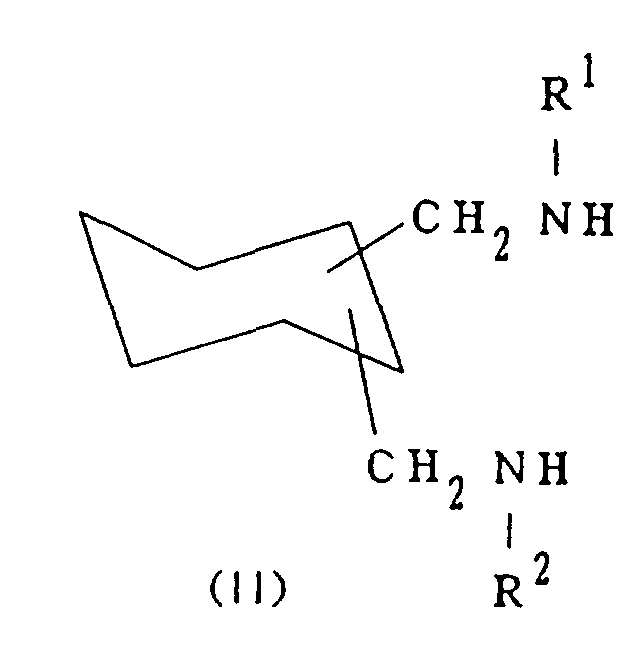
- The present invention further provides a compound which is a cyclohexanediurea derivative of formula (I) or a salt thereof, as defined above, for use as an Acyl:CoA: cholesterol acyltransferase (ACAT) enzyme inhibitor. In one aspect of the invention the compound is for use in the treatment of hyperlipidemia or atherosclerosis.
- The invention also provides a pharmaceutical composition which comprises, as an active ingredient, a cyclohexanediurea derivative of formula (I) as defined above, or a salt thereof, and a pharmaceutically acceptable carrier.
- The present invention also provides a process for preparing the cyclohexanediurea derivative of formula (I):wherein R1, R2, A1 and A2 are as defined above, which comprises one of the following processes (A) to (D):
 wherein R1, R2, A1 and A2 are as defined above,
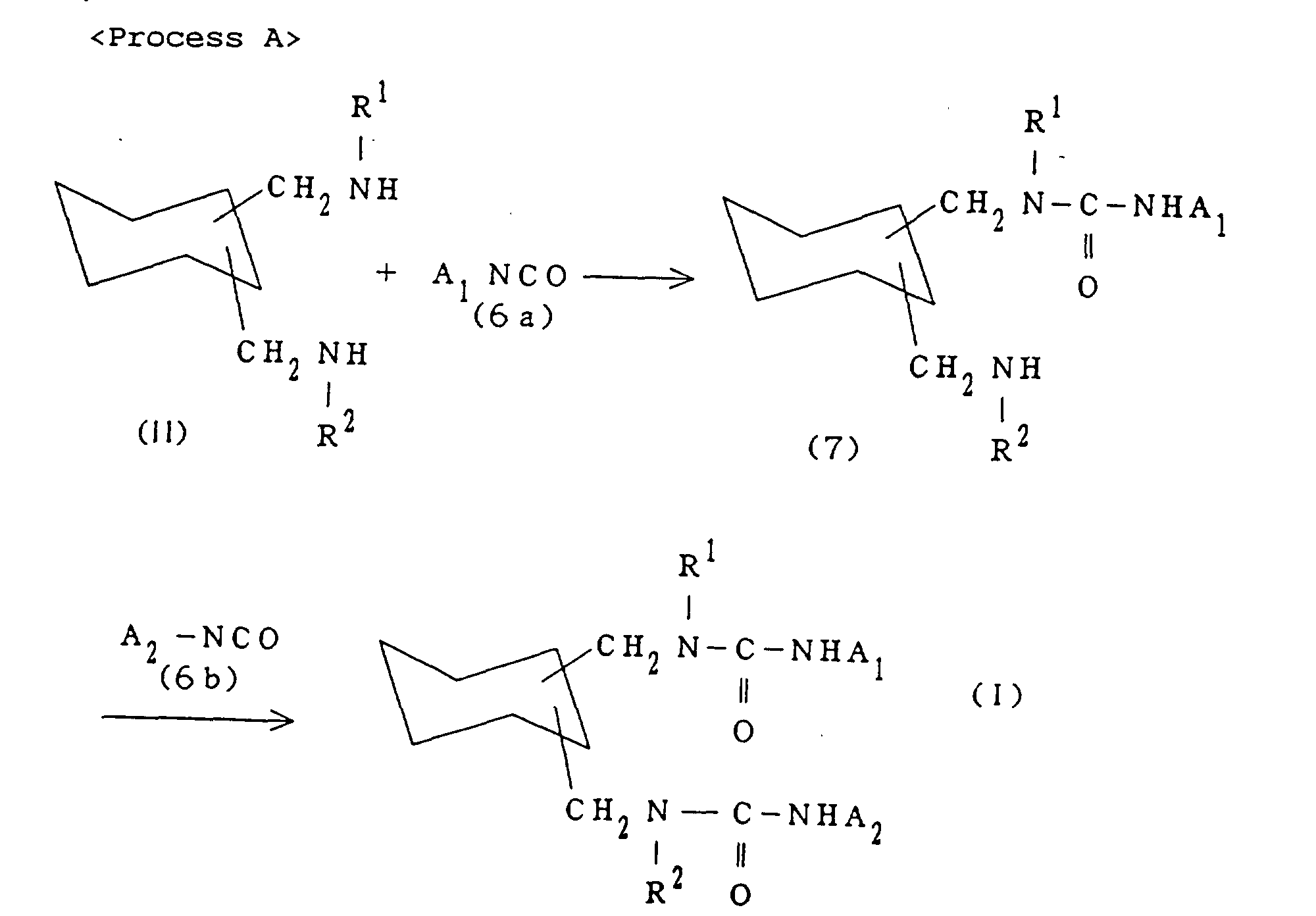 wherein R1, R2, A1 and A2 are as defined above
 ,
,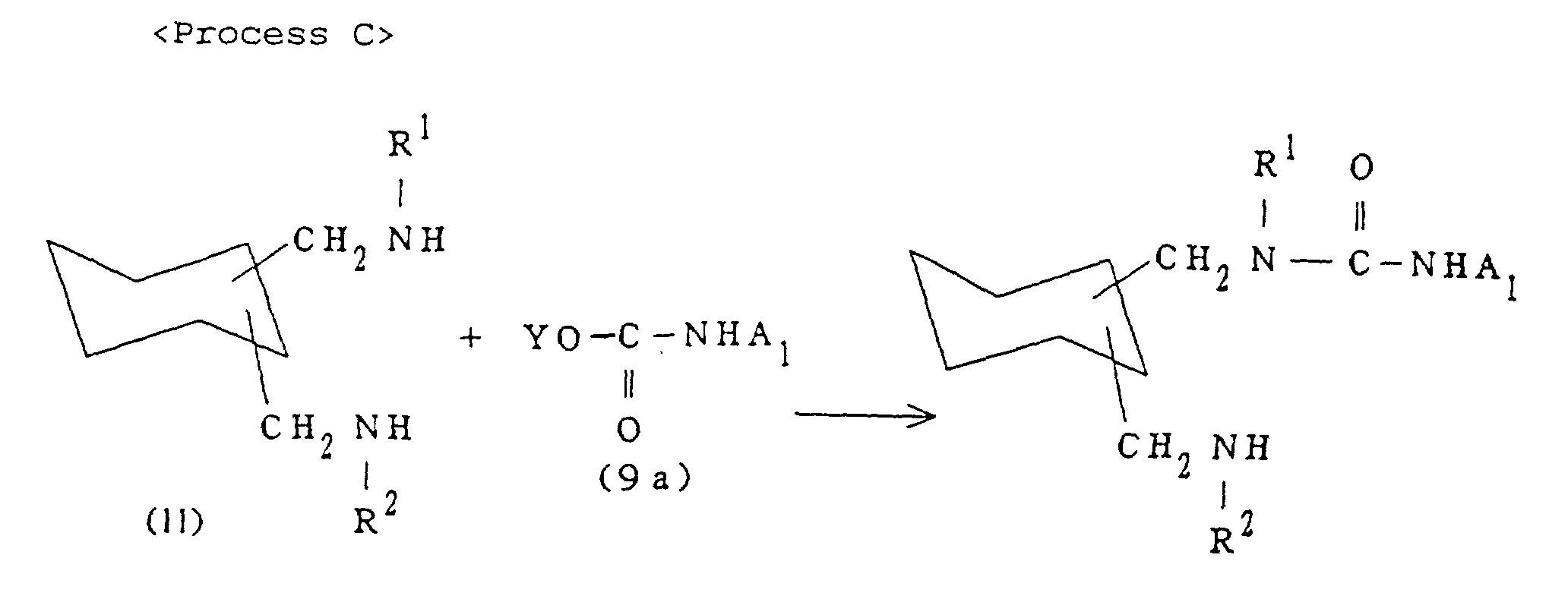 wherein R1, R2, A1 and A2 are as defined above, and
 wherein R1, R2, A1 and A2 are as defined above.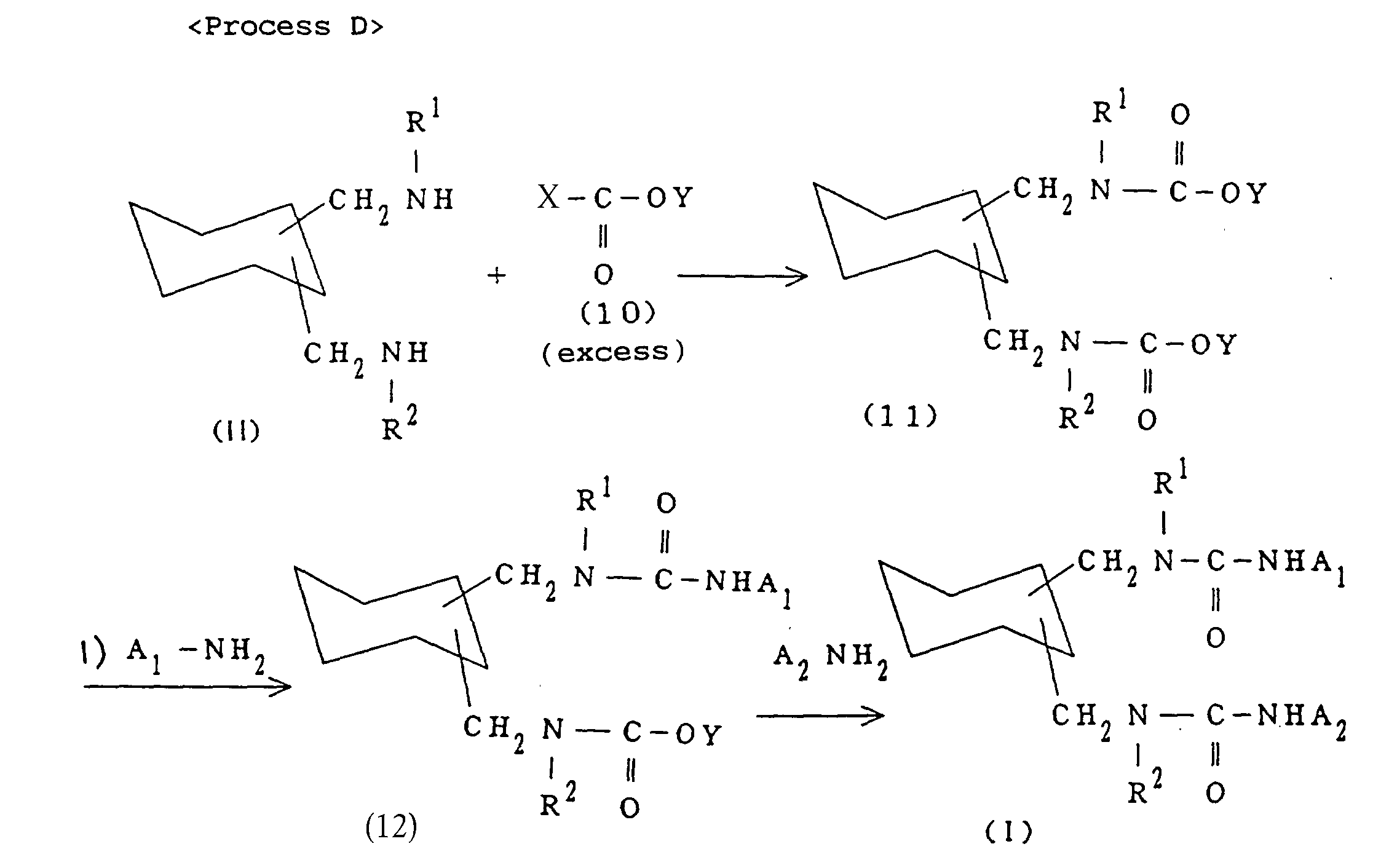
- The cyclohexanediamine derivative (II) is a synthetic intermediate for preparation of the cyclohexanediurea derivative of formula (I) or its salt.
- The present invention will be described below in detail. The compound (I) of the invention has such a structure that two urea derivatives are linked to a cyclohexane ring through methylene chains, and includes a trans-1,2, cis-1,2, trans-1,3, cis-1,3, trans-1,4 or cis-1,4 cyclohexanediurea derivative, which varies depending on how the urea derivatives are linked. The compound (I) of the present invention preferably has trans-1,4, cis-1,4, or cis-1,3 bond. The cyclohexane ring may be chair or boat form.
- In the definition of the formula (I), "the straight-chain or branched alkyl group having at least 3 carbon atoms" includes a C3-10 straight-chain or branched alkyl group, such as propyl, isopropyl, butyl, isobutyl, sec-butyl, tert-butyl, pentyl, isopentyl, tert-pentyl, neopentyl, hexyl, 1,3-dimethylbutyl, 3,3-dimethylbutyl, heptyl, 1-methylheptyl, 1-methylhexyl, 2-methylhexyl, 1-ethylpentyl, 1,1-dimetylpentyl, 1,2-dimethylpentyl, octyl, 1,5-dimethylhexyl, tert-octyl, nonyl, decyl and so on.
- "The cycloalkyl group" includes a C3-10 cycloalkyl group which may have a C1-4 lower alkyl group, such as cyclopropyl, cyclobutyl, cyclopentyl, cyclohexyl, 2-methylcyclohexyl, 3-methylcyclohexyl, 4-methylcyclohexyl, 4-ethylcyclohexyl, 4-propylcyclohexyl, 4-butylcyclohexyl, cycloheptyl, cyclooctyl, cyclononyl, cyclodecyl and so on.
- "The cycloalkyl group which has a bridge head" includes adamantyl, norbornyl and so on.
- "The furyl group" includes 2-furyl, 3-furyl and so on.
- "The furyl lower alkyl group" includes furylmethyl, furylethyl, furylpropyl, furylisopropyl, furylbutyl, furylisobutyl, furyl sec-butyl, furyl tert-butyl, furylpentyl, furylisopentyl, furyl tert-pentyl, furylneopentyl and so on.
- The substituent of "the phenyl, pyridyl, isoquinolyl, quinolyl or indolyl group which may have substituent(s)" includes a C1-5 lower alkyl group, a cyclic amino group, a mono(lower)alkylamino group, a di(lower)alkylamino group having the same or different alkyl groups, a hydroxyl group, a lower alkoxy group, a lower alkoxycarbonyl group, a lower alkoxycarbonyloxy group, a cyano group, a nitro group, a halogen atom, a lower alkylcarbonyloxy group, a trihalogenomethyl group, and an acylamino group.
- Among the substituents, the C1-5 lower alkyl group includes a straight-chain or branched alkyl group such as methyl, ethyl, propyl, isopropyl, butyl, isobutyl, sec-butyl, tert-butyl, pentyl, tert-pentyl and neopentyl. The cyclic amino group includes pyrrolidino, piperidino, morpholino, piperazino, homopiperazino and so on. The mono(lower)alkylamino group and the di(lower)alkylamino group having the same or different alkyl groups include an amino group substituted by one or two C1-5 lower alkyl groups mentioned above. The lower alkoxy group includes a C1-5 alkoxy group such as methoxy, ethoxy, propoxy, isopropyl, butoxy, sec-butoxy, tert-butoxy, pentoxy, sec-pentoxy, tert-pentoxy and so on. The lower alkoxycarbonyl group includes a C2-6 alkoxycarbonyl group such as methoxycarbonyl, ethoxycarbonyl, propoxycarbonyl, isopropoxycarbonyl, butoxycarbonyl, sec-butoxycarbonyl, tert-butoxycarbonyl, pentoxycarbonyl, sec-pentoxycarbonyl, tert-pentoxycarbonyl and so on. The lower alkoxycarbonyloxy group includes methoxycarbonyloxy, ethoxycarbonyloxy, propoxycarbonyloxy, isopropoxycarbonyloxy, butoxycarbonyloxy, sec-butoxycarbonyloxy, tert-butoxycarbonyloxy, pentoxycarbonyloxy, sec-pentoxycarbonyloxy, tert-pentoxycarbonyloxy and so on. The halogen atom includes fluorine, chlorine, bromine and iodine. The lower alkylcarbonyloxy group includes a C2-6 alkylcarbonyloxy group such as methylcarbonyloxy, ethylcarbonyloxy, propylcarbonyloxy, isopropylcarbonyloxy, butylcarbonyloxy, sec-butylcarbonyloxy, tert-butylcarbonyloxy, pentylcarbonyloxy, sec-pentylcarbonyloxy, tert-pentylcarbonyloxy and so on. The trihalogenomethyl group includes trifluoromethyl, trichloromethyl and so on. The acylamino group includes a C2-5 acylamino group such as acetylamino, propionylamino, isopropionylamino, butyrylamino, isobutyrylamino, valerylamino, isovalerylamino, pivaloylamino and so on.
- The phenyl, pyridyl, quinolyl, isoquinolyl or indolyl group represented by A may have one or more substituents mentioned above. Examples of such phenyl groups are 3-dimethylaminophenyl, 4-dimethylaminophenyl, 4-ethylmethylaminophenyl, 4-dietylaminophenyl, and 4-piperidinophenyl.
- The said phenyl (2-6 positions), pyridyl (2-6 positions), quinolyl (2-8 positions), isoquinolyl (1, 3-8 positions) or indolyl (2-7 positions) may be linked to the amino group of urea in any of these positions.
- Preferred species of the compound of formula (I) are as follows:
- I. a cyclohexanediurea derivative of formula (I) wherein the urea derivatives are linked to the cyclohexane ring by trans-1,4, cis-1,4 or cis-1,3 bond, and R1 or R2 represents a cycloalkyl group or a branched alkyl group; and A1 or A2 represents 4-dimethylaminophenyl, 4-pyrrolidinophenyl or 4-piperidinophenyl; or a salt thereof;
- II. a cyclohexanediurea derivative of formula (I) wherein R1 = R2 and A1 = A2; or a salt thereof;
- III. a cyclohexanediurea derivative of formula (I) wherein R1 and R2 are the same or different and they each represent cyclopentyl, cyclohexyl, cycloheptyl or 4-methylcyclohexyl; or a salt thereof;
- IV. a cyclohexanediurea derivative of formula (I) wherein A1 and A2 are the same or different and they each represent 4-dimethylaminophenyl, 4-diethylaminophenyl, 4-pyrrolidinophenyl, 4-piperidinophenyl or 4-morpholinophenyl; or a salt thereof; and
- V. a cyclohexanediurea derivative or salt thereof which
is one of the compounds or salts given below in (1)-(10):
- (1) a trans-1,4-bis[[1-cyclopentyl-3-(4-dimethylaminophenyl)ureido]methyl]cyclohexane or a salt thereof;
- (2) a trans-1,4-bis[[1-cyclohexyl-3-(4-dimethylaminophenyl)ureido]methyl]cyclohexane or a salt thereof;
- (3) a trans-1,4-bis[[1-cyclohexyl-3-(4-diethylaminophenyl)ureido]methyl]cyclohexane or a salt thereof;
- (4) a trans-1,4-bis[[1-cyclohexyl-3-(4-pyrrolidinophenyl)ureido]methyl]cyclohexane or a salt thereof;
- (5) a trans-1,4-bis[[1-cyclohexyl-3-(4-piperidinophenyl)ureido]methyl]cyclohexane or a salt thereof;
- (6) a trans-1,4-bis[[3-(4-dimethylaminophenyl)-1-(4-methylcyclohexyl)ureido]methyl]cyclohexane or a salt thereof;
- (7) a trans-1,4-bis[[1-cycloheptyl-3-(4-dimethylaminophenyl)ureido]methyl]cyclohexane or a salt thereof;
- (8) a trans-1,4-bis[[1-cycloheptyl-3-(4-diethylaminophenyl)ureido]methyl]cyclohexane or a salt thereof;
- (9) a trans-1,4-bis[[1-cycloheptyl-3-(4-pyrrolidinophenyl)ureido]methyl]cyclohexane or a salt thereof; and
- (10) a trans-1,4-bis[[1-cycloheptyl-3-(4-piperidinophenyl)ureido]methyl]cyclohexane or a salt thereof.
-
- The compounds of formula (I) can also be formed into salts. Acid addition salts of the compound (I) are included in the present invention. The acid used to form such salts includes mineral acids and organic acids such as hydrochloric acid, hydrobromic acid, sulfuric acid, nitric acid, phosphoric acid, acetic acid, citric acid, succinic acid, oxalic acid, fumaric acid, maleic acid, malic acid, tartaric acid, methanesulfonic acid, ethanesulfonic acid, p-toluenesulfonic acid and so on. The salts can be produced by reacting these acids with the compound of formula (I) by conventional methods.
- The compound of the invention can be prepared by various methods and there is no specific limitation on the method. The compound can be prepared, for example, by the following <Reaction scheme A>.
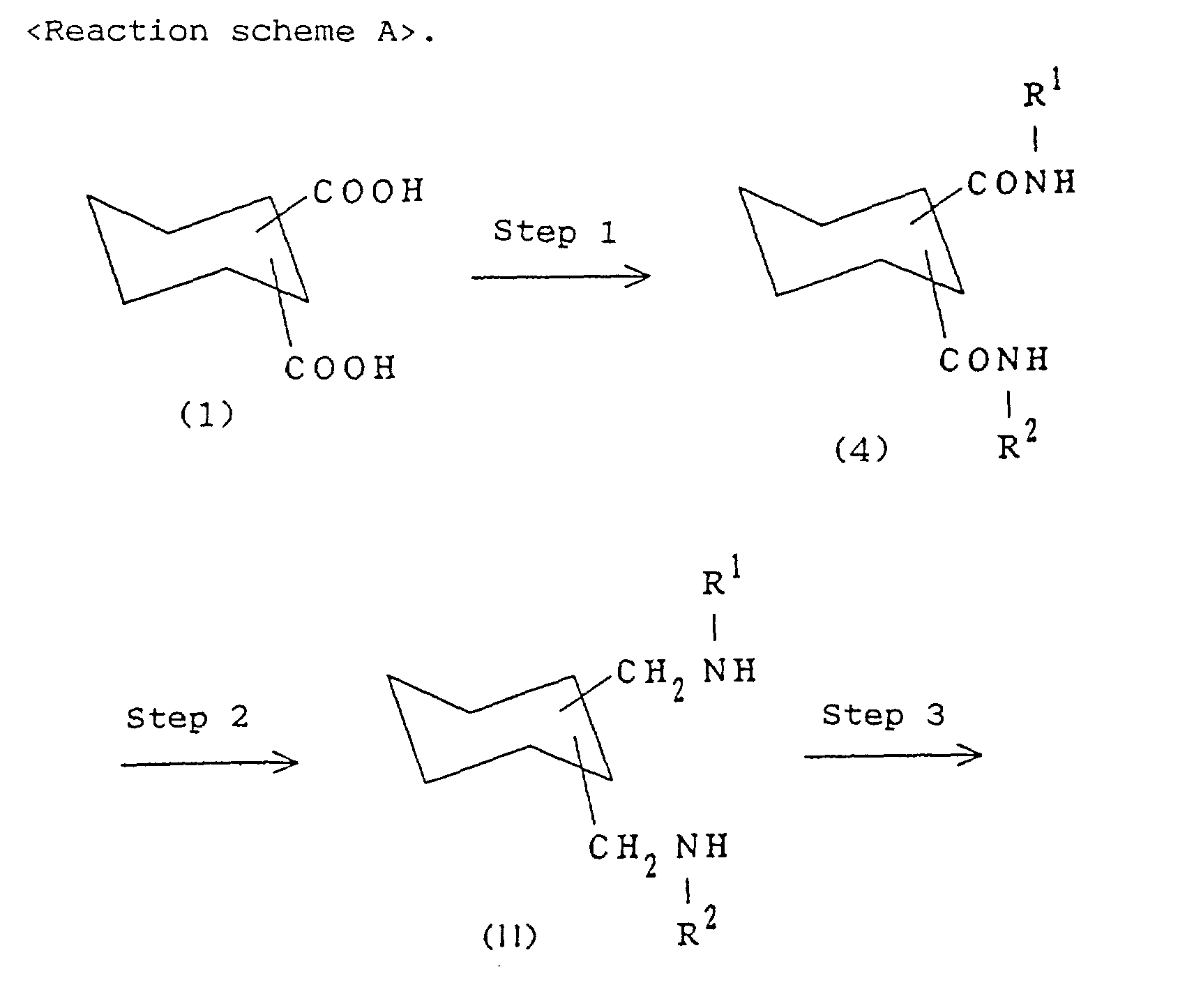 wherein R1, R2, A1 and A2 are as defined above.
- <Step 1> to <Step 3> are described below.

 wherein R1 and R2 are as defined above.
- The cyclohexanedicarboxylic acid of formula (1) (which is a cis or trans, 1,2-, 1,3-, or 1,4-isomer) is reacted with a primary amine derivative represented by R1NH2 in the presence of a condensing agent to give a monoamide (2). The monoamide (2) is reacted with a primary amine derivative represented by R2NH2 in the presence of a condensing agent to give a diamide of formula (4).
- The reaction between cyclohexanedicarboxylic acid and R1NH2 is carried out using about 0.9-1.1 moles of R1NH2 and about 1.0-1.1 moles of a condensing agent per mole of cyclohexanedicarboxylic acid in a solvent under cooling or at room temperature for about 1-5 hours. Examples of useful solvents are benzene, toluene, tetrahydrofuran (THF), dimethylformamide (DMF), dimethyl sulfoxide (DMSO), etc. Examples of useful condensing agents are N,N'-dicyclohexylcarbodiimide (DCC), 1-ethyl-3-(3-dimethylaminopropyl)carbodiimide hydrochloride acid salt (WSCD·HCl), carbonyldiimidazole, etc. A reaction promoter such as triethylamine, 1-hydroxybenzotriazole (HOBt) and N-hydroxysuccinimide can also be added in the reaction. The reaction mixture containing the starting dicarboxylic acid, object monoamide (2) and diamide is subjected to separation and purification by a conventional method such as recrystallization, column chromatography or extraction with a solvent, thus giving an object monoamide (2).
- The monoamide (2) is then reacted with R2NH2 in the presence of a condensing agent under the same conditions as mentioned above, thus giving a diamide (4).
- The diamide (4) wherein R1=R2 can be prepared by reacting cyclohexanecarboxylic acid with an excess (at least 2 equivalents) of R1NH2 and a condensing agent in the same manner as mentioned above.
- The diamide (4a) wherein R1=R2 can also be prepared by reacting cyclohexanedicarboxylic acid (1) with a chlorizing agent such as thionylchloride and oxazalylchloride under cooling or at room temperature in the absence of a solvent or in a solvent inert to the reaction, such as benzene, toluene, hexane, dichloromethane and chloroform, thus converting cyclohexanedicarboxylic acid into an acid chloride derivative of formula (3) and then allowing the derivative to react in an inert solvent such as benzene, toluene, hexane, dichloromethane, chloroform, THF, DMF and DMSO under ice-cooling or at room temperature, optionally using an inorganic base such as sodium carbonate, potassium carbonate and sodium hydrogencarbonate or an organic base such as triethylamine and pyridine to promote the reaction. The amine derivative represented by R1NH2 is usually used in an amount of 2 moles to an excess mole per mole of dicarboxylic acid.
- The diamide (4a) wherein R1=R2 can also be obtained by using at least 2 equivalents of an amine represented by R1NH2 and an condensing agent relative to the dicarboxylic acid (1).wherein R1 and R2 are as defined above.

- Step 2 is a reduction reaction of carbonyl groups of the diamide derivative of formula (4). In step 2, a diamide derivative of formula (4) is reacted in a solvent in the presence of a reducing agent, thus giving a reductant (II). The reaction is carried out using an equimolar to excess amount of the reducing agent relative to the diamide (4) at room temperature to about 100°C for about 2-24 hours.
- Examples of useful solvents in the reduction reaction include solvents inert to the reaction, such as benzene, toluene, dioxane, THF, ether, and the like, among which THF is preferred. Examples of useful reducing agents include lithiumaluminum hydride (LAH), diisobutylaluminum hydride, sodium dihydro-bis(2-methoxyethoxy)aluminate, diborane, borantetrahydrofuran complex, borane dimethyl sulfide complex, and so on.
- The compound (I) according to the present invention can be produced by various methods. Some typical methods are shown below.wherein R1, R2, A1 and A2 are as defined above.

- The amine derivative of formula (II) is reacted with an isocyanate (6a) represented by A1NCO in a solvent at room temperature to approximately the boiling point of the solvent for 3-72 hours, thus giving a monourea (7). The monourea (7) is reacted with an isocyanate (6b) to provide an object compound (I). Examples of useful solvents are pyridine, benzene, toluene, dioxane, THF, ether, dichloromethane, chloroform, n-hexane, acetonitrile, DMF, etc. The isocyanate (6a) is used in an amount of 0.9-1.1 equivalents per mole of the diamine of formula (II). After completion of the reaction, the monourea (7) is separated and purified by a conventional purification method such as extraction with a solvent, recrystallization and column chromatography. The diurea of formula (I) can be prepared by reacting the monourea (7) with an isocyanate (6b) under the same conditions as mentioned above. The diurea of formula (Ia) wherein A1=A2 is usually prepared using 2 moles to an excess of an isocyanate (6a) per mole of the amine derivative (II).
 wherein X is a chlorine, bromine or iodine atom and R1, R2, A1 and A2 are as defined above.
- One mole of an amine derivative of formula (II) is reacted with 1.0-1.1 moles of carbonyl halide (8a) in a solvent under ice-cooling or at room temperature for 1-6 hours to give a monourea (7). Examples of useful solvents are those inert to the reaction, such as benzene, toluene, dioxane, THF, ether, dichloromethane and chloroform. In the reaction, a base such as triethylamine, pyridine and dimethylaminopyridine can also be added in an amount of about 1.0-1.5 moles. After completion of the reaction, the reaction mixture is subjected to separation and purification in the same manner as in the above process 3-Ia, thus giving a monourea (7). The monourea (7) is reacted with carbonyl halide (8b) under the same conditions as mentioned above to give an object compound of formula (I).
- The compound (Ia) wherein A1=A2 can be prepared by reacting an amine derivative of formula (II) with 2 equivalents to an excess of carbonyl halide (8a).
 wherein Y represents a C1-5 lower alkyl group or a phenyl group, and R1, R2, A1 and A2 are as defined above.
- One mole of an amine derivative of formula (II) is reacted with about 0.9-1.1 moles of a carbamic acid ester of formula (9a) in the presence of a solvent at about 0°C to approximately the boiling point of the solvent for 5-24 hours to give a monourea (7). The monourea (7) is separated and purified by a conventional purification method such as solvent extraction, column chromatography and recrystallization. The monourea (7) is reacted with a carbamic acid ester of formula (9b) under the same conditions as mentioned above, thus giving an object compound of formula (I).
- Examples of useful solvents are inert solvents such as benzene, toluene, dioxane, ether, THF, DMF, acetonitrile, chloroform, dichloromethane.
- The compound (Ia) wherein A1=A2 according to the invention can be prepared by reacting an amine derivative of formula (II) with 2 equivalents to an excess of a carbamic acid ester (9a).
- The carbamic acid ester used as the starting compound in the above reaction can be prepared by the following reaction:
 wherein Y, X, A1 and A2 are as defined above.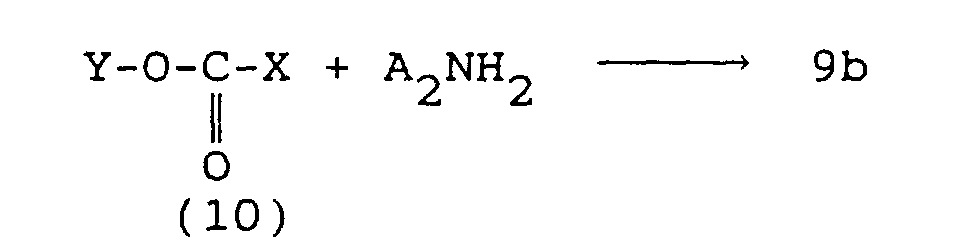
- The carbamic acid ester (9a) or (9b) can be prepared by reacting a halocarbonate (10) such as isobutylchlorocarbonate, methylchlorocarbonate and phenylchlorocarbonate with A1NH2 or A2NH2 in a solvent in the presence or absence of a base. Examples of useful solvents are inert solvents, such as benzene, toluene, dioxane, ether, THF, chloroform, and dichloromethane. Examples of useful bases are potassium carbonate, sodium carbonate, sodium hydrogencarbonate, potassium hydroxide, sodium hydroxide, triethylamine, and N,N-dimethylaniline. The reaction is carried out under cooling or at room temperature for about 1-5 hours.wherein X, Y, R1, R2, A1 and A2 are as defined above.

- One mole of an diamine derivative of formula (II) is reacted with 2 equivalents to an excess of a halocarbonate (10) in a solvent under ice-cooling or at room temperature for 1-5 hours to give a dicarbamic acid ester (11). One mole of the ester (11) is reacted with 2 moles to an excess of A1NH2 at room temperature to approximately the melting point of the solvent for 2-12 hours to give a compound of formula (Ia).
- Examples of useful solvents are inert solvents such as benzene, toluene, dioxane, ether, THF, chloroform and dichloromethane. The reaction between the diamine derivative of formula (II) and the halocarbonate (10) is carried out advantageously in the presence of a base such as potassium carbonate, sodium carbonate, sodium hydrogencarbonate, potassium hydroxide, sodium hydroxide, triethylamine and N,N-dimetylaniline.
- The substitution reaction can be promoted by means of a phase transfer catalyst such as benzyltriethylammonium chloride, benzyltriethylammonium bromide, tetra-n-butylammonium chloride, tetra-n-butylammonium bromide, and tetra-n-butylammonium hydrogensulfate. The compound of formula (I) can also be prepared by reacting 1 mole of an ester (11) with 1 mole of A1NH2 and reacting the resulting monourea (12) with 1 mole or an excess of A1NH2 under the same conditions as mentioned above.
- The isolation and purification can be done by a conventional chemical operation, such as extraction, recrystallization and various chromatographies.
- The compound (I) of the present invention or a pharmacologically acceptable salt can be provided in a variety of dosage forms of preventive or therapeutic medicine. Examples of such forms are compositions for oral administration, injections, suppositories, attaching agents such as cataplasms and taping agents, ointments, creams and lotions. These dosage forms can be manufactured by conventional methods for preparing pharmaceutical compositions.
- Solid pharmaceutical compositions for oral administration can be manufactured by optionally adding a binder, a disintegrator, a lubricant, a coloring agent, a flavor, a perfume, etc. to the compound of the invention and preparing the composition in the form of tablets, coated tablets, granule, powder, capsules, etc. by conventional methods. Conventional additives in this field can be used as such additives. Examples of useful excipients are lactose, sucrose, sodium chloride, glucose, starch, calcium carbonate, kaolin, crystalline cellulose and silicic acid. Examples of useful binders are water, ethanol, propanol, simple syrup, glucose syrup, starch solution, gelatin solution, carboxymethylcellulose, carboxypropylcellulose, hydroxypropylstarch, methylcellulose, ethylcellulose, shellac, calcium phosphate, and polyvinylpyrrolidone. Examples of useful disintegrators are dry starch, sodium alginate, agar powder, sodium hydrogen carbonate, calcium carbonate, sodium lauryl sulfate, stearyl monoglyceride, and lactose. Examples of useful lubricants are purified talc, salts of stearic acid, boric acid powder, and polyethylene glycol. Examples of useful flavors are sucrose, bitter orange peel, citric acid, and tartaric acid.
- Liquid pharmaceutical compositions for oral administration can be manufactured by optionally adding a flavor, a buffer, a stabilizer, a perfume, etc. to the compound of the invention and preparing the composition in the form of internal medicine, syrup, elixir, etc. by conventional methods. Examples of useful flavors are the same as mentioned above. Examples of useful buffers include sodium citrate. Examples of useful stabilizers include tragacanth, gum arabic, and gelatin.
- Injections can be manufactured by optionally adding a pH adjusting agent, a buffer, a stabilizer, an isotonic agent, a local anesthetic, etc. to the compound of the invention and preparing hypodermic, intramuscular or intravenous injections by conventional methods. Examples of useful pH adjusting agents and buffers are sodium citrate, sodium acetate, sodium phosphate, etc. Examples of useful stabilizers are sodium pyrosulfite, EDTA, thioglycollic acid, thiolactic acid, etc. Examples of useful local anesthetics are procaine hydrochloride, lidocaine hydrochloride, etc.
- Suppositories can be manufactured by adding a known pharmaceutically acceptable carrier such as polyethylene glycol, lanolin, cacao butter and fatty acid triglyceride and optionally a surfactant such as Tween (trademark) to the compound of the invention and preparing suppositories by conventional methods.
- Ointments can be manufactured by optionally adding a base, a stabilizer, a humectant, a preservative, etc. to the compound of the present invention and mixing them by a conventional method to form ointments. Examples of useful bases are liquid paraffin, white vaseline, bleached bee wax, octyldodecyl alcohol, paraffin, etc. Examples of useful preservatives are methyl parahydroxybenzoate, ethyl para-hydroxybenzoate, propyl parahydroxybenzoate, etc.
- Attaching agents can be manufactured by applying the above-mentioned ointment, cream, gel, paste, or the like to conventional substrates by conventional methods. Examples of suitable substrates are woven fabric of cotton, staple fiber or artificial fiber, unwoven fabrics, film of soft vinyl chloride, polyethylene or polyurethane, and expanded sheet.
- Examples of the "pharmaceutically acceptable carrier" added to the compound of formula (I) are various additives mentioned above in the pharmaceutical preparations.
- The amount of the compound of the invention to be incorporated in the above-mentioned dosage unit form may vary depending on the patient's condition, dosage form, etc. In the case of compositions for oral administration or injections, about 0.1-200 mg of the compound of the invention is preferably incorporated into a dosage unit form. The daily dosage of the medicament in the above-mentioned forms varies depending on patient's condition, weight, age, sex, etc. but generally, it is preferably about 0.1-200 mg per adult. This amount is preferably administered once or in 2-4 divided doses.
- The following experimental examples and examples are intended to illustrate the invention in further detail and should by no means be construed as limiting the scope of the invention.
- Examples illustrate the synthesis of compounds according to the invention. Synthesis Examples illustrate the synthesis of the starting compound and intermediate for the production of the compound of the invention. 1H-NMR means hydrogen nuclear magnetic resonance spectrum, mp melting point, MS mass spectrometry, and IR infrared absorption spectrum.
- A 4.30 g quantity of trans-1,4-cyclohexanedicarbonic acid, 11.5 g of 1-ethyl-3-(3-dimethylaminopropyl)carbodiimide hydrochloride, 7.75 g of n-octylamine and 8.10 g of 1-hydroxybenzotriazole were dissolved in 200 ml of DMF and reacted at room temperature for 12 hours. The solvent was distilled off. The residue was extracted with ethyl acetate, washed with diluted hydrochloric acid, sodium carbonate and water in this order and dried over magnesium sulfate and the solvent was distilled off, thus giving 9.55 g (yield: 96.8%) of trans-1,4-cyclohexanedioctylamide.
- Diamide derivatives were prepared in the same manner as in Synthesis Example 1. Table 1 shows positions of the substituents of the diamide derivatives obtained in Synthesis Examples 1-83 and data on the results of measurement.


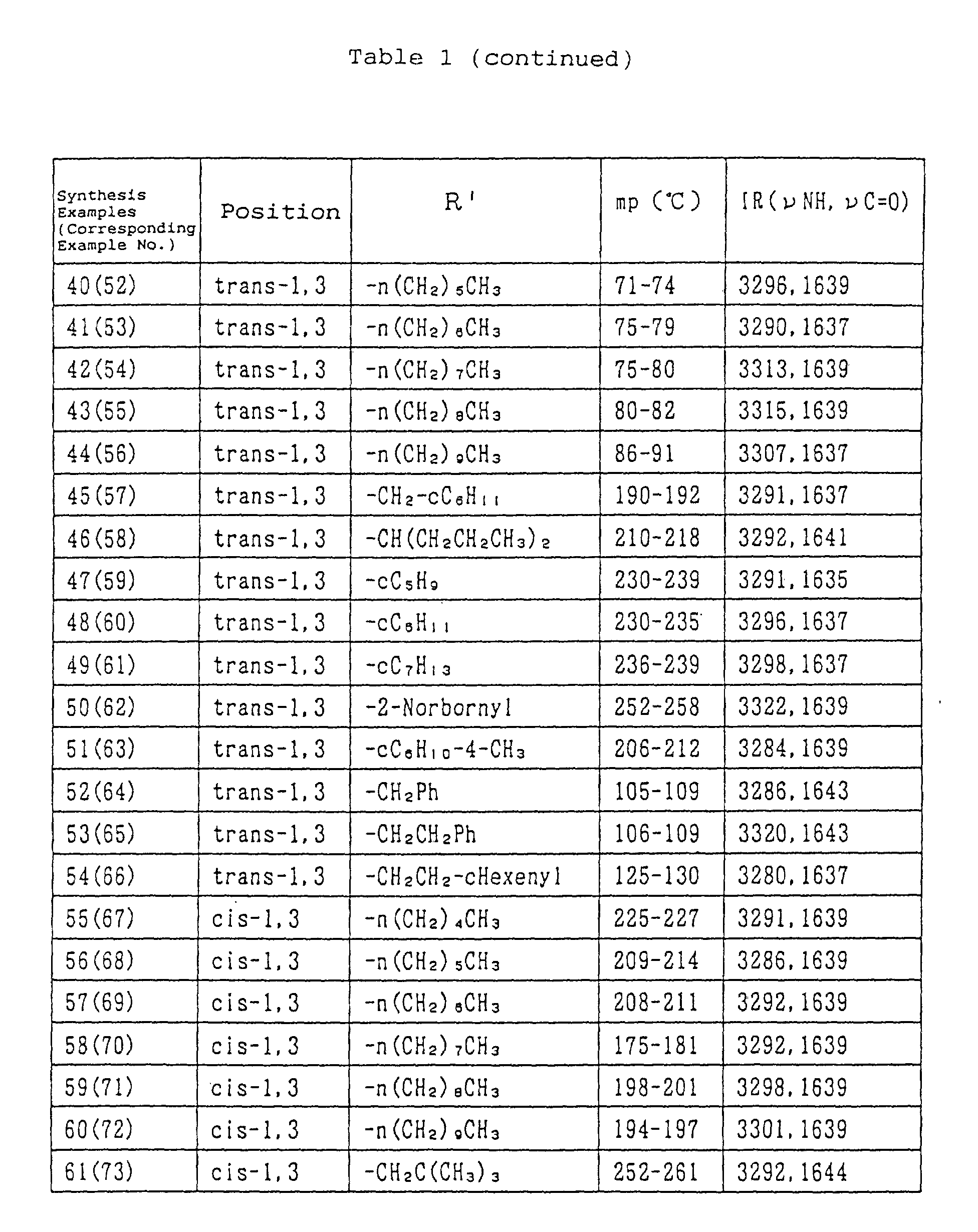
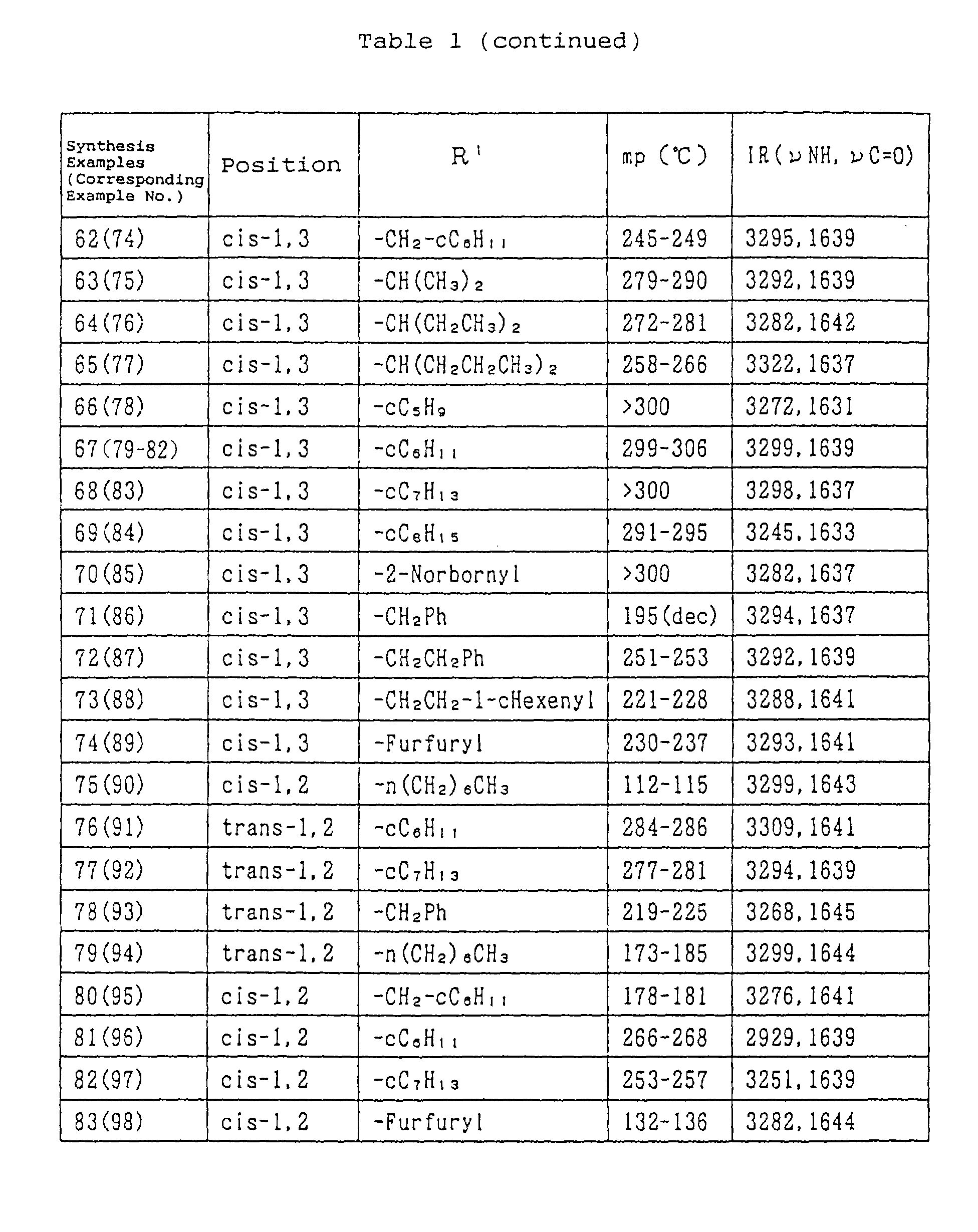
- Lithiumaluminum hydride, 2.17 g, was added little by little under ice-cooling to 150 ml of a THF suspension containing 8.70 g of the diamide derivative prepared in Synthesis Example 1. Stirring was continued for 1 hour and the reaction mixture was refluxed with heating for 65 hours. After adding 4.3 ml of water and 4.3 ml of a 2N aqueous sodium hydroxide solution under ice-cooling, the reaction mixture was allowed to stand at room temperature for 15 hours. The reaction mixture was filtered with suction and the filtrate was concentrated under reduced pressure. The residue was dissolved in hexane and washed with a saturated aqueous sodium bicarbonate solution and saturated brine. The organic layer was dried over anhydrous sodium sulfate and concentrated under reduced pressure to provide 5.03 g (yield: 76.2%) of a diamine derivative as a viscous oil compound.
- Diamine derivatives were prepared in the same manner as in Preparation Example 1.
- Table 2 shows positions of the substituents of the diamine derivatives obtained in Preparation Examples 1-83 and data on the results of measurement.

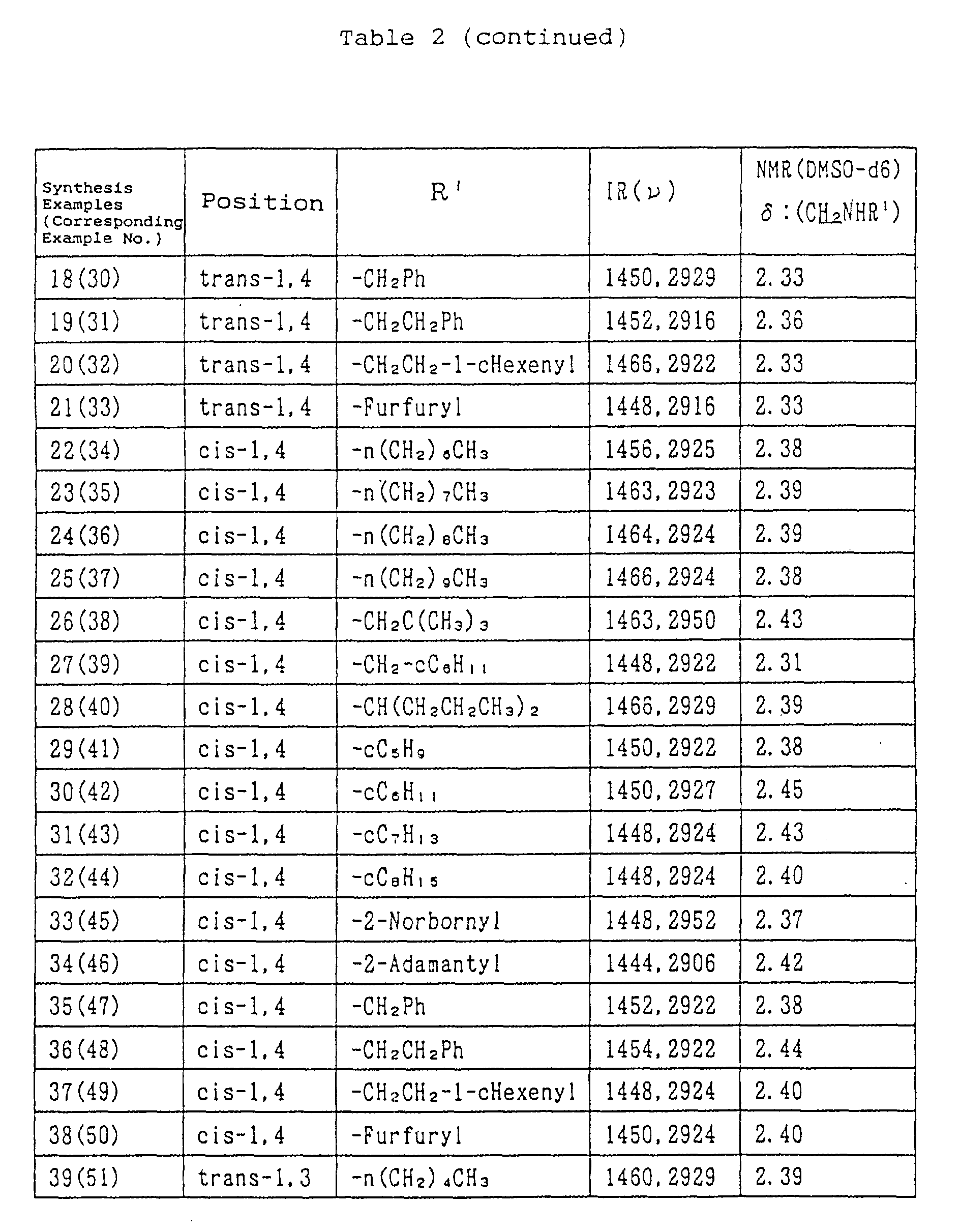
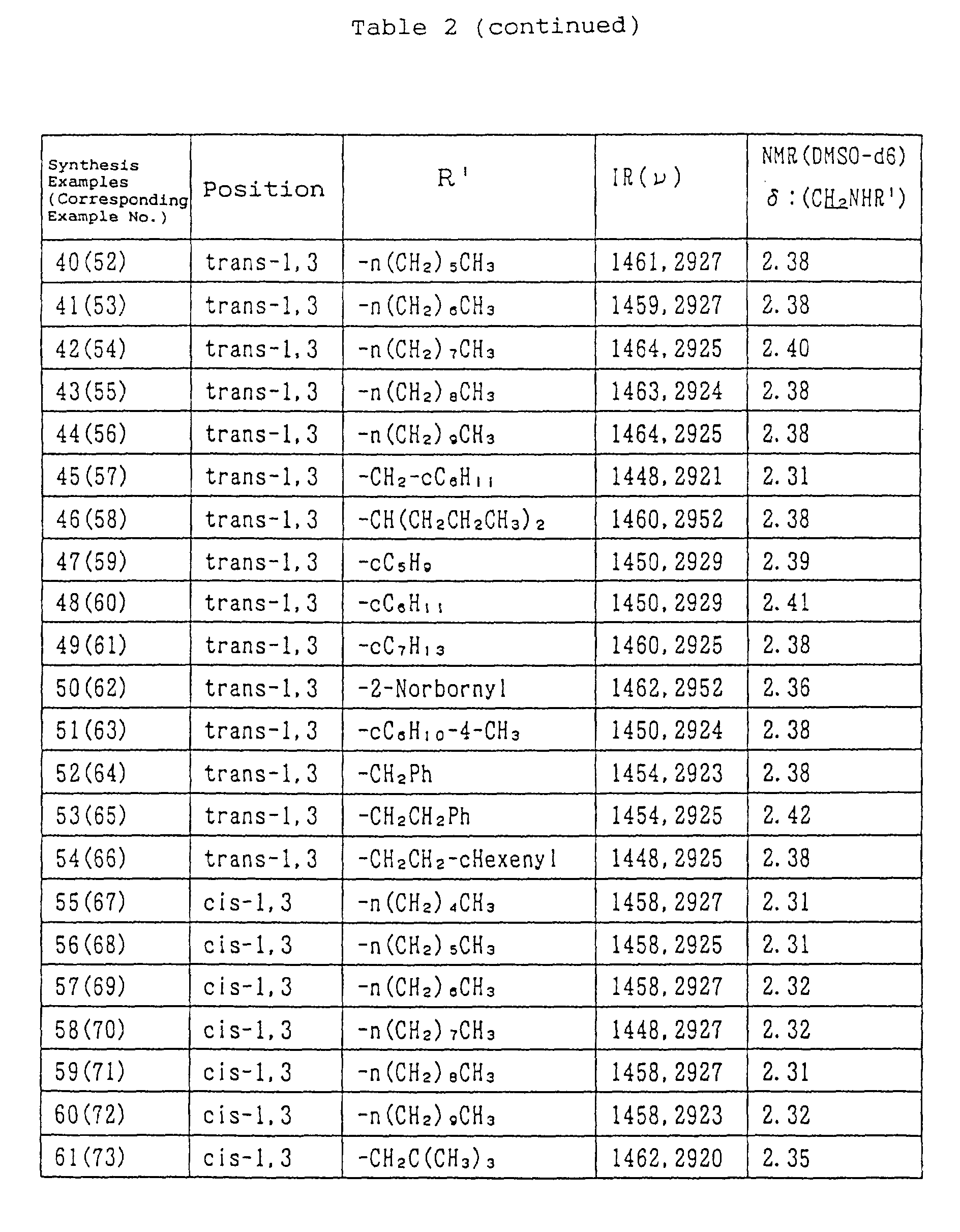
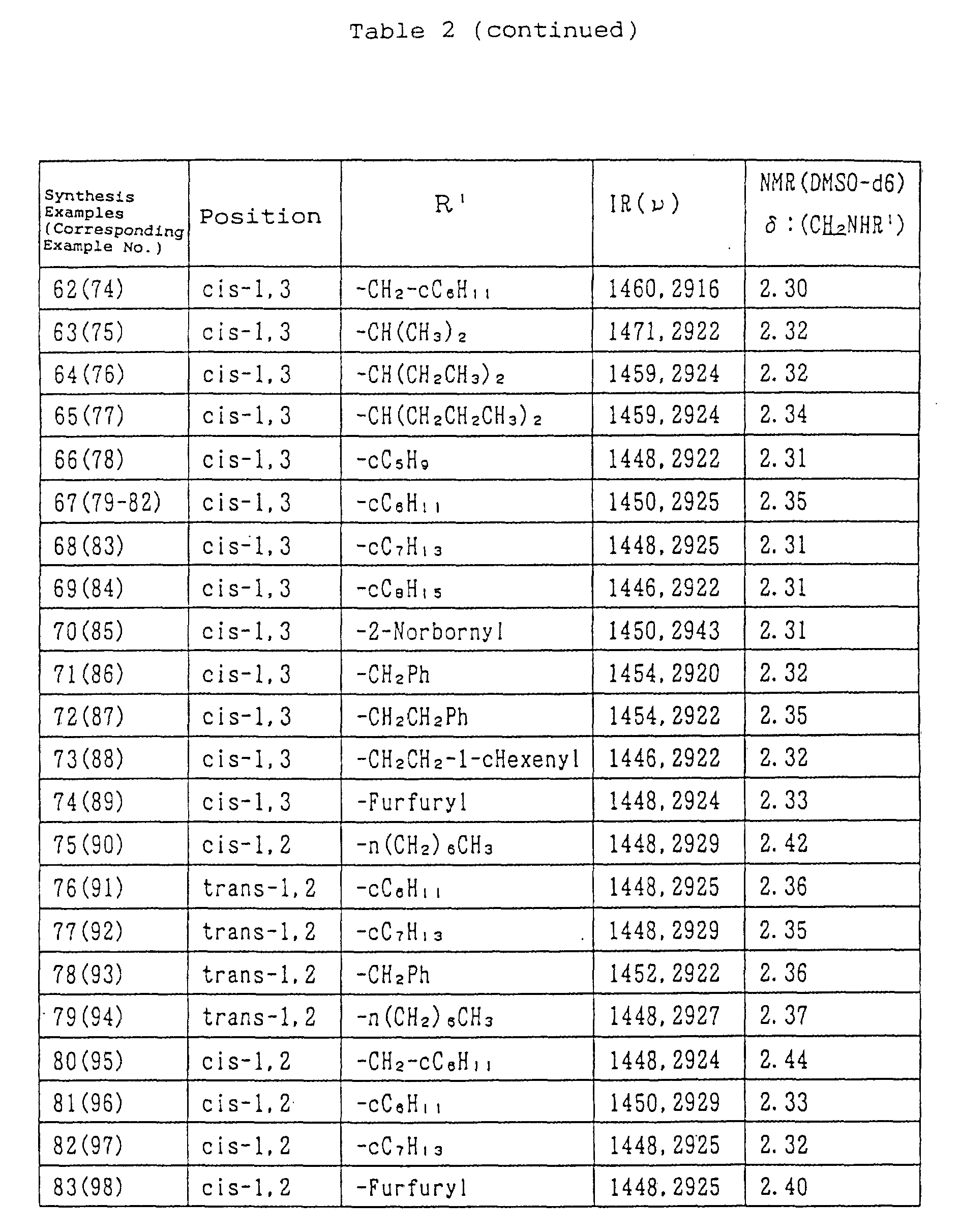
- A 1.28 g quantity of phenyl 4-dimethylaminophenylcarbamate, 0.28 g of tetrabutylammonium bromide (TBAB) and 0.33 g of potassium hydroxide were added to a solution of 0.73 g of trans-1,4-bis[(normaloctylamino)methyl]cyclohexane in 30 ml of acetonitrile and stirred at room temperature for 15 hours. After completion of the reaction, the crystals precipitated were separated by filtration and washed with ether, water and hexane. After purifying the crystals by silica gel column chromatography, the crystals were dissolved in chloroform and a 4N hydrochloric acid-dioxane solution was added to provide 1.21 g (yield: 79%) of white crystals precipitated.
- mp: 185-189°C (dihydrochloric acid salt)
- MS(FAB): m/e = 647 (M++1)
- IR(KBr) v MAX: 2923, 2366(brs), 1644(s), 1521(s)
- NMR(DMSO-d6) δ: 8.27 (2H, brs, NH x 2), 7.4-7.6 (8H, br, Ar-H), 3.28 (4H, brs, NCH2 x 2), 3.16 (4H, br, NCH2 x 2), 3.05 (4H, br, N(CH3)2 x 2), 1.2-1.8 (32H, m), 0.8-1.0 (8H, m)
-
- Trans-1,4-bis[(normalpentylamino)methyl]cyclohexane, 0.56 g, was dissolved in 10 ml of ether. A solution of 0.81 g of 4-dimethylaminophenyl isocyanate in 20 ml of acetonitrile was added. The reaction mixture was stirred at room temperature for 10 hours. The solvent of the reaction mixture was distilled off under reduced pressure and the residue was purified by silica gel column chromatography to provide 1.10 g (yield: 89%) of white crystals.
- mp: 205-208°C (free form)
- MS(FAB): m/e = 607 (M++1)
- IR(KBr) ν MAX: 2912, 1633(s), 1519(s)
- NMR(DMSO-d6) δ: 7.66 (2H, s, NH x 2 ), 7.20 (4H, d, J=9.2Hz, Ar-H), 6.63 (4H, d, J=9.2Hz, Ar-H), 3.1-3.3 (8H, m, NCH2 x 2, NCH2 x 2), 2.81 (12H, s, N(CH3)2 x 2), 1.2-1.8 (18H, m), 0.8-1.0 (10H, m)
-
- The title compound was synthesized by the method in accordance with Example 1.
- mp: 160-163°C (dihydrochloric acid salt)
- MS(FAB): m/e = 635 (M++1)
- IR(KBr) ν MAX: 2927(brs), 1646(s), 1521(s)
- NMR(DMSO-d6) δ: 8.27 (2H, brs, NH x 2), 7.50-7.70 (8H, brs, Ar-H), 3.0-3.4 (20H, br, NCH2 x 2, NCH2 x 2, N(CH3)2 x 2), 1.2-1.8 (24H, m), 0.8-1.0 (8H, m)
-
- The title compound was synthesized by the method in accordance with Example 1.
- mp: 189-191°C (dihydrochloric acid salt)
- MS(FAB): m/e = 662 (M+)
- IR(KBr) ν MAX: 2925(brs), 1648(s), 1521(s)
- NMR(DMSO-d6) δ: 8.32 (2H, s, NH x 2), 7.4-7.7 (8H, m, Ar-H), 3.33 (4H, m, NCH2 x 2), 3.22 (4H, m, NCH2 x 2), 3.10 (12H, s, N(CH3)2 x 2), 1.5-1.8 (10H, m), 1.2-1.4 (16H, m), 0.8-1.0 (10H, m)
-
- The title compound was synthesized by the method in accordance with Example 1.
- mp: 220-223°C (dihydrochloric acid salt)
- MS(FAB): m/e = 719 (M++1)
- IR(KBr) ν MAX: 2923(brs), 1643(s), 1521(s)
- NMR(DMSO-d6) δ: 8.23 (2H, brs, NH x 2), 7.4-7.6 (8H, br, Ar-H), 3.28 (4H, t, J = 7.0 Hz, NCH2 x 2), 3.16 (4H, d, J = 7.3 Hz, NCH2 x 2), 3.04 (12H, s, N(CH3)2 x 2), 1.2-1.8 (36H, m), 0.8-1.0 (8H, m)
-
- The title compound was synthesized by the method in accordance with Example 1.
- mp: 155-160°C (dihydrochloric acid salt)
- MS(FAB): m/e = 746 (M+)
- IR(KBr) ν MAX: 2921, 2979(brs), 1671(s), 1643(s)
- NMR(DMSO-d6) δ: 8.28 (2H, brs, NH x 2), 7.4-7.7 (8H, br, Ar-H), 3.28 (4H, br, NCH2 x 2), 3.16 (4H, br, NCH2 x 2), 3.05 (12H, s, N(CH3)2 x 2), 1.4-1.8 (8H, m), 1.2-1.3 (32H, m), 0.92 (2H, m), 0.85 (6H, t, J = 7.0 Hz, CH3 x 2)
-
- The title compound was synthesized by the method in accordance with Example 1.
- mp: 196-198°C (dihydrochloric acid salt)
- MS(FAB): m/e 607 (M++1)
- IR(KBr) ν MAX: 2923(brs), 1652(s), 1519(s)
- NMR(DMSO-d6) δ: 8.44 (2H, s, NH x 2), 7.55 (8H, br, Ar-H), 3.0-3.3 (20H, m, NCH2 x 4, N(CH3)2 x 2), 1.5-1.7 (6H, m), 0.8-1.0 (22H, m)
-
- The title compound was synthesized by the method in accordance with Example 1.
- mp: 210-212°C (dihydrochloric acid salt)
- MS(FAB): m/e = 659 (M++1)
- IR(KBr) ν MAX: 2919(brs), 1656(s), 1513(s)
- NMR(DMSO-d6) δ: 8.25 (2H, s, NH x 2), 7.4-7.7 (8H, s, Ar-H), 3.1-3.3 (20H, m, NCH2 x 4, N(CH3)2 x 2), 1.5-1.7 (24H, m), 1.0-1.3 (4H, m), 0.8-1.0 (4H, m)
-
- The title compound was synthesized by the method in accordance with Example 1.
- mp: 204-207°C (dihydrochloric acid salt)
- MS(FAB): m/e = 551 (M++1)
- IR(KBr) ν MAX: 2923(brs), 1635(s), 1448(s)
- NMR(DMSO-d6) δ: 8.33 (2H, s, NH x 2), 7.56 (8H, br, Ar-H), 4.20 (2H, m, NCH x 2 ) , 3.0-3.2 (16H, NCH2 x 2, N(CH3)2 x 2), 1.5-1.7 (6H, m), 1.14 (12H, d, J = 6.6Hz, CH(CH3)2 x 2), 0.8-1.0 (4H, m)
-
- The title compound was synthesized by the method in accordance with Example 2.
- mp: 173-176°C (free form)
- MS(FAB): m/e = 663 (M++1)
- IR(KBr) ν MAX: 2964(s), 1623(s), 1592(s), 1521(s)
- NMR(DMSO-d6) δ: 7.57 (2H, s, NH x 2), 7.18 (4H, d, J = 9.0Hz Ar-H), 6.62 (4H, d, J = 9.0Hz, Ar-H), 3.92 (2H, s, NCH x 2), 2.97 (4H, d, J = 7.3Hz, NCH2 x 2), 2.81 (12H, s, N(CH3)2 x 2), 1.2-1.8 (24H, m), 0.8-1.0 (16H, m)
-
- The title compound was synthesized by the method in accordance with Example 1.
- mp: 202-204°C (dihydrochloric acid salt)
- MS(FAB): m/e = 602 (M+)
- IR(KBr) ν MAX: 2915(brs), 1631(s), 1519(s)
- NMR(DMSO-d6) δ: 8.34 (2H, s, NH x 2), 7.56 (8H, s, Ar-H), 4.17 (2H, m, NCH x 2), 3.10 (4H, d, J = 7.0Hz, NCH2 x 2), 3.06 (12H, s, N(CH3)2 x 2), 1.5-1.8 (22H, m), 0.8-1.0 (4H, m)
-
- The title compound was synthesized by the method in accordance with Example 1.
- mp: 200-202°C (dihydrochloric acid salt)
- MS(FAB): m/e = 631 (M++1)
- IR(KBr) ν MAX: 2923(brs), 1652(s), 1519(s)
- NMR(DMSO-d6) δ: 8.34 (2H, s, NH x 2), 7.56 (8H, brs, Ar-H), 3.82 (2H, m, NCH x 2), 3.09 (4H, d, J = 7.0Hz, NCH2 x 2), 3.06 (12H, s, N(CH3)2 x 2), 0.8-1.8 (30H, m)
-
- The title compound was synthesized by the method in accordance with Example 1.
- mp: 145-147°C (fumaric acid salt)
- MS(FAB): m/e = 631 (M++1)
- IR(KBr) ν MAX: 2922(brs), 1626(s), 1518(s)
- NMR(DMSO-d6) δ: 7.66(2H, s, NH x 2), 7.18(4H, d, J = 9.2Hz, Ar-H), 6.63 (4H, d, J=9.2Hz, Ar-H), 6.62 (2H, s, = CH x 2), 3.78 (2H, br, NCH x 2), 3.03 (4H, d, J=6.9Hz, NCH2 x 2),
- 2.81 (12H, s, N(CH3)2 x 2), 0.8-1.8 (30H, m)
-
- The title compound was synthesized by the method in accordance with Example 1.
- mp: 128-131°C (maleic acid salt)
- MS(FAB): m/e = 631 (M++1)
- IR(KBr) ν MAX: 2927(brs), 1633(s), 1518(s)
- NMR(DMSO-d6) δ: 7.66 (2H, s, NH x 2), 7.19 (4H, d, J = 9.2Hz, Ar-H), 6.63 (4H, d, J = 9.2Hz, Ar-H), 6.19 (2H, s, = CH x 2), 3.79 (2H, br, NCH x 2), 3.0-3.2 (4H, br, NCH2 x 2), 2.83 (12H, s, N(CH3)2 x 0.8-1.8 (30H, m)
-
- The title compound was synthesized by the method in accordance with Example 1.
- mp: 110-115°C (dimethanesulfonic acid salt)
- MS(FAB): m/e = 631 (M++1)
- IR(KBr) ν MAX: 2922(brs), 1637(s), 1517(s)
- NMR(DMSO-d6) δ: 8.20 (2H, br, NH x 2), 7.2-7.6 (8H, br, Ar-H), 3.80 (2H, br, NCH x 2), 3.0-3.2 (16H, br), 2.38 (6H, s, SCH3 x 2), 0.8-1.8 (30H, m)
-
- The title compound was synthesized by the method in accordance with Example 1.
- mp: 174-178°C (dihydrochloric acid salt)
- MS(FAB): m/e = 711 (M++1)
- IR(KBr) ν MAX: 2938(brs), 1648(s), 1515(s)
- NMR(DMSO-d6) δ: 8.34 (2H, s, NH x 2), 7.5-7.7 (8H, m, Ar-H), 3.80 (2H, m, NCH x 2), 3.4-3.5 (8H, N(CH3)2 x 2), 3.09 (4H, d, J = 7.3Hz, NCH2 x 2), 0.8-1.8 (42H, m)
-
- The title compound was synthesized by the method in accordance with Example 1.
- mp: 212-217°C (dihydrochloric acid salt)
- MS(FAB): m/e = 686 (M++1)
- IR(KBr) ν MAX: 2925(brs), 1629(s), 1521(s)
- NMR(DMSO-d6) δ: 8.39 (2H, s, NH x 2), 7.5-7.7 (8H, m, Ar-H), 3.81 (2H, m, NCH x 2), 3.4-3.6 (8H, N(CH2)2 x 2), 3.09 (4H, d, J = 7.0Hz, NCH2 x 2), 0.8-1.8 (42H, m)
-
- The title compound was synthesized by the method in accordance with Example 1.
- mp: 149-152°C (dihydrochloric acid salt)
- MS(FAB): m/e = 683 (M++1)
- IR(KBr) ν MAX: 2929(brs), 1645(s), 1518(s)
- NMR(DMSO-d6) δ: 8.18 (2H, br, NH x 2), 7.2-7.6 (8H, br, Ar-H), 3.80 (2H, br, NCH x 2), 3.59 (8H, N(CH2)2 x 2), 3.0-3.2 (4H, br, NCH2 x 2), 0.8-2.2 (38H, m)
-
- The title compound was synthesized by the method in accordance with Example 1.
- mp: 132-135°C (dihydrochloric acid salt)
- MS(FAB): m/e = 739 (M++1)
- IR(KBr) ν MAX: 2918(brs), 1655(s), 1518(s)
- NMR(DMSO-d6) δ: 7.87 (2H, br, NH x 2), 6.8-7.4 (8H, br, Ar-H), 3.80 (2H, br, NCH x 2), 3.4-3.7 (8H, m, N(CH2)2 x 2), 3.0-3.2 (4H, br, NCH2 x 2), 0.8-1.8 (46H, m)
-
- The title compound was synthesized by the method in accordance with Example 1.
- mp: 126-130°C (dihydrochloric acid salt)
- MS(FAB): m/e = 767 (M++1)
- IR(KBr) ν MAX: 2922(brs), 1635(s), 1522(s)
- NMR(DMSO-d6) δ: 7.95 (2H, br, NH x 2), 7.2-7.6 (8H, br, Ar-H), 3.78 (2H, br, NCH x 2), 3.49 (8H, m, N(CH2)2 x 2), 3.0-3.2 (4H, br, NCH2 x 2), 0.8-2.0 (50H, m)
-
- The title compound was synthesized by the method in accordance with Example 1.
- mp: 156-158°C (dihydrochloric acid salt)
- MS(FAB): m/e = 715 (M++1)
- IR(KBr) ν MAX: 2929(brs), 1641(s), 1518(s)
- NMR(DMSO-d6) δ: 8.18 (2H, br, NH x 2), 7.3-7.6 (8H, br, Ar-H), 3.97 (8H, brs, O(CH2)2 x 2), 3.80 (2H, m, NCH x 2), 3.35 (8H, brs, N(CH2)2 x 2), 3.08 (4H, d, J = 6.9Hz, NCH2 x 2), 0.8-1.8 (30H, m)
-
- The title compound was synthesized by the method in accordance with Example 1.
- mp: 205-212°C (tetrahydrochloric acid salt)
- MS(FAB): m/e = 741 (M++1)
- IR(KBr) ν MAX: 2929(brs), 1630(s), 1520(s)
- NMR(DMSO-d6) δ: 7.86 (2H, br, NH x 2), 7.30 (4H, d, J = 8.8Hz, Ar-H), 6.87 (4H, d, J = 8.8Hz, Ar-H), 3.0-3.8 (22H, m), 2.79 (6H, s, NCH3 x 3), 0.8-1.8 (30H, m)
-
- The title compound was synthesized by the method in accordance with Example 2.
- mp: 140-142°C (dihydrochloric acid salt)
- MS(FAB): m/e = 799 (M++1)
- IR(KBr) ν MAX: 2931(brs), 1627(s), 1520(s)
- NMR(DMSO-d6) δ: 8.20 (2H, br, NH x 2), 7.2-7.6 (8H, br, Ar-H), 3.80 (2H, br, NCH x 2), 3.4-3.7 (8H, m, N(CH2)2 x 2), 3.0-3.2 (4H, br, NCH2 x 2), 0.8-2.2 (58H, m)
-
- The title compound was synthesized by the method in accordance with Example 2.
- mp: 147-150°C (dihydrochloric acid salt)
- MS(FAB): m/e = 743 (M++1)
- IR(KBr) ν MAX: 2925(brs), 1637(s), 1518(s)
- NMR(DMSO-d6) δ: 8.18 (2H, br, NH x 2), 7.2-7.6 (8H, br, Ar-H), 3.78 (2H, br, NCH x 2), 3.4-3.7 (8H, m, N(CH2)2 x 2), 3.0-3.2 (4H, br, NCH2 x 2), 0.8-1.8 (50H, m)
-
- A 0.6 g quantity of 10% palladium carbon was added to 100 ml of a DMF solution containing 5.7 g of trans-1,4-bis[[1-cyclohexyl-3-(4-nitrophenyl)ureido]-metyl]cyclohexane synthesized in accordance with Example 2. Hydrogen was added at ordinal pressure and normal temperature for 15 hours. After completion of the reaction, palladium was separated by filtration and the reaction mixture was concentrated under reduced pressure. The reaction mixture was dissolved in chloroform and a 4N hydrochloric acid-dioxyane solution was added to provide 5.5 g (95%) of white crystals precipitated.
- mp: 185-188°C (dihydrochloric acid salt)
- MS(FAB): m/e = 575 (M++1)
- IR(KBr) ν MAX: 2927(brs), 1520(s)
- NMR(DMSO-d6) δ: 9.92 (6H, br, N+H3 x 2), 8.22 (2H, brs, NH x 2), 7.50 (4H, d, J = 8.8Hz, Ar-H), 7.20 (4H, d, J = 8.8Hz, Ar-H), 3.79 (2H, m, NCH x 2), 3.08 (4H, d, J = 7.3Hz, NCH2 x 2), 0.8-1.8 (30H, m)
-
- A 0.25 g quantity of acetic anhydride and 0.25 g of triethylamine were added to 100 ml of a chloroform solution containing 0.58 g of trans-1,4-bis[[1-cyclohexyl-3-(4-aminophenyl)ureido]metyl]cyclohexane (free form) obtained in Example 14-8, and stirred at normal temperature for 3 hours. After completion of the reaction, the reaction mixture was concentrated under reduced pressure and distilled water was added to the residue. The crystals precipitated were washed with ether and dried under reduced pressure to provide 0.60 g (90%) of white crystals.
- mp: 228-231°C
- MS(FAB): m/e = 658 (M+)
- IR(KBr) ν MAX: 2927(brs), 1637(s), 1512(s)
- NMR(DMSO-d6) δ: 8.20 (2H, br, NH x 2), 7.2-7.5 (8H, br, Ar-H), 3.76 (2H, m, NCH x 2), 3.05 (4H, d, J = 6.9HZ, NCH2 x 2), 1.99 (6H, s, NCH3), 0.8-1.8 (30H, m)
-
- The title compound was synthesized by the method in accordance with Example 1.
- mp: 253-260°C (dihydrochloric acid salt)
- MS(FAB): m/e = 677 (M++1)
- IR(KBr) ν MAX: 2866(brs), 1635(s), 1525(s)
- NMR(DMSO-d6) δ: 8.1-8.5 (4H, m), 7.5-7.6 (10H, br), 6.47 (2H, s, Imidazolyl-H x 2), 3.80 (2H, m, NCH x 2), 3.09 (4H, d, J = 7.3HZ, NCH2 x 2), 0.8-2.2 (30H, m)
-
- The title compound was synthesized by the method in accordance with Example 2.
- mp: 151-153°C (dihydrochloric acid salt)
- MS(FAB): m/e = 659 (M++1)
- IR(KBr) ν MAX: 2927(brs), 1635(s), 1515(s)
- NMR(DMSO-d6) δ: 8.26 (2H, br, NH x 2), 7.2-7.7 (8H, m, Ar-H), 3.79 (2H, m, NCH x 2), 3.48 (4H, m, NCH2 x 2), 3.0-3.2 (10H, br), 0.8-1.8 (36H, m)
-
- The title compound was synthesized by the method in accordance with Example 2.
- mp: 151-153°C (dihydrochloric acid salt)
- MS(FAB): m/e = 687 (M++1)
- IR(KBr) ν MAX: 2929(brs), 1631(s), 1522(s)
- NMR(DMSO-d6) δ: 8.30 (2H, br, NH x 2), 7.2-7.5 (8H, m, Ar-H), 3.80 (2H, br, NCH x 2), 3.3-3.5 (4H, m, NCH2 x 2), 3.0-3.2 (10H, br, NCH2 x 2), 0.8-1.8 (40H, m)
-
- The title compound was synthesized by the method in accordance with Example 1.
- mp: 159-164°C (dihydrochloric acid salt)
- MS(FAB): m/e = 659 (M++1)
- IR(KBr) ν MAX: 2917(brs), 1643(s), 1631(s), 1513(s)
- NMR(DMSO-d6) δ: 8.26 (2H, s, NH x 2), 7.4-7.7 (8H, m, Ar-H), 3.78 (2H, m, NCH x 2), 3.0-3.2 (4H, m, NCH2 x 2), 3.06 (12H, s, N(CH3)2 x 2), 1.3-1.8 (30H, m, CH2 x 15), 0.8-1.0 (4H, m, CH2 x 2)
-
- The title compound was synthesized by the method in accordance with Example 1.
- mp: 175-178°C (dihydrochloric acid salt)
- MS(FAB): m/e = 738 (M++1)
- IR(KBr) ν MAX: 2927(brs), 1646(s), 1637(s), 1515(s)
- NMR(DMSO-d6) δ: 8.29 (2H, brs, NH x 2), 7.5-7.7 (8H, m, Ar-H), 3.78 (2H, m, NCH x 2), 3.2-3.6 (8H, br, NCH2 x 2), 3.09 (4H, d, J = 7.0Hz, NCH2 x 2), 1.4-2.4 (42H, m), 0.90 (4H, m)
-
- The title compound was synthesized by the method in accordance with Example 1.
- mp: 151-156°C (dihydrochloric acid salt)
- MS(FAB): m/e = 659 (M++1)
- IR(KBr) ν MAX: 2919(brs), 1641(s), 1604(s), 1506(s)
- NMR(DMSO-d6) δ: 8.32 (2H, brs, NH x 2), 7.74 (2H, brs, Ar-H), 7.1-7.4 (6H, m, Ar-H), 3.80 (2H, m, NCH x 2), 3.09 (4H, d, J = 7.3Hz, NCH2 x 2), 3.04 (12H, s, N(CH3)2 x 2), 1.4-1.8 (30H, m), 0.91 (4H, m)
-
- The title compound was synthesized by the method in accordance with Example 1.
- mp: 170-175°C (dihydrochloric acid salt)
- MS(FAB): m/e = 715 (M++1)
- IR(KBr) ν MAX: 2925(brs), 1639(s), 1612(s), 1515(s)
- NMR(DMSO-d6) δ: 8.33 (2H, brs, NH x 2), 7.61 (8H, brs, Ar-H), 3.78 (2H, m, NCH x 2), 3.3-3.6 (8H, br, NCH2 x 4), 3.09 (4H, d, J = 7.3Hz, NCH2 x 2), 1.4-1.9 (30H, m), 1.04 (12H, t, J = 7.0Hz, CH3 x 2), 0.91 (4H, m)
-
- The title compound was synthesized by the method in accordance with Example 1.
- mp: 152-155°C (dihydrochloric acid salt)
- MS(FAB): m/e = 711 (M++1)
- IR(KBr) ν MAX: 2931(brs), 1633(s), 1530(s)
- NMR(DMSO-d6) δ: 8.29 (2H, brs, NH x 2), 7.5-7.7 (8H, brs, Ar-H), 3.78 (2H, m, NCH x 2), 3.5-3.7 (8H, m, N(CH2)2 x 2), 3.0-3.2 (4H, br, NCH2 x 2), 0.9-2.2 (38H, m)
-
- The title compound was synthesized by the method in accordance with Example 1.
- mp: 181-184°C (dihydrochloric acid salt)
- MS(FAB): m/e = 675 (M++1)
- IR(KBr) ν MAX: 2927(brs), 1644(s), 1533(s)
- NMR(DMSO-d6) δ: 9.00 (2H, dd, J = 5.1, 1.5Hz, Ar-H), 8.90 (4H, m, Ar-H), 8.41 (2H, brs, NH x 2), 8.10-8.30 (4H, m, Ar-H), 7.90 (2H, dd, J = 8.4, 5.1Hz, Ar-H), 3.84 (2H, m, NCH x 2), 3.18 (4H, d, J = 7.3Hz, NCH2 x 2), 1.4-1.9 (30H, m), 0.95 (4H, m)
-
- The title compound was synthesized by the method in accordance with Example 1.
- mp: 150-153°C (dihydrochloric acid salt)
- MS(FAB): m/e = 682 (M++1)
- IR(KBr) ν MAX: 2919(brs), 1641(s), 1536(s)
- NMR(DMSO-d6) δ: 8.03 (2H, brs, NH x 2), 7.42 (2H, brs, Ar-H), 7.27 (2H, brs, Ar-H), 7.05 (2H, brs, Ar-H), 3.76 (2H, brs, NCH x 2), 2.8-3.2 (14H, m, NCH3 x 2, NCH2CH2 x 2), 1.4-1.8 (30H, m), 0.90 (4H, m)
-
- The title compound was synthesized by the method in accordance with Example 1.
- mp: 172-176°C (maleic acid salt)
- MS(FAB): m/e = 659 (M++1)
- IR(KBr) ν MAX: 2929(brs), 1630(s), 1521(s)
- NMR(DMSO-d6) δ: 7.67 (2H, brs, NH x 2), 7.22 (4H, d, J = 9.2Hz, Ar-H), 6.71 (4H, d, J = 8.4Hz, Ar-H), 6.19 (2H, s, = CH x 2), 3.74 (2H, m, NCH x 2), 3.03 (4H, d, J = 7.3Hz, NCH2 x 2), 2.85 (12H, s, N(CH3)2 x 2), 1.45-1.75 (30H, m), 0.91 (4H, m)
-
- The title compound was synthesized by the method in accordance with Example 1.
- mp: 198-202°C (fumaric acid salt)
- MS(FAB): m/e = 658 (M+)
- IR(KBr) ν MAX: 2924(brs), 1626(s), 1520(s)
- NMR(DMSO-d6) δ: 7.61 (2H, brs, NH x 2), 7.18 (4H, brs, Ar-H), 6.62 (4H, brs, Ar-H), 6.56 (2H, s, = CH x 2), 3.76 (2H, m, NCH x 2), 3.02 (4H, d, J = 7.3Hz, NCH2 x 2), 2.81 (12H, s, N(CH3)2 x 2), 1.44-1.73 (30H, m), 0.91 (4H, m)
-
- The title compound was synthesized by the method in accordance with Example 1.
- mp: 218-222°C (dioxalic acid salt)
- MS(FAB): m/e = 659 (M++1)
- IR(KBr) ν MAX: 2926(brs), 1633(s), 1520(s)
- NMR(DMSO-d6) δ: 7.64 (2H, brs, NH x 2), 7.20 (4H, d, J = 9.2Hz, Ar-H), 6.67 (4H, d, J = 9.2Hz, Ar-H), 3.75 (2H, m, NCH x 2), 3.03 (4H, d, J = 7.3Hz, NCH2 x 2), 2.82 (12H, s, N(CH3)2 x 2), 1.44-1.75 (30H, m), 0.91 (4H, m)
-
- The title compound was synthesized by the method in accordance with Example 1.
- mp: 112-117°C (dimethanesulfonic acid salt)
- MS(FAB): m/e = 658 (M+)
- IR(KBr) ν MAX: 2929(brs), 1637(s), 1518(s)
- NMR(DMSO-d6) δ: 8.24 (2H, brs, NH x 2), 7.55 (4H, d, J = 9.2Hz, Ar-H), 7.43 (4H, d, J = 9.2Hz, Ar-H), 3.77 (2H, m, NCH x 2), 3.13 (12H, s, N(CH3)2 x 2), 3.08 (4H, d, J = 7.3Hz, NCH2 x 2), 2.39 (6H, s, SCH3 x 2), 1.45-1.75 (30H, m), 0.91 (4H, m)
-
- The title compound was synthesized by the method in accordance with Example 1.
- mp: 142-146°C (di-p-toluenesulfonic acid salt)
- MS(FAB): m/e = 658 (M+)
- IR(KBr) ν MAX: 2929(brs), 1637(s), 1517(s)
- NMR(DMSO-d6) δ: 8.21 (2H, brs, NH x 2), 7.52 (8H, m, Ar-H), 7.43 (4H, d, J = 8.8Hz, Ar-H), 7.10 (4H, d, J = 8.8Hz, Ar-H), 3.76 (2H, m, NCH x 2), 3.11 (12H, s, N(CH3)2 x 2), 3.07 (4H, d, J = 7.3Hz, NCH2 x 2), 2.28 (6H, Ph-CH3 x 2), 1.42-1.74 (30H, m), 0.90 (4H, m)
-
- The title compound was synthesized by the method in accordance with Example 1.
- mp: 194-196°C (dihydrochloric acid salt)
- MS(FAB): m/e = 687 (M++1)
- IR(KBr) ν MAX: 2921(brs), 1648(s), 1519(s)
- NMR(DMSO-d6) δ: 8.17 (2H, s, NH x 2), 7.52 (8H, s, Ar-H), 3.78 (2H, s, NCH x 2), 3.0-3.1 (16H, NCH2 x 2, N(CH3)2 x 2), 1.4-1.9 (34H, m), 0.8-1.0 (4H, m)
-
- The title compound was synthesized by the method in accordance with Example 2.
- mp: 174-178°C (free form)
- MS(FAB): m/e = 655 (M++1)
- IR(KBr) ν MAX: 2954(s), 1625(s), 1590(s), 1519(s)
- NMR(DMSO-d6) δ: 7.66 (2H, s, NH x 2), 7.19 (4H, d, J = 9.0Hz, Ar-H), 6.62 (4H, d, J = 9.0Hz, Ar-H), 3.70 (2H, m, NCH x 2),
- 3.0-3.4 (4H, m, NCH2 x 2), 2.81 (12H, s, N(CH3)2 x 2), 0.8-2.3 (30H, m)
-
- The title compound was synthesized by the method in accordance with Example 1.
- mp: 150-153°C (dihydrochloric acid salt)
- MS(FAB): m/e = 658 (M+)
- IR(KBr) ν MAX: 2923(brs), 1637(s), 1519(s)
- NMR(DMSO-d6) δ: 8.24 (2H, s, NH x 2), 7.4-7.7 (8H, s, Ar-H), 3.6-3.9 (2H, m, NCH x 2), 3.0-3.2 (16H, br, NCH2 x 2, N(CH3)2 x 2), 0.8-1.9 (34H, m)
-
- The title compound was synthesized by the method in accordance with Example 1.
- mp: 148-155°C (dihydrochloric acid salt)
- MS(FAB): m/e = 715 (M+)
- IR(KBr) ν MAX: 2931(brs), 1631(s), 1532(s)
- NMR(DMSO-d6) δ: 8.39 (2H, s, NH x 2), 7.2-7.6 (8H, br, Ar-H), 3.4-3.9 (10H, m, NCH x 2, N(CH2)2 x 2), 3.0-3.2 (4H, br, NCH2 x 2), 0.8-1.8 (46H, m)
-
- The title compound was synthesized by the method in accordance with Example 1.
- mp: 149-155°C (dihydrochloric acid salt)
- MS(FAB): m/e = 711 (M+)
- IR(KBr) ν MAX: 2939(brs), 1635(s), 1538(s)
- NMR(DMSO-d6) δ: 8.20 (2H, s, NH x 2), 7.2-7.6 (8H, br, Ar-H), 3.4-3.9 (10H, m, NCH x 2, N(CH2)2 x 2), 3.0-3.2 (4H, br, NCH2 x 2), 0.8-2.2 (42H, m)
-
- The title compound was synthesized by the method in accordance with Example 1.
- mp: 161-165°C (dihydrochloric acid salt)
- MS(FAB): m/e = 739 (M+)
- IR(KBr) ν MAX: 2935(brs), 1633(s), 1531(s)
- NMR(DMSO-d6) δ: 8.29 (2H, brs, NH x 2), 7.3-7.7 (8H, br, Ar-H), 3.2-3.9 (10H, m, NCH x 2, N(CH2)2 x 2), 3.0-3.2 (4H, br, NCH2 x 2), 0.8-1.8 (46H, m)
-
- The title compound was synthesized by the method in accordance with Example 2.
- mp: 182-185°C (free form)
- MS(FAB): m/e = 735 (M++1)
- IR(KBr) ν MAX: 2908(brs), 1627(s), 1589(s), 1519(s)
- NMR(DMSO-d6) δ: 8.24 (2H, s, NH x 2), 7.19 (4H, d, J = 9.2Hz, Ar-H), 6.63 (4H, d, J = 9.2Hz, Ar-H), 3.64 (2H, s, NCH x 2), 3.15 (4H, br, NCH2 x 2), 2.80 (12H, s, N(CH3)2 x 2), 2.23 (4H, m), 1.4-1.9 (30H, m), 0.7-0.9 (4H, m)
-
- The title compound was synthesized by the method in accordance with Example 1.
- mp: 142-144°C (dihydrochloric acid salt)
- MS(FAB): m/e = 647 (M++1)
- IR(KBr) ν MAX: 2921(brs), 1646(s), 1519(s)
- NMR(DMSO-d6) δ: 8.55 (2H, s, NH x 2), 7.5-7.7 (8H, brs, Ar-H), 7.2-7.35 (10H, m, Ar-H), 4.59 (4H, brs, Ph-CH2 x 2), 3.0-3.3 (16H, N(CH3)2 x 2, NCH2 x 2), 1.5-1.7 (6H, m), 0.8-1.0 (4H, m)
-
- The title compound was synthesized by the method in accordance with Example 1.
- mp: 203-205°C (dihydrochloric acid salt)
- MS(FAB): m/e = 675 (M++1)
- IR(KBr) ν MAX: 2925(brs), 1664(s), 1533(s)
- NMR(DMSO-d6) δ: 8.34 (2H, s, NH x 2), 7.56 (8H, br, Ar-H), 7.1-7.3 (10H, m, Ar-H), 3.54 (4H, t, J = 7.5Hz, NCH2 x 2), 3.13 (4H, d, J = 7.0Hz, NCH2 x 2), 3.06 (12H, N(CH3)2 x 2), 2.80 (4H, t, J = 7.5Hz, Ph-CH2 x 2)
-
- The title compound was synthesized by the method in accordance with Example 1.
- mp: 208-210°C (dihydrochloric acid salt)
- MS(FAB): m/e = 683 (M++1)
- IR(KBr) ν MAX: 2923(brs), 1637(s), 1519(s)
- NMR(DMSO-d6) δ: 8.42 (2H, brs, NH x 2), 7.5-7.7 (8H, br, Ar-H), 5.40 (2H, brs, = CH x 2), 3.0-3.6 (20H, br, NCH2 x 2, NCH2 x 2, N(CH3)2 x 2), 0.9-2.2 (30H, m)
-
- The title compound was synthesized by the method in accordance with Example 2.
- mp: 195-199°C (free form)
- MS(FAB): m/e = 627 (M++1)
- IR(KBr) ν MAX: 2884(brs), 1619(s), 1594(s), 1519(s)
- NMR(DMSO-d6) δ: 7.88 (2H, s, NH x 2), 7.53 (2H, s, Ar-H), 7.21 (4H, 6.37 (2H, m, Ar-H), 6.27 (2H, m, Ar-H), 4.51 (4H, s, NH2 x 2), 3.15 (4H, d, J = 7.3Hz, NCH2 x 2), 2.82 (12H, s,
- N(CH3)2 x 2), 1.5-1.7 (6H, m), 0.8-1.0 (4H, m)
-
- The title compound was synthesized by the method in accordance with Example 1.
- mp: 112-114°C (free form)
- MS(FAB): m/e = 663 (M++1)
- IR(KBr) ν MAX: 2925(brs), 1617(s), 1521(s)
- NMR(DMSO-d6) δ: 7.69 (2H, s, NH x 2), 7.21 (4H, d, J = 9.2Hz, Ar-H), 6.62 (4H, d, J = 9.2Hz, Ar-H), 3.1-3.3 (8H, m, NCH2 x 4), 2.81 (12H, s, N(CH3)2 x 2), 1.77 (2H, brs), 1.2-1.6 (28H, m), 0.86 (6H, t, J = 7.0Hz, CH3 x 2)
-
- The title compound was synthesized by the method in accordance with Example 1.
- mp: 105-107°C (free form)
- MS(FAB): m/e = 690 (M+)
- IR(KBr) ν MAX: 2921(brs), 1620(s), 1521(s)
- NMR(DMSO-d6) δ: 7.67 (2H, s, NH x 2), 7.20 (4H, d, J = 9.2Hz, Ar-H), 6.60 (4H, d, J = 9.2Hz, Ar-H), 3.1-3.3 (8H, m, NCH2 x 4), 2.82 (12H, s, N(CH3)2 x 2), 1.78 (2H, brs), 1.2-1.6 (32H, m), 0.86 (6H, t, J = 7.0Hz, CH3 x 2)
-
- The title compound was synthesized by the method in accordance with Example 1.
- mp: 96-98°C (free form)
- MS(FAB): m/e = 719 (M++1)
- IR(KBr) ν MAX: 2913(brs), 1619(s), 1519(s)
- NMR(DMSO-d6) δ: 7.71 (2H, s, NH x 2), 7.22 (4H, d, J = 9.0Hz, Ar-H), 6.64 (4H, d, J = 9.0Hz, Ar-H), 3.1-3.3 (8H, m, NCH2 x 4), 2.82 (12H, s, N(CH3)2 x 2), 1.77 (2H, brs, CH x 2), 1.2-1.6 (36H, m), 0.85 (6H, t, J = 6.6Hz, CH3 x 2)
-
- The title compound was synthesized by the method in accordance with Example 1.
- mp: 125-127°C (free form)
- MS(FAB): m/e = 747 (M++1)
- IR(KBr) ν MAX: 2915(brs), 1619(s), 1521(s)
- NMR(DMSO-d6) δ: 7.71 (2H, s, NH x 2 ) , 7.22 (4H, d, J = 9.1Hz, Ar-H), 6.61 (4H, d, J = 9.1Hz, Ar-H), 3.1-3.3 (8H, m, NCH2 x 4), 2.81 (12H, s, N(CH3)2 x 2), 1.77 (2H, brs, CH x 2), 1.2-1.6 (40H, m, CH2 x 20), 0.85 (6H, t, J = 7.0Hz, CH3 x 2)
-
- The title compound was synthesized by the method in accordance with Example 1.
- mp: 178-181°C (dihydrochloric acid salt)
- MS(FAB): m/e = 606 (M+)
- IR(KBr) ν MAX: 2933(brs), 1648(s), 1519(s)
- NMR(DMSO-d6) δ: 8.52 (2H, s, NH x 2), 7.5-7.6 (8H, m, ArH x 2), 3.39 (4H, d, J = 7.0Hz, NCH2 x 2), 3.20 (4H, NCH2 x 2), 3.05 (12H, s), 1.82 (2H, brs), 1.1-1.3 (8H, m), 0.86 (18H, s, (CH3)3 x 2)
-
- The title compound was synthesized by the method in accordance with Example 1.
- mp: 172-175°C (dihydrochloric acid salt)
- MS(FAB): m/e = 659 (M++1)
- IR(KBr) ν MAX: 2925(brs), 1643(s), 1517(s)
- NMR(DMSO-d6) δ: 8.40 (2H, s, NH x 2), 7.4-7.7 (8H, s, Ar-H), 3.30 (4H, brs, NCH2 x 2), 3.17 (4H, m, NCH2 x 2), 3.06 (12H, s, N(CH3)2 x 2), 0.8-0.9 (32H, m)
-
- The title compound was synthesized by the method in accordance with Example 2.
- mp: 180-183°C (free form)
- MS(FAB): m/e = 663 (M++1)
- IR(KBr) ν MAX: 3453(brs), 1620(s), 1592(s), 1519(s)
- NMR(DMSO-d6) δ: 7.58 (2H, s, NH x 2), 7.19 (4H, d, J = 8.8Hz, Ar-H), 6.62 (4H, d, J = 8.8Hz, Ar-H), 3.87 (2H, m, NCH x 2), 3.07 (4H, d, J = 7.0Hz, NCH2 x 2), 2.81 (12H, s, N(CH3)2 x 2), 1.2-1.8 (26H, m), 0.87 (12H, t, J = 7.0Hz, CH3 x 4)
-
- The title compound was synthesized by the method in accordance with Example 1.
- mp: 162-165°C (dihydrochloric acid salt)
- MS(FAB): m/e = 603 (M++1)
- IR(KBr) ν MAX: 2917(brs), 1631(s), 1517(s)
- NMR(DMSO-d6) δ: 8.37 (2H, s, NH x 2), 7.4-7.6 (8H, brs, Ar-H), 4.11 (2H, m, NCH x 2), 3.23 (4H, br, NCH2 x 2), 3.06 (12H, brs, N(CH3)2 x 2), 1.3-1.8 (26H, m)
-
- The title compound was synthesized by the method in accordance with Example 1.
- mp: 145-147°C (dihydrochloric acid salt)
- MS(FAB): m/e = 631 (M++1)
- IR(KBr) v MAX: 2933(brs), 1635(s), 1517(s)
- NMR(DMSO-d6) δ: 8.39 (2H, s, NH x 2), 7.4-7.7 (8H, brs, Ar-H), 3.77 (2H, brs, NCH x 2), 3.22 (4H, brs, NCH2 x 2), 3.06 (12H, brs, N(CH3)2 x 2), 1.0-1.8 (30H, m)
-
- The title compound was synthesized by the method in accordance with Example 1.
- mp: 160-163°C (dihydrochloric acid salt)
- MS(FAB): m/e = 659 (M++1)
- IR(KBr) ν MAX: 2929(brs), 1656(s), 1637(s), 1515(s)
- NMR(DMSO-d6) δ: 8.36 (2H, s, NH x 2), 7.4-7.7 (8H, m, Ar-H), 3.73 (2H, m, NCH x 2), 3.23 (4H, d, J = 7.0Hz, NCH2 x 2), 3.06 (12H, s, N(CH3)2 x 2), 1.3-1.9 (34H, m)
-
- The title compound was synthesized by the method in accordance with Example 1.
- mp: 197-200°C (dihydrochloric acid salt)
- MS(FAB): m/e = 606 (M+)
- IR(KBr) ν MAX: 2927(brs), 1643(s), 1523(s)
- NMR(DMSO-d6) δ: 8.10 (2H, brs, NH x 2), 7.2-7.6 (8H, s, Ar-H), 3.72 (2H, m, NCH x 2), 3.20 (4H, m), 3.01 (12H, s, N(CH3)2 x 2), 1.3-2.0 (38H, m)
-
- The title compound was synthesized by the method in accordance with Example 2.
- mp: 188-191°C (free form)
- MS(FAB): m/e = 655 (M++1)
- IR(KBr) ν MAX: 2942(brs), 1631(s), 1517(s)
- NMR(DMSO-d6) δ: 7.87 (2H, t, J = 9.0Hz, NH x 2), 7.20 (4H, d, J = 9.2Hz, Ar-H), 6.62 (4H, d, J = 9.2Hz, Ar-H), 2.9-3.7 (6H, m, NCH2 x 2, NCH x 2), 2.80 (12H, s, N(CH3)2 x 2), 0.8-2.4 (30H, m)
-
- The title compound was synthesized by the method in accordance with Example 2.
- mp: 251-255°C (dihydrochloric acid salt)
- MS(FAB): m/e = 735 (M++1)
- IR(KBr) ν MAX: 2910(brs), 1708(s), 1560(s), 1515(s)
- NMR(DMSO-d6) δ: 8.59 (2H, brs, NH x 2), 7.5-7.7 (8H, m, Ar-H), 3.24 (2H, brs, NCH x 2), 3.06 (12H, s, N(CH3)2 x 2), 2.88 (4H, brs, NCH2 x 2), 1.4-2.8 (38H, m)
-
- The title compound was synthesized by the method in accordance with Example 1.
- mp: 155-157°C (dihydrochloric acid salt)
- MS(FAB): m/e = 647 (M++1)
- IR(KBr) ν MAX: 2923(brs), 1641(s), 1517(s)
- NMR(DMSO-d6) δ: 8.60 (2H, s, NH x 2), 7.2-7.7 (8H, br, Ar-H), 4.60 (4H, br, Ph-CH2 x 2), 3.31 (4H, br, NCH2 x 2), 3.05 (12H, brs, N(CH3)2 x 2), 1.83 (2H, br), 1.38 (8H, m)
-
- The title compound was synthesized by the method in accordance with Example 1.
- mp: 153-155°C (free form)
- MS(FAB): m/e = 675 (M++1)
- IR(KBr) ν MAX: 2927(brs), 1610(s), 1521(s)
- NMR(DMSO-d6) δ: 7.75 (2H, s, NH x 2), 7.1-7.4 (14H, m, Ar-H), 6.62 (4H, d, J = 8.8Hz, Ar-H), 3.50 (4H, m, NCH2 x 2), 3.1-3.2 (4H, m, NCH2 x 2), 2.7-2.9 (16H, m, N(CH3)2 x 2, ArCH2 x 2), 1.76 (2H, brs), 1.36 (8H, brs)
-
- The title compound was synthesized by the method in accordance with Example 1.
- mp: 152-155°C (free form)
- MS(FAB): m/e = 683 (M++1)
- IR(KBr) ν MAX: 2921(brs), 1612(s), 1519(s)
- NMR(DMSO-d6) δ: 7.71 (2H, s, NH x 2), 7.21 (4H, d, J = 9.0Hz, Ar-H), 6.62 (4H, d, J = 9.0Hz, Ar-H), 5.41 (2H, s, =CH x 2),
- 3.35 (4H, t, J = 7.3Hz, NCH2 x 2), 3.22 (4H, d, J = 7.3Hz, NCH2 x 2), 2.11 (4H, t, J = 7.3Hz, CH2 x 2), 1.3-2.6 (26H, m)
-
- The title compound was synthesized by the method in accordance with Example 2.
- mp: 129-132°C (free form)
- MS(FAB): m/e = 627 (M++1)
- IR(KBr) ν MAX: 2911(brs), 1635(s), 1612(s), 1519(s)
- NMR(DMSO-d6) δ: 7.91 (2H, d, NH x 2), 7.55 (4H, d, J = 1.8Hz, Ar-H), 7.22 (4H, d, J = 9.0Hz, Ar-H), 6.63 (4H, d, J = 9.0Hz, Ar-H), 6.38 (2H, m, Ar-H), 6.28 (2H, d, J = 3.3Hz, Ar-H), 4.52 (4H, s, NCH2 x 2), 3.25 (4H, d, J = 7.3Hz, NCH2 x 2), 2.81 (12H, s, N(CH3)2 x 2), 1.81 (2H, brs), 1.37 (8H, brs)
-
- The title compound was synthesized by the method in accordance with Example 2.
- mp: 124-127°C (free form)
- MS(FAB): m/e = 607 (M++1)
- IR(KBr) ν MAX: 2925(brs), 1631(s), 1587(s), 1519(s)
- NMR(DMSO-d6) δ: 7.67 (2H, s, NH x 2), 7.19 (4H, d, J = 9.0Hz, Ar-H), 6.59 (4H, d, J = 9.0Hz, Ar-H), 3.1-3.3 (8H, m, NCH2 x 2), 2.79 (12H, s, N(CH3)2 x 2), 1.96 (2H, brs, CH2 x 2), 1.1-1.5 (20H, m), 0.84(6H, t, J = 7.0Hz, CH3 x 2)
-
- The title compound was synthesized by the method in accordance with Example 1.
- mp: 144-150°C (dihydrochloric acid salt)
- MS(FAB): m/e = 635 (M++1)
- IR(KBr) ν MAX: 2921(brs), 1648(s), 1519(s)
- NMR(DMSO-d6) δ: 8.38 (2H, s, NH x 2), 7.5-7.65 (8H, m, Ar-H), 3.1-3.4 (8H, m, NCH2 x 4), 3.05 (12H, s, N(CH3)2 x 2), 1.97 (2H, brs), 1.1-1.6 (24H, m), 0.84 (6H, t, J = 7.0Hz, CH3 x 2)
-
- The title compound was synthesized by the method in accordance with Example 1.
- mp: 121-126°C (dihydrochloric acid salt)
- MS(FAB): m/e = 663 (M++1)
- IR(KBr) ν MAX: 2927(brs), 1643(s), 1517(s)
- NMR(DMSO-d6) δ: 8.31 (2H, s, NH x 2), 7.4-7.7 (8H, br, Ar-H), 3.0-3.4 (20H, m, NCH2 x 4, N(CH3)2 x 2), 1.98 (2H, brs), 1.2-1.6 (28H, m), 0.84(6H, t, J = 7.0Hz, CH3 x 2)
-
- The title compound was synthesized by the method in accordance with Example 1.
- mp: 115-119°C (dihydrochloric acid salt)
- MS(FAB): m/e = 691 (M++1)
- IR(KBr) ν MAX: 2923(brs), 1641(s), 1519(s)
- NMR(DMSO-d6) δ: 8.34 (2H, brs, NH x 2), 7.5-7.6 (8H, br, Ar-H), 3.1-3.4 (8H, m, NCH2 x 4), 3.05 (12H, s, N(CH3)2 x 2), 1.96 (2H, m), 1.46 (6H, m), 1.2-1.4 (26H, m), 0.84(6H, t, J = 7.0Hz, CH3 x 2)
-
- The title compound was synthesized by the method in accordance with Example 1.
- mp: 116-120°C (dihydrochloric acid salt)
- MS(FAB): m/e = 719 (M++1)
- IR(KBr) ν MAX: 2908(brs), 1656(s), 1639(s), 1517(s)
- NMR(DMSO-d6) δ: 8.38 (2H, s, NH x 2), 7.5-7.7 (8H, m, Ar-H), 3.1-3.4 (8H, m, NCH2 x 4), 3.07 (12H, s, N(CH3)2 x 2), 1.98 (2H, brs), 1.2-1.6 (36H, m), 0.85 (6H, t, J = 7.0Hz, CH3 x 2)
-
- The title compound was synthesized by the method in accordance with Example 2.
- mp: 115-117°C (dihydrochloric acid salt)
- MS(FAB): m/e = 747 (M++1)
- IR(KBr) ν MAX: 2921(brs), 1652(s), 1517(s)
- NMR(DMSO-d6) δ: 8.35 (2H, s, NH x 2), 7.5-7.7 (8H, m, Ar-H), 3.1-3.4 (8H, m, NCH2 x 4), 3.05 (12H, s, N(CH3)2 x 2), 1.96 (2H, m), 1.2-1.6 (40H, m), 0.84 (6H, t, J = 7.0Hz, CH3 x 2)
-
- The title compound was synthesized by the method in accordance with Example 2.
- mp: 161-164°C (free form)
- MS(FAB): m/e = 659 (M++1)
- IR(KBr) ν MAX: 2850(brs), 1629(s), 1590(s), 1519(s)
- NMR(DMSO-d6) δ: 7.62 (2H, s, NH x 2), 7.15 (4H, d, J = 9.0Hz, Ar-H), 6.55 (4H, d, J = 9.0Hz, Ar-H), 3.0-3.3 (8H, m, NCH2 x 2), 2.74 (12H, s, N(CH3)2 x 2), 1.92 (2H, brs), 0.7-1.6 (30H, m)
-
- The title compound was synthesized by the method in accordance with Example 2.
- mp: 122-126°C (dihydrochloric acid salt)
- MS(FAB): m/e = 663 (M++1)
- IR(KBr) ν MAX: 2917(brs), 1631(s), 1519(s)
- NMR(DMSO-d6) δ: 8.26 (2H, s, NH x 2), 7.5-7.7 (8H, m, Ar-H), 3.90 (2H, m, NCH x 2), 2.9-3.2 (4H, m, NCH2 x 4), 3.05 (12H, s, N(CH3)2 x 2), 1.86 (2H, brs, CH x 2), 1.2-1.6 (24H, m), 0.8-0.9 (12H, m, CH3 x 4)
-
- The title compound was synthesized by the method in accordance with Example 1.
- mp: 142-147°C (free form)
- MS(FAB): m/e = 603 (M++1)
- IR(KBr) ν MAX: 2938(brs), 1639(s), 1617(s), 1519(s)
- NMR(DMSO-d6) δ: 7.69 (2H, s, NH x 2), 7.19 (4H, d, J = 9.2Hz, Ar-H), 6.61 (4H, d, J = 9.2Hz, Ar-H), 4.06 (2H, m, NCH x 2), 3.0-3.2 (4H, m, NCH2 x 2), 2.81 (12H, s, N(CH3)2 x 2), 1.2-2.0 (26H, m)
-
- The title compound was synthesized by the method in accordance with Example 1.
- mp: 153-159°C (dihydrochloric acid salt)
- MS(FAB): m/e = 631 (M++1)
- IR(KBr) ν MAX: 2927(brs), 1639(s), 1517(s)
- NMR(DMSO-d6) δ: 8.38 (2H, s, NH x 2), 7.56 (8H, s, Ar-H), 3.78 (2H, brs, NCH x 2), 3.0-3.3 (16H, NCH2 x 2), 3.06 (12H, s, N(CH3)2 x 2), 1.1-2.0 (28H, m)
-
- The title compound was synthesized by the method in accordance with Example 1.
- mp: 109-114°C (dihydrochloric acid salt)
- MS(FAB): m/e = 659 (M++1)
- IR(KBr) ν MAX: 2927(brs), 1643(s), 1592(s), 1516(s)
- NMR(DMSO-d6) δ: 8.36 (2H, s, NH x 2), 7.5-7.7 (8H, m, Ar-H), 3.74 (2H, m, NCH x 2), 2.9-3.2 (4H, m, NCH2 x 2), 3.06 (12H, s, N(CH3)2 x 2), 1.0-2.0 (34H, m)
-
- The title compound was synthesized by the method in accordance with Example 2.
- mp: 126-129°C (free form)
- MS(FAB): m/e = 655 (M++1)
- IR(KBr) ν MAX: 2933(brs), 1629(s), 1594(s), 1519(s)
- NMR(DMSO-d6) δ: 7.68 (2H, s, NH x 2), 7.19 (4H, m, Ar-H), 6.62 (4H, m, Ar-H), 3.67 (2H, m, NCH x 2), 2.9-3.5 (4H, m, NCH2 x 2), 2.80 (12H, s, N(CH3)2 x 2), 1.0-2.4 (30H, m)
-
- The title compound was synthesized by the method in accordance with Example 2.
- mp: 106-110°C (free form)
- MS(FAB): m/e = 659 (M++1)
- IR(KBr) ν MAX: 2918(brs), 1629(s), 1592(s), 1517(s)
- NMR(DMSO-d6) δ: 7.69 (2H, s, NH x 2), 7.19 (4H, d, J = 9.0Hz, Ar-H), 6.61 (4H, d, J=9.0Hz, Ar-H), 3.6-3.8 (2H, m, NCH x 2), 3.0-3.2 (4H, m, NCH2 x 4), 2.81 (12H, s, N(CH3)2 x 2), 0.8-2.0 (22H, m)
-
- The title compound was synthesized by the method in accordance with Example 1.
- mp: 158-163°C (free form)
- MS(FAB): m/e = 646 (M+)
- IR(KBr) ν MAX: 3461(brs), 1633(s), 1458(s)
- NMR(DMSO-d6) δ: 8.66 (2H, s, NH x 2), 7.5-7.7 (8H, brs, Ar-H), 7,1-7.35(10H, m, Ar-H), 4.61 (4H, brs, NCH2Ph x 2), 3.18 (4H, NCH2 x 2), 3.04 (12H, N(CH3)2 x 2), 2.03 (2H, brs), 1.1-1.6 (8H, m)
-
- The title compound was synthesized by the method in accordance with Example 1.
- mp: 130-135°C (free form)
- MS(FAB): m/e = 675 (M++1)
- IR(KBr) ν MAX: 2925(brs), 1633(s), 1592(s), 1523(s)
- NMR(DMSO-d6) δ: 7.33 (2H, s, NH x 2), 7.1-7.3 (14H, m, Ar-H), 6.61 (4H, d, J = 8.8Hz, Ar-H), 3.48 (4H, m, NCH2 x 2), 3.13 (4H, m, J = 7.7Hz, NCH2 x 2), 2.7-2.9 (16H, m, N(CH3)2 x 2, PhCH2 x 2), 1.95 (2H, brs), 1.1-1.5 (8H, m)
-
- The title compound was synthesized by the method in accordance with Example 1.
- mp: 129-131°C (free form)
- MS(FAB): m/e = 683 (M++1)
- IR(KBr) ν MAX: 2927(brs), 1641(s), 1594(s), 1529(s)
- NMR(DMSO-d6) δ: 7.72 (2H, s, NH x 2), 7.23 (4H, d, J = 8.8Hz, Ar-H), 6.64 (4H, d, J = 8.8Hz, Ar-H), 5.42 (2H, s, = CH x 2),
- 3.37 (4H, m, NCH2 x 2), 3.1-3.2 (4H, m, NCH2 x 2), 2.83 (12H, s, N(CH3)2 x 2), 2.11 (4H, m, = C-CH2 x 2), 1.95 (10H, m), 1.2-1.7 (16H, m)
-
- The title compound was synthesized by the method in accordance with Example 1.
- mp: 172-176°C (dihydrochloric acid salt)
- MS(FAB): m/e = 607 (M++1)
- IR(KBr) ν MAX: 2929(brs), 1650(s), 1519(s)
- NMR(DMSO-d6) δ: 8.26 (2H, brs, NH x 2), 7.4-7.6 (8H, m, Ar-H), 3.28 (4H, d, J = 7.0Hz, NCH2 x 2), 3.17 (4H, NCH2 x 2), 3.05 (12H, s, N(CH3)2 x 2), 1.1-1.8 (20H, m), 0.6-1.0 (8H, m)
-
- The title compound was synthesized by the method in accordance with Example 1.
- mp: 121-125°C (dihydrochloric acid salt)
- MS(FAB): m/e = 635 (M++1)
- IR(KBr) ν MAX: 2929(brs), 1650(s), 1521(s)
- NMR(DMSO-d6) δ: 8.32 (2H, s, NH x 2), 7.5-7.7 (8H, m, Ar-H), 3.10-3.35 (8H, m, NCH2 x 4), 3.06 (12H, s, N(CH3)2 x 2), 0.6-1.8 (32H, m)
-
- The title compound was synthesized by the method in accordance with Example 1.
- mp: 124-127°C (dihydrochloric acid salt)
- MS(FAB): m/e = 663 (M++1)
- IR(KBr) ν MAX: 2929(brs), 1650(s), 1521(s)
- NMR(DMSO-d6) δ: 8.35 (2H, s, NH x 2), 7.5-7.7 (8H, m, Ar-H), 3.10-3.35 (8H, m, NCH2 x 4), 3.07 (12H, m, N(CH3)2 x 2), 0.6-1.8 (36H, m)
-
- The title compound was synthesized by the method in accordance with Example 1.
- mp: 118-121°C (dihydrochloric acid salt)
- MS(FAB): m/e = 690 (M+)
- IR(KBr) ν MAX: 2927(brs), 1643(s), 1519(s)
- NMR(DMSO-d6) δ: 8.32 (2H, brs, NH x 2), 7.5-7.6 (8H, br, Ar-H), 3.28 (4H, m, NCH2 x 2), 3.17 (4H, m, NCH2 x 2), 3.05 (12H, s, N(CH3)2 x 2), 1.4-1.8 (8H, m), 1.24 (24H, brs, CH2 x 6 x 2), 0.6-0.9 (8H, m)
-
- The title compound was synthesized by the method in accordance with Example 1.
- mp: 132-133°C (dihydrochloric acid salt)
- MS(FAB): m/e = 719 (M++1)
- IR(KBr) ν MAX: 2925(brs), 1646(s), 1521(s)
- NMR(DMSO-d6) δ: 8.34 (2H, s, NH x 2), 7.5-7.65 (8H, br, Ar-H), 3.15-3.35 (8H, m, NCH2 x 4), 3.06 (12H, s, N(CH3)2 x 2), 0.55-1.8 (44H, m)
-
- The title compound was synthesized by the method in accordance with Example 1.
- mp: 165-170°C (dihydrochloric acid salt)
- MS(FAB): m/e = 747 (M++1)
- IR(KBr) ν MAX: 2921(brs), 1650(s), 1519(s)
- NMR(DMSO-d6) δ: 8.28 (2H, brs, NH x 2), 7.4-7.6 (8H, br, Ar-H), 3.28 (4H, br, NCH2 x 2), 3.17 (4H, m, NCH2 x 2), 3.05 (12H, s, N(CH3)2 x 2), 1.1-1.8 (40H, m), 0.6-0.9 (8H, m)
-
- The title compound was synthesized by the method in accordance with Example 1.
- mp: 171-173°C (dihydrochloric acid salt)
- MS(FAB): m/e = 607 (M++1)
- IR(KBr) ν MAX: 2931(brs), 1644(s), 1542(s)
- NMR(DMSO-d6) δ: 8.50 (2H, s, NH x 2), 7.58 (8H, s, Ar-H), 3.10-3.35 (8H, m, NCH2 x 4), 3.06 (12H, s, N(CH3)2 x 2), 1.68-1.75 (6H, m), 0.55-1.2 (20H, m)
-
- The title compound was synthesized by the method in accordance with Example 1.
- mp: 136-140°C (dihydrochloric acid salt)
- MS(FAB): m/e = 659 (M++1)
- IR(KBr) ν MAX: 2921(brs), 1635(s), 1527(s)
- NMR(DMSO-d6) δ: 8.41 (2H, s, NH x 2), 7.55-7.65 (8H, brs, Ar-H), 3.1-3.3 (8H, br, NCH2 x 4), 3.07 (12H, s, N(CH3)2 x 2), 0.6-1.8 (32H, m)
-
- The title compound was synthesized by the method in accordance with Example 1.
- mp: 139-141°C (dihydrochloric acid salt)
- MS(FAB): m/e = 551 (M++1)
- IR(KBr) ν MAX: 2919(brs), 1644(s), 1523(s)
- NMR(DMSO-d6) δ: 8.35 (2H, s, NH x 2), 7.56 (8H, br, Ar-H), 4.18 (2H, m, NCH x 2), 3.0-3.15 (16H, m, NCH2 x 2, N(CH3)2 x 2), 1.55-1.8 (6H, m), 0.6-1.2 (22H, m)
-
- The title compound was synthesized by the method in accordance with Example 2.
- mp: 157-160°C (free form)
- MS(FAB): m/e = 607 (M++1)
- IR(KBr) ν MAX: 2927(brs), 1629(s), 1592(s), 1521(s)
- NMR(DMSO-d6) δ: 7.62 (2H, s, NH x 2), 7.19 (4H, d, J = 9.2Hz, Ar-H), 6.61 (4H, d, J = 9.2Hz, Ar-H), 3.67 (2H, m, NCH x 2), 2.97 (4H, m, NCH2 x 2), 2.81 (12H, s, N(CH3)2 x 2), 1.4-1.9 (18H, m), 0.83 (12H, m, CH3 x 4)
-
- The title compound was synthesized by the method in accordance with Example 2.
- mp: 130-140°C (dihydrochloric acid salt)
- MS(FAB): m/e = 663 (M++1)
- IR(KBr) ν MAX: 2960(brs), 1633(s), 1519(s)
- NMR(DMSO-d6) δ: 8.25 (2H, s, NH x 2), 7.54 (8H, m, Ar-H), 3.93 (2H, m, NCH x 2), 2.9-3.1 (4H, m, NCH2 x 2), 3.06 (12H, s, N(CH3)2 x 2), 0.6-1.8 (38H, m)
-
- The title compound was synthesized by the method in accordance with Example 1.
- mp: 138-140°C (dihydrochloric acid salt)
- MS(FAB): m/e = 602 (M+)
- IR(KBr) ν MAX: 2919(brs), 1648(s), 1519(s)
- NMR(DMSO-d6) δ: 8.37 (2H, s, NH x 2), 7.5-7.7 (8H, m, Ar-H), 4.16 (2H, m, NCH x 2 ) , 3.05-3.2 (16H, m, NCH2 x 2, N(CH3)2 x 2), 1.4-1.8 (22H, m), 0.6-1.2 (4H, m)
-
- The title compound was synthesized by the method in accordance with Example 1.
- mp: 145-146°C (dihydrochloric acid salt)
- MS(FAB): m/e = 631 (M++1)
- IR(KBr) ν MAX: 2927(brs), 1648(s), 1523(s)
- NMR(DMSO-d6) δ: 8.35 (2H, s, NH x 2), 7.5-7.6(8H, brs, Ar-H), 3.79 (2H, br, NCH x 2), 3.0-3.15 (16H, m), 0.55-1.8 (30H, m)
-
- The title compound was synthesized by the method in accordance with Example 1.
- mp: 174-178°C (dihydrochloric acid salt)
- MS(FAB): m/e = 711 (M++1)
- IR(KBr) ν MAX: 2935(brs), 1652(s), 1515(s)
- NMR(DMSO-d6) δ: 8.36 (2H, s, NH x 2), 7.5-7.8 (8H, m, Ar-H), 3.79 (2H, br, NCH x 2), 3.2-3.5 (8H, m, N(CH2)2 x 2), 3.08 (4H, NCH2 x 2), 0.5-1.8 (42H, m)
-
- The title compound was synthesized by the method in accordance with Example 1.
- mp: 170-172°C (dihydrochloric acid salt)
- MS(FAB): m/e = 687 (M++1)
- IR(KBr) ν MAX: 2940(brs), 1646(s), 1515(s)
- NMR(DMSO-d6) δ: 8.39 (2H, s, NH x 2), 7.5-7.8 (8H, m, Ar-H), 3.79 (2H, m, NCH x 2), 3.4-3.6 (8H, m, N(CH2)2 x 2), 3.08 (4H, NCH2 x 2), 0.5-1.8 (42H, m)
-
- The title compound was synthesized by the method in accordance with Example 1.
- mp: 154-156°C (dihydrochloric acid salt)
- MS(FAB): m/e = 654 (M++1)
- IR(KBr) ν MAX: 2921(s), 1644(s), 1496(s)
- NMR(DMSO-d6) δ: 8.22 (2H, s, NH x 2), 7.1-7.6 (6H, m, Ar-H), 3.6-3.9 (6H, m, NCH x 2, NCH2CH2 x 2), 2.9-3.2 (14H, m, NCH2 x 2, NCH2CH2 x 2, NCH3 x 2), 0.5-1.8 (30H, m)
-
- The title compound was synthesized by the method in accordance with Example 1.
- mp: 166-168°C (dihydrochloric acid salt)
- MS(FAB): m/e = 659 (M++1)
- IR(KBr) ν MAX: 2927(s), 1646(s), 1593(s), 1524(s)
- NMR(DMSO-d6) δ: 8.36 (2H, s, NH x 2), 7.5-7.7 (8H, m, Ar-H), 3.76 (2H, m, NCH x 2), 3.0-3.2 (4H, m, NCH2 x 2), 3.06 (12H, s, N(CH3)2 x 2), 0.5-1.8 (34H, m, CH2 x 17)
-
- The title compound was synthesized by the method in accordance with Example 1.
- mp: 147-149°C (dihydrochloric acid salt)
- MS(FAB): m/e = 687 (M++1)
- IR(KBr) ν MAX: 2921(s), 1643(s), 1521(s)
- NMR(DMSO-d6) δ: 8.23 (2H, s, NH x 2), 7.54 (8H, s, Ar-H), 3.78 (2H, m, NCH x 2), 3.0-3.2 (16H, NCH2 x 2, N(CH3)2 x 2), 0.6-1.9 (38H, m)
-
- The title compound was synthesized by the method in accordance with Example 2.
- mp: 110-115°C (free form)
- MS(FAB): m/e = 655 (M++1)
- IR(KBr) ν MAX: 2950(s), 1635(s), 1627(s), 1519(s)
- NMR(DMSO-d6) δ: 7.67 (2H, brs, NH x 2), 7.20 (4H, m, Ar-H), 6.62 (4H, m, Ar-H), 3.72 (2H, m, NCH x 2), 2.9-3.3 (4H, m, NCH2 x 2), 2.81 (12H, s, N(CH3)2 x 2), 2.27 (2H, brs), 2.19 (2H, brs), 0.7-1.9 (26H, m)
-
- The title compound was synthesized by the method in accordance with Example 1.
- mp: 129-133°C (dihydrochloric acid salt)
- MS(FAB): m/e = 646 (M+)
- IR(KBr) ν MAX: 2925(brs), 1648(s), 1521(s)
- NMR(DMSO-d6) δ: 8.55 (2H, s, NH x 2), 7.50-7.65 (6H, m, Ar-H), 7.15-7.35 (8H, m, Ar-H), 4.53-4.65 (4H, m, PhCH2 x 2), 3.18 (4H, t, J = 7.3Hz, NCH2 x 2), 3.06 (12H, s, N(CH3)2 x 2), 1.5-1.8 (6H, m), 0.6-1.2 (4H, m)
-
- The title compound was synthesized by the method in accordance with Example 1.
- mp: 167-171°C (dihydrochloric acid salt)
- MS(FAB): m/e = 675 (M++1)
- IR(KBr) ν MAX: 2925(s), 1648(s), 1521(s)
- NMR(DMSO-d6) δ: 8.34 (2H, s, NH x 2), 7.5-7.6 (8H, brs, Ar-H), 7.1-7.3 (10H, m, Ar-H), 3.54 (4H, m, N-CH2CH2Ph x 2), 3.13 (4H, m, NCH2 x 2), 3.06 (12H, s, N(CH3)2 x 2), 2.79 (4H, t, J = 7.5Hz, PhCH2 x 2), 1.5-1.8 (6H, m), 0.55-1.2 (4H, m)
-
- The title compound was synthesized by the method in accordance with Example 1.
- mp: 80-83°C (free form)
- MS(FAB): m/e = 683 (M++1)
- IR(KBr) ν MAX: 2921(brs), 1633(s), 1590(s), 1517(s)
- NMR(DMSO-d6) δ: 7.73 (2H, s, NH x 2), 7.24 (4H, d, J = 8.8Hz, Ar-H), 6.66 (4H, d, J = 8.8Hz, Ar-H), 5.44 (2H, s, = CH x 2), 3.38 (4H, m, NCH2 x 2), 3.17 (4H, m, NCH2 x 2), 2.85 (12H, s, N(CH3)2 x 2), 2.13 (4H, m, = C-CH2 x 2), 0.6-2.1 (26H, m)
-
- The title compound was synthesized by the method in accordance with Example 2.
- mp: 68-73°C (free form)
- MS(FAB): m/e = 627 (M++1)
- IR(KBr) ν MAX: 2927(brs), 1639(s), 1519(s)
- NMR(DMSO-d6) δ: 7.91 (2H, s, NH x 2), 7.55 (2H, m, Ar-H), 7.22 (4H, d, J = 9.2Hz, Ar-H), 6.64 (4H, d, J = 9.2Hz, Ar-H),
- 6.38 (2H, m, Ar-H), 6.28 (2H, m, Ar-H), 4.52 (4H, s, Ar-CH2 x 2), 3.15 (4H, d, J = 5.5Hz, NCH2 x 2), 2.82 (12H, s, N(CH3)2 x 2), 0.6-1.8 (10H, m)
-
- The title compound was synthesized by the method in accordance with Example 1.
- mp: 135-138°C (free form)
- MS(FAB): m/e = 663 (M++1)
- IR(KBr) ν MAX: 2923(brs), 1631(s), 1596(s), 1519(s)
- NMR(DMSO-d6) δ: 7.74 (2H, s, NH x 2), 7.19 (4H, d, J = 9.0Hz, Ar-H), 6.60 (4H, d, J = 9.0Hz, Ar-H), 3.2-3.4 (8H, m, NH2 x 4), 2.81 (12H, s, N(CH3)2 x 2), 1.90 (2H, brs, CH x 2), 1.2-1.7 (28H, m), 0.85 (6H, t, J = 7.0Hz, CH3 x 2)
-
- The title compound was synthesized by the method in accordance with Example 1.
- mp: 108-114°C (free form)
- MS(FAB): m/e = 631 (M++1)
- IR(KBr) ν MAX: 2933(brs), 1629(s), 1616(s), 1519(s)
- NMR(DMSO-d6) δ: 7.77 (2H, s, NH x 2), 7.18 (4H, d, J = 8.8Hz, Ar-H), 6.62 (4H, d, J = 8.8Hz, Ar-H), 3.74 (2H, m, NCH x 2), 3.45 (2H, m, CH2 x 2), 3.1-3.2 (2H, m, CH2 x 2), 2.81 (12H, s, N(CH3)2 x 2), 1.0-1.8 (30H, m)
-
- The title compound was synthesized by the method in accordance with Example 1.
- mp: 125-129°C (dihydrochloric acid salt)
- MS(FAB): m/e = 659 (M++1)
- IR(KBr) ν MAX: 2920(s), 1646(s), 1629(s), 1556(s), 1517(s)
- NMR(DMSO-d6) δ: 8.39 (2H, s, NH x 2), 7.4-7.7 (8H, m, Ar-H), 3.1-3.8 (6H, m, NCH x 2, NCH2 x 2), 3.06 (12H, s, N(CH3)2 x 2), 1.0-1.9 (34H, m)
-
- The title compound was synthesized by the method in accordance with Example 2.
- mp: 109-113°C (free form)
- MS(FAB): m/e = 647 (M++1)
- IR(KBr) ν MAX: 2927(s), 1629(s), 1592(s), 1519(s)
- NMR(DMSO-d6) δ: 7.96 (2H, s, NH x 2), 7.1-7.4 (14H, m, Ar-H), 6.60 (4H, d, J = 9.1Hz, Ar-H), 4.54 (4H, s, NCH2 x 2), 3.1-3.5 (4H, m, NCH2 x 2), 2.81 (12H, s, N(CH3)2 x 2), 1.5-1.8 (6H, m), 1.0-1.2 (4H, m)
-
- The title compound was synthesized by the method in accordance with Example 2.
- mp: 112-117°C (dihydrochloric acid salt)
- MS(FAB): m/e = 663 (M++1)
- IR(KBr) ν MAX: 2910(brs), 1652(s), 1517(s)
- NMR(DMSO-d6) δ: 8.40 (2H, s, NH x 2), 7.5-7.7 (8H, m, Ar-H), 3.0-3.6 (20H, NCH2 x 4, N(CH3)2 x 2), 0.8-1.7 (36H, m)
-
- The title compound was synthesized by the method in accordance with Example 1.
- mp: 102-106°C (free form)
- MS(FAB): m/e = 659 (M++1)
- IR(KBr) ν MAX: 2927(brs), 1631(s), 1590(s), 1521(s)
- NMR(DMSO-d6) δ: 7.75 (2H, s, NH x 2), 7.20 (4H, d, J = 8.8Hz, Ar-H), 6.61 (4H, J = 8.8Hz, Ar-H), 3.32 (4H, m, NCH2 x 2), 3.13 (4H, m, NCH2 x 2), 2.80 (12H, s, N(CH3)2 x 2), 0.8-2.2 (32H, m)
-
- The title compound was synthesized by the method in accordance with Example 1.
- mp: 149-154°C (dihydrochloric acid salt)
- MS(FAB): m/e = 631 (M++1)
- IR(KBr) ν MAX: 2933(brs), 1646(s), 1556(s), 1540(s)
- NMR(DMSO-d6) δ: 8.47 (2H, s, NH x 2), 7.4-7.7 (8H, m, Ar-H), 3.73 (2H, m, NCH x 2), 3.2-3.5 (4H, m, NCH2 x 2), 3.06 (12H, s, N(CH3)2 x 2), 1.0-1.9 (30H, m)
-
- The title compound was synthesized by the method in accordance with Example 1.
- mp: 107-112°C (dihydrochloric acid salt)
- MS(FAB): m/e = 659 (M++1)
- IR(KBr) ν MAX: 2921(brs), 1646(s), 1590(s), 1519(s)
- NMR(DMSO-d6) δ: 8.45 (2H, s, NH x 2), 7.5-7.7 (8H, m, Ar-H), 3.2-3.8 (6H, m, NCH x 2, NCH2 x 2), 3.05 (12H, s, N(CH3)2 x 2), 1.0-2.0 (34H, m)
-
- The title compound was synthesized by the method in accordance with Example 2.
- mp: 106-110°C (dihydrochloric acid salt)
- MS(FAB): m/e = 627 (M++1)
- IR(KBr) ν MAX: 2929(brs), 1656(s), 1646(s), 1517(s)
- NMR(DMSO-d6) δ: 8.43 (2H, s, NH x 2), 7.55 (2H, m, Ar-H), 7.2-7.5 (8H, m, Ar-H), 6.37 (2H, m, Ar-H), 6.30 (2H, d, J = 3.0Hz, Ar-H), 4.5-4.7 (4H, m, NCH2 x 2), 3.2-3.5 (4H, m, NCH2 x 2), 3.01 (12H, s, N(CH3)2 x 2), 1.93 (2H, brs, CH x 2), 1.2-1.7 (8H, m)
-
- Compounds of the present invention were tested for their pharmacological effects by the following methods.
- 1) Inhibitory effect on ACAT (Acyl-CoA : cholesterol
acyltransferase) enzyme (No.1)
Compounds of the invention were tested for their
inhibitory effects on ACAT enzyme of rabbit liver
microsome by the method of J.G. Heider (J. of Lipid Res.,
vol. 24, 1127-1134, 1983). More specifically, the test
was done by measuring the amount of labelled cholesterol
oleate ester produced from oleic acid CoA (coenzyme A)
labelled by radiation. Table 1 shows the concentration
of each test compound needed to inhibit 50% of the enzyme
activity of the control group.
Inhibitory effect on ACAT enzyme activity Example no. of test compound IC50(M) 7 10.0 X 10⁻⁸ 11 4.7 x 10⁻⁸ 15 3.8 x 10⁻⁸ 28 2.5 x 10⁻⁸ 42 6.0 x 10⁻⁸ 43 5.0 x 10⁻⁸ 61 3.6 x 10⁻⁸ 83 4.6 x 10⁻⁸ YM-17E 2.3 x 10⁻⁸ - 2) Inhibitory effect on ACAT (Acyl-CoA : cholesterol
acyltransferase) enzyme (No.2)
- [2-1] ACAT enzyme activities of rabbit liver and small
intestine mucosa microsomes
A white male rabbit was fed with a 1% cholesterol-containing
food for four weeks and bleeding-slaughtered
to extract its liver and small intestine. Microsomes of
the liver and small intestine mucosa were prepared by the
method of C. Marco et al. (Biochim. Biophys. Acta, 617,
458-471, 1980). ACAT enzyme activities of the microsomes were
determined by the method of J.G. Heider (J. Lipid Res.,
24, 1127-1134, 1983). A test sample dissolved in 1%
dimethylsulfoxide was added to a microsome fraction (100
µg), a phosphoric acid buffer (0.154 M) having pH 7.4, 1-14C-oleoyl
CoA (36 µM), dithiosleitol (2 mM) and bovine
blood serum albumin (36 µg/ml). The reaction mixture
adjusted to a final capacity of 0.5 ml was incubated at
37°C for 60 minutes. A mixture (6 ml) of chloroform and
methanol (2:1) was added and the reaction was stopped.
Cholesterol oleate was extracted with chloroform and
separated by thin-layer chromatography. ACAT enzyme
activities of the microsome fractions were determined by
radiation measurement. Table 10 shows the results.
Inhibitory effect on ACAT enzyme activity Example no. of test compound IC50(nM) Liver of rabbit Small intestine of rabbit 12 36 24 13 35 130 22 83 18 28 42 30 14-1 180 140 14-2 62 52 12-1 78 29 YM-17E 23 - - [2-2] ACAT enzyme activities of human HepG2 and CaCo2
cells
Human HepG2 and CaCo2 cells purchased from ATCC
(AMERICAN TYPE CULTURE COLLECTION) were used in this
test.Using RPMI 1640 medium for HepG2 and DMEM medium for
CaCo2, HepG2 and CaCo2 cells were cultured with 40 ml of
each medium containing 10% bovine blood serum, 50 I.U. of
penicillin and 50 µg/ml of streptomycin in a 5% CO2
incubator at 37°C. The cells were then monolayer-cultured
with 80 ml of each medium containing 10 µg/ml of
cholesterol and 5 µg/ml of 25-OH cholesterol in a 175 cm2
flask for 5 hours. The homogenizes of these cells were
subjected to centrifugation at 105,000 g to collect
microsome fractions. ACAT enzyme activities of the
microsome fractions were determined by the above-mentioned
method. Table 11 shows the results.
Inhibitory effect on ACAT enzyme activity Example No. of test compound IC50(nM) Human HepG2 Human CaCo2 12 1.1 0.74 13 0.86 1.1 22 0.32 0.22 28 1.2 0.52 14-1 0.40 0.80 14-2 0.27 1.6 12-1 1.5 1.5 YM-17E 9.6 14 - 3) Cholesterol lowering effect
- [3-1] Using a rat having high cholesterol, compounds of
the invention were tested for their serum cholesterol
lowering effects by the following method. A 6-week-old
SD-type (Sprague-Dawley) male rat was fed with food
containing 1% of cholesterol, 0.5% of cholic acid and 5%
of olive oil for 2 days and then orally administered the
food and a compound of the invention as dissolved in
saline once a day for 5 days starting on day 3. Four
hours after the final administration, a blood sample was
taken. The total cholesterol in the serum of the test
group was measured and compared with that of the control
group. Table 2 shows what percentage of the cholesterol
in the serum of the control group was reduced by means of
the test compound.
Cholesterol lowering effect Example no. of test compound % 10 mg/kg 3 mg/kg 7 103 105 11 101 108 15 99 93 28 100 106 42 102 110 43 107 88 61 82 48 83 91 43 YM-17E 91 38 - [3-2] Using a rat having high cholesterol, compounds of
the invention were tested for their serum cholesterol
lowering effects by the following method. A 6-week-old
SD-type (Sprague-Dawley) male rat was fed with food
containing 1% of cholesterol, 0.5% of cholic acid and 5%
of olive oil for 7 days. For the last 5 days, a test
sample suspended in some drops of Tween 80 and saline was
orally administered once a day. Four hours after the
final administration, a blood sample was taken from
celiac aorta of the rat under etherization. The total
cholesterol in the serum of the test group was measured
by the oxygen method and compared with that of the
control group. Table 13 shows what percentage of the
cholesterol of the serum of the control group was reduced
by means of the test compound.
Cholesterol lowering effect Example No. of test compound % 3 mg/kg % 1 mg/kg 12 92.6 96.2 13 96.2 76.8 22 97.2 77.6 28 106.5 70.2 14-1 96.2 80.9 14-4 98.8 79.9 12-1 108.3 100.4 YM-17E 38.0 - -
| Elemental analysis (for C42H70N6O2·2HCl·H2O) | |||
| Calculated (%) | C, 64.51; | H, 9.54; | N, 10.75. |
| Found (%) | C, 64.72; | H, 9.33; | N, 10.68. |
| Elemental analysis (for C36H58N6O2·2H2O) | |||
| Calculated (%) | C, 67.25; | H, 9.72; | N, 13.07. |
| Found (%) | C, 66.77; | H, 9.94; | N, 12.83. |
| Elemental analysis (for C38H62N6O2·2HCl·H2O) | |||
| Calculated (%) | C, 62.88; | H, 9.16; | N, 11.58. |
| Found (%) | C, 62.60; | H, 9.40; | N, 11.86. |
| Elemental analysis (for C40H66N6O2·2HCl·H2O) | |||
| Calculated (%) | C, 63.72; | H, 9.35; | N, 11.15. |
| Found (%) | C, 63.91; | H, 9.69; | N, 11.10. |
| Elemental analysis (for C44H74N6O2·2HCl·1/2H2O) | |||
| Calculated (%) | C, 65.98; | H, 9.69; | N, 10.49. |
| Found (%) | C, 66.05; | H, 9.43; | N, 10.42. |
| Elemental analysis (for C46H78N6O2·2HCl·1/2H2O) | |||
| Calculated (%) | C, 66.64; | H, 9.85; | N, 10.14. |
| Found (%) | C, 66.48; | H, 10.02; | N, 10.39. |
| Elemental analysis (for C36H58N6O2·2HCl·H2O) | |||
| Calculated (%) | C, 61.96; | H, 8.96; | N, 12.04. |
| Found (%) | C, 61.90; | H, 8.77; | N, 12.20. |
| Elemental analysis (for C40H62N6O2·2HCl·3/2H2O) | |||
| Calculated (%) | C, 63.31; | H, 8.90; | N, 11.07. |
| Found (%) | C, 63.38; | H, 8.84; | N, 11.23. |
| Elemental analysis (for C32H54N6O2·2HCl·H2O) | |||
| Calculated (%) | C, 59.89; | H, 8.48; | N, 13.10. |
| Found (%) | C, 59.60; | H, 8.48; | N, 13.38. |
| Elemental analysis (for C40H66N6O2) | |||
| Calculated (%) | C, 72.46; | H, 10.03; | N, 12.68. |
| Found (%) | C, 72.12; | H, 10.22; | N, 12.49. |
| Elemental analysis (for C36H54N6O2·2HCl·H2O) | |||
| Calculated (%) | C, 62.32; | H, 8.43; | N, 12.11. |
| Found (%) | C, 61.80; | H, 8.96; | N, 12.00. |
| Elemental analysis (for C38H58N6O2·2HCl) | |||
| Calculated (%) | C, 62.45; | H, 8.69; | N, 11.50. |
| Found (%) | C, 62.31; | H, 8.82; | N, 11.40. |
| Elemental analysis (for C38H58N6O2·C4H4O4·H2O) | |||
| Calculated (%) | C, 65.94; | H, 8.43; | N, 10.99. |
| Found (%) | C, 65.81; | H, 8.62; | N, 10.76. |
| Elemental analysis (for C38H58N6O2·C4H4O4·1/2H2O) | |||
| Calculated (%) | C, 66.73; | H, 8.46; | N, 11.12. |
| Found (%) | C, 66.75; | H, 8.04; | N, 10.90. |
| Elemental analysis (for C38H58N6O2·2CH4O3S·3H2O) | |||
| Calculated (%) | C, 54.78; | H, 8.27; | N, 9.58. |
| Found (%) | C, 54.49; | H, 8.43; | N, 9.76. |
| Elemental analysis (for C44H66N6O2·2HCl·5/2H2O) | |||
| Calculated (%) | C, 63.75; | H, 8.88; | N, 10.14. |
| Found (%) | C, 63.83; | H, 8.85; | N, 9.79. |
| Elemental analysis (for C46H66N6O2·2HCl·9/2H2O) | |||
| Calculated (%) | C, 59.98; | H, 9.22; | N, 9.99. |
| Found (%) | C, 59.79; | H, 8.80; | N, 9.87. |
| Elemental analysis (for C42H62N6O2·2HCl·2H2O) | |||
| Calculated (%) | C, 63.70; | H, 8.65; | N, 10.61. |
| Found (%) | C, 63.70; | H, 8.34; | N, 10.63. |
| Elemental analysis (for C42H70N6O2·2HCl·2H2O) | |||
| Calculated (%) | C, 65.15; | H, 9.03; | N, 9.91. |
| Found (%) | C, 65.43; | H, 9.02; | N, 9.95. |
| Elemental analysis (for C48H74N6O2·2HCl·5/2H2O) | |||
| Calculated (%) | C, 64.47; | H, 9.06; | N, 9.81. |
| Found (%) | C, 64.28; | H, 8.79; | N, 9.79. |
| Elemental analysis (for C42H62N6O4·2HCl·3H2O) | |||
| Calculated (%) | C, 59.92; | H, 8.38; | N, 9.98. |
| Found (%) | C, 59.80; | H, 8.09; | N, 9.96. |
| Elemental analysis (for C44H68N8O2·4HCl·2H2O) | |||
| Calculated (%) | C, 57.26; | H, 8.08; | N, 12.14. |
| Found (%) | C, 57.26; | H, 8.00; | N, 11.94. |
| Elemental analysis (for C50H82N6O2·2HCl·2H2O) | |||
| Calculated (%) | C, 66.13; | H, 9.77; | N, 9.25. |
| Found (%) | C, 66.37; | H, 10.01; | N, 9.20. |
| Elemental analysis (for C46H74N6O2·2HCl·4H2O) | |||
| Calculated (%) | C, 62.21; | H, 9.53; | N, 9.46. |
| Found (%) | C, 62.10; | H, 9.70; | N, 9.46. |
| Elemental analysis (for C34H50N6O2·2HCl·2H2O) | |||
| Calculated (%) | C, 59.73; | H, 8.26; | N, 12.29. |
| Found (%) | C, 59.49; | H, 8.55; | N, 12.41. |
| Elemental analysis (for C38H54N6O4) | |||
| Calculated (%) | C, 69.27; | H, 8.26; | N, 12.76. |
| Found (%) | C, 69.43; | H, 8.41; | N, 12.59. |
| Elemental analysis (for C40H52N8O2·2HCl·3/2H2O) | |||
| Calculated (%) | C, 61.85; | H, 7.14; | N, 14.43. |
| Found (%) | C, 62.03; | H, 7.01; | N, 14.52. |
| Elemental analysis (for C40H62N6O2·2HCl·2H2O) | |||
| Calculated (%) | C, 62.57; | H, 8.93; | N, 10.95. |
| Found (%) | C, 62.39; | H, 9.15; | N, 10.86. |
| Elemental analysis (for C42H66N6O2·2HCl·2H2O) | |||
| Calculated (%) | C, 63.38; | H, 9.12; | N, 10.56. |
| Found (%) | C, 63.70; | H, 8.98; | N, 10.24. |
| Elemental analysis (for C40H62N6O2·2HCl·3H2O) | |||
| Calculated (%) | C, 61.13; | H, 8.98; | N, 10.69. |
| Found (%) | C, 61.28; | H, 9.16; | N, 10.92. |
| Elemental analysis (for C46H70N6O2·2HCl·H2O) | |||
| Calculated (%) | C, 66.56; | H, 8.99; | N, 10.13. |
| Found (%) | C, 66.48; | H, 9.23; | N, 10.08. |
| Elemental analysis (for C40H62N6O2·2HCl·H2O) | |||
| Calculated (%) | C, 64.07; | H, 8.87; | N, 11.21. |
| Found (%) | C, 64.32; | H, 9.10; | N, 10.98. |
| Elemental analysis (for C44H70N6O2·2HCl·H2O) | |||
| Calculated (%) | C, 65.57; | H, 9.25; | N, 10.43. |
| Found (%) | C, 65.32; | H, 9.51; | N, 10.18. |
| Elemental analysis (for C44H66N6O2·2HCl·2H2O) | |||
| Calculated (%) | C, 64.45; | H, 8.85; | N, 10.25. |
| Found (%) | C, 64.77; | H, 9.04; | N, 10.43. |
| Elemental analysis (for C42H54N6O2·2HCl·2H2O) | |||
| Calculated (%) | C, 65.87; | H, 7.63; | N, 10.97. |
| Found (%) | C, 66.08; | H, 7.90; | N, 10.60. |
| Elemental analysis (for C42H62N6O2·2HCl·2H2O) | |||
| Calculated (%) | C, 63.70; | H, 8.65; | N, 10.61. |
| Found (%) | C, 63.90; | H, 8.89; | N, 10.40. |
| Elemental analysis (for C40H62N6O2·C4H4O4) | |||
| Calculated (%) | C, 68.19; | H, 8.58; | N, 10.84. |
| Found (%) | C, 68.45; | H, 8.91; | N, 11.03. |
| Elemental analysis (for C40H62N6O2·C4H4O4) | |||
| Calculated (%) | C, 68.19; | H, 8.58; | N, 10.84. |
| Found (%) | C, 68.30; | H, 8.70; | N, 10.56. |
| Elemental analysis (for C40H62N6O2·2C2H2O4·H2O) | |||
| Calculated (%) | C, 62.71; | H, 7.79; | N, 9.54. |
| Found (%) | C, 62.51; | H, 8.26; | N, 9.90. |
| Elemental analysis (for C40H62N6O2·2CH4O3S·6H2O) | |||
| Calculated (%) | C, 52.59; | H, 8.62; | N, 8.76. |
| Found (%) | C, 52.44; | H, 8.72; | N, 8.65. |
| Elemental analysis (for C40H62N6O2·2C7H8O3S·2H2O) | |||
| Calculated (%) | C, 62.40; | H, 7.95; | N, 8.09. |
| Found (%) | C, 62.64; | H, 8.20; | N, 7.83. |
| Elemental analysis (for C42H66N6O2·2HCl·H2O) | |||
| Calculated (%) | C, 64.84; | H, 9.07; | N, 10.80. |
| Found (%) | C, 64.50; | H, 9.00; | N, 10.70. |
| Elemental analysis (for C40H58N6O2·3H2O) | |||
| Calculated (%) | C, 67.76; | H, 9.10; | N, 11.85. |
| Found (%) | C, 67.69; | H, 8.86; | N, 11.66. |
| Elemental analysis (for C40H62N6O2·2HCl·2H2O) | |||
| Calculated (%) | C, 62.56; | H, 8.93; | N, 10.94. |
| Found (%) | C, 62.31; | H, 8.80; | N, 10.90. |
| Elemental analysis (for C44H70N6O2·2HCl·2H2O) | |||
| Calculated (%) | C, 64.14; | H, 9.30; | N, 10.20. |
| Found (%) | C, 64.21; | H, 9.19; | N, 10.16. |
| Elemental analysis (for C44H66N6O2·2HCl·2H2O) | |||
| Calculated (%) | C, 64.45; | H, 8.85; | N, 10.25. |
| Found (%) | C, 64.23; | H, 8.60; | N, 10.08. |
| Elemental analysis (for C44H66N6O2·2HCl·2H2O) | |||
| Calculated (%) | C, 65.15; | H, 9.03; | N, 9.91. |
| Found (%) | C, 64.95; | H, 8.82; | N, 10.01. |
| Elemental analysis (for C46H66N6O2·3H2O) | |||
| Calculated (%) | C, 71.65; | H, 9.15; | N, 10.90. |
| Found (%) | C, 71.69; | H, 9.63; | N, 10.39. |
| Elemental analysis (for C40H50N6O2·2HCl) | |||
| Calculated (%) | C, 66.75; | H, 7.28; | N, 11.68. |
| Found (%) | C, 66.50; | H, 7.00; | N, 11.40. |
| Elemental analysis (for C42H54N6O2·2HCl·H2O) | |||
| Calculated (%) | C, 65.87; | H, 7.63; | N, 10.97. |
| Found (%) | C, 66.06; | H, 7.41; | N, 11.07. |
| Elemental analysis (for C42H62N6O2·2HCl·3/2H2O) | |||
| Calculated (%) | C, 64.43; | H, 8.63; | N, 10.73. |
| Found (%) | C, 64.62; | H, 8.82; | N, 10.79. |
| Elemental analysis (for C36H46N6O4) | |||
| Calculated (%) | C, 68.99; | H, 7.40; | N, 13.41. |
| Found (%) | C, 68.96; | H, 7.72; | N, 13.85. |
| Elemental analysis (for C40H66N6O2) | |||
| Calculated (%) | C, 72.46; | H, 10.03; | N, 12.68. |
| Found (%) | C, 72.80; | H, 10.24; | N, 12.80. |
| Elemental analysis (for C42H70N6O2·1/2H2O) | |||
| Calculated (%) | C, 72.06; | H, 10.22; | N, 12.01. |
| Found (%) | C, 72.16; | H, 10.59; | N, 11.94. |
| Elemental analysis (for C44H74N6O2·H2O) | |||
| Calculated (%) | C, 71.70; | H, 10.39; | N, 11.40. |
| Found (%) | C, 71.91; | H, 10.74; | N, 11.29. |
| Elemental analysis (for C46H78N6O2·3H2O) | |||
| Calculated (%) | C, 68.96; | H, 10.57; | N, 10.49. |
| Found (%) | C, 68.79; | H, 10.82; | N, 10.60. |
| Elemental analysis (for C36H53N6O2·2HCl·2H2O) | |||
| Calculated (%) | C, 60.40; | H, 9.01; | N, 11.74. |
| Found (%) | C, 60.09; | H, 9.17; | N, 11.54. |
| Elemental analysis (for C40H62N6O2·2HCl·2H2O) | |||
| Calculated (%) | C, 62.56; | H, 8.93; | N, 10.94. |
| Found (%) | C, 62.28; | H, 8.75; | N, 11.27. |
| Elemental analysis (for C40H66N6O2) | |||
| Calculated (%) | C, 72.46; | H, 10.03; | N, 12.68. |
| Found (%) | C, 72.83; | H, 10.49; | N, 12.64. |
| Elemental analysis (for C36H54N6O2·2HCl·2H2O) | |||
| Calculated (%) | C, 60.75; | H, 8.50; | N, 11.81. |
| Found (%) | C, 60.89; | H, 8.44; | N, 11.50. |
| Elemental analysis (for C38H58N6O2·2HCl·2H2O) | |||
| Calculated (%) | C, 61.69; | H, 8.72; | N, 11.36. |
| Found (%) | C, 61.70; | H, 8.70; | N, 10.90. |
| Elemental analysis (for C40H62N6O2·2HCl·5/2H2O) | |||
| Calculated (%) | C, 61.84; | H, 8.95; | N, 10.82. |
| Found (%) | C, 61.96; | H, 8.65; | N, 10.94. |
| Elemental analysis (for C42H66N6O2·2HCl) | |||
| Calculated (%) | C, 66.38; | H, 9.02; | N, 11.06. |
| Found (%) | C, 66.25; | H, 9.48; | N, 10.97. |
| Elemental analysis (for C40H58N6O2·H2O) | |||
| Calculated (%) | C, 71.39; | H, 8.99; | N, 12.49. |
| Found (%) | C, 71.37; | H, 8.91; | N, 12.04. |
| Elemental analysis (for C46H66N6O2·2HCl·3H2O) | |||
| Calculated (%) | C, 64.09; | H, 8.65; | N, 9.75. |
| Found (%) | C, 63.75; | H, 8.76; | N, 9.78. |
| Elemental analysis (for C40H50N6O2·2HCl·2H2O) | |||
| Calculated (%) | C, 63.57; | H, 7.47; | N, 11.12. |
| Found (%) | C, 63.35; | H, 7.70; | N, 10.91. |
| Elemental analysis (for C42H54N6O2·2H2O) | |||
| Calculated (%) | C, 72.80; | H, 8.15; | N, 12.13. |
| Found (%) | C, 72.45; | H, 8.37; | N, 12.12. |
| Elemental analysis (for C42H62N6O2) | |||
| Calculated (%) | C, 73.86; | H, 9.15; | N, 12.31. |
| Found (%) | C, 73.76; | H, 9.27; | N, 12.32. |
| Elemental analysis (for C36H46N6O2) | |||
| Calculated (%) | C, 68.99; | H, 7.40; | N, 13.41. |
| Found (%) | C, 68.71; | H, 7.63; | N, 13.72. |
| Elemental analysis (for C36H58N6O2·H2O) | |||
| Calculated (%) | C, 69.19; | H, 9.68; | N, 13.45. |
| Found (%) | C, 68.85; | H, 10.05; | N, 13.28. |
| Elemental analysis (for C38H62N6O2·2HCl·H2O) | |||
| Calculated (%) | C, 62.88; | H, 9.16; | N, 11.58. |
| Found (%) | C, 63.04; | H, 9.26; | N, 11.70. |
| Elemental analysis (for C40H66N6O2·2HCl·2H2O) | |||
| Calculated (%) | C, 60.82; | H, 9.44; | N, 10.64. |
| Found (%) | C, 60.63; | H, 9.63; | N, 10.61. |
| Elemental analysis (for C42H70N6O2·2HCl·1/2H2O) | |||
| Calculated (%) | C, 65.56; | H, 10.20; | N, 10.50. |
| Found (%) | C, 65.26; | H, 9.90; | N, 10.87. |
| Elemental analysis (for C44H74N6O2·2HCl·1/2H2O) | |||
| Calculated (%) | C, 65.98; | H, 9.69; | N, 10.49. |
| Found (%) | C, 65.70; | H, 9.54; | N, 9.92. |
| Elemental analysis (for C46H78N6O2·2HCl·5/2H2O) | |||
| Calculated (%) | C, 63.86; | H, 9.90; | N, 9.71. |
| Found (%) | C, 63.64; | H, 9.67; | N, 9.66. |
| Elemental analysis (for C40H62N6O2·1/2H2O) | |||
| Calculated (%) | C, 71.92; | H, 9.51; | N, 12.58. |
| Found (%) | C, 71.74; | H, 10.04; | N, 12.33. |
| Elemental analysis (for C40H66N6O2·2HCl·3H2O) | |||
| Calculated (%) | C, 60.82; | H, 9.44; | N, 10.64. |
| Found (%) | C, 60.95; | H, 9.34; | N, 10.39. |
| Elemental analysis (for C36H54N6O2) | |||
| Calculated (%) | C, 71.72; | H, 9.03; | N, 13.94. |
| Found (%) | C, 71.57; | H, 9.55; | N, 14.03. |
| Elemental analysis (for C38H58N6O2·2HCl·3H2O) | |||
| Calculated (%) | C, 60.22; | H, 8.78; | N, 11.09. |
| Found (%) | C, 59.83; | H, 8.56; | N, 11.29. |
| Elemental analysis (for C40H62N6O2·2HCl·2H2O) | |||
| Calculated (%) | C, 62.56; | H, 8.93; | N, 10.94. |
| Found (%) | C, 62.30; | H, 8.83; | N, 10.93. |
| Elemental analysis (for C40H58N6O2·H2O) | |||
| Calculated (%) | C, 71.39; | H, 8.99; | N, 12.49. |
| Found (%) | C, 71.41; | H, 9.38; | N, 12.48. |
| Elemental analysis (for C40H62N6O2·5/2H2O) | |||
| Calculated (%) | C, 68.24; | H, 9.59; | N, 11.94. |
| Found (%) | C, 68.01; | H, 9.60; | N, 11.49. |
| Elemental analysis (for C40H50N6O2·2HCl·2H2O) | |||
| Calculated (%) | C, 63.48; | H, 7.51; | N, 10.97. |
| Found (%) | C, 63.57; | H, 7.47; | N, 11.12. |
| Elemental analysis (for C42H54N6O2) | |||
| Calculated (%) | C, 74.74; | H, 8.06; | N, 12.45. |
| Found (%) | C, 74.60; | H, 8.36; | N, 12.37. |
| Elemental analysis (for C42H62N6O2) | |||
| Calculated (%) | C, 73.86; | H, 9.15; | N, 12.31. |
| Found (%) | C, 73.77; | H, 9.48; | N, 12.10. |
| Elemental analysis (for C36H58N6O2·2HCl) | |||
| Calculated (%) | C, 62.77; | H, 8.93; | N, 12.20. |
| Found (%) | C, 62.66; | H, 9.42; | N, 12.46. |
| Elemental analysis (for C38H62N6O2·2HCl) | |||
| Calculated (%) | C, 63.67; | H, 9.14; | N, 11.73. |
| Found (%) | C, 63.78; | H, 9.06; | N, 11.77. |
| Elemental analysis (for C40H66N6O2·2HCl·H2O) | |||
| Calculated (%) | C, 63.72; | H, 9.36; | N, 11.15. |
| Found (%) | C, 63.43; | H, 9.05; | N, 11.44. |
| Elemental analysis (for C42H70N6O2·2HCl·3/2H2O) | |||
| Calculated (%) | C, 63.78; | H, 9.86; | N, 10.63. |
| Found (%) | C, 63.68; | H, 9.79; | N, 10.83. |
| Elemental analysis (for C44H74N6O2·2HCl) | |||
| Calculated (%) | C, 65.98; | H, 9.69; | N, 10.49. |
| Found (%) | C, 65.77; | H, 10.19; | N, 10.35. |
| Elemental analysis (for C46H78N6O2·2HCl) | |||
| Calculated (%) | C, 66.64; | H, 9.85; | N, 10.14. |
| Found (%) | C, 66.60; | H, 10.14; | N, 10.34. |
| Elemental analysis (for C36H58N6O2·2HCl·H2O) | |||
| Calculated (%) | C, 61.96; | H, 8.96; | N, 12.04. |
| Found (%) | C, 61.69; | H, 8.74; | N, 12.22. |
| Elemental analysis (for C40H62N6O2·2HCl·2H2O) | |||
| Calculated (%) | C, 62.56; | H, 8.93; | N, 10.94. |
| Found (%) | C, 62.43; | H, 8.83; | N, 10.88. |
| Elemental analysis (for C32H50N6O2·2HCl·H2O) | |||
| Calculated (%) | C, 59.89; | H, 8.48; | N, 13.10. |
| Found (%) | C, 59.50; | H, 8.44; | N, 13.30. |
| Elemental analysis (for C36H58N6O2) | |||
| Calculated (%) | C, 71.25; | H, 9.63; | N, 13.85. |
| Found (%) | C, 71.76; | H, 9.97; | N, 13.73. |
| Elemental analysis (for C40H66N6O2·2HCl·3H2O) | |||
| Calculated (%) | C, 60.82; | H, 9.44; | N, 10.64. |
| Found (%) | C, 60.55; | H, 9.70; | N, 10.87. |
| Elemental analysis (for C36H54N6O2·2HCl·3/2H2O) | |||
| Calculated (%) | C, 61.52; | H, 8.46; | N, 11.96. |
| Found (%) | C, 61.70; | H, 8.28; | N, 12.48. |
| Elemental analysis (for C38H58N6O2·2HCl·3/2H2O) | |||
| Calculated (%) | C, 62.45; | H, 8.69; | N, 11.50. |
| Found (%) | C, 62.05; | H, 8.67; | N, 11.61. |
| Elemental analysis (for C44H66N6O2·2HCl) | |||
| Calculated (%) | C, 67.41; | H, 8.74; | N, 10.72. |
| Found (%) | C, 67.20; | H, 9.12; | N, 10.60. |
| Elemental analysis (for C42H66N6O2·2HCl·3H2O) | |||
| Calculated (%) | C, 61.97; | H, 9.16; | N, 10.33. |
| Found (%) | C, 61.60; | H, 8.89; | N, 10.44. |
| Elemental analysis (for C40H58N6O2·2HCl·5/2H2O) | |||
| Calculated (%) | C, 62.16; | H, 8.48; | N, 10.87. |
| Found (%) | C, 62.26; | H, 8.25; | N, 10.98. |
| Elemental analysis (for C40H62N6O2·2HCl·3/2H2O) | |||
| Calculated (%) | C, 63.31; | H, 8.63; | N, 11.07. |
| Found (%) | C, 62.25; | H, 8.75; | N, 11.10. |
| Elemental analysis (for C42H66N6O2·2HCl) | |||
| Calculated (%) | C, 65.60; | H, 9.04; | N, 10.93. |
| Found (%) | C, 65.49; | H, 9.10; | N, 11.36. |
| Elemental analysis (for C40H53N6O2·2H2O) | |||
| Calculated (%) | C, 69.53; | H, 9.04; | N, 12.16. |
| Found (%) | C, 69.72; | H, 9.20; | N, 11.72. |
| Elemental analysis (for C40H50N6O2·2HCl·1/2H2O) | |||
| Calculated (%) | C, 65.92; | H, 7.33; | N, 11.53. |
| Found (%) | C, 65.92; | H, 7.66; | N, 11.20. |
| Elemental analysis (for C42H54N6O2·2HCl) | |||
| Calculated (%) | C, 66.65; | H, 7.59; | N, 11.10. |
| Found (%) | C, 66.44; | H, 8.06; | N, 11.49. |
| Elemental analysis (for C42H62N6O2) | |||
| Calculated (%) | C, 73.86; | H, 9.15; | N, 12.31. |
| Found (%) | C, 73.61; | H, 9.17; | N, 12.18. |
| Elemental analysis (for C36H46N6O4·H2O) | |||
| Calculated (%) | C, 67.06; | H, 7.50; | N, 13.03. |
| Found (%) | C, 66.91; | H, 7.21; | N, 12.82. |
| Elemental analysis (for C40H66N6O2·H2O) | |||
| Calculated (%) | C, 70.55; | H, 10.06; | N, 12.34. |
| Found (%) | C, 70.38; | H, 10.26; | N, 12.00. |
| Elemental analysis (for C38H58N6O2) | |||
| Calculated (%) | C, 72.34; | H, 9.27; | N, 13.32. |
| Found (%) | C, 72.08; | H, 9.50; | N, 13.10. |
| Elemental analysis (for C40H62N6O2·2HCl·3H2O) | |||
| Calculated (%) | C, 61.13; | H, 8.98; | N, 10.69. |
| Found (%) | C, 61.24; | H, 8.80; | N, 10.41. |
| Elemental analysis (for C40H50N6O2) | |||
| Calculated (%) | C, 74.27; | H, 7.79; | N, 12.99. |
| Found (%) | C, 74.10; | H, 8.05; | N, 12.70. |
| Elemental analysis (for C40H66N6O2·2HCl·3H2O) | |||
| Calculated (%) | C, 60.82; | H, 9.44; | N, 10.64. |
| Found (%) | C, 60.60; | H, 9.93; | N, 10.49. |
| Elemental analysis (for C40H62N6O2) | |||
| Calculated (%) | C, 72.91; | H, 9.48; | N, 12.75. |
| Found (%) | C, 72.87; | H, 9.83; | N, 12.53. |
| Elemental analysis (for C38H58N6O2·2HCl·2H2O) | |||
| Calculated (%) | C, 61.69; | H, 8.72; | N, 11.36. |
| Found (%) | C, 61.79; | H, 8.90; | N, 11.10. |
| Elemental analysis (for C40H62N6O2·2HCl) | |||
| Calculated (%) | C, 65.64; | H, 8.81; | N, 11.48. |
| Found (%) | C, 66.02; | H, 8.43; | N, 11.42. |
| Elemental analysis (for C36H46N6O4·2HCl·H2O) | |||
| Calculated (%) | C, 60.24; | H, 7.02; | N, 11.71. |
| Found (%) | C, 60.10; | H, 7.30; | N, 11.55. |
Claims (11)
- A compound which is a cyclohexanediurea of formula
(I) :wherein R1 and R2 are the same or different and each is a straight-chain or branched alkyl having at least 3 carbon atoms, cycloalkyl, cycloalkyl having a bridge head, furyl, furylmethyl, furylethyl, furylpropyl, furylisopropyl, furylbutyl, furylisobutyl, furyl sec-butyl, furyl tert-butyl, furylpentyl, furylisopentyl, furyl tert-pentyl, furyl neopentyl, or aralkyl, A1 and A2 are the same or different and each is phenyl, pyridyl, quinolyl, isoquinolyl or indolyl, each of which is unsubstituted or substituted; or a salt thereof.
- A compound according to claim 1 wherein the urea derivatives are linked to the cyclohexane ring by trans-1,4, cis-1,4 or cis-1,3 bond, R1 and R2 are the same or different and each represents a cycloalkyl group or a branched alkyl group, and A1 and A2 represent 4-dimethylaminophenyl, 4-pyrrolidinophenyl or 4-piperidinophenyl.
- A compound according to claim 1 or 2 wherein R1 and R2 are the same or different and each is cyclopentyl, cyclohexyl, cyclobutyl or 4-methylcyclohexyl.
- A compound according to any one of the preceding claims wherein A1 and A2 are the same or different and each is 4-dimethylaminophenyl, 4-diethylaminophenyl, 4-pyrrolidinophenyl, 4-piperidinophenyl, or 4-morpholinophenyl.
- A compound according to any one of the preceding claims wherein R1 and R2 are the same and/or A1 and A2 are the same.
- A compound according to claim 1 selected from:trans-1,4-bis[[1-cyclopentyl-3-(4-dimethylaminophenyl)ureido]methyl]cyclohexane;trans-1,4-bis[[1-cyclohexyl-3-(4-dimethylaminophenyl)ureido]methyl]cyclohexane;trans-1,4-bis[[1-cyclohexyl-3-(4-diethylaminophenyl)ureido]methyl]cyclohexane;trans-1,4-bis[[1-cyclohexyl-3-(4-pyrrolidinophenyl)ureido]methyl]cyclohexane;trans-1,4-bis[[1-cyclohexyl-3-(4-piperidinophenyl)ureido]methyl]cyclohexane;trans-1,4-bis[[3-(4-dimethylaminophenyl)-1-(4-methylcyclohexyl)ureido]methyl]cyclohexane;trans-1,4-bis[[1-cycloheptyl-3-(4-dimethylaminophenyl)ureido]methyl]cyclohexane;trans-1,4-bis[[1-cycloheptyl-3-(4-diethylaminophenyl)ureido]methyl]cyclohexane;trans-1,4-bis[[1-cycloheptyl-3-(4-pyrrolidinophenyl)ureido]methyl]cyclohexane;trans-1,4-bis[[1-cycloheptyl-3-(4-piperidinophenyl)ureido]methyl]cyclohexane; and salts thereof.
- A cyclohexanediamine derivative of formula (II):wherein R1

and R2, which are the same or different, are each a straight chain or branched chain alkyl group having at least 3 carbon atoms, cycloalkyl, cycloalkyl having a bridgehead, furyl, furylmethyl, furylethyl, furylpropyl, furylisopropyl, furylbutyl, furylisobutyl, furyl sec-butyl, furyl tert-butyl, furylpenty, furylisopentyl, furyl tert-pentyl or furyl neopentyl; or a salt thereof. - A compound as defined in any one of claims 1 to 6 for use as an Acyl-CoA: cholesterol acyltransferase (ACAT). enzyme inhibitor.
- A pharmaceutical composition which comprises, as an active ingredient, a compound as defined in any one of claims 1 to 6 and a pharmaceutically acceptable carrier.
- A compound as claimed in claim 8 for use in the treatment of hyperlipidemia or atherosclerosis.
- A process for producing a cyclohexanediurea derivative of formula (I) as defined in any one of claims 1 to 6 which comprises one of the following processes (A) to (D):wherein R1' R2, A1 and A2 are as defined in claim 1,
 wherein R1, R2, A1 and A2 are as defined in claim 1 and X is a chlorine, bromine or iodine atom;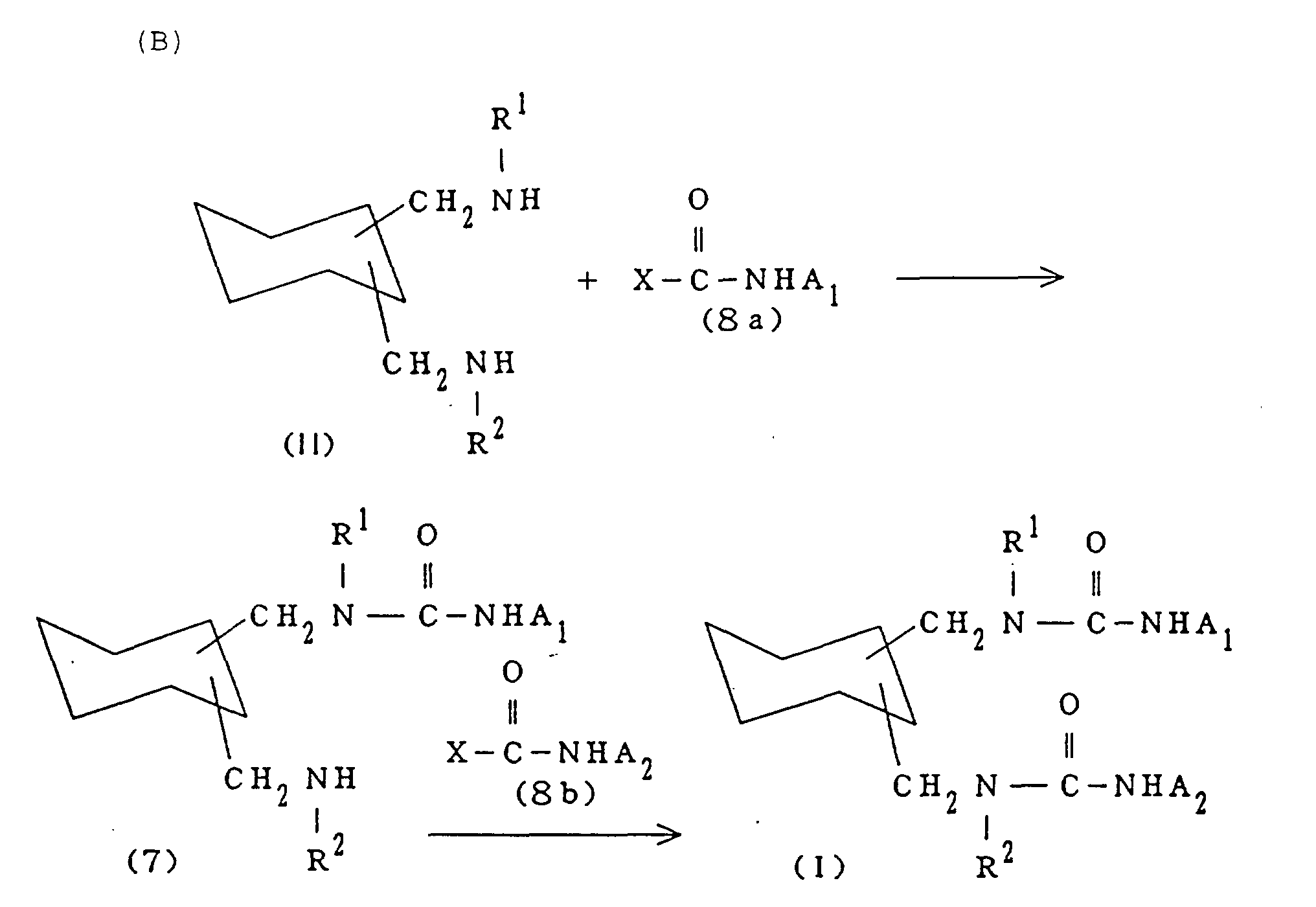
 wherein R1, R2, A1 and A2 are as defined in claim 1 and Y is a C1-C5 alkyl group or a phenyl group;
 wherein X, Y, R1, R2, A1 and A2 are as defined in claim 1.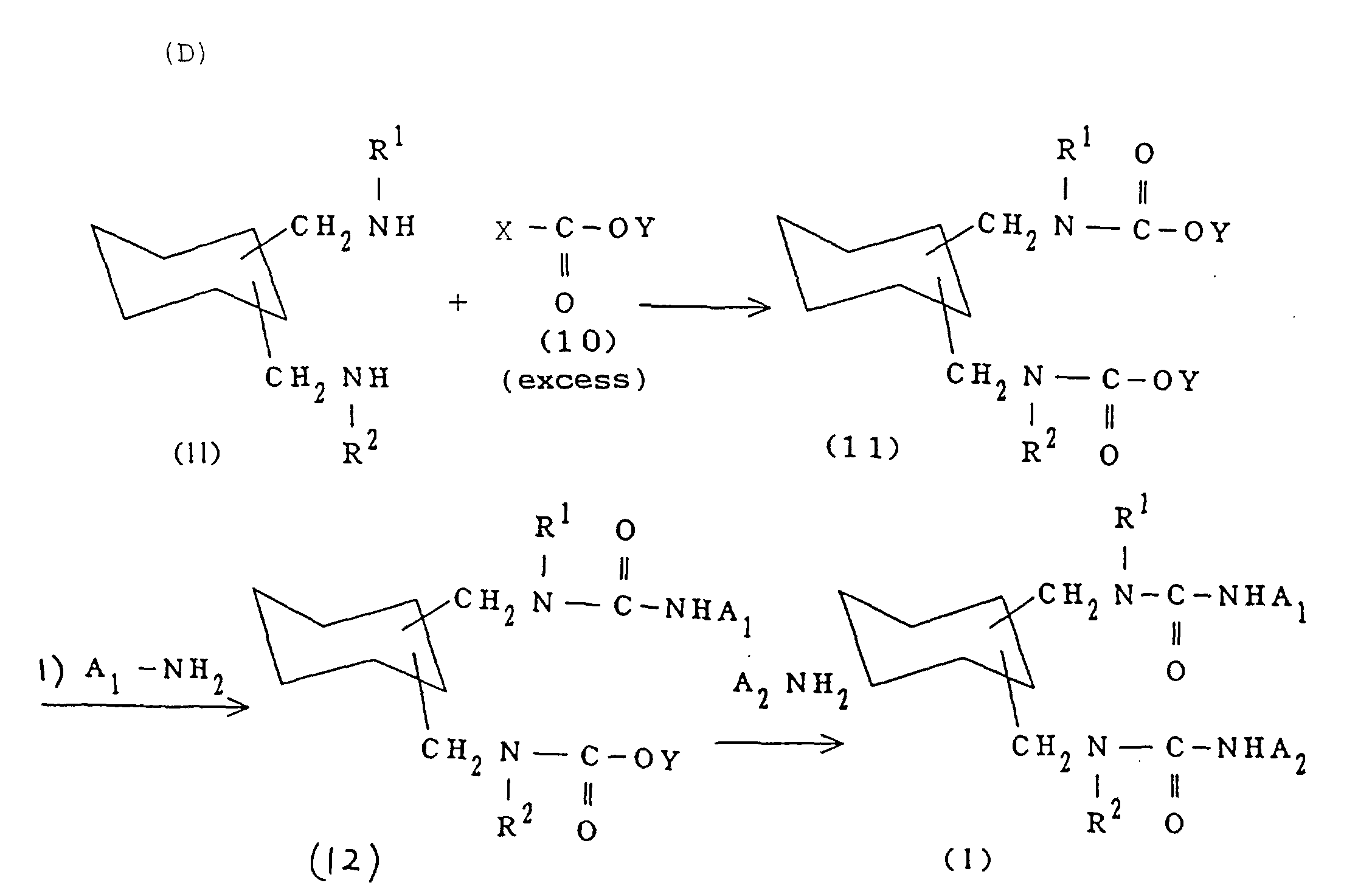
Applications Claiming Priority (4)
| Application Number | Priority Date | Filing Date | Title |
|---|---|---|---|
| JP22624793 | 1993-09-10 | ||
| JP226247/93 | 1993-09-10 | ||
| JP22624793A JP3286745B2 (en) | 1993-09-10 | 1993-09-10 | Cyclohexanediurea derivative and its production method |
| PCT/JP1994/001475 WO1995007258A1 (en) | 1993-09-10 | 1994-09-07 | Cyclohexanediurea derivative and process for producing the same |
Publications (3)
| Publication Number | Publication Date |
|---|---|
| EP0718281A1 EP0718281A1 (en) | 1996-06-26 |
| EP0718281A4 EP0718281A4 (en) | 1997-11-26 |
| EP0718281B1 true EP0718281B1 (en) | 2001-06-27 |
Family
ID=16842204
Family Applications (1)
| Application Number | Title | Priority Date | Filing Date |
|---|---|---|---|
| EP94926366A Expired - Lifetime EP0718281B1 (en) | 1993-09-10 | 1994-09-07 | Cyclohexanediurea derivative and process for producing the same |
Country Status (9)
| Country | Link |
|---|---|
| US (1) | US5733931A (en) |
| EP (1) | EP0718281B1 (en) |
| JP (1) | JP3286745B2 (en) |
| KR (1) | KR100320162B1 (en) |
| AT (1) | ATE202555T1 (en) |
| AU (1) | AU680941B2 (en) |
| CA (1) | CA2171295A1 (en) |
| DE (1) | DE69427587T2 (en) |
| WO (1) | WO1995007258A1 (en) |
Families Citing this family (12)
| Publication number | Priority date | Publication date | Assignee | Title |
|---|---|---|---|---|
| TW539661B (en) * | 2000-09-12 | 2003-07-01 | Mitsubishi Gas Chemical Co | Amino compound and process for producing the same |
| DE10133686C2 (en) * | 2001-07-11 | 2003-07-17 | Osram Opto Semiconductors Gmbh | Organic, electroluminescent display and its manufacture |
| US20050119314A1 (en) * | 2002-04-05 | 2005-06-02 | Sankyo Company, Limited | Pharmaceutical composition comprising an ACAT inhibitor and an insulin resistance reducing agent |
| CN1812983A (en) * | 2003-05-30 | 2006-08-02 | 兰贝克赛实验室有限公司 | Substituted pyrrole derivatives and their use as hmg-co inhibitors |
| EP1689383B1 (en) | 2003-11-19 | 2012-10-31 | Metabasis Therapeutics, Inc. | Novel phosphorus-containing thyromimetics |
| KR101021828B1 (en) * | 2004-10-27 | 2011-03-17 | 다이이찌 산쿄 가부시키가이샤 | Benzene Compounds Having Two or More Substituents |
| SG166829A1 (en) * | 2005-11-08 | 2010-12-29 | Ranbaxy Lab Ltd | Process for (3r, 5r)-7-[2-(4-fluorophenyl)-5-isopropyl-3-phenyl-4- [(4-hydroxy methyl phenyl amino) carbonyl]-pyrrol-1-yl]-3, 5-dihydroxy-heptanoic acid hemi calcium salt |
| WO2008020314A2 (en) * | 2006-03-14 | 2008-02-21 | Ranbaxy Laboratories Limited | Statin stabilizing dosage formulations |
| WO2008010087A2 (en) * | 2006-07-14 | 2008-01-24 | Ranbaxy Laboratories Limited | Polymorphic forms of an hmg-coa reductase inhibitor and uses thereof |
| US20120046364A1 (en) | 2009-02-10 | 2012-02-23 | Metabasis Therapeutics, Inc. | Novel Sulfonic Acid-Containing Thyromimetics, and Methods for Their Use |
| JP6806562B2 (en) * | 2013-03-15 | 2021-01-06 | ザ リージェンツ オブ ザ ユニバーシティ オブ カリフォルニア | Regulator of the eIF2α pathway |
| CN110272588B (en) * | 2019-06-21 | 2022-07-05 | 广州华新科智造技术有限公司 | Polypropylene nucleating agent and preparation method and application thereof |
Family Cites Families (7)
| Publication number | Priority date | Publication date | Assignee | Title |
|---|---|---|---|---|
| US3631107A (en) | 1969-10-24 | 1971-12-28 | Ayerst Mckenna & Harrison | N n'-bis(acenaphthenylmethyl)-cyclohexanebis(methylamines) and the salts thereof |
| US3940441A (en) | 1973-02-09 | 1976-02-24 | Sterling Drug Inc. | N,N'-bisphenoxybenzyl-bridged-diamides |
| US4119668A (en) | 1975-06-02 | 1978-10-10 | Sterling Drug Inc. | N,N'-Bridged-bis[N,N'substituted-2-hydroxy alkaneammonium] salts |
| CN1021819C (en) * | 1988-01-20 | 1993-08-18 | 山之内制药株式会社 | Process for diurea derivatives useful as medicaments |
| US5166429A (en) * | 1988-01-20 | 1992-11-24 | Yamanouchi Pharmaceutical Co., Ltd. | Diurea derivatives useful as medicaments and processes for the preparation thereof |
| JPH02117651A (en) * | 1988-01-20 | 1990-05-02 | Yamanouchi Pharmaceut Co Ltd | Diurea derivative and its production |
| US5227492A (en) * | 1988-01-20 | 1993-07-13 | Yamanouchi Pharmaceutical Co., Ltd. | Diurea derivatives useful as medicaments and processes for the preparation thereof |
-
1993
- 1993-09-10 JP JP22624793A patent/JP3286745B2/en not_active Expired - Fee Related
-
1994
- 1994-09-07 AU AU76235/94A patent/AU680941B2/en not_active Ceased
- 1994-09-07 CA CA002171295A patent/CA2171295A1/en not_active Abandoned
- 1994-09-07 DE DE69427587T patent/DE69427587T2/en not_active Expired - Fee Related
- 1994-09-07 EP EP94926366A patent/EP0718281B1/en not_active Expired - Lifetime
- 1994-09-07 US US08/617,828 patent/US5733931A/en not_active Expired - Fee Related
- 1994-09-07 KR KR1019960701207A patent/KR100320162B1/en not_active Expired - Fee Related
- 1994-09-07 AT AT94926366T patent/ATE202555T1/en not_active IP Right Cessation
- 1994-09-07 WO PCT/JP1994/001475 patent/WO1995007258A1/en not_active Ceased
Also Published As
| Publication number | Publication date |
|---|---|
| AU7623594A (en) | 1995-03-27 |
| US5733931A (en) | 1998-03-31 |
| EP0718281A4 (en) | 1997-11-26 |
| KR960704840A (en) | 1996-10-09 |
| EP0718281A1 (en) | 1996-06-26 |
| AU680941B2 (en) | 1997-08-14 |
| KR100320162B1 (en) | 2002-11-13 |
| JPH0782232A (en) | 1995-03-28 |
| JP3286745B2 (en) | 2002-05-27 |
| WO1995007258A1 (en) | 1995-03-16 |
| DE69427587D1 (en) | 2001-08-02 |
| CA2171295A1 (en) | 1995-03-16 |
| ATE202555T1 (en) | 2001-07-15 |
| DE69427587T2 (en) | 2002-04-25 |
Similar Documents
| Publication | Publication Date | Title |
|---|---|---|
| US5705529A (en) | N-benzoyl amino acid derivatives pharmaceutical compositions containing them and process for preparing same | |
| JP3484193B2 (en) | Aminosulfonyl carbamate | |
| US5300507A (en) | New heterocycle-substituted alkylamides | |
| AU680941B2 (en) | Cyclohexanediurea derivative and process for producing the same | |
| EP0333522B1 (en) | Catechol derivatives and pharmaceutical preparations containing same | |
| DE69119434T2 (en) | ANILIDE DERIVATIVE | |
| US6569895B1 (en) | Compounds and methods for the treatment of cardiovascular, inflammatory and immune disorders | |
| US4992464A (en) | Heteroaryl N-hydroxy amides and ureas with polar substituents as 5-lipoxygenase inhibitors | |
| JPH032144A (en) | New diamine compound and brain protective containing same | |
| US5232923A (en) | Catechol derivatives and pharmaceutical preparations containing same | |
| JPS61148150A (en) | Aminophenol derivative | |
| JP2023534674A (en) | Sulfonylurea derivatives and their medicinal use | |
| JPH0193569A (en) | N-((2,6-disubstituted)phenyl)urea and carbamate inhibitor of acyl coa-cholesterol acyltransferase | |
| EP0556308B1 (en) | Oxysulfonyl urea acat inhibitors | |
| US5753671A (en) | Imidazopyridine derivatives as dual histamine (H1) and platelet activating factor (PAF) antagonists | |
| JP3003941B2 (en) | Novel N- [substituted aryl] -N '-[substituted alkoxy] -urea and thiourea derivatives | |
| EP0399358B1 (en) | Butenoic acid derivatives | |
| EP0424194A2 (en) | Benzanilide derivatives and their use as anti-atherosclerotic agents | |
| US5258405A (en) | Urea derivatives and salts thereof in method for inhibiting the ACAT enzyme | |
| CN106608824B (en) | Aromatic acid ester compound and preparation method and application thereof | |
| US5073568A (en) | Antipsoriatic agents | |
| US4243665A (en) | 2-Heterocyclylalkyl-6-methoxy-naphthalenes | |
| AU698308B2 (en) | New thiophene compounds, process for the preparation thereof, and pharmaceutical compositions containing them | |
| EP0365210A1 (en) | Hydroxamic acid derivatives | |
| Nakao et al. | Novel hydroxyphenylurea dual inhibitor against acyl-CoA: cholesterol acyltransferase (ACAT) and low density lipoprotein (LDL) oxidation as antiatherosclerotic agent |
Legal Events
| Date | Code | Title | Description |
|---|---|---|---|
| PUAI | Public reference made under article 153(3) epc to a published international application that has entered the european phase |
Free format text: ORIGINAL CODE: 0009012 |
|
| 17P | Request for examination filed |
Effective date: 19960325 |
|
| AK | Designated contracting states |
Kind code of ref document: A1 Designated state(s): AT BE CH DE DK ES FR GB GR IE IT LI LU MC NL PT SE |
|
| A4 | Supplementary search report drawn up and despatched |
Effective date: 19971009 |
|
| AK | Designated contracting states |
Kind code of ref document: A4 Designated state(s): AT BE CH DE DK ES FR GB GR IE IT LI LU MC NL PT SE |
|
| 17Q | First examination report despatched |
Effective date: 19990927 |
|
| GRAG | Despatch of communication of intention to grant |
Free format text: ORIGINAL CODE: EPIDOS AGRA |
|
| GRAG | Despatch of communication of intention to grant |
Free format text: ORIGINAL CODE: EPIDOS AGRA |
|
| GRAH | Despatch of communication of intention to grant a patent |
Free format text: ORIGINAL CODE: EPIDOS IGRA |
|
| GRAG | Despatch of communication of intention to grant |
Free format text: ORIGINAL CODE: EPIDOS AGRA |
|
| GRAH | Despatch of communication of intention to grant a patent |
Free format text: ORIGINAL CODE: EPIDOS IGRA |
|
| GRAA | (expected) grant |
Free format text: ORIGINAL CODE: 0009210 |
|
| AK | Designated contracting states |
Kind code of ref document: B1 Designated state(s): AT BE CH DE DK ES FR GB GR IE IT LI LU MC NL PT SE |
|
| PG25 | Lapsed in a contracting state [announced via postgrant information from national office to epo] |
Ref country code: NL Free format text: LAPSE BECAUSE OF FAILURE TO SUBMIT A TRANSLATION OF THE DESCRIPTION OR TO PAY THE FEE WITHIN THE PRESCRIBED TIME-LIMIT Effective date: 20010627 Ref country code: GR Free format text: LAPSE BECAUSE OF NON-PAYMENT OF DUE FEES Effective date: 20010627 Ref country code: BE Free format text: LAPSE BECAUSE OF FAILURE TO SUBMIT A TRANSLATION OF THE DESCRIPTION OR TO PAY THE FEE WITHIN THE PRESCRIBED TIME-LIMIT Effective date: 20010627 Ref country code: AT Free format text: LAPSE BECAUSE OF FAILURE TO SUBMIT A TRANSLATION OF THE DESCRIPTION OR TO PAY THE FEE WITHIN THE PRESCRIBED TIME-LIMIT Effective date: 20010627 |
|
| REF | Corresponds to: |
Ref document number: 202555 Country of ref document: AT Date of ref document: 20010715 Kind code of ref document: T |
|
| REG | Reference to a national code |
Ref country code: CH Ref legal event code: NV Representative=s name: RITSCHER & SEIFERT Ref country code: CH Ref legal event code: EP |
|
| REG | Reference to a national code |
Ref country code: IE Ref legal event code: FG4D |
|
| REF | Corresponds to: |
Ref document number: 69427587 Country of ref document: DE Date of ref document: 20010802 |
|
| PG25 | Lapsed in a contracting state [announced via postgrant information from national office to epo] |
Ref country code: MC Free format text: LAPSE BECAUSE OF NON-PAYMENT OF DUE FEES Effective date: 20010907 Ref country code: LU Free format text: LAPSE BECAUSE OF NON-PAYMENT OF DUE FEES Effective date: 20010907 Ref country code: IE Free format text: LAPSE BECAUSE OF NON-PAYMENT OF DUE FEES Effective date: 20010907 |
|
| ITF | It: translation for a ep patent filed | ||
| PG25 | Lapsed in a contracting state [announced via postgrant information from national office to epo] |
Ref country code: SE Free format text: LAPSE BECAUSE OF FAILURE TO SUBMIT A TRANSLATION OF THE DESCRIPTION OR TO PAY THE FEE WITHIN THE PRESCRIBED TIME-LIMIT Effective date: 20010927 Ref country code: PT Free format text: LAPSE BECAUSE OF FAILURE TO SUBMIT A TRANSLATION OF THE DESCRIPTION OR TO PAY THE FEE WITHIN THE PRESCRIBED TIME-LIMIT Effective date: 20010927 Ref country code: DK Free format text: LAPSE BECAUSE OF FAILURE TO SUBMIT A TRANSLATION OF THE DESCRIPTION OR TO PAY THE FEE WITHIN THE PRESCRIBED TIME-LIMIT Effective date: 20010927 |
|
| ET | Fr: translation filed | ||
| NLV1 | Nl: lapsed or annulled due to failure to fulfill the requirements of art. 29p and 29m of the patents act | ||
| PG25 | Lapsed in a contracting state [announced via postgrant information from national office to epo] |
Ref country code: ES Free format text: LAPSE BECAUSE OF FAILURE TO SUBMIT A TRANSLATION OF THE DESCRIPTION OR TO PAY THE FEE WITHIN THE PRESCRIBED TIME-LIMIT Effective date: 20011220 |
|
| REG | Reference to a national code |
Ref country code: GB Ref legal event code: IF02 |
|
| PLBE | No opposition filed within time limit |
Free format text: ORIGINAL CODE: 0009261 |
|
| STAA | Information on the status of an ep patent application or granted ep patent |
Free format text: STATUS: NO OPPOSITION FILED WITHIN TIME LIMIT |
|
| 26N | No opposition filed | ||
| REG | Reference to a national code |
Ref country code: IE Ref legal event code: MM4A |
|
| PGFP | Annual fee paid to national office [announced via postgrant information from national office to epo] |
Ref country code: GB Payment date: 20030903 Year of fee payment: 10 |
|
| PGFP | Annual fee paid to national office [announced via postgrant information from national office to epo] |
Ref country code: FR Payment date: 20030915 Year of fee payment: 10 |
|
| PGFP | Annual fee paid to national office [announced via postgrant information from national office to epo] |
Ref country code: DE Payment date: 20030926 Year of fee payment: 10 |
|
| PGFP | Annual fee paid to national office [announced via postgrant information from national office to epo] |
Ref country code: CH Payment date: 20031001 Year of fee payment: 10 |
|
| PG25 | Lapsed in a contracting state [announced via postgrant information from national office to epo] |
Ref country code: GB Free format text: LAPSE BECAUSE OF NON-PAYMENT OF DUE FEES Effective date: 20040907 |
|
| PG25 | Lapsed in a contracting state [announced via postgrant information from national office to epo] |
Ref country code: LI Free format text: LAPSE BECAUSE OF NON-PAYMENT OF DUE FEES Effective date: 20040930 Ref country code: CH Free format text: LAPSE BECAUSE OF NON-PAYMENT OF DUE FEES Effective date: 20040930 |
|
| PG25 | Lapsed in a contracting state [announced via postgrant information from national office to epo] |
Ref country code: DE Free format text: LAPSE BECAUSE OF NON-PAYMENT OF DUE FEES Effective date: 20050401 |
|
| GBPC | Gb: european patent ceased through non-payment of renewal fee |
Effective date: 20040907 |
|
| REG | Reference to a national code |
Ref country code: CH Ref legal event code: PL |
|
| PG25 | Lapsed in a contracting state [announced via postgrant information from national office to epo] |
Ref country code: FR Free format text: LAPSE BECAUSE OF NON-PAYMENT OF DUE FEES Effective date: 20050531 |
|
| REG | Reference to a national code |
Ref country code: FR Ref legal event code: ST |
|
| PG25 | Lapsed in a contracting state [announced via postgrant information from national office to epo] |
Ref country code: IT Free format text: LAPSE BECAUSE OF NON-PAYMENT OF DUE FEES;WARNING: LAPSES OF ITALIAN PATENTS WITH EFFECTIVE DATE BEFORE 2007 MAY HAVE OCCURRED AT ANY TIME BEFORE 2007. THE CORRECT EFFECTIVE DATE MAY BE DIFFERENT FROM THE ONE RECORDED. Effective date: 20050907 |