EP0717905B1 - Method and apparatus for motion estimation using block matching - Google Patents
Method and apparatus for motion estimation using block matching Download PDFInfo
- Publication number
- EP0717905B1 EP0717905B1 EP94926222A EP94926222A EP0717905B1 EP 0717905 B1 EP0717905 B1 EP 0717905B1 EP 94926222 A EP94926222 A EP 94926222A EP 94926222 A EP94926222 A EP 94926222A EP 0717905 B1 EP0717905 B1 EP 0717905B1
- Authority
- EP
- European Patent Office
- Prior art keywords
- field
- frame
- interpolated
- motion vector
- search window
- Prior art date
- Legal status (The legal status is an assumption and is not a legal conclusion. Google has not performed a legal analysis and makes no representation as to the accuracy of the status listed.)
- Expired - Lifetime
Links
- 238000000034 method Methods 0.000 title claims abstract description 23
- 239000013598 vector Substances 0.000 claims abstract description 52
- 238000001514 detection method Methods 0.000 claims description 3
- 238000006073 displacement reaction Methods 0.000 description 3
- 238000006243 chemical reaction Methods 0.000 description 2
- 230000001934 delay Effects 0.000 description 2
- 230000001419 dependent effect Effects 0.000 description 2
- TVEXGJYMHHTVKP-UHFFFAOYSA-N 6-oxabicyclo[3.2.1]oct-3-en-7-one Chemical compound C1C2C(=O)OC1C=CC2 TVEXGJYMHHTVKP-UHFFFAOYSA-N 0.000 description 1
- 230000000694 effects Effects 0.000 description 1
- 230000002123 temporal effect Effects 0.000 description 1
Images



Classifications
-
- H—ELECTRICITY
- H04—ELECTRIC COMMUNICATION TECHNIQUE
- H04N—PICTORIAL COMMUNICATION, e.g. TELEVISION
- H04N5/00—Details of television systems
- H04N5/14—Picture signal circuitry for video frequency region
- H04N5/144—Movement detection
- H04N5/145—Movement estimation
-
- H—ELECTRICITY
- H04—ELECTRIC COMMUNICATION TECHNIQUE
- H04N—PICTORIAL COMMUNICATION, e.g. TELEVISION
- H04N19/00—Methods or arrangements for coding, decoding, compressing or decompressing digital video signals
- H04N19/50—Methods or arrangements for coding, decoding, compressing or decompressing digital video signals using predictive coding
- H04N19/503—Methods or arrangements for coding, decoding, compressing or decompressing digital video signals using predictive coding involving temporal prediction
- H04N19/51—Motion estimation or motion compensation
- H04N19/577—Motion compensation with bidirectional frame interpolation, i.e. using B-pictures
Definitions
- the present invention relates to a method and to an apparatus for motion estimation using block matching.
- FIG. 7 shows a possible architecture for a one-sided block matching motion estimator with a range of ⁇ 2 pixels per field horizontally and vertically, to integer accuracy.
- This architecture is based on processing elements, one per candidate motion vector.
- Each processing element PE accumulates the errors between the pixels (which form a group related to a candidate block position and vector, respectively) arriving at its two inputs, storing partial results in order to arrive at a total error for each block.
- the processing elements are connected together by means not shown in the figure in order to find which one yields the minimum error for each block.
- the processing elements may calculate the minimum absolute value or the minimum squared error.
- the invention uses two-sided block matching.
- the advantages of two-sided block matching are not confined to 50Hz to 100Hz upconversion but apply to any temporal interpolation, for example 50Hz to 60Hz or 50Hz to 75Hz standards conversion, for which motion vectors are required at points in time between input fields.
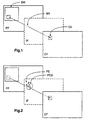
- the current field (or frame) CF of the picture is divided into blocks, typically rectangular.
- a search is made among overlapping blocks of the same size in the previous field (or frame) PF to find one that matches the current-field block CB best, usually using a meansquare or mean-absolute error criterion summed across the pixels in the block.
- the relative position of the best-matching block in the previous frame gives the chosen displacement, or motion, vector MV for the current block.
- the set of pixels involved in the previous frame is known as the search window SW corresponding to that block.
- the block matching process makes use of the current block and the search window.
- the positional error PE can be corrected by displacing the block in the interpolated field IF appropriately according to the motion vectors, but this leads to the occurrence of gaps GP (areas in the interpolated field for which no motion vectors exist) and, equally, of areas CT for which two or more motion vectors conflict, as shown in Fig. 3.
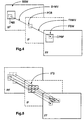
- the search window (BSW and FSW) is shared between the two input fields BF and FF in such a way that the candidate motion vectors (related to the candidate pixel blocks CPBB and CPBF) all pass through the same points in the field IF to be interpolated.
- the 'current block' becomes a notional area in the field to be interpolated, and each of the two new search windows BSW and FSW extends to half the maximum motion vector in each direction.
- Each motion vector points forward (forward half of motion vector FHMV) to the forward field FF by half its value and backward (backward half of motion vector BHMV) to the backward field BF by half its value. Both vector parts depend on the same candidate motion vector.
- Two-sided block matching solves the positional error problem because the current blocks IFB cover the interpolated field and are correctly placed in the interpolated field, and it solves the problem of gaps and conflicts because every point in the interpolated field has precisely one motion vector assigned to it, see Fig. 5.
- the inventive method is suited for motion estimation using block matching within a preselected search window width, wherein each successive pixel block of a current field or frame is matched with respective candidate pixel blocks within a search window of a backward field or frame having a half of said preselected width and with the corresponding pixel blocks within the corresponding search window of a forward field or frame having a half of said preselected width in order to select a motion vector related to the location of the best matching block of the backward field or frame and to the location of the best matching block of the forward field or frame, whereby the current position of said search window is related to the position of the current pixel block of said current field or frame.
- the inventive apparatus is suited for motion estimation using block matching within a preselected search window width and includes:
- Fig. 8 shows a possible architecture for a two-sided block matching motion estimator with a range of ⁇ 2 pixels per field horizontally and vertically, to integer accuracy.
- This architecture is based on processing elements, one per candidate motion vector.
- Each processing element PE accumulates the errors between the pixels (which form a group related to a candidate block position and vector, respectively) arriving at its two inputs, storing partial results in order to arrive at a total error for each block.
- the processing elements are connected together by means not shown in the figure in order to find which one yields the minimum error for each block.
- the processing elements may calculate the minimum absolute value or the minimum squared error.
- the two-sided motion estimator in Fig. 8 uses method (ii) described above to overcome the accuracy problem.
- the line LD and SD sample delays used to generate the relative search window displacements are now shared between the two fields, and both inputs of each processing element PE depend on the motion vector being tested, whereby the one input includes the field delay FD connected to input INP.
- the two-sided implementation is actually slightly simpler than the one-sided of Fig. 7.
- the inventive motion compensation improves the subjective picture quality and can also be used in slow motion generation, noise reduction, standard conversion and for controlling LCD displays.
Landscapes
- Engineering & Computer Science (AREA)
- Multimedia (AREA)
- Signal Processing (AREA)
- Television Systems (AREA)
- Compression Or Coding Systems Of Tv Signals (AREA)
- Image Analysis (AREA)
- Compression, Expansion, Code Conversion, And Decoders (AREA)
Abstract
Description
Fig. 7 shows a possible architecture for a one-sided block matching motion estimator with a range of ±2 pixels per field horizontally and vertically, to integer accuracy. This architecture is based on processing elements, one per candidate motion vector. Each processing element PE accumulates the errors between the pixels (which form a group related to a candidate block position and vector, respectively) arriving at its two inputs, storing partial results in order to arrive at a total error for each block. The processing elements are connected together by means not shown in the figure in order to find which one yields the minimum error for each block. The processing elements may calculate the minimum absolute value or the minimum squared error.
In the one-sided motion estimator in Fig. 7, all the processing elements PE have a common input IN, corresponding to the current block. The relative displacements between the pixels in the search window are provided by a network of line LD and sample SD delays that follow the field delay FD connected to input INP.
US-A-5162907 shows one-sided block matching, in which the reference picture is not the picture to be interpolated.
However, when the purpose of the motion estimation is to provide accurate interpolation between images, for example in a 50Hz to 100Hz upconverter, conventional block matching suffers from the problem that the blocks are situated in the original fields rather than in the fields to be interpolated, leading to possible errors in the calculated motion field.
by interpolating the field to provide the half-pixel points (for which simple bilinear interpolation will suffice)
by rounding the forward and backward half-vectors in such a way that their sum remains correct.
- field or frame delay means and line delay means and sample delay means providing for each successive pixel block of a current field or frame the pixel positions of a search window of a backward field or frame having a half of said preselected width and the pixel positions of the corresponding search window of a forward field or frame having a half of said preselected width;
- processing elements arranged in respective order with said delay means, for matching each of said successive pixel blocks of a current field or frame with the corresponding candidate pixel blocks within said search windows by accumulating the errors between such pixels which arrive at its two inputs, storing partial results in order to arrive at a total error for each block;
- detection means connected to said processing means for selecting a motion vector related to the location of the best matching pair of forward and backward blocks, a first part of which is related to the backward field or frame and a second part of which is related to the forward field or frame, whereby the current position of said search windows is related to the position of the current pixel block of said current field or frame.
- Fig. 1
- one-sided block matching;
- Fig. 2
- positional error in one-sided block matching;
- Fig. 3
- motion vector gaps and conflicts in one-sided block matching;
- Fig. 4
- two-sided block matching;
- Fig. 5
- avoidance of gaps and conflicts in two-sided block matching;
- Fig. 6
- overcoming the accuracy problem;
- Fig. 7
- one architecture for one-sided block matching;
- Fig. 8
- one architecture for two-sided block matching.
Claims (7)
- Method for motion estimation using two-sided block matching wherein a current field or frame (IF) to be interpolated is regarded as having notional pixel blocks (IFB) which cover the field or frame to be interpolated and are correctly placed in that field or frame to be interpolated and wherein respective candidate pixel blocks (CPBF) within a search window (FSW) in a forward field or frame (FF) are matched with respective candidate pixel blocks (CPBB) within a search window (BSW) in a backward field or frame (BF) in order to select one motion vector for a current of said notional pixel blocks (IFB), whereby the two-sided block matching is performed in such a way that a first part (BHMV) of said motion vector for a current of said notional pixel blocks (IFB) points to the location of the best matching block out of the backward field or frame search window (BSW) and the other part (FHMV) of said motion vector points to the location of the best matching block out of the forward field or frame search window (FSW), both vector parts depending on the same candidate motion vector, and whereby the candidate motion vectors all pass through the same points in said current field or frame (IF) to be interpolated.
- Method according to claim 1, wherein the first part and the other part of said motion vector is each one half of the motion vector.
- Method according to claim 1 or 2, wherein said block matching in said backward (BF) and said forward (FF) field or frame is performed using interpolated half-pixel values (IP).
- Method according to any of claims 2 to 3, wherein the first half (BHMV) and the second half (FHMV) of said motion vector is rounded in such a way that the related sum remains correct.
- Method according to any of claims 1 to 4, wherein this method is used for field or frame rate upconversion, slow motion generation, noise reduction or for controlling LCD displays.
- Apparatus for motion estimation using two-sided block matching wherein a current field or frame (IF) to be interpolated is regarded as having notional pixel blocks (IFB) which cover the field or frame to be interpolated and are correctly placed in that field or frame to be interpolated, for performing a method according to any of claims 1 to 5, and including:in order to select one motion vector for the current of said notional pixel blocks (IFB), whereby a first half (BHMV) of said motion vector points to the location of the best matching block in the backward field or frame search window (BSW) and the second half (FHMV) of said motion vector points to the location of the best matching block in the forward field or frame search window (FSW), both vector parts depending on the same candidate motion vector, and whereby the candidate motion vectors all pass through the same points in said current field or frame (IF) to be interpolated.field or frame delay means (FD), line delay means (LD) and sample delay means (SD) for providing for each current of said notional pixel blocks (IFB) pixels of the required pixel positions of a search window (FSW), having a preselected width, of a forward field or frame (FF),further field or frame delay means (FD), line delay means (LD) and sample delay means (SD) for providing for the current of said notional pixel blocks (IFB) the pixels of the required pixel positions of a search window (BSW), having said preselected width, of a backward field or frame (BF);processing elements (PE) each having two inputs and being connected to said field or frame delay means, line delay means and sample delay means and/or to said further field or frame delay means, line delay means and sample delay means for matching respective candidate pixel blocks (CPBF) within the search window (FSW) in the forward field or frame (FF) with respective candidate pixel blocks (CPBB) within the search window (BSW) in the backward field or frame (BF) by accumulating the errors between such pixels which arrive at its two inputs, and for storing the partial- results in order to arrive at a total error for each block;detection means connected to said processing elements (PE) for selecting a motion vector related to the location of the best matching pair of blocks from the forward field or frame and the backward field or frame,
- Apparatus according to claim 6, wherein said detection means round the first half (BHMV) and the second half (FHMV) of said motion vector in such a way that the related sum remains correct.
Priority Applications (1)
| Application Number | Priority Date | Filing Date | Title |
|---|---|---|---|
| EP94926222A EP0717905B1 (en) | 1993-09-08 | 1994-08-30 | Method and apparatus for motion estimation using block matching |
Applications Claiming Priority (6)
| Application Number | Priority Date | Filing Date | Title |
|---|---|---|---|
| EP93402187 | 1993-09-08 | ||
| EP93402187 | 1993-09-08 | ||
| EP93117674 | 1993-11-02 | ||
| EP93117674 | 1993-11-02 | ||
| EP94926222A EP0717905B1 (en) | 1993-09-08 | 1994-08-30 | Method and apparatus for motion estimation using block matching |
| PCT/EP1994/002870 WO1995007591A1 (en) | 1993-09-08 | 1994-08-30 | Method and apparatus for motion estimation using block matching |
Publications (2)
| Publication Number | Publication Date |
|---|---|
| EP0717905A1 EP0717905A1 (en) | 1996-06-26 |
| EP0717905B1 true EP0717905B1 (en) | 1998-04-22 |
Family
ID=26133500
Family Applications (1)
| Application Number | Title | Priority Date | Filing Date |
|---|---|---|---|
| EP94926222A Expired - Lifetime EP0717905B1 (en) | 1993-09-08 | 1994-08-30 | Method and apparatus for motion estimation using block matching |
Country Status (9)
| Country | Link |
|---|---|
| US (1) | US5822007A (en) |
| EP (1) | EP0717905B1 (en) |
| JP (1) | JP3852861B2 (en) |
| KR (1) | KR100330797B1 (en) |
| CN (1) | CN1045859C (en) |
| AT (1) | ATE165487T1 (en) |
| DE (1) | DE69409816T2 (en) |
| ES (1) | ES2117293T3 (en) |
| WO (1) | WO1995007591A1 (en) |
Families Citing this family (24)
| Publication number | Priority date | Publication date | Assignee | Title |
|---|---|---|---|---|
| FR2743247B1 (en) * | 1995-12-29 | 1998-01-23 | Thomson Multimedia Sa | DEVICE FOR ESTIMATING MOTION BY MATCHING BLOCKS |
| JP3183155B2 (en) * | 1996-03-18 | 2001-07-03 | 株式会社日立製作所 | Image decoding apparatus and image decoding method |
| JP3019787B2 (en) | 1996-09-20 | 2000-03-13 | 日本電気株式会社 | Motion vector detection device |
| JP3631868B2 (en) * | 1996-12-20 | 2005-03-23 | 株式会社東芝 | Motion vector detection apparatus and method |
| JPH11168727A (en) * | 1997-12-02 | 1999-06-22 | Mitsubishi Electric Corp | Motion vector detection device |
| DE69918877T2 (en) * | 1998-02-17 | 2005-07-28 | Koninklijke Philips Electronics N.V. | Image processing method for motion estimation in a picture sequence |
| EP1090502B1 (en) * | 1999-04-26 | 2005-11-30 | Koninklijke Philips Electronics N.V. | Sub-pixel accurate motion vector estimation and motion-compensated interpolation |
| EP1275244B1 (en) * | 2000-04-11 | 2010-12-22 | Trident Microsystems (Far East) Ltd. | Determining the degree of resemblance between a data sample and interpolations of other data samples |
| US6757330B1 (en) * | 2000-06-01 | 2004-06-29 | Hewlett-Packard Development Company, L.P. | Efficient implementation of half-pixel motion prediction |
| JP3840129B2 (en) * | 2002-03-15 | 2006-11-01 | 株式会社東芝 | Motion vector detection method and apparatus, interpolation image generation method and apparatus, and image display system |
| KR100437974B1 (en) * | 2002-05-11 | 2004-07-02 | 주식회사 메디슨 | Three-dimensional ultrasound imaging method and apparatus using lateral distance correlation function |
| US7362374B2 (en) * | 2002-08-30 | 2008-04-22 | Altera Corporation | Video interlacing using object motion estimation |
| US7120195B2 (en) * | 2002-10-28 | 2006-10-10 | Hewlett-Packard Development Company, L.P. | System and method for estimating motion between images |
| KR100499144B1 (en) * | 2003-03-06 | 2005-07-04 | 삼성전자주식회사 | Method and apparatus for generating the motion vector of interpolated image using the adaptive bi-directional motion estimation |
| US20070019107A1 (en) * | 2003-09-04 | 2007-01-25 | Koninklijke Philips Electronics N.V. | Robust de-interlacing of video signals |
| JP4692845B2 (en) * | 2004-04-09 | 2011-06-01 | ソニー株式会社 | Image processing apparatus and method, recording medium, and program |
| US20050286777A1 (en) * | 2004-06-27 | 2005-12-29 | Roger Kumar | Encoding and decoding images |
| US20080018788A1 (en) * | 2006-07-20 | 2008-01-24 | Samsung Electronics Co., Ltd. | Methods and systems of deinterlacing using super resolution technology |
| US8218811B2 (en) | 2007-09-28 | 2012-07-10 | Uti Limited Partnership | Method and system for video interaction based on motion swarms |
| US20090207314A1 (en) * | 2008-02-14 | 2009-08-20 | Brian Heng | Method and system for motion vector estimation using a pivotal pixel search |
| GB2503833B (en) * | 2008-12-09 | 2014-04-30 | Snell Ltd | Motion image rendering system |
| EP2800371A4 (en) * | 2011-12-28 | 2015-08-12 | Jvc Kenwood Corp | VIDEO ENCODING DEVICE, VIDEO ENCODING METHOD, AND VIDEO ENCODING PROGRAM, AND VIDEO DECODING DEVICE, VIDEO DECODING METHOD, AND VIDEO DECODING PROGRAM |
| US9148622B2 (en) * | 2011-12-29 | 2015-09-29 | Hong Kong Applied Science and Technology Research Institute Company, Limited | Halo reduction in frame-rate-conversion using hybrid bi-directional motion vectors for occlusion/disocclusion detection |
| CN105007493B (en) * | 2015-07-17 | 2018-06-29 | 珠海市杰理科技股份有限公司 | Matching searching method and system based on motion search window |
Family Cites Families (7)
| Publication number | Priority date | Publication date | Assignee | Title |
|---|---|---|---|---|
| FR2648254B2 (en) * | 1988-09-23 | 1991-08-30 | Thomson Csf | METHOD AND DEVICE FOR ESTIMATING MOTION IN A SEQUENCE OF MOVED IMAGES |
| GB2231743B (en) * | 1989-04-27 | 1993-10-20 | Sony Corp | Motion dependent video signal processing |
| GB2248361B (en) * | 1990-09-28 | 1994-06-01 | Sony Broadcast & Communication | Motion dependent video signal processing |
| CA2114028C (en) * | 1991-07-23 | 1998-04-28 | Mark Andrew Shackleton | Method and device for frame interpolation of a moving image |
| GB2266023B (en) * | 1992-03-31 | 1995-09-06 | Sony Broadcast & Communication | Motion dependent video signal processing |
| US5398079A (en) * | 1993-01-27 | 1995-03-14 | General Instrument Corporation | Half-pixel interpolation for a motion compensated digital video system |
| GB2283385B (en) * | 1993-10-26 | 1998-04-01 | Sony Uk Ltd | Motion compensated video signal processing |
-
1994
- 1994-08-30 KR KR1019960701282A patent/KR100330797B1/en not_active Expired - Fee Related
- 1994-08-30 JP JP50842995A patent/JP3852861B2/en not_active Expired - Fee Related
- 1994-08-30 ES ES94926222T patent/ES2117293T3/en not_active Expired - Lifetime
- 1994-08-30 DE DE69409816T patent/DE69409816T2/en not_active Expired - Lifetime
- 1994-08-30 CN CN94193310A patent/CN1045859C/en not_active Expired - Fee Related
- 1994-08-30 US US08/591,597 patent/US5822007A/en not_active Expired - Lifetime
- 1994-08-30 EP EP94926222A patent/EP0717905B1/en not_active Expired - Lifetime
- 1994-08-30 AT AT94926222T patent/ATE165487T1/en not_active IP Right Cessation
- 1994-08-30 WO PCT/EP1994/002870 patent/WO1995007591A1/en not_active Ceased
Also Published As
| Publication number | Publication date |
|---|---|
| HK1008457A1 (en) | 1999-05-07 |
| CN1045859C (en) | 1999-10-20 |
| DE69409816T2 (en) | 1998-08-13 |
| ES2117293T3 (en) | 1998-08-01 |
| KR100330797B1 (en) | 2002-07-31 |
| WO1995007591A1 (en) | 1995-03-16 |
| EP0717905A1 (en) | 1996-06-26 |
| JP3852861B2 (en) | 2006-12-06 |
| KR960705455A (en) | 1996-10-09 |
| CN1130455A (en) | 1996-09-04 |
| JPH09502317A (en) | 1997-03-04 |
| US5822007A (en) | 1998-10-13 |
| DE69409816D1 (en) | 1998-05-28 |
| ATE165487T1 (en) | 1998-05-15 |
Similar Documents
| Publication | Publication Date | Title |
|---|---|---|
| US5822007A (en) | Method and apparatus for motion estimation using block matching | |
| US5642170A (en) | Method and apparatus for motion compensated interpolation of intermediate fields or frames | |
| KR100396558B1 (en) | Apparatus and method for converting frame and/or field rate using adaptive motion compensation | |
| US8144778B2 (en) | Motion compensated frame rate conversion system and method | |
| JP4145351B2 (en) | Video signal scanning conversion method, apparatus, and video signal display apparatus | |
| EP0549681B1 (en) | Video image processing | |
| US8953687B2 (en) | Video interpolation | |
| JPH031787A (en) | Method and device for conducting time picture interpolation by using corrected transfer compensation | |
| JP2003174628A (en) | Apparatus and method for selecting pixel values for motion compensated interpolation | |
| CN101237578B (en) | Frame interpolation apparatus and method for motion estimation through separation into static object and moving object | |
| JP4197434B2 (en) | Facilitating motion estimation | |
| EP0659021A2 (en) | Detection of global translations between images | |
| Vlachos | Simple method for estimation of global motion parameters using sparse translational motion vector fields | |
| WO2003024117A1 (en) | Image processor and image display apparatus provided with such image processor | |
| HK1008457B (en) | Method and apparatus for motion estimation using block matching | |
| CN1957614B (en) | Motion Estimation in Interlaced Video Images | |
| EP0639926A1 (en) | Method and apparatus for motion vector estimation using block matching | |
| US8355441B2 (en) | Method and apparatus for generating motion compensated pictures | |
| JP4354799B2 (en) | Interpolated image generation method and apparatus | |
| JPH07222143A (en) | Method of detecting global displacement between images | |
| JP3903358B2 (en) | Motion vector evaluation method and apparatus | |
| KR20060084848A (en) | Robust de-interlacing of video signals | |
| GB2266639A (en) | Motion estimation. |
Legal Events
| Date | Code | Title | Description |
|---|---|---|---|
| PUAI | Public reference made under article 153(3) epc to a published international application that has entered the european phase |
Free format text: ORIGINAL CODE: 0009012 |
|
| 17P | Request for examination filed |
Effective date: 19960224 |
|
| AK | Designated contracting states |
Kind code of ref document: A1 Designated state(s): AT CH DE ES FR GB IT LI SE |
|
| GRAG | Despatch of communication of intention to grant |
Free format text: ORIGINAL CODE: EPIDOS AGRA |
|
| GRAG | Despatch of communication of intention to grant |
Free format text: ORIGINAL CODE: EPIDOS AGRA |
|
| GRAH | Despatch of communication of intention to grant a patent |
Free format text: ORIGINAL CODE: EPIDOS IGRA |
|
| 17Q | First examination report despatched |
Effective date: 19971002 |
|
| GRAH | Despatch of communication of intention to grant a patent |
Free format text: ORIGINAL CODE: EPIDOS IGRA |
|
| GRAA | (expected) grant |
Free format text: ORIGINAL CODE: 0009210 |
|
| RAP1 | Party data changed (applicant data changed or rights of an application transferred) |
Owner name: THOMSON MULTIMEDIA |
|
| ITF | It: translation for a ep patent filed | ||
| AK | Designated contracting states |
Kind code of ref document: B1 Designated state(s): AT CH DE ES FR GB IT LI SE |
|
| REF | Corresponds to: |
Ref document number: 165487 Country of ref document: AT Date of ref document: 19980515 Kind code of ref document: T |
|
| REG | Reference to a national code |
Ref country code: CH Ref legal event code: EP |
|
| REF | Corresponds to: |
Ref document number: 69409816 Country of ref document: DE Date of ref document: 19980528 |
|
| ET | Fr: translation filed | ||
| REG | Reference to a national code |
Ref country code: ES Ref legal event code: FG2A Ref document number: 2117293 Country of ref document: ES Kind code of ref document: T3 |
|
| PLBE | No opposition filed within time limit |
Free format text: ORIGINAL CODE: 0009261 |
|
| STAA | Information on the status of an ep patent application or granted ep patent |
Free format text: STATUS: NO OPPOSITION FILED WITHIN TIME LIMIT |
|
| 26N | No opposition filed | ||
| REG | Reference to a national code |
Ref country code: GB Ref legal event code: IF02 |
|
| PGFP | Annual fee paid to national office [announced via postgrant information from national office to epo] |
Ref country code: ES Payment date: 20070926 Year of fee payment: 14 |
|
| PGFP | Annual fee paid to national office [announced via postgrant information from national office to epo] |
Ref country code: CH Payment date: 20070830 Year of fee payment: 14 Ref country code: AT Payment date: 20070813 Year of fee payment: 14 |
|
| PGFP | Annual fee paid to national office [announced via postgrant information from national office to epo] |
Ref country code: SE Payment date: 20070807 Year of fee payment: 14 Ref country code: IT Payment date: 20070828 Year of fee payment: 14 |
|
| REG | Reference to a national code |
Ref country code: CH Ref legal event code: PL |
|
| EUG | Se: european patent has lapsed | ||
| PG25 | Lapsed in a contracting state [announced via postgrant information from national office to epo] |
Ref country code: AT Free format text: LAPSE BECAUSE OF NON-PAYMENT OF DUE FEES Effective date: 20080830 |
|
| PG25 | Lapsed in a contracting state [announced via postgrant information from national office to epo] |
Ref country code: LI Free format text: LAPSE BECAUSE OF NON-PAYMENT OF DUE FEES Effective date: 20080831 Ref country code: CH Free format text: LAPSE BECAUSE OF NON-PAYMENT OF DUE FEES Effective date: 20080831 |
|
| PG25 | Lapsed in a contracting state [announced via postgrant information from national office to epo] |
Ref country code: IT Free format text: LAPSE BECAUSE OF NON-PAYMENT OF DUE FEES Effective date: 20080830 |
|
| REG | Reference to a national code |
Ref country code: ES Ref legal event code: FD2A Effective date: 20080901 |
|
| PGFP | Annual fee paid to national office [announced via postgrant information from national office to epo] |
Ref country code: DE Payment date: 20090820 Year of fee payment: 16 |
|
| PG25 | Lapsed in a contracting state [announced via postgrant information from national office to epo] |
Ref country code: ES Free format text: LAPSE BECAUSE OF NON-PAYMENT OF DUE FEES Effective date: 20080901 |
|
| PG25 | Lapsed in a contracting state [announced via postgrant information from national office to epo] |
Ref country code: SE Free format text: LAPSE BECAUSE OF NON-PAYMENT OF DUE FEES Effective date: 20080831 |
|
| PGFP | Annual fee paid to national office [announced via postgrant information from national office to epo] |
Ref country code: FR Payment date: 20100901 Year of fee payment: 17 |
|
| PGFP | Annual fee paid to national office [announced via postgrant information from national office to epo] |
Ref country code: GB Payment date: 20100728 Year of fee payment: 17 |
|
| REG | Reference to a national code |
Ref country code: DE Ref legal event code: R119 Ref document number: 69409816 Country of ref document: DE Effective date: 20110301 |
|
| PG25 | Lapsed in a contracting state [announced via postgrant information from national office to epo] |
Ref country code: DE Free format text: LAPSE BECAUSE OF NON-PAYMENT OF DUE FEES Effective date: 20110301 |
|
| GBPC | Gb: european patent ceased through non-payment of renewal fee |
Effective date: 20110830 |
|
| REG | Reference to a national code |
Ref country code: FR Ref legal event code: ST Effective date: 20120430 |
|
| PG25 | Lapsed in a contracting state [announced via postgrant information from national office to epo] |
Ref country code: FR Free format text: LAPSE BECAUSE OF NON-PAYMENT OF DUE FEES Effective date: 20110831 Ref country code: GB Free format text: LAPSE BECAUSE OF NON-PAYMENT OF DUE FEES Effective date: 20110830 |