EP0717730B1 - Process for the preparation of 2-ethyl-1,3-hexane diol - Google Patents
Process for the preparation of 2-ethyl-1,3-hexane diol Download PDFInfo
- Publication number
- EP0717730B1 EP0717730B1 EP94925499A EP94925499A EP0717730B1 EP 0717730 B1 EP0717730 B1 EP 0717730B1 EP 94925499 A EP94925499 A EP 94925499A EP 94925499 A EP94925499 A EP 94925499A EP 0717730 B1 EP0717730 B1 EP 0717730B1
- Authority
- EP
- European Patent Office
- Prior art keywords
- ethyl
- metal hydroxide
- catalyst
- butyraldehyde
- process according
- Prior art date
- Legal status (The legal status is an assumption and is not a legal conclusion. Google has not performed a legal analysis and makes no representation as to the accuracy of the status listed.)
- Expired - Lifetime
Links
- RWLALWYNXFYRGW-UHFFFAOYSA-N 2-Ethyl-1,3-hexanediol Chemical compound CCCC(O)C(CC)CO RWLALWYNXFYRGW-UHFFFAOYSA-N 0.000 title claims abstract description 25
- 238000000034 method Methods 0.000 title claims abstract description 25
- 238000002360 preparation method Methods 0.000 title claims abstract description 20
- ZTQSAGDEMFDKMZ-UHFFFAOYSA-N Butyraldehyde Chemical compound CCCC=O ZTQSAGDEMFDKMZ-UHFFFAOYSA-N 0.000 claims abstract description 46
- 239000003444 phase transfer catalyst Substances 0.000 claims abstract description 21
- 239000003054 catalyst Substances 0.000 claims abstract description 19
- 230000007935 neutral effect Effects 0.000 claims abstract description 17
- 150000008044 alkali metal hydroxides Chemical class 0.000 claims abstract description 16
- 238000005882 aldol condensation reaction Methods 0.000 claims abstract description 15
- 150000005325 alkali earth metal hydroxides Chemical class 0.000 claims abstract description 15
- 238000005984 hydrogenation reaction Methods 0.000 claims description 11
- 239000002202 Polyethylene glycol Substances 0.000 claims description 10
- 229920001223 polyethylene glycol Polymers 0.000 claims description 10
- FMBAIQMSJGQWLF-UHFFFAOYSA-N 2-ethyl-3-hydroxyhexanal Chemical compound CCCC(O)C(CC)C=O FMBAIQMSJGQWLF-UHFFFAOYSA-N 0.000 claims description 8
- NPXOKRUENSOPAO-UHFFFAOYSA-N Raney nickel Chemical compound [Al].[Ni] NPXOKRUENSOPAO-UHFFFAOYSA-N 0.000 claims description 6
- 229910000564 Raney nickel Inorganic materials 0.000 claims description 6
- 239000013067 intermediate product Substances 0.000 claims description 6
- 239000007868 Raney catalyst Substances 0.000 claims description 5
- 238000009903 catalytic hydrogenation reaction Methods 0.000 claims description 5
- 239000003638 chemical reducing agent Substances 0.000 claims description 3
- HYFFNAVAMIJUIP-UHFFFAOYSA-N 2-ethylpropane-1,3-diol Chemical compound CCC(CO)CO HYFFNAVAMIJUIP-UHFFFAOYSA-N 0.000 claims description 2
- 238000006243 chemical reaction Methods 0.000 abstract description 23
- 239000002917 insecticide Substances 0.000 abstract description 2
- 229920000728 polyester Polymers 0.000 abstract description 2
- LRHPLDYGYMQRHN-UHFFFAOYSA-N N-Butanol Chemical compound CCCCO LRHPLDYGYMQRHN-UHFFFAOYSA-N 0.000 description 19
- 239000000203 mixture Substances 0.000 description 13
- YIWUKEYIRIRTPP-UHFFFAOYSA-N 2-ethylhexan-1-ol Chemical compound CCCCC(CC)CO YIWUKEYIRIRTPP-UHFFFAOYSA-N 0.000 description 12
- HEMHJVSKTPXQMS-UHFFFAOYSA-M Sodium hydroxide Chemical compound [OH-].[Na+] HEMHJVSKTPXQMS-UHFFFAOYSA-M 0.000 description 12
- 239000012074 organic phase Substances 0.000 description 11
- 239000006227 byproduct Substances 0.000 description 8
- 239000012071 phase Substances 0.000 description 6
- 239000000047 product Substances 0.000 description 6
- 239000007864 aqueous solution Substances 0.000 description 5
- 239000008346 aqueous phase Substances 0.000 description 4
- 239000007795 chemical reaction product Substances 0.000 description 4
- PYLMCYQHBRSDND-SOFGYWHQSA-N (E)-2-ethyl-2-hexenal Chemical compound CCC\C=C(/CC)C=O PYLMCYQHBRSDND-SOFGYWHQSA-N 0.000 description 3
- KWYUFKZDYYNOTN-UHFFFAOYSA-M Potassium hydroxide Chemical compound [OH-].[K+] KWYUFKZDYYNOTN-UHFFFAOYSA-M 0.000 description 3
- 150000001299 aldehydes Chemical class 0.000 description 3
- -1 alkali metal alkoxides Chemical class 0.000 description 3
- 150000001875 compounds Chemical class 0.000 description 3
- 150000003983 crown ethers Chemical group 0.000 description 3
- 230000003247 decreasing effect Effects 0.000 description 3
- 239000007789 gas Substances 0.000 description 3
- 231100001261 hazardous Toxicity 0.000 description 3
- 150000002500 ions Chemical class 0.000 description 3
- 239000011541 reaction mixture Substances 0.000 description 3
- PYLMCYQHBRSDND-UHFFFAOYSA-N 2-ethyl-2-hexenal Chemical compound CCCC=C(CC)C=O PYLMCYQHBRSDND-UHFFFAOYSA-N 0.000 description 2
- HSJKGGMUJITCBW-UHFFFAOYSA-N 3-hydroxybutanal Chemical compound CC(O)CC=O HSJKGGMUJITCBW-UHFFFAOYSA-N 0.000 description 2
- LFQSCWFLJHTTHZ-UHFFFAOYSA-N Ethanol Chemical compound CCO LFQSCWFLJHTTHZ-UHFFFAOYSA-N 0.000 description 2
- VEXZGXHMUGYJMC-UHFFFAOYSA-N Hydrochloric acid Chemical compound Cl VEXZGXHMUGYJMC-UHFFFAOYSA-N 0.000 description 2
- 229920002565 Polyethylene Glycol 400 Polymers 0.000 description 2
- 125000002091 cationic group Chemical group 0.000 description 2
- 239000003093 cationic surfactant Substances 0.000 description 2
- 230000000052 comparative effect Effects 0.000 description 2
- 239000000463 material Substances 0.000 description 2
- 239000003973 paint Substances 0.000 description 2
- 239000000243 solution Substances 0.000 description 2
- 239000000126 substance Substances 0.000 description 2
- MBDOYVRWFFCFHM-SNAWJCMRSA-N (2E)-hexenal Chemical compound CCC\C=C\C=O MBDOYVRWFFCFHM-SNAWJCMRSA-N 0.000 description 1
- UFHFLCQGNIYNRP-UHFFFAOYSA-N Hydrogen Chemical compound [H][H] UFHFLCQGNIYNRP-UHFFFAOYSA-N 0.000 description 1
- 239000002253 acid Substances 0.000 description 1
- 150000001298 alcohols Chemical class 0.000 description 1
- 238000005575 aldol reaction Methods 0.000 description 1
- 229910052783 alkali metal Inorganic materials 0.000 description 1
- 125000000129 anionic group Chemical group 0.000 description 1
- 238000009835 boiling Methods 0.000 description 1
- 230000003197 catalytic effect Effects 0.000 description 1
- 239000012467 final product Substances 0.000 description 1
- 239000003574 free electron Substances 0.000 description 1
- 125000003827 glycol group Chemical group 0.000 description 1
- 239000001257 hydrogen Substances 0.000 description 1
- 229910052739 hydrogen Inorganic materials 0.000 description 1
- XLYOFNOQVPJJNP-UHFFFAOYSA-M hydroxide Chemical compound [OH-] XLYOFNOQVPJJNP-UHFFFAOYSA-M 0.000 description 1
- 229910052500 inorganic mineral Inorganic materials 0.000 description 1
- 230000016507 interphase Effects 0.000 description 1
- 239000007788 liquid Substances 0.000 description 1
- 239000011707 mineral Substances 0.000 description 1
- 238000006386 neutralization reaction Methods 0.000 description 1
- 150000007524 organic acids Chemical class 0.000 description 1
- 125000004430 oxygen atom Chemical group O* 0.000 description 1
- 230000001737 promoting effect Effects 0.000 description 1
- 238000000926 separation method Methods 0.000 description 1
- 239000011734 sodium Substances 0.000 description 1
- 229910052708 sodium Inorganic materials 0.000 description 1
- 239000012279 sodium borohydride Substances 0.000 description 1
- 229910000033 sodium borohydride Inorganic materials 0.000 description 1
- 238000003756 stirring Methods 0.000 description 1
- XLYOFNOQVPJJNP-UHFFFAOYSA-N water Substances O XLYOFNOQVPJJNP-UHFFFAOYSA-N 0.000 description 1
Classifications
-
- C—CHEMISTRY; METALLURGY
- C07—ORGANIC CHEMISTRY
- C07C—ACYCLIC OR CARBOCYCLIC COMPOUNDS
- C07C31/00—Saturated compounds having hydroxy or O-metal groups bound to acyclic carbon atoms
- C07C31/18—Polyhydroxylic acyclic alcohols
- C07C31/20—Dihydroxylic alcohols
-
- C—CHEMISTRY; METALLURGY
- C07—ORGANIC CHEMISTRY
- C07C—ACYCLIC OR CARBOCYCLIC COMPOUNDS
- C07C29/00—Preparation of compounds having hydroxy or O-metal groups bound to a carbon atom not belonging to a six-membered aromatic ring
- C07C29/132—Preparation of compounds having hydroxy or O-metal groups bound to a carbon atom not belonging to a six-membered aromatic ring by reduction of an oxygen containing functional group
- C07C29/136—Preparation of compounds having hydroxy or O-metal groups bound to a carbon atom not belonging to a six-membered aromatic ring by reduction of an oxygen containing functional group of >C=O containing groups, e.g. —COOH
- C07C29/14—Preparation of compounds having hydroxy or O-metal groups bound to a carbon atom not belonging to a six-membered aromatic ring by reduction of an oxygen containing functional group of >C=O containing groups, e.g. —COOH of a —CHO group
- C07C29/141—Preparation of compounds having hydroxy or O-metal groups bound to a carbon atom not belonging to a six-membered aromatic ring by reduction of an oxygen containing functional group of >C=O containing groups, e.g. —COOH of a —CHO group with hydrogen or hydrogen-containing gases
-
- C—CHEMISTRY; METALLURGY
- C07—ORGANIC CHEMISTRY
- C07C—ACYCLIC OR CARBOCYCLIC COMPOUNDS
- C07C29/00—Preparation of compounds having hydroxy or O-metal groups bound to a carbon atom not belonging to a six-membered aromatic ring
- C07C29/36—Preparation of compounds having hydroxy or O-metal groups bound to a carbon atom not belonging to a six-membered aromatic ring increasing the number of carbon atoms by reactions with formation of hydroxy groups, which may occur via intermediates being derivatives of hydroxy, e.g. O-metal
- C07C29/38—Preparation of compounds having hydroxy or O-metal groups bound to a carbon atom not belonging to a six-membered aromatic ring increasing the number of carbon atoms by reactions with formation of hydroxy groups, which may occur via intermediates being derivatives of hydroxy, e.g. O-metal by reaction with aldehydes or ketones
-
- C—CHEMISTRY; METALLURGY
- C07—ORGANIC CHEMISTRY
- C07C—ACYCLIC OR CARBOCYCLIC COMPOUNDS
- C07C45/00—Preparation of compounds having >C = O groups bound only to carbon or hydrogen atoms; Preparation of chelates of such compounds
- C07C45/61—Preparation of compounds having >C = O groups bound only to carbon or hydrogen atoms; Preparation of chelates of such compounds by reactions not involving the formation of >C = O groups
- C07C45/67—Preparation of compounds having >C = O groups bound only to carbon or hydrogen atoms; Preparation of chelates of such compounds by reactions not involving the formation of >C = O groups by isomerisation; by change of size of the carbon skeleton
- C07C45/68—Preparation of compounds having >C = O groups bound only to carbon or hydrogen atoms; Preparation of chelates of such compounds by reactions not involving the formation of >C = O groups by isomerisation; by change of size of the carbon skeleton by increase in the number of carbon atoms
- C07C45/72—Preparation of compounds having >C = O groups bound only to carbon or hydrogen atoms; Preparation of chelates of such compounds by reactions not involving the formation of >C = O groups by isomerisation; by change of size of the carbon skeleton by increase in the number of carbon atoms by reaction of compounds containing >C = O groups with the same or other compounds containing >C = O groups
Definitions
- the object of the invention is a new, technically simple but efficient process for the preparation of 2-ethyl-1,3-hexane diol from n-butyraldehyde by aldol condensation in the presence of an alkali metal hydroxide or an alkali earth metal hydroxide.
- the efficiency of the invention is based on the use of correctly selected catalyst combinations in the reaction.
- 2-ethyl-1,3-hexane diol is a compound known per se , which is a slightly oil-like, colorless liquid.
- 2-Ethyl-1,3-hexane diol is used in the main in insecticides, but it can also be used in the preparation of polyesters and in the paint industry as one component in the preparation of pulverous paints.
- JP patent publication 2 040 333 describes a process for the preparation of 2-ethyl-1,3-hexane diol by an aldol condensation reaction from n-butyraldehyde in a homogenous system in the presence of an alkali metal hydroxide and by reducing the formed 2-ethyl-3-hydroxyhexanal.
- n-Butyraldehyde and potassium hydroxide were allowed to react in butanol at 40 °C, whereafter the intermediate formed with a yield of 50.4 %, 2-ethyl-3-hydroxyhexanal, was hydrogenated by using Raney nickel at a temperature of 100 °C and a pressure of 50 atm for 1 h.
- JP patent publication 1 299 240 discloses a process for the preparation of 2-ethyl-1,3-propane diol from n-butyraldehyde by aldol condensation by using alkali metal alkoxides as the catalyst. The reaction was performed in the presence of sodium methoxy in a butanol solution at 40 °C. 2-Ethyl-3-hydroxyhexanal formed with a yield of 52.6 %, and it was hydrogenated with Raney nickel at a temperature of 100 °C and a pressure of 50 atm.
- US-A-4 215 076 discloses the use of neutral or cationic surfactant to promote the aldol condensation of aldehydes, such as n-butyraldehyde. According to this document, cationic surfactants are preferred. This document gives however reason to pressure that 2-ethylhex-2-enal is the product.
- the process according to the present invention is thus intended for the preparation of 2-ethyl-1,3-hexane diol by a technically simple but efficient process as the result of which a good yield of the end product is obtained.
- This objective presupposes that the course of the reaction can be controlled significantly better in the aldol condensation step, so that the amount of the hazardous byproduct, 2-ethyl-2-hexanal, formed even in the process according to the JP patent publication described above, can be decreased and thus the yield of the end product can be increased.
- the process according to the invention uses, in addition to an alkali metal hydroxide or alkali earth metal hydroxide catalyst, a neutral phase-transfer catalyst for promoting the reaction, whereby the course of the reaction can be rendered more controllable, i.e. the amount of the hazardous byproduct can be considerably decreased and thus the yield of the end product can be increased.
- a neutral phase-transfer catalyst for promoting the reaction, whereby the course of the reaction can be rendered more controllable, i.e. the amount of the hazardous byproduct can be considerably decreased and thus the yield of the end product can be increased.
- Such a combination of alkali metal hydroxide or alkali earth metal hydroxide catalysts and neutral phase-transfer catalysts is a novel and surprising technical solution for the preparation of 2-ethyl-1,3-hexane diol from n-butyraldehyde.
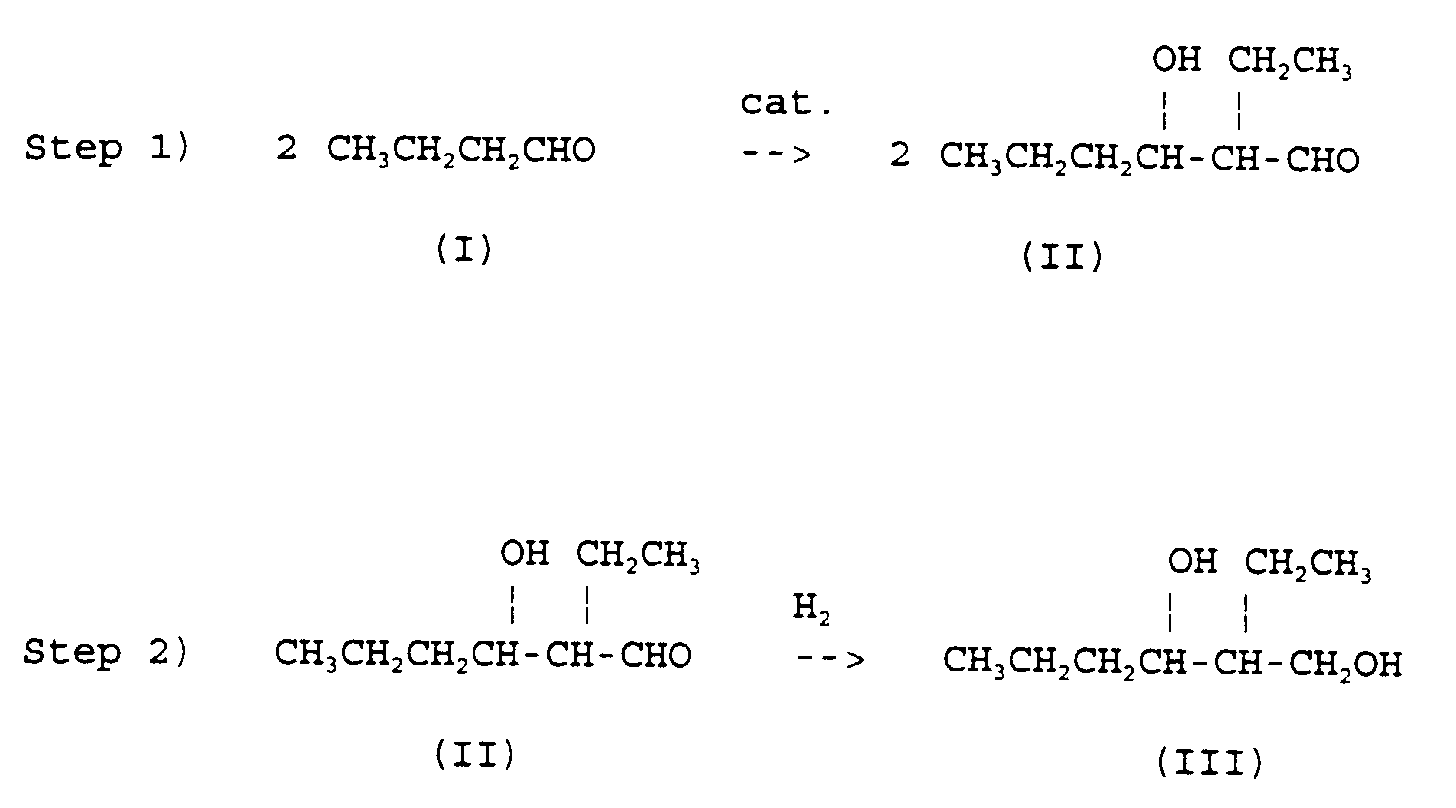
- step 1) a 2-ethyl-3-hydroxy-hexanal intermediate in accordance with Formula (II) is formed by aldol condensation from n-butyraldehyde (Formula I), and thereafter in step 2) the intermediate according to Formula (II) is hydrogenated by catalytic hydrogenation into 2-ethyl-1,3-hexane diol (Formula III).
- a neutral phase-transfer catalyst together with an alkali metal hydroxide or alkali earth metal hydroxide catalyst the amount of the non-desirable hexenal according to Formula (IV) is decreased to as low a level as below 2 per cent, and the yield of the final product is increased to nearly 60 per cent.
- phase-transfer catalysts are thus chemical compounds having the property of catalyzing inter-phase transfer of material.
- Phase-transfer catalysts may be cationic, anionic or neutral.
- the interesting phases are the organic phase and the aqueous phase. It has now been observed that in this case an advantageous end result, i.e. efficiency, speed and controllability of the reaction, is achieved by using in the aldol condensation step of the initial-material aldehyde a neutral phase-transfer catalyst together with an alkali metal hydroxide or alkali earth metal hydroxide.
- Polyethylene glycol (PEG) for example, is a usable neutral phase-transfer catalyst.
- Neutral phase-transfer catalysts do not have a charge as do, for example, cationic phase-transfer catalysts.
- the principle of action of a neutral phase-transfer catalyst between an organic phase and an aqueous phase can be described as follows, using polyethylene glycol as an example: Polyethylene glycol serves as a phase-transfer catalyst by attaching to a positive ion and by forming a so-called crown ether structure. The free electrons of the oxygen atoms of the polyethylene glycol attract the positive ions. The crown ether formed owing to the structure of the polyethylene glycol passes into the organic phase. To maintain the electron equilibrium in the phase, also the negative ions pass into the organic phase.
- 2-ethyl-1,3-hexane diol thus takes place in two steps, as shown above in the reaction formulae.
- n-butyraldehyde reacts with itself, forming as the product of the aldol reaction an intermediate-product ⁇ -hydroxyaldehyde according to Formula II, i.e. 2-ethyl-3-hydroxy-hexanal.
- This intermediate-product ⁇ -hydroxyaldehyde is hydrogenated (reduced) into the corresponding alcohol, i.e. into 2-ethyl-1,3-hexane diol according to Formula III.
- the efficiency, speed and controllability of the aldol step can thus be improved significantly by using an alkali metal hydroxide or alkali earth metal hydroxide catalyst together with a neutral phase-transfer catalyst.
- the use of this catalyst combination renders the control of the exothermal forming reaction of the intermediate-product ⁇ -aldehyde maximally efficient, and thus the amount of readily forming hazardous byproducts can be minimized.
- the intermediate-product aldehyde is hydrogenated completely into the desired end-product alcohol either by using a reducing agent or by catalytic hydrogenation.
- 2-ethyl-1,3-hexane diol is thus prepared from n-butyraldehyde.
- a neutral phase-transfer catalyst is added to n-butyraldehyde, one such catalyst being, for example, polyethylene glycol (PEG 400), whereafter the mixture is cooled to 0-20 °C.
- PEG 400 polyethylene glycol
- the reaction may also be started from room temperature, but preferably so that the mixture is first cooled.
- the reaction mixture is cooled to a temperature of 5-15 °C, and thereafter an aqueous solution of an alkali metal hydroxide or alkali earth metal hydroxide catalyst is added to the mixture drop by drop at such a rate that the reaction clearly starts, i.e. the temperature of the mixture clearly rises from its original value.
- the alkali metal hydroxide or alkali earth metal hydroxide is used in a proportion of 0.01-5 % by weight, preferably 0.1-1 % by weight, to n-butyraldehyde.
- the adding of the aqueous solution of the catalyst is discontinued when the temperature of the mixture has risen to the range 25-45 °C, preferably, however, to the range 30-40 °C.
- the mixture is further stirred for 0-5 h, preferably 0.2-3 h, whereafter the organic phase and the aqueous phase are separated from each other.
- the reaction mixture may be neutralized with a mineral acid or an organic acid.
- the organic phase is recovered, and it is hydrogenated by catalytic hydrogenation at a temperature of 30-200 °C and a pressure of 5-100 bar, preferably at a temperature of 60-140 °C and a pressure of 10-60 bar.
- the hydrogenation may be carried out by using, for example, a Raney nickel catalyst. After the hydrogenation the product is vacuum distilled.
- the boiling point of 2-ethyl-1,3-hexane diol is 100 °C/6 mbar, and a yield of up to more than 55 % is obtained.
- the worst byproduct, 2-ethyl hexanol via 2-ethyl hexenal is formed at maximum at a rate of 2.6 %.
- the rest of the reaction mixture is unreacted n-butyraldehyde which has become reduced to 1-butanol.
- the 2-ethyl-1,3-hexane diol yield was 57.7 g, which corresponded to a yield of 56.9 %.
- the reaction was carried out by a procedure corresponding to that in Example 1, except that the 0.25 % aqueous solution of NaOH was used in an amount of 72.3 g, and after the temperature of the mixture had risen to 32 °C, it was maintained at that temperature for 3 h.
- the neutralization and hydrogenation were carried out as in Example 1.
- the 2-ethyl-1,3-hexane diol yield was 56.3 %.
Landscapes
- Chemical & Material Sciences (AREA)
- Organic Chemistry (AREA)
- Chemical Kinetics & Catalysis (AREA)
- Organic Low-Molecular-Weight Compounds And Preparation Thereof (AREA)
- Low-Molecular Organic Synthesis Reactions Using Catalysts (AREA)
- Agricultural Chemicals And Associated Chemicals (AREA)
Abstract
Description

Claims (7)
- A process for the preparation of 2-ethyl-1,3-hexane diol from n-butyraldehyde by aldol condensation in the presence of an alkali metal hydroxide or alkali earth metal hydroxide catalyst and by hydrogenation of the obtained intermediate product, characterized in that a neutral phase-transfer catalyst is additionally used in the aldol condensation step.
- A process according to Claim 1, characterized in that the neutral phase-transfer catalyst is used in an amount of 0.5-10 % by weight, preferably 1-5 % by weight, of the amount of n-butyraldehyde.
- A process according to Claim 1, characterized in that the neutral phase-transfer catalyst is polyethylene glycol.
- A process according to Claim 1, characterized in that the alkali metal hydroxide or alkali earth metal hydroxide catalyst is used in a proportion of 0.01-5 % by weight, preferably 0.1-1 % by weight, to the n-butyraldehyde.
- A process according to Claim 1, characterized in that the preparation process comprises the following steps:1) the n-butyraldehyde is caused to react with itself in an aldol condensation reaction in the presence of an alkali metal hydroxide or alkali earth metal hydroxide catalyst and a neutral phase-transfer catalyst, in consequence of which a 2-ethyl-3-hydroxy-hexanal intermediate product is formed,2) the 2-ethyl-3-hydroxy-hexanal obtained from step 1) is hydrogenated by means of a reducing agent or by catalytic hydrogenation into 2-ethyl-1,3-hexane diol.
- A process according to Claim 5, characterized in that the hydrogenation is carried out by using a Raney nickel hydrogenation catalyst.
- A process according to any of Claims 1-6, characterized in that the yield obtained for 2-ethyl-1,3-propane diol is over 50 %.
Applications Claiming Priority (3)
| Application Number | Priority Date | Filing Date | Title |
|---|---|---|---|
| FI933896A FI95690C (en) | 1993-09-07 | 1993-09-07 | Process for the preparation of 2-ethyl-1,3-hexanediol |
| FI933896 | 1993-09-07 | ||
| PCT/FI1994/000387 WO1995007254A1 (en) | 1993-09-07 | 1994-09-02 | Process for the preparation of 2-ethyl-1,3-hexane diol |
Publications (2)
| Publication Number | Publication Date |
|---|---|
| EP0717730A1 EP0717730A1 (en) | 1996-06-26 |
| EP0717730B1 true EP0717730B1 (en) | 1998-05-06 |
Family
ID=8538538
Family Applications (1)
| Application Number | Title | Priority Date | Filing Date |
|---|---|---|---|
| EP94925499A Expired - Lifetime EP0717730B1 (en) | 1993-09-07 | 1994-09-02 | Process for the preparation of 2-ethyl-1,3-hexane diol |
Country Status (8)
| Country | Link |
|---|---|
| US (1) | US5663452A (en) |
| EP (1) | EP0717730B1 (en) |
| JP (1) | JPH09502197A (en) |
| AT (1) | ATE165806T1 (en) |
| CA (1) | CA2171205A1 (en) |
| DE (1) | DE69410103T2 (en) |
| FI (1) | FI95690C (en) |
| WO (1) | WO1995007254A1 (en) |
Families Citing this family (9)
| Publication number | Priority date | Publication date | Assignee | Title |
|---|---|---|---|---|
| DE19948112A1 (en) * | 1999-10-06 | 2001-04-12 | Basf Ag | Process for the preparation of 1,3-diols |
| US6979751B2 (en) * | 2002-12-23 | 2005-12-27 | Eastman Chemical Company | Processes for the preparation of higher molecular weight ketones |
| US20040138510A1 (en) * | 2003-01-13 | 2004-07-15 | Kramarz Kurt W. | Process for the co-production of alcohols |
| US6960694B2 (en) * | 2003-07-01 | 2005-11-01 | Eastman Chemical Company | Processes for preparing β-hydroxy-ketones and α,β-unsaturated ketones |
| US7071361B2 (en) * | 2004-06-25 | 2006-07-04 | Fastman Chemical Company | Processes for the preparation of high molecular weight saturated ketones |
| DE102008056086A1 (en) * | 2008-11-06 | 2010-05-12 | Gp Solar Gmbh | An additive for alkaline etching solutions, in particular for texture etching solutions and process for its preparation |
| FR2939790B1 (en) * | 2008-12-16 | 2013-07-12 | Rhodia Poliamida E Especialidades Ltda | CATALYTIC PROCESS FOR THE PRODUCTION OF DIOL TYPE COMPOUNDS |
| DE102011012846B4 (en) | 2011-03-03 | 2016-08-18 | Oxea Gmbh | Process for carrying out multiphase aldol condensation reactions to give mixed α, β-unsaturated aldehydes |
| EP4157817A1 (en) | 2020-05-29 | 2023-04-05 | Dow Global Technologies LLC | Organic catalyst for non-aqueous aldol condensation |
Family Cites Families (2)
| Publication number | Priority date | Publication date | Assignee | Title |
|---|---|---|---|---|
| US4215076A (en) * | 1976-04-23 | 1980-07-29 | Union Carbide Corporation | Surfactant-promoted aldol reactions |
| SE467873B (en) * | 1988-11-02 | 1992-09-28 | Alfred Hopfinger | PROCEDURES FOR PREPARING GRENADE 1,3-GYCLOLES AND THEIR MONOESTERS |
-
1993
- 1993-09-07 FI FI933896A patent/FI95690C/en active
-
1994
- 1994-09-02 DE DE69410103T patent/DE69410103T2/en not_active Expired - Fee Related
- 1994-09-02 AT AT94925499T patent/ATE165806T1/en not_active IP Right Cessation
- 1994-09-02 WO PCT/FI1994/000387 patent/WO1995007254A1/en not_active Ceased
- 1994-09-02 EP EP94925499A patent/EP0717730B1/en not_active Expired - Lifetime
- 1994-09-02 US US08/596,177 patent/US5663452A/en not_active Expired - Lifetime
- 1994-09-02 JP JP7508476A patent/JPH09502197A/en active Pending
- 1994-09-02 CA CA002171205A patent/CA2171205A1/en not_active Abandoned
Also Published As
| Publication number | Publication date |
|---|---|
| ATE165806T1 (en) | 1998-05-15 |
| DE69410103T2 (en) | 1998-11-12 |
| FI933896A0 (en) | 1993-09-07 |
| US5663452A (en) | 1997-09-02 |
| CA2171205A1 (en) | 1995-03-16 |
| FI95690B (en) | 1995-11-30 |
| EP0717730A1 (en) | 1996-06-26 |
| WO1995007254A1 (en) | 1995-03-16 |
| DE69410103D1 (en) | 1998-06-10 |
| FI95690C (en) | 1996-03-11 |
| JPH09502197A (en) | 1997-03-04 |
| FI933896L (en) | 1995-03-08 |
Similar Documents
| Publication | Publication Date | Title |
|---|---|---|
| US8779216B2 (en) | Method for producing Guerbet alcohols | |
| US8779169B2 (en) | Process for the preparation of 2 substituted tetrahydropyranols | |
| JP4976131B2 (en) | Polyglycerin monoether and method for producing the same | |
| US5663452A (en) | Process for the preparation of 2-ethyl-1,3-hexane diol | |
| FI101472B (en) | Process for the preparation of monoesters of 1,3-diols | |
| US6326514B1 (en) | Process for the preparation of ether carboxylic acids with low residual alcohol content | |
| CN109438234A (en) | A kind of synthetic method of the fluoro- 4- methoxy benzyl alcohol of 2,3,5,6- tetra- | |
| JP4902988B2 (en) | Method for producing vicinal alkanediol and alkanetriol and use thereof | |
| EP2277849B1 (en) | Process for the preparation of 1-alkyl glycerol ethers | |
| US5461144A (en) | Process for the preparation of alkyl polyglycosides | |
| EP0239993A2 (en) | A process of reduction of aldehydes and ketones | |
| EP0860419B1 (en) | Process for producing 2,2'-bis (hydroxymethyl) alkanal and 2,2,'-bis (hydroxymethyl) - alkanoic acid | |
| EP0656876B1 (en) | Process for the preparation of 2-n-butyl-2-ethyl-1,3-propane diol | |
| US4321413A (en) | Production of ethylene glycol dialkyl ethers using dialkyl ethers | |
| US20100168450A1 (en) | Novel branched alkoxylates | |
| DE69508632T2 (en) | Implementation of ether | |
| US6372923B1 (en) | Process for preparing alcohol derivatives | |
| CN118047663B (en) | A kind of synthesis process of ethylhexylglycerol | |
| JP5118353B2 (en) | Method for producing alkyl glycoside | |
| CN1224411A (en) | Preparation method of alkyne diol or mixture of alkyne diol and alkyne monoalcohol | |
| JP3798047B2 (en) | Method for producing ether compounds | |
| JP3908310B2 (en) | Method for producing ether compounds | |
| JP2011116694A (en) | Manufacturing method of lactic acid ester | |
| EP0654022A1 (en) | Aquathermolytic cleavage of unsaturated ketones | |
| US2812359A (en) | Production of hydroxy and polyhy- |
Legal Events
| Date | Code | Title | Description |
|---|---|---|---|
| PUAI | Public reference made under article 153(3) epc to a published international application that has entered the european phase |
Free format text: ORIGINAL CODE: 0009012 |
|
| 17P | Request for examination filed |
Effective date: 19960328 |
|
| AK | Designated contracting states |
Kind code of ref document: A1 Designated state(s): AT BE CH DE DK ES FR GB GR IT LI NL PT SE |
|
| GRAG | Despatch of communication of intention to grant |
Free format text: ORIGINAL CODE: EPIDOS AGRA |
|
| 17Q | First examination report despatched |
Effective date: 19970530 |
|
| GRAG | Despatch of communication of intention to grant |
Free format text: ORIGINAL CODE: EPIDOS AGRA |
|
| GRAH | Despatch of communication of intention to grant a patent |
Free format text: ORIGINAL CODE: EPIDOS IGRA |
|
| GRAH | Despatch of communication of intention to grant a patent |
Free format text: ORIGINAL CODE: EPIDOS IGRA |
|
| GRAA | (expected) grant |
Free format text: ORIGINAL CODE: 0009210 |
|
| AK | Designated contracting states |
Kind code of ref document: B1 Designated state(s): AT BE CH DE DK ES FR GB GR IT LI NL PT SE |
|
| PG25 | Lapsed in a contracting state [announced via postgrant information from national office to epo] |
Ref country code: NL Free format text: LAPSE BECAUSE OF FAILURE TO SUBMIT A TRANSLATION OF THE DESCRIPTION OR TO PAY THE FEE WITHIN THE PRESCRIBED TIME-LIMIT Effective date: 19980506 Ref country code: LI Free format text: LAPSE BECAUSE OF FAILURE TO SUBMIT A TRANSLATION OF THE DESCRIPTION OR TO PAY THE FEE WITHIN THE PRESCRIBED TIME-LIMIT Effective date: 19980506 Ref country code: IT Free format text: LAPSE BECAUSE OF FAILURE TO SUBMIT A TRANSLATION OF THE DESCRIPTION OR TO PAY THE FEE WITHIN THE PRE;WARNING: LAPSES OF ITALIAN PATENTS WITH EFFECTIVE DATE BEFORE 2007 MAY HAVE OCCURRED AT ANY TIME BEFORE 2007. THE CORRECT EFFECTIVE DATE MAY BE DIFFERENT FROM THE ONE RECORDED.SCRIBED TIME-LIMIT Effective date: 19980506 Ref country code: GR Free format text: LAPSE BECAUSE OF FAILURE TO SUBMIT A TRANSLATION OF THE DESCRIPTION OR TO PAY THE FEE WITHIN THE PRESCRIBED TIME-LIMIT Effective date: 19980506 Ref country code: FR Free format text: LAPSE BECAUSE OF FAILURE TO SUBMIT A TRANSLATION OF THE DESCRIPTION OR TO PAY THE FEE WITHIN THE PRESCRIBED TIME-LIMIT Effective date: 19980506 Ref country code: ES Free format text: THE PATENT HAS BEEN ANNULLED BY A DECISION OF A NATIONAL AUTHORITY Effective date: 19980506 Ref country code: CH Free format text: LAPSE BECAUSE OF FAILURE TO SUBMIT A TRANSLATION OF THE DESCRIPTION OR TO PAY THE FEE WITHIN THE PRESCRIBED TIME-LIMIT Effective date: 19980506 Ref country code: BE Free format text: LAPSE BECAUSE OF FAILURE TO SUBMIT A TRANSLATION OF THE DESCRIPTION OR TO PAY THE FEE WITHIN THE PRESCRIBED TIME-LIMIT Effective date: 19980506 Ref country code: AT Free format text: LAPSE BECAUSE OF FAILURE TO SUBMIT A TRANSLATION OF THE DESCRIPTION OR TO PAY THE FEE WITHIN THE PRESCRIBED TIME-LIMIT Effective date: 19980506 |
|
| REF | Corresponds to: |
Ref document number: 165806 Country of ref document: AT Date of ref document: 19980515 Kind code of ref document: T |
|
| REG | Reference to a national code |
Ref country code: CH Ref legal event code: EP |
|
| REF | Corresponds to: |
Ref document number: 69410103 Country of ref document: DE Date of ref document: 19980610 |
|
| PG25 | Lapsed in a contracting state [announced via postgrant information from national office to epo] |
Ref country code: SE Free format text: LAPSE BECAUSE OF FAILURE TO SUBMIT A TRANSLATION OF THE DESCRIPTION OR TO PAY THE FEE WITHIN THE PRESCRIBED TIME-LIMIT Effective date: 19980806 Ref country code: PT Free format text: LAPSE BECAUSE OF FAILURE TO SUBMIT A TRANSLATION OF THE DESCRIPTION OR TO PAY THE FEE WITHIN THE PRESCRIBED TIME-LIMIT Effective date: 19980806 Ref country code: DK Free format text: LAPSE BECAUSE OF FAILURE TO SUBMIT A TRANSLATION OF THE DESCRIPTION OR TO PAY THE FEE WITHIN THE PRESCRIBED TIME-LIMIT Effective date: 19980806 |
|
| PG25 | Lapsed in a contracting state [announced via postgrant information from national office to epo] |
Ref country code: GB Free format text: LAPSE BECAUSE OF NON-PAYMENT OF DUE FEES Effective date: 19980902 |
|
| NLV1 | Nl: lapsed or annulled due to failure to fulfill the requirements of art. 29p and 29m of the patents act | ||
| EN | Fr: translation not filed | ||
| REG | Reference to a national code |
Ref country code: CH Ref legal event code: PL |
|
| PLBE | No opposition filed within time limit |
Free format text: ORIGINAL CODE: 0009261 |
|
| STAA | Information on the status of an ep patent application or granted ep patent |
Free format text: STATUS: NO OPPOSITION FILED WITHIN TIME LIMIT |
|
| GBPC | Gb: european patent ceased through non-payment of renewal fee |
Effective date: 19980902 |
|
| 26N | No opposition filed | ||
| PGFP | Annual fee paid to national office [announced via postgrant information from national office to epo] |
Ref country code: DE Payment date: 20010829 Year of fee payment: 8 |
|
| PG25 | Lapsed in a contracting state [announced via postgrant information from national office to epo] |
Ref country code: DE Free format text: LAPSE BECAUSE OF NON-PAYMENT OF DUE FEES Effective date: 20030401 |