EP0717024B1 - Process for the recovery of phenol from an aqueous stream containing Na2So4 - Google Patents
Process for the recovery of phenol from an aqueous stream containing Na2So4 Download PDFInfo
- Publication number
- EP0717024B1 EP0717024B1 EP95118762A EP95118762A EP0717024B1 EP 0717024 B1 EP0717024 B1 EP 0717024B1 EP 95118762 A EP95118762 A EP 95118762A EP 95118762 A EP95118762 A EP 95118762A EP 0717024 B1 EP0717024 B1 EP 0717024B1
- Authority
- EP
- European Patent Office
- Prior art keywords
- phenol
- extraction
- stream
- solvent
- recovery
- Prior art date
- Legal status (The legal status is an assumption and is not a legal conclusion. Google has not performed a legal analysis and makes no representation as to the accuracy of the status listed.)
- Expired - Lifetime
Links
- ISWSIDIOOBJBQZ-UHFFFAOYSA-N Phenol Chemical compound OC1=CC=CC=C1 ISWSIDIOOBJBQZ-UHFFFAOYSA-N 0.000 title claims description 96
- 238000011084 recovery Methods 0.000 title claims description 25
- 238000000034 method Methods 0.000 title claims description 21
- 238000000605 extraction Methods 0.000 claims description 46
- RWGFKTVRMDUZSP-UHFFFAOYSA-N cumene Chemical compound CC(C)C1=CC=CC=C1 RWGFKTVRMDUZSP-UHFFFAOYSA-N 0.000 claims description 36
- CSCPPACGZOOCGX-UHFFFAOYSA-N Acetone Chemical compound CC(C)=O CSCPPACGZOOCGX-UHFFFAOYSA-N 0.000 claims description 30
- 239000002904 solvent Substances 0.000 claims description 28
- 238000004821 distillation Methods 0.000 claims description 25
- XYLMUPLGERFSHI-UHFFFAOYSA-N alpha-Methylstyrene Chemical compound CC(=C)C1=CC=CC=C1 XYLMUPLGERFSHI-UHFFFAOYSA-N 0.000 claims description 10
- 238000004519 manufacturing process Methods 0.000 claims description 10
- 239000007864 aqueous solution Substances 0.000 claims description 9
- 239000007832 Na2SO4 Substances 0.000 claims description 8
- PMZURENOXWZQFD-UHFFFAOYSA-L Sodium Sulfate Chemical compound [Na+].[Na+].[O-]S([O-])(=O)=O PMZURENOXWZQFD-UHFFFAOYSA-L 0.000 claims description 8
- 229910052938 sodium sulfate Inorganic materials 0.000 claims description 8
- NESLWCLHZZISNB-UHFFFAOYSA-M sodium phenolate Chemical compound [Na+].[O-]C1=CC=CC=C1 NESLWCLHZZISNB-UHFFFAOYSA-M 0.000 claims description 6
- 239000012535 impurity Substances 0.000 claims description 5
- HEMHJVSKTPXQMS-UHFFFAOYSA-M Sodium hydroxide Chemical compound [OH-].[Na+] HEMHJVSKTPXQMS-UHFFFAOYSA-M 0.000 description 42
- 239000000047 product Substances 0.000 description 19
- XLYOFNOQVPJJNP-UHFFFAOYSA-N water Substances O XLYOFNOQVPJJNP-UHFFFAOYSA-N 0.000 description 12
- 239000012074 organic phase Substances 0.000 description 11
- CDBYLPFSWZWCQE-UHFFFAOYSA-L Sodium Carbonate Chemical compound [Na+].[Na+].[O-]C([O-])=O CDBYLPFSWZWCQE-UHFFFAOYSA-L 0.000 description 10
- 229930195733 hydrocarbon Natural products 0.000 description 10
- 150000002430 hydrocarbons Chemical class 0.000 description 10
- 239000008346 aqueous phase Substances 0.000 description 9
- 239000000203 mixture Substances 0.000 description 7
- 239000003643 water by type Substances 0.000 description 7
- QAOWNCQODCNURD-UHFFFAOYSA-N Sulfuric acid Chemical compound OS(O)(=O)=O QAOWNCQODCNURD-UHFFFAOYSA-N 0.000 description 6
- 238000011049 filling Methods 0.000 description 6
- 238000000926 separation method Methods 0.000 description 6
- 238000009835 boiling Methods 0.000 description 5
- 239000012071 phase Substances 0.000 description 5
- 238000010992 reflux Methods 0.000 description 5
- 239000004215 Carbon black (E152) Substances 0.000 description 4
- 238000006386 neutralization reaction Methods 0.000 description 4
- 239000000243 solution Substances 0.000 description 4
- 239000007788 liquid Substances 0.000 description 3
- KWOLFJPFCHCOCG-UHFFFAOYSA-N Acetophenone Chemical compound CC(=O)C1=CC=CC=C1 KWOLFJPFCHCOCG-UHFFFAOYSA-N 0.000 description 2
- OKTJSMMVPCPJKN-UHFFFAOYSA-N Carbon Chemical group [C] OKTJSMMVPCPJKN-UHFFFAOYSA-N 0.000 description 2
- 239000002253 acid Substances 0.000 description 2
- 150000004945 aromatic hydrocarbons Chemical class 0.000 description 2
- 239000006227 byproduct Substances 0.000 description 2
- 238000005265 energy consumption Methods 0.000 description 2
- 239000000945 filler Substances 0.000 description 2
- 238000000746 purification Methods 0.000 description 2
- 239000001117 sulphuric acid Substances 0.000 description 2
- 235000011149 sulphuric acid Nutrition 0.000 description 2
- 239000002699 waste material Substances 0.000 description 2
- 239000002351 wastewater Substances 0.000 description 2
- OZXIZRZFGJZWBF-UHFFFAOYSA-N 1,3,5-trimethyl-2-(2,4,6-trimethylphenoxy)benzene Chemical compound CC1=CC(C)=CC(C)=C1OC1=C(C)C=C(C)C=C1C OZXIZRZFGJZWBF-UHFFFAOYSA-N 0.000 description 1
- BDCFWIDZNLCTMF-UHFFFAOYSA-N 2-phenylpropan-2-ol Chemical compound CC(C)(O)C1=CC=CC=C1 BDCFWIDZNLCTMF-UHFFFAOYSA-N 0.000 description 1
- FRIBMENBGGCKPD-UHFFFAOYSA-N 3-(2,3-dimethoxyphenyl)prop-2-enal Chemical compound COC1=CC=CC(C=CC=O)=C1OC FRIBMENBGGCKPD-UHFFFAOYSA-N 0.000 description 1
- 229910000831 Steel Inorganic materials 0.000 description 1
- 238000005903 acid hydrolysis reaction Methods 0.000 description 1
- 125000003118 aryl group Chemical group 0.000 description 1
- 238000010504 bond cleavage reaction Methods 0.000 description 1
- 229910052799 carbon Inorganic materials 0.000 description 1
- 239000003054 catalyst Substances 0.000 description 1
- 238000006243 chemical reaction Methods 0.000 description 1
- 239000006185 dispersion Substances 0.000 description 1
- VFNGKCDDZUSWLR-UHFFFAOYSA-N disulfuric acid Chemical compound OS(=O)(=O)OS(O)(=O)=O VFNGKCDDZUSWLR-UHFFFAOYSA-N 0.000 description 1
- 230000008030 elimination Effects 0.000 description 1
- 238000003379 elimination reaction Methods 0.000 description 1
- 230000007613 environmental effect Effects 0.000 description 1
- 230000002349 favourable effect Effects 0.000 description 1
- 239000011521 glass Substances 0.000 description 1
- SHOJXDKTYKFBRD-UHFFFAOYSA-N mesityl oxide Natural products CC(C)=CC(C)=O SHOJXDKTYKFBRD-UHFFFAOYSA-N 0.000 description 1
- 229910052751 metal Inorganic materials 0.000 description 1
- 239000002184 metal Substances 0.000 description 1
- 150000007524 organic acids Chemical class 0.000 description 1
- 235000005985 organic acids Nutrition 0.000 description 1
- 239000003960 organic solvent Substances 0.000 description 1
- 239000010815 organic waste Substances 0.000 description 1
- 230000003647 oxidation Effects 0.000 description 1
- 238000007254 oxidation reaction Methods 0.000 description 1
- QBDSZLJBMIMQRS-UHFFFAOYSA-N p-Cumylphenol Chemical compound C=1C=C(O)C=CC=1C(C)(C)C1=CC=CC=C1 QBDSZLJBMIMQRS-UHFFFAOYSA-N 0.000 description 1
- NKTOLZVEWDHZMU-UHFFFAOYSA-N p-cumyl phenol Natural products CC1=CC=C(C)C(O)=C1 NKTOLZVEWDHZMU-UHFFFAOYSA-N 0.000 description 1
- 150000002989 phenols Chemical class 0.000 description 1
- 239000011541 reaction mixture Substances 0.000 description 1
- 230000007017 scission Effects 0.000 description 1
- 159000000000 sodium salts Chemical class 0.000 description 1
- 239000010959 steel Substances 0.000 description 1
- 238000003756 stirring Methods 0.000 description 1
- 238000005406 washing Methods 0.000 description 1
Images


Classifications
-
- C—CHEMISTRY; METALLURGY
- C07—ORGANIC CHEMISTRY
- C07C—ACYCLIC OR CARBOCYCLIC COMPOUNDS
- C07C37/00—Preparation of compounds having hydroxy or O-metal groups bound to a carbon atom of a six-membered aromatic ring
- C07C37/68—Purification; separation; Use of additives, e.g. for stabilisation
- C07C37/70—Purification; separation; Use of additives, e.g. for stabilisation by physical treatment
- C07C37/72—Purification; separation; Use of additives, e.g. for stabilisation by physical treatment by liquid-liquid treatment
Definitions
- the present invention relates to a process for the recovery of phenol from an aqueous stream containing Na 2 SO 4 .
- Phenol is prepared industrially by the oxidation of cumene and subsequent acid hydrolysis of the resulting cumene hydroperoxide.
- the reaction mixture obtained consists of phenol, acetone and non-reacted cumene.
- various quantities of by-products are formed, such as for example, mesityl oxide, ⁇ -methylstyrene, p-cumylphenol, phenyldimethylcarbinol, acetophenone and phenols with a higher molecular weight.
- the effluent from the scission reactors which contains H 2 SO 4 used as catalyst, is mixed with the aqueous streams containing sodium phenate coming from other sections of the plant and additional quantities of H 2 SO 4 .
- the effluent is thus brought to a pH of about 7 which guarantees the salification of the sulphuric acid and organic acids formed as by-products during the reaction and, at the same time, releases the phenol from its sodium salt.
- the mixture is then sent to a decanter to enable the separation of the organic phase containing phenol and other aromatic hydrocarbons from the aqueous phase containing Na 2 SO 4 (7-15%) formed during the neutralization.
- the organic phase is then sent to the primary distillation section, after washing with water, where the crude phenol is recovered and subsequently purified by distillation in a series of columns.
- the aqueous phase which consists of "sulphatic" waters and varying quantities of phenol and acetone is discharged after recovering the latter.
- Phenol and acetone are usually present in quantities within the range of 0.5-2 and 1.5-4% in weight respectively.
- the recovery of the acetone is carried out by subsequent stripping whereas the phenol is usually recovered by counter-current extraction in a mixer-settler system.
- the almost total recovery of the phenol ( ⁇ 100 ppm) is obtained by counter-current extraction in a system normally consisting of 2 mixer-settlers and with a very high quantity of solvent (the ratio solvent/refined product is about 3.5 v/v) to limit the number of steps necessary.
- the phenol is then recovered from the solvent by extraction/salification with aqueous NaOH and the aqueous phenate solution is recycled to the neutralization section, whereas the solvent is continuously recycled to the extraction.
- US 4,026,791 describes a process for reducing the biological demand (phenol in particular) of an aqueous waste stream, resulting in the process for producing phenol from cumene in which phenol is extracted by a liquid extraction step using a highly aromatic fraction of an organic waste stream in the phenol process as solvent.
- the organic stream containing almost all the phenol has to be fractionated in a column which accomplishes the recovery of solvent used in the extraction, the production of new solvent from the process waste stream and the recovery of heavy organics stream containing sufficient phenol to justify the consideration of returning such stream to the phenol process for recovery.
- the invention relates to a process for the recovery of phenol dissolved in an aqueous stream of a plant for the production of phenol from cumene, containing Na 2 SO 4 and various organic impurities comprising the extraction of the phenol with a solvent stream mainly consisting of cumene and containing ⁇ -methylstyrene and acetone and its subsequent recovery from the solvent by distillation or re-extraction, characterized in that the extraction of the phenol from the aqueous stream is carried out in a multistep extractor using a solvent/aqueous stream ration of between 0,1 and 1,0 v/v at a temperature of between 20-70°C and the recovery of the phenol from the solvent is carried out in the primary distillation section of the plant or by re-extraction in a multistep extraction apparatus using as solvent an aqueous solution containing sodium phenate.
- a solvent/aqueous stream ration between 0,15-0,25 v/v and a temperature of between 25-60°C are used.
- the process of the present invention allows the production of an organic stream with a reduced flow rate, containing practically all the phenol which was previously dissolved in the sulphatic waters, which can be recovered in the distillation section of the plant or by re-extraction in a multistep extractor using, as solvent, an aqueous stream containing sodium phenate available in the plant, which is subsequently recycled to the neutralization section of the cracked product.
- the extraction of phenol with small quantities of solvent can be carried out by increasing the number of mixer-settlers or, even better, by using counter-current extraction columns (with perforated plates, with fillers, with stirring, pulsating etc.) which permits in a single extractor a number of extraction steps which can also be very high.
- the solvent stream taken form a section of the plant mainly consists of cumene and contains ⁇ -methylstyrene and acetone.
- the organic extract can be sent directly to the primary distillation section of the plant.
- the main products for this separation are: phenol, which in the stream at the head must not exceed 0.5% w; and ⁇ -methylstyrene which in the stream at the bottom must not exceed 0.1% w.
- the phenol present in the stream at the head of the column is subsequently recovered by salification with NaOH, whereas that remaining in the stream at the bottom is recovered by subsequent distillation in a series of columns which allows an initial separation of the high-boiling products and subsequent elimination of the impurities from the crude phenol.
- the energy cost is greater but is much less than any saving which can be obtained by a lower consumption of NaOH.
- the saving obtained corresponds to about 95% of the phenol extracted from the aqueous disulphate solution.
- the recovery of the phenol from the stream coming from the extraction can be carried out in another multistep extraction apparatus using as solvent an aqueous solution containing sodium phenate taken from another section of the plant.
- Examples 1 and 2 illustrate a possible setting of operating conditions for the extraction and the results which can be obtained, without limiting the scope of the present invention.
- Examples 3, 4 and 5 describe distillation tests carried out in the laboratory which simulate the conditions of the distillation section of our process; examples 6 and 7 simulate the distillation section conditions indicated by Stanford; examples 8 and 9 simulate a third possible condition for the separation of acetone, water and hydrocarbons from phenol and high-boiling products; examples 10, 11 and 12 refer to the recovery tests by means of re-extraction.
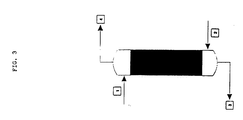
- a jacketed extractor having an internal diameter of 75 mm and containing 0.5" Raschig carbon rings, for a total height of 10.5 m.
- the filling was sub-divided into three 3.5 m sections, each of which was supported by a wide mesh steel net over which was a perforated plate with suitably sized and shaped holes for the dispersion of the aqueous phase inside the filler below and for the discharge of the continuous phase from the lower section to the upper one.
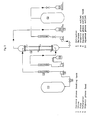
- FIG. 2 shows the scheme of the apparatus.
- the following products were fed to this column maintained at a temperature of 60°C by temperate water: at the filling base 9.65 Kg/h of an organic solvent mainly consisting of cumene and containing ⁇ -methylstyrene and acetone (it is known that the presence of acetone improves the equilibrium distribution when the phenol is extracted from an aqueous solution), taken from a section of the industrial plant for the production of phenol, and at the top 61.25 Kg/h of an aqueous solution of Na 2 SO 4 containing phenol, also taken from the industrial plant. During the passage through the column the phenol contained in the aqueous phase was extracted from the organic phase.
- example 1 Not having obtained the desired reduction of the phenol in the refined effluent to values lower than 100 ppm, the apparatus of example 1 was modified adding a mixer-settler so that the refined effluent could be further extracted from the solvent, before this was fed to the extractor. Using the same streams and flow rates as example 1, an extraction test was carried out which gave the results illustrated in table 2 fig. 4, from which it was observed that the residual phenol in the effluent organic phase was reduced to below 100 ppm.
- a sample of cracked product having the following %w composition was taken from the industrial plant: acetone 25.7; cumene+butylbenzenes 9.9; ⁇ -methylstyrene ( ⁇ -MS) 2.4; phenol 46.5; high-boiling products 5.5; water 10.0. It was fed, at a flow rate of 400 g/hr, between plate 15 and 16 (numbering which starts from the top) of an Oldershaw glass distillation column consisting of two sections, each containing 25 1.1" plates and insulated by means of a Dewar jacket. The section above the feeding was suitable for the distillation of aqueous systems (50 holes per plate); the section below the feeding was suitable for the distillation of organic systems (80 holes per plate). 193 and 207 g/hr were removed from the head and bottom of the column respectively.
- a solution consisting of water 13.7 %w; cumene 13.7 %w; ⁇ -methylstyrene 3.3 %w; phenol 69.3 %w was fed at a flow rate of 400 g/hr between plate 30 and 31 of a 60 plate Oldershaw column similar to the one described in example 3. 123 and 277 g/hr of liquid were removed from the head and bottom respectively.
- test of example 6 was repeated after adding to 100 parts by weight of feeding 5.80 parts by weight of the extract of example 2.
- the operating conditions were the same as those of the reference test (ex. 6) with the only difference that the extraction at the head was increased to allow for the increased quantity of hydrocarbons in the feeding.
- test of example 8 was repeated after adding to 100 parts by weight of feeding 6.51 parts by weight of the extract of example 2.
- the operating conditions were the same as those of the reference test (ex. 8) with the only difference that the extraction at the head was increased to allow for the increased quantity of hydrocarbons in the feeding.
- the conditions and results of the test are shown in table 3.
- the carbon filling was substituted with a filling of 3/8" metal Raschig rings, subdivided into three sections of 3.5 m each.
- the temperature of the water in the jacket was modified so as to guarantee a test temperature of 50°C.
- the organic phase of the previous example was mixed with the organic phase of the extraction of example 2 in a ratio of 22.2 parts by weight of the former and 100 parts by weight of the latter.
- Example 10 was then repeated varying the feeding of the organic phase, which in this test was 12.98 Kg/hr.
- the flow rate of the aqueous phase was maintained constant at 40.92 Kg/hr.
- Table 6, fig.3 On observing the compositions and flow rates of the streams fed and the effluents, shown in table 6, fig.3, it can be seen that during the test 99.1% of the phenol contained in the organic phase was extracted from the aqueous phase.
Landscapes
- Chemical & Material Sciences (AREA)
- Organic Chemistry (AREA)
- Organic Low-Molecular-Weight Compounds And Preparation Thereof (AREA)
Description
- the first of them is of an environmental nature and concerns the discharge, together with the waste water of the plant, of Na2SO4 which accompanies the recovery of the phenol from the solvent by extraction/salification with aqueous NaOH and subsequent neutralization with H2SO4.
- the second is of an economic nature and relates to the cost of the NaOH and the equivalent stoichiometric quantity of H2SO4 necessary for the above recovery.
| | 1 | 2 | 3 | 4 | ||||
| g/h | % p | g/h | % p | g/h | % p | g/h | % p | |
| H2O | 54210 | 88.51 | 3 | 0.03 | 54144 | 89.81 | 69 | 0.65 |
| Na2SO4 | 6130 | 10.01 | 6130 | 10.17 | ||||
| Phenol | 910 | 1.49 | 12 | 0.02 | 898 | 8.46 | ||
| Organic prod. | 9647 | 99.97 | 9647 | 90.89 | ||||
| Total | 61250 | 100.00 | 9650 | 100.00 | 60286 | 100.00 | 10614 | 100.00 |

| Experimental conditions and results of the distillation tests for the recovery of phenol | |||||||
| ES. 3 | ES. 4 | ES. 5 | ES. 6 | ES. 7 | ES. 8 | ES. 9 | |
| Temperature °C | 90 | 90 | 90 | 90 | 90 | 110 | 105 |
| Head pressure mm Hg | 520 | 520 | 520 | 280 | 280 | 400 | 400 |
| R.R. | 0,314 | 0,315 | 0,518 | 0,98 | 0,98 | 1,63 | 1,63 |
| Head | 0,52 | 6,72 | 0,48 | 0,59 | 0,90 | 3,36 | 3,60 |
| Bottom Methylstyr. | 0,1 | 0,1 | 0.1 | 0,017 | 0,031 | 0,10 | 0,11 |
| Duty flash Kcal/ | 95,5 | 94,0 | 94,0 | 65,5 | 68,7 | - | - |
| Duty reboil. Kcal/ | 72,7 | 81,8 | 86,7 | 110,9 | 109,3 | 100,1 | 112,1 |
| | 1 | 2 | 3 | 4 | ||||
| g/h | % p | g/h | % p | g/h | % p | g/h | % p | |
| NaOH | 41 | 0.10 | ||||||
| Phenate | 4090 | 10.00 | 4209 | 10.05 | ||||
| H2O | 36789 | 89.90 | 69 | 0.65 | 36866 | 88.02 | 10 | 0.10 |
| Phenol | 905 | 8.52 | 809 | 1.93 | < 1 | < 0.01 | ||
| Organic prod. | 9647 | 90.83 | 9647 | 99.90 | ||||
| Total | 40920 | 100.00 | 10621 | 100.00 | 41884 | 100.00 | 9657 | 100.00 |
| | 1 | 2 | 3 | 4 | ||||
| g/h | % p | g/h | % p | g/h | % p | g/h | % p | |
| NaOH | 41 | 0.10 | ||||||
| Phenate | 4090 | 10.00 | 4209 | 9.94 | ||||
| H2O | 36789 | 89.90 | 24 | 1.00 | 36831 | 86.94 | ||
| Phenol | 1416 | 60.00 | 1320 | 3.12 | ||||
| Organic prod. | 920 | 39.00 | 920 | 100.00 | ||||
| Total | 40920 | 100.00 | 2360 | 100.00 | 42360 | 100.00 | 920 | 100.00 |
| | 1 | 2 | 3 | 4 | ||||
| g/h | % p | g/h | % p | g/h | % p | g/h | % p | |
| NaOH | 41 | 0.10 | ||||||
| Phenate | 4090 | 10.00 | 4209 | 9.72 | ||||
| H2O | 36789 | 89.90 | 93 | 0.72 | 36889 | 85.19 | 11 | 0.10 |
| Phenol | 2321 | 17.88 | 2204 | 5.09 | 21 | 0.20 | ||
| Organic prod. | 10567 | 81.40 | 10567 | 99.70 | ||||
| Total | 40920 | 100.00 | 12981 | 100.00 | 43302 | 100.00 | 10599 | 100.00 |
Claims (3)
- Process for the recovery of phenol dissolved in an aqueous stream of a plant for the production of phenol from cumene, containing Na2SO4 and various organic impurities comprising the extraction of the phenol with a solvent stream mainly consisting of cumene and containing α-methylstyrene and acetone and its subsequent recovery from the solvent by distillation or re-extraction, characterized in that the extraction of the phenol from the aqueous stream is carried out in a multistep extractor using a solvent/ aqueous stream ratio of between 0.1 and 1,0 v/v at a temperature of between 20-70°C and the recovery of the phenol from the solvent is carried out in the primary distillation section of the plant or by re-extraction in a multistep extraction apparatus using as solvent an aqueous solution containing sodium phenate.
- Process according to claim 1 wherein the ratio between the solvent and the aqueous stream is between 0.15 and 0,25 v/v.
- Process according to claim 1 wherein the extraction temperature is between 25 and 60°C.
Applications Claiming Priority (2)
| Application Number | Priority Date | Filing Date | Title |
|---|---|---|---|
| ITMI942529A IT1271279B (en) | 1994-12-15 | 1994-12-15 | PROCESS FOR THE RECOVERY OF PHENOL FROM A WATER FLOW CONTAINING NA2 SO4 |
| ITMI942529 | 1994-12-15 |
Publications (2)
| Publication Number | Publication Date |
|---|---|
| EP0717024A1 EP0717024A1 (en) | 1996-06-19 |
| EP0717024B1 true EP0717024B1 (en) | 1999-09-01 |
Family
ID=11369996
Family Applications (1)
| Application Number | Title | Priority Date | Filing Date |
|---|---|---|---|
| EP95118762A Expired - Lifetime EP0717024B1 (en) | 1994-12-15 | 1995-11-29 | Process for the recovery of phenol from an aqueous stream containing Na2So4 |
Country Status (6)
| Country | Link |
|---|---|
| US (1) | US5811598A (en) |
| EP (1) | EP0717024B1 (en) |
| DE (1) | DE69511829T2 (en) |
| ES (1) | ES2136784T3 (en) |
| FI (1) | FI120790B (en) |
| IT (1) | IT1271279B (en) |
Families Citing this family (7)
| Publication number | Priority date | Publication date | Assignee | Title |
|---|---|---|---|---|
| ITMI980864A1 (en) * | 1998-04-23 | 1999-10-23 | Enichem Spa | PROCESS FOR THE EXTRACTION OF THE SALTS CONTAINED IN THE NEUTRALIZED SPLIT PRODUCT OBTAINED IN THE PREPARATION OF PHENOL VIA OXIDATION |
| US6965056B1 (en) * | 1999-05-03 | 2005-11-15 | Shell Oil Company | Removal of salts in the manufacture of phenolic compound |
| US6667178B2 (en) * | 2001-05-07 | 2003-12-23 | Sunoco, Inc. (R&M) | Optimization of caustic usage |
| US6620980B1 (en) * | 2002-04-12 | 2003-09-16 | Sunoco Inc (R&M) | Method for recovery of phenol from aqueous streams |
| US6824687B2 (en) | 2002-11-20 | 2004-11-30 | Abb Lummus Global Inc. | Extraction of phenol from wastewater |
| CN1675153A (en) * | 2003-06-20 | 2005-09-28 | 桑诺克公司(R&M) | Process for recovery of phenol from aqueous streams |
| WO2009080875A2 (en) * | 2007-12-20 | 2009-07-02 | Borealis Technology Oy | Recovery of organic compounds from a wastewater stream |
Family Cites Families (10)
| Publication number | Priority date | Publication date | Assignee | Title |
|---|---|---|---|---|
| DE1075119B (en) * | 1960-02-11 | Phenolchemie Gesellschaft mit bt. schrankter Haftung, Gladbeck (Westf) | Process for dephenoling waste water | |
| AT321830B (en) * | 1972-07-20 | 1975-04-25 | Phenolchemie Ges Mit Beschraen | Process for the dephenolation of waste water |
| US4026791A (en) * | 1975-10-02 | 1977-05-31 | Pullman Incorporated | Treatment of aqueous waste |
| JPS5594326A (en) * | 1979-01-11 | 1980-07-17 | Mitsui Petrochem Ind Ltd | Preparation of phenol |
| US4298765A (en) * | 1980-03-26 | 1981-11-03 | Allied Corporation | Purification of phenol with reduced energy consumption |
| US4504364A (en) * | 1982-06-28 | 1985-03-12 | The Lummus Company | Phenol purification |
| US4559110A (en) * | 1983-07-11 | 1985-12-17 | The Dow Chemical Company | Acetophenone recovery and purification |
| US4634796A (en) * | 1985-03-25 | 1987-01-06 | Lummus Crest, Inc. | Production of high purity phenol |
| IT1227668B (en) * | 1988-12-02 | 1991-04-23 | Montedipe S P A M | PROCESS FOR THE RECOVERY OF PHENOL FROM A GRINDING BLEED |
| US5240568A (en) * | 1991-08-29 | 1993-08-31 | Allied-Signal Inc. | Removal of acetophenone from phenol purification residues |
-
1994
- 1994-12-15 IT ITMI942529A patent/IT1271279B/en active IP Right Grant
-
1995
- 1995-11-29 ES ES95118762T patent/ES2136784T3/en not_active Expired - Lifetime
- 1995-11-29 DE DE69511829T patent/DE69511829T2/en not_active Expired - Lifetime
- 1995-11-29 EP EP95118762A patent/EP0717024B1/en not_active Expired - Lifetime
- 1995-12-04 US US08/566,991 patent/US5811598A/en not_active Expired - Lifetime
- 1995-12-12 FI FI955952A patent/FI120790B/en not_active IP Right Cessation
Also Published As
| Publication number | Publication date |
|---|---|
| US5811598A (en) | 1998-09-22 |
| FI955952L (en) | 1996-06-16 |
| EP0717024A1 (en) | 1996-06-19 |
| ES2136784T3 (en) | 1999-12-01 |
| DE69511829T2 (en) | 2000-04-27 |
| FI120790B (en) | 2010-03-15 |
| DE69511829D1 (en) | 1999-10-07 |
| FI955952A0 (en) | 1995-12-12 |
| IT1271279B (en) | 1997-05-27 |
| ITMI942529A1 (en) | 1996-06-15 |
| ITMI942529A0 (en) | 1994-12-15 |
Similar Documents
| Publication | Publication Date | Title |
|---|---|---|
| DE69705161T2 (en) | Process for the production of bisphenol | |
| EP0567338B1 (en) | Method of phenol extraction from phenol tar | |
| DE69604950T2 (en) | Joint cleavage of tars from bisphenol A and phenol processes | |
| DE60132354T2 (en) | METHOD AND DEVICE FOR THE DISTILLATIVE PURIFICATION OF COLD-PRODUCT MIXTURES WHICH APPEAR IN THE COLLECTION OF ALKYLARYL HYDROPEROXIDES | |
| US4026791A (en) | Treatment of aqueous waste | |
| US3972955A (en) | Process for preparation of isoprene | |
| US3267131A (en) | Product separation and recovery in adiponitrile manufacture | |
| EP0372685B1 (en) | Process for recovering phenol | |
| GB1574420A (en) | Process for recovering crude phenol from catalyst-free cumene hydroperoxide cleavage reaction products | |
| EP0524816A2 (en) | Purification of propylene oxide | |
| US5811598A (en) | Process for the recovery of phenol from an aqueous stream containing NA.sub. SO4 | |
| US2869989A (en) | Method for the recovery of hydrogen peroxide | |
| JPS6050169B2 (en) | Method for producing phenols | |
| EP0032255B1 (en) | Process for the direct neutralisation of a reaction mixture resulting from the acid cleavage of an alpha-hydroxy derivative of an alkyl-substituted aromatic hydrocarbon and the removal of the formed salt | |
| JP3516168B2 (en) | Phenol recovery method | |
| US4001341A (en) | Extraction separation | |
| CN115322085B (en) | Purification process for phenol acetone | |
| EP2769970B1 (en) | Process for purifying hydrocarbons | |
| US4021493A (en) | Vanillin recovery process | |
| CN1115318C (en) | Method for continuous production of dihydroxydiphenylalkanes | |
| EP1024128A1 (en) | Process for the separation of hydroxy acetone from a phenol containing the same | |
| JP2000086559A (en) | Method for producing purified phenol | |
| JP3883314B2 (en) | How to recover phenol | |
| JP2004217538A (en) | Phenol tar treatment method | |
| JPH0240050B2 (en) |
Legal Events
| Date | Code | Title | Description |
|---|---|---|---|
| PUAI | Public reference made under article 153(3) epc to a published international application that has entered the european phase |
Free format text: ORIGINAL CODE: 0009012 |
|
| AK | Designated contracting states |
Kind code of ref document: A1 Designated state(s): DE ES FR GB NL SE |
|
| 17P | Request for examination filed |
Effective date: 19961014 |
|
| 17Q | First examination report despatched |
Effective date: 19970604 |
|
| GRAG | Despatch of communication of intention to grant |
Free format text: ORIGINAL CODE: EPIDOS AGRA |
|
| GRAG | Despatch of communication of intention to grant |
Free format text: ORIGINAL CODE: EPIDOS AGRA |
|
| GRAH | Despatch of communication of intention to grant a patent |
Free format text: ORIGINAL CODE: EPIDOS IGRA |
|
| GRAH | Despatch of communication of intention to grant a patent |
Free format text: ORIGINAL CODE: EPIDOS IGRA |
|
| GRAA | (expected) grant |
Free format text: ORIGINAL CODE: 0009210 |
|
| AK | Designated contracting states |
Kind code of ref document: B1 Designated state(s): DE ES FR GB NL SE |
|
| REF | Corresponds to: |
Ref document number: 69511829 Country of ref document: DE Date of ref document: 19991007 |
|
| ET | Fr: translation filed | ||
| REG | Reference to a national code |
Ref country code: ES Ref legal event code: FG2A Ref document number: 2136784 Country of ref document: ES Kind code of ref document: T3 |
|
| PLBE | No opposition filed within time limit |
Free format text: ORIGINAL CODE: 0009261 |
|
| STAA | Information on the status of an ep patent application or granted ep patent |
Free format text: STATUS: NO OPPOSITION FILED WITHIN TIME LIMIT |
|
| 26N | No opposition filed | ||
| REG | Reference to a national code |
Ref country code: GB Ref legal event code: IF02 |
|
| PGFP | Annual fee paid to national office [announced via postgrant information from national office to epo] |
Ref country code: SE Payment date: 20021106 Year of fee payment: 8 |
|
| PGFP | Annual fee paid to national office [announced via postgrant information from national office to epo] |
Ref country code: GB Payment date: 20021127 Year of fee payment: 8 |
|
| PG25 | Lapsed in a contracting state [announced via postgrant information from national office to epo] |
Ref country code: GB Free format text: LAPSE BECAUSE OF NON-PAYMENT OF DUE FEES Effective date: 20031129 |
|
| PG25 | Lapsed in a contracting state [announced via postgrant information from national office to epo] |
Ref country code: SE Free format text: LAPSE BECAUSE OF NON-PAYMENT OF DUE FEES Effective date: 20031130 |
|
| EUG | Se: european patent has lapsed | ||
| GBPC | Gb: european patent ceased through non-payment of renewal fee |
Effective date: 20031129 |
|
| PGFP | Annual fee paid to national office [announced via postgrant information from national office to epo] |
Ref country code: FR Payment date: 20141118 Year of fee payment: 20 Ref country code: ES Payment date: 20141126 Year of fee payment: 20 Ref country code: DE Payment date: 20141128 Year of fee payment: 20 |
|
| PGFP | Annual fee paid to national office [announced via postgrant information from national office to epo] |
Ref country code: NL Payment date: 20141126 Year of fee payment: 20 |
|
| REG | Reference to a national code |
Ref country code: DE Ref legal event code: R071 Ref document number: 69511829 Country of ref document: DE |
|
| REG | Reference to a national code |
Ref country code: NL Ref legal event code: MK Effective date: 20151128 |
|
| REG | Reference to a national code |
Ref country code: ES Ref legal event code: FD2A Effective date: 20160304 |
|
| PG25 | Lapsed in a contracting state [announced via postgrant information from national office to epo] |
Ref country code: ES Free format text: LAPSE BECAUSE OF EXPIRATION OF PROTECTION Effective date: 20151130 |