EP0716586B1 - Perforated roll of nonwoven surgical tape - Google Patents
Perforated roll of nonwoven surgical tape Download PDFInfo
- Publication number
- EP0716586B1 EP0716586B1 EP94927299A EP94927299A EP0716586B1 EP 0716586 B1 EP0716586 B1 EP 0716586B1 EP 94927299 A EP94927299 A EP 94927299A EP 94927299 A EP94927299 A EP 94927299A EP 0716586 B1 EP0716586 B1 EP 0716586B1
- Authority
- EP
- European Patent Office
- Prior art keywords
- tape
- roll
- length
- perforations
- perforated
- Prior art date
- Legal status (The legal status is an assumption and is not a legal conclusion. Google has not performed a legal analysis and makes no representation as to the accuracy of the status listed.)
- Expired - Lifetime
Links
- 238000000926 separation method Methods 0.000 claims description 42
- 239000011230 binding agent Substances 0.000 claims description 41
- 239000000835 fiber Substances 0.000 claims description 36
- 239000000853 adhesive Substances 0.000 claims description 21
- 230000001070 adhesive effect Effects 0.000 claims description 20
- 238000000034 method Methods 0.000 claims description 19
- 239000004820 Pressure-sensitive adhesive Substances 0.000 claims description 18
- 229920000728 polyester Polymers 0.000 claims description 10
- 239000004745 nonwoven fabric Substances 0.000 claims description 8
- 239000002390 adhesive tape Substances 0.000 claims description 3
- 238000012360 testing method Methods 0.000 description 13
- 239000011248 coating agent Substances 0.000 description 12
- 238000000576 coating method Methods 0.000 description 12
- 239000004744 fabric Substances 0.000 description 9
- 229920001577 copolymer Polymers 0.000 description 7
- YXFVVABEGXRONW-UHFFFAOYSA-N Toluene Chemical compound CC1=CC=CC=C1 YXFVVABEGXRONW-UHFFFAOYSA-N 0.000 description 6
- -1 polyethylene Polymers 0.000 description 6
- 229920001169 thermoplastic Polymers 0.000 description 6
- 239000004416 thermosoftening plastic Substances 0.000 description 6
- 238000004519 manufacturing process Methods 0.000 description 5
- 239000000463 material Substances 0.000 description 5
- NIXOWILDQLNWCW-UHFFFAOYSA-N acrylic acid group Chemical group C(C=C)(=O)O NIXOWILDQLNWCW-UHFFFAOYSA-N 0.000 description 4
- 150000001875 compounds Chemical class 0.000 description 4
- 229920000126 latex Polymers 0.000 description 4
- 239000004816 latex Substances 0.000 description 4
- 239000010410 layer Substances 0.000 description 4
- 229920001296 polysiloxane Polymers 0.000 description 4
- 239000007787 solid Substances 0.000 description 4
- 239000004698 Polyethylene Substances 0.000 description 3
- XTXRWKRVRITETP-UHFFFAOYSA-N Vinyl acetate Chemical class CC(=O)OC=C XTXRWKRVRITETP-UHFFFAOYSA-N 0.000 description 3
- 239000000203 mixture Substances 0.000 description 3
- 229920000573 polyethylene Polymers 0.000 description 3
- 230000002028 premature Effects 0.000 description 3
- 230000002829 reductive effect Effects 0.000 description 3
- DXPPIEDUBFUSEZ-UHFFFAOYSA-N 6-methylheptyl prop-2-enoate Chemical compound CC(C)CCCCCOC(=O)C=C DXPPIEDUBFUSEZ-UHFFFAOYSA-N 0.000 description 2
- HRPVXLWXLXDGHG-UHFFFAOYSA-N Acrylamide Chemical compound NC(=O)C=C HRPVXLWXLXDGHG-UHFFFAOYSA-N 0.000 description 2
- 239000005062 Polybutadiene Substances 0.000 description 2
- 230000009286 beneficial effect Effects 0.000 description 2
- 230000015572 biosynthetic process Effects 0.000 description 2
- MTAZNLWOLGHBHU-UHFFFAOYSA-N butadiene-styrene rubber Chemical compound C=CC=C.C=CC1=CC=CC=C1 MTAZNLWOLGHBHU-UHFFFAOYSA-N 0.000 description 2
- 230000000694 effects Effects 0.000 description 2
- 229920002857 polybutadiene Polymers 0.000 description 2
- 229920002451 polyvinyl alcohol Polymers 0.000 description 2
- 235000019422 polyvinyl alcohol Nutrition 0.000 description 2
- 230000002441 reversible effect Effects 0.000 description 2
- 238000005507 spraying Methods 0.000 description 2
- 229920002725 thermoplastic elastomer Polymers 0.000 description 2
- QWDQYHPOSSHSAW-UHFFFAOYSA-N 1-isocyanatooctadecane Chemical compound CCCCCCCCCCCCCCCCCCN=C=O QWDQYHPOSSHSAW-UHFFFAOYSA-N 0.000 description 1
- SMZOUWXMTYCWNB-UHFFFAOYSA-N 2-(2-methoxy-5-methylphenyl)ethanamine Chemical compound COC1=CC=C(C)C=C1CCN SMZOUWXMTYCWNB-UHFFFAOYSA-N 0.000 description 1
- NIXOWILDQLNWCW-UHFFFAOYSA-M Acrylate Chemical compound [O-]C(=O)C=C NIXOWILDQLNWCW-UHFFFAOYSA-M 0.000 description 1
- 229920013683 Celanese Polymers 0.000 description 1
- 239000004709 Chlorinated polyethylene Substances 0.000 description 1
- CTQNGGLPUBDAKN-UHFFFAOYSA-N O-Xylene Chemical compound CC1=CC=CC=C1C CTQNGGLPUBDAKN-UHFFFAOYSA-N 0.000 description 1
- 239000004952 Polyamide Substances 0.000 description 1
- 239000004743 Polypropylene Substances 0.000 description 1
- 239000004372 Polyvinyl alcohol Substances 0.000 description 1
- 229920002472 Starch Polymers 0.000 description 1
- QYKIQEUNHZKYBP-UHFFFAOYSA-N Vinyl ether Chemical class C=COC=C QYKIQEUNHZKYBP-UHFFFAOYSA-N 0.000 description 1
- 150000001252 acrylic acid derivatives Chemical class 0.000 description 1
- 229920006397 acrylic thermoplastic Polymers 0.000 description 1
- 239000002313 adhesive film Substances 0.000 description 1
- 238000007664 blowing Methods 0.000 description 1
- KAKZBPTYRLMSJV-UHFFFAOYSA-N butadiene group Chemical group C=CC=C KAKZBPTYRLMSJV-UHFFFAOYSA-N 0.000 description 1
- 238000009960 carding Methods 0.000 description 1
- 230000001143 conditioned effect Effects 0.000 description 1
- 238000010276 construction Methods 0.000 description 1
- 230000007423 decrease Effects 0.000 description 1
- 230000001419 dependent effect Effects 0.000 description 1
- KPUWHANPEXNPJT-UHFFFAOYSA-N disiloxane Chemical class [SiH3]O[SiH3] KPUWHANPEXNPJT-UHFFFAOYSA-N 0.000 description 1
- 239000006185 dispersion Substances 0.000 description 1
- 238000001035 drying Methods 0.000 description 1
- 229920001971 elastomer Polymers 0.000 description 1
- 229920013728 elastomeric terpolymer Polymers 0.000 description 1
- 230000002708 enhancing effect Effects 0.000 description 1
- 229920001038 ethylene copolymer Polymers 0.000 description 1
- 238000011156 evaluation Methods 0.000 description 1
- 238000009472 formulation Methods 0.000 description 1
- 238000010438 heat treatment Methods 0.000 description 1
- 229920001519 homopolymer Polymers 0.000 description 1
- 239000012943 hotmelt Substances 0.000 description 1
- 230000002209 hydrophobic effect Effects 0.000 description 1
- 230000000977 initiatory effect Effects 0.000 description 1
- 230000000670 limiting effect Effects 0.000 description 1
- 239000007788 liquid Substances 0.000 description 1
- 239000011159 matrix material Substances 0.000 description 1
- 238000005065 mining Methods 0.000 description 1
- 231100000344 non-irritating Toxicity 0.000 description 1
- 239000000049 pigment Substances 0.000 description 1
- 229920003229 poly(methyl methacrylate) Polymers 0.000 description 1
- 229920002647 polyamide Polymers 0.000 description 1
- 229920001748 polybutylene Polymers 0.000 description 1
- 229920000098 polyolefin Polymers 0.000 description 1
- 229920001155 polypropylene Polymers 0.000 description 1
- 229920000915 polyvinyl chloride Polymers 0.000 description 1
- 230000000135 prohibitive effect Effects 0.000 description 1
- 239000005060 rubber Substances 0.000 description 1
- 239000002356 single layer Substances 0.000 description 1
- 239000002904 solvent Substances 0.000 description 1
- 235000019698 starch Nutrition 0.000 description 1
- 239000008107 starch Substances 0.000 description 1
- 229920006132 styrene block copolymer Polymers 0.000 description 1
- ISXSCDLOGDJUNJ-UHFFFAOYSA-N tert-butyl prop-2-enoate Chemical compound CC(C)(C)OC(=O)C=C ISXSCDLOGDJUNJ-UHFFFAOYSA-N 0.000 description 1
- 150000003673 urethanes Chemical class 0.000 description 1
- 229920006163 vinyl copolymer Polymers 0.000 description 1
- 229920001567 vinyl ester resin Polymers 0.000 description 1
- 125000000391 vinyl group Chemical group [H]C([*])=C([H])[H] 0.000 description 1
- 229920002554 vinyl polymer Polymers 0.000 description 1
- 239000002699 waste material Substances 0.000 description 1
- XLYOFNOQVPJJNP-UHFFFAOYSA-N water Substances O XLYOFNOQVPJJNP-UHFFFAOYSA-N 0.000 description 1
- 230000003313 weakening effect Effects 0.000 description 1
- 230000037303 wrinkles Effects 0.000 description 1
- 239000008096 xylene Substances 0.000 description 1
Images

Classifications
-
- A—HUMAN NECESSITIES
- A61—MEDICAL OR VETERINARY SCIENCE; HYGIENE
- A61F—FILTERS IMPLANTABLE INTO BLOOD VESSELS; PROSTHESES; DEVICES PROVIDING PATENCY TO, OR PREVENTING COLLAPSING OF, TUBULAR STRUCTURES OF THE BODY, e.g. STENTS; ORTHOPAEDIC, NURSING OR CONTRACEPTIVE DEVICES; FOMENTATION; TREATMENT OR PROTECTION OF EYES OR EARS; BANDAGES, DRESSINGS OR ABSORBENT PADS; FIRST-AID KITS
- A61F15/00—Auxiliary appliances for wound dressings; Dispensing containers for dressings or bandages
- A61F15/001—Packages or dispensers for bandages, cotton balls, drapes, dressings, gauze, gowns, sheets, sponges, swabsticks or towels
- A61F15/002—Packages or dispensers for bandages, cotton balls, drapes, dressings, gauze, gowns, sheets, sponges, swabsticks or towels dispensers for web or tape like bandages
-
- A—HUMAN NECESSITIES
- A61—MEDICAL OR VETERINARY SCIENCE; HYGIENE
- A61F—FILTERS IMPLANTABLE INTO BLOOD VESSELS; PROSTHESES; DEVICES PROVIDING PATENCY TO, OR PREVENTING COLLAPSING OF, TUBULAR STRUCTURES OF THE BODY, e.g. STENTS; ORTHOPAEDIC, NURSING OR CONTRACEPTIVE DEVICES; FOMENTATION; TREATMENT OR PROTECTION OF EYES OR EARS; BANDAGES, DRESSINGS OR ABSORBENT PADS; FIRST-AID KITS
- A61F13/00—Bandages or dressings; Absorbent pads
- A61F13/02—Adhesive bandages or dressings
- A61F13/0273—Adhesive bandages for winding around limb, trunk or head, e.g. cohesive
-
- C—CHEMISTRY; METALLURGY
- C09—DYES; PAINTS; POLISHES; NATURAL RESINS; ADHESIVES; COMPOSITIONS NOT OTHERWISE PROVIDED FOR; APPLICATIONS OF MATERIALS NOT OTHERWISE PROVIDED FOR
- C09J—ADHESIVES; NON-MECHANICAL ASPECTS OF ADHESIVE PROCESSES IN GENERAL; ADHESIVE PROCESSES NOT PROVIDED FOR ELSEWHERE; USE OF MATERIALS AS ADHESIVES
- C09J7/00—Adhesives in the form of films or foils
- C09J7/20—Adhesives in the form of films or foils characterised by their carriers
- C09J7/21—Paper; Textile fabrics
-
- A—HUMAN NECESSITIES
- A61—MEDICAL OR VETERINARY SCIENCE; HYGIENE
- A61F—FILTERS IMPLANTABLE INTO BLOOD VESSELS; PROSTHESES; DEVICES PROVIDING PATENCY TO, OR PREVENTING COLLAPSING OF, TUBULAR STRUCTURES OF THE BODY, e.g. STENTS; ORTHOPAEDIC, NURSING OR CONTRACEPTIVE DEVICES; FOMENTATION; TREATMENT OR PROTECTION OF EYES OR EARS; BANDAGES, DRESSINGS OR ABSORBENT PADS; FIRST-AID KITS
- A61F13/00—Bandages or dressings; Absorbent pads
- A61F2013/00089—Wound bandages
- A61F2013/00119—Wound bandages elastic
-
- A—HUMAN NECESSITIES
- A61—MEDICAL OR VETERINARY SCIENCE; HYGIENE
- A61F—FILTERS IMPLANTABLE INTO BLOOD VESSELS; PROSTHESES; DEVICES PROVIDING PATENCY TO, OR PREVENTING COLLAPSING OF, TUBULAR STRUCTURES OF THE BODY, e.g. STENTS; ORTHOPAEDIC, NURSING OR CONTRACEPTIVE DEVICES; FOMENTATION; TREATMENT OR PROTECTION OF EYES OR EARS; BANDAGES, DRESSINGS OR ABSORBENT PADS; FIRST-AID KITS
- A61F13/00—Bandages or dressings; Absorbent pads
- A61F2013/00361—Plasters
- A61F2013/00365—Plasters use
- A61F2013/00489—Plasters use for bracing or strapping
-
- A—HUMAN NECESSITIES
- A61—MEDICAL OR VETERINARY SCIENCE; HYGIENE
- A61F—FILTERS IMPLANTABLE INTO BLOOD VESSELS; PROSTHESES; DEVICES PROVIDING PATENCY TO, OR PREVENTING COLLAPSING OF, TUBULAR STRUCTURES OF THE BODY, e.g. STENTS; ORTHOPAEDIC, NURSING OR CONTRACEPTIVE DEVICES; FOMENTATION; TREATMENT OR PROTECTION OF EYES OR EARS; BANDAGES, DRESSINGS OR ABSORBENT PADS; FIRST-AID KITS
- A61F13/00—Bandages or dressings; Absorbent pads
- A61F2013/00361—Plasters
- A61F2013/00795—Plasters special helping devices
- A61F2013/008—Plasters special helping devices easy removing of the protection sheet
- A61F2013/00812—Plasters special helping devices easy removing of the protection sheet perforate or breakable zones
-
- C—CHEMISTRY; METALLURGY
- C09—DYES; PAINTS; POLISHES; NATURAL RESINS; ADHESIVES; COMPOSITIONS NOT OTHERWISE PROVIDED FOR; APPLICATIONS OF MATERIALS NOT OTHERWISE PROVIDED FOR
- C09J—ADHESIVES; NON-MECHANICAL ASPECTS OF ADHESIVE PROCESSES IN GENERAL; ADHESIVE PROCESSES NOT PROVIDED FOR ELSEWHERE; USE OF MATERIALS AS ADHESIVES
- C09J2301/00—Additional features of adhesives in the form of films or foils
- C09J2301/10—Additional features of adhesives in the form of films or foils characterized by the structural features of the adhesive tape or sheet
- C09J2301/18—Additional features of adhesives in the form of films or foils characterized by the structural features of the adhesive tape or sheet characterized by perforations in the adhesive tape
-
- C—CHEMISTRY; METALLURGY
- C09—DYES; PAINTS; POLISHES; NATURAL RESINS; ADHESIVES; COMPOSITIONS NOT OTHERWISE PROVIDED FOR; APPLICATIONS OF MATERIALS NOT OTHERWISE PROVIDED FOR
- C09J—ADHESIVES; NON-MECHANICAL ASPECTS OF ADHESIVE PROCESSES IN GENERAL; ADHESIVE PROCESSES NOT PROVIDED FOR ELSEWHERE; USE OF MATERIALS AS ADHESIVES
- C09J2400/00—Presence of inorganic and organic materials
- C09J2400/20—Presence of organic materials
- C09J2400/26—Presence of textile or fabric
- C09J2400/263—Presence of textile or fabric in the substrate
-
- Y—GENERAL TAGGING OF NEW TECHNOLOGICAL DEVELOPMENTS; GENERAL TAGGING OF CROSS-SECTIONAL TECHNOLOGIES SPANNING OVER SEVERAL SECTIONS OF THE IPC; TECHNICAL SUBJECTS COVERED BY FORMER USPC CROSS-REFERENCE ART COLLECTIONS [XRACs] AND DIGESTS
- Y10—TECHNICAL SUBJECTS COVERED BY FORMER USPC
- Y10T—TECHNICAL SUBJECTS COVERED BY FORMER US CLASSIFICATION
- Y10T428/00—Stock material or miscellaneous articles
- Y10T428/15—Sheet, web, or layer weakened to permit separation through thickness
-
- Y—GENERAL TAGGING OF NEW TECHNOLOGICAL DEVELOPMENTS; GENERAL TAGGING OF CROSS-SECTIONAL TECHNOLOGIES SPANNING OVER SEVERAL SECTIONS OF THE IPC; TECHNICAL SUBJECTS COVERED BY FORMER USPC CROSS-REFERENCE ART COLLECTIONS [XRACs] AND DIGESTS
- Y10—TECHNICAL SUBJECTS COVERED BY FORMER USPC
- Y10T—TECHNICAL SUBJECTS COVERED BY FORMER US CLASSIFICATION
- Y10T428/00—Stock material or miscellaneous articles
- Y10T428/28—Web or sheet containing structurally defined element or component and having an adhesive outermost layer
-
- Y—GENERAL TAGGING OF NEW TECHNOLOGICAL DEVELOPMENTS; GENERAL TAGGING OF CROSS-SECTIONAL TECHNOLOGIES SPANNING OVER SEVERAL SECTIONS OF THE IPC; TECHNICAL SUBJECTS COVERED BY FORMER USPC CROSS-REFERENCE ART COLLECTIONS [XRACs] AND DIGESTS
- Y10—TECHNICAL SUBJECTS COVERED BY FORMER USPC
- Y10T—TECHNICAL SUBJECTS COVERED BY FORMER US CLASSIFICATION
- Y10T428/00—Stock material or miscellaneous articles
- Y10T428/28—Web or sheet containing structurally defined element or component and having an adhesive outermost layer
- Y10T428/2848—Three or more layers
Definitions
- the invention relates to nonwoven tapes. More specifically, the invention relates to rolls of linerless nonwoven surgical tape.
- the random orientation of fibers in unoriented nonwoven fabrics provides such fabrics with a variety of useful properties and characteristics.
- One of these characteristics is the ability of such fabrics to resist continued linear tearing in the cross direction after introduction of an initial tear in the fabric. While this resistance-to-split characteristic of nonwoven fabrics is a beneficial attribute for various applications, it presents certain difficulties when nonwoven fabrics are used as the backing of adhesive tapes such as surgical tapes which are dispensed from a roll.
- the tape can be torn by hand without much difficulty.
- United States Patent No. 3,121,021 describes such low-strength nonwoven adhesive medical tapes.
- the tapes disclosed therein possess a tensile strength of about 1071 grams/cm (six pounds per inch width). Although they can be torn by hand, these tapes tend to tear unevenly.
- Nonwoven surgical tapes made with high-strength nonwoven backings are widely believed to be too tear resistant to be torn by hand and must be cut to size by scissors or other cutting tools.
- Nonwoven surgical tapes of this type are available in continuous roll form with a release liner laminated to the adhesive side of the tape.
- the liner serves to enhance the mechanical integrity of the web during the unwinding process and to facilitate cutting with scissors.
- the desired length of surgical tape is dispensed from the roll by unwinding the desired length and cutting through both the surgical tape and the liner with a pair of scissors.
- the liner is then peeled from the surgical tape to expose the adhesive and the tape applied to the patient. This method of dispensing is significantly more cumbersome than dispensing by hand-tearing from a linerless roll.
- High-strength linerless nonwoven surgical tape has recently become available to health care professionals as precut pads with a nonadhesive separation tab positioned along one edge of each layer.
- Such pads of precut surgical tape are available from Minnesota Mining and Manufacturing Company of St. Paul, Minnesota as MEDIPORETM dressing covers.
- a single layer of surgical tape is dispensed from the pad by simply gripping the nonadhesive tab attached to the top layer of surgical tape and peeling the top layer from the pad. The surgical tape is then applied to the patient and the tab peeled away.
- MEDIPORETM dressing covers have significantly improved the ease of dispensing surgical tape by eliminating the need for scissors and have reduced the amount of waste by significantly reducing the amount of release liner required.
- WO 93/15245 discloses an embossed nonwoven tape including both staple and binder fibers.
- the specific composition of the tape in combination with the embossed pattern on the tape renders the tape tearable in the cross-machine direction along an embossed pattern in the tape.
- the tearable tapes disclosed by this publication are limited to those which include a significant proportion of melt-activated binder fibers.
- US Patent No. 4,346,700 discloses pressure-sensitive adhesive sheet materials such as tapes and surgical drapes that are skin and joint conformable and comprise a backing of a non-woven web consisting essentially of chlorinated polyethylene and a pressure-sensitive adhesive on at least a portion of a surface thereof.
- the backing can consist entirely of fibres that are formed by an elastic adhesive material.
- the backing sheet can be provided with closely spaced circular perforations. In all Examples a liner is provided.
- EP-A-0 136 134 discloses a binding tape having a non woven fibrous backing coated on one surface with a pressure-sensitive adhesive.
- the tape is perforated transversely of its length at closely spaced positions to define short lengths of tape between predetermined lengths of tape.
- linerless binder-containing nonwoven tape which is capable of being dispensed without the need for cutting tools.
- the roll of tape includes a plurality of longitudinally spaced, laterally extending, perforated separation lines defined by a series of about 0.2 to 5 mm perforations separated by about 0.1 to 1 mm connecting segments of tape where the ratio of perforation length to connecting segment length in each separation line is about 1:1 to 10:1.
- surgical tape means a web of nonwoven fabric which is coated on a major surface with a skin-compatible pressure sensitive adhesive.
- perforation length is measured as the distance between longitudinal lines passing through the lateral extremities of the two connecting segments bounding the perforation.
- connecting segment length means the shortest distance between adjacent perforations.
- the tape 10 of the invention is a binder-containing nonwoven web 20 which is coated on a first major surface with a pressure sensitive adhesive 30 and on a second major surface with a low adhesion backsize 40 .
- each separation line 50 is defined by a series of perforations 60 , each of which has a perforation length 60D between about 0.2 and 5 mm.
- the connecting segments 70 between the perforations 60 are between about 0.1 and 1 mm in length ( 70D ).
- the ratio of the perforation length 60D to the connecting segment length 70D is about 1:1 to 10:1.
- the nonwoven web 20 may be manufactured by any of the well known methods for manufacturing nonwovens including melt-blowing, spin-bonding, carding, aerodynamic entanglement, etc.
- a particularly preferred method for making a nonwoven web 20 useful in the practice of this invention is by a technique known as hydroentangling. This process is described in United States Patent Nos. 3,485,706, 3,486,168, 3, 493,462, 3, 494,821 and 3,508,308. Briefly, fibers are supported on a perforated plate or similar support screen and traversed with high energy liquid streams so as to consolidate the material in a repeating pattern of entangled fiber regions and interconnecting fibers. An alternate method of forming a nonwoven web 20 is needle-tacking as described in United States Patent No. 5,016,331.
- the thickness of the nonwoven web 20 is largely dependant upon the intended use of the tape 10 . Generally, a thickness of about 0.2 to about 0.6 mm is suitable for most intended uses. For use as a surgical tape 10 , a thickness of about 0.1 to about 0.4 mm is typically desired.
- the weight of the nonwoven web 20 is preferably from about 10 g/m 2 to about 100 g/m 2 , more preferably from about 15 g/m 2 to about 70 g/m 2 , and most preferably from about 20 g/m 2 to about 50 g/m 2 .
- Preferred nonwoven webs 20 include a family of high-strength nonwoven fabrics available from E.I. Dupont de Nemuours & Company of Wilmington, Delaware under the trademark SONTARATM including SONTARATM 8010, a hydroentangled polyester fabric.
- Other suitable nonwoven webs 20 include a hydroentangled polyester fabric available from Veratec, a division of International Paper of Walpole, Massachusetts. This fabric is preferably bonded with HYSTRETCHTM V-43 binder, an elastomeric terpolymer available from the BF Goodrich Company.
- the nonwoven web 20 must include one of the well known binders for enhancing bonding of the individual fibers within the web 20 .
- Selection of a suitable binder i.e., one which has a suitable affinity for the fibers of the nonwoven web 20 ) is well within the judgment of one skilled in the art.
- binders for nonwoven fabrics are typically selected from such materials as homopolymer and copolymer latexes of acrylics, butadienes, styrene / butadiene rubber copolymers, urethanes, vinyl acetates, vinyl acetate / acrylate copolymers, vinyl acetate / ethylene copolymers, polyvinyl alcohols, polyvinyl chlorides, vinyl esters, vinyl ethers, etc.
- latex binding agents include, RHOPLEXTM E-2559 (an approximately 45% solids acrylic latex binder) available from the Rohm & Hass Co. of Philadelphia, Pennsylvania; UNICALTM 76-4402 (an approximately 50% solids styrene/butadiene rubber latex) available from the UNICAL Corp. of Charlotte, North Carolina; NATIONAL STARCHTM No. 78-6283 (an approximately 45% solids acrylic/vinyl acetate copolymer latex) available from the National Starch Corp. of Bridgewater, New Jersey; and the KRATONTM family of thermoplastic rubbers available from the Shell Oil Company of Oak Brook, Illinois.
- Additional binders include the various thermoplastic fibers which may be incorporated directly in the nonwoven web.
- the nonwoven web 20 is bonded by simply incorporating about 5 to 10 wt% of a compatible thermoplastic fiber into the nonwoven web 20 and heating the web 20 above the softening temperature of the thermoplastic fibers so as to bond the thermoplastic fibers to the staple fibers in the web 20 .
- a compatible thermoplastic fiber is a fiber capable of melt-bonding to the other fibers in the web 20 without substantially weakening the web 20 .
- Binder fibers are available in a wide variety of configurations including totally meltable binder fibers, side-by-side binder fibers, bicomponent binder fibers, elliptical core-sheath binder fibers, concentric core-sheath binder fibers, and combinations thereof.
- binder fibers examples include, binder fibers of polyester, polyethylene, polypropylene, polybutylene, polyamide and combinations thereof.
- the binder fibers are preferably from about 1 cm to about 20 cm in length and display a fineness of from about 0.1 denier to about 20 denier.
- suitable core-sheath binder fibers for use in the nonwoven web 20 include, DIAWATM binder fibers (11 ⁇ 2 denier by 38 mm crystalline polypropylene core with meltable polyethylene sheath) and MELTYTM binder fibers (2 denier by 38 mm oriented polyester core with meltable polyester sheath) available from Chori America, Inc. of Los Angeles, California; and K-52TM binder fibers (2 denier by 38 mm oriented polyester core with meltable polyester sheath) and K-54TM binder fibers (2 denier by 38 mm oriented polyester core with meltable polyester sheath) available from Hoechst Celanese Corp. of Charlotte, North Carolina.
- DIAWATM binder fibers 11 ⁇ 2 denier by 38 mm crystalline polypropylene core with meltable polyethylene sheath
- MELTYTM binder fibers (2 denier by 38 mm oriented polyester core with meltable polyester sheath) available from Chori America, Inc. of Los Angeles, California
- the enhanced fiber bonding achieved with binders tends to stiffen the web 20 and thereby facilitate tearing of the web 20 , improve handleability of the tape 10 during application, and control fraying of the fibers along the tear line.
- the amount of binder employed when intended for use as surgical tape 10 , must be controlled so as to provide the surgical tape 10 with a softness and conformability acceptable to both health care professionals and patients.
- the surgical tape 10 should posses sufficient stiffness to facilitate application of the tape 10 while retaining sufficient conformability to be comfortable to the patient and maintain contact with the skin over prolonged periods of use.
- Both high-strength and low-strength tapes 10 can benefit by incorporating the separation lines 50 described herein.
- High-strength tapes 10 i.e., those with a tensile strength of greater than about about 1800 g/cm (10 lbs/inch) are difficult to tear and do not generally tear in a linear fashion.
- Low-strength tapes i.e., those with a tensile strength of less than about about 1800 g/cm (10 lbs/inch) are tearable but do not generally tear evenly and may wrinkle during tearing to such an extent that the tape 10 can become adhesively adhered to itself.
- the perforation of tapes 10 in accordance with this invention is particularly beneficial when the tape 10 (including the nonwoven web 20 , binder, low adhesion backsize 40 and adhesive 30 ) is a high-strength tape 10 having a tensile strength prior to perforation of greater than about about 1800 g/cm. (10 lbs/inch).
- the adhesive 30 is a pressure sensitive adhesive 30 which, in the case of surgical tapes, is physically and biologically compatible with human skin.
- suitable, skin-compatible, pressure sensitive adhesives 30 include specifically, but not exclusively, acrylic-based adhesives, polyolefin adhesives, rubber-based adhesives, tackified styrene block copolymer adhesives, and the like.
- a preferred pressure sensitive adhesive 30 is any of the copolymers of isooctyl acrylate and acrylic acid or acrylamide described in United States Patent No. Re. 24,906. Such adhesives are preferred for use on surgical tapes since they are relatively nonirritating to the skin.
- a layer of low adhesion backsize 40 is preferably applied to the nonwoven web 20 .
- Application of low adhesion backsize 40 to the nonwoven web 20 provides a surface with a reduced adhesive affinity for the pressure sensitive adhesive 30 .
- Such reduced adhesion facilitates the unwinding of tape 10 from a linerless roll of the tape 10 .
- Materials suitable for use as a low adhesion backsize 40 in this invention include acrylates, fluorochemicals, polyethylenes, silicones, vinyl copolymers and combinations of these compounds.
- Compounds suitable as a low adhesion backsize 40 are disclosed in United States Patent No. 4,728,571.
- a specific example of a suitable low adhesion backsize 40 is SYL-OFFTM, a silicone compound available from Dow Corning Corp.
- Preferred low adhesion backsize 40 are the siloxane and acrylate based compounds disclosed in United States Patent No.
- the relative lengths 60d and 70d of perforations 60 and connecting segments 70 control several fundamental properties of tape 10 related to dispensibility and performance.
- length 70d of the connecting segments 70 is one factor controlling the tensile strength between individual sheets 80 of tape 10 . Separation of sheets 80 becomes difficult when the connecting segments 70 are too long while accidental and unintended separation is likely when the connecting segments 70 are too short.
- the physical dimensions of the perforations 60 and connecting segments 70 defining the separation lines 50 are important aspects of the invention. An acceptable balance must be achieved between the competing interests of adequate tensile strength to prevent premature separation and sufficient reduction in tensile strength to ensure easy and consistent separation of sheets 80 along a single separation line 50 .
- perforation length 60d perforation length 60d
- connecting segment length 70d perforation length 60d
- ratio of perforation length 60d to connecting segment length 70d Acceptable values for achieving proper performance of the perforated tape 10 of this invention are set forth below in Table One. The interdependence of these variables and the cooperational manner in which they effect and influence performance of the tape 10 requires that they be considered together.
- the tensile strength of the perforated section of tape 10 in the longitudinal direction 11 is desirably from about 400 to about 3000 grams/cm width, preferably from about 600 to about 2000 grams/cm width, and most preferably from about 800 to about 1700 grams/cm width.
- a longitudinal tensile strength of less than about 400 grams/cm width tends to result in premature separation of the sheets 80 while a longitudinal tensile of greater than about 3000 grams/cm width tends to require excessive force and thereby hinder separation of the sheets 80 .
- a secondary consideration is the shape of the perforations 60 and connecting segments 70 .
- Shape is designated a secondary consideration because, while relevant to dispensibility and performance of the tape 10 , its impact is not as critical as the primary considerations of perforation length 60d , connecting segment length 70d and ratio of perforation length 60d to connecting garment length 70d .
- the perforations 60 may be shaped in accordance with any of the accepted perforation patterns including linear, angled, Y-shaped, V-shaped, dual-angled offset, sinusoidal, etc. When angled, the perforations 60 are preferably angled about 30 to 60° from the lateral axis 12 of the tape 10 .
- the preferred shape based upon ease of manufacture and minimization of fraying along the torn edge, is a simple linear pattern extending laterally across the tape 10 as shown in Figure 2.
- the longitudinal distance between the separation lines 50 must be selected so as to balance the competing interests of permitting substantially any length of tape 10 to be created (more separation lines 50 ) and limiting the accidental and unintended separation of the tape 10 along a separation line 50 during dispensing, application or use (fewer separation lines 50 ).
- a longitudinal spacing of about 1 to about 20 cm, preferably about 2 to about 10 cm provides an acceptable balance between these competing interests.
- the binder may be applied after formation of the nonwoven web 20 by any of the conventional water or solvent-based coating techniques including air knife, trailing blade, direct and offset gravure, Meyer bar, wire-wound rod, reverse roll, roll coating, print bond and spray coating.
- the binder is a thermoplastic fiber
- the fiber is simply dispersed into the fiber matrix prior to formation of the web 20 and then melted.
- the low adhesion backsize 40 may be applied by any of the conventional coating techniques discussed in connection with the application of a binder.
- a dried coating weight of about 0.1 to about 0.4 mg/cm 2 is preferred for the low adhesion backsize and about 0.2 to 0.8 mg/cm 2 for the binder.
- the binder and the low adhesion backsize 40 may optionally be mixed together and simultaneously coated onto the nonwoven web 20 in accordance with the procedure outlined in the Examples section of this disclosure and disclosed in United States Patent No. 4,967,740.
- the pressure sensitive adhesive 30 may be applied to the nonwoven web 20 by any of the well known techniques for coating pressure sensitive adhesives such as dispersion coating, solution coating and hot melt application.
- a convenient method of coating the nonwoven web 20 with the pressure sensitive adhesive 30 is disclosed in United States Patent No. 3,121,021. Briefly, a pressure sensitive adhesive 30 is coated on a smooth release liner. The release liner carrying the adhesive film is then laminated to the nonwoven web 20 , the release liner peeled away, and the linerless tape 10 wound into a "jumbo" roll.
- the adhesive 30 may be applied by such conventional coating techniques as air knife, trailing blade, direct and offset gravure, wire-wound rod, reverse roll, print bond, spray coating, etc.
- the separation lines 50 are conveniently created with a rotary die having a serrated perforator blade(s) positioned along the periphery of the die so as to perforate the tape 10 at the desired intervals.
- Other perforation methods known in the art, e.g., laser perforation, may also be used.
- the separation lines 50 will generally be invisible to the user during both dispensing and use.
- the separation lines 50 may optionally be marked, such as with a compatible pigment at the point of perforation, or otherwise distinguished, so that the user dispensing the tape 10 can see the separation lines 50 .
- the "jumbo" rolls of tape 10 are converted into multiple rolls of commercially sized tape 10 by conventional converting techniques including unwinding, longitudinally slitting, rewinding, and laterally cutting.
- the tape 10 is dispensed by simply gripping the free end of the tape, unrolling the desired length, and then tearing the tape along a separation line 50 .
- it is generally desired to grip the sheet 80 of tape 10 closest to the roll to prevent other separation lines 50 from tearing.
- Utility of the tape disclosed and claimed herein is not limited to uses involving contact to human skin.
- Rectangular test samples of 1" x 9" are cut from a roll of the tape to be tested.
- the long dimension is cut in the direction (machine or cross-machine) to be tested.
- the ends of the test samples are folded adhesive-to-adhesive to form a two inch nonadhesive tab at each end.
- the nonadhesive tabs prevent the sample from being pulled out of the jaws, reduce premature jaw breaks, and prevent the sample from leaving an adhesive residue on the jaws.
- the samples are associated within the jaws of the Thwing-Albert tester and the tester set at a crosshead speed of 12.7 cm/min (5 inches per minute), a chart speed of 25.4 cm/min (10 inches per minute) and a gauge length of 12.7 cm (5 inches).
- the chart recorder is set at 2.54 mm (0.1 inch) per chart division in the cross direction and 5.08 mm (0.2 inch) per chart division in the machine direction.
- the machine is activated and the sample pulled apart until the force required to pull the sample
- Elongation is calculated in accordance with the equation set forth below where "Pen Distance max " is the number of small divisions reached by the pen in the machine direction from initiation of pen deflection to sample break.
- Test samples are cut with a 63 x 100 mm (2.5" x 4") cutting die.
- the samples are clamped into position in the ELMENDORF apparatus and a 20 mm long linear slit cut into the side of the sample fabric leaving a 43 mm long testing width.
- the capacity of the ELMENDORF apparatus is selected to effect a desired tear in the sample at a loading of between 20% and 60% of the scale value.
- test is conducted on a set of five samples cut in the machine direction (long dimension parallel to the machine direction). The results are averaged. Test values are discarded when the sample slips from the jaws or the tear deviates more than 6 mm (0.24 inches) from the projection of the original slit.
- Tear Strength ( Tear CD ) is calculated by multiplying the average test value by the appropriate factor found in ASTM 1424; ANNEX A 1.4; Table A1.
- a fabric backing of SONTARATM 8010 was laminated with light pressure to a coating of pressure sensitive adhesive containing 90-96 wt% solids. This adhesive was coated on the surface of a silicone release-coated carrier.
- the pressure sensitive adhesive was a copolymer of 97/3 weight ratio of iso-octyl acrylate and acrylamide. An adhesive of this type is described in U.S. Patent No. RE 24,906, Example 6.
- the carrier/adhesive backing laminate was dipped at a constant feed rate into a trough containing one part low adhesion backsize and one part of binder.
- the low adhesion backsize used was a 5% solution of polyvinyl N-octadecyl carbamate in toluene and xylene - ratio 90/10 by weight. This type of low adhesion backsize is described in column 9 of U.S. Patent No. 2,532,011.
- the binder used was a 10% by weight solution of KRATONTM 1101, a thermoplastic rubber obtained from Shell Oil Company of Oak Brook, Illinois, in toluene.
- the wet tape construction passed through a two-stage drying oven.
- the first stage was at 100°C for about 30 seconds and the second stage was at 135°C for about 2.5 minutes.
- the dried tape was removed from the silicone release coated carrier and was wound onto a spool to form a "jumbo" roll of adhesive tape.
- the tape was then laterally perforated with a rotary die to form separation lines with linear perforations.
- the separation lines were two inches apart and had perforation lengths, connecting segment lengths, and a ratio of perforation to connecting segment lengths as specified in Table Two.
- the perforated tape was then tested for Average Cross Direction Tear Strength ( Tear CD ), Average Machine Direction Tensile Strength ( T MD ) and Average Machine Direction Elongation ( E MD ) with the results set forth in Table Two.
- Perforated tape sample rolls of various perforation patterns were evaluated by a panel of eight people. Evaluation criteria included ease of tear, appearance of torn area, and perceived tape tensile strength. Acceptable and preferred performance were noted for samples #4, 7, 9, and 10 as indicated in Table 2. Sample # Separation Lines Perforated Tape Test Results Cut Length in CM. Uncut Length in CM.
Landscapes
- Health & Medical Sciences (AREA)
- General Health & Medical Sciences (AREA)
- Veterinary Medicine (AREA)
- Biomedical Technology (AREA)
- Heart & Thoracic Surgery (AREA)
- Vascular Medicine (AREA)
- Life Sciences & Earth Sciences (AREA)
- Animal Behavior & Ethology (AREA)
- Public Health (AREA)
- Engineering & Computer Science (AREA)
- Chemical & Material Sciences (AREA)
- Epidemiology (AREA)
- Organic Chemistry (AREA)
- Adhesive Tapes (AREA)
- Perforating, Stamping-Out Or Severing By Means Other Than Cutting (AREA)
- Treatment Of Fiber Materials (AREA)
- Cleaning Implements For Floors, Carpets, Furniture, Walls, And The Like (AREA)
- Nonwoven Fabrics (AREA)
Description
- The invention relates to nonwoven tapes. More specifically, the invention relates to rolls of linerless nonwoven surgical tape.
- The random orientation of fibers in unoriented nonwoven fabrics provides such fabrics with a variety of useful properties and characteristics. One of these characteristics is the ability of such fabrics to resist continued linear tearing in the cross direction after introduction of an initial tear in the fabric. While this resistance-to-split characteristic of nonwoven fabrics is a beneficial attribute for various applications, it presents certain difficulties when nonwoven fabrics are used as the backing of adhesive tapes such as surgical tapes which are dispensed from a roll.
- If the nonwoven backing is of sufficiently low strength, the tape can be torn by hand without much difficulty. United States Patent No. 3,121,021 describes such low-strength nonwoven adhesive medical tapes. The tapes disclosed therein possess a tensile strength of about 1071 grams/cm (six pounds per inch width). Although they can be torn by hand, these tapes tend to tear unevenly.
- Tapes made with high-strength nonwoven backings, such as SONTARA™ fabrics are widely believed to be too tear resistant to be torn by hand and must be cut to size by scissors or other cutting tools. Nonwoven surgical tapes of this type are available in continuous roll form with a release liner laminated to the adhesive side of the tape. The liner serves to enhance the mechanical integrity of the web during the unwinding process and to facilitate cutting with scissors. The desired length of surgical tape is dispensed from the roll by unwinding the desired length and cutting through both the surgical tape and the liner with a pair of scissors. The liner is then peeled from the surgical tape to expose the adhesive and the tape applied to the patient. This method of dispensing is significantly more cumbersome than dispensing by hand-tearing from a linerless roll.
- High-strength linerless nonwoven surgical tape has recently become available to health care professionals as precut pads with a nonadhesive separation tab positioned along one edge of each layer. Such pads of precut surgical tape are available from Minnesota Mining and Manufacturing Company of St. Paul, Minnesota as MEDIPORE™ dressing covers. A single layer of surgical tape is dispensed from the pad by simply gripping the nonadhesive tab attached to the top layer of surgical tape and peeling the top layer from the pad. The surgical tape is then applied to the patient and the tab peeled away. MEDIPORE™ dressing covers have significantly improved the ease of dispensing surgical tape by eliminating the need for scissors and have reduced the amount of waste by significantly reducing the amount of release liner required.
- However, despite the advances provided by MEDIPORE™ pre-cut dressing covers, a need still existed for a completely linerless and tabless nonwoven surgical tape in roll form which could be dispensed without the need for scissors or other cutting tools and which tears cleanly and evenly.
- One approach to providing a tearable nonwoven web is disclosed in United States Patent 4,772,499, which suggests applying binder to the nonwoven web in spaced linear bands so that the web can be torn in a linear fashion along the binder-free bands of web. Unfortunately, the cost of producing such a banded nonwoven web is prohibitive for many purposes and differences in the surface characteristics of the web as between the binder-free and binder-containing bands would significantly complicate manufacture of the web and it is perceived that it would detract from the performance of the tape.
- WO 93/15245 discloses an embossed nonwoven tape including both staple and binder fibers. The specific composition of the tape in combination with the embossed pattern on the tape renders the tape tearable in the cross-machine direction along an embossed pattern in the tape. The tearable tapes disclosed by this publication are limited to those which include a significant proportion of melt-activated binder fibers.
- US Patent No. 4,346,700 discloses pressure-sensitive adhesive sheet materials such as tapes and surgical drapes that are skin and joint conformable and comprise a backing of a non-woven web consisting essentially of chlorinated polyethylene and a pressure-sensitive adhesive on at least a portion of a surface thereof. The backing can consist entirely of fibres that are formed by an elastic adhesive material. The backing sheet can be provided with closely spaced circular perforations. In all Examples a liner is provided.
- EP-A-0 136 134 discloses a binding tape having a non woven fibrous backing coated on one surface with a pressure-sensitive adhesive. The tape is perforated transversely of its length at closely spaced positions to define short lengths of tape between predetermined lengths of tape.
- The present invention is characterised by the features of the claims.
- According to the present invention, there is provided linerless binder-containing nonwoven tape which is capable of being dispensed without the need for cutting tools. The roll of tape includes a plurality of longitudinally spaced, laterally extending, perforated separation lines defined by a series of about 0.2 to 5 mm perforations separated by about 0.1 to 1 mm connecting segments of tape where the ratio of perforation length to connecting segment length in each separation line is about 1:1 to 10:1.
- The invention is now described in detail in connection with the drawings.
- Figure 1 is a perspective view of one embodiment of a roll of tape manufactured in accordance with the present invention.
- Figure 2 is a top view of the tape of Figure 1.
- Figure 3 is a top view of a first alternative embodiment for the separation line in the tape of the present invention.
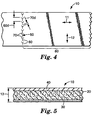
- Figure 4 is a top view of a second alternative embodiment for the separation line in the tape of the present invention.
- Figure 5 is an enlarged cross-sectional side view of the tape of Figure 1 taken along line 5-5.
-
- As used herein, including the claims, the term "surgical tape" means a web of nonwoven fabric which is coated on a major surface with a skin-compatible pressure sensitive adhesive.
- As used herein, including the claims, "perforation length" is measured as the distance between longitudinal lines passing through the lateral extremities of the two connecting segments bounding the perforation.
- As used herein, including the claims, "connecting segment length" means the shortest distance between adjacent perforations.
-
- 10
- Tape
- 11
- Longitudinal Direction of Tape
- 12
- Lateral Direction of Tape
- 13
- Thickness of Tape
- 20
- Nonwoven Web
- 30
- Pressure Sensitive Adhesive
- 40
- Low Adhesion Backsize
- 50
- Separation Line
- 60
- Perforations
- 60d
- Length of Perforations
- 70
- Connecting Segments
- 70d
- Length of Connecting Segments
- 80
- Individual Sheets of Tape
- 100
- Core
- As seen most clearly in Figure 5, the
tape 10 of the invention is a binder-containingnonwoven web 20 which is coated on a first major surface with a pressuresensitive adhesive 30 and on a second major surface with alow adhesion backsize 40. -
Tape 10 is rolled onto core 100 (Figure 1) or a strip ofconsecutive sheets 80 of the desired length. To facilitate dispensing individual sheets oftape 80 from the roll,perforated separation lines 50 extending laterally across the tape are uniformly spaced longitudinally along the length of the roll. As seen in Figures 2 and 3, eachseparation line 50 is defined by a series ofperforations 60, each of which has a perforation length 60D between about 0.2 and 5 mm. The connectingsegments 70 between theperforations 60 are between about 0.1 and 1 mm in length (70D). The ratio of the perforation length 60D to the connecting segment length 70D is about 1:1 to 10:1. - The
nonwoven web 20 may be manufactured by any of the well known methods for manufacturing nonwovens including melt-blowing, spin-bonding, carding, aerodynamic entanglement, etc. A particularly preferred method for making anonwoven web 20 useful in the practice of this invention is by a technique known as hydroentangling. This process is described in United States Patent Nos. 3,485,706, 3,486,168, 3, 493,462, 3, 494,821 and 3,508,308. Briefly, fibers are supported on a perforated plate or similar support screen and traversed with high energy liquid streams so as to consolidate the material in a repeating pattern of entangled fiber regions and interconnecting fibers. An alternate method of forming anonwoven web 20 is needle-tacking as described in United States Patent No. 5,016,331. - The thickness of the
nonwoven web 20 is largely dependant upon the intended use of thetape 10. Generally, a thickness of about 0.2 to about 0.6 mm is suitable for most intended uses. For use as asurgical tape 10, a thickness of about 0.1 to about 0.4 mm is typically desired. - The weight of the
nonwoven web 20 is preferably from about 10 g/m2 to about 100 g/m2, more preferably from about 15 g/m2 to about 70 g/m2, and most preferably from about 20 g/m2 to about 50 g/m2. - Preferred
nonwoven webs 20 include a family of high-strength nonwoven fabrics available from E.I. Dupont de Nemuours & Company of Wilmington, Delaware under the trademark SONTARA™ including SONTARA™ 8010, a hydroentangled polyester fabric. Other suitablenonwoven webs 20 include a hydroentangled polyester fabric available from Veratec, a division of International Paper of Walpole, Massachusetts. This fabric is preferably bonded with HYSTRETCH™ V-43 binder, an elastomeric terpolymer available from the BF Goodrich Company. - The
nonwoven web 20 must include one of the well known binders for enhancing bonding of the individual fibers within theweb 20. Selection of a suitable binder (i.e., one which has a suitable affinity for the fibers of the nonwoven web 20) is well within the judgment of one skilled in the art. Briefly, binders for nonwoven fabrics are typically selected from such materials as homopolymer and copolymer latexes of acrylics, butadienes, styrene / butadiene rubber copolymers, urethanes, vinyl acetates, vinyl acetate / acrylate copolymers, vinyl acetate / ethylene copolymers, polyvinyl alcohols, polyvinyl chlorides, vinyl esters, vinyl ethers, etc. - Specific examples of latex binding agents include, RHOPLEX™ E-2559 (an approximately 45% solids acrylic latex binder) available from the Rohm & Hass Co. of Philadelphia, Pennsylvania; UNICAL™ 76-4402 (an approximately 50% solids styrene/butadiene rubber latex) available from the UNICAL Corp. of Charlotte, North Carolina; NATIONAL STARCH™ No. 78-6283 (an approximately 45% solids acrylic/vinyl acetate copolymer latex) available from the National Starch Corp. of Bridgewater, New Jersey; and the KRATON™ family of thermoplastic rubbers available from the Shell Oil Company of Oak Brook, Illinois.
- Additional binders include the various thermoplastic fibers which may be incorporated directly in the nonwoven web. The
nonwoven web 20 is bonded by simply incorporating about 5 to 10 wt% of a compatible thermoplastic fiber into thenonwoven web 20 and heating theweb 20 above the softening temperature of the thermoplastic fibers so as to bond the thermoplastic fibers to the staple fibers in theweb 20. A compatible thermoplastic fiber is a fiber capable of melt-bonding to the other fibers in theweb 20 without substantially weakening theweb 20. - Binder fibers are available in a wide variety of configurations including totally meltable binder fibers, side-by-side binder fibers, bicomponent binder fibers, elliptical core-sheath binder fibers, concentric core-sheath binder fibers, and combinations thereof.
- Examples of suitable binder fibers include, binder fibers of polyester, polyethylene, polypropylene, polybutylene, polyamide and combinations thereof. The binder fibers are preferably from about 1 cm to about 20 cm in length and display a fineness of from about 0.1 denier to about 20 denier. -
- Specific examples of suitable core-sheath binder fibers for use in the
nonwoven web 20 include, DIAWA™ binder fibers (1½ denier by 38 mm crystalline polypropylene core with meltable polyethylene sheath) and MELTY™ binder fibers (2 denier by 38 mm oriented polyester core with meltable polyester sheath) available from Chori America, Inc. of Los Angeles, California; and K-52™ binder fibers (2 denier by 38 mm oriented polyester core with meltable polyester sheath) and K-54™ binder fibers (2 denier by 38 mm oriented polyester core with meltable polyester sheath) available from Hoechst Celanese Corp. of Charlotte, North Carolina. - The enhanced fiber bonding achieved with binders tends to stiffen the
web 20 and thereby facilitate tearing of theweb 20, improve handleability of thetape 10 during application, and control fraying of the fibers along the tear line. However, as understood by those skilled in the art, when intended for use assurgical tape 10, the amount of binder employed must be controlled so as to provide thesurgical tape 10 with a softness and conformability acceptable to both health care professionals and patients. Thesurgical tape 10 should posses sufficient stiffness to facilitate application of thetape 10 while retaining sufficient conformability to be comfortable to the patient and maintain contact with the skin over prolonged periods of use. - Both high-strength and low-
strength tapes 10 can benefit by incorporating theseparation lines 50 described herein. High-strength tapes 10, i.e., those with a tensile strength of greater than about about 1800 g/cm (10 lbs/inch) are difficult to tear and do not generally tear in a linear fashion. Low-strength tapes, i.e., those with a tensile strength of less than about about 1800 g/cm (10 lbs/inch) are tearable but do not generally tear evenly and may wrinkle during tearing to such an extent that thetape 10 can become adhesively adhered to itself. The perforation oftapes 10 in accordance with this invention is particularly beneficial when the tape 10 (including thenonwoven web 20, binder,low adhesion backsize 40 and adhesive 30) is a high-strength tape 10 having a tensile strength prior to perforation of greater than about about 1800 g/cm. (10 lbs/inch). - The adhesive 30 is a pressure sensitive adhesive 30 which, in the case of surgical tapes, is physically and biologically compatible with human skin. A wide variety of suitable, skin-compatible, pressure
sensitive adhesives 30 are known to those skilled in the art and include specifically, but not exclusively, acrylic-based adhesives, polyolefin adhesives, rubber-based adhesives, tackified styrene block copolymer adhesives, and the like. - A preferred pressure
sensitive adhesive 30 is any of the copolymers of isooctyl acrylate and acrylic acid or acrylamide described in United States Patent No. Re. 24,906. Such adhesives are preferred for use on surgical tapes since they are relatively nonirritating to the skin. - A layer of
low adhesion backsize 40 is preferably applied to thenonwoven web 20. Application oflow adhesion backsize 40 to thenonwoven web 20 provides a surface with a reduced adhesive affinity for the pressuresensitive adhesive 30. Such reduced adhesion facilitates the unwinding oftape 10 from a linerless roll of thetape 10. - Materials suitable for use as a
low adhesion backsize 40 in this invention, include acrylates, fluorochemicals, polyethylenes, silicones, vinyl copolymers and combinations of these compounds. Compounds suitable as alow adhesion backsize 40 are disclosed in United States Patent No. 4,728,571. A specific example of a suitablelow adhesion backsize 40 is SYL-OFF™, a silicone compound available from Dow Corning Corp. Preferredlow adhesion backsize 40 are the siloxane and acrylate based compounds disclosed in United States Patent No. 4,973,513 issued to Riedel and the water-insoluble hydrophobic urethane (carbamate) copolymer of polyvinyl alcohol and octadecyl isocyanate disclosed in United States Patent No. 2,532,011 issued to Dahlquist et al. - The
relative lengths perforations 60 and connectingsegments 70 control several fundamental properties oftape 10 related to dispensibility and performance. For example,length 70d of the connectingsegments 70 is one factor controlling the tensile strength betweenindividual sheets 80 oftape 10. Separation ofsheets 80 becomes difficult when the connectingsegments 70 are too long while accidental and unintended separation is likely when the connectingsegments 70 are too short. - The physical dimensions of the
perforations 60 and connectingsegments 70 defining theseparation lines 50 are important aspects of the invention. An acceptable balance must be achieved between the competing interests of adequate tensile strength to prevent premature separation and sufficient reduction in tensile strength to ensure easy and consistent separation ofsheets 80 along asingle separation line 50. - The parameters of
separation lines 50 necessary to define performance areperforation length 60d, connectingsegment length 70d and the ratio ofperforation length 60d to connectingsegment length 70d. Acceptable values for achieving proper performance of theperforated tape 10 of this invention are set forth below in Table One. The interdependence of these variables and the cooperational manner in which they effect and influence performance of thetape 10 requires that they be considered together.Variable Acceptable Preferred Highest Performance Perforation Length (mm) 0.2 - 5.0 0.5 - 3.0 1.0 - 2.0 Connecting Segment Length (mm) 0.1 - 1.0 0.2 - 0.8 0.3 - 0.6 Ratio Perforation Length -to-Connecting Segment Length 1:1 to 10:1 2:1 to 8:1 3:1 to 6:1 - The tensile strength of the perforated section of
tape 10 in the longitudinal direction 11 (Figure 2) measured in accordance with the protocol set forth herein, is desirably from about 400 to about 3000 grams/cm width, preferably from about 600 to about 2000 grams/cm width, and most preferably from about 800 to about 1700 grams/cm width. A longitudinal tensile strength of less than about 400 grams/cm width tends to result in premature separation of thesheets 80 while a longitudinal tensile of greater than about 3000 grams/cm width tends to require excessive force and thereby hinder separation of thesheets 80. - A secondary consideration is the shape of the
perforations 60 and connectingsegments 70. Shape is designated a secondary consideration because, while relevant to dispensibility and performance of thetape 10, its impact is not as critical as the primary considerations ofperforation length 60d, connectingsegment length 70d and ratio ofperforation length 60d to connectinggarment length 70d. Theperforations 60 may be shaped in accordance with any of the accepted perforation patterns including linear, angled, Y-shaped, V-shaped, dual-angled offset, sinusoidal, etc. When angled, theperforations 60 are preferably angled about 30 to 60° from thelateral axis 12 of thetape 10. The preferred shape, based upon ease of manufacture and minimization of fraying along the torn edge, is a simple linear pattern extending laterally across thetape 10 as shown in Figure 2. - Similarly, the longitudinal distance between the
separation lines 50 must be selected so as to balance the competing interests of permitting substantially any length oftape 10 to be created (more separation lines 50) and limiting the accidental and unintended separation of thetape 10 along aseparation line 50 during dispensing, application or use (fewer separation lines 50). Generally, a longitudinal spacing of about 1 to about 20 cm, preferably about 2 to about 10 cm provides an acceptable balance between these competing interests. - The binder may be applied after formation of the
nonwoven web 20 by any of the conventional water or solvent-based coating techniques including air knife, trailing blade, direct and offset gravure, Meyer bar, wire-wound rod, reverse roll, roll coating, print bond and spray coating. Where the binder is a thermoplastic fiber, the fiber is simply dispersed into the fiber matrix prior to formation of theweb 20 and then melted. - Similarly, the
low adhesion backsize 40 may be applied by any of the conventional coating techniques discussed in connection with the application of a binder. - A dried coating weight of about 0.1 to about 0.4 mg/cm2 is preferred for the low adhesion backsize and about 0.2 to 0.8 mg/cm2 for the binder.
- The binder and the
low adhesion backsize 40 may optionally be mixed together and simultaneously coated onto thenonwoven web 20 in accordance with the procedure outlined in the Examples section of this disclosure and disclosed in United States Patent No. 4,967,740. - The pressure
sensitive adhesive 30 may be applied to thenonwoven web 20 by any of the well known techniques for coating pressure sensitive adhesives such as dispersion coating, solution coating and hot melt application. A convenient method of coating thenonwoven web 20 with the pressuresensitive adhesive 30 is disclosed in United States Patent No. 3,121,021. Briefly, a pressuresensitive adhesive 30 is coated on a smooth release liner. The release liner carrying the adhesive film is then laminated to thenonwoven web 20, the release liner peeled away, and thelinerless tape 10 wound into a "jumbo" roll. - Alternatively, the adhesive 30 may be applied by such conventional coating techniques as air knife, trailing blade, direct and offset gravure, wire-wound rod, reverse roll, print bond, spray coating, etc.
- The separation lines 50 are conveniently created with a rotary die having a serrated perforator blade(s) positioned along the periphery of the die so as to perforate the
tape 10 at the desired intervals. Other perforation methods known in the art, e.g., laser perforation, may also be used. - The separation lines 50 will generally be invisible to the user during both dispensing and use. Dependent upon consumer preference, the
separation lines 50 may optionally be marked, such as with a compatible pigment at the point of perforation, or otherwise distinguished, so that the user dispensing thetape 10 can see the separation lines 50. - The "jumbo" rolls of
tape 10 are converted into multiple rolls of commerciallysized tape 10 by conventional converting techniques including unwinding, longitudinally slitting, rewinding, and laterally cutting. - The
tape 10 is dispensed by simply gripping the free end of the tape, unrolling the desired length, and then tearing the tape along aseparation line 50. When separating the desired length of tape from the roll, it is generally desired to grip thesheet 80 oftape 10 closest to the roll to preventother separation lines 50 from tearing. - Utility of the tape disclosed and claimed herein is not limited to uses involving contact to human skin.
- Testing is conducted upon a THWING-ALBERT INTELECT™ II (Model No. 1450-42-C) constant rate of extension tensile tester equipped with clamp-type jaws manufactured by the Thwing-Albert Instrument Company of Philadelphia, Pennsylvania.
- Rectangular test samples of 1" x 9" are cut from a roll of the tape to be tested. The long dimension is cut in the direction (machine or cross-machine) to be tested. The ends of the test samples are folded adhesive-to-adhesive to form a two inch nonadhesive tab at each end. The nonadhesive tabs prevent the sample from being pulled out of the jaws, reduce premature jaw breaks, and prevent the sample from leaving an adhesive residue on the jaws. The samples are associated within the jaws of the Thwing-Albert tester and the tester set at a crosshead speed of 12.7 cm/min (5 inches per minute), a chart speed of 25.4 cm/min (10 inches per minute) and a gauge length of 12.7 cm (5 inches). The chart recorder is set at 2.54 mm (0.1 inch) per chart division in the cross direction and 5.08 mm (0.2 inch) per chart division in the machine direction. The machine is activated and the sample pulled apart until the force required to pull the sample decreases.
- Tensile strength is calculated in accordance with the equation set forth below where "Pen Heightmax" is the number of small divisions in the cross direction reached by the pen in its maximum travel across the chart.
- Elongation is calculated in accordance with the equation set forth below where "Pen Distancemax" is the number of small divisions reached by the pen in the machine direction from initiation of pen deflection to sample break.

- Testing is conducted upon a THWING-
ALBERT Model # 60 ELMENDORF type falling pendulum tear tester. The samples to be tested are conditioned in accordance with ASTM D 1776 and tested according to ASTM D 1424. - Test samples are cut with a 63 x 100 mm (2.5" x 4") cutting die. The samples are clamped into position in the ELMENDORF apparatus and a 20 mm long linear slit cut into the side of the sample fabric leaving a 43 mm long testing width. The capacity of the ELMENDORF apparatus is selected to effect a desired tear in the sample at a loading of between 20% and 60% of the scale value.
- The test is conducted on a set of five samples cut in the machine direction (long dimension parallel to the machine direction). The results are averaged. Test values are discarded when the sample slips from the jaws or the tear deviates more than 6 mm (0.24 inches) from the projection of the original slit.
- Tear Strength ( Tear CD) is calculated by multiplying the average test value by the appropriate factor found in ASTM 1424; ANNEX A 1.4; Table A1.
- A fabric backing of SONTARA™ 8010 was laminated with light pressure to a coating of pressure sensitive adhesive containing 90-96 wt% solids. This adhesive was coated on the surface of a silicone release-coated carrier. The pressure sensitive adhesive was a copolymer of 97/3 weight ratio of iso-octyl acrylate and acrylamide. An adhesive of this type is described in U.S. Patent No. RE 24,906, Example 6.
- The carrier/adhesive backing laminate was dipped at a constant feed rate into a trough containing one part low adhesion backsize and one part of binder.
- The low adhesion backsize used was a 5% solution of polyvinyl N-octadecyl carbamate in toluene and xylene - ratio 90/10 by weight. This type of low adhesion backsize is described in column 9 of U.S. Patent No. 2,532,011.
- The binder used was a 10% by weight solution of KRATON™ 1101, a thermoplastic rubber obtained from Shell Oil Company of Oak Brook, Illinois, in toluene.
- Additional description of the formulation and coating of combined low adhesion backsize and binder is found in U.S. Patent No. 4,967,740.
- Following the binder/low adhesion backsize coating step, the wet tape construction passed through a two-stage drying oven. The first stage was at 100°C for about 30 seconds and the second stage was at 135°C for about 2.5 minutes.
- The dried tape was removed from the silicone release coated carrier and was wound onto a spool to form a "jumbo" roll of adhesive tape.
- The tape was then laterally perforated with a rotary die to form separation lines with linear perforations. The separation lines were two inches apart and had perforation lengths, connecting segment lengths, and a ratio of perforation to connecting segment lengths as specified in Table Two. The perforated tape was then tested for Average Cross Direction Tear Strength (TearCD ), Average Machine Direction Tensile Strength (TMD ) and Average Machine Direction Elongation (EMD ) with the results set forth in Table Two.
- Perforated tape sample rolls of various perforation patterns were evaluated by a panel of eight people. Evaluation criteria included ease of tear, appearance of torn area, and perceived tape tensile strength. Acceptable and preferred performance were noted for
samples # 4, 7, 9, and 10 as indicated in Table 2.Sample # Separation Lines Perforated Tape Test Results Cut Length in CM. Uncut Length in CM. Cut to Uncut Ratio Hand Tear Test Tear Force TearCD (in grams) Tensile; TMD (in GMS/CM) 1 0.54 0.25 2.1 : 1 691.4 2824 2 0.39 0.41 0.95 : 1 1394.9 3056 3 0.94 0.25 3.8 : 5 847.9 1198 4 0.78 0.41 1.9 : 1 Acceptable 418.8 1698 5 0.68 0.51 1.3 : 1 838.5 2306 6 1.33 0.25 5.3 : 1 297.6 840 7 1.18 0.41 2.9 : 1 Acceptable 521.2 1162 8 1.08 0.51 2.1 : 1 694.1 2627 9 1.58 0.41 3.9 : 1 Preferred 393.9 1001 10 1.48 0.51 2.9 : 1 Acceptable 492.8 1573 Control (Unperfect) --- --- --- 1775.9 3485
Claims (14)
- A roll of adhesive tape comprising a binder-containing nonwoven web having a longitudinal axis and a lateral axis which is coated on a major surface with a pressure sensitive adhesive which web is resistant to tearing by hand and which is linerless; the adhesively-coated web having a plurality of longitudinally spaced, laterally extending, perforated separation lines defined by a series of about 0.2 to 5 mm perforations separated by about 0.1 to 1 mm connecting segments of tape and a ratio of perforation length to connecting segment length of about 1:1 to 10:1 wherein the shape of the perforations is linear, angled, Y-shaped, V-shaped, dual-angled offset or sinusoidal, and wherein the perforated tape has a tensile strength of at least about 400 grams per -centimeter width and not more than about 3000 grams per centimeter width.
- The roll of tape of claim 1 further comprising a low adhesion backsize.
- The roll of tape of claim 1 wherein the nonwoven web is hydroentangled.
- The roll of tape of claim 1 wherein the nonwoven web is comprised of polyester fibers.
- The roll of tape of claim 1 wherein the perforated separation lines are about uniformly spaced.
- The roll of tape of claim 1 wherein the perforated separation lines are uniformly longitudinally spaced about 1 to 20 cm apart to define individually separable sheets of roll of tape having identical longitudinal lengths.
- The roll of tape of claim 1 wherein the perforated separation lines are uniformly longitudinally spaced about 2 to 10 cm apart to define individually separable sheets of tape having identical longitudinal lengths.
- The roll of tape of claim 1 wherein the perforated separation lines are defined by perforations which are about 0.5 to 3 mm long, connecting segments which are about 0.2 to 0.8 mm long, and a ratio of perforation length to connecting segment length of about 2:1 to 8:1.
- The roll of tape of claim 1 wherein the perforated separation lines are defined by perforations which are about 1 to 2 mm long, connecting segments which are about 0.3 to 0.6 mm long, and a ratio of perforation length to connecting segment length of about 3:1 to 6:1.
- The roll of tape of claim 1 wherein the perforations are linear perforations which extend at an angle of about 30° to 60° from the lateral axis of the tape.
- The roll of tape of claim 1 wherein the perforations in each separation line have a uniform length.
- The roll of tape of claim 9 wherein the perforations in each separation line have a uniform shape.
- The roll of tape of any of claims 1 to 12 wherein the tape is surgical tape comprising a core and length of tape wound around the core; wherein the nonwoven web is a nonwoven fabric and the pressure major surface with sensitive adhesive is a skin compatible pressure sensitive adhesive.
- A method of dispensing tape from a roll of tape according to any of claims 1 to 13, said method comprising the steps of:(a) unwinding a length of said tape from a wound core of the tape, and(b) laterally tearing the tape along a separation line to detach a length of tape from the tape remaining on the core.
Applications Claiming Priority (3)
| Application Number | Priority Date | Filing Date | Title |
|---|---|---|---|
| US11491293A | 1993-08-31 | 1993-08-31 | |
| US114912 | 1993-08-31 | ||
| PCT/US1994/009824 WO1995006450A1 (en) | 1993-08-31 | 1994-08-31 | Perforated roll of nonwoven surgical tape |
Publications (2)
| Publication Number | Publication Date |
|---|---|
| EP0716586A1 EP0716586A1 (en) | 1996-06-19 |
| EP0716586B1 true EP0716586B1 (en) | 2000-12-20 |
Family
ID=22358189
Family Applications (1)
| Application Number | Title | Priority Date | Filing Date |
|---|---|---|---|
| EP94927299A Expired - Lifetime EP0716586B1 (en) | 1993-08-31 | 1994-08-31 | Perforated roll of nonwoven surgical tape |
Country Status (8)
| Country | Link |
|---|---|
| US (1) | US5496605A (en) |
| EP (1) | EP0716586B1 (en) |
| JP (1) | JPH09502111A (en) |
| AU (1) | AU692178B2 (en) |
| BR (1) | BR9407375A (en) |
| CA (1) | CA2169623C (en) |
| DE (1) | DE69426453T2 (en) |
| WO (1) | WO1995006450A1 (en) |
Families Citing this family (95)
| Publication number | Priority date | Publication date | Assignee | Title |
|---|---|---|---|---|
| US5616387A (en) * | 1993-08-31 | 1997-04-01 | Minnesota Mining And Manufacturing Company | Perforated roll of elastic wrap |
| US5704566A (en) * | 1995-10-31 | 1998-01-06 | James River Corporation Of Virginia | Paper towel roll with variegated perforations |
| US5795834A (en) * | 1995-12-22 | 1998-08-18 | Minnesota Mining & Manufacturing Company | Adhesive tape and method of making |
| JP3016361B2 (en) * | 1996-03-27 | 2000-03-06 | ユニチカ株式会社 | Unidirectional elastic nonwoven fabric and method for producing the same |
| US5763038A (en) * | 1997-02-25 | 1998-06-09 | Minnesota Mining And Manufacturing Company | Progressively perforated tape roll |
| US6018092A (en) * | 1997-03-04 | 2000-01-25 | 3M Innovative Properties Company | Medical adhesive bandage, delivery system and method |
| EP0876909A1 (en) * | 1997-05-05 | 1998-11-11 | Monarch Marking Systems, INC. | Linerless labels and method of making same |
| US6045858A (en) * | 1997-08-04 | 2000-04-04 | Sumika Plastech Co., Ltd. | Film and process for producing the same |
| US6136053A (en) * | 1999-06-16 | 2000-10-24 | Sullivan; Colin | Method and apparatus for starting fires |
| US6368689B1 (en) | 1999-07-08 | 2002-04-09 | Kimberly-Clark Worldwide, Inc. | Perforated centerflow rolled product |
| US6682757B1 (en) | 2000-11-16 | 2004-01-27 | Euro-Celtique, S.A. | Titratable dosage transdermal delivery system |
| US20040028867A1 (en) * | 2001-11-19 | 2004-02-12 | Donald Allison | Method for using perforated masking tape |
| GB0224986D0 (en) | 2002-10-28 | 2002-12-04 | Smith & Nephew | Apparatus |
| US7138169B2 (en) * | 2003-03-05 | 2006-11-21 | 3M Innovative Properties Company | Cloth-like polymeric film with directional tear |
| US7186207B2 (en) * | 2003-07-31 | 2007-03-06 | The Evercare Company | Roller construction for detritus removal |
| US7135213B2 (en) * | 2003-07-31 | 2006-11-14 | 3M Innovative Properties Company | Tearable elastic composite article and method of manufacture |
| US20050090860A1 (en) * | 2003-10-23 | 2005-04-28 | Paprocki Loran J. | Segmented plug for tissue tracts |
| US8758313B2 (en) * | 2003-10-28 | 2014-06-24 | Smith & Nephew Plc | Apparatus and method for wound cleansing with actives |
| GB0325126D0 (en) | 2003-10-28 | 2003-12-03 | Smith & Nephew | Apparatus with heat |
| US11298453B2 (en) | 2003-10-28 | 2022-04-12 | Smith & Nephew Plc | Apparatus and method for wound cleansing with actives |
| GB0325120D0 (en) * | 2003-10-28 | 2003-12-03 | Smith & Nephew | Apparatus with actives |
| US6991840B2 (en) * | 2003-12-10 | 2006-01-31 | Kimberly-Clark Worldwide, Inc. | Separably joined relationship between adjoining wipes |
| US11206894B2 (en) | 2004-04-02 | 2021-12-28 | Applied Biokinetics Llc | Anatomical support method using elongate strap support |
| US10212987B2 (en) * | 2004-04-02 | 2019-02-26 | Applied Biokinetics Llc | Method of manufacturing an anatomical support system |
| US11690746B2 (en) | 2004-04-02 | 2023-07-04 | Applied Biokinetics Llc | Pre-cut adhesive supports for anatomical support, pain reduction, or therapeutic treatment |
| US10299953B2 (en) | 2004-04-02 | 2019-05-28 | Applied Biokenetics Llc | Material including pre-cut anatomical supports |
| US10058642B2 (en) | 2004-04-05 | 2018-08-28 | Bluesky Medical Group Incorporated | Reduced pressure treatment system |
| US7909805B2 (en) | 2004-04-05 | 2011-03-22 | Bluesky Medical Group Incorporated | Flexible reduced pressure treatment appliance |
| US8062272B2 (en) | 2004-05-21 | 2011-11-22 | Bluesky Medical Group Incorporated | Flexible reduced pressure treatment appliance |
| GB0409446D0 (en) | 2004-04-28 | 2004-06-02 | Smith & Nephew | Apparatus |
| SE528009C2 (en) * | 2004-12-30 | 2006-08-01 | Moelnlycke Health Care Ab | Self-adhesive dressings |
| JP4947939B2 (en) * | 2005-09-09 | 2012-06-06 | 日東電工株式会社 | Medical adhesive tape or sheet |
| US20070080090A1 (en) * | 2005-10-12 | 2007-04-12 | R. P. Scherer Technologies, Inc. | Child-resistant medicament storage and distribution back card and sealed blister card |
| CA2582000C (en) * | 2006-03-10 | 2011-05-10 | Nitto Denko Corporation | Pressure-sensitive adhesive tape or sheet |
| US9216850B2 (en) | 2006-09-26 | 2015-12-22 | Intercontinental Great Brands Llc | Rupturable substrate |
| CA2663560C (en) * | 2006-09-26 | 2015-12-08 | Cadbury Adams Usa Llc | Rupturable blister package |
| US11297984B2 (en) | 2006-10-31 | 2022-04-12 | Gpcp Ip Holdings Llc | Automatic napkin dispenser |
| FR2907654B1 (en) | 2006-10-31 | 2010-01-29 | Georgia Pacific France | PROCESS, MANUFACTURING DEVICE AND ASSOCIATED ROLLS FORMED OF CUTTING SHEETS AND ALTERNATE PREDECOUPLES |
| EP1929912A1 (en) * | 2006-12-06 | 2008-06-11 | The Procter and Gamble Company | Tissue roll with angled perforations |
| US20090022923A1 (en) * | 2007-07-17 | 2009-01-22 | Walkingshaw Nathan R | Apparatus and Method for Providing an Information Recording System |
| AU2008310685B2 (en) | 2007-10-10 | 2012-02-09 | 3M Innovative Properties Company | Articles and methods of masking or protecting a substrate |
| US9090737B2 (en) | 2007-11-13 | 2015-07-28 | Surmodics, Inc. | Viscous terpolymers as drug delivery platform |
| US20090155512A1 (en) * | 2007-12-13 | 2009-06-18 | Tsutama Satake Neto | Rolls of material providing one-handed dispensing of sheets of pre-determined length |
| FR2930131B1 (en) * | 2008-04-17 | 2013-04-12 | Georgia Pacific France | SYSTEM FOR DISTRIBUTING COUPONS OF A PAPER STRIP CONTAINED IN AN INDIVIDUAL COUPONS DISPENSER BOX |
| US8209909B2 (en) * | 2008-09-10 | 2012-07-03 | Robert Rissone | Method and system for sealing around door |
| US9308115B2 (en) * | 2008-11-26 | 2016-04-12 | Kt Health, Llc | Body-adhesive kinesiology tape |
| US10617571B2 (en) | 2008-11-26 | 2020-04-14 | Kt Health, Llc | Pre-cut strips of kinesiology tape |
| CN102300617A (en) * | 2008-12-19 | 2011-12-28 | 3M创新有限公司 | Prefilter For Spray Paint Booth And Method Of Reducing Contamination |
| ES2430057T3 (en) | 2008-12-22 | 2013-11-18 | Intercontinental Great Brands Llc | Film container that includes stacked confectionery product pieces |
| US8974808B2 (en) * | 2008-12-23 | 2015-03-10 | Surmodics, Inc. | Elastic implantable composites and implants comprising same |
| US9415197B2 (en) * | 2008-12-23 | 2016-08-16 | Surmodics, Inc. | Implantable suction cup composites and implants comprising same |
| US20100158978A1 (en) * | 2008-12-23 | 2010-06-24 | Peter Markland | Bioactive spray coating compositions and methods of making and uses thereof |
| GB0902368D0 (en) | 2009-02-13 | 2009-04-01 | Smith & Nephew | Wound packing |
| USD642692S1 (en) * | 2009-05-07 | 2011-08-02 | Tatuyou, Llc | Dermal tattoo covering |
| JP5632373B2 (en) * | 2009-06-12 | 2014-11-26 | ニチバン株式会社 | Rolled medical adhesive tape and method for producing the same |
| USD1011420S1 (en) | 2009-11-25 | 2024-01-16 | Kt Health, Llc | Roll of pre-cut strips of kinesiology tape |
| USD988400S1 (en) | 2009-11-25 | 2023-06-06 | Kt Health, Llc | Roll of pre-cut strips of kinesiology tape |
| US8791315B2 (en) | 2010-02-26 | 2014-07-29 | Smith & Nephew, Inc. | Systems and methods for using negative pressure wound therapy to manage open abdominal wounds |
| USD692565S1 (en) | 2010-06-03 | 2013-10-29 | Smith & Nephew, Inc. | Organ protection layer |
| CA2809825A1 (en) | 2010-08-30 | 2012-03-08 | Surmodics Pharmaceuticals, Inc. | Biodegradable terpolymers and terpolymer blends as pressure-sensitive adhesives |
| CA140188S (en) | 2010-10-15 | 2011-11-07 | Smith & Nephew | Medical dressing |
| CA140189S (en) | 2010-10-15 | 2011-11-07 | Smith & Nephew | Medical dressing |
| JP5732266B2 (en) * | 2011-01-26 | 2015-06-10 | 日東電工株式会社 | Patch |
| USD684266S1 (en) * | 2011-08-10 | 2013-06-11 | Theresa Zipf | Dual-sided unisex elastic athletic wrap |
| JP4940385B1 (en) * | 2012-01-27 | 2012-05-30 | 真希子 小川 | Roll tape |
| US10383489B2 (en) | 2012-02-10 | 2019-08-20 | Gpcp Ip Holdings Llc | Automatic napkin dispenser |
| USD723174S1 (en) * | 2012-07-19 | 2015-02-24 | Young Moo Kim | Elastic therapeutic tape with a surface pattern |
| US9032960B2 (en) * | 2012-09-19 | 2015-05-19 | Anthony D Rhodes | Male condom skin dressing |
| EP2909270A1 (en) | 2012-10-22 | 2015-08-26 | Avery Dennison Corporation | Hybrid material of crosslinked microgel particles dispersed in an adhesive |
| ES2668197T3 (en) | 2012-11-05 | 2018-05-17 | Kathe A. Sackler | Perforated painter masking tape |
| US9068610B2 (en) * | 2012-12-11 | 2015-06-30 | Arvinmeritor Technology, Llc | Brake caliper assembly having a spacer tape and a method of manufacture |
| US10257986B1 (en) | 2012-12-13 | 2019-04-16 | L.P. Brown Company, Inc. | Harvested bale wrapping material |
| US10940985B2 (en) | 2013-07-26 | 2021-03-09 | Tama Plastic Industry | Wrapping web assembly and wrapping method |
| WO2015024052A1 (en) | 2013-08-20 | 2015-02-26 | Tama Plastic Industry | A wrapping material and method of manufacture for baled harvested agricultural materials |
| US9604811B2 (en) | 2013-10-01 | 2017-03-28 | Georgia-Pacific Consumer Products Lp | Automatic paper product dispenser with data collection and method |
| DE102014110535A1 (en) * | 2014-07-25 | 2016-01-28 | Certoplast Vorwerk & Sohn Gmbh | Process for producing an adhesive tape |
| CA2961567C (en) | 2014-08-19 | 2020-11-03 | Kt Health, Llc | Kinesiology tape |
| USD765389S1 (en) | 2014-12-30 | 2016-09-06 | Medline Industries, Inc. | Dispenser |
| US10377545B2 (en) * | 2015-03-24 | 2019-08-13 | L.P. Brown Company, Inc. | Wrapping materials for solid objects |
| US20170252221A1 (en) * | 2016-02-25 | 2017-09-07 | Kim Scopelliti | Adhesive Bandage With Integral Sticker |
| WO2017151095A1 (en) | 2016-02-29 | 2017-09-08 | Tollini Dennis R | Securement device assembly and securement and dressing device assembly and method of applying said device assemblies |
| BR112019005774B1 (en) | 2016-09-27 | 2022-10-11 | L.P. Brown Company, Inc | PACKAGING MATERIAL SHEETS FOR HARVESTED BALE |
| US11510804B2 (en) * | 2016-12-02 | 2022-11-29 | 3M Innovative Properties Company | Muscle or joint support article with a strap |
| CN110494070A (en) | 2017-05-10 | 2019-11-22 | Gpcp知识产权控股有限责任公司 | Automatic paper product dispenser and associated method |
| JP2019024743A (en) * | 2017-07-27 | 2019-02-21 | ライオン株式会社 | Patch and method for suppressing peeling of the patch |
| US10660376B2 (en) * | 2017-08-30 | 2020-05-26 | Elizabeth Chabner Thompson | Radiation bra extender |
| US10844249B2 (en) * | 2018-02-01 | 2020-11-24 | An-Hsia Liu | Stress tearable tape |
| JP7270353B2 (en) * | 2018-09-25 | 2023-05-10 | スリーエム イノベイティブ プロパティズ カンパニー | roll product |
| US11142382B1 (en) | 2019-04-19 | 2021-10-12 | L.P. Brown Company, Inc. | Harvested bale wrapping material and sealing accessory to deliver and protect a closing adhesive |
| US11319464B2 (en) * | 2019-11-20 | 2022-05-03 | Gourgen AMBARTSOUMIAN | Polymeric tape with tear cuts |
| JP7714964B2 (en) * | 2021-08-31 | 2025-07-30 | 王子ホールディングス株式会社 | Hydrocolloid tape for skin application to wounds |
| CN219423135U (en) * | 2023-02-13 | 2023-07-28 | 常州市北飞无纺布技术有限公司 | Medical bandage |
| USD1069902S1 (en) | 2023-04-24 | 2025-04-08 | Dominic DeFrank | Tape tag |
| US12417718B1 (en) | 2023-05-29 | 2025-09-16 | Dominic DeFrank | Tape adhesive tag with tab system |
| USD1091835S1 (en) * | 2023-12-20 | 2025-09-02 | Noah Przyjemski | Religious athletic tape |
Family Cites Families (34)
| Publication number | Priority date | Publication date | Assignee | Title |
|---|---|---|---|---|
| US2308693A (en) * | 1941-04-05 | 1943-01-19 | Columbia Mills Inc | Adhesive tape |
| US2508855A (en) * | 1947-04-26 | 1950-05-23 | Clayton H Brown | Adhesive tape with tearing facilities |
| USRE24906E (en) * | 1955-11-18 | 1960-12-13 | Pressure-sensitive adhesive sheet material | |
| CA614504A (en) * | 1957-08-30 | 1961-02-14 | M. Kwitek Edwin | Web cutting apparatus |
| US3085024A (en) * | 1959-05-19 | 1963-04-09 | Johnson & Johnson | Porous extensible pressure-sensitive adhesive tape in which perforations arearrangedto facilitate tearing |
| GB886474A (en) * | 1959-09-08 | 1962-01-10 | Jean Charles Albert Wuhrlin | Improvements in or relating to easy-cut cotton wool and method of preparing same |
| US3121021A (en) * | 1960-04-18 | 1964-02-11 | Minnesota Mining & Mfg | Breathable surgical adhesive tapes |
| US3143208A (en) * | 1960-09-16 | 1964-08-04 | Jr Hiram Sizemore | Adhesive tape |
| US3331728A (en) * | 1964-02-17 | 1967-07-18 | Johnson & Johnson | Perforate film-fiber laminate |
| US3575782A (en) * | 1967-05-19 | 1971-04-20 | Minnesota Mining & Mfg | Elastic shirred web product |
| US4017002A (en) * | 1969-09-08 | 1977-04-12 | Sterling Drug Inc. | Dispensing moist treated towels or tissues |
| US4346700A (en) * | 1979-11-16 | 1982-08-31 | Minnesota Mining & Manufacturing Company | Pressure-sensitive adhesive sheet material |
| US4292360A (en) * | 1980-03-05 | 1981-09-29 | Minnesota Mining And Manufacturing Company | Pressure sensitive adhesive tape |
| DE3248753A1 (en) * | 1982-12-31 | 1984-07-12 | Akzo Gmbh, 5600 Wuppertal | METHOD FOR COMPRESSING FIBER FABRICS |
| US4581087A (en) * | 1983-02-04 | 1986-04-08 | The Kendall Company | Method of making a thermoplastic adhesive-coated tape |
| US4704113A (en) * | 1983-05-03 | 1987-11-03 | The Kendall Company | Dressing |
| EP0136134B1 (en) * | 1983-09-19 | 1988-10-19 | Minnesota Mining And Manufacturing Company | Binding tape supply packaging |
| US4562102A (en) * | 1984-03-01 | 1985-12-31 | Minnesota Mining And Manufacturing Company | Roll of predetermined length strips of pressure-sensitive tape |
| US4606338A (en) * | 1985-05-06 | 1986-08-19 | The Kendall Company | Slip resistant bandage |
| US4671266A (en) * | 1986-02-05 | 1987-06-09 | The Kendall Company | Blister bandage |
| US4967740A (en) * | 1986-06-11 | 1990-11-06 | Minnesota Mining And Manufacturing Company | Dispensable tapes |
| US4768810A (en) * | 1986-06-23 | 1988-09-06 | Minnesota Mining And Manufacturing Company | Fanfolded tablet of a web which is separable into sheets each bearing a pressure-sensitive adhesive pattern |
| JP2602016B2 (en) * | 1986-09-01 | 1997-04-23 | 日東電工株式会社 | Reinforced porous sheet |
| US4772499A (en) * | 1986-10-01 | 1988-09-20 | The Kendall Company | Novel tearable non-woven webs and products employing same |
| US4737393A (en) * | 1987-06-02 | 1988-04-12 | Kimberly-Clark Corporation | Dual perforation of scrim-reinforced webs |
| DE3802341A1 (en) * | 1988-01-27 | 1989-08-10 | Hermann Klaus D | LABEL TAPE |
| US4882213A (en) * | 1988-04-29 | 1989-11-21 | Weyerhaeuser Company | Absorbent article with tear line guide |
| US4957795A (en) * | 1988-05-13 | 1990-09-18 | Minnesota Mining And Manufacturing Company | Absorbent elastomeric wound dressing |
| US5202190A (en) * | 1989-08-14 | 1993-04-13 | Minnesota Mining And Manufacturing Company | Method of making vinyl-silicone copolymers using mercapto functional silicone chain-transfer agents and release coatings made therewith |
| US4973513A (en) * | 1990-04-04 | 1990-11-27 | Minnesota Mining And Manufacturing Company | Process for applying a release coating to a wet nonwoven backing and article |
| US5213565A (en) * | 1990-12-03 | 1993-05-25 | Rollband Ernest J | Temporary bandage tape |
| US5114771A (en) * | 1990-12-11 | 1992-05-19 | The Procter & Gamble Company | Perforator blade for paper products and products made therefrom |
| JPH04106400U (en) * | 1991-02-15 | 1992-09-14 | 富士夫 中島 | Perforation cut or perforation pattern |
| CA2127792C (en) * | 1992-02-03 | 2004-08-17 | John E. Riedel | Nonwoven sheet materials, tapes and methods |
-
1994
- 1994-08-31 CA CA002169623A patent/CA2169623C/en not_active Expired - Fee Related
- 1994-08-31 DE DE69426453T patent/DE69426453T2/en not_active Expired - Lifetime
- 1994-08-31 JP JP7508244A patent/JPH09502111A/en active Pending
- 1994-08-31 WO PCT/US1994/009824 patent/WO1995006450A1/en not_active Ceased
- 1994-08-31 EP EP94927299A patent/EP0716586B1/en not_active Expired - Lifetime
- 1994-08-31 BR BR9407375A patent/BR9407375A/en not_active IP Right Cessation
- 1994-08-31 AU AU76786/94A patent/AU692178B2/en not_active Ceased
-
1995
- 1995-08-18 US US08/516,691 patent/US5496605A/en not_active Expired - Lifetime
Also Published As
| Publication number | Publication date |
|---|---|
| BR9407375A (en) | 1996-07-16 |
| AU7678694A (en) | 1995-03-22 |
| CA2169623A1 (en) | 1995-03-09 |
| DE69426453D1 (en) | 2001-01-25 |
| EP0716586A1 (en) | 1996-06-19 |
| WO1995006450A1 (en) | 1995-03-09 |
| CA2169623C (en) | 2005-08-23 |
| JPH09502111A (en) | 1997-03-04 |
| AU692178B2 (en) | 1998-06-04 |
| DE69426453T2 (en) | 2001-06-07 |
| US5496605A (en) | 1996-03-05 |
Similar Documents
| Publication | Publication Date | Title |
|---|---|---|
| US5496605A (en) | Perforated roll of nonwoven surgical tape | |
| US5616387A (en) | Perforated roll of elastic wrap | |
| EP0670705B1 (en) | Perforated roll of elastic wrap | |
| EP1397098B1 (en) | Tapered stretch removable adhesive articles and methods | |
| AU773212B2 (en) | Nonwoven sheets, adhesive articles, and methods for making the same | |
| US6018092A (en) | Medical adhesive bandage, delivery system and method | |
| WO1999027975A1 (en) | Low trauma adhesive article | |
| JP2002526667A (en) | Hand tearable tape | |
| HU220959B1 (en) | Layered absorbent products and method for preparation of it | |
| AU3475293A (en) | Nonwoven sheet materials, tapes and methods | |
| EP1791507A1 (en) | Extensible absorbent core and absorbent article | |
| US20030180493A1 (en) | Auxiallary implement for patch application | |
| JP4763157B2 (en) | Adhesive tape for skin application and method for producing the same | |
| WO2002072162A2 (en) | Stretch removable adhesive articles and methods | |
| EP0136134B1 (en) | Binding tape supply packaging | |
| JP2007236764A (en) | Medical adhesive tape or sheet | |
| EP1400251B1 (en) | Stretch removable adhesive articles and methods | |
| JP2025111289A (en) | Rolled cleaning tape | |
| HK1169799B (en) | Roll-shaped medical adhesive tape and manufacturing method therefor |
Legal Events
| Date | Code | Title | Description |
|---|---|---|---|
| PUAI | Public reference made under article 153(3) epc to a published international application that has entered the european phase |
Free format text: ORIGINAL CODE: 0009012 |
|
| 17P | Request for examination filed |
Effective date: 19960329 |
|
| AK | Designated contracting states |
Kind code of ref document: A1 Designated state(s): DE FR GB IT SE |
|
| 17Q | First examination report despatched |
Effective date: 19971205 |
|
| GRAG | Despatch of communication of intention to grant |
Free format text: ORIGINAL CODE: EPIDOS AGRA |
|
| 17Q | First examination report despatched |
Effective date: 19971205 |
|
| GRAG | Despatch of communication of intention to grant |
Free format text: ORIGINAL CODE: EPIDOS AGRA |
|
| GRAG | Despatch of communication of intention to grant |
Free format text: ORIGINAL CODE: EPIDOS AGRA |
|
| GRAH | Despatch of communication of intention to grant a patent |
Free format text: ORIGINAL CODE: EPIDOS IGRA |
|
| GRAH | Despatch of communication of intention to grant a patent |
Free format text: ORIGINAL CODE: EPIDOS IGRA |
|
| GRAA | (expected) grant |
Free format text: ORIGINAL CODE: 0009210 |
|
| AK | Designated contracting states |
Kind code of ref document: B1 Designated state(s): DE FR GB IT SE |
|
| REF | Corresponds to: |
Ref document number: 69426453 Country of ref document: DE Date of ref document: 20010125 |
|
| ET | Fr: translation filed | ||
| ITF | It: translation for a ep patent filed | ||
| PLBE | No opposition filed within time limit |
Free format text: ORIGINAL CODE: 0009261 |
|
| STAA | Information on the status of an ep patent application or granted ep patent |
Free format text: STATUS: NO OPPOSITION FILED WITHIN TIME LIMIT |
|
| 26N | No opposition filed | ||
| REG | Reference to a national code |
Ref country code: GB Ref legal event code: IF02 |
|
| REG | Reference to a national code |
Ref country code: HK Ref legal event code: WD Ref document number: 1012879 Country of ref document: HK |
|
| PGFP | Annual fee paid to national office [announced via postgrant information from national office to epo] |
Ref country code: SE Payment date: 20100812 Year of fee payment: 17 Ref country code: IT Payment date: 20100823 Year of fee payment: 17 |
|
| PG25 | Lapsed in a contracting state [announced via postgrant information from national office to epo] |
Ref country code: IT Free format text: LAPSE BECAUSE OF NON-PAYMENT OF DUE FEES Effective date: 20110831 |
|
| REG | Reference to a national code |
Ref country code: SE Ref legal event code: EUG |
|
| PGFP | Annual fee paid to national office [announced via postgrant information from national office to epo] |
Ref country code: GB Payment date: 20120829 Year of fee payment: 19 |
|
| PGFP | Annual fee paid to national office [announced via postgrant information from national office to epo] |
Ref country code: FR Payment date: 20120823 Year of fee payment: 19 Ref country code: DE Payment date: 20120829 Year of fee payment: 19 |
|
| PG25 | Lapsed in a contracting state [announced via postgrant information from national office to epo] |
Ref country code: SE Free format text: LAPSE BECAUSE OF NON-PAYMENT OF DUE FEES Effective date: 20110901 |
|
| GBPC | Gb: european patent ceased through non-payment of renewal fee |
Effective date: 20130831 |
|
| PG25 | Lapsed in a contracting state [announced via postgrant information from national office to epo] |
Ref country code: DE Free format text: LAPSE BECAUSE OF NON-PAYMENT OF DUE FEES Effective date: 20140301 |
|
| REG | Reference to a national code |
Ref country code: DE Ref legal event code: R119 Ref document number: 69426453 Country of ref document: DE Effective date: 20140301 |
|
| REG | Reference to a national code |
Ref country code: FR Ref legal event code: ST Effective date: 20140430 |
|
| PG25 | Lapsed in a contracting state [announced via postgrant information from national office to epo] |
Ref country code: GB Free format text: LAPSE BECAUSE OF NON-PAYMENT OF DUE FEES Effective date: 20130831 |
|
| PG25 | Lapsed in a contracting state [announced via postgrant information from national office to epo] |
Ref country code: FR Free format text: LAPSE BECAUSE OF NON-PAYMENT OF DUE FEES Effective date: 20130902 |