EP0714660B1 - Ranolazine and related piperazines for protecting skeletal muscles - Google Patents
Ranolazine and related piperazines for protecting skeletal muscles Download PDFInfo
- Publication number
- EP0714660B1 EP0714660B1 EP95119452A EP95119452A EP0714660B1 EP 0714660 B1 EP0714660 B1 EP 0714660B1 EP 95119452 A EP95119452 A EP 95119452A EP 95119452 A EP95119452 A EP 95119452A EP 0714660 B1 EP0714660 B1 EP 0714660B1
- Authority
- EP
- European Patent Office
- Prior art keywords
- ranolazine
- lower alkyl
- compound
- methyl
- medicament
- Prior art date
- Legal status (The legal status is an assumption and is not a legal conclusion. Google has not performed a legal analysis and makes no representation as to the accuracy of the status listed.)
- Expired - Lifetime
Links
Classifications
-
- A—HUMAN NECESSITIES
- A61—MEDICAL OR VETERINARY SCIENCE; HYGIENE
- A61K—PREPARATIONS FOR MEDICAL, DENTAL OR TOILETRY PURPOSES
- A61K31/00—Medicinal preparations containing organic active ingredients
- A61K31/33—Heterocyclic compounds
- A61K31/395—Heterocyclic compounds having nitrogen as a ring hetero atom, e.g. guanethidine or rifamycins
- A61K31/495—Heterocyclic compounds having nitrogen as a ring hetero atom, e.g. guanethidine or rifamycins having six-membered rings with two or more nitrogen atoms as the only ring heteroatoms, e.g. piperazine or tetrazines
- A61K31/4965—Non-condensed pyrazines
-
- A—HUMAN NECESSITIES
- A61—MEDICAL OR VETERINARY SCIENCE; HYGIENE
- A61K—PREPARATIONS FOR MEDICAL, DENTAL OR TOILETRY PURPOSES
- A61K31/00—Medicinal preparations containing organic active ingredients
- A61K31/33—Heterocyclic compounds
- A61K31/395—Heterocyclic compounds having nitrogen as a ring hetero atom, e.g. guanethidine or rifamycins
- A61K31/495—Heterocyclic compounds having nitrogen as a ring hetero atom, e.g. guanethidine or rifamycins having six-membered rings with two or more nitrogen atoms as the only ring heteroatoms, e.g. piperazine or tetrazines
-
- A—HUMAN NECESSITIES
- A61—MEDICAL OR VETERINARY SCIENCE; HYGIENE
- A61K—PREPARATIONS FOR MEDICAL, DENTAL OR TOILETRY PURPOSES
- A61K38/00—Medicinal preparations containing peptides
- A61K38/16—Peptides having more than 20 amino acids; Gastrins; Somatostatins; Melanotropins; Derivatives thereof
- A61K38/164—Peptides having more than 20 amino acids; Gastrins; Somatostatins; Melanotropins; Derivatives thereof from bacteria
- A61K38/166—Streptokinase
-
- A—HUMAN NECESSITIES
- A61—MEDICAL OR VETERINARY SCIENCE; HYGIENE
- A61K—PREPARATIONS FOR MEDICAL, DENTAL OR TOILETRY PURPOSES
- A61K38/00—Medicinal preparations containing peptides
- A61K38/16—Peptides having more than 20 amino acids; Gastrins; Somatostatins; Melanotropins; Derivatives thereof
- A61K38/168—Peptides having more than 20 amino acids; Gastrins; Somatostatins; Melanotropins; Derivatives thereof from plants
-
- A—HUMAN NECESSITIES
- A61—MEDICAL OR VETERINARY SCIENCE; HYGIENE
- A61K—PREPARATIONS FOR MEDICAL, DENTAL OR TOILETRY PURPOSES
- A61K38/00—Medicinal preparations containing peptides
- A61K38/16—Peptides having more than 20 amino acids; Gastrins; Somatostatins; Melanotropins; Derivatives thereof
- A61K38/43—Enzymes; Proenzymes; Derivatives thereof
- A61K38/46—Hydrolases (3)
- A61K38/48—Hydrolases (3) acting on peptide bonds (3.4)
- A61K38/49—Urokinase; Tissue plasminogen activator
-
- A—HUMAN NECESSITIES
- A61—MEDICAL OR VETERINARY SCIENCE; HYGIENE
- A61P—SPECIFIC THERAPEUTIC ACTIVITY OF CHEMICAL COMPOUNDS OR MEDICINAL PREPARATIONS
- A61P21/00—Drugs for disorders of the muscular or neuromuscular system
-
- A—HUMAN NECESSITIES
- A61—MEDICAL OR VETERINARY SCIENCE; HYGIENE
- A61P—SPECIFIC THERAPEUTIC ACTIVITY OF CHEMICAL COMPOUNDS OR MEDICINAL PREPARATIONS
- A61P25/00—Drugs for disorders of the nervous system
-
- A—HUMAN NECESSITIES
- A61—MEDICAL OR VETERINARY SCIENCE; HYGIENE
- A61P—SPECIFIC THERAPEUTIC ACTIVITY OF CHEMICAL COMPOUNDS OR MEDICINAL PREPARATIONS
- A61P3/00—Drugs for disorders of the metabolism
-
- A—HUMAN NECESSITIES
- A61—MEDICAL OR VETERINARY SCIENCE; HYGIENE
- A61P—SPECIFIC THERAPEUTIC ACTIVITY OF CHEMICAL COMPOUNDS OR MEDICINAL PREPARATIONS
- A61P37/00—Drugs for immunological or allergic disorders
-
- A—HUMAN NECESSITIES
- A61—MEDICAL OR VETERINARY SCIENCE; HYGIENE
- A61P—SPECIFIC THERAPEUTIC ACTIVITY OF CHEMICAL COMPOUNDS OR MEDICINAL PREPARATIONS
- A61P43/00—Drugs for specific purposes, not provided for in groups A61P1/00-A61P41/00
-
- A—HUMAN NECESSITIES
- A61—MEDICAL OR VETERINARY SCIENCE; HYGIENE
- A61P—SPECIFIC THERAPEUTIC ACTIVITY OF CHEMICAL COMPOUNDS OR MEDICINAL PREPARATIONS
- A61P9/00—Drugs for disorders of the cardiovascular system
-
- A—HUMAN NECESSITIES
- A61—MEDICAL OR VETERINARY SCIENCE; HYGIENE
- A61P—SPECIFIC THERAPEUTIC ACTIVITY OF CHEMICAL COMPOUNDS OR MEDICINAL PREPARATIONS
- A61P9/00—Drugs for disorders of the cardiovascular system
- A61P9/08—Vasodilators for multiple indications
-
- A—HUMAN NECESSITIES
- A61—MEDICAL OR VETERINARY SCIENCE; HYGIENE
- A61P—SPECIFIC THERAPEUTIC ACTIVITY OF CHEMICAL COMPOUNDS OR MEDICINAL PREPARATIONS
- A61P9/00—Drugs for disorders of the cardiovascular system
- A61P9/10—Drugs for disorders of the cardiovascular system for treating ischaemic or atherosclerotic diseases, e.g. antianginal drugs, coronary vasodilators, drugs for myocardial infarction, retinopathy, cerebrovascula insufficiency, renal arteriosclerosis
Definitions
- the present invention relates to applications of ranolazine or another piperazine derivative compound of Formula I, particularly to applications of ranolazine in medicaments for treatment of tissues experiencing a physical or chemical insult, and specifically for protecting skeletal muscles.
- Ranolazine i.e., ⁇ N-(2,6-dimethylphenyl)-4-[2-hydroxy-3-(2-methoxyphenoxy)propyl]-1-piperazine acetamide or 1-[3-(2-methoxyphenoxy)-2-hydroxypropyl]-4-[(2,6-dimethylphenyl)aminocarbonylmethyl]piperazine, and the dihydrochloride salt thereof, and the compounds of Formula I, are described in U.S. Patent No. 4,567,264.
- Ranolazine is disclosed as a calcium entry blocking compound useful in the treatment of cardiovascular diseases, such as, myocardial infarction, congestive heart failure, angina and arrhythmia.
- ranolazine The anti-ischemic effects of ranolazine have been described in a number of publications, such as, Jain et al., "A PRELIMINARY STUDY OF A NEW ANTI-ANGINAL AGENT". Cardiovascular Drugs and Therapy, Vol. 1, No. 3, p. 252 (October 1987); Allely and Alps, "THE EFFECTS OF THE NOVEL ANTI-ANGINAL AGENT RAZOLAZINE (I.D.) IN A CANINE MODEL OF TRANSIENT MYOCARDIAL ISCHAEMIA", Br. J.
- cardiodepression has been identified as a limiting factor for extensive use of CEBs in the treatment of cardio-related ischaemic conditions (Packer, et al., Circn ., 75(V) , 56-64, 1987; Barjon, et al., J. Am. Coll. Cardiol. , 9 , 622-630, 1987).
- One aspect of the present invention concerns the use of an effective amount of a compound of Formula I: and the pharmaceutically acceptable esters and acid addition salts thereof, wherein:
- the invention entails the use of the compound of Formula I in which R 1 and R 5 are methyl, particularly where R 2 , R 3 , R 4 , R 11 and R 12 are hydrogen, and more particularly where W is oxygen.
- R 1 and R 5 are methyl, particularly where R 2 , R 3 , R 4 , R 11 and R 12 are hydrogen, and more particularly where W is oxygen.
- ranolazine i.e. where R 6 is methoxy and R 7 , R 8 , R 9 and R 10 are hydrogen.
- the invention entails the use of the above compounds in the manufacture of medicaments for protecting skeletal muscle against damage resulting, e.g., from trauma or subsequent to muscle or systemic diseases, which method comprises administering to a subject whose skeletal muscle is or is likely to be damaged an effective amount of a compound of Formula I, preferably ranolazine.
- Another aspect of the invention entails an application for coadministration of a compound of Formula I together with another pharmaceutically active agent, such as thrombolytic agents [especially TPA (Tissue Plasminogen Activator) or Streptokinase] or anti-anginals (such as beta blockers, including propranolol and timolol).
- thrombolytic agents especially TPA (Tissue Plasminogen Activator) or Streptokinase
- anti-anginals such as beta blockers, including propranolol and timolol
- treatment means any treatment of a disease in a mammal, including:
- q.s means adding a quantity sufficient to achieve a stated function, e.g., to bring a solution to the desired volume (i.e., 100%).
- the term "effective amount” means a dosage sufficient to provide treatment for the disease state being treated. This will vary depending on the patient, the disease and the treatment being effected.
- Ranolazine and the piperazine compounds of Formula I can be prepared, for example, as described in U.S. Patent No. 4,567,264.
- ranolazine is active in methods of treatment unrelated to its initially identified calcium entry blocking mechanism and cardioselective indications. Particularly interesting is the fact that ranolazine has now been found to protect tissues against ischaemia (improving cellular oxygen utilization efficiency) at doses that do not produce any cardiodepressant effects (see, Allely and Alps, supra and Ferrandon, et al., supra.).
- the piperazine compounds of Formula I are useful for treating tissues experiencing a physical or chemical insult.
- such treatment can be for cardioplegia, or for hypoxic reperfusion injury to cardiac or skeletal muscles, or brain tissue.
- the compounds of Formula I, particularly ranolazine and its salts are also useful for preserving (e.g., preventing deterioration of) donor tissues used in transplants, by administration to the transplant donor, to the transplant recipient, or by perfusion of the tissues to be transplanted, particularly for renal transplants, skin grafts, cardiac transplants, lung transplants, corneal transplants, and liver transplants.
- Protection against myocardial ischaemia can also be assessed via effectiveness to prevent ischaemia-induced increase in alpha-1 adrenoceptor number in the myocardium. It is known that alpha-1 adrenoceptor population increases in the myocardium suffering from ischaemia (Heathers, et al., Circulation Research, 61 , 735-746, 1987). It has also been shown that alpha-1 adrenoceptor antagonists have beneficial effects during ischaemia in animal models (Wilbur, et al., J. Cardiovascular Pharmacol ., 10 , 96-106, 1987). Thus agents which prevent the ischaemia-induced increase in alpha-1 adrenoceptors density are beneficial during myocardial ischaemia.
- Glomerular filtration is a well established indicator of renal function (see, e.g., Mudge and Weiner in The Pharmacological Basis of Therapeutics , Goodman and Gilman, 879, 7th Ed, 1985) and it is generally assessed by measurement of inulin and/or creatinine clearance (Textbook of Medicine, 1088-93, 14th Ed., 1975 - Beeson and McDermott Editors).
- Cerebral ischaemia is the result of either a generalized or a localized prolonged reduction of blood flow to the brain. Such a blood flow reduction can result from various pathological conditions including cerebral venous inflammation and thrombosis, cardiac diseases, changes in blood (clotting, viscosity, anaemia) or from cardiac surgical practices.
- cerebral ischaemia On of the indications of damage produced by cerebral ischaemia is the increase of the iso-enzyme creatinephosphokinase 1 (CPK 1 ) in the plasma (Rossi, et al., Am. J. Cardiol., 58 (13), 1236-1241, 1986). Inhibition of the peripheral appearance of CPK 1 is an indication of reduced damage caused by ischaemia to the brain.
- Administration of ranolazine in pure form or in an appropriate pharmaceutical composition can be carried out via any of the accepted modes of administration of agents for serving similar utilities.
- administration can be, for example, orally, nasally, parenterally or topically, including by perfusion.
- Administration can be achieved in the form of solid, semi-solid, lyophilized powder, or liquid dosage forms, such as for example, tablets, suppositories, capsules, powders, solutions, suspensions, emulsions, creams, lotions, aerosols, ointments or the like, preferably in unit dosage forms suitable for simple administration of precise dosages.
- compositions will include a conventional pharmaceutical carrier or excipient and an effective amount of ranolazine or a pharmaceutically acceptable salt thereof, and in addition, may include other medicinal agents, pharmaceutical agents, carriers, adjuvants, etc. Sustained release and slow release formulations for maintaining extended or constant dosage levels are also useful in the present invention.
- Ranolazine can also be co-administered with other active agents, such as thrombolytic agents [especially TPA (Tissue Plasminogen Activator) or streptokinase] or anti-anginals (such as beta blockers, including propranolol and timolol).
- the preferred method of administration is parenteral, except for those cases when the subject must be pre-treated before surgery or when the subject must be maintained under therapy after acute episodes of ischaemia (in which instances it may be preferable to administer the composition orally).
- the pharmaceutically acceptable compositions will contain about 1% to about 99% by weight of the pharmaceutically active compound of this invention and 99% to 1% by weight of suitable pharmaceutical excipients.
- the composition will be about 5 to 75% by weight of a pharmaceutically active compound with the rest being suitable pharmaceutical excipients.
- about 5 mg/ml is preferred as the maximum concentration for the active ingredient.
- Oral administration entails using a convenient daily dosage regimen which can be adjusted according to the degree of affliction.
- a pharmaceutically acceptable, non-toxic composition is formed by the incorporation of any of the normally employed excipients, such as, for example, pharmaceutical grades of mannitol, lactose, starch, magnesium carbonate, and the like.
- Such compositions take the form of solutions, suspensions, tablets, capsules, powders, sustained release or slow release formulations and the like.
- the oral compositions will take the form of a capsule or tablet and thus the composition will contain, along with the active ingredient, a diluent such as lactose, sucrose, dicalcium phosphate, and the like; a disintegrant such as starch or derivatives thereof; a lubricant such as magnesium stearate and the like; and a binder such as a starch, gum acacia, polyvinylpyrrolidone, gelatin, cellulose and derivatives thereof, and the like.
- a diluent such as lactose, sucrose, dicalcium phosphate, and the like
- a disintegrant such as starch or derivatives thereof
- a lubricant such as magnesium stearate and the like
- a binder such as a starch, gum acacia, polyvinylpyrrolidone, gelatin, cellulose and derivatives thereof, and the like.
- the active compounds may be formulated into a suppository using, for example, about 0.5% to about 50% active ingredient disposed in a carrier of polyethylene glycols (PEG) [e.g., PEG 1000 (96%) and PEG 4000 (4%)] or semisynthetic glycerides (WitepsolTM, SuppocireTM).
- PEG polyethylene glycols
- Liquid pharmaceutically administerable compositions can, for example, be prepared by dissolving, dispersing, etc. an active compound (about 0,5% to about 20%), as described above, and optional pharmaceutical adjuvants in a carrier, such as, for example, water, saline, aqueous dextrose, glycerol, ethanol and the like., to thereby form a solution or suspension.
- a carrier such as, for example, water, saline, aqueous dextrose, glycerol, ethanol and the like.
- a perfusion solution For preservation of tissues awaiting transplantation, a perfusion solution is preferred.
- Such solutions include an active compound in a carrier such as Eurocollins Solution (Fresenius, A.G., Bad Homburg, vdH, Germany), University of Wisconsin Fluid (Kalayoglu, M., et al., The Lancet, 1988 i, 617), phosphate buffered sucrose (see, e.g., Example 7E) and Hyperosmolar Citrate (Ross, et al., Transplantation , 1976, 498-501).
- a carrier such as Eurocollins Solution (Fresenius, A.G., Bad Homburg, vdH, Germany), University of Wisconsin Fluid (Kalayoglu, M., et al., The Lancet, 1988 i, 617), phosphate buffered sucrose (see, e.g., Example 7E) and Hyperosmolar Citrate (Ross, e
- the pharmaceutical composition to be administered may also contain minor amounts of non-toxic auxiliary substances such as wetting or emulsifying agents, pH buffering agents and the like, such as for example, sodium acetate, sorbitan monolaurate, triethanolamine oleate, etc.
- non-toxic auxiliary substances such as wetting or emulsifying agents, pH buffering agents and the like, such as for example, sodium acetate, sorbitan monolaurate, triethanolamine oleate, etc.
- composition to be administered will, in any event, contain a quantity of the active compound(s) in a pharmaceutically effective amount for relief of the particular condition being treated when administered in accordance with the teachings of this invention.
- Example 3 describes oral and parenteral formulations containing ranolazine. Such formulation should not be construed as narrowing the invention.
- parenteral formulations can be given as dilutions with perfusion fluids, dialysis fluids and/or fluids used to flush and store organs. It is also intended that the invention encompasses the possibility to associate ranolazine with other pharmaceutical agents, as co-prescription or by concomitant dissolution in fluids.
- ranolazine is administered in a therapeutically effective amount, i.e., a dosage sufficient to effect treatment.
- amount of active compound administered will, of course, be dependent on the subject treated, the subject's weight, the severity of the affliction, the route of administration and the judgement of the prescribing physician.
- effective i.v. dosages range from about 0.05 to about 5 mg/kg for bolus injection followed by an infusion ranging from about 0.3 to about 30 mg/kg/hour.
- the i.v. bolus dosage ranges from about 0.1 to about 2.5 mg/kg and the infusion dosage from about 1.5 to about 15 mg/kg/hour.
- the i.v. bolus would range from about 3.5 to about 350 mg, or preferably, from about 15 to about 105 mg.
- the oral dosage is in the range of about 35 to about 1400 mg per day, preferably about 70 to about 700 mg/day, for an average 70 kg human.
- a concentration of about 0.001 to about 5 g per litre is used, preferably about 0.005 to about 2.5 g per litre, and most preferably about 0.005 to about 0.1 g per litre; perfusion can continue from tissue removal from the donor until its use for transplantation.
- LAD left anterior descending coronary artery
- ranolazine 500 ug/kg intravenously 10 min. before LAD ligation followed by a continuous infusion of 50 ug/kg/min. for a 6-hour period starting at LAD ligation time.
- CPK 2 iso-enzyme levels in plasma remained below the detection limits until the first hour post-infarction.
- LDH 1 plasma levels were identical at presurgery and pre-ligation times (pre-infarct period). Results, as reported in Table I, are expressed in international units of iso-enzyme per litre of plasma.
- ranolazine strongly inhibited the release of CPK2 and LDH 1 , such a result being indicative of an effective protection of the myocardial tissue against deleterious effects of ischaemia.
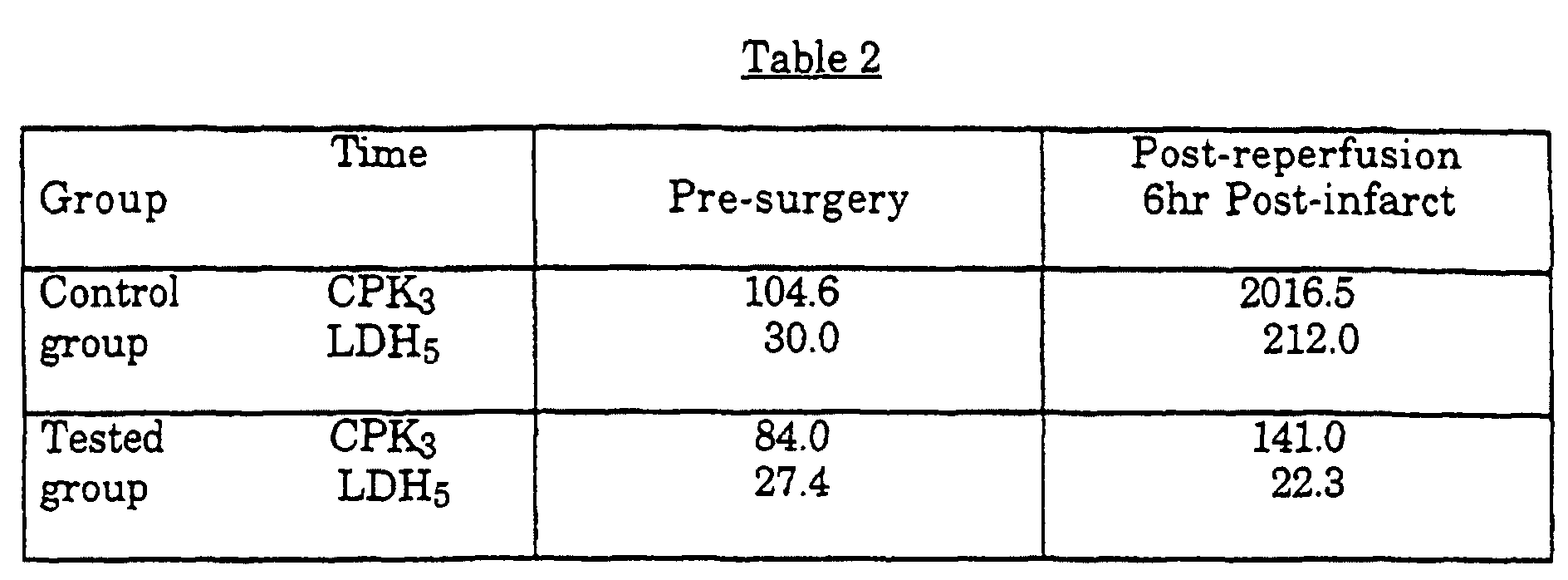
- Skeletal muscle protection was determined according to the experimental conditions as per Example 1, except that plasma samples were assayed for CPK 3 and LDH 5 , iso-enzymes. The results are reported in Table 2.
- Iso-enzyme levels are given in International Units per litre of plasma.
- ranolazine clearly protected the muscle from surgery-induced damage.
- the following example illustrates the preparation of representative pharmaceutical formulations containing a compound of Formula I, as exemplified by ranolazine.
- A. I.V. FORMULATION (low concentration) (ranolazine) 5.0 mg 0.5 g dextrose monohydrate 51.2 mg 5.1 g sodium hydroxide q.s. to pH 4 pH 4 water for injection to 1.0 ml 100 ml
- ranolazine and dextrose monohydrate are dissolved into water (70 per cent of the final desired volume) then sodium hydroxide (10N solution) is added under stirring until pH 4 and the volume is completed to 100 ml with water.
- the medium is filtered through a 0.2 micron membrane filter and packaged in ampoules or vials under sterile conditions. Alternatively the medium can be filtered under non-sterile conditions, packed in ampoules then sterilized by autoclaving.
- ranolazine HCl A 80.0 microcrystalline cellulose (B) 16.5 polyvinylpyrrolidone (C) 1.0 crosscarmellose sodium (D) 2.0 magnesium stearate (E) 0.5
- Perfusion fluid Ingredients Parts by weight Ranolazine 20 mg Phosphate Buffered Sucrose: Sucrose 48.0 g Sodium Dihydrogen Phosphate 4.59 g Sodium Monohydrogen Phosphate 6.53 g Water For Injection (U.S.P.) q.s. to 1000 ml
- the ingredients are dissolved in a portion of the Water For Injection, and once dissolved, the remaining volume is made up with Water For Injection.
Landscapes
- Health & Medical Sciences (AREA)
- Life Sciences & Earth Sciences (AREA)
- Pharmacology & Pharmacy (AREA)
- Medicinal Chemistry (AREA)
- Chemical & Material Sciences (AREA)
- Veterinary Medicine (AREA)
- Public Health (AREA)
- General Health & Medical Sciences (AREA)
- Animal Behavior & Ethology (AREA)
- Engineering & Computer Science (AREA)
- Bioinformatics & Cheminformatics (AREA)
- Epidemiology (AREA)
- Nuclear Medicine, Radiotherapy & Molecular Imaging (AREA)
- General Chemical & Material Sciences (AREA)
- Organic Chemistry (AREA)
- Chemical Kinetics & Catalysis (AREA)
- Immunology (AREA)
- Gastroenterology & Hepatology (AREA)
- Proteomics, Peptides & Aminoacids (AREA)
- Biomedical Technology (AREA)
- Cardiology (AREA)
- Heart & Thoracic Surgery (AREA)
- Neurology (AREA)
- Botany (AREA)
- Diabetes (AREA)
- Hematology (AREA)
- Urology & Nephrology (AREA)
- Vascular Medicine (AREA)
- Obesity (AREA)
- Physical Education & Sports Medicine (AREA)
- Orthopedic Medicine & Surgery (AREA)
- Neurosurgery (AREA)
- Pharmaceuticals Containing Other Organic And Inorganic Compounds (AREA)
- Heterocyclic Compounds That Contain Two Or More Ring Oxygen Atoms (AREA)
- Low-Molecular Organic Synthesis Reactions Using Catalysts (AREA)
- Agricultural Chemicals And Associated Chemicals (AREA)
- Plural Heterocyclic Compounds (AREA)
- Treatment Of Fiber Materials (AREA)
- Treatments For Attaching Organic Compounds To Fibrous Goods (AREA)
Abstract
Description


| A. I.V. FORMULATION (low concentration) | ||
| (ranolazine) | 5.0 mg | 0.5 g |
| dextrose monohydrate | 51.2 mg | 5.1 g |
| sodium hydroxide q.s. to | pH 4 | pH 4 |
| water for injection to | 1.0 ml | 100 ml |
| B. I.V. FORMULATION (high concentration) | ||
| (ranolazine) | 20.0 mg | 2 g |
| dextrose monohydrate | 39.4 mg | 4 g |
| sodium hydroxide q.s. to | pH 4 | pH 4 |
| water for injection to | 1.0 ml | 100 ml |
| C. FILM COATED TABLET FORMULATION | |
| Ingredients | Parts by weight |
| ranolazine HCl (A) | 80.0 |
| microcrystalline cellulose (B) | 16.5 |
| polyvinylpyrrolidone (C) | 1.0 |
| crosscarmellose sodium (D) | 2.0 |
| magnesium stearate (E) | 0.5 |
| D. CONTROLLED RELEASE FORMULATION | |
| Ingredients | Parts by weight |
| ranolazine BASE (A) | 90 |
| microcrystalline cellulose (B) | 10 |
| E. Perfusion fluid | |
| Ingredients | Parts by weight |
| Ranolazine | 20 mg |
| Phosphate Buffered Sucrose: | |
| Sucrose | 48.0 g |
| Sodium Dihydrogen Phosphate | 4.59 g |
| Sodium Monohydrogen Phosphate | 6.53 g |
| Water For Injection (U.S.P.) | q.s. to 1000 ml |
Claims (9)
- The use of a compound of the formulaor pharmaceutically acceptable esters or acid addition salts thereof, wherein:
 in the manufacture of a medicament for protecting skeletal muscles.R1, R2, R3, R4 and R5 are each independently hydrogen, lower alkyl, lower alkoxy, cyano, trifluoromethyl, halo, lower alkylthio, lower alkyl sulfinyl, lower alkyl sulfonyl, N-optionally substituted alkylamido, except that when R1 is methyl, R4 is not methyl; orR2 and R3 together form -OCH2O-;R6, R7, R8, R9 and R10 are each independently hydrogen, lower acyl, aminocarbonylmethyl, cyano, lower alkyl, lower alkoxy, trifluoromethyl, halo, lower alkylthio, lower alkyl sulfinyl, lower alkyl sulfonyl, di-lower alkyl amino;R6 and R7 together form -CH=CH-CH=CH-; orR7 and R8 together form -OCH2O-;R11 and R12 are each independently hydrogen or lower alkyl; andW is oxygen or sulfur;
 - The use of Claim 1 wherein R1 and R5 are methyl.
- The use of Claim 2 wherein R2, R3, R4, R11, R12 are hydrogen.
- The use of Claim 3 wherein W is oxygen.
- The use of Claim 4 wherein R6 is methoxy and R7, R8, R9 and R10 are hydrogen, i.e. ranolazine.
- The use of any one of Claims 1-5 wherein a medicament for protecting skeletal muscle against damage resulting from trauma or subsequent to muscle or systemic diseases is prepared.
- The use of any one of Claims 1-5 wherein a medicament for treating hypoxic reperfusion injury to skeletal muscle is prepared.
- The use of any, one of Claims 1-7 wherein said compound is ranolazine, or a pharmaceutically acceptable salt thereof.
- The use of any one of Claims 1-8 which comprises the combined use of said compound together with a second pharmaceutically active agent, such as TPA or streptokinase.
Applications Claiming Priority (3)
| Application Number | Priority Date | Filing Date | Title |
|---|---|---|---|
| US37043589A | 1989-06-23 | 1989-06-23 | |
| US370435 | 1989-06-23 | ||
| EP90111787A EP0407780B1 (en) | 1989-06-23 | 1990-06-21 | Ranolazine and related piperazines used in the treatment of tissues experiencing a physical or chemical insult |
Related Parent Applications (1)
| Application Number | Title | Priority Date | Filing Date |
|---|---|---|---|
| EP90111787.9 Division | 1990-06-21 |
Publications (2)
| Publication Number | Publication Date |
|---|---|
| EP0714660A1 EP0714660A1 (en) | 1996-06-05 |
| EP0714660B1 true EP0714660B1 (en) | 2002-09-04 |
Family
ID=23459660
Family Applications (3)
| Application Number | Title | Priority Date | Filing Date |
|---|---|---|---|
| EP95119463A Expired - Lifetime EP0719558B1 (en) | 1989-06-23 | 1990-06-21 | Ranolazine and related piperazines for use in the treatment of shock conditions |
| EP90111787A Expired - Lifetime EP0407780B1 (en) | 1989-06-23 | 1990-06-21 | Ranolazine and related piperazines used in the treatment of tissues experiencing a physical or chemical insult |
| EP95119452A Expired - Lifetime EP0714660B1 (en) | 1989-06-23 | 1990-06-21 | Ranolazine and related piperazines for protecting skeletal muscles |
Family Applications Before (2)
| Application Number | Title | Priority Date | Filing Date |
|---|---|---|---|
| EP95119463A Expired - Lifetime EP0719558B1 (en) | 1989-06-23 | 1990-06-21 | Ranolazine and related piperazines for use in the treatment of shock conditions |
| EP90111787A Expired - Lifetime EP0407780B1 (en) | 1989-06-23 | 1990-06-21 | Ranolazine and related piperazines used in the treatment of tissues experiencing a physical or chemical insult |
Country Status (13)
| Country | Link |
|---|---|
| US (2) | US5506229A (en) |
| EP (3) | EP0719558B1 (en) |
| JP (1) | JP3232085B2 (en) |
| AT (3) | ATE218344T1 (en) |
| AU (1) | AU633589B2 (en) |
| CA (1) | CA2019580C (en) |
| DE (3) | DE69034000T2 (en) |
| DK (3) | DK0407780T3 (en) |
| ES (3) | ES2091211T3 (en) |
| GR (1) | GR3020976T3 (en) |
| IE (1) | IE80710B1 (en) |
| NZ (2) | NZ234184A (en) |
| ZA (1) | ZA904842B (en) |
Families Citing this family (47)
| Publication number | Priority date | Publication date | Assignee | Title |
|---|---|---|---|---|
| DE69833665T2 (en) * | 1997-08-08 | 2006-11-09 | Duke University | COMPOSITIONS FOR SIMPLIFYING SURGICAL PROCEDURES |
| US6711436B1 (en) | 1997-08-08 | 2004-03-23 | Duke University | Compositions, apparatus and methods for facilitating surgical procedures |
| US6479496B1 (en) * | 1998-09-10 | 2002-11-12 | Cv Therapeutics, Inc. | Methods for treating angina with ranolazine |
| US6303607B1 (en) * | 1998-09-10 | 2001-10-16 | Cv Therapeutics, Inc. | Method for administering a sustained release ranolanolazine formulation |
| EP1259230A2 (en) * | 2000-02-18 | 2002-11-27 | Cv Therapeutics, Inc. | Partial fatty acid oxidation inhibitors in the treatment of congestive heart failure |
| AU2001239827A1 (en) | 2000-02-22 | 2001-09-03 | Cv Therapeutics, Inc. | Substituted alkylene diamine compounds |
| US6677336B2 (en) | 2000-02-22 | 2004-01-13 | Cv Therapeutics, Inc. | Substituted piperazine compounds |
| US6552023B2 (en) | 2000-02-22 | 2003-04-22 | Cv Therapeutics, Inc. | Aralkyl substituted piperazine compounds |
| CA2400176C (en) * | 2000-02-22 | 2009-04-28 | Cv Therapeutics, Inc. | Substituted piperazine compounds |
| WO2001062749A1 (en) * | 2000-02-22 | 2001-08-30 | Cv Therapeutics, Inc. | Substituted piperazine compounds |
| US6451798B2 (en) | 2000-02-22 | 2002-09-17 | Cv Therapeutics, Inc. | Substituted alkyl piperazine derivatives |
| JP2004507473A (en) * | 2000-08-25 | 2004-03-11 | オルガン リカヴァリー システムス インコーポレイテッド | Thrombolytic organ treatment and repair methods |
| US6573264B1 (en) | 2000-10-23 | 2003-06-03 | Cv Therapeutics, Inc. | Heteroaryl alkyl piperazine derivatives |
| GB0028414D0 (en) * | 2000-11-22 | 2001-01-03 | Univ Leeds | Flush preservation solution |
| US20030220344A1 (en) * | 2002-04-04 | 2003-11-27 | Luiz Belardinelli | Method of treating arrhythmias |
| CN100551370C (en) * | 2002-05-21 | 2009-10-21 | Cv医药有限公司 | Application of ranolazine in preparation of pharmaceutical composition for treating diabetes |
| US8822473B2 (en) * | 2002-05-21 | 2014-09-02 | Gilead Sciences, Inc. | Method of treating diabetes |
| ES2287574T3 (en) | 2002-12-05 | 2007-12-16 | Cv Therapeutics, Inc. | SUBSTITUTED PIPERACINE COMPOUNDS AND ITS USE AS INHIBITORS OF OXIDATION OF FATTY ACIDS. |
| KR20050086956A (en) | 2003-01-03 | 2005-08-30 | 씨브이 쎄러퓨틱스, 인코포레이티드 | Substituted heterocyclic compounds |
| AU2004209522A1 (en) | 2003-01-17 | 2004-08-19 | Gilead Palo Alto, Inc. | Substituted heterocyclic compounds useful in the treatment of cardiovascular diseases |
| EP1644345A1 (en) | 2003-06-23 | 2006-04-12 | Cv Therapeutics, Inc. | Urea derivatives of piperazines and piperidines as fatty acid oxidation inhibitors |
| KR20060124646A (en) | 2003-12-18 | 2006-12-05 | 씨브이 쎄러퓨틱스, 인코포레이티드 | 1-Acan-2-ol substituted piperazine and piperidine compounds |
| JP2008512465A (en) * | 2004-09-08 | 2008-04-24 | シーブイ・セラピューティクス・インコーポレイテッド | Substituted piperazine compounds and their use as fatty acid oxidation inhibitors |
| MX2007005367A (en) * | 2004-11-09 | 2007-06-18 | Cv Therapeutics Inc | Use ranolazine in combination with at least one remodeling agent for reversing left ventricular remodeling in the treatment of heart failure. |
| JP2008526879A (en) * | 2005-01-06 | 2008-07-24 | シーブイ・セラピューティクス・インコーポレイテッド | Sustained release pharmaceutical formulation containing ranolazine |
| WO2006099244A1 (en) * | 2005-03-11 | 2006-09-21 | Hong Kong Nitric Oxide Limited | Combination therapy for endothelial dysfunction, angina and diabetes |
| CA2678325A1 (en) * | 2007-02-13 | 2008-08-21 | Cv Therapeutics, Inc. | Use of ranolazine for the treatment of non-coronary microvascular diseases |
| JP2010518170A (en) * | 2007-02-13 | 2010-05-27 | ギリアード・パロ・アルト・インコーポレイテッド | Use of ranolazine for the treatment of coronary microvascular disease |
| CA2678515A1 (en) | 2007-02-13 | 2008-08-21 | Cv Therapeutics, Inc. | Use of ranolazine for the treatment of cardiovascular diseases |
| US20090111826A1 (en) * | 2007-02-13 | 2009-04-30 | Louis Lange | Use of ranolazine for the treatment of cardiovascular diseases |
| US20090312340A1 (en) * | 2007-02-13 | 2009-12-17 | Whedy Wang | Use of ranolazine for the treatment of cardiovascular diseases |
| WO2008116083A1 (en) * | 2007-03-22 | 2008-09-25 | Cv Therapeutics, Inc. | Use of ranolazine for elevated brain-type natriuretic peptide |
| RU2442585C2 (en) * | 2007-05-31 | 2012-02-20 | Си Ви Терапьютикс, Инк. | Method of diabetes treatment |
| CN101896181A (en) * | 2007-05-31 | 2010-11-24 | 吉利德帕洛阿尔托股份有限公司 | Ranolazine for elevated BNP |
| KR20110013348A (en) * | 2008-02-06 | 2011-02-09 | 길리애드 사이언시즈, 인코포레이티드 | Use of Ranolazine for Pain Treatment |
| US20090247535A1 (en) * | 2008-03-26 | 2009-10-01 | Duke University | Use of ranolazine for non-cardiovascular disorders |
| CA2761771A1 (en) * | 2009-05-14 | 2010-11-18 | Gilead Sciences, Inc. | Ranolazine for the treatment of cns disorders |
| WO2010137040A2 (en) | 2009-05-28 | 2010-12-02 | Lupin Limited | Novel pharmaceutical compositions of ranolazine |
| EP2453893A4 (en) * | 2009-07-09 | 2012-06-20 | Ozteo Pty Ltd | Treatment of non-neuronal and non-myocardial cell, tissue and organ damage and associated pain with persistent sodium current blockers |
| AU2015200961B2 (en) * | 2009-07-09 | 2017-02-16 | Ozteo Pty Ltd | Treatment of Non-Neuronal and Non-Cardiac Cell, Tissue and Organ Damage and Associated Pain with Persistent Sodium Current Blockers |
| US20120177729A1 (en) | 2009-09-25 | 2012-07-12 | Lupin Limited | Sustained release composition of ranolazine |
| TWI508726B (en) | 2009-12-21 | 2015-11-21 | Gilead Sciences Inc | Method of treating atrial fibrillation |
| EP2717860A4 (en) * | 2011-06-08 | 2014-11-05 | Sti Pharma Llc | WATER-SOLUBLE PHARMACEUTICAL ORGANIC PREPARATION WITH CONTROLLED ABSORPTION ADMINISTERED ONCE DAILY |
| KR101476379B1 (en) | 2011-11-30 | 2014-12-29 | 한국과학기술연구원 | Derivatives of 1-Phenoxy propan-2-ol and pharmaceutical composition containing the same |
| KR101331186B1 (en) * | 2013-08-05 | 2013-11-22 | 한국과학기술연구원 | Derivatives of 1-Phenoxy propan-2-ol and pharmaceutical composition containing the same |
| WO2021252951A1 (en) | 2020-06-12 | 2021-12-16 | Vanderbilt University | Methods of treatment for gastrointestinal motility disorders |
| CA3198685A1 (en) * | 2021-09-27 | 2023-03-30 | Tasly Pharmaceutical Group Co., Ltd. | Pharmaceutical composition for treating myocardial ischemia and preparation method thereof |
Family Cites Families (1)
| Publication number | Priority date | Publication date | Assignee | Title |
|---|---|---|---|---|
| US4567264A (en) * | 1983-05-18 | 1986-01-28 | Syntex (U.S.A.) Inc. | Cardioselective aryloxy- and arylthio- hydroxypropylene-piperazinyl acetanilides which affect calcium entry |
-
1990
- 1990-06-21 DK DK90111787.9T patent/DK0407780T3/en active
- 1990-06-21 EP EP95119463A patent/EP0719558B1/en not_active Expired - Lifetime
- 1990-06-21 IE IE225090A patent/IE80710B1/en not_active IP Right Cessation
- 1990-06-21 EP EP90111787A patent/EP0407780B1/en not_active Expired - Lifetime
- 1990-06-21 AT AT95119463T patent/ATE218344T1/en not_active IP Right Cessation
- 1990-06-21 ES ES90111787T patent/ES2091211T3/en not_active Expired - Lifetime
- 1990-06-21 CA CA002019580A patent/CA2019580C/en not_active Expired - Lifetime
- 1990-06-21 AT AT95119452T patent/ATE223218T1/en not_active IP Right Cessation
- 1990-06-21 ZA ZA904842A patent/ZA904842B/en unknown
- 1990-06-21 DK DK95119452T patent/DK0714660T3/en active
- 1990-06-21 DE DE69034000T patent/DE69034000T2/en not_active Expired - Lifetime
- 1990-06-21 EP EP95119452A patent/EP0714660B1/en not_active Expired - Lifetime
- 1990-06-21 ES ES95119463T patent/ES2177601T3/en not_active Expired - Lifetime
- 1990-06-21 DE DE69033967T patent/DE69033967T2/en not_active Expired - Lifetime
- 1990-06-21 ES ES95119452T patent/ES2182863T3/en not_active Expired - Lifetime
- 1990-06-21 DK DK95119463T patent/DK0719558T3/en active
- 1990-06-21 DE DE69028457T patent/DE69028457T2/en not_active Expired - Lifetime
- 1990-06-21 NZ NZ234184A patent/NZ234184A/en unknown
- 1990-06-21 NZ NZ247044A patent/NZ247044A/en unknown
- 1990-06-21 AT AT90111787T patent/ATE142497T1/en not_active IP Right Cessation
- 1990-06-21 AU AU57618/90A patent/AU633589B2/en not_active Expired
- 1990-06-22 JP JP16304590A patent/JP3232085B2/en not_active Expired - Lifetime
-
1992
- 1992-10-01 US US07/955,397 patent/US5506229A/en not_active Expired - Lifetime
-
1996
- 1996-04-05 US US08/628,836 patent/US5906988A/en not_active Expired - Fee Related
- 1996-09-12 GR GR960401307T patent/GR3020976T3/en unknown
Also Published As
Similar Documents
| Publication | Publication Date | Title |
|---|---|---|
| EP0407780B1 (en) | Ranolazine and related piperazines used in the treatment of tissues experiencing a physical or chemical insult | |
| MX2010013269A (en) | Small molecule inhibitors for the treatment or prevention of dengue virus infection. | |
| CA3113376A1 (en) | Compositions for reducing serum uric acid | |
| KR940000008B1 (en) | Pharmaceutical composition for the treatment of hyperlipidemia | |
| EP1478362B1 (en) | A combination treatment for acute myocardial infarction | |
| AU2003201980A1 (en) | A combination treatment for acute myocardial infarction | |
| AU599085B2 (en) | Cell protection | |
| US3705946A (en) | Method of treating hyperuricemia | |
| AU630373B2 (en) | Method of improving post-ischemic myocardial dysfunction using an ace inhibitor alone or in combination with a thrombolytic agent and combination | |
| US20050182136A1 (en) | N-acetylcysteine compositions and methods for the treatment and prevention of endothelial dysfunction | |
| IE83873B1 (en) | Novel methods of treatment using ranolazine and related piperazine derivatives | |
| TW202404627A (en) | Treatment for acute organ injury using cd39, recombinant cd39 | |
| WO1998023151A1 (en) | Use of thrombolytic reagents for prevention of vascular disease | |
| EP0369035A1 (en) | Agent for treating pancreatitis or the like | |
| IE19970486A1 (en) | Novel methods of treatment using ranolazine and related piperazine derivatives | |
| IE19970487A1 (en) | Ranolazine and related piperazines for use in the treatment of shock conditions | |
| IE83554B1 (en) | Ranolazine and related piperazines for use in the treatment of shock conditions | |
| JPH03133927A (en) | Agent for improving myocardinal disfunction after ischemia | |
| RU2201230C1 (en) | Medicinal agent "flusol" eliciting antifungal effect | |
| US8791110B2 (en) | Anti-arenaviral compounds | |
| JPWO1989011852A1 (en) | Treatment for pancreatitis, etc. | |
| HK1254154A1 (en) | Combination of tafia inhibitor with plasminogen activator |
Legal Events
| Date | Code | Title | Description |
|---|---|---|---|
| PUAI | Public reference made under article 153(3) epc to a published international application that has entered the european phase |
Free format text: ORIGINAL CODE: 0009012 |
|
| 17P | Request for examination filed |
Effective date: 19951230 |
|
| AC | Divisional application: reference to earlier application |
Ref document number: 407780 Country of ref document: EP |
|
| AK | Designated contracting states |
Kind code of ref document: A1 Designated state(s): AT BE CH DE DK ES FR GB GR IT LI LU NL SE |
|
| RAP1 | Party data changed (applicant data changed or rights of an application transferred) |
Owner name: SYNTEX (U.S.A.) INC. |
|
| 17Q | First examination report despatched |
Effective date: 20000614 |
|
| GRAG | Despatch of communication of intention to grant |
Free format text: ORIGINAL CODE: EPIDOS AGRA |
|
| RAP1 | Party data changed (applicant data changed or rights of an application transferred) |
Owner name: SYNTEX (U.S.A.) LLC |
|
| GRAG | Despatch of communication of intention to grant |
Free format text: ORIGINAL CODE: EPIDOS AGRA |
|
| GRAH | Despatch of communication of intention to grant a patent |
Free format text: ORIGINAL CODE: EPIDOS IGRA |
|
| GRAH | Despatch of communication of intention to grant a patent |
Free format text: ORIGINAL CODE: EPIDOS IGRA |
|
| GRAA | (expected) grant |
Free format text: ORIGINAL CODE: 0009210 |
|
| AC | Divisional application: reference to earlier application |
Ref document number: 407780 Country of ref document: EP |
|
| AK | Designated contracting states |
Kind code of ref document: B1 Designated state(s): AT BE CH DE DK ES FR GB GR IT LI LU NL SE |
|
| REF | Corresponds to: |
Ref document number: 223218 Country of ref document: AT Date of ref document: 20020915 Kind code of ref document: T |
|
| REG | Reference to a national code |
Ref country code: GB Ref legal event code: FG4D |
|
| REG | Reference to a national code |
Ref country code: CH Ref legal event code: EP |
|
| REG | Reference to a national code |
Ref country code: DK Ref legal event code: T3 |
|
| REF | Corresponds to: |
Ref document number: 69034000 Country of ref document: DE Date of ref document: 20021010 |
|
| REG | Reference to a national code |
Ref country code: GR Ref legal event code: EP Ref document number: 20020403348 Country of ref document: GR |
|
| ET | Fr: translation filed | ||
| REG | Reference to a national code |
Ref country code: ES Ref legal event code: FG2A Ref document number: 2182863 Country of ref document: ES Kind code of ref document: T3 |
|
| PLBE | No opposition filed within time limit |
Free format text: ORIGINAL CODE: 0009261 |
|
| STAA | Information on the status of an ep patent application or granted ep patent |
Free format text: STATUS: NO OPPOSITION FILED WITHIN TIME LIMIT |
|
| 26N | No opposition filed |
Effective date: 20030605 |
|
| PGFP | Annual fee paid to national office [announced via postgrant information from national office to epo] |
Ref country code: NL Payment date: 20090611 Year of fee payment: 20 Ref country code: ES Payment date: 20090623 Year of fee payment: 20 Ref country code: DK Payment date: 20090511 Year of fee payment: 20 |
|
| PGFP | Annual fee paid to national office [announced via postgrant information from national office to epo] |
Ref country code: SE Payment date: 20090605 Year of fee payment: 20 Ref country code: LU Payment date: 20090420 Year of fee payment: 20 Ref country code: IT Payment date: 20090620 Year of fee payment: 20 Ref country code: FR Payment date: 20090605 Year of fee payment: 20 Ref country code: AT Payment date: 20090507 Year of fee payment: 20 |
|
| PGFP | Annual fee paid to national office [announced via postgrant information from national office to epo] |
Ref country code: CH Payment date: 20090430 Year of fee payment: 20 |
|
| PGFP | Annual fee paid to national office [announced via postgrant information from national office to epo] |
Ref country code: GR Payment date: 20090415 Year of fee payment: 20 Ref country code: GB Payment date: 20090507 Year of fee payment: 20 Ref country code: DE Payment date: 20090630 Year of fee payment: 20 |
|
| PGFP | Annual fee paid to national office [announced via postgrant information from national office to epo] |
Ref country code: BE Payment date: 20090710 Year of fee payment: 20 |
|
| REG | Reference to a national code |
Ref country code: NL Ref legal event code: V4 Effective date: 20100621 |
|
| BE20 | Be: patent expired |
Owner name: *SYNTEX (U.S.A.) LLC Effective date: 20100621 |
|
| REG | Reference to a national code |
Ref country code: CH Ref legal event code: PL |
|
| REG | Reference to a national code |
Ref country code: DK Ref legal event code: EUP |
|
| REG | Reference to a national code |
Ref country code: GB Ref legal event code: PE20 Expiry date: 20100620 |
|
| EUG | Se: european patent has lapsed | ||
| REG | Reference to a national code |
Ref country code: ES Ref legal event code: FD2A Effective date: 20100622 |
|
| PG25 | Lapsed in a contracting state [announced via postgrant information from national office to epo] |
Ref country code: NL Free format text: LAPSE BECAUSE OF EXPIRATION OF PROTECTION Effective date: 20100621 Ref country code: ES Free format text: LAPSE BECAUSE OF EXPIRATION OF PROTECTION Effective date: 20100622 |
|
| PG25 | Lapsed in a contracting state [announced via postgrant information from national office to epo] |
Ref country code: GB Free format text: LAPSE BECAUSE OF EXPIRATION OF PROTECTION Effective date: 20100620 |
|
| PG25 | Lapsed in a contracting state [announced via postgrant information from national office to epo] |
Ref country code: DE Free format text: LAPSE BECAUSE OF EXPIRATION OF PROTECTION Effective date: 20100621 |