EP0714453B1 - Al-cu-li alloys with improved cryogenic fracture toughness - Google Patents
Al-cu-li alloys with improved cryogenic fracture toughness Download PDFInfo
- Publication number
- EP0714453B1 EP0714453B1 EP94925755A EP94925755A EP0714453B1 EP 0714453 B1 EP0714453 B1 EP 0714453B1 EP 94925755 A EP94925755 A EP 94925755A EP 94925755 A EP94925755 A EP 94925755A EP 0714453 B1 EP0714453 B1 EP 0714453B1
- Authority
- EP
- European Patent Office
- Prior art keywords
- alloy
- ksi
- weight percent
- toughness
- fracture toughness
- Prior art date
- Legal status (The legal status is an assumption and is not a legal conclusion. Google has not performed a legal analysis and makes no representation as to the accuracy of the status listed.)
- Expired - Lifetime
Links
- 239000001989 lithium alloy Substances 0.000 title description 9
- 229910000733 Li alloy Inorganic materials 0.000 title description 5
- 239000000956 alloy Substances 0.000 claims description 177
- 229910045601 alloy Inorganic materials 0.000 claims description 176
- 239000000203 mixture Substances 0.000 claims description 55
- 230000032683 aging Effects 0.000 claims description 48
- 229910052782 aluminium Inorganic materials 0.000 claims description 10
- 229910052749 magnesium Inorganic materials 0.000 claims description 10
- 229910052726 zirconium Inorganic materials 0.000 claims description 10
- 238000005275 alloying Methods 0.000 claims description 9
- 229910052719 titanium Inorganic materials 0.000 claims description 9
- XAGFODPZIPBFFR-UHFFFAOYSA-N aluminium Chemical compound [Al] XAGFODPZIPBFFR-UHFFFAOYSA-N 0.000 claims description 7
- 229910052796 boron Inorganic materials 0.000 claims description 6
- 229910052804 chromium Inorganic materials 0.000 claims description 5
- 229910052735 hafnium Inorganic materials 0.000 claims description 5
- 229910052748 manganese Inorganic materials 0.000 claims description 5
- 229910052758 niobium Inorganic materials 0.000 claims description 5
- QYEXBYZXHDUPRC-UHFFFAOYSA-N B#[Ti]#B Chemical compound B#[Ti]#B QYEXBYZXHDUPRC-UHFFFAOYSA-N 0.000 claims description 4
- 229910033181 TiB2 Inorganic materials 0.000 claims description 4
- 229910052725 zinc Inorganic materials 0.000 claims description 4
- 239000000654 additive Substances 0.000 claims description 3
- 229910052793 cadmium Inorganic materials 0.000 claims description 3
- 229910052732 germanium Inorganic materials 0.000 claims description 3
- 229910052738 indium Inorganic materials 0.000 claims description 3
- 229910052742 iron Inorganic materials 0.000 claims description 3
- 229910052759 nickel Inorganic materials 0.000 claims description 3
- 229910052709 silver Inorganic materials 0.000 claims description 3
- 229910052718 tin Inorganic materials 0.000 claims description 3
- 229910052727 yttrium Inorganic materials 0.000 claims description 3
- 239000004411 aluminium Substances 0.000 claims description 2
- 239000012535 impurity Substances 0.000 claims description 2
- 229910052720 vanadium Inorganic materials 0.000 claims description 2
- 239000010949 copper Substances 0.000 description 62
- 229910052744 lithium Inorganic materials 0.000 description 34
- 229910052802 copper Inorganic materials 0.000 description 30
- 239000011777 magnesium Substances 0.000 description 29
- WHXSMMKQMYFTQS-UHFFFAOYSA-N Lithium Chemical compound [Li] WHXSMMKQMYFTQS-UHFFFAOYSA-N 0.000 description 20
- 230000007423 decrease Effects 0.000 description 18
- 238000001125 extrusion Methods 0.000 description 18
- RYGMFSIKBFXOCR-UHFFFAOYSA-N Copper Chemical compound [Cu] RYGMFSIKBFXOCR-UHFFFAOYSA-N 0.000 description 17
- 239000011701 zinc Substances 0.000 description 17
- 230000000694 effects Effects 0.000 description 15
- 206010017076 Fracture Diseases 0.000 description 10
- 230000003247 decreasing effect Effects 0.000 description 10
- 239000000243 solution Substances 0.000 description 10
- 208000010392 Bone Fractures Diseases 0.000 description 9
- 238000012545 processing Methods 0.000 description 9
- 238000012360 testing method Methods 0.000 description 9
- 238000003466 welding Methods 0.000 description 9
- 238000001953 recrystallisation Methods 0.000 description 8
- 238000000034 method Methods 0.000 description 7
- 239000000047 product Substances 0.000 description 7
- 239000010936 titanium Substances 0.000 description 7
- HEMHJVSKTPXQMS-UHFFFAOYSA-M Sodium hydroxide Chemical compound [OH-].[Na+] HEMHJVSKTPXQMS-UHFFFAOYSA-M 0.000 description 6
- 238000007792 addition Methods 0.000 description 6
- 230000001419 dependent effect Effects 0.000 description 6
- 238000005242 forging Methods 0.000 description 6
- 238000010438 heat treatment Methods 0.000 description 6
- 239000000463 material Substances 0.000 description 6
- XLYOFNOQVPJJNP-UHFFFAOYSA-N water Substances O XLYOFNOQVPJJNP-UHFFFAOYSA-N 0.000 description 6
- 229910000838 Al alloy Inorganic materials 0.000 description 5
- FYYHWMGAXLPEAU-UHFFFAOYSA-N Magnesium Chemical compound [Mg] FYYHWMGAXLPEAU-UHFFFAOYSA-N 0.000 description 5
- 239000000945 filler Substances 0.000 description 5
- 239000007789 gas Substances 0.000 description 5
- 239000007788 liquid Substances 0.000 description 5
- WFKWXMTUELFFGS-UHFFFAOYSA-N tungsten Chemical compound [W] WFKWXMTUELFFGS-UHFFFAOYSA-N 0.000 description 5
- 229910052721 tungsten Inorganic materials 0.000 description 5
- 239000010937 tungsten Substances 0.000 description 5
- IJGRMHOSHXDMSA-UHFFFAOYSA-N Atomic nitrogen Chemical compound N#N IJGRMHOSHXDMSA-UHFFFAOYSA-N 0.000 description 4
- 229910017539 Cu-Li Inorganic materials 0.000 description 4
- -1 aluminum-copper-lithium Chemical compound 0.000 description 4
- 230000006872 improvement Effects 0.000 description 4
- 239000003380 propellant Substances 0.000 description 4
- 239000003351 stiffener Substances 0.000 description 4
- 229910006309 Li—Mg Inorganic materials 0.000 description 3
- HCHKCACWOHOZIP-UHFFFAOYSA-N Zinc Chemical compound [Zn] HCHKCACWOHOZIP-UHFFFAOYSA-N 0.000 description 3
- 230000008901 benefit Effects 0.000 description 3
- 230000032798 delamination Effects 0.000 description 3
- 230000004927 fusion Effects 0.000 description 3
- 239000001257 hydrogen Substances 0.000 description 3
- 229910052739 hydrogen Inorganic materials 0.000 description 3
- 239000011261 inert gas Substances 0.000 description 3
- 238000011068 loading method Methods 0.000 description 3
- 238000004519 manufacturing process Methods 0.000 description 3
- 238000003801 milling Methods 0.000 description 3
- 239000002244 precipitate Substances 0.000 description 3
- 238000010791 quenching Methods 0.000 description 3
- 230000004044 response Effects 0.000 description 3
- 238000005096 rolling process Methods 0.000 description 3
- 230000035882 stress Effects 0.000 description 3
- 229910018182 Al—Cu Inorganic materials 0.000 description 2
- UFHFLCQGNIYNRP-UHFFFAOYSA-N Hydrogen Chemical compound [H][H] UFHFLCQGNIYNRP-UHFFFAOYSA-N 0.000 description 2
- 229910000861 Mg alloy Inorganic materials 0.000 description 2
- RTAQQCXQSZGOHL-UHFFFAOYSA-N Titanium Chemical compound [Ti] RTAQQCXQSZGOHL-UHFFFAOYSA-N 0.000 description 2
- 229910001093 Zr alloy Inorganic materials 0.000 description 2
- 230000006978 adaptation Effects 0.000 description 2
- 230000002411 adverse Effects 0.000 description 2
- QVGXLLKOCUKJST-UHFFFAOYSA-N atomic oxygen Chemical compound [O] QVGXLLKOCUKJST-UHFFFAOYSA-N 0.000 description 2
- 230000009286 beneficial effect Effects 0.000 description 2
- 229910052799 carbon Inorganic materials 0.000 description 2
- 238000005266 casting Methods 0.000 description 2
- 230000008859 change Effects 0.000 description 2
- 230000009977 dual effect Effects 0.000 description 2
- 238000011156 evaluation Methods 0.000 description 2
- 230000002349 favourable effect Effects 0.000 description 2
- 238000005551 mechanical alloying Methods 0.000 description 2
- 238000012986 modification Methods 0.000 description 2
- 230000004048 modification Effects 0.000 description 2
- 229910052757 nitrogen Inorganic materials 0.000 description 2
- 230000006911 nucleation Effects 0.000 description 2
- 238000010899 nucleation Methods 0.000 description 2
- 229910052760 oxygen Inorganic materials 0.000 description 2
- 239000001301 oxygen Substances 0.000 description 2
- 239000000843 powder Substances 0.000 description 2
- 230000000063 preceeding effect Effects 0.000 description 2
- 238000001556 precipitation Methods 0.000 description 2
- 230000008569 process Effects 0.000 description 2
- 230000000171 quenching effect Effects 0.000 description 2
- 238000007670 refining Methods 0.000 description 2
- 238000005480 shot peening Methods 0.000 description 2
- 239000004332 silver Substances 0.000 description 2
- 238000005728 strengthening Methods 0.000 description 2
- 238000011282 treatment Methods 0.000 description 2
- AEQDJSLRWYMAQI-UHFFFAOYSA-N 2,3,9,10-tetramethoxy-6,8,13,13a-tetrahydro-5H-isoquinolino[2,1-b]isoquinoline Chemical compound C1CN2CC(C(=C(OC)C=C3)OC)=C3CC2C2=C1C=C(OC)C(OC)=C2 AEQDJSLRWYMAQI-UHFFFAOYSA-N 0.000 description 1
- MYMOFIZGZYHOMD-UHFFFAOYSA-N Dioxygen Chemical compound O=O MYMOFIZGZYHOMD-UHFFFAOYSA-N 0.000 description 1
- BQCADISMDOOEFD-UHFFFAOYSA-N Silver Chemical compound [Ag] BQCADISMDOOEFD-UHFFFAOYSA-N 0.000 description 1
- 208000013201 Stress fracture Diseases 0.000 description 1
- QCWXUUIWCKQGHC-UHFFFAOYSA-N Zirconium Chemical compound [Zr] QCWXUUIWCKQGHC-UHFFFAOYSA-N 0.000 description 1
- 230000003466 anti-cipated effect Effects 0.000 description 1
- 239000007864 aqueous solution Substances 0.000 description 1
- 238000000889 atomisation Methods 0.000 description 1
- 230000005540 biological transmission Effects 0.000 description 1
- 230000015572 biosynthetic process Effects 0.000 description 1
- 238000006243 chemical reaction Methods 0.000 description 1
- 230000002860 competitive effect Effects 0.000 description 1
- 230000007797 corrosion Effects 0.000 description 1
- 238000005260 corrosion Methods 0.000 description 1
- 239000004078 cryogenic material Substances 0.000 description 1
- 230000008021 deposition Effects 0.000 description 1
- 238000010894 electron beam technology Methods 0.000 description 1
- 238000004299 exfoliation Methods 0.000 description 1
- 150000002431 hydrogen Chemical class 0.000 description 1
- 230000006698 induction Effects 0.000 description 1
- 239000003112 inhibitor Substances 0.000 description 1
- 238000002074 melt spinning Methods 0.000 description 1
- 230000008018 melting Effects 0.000 description 1
- 238000002844 melting Methods 0.000 description 1
- 239000012528 membrane Substances 0.000 description 1
- 229910052751 metal Inorganic materials 0.000 description 1
- 239000002184 metal Substances 0.000 description 1
- 238000000386 microscopy Methods 0.000 description 1
- 238000009740 moulding (composite fabrication) Methods 0.000 description 1
- 239000011236 particulate material Substances 0.000 description 1
- 239000004033 plastic Substances 0.000 description 1
- 238000004663 powder metallurgy Methods 0.000 description 1
- 230000002028 premature Effects 0.000 description 1
- 238000007712 rapid solidification Methods 0.000 description 1
- 239000011265 semifinished product Substances 0.000 description 1
- 239000000176 sodium gluconate Substances 0.000 description 1
- 229940005574 sodium gluconate Drugs 0.000 description 1
- 235000012207 sodium gluconate Nutrition 0.000 description 1
- GRVFOGOEDUUMBP-UHFFFAOYSA-N sodium sulfide (anhydrous) Chemical compound [Na+].[Na+].[S-2] GRVFOGOEDUUMBP-UHFFFAOYSA-N 0.000 description 1
- 239000007787 solid Substances 0.000 description 1
- 238000009987 spinning Methods 0.000 description 1
- 238000007782 splat cooling Methods 0.000 description 1
- 239000000126 substance Substances 0.000 description 1
- 238000009864 tensile test Methods 0.000 description 1
- 230000007704 transition Effects 0.000 description 1
Images



Classifications
-
- C—CHEMISTRY; METALLURGY
- C22—METALLURGY; FERROUS OR NON-FERROUS ALLOYS; TREATMENT OF ALLOYS OR NON-FERROUS METALS
- C22F—CHANGING THE PHYSICAL STRUCTURE OF NON-FERROUS METALS AND NON-FERROUS ALLOYS
- C22F1/00—Changing the physical structure of non-ferrous metals or alloys by heat treatment or by hot or cold working
- C22F1/04—Changing the physical structure of non-ferrous metals or alloys by heat treatment or by hot or cold working of aluminium or alloys based thereon
-
- C—CHEMISTRY; METALLURGY
- C22—METALLURGY; FERROUS OR NON-FERROUS ALLOYS; TREATMENT OF ALLOYS OR NON-FERROUS METALS
- C22C—ALLOYS
- C22C21/00—Alloys based on aluminium
-
- C—CHEMISTRY; METALLURGY
- C22—METALLURGY; FERROUS OR NON-FERROUS ALLOYS; TREATMENT OF ALLOYS OR NON-FERROUS METALS
- C22C—ALLOYS
- C22C21/00—Alloys based on aluminium
- C22C21/12—Alloys based on aluminium with copper as the next major constituent
-
- C—CHEMISTRY; METALLURGY
- C22—METALLURGY; FERROUS OR NON-FERROUS ALLOYS; TREATMENT OF ALLOYS OR NON-FERROUS METALS
- C22F—CHANGING THE PHYSICAL STRUCTURE OF NON-FERROUS METALS AND NON-FERROUS ALLOYS
- C22F1/00—Changing the physical structure of non-ferrous metals or alloys by heat treatment or by hot or cold working
- C22F1/04—Changing the physical structure of non-ferrous metals or alloys by heat treatment or by hot or cold working of aluminium or alloys based thereon
- C22F1/057—Changing the physical structure of non-ferrous metals or alloys by heat treatment or by hot or cold working of aluminium or alloys based thereon of alloys with copper as the next major constituent
Definitions
- the present invention relates to aluminum-copper-lithium alloys.
- Aluminum-copper-lithium alloys are under consideration as replacements for conventional aluminum alloys in launch systems.
- launch vehicles are constructed primarily from Aluminum Association registered alloys 2014 (Titan) and 2219 (Space Shuttle External Tank).
- the preferred propellant system is liquid hydrogen and liquid oxygen, which are each cryogenic liquids. It is therefore important for the structural alloy for such propellant containment to have both high strength and high toughness at cryogenic service temperatures.
- the alloy is particularly advantageous for the alloy to have substantially equal or greater strength and toughness at cryogenic temperatures than at ambient temperature in both the parent alloy and any weldments.
- the ability to achieve higher fracture toughness and strength at cryogenic temperatures enables the structural proof test for the tank to be conducted more inexpensively at ambient rather than at cryogenic temperatures. If both strength and toughness are substantially the same or greater at cryogenic temperatures, a successful room temperature proof test ensures that neither strength-overload-induced nor toughness-limited-induced failure will occur at cryogenic service temperatures.
- AA Aluminum Association
- Alloy 2020 has a nominal composition, in weight percent, of Al - 4.5Cu - 1.1Li - 0.5Mn - 0.2Cd and was registered in the 1950's. Although the alloy possessed a relatively low density and developed high strength, it also possessed very low levels of fracture toughness and ductility. These problems along with processing difficulties led to the withdrawal of the alloy from the Aluminum Association register.
- Alloy 2090 comprising Al - (2.4-3.0)Cu - (1.9-2.6)Li - (0-0.25)Mg - 0.12Zr was designed as a low density replacement for high strength alloys such as 2024 and 7075. Although this alloy develops relatively high strength, it also possesses poor short transverse fracture toughness and poor short transverse ductility associated with delamination problems and has not yet had wide range commercial success.
- Alloy 2091 comprising Al - (1.8-2.5)Cu - (1.7-2.3)Li - (1.1-1.9)Mg - 0.12Zr was designed as a high strength, high ductility alloy. However, at heat treated conditions that produce maximum strength, ductility is relatively low in the short transverse direction. Additionally, the strength achieved by alloy 2091 in non-cold-worked tempers is below the strength attained by the alloy in cold-worked tempers.
- Alloy 8090 comprising Al - (1.0-1.6)Cu - (2.2-2.7)Li - (0.6-1.3)Mg - 0.12Zr was designed for aircraft applications in which exfoliation corrosion resistance and damage tolerance were required.
- alloy 8090's limited strength capability and poor fracture toughness have prevented the alloy from becoming a widely accepted alloy for aerospace and aircraft applications.
- Alloy 2094 comprises Al - (4.4-5.2)Cu - (0.8-1.5)Li - (0.25-0.6)Mg - (0.25-0.6)Ag - 0.25max.Zn - 0.1max.Mn - (0.04-0.18)Zr, while alloy 2095 comprises Al - (3.9-4.6)Cu - (1.0-1.6)Li - (0.25-0.6)Mg - (0.25-0.6)Ag - 0.25max.Zn - 0.10max.Mn - (0.04-0.18)Zr. Alloy 2195 is similar to alloy 2095, but has slightly lower Cu and Li limits. These alloys possess exceptional properties such as ultra-high strength, high modulus, good weldability, etc.
- an alloy to provide both strength and fracture toughness at cryogenic temperature which are equal to or greater than at room temperature, the fracture toughness at room temperature being at least 18.7Ksi ⁇ inch (20.5Mpa ⁇ m) and the fracture toughness at -196°C being at least 19.2Ksi ⁇ inch (21.
- the composition consisting of 2.0 to 6.5 weight percent Cu, 0.2 to 2.7 weight percent Li, 0.2 to 4.0 weight percent Mg optionally at least one of 0 to 4.0 weight percent Ag, and 0 to 3.0 weight percent Zn, optionally 0 to 10.0 weight percent of other alloying additives selected from the group consisting of Zr, Ti, Cr, Mn, Hf, Nb, B, Fe, Y, La, V, Mo, Se, Co, Ni, Cd, In, Sn, Ge and combinations thereof and TiB 2 , and the balance aluminium and incidental impurities, the composition being worked artificially aged, wherein the working produces the equivalent of at least 3% stretch to the composition and the aging artificially underages the composition to a yield strength at least 5Ksi (34.5 Mpa) below the peak yield strength which the composition is capable of attaining.
- the present invention relates to the use alloys produced by controlling the composition, fabrication and heat treating to provide improved cryogenic fracture toughness and strength properties.
- a wrought aluminum-copper-lithium alloy is used in which fracture toughness at cryogenic temperatures is higher than, or equal to, that at room temperature.
- strength at cryogenic temperatures is higher than that at room temperature.
- This combination of improved fracture toughness and strength at cryogenic temperatures is defined in accordance with the present invention as the "desirable cryogenic fracture toughness trend".
- the desirable trend can be attained by controlling the levels of copper and lithium in the alloys, and by controlling processing parameters such as stretch, aging and recrystallization of the alloys.
- cryogenic temperature is defined in accordance with the present invention to include temperatures significantly below room temperature and typically below 0°C. Thus, the temperatures at which hydrogen (-253°C), oxygen (-183°C) and nitrogen (-196°C) become liquid are included as cryogenic temperatures. For purposes of experimental evaluation, a temperature of -196°C is considered as a cryogenic temperature.
- Room temperature is defined in accordance with its common usage and includes temperatures of from about 20 to about 25°C. For purposes of experimental evaluation, a temperature of 25°C is considered to be room temperature.
- the alloys of the present invention may, in certain preferred embodiments, contain magnesium, silver, zinc, and combinations thereof, along with other alloying elements such as grain refiners, dispersoid forming elements and nucleation aids.
- Compositional ranges of the alloying additions of the present alloys are given below in Table 1. Unless stated otherwise, all composition values herein are in weight percent.
- alloying additives such as Zr, Ti, Cr, Mn, Hf, Nb, B, Fe, Y, La, V, Mo, Se, Co, Ni, Cd, In, Sn, Ge and combinations thereof may be included in amounts up to a total of about 10 weight percent as long as such additions do not significantly impair the attainment of the desirable cryogenic fracture toughness trend.
- Grain refiners such as Zr, Ti, Cr, Mn, Hf, Nb, B, V and TiB 2 may be included in a preferred total amount of from about 0.01 to about 1.0 weight percent and more preferably from about 0.08 to about 0.3 weight percent.
- the amount of grain refining elements and/or dispersoid forming elements may be increased in excess of 1.0% when powder metallurgy processing is employed, e.g., rapid solidification, mechanical alloying, and reaction milling.
- Zirconium and titanium are particularly preferred as grain refining additions, with Zr also being beneficial as a recrystallization inhibitor.
- Alloys were prepared having compositions as set forth in Table 2. Although not listed in Table 2, aluminum makes up the balance of each composition. Alloy Compositions (wt. %) Alloy Cu Li Ag Mg Zn Zr Ti A 6.18 1.35 0.41 0.40 0 0.16 0 B 4.52 1.29 0.40 0.36 0 0.14 0.03 C 4.13 1.27 0.40 0.40 0 0.14 0.02 D 4.38 1.04 0.38 0.38 0 0.14 0.03 E 5.70 1.29 0 0.34 0 0.15 0.04 F 4.01 0.84 0 0.40 0 0.14 0.03 G 6.00 1.00 0.38 0.36 0 0.14 0.04 H 4.23 0.73 0.40 0.34 0 0.15 0.02 I 4.28 0.85 0.36 0.40 0 0.14 0.03 J 3.95 1.03 0.39 0.37 0 0.14 0.03 K 4.19 1.21 0.37 0.38 0 0.14 0.03 M 3.78 1.81 0.40 0.34 0 0.15 0.03 N 4.04 0.86
- each of the above listed compositions was prepared as follows.
- the alloys were cast as 23 kilogram (50 lb.), 16.5-cm (6.5-inch) diameter ingots using an inert gas induction melting furnace.
- the ingots were homogenized at 4500C for 16 hours plus 504°C for 8 hours, scalped and extruded into 1.9 x 5.1 cm (3/4 x 2 inch) rectangular bars at a preheat temperature of 370°C (700°F).
- the extrusions were solution heat treated for one hour at a temperature just below the solidus and then water quenched. Varying amounts of stretch of from 0-9.5% were applied to the alloys and varying artificial aging temperatures and times were employed.
- stretch as used in accordance with the present invention is defined as the introduction of the equivalent of at least 3 percent stretch to an alloy.
- other means of working can be used such as rolling, roll forming, bump forming, spinning, shot peening and the like.
- Preferred amounts of stretch, or the equivalent thereof range from about 3 to about 9 percent, with from about 4.5 to about 7 percent generally being more preferred, depending on the alloy composition, the geometry of the part, and other processing parameters.
- Working of the alloys is typically carried out at room temperature (cold work), but both cryogenic and warm temperatures may be suitable.
- Artificial aging temperatures may vary, with temperatures of less than about 120°C to greater than about 180°C being satisfactory for most alloys. Artificial aging temperatures of from about 125 to about 145 or 150°C are preferred in order to promote the desirable cryogenic fracture toughness trend. Aging times are dependent on aging temperature and may extend up to a point at which the length of time becomes impractical. Aging times of from about 0.25 to about 500 hours may typically be used, with from about 2 to about 48 hours being preferred, and about 4 to about 24 hours being most preferred, depending on the alloy composition and other processing parameters.
- the alloys are typically cast into ingot form or billet form.
- the term "ingot” as used herein is broadly defined as a solid mass of alloy material.
- the term “billet” as used herein includes hot worked, semi-finished products suitable for subsequent working by such methods as rolling, extruding, forging, etc. While the formation of ingots or billets of the present alloys by casting techniques is preferred, the alloys may also be provided in ingot or billet form consolidated from fine powders or particulates.
- the powder or particulate material can be produced by such processes as atomization, mechanical alloying, melt spinning, splat cooling, plasma deposition and the like.
- the alloys may be provided in various known wrought forms, including extrusions, sheet, plate, forgings and the like.
- wrought alloy as used herein is defined as a product that has been subjected to mechanical working by such processes as extruding, rolling, forging, spin-forming and the like.
- sheet is defined in accordance with the present invention as a rolled product having a generally rectangular cross section with a thickness of from about 0.006 (0.15mm) to about 0.249 (6.3mm) inch, and having sheared, slit or sawed edges.
- plate is defined in a similar manner as sheet, with the exception that the thickness is about 0.250 (6.35mm) inches or greater.
- Alloy A (6.18 wt% Cu) was solution heat treated at 504°C for 1 hour, quenched in water (WQ) at 20°C, incubated for 1 hour at 20°C, stretched longitudinally 3% and artificially aged at 160°C for 6 hours.
- a longitudinal yield strength (YS) of 94.3 ksi (650.2MPa) and an ultimate tensile strength (UTS) of 98.5 ksi (679.13MPa) is achieved, with an elongation of 5% at 20°C, i.e., underaged T8 properties.
- the 20°C plane strain fracture toughness (K Ic ), measured on fatigue precracked compact tension specimens in the L-T orientation is 18.6 ksi ⁇ in (20.4MPa ⁇ m).
- K Ic The 20°C plane strain fracture toughness
- the YS and UTS increase to 116 ksi (799.8MPa) and 123 ksi (848MPa), respectively.
- the strength of a given aluminum alloy is expected to increase with decreasing test temperature provided that the alloy does not experience premature brittle fracture, which is a manifestation of low toughness or ductility.
- Ductility at -196°C decreases to 2.2% elongation and toughness decreases to 17 ksi ⁇ in (18.7MPa ⁇ m).This exemplifies the undesirable cryogenic fracture toughness trend.
- Alloy A was aged to a higher strength level than in Example 1, i.e., aged at 160°C for 24 hours, giving a 20°C YS of 98.7 ksi (680.5 MPa), UTS of 101.5 ksi (699.8MPa) and elongation of 5.4%. Fracture toughness at 20°C at this higher strength level is quite low at 13.4 ksi ⁇ in (14.7MPa ⁇ m). This toughness is sufficiently low such that the alloy would not be competitive for toughness-critical applications at this strength level. Consequently, toughness at -196°C was not measured, but the cryotoughness trend would be expected to be undesirable.
- Alloy B was processed similarly to Alloy A in the preceeding examples. Alloy B has a similar composition to that of Alloy A, except that Cu content is significantly lower at 4.52wt%. Alloy B's 20°C underaged T8 properties after a slightly underaged heat treatment (16h at 160°C) are higher in strength, at 99.7 YS (687.4MPa) and 102 UTS (703.2MPa) and higher in tensile elongation at 6.4%. Alloy B's 20°C fracture toughness is also higher at a K Ic of 22.3 ksi ⁇ in (24.5MPa ⁇ m) at this higher strength level.
- Alloy B was aged for 16 hours at 160°C as in Example 3, but was stretched 5% instead of 3%. By stretching 5%, aging kinetics are increased such that artificial aging for 16h at 160°C now gives peak strength (103 ksi YS (710.6MPa), 105 ksi UTS (723.9MPa) with 6% el).
- Fracture toughness at 20°C is 20.2 ksi ⁇ in (22.2MPa ⁇ m) at this ultra-high strength level. However, toughness increases significantly at -196°C to 25.0 ksi ⁇ in (27.47MPa ⁇ m). Thus, the desirable trend is achieved at an extremely high strength level by lowering the Cu to 4.52% and increasing the stretch level to 5%.
- Alloy C is similar to Alloys A and B but has a Cu content of 4.13%.
- SHT 511°C for 1h, WQ, stretched 3% and aged for 12 at 160°C it is slightly weaker in the T8 temper at 94 ksi YS (648.1MPa) and 98 ksi UTS (675.7MPa), but has better 20°C fracture toughness than that of the 4.52% Cu Alloy B, i.e., 24.5 (26.9MPa ⁇ m) instead of 22.3 ksi ⁇ in (24.5MPa ⁇ m).
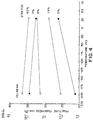
- Alloy C is underaged to a 20°C YS of 89 ksi (613.6MPa), at which point the onset of the desirable trend is achieved (fracture toughness of 33.9 ksi ⁇ in (37.2MPa ⁇ m) at 20°C and 34.3 ksi ⁇ in (37.7MPa ⁇ m) at -196°C). Underaging Alloy C further to 86 ksi (592.9MPa) YS at 20°C increases toughness and clearly results in the desirable trend. That is, 20°C toughness is 38.7 ksi ⁇ in (42.5MPa ⁇ m), while -196°C toughness is 40.4 ksi ⁇ in (44.4MPa ⁇ m) (see Figure 1). This represents an excellent example of the desirable cryogenic fracture toughness trend at both a high strength and a high toughness level.
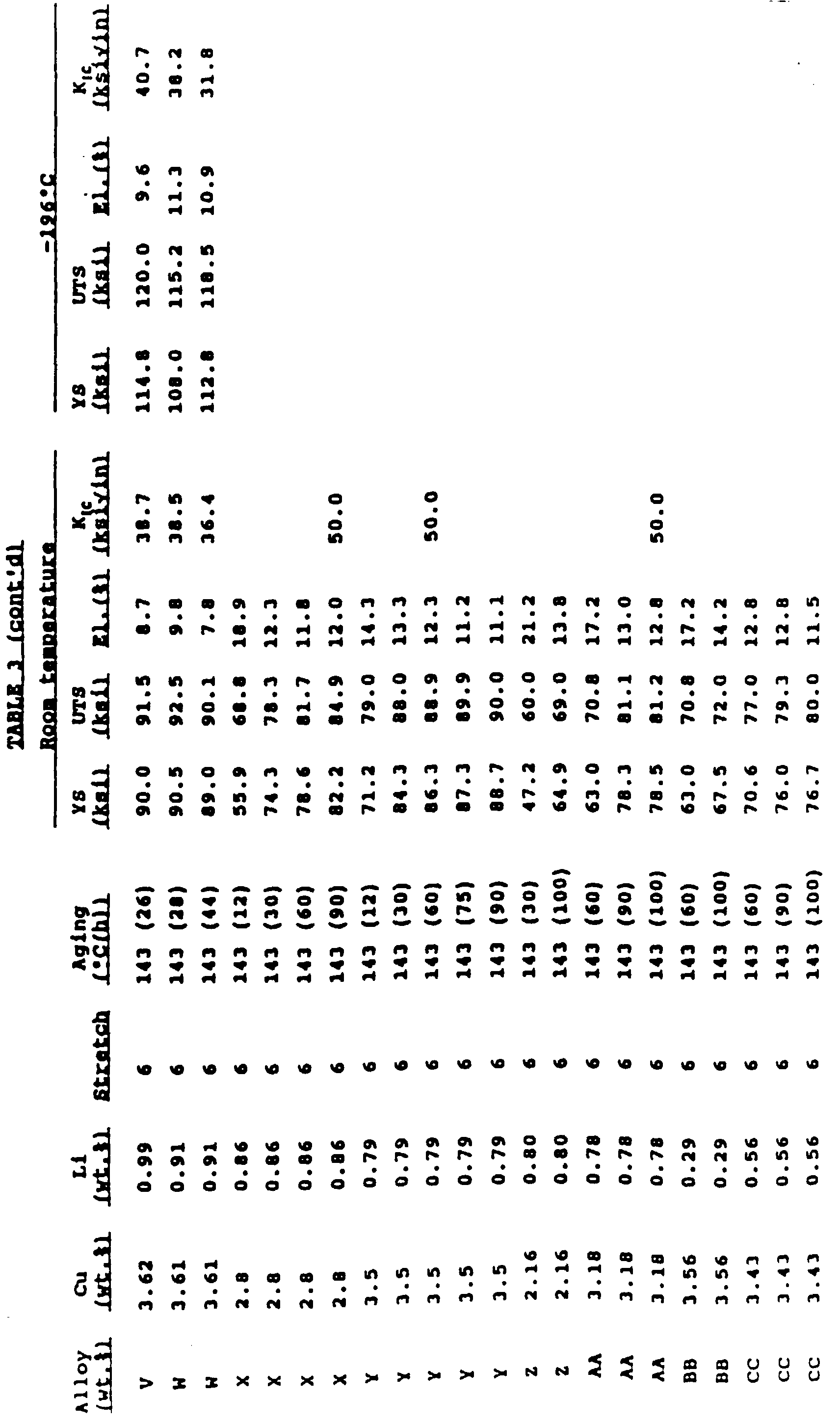
- Alloy D is similar in composition to alloy B except that the Li content is slightly lower. Part of this extrusion was stretched 3% and part 6%. The desirable trend is just about attained at a 20°C YS of 88 ksi (606.7MPa) at the 3% stretch level, but it is reached very easily at the 93 ksi (641.2MPa) 20°C YS level with 6% stretch (see Table 3). Furthermore, the desirable trend is almost achieved at 98.5 ksi YS (679.1MPa). The desirable trend is more readily achieved because of the higher stretch level and, in addition, the lower Li content which will be further illustrated later.
- Alloy E is similar in composition to Alloy A except that Alloy E is Ag-free. Alloy E's peak 20°C strength with 3% stretch can be attained by aging for 16h at 160°C (95.2 ksi YS (656.3MPa), 98.3 ksi UTS (677.7MPa) and 6% el). The peak strength of Alloy E is slightly lower than that of Alloy A because of the absence of Ag in Alloy E. At -196°C, strength increases to 114 ksi YS (786MPa) and 123 ksi UTS (848MPa), with a decrease in elongation to 4.0%.
- Toughness at 20°C is 16.9 ksi ⁇ in (18.6MPa ⁇ m), decreasing slightly to 16.6 ksi ⁇ in (18.2MPa ⁇ m) at -196°C.
- This toughness can be increased with only a slight strength penalty by underaging, e.g., aging for 6h at 160°C, producing a YS of 94.2 ksi (649.5MPa), UTS of 98.6 ksi (679.8MPa), elongation of 7.9% and K Q of 25.4 ksi ⁇ in (27.9MPa ⁇ m) at 20°C.
- the properties at -196°C are 111 ksi YS (765.3MPa), 123 ksi UTS (848MPa), 7.5% el and K Q of 23.0 ksi ⁇ in (25.3MPa ⁇ m). The desirable trend is not quite achieved in either case.
- Alloy F is similar in composition to Alloy E, but is significantly lower in Cu and Li content (see Table 2).
- the decrease in solute produces a lower peak YS at 20°C of 90 ksi (620.5MPa) compared to that of Alloy E.
- 20°C properties are 88.1 ksi YS (607.4MPa), 90.8 ksi UTS (626MPa), 10.5% el and 39.4 ksi ⁇ in (43.3MPa ⁇ m) toughness.
- Alloy G is similar in composition to Alloy A (high Cu content) but has a lower Li content of 1.0% (see Table 2).
- Alloy A 370°C preheat temperature for extrusion, 504°C SHT, WQ, stretch 3% and age for 16h at 160°C
- similar tensile properties to those of Alloy A are obtained, but with higher toughness. That is, at 25°C, a YS of 103 ksi (710.2MPa), UTS of 105 ksi (723.9MPa) elongation of 3.8% and K Ic of 18.7 ksi ⁇ in (20.5MPa ⁇ m) are obtained.
- This toughness is higher than the 13.4 ksi ⁇ in (14.7MPa ⁇ m) attained for Alloy A at the ultra-high strength level (see Example 2).
- Similar properties to those of Alloy A are once again obtained (123 ksi YS (848MPa), 128 ksi (882.5MPa) UTS and 3.6% el), but with a slightly higher toughness of 19.2 ksi ⁇ in (21.1MPa ⁇ m) than Alloy G at 25°C.
- a flat or desirable cryogenic fracture toughness trend can be attained by lowering the Li content.
- the benefits of underaging can also be seen by aging alloy G for 6h at 160°C instead of 16h.
- the alloys were then tested for fracture toughness at various strength levels at 25 and -196°C. At 25°C, strength-toughness combinations clearly improve with increasing Mg content. At -196°C, strength-toughness combinations improve by raising the Mg content from 0.2 to 0.4wt%. At 0.6wt% Mg, the data vary more, but also show higher toughness and the desirable trend.
- the desirable trend is achieved for each Mg level from 0.2 to 0.6%, but the 0.4 and 0.6% Mg-containing alloys can be aged to higher strengths, i.e., 97-98.1 ksi YS (668.7-676.3MPa) compared to 91 ksi YS (627.4MPa) for the 0.2% Mg-containing alloy.
- the toughness values at -196°C are extremely high for all of these alloys.
- underaging also facilitates the ability to attain the desirable cryogenic fracture toughness trend with these alloys of varying Mg content.
- Alloy R having a composition of Al-4.9Cu-1.15Li-0.4Ag-0.4Mg-0.14Zr, was cast and extruded at a preheat temperature of 370°C (700°F) in a 16.2-cm (6.375-inch) diameter container at a nominal ram speed of 0.25 cm/s (0.1 in/s) into 5.1 x 1.9 cm (2 x 0.75 inch) rectangular bar.
- the extrusion was solution heat treated at 504°C for 3/4h, water quenched at 25°C, and a portion of the bar was removed (with 0% stretch).
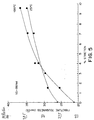
- cryogenic fracture toughness trend is attained. Fractographic and transmission microscopy were performed on each sample. While not intending to be bound by any particular theory, it is believed that stretch refines strengthening precipitation in the grain interiors while decreasing precipitation of coarser precipitates on grain and subgrain boundaries. Such coarse precipitates are known to lower room temperature toughness. However, the surprising result of increased cryogenic toughness, in comparison to room temperature toughness, with increased stretch level is not understood. For Alloy R at the 88 ksi YS (606.7MPa) stretch level, the cryogenic toughness trend switches from undesirable to desirable at around 4% stretch (see Figure 5). This switchover point could be moved to lower stretch levels by underaging to lower YS levels, decreasing Cu and/or Li content or, to a lesser extent, decreasing aging temperature.
- the high 25°C toughness of 38.9 ksi ⁇ in (42.7MPa ⁇ m) increases to 43.6 ksi ⁇ in (47.9MPa ⁇ m) at -196°C, an excellent example of the desirable cryogenic toughness trend.
- Toughness could be increased further by lowering the Cu and/or Li content.
- Alloy T is similar in composition to Alloy S, except that the Zn content is roughly doubled to 0.40%.
- the alloy was aged for 28 hours at 143°C, which is slightly further along the aging curve than the previous example of Alloy S. Otherwise, the alloy was processed the same.
- a slightly higher 25°C YS of 94.0 (648MPa) ksi, UTS of 95.8 ksi (660.5MPa) and elongation of 9.9% are achieved.
- YS increases to 114 ksi (786MPa) and UTS increases to 119.8 ksi (826MPa), with 9.4% elongation.
- One sample was aged at 127°C for 100 hours to achieve a room temperature YS of 88.4 ksi (609.5MPa), a UTS of 94.7 ksi (652.9MPa), an elongation of 8.8% and a K Q of 36.6 ksi ⁇ in (40.2MPa ⁇ m).
- the sample aged at 127°C attained a YS of 103.4 ksi (712.9MPa), a UTS of 113.4 ksi (781.9MPa), an elongation of 10.9% and a K Q of 36.4 ksi ⁇ in (40MPa ⁇ m).
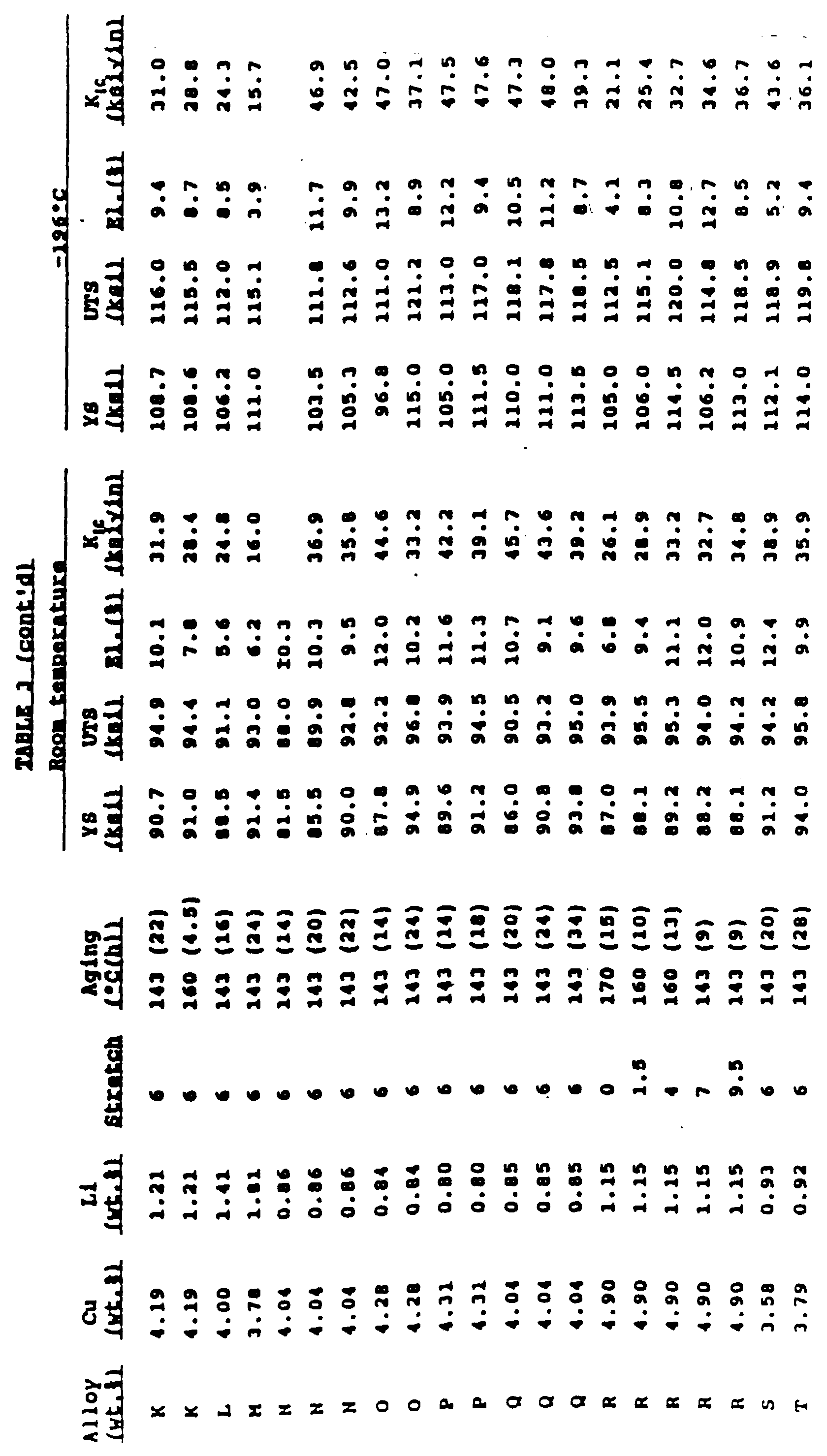
- Another sample was aged at 143°C for 22 hours to attain a 25°C YS of 90.7 ksi (625.4MPa), a UTS of 94.9 ksi (654.3MPa), an elongation of 10.1% and a K Q of 31.9 ksi ⁇ in (35.1MPa ⁇ m).
- this sample attained a YS of 108.7 ksi (748.8MPa), a UTS of 116.0 ksi (799.8MPa), an elongation of 9.4% and a K Q of 31.0 ksi ⁇ in (34.1MPa ⁇ m).
- a third sample was aged at 160°C for 4.5 hours to attain a 25°C YS of 91.0 ksi (620.5MPa), a UTS of 94.4 ksi (650.9MPa), an elongation of 7.7% and a K Q of 28.4 ksi ⁇ in (31.2MPa ⁇ m).
- this sample achieved a YS of 108.6 ksi (748.8MPa), a UTS of 115.5 ksi (796.3MPa), an elongation of 8.7% and a K Q of 28.8ksi ⁇ m (31.6MPa ⁇ m).
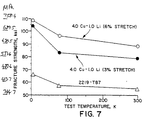
- Alloy U having a composition of A1-4.0Cu-1.0Li-0.4 Ag-0.4Mg-0.14Zr (virtually the same as Alloy J) was cast and rolled to 9.5 mm (0.375 in.) plate, solution heated at 510°C (950°F), quenched in water at 20°C and either stretched 3% or 6%. Plate at each stretch level was aged at 143°C to a 20°C YS of 85 ksi (586.1MPa). The plates were machined down to 2.0 mm to simulate anticipated flight gages for the External Tank of the Space Shuttle. To evaluate fracture toughness of the alloy at this thickness, the surface crack tension test (ASTM E740) was used.
- the variant with 6% stretch has a 69% advantage over 2219 at a test temperature of 4K, which could translate directly to a structural weight savings in the tank membranes of that gage. It is noted that both stretch levels show the desirable trend for the 2.0 mm gage and that toughness increases with stretch level as was shown in the previous examples for extrusions.
- Alloy V comprising Al-3.62Cu-0.99Li-0.35Ag-0.36Mg-0.15Zr-0.04Ti, falls within the most preferred compositional range of the present invention.
- the alloy With 6% stretch and artificial aging-at 143°C for 26 hours, the alloy attains room temperature properties of 90.0 ksi (620.5MPa) YS, 91.5 ksi UTS (630.9MPa), 8.7% elongation and 38.7 ksi ⁇ in K Ic (42.5MPa ⁇ m)
- the alloy attains properties of 114.8 ksi (791.5MPa) YS, 120.0 ksi (827.4MPa) UTS, 9.6% elongation and 40.7 ksi ⁇ in (44.7MPa ⁇ m) K Ic (see Table 3), i.e., the desirable cryogenic fracture toughness trend is obtained.
- Alloy W comprising Al-3.61Cu-0.91Li-0.33Mg-0.39Zn-0.15Zr-0.04Ti, was stretched 6% and artificially aged at 143°C for varying lengths of time as shown in Table 3.
- This alloy attains a peak strength of about 90 ksi (620.5MPa), which is attained by aging for 26 hours at 143°C.
- strength does not change significantly for longer aging times.
- increasing the aging time by about 70% to 44 hours only over-ages the alloy very slightly as 25°C YS decreases to about 89 ksi (613.6MPa) (See Table 3).
- this increased aging has an adverse effect on the cryogenic fracture toughness trend.
- the desirable cryogenic fracture toughness trend is essentially attained at the shorter aging time but is not attained at the longer aging time.
- Alloys X and Y are Ag-free and contain Zn (see Table 2). As shown in Table 3, the room temperature strengths of these alloys are quite high, especially considering the relatively low alloying content of these alloys. Furthermore, the room temperature plane strain fracture toughnesses are well above 50 ksi ⁇ in (54.9MPa ⁇ m). The toughnesses of these alloys are so high that valid L-T K Ic toughness values are not obtained with the 2 x 3/4 inch (19mm) extruded bar samples. Each of Alloys X and Y are capable of attaining the desirable cryogenic fracture toughness trend.
- Alloy Z contains 2.16% Cu (see Table 2). Significantly lower strengths are obtained with this low-copper variant as shown in Table 3. Although the desirable trend can be attained with this alloy, the strengths are less desirable than those for the alloys in aforementioned examples.
- Alloy AA falls within the most preferred compositional range of the present invention (see Table 2). As shown in Table 3, high strengths are obtained at room temperature, especially considering the relatively low alloying content of the alloy.
- the room temperature plane strain fracture toughness is above 50 ksi ⁇ in (54.9MPa ⁇ m). However, since the toughness is so high, valid L-T K Ic toughness values are not obtained with the 2 x 3/4 inch (19mm) extruded bar samples. Alloy AA is readily capable of attaining the desirable cryogenic fracture toughness trend.
- Alloy BB and CC contain 0.29% Li and 0.56% Li, respectively. Otherwise, the alloys are very similar in composition (see Table 2). Alloy BB, containing the lower amount of Li, possesses significantly decreased room temperature strengths compared to Alloy CC, as shown in Table 3. Although each alloy could attain the desirable cryogenic fracture toughness trend, the lower Li content of alloy BB causes the alloy to have much lower strengths than alloy CC, and alloys in aforementioned examples.
- Alloy DD is similar in composition to alloy S, except that it is Zn free and has a lower Cu content of 3.41% and a higher Li content of 1.12%. It was processed similarly to the other alloys in the study, but part of the extrusion was stretched 3% and the remainder 6%. The 3% stretch material was aged for 24 hours at 143°C, giving a 25°C YS of 88.5 ksi (610.2MPa) and a K Q of 29.8 ksi ⁇ in (32.7MPa ⁇ m). (See Table III).
- YS increased to 108.4 ksi (747.4MPa) and K Q increased to 41.6 ksi ⁇ in (45.7MPa ⁇ m)
- the 6% stretch material was aged for 16 hours at 143°C and achieved virtually the same 88.4 ksi (609.5MPa) YS and a K Q value of 28.7 ksi ⁇ in. (31.5MPa ⁇ m) at 25°C.
- YS increased to 107.2 ksi (739.1MPa) and toughness increased to 42.1 ksi ⁇ in (46.3 MPa ⁇ m) for both the 3% and the 6% stretch materials.
- the desirable cryogenic fracture toughness trend was achieved in both cases.
- Alloy EE is similar in composition to alloy D, and has the composition Al - 4.47 Cu - 0.95 Li - 0.43 Ag - 0.43 Mg - 0.14 Zr - 0.02 Ti. It was processed similarly the alloys in the previous examples and, importantly, it was extruded to 2 x 0.75 in (19mm) rectangular bar. The aspect ratio from this extrusion is a rather low 2.67 (i.e., 2 ⁇ 0.75), so the long transverse properties would be expected to be fairly close to the short transverse properties.
- a section of the bar was stretched 3% and aged at 160°C for 6 hours, providing a 25°C longitudinal YS of 86.5 ksi (596.4MPa) and L-T K Ic of 40.7 ksi ⁇ in (44.7MPa ⁇ m). These increased at -196°C to 106.2 ksi (732.2MPa) YS and 49.3 ksi ⁇ in (54.2MPa ⁇ m)K ic respectively.
- 25°C YS was 70.5 ksi (486.1MPa) and T-L (i.e., long transverse toughness) K Ic was 30.8 ksi ⁇ in (33.8MPa ⁇ m).
- T-L (i.e., long transverse toughness) K Ic was 30.8 ksi ⁇ in (33.8MPa ⁇ m).
- long transverse K Ic increased to 36.4 ksi ⁇ in (40MPa ⁇ m).
- the desirable cryogenic fracture toughness trend is achieved in both longitudinal and transverse orientation.
- composition FF Al - 4.99 Cu - 1.23 Li - 0.38 Ag - 0.46 Mg - 0.17 Zr - 0.04 Ti
- GG Al - 5.20 Cu - 1.00 Li - 0.40 Ag - 0.16 Zr
- Plane strain fracture toughness was measured from compact tension specimens orientated with crack propagation parallel and through the fusion zone, or parallel and through the heat affected zone (HAZ). These specimens are orientated in a T-L orientation.
- long transverse tensile testing was performed on specimens including both the fusion zone and the HAZ. Tests were performed at 250C and -196°C.
- HAZ toughness increased from 18.8 ksi ⁇ in (20.7MPa ⁇ m) at 25°C to 23.6 ksi ⁇ in (25.9MPa ⁇ m) at -196°C.
- the desirable cryogenic toughness trend was attained on weldments.
- the desirable cryogenic fracture toughness trend can be achieved by controlling Cu, Mg and Li levels. Copper levels of from about 3.0 to about 4.5% and lithium levels of from about 0.7 to about 1.1% are most preferred in order to most readily attain the desirable trend at high strength levels. However, the desirable trend can be achieved for copper levels of from 2.0 to about 6.5% lithium levels of from 0.2 to about 2.7% and magnesium levels of 0.2 to 4.0 weight percent. In order to produce the desirable cryogenic fracture toughness trend while at the same time producing high levels of strength, Cu levels of 2.8 to 4.8% and Li levels of 0.4 to 1.5% are more preferred. Within these compositional ranges, the combined cryogenic fracture toughness and strength properties are maximised, making such alloys highly superior for cryogenic use.
- One particularly preferred alloy for cryogenic use comprises 4.0% Cu and 1.0% Li, while another highly preferred alloy comprises 4,5% Cu and 0.8% Li.
- the amounts of Cu and Li employed are interdependent. For example, for copper levels at the high end of the broad range, e.g., 6.5%, the level of lithium should be close to about 1.0% to achieve the desirable cryogenic fracture toughness trend at high strength levels. At the lower and of the broad Cu range, e.g., 2.0%, more Li can be present but the highest strength attainable will generally be lower, as shown by Alloy Z (see Table 3).
- the level of lithium when the level of lithium is at the low and of the broad range, e.g., 0.2%, the level of copper can be relatively high and the desirable trend can be achieved, but strength will be lower than at higher Li levels of about 1%, as shown by Alloy BB (see Table 3).
- Alloy BB At the high and of the broad Li range, e.g., 2.7%, lower Cu levels such as 2% are preferred in order to attain the desirable trend.
- Copper and lithium levels have a significant effect on the strength levels attained in the present alloys. Copper levels above about 4% produce the highest strengths, with significant decreases in strength below about 3% (see Alloy Z in Table 3). In addition, the highest strengths are attained with Li levels of from about 1.05 to about 1.35%, with a peak at about 1.2% lithium. Significant decreases in strength result below about 0.5% and above about 1.5% Li (see Alloy BB in comparison to Alloy CC in Table 3). Thus, while the desirable cryogenic fracture toughness trend is most easily attained and strength levels are very high at copper levels of about 4% and lithium levels of about 1%, lowering of the copper and lithium levels significantly below these amounts may still result in the desirable trend, but with lower strengths.
- alloys of a preferred embodiment of the present invention comprising from about 2.8 to about 4.8 percent Cu and from about 0.4 to about 1.5 percent Li have been found to possess superior combinations of both cryogenic fracture toughness and strength properties, thus providing for surprisingly increased performance when used at cryogenic temperatures.
- the high toughnesses are obtained without the delamination associated with alloys such as 2090, which has inflated toughness values due to an effect known as "delamination toughening". Consequently, alloys such as 2090 actually display lower fracture strength than 2219 in actual tank gages.
- the amount of copper and lithium used also affects the processing that must be employed to achieve the desired trend. For example, at the most preferred levels of about 4.0% copper and 1.0% lithium, little or no stretch may be required to achieve the desired trend at high strength levels. However, as the boundaries of the copper and lithium ranges are reached, optimal amounts of stretch and carefully controlled artificial aging treatments may be required in order to produce the desired cryogenic fracture toughness trend at technologically useful strength levels.
- the amount of magnesium used in the present alloys has only a minor effect on the cryogenic fracture toughness trend.
- the strength of the alloys is highly dependent on Mg content, with peak strengths being attained at Mg levels of from about 0.3 to about 0.6 percent.
- increasing the Mg content to levels of about 0.6 to about 1.0% increases the absolute toughness values at the preferred Cu and Li levels.
- the presence or absence of silver in the alloys of the present invention does not significantly affect the cryogenic fracture toughness trend.
- Ag produces an improvement in strength.
- the amount of stretch employed in accordance with the present invention has a significant effect on cryogenic fracture toughness and the ability to attain the desirable trend. In general, greater amounts of stretch result in an improved cryogenic fracture toughness trend.
- a crossover point may be demonstrated, wherein the desirable trend is achieved above a certain stretch level but is not achieved below that level.
- Figure 5 shows one such crossover point. In the alloy illustrated in Figure 5, the crossover occurs at between 4 and 5% stretch at the 90 ksi* strength level. However, this point may change as composition and processing variables are altered. For compositions near the 4.0 Cu and 1.0 Li levels, the amount of stretch may not be as critical.
- artificial aging has a significant effect on the cryogenic fracture toughness trend.
- underaging tends to produce the desirable trend in comparison to peak or over aging.
- the desirable trend is more readily attained.
- a given alloy of the present invention may be capable of attaining a peak yield strength of 100 ksi
- underaging to a yield strength of 90 ksi is more likely to produce the desired cryogenic fracture toughness trend. This phenomena is not fully understood, but a possible explanation may involve the transition from intersubgranular to microvoid fracture.
- the degree of underaging required is dependent upon alloy composition and processing history.
- underaging may not be required and the desirable trend can be achieved at peak strength.
- significant underaging may be required in order to produce the desired trend.
- the required underaging treatment is to artificially age the alloy to a yield strength that is at least about 5 ksi below the peak yield strength of the alloy.
- Such underaging has been found to significantly promote the desirable cryogenic fracture toughness trend.
- the cryogenic fracture toughness trend can be significantly affected by the amount of recrystallization.
- unrecrystallized plate tends to promote the desired cryogenic toughness trend while recrystallized plate tends to decrease the ease with which the desired trend can be attained after solution heat treatment, stretching and aging.
- the unrecrystallized microstructure is desirable for increased fracture toughness at a given temperature. It may therefore be desirable to, for example, roll the alloy at higher temperatures at which recrystallization is less likely to occur than at lower temperatures at which recrystallization may be induced.
- Alloys of the present invention may be rolled, extruded and forged to the product forms necessary to fabricate a container for holding cryogenic materials.
- a cryogenic tank when used for holding cryogenic liquids such as liquid hydrogen, oxygen or nitrogen, generally consists of the barrel, which is a hollow cylinder, the domes, which are approximately hemispherical in shape, and the rings, which connect the barrel to the fore and aft domes.
- the barrel may be fabricated from plate that has been processed in accordance with the present invention and which is subsequently machined so that it has longitudinal T-shaped or L-shaped stiffeners.
- the barrel may be fabricated from integrally-stiffened extrusions which have the T-shaped or L-shaped longitudinal stiffeners introduced during the extrusion event.
- simple stiffeners may be rolled into the plate, e.g., linear stiffeners.
- the ring can be formed from extrusions that are bent over a curved tool and welded into a ring, or roll-ring forged, an operation in which a billet is pierced to a doughnut shape and the wall thickness is worked to thinner gages as the diameter increases.
- the domes may be formed from gore panels of plate or sheet that are stretched over a tool and welded together. Alternatively, the dome can be spin-formed from plate at cold, warm, or hot working temperatures.
- the amount of stretch necessary to produce the desirable cryogenic toughness trend can be introduced during the forming operation after solution heat treatment and quench.
- the plate and extrusion can be simply stretch straightened.
- cold work can be introduced when the gore panels are stretched over a mandrel, the barrel panels are bump formed over a tool, the ring extrusions are bent and stretched over a tool to introduce curvature, or the dome is spun formed.
- the artificial aging conditions are selected as previously disclosed to ensure that the desirable trend is achieved.
- the tank components may be welded together by virtually any of the conventional welding techniques, including gas tungsten arc welding, dual torch gas tungsten arc welding, metal inert gas welding, variable polarity plasma arc welding, variable polarity gas tungsten arc welding, electron beam welding and others.
- Conventional filler alloys such as 2319 are acceptable, as are parent filler alloys of the present invention.
- parent alloys containing greater amounts of grain refiners, e.g., Zr and Ti, and slightly greater Cu content are often preferred to increase weldment strength.
- the barrel panels are welded together forming a right circular cylinder which is then welded to the ring.
- the two domes are each welded to a ring, thereby forming the cryogenic tank.
- the cryogenic tank typically also has secondary hardware that may be fabricated by forging to asymmetric shapes, i.e., that cannot be stretched.
- These components should contain the more preferred amounts of Cu and Li, e.g., 2.8 - 4.8 Cu and 0.7 - 1.1 Li, to enable the desirable trend to be attained with no stretch, while still maintaining high strength levels. For some forgings, cold work could be practically introduced by shot peening.
- the components of the cryogenic tank can be welded by various parameters depending upon the technique selected.
- a preferred route is to weld the components using conventional gas tungsten arc welding with conventional 2319 filler.
- the surfaces to be welded should preferably be mechanically milled or chemically milled in a 100 g/l NaOH aqueous solution such that about 0.5 mm of the surface is removed.
- a 75% Ar/25% He inert gas cover at 14 1/min can be used.
- a travel speed of 25 cm/min at a current of 170 Amps and a voltage of 12.5 volts produces high integrity weldments.
- a typical solution for such milling is 103 g/l NaOH, 22 g/l sodium sulphide and 2.2 g/l sodium gluconate to make 1 liter of solution.
- Weldments made as described above also display increasing weldment toughness and strength with decreasing temperature.
- the tank so fabricated can be cost effectively proof tested at room temperature. Because toughness and strength are each substantially the same or greater at cryogenic service temperatures than at the ambient proof test temperature, the tank can be safely used with minimal risk of toughness-limited or strength-overload-induced failures.
Landscapes
- Chemical & Material Sciences (AREA)
- Mechanical Engineering (AREA)
- Organic Chemistry (AREA)
- Metallurgy (AREA)
- Engineering & Computer Science (AREA)
- Materials Engineering (AREA)
- Crystallography & Structural Chemistry (AREA)
- Physics & Mathematics (AREA)
- Thermal Sciences (AREA)
- Materials For Medical Uses (AREA)
- Extrusion Of Metal (AREA)
- Forging (AREA)
- Heat Treatment Of Steel (AREA)
- Powder Metallurgy (AREA)
Description
optionally at least one of 0 to 4.0 weight percent Ag, and 0 to 3.0 weight percent Zn, optionally 0 to 10.0 weight percent of other alloying additives selected from the group consisting of Zr, Ti, Cr, Mn, Hf, Nb, B, Fe, Y, La, V, Mo, Se, Co, Ni, Cd, In, Sn, Ge and combinations thereof and TiB2, and the balance aluminium and incidental impurities,
the composition being worked artificially aged, wherein the working produces the equivalent of at least 3% stretch to the composition and
the aging artificially underages the composition to a yield strength at least 5Ksi (34.5 Mpa) below the peak yield strength which the composition is capable of attaining.
| Compositional Ranges of Alloys (wt. %, balance Al) | |||||
| Cu | Li | Ag | Mg | Zn | |
| Broad | 2.0-6.5 | 0.2-2.7 | 0-4.0 | 0.2-4.0 | 0-3.0 |
| Preferred | 2.8-4.8 | 0.4-1.5 | 0-0.8 | 0.2-1.0 | 0-1.0 |
| Most Pref. | 3.0-4.5 | 0.7-1.1 | 0-0.6 | 0.3-0.6 | 0-0.75 |
| Alloy Compositions (wt. %) | |||||||
| Alloy | Cu | Li | Ag | Mg | Zn | Zr | Ti |
| A | 6.18 | 1.35 | 0.41 | 0.40 | 0 | 0.16 | 0 |
| B | 4.52 | 1.29 | 0.40 | 0.36 | 0 | 0.14 | 0.03 |
| C | 4.13 | 1.27 | 0.40 | 0.40 | 0 | 0.14 | 0.02 |
| D | 4.38 | 1.04 | 0.38 | 0.38 | 0 | 0.14 | 0.03 |
| E | 5.70 | 1.29 | 0 | 0.34 | 0 | 0.15 | 0.04 |
| F | 4.01 | 0.84 | 0 | 0.40 | 0 | 0.14 | 0.03 |
| G | 6.00 | 1.00 | 0.38 | 0.36 | 0 | 0.14 | 0.04 |
| H | 4.23 | 0.73 | 0.40 | 0.34 | 0 | 0.15 | 0.02 |
| I | 4.28 | 0.85 | 0.36 | 0.40 | 0 | 0.14 | 0.03 |
| J | 3.95 | 1.03 | 0.39 | 0.37 | 0 | 0.14 | 0.03 |
| K | 4.19 | 1.21 | 0.37 | 0.38 | 0 | 0.14 | 0.04 |
| L | 4.00 | 1.41 | 0.38 | 0.37 | 0 | 0.14 | 0.03 |
| M | 3.78 | 1.81 | 0.40 | 0.34 | 0 | 0.15 | 0.03 |
| N | 4.04 | 0.86 | 0.38 | 0.24 | 0 | 0.14 | 0.03 |
| O | 4.28 | 0.84 | 0.36 | 0.38 | 0 | 0.14 | 0.03 |
| P | 4.31 | 0.80 | 0.36 | 0.38 | 0 | 0.14 | 0.03 |
| Q | 4.04 | 0.85 | 0.38 | 0.60 | 0 | 0.15 | 0.03 |
| R | 4.90 | 1.15 | 0.40 | 0.40 | 0 | 0.14 | 0.02 |
| S | 3.58 | 0.93 | 0.35 | 0.34 | 0.22 | 0.15 | 0.04 |
| T | 3.79 | 0.92 | 0.34 | 0.34 | 0.40 | 0.15 | 0.03 |
| U | 4.00 | 1.00 | 0.40 | 0.40 | 0 | 0.14 | 0.02 |
| V | 3.62 | 0.99 | 0.35 | 0.36 | 0 | 0.15 | 0.04 |
| W | 3.61 | 0.91 | 0 | 0.33 | 0.39 | 0.15 | 0.04 |
| X | 2.8 | 0.86 | 0 | 0.38 | 0.65 | 0.14 | 0.02 |
| Y | 3.5 | 0.79 | 0 | 0.41 | 0.75 | 0.14 | 0.02 |
| Z | 2.16 | 0.80 | 0 | 0.38 | 0 | 0.14 | 0.03 |
| AA | 3.18 | 0.78 | 0 | 0.36 | 0 | 0.15 | 0.02 |
| BB | 3.56 | 0.29 | 0 | 0.39 | 0 | 0.14 | 0.03 |
| CC | 3.43 | 0.56 | 0 | 0.35 | 0 | 0.14 | 0.03 |
| DD | 3.41 | 1.12 | 0.38 | 0.36 | 0 | 0.14 | 0.03 |
| EE | 4.47 | 0.95 | 0.43 | 0.43 | 0 | 0.14 | 0.02 |
| FF | 4.99 | 1.23 | 0.38 | 0.46 | 0 | 0.17 | 0.04 |
| GG | 5.20 | 1.00 | 0.40 | 0 | 0 | 0.16 | 0 |
Al-4.9Cu-1.15Li-0.4Ag-0.4Mg-0.14Zr, was cast and extruded at a preheat temperature of 370°C (700°F) in a 16.2-cm (6.375-inch) diameter container at a nominal ram speed of 0.25 cm/s (0.1 in/s) into 5.1 x 1.9 cm (2 x 0.75 inch) rectangular bar. The extrusion was solution heat treated at 504°C for 3/4h, water quenched at 25°C, and a portion of the bar was removed (with 0% stretch). The remaining bar was then stretched 1.5%, a piece was cut off, stretched again with material cut off, and this procedure was repeated giving sections with stretch levels of 0, 1.5, 4, 7 and 9.5%. The artificial aging response was determined for each stretch level and portions of each extrusion were heat treated to a 20°C YS of 88 ksi (606.7MPa). Plane strain fracture toughness from fatigue precracked CT specimens was measured at each stretch level at 20°C and -196°C. Toughness at 20°C was found to increase with increasin stretch (see Figure 4). The undesirable trend was attained at 0, 1.5, and 4% stretch (see Figures 4 and 5) at this strength level. However, at the higher stretch levels of 7 and 9.5%, the desirable cryogenic fracture toughness trend is attained. Fractographic and transmission microscopy were performed on each sample. While not intending to be bound by any particular theory, it is believed that stretch refines strengthening precipitation in the grain interiors while decreasing precipitation of coarser precipitates on grain and subgrain boundaries. Such coarse precipitates are known to lower room temperature toughness. However, the surprising result of increased cryogenic toughness, in comparison to room temperature toughness, with increased stretch level is not understood. For Alloy R at the 88 ksi YS (606.7MPa) stretch level, the cryogenic toughness trend switches from undesirable to desirable at around 4% stretch (see Figure 5). This switchover point could be moved to lower stretch levels by underaging to lower YS levels, decreasing Cu and/or Li content or, to a lesser extent, decreasing aging temperature.



Claims (14)
- The use of an alloy to provide both strength and fracture toughness at cryogenic temperature which are equal to or greater than at room temperature, the fracture toughness at room temperature being at least 18.7Ksi√ inch (20.5Mpa√m) and the fracture toughness at -196°C being at least 19.2Ksi√ inch (21.1Mpa√m), the alloy composition consisting of 2.0 to 6.5 weight percent Cu, 0.2 to 2.7 weight percent Li, 0.2 to 4.0 weight percent Mg
optionally at least one of 0 to 4.0 weight percent Ag, and 0 to 3.0 weight percent Zn, optionally 0 to 10.0 weight percent of other alloying additives selected from the group consisting of Zr, Ti, Cr, Mn, Hf, Nb, B, Fe, Y, La, V, Mo, Se, Co, Ni, Cd, In, Sn, Ge and combinations thereof and TiB2, and the balance aluminium and incidental impurities,
the alloy composition being worked and artificially aged, wherein the working produces the equivalent of at least 3% stretch to the alloy composition and
the aging artificially underages the alloy composition to a yield strength at least 5Ksi (34.5 Mpa) below the peak yield strength which the composition is capable of attaining. - The use of claim 1, wherein the said composition contains from 0.01 to 1.0 weight percent of at least one grain refiner selected from the group consisting of Zr, Ti, Cr, Mn, Hf, Nb, B, V and TiB2.
- The use of claim 1 or claim 2, wherein the composition contains 2.8 to 4.8 weight percent Cu, 0.4 to 1.5 weight percent Li and 0.2 to 1.0 weight percent Mg.
- The use of claim 1 or claim 2, wherein the composition contains 3.0 to 4.5 weight percent Cu, 0.7 to 1.1 weight percent Li and 0.3 to 0.6 weight percent Mg.
- The use of claim 3 or claim 4 wherein the composition contains 0.08 to 0.3 weight percent grain refiner, the grain refiner being selected from the group consisting of Zr, Ti and combinations thereof.
- The use of claim 1, 2, 3, 4 or 5 wherein the composition further contains 0 to 0.8 weight percent Ag.
- The use of claim 4, wherein the composition further contains 0 to 0.6 weight percent Ag and 0 to 0.75 weight percent Zn.
- The use of claim 2, wherein the composition contains 3.0 to 4.5 weight percent Cu.
- The use of claim 2, wherein the composition contains 0.7 to 1.1 weight percent Li.
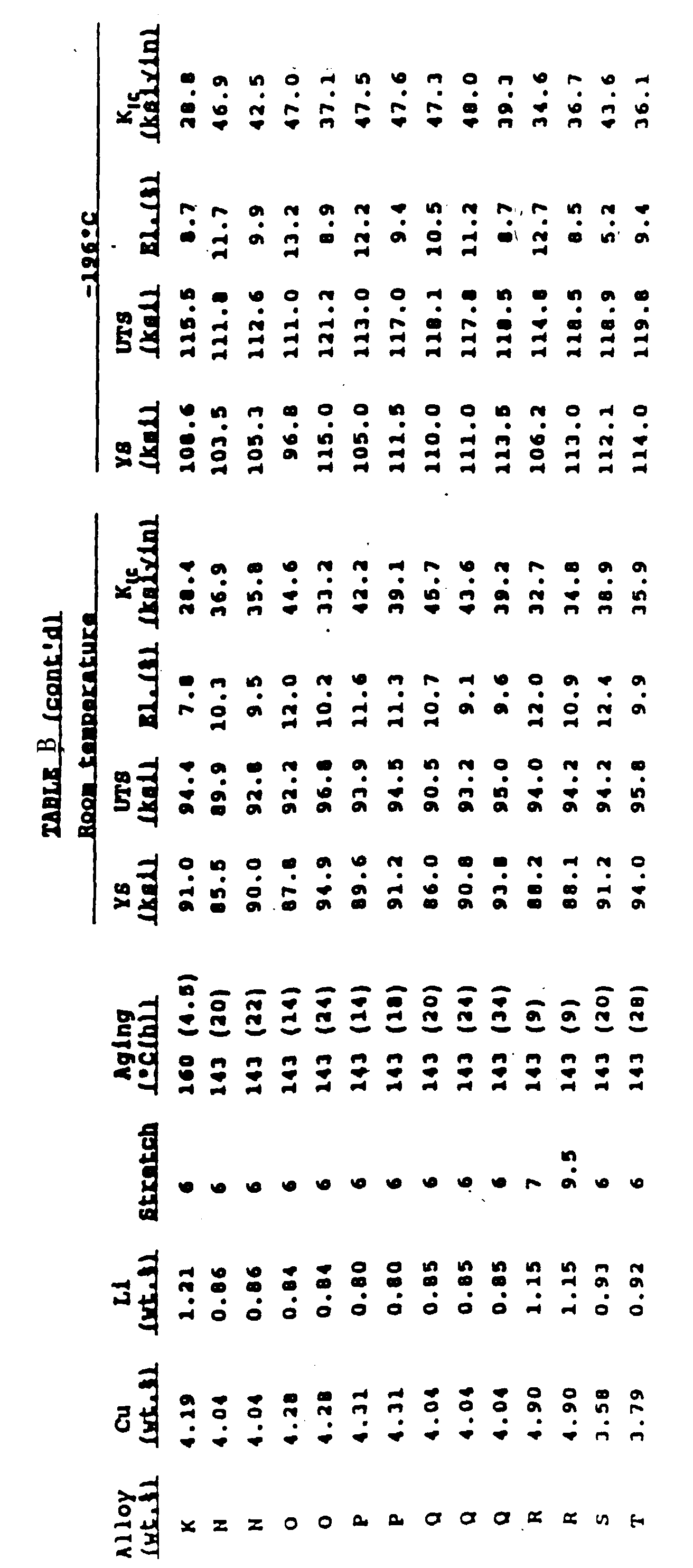
- The use of claim 1, wherein the composition contains Cu, Li, Ag, Mg, Zn, Zr and Ti in the proportions set out in Table A below and subject to working and aging and having the properties set out in Table B below.
Alloy Compositions (wt. %) Alloy Cu Li Ag Mg Zn Zr Ti B 4.52 1.29 0.40 0.36 0 0.14 0.03 C 4.13 1.27 0.40 0.40 0 0.14 0.02 D 4.38 1.04 0.38 0.38 0 0.14 0.03 F 4.01 0.84 0 0.40 0 0.14 0.03 G 6.00 1.00 0.38 0.36 0 0.14 0.04 H 4.23 0.73 0.40 0.34 0 0.15 0.02 I 4.28 0.85 0.36 0.40 0 0.14 0.03 J 3.95 1.03 0.39 0.37 0 0.14 0.03 K 4.19 1.21 0.37 0.38 0 0.14 0.04 N 4.04 0.86 0.38 0.24 0 0.14 0.03 O 4.28 0.84 0.36 0.38 0 0.14 0.03 P 4.31 0.80 0.36 0.38 0 0.14 0.03 Q 4.04 0.85 0.38 0.60 0 0.15 0.03 R 4.90 1.15 0.40 0.40 0 0.14 0.02 S 3.58 0.93 0.35 0.34 0.22 0.15 0.04 T 3.79 0.92 0.34 0.34 0.40 0.15 0.03 U 4.00 1.00 0.40 0.40 0 0.14 0.02 V 3.62 0.99 0.35 0.36 0 0.15 0.04 W 3.61 0.91 0 0.33 0.39 0.15 0.04 X 2.8 0.86 0 0.38 0.65 0.14 0.02 Y 3.5 0.79 0 0.41 0.75 0.14 0.02 Z 2.16 0.80 0 0.38 0 0.14 0.03 AA 3.18 0.78 0 0.36 0 0.15 0.02 BB 3.56 0.29 0 0.39 0 0.14 0.03 CC 3.43 0.56 0 0.35 0 0.14 0.03 DD 3.41 1.12 0.38 0.36 0 0.14 0.03 EE 4.47 0.95 0.43 0.43 0 0.14 0.02 


- The use of any preceding claim for the purpose of providing: a yield strength, greater than 85Ksi (586 Mpa) (longitudinal), of said composition at cryogenic temperature which is greater than its yield strength at room temperature; and a plane strain fracture toughness greater than 25Ksi√ in (27.5 Mpa√m) in of said alloy at cryogenic temperature which is greater than its plane strain fracture toughness at room temperature.
- The use of any preceding claim, wherein the working is performed at substantially room temperature.
- The use of any preceding claim, wherein the working introduces the equivalent of 3 to 7% stretch to the composition.
- The use of any preceding claim wherein the artificial underaging is performed at a temperature in the range 125 to 150°C.
Applications Claiming Priority (3)
| Application Number | Priority Date | Filing Date | Title |
|---|---|---|---|
| US103662 | 1987-10-02 | ||
| US08/103,662 US5455003A (en) | 1988-08-18 | 1993-08-10 | Al-Cu-Li alloys with improved cryogenic fracture toughness |
| PCT/US1994/008876 WO1995004837A1 (en) | 1993-08-10 | 1994-08-08 | Al-cu-li alloys with improved cryogenic fracture toughness |
Publications (2)
| Publication Number | Publication Date |
|---|---|
| EP0714453A1 EP0714453A1 (en) | 1996-06-05 |
| EP0714453B1 true EP0714453B1 (en) | 2000-01-12 |
Family
ID=22296371
Family Applications (1)
| Application Number | Title | Priority Date | Filing Date |
|---|---|---|---|
| EP94925755A Expired - Lifetime EP0714453B1 (en) | 1993-08-10 | 1994-08-08 | Al-cu-li alloys with improved cryogenic fracture toughness |
Country Status (13)
| Country | Link |
|---|---|
| US (1) | US5455003A (en) |
| EP (1) | EP0714453B1 (en) |
| JP (1) | JP3742884B2 (en) |
| KR (1) | KR100330990B1 (en) |
| AU (1) | AU683296B2 (en) |
| BR (1) | BR9407224A (en) |
| CA (1) | CA2167847A1 (en) |
| DE (1) | DE69422630T2 (en) |
| ES (1) | ES2141250T3 (en) |
| NO (1) | NO313641B1 (en) |
| PT (1) | PT714453E (en) |
| RU (1) | RU2128241C1 (en) |
| WO (1) | WO1995004837A1 (en) |
Cited By (2)
| Publication number | Priority date | Publication date | Assignee | Title |
|---|---|---|---|---|
| RU2639177C2 (en) * | 2007-12-04 | 2017-12-20 | Арконик Инк. | Improved aluminium-copper-lithium alloys |
| CN113373333A (en) * | 2021-05-27 | 2021-09-10 | 湖南瀚德微创医疗科技有限公司 | Low-elasticity high-strength aluminum alloy amplitude transformer and preparation method thereof |
Families Citing this family (53)
| Publication number | Priority date | Publication date | Assignee | Title |
|---|---|---|---|---|
| US5512241A (en) * | 1988-08-18 | 1996-04-30 | Martin Marietta Corporation | Al-Cu-Li weld filler alloy, process for the preparation thereof and process for welding therewith |
| US5983099A (en) * | 1996-06-11 | 1999-11-09 | Qualcomm Incorporated | Method/apparatus for an accelerated response to resource allocation requests in a CDMA push-to-talk system using a CDMA interconnect subsystem to route calls |
| US6168067B1 (en) * | 1998-06-23 | 2001-01-02 | Mcdonnell Douglas Corporation | High strength friction stir welding |
| US7438772B2 (en) * | 1998-06-24 | 2008-10-21 | Alcoa Inc. | Aluminum-copper-magnesium alloys having ancillary additions of lithium |
| RU2163940C1 (en) * | 1999-08-09 | 2001-03-10 | Государственное предприятие "Всероссийский научно-исследовательский институт авиационных материалов" | Aluminum-base alloy and article made of it |
| US6562154B1 (en) | 2000-06-12 | 2003-05-13 | Aloca Inc. | Aluminum sheet products having improved fatigue crack growth resistance and methods of making same |
| WO2002063059A1 (en) * | 2000-10-20 | 2002-08-15 | Pechiney Rolled Products, Llc | High strenght aluminum alloy |
| DE10053664A1 (en) * | 2000-10-28 | 2002-05-08 | Leybold Vakuum Gmbh | Mechanical kinetic vacuum pump |
| BRPI0408432B1 (en) * | 2003-03-17 | 2015-07-21 | Corus Aluminium Walzprod Gmbh | Method for producing an integrated monolithic aluminum frame and machined aluminum product from that frame |
| GB0425152D0 (en) * | 2004-11-15 | 2004-12-15 | Middlesex Silver Co Ltd | Fabric structure |
| BRPI0610937B1 (en) * | 2005-06-06 | 2015-12-08 | Alcan Rhenalu | manufacturing process of an aluminum alloy sheet and aluminum alloy sheet produced by the process |
| FR2889542B1 (en) * | 2005-08-05 | 2007-10-12 | Pechiney Rhenalu Sa | HIGH-TENACITY ALUMINUM-COPPER-LITHIUM PLASTER FOR AIRCRAFT FUSELAGE |
| CN101189353A (en) * | 2005-06-06 | 2008-05-28 | 爱尔康何纳吕公司 | High-toughness aluminum-copper-lithium alloy sheet for aircraft fuselages |
| US20100102049A1 (en) * | 2008-10-24 | 2010-04-29 | Keegan James M | Electrodes having lithium aluminum alloy and methods |
| FR2938553B1 (en) | 2008-11-14 | 2010-12-31 | Alcan Rhenalu | ALUMINUM-COPPER-LITHIUM ALLOY PRODUCTS |
| US8333853B2 (en) * | 2009-01-16 | 2012-12-18 | Alcoa Inc. | Aging of aluminum alloys for improved combination of fatigue performance and strength |
| FR2947282B1 (en) * | 2009-06-25 | 2011-08-05 | Alcan Rhenalu | LITHIUM COPPER ALUMINUM ALLOY WITH IMPROVED MECHANICAL RESISTANCE AND TENACITY |
| CN102625858B (en) | 2009-09-04 | 2014-10-29 | 美铝公司 | Methods of aging aluminum alloys to achieve improved ballistics performance |
| RU2598423C2 (en) * | 2010-04-12 | 2016-09-27 | Алкоа Инк. | Aluminium-lithium alloys of 2xxx series with low difference in strength |
| US9163304B2 (en) | 2010-04-20 | 2015-10-20 | Alcoa Inc. | High strength forged aluminum alloy products |
| FR2960002B1 (en) | 2010-05-12 | 2013-12-20 | Alcan Rhenalu | ALUMINUM-COPPER-LITHIUM ALLOY FOR INTRADOS ELEMENT. |
| US9347558B2 (en) | 2010-08-25 | 2016-05-24 | Spirit Aerosystems, Inc. | Wrought and cast aluminum alloy with improved resistance to mechanical property degradation |
| KR101226484B1 (en) | 2010-10-29 | 2013-01-25 | 국방과학연구소 | Multiple-heattreatment method of indium bearing 2090 alloy |
| FR2969177B1 (en) * | 2010-12-20 | 2012-12-21 | Alcan Rhenalu | LITHIUM COPPER ALUMINUM ALLOY WITH ENHANCED COMPRESSION RESISTANCE AND TENACITY |
| US12565695B2 (en) * | 2011-02-17 | 2026-03-03 | Arconic Technologies Llc | 2XXX series aluminum lithium alloys |
| FR2981365B1 (en) | 2011-10-14 | 2018-01-12 | Constellium Issoire | PROCESS FOR THE IMPROVED TRANSFORMATION OF AL-CU-LI ALLOY SHEET |
| FR2989387B1 (en) | 2012-04-11 | 2014-11-07 | Constellium France | LITHIUM COPPER ALUMINUM ALLOY WITH IMPROVED SHOCK RESISTANCE |
| US9458528B2 (en) * | 2012-05-09 | 2016-10-04 | Alcoa Inc. | 2xxx series aluminum lithium alloys |
| US20140050936A1 (en) * | 2012-08-17 | 2014-02-20 | Alcoa Inc. | 2xxx series aluminum lithium alloys |
| US10266933B2 (en) | 2012-08-27 | 2019-04-23 | Spirit Aerosystems, Inc. | Aluminum-copper alloys with improved strength |
| FR3004197B1 (en) | 2013-04-03 | 2015-03-27 | Constellium France | THIN ALUMINUM-COPPER-LITHIUM ALLOY SHEETS FOR THE MANUFACTURE OF AIRCRAFT FUSELAGES. |
| FR3004464B1 (en) * | 2013-04-12 | 2015-03-27 | Constellium France | PROCESS FOR TRANSFORMING AL-CU-LI ALLOY SHEETS ENHANCING FORMABILITY AND RESISTANCE TO CORROSION |
| FR3007423B1 (en) * | 2013-06-21 | 2015-06-05 | Constellium France | EXTRADOS STRUCTURE ELEMENT IN ALUMINUM COPPER LITHIUM ALUMINUM |
| FR3014448B1 (en) | 2013-12-05 | 2016-04-15 | Constellium France | ALUMINUM-COPPER-LITHIUM ALLOY PRODUCT FOR INTRADOS ELEMENT WITH IMPROVED PROPERTIES |
| FR3026747B1 (en) | 2014-10-03 | 2016-11-04 | Constellium France | ALUMINUM-COPPER-LITHIUM ALLOY ISOTROPES FOR THE MANUFACTURE OF AIRCRAFT FUSELAGES |
| US10253404B2 (en) * | 2014-10-26 | 2019-04-09 | Kaiser Aluminum Fabricated Products, Llc | High strength, high formability, and low cost aluminum-lithium alloys |
| CN105345308B (en) * | 2015-10-29 | 2020-01-10 | 中国航发北京航空材料研究院 | Welding wire for Al-Cu-Li series aluminum lithium alloy and Al-Cu series aluminum alloy |
| FR3044682B1 (en) * | 2015-12-04 | 2018-01-12 | Constellium Issoire | LITHIUM COPPER ALUMINUM ALLOY WITH IMPROVED MECHANICAL RESISTANCE AND TENACITY |
| FR3047253B1 (en) | 2016-02-03 | 2018-01-12 | Constellium Issoire | AL-CU-LI THICK-ALLOY TILES WITH IMPROVED FATIGUE PROPERTIES |
| CN109072358A (en) | 2016-02-09 | 2018-12-21 | 爱励轧制产品德国有限责任公司 | Al-Cu-Li-Mg-Mn-Zn alloy forging product |
| WO2018144568A1 (en) | 2017-01-31 | 2018-08-09 | Universal Alloy Corporation | Low density aluminum-copper-lithium alloy extrusions |
| US20190233921A1 (en) * | 2018-02-01 | 2019-08-01 | Kaiser Aluminum Fabricated Products, Llc | Low Cost, Low Density, Substantially Ag-Free and Zn-Free Aluminum-Lithium Plate Alloy for Aerospace Application |
| FR3080861B1 (en) | 2018-05-02 | 2021-03-19 | Constellium Issoire | METHOD OF MANUFACTURING AN ALUMINUM COPPER LITHIUM ALLOY WITH IMPROVED COMPRESSION RESISTANCE AND TENACITY |
| FR3080860B1 (en) | 2018-05-02 | 2020-04-17 | Constellium Issoire | LITHIUM COPPER ALUMINUM ALLOY WITH IMPROVED COMPRESSION RESISTANCE AND TENACITY |
| FR3082210B1 (en) | 2018-06-08 | 2020-06-05 | Constellium Issoire | THIN SHEETS OF ALUMINUM-COPPER-LITHIUM ALLOY FOR THE MANUFACTURE OF AIRCRAFT FUSELAGES |
| WO2020097169A1 (en) * | 2018-11-07 | 2020-05-14 | Arconic Inc. | 2xxx aluminum lithium alloys |
| EP3947761A4 (en) * | 2019-04-05 | 2022-11-30 | Arconic Technologies LLC | Methods of cold forming aluminum lithium alloys |
| CN110592448B (en) * | 2019-08-27 | 2021-06-22 | 江苏大学 | Heat-resistant and corrosion-resistant 2219 aluminum alloy and preparation method thereof |
| JP7469072B2 (en) * | 2020-02-28 | 2024-04-16 | 株式会社神戸製鋼所 | Aluminum alloy forgings and their manufacturing method |
| CN114438428B (en) * | 2022-01-27 | 2023-02-28 | 湘潭大学 | A kind of preparation method of corrosion-resistant aluminum alloy |
| FR3132306B1 (en) | 2022-01-28 | 2024-05-03 | Constellium Issoire | Improved aluminum-copper-lithium alloy thin sheet metal |
| FR3151859A1 (en) | 2023-08-02 | 2025-02-07 | Constellium Issoire | ALUMINUM-COPPER-LITHIUM ALLOY PRODUCT FOR INTRADOSIS ELEMENT WITH IMPROVED PROPERTIES |
| FR3165018A1 (en) | 2024-07-24 | 2026-01-30 | Constellium Issoire | Use of an aluminum alloy 4000 for the manufacture of cryogenic liquid storage tanks and its manufacturing process |
Family Cites Families (30)
| Publication number | Priority date | Publication date | Assignee | Title |
|---|---|---|---|---|
| US2381219A (en) * | 1942-10-12 | 1945-08-07 | Aluminum Co Of America | Aluminum alloy |
| US2915391A (en) * | 1958-01-13 | 1959-12-01 | Aluminum Co Of America | Aluminum base alloy |
| US3306717A (en) * | 1964-02-01 | 1967-02-28 | Svenska Metallverken Ab | Filler metal for welding aluminumbased alloys |
| GB2121822B (en) * | 1982-03-31 | 1985-07-31 | Alcan Int Ltd | Al-li-cu-mg alloys |
| JPS59118848A (en) * | 1982-12-27 | 1984-07-09 | Sumitomo Light Metal Ind Ltd | Structural aluminum alloy having improved electric resistance |
| DE3411760A1 (en) * | 1983-03-31 | 1984-10-04 | Alcan International Ltd., Montreal, Quebec | METHOD FOR PRODUCING SHEET OR STRIP FROM A ROLLING BAR OF AN ALUMINUM ALLOY |
| JPS60502159A (en) * | 1983-11-24 | 1985-12-12 | セジユデユ−ル・ソシエテ・ドウ・トランスフオルマシオン・ドウ・ラリユミニウム・ペシネ | Al-based alloy containing lithium, magnesium and copper |
| EP0150456B1 (en) * | 1983-12-30 | 1990-11-14 | The Boeing Company | Low temperature underaging of lithium bearing aluminum alloy |
| US5116572A (en) * | 1983-12-30 | 1992-05-26 | The Boeing Company | Aluminum-lithium alloy |
| FR2561261B1 (en) * | 1984-03-15 | 1992-07-24 | Cegedur | AL-BASED ALLOYS CONTAINING LITHIUM, COPPER AND MAGNESIUM |
| FR2561260B1 (en) * | 1984-03-15 | 1992-07-17 | Cegedur | AL-CU-LI-MG ALLOYS WITH VERY HIGH SPECIFIC MECHANICAL RESISTANCE |
| US5137686A (en) * | 1988-01-28 | 1992-08-11 | Aluminum Company Of America | Aluminum-lithium alloys |
| US4797165A (en) * | 1984-03-29 | 1989-01-10 | Aluminum Company Of America | Aluminum-lithium alloys having improved corrosion resistance and method |
| US4806174A (en) * | 1984-03-29 | 1989-02-21 | Aluminum Company Of America | Aluminum-lithium alloys and method of making the same |
| US4648913A (en) * | 1984-03-29 | 1987-03-10 | Aluminum Company Of America | Aluminum-lithium alloys and method |
| CH668269A5 (en) * | 1985-10-31 | 1988-12-15 | Bbc Brown Boveri & Cie | AL/CU/MG TYPE ALUMINUM ALLOY WITH HIGH STRENGTH IN THE TEMPERATURE RANGE BETWEEN 0 AND 250 C. |
| US4816087A (en) * | 1985-10-31 | 1989-03-28 | Aluminum Company Of America | Process for producing duplex mode recrystallized high strength aluminum-lithium alloy products with high fracture toughness and method of making the same |
| US4832910A (en) * | 1985-12-23 | 1989-05-23 | Aluminum Company Of America | Aluminum-lithium alloys |
| US4795502A (en) * | 1986-11-04 | 1989-01-03 | Aluminum Company Of America | Aluminum-lithium alloy products and method of making the same |
| JPS63206445A (en) * | 1986-12-01 | 1988-08-25 | コマルコ・アルミニウム・エルティーディー | Aluminum-lithium ternary alloy |
| US4812178A (en) * | 1986-12-05 | 1989-03-14 | Bruno Dubost | Method of heat treatment of Al-based alloys containing Li and the product obtained by the method |
| US5122339A (en) * | 1987-08-10 | 1992-06-16 | Martin Marietta Corporation | Aluminum-lithium welding alloys |
| US5032359A (en) * | 1987-08-10 | 1991-07-16 | Martin Marietta Corporation | Ultra high strength weldable aluminum-lithium alloys |
| CA1338007C (en) * | 1988-01-28 | 1996-01-30 | Roberto J. Rioja | Aluminum-lithium alloys |
| US4848647A (en) * | 1988-03-24 | 1989-07-18 | Aluminum Company Of America | Aluminum base copper-lithium-magnesium welding alloy for welding aluminum lithium alloys |
| US4869870A (en) * | 1988-03-24 | 1989-09-26 | Aluminum Company Of America | Aluminum-lithium alloys with hafnium |
| US5259897A (en) * | 1988-08-18 | 1993-11-09 | Martin Marietta Corporation | Ultrahigh strength Al-Cu-Li-Mg alloys |
| US5211910A (en) * | 1990-01-26 | 1993-05-18 | Martin Marietta Corporation | Ultra high strength aluminum-base alloys |
| US5151136A (en) * | 1990-12-27 | 1992-09-29 | Aluminum Company Of America | Low aspect ratio lithium-containing aluminum extrusions |
| US5234662A (en) * | 1991-02-15 | 1993-08-10 | Reynolds Metals Company | Low density aluminum lithium alloy |
-
1993
- 1993-08-10 US US08/103,662 patent/US5455003A/en not_active Expired - Lifetime
-
1994
- 1994-08-08 DE DE69422630T patent/DE69422630T2/en not_active Expired - Lifetime
- 1994-08-08 RU RU96105399A patent/RU2128241C1/en active
- 1994-08-08 KR KR1019960700671A patent/KR100330990B1/en not_active Expired - Lifetime
- 1994-08-08 ES ES94925755T patent/ES2141250T3/en not_active Expired - Lifetime
- 1994-08-08 WO PCT/US1994/008876 patent/WO1995004837A1/en not_active Ceased
- 1994-08-08 EP EP94925755A patent/EP0714453B1/en not_active Expired - Lifetime
- 1994-08-08 PT PT94925755T patent/PT714453E/en unknown
- 1994-08-08 AU AU75560/94A patent/AU683296B2/en not_active Expired
- 1994-08-08 CA CA002167847A patent/CA2167847A1/en not_active Abandoned
- 1994-08-08 BR BR9407224A patent/BR9407224A/en not_active IP Right Cessation
- 1994-08-08 JP JP50654295A patent/JP3742884B2/en not_active Expired - Lifetime
-
1996
- 1996-02-08 NO NO19960515A patent/NO313641B1/en not_active IP Right Cessation
Cited By (3)
| Publication number | Priority date | Publication date | Assignee | Title |
|---|---|---|---|---|
| RU2639177C2 (en) * | 2007-12-04 | 2017-12-20 | Арконик Инк. | Improved aluminium-copper-lithium alloys |
| CN113373333A (en) * | 2021-05-27 | 2021-09-10 | 湖南瀚德微创医疗科技有限公司 | Low-elasticity high-strength aluminum alloy amplitude transformer and preparation method thereof |
| CN113373333B (en) * | 2021-05-27 | 2022-03-11 | 湖南瀚德微创医疗科技有限公司 | Low-elasticity high-strength aluminum alloy amplitude transformer and preparation method thereof |
Also Published As
| Publication number | Publication date |
|---|---|
| JPH09501203A (en) | 1997-02-04 |
| NO960515L (en) | 1996-02-08 |
| CA2167847A1 (en) | 1995-02-16 |
| ES2141250T3 (en) | 2000-03-16 |
| BR9407224A (en) | 1994-08-08 |
| RU2128241C1 (en) | 1999-03-27 |
| KR100330990B1 (en) | 2002-08-27 |
| NO960515D0 (en) | 1996-02-08 |
| AU7556094A (en) | 1995-02-28 |
| WO1995004837A1 (en) | 1995-02-16 |
| PT714453E (en) | 2000-04-28 |
| US5455003A (en) | 1995-10-03 |
| NO313641B1 (en) | 2002-11-04 |
| JP3742884B2 (en) | 2006-02-08 |
| DE69422630D1 (en) | 2000-02-17 |
| EP0714453A1 (en) | 1996-06-05 |
| AU683296B2 (en) | 1997-11-06 |
| DE69422630T2 (en) | 2000-08-31 |
Similar Documents
| Publication | Publication Date | Title |
|---|---|---|
| US5455003A (en) | Al-Cu-Li alloys with improved cryogenic fracture toughness | |
| US5512241A (en) | Al-Cu-Li weld filler alloy, process for the preparation thereof and process for welding therewith | |
| US5462712A (en) | High strength Al-Cu-Li-Zn-Mg alloys | |
| KR100192936B1 (en) | Carbide Strength Aluminum Base Alloy | |
| AU750846B2 (en) | Exfoliation resistant aluminium-magnesium alloy | |
| RU2194787C2 (en) | Aluminum-magnesium alloy and welded construction from said alloy | |
| AU631137B2 (en) | Ultrahigh strength al based-cu-li-mg alloys | |
| EP0656956B1 (en) | Tough aluminum alloy containing copper and magnesium | |
| CA2089171C (en) | Improved lithium aluminum alloy system | |
| EP0642598B1 (en) | Low density, high strength al-li alloy having high toughness at elevated temperatures | |
| US4126448A (en) | Superplastic aluminum alloy products and method of preparation | |
| US5320803A (en) | Process for making aluminum-lithium alloys of high toughness | |
| EP1078109B1 (en) | Formable, high strength aluminium-magnesium alloy material for application in welded structures | |
| US5422066A (en) | Aluminum-lithium, aluminum-magnesium and magnesium-lithium alloys of high toughness | |
| CN121718761A (en) | High-strength 5754 aluminum alloy hot rolled plate and manufacturing method thereof | |
| IL108872A (en) | Ultra-high strength al-cu-li-mg alloys |
Legal Events
| Date | Code | Title | Description |
|---|---|---|---|
| PUAI | Public reference made under article 153(3) epc to a published international application that has entered the european phase |
Free format text: ORIGINAL CODE: 0009012 |
|
| 17P | Request for examination filed |
Effective date: 19960214 |
|
| AK | Designated contracting states |
Kind code of ref document: A1 Designated state(s): BE DE ES FR GB IT PT SE |
|
| 17Q | First examination report despatched |
Effective date: 19961122 |
|
| RAP1 | Party data changed (applicant data changed or rights of an application transferred) |
Owner name: LOCKHEED MARTIN CORPORATION |
|
| GRAG | Despatch of communication of intention to grant |
Free format text: ORIGINAL CODE: EPIDOS AGRA |
|
| GRAG | Despatch of communication of intention to grant |
Free format text: ORIGINAL CODE: EPIDOS AGRA |
|
| GRAH | Despatch of communication of intention to grant a patent |
Free format text: ORIGINAL CODE: EPIDOS IGRA |
|
| GRAH | Despatch of communication of intention to grant a patent |
Free format text: ORIGINAL CODE: EPIDOS IGRA |
|
| GRAA | (expected) grant |
Free format text: ORIGINAL CODE: 0009210 |
|
| ITF | It: translation for a ep patent filed | ||
| AK | Designated contracting states |
Kind code of ref document: B1 Designated state(s): BE DE ES FR GB IT PT SE |
|
| REF | Corresponds to: |
Ref document number: 69422630 Country of ref document: DE Date of ref document: 20000217 |
|
| ET | Fr: translation filed | ||
| REG | Reference to a national code |
Ref country code: ES Ref legal event code: FG2A Ref document number: 2141250 Country of ref document: ES Kind code of ref document: T3 |
|
| REG | Reference to a national code |
Ref country code: PT Ref legal event code: SC4A Free format text: AVAILABILITY OF NATIONAL TRANSLATION Effective date: 20000126 |
|
| PLBE | No opposition filed within time limit |
Free format text: ORIGINAL CODE: 0009261 |
|
| STAA | Information on the status of an ep patent application or granted ep patent |
Free format text: STATUS: NO OPPOSITION FILED WITHIN TIME LIMIT |
|
| 26N | No opposition filed | ||
| REG | Reference to a national code |
Ref country code: GB Ref legal event code: IF02 |
|
| PGFP | Annual fee paid to national office [announced via postgrant information from national office to epo] |
Ref country code: PT Payment date: 20130208 Year of fee payment: 20 Ref country code: DE Payment date: 20130828 Year of fee payment: 20 Ref country code: ES Payment date: 20130826 Year of fee payment: 20 Ref country code: SE Payment date: 20130828 Year of fee payment: 20 |
|
| PGFP | Annual fee paid to national office [announced via postgrant information from national office to epo] |
Ref country code: FR Payment date: 20130819 Year of fee payment: 20 Ref country code: GB Payment date: 20130827 Year of fee payment: 20 |
|
| PGFP | Annual fee paid to national office [announced via postgrant information from national office to epo] |
Ref country code: IT Payment date: 20130823 Year of fee payment: 20 |
|
| PGFP | Annual fee paid to national office [announced via postgrant information from national office to epo] |
Ref country code: BE Payment date: 20130827 Year of fee payment: 20 |
|
| REG | Reference to a national code |
Ref country code: DE Ref legal event code: R071 Ref document number: 69422630 Country of ref document: DE |
|
| REG | Reference to a national code |
Ref country code: PT Ref legal event code: MM4A Free format text: MAXIMUM VALIDITY LIMIT REACHED Effective date: 20140808 |
|
| REG | Reference to a national code |
Ref country code: GB Ref legal event code: PE20 Expiry date: 20140807 |
|
| BE20 | Be: patent expired |
Owner name: *LOCKHEED MARTIN CORP. Effective date: 20140808 |
|
| REG | Reference to a national code |
Ref country code: SE Ref legal event code: EUG |
|
| PG25 | Lapsed in a contracting state [announced via postgrant information from national office to epo] |
Ref country code: DE Free format text: LAPSE BECAUSE OF EXPIRATION OF PROTECTION Effective date: 20140809 |
|
| REG | Reference to a national code |
Ref country code: ES Ref legal event code: FD2A Effective date: 20141120 |
|
| PG25 | Lapsed in a contracting state [announced via postgrant information from national office to epo] |
Ref country code: GB Free format text: LAPSE BECAUSE OF EXPIRATION OF PROTECTION Effective date: 20140807 |
|
| PG25 | Lapsed in a contracting state [announced via postgrant information from national office to epo] |
Ref country code: PT Free format text: LAPSE BECAUSE OF EXPIRATION OF PROTECTION Effective date: 20140819 |
|
| PG25 | Lapsed in a contracting state [announced via postgrant information from national office to epo] |
Ref country code: ES Free format text: LAPSE BECAUSE OF EXPIRATION OF PROTECTION Effective date: 20140809 |