EP0714402B1 - Polymer modification - Google Patents
Polymer modification Download PDFInfo
- Publication number
- EP0714402B1 EP0714402B1 EP94924920A EP94924920A EP0714402B1 EP 0714402 B1 EP0714402 B1 EP 0714402B1 EP 94924920 A EP94924920 A EP 94924920A EP 94924920 A EP94924920 A EP 94924920A EP 0714402 B1 EP0714402 B1 EP 0714402B1
- Authority
- EP
- European Patent Office
- Prior art keywords
- polymer
- peg
- target
- formula
- iii
- Prior art date
- Legal status (The legal status is an assumption and is not a legal conclusion. Google has not performed a legal analysis and makes no representation as to the accuracy of the status listed.)
- Expired - Lifetime
Links
- 229920000642 polymer Polymers 0.000 title claims abstract description 184
- 238000012986 modification Methods 0.000 title description 13
- 230000004048 modification Effects 0.000 title description 12
- 238000000034 method Methods 0.000 claims abstract description 152
- 238000006243 chemical reaction Methods 0.000 claims abstract description 72
- 230000008569 process Effects 0.000 claims abstract description 63
- UHOVQNZJYSORNB-UHFFFAOYSA-N Benzene Chemical compound C1=CC=CC=C1 UHOVQNZJYSORNB-UHFFFAOYSA-N 0.000 claims abstract description 48
- 239000013077 target material Substances 0.000 claims abstract description 39
- -1 sulphonate ester Chemical class 0.000 claims abstract description 30
- CXCHEKCRJQRVNG-UHFFFAOYSA-N 2,2,2-trifluoroethanesulfonyl chloride Chemical compound FC(F)(F)CS(Cl)(=O)=O CXCHEKCRJQRVNG-UHFFFAOYSA-N 0.000 claims abstract description 23
- 239000003153 chemical reaction reagent Substances 0.000 claims abstract description 15
- XLYOFNOQVPJJNP-UHFFFAOYSA-N water Substances O XLYOFNOQVPJJNP-UHFFFAOYSA-N 0.000 claims abstract description 15
- 239000002808 molecular sieve Substances 0.000 claims abstract description 13
- URGAHOPLAPQHLN-UHFFFAOYSA-N sodium aluminosilicate Chemical compound [Na+].[Al+3].[O-][Si]([O-])=O.[O-][Si]([O-])=O URGAHOPLAPQHLN-UHFFFAOYSA-N 0.000 claims abstract description 13
- 238000004821 distillation Methods 0.000 claims abstract description 9
- 239000003960 organic solvent Substances 0.000 claims abstract description 7
- 108010017213 Granulocyte-Macrophage Colony-Stimulating Factor Proteins 0.000 claims description 43
- 239000000047 product Substances 0.000 claims description 42
- 229940105423 erythropoietin Drugs 0.000 claims description 34
- 102100039620 Granulocyte-macrophage colony-stimulating factor Human genes 0.000 claims description 33
- 108020004414 DNA Proteins 0.000 claims description 31
- OXCMYAYHXIHQOA-UHFFFAOYSA-N potassium;[2-butyl-5-chloro-3-[[4-[2-(1,2,4-triaza-3-azanidacyclopenta-1,4-dien-5-yl)phenyl]phenyl]methyl]imidazol-4-yl]methanol Chemical compound [K+].CCCCC1=NC(Cl)=C(CO)N1CC1=CC=C(C=2C(=CC=CC=2)C2=N[N-]N=N2)C=C1 OXCMYAYHXIHQOA-UHFFFAOYSA-N 0.000 claims description 30
- 102000003951 Erythropoietin Human genes 0.000 claims description 28
- 108090000394 Erythropoietin Proteins 0.000 claims description 28
- 229920001223 polyethylene glycol Polymers 0.000 claims description 25
- 102000004169 proteins and genes Human genes 0.000 claims description 19
- 108090000623 proteins and genes Proteins 0.000 claims description 19
- OKKJLVBELUTLKV-UHFFFAOYSA-N Methanol Chemical compound OC OKKJLVBELUTLKV-UHFFFAOYSA-N 0.000 claims description 18
- 239000002202 Polyethylene glycol Substances 0.000 claims description 18
- 239000003446 ligand Substances 0.000 claims description 16
- 230000003213 activating effect Effects 0.000 claims description 14
- 230000002401 inhibitory effect Effects 0.000 claims description 13
- 239000012634 fragment Substances 0.000 claims description 12
- 239000007787 solid Substances 0.000 claims description 12
- 239000002502 liposome Substances 0.000 claims description 11
- 230000002829 reductive effect Effects 0.000 claims description 11
- VEXZGXHMUGYJMC-UHFFFAOYSA-N Hydrochloric acid Chemical compound Cl VEXZGXHMUGYJMC-UHFFFAOYSA-N 0.000 claims description 8
- 239000003102 growth factor Substances 0.000 claims description 8
- TZCPCKNHXULUIY-RGULYWFUSA-N 1,2-distearoyl-sn-glycero-3-phosphoserine Chemical compound CCCCCCCCCCCCCCCCCC(=O)OC[C@H](COP(O)(=O)OC[C@H](N)C(O)=O)OC(=O)CCCCCCCCCCCCCCCCC TZCPCKNHXULUIY-RGULYWFUSA-N 0.000 claims description 7
- ZWZWYGMENQVNFU-UHFFFAOYSA-N Glycerophosphorylserin Natural products OC(=O)C(N)COP(O)(=O)OCC(O)CO ZWZWYGMENQVNFU-UHFFFAOYSA-N 0.000 claims description 7
- 108091034117 Oligonucleotide Proteins 0.000 claims description 7
- 230000004913 activation Effects 0.000 claims description 7
- 210000003743 erythrocyte Anatomy 0.000 claims description 7
- IJGRMHOSHXDMSA-UHFFFAOYSA-N Atomic nitrogen Chemical compound N#N IJGRMHOSHXDMSA-UHFFFAOYSA-N 0.000 claims description 6
- JLCPHMBAVCMARE-UHFFFAOYSA-N [3-[[3-[[3-[[3-[[3-[[3-[[3-[[3-[[3-[[3-[[3-[[5-(2-amino-6-oxo-1H-purin-9-yl)-3-[[3-[[3-[[3-[[3-[[3-[[5-(2-amino-6-oxo-1H-purin-9-yl)-3-[[5-(2-amino-6-oxo-1H-purin-9-yl)-3-hydroxyoxolan-2-yl]methoxy-hydroxyphosphoryl]oxyoxolan-2-yl]methoxy-hydroxyphosphoryl]oxy-5-(5-methyl-2,4-dioxopyrimidin-1-yl)oxolan-2-yl]methoxy-hydroxyphosphoryl]oxy-5-(6-aminopurin-9-yl)oxolan-2-yl]methoxy-hydroxyphosphoryl]oxy-5-(6-aminopurin-9-yl)oxolan-2-yl]methoxy-hydroxyphosphoryl]oxy-5-(6-aminopurin-9-yl)oxolan-2-yl]methoxy-hydroxyphosphoryl]oxy-5-(6-aminopurin-9-yl)oxolan-2-yl]methoxy-hydroxyphosphoryl]oxyoxolan-2-yl]methoxy-hydroxyphosphoryl]oxy-5-(5-methyl-2,4-dioxopyrimidin-1-yl)oxolan-2-yl]methoxy-hydroxyphosphoryl]oxy-5-(4-amino-2-oxopyrimidin-1-yl)oxolan-2-yl]methoxy-hydroxyphosphoryl]oxy-5-(5-methyl-2,4-dioxopyrimidin-1-yl)oxolan-2-yl]methoxy-hydroxyphosphoryl]oxy-5-(5-methyl-2,4-dioxopyrimidin-1-yl)oxolan-2-yl]methoxy-hydroxyphosphoryl]oxy-5-(6-aminopurin-9-yl)oxolan-2-yl]methoxy-hydroxyphosphoryl]oxy-5-(6-aminopurin-9-yl)oxolan-2-yl]methoxy-hydroxyphosphoryl]oxy-5-(4-amino-2-oxopyrimidin-1-yl)oxolan-2-yl]methoxy-hydroxyphosphoryl]oxy-5-(4-amino-2-oxopyrimidin-1-yl)oxolan-2-yl]methoxy-hydroxyphosphoryl]oxy-5-(4-amino-2-oxopyrimidin-1-yl)oxolan-2-yl]methoxy-hydroxyphosphoryl]oxy-5-(6-aminopurin-9-yl)oxolan-2-yl]methoxy-hydroxyphosphoryl]oxy-5-(4-amino-2-oxopyrimidin-1-yl)oxolan-2-yl]methyl [5-(6-aminopurin-9-yl)-2-(hydroxymethyl)oxolan-3-yl] hydrogen phosphate Polymers Cc1cn(C2CC(OP(O)(=O)OCC3OC(CC3OP(O)(=O)OCC3OC(CC3O)n3cnc4c3nc(N)[nH]c4=O)n3cnc4c3nc(N)[nH]c4=O)C(COP(O)(=O)OC3CC(OC3COP(O)(=O)OC3CC(OC3COP(O)(=O)OC3CC(OC3COP(O)(=O)OC3CC(OC3COP(O)(=O)OC3CC(OC3COP(O)(=O)OC3CC(OC3COP(O)(=O)OC3CC(OC3COP(O)(=O)OC3CC(OC3COP(O)(=O)OC3CC(OC3COP(O)(=O)OC3CC(OC3COP(O)(=O)OC3CC(OC3COP(O)(=O)OC3CC(OC3COP(O)(=O)OC3CC(OC3COP(O)(=O)OC3CC(OC3COP(O)(=O)OC3CC(OC3COP(O)(=O)OC3CC(OC3COP(O)(=O)OC3CC(OC3CO)n3cnc4c(N)ncnc34)n3ccc(N)nc3=O)n3cnc4c(N)ncnc34)n3ccc(N)nc3=O)n3ccc(N)nc3=O)n3ccc(N)nc3=O)n3cnc4c(N)ncnc34)n3cnc4c(N)ncnc34)n3cc(C)c(=O)[nH]c3=O)n3cc(C)c(=O)[nH]c3=O)n3ccc(N)nc3=O)n3cc(C)c(=O)[nH]c3=O)n3cnc4c3nc(N)[nH]c4=O)n3cnc4c(N)ncnc34)n3cnc4c(N)ncnc34)n3cnc4c(N)ncnc34)n3cnc4c(N)ncnc34)O2)c(=O)[nH]c1=O JLCPHMBAVCMARE-UHFFFAOYSA-N 0.000 claims description 6
- 229910052799 carbon Inorganic materials 0.000 claims description 6
- 230000012010 growth Effects 0.000 claims description 6
- HTTJABKRGRZYRN-UHFFFAOYSA-N Heparin Chemical compound OC1C(NC(=O)C)C(O)OC(COS(O)(=O)=O)C1OC1C(OS(O)(=O)=O)C(O)C(OC2C(C(OS(O)(=O)=O)C(OC3C(C(O)C(O)C(O3)C(O)=O)OS(O)(=O)=O)C(CO)O2)NS(O)(=O)=O)C(C(O)=O)O1 HTTJABKRGRZYRN-UHFFFAOYSA-N 0.000 claims description 5
- VEFXTGTZJOWDOF-UHFFFAOYSA-N benzene;hydrate Chemical compound O.C1=CC=CC=C1 VEFXTGTZJOWDOF-UHFFFAOYSA-N 0.000 claims description 5
- 238000005119 centrifugation Methods 0.000 claims description 5
- 229960002897 heparin Drugs 0.000 claims description 5
- 229920000669 heparin Polymers 0.000 claims description 5
- 230000007062 hydrolysis Effects 0.000 claims description 5
- 238000006460 hydrolysis reaction Methods 0.000 claims description 5
- 108090000765 processed proteins & peptides Proteins 0.000 claims description 5
- 239000006228 supernatant Substances 0.000 claims description 5
- VUDQSRFCCHQIIU-UHFFFAOYSA-N 1-(3,5-dichloro-2,6-dihydroxy-4-methoxyphenyl)hexan-1-one Chemical compound CCCCCC(=O)C1=C(O)C(Cl)=C(OC)C(Cl)=C1O VUDQSRFCCHQIIU-UHFFFAOYSA-N 0.000 claims description 4
- 108010039209 Blood Coagulation Factors Proteins 0.000 claims description 4
- 102000015081 Blood Coagulation Factors Human genes 0.000 claims description 4
- AOJJSUZBOXZQNB-TZSSRYMLSA-N Doxorubicin Chemical compound O([C@H]1C[C@@](O)(CC=2C(O)=C3C(=O)C=4C=CC=C(C=4C(=O)C3=C(O)C=21)OC)C(=O)CO)[C@H]1C[C@H](N)[C@H](O)[C@H](C)O1 AOJJSUZBOXZQNB-TZSSRYMLSA-N 0.000 claims description 4
- 101000942967 Homo sapiens Leukemia inhibitory factor Proteins 0.000 claims description 4
- 108090000723 Insulin-Like Growth Factor I Proteins 0.000 claims description 4
- 102100032352 Leukemia inhibitory factor Human genes 0.000 claims description 4
- 239000003114 blood coagulation factor Substances 0.000 claims description 4
- HVYWMOMLDIMFJA-DPAQBDIFSA-N cholesterol Chemical compound C1C=C2C[C@@H](O)CC[C@]2(C)[C@@H]2[C@@H]1[C@@H]1CC[C@H]([C@H](C)CCCC(C)C)[C@@]1(C)CC2 HVYWMOMLDIMFJA-DPAQBDIFSA-N 0.000 claims description 4
- 239000007788 liquid Substances 0.000 claims description 4
- 210000002540 macrophage Anatomy 0.000 claims description 4
- 239000002244 precipitate Substances 0.000 claims description 4
- 102000004127 Cytokines Human genes 0.000 claims description 3
- 108090000695 Cytokines Proteins 0.000 claims description 3
- 102000004190 Enzymes Human genes 0.000 claims description 3
- 108090000790 Enzymes Proteins 0.000 claims description 3
- 102000014150 Interferons Human genes 0.000 claims description 3
- 108010050904 Interferons Proteins 0.000 claims description 3
- 108010063738 Interleukins Proteins 0.000 claims description 3
- 102000015696 Interleukins Human genes 0.000 claims description 3
- 102100020880 Kit ligand Human genes 0.000 claims description 3
- 108010039445 Stem Cell Factor Proteins 0.000 claims description 3
- 229940088598 enzyme Drugs 0.000 claims description 3
- 238000007710 freezing Methods 0.000 claims description 3
- 230000008014 freezing Effects 0.000 claims description 3
- 229940047124 interferons Drugs 0.000 claims description 3
- 229940047122 interleukins Drugs 0.000 claims description 3
- 229910052757 nitrogen Inorganic materials 0.000 claims description 3
- 239000002773 nucleotide Substances 0.000 claims description 3
- 125000003729 nucleotide group Chemical group 0.000 claims description 3
- WWUZIQQURGPMPG-UHFFFAOYSA-N (-)-D-erythro-Sphingosine Natural products CCCCCCCCCCCCCC=CC(O)C(N)CO WWUZIQQURGPMPG-UHFFFAOYSA-N 0.000 claims description 2
- SFLSHLFXELFNJZ-QMMMGPOBSA-N (-)-norepinephrine Chemical compound NC[C@H](O)C1=CC=C(O)C(O)=C1 SFLSHLFXELFNJZ-QMMMGPOBSA-N 0.000 claims description 2
- HVAUUPRFYPCOCA-AREMUKBSSA-N 2-O-acetyl-1-O-hexadecyl-sn-glycero-3-phosphocholine Chemical compound CCCCCCCCCCCCCCCCOC[C@@H](OC(C)=O)COP([O-])(=O)OCC[N+](C)(C)C HVAUUPRFYPCOCA-AREMUKBSSA-N 0.000 claims description 2
- 102000040125 5-hydroxytryptamine receptor family Human genes 0.000 claims description 2
- 108091032151 5-hydroxytryptamine receptor family Proteins 0.000 claims description 2
- 108010033760 Amphiregulin Proteins 0.000 claims description 2
- 102100038778 Amphiregulin Human genes 0.000 claims description 2
- 108090000935 Antithrombin III Proteins 0.000 claims description 2
- 102000004411 Antithrombin III Human genes 0.000 claims description 2
- 102000007644 Colony-Stimulating Factors Human genes 0.000 claims description 2
- 108010071942 Colony-Stimulating Factors Proteins 0.000 claims description 2
- 102000015554 Dopamine receptor Human genes 0.000 claims description 2
- 108050004812 Dopamine receptor Proteins 0.000 claims description 2
- 101800003838 Epidermal growth factor Proteins 0.000 claims description 2
- 102400001368 Epidermal growth factor Human genes 0.000 claims description 2
- 108010049003 Fibrinogen Proteins 0.000 claims description 2
- 102000008946 Fibrinogen Human genes 0.000 claims description 2
- 102000018233 Fibroblast Growth Factor Human genes 0.000 claims description 2
- 108050007372 Fibroblast Growth Factor Proteins 0.000 claims description 2
- 102000005915 GABA Receptors Human genes 0.000 claims description 2
- 108010005551 GABA Receptors Proteins 0.000 claims description 2
- 102000004300 GABA-A Receptors Human genes 0.000 claims description 2
- 108090000839 GABA-A Receptors Proteins 0.000 claims description 2
- JZNWSCPGTDBMEW-UHFFFAOYSA-N Glycerophosphorylethanolamin Natural products NCCOP(O)(=O)OCC(O)CO JZNWSCPGTDBMEW-UHFFFAOYSA-N 0.000 claims description 2
- 102000003886 Glycoproteins Human genes 0.000 claims description 2
- 108090000288 Glycoproteins Proteins 0.000 claims description 2
- 108010017080 Granulocyte Colony-Stimulating Factor Proteins 0.000 claims description 2
- 102000004269 Granulocyte Colony-Stimulating Factor Human genes 0.000 claims description 2
- 108010007267 Hirudins Proteins 0.000 claims description 2
- 102000007625 Hirudins Human genes 0.000 claims description 2
- 102000000543 Histamine Receptors Human genes 0.000 claims description 2
- 108010002059 Histamine Receptors Proteins 0.000 claims description 2
- 108010002352 Interleukin-1 Proteins 0.000 claims description 2
- 108090000174 Interleukin-10 Proteins 0.000 claims description 2
- 108090000177 Interleukin-11 Proteins 0.000 claims description 2
- 108010002350 Interleukin-2 Proteins 0.000 claims description 2
- 108010002386 Interleukin-3 Proteins 0.000 claims description 2
- 108090000978 Interleukin-4 Proteins 0.000 claims description 2
- 108010002616 Interleukin-5 Proteins 0.000 claims description 2
- 108090001005 Interleukin-6 Proteins 0.000 claims description 2
- 108010002586 Interleukin-7 Proteins 0.000 claims description 2
- 108090001007 Interleukin-8 Proteins 0.000 claims description 2
- 108010002335 Interleukin-9 Proteins 0.000 claims description 2
- FBOZXECLQNJBKD-ZDUSSCGKSA-N L-methotrexate Chemical compound C=1N=C2N=C(N)N=C(N)C2=NC=1CN(C)C1=CC=C(C(=O)N[C@@H](CCC(O)=O)C(O)=O)C=C1 FBOZXECLQNJBKD-ZDUSSCGKSA-N 0.000 claims description 2
- 108091005804 Peptidases Proteins 0.000 claims description 2
- 102000035195 Peptidases Human genes 0.000 claims description 2
- 108010003541 Platelet Activating Factor Proteins 0.000 claims description 2
- 102000010780 Platelet-Derived Growth Factor Human genes 0.000 claims description 2
- 108010038512 Platelet-Derived Growth Factor Proteins 0.000 claims description 2
- 239000004365 Protease Substances 0.000 claims description 2
- 101800004937 Protein C Proteins 0.000 claims description 2
- 102000017975 Protein C Human genes 0.000 claims description 2
- 229940096437 Protein S Drugs 0.000 claims description 2
- 102000029301 Protein S Human genes 0.000 claims description 2
- 108010066124 Protein S Proteins 0.000 claims description 2
- 101800001700 Saposin-D Proteins 0.000 claims description 2
- 102000013275 Somatomedins Human genes 0.000 claims description 2
- 108010023197 Streptokinase Proteins 0.000 claims description 2
- AUYYCJSJGJYCDS-LBPRGKRZSA-N Thyrolar Chemical compound IC1=CC(C[C@H](N)C(O)=O)=CC(I)=C1OC1=CC=C(O)C(I)=C1 AUYYCJSJGJYCDS-LBPRGKRZSA-N 0.000 claims description 2
- 108090000373 Tissue Plasminogen Activator Proteins 0.000 claims description 2
- 102000003978 Tissue Plasminogen Activator Human genes 0.000 claims description 2
- 108091023040 Transcription factor Proteins 0.000 claims description 2
- 102000040945 Transcription factor Human genes 0.000 claims description 2
- 102000009618 Transforming Growth Factors Human genes 0.000 claims description 2
- 108010009583 Transforming Growth Factors Proteins 0.000 claims description 2
- 108090000435 Urokinase-type plasminogen activator Proteins 0.000 claims description 2
- 102000003990 Urokinase-type plasminogen activator Human genes 0.000 claims description 2
- 102000004305 alpha Adrenergic Receptors Human genes 0.000 claims description 2
- 108090000861 alpha Adrenergic Receptors Proteins 0.000 claims description 2
- 150000001413 amino acids Chemical class 0.000 claims description 2
- 239000003242 anti bacterial agent Substances 0.000 claims description 2
- 230000000843 anti-fungal effect Effects 0.000 claims description 2
- 229940088710 antibiotic agent Drugs 0.000 claims description 2
- 229940127090 anticoagulant agent Drugs 0.000 claims description 2
- 239000003146 anticoagulant agent Substances 0.000 claims description 2
- 229940121375 antifungal agent Drugs 0.000 claims description 2
- 229960005348 antithrombin iii Drugs 0.000 claims description 2
- 230000003385 bacteriostatic effect Effects 0.000 claims description 2
- 230000001588 bifunctional effect Effects 0.000 claims description 2
- 230000008468 bone growth Effects 0.000 claims description 2
- 150000001720 carbohydrates Chemical class 0.000 claims description 2
- 235000014633 carbohydrates Nutrition 0.000 claims description 2
- 125000004432 carbon atom Chemical group C* 0.000 claims description 2
- 235000012000 cholesterol Nutrition 0.000 claims description 2
- 229940047120 colony stimulating factors Drugs 0.000 claims description 2
- 229940127089 cytotoxic agent Drugs 0.000 claims description 2
- 239000002254 cytotoxic agent Substances 0.000 claims description 2
- 231100000599 cytotoxic agent Toxicity 0.000 claims description 2
- 230000004069 differentiation Effects 0.000 claims description 2
- 229960004679 doxorubicin Drugs 0.000 claims description 2
- 239000012636 effector Substances 0.000 claims description 2
- 239000000839 emulsion Substances 0.000 claims description 2
- 229940116977 epidermal growth factor Drugs 0.000 claims description 2
- 229940012952 fibrinogen Drugs 0.000 claims description 2
- 239000003527 fibrinolytic agent Substances 0.000 claims description 2
- 230000003480 fibrinolytic effect Effects 0.000 claims description 2
- 238000004108 freeze drying Methods 0.000 claims description 2
- 229960003692 gamma aminobutyric acid Drugs 0.000 claims description 2
- BTCSSZJGUNDROE-UHFFFAOYSA-N gamma-aminobutyric acid Chemical compound NCCCC(O)=O BTCSSZJGUNDROE-UHFFFAOYSA-N 0.000 claims description 2
- 150000004676 glycans Chemical class 0.000 claims description 2
- 125000000623 heterocyclic group Chemical group 0.000 claims description 2
- 229940006607 hirudin Drugs 0.000 claims description 2
- WQPDUTSPKFMPDP-OUMQNGNKSA-N hirudin Chemical compound C([C@@H](C(=O)N[C@@H](CCC(O)=O)C(=O)N[C@@H](CCC(O)=O)C(=O)N[C@@H]([C@@H](C)CC)C(=O)N1[C@@H](CCC1)C(=O)N[C@@H](CCC(O)=O)C(=O)N[C@@H](CCC(O)=O)C(=O)N[C@@H](CC=1C=CC(OS(O)(=O)=O)=CC=1)C(=O)N[C@@H](CC(C)C)C(=O)N[C@@H](CCC(N)=O)C(O)=O)NC(=O)[C@H](CC(O)=O)NC(=O)CNC(=O)[C@H](CC(O)=O)NC(=O)[C@H](CC(N)=O)NC(=O)[C@H](CC=1NC=NC=1)NC(=O)[C@H](CO)NC(=O)[C@H](CCC(N)=O)NC(=O)[C@H]1N(CCC1)C(=O)[C@H](CCCCN)NC(=O)[C@H]1N(CCC1)C(=O)[C@@H](NC(=O)CNC(=O)[C@H](CCC(O)=O)NC(=O)CNC(=O)[C@@H](NC(=O)[C@@H](NC(=O)[C@H]1NC(=O)[C@H](CCC(N)=O)NC(=O)[C@H](CC(N)=O)NC(=O)[C@H](CCCCN)NC(=O)[C@H](CCC(O)=O)NC(=O)CNC(=O)[C@H](CC(O)=O)NC(=O)[C@H](CO)NC(=O)CNC(=O)[C@H](CC(C)C)NC(=O)[C@H]([C@@H](C)CC)NC(=O)[C@@H]2CSSC[C@@H](C(=O)N[C@@H](CCC(O)=O)C(=O)NCC(=O)N[C@@H](CO)C(=O)N[C@@H](CC(N)=O)C(=O)N[C@H](C(=O)N[C@H](C(NCC(=O)N[C@@H](CCC(N)=O)C(=O)NCC(=O)N[C@@H](CC(N)=O)C(=O)N[C@@H](CCCCN)C(=O)N2)=O)CSSC1)C(C)C)NC(=O)[C@H](CC(C)C)NC(=O)[C@H]1NC(=O)[C@H](CC(C)C)NC(=O)[C@H](CC(N)=O)NC(=O)[C@H](CCC(N)=O)NC(=O)CNC(=O)[C@H](CO)NC(=O)[C@H](CCC(O)=O)NC(=O)[C@H]([C@@H](C)O)NC(=O)[C@@H](NC(=O)[C@H](CC(O)=O)NC(=O)[C@@H](NC(=O)[C@H](CC=2C=CC(O)=CC=2)NC(=O)[C@@H](NC(=O)[C@@H](N)C(C)C)C(C)C)[C@@H](C)O)CSSC1)C(C)C)[C@@H](C)O)[C@@H](C)O)C1=CC=CC=C1 WQPDUTSPKFMPDP-OUMQNGNKSA-N 0.000 claims description 2
- 208000032839 leukemia Diseases 0.000 claims description 2
- 210000000265 leukocyte Anatomy 0.000 claims description 2
- 150000002617 leukotrienes Chemical class 0.000 claims description 2
- 229960000485 methotrexate Drugs 0.000 claims description 2
- 239000000693 micelle Substances 0.000 claims description 2
- 239000004530 micro-emulsion Substances 0.000 claims description 2
- 239000002777 nucleoside Substances 0.000 claims description 2
- 125000003835 nucleoside group Chemical group 0.000 claims description 2
- 239000000813 peptide hormone Substances 0.000 claims description 2
- 150000008104 phosphatidylethanolamines Chemical class 0.000 claims description 2
- 229920001282 polysaccharide Polymers 0.000 claims description 2
- 239000005017 polysaccharide Substances 0.000 claims description 2
- 230000001376 precipitating effect Effects 0.000 claims description 2
- 102000004196 processed proteins & peptides Human genes 0.000 claims description 2
- 229960000856 protein c Drugs 0.000 claims description 2
- 108010073863 saruplase Proteins 0.000 claims description 2
- WWUZIQQURGPMPG-KRWOKUGFSA-N sphingosine Chemical compound CCCCCCCCCCCCC\C=C\[C@@H](O)[C@@H](N)CO WWUZIQQURGPMPG-KRWOKUGFSA-N 0.000 claims description 2
- 150000003431 steroids Chemical class 0.000 claims description 2
- 229960005202 streptokinase Drugs 0.000 claims description 2
- 239000000725 suspension Substances 0.000 claims description 2
- 229960000187 tissue plasminogen activator Drugs 0.000 claims description 2
- 230000002103 transcriptional effect Effects 0.000 claims description 2
- 229940035722 triiodothyronine Drugs 0.000 claims description 2
- 230000004614 tumor growth Effects 0.000 claims description 2
- VBEQCZHXXJYVRD-GACYYNSASA-N uroanthelone Chemical compound C([C@@H](C(=O)N[C@H](C(=O)N[C@@H](CS)C(=O)N[C@@H](CC(N)=O)C(=O)N[C@@H](CS)C(=O)N[C@H](C(=O)N[C@@H]([C@@H](C)CC)C(=O)NCC(=O)N[C@@H](CC=1C=CC(O)=CC=1)C(=O)N[C@@H](CO)C(=O)NCC(=O)N[C@@H](CC(O)=O)C(=O)N[C@@H](CCCNC(N)=N)C(=O)N[C@@H](CS)C(=O)N[C@@H](CCC(N)=O)C(=O)N[C@@H]([C@@H](C)O)C(=O)N[C@@H](CCCNC(N)=N)C(=O)N[C@@H](CC(O)=O)C(=O)N[C@@H](CC(C)C)C(=O)N[C@@H](CCCNC(N)=N)C(=O)N[C@@H](CC=1C2=CC=CC=C2NC=1)C(=O)N[C@@H](CC=1C2=CC=CC=C2NC=1)C(=O)N[C@@H](CCC(O)=O)C(=O)N[C@@H](CC(C)C)C(=O)N[C@@H](CCCNC(N)=N)C(O)=O)C(C)C)[C@@H](C)O)NC(=O)[C@H](CO)NC(=O)[C@H](CC(O)=O)NC(=O)[C@H](CC(C)C)NC(=O)[C@H](CO)NC(=O)[C@H](CCC(O)=O)NC(=O)[C@@H](NC(=O)[C@H](CC=1NC=NC=1)NC(=O)[C@H](CCSC)NC(=O)[C@H](CS)NC(=O)[C@@H](NC(=O)CNC(=O)CNC(=O)[C@H](CC(N)=O)NC(=O)[C@H](CC(C)C)NC(=O)[C@H](CS)NC(=O)[C@H](CC=1C=CC(O)=CC=1)NC(=O)CNC(=O)[C@H](CC(O)=O)NC(=O)[C@H](CC=1C=CC(O)=CC=1)NC(=O)[C@H](CO)NC(=O)[C@H](CO)NC(=O)[C@H]1N(CCC1)C(=O)[C@H](CS)NC(=O)CNC(=O)[C@H]1N(CCC1)C(=O)[C@H](CC=1C=CC(O)=CC=1)NC(=O)[C@H](CO)NC(=O)[C@@H](N)CC(N)=O)C(C)C)[C@@H](C)CC)C1=CC=C(O)C=C1 VBEQCZHXXJYVRD-GACYYNSASA-N 0.000 claims description 2
- 229960005356 urokinase Drugs 0.000 claims description 2
- 229960005486 vaccine Drugs 0.000 claims description 2
- 239000011782 vitamin Substances 0.000 claims description 2
- 229940088594 vitamin Drugs 0.000 claims description 2
- 229930003231 vitamin Natural products 0.000 claims description 2
- 235000013343 vitamin Nutrition 0.000 claims description 2
- 102000004218 Insulin-Like Growth Factor I Human genes 0.000 claims 1
- 239000000921 anthelmintic agent Substances 0.000 claims 1
- 230000000844 anti-bacterial effect Effects 0.000 claims 1
- 125000002887 hydroxy group Chemical group [H]O* 0.000 abstract description 18
- 150000001875 compounds Chemical class 0.000 abstract description 15
- 239000002274 desiccant Substances 0.000 abstract description 4
- 238000005859 coupling reaction Methods 0.000 description 66
- 238000010168 coupling process Methods 0.000 description 61
- 239000000463 material Substances 0.000 description 58
- 230000008878 coupling Effects 0.000 description 57
- 229920001427 mPEG Polymers 0.000 description 55
- 238000002360 preparation method Methods 0.000 description 45
- 230000000694 effects Effects 0.000 description 36
- 239000012071 phase Substances 0.000 description 32
- YMWUJEATGCHHMB-UHFFFAOYSA-N Dichloromethane Chemical compound ClCCl YMWUJEATGCHHMB-UHFFFAOYSA-N 0.000 description 24
- IQFYYKKMVGJFEH-XLPZGREQSA-N Thymidine Chemical compound O=C1NC(=O)C(C)=CN1[C@@H]1O[C@H](CO)[C@@H](O)C1 IQFYYKKMVGJFEH-XLPZGREQSA-N 0.000 description 24
- 230000004071 biological effect Effects 0.000 description 19
- 210000004027 cell Anatomy 0.000 description 18
- 238000003556 assay Methods 0.000 description 16
- JUJWROOIHBZHMG-UHFFFAOYSA-N Pyridine Chemical compound C1=CC=NC=C1 JUJWROOIHBZHMG-UHFFFAOYSA-N 0.000 description 14
- 239000000872 buffer Substances 0.000 description 14
- 238000003860 storage Methods 0.000 description 14
- 239000004472 Lysine Substances 0.000 description 13
- KDXKERNSBIXSRK-UHFFFAOYSA-N Lysine Natural products NCCCCC(N)C(O)=O KDXKERNSBIXSRK-UHFFFAOYSA-N 0.000 description 13
- 230000000052 comparative effect Effects 0.000 description 13
- 238000004519 manufacturing process Methods 0.000 description 13
- 230000015572 biosynthetic process Effects 0.000 description 12
- 230000006320 pegylation Effects 0.000 description 12
- 239000002953 phosphate buffered saline Substances 0.000 description 12
- DWRXFEITVBNRMK-UHFFFAOYSA-N Beta-D-1-Arabinofuranosylthymine Natural products O=C1NC(=O)C(C)=CN1C1C(O)C(O)C(CO)O1 DWRXFEITVBNRMK-UHFFFAOYSA-N 0.000 description 11
- IQFYYKKMVGJFEH-UHFFFAOYSA-N beta-L-thymidine Natural products O=C1NC(=O)C(C)=CN1C1OC(CO)C(O)C1 IQFYYKKMVGJFEH-UHFFFAOYSA-N 0.000 description 11
- 239000000203 mixture Substances 0.000 description 11
- 229940104230 thymidine Drugs 0.000 description 11
- 102000004457 Granulocyte-Macrophage Colony-Stimulating Factor Human genes 0.000 description 10
- FAPWRFPIFSIZLT-UHFFFAOYSA-M Sodium chloride Chemical compound [Na+].[Cl-] FAPWRFPIFSIZLT-UHFFFAOYSA-M 0.000 description 10
- 239000000356 contaminant Substances 0.000 description 10
- MGNCLNQXLYJVJD-UHFFFAOYSA-N cyanuric chloride Chemical compound ClC1=NC(Cl)=NC(Cl)=N1 MGNCLNQXLYJVJD-UHFFFAOYSA-N 0.000 description 10
- 238000002474 experimental method Methods 0.000 description 10
- 238000000746 purification Methods 0.000 description 10
- 239000002904 solvent Substances 0.000 description 10
- 238000000638 solvent extraction Methods 0.000 description 10
- AHWALFGBDFAJAI-UHFFFAOYSA-N phenyl carbonochloridate Chemical compound ClC(=O)OC1=CC=CC=C1 AHWALFGBDFAJAI-UHFFFAOYSA-N 0.000 description 9
- 241000894007 species Species 0.000 description 9
- 238000004587 chromatography analysis Methods 0.000 description 8
- 238000011109 contamination Methods 0.000 description 8
- 238000009826 distribution Methods 0.000 description 8
- 238000005194 fractionation Methods 0.000 description 8
- 238000000926 separation method Methods 0.000 description 8
- 239000000243 solution Substances 0.000 description 8
- 238000001994 activation Methods 0.000 description 7
- 230000005764 inhibitory process Effects 0.000 description 7
- UMJSCPRVCHMLSP-UHFFFAOYSA-N pyridine Natural products COC1=CC=CN=C1 UMJSCPRVCHMLSP-UHFFFAOYSA-N 0.000 description 7
- 239000000523 sample Substances 0.000 description 7
- 229920002307 Dextran Polymers 0.000 description 6
- LYCAIKOWRPUZTN-UHFFFAOYSA-N Ethylene glycol Chemical compound OCCO LYCAIKOWRPUZTN-UHFFFAOYSA-N 0.000 description 6
- HEMHJVSKTPXQMS-UHFFFAOYSA-M Sodium hydroxide Chemical compound [OH-].[Na+] HEMHJVSKTPXQMS-UHFFFAOYSA-M 0.000 description 6
- APKFDSVGJQXUKY-INPOYWNPSA-N amphotericin B Chemical compound O[C@H]1[C@@H](N)[C@H](O)[C@@H](C)O[C@H]1O[C@H]1/C=C/C=C/C=C/C=C/C=C/C=C/C=C/[C@H](C)[C@@H](O)[C@@H](C)[C@H](C)OC(=O)C[C@H](O)C[C@H](O)CC[C@@H](O)[C@H](O)C[C@H](O)C[C@](O)(C[C@H](O)[C@H]2C(O)=O)O[C@H]2C1 APKFDSVGJQXUKY-INPOYWNPSA-N 0.000 description 6
- 230000003466 anti-cipated effect Effects 0.000 description 6
- 230000002051 biphasic effect Effects 0.000 description 6
- 210000004369 blood Anatomy 0.000 description 6
- 239000008280 blood Substances 0.000 description 6
- 231100000673 dose–response relationship Toxicity 0.000 description 6
- 150000002148 esters Chemical class 0.000 description 6
- 230000000269 nucleophilic effect Effects 0.000 description 6
- 238000007086 side reaction Methods 0.000 description 6
- 231100000331 toxic Toxicity 0.000 description 6
- 230000002588 toxic effect Effects 0.000 description 6
- 229930183010 Amphotericin Natural products 0.000 description 5
- QGGFZZLFKABGNL-UHFFFAOYSA-N Amphotericin A Natural products OC1C(N)C(O)C(C)OC1OC1C=CC=CC=CC=CCCC=CC=CC(C)C(O)C(C)C(C)OC(=O)CC(O)CC(O)CCC(O)C(O)CC(O)CC(O)(CC(O)C2C(O)=O)OC2C1 QGGFZZLFKABGNL-UHFFFAOYSA-N 0.000 description 5
- 238000005481 NMR spectroscopy Methods 0.000 description 5
- 229940009444 amphotericin Drugs 0.000 description 5
- 230000008901 benefit Effects 0.000 description 5
- PFKFTWBEEFSNDU-UHFFFAOYSA-N carbonyldiimidazole Chemical compound C1=CN=CN1C(=O)N1C=CN=C1 PFKFTWBEEFSNDU-UHFFFAOYSA-N 0.000 description 5
- 239000007795 chemical reaction product Substances 0.000 description 5
- 238000007796 conventional method Methods 0.000 description 5
- 239000003112 inhibitor Substances 0.000 description 5
- 125000002496 methyl group Chemical group [H]C([H])([H])* 0.000 description 5
- 210000000056 organ Anatomy 0.000 description 5
- 238000005192 partition Methods 0.000 description 5
- 239000011541 reaction mixture Substances 0.000 description 5
- 230000009467 reduction Effects 0.000 description 5
- 239000011780 sodium chloride Substances 0.000 description 5
- 229910000162 sodium phosphate Inorganic materials 0.000 description 5
- GFFGJBXGBJISGV-UHFFFAOYSA-N Adenine Chemical compound NC1=NC=NC2=C1N=CN2 GFFGJBXGBJISGV-UHFFFAOYSA-N 0.000 description 4
- 229930024421 Adenine Natural products 0.000 description 4
- 102000053602 DNA Human genes 0.000 description 4
- 239000008118 PEG 6000 Substances 0.000 description 4
- 229920002584 Polyethylene Glycol 6000 Polymers 0.000 description 4
- 229960000643 adenine Drugs 0.000 description 4
- 230000002776 aggregation Effects 0.000 description 4
- 238000004220 aggregation Methods 0.000 description 4
- 230000015556 catabolic process Effects 0.000 description 4
- 230000008859 change Effects 0.000 description 4
- 239000003795 chemical substances by application Substances 0.000 description 4
- 238000003776 cleavage reaction Methods 0.000 description 4
- 238000004132 cross linking Methods 0.000 description 4
- OPTASPLRGRRNAP-UHFFFAOYSA-N cytosine Chemical compound NC=1C=CNC(=O)N=1 OPTASPLRGRRNAP-UHFFFAOYSA-N 0.000 description 4
- 238000006731 degradation reaction Methods 0.000 description 4
- YWEUIGNSBFLMFL-UHFFFAOYSA-N diphosphonate Chemical compound O=P(=O)OP(=O)=O YWEUIGNSBFLMFL-UHFFFAOYSA-N 0.000 description 4
- 238000010828 elution Methods 0.000 description 4
- UYTPUPDQBNUYGX-UHFFFAOYSA-N guanine Chemical compound O=C1NC(N)=NC2=C1N=CN2 UYTPUPDQBNUYGX-UHFFFAOYSA-N 0.000 description 4
- 229910052739 hydrogen Inorganic materials 0.000 description 4
- 239000001257 hydrogen Substances 0.000 description 4
- 238000010348 incorporation Methods 0.000 description 4
- 230000003993 interaction Effects 0.000 description 4
- DLYUQMMRRRQYAE-UHFFFAOYSA-N phosphorus pentoxide Inorganic materials O1P(O2)(=O)OP3(=O)OP1(=O)OP2(=O)O3 DLYUQMMRRRQYAE-UHFFFAOYSA-N 0.000 description 4
- 230000009257 reactivity Effects 0.000 description 4
- 230000007017 scission Effects 0.000 description 4
- 238000006467 substitution reaction Methods 0.000 description 4
- 230000001225 therapeutic effect Effects 0.000 description 4
- JYEUMXHLPRZUAT-UHFFFAOYSA-N 1,2,3-triazine Chemical group C1=CN=NN=C1 JYEUMXHLPRZUAT-UHFFFAOYSA-N 0.000 description 3
- JKMHFZQWWAIEOD-UHFFFAOYSA-N 2-[4-(2-hydroxyethyl)piperazin-1-yl]ethanesulfonic acid Chemical compound OCC[NH+]1CCN(CCS([O-])(=O)=O)CC1 JKMHFZQWWAIEOD-UHFFFAOYSA-N 0.000 description 3
- VLEIUWBSEKKKFX-UHFFFAOYSA-N 2-amino-2-(hydroxymethyl)propane-1,3-diol;2-[2-[bis(carboxymethyl)amino]ethyl-(carboxymethyl)amino]acetic acid Chemical compound OCC(N)(CO)CO.OC(=O)CN(CC(O)=O)CCN(CC(O)=O)CC(O)=O VLEIUWBSEKKKFX-UHFFFAOYSA-N 0.000 description 3
- QXZGLTYKKZKGLN-UHFFFAOYSA-N 4-(2,5-dioxopyrrolidin-1-yl)oxy-4-oxobutanoic acid Chemical compound OC(=O)CCC(=O)ON1C(=O)CCC1=O QXZGLTYKKZKGLN-UHFFFAOYSA-N 0.000 description 3
- 239000007995 HEPES buffer Substances 0.000 description 3
- 206010020751 Hypersensitivity Diseases 0.000 description 3
- 241001465754 Metazoa Species 0.000 description 3
- 108020004682 Single-Stranded DNA Proteins 0.000 description 3
- USDJGQLNFPZEON-UHFFFAOYSA-N [[4,6-bis(hydroxymethylamino)-1,3,5-triazin-2-yl]amino]methanol Chemical compound OCNC1=NC(NCO)=NC(NCO)=N1 USDJGQLNFPZEON-UHFFFAOYSA-N 0.000 description 3
- 208000026935 allergic disease Diseases 0.000 description 3
- 230000007815 allergy Effects 0.000 description 3
- 125000003277 amino group Chemical group 0.000 description 3
- 238000004458 analytical method Methods 0.000 description 3
- 230000000890 antigenic effect Effects 0.000 description 3
- 239000012736 aqueous medium Substances 0.000 description 3
- 125000004429 atom Chemical group 0.000 description 3
- 238000004166 bioassay Methods 0.000 description 3
- 238000009835 boiling Methods 0.000 description 3
- 238000001704 evaporation Methods 0.000 description 3
- 230000008020 evaporation Effects 0.000 description 3
- 238000005227 gel permeation chromatography Methods 0.000 description 3
- 230000002163 immunogen Effects 0.000 description 3
- 230000001976 improved effect Effects 0.000 description 3
- 238000001727 in vivo Methods 0.000 description 3
- 238000011534 incubation Methods 0.000 description 3
- 230000002452 interceptive effect Effects 0.000 description 3
- 239000000543 intermediate Substances 0.000 description 3
- 230000014759 maintenance of location Effects 0.000 description 3
- 239000002609 medium Substances 0.000 description 3
- 229920001515 polyalkylene glycol Polymers 0.000 description 3
- 239000002861 polymer material Substances 0.000 description 3
- 125000002924 primary amino group Chemical group [H]N([H])* 0.000 description 3
- 230000035484 reaction time Effects 0.000 description 3
- 102000005962 receptors Human genes 0.000 description 3
- 108020003175 receptors Proteins 0.000 description 3
- 230000004044 response Effects 0.000 description 3
- 239000001488 sodium phosphate Substances 0.000 description 3
- 238000002560 therapeutic procedure Methods 0.000 description 3
- 210000001519 tissue Anatomy 0.000 description 3
- 231100000419 toxicity Toxicity 0.000 description 3
- 230000001988 toxicity Effects 0.000 description 3
- RYFMWSXOAZQYPI-UHFFFAOYSA-K trisodium phosphate Chemical compound [Na+].[Na+].[Na+].[O-]P([O-])([O-])=O RYFMWSXOAZQYPI-UHFFFAOYSA-K 0.000 description 3
- 239000011800 void material Substances 0.000 description 3
- AZUYLZMQTIKGSC-UHFFFAOYSA-N 1-[6-[4-(5-chloro-6-methyl-1H-indazol-4-yl)-5-methyl-3-(1-methylindazol-5-yl)pyrazol-1-yl]-2-azaspiro[3.3]heptan-2-yl]prop-2-en-1-one Chemical compound ClC=1C(=C2C=NNC2=CC=1C)C=1C(=NN(C=1C)C1CC2(CN(C2)C(C=C)=O)C1)C=1C=C2C=NN(C2=CC=1)C AZUYLZMQTIKGSC-UHFFFAOYSA-N 0.000 description 2
- XNWFRZJHXBZDAG-UHFFFAOYSA-N 2-METHOXYETHANOL Chemical compound COCCO XNWFRZJHXBZDAG-UHFFFAOYSA-N 0.000 description 2
- ZCYVEMRRCGMTRW-UHFFFAOYSA-N 7553-56-2 Chemical compound [I] ZCYVEMRRCGMTRW-UHFFFAOYSA-N 0.000 description 2
- IKHGUXGNUITLKF-UHFFFAOYSA-N Acetaldehyde Chemical compound CC=O IKHGUXGNUITLKF-UHFFFAOYSA-N 0.000 description 2
- OKTJSMMVPCPJKN-UHFFFAOYSA-N Carbon Chemical compound [C] OKTJSMMVPCPJKN-UHFFFAOYSA-N 0.000 description 2
- CURLTUGMZLYLDI-UHFFFAOYSA-N Carbon dioxide Chemical compound O=C=O CURLTUGMZLYLDI-UHFFFAOYSA-N 0.000 description 2
- HEDRZPFGACZZDS-UHFFFAOYSA-N Chloroform Chemical compound ClC(Cl)Cl HEDRZPFGACZZDS-UHFFFAOYSA-N 0.000 description 2
- IAZDPXIOMUYVGZ-WFGJKAKNSA-N Dimethyl sulfoxide Chemical compound [2H]C([2H])([2H])S(=O)C([2H])([2H])[2H] IAZDPXIOMUYVGZ-WFGJKAKNSA-N 0.000 description 2
- KCXVZYZYPLLWCC-UHFFFAOYSA-N EDTA Chemical compound OC(=O)CN(CC(O)=O)CCN(CC(O)=O)CC(O)=O KCXVZYZYPLLWCC-UHFFFAOYSA-N 0.000 description 2
- 108090000371 Esterases Proteins 0.000 description 2
- DHMQDGOQFOQNFH-UHFFFAOYSA-N Glycine Chemical compound NCC(O)=O DHMQDGOQFOQNFH-UHFFFAOYSA-N 0.000 description 2
- 108010046938 Macrophage Colony-Stimulating Factor Proteins 0.000 description 2
- 102000007651 Macrophage Colony-Stimulating Factor Human genes 0.000 description 2
- TWRXJAOTZQYOKJ-UHFFFAOYSA-L Magnesium chloride Chemical compound [Mg+2].[Cl-].[Cl-] TWRXJAOTZQYOKJ-UHFFFAOYSA-L 0.000 description 2
- 102000007474 Multiprotein Complexes Human genes 0.000 description 2
- 108010085220 Multiprotein Complexes Proteins 0.000 description 2
- 241000699670 Mus sp. Species 0.000 description 2
- JOCBASBOOFNAJA-UHFFFAOYSA-N N-tris(hydroxymethyl)methyl-2-aminoethanesulfonic acid Chemical compound OCC(CO)(CO)NCCS(O)(=O)=O JOCBASBOOFNAJA-UHFFFAOYSA-N 0.000 description 2
- 229910019142 PO4 Inorganic materials 0.000 description 2
- ISWSIDIOOBJBQZ-UHFFFAOYSA-N Phenol Chemical compound OC1=CC=CC=C1 ISWSIDIOOBJBQZ-UHFFFAOYSA-N 0.000 description 2
- ISAKRJDGNUQOIC-UHFFFAOYSA-N Uracil Chemical compound O=C1C=CNC(=O)N1 ISAKRJDGNUQOIC-UHFFFAOYSA-N 0.000 description 2
- 230000032683 aging Effects 0.000 description 2
- 150000001335 aliphatic alkanes Chemical class 0.000 description 2
- 150000008064 anhydrides Chemical class 0.000 description 2
- 239000003963 antioxidant agent Substances 0.000 description 2
- 125000003118 aryl group Chemical group 0.000 description 2
- 239000012620 biological material Substances 0.000 description 2
- 239000006227 byproduct Substances 0.000 description 2
- 125000003178 carboxy group Chemical group [H]OC(*)=O 0.000 description 2
- 230000005757 colony formation Effects 0.000 description 2
- 229940104302 cytosine Drugs 0.000 description 2
- SUYVUBYJARFZHO-RRKCRQDMSA-N dATP Chemical compound C1=NC=2C(N)=NC=NC=2N1[C@H]1C[C@H](O)[C@@H](COP(O)(=O)OP(O)(=O)OP(O)(O)=O)O1 SUYVUBYJARFZHO-RRKCRQDMSA-N 0.000 description 2
- SUYVUBYJARFZHO-UHFFFAOYSA-N dATP Natural products C1=NC=2C(N)=NC=NC=2N1C1CC(O)C(COP(O)(=O)OP(O)(=O)OP(O)(O)=O)O1 SUYVUBYJARFZHO-UHFFFAOYSA-N 0.000 description 2
- 238000011161 development Methods 0.000 description 2
- 230000018109 developmental process Effects 0.000 description 2
- 238000002405 diagnostic procedure Methods 0.000 description 2
- 239000003085 diluting agent Substances 0.000 description 2
- 238000010790 dilution Methods 0.000 description 2
- 239000012895 dilution Substances 0.000 description 2
- VHJLVAABSRFDPM-QWWZWVQMSA-N dithiothreitol Chemical compound SC[C@@H](O)[C@H](O)CS VHJLVAABSRFDPM-QWWZWVQMSA-N 0.000 description 2
- 238000001035 drying Methods 0.000 description 2
- 210000003617 erythrocyte membrane Anatomy 0.000 description 2
- 230000000925 erythroid effect Effects 0.000 description 2
- 239000000499 gel Substances 0.000 description 2
- 239000011521 glass Substances 0.000 description 2
- 239000013542 high molecular weight contaminant Substances 0.000 description 2
- 239000013628 high molecular weight specie Substances 0.000 description 2
- 238000000338 in vitro Methods 0.000 description 2
- NOESYZHRGYRDHS-UHFFFAOYSA-N insulin Chemical compound N1C(=O)C(NC(=O)C(CCC(N)=O)NC(=O)C(CCC(O)=O)NC(=O)C(C(C)C)NC(=O)C(NC(=O)CN)C(C)CC)CSSCC(C(NC(CO)C(=O)NC(CC(C)C)C(=O)NC(CC=2C=CC(O)=CC=2)C(=O)NC(CCC(N)=O)C(=O)NC(CC(C)C)C(=O)NC(CCC(O)=O)C(=O)NC(CC(N)=O)C(=O)NC(CC=2C=CC(O)=CC=2)C(=O)NC(CSSCC(NC(=O)C(C(C)C)NC(=O)C(CC(C)C)NC(=O)C(CC=2C=CC(O)=CC=2)NC(=O)C(CC(C)C)NC(=O)C(C)NC(=O)C(CCC(O)=O)NC(=O)C(C(C)C)NC(=O)C(CC(C)C)NC(=O)C(CC=2NC=NC=2)NC(=O)C(CO)NC(=O)CNC2=O)C(=O)NCC(=O)NC(CCC(O)=O)C(=O)NC(CCCNC(N)=N)C(=O)NCC(=O)NC(CC=3C=CC=CC=3)C(=O)NC(CC=3C=CC=CC=3)C(=O)NC(CC=3C=CC(O)=CC=3)C(=O)NC(C(C)O)C(=O)N3C(CCC3)C(=O)NC(CCCCN)C(=O)NC(C)C(O)=O)C(=O)NC(CC(N)=O)C(O)=O)=O)NC(=O)C(C(C)CC)NC(=O)C(CO)NC(=O)C(C(C)O)NC(=O)C1CSSCC2NC(=O)C(CC(C)C)NC(=O)C(NC(=O)C(CCC(N)=O)NC(=O)C(CC(N)=O)NC(=O)C(NC(=O)C(N)CC=1C=CC=CC=1)C(C)C)CC1=CN=CN1 NOESYZHRGYRDHS-UHFFFAOYSA-N 0.000 description 2
- 238000011835 investigation Methods 0.000 description 2
- 229910052740 iodine Inorganic materials 0.000 description 2
- 239000011630 iodine Substances 0.000 description 2
- 210000003734 kidney Anatomy 0.000 description 2
- 125000005647 linker group Chemical group 0.000 description 2
- 150000002632 lipids Chemical class 0.000 description 2
- 239000007791 liquid phase Substances 0.000 description 2
- 231100000053 low toxicity Toxicity 0.000 description 2
- 229920000609 methyl cellulose Polymers 0.000 description 2
- 239000001923 methylcellulose Substances 0.000 description 2
- 235000010981 methylcellulose Nutrition 0.000 description 2
- 231100000252 nontoxic Toxicity 0.000 description 2
- 230000003000 nontoxic effect Effects 0.000 description 2
- OJUGVDODNPJEEC-UHFFFAOYSA-N phenylglyoxal Chemical compound O=CC(=O)C1=CC=CC=C1 OJUGVDODNPJEEC-UHFFFAOYSA-N 0.000 description 2
- 239000010452 phosphate Substances 0.000 description 2
- 230000002035 prolonged effect Effects 0.000 description 2
- 238000011160 research Methods 0.000 description 2
- 108091008146 restriction endonucleases Proteins 0.000 description 2
- 150000003839 salts Chemical class 0.000 description 2
- 238000003345 scintillation counting Methods 0.000 description 2
- 125000000467 secondary amino group Chemical group [H]N([*:1])[*:2] 0.000 description 2
- 230000035945 sensitivity Effects 0.000 description 2
- 238000013207 serial dilution Methods 0.000 description 2
- 210000002966 serum Anatomy 0.000 description 2
- AJPJDKMHJJGVTQ-UHFFFAOYSA-M sodium dihydrogen phosphate Chemical compound [Na+].OP(O)([O-])=O AJPJDKMHJJGVTQ-UHFFFAOYSA-M 0.000 description 2
- 239000012064 sodium phosphate buffer Substances 0.000 description 2
- 239000007858 starting material Substances 0.000 description 2
- 210000000130 stem cell Anatomy 0.000 description 2
- 230000004936 stimulating effect Effects 0.000 description 2
- 230000000638 stimulation Effects 0.000 description 2
- 238000003756 stirring Methods 0.000 description 2
- 239000000126 substance Substances 0.000 description 2
- 238000012360 testing method Methods 0.000 description 2
- 125000003396 thiol group Chemical group [H]S* 0.000 description 2
- RWQNBRDOKXIBIV-UHFFFAOYSA-N thymine Chemical compound CC1=CNC(=O)NC1=O RWQNBRDOKXIBIV-UHFFFAOYSA-N 0.000 description 2
- 239000002691 unilamellar liposome Substances 0.000 description 2
- NHBKXEKEPDILRR-UHFFFAOYSA-N 2,3-bis(butanoylsulfanyl)propyl butanoate Chemical compound CCCC(=O)OCC(SC(=O)CCC)CSC(=O)CCC NHBKXEKEPDILRR-UHFFFAOYSA-N 0.000 description 1
- QKNYBSVHEMOAJP-UHFFFAOYSA-N 2-amino-2-(hydroxymethyl)propane-1,3-diol;hydron;chloride Chemical compound Cl.OCC(N)(CO)CO QKNYBSVHEMOAJP-UHFFFAOYSA-N 0.000 description 1
- 101710169336 5'-deoxyadenosine deaminase Proteins 0.000 description 1
- XVMSFILGAMDHEY-UHFFFAOYSA-N 6-(4-aminophenyl)sulfonylpyridin-3-amine Chemical compound C1=CC(N)=CC=C1S(=O)(=O)C1=CC=C(N)C=N1 XVMSFILGAMDHEY-UHFFFAOYSA-N 0.000 description 1
- 102000055025 Adenosine deaminases Human genes 0.000 description 1
- 102000015790 Asparaginase Human genes 0.000 description 1
- 108010024976 Asparaginase Proteins 0.000 description 1
- 241000283690 Bos taurus Species 0.000 description 1
- FRPHFZCDPYBUAU-UHFFFAOYSA-N Bromocresolgreen Chemical compound CC1=C(Br)C(O)=C(Br)C=C1C1(C=2C(=C(Br)C(O)=C(Br)C=2)C)C2=CC=CC=C2S(=O)(=O)O1 FRPHFZCDPYBUAU-UHFFFAOYSA-N 0.000 description 1
- 210000003771 C cell Anatomy 0.000 description 1
- 102000055006 Calcitonin Human genes 0.000 description 1
- 108060001064 Calcitonin Proteins 0.000 description 1
- 102000014914 Carrier Proteins Human genes 0.000 description 1
- 108010078791 Carrier Proteins Proteins 0.000 description 1
- 230000008836 DNA modification Effects 0.000 description 1
- 239000003298 DNA probe Substances 0.000 description 1
- 230000007018 DNA scission Effects 0.000 description 1
- 108010054576 Deoxyribonuclease EcoRI Proteins 0.000 description 1
- IAYPIBMASNFSPL-UHFFFAOYSA-N Ethylene oxide Chemical group C1CO1 IAYPIBMASNFSPL-UHFFFAOYSA-N 0.000 description 1
- 229920001917 Ficoll Polymers 0.000 description 1
- 102000004547 Glucosylceramidase Human genes 0.000 description 1
- 108010017544 Glucosylceramidase Proteins 0.000 description 1
- SXRSQZLOMIGNAQ-UHFFFAOYSA-N Glutaraldehyde Chemical compound O=CCCCC=O SXRSQZLOMIGNAQ-UHFFFAOYSA-N 0.000 description 1
- 239000004471 Glycine Substances 0.000 description 1
- 229940033332 HIV-1 vaccine Drugs 0.000 description 1
- 108010022901 Heparin Lyase Proteins 0.000 description 1
- 101000987586 Homo sapiens Eosinophil peroxidase Proteins 0.000 description 1
- 101000920686 Homo sapiens Erythropoietin Proteins 0.000 description 1
- 101000746373 Homo sapiens Granulocyte-macrophage colony-stimulating factor Proteins 0.000 description 1
- 102000008100 Human Serum Albumin Human genes 0.000 description 1
- 108091006905 Human Serum Albumin Proteins 0.000 description 1
- 102000004877 Insulin Human genes 0.000 description 1
- 108090001061 Insulin Proteins 0.000 description 1
- 102100037852 Insulin-like growth factor I Human genes 0.000 description 1
- 241000699666 Mus <mouse, genus> Species 0.000 description 1
- 206010028980 Neoplasm Diseases 0.000 description 1
- 101710163270 Nuclease Proteins 0.000 description 1
- 239000012980 RPMI-1640 medium Substances 0.000 description 1
- 229920005654 Sephadex Polymers 0.000 description 1
- 239000012507 Sephadex™ Substances 0.000 description 1
- VYPSYNLAJGMNEJ-UHFFFAOYSA-N Silicium dioxide Chemical compound O=[Si]=O VYPSYNLAJGMNEJ-UHFFFAOYSA-N 0.000 description 1
- RAHZWNYVWXNFOC-UHFFFAOYSA-N Sulphur dioxide Chemical group O=S=O RAHZWNYVWXNFOC-UHFFFAOYSA-N 0.000 description 1
- 102000019197 Superoxide Dismutase Human genes 0.000 description 1
- 108010012715 Superoxide dismutase Proteins 0.000 description 1
- 108010046516 Wheat Germ Agglutinins Proteins 0.000 description 1
- 238000002835 absorbance Methods 0.000 description 1
- 238000009825 accumulation Methods 0.000 description 1
- 230000002378 acidificating effect Effects 0.000 description 1
- 238000012382 advanced drug delivery Methods 0.000 description 1
- 230000002411 adverse Effects 0.000 description 1
- 238000003450 affinity purification method Methods 0.000 description 1
- 239000011543 agarose gel Substances 0.000 description 1
- 125000003172 aldehyde group Chemical group 0.000 description 1
- 150000001299 aldehydes Chemical class 0.000 description 1
- 150000001408 amides Chemical class 0.000 description 1
- 150000007854 aminals Chemical class 0.000 description 1
- 230000000507 anthelmentic effect Effects 0.000 description 1
- 239000000427 antigen Substances 0.000 description 1
- 102000036639 antigens Human genes 0.000 description 1
- 108091007433 antigens Proteins 0.000 description 1
- 230000003078 antioxidant effect Effects 0.000 description 1
- 238000013459 approach Methods 0.000 description 1
- 239000007864 aqueous solution Substances 0.000 description 1
- 229960003272 asparaginase Drugs 0.000 description 1
- DCXYFEDJOCDNAF-UHFFFAOYSA-M asparaginate Chemical compound [O-]C(=O)C(N)CC(N)=O DCXYFEDJOCDNAF-UHFFFAOYSA-M 0.000 description 1
- 239000012298 atmosphere Substances 0.000 description 1
- 238000000376 autoradiography Methods 0.000 description 1
- 239000003899 bactericide agent Substances 0.000 description 1
- 238000011021 bench scale process Methods 0.000 description 1
- 230000000903 blocking effect Effects 0.000 description 1
- 230000036765 blood level Effects 0.000 description 1
- 230000037396 body weight Effects 0.000 description 1
- 210000001185 bone marrow Anatomy 0.000 description 1
- 235000021170 buffet Nutrition 0.000 description 1
- 229960004015 calcitonin Drugs 0.000 description 1
- BBBFJLBPOGFECG-VJVYQDLKSA-N calcitonin Chemical compound N([C@H](C(=O)N[C@@H](CC(C)C)C(=O)NCC(=O)N[C@@H](CCCCN)C(=O)N[C@@H](CC(C)C)C(=O)N[C@@H](CO)C(=O)N[C@@H](CCC(N)=O)C(=O)N[C@@H](CCC(O)=O)C(=O)N[C@@H](CC(C)C)C(=O)N[C@@H](CC=1NC=NC=1)C(=O)N[C@@H](CCCCN)C(=O)N[C@@H](CC(C)C)C(=O)N[C@@H](CCC(N)=O)C(=O)N[C@@H]([C@@H](C)O)C(=O)N[C@@H](CC=1C=CC(O)=CC=1)C(=O)N1[C@@H](CCC1)C(=O)N[C@@H](CCCNC(N)=N)C(=O)N[C@@H]([C@@H](C)O)C(=O)N[C@@H](CC(N)=O)C(=O)N[C@@H]([C@@H](C)O)C(=O)NCC(=O)N[C@@H](CO)C(=O)NCC(=O)N[C@@H]([C@@H](C)O)C(=O)N1[C@@H](CCC1)C(N)=O)C(C)C)C(=O)[C@@H]1CSSC[C@H](N)C(=O)N[C@@H](CO)C(=O)N[C@@H](CC(N)=O)C(=O)N[C@@H](CC(C)C)C(=O)N[C@@H](CO)C(=O)N[C@@H]([C@@H](C)O)C(=O)N1 BBBFJLBPOGFECG-VJVYQDLKSA-N 0.000 description 1
- 244000309466 calf Species 0.000 description 1
- 201000011510 cancer Diseases 0.000 description 1
- 150000001721 carbon Chemical group 0.000 description 1
- 239000001569 carbon dioxide Substances 0.000 description 1
- 229910002092 carbon dioxide Inorganic materials 0.000 description 1
- RSOCSVWZTHPBBQ-UHFFFAOYSA-N carbonic acid;pyrrolidine-2,5-dione Chemical compound OC(O)=O.O=C1CCC(=O)N1 RSOCSVWZTHPBBQ-UHFFFAOYSA-N 0.000 description 1
- 239000000969 carrier Substances 0.000 description 1
- 238000004113 cell culture Methods 0.000 description 1
- 210000000170 cell membrane Anatomy 0.000 description 1
- 239000006285 cell suspension Substances 0.000 description 1
- 230000002281 colonystimulating effect Effects 0.000 description 1
- 238000004891 communication Methods 0.000 description 1
- 239000003636 conditioned culture medium Substances 0.000 description 1
- 238000013270 controlled release Methods 0.000 description 1
- 238000010219 correlation analysis Methods 0.000 description 1
- ATDGTVJJHBUTRL-UHFFFAOYSA-N cyanogen bromide Chemical compound BrC#N ATDGTVJJHBUTRL-UHFFFAOYSA-N 0.000 description 1
- 238000000354 decomposition reaction Methods 0.000 description 1
- 230000007547 defect Effects 0.000 description 1
- 230000002939 deleterious effect Effects 0.000 description 1
- 230000001627 detrimental effect Effects 0.000 description 1
- 238000003745 diagnosis Methods 0.000 description 1
- 239000010432 diamond Substances 0.000 description 1
- LOKCTEFSRHRXRJ-UHFFFAOYSA-I dipotassium trisodium dihydrogen phosphate hydrogen phosphate dichloride Chemical compound P(=O)(O)(O)[O-].[K+].P(=O)(O)([O-])[O-].[Na+].[Na+].[Cl-].[K+].[Cl-].[Na+] LOKCTEFSRHRXRJ-UHFFFAOYSA-I 0.000 description 1
- 239000006185 dispersion Substances 0.000 description 1
- 238000002224 dissection Methods 0.000 description 1
- 239000012153 distilled water Substances 0.000 description 1
- 239000003814 drug Substances 0.000 description 1
- 230000008030 elimination Effects 0.000 description 1
- 238000003379 elimination reaction Methods 0.000 description 1
- 230000002255 enzymatic effect Effects 0.000 description 1
- 238000001976 enzyme digestion Methods 0.000 description 1
- 230000000913 erythropoietic effect Effects 0.000 description 1
- 238000012869 ethanol precipitation Methods 0.000 description 1
- 230000007717 exclusion Effects 0.000 description 1
- 230000029142 excretion Effects 0.000 description 1
- 238000000605 extraction Methods 0.000 description 1
- 210000003414 extremity Anatomy 0.000 description 1
- 239000012467 final product Substances 0.000 description 1
- 235000013305 food Nutrition 0.000 description 1
- 238000009472 formulation Methods 0.000 description 1
- 230000004927 fusion Effects 0.000 description 1
- 239000001963 growth medium Substances 0.000 description 1
- 230000003394 haemopoietic effect Effects 0.000 description 1
- 150000004820 halides Chemical group 0.000 description 1
- 210000002216 heart Anatomy 0.000 description 1
- SPSXSWRZQFPVTJ-ZQQKUFEYSA-N hepatitis b vaccine Chemical compound C([C@H](NC(=O)[C@H]([C@@H](C)O)NC(=O)[C@H]([C@@H](C)O)NC(=O)[C@H](CO)NC(=O)[C@H](CC(N)=O)NC(=O)[C@H](CC=1C2=CC=CC=C2NC=1)NC(=O)[C@H](CCC(N)=O)NC(=O)[C@@H](N)CCSC)C(=O)N[C@@H](CC1N=CN=C1)C(=O)N[C@@H](CCC(N)=O)C(=O)N[C@@H]([C@@H](C)O)C(=O)N[C@@H](CC(C)C)C(=O)N[C@@H](CCC(N)=O)C(=O)N[C@@H](CC(O)=O)C(=O)N1[C@@H](CCC1)C(=O)N[C@@H](CCCNC(N)=N)C(=O)N[C@@H](C(C)C)C(=O)OC(=O)CNC(=O)CNC(=O)[C@H](C)NC(=O)[C@H]1N(CCC1)C(=O)[C@H](CC=1C=CC=CC=1)NC(=O)[C@H](CC=1C=CC(O)=CC=1)NC(=O)[C@H](CC(C)C)NC(=O)CNC(=O)[C@@H](N)CCCNC(N)=N)C1=CC=CC=C1 SPSXSWRZQFPVTJ-ZQQKUFEYSA-N 0.000 description 1
- 229940124736 hepatitis-B vaccine Drugs 0.000 description 1
- 102000046157 human CSF2 Human genes 0.000 description 1
- 102000044890 human EPO Human genes 0.000 description 1
- 238000009396 hybridization Methods 0.000 description 1
- FUKUFMFMCZIRNT-UHFFFAOYSA-N hydron;methanol;chloride Chemical compound Cl.OC FUKUFMFMCZIRNT-UHFFFAOYSA-N 0.000 description 1
- XLYOFNOQVPJJNP-UHFFFAOYSA-M hydroxide Chemical compound [OH-] XLYOFNOQVPJJNP-UHFFFAOYSA-M 0.000 description 1
- 230000001771 impaired effect Effects 0.000 description 1
- 230000006872 improvement Effects 0.000 description 1
- 230000002779 inactivation Effects 0.000 description 1
- 230000006698 induction Effects 0.000 description 1
- 239000012442 inert solvent Substances 0.000 description 1
- 230000001524 infective effect Effects 0.000 description 1
- 229940125396 insulin Drugs 0.000 description 1
- 230000010354 integration Effects 0.000 description 1
- 238000002372 labelling Methods 0.000 description 1
- 230000000670 limiting effect Effects 0.000 description 1
- 238000012417 linear regression Methods 0.000 description 1
- NRUBUZBAZRTHHX-UHFFFAOYSA-N lithium;propan-2-ylazanide Chemical compound [Li+].CC(C)[NH-] NRUBUZBAZRTHHX-UHFFFAOYSA-N 0.000 description 1
- 210000004185 liver Anatomy 0.000 description 1
- 239000012160 loading buffer Substances 0.000 description 1
- 210000003141 lower extremity Anatomy 0.000 description 1
- 210000004072 lung Anatomy 0.000 description 1
- 125000003588 lysine group Chemical group [H]N([H])C([H])([H])C([H])([H])C([H])([H])C([H])([H])C([H])(N([H])[H])C(*)=O 0.000 description 1
- 229910001629 magnesium chloride Inorganic materials 0.000 description 1
- 238000012423 maintenance Methods 0.000 description 1
- 229940124735 malaria vaccine Drugs 0.000 description 1
- FPYJFEHAWHCUMM-UHFFFAOYSA-N maleic anhydride Chemical compound O=C1OC(=O)C=C1 FPYJFEHAWHCUMM-UHFFFAOYSA-N 0.000 description 1
- 238000013507 mapping Methods 0.000 description 1
- 230000000873 masking effect Effects 0.000 description 1
- 229940115256 melanoma vaccine Drugs 0.000 description 1
- 230000008018 melting Effects 0.000 description 1
- 238000002844 melting Methods 0.000 description 1
- 239000012528 membrane Substances 0.000 description 1
- 125000000956 methoxy group Chemical group [H]C([H])([H])O* 0.000 description 1
- 230000003472 neutralizing effect Effects 0.000 description 1
- 108020004707 nucleic acids Proteins 0.000 description 1
- 102000039446 nucleic acids Human genes 0.000 description 1
- 150000007523 nucleic acids Chemical class 0.000 description 1
- 230000003647 oxidation Effects 0.000 description 1
- 238000007254 oxidation reaction Methods 0.000 description 1
- 238000012856 packing Methods 0.000 description 1
- 244000052769 pathogen Species 0.000 description 1
- 238000012510 peptide mapping method Methods 0.000 description 1
- 230000035699 permeability Effects 0.000 description 1
- 239000008194 pharmaceutical composition Substances 0.000 description 1
- 230000000144 pharmacologic effect Effects 0.000 description 1
- 230000005501 phase interface Effects 0.000 description 1
- 230000001766 physiological effect Effects 0.000 description 1
- 210000002381 plasma Anatomy 0.000 description 1
- 239000013612 plasmid Substances 0.000 description 1
- 229920000233 poly(alkylene oxides) Polymers 0.000 description 1
- 239000004417 polycarbonate Substances 0.000 description 1
- 229920000515 polycarbonate Polymers 0.000 description 1
- 238000003752 polymerase chain reaction Methods 0.000 description 1
- 238000006116 polymerization reaction Methods 0.000 description 1
- 229920001451 polypropylene glycol Polymers 0.000 description 1
- 238000011176 pooling Methods 0.000 description 1
- 230000000750 progressive effect Effects 0.000 description 1
- 230000006337 proteolytic cleavage Effects 0.000 description 1
- 238000000425 proton nuclear magnetic resonance spectrum Methods 0.000 description 1
- 239000000700 radioactive tracer Substances 0.000 description 1
- 239000012429 reaction media Substances 0.000 description 1
- 238000011084 recovery Methods 0.000 description 1
- 238000009877 rendering Methods 0.000 description 1
- 125000006853 reporter group Chemical group 0.000 description 1
- 230000002441 reversible effect Effects 0.000 description 1
- 238000012552 review Methods 0.000 description 1
- 239000000741 silica gel Substances 0.000 description 1
- 229910002027 silica gel Inorganic materials 0.000 description 1
- RYMZZMVNJRMUDD-HGQWONQESA-N simvastatin Chemical compound C([C@H]1[C@@H](C)C=CC2=C[C@H](C)C[C@@H]([C@H]12)OC(=O)C(C)(C)CC)C[C@@H]1C[C@@H](O)CC(=O)O1 RYMZZMVNJRMUDD-HGQWONQESA-N 0.000 description 1
- 210000000278 spinal cord Anatomy 0.000 description 1
- 210000000952 spleen Anatomy 0.000 description 1
- 238000007920 subcutaneous administration Methods 0.000 description 1
- 238000010254 subcutaneous injection Methods 0.000 description 1
- 239000007929 subcutaneous injection Substances 0.000 description 1
- 239000000758 substrate Substances 0.000 description 1
- 230000002195 synergetic effect Effects 0.000 description 1
- 150000003512 tertiary amines Chemical class 0.000 description 1
- 229940113082 thymine Drugs 0.000 description 1
- GRGCWBWNLSTIEN-UHFFFAOYSA-N trifluoromethanesulfonyl chloride Chemical compound FC(F)(F)S(Cl)(=O)=O GRGCWBWNLSTIEN-UHFFFAOYSA-N 0.000 description 1
- 210000001364 upper extremity Anatomy 0.000 description 1
- 210000000689 upper leg Anatomy 0.000 description 1
- 229940035893 uracil Drugs 0.000 description 1
- 210000003462 vein Anatomy 0.000 description 1
- 238000005406 washing Methods 0.000 description 1
- 229920003169 water-soluble polymer Polymers 0.000 description 1
- 238000005303 weighing Methods 0.000 description 1
Images


Classifications
-
- C—CHEMISTRY; METALLURGY
- C07—ORGANIC CHEMISTRY
- C07K—PEPTIDES
- C07K1/00—General methods for the preparation of peptides, i.e. processes for the organic chemical preparation of peptides or proteins of any length
- C07K1/107—General methods for the preparation of peptides, i.e. processes for the organic chemical preparation of peptides or proteins of any length by chemical modification of precursor peptides
- C07K1/1072—General methods for the preparation of peptides, i.e. processes for the organic chemical preparation of peptides or proteins of any length by chemical modification of precursor peptides by covalent attachment of residues or functional groups
- C07K1/1077—General methods for the preparation of peptides, i.e. processes for the organic chemical preparation of peptides or proteins of any length by chemical modification of precursor peptides by covalent attachment of residues or functional groups by covalent attachment of residues other than amino acids or peptide residues, e.g. sugars, polyols, fatty acids
-
- A—HUMAN NECESSITIES
- A61—MEDICAL OR VETERINARY SCIENCE; HYGIENE
- A61K—PREPARATIONS FOR MEDICAL, DENTAL OR TOILETRY PURPOSES
- A61K47/00—Medicinal preparations characterised by the non-active ingredients used, e.g. carriers or inert additives; Targeting or modifying agents chemically bound to the active ingredient
- A61K47/50—Medicinal preparations characterised by the non-active ingredients used, e.g. carriers or inert additives; Targeting or modifying agents chemically bound to the active ingredient the non-active ingredient being chemically bound to the active ingredient, e.g. polymer-drug conjugates
- A61K47/51—Medicinal preparations characterised by the non-active ingredients used, e.g. carriers or inert additives; Targeting or modifying agents chemically bound to the active ingredient the non-active ingredient being chemically bound to the active ingredient, e.g. polymer-drug conjugates the non-active ingredient being a modifying agent
- A61K47/56—Medicinal preparations characterised by the non-active ingredients used, e.g. carriers or inert additives; Targeting or modifying agents chemically bound to the active ingredient the non-active ingredient being chemically bound to the active ingredient, e.g. polymer-drug conjugates the non-active ingredient being a modifying agent the modifying agent being an organic macromolecular compound, e.g. an oligomeric, polymeric or dendrimeric molecule
- A61K47/59—Medicinal preparations characterised by the non-active ingredients used, e.g. carriers or inert additives; Targeting or modifying agents chemically bound to the active ingredient the non-active ingredient being chemically bound to the active ingredient, e.g. polymer-drug conjugates the non-active ingredient being a modifying agent the modifying agent being an organic macromolecular compound, e.g. an oligomeric, polymeric or dendrimeric molecule obtained otherwise than by reactions only involving carbon-to-carbon unsaturated bonds, e.g. polyureas or polyurethanes
- A61K47/60—Medicinal preparations characterised by the non-active ingredients used, e.g. carriers or inert additives; Targeting or modifying agents chemically bound to the active ingredient the non-active ingredient being chemically bound to the active ingredient, e.g. polymer-drug conjugates the non-active ingredient being a modifying agent the modifying agent being an organic macromolecular compound, e.g. an oligomeric, polymeric or dendrimeric molecule obtained otherwise than by reactions only involving carbon-to-carbon unsaturated bonds, e.g. polyureas or polyurethanes the organic macromolecular compound being a polyoxyalkylene oligomer, polymer or dendrimer, e.g. PEG, PPG, PEO or polyglycerol
Definitions
- the present invention relates to a process for direct covalent bonding of polymer moieties to target molecules in order to improve or modify the biological properties of the target molecules.
- the invention also relates to certain products which may be produced by this process and to intermediates useful in the process as well as to methods of use of the products of the process.
- Typical targets are proteins which contain one or more reactive groups on which the attachment of the coupling moiety or polymer itself can take place, such as primary and secondary amino groups, thiol groups and aromatic hydroxy groups. Alternatively, the protein molecule has been modified so that it contains suitable groups. Similar techniques are applied in coupling PEG and other polymers to other types of target molecule.
- TMPEG 2,2,2-trifluoroethanesulphonylmonomethoxy PEG
- the TMPEG method mentioned above for instance in WO-A-90/04606, comprises activation of monomethoxy PEG (MPEG) with 2,2,2-trifluoroethanesulphonyl chloride (tresyl chloride) to produce tresyl MPEG (TMPEG) which is subsequently reacted with the target protein molecule to produce monomethoxy products.
- MPEG monomethoxy PEG
- tresyl chloride 2,2,2-trifluoroethanesulphonyl chloride
- TMPEG tresyl MPEG
- the same technique is described in WO 90/04650 for coupling monomethoxy PEG moieties to DNA/protein complexes and in WO/04384 for coupling monomethoxy PEG moieties to liposomes.
- the present inventors have addressed these difficulties in further research and have identified a number of factors which, in combination, contribute to the poor performance of the TMPEG process. This has allowed development of an improved technique for producing PEG adducts. The technique has been extended to include additional technical developments permitting more facile formation of complex adducts of PEG and other polymers and the formulation of adducts of a wider range of target molecules.
- the present invention relates to an improved process for producing polymer:target molecule adducts which are directly covalently linked without any intervening coupling moiety residue from the activating group on the polymer and in which the link between polymer and target moieties is non-immunogenic, non-antigenic, non-toxic and non-biodegradable, this objective being achieved by careful control of the properties of certain of the reagents and the reaction conditions.
- the coupling step may be performed in aqueous media and occurs rapidly thus minimising damage to fragile target species.
- the invention provides a process for producing an adduct of a polyethylene glycol (PEG) polymer and a target material which process comprises the steps of
- the proportion of the tresyl groups on the sulphonate ester-activated polymer which react with the (initial) target material is controlled such that in at least a proportion of the molecules of polymer:target adduct produced there remain unreacted activating tresyl groups
- Such unreacted reactive groups may then be reacted with one or more different further target materials so as to form materials polymer:[target] n wherein n is 2 or more and the initial and further target entities are different; or they are reacted with more of the initial target material so as to form materials polymer:[target] n wherein the target entities are all the same; or they are reacted with further unreacted groups in the initial target entity of the polymer:target adduct (for instance under conditions which hinder intermolecular reactions, such as high dilution) such that the polymer moieties are bonded at two or more positions to the target entity.
- the polymer and/or the target materials may be multivalent, it is possible by the process of the invention to produce a variety of polymer:target structures.
- a univalent polymer and univalent target produce 1:1 adducts;
- a bivalent target and a univalent polymer may form adducts wherein the target entities bear two polymer moieties whereas a bivalent polymer and a univalent target may produce species where two target entities are linked to a single polymer moiety;
- use of higher-valent polymers can lead to the formation of clusters of target entities bound to a single polymer moiety whereas higher-valent targets may become encrusted with a plurality of polymer moieties.
- target moieties are likely to have more than one reactive group which will react with the activated polymer and the possibility of forming complex structures must always be considered; when it is desired to form simple structures such as 1:1 adducts of polymer and target, or to use bivalent polymers to form target:polymer:target adducts, it will be necessary to use predetermined ratios of activated polymer and target material, predetermined concentrations thereof and to conduct the reaction under predetermined conditions (such as duration, temperature, pH etc.) so as to form a proportion of the described product and then to separate the described product from the other reaction products.
- predetermined ratios of activated polymer and target material predetermined concentrations thereof and to conduct the reaction under predetermined conditions (such as duration, temperature, pH etc.) so as to form a proportion of the described product and then to separate the described product from the other reaction products.
- the necessary reaction conditions, proportions and concentrations of the reagents can be obtained by relatively simple trial-and-error experiments with appropriate scaling-up as necessary. It will be appreciated that molar proportions and the concentrations of individual reagents may need to be adjusted on scaling up compared with the optimal molar proportions and concentrations identified at the laboratory bench scale for production of a particular product; this may also require relatively simple trial-and-error experimentation. Purification and separation of the products is similarly achieved by conventional techniques well known to those skilled in the art.
- the present invention therefore provides the following particular embodiments of the process:
- process variants may each be used in conjunction with any of the process variants described earlier relating to liquid phase and solid:liquid phase interface reactions.
- Tresyl chloride used in step (a) is the compound:
- the PEG polymers of formula (II) used in the present invention are all based on known and readily available polymers which generally already contain at least one group reactive with the chloride group of the tresyl chloride.
- the value of g will be an average for the material as a whole but is preferably nearly or, more preferably, exactly integral, preferably with a high degree of homogeneity.
- the number of capping groups will also be an average for the material as a whole and is preferably nearly or, more preferably, exactly integral, or is zero when no capping groups are required.
- the PEG polymers, and capping groups C will be further described below.
- the PEG element of formula (II) is polyethylene glycol of varying claim length as discussed below
- the polymer will be water soluble.
- the polymer is preferably of very low toxicity in vivo and in vitro , since many applications involve administration to man or animals and/or exposure to cells in cell culture systems.
- the polymer length is not restricted in this invention, since it will depend on the principal use of the product (e.g. short lengths may be best for coupling two proteins together and longer polymers for improving plasma half life). With each application optimum polymer length must be selected either empirically or by reference to the desired application.
- the polymer's own inherent hydrophobicity is also important in some settings and will have to be evaluated on a case-by-case basis.
- the reactive hydroxyl groups are terminal hydroxyl groups. Depending upon the selected polymer such groups may already be available for reaction or it may be necessary to introduce such groups by conventional techniques in a preliminary step. Generally the hydroxyl groups are bonded to carbon atoms of the polymer. The hydroxyl groups must be capable of reacting with the chloride group of the tresyl chloride. The hydroxyl groups are such that they ultimately permit formation of the desired non-immunogenic, non-antigenic, non-toxic, non-biodegradable direct covalent link between the polymer and target. Such hydroxyls react with tresyl chloride to form activating sulphonate ester moities.
- capping groups C are an important feature of the reaction since this embodiment of the invention has special advantages discussed further below.
- the function of the capping groups C is to protect one or more reactive hydroxy groups of the polymer molecule from nucleophilic attack while leaving the activated polymer product susceptible to nucleophilic attack only at the carbon or equivalent atom adjacent to the tresyl groups. C therefore must lack the properties of tresyl and should preferably be an inert group with respect to reactivity with other molecules and should be of low toxicity.
- Suitable groups C are well known to those skilled in the art as are techniques for introducing such groups.
- a preferred group C is methyl.
- Production of the polymers for use in the process of the invention may be achieved by conventional techniques although most materials will be obtained commercially, possibly then being modified to introduce the desired hydroxy reactive groups and/or capping groups C as mentioned above.
- the size of the polymer actually used will be selected according to the desired properties of the end product.
- MPEG i.e. the polymer MeO-(CH 2 CH 2 0) x -H which has one capping group C, i.e. the methyl group and one reactive group G, i.e. the hydroxyl group
- x is 3, 4, 5 or 6 or is large enough to provide molecular weights of, for instance, about 500, 1000, 2000, 3000, 4000, 5000, 6000 or 10000.
- Branched PEGs can also be used.
- Suitable target materials to which polymer can be attached in accordance with the present invention are all materials having biological activity which are useful in, for instance diagnosis or therapy and which are all well-known to those skilled in the art. They all contain at least one reactive group (hereinafter referred to as groups "N") containing an atom which is capable of mounting a nucleophilic attack on the carbon or equivalent atom of the polymer adjacent to the group AM.
- groups "N" include primary and secondary amino groups, thiol groups and aromatic hydroxy groups.
- potential targets include proteins, peptides, amino acids and their derivatives such as: antibodies and fragments thereof; cytokines and derivatives or fragments thereof, for example, the interleukins (IL) and especially the IL-1, IL-2, IL-3, IL-4, IL-5, IL-6, IL-7, IL-8, IL-9, IL-10 and IL-11 subtypes thereof; colony stimulating factors, for example granulocyte-macrophage colony stimulating factor, granulocyte-colony stimulating factor (alpha and beta forms) and macrophage-colony stimulating factor (also known as CSF-1); haemopoietins, for example erythropoietin, haemopoietin-alpha and kit-ligand (also known as stem cell factor or Steel factor); interferons (IFNS), for example IFNalpha, IFNbeta and IFNgamma; growth factors and bifunctional growth modulators, for example epidermal growth factor
- the target molecules may also be part of larger multi-molecular structures. These include cells or parts thereof, for instance erythrocytes, erythrocyte "ghosts” and leukocytes, liposomes such as multilamellar vesicles and unilamellar vesicles, micelles and micelle-like structures, and aggregates, microemulsions, coacervates, emulsions, suspensions of the foregoing.
- reaction with a multimolecular target may result in intermolecular cross-linking by the polymer between molecules of the same target structure and/or between molecules of different target structures as well as intramolecular bonding of the polymer to more than one position on the same molecule of a target structure.
- the situation can then be remedied either by modifying the group N to abrogate coupling of polymer at that site or by shielding N with an appropriate non-covalent bond (examples include hydrogen bonding of base pairs for DNA and protein/protein binding like receptor ligand interactions).
- Two alternative strategies are available depending on the nature of the critical N group, in particular whether there are significant differences in the susceptibility of the group compared to the other such groups (either being more or less susceptible) to coupling to the polymer. If the group N is less susceptible the coupling conditions (usually the coupling ratio) can be altered so that the critical group N is rarely modified. If it is more susceptible, a two step procedure where short polymer molecules are first linked to more accessible (susceptible) sites (i.e. including the group(s) N) then long polymer molecules are linked to the remaining sites may prove acceptable, the outcome depending on the nature of the problem at the N site with respect to biological activity.
- Targets lacking a reactive group may be modified so as to create one or more reactive groups; this is within the ability of those skilled in the art and can be achieved by well-known techniques.
- Some target structures e.g. RNA and single stranded DNA pose special problems because they provide too many "N" groups to which the polymer would attach in a standard reaction. There the groups N may be temporarily protected by involvement in an appropriate conformation precluding the nucleophilic attack, as for example in the hydrogen bonding associated with base pairing of DNA (see below).
- An embodiment of the present process involves site-specific modification of DNA, RNA and synthetic oligonucleotide targets (or of any molecule containing an amino or other reactive group which can participate in interactions such as hydrogen bonding with another molecule or compound) by precluding the nucleophilic attack on the activated polymer species by reactive groups on the target.
- the bases adenine (A), cytosine (C) and guanine (G) [but not uracil (U) or thymine (T)] provide suitable targets in DNA, RNA and synthetic oligonucleotides for modification with polymer moieties according to the invention and thus these are special targets with the problem that there are too many available reactive groups to which the polymer can be attached.
- TMPEG activated PEG
- A, C or G can be modified by the expedient of leaving short stretches (e.g. 2-4 bases) single stranded.
- Adenine bases appear to be the most susceptible to such modification.
- Blunt ended double stranded DNA is not readily coupled under the conditions described, indicating that hydrogen bonding between base pairs is sufficient to preclude interaction of the amino groups of A, C and G bases with the activated polymers.
- Site-specific DNA modification by polymer can be achieved by the expedient of including one or more A, C or G bases in a short single stranded section of DNA by appropriate restriction enzyme digestion or by hybridising oligonucleotides of dissimilar lengths with the DNA to protect bases which are not to be modified or by exploiting the natural strand asymmetry of polymerase chain reaction products which have a one base-pair overhang, or by exploiting localised regions of single strandedness achieved by natural or artificial localised melting of the double helix.
- step (a) must be conducted using steps (i) to (iii) as described above.
- dryness of the polymer may be determined by benzene distillation as described below. If the polymer is not sufficiently dry, interfering side reactions occur making it difficult to obtain economical amounts of the final adduct. Likewise, wet solvents and ingress of water during the reaction will also cause interfering side reactions.
- dry solvents are obtained using molecular sieves (0.3nm) as described below. Exclusion of water from the reaction vessel can be achieved by conventional techniques.
- the water-benzene azeotrope has a boiling point of 65°C and that after water has been removed from a sample, the distilling temperature rises to that of pure benzene (i.e 79 to 80°C).
- the water-benzene azeotrope is cloudy and benzene is clear so that the change from cloudy to clear distillate confirms that drying is complete. If a suitably dry sample is heated in benzene the distillation temperature will be that of pure benzene and the distillate will be clear from the first.
- Solvents may be dried by any conventional method provided that they are dried to the extent obtainable by use of 0.3 nm molecular sieves.
- 0.3 nm molecular sieves an amount of molecular sieve is added to and left in contact with the solvent for several hours (preferably about 10 hours or more) and at about room temperature (ca 20°C), the amount of molecular sieves used suitably represents a twenty fold excess over the recommended amount to adsorb the anticipated water content in the solvent, according to the manufacturer's instructions, for instance about 100g of molecular sieve per litre of substantially dry solvent.
- the solvent should be inert to the reagents and the activated polymer.
- Suitable inert solvents include halogenated alkanes such as dichloromethane and other organic solvents with low hydrophilicity and low hygroscopicity; such solvents are well known to those skilled in the art. Halogenated alkanes, especially dichloromethane, are preferred.
- the activated polymer is preferably used directly following its production in accordance with step (a) as this affords the minimum opportunity for degradation leading to formation of other reactive species which will interfere with subsequent reactions. If the product is to be stored prior to use, for instance when formed in bulk for use in smaller quantities at a later date, it must be stored so as to avoid hydrolysis, i.e. in the presence of a more hygroscopic desiccant. Sulphonyl halides are highly hygroscopic and will dry many common desiccants such as silica gel and thus become hydrolysed. The preferred desiccant for drying and storage of the activated polymer is phosphorus pentoxide.
- step (b) The reaction of the activated polymer with the target material in step (b) takes place in a non-denaturing medium; for many biological materials this will of necessity be an aqueous medium. There are also many target materials which are stable under non-aqueous conditions and for these it is quite acceptable to conduct step (b) in organic solvents which are inert to the reagents. Ultimately the choice of reaction medium will be dependant on the stability of the target material and final adduct in that medium. Selection of pH, salt concentration, protein concentration and other requirements for stability will be determined on a case-by-case basis. Those skilled in the art will have no difficulty with this. The same applies in relation to determination of non-denaturing temperatures.
- the reactions involved in coupling the activating moiety to the solid support will also be conducted under dry conditions, i.e. dry reagents as determined by benzene distillation and dry solvents as determined using molecular sieves of 0.3 nm, will be employed whenever sulphonyl halide groups are present.
- step (a) is conducted in the presence of a base such as a tertiary amine
- preferred bases include those which are easily removed by washing, such as pyridine, and volatile bases which may be removed by evaporation.
- the preferred base is pyridine.
- certain bases, especially pyridine may react deleteriously with The target material and these should be removed prior to step (b). This may be achieved by conventional means.
- the reagents for step (a) are mixed at reduced temperature, preferably at 0°C for instance by chilling with ice and that The reaction mixture is then allowed to wan to ambient temperature, for instance about 20°C.
- Contaminants of formula (II') in which c' is 2 and g' is 0 will be unreactive and thus not detrimental but contaminants in which c' is 0 and g' is 2 will cause cross-linking of target materials; preferably such contaminants are avoided in production of the compounds of formula (II) or are removed prior to use of the compound in step (a) of the present process.
- the polymer of formula (II) is a material in which c' + g' > 2 there are many possible contaminants; again those wherein g' is 0 are unreactive and of little concern whereas those wherein g' > 1 and g' > g, especially those wherein g' > g, cause unwanted side reactions and are preferably removed from the reagent before use.
- the amount of all compounds of formula (II') present in the compound of formula (II) is less than 35%, for instance less than 25%, more preferably less than 20%, for instance, 15, 10 or 5% and yet more preferably below 1% by weight based on the total weight of the compound of formula (II) and all compounds of formula (II'). This may be achieved by purifying the starting materials used in forming the polymer, controlling the polymerisation and subsequent process steps required to form the compound of formula (II) and/or by purifying the compound of formula (II) before use in the process of the invention.
- the compound of formula (II) is MPEG in which PEG is a divalent residue -0-(CH 2 CH 2 0) x - (for instance the residue of PEG 5000), c is 1 and C is methyl and g is 1.
- This material is produced by polymerisation from methoxyethanol and ethylene glycol and tends to contain a large proportion of material where polymerisation has initiated from ethylene glycol rather than the methoxyethanol such that chain extension occurs in both directions and a PEG product of approximately twice the molecular weight of the MPEG is present as a major contaminant; this may readily be removed by gel permeation chromatography at an appropriate molecular weight cut-off.
- the activated polymer may, in one variant of the process, be linked to a solid support after reacting a compound of formula (I) having a suitable linking group with the polymer.
- the linking reaction may be effected as described above in connection with the production of compounds of formula (I) linked to a solid support.
- a tetrafluoro-4-amino-azobenzene-4'-sulphonyl derivative of the polymer is reacted with a solid support bearing aldehyde groups (for instance siliconised glass treated with glutaraldehyde) in the presence of a non-nucleophilic base, such as lithium isopropylamide, followed by borohydride reduction of the potentially labile double bond.
- aldehyde groups for instance siliconised glass treated with glutaraldehyde
- a non-nucleophilic base such as lithium isopropylamide
- the process of the invention is conducted using tresyl chloride and MPEG, for instance MPEG 5000, as the polymer of formula (II).
- MPEG for instance MPEG 5000
- purity can be checked by nmr but for higher molecular weight material the methyl signal is swamped and chromatographic techniques must be adopted.
- the product of formula (III) is TMPEG.
- TMPEG is TMPEG.
- this is used immediately but, if not, storage of TMPEG is critical and activity is not well maintained unless it is properly stored.
- activity is maintained for at least 1 year.
- Degradation of TMPEG is detectable on the basis of a change in the FPLC profiles of exposed peptide targets (see Example 1). It produces less substitution of the target at a given molar ratio (a loss of resolution and right shift of the elution profile accompanies the former if FPLC loads are not corrected for the amount of PEG loaded).
- Substantial aging of TMPEG prepared as previously described is documented in Figure 8 in WO90/04606. Since degradation produces coproduct, degraded TMPEG preparations are also more acidic.
- PEG itself is known to oxidise on storage to a brown discoloured product.
- the TMPEG preparation process removes the antioxidants present in commercially supplied PEG. Oxidation has been observed in several stored TMPEG preparations and it is recommended that, if prolonged storage is anticipated, an appropriate antioxidant should be included.
- This new method for preparing and storing the TMPEG has significant advantages over previously described methods in terms of the activity, reproducibility between preparations and stability of individual preparations.
- the present invention provides a process comprising the steps of
- the molar ratio of tresyl chloride to MPEG is 2:1 or more, most preferably about 2.5:1.
- the process of the present invention may be supplemented by one or more separation and/or purification steps at any stage as necessary or desirable. Separation and purification may be achieved by appropriate techniques well known in the art selected having regard to the need to maintain the activity of the reagents and products and to avoid use of toxic or interfering materials. In some cases, for instance where the polymer is a polyalkylene glycol, aqueous biphasic polyalkylene glycol solutions may be used to effect separation and/or purification of the activated polymer and/or polymer:target adduct.
- the present invention further provides polymer:target adducts obtainable by the process of the invention other than the known polymer:target adducts having polymer and target moieties directly linked by stable, non biodegradable covalent bonds which are described in the references discussed above.
- the invention also extends to such products for use in therapeutic and diagnostic methods of treatment of the human or animal body and to the use of such products in the manufacture of medicaments for use in therapeutic and diagnostic methods of treatment of the human or animal body and to pharmaceutical compositions comprising products of the invention together with pharmaceutically acceptable diluents or carriers.
- the products of the present invention preferably comprise any one of the polymer materials set out above and any one or more of the target materials set out above.
- Particularly preferred products of the invention are adducts of a polyalkylene glycol, especially polyethylene glycol and polypropylene glycol with the former being most preferred, with any one or more of the target materials set out above, with erythropoietin (EPO) being particularly preferred.
- EPO erythropoietin
- the excess tresyl is neutralised with a monovalent neutralising agent e.g. with glycine, and the products are purified to discriminate the combinatorial possibilities.
- a monovalent neutralising agent e.g. with glycine
- the products are purified to discriminate the combinatorial possibilities. This may be possible on the basis of molecular weight if target(A) and target(B) differ significantly in size or via differential labelling of the targets.
- a monovalent neutralising agent e.g. with glycine
- a particular advantage of the present invention is that the process enables the coupling of polymer moieties to oligonucleotides and nucleic acids (DNA and RNA) at defined positions.
- EP-A-O 292 128 (Seger 1988) deals with "improved DNA probes" and uses PEG, amongst other molecules, to link DNA to reporter groups for hybridisation. However the PEG is linked to the 5'-phosphate of the DNA and there is no indication of a method which would link the PEG without leaving a coupling moiety.
- This ability to modify DNA, RNA and synthetic oligonucleotides with polymer will influence the solubility and alter biodistribution and has applications in both the in vitro and therapeutic or diagnostic ( in vivo ) use of nucleotides.
- MPEG-5000 (Union Carbide) was subjected to permeation gel chromatography on Superose 12 (Fig. 1a).
- the material has a clearly biphasic size distribution with an estimated 22.9% high molecular weight contaminant (9280Da) and a low molecular weight component (5460Da).
- the good agreement between proportions of the two peak areas and the NMR estimate of PEG versus MPEG in the same preparation suggest that all the PEG is accounted for by the high molecular weight species.
- vesicle chromatography [Ehwald (1991)] was used. Analytical and preparative scale preparations gave different efficiencies of separation.
- Analytical scale separation was performed using vesicular packing material P1(5) equilibrated in 0.05M NaH 2 PO 4 buffer pH 5.5 (column bed volume 22 ml).
- the MPEG preparation (Union Carbide Mw 5000), 0.5ml of a 20mg/ml solution in PBS was loaded onto the column.
- the column was eluted with PBS using a flow rate of 0.08 ml/min and 0.5 ml fractions were collected.
- the elution profile is shown in Fig.1b; circa 8% of the material was eluted in the excluded fraction (high molecular weight) and 92% in the permeable fraction (low molecular weight fraction).
- NMR analysis of the permeable fraction gave an estimated ratio of PEG:MPEG of 11:89 mole:mole, which is in good agreement with the area under the curve estimate of the residual high molecular weight contaminant in the permeable fraction on the elution profile on Superose 12 (Fig.1d, squares). NMR analysis could not be performed on the excluded fraction because of its much higher molecular weight. Further rounds of vesicle chromatography, at analytical scale, gave a comparable reduction in the high molecular weight material (the permeable fraction yielded a smaller "excluded" peak on rechromatography, circa 4% in the high molecular weight excluded fraction, using a second round of vesicle chromatography, Fig. 1e).
- Tresyl chloride was used when freshly prepared or after storage in airtight ampoules.
- MPEG-5000 (Mr 5000, 18g, 3.5 mmol) was dried with benzene (B.P. 79-80°C) by distillation of the water-benzene azeotrope and then the benzene.
- the water-free MPEG was then immediately dissolved in dichloromethane (45 ml, ANALAR, previously dried over molecular sieve 3 ⁇ , 100 g per litre of solvent, overnight at room temperature).
- Activation of MPEG-5000 with tresyl chloride was carried out at a molar ratio of 2.5:1 (tresyl chloride to available hydroxyl groups in MPEG).
- the MPEG/dichloromethane mixture was then cooled on ice (to circa 3°C) and pyridine (1 ml, 12.4 mmol) followed by tresyl chloride (1 ml, 9 mmol), both precooled on ice were added dropwise with constant stirring using a magnetic stirrer. The reaction was allowed to continue (for 2 hr) at room temperature with constant stirring before the removal of dichloromethane by evaporation under reduced pressure. The solid obtained (TMPEG) was redissolved in methanol-hydrochloric acid mixture (1000:0.3 v/v) and allowed to precipitate overnight at reduced temperature (-20°C).
- the precipitate was recovered by centrifugation (at 1100 x g, for 10 minutes) at reduced temperature (0°C) and the supernatant was spectrophotometrically checked for pyridine content ( ⁇ max 255nm). This procedure was repeated until no pyridine could be detected, usually 12 to 15 washes. Finally, the pyridine-free precipitate was washed in methanol only, preferably at least twice, and then the methanol was removed by evaporation under reduced pressure and the TMPEG was finally dried by freezing in liquid nitrogen and lyophilising under reduced pressure. The hydroxyl content of the white solid as determined by 1 H nmr obtained was undetectable (4.56ppm). Therefore, approximately 100 % of hydroxyl groups in the MPEG were transformed into tresyl esters.
- the TMPEG so produced was desiccated over phosphorus pentoxide and stored at 4°C.
- TMPEG samples were monitored by exposure of the samples to gm-CSF at molar ratios of 305:1 (Example 1a and Comparative Example 1a) or 75:1 (Example 1b and Comparative Example 1b) in a standard coupling reaction and estimating the percent of the preparation remaining unmodified after the reaction as shown in Fig.2: the relative activities of TMPEG preparations obtained as described above (Examples 1a and b) and of TMPEG made by a prior art process (Comparative Examples 1a and b) is plotted against the storage period. TMPEG made by the process of the invention and used at 305:1 (squares), throughout the observation period, gave ⁇ 10% residual unmodified gm-CSF.
- Example 1 The process described above (Example 1) has been repeated on a number of occasions with similar results.
- the gm-CSF PEGylated using the process of Example 1 showed no significant loss of its growth stimulating activity as assessed by granulocyte-macrophage colony assay (Fig.3a) or by thymidine uptake (Fig. 3b).
- Dose response analyses are a relatively insensitive means for demonstrating subtle differences in bioactivity and are also difficult to analyse after pooling because of the high contribution to errors of the variation in the response level between experiments.
- a better approach is to perform a correlation analysis, plotting the response obtained with equivalent amounts of the modified and unmodified materials on an XY plot. Identical activity gives datum points randomly distributed about the line representing equal activity (the dashed lines).
- Reduced activity reveals itself as a curvilinear departure from the equal activity line which converges towards the line at the extremities (if sufficiently broad a dose response range is examined such that the plateau of maximum stimulation is reached).
- the presence of inhibitory material, with or without loss of intrinsic activity produces a departure, usually without convergence to the upper extremity.
- failure to observe divergence at the lower extremity indicates that the inhibitor is masking activity only at relatively high inhibitor levels; divergence throughout the plot indicates either an inhibitor with powerful effect at low dilution or combined inhibition and loss of activity.
- PEG-6000 (10.5 g, 1.75 mmol) was dissolved in benzene (30 ml) and dried as in Example 1 above. The dry PEG-6000 was then immediately dissolved in 25 ml of dichloromethane (dried as in Example 1), cooled on ice and pyridine (1 ml, 2.4 mmol) followed by tresyl chloride (1 ml, 9 mmol) were added dropwise. The mixture was left to react (two hours at room temperature) and the dichloromethane was evaporated as in Example 1. The solid was resuspended in methanol:hydrochloric acid and was treated as above.
- this TPEGT was used to aggregate GM-CSF.
- 125 I-GM-CSF (1.4nmol/ml) was reacted with TPEGT (160mg/ml) for 2h at room temperature.
- the resulting aggregates were estimated by FPLC and contained 95% of the total GM-CSF.
- the bivalent AM-polymer-AM construct is demonstrated to be functional.
- Example 2 was repeated using TMPEG prepared from a sample of MPEG containing 8% PEG as contaminant, and thus containing about 8% TPEGT. When used to aggregate GM-CSF, this material (160 mg/ml) produced an aggregate estimated by FPLC to contain only 20% of the total GM-CSF. This demonstrates that the higher proportion of conjugates seen in Example 2 was related to the additional TPEGT and not merely due to non-specific aggregation. It should be noted that using a prior art process, the present inventors have shown [Malik et al (1992) Experimental Hematology, 20 , 1028, fig.
- Fig. 4 shows the excellent conservation of biological activity achieved with EPO PEGylated with the TMPEG (filled circles) compared with unmodified EPO (open circles). Datum points are superimposed except at 4U/ml (33.6 ng/ml) erythropoietin. Similar effects observed in CFUgm assays were found to be due to a modest inhibitory effect of TMPEG in the assay system.
- Fig. 4b shows a complete loss of detectable activity when the cyanuric chloride method (filled circles) was used compared with PEG-EPO prepared according to Example 1 (open circles) and a high dose inhibition of endogenously stimulated erythroid colonies. This indicates either the presence of a profoundly inhibitory substance in the reaction mixture or loss of all intrinsic erythropoietic activity in conjunction with some inhibitory material. Lack of even a slight increment in colony formation at low doses and the shallow dose related inhibition of endogenously stimulated colonies at high concentrations favours the latter interpretation.
- the FPLC profile for this material also differed somewhat from that obtained with the other three activated PEG preparations in that there was a higher proportion of material eluting with the void volume, indicating the presence of more aggregates. This suggests that crosslinking of target molecules may be occurring (as has previously been observed for this agent [Leonard (1984)]).
- Fig. 4c shows a somewhat different picture for PEG-EPO prepared by the succinimidyl succinate method (filled circles), with detectable activity only at 4U/ml (33.6ng/ml) compared with PEG-EPO according to the invention (open circles).
- This type of shift in the dose-response curve is less likely to be due to inhibitor and probably represents over an order of magnitude loss in bioactivity. This is somewhat surprising because this method is claimed to have good conservation of biological activity [Katre (1987), Zalipsky (1992)].
- this method is claimed to have good conservation of biological activity [Katre (1987), Zalipsky (1992)].
- the erythropoietin needs to be available throughout the 14-16 day culture period.
- the cells in these cultures are also a rich source of esterases and the PEG-erythropoietin made by this method contains a potentially labile bond (see Table 1).
- removal of the PEG leaves the molecule modified as follows:- Target-NH 2 forms Target-NH-CO-CH 2 -(CH 2 ) n -CO-PEG then esterase cleavage forms Target-NH-CO-CH 2 -(CH 2 ) n -COOH.
- This process might well influence bioactivity adversely since there is a charge conversion from a lysine amino group to a carboxyl group at the previously PEGylated site.
- Fig. 4d shows PEG-erythropoietin made using monomethoxy PEG-p-nitrophenylcarbonate (filled circles) compared with unmodified (sham-treated) EPO (open circles).
- EPO unmodified EPO
- the partition coefficient of amphotericin in both samples was measured as follows: 100 ⁇ l samples were mixed with 1 ml of top and 1 ml of bottom phases of a biphasic system containing 5% dextran T-500, 5% PEG-6000, 0.15 M sodium chloride and 0.01 M sodium phosphate pH 6.8. After shaking for 1 min. the system was left to settle for 20 min. and then 500 ⁇ l from the top and bottom phases were removed to quantify amphotericin (by measuring the absorbance at 330 nm).
- the % material in the top (PEG-rich) phase was: a) control 4.9 ⁇ 0.2%; b) MPEG control 4.1 ⁇ 0.4%; c) TMPEG (preparation 1) 92.8 ⁇ 0.1%; d) TMPEG (preparation 2) 92.7 ⁇ 0.2%.
- PEG-WGA polyethyleneglycol modified wheat germ agglutinin
- Liposomes were reacted with TMPEG prepared by the process of WO90/04384 (Comparative Example 6) and the process of Example 1 (Example 8).
- the success of the PEGylation was followed in a PEG-dextran phase system by quantitating the liposome content of the top (PEG-rich) and bottom (dextran-rich) phases and at the interface.
- the TMPEG prepared by the process of Example 1 was known to be more active, only half the molar ratio was used. Despite this, a much higher degree of substitution of the liposome was achieved.
- Vesicles (300 ⁇ l) were incubated with TMPEG (39 mg, molar ratio TMPEG:PS at outer surface 4:1 or 19.5 mg, molar ratio. 2:1) in HEPES buffer (60 ⁇ l) for 18 hrs at room temperature. As a control MPEG was substituted for TMPEG.
- Vesicle partitionings calculated as the percentage of added vesicles that were present in the top(T) and bottom(B) phases and at the interface (100-T-B) were as shown in Table 2.
- TMPEG sample TMPEG:PS Molar ratio Partitioning (%) (mean of triplicate partitions)
- Control MPEG 4.9 ⁇ 0.2 1.6 ⁇ 1.6 104.3 ⁇ 7.3
- the molar ratio was increased to 20:1, using a final concentration of 35% w/w TMPEG. This caused the vesicles to aggregate. Controls with MPEG also showed aggregation.
- mice Male, 6-8 week-old mice, weighing approximately 20g, were pooled into groups of three per condition, with adlib access to food and water.
- PEG-modified GM-CSF samples were prepared as in Example 1, using the concentrations of GM-CSF and TM-PEG indicated in Table 4a.
- the reaction products were evaluated by FPLC and the proportions of individual species were estimated by fitting summated Gaussian curves to the FPLC profiles and estimating the area under the curve corresponding to each individual peak and expressing this as a % of the total area for the whole FPLC profile (Table 4b).
- the inventors have previously established that the individual peaks seen at low TMPEG concentrations (peaks 0, 1, 2 and 3) correspond to GM-CSF, PEG 1 -GM-CSF, PEG 2 -GM-CSF, PEG 3 -GM-CSF, respectively.
- the peaks are broader and less well resolved thus fitting of individual Gaussian curves over all regions of the FPLC profile may not be possible.
- peak 3 and the peaks for more highly substituted GM-CSF (potentially PEG 4-7 -GM-CSF) have been pooled.
- the peak eluting with the void volume peak is well resolved from the PEG 4-7 -GM-CSF and presumably represents aggregates, the area of this peak was used to estimate the proportion of aggregated material (Table 4b).
- reaction D which is known to contain >50% of aggregates (the latter are known to clear slowly)
- t 1/2 for the other reactions are similar. Although there may be some increment in t 1/2 between reactions A and B, surprisingly, there is no additional increment in t 1/2 betwen reactions B and C. This was not anticipated in view of the fact that reaction C produced a higher proportion of PEG 2 -GM-CSF and adducts with higher PEGylation ratios.
- PEG 1 -GM-CSF should not exceed the renal molecular weight threshold for excretion and the major increment in the t 1/2 would have been expected to be between PEG 1 - and PEG 2 -GM-CSF not between GM-CSF and PEG 1 -GM-CSF.
- This result is also surprising in that the increment in apparent molecular weight is unexpectedly large for the addition of the first MPEG 5000 molecule (12.5 to 41.1 kDa).
- Other proteins e.g. recombinant erythropoietin
- Unmodified GM-CSF Peak 0
- Unmodified Control 100 0.0 0.0 0.0 0.0 0.0 Reaction A 48.6 27.7 14.1 3.1 0.0 Reaction B 31.0 26.0 21.6 8.0 1.6 Reaction C 16.8 23.5 15.9 19.2 20.7 Reaction D 11.1 37.7 51.2 Half-life of late clearing components in PEGylated (GM-CSF) preparations).
- 125 I-GM-CSF shows degradation with the appearance of label in low molecular weight material. This process is slowed by PEG modification.
- Fig.7 shows FPLC profiles of representative examples stored for 1 day (upper panels) and 33 days (lower panels). When supplied, 125 I-GM-CSF has little or no low molecular weight labelled species. After storage for 1 day of an unmodified (open circles) preparation and a modified preparation (exposed to TMPEG at a molar ratio of 305:1 as described above, filled circles) there was a small amount of labelled low molecular weight material (peak 3) in both preparations.
- Example 2 Dry stored TMPEG, prepared as in Example 1 above, derived from an MPEG preparation (Union Carbide UK) contaminated with circa 22% PEG (when estimated by NMR) was used in this Example.
- This contaminating PEG results (during the polymer activation process) in the formation of biactivated tresyl PEG which produces aggregates in the final product; the formation of aggregates can be reduced by reducing the level of contamination of the MPEG preparation by PEG.
- the erythropoietin (EPO) preparation used was a commercial preparation obtained from Cilag Ltd and the erythropoietin stock contained 3200 u/ml in PBS. This preparation contains 3200 units of EPO, and 2 mg/ml of human serum albumin.
- the coupling ratios were calculated on the basis of the total number of available lysine groups in the erythropoietin and carrier protein, and would need to be adjusted accordingly for pure erythropoietin preparations.
- the erythropoietin preparation was exposed to the stated molar ratios of TMPEG:lysine and was incubated at room temperature for two hours on a rotary mixer. The sham-reacted control was similarly exposed to diluent, (PBS).
- TF-1 cells To increase sensitivity of TF-1 cells to cytokine, they were deprived of their maintenance growth stimulus (GM-CSF at 50 units/ml) for 24 hours prior to assay. Each well contained either PEG-erythropoietin or unmodified erythropoietin, diluted in RMPI-1640. Cultures were incubated in a humidified atmosphere of 5% carbon dioxide in air at 37°C for 18 h. Cells were then exposed to 0.5 ⁇ Ci of [methyl 3 H]thymidine 25Ci/mmol. Amersham) in 50 ⁇ l of culture medium and incubation was continued as above for 4 h.
- GM-CSF maintenance growth stimulus
- Fig.9a shows the induction of thymidine uptake by all preparations, both PEG-modified and unmodified.
- Fig. 9b shows the early portion of the dose-response curves for concentrations less than one unit/ml at expanded scale to facilitate comparison. All preparations produced stimulation of incorporation of thymidine, but there is a progressive contamination by inhibitory material, whose activity is most evident at 3 and 10 units/ml of erythropoietin. The inhibitor is related to the TMPEG:lysine molar ratio suggesting that either TMPEG itself or co-product is responsible (TMPEG does have an inhibitory effect in this assay system [Malik (1992)].
- PEG contamination results from its production as a by-product during the polymerisation reaction for the manufacture of MPEG (hydroxide used to catalyse the reaction, initiates a side reaction yielding PEG). Since PEG has two termini at which polymerisation can take place, it should achieve a larger molecular weight than that of the MPEG.
- TMPEG preparation derived from the same MPEG preparation analysed above was fractionated on the expectation that it would contain circa 25.5% bi-activated PEG. [Such fractionation requires prolonged exposure to an aqueous environment and resulted in some overall loss of activity (thus requiring appropriate sham-treatment of unfractionated controls) and is therefore not advisable as a step in the process of the invention, rather purification prior to activation is recommended].
- the TMPEG was then exposed to 125 I-gm-CSF under standard coupling conditions as described over a range of molar ratios as indicated in Table 8 (aggregate formation is more likely at higher molar ratios and/or concentrations of polymer and target). Aggregates were identified by FPLC on Superose 12 (as labelled material eluting with the void volume) and PEG-modified GM-CSF species (as labelled material eluting faster than unmodified GM-CSF, but not as fast as the aggregated material). This identification has been confirmed independently by phase partitioning.
- the fractionation by vesicle chromatography separates material less prone to produce aggregates (permeable fraction) and more prone (excluded fraction) than the starting material respectively. This validates two points; first that the PEG becomes biactivated and second that the reduction of the contaminating PEG by size fractionation will reduce he amount of aggregates. Since the acceptable level of aggregates will vary from application to application a limit for contamination of MPEG by PEG will have to be selected on a case-by-case basis.
Landscapes
- Chemical & Material Sciences (AREA)
- Health & Medical Sciences (AREA)
- Life Sciences & Earth Sciences (AREA)
- Organic Chemistry (AREA)
- Medicinal Chemistry (AREA)
- General Health & Medical Sciences (AREA)
- Chemical Kinetics & Catalysis (AREA)
- Genetics & Genomics (AREA)
- Animal Behavior & Ethology (AREA)
- Pharmacology & Pharmacy (AREA)
- Public Health (AREA)
- Veterinary Medicine (AREA)
- Engineering & Computer Science (AREA)
- General Chemical & Material Sciences (AREA)
- Analytical Chemistry (AREA)
- Biochemistry (AREA)
- Biophysics (AREA)
- Epidemiology (AREA)
- Molecular Biology (AREA)
- Proteomics, Peptides & Aminoacids (AREA)
- Bioinformatics & Cheminformatics (AREA)
- Addition Polymer Or Copolymer, Post-Treatments, Or Chemical Modifications (AREA)
- Other Resins Obtained By Reactions Not Involving Carbon-To-Carbon Unsaturated Bonds (AREA)
- Polyethers (AREA)
- Medicinal Preparation (AREA)
- Medicines Containing Antibodies Or Antigens For Use As Internal Diagnostic Agents (AREA)
- Peptides Or Proteins (AREA)
Abstract
Description
- The present invention relates to a process for direct covalent bonding of polymer moieties to target molecules in order to improve or modify the biological properties of the target molecules. The invention also relates to certain products which may be produced by this process and to intermediates useful in the process as well as to methods of use of the products of the process.
- Covalent attachment of polyethylene glycol(PEG) and other polymers to proteins is well known to convey many benefits which improve the pharmacological and some physiological properties of proteins (reviewed in Nucci et al (1991) Advanced Drug Delivery Reviews, 6, 133-151; Zalipsky & Lee (1992) Biomedical Applications of Polyethylene Glycol Chemistry (ed. by J.M. Harris), Plenum, New York; Fuertges & Abuchowski, Journal of Controlled Release, 11, 139-148 1990).
- There are many methods for achieving covalent coupling of polymers like PEG to proteins. All consist of a method of activating the polymer by attachment of a group or groups herein called an "activating moiety" or by coverting a terminal moiety of the polymer into an "activating moiety" and a second step where the polymer couples to the target molecule, usually via a residual portion of the "activating moiety" herein called the "coupling moiety".
- Typical targets are proteins which contain one or more reactive groups on which the attachment of the coupling moiety or polymer itself can take place, such as primary and secondary amino groups, thiol groups and aromatic hydroxy groups. Alternatively, the protein molecule has been modified so that it contains suitable groups. Similar techniques are applied in coupling PEG and other polymers to other types of target molecule.
- Examples of known techniques are:
- Cyanuric Chloride Methods: USP 4 179 337 Davis at al; USP 4 301 144 Iwashita & Ajisaka; USP 4 261 973 Lee & Sehon; EP-A-0 098 110 Hiratani; USP 4 495 285 Shimitzu; USP 4 609 546 Hiratani; WO 86/04145 Tomasi; EP-A-0 210 761 Miyata et al; WO 90/06952 Ishikawa at al; GB 2 238 959A Sehon at al; Abuchowski at al (1977a), Journal of Biological Chemistry, 252, 3578-3581, Abuchowski at al (1977b), Journal of Biological Chemistry, 252, 3582-3586.
- Succinimidyl Active Ester Methods: Boccu at al (1983) Z. Naturforsch, 38c 94-99; Abuchowski et al (1984) Cancer Biochem. Biophys., 7, 175-186; Leonard at al (1984) Tetrahedron, 40, 1585-1590; USP 4 412 989 Iwashita at al; WO 86/04145 Tomasi; WO 87/00056 Katre & Knauf; EP-A-0 247 860 Katre at al; EP-A-0-260 098 Inada at al; WO 89/06546 Shadle at al; Katre at al (1987) Proc. Natl. Acad. Sci. USA, 84, 1487-1491.
- Carbonyldiimidazole Method: Beauchamp at al (1983) Analytical Biochemistry, 131, 25-33; EP-A-0 154 432 Sawai et al.
- Phenylchloroformate Methods: Veronese et al (1985) Appl. Biochem. Biotechnol., 11, 141-152; WO 89/06546 Shadle et al; WO 90/15628 Groves et al.
- PEG-Succinate Mixed Anhydride Methods: Ahlstedt et al (1983) Int. Arch. Allergy Appl. Immunol., 71,228-232; Richter and Akerblom (1983) Int. Arch. Allergy Appl. Immunol, 70, 124-131; Richter & Akerblom (1984) Int. Arch. Allergy Appl. Immunol, 74, 36-39; Lee and Sehon (1978) Immunol. Rev, 41, 200-247; USP 4 261 973 Lee and Sehon.
- Organic Sulphonyl Halide Methods: USP 4 415 665 Mosbach & Nilsson; Delgado at al (1990) Biotechnology and Applied Biochemistry, 12, 119-128; WO 90/04650 Francis et al; WO 90/04606 Delgado et al; WO 90/04384 Fisher.
- PEG-Aldehyde Methods: Harris et al (1989) Separations Using Aqeous Phase Systems. Applications in Cell Biology and Biotechnology (ed. by D. Fisher and I.A. Sutherland), p.203. Plenum Press, London; Harris et al (1991) Water-Soluble Polymers (ed. by S.W. Shalaby, C.L. McCormick and G.B. Butler), American Chemical Society, Washington, D.C. USP 4 002 531 Royer; EP-A-0-251 304 Minami et al; WO 90/05534 Capon et al.
- PEG-Maleimide and Related Methods: Goodson & Katre (1990) Biotechnology, 8, 343-346.
- Phenylglyoxal Method: EP-A-0 340 741 Maeda et al.
- Succinimide Carbonate Method: WO 90/13540 Zalipsky; WO 91/07190 Nho et al;
- Cyanogen Bromide Method:
USP 4 301 144 Iwashita & Ajisaka. - Poly-PEG Maleic Acid Anhydride Method: Yoshimoto et al (1987) Biochemical and Biophysical Research Communications, 148, 876-882.
-
- The key features of the methods are summarised in Table 1.
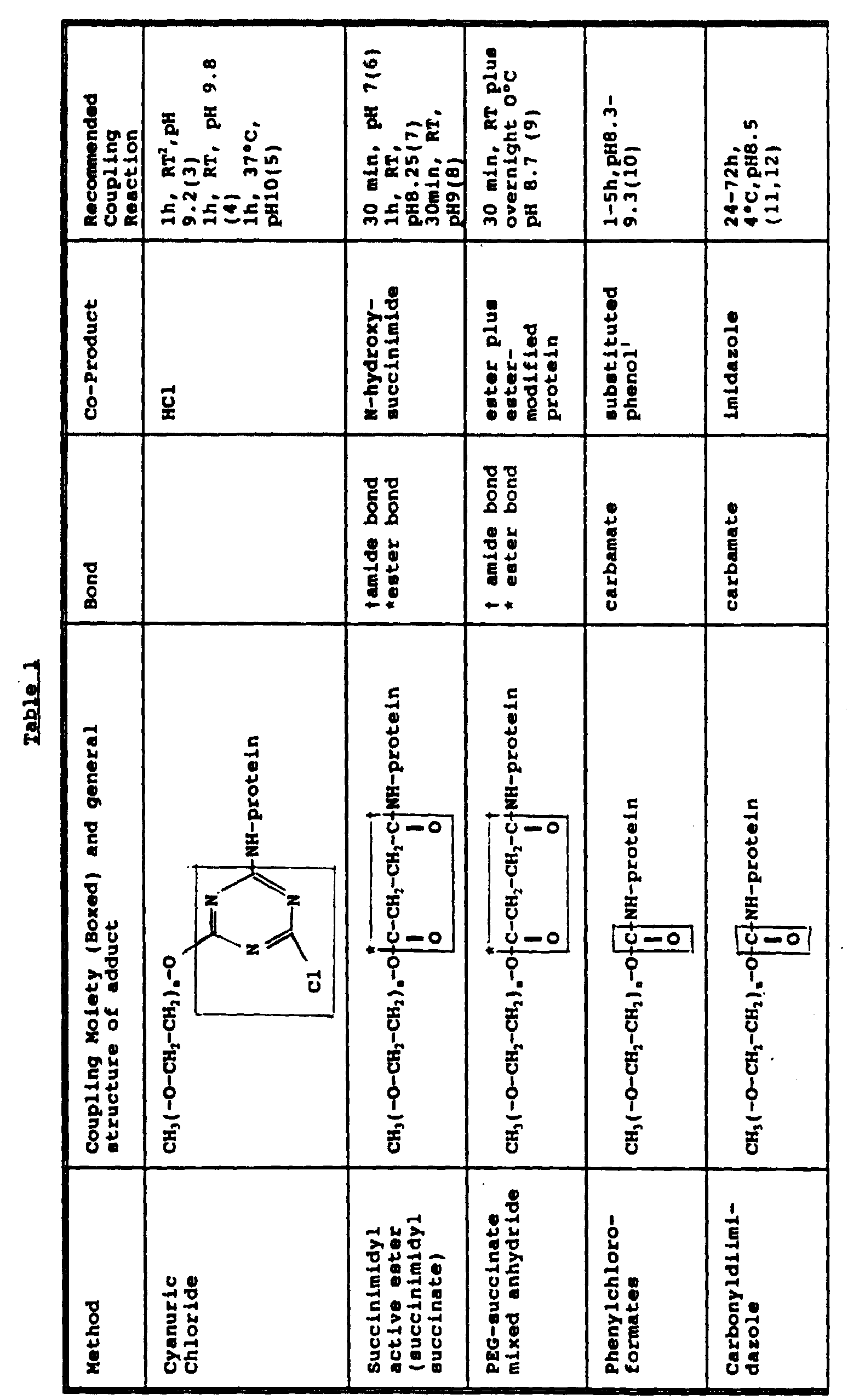


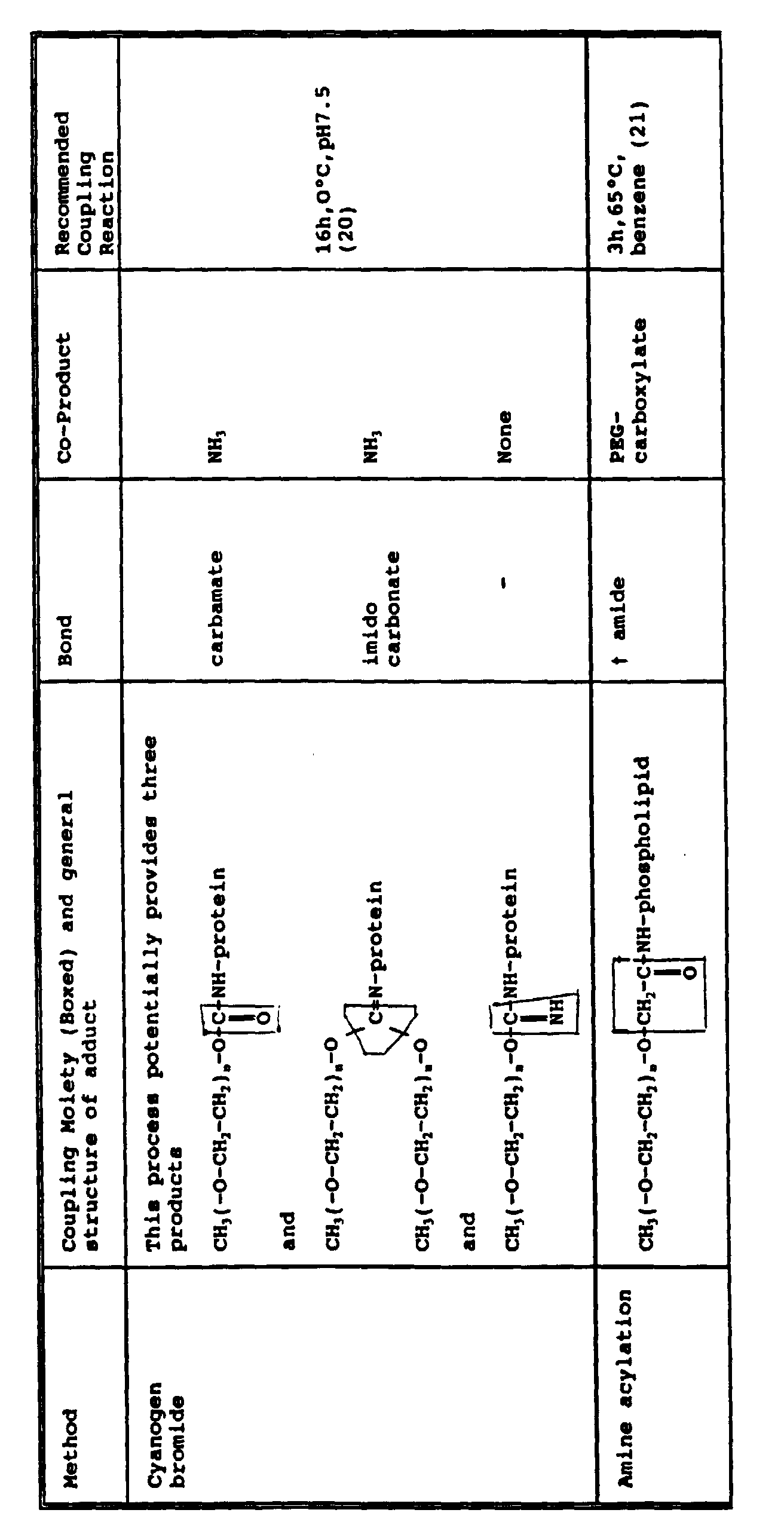


- Methods previously disclosed suffer from one or more of the following defects:
- 1. Substantial loss of biological activity (e.g. 20-95% loss of bio-activity) is frequently seen with the cyanuric chloride and carbonyldiimidazole methods and occasionally with phenylchloroformate and succinimidyl active ester methods.
- 2. The coupling of PEG (or other polymers) to
proteins (or other target molecules) is, with few exceptions,
in a manner which leaves part of the activating
moiety, the coupling moiety, between the polymer and the
target molecule. Of the above methods, only the organic
sulphonyl halide methods and a PEG-acetaldehyde method (one
of the PEG aldehyde methods [Harris (1989), Harris (1991)])
couple PEG directly without coupling moieties (see Table
1). With the exception of some PEG acetaldehyde methods
where the coupling moiety is ethylene oxide (and thus
indistinguishable from PEG itself) and the direct coupling
methods above, all other coupling methods incorporate a
coupling moiety distinct from the polymer and the target
and are regarded herein as "indirect" coupling methods.
The incorporation of a coupling moiety generates
further problems depending on the nature of the coupling
moiety, thus
- (i) some coupling moieties provide reactive groups capable of linking further molecules to the polymer-target construct via the coupling moiety (e.g. the triazine ring of the cyanuric chloride method, Leonard, M. et al., Tetrahedron, 40: 1585 (1984));
- (ii) some coupling moieties provide an immunogenic/antigenic group (e.g. the triazine ring of the cyanuric chloride method);
- (iii) some coupling moieties are potentially toxic or are themselves of unknown toxicity but derived from a compound known to be toxic (e.g. the triazine ring of the cyanuric chloride method and reagents in the phenylchloroformate method); and
- (iv) some coupling moieties provide targets for enzymatic cleavage (see below).
- 3. Coupling in some instances is via an unstable
bond liable to be cleaved by enzymes available in serum,
plasma, cells or other biological materials or by
procedures applied to the polymer-target product. This has
two possible deleterious consequences,
- (i) the polymer-target construct is degraded enzymatically or by the conditions required for subsequent reaction steps; the former occurs with methods generating amide and/or ester bonds (see Table 1); and
- (ii) removal of the polymer alters the target molecule; this occurs with some succinimidyl active ester and mixed anhydride methods, and either or both of these can occur.
- 4. Many methods recommend long coupling times and/or unphysiological pH, thus rendering some target molecules less active or inactive (cf. the carbonyl-diimidazole, cyanuric chloride, phenylchloroformate and some succinimidyl active ester methods (see Table 1)).
- 5. Many methods use activated polymer species and/or produce co-products which are toxic in a wide range of bioassays and which are potentially toxic in vivo if not separated from the product (e.g phenylchloroformate, cyanuric chloride methods).
- 6. Many methods produce products highly contaminated with either activated or inactivated polymer, causing problems in analytical methods like FPLC and toxicity in some bioassay systems (cf. the organic sulphonyl halide [Delgado (1990)] and phenylchloroformate [Veronese (1985)] methods).
- 7. Some methods are unsuitable for use in aqueous solution, thus limiting the target molecules to those which will tolerate non-aqueous conditions (cf. the organic sulphonyl halide method using trifluoromethanesulphonyl chloride).
- 8. Some of the activated polymer constructs are unstable, for instance being subject to hydrolysis during either the activation or coupling reactions (cf. the phenylchloroformate method [Veronese (1985)]). The PEG-acetaldehyde is sensitive to decomposition under basic conditions and can give irreproducible results [Harris et al. (1991)].
-
- The present inventors have previously described PEGylation by an organic sulphonyl halide method using 2,2,2-trifluoroethanesulphonylmonomethoxy PEG (TMPEG) as follows:
- 1. WO 90/04606 discloses a method for fractionation of PEG-proteins formed by the TMPEG method (discussed below) and an individual adduct, PEG-gm-CSF. The fractionation method is unrelated to the present invention. The PEG-protein products of the processes disclosed in this application, and specifically disclosed materials such as the PEG-gm-CSF adduct, are excluded from the present invention.
- 2. PCT WO 90/04650 discloses a method to separate DNA/protein complexes using PEG adducts formed by the TMPEG in which PEG acts as an affinity ligand. These complexes are also excluded from the present invention.
- 3. PCT WO 90/04384 discloses the TMPEG method for attaching PEG to liposomes. Such PEGylated liposomes are excluded from the present invention. It should be noted that the objective of coupling PEG to lipsomes in this patent was to improve half life and liposome stability.
-
- The TMPEG method mentioned above, for instance in WO-A-90/04606, comprises activation of monomethoxy PEG (MPEG) with 2,2,2-trifluoroethanesulphonyl chloride (tresyl chloride) to produce tresyl MPEG (TMPEG) which is subsequently reacted with the target protein molecule to produce monomethoxy products. The same technique is described in WO 90/04650 for coupling monomethoxy PEG moieties to DNA/protein complexes and in WO/04384 for coupling monomethoxy PEG moieties to liposomes. Further investigation of the TMPEG method has revealed that the reactivity of the activated polymer, TMPEG, is severely impaired necessitating the use of uneconomically large ratios of TMPEG to the target molecules and has exposed the rather poor yield of the final products and the low purity thereof, necessitating extensive purification and thereby further reducing the overall yield.
- The present inventors have addressed these difficulties in further research and have identified a number of factors which, in combination, contribute to the poor performance of the TMPEG process. This has allowed development of an improved technique for producing PEG adducts. The technique has been extended to include additional technical developments permitting more facile formation of complex adducts of PEG and other polymers and the formulation of adducts of a wider range of target molecules.
- The present invention relates to an improved process for producing polymer:target molecule adducts which are directly covalently linked without any intervening coupling moiety residue from the activating group on the polymer and in which the link between polymer and target moieties is non-immunogenic, non-antigenic, non-toxic and non-biodegradable, this objective being achieved by careful control of the properties of certain of the reagents and the reaction conditions. The coupling step may be performed in aqueous media and occurs rapidly thus minimising damage to fragile target species.
- Accordingly the invention provides a process for producing an adduct of a polyethylene glycol (PEG) polymer and a target material which process comprises the steps of
- a) reacting tresyl-chloride with a polymer of formula (II)
- the PEG has a valency c+g,
- c is zero or a positive number and
- g is a postive number so as to form
- a sulphonate ester-activated polymer of formula (III)
- C is a capping group
- c and g are as defined above
- (b) reacting the activated polymer of formula (III) with the target material and
- (c) recovering the adduct of the polymer and the target
material,
in which process: - (i) the polymer of formula (II) is dried as obtainable by distillation of any water-benzene azeotrope and then the benzene from a benzene solution of the polymer and said dried polymer of formula (II) is immediately dissolved in an organic solvent which is inert to the reagents and to the product of formula (III) and is anhydrous as obtainable using molecular sieves of 0.3 nm;
- (ii) the polymer solution formed in step (i) is reacted with the tresyl chloride in the presence of a base in a reaction vessel from which water is excluded, the polymer of formula III is obtained by removing the organic solvent and dissolving the resultant solid in methanol/hydrochloric acid (1000:0.3), recovering the polymer of formula III as free of base as obtainable by precipitating overnight, recovering the resultant precipitate and supernatant by centrifugation, repeating the dissolving-precipitating-centrifugation steps until no base is detectable in the supernatant;
- (iii) the sulphonate ester-activated polymer of formula (III) so produced is recovered dry as obtainable by liquid nitrogen freezing and lyophilisation under reduced pressure;
- (iv) the product of step (iii) is then used directly in step (b) or stored as to avoid hydrolysis prior to use in step (b); and
- (v) the reaction in step (b) of the sulphonate ester-activated polymer with the target material is conducted in a non-denaturing medium at non-denaturing temperature with respect to the target material.
-
- As used hereinafter reference to the "polymer" is directed towards the PEG.
- In further variants of the process of the invention, which can be conducted in conjunction with any of the foregoing variants, the proportion of the tresyl groups on the sulphonate ester-activated polymer which react with the (initial) target material is controlled such that in at least a proportion of the molecules of polymer:target adduct produced there remain unreacted activating tresyl groups Such unreacted reactive groups may then be reacted with one or more different further target materials so as to form materials polymer:[target]n wherein n is 2 or more and the initial and further target entities are different; or they are reacted with more of the initial target material so as to form materials polymer:[target]n wherein the target entities are all the same; or they are reacted with further unreacted groups in the initial target entity of the polymer:target adduct (for instance under conditions which hinder intermolecular reactions, such as high dilution) such that the polymer moieties are bonded at two or more positions to the target entity.
- It will be appreciated that, since the polymer and/or the target materials may be multivalent, it is possible by the process of the invention to produce a variety of polymer:target structures. By way of example, a univalent polymer and univalent target produce 1:1 adducts; a bivalent target and a univalent polymer may form adducts wherein the target entities bear two polymer moieties whereas a bivalent polymer and a univalent target may produce species where two target entities are linked to a single polymer moiety; use of higher-valent polymers can lead to the formation of clusters of target entities bound to a single polymer moiety whereas higher-valent targets may become encrusted with a plurality of polymer moieties.
- In general the target moieties are likely to have more than one reactive group which will react with the activated polymer and the possibility of forming complex structures must always be considered; when it is desired to form simple structures such as 1:1 adducts of polymer and target, or to use bivalent polymers to form target:polymer:target adducts, it will be necessary to use predetermined ratios of activated polymer and target material, predetermined concentrations thereof and to conduct the reaction under predetermined conditions (such as duration, temperature, pH etc.) so as to form a proportion of the described product and then to separate the described product from the other reaction products.
- The necessary reaction conditions, proportions and concentrations of the reagents can be obtained by relatively simple trial-and-error experiments with appropriate scaling-up as necessary. It will be appreciated that molar proportions and the concentrations of individual reagents may need to be adjusted on scaling up compared with the optimal molar proportions and concentrations identified at the laboratory bench scale for production of a particular product; this may also require relatively simple trial-and-error experimentation. Purification and separation of the products is similarly achieved by conventional techniques well known to those skilled in the art.
- The present invention therefore provides the following particular embodiments of the process:
- 1. A process as described above comprising, in step (b), reacting, in predetermined molar ratio and at predetermined concentrations, sulphonate ester-activated polymer having two tresyl groups with a first target material, so as to produce a sulphonate ester-activated 1:1 adduct of polymer and target material, then reacting the 1:1 adduct with a second target material so as to produce a target1:polymer:target2 adduct, wherein the first and second target materials may be the same or different, and then recovering the adduct in accordance with step (c).
- 2. A process as described above comprising, in step (b), reacting, in predetermined molar ratio and at predetermined concentrations, sulphonate ester-activated polymer having only one tresyl group with a target material having more than one reactive group so as to form an adduct of the polymer and target having a preselected number of polymer molecules per molecule of target or, especially for macromolecular targets having a large number of reactive groups, so as to form an adduct in which a preselected proportion of the reactive groups have been reacted with and linked to polymer molecules, and then recovering the adduct in accordance with step (c). The preselected number may be, for instance from 1 to 10, preferably from 1 to 5, for example 1, 2, 3 or 4. The preselected proportion may be, for instance from 1 to 100 %, preferably from 5 to 95 %, for example, 10, 20, 30, 40, 50, 60, 70, 80, or 90%.
- 3. A process as described above comprising, in step (b), reacting, in predetermined molar ratio and at predetermined concentrations, sulphonate ester-activated polymer having two or more activating tresyl groups with a target material having two or more reactive groups so as to produce a sulphonate ester-activated 1:1 adduct of polymer and target then changing the reaction conditions to hinder intermolecular reactions whilst permitting intramolecular reactions between the terminal carbon atom of the polymer and reactive groups on the target so as to form adducts of polymer and target having two or more covalent bonds between the polymer and target moieties, and then recovering the adduct in accordance with step (c).
-
- These process variants may each be used in conjunction with any of the process variants described earlier relating to liquid phase and solid:liquid phase interface reactions.
- The reagents used in the process of the invention will now be described:
- Tresyl chloride used in step (a) is the compound:
- 2,2,2-trifluoroethanesulphonyl chloride
-
- The PEG polymers of formula (II) used in the present invention are all based on known and readily available polymers which generally already contain at least one group reactive with the chloride group of the tresyl chloride.
- As polymers are almost inevitably mixtures, the value of g will be an average for the material as a whole but is preferably nearly or, more preferably, exactly integral, preferably with a high degree of homogeneity. For polymers which have two or more reactive hydroxyl groups it may be necessary or desirable to prevent reaction at a proportion of such groups by blocking them with a capping group C. The number of capping groups will also be an average for the material as a whole and is preferably nearly or, more preferably, exactly integral, or is zero when no capping groups are required. The PEG polymers, and capping groups C will be further described below.
- The PEG element of formula (II) is polyethylene glycol of varying claim length as discussed below
- Typically the polymer will be water soluble. The polymer is preferably of very low toxicity in vivo and in vitro, since many applications involve administration to man or animals and/or exposure to cells in cell culture systems. The polymer length is not restricted in this invention, since it will depend on the principal use of the product (e.g. short lengths may be best for coupling two proteins together and longer polymers for improving plasma half life). With each application optimum polymer length must be selected either empirically or by reference to the desired application. The polymer's own inherent hydrophobicity is also important in some settings and will have to be evaluated on a case-by-case basis.
- The reactive hydroxyl groups (OH), are terminal hydroxyl groups. Depending upon the selected polymer such groups may already be available for reaction or it may be necessary to introduce such groups by conventional techniques in a preliminary step. Generally the hydroxyl groups are bonded to carbon atoms of the polymer. The hydroxyl groups must be capable of reacting with the chloride group of the tresyl chloride. The hydroxyl groups are such that they ultimately permit formation of the desired non-immunogenic, non-antigenic, non-toxic, non-biodegradable direct covalent link between the polymer and target. Such hydroxyls react with tresyl chloride to form activating sulphonate ester moities.
- The use of capping groups C is an important feature of the reaction since this embodiment of the invention has special advantages discussed further below. The function of the capping groups C is to protect one or more reactive hydroxy groups of the polymer molecule from nucleophilic attack while leaving the activated polymer product susceptible to nucleophilic attack only at the carbon or equivalent atom adjacent to the tresyl groups. C therefore must lack the properties of tresyl and should preferably be an inert group with respect to reactivity with other molecules and should be of low toxicity. Suitable groups C are well known to those skilled in the art as are techniques for introducing such groups. A preferred group C is methyl.
- Production of the polymers for use in the process of the invention may be achieved by conventional techniques although most materials will be obtained commercially, possibly then being modified to introduce the desired hydroxy reactive groups and/or capping groups C as mentioned above.
- The preferred polymer for use in accordance with the present invention is a PEG polymer HO-(CH2CH20)x-H where x is large enough for the molecular weight to be in 150(x=3), 194(x=4), 238(x=5), 282(x=6) or above, for instance about 500, 1000, 2000, 3000, 4000, 5000, 6000 or 10000 which has two reactive hydroxyl groups. The size of the polymer actually used will be selected according to the desired properties of the end product.
- Another preferred polymer is MPEG (i.e. the polymer MeO-(CH2CH20)x-H which has one capping group C, i.e. the methyl group and one reactive group G, i.e. the hydroxyl group) where x is 3, 4, 5 or 6 or is large enough to provide molecular weights of, for instance, about 500, 1000, 2000, 3000, 4000, 5000, 6000 or 10000. Branched PEGs can also be used.
- Since conventional polymerisation techniques generally produce materials which are mixtures, in certain cases some purification may be required before the polymer is used in the process of the invention, for example, some preparations of MPEG are significantly contaminated with PEG. This would lead to the production of biactivated PEG and crosslinking on subsequent use and needs to be avoided for many applications. Such contaminated material can be identified on the basis of its size distribution (polymerisation occurs at both ends of the molecule for PEG hence the contaminant has circa twice the molecular weight). Size fractionation should therefore be used to remove this PEG from MPEG preparations prior to activation: gel permeation chromatography and other appropriate methods may be used. For example, the divalent PEG can be separated from the bulk MPEG using vesicle chromatography [Selisko et al (1993) J. Chromatogr. 641, 71-79].
- Suitable target materials to which polymer can be attached in accordance with the present invention are all materials having biological activity which are useful in, for instance diagnosis or therapy and which are all well-known to those skilled in the art. They all contain at least one reactive group (hereinafter referred to as groups "N") containing an atom which is capable of mounting a nucleophilic attack on the carbon or equivalent atom of the polymer adjacent to the group AM. Examples of the reactive group include primary and secondary amino groups, thiol groups and aromatic hydroxy groups.
- More specifically, potential targets include proteins, peptides, amino acids and their derivatives such as: antibodies and fragments thereof; cytokines and derivatives or fragments thereof, for example, the interleukins (IL) and especially the IL-1, IL-2, IL-3, IL-4, IL-5, IL-6, IL-7, IL-8, IL-9, IL-10 and IL-11 subtypes thereof; colony stimulating factors, for example granulocyte-macrophage colony stimulating factor, granulocyte-colony stimulating factor (alpha and beta forms) and macrophage-colony stimulating factor (also known as CSF-1); haemopoietins, for example erythropoietin, haemopoietin-alpha and kit-ligand (also known as stem cell factor or Steel factor); interferons (IFNS), for example IFNalpha, IFNbeta and IFNgamma; growth factors and bifunctional growth modulators, for example epidermal growth factor, platelet derived growth factor, transforming growth factor (alpha and beta forms), amphiregulin, somatomedin-C, bone growth factor, fibroblast growth factors, insulin-like growth factors, heparin binding growth factors and tumour growth factors; differentiation factors and the like, for example macrophage differentiating factor, differentiation inducing factor (DIF) and leukaemia inhibitory factor; activating factors, for example platelet activating factor and macrophage activation factor; coagulation factors such as fibrinolytic/anticoagulant agents including heparin and proteases and their pro-factors, for example clotting factors VII, VIII, IX, X, XI and XII, antithrombin III, protein C, protein S, streptokinase, urokinase, prourokinase, tissue plasminogen activator, fibrinogen and hirudin; peptide hormones, for example insulin and calcitonin; enzymes such as superoxide dismutase, glucocerebrosidase, asparaginase and adenosine deaminase; vaccines, for example hepatitis-B vaccine, malaria vaccine, melanoma vaccine and HIV-1 vaccine; transcription factors and transcriptional modulators; carbohydrates, glycosoaminoglycans, glycoproteins and polysaccharides; lipids, for example phosphatidyl-ethanolamine, phosphatidylserine and derivatives thereof; sphingosine; steroids such as cholesterol and derivatives thereof; nucleotides, nucleosides, heterocyclic bases, DNA, RNA, synthetic and non-synthetic oligonucleotides including those with nuclease resistant backbones; vitamins; antibiotics; bacteristatic and bactericidal agents; antifungal, anthelminthic and other agents effective against infective agents including unicellular pathogens; small effector molecules such as noradrenalin, alpha adrenergic receptor ligands, dopamine receptor ligands, histamine receptor ligands, GABA/benzodiazepine receptor ligands, serotonin receptor ligands, leukotrienes and triiodothyronine; cytotoxic agents such as doxorubicin, methotrexate and derivatives thereof.
- The target molecules may also be part of larger multi-molecular structures. These include cells or parts thereof, for instance erythrocytes, erythrocyte "ghosts" and leukocytes, liposomes such as multilamellar vesicles and unilamellar vesicles, micelles and micelle-like structures, and aggregates, microemulsions, coacervates, emulsions, suspensions of the foregoing.
- It will be appreciated that when the target molecules are part of such structures there will generally be many target molecules in each structure; treatment according to the invention will therefore produce a structure bearing many polymer moieties. Where the polymers are bi- or multivalent, reaction with a multimolecular target may result in intermolecular cross-linking by the polymer between molecules of the same target structure and/or between molecules of different target structures as well as intramolecular bonding of the polymer to more than one position on the same molecule of a target structure.
- It is evident from the inventors' investigation that much of the loss of biological activity frequently observed with prior polymer coupling methods is due to inappropriate coupling reactions (i.e. reactions taking place at sites which disable the target's biological activity), coupling conditions and/or contaminating toxic material reducing responses in bioassays. The present process provides a means of generating adducts of polymer and target with highly conserved biological activity for the majority of molecules, or even enhanced biological activity. In the event of unusually substantial loss of biological activity, a search must be made using fractionated material with different degrees of substitution and appropriate mapping (e.g. peptide mapping) to identify the group or groups N the modification of which by polymer is responsible for lost activity. The situation can then be remedied either by modifying the group N to abrogate coupling of polymer at that site or by shielding N with an appropriate non-covalent bond (examples include hydrogen bonding of base pairs for DNA and protein/protein binding like receptor ligand interactions). Two alternative strategies are available depending on the nature of the critical N group, in particular whether there are significant differences in the susceptibility of the group compared to the other such groups (either being more or less susceptible) to coupling to the polymer. If the group N is less susceptible the coupling conditions (usually the coupling ratio) can be altered so that the critical group N is rarely modified. If it is more susceptible, a two step procedure where short polymer molecules are first linked to more accessible (susceptible) sites (i.e. including the group(s) N) then long polymer molecules are linked to the remaining sites may prove acceptable, the outcome depending on the nature of the problem at the N site with respect to biological activity.
- Targets lacking a reactive group may be modified so as to create one or more reactive groups; this is within the ability of those skilled in the art and can be achieved by well-known techniques.
- Some target structures (e.g. RNA and single stranded DNA) pose special problems because they provide too many "N" groups to which the polymer would attach in a standard reaction. There the groups N may be temporarily protected by involvement in an appropriate conformation precluding the nucleophilic attack, as for example in the hydrogen bonding associated with base pairing of DNA (see below).
- An embodiment of the present process involves site-specific modification of DNA, RNA and synthetic oligonucleotide targets (or of any molecule containing an amino or other reactive group which can participate in interactions such as hydrogen bonding with another molecule or compound) by precluding the nucleophilic attack on the activated polymer species by reactive groups on the target. The bases adenine (A), cytosine (C) and guanine (G) [but not uracil (U) or thymine (T)] provide suitable targets in DNA, RNA and synthetic oligonucleotides for modification with polymer moieties according to the invention and thus these are special targets with the problem that there are too many available reactive groups to which the polymer can be attached. As shown below, single stranded DNA is rapidly and very heavily modified by activated PEG (TMPEG).
- By using various restriction fragment DNA cleavage sites as a model system, the present inventors have shown that selected bases A, C or G can be modified by the expedient of leaving short stretches (e.g. 2-4 bases) single stranded. Adenine bases appear to be the most susceptible to such modification. Blunt ended double stranded DNA is not readily coupled under the conditions described, indicating that hydrogen bonding between base pairs is sufficient to preclude interaction of the amino groups of A, C and G bases with the activated polymers.
- Site-specific DNA modification by polymer can be achieved by the expedient of including one or more A, C or G bases in a short single stranded section of DNA by appropriate restriction enzyme digestion or by hybridising oligonucleotides of dissimilar lengths with the DNA to protect bases which are not to be modified or by exploiting the natural strand asymmetry of polymerase chain reaction products which have a one base-pair overhang, or by exploiting localised regions of single strandedness achieved by natural or artificial localised melting of the double helix.
- The process of the present invention relies upon conducting steps (a) and (b) in accordance with certain constraints as defined above. In particular step (a) must be conducted using steps (i) to (iii) as described above. Thus, dryness of the polymer may be determined by benzene distillation as described below. If the polymer is not sufficiently dry, interfering side reactions occur making it difficult to obtain economical amounts of the final adduct. Likewise, wet solvents and ingress of water during the reaction will also cause interfering side reactions. Suitably dry solvents are obtained using molecular sieves (0.3nm) as described below. Exclusion of water from the reaction vessel can be achieved by conventional techniques.
- The principal exploited here is that the water-benzene azeotrope has a boiling point of 65°C and that after water has been removed from a sample, the distilling temperature rises to that of pure benzene (i.e 79 to 80°C). In addition, the water-benzene azeotrope is cloudy and benzene is clear so that the change from cloudy to clear distillate confirms that drying is complete. If a suitably dry sample is heated in benzene the distillation temperature will be that of pure benzene and the distillate will be clear from the first.
- Solvents may be dried by any conventional method provided that they are dried to the extent obtainable by use of 0.3 nm molecular sieves. Thus, for instance, when 0.3 nm molecular sieves are used an amount of molecular sieve is added to and left in contact with the solvent for several hours (preferably about 10 hours or more) and at about room temperature (
ca 20°C), the amount of molecular sieves used suitably represents a twenty fold excess over the recommended amount to adsorb the anticipated water content in the solvent, according to the manufacturer's instructions, for instance about 100g of molecular sieve per litre of substantially dry solvent. - It is also a requirement that the solvent should be inert to the reagents and the activated polymer. Suitable inert solvents include halogenated alkanes such as dichloromethane and other organic solvents with low hydrophilicity and low hygroscopicity; such solvents are well known to those skilled in the art. Halogenated alkanes, especially dichloromethane, are preferred.
- The activated polymer is preferably used directly following its production in accordance with step (a) as this affords the minimum opportunity for degradation leading to formation of other reactive species which will interfere with subsequent reactions. If the product is to be stored prior to use, for instance when formed in bulk for use in smaller quantities at a later date, it must be stored so as to avoid hydrolysis, i.e. in the presence of a more hygroscopic desiccant. Sulphonyl halides are highly hygroscopic and will dry many common desiccants such as silica gel and thus become hydrolysed. The preferred desiccant for drying and storage of the activated polymer is phosphorus pentoxide.
- The reaction of the activated polymer with the target material in step (b) takes place in a non-denaturing medium; for many biological materials this will of necessity be an aqueous medium. There are also many target materials which are stable under non-aqueous conditions and for these it is quite acceptable to conduct step (b) in organic solvents which are inert to the reagents. Ultimately the choice of reaction medium will be dependant on the stability of the target material and final adduct in that medium. Selection of pH, salt concentration, protein concentration and other requirements for stability will be determined on a case-by-case basis. Those skilled in the art will have no difficulty with this. The same applies in relation to determination of non-denaturing temperatures.
- When the process of the invention involves the use of a solid support coupled to the activated polymer, the reactions involved in coupling the activating moiety to the solid support will also be conducted under dry conditions, i.e. dry reagents as determined by benzene distillation and dry solvents as determined using molecular sieves of 0.3 nm, will be employed whenever sulphonyl halide groups are present.
- It is preferred that the reaction of step (a) is conducted in the presence of a base such as a tertiary amine, preferred bases include those which are easily removed by washing, such as pyridine, and volatile bases which may be removed by evaporation. At present the preferred base is pyridine. However certain bases, especially pyridine, may react deleteriously with The target material and these should be removed prior to step (b). This may be achieved by conventional means.
- It is preferred That the reagents for step (a) are mixed at reduced temperature, preferably at 0°C for instance by chilling with ice and that The reaction mixture is then allowed to wan to ambient temperature, for instance about 20°C.
- These preferred features may be adopted in any combination but most preferably all of these preferred features are adopted.
- When the polymer of formula (II) has more than one hydroxy group and/or one or more capping groups C, it has been found that contamination with related products of formula (II')
- Whilst the reaction of step (b) will proceed in the presence of large amounts of such contaminants, it is preferred that the amount of all compounds of formula (II') present in the compound of formula (II) is less than 35%, for instance less than 25%, more preferably less than 20%, for instance, 15, 10 or 5% and yet more preferably below 1% by weight based on the total weight of the compound of formula (II) and all compounds of formula (II'). This may be achieved by purifying the starting materials used in forming the polymer, controlling the polymerisation and subsequent process steps required to form the compound of formula (II) and/or by purifying the compound of formula (II) before use in the process of the invention.
- In a preferred aspect of the invention the compound of formula (II) is MPEG in which PEG is a divalent residue -0-(CH2CH20)x- (for instance the residue of PEG 5000), c is 1 and C is methyl and g is 1. This material is produced by polymerisation from methoxyethanol and ethylene glycol and tends to contain a large proportion of material where polymerisation has initiated from ethylene glycol rather than the methoxyethanol such that chain extension occurs in both directions and a PEG product of approximately twice the molecular weight of the MPEG is present as a major contaminant; this may readily be removed by gel permeation chromatography at an appropriate molecular weight cut-off.
- Purity can be checked by nmr and chromatography. Contamination by materials where g' > g is particularly to be avoided when 1:1 target:polymer adducts are to be produced, since the presence of such contaminants will lead to the production of aggregated materials.
- When the reaction of target and activated polymer is to be performed at a solid:liquid interface, the activated polymer may, in one variant of the process, be linked to a solid support after reacting a compound of formula (I) having a suitable linking group with the polymer. The linking reaction may be effected as described above in connection with the production of compounds of formula (I) linked to a solid support. Thus, for instance, a tetrafluoro-4-amino-azobenzene-4'-sulphonyl derivative of the polymer is reacted with a solid support bearing aldehyde groups (for instance siliconised glass treated with glutaraldehyde) in the presence of a non-nucleophilic base, such as lithium isopropylamide, followed by borohydride reduction of the potentially labile double bond.
- It is particularly preferred that the process of the invention is conducted using tresyl chloride and MPEG, for
instance MPEG 5000, as the polymer of formula (II). For MPEG of molecular weight up to 5000 or 6000, purity can be checked by nmr but for higher molecular weight material the methyl signal is swamped and chromatographic techniques must be adopted. These are well known to those skilled in the art. - In this preferred aspect, the product of formula (III) is TMPEG. Ideally this is used immediately but, if not, storage of TMPEG is critical and activity is not well maintained unless it is properly stored. When desiccated over phosphorus pentoxide and stored at 4°C, activity is maintained for at least 1 year. Degradation of TMPEG (either during production or on storage) is detectable on the basis of a change in the FPLC profiles of exposed peptide targets (see Example 1). It produces less substitution of the target at a given molar ratio (a loss of resolution and right shift of the elution profile accompanies the former if FPLC loads are not corrected for the amount of PEG loaded). Substantial aging of TMPEG prepared as previously described is documented in Figure 8 in WO90/04606. Since degradation produces coproduct, degraded TMPEG preparations are also more acidic.
- PEG itself is known to oxidise on storage to a brown discoloured product. The TMPEG preparation process removes the antioxidants present in commercially supplied PEG. Oxidation has been observed in several stored TMPEG preparations and it is recommended that, if prolonged storage is anticipated, an appropriate antioxidant should be included. This new method for preparing and storing the TMPEG has significant advantages over previously described methods in terms of the activity, reproducibility between preparations and stability of individual preparations.
- In an especially preferred aspect the present invention provides a process comprising the steps of
- (a) reacting dry MPEG (as determined by benzene distillation) containing less than 10% by weight of PEG (as determined by nmr and/or chromatography) with tresyl chloride in dry dichloromethane (as determined using 0.3 nm molecular sieves) in the presence of pyridine in a reaction vessel from which water is excluded, so as to form TMPEG, recovering the TMPEG so formed and either storing it over phosphorus pentoxide or using it directly in step (b),
- (b) reacting the TMPEG so formed, optionally after storage, with a target material such as erythropoietin (EPO) in aqueous medium and about 20°C and
- (c) recovering the Target:MPEG adduct (eg EPO:MPEG) so formed.
-
- More preferably the molar ratio of tresyl chloride to MPEG is 2:1 or more, most preferably about 2.5:1.
- The process of the present invention may be supplemented by one or more separation and/or purification steps at any stage as necessary or desirable. Separation and purification may be achieved by appropriate techniques well known in the art selected having regard to the need to maintain the activity of the reagents and products and to avoid use of toxic or interfering materials. In some cases, for instance where the polymer is a polyalkylene glycol, aqueous biphasic polyalkylene glycol solutions may be used to effect separation and/or purification of the activated polymer and/or polymer:target adduct.
- The present invention further provides polymer:target adducts obtainable by the process of the invention other than the known polymer:target adducts having polymer and target moieties directly linked by stable, non biodegradable covalent bonds which are described in the references discussed above.
- The invention also extends to such products for use in therapeutic and diagnostic methods of treatment of the human or animal body and to the use of such products in the manufacture of medicaments for use in therapeutic and diagnostic methods of treatment of the human or animal body and to pharmaceutical compositions comprising products of the invention together with pharmaceutically acceptable diluents or carriers.
- Many of the prior methods of coupling polymers to targets are unsuitable for coupling more than one target molecule to each polymer molecule since most methods use polymers having only one group capable of reacting with the target. In contrast, the process of the present invention enables the production of constructs such as the following which form particular embodiments of the present invention:
- 1. Liposomes bearing linear polymeric linking groups bound to the surface of the liposome at one terminal of the polymer and bearing a receptor ligand, receptor molecule, antibody, antigen or other molecule of therapeutic or diagnostic interest at the other terminal.
- 2. Constructs where a plurality of identical target molecules are linked to a single polymer moiety; for instance a linear polymer having two reactive termini is linked to two target molecules to enhance the biological activity thereof or a branched polymer having three or more reactive termini or a polymer having reactive pendant groups is linked to three or more target molecules.
- 3. Constructs as in 2. above wherein the target molecules are different; such constructs may be intended to have synergistic effect when the target molecules interact with each other or with other substrates.
- 4. Constructs wherein the polymer moiety is linked to a target molecule at two or more positions either by reaction of both termini of a linear polymer with different sites on the target molecule or by reaction of pendant reactive groups, or the termini of a branched polymer, at two, three or more sites on the target molecule.
-
- The products of the present invention preferably comprise any one of the polymer materials set out above and any one or more of the target materials set out above. Particularly preferred products of the invention are adducts of a polyalkylene glycol, especially polyethylene glycol and polypropylene glycol with the former being most preferred, with any one or more of the target materials set out above, with erythropoietin (EPO) being particularly preferred.
- The production of adducts wherein two or more different target species are coupled to a multivalent polymer presents special difficulties which can be overcome by the process of the present invention. For this situation an appropriate procedure for producing a product comprising two different targets involves the following steps:
- 1. A first target, Target (A), is exposed to activated polymer (tresyl-PEG-tresyl) with the latter in gross excess such that essentially only 1:1 Target(A):PEG adducts are formed and 2:1 or higher Target(A):PEG adduct formation is minimised. This can be followed by FPLC or other appropriate methods to separate and, if necessary, purify the adduct, provided that this is sufficiently rapid to avoid hydrolysis of the remaining activating moieties. If the target has many derivatisable groups, it may be necessary to fine-tune the coupling ratio, reaction time and/or pH, so that 2:1 or lower Target(A):PEG adducts are not formed or, if formed are discarded. Alternatively a mixture of monovalent and multivalent activated polymer species may be used in a ratio selected such that it is statistically likely that only one of the polymer molecules attached to any target molecule will be the multivalent form (targets which are by chance only modified with the univalent form will be wasted).
- 2. Either:
- a) the Target(A):PEG adduct is first separated from the tresyl-PEG-tresyl then reacted with the second target, Target(B), preferably at equimolar ratio or, if this reacts too slowly, with the adduct in excess; or
- b) the reaction product of
step 1 is reacted with Target(B), preferably at a molar ratio of 1:2 with respect to the amount of activating moieties remaining in order to reduce the formation of Target(B):polymer:Target(B) constructs. This is much simpler than (a) but more wasteful in terms of Target(B) which is therefore selected as the cheaper of the targets. -
- After a sufficient reaction time (derived empirically), the excess tresyl is neutralised with a monovalent neutralising agent e.g. with glycine, and the products are purified to discriminate the combinatorial possibilities. This may be possible on the basis of molecular weight if target(A) and target(B) differ significantly in size or via differential labelling of the targets. Alternately, since the major contaminant will be Target(B):polymer:Target(B) at this stage, an affinity purification method, with affinity ligand to Target(A), should enrich for hybrids. Similar measures may be adopted to construct more complex adducts.
- A particular advantage of the present invention is that the process enables the coupling of polymer moieties to oligonucleotides and nucleic acids (DNA and RNA) at defined positions. EP-A-O 292 128 (Seger 1988) deals with "improved DNA probes" and uses PEG, amongst other molecules, to link DNA to reporter groups for hybridisation. However the PEG is linked to the 5'-phosphate of the DNA and there is no indication of a method which would link the PEG without leaving a coupling moiety. This ability to modify DNA, RNA and synthetic oligonucleotides with polymer will influence the solubility and alter biodistribution and has applications in both the in vitro and therapeutic or diagnostic (in vivo) use of nucleotides.
- Further improvements offered by the invention include the ability to maximise the biological activity retention and/or to increase the activity of the target molecule, minimise the toxicity of the product, minimise the reaction time at physiological pH, reduce contamination of the product and improve the stability of the activated polymer.
- The invention will be illustrated with reference to the accompanying figures of the drawings in which:
- Fig.1 shows the results of separations of
MPEG 5000 obtained commercially. - Fig.2 is a plot of age of TMPEG used and % of gm-CSF left unmodified by reaction with aged TMPEG produced according to the invention.
- Fig.3 is a plot of the relative activities of PEGylated gm-CSF prepared by the process of the invention and by a previously described process.
- Fig.4 plots the activity of EPO and PEG-EPO.
- Fig.5 is a gel showing DNA fragments variously treated with TMPEG, MPEG or buffer.
- Fig.6 shows log concentrations of qm-CSF and various PEG-gmCSF adducts in blood and tissue of mice.
- Fig.7 shows the results of fractionation of gm-CSF and PEG-gm-CSF before and after ageing.
- Fig.8 shows FPLC profiles for EPO PEGylated with various molar ratios of TMPEG:lysine.
- Fig.9 shows biological activity of unmodified and PEGylated EPO.
-
- The present invention will now be illustrated by the following Examples which are not intended to limit the scope of the invention in any way:
- MPEG-5000 (Union Carbide) was subjected to permeation gel chromatography on Superose 12 (Fig. 1a). The material has a clearly biphasic size distribution with an estimated 22.9% high molecular weight contaminant (9280Da) and a low molecular weight component (5460Da). The good agreement between proportions of the two peak areas and the NMR estimate of PEG versus MPEG in the same preparation suggest that all the PEG is accounted for by the high molecular weight species. To confirm this and to devise an appropriate purification procedure, vesicle chromatography [Ehwald (1991)] was used. Analytical and preparative scale preparations gave different efficiencies of separation. Analytical scale separation was performed using vesicular packing material P1(5) equilibrated in 0.05M NaH2PO4 buffer pH 5.5 (
column bed volume 22 ml). The MPEG preparation (Union Carbide Mw 5000), 0.5ml of a 20mg/ml solution in PBS was loaded onto the column. The column was eluted with PBS using a flow rate of 0.08 ml/min and 0.5 ml fractions were collected. The elution profile is shown in Fig.1b; circa 8% of the material was eluted in the excluded fraction (high molecular weight) and 92% in the permeable fraction (low molecular weight fraction). In preparative scale (using 6.5L bed volume and 15g/500ml MPEG in 0.01M NaH2PO4 pH 5.5 and an elution rate of 20.5 ml/min) the excluded fraction (PEG) was 11.2 % (Fig.1c). Rechromatography onSuperose 12 of the two pooled fractions (shaded and hatched areas of Fig.1c) taken from the preparative scale fractionation onSuperose 12 was used to determine the extent to which the two materials were separated (Fig. 1d, squares - permeable fraction, crosses - excluded fraction). NMR analysis of the permeable fraction gave an estimated ratio of PEG:MPEG of 11:89 mole:mole, which is in good agreement with the area under the curve estimate of the residual high molecular weight contaminant in the permeable fraction on the elution profile on Superose 12 (Fig.1d, squares). NMR analysis could not be performed on the excluded fraction because of its much higher molecular weight. Further rounds of vesicle chromatography, at analytical scale, gave a comparable reduction in the high molecular weight material (the permeable fraction yielded a smaller "excluded" peak on rechromatography, circa 4% in the high molecular weight excluded fraction, using a second round of vesicle chromatography, Fig. 1e). - Tresyl chloride was used when freshly prepared or after storage in airtight ampoules. MPEG-5000 (
Mr 5000, 18g, 3.5 mmol) was dried with benzene (B.P. 79-80°C) by distillation of the water-benzene azeotrope and then the benzene. The water-free MPEG was then immediately dissolved in dichloromethane (45 ml, ANALAR, previously dried over molecular sieve 3Å, 100 g per litre of solvent, overnight at room temperature). Activation of MPEG-5000 with tresyl chloride was carried out at a molar ratio of 2.5:1 (tresyl chloride to available hydroxyl groups in MPEG). The MPEG/dichloromethane mixture was then cooled on ice (to circa 3°C) and pyridine (1 ml, 12.4 mmol) followed by tresyl chloride (1 ml, 9 mmol), both precooled on ice were added dropwise with constant stirring using a magnetic stirrer. The reaction was allowed to continue (for 2 hr) at room temperature with constant stirring before the removal of dichloromethane by evaporation under reduced pressure. The solid obtained (TMPEG) was redissolved in methanol-hydrochloric acid mixture (1000:0.3 v/v) and allowed to precipitate overnight at reduced temperature (-20°C). The precipitate was recovered by centrifugation (at 1100 x g, for 10 minutes) at reduced temperature (0°C) and the supernatant was spectrophotometrically checked for pyridine content (λmax 255nm). This procedure was repeated until no pyridine could be detected, usually 12 to 15 washes. Finally, the pyridine-free precipitate was washed in methanol only, preferably at least twice, and then the methanol was removed by evaporation under reduced pressure and the TMPEG was finally dried by freezing in liquid nitrogen and lyophilising under reduced pressure. The hydroxyl content of the white solid as determined by 1H nmr obtained was undetectable (4.56ppm). Therefore, approximately 100 % of hydroxyl groups in the MPEG were transformed into tresyl esters. - The TMPEG so produced was desiccated over phosphorus pentoxide and stored at 4°C.
- The activity of TMPEG samples was monitored by exposure of the samples to gm-CSF at molar ratios of 305:1 (Example 1a and Comparative Example 1a) or 75:1 (Example 1b and Comparative Example 1b) in a standard coupling reaction and estimating the percent of the preparation remaining unmodified after the reaction as shown in Fig.2: the relative activities of TMPEG preparations obtained as described above (Examples 1a and b) and of TMPEG made by a prior art process (Comparative Examples 1a and b) is plotted against the storage period. TMPEG made by the process of the invention and used at 305:1 (squares), throughout the observation period, gave <10% residual unmodified gm-CSF. The equivalent result when using the same material at 75:1 (diamonds) was circa 20% unmodified material. With both preparations there was no evidence of a trend of worsening activity with storage. In contrast preparations made from MPEG as obtained from the manufacturer by a previously described method (WO90/04606, Example 1) (triangles; downwards triangles 305:1 and upwards triangles 75:1) showed: (1) lower mean activity (reflected in higher mean residual unmodified material); (2) a very broad scatter of reactivities; (3) 3 samples completely inactive at 75:1 and 2 inactive at 305:1 after only 5-12 weeks of storage. At 305:1 the process of the invention consistently produced 92-95% modification, irrespective of the age of the TMPEG and using a coupling ratio of 75:1, circa 80% of the gm-CSF preparation was modified.
- The process described above (Example 1) has been repeated on a number of occasions with similar results.
- The gm-CSF PEGylated using the process of Example 1 showed no significant loss of its growth stimulating activity as assessed by granulocyte-macrophage colony assay (Fig.3a) or by thymidine uptake (Fig. 3b). Dose response analyses are a relatively insensitive means for demonstrating subtle differences in bioactivity and are also difficult to analyse after pooling because of the high contribution to errors of the variation in the response level between experiments. A better approach is to perform a correlation analysis, plotting the response obtained with equivalent amounts of the modified and unmodified materials on an XY plot. Identical activity gives datum points randomly distributed about the line representing equal activity (the dashed lines). Reduced activity reveals itself as a curvilinear departure from the equal activity line which converges towards the line at the extremities (if sufficiently broad a dose response range is examined such that the plateau of maximum stimulation is reached). In contrast, the presence of inhibitory material, with or without loss of intrinsic activity, produces a departure, usually without convergence to the upper extremity. In the latter case (i.e. where there is no loss of intrinsic activity) failure to observe divergence at the lower extremity indicates that the inhibitor is masking activity only at relatively high inhibitor levels; divergence throughout the plot indicates either an inhibitor with powerful effect at low dilution or combined inhibition and loss of activity.
- Two assays for the growth stimulating activity of GM-CSF prepared by the methods of Example 1 in Fig.3) and Comparative Example 1 (□ in Fig.3) show that the process of the invention gives better conservation of biological activity. Colony counts or 3H-thymidine uptake (normalised with respect to the maximum per experiment to avoid a contribution of between-experiment differences to the correlation) were plotted for comparable amounts of PEG-GM-CSF and GM-CSF over the dose range spanning the upper and lower asymptotes of the dose response curve (0.1 to 8 ng/ml for colony assays and 0.0006 to 1.0ng/ml for thymidine uptake assays). Datum points are means of colony counts in triplicate dishes for three independent experiments (Fig. 3a) or of two independent thymidine uptake experiments (Fig 3b). The results in the thymidine uptake demonstrate no significant loss of activity with the process of Example 1 and loss of activity without significant inhibitory material for the process of Comparative Example 1 (TMPEG in equivalent doses was not inhibitory in this assay). The results for colony stimulating activity again show no significant loss of activity with process of the invention but indicate an additional inhibitory activity for this assay when the old method was used possibly accompanied by loss of bioactivity.
- PEG-6000 (10.5 g, 1.75 mmol) was dissolved in benzene (30 ml) and dried as in Example 1 above. The dry PEG-6000 was then immediately dissolved in 25 ml of dichloromethane (dried as in Example 1), cooled on ice and pyridine (1 ml, 2.4 mmol) followed by tresyl chloride (1 ml, 9 mmol) were added dropwise. The mixture was left to react (two hours at room temperature) and the dichloromethane was evaporated as in Example 1. The solid was resuspended in methanol:hydrochloric acid and was treated as above.
- To test that this material was bivalent and could couple target(s) at both ends of the PEG chain, this TPEGT was used to aggregate GM-CSF. 125I-GM-CSF (1.4nmol/ml) was reacted with TPEGT (160mg/ml) for 2h at room temperature. The resulting aggregates were estimated by FPLC and contained 95% of the total GM-CSF. Thus the bivalent AM-polymer-AM construct is demonstrated to be functional.
- Example 2 was repeated using TMPEG prepared from a sample of MPEG containing 8% PEG as contaminant, and thus containing about 8% TPEGT. When used to aggregate GM-CSF, this material (160 mg/ml) produced an aggregate estimated by FPLC to contain only 20% of the total GM-CSF. This demonstrates that the higher proportion of conjugates seen in Example 2 was related to the additional TPEGT and not merely due to non-specific aggregation. It should be noted that using a prior art process, the present inventors have shown [Malik et al (1992) Experimental Hematology, 20, 1028, fig. 4] that both the non-specific aggregated gm-CSF in unPEGylated reactions and aggregates generated in PEGylation reactions (which include cross-linked products due to TPEGT) have an extremely high specific activity, as assessed by thymidine incorporation, with respect to monomeric gm-CSF). Thus it is anticipated that the bivalent 2-polymer construct generated in Examples 2 and 3 would have a higher specific activity than monomeric unmodified gm-CSF.
- To document the better conservation of biological activity, direct comparisons were made with three of the widely used current methods, using erythropoietin as the target peptide. It is an important prerequisite in experiments of this type to perform preliminary experiments (using at least two independent assays of bioactivity and some measure of the degree of modification) to select the optimum coupling ratio and duration of coupling reaction for maximum retention of biological activity. It is important to record the degree of modification since this may vary between the methods being analysed and only materials substituted to approximately the same extent should be compared for retention of activity.
- Serial dilutions of TMPEG produced as in Example 1 were mixed with the same amount of erythropoietin and the resultant PEG-erythropoietin adducts were assessed first by FPLC for the degree of modification and also in the thymidine uptake assay [Malik et al., (1992) Experimental Hematology, 20: 1028] for a preliminary estimate of activity. Based on the latter a smaller range of activities were analysed in colony assays using the methyl cellulose assay system of Ash et al., Blood, 58:309-316 (1981), Knusli, C. et al. (1992) Br. J. Haematol. 82(4): 654.
- Commercially available activated PEGs (Sigma Limited) were used to PEGylate recombinant human erythropoietin (Cilag Ltd.) by the cyanuric chloride (Comparative Example 2), succinimidyl succinate (Comparative Example 3) and phenylchloroformate (MPEG-p-nitrophenylcarbonate) methods (Comparative Example 4). TMPEG, prepared as described above, or the alternate activated PEGs, were incubated (for 2 h) with erythropoietin (100 µg/mli total protein, i.e. carrier plus erythropoietin) in coupling buffer (PBS) at room temperature in a rotary mixer, at an activated-PEG:lysine molar ratio of 75:1. Conditions were standardised so that differences in pH and duration of the coupling reaction could not account for differences in the residual bioactivity. Representative reactions at the same molar ratios were checked by FPLC and found to be ≥85% modified. Modified material was assayed in methylcellulose cultures of normal human bone marrow progenitor cells essentially by the method of Ash et al (1981) Blood, 58 309-316, but substituting recombinant human GM-CSF for leucocyte conditioned medium. Erythroid bursts were scored microscopically on encoded, encrypted dishes on day 14-16 of culture. The results for the optimised TMPEG-derived adducts and for products of the other coupling reactions having the same coupling ratio are shown in Fig. 4 as means of triplicate culture dishes except in Panel A where the results are means ± SEM for 3 independent experiments. Fig 4a shows the excellent conservation of biological activity achieved with EPO PEGylated with the TMPEG (filled circles) compared with unmodified EPO (open circles). Datum points are superimposed except at 4U/ml (33.6 ng/ml) erythropoietin. Similar effects observed in CFUgm assays were found to be due to a modest inhibitory effect of TMPEG in the assay system.
- Fig. 4b shows a complete loss of detectable activity when the cyanuric chloride method (filled circles) was used compared with PEG-EPO prepared according to Example 1 (open circles) and a high dose inhibition of endogenously stimulated erythroid colonies. This indicates either the presence of a profoundly inhibitory substance in the reaction mixture or loss of all intrinsic erythropoietic activity in conjunction with some inhibitory material. Lack of even a slight increment in colony formation at low doses and the shallow dose related inhibition of endogenously stimulated colonies at high concentrations favours the latter interpretation. The FPLC profile for this material also differed somewhat from that obtained with the other three activated PEG preparations in that there was a higher proportion of material eluting with the void volume, indicating the presence of more aggregates. This suggests that crosslinking of target molecules may be occurring (as has previously been observed for this agent [Leonard (1984)]).
- Fig. 4c shows a somewhat different picture for PEG-EPO prepared by the succinimidyl succinate method (filled circles), with detectable activity only at 4U/ml (33.6ng/ml) compared with PEG-EPO according to the invention (open circles). This type of shift in the dose-response curve is less likely to be due to inhibitor and probably represents over an order of magnitude loss in bioactivity. This is somewhat surprising because this method is claimed to have good conservation of biological activity [Katre (1987), Zalipsky (1992)]. However such claims have been made on the basis of short term assays. In the assay used here the erythropoietin needs to be available throughout the 14-16 day culture period. The cells in these cultures are also a rich source of esterases and the PEG-erythropoietin made by this method contains a potentially labile bond (see Table 1). In this and some related active ester methods, removal of the PEG leaves the molecule modified as follows:- Target-NH2 forms
- This process might well influence bioactivity adversely since there is a charge conversion from a lysine amino group to a carboxyl group at the previously PEGylated site.
- Fig. 4d shows PEG-erythropoietin made using monomethoxy PEG-p-nitrophenylcarbonate (filled circles) compared with unmodified (sham-treated) EPO (open circles). Here there are increments in colony number at low doses similar to that seen with the tresyl chloride activated PEG, but the high-dose inhibition of colony formation is much more evident, indicating the presence of inhibitory material.
- An attempt was made to make PEG-erythropoietin using the carbonyldiimidazole method under comparable conditions to those used above, but on this time scale and coupling ratio the degree of modification achieved was not significant.
- A solution (50µl) of amphotericin (Fungizone) in distilled water (20 mg/ml) was mixed with HEPES buffer (450µl, pH 9.0) containing TMPEG produced according to Example 1 (60 mg/ml). The mixture was then incubated at room temperature for 24 h. As a control, amphotericin was similarly treated but with MPEG substituted for TMPEG. To demonstrate the covalent linkage of the TMPEG to the amphotericin, the partition coefficient of amphotericin in both samples was measured as follows: 100µl samples were mixed with 1 ml of top and 1 ml of bottom phases of a biphasic system containing 5% dextran T-500, 5% PEG-6000, 0.15 M sodium chloride and 0.01 M sodium phosphate pH 6.8. After shaking for 1 min. the system was left to settle for 20 min. and then 500µl from the top and bottom phases were removed to quantify amphotericin (by measuring the absorbance at 330 nm). The % material in the top (PEG-rich) phase was: a) control 4.9 ± 0.2%; b) MPEG control 4.1 ± 0.4%; c) TMPEG (preparation 1) 92.8 ± 0.1%; d) TMPEG (preparation 2) 92.7 ± 0.2%.
- As an example of creation of an affinity ligand PEG-WGA (polyethyleneglycol modified wheat germ agglutinin) was constructed in exactly the same manner as used in Example 1 and used to bind rightside-out vesicles from human erythrocyte membranes thus altering their partition in a PEG-dextran aqueous two-phase system. Rightside-out vesicles exposed to phosphate buffered saline prior to partitioning showed the following distribution: 17.6 ± 1.2% to the top phase, 48.7 ± 9.0% to the interface and 33.6 ± 8.6% to the bottom phase (mean ± SEM, n=3). Rightside-out vesicles exposed to the PEG-WGA ligand prior to partioning showed the following distribution: 30.1 ± 1.2% to the top phase, 32.7 ± 1.4% to the interface and 7.2 ± 0.6% to the bottom phase. This change in partitioning can be exploited to remove rightside-out vesicles from a mixture with inside-out vesicles thus obtaining a pure preparation of inside-out vesicles from human erythrocyte membranes.
- Aliquots of human erythrocytes (50µl containing 0.95 x 10⁷ cells) were added to one of the following reagents (500µl):
- a) sodium phosphate buffer (0.05M, pH 7.5) containing sodium chloride (0.125M) (PBS).
- b) TMPEG freshly prepared as in Example 1 in PBS (36 mg/ml, equivalent to 1.9 ng/cell).
- c) TMPEG (36 mg/ml) inactivated with lysine (Sigma Ltd. 4mg/ml) at 2.5:1 molar lysine:TMPEG for 2h at room temperature.
-
- After 30 min incubation at 37°C cells were pelleted down and resuspended in PEG-rich top phase (1 ml) so that their PEGylation could be monitored in a PEG-dextran phase system. Cells incubated in PBS partitioned with 26.2 ± 11.8% (mean ± SD) cells in the top phase. With TMPEG exposure of cells this increased to 72.1 ± 10.7%, whereas with prior inactivation of TMPEG to prevent coupling to cells there was only 32.7 ± 9.3% in the top phase, indicating that covalent attachment of the PEG to the erythrocytes was responsible for the change in partitioning behaviour. The erythrocytes remained intact in the TMPEG-treated and control experiments indicating that the method does not disrupt the cell membrane.
- Liposomes were reacted with TMPEG prepared by the process of WO90/04384 (Comparative Example 6) and the process of Example 1 (Example 8). The success of the PEGylation was followed in a PEG-dextran phase system by quantitating the liposome content of the top (PEG-rich) and bottom (dextran-rich) phases and at the interface. Because the TMPEG prepared by the process of Example 1 was known to be more active, only half the molar ratio was used. Despite this, a much higher degree of substitution of the liposome was achieved. This greater reactivity has the advantage that the liposomal preparation does not have to be exposed to so much activated PEG (the level of the latter is limited by its effect on liposomal stability and/or aggregation). 100 nm diameter unilamellar vesicles of bovine spinal cord phosphatidylserine (PS) were prepared by extruding lipid dispersions of PS (10 mg/ml in HEPES buffer pH9), spiked with 3H-dipalmitoylphosphatidylcholine through 100 nm polycarbonate filters ten times using an extruder device (Lipex Biomembranes, Canada). Vesicles (300 µl) were incubated with TMPEG (39 mg, molar ratio TMPEG:PS at outer surface 4:1 or 19.5 mg, molar ratio. 2:1) in HEPES buffer (60 µl) for 18 hrs at room temperature. As a control MPEG was substituted for TMPEG. To demonstrate the covalent attachment of PEG to the outer surface of the vesicles the distribution of the vesicle in a two-phase system was measured as follows: samples (20 µl) were mixed with top phase (1 ml) and bottom phase (1 ml) of a biphasic system containing dextran T-500 (5%) and PEG 6000 (5%), sodium chloride (0.15M) and sodium phosphate buffer (0.01M) prepared at 25°C. After shaking for 1 min, triplicate samples (50 µl) were removed for total counts. After the phases had separated at 25°C for 20 min triplicate samples were taken from the top phase (50 µl) and the bottom phase (20 µl) for scintillation counting. Vesicle partitionings, calculated as the percentage of added vesicles that were present in the top(T) and bottom(B) phases and at the interface (100-T-B) were as shown in Table 2.
TMPEG sample TMPEG:PS Molar ratio Partitioning (%) (mean of triplicate partitions) Top Interface Bottom Old Method 4:1 6.3±0.6 25.3±4.0 68.4±3.7 Control MPEG 5.5±0.3 9.1±4.9 85.4±4.8 New Method 2:1 71.6±1.2 11.1±1.2 17.3±0.5 Control MPEG 4.9±0.2 1.6±1.6 104.3±7.3 - The increase in interface partitioning with associated decrease in bottom phase partitioning with the old method indicated some PEGylation. However with the activated PEG made by the new method, even at the lower molar ratio there is extensive partitioning to the top phase indicating the highest degree of PEGylation of the two samples.
- To increase the PEGylation with the rather unreactive old method sample, the molar ratio was increased to 20:1, using a final concentration of 35% w/w TMPEG. This caused the vesicles to aggregate. Controls with MPEG also showed aggregation. Addition of 75µl of the reaction mixture to 2.2 ml of N-tris-(hydroxymethyl)methyl-2-amino-ethanesulphonic acid (TES) buffet [Fisher et al (1991) Cell and Model Membrane Interactions p.47 Plenum Press, New York] pH 7.4 gave solutions with OD650 of 0.26 whereas untreated vesicles in control buffer had OD650 of 0.01, indicating that the aggregation observed with the TMPEG and MPEG was not completely reversible. It is well established that PEG solutions can produce fusion and/or permeability increases [Tilcock & Fisher (1982) Biochimica et Biophysica Acta, 688 645-652, Aldwinkle et al., (1992) ibid, 689: 548]
-
- (a) 1µg of the supercoiled plasmid pBR322 was
digested with 100 units of the restriction enzyme Rsa I for
two hours at 37°C, in low salt buffer consisting of 10mM
Tris HCl pH 7.5, 10mM MgCl2, 1 mM dithiothreitol (DTT).
This yields four blunt ended fragments per molecule of
pBR322. Protein was removed by phenol/chloroform
extraction. After ethanol precipitation the DNA was
resuspended in a small volume of tris-EDTA (TE) pH 7.6 and
the DNA was end labelled with [γ32P] dATP using a BCL kit
as per the manufacturer's instructions. Removal of the free
[32P] dATP was achieved using Sephadex G-50 columns. The DNA
was then split into 6 aliquots. Three of these aliquots
were made single stranded by boiling and then exposed to
either TMPEG or MPEG, at a concentration of 400mg/ml in
coupling buffer (consisting of 0.005M sodium phosphate
0.125M sodium chloride pH 7.5) or to coupling buffer only,
at a volume ratio of 150 µl:150µl), for 20 minutes. Three
other aliquots, which were allowed to remain double
stranded, were incubated with either TMPEG, MPEG or
coupling buffer only, under identical conditions. After
incubation, all the samples were again made single stranded
by boiling. The samples were examined in a 2% alkaline
agarose gel, (50mM NaOH, 1mM EDTA pH 8.0) using alkaline
loading buffer. This was a 6x stock consisting of 0.3M
NaOH, 6mM EDTA pH 8.0, 18
% Ficoll 400, and 0.15% bromocresol green. The samples were run overnight at 50v. The dried gel (Fig. 5) was analysed by autoradiography, the film was developed in an automated Fuji X-ray film developer. Lanes 1-6 from left to right are: 1-3 DNA exposed while double stranded; 4-6 DNA exposed while single stranded; 1&4 coupling buffer; 2&5 MPEG; 3&6 TMPEG. Only single stranded DNA exposed to TMPEG showed a mobility shift demonstrating coupling of PEG to the DNA. - (b) Eco RI digested pBR322 containing a single
cleavage site yielding one double stranded fragment with a
3' recessed 4bp cut and the following single stranded
overhangs:-
Of three aliquots, one was treated with a reaction mixture consisting of TMPEG (400 mg/ml) in coupling buffer (50 ml), DNA (circa 0.1 µg in 50 ul of tris EDTA). The coupling buffer (pH 7.5) was a solution of sodium chloride (0.125M) and sodium phosphate (0.05M). The reaction was conducted at room temperature for 20 min. A second aliquot was similarly teated with TMPEG (40 mg/ml) in coupling buffer and the third was treated with coupling buffer alone.

- (c) Bam HI digested pBR322 containing a single
cleavage site yielding one double stranded fragment with a
3' recessed 4bp cut and the following single stranded
overhangs:-
This material was divided into three aliquots which were treated with two concentrations of TMPEG and coupling buffer as in (b).

-
- To detect the extent of PEG-modification the staggered ended DNA was end-labelled with 32P and then partitioned in a PEG-phosphate phase system to determine the partition coefficient (K), results being shown in Table 3.
No PEG TMPEG 40mg/ml TMPEG 400mg/ml DNA digest EcoR1 50µg/ml ECoR1 50µg/ml ECoR1 50µg/ml PEG-phase (%) 41.7 58.4 96.5 PO4-phase (%) 58.3 41.5 3.5 log(K) -0.145 -0.148 1.44 DNA digest BamH1 50µg/ml BamH1 50µg/ml BamH1 50µg/ml PEG-phase (%) 41.7 51.0 69.4 PO4-phase (%) 58.3 49.0 30.6 log(K) -0.145 -0.017 0.356 - Up to saturation there is known to be a linear relationship between the number of PEG molecules attached per target molecule and log(K). The DNA cleaved with EcoRI (with two free amino groups supplied by two adenine bases) is more readily modified than the DNA cleaved with BamHI (with three free amino groups supplied by adenine, guanine and cytosine).
- BALB/c, male, 6-8 week-old mice, weighing approximately 20g, were pooled into groups of three per condition, with adlib access to food and water. PEG-modified GM-CSF samples were prepared as in Example 1, using the concentrations of GM-CSF and TM-PEG indicated in Table 4a. The reaction products were evaluated by FPLC and the proportions of individual species were estimated by fitting summated Gaussian curves to the FPLC profiles and estimating the area under the curve corresponding to each individual peak and expressing this as a % of the total area for the whole FPLC profile (Table 4b). The inventors have previously established that the individual peaks seen at low TMPEG concentrations (
peaks peak 3 and the peaks for more highly substituted GM-CSF (potentially PEG4-7-GM-CSF) have been pooled. The peak eluting with the void volume peak is well resolved from the PEG4-7-GM-CSF and presumably represents aggregates, the area of this peak was used to estimate the proportion of aggregated material (Table 4b). - The different PEGylated samples and unmodified GM-CSF (Hoechst), all containing <4% [125I]GM-CSF (Amersham, 1222 Ci/mmol) to serve as a tracer, were adminstrated at a dose of 0.0524µg in 100µl (3.45 x 10⁻¹² mole; equivalent to 2.5µg/kg body weight) by subcutaneous injection. The amount of TMPEG concomitantly administered is also indicated in Table 4a (MPEG has been shown not to influence t1/2, but does influence egress from the subcutaneous site). Up to eight 25µl tail vein blood samples were collected from each mouse using capillary tubes at various time points ranging between 10 minutes and 80 hours, to give a minimum of three samples per time point. Samples from the capillary tubes were washed immediately into 1ml of PBS containing 50 I.U. of heparin. Radioactivity was determined using a gamma counter (LKB 1270 Rackgamma) results being shown in Fig. 6a (open circles for untreated material, other symbols as indicated on the figure). Clearances for the materials of reactions A and B were clearly biphasic, presumably reflecting the large proportion of unmodified material remaining in these preparations (Table 4b). Half-lives were calculated using linear regression (log concentration versus time) for the slower clearing component if biphasic elimination was present (solid lines Figure 6a; dotted lines give the 95% confidence intervals). The t1/2 values ±SE are given in Table 5.
- With the exception of the product of reaction D, which is known to contain >50% of aggregates (the latter are known to clear slowly), t1/2 for the other reactions (A-C) are similar. Although there may be some increment in t1/2 between reactions A and B, surprisingly, there is no additional increment in t1/2 betwen reactions B and C. This was not anticipated in view of the fact that reaction C produced a higher proportion of PEG2-GM-CSF and adducts with higher PEGylation ratios. The difference in t1/2 between reactions A and B is also not marked and, with the proviso that dissection of early and late components introduces more error into the t1/2 estimates, it can be inferred that the addition of the first PEG molecule has the greatest impact on the clearance of GM-CSF. This is unexpected because the estimates for apparent molecular weight from FPLC were initially: GM-CSF 14.5kDa; PEG1-GM-CSF 40.5kDa; PEG2-GM-CSF 67.6 kDa; PEG3-GM-CSF 112.9 kDa and after 3 or 4 independant estimates the values were: GM-CSF 12.5 ± 1 kDa; PEG1-GM-CSF 41.5 ± 3.6 kDa; PEG2-GM-CSF 75.2 ± 10.5 kDa; PEG3-GM-CSF 138.5 ± 27.3 kDa. Thus, PEG1-GM-CSF should not exceed the renal molecular weight threshold for excretion and the major increment in the t1/2 would have been expected to be between PEG1- and PEG2-GM-CSF not between GM-CSF and PEG1-GM-CSF. This result is also surprising in that the increment in apparent molecular weight is unexpectedly large for the addition of the
first MPEG 5000 molecule (12.5 to 41.1 kDa). Other proteins (e.g. recombinant erythropoietin) have shown a surprisingly small increment in apparent molecular weight with the addition of oneMPEG 5000 molecule (eg circa 1.4 kDa increment). - In order to establish the contributions to extended t1/2 we examined the tissue distribution of material prepared in an identical manner to reaction C, using an identical dose. At each of the times indicated, one aminal was sacrificed and organs/tissue including kidney, spleen, liver, lung, heart and femur were recovered and radioactivity was measured as above. Figure 6b shows the results. The dotted and dashed lines indicate the blood levels of GM-CSF and PEG-GM-CSF respectively. The filled circles and open circles are the organ concentrations of PEG-GM-CSF and GM-CSF respectively. Comparison of organ:blood concentration ratios indicates that renal accumulation (the kidney is the only organ which achieves high organ:blood ratios and is the site which is known to catabolise the peptide to small fragments), is substantially reduced by PEGylation of the degree achieved in reaction C. This is somewhat surprising since circa 24% of the reaction C mixture represents PEG1-GM-CSF (i.e. material below the renal threshold). It suggests that the size of PEG conjugates is not the only factor in reduction of renal clearance. Thus the degree of substitution desirable for individual targets will have to be assessed on a case-by-case basis.
Coupling Ratios and Compositions for PEGylated GM-CSF Preparations PREPARATION GM-CSF (µg/ml) TMPEG (mg/ml) GM-CSF (dose, µg) TMPEG (dose, mg) Unmodified Control 0.524 0 0.0524 0 Reaction A 0.524 6.46 0.0524 0.646 Reaction B 0.524 19.75 0.0524 1.975 Reaction C 0.524 197.5 0.0524 19.75 Reaction D 0.524 459.7 0.0524 45.97 Percentage of GM-CSF in different fractions at various coupling reactions. Unmodified GM-CSF (Peak 0) PEG-modified-GM-CSF Peak-1 Peak-2 Peak-3 & higher Putative Aggregates Unmodified Control 100 0.0 0.0 0.0 0.0 Reaction A 48.6 27.7 14.1 3.1 0.0 Reaction B 31.0 26.0 21.6 8.0 1.6 Reaction C 16.8 23.5 15.9 19.2 20.7 Reaction D 11.1 37.7 51.2 Half-life of late clearing components in PEGylated (GM-CSF) preparations). t 1/2 (hours) t 1/2 + SE t 1/2 -SE Unmodified Control 1.63 1.81 1.47 Reaction A 11.7 (7.2) 14.0 (8.6) 10.1 (6.2) Reaction B 18.1 (11.1) 23.1 (14.2) 14.8 (9.1) Reaction C 16.8 (10.3) 17.3 (10.6) 16.4 (10.1) Reaction D 25.1 (15.3) 26.0 (15.9) 24.2 (14.8) - A direct comparison using a 2h. coupling period and a molar ratio of activated PEG:lysine of 305:1 gave the following results (assessing modification by phase partitioning as described by Delgado (1990)) is shown in Table 6.
PEGYLATION METHOD PARTITION COEFFICIENT Unmodified Control 1.54±0.07 The present invention (TMPEG) 4.77±0.04 Cyanuric Chloride 9.0±0.74 Carbonyldiimidazole 2.06±0.14 Phenylchloroformate 4.92±0.02 Succinimidyl succinate 3.35±0.25 - These results demonstrate that a fast reaction rate is achieved with the present invention so that there is less time for a target material to be damaged by the possibly hostile environment of the coupling reaction.
- After storage at 4°C, 125I-GM-CSF shows degradation with the appearance of label in low molecular weight material. This process is slowed by PEG modification. Fig.7 shows FPLC profiles of representative examples stored for 1 day (upper panels) and 33 days (lower panels). When supplied, 125I-GM-CSF has little or no low molecular weight labelled species. After storage for 1 day of an unmodified (open circles) preparation and a modified preparation (exposed to TMPEG at a molar ratio of 305:1 as described above, filled circles) there was a small amount of labelled low molecular weight material (peak 3) in both preparations. In both, the majority of the material (peak 1) is high molecular weight (the size distribution difference is commensurate with the PEGylation of the intact protein and the low molecular weight material probably represents free iodine). After storage the low molecular weight peak had increased substantially and a second peak (peak 2) had appeared between it and the peak of unmodified material (lower panel). There has been generation of intermediate and low molecular weight fragments in both samples. The former are commensurate in size with proteolytic cleavage products and the latter either with free iodine or very small fragments (i.e. < circa 1kDa). The relative amounts of 125I in the samples is listed in the Table 7. Pegylation reduces the loss of high molecular weight species.
Peak Before Storage After 1 Month Storage GM- CSF 1 76.1 9.2 2 0 20.6 3 21.5 68.2 PEG-CM- CSF 1 81.1 45.8 2 0 8.9 3 12.4 36.3 - Dry stored TMPEG, prepared as in Example 1 above, derived from an MPEG preparation (Union Carbide UK) contaminated with circa 22% PEG (when estimated by NMR) was used in this Example. This contaminating PEG results (during the polymer activation process) in the formation of biactivated tresyl PEG which produces aggregates in the final product; the formation of aggregates can be reduced by reducing the level of contamination of the MPEG preparation by PEG. The erythropoietin (EPO) preparation used was a commercial preparation obtained from Cilag Ltd and the erythropoietin stock contained 3200 u/ml in PBS. This preparation contains 3200 units of EPO, and 2 mg/ml of human serum albumin. The coupling ratios were calculated on the basis of the total number of available lysine groups in the erythropoietin and carrier protein, and would need to be adjusted accordingly for pure erythropoietin preparations. The erythropoietin preparation was exposed to the stated molar ratios of TMPEG:lysine and was incubated at room temperature for two hours on a rotary mixer. The sham-reacted control was similarly exposed to diluent, (PBS). The resulting samples were analysed by FPLC the profiles being shown in Fig.8 panels A to F; the vertical axis in all cases is C.P.M.[125I]-erythropoietin: A) Sham treated;B to F TMPEG:lysine at ratios B)9.375:1; C) 18.75:1; D) 37.5:1; E) 75:1; F) 305:1
- Samples (200µl containing circa 10.5µg/ml total proteins) were analysed on a Pharmacia FPLC system with a Superose 12
HR 10/30 column previously equilibrated with PBS. The samples were loaded onto the column and then eluted with sterile PBS at a flow rate of 0.3ml per minute; 0.25ml fractions were collected. To monitor protein profiles, PEG-EPO was prepared using [125I]-erythropoietin (Amersham) and fractions were analysed using a gamma counter (Nuclear Enterprises NE1600). To check the biological activity of a series of preparations made using the same TMPEG preparation, over a similar range of molar ratios of TMPEG:lysine, using unlabelled EPO (Cilag), serial dilutions of the unfractionated reaction mixture were exposed to the haemopoietic cell-line, TF-1, to induce thymidine uptake. Cultures were performed in microtitre plates containing 50 µl of cell suspension (5 x 10⁴ cells/well) in RPMI-1640 medium containing 5% foetal calf serum (FCS) in round bottom microwell plates (NUNC). To increase sensitivity of TF-1 cells to cytokine, they were deprived of their maintenance growth stimulus (GM-CSF at 50 units/ml) for 24 hours prior to assay. Each well contained either PEG-erythropoietin or unmodified erythropoietin, diluted in RMPI-1640. Cultures were incubated in a humidified atmosphere of 5% carbon dioxide in air at 37°C for 18 h. Cells were then exposed to 0.5µCi of [methyl3H]thymidine 25Ci/mmol. Amersham) in 50µl of culture medium and incubation was continued as above for 4 h. Cells were harvested onto glass filters (Titertek Flow labs) using aDynateck multimesh 2000 harvester, washed with methanol and dried for 12 h at room temperature. [3H]-thymidine incorporation was determined by scintillation counting (Beckman LS 5000 CE) using 5ml Filter Count (Packard) the results being expressed as D.P.M. of the test sample minus D.P.M of unstimulated cells; negative values therefore indicate inhibition of background thymidine uptake. - Fig.9a shows the induction of thymidine uptake by all preparations, both PEG-modified and unmodified. Fig. 9b shows the early portion of the dose-response curves for concentrations less than one unit/ml at expanded scale to facilitate comparison. All preparations produced stimulation of incorporation of thymidine, but there is a progressive contamination by inhibitory material, whose activity is most evident at 3 and 10 units/ml of erythropoietin. The inhibitor is related to the TMPEG:lysine molar ratio suggesting that either TMPEG itself or co-product is responsible (TMPEG does have an inhibitory effect in this assay system [Malik (1992)]. This inhibitory material was not evident to a similar degree in PEG-GM-CSF preparations, even those prepared with the same batch of TMPEG, and its nature has not yet been determined but may reflect altered sensitivity of the cell line to inhibition under different growth conditions. The similarity of the upward portion of the dose-response curves indicates that there is little inherent loss of biological activity for all the preparations studied.
- NMR analysis showed that a standard preparation of MPEG-5000 (kindly donated by Union Carbide) contained 23.5 mole % PEG and 76.5 mole % MPEG. Method: 1H-nmr spectra were acquired on a Brucker WN 259 spectrometer on polymer samples in DMSO-d6 (50mg/ml). Integrations of the peaks at 4.56ppm (OH), 3.56 ppm (CH2CH20) and at 3.26 ppm (OCH3) were made and used to calculate the PEG and MPEG contents (also the molecular mass of the sample which was 5200Da).
- PEG contamination results from its production as a by-product during the polymerisation reaction for the manufacture of MPEG (hydroxide used to catalyse the reaction, initiates a side reaction yielding PEG). Since PEG has two termini at which polymerisation can take place, it should achieve a larger molecular weight than that of the MPEG. These data confirm that this side reaction takes place largely during the early phase of the reaction, since the size distribution of the PEG product is approximately double that of the MPEG product and there is no substantial proportion of material spanning a range of intermediate sizes (as would be anticipated if the side reaction continued throughout the polymerisation).
- To confirm that the contaminating PEG is, as anticipated, responsible for aggregate formation during the coupling reaction, a TMPEG preparation derived from the same MPEG preparation analysed above was fractionated on the expectation that it would contain circa 25.5% bi-activated PEG. [Such fractionation requires prolonged exposure to an aqueous environment and resulted in some overall loss of activity (thus requiring appropriate sham-treatment of unfractionated controls) and is therefore not advisable as a step in the process of the invention, rather purification prior to activation is recommended]. The TMPEG was then exposed to 125I-gm-CSF under standard coupling conditions as described over a range of molar ratios as indicated in Table 8 (aggregate formation is more likely at higher molar ratios and/or concentrations of polymer and target). Aggregates were identified by FPLC on Superose 12 (as labelled material eluting with the void volume) and PEG-modified GM-CSF species (as labelled material eluting faster than unmodified GM-CSF, but not as fast as the aggregated material). This identification has been confirmed independently by phase partitioning. The fractionation by vesicle chromatography separates material less prone to produce aggregates (permeable fraction) and more prone (excluded fraction) than the starting material respectively. This validates two points; first that the PEG becomes biactivated and second that the reduction of the contaminating PEG by size fractionation will reduce he amount of aggregates. Since the acceptable level of aggregates will vary from application to application a limit for contamination of MPEG by PEG will have to be selected on a case-by-case basis.
-
Unfractionated MPEG Permeable Fraction Excluded Fraction PREP 1 (150:1 TMPEG:lysine) Aggregates 21.6 6.1 PREP 2 (120:1) TMPEG:lysine) Aggregates 17.9 0 PREP 3 (17:1 TMPEG:lysine) Aggregates 0 0 13.3
Claims (4)
- A process for producing an adduct of a polyethylene glycol (PEG) polymer and a target material which process comprises the steps ofa) reacting tresyl-chloride with a polymer of formula (II)so as to formthe PEG has a valency c+g,c is zero or a positive number andg is a postive numbera sulphonate ester-activated polymer of formula (III)C is a capping groupc and g are as defined above(b) reacting the activated polymer of formula (III) with the target material and(c) recovering the adduct of the polymer and the target material,
in which process:(i) the polymer of formula (II) is dried as obtainable by distillation of any water-benzene azeotrope and then the benzene from a benzene solution of the polymer and said dried polymer of formula (II) is immediately dissolved in an organic solvent which is inert to the reagents and to the product of formula (III) and is anhydrous as obtainable using molecular sieves of 0.3 nm;(ii) the polymer solution formed in step (i) is reacted with the tresyl chloride in the presence of a base in a reaction vessel from which water is excluded, the polymer of formula III is obtained as free of base as obtainable by removing the organic solvent and dissolving the resultant solid in methanol/hydrochloric acid (1000:0.3), recovering the polymer of formula III by precipitating overnight, recovering the resultant precipitate and supernatant by centrifugation, repeating the dissolying-precipitating-centrifugation steps until no base is detectable in the supernatant;(iii) the sulphonate ester-activated polymer of formula (III) so produced is recovered dry as obtainable by liquid nitrogen freezing and lyophilisation under reduced pressure;(iv) the product of step (iii) is then used directly in step (b) or stored as to avoid hydrolysis prior to use in step (b); and(v) the reaction in step (b) of the sulphonate ester-activated polymer with the target material is conducted in a non-denaturing medium at non-denaturing temperature with respect to the target material. - A process according to claim 1 comprising, in step (b), reacting, in predetermined molar ratio and at predetermined concentrations, a sulphonate ester-activated polymer having only one tresyl moiety with a target material having more than one reactive group so as to form an adduct of PEG and target having a preselected number of PEG molecules per molecule of target, or having a preselected proportion of the reactive groups reacted with and linked to PEG molecules, and then recovering the adduct in accordance with step (c).
- A process according to claim 1 comprising, in step (b), reacting, in predetermined molar ratio, and at predetermined concentrations, a sulphonate ester-activated polymer having two or more tresyl sulphonyl moieties -AM with a target material having two or more reactive groups so as to produce a sulphonate ester-activated 1:1 adduct of PEG and target than changing the reaction conditions so as to hinder intermolecular reactions whilst permitting intramolecular reactions between the terminal carbon atom of the PEG and reactive groups on the target so as to form adducts of PEG and target having two or more covalent bonds between the PEG and target moieties, and then recovering the adduct in accordance with step (c).
- A process according to any preceding claim wherein the target, is selected from proteins, peptides, amino acids and their derivatives, antibodies and fragments thereof, , IL-1, IL-2, IL-3, IL-4, IL-5, IL-6, IL-7, IL-8, IL-9, IL-10, IL-11 and other interleukins and subtypes thereof, and other cytokines and derivatives or fragments thereof, granulocyte-macrophage colony stimulating factor, the alpha and beta forms of granulocyte-colony stimulating factor, macrophage-colony stimulating factor, and other colony stimulating factors, erythropoietin, haemopoietin-alpha and kit-ligand and other haemopoietins, IFNalpha, IFNbeta and IFNgamma and other interferons, epidermal growth factor, platelet derived growth factor, transforming growth factor (alpha and beta forms), amphiregulin, somatomedin-C, bone growth factor, fibroblast growth factors, insulin-like growth factors, heparin binding growth factors, tumour growth factors and other growth factors and bifunctional growth modulators, macrophage differentiating factor, differentiation inducing factor (DIF), leukaemia inhibitory factor and other differentiation factors, platelet activating factor, macrophage activation factor, and other activating factors, heparin, proteases and their pro-factors, clotting factors VII, VIII, IX, X, XI and XII, antithrombin III, protein C, protein S, streptokinase, urokinase, prourokinase, tissue plasminogen activator, fibrinogen, hirudin, other fibrinolytic/anticoagulant agents and other coagulation factors, peptide hormones, enzymes, vaccines, transcription factors and transcriptional modulators, carbohydrates, glycosoaminoglycans, glycoproteins and polysaccharides, phosphatidylethanolamine and phosphatidylserine and derivatives thereof, sphingosine, cholesterol and other steroids and derivatives thereof, nucleotides, nucleosides, heterocyclic bases, DNA, RNA, synthetic and non-synthetic oligonucleotides, vitamins, antibiotics, bacteristatic and bactericidal, antifungal, anthelminthic agents, noradrenalin, alpha adrenergic receptor ligands, dopamine receptor ligands, histamine receptor ligands, GABA/benzodiazepine receptor ligands, serotonin receptor ligands, leukotrienes and tri-iodothyronine and other small effector molecules, doxorubicin, methotrexate and other cytotoxic agents and derivatives thereof, large multi-molecular structures, erythrocytes, erythrocyte "ghosts" leukocytes, liposomes such as multilamellar vesicules and unilamellar vesicules, micelles and micelle-like structures, and aggregates, microemulsions, coacervates, emulsions or suspensions thereof.
Priority Applications (1)
| Application Number | Priority Date | Filing Date | Title |
|---|---|---|---|
| EP00105847A EP1026171A1 (en) | 1993-08-24 | 1994-08-23 | Polymer modification |
Applications Claiming Priority (3)
| Application Number | Priority Date | Filing Date | Title |
|---|---|---|---|
| GB9317618 | 1993-08-24 | ||
| GB939317618A GB9317618D0 (en) | 1993-08-24 | 1993-08-24 | Polymer modifications |
| PCT/GB1994/001844 WO1995006058A1 (en) | 1993-08-24 | 1994-08-23 | Polymer modification |
Related Child Applications (1)
| Application Number | Title | Priority Date | Filing Date |
|---|---|---|---|
| EP00105847A Division EP1026171A1 (en) | 1993-08-24 | 1994-08-23 | Polymer modification |
Publications (3)
| Publication Number | Publication Date |
|---|---|
| EP0714402A1 EP0714402A1 (en) | 1996-06-05 |
| EP0714402B1 true EP0714402B1 (en) | 2000-11-15 |
| EP0714402B9 EP0714402B9 (en) | 2001-03-21 |
Family
ID=10740975
Family Applications (2)
| Application Number | Title | Priority Date | Filing Date |
|---|---|---|---|
| EP94924920A Expired - Lifetime EP0714402B9 (en) | 1993-08-24 | 1994-08-23 | Polymer modification |
| EP00105847A Withdrawn EP1026171A1 (en) | 1993-08-24 | 1994-08-23 | Polymer modification |
Family Applications After (1)
| Application Number | Title | Priority Date | Filing Date |
|---|---|---|---|
| EP00105847A Withdrawn EP1026171A1 (en) | 1993-08-24 | 1994-08-23 | Polymer modification |
Country Status (7)
| Country | Link |
|---|---|
| EP (2) | EP0714402B9 (en) |
| JP (1) | JPH09504515A (en) |
| AT (1) | ATE197589T1 (en) |
| DE (1) | DE69426300T2 (en) |
| ES (1) | ES2151558T3 (en) |
| GB (1) | GB9317618D0 (en) |
| WO (1) | WO1995006058A1 (en) |
Cited By (2)
| Publication number | Priority date | Publication date | Assignee | Title |
|---|---|---|---|---|
| US7714114B2 (en) | 2005-02-16 | 2010-05-11 | Nektar Therapeutics | Conjugates of an EPO moiety and a polymer |
| US8227555B2 (en) | 2002-12-31 | 2012-07-24 | Nektar Therapeutics | Hydrolytically stable maleimide-terminated polymers |
Families Citing this family (162)
| Publication number | Priority date | Publication date | Assignee | Title |
|---|---|---|---|---|
| IL95031A (en) | 1989-07-18 | 2007-03-08 | Amgen Inc | Method for the production of a human recombinant tumor necrosis factor inhibitor |
| US6552170B1 (en) * | 1990-04-06 | 2003-04-22 | Amgen Inc. | PEGylation reagents and compounds formed therewith |
| US7597886B2 (en) | 1994-11-07 | 2009-10-06 | Human Genome Sciences, Inc. | Tumor necrosis factor-gamma |
| US7429646B1 (en) | 1995-06-05 | 2008-09-30 | Human Genome Sciences, Inc. | Antibodies to human tumor necrosis factor receptor-like 2 |
| US7048906B2 (en) | 1995-05-17 | 2006-05-23 | Cedars-Sinai Medical Center | Methods of diagnosing and treating small intestinal bacterial overgrowth (SIBO) and SIBO-related conditions |
| US7888466B2 (en) | 1996-01-11 | 2011-02-15 | Human Genome Sciences, Inc. | Human G-protein chemokine receptor HSATU68 |
| US5908624A (en) * | 1996-06-27 | 1999-06-01 | Albany Medical College | Antigenic modulation of cells |
| US6713061B1 (en) | 1996-03-12 | 2004-03-30 | Human Genome Sciences, Inc. | Death domain containing receptors |
| WO1997033904A1 (en) | 1996-03-12 | 1997-09-18 | Human Genome Sciences, Inc. | Death domain containing receptors |
| US7357927B2 (en) | 1996-03-12 | 2008-04-15 | Human Genome Sciences, Inc. | Death domain containing receptors |
| US6635743B1 (en) | 1996-03-22 | 2003-10-21 | Human Genome Sciences, Inc. | Apoptosis inducing molecule II and methods of use |
| US7964190B2 (en) | 1996-03-22 | 2011-06-21 | Human Genome Sciences, Inc. | Methods and compositions for decreasing T-cell activity |
| US8007784B1 (en) | 1996-06-27 | 2011-08-30 | Albany Medical College | Antigenic modulation of cells |
| TW555765B (en) | 1996-07-09 | 2003-10-01 | Amgen Inc | Low molecular weight soluble tumor necrosis factor type-I and type-II proteins |
| US6455040B1 (en) | 1997-01-14 | 2002-09-24 | Human Genome Sciences, Inc. | Tumor necrosis factor receptor 5 |
| EP1012274B2 (en) | 1997-01-28 | 2011-06-15 | Human Genome Sciences, Inc. | Death domain containing receptor 4 (dr4: death receptor 4), member of the tnf-receptor superfamily and binding to trail (ap0-2l) |
| US7452538B2 (en) | 1997-01-28 | 2008-11-18 | Human Genome Sciences, Inc. | Death domain containing receptor 4 antibodies and methods |
| US6433147B1 (en) | 1997-01-28 | 2002-08-13 | Human Genome Sciences, Inc. | Death domain containing receptor-4 |
| US8329179B2 (en) | 1997-01-28 | 2012-12-11 | Human Genome Sciences, Inc. | Death domain containing receptor 4 antibodies and methods |
| JP2001508783A (en) * | 1997-01-29 | 2001-07-03 | ポリマスク・ファーマシューティカルズ・パブリック・リミテッド・カンパニー | PEGylation method |
| US6872568B1 (en) | 1997-03-17 | 2005-03-29 | Human Genome Sciences, Inc. | Death domain containing receptor 5 antibodies |
| US5985263A (en) * | 1997-12-19 | 1999-11-16 | Enzon, Inc. | Substantially pure histidine-linked protein polymer conjugates |
| DE69921102T2 (en) | 1998-03-05 | 2006-02-02 | Chiron Corp., Emeryville | METHOD FOR IMPROVING THE SERUM HALF-TIME OF BIOLOGICALLY ACTIVE MOLECULES |
| US6066673A (en) * | 1998-03-12 | 2000-05-23 | The Procter & Gamble Company | Enzyme inhibitors |
| US6942859B2 (en) | 1998-03-13 | 2005-09-13 | University Of Southern California | Red blood cells covalently bound with polymers |
| US6312685B1 (en) | 1998-03-13 | 2001-11-06 | Timothy C. Fisher | Red blood cells covalently bound with two different polyethylene glycol derivatives |
| US6632922B1 (en) | 1998-03-19 | 2003-10-14 | The Regents Of The University Of California | Methods and compositions for controlled polypeptide synthesis |
| US6686446B2 (en) | 1998-03-19 | 2004-02-03 | The Regents Of The University Of California | Methods and compositions for controlled polypeptide synthesis |
| US6660843B1 (en) | 1998-10-23 | 2003-12-09 | Amgen Inc. | Modified peptides as therapeutic agents |
| EP2357192A1 (en) | 1999-02-26 | 2011-08-17 | Human Genome Sciences, Inc. | Human endokine alpha and methods of use |
| EP1161516B1 (en) * | 1999-03-09 | 2005-08-24 | Rhodia Chimie | Sulphonated copolymer and method for cleaning surfaces and/or providing same with stain resistant properties and/or for facilitating stain and soil release |
| CA2372526A1 (en) * | 1999-05-10 | 2000-11-16 | Michael D. Wyrsta | Methods and compositions for controlled polypeptide synthesis |
| CA2395713C (en) | 2000-01-10 | 2012-04-10 | Maxygen, Inc. | G-csf conjugates |
| EP1982732A3 (en) | 2000-02-11 | 2011-06-08 | Bayer HealthCare LLC | Factor VII or VIIA-like conjugates |
| EP1274720A4 (en) | 2000-04-12 | 2004-08-18 | Human Genome Sciences Inc | ALBUMIN FUSED PROTEINS |
| WO2001096528A2 (en) | 2000-06-15 | 2001-12-20 | Human Genome Sciences, Inc. | Human tumor necrosis factor delta and epsilon |
| AU2001285066B2 (en) | 2000-08-18 | 2006-06-29 | Human Genome Sciences, Inc. | Binding polypeptides for B lymphocyte stimulator protein (BLYS) |
| ATE516820T1 (en) | 2000-09-29 | 2011-08-15 | Schering Corp | PEGYLATED INTERLEUKIN 10 |
| ATE421535T1 (en) | 2000-10-16 | 2009-02-15 | Chugai Pharmaceutical Co Ltd | PEG-MODIFIED ERYTHROPOIETIN |
| PL367154A1 (en) | 2001-02-27 | 2005-02-21 | Maxygen Aps | New interferon beta-like molecules |
| US7348003B2 (en) | 2001-05-25 | 2008-03-25 | Human Genome Sciences, Inc. | Methods of treating cancer using antibodies that immunospecifically bind to TRAIL receptors |
| CN100594935C (en) | 2001-05-25 | 2010-03-24 | 人体基因组科学有限公司 | Antibodies that immunospecifically bind to the TRAIL receptor |
| US7361341B2 (en) | 2001-05-25 | 2008-04-22 | Human Genome Sciences, Inc. | Methods of treating cancer using antibodies that immunospecifically bind to trail receptors |
| PL205971B1 (en) | 2001-09-24 | 2010-06-30 | Imp Innovations Ltd | Modification of feeding behavior |
| PT1463751E (en) | 2001-12-21 | 2013-08-26 | Human Genome Sciences Inc | ALBUMINE FUSION PROTEINS |
| AU2003201998C1 (en) | 2002-01-10 | 2012-10-25 | Imperial Innovations Limited | Modification of feeding behavior |
| DE10209821A1 (en) | 2002-03-06 | 2003-09-25 | Biotechnologie Ges Mittelhesse | Coupling of proteins to a modified polysaccharide |
| BR0311978A (en) | 2002-06-21 | 2005-03-22 | Novo Nordisk Healthcare Ag | Preparation, method for preparing it, pharmaceutical formulation, methods for treating a factor responsive syndrome vii, to prevent unwanted bleeding, to prevent unwanted blood clotting and to prevent tissue factor mediated reactions, and to use a preparation |
| ATE409048T1 (en) | 2002-10-08 | 2008-10-15 | Fresenius Kabi De Gmbh | PHARMACEUTICALLY ACTIVE OLIGOSACCHARIDE CONJUGATES |
| JP4490290B2 (en) | 2002-12-31 | 2010-06-23 | ネクター セラピューティクス アラバマ,コーポレイション | Hydrolytically stable maleimide terminated polymer |
| TW200510454A (en) | 2003-04-15 | 2005-03-16 | Smithkline Beecham Corp | Conjugates comprising human IL-18 and substitution mutants thereof |
| US20040249119A1 (en) * | 2003-06-05 | 2004-12-09 | Fox Martin Edward | Novel mPEG propionaldehyde precursor |
| WO2005014655A2 (en) | 2003-08-08 | 2005-02-17 | Fresenius Kabi Deutschland Gmbh | Conjugates of hydroxyalkyl starch and a protein |
| WO2005014024A2 (en) * | 2003-08-08 | 2005-02-17 | Fresenius Kabi Deutschland Gmbh | Conjugates of a polymer and a protein linked by an oxime linking group |
| EP2263684A1 (en) | 2003-10-10 | 2010-12-22 | Novo Nordisk A/S | IL-21 derivatives |
| ES2428358T3 (en) | 2003-10-17 | 2013-11-07 | Novo Nordisk A/S | Combination therapy |
| CN103755800B (en) | 2004-02-02 | 2016-02-24 | Ambrx公司 | Modified human interferon polypeptides and its purposes |
| AU2005319099B2 (en) | 2004-02-02 | 2010-09-16 | Ambrx, Inc. | Modified human growth hormone |
| JP5010923B2 (en) | 2004-02-09 | 2012-08-29 | ヒューマン ジノーム サイエンシーズ, インコーポレイテッド | Albumin fusion protein |
| EP1786463A4 (en) | 2004-03-26 | 2009-05-20 | Human Genome Sciences Inc | ANTIBODIES AGAINST NOGO RECEPTOR |
| CN102532321B (en) | 2004-06-18 | 2018-10-12 | Ambrx公司 | Novel antigen-binding polypeptides and its purposes |
| US20060036080A1 (en) * | 2004-07-16 | 2006-02-16 | Bossard Mary J | Conjugates of GM-CSF moiety and a polymer |
| US7638299B2 (en) | 2004-07-21 | 2009-12-29 | Ambrx, Inc. | Biosynthetic polypeptides utilizing non-naturally encoded amino acids |
| NZ555425A (en) | 2004-12-22 | 2010-04-30 | Ambrx Inc | Compositions of aminoacyl-tRNA synthetase and uses thereof |
| AU2005323106B2 (en) | 2004-12-22 | 2010-07-29 | Ambrx, Inc. | Methods for expression and purification of recombinant human growth hormone |
| KR101224781B1 (en) | 2004-12-22 | 2013-01-21 | 암브룩스, 인코포레이티드 | Formulations of human growth hormone comprising a non-naturally encoded amino acid |
| WO2006133088A2 (en) | 2005-06-03 | 2006-12-14 | Ambrx, Inc. | Improved human interferon molecules and their uses |
| WO2006134173A2 (en) | 2005-06-17 | 2006-12-21 | Novo Nordisk Health Care Ag | Selective reduction and derivatization of engineered proteins comprising at least one non-native cysteine |
| CA2618878C (en) | 2005-08-18 | 2016-06-28 | Ambrx, Inc. | Compositions of trna and uses thereof |
| KR20080048502A (en) | 2005-09-29 | 2008-06-02 | 머크 앤드 캄파니 인코포레이티드 | Acylated spiropiperidine derivatives as melanocortin-4 receptor modulators |
| CA2626082C (en) | 2005-10-13 | 2017-04-11 | Human Genome Sciences, Inc. | Methods and compositions for use in treatment of patients with autoantibody positive disease |
| WO2007047922A2 (en) | 2005-10-19 | 2007-04-26 | Smartcells, Inc. | Polymer-drug conjugates |
| EP1951890A4 (en) | 2005-11-16 | 2009-06-24 | Ambrx Inc | Methods and compositions comprising non-natural amino acids |
| CN103232540A (en) | 2006-02-01 | 2013-08-07 | 赛法隆澳大利亚控股有限公司 | Domain antibody construct |
| AU2007240313B2 (en) | 2006-04-20 | 2012-02-02 | Amgen Inc. | GLP-1 compounds |
| US20090252720A1 (en) | 2006-05-24 | 2009-10-08 | Novo Nordisk Health Care Ag | Prolonged FIX Analogues and Derivatives |
| PT2064333E (en) | 2006-09-08 | 2014-06-09 | Ambrx Inc | Suppressor trna transcription in vertebrate cells |
| WO2008030558A2 (en) | 2006-09-08 | 2008-03-13 | Ambrx, Inc. | Modified human plasma polypeptide or fc scaffolds and their uses |
| ES2457527T3 (en) | 2006-09-08 | 2014-04-28 | Ambrx, Inc. | TRNA Hybrid Suppressor in vertebrate cells |
| US8173629B2 (en) | 2006-09-22 | 2012-05-08 | Merck Sharp & Dohme Corp. | Method of treatment using fatty acid synthesis inhibitors |
| TWI428346B (en) | 2006-12-13 | 2014-03-01 | Imp Innovations Ltd | Novel compounds and their effects on feeding behaviour |
| KR101476472B1 (en) | 2007-03-30 | 2015-01-05 | 암브룩스, 인코포레이티드 | Modified FGF-21 polypeptides and uses thereof |
| JP5319518B2 (en) | 2007-04-02 | 2013-10-16 | Msd株式会社 | Indoledione derivative |
| KR20100019467A (en) | 2007-05-02 | 2010-02-18 | 암브룩스, 인코포레이티드 | Modified interferon beta polypeptides and their uses |
| ES2632504T3 (en) | 2007-11-20 | 2017-09-13 | Ambrx, Inc. | Modified insulin polypeptides and their uses |
| WO2009089295A2 (en) | 2008-01-07 | 2009-07-16 | Government Of The United States Of America, As Represented By The Secretary, Dept. Of Health And Human Services | Anti-hiv domain antibodies and method of making and using same |
| NZ602170A (en) | 2008-02-08 | 2014-03-28 | Ambrx Inc | Modified leptin polypeptides and their uses |
| US20110020368A1 (en) | 2008-03-25 | 2011-01-27 | Nancy Hynes | Treating cancer by down-regulating frizzled-4 and/or frizzled-1 |
| MX2011000859A (en) | 2008-07-23 | 2011-02-24 | Ambrx Inc | Modified bovine g-csf polypeptides and their uses. |
| NO2337846T3 (en) | 2008-09-26 | 2018-06-16 | ||
| PL2342223T3 (en) | 2008-09-26 | 2017-09-29 | Ambrx, Inc. | Modified animal erythropoietin polypeptides and their uses |
| EP3348281B1 (en) | 2008-12-17 | 2023-07-05 | Merck Sharp & Dohme Corp. | Mono- and di-peg il-10 production; and uses |
| WO2010088286A1 (en) | 2009-01-28 | 2010-08-05 | Smartcells, Inc. | Synthetic conjugates and uses thereof |
| WO2010100247A1 (en) | 2009-03-06 | 2010-09-10 | Novartis Forschungsstiftung, Zweigniederlassung, Friedrich Miescher Institute For Biomedical Research | Novel therapy for anxiety |
| CA2754950A1 (en) | 2009-03-20 | 2010-09-23 | Smartcells, Inc. | Terminally-functionalized conjugates and uses thereof |
| US8580732B2 (en) | 2009-04-07 | 2013-11-12 | Duke University | Peptide therapy for hyperglycemia |
| EP2241323A1 (en) | 2009-04-14 | 2010-10-20 | Novartis Forschungsstiftung, Zweigniederlassung Friedrich Miescher Institute For Biomedical Research | Tenascin-W and brain cancers |
| EP2292266A1 (en) | 2009-08-27 | 2011-03-09 | Novartis Forschungsstiftung, Zweigniederlassung | Treating cancer by modulating copine III |
| US20120244170A1 (en) | 2009-09-22 | 2012-09-27 | Rafal Ciosk | Treating cancer by modulating mex-3 |
| WO2011045352A2 (en) | 2009-10-15 | 2011-04-21 | Novartis Forschungsstiftung | Spleen tyrosine kinase and brain cancers |
| MX366890B (en) | 2009-10-23 | 2019-07-30 | Millennium Pharm Inc | Anti-gcc antibody molecules and related compositions and methods. |
| US20120213801A1 (en) | 2009-10-30 | 2012-08-23 | Ekaterina Gresko | Phosphorylated Twist1 and cancer |
| EP2516455A4 (en) | 2009-12-21 | 2013-05-22 | Ambrx Inc | MODIFIED PORCINE GROWTH HORMONE POLYPEPTIDES AND USES THEREOF |
| NZ600361A (en) | 2009-12-21 | 2014-06-27 | Ambrx Inc | Modified bovine somatotropin polypeptides and their uses |
| US9815876B2 (en) | 2010-03-05 | 2017-11-14 | Omeros Corporation | Chimeric inhibitor molecules of complement activation |
| WO2011107586A1 (en) | 2010-03-05 | 2011-09-09 | Novartis Forschungsstiftung, Zweigniederlassung, Friedrich Miescher Institute For Biomedical Research, | Smoc1, tenascin-c and brain cancers |
| US20130034543A1 (en) | 2010-04-19 | 2013-02-07 | Novartis Forschungsstiftung, Zweigniederlassung Friedrich Miescher Institute For Biomedical Resear | Modulating xrn1 |
| US20120135912A1 (en) | 2010-05-10 | 2012-05-31 | Perseid Therapeutics Llc | Polypeptide inhibitors of vla4 |
| WO2011154485A1 (en) | 2010-06-10 | 2011-12-15 | Novartis Forschungsstiftung, Zweigniederlassung Friedrich Miescher Institute For Biomedical Research | Treating cancer by modulating mammalian sterile 20-like kinase 3 |
| US9567386B2 (en) | 2010-08-17 | 2017-02-14 | Ambrx, Inc. | Therapeutic uses of modified relaxin polypeptides |
| SMT201900495T1 (en) | 2010-08-17 | 2019-11-13 | Ambrx Inc | Modified relaxin polypeptides and their uses |
| EP2614080A1 (en) | 2010-09-10 | 2013-07-17 | Novartis Forschungsstiftung, Zweigniederlassung Friedrich Miescher Institute For Biomedical Research | Phosphorylated twist1 and metastasis |
| TWI480288B (en) | 2010-09-23 | 2015-04-11 | Lilly Co Eli | Formulations for bovine granulocyte colony stimulating factor and variants thereof |
| WO2012065937A1 (en) | 2010-11-15 | 2012-05-24 | Novartis Forschungsstiftung, Zweigniederlassung, Friedrich Miescher Institute For Biomedical Research | Anti-fungal agents |
| EP2474612A1 (en) | 2011-01-05 | 2012-07-11 | University College Dublin, National University of Ireland Dublin | Affinity separation means, and uses thereof to separate, purify or concentrate a target molecule |
| EP2717911A1 (en) | 2011-06-06 | 2014-04-16 | Novartis Forschungsstiftung, Zweigniederlassung | Protein tyrosine phosphatase, non-receptor type 11 (ptpn11) and triple-negative breast cancer |
| US9382305B2 (en) | 2011-07-01 | 2016-07-05 | Bayer Intellectual Property Gmbh | Relaxin fusion polypeptides and uses thereof |
| US20140294732A1 (en) | 2011-11-08 | 2014-10-02 | Novartis Forschungsstiftung, Zweigniederlassung, Friedrich Miescher Institute | Early diagnostic of neurodegenerative diseases |
| EP2776022A1 (en) | 2011-11-08 | 2014-09-17 | Novartis Forschungsstiftung, Zweigniederlassung Friedrich Miescher Institute For Biomedical Research | New treatment for neurodegenerative diseases |
| EP2800583A1 (en) | 2012-01-02 | 2014-11-12 | Novartis AG | Cdcp1 and breast cancer |
| US8993614B2 (en) | 2012-03-15 | 2015-03-31 | F. Hoffmann-La Roche Ag | Substituted pyrrolidine-2-carboxamides |
| EP2831112A1 (en) | 2012-03-29 | 2015-02-04 | Friedrich Miescher Institute for Biomedical Research | Inhibition of interleukin- 8 and/or its receptor cxcrl in the treatment her2/her3 -overexpressing breast cancer |
| US9156915B2 (en) | 2012-04-26 | 2015-10-13 | Thomas Jefferson University | Anti-GCC antibody molecules |
| JP6498600B2 (en) | 2012-06-08 | 2019-04-10 | ストロ バイオファーマ インコーポレーテッド | Antibodies containing site-specific unnatural amino acid residues, methods for their preparation, and methods for their use |
| EP2863955B1 (en) | 2012-06-26 | 2016-11-23 | Sutro Biopharma, Inc. | Modified fc proteins comprising site-specific non-natural amino acid residues, conjugates of the same, methods of their preparation and methods of their use |
| WO2014001482A1 (en) | 2012-06-29 | 2014-01-03 | Novartis Forschungsstiftung, Zweigniererlassung, Friedrich Miescher Institute For Biomedical Research | Treating diseases by modulating a specific isoform of mkl1 |
| WO2014006114A1 (en) | 2012-07-05 | 2014-01-09 | Novartis Forschungsstiftung, Zweigniederlassung Friedrich Miescher Institute For Biomedical Research | New treatment for neurodegenerative diseases |
| DK2890402T3 (en) | 2012-08-31 | 2019-07-15 | Sutro Biopharma Inc | MODIFIED AMINO ACIDS INCLUDING AN AZIDOG GROUP |
| CN105209054A (en) | 2013-04-18 | 2015-12-30 | 阿尔莫生物科技股份有限公司 | Methods of treating diseases and conditions using interleukin-10 |
| JP2016528879A (en) | 2013-06-17 | 2016-09-23 | アルモ・バイオサイエンシーズ・インコーポレイテッド | Methods for assessing protein identity and stability |
| WO2015006555A2 (en) | 2013-07-10 | 2015-01-15 | Sutro Biopharma, Inc. | Antibodies comprising multiple site-specific non-natural amino acid residues, methods of their preparation and methods of their use |
| ES2761587T3 (en) | 2013-08-07 | 2020-05-20 | Friedrich Miescher Institute For Biomedical Res | New screening method for the treatment of Friedreich's ataxia |
| HK1226308A1 (en) | 2013-08-30 | 2017-09-29 | Armo Biosciences, Inc. | Methods of using interleukin-10 for treating diseases and disorders |
| US9840493B2 (en) | 2013-10-11 | 2017-12-12 | Sutro Biopharma, Inc. | Modified amino acids comprising tetrazine functional groups, methods of preparation, and methods of their use |
| US11413332B2 (en) | 2013-11-11 | 2022-08-16 | Armo Biosciences, Inc. | Methods of using interleukin-10 for treating diseases and disorders |
| JP2017518737A (en) | 2014-04-21 | 2017-07-13 | ミレニアム ファーマシューティカルズ, インコーポレイテッドMillennium Pharmaceuticals, Inc. | Anti-pSYK antibody molecules and their use for SYK targeted therapeutics |
| US10293043B2 (en) | 2014-06-02 | 2019-05-21 | Armo Biosciences, Inc. | Methods of lowering serum cholesterol |
| EP3154579A1 (en) | 2014-06-13 | 2017-04-19 | Friedrich Miescher Institute for Biomedical Research | New treatment against influenza virus |
| US10308935B2 (en) | 2014-06-23 | 2019-06-04 | Friedrich Miescher Institute For Biomedical Research | Methods for triggering de novo formation of heterochromatin and or epigenetic silencing with small RNAS |
| EP3197557A1 (en) | 2014-09-24 | 2017-08-02 | Friedrich Miescher Institute for Biomedical Research | Lats and breast cancer |
| KR20170068553A (en) | 2014-10-14 | 2017-06-19 | 아르모 바이오사이언시스 인코포레이티드 | Interleukin-15 compositions and uses thereof |
| JP6675394B2 (en) | 2014-10-22 | 2020-04-01 | アルモ・バイオサイエンシーズ・インコーポレイテッド | Use of interleukin-10 for the treatment of diseases and disorders |
| BR112017008157A2 (en) | 2014-10-24 | 2017-12-19 | Bristol Myers Squibb Co | modified fgf-21 polypeptides and uses thereof |
| US10618970B2 (en) | 2015-02-03 | 2020-04-14 | Armo Biosciences, Inc. | Method of treating cancer with IL-10 and antibodies that induce ADCC |
| US20160361415A1 (en) | 2015-05-28 | 2016-12-15 | Armo Biosciences, Inc. | Methods of Using Interleukin-10 for Treating Diseases and Disorders |
| EP3334452A4 (en) | 2015-08-12 | 2019-04-17 | Cell Machines, Inc. | METHODS AND COMPOSITIONS RELATING TO LONG LIFE COAGULATION COMPLEXES |
| JP7053453B2 (en) | 2015-08-25 | 2022-04-12 | アルモ・バイオサイエンシーズ・インコーポレイテッド | How to use interleukin 10 to treat diseases and disorders |
| US20180348224A1 (en) | 2015-10-28 | 2018-12-06 | Friedrich Miescher Institute For Biomedical Resear Ch | Tenascin-w and biliary tract cancers |
| US10266578B2 (en) | 2017-02-08 | 2019-04-23 | Bristol-Myers Squibb Company | Modified relaxin polypeptides comprising a pharmacokinetic enhancer and uses thereof |
| WO2019030692A1 (en) | 2017-08-10 | 2019-02-14 | Friedrich Miescher Institute For Biomedical Research | Hdac6 and protein aggregation |
| MX2021002575A (en) | 2018-09-11 | 2021-06-08 | Ambrx Inc | Interleukin-2 polypeptide conjugates and their uses. |
| AU2019361206A1 (en) | 2018-10-19 | 2021-06-03 | Ambrx, Inc. | Interleukin-10 polypeptide conjugates, dimers thereof, and their uses |
| CN119455003A (en) | 2019-02-12 | 2025-02-18 | Ambrx公司 | Compositions, methods and uses comprising antibody-TLR agonist conjugates |
| WO2021183832A1 (en) | 2020-03-11 | 2021-09-16 | Ambrx, Inc. | Interleukin-2 polypeptide conjugates and methods of use thereof |
| AU2021327396A1 (en) | 2020-08-20 | 2023-03-23 | Ambrx, Inc. | Antibody-TLR agonist conjugates, methods and uses thereof |
| TW202237638A (en) | 2020-12-09 | 2022-10-01 | 日商武田藥品工業股份有限公司 | Compositions of guanylyl cyclase c (gcc) antigen binding agents and methods of use thereof |
| TW202237639A (en) | 2020-12-09 | 2022-10-01 | 日商武田藥品工業股份有限公司 | Compositions of guanylyl cyclase c (gcc) antigen binding agents and methods of use thereof |
| JP2024506200A (en) | 2021-02-15 | 2024-02-09 | 武田薬品工業株式会社 | Compositions for cell therapy and methods of modulating TGF-B signaling |
| MX2023011480A (en) | 2021-04-03 | 2023-12-06 | Ambrx Inc | ANTI-HER2 ANTIBODY-DRUG CONJUGATES AND USES OF THESE. |
| CN116008205A (en) * | 2022-12-16 | 2023-04-25 | 苏州海狸生物医学工程有限公司 | A kind of detection method of activation degree of dicarbonylimidazole activated gel |
| CN117563055B (en) * | 2023-11-17 | 2025-10-24 | 浙江大学绍兴研究院 | A super-lubricating anti-biofilm hydrogel cross-linked coating and its preparation method and application |
| WO2026043823A2 (en) | 2024-08-19 | 2026-02-26 | Sutro Biopharma, Inc. | Antibodies comprising site-specific non-natural amino acid residues, methods of preparation and uses thereof |
Family Cites Families (4)
| Publication number | Priority date | Publication date | Assignee | Title |
|---|---|---|---|---|
| GB8824592D0 (en) * | 1988-10-20 | 1988-11-23 | Royal Free Hosp School Med | Purification process |
| GB8824593D0 (en) * | 1988-10-20 | 1988-11-23 | Royal Free Hosp School Med | Liposomes |
| GB8824591D0 (en) * | 1988-10-20 | 1988-11-23 | Royal Free Hosp School Med | Fractionation process |
| NZ244778A (en) * | 1991-10-21 | 1994-03-25 | Ortho Pharma Corp | Peg imidates and protein derivatives thereof |
-
1993
- 1993-08-24 GB GB939317618A patent/GB9317618D0/en active Pending
-
1994
- 1994-08-23 EP EP94924920A patent/EP0714402B9/en not_active Expired - Lifetime
- 1994-08-23 DE DE69426300T patent/DE69426300T2/en not_active Expired - Fee Related
- 1994-08-23 AT AT94924920T patent/ATE197589T1/en not_active IP Right Cessation
- 1994-08-23 WO PCT/GB1994/001844 patent/WO1995006058A1/en not_active Ceased
- 1994-08-23 ES ES94924920T patent/ES2151558T3/en not_active Expired - Lifetime
- 1994-08-23 JP JP7507430A patent/JPH09504515A/en active Pending
- 1994-08-23 EP EP00105847A patent/EP1026171A1/en not_active Withdrawn
Cited By (2)
| Publication number | Priority date | Publication date | Assignee | Title |
|---|---|---|---|---|
| US8227555B2 (en) | 2002-12-31 | 2012-07-24 | Nektar Therapeutics | Hydrolytically stable maleimide-terminated polymers |
| US7714114B2 (en) | 2005-02-16 | 2010-05-11 | Nektar Therapeutics | Conjugates of an EPO moiety and a polymer |
Also Published As
| Publication number | Publication date |
|---|---|
| WO1995006058A1 (en) | 1995-03-02 |
| ES2151558T3 (en) | 2001-01-01 |
| JPH09504515A (en) | 1997-05-06 |
| ATE197589T1 (en) | 2000-12-15 |
| DE69426300D1 (en) | 2000-12-21 |
| EP0714402A1 (en) | 1996-06-05 |
| GB9317618D0 (en) | 1993-10-06 |
| EP0714402B9 (en) | 2001-03-21 |
| DE69426300T2 (en) | 2001-04-12 |
| EP1026171A1 (en) | 2000-08-09 |
Similar Documents
| Publication | Publication Date | Title |
|---|---|---|
| EP0714402B9 (en) | Polymer modification | |
| EP1090036B1 (en) | Site specific protein modification by mutagenesis | |
| EP0906122B1 (en) | Activated linkers and methods for making and purifying the same | |
| CN104906594B (en) | The dendrimer-PEG of four side chains for puting together with protein and peptide | |
| EP0730470B1 (en) | Improved interferon polymer conjugates | |
| KR101442867B1 (en) | IX Partial Polymer Conjugates Having Binding That Can Be Removed | |
| EP2049566B1 (en) | G-csf site-specific mono-conjugates | |
| EP0921817B1 (en) | Pegylation process | |
| US8901277B2 (en) | Interferon alpha mutant and its polyethylene glycol derivative | |
| EP0247860B1 (en) | Tumor necrosis factor formulation and its preparation | |
| EA008866B1 (en) | POLYMER CONJUGATES OF INTERFERON-β, PHARMACEUTICAL PRODUCTS BASED THEREON AND METHOD FOR THE PRODUCTION THEREOF | |
| JPH09506116A (en) | N-terminal chemically modified protein compositions and methods | |
| CN101627056B (en) | Y-type polyethylene glycol modified g-csf and preparation method and use thereof | |
| KR20060135887A (en) | New G-CSF conjugate | |
| WO2006095029A2 (en) | Di-polymer protein conjugates and processes for their preparation | |
| CN106749608B (en) | Interferon alpha conjugate | |
| EA006368B1 (en) | Chemically-modified progenipoietin conjugates | |
| US20060286657A1 (en) | Novel bioconjugation reactions for acylating polyethylene glycol reagents | |
| Abbasi et al. | Site Directed Disulfide PEGylation of Interferon-β-1b with Fork Peptide Linker | |
| EP1869079A2 (en) | Di-polymer protein conjugates and processes for their preparation | |
| HK1130191B (en) | Factor ix moiety-polymer conjugates having a releaseable linkage | |
| WO2003074089A1 (en) | Conjugates of the c domain of human gelatinase a and polyethylene glycol, methods of purification and uses thereof |
Legal Events
| Date | Code | Title | Description |
|---|---|---|---|
| PUAI | Public reference made under article 153(3) epc to a published international application that has entered the european phase |
Free format text: ORIGINAL CODE: 0009012 |
|
| 17P | Request for examination filed |
Effective date: 19960322 |
|
| AK | Designated contracting states |
Kind code of ref document: A1 Designated state(s): AT BE CH DE DK ES FR GB GR IE IT LI LU MC NL PT SE |
|
| 17Q | First examination report despatched |
Effective date: 19970204 |
|
| GRAG | Despatch of communication of intention to grant |
Free format text: ORIGINAL CODE: EPIDOS AGRA |
|
| GRAG | Despatch of communication of intention to grant |
Free format text: ORIGINAL CODE: EPIDOS AGRA |
|
| GRAG | Despatch of communication of intention to grant |
Free format text: ORIGINAL CODE: EPIDOS AGRA |
|
| GRAH | Despatch of communication of intention to grant a patent |
Free format text: ORIGINAL CODE: EPIDOS IGRA |
|
| GRAH | Despatch of communication of intention to grant a patent |
Free format text: ORIGINAL CODE: EPIDOS IGRA |
|
| GRAA | (expected) grant |
Free format text: ORIGINAL CODE: 0009210 |
|
| AK | Designated contracting states |
Kind code of ref document: B1 Designated state(s): AT BE CH DE DK ES FR GB GR IE IT LI LU MC NL PT SE |
|
| PG25 | Lapsed in a contracting state [announced via postgrant information from national office to epo] |
Ref country code: LI Free format text: LAPSE BECAUSE OF FAILURE TO SUBMIT A TRANSLATION OF THE DESCRIPTION OR TO PAY THE FEE WITHIN THE PRESCRIBED TIME-LIMIT Effective date: 20001115 Ref country code: GR Free format text: LAPSE BECAUSE OF NON-PAYMENT OF DUE FEES Effective date: 20001115 Ref country code: CH Free format text: LAPSE BECAUSE OF FAILURE TO SUBMIT A TRANSLATION OF THE DESCRIPTION OR TO PAY THE FEE WITHIN THE PRESCRIBED TIME-LIMIT Effective date: 20001115 Ref country code: BE Free format text: LAPSE BECAUSE OF FAILURE TO SUBMIT A TRANSLATION OF THE DESCRIPTION OR TO PAY THE FEE WITHIN THE PRESCRIBED TIME-LIMIT Effective date: 20001115 Ref country code: AT Free format text: LAPSE BECAUSE OF FAILURE TO SUBMIT A TRANSLATION OF THE DESCRIPTION OR TO PAY THE FEE WITHIN THE PRESCRIBED TIME-LIMIT Effective date: 20001115 |
|
| REF | Corresponds to: |
Ref document number: 197589 Country of ref document: AT Date of ref document: 20001215 Kind code of ref document: T |
|
| REG | Reference to a national code |
Ref country code: CH Ref legal event code: EP |
|
| REG | Reference to a national code |
Ref country code: IE Ref legal event code: FG4D |
|
| ET | Fr: translation filed | ||
| REF | Corresponds to: |
Ref document number: 69426300 Country of ref document: DE Date of ref document: 20001221 |
|
| REG | Reference to a national code |
Ref country code: ES Ref legal event code: FG2A Ref document number: 2151558 Country of ref document: ES Kind code of ref document: T3 |
|
| ITF | It: translation for a ep patent filed | ||
| PG25 | Lapsed in a contracting state [announced via postgrant information from national office to epo] |
Ref country code: SE Free format text: LAPSE BECAUSE OF FAILURE TO SUBMIT A TRANSLATION OF THE DESCRIPTION OR TO PAY THE FEE WITHIN THE PRESCRIBED TIME-LIMIT Effective date: 20010215 Ref country code: PT Free format text: LAPSE BECAUSE OF FAILURE TO SUBMIT A TRANSLATION OF THE DESCRIPTION OR TO PAY THE FEE WITHIN THE PRESCRIBED TIME-LIMIT Effective date: 20010215 Ref country code: DK Free format text: LAPSE BECAUSE OF FAILURE TO SUBMIT A TRANSLATION OF THE DESCRIPTION OR TO PAY THE FEE WITHIN THE PRESCRIBED TIME-LIMIT Effective date: 20010215 |
|
| REG | Reference to a national code |
Ref country code: CH Ref legal event code: PL |
|
| PG25 | Lapsed in a contracting state [announced via postgrant information from national office to epo] |
Ref country code: LU Free format text: LAPSE BECAUSE OF NON-PAYMENT OF DUE FEES Effective date: 20010823 Ref country code: IE Free format text: LAPSE BECAUSE OF NON-PAYMENT OF DUE FEES Effective date: 20010823 |
|
| PLBE | No opposition filed within time limit |
Free format text: ORIGINAL CODE: 0009261 |
|
| STAA | Information on the status of an ep patent application or granted ep patent |
Free format text: STATUS: NO OPPOSITION FILED WITHIN TIME LIMIT |
|
| 26N | No opposition filed | ||
| REG | Reference to a national code |
Ref country code: GB Ref legal event code: IF02 |
|
| PG25 | Lapsed in a contracting state [announced via postgrant information from national office to epo] |
Ref country code: MC Free format text: LAPSE BECAUSE OF NON-PAYMENT OF DUE FEES Effective date: 20020301 |
|
| REG | Reference to a national code |
Ref country code: IE Ref legal event code: MM4A |
|
| PGFP | Annual fee paid to national office [announced via postgrant information from national office to epo] |
Ref country code: FR Payment date: 20020816 Year of fee payment: 9 |
|
| PGFP | Annual fee paid to national office [announced via postgrant information from national office to epo] |
Ref country code: GB Payment date: 20020820 Year of fee payment: 9 |
|
| PGFP | Annual fee paid to national office [announced via postgrant information from national office to epo] |
Ref country code: ES Payment date: 20020826 Year of fee payment: 9 |
|
| PGFP | Annual fee paid to national office [announced via postgrant information from national office to epo] |
Ref country code: NL Payment date: 20020830 Year of fee payment: 9 |
|
| PGFP | Annual fee paid to national office [announced via postgrant information from national office to epo] |
Ref country code: DE Payment date: 20021024 Year of fee payment: 9 |
|
| PG25 | Lapsed in a contracting state [announced via postgrant information from national office to epo] |
Ref country code: GB Free format text: LAPSE BECAUSE OF NON-PAYMENT OF DUE FEES Effective date: 20030823 |
|
| PG25 | Lapsed in a contracting state [announced via postgrant information from national office to epo] |
Ref country code: ES Free format text: LAPSE BECAUSE OF NON-PAYMENT OF DUE FEES Effective date: 20030825 |
|
| PG25 | Lapsed in a contracting state [announced via postgrant information from national office to epo] |
Ref country code: NL Free format text: LAPSE BECAUSE OF NON-PAYMENT OF DUE FEES Effective date: 20040301 |
|
| PG25 | Lapsed in a contracting state [announced via postgrant information from national office to epo] |
Ref country code: DE Free format text: LAPSE BECAUSE OF NON-PAYMENT OF DUE FEES Effective date: 20040302 |
|
| GBPC | Gb: european patent ceased through non-payment of renewal fee | ||
| PG25 | Lapsed in a contracting state [announced via postgrant information from national office to epo] |
Ref country code: FR Free format text: LAPSE BECAUSE OF NON-PAYMENT OF DUE FEES Effective date: 20040430 |
|
| NLV4 | Nl: lapsed or anulled due to non-payment of the annual fee |
Effective date: 20040301 |
|
| REG | Reference to a national code |
Ref country code: FR Ref legal event code: ST |
|
| REG | Reference to a national code |
Ref country code: ES Ref legal event code: FD2A Effective date: 20030825 |
|
| PG25 | Lapsed in a contracting state [announced via postgrant information from national office to epo] |
Ref country code: IT Free format text: LAPSE BECAUSE OF NON-PAYMENT OF DUE FEES;WARNING: LAPSES OF ITALIAN PATENTS WITH EFFECTIVE DATE BEFORE 2007 MAY HAVE OCCURRED AT ANY TIME BEFORE 2007. THE CORRECT EFFECTIVE DATE MAY BE DIFFERENT FROM THE ONE RECORDED. Effective date: 20050823 |