EP0711051B1 - Data processing system with verification of authenticity of cryptographic algorithms according to the challenge/response principle - Google Patents
Data processing system with verification of authenticity of cryptographic algorithms according to the challenge/response principle Download PDFInfo
- Publication number
- EP0711051B1 EP0711051B1 EP95306821A EP95306821A EP0711051B1 EP 0711051 B1 EP0711051 B1 EP 0711051B1 EP 95306821 A EP95306821 A EP 95306821A EP 95306821 A EP95306821 A EP 95306821A EP 0711051 B1 EP0711051 B1 EP 0711051B1
- Authority
- EP
- European Patent Office
- Prior art keywords
- cryptographic
- response
- challenge
- support facility
- algorithm
- Prior art date
- Legal status (The legal status is an assumption and is not a legal conclusion. Google has not performed a legal analysis and makes no representation as to the accuracy of the status listed.)
- Expired - Lifetime
Links
- 238000012545 processing Methods 0.000 title claims description 8
- 238000012795 verification Methods 0.000 title description 2
- 238000003672 processing method Methods 0.000 claims description 6
- 238000000034 method Methods 0.000 claims description 4
- 238000012986 modification Methods 0.000 description 3
- 230000004048 modification Effects 0.000 description 3
- 238000010079 rubber tapping Methods 0.000 description 2
- 210000001175 cerebrospinal fluid Anatomy 0.000 description 1
- 238000011161 development Methods 0.000 description 1
- 238000010586 diagram Methods 0.000 description 1
- 230000000873 masking effect Effects 0.000 description 1
- 230000003068 static effect Effects 0.000 description 1
- 238000006467 substitution reaction Methods 0.000 description 1
Images

Classifications
-
- H—ELECTRICITY
- H04—ELECTRIC COMMUNICATION TECHNIQUE
- H04L—TRANSMISSION OF DIGITAL INFORMATION, e.g. TELEGRAPHIC COMMUNICATION
- H04L9/00—Cryptographic mechanisms or cryptographic arrangements for secret or secure communications; Network security protocols
- H04L9/32—Cryptographic mechanisms or cryptographic arrangements for secret or secure communications; Network security protocols including means for verifying the identity or authority of a user of the system or for message authentication, e.g. authorization, entity authentication, data integrity or data verification, non-repudiation, key authentication or verification of credentials
- H04L9/3271—Cryptographic mechanisms or cryptographic arrangements for secret or secure communications; Network security protocols including means for verifying the identity or authority of a user of the system or for message authentication, e.g. authorization, entity authentication, data integrity or data verification, non-repudiation, key authentication or verification of credentials using challenge-response
- H04L9/3273—Cryptographic mechanisms or cryptographic arrangements for secret or secure communications; Network security protocols including means for verifying the identity or authority of a user of the system or for message authentication, e.g. authorization, entity authentication, data integrity or data verification, non-repudiation, key authentication or verification of credentials using challenge-response for mutual authentication
-
- H—ELECTRICITY
- H04—ELECTRIC COMMUNICATION TECHNIQUE
- H04L—TRANSMISSION OF DIGITAL INFORMATION, e.g. TELEGRAPHIC COMMUNICATION
- H04L9/00—Cryptographic mechanisms or cryptographic arrangements for secret or secure communications; Network security protocols
- H04L9/14—Cryptographic mechanisms or cryptographic arrangements for secret or secure communications; Network security protocols using a plurality of keys or algorithms
Definitions
- This invention relates to access control to sensitive functions in a computer system.
- EP-A-0 592 808 describes a weakened symmetric cryptographic algorithm, called Commercial Data Masking, which can be substituted for the standard Data Encryption Algorithm. The purpose is to allow the algorithm to be generally exported from the United States of America for use in data privacy.
- One object of the present invention is to provide a means for ensuring the stronger algorithms available to the security infrastructure are not used by the facilities available for the protection of user data, and to protect against substitution of weaker algorithms with such stronger algorithms.
- Figure 1 is a block diagram of a data processing system comprising a challenge/response mechanism for authenticating access to sensitive functions.
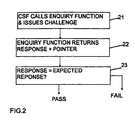
- Figure 2 is a flow chart which illustrates the steps involved in the challenge/response mechanism.
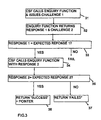
- FIG. 3 is a flowchart which illustrates the steps involved in a mutual authentication mechanism.
- a data processing system 10 comprises a number of user applications 11, a security infrastructure 12, a generic security service 13 for user data, and a number of cryptographic algorithms 14. Some of the algorithms are strong algorithms for use by the security infrastructure while others are weak algorithms for protecting user data.
- the CSF 15 for the security infrastructure is set up as an SLL. This ensures user applications cannot link with it to gain access to the stronger algorithms available to the CSF 15.
- the CSF 16 for the generic security service is set up as a DLL.
- Each algorithm 14 has an enquiry function 17 and a function table 18 containing pointers to the various functions (operations) 19 of the algorithm.
- the enquiry function provides a predetermined interface with the CSFs. Algorithms that support this agreed interface are referred to as supported algorithms.
- a challenge/response mechanism which enables a CSF to verify the authenticity of any algorithm used by it.
- the operation of this challenge/response mechanism will now be described with reference to Figure 2.
- the CSF Whenever the CSF requires to use one of the algorithms, it calls the algorithm's enquiry function.
- the call includes a challenge, comprising a random number.
- the challenge/response mechanism enables the CSF to verify that the authenticity of the algorithm: that is, to verify that the algorithm is indeed a supported algorithm, and that algorithm in one category has not been replaced by an algorithm in the other category. If this verification fails, the CSF will refuse to use the algorithm.
- the CSF when the CSF receives the response, it decrypts the response, using the shared secret key, and then compares the decrypted value with the original challenge.
- the enquiry function when it receives a challenge, it uses the challenge as a seed for a pseudo-random number generator (RNG), comprising a shift register with secret feedback tappings.
- RNG pseudo-random number generator
- the RNG is then clocked a predetermined number of times, and each time the RNG is clocked, one bit is shifted out.
- the output bits are accumulated to produce a pseudo-random number.
- This pseudo-random number is then encrypted using the shared secret key, and the encrypted value is returned to the CSF as the response.
- the CSF receives this response, it generates the expected value of the pseudo-random number, by applying the challenge to an RNG with the same tappings as the RNG used by the enquiry function.
- the CSF then either:
- the algorithm uses its enquiry function to generate a response (response 1) to challenge 1, the response being a predetermined cryptographic function of the challenge.
- the enquiry function generates its own challenge, referred to as challenge 2.
- the enquiry function returns response 1 and challenge 2 to the CSF.
- the CSF If the actual response is equal to the expected response, the CSF generates a response (response 2) to challenge 2. The CSF then calls the enquiry function again, the call including response 2.
Landscapes
- Engineering & Computer Science (AREA)
- Computer Security & Cryptography (AREA)
- Computer Networks & Wireless Communication (AREA)
- Signal Processing (AREA)
- Storage Device Security (AREA)
Description
- This invention relates to access control to sensitive functions in a computer system.
- Different national security bodies have differing data protection/security requirements. Some national bodies permit strong protection for the security infrastructure in a distributed computer system but insist on weaker protection for user data. Further, the different countries will tend to require different levels of strong and weak protection for the security infrastructure and user data respectively.
- In a security system where different levels of strong and weak protection are provided by cryptographic facilities for the security infrastructure and for user data protection, it is possible to increase the flexibility of the access control system by simply replacing the weak algorithms which fit the requirements for protection of user data in one country with relatively weaker or stronger algorithms as appropriate to meet the requirements for protecting the integrity and confidentiality of user data in another country. The strengths of the cryptographic algorithms available to the security infrastructure could be altered in the same way.
- However, before accepting such a system the national bodies would have to be convinced that the stronger algorithms available to the security infrastructure could not be used by the facilities available for the protection of user data.
- EP-A-0 592 808 describes a weakened symmetric cryptographic algorithm, called Commercial Data Masking, which can be substituted for the standard Data Encryption Algorithm. The purpose is to allow the algorithm to be generally exported from the United States of America for use in data privacy.
- B.Clifford Neuman et al., "Kerberos: an authentication service for computer networks", USC/ISI Technical Report, September 1994, vol.32, no.9,
pages 33 to 38, describes techniques for allowing a client to authenticate itself to a verifier, using encrypted tickets obtained from an authentication server. - One object of the present invention is to provide a means for ensuring the stronger algorithms available to the security infrastructure are not used by the facilities available for the protection of user data, and to protect against substitution of weaker algorithms with such stronger algorithms.
- According to one aspect of the invention, there is provided a data processing system as claimed in
Claim 1. According to another aspect of the invention, there is provided a data processing method as claimed in Claim 4. - Figure 1 is a block diagram of a data processing system comprising a challenge/response mechanism for authenticating access to sensitive functions.
- Figure 2 is a flow chart which illustrates the steps involved in the challenge/response mechanism.
- Figure 3 is a flowchart which illustrates the steps involved in a mutual authentication mechanism.
- One embodiment of the invention will now be described by way of example with reference to the accompanying drawings.
- Referring to Figure 1, a
data processing system 10 comprises a number ofuser applications 11, asecurity infrastructure 12, ageneric security service 13 for user data, and a number ofcryptographic algorithms 14. Some of the algorithms are strong algorithms for use by the security infrastructure while others are weak algorithms for protecting user data. - In order to ensure that the
security infrastructure 12 alone has strong cryptographic algorithms made available to it and that the user data is protected only by the weaker algorithms as required by the national bodies, it is necessary to provide separate controls over the cryptographic services required by thesecurity infrastructure 12 and the cryptographic services available for protecting user data. The separate controls are achieved by providing a first Cryptographic Support Facility (CSF) 15 for the security infrastructure and a second separate CSF 16 for the user data. - Normally during application development source code modules are compiled into object code modules and collections of object code modules may be grouped into libraries. An application is built by linking object code modules and libraries to form an executable image. Conventionally libraries are implemented as a Static Link Library (SLL). SLLs cannot be replaced without requiring the application to be re-linked. Dynamic Link Libraries (DLLs) allow some of the symbolic links within an executable image to be left unresolved until the application is run or the function which resolves the DLL is invoked. This is known as late binding and allows a DLL to be replaced without the need of any additional linking. All that is necessary for the application to be restarted and when it is run, or when the function which resolves the DLL is invoked, the symbolic links will be resolved automatically.
- The CSF 15 for the security infrastructure is set up as an SLL. This ensures user applications cannot link with it to gain access to the stronger algorithms available to the CSF 15. On the other hand, the CSF 16 for the generic security service is set up as a DLL.
- Each
algorithm 14 has anenquiry function 17 and a function table 18 containing pointers to the various functions (operations) 19 of the algorithm. The enquiry function provides a predetermined interface with the CSFs. Algorithms that support this agreed interface are referred to as supported algorithms. - The
algorithms 14 are contained in a number of DLLs. Because DLLs are employed, the cryptographic algorithms can be replaced easily. However, assuming the CSF 15 for thesecurity infrastructure 12 and the CSF 16 for the generic security interface have the same interface, the use of DLLs to allow replacement of the cryptographic algorithms is open to abuse because a user can simply replace the weak algorithms intended for protection of the user data with the strong algorithms intended for use by the security infrastructure. - To protect against this possible abuse, a challenge/response mechanism is provided which enables a CSF to verify the authenticity of any algorithm used by it. The operation of this challenge/response mechanism will now be described with reference to Figure 2.
- (Box 21) Whenever the CSF requires to use one of the algorithms, it calls the algorithm's enquiry function. The call includes a challenge, comprising a random number.
- (Box 22) When the algorithm's
enquiry function 17 receives this call, it generates a response to the challenge, by encrypting the challenge, using a secret key, known also to the CSF. Algorithms intended to be used with the security infrastructure use a first secret key to generate the response, while algorithms intended only for protecting user data use a second secret key to generate the response. The enquiry function returns the response to the CSF along with a pointer to the function table 18. The pointer is encrypted under the shared secret key, in order to prevent an "attacker in the middle" relaying the requests and responses between the CSF and the algorithm in order to gain access to the function table. - (Box 23) When the CSF receives the response, it generates an expected response value, by encrypting the original challenge, using the shared secret key. The CSF then compares the actual response from the enquiry function with this expected response. If the actual response is equal to the expected response, the CSF accepts the algorithm as a supported algorithm, and decrypts the encrypted function table pointer. The CSF then goes ahead with using the algorithm. If on the other hand the expected response is not equal to the actual response, the CSF does not use the algorithm.
- Thus, it can be seen that the challenge/response mechanism enables the CSF to verify that the authenticity of the algorithm: that is, to verify that the algorithm is indeed a supported algorithm, and that algorithm in one category has not been replaced by an algorithm in the other category. If this verification fails, the CSF will refuse to use the algorithm.
- In a possible modification of the challenge/response mechanism described above, when the CSF receives the response, it decrypts the response, using the shared secret key, and then compares the decrypted value with the original challenge.
- In another possible modification of the challenge/response mechanism, when the enquiry function receives a challenge, it uses the challenge as a seed for a pseudo-random number generator (RNG), comprising a shift register with secret feedback tappings. The RNG is then clocked a predetermined number of times, and each time the RNG is clocked, one bit is shifted out. The output bits are accumulated to produce a pseudo-random number. This pseudo-random number is then encrypted using the shared secret key, and the encrypted value is returned to the CSF as the response. When the CSF receives this response, it generates the expected value of the pseudo-random number, by applying the challenge to an RNG with the same tappings as the RNG used by the enquiry function. The CSF then either:
- (a) encrypts the expected pseudo-random number and compares the result with the response, or
- (b) decrypts the response and compares it with the expected pseudo-random number.
-
- It may be desirable for an algorithm to challenge the CSF which invokes its enquiry function, to ensure that only a legitimate CSF can use the algorithm and not any application attempting to use the algorithm directly. This can be achieved by a procedure referred to as mutual authentication.
- Referring to Figure 3, the mutual authentication procedure is as follows.
- (Box 31) Whenever the CSF requires to use one of the algorithms, it calls that algorithm's enquiry function. The call includes a challenge, referred to as
challenge 1. - (Box 32) When the algorithm receives this call, the algorithm uses its enquiry function to generate a response (response 1) to
challenge 1, the response being a predetermined cryptographic function of the challenge. At the same time, the enquiry function generates its own challenge, referred to aschallenge 2. The enquiry function returnsresponse 1 andchallenge 2 to the CSF. - (Box 33) When the CSF receives
response 1, it compares the actual response from the algorithm with the expected response. If the actual response is not equal to this expected response, a failure is indicated. - (Box 34) If the actual response is equal to the expected response, the CSF generates a response (response 2) to
challenge 2. The CSF then calls the enquiry function again, thecall including response 2. - (Box 35) When the enquiry function receives
response 2, it compares it with the expected response. - (Box 36) If the
actual response 2 is equal to this expected response, the enquiry function returns a "success" message to the CSF, along with a pointer to the function table, encrypted under a shared secret key. - (Box 37) If on the other hand the
actual response 2 is not equal to the expected response, a "failed" message is returned to the CSF.
Claims (9)
- A data processing system comprising at least one cryptographic support facility (15; 16) and at least one means executing a cryptographic algorithm (14) usable by the cryptographic support facility,
characterised in that(a) the cryptographic support facility (15;16) includes means for issuing a challenge to the cryptographic algorithm (14),(b) the cryptographic algorithm (14) includes means for generating a response to the challenge and for returning the response to the cryptographic support facility (15;16), and(c) the cryptographic support facility (15;16) includes means for checking the response and for using the cryptographic algorithm (14) only if the response has an expected value. - A data processing system according Claim 1 wherein the cryptographic algorithm (14) generates said response by applying a cryptographic function to the challenge, using a secret key.
- A data processing system according Claim 1 or 2 wherein:(a) the cryptographic algorithm (14) includes means for issuing a further challenge to the cryptographic support facility (15;16),(b) the cryptographic support facility (15;16) includes means for generating a further response when it receives the further challenge, and for returning the response to the cryptographic algorithm (14); and(c) the cryptographic algorithm (14) includes means for checking the further response and for allowing the cryptographic support facility (15;16) to use the cryptographic algorithm (14) only if the further response has an expected value.
- A data processing system according to any preceding claim wherein the challenge comprises a random number.
- A data processing method comprising providing a computer system with at least one cryptographic support facility (15;16) and at least one cryptographic algorithm (14) usable by the cryptographic support facility,
the method being characterised in that(a) when the cryptographic support facility (15;16) requires to use the cryptographic algorithm (14), it issues a challenge to the cryptographic algorithm (14),(b) when the cryptographic algorithm (14) receives the challenge, it generates a response and returns the response to the cryptographic support facility (15;16), and(c) when the the cryptographic support facility (15;16) receives the response, it checks the response and goes ahead with using the cryptographic algorithm (14) only if the response has an expected value. - A data processing method according Claim 5 wherein the cryptographic algorithm (14) generates said response by applying a cryptographic function to the challenge, using a secret key.
- A data processing method according Claim 5 or 6, when used to ensure that a cryptographic support facility (16) uses only a relatively weak cryptographic algorithm (14) intended for protecting user data, and does not use a relatively strong cryptographic algorithm intended for use by a security infrastructure.
- A data processing method according any of Claims 5 to 7 wherein:(a) when the cryptographic algorithm (14) receives said challenge, it issues a further challenge and sends it to the cryptographic support facility (15;16),(b) when the cryptographic support facility (15;16) receives the further challenge, it generates a further response and returns the further response to the cryptographic algorithm (14); and(c) when the cryptographic algorithm (14) receives the further response, it checks the further response and allows the cryptographic support facility (15;16) to use the cryptographic algorithm (14) only if the further response has an expected value.
- A data processing method according to any of Claims 5 to 8 wherein the challenge comprises a random number.
Applications Claiming Priority (2)
| Application Number | Priority Date | Filing Date | Title |
|---|---|---|---|
| GB9422389 | 1994-11-05 | ||
| GB9422389A GB9422389D0 (en) | 1994-11-05 | 1994-11-05 | Authenticating access control for sensitive functions |
Publications (2)
| Publication Number | Publication Date |
|---|---|
| EP0711051A1 EP0711051A1 (en) | 1996-05-08 |
| EP0711051B1 true EP0711051B1 (en) | 2004-02-11 |
Family
ID=10763981
Family Applications (1)
| Application Number | Title | Priority Date | Filing Date |
|---|---|---|---|
| EP95306821A Expired - Lifetime EP0711051B1 (en) | 1994-11-05 | 1995-09-27 | Data processing system with verification of authenticity of cryptographic algorithms according to the challenge/response principle |
Country Status (4)
| Country | Link |
|---|---|
| US (1) | US5748739A (en) |
| EP (1) | EP0711051B1 (en) |
| DE (1) | DE69532549T2 (en) |
| GB (1) | GB9422389D0 (en) |
Families Citing this family (30)
| Publication number | Priority date | Publication date | Assignee | Title |
|---|---|---|---|---|
| US5434919A (en) * | 1994-01-11 | 1995-07-18 | Chaum; David | Compact endorsement signature systems |
| US5757914A (en) * | 1995-10-26 | 1998-05-26 | Sun Microsystems, Inc. | System and method for protecting use of dynamically linked executable modules |
| DE19549014C1 (en) * | 1995-12-28 | 1997-02-20 | Siemens Ag | Protected function activation method for communication system |
| WO1998052316A1 (en) * | 1997-05-09 | 1998-11-19 | Connotech Experts-Conseils Inc. | Initial secret key establishment including facilities for verification of identity |
| US5974550A (en) * | 1997-12-12 | 1999-10-26 | Intel Corporation | Method for strongly authenticating another process in a different address space |
| US7437550B2 (en) * | 1999-12-02 | 2008-10-14 | Ponoi Corp. | System for providing session-based network privacy, private, persistent storage, and discretionary access control for sharing private data |
| US6789199B1 (en) * | 2000-02-08 | 2004-09-07 | International Business Machines Corporation | Tamper resistance with pseudo-random binary sequence program interlocks |
| WO2002037728A1 (en) * | 2000-11-03 | 2002-05-10 | Fusionone, Inc. | Updating security schemes for remote client access |
| AU2002339711A1 (en) * | 2001-04-20 | 2002-12-03 | Ponoi Corp. | System and method for secure and private communication |
| US7752459B2 (en) * | 2001-12-06 | 2010-07-06 | Novell, Inc. | Pointguard: method and system for protecting programs against pointer corruption attacks |
| US7552470B2 (en) * | 2002-11-21 | 2009-06-23 | Honeywell International Inc. | Generic security infrastructure for COM based systems |
| KR101203245B1 (en) | 2004-06-12 | 2012-11-20 | 마이크로소프트 코포레이션 | Securing software |
| US7721340B2 (en) * | 2004-06-12 | 2010-05-18 | Microsoft Corporation | Registry protection |
| US7640592B2 (en) * | 2004-06-12 | 2009-12-29 | Microsoft Corporation | Installation setup |
| ATE500855T1 (en) * | 2004-11-22 | 2011-03-15 | Theregen Inc | USE OF THREE-DIMENSIONAL CULTURED TISSUE TO TREAT CONGESTIVE HEART FAILURE |
| US20070258459A1 (en) * | 2006-05-02 | 2007-11-08 | Harris Corporation | Method and system for QOS by proxy |
| US20070291767A1 (en) * | 2006-06-16 | 2007-12-20 | Harris Corporation | Systems and methods for a protocol transformation gateway for quality of service |
| US8516153B2 (en) | 2006-06-16 | 2013-08-20 | Harris Corporation | Method and system for network-independent QoS |
| US7990860B2 (en) | 2006-06-16 | 2011-08-02 | Harris Corporation | Method and system for rule-based sequencing for QoS |
| US8064464B2 (en) | 2006-06-16 | 2011-11-22 | Harris Corporation | Method and system for inbound content-based QoS |
| US20070291656A1 (en) * | 2006-06-16 | 2007-12-20 | Harris Corporation | Method and system for outbound content-based QoS |
| US7916626B2 (en) * | 2006-06-19 | 2011-03-29 | Harris Corporation | Method and system for fault-tolerant quality of service |
| US8730981B2 (en) | 2006-06-20 | 2014-05-20 | Harris Corporation | Method and system for compression based quality of service |
| US20080025318A1 (en) * | 2006-07-31 | 2008-01-31 | Harris Corporation | Systems and methods for dynamically customizable quality of service on the edge of a network |
| US20100241759A1 (en) * | 2006-07-31 | 2010-09-23 | Smith Donald L | Systems and methods for sar-capable quality of service |
| US20100238801A1 (en) * | 2006-07-31 | 2010-09-23 | Smith Donald L | Method and system for stale data detection based quality of service |
| US8300653B2 (en) | 2006-07-31 | 2012-10-30 | Harris Corporation | Systems and methods for assured communications with quality of service |
| WO2014057305A1 (en) | 2012-10-09 | 2014-04-17 | Nokia Corporation | Method and apparatus for disabling algorithms in a device |
| US10897363B2 (en) * | 2015-11-17 | 2021-01-19 | Cryptography Research, Inc. | Authenticating a secondary device based on encrypted tables |
| FR3140503A1 (en) * | 2022-09-29 | 2024-04-05 | Orange | Methods for proving and verifying the use of a cipher suite, verification entity, communication devices, terminal, and associated computer program |
Family Cites Families (9)
| Publication number | Priority date | Publication date | Assignee | Title |
|---|---|---|---|---|
| US4996711A (en) * | 1989-06-21 | 1991-02-26 | Chaum David L | Selected-exponent signature systems |
| US5148479A (en) * | 1991-03-20 | 1992-09-15 | International Business Machines Corp. | Authentication protocols in communication networks |
| US5159634A (en) * | 1991-09-13 | 1992-10-27 | At&T Bell Laboratories | Cryptosystem for cellular telephony |
| US5311596A (en) * | 1992-08-31 | 1994-05-10 | At&T Bell Laboratories | Continuous authentication using an in-band or out-of-band side channel |
| US5323464A (en) * | 1992-10-16 | 1994-06-21 | International Business Machines Corporation | Commercial data masking |
| US5351293A (en) * | 1993-02-01 | 1994-09-27 | Wave Systems Corp. | System method and apparatus for authenticating an encrypted signal |
| US5420908A (en) * | 1993-03-11 | 1995-05-30 | At&T Corp. | Method and apparatus for preventing wireless fraud |
| FR2704081B1 (en) * | 1993-04-16 | 1995-05-19 | France Telecom | Method for updating a memory card and memory card for implementing this method. |
| US5455862A (en) * | 1993-12-02 | 1995-10-03 | Crest Industries, Inc. | Apparatus and method for encrypting communications without exchanging an encryption key |
-
1994
- 1994-11-05 GB GB9422389A patent/GB9422389D0/en active Pending
-
1995
- 1995-09-27 DE DE69532549T patent/DE69532549T2/en not_active Expired - Lifetime
- 1995-09-27 EP EP95306821A patent/EP0711051B1/en not_active Expired - Lifetime
- 1995-10-16 US US08/543,641 patent/US5748739A/en not_active Expired - Lifetime
Non-Patent Citations (1)
| Title |
|---|
| NEUMAN B.C. AND TS'O T.: "Kerberos: An Authentication Service for Computer Networks", USC/ISI TECHNICAL REPORT, vol. 32, no. 9, 1 September 1994 (1994-09-01), pages 33 - 38, XP000476553 * |
Also Published As
| Publication number | Publication date |
|---|---|
| EP0711051A1 (en) | 1996-05-08 |
| DE69532549T2 (en) | 2004-12-09 |
| GB9422389D0 (en) | 1995-01-04 |
| DE69532549D1 (en) | 2004-03-18 |
| US5748739A (en) | 1998-05-05 |
Similar Documents
| Publication | Publication Date | Title |
|---|---|---|
| US5748739A (en) | Access control for sensitive functions | |
| US6148400A (en) | Apparatus and method for establishing a crytographic link between elements of a system | |
| US6948065B2 (en) | Platform and method for securely transmitting an authorization secret | |
| US5787172A (en) | Apparatus and method for establishing a cryptographic link between elements of a system | |
| EP0531784B1 (en) | Apparatus for encryption and decryption using split key | |
| US6278782B1 (en) | Method of implementing a key recovery system | |
| US5796840A (en) | Apparatus and method for providing secured communications | |
| US6185546B1 (en) | Apparatus and method for providing secured communications | |
| US5717756A (en) | System and method for providing masquerade protection in a computer network using hardware and timestamp-specific single use keys | |
| EP0503765B1 (en) | Access control in a distributed computer system | |
| US6408389B2 (en) | System for supporting secured log-in of multiple users into a plurality of computers using combined presentation of memorized password and transportable passport record | |
| US5109152A (en) | Communication apparatus | |
| US7685421B2 (en) | System and method for initializing operation for an information security operation | |
| JPH11225142A (en) | Authentication system and method | |
| GB2328047A (en) | Protected storage of core data secrets | |
| US20060013399A1 (en) | Method of delivering direct proof private keys to devices using a distribution CD | |
| US7721100B2 (en) | Granting an access to a computer-based object | |
| US20020168067A1 (en) | Copy protection method and system for a field-programmable gate array | |
| EP0356065A2 (en) | Secure management of keys using control vectors | |
| CA2636590C (en) | Apparatus and method for establishing a cryptographic link between elements of a system | |
| AU655960B2 (en) | Access control in a distributed computer system | |
| Sherwood et al. | The application of smart cards for RSA digital signatures in a network comprising both interactive and store-and-forward facilities | |
| KR920007379A (en) | Communications Security Systems and Methods | |
| IL116546A (en) | Apparatus and method for providing secured communications | |
| HK1019376A (en) | Apparatus and method for establishing a cryptographic link between elements of a system |
Legal Events
| Date | Code | Title | Description |
|---|---|---|---|
| PUAI | Public reference made under article 153(3) epc to a published international application that has entered the european phase |
Free format text: ORIGINAL CODE: 0009012 |
|
| AK | Designated contracting states |
Kind code of ref document: A1 Designated state(s): BE DE FR GB IE |
|
| 17P | Request for examination filed |
Effective date: 19960911 |
|
| 17Q | First examination report despatched |
Effective date: 20001123 |
|
| RAP1 | Party data changed (applicant data changed or rights of an application transferred) |
Owner name: FUJITSU SERVICES LIMITED |
|
| GRAP | Despatch of communication of intention to grant a patent |
Free format text: ORIGINAL CODE: EPIDOSNIGR1 |
|
| GRAS | Grant fee paid |
Free format text: ORIGINAL CODE: EPIDOSNIGR3 |
|
| GRAA | (expected) grant |
Free format text: ORIGINAL CODE: 0009210 |
|
| AK | Designated contracting states |
Kind code of ref document: B1 Designated state(s): BE DE FR GB IE |
|
| PG25 | Lapsed in a contracting state [announced via postgrant information from national office to epo] |
Ref country code: BE Free format text: LAPSE BECAUSE OF FAILURE TO SUBMIT A TRANSLATION OF THE DESCRIPTION OR TO PAY THE FEE WITHIN THE PRESCRIBED TIME-LIMIT Effective date: 20040211 |
|
| REG | Reference to a national code |
Ref country code: GB Ref legal event code: FG4D |
|
| REG | Reference to a national code |
Ref country code: IE Ref legal event code: FG4D |
|
| REF | Corresponds to: |
Ref document number: 69532549 Country of ref document: DE Date of ref document: 20040318 Kind code of ref document: P |
|
| PG25 | Lapsed in a contracting state [announced via postgrant information from national office to epo] |
Ref country code: IE Free format text: LAPSE BECAUSE OF NON-PAYMENT OF DUE FEES Effective date: 20040927 |
|
| ET | Fr: translation filed | ||
| PLBE | No opposition filed within time limit |
Free format text: ORIGINAL CODE: 0009261 |
|
| STAA | Information on the status of an ep patent application or granted ep patent |
Free format text: STATUS: NO OPPOSITION FILED WITHIN TIME LIMIT |
|
| 26N | No opposition filed |
Effective date: 20041112 |
|
| REG | Reference to a national code |
Ref country code: IE Ref legal event code: MM4A |
|
| PGFP | Annual fee paid to national office [announced via postgrant information from national office to epo] |
Ref country code: DE Payment date: 20140922 Year of fee payment: 20 |
|
| PGFP | Annual fee paid to national office [announced via postgrant information from national office to epo] |
Ref country code: GB Payment date: 20140919 Year of fee payment: 20 Ref country code: FR Payment date: 20140919 Year of fee payment: 20 |
|
| REG | Reference to a national code |
Ref country code: DE Ref legal event code: R071 Ref document number: 69532549 Country of ref document: DE |
|
| REG | Reference to a national code |
Ref country code: GB Ref legal event code: PE20 Expiry date: 20150926 |
|
| PG25 | Lapsed in a contracting state [announced via postgrant information from national office to epo] |
Ref country code: GB Free format text: LAPSE BECAUSE OF EXPIRATION OF PROTECTION Effective date: 20150926 |