EP0708142B1 - Polyamide resin compositions - Google Patents
Polyamide resin compositions Download PDFInfo
- Publication number
- EP0708142B1 EP0708142B1 EP95120551A EP95120551A EP0708142B1 EP 0708142 B1 EP0708142 B1 EP 0708142B1 EP 95120551 A EP95120551 A EP 95120551A EP 95120551 A EP95120551 A EP 95120551A EP 0708142 B1 EP0708142 B1 EP 0708142B1
- Authority
- EP
- European Patent Office
- Prior art keywords
- polyamide resin
- dicarboxylic acid
- aliphatic
- amount
- resin composition
- Prior art date
- Legal status (The legal status is an assumption and is not a legal conclusion. Google has not performed a legal analysis and makes no representation as to the accuracy of the status listed.)
- Expired - Lifetime
Links
- 229920006122 polyamide resin Polymers 0.000 title claims description 27
- 239000011342 resin composition Substances 0.000 title claims description 27
- OFOBLEOULBTSOW-UHFFFAOYSA-N Malonic acid Chemical compound OC(=O)CC(O)=O OFOBLEOULBTSOW-UHFFFAOYSA-N 0.000 claims description 36
- KKEYFWRCBNTPAC-UHFFFAOYSA-N Terephthalic acid Chemical compound OC(=O)C1=CC=C(C(O)=O)C=C1 KKEYFWRCBNTPAC-UHFFFAOYSA-N 0.000 claims description 34
- -1 aliphatic diamine Chemical class 0.000 claims description 31
- 229920005989 resin Polymers 0.000 claims description 31
- 239000011347 resin Substances 0.000 claims description 31
- 239000004760 aramid Substances 0.000 claims description 22
- 229920003235 aromatic polyamide Polymers 0.000 claims description 22
- 150000004985 diamines Chemical class 0.000 claims description 17
- 239000000654 additive Substances 0.000 claims description 13
- 125000001931 aliphatic group Chemical group 0.000 claims description 13
- 229910052751 metal Chemical class 0.000 claims description 9
- 239000002184 metal Chemical class 0.000 claims description 9
- WNLRTRBMVRJNCN-UHFFFAOYSA-N adipic acid Chemical compound OC(=O)CCCCC(O)=O WNLRTRBMVRJNCN-UHFFFAOYSA-N 0.000 claims description 8
- 239000003365 glass fiber Substances 0.000 claims description 8
- 230000002787 reinforcement Effects 0.000 claims description 8
- 150000007933 aliphatic carboxylic acids Chemical class 0.000 claims description 7
- 230000000996 additive effect Effects 0.000 claims description 6
- 125000004432 carbon atom Chemical group C* 0.000 claims description 6
- 150000002148 esters Chemical class 0.000 claims description 6
- NAQMVNRVTILPCV-UHFFFAOYSA-N hexane-1,6-diamine Chemical group NCCCCCCN NAQMVNRVTILPCV-UHFFFAOYSA-N 0.000 claims description 6
- 150000003839 salts Chemical class 0.000 claims description 5
- 239000001361 adipic acid Substances 0.000 claims description 4
- 235000011037 adipic acid Nutrition 0.000 claims description 4
- 125000003118 aryl group Chemical group 0.000 claims description 4
- QAOWNCQODCNURD-UHFFFAOYSA-N sulfuric acid Substances OS(O)(=O)=O QAOWNCQODCNURD-UHFFFAOYSA-N 0.000 claims description 3
- 239000000203 mixture Substances 0.000 description 20
- 238000000034 method Methods 0.000 description 7
- 239000004953 Aliphatic polyamide Substances 0.000 description 6
- 229920003189 Nylon 4,6 Polymers 0.000 description 6
- 229920003231 aliphatic polyamide Polymers 0.000 description 6
- UTOPWMOLSKOLTQ-UHFFFAOYSA-N octacosanoic acid Chemical compound CCCCCCCCCCCCCCCCCCCCCCCCCCCC(O)=O UTOPWMOLSKOLTQ-UHFFFAOYSA-N 0.000 description 6
- XLYOFNOQVPJJNP-UHFFFAOYSA-N water Substances O XLYOFNOQVPJJNP-UHFFFAOYSA-N 0.000 description 6
- 125000005263 alkylenediamine group Chemical group 0.000 description 5
- 239000000835 fiber Substances 0.000 description 5
- 238000002844 melting Methods 0.000 description 5
- 230000008018 melting Effects 0.000 description 5
- 238000000465 moulding Methods 0.000 description 5
- 239000008188 pellet Substances 0.000 description 5
- OKTJSMMVPCPJKN-UHFFFAOYSA-N Carbon Chemical group [C] OKTJSMMVPCPJKN-UHFFFAOYSA-N 0.000 description 4
- 229910052784 alkaline earth metal Inorganic materials 0.000 description 4
- 230000003578 releasing effect Effects 0.000 description 4
- DZIHTWJGPDVSGE-UHFFFAOYSA-N 4-[(4-aminocyclohexyl)methyl]cyclohexan-1-amine Chemical compound C1CC(N)CCC1CC1CCC(N)CC1 DZIHTWJGPDVSGE-UHFFFAOYSA-N 0.000 description 3
- 239000004952 Polyamide Substances 0.000 description 3
- 238000001125 extrusion Methods 0.000 description 3
- 238000001746 injection moulding Methods 0.000 description 3
- 229920002647 polyamide Polymers 0.000 description 3
- 229920001223 polyethylene glycol Polymers 0.000 description 3
- CXMXRPHRNRROMY-UHFFFAOYSA-N sebacic acid Chemical compound OC(=O)CCCCCCCCC(O)=O CXMXRPHRNRROMY-UHFFFAOYSA-N 0.000 description 3
- 239000000243 solution Substances 0.000 description 3
- PWGJDPKCLMLPJW-UHFFFAOYSA-N 1,8-diaminooctane Chemical compound NCCCCCCCCN PWGJDPKCLMLPJW-UHFFFAOYSA-N 0.000 description 2
- IGSBHTZEJMPDSZ-UHFFFAOYSA-N 4-[(4-amino-3-methylcyclohexyl)methyl]-2-methylcyclohexan-1-amine Chemical compound C1CC(N)C(C)CC1CC1CC(C)C(N)CC1 IGSBHTZEJMPDSZ-UHFFFAOYSA-N 0.000 description 2
- GLUUGHFHXGJENI-UHFFFAOYSA-N Piperazine Chemical compound C1CNCCN1 GLUUGHFHXGJENI-UHFFFAOYSA-N 0.000 description 2
- 239000002202 Polyethylene glycol Substances 0.000 description 2
- QLBRROYTTDFLDX-UHFFFAOYSA-N [3-(aminomethyl)cyclohexyl]methanamine Chemical compound NCC1CCCC(CN)C1 QLBRROYTTDFLDX-UHFFFAOYSA-N 0.000 description 2
- 238000010521 absorption reaction Methods 0.000 description 2
- 239000003513 alkali Substances 0.000 description 2
- 150000004984 aromatic diamines Chemical class 0.000 description 2
- FIASKJZPIYCESA-UHFFFAOYSA-L calcium;octacosanoate Chemical compound [Ca+2].CCCCCCCCCCCCCCCCCCCCCCCCCCCC([O-])=O.CCCCCCCCCCCCCCCCCCCCCCCCCCCC([O-])=O FIASKJZPIYCESA-UHFFFAOYSA-L 0.000 description 2
- 230000015556 catabolic process Effects 0.000 description 2
- 230000000052 comparative effect Effects 0.000 description 2
- YQLZOAVZWJBZSY-UHFFFAOYSA-N decane-1,10-diamine Chemical compound NCCCCCCCCCCN YQLZOAVZWJBZSY-UHFFFAOYSA-N 0.000 description 2
- 230000007547 defect Effects 0.000 description 2
- 238000006731 degradation reaction Methods 0.000 description 2
- QFTYSVGGYOXFRQ-UHFFFAOYSA-N dodecane-1,12-diamine Chemical compound NCCCCCCCCCCCCN QFTYSVGGYOXFRQ-UHFFFAOYSA-N 0.000 description 2
- XMHIUKTWLZUKEX-UHFFFAOYSA-N hexacosanoic acid Chemical compound CCCCCCCCCCCCCCCCCCCCCCCCCC(O)=O XMHIUKTWLZUKEX-UHFFFAOYSA-N 0.000 description 2
- 239000012784 inorganic fiber Substances 0.000 description 2
- QQVIHTHCMHWDBS-UHFFFAOYSA-N isophthalic acid Chemical compound OC(=O)C1=CC=CC(C(O)=O)=C1 QQVIHTHCMHWDBS-UHFFFAOYSA-N 0.000 description 2
- VKHLCNWQYFQMLQ-UHFFFAOYSA-M lithium octacosanoate Chemical compound [Li+].CCCCCCCCCCCCCCCCCCCCCCCCCCCC([O-])=O VKHLCNWQYFQMLQ-UHFFFAOYSA-M 0.000 description 2
- 239000000314 lubricant Substances 0.000 description 2
- VNWKTOKETHGBQD-UHFFFAOYSA-N methane Chemical compound C VNWKTOKETHGBQD-UHFFFAOYSA-N 0.000 description 2
- BDJRBEYXGGNYIS-UHFFFAOYSA-N nonanedioic acid Chemical compound OC(=O)CCCCCCCC(O)=O BDJRBEYXGGNYIS-UHFFFAOYSA-N 0.000 description 2
- 229920006139 poly(hexamethylene adipamide-co-hexamethylene terephthalamide) Polymers 0.000 description 2
- 229920000642 polymer Polymers 0.000 description 2
- YKIBJOMJPMLJTB-UHFFFAOYSA-M sodium;octacosanoate Chemical compound [Na+].CCCCCCCCCCCCCCCCCCCCCCCCCCCC([O-])=O YKIBJOMJPMLJTB-UHFFFAOYSA-M 0.000 description 2
- 238000005979 thermal decomposition reaction Methods 0.000 description 2
- VHOCUJPBKOZGJD-UHFFFAOYSA-N triacontanoic acid Chemical compound CCCCCCCCCCCCCCCCCCCCCCCCCCCCCC(O)=O VHOCUJPBKOZGJD-UHFFFAOYSA-N 0.000 description 2
- PUPZLCDOIYMWBV-UHFFFAOYSA-N (+/-)-1,3-Butanediol Chemical compound CC(O)CCO PUPZLCDOIYMWBV-UHFFFAOYSA-N 0.000 description 1
- HXJZEGBVQCRLOD-UHFFFAOYSA-N 1-triethoxysilylpropan-2-amine Chemical compound CCO[Si](CC(C)N)(OCC)OCC HXJZEGBVQCRLOD-UHFFFAOYSA-N 0.000 description 1
- JCUZDQXWVYNXHD-UHFFFAOYSA-N 2,2,4-trimethylhexane-1,6-diamine Chemical compound NCCC(C)CC(C)(C)CN JCUZDQXWVYNXHD-UHFFFAOYSA-N 0.000 description 1
- VECYFPCPMVHUEN-UHFFFAOYSA-N 2,2-dimethylheptane-1,7-diamine Chemical compound NCC(C)(C)CCCCCN VECYFPCPMVHUEN-UHFFFAOYSA-N 0.000 description 1
- QPIDRHUVWIFOBW-UHFFFAOYSA-N 2,2-dimethylhexane-1,6-diamine Chemical compound NCC(C)(C)CCCCN QPIDRHUVWIFOBW-UHFFFAOYSA-N 0.000 description 1
- CRTFIUQMLDPORS-UHFFFAOYSA-N 2,2-dimethyloctane-1,8-diamine Chemical compound NCC(C)(C)CCCCCCN CRTFIUQMLDPORS-UHFFFAOYSA-N 0.000 description 1
- RMIUJCRSUIITNG-UHFFFAOYSA-N 2,3-dimethylbutane-1,4-diamine Chemical compound NCC(C)C(C)CN RMIUJCRSUIITNG-UHFFFAOYSA-N 0.000 description 1
- KEEWXLYVPARTPY-UHFFFAOYSA-N 2,3-dimethylheptane-1,7-diamine Chemical compound NCC(C)C(C)CCCCN KEEWXLYVPARTPY-UHFFFAOYSA-N 0.000 description 1
- DPQHRXRAZHNGRU-UHFFFAOYSA-N 2,4,4-trimethylhexane-1,6-diamine Chemical compound NCC(C)CC(C)(C)CCN DPQHRXRAZHNGRU-UHFFFAOYSA-N 0.000 description 1
- AHBYWKWAVAMOMN-UHFFFAOYSA-N 2,4-diethylhexane-1,6-diamine Chemical compound CCC(CN)CC(CC)CCN AHBYWKWAVAMOMN-UHFFFAOYSA-N 0.000 description 1
- UVCBXTALTSTYBM-UHFFFAOYSA-N 2,4-dimethylheptane-1,7-diamine Chemical compound NCC(C)CC(C)CCCN UVCBXTALTSTYBM-UHFFFAOYSA-N 0.000 description 1
- KSQSUDDRZLCKSW-UHFFFAOYSA-N 2,4-dimethylhexane-1,6-diamine Chemical compound NCC(C)CC(C)CCN KSQSUDDRZLCKSW-UHFFFAOYSA-N 0.000 description 1
- SQAPJTNHAUBTOP-UHFFFAOYSA-N 2,4-dimethyloctane-1,8-diamine Chemical compound NCC(C)CC(C)CCCCN SQAPJTNHAUBTOP-UHFFFAOYSA-N 0.000 description 1
- XGKKWUNSNDTGDS-UHFFFAOYSA-N 2,5-dimethylheptane-1,7-diamine Chemical compound NCC(C)CCC(C)CCN XGKKWUNSNDTGDS-UHFFFAOYSA-N 0.000 description 1
- YXOKJIRTNWHPFS-UHFFFAOYSA-N 2,5-dimethylhexane-1,6-diamine Chemical compound NCC(C)CCC(C)CN YXOKJIRTNWHPFS-UHFFFAOYSA-N 0.000 description 1
- NSMWYRLQHIXVAP-UHFFFAOYSA-N 2,5-dimethylpiperazine Chemical compound CC1CNC(C)CN1 NSMWYRLQHIXVAP-UHFFFAOYSA-N 0.000 description 1
- HCUZVMHXDRSBKX-UHFFFAOYSA-N 2-decylpropanedioic acid Chemical compound CCCCCCCCCCC(C(O)=O)C(O)=O HCUZVMHXDRSBKX-UHFFFAOYSA-N 0.000 description 1
- ACEKLXGWCBIDGA-UHFFFAOYSA-N 2-methylpentane-1,4-diamine Chemical compound CC(N)CC(C)CN ACEKLXGWCBIDGA-UHFFFAOYSA-N 0.000 description 1
- WMRCTEPOPAZMMN-UHFFFAOYSA-N 2-undecylpropanedioic acid Chemical compound CCCCCCCCCCCC(C(O)=O)C(O)=O WMRCTEPOPAZMMN-UHFFFAOYSA-N 0.000 description 1
- OWRGRHKXXGTEHA-UHFFFAOYSA-N 3,3-dimethylhexane-1,6-diamine Chemical compound NCCC(C)(C)CCCN OWRGRHKXXGTEHA-UHFFFAOYSA-N 0.000 description 1
- WTXAAHKEBFFHIC-UHFFFAOYSA-N 3,3-dimethyloctane-1,8-diamine Chemical compound NCCC(C)(C)CCCCCN WTXAAHKEBFFHIC-UHFFFAOYSA-N 0.000 description 1
- NEIQVECNZQYVDC-UHFFFAOYSA-N 3,4-dimethyloctane-1,8-diamine Chemical compound NCCC(C)C(C)CCCCN NEIQVECNZQYVDC-UHFFFAOYSA-N 0.000 description 1
- RNLHGQLZWXBQNY-UHFFFAOYSA-N 3-(aminomethyl)-3,5,5-trimethylcyclohexan-1-amine Chemical compound CC1(C)CC(N)CC(C)(CN)C1 RNLHGQLZWXBQNY-UHFFFAOYSA-N 0.000 description 1
- OLTBRQIRRDQOTO-UHFFFAOYSA-N 3-methylpentane-1,4-diamine Chemical compound CC(N)C(C)CCN OLTBRQIRRDQOTO-UHFFFAOYSA-N 0.000 description 1
- ULLJDGWZKSOING-UHFFFAOYSA-N 4,4-dimethyloctane-1,8-diamine Chemical compound NCCCC(C)(C)CCCCN ULLJDGWZKSOING-UHFFFAOYSA-N 0.000 description 1
- CPWPLIIHQWYLLH-UHFFFAOYSA-N 4,5-dimethyloctane-1,8-diamine Chemical compound NCCCC(C)C(C)CCCN CPWPLIIHQWYLLH-UHFFFAOYSA-N 0.000 description 1
- LDVIHFSQEJGXPV-UHFFFAOYSA-N 4-[1,3-di(propan-2-yl)cyclohexyl]cyclohexan-1-amine Chemical compound C1C(C(C)C)CCCC1(C(C)C)C1CCC(N)CC1 LDVIHFSQEJGXPV-UHFFFAOYSA-N 0.000 description 1
- BDBZTOMUANOKRT-UHFFFAOYSA-N 4-[2-(4-aminocyclohexyl)propan-2-yl]cyclohexan-1-amine Chemical compound C1CC(N)CCC1C(C)(C)C1CCC(N)CC1 BDBZTOMUANOKRT-UHFFFAOYSA-N 0.000 description 1
- WHLFXPIYRPOHGB-UHFFFAOYSA-N 4-methylpentane-1,4-diamine Chemical compound CC(C)(N)CCCN WHLFXPIYRPOHGB-UHFFFAOYSA-N 0.000 description 1
- UVJGPFKXFTVLIZ-UHFFFAOYSA-N 5-methylnonane-1,8-diamine Chemical compound CC(N)CCC(C)CCCCN UVJGPFKXFTVLIZ-UHFFFAOYSA-N 0.000 description 1
- MBRGOFWKNLPACT-UHFFFAOYSA-N 5-methylnonane-1,9-diamine Chemical compound NCCCCC(C)CCCCN MBRGOFWKNLPACT-UHFFFAOYSA-N 0.000 description 1
- XNQIUBJCXWNVIA-UHFFFAOYSA-N 6-methylnonane-1,8-diamine Chemical compound CC(N)CC(C)CCCCCN XNQIUBJCXWNVIA-UHFFFAOYSA-N 0.000 description 1
- 239000004604 Blowing Agent Substances 0.000 description 1
- OYPRJOBELJOOCE-UHFFFAOYSA-N Calcium Chemical compound [Ca] OYPRJOBELJOOCE-UHFFFAOYSA-N 0.000 description 1
- 229920000049 Carbon (fiber) Polymers 0.000 description 1
- 239000004698 Polyethylene Substances 0.000 description 1
- ZLMJMSJWJFRBEC-UHFFFAOYSA-N Potassium Chemical compound [K] ZLMJMSJWJFRBEC-UHFFFAOYSA-N 0.000 description 1
- 239000006087 Silane Coupling Agent Substances 0.000 description 1
- KDYFGRWQOYBRFD-UHFFFAOYSA-N Succinic acid Natural products OC(=O)CCC(O)=O KDYFGRWQOYBRFD-UHFFFAOYSA-N 0.000 description 1
- XZAHJRZBUWYCBM-UHFFFAOYSA-N [1-(aminomethyl)cyclohexyl]methanamine Chemical class NCC1(CN)CCCCC1 XZAHJRZBUWYCBM-UHFFFAOYSA-N 0.000 description 1
- FDLQZKYLHJJBHD-UHFFFAOYSA-N [3-(aminomethyl)phenyl]methanamine Chemical compound NCC1=CC=CC(CN)=C1 FDLQZKYLHJJBHD-UHFFFAOYSA-N 0.000 description 1
- OXIKYYJDTWKERT-UHFFFAOYSA-N [4-(aminomethyl)cyclohexyl]methanamine Chemical compound NCC1CCC(CN)CC1 OXIKYYJDTWKERT-UHFFFAOYSA-N 0.000 description 1
- ISKQADXMHQSTHK-UHFFFAOYSA-N [4-(aminomethyl)phenyl]methanamine Chemical compound NCC1=CC=C(CN)C=C1 ISKQADXMHQSTHK-UHFFFAOYSA-N 0.000 description 1
- 239000002253 acid Substances 0.000 description 1
- 125000002723 alicyclic group Chemical group 0.000 description 1
- 150000001342 alkaline earth metals Chemical class 0.000 description 1
- 239000002216 antistatic agent Substances 0.000 description 1
- WERYXYBDKMZEQL-UHFFFAOYSA-N butane-1,4-diol Chemical class OCCCCO WERYXYBDKMZEQL-UHFFFAOYSA-N 0.000 description 1
- KDYFGRWQOYBRFD-NUQCWPJISA-N butanedioic acid Chemical compound O[14C](=O)CC[14C](O)=O KDYFGRWQOYBRFD-NUQCWPJISA-N 0.000 description 1
- 229910052791 calcium Inorganic materials 0.000 description 1
- 239000011575 calcium Substances 0.000 description 1
- 239000004917 carbon fiber Substances 0.000 description 1
- 239000000919 ceramic Substances 0.000 description 1
- 239000003086 colorant Substances 0.000 description 1
- 238000009833 condensation Methods 0.000 description 1
- 230000005494 condensation Effects 0.000 description 1
- 238000007796 conventional method Methods 0.000 description 1
- 229920001577 copolymer Polymers 0.000 description 1
- GEQHKFFSPGPGLN-UHFFFAOYSA-N cyclohexane-1,3-diamine Chemical compound NC1CCCC(N)C1 GEQHKFFSPGPGLN-UHFFFAOYSA-N 0.000 description 1
- VKIRRGRTJUUZHS-UHFFFAOYSA-N cyclohexane-1,4-diamine Chemical compound NC1CCC(N)CC1 VKIRRGRTJUUZHS-UHFFFAOYSA-N 0.000 description 1
- 235000014113 dietary fatty acids Nutrition 0.000 description 1
- NJLLQSBAHIKGKF-UHFFFAOYSA-N dipotassium dioxido(oxo)titanium Chemical compound [K+].[K+].[O-][Ti]([O-])=O NJLLQSBAHIKGKF-UHFFFAOYSA-N 0.000 description 1
- 229920006351 engineering plastic Polymers 0.000 description 1
- FWDBOZPQNFPOLF-UHFFFAOYSA-N ethenyl(triethoxy)silane Chemical compound CCO[Si](OCC)(OCC)C=C FWDBOZPQNFPOLF-UHFFFAOYSA-N 0.000 description 1
- 239000000194 fatty acid Substances 0.000 description 1
- 229930195729 fatty acid Natural products 0.000 description 1
- 239000000945 filler Substances 0.000 description 1
- 239000003063 flame retardant Substances 0.000 description 1
- 239000012760 heat stabilizer Substances 0.000 description 1
- PWSKHLMYTZNYKO-UHFFFAOYSA-N heptane-1,7-diamine Chemical compound NCCCCCCCN PWSKHLMYTZNYKO-UHFFFAOYSA-N 0.000 description 1
- JVQUBHIPPUVHCN-UHFFFAOYSA-N hexane-1,2-diamine Chemical compound CCCCC(N)CN JVQUBHIPPUVHCN-UHFFFAOYSA-N 0.000 description 1
- HYQBVSXBLGKEDT-UHFFFAOYSA-N hexane-1,4-diamine Chemical compound CCC(N)CCCN HYQBVSXBLGKEDT-UHFFFAOYSA-N 0.000 description 1
- BBPXVYVXKAYBSS-UHFFFAOYSA-N hexane-2,5-diamine Chemical compound CC(N)CCC(C)N BBPXVYVXKAYBSS-UHFFFAOYSA-N 0.000 description 1
- 239000007924 injection Substances 0.000 description 1
- 238000004519 manufacturing process Methods 0.000 description 1
- 239000000155 melt Substances 0.000 description 1
- FTQWRYSLUYAIRQ-UHFFFAOYSA-N n-[(octadecanoylamino)methyl]octadecanamide Chemical compound CCCCCCCCCCCCCCCCCC(=O)NCNC(=O)CCCCCCCCCCCCCCCCC FTQWRYSLUYAIRQ-UHFFFAOYSA-N 0.000 description 1
- SXJVFQLYZSNZBT-UHFFFAOYSA-N nonane-1,9-diamine Chemical compound NCCCCCCCCCN SXJVFQLYZSNZBT-UHFFFAOYSA-N 0.000 description 1
- 239000002667 nucleating agent Substances 0.000 description 1
- 238000012643 polycondensation polymerization Methods 0.000 description 1
- 229920000573 polyethylene Polymers 0.000 description 1
- 229910052700 potassium Inorganic materials 0.000 description 1
- 239000011591 potassium Substances 0.000 description 1
- 230000003014 reinforcing effect Effects 0.000 description 1
- 238000012552 review Methods 0.000 description 1
- 239000007790 solid phase Substances 0.000 description 1
- 239000002904 solvent Substances 0.000 description 1
- 239000003381 stabilizer Substances 0.000 description 1
- 239000000126 substance Substances 0.000 description 1
- 150000005846 sugar alcohols Polymers 0.000 description 1
- HTVULPNMIHOVRU-UHFFFAOYSA-N trimethoxy-[2-(oxiran-2-ylmethoxy)propyl]silane Chemical compound CO[Si](OC)(OC)CC(C)OCC1CO1 HTVULPNMIHOVRU-UHFFFAOYSA-N 0.000 description 1
- KLNPWTHGTVSSEU-UHFFFAOYSA-N undecane-1,11-diamine Chemical compound NCCCCCCCCCCCN KLNPWTHGTVSSEU-UHFFFAOYSA-N 0.000 description 1
- 239000010456 wollastonite Substances 0.000 description 1
- 229910052882 wollastonite Inorganic materials 0.000 description 1
Classifications
-
- C—CHEMISTRY; METALLURGY
- C08—ORGANIC MACROMOLECULAR COMPOUNDS; THEIR PREPARATION OR CHEMICAL WORKING-UP; COMPOSITIONS BASED THEREON
- C08K—Use of inorganic or non-macromolecular organic substances as compounding ingredients
- C08K5/00—Use of organic ingredients
- C08K5/04—Oxygen-containing compounds
- C08K5/09—Carboxylic acids; Metal salts thereof; Anhydrides thereof
- C08K5/098—Metal salts of carboxylic acids
-
- C—CHEMISTRY; METALLURGY
- C08—ORGANIC MACROMOLECULAR COMPOUNDS; THEIR PREPARATION OR CHEMICAL WORKING-UP; COMPOSITIONS BASED THEREON
- C08K—Use of inorganic or non-macromolecular organic substances as compounding ingredients
- C08K7/00—Use of ingredients characterised by shape
- C08K7/02—Fibres or whiskers
- C08K7/04—Fibres or whiskers inorganic
- C08K7/14—Glass
Definitions
- This invention relates to a polyamide resin composition.
- Polyamide resins have well balanced properties and are in wide use as engineering plastics, in such applications as, for example, automobile or electric parts.
- aromatic polyamide resins composed of aromatic dicarboxylic acids, e.g., terephthalic acid, and aliphatic diamines, e.g., hexamethylenediamine, have higher melting points and higher mechanical properties than aliphatic polyamide resins, and thus they have a great expectation of use in much broader fields.
- Aromatic polyamide resin compositions which contain fibrous reinforcements such as glass fibers to further improve the heat resistance or rigidity of the resins are also known.
- the polyamide resins and their compositions have low fluidity as well as high melting points, so that it is necessary that they be molded or processed at high temperatures near to their thermal decomposition temperatures. Further, when the polyamide resins or their compositions are injection-molded, they produce large amounts of frictional heat and very often they thermally decompose to lower molecular weight resins, thus the properties which the polyamide resins or their compositions originally possess deteriorate. Therefore, it has been difficult to produce molded articles having thin walls or complicated shapes by injection molding because of the particularly large amount of frictional heat liberated.
- aromatic polyamide resin compositions in general have inferior mold-releasing properties, so that thin-walled molded articles are apt to break when they are released from molds.
- the aromatic polyamide resin compositions have low fluidity, and accordingly the supply of the compositions to molding machines from hoppers is not carried out smoothly in injection or extrusion molding.
- metering of the compositions is of insufficient accuracy, and the resultant individual molded articles are apt to be uneven in quality.
- Japanese Patent Laid-open No. 61-188457 a polyamide resin composition for thin-walled articles which contains nylon 46, glass fibers in an amount of 10-80 parts by weight per 100 parts by weight of the resin, and a lubricant in an amount of 0.001-1 part by weight per 100 parts by weight of the total of the resin and the glass fibers.
- a further polyamide resin composition for thin-walled articles is described in Japanese Patent Laid-open No. 61-188458 which contains nylon 46 and a lubricant such as a bisamide, fatty acid salt of a group I, II or III metal, polyethylene glycol, aliphatic carboxylic acid of 26-32 carbon atoms or a derivative thereof.
- nylon 46 which has a high melting point, is improved in moldability, and reduction in molecular weight of the resin during molding is prevented. Further, it is described therein that the nylon 46 includes mixtures or copolymers of nylon 46 with nylon 66/6T (terephthalic acid component) or nylon 66/6T/6I (isophthalic acid component).
- Aromatic polyamide resins have much higher melting points, much higher molding temperatures and much higher heat deflection temperatures than aliphatic polyamide resins, and aromatic polyamide resins are different in molecular structure from aliphatic polyamide resins. Therefore, nothing has heretofore been known about the improvement of moldability of compositions which contain aromatic polyamide resins as a main component.
- an object of the invention to provide an aromatic polyamide resin composition which has excellent fluidity and mold-releasing properties, as well as high heat resistance and rigidity, and thus a reduction in molecular weight during molding is prevented.
- a polyamide resin composition which comprises:
- the aromatic polyamide resin used consists of a dicarboxylic acid component and a diamine component.
- the dicarboxylic acid component includes terephthalic acid as an aromatic dicarboxylic acid component in amounts of at least 40 mole % and an aliphatic dicarboxylic acid component in an amount of 60 mole % or less.
- the aliphatic dicarboxylic acid component used is preferably of 4-20 carbons, more preferably of 6-12 carbons, and may be, for example, succinic acid, adipic acid, azelaic acid, sebacic acid, decane dicarboxylic acid, undecane dicarboxylic acid or dodecane dicarboxylic acid, of which adipic acid is particular preferred.
- the resultant resin compositions provide molded articles which have high heat resistance, and hence high resistance to heat degradation or high thermal deflection temperature, as well as high mechanical properties such as tensile strength, flexural strength or wear resistance, chemical resistance or water resistance.
- the diamine component used is an aliphatic diamine or an alicyclic diamine, or a mixture of these.
- the aliphatic diamine may be linear or branched.
- Preferred diamines are linear or branched alkylene diamines of 4-25 carbons, most preferably of 6-18 carbons.
- the preferred linear alkylene diamines may be exemplified by 1,6-diaminohexane, 1,7-diaminoheptane, 1,8-diaminooctane, 1,9-diaminononane, 1,10-diaminodecane, 1,11-diaminoundecane or 1,12-diaminododecane component.
- the preferred branched alkylene diamine component may be exemplified by 1,4-diamino-1,1-dimethylbutane, 1,4-diamino-1-ethylbutane, 1,4-diamino-1,2-dimethylbutane, 1,4-diamino-1,3-dimethylbutane, 1,4-diamino-1,4-dimethylbutane, 1,4-diamino-2,3-dimethylbutane, 1,2-diamino-1-butylethane, 1,6-diamino-2,5-dimethylhexane, 1,6-diamino-2,4-dimethylhexane, 1,6-diamino-3,3-dimethylhexane, 1,6-diamino-2,2-dimethylhexane, 1,6-diamino-2,2,4-trimethylhexane, 1,6-diamino-2
- the linear alkylene diamines are preferred, and in particular, 1,6-diaminohexane, 1,8-diaminooctane, 1,10-diaminodecane or 1,12-diaminododecane, or a mixture of two or more of these are preferred.
- the alicyclic diamines used are usually of 6-25 carbons, and contain at least one alicyclic ring.
- These may be exemplified by 1,3-diaminocyclohexane, 1,4-diaminocyclohexane, 1,3-bis(aminomethyl)cyclohexane, 1,4-bis(aminomethyl)cyclohexane, isophoronediamine, piperazine, 2,5-dimethylpiperazine, bis(4-aminocyclohexyl)methane, bis(4-aminocyclohexyl)propane, 4,4'-diamino-3,3'-dimethyldicyclohexylmethane, 4,4'-diamino-3,3'-dimethyldicyclohexylpropane, 4,4'-diamino-3,3'-dimethyl-5,5'-dimethyldicyclohexylmethane,
- bis(aminomethyl)cyclohexanes bis(4-aminocyclohexyl)methane or 4,4'-diamino-3,3'-dimethyldicyclohexylmethane are preferred, and bis(4-aminocyclohexyl)methane, 1,3-bis(aminocyclohexyl)methane or 1,3-bis(aminomethyl)cyclohexane are most preferred.
- the dicarboxylic acid component when the dicarboxylic acid component is mainly composed of terephthalic acid, and more specifically when the dicarboxylic acid component contains terephthalic acid preferably in amounts of not less than 60 mole %, the diamine component is preferably composed of such aliphatic diamines as described hereinbefore. Further, it is preferred that the amount of the terephthalic acid in the dicarboxylic acid component be defined by the number of carbons in the aliphatic diamine.
- terephthalic acid be contained in an amount of at least 50 mole % in the dicarboxylic acid component.
- the aliphatic dicarboxylic acid is accordingly contained in an amount of 50 mole % or less in the dicarboxylic acid component.
- terephthalic acid be contained in an amount of 50-85 mole % in the dicarboxylic acid component.
- the aliphatic dicarboxylic acid is accordingly contained in an amount of 50-15 mole % in the dicarboxylic acid component.
- terephthalic acid be contained in an amount of at least 50 mole % in the dicarboxylic acid component.
- the aliphatic dicarboxylic acid is accordingly contained in an amount of 50 mole % or less in the dicarboxylic acid component.
- terephthalic acid be contained in an amount of at least 75 mole % in the dicarboxylic acid component.
- the aliphatic dicarboxylic acid is accordingly contained in an amount of 25 mole % or less in the dicarboxylic acid component.
- the resultant resin composition not only has good moldability, but also molded articles therewith have high heat resistance, and hence high resistance to heat degradation and high thermal deflection temperature, and have excellent mechanical properties such as flexural strength or wear resistance.
- the diamine component may contain aromatic diamines in addition to the alkylene diamines.
- aromatic diamine components there may be mentioned, for example, m-xylylenediamine or p-xylylenediamine.
- the polyamide resin used in the composition of the invention has an intrinsic viscosity [ ⁇ ] of preferably not less than 0.5 dl/g, more preferably not less than 0.6 dl/g, most preferably in the range of 0.7-3.0 dl/g, as measured in concentrated sulfuric acid at a temperature of 30°C.
- the above mentioned polyamide resin may be produced by condensation polymerization in solution of a dicarboxylic acid halide and a diamine, corresponding to the dicarboxylic acid and diamine components as described hereinbefore, by a known method as described, for example, in P. W. Morgan, Polymer Reviews, 10 , Condensation Polymers by Interfacial and Solution Methods, Interscience Publishers (1965) or Makromol. Chem., 47 , 93-113 (1961). A known interfacial method also provides the above polyamide resin.
- the polyamide resin may also be produced by melt methods, wherein an aromatic dicarboxylic acid and a diamine or its polyamide salt correspondening to the aromatic dicarboxylic acid component and diamine component, respectively, are polycondensed together in the presence or absence of a solvent such as water.
- oligomers are first produced by, for example, solution methods, and then the oligomers are polycondensed in the solid phase.
- the polyamide resin composition of the invention may optionally contain fibrous reinforcements so as to be of higher heat resistance and rigidity.
- the fibrous reinforcements used include, for example, various organic fibers and inorganic fibers such as glass fibers, carbon fibers, potassium titanate fibers, wollastonite, ceramics fibers, metal coated glass fibers, metal carbide fibers or metal fibers. Inorganic fibers are preferred on account of their high heat resistance, and glass fibers are especially preferred on account of high reinforcing effect.
- the fibrous reinforcements may be treated in advance with silane coupling agents such as vinyltriethoxysilane, 2-aminopropyltriethoxysilane or 2-glycidoxypropyltrimethoxy-silane.
- the fibrous reinforcements may be contained in amounts of not more than 200 parts by weight, preferably of not more than 150 parts by weight, per 100 parts by weight of the aromatic polyamide resin in the composition.
- the use of excessive amounts reduces fluidity of the composition, making its molding difficult.
- the polyamide resin composition of the invention contains at least one additive selected from partially saponified esters and metal salts of aliphatic carboxylic acid of 26-32 carbons.
- the metal is preferably selected from alkali or alkaline earth metals.
- the additive is present in an amount of 0.01-5 parts by weight per 100 parts by weight of the aromatic polyamide resin.
- the additive improves fluidity in hoppers, melt fluidity and mold releasing properties of the resultant compositions, and prevents thermal decomposition of the polyamide resins to low molecular weight resins, so that the resultant resin composition permits the production of thin walled molded articles.
- the partially saponified esters of aliphatic carboxylic acids of 26-32 carbons include, for example, partially saponified esters of aliphatic carboxylic acids such as cerotic acid, montanic acid or melissic acid, with aliphatic polyhydric alcohols
- the metal salts are preferably alkali or alkaline earth metal salts of the aliphatic carboxylic acids. Specific preferred examples are calcium montanate, sodium montanate, lithium montanate or partially potassium saponified products of butylene glycol esters of montanic acid.
- the additives may be used singly or as a mixture of two or more.
- the additives are contained in an amount of 0.01-5 parts by weight, preferably of 0.05-1 part by weight, per 100 parts by weight of the aromatic polyamide resins.
- the amount of the additives is less than 0.01 part by weight per 100 parts by weight of the aromatic polyamide resins, the resultant resin composition still has inferior moldability, whereas when the amount of the additives is more than 5 parts by weight, the resultant resin composition tends to have reduced mechanical properties.
- composition of the invention may be produced by any conventional method, and may contain, if desired, other additives such as heat stabilizers, weather stabilizers, fire retardants, antistatic agents, nucleating agents, colorants, blowing agents or fillers, in amounts which cause no detrioration of desired properties of the composition.
- additives such as heat stabilizers, weather stabilizers, fire retardants, antistatic agents, nucleating agents, colorants, blowing agents or fillers, in amounts which cause no detrioration of desired properties of the composition.
- a heat resistant aromatic polyamide resin was prepared composed of an acid component of 60 mole% of terephthalic acid and 40 mole% of adipic acid and a diamine component of 100 mole% of 1,6-diaminohexane.
- the resin was found to have an intrinsic viscosity [ ⁇ ] of 1.1 g/dl as measured in concentrated sulfuric acid at 30°C and a melting point of 325°C as measured by a DSC method.
- the polyamide will be referred to as PA-1 hereinafter.
- the mixtures were melted and kneaded with a single screw extruder (30mm diameter, 330°C) in an extrusion amount of 8 Kg/hr to provide pellets. Pressures of resins at the top of the extruder and intrinsic viscosity [ ⁇ ] of the pellets are shown in Table 1. Further, the pellets were injection-molded at 340°C with an injection molding machine (IS-50EP, Toshiba Kikai K.K.) to estimate the properties of the compositions. The results are shown in Table 1.
- Specimens were immersed in water at 23 °C for 24 hr and then tensile strength was measured as above.
- the mixtures were melted and kneaded with a two screw vented extruder (30 mm diameter, 330°C) in an extrusion amount of 20 Kg/hr to provide pellets.
- the pellets were injection-molded in the same manner as in the first EXAMPLES to estimate the properties of the compositions. The results are shown in Table 2.
Landscapes
- Chemical & Material Sciences (AREA)
- Health & Medical Sciences (AREA)
- Chemical Kinetics & Catalysis (AREA)
- Medicinal Chemistry (AREA)
- Polymers & Plastics (AREA)
- Organic Chemistry (AREA)
- Compositions Of Macromolecular Compounds (AREA)
Description
- This invention relates to a polyamide resin composition. Polyamide resins have well balanced properties and are in wide use as engineering plastics, in such applications as, for example, automobile or electric parts. In particular, aromatic polyamide resins composed of aromatic dicarboxylic acids, e.g., terephthalic acid, and aliphatic diamines, e.g., hexamethylenediamine, have higher melting points and higher mechanical properties than aliphatic polyamide resins, and thus they have a great expectation of use in much broader fields.
- Aromatic polyamide resin compositions which contain fibrous reinforcements such as glass fibers to further improve the heat resistance or rigidity of the resins are also known.
- However, the polyamide resins and their compositions have low fluidity as well as high melting points, so that it is necessary that they be molded or processed at high temperatures near to their thermal decomposition temperatures. Further, when the polyamide resins or their compositions are injection-molded, they produce large amounts of frictional heat and very often they thermally decompose to lower molecular weight resins, thus the properties which the polyamide resins or their compositions originally possess deteriorate. Therefore, it has been difficult to produce molded articles having thin walls or complicated shapes by injection molding because of the particularly large amount of frictional heat liberated.
- As a further defect, aromatic polyamide resin compositions in general have inferior mold-releasing properties, so that thin-walled molded articles are apt to break when they are released from molds.
- As a still further defect, the aromatic polyamide resin compositions have low fluidity, and accordingly the supply of the compositions to molding machines from hoppers is not carried out smoothly in injection or extrusion molding. Thus, metering of the compositions is of insufficient accuracy, and the resultant individual molded articles are apt to be uneven in quality.
- There is described in Japanese Patent Laid-open No. 61-188457 a polyamide resin composition for thin-walled articles which contains nylon 46, glass fibers in an amount of 10-80 parts by weight per 100 parts by weight of the resin, and a lubricant in an amount of 0.001-1 part by weight per 100 parts by weight of the total of the resin and the glass fibers. A further polyamide resin composition for thin-walled articles is described in Japanese Patent Laid-open No. 61-188458 which contains nylon 46 and a lubricant such as a bisamide, fatty acid salt of a group I, II or III metal, polyethylene glycol, aliphatic carboxylic acid of 26-32 carbon atoms or a derivative thereof.
- In the above references, it is said that nylon 46, which has a high melting point, is improved in moldability, and reduction in molecular weight of the resin during molding is prevented. Further, it is described therein that the nylon 46 includes mixtures or copolymers of nylon 46 with nylon 66/6T (terephthalic acid component) or nylon 66/6T/6I (isophthalic acid component).
- However, these prior polyamide resin compositions contain nylon 46, an aliphatic polyamide resin, as a main component. Therefore, it is not expected that the heat resistance of aliphatic polyamide resin compositions would be improved to a great extent by incorporating small amounts of aromatic polyamide resins thereinto, compared with the original aliphatic polyamide resins.
- Aromatic polyamide resins have much higher melting points, much higher molding temperatures and much higher heat deflection temperatures than aliphatic polyamide resins, and aromatic polyamide resins are different in molecular structure from aliphatic polyamide resins.
Therefore, nothing has heretofore been known about the improvement of moldability of compositions which contain aromatic polyamide resins as a main component. - It is, therefore, an object of the invention to provide an aromatic polyamide resin composition which has excellent fluidity and mold-releasing properties, as well as high heat resistance and rigidity, and thus a reduction in molecular weight during molding is prevented.
- In accordance with the invention, there is provided a polyamide resin composition which comprises:
- (A) an aromatic polyamide resin consisting of:
- (a) a dicarboxylic acid component which consists of terephthalic acid in an amount of at least 40 mole % together with an aliphatic dicarboxylic acid in an amount of 60 mole% or less, and
- (b) a diamine component comprising at least one aliphatic diamine or alicyclic diamine;
- (B) optionally a fibrous reinforcement in an amount of 0-200 parts by weight per 100 parts by weight of the aromatic polyamide resin; and
- (C) at least one additive which is a partially saponified ester or a metal salt of an aliphatic carboxylic acid of 26-32 carbon atoms in an amount of 0.01-5 parts by weight per 100 parts by weight of the aromatic polyamide resin.
-
- The aromatic polyamide resin used consists of a dicarboxylic acid component and a diamine component. The dicarboxylic acid component includes terephthalic acid as an aromatic dicarboxylic acid component in amounts of at least 40 mole % and an aliphatic dicarboxylic acid component in an amount of 60 mole % or less. The aliphatic dicarboxylic acid component used is preferably of 4-20 carbons, more preferably of 6-12 carbons, and may be, for example, succinic acid, adipic acid, azelaic acid, sebacic acid, decane dicarboxylic acid, undecane dicarboxylic acid or dodecane dicarboxylic acid, of which adipic acid is particular preferred.
- When the polyamide resins used are composed of the dicarboxylic acid component and diamine component in specific amounts as set forth above, the resultant resin compositions provide molded articles which have high heat resistance, and hence high resistance to heat degradation or high thermal deflection temperature, as well as high mechanical properties such as tensile strength, flexural strength or wear resistance, chemical resistance or water resistance.
- The diamine component used is an aliphatic diamine or an alicyclic diamine, or a mixture of these. The aliphatic diamine may be linear or branched. Preferred diamines are linear or branched alkylene diamines of 4-25 carbons, most preferably of 6-18 carbons. Thus, the preferred linear alkylene diamines may be exemplified by 1,6-diaminohexane, 1,7-diaminoheptane, 1,8-diaminooctane, 1,9-diaminononane, 1,10-diaminodecane, 1,11-diaminoundecane or 1,12-diaminododecane component. The preferred branched alkylene diamine component may be exemplified by 1,4-diamino-1,1-dimethylbutane, 1,4-diamino-1-ethylbutane, 1,4-diamino-1,2-dimethylbutane, 1,4-diamino-1,3-dimethylbutane, 1,4-diamino-1,4-dimethylbutane, 1,4-diamino-2,3-dimethylbutane, 1,2-diamino-1-butylethane, 1,6-diamino-2,5-dimethylhexane, 1,6-diamino-2,4-dimethylhexane, 1,6-diamino-3,3-dimethylhexane, 1,6-diamino-2,2-dimethylhexane, 1,6-diamino-2,2,4-trimethylhexane, 1,6-diamino-2,4,4-trimethylhexane, 1,7-diamino-2,3-dimethylheptane, 1,7-diamino-2,4-dimethylheptane, 1,7-diamino-2,5-dimethylheptane, 1,7-diamino-2,2-dimethylheptane, 1,8-diamino-1,3-dimethyloctane, 1,8-diamino-1,4-dimethyloctane, 1,8-diamino-2,4-dimethyloctane, 1,8-diamino-3,4-dimethyloctane, 1,8-diamino-4,5-dimethyloctane, 1,8-diamino-2,2-dimethyloctane, 1,8-diamino-3,3-dimethyloctane, 1,8-diamino-4,4-dimethyloctane, 1,6-diamino-2,4-diethylhexane or 1,9-diamino-5-methylnonane.
- Among the diamines listed above, the linear alkylene diamines are preferred, and in particular, 1,6-diaminohexane, 1,8-diaminooctane, 1,10-diaminodecane or 1,12-diaminododecane, or a mixture of two or more of these are preferred.
- The alicyclic diamines used, in turn, are usually of 6-25 carbons, and contain at least one alicyclic ring. These may be exemplified by 1,3-diaminocyclohexane, 1,4-diaminocyclohexane, 1,3-bis(aminomethyl)cyclohexane, 1,4-bis(aminomethyl)cyclohexane, isophoronediamine, piperazine, 2,5-dimethylpiperazine, bis(4-aminocyclohexyl)methane, bis(4-aminocyclohexyl)propane, 4,4'-diamino-3,3'-dimethyldicyclohexylmethane, 4,4'-diamino-3,3'-dimethyldicyclohexylpropane, 4,4'-diamino-3,3'-dimethyl-5,5'-dimethyldicyclohexylmethane, 4,4'-diamino-3,3'-dimethyl-5,5'-dimethyldicyclohexylpropane, α,α'-bis(4-aminocyclohexyl)-p-diisopropylbenzene, α,α'-bis(4-aminocyclohexyl)-m-diisopropylbenzene, α,α'-bis(4-aminocyclohexyl)-1,4-diisopropylcyclohexane or α,α'-bis (4-aminocyclohexyl)-1,3-diisopropylcyclohexane.
- Among the alicyclic diamines listed above, bis(aminomethyl)cyclohexanes, bis(4-aminocyclohexyl)methane or 4,4'-diamino-3,3'-dimethyldicyclohexylmethane are preferred, and bis(4-aminocyclohexyl)methane, 1,3-bis(aminocyclohexyl)methane or 1,3-bis(aminomethyl)cyclohexane are most preferred.
- In accordance with the invention, when the dicarboxylic acid component is mainly composed of terephthalic acid, and more specifically when the dicarboxylic acid component contains terephthalic acid preferably in amounts of not less than 60 mole %, the diamine component is preferably composed of such aliphatic diamines as described hereinbefore. Further, it is preferred that the amount of the terephthalic acid in the dicarboxylic acid component be defined by the number of carbons in the aliphatic diamine.
- More specifically, when the aliphatic diamine is composed of carbon chains of 5-11 carbons, it is preferred that terephthalic acid be contained in an amount of at least 50 mole % in the dicarboxylic acid component. The aliphatic dicarboxylic acid is accordingly contained in an amount of 50 mole % or less in the dicarboxylic acid component.
- In more detail, when the aliphatic diamine is composed of short linear carbon chains of 5-7 carbons, it is preferred that terephthalic acid be contained in an amount of 50-85 mole % in the dicarboxylic acid component. The aliphatic dicarboxylic acid is accordingly contained in an amount of 50-15 mole % in the dicarboxylic acid component.
- When the aliphatic diamine is composed of an intermittent length of carbon chains of 6-11 carbons, preferably of 6-10 carbons, it is preferred that terephthalic acid be contained in an amount of at least 50 mole % in the dicarboxylic acid component. The aliphatic dicarboxylic acid is accordingly contained in an amount of 50 mole % or less in the dicarboxylic acid component.
- On the other hand, when the aliphatic diamine is composed of a relatively long carbon chains of 10-18 carbons, then it is preferred that terephthalic acid be contained in an amount of at least 75 mole % in the dicarboxylic acid component. The aliphatic dicarboxylic acid is accordingly contained in an amount of 25 mole % or less in the dicarboxylic acid component.
- As set forth above, when the amounts of the terephthalic acid and aliphatic dicarboxylic acid in the dicarboxylic acid component are specified in accordance with the number of carbons in the aliphatic diamine component, the resultant resin composition not only has good moldability, but also molded articles therewith have high heat resistance, and hence high resistance to heat degradation and high thermal deflection temperature, and have excellent mechanical properties such as flexural strength or wear resistance.
- The diamine component may contain aromatic diamines in addition to the alkylene diamines. As such aromatic diamine components, there may be mentioned, for example, m-xylylenediamine or p-xylylenediamine.
- The polyamide resin used in the composition of the invention has an intrinsic viscosity [η] of preferably not less than 0.5 dl/g, more preferably not less than 0.6 dl/g, most preferably in the range of 0.7-3.0 dl/g, as measured in concentrated sulfuric acid at a temperature of 30°C.
- The above mentioned polyamide resin may be produced by condensation polymerization in solution of a dicarboxylic acid halide and a diamine, corresponding to the dicarboxylic acid and diamine components as described hereinbefore, by a known method as described, for example, in P. W. Morgan, Polymer Reviews, 10, Condensation Polymers by Interfacial and Solution Methods, Interscience Publishers (1965) or Makromol. Chem., 47, 93-113 (1961). A known interfacial method also provides the above polyamide resin.
- The polyamide resin may also be produced by melt methods, wherein an aromatic dicarboxylic acid and a diamine or its polyamide salt correspondening to the aromatic dicarboxylic acid component and diamine component, respectively, are polycondensed together in the presence or absence of a solvent such as water. As a further method, oligomers are first produced by, for example, solution methods, and then the oligomers are polycondensed in the solid phase.
- The polyamide resin composition of the invention may optionally contain fibrous reinforcements so as to be of higher heat resistance and rigidity. The fibrous reinforcements used include, for example, various organic fibers and inorganic fibers such as glass fibers, carbon fibers, potassium titanate fibers, wollastonite, ceramics fibers, metal coated glass fibers, metal carbide fibers or metal fibers. Inorganic fibers are preferred on account of their high heat resistance, and glass fibers are especially preferred on account of high reinforcing effect. The fibrous reinforcements may be treated in advance with silane coupling agents such as vinyltriethoxysilane, 2-aminopropyltriethoxysilane or 2-glycidoxypropyltrimethoxy-silane.
- The fibrous reinforcements may be contained in amounts of not more than 200 parts by weight, preferably of not more than 150 parts by weight, per 100 parts by weight of the aromatic polyamide resin in the composition. The use of excessive amounts reduces fluidity of the composition, making its molding difficult.
- The polyamide resin composition of the invention contains at least one additive selected from partially saponified esters and metal salts of aliphatic carboxylic acid of 26-32 carbons. The metal is preferably selected from alkali or alkaline earth metals. The additive is present in an amount of 0.01-5 parts by weight per 100 parts by weight of the aromatic polyamide resin.
- The additive improves fluidity in hoppers, melt fluidity and mold releasing properties of the resultant compositions, and prevents thermal decomposition of the polyamide resins to low molecular weight resins, so that the resultant resin composition permits the production of thin walled molded articles.
- The partially saponified esters of aliphatic carboxylic acids of 26-32 carbons include, for example, partially saponified esters of aliphatic carboxylic acids such as cerotic acid, montanic acid or melissic acid, with aliphatic polyhydric alcohols The metal salts are preferably alkali or alkaline earth metal salts of the aliphatic carboxylic acids. Specific preferred examples are calcium montanate, sodium montanate, lithium montanate or partially potassium saponified products of butylene glycol esters of montanic acid. The additives may be used singly or as a mixture of two or more.
- The additives are contained in an amount of 0.01-5 parts by weight, preferably of 0.05-1 part by weight, per 100 parts by weight of the aromatic polyamide resins. When the amount of the additives is less than 0.01 part by weight per 100 parts by weight of the aromatic polyamide resins, the resultant resin composition still has inferior moldability, whereas when the amount of the additives is more than 5 parts by weight, the resultant resin composition tends to have reduced mechanical properties.
- The composition of the invention may be produced by any conventional method, and may contain, if desired, other additives such as heat stabilizers, weather stabilizers, fire retardants, antistatic agents, nucleating agents, colorants, blowing agents or fillers, in amounts which cause no detrioration of desired properties of the composition.
- The invention will now be further described with reference to examples, however, the invention is not limited thereto.
- A heat resistant aromatic polyamide resin was prepared composed of an acid component of 60 mole% of terephthalic acid and 40 mole% of adipic acid and a diamine component of 100 mole% of 1,6-diaminohexane. The resin was found to have an intrinsic viscosity [η] of 1.1 g/dl as measured in concentrated sulfuric acid at 30°C and a melting point of 325°C as measured by a DSC method. The polyamide will be referred to as PA-1 hereinafter.
- An amount of 100 parts by weight of the polyamide was mixed with an additive selected from those listed below in amounts as shown in Table 1. The additives used will be abbreviated as follows:
- L-1:
- calcium montanate WAX CAW2 (Hoechst-Japan K.K)
- L-2 :
- sodium montanate WAX NAW1 (Hoechst-Japan K.K)
- L-3 :
- lithium montanate WAX LIW (Hoechst-Japan K.K)
- L-4 :
- partially calcium saponified esters of montanic acid with butylene glycol WAX OP (Hoechst-Japan K.K)
- L-5 :
- ethylenebisstearyl amide ALFLOW H50 (Nippon Yushi K.K)
- L-6 :
- polyethylene glycol PEG 2000 (Wako Junyaku Kogyo K.K)
- L-7 :
- polyethylene wax WAX PE190 (Hoechst-Japan K.K).
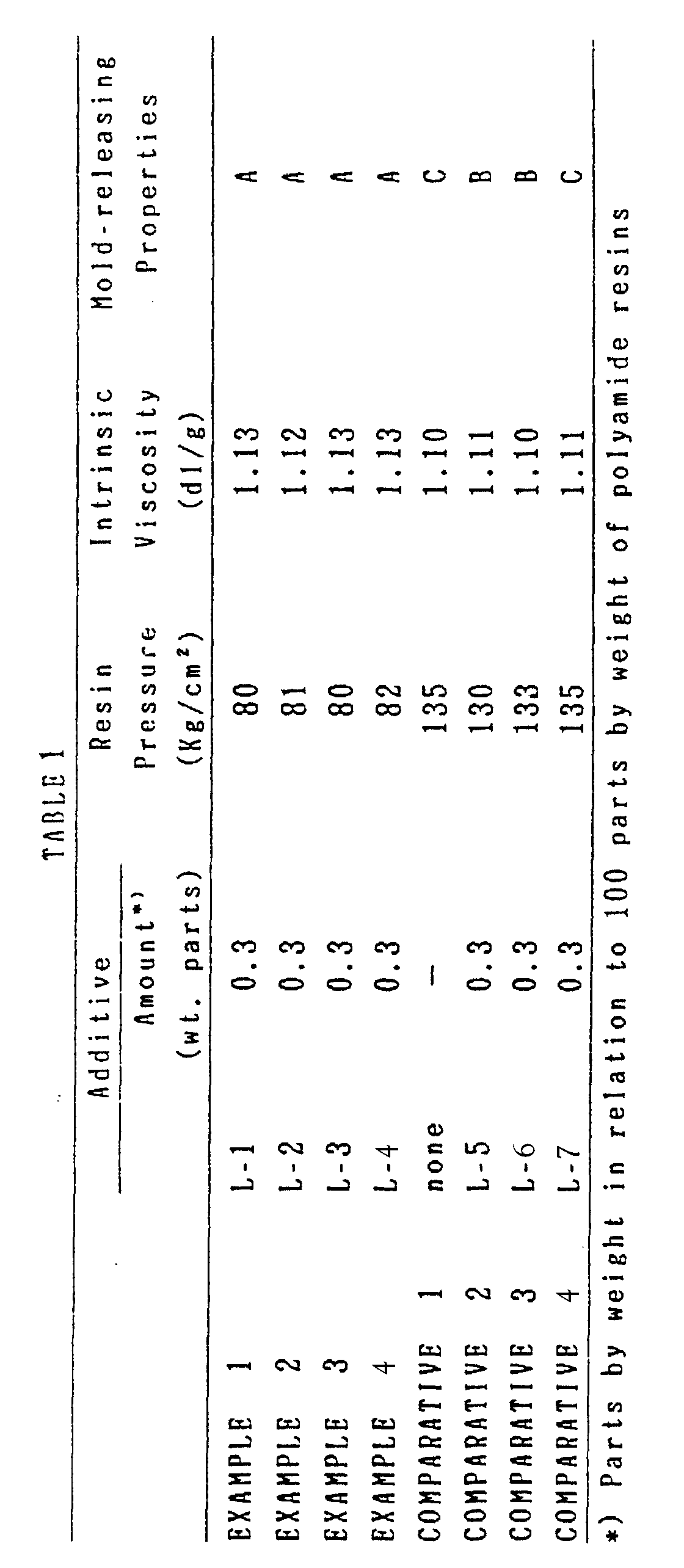
- The mixtures were melted and kneaded with a single screw extruder (30mm diameter, 330°C) in an extrusion amount of 8 Kg/hr to provide pellets. Pressures of resins at the top of the extruder and intrinsic viscosity [η] of the pellets are shown in Table 1. Further, the pellets were injection-molded at 340°C with an injection molding machine (IS-50EP, Toshiba Kikai K.K.) to estimate the properties of the compositions. The results are shown in Table 1.
- The properties were measured as follows:
- Flat molds of 100 mm x 50 mm x 0.8 mm were used at 120°C. A: molded articles were readily released from the molds and no distortion was found; B: distortion was in part found; C: remarkable distortion was found as a whole.
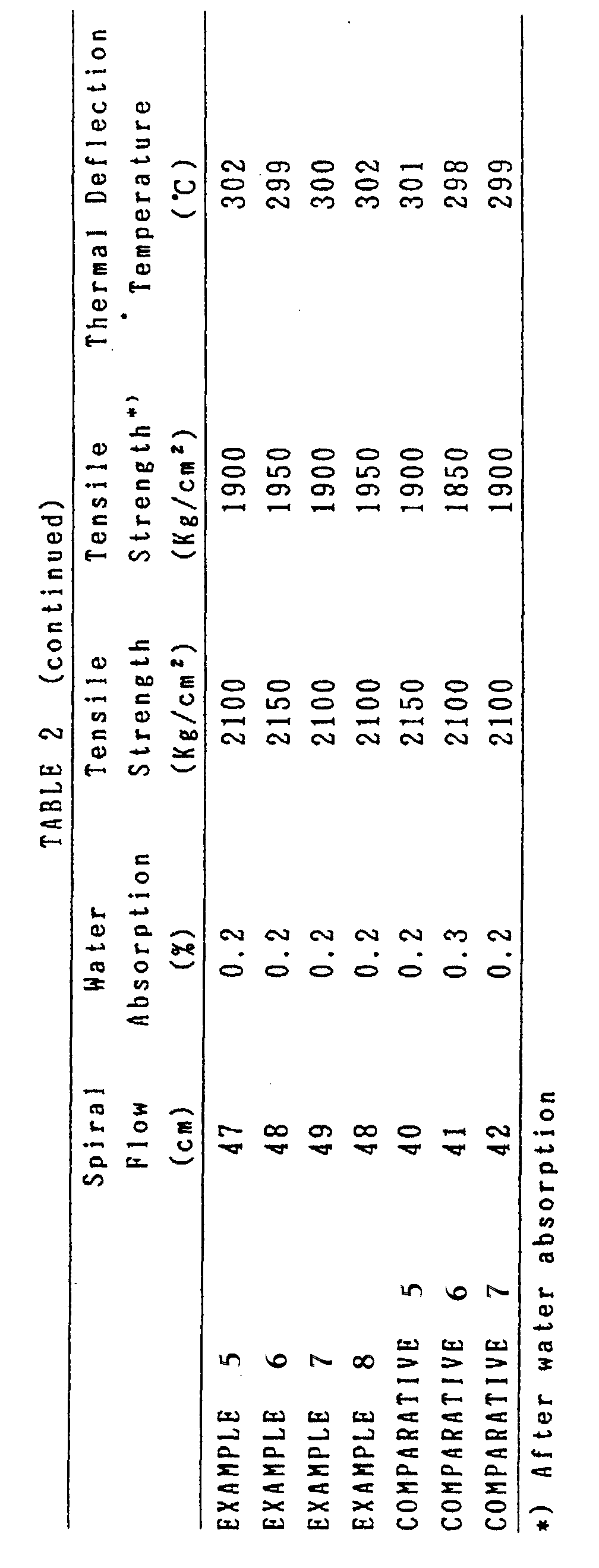
- Spiral flows were measured with spiral flow test molds at 70°C. The larger the spiral flow, the better the melt fluidity.
- Specimens were immersed in water at 23 °C for 24 hr and the increase in weight was measured in accordance with ASTM D570.
- Measured in accordance with ASTM D638.
- Specimens were immersed in water at 23 °C for 24 hr and then tensile strength was measured as above.
- Measured under a load of 18.6 Kg/cm2 in accordance with ASTM D648.

- An amount of 60 parts by weight of the resin PA-1 was mixed with 40 parts by weight of glass fibers (03MA486A, Asahi Fiber Glass K.K.), and additives as metioned before in amounts shown in Table 2.
- The mixtures were melted and kneaded with a two screw vented extruder (30 mm diameter, 330°C) in an extrusion amount of 20 Kg/hr to provide pellets. The pellets were injection-molded in the same manner as in the first EXAMPLES to estimate the properties of the compositions. The results are shown in Table 2.

Claims (9)
- An aromatic polyamide resin composition which comprises:(A) an aromatic polyamide resin consisting of:(a) a dicarboxylic acid component which consists of terephthalic acid in an amount of at least 40 mole% together with an aliphatic dicarboxylic acid in an amount of 60 mole% or less, and(b) a diamine component comprising at least one aliphatic diamine or alicyclic diamine;(B) optionally a fibrous reinforcement in an amount of 0-200 parts by weight per 100 parts by weight of the aromatic polyamide resin; and(C) at least one additive which is a partially saponified ester or a metal salt of an aliphatic carboxylic acid of 26-32 carbon atoms in an amount of 0.01-5 parts by weight per 100 parts by weight of the aromatic polyamide resin.
- A polyamide resin composition according to claim 1, wherein the dicarboxylic acid component (a) contains terephthalic acid in an amount of at least 50 mole% and an aliphatic dicarboxylic acid in an amount of 50 mole% or less, and wherein the diamine component (b) is composed of an aliphatic diamine component of 5-11 carbon atoms.
- A polyamide resin composition according to claim 1 or 2, wherein the diamine component (b) is composed of an aliphatic diamine of 6-10 carbon atoms.
- A polyamide resin composition according to claim 3, wherein the dicarboxylic acid component (a) contains terephthalic acid in an amount of 50-85 mole% and an aliphatic dicarboxylic acid in an amount of 50-15 mole%, and wherein the diamine component (b) is composed of an aliphatic diamine of 5-7 carbon atoms.
- A polyamide resin composition according to any one of the preceding claims, wherein the aliphatic dicarboxylic acid is adipic acid, and wherein the aliphatic diamine is 1,6-diaminohexane.
- A polyamide resin composition according to any one of the preceding claims, wherein the polyamide resin (A) has an intrinsic viscosity of not less than 0.5 dl/g as measured in concentrated sulfuric acid at a temperature of 30°C.
- A polyamide resin composition according to any one of the preceding claims, wherein the fibrous reinforcement is glass fibers.
- A polyamide resin composition according to any one of the preceding claims, wherein the aromatic dicarboxylic acid component (a) contains at least 60 mole% of terephthalic acid.
- Molded articles of a polyamide resin composition as claimed in any one of the preceding claims.
Applications Claiming Priority (4)
| Application Number | Priority Date | Filing Date | Title |
|---|---|---|---|
| JP22575489 | 1989-08-31 | ||
| JP225754/89 | 1989-08-31 | ||
| JP22575489 | 1989-08-31 | ||
| EP89309644A EP0360611B1 (en) | 1988-09-22 | 1989-09-21 | Polyamide resin compositions |
Related Parent Applications (2)
| Application Number | Title | Priority Date | Filing Date |
|---|---|---|---|
| EP89309644A Division EP0360611B1 (en) | 1988-09-22 | 1989-09-21 | Polyamide resin compositions |
| EP89309644.6 Division | 1989-09-21 |
Publications (3)
| Publication Number | Publication Date |
|---|---|
| EP0708142A2 EP0708142A2 (en) | 1996-04-24 |
| EP0708142A3 EP0708142A3 (en) | 1996-06-12 |
| EP0708142B1 true EP0708142B1 (en) | 2000-03-15 |
Family
ID=16834302
Family Applications (1)
| Application Number | Title | Priority Date | Filing Date |
|---|---|---|---|
| EP95120551A Expired - Lifetime EP0708142B1 (en) | 1989-08-31 | 1989-09-21 | Polyamide resin compositions |
Country Status (2)
| Country | Link |
|---|---|
| EP (1) | EP0708142B1 (en) |
| DE (1) | DE68929183T2 (en) |
Family Cites Families (7)
| Publication number | Priority date | Publication date | Assignee | Title |
|---|---|---|---|---|
| BE570938A (en) * | 1957-10-22 | |||
| DE2349835B2 (en) * | 1973-10-04 | 1979-06-07 | Basf Ag, 6700 Ludwigshafen | Molding compounds made from reinforced polyamides |
| US4250065A (en) * | 1979-06-06 | 1981-02-10 | Monsanto Company | Flame retardant nylon having improved moldability |
| JPS61254662A (en) * | 1985-05-07 | 1986-11-12 | Seiko Epson Corp | resin composition |
| DE3706356A1 (en) * | 1987-02-27 | 1988-09-08 | Basf Ag | POLYAMIDE GRANULES WITH EXTERNAL COVER |
| EP0350689B1 (en) * | 1988-07-13 | 1994-12-21 | BASF Aktiengesellschaft | Flame-retardant thermoplastic moulding compositions based on partially aromatic copolyamides |
| JP2883521B2 (en) * | 1993-08-30 | 1999-04-19 | シャープ株式会社 | Display device |
-
1989
- 1989-09-21 EP EP95120551A patent/EP0708142B1/en not_active Expired - Lifetime
- 1989-09-21 DE DE68929183T patent/DE68929183T2/en not_active Expired - Lifetime
Also Published As
| Publication number | Publication date |
|---|---|
| EP0708142A2 (en) | 1996-04-24 |
| EP0708142A3 (en) | 1996-06-12 |
| DE68929183D1 (en) | 2000-04-20 |
| DE68929183T2 (en) | 2000-10-05 |
Similar Documents
| Publication | Publication Date | Title |
|---|---|---|
| EP0360611B1 (en) | Polyamide resin compositions | |
| EP0442465B1 (en) | Thermoplastic resin composition | |
| CN103987782B (en) | Molded product | |
| US4702859A (en) | Electrically conductive polyamide resin composition | |
| CN101891953A (en) | A kind of halogen-free flame-retardant reinforced polyamide composition and its molded product | |
| EP0203136A1 (en) | Polyamide resin compositions. | |
| KR20130086067A (en) | Copolymer polyamide | |
| JPWO2015166896A1 (en) | Semi-aromatic polyamide resin composition and molded body formed by molding the same | |
| EP0392602A1 (en) | Polyamide resin composition | |
| EP0449466A1 (en) | Polyamide and polyamide resin composition | |
| JP5744439B2 (en) | Sliding member | |
| US4866115A (en) | Solid mixture of nucleated and nonnucleated polyamides | |
| JPS63308065A (en) | Glass fiber reinforced stabilized polyamide molding composition | |
| US20020040087A1 (en) | Polyamide resin composition | |
| JPH0655886B2 (en) | Nylon 46 resin composition for molding | |
| EP1200516B1 (en) | An aromatic polyamide compositions for molding | |
| US11021605B2 (en) | Vibration components for motor vehicles | |
| JP2019011388A (en) | Reinforced polyamide resin composition and molded body | |
| JP2743499B2 (en) | Polyamide resin composition | |
| EP0708142A2 (en) | Polyamide resin compositions | |
| JPH0655885B2 (en) | Polyamide resin composition for thin molded products | |
| JPH0372564A (en) | Polyamide resin composition for engine head cover | |
| JP6067254B2 (en) | Copolyamide | |
| KR0140539B1 (en) | Polyamide resin compositions | |
| JP2016138256A (en) | Molding including polyamide resin composition |
Legal Events
| Date | Code | Title | Description |
|---|---|---|---|
| PUAI | Public reference made under article 153(3) epc to a published international application that has entered the european phase |
Free format text: ORIGINAL CODE: 0009012 |
|
| 17P | Request for examination filed |
Effective date: 19951227 |
|
| AC | Divisional application: reference to earlier application |
Ref document number: 360611 Country of ref document: EP |
|
| AK | Designated contracting states |
Kind code of ref document: A2 Designated state(s): DE FR GB IT NL |
|
| PUAL | Search report despatched |
Free format text: ORIGINAL CODE: 0009013 |
|
| AK | Designated contracting states |
Kind code of ref document: A3 Designated state(s): DE FR GB IT NL |
|
| RAP1 | Party data changed (applicant data changed or rights of an application transferred) |
Owner name: MITSUI CHEMICALS, INC. |
|
| 17Q | First examination report despatched |
Effective date: 19980722 |
|
| GRAG | Despatch of communication of intention to grant |
Free format text: ORIGINAL CODE: EPIDOS AGRA |
|
| GRAG | Despatch of communication of intention to grant |
Free format text: ORIGINAL CODE: EPIDOS AGRA |
|
| GRAH | Despatch of communication of intention to grant a patent |
Free format text: ORIGINAL CODE: EPIDOS IGRA |
|
| GRAH | Despatch of communication of intention to grant a patent |
Free format text: ORIGINAL CODE: EPIDOS IGRA |
|
| GRAA | (expected) grant |
Free format text: ORIGINAL CODE: 0009210 |
|
| AC | Divisional application: reference to earlier application |
Ref document number: 360611 Country of ref document: EP |
|
| AK | Designated contracting states |
Kind code of ref document: B1 Designated state(s): DE FR GB IT NL |
|
| REF | Corresponds to: |
Ref document number: 68929183 Country of ref document: DE Date of ref document: 20000420 |
|
| ET | Fr: translation filed | ||
| ITF | It: translation for a ep patent filed | ||
| PLBE | No opposition filed within time limit |
Free format text: ORIGINAL CODE: 0009261 |
|
| STAA | Information on the status of an ep patent application or granted ep patent |
Free format text: STATUS: NO OPPOSITION FILED WITHIN TIME LIMIT |
|
| 26N | No opposition filed | ||
| PGFP | Annual fee paid to national office [announced via postgrant information from national office to epo] |
Ref country code: NL Payment date: 20010927 Year of fee payment: 13 |
|
| REG | Reference to a national code |
Ref country code: GB Ref legal event code: IF02 |
|
| PG25 | Lapsed in a contracting state [announced via postgrant information from national office to epo] |
Ref country code: NL Free format text: LAPSE BECAUSE OF NON-PAYMENT OF DUE FEES Effective date: 20030401 |
|
| PG25 | Lapsed in a contracting state [announced via postgrant information from national office to epo] |
Ref country code: IT Free format text: LAPSE BECAUSE OF NON-PAYMENT OF DUE FEES Effective date: 20050921 |
|
| PGFP | Annual fee paid to national office [announced via postgrant information from national office to epo] |
Ref country code: FR Payment date: 20080915 Year of fee payment: 20 |
|
| PGFP | Annual fee paid to national office [announced via postgrant information from national office to epo] |
Ref country code: GB Payment date: 20080924 Year of fee payment: 20 |
|
| PGFP | Annual fee paid to national office [announced via postgrant information from national office to epo] |
Ref country code: DE Payment date: 20081002 Year of fee payment: 20 |
|
| REG | Reference to a national code |
Ref country code: GB Ref legal event code: PE20 Expiry date: 20090920 |
|
| PG25 | Lapsed in a contracting state [announced via postgrant information from national office to epo] |
Ref country code: GB Free format text: LAPSE BECAUSE OF EXPIRATION OF PROTECTION Effective date: 20090920 |