EP0705816B1 - Benzene derivative useful for ischemic diseases - Google Patents
Benzene derivative useful for ischemic diseases Download PDFInfo
- Publication number
- EP0705816B1 EP0705816B1 EP94918559A EP94918559A EP0705816B1 EP 0705816 B1 EP0705816 B1 EP 0705816B1 EP 94918559 A EP94918559 A EP 94918559A EP 94918559 A EP94918559 A EP 94918559A EP 0705816 B1 EP0705816 B1 EP 0705816B1
- Authority
- EP
- European Patent Office
- Prior art keywords
- methyl
- butyl
- ethyl
- group
- propyl
- Prior art date
- Legal status (The legal status is an assumption and is not a legal conclusion. Google has not performed a legal analysis and makes no representation as to the accuracy of the status listed.)
- Expired - Lifetime
Links
- 0 CC(*C(*)N**)=O Chemical compound CC(*C(*)N**)=O 0.000 description 1
Classifications
-
- C—CHEMISTRY; METALLURGY
- C07—ORGANIC CHEMISTRY
- C07D—HETEROCYCLIC COMPOUNDS
- C07D405/00—Heterocyclic compounds containing both one or more hetero rings having oxygen atoms as the only ring hetero atoms, and one or more rings having nitrogen as the only ring hetero atom
- C07D405/02—Heterocyclic compounds containing both one or more hetero rings having oxygen atoms as the only ring hetero atoms, and one or more rings having nitrogen as the only ring hetero atom containing two hetero rings
- C07D405/12—Heterocyclic compounds containing both one or more hetero rings having oxygen atoms as the only ring hetero atoms, and one or more rings having nitrogen as the only ring hetero atom containing two hetero rings linked by a chain containing hetero atoms as chain links
-
- A—HUMAN NECESSITIES
- A61—MEDICAL OR VETERINARY SCIENCE; HYGIENE
- A61P—SPECIFIC THERAPEUTIC ACTIVITY OF CHEMICAL COMPOUNDS OR MEDICINAL PREPARATIONS
- A61P9/00—Drugs for disorders of the cardiovascular system
- A61P9/10—Drugs for disorders of the cardiovascular system for treating ischaemic or atherosclerotic diseases, e.g. antianginal drugs, coronary vasodilators, drugs for myocardial infarction, retinopathy, cerebrovascula insufficiency, renal arteriosclerosis
-
- A—HUMAN NECESSITIES
- A61—MEDICAL OR VETERINARY SCIENCE; HYGIENE
- A61P—SPECIFIC THERAPEUTIC ACTIVITY OF CHEMICAL COMPOUNDS OR MEDICINAL PREPARATIONS
- A61P9/00—Drugs for disorders of the cardiovascular system
- A61P9/12—Antihypertensives
-
- C—CHEMISTRY; METALLURGY
- C07—ORGANIC CHEMISTRY
- C07D—HETEROCYCLIC COMPOUNDS
- C07D277/00—Heterocyclic compounds containing 1,3-thiazole or hydrogenated 1,3-thiazole rings
- C07D277/02—Heterocyclic compounds containing 1,3-thiazole or hydrogenated 1,3-thiazole rings not condensed with other rings
- C07D277/08—Heterocyclic compounds containing 1,3-thiazole or hydrogenated 1,3-thiazole rings not condensed with other rings having one double bond between ring members or between a ring member and a non-ring member
- C07D277/12—Heterocyclic compounds containing 1,3-thiazole or hydrogenated 1,3-thiazole rings not condensed with other rings having one double bond between ring members or between a ring member and a non-ring member with hetero atoms or with carbon atoms having three bonds to hetero atoms with at the most one bond to halogen, e.g. ester or nitrile radicals, directly attached to ring carbon atoms
- C07D277/14—Oxygen atoms
-
- C—CHEMISTRY; METALLURGY
- C07—ORGANIC CHEMISTRY
- C07D—HETEROCYCLIC COMPOUNDS
- C07D277/00—Heterocyclic compounds containing 1,3-thiazole or hydrogenated 1,3-thiazole rings
- C07D277/60—Heterocyclic compounds containing 1,3-thiazole or hydrogenated 1,3-thiazole rings condensed with carbocyclic rings or ring systems
- C07D277/62—Benzothiazoles
- C07D277/68—Benzothiazoles with hetero atoms or with carbon atoms having three bonds to hetero atoms with at the most one bond to halogen, e.g. ester or nitrile radicals, directly attached in position 2
- C07D277/82—Nitrogen atoms
-
- C—CHEMISTRY; METALLURGY
- C07—ORGANIC CHEMISTRY
- C07D—HETEROCYCLIC COMPOUNDS
- C07D317/00—Heterocyclic compounds containing five-membered rings having two oxygen atoms as the only ring hetero atoms
- C07D317/08—Heterocyclic compounds containing five-membered rings having two oxygen atoms as the only ring hetero atoms having the hetero atoms in positions 1 and 3
- C07D317/44—Heterocyclic compounds containing five-membered rings having two oxygen atoms as the only ring hetero atoms having the hetero atoms in positions 1 and 3 ortho- or peri-condensed with carbocyclic rings or ring systems
- C07D317/46—Heterocyclic compounds containing five-membered rings having two oxygen atoms as the only ring hetero atoms having the hetero atoms in positions 1 and 3 ortho- or peri-condensed with carbocyclic rings or ring systems condensed with one six-membered ring
- C07D317/48—Methylenedioxybenzenes or hydrogenated methylenedioxybenzenes, unsubstituted on the hetero ring
- C07D317/62—Methylenedioxybenzenes or hydrogenated methylenedioxybenzenes, unsubstituted on the hetero ring with hetero atoms or with carbon atoms having three bonds to hetero atoms with at the most one bond to halogen, e.g. ester or nitrile radicals, directly attached to atoms of the carbocyclic ring
- C07D317/64—Oxygen atoms
-
- C—CHEMISTRY; METALLURGY
- C07—ORGANIC CHEMISTRY
- C07D—HETEROCYCLIC COMPOUNDS
- C07D413/00—Heterocyclic compounds containing two or more hetero rings, at least one ring having nitrogen and oxygen atoms as the only ring hetero atoms
- C07D413/02—Heterocyclic compounds containing two or more hetero rings, at least one ring having nitrogen and oxygen atoms as the only ring hetero atoms containing two hetero rings
- C07D413/12—Heterocyclic compounds containing two or more hetero rings, at least one ring having nitrogen and oxygen atoms as the only ring hetero atoms containing two hetero rings linked by a chain containing hetero atoms as chain links
-
- C—CHEMISTRY; METALLURGY
- C07—ORGANIC CHEMISTRY
- C07D—HETEROCYCLIC COMPOUNDS
- C07D417/00—Heterocyclic compounds containing two or more hetero rings, at least one ring having nitrogen and sulfur atoms as the only ring hetero atoms, not provided for by group C07D415/00
- C07D417/02—Heterocyclic compounds containing two or more hetero rings, at least one ring having nitrogen and sulfur atoms as the only ring hetero atoms, not provided for by group C07D415/00 containing two hetero rings
- C07D417/06—Heterocyclic compounds containing two or more hetero rings, at least one ring having nitrogen and sulfur atoms as the only ring hetero atoms, not provided for by group C07D415/00 containing two hetero rings linked by a carbon chain containing only aliphatic carbon atoms
-
- C—CHEMISTRY; METALLURGY
- C07—ORGANIC CHEMISTRY
- C07D—HETEROCYCLIC COMPOUNDS
- C07D417/00—Heterocyclic compounds containing two or more hetero rings, at least one ring having nitrogen and sulfur atoms as the only ring hetero atoms, not provided for by group C07D415/00
- C07D417/02—Heterocyclic compounds containing two or more hetero rings, at least one ring having nitrogen and sulfur atoms as the only ring hetero atoms, not provided for by group C07D415/00 containing two hetero rings
- C07D417/12—Heterocyclic compounds containing two or more hetero rings, at least one ring having nitrogen and sulfur atoms as the only ring hetero atoms, not provided for by group C07D415/00 containing two hetero rings linked by a chain containing hetero atoms as chain links
-
- C—CHEMISTRY; METALLURGY
- C07—ORGANIC CHEMISTRY
- C07D—HETEROCYCLIC COMPOUNDS
- C07D417/00—Heterocyclic compounds containing two or more hetero rings, at least one ring having nitrogen and sulfur atoms as the only ring hetero atoms, not provided for by group C07D415/00
- C07D417/14—Heterocyclic compounds containing two or more hetero rings, at least one ring having nitrogen and sulfur atoms as the only ring hetero atoms, not provided for by group C07D415/00 containing three or more hetero rings
-
- C—CHEMISTRY; METALLURGY
- C07—ORGANIC CHEMISTRY
- C07D—HETEROCYCLIC COMPOUNDS
- C07D419/00—Heterocyclic compounds containing two or more hetero rings, at least one ring having nitrogen, oxygen, and sulfur atoms as the only ring hetero atoms
- C07D419/02—Heterocyclic compounds containing two or more hetero rings, at least one ring having nitrogen, oxygen, and sulfur atoms as the only ring hetero atoms containing two hetero rings
- C07D419/12—Heterocyclic compounds containing two or more hetero rings, at least one ring having nitrogen, oxygen, and sulfur atoms as the only ring hetero atoms containing two hetero rings linked by a chain containing hetero atoms as chain links
-
- C—CHEMISTRY; METALLURGY
- C07—ORGANIC CHEMISTRY
- C07D—HETEROCYCLIC COMPOUNDS
- C07D513/00—Heterocyclic compounds containing in the condensed system at least one hetero ring having nitrogen and sulfur atoms as the only ring hetero atoms, not provided for in groups C07D463/00, C07D477/00 or C07D499/00 - C07D507/00
- C07D513/02—Heterocyclic compounds containing in the condensed system at least one hetero ring having nitrogen and sulfur atoms as the only ring hetero atoms, not provided for in groups C07D463/00, C07D477/00 or C07D499/00 - C07D507/00 in which the condensed system contains two hetero rings
- C07D513/10—Spiro-condensed systems
Definitions
- This invention relates to compounds by the general formula (I) and pharmaceutically acceptable salts or each possible stereoisomer and optical isomer thereof, which have an inhibitory action on calcium overload in addition to a vasorelaxing activity (calcium antagonism) and an inhibitory action on lipid peroxidation and are useful as a preventive or treating agent for ischemic diseases and hypertension.
- the process of cell injuries owing to ischemia is broadly divided into two courses: (1) damages caused by reduction in intracellular ATP level or increase in intracellular calcium concentration etc. under insufficient oxygen supply during ischemia and (2) damages caused by increasing influx of calcium or production of free radicals, etc. followed by reperfusion or restoration of blood vessels after ischemia (Yoshiwara, et al., Metabolism and disease , 29 , 379 (1992)).
- cardiovascular diseases such as variant angina, unstable angina and arrythmia brought by restoration of coronary vessels by PTCA/PTCR/CABG, etc. or cerebrovascular diseases such as transient cerebroischemic attack; traumatic injury to the head and sequels after brain surgery can be given.
- nitro compounds exemplified by nitroglycerin and nicorandil and calcium antagonists exemplified by diltiazem, nifedipine and verapamil are used and for the amelioration of cardiac infarction or coronary reperfusion injury followed by PTCA/PTCR/CABG, etc.
- use of 5-lipoxygenase inhibitors or radical scavengers are under investigation.
- As preventive and treating agents for ischemic cerebrovascular diseases glyceol (registered trade mark), ozagrel, nizofenone, ticlopidine, nicaraven, etc.
- cerebral circulation enhancers such as calcium antagonists exemplified by nicardipine, cinnarizine and flunarizine, cerebral circulation enhancers with promotive action for metabolism such as vinpocetine, nicergoline, pentoxifylline, and ifenprodil, or cerebral metabolic activators such as idebenone, GABA, and calcium hopantenate have been used in order to increase blood flow or improve the metabolic state in the tissue which survived the ischemic injury.
- cerebral circulation enhancers such as calcium antagonists exemplified by nicardipine, cinnarizine and flunarizine
- cerebral circulation enhancers with promotive action for metabolism such as vinpocetine, nicergoline, pentoxifylline, and ifenprodil
- cerebral metabolic activators such as idebenone, GABA, and calcium hopantenate
- the present invention provides compounds represented by the general formula (I): wherein R 1 represents a hydrogen atom, a hydroxyl group, an acyloxy group having 1 to 9 carbon atoms or a lower alkoxy group having 1 to 6 carbon atoms; R 2 and R 3 , which may be the same or different, each represents, a hydroxyl group, an isopropyl group or a t-butyl group, R 4 represents a hydrogen atom, a lower alkyl group having 1 to 6 carbon atoms; A represents a fragment represented by formula (II): wherein R 5 represents a hydrogen atom, a substituted or unsubstituted lower alkyl group having 1 to 6 carbon atoms, a substituted or unsubstituted lower alkenyl group having 1 to 6 carbon atoms, a substituted or unsubstituted alkoxy group having 1 to 6 carbon atoms, a substituted or unsubstituted aryl group or a substituted or unsubsti
- the compound represented by formula (I) can be prepared by the following processes A to Q.
- R 1 represents a hydrogen atom, a hydroxyl group, an acyloxy group having 1 to 9 carbon atoms or a lower alkoxy group having 1 to 6 carbon atoms
- R 2 and R 3 which may be the same or different, each represents a hydrogen atom, a hydroxyl group, a halogen atom, a lower alkyl group having 1 to 6 carbon atoms or a lower alkoxy group having 1 to 6 carbon atoms
- R 4 represents a hydrogen atom, a lower alkyl group having 1 to 6 carbon atoms
- R 5 represents a hydrogen atom, a substituted or unsubstituted lower alkyl group having 1 to 6 carbon atoms, a substituted or unsubstituted lower alkenyl group having 1 to 6 carbon atoms, a substituted or unsubstituted aryl group or a substituted or unsubstituted heterocyclic group
- R 6 and R 7 which may be the same or different
- R 1 , R 2 , R 3 , R 4 , R 5 , R 6 , R 7 , and n are the same as defined previously;
- R 8 represents a substituted or unsubstituted aryl group or a substituted or unsubstituted heterocyclic group;
- Z represents a chlorine atom or a bromine atom.
- R 1 , R 2 , R 3 , R 4 , R 5 , R 6 , R 7 , R 8 , n, and Z are the same as defined previously.
- R 1 , R 2 , R 3 , R 4 , R 5 , R 6 , R 7 , and n are the same as defined previously.
- R 1 , R 2 , R 3 , R 4 , R 5 , R 6 , R 7 , n, and Z are the same as defined previously;
- R 9 represents an alkyl group having 1 to 6 carbon atoms; and
- m represents an integer of 1 to 7.
- R 1 , R 2 , R 3 , R 4 , R 5 , R 6 , R 7 , R 8 , R 9 , n, and m are the same as defined previously.
- R 2 , R 3 , R 4 , R 5 , R 6 , R 7 , R 8 , R 9 , n, and m are the same as defined previously.
- R 1 , R 2 , R 3 , R 4 , R 5 , R 5 , R 6 , Z, n, and m are the same as defined previously; and R 10 and R 11 , which may be the same or different, each represents a hydrogen atom, a substituted or unsubstituted lower alkyl group having 1 to 6 carbon atoms, a substituted or unsubstituted lower alkenyl group having 1 to 6 carbon atoms, a substituted or unsubstituted aryl group or a substituted or unsubstituted heterocyclic group, or R 10 and R 11 are taken together to form a substituted or unsubstituted ring which may be a condensed ring.
- R 1 , R 2 , R 3 , R 4 , R 5 , R 6 , R 7 , Z, and n are the same as defined previously; and R 9 represents a substituted or unsubstituted lower alkyl group having 1 to 6 carbon atoms.
- R 1 , R 2 , R 3 , R 4 , R 5 , R 6 , R 7 , and n are the same as defined previously.
- R 1 , R 2 , R 3 , R 4 , R 5 , R 6 , R 7 , and n are the same as defined previously;
- R 12 represents a carboxyl group or a sulfonyl group; and
- R 13 represents a carbonyl group or a sulfonyl group.
- R 1 , R 2 , R 3 , R 4 , R 5 , R 6 , R 7 , and n are the same as defined previously; and R 13 represents a carbonyl group.
- R 1 , R 2 , R 3 , R 4 , R 5 , R 6 , R 7 , and n are the same as defined previously.
- R 1 , R 2 , R 3 , R 4 , R 5 , R 6 , R 7 , and n are the same as defined previously;
- A represents a fragment selected from the group of following fragments represented by formulae (VI), (VIII), (XI), (XV), and (XVI): and X represents a chlorine atom or a bromine atom.
- R 1 , R 2 , R 3 , R 4 , R 5 , R 6 , R 7 , n, and X are the same as defined previously.
- R 1 , R 2 , R 3 , R 4 , R 5 , R 6 , R 7 , and n are the same as defined previously.
- R 1 , R 2 , R 3 , R 4 , R 5 , R 6 , and R 7 are the same as defined previously.
- the compound of formula (I) according to the present invention contains one or two asymmetric carbon atoms in the structure thereof, and the pure stereoisomers or optical isomers can be obtained by methods known in the art.
- each enantiomer can be separated by chromatography using a HPLC column for optical resolution or by fractional crystallization utilizing an optically active acid, preferably (R)-(-)-1,1'-binaphthyl-2,2'-diyl hydrogen phosphate.
- optically active acid preferably (R)-(-)-1,1'-binaphthyl-2,2'-diyl hydrogen phosphate.
- optically active acid preferably (R)-(-)-1,1'-binaphthyl-2,2'-diyl hydrogen phosphate.
- commonly used optically active bases such as brucine can be employed.
- diastereomeric mixtures comprising both cis- and trans-stereoisomers can be separated to each optical isomer, i.e., cis(+), cis(-), trans(+) and trans(-), by conventional methods known to those skilled in the art.
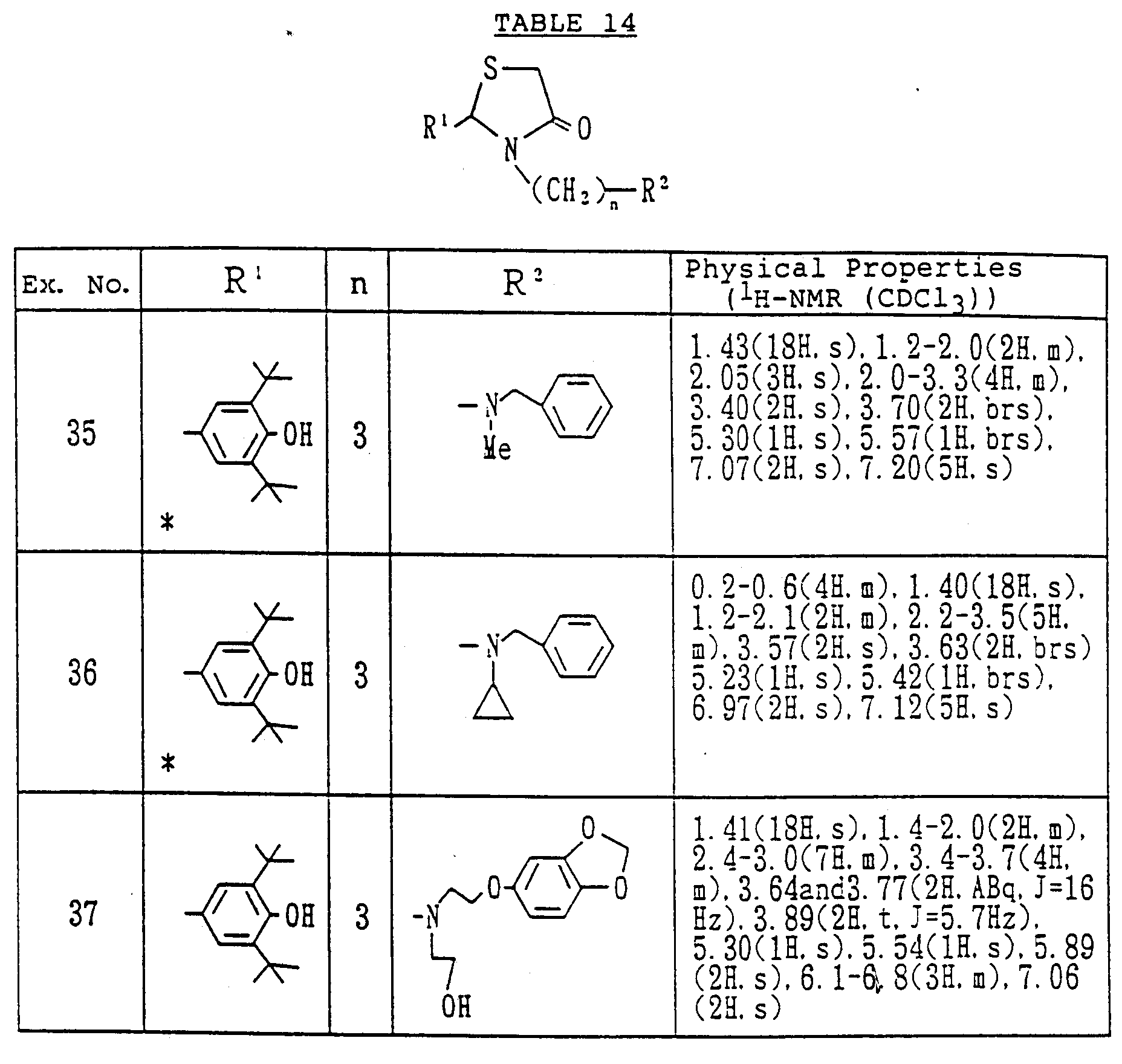
- Each compound of Table 14 was prepared according to the procedure for Example 26-B, reacting each of the compounds shown in Table 13 with an appropriate bromide in each case.
- N-[3-[N'-methyl-N'-[2-(3,4-methylenedioxyphenoxy)ethyl]amino]propyl]phthalimide (1.82 g) was dissolved in 40% methanolic solution of methylamine (10 ml), and the mixture was stirred at room temperature overnight. After completion of the reaction, the solvent and excess methylamine were removed under reduced pressure. The residue was purified by silica gel column chromatography (eluent; chloroform-methanol, 1:1 containing 1% triethylamine) to afford 0.74 g (62%) of the title compound as a pale brown oil.
- the title compound was prepared according to the procedure for Reference Example 36, using N-(2-bromoethyl)phthalimide instead of N-(3-bromopropyl)phthalimide.
- the title compound was prepared according to the procedure for Reference Example 1, using 3-[N-methyl-N-[2-(3,4-methylenedioxyphenoxy)ethyl]amino]propylamine and 2-mercaptopropionic acid instead of 3-aminopropanol and ⁇ -mercaptoacetic acid.
- the title compound was prepared according to the procedure for Reference Example 1, using 2-[N-methyl-N-[2-(3,4-methylenedioxyphenoxy)ethyl]amino]ethylamine instead of 3-aminopropanol.
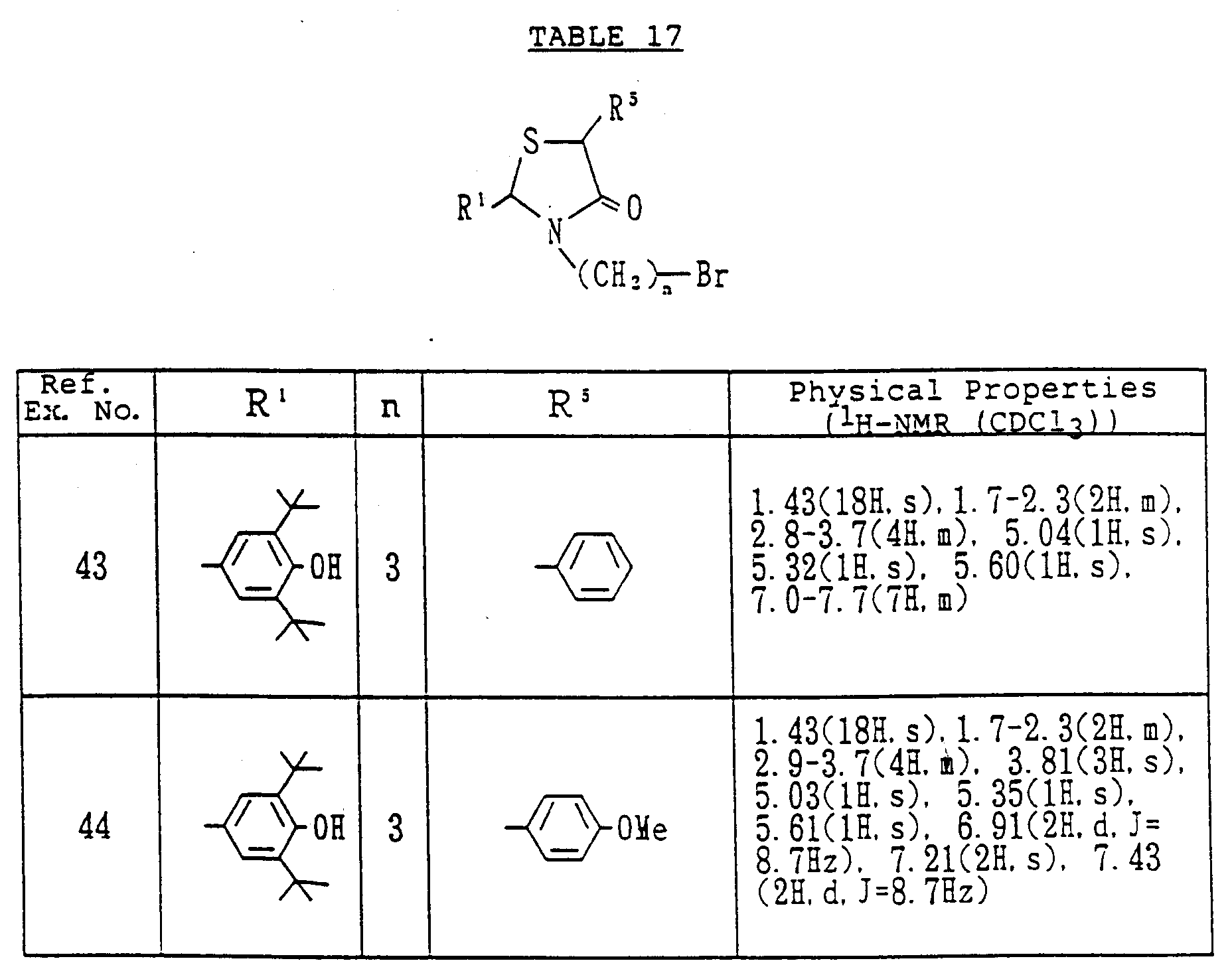
- Each compound shown in Table 17 was prepared from each of the compounds prepared in Reference Examples 39 and 40, respectively, according to the procedure for Reference Example 29.
- Example 41-A The title compound was prepared according to the procedure for Example 1, using 2-(3,5-di-tert-butyl-4-hydroxyphenyl)-3-(3-chloropropyl)-5-methyl-1,3-thiazolidin-4-one prepared in Reference Example 42.
- the data of instrumental analyses on the resulting compound were identical with those of the compound prepared in Example 41-A.
- Each compound shown in Table 18 was prepared according to the procedure for Example 26-A, using respective compounds obtained in Reference Examples 43 and 44, instead of 2-(3,5-di-tert-butyl-4-hydroxyphenyl)-3-(3-bromopropyl)-1,3-thiazolidin-4-one.
- the title compound was obtained as a pale brown oil according to the procedure for Example 1, using 2-(3,5-di-tert-butyl-4-hydroxyphenyl)-3-(3-chloropropyl)-5-(1-pyrrolidinecarbonylmethyl)-1,3-thiazolidin-4-one obtained in Reference Example 47 instead of 2-(3,5-diisopropyl-4-hydroxyphenyl)-3-(3-chloropropyl)-1,3-thiazolidin-4-one.
- Each compound shown in Table 20 was prepared according to the procedure for Example 50, using each of the compounds prepared in Reference Examples 48 to 50 instead of 2-(3,5-di-tert-butyl-4-hydroxyphenyl)-3-(chloropropyl)-5-(1-pyrrolidinecarbonylmethyl)-1,3-thiazolidin-4-one.
- the title compound was obtained as a pale yellow oil according to the procedure for Example 26-A, using 2-(3,5-di-tert-butyl-4-hydroxyphenyl)-3-(3-bromopropyl)-5-methoxy-1,3-thiazolidin-4-one prepared in Reference Example 51 instead of 2-(3,5-di-tert-butyl-4-hydroxyphenyl)-3-(3-bromopropyl)-1,3-thiazolidin-4-one.
- Each compound shown in Table 22 was prepared according to the procedure for Example 54, using each of the compounds prepared in Reference Examples 52 and 53 instead of 2-(3,5-di-tert-butyl-4-hydroxyphenyl)-3-(3-bromopropyl)-5-methoxy-1,3-thiazolidin-4-one.
- 3,5-di-tert-butyl-4-hydroxybenzenesulfonyl chloride was prepared from 3,5-di-tert-butyl-4-hydroxybenzenesulfonic acid and thionyl chloride instead of 3,5-di-tert-butyl-4-hydroxybenzoic acid and oxalyl chloride, and then converted to N-[3-[N-methyl-N-[2-(3,4-methylenedioxyphenoxy)ethyl]amino]propyl]-3,5-di-tert-butyl-4-hydroxybenzenesulfonamide to afford a colorless oil.
- Example 57 The title compound was obtained as pale yellow crystals according to the procedure for Example 57, using N-[3-[N-methyl-N-[2-(3,4-methylenedioxyphenoxy)ethyl]amino]propyl]-3,5-di-tert-butyl-4-hydroxybenzamide prepared in Example 58 instead of 2-(3,5-di-tert-butyl-4-hydroxyphenyl)-3-[3-[N-methyl-N-[2-(3,4-methylenedioxyphenoxy)ethyl]amino]propyl]-1,3-thiazolidin-4-one. mp 114-115°C.
- the title compound was obtained as a colorless oil according to the procedure for Example 26-A, using 3-(3-bromopropyl)-5-(3,5-di-tert-butyl-4-hydroxyphenyl)-1,3,4- oxadiazol-2(3H)-one obtained in Reference Example 54 instead of 2-(3,5-di-tert-butyl-4-hydroxyphenyl)-3-(3-bromopropyl)-1,3-thiazolidin-4-one.
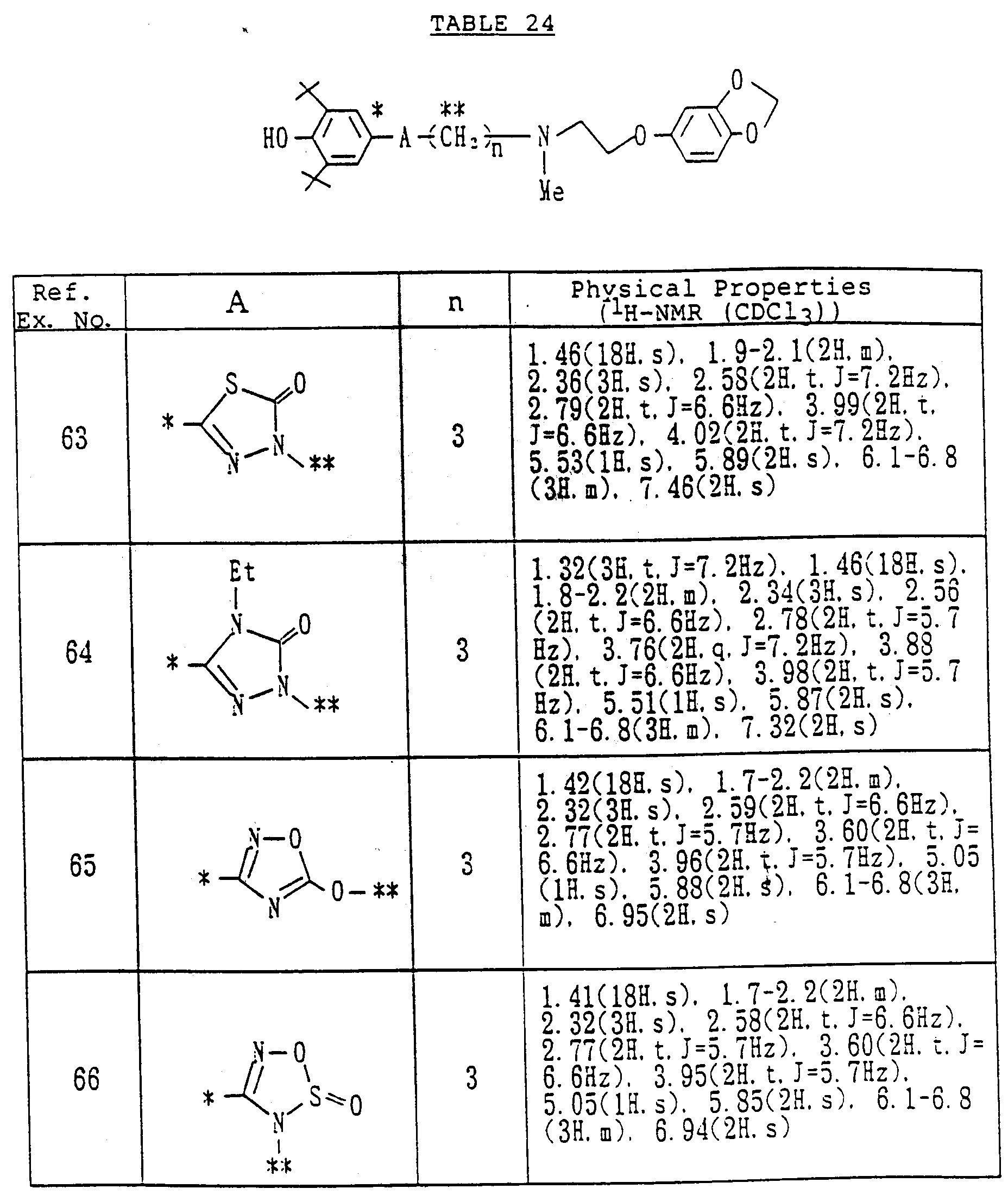
- Each compound shown in Table 24 was prepared according to the procedure for Example 62, using each of the compounds shown in Table 23 instead of 3-(3-bromopropyl)-5-(3,5-di-tert-butyl-4-hydroxyphenyl)-1,3,4-oxadiazol-2(3H)-one.
- the title compound was obtained as a colorless oil according to the procedure for Example 1, using 5-(3,5-di-tert-butyl-4-hydroxyphenyl)-1-(3-chloropropyl)imidazole obtained in Reference Example 60 instead of 2-(3,5-diisopropyl-4-hydroxyphenyl)-3-(3-chloropropyl)-1,3-thiazolidin-4-one.
- Example 26-A or 26-B The compound obtained in Example 26-A or 26-B and weighing 400 mg was subjected to HPLC using a column for optical resolution (CHIRALCEL OD; 2 cm (diameter) x 25 cm) in several tens of divided fractions under conditions of a mobile phase of n-hexane-isopropyl alcohol, (80:20), a flow rate of 16 ml/min, and a detection wavelength of 280 nm to recover 180 mg of the title compound.
- Example 41-A or 41-B The compound obtained in Example 41-A or 41-B and weighing 500 mg was subjected to HPLC using a silica gel column (YMC-PackSIL SH-043-5, 2 cm (diameter) x 25 cm) in several tens of divided fractions under conditions of a mobile phase of chloroform-isopropanol, (97:3), a flow rate of 12 ml/min, and a detection wavelength of 280 nm to recover 150 mg of the title compound.
- the stereochemistry was assumed from the 1 H-NMR data of M.R. Johnson, et al. (M.R. Johnson, et al., J. Org. Chem. , 48 , 494 (1983)).
- Example 41-A or 41-B The compound obtained in Example 41-A or 41-B and weighing 500 mg was subjected to HPLC in several tens of divided fractions under the same conditions as in Example 72 to obtain 140 mg of the title compound.
- the stereochemistry was assumed from the 1 H-NMR data of M.R. Johnson, et al. (M.R. Johnson, et al., J. Org. Chem. , 48 , 494 (1983)).
- Example 73 The compound obtained in Example 73 was subjected to HPLC in several tens of divided fractions under the same conditions as in Example 70 to recover the title compound.
- Example 73 The compound obtained in Example 73 was subjected to HPLC in several tens of divided fractions under the same conditions as in Example 70 to recover the title compound.
- Test Examples are described below in order to demonstrate that the compounds having formula (I) according to the present invention exhibit the three actions, i.e., an inhibitory action on lipid peroxidation, a vasorelaxing action, and an inhibition of calcium overload.
- a test compound was added to rabbit LDL prepared according to the method of Havel, et al. (Havel RJ et al., J. Clin. Invest. , 34 , 1345 (1955)), and then a soybean lipoxygenase type-IS (SLO) was added to a final concentration of 40 ⁇ g/ml.
- Oxydation of LDL was carried out by incubating at 37°C in a CO 2 incubator for 24 hours.
- the oxidized LDL solution was analyzed by gel-permeation chromatography, and the fluorescence intensity of the LDL fraction was measured at an excitation wavelength of 360 nm and an emission wavelength of 430 nm. The results of measurement expressed as a percentage of control, are shown in Table 25.
- a test compound was added to rabbit LDL prepared according to the method of Havel, et al. (Havel RJ, et al., J. Clin. Invest. , 34 , 1345 (1955)), and then CuSO 4 was added to a final concentration of 1 ⁇ M. Oxidation of LDL was performed by shaking at 37°C for 24 hours. The generated TBARS was measured by the method of Yagi utilizing fluorometry (Yagi, K., Biochem. Med. , 15 , 212 (1976)). The results of measurement expressed as a percentage of control, are shown in Table 26.
- the thoracic aorta was excised from a Sprague-Dawley (Crj) male rat weighing between 350 and 550 g, and dissected free from surrounding connective tissue.
- the vessel was cut into a ring having a width of 2 to 3 mm.
- the resulting preparation was mounted for isometric tension recording in an organ bath filled with 10 ml of a Krebs-Henseleit solution (K-H solution, pH 7.4, 37°C), which was bubbled with 95% O 2 /5% CO 2 .
- Isometric tension changes were monitored with an isometric transducer (TB-611T, manufactured by Nihon Kohden Corp.).
- the preparation was given a stretched tension of 2 g and allowed to equilibrate for 30 minutes (the K-H solution was exchanged for a fresh one every 15 minutes).
- the preparation was precontracted by changing the solution in the bath to one containing 30 mM K + .
- the preparation was washed with K-H solution.
- Sixty minutes thereafter the K-H solution was exchanged with a fresh one every 20 minutes
- contraction was again induced in the same manner as described above.
- a test compound or diltiazem was added to the system in a cumulative manner in half log-unit increments to obtain a concentration-response curve.
- Incubated ventricular myocytes were prepared from the heart of male Sprague-Dawley rat weighing 300 to 500 g, using an enzyme-perfusion method.
- rod-shaped normal myocytes were treated with a test compound or diltiazem for 30 minutes, and 100 ⁇ g/ml of veratrine was added. Five minutes later, the shape of the cells was observed to obtain a survival rate thereby to evaluate the efficacy of the compound.
- the results obtained are shown in Table 28.
- Compound (Example No.) Survival Rate of Cells Compound (26) Compound (8) Compound (9) Compound (12) Compound (20) Diltiazem
- the compound according to the present invention has an inhibitory action on lipid peroxidation, a vasorelaxing action, and an inhibitory action on calcium overload and can therefore be used as a preventive or treating agent for ischemic diseases and a hypertension.
Landscapes
- Organic Chemistry (AREA)
- Chemical & Material Sciences (AREA)
- Health & Medical Sciences (AREA)
- Engineering & Computer Science (AREA)
- Bioinformatics & Cheminformatics (AREA)
- Heart & Thoracic Surgery (AREA)
- Life Sciences & Earth Sciences (AREA)
- Veterinary Medicine (AREA)
- Chemical Kinetics & Catalysis (AREA)
- General Chemical & Material Sciences (AREA)
- Medicinal Chemistry (AREA)
- Nuclear Medicine, Radiotherapy & Molecular Imaging (AREA)
- Public Health (AREA)
- Pharmacology & Pharmacy (AREA)
- Cardiology (AREA)
- Animal Behavior & Ethology (AREA)
- General Health & Medical Sciences (AREA)
- Urology & Nephrology (AREA)
- Vascular Medicine (AREA)
- Pharmaceuticals Containing Other Organic And Inorganic Compounds (AREA)
- Organic Low-Molecular-Weight Compounds And Preparation Thereof (AREA)
- Acyclic And Carbocyclic Compounds In Medicinal Compositions (AREA)
- Nitrogen Condensed Heterocyclic Rings (AREA)
- Heterocyclic Carbon Compounds Containing A Hetero Ring Having Oxygen Or Sulfur (AREA)
- Plural Heterocyclic Compounds (AREA)
Abstract
Description
- This invention relates to compounds by the general formula (I) and pharmaceutically acceptable salts or each possible stereoisomer and optical isomer thereof, which have an inhibitory action on calcium overload in addition to a vasorelaxing activity (calcium antagonism) and an inhibitory action on lipid peroxidation and are useful as a preventive or treating agent for ischemic diseases and hypertension.
- The process of cell injuries owing to ischemia is broadly divided into two courses: (1) damages caused by reduction in intracellular ATP level or increase in intracellular calcium concentration etc. under insufficient oxygen supply during ischemia and (2) damages caused by increasing influx of calcium or production of free radicals, etc. followed by reperfusion or restoration of blood vessels after ischemia (Yoshiwara, et al., Metabolism and disease, 29, 379 (1992)). As typical ischemic diseases, cardiovascular diseases such as variant angina, unstable angina and arrythmia brought by restoration of coronary vessels by PTCA/PTCR/CABG, etc. or cerebrovascular diseases such as transient cerebroischemic attack; traumatic injury to the head and sequels after brain surgery can be given. In the treatment for variant angina or unstable angina, nitro compounds exemplified by nitroglycerin and nicorandil and calcium antagonists exemplified by diltiazem, nifedipine and verapamil are used and for the amelioration of cardiac infarction or coronary reperfusion injury followed by PTCA/PTCR/CABG, etc., use of 5-lipoxygenase inhibitors or radical scavengers are under investigation. As preventive and treating agents for ischemic cerebrovascular diseases, glyceol (registered trade mark), ozagrel, nizofenone, ticlopidine, nicaraven, etc. have been investigated and used with the idea of reducing the occurrence of cerebral edema or cerebrovascular spasms in the acute stage of cerebrovascular accident. In the chronic stage, cerebral circulation enhancers such as calcium antagonists exemplified by nicardipine, cinnarizine and flunarizine, cerebral circulation enhancers with promotive action for metabolism such as vinpocetine, nicergoline, pentoxifylline, and ifenprodil, or cerebral metabolic activators such as idebenone, GABA, and calcium hopantenate have been used in order to increase blood flow or improve the metabolic state in the tissue which survived the ischemic injury.
- Based on extensive investigation to seek for an excellent preventive and treating agents for ischemic diseases or hypertension which would be able to suppress the generation of active oxygen species and increase of intracellular calcium concentration that are considered as the main causes of ischemic diseases and hypertension, the present inventors have discovered compounds represented by formula (I) having vasorelaxing activity (calcium antagonism), inhibitory actions on lipid peroxidation and calcium overload and have resulted in the completion of the present invention.
- On the other hand, compounds having a phenol moiety substituted by two t-butyl groups and 1,3-thiazolidine moiety, for example, 5-[[3,5-bis(t-butyl)-4-hydroxyphenyl]methylene]-3-methyl-4-thiazolidine, are known from EP-B-0 211 670 as anti-inflammatory drugs.
- The present invention provides compounds represented by the general formula (I):wherein R1 represents a hydrogen atom, a hydroxyl group, an acyloxy group having 1 to 9 carbon atoms or a lower alkoxy group having 1 to 6 carbon atoms; R2 and R3, which may be the same or different, each represents, a hydroxyl group, an isopropyl group or a t-butyl group, R4 represents a hydrogen atom, a lower alkyl group having 1 to 6 carbon atoms; A represents a fragment represented by formula (II):
 wherein R5 represents a hydrogen atom, a substituted or unsubstituted lower alkyl group having 1 to 6 carbon atoms, a substituted or unsubstituted lower alkenyl group having 1 to 6 carbon atoms, a substituted or unsubstituted alkoxy group having 1 to 6 carbon atoms, a substituted or unsubstituted aryl group or a substituted or unsubstituted heterocyclic group, or R5 forms a 5- or 6-membered ring containing two or more oxygen atoms or sulfur atoms, in which case the carbon atom to which it is bonded is a spiro atom; or a fragment represented by formula (III):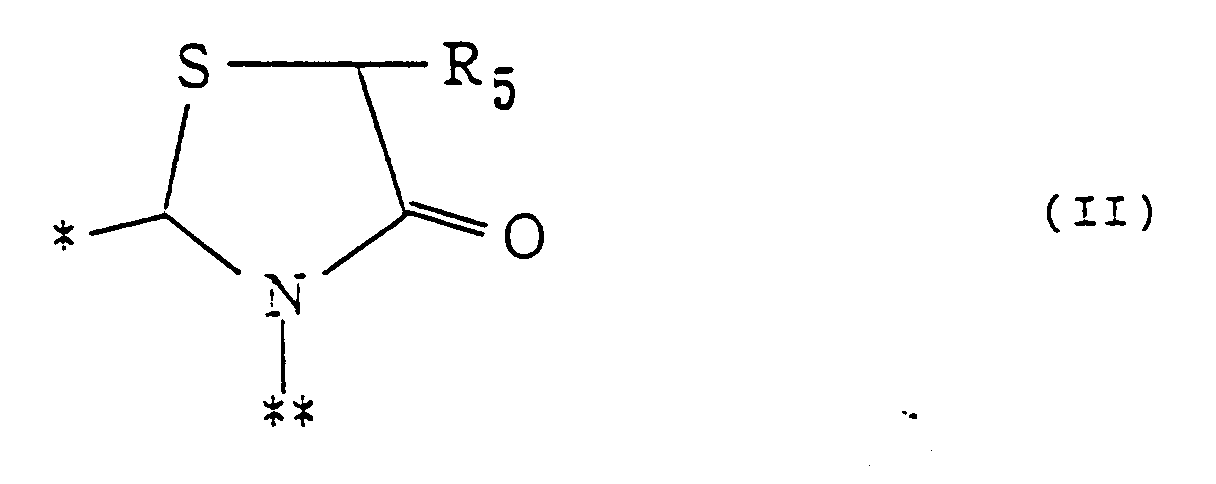
 R5 and R7, which may be the same or different, each represents a hydrogen atom, a substituted or unsubstituted lower alkyl group having 1 to 6 carbon atoms, a substituted or unsubstituted lower alkenyl group having 1 to 6 carbon atoms, a substituted or unsubstituted aryl group or a substituted or unsubstituted heterocyclic group, provided that R6 and R7 do not represent a methyl group simultaneously, or R6 and R7 are taken together to form a substituted or unsubstituted ring which may be a condensed ring; and n represents an integer of 2, 3, 4, 5 or 6, and a pharmaceutically acceptable salt thereof or a possible stereoisomer or optical isomer thereof.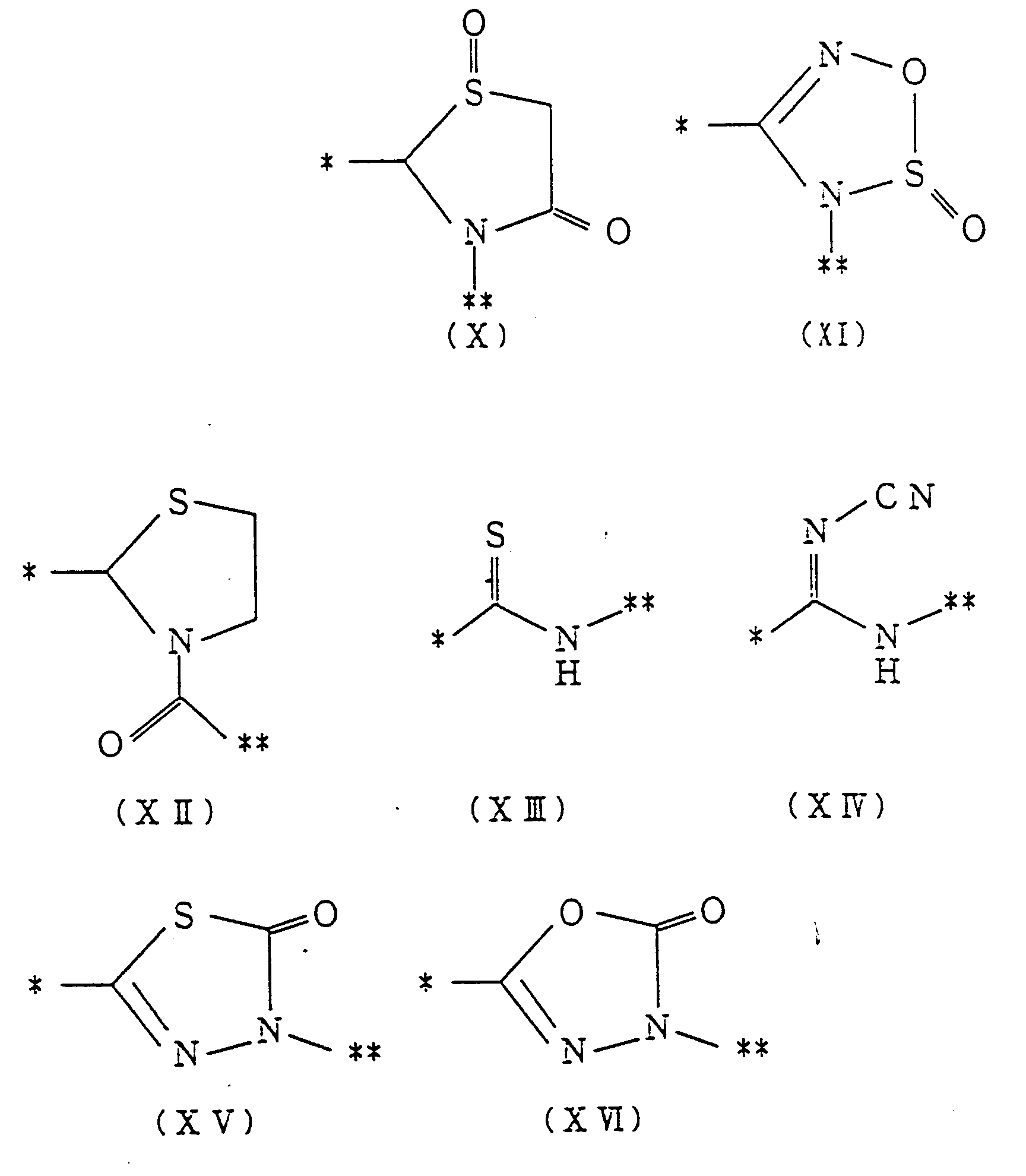
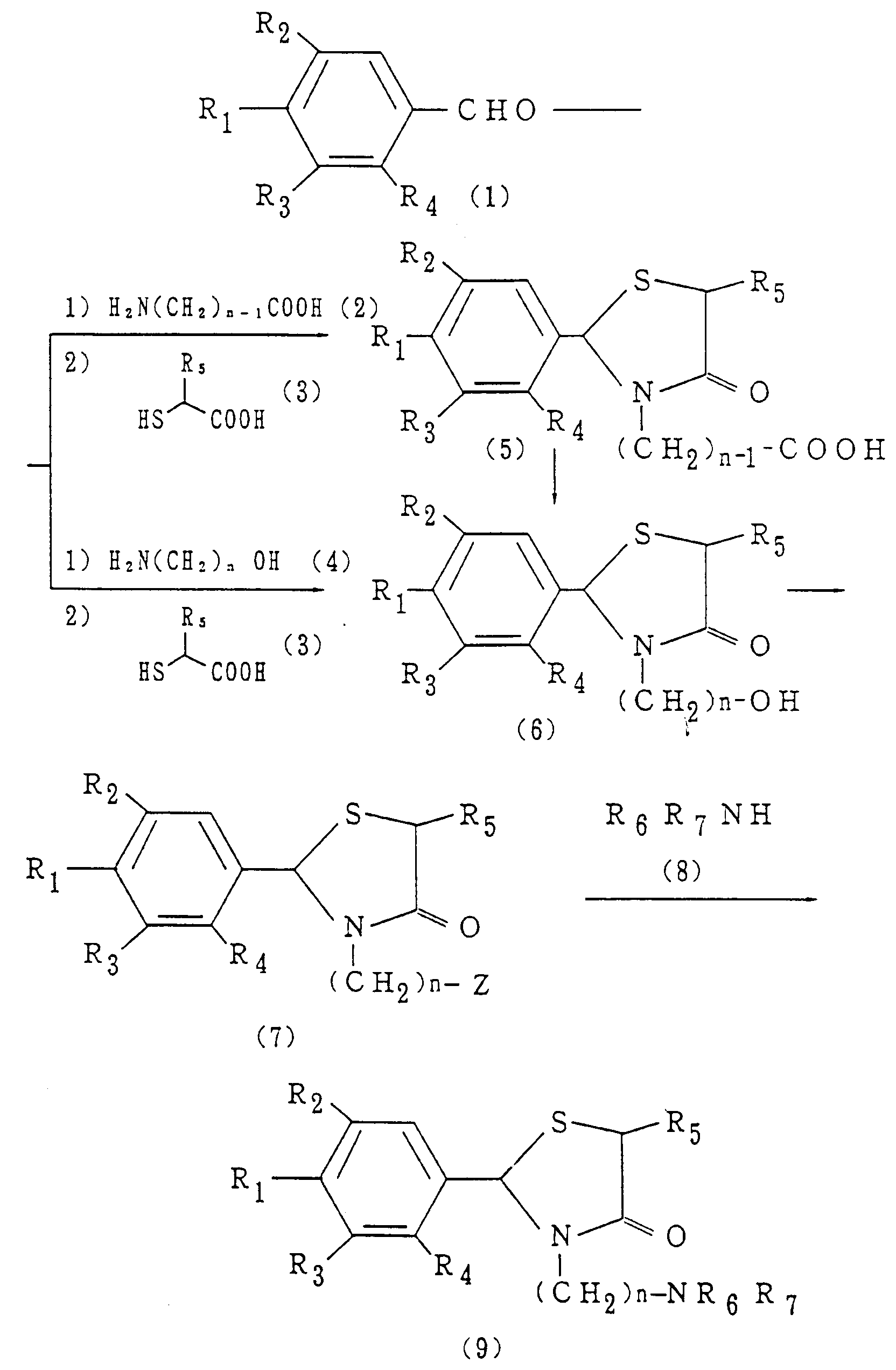
- The compound represented by formula (I) can be prepared by the following processes A to Q.
- In the scheme of process A, R1 represents a hydrogen atom, a hydroxyl group, an acyloxy group having 1 to 9 carbon atoms or a lower alkoxy group having 1 to 6 carbon atoms; R2 and R3, which may be the same or different, each represents a hydrogen atom, a hydroxyl group, a halogen atom, a lower alkyl group having 1 to 6 carbon atoms or a lower alkoxy group having 1 to 6 carbon atoms; R4 represents a hydrogen atom, a lower alkyl group having 1 to 6 carbon atoms; R5 represents a hydrogen atom, a substituted or unsubstituted lower alkyl group having 1 to 6 carbon atoms, a substituted or unsubstituted lower alkenyl group having 1 to 6 carbon atoms, a substituted or unsubstituted aryl group or a substituted or unsubstituted heterocyclic group; R6 and R7, which may be the same or different, each represent a hydrogen atom, a substituted or unsubstituted lower alkyl group having 1 to 6 carbon atoms, a substituted or unsubstituted lower alkenyl group having 1 to 6 carbon atoms, a substituted or unsubstituted aryl group or a substituted or unsubstituted heterocyclic group, provided that R6 and R7 do not represent a methyl group simultaneously, or R6 and R7 are taken together to form a substituted or unsubstituted ring which may be a condensed ring; n represents an integer of 2, 3, 4, 5 or 6; and Z represents a halogen atom.
- In the scheme of process B, R1, R2, R3, R4, R5, R6, R7, and n are the same as defined previously; R8 represents a substituted or unsubstituted aryl group or a substituted or unsubstituted heterocyclic group; and Z represents a chlorine atom or a bromine atom.

- In the scheme of process C, R1, R2, R3, R4, R5, R6, R7, R8, n, and Z are the same as defined previously.

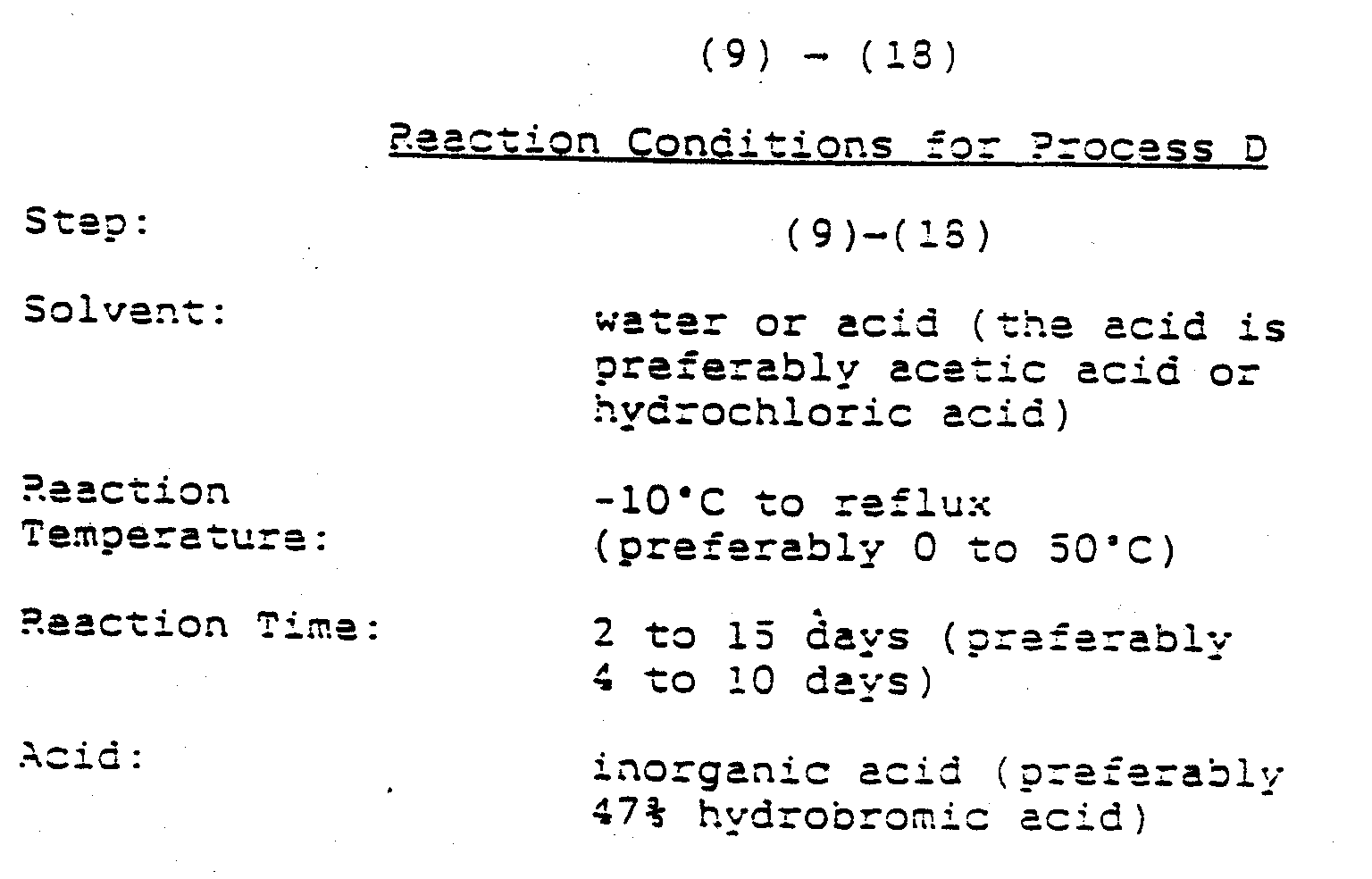
- In the scheme of process D, R1, R2, R3, R4, R5, R6, R7, and n are the same as defined previously.

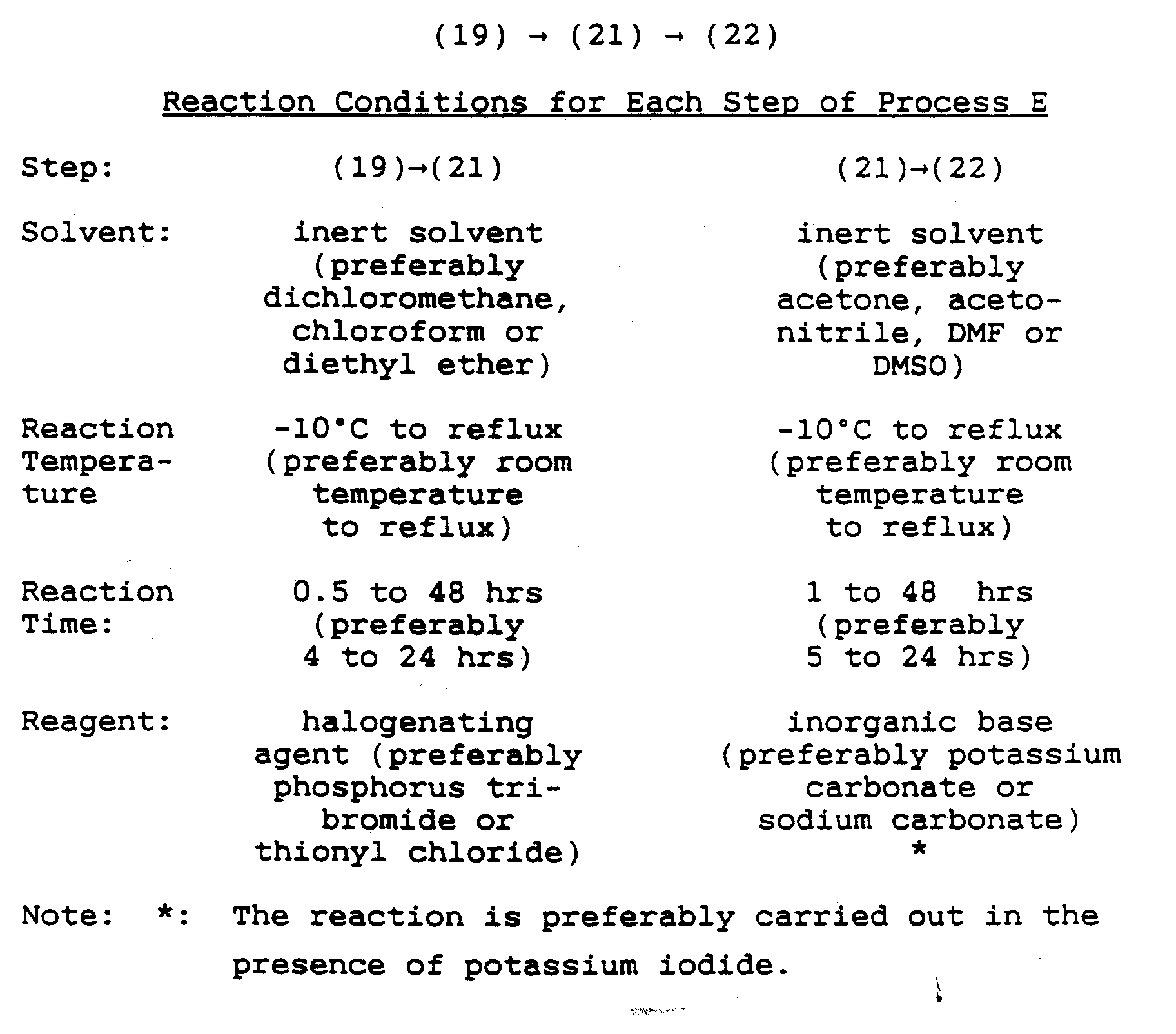
- In the scheme of process E, R1, R2, R3, R4, R5, R6, R7, n, and Z are the same as defined previously; R9 represents an alkyl group having 1 to 6 carbon atoms; and m represents an integer of 1 to 7.
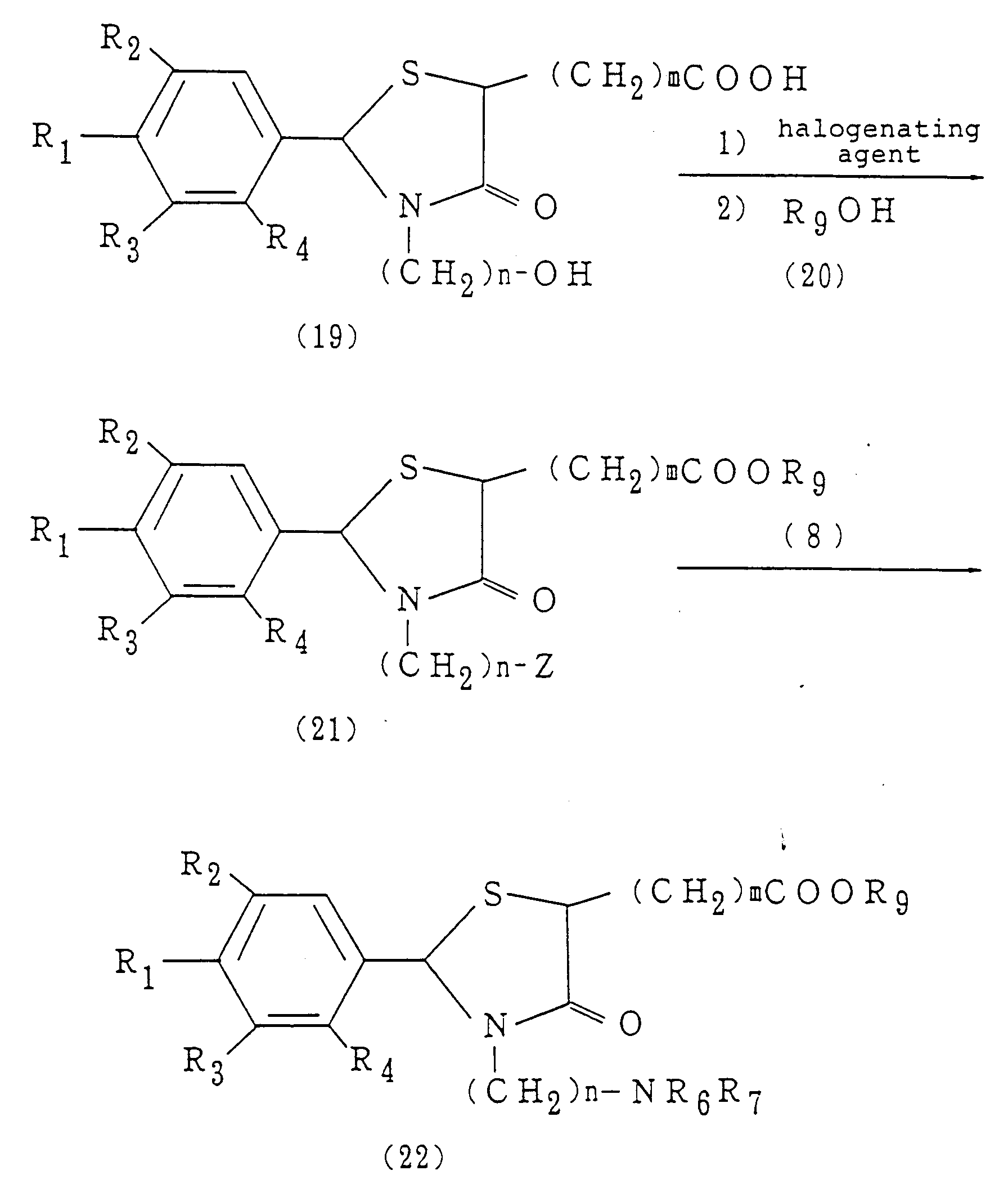
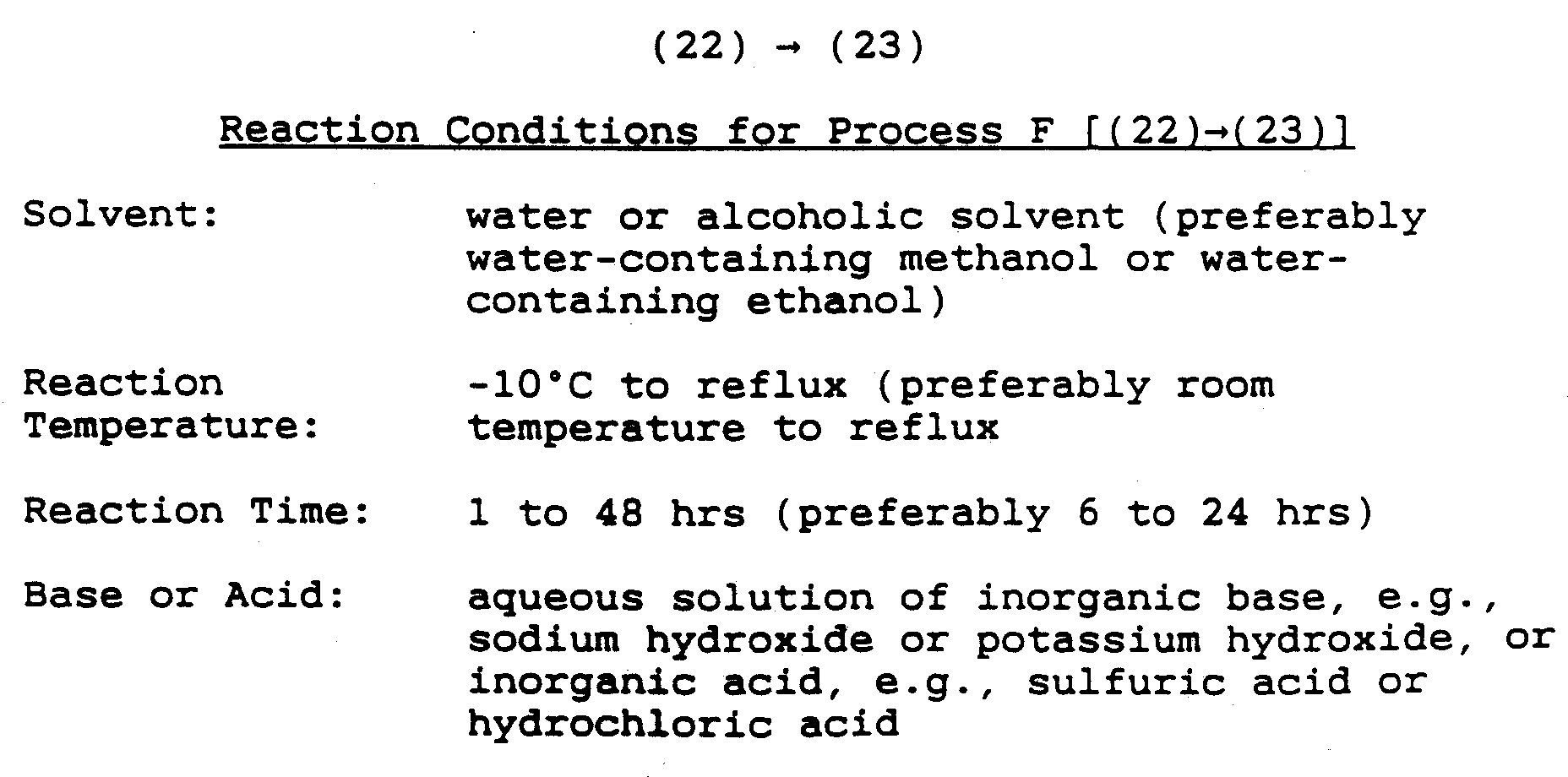
- In the scheme of process F, R1, R2, R3, R4, R5, R6, R7, R8, R9, n, and m are the same as defined previously.
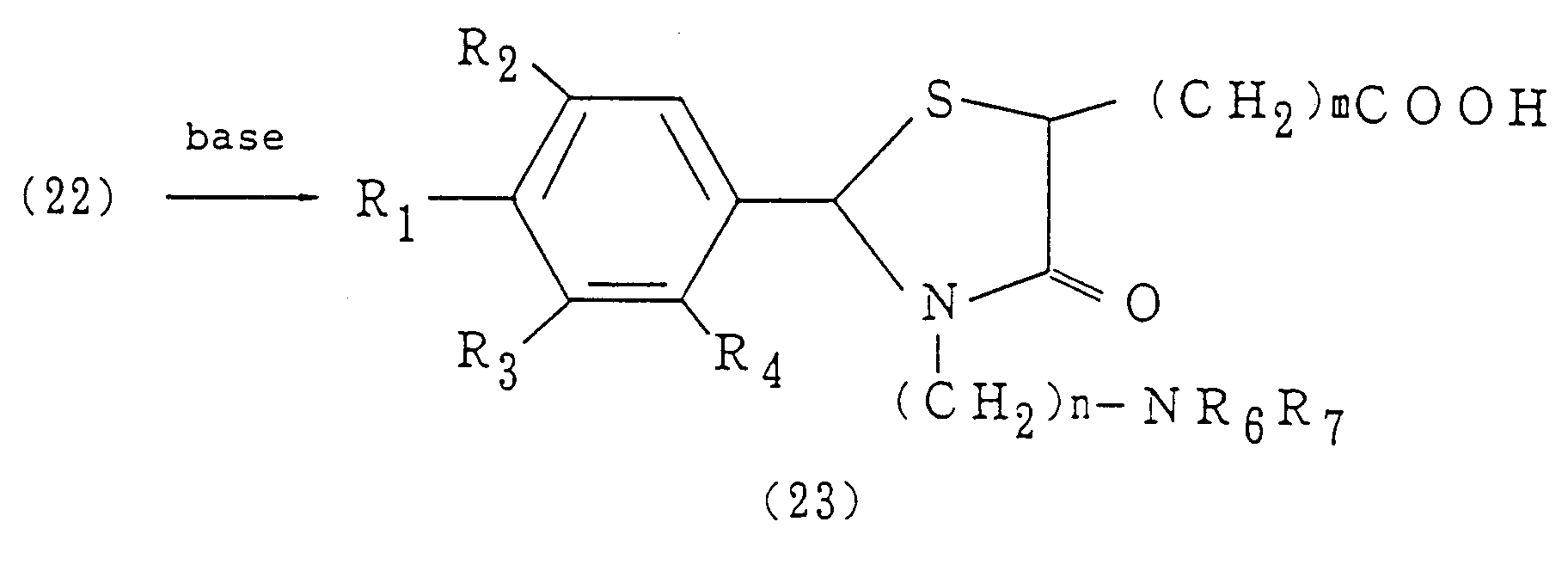
- In the scheme of process G, R2, R3, R4, R5, R6, R7, R8, R9, n, and m are the same as defined previously.
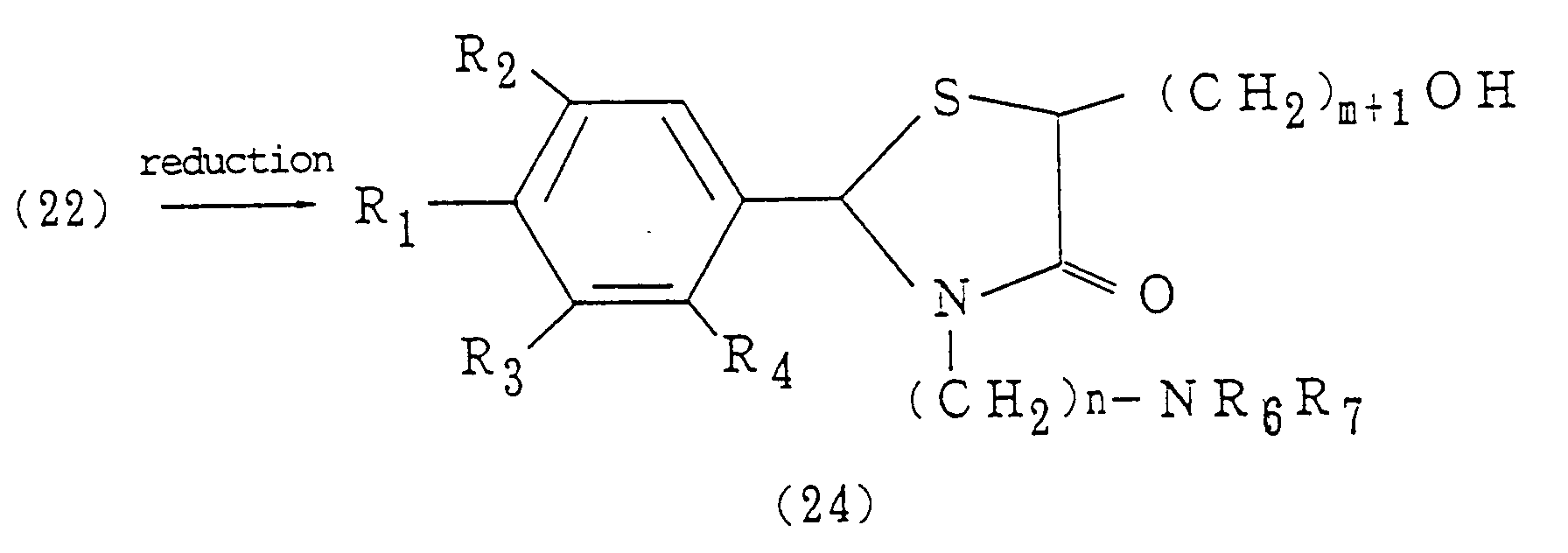
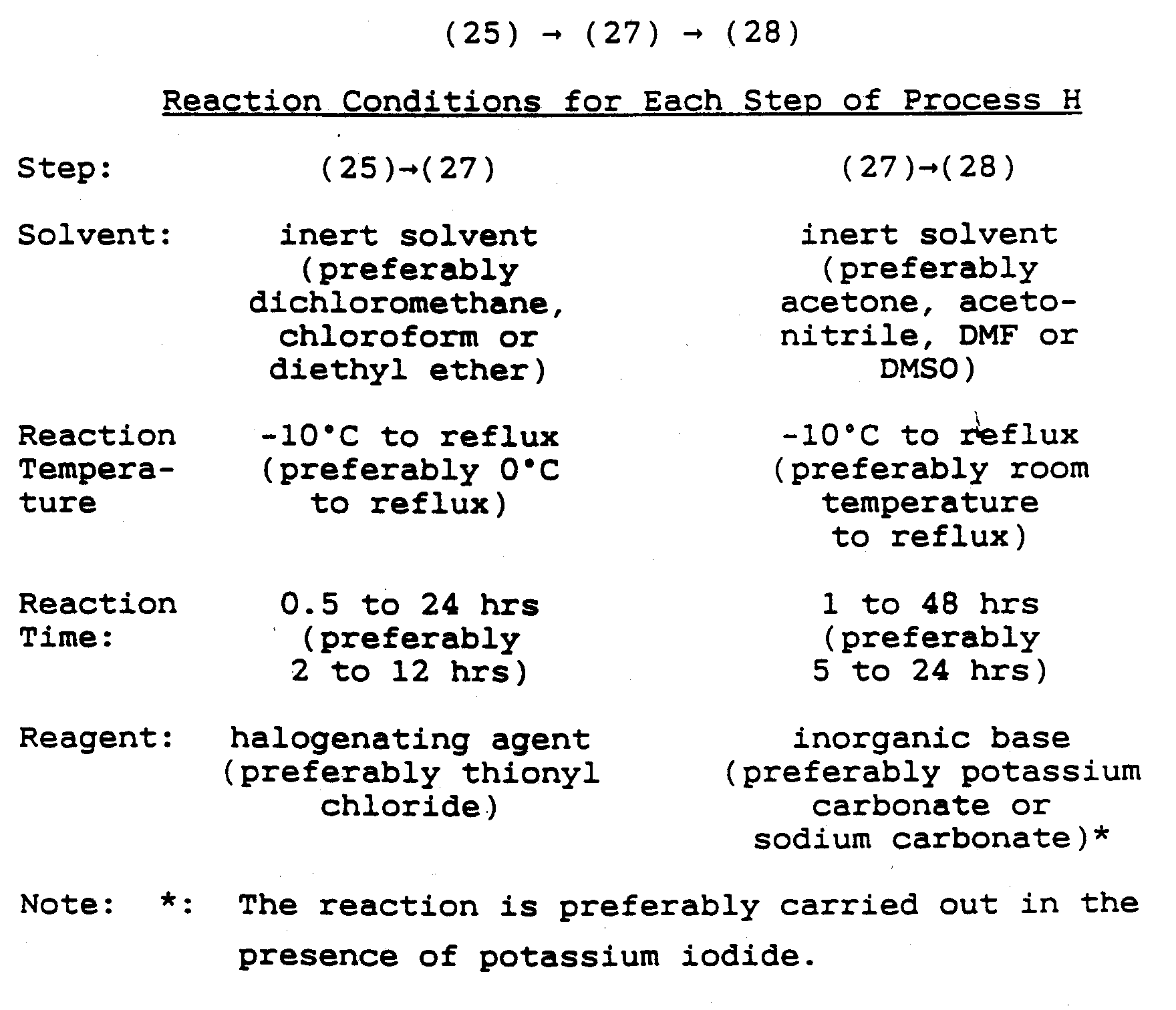
- In the scheme of process H, R1, R2, R3, R4, R5, R5, R6, Z, n, and m are the same as defined previously; and R10 and R11, which may be the same or different, each represents a hydrogen atom, a substituted or unsubstituted lower alkyl group having 1 to 6 carbon atoms, a substituted or unsubstituted lower alkenyl group having 1 to 6 carbon atoms, a substituted or unsubstituted aryl group or a substituted or unsubstituted heterocyclic group, or R10 and R11 are taken together to form a substituted or unsubstituted ring which may be a condensed ring.

- In the scheme of process I, R1, R2, R3, R4, R5, R6, R7, Z, and n are the same as defined previously; and R9 represents a substituted or unsubstituted lower alkyl group having 1 to 6 carbon atoms.

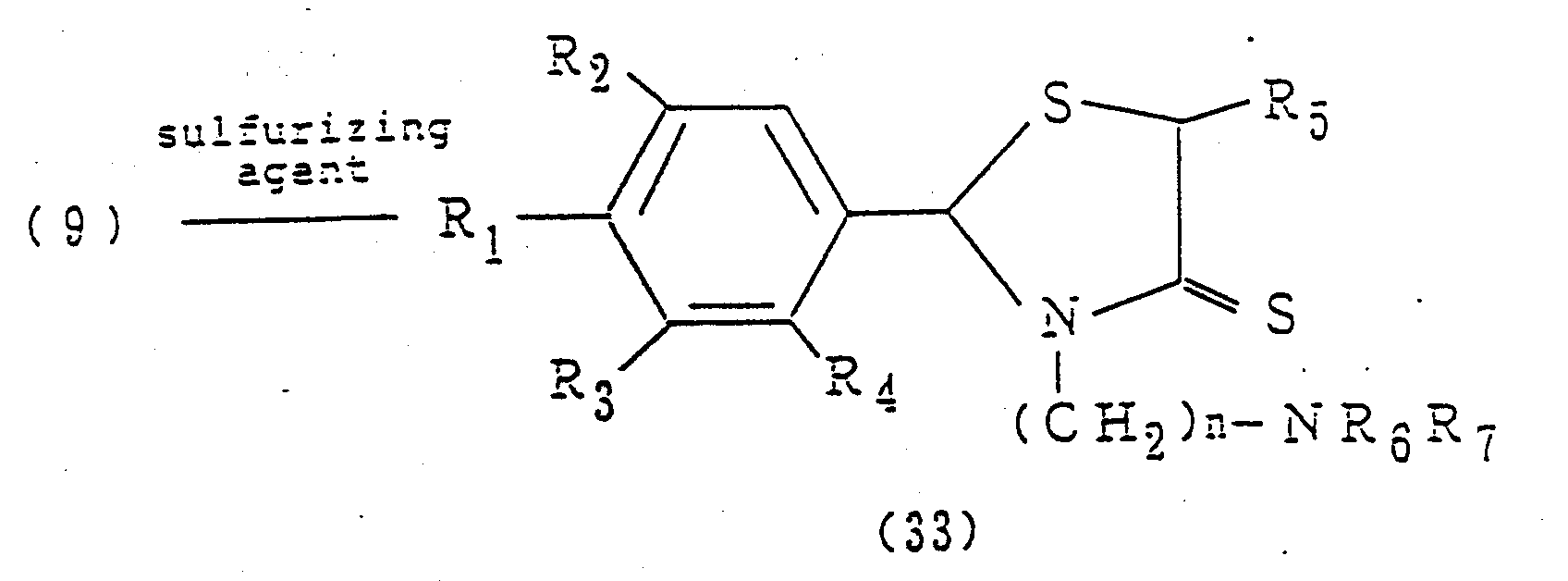
- In the scheme of process J, R1, R2, R3, R4, R5, R6, R7, and n are the same as defined previously.
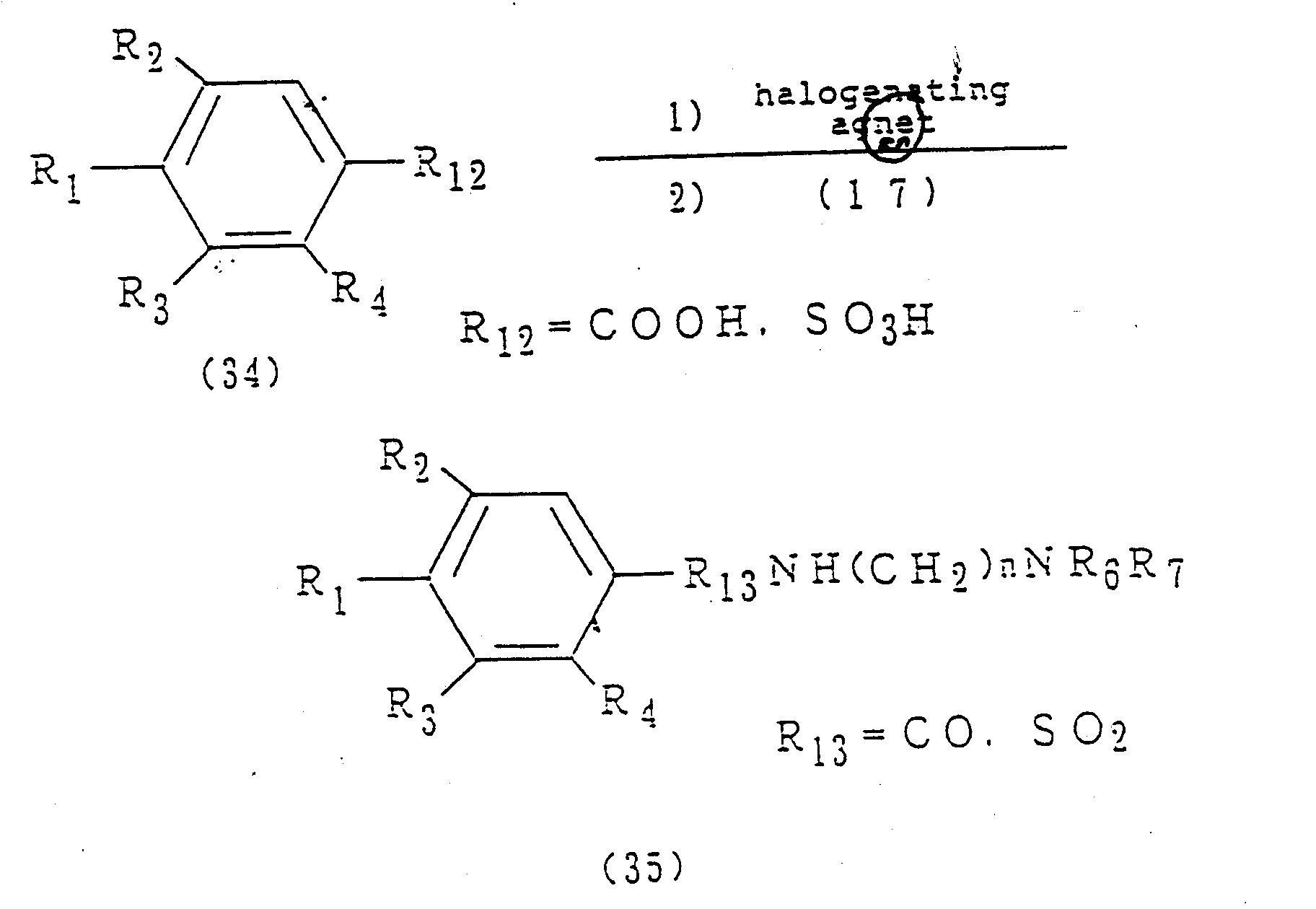
- In the scheme of process K, R1, R2, R3, R4, R5, R6, R7, and n are the same as defined previously; R12 represents a carboxyl group or a sulfonyl group; and R13 represents a carbonyl group or a sulfonyl group.
- In the scheme of process L, R1, R2, R3, R4, R5, R6, R7, and n are the same as defined previously; and R13 represents a carbonyl group.

- In the scheme of process M, R1, R2, R3, R4, R5, R6, R7, and n are the same as defined previously.

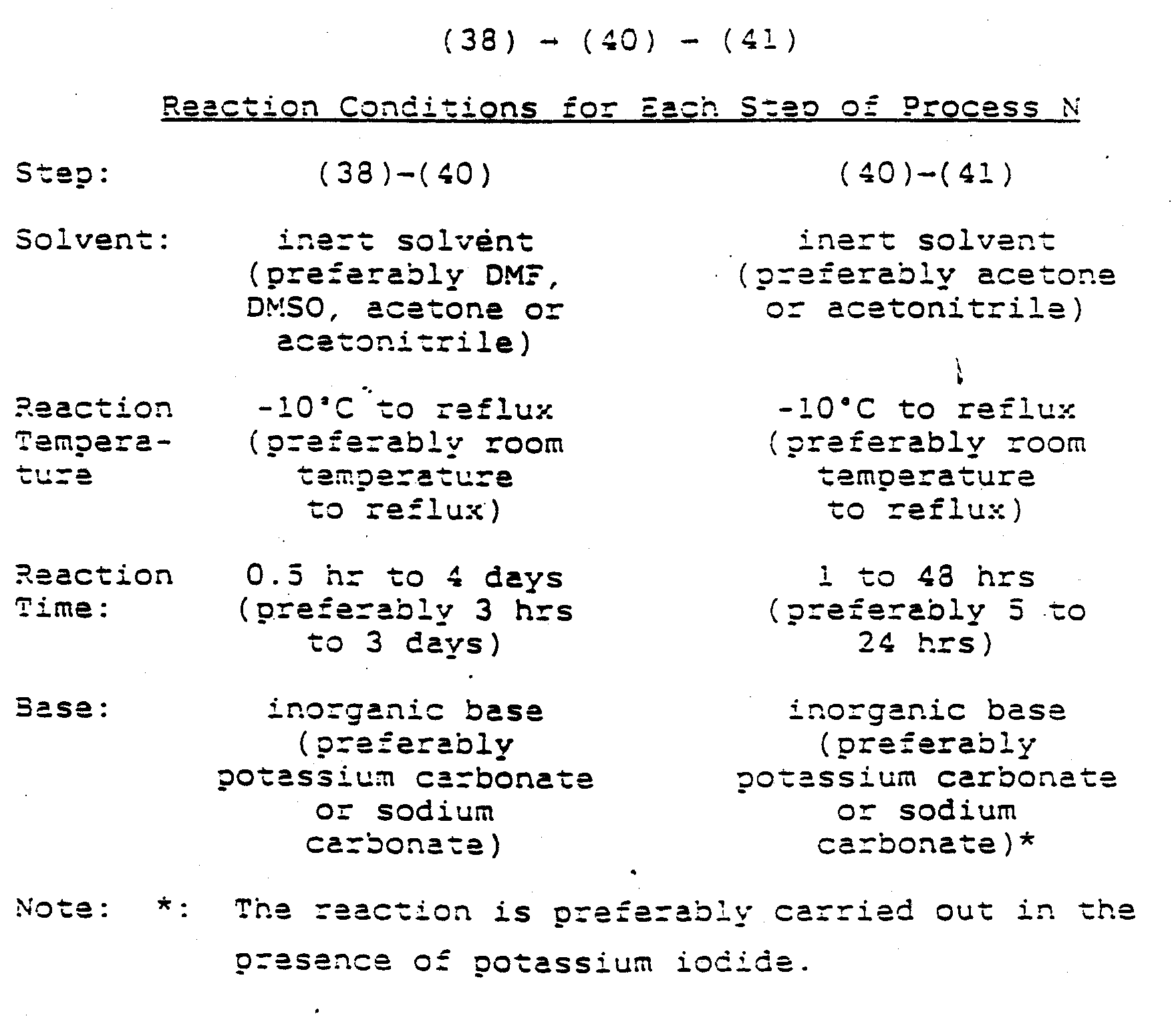
- In the scheme of process N, R1, R2, R3, R4, R5, R6, R7, and n are the same as defined previously; A represents a fragment selected from the group of following fragments represented by formulae (VI), (VIII), (XI), (XV), and (XVI):
 and X represents a chlorine atom or a bromine atom.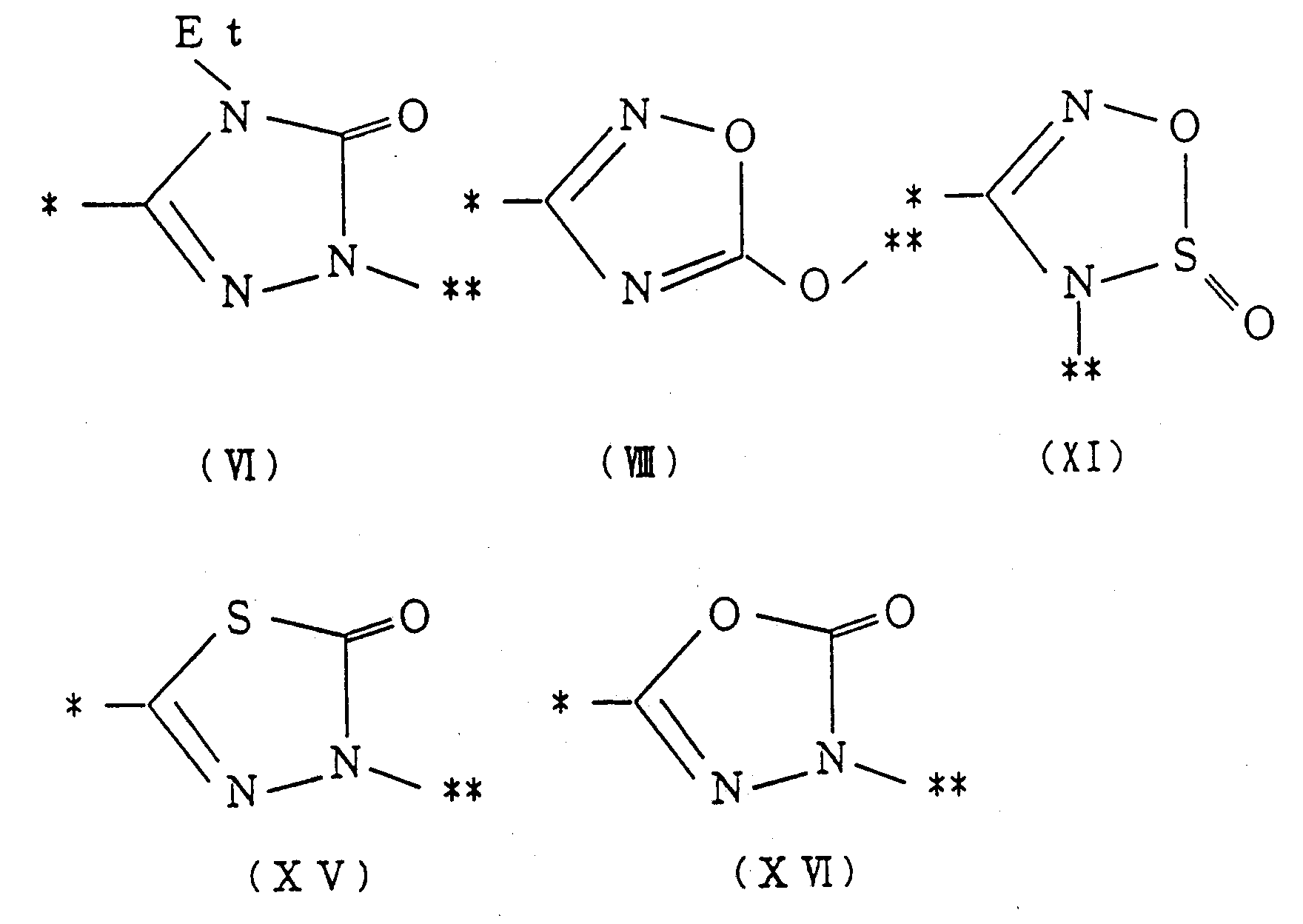
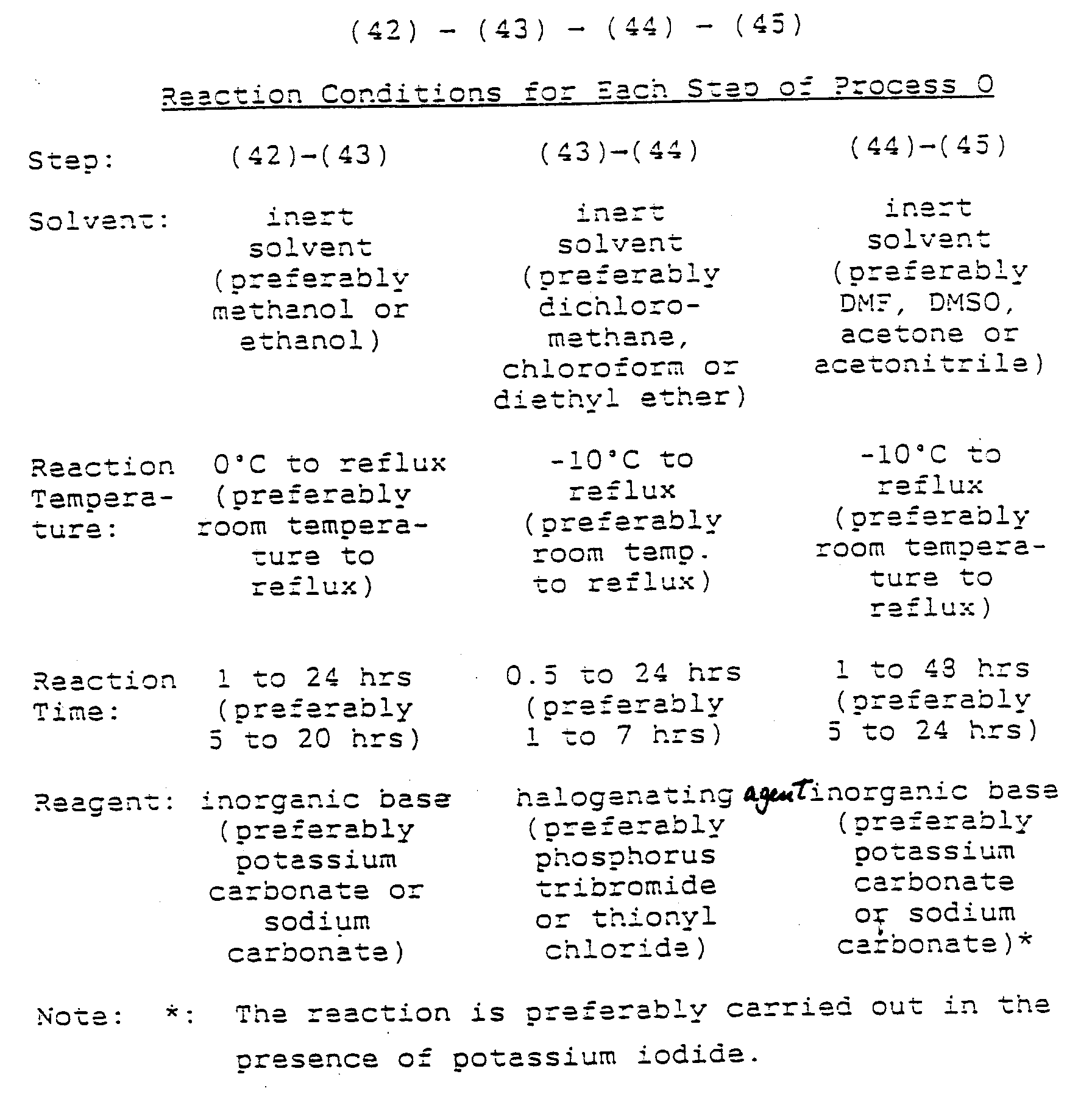
- In the scheme of process O, R1, R2, R3, R4, R5, R6, R7, n, and X are the same as defined previously.
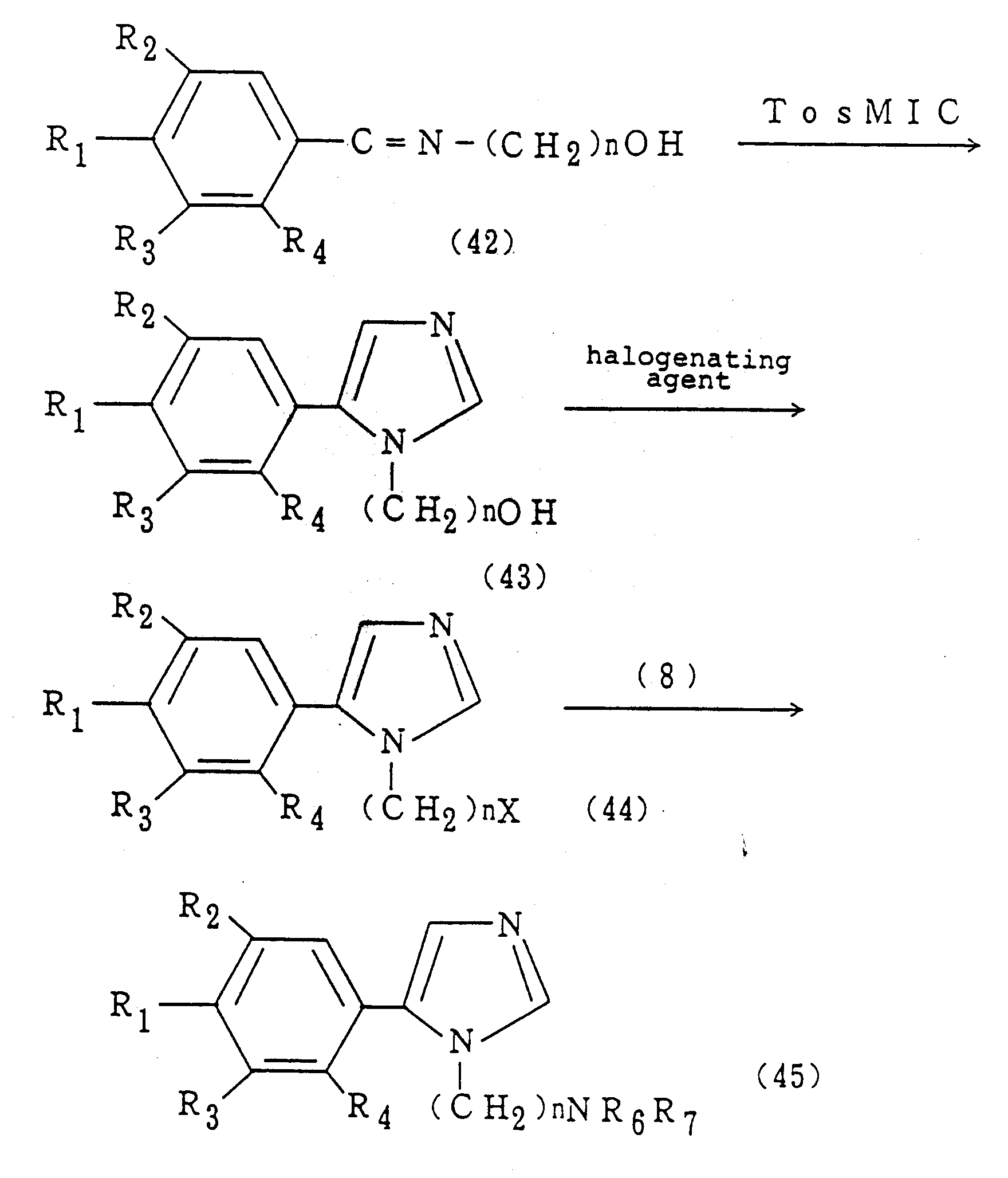
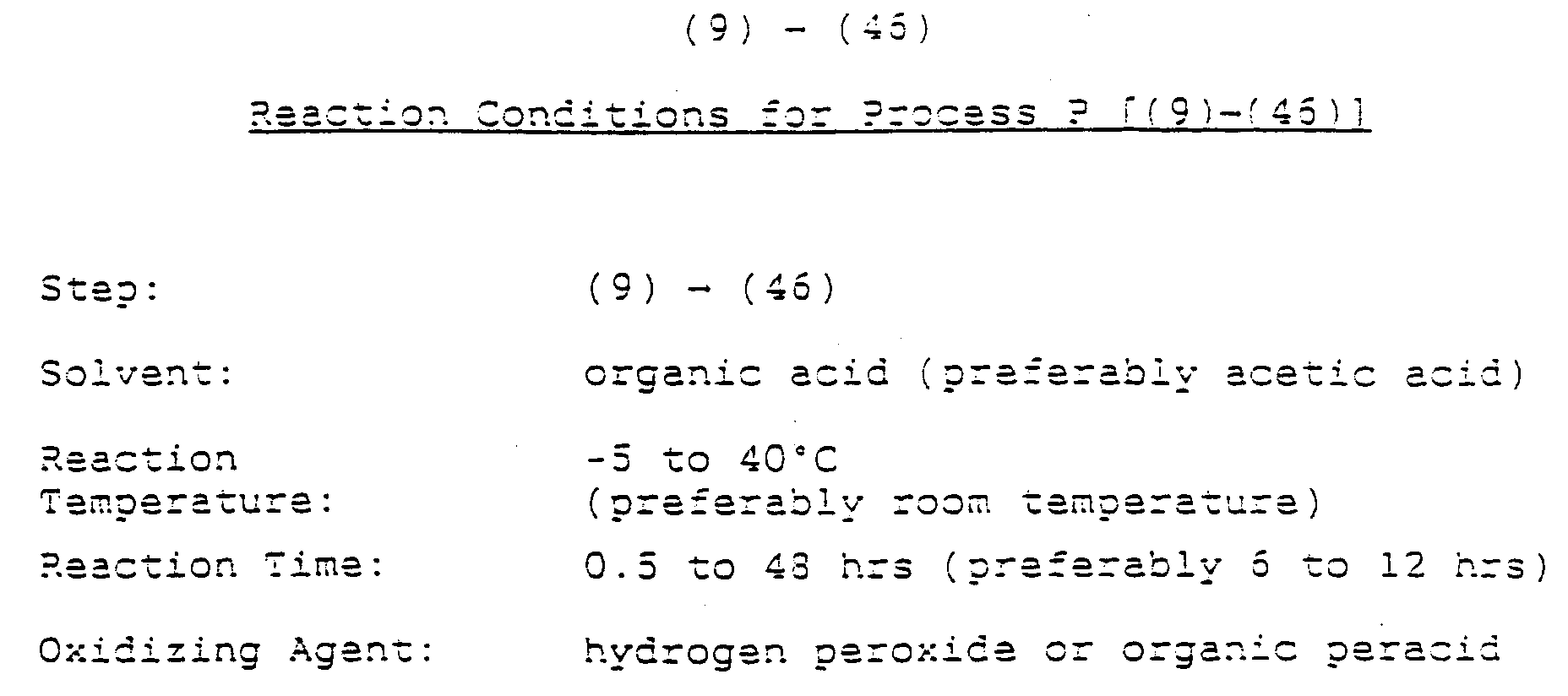
- In the scheme of process P, R1, R2, R3, R4, R5, R6, R7, and n are the same as defined previously.

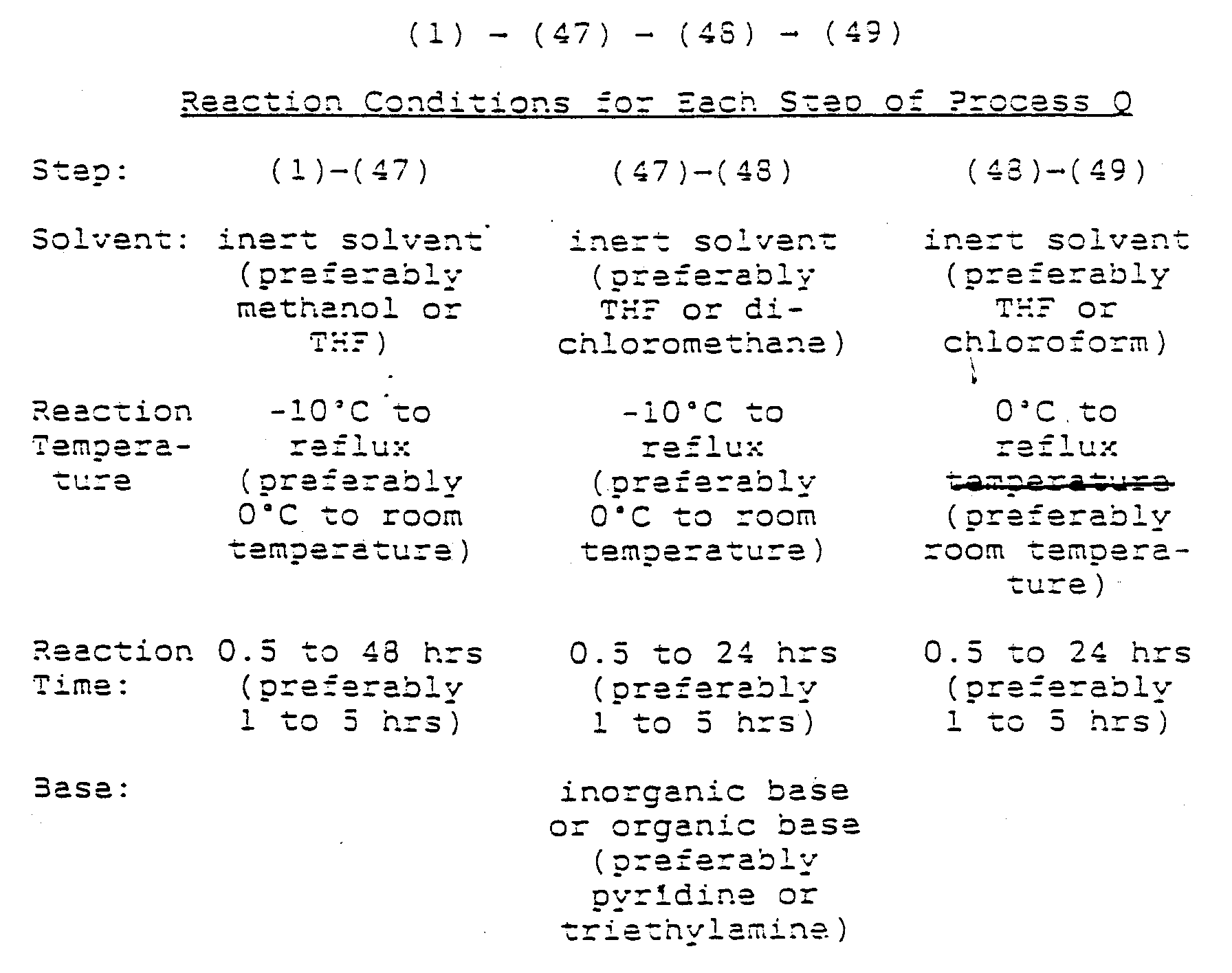
- In the scheme of process Q, R1, R2, R3, R4, R5, R6, and R7 are the same as defined previously.
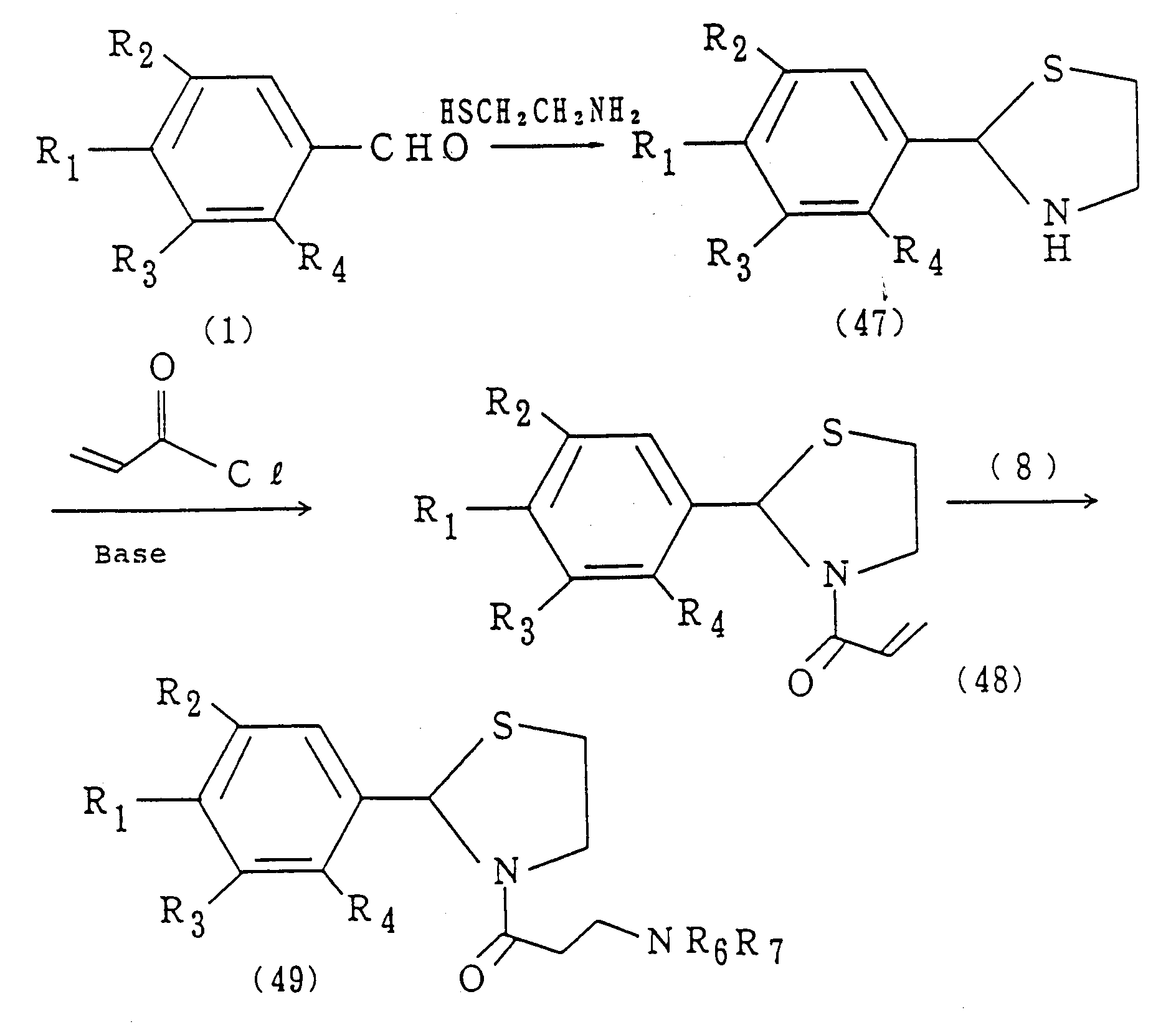
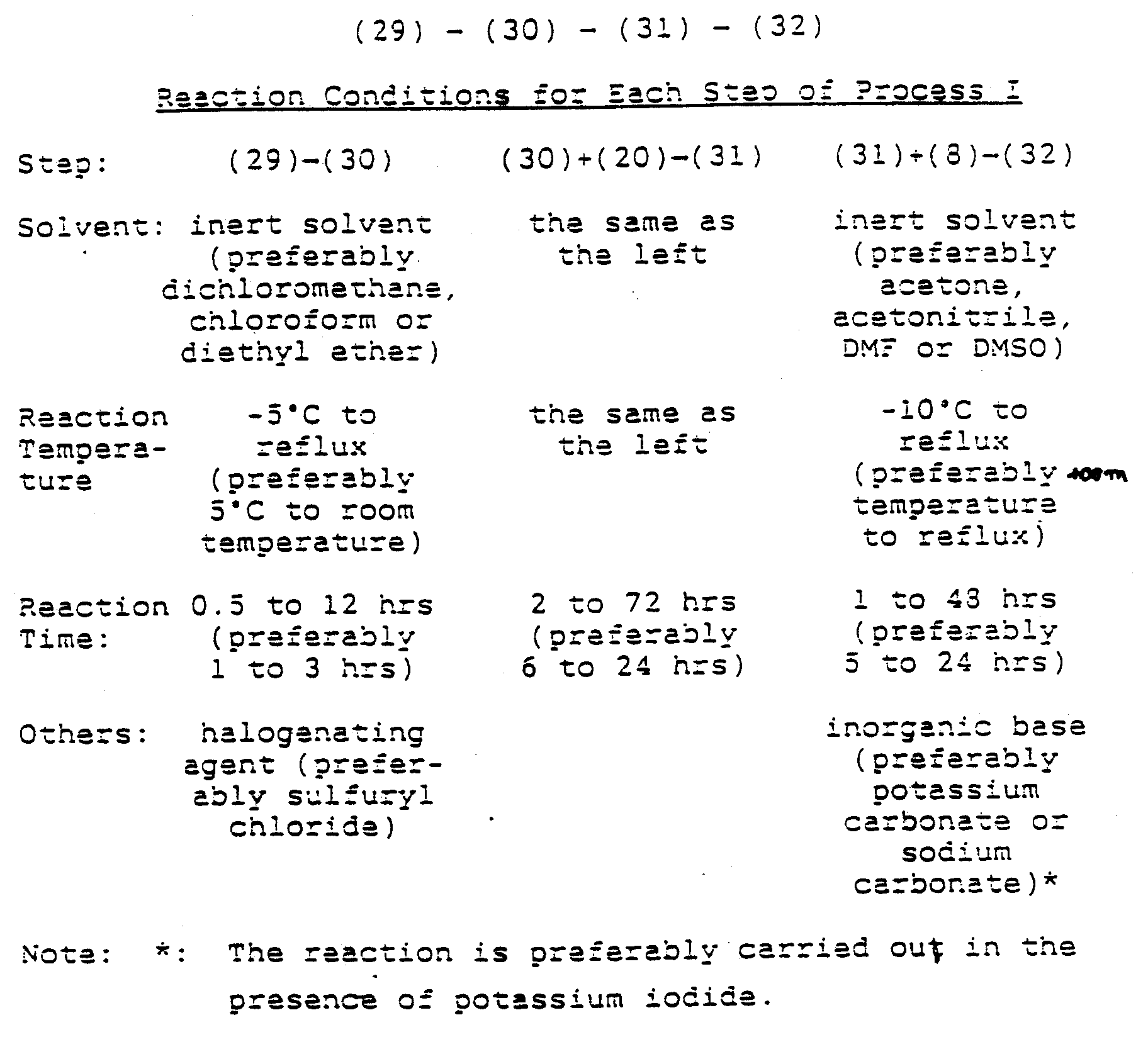
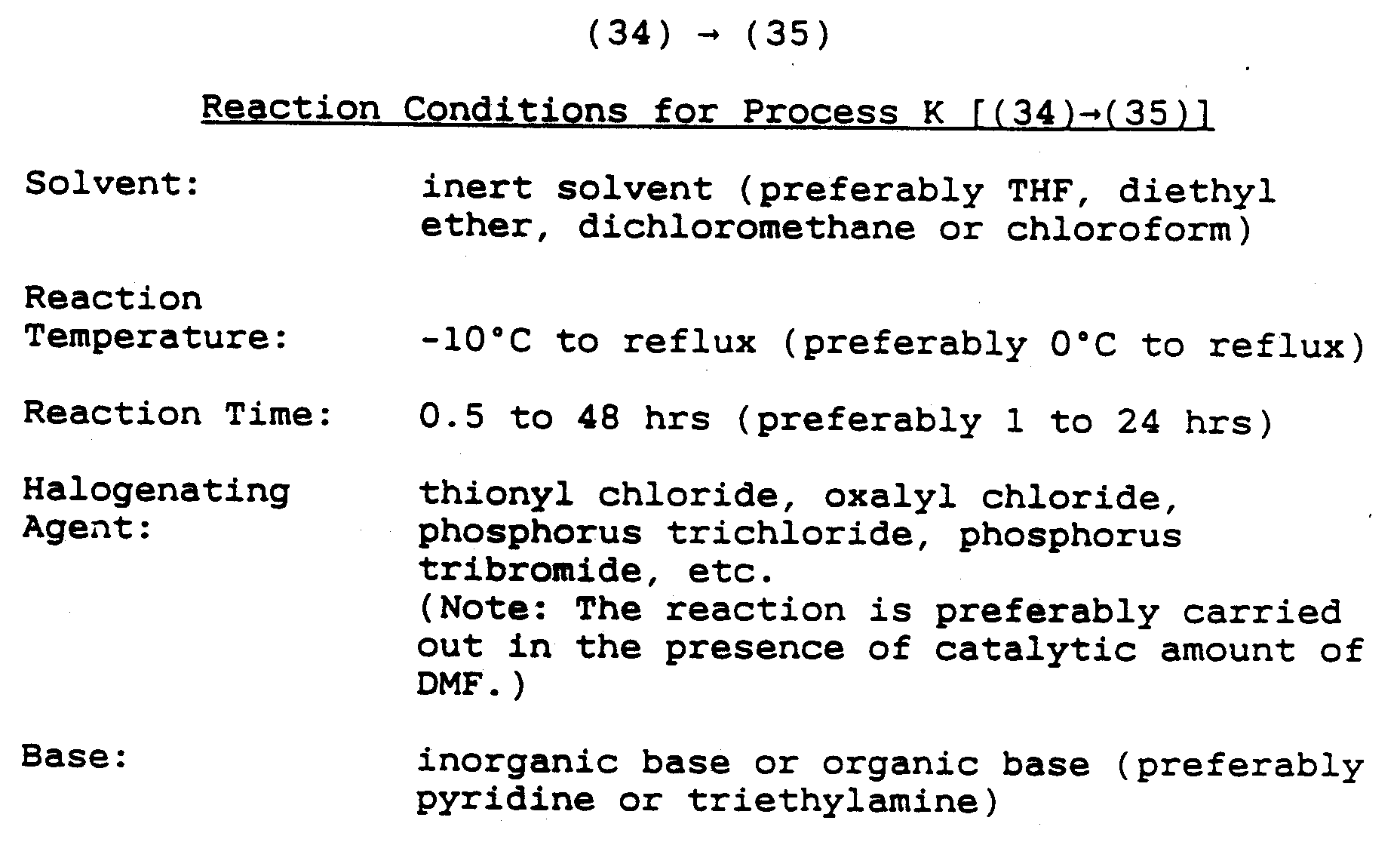
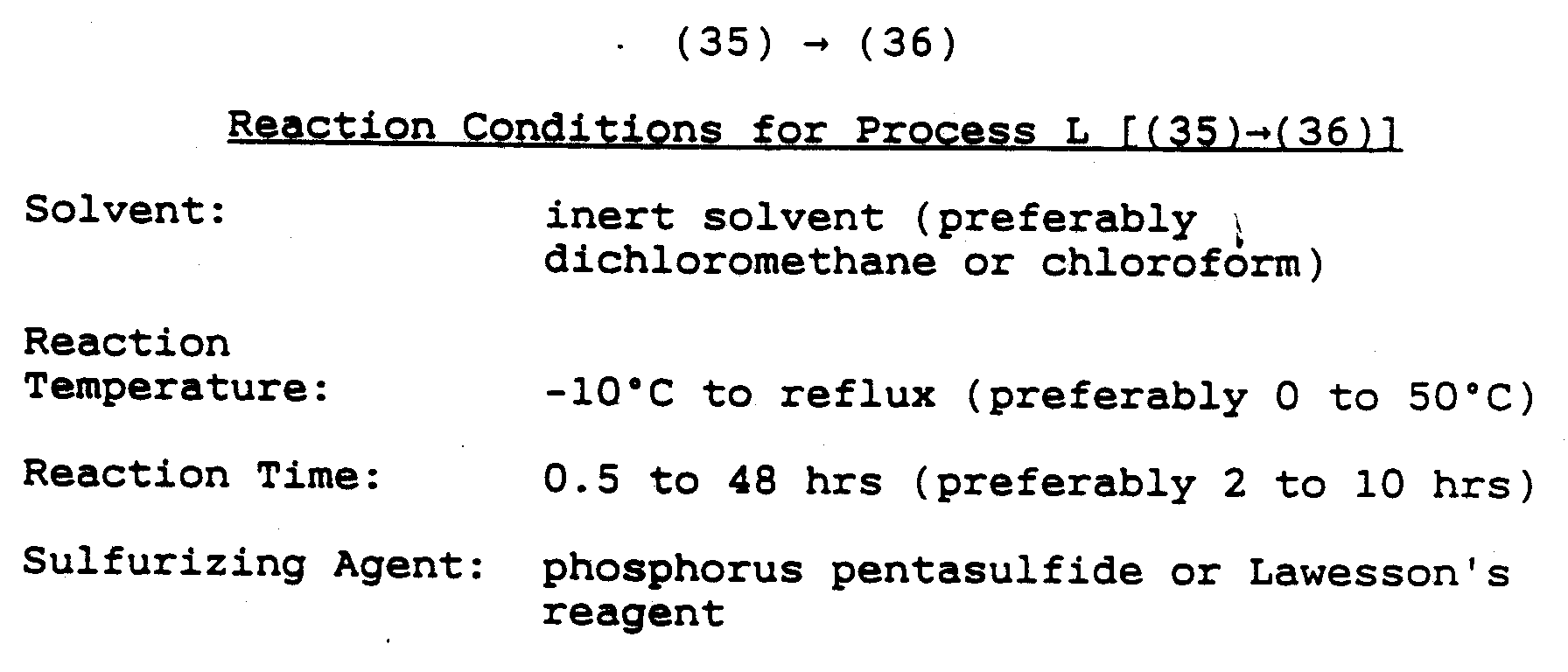
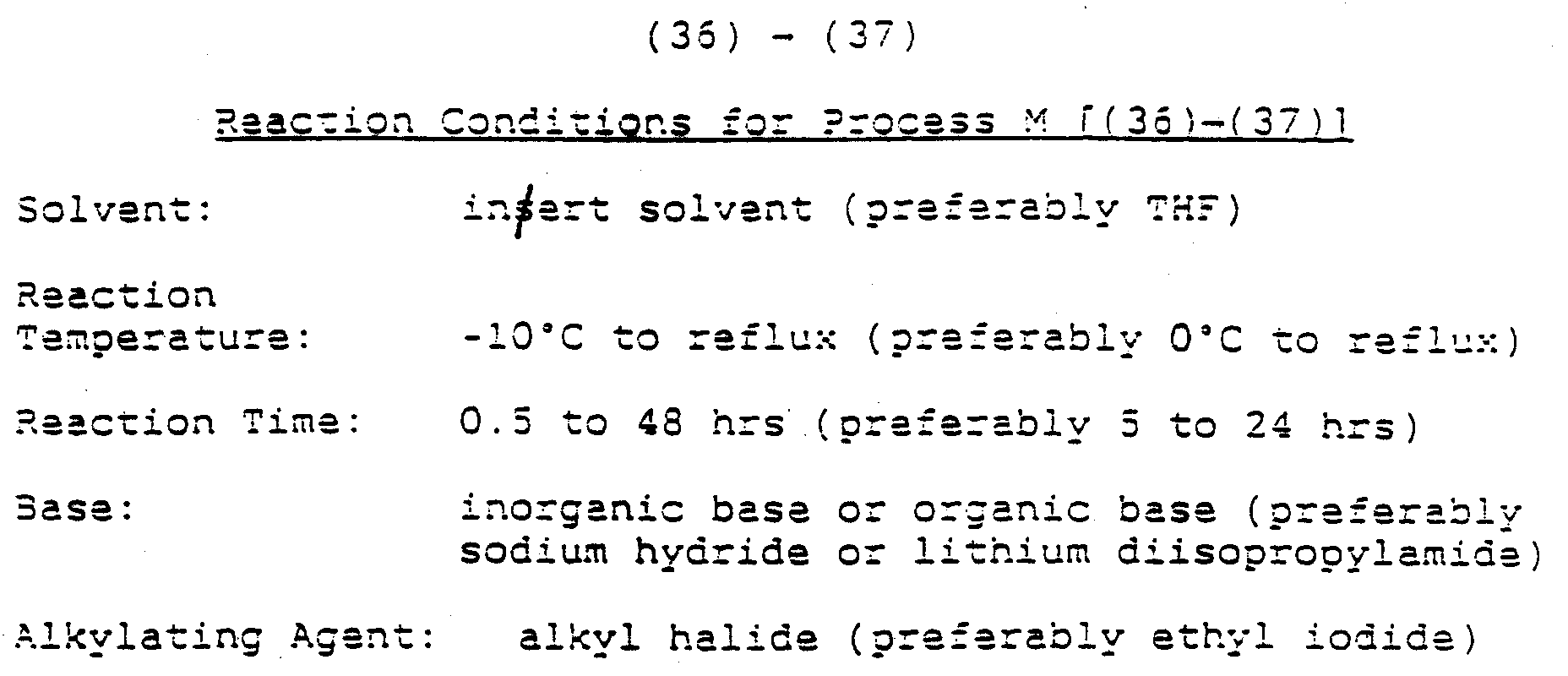
- The reaction conditions adopted in each of processes A to Q are tabulated below.
-


-
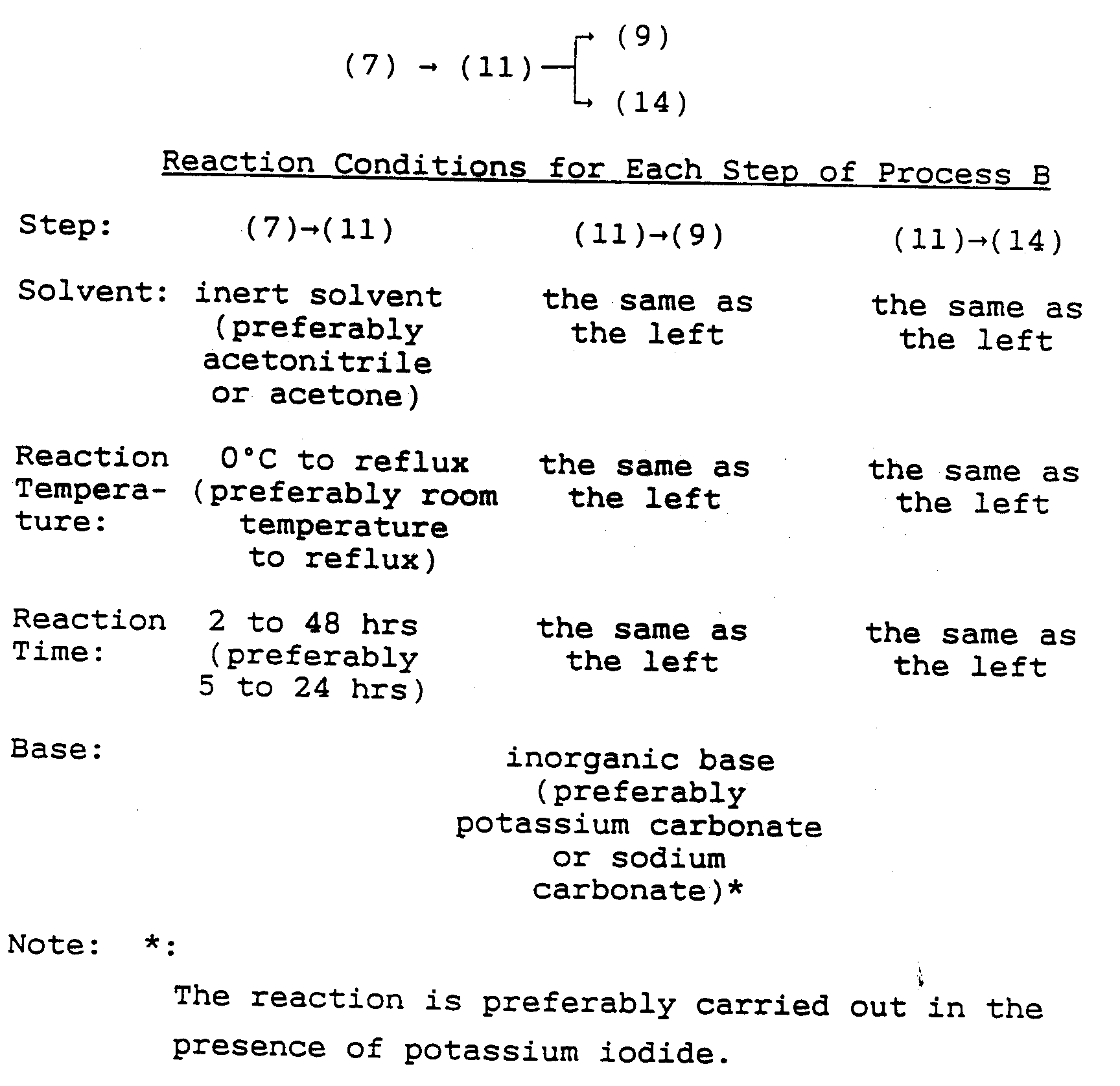
-

-
-
-
-

-
-
-

-
-
-
-
-
-
-
- The compound of formula (I) according to the present invention contains one or two asymmetric carbon atoms in the structure thereof, and the pure stereoisomers or optical isomers can be obtained by methods known in the art. For example, each enantiomer can be separated by chromatography using a HPLC column for optical resolution or by fractional crystallization utilizing an optically active acid, preferably (R)-(-)-1,1'-binaphthyl-2,2'-diyl hydrogen phosphate. The above-mentioned techniques for separation of optical isomers apply to not only a final product but also an intermediate having a carboxyl group. In the latter case, commonly used optically active bases such as brucine can be employed. Similarly, diastereomeric mixtures comprising both cis- and trans-stereoisomers can be separated to each optical isomer, i.e., cis(+), cis(-), trans(+) and trans(-), by conventional methods known to those skilled in the art.
- As a matter of course, the stereoisomers and optical isomers of the compound of formula (I) are also included in the scope of the present invention.
- The present invention will now be illustrated in greater detail by referring to reference examples, examples, and pharmacological test examples.
- In the following reference examples, examples, and tables 1 to 24 inclusive the NMR data were measured with JEOL JNM-FX200 or JEOL JNM-EX270 except those with asterisk, in which case the measurements were carried out on Hitachi R-24B (60 MHz).
- In benzene (50 ml) were suspended 3,5-diisopropyl-4-hydroxybenzaldehyde (5.00 g) and 3-aminopropanol (1.82 g) in a nitrogen atmosphere. A Dean-Stark trap was fitted to the reactor, and the suspension was refluxed for 1.5 hours. After allowing the mixture to cool, α-mercaptoacetic acid (2.23 g) was added, then the mixture was further refluxed for 2 hours. After removal of benzene by evaporation, water (50 ml) was added to the residue, and the mixture was extracted with chloroform. The organic layer was dried over anhydrous sodium sulfate, and the solvent was removed under reduced pressure. The residue was purified by silica gel column chromatography (eluent; chloroform-methanol, 99:1) to afford 1.97 g (24%) of the title compound as a colorless oil.
- NMR (CDCl3, 60 MHz):
-
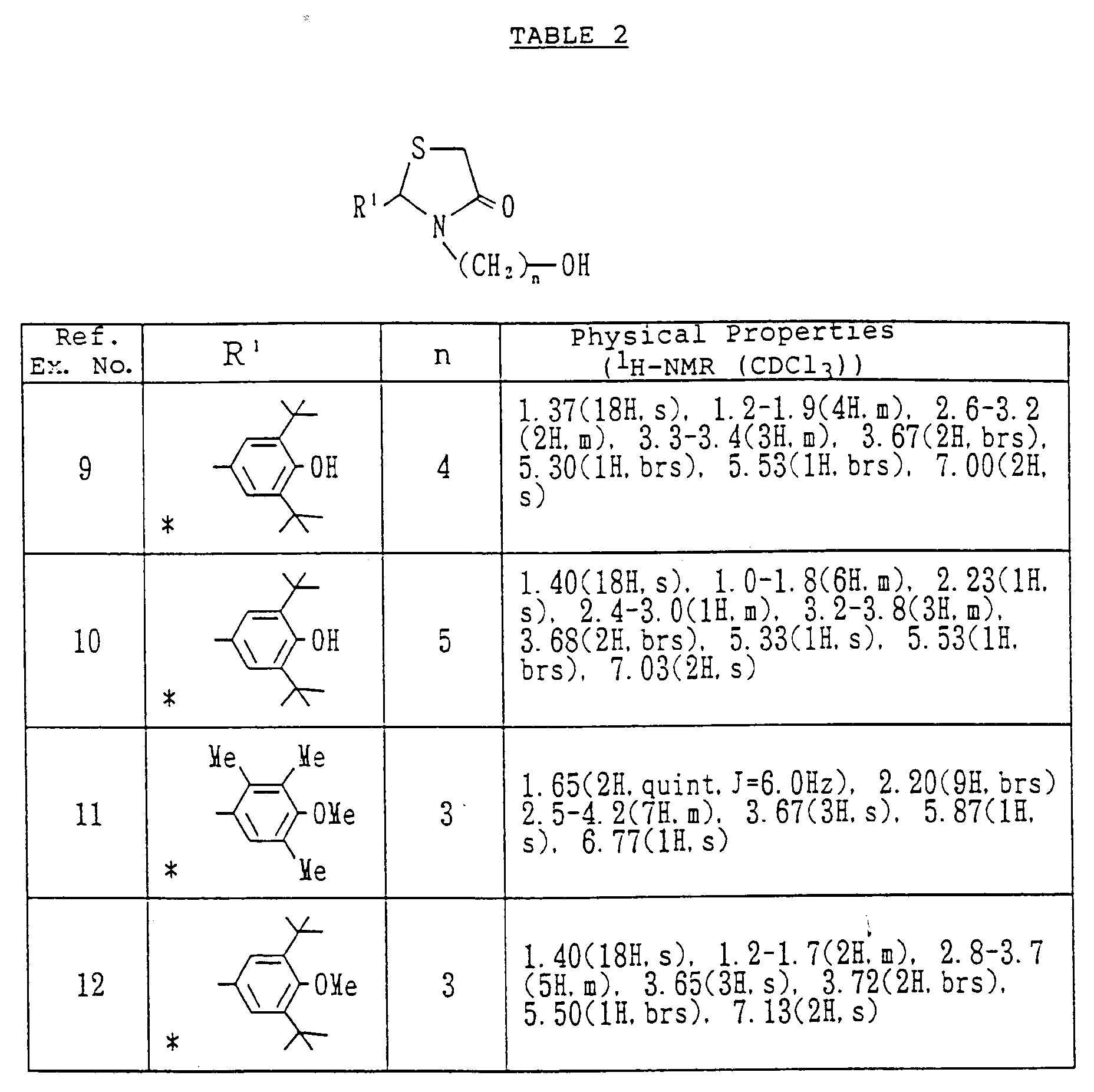
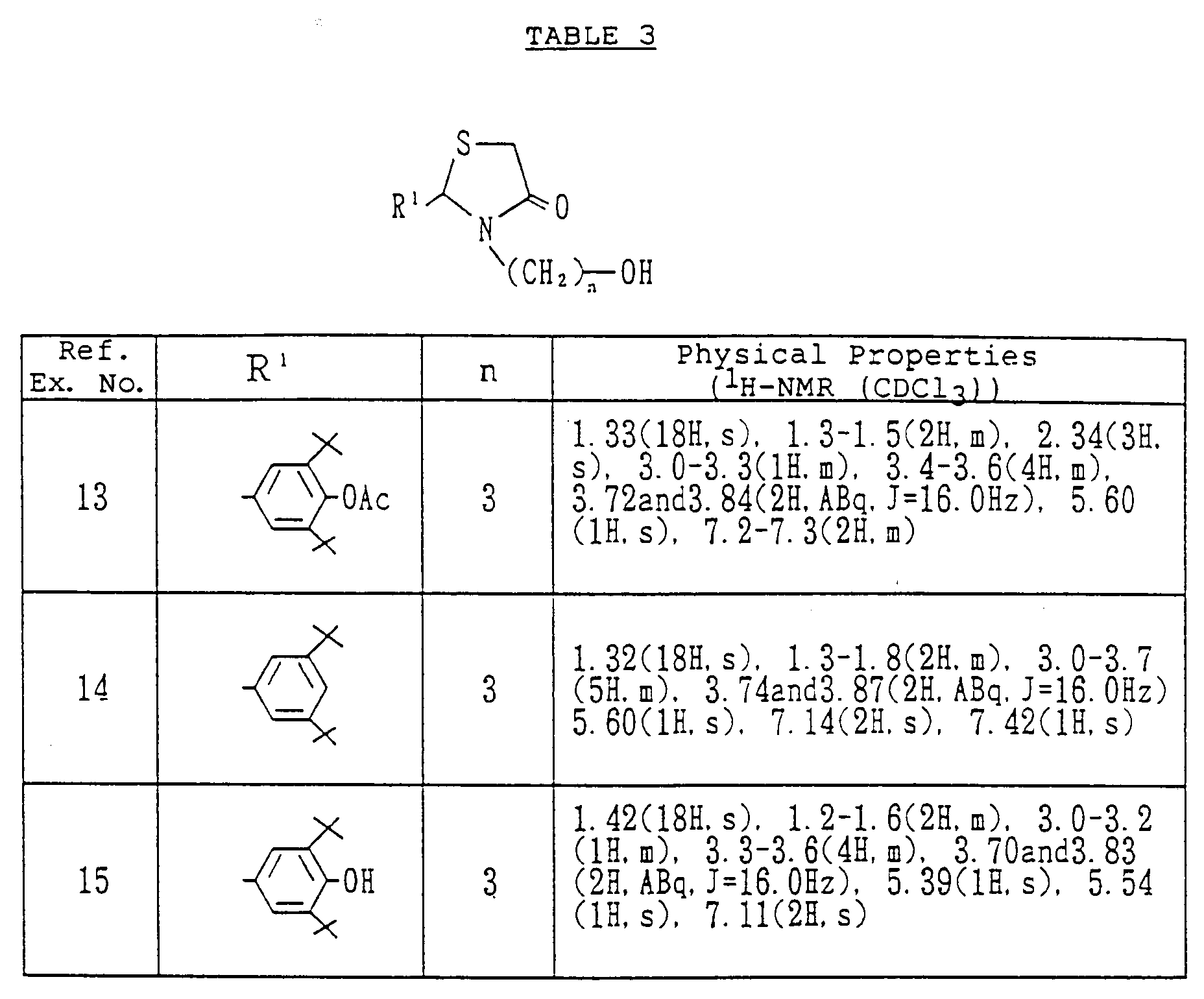
1.23 (12H, d, J=6.6Hz), 1.0-1.8 (2H, m), 2.5-3.8 (7H, m), 3.73 (2H, brs), 5.50 (2H, brs), 6.92 (2H, s) - Each alcohol shown in Tables 1 to 3 was prepared according to the procedure for Reference Example 1, using an appropriate substituted benzaldehyde and a corresponding ω-aminoalkyl alcohol instead of 3,5-diisopropyl-4-hydroxybenzaldehyde and 3-aminopropanol in each case.

- In benzene (500 ml) were suspended 3,5-di-tert-butyl-4-hydroxybenzaldehyde (50.0 g) and β-alanine (20.0 g) under a nitrogen atmosphere. A Dean-Stark trap was fitted to the reactor, and the suspension was refluxed for 1 hour. After allowing the mixture to cool, α-mercaptoacetic acid (23.6 g) was added, then the mixture was further refluxed for 24 hours. After removal of benzene by evaporation, water (500 ml) was added to the residue, and the mixture was extracted with chloroform. The organic layer was dried over anhydrous sodium sulfate, and the solvent was removed under reduced pressure. The residue was purified by silica gel column chromatography (eluent; chloroform-methanol, 98:2) to afford 54.6 g (67%) of 2-(3,5-di-tert-butyl-4-hydroxyphenyl)-3-(2-carboxyethyl)-1,3-thiazolidin-4-one as colorless crystals. mp 164-165°C.
- NMR (CDCl3, 200 MHz) δ:
-
1.42 (18H, s), 2.2-2.5 (1H, m), 2.5-2.8 (1H, m), 3.0-3.3 (1H, m), 3.5-4.0 (3H, m), 5.33 (1H, s), 5.64 (1H, s), 7.09 (2H, s), 8.5 (1H, brs) - To a solution of the resulting 2-(3,5-di-tert-butyl-4-hydroxyphenyl)-3-(2-carboxyethyl)-1,3-thiazolidin-4-one (100 mg) in tetrahydrofuran (3 ml) were added dropwise triethylamine (27 mg) and ethyl chloroformate (28 mg) at -10°C under a nitrogen atmosphere, followed by stirring at -10 to -5°C for 1 hour. To the mixture was added sodium borohydride (100 mg), the mixture was stirred at room temperature for 3 hours, then poured into ice-water and extracted with ethyl acetate. The organic layer was dried over anhydrous sodium sulfate, and the solvent was evaporated under reduced pressure. The residue was purified by silica gel column chromatography (eluent; chloroform-methanol, 98:2) to afford 70 mg (73%) of the product which was identical with that of Reference Example 15.
- To a dichloromethane (50 ml) solution of the 2-(3,5-diisopropyl-4-hydroxyphenyl)-3-(3-hydroxypropyl)-1,3-thiazolidin-4-one (1.97 g) obtained in Reference Example 1 was added thionyl chloride (1.04 g) under a nitrogen atmosphere, then the mixture was refluxed for 1 hour. The solvent was evaporated under reduced pressure, and to the residue were added brine and chloroform. The organic layer was separated and dried over anhydrous sodium sulfate, and the solvent was evaporated under reduced pressure. The residue was purified by silica gel column chromatography (eluent; dichloromethane) to afford 1.25 g (60%) of the title compound as pale yellow crystals. mp 105-106°C.
- NMR (CDCl3, 60 MHz) δ:
-
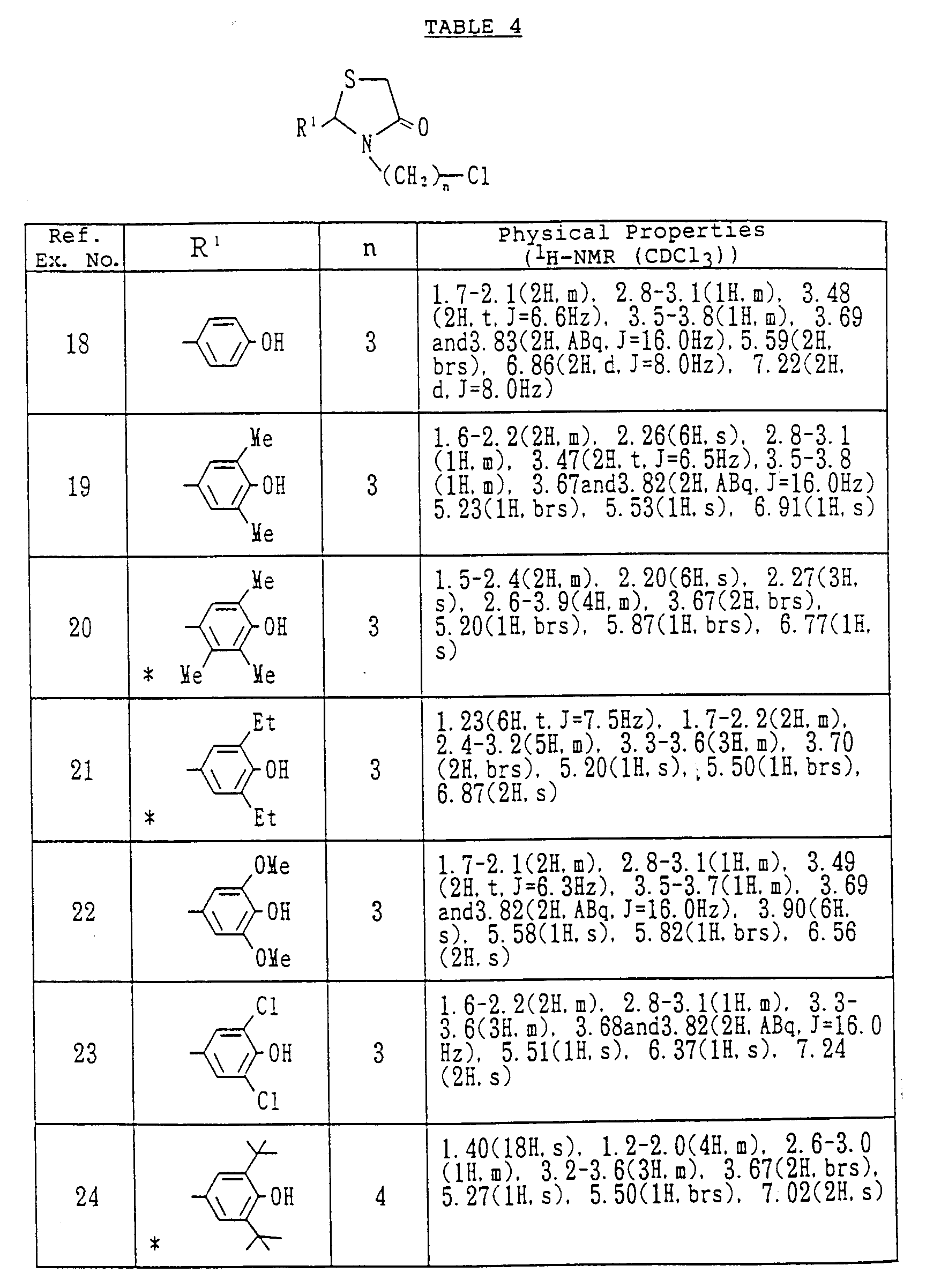
1.23 (12H, d, J=6.6Hz), 1.5-2.1 (2H, m), 2.6-3.8 (6H, m), 3.67 (2H, brs), 5.20 (1H, s), 5.50 (1H, brs), 6.88 (2H, s) - Each compound shown in Tables 4 and 5 was prepared according to the procedure for Reference Example 17 using an appropriate alcohol in each case.

- To a solution of 2-(3,5-di-tert-butyl-4-hydroxyphenyl)-3-(3-hydroxypropyl)-1,3-thiazolidin-4-one (2.00 g) obtained in Reference Example 15 in diethyl ether (20 ml) was added phosphorus tribromide (0.74 g) under a nitrogen atmosphere, then the mixture was stirred at room temperature for 6 hours. After completion of the reaction, the mixture was poured into ice-water (100 ml), and the product was extracted with diethyl ether. The organic layer was washed with brine and dried over anhydrous sodium sulfate. The solvent was evaporated under reduced pressure, and the residue was purified by silica gel column chromatography (eluent; chloroform) to afford 1.31 g (56%) of the title compound as pale yellow crystals. mp 130-131°C.
- NMR (CDCl3, 60 MHz) δ:
-
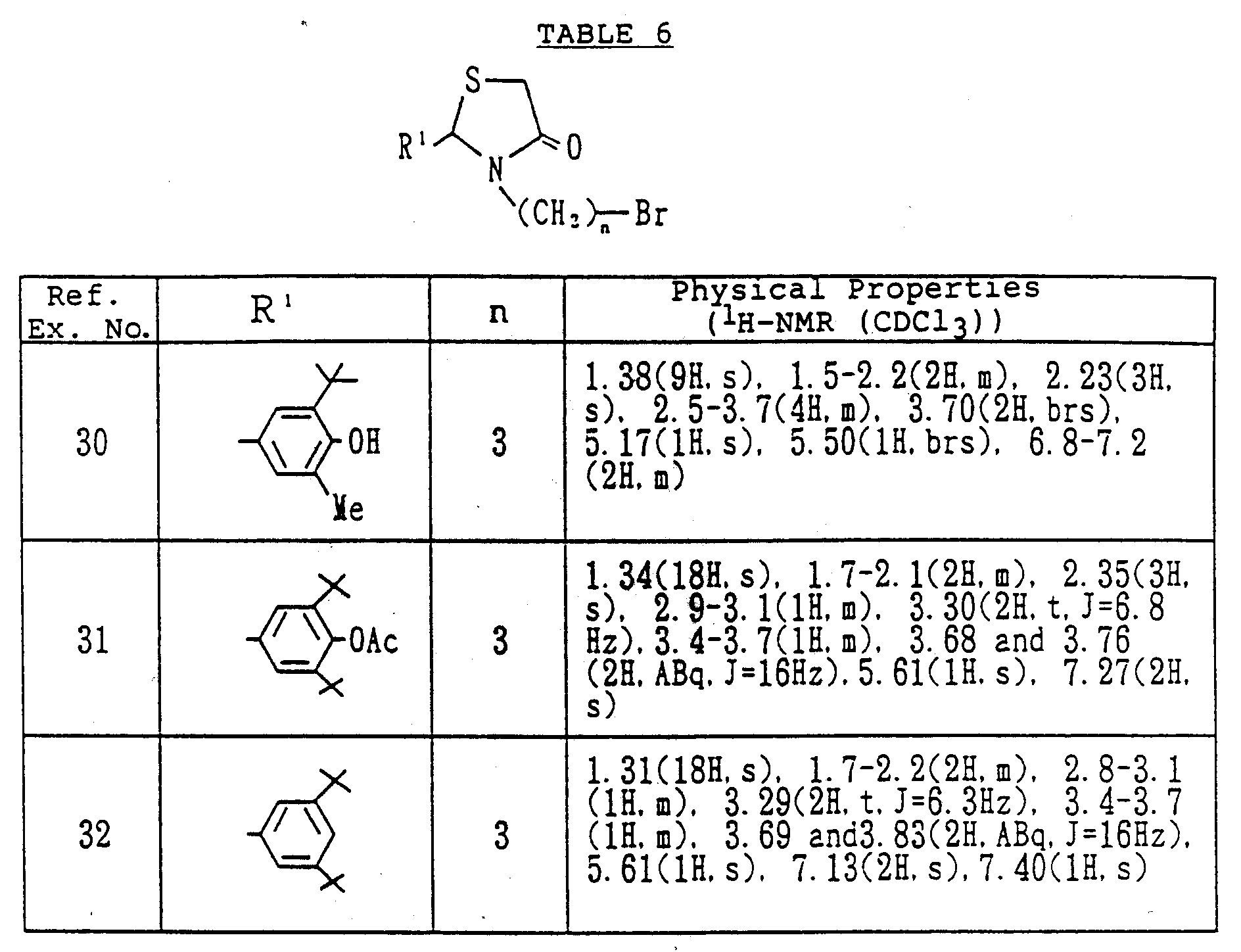
1.43 (18H, s), 1.6-2.2 (2H, m), 2.6-3.6 (2H, m), 3.28 (2H, t, J=6.5Hz), 3.70 (2H, brs), 5.28 (1H, s), 5.53 (1H, brs), 7.05 (2H, s) - Each bromide shown in Table 6 was prepared according to the procedure for Reference Example 29, using an appropriate alcohol in each case.
- To a solution of 2-(3,5-diisopropyl-4-hydroxyphenyl)-3-(3-chloropropyl)-1,3-thiazolidin-4-one (0.50 g) obtained in Reference Example 17 and N-methyl-N-[2-(3,4-methylenedioxyphenoxy)ethyl]amine (0.30 g) in dimethylformamide (10 ml) were added sodium carbonate (0.29 g) and potassium iodide (0.30 g) under a nitrogen atmosphere, and the mixture was stirred at 80°C for 24 hours. The solvent was removed by evaporation under reduced pressure, water (20 ml) was added to the residue, and the mixture was extracted with chloroform. The organic layer was washed successively with water and brine, then dried over anhydrous sodium sulfate. The solvent was evaporated under reduced pressure, and the residue was purified by silica gel column chromatography (eluent; chloroform-methanol, 97:3) to afford 0.26 g (36%) of the title compound as a pale brown oil.
- NMR (CDCl3, 60 MHz) δ:
-
1.23 (12H, d, J=6.6Hz), 1.4-1.9 (2H, m), 2.17 (3H, s), 2.3-3.8 (8H, m), 3.67 (2H, brs), 3.87 (2H, t, J=5.7Hz), 5.00 (1H, brs), 5.57 (1H, s), 5.80 (2H, s), 6.0-6.7 (3H, m), 6.90 (2H, s) - Each compound shown in Tables 7 to 10 was prepared according to the procedure for Example 1, using a corresponding chloride and an appropriate amine in each case.
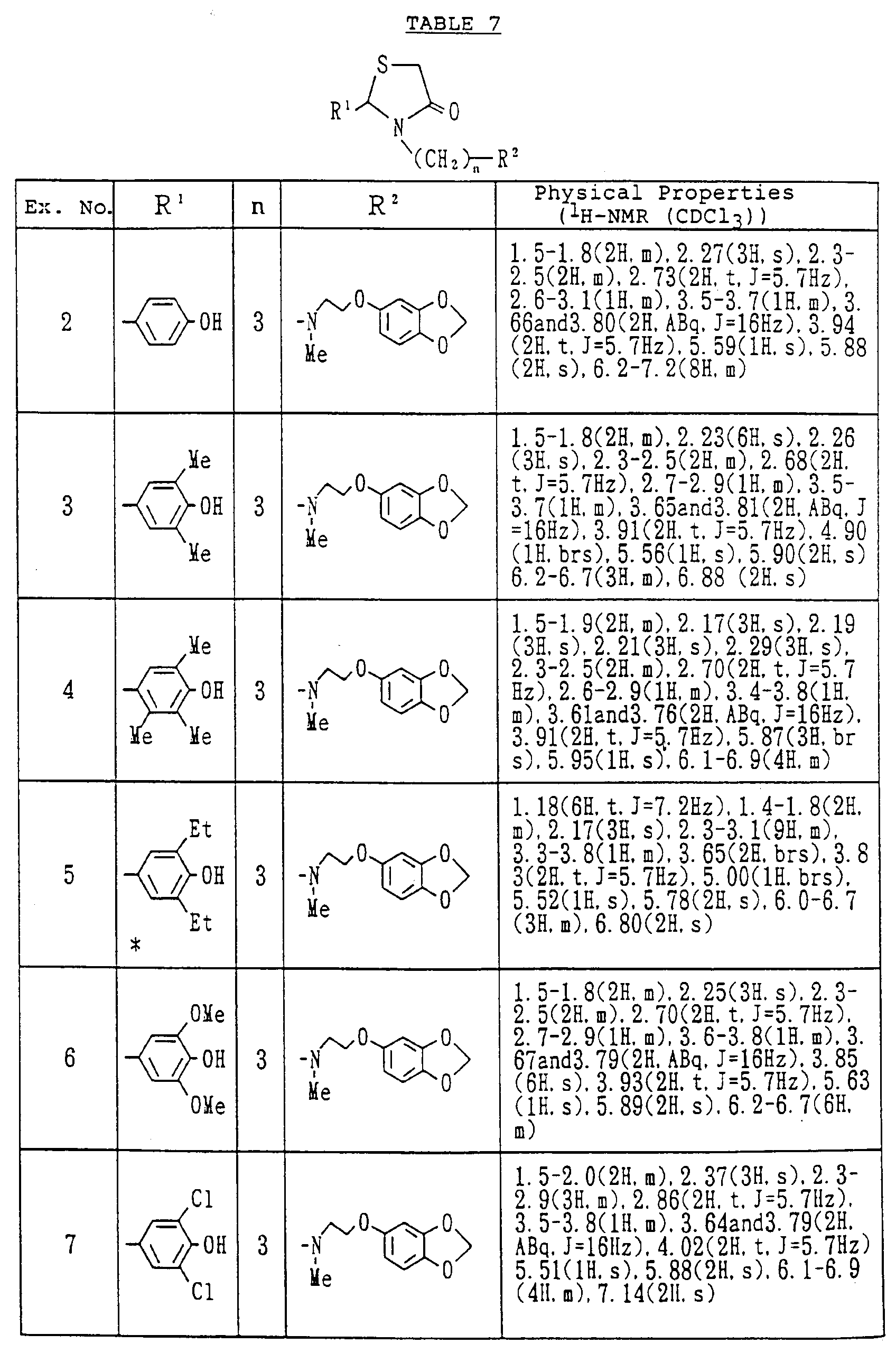

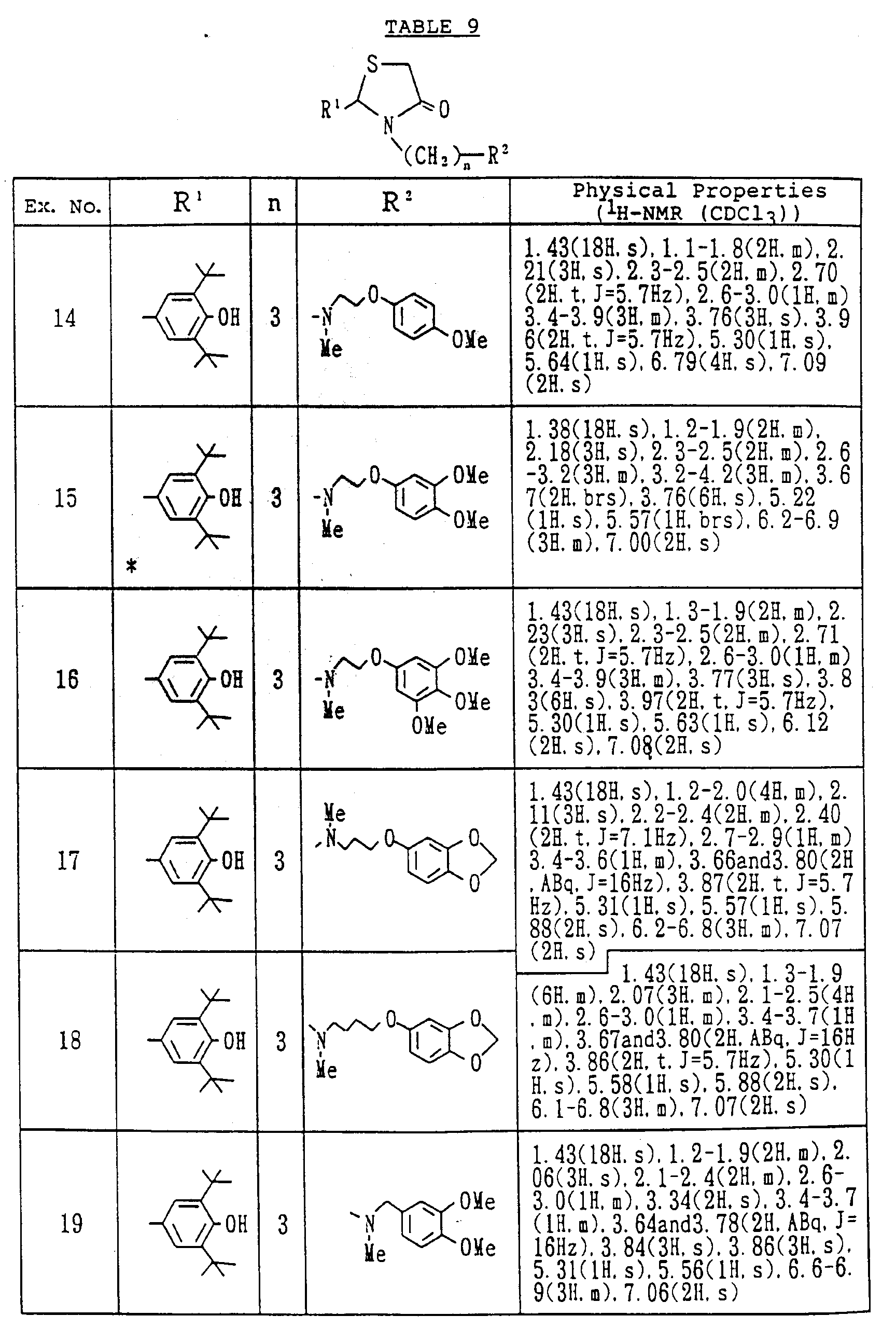
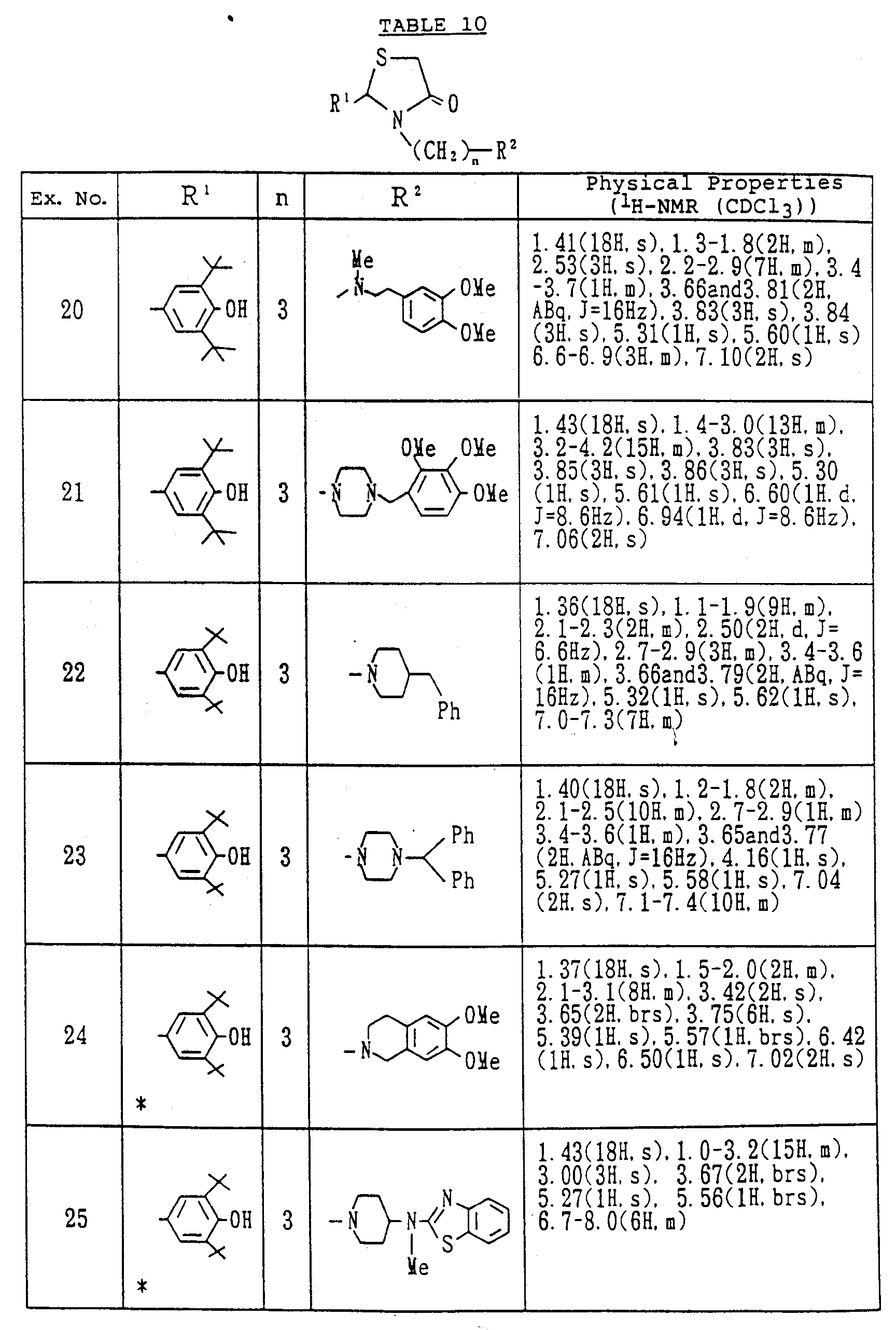
- To a solution of the 2-(3,5-di-tert-butyl-4-hydroxyphenyl)-3-(3-bromopropyl)-1,3-thiazolidin-4-one (89.3 mg) obtained in Reference Example 29 and N-methyl-N-[2-(3,4-methylenedioxyphenoxy)ethyl]amine (48.8 mg) in acetone (5 ml) was added potassium carbonate (34.6 mg) under a nitrogen atmosphere, and the mixture was refluxed for 10 hours. After allowing the mixture to cool, inorganic matter was removed by filtration, and the filtrate was concentrated under reduced pressure. The residue was purified by silica gel column chromatography (eluent; chloroform-methanol, 97:3) to afford 67.4 mg (60%) of the title compound as colorless crystals. mp 70-71°C.
- NMR (CDCl3, 200 MHz) δ:
-
1.42 (18H, s), 1.4-1.7 (2H, m), 2.20 (3H, s), 2.3-2.5 (2H, m), 2.68 (2H, t, J=5.9Hz), 2.7-2.9 (1H, m), 3.5-3.6 (1H, m), 3.66 and 3.80 (2H, ABq, J=16.0Hz), 3.92 (2H, t, J=5.9Hz), 5.32 (1H, s), 5.66 (1H, s), 5.90 (2H, s), 6.2-6.7 (3H, m), 7.09 (2H, s) - Each compound shown in Tables 11 and 12 was prepared according to the procedure for Example 26-A, using a corresponding bromide and an appropriate amine in each case.

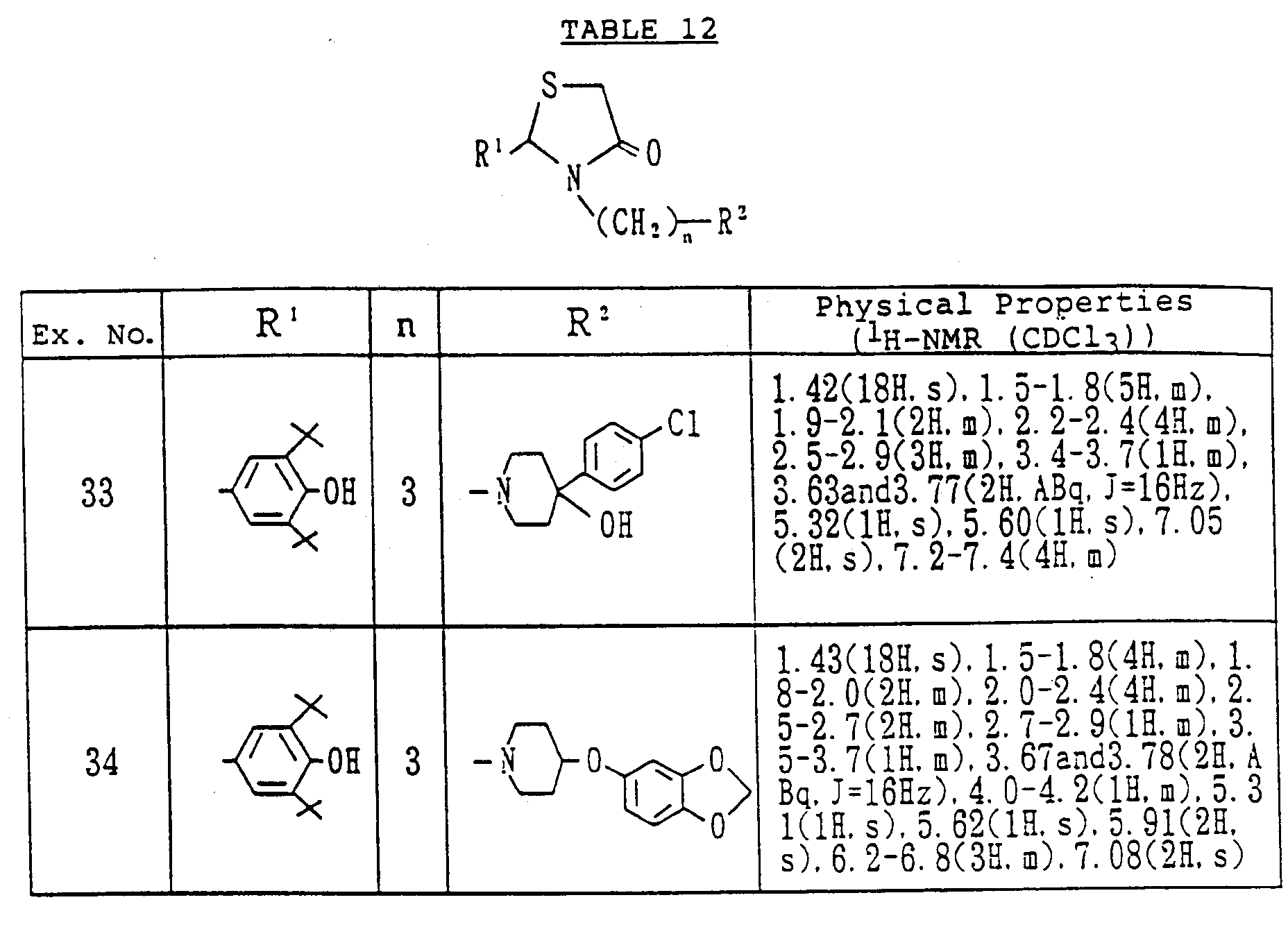
- A mixture of 2-(3,5-di-tert-butyl-4-hydroxyphenyl)-3-(3-bromopropyl)-1,3-thiazolidin-4-one (1.10 g) obtained in Reference Example 29, 40% methanolic solution of methylamine (20 ml), and acetonitrile (15 ml) was stirred at room temperature for 15 hours under a nitrogen atmosphere. After completion of the reaction, the solvent and excess methylamine were removed under reduced pressure. The residue was purified by silica gel column chromatography (eluent; chloroform-methanol, 95:5) to afford 0.90 g (76%) of the title compound as pale orange crystals. mp 195-196°C.
- NMR (CDCl3, 60 MHz) δ:
-
1.42 (18H, s), 1.6-2.2 (2H, m), 2.67 (3H, s), 2.6-3.6 (4H, m), 3.77 (2H, brs), 5.33 (1H, s), 5.63 (1H, brs), 7.08 (2H, s) - Each compound shown in Table 13 was prepared according to the procedure for Reference Example 33, using an appropriate amine instead of methylamine in each case.
- In Reference Example 35, chromatographic purification was performed on a column of silica gel using chloroform-methanol, 95:5 containing 1% triethylamine as an eluent.

- To a solution of the 2-(3,5-di-tert-butyl-4-hydroxyphenyl)-3-[3-(N-methylamino)propyl]-1,3-thiazolidin- 4-one hydrobromide (380 mg) obtained in Reference Example 33 and 2-(3,4-methylenedioxyphenoxy)ethyl bromide (260 mg) in acetone (10 ml) was added potassium carbonate (300 mg) and the mixture was refluxed for 10 hours under a nitrogen atmosphere. After allowing the reaction mixture to cool, insoluble matter was removed by filtration, and the filtrate was concentrated under reduced pressure. The residue was purified by silica gel column chromatography (eluent; chloroform-methanol, 97:3) to afford 350 mg (64%) of the same compound as obtained in Example 26-A.
- Each compound of Table 14 was prepared according to the procedure for Example 26-B, reacting each of the compounds shown in Table 13 with an appropriate bromide in each case.
- To a solution of the 2-(3,5-di-tert-butyl-4-hydroxyphenyl)-3-[3-(N-methylamino)propyl]-1,3-thiazolidin-4-one (0.50 g) obtained in Reference Example 33 in acetonitrile (10 ml) was added 2,3-epoxypropyl-3,4-methylenedioxyphenyl ether (0.26 g) at room temperature, and the mixture was refluxed for 8 hours. After allowing to cool, the mixture was poured into ice-water and extracted with ethyl acetate. The organic layer was washed with brine and dried over anhydrous sodium sulfate. The solvent was evaporated under reduced pressure, and the residue was purified by silica gel column chromatography (eluent; chloroform-methanol, 98:2) to afford 0.72 g (95%) of the title compound as a colorless oil.
- NMR (CDCl3, 270 MHz) δ:
-
1.43 (18H, s), 1.4-1.8 (2H, m), 2.17 (3H, s), 2.2-2.6 (4H, m), 2.7-3.0 (1H, m), 3.4-3.7 (1H, m), 3.67 and 3.80 (2H, ABq, J=16.0Hz), 3.8-4.1 (4H, m), 5.33 (1H, s), 5.57 (1H, s), 5.91 (2H, s), 6.2-6.8 (3H, m), 7.09 (2H, s) - Each compound shown in Table 15 was prepared according to the procedure for Example 38, using an appropriate epoxide in each case.

- In acetone (20 ml) were suspended N-methyl-N-[2-(3,4-methylenedioxyphenoxy)ethyl]amine (1.0 g), N-(3-bromopropyl)phthalimide (1.51 g), and potassium carbonate (0.78 g), and the suspension was refluxed for 3 hours. After allowing to cool, the mixture was filtered to remove inorganic matter, and the filtrate was concentrated. The residue was purified by silica gel column chromatography (eluent; chloroform-methanol, 10:1) to afford 1.82 g (93%) of N-[3-[N'-methyl-N'-[2-(3,4-methylenedioxyphenoxy)ethyl]amino]propyl]phthalimide as a brown oil.
- NMR (CDCl3, 60 MHz) δ:
-
1.5-2.2 (2H, m), 2.28 (3H, s), 2.3-2.9 (4H, m), 3.72 (2H, t, J=7.0Hz), 3.90 (2H, t, J=6.0Hz), 5.82 (2H, s), 6.0-6.8 (3H, m), 7.4-8.0 (4H, m) - The resulting N-[3-[N'-methyl-N'-[2-(3,4-methylenedioxyphenoxy)ethyl]amino]propyl]phthalimide (1.82 g) was dissolved in 40% methanolic solution of methylamine (10 ml), and the mixture was stirred at room temperature overnight. After completion of the reaction, the solvent and excess methylamine were removed under reduced pressure. The residue was purified by silica gel column chromatography (eluent; chloroform-methanol, 1:1 containing 1% triethylamine) to afford 0.74 g (62%) of the title compound as a pale brown oil.
- NMR (CDCl3) (60 MHz) δ:
-
1.33 (2H, s), 1.1-2.1 (2H, m), 2.27 (3H, s), 2.2-3.0 (6H, m), 3.90 (2H, t, J=6.0Hz), 5.77 (2H, s), 6.0-6.8 (3H, m) - The title compound was prepared according to the procedure for Reference Example 36, using N-(2-bromoethyl)phthalimide instead of N-(3-bromopropyl)phthalimide.
- NMR (CDCl3) (60 MHz) δ:
-
2.34 (3H, s), 2.0-3.2 (8H, m), 3.90 (2H, t, J=6.0Hz), 5.85 (2H, s), 6.0-6.9 (3H, m) - The title compound was prepared according to the procedure for Reference Example 1, using 3-[N-methyl-N-[2-(3,4-methylenedioxyphenoxy)ethyl]amino]propylamine and 2-mercaptopropionic acid instead of 3-aminopropanol and α-mercaptoacetic acid.
- NMR (CDCl3) (270 MHz) δ:
-
1.42 (18H, s), 1.2-1.8 (2H, m), 1.58 (3x2/5H, d, J=6.9Hz), 1.65 (3x3/5H, d, J=6.9Hz), 2.20 (3x3/5H, s), 2.23 (3x2/5H, s), 2.2-2.5 (2H, m), 2.6-2.9 (3H, m), 3.4-3.7 (1H, m), 3.8-4.1 (3H, m), 5.29 (2/5H, s), 5.30 (3/5H, s), 5.56 (3/5H, s), 5.57 (2/5H, brs), 5.90 (2H, s), 6.2-6.8 (3H, m), 7.05 (2x2/5H, s), 7.11 (2x3/5H, s) - The title compound was prepared according to the procedure for Reference Example 1, using 2-[N-methyl-N-[2-(3,4-methylenedioxyphenoxy)ethyl]amino]ethylamine instead of 3-aminopropanol.
- NMR (CDCl3) (60 MHz) δ:
-
1.40 (18H, s), 2.20 (3H, s), 2.5-3.0 (5H, m), 3.3-4.1 (3H, m), 3.65 (2H, brs), 5.23 (1H, s), 5.73 (1H, s), 5.82 (2H, s), 6.0-6.8 (3H, m), 7.00 (2H, s) - In acetic acid (5 ml) was dissolved 2-(3,5-di-tert-butyl-4-hydroxyphenyl)-3-[3-[N-methyl-N-[2-(3,4-methylenedioxyphenoxy)ethyl]amino]propyl]-1,3-thiazolidin-4-one (0.35 g), and 47% hydrobromic acid (5 ml) was added, then the mixture was stirred at room temperature for 7 days. After completion of the reaction, the mixture was poured into an ice-cooled 5% aqueous solution of sodium carbonate and extracted with chloroform. The organic layer was dried over anhydrous sodium sulfate, and the solvent was evaporated under reduced pressure. The residue was purified by silica gel column chromatography (eluent; chloroform-methanol, 98:2) to afford 0.05 g (16%) of the title compound as a pale brown oil.
- NMR (CDCl3) (200 MHz) δ:
-
1.37 (9H, s), 1.2-1.9 (2H, m), 2.26 (3H, s), 2.1-2.5 (2H, m), 2.71 (2H, t, J=5.7Hz), 2.6-3.0 (1H, m), 3.4-3.8 (1H, m), 3.67 and 3.80 (2H, ABq, J=16.0Hz), 3.94 (2H, t, J=5.7Hz), 5.60 (1H, s), 5.82 (1H, s), 5.88 (2H, s), 6.1-7.0 (5H, m), 7.14 (1H, s) - 2-(3,5-Di-tert-butyl-4-hydroxyphenyl)-3-(3-hydroxypropyl)-5-methyl-1,3-thiazolidin-4-one was prepared according to the procedure for Reference Example 1, using 2-mercaptopropionic acid instead of α-mercaptoacetic acid.
- NMR (CDCl3) (200 MHz) δ:
-
1.43 (18H, s), 1.1-1.7 (2H, m), 1.60 (3x1/4H, d, J=6.9Hz), 1.67 (3x3/4H, d, J=6.9Hz), 3.0-3.3 (1H, m), 3.3-3.7 (4H, m), 3.9-4.2 (1H, m), 5.34 (1/4H, s), 5.36 (3/4H, s), 5.49 (3/4H, s), 5.52 (1/4H, s), 7.07 (2x1/4H, s), 7.12 (2x3/4H, s) - Each compound shown in Table 16 was prepared according to the procedure for Reference Example 38, using an appropriate α-mercaptocarboxylic acid instead of 2-mercaptopropionic acid in each case.

- In benzene (200 ml) were suspended 3,5-di-tert-butyl-4-hydroxybenzaldehyde (23.4 g) and 3-aminopropanol (9.01 g) under a nitrogen atmosphere. After fitting a Dean-Stark trap to the reactor, the suspension was refluxed for 2 hours. After allowing the mixture to cool, thiomalic acid (19.52 g) was added thereto, then the mixture was refluxed for an additional period of 3 hours. Benzene was removed by evaporation, and the resulting white solid was recrystallized from water-containing methanol to afford 10.5 g (25%) of the title compound as colorless crystals. mp 227-228°C.
- NMR (d6-DMSO) (200 MHz) δ:
-
1.37 (18H, s), 1.2-1.8 (2H, m), 2.3-2.8 (1H, m), 3.0-3.6 (5H, m), 4.0-4.2 (1H, m), 4.37 (1H, brs), 5.73 (1H, s), 7.10 (2H, s), 7.13 (1H, s) - 2-(3,5-Di-tert-butyl-4-hydroxyphenyl)-3-(3-chloropropyl)-5-methyl-1,3-thiazolidin-4-one was prepared from 2-(3,5-di-tert-butyl-4-hydroxyphenyl)-3-(3-hydroxypropyl)-5-methyl-1,3-thiazolidin-4-one according to the procedure for Reference Example 17.
- NMR (CDCl3) (60 MHz) δ:
-
1.42 (18H, s), 1.1-2.2 (5H, m), 2.7-4.2 (5H, m), 5.23 (1H, s), 5.43 (1H, brs), 6.97 (2H, brs) - Each compound shown in Table 17 was prepared from each of the compounds prepared in Reference Examples 39 and 40, respectively, according to the procedure for Reference Example 29.
- To a suspension of 2-(3,5-di-tert-butyl-4-hydroxyphenyl)-3-(3-hydroxypropyl)-5-carboxymethyl-1,3-thiazolidin-4-one (2.45 g) in diethyl ether (30 ml) was added phosphorus tribromide (3.45 g), and the mixture was stirred at room temperature for 3 hours. To the mixture was added dropwise ethanol (30 ml) under cooling with ice, the mixture was stirred at room temperature overnight. After completion of the reaction, the reaction mixture was poured into 100 ml of ice-water, and the product was extracted with ethyl acetate. The organic layer was washed with brine and dried over anhydrous sodium sulfate. The solvent was removed by evaporation under reduced pressure, and the residue was purified by silica gel column chromatography (eluent; ethyl acetate:n-hexane, 20:80) and then recrystallized from chloroform/n-hexane to afford 1.50 g (51%) of the title compound as colorless crystals. mp 154-155°C.
- NMR (CDCl3) (200 MHz) δ:
-
1.26 (3H, t, J=7.1Hz), 1.43 (18H, s), 1.6-2.2 (2H, m), 2.6-3.1 (2H, m), 3.2-3.6 (4H, m), 4.17 (2H, q, J=7.1Hz), 4.1-4.4 (1H, m), 5.33 (1H, s), 5.53 (1H, s), 7.14 (2H, s) - 2-(3,5-Di-tert-butyl-4-hydroxyphenyl)-3-(3-bromopropyl)-5-isopropoxycarbonylmethyl-1,3-thiazolidin-4-one was prepared as colorless crystals according to the procedure for Reference Example 45, using isopropyl alcohol instead of ethanol. mp 170-171°C.
- NMR (CDCl3) (200 MHz) δ:
-
1.24 (6H, d, J=5.7Hz), 1.43 (18H, s), 1.6-2.2 (2H, m), 2.6-3.7 (6H, m), 4.1-4.4 (1H, m), 4.8-5.2 (1H, m), 5.33 (1H, s), 5.53 (1H, s), 7.14 (2H, s) - The title compound was prepared according to the procedure for Example 1, using 2-(3,5-di-tert-butyl-4-hydroxyphenyl)-3-(3-chloropropyl)-5-methyl-1,3-thiazolidin-4-one prepared in Reference Example 42. The data of instrumental analyses on the resulting compound were identical with those of the compound prepared in Example 41-A.
- Each compound shown in Table 18 was prepared according to the procedure for Example 26-A, using respective compounds obtained in Reference Examples 43 and 44, instead of 2-(3,5-di-tert-butyl-4-hydroxyphenyl)-3-(3-bromopropyl)-1,3-thiazolidin-4-one.

- According to the procedure for Example 26-A, using 2-(3,5-di-tert-butyl-4-hydroxyphenyl)-3-(3-bromopropyl)-5-ethoxycarbonylmethyl-1,3-thiazolidin-4-one obtained in Reference Example 45 instead of 2-(3,5-di-tert-butyl-4-hydroxyphenyl)-3-(3-bromopropyl)-1,3-thiazolidin-4-one, the title compound was prepared as colorless crystals. mp 88-89°C.
- NMR (CDCl3) (200 MHz) δ:
-
1.26 (3H, t, J=7.1Hz), 1.41 (18H, s), 1.4-1.9 (2H, m), 2.19 (3H, s), 2.3-2.5 (2H, m), 2.67 (2H, t, J=5.7Hz), 2.7-3.0 (2H, m), 3.2-3.7 (2H, m), 3.91 (2H, t, J=5.7Hz), 4.17 (2H, q, J=7.1Hz), 4.1-4.4 (1H, m), 5.29 (1H, s), 5.58 (1H, s), 5.89 (2H, s), 6.1-6.8 (3H, m), 7.09 (2H, s) - According to the procedure for Example 46, using 2-(3,5-di-tert-butyl-4-hydroxyphenyl)-3-(3-bromopropyl)-5-isopropoxycarbonylmethyl-1,3-thiazolidin-4-one instead of 2-(3,5-di-tert-butyl-4-hydroxyphenyl)-3-(3-bromopropyl)-5-ethoxycarbonylmethyl-1,3-thiazolidin-4-one, 2-(3,5-di-tert-butyl-4-hydroxyphenyl)-3-[3-[N-methyl-N-[2-(3,4-methylenedioxyphenoxy)ethyl]amino]propyl]-5-isopropoxycarbonylmethyl-1,3-thiazolidin-4-one was prepared as colorless crystals. mp 81-82°C.
- NMR (CDCl3) (200 MHz) δ:
-
1.23 (6H, d, J=5.7Hz), 1.41 (18H, s), 1.4-2.0 (2H, m), 2.20 (3H, s), 2.2-2.5 (2H, m), 2.5-3.0 (4H, m), 3.1-3.7 (2H, m), 3.93 (2H, t, J=5.7Hz), 4.1-4.4 (1H, m), 4.8-5.2 (1H, m), 5.30 (1H, s), 5.57 (1H, s), 5.89 (2H, s), 6.1-6.8 (3H, m), 7.10 (2H, s) - In ethanol (5 ml) was dissolved 2-(3,5-di-tert-butyl-4-hydroxyphenyl)-3-[3-[N-methyl-N-[2-(3,4-methylenedioxy phenoxy)ethyl]amino]propyl]-5-ethoxycarbonylmethyl-1,3-thiazolidin-4-one (100 mg) prepared in Example 46, and a solution of sodium hydroxide (200 mg) in 20% water-containing ethanol was added, then the mixture was stirred at room temperature overnight. After completion of the reaction, the mixture was neutralized with 1N hydrochloric acid and concentrated under reduced pressure. To the residue was added a mixture of water (50 ml) and chloroform (50 ml), and the mixture was stirred. The organic layer was separated, washed with brine, and dried over anhydrous sodium sulfate. The solvent was evaporated under reduced pressure, and the residue was triturated with n-hexane to afford 80 mg (84%) of the title compound as a pale yellow solid.
- NMR (CDCl3) (200 MHz) δ:
-
1.41 (18/2H, s), 1.42 (18/2H, s), 1.4-2.4 (2H, m), 2.85 (3/2H, s), 2.90 (3/2H, s), 2.7-3.8 (8H, m), 4.1-4.7 (3H, m), 5.2-5.4 (1H, m), 5.66 (1/2H, brs), 5.81 (1/2H, brs), 5.89 (2H, s), 6.2-6.7 (3H, m), 7.13 (2/2H, s), 7.14 (2/2H, s) - To a solution of 2-(3,5-di-tert-butyl-4-hydroxyphenyl)-3-[3-[N-methyl-N-[2-(3,4-methylenedioxyphenoxy)ethyl]amino]propyl]-5-ethoxycarbonylmethyl-1,3-thiazolidin-4-one (80 mg) prepared in Example 46 in dry tetrahydrofuran (5 ml) was added lithium aluminum hydride (20 mg) at -78°C, and the mixture was stirred at 0°C for 3 hours. To the mixture was added water-containing tetrahydrofuran (5 ml), followed by stirring at that temperature for 1 hour. The mixture was neutralized with 1N hydrochloric acid, concentrated under reduced pressure. The residue was purified by silica gel column chromatography (eluent; chloroform-methanol, 95:5) to afford 68 mg (86%) of the title compound as a colorless oil.
- NMR (CDCl3) (200 MHz) δ:
-
1.41 (18H, s), 1.3-1.8 (4H, m), 2.19 (3H, s), 2.2-2.5 (3H, m), 2.67 (2H, t, J=5.7Hz), 2.7-2.9 (1H, m), 3.4-3.6 (1H, m), 3.8-4.0 (2H, m), 3.91 (2H, t, J=5.7Hz), 4.04 (1H, t, J=5.7Hz), 5.33 (1H, s), 5.60 (1H, s), 5.90 (2H, s), 6.2-6.7 (3H, m), 7.12 (2H, s) - To a suspension of 2-(3,5-di-tert-butyl-4-hydroxyphenyl)-3-(3-hydroxypropyl)-5-carboxymethyl-1,3-thiazolidin-4-one (0.61 g) obtained in Reference Example 41 in dichloromethane (20 ml) were added thionyl chloride (0.38 g) and a catalytic amount of dimethylformamide, and the mixture was refluxed for 2 hours. After allowing to cool, the mixture was added dropwise to a solution of pyrrolidine (1.02 g) in dichloromethane (20 ml) under cooling with ice, and stirred at that temperature for 1 hour. After completion of the reaction, the reaction mixture was poured into ice-water and extracted with chloroform. The organic layer was washed successively with 1N hydrochloric acid and brine, and dried over anhydrous sodium sulfate. The solvent was evaporated under reduced pressure, and the residue was purified by silica gel column chromatography (eluent; chloroform-methanol, 97:3) and then recrystallized from chloroform/n-hexane to yield 0.65 g (92%) of the title compound as colorless crystals. mp 193-194°C.
- NMR (CDCl3) (200 MHz) δ:
-
1.43 (18H, s), 1.4-2.2 (6H, m), 2.5-3.1 (2H, m), 3.2-3.7 (8H, m), 4.2-4.5 (1H, m), 5.29 (1H, s), 5.53 (1H, s), 7.08 (2H, s) - Each compound shown in Table 19 was prepared according to the procedure for Reference Example 47, using an appropriate amine in each case.

- The title compound was obtained as a pale brown oil according to the procedure for Example 1, using 2-(3,5-di-tert-butyl-4-hydroxyphenyl)-3-(3-chloropropyl)-5-(1-pyrrolidinecarbonylmethyl)-1,3-thiazolidin-4-one obtained in Reference Example 47 instead of 2-(3,5-diisopropyl-4-hydroxyphenyl)-3-(3-chloropropyl)-1,3-thiazolidin-4-one.
- NMR (CDCl3) (200 MHz) δ:
-
1.41 (18H, s), 1.4-2.1 (6H, m), 2.20 (3H, s), 2.2-2.5 (2H, m), 2.5-3.1 (4H, m), 3.2-3.8 (6H, m), 3.93 (2H, t, J=5.7Hz), 4.2-4.5 (1H, m), 5.29 (1H, s), 5.57 (1H, s), 5.88 (2H, s), 6.1-6.8 (3H, m), 6.9-7.2 (2H, m) - Each compound shown in Table 20 was prepared according to the procedure for Example 50, using each of the compounds prepared in Reference Examples 48 to 50 instead of 2-(3,5-di-tert-butyl-4-hydroxyphenyl)-3-(chloropropyl)-5-(1-pyrrolidinecarbonylmethyl)-1,3-thiazolidin-4-one.

- To a solution of 2-(3,5-di-tert-butyl-4-hydroxyphenyl)-3-(3-bromopropyl)-1,3-thiazolidin-4-one (1.0 g) prepared in Reference Example 29 in dichloromethane (15 ml) was added dropwise sulfuryl chloride (0.36 g) under cooling with ice-water, and the mixture was stirred at room temperature for 1.5 hours. The solvent was evaporated under reduced pressure, and methanol (10 ml) was added to the residue, and the mixture was stirred at room temperature overnight. The mixture was concentrated under reduced pressure, and the residue was purified by silica gel column chromatography (eluent; chloroform) to afford 0.59 g (48%) of the title compound as a pale brown oil.
- NMR (CDCl3) (200 MHz) δ:
-
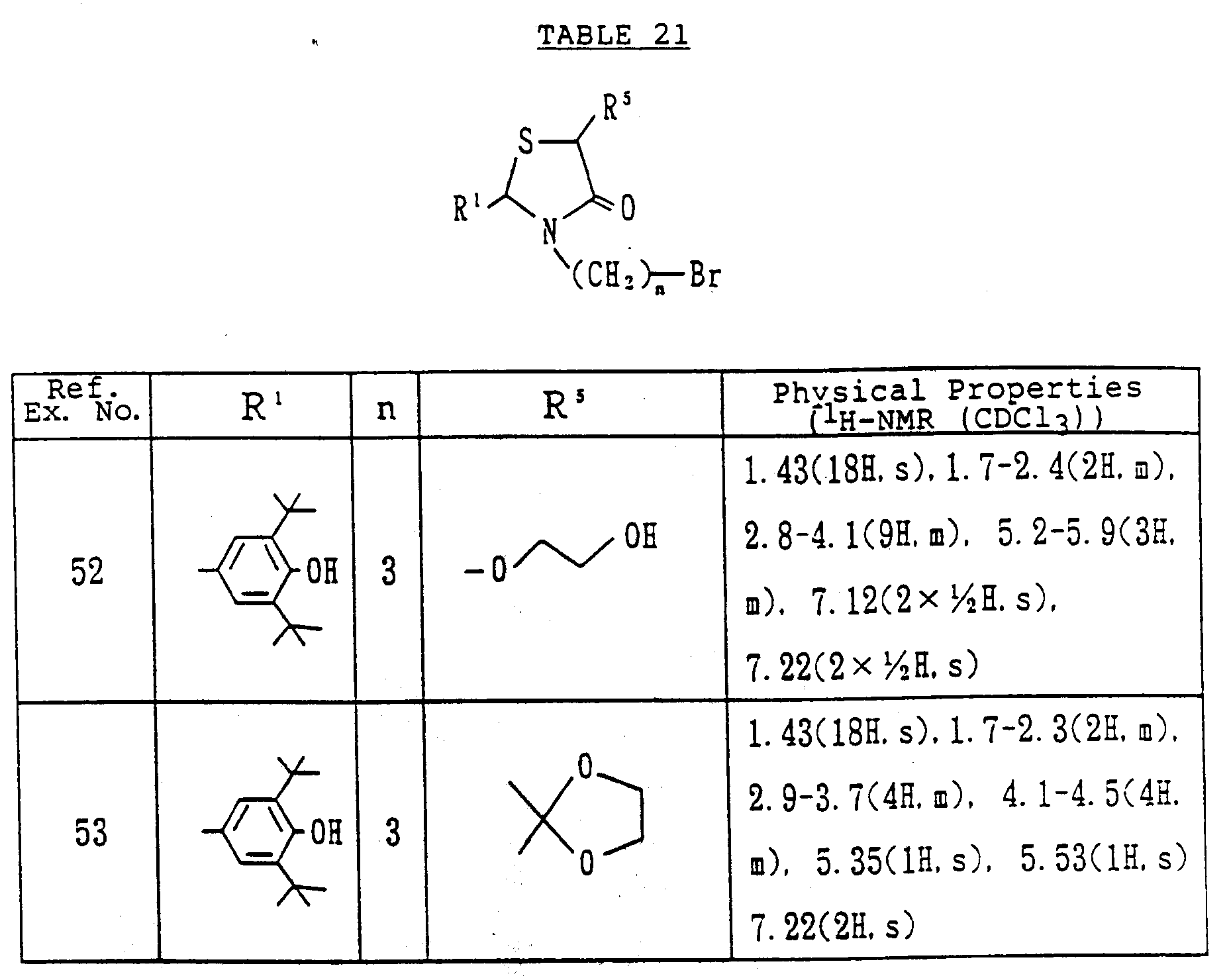
1.42 (18H, s), 1.5-2.3 (2H, m), 2.8-3.6 (4H, m), 3.46 (3x2/5H, s), 3.52 (3x3/5H, s), 5.2-6.1 (3H, m), 7.08 (2x2/5H, s), 7.12 (2x3/5H, s) - Each compound shown in Table 21 was prepared according to the procedure for Reference Example 51, using ethylene glycol instead of methanol.
- The title compound was obtained as a pale yellow oil according to the procedure for Example 26-A, using 2-(3,5-di-tert-butyl-4-hydroxyphenyl)-3-(3-bromopropyl)-5-methoxy-1,3-thiazolidin-4-one prepared in Reference Example 51 instead of 2-(3,5-di-tert-butyl-4-hydroxyphenyl)-3-(3-bromopropyl)-1,3-thiazolidin-4-one.
- NMR (CDCl3) (270 MHz) δ:
-
1.41 (18H, s), 1.4-1.9 (2H, m), 2.18 (3x2/5H, s), 2.22 (3x3/5H, s), 2.2-3.1 (5H, m), 3.46 (3x2/5H, s), 3.51 (3x3/5H, s), 3.5-3.7 (1H, m), 3.8-4.1 (2H, m), 5.2-5.8 (3H, m), 5.90 (2H, s), 6.1-6.8 (3H, m), 7.21 (2x2/5H, s), 7.26 (2x3/5H, s) - Each compound shown in Table 22 was prepared according to the procedure for Example 54, using each of the compounds prepared in Reference Examples 52 and 53 instead of 2-(3,5-di-tert-butyl-4-hydroxyphenyl)-3-(3-bromopropyl)-5-methoxy-1,3-thiazolidin-4-one.

- In THF (5 ml) were suspended 2-(3,5-di-tert-butyl-4-hydroxyphenyl)-3-[3-[N-methyl-N-[2-(3,4-methylenedioxyphenoxy)ethyl]amino]propyl]-1,3-thiazolidin-4-one (217 mg) and Lawesson's reagent (194 mg), and the suspension was stirred at room temperature for 5 hours. The solvent was evaporated under reduced pressure, and to the residue was added water (20 ml), then the mixture was extracted with chloroform. The organic layer was washed successively with water and brine, and dried over anhydrous sodium sulfate. The solvent was removed by evaporation under reduced pressure, and the residue was purified by silica gel column chromatography (eluent; chloroform-methanol, 99:1) to afford 181 mg (81%) of the title compound as a pale yellow oil.
- NMR (CDCl3) (200 MHz) δ:
-
1.41 (18H, s), 1.3-1.8 (2H, m), 2.20 (3H, s), 2.3-2.5 (2H, m), 2.70 (2H, t, J=5.7Hz), 3.1-3.3 (1H, m), 3.93 (2H, t, J=5.7Hz), 3.9-4.1 (1H, m), 4.26 and 4.40 (2H, ABq, J=16.0Hz), 5.34 (1H, s), 6.18 (2H, s), 6.04 (1H, s), 6.2-7.0 (3H, m), 7.07 (2H, s) - To a suspension of 3,5-di-tert-butyl-4-hydroxybenzoic acid (1.00 g) in tetrahydrofuran (17 ml) were added oxalyl chloride (0.76 g) and a catalytic amount of dimethylformamide at 0°C, the mixture was stirred at room temperature for 1 hour. The solvent and excess oxalyl chloride were removed under reduced pressure, and tetrahydrofuran (8 ml) was added to the residue. The resultant solution was added dropwise to a solution of 3-[N-methyl-N-[2-(3,4-methylenedioxyphenoxy)ethyl]amino]propylamine (1.01 g) and triethylamine (0.41 g) in tetrahydrofuran (13 ml) at 0°C, and the mixture was stirred at room temperature for 6 hours. The reaction mixture was poured into cold water, and the product was extracted with chloroform. The organic layer was washed with brine and dried over anhydrous sodium sulfate. The solvent was evaporated under reduced pressure, and the residue was purified by silica gel column chromatography (eluent; chloroform-methanol, 97:3) to afford 1.35 g (70%) of the title compound as a pale brown oil.
- NMR (CDCl3) δ:
-
1.34 (18x1/3H, s), 1.43 (18x2/3H, s), 1.7-1.9 (2H, m), 2.41 (3H, s), 2.6-2.7 (2H, m), 2.8-2.9 (2H, m), 3.5-3.6 (2H, m), 3.9-4.1 (2H, m), 5.48 (1H, s), 5.86 (2x2/3H, s), 5.88 (2x1/3H, s), 6.1-6.7 (3H, m), 7.64 (2x2/3H, s), 7.79 (2x1/3H, s), 7.8-8.0 (1H, brs) - According to the procedure for Example 58, 3,5-di-tert-butyl-4-hydroxybenzenesulfonyl chloride was prepared from 3,5-di-tert-butyl-4-hydroxybenzenesulfonic acid and thionyl chloride instead of 3,5-di-tert-butyl-4-hydroxybenzoic acid and oxalyl chloride, and then converted to N-[3-[N-methyl-N-[2-(3,4-methylenedioxyphenoxy)ethyl]amino]propyl]-3,5-di-tert-butyl-4-hydroxybenzenesulfonamide to afford a colorless oil.
- NMR (CDCl3) (200 MHz) δ:
-
1.43 (18H, s), 1.3-1.8 (2H, m), 2.25 (3H, s), 2.51 (2H, t, J=6.3Hz), 2.72 (2H, t, J=6.3Hz), 3.07 (2H, t, J=6.3Hz), 3.97 (2H, t, J=6.3Hz), 5.66 (1H, s), 5.90 (2H, s), 6.2-6.7 (3H, m), 7.67 (2H, s) - The title compound was obtained as pale yellow crystals according to the procedure for Example 57, using N-[3-[N-methyl-N-[2-(3,4-methylenedioxyphenoxy)ethyl]amino]propyl]-3,5-di-tert-butyl-4-hydroxybenzamide prepared in Example 58 instead of 2-(3,5-di-tert-butyl-4-hydroxyphenyl)-3-[3-[N-methyl-N-[2-(3,4-methylenedioxyphenoxy)ethyl]amino]propyl]-1,3-thiazolidin-4-one. mp 114-115°C.
- NMR (CDCl3) (200 MHz) δ:
-
1.42 (18H, s), 1.6-2.1 (2H, m), 2.21 (3H, s), 2.5-2.9 (4H, m), 3.80 (2H, t, J=5.7Hz), 3.8-4.1 (2H, m), 5.44 (1H, s), 5.82 (2H, s), 5.8-6.7 (3H, m), 7.5-7.8 (3H, m) - To a solution of N-[3-[N-methyl-N-[2-(3,4-methylenedioxyphenoxy)ethyl]amino]propyl]-3,5-di-tert-butyl-4-hydroxybenzothioamide (1.0 g) obtained in Example 60 in dry tetrahydrofuran was added sodium hydride (0.16 g) at 0°C under a nitrogen atmosphere, and the mixture was stirred at the same temperature for 1 hour. To the mixture was added ethyl iodide (0.31 g), followed by stirring at room temperature for 2 hours. The mixture was again cooled to 0°C, and cyanamide (0.84 g) was added thereto, followed by stirring at room temperature for 15 hours. After completion of the reaction, the mixture was poured into ice-water, and the product was extracted with chloroform. The organic layer was washed with brine and dried over anhydrous sodium sulfate. The solvent was removed by evaporation under reduced pressure, and the residue was purified by silica gel column chromatography (eluent; chloroform-methanol, 99:1) to afford 0.70 g (69%) of the title compound as pale yellow crystals. mp 129-130°C.
- NMR (CDCl3) (200 MHz) δ:
-
1.45 (18H, s), 1.6-2.1 (2H, m), 2.20 (3H, s), 2.6-3.0 (4H, m), 3.6-3.8 (2H, m), 3.83 (2H, t, J=5.7Hz), 5.56 (1H, s), 5.84 (2H, s), 5.8-6.8 (3H, m), 7.48 (2H, s), 8.44 (1H, brs) - To a solution of 5-(3,5-di-tert-butyl-4-hydroxyphenyl)-1,3,4-oxadiazol-2(3H)-one (0.50 g) in dimethylformamide (8 ml) were added sodium carbonate (0.36 g) and dibromopropane (1.74 g), followed by stirring at room temperature for 5 hours. After completion of the reaction, the reaction mixture was poured into ice-water, and the product was extracted with ethyl acetate. The organic layer was dried over anhydrous sodium sulfate, and the solvent was evaporated under reduced pressure. The residue was purified by silica gel column chromatography (eluent; chloroform) and then recrystallized from chloroform/n-hexane to afford 0.45 g (63%) of the title compound as colorless crystals. mp 130-131°C.
- NMR (CDCl3) (200 MHz) δ:
-
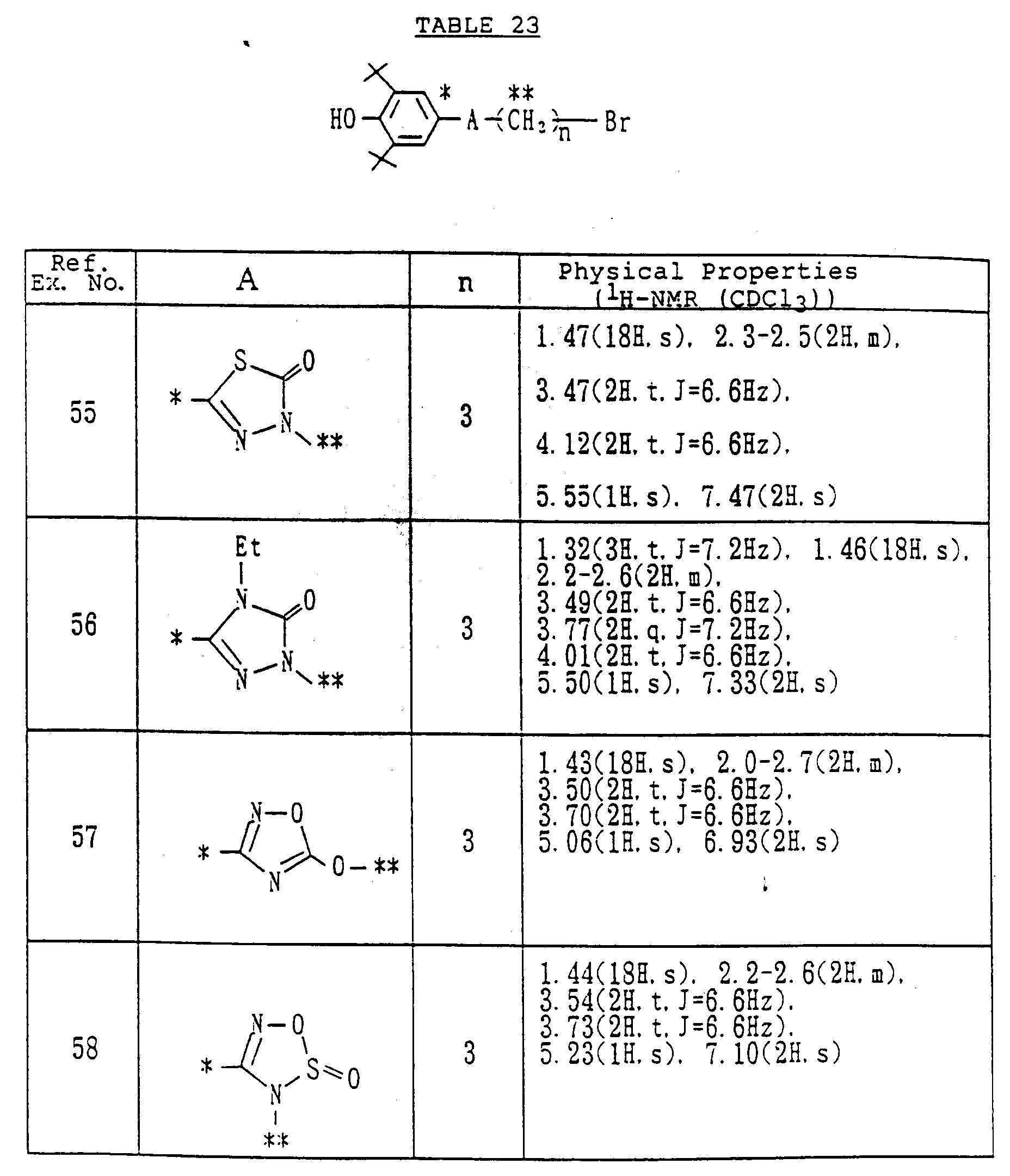
1.46 (18H, s), 2.1-2.6 (2H, m), 3.46 (2H, t, J=6.6Hz), 3.93 (2H, t,J=6.6Hz), 5.60 (1H, s), 7.63 (2H, s) - Each compound shown in Table 23 was prepared according to the procedure for Reference Example 54, using an appropriate 5-membered heterocyclic compound instead of 5-(3,5-di-tert-butyl-4-hydroxyphenyl)-1,3,4-oxadiazol-2(3H)-one in each case.
- The title compound was obtained as a colorless oil according to the procedure for Example 26-A, using 3-(3-bromopropyl)-5-(3,5-di-tert-butyl-4-hydroxyphenyl)-1,3,4- oxadiazol-2(3H)-one obtained in Reference Example 54 instead of 2-(3,5-di-tert-butyl-4-hydroxyphenyl)-3-(3-bromopropyl)-1,3-thiazolidin-4-one.
- NMR (CDCl3) (270 MHz) δ:
-
1.45 (18H, s), 1.8-2.2 (2H, m), 2.35 (3H, s), 2.4-3.0 (4H, m), 3.7-4.2 (4H, m), 5.60 (1H, s), 5.88 (2H, s), 6.1-6.8 (3H, m), 7.65 (2H, s) - Each compound shown in Table 24 was prepared according to the procedure for Example 62, using each of the compounds shown in Table 23 instead of 3-(3-bromopropyl)-5-(3,5-di-tert-butyl-4-hydroxyphenyl)-1,3,4-oxadiazol-2(3H)-one.
- To a solution of 3-hydroxy-N-(3,5-di-tert-butyl-4-hydroxybenzylidene)propylamine (1.50 g) in methanol (50 ml) were added tosylmethyl isocyanide (1.68 g) and potassium carbonate (1.43 g), and the mixture was stirred at room temperature for 16 hours. After completion of the reaction, the reaction mixture was poured into ice-water and extracted with dichloromethane. The organic layer was dried over anhydrous sodium sulfate, and the solvent was evaporated under reduced pressure. The resulting crude crystals were recrystallized from a chloroform/diethyl ether to afford 1.41 g (82%) of the title compound as pale yellow crystals. mp 166-167°C.
- NMR (CDCl3) δ:
-
1.43 (18H, s), 1.5-2.3 (3H, m), 3.53 (2H, t,J=6.6Hz), 4.08 (2H, t, J=6.6Hz), 5.30 (1H, brs), 6.92 (1H, brs), 7.10 (2H, s), 7.50 (1H, s) - To a solution of 5-(3,5-di-tert-butyl-4-hydroxyphenyl)-1-(3-hydroxypropyl)imidazole (1.20 g) obtained in Reference Example 59 in dichloromethane (30 ml) were added thionyl chloride (0.65 g) and a catalytic amount of dimethylformamide, and the mixture was refluxed for 2 hours. After allowing to cool, the reaction mixture was poured into a 5% aqueous solution of sodium carbonate cooled with ice-water, and the product was extracted with dichloromethane. The organic layer was dried over anhydrous sodium sulfate, and the solvent was evaporated under reduced pressure. The resulting crude product was recrystallized from a dichloromethane/diethyl ether to afford 1.09 g (86%) of the title compound as pale yellow crystals. mp 178-179°C.
- NMR (CDCl3) (60 MHz) δ:
-
1.43 (18H, s), 1.6-2.8 (2H, m), 3.35 (2H, t,J=6.6Hz), 4.15 (2H, t, J=6.6Hz), 5.45 (1H, brs), 6.90 (1H, s), 7.05 (2H, s), 7.43 (1H, s) - The title compound was obtained as a colorless oil according to the procedure for Example 1, using 5-(3,5-di-tert-butyl-4-hydroxyphenyl)-1-(3-chloropropyl)imidazole obtained in Reference Example 60 instead of 2-(3,5-diisopropyl-4-hydroxyphenyl)-3-(3-chloropropyl)-1,3-thiazolidin-4-one.
- NMR (CDCl3) (200 MHz) δ:
-
1.43 (18H, s), 1.5-2.0 (2H, m), 2.16 (3H, s), 2.32 (2H, t, J=6.6Hz), 2.64 (2H, t,J=5.7Hz), 3.88 (2H, t, J=5.7Hz), 3.98 (2H, t, J=6.6Hz), 5.35 (1H, brs), 5.87 (2H, s), 6.1-6.8 (3H, m), 6.96 (1H, s), 7.12 (2H, s), 7.52 (1H, s) - To a solution of 2-(3,5-di-tert-butyl-4-hydroxyphenyl)-3-[3-[N-methyl-N-[2-(3,4-methylenedioxyphenoxy)ethyl]amino]propyl]-1,3-thiazolidin-4-one (0.30 g) obtained in Example 26-A or 26-B in acetic acid (5 ml) was added 35% aqueous solution of hydrogen peroxide (0.20 g), and the mixture was stirred at room temperature overnight. After completion of the reaction, the reaction mixture was added to a mixture of ethyl acetate and a 5% aqueous solution of sodium carbonate and stirred. The organic layer was separated, dried over anhydrous sodium sulfate. The solvent was evaporated under reduced pressure, and the residue was purified by silica gel column chromatography (eluent; chloroform-methanol, 98:2) to afford 0.12 g (39%) of the title compound as a colorless oil.
- MS (m/z):
- 558 (M+)
- NMR (CDCl3) (200 MHz) δ:
-
1.41 (18H, s), 1.4-2.0 (2H, m), 2.28 (3H, s), 2.3-2.7 (2H, m), 2.72 (2H, t, J=5.7Hz), 2.9-3.2 (1H, m), 3.37 and 3.69 (2H, ABq, J=16Hz), 3.8-4.2 (3H, m), 5.40 (1H, s), 5.61 (1H, s), 5.87 (2H, s), 6.1-6.8 (3H, m), 6.94 (2H, s) - In a mixed solvent of methanol (100 ml) and tetrahydrofuran (100 ml) was dissolved 5.0 g of 3,5-di-tert-butyl-4-hydroxybenzaldehyde (5.0 g), and solution of 2-aminoethanethiol (1.73 g) in methanol (10 ml) was added. Then the mixture was stirred at room temperature for 2 hours. After completion of the reaction, the solvent was evaporated under reduced pressure, and 200 ml of ice-water was added to the residue. The product was extracted with chloroform, and the organic layer was dried over anhydrous sodium sulfate. The solvent was evaporated under reduced pressure, and methanol-hydrochloric acid (5 ml) was added to the residue. The mixture was triturated with diethyl ether to yield 5.81 g (82%) of the title compound as a white powder.
- NMR (CDCl3) (200 MHz) δ:
-
1.43 (18H, s), 2.9-3.2 (2H, m), 3.6-3.8 (1H, m), 3.8-4.0 (1H, m), 5.20 (1H, s), 5.46 (1H, s), 7.2-7.4 (2H, m) - To a suspension of 2-(3,5-di-tert-butyl-4-hydroxyphenyl)-1,3-thiazolidine hydrochloride (1.65 g) obtained in Reference Example 61 in tetrahydrofuran (20 ml) was added triethylamine (1.52 g), and acryloyl chloride (0.63 g) was added thereto at 0°C. The mixture was stirred at that temperature for 3 hours. After completion of the reaction, the reaction mixture was poured into ice-water, and the product was extracted with chloroform. The organic layer was washed successively with 1N hydrochloric acid, a saturated aqueous solution of sodium hydrogencarbonate, and brine, then dried over anhydrous sodium sulfate. The solvent was evaporated under reduced pressure, and the residue was purified by silica gel column chromatography (eluent; chloroform-methanol, 98:2) to afford 0.93 g (54%) of the title compound as colorless crystals. mp 147-149°C.
- NMR (CDCl3) (200 MHz) δ:
-
1.40 (18H, s), 3.0-3.2 (2H, m), 3.8-4.0 (1H, m), 4.2-4.5 (1H, m), 5.20 (1H, brs), 5.5-5.8 (1H, m), 5.9-6.6 (3H, m), 6.98 (2H, brs) - To a solution of 2-(3,5-di-tert-butyl-4-hydroxyphenyl)-3-acryloyl-1,3-thiazolidine (0.35 g) obtained in Reference Example 62 in chloroform (5 ml) was added N-methyl-2-(3,4-methylenedioxyphenoxy)ethylamine (0.20 g), and the mixture was refluxed for 3 hours. After completion of the reaction, the solvent was evaporated under reduced pressure, and the residue was purified by silica gel column chromatography (eluent; chloroform-methanol, 98:2) to afford 0.41 g (76%) of the title compound as a colorless oil.
- NMR (CDCl3) (200 MHz) δ:
-
1.41 (18H, s), 2.14 (3H, s), 2.2-2.7 (4H, m), 2.7-2.9 (2H, m), 2.9-3.2 (2H, m), 3.8-4.1 (3H, m), 4.2-4.4 (1H, m), 5.1-5.3 (1H, m), 5.89 (2H, s), 6.02 (1H, brs), 6.2-7.1 (5H, m) - The compound obtained in Example 26-A or 26-B and weighing 400 mg was subjected to HPLC using a column for optical resolution (CHIRALCEL OD; 2 cm (diameter) x 25 cm) in several tens of divided fractions under conditions of a mobile phase of n-hexane-isopropyl alcohol, (80:20), a flow rate of 16 ml/min, and a detection wavelength of 280 nm to recover 180 mg of the title compound. The specific rotation of the hydrochloride of the resulting compound is as follows.
[α]D = +36.14 (EtOH, c=0.332) - The compound obtained in Examples 26-A or 26-B and weighing 400 mg was subjected to HPLC in several tens of divided fractions under the same conditions as in Example 70 to obtain 170 mg of the title compound. The hydrochloride of the resulting compound had the following specific rotation.
[α]D = -36.72 (EtOH, c=0.610) - The compound obtained in Example 41-A or 41-B and weighing 500 mg was subjected to HPLC using a silica gel column (YMC-PackSIL SH-043-5, 2 cm (diameter) x 25 cm) in several tens of divided fractions under conditions of a mobile phase of chloroform-isopropanol, (97:3), a flow rate of 12 ml/min, and a detection wavelength of 280 nm to recover 150 mg of the title compound. The stereochemistry was assumed from the 1H-NMR data of M.R. Johnson, et al. (M.R. Johnson, et al., J. Org. Chem., 48, 494 (1983)).
- NMR (CDCl3) (270 MHz) δ:
-
1.41 (18H, s), 1.5-1.9 (2H, m), 1.58 (3H, d, J=6.9Hz), 2.23 (3H, s), 2.3-2.5 (2H, m), 2.69 (2H, t, J=5.6Hz), 2.7-2.9 (1H, m), 3.5-3.7 (1H, m), 3.94 (2H, t, J=5.6Hz), 4.02 (1H, dq, J=1.7, 6.9Hz), 5.28 (1H, s), 5.57 (1H, d, J=1.7Hz), 5.90 (2H, s), 6.2-6.8 (3H, m), 7.05 (2H, s) - The compound obtained in Example 41-A or 41-B and weighing 500 mg was subjected to HPLC in several tens of divided fractions under the same conditions as in Example 72 to obtain 140 mg of the title compound. The stereochemistry was assumed from the 1H-NMR data of M.R. Johnson, et al. (M.R. Johnson, et al., J. Org. Chem., 48, 494 (1983)).
- NMR (CDCl3) (270 MHz) δ:
-
1.43 (18H, s), 1.2-2.0 (2H, m), 1.65 (3H, d, J=6.9Hz), 2.20 (3H, m), 2.2-2.5 (2H, m), 2.67 (2H, t, J=5.6Hz), 2.7-3.0 (1H, m), 3.4-3.8 (1H, m), 3.92 (2H, t, J=5.6Hz), 4.02 (1H, q, J=6.9Hz), 5.30 (1H, s), 5.55 (1H, s), 5.91 (2H, s), 6.2-6.8 (3H, m), 7.12 (2H, s) - The compound obtained in Example 73 was subjected to HPLC in several tens of divided fractions under the same conditions as in Example 70 to recover the title compound. The resulting compound had the following specific rotation.
[α]D = +27.59 (CHCl3, C=1.000) - The compound obtained in Example 73 was subjected to HPLC in several tens of divided fractions under the same conditions as in Example 70 to recover the title compound. The resulting compound had the following specific rotation.
[α]D = -28.39 (CHCl3, c=1.000) - Test Examples are described below in order to demonstrate that the compounds having formula (I) according to the present invention exhibit the three actions, i.e., an inhibitory action on lipid peroxidation, a vasorelaxing action, and an inhibition of calcium overload.
- A test compound was added to rabbit LDL prepared according to the method of Havel, et al. (Havel RJ et al., J. Clin. Invest., 34, 1345 (1955)), and then a soybean lipoxygenase type-IS (SLO) was added to a final concentration of 40 µg/ml. Oxydation of LDL was carried out by incubating at 37°C in a CO2 incubator for 24 hours. The oxidized LDL solution was analyzed by gel-permeation chromatography, and the fluorescence intensity of the LDL fraction was measured at an excitation wavelength of 360 nm and an emission wavelength of 430 nm. The results of measurement expressed as a percentage of control, are shown in Table 25.
Compound (Example No.) Percent (%) of Control 5 x 10⁻⁶ M 5 x 10⁻⁷ M None (Control) 100 100 Compound (9) 5.9 13.5 Compound (12) 6.4 16.8 Compound (17) 3.9 16.4 Compound (20) 0.6 8.7 Compound (41) 6.2 18.3 Compound (57) 11.3 22.8 Compound (70) 5.1 15.2 Compound (71) 2.8 12.7 Diltiazem 110.7 109.1 - A test compound was added to rabbit LDL prepared according to the method of Havel, et al. (Havel RJ, et al., J. Clin. Invest., 34, 1345 (1955)), and then CuSO4 was added to a final concentration of 1 µM. Oxidation of LDL was performed by shaking at 37°C for 24 hours. The generated TBARS was measured by the method of Yagi utilizing fluorometry (Yagi, K., Biochem. Med., 15, 212 (1976)). The results of measurement expressed as a percentage of control, are shown in Table 26.
Compound (Example No.) % of Control 1 x 10⁻⁵ M None (Control) 100 Compound (9) 26.4 Compound (12) 25.9 Compound (17) 21.0 Compound (20) 21.3 Compound (41) 26.3 Compound (57) 23.0 Compound (70) 21.1 Compound (71) 23.8 Compound (46) 20.4 Compound (49) 15.7 Compound (34) 20.5 Compound (55) 20.0 Compound (51) 16.6 Diltiazem 96.9 - The thoracic aorta was excised from a Sprague-Dawley (Crj) male rat weighing between 350 and 550 g, and dissected free from surrounding connective tissue. The vessel was cut into a ring having a width of 2 to 3 mm. The resulting preparation was mounted for isometric tension recording in an organ bath filled with 10 ml of a Krebs-Henseleit solution (K-H solution, pH 7.4, 37°C), which was bubbled with 95% O2/5% CO2. Isometric tension changes were monitored with an isometric transducer (TB-611T, manufactured by Nihon Kohden Corp.). Before starting the experiment, the preparation was given a stretched tension of 2 g and allowed to equilibrate for 30 minutes (the K-H solution was exchanged for a fresh one every 15 minutes). At first, the preparation was precontracted by changing the solution in the bath to one containing 30 mM K+. After the contraction was maintained for 20 minutes, the preparation was washed with K-H solution. Sixty minutes thereafter (the K-H solution was exchanged with a fresh one every 20 minutes), contraction was again induced in the same manner as described above. After the contraction stabilized, a test compound or diltiazem was added to the system in a cumulative manner in half log-unit increments to obtain a concentration-response curve.
- Taking the contraction at 30 mM K+ as 100%, the concentration of the drug at which the contraction is relaxed to 50% was obtained as IC50. The results obtained are shown in Table 27.
Compound (Example No.) Vasorelaxing Activity, IC50 (µM) Compound (26) 0.037 Compound (1) 0.17 Compound (8) 0.17 Compound (9) 0.028 Compound (11) 0.021 Compound (12) 0.063 Compound (17) 0.028 Compound (19) 0.11 Compound (41) 0.056 Compound (72) 0.098 Compound (73) 0.049 Compound (70) 0.30 Compound (71) 0.027 Compound (55) 0.021 Compound (49) 0.023 Compound (74) 0.141 Compound (75) 0.022 Diltiazem 0.11 - Incubated ventricular myocytes were prepared from the heart of male Sprague-Dawley rat weighing 300 to 500 g, using an enzyme-perfusion method. Thus obtained rod-shaped normal myocytes were treated with a test compound or diltiazem for 30 minutes, and 100 µg/ml of veratrine was added. Five minutes later, the shape of the cells was observed to obtain a survival rate thereby to evaluate the efficacy of the compound. The results obtained are shown in Table 28.
Compound (Example No.) Survival Rate of Cells Compound (26) Compound (8) Compound (9) Compound (12) Compound (20) Diltiazem - The efficacy was evaluated in the same manner as in Method A, except for using 50 µg/ml of veratridine in place of veratrine (100 µg/ml). The results obtained are shown in Table 29.
Compound (Example No.) Concentration at Which Cells Survived Almost Completely (µM) Compound (17) 0.32 Compound (34) 0.32 Compound (72) 0.32 Compound (74) 0.32 Compound (75) 0.32 Diltiazem - - The compounds of the foregoing Examples are shown in Tables 30 through 37 below.


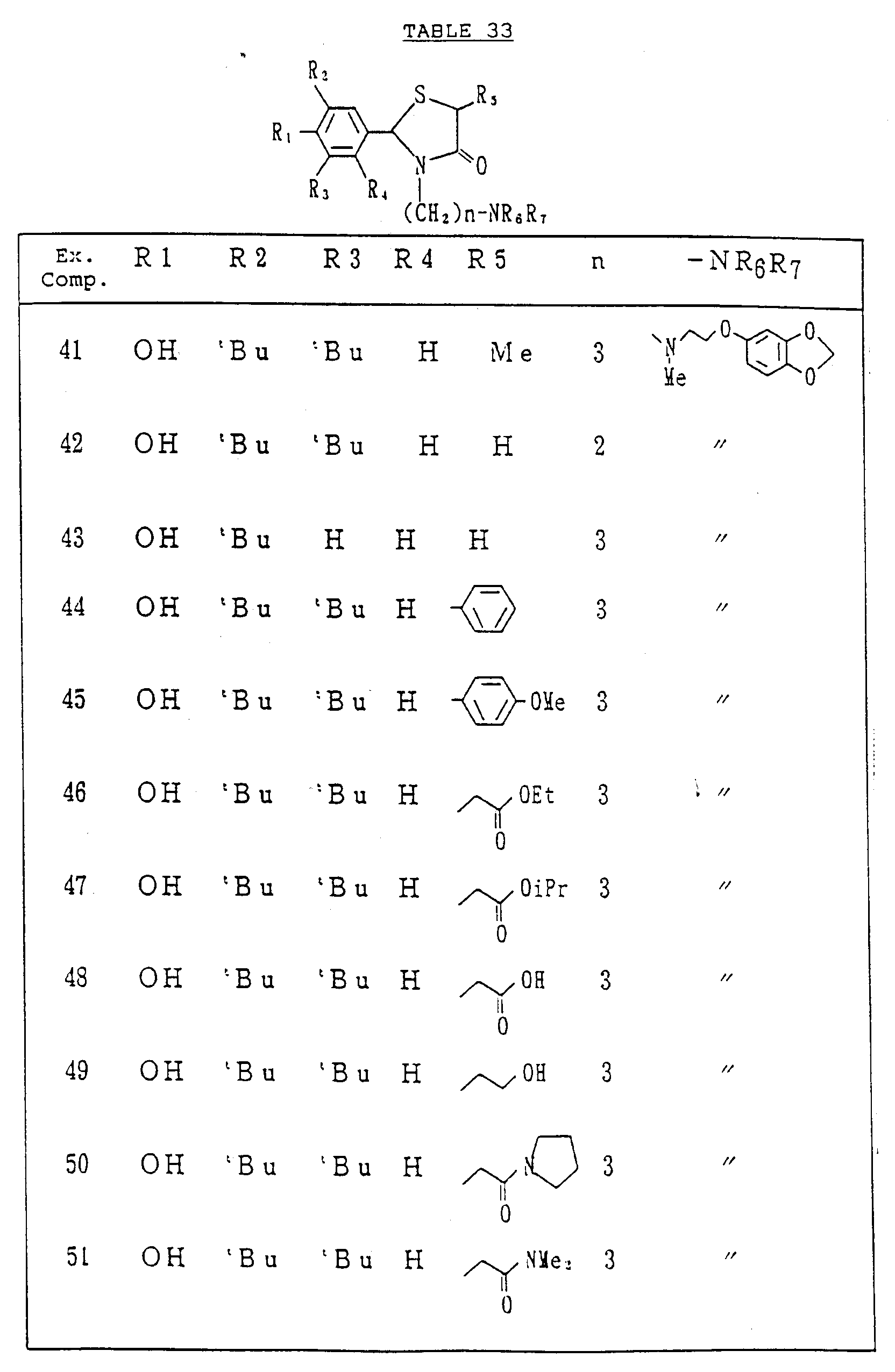

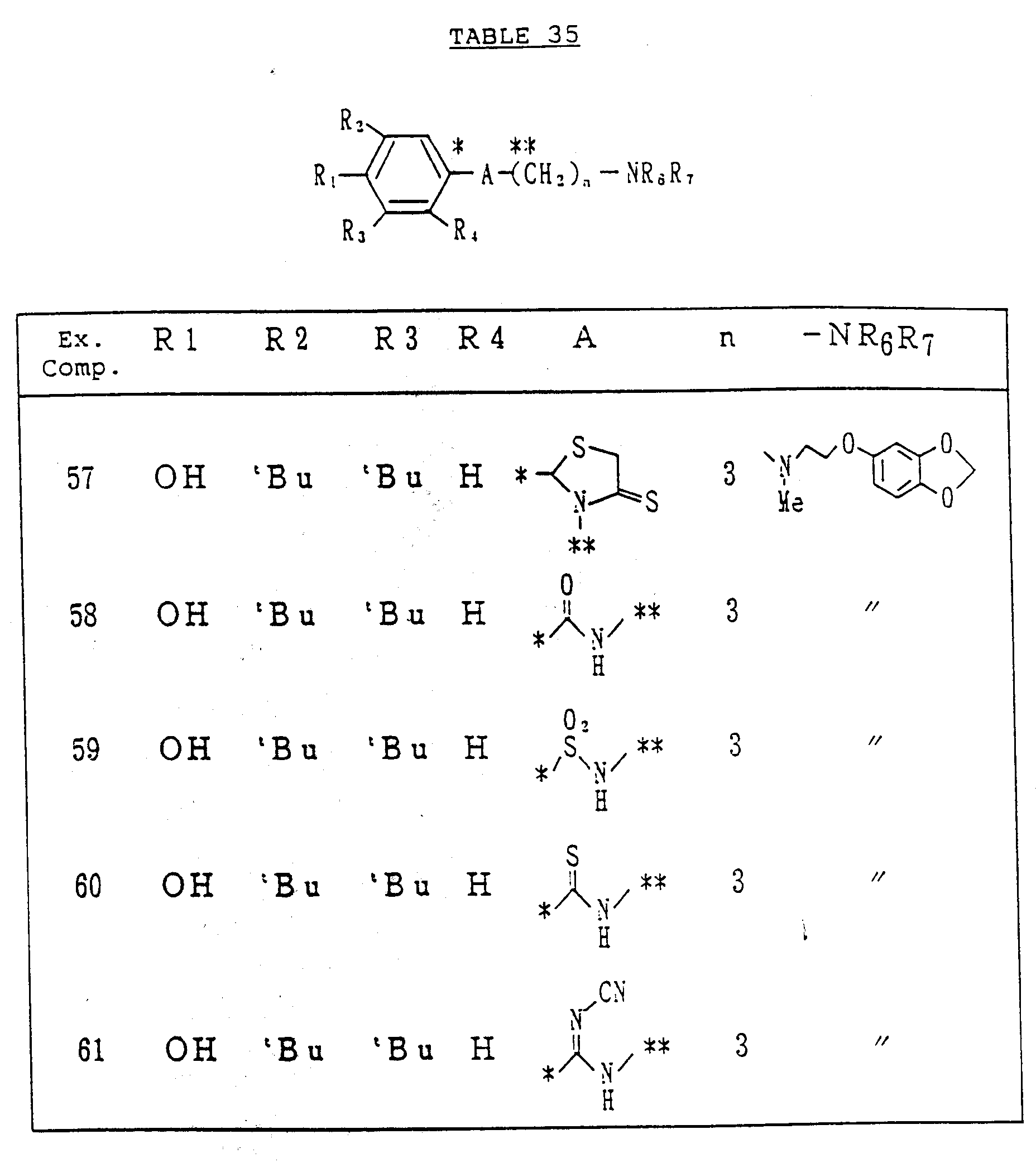

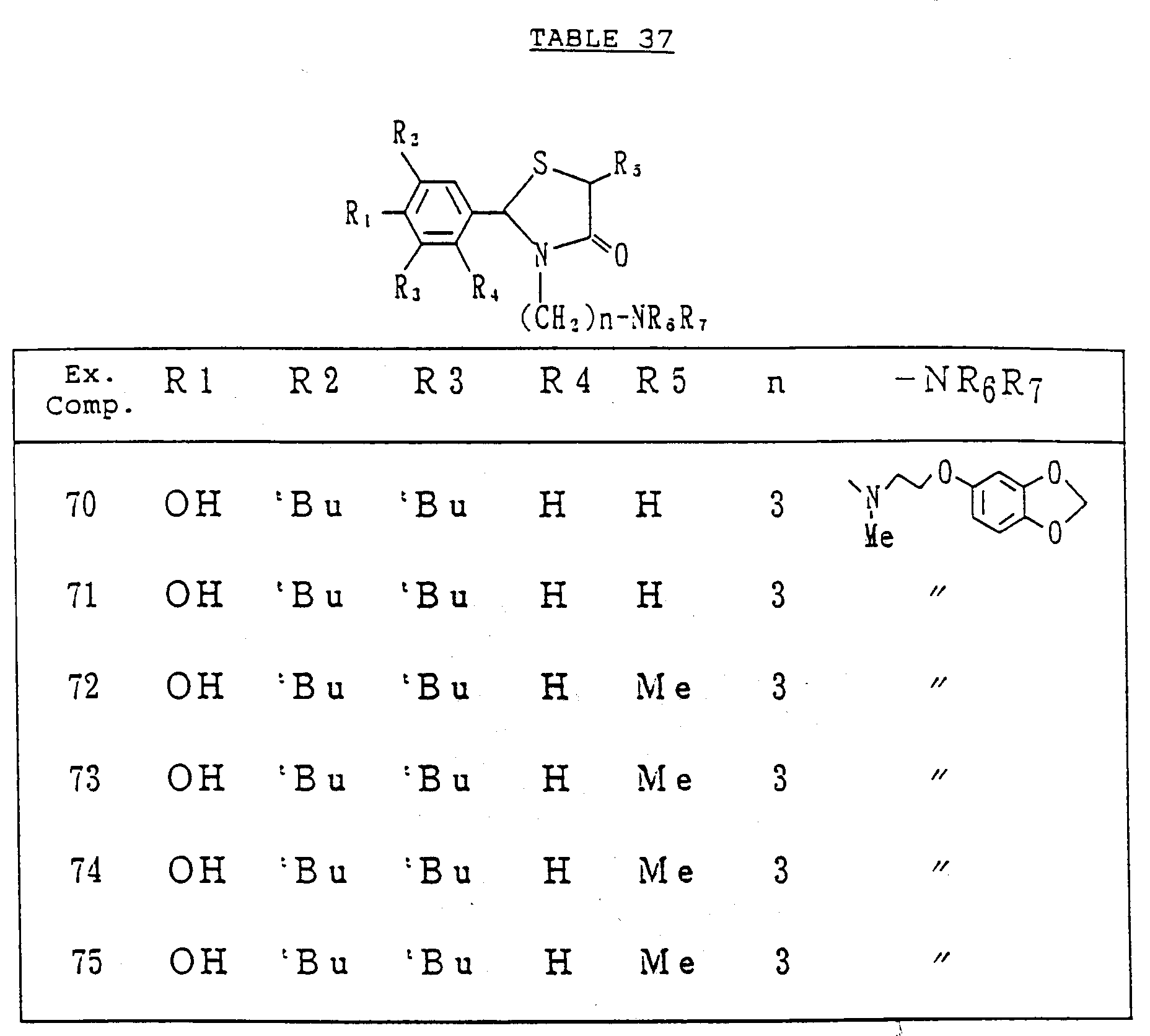
- As has been described, the compound according to the present invention has an inhibitory action on lipid peroxidation, a vasorelaxing action, and an inhibitory action on calcium overload and can therefore be used as a preventive or treating agent for ischemic diseases and a hypertension.
Claims (35)
- A compound represented by formula (I):wherein
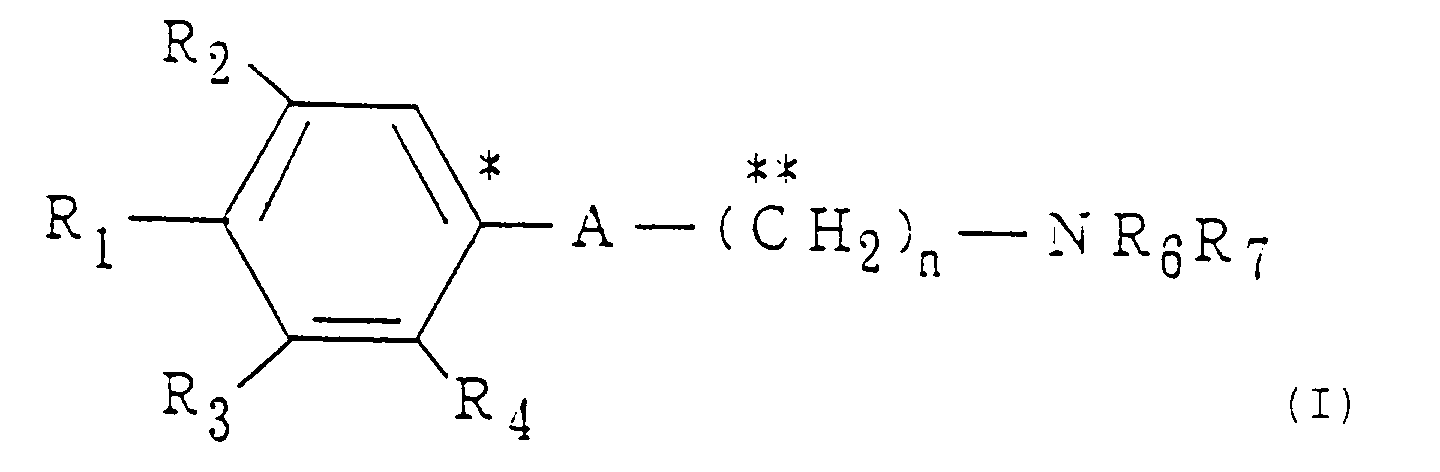 R1 represents a hydrogen atom, a hydroxyl group, an acyloxy group having 1 to 9 carbon atoms or a lower alkoxy group having 1 to 6 carbon atoms;R2 and R3, which may be the same or different, each represents a hydroxy group, an isopropyl group or a t-butyl group;R4 represents a hydrogen atom, a lower alkyl group having 1 to 6 carbon atoms;A represents a fragment represented by formula (II):wherein
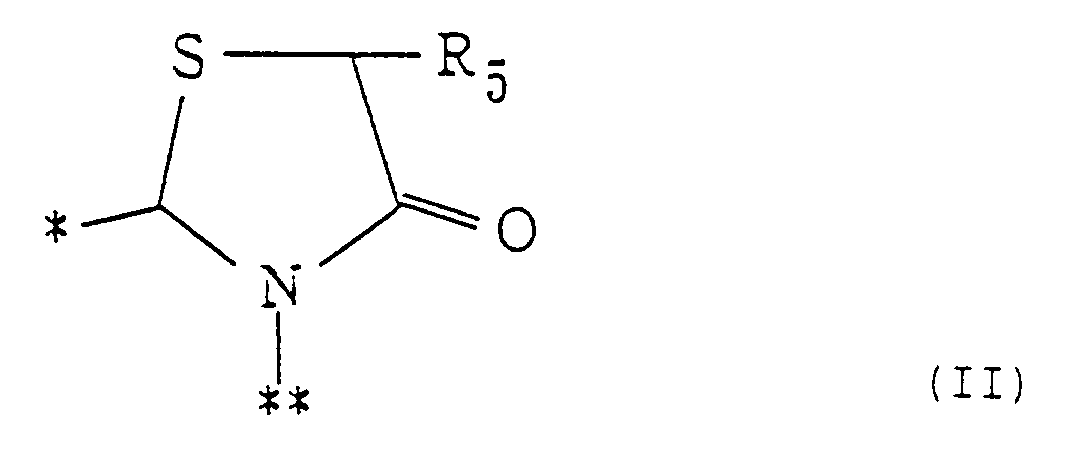 R5 represents a hydrogen atom, a substituted or unsubstituted lower alkyl group having 1 to 6 carbon atoms, a substituted or unsubstituted lower alkenyl group having 1 to 6 carbon atoms, a substituted or unsubstituted alkoxy group having 1 to 6 carbon atoms, a substituted or unsubstituted aryl group or a substituted or unsubstituted heterocyclic group, or a 5- or 6-membered ring containing two or more oxygen atoms or sulfur atoms, in which case the carbon atom to which it is bonded is a spiro atom; or
a fragment represented by formula (III):B represents a fragment selected from the following group of fragments represented by formula (IV), (V), (VI), (VII), (VIII), (X), (XI), (XII), (XIII), (XIV), (XV), or (XVI):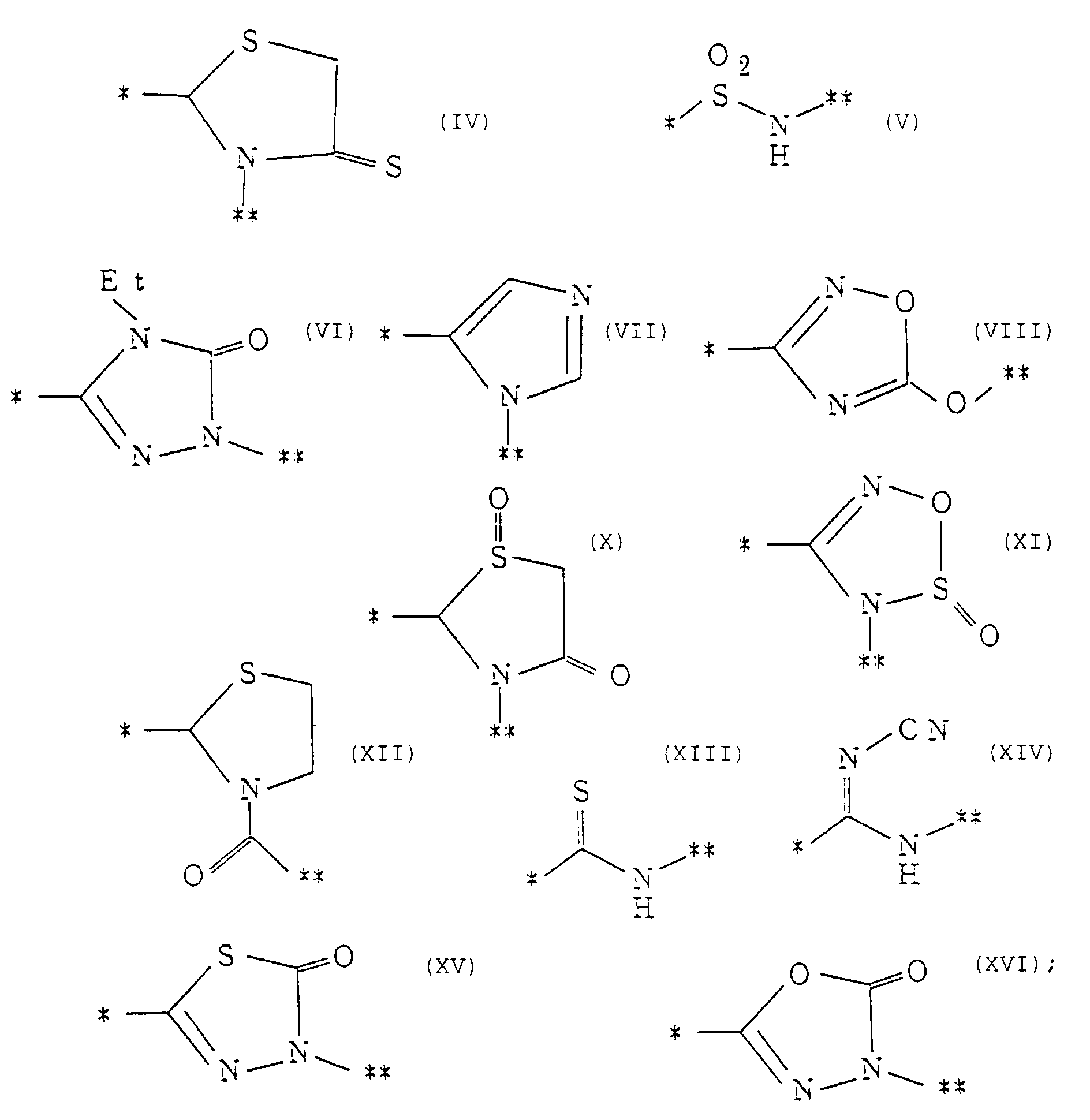 R6 and R7, which may be the same or different, each represents a hydrogen atom, a substituted or unsubstituted lower alkyl group having 1 to 6 carbon atoms, a substituted or unsubstituted lower alkenyl group having 1 to 6 carbon atoms, a substituted or unsubstituted aryl group or a substituted or unsubstituted heterocyclic group, provided that R6 and R7 do not both represent a methyl group, orR6 and R7 are taken together to form a substituted or unsubstituted ring which may be a condensed ring; andn represents an integer of 2, 3, 4, 5 or 6,
or a possible stereoisomer or optical isomer thereof or a pharmaceutically acceptable salt thereof. - The compound according to claim 1, wherein R2 and R3 both represent a t-butyl group.
- The compound according to claim 1, wherein R1 represents a hydroxy group, an acyloxy group having 1 to 9 carbon atoms or a lower alkoxy group having 1 to 6 carbon atoms.
- The compound according to claim 3, wherein R2 and R3, which may be the same or different, each represents an isopropyl group or a t-butyl group, R4 represents a hydrogen atom or methyl group, A represents a fragment represented by formula (II), (IV), (V), (VI), (VII) or (VIII) and n represents an integer of 2, 3, 4 or 5.
- The compound according to claim 4, wherein A represents a fragment represented by formula (II) or (IV).
- The compound according to claim 5, wherein R2 and R3 both represent a t-butyl group, R4 represents a hydrogen atom, and A represents a fragment represented by formula (II).
- The compound according to claim 6, wherein R1 represents a hydroxy group or a methoxy group.
- The compound according to claim 7, wherein R1 represents a hydroxy group.
- The compound according to claim 8, wherein n represents 3.
- The compound according to claim 3, wherein R1 represents an acyloxy group having 1 to 9 carbon atoms, R2 and R3 both represent a t-butyl group, R4 represents a hydrogen atom, A represents a fragment represented by formula (II) and n represents an integer of 2,3, 4 or 5.
- The compound according to claim 3, wherein R1 represents a lower alkoxy group having 1 to 6 carbon atoms, R2 and R3 both represent a t-butyl group, R4 represents a hydrogen atom, A represents a fragment represented by formula (II) and n represents an integer of 2, 3, 4 or 5.
- The compound according to claim 11, wherein R1 represents a methoxy group.
- The compound according to claim 6, wherein R5 represents a hydrogen atom, a substituted or unsubstituted lower alkyl group having 1 to 6 carbon atoms, a substituted or unsubstituted lower alkoxy group having 1 to 6 carbon atoms or a substituted or unsubstituted aryl group, or a 5- or 6-membered ring containing two or more oxygen atoms or sulfur atoms, in which case the carbon atom to which it is bonded is a spiro atom; R6 and R7, which may be the same or different, each represents a hydrogen atom or a substituted or unsubstituted lower alkyl group having 1 to 6 carbon atoms, provided that R6 and R7 do not both represent a methyl group or R6 and R7 are taken together to form a substituted or unsubstituted ring which may be a condensed ring.
- The compound according to claim 13, wherein R6 and R7, which may be the same or different, each represents a substituted or unsubstituted lower alkyl group having 1 to 6 carbon atoms, provided that R6 and R7 do not both represent a methyl group or R6 and R7 are taken together to form a substituted or unsubstituted ring which may be a condensed ring.
- The compound according to claim 14, wherein R6 represents a substituted or unsubstituted lower alkyl group having 1 to 3 carbon atoms; R7 represents a group selected from the set of groups consisting of a 2-(3,4-methylenedioxyphenoxy)ethyl group, a 3-(3,4-methylenedioxyphenoxy)propyl group, a 4-(3,4-methylenedioxyphenoxy)-n-butyl group, and a 3, 4-dimethoxyphenylmethyl group; or -NR6R7 represents a group selected from the set of groups consisting of a 4-(N-2-benzothiazolyl-N-methylamino)piperidyl group, a 4-phenylmethylpiperidyl group, a 4-(3,4-methylenedioxyphenoxy)piperidyl group, and a 4-(2,3,4-trimethoxyphenylmethyl)piperazinyl group.
- The compound according to claim 15, wherein R6 represents a methyl group or an ethyl group.
- The compound according to claim 13, wherein R5 represents a hydrogen atom, a substituted or unsubstituted lower alkyl group having 1 to 6 carbon atoms, a substituted or unsubstituted lower alkoxy group having 1 to 6 carbon atoms, or a 5- or 6-membered ring containing two or more oxygen atoms or sulfur atoms, in which case the carbon atom to which it is bonded is a spiro atom; R6 represents a methyl group; R7 represents a group selected from the set of groups consisting of a 2-(3,4-methylenedioxyphenoxy)ethyl group, a 3-(3,4-methylenedioxyphenoxy)propyl group, a 4-(3,4-methylenedioxyphenoxy)-n-butyl group, and a 3, 4-dimethoxyphenylmethyl group; or -NR6R7 represents a group selected from the set of groups consisting of a 4-(N-2-benzothiazolyl-N-methylamino)piperidyl group, a 4-phenylmethylpiperidyl group, a 4-(3,4-methylenedioxyphenoxy)piperidyl group, and a 4-(2,3,4-trimethoxyphenylmethyl)piperazinyl group.
- The compound according to any one of claims 13-17, wherein n represents 3.
- A compound according to claim 1, which is selected from the group of compounds consisting of 2-(3,5-di-t-butyl-4-hydroxyphenyl)-3-[3-[N-methyl-N-[2-(3,4-methylenedioxy-phenoxy)ethyl]amino]propyl]-1,3-thiazolidin-4-one, (+)-2-(3,5-di-t-butyl-4-hydroxyphenyl)-3-[3-[N-methyl-N-[2-(3,4-methylenedioxyphenoxy)ethyl]amino]propyl]-1,3-thiazolidin-4-one, (-)-2-(3,5-di-t-butyl-4-hydroxy-phenyl)-3-[3-[N-methyl-N-[2-(3,4-methylenedioxyphenoxy)ethyl]amino]propyl]-1,3-thiazolidin-4-one, 2-(3,5-di-t-butyl-4-hydroxyphenyl)-3-[3-[N-ethyl-N-[2-(3,4-methylenedioxy-phenoxy)ethyl]amino]propyl]-1,3-thiazolidin-4-one, 2-(3,5-di-t-butyl-4-hydroxyphenyl)-3-[4-[N-methyl-N-[2-(3,4-methylenedioxyphenoxy)ethyl]amino]butyl]-1,3-thiazolidin-4-one, 2-(3,5-di-t-butyl-4-hydroxyphenyl)-3-[5-[N-methyl-N-[2-(3,4-methylenedioxyphenoxy)ethyl]amino]pentyl]-1,3-thiazolidin-4-one, 2-(3,5-di-t-butyl-4-hydroxyphenyl)-3-[3-[N-methyl-N-[3-(3,4-methylenedioxyphenoxy)propyl]amino]propyl]-1,3-thiazolidin-4-one, 2-(3,5-diisopropyl-4-hydroxyphenyl)-3-[3-[N-methyl-N-[2-(3,4-methylenedioxyphenoxy)ethyl]amino]propyl]-1,3-thiazolidin-4-one, 2-(3,5-di-t-butyl-4-hydroxyphenyl)-3-[3-[1-[4-(2,3,4-trimethoxybenzyl)piperazinyl]]propyl]-1,3-thiazolidin-4-one, 2-(3,5-di-t-butyl-4-hydroxyphenyl)-3-[3-[N-methyl-N-[2-(3,4-methylenedioxyphenoxy)ethyl]amino]propyl]-5-methyl-1,3-thiazolidin-4-one, 2,5-cis-2-(3,5-di-t-butyl-4-hydroxyphenyl)-3-[3-[N-methyl-N-[2-(3,4-methylenedioxyphenoxy)ethyl]amino]propyl]-5-methyl-1,3-thiazolidin-4-one (-)-2,5-cis-2-(3,5-di-t-butyl-4-hydroxyphenyl)-3-[3-[N-methyl-N-[2-(3,4- methylenedioxyphenoxy)ethyl]amino]propyl]-5-methyl-1,3-thiazolidin-4-one, (+)-2,5-cis-2-(3,5-di-t-butyl-4-hydroxyphenyl)-3-[3-[N-methyl-N-[2-(3,4-methylenedioxyphenoxy)ethyl]amino]propyl]-5-methyl-1,3-thiazolidin-4-one, 2,5-trans-2-(3,5-di-t-butyl-4-hydroxyphenyl)-3-[3-[N-methyl-N-[2-(3,4-methylenedioxyphenoxy)ethyl]amino]propyl]-5-methyl-1,3-thiazolidin-4-one, 2-(3,5-di-t-butyl-4-hydroxyphenyl)-3-[3-[N-methyl-N-[4-(3,4-methylenedioxyphenoxy)butyl]amino]propyl]-1,3-thiazolidin-4-one, 5-(3,5-di-t-butyl-4-hydroxyphenyl)-1-[3-[N-methyl-N-[2-(3,4-methylenedioxyphenoxy)ethyl]amino]propyl]imidazole, 2-(3,5-di-t-butyl-4-hydroxyphenyl)-3-[3-[N-methyl-N-[2-(3,4-methylenedioxyphenoxy)ethyl]amino]propyl]-1,3-thiazolidin-4-thione, 5-(3,5-di-t-butyl-4-hydroxy-phenyl)-4-ethyl-2-[3-[N-methyl-N-[2-(3,4-methylenedioxyphenoxy)ethyl]amino]propyl]-1,2,4-triazol-3-one, 3-(3,5-di-t-butyl-4-hydroxyphenyl)-5-[3-[N-methyl-N-[2-(3,4-methylenedioxy-phenoxy)ethyl]amino]propoxy]-1,2,4-oxadiazole, 2-(3,5-di-t-butyl-4-hydroxyphenyl)-3-[3-[N-methyl-N-[2-(3,4-methylenedioxyphenoxy)ethyl]amino]propyl]-5-(2-hydroxy-ethyl)-1,3-thiazolidin-4-one, 2-(3,5-di-t-butyl-4-hydroxyphenyl)-3-[3-[N-methyl-N-[2-(3,4-methylenedioxyphenoxy)ethyl]amino]propyl]-5-ethoxycarbonylmethyl-1,3-thiazolidin-4-one, N-[3-[N-methyl-N-[2-(3,4-methylenedioxyphenoxy)ethyl]amino]propyl]-3,5-di-t-butyl-4-hydroxybenzenesulfonamide, 2-(3,5-di-t-butyl-4-hydroxyphenyl)-3-[3-[N-methyl-N-[2-(3,4-methylenedioxy phenoxy)ethyl]amino]propyl]-5-methoxy-1,3-thiazolidin-4-one, 2-(3,5-di-t-butyl-4-hydroxyphenyl)-3-[3-[N-methyl-N-[2-(3,4-methylenedioxyphenoxy)ethyl]amino]propyl]-5-isopropoxy-carbonylmethyl-1,3-thiazolidin-4-one, 2-(3,5-di-t-butyl-4-hydroxyphenyl)-3-[3-[N-methyl-N-[2-(3,4-methylenedioxy-phenoxy)ethyl]amino]propyl]-5-(2-hydroxyethoxy)-1,3-thiazolidin-4-one, spiro[2-(3,5-di-t-butyl-4-hydroxyphenyl)-3-[3-[N-methyl-N-[2-(3,4-methylenedioxyphenoxy)ethyl]amino]propyl]-1,3-thiazolidin-4-one-5,2'-[1,3]dioxolane], 2-(3,5-di-t-butyl-4-hydroxyphenyl)-3-[3-[N-methyl-N-[2-(3,4-methylenedioxyphenoxy)ethyl]amino]propyl]-5-N,N-dimethylcarbamoylmethyl-1,3-thiazolidin-4-one, 2-(3,5-di-t-butyl-4-hydroxyphenyl)-3-[3-[1-(4-benzyl)piperidyl]propyl]-1,3-thiazolidin-4-one, and 2-(3,5-di-t-butyl-4-hydroxyphenyl)-3-[3-[1-[4-(3,4-methylenedioxyphenoxy)piperidyl]]propyl]-1,3-thiazolidin-4-one, and a pharmaceutically acceptable salt thereof.
- A compound according to claim 1, which is selected from the group of compounds consisting of 2-(3,5-di-t-butyl-4-hydroxyphenyl)-3-[3-[N-methyl-N-[2-(3,4-methylenedioxyphenoxy)ethyl]amino]propyl]-1,3-thiazolidin-4-one, (+)-2-(3,5-di-t-butyl-4-hydroxyphenyl)-3-[3-[N-methyl-N-[2-(3,4-methylenedioxyphenoxy)ethyl]amino]propyl]-1,3-thiazolidin-4-one, (-)-2-(3,5-di-t-butyl-4-hydroxyphenyl)-3-[3-[N-methyl-N-[2-(3,4-methylenedioxyphenoxy)ethyl]amino]propyl]-1,3-thiazolidin-4-one, 2-(3,5-di-t-butyl-4-hydroxyphenyl)-3-[3-[N-ethyl-N-[2-(3,4-methylenedioxyphenoxy)ethyl]amino]propyl]-1,3-thiazoiidin-4-one, 2-(3,5-di-t-butyl-4-hydroxyphenyl)-3-[3-[N-methyl-N-[3-(3,4-methylenedioxyphenoxy)propyl]amino]propyl]-1,3-thiazolidin-4-one, 2-(3,5-di-t-butyl-4-hydroxyphenyl)-3-[3-[N-methyl-N-[2-(3,4-methylenedioxyphenoxy)ethyl]amino]propyl]-5-methyl-1,3-thiazolidin-4-one, 2,5-cis-2-(3,5-di-t-butyl-4-hydroxyphenyl)-3-[3-[N-methyl-N-[2-(3,4-methylenedioxyphenoxy)ethyl]amino]propyl]-5-methyl-1,3-thiazolidin-4-one, (-)-2,5-cis-2-(3,5-di-t-butyl-4-hydroxyphenyl)-3-[3-[N-methyl-N-[2-(3,4-methylenedioxyphenoxy)ethyl]amino]propyl]-5-methyl-1,3-thiazolidin-4-one, (+)-2,5-cis-2-(3,5-di-t-butyl-4-hydroxyphenyl)-3-[3-[N-methyl-N-[2-(3,4-methylenedioxyphenoxy)ethyl]amino]propyl]-5-methyl-1,3-thiazolidin-4-one, 2,5-trans-2-(3,5-di-t-butyl-4-hydroxyphenyl)-3-[3-[N-methyl-N-[2-(3,4-methylenedioxyphenoxy)ethyl]amino]propyl]-5-methyl-1,3-thiazolidin-4-one, 5-(3,5-di-t-butyl-4-hydroxyphenyl)-1-[3-[N-methyl-N-[2-(3,4-methylenedioxyphenoxy)ethyl]amino]propyl]imidazole, 2-(3,5-di-t-butyl-4-hydroxyphenyl)-3-[3-[N-methyl-N-[2-(3,4-methylenedioxyphenoxy)ethyl]amino]propyl]-1,3-thiazolidin-4-thione, 5-(3,5-di-t-butyl-4-hydroxyphenyl)-4-ethyl-2-[3-[N-methyl-N-[2-(3,4-methylenedioxyphenoxy)ethyl]amino]propyl]-1,2,4-triazol-3-one, 3-(3,5-di-t-butyl-4-hydroxyphenyl)-5-[3-[N-methyl-N-[2-(3,4-methylenedioxy-phenoxy)ethyl]amino]propoxy]-1,2,4-oxadiazole, 2-(3,5-di-t-butyl-4-hydroxyphenyl)-3-[3-[N-methyl-N-[2-(3,4-methylenedioxyphenoxy)ethyl]amino]propyl]-5-(2-hydroxy-ethyl)-1,3-thiazolidin-4-one, 2-(3,5-di-t-butyl-4-hydroxyphenyl)-3-[3-[N-methyl-N-[2-(3,4-methylene dioxyphenoxy)ethyl]amino]propyl]-5-ethoxycarbonylmethyl-1,3-thiazolidin-4-one, N-[3-[N-methyl-N-[2-(3,4-methylenedioxyphenoxy)ethyl]amino]propyl]-3,5-di-t-butyl-4-hydroxybenzenesulfonamide, 2-(3,5-di-t-butyl-4-hydroxyphenyl)-3-[3-[N-methyl-N-[2-(3,4-methylenedioxyphenoxy)ethyl]amino]propyl]-5-methoxy-1,3-thiazolidin-4-one, 2-(3,5-di-t-butyl-4-hydroxyphenyl)-3-[3-[N-methyl-N-[2-(3,4-methylenedioxyphenoxy)ethyl]amino]propyl]-5-isopropoxy-carbonylmethyl-1,3-thiazolidin-4-one, 2-(3,5-di-t-butyl-4-hydroxyphenyl)-3-[3-[N-methyl-N-[2-(3,4-methylenedioxy-phenoxy)ethyl]amino]propyl]-5-(2-hydroxyethoxy)-1,3-thiazolidin-4-one, spiro[2-(3,5-di-t-butyl-4-hydroxyphenyl)-3-[3-[N-methyl-N-[2-(3,4-methylenedioxy-phenoxy)ethyl]amino]propyl]-1,3-thiazolidin-4-one-5,2'-[1,3]dioxolane], 2-(3,5-di-t-butyl-4-hydroxy-phenyl)-3-[3-[N-methyl-N-[2-(3,4-methylenedioxyphenoxy)ethyl]amino]propyl]-5-N,N-dimethylcarbamoylmethyl-1,3-thiazolidin-4-one, and 2-(3,5-di-t-butyl-4-hydroxy-phenyl)-3-[3-[1-(4-benzyl)piperidyl]propyl]-1,3-thiazolidin-4-one,and a pharmaceutically acceptable salt thereof.
- 2-(3,5-Di-t-butyl-4-hydroxyphenyl)-3-[3-[N-methyl-N-[2-(3,4-methylenedioxyphenoxy)ethyl]amino]propyl]-1,3-thiazolidin-4-one according to claim 1 and a pharmaceutically acceptable salt thereof or a possible optical isomer thereof.
- (+)-2-(3,5-Di-t-butyl-4-hydroxyphenyl)-3-[3-[N-methyl-N-[2-(3,4-methylenedioxyphenoxy)ethyl]amino]propyl]-1,3-thiazolidin-4-one according to claim 1 and a pharmaceutically acceptable salt thereof.
- (-)-2-(3,5-Di-t-butyl-4-hydroxyphenyl)-3-[3-[N-methyl-N-[2-(3,4-methylenedioxyphenoxy)ethyl]amino]propyl]-1,3-thiazolidin-4-one according to claim 1 and a pharmaceutically acceptable salt thereof.
- 2-(3,5-Di-t-butyl-4-hydroxyphenyl)-3-[3-[N-methyl-N-[2-(3,4-methylenedioxyphenoxy)ethyl]amino]propyl]-5-methyl-1,3-thiazolidin-4-one according to claim 1 and a pharmaceutically acceptable salt thereof or a possible stereoisomer or optical isomer thereof.
- 2,5-Cis-2-(3,5-di-t-butyl-4-hydroxyphenyl)-3-[3-[N-methyl-N-[2-(3,4-methylenedioxyphenoxy)ethyl]amino]propyl]-5-methyl-1,3-thiazolidin-4-one according to claim 1 and a pharmaceutically acceptable salt thereof or a possible optical isomer thereof.
- 2,5-Trans-2-(3,5-di-t-butyl-4-hydroxyphenyl)-3-[3-[N-methyl-N-[2-(3,4-methylenedioxyphenoxy)ethyl]amino]propyl]-5-methyl-1,3-thiazolidin-4-one according to claim 1 and a pharmaceutically acceptable salt thereof or a possible optical isomer thereof.
- (-)-2,5-Cis-2-(3,5-di-t-butyl-4-hydroxyphenyl)-3-[3-[N-methyl-N-[2-(3,4-methylenedioxyphenoxy)ethyl]amino]propyl]-5-methyl-1,3-thiazolidin-4-one according to claim 1 and a pharmaceutically acceptable salt thereof.
- (+)-2,5-Cis-2-(3,5-di-t-butyl-4-hydroxyphenyl)-3-[3-[N-methyl-N-[2-(3,4-methylenedioxyphenoxy)ethyl]amino]propyl]-5-methyl-1,3-thiazolidin-4-one according to claim 1 and a pharmaceutically acceptable salt thereof.
- A therapeutic agent comprising a compound or a possible stereoisomer or optical isomer thereof or a pharmaceutically acceptable salt thereof of any one of claims 1 to 28.
- A use of a compound represented by formula (I'):wherein
 R1, R4, A, R6 and R7 and n are as defined in claim 1 andR2 and R3, which may be the same or different, each represents a hydrogen atom, a hydroxyl group, a halogen atom, a lower alkyl group having 1 to 6 carbon atoms or a lower alkoxy group having 1 to 6 carbon atoms, for producing a medicament for treating ischemic diseases.
 - The use according to claim 30, A represents a fragment represented by formula (II), (IV), (VI), (VII), (VIII), (X), (XI), (XII), (XV), or (XVI), as defined in Claim 1.
- The use according to claim 30, wherein R1 represents a hydroxy group, an acyloxy group having 1 to 9 carbon atoms or a lower alkoxy group having 1 to 6 carbon atoms.
- The use according to claim 32, wherein R2' and R3', which may be the same or different, each represents a hydrogen atom or a lower alkyl group having 1 to 4 carton atoms, R4 represents a hydrogen atom or methyl group, A represents a fragment represented by formula (II), (IV), (V), (VI), (VII) or (VIII) as defined in claim 1 and n represents an integer of 2, 3, 4 or 5.
- The use according to claim 33, wherein R2' and R3', which may be the same or different, each represents a methyl group, an ethyl group, an isopropyl group or a t-butyl group, and A represents a fragment represented by formula (II) or (IV).
- A use of a compound or a possible stereoisomer or optical isomer thereof or a pharmaceutically acceptable salt thereof of any one of claims 6 to 28 for producing a medicament for treating ischemic diseases.
Applications Claiming Priority (4)
| Application Number | Priority Date | Filing Date | Title |
|---|---|---|---|
| JP15224893 | 1993-06-23 | ||
| JP152248/93 | 1993-06-23 | ||
| JP15224893 | 1993-06-23 | ||
| PCT/JP1994/001009 WO1995000471A1 (en) | 1993-06-23 | 1994-06-23 | Benzene derivative useful for ischemic diseases |
Publications (3)
| Publication Number | Publication Date |
|---|---|
| EP0705816A1 EP0705816A1 (en) | 1996-04-10 |
| EP0705816A4 EP0705816A4 (en) | 1997-05-28 |
| EP0705816B1 true EP0705816B1 (en) | 2000-09-20 |
Family
ID=15536338
Family Applications (1)
| Application Number | Title | Priority Date | Filing Date |
|---|---|---|---|
| EP94918559A Expired - Lifetime EP0705816B1 (en) | 1993-06-23 | 1994-06-23 | Benzene derivative useful for ischemic diseases |
Country Status (18)
| Country | Link |
|---|---|
| EP (1) | EP0705816B1 (en) |
| KR (1) | KR100262419B1 (en) |
| CN (1) | CN1038582C (en) |
| AT (1) | ATE196464T1 (en) |
| CA (1) | CA2165662A1 (en) |
| CZ (1) | CZ289716B6 (en) |
| DE (1) | DE69425970T2 (en) |
| ES (1) | ES2152319T3 (en) |
| FI (1) | FI956151A7 (en) |
| HU (1) | HUT75102A (en) |
| NO (1) | NO305956B1 (en) |
| PL (1) | PL176687B1 (en) |
| RO (1) | RO115518B1 (en) |
| RU (1) | RU2127254C1 (en) |
| SK (1) | SK164795A3 (en) |
| TW (1) | TW403734B (en) |
| UA (1) | UA43338C2 (en) |
| WO (1) | WO1995000471A1 (en) |
Families Citing this family (9)
| Publication number | Priority date | Publication date | Assignee | Title |
|---|---|---|---|---|
| US5998452A (en) * | 1993-06-23 | 1999-12-07 | Chugai Seiyaku Kabushiki Kaisha | Benzene derivatives, compositions and methods for treating ischemic diseases |
| EP0799614A4 (en) * | 1994-12-22 | 2000-03-22 | Chugai Pharmaceutical Co Ltd | ISCHEMIC DISEASE MEDICINE |
| WO1998021584A1 (en) * | 1996-11-12 | 1998-05-22 | Eli Lilly And Company | Combinatorial process for preparing thiazolidinone libraries |
| US6174908B1 (en) | 1999-05-10 | 2001-01-16 | Icagen, Inc. | Potassium channel inhibitors |
| JP2002517385A (en) * | 1998-06-05 | 2002-06-18 | イカゲン インク. | Potassium channel inhibitor |
| JP2004002206A (en) * | 2000-07-26 | 2004-01-08 | Chugai Pharmaceut Co Ltd | Method for producing optically active thiazolidinone derivative |
| CA2453633A1 (en) * | 2001-07-16 | 2003-01-30 | Euro-Celtique S.A. | Aryl substituted thiazolidinones and the use thereof |
| AU2003255844A1 (en) * | 2002-08-23 | 2004-03-11 | Ionix Pharmaceuticals Limited | Five-membered heterocyclic compounds in the treatment of chronic and acute pain |
| FR3120368B1 (en) * | 2021-03-02 | 2024-01-19 | Michelin & Cie | Monomers containing a 4-thiazolidinone unit and their polyamide, polyester and polyurethane polycondensates. |
Family Cites Families (8)
| Publication number | Priority date | Publication date | Assignee | Title |
|---|---|---|---|---|
| US2623048A (en) * | 1948-04-05 | 1952-12-23 | Parke Davis & Co | 4-thiazolidone derivatives and process for preparing the same |
| US2520179A (en) * | 1949-02-02 | 1950-08-29 | Sterling Drug Inc | 4-thiazolidones and a method for preparation thereof |
| US3309377A (en) * | 1964-10-19 | 1967-03-14 | Sterling Drug Inc | 3-[(2-oxazolidinone-3-yl)-alkyl]-4-thiazolidinones and their preparation |
| FR2504528A1 (en) * | 1981-04-23 | 1982-10-29 | Choay Sa | DIALCOXY (2,4) N-SUBSTITUTED BENZENESULFONAMIDES |
| US4820715A (en) * | 1984-06-28 | 1989-04-11 | Bristol-Myers Company | Anti-emetic quinuclidinyl benzamides |
| GR862081B (en) | 1985-08-09 | 1986-12-24 | Lilly Co Eli | Di-t-butylphenol compounds |
| GB8820442D0 (en) * | 1988-08-30 | 1988-09-28 | Usherwood P N R | Therapeutic polyamine amides |
| EP0515684A4 (en) * | 1990-02-14 | 1993-04-21 | Chugai Seiyaku Kabushiki Kaisha | Inhibitor of denatured ldl formation |
-
1994
- 1994-06-23 HU HU9503775A patent/HUT75102A/en unknown
- 1994-06-23 TW TW083105734A patent/TW403734B/en not_active IP Right Cessation
- 1994-06-23 CA CA002165662A patent/CA2165662A1/en not_active Abandoned
- 1994-06-23 RU RU96102006/04A patent/RU2127254C1/en not_active IP Right Cessation
- 1994-06-23 AT AT94918559T patent/ATE196464T1/en not_active IP Right Cessation
- 1994-06-23 SK SK1647-95A patent/SK164795A3/en unknown
- 1994-06-23 CN CN94192846A patent/CN1038582C/en not_active Expired - Fee Related
- 1994-06-23 DE DE69425970T patent/DE69425970T2/en not_active Expired - Fee Related
- 1994-06-23 RO RO95-02265A patent/RO115518B1/en unknown
- 1994-06-23 PL PL94312471A patent/PL176687B1/en unknown
- 1994-06-23 KR KR1019950705894A patent/KR100262419B1/en not_active Expired - Fee Related
- 1994-06-23 EP EP94918559A patent/EP0705816B1/en not_active Expired - Lifetime
- 1994-06-23 WO PCT/JP1994/001009 patent/WO1995000471A1/en not_active Ceased
- 1994-06-23 UA UA95125450A patent/UA43338C2/en unknown
- 1994-06-23 CZ CZ19953450A patent/CZ289716B6/en not_active IP Right Cessation
- 1994-06-23 ES ES94918559T patent/ES2152319T3/en not_active Expired - Lifetime
-
1995
- 1995-12-20 NO NO955176A patent/NO305956B1/en unknown
- 1995-12-20 FI FI956151A patent/FI956151A7/en unknown
Also Published As
| Publication number | Publication date |
|---|---|
| NO955176D0 (en) | 1995-12-20 |
| AU674239B2 (en) | 1996-12-12 |
| WO1995000471A1 (en) | 1995-01-05 |
| RU2127254C1 (en) | 1999-03-10 |
| CA2165662A1 (en) | 1995-01-05 |
| SK164795A3 (en) | 1996-10-02 |
| AU6982994A (en) | 1995-01-17 |
| TW403734B (en) | 2000-09-01 |
| NO305956B1 (en) | 1999-08-23 |
| DE69425970D1 (en) | 2000-10-26 |
| KR100262419B1 (en) | 2000-09-01 |
| PL176687B1 (en) | 1999-07-30 |
| CN1127502A (en) | 1996-07-24 |
| EP0705816A4 (en) | 1997-05-28 |
| CZ345095A3 (en) | 1996-12-11 |
| ATE196464T1 (en) | 2000-10-15 |
| PL312471A1 (en) | 1996-04-29 |
| CN1038582C (en) | 1998-06-03 |
| CZ289716B6 (en) | 2002-03-13 |
| HU9503775D0 (en) | 1996-02-28 |
| ES2152319T3 (en) | 2001-02-01 |
| RO115518B1 (en) | 2000-03-30 |
| FI956151A7 (en) | 1996-02-19 |
| HUT75102A (en) | 1997-04-28 |
| NO955176L (en) | 1996-02-23 |
| FI956151A0 (en) | 1995-12-20 |
| DE69425970T2 (en) | 2001-01-18 |
| EP0705816A1 (en) | 1996-04-10 |
| UA43338C2 (en) | 2001-12-17 |
Similar Documents
| Publication | Publication Date | Title |
|---|---|---|
| EP0565721B1 (en) | 1,4-benzothiazepine derivative | |
| US6620831B2 (en) | Indazoles substituted with 1,1-dioxoisothiazolidine useful as inhibitors of cell proliferation | |
| US5484780A (en) | Angiotensin II antagonists | |
| US5371087A (en) | 3-<4-substituted-4-piperazinyl)buty]-4-thiazolidinone and related compounds | |
| US5512576A (en) | 2-substituted 1,2,5,-thiadiazolidin-3-one 1,1-dioxides and compositions and method of use thereof | |
| FR2569404A1 (en) | NOVEL 1,2-BENZISOTHIAZOL-3-YLPIPERAZINE DERIVATIVES, PHARMACEUTICAL COMPOSITIONS CONTAINING SUCH COMPOUNDS AND METHODS FOR PREPARING THE SAME | |
| BG61727B1 (en) | Heterodril amines as new acetylcholineesterase inhibitors | |
| US4539322A (en) | Dihydropyridine derivatives and their use in treating heart conditions and hypertension | |
| US6395730B1 (en) | Potassium channel inhibitors | |
| RU2127254C1 (en) | Benzene derivatives | |
| US5556909A (en) | Substituted 2-arylcarbonyloxymethyl-1,2,5-thiadiazolidin-3-one 1,1-dioxide derivatives and compositions and method of use thereof | |
| JPH0710855B2 (en) | Thiazine (or oxazine) derivative and process for producing the same | |
| US6100265A (en) | Thiopyran derivatives | |
| US4115382A (en) | 3,3-Dichloro-2-azetidinone derivatives having basic substituents | |
| US5314907A (en) | 3-aminochroan compounds | |
| DE69201184T2 (en) | 5- piperazinylalkyl-1,5-benzothiazepinones useful as calcium channel blockers. | |
| US5998452A (en) | Benzene derivatives, compositions and methods for treating ischemic diseases | |
| EP0799614A1 (en) | Remedy for ischemic diseases | |
| JP3263241B2 (en) | Benzene derivatives useful for ischemic diseases | |
| US6174908B1 (en) | Potassium channel inhibitors | |
| JPH08225449A (en) | Ischemic disease therapeutic agent | |
| US4992432A (en) | 3-phenyl-thiazepinones as calcium regulating agents | |
| US6316442B1 (en) | Benzothiazine derivative |
Legal Events
| Date | Code | Title | Description |
|---|---|---|---|
| PUAI | Public reference made under article 153(3) epc to a published international application that has entered the european phase |
Free format text: ORIGINAL CODE: 0009012 |
|
| 17P | Request for examination filed |
Effective date: 19960117 |
|
| AK | Designated contracting states |
Kind code of ref document: A1 Designated state(s): AT BE CH DE DK ES FR GB GR IE IT LI LU MC NL PT SE |
|
| A4 | Supplementary search report drawn up and despatched |
Effective date: 19970415 |
|
| AK | Designated contracting states |
Kind code of ref document: A4 Designated state(s): AT BE CH DE DK ES FR GB GR IE IT LI LU MC NL PT SE |
|
| 17Q | First examination report despatched |
Effective date: 19980709 |
|
| GRAG | Despatch of communication of intention to grant |
Free format text: ORIGINAL CODE: EPIDOS AGRA |
|
| GRAG | Despatch of communication of intention to grant |
Free format text: ORIGINAL CODE: EPIDOS AGRA |
|
| GRAG | Despatch of communication of intention to grant |
Free format text: ORIGINAL CODE: EPIDOS AGRA |
|
| GRAH | Despatch of communication of intention to grant a patent |
Free format text: ORIGINAL CODE: EPIDOS IGRA |
|
| ITF | It: translation for a ep patent filed | ||
| GRAH | Despatch of communication of intention to grant a patent |
Free format text: ORIGINAL CODE: EPIDOS IGRA |
|
| GRAA | (expected) grant |
Free format text: ORIGINAL CODE: 0009210 |
|
| AK | Designated contracting states |
Kind code of ref document: B1 Designated state(s): AT BE CH DE DK ES FR GB GR IE IT LI LU MC NL PT SE |
|
| PG25 | Lapsed in a contracting state [announced via postgrant information from national office to epo] |
Ref country code: NL Free format text: LAPSE BECAUSE OF FAILURE TO SUBMIT A TRANSLATION OF THE DESCRIPTION OR TO PAY THE FEE WITHIN THE PRESCRIBED TIME-LIMIT Effective date: 20000920 Ref country code: LI Free format text: LAPSE BECAUSE OF FAILURE TO SUBMIT A TRANSLATION OF THE DESCRIPTION OR TO PAY THE FEE WITHIN THE PRESCRIBED TIME-LIMIT Effective date: 20000920 Ref country code: GR Free format text: LAPSE BECAUSE OF NON-PAYMENT OF DUE FEES Effective date: 20000920 Ref country code: CH Free format text: LAPSE BECAUSE OF FAILURE TO SUBMIT A TRANSLATION OF THE DESCRIPTION OR TO PAY THE FEE WITHIN THE PRESCRIBED TIME-LIMIT Effective date: 20000920 Ref country code: BE Free format text: LAPSE BECAUSE OF FAILURE TO SUBMIT A TRANSLATION OF THE DESCRIPTION OR TO PAY THE FEE WITHIN THE PRESCRIBED TIME-LIMIT Effective date: 20000920 Ref country code: AT Free format text: LAPSE BECAUSE OF FAILURE TO SUBMIT A TRANSLATION OF THE DESCRIPTION OR TO PAY THE FEE WITHIN THE PRESCRIBED TIME-LIMIT Effective date: 20000920 |
|
| REF | Corresponds to: |
Ref document number: 196464 Country of ref document: AT Date of ref document: 20001015 Kind code of ref document: T |
|
| REG | Reference to a national code |
Ref country code: CH Ref legal event code: EP |
|
| ET | Fr: translation filed | ||
| REF | Corresponds to: |
Ref document number: 69425970 Country of ref document: DE Date of ref document: 20001026 |
|
| REG | Reference to a national code |
Ref country code: IE Ref legal event code: FG4D |
|
| PG25 | Lapsed in a contracting state [announced via postgrant information from national office to epo] |
Ref country code: SE Free format text: LAPSE BECAUSE OF FAILURE TO SUBMIT A TRANSLATION OF THE DESCRIPTION OR TO PAY THE FEE WITHIN THE PRESCRIBED TIME-LIMIT Effective date: 20001220 Ref country code: PT Free format text: LAPSE BECAUSE OF FAILURE TO SUBMIT A TRANSLATION OF THE DESCRIPTION OR TO PAY THE FEE WITHIN THE PRESCRIBED TIME-LIMIT Effective date: 20001220 Ref country code: DK Free format text: LAPSE BECAUSE OF FAILURE TO SUBMIT A TRANSLATION OF THE DESCRIPTION OR TO PAY THE FEE WITHIN THE PRESCRIBED TIME-LIMIT Effective date: 20001220 |
|
| REG | Reference to a national code |
Ref country code: ES Ref legal event code: FG2A Ref document number: 2152319 Country of ref document: ES Kind code of ref document: T3 |
|
| NLV1 | Nl: lapsed or annulled due to failure to fulfill the requirements of art. 29p and 29m of the patents act | ||
| REG | Reference to a national code |
Ref country code: CH Ref legal event code: PL |
|
| PG25 | Lapsed in a contracting state [announced via postgrant information from national office to epo] |
Ref country code: LU Free format text: LAPSE BECAUSE OF NON-PAYMENT OF DUE FEES Effective date: 20010623 |
|
| PG25 | Lapsed in a contracting state [announced via postgrant information from national office to epo] |
Ref country code: IE Free format text: LAPSE BECAUSE OF NON-PAYMENT OF DUE FEES Effective date: 20010625 |
|
| PG25 | Lapsed in a contracting state [announced via postgrant information from national office to epo] |
Ref country code: MC Free format text: LAPSE BECAUSE OF NON-PAYMENT OF DUE FEES Effective date: 20010630 |
|
| PLBE | No opposition filed within time limit |
Free format text: ORIGINAL CODE: 0009261 |
|
| STAA | Information on the status of an ep patent application or granted ep patent |
Free format text: STATUS: NO OPPOSITION FILED WITHIN TIME LIMIT |
|
| 26N | No opposition filed | ||
| REG | Reference to a national code |
Ref country code: GB Ref legal event code: IF02 |
|
| PGFP | Annual fee paid to national office [announced via postgrant information from national office to epo] |
Ref country code: FR Payment date: 20060529 Year of fee payment: 13 |
|
| PGFP | Annual fee paid to national office [announced via postgrant information from national office to epo] |
Ref country code: GB Payment date: 20060615 Year of fee payment: 13 |
|
| PGFP | Annual fee paid to national office [announced via postgrant information from national office to epo] |
Ref country code: IT Payment date: 20060630 Year of fee payment: 13 Ref country code: ES Payment date: 20060630 Year of fee payment: 13 |
|
| PGFP | Annual fee paid to national office [announced via postgrant information from national office to epo] |
Ref country code: DE Payment date: 20060728 Year of fee payment: 13 |
|
| GBPC | Gb: european patent ceased through non-payment of renewal fee |
Effective date: 20070623 |
|
| REG | Reference to a national code |
Ref country code: FR Ref legal event code: ST Effective date: 20080229 |
|
| PG25 | Lapsed in a contracting state [announced via postgrant information from national office to epo] |
Ref country code: DE Free format text: LAPSE BECAUSE OF NON-PAYMENT OF DUE FEES Effective date: 20080101 |
|
| PG25 | Lapsed in a contracting state [announced via postgrant information from national office to epo] |
Ref country code: GB Free format text: LAPSE BECAUSE OF NON-PAYMENT OF DUE FEES Effective date: 20070623 |
|
| REG | Reference to a national code |
Ref country code: ES Ref legal event code: FD2A Effective date: 20070625 |
|
| PG25 | Lapsed in a contracting state [announced via postgrant information from national office to epo] |
Ref country code: FR Free format text: LAPSE BECAUSE OF NON-PAYMENT OF DUE FEES Effective date: 20070702 |
|
| PG25 | Lapsed in a contracting state [announced via postgrant information from national office to epo] |
Ref country code: ES Free format text: LAPSE BECAUSE OF NON-PAYMENT OF DUE FEES Effective date: 20070625 |
|
| PG25 | Lapsed in a contracting state [announced via postgrant information from national office to epo] |
Ref country code: IT Free format text: LAPSE BECAUSE OF NON-PAYMENT OF DUE FEES Effective date: 20070623 |