EP0699763B1 - Nucleic acid sequence encoding trypsin-like enzyme and process for producing the enzyme - Google Patents
Nucleic acid sequence encoding trypsin-like enzyme and process for producing the enzyme Download PDFInfo
- Publication number
- EP0699763B1 EP0699763B1 EP95111972A EP95111972A EP0699763B1 EP 0699763 B1 EP0699763 B1 EP 0699763B1 EP 95111972 A EP95111972 A EP 95111972A EP 95111972 A EP95111972 A EP 95111972A EP 0699763 B1 EP0699763 B1 EP 0699763B1
- Authority
- EP
- European Patent Office
- Prior art keywords
- enzyme
- trypsin
- sequence
- dna
- nucleic acid
- Prior art date
- Legal status (The legal status is an assumption and is not a legal conclusion. Google has not performed a legal analysis and makes no representation as to the accuracy of the status listed.)
- Expired - Lifetime
Links
- 108090000790 Enzymes Proteins 0.000 title claims abstract description 141
- 102000004190 Enzymes Human genes 0.000 title claims abstract description 137
- 230000001810 trypsinlike Effects 0.000 title claims abstract description 122
- 150000007523 nucleic acids Chemical group 0.000 title claims abstract description 46
- 108091028043 Nucleic acid sequence Proteins 0.000 title claims abstract description 37
- 238000000034 method Methods 0.000 title claims abstract description 37
- 230000008569 process Effects 0.000 title claims abstract description 8
- 238000010353 genetic engineering Methods 0.000 claims abstract description 3
- 125000003275 alpha amino acid group Chemical group 0.000 claims description 24
- 108091033380 Coding strand Proteins 0.000 claims description 3
- 229940088598 enzyme Drugs 0.000 abstract description 131
- 239000000758 substrate Substances 0.000 abstract description 40
- 241000282414 Homo sapiens Species 0.000 abstract description 30
- 210000003437 trachea Anatomy 0.000 abstract description 16
- 108090000631 Trypsin Proteins 0.000 abstract description 14
- 102000004142 Trypsin Human genes 0.000 abstract description 14
- 239000012588 trypsin Substances 0.000 abstract description 14
- 108010049003 Fibrinogen Proteins 0.000 abstract description 12
- 102000008946 Fibrinogen Human genes 0.000 abstract description 12
- 229940012952 fibrinogen Drugs 0.000 abstract description 12
- 108090000190 Thrombin Proteins 0.000 abstract description 8
- 229960004072 thrombin Drugs 0.000 abstract description 8
- 210000004072 lung Anatomy 0.000 abstract description 4
- 210000004027 cell Anatomy 0.000 description 56
- 239000002299 complementary DNA Substances 0.000 description 54
- 108020004414 DNA Proteins 0.000 description 51
- 239000000203 mixture Substances 0.000 description 39
- 238000003752 polymerase chain reaction Methods 0.000 description 38
- 239000013612 plasmid Substances 0.000 description 37
- LFQSCWFLJHTTHZ-UHFFFAOYSA-N Ethanol Chemical compound CCO LFQSCWFLJHTTHZ-UHFFFAOYSA-N 0.000 description 36
- 239000000243 solution Substances 0.000 description 36
- 108090000623 proteins and genes Proteins 0.000 description 34
- 230000000694 effects Effects 0.000 description 33
- 108020004707 nucleic acids Proteins 0.000 description 31
- 102000039446 nucleic acids Human genes 0.000 description 31
- PEDCQBHIVMGVHV-UHFFFAOYSA-N Glycerine Chemical compound OCC(O)CO PEDCQBHIVMGVHV-UHFFFAOYSA-N 0.000 description 27
- FAPWRFPIFSIZLT-UHFFFAOYSA-M Sodium chloride Chemical compound [Na+].[Cl-] FAPWRFPIFSIZLT-UHFFFAOYSA-M 0.000 description 26
- 239000012634 fragment Substances 0.000 description 26
- 102000004169 proteins and genes Human genes 0.000 description 23
- 108091034117 Oligonucleotide Proteins 0.000 description 22
- 235000018102 proteins Nutrition 0.000 description 21
- 241000701447 unidentified baculovirus Species 0.000 description 21
- 239000002585 base Substances 0.000 description 20
- 241000700605 Viruses Species 0.000 description 19
- QKNYBSVHEMOAJP-UHFFFAOYSA-N 2-amino-2-(hydroxymethyl)propane-1,3-diol;hydron;chloride Chemical compound Cl.OCC(N)(CO)CO QKNYBSVHEMOAJP-UHFFFAOYSA-N 0.000 description 18
- 206010062717 Increased upper airway secretion Diseases 0.000 description 18
- 238000003780 insertion Methods 0.000 description 18
- 230000037431 insertion Effects 0.000 description 18
- 208000026435 phlegm Diseases 0.000 description 18
- 102000035195 Peptidases Human genes 0.000 description 17
- 108091005804 Peptidases Proteins 0.000 description 17
- 239000000499 gel Substances 0.000 description 17
- 239000013598 vector Substances 0.000 description 17
- 206010011224 Cough Diseases 0.000 description 16
- 239000004365 Protease Substances 0.000 description 16
- 238000006243 chemical reaction Methods 0.000 description 16
- 235000001014 amino acid Nutrition 0.000 description 15
- 150000001413 amino acids Chemical class 0.000 description 15
- 108090000765 processed proteins & peptides Proteins 0.000 description 14
- 210000002345 respiratory system Anatomy 0.000 description 14
- 108091032973 (ribonucleotides)n+m Proteins 0.000 description 13
- 239000000872 buffer Substances 0.000 description 13
- 238000002360 preparation method Methods 0.000 description 13
- 239000000047 product Substances 0.000 description 13
- 239000011780 sodium chloride Substances 0.000 description 13
- 241000588724 Escherichia coli Species 0.000 description 12
- 108010076504 Protein Sorting Signals Proteins 0.000 description 12
- 239000002609 medium Substances 0.000 description 12
- 108020004999 messenger RNA Proteins 0.000 description 12
- 238000002415 sodium dodecyl sulfate polyacrylamide gel electrophoresis Methods 0.000 description 12
- YBYRMVIVWMBXKQ-UHFFFAOYSA-N phenylmethanesulfonyl fluoride Chemical compound FS(=O)(=O)CC1=CC=CC=C1 YBYRMVIVWMBXKQ-UHFFFAOYSA-N 0.000 description 11
- 235000019419 proteases Nutrition 0.000 description 11
- 239000011541 reaction mixture Substances 0.000 description 11
- 239000006228 supernatant Substances 0.000 description 11
- 102000016387 Pancreatic elastase Human genes 0.000 description 10
- 108010067372 Pancreatic elastase Proteins 0.000 description 10
- 238000003556 assay Methods 0.000 description 10
- 238000003776 cleavage reaction Methods 0.000 description 10
- 230000007017 scission Effects 0.000 description 10
- 241000201370 Autographa californica nucleopolyhedrovirus Species 0.000 description 9
- 239000012475 sodium chloride buffer Substances 0.000 description 9
- HEDRZPFGACZZDS-UHFFFAOYSA-N Chloroform Chemical compound ClC(Cl)Cl HEDRZPFGACZZDS-UHFFFAOYSA-N 0.000 description 8
- 108091034057 RNA (poly(A)) Proteins 0.000 description 8
- 239000007984 Tris EDTA buffer Substances 0.000 description 8
- 239000008351 acetate buffer Substances 0.000 description 8
- 208000017667 Chronic Disease Diseases 0.000 description 7
- 108060005989 Tryptase Proteins 0.000 description 7
- 102000001400 Tryptase Human genes 0.000 description 7
- 230000006801 homologous recombination Effects 0.000 description 7
- 238000002744 homologous recombination Methods 0.000 description 7
- 238000011534 incubation Methods 0.000 description 7
- 108010014303 DNA-directed DNA polymerase Proteins 0.000 description 6
- 102000016928 DNA-directed DNA polymerase Human genes 0.000 description 6
- 102000009123 Fibrin Human genes 0.000 description 6
- 108010073385 Fibrin Proteins 0.000 description 6
- BWGVNKXGVNDBDI-UHFFFAOYSA-N Fibrin monomer Chemical compound CNC(=O)CNC(=O)CN BWGVNKXGVNDBDI-UHFFFAOYSA-N 0.000 description 6
- 241000238631 Hexapoda Species 0.000 description 6
- VEXZGXHMUGYJMC-UHFFFAOYSA-N Hydrochloric acid Chemical compound Cl VEXZGXHMUGYJMC-UHFFFAOYSA-N 0.000 description 6
- VMHLLURERBWHNL-UHFFFAOYSA-M Sodium acetate Chemical compound [Na+].CC([O-])=O VMHLLURERBWHNL-UHFFFAOYSA-M 0.000 description 6
- MUCZHBLJLSDCSD-UHFFFAOYSA-N diisopropyl fluorophosphate Chemical compound CC(C)OP(F)(=O)OC(C)C MUCZHBLJLSDCSD-UHFFFAOYSA-N 0.000 description 6
- 208000037265 diseases, disorders, signs and symptoms Diseases 0.000 description 6
- 239000013604 expression vector Substances 0.000 description 6
- 229950003499 fibrin Drugs 0.000 description 6
- 229960005051 fluostigmine Drugs 0.000 description 6
- 210000003630 histaminocyte Anatomy 0.000 description 6
- 239000003112 inhibitor Substances 0.000 description 6
- 239000008188 pellet Substances 0.000 description 6
- 239000013600 plasmid vector Substances 0.000 description 6
- 238000000746 purification Methods 0.000 description 6
- 102000029816 Collagenase Human genes 0.000 description 5
- 108060005980 Collagenase Proteins 0.000 description 5
- 102000015395 alpha 1-Antitrypsin Human genes 0.000 description 5
- 108010050122 alpha 1-Antitrypsin Proteins 0.000 description 5
- 229940024142 alpha 1-antitrypsin Drugs 0.000 description 5
- 239000008346 aqueous phase Substances 0.000 description 5
- 229960002424 collagenase Drugs 0.000 description 5
- 201000010099 disease Diseases 0.000 description 5
- 239000008187 granular material Substances 0.000 description 5
- 230000005764 inhibitory process Effects 0.000 description 5
- 239000010410 layer Substances 0.000 description 5
- 239000006225 natural substrate Substances 0.000 description 5
- 239000000137 peptide hydrolase inhibitor Substances 0.000 description 5
- 102000004196 processed proteins & peptides Human genes 0.000 description 5
- 238000012545 processing Methods 0.000 description 5
- 230000000241 respiratory effect Effects 0.000 description 5
- 229920001817 Agar Polymers 0.000 description 4
- 108010087765 Antipain Proteins 0.000 description 4
- 108090000317 Chymotrypsin Proteins 0.000 description 4
- 241001646716 Escherichia coli K-12 Species 0.000 description 4
- 102000002704 Leucyl aminopeptidase Human genes 0.000 description 4
- 108010004098 Leucyl aminopeptidase Proteins 0.000 description 4
- GDBQQVLCIARPGH-UHFFFAOYSA-N Leupeptin Natural products CC(C)CC(NC(C)=O)C(=O)NC(CC(C)C)C(=O)NC(C=O)CCCN=C(N)N GDBQQVLCIARPGH-UHFFFAOYSA-N 0.000 description 4
- 101710182846 Polyhedrin Proteins 0.000 description 4
- JLCPHMBAVCMARE-UHFFFAOYSA-N [3-[[3-[[3-[[3-[[3-[[3-[[3-[[3-[[3-[[3-[[3-[[5-(2-amino-6-oxo-1H-purin-9-yl)-3-[[3-[[3-[[3-[[3-[[3-[[5-(2-amino-6-oxo-1H-purin-9-yl)-3-[[5-(2-amino-6-oxo-1H-purin-9-yl)-3-hydroxyoxolan-2-yl]methoxy-hydroxyphosphoryl]oxyoxolan-2-yl]methoxy-hydroxyphosphoryl]oxy-5-(5-methyl-2,4-dioxopyrimidin-1-yl)oxolan-2-yl]methoxy-hydroxyphosphoryl]oxy-5-(6-aminopurin-9-yl)oxolan-2-yl]methoxy-hydroxyphosphoryl]oxy-5-(6-aminopurin-9-yl)oxolan-2-yl]methoxy-hydroxyphosphoryl]oxy-5-(6-aminopurin-9-yl)oxolan-2-yl]methoxy-hydroxyphosphoryl]oxy-5-(6-aminopurin-9-yl)oxolan-2-yl]methoxy-hydroxyphosphoryl]oxyoxolan-2-yl]methoxy-hydroxyphosphoryl]oxy-5-(5-methyl-2,4-dioxopyrimidin-1-yl)oxolan-2-yl]methoxy-hydroxyphosphoryl]oxy-5-(4-amino-2-oxopyrimidin-1-yl)oxolan-2-yl]methoxy-hydroxyphosphoryl]oxy-5-(5-methyl-2,4-dioxopyrimidin-1-yl)oxolan-2-yl]methoxy-hydroxyphosphoryl]oxy-5-(5-methyl-2,4-dioxopyrimidin-1-yl)oxolan-2-yl]methoxy-hydroxyphosphoryl]oxy-5-(6-aminopurin-9-yl)oxolan-2-yl]methoxy-hydroxyphosphoryl]oxy-5-(6-aminopurin-9-yl)oxolan-2-yl]methoxy-hydroxyphosphoryl]oxy-5-(4-amino-2-oxopyrimidin-1-yl)oxolan-2-yl]methoxy-hydroxyphosphoryl]oxy-5-(4-amino-2-oxopyrimidin-1-yl)oxolan-2-yl]methoxy-hydroxyphosphoryl]oxy-5-(4-amino-2-oxopyrimidin-1-yl)oxolan-2-yl]methoxy-hydroxyphosphoryl]oxy-5-(6-aminopurin-9-yl)oxolan-2-yl]methoxy-hydroxyphosphoryl]oxy-5-(4-amino-2-oxopyrimidin-1-yl)oxolan-2-yl]methyl [5-(6-aminopurin-9-yl)-2-(hydroxymethyl)oxolan-3-yl] hydrogen phosphate Polymers Cc1cn(C2CC(OP(O)(=O)OCC3OC(CC3OP(O)(=O)OCC3OC(CC3O)n3cnc4c3nc(N)[nH]c4=O)n3cnc4c3nc(N)[nH]c4=O)C(COP(O)(=O)OC3CC(OC3COP(O)(=O)OC3CC(OC3COP(O)(=O)OC3CC(OC3COP(O)(=O)OC3CC(OC3COP(O)(=O)OC3CC(OC3COP(O)(=O)OC3CC(OC3COP(O)(=O)OC3CC(OC3COP(O)(=O)OC3CC(OC3COP(O)(=O)OC3CC(OC3COP(O)(=O)OC3CC(OC3COP(O)(=O)OC3CC(OC3COP(O)(=O)OC3CC(OC3COP(O)(=O)OC3CC(OC3COP(O)(=O)OC3CC(OC3COP(O)(=O)OC3CC(OC3COP(O)(=O)OC3CC(OC3COP(O)(=O)OC3CC(OC3CO)n3cnc4c(N)ncnc34)n3ccc(N)nc3=O)n3cnc4c(N)ncnc34)n3ccc(N)nc3=O)n3ccc(N)nc3=O)n3ccc(N)nc3=O)n3cnc4c(N)ncnc34)n3cnc4c(N)ncnc34)n3cc(C)c(=O)[nH]c3=O)n3cc(C)c(=O)[nH]c3=O)n3ccc(N)nc3=O)n3cc(C)c(=O)[nH]c3=O)n3cnc4c3nc(N)[nH]c4=O)n3cnc4c(N)ncnc34)n3cnc4c(N)ncnc34)n3cnc4c(N)ncnc34)n3cnc4c(N)ncnc34)O2)c(=O)[nH]c1=O JLCPHMBAVCMARE-UHFFFAOYSA-N 0.000 description 4
- 230000009471 action Effects 0.000 description 4
- 239000008272 agar Substances 0.000 description 4
- BFNBIHQBYMNNAN-UHFFFAOYSA-N ammonium sulfate Chemical compound N.N.OS(O)(=O)=O BFNBIHQBYMNNAN-UHFFFAOYSA-N 0.000 description 4
- 229910052921 ammonium sulfate Inorganic materials 0.000 description 4
- AVKUERGKIZMTKX-NJBDSQKTSA-N ampicillin Chemical compound C1([C@@H](N)C(=O)N[C@H]2[C@H]3SC([C@@H](N3C2=O)C(O)=O)(C)C)=CC=CC=C1 AVKUERGKIZMTKX-NJBDSQKTSA-N 0.000 description 4
- 229960000723 ampicillin Drugs 0.000 description 4
- 230000003321 amplification Effects 0.000 description 4
- 238000000137 annealing Methods 0.000 description 4
- SDNYTAYICBFYFH-TUFLPTIASA-N antipain Chemical compound NC(N)=NCCC[C@@H](C=O)NC(=O)[C@H](C(C)C)NC(=O)[C@H](CCCN=C(N)N)NC(=O)N[C@H](C(O)=O)CC1=CC=CC=C1 SDNYTAYICBFYFH-TUFLPTIASA-N 0.000 description 4
- 230000015572 biosynthetic process Effects 0.000 description 4
- 230000001684 chronic effect Effects 0.000 description 4
- 229960002376 chymotrypsin Drugs 0.000 description 4
- 238000010367 cloning Methods 0.000 description 4
- 230000015271 coagulation Effects 0.000 description 4
- 238000005345 coagulation Methods 0.000 description 4
- 230000000295 complement effect Effects 0.000 description 4
- 150000001875 compounds Chemical class 0.000 description 4
- GLNDAGDHSLMOKX-UHFFFAOYSA-N coumarin 120 Chemical compound C1=C(N)C=CC2=C1OC(=O)C=C2C GLNDAGDHSLMOKX-UHFFFAOYSA-N 0.000 description 4
- 238000010790 dilution Methods 0.000 description 4
- 239000012895 dilution Substances 0.000 description 4
- 229940042399 direct acting antivirals protease inhibitors Drugs 0.000 description 4
- 108010052968 leupeptin Proteins 0.000 description 4
- 238000003199 nucleic acid amplification method Methods 0.000 description 4
- 229920001184 polypeptide Polymers 0.000 description 4
- JLKJMNJZJBEYLQ-SDHOMARFSA-N tert-butyl n-[(2s)-1-[[(2s)-1-[[(2s)-5-(diaminomethylideneamino)-1-[(4-methyl-2-oxochromen-7-yl)amino]-1-oxopentan-2-yl]amino]-3-hydroxy-1-oxopropan-2-yl]amino]-1-oxo-3-phenylpropan-2-yl]carbamate Chemical compound C([C@@H](C(=O)N[C@@H](CO)C(=O)N[C@@H](CCCN=C(N)N)C(=O)NC1=CC=2OC(=O)C=C(C=2C=C1)C)NC(=O)OC(C)(C)C)C1=CC=CC=C1 JLKJMNJZJBEYLQ-SDHOMARFSA-N 0.000 description 4
- 108010064020 tertiary-butyloxycarbonyl-phenylalanyl-seryl-arginyl-4-methylcoumarin-7-amide Proteins 0.000 description 4
- 238000001262 western blot Methods 0.000 description 4
- QTBSBXVTEAMEQO-UHFFFAOYSA-N Acetic acid Chemical compound CC(O)=O QTBSBXVTEAMEQO-UHFFFAOYSA-N 0.000 description 3
- WEVYAHXRMPXWCK-UHFFFAOYSA-N Acetonitrile Chemical compound CC#N WEVYAHXRMPXWCK-UHFFFAOYSA-N 0.000 description 3
- 102100027211 Albumin Human genes 0.000 description 3
- 108010088751 Albumins Proteins 0.000 description 3
- VGGGPCQERPFHOB-MCIONIFRSA-N Bestatin Chemical compound CC(C)C[C@H](C(O)=O)NC(=O)[C@@H](O)[C@H](N)CC1=CC=CC=C1 VGGGPCQERPFHOB-MCIONIFRSA-N 0.000 description 3
- VGGGPCQERPFHOB-UHFFFAOYSA-N Bestatin Natural products CC(C)CC(C(O)=O)NC(=O)C(O)C(N)CC1=CC=CC=C1 VGGGPCQERPFHOB-UHFFFAOYSA-N 0.000 description 3
- 238000001712 DNA sequencing Methods 0.000 description 3
- KCXVZYZYPLLWCC-UHFFFAOYSA-N EDTA Chemical compound OC(=O)CN(CC(O)=O)CCN(CC(O)=O)CC(O)=O KCXVZYZYPLLWCC-UHFFFAOYSA-N 0.000 description 3
- 102100027612 Kallikrein-11 Human genes 0.000 description 3
- 108091081024 Start codon Proteins 0.000 description 3
- 101710152431 Trypsin-like protease Proteins 0.000 description 3
- 102000055135 Vasoactive Intestinal Peptide Human genes 0.000 description 3
- 108010003205 Vasoactive Intestinal Peptide Proteins 0.000 description 3
- QFAADIRHLBXJJS-ZAZJUGBXSA-N amastatin Chemical compound CC(C)C[C@@H](N)[C@H](O)C(=O)N[C@@H](C(C)C)C(=O)N[C@@H](C(C)C)C(=O)N[C@H](C(O)=O)CC(O)=O QFAADIRHLBXJJS-ZAZJUGBXSA-N 0.000 description 3
- 108010052590 amastatin Proteins 0.000 description 3
- 235000011130 ammonium sulphate Nutrition 0.000 description 3
- PXXJHWLDUBFPOL-UHFFFAOYSA-N benzamidine Chemical compound NC(=N)C1=CC=CC=C1 PXXJHWLDUBFPOL-UHFFFAOYSA-N 0.000 description 3
- 230000007248 cellular mechanism Effects 0.000 description 3
- 238000012258 culturing Methods 0.000 description 3
- 238000001962 electrophoresis Methods 0.000 description 3
- 238000010828 elution Methods 0.000 description 3
- 239000003623 enhancer Substances 0.000 description 3
- 229960005542 ethidium bromide Drugs 0.000 description 3
- ZMMJGEGLRURXTF-UHFFFAOYSA-N ethidium bromide Chemical compound [Br-].C12=CC(N)=CC=C2C2=CC=C(N)C=C2[N+](CC)=C1C1=CC=CC=C1 ZMMJGEGLRURXTF-UHFFFAOYSA-N 0.000 description 3
- GDBQQVLCIARPGH-ULQDDVLXSA-N leupeptin Chemical compound CC(C)C[C@H](NC(C)=O)C(=O)N[C@@H](CC(C)C)C(=O)N[C@H](C=O)CCCN=C(N)N GDBQQVLCIARPGH-ULQDDVLXSA-N 0.000 description 3
- 238000004519 manufacturing process Methods 0.000 description 3
- 210000000440 neutrophil Anatomy 0.000 description 3
- 239000002244 precipitate Substances 0.000 description 3
- 239000000523 sample Substances 0.000 description 3
- 238000012163 sequencing technique Methods 0.000 description 3
- 239000012679 serum free medium Substances 0.000 description 3
- 230000014621 translational initiation Effects 0.000 description 3
- 239000002753 trypsin inhibitor Substances 0.000 description 3
- 210000004881 tumor cell Anatomy 0.000 description 3
- 229950009811 ubenimex Drugs 0.000 description 3
- 238000000108 ultra-filtration Methods 0.000 description 3
- 238000005406 washing Methods 0.000 description 3
- QDZOEBFLNHCSSF-PFFBOGFISA-N (2S)-2-[[(2R)-2-[[(2S)-1-[(2S)-6-amino-2-[[(2S)-1-[(2R)-2-amino-5-carbamimidamidopentanoyl]pyrrolidine-2-carbonyl]amino]hexanoyl]pyrrolidine-2-carbonyl]amino]-3-(1H-indol-3-yl)propanoyl]amino]-N-[(2R)-1-[[(2S)-1-[[(2R)-1-[[(2S)-1-[[(2S)-1-amino-4-methyl-1-oxopentan-2-yl]amino]-4-methyl-1-oxopentan-2-yl]amino]-3-(1H-indol-3-yl)-1-oxopropan-2-yl]amino]-1-oxo-3-phenylpropan-2-yl]amino]-3-(1H-indol-3-yl)-1-oxopropan-2-yl]pentanediamide Chemical compound C([C@@H](C(=O)N[C@H](CC=1C2=CC=CC=C2NC=1)C(=O)N[C@@H](CC(C)C)C(=O)N[C@@H](CC(C)C)C(N)=O)NC(=O)[C@@H](CC=1C2=CC=CC=C2NC=1)NC(=O)[C@H](CCC(N)=O)NC(=O)[C@@H](CC=1C2=CC=CC=C2NC=1)NC(=O)[C@H]1N(CCC1)C(=O)[C@H](CCCCN)NC(=O)[C@H]1N(CCC1)C(=O)[C@H](N)CCCNC(N)=N)C1=CC=CC=C1 QDZOEBFLNHCSSF-PFFBOGFISA-N 0.000 description 2
- RPHBOWQMQBFJME-SDHOMARFSA-N 4-[[2-[(2s)-2-[[(2s)-4-methyl-1-[[2-[(2s)-2-[(4-methyl-2-oxochromen-7-yl)carbamoyl]pyrrolidin-1-yl]-2-oxoethyl]amino]-1-oxopentan-2-yl]carbamoyl]pyrrolidin-1-yl]-2-oxoethyl]amino]-4-oxobutanoic acid Chemical compound N([C@@H](CC(C)C)C(=O)NCC(=O)N1[C@@H](CCC1)C(=O)NC=1C=C2OC(=O)C=C(C)C2=CC=1)C(=O)[C@@H]1CCCN1C(=O)CNC(=O)CCC(O)=O RPHBOWQMQBFJME-SDHOMARFSA-N 0.000 description 2
- FWMNVWWHGCHHJJ-SKKKGAJSSA-N 4-amino-1-[(2r)-6-amino-2-[[(2r)-2-[[(2r)-2-[[(2r)-2-amino-3-phenylpropanoyl]amino]-3-phenylpropanoyl]amino]-4-methylpentanoyl]amino]hexanoyl]piperidine-4-carboxylic acid Chemical compound C([C@H](C(=O)N[C@H](CC(C)C)C(=O)N[C@H](CCCCN)C(=O)N1CCC(N)(CC1)C(O)=O)NC(=O)[C@H](N)CC=1C=CC=CC=1)C1=CC=CC=C1 FWMNVWWHGCHHJJ-SKKKGAJSSA-N 0.000 description 2
- IVJCDOMMOHAXOP-UHFFFAOYSA-N 4-methyl-2-oxochromene-3-carboxamide Chemical compound C1=CC=CC2=C1OC(=O)C(C(N)=O)=C2C IVJCDOMMOHAXOP-UHFFFAOYSA-N 0.000 description 2
- HRPVXLWXLXDGHG-UHFFFAOYSA-N Acrylamide Chemical compound NC(=O)C=C HRPVXLWXLXDGHG-UHFFFAOYSA-N 0.000 description 2
- USFZMSVCRYTOJT-UHFFFAOYSA-N Ammonium acetate Chemical compound N.CC(O)=O USFZMSVCRYTOJT-UHFFFAOYSA-N 0.000 description 2
- 241001203868 Autographa californica Species 0.000 description 2
- 241000894006 Bacteria Species 0.000 description 2
- LQSLBVXESNRILG-VDGAXYAQSA-N Boc-Gln-Ala-Arg-7-amino-4-methylcoumarin Chemical compound CC1=CC(=O)OC2=CC(NC(=O)[C@H](CCCNC(N)=N)NC(=O)[C@@H](NC(=O)[C@H](CCC(N)=O)NC(=O)OC(C)(C)C)C)=CC=C21 LQSLBVXESNRILG-VDGAXYAQSA-N 0.000 description 2
- 108020004705 Codon Proteins 0.000 description 2
- 108010074860 Factor Xa Proteins 0.000 description 2
- 108090001101 Hepsin Proteins 0.000 description 2
- 102000004989 Hepsin Human genes 0.000 description 2
- GUBGYTABKSRVRQ-QKKXKWKRSA-N Lactose Natural products OC[C@H]1O[C@@H](O[C@H]2[C@H](O)[C@@H](O)C(O)O[C@@H]2CO)[C@H](O)[C@@H](O)[C@H]1O GUBGYTABKSRVRQ-QKKXKWKRSA-N 0.000 description 2
- 241000283973 Oryctolagus cuniculus Species 0.000 description 2
- 239000001888 Peptone Substances 0.000 description 2
- 108010080698 Peptones Proteins 0.000 description 2
- 240000004808 Saccharomyces cerevisiae Species 0.000 description 2
- 101800003906 Substance P Proteins 0.000 description 2
- 102400000096 Substance P Human genes 0.000 description 2
- 208000026216 Thoracic disease Diseases 0.000 description 2
- 229920004890 Triton X-100 Polymers 0.000 description 2
- 239000013504 Triton X-100 Substances 0.000 description 2
- XSQUKJJJFZCRTK-UHFFFAOYSA-N Urea Chemical compound NC(N)=O XSQUKJJJFZCRTK-UHFFFAOYSA-N 0.000 description 2
- 102000003990 Urokinase-type plasminogen activator Human genes 0.000 description 2
- 108090000435 Urokinase-type plasminogen activator Proteins 0.000 description 2
- 238000001042 affinity chromatography Methods 0.000 description 2
- 210000004369 blood Anatomy 0.000 description 2
- 239000008280 blood Substances 0.000 description 2
- 229940041514 candida albicans extract Drugs 0.000 description 2
- 238000005119 centrifugation Methods 0.000 description 2
- 239000003795 chemical substances by application Substances 0.000 description 2
- 238000004587 chromatography analysis Methods 0.000 description 2
- 238000001514 detection method Methods 0.000 description 2
- 230000002255 enzymatic effect Effects 0.000 description 2
- 239000011536 extraction buffer Substances 0.000 description 2
- 108060003552 hemocyanin Proteins 0.000 description 2
- 206010073071 hepatocellular carcinoma Diseases 0.000 description 2
- 238000002513 implantation Methods 0.000 description 2
- 238000002955 isolation Methods 0.000 description 2
- 239000008101 lactose Substances 0.000 description 2
- 210000004185 liver Anatomy 0.000 description 2
- 238000005259 measurement Methods 0.000 description 2
- 238000010369 molecular cloning Methods 0.000 description 2
- 210000003097 mucus Anatomy 0.000 description 2
- ZIUHHBKFKCYYJD-UHFFFAOYSA-N n,n'-methylenebisacrylamide Chemical compound C=CC(=O)NCNC(=O)C=C ZIUHHBKFKCYYJD-UHFFFAOYSA-N 0.000 description 2
- 239000002773 nucleotide Substances 0.000 description 2
- 125000003729 nucleotide group Chemical group 0.000 description 2
- 235000019319 peptone Nutrition 0.000 description 2
- 239000008363 phosphate buffer Substances 0.000 description 2
- 229940012957 plasmin Drugs 0.000 description 2
- 229920002401 polyacrylamide Polymers 0.000 description 2
- 238000002264 polyacrylamide gel electrophoresis Methods 0.000 description 2
- 239000002243 precursor Substances 0.000 description 2
- 230000009257 reactivity Effects 0.000 description 2
- 238000010839 reverse transcription Methods 0.000 description 2
- 239000003001 serine protease inhibitor Substances 0.000 description 2
- 239000002356 single layer Substances 0.000 description 2
- 239000007858 starting material Substances 0.000 description 2
- 230000004936 stimulating effect Effects 0.000 description 2
- 239000000126 substance Substances 0.000 description 2
- 238000006467 substitution reaction Methods 0.000 description 2
- 239000013589 supplement Substances 0.000 description 2
- KVLPXRKIIFWZLM-DPZBCOQUSA-N tert-butyl n-[(2s)-1-[[(2s)-1-[[(2s)-6-amino-1-[(4-methyl-2-oxochromen-7-yl)amino]-1-oxohexan-2-yl]amino]-4-methyl-1-oxopentan-2-yl]amino]-3-methyl-1-oxobutan-2-yl]carbamate Chemical compound CC1=CC(=O)OC2=CC(NC(=O)[C@H](CCCCN)NC(=O)[C@@H](NC(=O)[C@@H](NC(=O)OC(C)(C)C)C(C)C)CC(C)C)=CC=C21 KVLPXRKIIFWZLM-DPZBCOQUSA-N 0.000 description 2
- 108010081072 tertiary butyloxycarbonylvalyl-leucyl-lysinyl-4-methylcoumarin-7-amide Proteins 0.000 description 2
- 108010066180 tertiary-butyloxycarbonyl-valyl-prolyl-arginyl-7-amino-4-methylcoumarin Proteins 0.000 description 2
- 238000013518 transcription Methods 0.000 description 2
- 230000035897 transcription Effects 0.000 description 2
- 241000701366 unidentified nuclear polyhedrosis viruses Species 0.000 description 2
- 241001515965 unidentified phage Species 0.000 description 2
- 238000011144 upstream manufacturing Methods 0.000 description 2
- 229960005356 urokinase Drugs 0.000 description 2
- 239000012138 yeast extract Substances 0.000 description 2
- GTAAIHRZANUVJS-ZDUSSCGKSA-N (2s)-2-amino-4-methyl-n-(4-methyl-2-oxochromen-7-yl)pentanamide Chemical compound CC1=CC(=O)OC2=CC(NC(=O)[C@@H](N)CC(C)C)=CC=C21 GTAAIHRZANUVJS-ZDUSSCGKSA-N 0.000 description 1
- PLTLVTCIEAIGIV-VITAEQTISA-N 2-amino-9-[(2s,3r,4s,5r)-2-amino-3,4-dihydroxy-5-(hydroxymethyl)oxolan-2-yl]-3h-purin-6-one Chemical compound C1=NC=2C(=O)NC(N)=NC=2N1[C@]1(N)O[C@H](CO)[C@@H](O)[C@H]1O PLTLVTCIEAIGIV-VITAEQTISA-N 0.000 description 1
- 101710149506 28 kDa protein Proteins 0.000 description 1
- LKDMKWNDBAVNQZ-UHFFFAOYSA-N 4-[[1-[[1-[2-[[1-(4-nitroanilino)-1-oxo-3-phenylpropan-2-yl]carbamoyl]pyrrolidin-1-yl]-1-oxopropan-2-yl]amino]-1-oxopropan-2-yl]amino]-4-oxobutanoic acid Chemical compound OC(=O)CCC(=O)NC(C)C(=O)NC(C)C(=O)N1CCCC1C(=O)NC(C(=O)NC=1C=CC(=CC=1)[N+]([O-])=O)CC1=CC=CC=C1 LKDMKWNDBAVNQZ-UHFFFAOYSA-N 0.000 description 1
- OPIFSICVWOWJMJ-AEOCFKNESA-N 5-bromo-4-chloro-3-indolyl beta-D-galactoside Chemical compound O[C@@H]1[C@@H](O)[C@@H](O)[C@@H](CO)O[C@H]1OC1=CNC2=CC=C(Br)C(Cl)=C12 OPIFSICVWOWJMJ-AEOCFKNESA-N 0.000 description 1
- 229920000936 Agarose Polymers 0.000 description 1
- 229940097396 Aminopeptidase inhibitor Drugs 0.000 description 1
- 244000063299 Bacillus subtilis Species 0.000 description 1
- 235000014469 Bacillus subtilis Nutrition 0.000 description 1
- UXVMQQNJUSDDNG-UHFFFAOYSA-L Calcium chloride Chemical compound [Cl-].[Cl-].[Ca+2] UXVMQQNJUSDDNG-UHFFFAOYSA-L 0.000 description 1
- 102000003846 Carbonic anhydrases Human genes 0.000 description 1
- 108090000209 Carbonic anhydrases Proteins 0.000 description 1
- 108090000617 Cathepsin G Proteins 0.000 description 1
- 102000004173 Cathepsin G Human genes 0.000 description 1
- 229940122644 Chymotrypsin inhibitor Drugs 0.000 description 1
- 101710137926 Chymotrypsin inhibitor Proteins 0.000 description 1
- 108091026890 Coding region Proteins 0.000 description 1
- 101710137943 Complement control protein C3 Proteins 0.000 description 1
- 108020004635 Complementary DNA Proteins 0.000 description 1
- 230000008836 DNA modification Effects 0.000 description 1
- 102000016942 Elastin Human genes 0.000 description 1
- 108010014258 Elastin Proteins 0.000 description 1
- 102000013382 Gelatinases Human genes 0.000 description 1
- 108010026132 Gelatinases Proteins 0.000 description 1
- 244000068988 Glycine max Species 0.000 description 1
- 235000010469 Glycine max Nutrition 0.000 description 1
- 239000007995 HEPES buffer Substances 0.000 description 1
- 206010061218 Inflammation Diseases 0.000 description 1
- 102100034343 Integrase Human genes 0.000 description 1
- 108091092195 Intron Proteins 0.000 description 1
- LRQKBLKVPFOOQJ-YFKPBYRVSA-N L-norleucine Chemical compound CCCC[C@H]([NH3+])C([O-])=O LRQKBLKVPFOOQJ-YFKPBYRVSA-N 0.000 description 1
- 108091026898 Leader sequence (mRNA) Proteins 0.000 description 1
- PEEHTFAAVSWFBL-UHFFFAOYSA-N Maleimide Chemical compound O=C1NC(=O)C=C1 PEEHTFAAVSWFBL-UHFFFAOYSA-N 0.000 description 1
- 241000124008 Mammalia Species 0.000 description 1
- 206010027476 Metastases Diseases 0.000 description 1
- 102000016943 Muramidase Human genes 0.000 description 1
- 108010014251 Muramidase Proteins 0.000 description 1
- 108010062010 N-Acetylmuramoyl-L-alanine Amidase Proteins 0.000 description 1
- 108010058846 Ovalbumin Proteins 0.000 description 1
- 108010065081 Phosphorylase b Proteins 0.000 description 1
- 108091036407 Polyadenylation Proteins 0.000 description 1
- 101710180313 Protease 3 Proteins 0.000 description 1
- 229940124158 Protease/peptidase inhibitor Drugs 0.000 description 1
- 101710086015 RNA ligase Proteins 0.000 description 1
- 108010092799 RNA-directed DNA polymerase Proteins 0.000 description 1
- 108020004511 Recombinant DNA Proteins 0.000 description 1
- 229920002684 Sepharose Polymers 0.000 description 1
- 238000012300 Sequence Analysis Methods 0.000 description 1
- 102000012479 Serine Proteases Human genes 0.000 description 1
- 108010022999 Serine Proteases Proteins 0.000 description 1
- 241000256251 Spodoptera frugiperda Species 0.000 description 1
- 241000187747 Streptomyces Species 0.000 description 1
- 101710152003 Suppressor of silencing P0 Proteins 0.000 description 1
- 108091036066 Three prime untranslated region Proteins 0.000 description 1
- 239000007983 Tris buffer Substances 0.000 description 1
- 229940122618 Trypsin inhibitor Drugs 0.000 description 1
- 101710162629 Trypsin inhibitor Proteins 0.000 description 1
- HMNZFMSWFCAGGW-XPWSMXQVSA-N [3-[hydroxy(2-hydroxyethoxy)phosphoryl]oxy-2-[(e)-octadec-9-enoyl]oxypropyl] (e)-octadec-9-enoate Chemical compound CCCCCCCC\C=C\CCCCCCCC(=O)OCC(COP(O)(=O)OCCO)OC(=O)CCCCCCC\C=C\CCCCCCCC HMNZFMSWFCAGGW-XPWSMXQVSA-N 0.000 description 1
- 239000011543 agarose gel Substances 0.000 description 1
- 238000000246 agarose gel electrophoresis Methods 0.000 description 1
- 239000003513 alkali Substances 0.000 description 1
- 125000000539 amino acid group Chemical group 0.000 description 1
- 239000003146 anticoagulant agent Substances 0.000 description 1
- 229940127219 anticoagulant drug Drugs 0.000 description 1
- 239000000427 antigen Substances 0.000 description 1
- 108091007433 antigens Proteins 0.000 description 1
- 102000036639 antigens Human genes 0.000 description 1
- 239000007864 aqueous solution Substances 0.000 description 1
- 208000021328 arterial occlusion Diseases 0.000 description 1
- 208000006673 asthma Diseases 0.000 description 1
- 230000023555 blood coagulation Effects 0.000 description 1
- 210000004204 blood vessel Anatomy 0.000 description 1
- 239000012888 bovine serum Substances 0.000 description 1
- 125000000484 butyl group Chemical group [H]C([*])([H])C([H])([H])C([H])([H])C([H])([H])[H] 0.000 description 1
- 238000010805 cDNA synthesis kit Methods 0.000 description 1
- 239000001110 calcium chloride Substances 0.000 description 1
- 229910001628 calcium chloride Inorganic materials 0.000 description 1
- 239000004202 carbamide Substances 0.000 description 1
- 239000013592 cell lysate Substances 0.000 description 1
- 239000003153 chemical reaction reagent Substances 0.000 description 1
- 239000003541 chymotrypsin inhibitor Substances 0.000 description 1
- 238000004440 column chromatography Methods 0.000 description 1
- 230000002860 competitive effect Effects 0.000 description 1
- 239000012141 concentrate Substances 0.000 description 1
- 238000012790 confirmation Methods 0.000 description 1
- 238000001816 cooling Methods 0.000 description 1
- 239000012228 culture supernatant Substances 0.000 description 1
- 210000004748 cultured cell Anatomy 0.000 description 1
- 235000018417 cysteine Nutrition 0.000 description 1
- XUJNEKJLAYXESH-UHFFFAOYSA-N cysteine Natural products SCC(N)C(O)=O XUJNEKJLAYXESH-UHFFFAOYSA-N 0.000 description 1
- 230000006378 damage Effects 0.000 description 1
- 230000003247 decreasing effect Effects 0.000 description 1
- 238000012217 deletion Methods 0.000 description 1
- 230000037430 deletion Effects 0.000 description 1
- 239000003599 detergent Substances 0.000 description 1
- 238000000502 dialysis Methods 0.000 description 1
- 230000029087 digestion Effects 0.000 description 1
- 208000035475 disorder Diseases 0.000 description 1
- 229920002549 elastin Polymers 0.000 description 1
- 239000002532 enzyme inhibitor Substances 0.000 description 1
- 229940125532 enzyme inhibitor Drugs 0.000 description 1
- 239000003172 expectorant agent Substances 0.000 description 1
- 230000003419 expectorant effect Effects 0.000 description 1
- 239000000284 extract Substances 0.000 description 1
- 230000004927 fusion Effects 0.000 description 1
- 238000001641 gel filtration chromatography Methods 0.000 description 1
- 230000002068 genetic effect Effects 0.000 description 1
- 239000011521 glass Substances 0.000 description 1
- 150000003278 haem Chemical class 0.000 description 1
- 238000009396 hybridization Methods 0.000 description 1
- 230000002209 hydrophobic effect Effects 0.000 description 1
- 230000000984 immunochemical effect Effects 0.000 description 1
- 230000006872 improvement Effects 0.000 description 1
- 230000000415 inactivating effect Effects 0.000 description 1
- 230000002779 inactivation Effects 0.000 description 1
- 230000006698 induction Effects 0.000 description 1
- 208000015181 infectious disease Diseases 0.000 description 1
- 230000004054 inflammatory process Effects 0.000 description 1
- 208000030603 inherited susceptibility to asthma Diseases 0.000 description 1
- 230000002401 inhibitory effect Effects 0.000 description 1
- VBUWHHLIZKOSMS-RIWXPGAOSA-N invicorp Chemical compound C([C@@H](C(=O)N[C@@H](CC(C)C)C(=O)N[C@@H](CC(N)=O)C(=O)N[C@@H](CO)C(=O)N[C@@H]([C@@H](C)CC)C(=O)N[C@@H](CC(C)C)C(=O)N[C@@H](CC(N)=O)C(O)=O)NC(=O)[C@H](CCCCN)NC(=O)[C@H](CCCCN)NC(=O)[C@@H](NC(=O)[C@H](C)NC(=O)[C@H](CCSC)NC(=O)[C@H](CCC(N)=O)NC(=O)[C@H](CCCCN)NC(=O)[C@H](CCCNC(N)=N)NC(=O)[C@H](CC(C)C)NC(=O)[C@H](CCCNC(N)=N)NC(=O)[C@@H](NC(=O)[C@H](CC=1C=CC(O)=CC=1)NC(=O)[C@H](CC(N)=O)NC(=O)[C@H](CC(O)=O)NC(=O)[C@@H](NC(=O)[C@H](CC=1C=CC=CC=1)NC(=O)[C@@H](NC(=O)[C@H](C)NC(=O)[C@H](CC(O)=O)NC(=O)[C@H](CO)NC(=O)[C@@H](N)CC=1NC=NC=1)C(C)C)[C@@H](C)O)[C@@H](C)O)C(C)C)C1=CC=C(O)C=C1 VBUWHHLIZKOSMS-RIWXPGAOSA-N 0.000 description 1
- 238000004255 ion exchange chromatography Methods 0.000 description 1
- 101150066555 lacZ gene Proteins 0.000 description 1
- 229960000274 lysozyme Drugs 0.000 description 1
- 239000004325 lysozyme Substances 0.000 description 1
- 235000010335 lysozyme Nutrition 0.000 description 1
- 210000004962 mammalian cell Anatomy 0.000 description 1
- 239000003550 marker Substances 0.000 description 1
- 230000007246 mechanism Effects 0.000 description 1
- 238000002844 melting Methods 0.000 description 1
- 230000008018 melting Effects 0.000 description 1
- 239000012528 membrane Substances 0.000 description 1
- 230000009401 metastasis Effects 0.000 description 1
- 230000004048 modification Effects 0.000 description 1
- 238000012986 modification Methods 0.000 description 1
- 238000006386 neutralization reaction Methods 0.000 description 1
- 229940092253 ovalbumin Drugs 0.000 description 1
- 230000002093 peripheral effect Effects 0.000 description 1
- 239000000843 powder Substances 0.000 description 1
- 230000002035 prolonged effect Effects 0.000 description 1
- 239000012521 purified sample Substances 0.000 description 1
- 238000004445 quantitative analysis Methods 0.000 description 1
- 239000011535 reaction buffer Substances 0.000 description 1
- 238000004366 reverse phase liquid chromatography Methods 0.000 description 1
- 238000004007 reversed phase HPLC Methods 0.000 description 1
- 229920006395 saturated elastomer Polymers 0.000 description 1
- 230000028327 secretion Effects 0.000 description 1
- 210000002966 serum Anatomy 0.000 description 1
- 239000002904 solvent Substances 0.000 description 1
- 238000003786 synthesis reaction Methods 0.000 description 1
- 238000010189 synthetic method Methods 0.000 description 1
- 238000001890 transfection Methods 0.000 description 1
- 230000009466 transformation Effects 0.000 description 1
- 230000001131 transforming effect Effects 0.000 description 1
- 108010036927 trypsin-like serine protease Proteins 0.000 description 1
- 108010087967 type I signal peptidase Proteins 0.000 description 1
- 241000712461 unidentified influenza virus Species 0.000 description 1
- 230000002792 vascular Effects 0.000 description 1
- XLYOFNOQVPJJNP-UHFFFAOYSA-N water Substances O XLYOFNOQVPJJNP-UHFFFAOYSA-N 0.000 description 1
Images


Classifications
-
- C—CHEMISTRY; METALLURGY
- C12—BIOCHEMISTRY; BEER; SPIRITS; WINE; VINEGAR; MICROBIOLOGY; ENZYMOLOGY; MUTATION OR GENETIC ENGINEERING
- C12N—MICROORGANISMS OR ENZYMES; COMPOSITIONS THEREOF; PROPAGATING, PRESERVING, OR MAINTAINING MICROORGANISMS; MUTATION OR GENETIC ENGINEERING; CULTURE MEDIA
- C12N9/00—Enzymes; Proenzymes; Compositions thereof; Processes for preparing, activating, inhibiting, separating or purifying enzymes
- C12N9/14—Hydrolases (3)
- C12N9/48—Hydrolases (3) acting on peptide bonds (3.4)
- C12N9/50—Proteinases, e.g. Endopeptidases (3.4.21-3.4.25)
- C12N9/64—Proteinases, e.g. Endopeptidases (3.4.21-3.4.25) derived from animal tissue
- C12N9/6421—Proteinases, e.g. Endopeptidases (3.4.21-3.4.25) derived from animal tissue from mammals
- C12N9/6424—Serine endopeptidases (3.4.21)
-
- C—CHEMISTRY; METALLURGY
- C12—BIOCHEMISTRY; BEER; SPIRITS; WINE; VINEGAR; MICROBIOLOGY; ENZYMOLOGY; MUTATION OR GENETIC ENGINEERING
- C12N—MICROORGANISMS OR ENZYMES; COMPOSITIONS THEREOF; PROPAGATING, PRESERVING, OR MAINTAINING MICROORGANISMS; MUTATION OR GENETIC ENGINEERING; CULTURE MEDIA
- C12N2799/00—Uses of viruses
- C12N2799/02—Uses of viruses as vector
- C12N2799/021—Uses of viruses as vector for the expression of a heterologous nucleic acid
- C12N2799/026—Uses of viruses as vector for the expression of a heterologous nucleic acid where the vector is derived from a baculovirus
Definitions
- This invention relates to a DNA or RNA nucleic acid sequence encoding a trypsin-like enzyme, more detailedly a protease found in cough phlegm, etc. from patients suffering from chronic disease on the respiratory tract; and a process for producing the protease using the nucleic acid sequence.
- proteases exist in the human lungs and respiratory tract, and, for example as proteases derived from neutrophiles found in the lungs and respiratory tract of patients suffering from chronic disease on the respiratory apparatus, there are elastase, cathepsin G, collagenase, gelatinase, protease 3, etc. It is considered that neutrophiles act as a protection mechanism against foreign substances such as bacteria and viruses, but when inflammation grew worse or was made to be chronic, they cannot treat the foreign substances, and the release of the neutrophile proteases takes place by destruction of the neutrophiles themselves.
- trypsin-like enzymes derived from mast cells a tryptase having a molecular weight of about 140,000 exists in the lungs and respiratory tract, but its physiological role is not perfectly clarified (J.B.C., 259 , 11046-11051, 1984).
- protease As a trypsin-like enzyme different from this tryptase it is known a protease having a molecular weight of 20,000 crudely purified from cough phlegm of a patient suffering from chronic disease on the respiratory tract (The Japanese Journal of Thoracic Diseases, Vol. 30, Supplement, Apr./1992, p280, G-77, p319, I-36). It is shown that this protease digests a synthetic substrate for thrombin and a synthetic substrate for trypsin, and digests fibrinogen as a natural substrate, but its physiological role is unclear.
- Fibrin is contained in phlegm, particularly viscous phlegm in respiratory apparatus diseases such as bronchial asthma, and it is suggested that fibrin participates in the viscosity (The Japanese Journal of Thoracic Diseases, Vol. 31, Supplement, Mar./1993, p311, K1-58).
- a trypsin-like enzyme capable of selectively digesting fibrinogen which is a precursor of fibrin is expected to be utilized as an expectorant.
- fibrin network formation participates in the implantation of tumor cells in the vascular floor during metastasis formation (Irish. J. Med. Sci.
- a trypsin-like enzyme capable of digesting fibrinogen and decreasing fibrin network formation is expected to be used as a tumor cells implantation-inhibiting agent.
- a trypsin-like enzyme capable of digesting fibrinogen in the blood vessel and prolonging blood coagulation time its application as an anticoagulant in the broad sense to diseases in the circulatory system such as chronic arterial obstruction and peripheral circulatory disorder is expected.
- hepsin trypsin-like serine protease
- hepsin trypsin-like serine protease
- this reference discloses recombinant clones with cDNA inserts coding for a new serine protease (hepsin) isolated from cDNA libraries prepared from human liver and hepatoma cell line mRNA.
- the total length of the cDNA is reported to be approximately 1,8 kilobases and includes a 5' untranslated region, 1251 nucleotides coding for a protein of 417 amino acids, a 3' untranslated region, and a poly(A) tail.
- the present inventors isolated an enzyme having trypsin activity (protease) from cough phlegm of a patient suffering from a chronic respiratory apparatus disease, determined the amino acid sequence composed of 20 amino acids at the N-terminus, synthesized a DNA encoding the above N-terminus amino acid sequence, succeeded in cloning a nucleic acid sequence encoding the enzyme according to rapid amplification of cDNA ends (hereafter, abbreviated as RACE) using this DNA, and determined the whole amino acid sequence of the enzyme.
- prote trypsin activity
- the present invention provides a nucleic acid sequence encoding a trypsin-like enzyme having the following amino acid sequence [I].
- the trypsin-like enzyme which the nucleic acid sequence of the invention encodes is a protease existing in the human lower respiratory tract, particularly cough phlegm, respiratory tract mucus, respiratory tract washings, etc. of patients suffering from chronic diseases on the respiratory tract, and has physicochemical characteristics as stated below.
- the trypsin-like enzyme digests fibrinogen, VIP (vasoactive intestinal peptide), but does not digest IgA, IgG, albumin, ⁇ 1-antitrypsin and substance P.
- trypsin-like enzyme in contrast to trypsin, the trypsin-like enzyme also has an action of inactivating influenza viruses, NDV Miyadera strain and VSV New Jersey strain (see: The Society of Japanese Virologist, the 42th General Meeting Lecture Extracts, p201, No. 4022).
- the trypsin-like enzyme having physicochemical characteristics as stated above can be obtained by isolating and purifying it from, for example, cough phlegm, respiratory tract mucus, respiratory tract washings, etc. of patients suffering from chronic disease on the respiratory tract, according to the method specifically described in the later-described Example 1, for example, by chromatography using one of or a combination of two or more of hydrophobic chromatography, ion exchange chromatography, reverse-phase chromatography, affinity chromatography, gel filtration chromatography, etc.
- the nucleic acid sequence of the invention encoding the trypsin-like enzyme can be synthesized according to the RACE method (Frohman, M.A. et al. Proc. Natl. Acad. Sci. USA, 85, 8998-9002 (1988)), and the outline of the method is described as follows.
- the RACE method is a method for efficiently obtaining, when part of the sequence of a cDNA is known, the full length cDNA based thereon. Namely, it is a method of obtaining the cDNA by amplifying the fragment between the 3'-terminus or 5'-terminus of the mRNA and the known sequence at the middle thereof using PCR. A primer is prepared in such a manner that a strand can be extended in the direction of the 3'-terminus or 5'-terminus from this known sequence region, and then the cDNA is synthesized.
- PCR in PCR are used a primer which specifically anneals to the known region, and a primer which anneals, at the 3'-terminus, to the poly (A) sequence of the mRNA, whereas a primer which anneals, at the 5'-terminus, to a sequence added by tailing reaction or ligation reaction or the like. Then, utilizing the parts of the duplicated sequences, the synthesized cDNA sequence of the 3'-terminus side and synthesized cDNA sequence of the 5'-terminus side are ligated to give the full length cDNA.
- the N-terminus amino acid sequence 20 residues of a trypsin-like enzyme isolated from cough phlegm of a patient suffering from human chronic disease on the respiratory tract is sequenced, and, based on this sequence, an oligonucleotide mixture capable of encoding the 1st to 7th amino acids, and an oligonucleotide mixture of the complementary strand of a sequence capable of encoding the 15th to 20th amino acids are produced taking the degeneracy of the corresponding codons.
- primers degenerate primers
- human trachea cDNA as a template
- this 59 bp DNA fragment is part of the cDNA of the trypsin-like enzyme because it encodes the N-terminus amino acid sequence 19 residues of the trypsin-like enzyme. Based on the sequence of this part of the cDNA, the sequence of the full length cDNA can be obtained according to such a manner as described below.
- a single-strand cDNA is synthesized from a human trachea mRNA with a reverse transcriptase using an oligo dT primer having an additional sequence 1 ⁇ at the 5'-terminus side.
- PCR is conducted with this single-strand cDNA as a template, using a primer specifically annealing to part of the above 59 bp fragment sequence and a primer corresponding to the additional sequence 1 ⁇ .
- an amplified product can be obtained, the cDNA of the 3'-terminus side is cloned using this amplified product, and sequencing can be made.
- a single-strand cDNA is synthesized from the human trachea mRNA using a primer specifically annealing to the determined cDNA sequence.
- This single-strand cDNA is purified, and an additional sequence 2 ⁇ is ligated to the 3'-terminus through ligation reaction.
- PCR is conducted with a primer specifically annealing to a sequence located in an inner position than the primer used in the reverse transcription, and a primer corresponding to the additional sequence 2 ⁇ . Thereafter, the same operations as in the 3'-terminus side can be conducted to conduct sequencing.
- the cDNAs of the 3'-terminus side and the 5'-terminus side can be ligated to give the full length cDNA of the trypsin-like enzyme.
- the trypsin-like enzyme gene cDNA sequence thus synthesized and cloned has a base sequence shown in Sequence No. 15, and this sequence can be integrated as it is into a vector plasmid, an appropriate host can be transformed with the plasmid, and the gene can be expressed. Further, it is also possible to synthesize the corresponding mRNA sequence using the cDNA as a template.
- nucleic acid sequence of the invention can, specifically, have the following sequence [II]. wherein X represents T or U.
- the coding strand encoding the trypsin-like enzyme not only can exist in the form of the above continuous base sequence (cDNA or mRNA), but can exist, as a gene of exon-intron structure which is a precursor of the cDNA or mRNA, in such an intermittent form that the coding strand is discontinued by intervention of introns.
- trypsin-like enzyme can be purified from human cough phlegm, this method is complicated and expensive because the availability of the starting material is limited and the concentration of the trypsin-like enzyme is low. Production of a trypsin-like enzyme in a useful amount is apparently important (in view of possibility of clinical application of the trypsin-like enzyme).
- the trypsin-like enzyme according to the invention can, for example, be produced by growing a host cell transformed or infected with a vector or virus containing a sequence which contains
- sequence A is a DNA sequence encoding a signal peptide (prepeptide) and/or a prepropeptide, and these signal peptide (prepeptide) and/or prepropeptide can be peptides functioning as a signal peptide (prepeptide) and/or a prepropeptide in a host cell wherein the desired protein is expressed.
- the sequence B is a DNA sequence encoding a cleavage sequence or a translation initiation codon, and as a sequence usable for such purpose is desirable a sequence cleavable with a signal peptidase or processing protease of the host cell, an enzymatically cleavable sequence, or Met.
- the amino acid of this cleavage sequence is an amino acid corresponding to the kinds of the signal peptide (prepeptide) and/or a prepropeptide, as stated above.
- amino acid of the cleavage sequence there can, for example, be mentioned Gln, Ala, Ser, Glu, Arg, Lys, Asp, Gly, etc.
- DNA sequence encoding the sequence there can, for example, be mentioned CAG corresponding to Gln.
- ATG can be mentioned as a DNA sequence encoding the sequence of Met which is the amino acid of the translation initiation codon.
- the sequence C represents the DNA sequence of the trypsin-like enzyme or a protein biochemically equivalent thereto.
- the protein biochemically equivalent to the trypsin-like enzyme includes a protein detectable by an immunochemical assay method for the trypsin-like enzyme, more preferably one detectable by an enzymological assay method therefor.
- sequence C a DNA sequence encoding the aforesaid amino acid sequence [I] of the mature trypsin-like enzyme can be mentioned, but, for convenience, a human cDNA represented by the aforesaid base sequence [II] wherein X represents T can be used.
- the DNA compound of the invention encoding a trypsin-like enzyme is particularly suitable for transforming or infecting an insect cell or another eucaryotic host cell therewith, and expressing a trypsin-like enzyme activity.
- Many insect and mammal host cells have a cellular mechanism necessary for recognizing the signal peptide (prepeptide) and/or prepropeptide existing at the N-terminus of the trypsin-like enzyme, and conducting appropriate processing.
- prepeptide signal peptide
- prepropeptide prepropeptide
- a process for producing a trypsin-like enzyme in a eucaryotic host cell is described below taking a case of using, as a representative example, a baculovirus expression system exemplified above.
- a promoter which the baculovirus has is used as the eucaryotic promoter.
- a promoter which a virus with which a eucaryotic cell is infected has is a "eucaryotic promoter" because it expresses its promoter function in a eucaryotic cell.
- an enhancer disposed so as to stimulate it can, optionally, be easily disposed by utilizing an enhancer of the baculovirus.
- the most convenient means for these constitution can be accomplished by utilizing a protein expression system, for example, a polyhedrin gene which a baculovirus has, and conducting the substitution or insertion of a DNA sequence encoding the above amino acid sequence [I], more preferably a DNA sequence represented by the above formula [III] at the polyhedrin gene region.
- a desired protein can, for example, be produced by using the full EcoRI-I fragment [R. D. Posse et al., Virology, 185 (1991), 229-241] of Autographa californica multiple nuclear polyhedrosis virus: AcMNPV, conducting the substitution or insertion of the above DNA sequence at its polyhedrin gene part to prepare a mutant virus, infecting an insect cell, for example an established strain SF-9 (ATCC CRL1711) of the Spodoptera frugiperda with the virus, and culturing the infected cell.
- an insect cell for example an established strain SF-9 (ATCC CRL1711) of the Spodoptera frugiperda with the virus, and culturing the infected cell.
- the above preparation of a mutant virus can, for convenience, be conducted by homologous recombination, and a specific means therefor is also detailedly described in Japanese Laid-open Patent Publication No. 37988/1985.
- the baculovirus AcMNPV, a vector for homologous recombination and the SF-9 strain are necessary as starting materials.
- Such an expression system is sold from Funakoshi Co., Ltd. (MaxBac R Baculovirus Expression system; INV IV-0822-04), and anyone can obtain it.
- baculoviruses themselves one can obtain one from nature according to the method described in G. E. Smith & M. D. Summers, Virology, 89 (1978), 517-527.
- a vector for homologous recombination can also be obtained, for example by inserting the above EcoRI-I fragment of AcMNPV in the EcoRI site of pBR322, and replacing the part of the polyhedrin structural gene by the DNA sequence represented by the formula [III].
- the thus obtained vector for homologous recombination can be mixed with the baculovirus AcMNPV, and then the SF-9 culture cell can be cotransfected with the mixture.
- a virus population comprising recombinant baculoviruses and non-recombinant baculoviruses is obtained by such operations.
- 10 5 to 10 6 pfu/ml of viruses exist in the supernatant of the third day from the transfection.
- a recombinant baculovirus can be obtained by detecting a DNA encoding a trypsin-like enzyme according to the PCR method or a hybridization method. A large amount of this recombinant baculovirus can be produced by taking a method of infecting fresh SF-9 cells again with the recombinant baculovirus.
- non-infected SF-9 cells can be cultured at 28°C in a medium containing 10 % bovine serum.
- SF-9 culture cells which are being cultured and maintained in a medium are infected with the above recombinant baculovirus, and made to express the protein. This can be attained by continuing culture at 28°C for time of the order of 72 to 96 hours in the above medium or a serum-free medium.
- the resultant culture broth contains the desired protein, AcMNPV, SF-9 cells, SF-9 dead cells, and DNAs and proteins derived from SF-9 or AcMNPV. Therefore, for obtaining the trypsin-like enzyme, the trypsin-like enzyme is purified and separated from the culture broth according to the following operations.
- the resultant trypsin-like enzyme exhibits one band by SDS-PAGE.
- the resultant trypsin-like enzyme exhibits one band by SDS-PAGE.
- the DNA compound of the invention can also be expressed in procaryotic host cells such as, Escherichia coli , Bacillus subtilis and Streptomyces .
- procaryotic host cells such as, Escherichia coli , Bacillus subtilis and Streptomyces .
- the trypsin-like enzyme can be produced.
- the trypsin-like enzyme can be used as an antigen for stimulating production of trypsin-like enzyme-specific antibodies, or also for quantitative analysis of a trypsin-like enzyme.
- competitive antibody binding is utilized.
- a procaryote-produced trypsin-like enzyme labeled with radioactivity can be used as a "competing molecule" in assay of a trypsin-like enzyme in the respiratory tract humor.
- procaryotes do not effectively make processing on eucaryotic signal peptides (prepeptides) and/or prepropeptides. Therefore, it is, somewhat, inefficient to express the part encoding the signal peptide (prepeptide) and/or prepropeptide of the trypsin-like enzyme structural gene, in a procaryote. Thus, it is also possible, before expressing a DNA compound encoding the trypsin-like enzyme activity, in a procaryotic host cell, to remove the DNA encoding the prepropeptide.
- the invention also includes a fusion between the coding DNA of a procaryotic signal peptide (prepeptide) and the coding DNA of a trypsin-like enzyme activity, aiming to express and secrete the trypsin-like enzyme in a procaryote.
- prepeptide procaryotic signal peptide
- the -186th to -1st amino acid residues (see Sequence No. 15) of the nascent polypeptide of the trypsin-like enzyme are surmised to encode a signal peptide (prepeptide) for extracellular secretion and a propeptide, and do not exist in a mature trypsin-like enzyme. It is not necessary that these regions of the trypsin-like enzyme are encoded in a procaryotic expression vector, but in the invention, a procaryotic expression vector encoding the prepropeptide of the trypsin-like enzyme can also be used.
- promoters of Escherichia coli lactose (lac), Escherichia coli trp, bacteriophage ⁇ P L O L , bacteriophage ⁇ P R O R , etc. can be mentioned, as examples, promoters of Escherichia coli lactose (lac), Escherichia coli trp, bacteriophage ⁇ P L O L , bacteriophage ⁇ P R O R , etc., but promoters thereforare not limited thereto.
- the trypsin-like enzyme structural gene it is also possible to conduct the expression of the trypsin-like enzyme structural gene, using one or more promoters, for example, the trp promoter and the lac promoter, disposed in series, or using a hybrid promoter such as the tac promoter.
- promoters for example, the trp promoter and the lac promoter, disposed in series, or using a hybrid promoter such as the tac promoter.
- All the above promoters are already characterized, well-known by a person skilled in the art, and can be assembled synthetically or from a known plasmid.
- the synthetic rate of the protein remarkably increases due to induction by lactose, and at the same time proteinic granules are formed in the cells.
- the homogeneity of the protein composition of these granules is high, and at least 50 %, mostly 80 % (these are dry weight %) or more of these granules are composed of the desired protein product.
- These granules can easily be isolated from the cell lysate, and are stable if washed with urea of a low concentration or a detergent solution. By the washing, proteins nonspecifically binding to the granules are removed.
- the procaryotic expression vector can be applied to various host organisms, above all, Gram-negative bacteria such as Escherichia coli , Escherichia coli K12, Escherichia coli K12 C600, Escherichia coli K12 HB101, and Escherichia coli K12 JM109.
- Gram-negative bacteria such as Escherichia coli , Escherichia coli K12, Escherichia coli K12 C600, Escherichia coli K12 HB101, and Escherichia coli K12 JM109.
- the present invention is not limited to use of the actual selective markers contained in the recombinant plasmids or viruses exemplified in the present specification.
- DNA sequences, plasmids and viruses of the invention can be replaced, through the whole coding region of the polypeptide.
- sequences can be surmised from the amino acid sequence or DNA sequence of the trypsin-like enzyme, and can be assembled according to the following usual synthetic methods.
- Such synthesis can, substantially, be conducted according to the method of Itakura et al. (Itakura et al., 1977, Science, 198: 1059) and the method of Crea et al. (Crea et al. , 1978, Proceedings of the National Academy of Sciences USA 75: 5765). Therefore, the invention is not limited to the DNA sequence, plasmids and viruses particularly exemplified.
- expression vectors or viruses in the invention can be used in any of eucaryotic and procaryotic host cells, and thereby, a polypeptide having the trypsin-like enzyme activity can be expressed in the host.
- the trypsin-like enzyme when the host cell is transformed or infected therewith, if the host cell has a cellular mechanism for conducting the processing of the signal peptide (prepeptide) and/or prepropeptide, the trypsin-like enzyme can be isolated from the medium. Under another expression situation, if the host cell does not have a cellular mechanism for conducting the processing of the signal peptide (prepeptide) and/or prepropeptide, the trypsin-like enzyme must be isolated from the host cell.
- Fig. 1 is an SDS-PAGE pattern used for measurement of the molecular weight of the trypsin-like enzyme obtained in Example 1.
- Fig. 2 is a graph showing the influence of pH on the activity of the trypsin-like enzyme obtained in Example 1.
- Fig. 3 is a graph showing the influence of the trypsin-like enzyme obtained in Example 1 on the thrombin-induced coagulation time of fibrinogen.
- Fig. 4 is a drawing showing the plasmid pPHAT1 having the trypsine-like enzyme gene obtained in Example 12.
- Fig. 5 is a drawing showing a starting vector pBlueBac III for creating a recombinant vector.
- Fig. 6 is a drawing showing the vector for homologous recombination pBacPHAT1 obtained in Example 6.
- Fig. 7 is a drawing showing the relation between the affinity column elution fractions obtained in Example 15 and their activities.
- Fig. 8 is the SDS-PAGE and Western Blot of the purified trypsine-like enzyme obtained in Example 15.
- Example 1 Isolation and purification of trypsin-like enzyme
- 1,000 ml of cough phlegm itself from a patient suffering from a chronic respiratory apparatus disease was mixed with the same amount of 0.05 M Tris-HCl buffer (pH 7.5), 0.3 M NaCl, and the mixture was homogenized for 1 minute under ice cooling by a homogenizer, and centrifuged (19,000 rpm). Ammonium sulfate was added to the supernatant so that the final concentration could be 40 %.
- the precipitate was removed by centrifugation (10,000 rpm), proteases in the supernatant were adsorbed on Butyl Toyoperl Gel, and protease fractions were eluted using 5 % (NH 4 ) 2 SO 4 ; 10 % glycerol; 0.05 M Tris-HCl (pH 7.5).
- Ammonium sulfate was added to the eluate so that the final concentration could be 65 %, the mixture was centrifuged (10,000 rpm), the resultant precipitate was dissolved in 0.05 M acetate buffer (pH 4.0), 10 % glycerol to make the whole volume 100 ml, and the solution was dialyzed against the same buffer.
- Proteases in the dialyzed solution were adsorbed on SP-Toyoperl 650 M Gel, washed three times with 0.05 M acetate buffer (pH 4.0) and twice 0.05 M acetate buffer (pH 4.0), 0.1 M NaCl, and protease fractions were eluted with 0.05 M acetate buffer (pH 4.0), 10 % glycerol, 0.3 M NaCl.
- Ammonium sulfate was added to the eluate so that the final concentration could be 80 %, the mixture was centrifuged (8,000 rpm), the resultant precipitate was dissolved in 40 ml of 0.05 M acetate buffer (pH 4.0), 10 % glycerol , and the solution was dialyzed against the same buffer.
- the dialyzed solution was again poured on SP-Toyoperl 650 column (1.2 x 2 cm), and subjected to gradient elution of from 0.05 M acetate buffer (pH 4.0), 10 % glycerol to 0.05 M acetate buffer (pH 4.5), 10 % glycerol, 0.2 M NaCl to give protease fractions.
- the eluate was concentrated to about 30 ml by ultrafiltration (YM10 membrane), and the concentrate was dialyzed against 0.05 M Tris-HCl (pH 9.2), 10 % glycerol, 0.5 M NaCl.
- the dialyzed solution was purified by affinity chromatography. Namely, the dialyzed solution was poured on a benzamidine-Sepharose 6B column, washed with 0.05 M Tris-HCl (pH 9.2), 10 % glycerol, 0.5 M NaCl, and eluted with 0.05 M acetate buffer (pH 4.0), 10 % glycerol, 0.5 M NaCl to give a solution of a purified protein.
- This trypsin-like enzyme was analyzed by SDS-polyacrylamide gel electrophoresis, and as a result, it was detected as a single band at a molecular weight of 28,000 (Fig. 1).
- the enzyme exhibited strong activity in the range of pH 8.2 to 9.2, and, above all, the highest activities were exhibited at pH 8.4, 8.6, 8.7 and 8.8.
- the activity of the trypsin-like enzyme obtained in Example 1 was assayed according to the method described in Example 2, using as a reaction buffer 0.1 M Tris-HCl buffer (pH 8.6), and using a substrate for trypsin (Boc-Phe-Ser-Arg-MCA, Boc-Gln-Ala-Arg-MCA), a substrate for thrombin (Boc-Val-Pro-Arg-MCA), a substrate for factor Xa (Boc-Ile-Gln-Gly-Arg-MCA), a sub) strate for urokinase (Boc-Gln-Gly-Arg-MCA), a substrate for plasmin (Boc-Val-Leu-Lys-MCA), a substrate for chymotrypsin (Boc-Ala-Ala-Pro-Phe-MCA), a substrate for elastase (Suc-Ala-Pro-Ala-MCA), a substrate for
- the reactivity of the trypsin-like enzyme on each substrate in the case where the activity thereof on Boc-Phe-Ser-Arg-MCA (a substrate for trypsin) was taken to be 100 % was shown in Table 1. Further, also as to a human neutrophile elastase and a rat mast cell-derived tryptase, the reactivities of the enzymes on each substrate in the case where the activities thereof on Suc-Ala-Pro-Ala-MCA and Suc-Phe-Ser-Arg-MCA were taken to be 100 %, respectively, were shown in Table 1.
- the trypsin-like enzyme obtained in Example 1 well digested the substrate for trypsin and the substrate for thrombin, and did not exhibit chymotrypsin activity, elastase activity, collagenase activity nor leucine aminopeptidase activity.
- the human neutrophile elastase and the rat mast cell-derived tryptase differed in point of substrate specificity.
- Example 2 IgA, IgG, albumin, ⁇ 1-antitrypsin fibrinogen, VIP (vasoactive intestinal peptide) and substance P were used, the trypsin-like enzyme obtained in Example 1 was reacted with each of them, and the digestion of each substrate was detected by SDS-polyacrylamide gel electrophoresis. As a result, only fibrinogen and VIP were specifically digested, and the other natural substrates were not digested.
- VIP vasoactive intestinal peptide
- protease inhibitors serine protease inhibitors DFP (diisopropyl fluorophosphate) and PMSF (phenylmethylsulfonyl fluoride, trypsin inhibitors leupeptin and antipain, an elastin inhibitor elastinol, a leucine aminopeptidase inhibitor bestatin, a chymotrypsin inhibitor amastatin, and a blood protease inhibitor ⁇ 1-antitrypsin, and the inhibition effect of these protease inhibitors on the trypsin-like enzyme obtained in Example 1, a human-derived neutrophile elastase and a rat mast cell-derived tryptase was assayed.
- DFP diisopropyl fluorophosphate
- PMSF phenylmethylsulfonyl fluoride
- trypsin inhibitors leupeptin and antipain an elastin inhibitor elastinol
- the trypsin-like enzyme was inhibited by DFP, PMSF, leupeptin, antipain and ⁇ 1-antitrypsin, but not inhibited by elastinol, bestatin and amastatin. Judging from the substrate specificity and the inhibition effect of each inhibitor, the trypsin-like enzyme exhibited properties different from those of the human neutrophile elastase and the rat mast cell-derived tryptase.
- Fibrinogen was dissolved in 0.01 M Tris-HCl buffer (pH 7.4), 0.01 M CaCl 2 0.15 M NaCl so that its concentration could be 2 mg/ml, the trypsin-like enzyme obtained in Example 1 was added with its activity unit changed, the mixture was heated to 37°C, 0.1 ml of this reaction solution was mixed with 0.1 ml of a thrombin solution (2.5 units/ml), and coagulation time was measured on the mixture. The results are shown in Fig. 3. In proportion as the added activity unit of the trypsin-like enzyme increases, coagulation time was prolonged.
- the trypsin-like enzyme obtained in Example 1 was subjected to reverse-phase HPLC (Vydac214TP54), and the enzyme was eluted with an acetonitrile concentration of 50.4 %.
- the eluate was concentrated by distilling out the solvent, and subjected as such to a protein sequencer (Applied Biosystems Model 477A) to analyze the N-terminus amino acid sequence.
- sequence of up to the 20th residue from the N-terminus of the trypsin-like enzyme was Ile-Leu-Gly-Gly-Thr-Glu-Ala-Glu-Glu-Gly-Ser-Trp-Pro-Trp-Gln-Val-Ser-Leu-Arg-Leu.
- Example 8 Cloning of cDNA 59bp encoding the N-terminus amino acid sequence 20 residues of the trypsin-like enzyme isolated from cough phlegm
- An oligonucleotide mixture capable of encoding the 1st to 7th amino acids, shown by Sequence No. 2 was designed based on the amino acid sequence determined in Example 7, taking the degeneracy of the corresponding codons into account, and named TRY-0. Further, the complementary strand of a sequence capable of encoding the 15th to 20th amino acids, namely an oligonucleotide mixture shown by Sequence No. 3 was designed, and named TRY-00. These were synthesized by Applied Biosystems Model 394 DNA/RNA Synthesizer, and purified using OPC (Oligonucleotide Purification Cartridge) columns.
- PCR was conducted with a reaction volume of 20 ⁇ l per 1 ng of human trachea QUICK-Clone cDNA (LOT#23022) produced by CLONTECH Co., using 0.1 ⁇ g each of the oligonucleotide mixtures TRY-0 and TRY-00 prepared in Example 8A as primers and ampliTaq DNA polymerase.
- the PCR was conducted by using DNA Thermal Cycler produced by Perkin-Elmer Cetus Instruments Co., repeating 35 times a reaction cycle of 94°C 1 min, 57°C 1 min and 30 sec and 72°C 2 min, and finally conducting incubation at 72°C for 7 minutes, and thereby a PCR reaction mixture was obtained.
- Example 8B To 20 ⁇ l of the PCR reaction mixture obtained in Example 8B was added an equal volume of chloroform, and the mixture was vigorously stirred. The mixture was then centrifuged, and the aqueous phase as the upper layer was transferred to a new tube. To this solution were added NaOAc in such an amount that its final concentration became 0.3 M, and 2.5 volumes of ethanol, and the mixture was mixed. The resultant solution was allowed to stand at -80°C for 20 minutes and centrifuged, and DNAs were pelletized.
- the pellets were rinsed with 70 % ethanol, dissolved in 10 ⁇ l of TE buffer (10 mM Tris-HCl pH 8.0 and 1 mM EDTA), subjected to 5.6 % polyacrylamide gel (29 : 1, acrylamide : bis-acrylamide) electrophoresis, and electrophoresed until a 59 bp DNA fragment was separated from the other PCR products.
- TE buffer 10 mM Tris-HCl pH 8.0 and 1 mM EDTA
- polyacrylamide gel 29 : 1, acrylamide : bis-acrylamide
- a region containing the 59 bp fragment was cut off from the gel, pint in a microcentrifugation tube, and made into pieces.
- 400 ⁇ l of an extraction buffer 500 mM NH 4 OAc : 0.1 % SDS : and 1 mM EDTA, pH 7.5
- an extraction buffer 500 mM NH 4 OAc : 0.1 % SDS : and 1 mM EDTA, pH 7.5
- the mixture was then centrifuged, the residue was pelletized, and the supernatant was transferred to a new tube.
- To this supernatant were added NaOAc in such an amount that its final concentration became 0.3 M, and 2.5 volumes of ethanol, and the mixture was mixed.
- the resultant solution was allowed to stand at -80°C for 20 minutes and centrifuged, and DNAs were pelletized.
- the pellets were rinsed with 70 % ethanol, and the resultant purified fragment was dissolved in 10 ⁇ l of TE buffer.
- Example 8C The fragment obtained in Example 8C was ligated to the SmaI cleavage site of a plasmid vector pUC 18 at the blunt ends using SureClone Ligation Kit produced by Pharmacia Co. Then, a competent E . coli JM109 cell produced by Takara Co. was transformed with the resultant plasmid according to the method described in Maniatis et al., Molecular Cloning: A Laboratory Manual, Cold Spring Harbor Laboratory, 1982.
- a p59-14 clone was selected based on its ampicillin resistance phenotype, and the length of a product obtained by PCR, for amplifying the insertion part, using a primer having a sequence near the SmaI cleavage site of the plasmid vector pUC 18, and by preparing a plasmid from a positive clone, p59-14 was obtained.
- the preparation of the plasmid was conducted by culturing an E .
- the plasmid p59-14 insertion part obtained in Example 8D was sequenced according to the dideoxy method (Sanger et al., Proc. Natl. Acad. Sci. USA, 74 : pages 5463-5467, 1977).
- the DNA sequence of the plasmid p59-14 insertion part is shown in Sequence No. 4.
- This p59-14 insertion part encodes the N-terminus amino acid sequence 19 residues of the trypsin-like enzyme isolated from the cough phlegm, and was identified as part of the desired trypsin-like enzyme cDNA.
- an oligonucleotide shown by Sequence No. 7, capable of annealing to the 3'-terminus of poly(A)+ RNA was designed, and named TRY-10.
- 10 ng of human trachea poly(A)+ RNA obtained from CLONTECH was made to be an aqueous solution of 9 ⁇ l. This solution was subjected to incubation at 65°C for 3 minutes, and the vessel containing the solution was immediately put in an ice bath for 5 minutes.
- a single-strand cDNA was prepared in a reaction volume of 20 ⁇ l using the above solution and, as a primer, 10 ng of an oligonucleotide TRY-10 prepared in Example 9A, and using a cDNA Synthesis Kit produced by Boehringer ⁇ Mannheim Co.
- PCR was conducted with a reaction volume of 20 ⁇ l per a 1/10 amount of the single-strand cDNA obtained in Example 9B using human trachea poly(A)+ RNA as a template, using 0.1 ⁇ g each of the oligonucleotides TRY-1 and TRY-11 prepared in Example 9A as primers and ampliTaq DNA polymerase.
- the PCR was conducted by repeating 35 times a reaction cycle of 94°C 1 min, 57°C 1 min and 30 sec and 72°C 2 min, and finally conducting incubation at 72°C for 7 minutes, and thereby the first PCR reaction mixture was obtained.
- PCR was conducted with a reaction volume of 20 ⁇ l per a 1/40 amount of the PCR reaction mixture, using 0.1 ⁇ g each of the oligonucleotides TRY-8 and TRY-10 prepared in Example 9A as primers and ampliTaq DNA polymerase.
- the PCR was conducted by repeating 35 times a reaction cycle of 94°C 1 min, 57°C 1 min and 30 sec and 72°C 2 min, and finally conducting incubation at 72°C for 7 minutes, and thereby the second PCR reaction mixture was obtained. It was confirmed by 5.6 % polyacrylamide gel electrophoresis that in this second PCR reaction mixture, about 900 bp of DNA was selectively amplified.
- Example 9C To 20 ⁇ l of the second PCR reaction mixture obtained in Example 9C was added an equal volume of chloroform, and the mixture was vigorously stirred. The mixture was then centrifuged, and the aqueous phase as the upper layer was transferred to a new tube. To this solution were added NaOAc in such an amount that its final concentration became 0.3 M, and 2.5 volumes of ethanol, and the mixture was mixed. The resultant solution was allowed to stand at -80°C for 20 minutes and centrifuged, and DNAs were pelletized.
- the pellets were rinsed with 70 % ethanol, dissolved in 10 ⁇ l of TE buffer, subjected to 2 % low melting point agarose gel electrophoresis, and electrophoresed until an about 900 bp DNA fragment was separated from the other PCR products.
- the gel was first stained with a dilute solution of ethidium bromide, and then DNA bands were checked by observing this gel under ultraviolet rays.
- a region containing the about 900 bp DNA fragment was cut off from the gel, put in a microcetrifugation tube.
- TE buffer was put in the microcetrifugation tube containing the gel pieces so that the whole volume could be 400 ⁇ l, and the mixture was subjected to incubation until the agarose gel was dissolved.
- To this solution was added an equal volume of phenol-saturated TE buffer previously adjusted to a temperature 65°C, and the mixture was vigorously stirred and centrifuged, and the aqueous phase as the upper layer was transferred to a new tube. The operations were repeated again. Then, to the resultant solution was added an equal volume of chloroform, and the mixture was vigorously stirred.
- the mixture was then centrifuged, and the aqueous phase as the upper layer was transferred to a new tube.
- To this solution were added NaOAc in such an amount that its final concentration became 0.3 M, and 2.5 volumes of ethanol, and the mixture was mixed.
- the resultant solution was allowed to stand at -80°C for 20 minutes and centrifuged, and DNAs were pelletized.
- the pellets were rinsed with 70 % ethanol, and the resultant purified fragment was dissolved in 10 ⁇ l of TE buffer.
- Example 9D The fragment obtained in Example 9D was ligated to the SmaI cleavage site of a plasmid vector pUC 18 at the blunt ends using SureClone Ligation Kit produced by Pharmacia Co. Then, a competent E . coli JM109 cell produced by Takara Co. was transformed with the resultant plasmid.
- a p19-33 clone was selected based on its ampicillin resistance phenotype, and the length of a product obtained by PCR, for amplifying the insertion part, using a primer having a sequence near the SmaI cleavage site of the plasmid vector pUC 18, and by preparing a plasmid from a positive clone, p19-33 was obtained.
- the insertion part of the plasmid p19-33 obtained in Example 9E was sequenced according to the dideoxy method (Sanger et al., Proc. Natl. Acad. Sci. USA, 74: pages 5463-5467, 1977).
- the DNA sequence of the plasmid p19-33 insertion part is shown in Sequence No. 9.
- This p19-33 insertion part encodes part of the N-terminus amino acid sequence 20 residues of the trypsin-like enzyme isolated from the cough phlegm, and was identified as part of the desired trypsin-like enzyme cDNA.
- Reverse transcription reaction was conducted on 2 ⁇ g of human trachea poly(A)+ RNA (LOT# 29099) obtained from CLONTECH, using 5'-AmpliFINDER RACE Kit produced by CLONTECH Co., and using 83 ng of the oligonucleotide TRY-25 prepared in Example 10A as a primer, and thereby a single-strand cDNA was synthesized. Then, the RNA in the reaction mixture was alkali hydrolyzed, neutralization was conducted, and the single-strand cDNA was purified using glass powder contained in the kit. AmpliFINDER anchor shown by Sequence No. 12 in the kit was ligated to the 3'-terminus of this single-strand cDNA using a T4 RNA ligase.
- PCR was conducted with a reaction volume of 50 ⁇ l per a 1/100 amount of the anchor ligation single-strand cDNA corresponding to human trachea poly(A)+ RNA obtained in Example 10B, using the oligonucleotide TRY-26, and AmpliFINDER anchor primer contained in 5'-AmpliFINDER RACE Kit produced by CLONTECH Co., shown in Sequence No. 13, as primers, in each final concentration of 0.2 ⁇ M, and using ampliTaq DNA polymerase.
- the PCR was conducted by repeating 35 times a reaction cycle of 94°C 45 sec, 60°C 45 sec and 72°C 2 min, and finally conducting incubation at 72°C for 7 minutes, and thereby a PCR reaction mixture was obtained. It was confirmed by 5.6 % polyacrylamide gel electrophoresis that in this PCR reaction mixture, about 790 bp of DNA was selectively amplified.
- Example 10C To 40 ⁇ l of the PCR reaction mixture obtained in Example 10C was added an equal volume of chloroform, and the mixture was vigorously stirred. The mixture was then centrifuged, and the aqueous phase as the upper layer was transferred to a new tube. To this solution were added NaOAc in such an amount that its final concentration became 0.3 M, and 2.5 volumes of ethanol, and the mixture was mixed. The resultant solution was allowed to stand at -80°C for 20 minutes and centrifuged, and DNAs were pelletized.
- the pellets were rinsed with 70 % ethanol, dissolved in 10 ⁇ l of TE buffer, subjected to 5.6 % polyacrylamide gel (29 : 1, acrylamide : bis-acrylamide) electrophoresis, and electrophoresed until an about 790 bp DNA fragment was separated from the other PCR products.
- the gel was first stained with a dilute solution of ethidium bromide, and then DNA bands were checked by observing this gel under ultraviolet rays.
- a region containing the about 790 bp DNA fragment was cut off from the gel, put in a microcetrifugation tube, and made into small pieces.
- 400 ⁇ l of an extraction buffer 500 mM NH 4 OAc : 0.1 % SDS : and 1 mM EDTA, pH 7.5
- an extraction buffer 500 mM NH 4 OAc : 0.1 % SDS : and 1 mM EDTA, pH 7.5
- the mixture was centrifuged, the residue was pelletized, and the supernatant was transferred to a new tube.
- To this supernatant were added NaOAc in such an amount that its final concentration became 0.3 M, and 2.5 volumes of ethanol, and the mixture was mixed.
- the resultant solution was allowed to stand at -80°C for 20 minutes and centrifuged, and DNAs were pelletized.
- the pellets were rinsed with 70 % ethanol, and the resultant purified fragment was dissolved in 10 ⁇ l of TE buffer.
- Example 10D The fragment obtained in Example 10D was ligated to the SmaI cleavage site of a plasmid vector pUC 18 at the blunt ends using SureClone Ligation Kit produced by Pharmacia Co. Then, a competent E . coli JM109 cell produced by Takara Co. was transformed with the resultant plasmid.
- a p5-119 clone was selected based on its ampicillin resistance phenotype, and the length of a product, for amplifying the insertion part, obtained by PCR using a primer having a sequence near the SmaI cleavage site of the plasmid vector pUC 18, and by preparing a plasmid from a positive clone, p5-119 was obtained.
- the insertion part of the plasmid p5-119 obtained in Example 10E was sequenced according to the dideoxy method (Sanger et al., Proc. Natl. Acad. Sci. USA, 74: pages 5463-5467, 1977).
- the DNA sequence of the plasmid p5-119 insertion part is shown in Sequence No. 14.
- This insertion part of 789 bp contains a region encoding the N-terminus amino acid sequence 20 residues of the trypsin-like enzyme isolated from the cough phlegm, and was identified as part of the desired trypsin-like enzyme cDNA.
- the plasmid p19-33 obtained in Example 9 and the plasmid p5-119 obtained in Example 10 were, separately, cleaved with SphI and BstXI.
- a SphI-BstXI fragment of about 3.6 kb derived from p19-33 and a SphI-BstXI fragment of about 0.7 kb derived from p5-119 were separated and isolated by agarose electrophoresis. Ligation reaction was conducted on these two SphI-BstXI fragments, and an Escherichia coli JM 109 strain was transformed with the ligation product.
- a plasmid bpHAT1 was obtained (Fig. 4).
- Example 13 Assembly of recombinant vector into which cDNA encoding trypsin-like enzyme was inserted
- pBlueBacIII (Invitrogen) was used as an expression vector.
- the sequence of this vector pBlueBacIII is shown in Sequence No. 16, and its restriction sites and function map are shown in Fig. 5.
- pBlueBacIII has the AcMNPV gene.
- This AcMNPV gene Autographa californica multiple nuclear polyhedrosis virus gene
- This pBlueBacIII was cleaved with BamHI and HindIII, and to this were ligated a BamHI-NdeI fragment obtained by annealing the two single-strand DNAs shown in Sequence Nos. 17 and 18, and a NdeI-Hind III fragment separated and isolated by cleaving pPHAT1 with NdeI and HindIII and subjecting the cleavage products to agarose electrophoresis.
- An Escherichia coli HB101 strain was transformed using the ligation product.
- a vector pBacPHAT1 for homologous recombination was obtained (Fig. 6).
- Example 15 Production of trypsin-like enzyme by recombinant baculovirus
- SF-9 cells were grown in a monolayer until a density of 5 x 10 6 cells/ml, the medium was removed, a serum-free medium containing 2 to 5 pfu of #1B3 per cell was added to infect the cells, and the cells were cultured for 4 days to express a trypsin-like enzyme. Confirmation of the expressed protein was conducted by Western blot technique (Anal. Biochem., 112, 195-203, 1981) using SDS-PAGE and an anti-trypsin-like enzyme peptide antibody.
- the supernatant and the cells were separated by centrifugation (about 500 x g), the supernatant was subjected to ultrafiltration (Fujifilter Filtron Miniset; cut-off molecular weight 300 kDa) to remove the virus, and the resultant solution was dialyzed against or diluted with 50 mM Tris hydrochloric acid - 500 mM sodium chloride buffer (pH 8.0) overnight.
- the cells were suspended in 50 mM Tris hydrochloric acid - 500 mM sodium chloride buffer (pH 8.0), Triton X-100 was added so that its final concentration could be 1 %, and the mixture was left alone at 0 °C for 60 minutes to lyse the cells.
- the cell debris was centrifuged, and the supernatant was dialyzed against or diluted with 50 mM Tris hydrochloric acid - 500 mM sodium chloride buffer (pH 8.0) overnight.
- the solution was loaded on a benzamidine affinity column (Pharmacia) equilibrated with 50 mM Tris hydrochloric acid - 500 mM sodium chloride buffer (pH 8.0), and washed with the same buffer, and elution was conducted with 10 mM hydrochloric acid - 500 mM sodium chloride solution (pH 2.0). Trypsin-like enzyme activity was assayed and detected on each fraction according to the method shown in Example 2 (Fig.
- the thus obtained purified trypsin-like enzyme exhibits one band in SDS-PAGE.
- the results of the SDS-PAGE and Western blotting of the trypsin-like enzyme isolated from the infected cells are shown in Fig. 8.
- the N-terminus amino acid sequence of this purified sample was determined by a protein sequencer (Applied Biosystems Model 477A), and as a result it coincided with that of a natural trypsin-like enzyme.
- Reference example 1 Preparation of anti-trypsin-like enzyme peptide polyclonal antibody
- a peptide of 20 residues wherein cysteine was disposed at the N-terminus of the sequence of from 1st residue to 19th residue of the mature trypsin-like enzyme was chemically synthesized by a peptide synthesizer (Applied Biosystems Model 431A). This synthetic peptide was dissolved in 10 mM phosphate buffer (pH 7.5) (10 mg/ml), and incubated at 25 °C for 2 hours with 10 mg of maleimide-activated hemocyanin (Boehringer Mannheim Biochemica), and the reaction solution was dialyzed against 10 mM phosphate buffer (pH 7.5). The peptide bound to hemocyanin was subcutaneously administered (0.5 mg/once) to a rabbit.
- the rabbit was exsanguinated, and serum was prepared from the blood, and purified by a protein A-Sepharose-4B (Pharmacia) column to give an anti-trypsin-like enzyme peptide polyclonal antibody.
Landscapes
- Health & Medical Sciences (AREA)
- Engineering & Computer Science (AREA)
- Life Sciences & Earth Sciences (AREA)
- Chemical & Material Sciences (AREA)
- Biomedical Technology (AREA)
- Organic Chemistry (AREA)
- Zoology (AREA)
- Bioinformatics & Cheminformatics (AREA)
- Wood Science & Technology (AREA)
- Genetics & Genomics (AREA)
- Microbiology (AREA)
- Biotechnology (AREA)
- Molecular Biology (AREA)
- Biochemistry (AREA)
- General Engineering & Computer Science (AREA)
- General Health & Medical Sciences (AREA)
- Medicinal Chemistry (AREA)
- Enzymes And Modification Thereof (AREA)
- Peptides Or Proteins (AREA)
- Micro-Organisms Or Cultivation Processes Thereof (AREA)
- Preparation Of Compounds By Using Micro-Organisms (AREA)
Abstract
Description
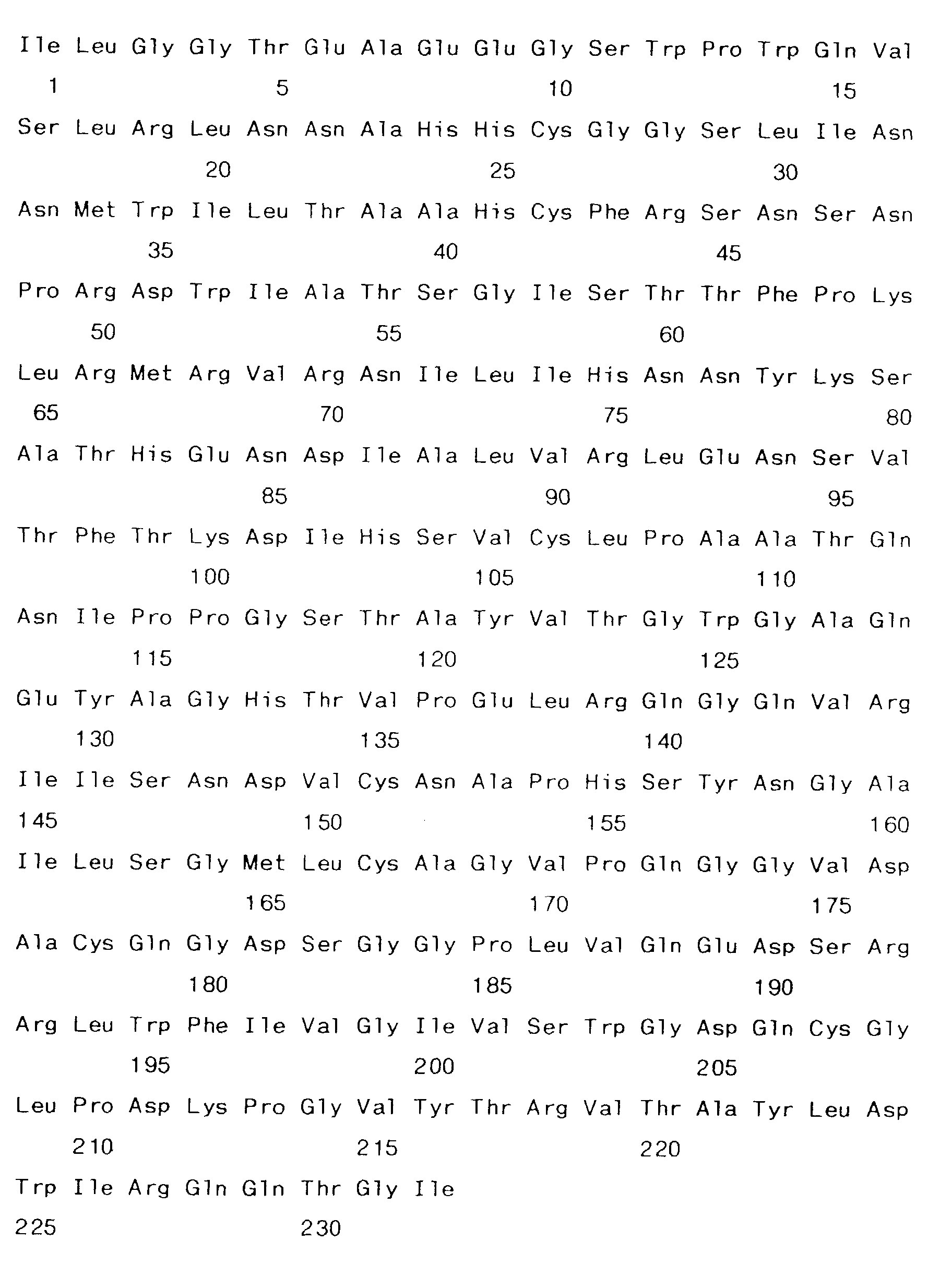
- a synthetic substrate for factor Xa:
- Boc-Ile-Gln-Gly-Arg-MCA,
- a synthetic substrate for chymotrypsin:
- Suc-Ala-Ala-Pro-Phe-MCA,

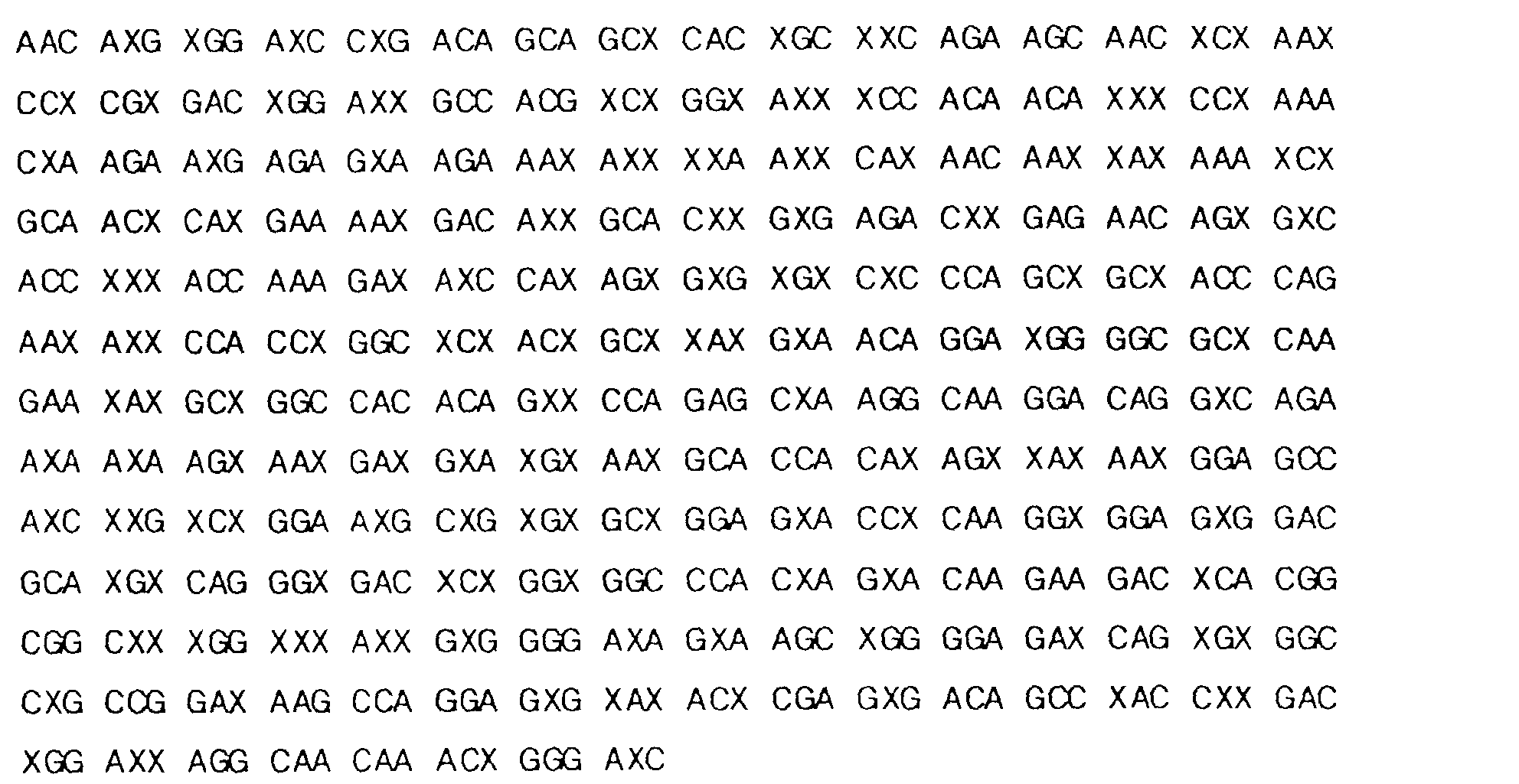
- A
- represents a DNA sequence encoding a signal peptide (prepeptide) and/or a prepropeptide,
- B
- represents a DNA sequence encoding a cleavage sequence or a translation initiation codon,
- m
- represents 0 or 1, and n represents 0 or 1, and
- C
- represents a DNA sequence encoding the amino acid sequence of the above formula [I],
Escherichia coli, Bacillus subtilis and Streptomyces. By expressing a DNA encoding a trypsin-like enzyme activity in a procaryotic host cell, the trypsin-like enzyme can be produced. The trypsin-like enzyme can be used as an antigen for stimulating production of trypsin-like enzyme-specific antibodies, or also for quantitative analysis of a trypsin-like enzyme. In many assay methods, for assaying the level of a protein in a sample, competitive antibody binding is utilized. Namely, a procaryote-produced trypsin-like enzyme labeled with radioactivity (or by another method) can be used as a "competing molecule" in assay of a trypsin-like enzyme in the respiratory tract humor.
- 97. 4kDa:
- Phosphorylase b
- 66. 2kDa:
- Albumin
- 42. 7kDa:
- Ovalbumin
- 31. 0kDa:
- Carbonic anhydrase
- 21. 5kDa:
- Soybean trypsin inhibitor
- 14. 4kDa:
- Lysozyme

| Influence of protease inhibitors on trypsin-like enzyme | ||||
| Inhibitor | Concentration (µM) | Inhibition (%) | ||
| Trypsin-like protease (human) | Neutrophile elastase (human) | Tryptase (derived from rat mast cell) | ||
| | 10 | 100 | 100 | 100 |
| | 1000 | 100 | 93.6 | - |
| | 10 | 82.5 | 0 | 100 |
| Antipain | 10 | 78.1 | 11.1 | 98.2 |
| | 10 | 0 | 0 | 53.0 |
| Bestatin | 10 | 0 | 15.2 | 23.4 |
| | 10 | 0 | 67.6 | 6.6 |
| α-1- | 10 | 23.5 | 100 | 66.3 |















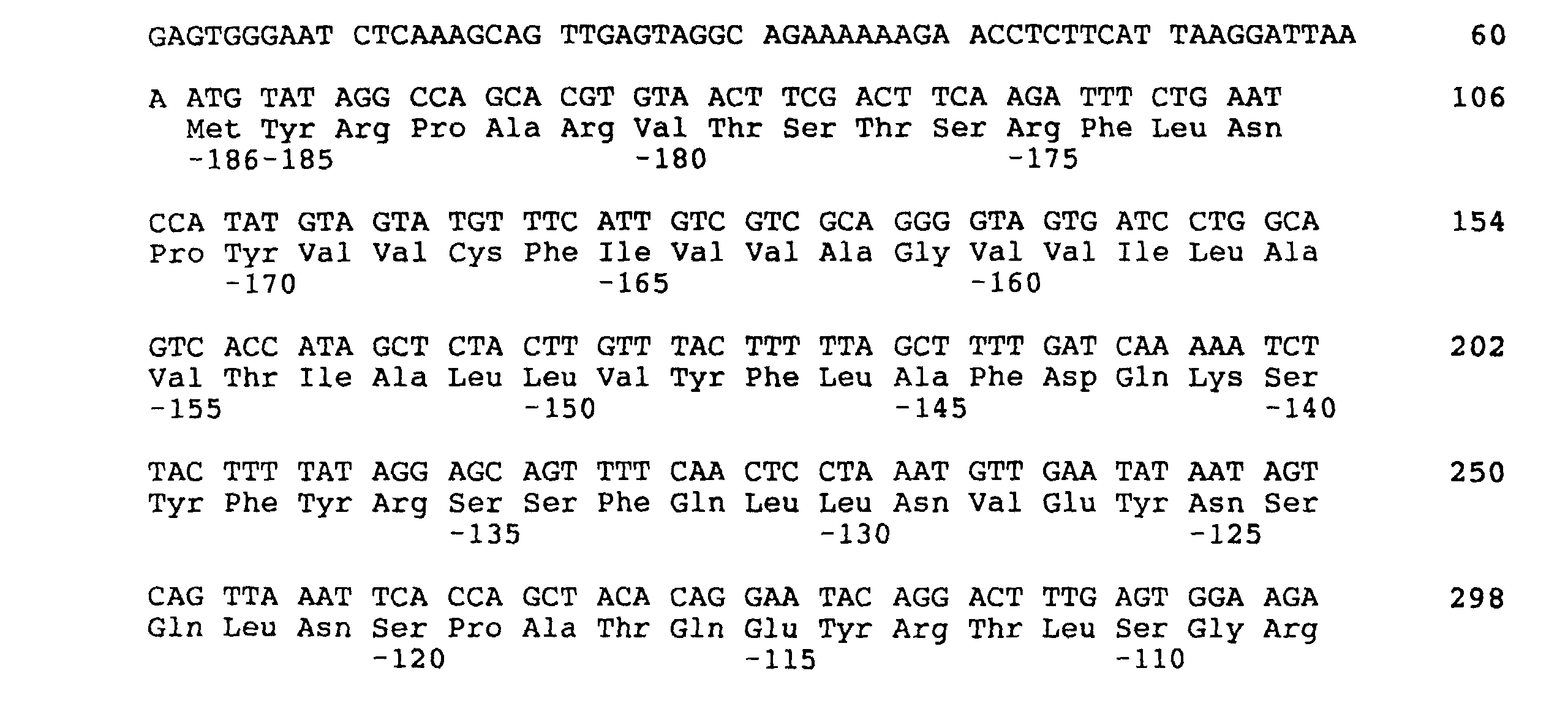

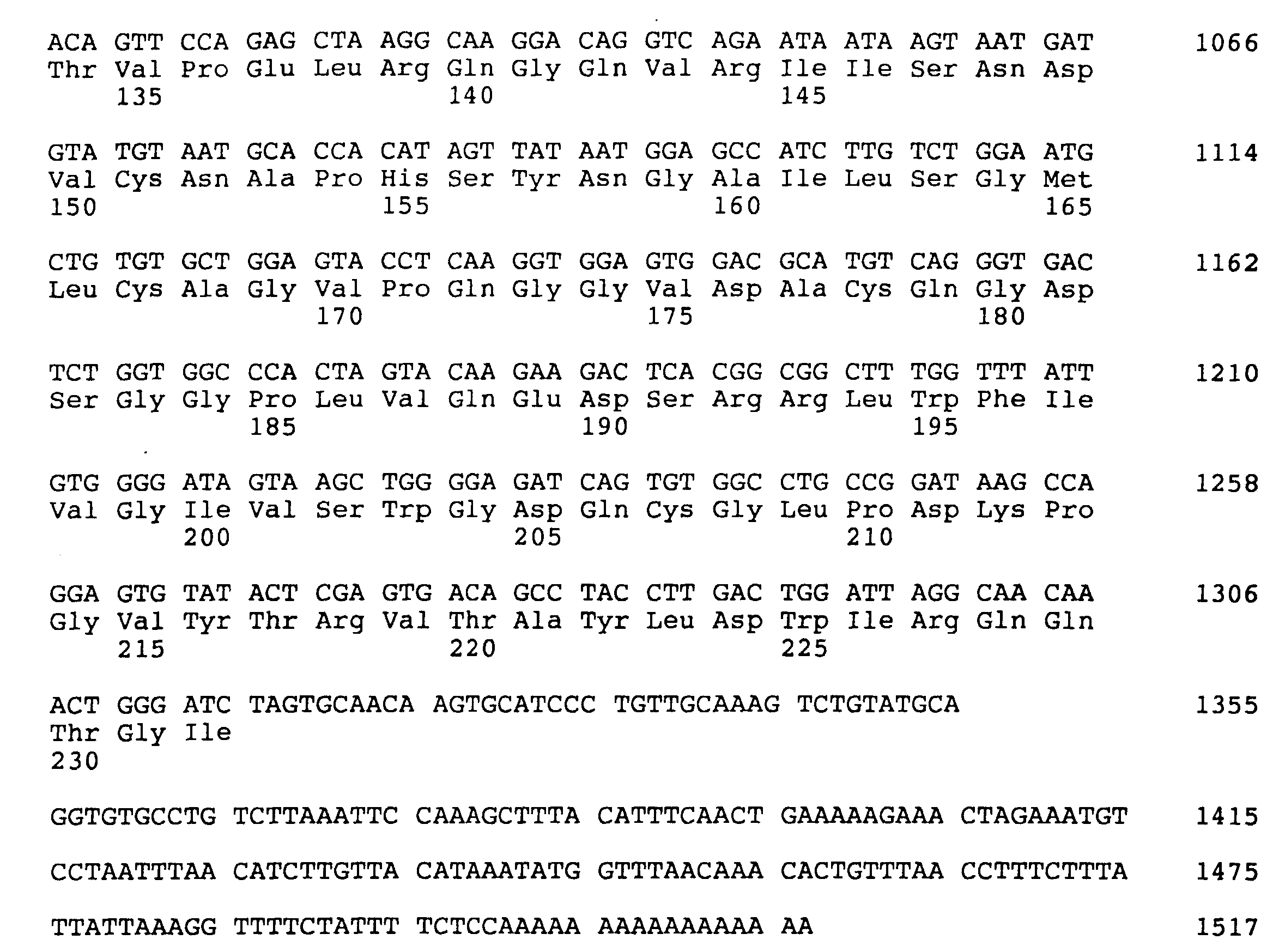
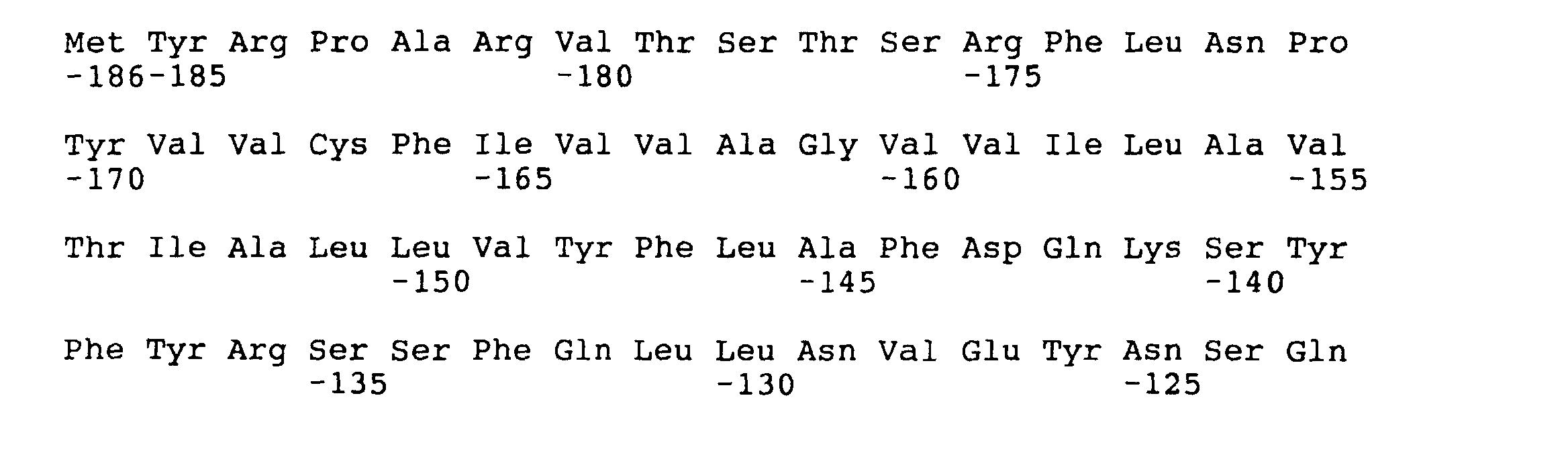
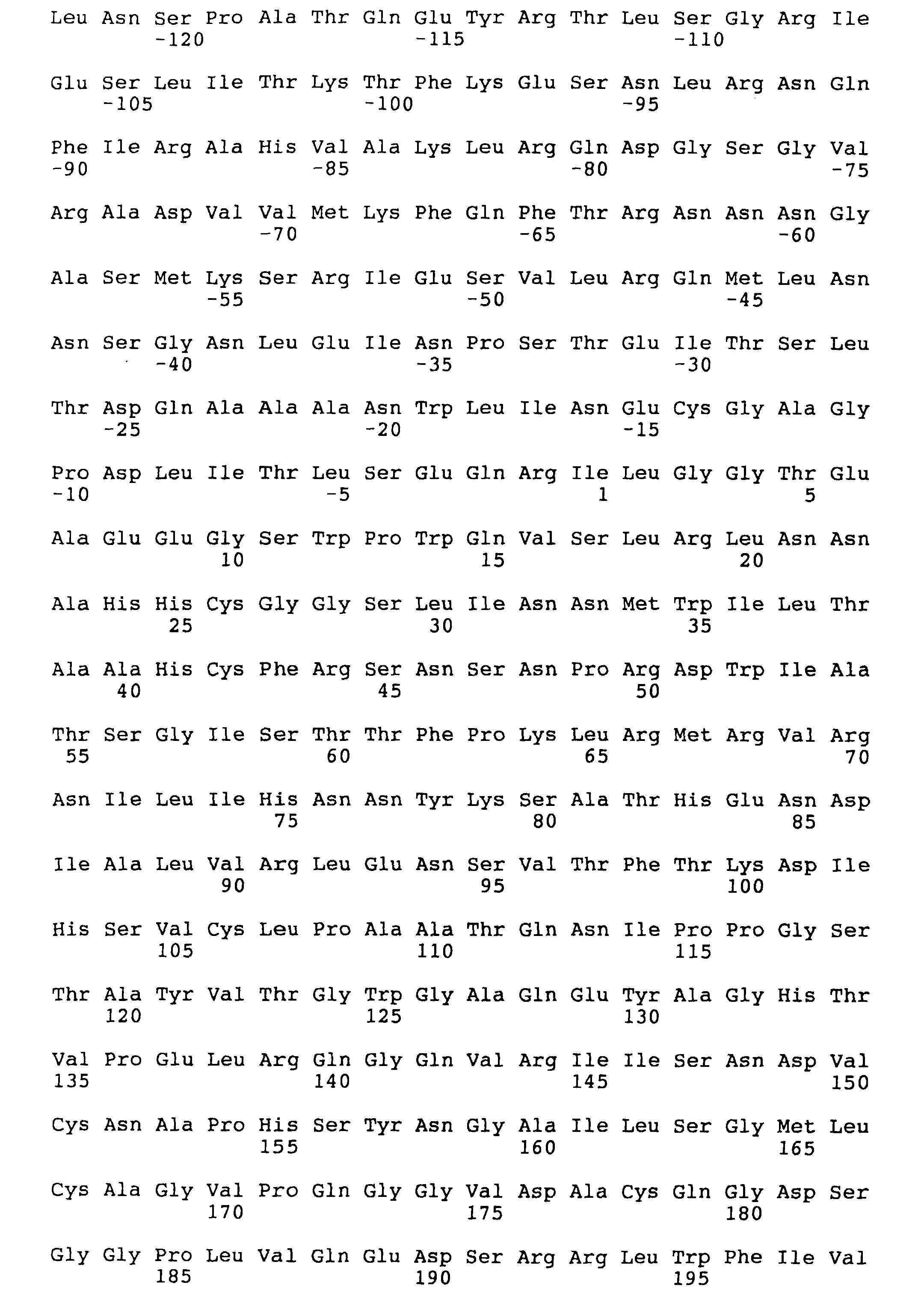

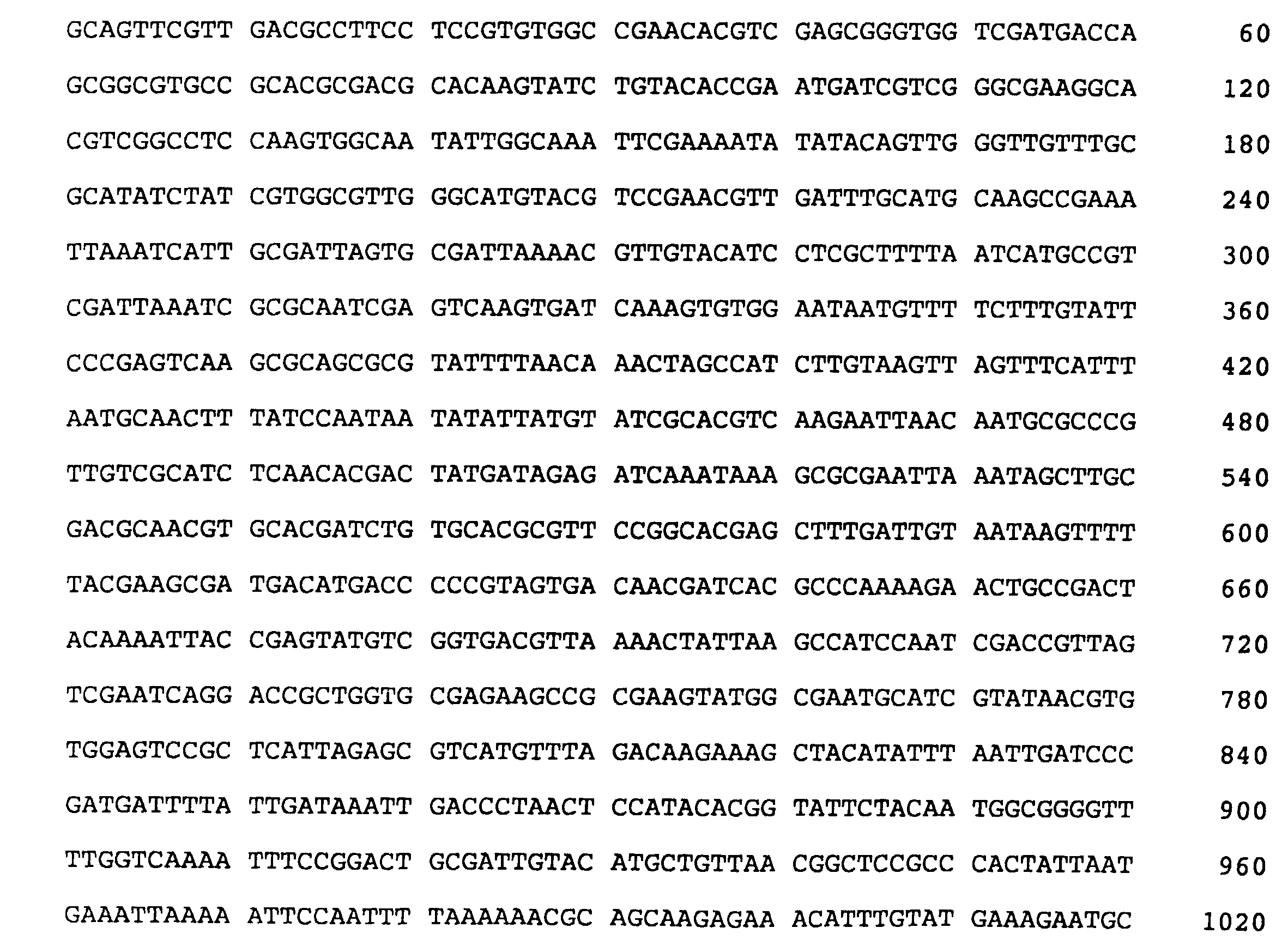
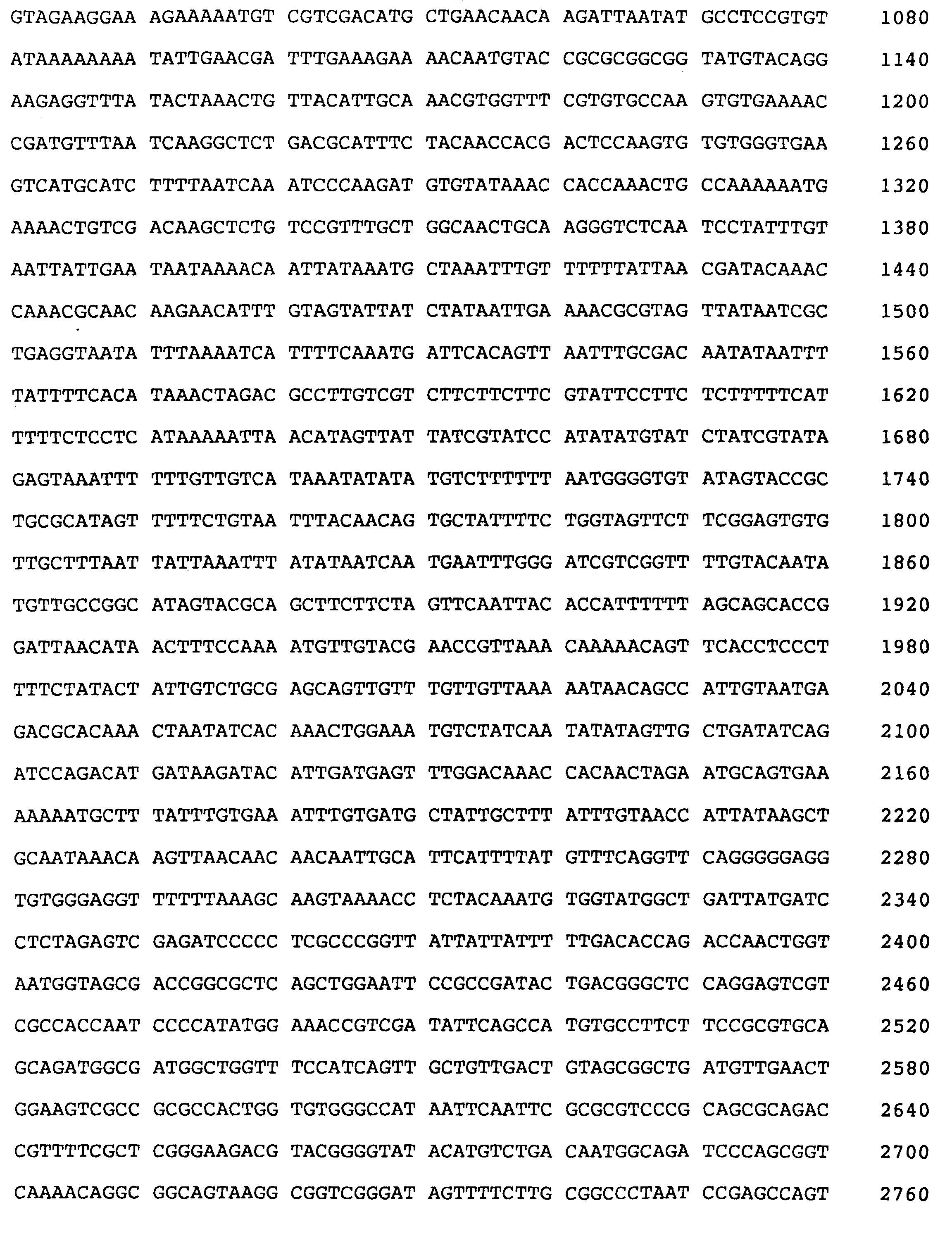


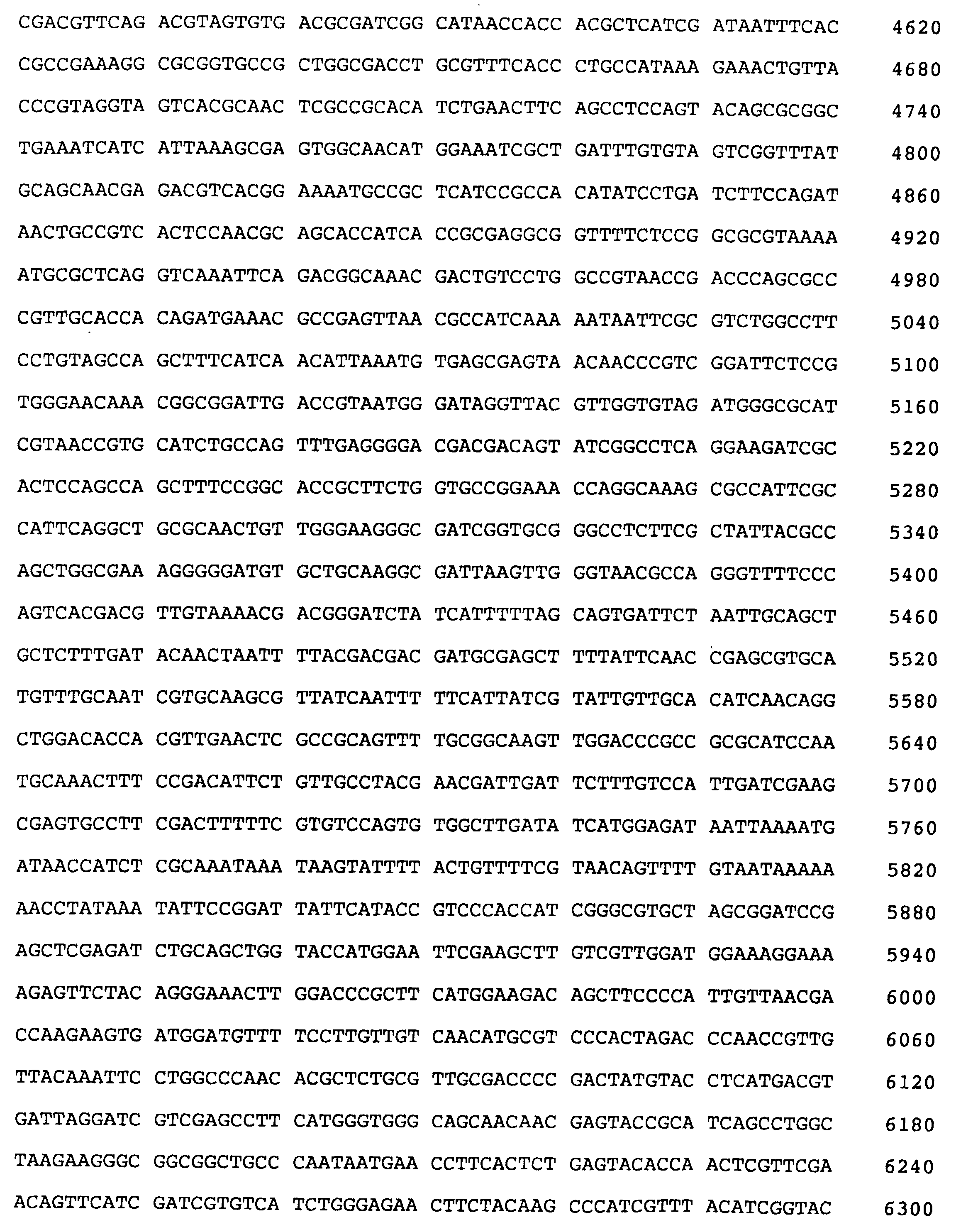
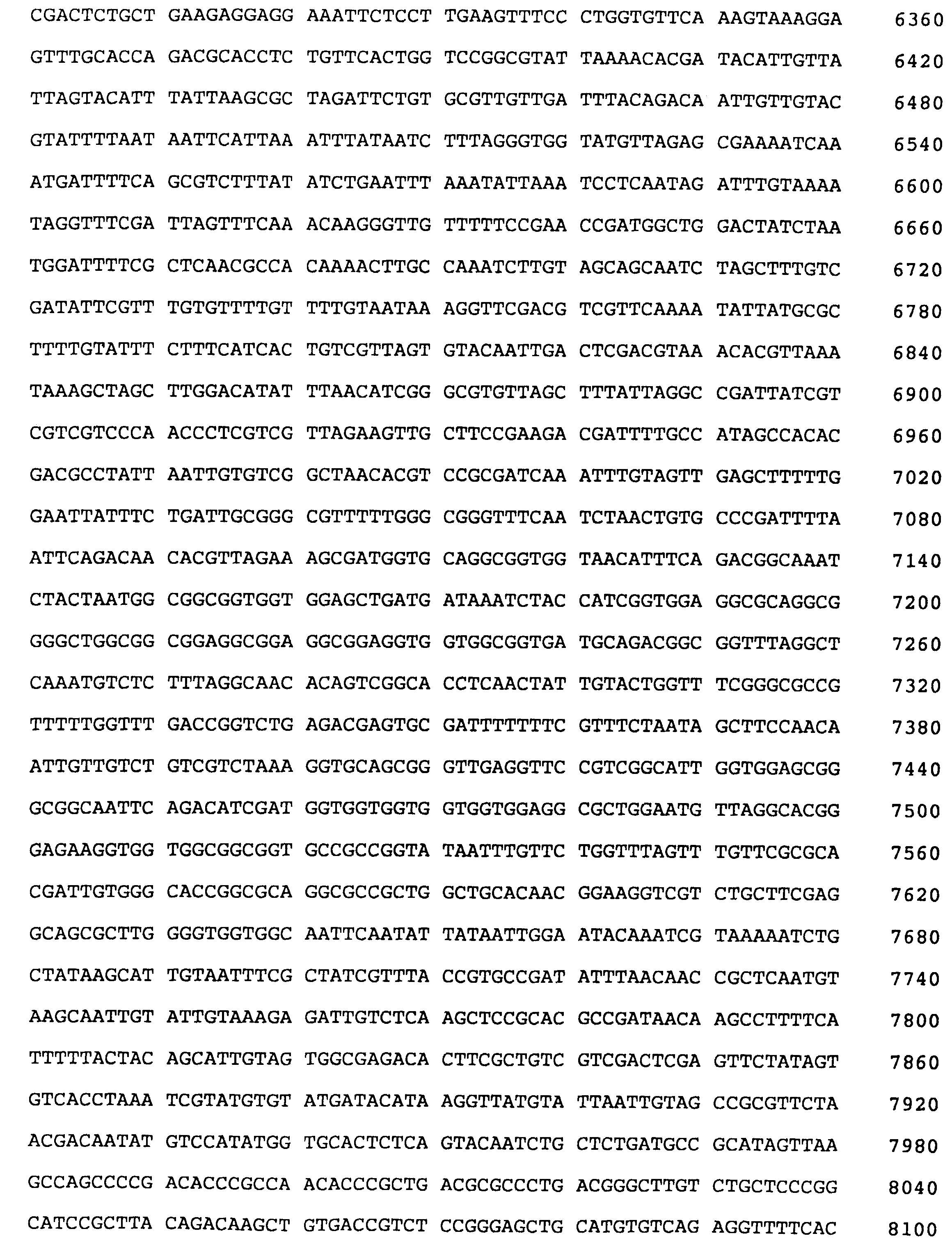
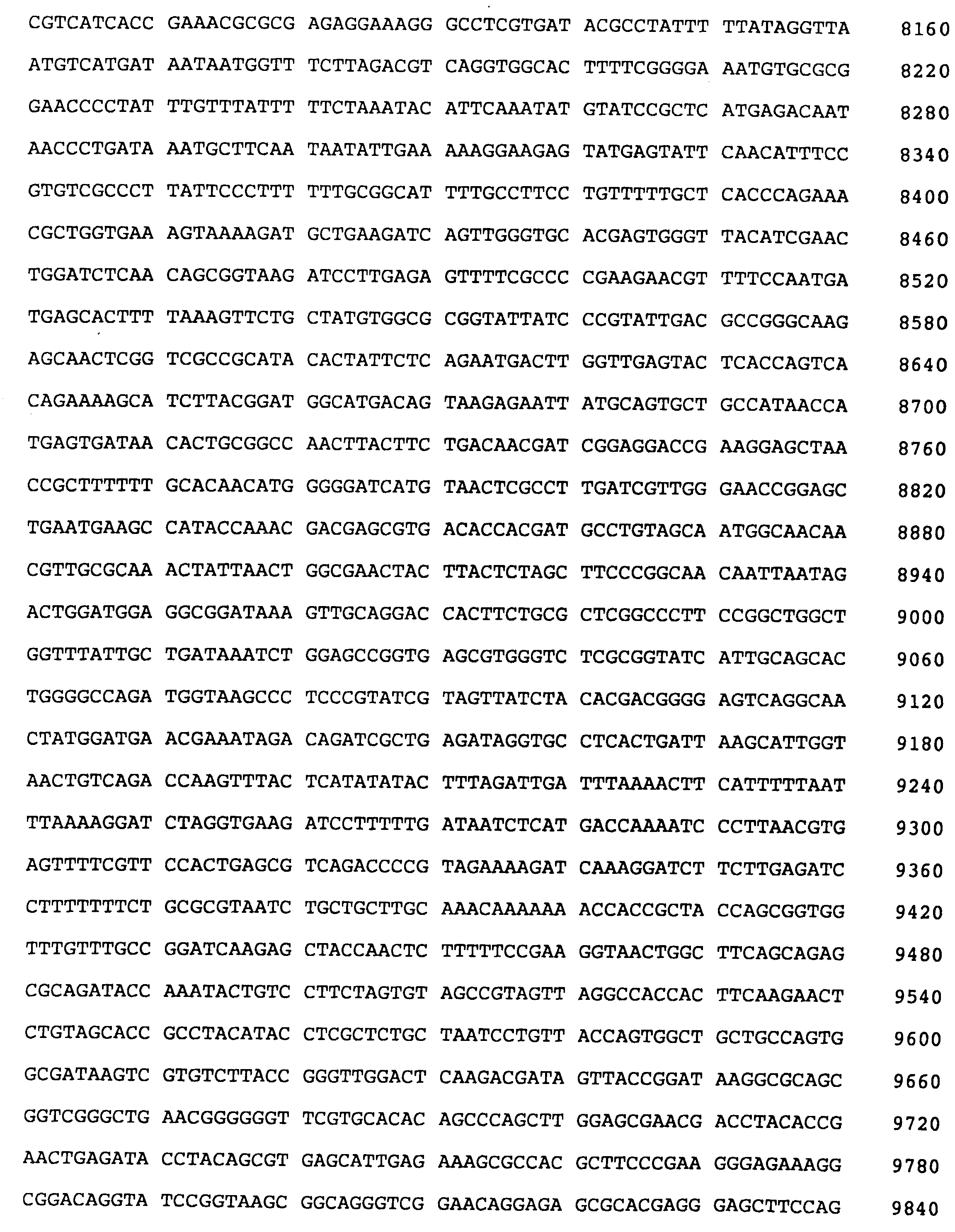



Claims (4)
- A nucleic acid sequence encoding a trypsin-like enzyme having the following amino acid sequence:
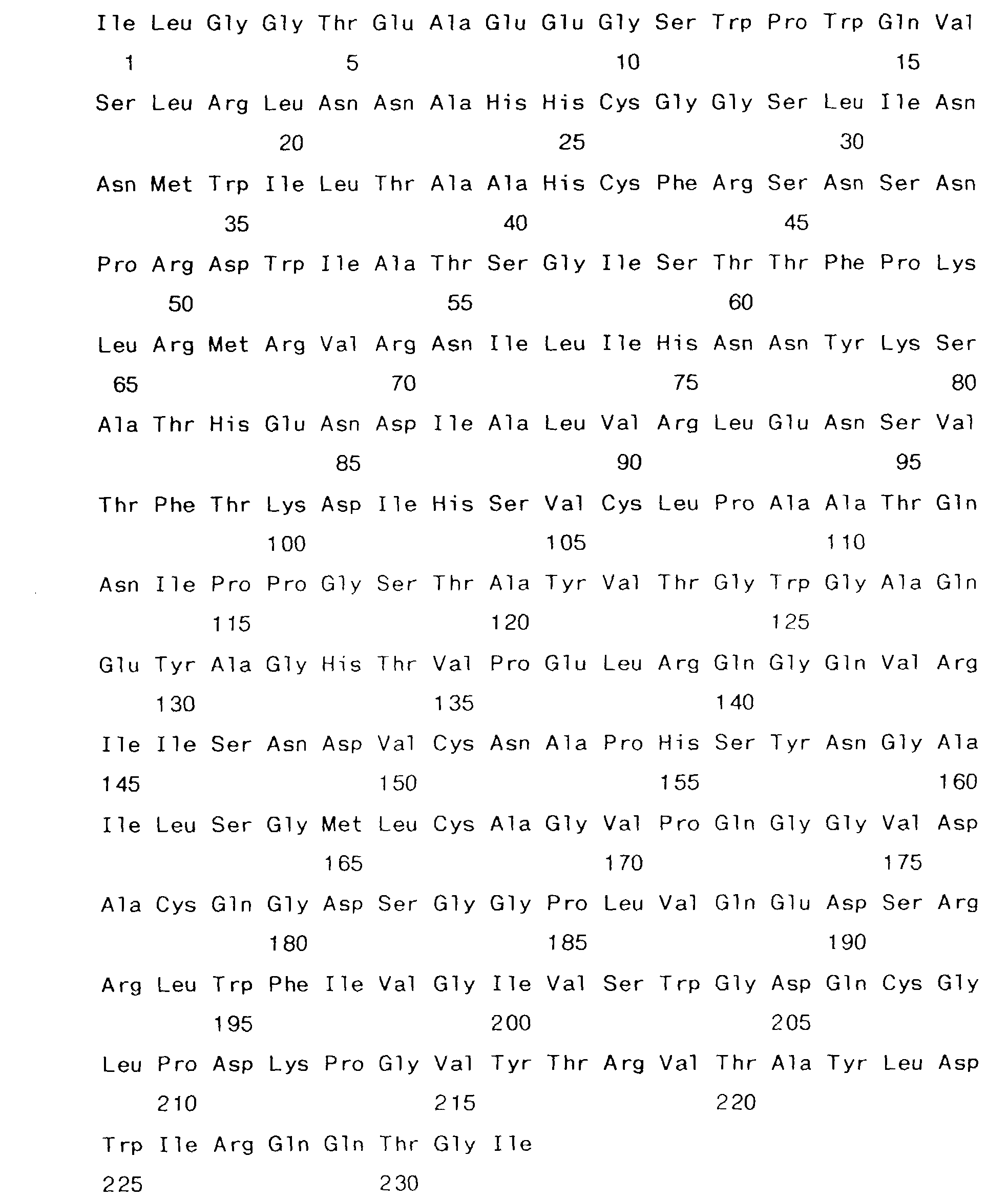
- The nucleic acid sequence according to claim 1 which contains in the base sequence a coding strand represented by the following formula:wherein X represents T or U.
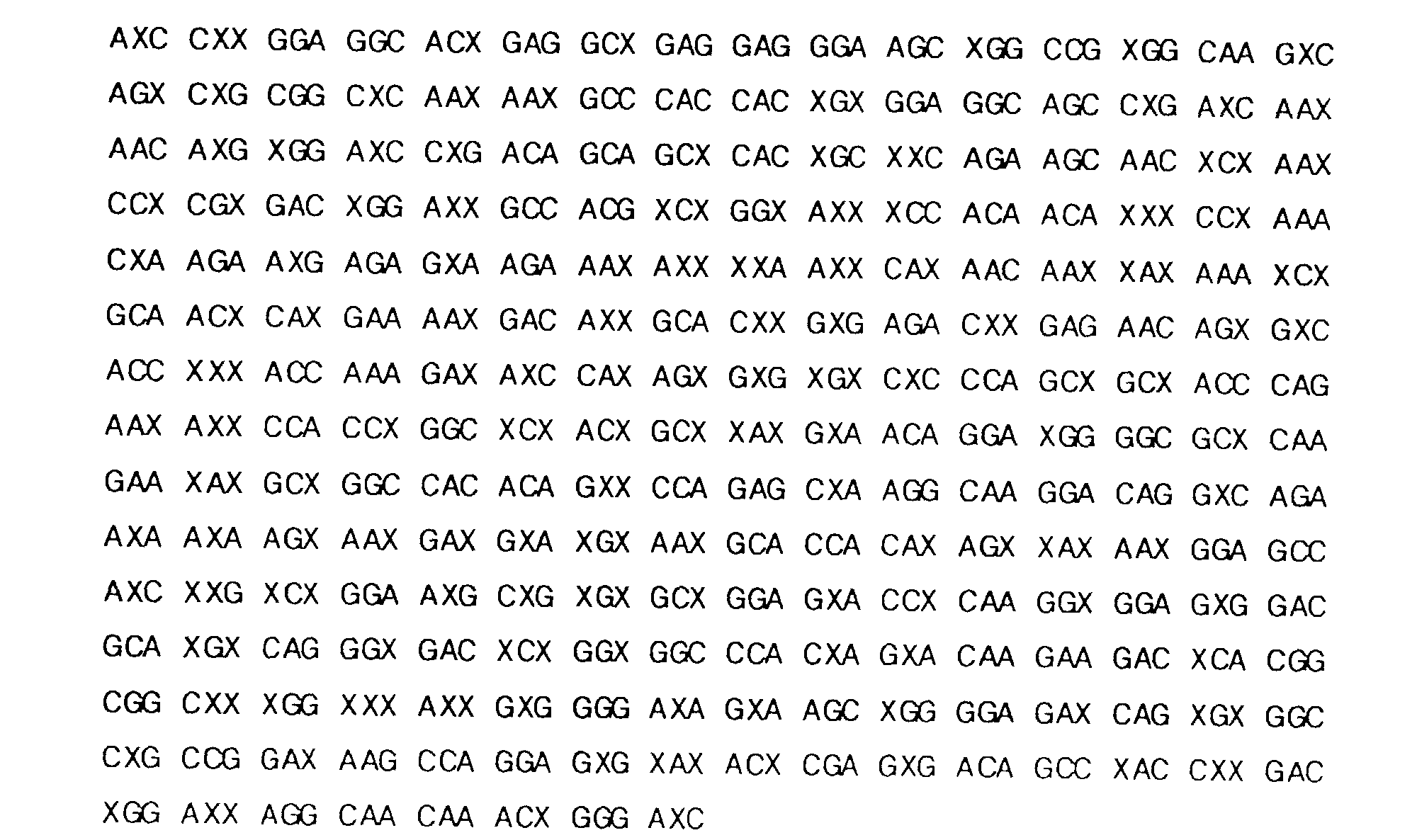
- A process for producing a trypsin-like enzyme having the amino acid sequence according to claim 1, which comprises producing the trypsin-like enzyme having the amino acid sequence according to claim 1, by a genetic engineering method using the nucleic acid sequence according to claim 2.
- A trypsin-like enzyme having the amino acid sequence according to claim 1.
Applications Claiming Priority (2)
| Application Number | Priority Date | Filing Date | Title |
|---|---|---|---|
| JP17860794 | 1994-07-29 | ||
| JP178607/94 | 1994-07-29 |
Publications (2)
| Publication Number | Publication Date |
|---|---|
| EP0699763A1 EP0699763A1 (en) | 1996-03-06 |
| EP0699763B1 true EP0699763B1 (en) | 1998-09-30 |
Family
ID=16051414
Family Applications (1)
| Application Number | Title | Priority Date | Filing Date |
|---|---|---|---|
| EP95111972A Expired - Lifetime EP0699763B1 (en) | 1994-07-29 | 1995-07-28 | Nucleic acid sequence encoding trypsin-like enzyme and process for producing the enzyme |
Country Status (8)
| Country | Link |
|---|---|
| US (1) | US5804410A (en) |
| EP (1) | EP0699763B1 (en) |
| KR (1) | KR100241571B1 (en) |
| AT (1) | ATE171728T1 (en) |
| AU (1) | AU691929B2 (en) |
| CA (1) | CA2155089C (en) |
| DE (1) | DE69505076T2 (en) |
| ES (1) | ES2125530T3 (en) |
Cited By (1)
| Publication number | Priority date | Publication date | Assignee | Title |
|---|---|---|---|---|
| WO2002006455A3 (en) * | 2000-07-19 | 2002-09-12 | Bayer Ag | Regulation of human airway trypsin protease-like enzyme |
Families Citing this family (16)
| Publication number | Priority date | Publication date | Assignee | Title |
|---|---|---|---|---|
| US6268165B1 (en) * | 1997-03-19 | 2001-07-31 | The Board Of Trustees Of The University Of Arkansas | Methods for the early diagnosis of ovarian cancer |
| US7081519B1 (en) | 1997-04-24 | 2006-07-25 | Zymogenetics, Inc. | Antibodies to serine protease polypeptides |
| US6153420A (en) * | 1997-04-24 | 2000-11-28 | Zymogenetics, Inc. | Serine protease polypeptides and materials and methods for making them |
| EP1206233A4 (en) * | 1999-08-03 | 2004-04-14 | Human Genome Sciences Inc | SERINE PROTEASES |
| EP1230349B1 (en) * | 1999-11-18 | 2007-06-13 | Dendreon Corporation | Nucleic acids encoding endotheliases, endotheliases and uses thereof |
| HK1043389A1 (en) * | 1999-12-06 | 2002-09-13 | 帝人株式会社 | Antibody binding to human airway trypsin-like enzyme and utilization thereof |
| US7700341B2 (en) * | 2000-02-03 | 2010-04-20 | Dendreon Corporation | Nucleic acid molecules encoding transmembrane serine proteases, the encoded proteins and methods based thereon |
| US20020031801A1 (en) * | 2000-03-24 | 2002-03-14 | Millennium Pharmaceuticals, Inc. | 18806, a novel trypsin serine protease-like molecule and uses thereof |
| US20040038369A1 (en) * | 2000-08-28 | 2004-02-26 | Hiroshi Eguchi | Airway-specific trypsin-like enzymes and method of using the same |
| EP1314779B1 (en) * | 2000-08-28 | 2007-10-03 | Teijin Limited | Airway-specific trypsin-like enzymes and method of using the same |
| AU2002305052A1 (en) | 2001-03-13 | 2002-09-24 | Corvas International, Inc. | Nucleic acid molecules encoding a transmembrane serine protease 7, the encoded polypeptides and methods based thereon |
| EP1383884A4 (en) | 2001-03-22 | 2004-12-15 | Dendreon Corp | Nucleic acid molecules encoding serine protease cvsp14, the encoded polypeptides and methods based thereon |
| NZ527971A (en) | 2001-03-27 | 2006-03-31 | Dendreon Corp | Nucleic acid molecules encoding a transmembrane serine protease 9, the encoded polypeptides and methods based thereon |
| WO2002092841A2 (en) | 2001-05-14 | 2002-11-21 | Dendreon San Diego Llc | Nucleic acid molecules encoding a transmembrane serine protease 10, the encoded polypeptides and methods based thereon |
| AU2002357004A1 (en) * | 2001-11-20 | 2003-06-10 | Dendreon San Diego Llc | Nucleic acid molecules encoding serine protease 17, the encoded polypeptides and methods based thereon |
| US20040001801A1 (en) * | 2002-05-23 | 2004-01-01 | Corvas International, Inc. | Conjugates activated by cell surface proteases and therapeutic uses thereof |
Family Cites Families (8)
| Publication number | Priority date | Publication date | Assignee | Title |
|---|---|---|---|---|
| NZ199722A (en) * | 1981-02-25 | 1985-12-13 | Genentech Inc | Dna transfer vector for expression of exogenous polypeptide in yeast;transformed yeast strain |
| ATE78293T1 (en) * | 1983-05-27 | 1992-08-15 | Texas A & M Univ Sys | METHOD OF GENERATING A RECOMBINANT BACULOVIRUS EXPRESSION VECTOR. |
| US4745051A (en) * | 1983-05-27 | 1988-05-17 | The Texas A&M University System | Method for producing a recombinant baculovirus expression vector |
| US4879236A (en) * | 1984-05-16 | 1989-11-07 | The Texas A&M University System | Method for producing a recombinant baculovirus expression vector |
| US5017489A (en) * | 1985-06-28 | 1991-05-21 | Massachusetts Institute Of Technology | Cytotoxic T lymphocte serine esterase and method for stimulation and inhibition |
| CA1332049C (en) * | 1988-10-07 | 1994-09-20 | Eli Lilly And Company | Eukaryotic expression |
| DK52393D0 (en) * | 1993-05-05 | 1993-05-05 | Novo Nordisk As | |
| JP2839825B2 (en) * | 1993-08-30 | 1998-12-16 | 帝人株式会社 | Novel trypsin-like enzyme |
-
1995
- 1995-07-28 US US08/508,448 patent/US5804410A/en not_active Expired - Lifetime
- 1995-07-28 AT AT95111972T patent/ATE171728T1/en not_active IP Right Cessation
- 1995-07-28 DE DE69505076T patent/DE69505076T2/en not_active Expired - Lifetime
- 1995-07-28 EP EP95111972A patent/EP0699763B1/en not_active Expired - Lifetime
- 1995-07-28 ES ES95111972T patent/ES2125530T3/en not_active Expired - Lifetime
- 1995-07-29 KR KR1019950023128A patent/KR100241571B1/en not_active Expired - Fee Related
- 1995-07-31 AU AU27248/95A patent/AU691929B2/en not_active Ceased
- 1995-07-31 CA CA002155089A patent/CA2155089C/en not_active Expired - Fee Related
Cited By (1)
| Publication number | Priority date | Publication date | Assignee | Title |
|---|---|---|---|---|
| WO2002006455A3 (en) * | 2000-07-19 | 2002-09-12 | Bayer Ag | Regulation of human airway trypsin protease-like enzyme |
Also Published As
| Publication number | Publication date |
|---|---|
| DE69505076T2 (en) | 1999-02-25 |
| DE69505076D1 (en) | 1998-11-05 |
| AU2724895A (en) | 1996-02-08 |
| KR100241571B1 (en) | 2000-02-01 |
| EP0699763A1 (en) | 1996-03-06 |
| ES2125530T3 (en) | 1999-03-01 |
| ATE171728T1 (en) | 1998-10-15 |
| CA2155089C (en) | 2001-04-17 |
| US5804410A (en) | 1998-09-08 |
| CA2155089A1 (en) | 1996-01-30 |
| AU691929B2 (en) | 1998-05-28 |
Similar Documents
| Publication | Publication Date | Title |
|---|---|---|
| US5804410A (en) | Nucleic acid sequence encoding trypsin-like enzyme and process for producing the enzyme | |
| EP0319312B1 (en) | Vectors and compounds for direct expression of activated human protein C | |
| CA2242342C (en) | Isolated dimeric fibroblast activation protein alpha, and uses thereof | |
| US5665566A (en) | Cloning of enterokinase and method of use | |
| KR0138997B1 (en) | Vampire bat salivary plasminogen activators | |
| US5358932A (en) | Hybrid protein C | |
| HUT61592A (en) | Process for producing deoxyribonucleic acid molecules and vectors for expressing zymogen forms of human c protein | |
| EP0506821B1 (en) | Hybrid protein c | |
| JP2533869B2 (en) | DNA sequence encoding a protein having the biological activity of a HUSI type I inhibitor, recombinant cloning vector containing said DNA sequence and bacteria transformed with said vector | |
| US5087572A (en) | Dna encoding human plasminogen modified at the cleavage site | |
| Yamauchi et al. | Recombinant and native zymogen forms of human complement factor D. | |
| AU646633B2 (en) | Soluble analogs of thrombomodulin | |
| US6746859B1 (en) | Cloning of enterokinase and method of use | |
| AU696358B2 (en) | Expression systems utilizing autolyzing fusion proteins and a novel reducing polypeptide | |
| EP1694848B1 (en) | Novel chimeric plasminogen activators and their pharmaceutical use | |
| US5190756A (en) | Methods and materials for expression of human plasminogen variant | |
| Meulien et al. | Increased biological activity of a recombinant factor IX variant carrying alanine at position+ 1 | |
| US5500344A (en) | Serine protease and uses thereof | |
| AU619803B2 (en) | Rearranged tissue plasminogen activators and method for producing same | |
| MXPA97000151A (en) | Elastase iv hum | |
| MXPA96005473A (en) | Polipeptido hk2 recombina |
Legal Events
| Date | Code | Title | Description |
|---|---|---|---|
| PUAI | Public reference made under article 153(3) epc to a published international application that has entered the european phase |
Free format text: ORIGINAL CODE: 0009012 |
|
| AK | Designated contracting states |
Kind code of ref document: A1 Designated state(s): AT BE CH DE ES FR GB IT LI NL SE |
|
| 17P | Request for examination filed |
Effective date: 19960430 |
|
| 17Q | First examination report despatched |
Effective date: 19970325 |
|
| GRAG | Despatch of communication of intention to grant |
Free format text: ORIGINAL CODE: EPIDOS AGRA |
|
| GRAG | Despatch of communication of intention to grant |
Free format text: ORIGINAL CODE: EPIDOS AGRA |
|
| GRAH | Despatch of communication of intention to grant a patent |
Free format text: ORIGINAL CODE: EPIDOS IGRA |
|
| GRAH | Despatch of communication of intention to grant a patent |
Free format text: ORIGINAL CODE: EPIDOS IGRA |
|
| GRAA | (expected) grant |
Free format text: ORIGINAL CODE: 0009210 |
|
| AK | Designated contracting states |
Kind code of ref document: B1 Designated state(s): AT BE CH DE ES FR GB IT LI NL SE |
|
| REF | Corresponds to: |
Ref document number: 171728 Country of ref document: AT Date of ref document: 19981015 Kind code of ref document: T |
|
| REG | Reference to a national code |
Ref country code: CH Ref legal event code: EP |
|
| REF | Corresponds to: |
Ref document number: 69505076 Country of ref document: DE Date of ref document: 19981105 |
|
| REG | Reference to a national code |
Ref country code: CH Ref legal event code: NV Representative=s name: BOVARD AG PATENTANWAELTE |
|
| ET | Fr: translation filed | ||
| REG | Reference to a national code |
Ref country code: ES Ref legal event code: FG2A Ref document number: 2125530 Country of ref document: ES Kind code of ref document: T3 |
|
| PLBE | No opposition filed within time limit |
Free format text: ORIGINAL CODE: 0009261 |
|
| STAA | Information on the status of an ep patent application or granted ep patent |
Free format text: STATUS: NO OPPOSITION FILED WITHIN TIME LIMIT |
|
| 26N | No opposition filed | ||
| REG | Reference to a national code |
Ref country code: GB Ref legal event code: IF02 |
|
| PGFP | Annual fee paid to national office [announced via postgrant information from national office to epo] |
Ref country code: NL Payment date: 20100701 Year of fee payment: 16 Ref country code: ES Payment date: 20100705 Year of fee payment: 16 Ref country code: CH Payment date: 20100721 Year of fee payment: 16 |
|
| PGFP | Annual fee paid to national office [announced via postgrant information from national office to epo] |
Ref country code: SE Payment date: 20100628 Year of fee payment: 16 Ref country code: IT Payment date: 20100720 Year of fee payment: 16 Ref country code: FR Payment date: 20100723 Year of fee payment: 16 Ref country code: DE Payment date: 20100728 Year of fee payment: 16 Ref country code: AT Payment date: 20100630 Year of fee payment: 16 |
|
| PGFP | Annual fee paid to national office [announced via postgrant information from national office to epo] |
Ref country code: GB Payment date: 20100630 Year of fee payment: 16 |
|
| PGFP | Annual fee paid to national office [announced via postgrant information from national office to epo] |
Ref country code: BE Payment date: 20100719 Year of fee payment: 16 |
|
| REG | Reference to a national code |
Ref country code: CH Ref legal event code: PFA Owner name: TEIJIN LIMITED Free format text: TEIJIN LIMITED#6-7, MINAMIHOMMACHI 1-CHOME CHUO-KU#OSAKA 541 (JP) -TRANSFER TO- TEIJIN LIMITED#6-7, MINAMIHOMMACHI 1-CHOME CHUO-KU#OSAKA 541 (JP) |
|
| BERE | Be: lapsed |
Owner name: *TEIJIN LTD Effective date: 20110731 |
|
| REG | Reference to a national code |
Ref country code: NL Ref legal event code: V1 Effective date: 20120201 |
|
| REG | Reference to a national code |
Ref country code: CH Ref legal event code: PL |
|
| REG | Reference to a national code |
Ref country code: SE Ref legal event code: EUG |
|
| GBPC | Gb: european patent ceased through non-payment of renewal fee |
Effective date: 20110728 |
|
| REG | Reference to a national code |
Ref country code: AT Ref legal event code: MM01 Ref document number: 171728 Country of ref document: AT Kind code of ref document: T Effective date: 20110728 |
|
| REG | Reference to a national code |
Ref country code: FR Ref legal event code: ST Effective date: 20120330 |
|
| PG25 | Lapsed in a contracting state [announced via postgrant information from national office to epo] |
Ref country code: BE Free format text: LAPSE BECAUSE OF NON-PAYMENT OF DUE FEES Effective date: 20110731 Ref country code: CH Free format text: LAPSE BECAUSE OF NON-PAYMENT OF DUE FEES Effective date: 20110731 Ref country code: DE Free format text: LAPSE BECAUSE OF NON-PAYMENT OF DUE FEES Effective date: 20120201 Ref country code: LI Free format text: LAPSE BECAUSE OF NON-PAYMENT OF DUE FEES Effective date: 20110731 Ref country code: FR Free format text: LAPSE BECAUSE OF NON-PAYMENT OF DUE FEES Effective date: 20110801 |
|
| REG | Reference to a national code |
Ref country code: DE Ref legal event code: R119 Ref document number: 69505076 Country of ref document: DE Effective date: 20120201 |
|
| PG25 | Lapsed in a contracting state [announced via postgrant information from national office to epo] |
Ref country code: IT Free format text: LAPSE BECAUSE OF NON-PAYMENT OF DUE FEES Effective date: 20110728 Ref country code: NL Free format text: LAPSE BECAUSE OF NON-PAYMENT OF DUE FEES Effective date: 20120201 |
|
| PG25 | Lapsed in a contracting state [announced via postgrant information from national office to epo] |
Ref country code: GB Free format text: LAPSE BECAUSE OF NON-PAYMENT OF DUE FEES Effective date: 20110728 |
|
| PG25 | Lapsed in a contracting state [announced via postgrant information from national office to epo] |
Ref country code: AT Free format text: LAPSE BECAUSE OF NON-PAYMENT OF DUE FEES Effective date: 20110728 |
|
| PG25 | Lapsed in a contracting state [announced via postgrant information from national office to epo] |
Ref country code: SE Free format text: LAPSE BECAUSE OF NON-PAYMENT OF DUE FEES Effective date: 20110729 |
|
| REG | Reference to a national code |
Ref country code: ES Ref legal event code: FD2A Effective date: 20130702 |
|
| PG25 | Lapsed in a contracting state [announced via postgrant information from national office to epo] |
Ref country code: ES Free format text: LAPSE BECAUSE OF NON-PAYMENT OF DUE FEES Effective date: 20110729 |