EP0699204B1 - Use of indolocarbazole derivatives to treat a pathological condition of the prostate - Google Patents
Use of indolocarbazole derivatives to treat a pathological condition of the prostate Download PDFInfo
- Publication number
- EP0699204B1 EP0699204B1 EP94918168A EP94918168A EP0699204B1 EP 0699204 B1 EP0699204 B1 EP 0699204B1 EP 94918168 A EP94918168 A EP 94918168A EP 94918168 A EP94918168 A EP 94918168A EP 0699204 B1 EP0699204 B1 EP 0699204B1
- Authority
- EP
- European Patent Office
- Prior art keywords
- compound
- carbons
- alkyl
- mmol
- group
- Prior art date
- Legal status (The legal status is an assumption and is not a legal conclusion. Google has not performed a legal analysis and makes no representation as to the accuracy of the status listed.)
- Expired - Lifetime
Links
- 0 CC1(C(*)(CC(C2)C2O)C2)OC2*(c2ccccc2-2)c3c-2c(C(*C2)=O)c2c-2c3*1c1ccccc-21 Chemical compound CC1(C(*)(CC(C2)C2O)C2)OC2*(c2ccccc2-2)c3c-2c(C(*C2)=O)c2c-2c3*1c1ccccc-21 0.000 description 10
- ZSFXKAXRNOEORK-UHFFFAOYSA-N CC1(C(C2)(N=O)I)OC2[n]2c3c4[n]1c1ccccc1c4c(CNC1=C)c1c3c1c2cccc1 Chemical compound CC1(C(C2)(N=O)I)OC2[n]2c3c4[n]1c1ccccc1c4c(CNC1=C)c1c3c1c2cccc1 ZSFXKAXRNOEORK-UHFFFAOYSA-N 0.000 description 1
Images


Classifications
-
- C—CHEMISTRY; METALLURGY
- C07—ORGANIC CHEMISTRY
- C07D—HETEROCYCLIC COMPOUNDS
- C07D487/00—Heterocyclic compounds containing nitrogen atoms as the only ring hetero atoms in the condensed system, not provided for by groups C07D451/00 - C07D477/00
- C07D487/12—Heterocyclic compounds containing nitrogen atoms as the only ring hetero atoms in the condensed system, not provided for by groups C07D451/00 - C07D477/00 in which the condensed system contains three hetero rings
- C07D487/14—Ortho-condensed systems
-
- A—HUMAN NECESSITIES
- A61—MEDICAL OR VETERINARY SCIENCE; HYGIENE
- A61K—PREPARATIONS FOR MEDICAL, DENTAL OR TOILETRY PURPOSES
- A61K31/00—Medicinal preparations containing organic active ingredients
- A61K31/33—Heterocyclic compounds
- A61K31/395—Heterocyclic compounds having nitrogen as a ring hetero atom, e.g. guanethidine or rifamycins
- A61K31/55—Heterocyclic compounds having nitrogen as a ring hetero atom, e.g. guanethidine or rifamycins having seven-membered rings, e.g. azelastine, pentylenetetrazole
-
- A—HUMAN NECESSITIES
- A61—MEDICAL OR VETERINARY SCIENCE; HYGIENE
- A61P—SPECIFIC THERAPEUTIC ACTIVITY OF CHEMICAL COMPOUNDS OR MEDICINAL PREPARATIONS
- A61P13/00—Drugs for disorders of the urinary system
- A61P13/08—Drugs for disorders of the urinary system of the prostate
-
- A—HUMAN NECESSITIES
- A61—MEDICAL OR VETERINARY SCIENCE; HYGIENE
- A61P—SPECIFIC THERAPEUTIC ACTIVITY OF CHEMICAL COMPOUNDS OR MEDICINAL PREPARATIONS
- A61P15/00—Drugs for genital or sexual disorders; Contraceptives
-
- A—HUMAN NECESSITIES
- A61—MEDICAL OR VETERINARY SCIENCE; HYGIENE
- A61P—SPECIFIC THERAPEUTIC ACTIVITY OF CHEMICAL COMPOUNDS OR MEDICINAL PREPARATIONS
- A61P35/00—Antineoplastic agents
-
- A—HUMAN NECESSITIES
- A61—MEDICAL OR VETERINARY SCIENCE; HYGIENE
- A61P—SPECIFIC THERAPEUTIC ACTIVITY OF CHEMICAL COMPOUNDS OR MEDICINAL PREPARATIONS
- A61P43/00—Drugs for specific purposes, not provided for in groups A61P1/00-A61P41/00
-
- C—CHEMISTRY; METALLURGY
- C07—ORGANIC CHEMISTRY
- C07H—SUGARS; DERIVATIVES THEREOF; NUCLEOSIDES; NUCLEOTIDES; NUCLEIC ACIDS
- C07H19/00—Compounds containing a hetero ring sharing one ring hetero atom with a saccharide radical; Nucleosides; Mononucleotides; Anhydro-derivatives thereof
- C07H19/02—Compounds containing a hetero ring sharing one ring hetero atom with a saccharide radical; Nucleosides; Mononucleotides; Anhydro-derivatives thereof sharing nitrogen
- C07H19/04—Heterocyclic radicals containing only nitrogen atoms as ring hetero atom
Definitions
- the invention relates to the use of certain indolocarbazole compounds for the manufacture of a medicament for use in the treatment of a pathological condition of the prostate gland.
- Prostatic hyperplasia affects 90% of men by the age of 80 years. Where the hyperplastic condition causes urinary obstruction, it is alleviated by surgical techniques.
- Prostate cancer which is now the most frequently diagnosed cancer in men, is most frequently treated by surgery, by radiation therapy, or by androgen deprivation, e.g. by castration, by estrogen therapy, by administration of analogues of adrenocorticotropic hormone (ACTH) ( Harrison's Principles of Internal Medicine, 12th ed. Wilson et al. eds. McGraw-Hill, NY. pages 1629-32), or by administration of Suramin, a non-specific and highly toxic growth factor inhibitor.
- ACTH adrenocorticotropic hormone
- the neurotrophin family of growth factors includes nerve growth factor (NGF), brain derived neurotrophic factor (BDNF), neurotrophin-3 (NT-3) and neurotrophin 4/5 (NT-4/5). These basic proteins are approximately 120 amino acids in length, share ⁇ 50% sequence homology, and are highly conserved among mammalian species (Issackson et al., FEBS Lett. 285 :260-64, 1991). NGF was the first growth factor discovered and remains the best characterized neurotrophin. NGF is required for normal development of sensory and sympathetic neurons and for normal function of these cells in adult life (Levi-Montalcini, Annu.Rev.Neurosci. 5 :341-362, 1982; Yankner et al., Annu. Rev. Biochem 51 :845-868, 1982).
- trks Neurotrophin binding and activation of a set of high affinity receptors (trks) is necessary and sufficient to mediate most of the biological effects of the neurotrophins.
- the trks are transmembrane proteins which contain an extracellular ligand binding domain, a transmembrane sequence, and a cytoplasmic tyrosine kinase domain.
- the trks comprise a family of structurally related proteins with preferential binding specificities for the individual neurotrophins. TrkA, which is sometimes referred to as trk, is a high-affinity receptor for NGF, but it can also mediate biological responses to NT-3 under particular conditions (Kaplan et al.
- TrkB binds and mediates functions of BDNF, NT-3, and NT4/5 (Klein et al. Cell 66 :395-403, 1991; Squinto et al., Cell 65 :885-893, 1991; Klein et al. Neuron 8 :947-956, 1992). TrkC is relatively specific for NT-3 (Lamballe et al., Cell 66 :967-979, 1991).
- the pathological condition of the prostate gland may be one that results from an excessive proliferation of prostate cells.
- the condition may be treated by administering to a mammal a therapeutic amount of an indolocarbazole compound, e.g. K-252a, or a functional derivative thereof, ie. a compound of formula I or II or a salt thereof.
- K-252a an alkaloid-like material isolated from the culture broth of Nocardiosis sp. and Actinomadula sp. is an inhibitor of protein kinase C, A, and G, as well as myosin light-chain kinase and phosphorylase kinase.
- Certain functional derivatives of K-252a can be used to prevent prostate tissue growth, and thereby to attenuate or cause regression of conditions exhibited by pathological proliferation of prostate cells, e.g. benign prostatic hypertrophy, or prostatic cancer, i.e. locally confined or metastatic prostate cancer.
- An excessive, or pathological, proliferation of prostate cells can be indicated by any one of a number of cellular changes, including but not limited to neoplastic transformation, an altered ratio of fibromuscular (stromal) cells to epithelial (secretory) cells in the prostate, or by a gross change in the degree of prostate gland enlargement or swelling. This may result in a symptom such as hesitancy, poor urinary stream, intermittent urinary flow, or growth of cells outside the organ capsule.
- a “functional derivative of K-252a” is meant a K-252a derivative that inhibits the tyrosine kinase (TK) activity associated with a neurotrophin receptor, e.g. trkA, trkB or trkC.
- a neurotrophin receptor e.g. trkA, trkB or trkC.
- the neurotrophin receptor is trkA, and is activated when contacted by NGF.
- the TK activity of the trks in the presence of the K-252a derivative is preferably less than the TK activity of the trks in the absence of the K-252a derivative.
- the TK activity of the trks can be measured according to the methods disclosed herein.
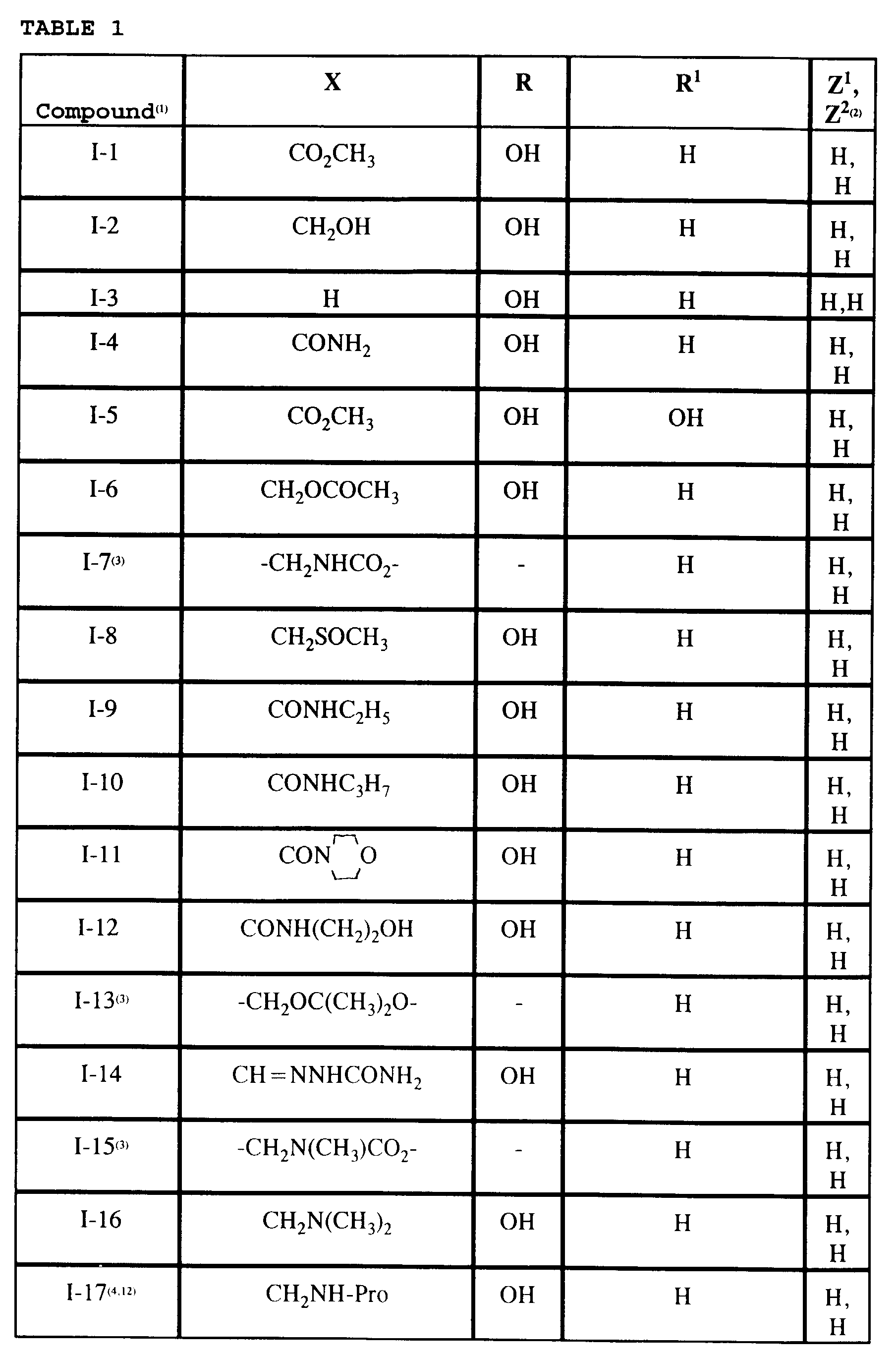
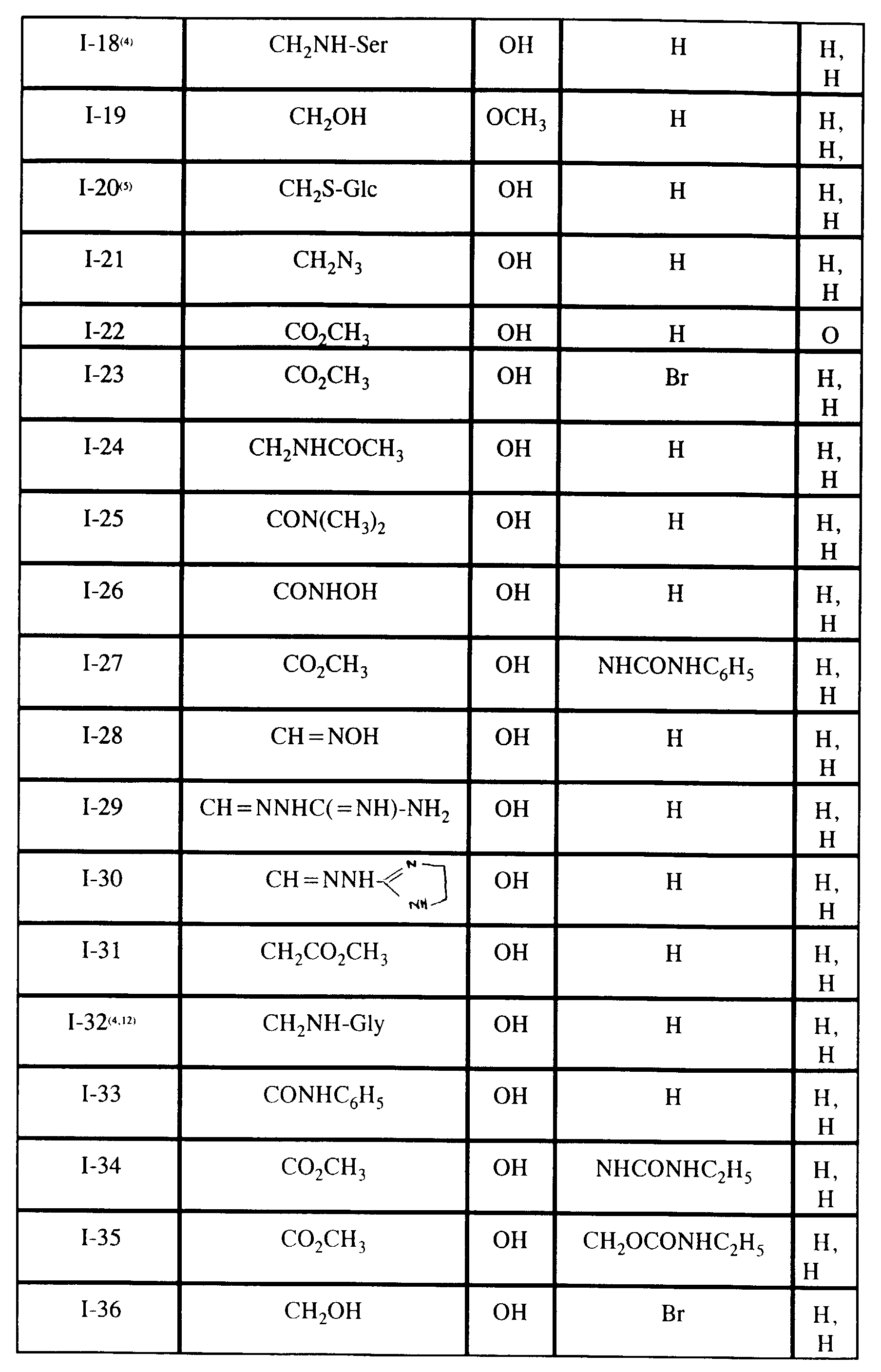
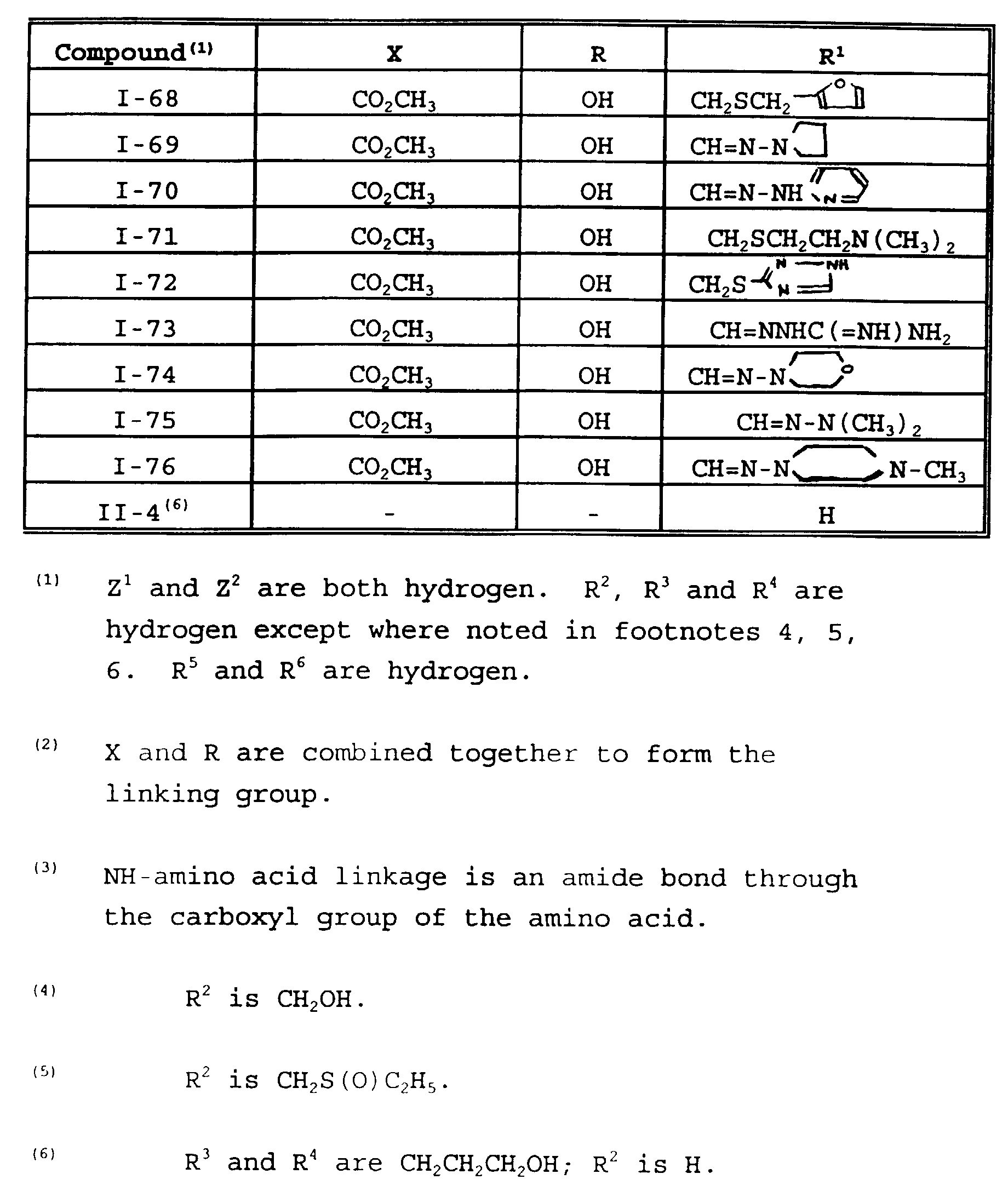
- Preferred formula I compounds are hereafter referred to as compounds I-1 through I-76 inclusive.
- Preferred formula II derivatives are hereafter referred to as compounds II-1 through II-4, inclusive.
- Preferred Formula I and Formula II compounds for use according to the invention are those compounds shown in Table 1 and Table 1A, wherein the following substitutions are made.
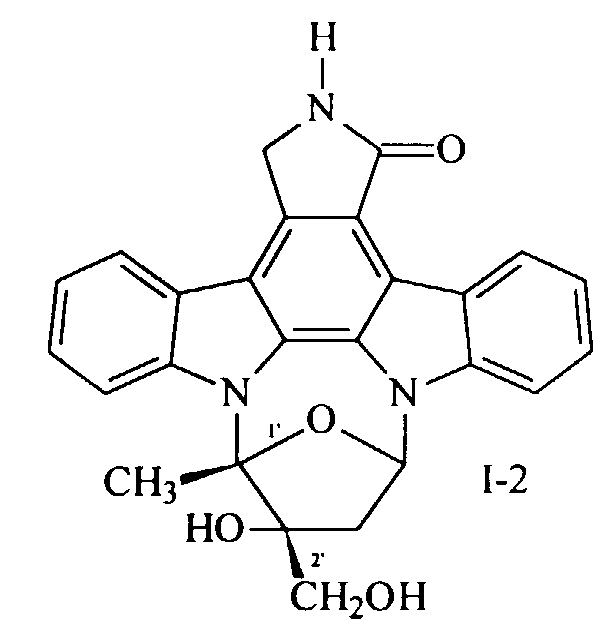
- the invention provides the use of an indolocarbazole compound selected from the group consisting of I-1, 1-2, I-5, 1-8, 1-12, 1-15, 1-16, 1-19, 1-20, 1-22 and 1-42.
- the invention provides the use of an indolocarbazole compound selected from the group consisting of 1-52, 1-53, 1-54, 1-55, 1-56, 1-57, 1-58, 1-59, 1-60, 1-61, 1-62, 1-63, 1-64, 1-65, I-66, I-67, I-68, I-69, I-70, I-71, I-72, I-73, I-74, I-75, and I-76.
- an indolocarbazole compound selected from the group consisting of 1-52, 1-53, 1-54, 1-55, 1-56, 1-57, 1-58, 1-59, 1-60, 1-61, 1-62, 1-63, 1-64, 1-65, I-66, I-67, I-68, I-69, I-70, I-71, I-72, I-73, I-74, I-75, and I-76.
- the indolocarbazole compound is selected from the group consisting of I-6, I-9, I-11, I-13, I-14, I-16, I-17, I-18, I-19, I-24, I-25, I-27, I-31, I-33, I-34, I-35, I-37, I-40, I-41, I-43, I-45, I-46, I-47, I-48, I-49, I-50, and I-51.
- the indolocarbazole compound is I-1, I-5, I-8, I-12, I-15, I-16, I-19, I-20, I-22, or I-42.
- the indolocarbazole compound is I-1, I-5, I-12, I-19 or I-42.
- Z 1 and Z 2 are both hydrogen.
- the invention provides the use of an indolocarbazole compound selected from the group consisting of II-1, II-2, II-3, and II-4.
- the indolocarbazole derivative used according to the invention can be administered in combination with a pharmacological excipient, or in the form of a pharmaceutically acceptable salt.
- Formula (III) in which R 1 represents halogen, CH 2 OCONHR 14 , or NHCO 2 R 14 (in which R 14 represents straight chain or
- X represents CH 2 S(O)R 16 (in which R 16 represents C 6-10 aryl or a nitrogen atom containing heterocyclic group selected from pyrrolyl, pyranyl, thiopyr
- the invention also features the use of compounds represented by the following Formula (V) : in which one of R 19 and R 20 is hydrogen and the other is allyl, or both of them are allyl, or a pharmaceutically acceptable salt thereof.
- R 1 represents CH(SC 6 H 5 ) 2
- CH 2 SR 24 in which R 24 represents benzimidazol-2-yl, furfuryl, 2-dimethylaminoethyl, or 1H-1,2,4-triazol-3-yl
- the invention features the use of the novel compounds I-35, I-37, I-40, I-42, and I-43.
- the invention also includes the use of novel compounds II-1, II-2, and II-3.
- the invention also includes the use of novel compounds I-58, I-59, I-60, I-61, I-62, I-63, I-64, I-65, I-66, I-67, I-68, I-69, I-70, I-71, I-72, I-73, I-74, I-75, and I-76.
- the pathological condition of the prostate gland in a mammal is benign prostatic hypertrophy or prostate cancer; the activity of trks in the presence of a Compound I or Compound II is less then the activity of trks in the absence of Compound I or Compound II.
- lower alkyl means a straight-chain or branched alkyl group having 1 to 6 carbon atoms, such as methyl, ethyl, propyl, isopropyl, butyl, isobutyl, sec-butyl, tert-butyl, pentyl, neopentyl, and hexyl.
- Aryl means an aryl group having 6 to 10 carbon atoms, such as phenyl and naphthyl.
- heterocyclic group examples include pyrrolyl, pyranyl, thiopyranyl, pyridyl, thiazolyl, imidazolyl, pyrimidyl, triazinyl, indolyl, quinolyl, purinyl, and benzothiazolyl.
- Halogen includes fluorine, chlorine, bromine, and iodine.
- the pharmaceutically acceptable salts of compounds of Formulae III, IV, V and VI include pharmaceutically acceptable acid addition salts, metal salts, ammonium salts, organic amine addition salts, and amino acid addition salts.
- Examples of the pharmaceutically acceptable acid addition salts are inorganic acid addition salts such as hydrochloride, sulfate, and phosphate, and organic acid addition salts such as acetate, maleate, fumarate, tartrate, and citrate.
- Examples of the pharmaceutically acceptable metal salts are alkali metal salts such as sodium salt and potassium salt, alkaline earth metal salts such as magnesium salt and calcium salt, aluminum salt, and zinc salt.
- Examples of the pharmaceutically acceptable ammonium salts are ammonium salt and tetramethylammonium salt.
- Examples of the pharmaceutically acceptable organic amine addition salts are salts with morpholine and piperidine.
- Examples of the pharmaceutically acceptable amino acid addition salts are salts with lysine, glycine, and phenylalanine.
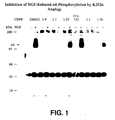
- Fig. 1 is an autoradiogram of a Western blot demonstrating inhibition of ligand-dependent trk tyrosine kinase phosphorylation by K-252a derivatives.
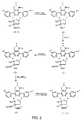
- Fig. 2 is a schematic illustration of the synthesis of Compound III-2.
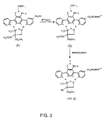
- Fig. 3 is a schematic illustration of the synthesis of Compound III-3.
- Fig. 4 is a schematic illustration of the synthesis of Compound III-4.
- Fig. 5 is a schematic illustration of the synthesis of Compound IV-5.
- Fig. 6 is a schematic illustration of the synthesis of Compounds of Formula (V).
- Applicants have determined that the ability of a candidate compound to inhibit autophosphorylation of the trks is predictive of its potential for treating a pathological condition of the prostate gland. This is because, as shown herein, pharmacological intervention with trk inhibitors can inhibit specifically the growth of prostate cells in vivo. Proliferating prostate cells are special in this regard because, although trk is present on a large subset of non-prostate proliferating cell types, it is not necessarily the causal force, nor the sustentative force, driving proliferation. Thus, the choice of compounds useful for the treatment of a pathological condition of the prostate gland can be substantially narrowed according to the compound's ability to inhibit trk autophosphorylation.
- Candidate compounds for the inhibition of prostate cell proliferation were selected according to their ability to inhibit the tyrosine kinase activity associated with the trks.
- trkA Upon binding of NGF, trkA undergoes autophosphorylation as a result of the activation of its tyrosine kinase domain (Kaplan et al. Nature 350 :158-160,1991). The degree of autophosphorylation of trks can be measured, and it is recognized as a reliable assay for trk kinase activity (Kaplan, 1991 supra).
- PC12 cells are rat pheochromocytoma cells that bear trkA and differentiate into sympathetic neurons when treated with NGF. These cells were grown in 100 mm dishes in DMEM media (GIBCO) containing 7.5% fetal bovine serum, 7.5% horse serum, 2 mM glutamine, 1 mM pyruvate. Cells were incubated at 37°C in a humidified atmosphere of 10% CO 2 and 90% air. Subconfluent cell cultures were incubated in medium without serum for one hour, incubated for one hour with a K-252a derivative compound at a concentration of 100 nM or 500 nM, and then stimulated for 5 minutes with NGF at a concentration of 50 ng/ml.
- the cells in each culture were disrupted and cell lysates were prepared by standard techniques known to those skilled in the art. Each lysate was incubated with anti-trk antibody whereby immune complexes were formed. Polyclonal anti-trkA, B, and C antibodies were prepared against the C-terminal 16 amino acids of trk (Kaplan et al. 1991 supra).
- the immune complexes were collected on Protein A-Sepharose beads, separated by SDS-polyacrylamide gel electrophoresis (SDS-PAGE), and transferred to polyvinylidene difluoride (PVDF) membranes (Millipore Corp., Bedford, MA), using techniques well known to those skilled in the art.
- PVDF polyvinylidene difluoride
- the membranes were incubated with anti-phosphotyrosine antibody, which binds to the tyrosine phosphorylated trks, but not to the un-phosphorylated form of trks. Proteins bound to anti-phosphotyrosine antibody were visualized with enhanced chemiluminescence (ECL, Amersham), and are shown as dark “spots" in Fig. 1.
- ECL enhanced chemiluminescence
- Measurement of the autophosphorylation of trk provides a good index of trk tyrosine kinase activity, and thereby of trk stimulation.
- NGF added in the absence of candidate inhibitors resulted in an increase in tyrosine phosphorylation of trk.
- the column headed DMSO(+) dimethylsulfoxide
- the vehicle shows substantial phosphorylation of trkA in the presence of NGF and the absence of a candidate inhibitor compound.
- the phosphorylation response was absent (no spot seen).
- Derivative compound 734 is included as a non-active, negative control, and demonstrates that the inhibitory activity of other tested derivatives is not attributable to non-specific toxicity.
- K-252a compound I-1 and 130 different K-252a derivative compounds were tested as described above for their ability to inhibit the autophosphorylation of the tyrosine kinase domain of trk (concentrations of the derivative compounds were 100 nM and/or 500 nM). Inhibition was indicated by the absence of a spot migrating with the trk marker shown at the left side of the figure. Partial inhibition was indicated by a spot of reduced size. Seventy-three compounds showed at least partial inhibition of phosphorylation at a concentration of 500 nM or less. These compounds, which are tabulated in Table 2, are predicted to be functional K-252a derivatives for the treatment of an abnormal proliferation of cells of the prostate gland.
- the Tsu-Pr1 and Du-Prol cells were maintained in RPMI 1640 medium (GIBCO) containing 10% fetal bovine serum (Hyclone), 2 mM glutamine, 100 U/ml penicillin, and 100 ⁇ g/ml streptomycin.
- the PC-3 cells were maintained in Ham's F12K medium (Irvine Scientific) containing 10% fetal bovine serum (Hyclone), 2 mM glutamine, 100 U/ml penicillin, and 100 ⁇ g/ml streptomycin. All cell lines were maintained at 37°C in a humidified atmosphere containing 5% CO 2 .
- the DU-145 cells were maintained in minimal essential medium (Gibco), containing 10% fetal bovine serum (Hyclone), 2 mM glutamine, and no antibiotics.
- Tests for growth inhibition by the candidate compounds were conducted by the following procedure. In each well of a 96-well plate (Falcon) were placed 2,500 cells in 0.1 ml of medium. The cultures were incubated overnight after which a 0.1 ml aliquot of culture medium was added to each well. Each aliquot contained a different concentration of ten representative candidate compounds (I-1, I-5, I-8, I-12, I-15, I-16, I-19, I-20, I-22, and I-42). Two additional aliquots contained the K-252a derivatives cmp700 or cmp783, which were found not to inhibit autophosphorylation of the tyrosine kinase domain of trk in the test described in Example 1.
- the derivatives cmp700 and cmp783 were therefore included as negative controls to show that the inhibition of cancer derived prostate cell growth is correlated with the inhibition of autophosphorylation of the tyrosine kinase domain of the trks.
- Other control wells received medium without any K-252a derivative compounds. Incubation was continued for three days. On day three the number of cells in each well was measured using a calcein fluorescence assay (Bozyczko-Coyne et al. J. Neurosci. Meth. 50, 205-216 (1993)).
- Calcein AM (Molecular Probes, Eugene, OR), an analog of the viable dye fluorescein diacetate, is taken up by cells and cleaved intracellularly to fluorescent salts that are retained by intact membranes of viable cells. This method thus provides a reliable and quantitative measurement of cell survival.
- Calcein AM was diluted 2x in Dulbeccos phosphate buffered saline (D-PBS) to 2x the final assay concentration (6 ⁇ M) and 100 ⁇ l was added to culture wells containing 100 ⁇ l of medium. The plates were then incubated for 1 hour at 37°C. Cells were then washed 4 times with D-PBS to remove excess calcein not taken up by cells.
- D-PBS Dulbeccos phosphate buffered saline
- mice were used in the following in vivo study. The mice were allowed at least 3 days after purchase to acclimate before being used in any experiments.
- Solutions of compounds I-1, I-12, and cmp700 were prepared daily by dissolving them in 10% Tween 20, 5% ethanol, and 85% phosphate buffered saline (TEPBS). Each test group contained 12 mice. Mice were injected subcutaneously each day for 21 days with TEPBS, TEPBS containing compound I-1 at concentrations of 1 or 10 mg/kg, TEPBS containing compound I-12 at concentrations of 1 or 10 mg/kg, or TEPBS containing cmp700 at concentrations of 1 or 10 mg/kg.
- mice were sacrificed and whole body blood, dorsal prostate, ventral prostate, coagulating glands, seminal vesicles, heart, liver, stomach, lung, kidneys and testes were collected separately and weighed.
- the concentration of plasma testosterone was determined using the Coat-A-Count Total Testosterone RIA kit (Diagnostic Products Corporation, Los Angeles, CA 90045). This was done to show that the compounds prevent epithelial growth through a mechanism that does not involve modulation of serum testosterone levels.
- mice receiving injections of TEPBS with compound I-1, TEPBS with compound 1-12, or TEPBS with cmp700 were compared to those from mice receiving TEPBS alone using a Dunnett's T-test or a group t-test (Tables 4 and 5).
- the results from mice receiving injections of TEPBS with compound 1-19 were compared to those from mice receiving TEPBS alone using a Dunnett's T-test, a Newman-Keul test, or a group t-test (Tables 6 and 7) (Tallarida et al. Manual of Pharmacologie Calculation with Computer Programs. 2nd ed. Springer Verlag, NY, 1987, pp.
- the usefulness of the K-252a derivatives provided herein specifically for the treatment of prostate cancer can be assessed in several animal models. Two of these models include 1) a test of the effect of a functional derivative on the growth of human prostate cancer cell lines in nude mice; and 2) a test of the effect of a functional derivative on the growth of Dunning prostate tumors in rats.
- a human prostate cell line e.g., the Tsu-Prl, DuPro-1, PC-3, or DU-145 cell lines described in Example 2
- Tsu-Prl, DuPro-1, PC-3, or DU-145 cell lines described in Example 2 can be grown under standard conditions and injected (at 1 x 10 6 cells/0.1 ml - 10 7 cells/1 ml) subcutaneously into the rear haunch of adult athymic nude mice (Gleave, et al. Cancer Res. 51 :3753-3761, 1991).
- the effect of test compounds on the growth of the tumor will be assessed by measuring the size and growth rate of the tumor in the presence and absence of the test compound.
- the Dunning rat prostate tumor lines are transplantable rat tumors which have become standard models for assessment of potential cancer treatments.
- One method of using the Dunning tumors to assess the effects of potential anti-cancer compounds has been described in detail (Isaacs, Cancer Res. 49 :6290-6294, 1989).
- the utility of the K-252a derivatives provided herein for reducing tumors in this model involves measuring the effect of test compounds on the growth rate of the tumor. Test compounds are dissolved and injected as described above.
- trk antagonists in inhibiting the growth of androgen-independent prostate cancer cells in vitro indicated that the molecules would be efficacious in in vivo models of androgen-independent prostate cancer.
- the AT-2 tumor is a highly anaplastic cell line derived from the original slow-growing androgen-dependent Dunning R-3327 H rat prostate tumor (Issacs et al., Prostate 9:261-281, 1986).
- the AT-2 tumor model has been used to characterize other potential anti-prostatic cancer agents including linomide (Ichikawa et al., Cancer Research 52:3022-3028, 1992) and suramin (Morton et al., Prostate 17:327-336, 1990) which is undergoing evaluation in clinical trials for androgen-independent prostate cancer (Eisenberger et al., J. Natl. Can. Inst. 85: 611-621, 1993).
- mice Twenty-four inbred male Copenhagen rats were inoculated subcutaneously in the flank with 1 x 10 6 viable AT-2.1 tumor cells. All animals were allowed to develop tumors of approximately 2.7 cm 3 in size (approximately 14 days) before being randomized into three groups of 8 animals each.
- Group 1 received daily subcutaneous injections of vehicle alone (1 ml/kg body weight).
- Group 2 received daily subcutaneous injections of Compound I-19 (1 ml/kg of a solution containing I-19 at 10 mg/ml).
- Group 3 received daily subcutaneous injections of Compound I-5 (1 ml/kg of a solution containing I-5 at 3 mg/ml). All animals had their tumor sizes evaluated for a period of 16 days. Tumor volume was calculated using the formula (1xw 2 ) x 0.5.
- Results The results of the experiment are presented in Table 8. Both Compound I-19 (10 mg/kg/day) and Compound I-5 (3 mg/kg/day) were effective in inhibiting growth of AT-2.1 tumors by approximately 50-60%. These results demonstrate the utility of these compounds in inhibiting the growth of prostate cancer cells in vivo.
- N,O-Diacetylated Compound VI-1 (70 mg, 0.09 mmol) was dissolved in a mixture of 6 ml of chloroform and 3 ml of methanol, and then 18 ⁇ l (0.09 mmol) of 5.1N sodium methoxide was added thereto, followed by stirring at room temperature for 20 minutes.
- Compound (III-1) [Compound (III) in which R 1 and R 2 are independently halogen, and X is CH 2 OH] can be prepared by the following reaction step: (In the formula, R 1a and R 2a independently represent halogen.)
- the starting compound (A-1) is disclosed in Japanese Published Unexamined Patent Application No. 120388/87.
- Compound (III-1) can be obtained by treatment of Compound (A-1) with 2 to 10 equivalents of a reducing agent in an inert solvent.
- a reducing agent is sodium borohydride.
- an example of the inert solvent is a mixed solvent of an ether such as diethyl ether or tetrahydrofuran and an alcohol such as methanol or ethanol. The ratio of the ether to the alcohol is preferably 1:1 to 5:1. The reaction is completed in 3 to 24 hours at 0 to 50°C.
- Compound (III-2) [Compound (III) in which R 1 is halogen, R 2 is hydrogen or halogen, and X is CONHR 15 ] can be prepared by the following reaction steps, which are illustrated in Fig. 2. (In the formulae, R 1a , R 2 , and R 15 have the same meanings as defined above.)
- the starting compound (A-2) is disclosed in Japanese Published Unexamined Patent Application No. 120388/87 (supra).
- Compound (B) can be obtained by hydrolysis of Compound (A-2) with 1 to 1.5 equivalents of an alkali metal hydroxide.
- alkali metal hydroxide examples include sodium hydroxide and potassium hydroxide.
- dimethylformamide or the like is used as a reaction solvent. The reaction is completed in 1 to 24 hours at 0 to 50°C.
- Compound (C) can be obtained by reaction of Compound (B) with 3 to 20 equivalents of an acetylating agent.
- An example of the acetylating agent is acetic anhydride.
- a reaction solvent pyridine or the like is used. The reaction is completed in 1 hours to 4 days at 0 to 50°C.
- Compound (D) can be obtained by reaction of Compound (C) with a halogenating agent of a carboxyl group, which serves also as a solvent.
- a halogenating agent of a carboxyl group which serves also as a solvent.
- the halogenating agent are thionyl chloride and oxalyl chloride. The reaction is completed in 1 to 3 hours at 50 to 100°C.
- Compound (E) can be obtained by reaction of Compound (D) with 5 to 30 equivalents of R 15 NH 2 .
- a reaction solvent a halogenated hydrocarbon such as methylene chloride, chloroform, or ethylene dichloride, dimethylformamide, or the like is used. The reaction is completed in 1 to 24 hours at 0 to 50°C.
- Compound (III-2) can be obtained by deacetylation of Compound (E) with 0.5 to 10 equivalents of a deacetylating agent.
- the deacetylating agent are alkali metal alkoxylate such as sodium methylate and alkali metal hydroxide such as sodium hydroxide.
- a reaction solvent a mixed solvent of a halogenated hydrocarbon such as methylene chloride, chloroform, or ethylene dichloride and an alcohol such as methanol or ethanol, a mixed solvent of an ether such as dioxane or tetrahydrofuran and an alcohol such as methanol or ethanol, or the like is used.
- the ratio of the halogenated hydrocarbon to the alcohol, or that of the ether to the alcohol is 1:5 to 1:1.
- the reaction is completed in 5 minutes to 1 hour at 0 to 50°C.
- Compound (III-3) [Compound (III) in which R 1 is CH 2 OCONHR 14 and X is CO 2 CH 3 ] can be prepared by the following reaction steps, which are illustrated in Fig. 3. (In the formulae, R 14 represents lower alkyl.)
- the starting compound (F) is disclosed in Japanese Published Unexamined Patent Application No. 295588/88.
- Compound (G) can be obtained by reaction of Compound (F) with 1 to 5 equivalents of R 14 NCO in the presence of a base.
- a base is triethylamine.
- a reaction solvent a mixed solvent of tetrahydrofuran and dimethylformamide, or the like is used. The ratio of tetrahydrofuran to dimethylformamide is 5:1 to 1:1. The reaction is completed in 5 to 24 hours at 10 to 70°C.
- Compound (III-3) can be obtained from Compound (G) in a manner similar to that of the preparation of Compound (III-2).
- Compound (III-4) [Compound III in which R 1 is NHCO 2 R 14 and X is CO 2 CH 3 ] can be prepared by the following reaction steps depicted in Fig. 4. (In the formulae, R 14 represents lower alkyl).
- the starting compound (N) is disclosed in Japanese Published Unexamined Patent Application No. 295588/88 (hereby incorporated by reference).
- Compound (O) can be obtained by reaction of Compound (N) with 1 to 5 equivalents of ClCO 2 R 14 in the presence of 1 to 5 equivalents of a base.
- a base is triethylamine.
- a reaction solvent a halogenated hydrocarbon such as methylene chloride, chloroform, or ethylene dichloride, or the like is used. The reaction is completed in 1 to 3 hours at 0 to 50°C.
- Compound (III-4) can be obtained from Compound (O) in a manner similar to that in the preparation of Compound (III-2).
- Compound (IV-1) [Compound (IV) in which X is CH 2 SR 16 ] can be prepared by the following reaction step: (In the formulae, R 16 has the same meaning as defined above.)
- the starting compound (H) is disclosed in Japanese Published Unexamined Patent Application No. 155285/87.
- Compound (IV-1) can be obtained by reaction of Compound (H) with 1 to 5 equivalents of R 16 SH in the presence of 1 to 5 equivalents of a base.
- a base is alkali metal hydride such as sodium hydride.
- dimethylformamide or the like is used as a reaction solvent. The reaction is completed in 2 to 5 hours at 0 to 50°C.
- Compound (IV-2) [Compound (IV) in which X is CH 2 S(O)R 16 ] can be prepared by the following reaction step: (In the formulae, R 16 represents aryl or a heterocyclic group including a nitrogen atom.)
- Compound (IV-2) can be obtained by treatment of Compound (IV-1) with 1 to 1.5 equivalents of an oxidant.
- an oxidant is m-chloroperbenzoic acid.
- a reaction solvent a halogenated hydrocarbon such as methylene chloride, chloroform, or ethylene dichloride, or the like is used. The reaction is completed in 1 to 8 hours at - 70 to 0°C.
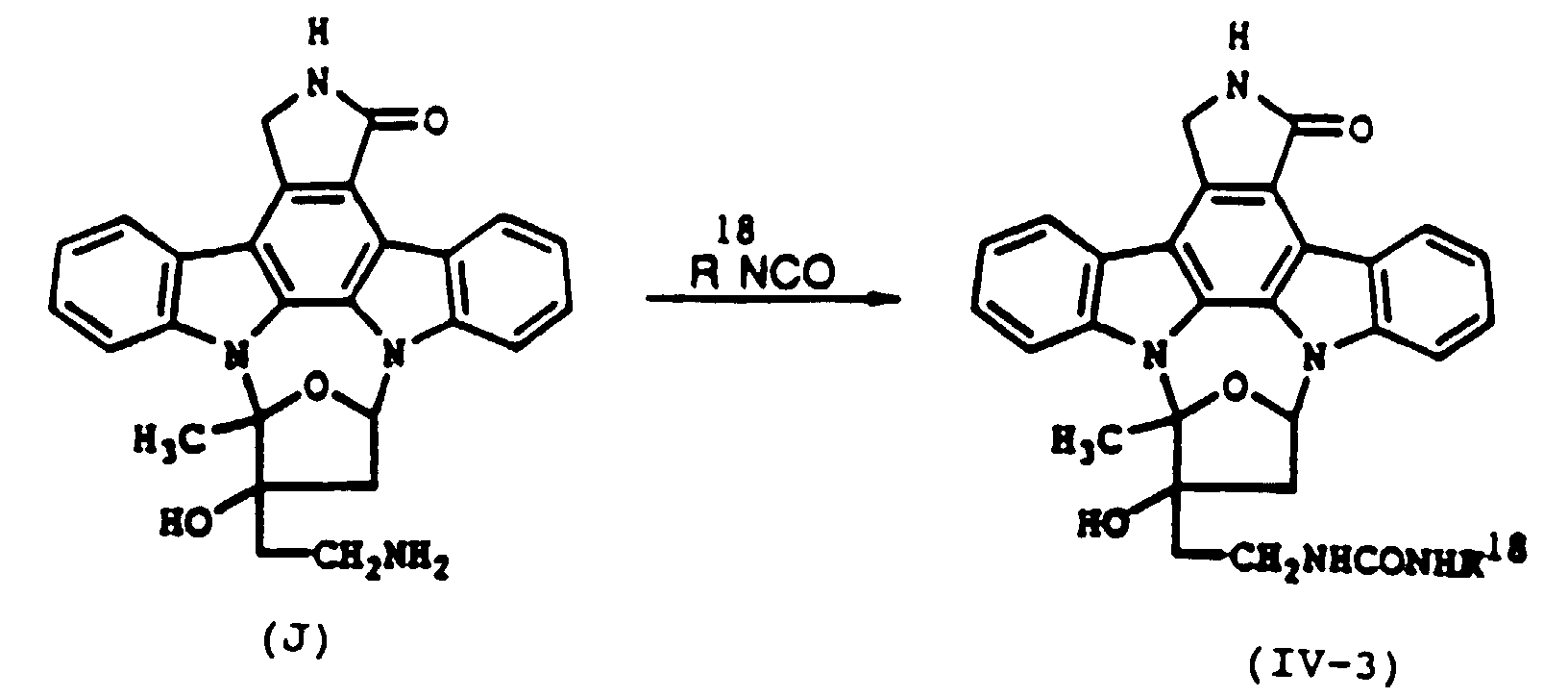
- Compound (IV-3) [Compound (IV) in which X is CH 2 NHCONHR 18 ] can be prepared by the following reaction step: (In the formulae, R 18 represents lower alkyl or aryl.)
- the starting compound (J) is disclosed in Japanese Published Unexamined Patent Application No. 155285/87.
- Compound (IV-3) can be obtained by reaction of Compound (J) with 1 to 3 equivalents of R 18 NCO in the presence of 1 to 3 equivalents of a base.
- a base is triethylamine.
- tetrahydrofuran or the like is used as a reaction solvent. The reaction is completed in 1 to 5 hours at 0 to 50°C.
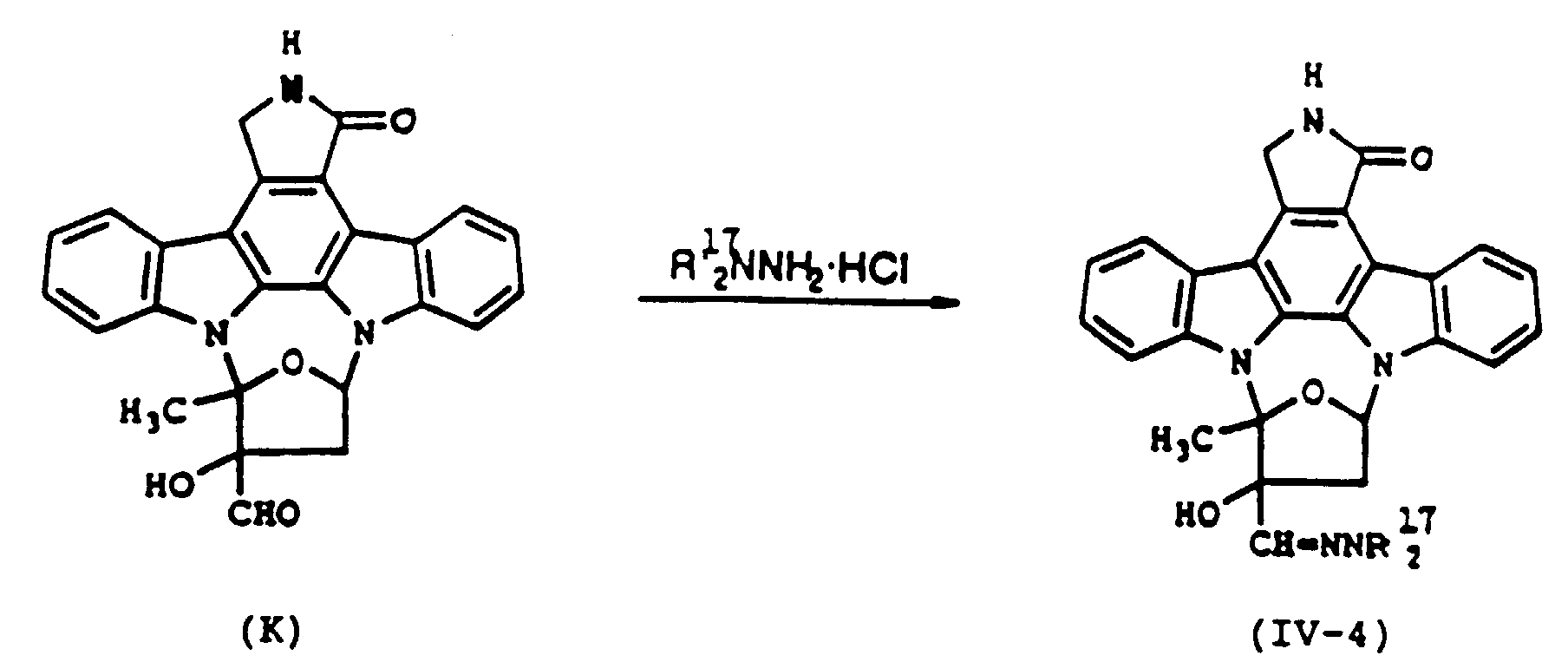
- the starting compound (K) is disclosed in Japanese Published Unexamined Patent Application No. 295588/88 (supra).
- Compound (IV-4) can be obtained by reaction of Compound (K) with 2 to 10 equivalents of R 17 2 NNH 2 •HCl.
- a reaction solvent a mixed solvent of an ether such as dioxane or tetrahydrofuran and water, or the like is used. The ratio of the ether to water is 1:10 to 1:2. The reaction is completed in 2 to 8 hours at 0 to 50°C.
- Compound (IV-5) [Compound (IV) in which X is CH 2 CO 2 CH 3 ] can be prepared by the following reaction steps, which are illustrated in Fig. 5.
- Compound (L) can be obtained by reaction of Compound (H) with 1 to 5 equivalents of a cyanating agent.
- a cyanating agent is an alkali metal cyanide such as sodium cyanide.
- As a reaction solvent dimethylformamide or the like is used. The reaction is completed in 1 to 24 hours at 20 to 100°C.
- Compound (IV-5) can be obtained by hydrolysis of Compound (L) with 10 to 50 ml/mmol of an aqueous solution of an alkali metal hydroxide, followed by treatment with 2 to 10 equivalents of CH 2 N 2 .
- the aqueous solution of an alkali metal hydroxide are a 30% aqueous solution of sodium hydroxide and a 30% aqueous solution of potassium hydroxide.
- ethylene glycol or the like is used as a reaction solvent, and the reaction is completed in 1 to 3 hours at 120 to 180°C.
- dimethylformamide or the like is used as a reaction solvent, and the reaction is completed in 1 to 5 hours at 0 to 30°C.
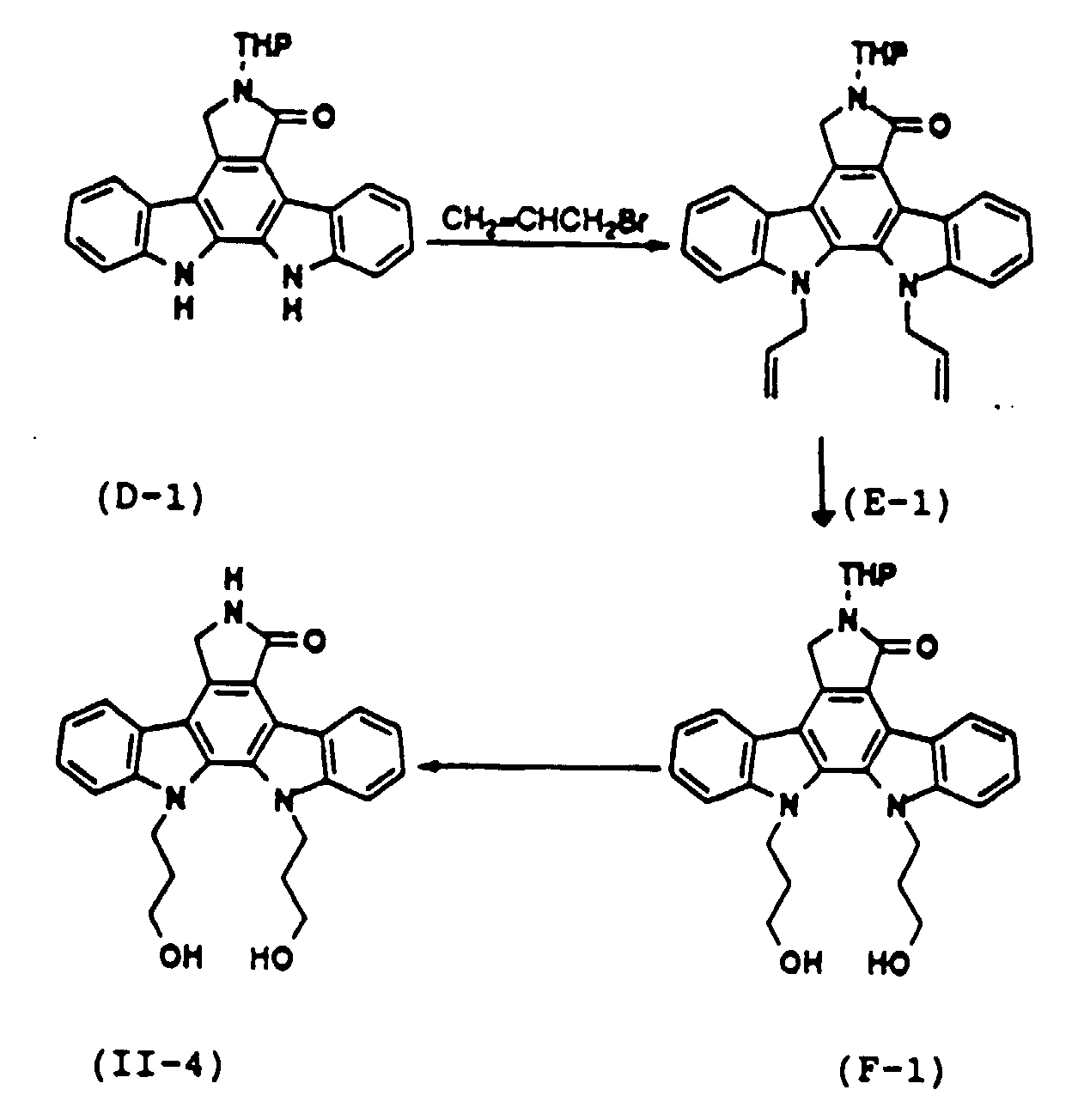
- Compound (V) can be prepared by the following reaction steps, which are illustrated in Fig. 6. (In the formulae, THP represents tetrahydropyranyl; one of R 19 and R 20 is hydrogen and the other is allyl, or both of them are allyl.)
- the starting compound (M) is disclosed in J. Chem. Soc. Perkin Trans. I, 2475 (1990).
- Compound (P) can be obtained by reaction of Compound (M) with 1 to 1.5 equivalents of allyl bromide in the presence of 1 to 1.5 equivalents of a base.
- a base is an alkali metal hydride such as sodium hydride.
- dimethylformamide or the like is used as a reaction solvent. The reaction is completed in 1 to 5 hours at -10 to 10°C.
- Compound (V) can be obtained by treatment of Compound (P) with 4 to 50 ml/mmol of an aqueous solution of an acid.
- An example of the aqueous solution of an acid is 2M H 2 SO 4 .
- As a reaction solvent tetrahydrofuran or the like is used. The reaction is completed in 5 to 24 hours at 50 to 100°C.
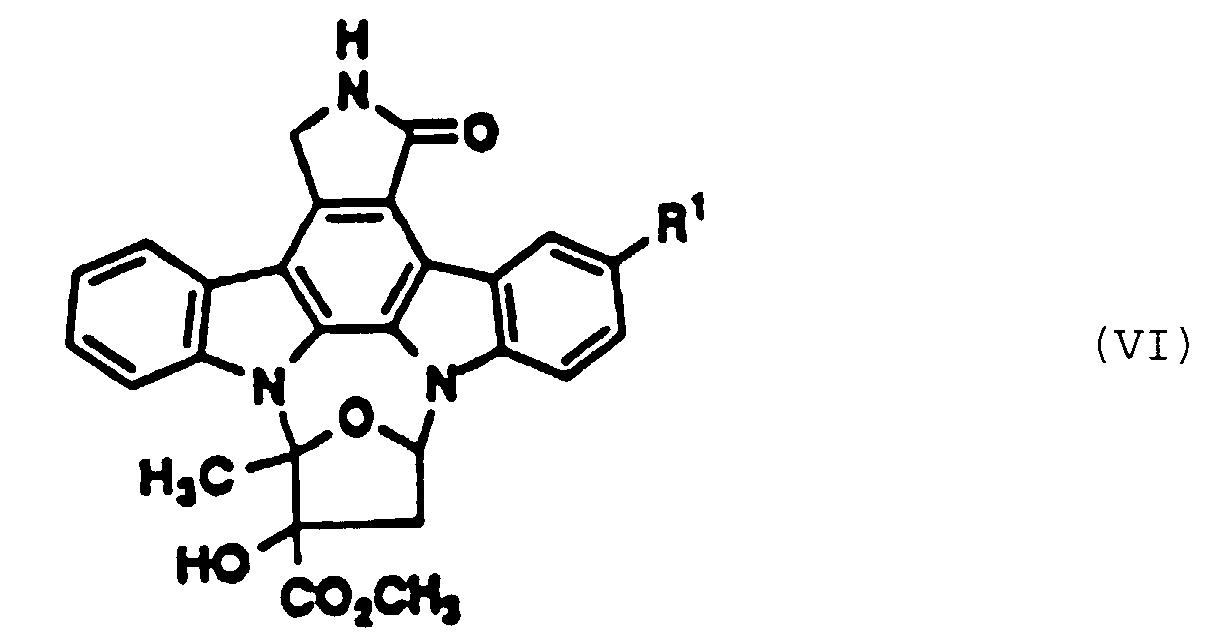
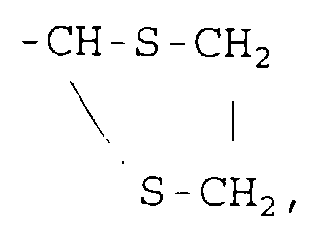
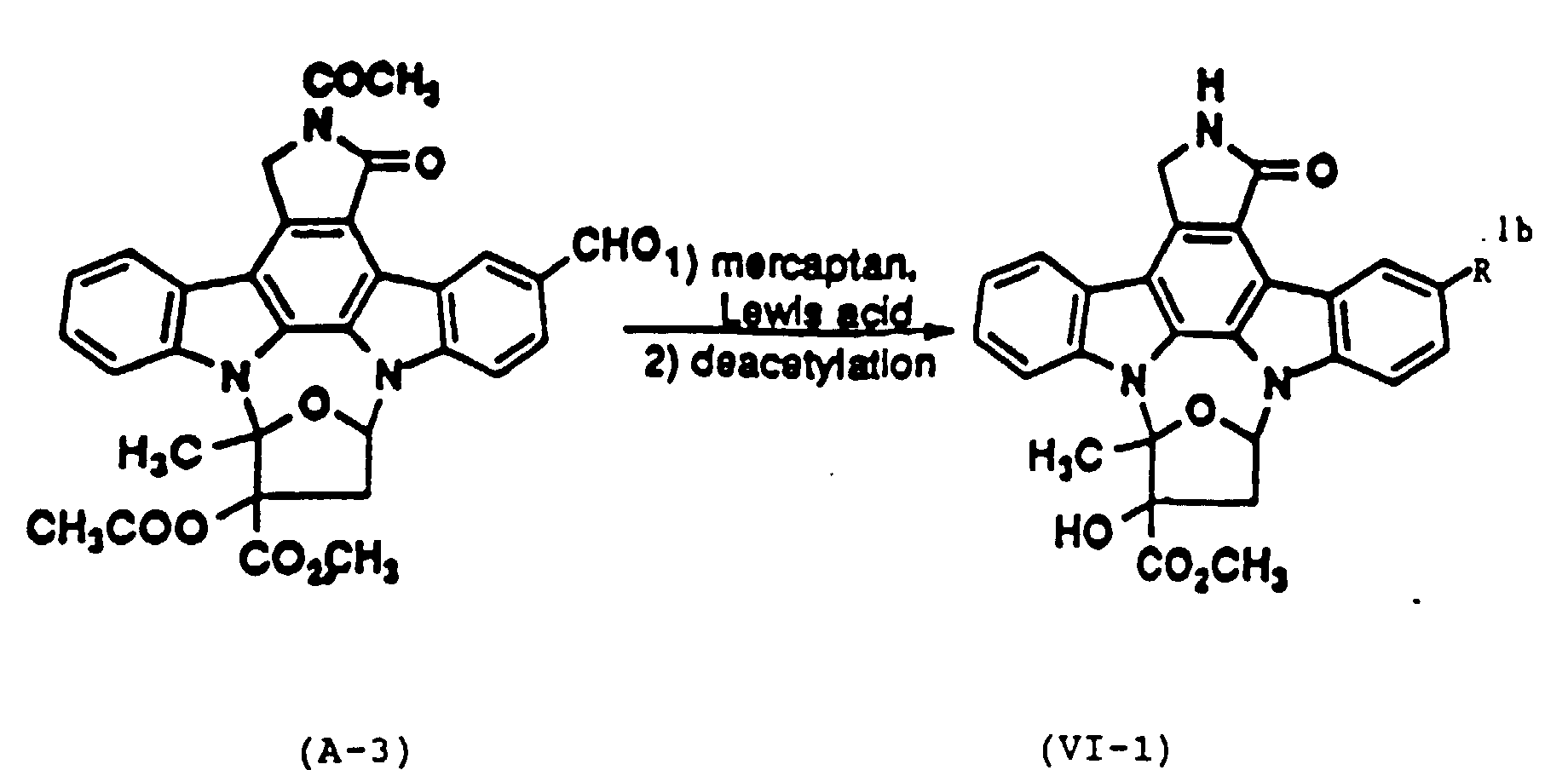
- Compound (VI-1) [Compound VI in which R 1 is CH(SC 6 H 5 ) 2 or CH(-SCH 2 CH 2 S-)] can be prepared by the following reaction step: [In the formulae, R 1b represents CH(SC 6 H 5 ) 2 or CH(-SCH 2 CH 2 S-).]
- the starting compound (A-3) is disclosed in Japanese Published Unexamined Patent Application No. 295588/88.
- N,O-Diacetylated Compound (VI-1) can be obtained by reaction of Compound (A-3) with 1 to 10 equivalents of a corresponding mercaptan in the presence of a Lewis acid in an inert solvent.
- a Lewis acid is boron trifluoride ether complex.
- An example of the inert solvent is dichloroethane. The reaction is completed in 1 to 24 hours at 0°C to room temperature.
- Compound (VI-1) can be obtained by hydrolysis of N,O-diacetylated Compound (VI-1) with 1 to 5 equivalents of an alkali metal alkoxide.
- alkali metal alkoxide sodium methoxide and potassium ethoxide.
- a reaction solvent chloroform, methanol, a mixture thereof, or the like is used. The reaction is completed in 0.1 to 24 hours at 0 to 50°C.
- Compound (VI-2) [Compound (VI) in which R 1 is CH 2 SR 24 ] can be prepared by the following reaction step: (In the formulae, R 1c represents CH 2 SR 24 .)
- N,O-Diacetylated Compound (VI-2) can be obtained by reaction of Compound (A-3) with 1 to 10 equivalents of a corresponding mercaptan in the presence of an acid in an inert solvent.
- An example of the acid is ( ⁇ )-10-camphorsulfonic acid.
- the inert solvent chloroform, methanol, a mixture thereof, or the like is used. The reaction is completed in 1 to 48 hours at 0 to 50°C.
- Compound (VI-2) can be obtained by hydrolysis of N,O-diacetylated Compound (VI-2) with 1 to 5 equivalents of an alkali metal alkoxide.
- alkali metal alkoxide sodium methoxide and potassium ethoxide.
- chloroform, methanol, a mixture thereof, or the like is used as a reaction solvent. The reaction is completed in 0.1 to 24 hours at 0 to 50°C.
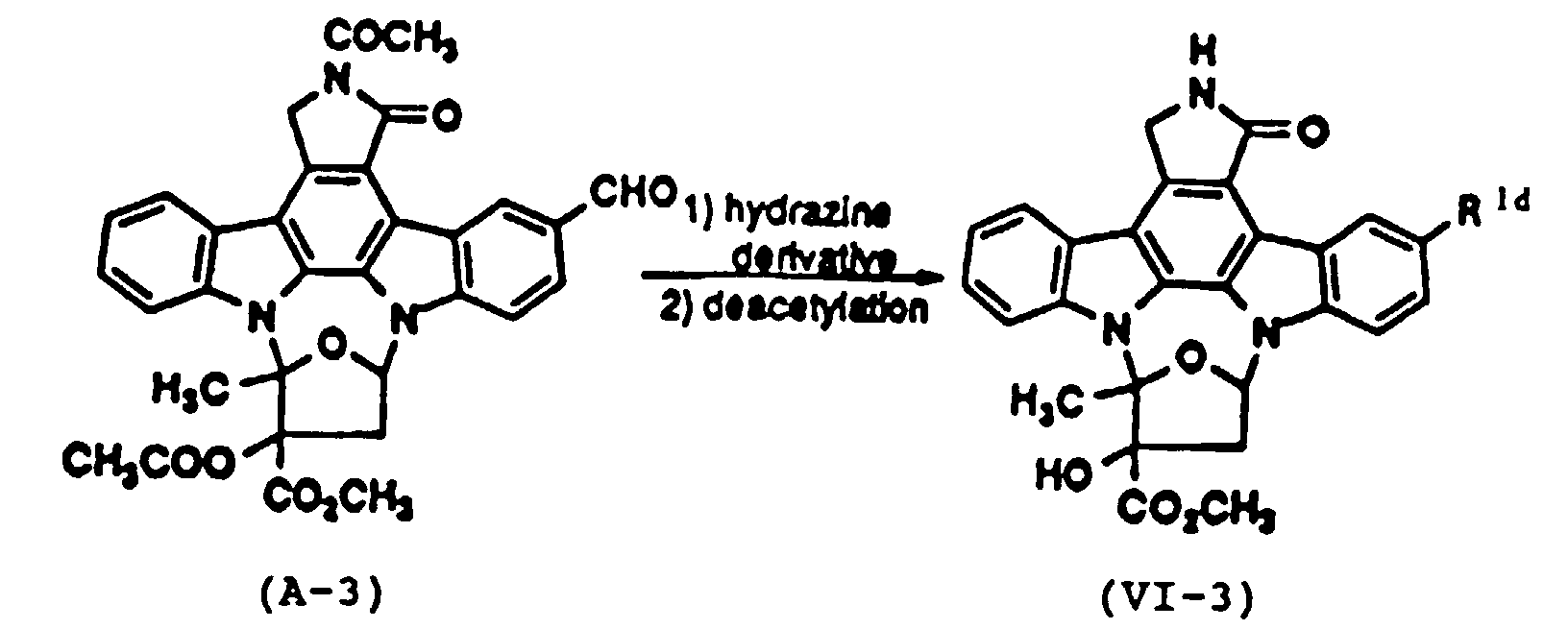
- N,O-Diacetylated Compound (VI-3) can be obtained by reaction of Compound (A-3) with 1 to 10 equivalents of a corresponding hydrazine derivative in the presence of an acid in an inert solvent.
- An example of the acid is hydrochloric acid.
- the inert solvent chloroform, methanol, tetrahydrofuran, water, a mixture thereof, or the like is used. The reaction is completed in 1 to 48 hours at 0 to 50°C.
- N,O-diacetylated Compound (VI-3) may be obtained by reaction of Compound (A-3) with 1 to 10 equivalents of an acid addition salt of the corresponding hydrazine derivative in an inert solvent.
- the acid are hydrochloric acid and sulfuric acid.
- the inert solvent chloroform, methanol, tetrahydrofuran, water, a mixture thereof, or the like is used. The reaction is completed in 1 to 48 hours at 0 to 50°C.
- Compound (VI-3) can be obtained by hydrolysis of N,O-diacetylated Compound (VI-3) with 1 to 5 equivalents of an alkali metal alkoxide.
- alkali metal alkoxide ar sodium methoxide and potassium ethoxide.
- chloroform, methanol, a mixture thereof, or the like is used as a reaction solvent. The reaction is completed in 0.1 to 24 hours at 0 to 50°C.
- I-1 can be prepared de novo by chemical synthesis using methods known to those skilled in the art, and by the following procedures, all of which are hereby incorporated by reference.
- procedures used for preparation of Compound I are described by Murakata et al (U.S. Patent 4,923,986), hereby incorporated by reference.
- Procedures used for preparation of Compound II are described by Moody et al., J. Org. Chem. 57: 2105-2114 (1992); Steglich et al., Angew. Chem. Int. Ed. Engl. 19: 459-460 (1980); Nakanishi et al., J. Antibiotics 39: 1066-1071 (1986); and Japanese Patent Application No.
- compositions can be formulated into pharmaceutical compositions by admixture with pharmaceutically acceptable nontoxic excipients and carriers.
- pharmaceutically acceptable nontoxic excipients and carriers can be prepared for use in parenteral administration, particularly in the form of liquid solutions or suspensions; for oral administration, particularly in the form of tablets or capsules; or intranasally, particularly in the form of powders, nasal drops, or aerosols.
- compositions can conveniently be administered in unit dosage form and can be prepared by any of the methods well known in the pharmaceutical art, or example, as described in Remington's Pharmaceutical Sciences (Mack Pub. Co., Easton, PA, 1980).
- Formulations for parenteral administration can contain as common excipients sterile water or saline, polyalkylene glycols such as polyethylene glycol, oils of vegetable origin, hydrogenated naphthalenes and the like.
- biocompatible, biodegradable lactide polymer, lactide/glycolide copolymer, or ployoxyethylene-polyoxypropylene copolymers can be useful excipients to control the release of the active compounds.
- parenteral delivery systems for these active compounds include ethylene-vinyl acetate copolymer particles, osmotic pumps, implantable infusion systems, and liposomes.
- Formulations for inhalation administration contain as excipients, for example, lactose, or can be aqueous solutions containing, for example, polyoxyethylene-9-lauryl ether, glycocholate and deoxycholate, or oily solutions for administration in the form of nasal drops, or as a gel to be applied intranasally.
- Formulations for parenteral administration can also include glycocholate for buccal administration, methoxysalicylate for rectal administration, or citric acid for vaginal administration.
- concentrations of the compounds described herein in a therapeutic composition will vary depending upon a number of factors, including the dosage of the drug to be administered, the chemical characteristics (e.g., hydrophobicity) of the compounds employed, and the route of administration.
- the compounds of this invention can be provided in an aqueous physiological buffer solution containing about 0.1 to 10% w/v compound for parenteral administration. Typical dose ranges are from about 1 ⁇ g/kg to about 1 g/kg of body weight per day; a preferred dose range is from about 0.01 mg/kg to 100 mg/kg of body weight per day.
- the preferred dosage of drug to be administered is likely to depend on such variables as the type and extent of progression of the prostate disease, the overall health status of the particular patient, the relative biological efficacy of the compound selected, the formulation of the compound excipients, and its route of administration.
Landscapes
- Chemical & Material Sciences (AREA)
- Health & Medical Sciences (AREA)
- Organic Chemistry (AREA)
- General Health & Medical Sciences (AREA)
- Life Sciences & Earth Sciences (AREA)
- Medicinal Chemistry (AREA)
- Veterinary Medicine (AREA)
- Pharmacology & Pharmacy (AREA)
- Animal Behavior & Ethology (AREA)
- Public Health (AREA)
- Engineering & Computer Science (AREA)
- Nuclear Medicine, Radiotherapy & Molecular Imaging (AREA)
- General Chemical & Material Sciences (AREA)
- Chemical Kinetics & Catalysis (AREA)
- Genetics & Genomics (AREA)
- Epidemiology (AREA)
- Biochemistry (AREA)
- Biotechnology (AREA)
- Bioinformatics & Cheminformatics (AREA)
- Molecular Biology (AREA)
- Urology & Nephrology (AREA)
- Endocrinology (AREA)
- Reproductive Health (AREA)
- Pharmaceuticals Containing Other Organic And Inorganic Compounds (AREA)
- Nitrogen And Oxygen Or Sulfur-Condensed Heterocyclic Ring Systems (AREA)
- Nitrogen Condensed Heterocyclic Rings (AREA)
Abstract
Description

CO2CH3; CH=NNHCONH2; CONHOH; CH=NOH;
CH=NNHC(=NH)NH2 ;


and R2, R5 and R6 are H; or R1 is CH=NNR22R23 (wherein R22 and R23, are each independently H, alkyl of 1-3 carbons, C(=NH)NH2, or a nitrogen atom containing heterocyclic group selected from pyrrolyl, pyranyl, thiopyranyl, pyridyl, thiazolyl, imidazolyl, pyrimidyl, triazinyl, indolyl, quinolyl, purinyl and benzothiazolyl, or R22 and R23 are combined together to form a -(CH2)4-, -(CH2CH2OCH2CH2)-, or -(CH2CH2N(CH3)CH2CH2)- bridging group, with the proviso that R22 and R23 cannot both be H, and at least one of R22 or R23 is H except when both are alkyl or when they together form a bridging group), and R2, R5 and R6 are H;
or





| Compound | trk 100 nM | trk 500 nM |
| I-1 | + | + |
| I-2 | + | NT |
| 1-3 | + | NT |
| I-4 | + | + |
| I-5 | + | NT |
| 1-6 | + | NT |
| 1-7 | + | NT |
| I-8 | - | + |
| I-9 | + | NT |
| I-10 | + | NT |
| I-11 | + | NT |
| I-12 | + | NT |
| I-13 | + | + |
| I-14 | + | NT |
| I-15 | + | NT |
| I-16 | + | NT |
| I-17 | - | + |
| I-18 | + | NT |
| I-19 | + | NT |
| I-20 | - | + |
| I-21 | - | + |
| I-22 | + | NT |
| I-23 | - | + |
| I-24 | + | NT |
| I-25 | + | NT |
| I-26 | + | NT |
| I-27 | - | + |
| I-28 | + | NT |
| I-29 | - | + |
| I-30 | - | + |
| I-31 | + | NT |
| I-32 | + | NT |
| I-33 | - | + |
| I-34 | - | + |
| I-35 | + | + |
| I-36 | + | NT |
| I-37 | + | NT |
| I-38 | + | NT |
| I-39 | + | NT |
| I-40 | + | NT |
| I-41 | + | + |
| I-42 | + | + |
| I-43 | - | + |
| I-44 | - | + |
| I-52 | + | NT |
| I-53 | + | NT |
| I-54 | + | NT |
| I-55 | + | NT |
| I-56 | NT | + |
| I-57 | + | NT |
| I-58 | - | + |
| I-59 | - | + |
| I-60 | - | + |
| I-61 | - | + |
| I-62 | + | + |
| I-63 | - | + |
| I-64 | - | + |
| I-65 | - | + |
| I-66 | - | + |
| I-67 | + | + |
| I-68 | - | + |
| I-69 | + | + |
| I-70 | + | + |
| I-71 | - | + |
| I-72 | - | + |
| I-73 | + | + |
| I-74 | + | + |
| I-75 | NT | + |
| I-76 | NT | + |
| II-1 | - | + |
| II-2 | - | + |
| II-4 | NT | + |
| NT : Not Tested (+) : Inhibited phosphorylation; (-) : Did not inhibit phosphorylation |
| Compound | Tsu-Pr1 IC50(µM) | Du-Pro1 IC50(µM) | PC-3 IC50(µM) | DU-145 C50(µM) |
| I-12 | 0.038 | 0.31 | 0.69 | 0.75 |
| 1-5 | 0.07 | 0.06 | NT | 0.08 |
| 1-19 | 0.07 | 0.27 | 5.0 | 0.11 |
| 1-42 | 0.09 | NT | NT | NT |
| I-1 | 0.21 | 0.75 | 3.4 | 1.2 |
| 1-16 | 0.21 | NT | NT | NT |
| 1-15 | 0.51 | NT | NT | NT |
| 1-8 | 0.54 | NT | NT | NT |
| 1-22 | 0.69 | NT | NT | NT |
| 1-20 | 5.7 | NT | NT | NT |
| cmp700 | 2.7 | >5 | 7.6 | 3.1 |
| cmp783 | 1.1 | 3.1 | 11 | 1.7 |
| EFFECT OF COMPOUNDS I-1, I-12 AND Cmp700 ON BODY WEIGHTS AND THE WEIGHT OF PROSTATE GLANDS | |||||
| Treatment | Body Weight (g) | Ventral Prostate (mg) | Dorsal Prostate (mg) | Seminal Vesicles (mg) | Coagulating Glands (mg) |
| TEPBS | 31.5 ± 0.8 | 11.3 ± 0.6 | 9.8 ± 1.6 | 75.0 ± 5.0 | 25.1 ± 1.6 |
| I-1-1 mg/kg | 32.2 ± 0.6 | 7.6 ± 0.9 | 6.2 ± 1.3 | 61.4 ± 4.1 | 18.2 ± 2.4 |
| I-1-10 mg/kg | 30.0 ± 0.6 | 8.6 ± 0.8 | 6.7 ± 0.7 | 66.4 ± 5.6 | 18.5 ± 1.4 |
| Cmp700-1 mg/kg | 30.3 ± 0.7 | 11.1 ± 0.8 | 11.2 ± 1.2 | 57.9 ± 3.9 | 23.4 ± 2.4 |
| Cmp700-10 mg/kg | 30.2 ± 0.7 | 11.0 ± 0.6 | 9.6 ± 1.2 | 88.1 ± 4.9 | 19.4 ± 2.9 |
| I-12-1 mg/kg | 32.8 ± 0.4 | 6.2 ± 0.4 | 4.7 ± 0.4 | 54.3 ± 1.5 | 18.0 ± 2.4 |
| I-12-10 mg/kg | 29.5 ± 1.0 | 8.4 ± 0.8a | 8.6 ± 1.1 | 55.3 ± 2.2 | 17.6 ± 1.0 |
| EFFECT OF COMPOUND I-1, Cmp700, AND COMPOUND 1-12 ON THE WEIGHT OF PERIPHERAL ORGANS | ||||||
| Treatment | Stomach (mg) | Heart (mg) | Lung (mg) | Testes (mg) | Kidney (mg) | Liver (mg) |
| TEPBS | 294 ± 22 | 171 ± 8.4 | 230 ± 15.9 | 202 ± 6 | 576 ± 22 | 1937 ± 75 |
| 1-1 1 mg/kg | 288 ± 10 | 164 ± 6.4 | 229 ± 8.02 | 216 ± 6 | 598 ± 19 | 1921 ± 81 |
| I-1 10 mg/kg | 295 ± 30 | 152 ± 6.58 | 263 ± 14.8 | 204 ± 11 | 550 ± 18 | 1765 ± 50 |
| Cmp700 1 mg/kg | 277 ± 17 | 167 ± 7.06 | 280 ± 17.9 | 205 ± 8 | 561 ± 25 | 2011 ± 88 |
| Cmp700 10 mg/kg | 341 ± 25 | 164 ± 7.28 | 312 ± 18.4 | 218 ± 13 | 596 ± 21 | 2072 ± 106 |
| I-12 1 mg/kg | 329 ± 28 | 179 ± 8.78 | 244 ± 15.1 | 191 ± 12 | 591 ± 16 | 2120 ± 54 |
| I-12 10 mg/kg | 270 ± 19 | 152 ± 9.60 | 253 ± 20.9 | 187 ± 5 | 552 ± 29 | 1886 ± 84 |
| EFFECT OF COMPOUND I-19 ON BODY WEIGHTS AND THE WEIGHTS OF PROSTATE GLANDS | |||||
| Treatment | Body Weight (g) | Ventral Prostate (mg) | Dorsal Prostate (mg) | Seminal Vesicles (mg) | Coagulat-ing Glands (mg) |
| TEPBS | 32.0 ± 0.6 | 14.0 ± 0.8 | 14.6 ± 1 4 | 71.4 ± 2.4 | 29.6 ± 2.0 |
| I-19 1 mg/kg | 31.9 ± 0.8 | 11.0 ± 0.9 | 10.4 ± 0.9 | 60.0 ± 2.2 | 24.6 ± 1.4 |
| I-19 10 mg/kg | 31.2 ± 0.5 | 10.5 ± 0.6 | 7.2 ± 0.8 | 52.0 ± 2.0 | 23.6 ± 0.8 |
| EFFECT OF COMPOUND I-19 ON THE WEIGHT OF PERIPHERAL ORGANS | ||||||
| Treatment | Stomach (mg) | Heart (mg) | Lung (mg) | Testes (mg) | Kidney (mg) | Liver (mg) |
| TEPBS | 272 ± 14 | 170 ± 10 | 280 ± 15 | 206 ± 8 | 589 ± 34 | 2004 ± 69 |
| I-19 1mg/kg | 252 ± 12 | 160 ± 20 | 323 ± 16 | 205 ± 7 | 467 ± 18 | 1968 ± 58 |
| 1-19 10mg/kg | 242 ± 11 | 166 ± 8 | 276 ± 18 | 208 ± 8 | 563 ± 17 | 1933 ± 70 |
| Efficacy of Compounds I-19 and I-5 in Inhibiting the Growth of Dunning R-3327 AT-2.1 Prostate Tumor in Adult Male Copenhagen Rats | |||||
| Treatment group | Tumor volume (cm3) at indicated days of | ||||
| Day | |||||
| 0 | | Day 8 | Day 13 | Day 16 | |
| Vehicle only (control) | 2.73±0.50 | 6.66±1.48 | 21.0±3.0 | 37.3±4.0 | 58.7±5.0 |
| I-19 10 mg/kg/day | 2.62±0.53 | 5.52±1.10 | 11.3±1.8 | 22.4±2.7 | 28.4±5.1 |
| I-5 3 mg/kg/day | 2.70±1.06 | 5.64±1.32 | 10.7±2.9 | 19.8±5.6 | 24.6±6.2 |
1H-NMR (DMSO-d6) δ (ppm) : 2.00(1H, dd, J=5.1, 14.0Hz), 2.22(3H, s), 5.01(2H, s), 7.10(1H, dd, J-5.7, 7.0Hz), 7.26-8.08(6H, m), 8.65(1H, s), 9.36(1H, d, J-2Hz)
1H-NMR (DMSO-d6) δ (ppm) : 1.66(3H, s), 2.48(3H, s), 5.02(2H, s), 7.16-8.08(7H, m), 8.69(1H, s), 9.34 (1H, d, J=2Hz)
1H-NMR (DMSO-d6) δ (ppm): 2.018(1H, dd, J=4.6, 13.7Hz), 2.183(3H, s), 4.985(1H, d, J=17.0Hz), 5.054(1H, d, J=17.1Hz), 6.308(1H, s), 7.057(1H, dd, J=4.9, 7.5Hz), 7.353-8.092(8H, m), 8.696(1H, s), 9.385(1H, d, J=2.lHz) SIMS (m/z): 531 (M+1)+
1H-NMR (CDCl3) δ (ppm): 1.16(3H, t, J-7.3Hz), 1.800(3H, s), 2.150(1H, dd, J-5.1, 14.5Hz), 2.282(3H, s), 2.849(3H, s), 3.273(1H, m), 3.978(1H, dd, J=7.5, 14.5Hz), 4.011(3H, s), 5.355(2H, brs), 5.406(1H, d, J=17.4Hz), 5.449(1H, d, J=17.4Hz), 7.007(1H, dd, J=5.1, 7.4Hz), 7.427-8.098(6H, m), 9.245(1H, s)
FAB-MS (m/z): 652 (M)+
1H-NMR (CDCl3) δ (ppm): 1.103(3H, t, J=7.2Hz), 2.163(3H, s), 2.282(1H, dd, J=5.0, 14.3Hz), 3.184(2H, q, J=7.2Hz), 3.288(1H, dd, J=7.5, 14.3Hz), 4.023(3H, s), 4.866(1H, d, J=17.0Hz), 4.937(1H, d, J=16.9Hz), 5.230(2H, s), 6.856(1H, dd, J=5.0, 7.5Hz), 7.306-7.882(6H, m), 9.148(1H, s)
FAB-MS (m/z):569 (M+1)+
1H-NMR (CDCl3) δ (ppm):1.783(3H, s), 2.125(1H, dd, J=5.0, 14.6Hz), 2.269(3H, s), 2.810(3H, s), 3.828 (3H, s), 3.965(1H, dd, J-7.4, 14.6Hz), 4.007(3H, s), 5.357(1H, d, J=17.8Hz), 5.403(1H, d, J=17.6Hz), 6.963(1H, dd, J=4.9, 7.6Hz), 7.411-8.071(6H, m), 8.944(1H, d, J=2.0Hz)
1H-NMR (DMSO-d6) δ (ppm): 1.999(1H, dd, J=4.6, 13.9Hz), 2.146(3H, s), 3.373(1H, dd, J=7.7, 14.2Hz), 3.688 (3H, s), 3.924(3H, s), 4.959(1H, d, J=17.6Hz), 5.020(1H, d, J=17.6Hz), 6.311(1H, s), 7.081(1H, dd, J=5.0,7.0Hz), 7.333-8.052(6H, m), 8.553(1H, s)
FAB-MS (m/z): 541 (M+1)+
1H-NMR (DMSO-d6) δ (ppm) : 1.918(1H, dd, J=4.9, 5.1Hz), 2.140(3H, s), 3.149(1H, dd, J+7.3, 7.6Hz), 3.728-3.836(2H, m), 5.009(1H, d, J=17.8Hz), 5.070(1H, d, J=17.5Hz), 5.144(1H, t, J=5.1Hz), 5.439(1H, s), 6.994(1H, dd, J=4.9, 7.5Hz), 7.573-8.184(5H, m), 8.701(1H, s), 9.387(1H, d, J=2.2Hz)
FAB-MS (m/z): 598 (M+1)+
1H-NMR (DMSO-d6) δ (ppm): 2.009(1H, dd, J=4.7, 13.9Hz), 2.102(3H, s), 4.832(1H, t, J=5.5Hz), 5.004(1H, d, J=17.3Hz), 5.073(1H, d, J=17.3Hz), 6.509(1H, s), 7.055(1H, dd, J=4.7, 7.3Hz), 7.586-8.270(6H, m), 8.695(1H, s), 9.380(1H, d, J=2.2Hz)
FAB-MS (m/z): 655 (M+1)+
1H-NMR (DMSO-d6) δ (ppm): 1.051 (3H, t, J=7.2Hz), 1.964 (1H, dd, J=5.3, 13.5Hz), 2.145(3H, s), 2.959(1H, dd, J=7.6, 13.8Hz), 3.111(2H, m), 4.965(1H, d, J=17.4Hz), 5.031(1H, d, J=17.6Hz), 5.835(1H, s), 6.138(1H, t, J=5.7Hz), 6.265(1H, t, J=5.4Hz), 6.925 (1H, dd, J=5.4, 7.4Hz), 7.253-8.059(7H, m), 8.584 (1H, s), 9.200(1H, d, J=7.8Hz)
FAB-MS (m/z): 510 (M+1)+
1H-NMR (DMSO-d6) δ (ppm): 2.063(1H, dd, J=5.2, 13.4Hz), 2.180(3H, s), 2.999(1H, dd, J=7.3, 13.6Hz), 3.635-3.727(2H, m), 4.965(1H, d, J=17.1Hz), 5.043(1H, d, J=17.4Hz), 5.776(1H, s), 6.445(1H, dd, J=4.6, 6.6Hz), 6.928(1H, t, J=7.4Hz), 7.007(1H, dd, J=5.5, 7.3Hz), 7.243-8.074(11H, m), 8.583(1H, s), 8.830 (1H, s), 9.198(1H, d, J=7.8Hz)
FAB-MS (m/z): 558 (M+1)+
1H-NMR (DMSO-d6) δ (ppm): 2.012(3H, s), 2.137(1H, dd, J=5.2, 13.5Hz), 3.588(1H, dd, J=7.4, 13.2Hz), 4.973 (1H, d, J=17.3Hz), 5.031(1H, d, J=17.3Hz), 6.086 (1H, s), 6.885(1H, s), 7.105(1H, dd, J=5.4, 7.3Hz), 7.250-8.045(17H, m), 8.590(1H, s), 9.230(1H, d, J=7.8Hz)
FAB-MS (m/z): 604 (M+1)+
1H-NMR (CDCl3) δ (ppm): 2.211(3H, s), 2.661(1H, dd, J=5.7, 14.4Hz), 3.423(1H, dd, J=7.6, 14.5Hz), 3.537 (1H, d, J=13.0Hz), 3.734(1H, d, J=13.0Hz), 4.545 (1H, d, J=17.3Hz), 4.761(1H, d, J=17.3Hz), 6.568 (lH, dd, J=5.5, 7.4Hz), 7.091-8.003(12H, m), 8.736 (1H, d, J=7.9Hz)
FAB-MS (m/z): 532 (M+1)+
1H-NMR (CDCl3) δ (ppm): 2.326(3H, s), 2.401(1H, m), 3.339(1H, dd, J=7.4, 14.5Hz), 3.571(1H, d, J=14.9Hz), 4.130(1H, d, J-14.8Hz), 4.918(1H, d, J=16.6Hz), 5.002(1H, d, J=16.7Hz), 6.723(1H, dd, J=6.0, 7.4Hz), 7.173-8.468(11H, m), 9.177(1H, d, J=7.7Hz)
FAB-MS (m/z): 533 (M+1)1
1H-NMR (DMSO-d6) δ (ppm): 2.100(0.87H, s), 2.189(2.13H, s), 4.982(1H, d, J=18.OHz), 5.038(1H, d, J=17.9Hz), 6.056(0.71H, s), 6.337(0.29H, s), 7.145-8.073(12H, m), 8.583(1H, s), 9.200(0.29H, d, J=7.4Hz), 9.207 (0.71H, d, J=8.3Hz)
FAB-MS (m/z): 548 (M+1)+
1H-NMR (DMSO-d6) δ (ppm): 2.134(0.25H, s), 2.185(0.75H, s), 4.981(1H, d, J=7.9Hz), 5.040(1H, d, J=7.6Hz), 6.212(0.75H, s), 6.449(0.25H, s), 7.088-8.228(11H, m), 8.598(1H, s), 8.809(0.25H, m), 8.919(0.75H, m), 9.198(0.25H, d, J=7.2Hz), 9.213(0.75H, d, J=7.7Hz)
FAB-MS (m/z): 549 (M+1)+
1H-NMR (CDCl3+DMSO-d6; 9/1) δ (ppm): 2.20(3H, s), 4.90 (2H, brs), 6.84(1H, m), 7.12-8.00(7H, m), 9.20 (1H, d, J=8.0Hz) EI-MS (m/z): 448 (M)+
FAB-MS (m/z): 476 (M+1)+
FAB-MS (m/z): 436 (M+1)+
1H-NMR (DMSO-d6) δ (ppm): 4.965(2H, s), 5.067-5.371(8H, m), 6.080-6.211(2H, m), 7.276-8.051(7H, m), 8.571 (1H, s), 9.434(1H, d, J=7.8Hz)
FAB-MS (m/z): 392 (M+1)+.
1H-NMR (DMSO-d6) δ (ppm): 4.694(0.6H, d, J=17.1Hz), 4.755(0.4H, d, J=17.2Hz), 4.967(2H, s), 5.008-5.556 (3H, m), 6.145(1H, m), 7.219-8.278(7H, m), 8.463 (1H, s), 9.318 (0.4H, d, J=7.9Hz), 9.369(0.6H, d, J=7.9Hz)
FAB-MS (m/Z): 352 (M+1)+.
FAB-MS (m/z): 781 (M+1)+
1H-NMR (DMSO-d6) δ (ppm): 2.035(1H, dd, J=4.9, 14.1Hz), 2.135(3H, s), 3.921(3H, s), 4.982(1H, d, J=16.9Hz), 5.033(1H, d, J=17.1Hz), 6.231(1H, s), 6.348(1H, s), 7.096(1H, dd, J=4.9, 7.3Hz), 7.196-8.060(16H, m), 8.577(1H, s), 9.457(1H, d, J=1.9Hz)
FAB-MS (m/z): 698 (M+1)+
FAB-MS (m/z): 656 (M+1)+
1H-NMR (DMSO-d6) δ (ppm): 2.013(1H, dd, J=4.9, 14.0Hz), 2.148(3H, s), 3.590-3.641(2H, m), 3.925(3H, s), 4.984(1H, d, J=17.7Hz), 5.034(1H, d, J=17.7Hz), 5.931(1H, s), 6.331(1H, s), 7.113(1H, dd, J=5.0, 7.4Hz), 7.345-8.060(6H, m), 8.588(1H, s), 9.318(1H, d, J=1.5Hz)
FAB-MS (m/z): 572 (M+1)+
FAB-MS (m/z): 714 (M+1)+
1H-NMR (DMSO-d6) δ (ppm): 2.995(1H, dd, J=4.9, 14.1Hz), 2.139(3H, s), 3.914(3H, s), 4.779(2H, s), 4.979(1H, d, J=17.3Hz), 5.028(1H, d, J=17.3Hz), 6.342(1H, s), 7.101(1H, dd, J=4.9, 7.3Hz), 7.123-8.056(10H, m), 8.617(1H, s), 9.278(1H, m)
FAB-MS (m/z): 630 (M+1)+
FAB-MS (m/z): 678 (M+1)+
1H-NMR (CDCl3) δ (ppm): 2.209(3H, s) 2.607(1H, dd, J=4.9, 14.5Hz), 3.401(1H, dd, J=7.5, 14.5Hz), 3.671(2H, s), 3.857(2H, s), 4.103(3H, s), 4.532(1H, brs), 4.789(1H, d, J=16.1Hz), 4.873(1H, d, J=16.1Hz), 5.690(1H, s), 6.378(1H, dd, J=1.9, 3.2Hz), 6.416(1H, dd, J=0.6, 3.2Hz), 6.846(1H, dd, J=4.8, 7.5Hz), 7.334-7.932(7H, m), 8.961(1H, m)
FAB-MS (m/z): 593 (M)+
FAB-MS (m/z): 648 (M+1)+
1H-NMR (DMSO-d6 δ (ppm): 1.910-1.937(4H, m), 2.031(1H, dd, J=4.9, 14.1Hz), 2.142(3H, s), 2.329-2.635(4H, m), 3.395(1H, dd, J=7.3, 14.1Hz), 3.925(3H, s), 4.981(1H, d, J=17.0Hz), 5.030(1H, d, J=17.0Hz), 7.110(1H, dd, J=4.9, 7.3Hz), 7.345-8.057(6H, m), 7.425(1H, s), 8.596(1H, s), 9.210(1H, d, J=1.4Hz)
FAB-MS (m/z): 564 (M+1)+
FAB-MS (m/z): 671 (M+1)+
1H-NMR (DMSO-d6) δ (ppm): 2.039(1H, dd, J=5.0, 13.9Hz), 2.153 (3H,S), 3.418(1H, dd, J=7.2, 13.9 Hz) 3.933 (3H, s), 5.001(1H, d, J=17.5Hz), 5.057(1H, d, J=17.5Hz), 6.366(1H, s), 6.748(1H, m), 7.164(1H, dd, J=5.0, 7.2Hz), 7.301-8.120(9H, m), 8.242(1H, s), 8.656(1H, s), 9.368(1H, s), 10.738(1H, s)
FAB-MS (m/z): 587 (M+1)+
FAB-MS (m/z): 668 (M+1)+
1H-NMR (DMSO-d6) δ (ppm): 2.011(1H, dd, J=4.9, 14.1Hz), 2.142(9H, s), 2.460-2.584(4H, m), 3.404(1H, dd, J=7.3, 14.1Hz), 3.923(3H, s), 3.950(2H, s), 4.951-5.054(2H, m), 6.336(1H, s), 7.111(1H, dd, J=4.9, 7.3Hz), 7.338-8.060(6H, m), 8.595(1H, s), 9.137(1H, d, J=1.3Hz)
FAB-MS (m/z): 585 (M+1)+
FAB-MS (m/z): 665 (M+1)+
1H-NMR (DMSO-d6) δ (ppm): 2.006(1H, dd, J=4.9, 13.9Hz), 2.144(3H, s), 3.375(1H, dd, J=7.3, 13.9Hz), 3.921 (3H, s), 4.559(2H, brs), 4.977(1H, d, J=17.4Hz), 5.033(1H, d, J=17.4Hz), 6.332(1H, s), 7.106(1H, dd, J=4.9, 7.3Hz), 7.341-8.062(6H, m), 8.614(1H, s), 9.202(1H, d, J=1.5Hz)
FAB-MS (m/z): 581 (M+1)+
FAB-MS (m/z): 636 (M+1)+
1H-NMR (DMSO-d6) δ (ppm): 2.046(1H, dd, J=4.9, 14.2Hz), 2.148(3H, s), 3.406(1H, dd, J=7.5, 14.2Hz), 3.929 (3H, s), 4.988(1H, d, J=17.3Hz), 5.045(1H, d, J=17.3Hz), 5.637-6.129(4H, m), 6.350(1H, s), 7.156(1H, dd, J=4.9, 7.5Hz), 7.345-8.092(6H, m), 8.206 (1H, s), 8.603(1H, s), 9.271(1H, d, J=1.7Hz)
FAB-MS (m/z): 552(M+1)+
FAB-MS (m/z): 663 (M)+
1H-NMR (DMSO-d6) δ (ppm): 2.042(1H, dd, J=4.8, 14.3Hz), 2.144(3H, s), 3.139-3.163(4H, m), 3.404(1H, dd, J=7.5, 14.3Hz), 3.792-3.815(4H, m), 3.927(3H, s), 4.984(1H, d, J=17.3Hz), 5.040(1H, d, J=17.3Hz), 6.352(1H, s), 7.132(1H, dd, J=4.8, 7.5Hz), 7.344-8.065(6H, m), 7.897(1H, s), 8.610(1H, s), 9.316(1H, d, J=1.7Hz)
FAB-MS (m/z): 580 (M+1)+
FAB-MS (m/z): 622 (M+1)+
1H-NMR (DMSO-d6) δ (ppm): 2.037(1H, dd, J=5.0, 14.1Hz), 2.142(3H, s), 2.939(6H, s), 3.399(1H, dd, J=7.5, 14.1Hz), 3.926(3H, s), 4.981(1H, d, J=17.7Hz), 5.037(1H, d, J=17.7Hz), 6.342(1H, s), 7.118(1H, dd, J=5.0, 7.5Hz), 7.342-8.063(6H, m), 7.533(1H, s), 8.601(1H, s), 9.258(1H, s)
FAB-MS (m/z): 538 (M+1)+
1H-NMR (DMSO-d6) δ (ppm): 2.040(1H, dd, J=5.0, 14.0Hz), 2.144(3H, s), 2.268(3H, s), 2.553(4H, m), 3.167(4H, m), 3.401(1H, dd, J=7.2, 14.0Hz), 3.927(3H, s), 4.982(1H, d, J=17.1Hz), 5.038(1H, d, J=17.1Hz), 6.345(1H, s), 7.128(1H, dd, J=5.0, 7.2Hz), 7.343-8.065(6H, m), 7.827(1H, s), 8.609(1H, s), 9.299(1H, d, J=1.2Hz)
FAB-MS (m/z): 593 (M+1)+




1H-NMR (DMSO-d6/D2O = 10/1) δ (ppm): 1.40-2.32(7H, m), 2.22(3H, s), 2.64-3.24(3H, m), 3.40-4.20(3H, m), 5.04(2H, s), 7.10(1H, m), 7.30-8.20(7H, m), 8.96(1H, brs), 9.20(1H, d, J=8Hz)
SI-MS (m/z): 567 (M+1)+
1H-NMR (CDCl3/CD3OD=10/1) δ (ppm): 1.334-1.429(6H, m), 2.120, 2.136, 2.148, 2.157(3H, 4s), 3.270-3.372 (1H, m), 4.082(3H, s), 4.619-4.792(2H, m), 6.832 (1H, brs), 7.225-7.857(5H, m), 8.939(0.6H, d, J=7.6Hz), 8.997(0.4H, d, J=8.3Hz)
FAB-MS (m/z): 648 (M+1)+
FAB-MS (m/z): 675 (M+1)+
1H-NMR (CDCl3) δ (ppm): 2.160 (3H, s), 2.849(1H, dd, J=4.9, 14.4 Hz), 4.054(3H, s), 4.556(1H, d, J=12.9Hz), 4.622(1H, d, J=14.9Hz), 4.656(1H, d, J=12.7Hz), 4.734(1H, d, J=16.1Hz), 5.048(1H, brs), 5.352(1H, s), 6.807(1H, dd, J=2.6, 7.4 Hz), 7.000-7.949 (9H, m), 8.533-8.553 (1H, m), 8.918 (1H, d, J=1.2 Hz)
FAB-MS (m/z): 591 (M+1)+
FAB-MS (m/z) : 676 (M+1)+
1H-NMR (CDCl3) δ (ppm): 2.200(3H, s), 4.066(3H, s), 4.595(1H, d, J=13.2Hz), 4.657(1H, d, J=13.2Hz), 4.793(1H, d, J=17.1Hz), 4.892(1H, d, J=17.1Hz), 6.878(1H, dd, J=4.8, 7.4Hz), 6.987-7.920(7H, m), 8.583(2H, d, J=4.8Hz), 9.162(1H, s)
FAB-MS (m/z): 592 (M+1)+
1H-NMR (CDCl3) δ (ppm): 2.184(1.5H, s), 2.191(1.5H, s), 2.572(0.5H, dd, J=4.6, 14.4Hz), 2.609(0.5H, dd, J=4.5, 14.7Hz), 3.449(0.5H, dd, J=7.4, 11.6Hz), 3.485(0.5H, dd, J=7.7, 11.4Hz), 4.095(3H, s), 4.173 (0.5H, d, J=13.1Hz), 4.230(0.5H, d, J=13.2Hz), 4.485(0.5H, d, J=13.2Hz), 4.538(0.5H, d, J=12.9Hz), 4.588-4.828(3H, m), 5.582(0.5H, brs), 5.723(0.5H, brs), 6.819-6.873(1H, m), 7.227-7.894(9H, m), 8.371 (0.5H, s), 8.607(0.5H, s), 8.716-8.747(1H, m)
FAB-MS (m/z): 607 (M+1)+
1H-NMR (CDCl3) δ (ppm): 2.170(3H, s), 2.501(0.6H, dd, J=4.7, 14.6Hz), 2.564(0.4H, dd, J = 4.6, 14.5Hz), 3.410-3.487(1H, m), 4.076(1.2H, s), 4.082(1.8H, s), 4.326-4.765(5H, m), 5.682(0.4H, brs), 5.796(0.6H, brs), 6.788-6.834(1H, m), 7.203-7.877(7H, m), 8.267(1H, s), 8.736-8.751(2H, m)
FAB-MS (m/z): 608 (M+1)+
FAB-MS (m/z): 662 (M+1)+
1H-NMR (DMSO-D6) δ (ppm): 2.052(1H, dd, J=4.9, 14.0Hz), 2.150(3H, s), 3.933(3H, s), 4.995(1H, d, J=17.3Hz), 5.044(1H, d, J=17.3Hz), 6.372(1H, brs), 7.164(1H, dd, J=5.0, 7.2Hz), 7.353-8.166(6H, m), 8.213(1H, s), 8.619(1H, s), 9.214(1H, d, J=1.3Hz)
FAB-MS (m/z): 578 (M+1)+
1H-NMR (DMSO-d6) δ (ppm): 1.563-2.154(6H, m), 3.657(1H, m), 4.008(1H, m), 5.044-5.478(11H, m), 6.153(2H, m), 7.240-7.640(6H, m), 8.167(1H, d, J=7.8Hz), 9.415(1H, d, J=7.8Hz)
FAB-MS (m/z): 476 (M+1)+
1H-NMR (CDCl3) δ (ppm): 1.60-2.11(10H, m), 3.129(2H, t, J=5.9Hz), 3.192(2H, t, J=5.9Hz), 3.798(1H, dt, J=2.8, 11.7Hz), 4.09-4.15(1H, m), 4.723(2H, t, J=7.2Hz), 4.807(2H, t, J=7.2Hz), 4.943(1H, d, J=16.6Hz), 5.107(1H, d, J=16.6Hz), 5.652(1H, dd, J=2.4, 10.5Hz), 7.15-7.18(1H, m), 7.318(1H, ddd, J=1.1, 7.0, 8.0Hz), 7.35-7.39(1H, m), 7.461(1H, ddd, J=1.2, 6.8, 8.0Hz), 7.519(1H, dd, J=1.0, 8.0Hz), 7.610(1H, d, J=8.0Hz), 7.951(1H, d, J=8.0Hz), 9.490(1H, d, J=8.0Hz)
FAB-MS (m/z): 512 (M+1)+
1H-NMR (DMSO-d6) δ (ppm): 1.59-1.65(2H, m), 1.70-1.82(2H, m), 3.03-3.27(2H, m), 3.09-3.14(2H, m), 4.371(1H, t, J=5.0Hz), 4.419(1H, t, J=5.0Hz), 4.780(2H, t, J=7.3Hz), 4.818(2H, t, J=7.4Hz), 4.972(2H, s), 7.288(1H, ddd, J=0.8, 7.0, 7.8Hz), 7.370(1H, t, J=7.2Hz), 7.501(1H, ddd, J=1.2, 7.0, 8.2Hz), 7.563(1H, ddd, J=1.1, 7.2, 8.3Hz), 7.779(1H, d, J=8.3Hz), 7.848(1H, d, J=8.2Hz), 8.043(1H, d, J=7.2Hz), 9.412(1H, dd, J=0.8, 7.8Hz)
FAB-MS (m/z): 428 (M+1)+
Claims (6)
- The use of a compound of formula I(wherein either:
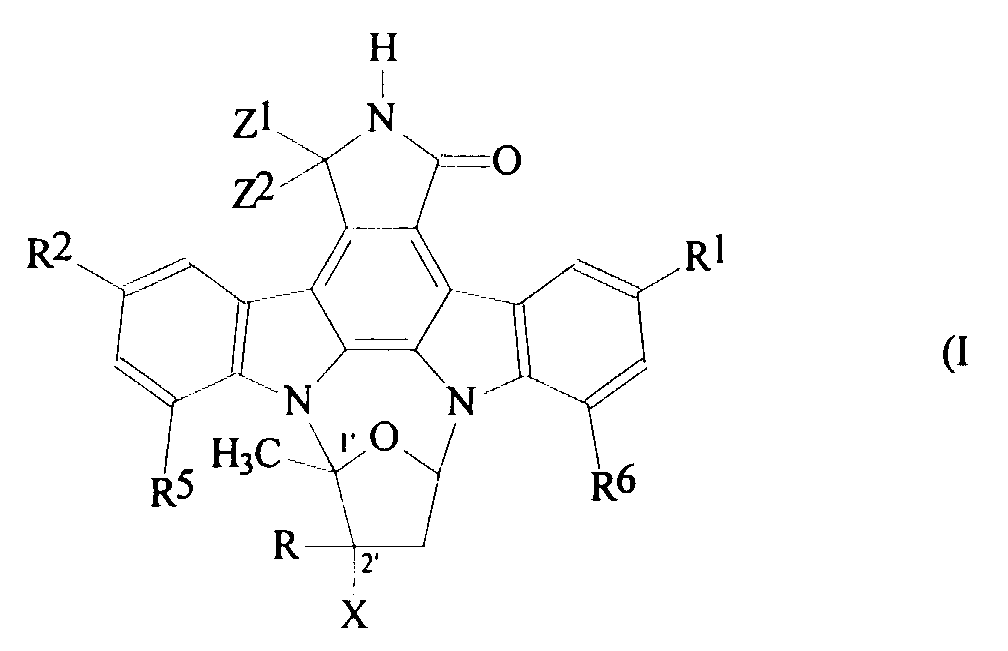 or:a) Z1 and Z2 are both hydrogen:1) R is selected from the group consisting of OH, O-n-alkyl of 1-6 carbons, and O-acyl of 2-6 carbons;2) X is selected from the group consisting of H; CH2Y (wherein Y is:CONR11R12 (wherein R11 and R12, independently, are H, alkyl of 1-6 carbons, C6H5, hydroxyalkyl of 1-6 carbons, or R11 and R12 are combined to form -CH2CH2OCH2-CH2-) ;OR7 (wherein R7 is H or acyl of 2-5 carbons);SOR8 (wherein R8 is alkyl of 1-3 carbons, C6-10 aryl, or a nitrogen atom containing heterocyclic group selected from pyrrolyl, pyranyl, thiopyranyl, pyridyl, thiazolyl, imidazolyl, pyrimidyl, triazinyl, indolyl, quinolyl, purinyl and benzothiazolyl);NR9R10 (wherein R9 and R10, independently, are H or alkyl of 1-3 carbons, or one of R9 and R10 is H or alkyl of 1-3 carbons and the other is Pro, Ser, Gly, Lys, or acyl of 2-5 carbons);SR16 (wherein R16 is a C6-10 aryl, alkyl of 1-3 carbons, or a nitrogen atom containing heterocyclic group selected from pyrrolyl, pyranyl, thiopyranyl, pyridyl, thiazolyl, imidazolyl, pyrimidyl, triazinyl, indolyl, quinolyl, purinyl and benzothiazolyl); N3; CO2CH3; or S-Glc);
CO2CH3; CH=NNHCONH2; CONHOH; CH=NOH;
CH=NNHC(=NH)NH2 ;CH=NN(R17)2 (wherein R17 represents C6-10 aryl) ; CH2NHCONHR18 (wherein R18 is a straight chain or branched C1-6 alkyl group or a C6-10 aryl group); or, where R1 and R2 are both hydrogen, X may also be CONHC6H5;or X and R are combined together to form -CH2NHCO2-, -CH2OC(CH3)2O-, =O, or -CH2N (CH3)CO2- ;3) R1, R2, R5 and R6, are each independently, H or up to two of them are F, Cl, Br, I, NO2, CN, OH, NHCONHR13 (wherein R13 is C6H5 or alkyl of 1-3 carbons with the proviso that only one of R1, R2, R5 and R6 is NHCONHR13), CH2OR13, alkyl of 1-3 carbons;
CH2OCONHR14, NHCO2R14 (in which R14 is a straight chain or branched C1-6 alkyl group), CH(SC6H5)2, oror R1 is CH2S(O)pR21 (where p=0 or 1 and R21 is aryl, alkyl of 1-3 carbons, CH2CH2N(CH3)2,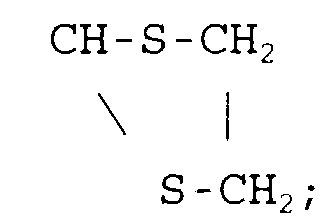 or a nitrogen atom containing heterocyclic group that includes a nitrogen atom and is selected from pyrrolyl, pyranyl, thiopyranyl, pyridyl, thiazolyl, imidazolyl, pyrimidyl, triazinyl, indolyl, quinolyl, purinyl and benzothiazolyl, and R2, R5 and R6 are H; or R1 is CH=NNR22R23 (wherein R22 and R23, are each independently, H, alkyl of 1-3 carbons, C(=NH)NH2, or a nitrogen atom containing heterocyclic group selected from pyrrolyl, pyranyl, thiopyranyl, pyridyl, thiazolyl, imidazolyl, pyrimidyl, triazinyl, indolyl, quinolyl, purinyl and benzothiazolyl, or R22 and R23 are combined together to form a -(CH2)4-, -(CH2CH2OCH2CH2)-, or-(CH2CH2N(CH3)CH2CH2)- bridging group, with the proviso that R22 and R23 cannot both be H, and at least one of R22 or R23 is H except when both are alkyl or when they together form a bridging group), and R2, R5 and R6 are H;
b) Z1 and Z2 are both combined together to represent O; X is CO2CH3; R is OH and R1, R2, R5 and R6 are each hydrogen)
or a pharmaceutically acceptable salt thereof for the manufacture of a medicament for use in the treatment of a pathological condition of the prostate gland. - The use of a compound of formula II(wherein:
 or a pharmaceutically acceptable salt thereof for the manufacture of a medicament for use in the treatment of a pathological condition of the prostate gland.a) R3 and R4 are each independently selected from the group consisting of H, alkyl of 1-6 carbons, hydroxyalkyl of 1-3 carbons, and alkenyl of 3-6 carbons, with the proviso that R3 and R4 are not both H; andb) Z1 and Z2 are both hydrogen; and R1, R2, R5 and R6 are each independently H or up to two of them are F, Cl, Br, I, NO2, CN, OH, NHCONHR13 (wherein R13 is C6H5 or alkyl of 1-3 carbons and with the proviso that only one of R1, R2, R5 and R6 is NHCONHR13), CH2OR13, alkyl of 1-3 carbons; CH2OCONHC2H5, or NHCO2CH3; orc) Z1 and Z2 are combined together to represent O, and R1, R2, R5 and R6 are each hydrogen)
 - Use as claimed in claim 1 of a compound of formula I-1, I-2, I-5, I-8, I-12, I-15, I-16, I-19, I-20, I-22 or I-42

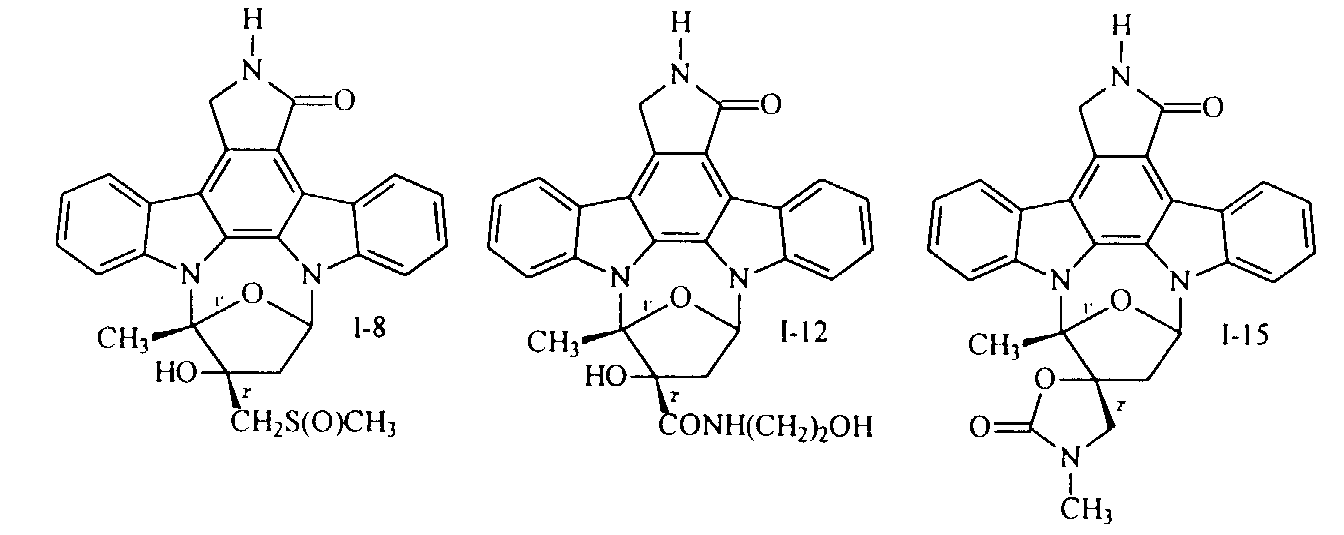
 or a salt thereof.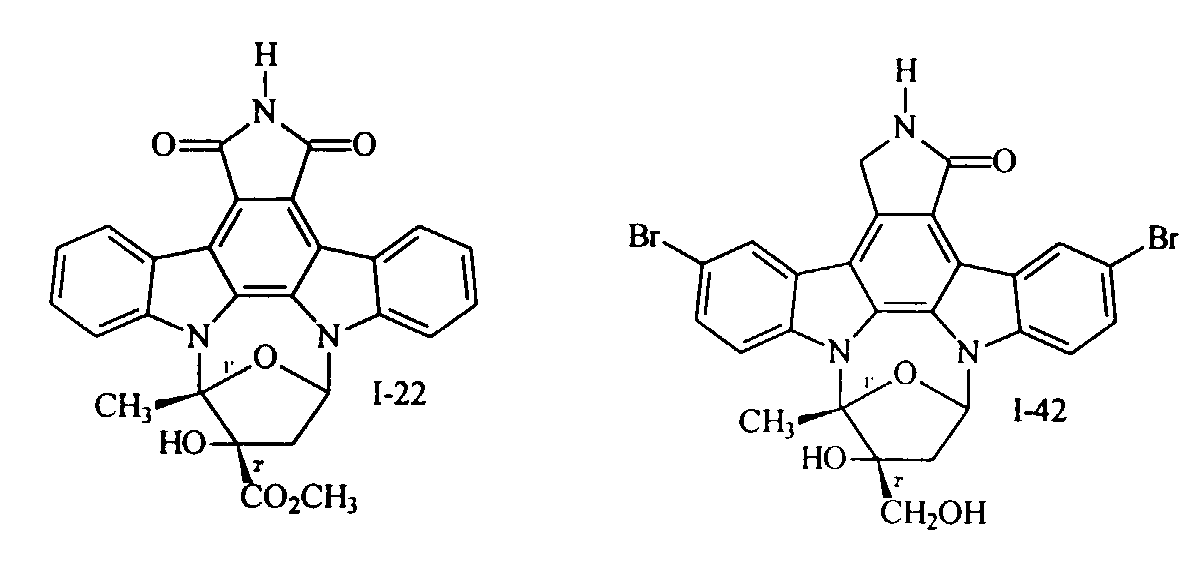
- Use as claimed in claim 1 of a compound of formula I-1, I-5, I-12, I-19, or I-42
 or a salt thereof.
- Use as claimed in claim 1 of a compound of formula I-2or a salt thereof.
- Use as claimed in any one of claims 1 to 5 for the manufacture of a medicament for use in the treatment of prostatic hypertrophy or prostatic cancer.
Priority Applications (1)
| Application Number | Priority Date | Filing Date | Title |
|---|---|---|---|
| EP98200023A EP0839814A3 (en) | 1993-05-28 | 1994-05-27 | Indolocarbazole derivatives and their use for the treatment of prostate gland disorders |
Applications Claiming Priority (5)
| Application Number | Priority Date | Filing Date | Title |
|---|---|---|---|
| US6917893A | 1993-05-28 | 1993-05-28 | |
| US9662293A | 1993-07-22 | 1993-07-22 | |
| US96622 | 1993-07-22 | ||
| PCT/US1994/006082 WO1994027982A1 (en) | 1993-05-28 | 1994-05-27 | Use of indolocarbazole derivatives to treat a pathological condition of the prostate |
| US69178 | 2005-03-01 |
Related Child Applications (1)
| Application Number | Title | Priority Date | Filing Date |
|---|---|---|---|
| EP98200023A Division EP0839814A3 (en) | 1993-05-28 | 1994-05-27 | Indolocarbazole derivatives and their use for the treatment of prostate gland disorders |
Publications (3)
| Publication Number | Publication Date |
|---|---|
| EP0699204A4 EP0699204A4 (en) | 1996-01-10 |
| EP0699204A1 EP0699204A1 (en) | 1996-03-06 |
| EP0699204B1 true EP0699204B1 (en) | 1998-04-15 |
Family
ID=26749764
Family Applications (2)
| Application Number | Title | Priority Date | Filing Date |
|---|---|---|---|
| EP94918168A Expired - Lifetime EP0699204B1 (en) | 1993-05-28 | 1994-05-27 | Use of indolocarbazole derivatives to treat a pathological condition of the prostate |
| EP98200023A Withdrawn EP0839814A3 (en) | 1993-05-28 | 1994-05-27 | Indolocarbazole derivatives and their use for the treatment of prostate gland disorders |
Family Applications After (1)
| Application Number | Title | Priority Date | Filing Date |
|---|---|---|---|
| EP98200023A Withdrawn EP0839814A3 (en) | 1993-05-28 | 1994-05-27 | Indolocarbazole derivatives and their use for the treatment of prostate gland disorders |
Country Status (14)
| Country | Link |
|---|---|
| US (2) | US5516771A (en) |
| EP (2) | EP0699204B1 (en) |
| JP (2) | JP3344586B2 (en) |
| KR (1) | KR100201343B1 (en) |
| AT (1) | ATE165097T1 (en) |
| AU (1) | AU679752B2 (en) |
| CA (1) | CA2163904C (en) |
| DE (1) | DE69409641T2 (en) |
| DK (1) | DK0699204T3 (en) |
| ES (1) | ES2118414T3 (en) |
| FI (2) | FI113537B (en) |
| NO (1) | NO306902B1 (en) |
| NZ (1) | NZ267337A (en) |
| WO (1) | WO1994027982A1 (en) |
Families Citing this family (31)
| Publication number | Priority date | Publication date | Assignee | Title |
|---|---|---|---|---|
| US5756494A (en) * | 1992-07-24 | 1998-05-26 | Cephalon, Inc. | Protein kinase inhibitors for treatment of neurological disorders |
| DE4243321A1 (en) * | 1992-12-21 | 1994-06-23 | Goedecke Ag | Amino acid derivatives of heterocycles as PKC inhibitors |
| ES2123873T3 (en) * | 1994-08-04 | 1999-01-16 | Hoffmann La Roche | PYROLLOCARBAZOLE. |
| US5650407A (en) * | 1995-04-05 | 1997-07-22 | Cephalon, Inc. | Selected soluble esters of hydroxyl-containing indolocarbazoles |
| US5686444A (en) | 1995-04-05 | 1997-11-11 | Cephalon, Inc. | Selected soluble esters of hydroxyl-containing indolocarbazoles |
| US6676935B2 (en) | 1995-06-27 | 2004-01-13 | Cell Genesys, Inc. | Tissue specific adenoviral vectors |
| US6197293B1 (en) | 1997-03-03 | 2001-03-06 | Calydon, Inc. | Adenovirus vectors specific for cells expressing androgen receptor and methods of use thereof |
| US5808060A (en) * | 1995-12-11 | 1998-09-15 | Cephalon, Inc. | Fused isoindolones |
| BR9710706A (en) * | 1996-05-01 | 1999-08-17 | Lilly Co Eli | Therapeutic treatment for vegf-related diseases |
| UA67725C2 (en) | 1996-06-03 | 2004-07-15 | Cephalon Inc | K-252a derivatives and a method for improvement of functioning and cell survival enhancement |
| US6875865B1 (en) | 1996-06-03 | 2005-04-05 | Cephalon, Inc. | Selected derivatives of K-252a |
| BR9710693A (en) | 1996-06-25 | 2000-01-11 | Cephalon Inc | Use of a k-252a derivative for the treatment of the central or peripheral nerve and overproduction of cytoquinone. |
| EA002525B1 (en) * | 1997-08-15 | 2002-06-27 | Сефалон Инк. | Combination of tyrosine kinase inhibitor and chemical castration to treat prostate cancer |
| DK1044203T3 (en) | 1997-12-31 | 2003-07-14 | Cephalon Inc | 3'-epimeric K-252a derivatives |
| US6127401A (en) | 1998-06-05 | 2000-10-03 | Cephalon, Inc. | Bridged indenopyrrolocarbazoles |
| US6013646A (en) | 1998-07-02 | 2000-01-11 | Bayer Corporation | Indolocarbazole derivatives useful for the treatment of neurodegenerative diseases and cancer |
| US6200968B1 (en) * | 1998-08-06 | 2001-03-13 | Cephalon, Inc. | Particle-forming compositions containing fused pyrrolocarbazoles |
| US7795246B2 (en) * | 1998-08-06 | 2010-09-14 | Cephalon, Inc. | Particle-forming compositions containing fused pyrrolocarbazoles |
| CN1329034C (en) | 1998-09-25 | 2007-08-01 | 赛福伦公司 | Method for preventing/treating damage to sensory hair cells and cochlear neurons |
| ATE406907T1 (en) * | 1998-10-28 | 2008-09-15 | Cornell Res Foundation Inc | METHODS FOR REGULATION OF ANGIOGENESIS AND VASCULAR INTEGRITY USING TRK RECEPTOR LIGANDS BDNF, NT-3 AND NT-4 |
| US6841567B1 (en) * | 1999-02-12 | 2005-01-11 | Cephalon, Inc. | Cyclic substituted fused pyrrolocarbazoles and isoindolones |
| WO2001010440A1 (en) * | 1999-08-09 | 2001-02-15 | Trustees Of Dartmouth College | COMPOSITIONS AND METHODS TO ENHANCE CANCER CHEMOTHERAPY IN p53 DEFECTIVE TUMORS |
| US6399780B1 (en) * | 1999-08-20 | 2002-06-04 | Cephalon, Inc. | Isomeric fused pyrrolocarbazoles and isoindolones |
| US7129250B2 (en) | 2000-05-19 | 2006-10-31 | Aegera Therapeutics Inc. | Neuroprotective and anti-proliferative compounds |
| AR035971A1 (en) * | 2001-05-16 | 2004-07-28 | Cephalon Inc | METHODS FOR THE TREATMENT AND PREVENTION OF PAIN |
| IL144583A0 (en) * | 2001-07-26 | 2002-05-23 | Peptor Ltd | Chimeric protein kinase inhibitors |
| IL156429A0 (en) * | 2003-06-12 | 2004-01-04 | Peptor Ltd | Cell permeable conjugates of peptides for inhibition of protein kinases |
| CN101283275A (en) | 2005-10-11 | 2008-10-08 | 默克专利有限公司 | EGFR-dependent regulation of chemokine expression and its impact on tumor diagnosis and treatment and its side effects |
| US20080021013A1 (en) * | 2006-07-21 | 2008-01-24 | Cephalon, Inc. | JAK inhibitors for treatment of myeloproliferative disorders |
| US20090155352A1 (en) * | 2007-11-20 | 2009-06-18 | Cephalon, Inc. | Microemulsion containing indolocarbazole compound and dosage forms containing the same |
| AU2013362134B2 (en) | 2012-12-21 | 2018-07-05 | Sykehuset Sorlandet Hf | EGFR targeted therapy of neurological disorders and pain |
Family Cites Families (14)
| Publication number | Priority date | Publication date | Assignee | Title |
|---|---|---|---|---|
| JPS62155285A (en) * | 1985-12-27 | 1987-07-10 | Kyowa Hakko Kogyo Co Ltd | Physiologically active substance k-252 derivative |
| JPS62155284A (en) * | 1985-12-27 | 1987-07-10 | Kyowa Hakko Kogyo Co Ltd | Physiologically active substance k-252 derivative |
| JPS62240689A (en) * | 1986-04-07 | 1987-10-21 | Meiji Seika Kaisha Ltd | Sf-2370 substance derivative and production thereof |
| JPH0826037B2 (en) * | 1987-01-22 | 1996-03-13 | 協和醗酵工業株式会社 | Derivatives of physiologically active substance K-252 |
| JPH0826036B2 (en) * | 1987-01-22 | 1996-03-13 | 協和醗酵工業株式会社 | Derivatives of physiologically active substance K-252 |
| US4923986A (en) * | 1987-03-09 | 1990-05-08 | Kyowa Hakko Kogyo Co., Ltd. | Derivatives of physiologically active substance K-252 |
| JPH07113027B2 (en) * | 1987-12-24 | 1995-12-06 | 協和醗酵工業株式会社 | K-252 derivative |
| DE3803620A1 (en) * | 1988-02-06 | 1989-08-17 | Goedecke Ag | INDOLOCARBAZOL DERIVATIVES, METHOD FOR THE PRODUCTION THEREOF AND MEDICINAL PRODUCTS CONTAINING THE SAME |
| US5073633A (en) * | 1989-03-23 | 1991-12-17 | Bristol-Myers Company | BMY-41950 antitumor antibiotic |
| DE3924538A1 (en) * | 1989-07-25 | 1991-01-31 | Goedecke Ag | INDOLOCARBAZOL AND THEIR USE |
| CA2112799A1 (en) * | 1991-07-03 | 1993-01-21 | Stephen P. Squinto | Method and assay system for neurotrophin activity |
| WO1993008809A1 (en) * | 1991-11-08 | 1993-05-13 | The University Of Southern California | Compositions containing k-252 compounds for potentiation of neurotrophin activity |
| US6271242B1 (en) * | 1992-02-10 | 2001-08-07 | Bristol-Myers Squibb Co. | Method for treating cancer using a tyrosine protein kinase inhibitor |
| US5461146A (en) * | 1992-07-24 | 1995-10-24 | Cephalon, Inc. | Selected protein kinase inhibitors for the treatment of neurological disorders |
-
1994
- 1994-05-27 EP EP94918168A patent/EP0699204B1/en not_active Expired - Lifetime
- 1994-05-27 WO PCT/US1994/006082 patent/WO1994027982A1/en not_active Ceased
- 1994-05-27 DK DK94918168T patent/DK0699204T3/en active
- 1994-05-27 DE DE69409641T patent/DE69409641T2/en not_active Expired - Lifetime
- 1994-05-27 CA CA002163904A patent/CA2163904C/en not_active Expired - Fee Related
- 1994-05-27 EP EP98200023A patent/EP0839814A3/en not_active Withdrawn
- 1994-05-27 NZ NZ267337A patent/NZ267337A/en not_active IP Right Cessation
- 1994-05-27 JP JP50102695A patent/JP3344586B2/en not_active Expired - Fee Related
- 1994-05-27 AT AT94918168T patent/ATE165097T1/en not_active IP Right Cessation
- 1994-05-27 AU AU69607/94A patent/AU679752B2/en not_active Ceased
- 1994-05-27 KR KR1019950705338A patent/KR100201343B1/en not_active Expired - Fee Related
- 1994-05-27 US US08/250,175 patent/US5516771A/en not_active Expired - Lifetime
- 1994-05-27 ES ES94918168T patent/ES2118414T3/en not_active Expired - Lifetime
-
1995
- 1995-06-05 US US08/463,680 patent/US5654427A/en not_active Expired - Lifetime
- 1995-11-27 NO NO954816A patent/NO306902B1/en not_active IP Right Cessation
- 1995-11-27 FI FI955709A patent/FI113537B/en not_active IP Right Cessation
-
2002
- 2002-05-27 JP JP2002153049A patent/JP3727613B2/en not_active Expired - Fee Related
-
2003
- 2003-10-16 FI FI20031516A patent/FI114864B/en not_active IP Right Cessation
Non-Patent Citations (2)
| Title |
|---|
| Cancer Research 51:4693-4700 (1991) * |
| Seminars in Oncology 15:371-389 (1989) * |
Also Published As
| Publication number | Publication date |
|---|---|
| CA2163904C (en) | 2000-01-25 |
| JP3344586B2 (en) | 2002-11-11 |
| NO954816L (en) | 1996-01-26 |
| WO1994027982A1 (en) | 1994-12-08 |
| FI114864B (en) | 2005-01-14 |
| NO954816D0 (en) | 1995-11-27 |
| EP0699204A4 (en) | 1996-01-10 |
| DK0699204T3 (en) | 1999-02-22 |
| AU6960794A (en) | 1994-12-20 |
| EP0839814A2 (en) | 1998-05-06 |
| JP2002504064A (en) | 2002-02-05 |
| KR100201343B1 (en) | 1999-06-15 |
| DE69409641T2 (en) | 1998-11-26 |
| EP0839814A3 (en) | 1998-09-16 |
| NO306902B1 (en) | 2000-01-10 |
| US5654427A (en) | 1997-08-05 |
| FI955709L (en) | 1996-01-03 |
| DE69409641D1 (en) | 1998-05-20 |
| JP2002356487A (en) | 2002-12-13 |
| FI20031516A7 (en) | 2003-10-16 |
| FI113537B (en) | 2004-05-14 |
| EP0699204A1 (en) | 1996-03-06 |
| JP3727613B2 (en) | 2005-12-14 |
| KR960702838A (en) | 1996-05-23 |
| AU679752B2 (en) | 1997-07-10 |
| NZ267337A (en) | 2005-01-28 |
| CA2163904A1 (en) | 1994-12-08 |
| US5516771A (en) | 1996-05-14 |
| ATE165097T1 (en) | 1998-05-15 |
| ES2118414T3 (en) | 1998-09-16 |
| FI955709A0 (en) | 1995-11-27 |
Similar Documents
| Publication | Publication Date | Title |
|---|---|---|
| US5516771A (en) | Use of indolocarbazole derivatives to treat a pathological condition of the prostate | |
| DE69310178T2 (en) | K-252a DERIVATIVES | |
| JP4094950B2 (en) | Indole derivatives and their use as 5-HT2B and 5-HT2C receptor ligands | |
| US6172060B1 (en) | Nitrosated and nitrosylated phosphodiesterase inhibitor compounds, compositions and their uses | |
| Utsugi et al. | Antitumor activity of a novel podophyllotoxin derivative (TOP-53) against lung cancer and lung metastatic cancer | |
| JP3943126B2 (en) | K-252a derivative with enhanced neurotrophin-inducing activity | |
| CN108290864B (en) | A kind of protein kinase inhibitor and its preparation method and medical use | |
| JP4047723B2 (en) | Indoline derivatives and their use as 5-HT2 receptor ligands | |
| EP0788501B1 (en) | Protein kinase inhibitors for treatment of neurological disorders | |
| JP2020090553A (en) | Heterobifunctional inhibitors of E-selectin and CXCR4 chemokine receptors | |
| CN111406063B (en) | Cyclic dinucleotides as anticancer agents | |
| CN102821602A (en) | Fatty acid fumarate derivatives and their uses | |
| CN107530353A (en) | MELK three ring kinase inhibitors and application method | |
| TW201836606A (en) | Combination use of mor agonist and kor agonist in the preparation of a medicament for the remission and/or treatment of pain | |
| WO2019109937A1 (en) | Use of kor agonist in combination with mor agonist in preparing drug for treating pain | |
| EP2836493B1 (en) | Functionalized thieno-indole derivatives for the treatment of cancer | |
| CN111566113B (en) | Macrocyclic compounds and uses thereof | |
| CN115715201A (en) | Glucose triptolide conjugate and application thereof | |
| US8791117B2 (en) | Cyclic glycyl-2-allyl proline improves cognitive performance in impaired animals | |
| US20030232827A1 (en) | Therapeutic compounds | |
| WO2022105636A1 (en) | Spiro compound, pharmaceutical composition containing same, and use thereof | |
| HK1010543A (en) | Indolocarbazole derivatives and their use for the treatment of prostate gland disorders | |
| JPH09183725A (en) | Cancer treating agent | |
| US11806351B2 (en) | Use of coenzyme factor for activation of ATP production in cell | |
| CN118047776A (en) | A tricyclic compound, a preparation method thereof, a pharmaceutical composition containing the same and its application |
Legal Events
| Date | Code | Title | Description |
|---|---|---|---|
| A4 | Supplementary search report drawn up and despatched | ||
| AK | Designated contracting states |
Kind code of ref document: A4 Designated state(s): AT BE CH DE DK ES FR GB GR IE IT LI LU NL PT SE |
|
| PUAI | Public reference made under article 153(3) epc to a published international application that has entered the european phase |
Free format text: ORIGINAL CODE: 0009012 |
|
| 17P | Request for examination filed |
Effective date: 19950725 |
|
| AK | Designated contracting states |
Kind code of ref document: A1 Designated state(s): AT BE CH DE DK ES FR GB GR IE IT LI LU NL PT SE |
|
| 17Q | First examination report despatched |
Effective date: 19960806 |
|
| GRAG | Despatch of communication of intention to grant |
Free format text: ORIGINAL CODE: EPIDOS AGRA |
|
| GRAG | Despatch of communication of intention to grant |
Free format text: ORIGINAL CODE: EPIDOS AGRA |
|
| GRAH | Despatch of communication of intention to grant a patent |
Free format text: ORIGINAL CODE: EPIDOS IGRA |
|
| GRAG | Despatch of communication of intention to grant |
Free format text: ORIGINAL CODE: EPIDOS AGRA |
|
| GRAH | Despatch of communication of intention to grant a patent |
Free format text: ORIGINAL CODE: EPIDOS IGRA |
|
| GRAA | (expected) grant |
Free format text: ORIGINAL CODE: 0009210 |
|
| AK | Designated contracting states |
Kind code of ref document: B1 Designated state(s): AT BE CH DE DK ES FR GB GR IE IT LI LU NL PT SE |
|
| REF | Corresponds to: |
Ref document number: 165097 Country of ref document: AT Date of ref document: 19980515 Kind code of ref document: T |
|
| REG | Reference to a national code |
Ref country code: CH Ref legal event code: EP |
|
| REF | Corresponds to: |
Ref document number: 69409641 Country of ref document: DE Date of ref document: 19980520 |
|
| ITF | It: translation for a ep patent filed | ||
| REG | Reference to a national code |
Ref country code: IE Ref legal event code: FG4D Free format text: 79851 |
|
| REG | Reference to a national code |
Ref country code: CH Ref legal event code: NV Representative=s name: A. BRAUN, BRAUN, HERITIER, ESCHMANN AG PATENTANWAE |
|
| ET | Fr: translation filed | ||
| REG | Reference to a national code |
Ref country code: ES Ref legal event code: FG2A Ref document number: 2118414 Country of ref document: ES Kind code of ref document: T3 |
|
| REG | Reference to a national code |
Ref country code: PT Ref legal event code: SC4A Free format text: AVAILABILITY OF NATIONAL TRANSLATION Effective date: 19980617 |
|
| PLBE | No opposition filed within time limit |
Free format text: ORIGINAL CODE: 0009261 |
|
| STAA | Information on the status of an ep patent application or granted ep patent |
Free format text: STATUS: NO OPPOSITION FILED WITHIN TIME LIMIT |
|
| REG | Reference to a national code |
Ref country code: DK Ref legal event code: T3 |
|
| 26N | No opposition filed | ||
| REG | Reference to a national code |
Ref country code: GB Ref legal event code: IF02 |
|
| REG | Reference to a national code |
Ref country code: CH Ref legal event code: PFA Owner name: CEPHALON, INC. Free format text: CEPHALON, INC.#145 BRANDYWINE PARKWAY#WEST CHESTER, PA 19380 (US) $ KYOWA HAKKO KOGYO CO., LTD.#OHTEMACHI BLDG., 6-1, OHTEMACHI 1-CHOME#CHIYODA-KU, TOKYO 100 (JP) -TRANSFER TO- CEPHALON, INC.#145 BRANDYWINE PARKWAY#WEST CHESTER, PA 19380 (US) $ KYOWA HAKKO KOGYO CO., LTD.#OHTEMACHI BLDG., 6-1, OHTEMACHI 1-CHOME#CHIYODA-KU, TOKYO 100 (JP) |
|
| PGFP | Annual fee paid to national office [announced via postgrant information from national office to epo] |
Ref country code: LU Payment date: 20080606 Year of fee payment: 15 Ref country code: DK Payment date: 20080528 Year of fee payment: 15 Ref country code: CH Payment date: 20080530 Year of fee payment: 15 |
|
| PGFP | Annual fee paid to national office [announced via postgrant information from national office to epo] |
Ref country code: BE Payment date: 20080624 Year of fee payment: 15 |
|
| PGFP | Annual fee paid to national office [announced via postgrant information from national office to epo] |
Ref country code: SE Payment date: 20080529 Year of fee payment: 15 Ref country code: NL Payment date: 20080524 Year of fee payment: 15 Ref country code: IE Payment date: 20080528 Year of fee payment: 15 |
|
| PGFP | Annual fee paid to national office [announced via postgrant information from national office to epo] |
Ref country code: PT Payment date: 20090512 Year of fee payment: 16 Ref country code: AT Payment date: 20090505 Year of fee payment: 16 |
|
| BERE | Be: lapsed |
Owner name: *KYOWA HAKKO KOGYO CO. LTD Effective date: 20090531 Owner name: *CEPHALON INC. Effective date: 20090531 |
|
| PGFP | Annual fee paid to national office [announced via postgrant information from national office to epo] |
Ref country code: GR Payment date: 20090430 Year of fee payment: 16 |
|
| REG | Reference to a national code |
Ref country code: CH Ref legal event code: PL |
|
| REG | Reference to a national code |
Ref country code: DK Ref legal event code: EBP |
|
| PG25 | Lapsed in a contracting state [announced via postgrant information from national office to epo] |
Ref country code: LI Free format text: LAPSE BECAUSE OF NON-PAYMENT OF DUE FEES Effective date: 20090531 Ref country code: CH Free format text: LAPSE BECAUSE OF NON-PAYMENT OF DUE FEES Effective date: 20090531 |
|
| NLV4 | Nl: lapsed or anulled due to non-payment of the annual fee |
Effective date: 20091201 |
|
| PG25 | Lapsed in a contracting state [announced via postgrant information from national office to epo] |
Ref country code: NL Free format text: LAPSE BECAUSE OF NON-PAYMENT OF DUE FEES Effective date: 20091201 |
|
| REG | Reference to a national code |
Ref country code: IE Ref legal event code: MM4A |
|
| PG25 | Lapsed in a contracting state [announced via postgrant information from national office to epo] |
Ref country code: IE Free format text: LAPSE BECAUSE OF NON-PAYMENT OF DUE FEES Effective date: 20090527 Ref country code: DK Free format text: LAPSE BECAUSE OF NON-PAYMENT OF DUE FEES Effective date: 20090531 |
|
| PG25 | Lapsed in a contracting state [announced via postgrant information from national office to epo] |
Ref country code: BE Free format text: LAPSE BECAUSE OF NON-PAYMENT OF DUE FEES Effective date: 20090531 |
|
| REG | Reference to a national code |
Ref country code: PT Ref legal event code: MM4A Free format text: LAPSE DUE TO NON-PAYMENT OF FEES Effective date: 20101129 |
|
| PG25 | Lapsed in a contracting state [announced via postgrant information from national office to epo] |
Ref country code: AT Free format text: LAPSE BECAUSE OF NON-PAYMENT OF DUE FEES Effective date: 20100527 |
|
| PG25 | Lapsed in a contracting state [announced via postgrant information from national office to epo] |
Ref country code: PT Free format text: LAPSE BECAUSE OF NON-PAYMENT OF DUE FEES Effective date: 20101129 |
|
| PG25 | Lapsed in a contracting state [announced via postgrant information from national office to epo] |
Ref country code: GR Free format text: LAPSE BECAUSE OF NON-PAYMENT OF DUE FEES Effective date: 20101202 |
|
| PG25 | Lapsed in a contracting state [announced via postgrant information from national office to epo] |
Ref country code: LU Free format text: LAPSE BECAUSE OF NON-PAYMENT OF DUE FEES Effective date: 20090527 |
|
| PG25 | Lapsed in a contracting state [announced via postgrant information from national office to epo] |
Ref country code: SE Free format text: LAPSE BECAUSE OF NON-PAYMENT OF DUE FEES Effective date: 20090528 |
|
| PGFP | Annual fee paid to national office [announced via postgrant information from national office to epo] |
Ref country code: ES Payment date: 20110526 Year of fee payment: 18 Ref country code: FR Payment date: 20110607 Year of fee payment: 18 |
|
| PGFP | Annual fee paid to national office [announced via postgrant information from national office to epo] |
Ref country code: GB Payment date: 20110525 Year of fee payment: 18 |
|
| PGFP | Annual fee paid to national office [announced via postgrant information from national office to epo] |
Ref country code: DE Payment date: 20110527 Year of fee payment: 18 Ref country code: IT Payment date: 20110526 Year of fee payment: 18 |
|
| GBPC | Gb: european patent ceased through non-payment of renewal fee |
Effective date: 20120527 |
|
| PG25 | Lapsed in a contracting state [announced via postgrant information from national office to epo] |
Ref country code: IT Free format text: LAPSE BECAUSE OF NON-PAYMENT OF DUE FEES Effective date: 20120527 |
|
| REG | Reference to a national code |
Ref country code: FR Ref legal event code: ST Effective date: 20130131 |
|
| REG | Reference to a national code |
Ref country code: DE Ref legal event code: R119 Ref document number: 69409641 Country of ref document: DE Effective date: 20121201 |
|
| PG25 | Lapsed in a contracting state [announced via postgrant information from national office to epo] |
Ref country code: GB Free format text: LAPSE BECAUSE OF NON-PAYMENT OF DUE FEES Effective date: 20120527 Ref country code: FR Free format text: LAPSE BECAUSE OF NON-PAYMENT OF DUE FEES Effective date: 20120531 |
|
| PG25 | Lapsed in a contracting state [announced via postgrant information from national office to epo] |
Ref country code: DE Free format text: LAPSE BECAUSE OF NON-PAYMENT OF DUE FEES Effective date: 20121201 |
|
| REG | Reference to a national code |
Ref country code: ES Ref legal event code: FD2A Effective date: 20130820 |
|
| PG25 | Lapsed in a contracting state [announced via postgrant information from national office to epo] |
Ref country code: ES Free format text: LAPSE BECAUSE OF NON-PAYMENT OF DUE FEES Effective date: 20120528 |