EP0699197B1 - 4-p-fluorobenzoyl-1-piperidinyl-propoxy-chromen-4-one derivatives, their preparation and their use in the treatment of psychosis and schizophrenia - Google Patents
4-p-fluorobenzoyl-1-piperidinyl-propoxy-chromen-4-one derivatives, their preparation and their use in the treatment of psychosis and schizophrenia Download PDFInfo
- Publication number
- EP0699197B1 EP0699197B1 EP95913143A EP95913143A EP0699197B1 EP 0699197 B1 EP0699197 B1 EP 0699197B1 EP 95913143 A EP95913143 A EP 95913143A EP 95913143 A EP95913143 A EP 95913143A EP 0699197 B1 EP0699197 B1 EP 0699197B1
- Authority
- EP
- European Patent Office
- Prior art keywords
- och
- chromen
- fluorobenzoyl
- piper
- propoxy
- Prior art date
- Legal status (The legal status is an assumption and is not a legal conclusion. Google has not performed a legal analysis and makes no representation as to the accuracy of the status listed.)
- Expired - Lifetime
Links
- 0 COc(cc1)cc(OC(*)=C2*)c1C2=O Chemical compound COc(cc1)cc(OC(*)=C2*)c1C2=O 0.000 description 3
- ARTIZDJMTIAXRE-UHFFFAOYSA-N CC(C(C=O)C=C1)C=C1F Chemical compound CC(C(C=O)C=C1)C=C1F ARTIZDJMTIAXRE-UHFFFAOYSA-N 0.000 description 1
Classifications
-
- C—CHEMISTRY; METALLURGY
- C07—ORGANIC CHEMISTRY
- C07D—HETEROCYCLIC COMPOUNDS
- C07D405/00—Heterocyclic compounds containing both one or more hetero rings having oxygen atoms as the only ring hetero atoms, and one or more rings having nitrogen as the only ring hetero atom
- C07D405/02—Heterocyclic compounds containing both one or more hetero rings having oxygen atoms as the only ring hetero atoms, and one or more rings having nitrogen as the only ring hetero atom containing two hetero rings
- C07D405/12—Heterocyclic compounds containing both one or more hetero rings having oxygen atoms as the only ring hetero atoms, and one or more rings having nitrogen as the only ring hetero atom containing two hetero rings linked by a chain containing hetero atoms as chain links
-
- A—HUMAN NECESSITIES
- A61—MEDICAL OR VETERINARY SCIENCE; HYGIENE
- A61P—SPECIFIC THERAPEUTIC ACTIVITY OF CHEMICAL COMPOUNDS OR MEDICINAL PREPARATIONS
- A61P25/00—Drugs for disorders of the nervous system
- A61P25/18—Antipsychotics, i.e. neuroleptics; Drugs for mania or schizophrenia
Definitions
- the present invention relates to new chromene compounds having the general formula (I): wherein R 1 and R 2 are hydrogen, alkyl having from 1 to 4 carbon atoms, halogen, trifluoromethyl, phenyl, or hydroxymethyl, as well as their pharmaceutically acceptable addtion salts.
- hydrochloride is preferred.
- Acetonitrile is appropriate as a nonpolar solvent, and as a base it is useful to employ an alkali metal carbonate or hydrogen carbonate.
- Potassium iodide can be used as a catalyst.
- the reaction occurs under heating, preferably at the boiling temperature of the mixture.
- Intermediate (II) can be purchased from commercial source. This reaction can be illustrated according to Scheme 1.
- the intermediates of the general formula (III) wherein X is chlorine, bromine or iodine and R 1 and R 2 are hydrogen, alkyl having from 1 to 4 carbon atoms, halogen, trifluoromethyl, phenyl, may be prepared, although not in a limitative manner, a) by alkylation of the corresponding 7-hydroxy-chromen-4-ones of general formula (IV) wherein R 1 and R 2 are as defined in (I) with 1-bromo-3-halopropane of general formula (V) wherein X is as defined in (III), or b) by cyclization from the corresponding 4-(3-halopropoxy)-2-hydroxyacetophenones of general formula (VI) wherein X is as defined in the preceding structure, all of this according to Scheme 2.
- [Y] is a halogenating agent which is able to introduce a chlorine, bromine or iodine atom, such as tert -butyl hypochlorite, chlorine, bromine or iodine.
- a chlorine, bromine or iodine atom such as tert -butyl hypochlorite, chlorine, bromine or iodine.
- the intermediates of the general formula (III) wherein X is chlorine, bromine or iodine, R 1 is hydrogen and R 2 is hydroxymethyl may be prepared through two steps from the 4'-(halopropoxy)-2'-hydroxy-acetophenones of general formula (VI) by alkylation in dimethylformamide with phosphoryl chloride followed by addition on ice and subsequent reduction of the so-formed 7-(3-halopropoxy)-3-formyl-chromen-4-ones of general formula (IX) wherein X is as defined in the preceding structures with sodium borohydride according to conventional procedures of organic chemistry as shown in Scheme 2'.
- the raw material required for performing the reactions shown in these schemes may be obtained either from commercial sources or according to conventional procedures of organic chemistry.
- EP Patent No. 546389 discloses substituted piperidyl-methyl chromanes as dopamine and serotonin receptor inhibitors which are potentially useful for treating CNS diseases, such as anxiety, depression, psychosis, Alzheimer's disease, etc.
- EP Patent No. 441506 discloses 3-piperidino-4-hydroxy-chromanes that can be used in the treatment of CNS diseases, such as stroke, Alzheimer's disease, Parkinson's disease and Huntington's disease.
- PCT Patent application No. 9012795 discloses substituted chromanes that are potentially useful for treating CNS diseases, such as aggressive behaviour, delirium and confusion, and impotence.
- 8702359 discloses aminoalcohols from the family of dihydrobenzothiophene and thiochromane having antihypertensive, antithrombotic, hypolipidemic, spasmolytic, calcium antagonist and neuroleptic actions.
- US Patent No. 4678787 discloses 4H-1-benzopyran-4-ones and their analogs containing sulfur, which are potentially useful to treat psychosis and schizophrenia.
- US Patent No. 4617314 discloses dihydrobenzofuranyl- and benzopyranyl-carboxamides having antidopamine, antiemetic and methamphetamine potentiating actions.
- EP-A-0 190 015 and J. Med. Chem. (1991), 34(1), P. 248-256 disclose 4H-1-benzopyran-4-ones and their sulfur containing analogues which are said to be efficient for the treatment of psychosis including schizophrenia.
- WO-A-91 18597 and J. Med. Chem. (1992), 35(9), p. 1526-1535 disclose compounds of the formula wherein A1, A2, A3, X, Y, and Z have specified meanings. The compounds are said to be useful to inhibit ⁇ binding site-induced activity.
- EP-A-0 064 255 discloses compounds which are 4-benzamidopiperidin-1-ylalkoxychromen-4-one derivatives which exhibit anti-allergenic, anti-anaphylactic activities.
- WO-A-90 06921 discloses inter alia compounds which are arylpiperidin-1-yl-1-alkoxychromen-4-one derivatives which show anti-thrombotic, anti-atherosclerotic activities.
- EP-A-0 558 245 discloses compounds which are 4-arylpiperidin-1-yl-alkoxychromen-4-one derivatives which show hypertensive activities.
- the compounds of formula (I) are different from the compounds disclosed in the aforesaid patents and prove not to be obvious in view of the prior art described in these patents.
- the compounds exhibit an interesting profile as neuroleptics as evidenced by both biochemical and pharmacological data.
- the biochemical tests revealed an intense action of these compounds on various receptors that are generally considered to be involved in the neuroleptic action ( ⁇ , D 2 5HT 2 receptors, B.L. Largent et al: "Eur. J. Pharmacol.”, 155 , 345-7, 1988; 5HT 1a receptors, B.A. McMillen et al: "Drug Dev.
- the compounds of this invention are characterized by a genuine neuroleptic profile, since advantageously their specificity over 5HT 2 receptors versus D 2 receptors according to D 2 /5HT 2 ratios is higher than that of haloperidol.
- the specificity of the compound of Ex. 1 over ⁇ receptors versus D 2 receptors is also higher than that of haloperidol and surpasses BMY-14802 and risperidone in D 2 /5HT 2 ratio.
- the compound is active on D 3 receptors in the same order as 7-OH-DPAT. All this confers potentially valuable properties on the compounds of this invention as neuroleptics, which are useful in psychosis and schizophrenia, and no extrapyramidal effects are attributed to their interaction with D 2 receptors.
- the neuroleptic activity of the compounds of this invention was confirmed in Animal Pharmacology by oral testing of the inhibition of p -chloro-amphetamine-induced hyperactivity (T.G. Heffner et al: "J.Pharmacol.Exp.Ther.”, 251 , 105, 1989), inhibition of apomorphine-induced hyperactivity (A. Puech et al: “Eur.J.Pharmacol.”, 50 , 291-300, 1978) and inhibition of apomorphine-induced climbing behaviour (P.Protais et al: "Psychopharmacology", 50 , 1-6, 1976).
- mice Male Swiss mice weighing 22-26 g were used. One week prior to experiment, animals were kept in our facilities at a temperature of 20-22°C and 12/12 h light-dark cycle, and had free access to food and water.
- the device consists of a top transparent cage for placing of animals and a lower command panel for starting and calibration of it, as well as a system for animal activity detection.
- mice Male Swiss mice weighing 22-26 g were used. One week prior to experiment, animals were kept in our facilities at a temperature of 20-22°C and 12/12 h light-dark cycle, and had free access to food and water.
- the device consists of a top transparent cage for placing of animals and a lower command panel for starting and calibration of it, as well as a system for animal activity detection.
- mice Male Swiss mice weighing 22-26 g were used. One week prior to experiment, animals were kept in our facilities at a temperature of 20-22°C and 12/12 h light-dark cycle, and had free access to food and water. Two hours prior to experiment, the animals were placed in individual cages without access to food.
- each animal was placed on the bottom of a small upright box (7.5x4.5 cm).
- the walls of the box were made of translucent methacrylate except one of the lateral surfaces (7.5 cm wide) which was a 3-mm wire mesh.
- the compounds of this invention are found to be potentially useful as neuroleptics for treating psychosis and schizophrenia.
- the compound of Example 1 7-[3-(4- p -fluorobenzoyl-1-piperidinyl)propoxy]-chromen-4-one hydrochloride
- the compound of Example 3 7-[3-(4- p -fluorobenzoyl-1-piperidinyl)propoxy]-3-methyl-chromen-4-one hydrochloride
- the compound of Example 4 3-Hydroxymethyl-7-[3-(4- p -fluorobenzoyl-1-piperidinyl)propoxy]chromen-4-one hydrochloride, are preferred.
- the compound of Example 1 was biochemically the most specific over 5HT 2 receptors versus D 2 receptors.
- the compound of Example 3 was very active in animal pharmacological tests and, moreover, its extrapyramidal effects were not very important; the oral administration of this compound to rats at a dose of 50 mg/kg (over 10 times ED 50 - Test C) caused catalepsy in only 60% of treated animals 3 hours after administration and inhibited stereotypy in only 23% of animals.
- the compound of Example 4 was also very active in animal pharmacological tests and did not show very important extrapyramidal effects either; in effect, in rat oral testing, it was necessary to administer a dose of 15 mg/kg of product so that catalepsy could occur in 50% of treated animals.
- IR (KBr): 3200-3600, 2930, 2300-2800, 2680. 1650, 1630, 1595, 1445, 1270, 1230 cm -1 .
- IR (KBr): 3200-3600, 2300-2800, 1680, 1650, 1630, 1595, 1445, 1270, 1230 cm -1 .
- composition for 1 ampoule 7-[3-(4- p -Fluorobenzoyl-1-piperidinyl)propoxy] chromen-4-one hydrochloride 5.0 mg Methyl p -hydroxybenzoate 1.0 mg Propyl p -hydroxybenzoate 0.1 mg Bidistilled water to volume 2.0 ml
- composition for 10 mg tablet 7-[3-(4- p -Fluorobenzoyl-1-piperidinyl)propoxy] chromen-4-one hydrochloride 10.0 mg Corn starch 43.2 mg Talc 6.0 mg Hydrogenated castor oil 2.0 mg Lactose to volume 200.0 mg
- composition for 50 mg tablet 7-[3-(4- p -Fluorobenzoyl-1-piperidinyl)propoxy] chromen-4-one hydrochloride 50.0 mg Corn starch 86.4 mg Talc 12.0 mg Hydrogenated castor oil 4.0 mg Lactose to volume 400.0 mg
Landscapes
- Organic Chemistry (AREA)
- Chemical & Material Sciences (AREA)
- Health & Medical Sciences (AREA)
- Engineering & Computer Science (AREA)
- Bioinformatics & Cheminformatics (AREA)
- Neurosurgery (AREA)
- General Health & Medical Sciences (AREA)
- Biomedical Technology (AREA)
- Chemical Kinetics & Catalysis (AREA)
- General Chemical & Material Sciences (AREA)
- Medicinal Chemistry (AREA)
- Nuclear Medicine, Radiotherapy & Molecular Imaging (AREA)
- Psychiatry (AREA)
- Pharmacology & Pharmacy (AREA)
- Life Sciences & Earth Sciences (AREA)
- Animal Behavior & Ethology (AREA)
- Neurology (AREA)
- Public Health (AREA)
- Veterinary Medicine (AREA)
- Pharmaceuticals Containing Other Organic And Inorganic Compounds (AREA)
- Plural Heterocyclic Compounds (AREA)
- Hydrogenated Pyridines (AREA)
- Transition And Organic Metals Composition Catalysts For Addition Polymerization (AREA)
- Nitrogen Condensed Heterocyclic Rings (AREA)
- Pyrane Compounds (AREA)
- Organic Low-Molecular-Weight Compounds And Preparation Thereof (AREA)
Abstract
Description
- The present invention relates to new chromene compounds having the general formula (I):wherein R1 and R2 are hydrogen, alkyl having from 1 to 4 carbon atoms, halogen, trifluoromethyl, phenyl, or hydroxymethyl, as well as their pharmaceutically acceptable addtion salts.

- Among the pharmaceutically acceptable salts, hydrochloride is preferred.
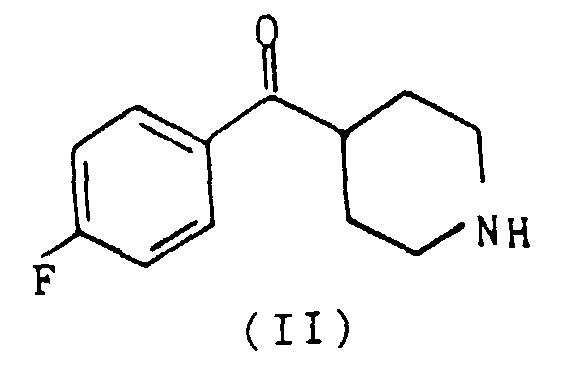
- The compounds of the general formula (I) are obtained according to Scheme I. In effect, the alkylation of 4-(p-fluorobenzoyl)piperidine (II) with a 7-(3-halopropoxy)chromen-4-one of general formula (III), wherein X is chlorine, bromine or iodine and R1 and R2 are as defined for (I), provides the compounds of the invention. The reaction occurs conveniently in a nonpolar solvent and in the presence of a base.
- Acetonitrile is appropriate as a nonpolar solvent, and as a base it is useful to employ an alkali metal carbonate or hydrogen carbonate. Potassium iodide can be used as a catalyst. The reaction occurs under heating, preferably at the boiling temperature of the mixture. Intermediate (II) can be purchased from commercial source. This reaction can be illustrated according to Scheme 1.

- The intermediates of the general formula (III) wherein X is chlorine, bromine or iodine and R1 and R2 are hydrogen, alkyl having from 1 to 4 carbon atoms, halogen, trifluoromethyl, phenyl, may be prepared, although not in a limitative manner, a) by alkylation of the corresponding 7-hydroxy-chromen-4-ones of general formula (IV) wherein R1 and R2 are as defined in (I) with 1-bromo-3-halopropane of general formula (V) wherein X is as defined in (III), or b) by cyclization from the corresponding 4-(3-halopropoxy)-2-hydroxyacetophenones of general formula (VI) wherein X is as defined in the preceding structure, all of this according to Scheme 2. In this scheme, [Y] is a halogenating agent which is able to introduce a chlorine, bromine or iodine atom, such as tert-butyl hypochlorite, chlorine, bromine or iodine. The spontaneous intramolecular cyclization of the intermediates of general formula (VIII) in the reaction medium leads to the intermediates of general formula (III) when R1 is hydrogen and R2 is as defined for Y.

- The intermediates of the general formula (III) wherein X is chlorine, bromine or iodine, R1 is hydrogen and R2 is hydroxymethyl may be prepared through two steps from the 4'-(halopropoxy)-2'-hydroxy-acetophenones of general formula (VI) by alkylation in dimethylformamide with phosphoryl chloride followed by addition on ice and subsequent reduction of the so-formed 7-(3-halopropoxy)-3-formyl-chromen-4-ones of general formula (IX) wherein X is as defined in the preceding structures with sodium borohydride according to conventional procedures of organic chemistry as shown in Scheme 2'.

- In turn, the raw material required for performing the reactions shown in these schemes may be obtained either from commercial sources or according to conventional procedures of organic chemistry.
- Chromene compounds containing amine groups are known in the patent literature, and their use for treating various diseases is recommended. EP Patent No. 546389 discloses substituted piperidyl-methyl chromanes as dopamine and serotonin receptor inhibitors which are potentially useful for treating CNS diseases, such as anxiety, depression, psychosis, Alzheimer's disease, etc. EP Patent No. 441506 discloses 3-piperidino-4-hydroxy-chromanes that can be used in the treatment of CNS diseases, such as stroke, Alzheimer's disease, Parkinson's disease and Huntington's disease. PCT Patent application No. 9012795 discloses substituted chromanes that are potentially useful for treating CNS diseases, such as aggressive behaviour, delirium and confusion, and impotence. PCT Patent application No. 8702359 discloses aminoalcohols from the family of dihydrobenzothiophene and thiochromane having antihypertensive, antithrombotic, hypolipidemic, spasmolytic, calcium antagonist and neuroleptic actions. US Patent No. 4678787 discloses 4H-1-benzopyran-4-ones and their analogs containing sulfur, which are potentially useful to treat psychosis and schizophrenia. US Patent No. 4617314 discloses dihydrobenzofuranyl- and benzopyranyl-carboxamides having antidopamine, antiemetic and methamphetamine potentiating actions. EP Patent No. 89781 discloses 7-substituted 5-hydroxy-3,4-dihydrobenzopyran compounds as antidiarrheals, antiemetics, antinauseants, tranquilizers, diuretics, antitussives and antiglaucoma agents. DE Patent No. 2037852 discloses N-arylpropyl(2)-N'-aryl-piperazines as sedatives, neuroleptics, tranquilizers, bronchospasmolytics and hypotensors. US Patent No. 4428955 discloses benzopyranyl ether derivatives as histamine antagonists. US Patent No. 4320128 discloses 7-(2-hydroxy-3-piperazino-propoxy)-3,3-dimethyl chromanone having antihypertensive action.
- EP-A-0 190 015 and J. Med. Chem. (1991), 34(1), P. 248-256 disclose 4H-1-benzopyran-4-ones and their sulfur containing analogues which are said to be efficient for the treatment of psychosis including schizophrenia.
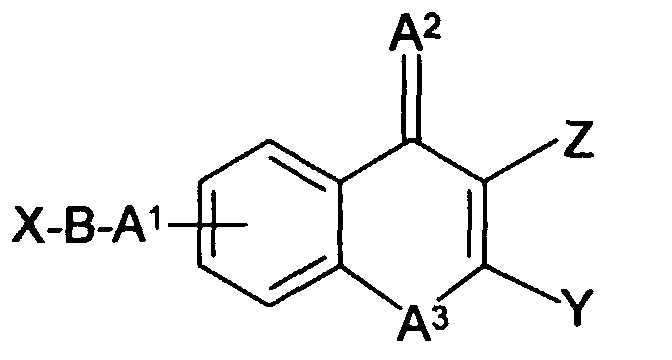
- WO-A-91 18597 and J. Med. Chem. (1992), 35(9), p. 1526-1535 disclose compounds of the formulawherein A1, A2, A3, X, Y, and Z have specified meanings. The compounds are said to be useful to inhibit σ binding site-induced activity.
- EP-A-0 064 255 discloses compounds which are 4-benzamidopiperidin-1-ylalkoxychromen-4-one derivatives which exhibit anti-allergenic, anti-anaphylactic activities.
- WO-A-90 06921 discloses inter alia compounds which are arylpiperidin-1-yl-1-alkoxychromen-4-one derivatives which show anti-thrombotic, anti-atherosclerotic activities.
- EP-A-0 558 245 discloses compounds which are 4-arylpiperidin-1-yl-alkoxychromen-4-one derivatives which show hypertensive activities.
- Thus the compounds of formula (I) are different from the compounds disclosed in the aforesaid patents and prove not to be obvious in view of the prior art described in these patents. The compounds exhibit an interesting profile as neuroleptics as evidenced by both biochemical and pharmacological data. In effect, the biochemical tests revealed an intense action of these compounds on various receptors that are generally considered to be involved in the neuroleptic action (σ, D2 5HT2 receptors, B.L. Largent et al: "Eur. J. Pharmacol.", 155, 345-7, 1988; 5HT1a receptors, B.A. McMillen et al: "Drug Dev. Res.", 12, 53-62, 1988; D3 receptors, P.Sokoloff et al: "Nature", 347, 146-151, 1990). Specific binding to σ, D2, D3, 5HT2 and 5HT1a receptors has been tested as follows:
- σ receptors: A 2-nM solution of radioactive 3-PPP ((+) [3H]3-[3-hydroxyphenyl]-N-(1-propyl)-piperidine), which acts as a specific ligand, was incubated with the membrane corresponding to 40 mg of guinea-pig total brain for 90 min at 25°C buffered at pH 8.5 with Tris.HCl. Thus, total binding of ligand to membranes was attained. Non-specific binding was then determined by adding a micromolar concentration of unlabelled 3-PPP. IC50 values (inhibitory concentration 50%) were calculated from the inhibition rate of the specific binding obtained by adding eleven different concentrations of the compounds to be tested. After the incubation was completed, the samples were filtered through a glass fiber filter and then washed three times with Tris.HCl buffer. The amount of receptor-bound radioactivity was retained on the membrane and determined by liquid scintillation counting.
- D2 receptors: A 2-nM solution of radioactive spiperone ([3H]spiperone), which acts as a specific ligand, was incubated with the membrane corresponding to 20 mg of rat striatum for 20 min at 35°C buffered at pH 7.4 with Tris.HCl. The non-specific binding was then determined by addition of a micromolar concentration of unlabelled spiperone. IC50 (inhibitory concentration 50%) was calculated from the inhibition rate of the specific binding obtained by addition of eleven different concentrations of the compounds to be tested. After the incubation was completed, the sample was filtered through a glass fiber filter and then washed three times with Tris.HCl buffer. The amount of receptor-bound radioactivity was retained on the membrane and determined by liquid scintillation counting.
- D3 receptors: A 0.1 nM solution of radioactive YM-0951 ([3H]YM-0951), which acts as a specific ligand, was incubated with the membrane provided by RBI obtained from mouse fibroblasts (CCL 1,3) for 15 min at 37°C, buffered at pH 7.4 with Tris.HCl. The non-specific binding was then determined by addition of a micromolar concentration of unlabelled 7-OH-DPAT. IC50 (inhibitory concentration 50%) was calculated from the inhibition rate of the specific binding obtained by addition of eleven different concentrations of the compounds to be tested. After the incubation was completed, the sample was filtered through a glass fiber filter and then washed three times with Tris.HCl buffer. The amount of receptor-bound radioactivity was retained on the membrane and determined by liquid scintillation counting.
- 5HT1a receptors: A 1 nM solution of radioactive 5-OH-DPAT ([3H)5-OH-DPAT), which acts as a specific ligand, was incubated with the membrane corresponding to 1 mg of rat cortex for 20 min at 35°C buffered at pH 7.4 with Tris.HCl. Non-specific binding was then determined by addition of a 20 micromolar concentration of unlabelled buspirone. IC50 (inhibitory concentration 50%) was calculated from the inhibition rate of the specific binding obtained by addition of eleven different concentrations of the compounds to be tested. After the incubation was completed, the sample was filtered through a glass fiber filter and then washed three times with Tris.HCl buffer. The amount of receptor-bound radioactivity was retained on the membrane and determined by liquid scintillation counting.
- 5HT2 receptors: A 0.5 nM solution of radioactive ketanserin ([3H]ketanserin), which acts as a specific ligand, was incubated with the membrane corresponding to 1 mg of rat cortex for 30 min at 35°C buffered at pH 7.4 with Tris.HCl. Non-specific binding was then determined by addition of 5 micromolar concentration of unlabelled mianserin. IC50 (inhibitory concentration 50%) was calculated from the inhibition rate of the specific binding obtained by addition of eleven different concentrations of the compounds to be tested. After the incubation was completed, the sample was filtered through a glass fiber filter and then washed three times with Tris.HCl buffer. The amount of receptor-bound radioactivity was retained on the membrane and determined by liquid scintillation counting.
-
- The comparative biochemical results of the compounds of Examples 1, 2, 3 and 4 versus several reference compounds are presented in Table 1. Values are expressed as IC50 in molar concentrations.
IC50 (M) σ D2 D3 5HT1A 5HT2 D2/σ D2/5HT2 Example 1 1.46x10⁻⁸ 4.36x10⁻⁷ 6.88x10⁻⁸ 1.56x10⁻⁶ 1.71x10⁻⁸ 29.9 25.5 Example 2 7.99x10⁻⁷ 3.74x10⁻⁷ 8.55x10⁻⁷ 1.57x10⁻⁶ 5.66x10⁻⁸ 0.47 6.61 Example 3 2.43x10⁻⁷ 1.29x10⁻⁷ 1.94x10⁻⁷ 7.64x10⁻⁷ 8.20x10⁻⁸ 0.53 1.57 Example 4 -- 1.90x10⁻⁷ -- -- 4.74x10⁻⁸ -- 4.01 Haloperidol 2.14x10⁻⁹ 1.23x10⁻⁸ -- 1.12x10⁻⁵ 1.04x10⁻⁷ 5.75 0.12 BMY·14802 4.90x10⁻⁸ 1.59x10⁻⁵ -- 4.04x10⁻⁷ 1.15x10⁻⁸ 324 13.8 7-OHDPAT -- -- 6.01x10⁻⁸ -- -- -- -- Risperidone -- 7.61x10⁻⁹ -- 4.31x10⁻⁷ 4.06x-10 -- 18.7 - From the results in the above table, it can be concluded that the compounds of this invention are characterized by a genuine neuroleptic profile, since advantageously their specificity over 5HT2 receptors versus D2 receptors according to D2/5HT2 ratios is higher than that of haloperidol. In addition, the specificity of the compound of Ex. 1 over σ receptors versus D2 receptors is also higher than that of haloperidol and surpasses BMY-14802 and risperidone in D2/5HT2 ratio. In addition, the compound is active on D3 receptors in the same order as 7-OH-DPAT. All this confers potentially valuable properties on the compounds of this invention as neuroleptics, which are useful in psychosis and schizophrenia, and no extrapyramidal effects are attributed to their interaction with D2 receptors.
- The neuroleptic activity of the compounds of this invention was confirmed in Animal Pharmacology by oral testing of the inhibition of p-chloro-amphetamine-induced hyperactivity (T.G. Heffner et al: "J.Pharmacol.Exp.Ther.", 251, 105, 1989), inhibition of apomorphine-induced hyperactivity (A. Puech et al: "Eur.J.Pharmacol.", 50, 291-300, 1978) and inhibition of apomorphine-induced climbing behaviour (P.Protais et al: "Psychopharmacology", 50, 1-6, 1976).
- The three pharmacological tests were performed as follows:
- Male Swiss mice weighing 22-26 g were used. One week prior to experiment, animals were kept in our facilities at a temperature of 20-22°C and 12/12 h light-dark cycle, and had free access to food and water.
- Motor activity was measured using a DAS 16 computer-assisted Actimeter (Actisystem, Panlab) which records data from four sensory units. These units detect the activity via resonance frequency oscillation in LC network. The device consists of a top transparent cage for placing of animals and a lower command panel for starting and calibration of it, as well as a system for animal activity detection.
- Animals were administered orally with test drug at time 0 and then placed into each Actimeter cage in groups of three animals. After 60 minutes, p-chloro-amphetamine was subcutaneously injected at a dose of 5 mg/kg, and the animals were immediately placed in respective cages. The device was started and the motor activity of animals was monitored for 90 minutes. The results obtained in this test are presented in Table 2 (A).
- Male Swiss mice weighing 22-26 g were used. One week prior to experiment, animals were kept in our facilities at a temperature of 20-22°C and 12/12 h light-dark cycle, and had free access to food and water.
- Motor activity was measured using a DAS 16 computer-assisted Actimeter (Actisystem, Panlab) which records data from four sensory units. These units detect the activity via resonance frequency oscillation in LC network. The device consists of a top transparent cage for placing of animals and a lower command panel for starting and calibration of it, as well as a system for animal activity detection.
- Animals were administered orally with test drug at time 0 and then placed into each Actimeter cage in groups of three animals. After 30 minutes, apomorphine was subcutaneously injected at a dose of 1 mg/kg, and the animals were immediately placed in respective cages. The device was started and the motor activity of animals was monitored for 60 minutes. The results obtained in this test are presented in Table 2 (B).
- Male Swiss mice weighing 22-26 g were used. One week prior to experiment, animals were kept in our facilities at a temperature of 20-22°C and 12/12 h light-dark cycle, and had free access to food and water. Two hours prior to experiment, the animals were placed in individual cages without access to food.
- Animals were administered orally with either test drug or 0.25% agar at time 0. After 60 minutes, apomorphine was subcutaneously injected at a dose of 1 mg/kg, and after further 60 minutes the animal's behaviour was assessed. Two additional assessments were performed at 10-min intervals.
- For assessment, each animal was placed on the bottom of a small upright box (7.5x4.5 cm). The walls of the box were made of translucent methacrylate except one of the lateral surfaces (7.5 cm wide) which was a 3-mm wire mesh. The position of the animal was scored for 2 minutes according to the following criteria: 0 = four paws on the floor; 1 = three paws on the floor; 2 = two paws on the floor; 3 = one paw on the floor; and 4 = four paws holding the wire mesh. If an animal keeps several positions within the 2-min observation, the seconds elapsed in each position will be recorded. Finally, mean scoring was calculated. The results obtained in this test are presented in Table 2 (C).
ED50 (mg(kg) Test (A) Test (B) Test (C) Example 1 3.2 2.5 6.4 Example 2 2.1 6.1 25 Example 3 1.8 1.6 4.9 Example 4 -- -- 3.2 Example 5 5.9 11.1 >25 Example 6 3.3 >25 >25 Example 7 2.6 6.2 9.1 - The compounds of this invention are found to be potentially useful as neuroleptics for treating psychosis and schizophrenia. Among the compounds described in this invention, the compound of Example 1, 7-[3-(4-p-fluorobenzoyl-1-piperidinyl)propoxy]-chromen-4-one hydrochloride, the compound of Example 3, 7-[3-(4-p-fluorobenzoyl-1-piperidinyl)propoxy]-3-methyl-chromen-4-one hydrochloride, and the compound of Example 4, 3-Hydroxymethyl-7-[3-(4-p-fluorobenzoyl-1-piperidinyl)propoxy]chromen-4-one hydrochloride, are preferred. In fact, the compound of Example 1 was biochemically the most specific over 5HT2 receptors versus D2 receptors. The compound of Example 3 was very active in animal pharmacological tests and, moreover, its extrapyramidal effects were not very important; the oral administration of this compound to rats at a dose of 50 mg/kg (over 10 times ED50 - Test C) caused catalepsy in only 60% of treated animals 3 hours after administration and inhibited stereotypy in only 23% of animals. The compound of Example 4 was also very active in animal pharmacological tests and did not show very important extrapyramidal effects either; in effect, in rat oral testing, it was necessary to administer a dose of 15 mg/kg of product so that catalepsy could occur in 50% of treated animals.
- To a solution of 3.9 g (18.8 mmole) of 4-p-fluorobenzoyl-piperidine and 4.5 g (18.8 mmole) of 7-(3-chloropropoxy)chromen-4-one in 250 ml of acetonitrile, 2.7 g (18.8 mmole) of anhydrous potassium carbonate and 0.2 g of potassium iodide were added. The resulting suspension was refluxed for 24 hours, then cooled, filtered, and the filtrate was evaporated to dryness. The oil obtained was dissolved in dichloromethane, washed with NaCl saturated solution, dried over sodium sulfate and evaporated. The residue was dissolved in isopropanol and precipitated by addition of HCL solution in isopropanol to provide 2.2 g (26%) of product.
- Elemental analysis for C24H24FNO4.HCl: (calculated) C 64.64, H 5.65, N 3.14, Cl 7.95; (found) C 64.34, H 5.77, N 2.93, Cl 8.13. Melting point: 235-238°C (i-PrOH).
- IR (KBr): 3200-3600, 2930, 2300-2800, 2680. 1650, 1630, 1595, 1445, 1270, 1230 cm-1.
- 1H-NMR (d6-DMSO): 2.01 (m, 4H, piper-3H and -5H), 2.30 (m, 2H, O-CH2-CH 2), 3.13 (m, 2H, piper-2Hax and -6Hax), 3.24 (t a, J= 6Hz, 2H, N-CH 2-CH2-CH2-O), 3.61 (d a, J= 10.2Hz, 2H, piper-2Heq and -6Heq), 3.75 (m, 1H, 4-H), 4.25 (t a, J= 6Hz, 2H, O-CH2), 6.29 (d, J= 6.3Hz, 1H, 3-H), 7.08 (dd, J= 9 and 2 Hz, 1H, 6-H), 7.16 (d, J= 2Hz, 1H, 8-H), 7.40 (t, J= 9Hz, 2H, Ph-3H and -5H), 7.96 (d, J= 9Hz, 1H, 5-H), 8.11 (dd, J= 9 and 6Hz, 2H, Ph-2H and -6H), 8.25 (d, J= 6Hz, 1H, 2-H).
- 13C-NMR (d6-DMSO): 22.93 (O-CH2-CH 2), 25.46 (piper-3C and 5C), 40.03 (piper-4C), 50.85 (piper-2C and -6C), 53.18 (O-CH2-CH2-CH 2-N), 65.77 (O-CH 2), 101.77 (8-C), 111.91 (3-C), 114.62 (6-C), 115.65 (d, J= 21.7Hz, Ph-3C and -5C), 117.90 (4a-C), 126.13 (5-C), 131.04 (d, J= 9.2Hz, Ph-2C and -6C), 131.52 (d, J= 3.5Hz, Ph-1C), 156.16 (2-C), 157.34 (8a-C), 162.31 (7-C), 164.78 (d, J= 250.4Hz, Ph-4C), 175.25 (4-C), 199.09 (Ph-C=O).
- A mixture of 4.5 g (19 mmole) of 4-(p-fluorobenzoyl) piperidine, 19 mmole of the corresponding 7-(3-halopropoxy) chromen-4-one, 2.7 g (19 mmole) of anhydrous potassium carbonate and 0.2 g of potassium iodide in 250 ml of acetonitrile was heated at reflux for 24 hours. The mixture was allowed to cool and filtered, and the filtrate was evaporated to dryness. The residue was dissolved in dichloromethane, washed with sodium clorhide saturated solution, dried over anhydrous sodium sulfate and evaporated. The product was redissolved in isopropanol and precipitated by addition of hydrogen chloride solution. The precipitate was collected by filtration, washed with isopropanol and recrystallized from methanol-ethyl ether.
- According to the general procedure described in a), from 7-(3-chloropropoxy)-2-methyl-chromen-4-one, the compound was obtained as a solid (yield= 77%), melting point 250-253°C.
- Elemental analysis calculated for C25H26FNO4.HCl: C 65.29; H 5.92; N 3.05; Cl 7.70. Found: C 64.93; H 5.83; N 3.01; Cl 7.63.
- IR (KBr): 3200-3600, 2300-2500, 1685, 1650, 1610, 1445, 1390 cm-1.
- 1H-NMR (CDCl3): 1.87 (m, 4H, piper-3H and -5H), 2.03 (quint, J= 6.7 Hz 2H, OCH2-CH 2), 2.13 (m, 2H, piper-2Hax and - 6Hax), 2.36 (s, 3H, CH3), 2.55 (t, J= 6.7 Hz, 2H, OCH2-CH2-CH 2), 3.02 (d a, J= 10.5 Hz, 2H, piper-2Heq and -6Heq), 3.22 (m, 1H, piper-4H), 4.12 (t, J= 6.7 Hz, 2H, OCH2), 6.10 (s, 1H, 3-H), 6.84 (d, J= 2.4 Hz, 1H, 8-H), 6.93 (dd, J= 8.9 and 2.4 Hz,1H, 6-H), 7.14 (t, J= 8.9 Hz, 2H, Ph-2H and -5H), 7.97 (dd, J=8.9 and 5.3 Hz, 2H, Ph-2H and -5H), 8.06 (d, J= 8.9Hz, 1H, 5-H).
- 13C-NMR (CDCl3): 20.39 (CH3), 23.67 (piper-3C and -5C), 25.89 (OCH2 CH 2), 35.62 (piper-4C), 49.43 (piper-2C and -6C), 52.13 (O-CH2CH2 CH 2), 65.28 (OCH2), 100.61 (8-C), 109.95 (3-C), 114.21 (6-C), 116.05 (d, J= 22 Hz, Ph-3C and -5C), 117.26 (4a-C), 126.78 (5-C), 130.94 (d, J= 7 Hz, Ph-6C and -2C), 131.10 (Ph-1C), 157.89 (8a-C), 162.30 (7-C), 165.85 (d, J= 255 Hz, Ph-4C), 166.22 (2-C), 177.93 (4-C), 200.38 (Ph-C=O).
- The compound was obtained as a solid (yield= 50%), melting point 224-227°C (d).
- Elemental analysis calculated for C25H26FNO4.HCl: C 65.28; H 5.92; N 3.15; Cl 7.40. Found: C 64.97; H 5.98; N 3.08; Cl 7.23.
- IR (KBr): 3200-3500, 2400-2900, 1680, 1640, 1595, 1450, 1250 cm-1.
- 1H-NMR (CD3OD): 1.90 (s, 3H, CH3), 2.02 (m, 4H, piper-3H and -5H), 2.31 (m, 2H, OCH2 CH 2), 3.12 (m, 2H, piper-2Hax and - 6Hax), 3.24 (t a, J= 6 Hz, 2H, piper-2Heq and -6Heq), 3.76 (m, 1H, 4-H), 4.23 (t, J= 6 Hz, 2H, OCH2), 7.05 (d, J= 9 Hz, 1H, 6-H), 7.11 (s, 1H, 8-H), 7.40 (t, J= 9 Hz, 2H, Ph-3H and - 5H), 7.96 (d, J= 9 Hz, 1H, 5-H), 8.12 (dd, J= 9 and 5.5 Hz, 2H, Ph-2H and -6H), 8.22 (s, 1H, 2-H).
- 13C-NMR (CD3OD): 10.90 (CH3), 23.28 (OCH2 CH 2), 25.78 (piper-3C and -5C), 40.41 (piper-4C), 51.19 (piper-2C and - 6C), 53.56 (O-CH2CH2 CH 2), 66.12 (OCH2), 101.16 (8-C), 114.79 (6-C), 115.98 (d, J= 22 Hz, Ph-3C and -5C), 116.99 (4a-C), 119.59 (3-C), 126.43 (5-C), 131.39 (d, J= 9 Hz, Ph-2C and - 6C), 131.85 (d, J= 3 Hz, Ph-1C), 152.47 (2-C), 157.80 (8a-C), 162.38 (7-C), 165.11 (d, J= 250 Hz, Ph-4C), 176.25 (4-C), 199.61 (Ph-C=O).
- A mixture of 1.6 g (6 mmole) of 7-(3-chloropropoxy-3-(hydroxymethyl)chromen-4-one, 1.2 g (6 mmole) de 4-(p-fluorobenzoyl)piperidine, 2 g (14 mmole) of anhydrous potassium carbonate and 0.5 g of potassium iodide in 30 ml of acetonitrile was heated for 24 hours at reflux, allowed to cool, filtered, and the filtrate was evaporated to dryness. The residue was dissolved in dichloromethane, washed with saturated sodium chloride solution, dried over anhydrous sodium sulfate, and evaporated. The product was dissolved in acetone and precipitated by addition of a hydrogen chloride solution. The precipitate was collected by filtration, washed with acetone, and recrystallized from methanol-ethyl ether to give 0.5 g (18%) of a solid, melting point 217-218°C (d).
- Elemental analysis. Calculated for C25H26FNO5.HCl: C, 63.09; H, 5.72; N, 2.94; Cl, 7.45. Found: C, 62.89; H, 5.91; N, 2.72; Cl, 7.30.
- IR(KBr): 3100-3700, 2300-2800, 1680, 1645, 1600, 1245 cm1.
- 1H-NMR (d6-DMSO): 1.90-2.15 (m, 4H, piper-3H and -5H), 2.29 (m, 2H, -CH2-CH 2), 3.20 (m, 2H, piper-2Hax and -6Hax), 3.33 (m, 2H, N-CH 2-CH2), 3.70 (da, J=10Hz, 2H, piper-2Heq and -6Heq), 3.78 (m, 1H, piper-4H), 4.26 (t, J=6Hz, 2H, O-CH 2CH2), 4.41 (s, 2H, CH2-OH), 7.08 (dd, J=9 and 2Hz, 1H, 6-H), 7.12 (d, J=2Hz, 1H, 8-H), 7.35 (t, J=9Hz, 2H, Ph-3H and -5H), 8.02 (d, J=9Hz, 1H, 5-H), 8,11 (dd, J=9 y 6Hz, 2H, Ph-2H and -6H), 8,14 (s, 1H, 2-H), 10.80 (sa, 1H, OH).
- 13C-NMR (d6-DMSO): 23.29 (O-CH2-CH 2), 25.81 (piper-3C and -5C), 39.90 (piper-4C), 51.22 (piper-2C and -6C), 53.53 (N-CH 2 CH2), 55.42 (CH2-OH), 66.08 (O-CH 2CH2), 101.30 (8-C), 114.93 (6-C), 115.99 (d, J=21,6Hz, Ph-3C and -5C), 117.20 (4a-C), 123.89 (3-C), 126.38 (5-C), 131.38 (d, J=9Hz, Ph-2C and -6C), 131.85 (Ph-1C), 153.11 (2-C), 157.69 (8a-C), 162.52 (7-C), 165.11 (d, J=250,4Hz, Ph-4C), 175.24 (4-C), 199.39 (Ph-C=O).
- The compound was obtained as a solid (yield= 41%), melting point >250°C.
- Elemental analysis calculated for C25H23F4NO4.HCl: C 58.43; H 4.71; N 2.73; Cl 6.90. Found: C 58.07; H 4.52; N 2.74; Cl 6.78.
- IR (KBr): 3200-3600, 2300-2600, 1670, 1655, 1605, 1430, 1205 cm-1.
- 1H-NMR (d6-DMSO): 2.01 (m, 4H, piper-3H and -5H), 2.29 (m, 2H, OCH2 CH 2), 3.15 (m, 2H, piper-2Hax and -6Hax), 3.29 (m, 2H, OCH2CH2 CH 2), 3.63 (d a, J= 10 Hz, 2H, piper-2Heq and -6Heq), 3.75 (m, 1H, 4-H), 4.27 (t a, J= 6 Hz, 2H, OCH2), 6.90 (s,1H, 3-H), 7.14 (dd, J= 8.7 and 2 Hz, 1H, 6-H), 7.29 (d, J= 2 Hz, 1H, 8-H), 7.34 (t, J= 8.7 Hz, 2H, Ph-3H and -5H), 8.01 (d, J= 8.7 Hz, 1H, 5-H), 8.10 (t a, J= 8.7 Hz, 2H, Ph-2H and -6H).
- 13C-NMR (d6-DMSO): 23.28 (OCH2 CH 2), 25.84 (piper-3C and - 5C), 40.11 (piper-4C), 51.29 (piper-2C and 6C), 53.51 (OCH2CH2 CH 2), 66.17 (OCH2), 101.43 (8-C), 110.75 (3-C), 115.77 (d, J=22 Hz, Ph-3C and -5C), 116.17 (6-C), 118.52 (q, J=272Hz, CF3),126.60 (5-C), 131.31 (d, J=10 Hz, Ph-2C and - 6C), 131.63 (d, J=3 Hz, Ph-1C), 150.51 (q, J=39Hz, 2-C), 156.89 (8a-C), 163.55 (7-C), 165.07 (d, J= 250 Hz, Ph-4C), 174.84 (4-C), 198.97 (Ph-C=O).
- The compound was obtained as a solid (yield= 53%), melting point 259-262°C (d).
- Elemental analysis calculated for C30H28FNO4.HCl: C 69.03; H 5.60; N 2.58; Cl 6.79. Found: C 68.86; H 5.52; N 2.56; Cl 6.50.
- 1H-NMR (CDCL3-CD3OD): 2.20 (m, 4H, piper-3H and -5H), 2.45 (m, 2H, OCH2 CH 2), 3.30 (m, 2H, piper-2Hax and -6Hax), 3.48 (m, 2H, OCH2 CH 2), 3.75 (d a, J= 12 Hz, 2H, piper-2Heq and - 6Heq), 3.90 (m, 1H, 4-H), 4.29 (t a, J= 5.4 Hz, 2H, OCH2), 6.80 (s, 1H, 3-H), 7.04 (d, J= 9 Hz, 1H, 6-H), 7.11 (d, J= 2.4 Hz, 1H, 8-H), 7.21 (t, J= 8.7 Hz, 2H, Ph-3H and -5H), 7.56 (m, 3H, 2-Ph-3H -4H and -5H), 7.96 (d a, J= 7.5 Hz, 2H, 2-Ph-2H and -6H), 8.07 (m, 3H, 5-H and F-Ph-2H and -6-H).
- 13C-NMR (CDCl3-CD3OD): 23.56 (OCH2 CH 2), 25.81 (piper-3C and -5C), 40.10 (piper-4C), 51.72 (piper-2C and -6C), 54.39 (OCH2CH2 CH 2), 65.22 (OCH2), 100.90 (8-C), 106.18 (3-C), 114.62 (6-C), 115.60 (d, J= 23 Hz, F-Ph-3C and -5C), 117.18 (4a-C), 125.84 (2-Ph-2C and -6C), 126.40 (5-C), 128.63 (2-Ph-3C and -5C), 130.81 (d, J= 8 Hz, F-Ph-2C and -6C), 130.86 (2-Ph-1C), 131.42 (F-Ph-1C), 157.67 (8a-C), 162.80 (2-C), 163.71 (7-C), 165.65 (d, J= 254 Hz, F-Ph-4C), 178.33 (4-C), 198.56 (Ph-C=O).
- The compound was obtained as a solid (yield= 19%), melting point 240-243°C.
- Elemental analysis calculated for C24H23ClFNO4.HCl: C 60.01; H 5.04; N 2.92; Cl 14.76. Found: C 59.85; H 5.02; N 2.70; Cl 14.60.
- IR (KBr): 3200-3600, 2300-2600, 1680, 1640, 1625, 1597, 1443, 1230 cm-1.
- 1H-NMR (d6-DMSO): 1.99 (m, 4H, piper-3H and -5H), 2.28 (m, 2H, OCH2 CH 2), 3.11 (m, 2H, piper-2Hax and -6Hax), 3.24 (m, 2H, OCH2CH2 CH 2), 3.61 (d a, J= 11.7 Hz, 2H, piper-2Heq and - 6Heq), 3.68 (m, 1H, piper-4H), 4.26 (m, 2H, OCH2), 7.15 (d, J= 9.1 Hz, 1H, 6-H), 7.24 (s, 1H, 8-H), 7.40 (t, J= 8 Hz, 2H, Ph-3H and -5H), 8.03 (d, J= 9.1 Hz, 1H, 5-H), 8.11 (dd, J= 8 and 5.7 Hz, 2H, Ph-2H and -6H)), 8.81 (s, 1H, 2H).
- 13C-NMR (d6-DMSO): 23.60 (OCH2 CH 2), 26.16 (piper-3C and - 5C), 40.40 (piper-4C), 51.60 (piper-2C and -6C), 53.81 (OCH2CH2 CH 2), 66.58 (OCH2), 101.83 (8-C), 116.14 (6-C), 116.32 (d, J= 22 Hz, Ph-3C and -5C), 117.05 (3-C), 119.59 (4a-C), 131.71 (d, J= 9 Hz, Ph-2C and -6C), 132.15 (d, J= 2 Hz, Ph-1C), 153.99 (2-C), 157.71 (8a-C), 163.34 (7-C), 165.65 (d, J= 250 Hz, Ph-4C), 170.79 (4-C), 199.71 (Ph-C=O).
- The compound was obtained as a solid (yield= 26%), melting point 235-238°C.
- Elemental analysis calculated for C25H24FNO4.HCl: C 64.64; H 5.65; N 3.14; Cl 7.95. Found:C 64.34; H 5.77; N 2.93; C18.13.
- IR (KBr): 3200-3600, 2300-2800, 1680, 1650, 1630, 1595, 1445, 1270, 1230 cm-1.
- 1H-NMR (d6-DMSO): 2.01 (m, 4H, piper-3H and -5H), 2.30 (m, 2H, OCH2 CH 2), 3.13 (m, 2H, piper-2Hax and -6Hax), 3.24 (t a, J= 6Hz, 2H, OCH2CH2 CH 2), 3.61 (d a, J = 10.2 Hz, 2H, piper-2Heq and -6Heq), 3.75 (m, 1H, 4-H), 4.25 (t a, J= 6 Hz, 2H, OCH2), 6.29 (d, J= 6.3 Hz, 1H, 3-H), 7.08 (dd, J= 9 and 2 Hz, 1H, 6-H), 7.16 (d, J= 2 Hz, 1H, 8-H), 7.40 (t, J = 9 Hz, 2H, Ph-3H and -5H), 7.96 (d, J= 9 Hz, 1H, 5-H), 8.11 (dd, J= 9 and 6 Hz, 2H, Ph-2H and -6H), 8.25 (d, J= 6 Hz, 1H, 2-H).
- 13C-NMR (d6-DMSO): 22.93 (OCH2 CH 2), 25.46 (piper-3C and - 5C), 40.03 (piper-4C), 50.85 (piper-2C and -6C), 53.18 (OCH2CH2 CH 2), 65.77 (OCH2), 101.77 (8-C), 111.91 (3-C), 114.62 (6-C), 115.65 (d, J= 22 Hz, Ph-3C and -5C), 117.90 (4a-C), 126.13 (5-C), 131.04 (d, J= 9 Hz, Ph-2C and -6C), 131.52 (d, J=3 Hz, Ph-1C), 156.16 (2-C), 157.34 (8a-C), 162.31 (7-C), 164.78 (d, J= 250 Hz, Ph-4C), 175.25 (4-C), 199.09 (Ph-C=O).
- 3.9 g (20 mmole) of 7-hydroxy-2-methylchromen-4-one, 4.4 ml (40 mmole) of 1-bromo-3-chloropropane and 6.1 g (40 mmole) of anhydrous potassium carbonate in 100 ml of acetone were mixed and refluxed under heating for 16 hours. The mixture was allowed to cool and the insoluble solid was separated by filtration. The filtrate was evaporated to dryness, and the residue obtained was suspended in ethyl ether, filtered, washed with ether and dried at vaccum to yield 4.76 g (85%) of the product, melting point 113-115°C.
- Elemental analysis calculated for C13H13ClO3: C 61.79; H 5.19; Cl 14.03. Found: C 61.47; H 5.26; C 13.91.
- IR (KBr): 3600-3200, 1640, 1600, 1240 cm-1.
- 1H-NMR (CDCl3): 2.28 (quint., J= 6 HZ, 2H, OCH2 CH 2), 2.35 (s, 3H, CH3), 3.76 (t, J= 6 Hz, 2H, CH2Cl), 4.20 (t, J= 6 Hz, 2H, OCH2), 6.09 (s, 1H, 3-H), 6.82 (d, J= 2.3 Hz, 1H, 8-H), 6.93 (dd, J = 8.9 and 2.3 Hz, 1H, 6-H), 8.06 (d, J = 8.9Hz, 1H, 5-H).
- 13C-NMR (CDCl3): 20.36 (2-CH3), 31.79 (OCH2 CH 2), 41.11 (CH2Cl), 64.69 (OCH2), 100.61 (8-C), 110.20 (3-C), 114.07 (6-C), 117.34 (4a-C), 126.79 (5-C), 157.89 (8a-C), 162.70 (7-C), 154.44 (2-C), 177.40 (4-C).
- Similarly, from 30 g (170 mmole) of 7-hydroxy-3-methylchromen-4-one and 25 ml (253 mmole) of 1-bromo-3-chloropropane, 27 g (63%) of the product were obtained as a solid, melting point 83-85°C.
- Elemental analysis calculated for C13H13ClO3: C 61.79; H 5.19; Cl 14.03. Found: C 61.58; H 5.22; C 13.83.
- IR (KBr): 3600-3200, 1640, 1600, 1240 cm-1.
- 1H-NMR (CDCl3): 2.00 (s, 3H, CH3), 2.28 (quint., J= 6 HZ, 2H, OCH2 CH 2), 3.76 (t, 7= 6 Hz, 2H, CH2Cl), 4.19 (t, J= 6 Hz, 2H, OCH2), 6.80 (d, J= 2.3 Hz, 1H, 8-H), 6.93 (dd, J = 8.9 and 2.3 Hz, 1H, 6-H), 7.71 (d, J= 0.9 Hz, 1H, 2-H), 8.12 (d, J = 8.9 Hz, 1H, 5-H).
- 13C-NMR (CDCl3): 11.08 (3-CH3), 31.81 (OCH2 CH 2), 41.12 (CH2Cl), 64.69 (OCH2), 100.48 (8-C), 114.32 (6-C), 117.55 (4a-C), 120.34 (3-C), 127.00 (5-C), 151.12 (2-C), 158.11 (8a-C), 162.58 (7-C), 177.42 (4-C).
- Similarly, from 8.5 g (36 mmole) of 7-hydroxy-2-phenylchromen-4-one and 7 ml (71 mmole) of 1-bromo-3-chloropropane, 10.7 g (96%) of the product were obtained as a solid, melting point 119-121°C.
- Elemental analysis calculated for C18H15ClO3: C 68.68; H 4.80; Cl 11.30. Found: C 68.39; H 4.60; C 10.95.
- IR (KBr): 1630, 1600, 1450, 1250, 1180 cm-1.
- 1H-NMR (CDCl3): 2.29 (quint., J= 6 HZ, 2H, OCH2 CH 2), 3.77 (t, J= 6 Hz, 2H, CH2Cl), 4.22 (t, J= 6 Hz, 2H, OCH2), 6.72 (s, 1H, 3-H), 6.94 (m, 2H, 6-H amd 8-H), 7.49 (m, 3H, Ph-3H, -4H and -5H),7.86 (m, 2H, Ph-2H and -6H), 8.10 (d, J=9.6Hz, 1H, 5-H).
- 13C-NMR (CDCl3): 31.79 (OCH2 CH 2), 41.12 (CH2Cl), 64.80 (OCH2), 100.83 (8-C), 107.28 (3-C), 114.47 (6-C), 117.75 (4a-C), 125.91 (Ph-2C and -6C), 128.81 (Ph-3C) and -5H), 126.82 (5-C), 131.24 (Ph-4C), 131.54 (Ph-1C), 157.64 (8a-C), 162.71 (2-C), 162.99 (7-C), 177.48 (4-C).
- Similarly, from 7-hydroxy-2-trifluoromethylchromen-4-one, the product was obtained as a solid (yield 69%), melting point 77-79°C.
- Elemental analysis calculated for C13H10ClF3O3: C 50.92; H 3.29; Cl 11.56. Found: C 50.63; H 3.04; C 11.30.
- IR (KBr): 1670, 1610, 1430, 1200, 1130 cm-1.
- 1H-NMR (CDCl3): 2.31 (t, J= 6 HZ, 2H, OCH2 CH 2), 3.77 (quint, J= 6 Hz, 2H, CH2Cl), 4.26 (t, J= 6 Hz, 2H, OCH2), 6.67 (s, 1H, 3-H), 6.95 (d, J= 1.9 Hz, 1H, 8-H), 7.03 (dd, J= 9 amd 1.9 Hz, 1H, 6-H), 8.10 (d, J= 9 Hz, 1H, 5-H).
- 13C-NMR (CDCl3-CD3OD): 31.82 (OCH2 CH 2), 41.06 (CH2Cl), 65.16 (OCH2), 101.01 (8-C), 110.63 (3-C), 115.86 (6-C), 117.87 (4a-C), 118.50 (q, J= 272 Hz, CF3), 127.26 (5-C), 151.80 (q, J= 40 Hz, 2-C), 157.26 (8a-C), 163.90 (7-C), 175.82 (4-C).
- 10 g (66 mmole) of 2',4'-dihydroxyacetophenone, 10 ml (101 mmole) of 1-bromo-3-chloropropane and 22.7 g (164 mmole) of anhydrous potassium carbonate in 250 ml of acetone were mixed and refluxed under heating for 16 hours. The mixture was cooled to room temperature, the solid insoluble was separated by filtration, and the filtrate was evaporated to dryness. The residue was dispersed in ethyl ether, filtered and dried to give 13.1 g (87%) of the product, melting point 74°C.
- IR (KBr): 3600-3200, 1650, 1590, 1285, 1160 cm-1.
- 1H-NMR (CDCl3): 2.25 (quint, J= 6 Hz, 2H, OCH2 CH 2), 2.56 (s, 3H, CH3), 3.73 (t, J= 6 Hz, 2H, CH2Cl), 4.15 (t, J= 6 Hz, 2H, OCH2), 6.42 (m, 2H, 3-H and 5-H). 7.63 (d, J= 8.1 Hz, 1H, 6-H), 12.73 (s, 1H,OH).
- 13C-NMR (CDCl3): 26.24 (CH3), 31.90 (OCH2 CH 2), 41.20 (CH2Cl), 64.53 (OCH2), 101.34 (3-C), 107.56 (5-C), 113.89 (1-C), 132.20 (6-C), 164.90 (2-C and 4-C), 202.28 (C=O).
- 6 g (26 mmole) of the compound of Ex. 13 and 5.2 ml (39 mmole) of dimethylformamide-dimethylketal were mixed and refluxed under heating for 3.5 hours. The resultant solution was evaporated at vaccum, and the residue was suspended in 40 ml of ethyl ether. The solid obtained was filtered and dried at vaccum to give 5.6 g (75%) of the product as a solid, melting point 119-121°C.
- Elemental analysis calculated for C14H18ClNO3: C 59.26; H 6.39; N 4.94; Cl 12.49. Found: C 58.89; H 6.33; N 4.91; Cl 12.20.
- IR (KBr): 3600-3200, 1620, 1530, 1350, 1235, 1100 cm-1.
- 1H-NMR (CDCl3): 2.24 (quint., J= 6 HZ, 2H, OCH2 CH 2), 2.96 (s a, 3H, NCH3), 3.18 (s a, 3H, NCH3), 3.73 (t, J= 6 Hz, 2H, CH2Cl), 4.13 (t, J= 6 Hz, 2H, OCH2), 5.68 (d, J= 12 Hz, 1H, =CH-N), 6.38 (d, J= 8.6 Hz, 1H, Ph-5H), 6.41 (s, 1H, Ph-3H), 7.61 (d, J= 8.6 Hz, 1H, Ph-6H), 7.84 (d, J= 12 Hz, 1H, CO-CH=).
- 13C-NMR (CDCl3): 31.96 (OCH2 CH 2), 37.28 (NCH3), 41.25 (CH2Cl), 45.20 (NCH3), 64.15 (OCH2), 89.59 (=CH-N), 101.48 (Ph-3C), 106.31 (Ph-5C), 113.81 (Ph-1C), 129.45 (Ph-6C), 153.73 (CO-CH=), 163.04 (Ph-2C), 165.13 (Ph-4C), 190.17 (C=O).
- To a solution of 3 g (11 mmole) of the compound of Ex. 14 in 60 ml of chloroform, 2 ml of hydrochloric acid 5.6M solution in ethanol were added. The mixture was stirred at room temperature for 15 min. The chloroform solution was washed with water and sodium bicarbonate aqueous solution, and evaporated to dryness. The residue was dispersed in ethyl ether, filtered and dried to give 2 g (70%) of the product as a white solid, melting point 76-78°C.
- Elemental analysis calculated for C12H11ClO3: C 60.39; H 4.65; Cl 14.85. Found: C 60.22; H 4.71; Cl 14.78.
- IR (KBr): 1650, 1625, 1605, 1260, 1230 cm-1.
- 1H-NMR (CDCl3): 2.30 (quint., J= 6 HZ, 2H, OCH2 CH 2), 3.77 (t, J= 6 Hz, 2H, CH2Cl), 4.22 (t, J= 6 Hz, 2H, OCH2), 6.28 (d, J= 6 Hz, 1H, 3-H), 6.86 (d, J= 2.3 Hz, 1H, 8-H), 6.97 (dd, J= 8.8 and 2.3 Hz, 1H, 6-H), 7.78 (d, J= 6 Hz, 1H, 2-H), 8.12 (d, J= 8.8 Hz, 1H, 5-H).
- 13C-NMR (CDCl3): 31.76 (OCH2 CH 2), 41.09 (CH2Cl), 64.74 (OCH2), 100.78 (8-C), 112.66 (3-C), 114-47 (6-C), 118.61 (4a-C), 126.90 (5-C), 154.62 (2-C), 157.83 (8a-C), 162.79 (7-C), 176.57 (4-C).
- To a solution of 4.5 g (16 mmole) of 1-(4-(3-chloropropoxy)-2-hydroxyphenyl)-3-dimethylamino-1-propenone in 60 ml of chloroform was added a solution of 1.9 g (16 mmole) of tert-butyl hypochlorite in 40 ml of chloroform at a temperature between 0°C and 5°C. The mixture was allowed to stir for 4 hours at room temperature and evaporated to dryness. The residue was washed with diisopropyl ether to give 2.9 g (67%) of the product as a solid, melting point 101-103°C.
- Elemental analysis calculated for C12H10Cl2O3: C 52.77; H 3.69; Cl 25.96. Found: C 52.61; H 3.75; Cl 26.21.
- IR (KBr): 1635, 1610, 1255, 1220 cm-1.
- 1H-NMR (CDCl3): 2.30 (quint., J= 6 HZ, 2H, OCH2 CH 2), 3.77 (t, J= 6 Hz, 2H, CH2Cl), 4.23 (t, J= 6 Hz, 2H, OCH2), 6.87 (d, J= 2.4 Hz, 1H, 8-H), 7.02 (dd, J= 9 and 2.4 Hz, 1H, 6-H), 8.10 (s, 1H, 2-H), 8.16 (d, J= 9Hz, 1H, 5-H).
- 13C-NMR (CDCl3): 31.81 (OCH2 CH 2), 41.08 (CH2Cl), 65.00 (OCH2), 100.72 (8-C), 115.38 (6-C), 117.20 (4a-C), 120.61 (3-C), 127.50 (5-C), 151.53 (2-C), 157.58 (8a-C), 163.25 (7-C), 171.51 (4-C).
- A solution of 20 g (87 mmole) of 4'-(3-chloropropoxy)-2'-hydroxy-acetophenone in 80 ml de N,N-dimethylformamide was cooled on an ice bath, and 30 ml (214 mmole) of phosphoryl chloride were dropwise added. The mixture was stirred for 30 min at 0°C, and allowed to stand at room temperature for an additional 16 hours. The reaction crude was poured onto ice and removed with chloroform. The chloroform extracts were washed 4 times with water, dried over anhydrous sodium sulfate and evaporated in vacuo. The oil obtained was purified by column chromatography (silica gel-chloroform) to give 12 g (51%) of the product.
- Elemental analysis. Calculated for C13H11ClO4: C, 58.55; H, 4.16; Cl, 13.29. Found: C, 58.20; H, 4.25; Cl, 12.97.
- IR (KBr): 1695, 1650, 1620 cm-1.
- 1H-RMN (CDCl3): 2.31 (quint., J=6Hz, 2H, O-CH2-CH 2), 3.78 (t, J=6Hz, 2H, CH2-Cl), 4.25 (t, J=6Hz, 2H, O-CH2), 6.94 (d, J=2Hz, 1H, 8-H), 7.04 (dd, J=9 and 2Hz, 1H, 6-H), 8.18 (d, J=9Hz, 1H, 5-H), 8.47 (s, 1H, 2-H), 10.35 (s, 1H, CHO).
- 13C-NMR (CDCl3): 31.73 (O-CH2-CH 2), 41.02 (CH2Cl), 65.07 (OCH2), 101.55 (8-C), 115.53 (6-C), 118.72 (4a-C), 120.01 (3-C), 127.31 (5-C), 157.58 (8a-C), 160.01 (2-C), 163.64 (7-C), 174.88 (4-C), 188.45 (CHO).
- To a solution of 2.5 g (9.4 mmole) of the aforesaid product in 15 ml of chloroform, 15 ml of absolute ethanol were added and cooled to a temperature of -10°C. 0.2 g (5.3 mmole) of sodium borohydride in several portions were added and then stirred for 15 min at -10°C and for an additional 1 hour at 0°C. The reaction mixture was poured onto water, neutralized by addition of hydrochloric acid, and removed with chloroform. The extracts were dried over anhydrous sodium sulfate and evaporated to give an oil, which was purified by column chromatography (chloroform-methanol, 98:2 as eluant). 1 g (40%) of the product was obtained.
- Elemental analysis. Calculated for C13H13ClO4: C, 58.11; H, 4.88; Cl, 13.19. Found: C, 58.03; H, 4.97; Cl, 12.90.
- 1H-NMR (CDCl3): 2.21 (m, 2H, -O-CH2-CH 2), 3.68 (t, J=6Hz, 2H, CH2-Cl), 4.12 (t, J=6Hz, 2H, O-CH 2-CH2), 4.47 (s, 2H, CH2-OH), 6.76 (d, J=2Hz, 1H, 8-H), 6.88 (dd, J=9 and 2Hz, 1H, 6-H), 7.81 (s, 1H, 2-H), 8.00 (d, J=9Hz, 1H, 5-H).
- Composition for 1 ampoule:
7-[3-(4-p-Fluorobenzoyl-1-piperidinyl)propoxy] chromen-4-one hydrochloride 5.0 mg Methyl p-hydroxybenzoate 1.0 mg Propyl p-hydroxybenzoate 0.1 mg Bidistilled water to volume 2.0 ml -
7-[3-(4-p-Fluorobenzoyl-1-piperidinyl)propoxy] chromen-4-one hydrochloride 1000 mg Methyl p-hydroxybenzoate 135 mg Propyl p-hydroxybenzoate 15 mg 70% Sorbitol 20 g Sodium saccharin 50 mg Orange scent 0.25 ml Distilled water to volume 100 ml - Composition for 10 mg tablet:
7-[3-(4-p-Fluorobenzoyl-1-piperidinyl)propoxy] chromen-4-one hydrochloride 10.0 mg Corn starch 43.2 mg Talc 6.0 mg Hydrogenated castor oil 2.0 mg Lactose to volume 200.0 mg - Composition for 50 mg tablet:
7-[3-(4-p-Fluorobenzoyl-1-piperidinyl)propoxy] chromen-4-one hydrochloride 50.0 mg Corn starch 86.4 mg Talc 12.0 mg Hydrogenated castor oil 4.0 mg Lactose to volume 400.0 mg
Claims (6)
- Chromene compounds of formula (I):wherein R1 and R2 are hydrogen, alkyl having from 1 to 4 carbon atoms, halogen, trifluoromethyl, phenyl or hydroxymethyl, as well as their pharmaceutically acceptable addition salts.
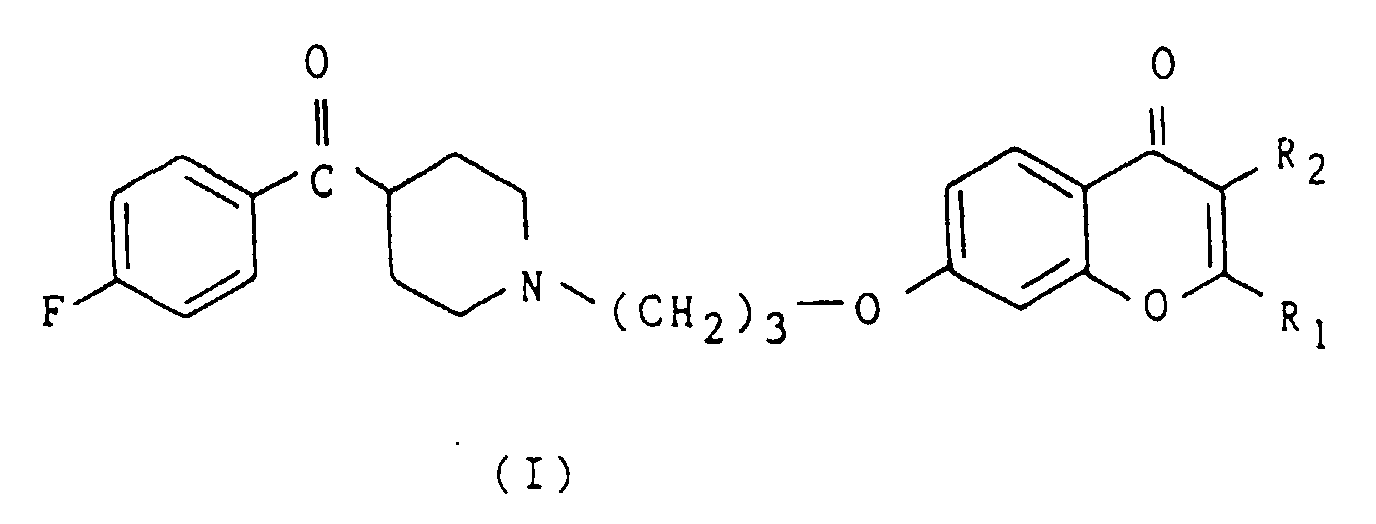
- The compounds according to claim 1, which are:7-[3-(4-p-fluorobenzoyl-1-piperidinyl)propoxy]-chromen-4-one;7-[3-(4-p-fluorobenzoyl-1-piperidinyl)propoxy]-3-methylchromen-4-one;3-Hydroxymethyl-7-[3-(4-p-fluorobenzoyl-1-piperidinyl)propoxy]chromen-4-oneand the pharmaceutically acceptable addition salts thereof.
- Chromene compounds of formula (I), according to claim 1 or 2, for use in the treatment of psychosis and schizophrenia.
- A pharmaceutical composition comprising at least one compound of claim 1 or 2, optionally in combination with pharmaceutically acceptable carriers and/or adjuvants.
- The use of a compound according to claim 1 or 2 for the manufacture of a pharmaceutical composition for treating a mammal affected by psychosis and schizophrenia.
- A process for preparing the chromene compounds of claim 1 or 2 which comprises alkylating 4-(p-fluorobenzoyl)piperidine of formula IIwith a 7-(3-halopropoxy)chromen-4-one of formula III
 wherein X is chlorine, bromine or iodine and R1 and R2 are as defined in claim 1, and if desired, converting a compound of formula I in free base form into an acid addition salt thereof.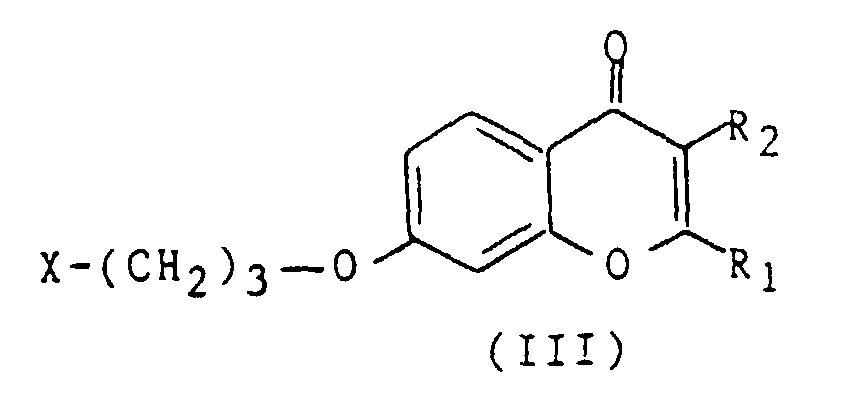
Applications Claiming Priority (7)
| Application Number | Priority Date | Filing Date | Title |
|---|---|---|---|
| ES09400581A ES2101620B1 (en) | 1994-03-18 | 1994-03-18 | NEW COMPOUND DERIVED FROM CHROMENE. |
| ES9400581 | 1994-03-18 | ||
| ES09401437A ES2101635B1 (en) | 1994-03-18 | 1994-07-01 | NEW CHROME-DERIVED COMPOUND |
| ES9401437 | 1994-07-01 | ||
| ES9500163 | 1995-01-30 | ||
| ES09500163A ES2101644B1 (en) | 1994-03-18 | 1995-01-30 | NEW CHROME-DERIVED COMPOUND |
| PCT/EP1995/001008 WO1995025733A1 (en) | 1994-03-18 | 1995-03-17 | 4-p-fluorobenzoyl-1-piperidinyl-propoxy-chromen-4-one derivatives, their preparation and their use in the treatment of psychosis and schizophrenia |
Publications (2)
| Publication Number | Publication Date |
|---|---|
| EP0699197A1 EP0699197A1 (en) | 1996-03-06 |
| EP0699197B1 true EP0699197B1 (en) | 2000-06-07 |
Family
ID=27240511
Family Applications (1)
| Application Number | Title | Priority Date | Filing Date |
|---|---|---|---|
| EP95913143A Expired - Lifetime EP0699197B1 (en) | 1994-03-18 | 1995-03-17 | 4-p-fluorobenzoyl-1-piperidinyl-propoxy-chromen-4-one derivatives, their preparation and their use in the treatment of psychosis and schizophrenia |
Country Status (16)
| Country | Link |
|---|---|
| US (1) | US5643927A (en) |
| EP (1) | EP0699197B1 (en) |
| JP (1) | JP3170287B2 (en) |
| AT (1) | ATE193705T1 (en) |
| AU (1) | AU683549B2 (en) |
| CA (1) | CA2163251A1 (en) |
| DE (1) | DE69517371T2 (en) |
| DK (1) | DK0699197T3 (en) |
| FI (1) | FI955386A7 (en) |
| GR (1) | GR3034226T3 (en) |
| IL (1) | IL112764A0 (en) |
| NO (1) | NO308001B1 (en) |
| NZ (1) | NZ282810A (en) |
| PH (1) | PH31442A (en) |
| PT (1) | PT699197E (en) |
| WO (1) | WO1995025733A1 (en) |
Families Citing this family (7)
| Publication number | Priority date | Publication date | Assignee | Title |
|---|---|---|---|---|
| IL117646A (en) * | 1995-04-12 | 2000-06-01 | Ferrer Int | 7-¬3-¬4-(6-fluoro-1,2-benzisoxazole-3-YL)piperidin-1-YL¾propoxy¾3-alkyl-chromen-4-ones their preparation their uses and pharmaceutical compositions comprising them |
| ES2144355B1 (en) * | 1997-12-30 | 2001-01-01 | Ferrer Int | COMPOUNDS DERIVED FROM THE CHROME. |
| ES2154176B1 (en) * | 1998-09-21 | 2001-10-16 | Ferrer Int | NEW PROCEDURE FOR OBTAINING 3- (HYDROXIMETHYL) CROMEN-4-ONAS. |
| WO2002069973A1 (en) * | 2001-03-02 | 2002-09-12 | Sepracor, Inc. | Piperidine-piperazine ligand for neurotransmitter receptors |
| US7504395B2 (en) | 2001-07-20 | 2009-03-17 | Psychogenics, Inc. | Treatment for attention-deficit hyperactivity disorder |
| NZ560633A (en) * | 2005-03-11 | 2011-08-26 | Neuprotect Pty Ltd | Flavonoid compounds and uses thereof |
| EP1829873A1 (en) * | 2006-03-02 | 2007-09-05 | Laboratorios Del Dr. Esteve, S.A. | Pyrrazole derivatives as sigma receptors antagonists |
Family Cites Families (7)
| Publication number | Priority date | Publication date | Assignee | Title |
|---|---|---|---|---|
| US3576810A (en) * | 1968-06-20 | 1971-04-27 | Robins Co Inc A H | 1-substituted-3-(-4)-aroylpiperidines |
| DE3117389A1 (en) * | 1981-05-02 | 1982-11-18 | Boehringer Mannheim Gmbh, 6800 Mannheim | BENZOPYRANYLETHER, METHOD FOR PRODUCING THE SAME AND MEDICINAL PRODUCTS CONTAINING THESE COMPOUNDS |
| US4678787A (en) * | 1985-01-30 | 1987-07-07 | Warner-Lambert Company | 4H-1-benzopyran-4-ones and their sulfur containing analogs |
| DK623586A (en) * | 1985-12-27 | 1987-06-28 | Eisai Co Ltd | PIPERIDE INGREDIENTS OR SALTS THEREOF AND PHARMACEUTICAL COMPOSITIONS CONTAINING THE COMPOUNDS |
| HUT58310A (en) * | 1988-12-21 | 1992-02-28 | Upjohn Co | Anti-atherosclerotic and anti-thrombotic 1-benzopyran-4-one- and 2-amino-1,3-benzoxazin-4-one derivatives, process for producing them and pharmaceutical compositions containing them |
| US5278174A (en) * | 1990-06-04 | 1994-01-11 | Scios Nova, Inc. | Sigma binding site agents |
| SG65570A1 (en) * | 1992-02-25 | 1999-06-22 | Recordati Chem Pharm | Heterobicyclic compounds |
-
1995
- 1995-02-23 IL IL11276495A patent/IL112764A0/en not_active IP Right Cessation
- 1995-03-17 EP EP95913143A patent/EP0699197B1/en not_active Expired - Lifetime
- 1995-03-17 WO PCT/EP1995/001008 patent/WO1995025733A1/en not_active Ceased
- 1995-03-17 DK DK95913143T patent/DK0699197T3/en active
- 1995-03-17 AU AU20720/95A patent/AU683549B2/en not_active Ceased
- 1995-03-17 CA CA002163251A patent/CA2163251A1/en not_active Abandoned
- 1995-03-17 JP JP52437695A patent/JP3170287B2/en not_active Expired - Fee Related
- 1995-03-17 US US08/532,791 patent/US5643927A/en not_active Expired - Fee Related
- 1995-03-17 FI FI955386A patent/FI955386A7/en unknown
- 1995-03-17 AT AT95913143T patent/ATE193705T1/en not_active IP Right Cessation
- 1995-03-17 PT PT95913143T patent/PT699197E/en unknown
- 1995-03-17 DE DE69517371T patent/DE69517371T2/en not_active Expired - Fee Related
- 1995-03-17 NZ NZ282810A patent/NZ282810A/en unknown
- 1995-03-27 PH PH50033A patent/PH31442A/en unknown
- 1995-11-16 NO NO954633A patent/NO308001B1/en not_active IP Right Cessation
-
2000
- 2000-08-17 GR GR20000401911T patent/GR3034226T3/en not_active IP Right Cessation
Also Published As
| Publication number | Publication date |
|---|---|
| PT699197E (en) | 2000-10-31 |
| DK0699197T3 (en) | 2000-08-07 |
| FI955386A0 (en) | 1995-11-08 |
| EP0699197A1 (en) | 1996-03-06 |
| DE69517371D1 (en) | 2000-07-13 |
| ATE193705T1 (en) | 2000-06-15 |
| US5643927A (en) | 1997-07-01 |
| AU2072095A (en) | 1995-10-09 |
| JP3170287B2 (en) | 2001-05-28 |
| JPH08510478A (en) | 1996-11-05 |
| GR3034226T3 (en) | 2000-12-29 |
| NZ282810A (en) | 1996-11-26 |
| FI955386L (en) | 1995-11-08 |
| PH31442A (en) | 1998-11-03 |
| CA2163251A1 (en) | 1995-09-28 |
| AU683549B2 (en) | 1997-11-13 |
| WO1995025733A1 (en) | 1995-09-28 |
| FI955386A7 (en) | 1995-11-08 |
| NO308001B1 (en) | 2000-07-03 |
| DE69517371T2 (en) | 2001-02-22 |
| NO954633L (en) | 1995-11-16 |
| IL112764A0 (en) | 1995-05-26 |
| NO954633D0 (en) | 1995-11-16 |
Similar Documents
| Publication | Publication Date | Title |
|---|---|---|
| DE69230926T2 (en) | Benzimidazolone derivatives as 5-HT1A and 5-HT2 antagonists | |
| EP1417206B1 (en) | Novel 2h-pyridazine-3-one derivatives, pharmaceutical compositions containing the same and a process for the preparation of the active ingredient | |
| TW419477B (en) | Diphenylmethylene piperidine derivatives | |
| JPH08325257A (en) | Novel piperazine, piperidine, and 1,2,5,6-tetrahydropyridinecompounds, their production, and medicine composition containing them | |
| AU2002321669A1 (en) | Novel 2H-pyridazine-3-one derivatives, pharmaceutical compositions containing the same and a process for the preparation of the active ingredient | |
| US5359098A (en) | Intermediates for making sigma binding site agents | |
| AU683549B2 (en) | 4-P-fluorobenzoyl-1-piperidinyl-propoxy-chromen-4-one derivatives, their preparation and their use in the treatment of Psychosis and Schizophrenia | |
| Toja et al. | 1-Alkyl-1, 2, 5, 6-tetrahydropyridine-3-carboxaldehyde-O-alkyl-oximes: A new class of potent orally active muscarinic agonists related to arecoline | |
| JPH07258233A (en) | New aminoalkylbenzoxazolinone and benzo- thiazolinone, their production and pharmaceutical compositions containing them | |
| NO316693B1 (en) | New indanol compounds, processes in their preparation, and pharmaceutical compositions containing them | |
| US6187793B1 (en) | 7-[(Piperidin-1-YL)-Propoxy]-chromen-4-one derivatives, their preparation and their pharmaceutical use | |
| EP0765323B1 (en) | 4-(6-fluoro-1,2-benzisoxazolyl)-1-piperidinyl-propoxy-chromen-4-one derivatives, their preparation and their use in the treatment of psychosis, schizophrenia and anxiety | |
| KR0182088B1 (en) | 4-p-fluorobenzoyl-1-piperidinyl-propoxy-chromen-4-one derivatives, their preparation and their use in the treatment | |
| JP3478405B2 (en) | New benzyl and benzhydryl alcohols | |
| US6448268B1 (en) | Aryl-{4-fluoro-4-[(2-pyridin-2-yl-ethylamino)-methyl]-piperidin-1-yl}-methanone derivatives as 5-ht1 receptor antagonists | |
| US5512566A (en) | Tricyclic compounds having affinity for the 5-HT1A receptor | |
| JPH09268188A (en) | Imidazol-2-one derivative and its salt | |
| CZ346999A3 (en) | 7-[(piperidin-1-yl)-propoxy]chromen-4-one derivatives | |
| JPH10503782A (en) | Novel 5H-thiazolo [3,2-a] pyrimidin-5-one derivatives | |
| MXPA99007944A (en) | 7-[(piperidin-1-yl)-propoxy]-chromen-4-one derivatives, their preparation and their pharmaceutical use | |
| HK1067626B (en) | Novel 2h-pyridazine-3-one derivatives, pharmaceutical compositions containing the same and a process for the preparation of the active ingredient |
Legal Events
| Date | Code | Title | Description |
|---|---|---|---|
| PUAI | Public reference made under article 153(3) epc to a published international application that has entered the european phase |
Free format text: ORIGINAL CODE: 0009012 |
|
| 17P | Request for examination filed |
Effective date: 19951024 |
|
| AK | Designated contracting states |
Kind code of ref document: A1 Designated state(s): AT BE CH DE DK ES FR GB GR IE IT LI LU NL PT SE |
|
| 17Q | First examination report despatched |
Effective date: 19980730 |
|
| GRAG | Despatch of communication of intention to grant |
Free format text: ORIGINAL CODE: EPIDOS AGRA |
|
| GRAG | Despatch of communication of intention to grant |
Free format text: ORIGINAL CODE: EPIDOS AGRA |
|
| GRAH | Despatch of communication of intention to grant a patent |
Free format text: ORIGINAL CODE: EPIDOS IGRA |
|
| GRAH | Despatch of communication of intention to grant a patent |
Free format text: ORIGINAL CODE: EPIDOS IGRA |
|
| GRAA | (expected) grant |
Free format text: ORIGINAL CODE: 0009210 |
|
| AK | Designated contracting states |
Kind code of ref document: B1 Designated state(s): AT BE CH DE DK ES FR GB GR IE IT LI LU NL PT SE |
|
| PG25 | Lapsed in a contracting state [announced via postgrant information from national office to epo] |
Ref country code: ES Free format text: THE PATENT HAS BEEN ANNULLED BY A DECISION OF A NATIONAL AUTHORITY Effective date: 20000607 |
|
| REF | Corresponds to: |
Ref document number: 193705 Country of ref document: AT Date of ref document: 20000615 Kind code of ref document: T |
|
| RIN1 | Information on inventor provided before grant (corrected) |
Inventor name: ORTIZ, JOSE, A. Inventor name: SACRISTAN, AURELIO Inventor name: BOLOS, JORDI Inventor name: FOGUET, RAFAEL |
|
| REG | Reference to a national code |
Ref country code: CH Ref legal event code: EP |
|
| REG | Reference to a national code |
Ref country code: IE Ref legal event code: FG4D |
|
| REF | Corresponds to: |
Ref document number: 69517371 Country of ref document: DE Date of ref document: 20000713 |
|
| REG | Reference to a national code |
Ref country code: DK Ref legal event code: T3 |
|
| ITF | It: translation for a ep patent filed | ||
| ET | Fr: translation filed | ||
| REG | Reference to a national code |
Ref country code: CH Ref legal event code: NV Representative=s name: BOVARD AG PATENTANWAELTE |
|
| REG | Reference to a national code |
Ref country code: PT Ref legal event code: SC4A Free format text: AVAILABILITY OF NATIONAL TRANSLATION Effective date: 20000727 |
|
| PGFP | Annual fee paid to national office [announced via postgrant information from national office to epo] |
Ref country code: IE Payment date: 20010115 Year of fee payment: 7 |
|
| PGFP | Annual fee paid to national office [announced via postgrant information from national office to epo] |
Ref country code: SE Payment date: 20010119 Year of fee payment: 7 |
|
| PGFP | Annual fee paid to national office [announced via postgrant information from national office to epo] |
Ref country code: DK Payment date: 20010302 Year of fee payment: 7 |
|
| PGFP | Annual fee paid to national office [announced via postgrant information from national office to epo] |
Ref country code: CH Payment date: 20010305 Year of fee payment: 7 |
|
| PGFP | Annual fee paid to national office [announced via postgrant information from national office to epo] |
Ref country code: LU Payment date: 20010313 Year of fee payment: 7 Ref country code: GB Payment date: 20010313 Year of fee payment: 7 |
|
| PGFP | Annual fee paid to national office [announced via postgrant information from national office to epo] |
Ref country code: NL Payment date: 20010323 Year of fee payment: 7 |
|
| PGFP | Annual fee paid to national office [announced via postgrant information from national office to epo] |
Ref country code: FR Payment date: 20010327 Year of fee payment: 7 |
|
| PGFP | Annual fee paid to national office [announced via postgrant information from national office to epo] |
Ref country code: AT Payment date: 20010328 Year of fee payment: 7 |
|
| PGFP | Annual fee paid to national office [announced via postgrant information from national office to epo] |
Ref country code: BE Payment date: 20010402 Year of fee payment: 7 |
|
| PLBE | No opposition filed within time limit |
Free format text: ORIGINAL CODE: 0009261 |
|
| STAA | Information on the status of an ep patent application or granted ep patent |
Free format text: STATUS: NO OPPOSITION FILED WITHIN TIME LIMIT |
|
| 26N | No opposition filed | ||
| PGFP | Annual fee paid to national office [announced via postgrant information from national office to epo] |
Ref country code: DE Payment date: 20010531 Year of fee payment: 7 |
|
| PGFP | Annual fee paid to national office [announced via postgrant information from national office to epo] |
Ref country code: GR Payment date: 20010806 Year of fee payment: 7 |
|
| PGFP | Annual fee paid to national office [announced via postgrant information from national office to epo] |
Ref country code: PT Payment date: 20010919 Year of fee payment: 8 |
|
| REG | Reference to a national code |
Ref country code: GB Ref legal event code: IF02 |
|
| PG25 | Lapsed in a contracting state [announced via postgrant information from national office to epo] |
Ref country code: LU Free format text: LAPSE BECAUSE OF NON-PAYMENT OF DUE FEES Effective date: 20020317 Ref country code: GB Free format text: LAPSE BECAUSE OF NON-PAYMENT OF DUE FEES Effective date: 20020317 Ref country code: AT Free format text: LAPSE BECAUSE OF NON-PAYMENT OF DUE FEES Effective date: 20020317 |
|
| PG25 | Lapsed in a contracting state [announced via postgrant information from national office to epo] |
Ref country code: SE Free format text: LAPSE BECAUSE OF NON-PAYMENT OF DUE FEES Effective date: 20020318 Ref country code: IE Free format text: LAPSE BECAUSE OF NON-PAYMENT OF DUE FEES Effective date: 20020318 |
|
| PG25 | Lapsed in a contracting state [announced via postgrant information from national office to epo] |
Ref country code: LI Free format text: LAPSE BECAUSE OF NON-PAYMENT OF DUE FEES Effective date: 20020331 Ref country code: CH Free format text: LAPSE BECAUSE OF NON-PAYMENT OF DUE FEES Effective date: 20020331 Ref country code: BE Free format text: LAPSE BECAUSE OF NON-PAYMENT OF DUE FEES Effective date: 20020331 |
|
| PG25 | Lapsed in a contracting state [announced via postgrant information from national office to epo] |
Ref country code: DK Free format text: LAPSE BECAUSE OF NON-PAYMENT OF DUE FEES Effective date: 20020402 |
|
| BERE | Be: lapsed |
Owner name: S.A. *FERRER INTERNACIONAL Effective date: 20020331 |
|
| PG25 | Lapsed in a contracting state [announced via postgrant information from national office to epo] |
Ref country code: NL Free format text: LAPSE BECAUSE OF NON-PAYMENT OF DUE FEES Effective date: 20021001 Ref country code: DE Free format text: LAPSE BECAUSE OF NON-PAYMENT OF DUE FEES Effective date: 20021001 |
|
| PG25 | Lapsed in a contracting state [announced via postgrant information from national office to epo] |
Ref country code: GR Free format text: LAPSE BECAUSE OF NON-PAYMENT OF DUE FEES Effective date: 20021007 |
|
| EUG | Se: european patent has lapsed |
Ref document number: 95913143.4 |
|
| GBPC | Gb: european patent ceased through non-payment of renewal fee |
Effective date: 20020317 |
|
| REG | Reference to a national code |
Ref country code: CH Ref legal event code: PL |
|
| PG25 | Lapsed in a contracting state [announced via postgrant information from national office to epo] |
Ref country code: FR Free format text: LAPSE BECAUSE OF NON-PAYMENT OF DUE FEES Effective date: 20021129 |
|
| NLV4 | Nl: lapsed or anulled due to non-payment of the annual fee |
Effective date: 20021001 |
|
| REG | Reference to a national code |
Ref country code: DK Ref legal event code: EBP |
|
| REG | Reference to a national code |
Ref country code: IE Ref legal event code: MM4A |
|
| REG | Reference to a national code |
Ref country code: FR Ref legal event code: ST |
|
| PG25 | Lapsed in a contracting state [announced via postgrant information from national office to epo] |
Ref country code: PT Free format text: LAPSE BECAUSE OF NON-PAYMENT OF DUE FEES Effective date: 20030930 |
|
| REG | Reference to a national code |
Ref country code: PT Ref legal event code: MM4A Free format text: LAPSE DUE TO NON-PAYMENT OF FEES Effective date: 20030930 |
|
| PG25 | Lapsed in a contracting state [announced via postgrant information from national office to epo] |
Ref country code: IT Free format text: LAPSE BECAUSE OF NON-PAYMENT OF DUE FEES;WARNING: LAPSES OF ITALIAN PATENTS WITH EFFECTIVE DATE BEFORE 2007 MAY HAVE OCCURRED AT ANY TIME BEFORE 2007. THE CORRECT EFFECTIVE DATE MAY BE DIFFERENT FROM THE ONE RECORDED. Effective date: 20050317 |