EP0698041B1 - Synthetic aglucodalbaheptide antibiotics - Google Patents
Synthetic aglucodalbaheptide antibiotics Download PDFInfo
- Publication number
- EP0698041B1 EP0698041B1 EP94913599A EP94913599A EP0698041B1 EP 0698041 B1 EP0698041 B1 EP 0698041B1 EP 94913599 A EP94913599 A EP 94913599A EP 94913599 A EP94913599 A EP 94913599A EP 0698041 B1 EP0698041 B1 EP 0698041B1
- Authority
- EP
- European Patent Office
- Prior art keywords
- group
- hydrogen
- formula
- protected
- aglucodalbaheptide
- Prior art date
- Legal status (The legal status is an assumption and is not a legal conclusion. Google has not performed a legal analysis and makes no representation as to the accuracy of the status listed.)
- Expired - Lifetime
Links
- 239000003242 anti bacterial agent Substances 0.000 title claims abstract description 13
- 229940088710 antibiotic agent Drugs 0.000 title description 6
- 229910052739 hydrogen Inorganic materials 0.000 claims abstract description 48
- 239000001257 hydrogen Substances 0.000 claims abstract description 48
- 238000000034 method Methods 0.000 claims abstract description 40
- 125000006239 protecting group Chemical group 0.000 claims abstract description 28
- 150000003839 salts Chemical class 0.000 claims abstract description 25
- UFHFLCQGNIYNRP-UHFFFAOYSA-N Hydrogen Chemical compound [H][H] UFHFLCQGNIYNRP-UHFFFAOYSA-N 0.000 claims abstract description 24
- 125000004435 hydrogen atom Chemical group [H]* 0.000 claims abstract description 24
- 125000002924 primary amino group Chemical group [H]N([H])* 0.000 claims abstract description 22
- 230000008569 process Effects 0.000 claims abstract description 18
- 239000002253 acid Substances 0.000 claims abstract description 17
- DKVBOUDTNWVDEP-NJCHZNEYSA-N teicoplanin aglycone Chemical compound N([C@H](C(N[C@@H](C1=CC(O)=CC(O)=C1C=1C(O)=CC=C2C=1)C(O)=O)=O)[C@H](O)C1=CC=C(C(=C1)Cl)OC=1C=C3C=C(C=1O)OC1=CC=C(C=C1Cl)C[C@H](C(=O)N1)NC([C@H](N)C=4C=C(O5)C(O)=CC=4)=O)C(=O)[C@@H]2NC(=O)[C@@H]3NC(=O)[C@@H]1C1=CC5=CC(O)=C1 DKVBOUDTNWVDEP-NJCHZNEYSA-N 0.000 claims abstract description 10
- 230000003115 biocidal effect Effects 0.000 claims abstract description 8
- 239000003814 drug Substances 0.000 claims abstract description 6
- -1 preferably Inorganic materials 0.000 claims description 44
- 150000001875 compounds Chemical class 0.000 claims description 32
- RTZKZFJDLAIYFH-UHFFFAOYSA-N ether Substances CCOCC RTZKZFJDLAIYFH-UHFFFAOYSA-N 0.000 claims description 29
- 125000003277 amino group Chemical group 0.000 claims description 27
- 125000002435 L-phenylalanyl group Chemical class O=C([*])[C@](N([H])[H])([H])C([H])([H])C1=C([H])C([H])=C([H])C([H])=C1[H] 0.000 claims description 15
- 229940024606 amino acid Drugs 0.000 claims description 14
- 125000003178 carboxy group Chemical group [H]OC(*)=O 0.000 claims description 14
- 150000002148 esters Chemical class 0.000 claims description 14
- 150000001413 amino acids Chemical class 0.000 claims description 13
- COLNVLDHVKWLRT-QMMMGPOBSA-N phenylalanine group Chemical group N[C@@H](CC1=CC=CC=C1)C(=O)O COLNVLDHVKWLRT-QMMMGPOBSA-N 0.000 claims description 13
- 150000007513 acids Chemical class 0.000 claims description 9
- 238000009833 condensation Methods 0.000 claims description 9
- 230000005494 condensation Effects 0.000 claims description 9
- 230000015572 biosynthetic process Effects 0.000 claims description 7
- 125000001997 phenyl group Chemical group [H]C1=C([H])C([H])=C(*)C([H])=C1[H] 0.000 claims description 7
- 239000004480 active ingredient Substances 0.000 claims description 6
- 125000001309 chloro group Chemical group Cl* 0.000 claims description 6
- 229910052736 halogen Inorganic materials 0.000 claims description 6
- 150000002367 halogens Chemical class 0.000 claims description 6
- 125000003118 aryl group Chemical group 0.000 claims description 5
- 125000004356 hydroxy functional group Chemical group O* 0.000 claims description 5
- NQTADLQHYWFPDB-UHFFFAOYSA-N N-Hydroxysuccinimide Chemical compound ON1C(=O)CCC1=O NQTADLQHYWFPDB-UHFFFAOYSA-N 0.000 claims description 4
- 230000003213 activating effect Effects 0.000 claims description 4
- 238000004519 manufacturing process Methods 0.000 claims description 4
- 125000006633 tert-butoxycarbonylamino group Chemical group 0.000 claims description 4
- 125000005907 alkyl ester group Chemical group 0.000 claims description 3
- 125000003710 aryl alkyl group Chemical group 0.000 claims description 2
- 125000001743 benzylic group Chemical group 0.000 claims description 2
- 125000001246 bromo group Chemical group Br* 0.000 claims description 2
- 125000002887 hydroxy group Chemical group [H]O* 0.000 claims description 2
- 125000003588 lysine group Chemical group [H]N([H])C([H])([H])C([H])([H])C([H])([H])C([H])([H])C([H])(N([H])[H])C(*)=O 0.000 claims description 2
- ISWSIDIOOBJBQZ-UHFFFAOYSA-N phenol group Chemical group C1(=CC=CC=C1)O ISWSIDIOOBJBQZ-UHFFFAOYSA-N 0.000 claims description 2
- 150000002993 phenylalanine derivatives Chemical class 0.000 claims 2
- 150000008564 D-lysines Chemical class 0.000 claims 1
- 239000008194 pharmaceutical composition Substances 0.000 claims 1
- 230000001131 transforming effect Effects 0.000 claims 1
- 150000004702 methyl esters Chemical class 0.000 description 40
- 238000006243 chemical reaction Methods 0.000 description 38
- XLYOFNOQVPJJNP-UHFFFAOYSA-N water Substances O XLYOFNOQVPJJNP-UHFFFAOYSA-N 0.000 description 28
- 239000000243 solution Substances 0.000 description 25
- ZMXDDKWLCZADIW-UHFFFAOYSA-N N,N-Dimethylformamide Chemical compound CN(C)C=O ZMXDDKWLCZADIW-UHFFFAOYSA-N 0.000 description 24
- 238000002360 preparation method Methods 0.000 description 20
- 239000000203 mixture Substances 0.000 description 19
- XEKOWRVHYACXOJ-UHFFFAOYSA-N Ethyl acetate Chemical compound CCOC(C)=O XEKOWRVHYACXOJ-UHFFFAOYSA-N 0.000 description 18
- DTQVDTLACAAQTR-UHFFFAOYSA-N Trifluoroacetic acid Chemical compound OC(=O)C(F)(F)F DTQVDTLACAAQTR-UHFFFAOYSA-N 0.000 description 18
- LRHPLDYGYMQRHN-UHFFFAOYSA-N N-Butanol Chemical compound CCCCO LRHPLDYGYMQRHN-UHFFFAOYSA-N 0.000 description 16
- 238000004128 high performance liquid chromatography Methods 0.000 description 15
- 230000002829 reductive effect Effects 0.000 description 14
- 229950002309 teicoplanin aglycone Drugs 0.000 description 14
- 239000007787 solid Substances 0.000 description 13
- WEVYAHXRMPXWCK-UHFFFAOYSA-N Acetonitrile Chemical compound CC#N WEVYAHXRMPXWCK-UHFFFAOYSA-N 0.000 description 12
- OKKJLVBELUTLKV-UHFFFAOYSA-N Methanol Chemical compound OC OKKJLVBELUTLKV-UHFFFAOYSA-N 0.000 description 12
- HEMHJVSKTPXQMS-UHFFFAOYSA-M Sodium hydroxide Chemical compound [OH-].[Na+] HEMHJVSKTPXQMS-UHFFFAOYSA-M 0.000 description 12
- 239000003153 chemical reaction reagent Substances 0.000 description 12
- 239000000047 product Substances 0.000 description 11
- 239000002904 solvent Substances 0.000 description 11
- 0 CC(*)*NC*NC(CC1=CCCC=C1)*NC1*(C)C(C)N*C(C)N*1 Chemical compound CC(*)*NC*NC(CC1=CCCC=C1)*NC1*(C)C(C)N*C(C)N*1 0.000 description 10
- VEXZGXHMUGYJMC-UHFFFAOYSA-N Hydrochloric acid Chemical compound Cl VEXZGXHMUGYJMC-UHFFFAOYSA-N 0.000 description 10
- 125000000217 alkyl group Chemical group 0.000 description 10
- YMWUJEATGCHHMB-UHFFFAOYSA-N Dichloromethane Chemical compound ClCCl YMWUJEATGCHHMB-UHFFFAOYSA-N 0.000 description 9
- 239000006227 byproduct Substances 0.000 description 8
- 229960005190 phenylalanine Drugs 0.000 description 8
- 239000007858 starting material Substances 0.000 description 8
- DYHSDKLCOJIUFX-UHFFFAOYSA-N tert-butoxycarbonyl anhydride Chemical compound CC(C)(C)OC(=O)OC(=O)OC(C)(C)C DYHSDKLCOJIUFX-UHFFFAOYSA-N 0.000 description 8
- 150000001412 amines Chemical class 0.000 description 7
- 239000012044 organic layer Substances 0.000 description 7
- 125000005931 tert-butyloxycarbonyl group Chemical group [H]C([H])([H])C(OC(*)=O)(C([H])([H])[H])C([H])([H])[H] 0.000 description 7
- IAZDPXIOMUYVGZ-UHFFFAOYSA-N Dimethylsulphoxide Chemical compound CS(C)=O IAZDPXIOMUYVGZ-UHFFFAOYSA-N 0.000 description 6
- WYURNTSHIVDZCO-UHFFFAOYSA-N Tetrahydrofuran Chemical compound C1CCOC1 WYURNTSHIVDZCO-UHFFFAOYSA-N 0.000 description 6
- ZMANZCXQSJIPKH-UHFFFAOYSA-N Triethylamine Chemical compound CCN(CC)CC ZMANZCXQSJIPKH-UHFFFAOYSA-N 0.000 description 6
- 239000002585 base Substances 0.000 description 6
- COLNVLDHVKWLRT-UHFFFAOYSA-N phenylalanine Natural products OC(=O)C(N)CC1=CC=CC=C1 COLNVLDHVKWLRT-UHFFFAOYSA-N 0.000 description 6
- RYHBNJHYFVUHQT-UHFFFAOYSA-N 1,4-Dioxane Chemical compound C1COCCO1 RYHBNJHYFVUHQT-UHFFFAOYSA-N 0.000 description 5
- 238000005755 formation reaction Methods 0.000 description 5
- 239000012458 free base Substances 0.000 description 5
- 239000007788 liquid Substances 0.000 description 5
- 239000003960 organic solvent Substances 0.000 description 5
- 239000000725 suspension Substances 0.000 description 5
- GLUUGHFHXGJENI-UHFFFAOYSA-N Piperazine Chemical compound C1CNCCN1 GLUUGHFHXGJENI-UHFFFAOYSA-N 0.000 description 4
- VYPSYNLAJGMNEJ-UHFFFAOYSA-N Silicium dioxide Chemical compound O=[Si]=O VYPSYNLAJGMNEJ-UHFFFAOYSA-N 0.000 description 4
- UIIMBOGNXHQVGW-UHFFFAOYSA-M Sodium bicarbonate Chemical compound [Na+].OC([O-])=O UIIMBOGNXHQVGW-UHFFFAOYSA-M 0.000 description 4
- DTQVDTLACAAQTR-UHFFFAOYSA-M Trifluoroacetate Chemical compound [O-]C(=O)C(F)(F)F DTQVDTLACAAQTR-UHFFFAOYSA-M 0.000 description 4
- 125000001931 aliphatic group Chemical group 0.000 description 4
- 125000003545 alkoxy group Chemical group 0.000 description 4
- 239000000543 intermediate Substances 0.000 description 4
- 238000000746 purification Methods 0.000 description 4
- 239000011541 reaction mixture Substances 0.000 description 4
- 239000000741 silica gel Substances 0.000 description 4
- 229910002027 silica gel Inorganic materials 0.000 description 4
- 229960001866 silicon dioxide Drugs 0.000 description 4
- 125000001424 substituent group Chemical group 0.000 description 4
- 238000003786 synthesis reaction Methods 0.000 description 4
- ASOKPJOREAFHNY-UHFFFAOYSA-N 1-Hydroxybenzotriazole Chemical compound C1=CC=C2N(O)N=NC2=C1 ASOKPJOREAFHNY-UHFFFAOYSA-N 0.000 description 3
- 238000005160 1H NMR spectroscopy Methods 0.000 description 3
- QTBSBXVTEAMEQO-UHFFFAOYSA-N Acetic acid Chemical compound CC(O)=O QTBSBXVTEAMEQO-UHFFFAOYSA-N 0.000 description 3
- CSCPPACGZOOCGX-UHFFFAOYSA-N Acetone Chemical compound CC(C)=O CSCPPACGZOOCGX-UHFFFAOYSA-N 0.000 description 3
- QOSSAOTZNIDXMA-UHFFFAOYSA-N Dicylcohexylcarbodiimide Chemical compound C1CCCCC1N=C=NC1CCCCC1 QOSSAOTZNIDXMA-UHFFFAOYSA-N 0.000 description 3
- KDXKERNSBIXSRK-YFKPBYRVSA-N L-lysine Chemical compound NCCCC[C@H](N)C(O)=O KDXKERNSBIXSRK-YFKPBYRVSA-N 0.000 description 3
- KDXKERNSBIXSRK-UHFFFAOYSA-N Lysine Natural products NCCCCC(N)C(O)=O KDXKERNSBIXSRK-UHFFFAOYSA-N 0.000 description 3
- 239000004472 Lysine Substances 0.000 description 3
- SJRJJKPEHAURKC-UHFFFAOYSA-N N-Methylmorpholine Chemical compound CN1CCOCC1 SJRJJKPEHAURKC-UHFFFAOYSA-N 0.000 description 3
- 239000007832 Na2SO4 Substances 0.000 description 3
- RWRDLPDLKQPQOW-UHFFFAOYSA-N Pyrrolidine Chemical compound C1CCNC1 RWRDLPDLKQPQOW-UHFFFAOYSA-N 0.000 description 3
- PMZURENOXWZQFD-UHFFFAOYSA-L Sodium Sulfate Chemical compound [Na+].[Na+].[O-]S([O-])(=O)=O PMZURENOXWZQFD-UHFFFAOYSA-L 0.000 description 3
- 108010053950 Teicoplanin Proteins 0.000 description 3
- 230000004913 activation Effects 0.000 description 3
- 125000001584 benzyloxycarbonyl group Chemical group C(=O)(OCC1=CC=CC=C1)* 0.000 description 3
- 150000003857 carboxamides Chemical group 0.000 description 3
- DDTDNCYHLGRFBM-YZEKDTGTSA-N chembl2367892 Chemical compound CC(=O)N[C@H]1[C@@H](O)[C@H](O)[C@H](CO)O[C@H]1O[C@@H]([C@H]1C(N[C@@H](C2=CC(O)=CC(O[C@@H]3[C@H]([C@H](O)[C@H](O)[C@@H](CO)O3)O)=C2C=2C(O)=CC=C(C=2)[C@@H](NC(=O)[C@@H]2NC(=O)[C@@H]3C=4C=C(O)C=C(C=4)OC=4C(O)=CC=C(C=4)[C@@H](N)C(=O)N[C@H](CC=4C=C(Cl)C(O5)=CC=4)C(=O)N3)C(=O)N1)C(O)=O)=O)C(C=C1Cl)=CC=C1OC1=C(O[C@H]3[C@H]([C@@H](O)[C@H](O)[C@H](CO)O3)NC(C)=O)C5=CC2=C1 DDTDNCYHLGRFBM-YZEKDTGTSA-N 0.000 description 3
- 238000004440 column chromatography Methods 0.000 description 3
- 238000006482 condensation reaction Methods 0.000 description 3
- 238000010511 deprotection reaction Methods 0.000 description 3
- 230000000694 effects Effects 0.000 description 3
- NPZTUJOABDZTLV-UHFFFAOYSA-N hydroxybenzotriazole Substances O=C1C=CC=C2NNN=C12 NPZTUJOABDZTLV-UHFFFAOYSA-N 0.000 description 3
- 239000012071 phase Substances 0.000 description 3
- 229910052938 sodium sulfate Inorganic materials 0.000 description 3
- 238000003756 stirring Methods 0.000 description 3
- 229960001608 teicoplanin Drugs 0.000 description 3
- YLQBMQCUIZJEEH-UHFFFAOYSA-N tetrahydrofuran Natural products C=1C=COC=1 YLQBMQCUIZJEEH-UHFFFAOYSA-N 0.000 description 3
- 125000003088 (fluoren-9-ylmethoxy)carbonyl group Chemical group 0.000 description 2
- 241000894006 Bacteria Species 0.000 description 2
- 208000035473 Communicable disease Diseases 0.000 description 2
- FBPFZTCFMRRESA-FSIIMWSLSA-N D-Glucitol Natural products OC[C@H](O)[C@H](O)[C@@H](O)[C@H](O)CO FBPFZTCFMRRESA-FSIIMWSLSA-N 0.000 description 2
- KDXKERNSBIXSRK-RXMQYKEDSA-N D-lysine Chemical compound NCCCC[C@@H](N)C(O)=O KDXKERNSBIXSRK-RXMQYKEDSA-N 0.000 description 2
- XTHFKEDIFFGKHM-UHFFFAOYSA-N Dimethoxyethane Chemical compound COCCOC XTHFKEDIFFGKHM-UHFFFAOYSA-N 0.000 description 2
- IAZDPXIOMUYVGZ-WFGJKAKNSA-N Dimethyl sulfoxide Chemical compound [2H]C([2H])([2H])S(=O)C([2H])([2H])[2H] IAZDPXIOMUYVGZ-WFGJKAKNSA-N 0.000 description 2
- 241000194032 Enterococcus faecalis Species 0.000 description 2
- YNAVUWVOSKDBBP-UHFFFAOYSA-N Morpholine Chemical compound C1COCCN1 YNAVUWVOSKDBBP-UHFFFAOYSA-N 0.000 description 2
- KDLHZDBZIXYQEI-UHFFFAOYSA-N Palladium Chemical compound [Pd] KDLHZDBZIXYQEI-UHFFFAOYSA-N 0.000 description 2
- 238000002479 acid--base titration Methods 0.000 description 2
- 230000002378 acidificating effect Effects 0.000 description 2
- 150000003973 alkyl amines Chemical class 0.000 description 2
- 125000003282 alkyl amino group Chemical group 0.000 description 2
- 238000004458 analytical method Methods 0.000 description 2
- 230000000845 anti-microbial effect Effects 0.000 description 2
- HSDAJNMJOMSNEV-UHFFFAOYSA-N benzyl chloroformate Chemical compound ClC(=O)OCC1=CC=CC=C1 HSDAJNMJOMSNEV-UHFFFAOYSA-N 0.000 description 2
- 239000002775 capsule Substances 0.000 description 2
- 125000003917 carbamoyl group Chemical group [H]N([H])C(*)=O 0.000 description 2
- 239000003795 chemical substances by application Substances 0.000 description 2
- 229940079593 drug Drugs 0.000 description 2
- 230000008030 elimination Effects 0.000 description 2
- 238000003379 elimination reaction Methods 0.000 description 2
- 239000003480 eluent Substances 0.000 description 2
- 229940032049 enterococcus faecalis Drugs 0.000 description 2
- 238000000605 extraction Methods 0.000 description 2
- 238000004992 fast atom bombardment mass spectroscopy Methods 0.000 description 2
- 239000000706 filtrate Substances 0.000 description 2
- 125000005843 halogen group Chemical group 0.000 description 2
- 239000012442 inert solvent Substances 0.000 description 2
- 208000015181 infectious disease Diseases 0.000 description 2
- 229910052500 inorganic mineral Inorganic materials 0.000 description 2
- 150000002500 ions Chemical class 0.000 description 2
- HQKMJHAJHXVSDF-UHFFFAOYSA-L magnesium stearate Chemical compound [Mg+2].CCCCCCCCCCCCCCCCCC([O-])=O.CCCCCCCCCCCCCCCCCC([O-])=O HQKMJHAJHXVSDF-UHFFFAOYSA-L 0.000 description 2
- 239000000463 material Substances 0.000 description 2
- 239000011707 mineral Substances 0.000 description 2
- 235000010755 mineral Nutrition 0.000 description 2
- 229910052757 nitrogen Inorganic materials 0.000 description 2
- 239000003973 paint Substances 0.000 description 2
- UYWQUFXKFGHYNT-UHFFFAOYSA-N phenylmethyl ester of formic acid Natural products O=COCC1=CC=CC=C1 UYWQUFXKFGHYNT-UHFFFAOYSA-N 0.000 description 2
- 239000000843 powder Substances 0.000 description 2
- 239000002244 precipitate Substances 0.000 description 2
- 239000002243 precursor Substances 0.000 description 2
- 108090000765 processed proteins & peptides Proteins 0.000 description 2
- 102000004196 processed proteins & peptides Human genes 0.000 description 2
- 230000001737 promoting effect Effects 0.000 description 2
- 239000000376 reactant Substances 0.000 description 2
- 230000002441 reversible effect Effects 0.000 description 2
- 229910000030 sodium bicarbonate Inorganic materials 0.000 description 2
- 239000011877 solvent mixture Substances 0.000 description 2
- 239000000600 sorbitol Substances 0.000 description 2
- 235000010356 sorbitol Nutrition 0.000 description 2
- 239000000126 substance Substances 0.000 description 2
- 239000000375 suspending agent Substances 0.000 description 2
- 150000003512 tertiary amines Chemical class 0.000 description 2
- 230000000699 topical effect Effects 0.000 description 2
- ZYJPUMXJBDHSIF-NSHDSACASA-N (2s)-2-[(2-methylpropan-2-yl)oxycarbonylamino]-3-phenylpropanoic acid Chemical compound CC(C)(C)OC(=O)N[C@H](C(O)=O)CC1=CC=CC=C1 ZYJPUMXJBDHSIF-NSHDSACASA-N 0.000 description 1
- PVOAHINGSUIXLS-UHFFFAOYSA-N 1-Methylpiperazine Chemical compound CN1CCNCC1 PVOAHINGSUIXLS-UHFFFAOYSA-N 0.000 description 1
- PJUPKRYGDFTMTM-UHFFFAOYSA-N 1-hydroxybenzotriazole;hydrate Chemical compound O.C1=CC=C2N(O)N=NC2=C1 PJUPKRYGDFTMTM-UHFFFAOYSA-N 0.000 description 1
- AVFZOVWCLRSYKC-UHFFFAOYSA-N 1-methylpyrrolidine Chemical compound CN1CCCC1 AVFZOVWCLRSYKC-UHFFFAOYSA-N 0.000 description 1
- XNWFRZJHXBZDAG-UHFFFAOYSA-N 2-METHOXYETHANOL Chemical compound COCCO XNWFRZJHXBZDAG-UHFFFAOYSA-N 0.000 description 1
- 125000003341 7 membered heterocyclic group Chemical group 0.000 description 1
- GUBGYTABKSRVRQ-XLOQQCSPSA-N Alpha-Lactose Chemical compound O[C@@H]1[C@@H](O)[C@@H](O)[C@@H](CO)O[C@H]1O[C@@H]1[C@@H](CO)O[C@H](O)[C@H](O)[C@H]1O GUBGYTABKSRVRQ-XLOQQCSPSA-N 0.000 description 1
- 241000416162 Astragalus gummifer Species 0.000 description 1
- 108091003079 Bovine Serum Albumin Proteins 0.000 description 1
- 238000009631 Broth culture Methods 0.000 description 1
- COVZYZSDYWQREU-UHFFFAOYSA-N Busulfan Chemical compound CS(=O)(=O)OCCCCOS(C)(=O)=O COVZYZSDYWQREU-UHFFFAOYSA-N 0.000 description 1
- HGCIXCUEYOPUTN-UHFFFAOYSA-N C1CC=CCC1 Chemical compound C1CC=CCC1 HGCIXCUEYOPUTN-UHFFFAOYSA-N 0.000 description 1
- KXDHJXZQYSOELW-UHFFFAOYSA-M Carbamate Chemical compound NC([O-])=O KXDHJXZQYSOELW-UHFFFAOYSA-M 0.000 description 1
- BVKZGUZCCUSVTD-UHFFFAOYSA-L Carbonate Chemical compound [O-]C([O-])=O BVKZGUZCCUSVTD-UHFFFAOYSA-L 0.000 description 1
- RENMDAKOXSCIGH-UHFFFAOYSA-N Chloroacetonitrile Chemical compound ClCC#N RENMDAKOXSCIGH-UHFFFAOYSA-N 0.000 description 1
- DEFJQIDDEAULHB-QWWZWVQMSA-N D-alanyl-D-alanine Chemical compound C[C@@H]([NH3+])C(=O)N[C@H](C)C([O-])=O DEFJQIDDEAULHB-QWWZWVQMSA-N 0.000 description 1
- FBPFZTCFMRRESA-JGWLITMVSA-N D-glucitol Chemical compound OC[C@H](O)[C@@H](O)[C@H](O)[C@H](O)CO FBPFZTCFMRRESA-JGWLITMVSA-N 0.000 description 1
- LCGLNKUTAGEVQW-UHFFFAOYSA-N Dimethyl ether Chemical compound COC LCGLNKUTAGEVQW-UHFFFAOYSA-N 0.000 description 1
- 108010010803 Gelatin Proteins 0.000 description 1
- 108010015899 Glycopeptides Proteins 0.000 description 1
- 102000002068 Glycopeptides Human genes 0.000 description 1
- 238000012404 In vitro experiment Methods 0.000 description 1
- GUBGYTABKSRVRQ-QKKXKWKRSA-N Lactose Natural products OC[C@H]1O[C@@H](O[C@H]2[C@H](O)[C@@H](O)C(O)O[C@@H]2CO)[C@H](O)[C@@H](O)[C@H]1O GUBGYTABKSRVRQ-QKKXKWKRSA-N 0.000 description 1
- 240000007472 Leucaena leucocephala Species 0.000 description 1
- 235000010643 Leucaena leucocephala Nutrition 0.000 description 1
- DEFJQIDDEAULHB-UHFFFAOYSA-N N-D-alanyl-D-alanine Natural products CC(N)C(=O)NC(C)C(O)=O DEFJQIDDEAULHB-UHFFFAOYSA-N 0.000 description 1
- AHVYPIQETPWLSZ-UHFFFAOYSA-N N-methyl-pyrrolidine Natural products CN1CC=CC1 AHVYPIQETPWLSZ-UHFFFAOYSA-N 0.000 description 1
- 239000002202 Polyethylene glycol Substances 0.000 description 1
- UIIMBOGNXHQVGW-DEQYMQKBSA-M Sodium bicarbonate-14C Chemical compound [Na+].O[14C]([O-])=O UIIMBOGNXHQVGW-DEQYMQKBSA-M 0.000 description 1
- 241000295644 Staphylococcaceae Species 0.000 description 1
- 229920001615 Tragacanth Polymers 0.000 description 1
- 238000010521 absorption reaction Methods 0.000 description 1
- 238000005903 acid hydrolysis reaction Methods 0.000 description 1
- 239000000654 additive Substances 0.000 description 1
- 238000002814 agar dilution Methods 0.000 description 1
- 108010056243 alanylalanine Proteins 0.000 description 1
- 239000003513 alkali Substances 0.000 description 1
- 150000008044 alkali metal hydroxides Chemical class 0.000 description 1
- 150000001408 amides Chemical class 0.000 description 1
- 150000003862 amino acid derivatives Chemical class 0.000 description 1
- VZTDIZULWFCMLS-UHFFFAOYSA-N ammonium formate Chemical compound [NH4+].[O-]C=O VZTDIZULWFCMLS-UHFFFAOYSA-N 0.000 description 1
- 230000000844 anti-bacterial effect Effects 0.000 description 1
- 239000008346 aqueous phase Substances 0.000 description 1
- 239000007900 aqueous suspension Substances 0.000 description 1
- 239000008135 aqueous vehicle Substances 0.000 description 1
- 125000004429 atom Chemical group 0.000 description 1
- 244000052616 bacterial pathogen Species 0.000 description 1
- WPYMKLBDIGXBTP-UHFFFAOYSA-N benzoic acid group Chemical group C(C1=CC=CC=C1)(=O)O WPYMKLBDIGXBTP-UHFFFAOYSA-N 0.000 description 1
- 239000011230 binding agent Substances 0.000 description 1
- 230000037396 body weight Effects 0.000 description 1
- 229940098773 bovine serum albumin Drugs 0.000 description 1
- 238000002815 broth microdilution Methods 0.000 description 1
- 239000001506 calcium phosphate Substances 0.000 description 1
- 229910000389 calcium phosphate Inorganic materials 0.000 description 1
- 235000011010 calcium phosphates Nutrition 0.000 description 1
- 150000004657 carbamic acid derivatives Chemical class 0.000 description 1
- 125000004432 carbon atom Chemical group C* 0.000 description 1
- 150000001732 carboxylic acid derivatives Chemical group 0.000 description 1
- 239000003054 catalyst Substances 0.000 description 1
- 238000009903 catalytic hydrogenation reaction Methods 0.000 description 1
- 210000004027 cell Anatomy 0.000 description 1
- BULLHNJGPPOUOX-UHFFFAOYSA-N chloroacetone Chemical compound CC(=O)CCl BULLHNJGPPOUOX-UHFFFAOYSA-N 0.000 description 1
- 238000003776 cleavage reaction Methods 0.000 description 1
- 229940110456 cocoa butter Drugs 0.000 description 1
- 235000019868 cocoa butter Nutrition 0.000 description 1
- 230000001332 colony forming effect Effects 0.000 description 1
- 229940125904 compound 1 Drugs 0.000 description 1
- 229940125782 compound 2 Drugs 0.000 description 1
- 229940126214 compound 3 Drugs 0.000 description 1
- 229940125898 compound 5 Drugs 0.000 description 1
- 238000001816 cooling Methods 0.000 description 1
- 230000008878 coupling Effects 0.000 description 1
- 238000010168 coupling process Methods 0.000 description 1
- 238000005859 coupling reaction Methods 0.000 description 1
- 239000006071 cream Substances 0.000 description 1
- 125000004093 cyano group Chemical group *C#N 0.000 description 1
- 150000004292 cyclic ethers Chemical class 0.000 description 1
- HPNMFZURTQLUMO-UHFFFAOYSA-N diethylamine Chemical compound CCNCC HPNMFZURTQLUMO-UHFFFAOYSA-N 0.000 description 1
- 239000003085 diluting agent Substances 0.000 description 1
- 231100000676 disease causative agent Toxicity 0.000 description 1
- 239000002270 dispersing agent Substances 0.000 description 1
- 239000002552 dosage form Substances 0.000 description 1
- 210000005069 ears Anatomy 0.000 description 1
- 238000010828 elution Methods 0.000 description 1
- 239000000839 emulsion Substances 0.000 description 1
- 238000005516 engineering process Methods 0.000 description 1
- 238000001704 evaporation Methods 0.000 description 1
- 230000008020 evaporation Effects 0.000 description 1
- 238000001914 filtration Methods 0.000 description 1
- 239000000796 flavoring agent Substances 0.000 description 1
- 235000013355 food flavoring agent Nutrition 0.000 description 1
- 239000007789 gas Substances 0.000 description 1
- 229920000159 gelatin Polymers 0.000 description 1
- 239000008273 gelatin Substances 0.000 description 1
- 235000019322 gelatine Nutrition 0.000 description 1
- 235000011852 gelatine desserts Nutrition 0.000 description 1
- 230000007062 hydrolysis Effects 0.000 description 1
- 238000006460 hydrolysis reaction Methods 0.000 description 1
- 230000002209 hydrophobic effect Effects 0.000 description 1
- 150000002440 hydroxy compounds Chemical class 0.000 description 1
- 239000012535 impurity Substances 0.000 description 1
- 238000000338 in vitro Methods 0.000 description 1
- 238000011534 incubation Methods 0.000 description 1
- 230000002401 inhibitory effect Effects 0.000 description 1
- 238000002347 injection Methods 0.000 description 1
- 239000007924 injection Substances 0.000 description 1
- 239000002054 inoculum Substances 0.000 description 1
- 238000007116 intermolecular coupling reaction Methods 0.000 description 1
- 239000008101 lactose Substances 0.000 description 1
- 239000010410 layer Substances 0.000 description 1
- 239000006193 liquid solution Substances 0.000 description 1
- 239000006194 liquid suspension Substances 0.000 description 1
- 239000006210 lotion Substances 0.000 description 1
- 239000007937 lozenge Substances 0.000 description 1
- 239000000314 lubricant Substances 0.000 description 1
- 235000019359 magnesium stearate Nutrition 0.000 description 1
- 239000011159 matrix material Substances 0.000 description 1
- 230000010534 mechanism of action Effects 0.000 description 1
- 125000001160 methoxycarbonyl group Chemical group [H]C([H])([H])OC(*)=O 0.000 description 1
- 150000007522 mineralic acids Chemical class 0.000 description 1
- 238000002156 mixing Methods 0.000 description 1
- PJUIMOJAAPLTRJ-UHFFFAOYSA-N monothioglycerol Chemical compound OCC(O)CS PJUIMOJAAPLTRJ-UHFFFAOYSA-N 0.000 description 1
- 210000004400 mucous membrane Anatomy 0.000 description 1
- XBXCNNQPRYLIDE-UHFFFAOYSA-M n-tert-butylcarbamate Chemical compound CC(C)(C)NC([O-])=O XBXCNNQPRYLIDE-UHFFFAOYSA-M 0.000 description 1
- 125000000449 nitro group Chemical group [O-][N+](*)=O 0.000 description 1
- 125000004433 nitrogen atom Chemical group N* 0.000 description 1
- QJGQUHMNIGDVPM-UHFFFAOYSA-N nitrogen group Chemical group [N] QJGQUHMNIGDVPM-UHFFFAOYSA-N 0.000 description 1
- 239000002674 ointment Substances 0.000 description 1
- 150000007524 organic acids Chemical class 0.000 description 1
- 235000005985 organic acids Nutrition 0.000 description 1
- 238000007911 parenteral administration Methods 0.000 description 1
- 238000005897 peptide coupling reaction Methods 0.000 description 1
- 239000000546 pharmaceutical excipient Substances 0.000 description 1
- 150000002994 phenylalanines Chemical class 0.000 description 1
- 230000004260 plant-type cell wall biogenesis Effects 0.000 description 1
- 229920000570 polyether Polymers 0.000 description 1
- 229920001223 polyethylene glycol Polymers 0.000 description 1
- 229920001184 polypeptide Polymers 0.000 description 1
- 239000003910 polypeptide antibiotic agent Substances 0.000 description 1
- 239000001267 polyvinylpyrrolidone Substances 0.000 description 1
- 229920000036 polyvinylpyrrolidone Polymers 0.000 description 1
- 235000013855 polyvinylpyrrolidone Nutrition 0.000 description 1
- 229910000028 potassium bicarbonate Inorganic materials 0.000 description 1
- 235000015497 potassium bicarbonate Nutrition 0.000 description 1
- 239000011736 potassium bicarbonate Substances 0.000 description 1
- TYJJADVDDVDEDZ-UHFFFAOYSA-M potassium hydrogencarbonate Chemical compound [K+].OC([O-])=O TYJJADVDDVDEDZ-UHFFFAOYSA-M 0.000 description 1
- 230000002265 prevention Effects 0.000 description 1
- 150000003141 primary amines Chemical class 0.000 description 1
- 238000000425 proton nuclear magnetic resonance spectrum Methods 0.000 description 1
- 239000012429 reaction media Substances 0.000 description 1
- 238000011084 recovery Methods 0.000 description 1
- 230000001172 regenerating effect Effects 0.000 description 1
- 230000007017 scission Effects 0.000 description 1
- 238000001228 spectrum Methods 0.000 description 1
- 229940084106 spermaceti Drugs 0.000 description 1
- 239000012177 spermaceti Substances 0.000 description 1
- 239000007921 spray Substances 0.000 description 1
- 239000003381 stabilizer Substances 0.000 description 1
- 230000000087 stabilizing effect Effects 0.000 description 1
- 239000008223 sterile water Substances 0.000 description 1
- 239000000829 suppository Substances 0.000 description 1
- 239000003826 tablet Substances 0.000 description 1
- 239000000454 talc Substances 0.000 description 1
- 229910052623 talc Inorganic materials 0.000 description 1
- 125000000999 tert-butyl group Chemical group [H]C([H])([H])C(*)(C([H])([H])[H])C([H])([H])[H] 0.000 description 1
- 238000002560 therapeutic procedure Methods 0.000 description 1
- 229940035024 thioglycerol Drugs 0.000 description 1
- 210000001519 tissue Anatomy 0.000 description 1
- 239000000196 tragacanth Substances 0.000 description 1
- 235000010487 tragacanth Nutrition 0.000 description 1
- 229940116362 tragacanth Drugs 0.000 description 1
- QORWJWZARLRLPR-UHFFFAOYSA-H tricalcium bis(phosphate) Chemical compound [Ca+2].[Ca+2].[Ca+2].[O-]P([O-])([O-])=O.[O-]P([O-])([O-])=O QORWJWZARLRLPR-UHFFFAOYSA-H 0.000 description 1
- 239000003981 vehicle Substances 0.000 description 1
- 239000001993 wax Substances 0.000 description 1
- 239000000080 wetting agent Substances 0.000 description 1
Classifications
-
- C—CHEMISTRY; METALLURGY
- C07—ORGANIC CHEMISTRY
- C07K—PEPTIDES
- C07K9/00—Peptides having up to 20 amino acids, containing saccharide radicals and having a fully defined sequence; Derivatives thereof
-
- C—CHEMISTRY; METALLURGY
- C07—ORGANIC CHEMISTRY
- C07K—PEPTIDES
- C07K7/00—Peptides having 5 to 20 amino acids in a fully defined sequence; Derivatives thereof
- C07K7/04—Linear peptides containing only normal peptide links
- C07K7/06—Linear peptides containing only normal peptide links having 5 to 11 amino acids
-
- A—HUMAN NECESSITIES
- A61—MEDICAL OR VETERINARY SCIENCE; HYGIENE
- A61K—PREPARATIONS FOR MEDICAL, DENTAL OR TOILETRY PURPOSES
- A61K38/00—Medicinal preparations containing peptides
-
- A—HUMAN NECESSITIES
- A61—MEDICAL OR VETERINARY SCIENCE; HYGIENE
- A61P—SPECIFIC THERAPEUTIC ACTIVITY OF CHEMICAL COMPOUNDS OR MEDICINAL PREPARATIONS
- A61P31/00—Antiinfectives, i.e. antibiotics, antiseptics, chemotherapeutics
- A61P31/04—Antibacterial agents
-
- C—CHEMISTRY; METALLURGY
- C07—ORGANIC CHEMISTRY
- C07K—PEPTIDES
- C07K9/00—Peptides having up to 20 amino acids, containing saccharide radicals and having a fully defined sequence; Derivatives thereof
- C07K9/006—Peptides having up to 20 amino acids, containing saccharide radicals and having a fully defined sequence; Derivatives thereof the peptide sequence being part of a ring structure
- C07K9/008—Peptides having up to 20 amino acids, containing saccharide radicals and having a fully defined sequence; Derivatives thereof the peptide sequence being part of a ring structure directly attached to a hetero atom of the saccharide radical, e.g. actaplanin, avoparcin, ristomycin, vancomycin
-
- Y—GENERAL TAGGING OF NEW TECHNOLOGICAL DEVELOPMENTS; GENERAL TAGGING OF CROSS-SECTIONAL TECHNOLOGIES SPANNING OVER SEVERAL SECTIONS OF THE IPC; TECHNICAL SUBJECTS COVERED BY FORMER USPC CROSS-REFERENCE ART COLLECTIONS [XRACs] AND DIGESTS
- Y02—TECHNOLOGIES OR APPLICATIONS FOR MITIGATION OR ADAPTATION AGAINST CLIMATE CHANGE
- Y02P—CLIMATE CHANGE MITIGATION TECHNOLOGIES IN THE PRODUCTION OR PROCESSING OF GOODS
- Y02P20/00—Technologies relating to chemical industry
- Y02P20/50—Improvements relating to the production of bulk chemicals
- Y02P20/55—Design of synthesis routes, e.g. reducing the use of auxiliary or protecting groups
Definitions
- This invention concerns synthetic aglucodalbaheptides of general formula (I) wherein:
- a further object of this invention is a process for producing the aglucodalbaheptide antibiotics of formula (I) above starting from the tetrapeptides of formula (II) wherein:
- dalbaheptides are usually defined all antibiotic substances having in common a highly modified linear heptapeptidic structure made up of seven amino acids, five of which are constantly aryl- and arylmethyl-amino acids, said structure being determinant of a common mechanism of action, i.e. the specific complexion with the D-alanyl-D-alanine terminus of one or more intermediates of the cell wall synthesis which leads to cell disruption (see also: F. Parenti and B. Cavalleri, "Novel glycopeptide antibiotics of the dalbaheptide group", Drugs of the future, Vol. 15 (1) : 57-72, (1990)and B. Cavalleri, F. Parenti: “Glycopeptides (dalbaheptides)", in Kirk-Othmer's Encyclopedia of Chemical Technology, Vol. 2, 995-1018, J. Wiley & Sons, 1992).
- the synthetic aglucodalbaheptides of the formula (I) above comprise those derivatives wherein: wherein:
- the encircled numbers in the aromatic rings indicate the respective amino acids of the aglucodalbaheptide chain to which the specific aryl or aralkyl moiety is bound.
- the symbol Y in formula (I), represents a carboxylic group, a functional derivative thereof, preferably, an ester.
- ester derivatives include the protected carboxylic groups from which the free carboxylic group can be easily restored under specific conditions which do not affect the amino acid chain.
- This definition includes the lower alkyl ester derivatives as well as the esters formed by reaction of the carboxylic function with aliphatic alcohols bearing substituents (e.g. hydroxy, halo, lower alkoxy, amino, lower alkylamino, di-(lower alkyl)amino, cyano and phenyl, optionally substituted by lower alkyl, lower alkoxy, halo or nitro) in the aliphatic chain.
- substituents e.g. hydroxy, halo, lower alkoxy, amino, lower alkylamino, di-(lower alkyl)amino, cyano and phenyl, optionally substituted by lower alkyl, lower alkoxy,
- the term "functional derivative of the carboxylic group” includes also the carboxamide moieties which are described in International Application Publication No W092/10517 where the meanings of the symbol Y of the tetrapeptide starting material of formula (II) are illustrated in more details. Said carboxamide moieties are functional derivatives resulting from the reaction of the carboxylic group with aliphatic, cycloaliphatic and heterocyclic amines.
- the lower alkylamines and the di-lower alkylamines are preferred and may optionally contain a substituent on the aliphatic chain such as amino, lower alkylamino, di-(lower alkyl)amino, pyrrolidino, piperazino, N-(lower alkyl)piperazino, morpholino, hydroxy, lower alkoxy, carboxy, carbo(lower alkoxy), carbamyl, mono- and di-(lower alkyl)carbamyl and the like; among the cycloaliphatic amines, the C 4 -C 7 cycloaliphatic primary amines are preferred; among the heterocyclic amines, saturated nitrogen containing 5 to 7 membered heterocyclic ring moieties are preferred, e.g. pyrrolidine, morpholine, piperazine, and N-(lower alkyl)piperazine.
- a substituent on the aliphatic chain such as amino, lower alkylamino
- the salts of the end compounds of formula (I), and of starting compounds of formula (II) are those deriving from the salification with an acid of the basic functions of the molecule, e.g., the amino moieties NHR and/or NR 1 R 2 .
- Representative acid addition salts are those formed by reaction with both inorganic and organic acids, for example, hydrochloric, sulfuric, phosphoric, succinic, citric, lactic, maleic, fumaric, cholic, d-glutamic, d-camphoric, glutaric, phthalic, tartaric, methanesulfonic, benzenesulfonic, benzoic, salicylic, trifluoroacetic acid and the like.
- the salts may be formed through salification of the carboxylic acid function represented by the symbol Y with an appropriate base, such as, for instance, an alkali metal hydroxide or carbonate or an organic amine, such as a mono-, di- or tri-(lower alkyl)amine, a mono-, di- or tri-(hydroxy-lower alkyl)amine.
- an appropriate base such as, for instance, an alkali metal hydroxide or carbonate or an organic amine, such as a mono-, di- or tri-(lower alkyl)amine, a mono-, di- or tri-(hydroxy-lower alkyl)amine.
- the inner salts of the aglucodalbaheptides of formula (I) are those formed through internal salification in the cases of simultaneous presence of basic (e.g. amino) and acid (e.g. carboxylic) functions of sufficient strength in the same compound.
- the chiral centers which are synthetically introduced into the aglucodalbaheptides of this invention and are indicated with the index 3 and 15, respectively, in the formula (I) above, may have both R and S absolute configuration, depending on the absolute configuration of the amino acid which is inserted.
- the configuration of the introduced chiral center identified with the index 3 is S
- the configuration of the chiral center identified with the index 15 may be both R and S, most preferably, R.
- a most preferred group of aglucodalbaheptide antibiotics according to this invention comprises those derivatives of formula (Ia) wherein:
- the first Step(a) of the above reaction scheme involves the selective protection of the amino group represented by the symbol R 4 in the tetrapeptide (TP) of formula (IIa) to yield the TP of formula (IIb).
- Said selective protection may be accomplished, for instance, by protecting first the more reactive amino group identified with the symbol R 3 in the TP of formula (IIa), then, protecting the amino group represented by the symbol R 4 with a different type of protecting group which is not cleaved under the conditions required for the subsequent elimination of the protection (deprotection) of the amino group identified with the symbol R 3 .
- the successive Step(c) involves an intramolecular condensation between the free amino group of the PP (III) and the carboxylic moiety COOR 5 wherein R 5 is hydrogen. Also in this case the reaction course would be negatively affected by the presence of an additional free carboxylic group in the position Y of the PP. In fact, such additional carboxylic group would take part to intermolecular coupling reactions with the free amino group yielding undesired side-products. Therefore, in this case it is particularly important to maintain the protection of such carboxylic group as described above.
- the Step(c) includes also the N-deprotection of the amino group represented by the symbol R 4 to form the intermediate hexapeptide (HP) of formula (IV).
- Step(d) involves the addition of the second amino acid by condensation with a N ⁇ ,N ⁇ -protected lysine derivative, to yield the aglucodalbaheptide derivative (Ib) which, in the successive Step (e), can be submitted to the N-deprotection of the amino groups of the lysine moiety.
- Y is an easily cleavable protected carboxy group
- said protected carboxy group can be de-protected to yield the aglucodalbaheptide (Ic) wherein Y is a carboxylic group.
- This reagent is contacted in an about equimolecular amount with the TP of formula (IIa) in a solution consisting of a mixture of water and an inert water miscible organic solvent preferably selected from lower alkanols, acetone, tetrahydrofuran, dioxane and dimethoxyethane at a temperature between -5 and 20°C, preferably between 0° and 10°C at a pH between 6 and 8, preferably between 6,5 and 7,5.
- a solution consisting of a mixture of water and an inert water miscible organic solvent preferably selected from lower alkanols, acetone, tetrahydrofuran, dioxane and dimethoxyethane at a temperature between -5 and 20°C, preferably between 0° and 10°C at a pH between 6 and 8, preferably between 6,5 and 7,5.
- the proportion between water and organic solvent is varying between 1:9 and 9:1, preferably between 4:6 and 6:4.
- the side-product can be easily separated from the desired mono-protected product, for instance, by extraction of an acid aqueous mixture containing both products with a water immiscible solvent.
- the recovered side-product can be converted to the unprotected starting material by means of acid hydrolysis (e.g. with trifluoroacetic acid).
- the regenerated starting material is reacted again with di-tert-butyldicarbonate under the above described conditions. If needed, the regenerating process of the side-product material followed by reaction with di-tert-butyldicarbonate can be repeated two or three times in order to obtain a high conversion yield of the desired mono-protected product.
- the mono-protected product is then submitted to a further intermediate process for protecting the free amino group represented by the symbol R 4 with a protecting group which is not cleaved under the acidic treatment conditions which are required to remove the tert-butoxycarbonyl group.
- Reagents that can be used to achieve the above desired effect may be selected from those forming carbamate derivatives.
- the following protecting groups are particularly suitable for the protection of the amino group identified with the symbol R 4 in the TP of formula (IIb): 9-fluorenylmethoxycarbonyl, 9-(2-sulfo)fluorenylmethoxycarbonyl, 9-(2,7-di-bromo)fluorenylmethoxycarbonyl, 2,7-di-tert-butyl[9-(10,10-dioxo-thioxanthenyl)]methoxycarbonyl, 1,1-dimethyl-2,2-dibromoethoxycarbonyl, 1,1-dimethyl-2,2,2-trichloroethoxycarbonyl, allyloxycarbonyl, benzyloxycarbonyl, p-nitrobenzyloxycarbonyl, p-bromobenzyloxycarbonyl, 2,4-dichlorobenzyloxycarbonyl and 4-methylsulfinylbenzyloxycarbonyl.
- the benzyloxycarbonyl radical is employed as protecting group of the amino function represented by the radical R 4 in formula (IIa).
- R 4 represents a tert-butoxycarbonylamino moiety
- a suitable reagent capable of introducing such benzyloxycarbonyl group on the amino function, for example, benzylchloroformate in the presence of an excess of a mild base, e.g. sodium bicarbonate, potassium bicarbonate, or a tri-(lower alkyl) amine.
- the reactant providing the N-protecting group is usually employed in an equimolecular amount with respect to the TP. However, in certain cases it may be necessary to employ a slight molecular excess (up to 20 per cent) of such reagent to complete the reaction.
- the reaction is usually carried out in the presence of a solvent preferably consisting of a mixture of water and a water miscible inert organic solvent, such as those described above for the introduction of the tert-butoxycarbonyl moiety.
- a solvent preferably consisting of a mixture of water and a water miscible inert organic solvent, such as those described above for the introduction of the tert-butoxycarbonyl moiety.
- the reaction temperature is maintained between 0° and 50°C, preferably between 15 and 30°C.
- the di-protected TP obtained according to the above procedure is then submitted to acidic treatment suitable for the selective removal of the tert-butoxycarbonyl group.
- Such treatment consists, for instance, of contacting the di-protected TP with an excess of dry trifluoroacetic acid at a temperature between 5 and 30°C for 5 to 25 minutes.
- This step consists in reacting the N-protected TP of formula (IIb) with a suitable derivative of phenylalanine.
- a suitable derivative of phenylalanine Such derivative must be protected on the amino group and must contain an activating group of the carboxy moiety suitable for promoting the condensation process.
- the protecting group of the amino moiety of the phenylalanine must be different from that of the R 4 portion of the TP, since it must be removed in the next step under conditions which do not affect such R 4 portion.
- a solution of this problem consists in employing a carbamate forming group which can be cleaved under the same conditions which have been applied in the former Step(a).
- the tert-butoxycarbonyl moiety is, therefore, one of the preferred N-protecting groups for the phenylalanine.
- the activating group of the N-protected phenylalanine carboxylic function may be selected from those forming the usual activated ester moieties.
- activated esters are those described in general terms as amino acid esters for peptide coupling in the book by L.F. Fieser and M. Fieser, "Reagent for organic Synthesis", Vol. 1, J. Wiley, New York.
- Activated esters forming reagents which can be used to activate the carboxy function of the N-protected phenylalanine are for instance those described by R. Schwyzer et al. in Helv. Chim. Act., 1955, 38, 69-70 and include the following: ClCH 2 CN, BrCH 2 COOC 2 H 5 , BrCH(COOC 2 H 5 ) 2 , ClCH 2 COCH 3 , ClCH 2 CH 2 N(C 2 H 5 ) 2
- activating groups of the carboxylic function of the N-protected phenylalanine that can be employed according to the process of this invention are the esters of the carboxylic moiety with the following hydroxy compounds: as described by J. Jones in "The Chemical Synthesis of Peptides", pages 55-58, Clarendon Press-Oxford (1991).
- ester of N-protected phenylalanine with N-hydroxysuccinimide is employed for the condensation reaction with the TP of formula (IIb).
- the condensation reaction is carried out under the general conditions required for the formation of polypeptides.
- the two reactants are contacted in about equimolecular amounts (in the presence of an about equimolecular amount of an organic tertiary amine, e.g. a tri-(lower alkyl) amine, if the amino group R 3 in compound (IIb) is in the form of an acid addition salt) in an organic inert solvent at a temperature between 5 and 35°C, preferably between 15 and 25°C.
- the organic inert solvent is usually selected from organic amides (e.g. dimethylformamide), polyethers (e.g.
- dimethoxyethane dimethoxyethane
- cyclic ethers e.g.tetrahydrofuran
- lower aliphatic esters e.g. ethyl acetate
- dimethylsulfoxide A preferred solvent is dimethylformamide.
- the di-protected PP derivative is formed following the condensation reaction is then treated under conditions promoting the cleavage of the N-protected amino group of phenylalanine residue, without affecting the N-protected amino group R 4 , thus yielding the PP of formula (III).
- the preferred treatment is essentially the same as that applied at the end of Step(a) for the removal of the protecting tert-butoxycarbonyl group of the R 3 amino moiety of the corresponding TP.
- the mono protected PP (III) resulting from the previous reaction is submitted to intramolecular condensation for the formation of a peptidic bond between the free amino group of the phenylalanine moiety and the carboxylic group COOR 5 wherein R 5 is hydrogen.
- the intramolecular condensation apparently occurs only under well defined conditions by selecting appropriate condensing agents, solvents, reagents, proportions and temperature.
- the intramolecular reaction occurs via activation of the carboxylic group COOR 5 of the PP of formula (III) by reaction with N-hydroxybenzotriazole in the presence of dicyclohexylcarbodiimide.
- the conditions for the formation of the activated carboxy derivative of the PP require that the carboxy group COOR 5 is first salified with an organic tertiary amine such as diethylamine, N-methylpyrrolidine, N-methylpiperazine or N-methylmorfoline before reacting with N-hydroxybenzotriazole.
- the PP, the organic amine and the N-hydroxybenzotriazole are employed in about equimolecular amounts while the dicyclohexylcarbodiimide is employed in a 10 to 20 per cent molar excess.
- the reaction is preferably carried out in a solvent mixture consisting of dimethylformamide and dichloromethane in about equal volumes.
- the temperature of the reaction mixture is kept between 10 and 35°C for a sufficient period of time to complete the intramolecular condensation. The time required may be determined by following the reaction course with the usual analytical systems which include TLC and HPLC methods.
- the solid recovered from this reaction may be purified by reverse phase column chromatography, for instance, on silica-gel by using a linear gradient of from 10 to 70 per cent of acetonitrile in water and checking the collected fraction by HPLC.
- the fractions containing the pure N-protected HP are combined and, after concentration, the product is precipitated by addition of a non-solvent (e.g. diethyl ether).
- a non-solvent e.g. diethyl ether
- Inorganic impurities which may be present in the precipitated product may be eliminated by adding the product to dimethylsulfoxide, filtering the suspension and lyophilizing the clear filtrate.
- the N-protected HP is then transformed in the HP compound of formula (IV) by removal of the protecting group of the amino moiety identified by the radical R4.
- Said protecting group may be eliminated by applying the appropriate methods suggested by the specific literature regarding the N-protecting groups mentioned above.
- the N-protecting group of the amino function identified by the radical R 4 is a benzyloxycarbonyl group
- the removal of such protecting group is usually carried out by catalytic hydrogenation at atmospheric pressure and room temperature, in the presence of an organic solvent or a mixture of organic solvents and, preferably, an aqueous mineral acid (e.g. 1N HCl).
- the HP of formula (IV) is recovered from the filtered hydrogenated solution as the salt with said mineral acid.
- the HP of formula (IV) of Step (c) is condensed with a N ⁇ ,N ⁇ -protected lysine derivative activated on the carboxylic group.
- a N ⁇ ,N ⁇ -protected lysine derivative activated on the carboxylic group.
- the same reagents that are employed for N-protection and carboxy- activation of phenylalanine in Step(b) can be utilized.
- the reaction conditions and the mutual proportions of the reagents and the recovery procedure are essentially the same as in the case mentioned above.
- This Step is primarily performed for removing the two N-protecting groups of the aglucodalbaheptide (Ib).
- N-protecting groups are tert-butoxycarbonyl moieties
- the removal is carried out with essentially the same treatment with trifluoroacetic acid as described for the removal of the tert-butoxycarbonyl moiety from the phenylalanine portion of the PP obtained in Step(c).
- the aglucodalbaheptide (Ic) may be obtained from the above treatment as a free base if the residual of the evaporated trifluoroacetic acid solution is treated with an aqueous alkali solution at a pH 8.5.
- the free base of the aglucodalbaheptide may be further purified by reverse phase column chromatography by using essentially the same procedure and conditions applied in Step(c) for the purification of the HP of formula (IV).
- the aglucodalbaheptide of formula (Ic) wherein Y represents a protected carboxylic function may be converted to the corresponding free carboxy derivative by removal of the protecting group.
- the hydrolysis of such ester may be performed by suspending the product in tetrahydrofuran and adding a molar excess (10-50%) of 1N NaOH at room temperature.
- a molar excess (10-50%) of 1N NaOH at room temperature.
- An aglucodalbaheptide (Ic) having a carboxylic group as substituent Y can be transformed into an aglucodalbaheptide derivative of formula (Ic) wherein Y is a functional derivative of such carboxylic function (e.g. an ester or an amide) as described above.
- Y is a functional derivative of such carboxylic function (e.g. an ester or an amide) as described above.
- Methods for the preparation of such functional derivatives from the corresponding free carboxylic compound are widely described in the dalbaheptides literature. In particular, see the following patent applications: EPA Publication Nos. 216775, 340245, 370283, 376041, 351685, 460448, and International Application Publication No. WO93/0360.
- the TP of formula (IIa) derived from aglucoteicoplanin has been employed as the starting material.
- Said TP has the following structure formula and is currently indicated in the following description and examples as ATTP methyl ester.
- ATTP methyl ester For the purpose of clarity and better understanding of the examples which follow this description, in the above formula the nitrogen atoms of the two different free amino groups have been distinguished with the letters A and B, respectively.
- the above compound has been conventionally named (L-phenylalanyl) 3 -(D-lysyl) 15 -aglucoteicoplanin dalbaheptide methyl ester [(L-phenylalanyl) 3 -(D-lysyl) 15 -ATDH methyl ester] where the apexes 3 and 15 indicate that the amino acid units containing the carbon atoms numbered as 3 and 15 in the aglucoteicoplanin basic skeleton according to A. Malabarba et al., J. Antibiotics 42, 1684-1697, (1989) are replaced by a L-phenylalanine and a D-lysine moiety, respectively.
- the absolute configuration of the chirality centers identified with the index 3 and 15 is S and R, respectively, as described above.
- This compound shows a remarkable antimicrobial activity in in vitro experiments as reported in the following TABLE 1 wherein teicoplanin and teicoplanin aglycon are taken as the reference compounds.
- the in vitro antibacterial activity of the compounds is determined by means of standard agardilution tests in microtiter.
- Iso-Sensitest broth (Oxoid) is used for all bacteria except streptococci (Todd-Hewitt broth, Difco) and enterococci (Mueller-Einton, Difco).
- Broth cultures are diluted so that the final inoculum was about 5x10 5 cfu/ml (colony forming units per ml). All broth microdilution MICs are performed in the presence of 0.01% bovine serum albumin (Pentax fraction V, Sigma). MIC (minimal inhibitory concentration) is considered as the lowest concentration which shows no visible growth after incubation at 37°C for 18-24 hours.
- compounds of formula (I) with different configurations at C 3 and C 15 may be obtained by using phenylalanine and lysine starting materials having appropriate chirality. If racemic amino acid materials are employed, mixtures of diastereomers of formula (I) are obtained.
- the compounds of the present invention can be employed as the active ingredients of the antimicrobial preparations used in human and veterinary medicine for the prevention and treatment of infectious diseases caused by pathogenic bacteria which are susceptible to said active ingredients, in particular, for the treatment of infections caused by Streptococci, Staphylococci and Enterococci strains, including Enterococcus faecalis strains resistant to teicoplanin, an antibiotic currently used in the therapy of severe infectious diseases.
- the compounds of the present invention can be administered orally, topically or parenterally, the parenteral administration route being preferred.
- these compounds can be formulated into various dosage forms.
- Preparations for oral administration may be in the form of capsules, tables, liquid solutions or suspensions.
- the capsules and tablets may contain in addition to the active ingredient, conventional excipients such as diluents, e.g. lactose, calcium phosphate, sorbitol and the like, lubricants, e.g. magnesium stearate, talc, polyethylene glycol, binding agents, e.g. polyvinylpyrrolidone, gelatin, sorbitol, tragacanth, acacia, flavoring agents, and acceptable disintegrating and wetting agents.
- the liquid preparations generally in the form of aqueous or oily solutions or suspensions, may contain conventional additives such as suspending agents.
- the compounds of the present invention may also be prepared in suitable forms for absorption through the mucous membranes of the nose and throat or bronchial tissues and may conveniently take the form of liquid sprays or inhalants, lozenges, or throat paints.
- Topical applications may be formulated in hydrophobic or hydrophilic bases as ointments, creams, lotions, paints, or powders.
- the compounds of the invention are administered in the form of suppositories admixed with conventional wehicles, such as, for example, cocoa butter, wax, spermaceti or polyethylenglycols and their derivatives.
- conventional wehicles such as, for example, cocoa butter, wax, spermaceti or polyethylenglycols and their derivatives.
- compositions for injection may take such forms as suspensions, solutions, or emulsions in oily or aqueous vehicles, and may contain formulatory agents such as suspending, stabilizing and/or dispersing agents.
- the active ingredient may be in powder form for reconstitution at the time of delivery with a suitable vehicle, such as sterile water.
- the amount of active principle to be administered depends on various factors such as the size and conditions of the subject to be treated, the route and frequency of administration, and the causative agent involved.
- the compounds of the invention are generally effective at a dosage comprised between about 1 and about 40 mg of active ingredient per kg of body weight. Depending on the characteristics of the specific compound, the infection and the patients, the effective dose can be administered in a single administration per day or divided in 2 to 4 administrations per day. Particularly desirable compositions are those prepared in the form of dosage units containing from about 30 to about 500 mg per unit.
- N B -CBZ-(N-t-BOC-L-phenylalanyl) 3 -ATPP methyl ester (220 mg) in 10 ml of dry trifluoroacetic acid is stirred at room temperature for 15 minutes and then the solvent is evaporated at 30°C under reduced pressure. The oily residue is slurried with diethyl ether to give 200 mg N B -CBZ-(L-phenylalanyl) 3 -ATPP methyl ester as trifluoroacetate (TABLE 2, compound 5, analytical data reported for the free base; HPLC: Method B, t R 10.2 minutes).
- the column is developed with a linear gradient from 10 to 70% of acetonitrile in water in 15 hours at the flow-rate of 100 ml/hour, while collecting 10 ml-fractions which are checked by HPLC. Those fractions containing pure title compound are pooled and an equal volume of n-butanol is added. The resulting solution is concentrated, at 40°C under reduced pressure, to a small volume (about 10 ml), and then diethyl ether (100 ml) is added. The precipitated solid is collected and added to 20 ml of dimethylsulfoxide.
- Elutions are carried out at a flow-rate of 1.5 ml/minutes by mixing Eluent (a): 0.2% aqueous ammonium formate, with Eluent (b): acetonitrile, according to linear step gradients programmed as follows: Method A: Time (minutes): 0 10 20 30 35 45 % of (b) in (a): 5 23 26 35 75 5 Method B: Time (minutes): 0 30 35 40 45 % of (b) in (a): 20 60 75 75 20
- Acid-base titrations are carried out under the following conditions: the sample is dissolved in a mixture methylcellosolve:water 4:1, then an excess of 0.01M HCl in the same solvent mixture is added and the resulting solution in titrated with 0.01N NaOH.
- the 1 H NMR spectra are recorded in DMSO-d 6 solution at 303°K on a Bruker AM 500 NMR-spectrometer equipped with an Aspect 3000 computer, using (CH 3 ) 4 Si (delta 0.00 ppm) as internal reference.
- FAB-MS positive ion spectra are obtained on a Kratos MS-50 double focusing mass spectrometer of 3000 dalton mass range, using 8 kV accelerating voltage. The instrument operates under computer control. To obtain high quality data, a DS-90 data-system in "raw data" acquisition is used.
- FAB a saddle field atom gun is used with Xe gas (2 x 10 -5 torr pressure indicated on the source ion gauge) at 6 kV voltage and 1 mA current.
- the samples are dissolved in a mixture methanol:water 1:1 containing 0.2N HCl or, alternatively in dimethylformamide. Then, 1 microliter of this solution is mixed with 1 microliter of thioglycerol matrix, optionally containing 1N acetic acid on the target.
Landscapes
- Chemical & Material Sciences (AREA)
- Organic Chemistry (AREA)
- Health & Medical Sciences (AREA)
- Life Sciences & Earth Sciences (AREA)
- Medicinal Chemistry (AREA)
- General Health & Medical Sciences (AREA)
- Proteomics, Peptides & Aminoacids (AREA)
- Biochemistry (AREA)
- Molecular Biology (AREA)
- Genetics & Genomics (AREA)
- Biophysics (AREA)
- Veterinary Medicine (AREA)
- Public Health (AREA)
- Animal Behavior & Ethology (AREA)
- Pharmacology & Pharmacy (AREA)
- General Chemical & Material Sciences (AREA)
- Immunology (AREA)
- Chemical Kinetics & Catalysis (AREA)
- Oncology (AREA)
- Communicable Diseases (AREA)
- Engineering & Computer Science (AREA)
- Bioinformatics & Cheminformatics (AREA)
- Nuclear Medicine, Radiotherapy & Molecular Imaging (AREA)
- Epidemiology (AREA)
- Peptides Or Proteins (AREA)
- Medicines That Contain Protein Lipid Enzymes And Other Medicines (AREA)
- Medicines Containing Material From Animals Or Micro-Organisms (AREA)
- Preparation Of Compounds By Using Micro-Organisms (AREA)
- Compounds Of Unknown Constitution (AREA)
- Pharmaceuticals Containing Other Organic And Inorganic Compounds (AREA)
- Medicinal Preparation (AREA)
Abstract
Description
- This invention concerns synthetic aglucodalbaheptides of general formula (I)

- W and Z, each independently, represent the relative portions of the aglycon of an antibiotic of the dalbaheptide group (aglucodalbaheptides);
- Y represents a carboxylic group or a functional derivative of said carboxylic group;
- R and R1, each independently, represent hydrogen or a protecting group of the amino function; and
- R2 represents hydrogen.
- A further object of this invention is a process for producing the aglucodalbaheptide antibiotics of formula (I) above starting from the tetrapeptides of formula (II)

- W and Z, each independently, represent the relative portions of the aglycon of an antibiotic of the dalbaheptide group (aglucodalbaheptides);
- Y represents a carboxylic group or a functional derivative of said carboxylic group;
- R3 and R4, each independently, represent amino or a protected amino group; and
- R5 is hydrogen or a protecting group of the carboxylic function.
- The tetrapeptides of general formula (II) above, their salts and their method of manufacture are described in International Application Publication No WO92/10517. The above mentioned International Application contains also an exhaustive description of the naturally occurring dalbaheptide antibiotics and their classification in four sub-groups referred respectively as ristocetin-type, vancomycin-type, avoparcin-type and synmonicin-type dalbaheptides.
- The pentapeptide precursors suitable for the preparation of the above mentioned tetrapeptides are described in European Patent Application Publication No. 409 045.
- With the term dalbaheptides are usually defined all antibiotic substances having in common a highly modified linear heptapeptidic structure made up of seven amino acids, five of which are constantly aryl- and arylmethyl-amino acids, said structure being determinant of a common mechanism of action, i.e. the specific complexion with the D-alanyl-D-alanine terminus of one or more intermediates of the cell wall synthesis which leads to cell disruption (see also: F. Parenti and B. Cavalleri, "Novel glycopeptide antibiotics of the dalbaheptide group", Drugs of the future, Vol. 15 (1) : 57-72, (1990)and B. Cavalleri, F. Parenti: "Glycopeptides (dalbaheptides)", in Kirk-Othmer's Encyclopedia of Chemical Technology, Vol. 2, 995-1018, J. Wiley & Sons, 1992).
- According to a preferred embodiment of this invention the synthetic aglucodalbaheptides of the formula (I) above comprise those derivatives wherein:


- i): A is hydrogen or a protecting group of the phenolic hydroxy moiety; R6, R7 and R8 are, each independently, hydrogen or halogen wherein the halogen preferably is chloro or bromo and, most preferably, are in the ortho position with respect to the ether bond; R9 and R10 are, each independently, hydrogen or a group OR15 wherein R15 is hydrogen or a protecting group of the benzylic hydroxy moiety.
As shown in formula (I) above, the group W is simultaneously linked to the second, fourth and sixth amino acid (starting from the right) moiety of the heptapeptidic chain of the aglucodalbaheptides; - ii): the groups OR11 and OR12, preferably, are in, respectively, the para and ortho position with respect to the bond connecting the two phenyl rings and the radicals R11 and R12, each independently, represent hydrogen or a protecting group of the phenolic hydroxy moiety; the group OR13, preferably, is in the position ortho with respect to the bond connecting the two phenyl rings and the radical R13 represents hydrogen or a protecting group of the phenolic hydroxy moiety; the group R14, preferably, is in the position meta with respect to the bond connecting the two phenyl rings and represents hydrogen or halogen, preferably, hydrogen or chloro.
As represented in formula (I) above, the group Z is linked to the amino acids corresponding to the fifth and seventh amino acid (starting from the right) moieties of the heptapeptidic chain of the aglucodalbaheptides. - The encircled numbers in the aromatic rings indicate the respective amino acids of the aglucodalbaheptide chain to which the specific aryl or aralkyl moiety is bound.
- The symbol Y in formula (I), represents a carboxylic group, a functional derivative thereof, preferably, an ester. Such ester derivatives include the protected carboxylic groups from which the free carboxylic group can be easily restored under specific conditions which do not affect the amino acid chain. This definition includes the lower alkyl ester derivatives as well as the esters formed by reaction of the carboxylic function with aliphatic alcohols bearing substituents (e.g. hydroxy, halo, lower alkoxy, amino, lower alkylamino, di-(lower alkyl)amino, cyano and phenyl, optionally substituted by lower alkyl, lower alkoxy, halo or nitro) in the aliphatic chain.
- The term "functional derivative of the carboxylic group" includes also the carboxamide moieties which are described in International Application Publication No W092/10517 where the meanings of the symbol Y of the tetrapeptide starting material of formula (II) are illustrated in more details. Said carboxamide moieties are functional derivatives resulting from the reaction of the carboxylic group with aliphatic, cycloaliphatic and heterocyclic amines. In particular, among the aliphatic amines, the lower alkylamines and the di-lower alkylamines are preferred and may optionally contain a substituent on the aliphatic chain such as amino, lower alkylamino, di-(lower alkyl)amino, pyrrolidino, piperazino, N-(lower alkyl)piperazino, morpholino, hydroxy, lower alkoxy, carboxy, carbo(lower alkoxy), carbamyl, mono- and di-(lower alkyl)carbamyl and the like; among the cycloaliphatic amines, the C4-C7 cycloaliphatic primary amines are preferred; among the heterocyclic amines, saturated nitrogen containing 5 to 7 membered heterocyclic ring moieties are preferred, e.g. pyrrolidine, morpholine, piperazine, and N-(lower alkyl)piperazine.
- The salts of the end compounds of formula (I), and of starting compounds of formula (II) are those deriving from the salification with an acid of the basic functions of the molecule, e.g., the amino moieties NHR and/or NR1R2.
- Representative acid addition salts are those formed by reaction with both inorganic and organic acids, for example, hydrochloric, sulfuric, phosphoric, succinic, citric, lactic, maleic, fumaric, cholic, d-glutamic, d-camphoric, glutaric, phthalic, tartaric, methanesulfonic, benzenesulfonic, benzoic, salicylic, trifluoroacetic acid and the like. Alternatively, the salts may be formed through salification of the carboxylic acid function represented by the symbol Y with an appropriate base, such as, for instance, an alkali metal hydroxide or carbonate or an organic amine, such as a mono-, di- or tri-(lower alkyl)amine, a mono-, di- or tri-(hydroxy-lower alkyl)amine.
- The inner salts of the aglucodalbaheptides of formula (I) are those formed through internal salification in the cases of simultaneous presence of basic (e.g. amino) and acid (e.g. carboxylic) functions of sufficient strength in the same compound.
- In the formula (I) above and in the other related formulas in this description and claims the chiral center of each of the five basic aryl-and arylmethyl-amino acids of the aglucodalbaheptides has the same absolute configuration as that of the respective amino acid of the natural dalbapeptide from which the tetrapeptide starting material (II) has been obtained.
- The chiral centers which are synthetically introduced into the aglucodalbaheptides of this invention and are indicated with the index 3 and 15, respectively, in the formula (I) above, may have both R and S absolute configuration, depending on the absolute configuration of the amino acid which is inserted.
- However, according to a preferred embodiment of this invention, the configuration of the introduced chiral center identified with the index 3 is S, while the configuration of the chiral center identified with the index 15 may be both R and S, most preferably, R.
- A most preferred group of aglucodalbaheptide antibiotics according to this invention comprises those derivatives of formula (Ia)

- Y represents a carboxylic group or a lower alkyl ester derivative of said carboxylic group;
- R and R1, each independently, represent hydrogen or a protecting group of the amino function, preferably, hydrogen;
- R2 represents hydrogen;
- R6 represents hydrogen;
- R7 and R8, each independently, represent hydrogen or chloro;
- R9 represents hydrogen or hydroxy, preferably hydrogen;
- R10 represents hydrogen or hydroxy; and
- According to this invention the process for the manufacture of the aglucodalbaheptide antibiotics of formula (I) is running through the following Reaction Scheme 1.


- In the above Reaction Scheme the symbols W and Z have the same meanings as above, while the term "funct. der. carboxy" relative to the meaning of the symbol Y means that such symbol represents a functional derivative of the carboxylic group as described before, including a protected carboxylic group which can be deprotected at the end of the process.
- The first Step(a) of the above reaction scheme involves the selective protection of the amino group represented by the symbol R4 in the tetrapeptide (TP) of formula (IIa) to yield the TP of formula (IIb).
- Said selective protection may be accomplished, for instance, by protecting first the more reactive amino group identified with the symbol R3 in the TP of formula (IIa), then, protecting the amino group represented by the symbol R4 with a different type of protecting group which is not cleaved under the conditions required for the subsequent elimination of the protection (deprotection) of the amino group identified with the symbol R3.
- This last operation leads to a TP compound (IIb) wherein R4 is a protected amino group and R3 is a free amino group apt to react with the selected amino acid derivative, that is, N-protected phenylalanine, to form a pentapeptide (PP) according to reaction Step(b). This stepis completed by the elimination of the N-protecting group originating from the N-protected phenylalanine precursor, thus yielding the PP of formula (III).
- The performance of the above described reaction Step(b), involves the application of reaction conditions where the presence of a free carboxy group in the position Y would negatively affect the reaction course. Therefore, it is preferred to use a TP derivative (IIb) wherein Y represents a functional derivative of said carboxylic group to avoid any undesired interference of the free carboxylic group when the condensation conditions are applied for the coupling of the N-protected phenylalanine with the TP (IIb) to form the PP (III).
- For analogous reasons, it is preferred to maintain the protection of the carboxy group represented by the symbol Y also in the successive steps involving the formations of other peptidic bonds.
- In the performance of the above mentioned reaction steps as well as in the successive reactions it is not necessary to provide protection to the phenolic or benzylic hydroxy groups which may be contained in the portions W and Z of the TP and PP. However, if these protecting groups are originally present in the TP of formula (II), as obtained according to International Application Publication N. W092/10517, they may be maintained during all the successive reaction course and may be optionally cleaved at the end of the whole process, when the aglucodalbaheptide (Ib) or (Ic) is obtained.
- The successive Step(c) involves an intramolecular condensation between the free amino group of the PP (III) and the carboxylic moiety COOR5 wherein R5 is hydrogen. Also in this case the reaction course would be negatively affected by the presence of an additional free carboxylic group in the position Y of the PP. In fact, such additional carboxylic group would take part to intermolecular coupling reactions with the free amino group yielding undesired side-products. Therefore, in this case it is particularly important to maintain the protection of such carboxylic group as described above. The Step(c) includes also the N-deprotection of the amino group represented by the symbol R4 to form the intermediate hexapeptide (HP) of formula (IV).
- The following Step(d) involves the addition of the second amino acid by condensation with a Nα,Nε-protected lysine derivative, to yield the aglucodalbaheptide derivative (Ib) which, in the successive Step (e), can be submitted to the N-deprotection of the amino groups of the lysine moiety. If desired, when Y is an easily cleavable protected carboxy group, said protected carboxy group can be de-protected to yield the aglucodalbaheptide (Ic) wherein Y is a carboxylic group.
- In the following description are given more specific details on the way each Step of the above described process may be carried out.
- The crucial point for the performance of this Stepis the selection of a reagent suitable for introducing a protecting group of a primary amino function which preferentially reacts with the amino group represented by the symbol R3 in formula (IIa).
- With respect to this desired effect, it has been found that satisfactory selectivity and yields are obtained by employing di-tert-butyldicarbonate as the reagent furnishing the N-protecting group.
- This reagent is contacted in an about equimolecular amount with the TP of formula (IIa) in a solution consisting of a mixture of water and an inert water miscible organic solvent preferably selected from lower alkanols, acetone, tetrahydrofuran, dioxane and dimethoxyethane at a temperature between -5 and 20°C, preferably between 0° and 10°C at a pH between 6 and 8, preferably between 6,5 and 7,5.
- The proportion between water and organic solvent is varying between 1:9 and 9:1, preferably between 4:6 and 6:4.
- The desired product of formula (IIa) wherein R3 is a tert-butoxycarbonylamino group (all other symbols having the same meanings as indicated in the Reaction Scheme 1) is usually obtained together with some amount of a side-product of formula (IIa) wherein both R3 and R4 represent tert-butoxycarbonylamino moieties.
- The side-product can be easily separated from the desired mono-protected product, for instance, by extraction of an acid aqueous mixture containing both products with a water immiscible solvent.
- The recovered side-product can be converted to the unprotected starting material by means of acid hydrolysis (e.g. with trifluoroacetic acid). The regenerated starting material, in turn, is reacted again with di-tert-butyldicarbonate under the above described conditions. If needed, the regenerating process of the side-product material followed by reaction with di-tert-butyldicarbonate can be repeated two or three times in order to obtain a high conversion yield of the desired mono-protected product.
- The mono-protected product is then submitted to a further intermediate process for protecting the free amino group represented by the symbol R4 with a protecting group which is not cleaved under the acidic treatment conditions which are required to remove the tert-butoxycarbonyl group. Reagents that can be used to achieve the above desired effect may be selected from those forming carbamate derivatives.
- Examples of such reagents and the relative reaction conditions are described, for instance, in the book by T.W. Greene and P.G.M. Wuts: "Protective Groups in Organic Synthesis" second edition, J. Wiley, N.Y., 1991 (see, in particular, pages 315-348).
- Accordingly, the following protecting groups are particularly suitable for the protection of the amino group identified with the symbol R4 in the TP of formula (IIb): 9-fluorenylmethoxycarbonyl, 9-(2-sulfo)fluorenylmethoxycarbonyl, 9-(2,7-di-bromo)fluorenylmethoxycarbonyl, 2,7-di-tert-butyl[9-(10,10-dioxo-thioxanthenyl)]methoxycarbonyl, 1,1-dimethyl-2,2-dibromoethoxycarbonyl, 1,1-dimethyl-2,2,2-trichloroethoxycarbonyl, allyloxycarbonyl, benzyloxycarbonyl, p-nitrobenzyloxycarbonyl, p-bromobenzyloxycarbonyl, 2,4-dichlorobenzyloxycarbonyl and 4-methylsulfinylbenzyloxycarbonyl.
- According to a preferred embodiment of this invention, the benzyloxycarbonyl radical is employed as protecting group of the amino function represented by the radical R4 in formula (IIa). For this purpose, the above mentioned mono-protected TP of formula (IIa) wherein R3 represents a tert-butoxycarbonylamino moiety is reacted with a suitable reagent capable of introducing such benzyloxycarbonyl group on the amino function, for example, benzylchloroformate in the presence of an excess of a mild base, e.g. sodium bicarbonate, potassium bicarbonate, or a tri-(lower alkyl) amine.
- The reactant providing the N-protecting group is usually employed in an equimolecular amount with respect to the TP. However, in certain cases it may be necessary to employ a slight molecular excess (up to 20 per cent) of such reagent to complete the reaction.
- The reaction is usually carried out in the presence of a solvent preferably consisting of a mixture of water and a water miscible inert organic solvent, such as those described above for the introduction of the tert-butoxycarbonyl moiety. The reaction temperature is maintained between 0° and 50°C, preferably between 15 and 30°C. The di-protected TP obtained according to the above procedure is then submitted to acidic treatment suitable for the selective removal of the tert-butoxycarbonyl group.
- Such treatment consists, for instance, of contacting the di-protected TP with an excess of dry trifluoroacetic acid at a temperature between 5 and 30°C for 5 to 25 minutes.
- The TP of formula(IIb) wherein R4 is a benzyloxycarbonylamino moiety (all other symbols having the same meanings as in Reaction Scheme 1) is then recovered from the reaction medium according to procedures per se known in the art.
- This step consists in reacting the N-protected TP of formula (IIb) with a suitable derivative of phenylalanine. Such derivative must be protected on the amino group and must contain an activating group of the carboxy moiety suitable for promoting the condensation process. The protecting group of the amino moiety of the phenylalanine must be different from that of the R4 portion of the TP, since it must be removed in the next step under conditions which do not affect such R4 portion.
- A solution of this problem consists in employing a carbamate forming group which can be cleaved under the same conditions which have been applied in the former Step(a). The tert-butoxycarbonyl moiety is, therefore, one of the preferred N-protecting groups for the phenylalanine.
- The activating group of the N-protected phenylalanine carboxylic function may be selected from those forming the usual activated ester moieties.
- Examples of activated esters are those described in general terms as amino acid esters for peptide coupling in the book by L.F. Fieser and M. Fieser, "Reagent for organic Synthesis", Vol. 1, J. Wiley, New York.
- Activated esters forming reagents which can be used to activate the carboxy function of the N-protected phenylalanine are for instance those described by R. Schwyzer et al. in Helv. Chim. Act., 1955, 38, 69-70 and include the following:
ClCH2CN, BrCH2COOC2H5, BrCH(COOC2H5)2, ClCH2COCH3,

ClCH2CH2N(C2H5)2
- Other activating groups of the carboxylic function of the N-protected phenylalanine that can be employed according to the process of this invention are the esters of the carboxylic moiety with the following hydroxy compounds:


- According to one preferred embodiment of this invention the ester of N-protected phenylalanine with N-hydroxysuccinimide is employed for the condensation reaction with the TP of formula (IIb).
- The condensation reaction is carried out under the general conditions required for the formation of polypeptides. Usually, the two reactants are contacted in about equimolecular amounts (in the presence of an about equimolecular amount of an organic tertiary amine, e.g. a tri-(lower alkyl) amine, if the amino group R3 in compound (IIb) is in the form of an acid addition salt) in an organic inert solvent at a temperature between 5 and 35°C, preferably between 15 and 25°C. The organic inert solvent is usually selected from organic amides (e.g. dimethylformamide), polyethers (e.g. dimethoxyethane), cyclic ethers (e.g.tetrahydrofuran), lower aliphatic esters (e.g. ethyl acetate) and dimethylsulfoxide. A preferred solvent is dimethylformamide.
- The di-protected PP derivative is formed following the condensation reaction is then treated under conditions promoting the cleavage of the N-protected amino group of phenylalanine residue, without affecting the N-protected amino group R4, thus yielding the PP of formula (III). In the case where the amino group of phenylalanine is protected through the formation of a tert-butylcarbamate and R4 is benzyloxycarbonylamino, the preferred treatment is essentially the same as that applied at the end of Step(a) for the removal of the protecting tert-butoxycarbonyl group of the R3 amino moiety of the corresponding TP.
- The mono protected PP (III) resulting from the previous reaction is submitted to intramolecular condensation for the formation of a peptidic bond between the free amino group of the phenylalanine moiety and the carboxylic group COOR5 wherein R5 is hydrogen.
- The intramolecular condensation apparently occurs only under well defined conditions by selecting appropriate condensing agents, solvents, reagents, proportions and temperature. The intramolecular reaction occurs via activation of the carboxylic group COOR5 of the PP of formula (III) by reaction with N-hydroxybenzotriazole in the presence of dicyclohexylcarbodiimide. The conditions for the formation of the activated carboxy derivative of the PP require that the carboxy group COOR5 is first salified with an organic tertiary amine such as diethylamine, N-methylpyrrolidine, N-methylpiperazine or N-methylmorfoline before reacting with N-hydroxybenzotriazole. The PP, the organic amine and the N-hydroxybenzotriazole are employed in about equimolecular amounts while the dicyclohexylcarbodiimide is employed in a 10 to 20 per cent molar excess. The reaction is preferably carried out in a solvent mixture consisting of dimethylformamide and dichloromethane in about equal volumes. The temperature of the reaction mixture is kept between 10 and 35°C for a sufficient period of time to complete the intramolecular condensation. The time required may be determined by following the reaction course with the usual analytical systems which include TLC and HPLC methods.
- The solid recovered from this reaction may be purified by reverse phase column chromatography, for instance, on silica-gel by using a linear gradient of from 10 to 70 per cent of acetonitrile in water and checking the collected fraction by HPLC. The fractions containing the pure N-protected HP are combined and, after concentration, the product is precipitated by addition of a non-solvent (e.g. diethyl ether). Inorganic impurities which may be present in the precipitated product may be eliminated by adding the product to dimethylsulfoxide, filtering the suspension and lyophilizing the clear filtrate.
- The N-protected HP is then transformed in the HP compound of formula (IV) by removal of the protecting group of the amino moiety identified by the radical R4. Said protecting group may be eliminated by applying the appropriate methods suggested by the specific literature regarding the N-protecting groups mentioned above. When the N-protecting group of the amino function identified by the radical R4 is a benzyloxycarbonyl group the removal of such protecting group is usually carried out by catalytic hydrogenation at atmospheric pressure and room temperature, in the presence of an organic solvent or a mixture of organic solvents and, preferably, an aqueous mineral acid (e.g. 1N HCl). In such case, the HP of formula (IV) is recovered from the filtered hydrogenated solution as the salt with said mineral acid.
- The HP of formula (IV) of Step (c)is condensed with a Nα,Nε-protected lysine derivative activated on the carboxylic group. For both the N-protection and the activation of the carboxylic group of the lysine the same reagents that are employed for N-protection and carboxy- activation of phenylalanine in Step(b) can be utilized. The reaction conditions and the mutual proportions of the reagents and the recovery procedure are essentially the same as in the case mentioned above.
- The result of this condensation is an aglucodalbaheptide of formula (Ib) wherein each of the two amino groups of the lysine portion bears an N-protecting group.
- This Stepis primarily performed for removing the two N-protecting groups of the aglucodalbaheptide (Ib). There is no special problem for this removal. In particular, when such N-protecting groups are tert-butoxycarbonyl moieties, the removal is carried out with essentially the same treatment with trifluoroacetic acid as described for the removal of the tert-butoxycarbonyl moiety from the phenylalanine portion of the PP obtained in Step(c). The aglucodalbaheptide (Ic) may be obtained from the above treatment as a free base if the residual of the evaporated trifluoroacetic acid solution is treated with an aqueous alkali solution at a pH 8.5. The free base of the aglucodalbaheptide may be further purified by reverse phase column chromatography by using essentially the same procedure and conditions applied in Step(c) for the purification of the HP of formula (IV).
- The aglucodalbaheptide of formula (Ic) wherein Y represents a protected carboxylic function, if desired, may be converted to the corresponding free carboxy derivative by removal of the protecting group.
- For instance, when the protected carboxylic function is an ester with a lower alkanol, the hydrolysis of such ester may be performed by suspending the product in tetrahydrofuran and adding a molar excess (10-50%) of 1N NaOH at room temperature. The above conditions do not affect the other portions of the molecule.
- When the substituent Y of the aglucodalbaheptide (Ic) is a functional derivative of the carboxylic group which is not easily cleavable under mild conditions, such function is maintained unmodified in the final compound which, however, is still part of this invention.
- An aglucodalbaheptide (Ic) having a carboxylic group as substituent Y can be transformed into an aglucodalbaheptide derivative of formula (Ic) wherein Y is a functional derivative of such carboxylic function (e.g. an ester or an amide) as described above. Methods for the preparation of such functional derivatives from the corresponding free carboxylic compound are widely described in the dalbaheptides literature. In particular, see the following patent applications: EPA Publication Nos. 216775, 340245, 370283, 376041, 351685, 460448, and International Application Publication No. WO93/0360.
- In a specific representative example embodying the performance of the Reaction Scheme 1 above, the TP of formula (IIa) derived from aglucoteicoplanin has been employed as the starting material. Said TP has the following structure formula

- By following the multi-stepprocess described above and employing the appropriately protected amino acids L-phenylalanine and D-lysine in Steps (b) and (d), respectively, the following compound falling into general formula (Ic) has been obtained

- This reaction process runs through the preparation of the corresponding PP and HP intermediates of formulae (III) and (IV) which are conventionally identified as NB-protected-(L-phenylalanyl)3-ATPP methyl ester and (L-phenylalanyl)3-ATHP methyl ester, respectively.
- The above compound has been conventionally named (L-phenylalanyl)3-(D-lysyl)15-aglucoteicoplanin dalbaheptide methyl ester [(L-phenylalanyl)3-(D-lysyl)15-ATDH methyl ester] where the apexes 3 and 15 indicate that the amino acid units containing the carbon atoms numbered as 3 and 15 in the aglucoteicoplanin basic skeleton according to A. Malabarba et al., J. Antibiotics 42, 1684-1697, (1989) are replaced by a L-phenylalanine and a D-lysine moiety, respectively. The absolute configuration of the chirality centers identified with the index 3 and 15 is S and R, respectively, as described above.
- This compound shows a remarkable antimicrobial activity in in vitro experiments as reported in the following TABLE 1 wherein teicoplanin and teicoplanin aglycon are taken as the reference compounds.

- The in vitro antibacterial activity of the compounds is determined by means of standard agardilution tests in microtiter. Iso-Sensitest broth (Oxoid) is used for all bacteria except streptococci (Todd-Hewitt broth, Difco) and enterococci (Mueller-Einton, Difco). Broth cultures are diluted so that the final inoculum was about 5x10⁵ cfu/ml (colony forming units per ml). All broth microdilution MICs are performed in the presence of 0.01% bovine serum albumin (Pentax fraction V, Sigma). MIC (minimal inhibitory concentration) is considered as the lowest concentration which shows no visible growth after incubation at 37°C for 18-24 hours.
- The above synthetically obtained aglucodalbaheptide, while maintaining substantially the same level of activity as the teicoplanin aglycon against most of the bacteria which are usually sensitive to the dalbaheptides, is surprisingly active also against a clinical isolate of Enterococcus faecalis which is resistant to both teicoplanin and teicoplanin aglycon.
- By using the process of this invention and selecting as starting materials other TP compounds which can be prepared according to International Application Publication No. WO92/10517 a series of synthetic aglucodalbaheptides of formula (I) can be obtained.
- Moreover, compounds of formula (I) with different configurations at C3 and C15 may be obtained by using phenylalanine and lysine starting materials having appropriate chirality. If racemic amino acid materials are employed, mixtures of diastereomers of formula (I) are obtained.
- The compounds of the present invention can be employed as the active ingredients of the antimicrobial preparations used in human and veterinary medicine for the prevention and treatment of infectious diseases caused by pathogenic bacteria which are susceptible to said active ingredients, in particular, for the treatment of infections caused by Streptococci, Staphylococci and Enterococci strains, including Enterococcus faecalis strains resistant to teicoplanin, an antibiotic currently used in the therapy of severe infectious diseases.
- The compounds of the present invention can be administered orally, topically or parenterally, the parenteral administration route being preferred.
- Depending on the route of administration, these compounds can be formulated into various dosage forms.
- Preparations for oral administration may be in the form of capsules, tables, liquid solutions or suspensions. As known in the art, the capsules and tablets may contain in addition to the active ingredient, conventional excipients such as diluents, e.g. lactose, calcium phosphate, sorbitol and the like, lubricants, e.g. magnesium stearate, talc, polyethylene glycol, binding agents, e.g. polyvinylpyrrolidone, gelatin, sorbitol, tragacanth, acacia, flavoring agents, and acceptable disintegrating and wetting agents. The liquid preparations, generally in the form of aqueous or oily solutions or suspensions, may contain conventional additives such as suspending agents.
- For topical use the compounds of the present invention may also be prepared in suitable forms for absorption through the mucous membranes of the nose and throat or bronchial tissues and may conveniently take the form of liquid sprays or inhalants, lozenges, or throat paints.
- For medication of the eyes or ears, the preparation may be presented in liquid or semi-liquid form. Topical applications may be formulated in hydrophobic or hydrophilic bases as ointments, creams, lotions, paints, or powders.
- For rectal administration the compounds of the invention are administered in the form of suppositories admixed with conventional wehicles, such as, for example, cocoa butter, wax, spermaceti or polyethylenglycols and their derivatives.
- Compositions for injection may take such forms as suspensions, solutions, or emulsions in oily or aqueous vehicles, and may contain formulatory agents such as suspending, stabilizing and/or dispersing agents.
- Alternatively, the active ingredient may be in powder form for reconstitution at the time of delivery with a suitable vehicle, such as sterile water.
- The amount of active principle to be administered depends on various factors such as the size and conditions of the subject to be treated, the route and frequency of administration, and the causative agent involved.
- The compounds of the invention are generally effective at a dosage comprised between about 1 and about 40 mg of active ingredient per kg of body weight. Depending on the characteristics of the specific compound, the infection and the patients, the effective dose can be administered in a single administration per day or divided in 2 to 4 administrations per day. Particularly desirable compositions are those prepared in the form of dosage units containing from about 30 to about 500 mg per unit.
- A stirred solution of 3 g (about 3 mmol) of ATTP methyl ester (the synthesis of this compound is described in International Application Publication No WO92/10517) in 100 ml of dioxane:water 1:1 mixture is adjusted at pH 7 by adding solid NaHCO3. Then, a solution of 0.65 g (about 3 mmol) of di-tert-butyldicarbonate in 20 ml of dioxane is added dropwise while cooling at 0°C. The reaction mixture is stirred at 0°C for 18 hours, and then is poured into 400 ml of a mixture water:ethyl acetate 1:1.
- After adjusting at pH 3 with 1N HCl:
- a) the organic layer is separated, washed with water (3 x 100 ml), dried over Na2SO4, and then it is concentrated, at 30°C under reduced pressure, to a small volume (about 25 ml). On adding diethyl ether (100 ml), the precipitated solid is collected, yielding 1.4 g of side-product NA,NB-di-(t-BOC)-ATTP methyl ester (HPLC: Method A, tR 25.2 minutes);
- b) the aqueous phase is extracted with an equal volume of butanol and the butanol layer is concentrated at 40°C under reduced pressure to a small volume (about 30 ml). On adding diethyl ether (100 ml), the precipitated solid is collected to give 1.5 g of NA-t-BOC-ATTP methyl ester (TABLE 2, compound 1; HPLC: Method A, 16.4 minutes).
- The above di-protected side-product NA,NB-di-(t-BOC)-ATTP methyl ester (1.4 g) is treated with trifluoroacetic acid (50 ml) at room temperature (10 minutes) to regenerate ATTP methyl ester (1.15 g) which is then transformed into 0.7 g of NA-t-BOC-ATTP methyl ester and 0.5 g of the above side product under the same above conditions. By repeating this process three times, the overall conversion yield of ATTP methyl ester to NA-t-BOC-ATTP methyl ester is about 80%.
- To a stirred solution of 2.35 g (about 2.3 mmol) of NA-t-BOC-ATTP methyl ester in 100 ml of a dioxane:water 1:1 mixture, which is adjusted at pH 7 with solid NaHCO3, a solution of 0.32 ml (about 2.3 mmol) of benzyl chloroformate in 10 ml of dioxane is added dropwise at room temperature in 10 minutes. The reaction mixture is stirred at room temperature for 20 minutes and then it is poured into 150 ml of water. The resulting cloudy solution is adjusted at pH 3 with 1N HCl and extracted with 200 ml of ethyl acetate. The organic layer is separated, dried over Na2SO4, and then it is concentrated, at 30°C under reduced pressure, to a small volume (about 20 ml). On adding diethyl ether (100 (100 ml), the precipitated solid is collected, yielding 2.4 g of NA-t-BOC-NB-CBZ-ATTP methyl ether (TABLE 2, compound 2; HPLC: Method B, tR 11.8 minutes).
- A solution of NA-t-BOC-NB-CBZ-ATTP methyl ester (2.4 g) in 100 ml of dry trifluoroacetic acid is stirred at room temperature for 10 minutes, and then the solvent is evaporated at 35°C under reduced pressure. The oily residue is dissolved in 300 ml of a mixture water:ethyl acetate 1:1. The organic layer is separated, washed twice with water (2 x 150 ml), dried over Na2SO4, and then it is concentrated, at 40°C under reduced pressure, to a small volume (about 15 ml). On adding diethyl ether (100 ml) the solid precipitate is collected to give 2 g of NB-CBZ-ATTP methyl ester as trifluoroacetate (TABLE 2, compound 3, analytical data reported for the free base; HPLC: Method B, tR 8.3 minutes).
- To a stirred solution of 1 g (about 0.9 mmol) of NB-CBZ-ATTP methyl ester trifluoroacetate in 20 ml of dimethylformamide, 0.13 ml (about 0.9 mmol) of triethylamine is added at room temperature followed by 0.34 g (about 0.9 mmol) of the ester of N-t-BOC-L-phenylalanine with N-hydroxysuccinimide (Sigma Chemical Co., St. Louis, USA). After 3 hours stirring at room temperature, 100 ml of water is added and the resulting solution is adjusted at pH 3 with 1N HCl. Extraction with n-butanol (100 ml) and evaporation of the organic layer yield 0.9 g of NB-CBZ-(N-t-BOC-L-phenylalanyl)3-ATPP methyl ester (TABLE 2, compound 4; HPLC: Method B, tR 14.9 minutes);
- A solution of NB-CBZ-(N-t-BOC-L-phenylalanyl)3-ATPP methyl ester (220 mg) in 10 ml of dry trifluoroacetic acid is stirred at room temperature for 15 minutes and then the solvent is evaporated at 30°C under reduced pressure. The oily residue is slurried with diethyl ether to give 200 mg NB-CBZ-(L-phenylalanyl)3-ATPP methyl ester as trifluoroacetate (TABLE 2, compound 5, analytical data reported for the free base; HPLC: Method B, tR 10.2 minutes).
- To a stirred solution of 0.4 g (about 0.34 mmol) of NB-CBZ-(L-phenylalanyl)3-ATPP methyl ester in 40 ml of a dimethylformamide: dichloromethane 1:1 mixture, 0.047 g (about 0.34 mmol) of N-hydroxybenzotriazole hydrate and 0.038 ml (about 0.34 mmol) of N-methylmorpholine are added at room temperature followed by 0.085 g (about 0.4 mmol) of dicyclohexylcarbodiimide. The reaction mixture is stirred at room temperature overnight and then the dichloromethane solvent is evaporated at 30°C under reduced pressure. Afterwards, 200 ml of a water:ethyl acetate 1:1 mixture is added dropwise under stirring. The resulting mixture is adjusted at pH 3 with 1N HCl and the insoluble matter is filtered off. Then, the organic layer is separated and the solvent is evaporated at 35°C under reduced pressure. The solid residue is dissolved in 50 ml of a mixture water:acetonitrile:n-butanol 1:1:2 and 5 g of silanized silica-gel 60 (0.06-0.2 mm; Merck) is added under stirring. After 30 minutes, the solvents are evaporated at 45°C under reduced pressure and the solid residue is loaded on a column of 35 g of the same silanized silica-gel in water. The column is developed with a linear gradient from 10 to 70% of acetonitrile in water in 15 hours at the flow-rate of 100 ml/hour, while collecting 10 ml-fractions which are checked by HPLC. Those fractions containing pure title compound are pooled and an equal volume of n-butanol is added. The resulting solution is concentrated, at 40°C under reduced pressure, to a small volume (about 10 ml), and then diethyl ether (100 ml) is added. The precipitated solid is collected and added to 20 ml of dimethylsulfoxide. The resulting suspension is filtered and the clear filtrate is lyophilized, yielding 0.11 g of pure NB-CBZ-(L-phenylalanyl)3-ATHP methyl ester (TABLE 2, compound 6; HPLC: Method B, tR 22.6 minutes).
- The 1H-NMR data (delta, ppm) of protons are reported hereinbelow (the protons identification is made in accordance with J.C.J. Barna, et al., Am. Chem. Soc. 1984, 106, 4895-4902):
8.69(w5); 8.65(w7); 8.38(w4); 7.87(6b); 7.70(w3); 7.45(w2); 6.60(w6); 6.44(7d); 6.23(4b); 6.10(7f); 5.82(x4); 5.40(4f); 5.13(z6); 4.97(CBZ-CH2); 4.60(x2); 4.60(x5); 4.54(x7); 4.25(x3); 4.24(x6); 3.71(COO-CH3); 2.85, 2.72(z2,z2'): 2.43, 2.25(Phe-CH2). - A solution of 1.8 g (about 1.5 mmol) of NB-CBZ-(L-phenylalanyl)3-ATHP methyl ester in 120 ml of a mixture methanol:1N HCl:dimethylformamide 6:2:1 is hydrogenated (1 atm, 25°C) in the presence of 1.5 g of 5% Pd/C. The catalyst is filtered off and methanol is evaporated at 35°C under reduced pressure; then, 100 ml of water is added and the resulting solution is extracted with 150 ml of ethyl acetate. The organic layer is discarded and the resulting aqueous suspension is extracted with 130 ml of n-butanol. The butanol phase is separated and concentrated at 30°C under reduced pressure to a volume of about 20 ml. After addition of 150 ml of diethyl ether the precipitated solid is collected yielding 0.65 g of (L-phenylalanyl)3-ATHP methyl ester as the hydrochloride (HPLC: Method B, tR 17.5 minutes, titre about 75%) which is used for the next step without any further purification.
- To a stirred solution of 0.29 g of crude (L-phenylalanyl]3-ATHP methyl ester hydrochloride 3 ml of dimethylformamide, 0.07 ml of triethylamine and 0.19 g of the ester of Nα,Nε-di-(t-BOC)-D-lysine with N-hydroxy succinimide (prepared according to the method described by M.J. Marquisee and J.C. Kower, J. Med. Chem., 21: 1188-1194, 1978) are added at room temperature. After 1 day reaction, 50 ml of water is added and the resulting suspension is adjusted at pH 3 with 1N HCl; then, it is extracted with 50 ml of n-butanol. The organic layer is separated and washed with 25 ml of water; then, it is concentrated at 45°C under reduced pressure to a small volume (about 3 ml). After addition of diethyl ether (30 ml), the precipitated solid is collected yielding 0.27 g of (L-phenylalanyl)3-[Nα,Nε-di-(t-BOC)-D-lysyl]15-ATDH methyl ester, (HPLC: Method B, tR 22.5 minutes, titre about 45%). The compound is used without any purification for the final step.
- The crude (L-phenylalanyl)3-[Nα,Nε-di-(t-BOC)-D-lysyl]15-ATDH methyl ester (0.27 g) is dissolved at 10°C in 5 ml of dry trifluoroacetic acid. After 10 minutes, the solvent is evaporated at 15°C under reduced pressure. The oily residue is dissolved in 30 ml of a mixture water:methanol 1:1 and the resulting solution is adjusted at pH 3.5 with 1N NaOH; then, it is loaded on a column of 50 g of silanized silica-gel. Column chromatography is performed as previously described for the purification of NB-CBZ-(L-phenylalanyl)3-ATHP methyl ester in EXAMPLE 3, obtaining 0.05 g of pure title compound as the trifluoroacetate. The product is then dissolved in 1 ml of water and the pH adjusted at 8.5 with 1N NaOH. The solid precipitate is collected and washed with water (2 x 2 ml), obtaining title compound (0.045 g) as the free base.
(TABLE 2, compound 7; HPLC: Method B, tR 18.3 minutes). - The 1H-NMR data (delta, ppm) of protons are reported hereinbelow (trifluoroacetate):
1.28, 1.45, 1.68, 2.93(Lys-CH2s); 3.71(COO-CH3); 4.14-5.34[peptidie alpha-CH's(x1 to x7; 4.14 ppm attributable to x1, and 5.34 ppm to x4]; 6.64-8.59(aromatic protons and peptidic NH's). - Reactions, column eluates and final products are checked by HPLC analyses, which are performed on a column LiChroCART (125 x 4 mm, Merck) pre-packed with LiChrospher RP (5 µm), using a Varian Model 5500 Liquid Chromatographic pump equipped with a 20 µl loop injector Rheodyne Model 7125 and a UV variable detector. Chromatograms are recorded at 254 nm. Elutions are carried out at a flow-rate of 1.5 ml/minutes by mixing Eluent (a): 0.2% aqueous ammonium formate, with Eluent (b): acetonitrile, according to linear step gradients programmed as follows:
Method A: Time (minutes): 0 10 20 30 35 45 % of (b) in (a): 5 23 26 35 75 5 Method B: Time (minutes): 0 30 35 40 45 % of (b) in (a): 20 60 75 75 20 - Acid-base titrations are carried out under the following conditions: the sample is dissolved in a mixture methylcellosolve:water 4:1, then an excess of 0.01M HCl in the same solvent mixture is added and the resulting solution in titrated with 0.01N NaOH.
- The 1H NMR spectra are recorded in DMSO-d6 solution at 303°K on a Bruker AM 500 NMR-spectrometer equipped with an Aspect 3000 computer, using (CH3)4 Si (delta 0.00 ppm) as internal reference.
- FAB-MS positive ion spectra are obtained on a Kratos MS-50 double focusing mass spectrometer of 3000 dalton mass range, using 8 kV accelerating voltage. The instrument operates under computer control. To obtain high quality data, a DS-90 data-system in "raw data" acquisition is used. For FAB, a saddle field atom gun is used with Xe gas (2 x 10⁻⁵ torr pressure indicated on the source ion gauge) at 6 kV voltage and 1 mA current. The samples are dissolved in a mixture methanol:water 1:1 containing 0.2N HCl or, alternatively in dimethylformamide. Then, 1 microliter of this solution is mixed with 1 microliter of thioglycerol matrix, optionally containing 1N acetic acid on the target.

Claims (14)
- An aglucodalbaheptide of general formula (I)
 W and Z, each independently, represent the relative portions of the aglycon of an antibiotic of the dalbaheptide group;Y represents a carboxylic group or a functional derivative of said carboxylic group;R and R1, each independently, represent hydrogen or a protecting group of the amino function;R2 represents hydrogen;and its salts with acids or bases as well as its inner salts.
 - An aglucodalbaheptide of claim 1 wherein Y, R, R1 and R2 are as in claim 1;W is a group:
 A is hydrogen or a protecting group of the phenolic hydroxy moiety;R6, R7 and R8 are, each independently, hydrogen or halogen wherein the halogen, preferably, is chloro or bromo and, most preferably, are in the ortho position with respect to the ether bond;R9 and R10 are, each independently, hydrogen or a group OR15 wherein R15 is hydrogen or a protecting group of the benzylic hydroxy moiety;Z is a group:
 the groups OR11 and OR12, preferably, are in, respectively, the para and ortho position with respect to the bond connecting the two phenyl rings and the radicals R11 and R12, each independently, represent hydrogen or a protecting group of the phenolic hydroxy moiety; the group OR13, preferably, is in the position ortho with respect to the bond connecting the two phenyl rings and the radical R13 represents hydrogen or a protecting group of the phenolic hydroxy moiety; the group R14, preferably, is in the position meta with respect to the bond connecting the two phenyl rings and represents hydrogen or halogen, preferably, hydrogen or chloro.The encircled numbers in the aromatic rings indicate the respective amino acids of the aglucodalbaheptide chain to which the specific aryl or aralkyl moiety is bound.
 - An aglucodalbaheptide of claim 1 of formula (Ia)
 Y represents a carboxylic group or a lower alkyl ester derivative of said carboxylic group;R and R1, each independently, represent hydrogen or a protecting group of the amino function, preferably, hydrogen;R2 represents hydrogen;R6 represents hydrogen;R7 and R8, each independently, represent hydrogen or chloro;R9 represents hydrogen or hydroxy, preferably hydrogen;R10 represents hydrogen or hydroxy;and its salts with acids and bases, preferably its salts with the pharmaceutically acceptable acids and bases, as well as its inner salts.
 - An aglucodalbaheptide of any of claims 1, 2 and 3 further characterized in that the absolute configuration of the chiral center identified with the index 3 is S and the absolute configuration of the chiral center identified with the index 15 is R or S, preferably, R.
- An aglucodalbaheptide of claim 1 having the following formula
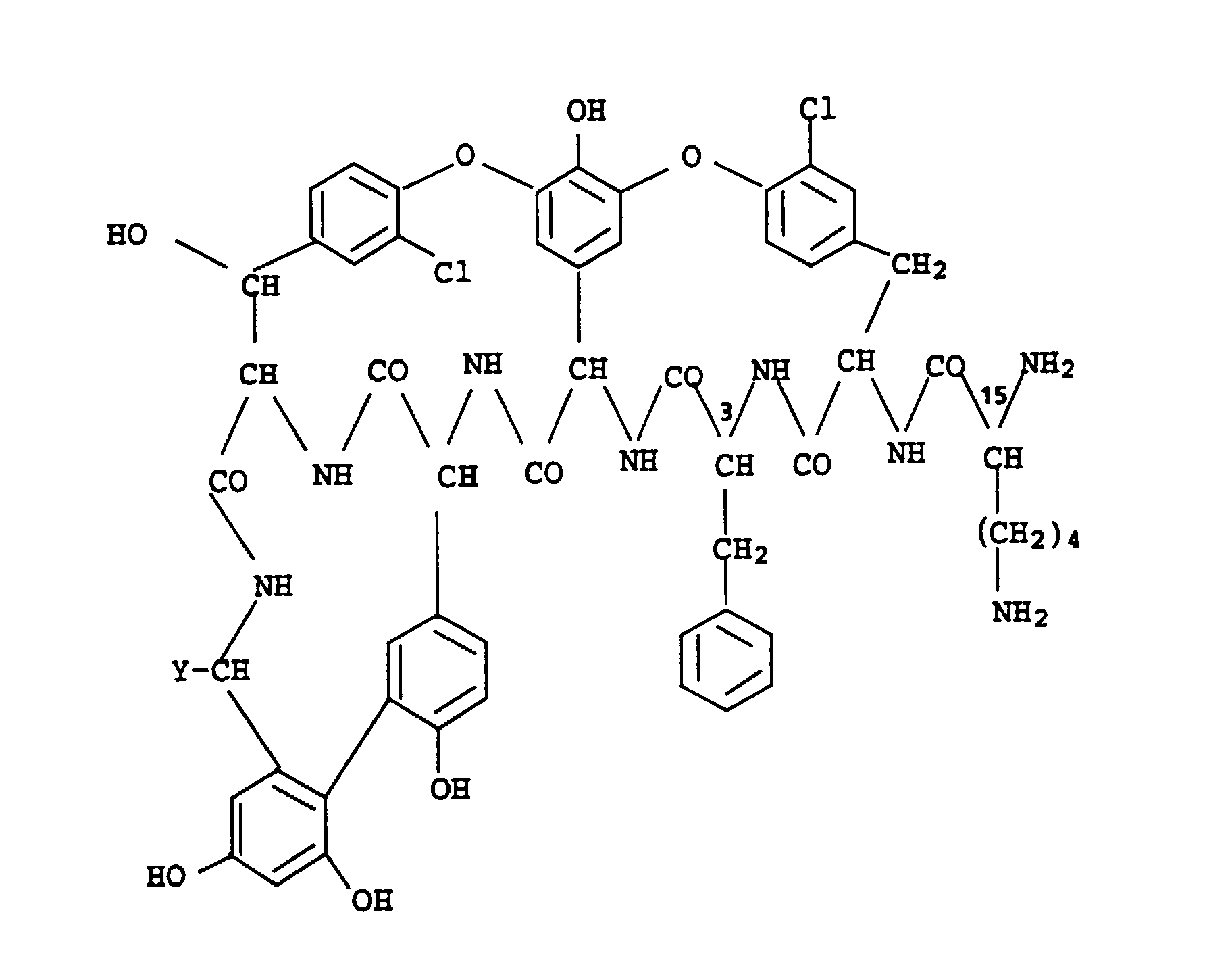
and its pharmaceutically acceptable salts with acids and bases as well as its inner salts. - A process for the manufacture of an aglucodalbaheptide of the general formula (I)
 W and Z, each independently, represent the relative portions of the aglycon of an antibiotic of the dalbaheptide group;Y represents a carboxylic group or a functional derivative of said carboxylic group;R and R1, each independently, represent hydrogen or a protecting group of the amino function;R2 represents hydrogen;and its salts with acids or bases as well as its inner salts, which comprises:i) condensing a tetrapeptide of formula (IIb)
 W and Z have the same meanings as above;Y is a functional derivative of the carboxylic group;R3 is amino;R4 is a protected amino group;R5 is hydrogen;with a N-protected phenylalanine derivative and, successively, deprotecting the amino group of the phenylalanine moiety of the obtained pentapeptide to yield a pentapeptide of formula (III)
wherein:W and Z have the same meanings as above;Y is a functional derivative of the carboxylic group;R4 is a protected amino group;R5 is hydrogen; ii) submitting the pentapeptide of formula (III) to intramolecular condensation and successively deprotecting the protected amino group R4 of the obtained hexapeptide to yield an hexapeptide of formula (IV)
 W and Z have the same meanings as above;Y is a functional derivative of the carboxylic group;R4 is amino;iii) condensing the hexapeptide of formula (IV) with a Nα,Nε-protected lysine derivative and, successively, deprotecting the amino groups of the lysine moiety of the obtained aglucodalbaheptide to yield the aglucodalbaheptide of formula (Ic)
 W and Z have the same meaning as above;Y is a functional derivative of the carboxylic group;R is hydrogen;R1 is hydrogen;R2 is hydrogen;iv) when Y is an easily cleavable protected carboxylic group, optionally deprotecting said protected carboxylic group of the compound of formula (Ic) to yield the corresponding carboxy derivative;v) in case each of the portions W and Z of the compound of formula (Ic) contains protected phenolic or benzylic hydroxy groups, optionally removing said protecting groups;vi) optionally transforming the free compound of formula (Ic) or its corresponding inner salts in its salts with acids and/or bases.
 - A process as in claim 6 wherein in step i) the N-protected phenylalanine derivative is a L-phenylalanine derivative and in step iii) the Nα ,Nε-protected lysine derivative is a D-lysine derivative.
- A process as in any of claims 6 and 7 wherein the N-protecting group of the phenylalanine derivative is removable under conditions that do not affect the N-protecting group of the protected amino group R4.
- A process as in any of claims 6, 7 and 8 wherein the N-protecting group of the phenylalanine derivative is a tert-butoxycarbonylamino group and the N-protecting group of the protected amino group R4 is a benzyloxycarbonylamino group.
- A process as in any of claims 6, 7, 8 and 9 wherein the N-protected phenylalanine derivative and Nα,Nε-protected lysine derivative are activated on the carboxylic function with groups suitable for the formation of peptidic bonds.
- A process as in claim 10 wherein the activating group of the carboxylic function is the ester formed between such carboxy group and N-hydroxysuccinimide.
- An aglucodalbaheptide of claim 1 for use as a medicament.
- Use of an aglucodalbaheptide of claim 1 for the manufacture of an antibiotic medicament.
- A pharmaceutical composition containing an aglucodalbaheptide of claim 1 as the antibiotically active ingredient.
Priority Applications (3)
| Application Number | Priority Date | Filing Date | Title |
|---|---|---|---|
| DK94913599.0T DK0698041T3 (en) | 1993-05-19 | 1994-04-14 | Synthetic aglucodalbaheptide antibiotics. |
| EP94913599A EP0698041B1 (en) | 1993-05-19 | 1994-04-14 | Synthetic aglucodalbaheptide antibiotics |
| SI9430101T SI0698041T1 (en) | 1993-05-19 | 1994-04-14 | Synthetic aglucodalbaheptide antibiotics |
Applications Claiming Priority (4)
| Application Number | Priority Date | Filing Date | Title |
|---|---|---|---|
| EP93108139 | 1993-05-19 | ||
| EP93108139 | 1993-05-19 | ||
| PCT/EP1994/001154 WO1994026780A1 (en) | 1993-05-19 | 1994-04-14 | Synthetic aglucodalbaheptide antibiotics |
| EP94913599A EP0698041B1 (en) | 1993-05-19 | 1994-04-14 | Synthetic aglucodalbaheptide antibiotics |
Publications (2)
| Publication Number | Publication Date |
|---|---|
| EP0698041A1 EP0698041A1 (en) | 1996-02-28 |
| EP0698041B1 true EP0698041B1 (en) | 1997-10-22 |
Family
ID=8212919
Family Applications (1)
| Application Number | Title | Priority Date | Filing Date |
|---|---|---|---|
| EP94913599A Expired - Lifetime EP0698041B1 (en) | 1993-05-19 | 1994-04-14 | Synthetic aglucodalbaheptide antibiotics |
Country Status (17)
| Country | Link |
|---|---|
| US (1) | US5674840A (en) |
| EP (1) | EP0698041B1 (en) |
| JP (1) | JP3503066B2 (en) |
| KR (1) | KR100298136B1 (en) |
| AT (1) | ATE159533T1 (en) |
| AU (1) | AU683881B2 (en) |
| CA (1) | CA2159728A1 (en) |
| DE (1) | DE69406441T2 (en) |
| DK (1) | DK0698041T3 (en) |
| ES (1) | ES2108444T3 (en) |
| GR (1) | GR3025446T3 (en) |
| HU (1) | HUT69700A (en) |
| IL (1) | IL109645A (en) |
| RU (1) | RU2126419C1 (en) |
| SI (1) | SI0698041T1 (en) |
| WO (1) | WO1994026780A1 (en) |
| ZA (1) | ZA943426B (en) |
Families Citing this family (4)
| Publication number | Priority date | Publication date | Assignee | Title |
|---|---|---|---|---|
| WO1992010516A1 (en) * | 1990-12-05 | 1992-06-25 | Gruppo Lepetit S.P.A. | 38-decarboxy-38-hydroxymethyl derivatives of teicoplanin antibiotics, and a process for preparing them |
| KR20000010589A (en) | 1996-04-23 | 2000-02-15 | 클라우디오 쿼르타 | Improved chemical process for preparing amide derivatives of antibiotic a40926 |
| EP1095058A4 (en) * | 1998-07-14 | 2003-07-16 | Univ Princeton | GLYCOPEPTIDE ANTIBIOTICS, COMBINATORIAL LIBRARIES OF GLYCOPEPTIDE ANTIBIOTICS, AND METHODS OF MAKING SAME |
| AU5141900A (en) * | 1999-05-19 | 2000-12-05 | Princeton University | Glycopeptide antibiotics, combinatorial libraries of glycopeptide antibiotics and methods of producing same |
Family Cites Families (4)
| Publication number | Priority date | Publication date | Assignee | Title |
|---|---|---|---|---|
| US4711877A (en) * | 1985-09-18 | 1987-12-08 | Smithkline Beckman Corporation | 6-pen-vasopressin compounds |
| ATE160360T1 (en) * | 1989-07-18 | 1997-12-15 | Biosearch Italia Spa | PENTAPEPTIDE ANTIBIOTICS PRODUCED FROM DALBAHEPTIDE |
| ATE121101T1 (en) * | 1990-12-10 | 1995-04-15 | Lepetit Spa | TETRAPEPTIDE ANTIBIOTIC PRODUCED FROM DALBAHEPTIDE. |
| US5438117A (en) * | 1990-12-20 | 1995-08-01 | Gruppo Lepetit S.P.A. | Hexapeptides deriving from aglucoteicoplanin and a process for preparing them |
-
1994
- 1994-04-14 SI SI9430101T patent/SI0698041T1/en not_active IP Right Cessation
- 1994-04-14 HU HU9401939A patent/HUT69700A/en unknown
- 1994-04-14 US US08/532,629 patent/US5674840A/en not_active Expired - Fee Related
- 1994-04-14 ES ES94913599T patent/ES2108444T3/en not_active Expired - Lifetime
- 1994-04-14 JP JP52485294A patent/JP3503066B2/en not_active Expired - Fee Related
- 1994-04-14 EP EP94913599A patent/EP0698041B1/en not_active Expired - Lifetime
- 1994-04-14 KR KR1019950705160A patent/KR100298136B1/en not_active Expired - Fee Related
- 1994-04-14 DK DK94913599.0T patent/DK0698041T3/en active
- 1994-04-14 DE DE69406441T patent/DE69406441T2/en not_active Expired - Fee Related
- 1994-04-14 AU AU65689/94A patent/AU683881B2/en not_active Ceased
- 1994-04-14 CA CA002159728A patent/CA2159728A1/en not_active Abandoned
- 1994-04-14 WO PCT/EP1994/001154 patent/WO1994026780A1/en not_active Ceased
- 1994-04-14 RU RU95122178A patent/RU2126419C1/en not_active IP Right Cessation
- 1994-04-14 AT AT94913599T patent/ATE159533T1/en not_active IP Right Cessation
- 1994-05-12 IL IL10964594A patent/IL109645A/en not_active IP Right Cessation
- 1994-05-18 ZA ZA943426A patent/ZA943426B/en unknown
-
1997
- 1997-11-19 GR GR970403091T patent/GR3025446T3/en unknown
Also Published As
| Publication number | Publication date |
|---|---|
| JPH08510215A (en) | 1996-10-29 |
| IL109645A0 (en) | 1994-08-26 |
| JP3503066B2 (en) | 2004-03-02 |
| ZA943426B (en) | 1995-01-20 |
| ATE159533T1 (en) | 1997-11-15 |
| EP0698041A1 (en) | 1996-02-28 |
| KR100298136B1 (en) | 2001-10-24 |
| HUT69700A (en) | 1995-09-28 |
| KR960702475A (en) | 1996-04-27 |
| SI0698041T1 (en) | 1998-02-28 |
| DK0698041T3 (en) | 1997-12-08 |
| DE69406441T2 (en) | 1998-03-26 |
| US5674840A (en) | 1997-10-07 |
| DE69406441D1 (en) | 1997-11-27 |
| AU683881B2 (en) | 1997-11-27 |
| CA2159728A1 (en) | 1994-11-24 |
| AU6568994A (en) | 1994-12-12 |
| WO1994026780A1 (en) | 1994-11-24 |
| IL109645A (en) | 2000-06-01 |
| ES2108444T3 (en) | 1997-12-16 |
| GR3025446T3 (en) | 1998-02-27 |
| RU2126419C1 (en) | 1999-02-20 |
| HU9401939D0 (en) | 1995-02-28 |
Similar Documents
| Publication | Publication Date | Title |
|---|---|---|
| US5750509A (en) | Amide derivatives of antibiotic A 40926 | |
| KR100242682B1 (en) | Amide derivaties of antibiotic a 40926 | |
| KR960014104B1 (en) | Substituted alkylamides of teicoplanin compounds | |
| EP0376041B1 (en) | C63-Amide derivatives of 34-de(acetylglucosaminyl)-34-deoxy-teicoplanins | |
| HU217074B (en) | Process for the preparation of substituted alkyl amide derivatives of teicoplanin and pharmaceutical compositions containing them | |
| US5674840A (en) | Synthetic aglucodalbaheptide antibiotics | |
| US5684127A (en) | Tetrapeptides deriving from dalbaheptide antibiotics | |
| US5438117A (en) | Hexapeptides deriving from aglucoteicoplanin and a process for preparing them | |
| US5644025A (en) | Tetrapeptides deriving from dalbaheptide antibiotics | |
| EP0460448B1 (en) | Use of C63-amide derivatives of 34-de(acetylglucosaminyl)-34-deoxy-teicoplanin against bacteria resistant to glycopeptide antibiotics | |
| EP0563062B1 (en) | Hexapeptides deriving from aglucoteicoplanin and a process for preparing them | |
| EP0326873A2 (en) | Teicoplanin hydrazides | |
| JPH06503307A (en) | Tetrapeptides derived from dalbaheptide antibiotic |
Legal Events
| Date | Code | Title | Description |
|---|---|---|---|
| PUAI | Public reference made under article 153(3) epc to a published international application that has entered the european phase |
Free format text: ORIGINAL CODE: 0009012 |
|
| 17P | Request for examination filed |
Effective date: 19951121 |
|
| AK | Designated contracting states |
Kind code of ref document: A1 Designated state(s): AT BE CH DE DK ES FR GB GR IE IT LI LU NL PT SE |
|
| AX | Request for extension of the european patent |
Free format text: SI PAYMENT 951121 |
|
| RAX | Requested extension states of the european patent have changed |
Free format text: SI PAYMENT 951121 |
|
| GRAG | Despatch of communication of intention to grant |
Free format text: ORIGINAL CODE: EPIDOS AGRA |
|
| 17Q | First examination report despatched |
Effective date: 19960712 |
|
| GRAH | Despatch of communication of intention to grant a patent |
Free format text: ORIGINAL CODE: EPIDOS IGRA |
|
| GRAH | Despatch of communication of intention to grant a patent |
Free format text: ORIGINAL CODE: EPIDOS IGRA |
|
| RAP1 | Party data changed (applicant data changed or rights of an application transferred) |
Owner name: BIOSEARCH ITALIA S.P.A. |
|
| GRAA | (expected) grant |
Free format text: ORIGINAL CODE: 0009210 |
|
| AK | Designated contracting states |
Kind code of ref document: B1 Designated state(s): AT BE CH DE DK ES FR GB GR IE IT LI LU NL PT SE |
|
| AX | Request for extension of the european patent |
Free format text: SI PAYMENT 951121 |
|
| REF | Corresponds to: |
Ref document number: 159533 Country of ref document: AT Date of ref document: 19971115 Kind code of ref document: T |
|
| REG | Reference to a national code |
Ref country code: CH Ref legal event code: EP |
|
| REG | Reference to a national code |
Ref country code: CH Ref legal event code: NV Representative=s name: FIAMMENGHI-FIAMMENGHI |
|
| REF | Corresponds to: |
Ref document number: 69406441 Country of ref document: DE Date of ref document: 19971127 |
|
| ET | Fr: translation filed | ||
| REG | Reference to a national code |
Ref country code: DK Ref legal event code: T3 |
|
| ITF | It: translation for a ep patent filed | ||
| REG | Reference to a national code |
Ref country code: ES Ref legal event code: FG2A Ref document number: 2108444 Country of ref document: ES Kind code of ref document: T3 |
|
| REG | Reference to a national code |
Ref country code: GR Ref legal event code: FG4A Free format text: 3025446 |
|
| REG | Reference to a national code |
Ref country code: PT Ref legal event code: SC4A Free format text: AVAILABILITY OF NATIONAL TRANSLATION Effective date: 19980102 |
|
| PLBE | No opposition filed within time limit |
Free format text: ORIGINAL CODE: 0009261 |
|
| STAA | Information on the status of an ep patent application or granted ep patent |
Free format text: STATUS: NO OPPOSITION FILED WITHIN TIME LIMIT |
|
| 26N | No opposition filed | ||
| REG | Reference to a national code |
Ref country code: GB Ref legal event code: IF02 |
|
| BECA | Be: change of holder's address |
Owner name: *VICURON PHARMACEUTICALS INC.1209 ORANGE STREET, W Effective date: 20030619 |
|
| BECH | Be: change of holder |
Owner name: *VICURON PHARMACEUTICALS INC.1209 ORANGE STREET, W Effective date: 20030619 |
|
| NLS | Nl: assignments of ep-patents |
Owner name: VERSICOR INC. |
|
| NLT1 | Nl: modifications of names registered in virtue of documents presented to the patent office pursuant to art. 16 a, paragraph 1 |
Owner name: VICURON PHARMACEUTICALS INC. |
|
| REG | Reference to a national code |
Ref country code: GB Ref legal event code: 732E |
|
| REG | Reference to a national code |
Ref country code: PT Ref legal event code: PD4A Free format text: VICURON PHARMACEUTICALS INC. US Effective date: 20030521 Ref country code: PT Ref legal event code: PC4A Free format text: VERSICOR INC. US Effective date: 20030521 |
|
| REG | Reference to a national code |
Ref country code: CH Ref legal event code: PUE Owner name: VICURON PHARMACEUTICALS INC. Free format text: BIOSEARCH ITALIA S.P.A.#VIA R. LEPETIT, 34#21040 GERENZANO (VA) (IT) -TRANSFER TO- VICURON PHARMACEUTICALS INC.#455 SOUTH GULPH ROAD#KING OF PRUSSIA, PA 19405 (US) Ref country code: CH Ref legal event code: NV Representative=s name: ARNOLD & SIEDSMA AG |
|
| REG | Reference to a national code |
Ref country code: FR Ref legal event code: TP Ref country code: FR Ref legal event code: CD |
|
| PGFP | Annual fee paid to national office [announced via postgrant information from national office to epo] |
Ref country code: LU Payment date: 20040308 Year of fee payment: 11 |
|
| PGFP | Annual fee paid to national office [announced via postgrant information from national office to epo] |
Ref country code: SE Payment date: 20040316 Year of fee payment: 11 |
|
| PGFP | Annual fee paid to national office [announced via postgrant information from national office to epo] |
Ref country code: PT Payment date: 20040319 Year of fee payment: 11 |
|
| PGFP | Annual fee paid to national office [announced via postgrant information from national office to epo] |
Ref country code: GR Payment date: 20040329 Year of fee payment: 11 |
|
| PGFP | Annual fee paid to national office [announced via postgrant information from national office to epo] |
Ref country code: GB Payment date: 20040401 Year of fee payment: 11 |
|
| PGFP | Annual fee paid to national office [announced via postgrant information from national office to epo] |
Ref country code: BE Payment date: 20040402 Year of fee payment: 11 |
|
| PGFP | Annual fee paid to national office [announced via postgrant information from national office to epo] |
Ref country code: ES Payment date: 20040405 Year of fee payment: 11 Ref country code: DK Payment date: 20040405 Year of fee payment: 11 |
|
| PGFP | Annual fee paid to national office [announced via postgrant information from national office to epo] |
Ref country code: AT Payment date: 20040413 Year of fee payment: 11 |
|
| REG | Reference to a national code |
Ref country code: CH Ref legal event code: NV Representative=s name: FIAMMENGHI-FIAMMENGHI |
|
| PGFP | Annual fee paid to national office [announced via postgrant information from national office to epo] |
Ref country code: FR Payment date: 20040421 Year of fee payment: 11 |
|
| PGFP | Annual fee paid to national office [announced via postgrant information from national office to epo] |
Ref country code: NL Payment date: 20040429 Year of fee payment: 11 |
|
| PGFP | Annual fee paid to national office [announced via postgrant information from national office to epo] |
Ref country code: DE Payment date: 20040430 Year of fee payment: 11 |
|
| REG | Reference to a national code |
Ref country code: SI Ref legal event code: IF |
|
| PG25 | Lapsed in a contracting state [announced via postgrant information from national office to epo] |
Ref country code: LU Free format text: LAPSE BECAUSE OF NON-PAYMENT OF DUE FEES Effective date: 20050414 Ref country code: IT Free format text: LAPSE BECAUSE OF NON-PAYMENT OF DUE FEES;WARNING: LAPSES OF ITALIAN PATENTS WITH EFFECTIVE DATE BEFORE 2007 MAY HAVE OCCURRED AT ANY TIME BEFORE 2007. THE CORRECT EFFECTIVE DATE MAY BE DIFFERENT FROM THE ONE RECORDED. Effective date: 20050414 Ref country code: GB Free format text: LAPSE BECAUSE OF NON-PAYMENT OF DUE FEES Effective date: 20050414 Ref country code: AT Free format text: LAPSE BECAUSE OF NON-PAYMENT OF DUE FEES Effective date: 20050414 |
|
| PG25 | Lapsed in a contracting state [announced via postgrant information from national office to epo] |
Ref country code: SE Free format text: LAPSE BECAUSE OF NON-PAYMENT OF DUE FEES Effective date: 20050415 Ref country code: ES Free format text: LAPSE BECAUSE OF NON-PAYMENT OF DUE FEES Effective date: 20050415 |
|
| PG25 | Lapsed in a contracting state [announced via postgrant information from national office to epo] |
Ref country code: BE Free format text: LAPSE BECAUSE OF NON-PAYMENT OF DUE FEES Effective date: 20050430 |
|
| PG25 | Lapsed in a contracting state [announced via postgrant information from national office to epo] |
Ref country code: DK Free format text: LAPSE BECAUSE OF NON-PAYMENT OF DUE FEES Effective date: 20050502 |
|
| PGFP | Annual fee paid to national office [announced via postgrant information from national office to epo] |
Ref country code: IE Payment date: 20050927 Year of fee payment: 12 |
|
| PG25 | Lapsed in a contracting state [announced via postgrant information from national office to epo] |
Ref country code: PT Free format text: LAPSE BECAUSE OF NON-PAYMENT OF DUE FEES Effective date: 20051014 |
|
| PGFP | Annual fee paid to national office [announced via postgrant information from national office to epo] |
Ref country code: CH Payment date: 20051028 Year of fee payment: 12 |
|
| BERE | Be: lapsed |
Owner name: *VICURON PHARMACEUTICALS INC. Effective date: 20050430 |
|
| PG25 | Lapsed in a contracting state [announced via postgrant information from national office to epo] |
Ref country code: NL Free format text: LAPSE BECAUSE OF NON-PAYMENT OF DUE FEES Effective date: 20051101 Ref country code: DE Free format text: LAPSE BECAUSE OF NON-PAYMENT OF DUE FEES Effective date: 20051101 |
|
| PG25 | Lapsed in a contracting state [announced via postgrant information from national office to epo] |
Ref country code: GR Free format text: LAPSE BECAUSE OF NON-PAYMENT OF DUE FEES Effective date: 20051103 |
|
| REG | Reference to a national code |
Ref country code: DK Ref legal event code: EBP |
|
| EUG | Se: european patent has lapsed | ||
| GBPC | Gb: european patent ceased through non-payment of renewal fee |
Effective date: 20050414 |
|
| PG25 | Lapsed in a contracting state [announced via postgrant information from national office to epo] |
Ref country code: FR Free format text: LAPSE BECAUSE OF NON-PAYMENT OF DUE FEES Effective date: 20051230 |
|
| NLV4 | Nl: lapsed or anulled due to non-payment of the annual fee |
Effective date: 20051101 |
|
| REG | Reference to a national code |
Ref country code: FR Ref legal event code: ST Effective date: 20051230 |
|
| PG25 | Lapsed in a contracting state [announced via postgrant information from national office to epo] |
Ref country code: IE Free format text: LAPSE BECAUSE OF NON-PAYMENT OF DUE FEES Effective date: 20060414 |
|
| PG25 | Lapsed in a contracting state [announced via postgrant information from national office to epo] |
Ref country code: LI Free format text: LAPSE BECAUSE OF NON-PAYMENT OF DUE FEES Effective date: 20060430 Ref country code: CH Free format text: LAPSE BECAUSE OF NON-PAYMENT OF DUE FEES Effective date: 20060430 |
|
| REG | Reference to a national code |
Ref country code: ES Ref legal event code: FD2A Effective date: 20050415 |
|
| REG | Reference to a national code |
Ref country code: CH Ref legal event code: PL |
|
| REG | Reference to a national code |
Ref country code: IE Ref legal event code: MM4A |
|
| BERE | Be: lapsed |
Owner name: *VICURON PHARMACEUTICALS INC. Effective date: 20050430 |