EP0697380A2 - Chromate free cements and a process for preparing them - Google Patents
Chromate free cements and a process for preparing them Download PDFInfo
- Publication number
- EP0697380A2 EP0697380A2 EP95202166A EP95202166A EP0697380A2 EP 0697380 A2 EP0697380 A2 EP 0697380A2 EP 95202166 A EP95202166 A EP 95202166A EP 95202166 A EP95202166 A EP 95202166A EP 0697380 A2 EP0697380 A2 EP 0697380A2
- Authority
- EP
- European Patent Office
- Prior art keywords
- cement
- process according
- formula
- iii
- cements
- Prior art date
- Legal status (The legal status is an assumption and is not a legal conclusion. Google has not performed a legal analysis and makes no representation as to the accuracy of the status listed.)
- Granted
Links
Classifications
-
- C—CHEMISTRY; METALLURGY
- C04—CEMENTS; CONCRETE; ARTIFICIAL STONE; CERAMICS; REFRACTORIES
- C04B—LIME, MAGNESIA; SLAG; CEMENTS; COMPOSITIONS THEREOF, e.g. MORTARS, CONCRETE OR LIKE BUILDING MATERIALS; ARTIFICIAL STONE; CERAMICS; REFRACTORIES; TREATMENT OF NATURAL STONE
- C04B7/00—Hydraulic cements
- C04B7/36—Manufacture of hydraulic cements in general
- C04B7/48—Clinker treatment
-
- C—CHEMISTRY; METALLURGY
- C04—CEMENTS; CONCRETE; ARTIFICIAL STONE; CERAMICS; REFRACTORIES
- C04B—LIME, MAGNESIA; SLAG; CEMENTS; COMPOSITIONS THEREOF, e.g. MORTARS, CONCRETE OR LIKE BUILDING MATERIALS; ARTIFICIAL STONE; CERAMICS; REFRACTORIES; TREATMENT OF NATURAL STONE
- C04B2103/00—Function or property of ingredients for mortars, concrete or artificial stone
- C04B2103/0068—Ingredients with a function or property not provided for elsewhere in C04B2103/00
- C04B2103/0096—Reducing agents
-
- C—CHEMISTRY; METALLURGY
- C04—CEMENTS; CONCRETE; ARTIFICIAL STONE; CERAMICS; REFRACTORIES
- C04B—LIME, MAGNESIA; SLAG; CEMENTS; COMPOSITIONS THEREOF, e.g. MORTARS, CONCRETE OR LIKE BUILDING MATERIALS; ARTIFICIAL STONE; CERAMICS; REFRACTORIES; TREATMENT OF NATURAL STONE
- C04B2111/00—Mortars, concrete or artificial stone or mixtures to prepare them, characterised by specific function, property or use
- C04B2111/10—Compositions or ingredients thereof characterised by the absence or the very low content of a specific material
- C04B2111/1075—Chromium-free or very low chromium-content materials
- C04B2111/1081—Chromium VI, e.g. for avoiding chromium eczema
Definitions
- the present invention relates to a process for preparing a cement composition which, when, at use time, is brought into contact with water, releases less than 2 parts per million parts of soluble hexavalent chrome (chromates).
- a further object of the present invention is the cement that said process makes it possible to obtain.
- an eczema After a long exposure time to aqueous solutions of chrome-(VI) compounds, an eczema can develop (in general on workers' hands and arms) which can even become of chronic character.
- European patent No. 54 314 a method for chromate reduction is disclosed, in which during cement production process an amount of from 0.3 to 1% is added of a special type of ferrous sulfate hydrate, which is characterized by a suitable coating aiming at preventing Fe2+ ion from being oxidised.
- European patent No. 125,267 proposes a method according to which ferrous sulfate is dried and mixed with products displaying suitable granulometry characteristics, such as flying ash or calcium sulfate, which the resulting mixture being subsequently added to cement.
- this method besides being particularly laborious when carried out on an industrial scale, does not anyway prevent iron from undergoing the undesired valency state change and furthermore requires that substances are added which may be undesired.
- a further problem, also not completely removable, derives from ferrous sulfate, per se , being a corrosive agent, undesired in both clinker grinding facilities and silos.
- the removal of chrome is accomplished according to the present invention by means of the action of a suitably selected organic reductant compound, directly metered to cement during the grinding and production process.
- the object of the present invention is a process for preparing a cement composition which comprises bringing into contact (before, during or after the grinding step) the component materials of such a composition, or the same composition, with an organic reductant in the presence of water in order to eliminate or substantially reduce the level of soluble chromates present, said organic reductant being characterized in that it is selected from:
- aldehydic compounds as disclosed above and their corresponding hydrate, semi-acetalic, acetalic derivatives, cyclic trimers, in whichever form they may be present, such as, e.g., the oligomeric form, as well as the alkali- or alkali-earth metal salts of acidic or alcoholic functions possibly present in the structure, have to be regarded as being organic reductants according to the present invention.
- the following compounds are specific examples of the above mentioned reductants: HOCH2-CHO hydroxy acetaldehyde OHC-CHO glyoxal H-CHO formaldehyde CH3-CHO acetaldehyde CH3-CH2-CHO propionaldehyde HOOC-CHO glyoxalic acid CH3-OOC-CHO glyoxalic acid methyl ester OHC-(CH2)2-CHO succinic di-aldehyde OHC-(CH2)2-CHO 1,8-octanedial HOOC-CH(OH)2 glyoxalic acid hydrate (C2H5O)(OH)CH-COOC2H5 glyoxalic acid ethyl ester ethyl semiacetal (CH3O)2-(CH2)6-CH(OCH3)2 1,1,8,8-tetramethoxy octane glyoxal trimer dihydrate According to a preferred aspect of the present organic, g
- reactants are formaldehyde, acetaldehyde, para-formaldehyde, glyceraldehyde, glycolic aldehyde.
- Chromates contained in cement mostly derive from those materials from which cement is formed.
- cement is produced by grinding clinker and calcium sulfate, possibly in the presence of further added materials, such as blast furnace slags, (either natural or industrial) pozzuolanas, (either silica or calcium) flying ashes, fired shales, limestone or microsilica as the starting materials.
- blast furnace slags either natural or industrial
- pozzuolanas either silica or calcium
- the organic agent can reduce chromates during any steps of cement production process, i.e., before, during or after clinker grinding with calcium sulfate, provided that the operating reduction conditions so allow.
- the temperature is generally comprised within the range of from 60 to 120°C. These operating conditions are sufficient in order to eliminate or substantially reduce soluble chromates with reductant amounts comprised within the range of from 0.01% to 1% by weight, based on cement, preferably of from 0.04% to 0.1%.
- Water presence is necessary in order that the reaction of reduction of chromates with the aldehydic derivatives of the invention may occur.
- the level of water into contact with clinker or cement should desirably be decreased as far as possible. Water level should preferably be not higher that 2% based on cement. Water should not necessarily be added; water contained in the moisture of the starting material may be already enough; however, should water be added, it can be added either as atomized water, or as steam.
- the optimal amount of reductant depends on a number of factors, such as the amount of chrome to be reduced, contained in the starting material or from other sources, the type of organic reductant selected, water amount and temperature at which the reaction is carried out.
- the organic reducing reactant according to the present invention is perfectly compatible with any known additives as commonly used for cement, i.e., both the grinding additives, such as, e.g., triethanolamine or that amine blend known as NT9 (R) , or other types of additives, such as, e.g., accelerants, as CaCl2.
- the ideal operating conditions will be found during clinker grinding, because the grinding facilities (of ball or roller type) generate temperatures of round 100-120°C.
- the operating temperature is kept at those values by means of the addition of water, the function of which is of keeping inside the grinding chambers, moisture levels of at least 0.3 kg of steam per kg of air.
- a preferred mode for implementing the invention provides for the organic reductant to be added to water fed to the chambers during the grinding step.
- cement and cement composition encompass any cement types, i.e., both so-said "normal” cements provided for by the preliminary European standard 197.1 (Cements of I, II, III, IV and V Types), i.e., normal Portland cement and any mix cements (pozzuolana cement, composite cement or slag cement), and such cements as aluminous cement or weir cements, or special cements, e.g., low-hydration heat cements.
- the present invention offers the extraordinary advantage of producing cement which is already substantially free from chrome before being stored to silos, or packaged inside bags.
- the organic reductants according to the present invention do not endanger the chemical and physical-mechanical properties of cement mixes.
- the organic reductants according to the present invention display a high reaction rate, have a limited cost, and, should they remain inside the cement composition, either as such or as oxidized products, they will not constitute any risk causes (e.g., pollution, toxicity risks, and so forth).
- the method used for determining the content of Cr6+ in the cements of the present invention is derived from a standard published by the Swedish National Testing and Research Institute.
- Said method consists in an extraction carried out with water or an aqueous solution of sodium sulfate, with stirring. Cement:water ratio is 1:10 and extraction time is 15 minutes.
- the mixture was discharged, admixed with sodium sulfate (5%) and then was analysed without being submitted to any further treatments.
- the cement prepared according to Example 1 was characterized by means of the standard test in normal mortar according to EU standard UNI EN 196.1.
Landscapes
- Chemical & Material Sciences (AREA)
- Engineering & Computer Science (AREA)
- Ceramic Engineering (AREA)
- Materials Engineering (AREA)
- Structural Engineering (AREA)
- Organic Chemistry (AREA)
- Curing Cements, Concrete, And Artificial Stone (AREA)
- Saccharide Compounds (AREA)
Abstract
Description
- The present invention relates to a process for preparing a cement composition which, when, at use time, is brought into contact with water, releases less than 2 parts per million parts of soluble hexavalent chrome (chromates).
- A further object of the present invention is the cement that said process makes it possible to obtain.
- It is known that nearly all of the hydraulic binders contain chrome, prevailingly as hexavalent status.
- In particular, it is well-known that when cement is mixed with water, soluble hexavalent chrome contained in it is dissolved.
- After a long exposure time to aqueous solutions of chrome-(VI) compounds, an eczema can develop (in general on workers' hands and arms) which can even become of chronic character.
- Although a lower limit cannot be established under which one will be sure that the causes of chrome induced eczema are removed, some, by now established, practical experiences would indicate that noxious chrome concentrations in cements would be higher than 1-2 mg of chromate/cement g (1-2 ppm).
- In the past, attempts to solve the problem had made resort to suitable additions of ferrous sulfate during cement preparation before or after clinker grinding.
- In fact, following Fe²⁺ addition, hexavalent chrome [chrome-(VI) or Cr⁶⁺] is reduced to Cr-(III) (trivalent chrome, or Cr³⁺) according to the generic equation:
Cr⁶⁺ + 3 Fe²⁺ ---------> Cr³⁺ + 3 Fe³⁺
Such a reaction takes place in aqueous solution and, consequently, at cement use time. - Water in the mix dissolves hexavalent chrome which is immediately transformed into insoluble, non-toxic trivalent chrome. See, e.g., Italian patent No. 944,160.
- In reality, a very large number of problems exist which make this reaction unfeasible from a practical point of view.
- A great drawback arising when this reductant is used is that reducing power of ferrous sulfate decreases with time because Fe²⁺ undergoes a slow oxidation in air. Therefore, during the usual time periods of cement storage inside silos or bags, the reducing power of Fe²⁺ tends to decrease, thus no longer securing that at use time chromate will be reduced to Cr³⁺.
- In European patent No. 54 314 a method for chromate reduction is disclosed, in which during cement production process an amount of from 0.3 to 1% is added of a special type of ferrous sulfate hydrate, which is characterized by a suitable coating aiming at preventing Fe²⁺ ion from being oxidised.
- However, the use of this type of ferrous sulfate enables the reducing power of iron to be preserved only partially.
- However, a further technical drawback exists, in correlation with the preservation of ferrous sulfate hydrate in cement: this product tends to block inside the silos and therefore does not homogeneously distribute throughout cement.
- In order to address this problem, European patent No. 125,267 proposes a method according to which ferrous sulfate is dried and mixed with products displaying suitable granulometry characteristics, such as flying ash or calcium sulfate, which the resulting mixture being subsequently added to cement.
- Also this method, besides being particularly laborious when carried out on an industrial scale, does not anyway prevent iron from undergoing the undesired valency state change and furthermore requires that substances are added which may be undesired.
- A further problem, also not completely removable, derives from ferrous sulfate, per se, being a corrosive agent, undesired in both clinker grinding facilities and silos.
- Therefore, the need for solving the problem of chromate reducing in cements, while simultaneously removing all drawbacks caused by the use of ferrous sulfate, is strongly felt.
- The removal of chrome is accomplished according to the present invention by means of the action of a suitably selected organic reductant compound, directly metered to cement during the grinding and production process.
- Therefore, the object of the present invention is a process for preparing a cement composition which comprises bringing into contact (before, during or after the grinding step) the component materials of such a composition, or the same composition, with an organic reductant in the presence of water in order to eliminate or substantially reduce the level of soluble chromates present, said organic reductant being characterized in that it is selected from:
- -- an aldehyde of formula (I)
R-CHO (I)
wherein R can be hydrogen, CHO, COOH, COOR₁ or a C₁-C₈ alkyl radical possibly substituted with one or two OH group(s) or a CHO, COOH, COOR₁ group wherein R₁ is a C₁-C₄ alkyl radical, - -- a corresponding hydrate, semi-acetalic or acetalic derivative of formula (II)
R-CH(OR₂)(OR₃) (II)
wherein R₂ and R₃ can be hydrogen or a C₁-C₃ alkyl radical, or R₂ and R₃, linked to each other, represent the (CH₂)n moiety with n being either 2 or 3, - -- and a corresponding cyclic, trimeric derivative of formula (III)

- Therefore, the aldehydic compounds as disclosed above, and their corresponding hydrate, semi-acetalic, acetalic derivatives, cyclic trimers, in whichever form they may be present, such as, e.g., the oligomeric form, as well as the alkali- or alkali-earth metal salts of acidic or alcoholic functions possibly present in the structure, have to be regarded as being organic reductants according to the present invention.
- In particular, the following compounds are specific examples of the above mentioned reductants:
HOCH₂-CHO
hydroxy acetaldehyde
OHC-CHO
glyoxal
H-CHO
formaldehyde
CH₃-CHO
acetaldehyde
CH₃-CH₂-CHO
propionaldehyde
HOOC-CHO
glyoxalic acid
CH₃-OOC-CHO
glyoxalic acid methyl ester
OHC-(CH₂)₂-CHO
succinic di-aldehyde
OHC-(CH₂)₂-CHO
1,8-octanedial
HOOC-CH(OH)₂
glyoxalic acid hydrate
(C₂H₅O)(OH)CH-COOC₂H₅
glyoxalic acid ethyl ester ethyl semiacetal
(CH₃O)₂-(CH₂)₆-CH(OCH₃)₂
1,1,8,8-tetramethoxy octane
glyoxal trimer dihydrate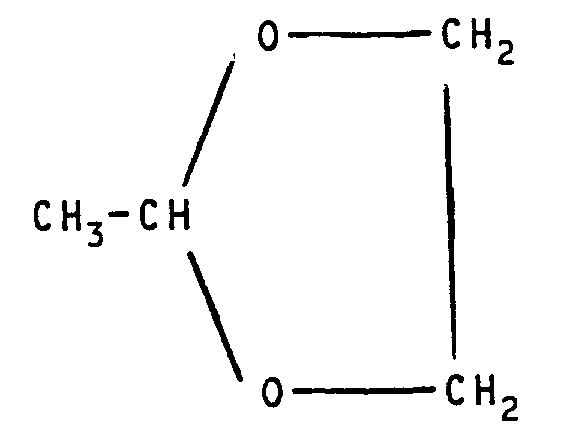
According to a preferred aspect of the present organic, glyoxal trimer dihydrate proved to be the organic reductant. - Other particularly preferred reactants are formaldehyde, acetaldehyde, para-formaldehyde, glyceraldehyde, glycolic aldehyde.
- It should be stated in detail here that the expressions "chrome free" and "eliminate or substantially reduce the level of water soluble chromates", as used in the instant text and in the appended claims, are understood to mean that the content of soluble chrome contained in the produced cement is of round 2 mg of chromate per cement gramme (2 ppm), as determined according to SPO662 method published by the Swedish National Testing and Research Institute on Dec. 7th, 1992.
- Chromates contained in cement mostly derive from those materials from which cement is formed.
- In the instant specification, the expression "those materials from which cement is formed" relates to those raw materials from which cement is produced. As well-known, cement is produced by grinding clinker and calcium sulfate, possibly in the presence of further added materials, such as blast furnace slags, (either natural or industrial) pozzuolanas, (either silica or calcium) flying ashes, fired shales, limestone or microsilica as the starting materials.
- The organic agent can reduce chromates during any steps of cement production process, i.e., before, during or after clinker grinding with calcium sulfate, provided that the operating reduction conditions so allow.
- This means that the process according to the invention can be applied by using clinker or same cement as the starting material.
- The temperature is generally comprised within the range of from 60 to 120°C. These operating conditions are sufficient in order to eliminate or substantially reduce soluble chromates with reductant amounts comprised within the range of from 0.01% to 1% by weight, based on cement, preferably of from 0.04% to 0.1%.
- Water presence is necessary in order that the reaction of reduction of chromates with the aldehydic derivatives of the invention may occur. The level of water into contact with clinker or cement should desirably be decreased as far as possible. Water level should preferably be not higher that 2% based on cement. Water should not necessarily be added; water contained in the moisture of the starting material may be already enough; however, should water be added, it can be added either as atomized water, or as steam.
- Obviously, the optimal amount of reductant depends on a number of factors, such as the amount of chrome to be reduced, contained in the starting material or from other sources, the type of organic reductant selected, water amount and temperature at which the reaction is carried out.
- However, those skilled in the art will be perfectly capable of evaluating from time to time which the most suitable operating conditions should be.
- It may be suggested here that for a clinker with a content of about 10 ppm of hexavalent chrome to be reduced in the presence of steam at 100°C, approximately 0.1% by weight of reductant of the invention having an aldehydic function will be necessary. The organic reducing reactant according to the present invention is perfectly compatible with any known additives as commonly used for cement, i.e., both the grinding additives, such as, e.g., triethanolamine or that amine blend known as NT9(R), or other types of additives, such as, e.g., accelerants, as CaCl₂.
- However, the ideal operating conditions will be found during clinker grinding, because the grinding facilities (of ball or roller type) generate temperatures of round 100-120°C. The operating temperature is kept at those values by means of the addition of water, the function of which is of keeping inside the grinding chambers, moisture levels of at least 0.3 kg of steam per kg of air.
- A preferred mode for implementing the invention provides for the organic reductant to be added to water fed to the chambers during the grinding step.
- The presence of small amounts of transition metal ions can favour the process of the invention.
- In the instant specification, the expressions "cement" and "cement composition" encompass any cement types, i.e., both so-said "normal" cements provided for by the preliminary European standard 197.1 (Cements of I, II, III, IV and V Types), i.e., normal Portland cement and any mix cements (pozzuolana cement, composite cement or slag cement), and such cements as aluminous cement or weir cements, or special cements, e.g., low-hydration heat cements.
- The present invention offers the extraordinary advantage of producing cement which is already substantially free from chrome before being stored to silos, or packaged inside bags.
- This feature, together with the elimination of all of the disadvantages deriving from the use of ferrous sulfate, represent a valuable solution to the technical problem of chrome removal.
- The organic reductants according to the present invention do not endanger the chemical and physical-mechanical properties of cement mixes.
- For that purpose, comparison tests were carried out on samples with and without the reductant additive, for compression strength in normal mortar.
- The results from these tests confirmed that the 28-day strength values were substantially the same in both cases.
- The organic reductants according to the present invention display a high reaction rate, have a limited cost, and, should they remain inside the cement composition, either as such or as oxidized products, they will not constitute any risk causes (e.g., pollution, toxicity risks, and so forth).
- The method used for determining the content of Cr⁶⁺ in the cements of the present invention is derived from a standard published by the Swedish National Testing and Research Institute.
- Said method consists in an extraction carried out with water or an aqueous solution of sodium sulfate, with stirring. Cement:water ratio is 1:10 and extraction time is 15 minutes.
- After filtration, the content of Cr⁶⁺ was determined on the filtrate, by means of the colorimetric methods using diphenyl carbazide.
- In the following, some examples are reported in order to better explain the invention without limiting it.
- Five kg of clinker was heated up to about 90°C and was ground in a refiner mill, with temperature being kept around 90°C.
- Then, 25 ml was added of a suspension of glyoxal trimer dihydrate (5 g) and 20 ml of grinding additive (NT9(R)).
- Grinding was continued until a fineness of about 3,500 Blaine was reached (required time, about 2 hours).
- The mixture was discharged, admixed with sodium sulfate (5%) and then was analysed without being submitted to any further treatments.
- Thus produced cement (5 g) was suspended in 100 ml of a solution of 20% Na₂SO₄, with stirring for 15 minutes at room temperature, and then was filtered and diluted.
- Then, 1 ml of 1% diphenyl carbazide solution was added and, after the development of the brown-violet colour, the absorbance at 540 nm was measured by means of a colorimeter. The concentration of chromates in the sample resulted to be lower than 1 ppm.
- The concentration of chromates in a sample of said clinker ground without the addition of the reducing additive under such conditions as reported above, resulted to be of 10 ppm.
- The cement prepared according to Example 1 was characterized by means of the standard test in normal mortar according to EU standard UNI EN 196.1.
- The results are reported in following Table 1. For comparison purpose, also the values are reported which relate to a cement prepared without the reducing additive, but exclusively using the grinding additive NT9(R).

- From the table, one will easily see that the compression values at 28 days are the same.
- A clinker containing 20 ppm of chromates was ground by operating substantially as disclosed in Example 1:
- (a) in the presence of 0.4% ferrous sulfate;
- (b) in the presence of 0.4% of glyoxal trimer dihydrate.
- By substantially following the same procedure as disclosed in Example 1, but using different reducing agents by starting from a clinker which contained 8 ppm of chromates, the following results were obtained:
Organic reactant Content of chromates in clinker after the treatment (ppm) Formaldehyde 1.8 Para-formaldehyde 1.0 Acetaldehyde 1.5 Glyceraldehyde 0.2 Glycolic aldehyde 0.4
Claims (13)
- Process for preparing a cement composition which comprises bringing into contact the component materials of such a composition, or the same composition, with an organic reductant in the presence of water in order to eliminate or substantially reduce the level of soluble chromates present, said organic reductant being characterized in that it is selected from:-- an aldheyde of formula (I)
R-CHO (I)
wherein R can be hydrogen, CHO, COOH, COOR₁ or a C₁-C₈ alkyl radical possibly substituted with one or two OH group(s) or a CHO, COOH, COOR₁ group wherein R₁ is a C₁-C₄ alkyl radical,-- a corresponding hydrate, semi-acetalic or acetalic derivative of formula (II)
R-CH(OR₂)(OR₃) (II)
wherein R₂ and R₃ can be hydrogen or a C₁-C₃ alkyl radical, or R₂ and R₃, linked to each other, represent the (CH₂)n moiety with n being either 2 or 3,-- and a corresponding cyclic, trimeric derivative of formula (III)
- Process according to claim 1, in which the aldehydic compounds of formula (I) or (II) are in oligomeric form.
- Process according to claims 1 and 2, in which the acidic or alcoholic functions are in the form of alkali or alkali-earth metal salts.
- Process according to claim 1, in which the organic reductant is selected from glyoxal, its trimer dihydrate, formaldehyde, paraformaldehyde, acetaldehyde, glyceraldehyde and glycolic aldehyde.
- Process according to claims from 1 to 4, further characterized in that the reaction temperature is comprised within the range of from 60 to 120°C.
- Process according to claims from 1 to 5, characterized in that the organic reductant of formula (I), (II) or (III) is present at a level comprised within the range of from 0.01% to 1% by weight, based on cement.
- Process according to claims from 1 to 6, in which the organic reductant of formula (I), (II) or (III) is present at a level comprised within the range of from 0.04% to 0.1% by weight, based on cement.
- Process according to claims from 1 to 7, in which the water content is lower than 2%, based on cement.
- Process according to claims from 4 to 8, characterized in that the organic reductant of formula (I), (II) or (III) is added during clinker grinding.
- Process according to claim 9, characterized in that the organic reductant of formula (I), (II) or (III) is added together with a grinding additive, preferably triethanolamine or NT9(R).
- Process according to claims from 4 to 9, characterized in that the cement composition is selected from so-said "normal" cements as provided for by preliminary European standard 197.1, (cements of I, II, III, IV and V types), such cements as aluminous cement or weir cements or special cements.
- Chromate free cement composition, characterized in that it is produced by means of the process according to claims from 1 to 11.
- Use of organic reductant selected from compounds of formula (I), (II) or (III) as claimed in claim 1, in order to eliminate or substantially reduce soluble chromate levels in clinker or cement compositions.
Applications Claiming Priority (2)
| Application Number | Priority Date | Filing Date | Title |
|---|---|---|---|
| ITMI941756 | 1994-08-19 | ||
| ITMI941756A IT1274718B (en) | 1994-08-19 | 1994-08-19 | CHROME FREE CEMENTS AND A PROCEDURE FOR THEIR PREPARATION |
Publications (3)
| Publication Number | Publication Date |
|---|---|
| EP0697380A2 true EP0697380A2 (en) | 1996-02-21 |
| EP0697380A3 EP0697380A3 (en) | 1997-05-02 |
| EP0697380B1 EP0697380B1 (en) | 2001-12-05 |
Family
ID=11369483
Family Applications (1)
| Application Number | Title | Priority Date | Filing Date |
|---|---|---|---|
| EP95202166A Expired - Lifetime EP0697380B1 (en) | 1994-08-19 | 1995-08-09 | Chromate free cements and a process for preparing them |
Country Status (3)
| Country | Link |
|---|---|
| EP (1) | EP0697380B1 (en) |
| DE (1) | DE69524310D1 (en) |
| IT (1) | IT1274718B (en) |
Cited By (5)
| Publication number | Priority date | Publication date | Assignee | Title |
|---|---|---|---|---|
| DE19750894A1 (en) * | 1997-11-17 | 1999-05-27 | Fraunhofer Ges Forschung | Reducing soluble chromium content of wood ash |
| EP0960865A1 (en) * | 1998-05-25 | 1999-12-01 | Chemische Werke Zell-Wildshausen GMBH | Agent for the reduction of chromium (VI) ions in cement |
| WO2000006517A1 (en) * | 1998-07-29 | 2000-02-10 | 'holderbank' Financiere Glarus Ag | Method for preparing chromate-free inorganic binding agents |
| EP2662346A1 (en) | 2012-05-07 | 2013-11-13 | Mapei S.p.A. | Portland cement additives consisting of a reducing agent embedded in a polymer matrix |
| CN113060948A (en) * | 2021-04-01 | 2021-07-02 | 重庆康尼睿能商贸有限公司 | Cement raw meal and preparation method of cement |
Family Cites Families (6)
| Publication number | Priority date | Publication date | Assignee | Title |
|---|---|---|---|---|
| CH534643A (en) * | 1971-02-16 | 1973-03-15 | Service Neuchatelois De Medeci | Cement prodn - with addn of cpds insolubilising or reducing dermatitis-causing hexavalent chromium salts |
| US4161409A (en) * | 1978-03-06 | 1979-07-17 | Louis Schiffman | Corrosion inhibitive pigment |
| IS1443B6 (en) * | 1980-12-17 | 1990-12-14 | Aalborg Portland A/S | thurr cement mix |
| DD246983A1 (en) * | 1986-02-03 | 1987-06-24 | Zementind Rationalisierung | PROCESS FOR THE PREPARATION OF CHROMATAR CEMENT |
| DD262852A1 (en) * | 1987-08-03 | 1988-12-14 | Zementind Rationalisierung | METHOD FOR REDUCING THE CHROMATE CONTENT IN THE CEMENT LINKER |
| DE3800985A1 (en) * | 1988-01-15 | 1989-07-27 | Wolman Gmbh Dr | METHOD FOR DETOXIFYING A CHROMATE-BASED SOIL |
-
1994
- 1994-08-19 IT ITMI941756A patent/IT1274718B/en active IP Right Grant
-
1995
- 1995-08-09 EP EP95202166A patent/EP0697380B1/en not_active Expired - Lifetime
- 1995-08-09 DE DE69524310T patent/DE69524310D1/en not_active Expired - Lifetime
Cited By (6)
| Publication number | Priority date | Publication date | Assignee | Title |
|---|---|---|---|---|
| DE19750894A1 (en) * | 1997-11-17 | 1999-05-27 | Fraunhofer Ges Forschung | Reducing soluble chromium content of wood ash |
| DE19750894C2 (en) * | 1997-11-17 | 2001-02-15 | Fraunhofer Ges Forschung | Process for reducing the soluble chromate content in wood ash |
| EP0960865A1 (en) * | 1998-05-25 | 1999-12-01 | Chemische Werke Zell-Wildshausen GMBH | Agent for the reduction of chromium (VI) ions in cement |
| WO2000006517A1 (en) * | 1998-07-29 | 2000-02-10 | 'holderbank' Financiere Glarus Ag | Method for preparing chromate-free inorganic binding agents |
| EP2662346A1 (en) | 2012-05-07 | 2013-11-13 | Mapei S.p.A. | Portland cement additives consisting of a reducing agent embedded in a polymer matrix |
| CN113060948A (en) * | 2021-04-01 | 2021-07-02 | 重庆康尼睿能商贸有限公司 | Cement raw meal and preparation method of cement |
Also Published As
| Publication number | Publication date |
|---|---|
| ITMI941756A0 (en) | 1994-08-19 |
| ITMI941756A1 (en) | 1996-02-19 |
| EP0697380B1 (en) | 2001-12-05 |
| DE69524310D1 (en) | 2002-01-17 |
| EP0697380A3 (en) | 1997-05-02 |
| IT1274718B (en) | 1997-07-24 |
Similar Documents
| Publication | Publication Date | Title |
|---|---|---|
| US6302954B1 (en) | Solidifying and hardening accelerator for hydraulic binders | |
| EP0554046B1 (en) | Hydraulic cement set-accelerating admixtures incorporating glycols | |
| US5211751A (en) | Hydraulic cement set-accelerating admixtures incorporating amino acid derivatives | |
| EP0308915B1 (en) | Aminoarylsulfonic acid-phenol-formaldehyde condensate and concrete admixture comprising the same | |
| CN100441533C (en) | A method for reducing hexavalent chromium in cement composition | |
| HK1002255B (en) | Hydraulic cement set-accelerating admixtures incorporating glycols | |
| JPH03183647A (en) | Reinforced blended cement composition and reinforced portland cement composition | |
| CN102701630B (en) | Use of aqueous polymer composition as cement grinding agent and method of producing cement | |
| EP0405306A1 (en) | Improved additives for hydraulic cement compositions | |
| US20260116820A1 (en) | Method for preparing early-strength liquid accelerator free of alkali, chlorine, fluorine | |
| US5306344A (en) | Mixture of portland cement concrete materials for freeze/thaw resistance | |
| US20040255825A1 (en) | Accelerator composition | |
| EP0697380B1 (en) | Chromate free cements and a process for preparing them | |
| CN105924029A (en) | Liquid cement additive for reducing content of water-soluble Cr<6+> in cement | |
| US4747877A (en) | Chloride-free hardening accelerant for portland cement and process thereof | |
| US20070034118A1 (en) | Dosage efficient, storage stable compositions for reducing chromium (VI) in cement | |
| KR20080044246A (en) | Dose Efficient Storage Stable Composition for Reducing Chromium in Cement | |
| US8361221B2 (en) | Additive for reducing chromium (VI) to chromium (III) ions | |
| CA1092171A (en) | Cementitious compositions | |
| CN110143777A (en) | A kind of high-efficiency concrete grinding aid | |
| CN112500014A (en) | Preparation method of hexavalent chromium reducing agent for high-temperature-resistant cement | |
| CN117720300A (en) | New chromium reducing agent for cement | |
| CN111072305A (en) | Slag activity synergist and preparation method and application thereof | |
| CN115259739A (en) | Efficient cement chromium removing agent and preparation method thereof | |
| GB2089682A (en) | Grinding aid for granular blast furnace slag |
Legal Events
| Date | Code | Title | Description |
|---|---|---|---|
| PUAI | Public reference made under article 153(3) epc to a published international application that has entered the european phase |
Free format text: ORIGINAL CODE: 0009012 |
|
| AK | Designated contracting states |
Kind code of ref document: A2 Designated state(s): BE CH DE DK ES FR GB GR IT LI |
|
| PUAL | Search report despatched |
Free format text: ORIGINAL CODE: 0009013 |
|
| RHK1 | Main classification (correction) |
Ipc: C04B 7/42 |
|
| AK | Designated contracting states |
Kind code of ref document: A3 Designated state(s): BE CH DE DK ES FR GB GR IT LI |
|
| 17P | Request for examination filed |
Effective date: 19970926 |
|
| 17Q | First examination report despatched |
Effective date: 20000217 |
|
| GRAG | Despatch of communication of intention to grant |
Free format text: ORIGINAL CODE: EPIDOS AGRA |
|
| GRAG | Despatch of communication of intention to grant |
Free format text: ORIGINAL CODE: EPIDOS AGRA |
|
| GRAH | Despatch of communication of intention to grant a patent |
Free format text: ORIGINAL CODE: EPIDOS IGRA |
|
| GRAH | Despatch of communication of intention to grant a patent |
Free format text: ORIGINAL CODE: EPIDOS IGRA |
|
| GRAA | (expected) grant |
Free format text: ORIGINAL CODE: 0009210 |
|
| AK | Designated contracting states |
Kind code of ref document: B1 Designated state(s): BE CH DE DK ES FR GB GR IT LI |
|
| PG25 | Lapsed in a contracting state [announced via postgrant information from national office to epo] |
Ref country code: LI Free format text: LAPSE BECAUSE OF FAILURE TO SUBMIT A TRANSLATION OF THE DESCRIPTION OR TO PAY THE FEE WITHIN THE PRESCRIBED TIME-LIMIT Effective date: 20011205 Ref country code: IT Free format text: LAPSE BECAUSE OF FAILURE TO SUBMIT A TRANSLATION OF THE DESCRIPTION OR TO PAY THE FEE WITHIN THE PRE;WARNING: LAPSES OF ITALIAN PATENTS WITH EFFECTIVE DATE BEFORE 2007 MAY HAVE OCCURRED AT ANY TIME BEFORE 2007. THE CORRECT EFFECTIVE DATE MAY BE DIFFERENT FROM THE ONE RECORDED.SCRIBED TIME-LIMIT Effective date: 20011205 Ref country code: GR Free format text: LAPSE BECAUSE OF FAILURE TO SUBMIT A TRANSLATION OF THE DESCRIPTION OR TO PAY THE FEE WITHIN THE PRESCRIBED TIME-LIMIT Effective date: 20011205 Ref country code: FR Free format text: LAPSE BECAUSE OF FAILURE TO SUBMIT A TRANSLATION OF THE DESCRIPTION OR TO PAY THE FEE WITHIN THE PRESCRIBED TIME-LIMIT Effective date: 20011205 Ref country code: CH Free format text: LAPSE BECAUSE OF FAILURE TO SUBMIT A TRANSLATION OF THE DESCRIPTION OR TO PAY THE FEE WITHIN THE PRESCRIBED TIME-LIMIT Effective date: 20011205 Ref country code: BE Free format text: LAPSE BECAUSE OF FAILURE TO SUBMIT A TRANSLATION OF THE DESCRIPTION OR TO PAY THE FEE WITHIN THE PRESCRIBED TIME-LIMIT Effective date: 20011205 |
|
| REG | Reference to a national code |
Ref country code: CH Ref legal event code: EP |
|
| REG | Reference to a national code |
Ref country code: GB Ref legal event code: IF02 |
|
| REF | Corresponds to: |
Ref document number: 69524310 Country of ref document: DE Date of ref document: 20020117 |
|
| PG25 | Lapsed in a contracting state [announced via postgrant information from national office to epo] |
Ref country code: DK Free format text: LAPSE BECAUSE OF FAILURE TO SUBMIT A TRANSLATION OF THE DESCRIPTION OR TO PAY THE FEE WITHIN THE PRESCRIBED TIME-LIMIT Effective date: 20020305 |
|
| PG25 | Lapsed in a contracting state [announced via postgrant information from national office to epo] |
Ref country code: DE Free format text: LAPSE BECAUSE OF FAILURE TO SUBMIT A TRANSLATION OF THE DESCRIPTION OR TO PAY THE FEE WITHIN THE PRESCRIBED TIME-LIMIT Effective date: 20020306 |
|
| REG | Reference to a national code |
Ref country code: CH Ref legal event code: PL |
|
| PG25 | Lapsed in a contracting state [announced via postgrant information from national office to epo] |
Ref country code: ES Free format text: LAPSE BECAUSE OF FAILURE TO SUBMIT A TRANSLATION OF THE DESCRIPTION OR TO PAY THE FEE WITHIN THE PRESCRIBED TIME-LIMIT Effective date: 20020627 |
|
| PG25 | Lapsed in a contracting state [announced via postgrant information from national office to epo] |
Ref country code: GB Free format text: LAPSE BECAUSE OF NON-PAYMENT OF DUE FEES Effective date: 20020809 |
|
| PLBE | No opposition filed within time limit |
Free format text: ORIGINAL CODE: 0009261 |
|
| STAA | Information on the status of an ep patent application or granted ep patent |
Free format text: STATUS: NO OPPOSITION FILED WITHIN TIME LIMIT |
|
| EN | Fr: translation not filed | ||
| 26N | No opposition filed | ||
| GBPC | Gb: european patent ceased through non-payment of renewal fee |
Effective date: 20020809 |