EP0695184B1 - Hiv protease inhibitors - Google Patents
Hiv protease inhibitors Download PDFInfo
- Publication number
- EP0695184B1 EP0695184B1 EP94907199A EP94907199A EP0695184B1 EP 0695184 B1 EP0695184 B1 EP 0695184B1 EP 94907199 A EP94907199 A EP 94907199A EP 94907199 A EP94907199 A EP 94907199A EP 0695184 B1 EP0695184 B1 EP 0695184B1
- Authority
- EP
- European Patent Office
- Prior art keywords
- compound
- solution
- mmol
- added
- compound according
- Prior art date
- Legal status (The legal status is an assumption and is not a legal conclusion. Google has not performed a legal analysis and makes no representation as to the accuracy of the status listed.)
- Expired - Lifetime
Links
- 239000004030 hiv protease inhibitor Substances 0.000 title description 3
- 150000001875 compounds Chemical class 0.000 claims abstract description 255
- 241000725303 Human immunodeficiency virus Species 0.000 claims abstract description 23
- 108010010369 HIV Protease Proteins 0.000 claims abstract description 10
- 239000000137 peptide hydrolase inhibitor Substances 0.000 claims abstract description 4
- 239000008194 pharmaceutical composition Substances 0.000 claims abstract description 3
- 239000000203 mixture Substances 0.000 claims description 232
- 238000006243 chemical reaction Methods 0.000 claims description 126
- 238000002360 preparation method Methods 0.000 claims description 58
- 125000000217 alkyl group Chemical group 0.000 claims description 46
- 125000003118 aryl group Chemical group 0.000 claims description 45
- 125000000547 substituted alkyl group Chemical group 0.000 claims description 38
- 229910052739 hydrogen Inorganic materials 0.000 claims description 32
- 239000001257 hydrogen Substances 0.000 claims description 31
- 238000000034 method Methods 0.000 claims description 28
- 229920006395 saturated elastomer Polymers 0.000 claims description 23
- UFHFLCQGNIYNRP-UHFFFAOYSA-N Hydrogen Chemical compound [H][H] UFHFLCQGNIYNRP-UHFFFAOYSA-N 0.000 claims description 17
- 125000002887 hydroxy group Chemical class [H]O* 0.000 claims description 16
- -1 -NR'1R'2 Chemical group 0.000 claims description 15
- 125000000753 cycloalkyl group Chemical group 0.000 claims description 15
- 239000003814 drug Substances 0.000 claims description 15
- 229910052757 nitrogen Inorganic materials 0.000 claims description 15
- 150000001412 amines Chemical class 0.000 claims description 13
- 150000002431 hydrogen Chemical class 0.000 claims description 12
- 239000001301 oxygen Substances 0.000 claims description 12
- 229910052760 oxygen Inorganic materials 0.000 claims description 12
- 125000000623 heterocyclic group Chemical group 0.000 claims description 11
- 125000004433 nitrogen atom Chemical group N* 0.000 claims description 10
- 125000003545 alkoxy group Chemical group 0.000 claims description 9
- 150000002367 halogens Chemical class 0.000 claims description 9
- 230000009467 reduction Effects 0.000 claims description 9
- 229910052736 halogen Inorganic materials 0.000 claims description 8
- 125000000449 nitro group Chemical group [O-][N+](*)=O 0.000 claims description 8
- 150000003839 salts Chemical class 0.000 claims description 8
- KBMBVTRWEAAZEY-UHFFFAOYSA-N trisulfane Chemical compound SSS KBMBVTRWEAAZEY-UHFFFAOYSA-N 0.000 claims description 8
- NINIDFKCEFEMDL-UHFFFAOYSA-N Sulfur Chemical compound [S] NINIDFKCEFEMDL-UHFFFAOYSA-N 0.000 claims description 7
- 239000005864 Sulphur Substances 0.000 claims description 7
- 125000003277 amino group Chemical group 0.000 claims description 7
- QVGXLLKOCUKJST-UHFFFAOYSA-N atomic oxygen Chemical compound [O] QVGXLLKOCUKJST-UHFFFAOYSA-N 0.000 claims description 7
- 125000002837 carbocyclic group Chemical group 0.000 claims description 7
- 230000002401 inhibitory effect Effects 0.000 claims description 7
- 230000002829 reductive effect Effects 0.000 claims description 7
- 125000001424 substituent group Chemical group 0.000 claims description 6
- 229910052799 carbon Inorganic materials 0.000 claims description 5
- 150000002926 oxygen Chemical class 0.000 claims description 5
- 125000002924 primary amino group Chemical group [H]N([H])* 0.000 claims description 4
- 125000004435 hydrogen atom Chemical group [H]* 0.000 claims description 3
- OKTJSMMVPCPJKN-UHFFFAOYSA-N Carbon Chemical group [C] OKTJSMMVPCPJKN-UHFFFAOYSA-N 0.000 claims description 2
- 239000003937 drug carrier Substances 0.000 claims description 2
- 125000000101 thioether group Chemical group 0.000 claims 8
- PXQLVRUNWNTZOS-UHFFFAOYSA-N sulfanyl Chemical class [SH] PXQLVRUNWNTZOS-UHFFFAOYSA-N 0.000 claims 4
- AGJSNMGHAVDLRQ-HUUJSLGLSA-N methyl (2s)-2-[[(2r)-2-[[(2s)-2-[[(2r)-2-amino-3-sulfanylpropanoyl]amino]-3-methylbutanoyl]amino]-3-(4-hydroxy-2,3-dimethylphenyl)propanoyl]amino]-4-methylsulfanylbutanoate Chemical compound SC[C@H](N)C(=O)N[C@@H](C(C)C)C(=O)N[C@@H](C(=O)N[C@@H](CCSC)C(=O)OC)CC1=CC=C(O)C(C)=C1C AGJSNMGHAVDLRQ-HUUJSLGLSA-N 0.000 claims 2
- 229940124158 Protease/peptidase inhibitor Drugs 0.000 claims 1
- 208000030507 AIDS Diseases 0.000 abstract description 6
- 238000003786 synthesis reaction Methods 0.000 abstract description 6
- 229940042399 direct acting antivirals protease inhibitors Drugs 0.000 abstract description 3
- 239000003443 antiviral agent Substances 0.000 abstract description 2
- 239000004615 ingredient Substances 0.000 abstract description 2
- 230000010076 replication Effects 0.000 abstract description 2
- 230000004071 biological effect Effects 0.000 abstract 1
- XEKOWRVHYACXOJ-UHFFFAOYSA-N Ethyl acetate Chemical compound CCOC(C)=O XEKOWRVHYACXOJ-UHFFFAOYSA-N 0.000 description 597
- 239000000243 solution Substances 0.000 description 531
- VLKZOEOYAKHREP-UHFFFAOYSA-N n-Hexane Chemical compound CCCCCC VLKZOEOYAKHREP-UHFFFAOYSA-N 0.000 description 363
- RTZKZFJDLAIYFH-UHFFFAOYSA-N Diethyl ether Chemical compound CCOCC RTZKZFJDLAIYFH-UHFFFAOYSA-N 0.000 description 270
- CSNNHWWHGAXBCP-UHFFFAOYSA-L Magnesium sulfate Chemical compound [Mg+2].[O-][S+2]([O-])([O-])[O-] CSNNHWWHGAXBCP-UHFFFAOYSA-L 0.000 description 240
- WYURNTSHIVDZCO-UHFFFAOYSA-N Tetrahydrofuran Chemical compound C1CCOC1 WYURNTSHIVDZCO-UHFFFAOYSA-N 0.000 description 226
- YMWUJEATGCHHMB-UHFFFAOYSA-N Dichloromethane Chemical compound ClCCl YMWUJEATGCHHMB-UHFFFAOYSA-N 0.000 description 214
- XLYOFNOQVPJJNP-UHFFFAOYSA-N water Substances O XLYOFNOQVPJJNP-UHFFFAOYSA-N 0.000 description 193
- 239000000047 product Substances 0.000 description 173
- 238000003818 flash chromatography Methods 0.000 description 131
- OKKJLVBELUTLKV-UHFFFAOYSA-N Methanol Chemical compound OC OKKJLVBELUTLKV-UHFFFAOYSA-N 0.000 description 120
- 229910052943 magnesium sulfate Inorganic materials 0.000 description 120
- 239000003921 oil Substances 0.000 description 118
- 235000019198 oils Nutrition 0.000 description 118
- YLQBMQCUIZJEEH-UHFFFAOYSA-N tetrahydrofuran Natural products C=1C=COC=1 YLQBMQCUIZJEEH-UHFFFAOYSA-N 0.000 description 113
- YXFVVABEGXRONW-UHFFFAOYSA-N Toluene Chemical compound CC1=CC=CC=C1 YXFVVABEGXRONW-UHFFFAOYSA-N 0.000 description 111
- LFQSCWFLJHTTHZ-UHFFFAOYSA-N Ethanol Chemical compound CCO LFQSCWFLJHTTHZ-UHFFFAOYSA-N 0.000 description 106
- VYPSYNLAJGMNEJ-UHFFFAOYSA-N Silicium dioxide Chemical compound O=[Si]=O VYPSYNLAJGMNEJ-UHFFFAOYSA-N 0.000 description 98
- HPALAKNZSZLMCH-UHFFFAOYSA-M sodium;chloride;hydrate Chemical compound O.[Na+].[Cl-] HPALAKNZSZLMCH-UHFFFAOYSA-M 0.000 description 96
- 239000012267 brine Substances 0.000 description 92
- 239000011541 reaction mixture Substances 0.000 description 85
- CSCPPACGZOOCGX-UHFFFAOYSA-N Acetone Chemical compound CC(C)=O CSCPPACGZOOCGX-UHFFFAOYSA-N 0.000 description 84
- 239000007787 solid Substances 0.000 description 84
- UHOVQNZJYSORNB-UHFFFAOYSA-N Benzene Chemical compound C1=CC=CC=C1 UHOVQNZJYSORNB-UHFFFAOYSA-N 0.000 description 78
- 239000002904 solvent Substances 0.000 description 77
- ZMXDDKWLCZADIW-UHFFFAOYSA-N N,N-Dimethylformamide Chemical compound CN(C)C=O ZMXDDKWLCZADIW-UHFFFAOYSA-N 0.000 description 60
- UIIMBOGNXHQVGW-UHFFFAOYSA-M Sodium bicarbonate Chemical class [Na+].OC([O-])=O UIIMBOGNXHQVGW-UHFFFAOYSA-M 0.000 description 53
- XKRFYHLGVUSROY-UHFFFAOYSA-N Argon Chemical compound [Ar] XKRFYHLGVUSROY-UHFFFAOYSA-N 0.000 description 50
- 239000007858 starting material Substances 0.000 description 49
- 239000012074 organic phase Substances 0.000 description 47
- MZRVEZGGRBJDDB-UHFFFAOYSA-N N-Butyllithium Chemical compound [Li]CCCC MZRVEZGGRBJDDB-UHFFFAOYSA-N 0.000 description 43
- HEMHJVSKTPXQMS-UHFFFAOYSA-M Sodium hydroxide Chemical compound [OH-].[Na+] HEMHJVSKTPXQMS-UHFFFAOYSA-M 0.000 description 42
- 239000000377 silicon dioxide Substances 0.000 description 41
- 238000003756 stirring Methods 0.000 description 41
- ZMANZCXQSJIPKH-UHFFFAOYSA-N Triethylamine Chemical compound CCN(CC)CC ZMANZCXQSJIPKH-UHFFFAOYSA-N 0.000 description 39
- 210000004027 cell Anatomy 0.000 description 39
- UAOMVDZJSHZZME-UHFFFAOYSA-N diisopropylamine Chemical compound CC(C)NC(C)C UAOMVDZJSHZZME-UHFFFAOYSA-N 0.000 description 39
- 239000000284 extract Substances 0.000 description 39
- 239000007832 Na2SO4 Substances 0.000 description 38
- PMZURENOXWZQFD-UHFFFAOYSA-L Sodium Sulfate Chemical compound [Na+].[Na+].[O-]S([O-])(=O)=O PMZURENOXWZQFD-UHFFFAOYSA-L 0.000 description 38
- 229910052938 sodium sulfate Inorganic materials 0.000 description 38
- 235000019441 ethanol Nutrition 0.000 description 37
- 239000012044 organic layer Substances 0.000 description 36
- NLXLAEXVIDQMFP-UHFFFAOYSA-N Ammonia chloride Chemical compound [NH4+].[Cl-] NLXLAEXVIDQMFP-UHFFFAOYSA-N 0.000 description 33
- KRKNYBCHXYNGOX-UHFFFAOYSA-N citric acid Chemical compound OC(=O)CC(O)(C(O)=O)CC(O)=O KRKNYBCHXYNGOX-UHFFFAOYSA-N 0.000 description 33
- CURLTUGMZLYLDI-UHFFFAOYSA-N Carbon dioxide Chemical compound O=C=O CURLTUGMZLYLDI-UHFFFAOYSA-N 0.000 description 31
- VEXZGXHMUGYJMC-UHFFFAOYSA-N Hydrochloric acid Chemical compound Cl VEXZGXHMUGYJMC-UHFFFAOYSA-N 0.000 description 31
- KWYUFKZDYYNOTN-UHFFFAOYSA-M Potassium hydroxide Chemical compound [OH-].[K+] KWYUFKZDYYNOTN-UHFFFAOYSA-M 0.000 description 31
- WGOPGODQLGJZGL-UHFFFAOYSA-N lithium;butane Chemical compound [Li+].CC[CH-]C WGOPGODQLGJZGL-UHFFFAOYSA-N 0.000 description 31
- 235000011089 carbon dioxide Nutrition 0.000 description 30
- 238000010992 reflux Methods 0.000 description 30
- 239000006260 foam Substances 0.000 description 28
- JLTRXTDYQLMHGR-UHFFFAOYSA-N trimethylaluminium Chemical compound C[Al](C)C JLTRXTDYQLMHGR-UHFFFAOYSA-N 0.000 description 28
- 239000000463 material Substances 0.000 description 26
- 229910052786 argon Inorganic materials 0.000 description 25
- 239000012279 sodium borohydride Substances 0.000 description 23
- 229910000033 sodium borohydride Inorganic materials 0.000 description 23
- YBRBMKDOPFTVDT-UHFFFAOYSA-N tert-butylamine Chemical compound CC(C)(C)N YBRBMKDOPFTVDT-UHFFFAOYSA-N 0.000 description 23
- KWYHDKDOAIKMQN-UHFFFAOYSA-N N,N,N',N'-tetramethylethylenediamine Chemical compound CN(C)CCN(C)C KWYHDKDOAIKMQN-UHFFFAOYSA-N 0.000 description 22
- 241000700605 Viruses Species 0.000 description 20
- FPGGTKZVZWFYPV-UHFFFAOYSA-M tetrabutylammonium fluoride Chemical compound [F-].CCCC[N+](CCCC)(CCCC)CCCC FPGGTKZVZWFYPV-UHFFFAOYSA-M 0.000 description 20
- 239000002244 precipitate Substances 0.000 description 17
- JUJWROOIHBZHMG-UHFFFAOYSA-N Pyridine Chemical compound C1=CC=NC=C1 JUJWROOIHBZHMG-UHFFFAOYSA-N 0.000 description 16
- SCYULBFZEHDVBN-UHFFFAOYSA-N 1,1-Dichloroethane Chemical compound CC(Cl)Cl SCYULBFZEHDVBN-UHFFFAOYSA-N 0.000 description 15
- WEVYAHXRMPXWCK-UHFFFAOYSA-N Acetonitrile Chemical compound CC#N WEVYAHXRMPXWCK-UHFFFAOYSA-N 0.000 description 15
- 238000003556 assay Methods 0.000 description 15
- 239000010502 orange oil Substances 0.000 description 15
- 0 C*(C)[S+](C1CC1)(*1CC1)OCCNC(C)(C)C Chemical compound C*(C)[S+](C1CC1)(*1CC1)OCCNC(C)(C)C 0.000 description 14
- IAYPIBMASNFSPL-UHFFFAOYSA-N Ethylene oxide Chemical compound C1CO1 IAYPIBMASNFSPL-UHFFFAOYSA-N 0.000 description 14
- 235000019502 Orange oil Nutrition 0.000 description 14
- 239000008346 aqueous phase Substances 0.000 description 14
- 208000015181 infectious disease Diseases 0.000 description 14
- 239000007788 liquid Substances 0.000 description 14
- QTBSBXVTEAMEQO-UHFFFAOYSA-N Acetic acid Chemical compound CC(O)=O QTBSBXVTEAMEQO-UHFFFAOYSA-N 0.000 description 13
- IAZDPXIOMUYVGZ-UHFFFAOYSA-N Dimethylsulphoxide Chemical compound CS(C)=O IAZDPXIOMUYVGZ-UHFFFAOYSA-N 0.000 description 13
- 229940043279 diisopropylamine Drugs 0.000 description 13
- 229940079593 drug Drugs 0.000 description 13
- 229940086542 triethylamine Drugs 0.000 description 13
- HEDRZPFGACZZDS-UHFFFAOYSA-N Chloroform Chemical compound ClC(Cl)Cl HEDRZPFGACZZDS-UHFFFAOYSA-N 0.000 description 12
- XDTMQSROBMDMFD-UHFFFAOYSA-N Cyclohexane Chemical compound C1CCCCC1 XDTMQSROBMDMFD-UHFFFAOYSA-N 0.000 description 12
- CTSLXHKWHWQRSH-UHFFFAOYSA-N oxalyl chloride Chemical compound ClC(=O)C(Cl)=O CTSLXHKWHWQRSH-UHFFFAOYSA-N 0.000 description 12
- 238000000746 purification Methods 0.000 description 12
- 239000003610 charcoal Substances 0.000 description 11
- 230000008859 change Effects 0.000 description 10
- 238000004440 column chromatography Methods 0.000 description 10
- 229960004132 diethyl ether Drugs 0.000 description 10
- 239000010410 layer Substances 0.000 description 10
- 239000000741 silica gel Substances 0.000 description 10
- 229910002027 silica gel Inorganic materials 0.000 description 10
- FAPWRFPIFSIZLT-UHFFFAOYSA-M Sodium chloride Chemical compound [Na+].[Cl-] FAPWRFPIFSIZLT-UHFFFAOYSA-M 0.000 description 9
- 210000004369 blood Anatomy 0.000 description 9
- 239000008280 blood Substances 0.000 description 9
- 238000010790 dilution Methods 0.000 description 9
- 239000012895 dilution Substances 0.000 description 9
- FKHIFSZMMVMEQY-UHFFFAOYSA-N talc Chemical compound [Mg+2].[O-][Si]([O-])=O FKHIFSZMMVMEQY-UHFFFAOYSA-N 0.000 description 9
- DKGAVHZHDRPRBM-UHFFFAOYSA-N Tert-Butanol Chemical compound CC(C)(C)O DKGAVHZHDRPRBM-UHFFFAOYSA-N 0.000 description 8
- 238000004458 analytical method Methods 0.000 description 8
- 239000012298 atmosphere Substances 0.000 description 8
- WGLPBDUCMAPZCE-UHFFFAOYSA-N chromium trioxide Inorganic materials O=[Cr](=O)=O WGLPBDUCMAPZCE-UHFFFAOYSA-N 0.000 description 8
- UMJSCPRVCHMLSP-UHFFFAOYSA-N pyridine Natural products COC1=CC=CN=C1 UMJSCPRVCHMLSP-UHFFFAOYSA-N 0.000 description 8
- 239000000725 suspension Substances 0.000 description 8
- 230000000840 anti-viral effect Effects 0.000 description 7
- 239000012043 crude product Substances 0.000 description 7
- 239000003480 eluent Substances 0.000 description 7
- RAXXELZNTBOGNW-UHFFFAOYSA-N imidazole Substances C1=CNC=N1 RAXXELZNTBOGNW-UHFFFAOYSA-N 0.000 description 7
- 239000000543 intermediate Substances 0.000 description 7
- 230000001177 retroviral effect Effects 0.000 description 7
- 238000012360 testing method Methods 0.000 description 7
- FANCTJAFZSYTIS-IQUVVAJASA-N (1r,3s,5z)-5-[(2e)-2-[(1r,3as,7ar)-7a-methyl-1-[(2r)-4-(phenylsulfonimidoyl)butan-2-yl]-2,3,3a,5,6,7-hexahydro-1h-inden-4-ylidene]ethylidene]-4-methylidenecyclohexane-1,3-diol Chemical compound C([C@@H](C)[C@@H]1[C@]2(CCCC(/[C@@H]2CC1)=C\C=C\1C([C@@H](O)C[C@H](O)C/1)=C)C)CS(=N)(=O)C1=CC=CC=C1 FANCTJAFZSYTIS-IQUVVAJASA-N 0.000 description 6
- VHYFNPMBLIVWCW-UHFFFAOYSA-N 4-Dimethylaminopyridine Chemical compound CN(C)C1=CC=NC=C1 VHYFNPMBLIVWCW-UHFFFAOYSA-N 0.000 description 6
- SMWDFEZZVXVKRB-UHFFFAOYSA-N Quinoline Chemical compound N1=CC=CC2=CC=CC=C21 SMWDFEZZVXVKRB-UHFFFAOYSA-N 0.000 description 6
- 230000000694 effects Effects 0.000 description 6
- 239000000706 filtrate Substances 0.000 description 6
- KUCDOJMOTMEEOF-UHFFFAOYSA-N gtpl6345 Chemical compound C1=CC(OC)=CC=C1N1C(=O)C(SC=2C3=C4NCCOC4=CN=2)=C3N=C1 KUCDOJMOTMEEOF-UHFFFAOYSA-N 0.000 description 6
- 238000010438 heat treatment Methods 0.000 description 6
- AWJUIBRHMBBTKR-UHFFFAOYSA-N isoquinoline Chemical compound C1=NC=CC2=CC=CC=C21 AWJUIBRHMBBTKR-UHFFFAOYSA-N 0.000 description 6
- 238000012544 monitoring process Methods 0.000 description 6
- KDLHZDBZIXYQEI-UHFFFAOYSA-N palladium Substances [Pd] KDLHZDBZIXYQEI-UHFFFAOYSA-N 0.000 description 6
- GPZXFICWCMCQPF-UHFFFAOYSA-N 2-methylbenzoyl chloride Chemical compound CC1=CC=CC=C1C(Cl)=O GPZXFICWCMCQPF-UHFFFAOYSA-N 0.000 description 5
- MITGKKFYIJJQGL-UHFFFAOYSA-N 9-(4-chlorobenzoyl)-6-methylsulfonyl-2,3-dihydro-1H-carbazol-4-one Chemical compound ClC1=CC=C(C(=O)N2C3=CC=C(C=C3C=3C(CCCC2=3)=O)S(=O)(=O)C)C=C1 MITGKKFYIJJQGL-UHFFFAOYSA-N 0.000 description 5
- 229960000583 acetic acid Drugs 0.000 description 5
- 150000001299 aldehydes Chemical class 0.000 description 5
- 238000002832 anti-viral assay Methods 0.000 description 5
- RBHJBMIOOPYDBQ-UHFFFAOYSA-N carbon dioxide;propan-2-one Chemical compound O=C=O.CC(C)=O RBHJBMIOOPYDBQ-UHFFFAOYSA-N 0.000 description 5
- 238000004587 chromatography analysis Methods 0.000 description 5
- 229910052681 coesite Inorganic materials 0.000 description 5
- 229910052906 cristobalite Inorganic materials 0.000 description 5
- 239000008187 granular material Substances 0.000 description 5
- USZLCYNVCCDPLQ-UHFFFAOYSA-N hydron;n-methoxymethanamine;chloride Chemical compound Cl.CNOC USZLCYNVCCDPLQ-UHFFFAOYSA-N 0.000 description 5
- RCBVKBFIWMOMHF-UHFFFAOYSA-L hydroxy-(hydroxy(dioxo)chromio)oxy-dioxochromium;pyridine Chemical compound C1=CC=NC=C1.C1=CC=NC=C1.O[Cr](=O)(=O)O[Cr](O)(=O)=O RCBVKBFIWMOMHF-UHFFFAOYSA-L 0.000 description 5
- 230000002458 infectious effect Effects 0.000 description 5
- 239000003112 inhibitor Substances 0.000 description 5
- 230000005764 inhibitory process Effects 0.000 description 5
- 239000012071 phase Substances 0.000 description 5
- 108090000765 processed proteins & peptides Proteins 0.000 description 5
- 229910052682 stishovite Inorganic materials 0.000 description 5
- 229910052905 tridymite Inorganic materials 0.000 description 5
- 238000003828 vacuum filtration Methods 0.000 description 5
- 230000003612 virological effect Effects 0.000 description 5
- LENAVORGWBTPJR-UHFFFAOYSA-N (5-pyridin-3-ylfuran-2-yl)methanamine Chemical compound O1C(CN)=CC=C1C1=CC=CN=C1 LENAVORGWBTPJR-UHFFFAOYSA-N 0.000 description 4
- NFKAWBGFIMBUMB-UHFFFAOYSA-N 1-phenylpentan-2-one Chemical compound CCCC(=O)CC1=CC=CC=C1 NFKAWBGFIMBUMB-UHFFFAOYSA-N 0.000 description 4
- HIHOEGPXVVKJPP-JTQLQIEISA-N 5-fluoro-2-[[(1s)-1-(5-fluoropyridin-2-yl)ethyl]amino]-6-[(5-methyl-1h-pyrazol-3-yl)amino]pyridine-3-carbonitrile Chemical compound N([C@@H](C)C=1N=CC(F)=CC=1)C(C(=CC=1F)C#N)=NC=1NC=1C=C(C)NN=1 HIHOEGPXVVKJPP-JTQLQIEISA-N 0.000 description 4
- 238000000023 Kugelrohr distillation Methods 0.000 description 4
- QPJVMBTYPHYUOC-UHFFFAOYSA-N Methyl benzoate Natural products COC(=O)C1=CC=CC=C1 QPJVMBTYPHYUOC-UHFFFAOYSA-N 0.000 description 4
- YNAVUWVOSKDBBP-UHFFFAOYSA-N Morpholine Chemical compound C1COCCN1 YNAVUWVOSKDBBP-UHFFFAOYSA-N 0.000 description 4
- JGFZNNIVVJXRND-UHFFFAOYSA-N N,N-Diisopropylethylamine (DIPEA) Chemical compound CCN(C(C)C)C(C)C JGFZNNIVVJXRND-UHFFFAOYSA-N 0.000 description 4
- DTQVDTLACAAQTR-UHFFFAOYSA-N Trifluoroacetic acid Chemical compound OC(=O)C(F)(F)F DTQVDTLACAAQTR-UHFFFAOYSA-N 0.000 description 4
- 230000015572 biosynthetic process Effects 0.000 description 4
- 239000003153 chemical reaction reagent Substances 0.000 description 4
- 239000003795 chemical substances by application Substances 0.000 description 4
- 229940117975 chromium trioxide Drugs 0.000 description 4
- GAMDZJFZMJECOS-UHFFFAOYSA-N chromium(6+);oxygen(2-) Chemical compound [O-2].[O-2].[O-2].[Cr+6] GAMDZJFZMJECOS-UHFFFAOYSA-N 0.000 description 4
- 239000012230 colorless oil Substances 0.000 description 4
- 238000002474 experimental method Methods 0.000 description 4
- 239000011521 glass Substances 0.000 description 4
- 238000011534 incubation Methods 0.000 description 4
- INQOMBQAUSQDDS-UHFFFAOYSA-N iodomethane Chemical compound IC INQOMBQAUSQDDS-UHFFFAOYSA-N 0.000 description 4
- 150000002596 lactones Chemical class 0.000 description 4
- ZCSHNCUQKCANBX-UHFFFAOYSA-N lithium diisopropylamide Chemical compound [Li+].CC(C)[N-]C(C)C ZCSHNCUQKCANBX-UHFFFAOYSA-N 0.000 description 4
- 239000002609 medium Substances 0.000 description 4
- 229910000489 osmium tetroxide Inorganic materials 0.000 description 4
- 230000008569 process Effects 0.000 description 4
- 238000012545 processing Methods 0.000 description 4
- 239000011343 solid material Substances 0.000 description 4
- 239000000758 substrate Substances 0.000 description 4
- 231100000419 toxicity Toxicity 0.000 description 4
- 230000001988 toxicity Effects 0.000 description 4
- BSGIKRCNMBTGEB-UHFFFAOYSA-N (5-bromo-1-methylpyrrolo[2,3-c]pyridin-2-yl)-[6-[(dimethylamino)methyl]-4-methyl-3,4-dihydro-1h-isoquinolin-2-yl]methanone Chemical compound BrC1=NC=C2N(C)C(C(=O)N3CC(C4=CC(CN(C)C)=CC=C4C3)C)=CC2=C1 BSGIKRCNMBTGEB-UHFFFAOYSA-N 0.000 description 3
- VICOOSNNZUPVHM-IGPZRPDBSA-M (e,3r,5s)-7-[2-(4-fluorophenyl)-4-(3-phenylpentan-3-yl)phenyl]-3,5-dihydroxyhept-6-enoate Chemical compound C=1C=C(\C=C\[C@@H](O)C[C@@H](O)CC([O-])=O)C(C=2C=CC(F)=CC=2)=CC=1C(CC)(CC)C1=CC=CC=C1 VICOOSNNZUPVHM-IGPZRPDBSA-M 0.000 description 3
- RYHBNJHYFVUHQT-UHFFFAOYSA-N 1,4-Dioxane Chemical compound C1COCCO1 RYHBNJHYFVUHQT-UHFFFAOYSA-N 0.000 description 3
- XZRHNAFEYMSXRG-UHFFFAOYSA-N 2,5-dimethylbenzoic acid Chemical compound CC1=CC=C(C)C(C(O)=O)=C1 XZRHNAFEYMSXRG-UHFFFAOYSA-N 0.000 description 3
- IUXYVKZUDNLISR-UHFFFAOYSA-N 2-(tert-butylamino)ethanol Chemical compound CC(C)(C)NCCO IUXYVKZUDNLISR-UHFFFAOYSA-N 0.000 description 3
- CJLZUKCACMUYFP-GOSISDBHSA-N 2-[(5R)-4-[2-[3-(3-methylbutanoyloxy)phenyl]acetyl]-8-(trifluoromethyl)-1,2,3,5-tetrahydropyrido[2,3-e][1,4]diazepin-5-yl]acetic acid Chemical compound CC(C)CC(=O)OC1=CC=CC(CC(=O)N2[C@@H](C3=CC=C(N=C3NCC2)C(F)(F)F)CC(O)=O)=C1 CJLZUKCACMUYFP-GOSISDBHSA-N 0.000 description 3
- ZSPDYGICHBLYSD-UHFFFAOYSA-N 2-methylnaphthalene-1-carboxylic acid Chemical compound C1=CC=CC2=C(C(O)=O)C(C)=CC=C21 ZSPDYGICHBLYSD-UHFFFAOYSA-N 0.000 description 3
- VGOALPIDEXVYQI-UHFFFAOYSA-N 3-(2-imidazo[1,2-b]pyridazin-3-ylethynyl)-n-[3-imidazol-1-yl-5-(trifluoromethyl)phenyl]-4-methylbenzamide Chemical compound C1=C(C#CC=2N3N=CC=CC3=NC=2)C(C)=CC=C1C(=O)NC(C=C(C=1)C(F)(F)F)=CC=1N1C=CN=C1 VGOALPIDEXVYQI-UHFFFAOYSA-N 0.000 description 3
- NHQDETIJWKXCTC-UHFFFAOYSA-N 3-chloroperbenzoic acid Chemical compound OOC(=O)C1=CC=CC(Cl)=C1 NHQDETIJWKXCTC-UHFFFAOYSA-N 0.000 description 3
- JOFDSYLCZIHGGO-UHFFFAOYSA-N 4-[(4-cyclohexylphenyl)methyl-[2-[[5-(dimethylamino)naphthalen-1-yl]sulfonyl-methylamino]acetyl]amino]-2-hydroxybenzoic acid Chemical compound C1=CC=C2C(N(C)C)=CC=CC2=C1S(=O)(=O)N(C)CC(=O)N(C=1C=C(O)C(C(O)=O)=CC=1)CC(C=C1)=CC=C1C1CCCCC1 JOFDSYLCZIHGGO-UHFFFAOYSA-N 0.000 description 3
- ZCYVEMRRCGMTRW-UHFFFAOYSA-N 7553-56-2 Chemical compound [I] ZCYVEMRRCGMTRW-UHFFFAOYSA-N 0.000 description 3
- UGFAIRIUMAVXCW-UHFFFAOYSA-N Carbon monoxide Chemical compound [O+]#[C-] UGFAIRIUMAVXCW-UHFFFAOYSA-N 0.000 description 3
- QOSSAOTZNIDXMA-UHFFFAOYSA-N Dicylcohexylcarbodiimide Chemical compound C1CCCCC1N=C=NC1CCCCC1 QOSSAOTZNIDXMA-UHFFFAOYSA-N 0.000 description 3
- 102000004190 Enzymes Human genes 0.000 description 3
- 108090000790 Enzymes Proteins 0.000 description 3
- KFZMGEQAYNKOFK-UHFFFAOYSA-N Isopropanol Chemical compound CC(C)O KFZMGEQAYNKOFK-UHFFFAOYSA-N 0.000 description 3
- WHXSMMKQMYFTQS-UHFFFAOYSA-N Lithium Chemical compound [Li] WHXSMMKQMYFTQS-UHFFFAOYSA-N 0.000 description 3
- MPCRDALPQLDDFX-UHFFFAOYSA-L Magnesium perchlorate Chemical compound [Mg+2].[O-]Cl(=O)(=O)=O.[O-]Cl(=O)(=O)=O MPCRDALPQLDDFX-UHFFFAOYSA-L 0.000 description 3
- SJRJJKPEHAURKC-UHFFFAOYSA-N N-Methylmorpholine Chemical compound CN1CCOCC1 SJRJJKPEHAURKC-UHFFFAOYSA-N 0.000 description 3
- 108091005804 Peptidases Proteins 0.000 description 3
- 239000004365 Protease Substances 0.000 description 3
- 102100037486 Reverse transcriptase/ribonuclease H Human genes 0.000 description 3
- KEAYESYHFKHZAL-UHFFFAOYSA-N Sodium Chemical compound [Na] KEAYESYHFKHZAL-UHFFFAOYSA-N 0.000 description 3
- OKJPEAGHQZHRQV-UHFFFAOYSA-N Triiodomethane Natural products IC(I)I OKJPEAGHQZHRQV-UHFFFAOYSA-N 0.000 description 3
- 239000012300 argon atmosphere Substances 0.000 description 3
- 125000004432 carbon atom Chemical group C* 0.000 description 3
- 229910002091 carbon monoxide Inorganic materials 0.000 description 3
- 238000001816 cooling Methods 0.000 description 3
- 239000013078 crystal Substances 0.000 description 3
- 230000007423 decrease Effects 0.000 description 3
- AAXGWYDSLJUQLN-UHFFFAOYSA-N diphenyl(propyl)phosphane Chemical compound C=1C=CC=CC=1P(CCC)C1=CC=CC=C1 AAXGWYDSLJUQLN-UHFFFAOYSA-N 0.000 description 3
- 201000010099 disease Diseases 0.000 description 3
- 208000037265 diseases, disorders, signs and symptoms Diseases 0.000 description 3
- 238000001914 filtration Methods 0.000 description 3
- 239000007789 gas Substances 0.000 description 3
- 238000004128 high performance liquid chromatography Methods 0.000 description 3
- 210000000987 immune system Anatomy 0.000 description 3
- 229910052740 iodine Inorganic materials 0.000 description 3
- 239000011630 iodine Substances 0.000 description 3
- 239000011981 lindlar catalyst Substances 0.000 description 3
- 229910052744 lithium Inorganic materials 0.000 description 3
- 239000011777 magnesium Substances 0.000 description 3
- 229940095102 methyl benzoate Drugs 0.000 description 3
- RCSBCWXPGSPJNF-UHFFFAOYSA-N n-[4-[5-[3-chloro-4-(trifluoromethoxy)phenyl]-1,3,4-oxadiazol-2-yl]butyl]-4-(1,8-naphthyridin-2-yl)butanamide Chemical compound C1=C(Cl)C(OC(F)(F)F)=CC=C1C(O1)=NN=C1CCCCNC(=O)CCCC1=CC=C(C=CC=N2)C2=N1 RCSBCWXPGSPJNF-UHFFFAOYSA-N 0.000 description 3
- SHVJWMYCHXFRMF-UHFFFAOYSA-N n-tert-butyl-2-methylbenzamide Chemical compound CC1=CC=CC=C1C(=O)NC(C)(C)C SHVJWMYCHXFRMF-UHFFFAOYSA-N 0.000 description 3
- 230000003287 optical effect Effects 0.000 description 3
- YJVFFLUZDVXJQI-UHFFFAOYSA-L palladium(ii) acetate Chemical compound [Pd+2].CC([O-])=O.CC([O-])=O YJVFFLUZDVXJQI-UHFFFAOYSA-L 0.000 description 3
- 102000004196 processed proteins & peptides Human genes 0.000 description 3
- 230000002797 proteolythic effect Effects 0.000 description 3
- 238000011160 research Methods 0.000 description 3
- 238000012216 screening Methods 0.000 description 3
- 229910000030 sodium bicarbonate Inorganic materials 0.000 description 3
- 239000011780 sodium chloride Substances 0.000 description 3
- 239000012312 sodium hydride Substances 0.000 description 3
- 229910000104 sodium hydride Inorganic materials 0.000 description 3
- JQWHASGSAFIOCM-UHFFFAOYSA-M sodium periodate Chemical compound [Na+].[O-]I(=O)(=O)=O JQWHASGSAFIOCM-UHFFFAOYSA-M 0.000 description 3
- 239000012265 solid product Substances 0.000 description 3
- RMVRSNDYEFQCLF-UHFFFAOYSA-N thiophenol Chemical compound SC1=CC=CC=C1 RMVRSNDYEFQCLF-UHFFFAOYSA-N 0.000 description 3
- 230000035899 viability Effects 0.000 description 3
- 238000005406 washing Methods 0.000 description 3
- KAFZOLYKKCWUBI-HPMAGDRPSA-N (2s)-2-[[(2s)-2-[[(2s)-1-[(2s)-3-amino-2-[[(2s)-2-[[(2s)-2-(3-cyclohexylpropanoylamino)-4-methylpentanoyl]amino]-5-methylhexanoyl]amino]propanoyl]pyrrolidine-2-carbonyl]amino]-5-(diaminomethylideneamino)pentanoyl]amino]butanediamide Chemical compound N([C@@H](CC(C)C)C(=O)N[C@@H](CCC(C)C)C(=O)N[C@@H](CN)C(=O)N1[C@@H](CCC1)C(=O)N[C@@H](CCCN=C(N)N)C(=O)N[C@@H](CC(N)=O)C(N)=O)C(=O)CCC1CCCCC1 KAFZOLYKKCWUBI-HPMAGDRPSA-N 0.000 description 2
- FOLCUFKJHSQMEL-BIXPGCQOSA-N (4-butylcyclohexyl) N-[(2S)-4-methyl-1-oxo-1-[[(2S)-1-oxo-3-[(3S)-2-oxopyrrolidin-3-yl]propan-2-yl]amino]pentan-2-yl]carbamate Chemical compound CCCCC1CCC(CC1)OC(=O)N[C@@H](CC(C)C)C(=O)N[C@@H](C[C@@H]2CCNC2=O)C=O FOLCUFKJHSQMEL-BIXPGCQOSA-N 0.000 description 2
- UXKLQDCALAWFIU-VKNDCNMPSA-N (6r,7r)-1-[(4s,5r)-4-acetyloxy-5-methyl-3-methylidene-6-phenylhexyl]-4,7-dihydroxy-6-tetradecoxy-2,8-dioxabicyclo[3.2.1]octane-3,4,5-tricarboxylic acid Chemical compound C([C@@H](C)[C@H](OC(C)=O)C(=C)CCC12[C@H](O)[C@H](C(O2)(C(O)=O)C(O)(C(O1)C(O)=O)C(O)=O)OCCCCCCCCCCCCCC)C1=CC=CC=C1 UXKLQDCALAWFIU-VKNDCNMPSA-N 0.000 description 2
- NENLYAQPNATJSU-UHFFFAOYSA-N 1,2,3,4,4a,5,6,7,8,8a-decahydroisoquinoline Chemical compound C1NCCC2CCCCC21 NENLYAQPNATJSU-UHFFFAOYSA-N 0.000 description 2
- WSLDOOZREJYCGB-UHFFFAOYSA-N 1,2-Dichloroethane Chemical compound ClCCCl WSLDOOZREJYCGB-UHFFFAOYSA-N 0.000 description 2
- OXTVBHDILDPYAS-UHFFFAOYSA-N 1-[4-(aminomethyl)-2,6-di(propan-2-yl)phenyl]-3-[1-butyl-4-[3-(3-hydroxypropoxy)phenyl]-2-oxo-1,8-naphthyridin-3-yl]urea;hydrochloride Chemical compound Cl.CC(C)C=1C=C(CN)C=C(C(C)C)C=1NC(=O)NC=1C(=O)N(CCCC)C2=NC=CC=C2C=1C1=CC=CC(OCCCO)=C1 OXTVBHDILDPYAS-UHFFFAOYSA-N 0.000 description 2
- QSSXJPIWXQTSIX-UHFFFAOYSA-N 1-bromo-2-methylbenzene Chemical compound CC1=CC=CC=C1Br QSSXJPIWXQTSIX-UHFFFAOYSA-N 0.000 description 2
- SRXJYTZCORKVNA-UHFFFAOYSA-N 1-bromoethenylbenzene Chemical compound BrC(=C)C1=CC=CC=C1 SRXJYTZCORKVNA-UHFFFAOYSA-N 0.000 description 2
- VBICKXHEKHSIBG-UHFFFAOYSA-N 1-monostearoylglycerol Chemical compound CCCCCCCCCCCCCCCCCC(=O)OCC(O)CO VBICKXHEKHSIBG-UHFFFAOYSA-N 0.000 description 2
- KJCVRFUGPWSIIH-UHFFFAOYSA-N 1-naphthol Chemical compound C1=CC=C2C(O)=CC=CC2=C1 KJCVRFUGPWSIIH-UHFFFAOYSA-N 0.000 description 2
- UFLFSJVTFSZTKX-UHFFFAOYSA-N 2,2-dimethylmorpholine Chemical compound CC1(C)CNCCO1 UFLFSJVTFSZTKX-UHFFFAOYSA-N 0.000 description 2
- XBNGYFFABRKICK-UHFFFAOYSA-N 2,3,4,5,6-pentafluorophenol Chemical compound OC1=C(F)C(F)=C(F)C(F)=C1F XBNGYFFABRKICK-UHFFFAOYSA-N 0.000 description 2
- OZAIFHULBGXAKX-UHFFFAOYSA-N 2-(2-cyanopropan-2-yldiazenyl)-2-methylpropanenitrile Chemical compound N#CC(C)(C)N=NC(C)(C)C#N OZAIFHULBGXAKX-UHFFFAOYSA-N 0.000 description 2
- HIXDQWDOVZUNNA-UHFFFAOYSA-N 2-(3,4-dimethoxyphenyl)-5-hydroxy-7-methoxychromen-4-one Chemical compound C=1C(OC)=CC(O)=C(C(C=2)=O)C=1OC=2C1=CC=C(OC)C(OC)=C1 HIXDQWDOVZUNNA-UHFFFAOYSA-N 0.000 description 2
- IZHVBANLECCAGF-UHFFFAOYSA-N 2-hydroxy-3-(octadecanoyloxy)propyl octadecanoate Chemical compound CCCCCCCCCCCCCCCCCC(=O)OCC(O)COC(=O)CCCCCCCCCCCCCCCCC IZHVBANLECCAGF-UHFFFAOYSA-N 0.000 description 2
- LAIUFBWHERIJIH-UHFFFAOYSA-N 3-Methylheptane Chemical compound CCCCC(C)CC LAIUFBWHERIJIH-UHFFFAOYSA-N 0.000 description 2
- XVMSFILGAMDHEY-UHFFFAOYSA-N 6-(4-aminophenyl)sulfonylpyridin-3-amine Chemical compound C1=CC(N)=CC=C1S(=O)(=O)C1=CC=C(N)C=N1 XVMSFILGAMDHEY-UHFFFAOYSA-N 0.000 description 2
- OZAIFHULBGXAKX-VAWYXSNFSA-N AIBN Substances N#CC(C)(C)\N=N\C(C)(C)C#N OZAIFHULBGXAKX-VAWYXSNFSA-N 0.000 description 2
- 244000144730 Amygdalus persica Species 0.000 description 2
- PAYRUJLWNCNPSJ-UHFFFAOYSA-N Aniline Chemical compound NC1=CC=CC=C1 PAYRUJLWNCNPSJ-UHFFFAOYSA-N 0.000 description 2
- QUMCIHKVKQYNPA-RUZDIDTESA-N C1(CCCCC1)CN1[C@@H](C=2N(C=3C=NC(=NC1=3)NC1=C(C=C(C(=O)NC3CCN(CC3)C)C=C1)OC)C(=NN=2)C)CC Chemical compound C1(CCCCC1)CN1[C@@H](C=2N(C=3C=NC(=NC1=3)NC1=C(C=C(C(=O)NC3CCN(CC3)C)C=C1)OC)C(=NN=2)C)CC QUMCIHKVKQYNPA-RUZDIDTESA-N 0.000 description 2
- WUZBOJXXYMKMMF-UHFFFAOYSA-N COC1=CC2=NC=3N(C(N(C(C=3N2C=C1)=O)CCC)=O)CCCCNC(=O)C1=CC=C(C=C1)S(=O)(=O)F Chemical compound COC1=CC2=NC=3N(C(N(C(C=3N2C=C1)=O)CCC)=O)CCCCNC(=O)C1=CC=C(C=C1)S(=O)(=O)F WUZBOJXXYMKMMF-UHFFFAOYSA-N 0.000 description 2
- YXHKONLOYHBTNS-UHFFFAOYSA-N Diazomethane Chemical compound C=[N+]=[N-] YXHKONLOYHBTNS-UHFFFAOYSA-N 0.000 description 2
- LYCAIKOWRPUZTN-UHFFFAOYSA-N Ethylene glycol Chemical compound OCCO LYCAIKOWRPUZTN-UHFFFAOYSA-N 0.000 description 2
- 241000713772 Human immunodeficiency virus 1 Species 0.000 description 2
- 108010016183 Human immunodeficiency virus 1 p16 protease Proteins 0.000 description 2
- JLTDJTHDQAWBAV-UHFFFAOYSA-N N,N-dimethylaniline Chemical compound CN(C)C1=CC=CC=C1 JLTDJTHDQAWBAV-UHFFFAOYSA-N 0.000 description 2
- TZYWCYJVHRLUCT-VABKMULXSA-N N-benzyloxycarbonyl-L-leucyl-L-leucyl-L-leucinal Chemical compound CC(C)C[C@@H](C=O)NC(=O)[C@H](CC(C)C)NC(=O)[C@H](CC(C)C)NC(=O)OCC1=CC=CC=C1 TZYWCYJVHRLUCT-VABKMULXSA-N 0.000 description 2
- RTHSEYQQWBBPHL-UHFFFAOYSA-N N1=CC(=CC=C1)C1=C2C=CC=NC2=C(C=C1)NS(=O)(=O)C1=CC(=CC=C1)C(F)(F)F Chemical compound N1=CC(=CC=C1)C1=C2C=CC=NC2=C(C=C1)NS(=O)(=O)C1=CC(=CC=C1)C(F)(F)F RTHSEYQQWBBPHL-UHFFFAOYSA-N 0.000 description 2
- TZCCKCLHNUSAMQ-DUGSHLAESA-N NC(=O)C[C@H](NC(=O)[C@H](CCCNC(=N)N)NC(=O)[C@@H]1CCCN1C(=O)[C@H](CCCNC(=N)N)NC(=O)[C@H](Cc2ccc(F)cc2)NC(=O)[C@H](Cc3c[nH]c4ccccc34)NC(=O)Cc5cccs5)C(=O)N Chemical compound NC(=O)C[C@H](NC(=O)[C@H](CCCNC(=N)N)NC(=O)[C@@H]1CCCN1C(=O)[C@H](CCCNC(=N)N)NC(=O)[C@H](Cc2ccc(F)cc2)NC(=O)[C@H](Cc3c[nH]c4ccccc34)NC(=O)Cc5cccs5)C(=O)N TZCCKCLHNUSAMQ-DUGSHLAESA-N 0.000 description 2
- 235000006040 Prunus persica var persica Nutrition 0.000 description 2
- PXIPVTKHYLBLMZ-UHFFFAOYSA-N Sodium azide Chemical compound [Na+].[N-]=[N+]=[N-] PXIPVTKHYLBLMZ-UHFFFAOYSA-N 0.000 description 2
- DWAQJAXMDSEUJJ-UHFFFAOYSA-M Sodium bisulfite Chemical compound [Na+].OS([O-])=O DWAQJAXMDSEUJJ-UHFFFAOYSA-M 0.000 description 2
- 101710172711 Structural protein Proteins 0.000 description 2
- HCHKCACWOHOZIP-UHFFFAOYSA-N Zinc Chemical compound [Zn] HCHKCACWOHOZIP-UHFFFAOYSA-N 0.000 description 2
- NPUXORBZRBIOMQ-RUZDIDTESA-N [(2R)-1-[[4-[[3-(benzenesulfonylmethyl)-5-methylphenoxy]methyl]phenyl]methyl]-2-pyrrolidinyl]methanol Chemical compound C=1C(OCC=2C=CC(CN3[C@H](CCC3)CO)=CC=2)=CC(C)=CC=1CS(=O)(=O)C1=CC=CC=C1 NPUXORBZRBIOMQ-RUZDIDTESA-N 0.000 description 2
- 238000002835 absorbance Methods 0.000 description 2
- 230000001154 acute effect Effects 0.000 description 2
- BHELZAPQIKSEDF-UHFFFAOYSA-N allyl bromide Chemical compound BrCC=C BHELZAPQIKSEDF-UHFFFAOYSA-N 0.000 description 2
- 150000001408 amides Chemical class 0.000 description 2
- FVLMDTCQEQACLK-UHFFFAOYSA-N aminoaluminum Chemical compound [Al]N FVLMDTCQEQACLK-UHFFFAOYSA-N 0.000 description 2
- VZTDIZULWFCMLS-UHFFFAOYSA-N ammonium formate Chemical compound [NH4+].[O-]C=O VZTDIZULWFCMLS-UHFFFAOYSA-N 0.000 description 2
- 239000003242 anti bacterial agent Substances 0.000 description 2
- 230000036436 anti-hiv Effects 0.000 description 2
- 125000004104 aryloxy group Chemical group 0.000 description 2
- CBHOOMGKXCMKIR-UHFFFAOYSA-N azane;methanol Chemical compound N.OC CBHOOMGKXCMKIR-UHFFFAOYSA-N 0.000 description 2
- IOJUPLGTWVMSFF-UHFFFAOYSA-N benzothiazole Chemical compound C1=CC=C2SC=NC2=C1 IOJUPLGTWVMSFF-UHFFFAOYSA-N 0.000 description 2
- 125000001797 benzyl group Chemical class [H]C1=C([H])C([H])=C(C([H])=C1[H])C([H])([H])* 0.000 description 2
- 230000005587 bubbling Effects 0.000 description 2
- 239000000969 carrier Substances 0.000 description 2
- 239000003054 catalyst Substances 0.000 description 2
- 230000022534 cell killing Effects 0.000 description 2
- 150000003841 chloride salts Chemical class 0.000 description 2
- 150000001844 chromium Chemical class 0.000 description 2
- 229940126209 compound 43b Drugs 0.000 description 2
- PBGGNZZGJIKBMJ-UHFFFAOYSA-N di(propan-2-yl)azanide Chemical compound CC(C)[N-]C(C)C PBGGNZZGJIKBMJ-UHFFFAOYSA-N 0.000 description 2
- 238000001035 drying Methods 0.000 description 2
- GKIPXFAANLTWBM-UHFFFAOYSA-N epibromohydrin Chemical compound BrCC1CO1 GKIPXFAANLTWBM-UHFFFAOYSA-N 0.000 description 2
- 150000002148 esters Chemical class 0.000 description 2
- ZKQFHRVKCYFVCN-UHFFFAOYSA-N ethoxyethane;hexane Chemical compound CCOCC.CCCCCC ZKQFHRVKCYFVCN-UHFFFAOYSA-N 0.000 description 2
- OAYLNYINCPYISS-UHFFFAOYSA-N ethyl acetate;hexane Chemical compound CCCCCC.CCOC(C)=O OAYLNYINCPYISS-UHFFFAOYSA-N 0.000 description 2
- 238000000605 extraction Methods 0.000 description 2
- 239000012362 glacial acetic acid Substances 0.000 description 2
- 238000002347 injection Methods 0.000 description 2
- 239000007924 injection Substances 0.000 description 2
- 125000001786 isothiazolyl group Chemical group 0.000 description 2
- MHCFAGZWMAWTNR-UHFFFAOYSA-M lithium perchlorate Chemical compound [Li+].[O-]Cl(=O)(=O)=O MHCFAGZWMAWTNR-UHFFFAOYSA-M 0.000 description 2
- 229910001486 lithium perchlorate Inorganic materials 0.000 description 2
- HQKMJHAJHXVSDF-UHFFFAOYSA-L magnesium stearate Chemical compound [Mg+2].CCCCCCCCCCCCCCCCCC([O-])=O.CCCCCCCCCCCCCCCCCC([O-])=O HQKMJHAJHXVSDF-UHFFFAOYSA-L 0.000 description 2
- NXPHGHWWQRMDIA-UHFFFAOYSA-M magnesium;carbanide;bromide Chemical compound [CH3-].[Mg+2].[Br-] NXPHGHWWQRMDIA-UHFFFAOYSA-M 0.000 description 2
- 230000014759 maintenance of location Effects 0.000 description 2
- 238000002156 mixing Methods 0.000 description 2
- 239000001788 mono and diglycerides of fatty acids Substances 0.000 description 2
- 125000002950 monocyclic group Chemical group 0.000 description 2
- VMGAPWLDMVPYIA-HIDZBRGKSA-N n'-amino-n-iminomethanimidamide Chemical compound N\N=C\N=N VMGAPWLDMVPYIA-HIDZBRGKSA-N 0.000 description 2
- NSNPSJGHTQIXDO-UHFFFAOYSA-N naphthalene-1-carbonyl chloride Chemical compound C1=CC=C2C(C(=O)Cl)=CC=CC2=C1 NSNPSJGHTQIXDO-UHFFFAOYSA-N 0.000 description 2
- AICOOMRHRUFYCM-ZRRPKQBOSA-N oxazine, 1 Chemical compound C([C@@H]1[C@H](C(C[C@]2(C)[C@@H]([C@H](C)N(C)C)[C@H](O)C[C@]21C)=O)CC1=CC2)C[C@H]1[C@@]1(C)[C@H]2N=C(C(C)C)OC1 AICOOMRHRUFYCM-ZRRPKQBOSA-N 0.000 description 2
- 230000003647 oxidation Effects 0.000 description 2
- 238000007254 oxidation reaction Methods 0.000 description 2
- LXNAVEXFUKBNMK-UHFFFAOYSA-N palladium(II) acetate Substances [Pd].CC(O)=O.CC(O)=O LXNAVEXFUKBNMK-UHFFFAOYSA-N 0.000 description 2
- IZUPBVBPLAPZRR-UHFFFAOYSA-N pentachloro-phenol Natural products OC1=C(Cl)C(Cl)=C(Cl)C(Cl)=C1Cl IZUPBVBPLAPZRR-UHFFFAOYSA-N 0.000 description 2
- 229920001184 polypeptide Polymers 0.000 description 2
- BWHMMNNQKKPAPP-UHFFFAOYSA-L potassium carbonate Chemical compound [K+].[K+].[O-]C([O-])=O BWHMMNNQKKPAPP-UHFFFAOYSA-L 0.000 description 2
- 239000000843 powder Substances 0.000 description 2
- 230000035755 proliferation Effects 0.000 description 2
- 125000006239 protecting group Chemical group 0.000 description 2
- BGUWFUQJCDRPTL-UHFFFAOYSA-N pyridine-4-carbaldehyde Chemical compound O=CC1=CC=NC=C1 BGUWFUQJCDRPTL-UHFFFAOYSA-N 0.000 description 2
- 238000001953 recrystallisation Methods 0.000 description 2
- BOLDJAUMGUJJKM-LSDHHAIUSA-N renifolin D Natural products CC(=C)[C@@H]1Cc2c(O)c(O)ccc2[C@H]1CC(=O)c3ccc(O)cc3O BOLDJAUMGUJJKM-LSDHHAIUSA-N 0.000 description 2
- 238000010839 reverse transcription Methods 0.000 description 2
- TZSZZENYCISATO-WIOPSUGQSA-N rodatristat Chemical compound CCOC(=O)[C@@H]1CC2(CN1)CCN(CC2)c1cc(O[C@H](c2ccc(Cl)cc2-c2ccccc2)C(F)(F)F)nc(N)n1 TZSZZENYCISATO-WIOPSUGQSA-N 0.000 description 2
- 239000002002 slurry Substances 0.000 description 2
- 239000011734 sodium Substances 0.000 description 2
- AKHNMLFCWUSKQB-UHFFFAOYSA-L sodium thiosulfate Chemical class [Na+].[Na+].[O-]S([O-])(=O)=S AKHNMLFCWUSKQB-UHFFFAOYSA-L 0.000 description 2
- 239000006188 syrup Substances 0.000 description 2
- 235000020357 syrup Nutrition 0.000 description 2
- 125000003831 tetrazolyl group Chemical group 0.000 description 2
- WJKHJLXJJJATHN-UHFFFAOYSA-N triflic anhydride Chemical compound FC(F)(F)S(=O)(=O)OS(=O)(=O)C(F)(F)F WJKHJLXJJJATHN-UHFFFAOYSA-N 0.000 description 2
- GETQZCLCWQTVFV-UHFFFAOYSA-N trimethylamine Chemical compound CN(C)C GETQZCLCWQTVFV-UHFFFAOYSA-N 0.000 description 2
- RIOQSEWOXXDEQQ-UHFFFAOYSA-N triphenylphosphine Chemical compound C1=CC=CC=C1P(C=1C=CC=CC=1)C1=CC=CC=C1 RIOQSEWOXXDEQQ-UHFFFAOYSA-N 0.000 description 2
- 238000001665 trituration Methods 0.000 description 2
- 238000007514 turning Methods 0.000 description 2
- 241001430294 unidentified retrovirus Species 0.000 description 2
- 238000010626 work up procedure Methods 0.000 description 2
- HBOMLICNUCNMMY-XLPZGREQSA-N zidovudine Chemical compound O=C1NC(=O)C(C)=CN1[C@@H]1O[C@H](CO)[C@@H](N=[N+]=[N-])C1 HBOMLICNUCNMMY-XLPZGREQSA-N 0.000 description 2
- 239000011701 zinc Substances 0.000 description 2
- 229910052725 zinc Inorganic materials 0.000 description 2
- VCGRFBXVSFAGGA-UHFFFAOYSA-N (1,1-dioxo-1,4-thiazinan-4-yl)-[6-[[3-(4-fluorophenyl)-5-methyl-1,2-oxazol-4-yl]methoxy]pyridin-3-yl]methanone Chemical compound CC=1ON=C(C=2C=CC(F)=CC=2)C=1COC(N=C1)=CC=C1C(=O)N1CCS(=O)(=O)CC1 VCGRFBXVSFAGGA-UHFFFAOYSA-N 0.000 description 1
- UAOUIVVJBYDFKD-XKCDOFEDSA-N (1R,9R,10S,11R,12R,15S,18S,21R)-10,11,21-trihydroxy-8,8-dimethyl-14-methylidene-4-(prop-2-enylamino)-20-oxa-5-thia-3-azahexacyclo[9.7.2.112,15.01,9.02,6.012,18]henicosa-2(6),3-dien-13-one Chemical compound C([C@@H]1[C@@H](O)[C@@]23C(C1=C)=O)C[C@H]2[C@]12C(N=C(NCC=C)S4)=C4CC(C)(C)[C@H]1[C@H](O)[C@]3(O)OC2 UAOUIVVJBYDFKD-XKCDOFEDSA-N 0.000 description 1
- LAJAFFLJAJMYLK-CVOKMOJFSA-N (1s,2s,3r,4r)-3-[[5-chloro-2-[[(7s)-4-methoxy-7-morpholin-4-yl-6,7,8,9-tetrahydro-5h-benzo[7]annulen-3-yl]amino]pyrimidin-4-yl]amino]bicyclo[2.2.1]hept-5-ene-2-carboxamide Chemical compound N1([C@H]2CCC3=CC=C(C(=C3CC2)OC)NC=2N=C(C(=CN=2)Cl)N[C@H]2[C@H]([C@@]3([H])C[C@@]2(C=C3)[H])C(N)=O)CCOCC1 LAJAFFLJAJMYLK-CVOKMOJFSA-N 0.000 description 1
- SHAHPWSYJFYMRX-GDLCADMTSA-N (2S)-2-(4-{[(1R,2S)-2-hydroxycyclopentyl]methyl}phenyl)propanoic acid Chemical compound C1=CC([C@@H](C(O)=O)C)=CC=C1C[C@@H]1[C@@H](O)CCC1 SHAHPWSYJFYMRX-GDLCADMTSA-N 0.000 description 1
- DAAXYQZSKBPJOX-FQEVSTJZSA-N (2S)-2-amino-3-[4-[5-[3-(4-hydroxyphenyl)-4-methoxyphenyl]-1,2,4-oxadiazol-3-yl]phenyl]propanoic acid Chemical compound COC1=C(C=C(C=C1)C2=NC(=NO2)C3=CC=C(C=C3)C[C@@H](C(=O)O)N)C4=CC=C(C=C4)O DAAXYQZSKBPJOX-FQEVSTJZSA-N 0.000 description 1
- LJIOTBMDLVHTBO-CUYJMHBOSA-N (2s)-2-amino-n-[(1r,2r)-1-cyano-2-[4-[4-(4-methylpiperazin-1-yl)sulfonylphenyl]phenyl]cyclopropyl]butanamide Chemical compound CC[C@H](N)C(=O)N[C@]1(C#N)C[C@@H]1C1=CC=C(C=2C=CC(=CC=2)S(=O)(=O)N2CCN(C)CC2)C=C1 LJIOTBMDLVHTBO-CUYJMHBOSA-N 0.000 description 1
- GTVVZTAFGPQSPC-QMMMGPOBSA-N (2s)-2-azaniumyl-3-(4-nitrophenyl)propanoate Chemical compound OC(=O)[C@@H](N)CC1=CC=C([N+]([O-])=O)C=C1 GTVVZTAFGPQSPC-QMMMGPOBSA-N 0.000 description 1
- AEVBPXDFDKBGLT-YOUFYPILSA-N (2s,3s,4r,5r)-n-[2-[4-(diethoxyphosphorylmethyl)anilino]-2-oxoethyl]-5-(2,4-dioxopyrimidin-1-yl)-3,4-dihydroxyoxolane-2-carboxamide Chemical compound C1=CC(CP(=O)(OCC)OCC)=CC=C1NC(=O)CNC(=O)[C@@H]1[C@@H](O)[C@@H](O)[C@H](N2C(NC(=O)C=C2)=O)O1 AEVBPXDFDKBGLT-YOUFYPILSA-N 0.000 description 1
- TWYYFYNJOJGNFP-CUXYNZQBSA-N (2s,4r,5s,6s)-2-[(4s,5r)-4-acetyloxy-5-methyl-3-methylidene-6-phenylhexyl]-2-carbamoyl-4-[[(e,4s,6s)-4,6-dimethyloct-2-enoyl]oxymethyl]-5-hydroxy-1,3-dioxane-4,5,6-tricarboxylic acid Chemical compound O1[C@H](C(O)=O)[C@](C(O)=O)(O)[C@](COC(=O)/C=C/[C@@H](C)C[C@@H](C)CC)(C(O)=O)O[C@]1(C(N)=O)CCC(=C)[C@@H](OC(C)=O)[C@H](C)CC1=CC=CC=C1 TWYYFYNJOJGNFP-CUXYNZQBSA-N 0.000 description 1
- PHDIJLFSKNMCMI-ITGJKDDRSA-N (3R,4S,5R,6R)-6-(hydroxymethyl)-4-(8-quinolin-6-yloxyoctoxy)oxane-2,3,5-triol Chemical compound OC[C@@H]1[C@H]([C@@H]([C@H](C(O1)O)O)OCCCCCCCCOC=1C=C2C=CC=NC2=CC=1)O PHDIJLFSKNMCMI-ITGJKDDRSA-N 0.000 description 1
- MPDDTAJMJCESGV-CTUHWIOQSA-M (3r,5r)-7-[2-(4-fluorophenyl)-5-[methyl-[(1r)-1-phenylethyl]carbamoyl]-4-propan-2-ylpyrazol-3-yl]-3,5-dihydroxyheptanoate Chemical compound C1([C@@H](C)N(C)C(=O)C2=NN(C(CC[C@@H](O)C[C@@H](O)CC([O-])=O)=C2C(C)C)C=2C=CC(F)=CC=2)=CC=CC=C1 MPDDTAJMJCESGV-CTUHWIOQSA-M 0.000 description 1
- NUJWKQSEJDYCDB-GNRVTEMESA-N (3s)-1-[(1s,2r,4r)-4-[methyl(propan-2-yl)amino]-2-propylcyclohexyl]-3-[[6-(trifluoromethyl)quinazolin-4-yl]amino]pyrrolidin-2-one Chemical compound CCC[C@@H]1C[C@H](N(C)C(C)C)CC[C@@H]1N1C(=O)[C@@H](NC=2C3=CC(=CC=C3N=CN=2)C(F)(F)F)CC1 NUJWKQSEJDYCDB-GNRVTEMESA-N 0.000 description 1
- VUDZSIYXZUYWSC-DBRKOABJSA-N (4r)-1-[(2r,4r,5r)-3,3-difluoro-4-hydroxy-5-(hydroxymethyl)oxolan-2-yl]-4-hydroxy-1,3-diazinan-2-one Chemical compound FC1(F)[C@H](O)[C@@H](CO)O[C@H]1N1C(=O)N[C@H](O)CC1 VUDZSIYXZUYWSC-DBRKOABJSA-N 0.000 description 1
- PNHBRYIAJCYNDA-VQCQRNETSA-N (4r)-6-[2-[2-ethyl-4-(4-fluorophenyl)-6-phenylpyridin-3-yl]ethyl]-4-hydroxyoxan-2-one Chemical compound C([C@H](O)C1)C(=O)OC1CCC=1C(CC)=NC(C=2C=CC=CC=2)=CC=1C1=CC=C(F)C=C1 PNHBRYIAJCYNDA-VQCQRNETSA-N 0.000 description 1
- VIMMECPCYZXUCI-MIMFYIINSA-N (4s,6r)-6-[(1e)-4,4-bis(4-fluorophenyl)-3-(1-methyltetrazol-5-yl)buta-1,3-dienyl]-4-hydroxyoxan-2-one Chemical compound CN1N=NN=C1C(\C=C\[C@@H]1OC(=O)C[C@@H](O)C1)=C(C=1C=CC(F)=CC=1)C1=CC=C(F)C=C1 VIMMECPCYZXUCI-MIMFYIINSA-N 0.000 description 1
- JHLIGYPHPBLDDL-UHFFFAOYSA-N (5-pyridin-3-ylthiophen-2-yl)methanamine Chemical compound S1C(CN)=CC=C1C1=CC=CN=C1 JHLIGYPHPBLDDL-UHFFFAOYSA-N 0.000 description 1
- RXNPEQZHMGFNAY-GEALJGNFSA-N (5R)-4-[(1S,6R)-5-[(2S)-2-(4-chlorophenyl)-3-(propan-2-ylamino)propanoyl]-2,5-diazabicyclo[4.1.0]heptan-2-yl]-5-methyl-6,8-dihydro-5H-pyrido[2,3-d]pyrimidin-7-one Chemical compound C[C@@H]1CC(=O)NC2=C1C(=NC=N2)N3CCN([C@H]4[C@@H]3C4)C(=O)[C@H](CNC(C)C)C5=CC=C(C=C5)Cl RXNPEQZHMGFNAY-GEALJGNFSA-N 0.000 description 1
- QOLHWXNSCZGWHK-BWBORTOCSA-N (6r,7r)-1-[(4s,5r)-4-acetyloxy-5-methyl-3-methylidene-6-phenylhexyl]-4,7-dihydroxy-6-(11-phenoxyundecylcarbamoyloxy)-2,8-dioxabicyclo[3.2.1]octane-3,4,5-tricarboxylic acid Chemical compound C([C@@H](C)[C@H](OC(C)=O)C(=C)CCC12[C@@H]([C@@H](OC(=O)NCCCCCCCCCCCOC=3C=CC=CC=3)C(O1)(C(O)=O)C(O)(C(O2)C(O)=O)C(O)=O)O)C1=CC=CC=C1 QOLHWXNSCZGWHK-BWBORTOCSA-N 0.000 description 1
- VGNCBRNRHXEODV-XXVHXNRLSA-N (6r,7r)-1-[(4s,5r)-4-acetyloxy-5-methyl-3-methylidene-6-phenylhexyl]-6-dodecoxy-4,7-dihydroxy-2,8-dioxabicyclo[3.2.1]octane-3,4,5-tricarboxylic acid Chemical compound C([C@@H](C)[C@H](OC(C)=O)C(=C)CCC12[C@H](O)[C@H](C(O2)(C(O)=O)C(O)(C(O1)C(O)=O)C(O)=O)OCCCCCCCCCCCC)C1=CC=CC=C1 VGNCBRNRHXEODV-XXVHXNRLSA-N 0.000 description 1
- RMXLHIUHKIVPAB-OWOJBTEDSA-N (e)-1,4-dibromobut-2-ene Chemical compound BrC\C=C\CBr RMXLHIUHKIVPAB-OWOJBTEDSA-N 0.000 description 1
- IGVKWAAPMVVTFX-BUHFOSPRSA-N (e)-octadec-5-en-7,9-diynoic acid Chemical compound CCCCCCCCC#CC#C\C=C\CCCC(O)=O IGVKWAAPMVVTFX-BUHFOSPRSA-N 0.000 description 1
- LVEYOSJUKRVCCF-UHFFFAOYSA-N 1,3-bis(diphenylphosphino)propane Chemical compound C=1C=CC=CC=1P(C=1C=CC=CC=1)CCCP(C=1C=CC=CC=1)C1=CC=CC=C1 LVEYOSJUKRVCCF-UHFFFAOYSA-N 0.000 description 1
- FZQXMGLQANXZRP-UHFFFAOYSA-N 1-(3,4-dimethoxyphenyl)-3-(3-imidazol-1-ylpropyl)thiourea Chemical compound C1=C(OC)C(OC)=CC=C1NC(=S)NCCCN1C=NC=C1 FZQXMGLQANXZRP-UHFFFAOYSA-N 0.000 description 1
- KTDXVBDOVFBJFN-UHFFFAOYSA-N 1-(bromomethyl)cyclohexa-2,4-diene-1-carboxylic acid Chemical compound OC(=O)C1(CBr)CC=CC=C1 KTDXVBDOVFBJFN-UHFFFAOYSA-N 0.000 description 1
- ASOKPJOREAFHNY-UHFFFAOYSA-N 1-Hydroxybenzotriazole Chemical compound C1=CC=C2N(O)N=NC2=C1 ASOKPJOREAFHNY-UHFFFAOYSA-N 0.000 description 1
- FJZNNKJZHQFMCK-LRDDRELGSA-N 1-[(3S,4R)-4-(2,6-difluoro-4-methoxyphenyl)-2-oxopyrrolidin-3-yl]-3-phenylurea Chemical compound C1(=CC(=CC(=C1[C@H]1[C@@H](C(=O)NC1)NC(=O)NC1=CC=CC=C1)F)OC)F FJZNNKJZHQFMCK-LRDDRELGSA-N 0.000 description 1
- YCGQPIRMLGEWMW-UHFFFAOYSA-N 1-[1-butyl-4-(3-methoxyphenyl)-2-oxo-1,8-naphthyridin-3-yl]-3-[4-[(dimethylamino)methyl]-2,6-di(propan-2-yl)phenyl]urea;hydrochloride Chemical compound Cl.CC(C)C=1C=C(CN(C)C)C=C(C(C)C)C=1NC(=O)NC=1C(=O)N(CCCC)C2=NC=CC=C2C=1C1=CC=CC(OC)=C1 YCGQPIRMLGEWMW-UHFFFAOYSA-N 0.000 description 1
- SZCBDIVMCGFVPW-UHFFFAOYSA-N 1-[4-(aminomethyl)-2,6-di(propan-2-yl)phenyl]-3-[1-butyl-4-(3-methoxyphenyl)-2-oxo-1,8-naphthyridin-3-yl]urea;hydrochloride Chemical compound Cl.CC(C)C=1C=C(CN)C=C(C(C)C)C=1NC(=O)NC=1C(=O)N(CCCC)C2=NC=CC=C2C=1C1=CC=CC(OC)=C1 SZCBDIVMCGFVPW-UHFFFAOYSA-N 0.000 description 1
- REIPETAPQYZKEU-UHFFFAOYSA-N 1-ethenylcyclohexa-2,4-diene-1-carboxylic acid Chemical compound OC(=O)C1(C=C)CC=CC=C1 REIPETAPQYZKEU-UHFFFAOYSA-N 0.000 description 1
- LMDZBCPBFSXMTL-UHFFFAOYSA-N 1-ethyl-3-(3-dimethylaminopropyl)carbodiimide Chemical compound CCN=C=NCCCN(C)C LMDZBCPBFSXMTL-UHFFFAOYSA-N 0.000 description 1
- LPCWIFPJLFCXRS-UHFFFAOYSA-N 1-ethylcyclopentan-1-ol Chemical compound CCC1(O)CCCC1 LPCWIFPJLFCXRS-UHFFFAOYSA-N 0.000 description 1
- TWASBYPJZBHZQJ-UHFFFAOYSA-N 1-methylcyclopentan-1-amine Chemical compound CC1(N)CCCC1 TWASBYPJZBHZQJ-UHFFFAOYSA-N 0.000 description 1
- QCWXDVFBZVHKLV-UHFFFAOYSA-N 1-tert-butyl-4-methylbenzene Chemical compound CC1=CC=C(C(C)(C)C)C=C1 QCWXDVFBZVHKLV-UHFFFAOYSA-N 0.000 description 1
- HYZJCKYKOHLVJF-UHFFFAOYSA-N 1H-benzimidazole Chemical compound C1=CC=C2NC=NC2=C1 HYZJCKYKOHLVJF-UHFFFAOYSA-N 0.000 description 1
- JVSFQJZRHXAUGT-UHFFFAOYSA-N 2,2-dimethylpropanoyl chloride Chemical compound CC(C)(C)C(Cl)=O JVSFQJZRHXAUGT-UHFFFAOYSA-N 0.000 description 1
- MGBRPGMQNVRQCG-UHFFFAOYSA-N 2,5-dimethylbenzoyl chloride Chemical compound CC1=CC=C(C)C(C(Cl)=O)=C1 MGBRPGMQNVRQCG-UHFFFAOYSA-N 0.000 description 1
- XZORQADPEUSNQJ-UHFFFAOYSA-N 2-(3-piperidin-4-yloxy-1-benzothiophen-2-yl)-5-[(1,3,5-trimethylpyrazol-4-yl)methyl]-1,3,4-oxadiazole Chemical compound CC1=NN(C)C(C)=C1CC1=NN=C(C2=C(C3=CC=CC=C3S2)OC2CCNCC2)O1 XZORQADPEUSNQJ-UHFFFAOYSA-N 0.000 description 1
- NGNBDVOYPDDBFK-UHFFFAOYSA-N 2-[2,4-di(pentan-2-yl)phenoxy]acetyl chloride Chemical compound CCCC(C)C1=CC=C(OCC(Cl)=O)C(C(C)CCC)=C1 NGNBDVOYPDDBFK-UHFFFAOYSA-N 0.000 description 1
- WGABOZPQOOZAOI-UHFFFAOYSA-N 2-[4-[[(3,5-dimethoxy-4-methylbenzoyl)-(3-phenylpropyl)amino]methyl]phenyl]acetic acid Chemical compound COC1=C(C)C(OC)=CC(C(=O)N(CCCC=2C=CC=CC=2)CC=2C=CC(CC(O)=O)=CC=2)=C1 WGABOZPQOOZAOI-UHFFFAOYSA-N 0.000 description 1
- KWSIQJUNYMMCTB-UHFFFAOYSA-N 2-[[4-[carboxymethyl-(4-methoxyphenyl)sulfonylamino]naphthalen-1-yl]-(4-methoxyphenyl)sulfonylamino]acetic acid Chemical compound C1=CC(OC)=CC=C1S(=O)(=O)N(CC(O)=O)C(C1=CC=CC=C11)=CC=C1N(CC(O)=O)S(=O)(=O)C1=CC=C(OC)C=C1 KWSIQJUNYMMCTB-UHFFFAOYSA-N 0.000 description 1
- GOJUJUVQIVIZAV-UHFFFAOYSA-N 2-amino-4,6-dichloropyrimidine-5-carbaldehyde Chemical group NC1=NC(Cl)=C(C=O)C(Cl)=N1 GOJUJUVQIVIZAV-UHFFFAOYSA-N 0.000 description 1
- LHASZEBEQGPCFM-CJFMBICVSA-N 2-amino-4-[(1r)-1-[[(6r)-6-[(5-chloro-2-methoxyphenyl)methyl]-7-oxo-3-(phenoxyamino)-5,6-dihydro-2h-1,4-diazepine-1-carbonyl]amino]propyl]benzoic acid Chemical compound C([C@@H]1CNC(CN(C1=O)C(=O)N[C@H](CC)C=1C=C(N)C(C(O)=O)=CC=1)=NOC=1C=CC=CC=1)C1=CC(Cl)=CC=C1OC LHASZEBEQGPCFM-CJFMBICVSA-N 0.000 description 1
- YSUIQYOGTINQIN-UZFYAQMZSA-N 2-amino-9-[(1S,6R,8R,9S,10R,15R,17R,18R)-8-(6-aminopurin-9-yl)-9,18-difluoro-3,12-dihydroxy-3,12-bis(sulfanylidene)-2,4,7,11,13,16-hexaoxa-3lambda5,12lambda5-diphosphatricyclo[13.2.1.06,10]octadecan-17-yl]-1H-purin-6-one Chemical compound NC1=NC2=C(N=CN2[C@@H]2O[C@@H]3COP(S)(=O)O[C@@H]4[C@@H](COP(S)(=O)O[C@@H]2[C@@H]3F)O[C@H]([C@H]4F)N2C=NC3=C2N=CN=C3N)C(=O)N1 YSUIQYOGTINQIN-UZFYAQMZSA-N 0.000 description 1
- UPHOPMSGKZNELG-UHFFFAOYSA-N 2-hydroxynaphthalene-1-carboxylic acid Chemical compound C1=CC=C2C(C(=O)O)=C(O)C=CC2=C1 UPHOPMSGKZNELG-UHFFFAOYSA-N 0.000 description 1
- MGOLNIXAPIAKFM-UHFFFAOYSA-N 2-isocyanato-2-methylpropane Chemical compound CC(C)(C)N=C=O MGOLNIXAPIAKFM-UHFFFAOYSA-N 0.000 description 1
- CEBKHWWANWSNTI-UHFFFAOYSA-N 2-methylbut-3-yn-2-ol Chemical compound CC(C)(O)C#C CEBKHWWANWSNTI-UHFFFAOYSA-N 0.000 description 1
- JKIFPWHZEZQCQA-UHFFFAOYSA-N 2-nitrobenzenethiol Chemical compound [O-][N+](=O)C1=CC=CC=C1S JKIFPWHZEZQCQA-UHFFFAOYSA-N 0.000 description 1
- YLLRPQWLASQXSI-UHFFFAOYSA-N 3-(4b,8a,9,9a-tetrahydro-4aH-pyrido[2,3-b]indol-4-ylamino)phenol Chemical compound Oc1cccc(NC2=CC=NC3NC4C=CC=CC4C23)c1 YLLRPQWLASQXSI-UHFFFAOYSA-N 0.000 description 1
- HNFMVVHMKGFCMB-UHFFFAOYSA-N 3-[3-[4-(1-aminocyclobutyl)phenyl]-5-phenylimidazo[4,5-b]pyridin-2-yl]pyridin-2-amine Chemical compound NC1=NC=CC=C1C1=NC2=CC=C(C=3C=CC=CC=3)N=C2N1C1=CC=C(C2(N)CCC2)C=C1 HNFMVVHMKGFCMB-UHFFFAOYSA-N 0.000 description 1
- MWDVCHRYCKXEBY-LBPRGKRZSA-N 3-chloro-n-[2-oxo-2-[[(1s)-1-phenylethyl]amino]ethyl]benzamide Chemical compound N([C@@H](C)C=1C=CC=CC=1)C(=O)CNC(=O)C1=CC=CC(Cl)=C1 MWDVCHRYCKXEBY-LBPRGKRZSA-N 0.000 description 1
- CEFZJXZPJXVAST-UHFFFAOYSA-N 3-methyl-2-prop-1-enylbenzoic acid Chemical compound CC=CC1=C(C)C=CC=C1C(O)=O CEFZJXZPJXVAST-UHFFFAOYSA-N 0.000 description 1
- NSTNFAAVDYYTFE-UHFFFAOYSA-N 3-tert-butyl-4-methylpyridine-2-carboxamide Chemical compound CC1=CC=NC(C(N)=O)=C1C(C)(C)C NSTNFAAVDYYTFE-UHFFFAOYSA-N 0.000 description 1
- XDCOYBQVEVSNNB-UHFFFAOYSA-N 4-[(7-naphthalen-2-yl-1-benzothiophen-2-yl)methylamino]butanoic acid Chemical compound OC(=O)CCCNCc1cc2cccc(-c3ccc4ccccc4c3)c2s1 XDCOYBQVEVSNNB-UHFFFAOYSA-N 0.000 description 1
- TXEBWPPWSVMYOA-UHFFFAOYSA-N 4-[3-[(1-amino-2-chloroethyl)amino]propyl]-1-[[3-(2-chlorophenyl)phenyl]methyl]-5-hydroxyimidazolidin-2-one Chemical compound NC(CCl)NCCCC1NC(=O)N(Cc2cccc(c2)-c2ccccc2Cl)C1O TXEBWPPWSVMYOA-UHFFFAOYSA-N 0.000 description 1
- WCDLCPLAAKUJNY-UHFFFAOYSA-N 4-[4-[3-(1h-pyrazol-4-yl)pyrazolo[1,5-a]pyrimidin-6-yl]phenyl]morpholine Chemical compound C1COCCN1C1=CC=C(C2=CN3N=CC(=C3N=C2)C2=CNN=C2)C=C1 WCDLCPLAAKUJNY-UHFFFAOYSA-N 0.000 description 1
- KVCQTKNUUQOELD-UHFFFAOYSA-N 4-amino-n-[1-(3-chloro-2-fluoroanilino)-6-methylisoquinolin-5-yl]thieno[3,2-d]pyrimidine-7-carboxamide Chemical compound N=1C=CC2=C(NC(=O)C=3C4=NC=NC(N)=C4SC=3)C(C)=CC=C2C=1NC1=CC=CC(Cl)=C1F KVCQTKNUUQOELD-UHFFFAOYSA-N 0.000 description 1
- MVXAKOGJWVQPKC-UHFFFAOYSA-N 5-(3-ethynyl-5-fluorophenyl)-2-pyridin-2-yl-4,6,7,8-tetrahydro-[1,3]oxazolo[4,5-c]azepine Chemical compound FC1=CC(C#C)=CC(N2CC=3N=C(OC=3CCC2)C=2N=CC=CC=2)=C1 MVXAKOGJWVQPKC-UHFFFAOYSA-N 0.000 description 1
- KUZSBKJSGSKPJH-VXGBXAGGSA-N 5-[(9R)-6-[(3R)-3-methylmorpholin-4-yl]-11-oxa-1,3,5-triazatricyclo[7.4.0.02,7]trideca-2,4,6-trien-4-yl]pyrazin-2-amine Chemical compound C[C@@H]1COCCN1c1nc(nc2N3CCOC[C@H]3Cc12)-c1cnc(N)cn1 KUZSBKJSGSKPJH-VXGBXAGGSA-N 0.000 description 1
- FCBOUJYKAGWYQM-DEOSSOPVSA-N 6-[[(2s)-1-hydroxy-3-phenylpropan-2-yl]amino]-n-(2-phenoxyethyl)-2-(3,4,5-trimethoxyphenyl)pyridine-3-carboxamide Chemical compound COC1=C(OC)C(OC)=CC(C=2C(=CC=C(N[C@H](CO)CC=3C=CC=CC=3)N=2)C(=O)NCCOC=2C=CC=CC=2)=C1 FCBOUJYKAGWYQM-DEOSSOPVSA-N 0.000 description 1
- VYDIHASKJTXTNL-UHFFFAOYSA-N 6-methyl-1-sulfanylcyclohexa-2,4-diene-1-carboxylic acid Chemical compound CC1C=CC=CC1(S)C(O)=O VYDIHASKJTXTNL-UHFFFAOYSA-N 0.000 description 1
- HBAQYPYDRFILMT-UHFFFAOYSA-N 8-[3-(1-cyclopropylpyrazol-4-yl)-1H-pyrazolo[4,3-d]pyrimidin-5-yl]-3-methyl-3,8-diazabicyclo[3.2.1]octan-2-one Chemical class C1(CC1)N1N=CC(=C1)C1=NNC2=C1N=C(N=C2)N1C2C(N(CC1CC2)C)=O HBAQYPYDRFILMT-UHFFFAOYSA-N 0.000 description 1
- MCMSJVMUSBZUCN-UHFFFAOYSA-N 9,10-dimethoxy-3-methyl-2-(2,4,6-trimethylphenyl)imino-6,7-dihydropyrimido[6,1-a]isoquinolin-4-one Chemical compound C1=2C=C(OC)C(OC)=CC=2CCN(C(N2C)=O)C1=CC2=NC1=C(C)C=C(C)C=C1C MCMSJVMUSBZUCN-UHFFFAOYSA-N 0.000 description 1
- LPWKFUVWWQYLOD-UHFFFAOYSA-N 9-(dimethylamino)-3-(4-methylphenyl)pyrido[2,3]thieno[2,4-d]pyrimidin-4-one Chemical compound C1=2C(N(C)C)=CN=CC=2SC(C2=O)=C1N=CN2C1=CC=C(C)C=C1 LPWKFUVWWQYLOD-UHFFFAOYSA-N 0.000 description 1
- QAYNSPOKTRVZRC-UHFFFAOYSA-N 99-60-5 Chemical compound OC(=O)C1=CC=C([N+]([O-])=O)C=C1Cl QAYNSPOKTRVZRC-UHFFFAOYSA-N 0.000 description 1
- 229920001817 Agar Polymers 0.000 description 1
- GUBGYTABKSRVRQ-XLOQQCSPSA-N Alpha-Lactose Chemical compound O[C@@H]1[C@@H](O)[C@@H](O)[C@@H](CO)O[C@H]1O[C@@H]1[C@@H](CO)O[C@H](O)[C@H](O)[C@H]1O GUBGYTABKSRVRQ-XLOQQCSPSA-N 0.000 description 1
- VHUUQVKOLVNVRT-UHFFFAOYSA-N Ammonium hydroxide Chemical compound [NH4+].[OH-] VHUUQVKOLVNVRT-UHFFFAOYSA-N 0.000 description 1
- 108091005502 Aspartic proteases Proteins 0.000 description 1
- 102000035101 Aspartic proteases Human genes 0.000 description 1
- 108091003079 Bovine Serum Albumin Proteins 0.000 description 1
- WKBOTKDWSSQWDR-UHFFFAOYSA-N Bromine atom Chemical compound [Br] WKBOTKDWSSQWDR-UHFFFAOYSA-N 0.000 description 1
- HDXLEJDPMOROEZ-UHFFFAOYSA-N CC(C)(C)C(C(c1c(CCC(Cc(cccc2)c2C(C(CCOc2ccccc2)C(C)(C)c2ccncc2)=O)O)cccc1)=O)NCCO Chemical compound CC(C)(C)C(C(c1c(CCC(Cc(cccc2)c2C(C(CCOc2ccccc2)C(C)(C)c2ccncc2)=O)O)cccc1)=O)NCCO HDXLEJDPMOROEZ-UHFFFAOYSA-N 0.000 description 1
- PWAKIUXWCUXPIG-UHFFFAOYSA-N CC(C)(C)C1C=C(C)CCC1 Chemical compound CC(C)(C)C1C=C(C)CCC1 PWAKIUXWCUXPIG-UHFFFAOYSA-N 0.000 description 1
- LBMAOZMPXWYLPO-UHFFFAOYSA-N CC(C)(C)C1CC=C(CC[NH+](N(C)C(C)=O)[O-])C(CNC(C)(C)C)C1 Chemical compound CC(C)(C)C1CC=C(CC[NH+](N(C)C(C)=O)[O-])C(CNC(C)(C)C)C1 LBMAOZMPXWYLPO-UHFFFAOYSA-N 0.000 description 1
- SAGLSBTZAXQSRW-UHFFFAOYSA-N CC(C)(C)N(CCO)C(c1c(CCC(Cc(cccc2)c2C(N(CCO)C(C)(C)C)=O)N=O)cccc1)=O Chemical compound CC(C)(C)N(CCO)C(c1c(CCC(Cc(cccc2)c2C(N(CCO)C(C)(C)C)=O)N=O)cccc1)=O SAGLSBTZAXQSRW-UHFFFAOYSA-N 0.000 description 1
- CDTQEMUZKZHHAU-UHFFFAOYSA-N CC(C)(C)N(CCO)C(c1c(CCC(Cc(cccc2)c2C(N(CCO)C(C)(C)C)=O)O)cccc1)=O Chemical compound CC(C)(C)N(CCO)C(c1c(CCC(Cc(cccc2)c2C(N(CCO)C(C)(C)C)=O)O)cccc1)=O CDTQEMUZKZHHAU-UHFFFAOYSA-N 0.000 description 1
- IHUPSDHNUJCYBF-UHFFFAOYSA-N CC(C)(C)N(CCO)C(c1c(CCC(Cc2ccccc2C(N(CCO)C(C)(C)c2ccccc2)=O)O)ccc(C)c1)=O Chemical compound CC(C)(C)N(CCO)C(c1c(CCC(Cc2ccccc2C(N(CCO)C(C)(C)c2ccccc2)=O)O)ccc(C)c1)=O IHUPSDHNUJCYBF-UHFFFAOYSA-N 0.000 description 1
- PEUDDQOUGSHQMM-UHFFFAOYSA-N CC(C)(C)N(CCO[Si](C)(c1ccccc1)c1ccccc1)C(c1ccccc1CCC1OC1)=O Chemical compound CC(C)(C)N(CCO[Si](C)(c1ccccc1)c1ccccc1)C(c1ccccc1CCC1OC1)=O PEUDDQOUGSHQMM-UHFFFAOYSA-N 0.000 description 1
- IPHSAOHQZFTQGE-UHFFFAOYSA-N CC(C)(C)N(CO)C(c1c(CCC(C(c(cccc2)c2C(N(C(C)(C)c2ccccc2)O)=O)(F)F)=O)cccc1)=O Chemical compound CC(C)(C)N(CO)C(c1c(CCC(C(c(cccc2)c2C(N(C(C)(C)c2ccccc2)O)=O)(F)F)=O)cccc1)=O IPHSAOHQZFTQGE-UHFFFAOYSA-N 0.000 description 1
- FGWJLASYSLJOQW-UHFFFAOYSA-N CC(C)(C)NC(c1ccccc1CCC(Cc(cccc1)c1C(NC(C)(C)C)=O)O)=O Chemical compound CC(C)(C)NC(c1ccccc1CCC(Cc(cccc1)c1C(NC(C)(C)C)=O)O)=O FGWJLASYSLJOQW-UHFFFAOYSA-N 0.000 description 1
- UKLOFHBAOALAEH-UHFFFAOYSA-N CC(C)(C)NC(c1ccccc1CCC1OC1)=O Chemical compound CC(C)(C)NC(c1ccccc1CCC1OC1)=O UKLOFHBAOALAEH-UHFFFAOYSA-N 0.000 description 1
- TWAKOLXGZIDCNM-UHFFFAOYSA-N CC(C)(c1ccncc1)N(CCO)C(c1c(CC(CCc(cccc2)c2C(N(C2)C(C)(C)C2O)=O)O)cccc1)=O Chemical compound CC(C)(c1ccncc1)N(CCO)C(c1c(CC(CCc(cccc2)c2C(N(C2)C(C)(C)C2O)=O)O)cccc1)=O TWAKOLXGZIDCNM-UHFFFAOYSA-N 0.000 description 1
- PLKGAXINZMOODT-QGZVFWFLSA-N CC(C)N(CCO)[C@@H](c1c(C)ccc2ccccc12)O Chemical compound CC(C)N(CCO)[C@@H](c1c(C)ccc2ccccc12)O PLKGAXINZMOODT-QGZVFWFLSA-N 0.000 description 1
- XJVDIMLQFRPIMP-UHFFFAOYSA-N CC(c1ccccc11)OC1=O Chemical compound CC(c1ccccc11)OC1=O XJVDIMLQFRPIMP-UHFFFAOYSA-N 0.000 description 1
- HEYGLTRAXBZNAD-UHFFFAOYSA-N CC1(C)NCCOC1 Chemical compound CC1(C)NCCOC1 HEYGLTRAXBZNAD-UHFFFAOYSA-N 0.000 description 1
- NDDRJGNDWISVMO-UHFFFAOYSA-N CC1C=C(CC(CCc(cccc2)c2C(N(CCN=O)C(C)(C)C)=O)O)C(C(N(CCN=O)C(C)(C)C2=CCCC=C2)=O)=CC1C Chemical compound CC1C=C(CC(CCc(cccc2)c2C(N(CCN=O)C(C)(C)C)=O)O)C(C(N(CCN=O)C(C)(C)C2=CCCC=C2)=O)=CC1C NDDRJGNDWISVMO-UHFFFAOYSA-N 0.000 description 1
- MSQFAXFSTVXDBR-UHFFFAOYSA-N CCC1(CCCC1)N(CC(CN=O)CO)C(c1c(CCC(Cc(ccc(C)c2)c2C(N(CC(CO)CO)C(C)(C)c2ccccc2)=O)O)cccc1)=O Chemical compound CCC1(CCCC1)N(CC(CN=O)CO)C(c1c(CCC(Cc(ccc(C)c2)c2C(N(CC(CO)CO)C(C)(C)c2ccccc2)=O)O)cccc1)=O MSQFAXFSTVXDBR-UHFFFAOYSA-N 0.000 description 1
- BKAURVOJQILZBS-BEBVUIBBSA-N CCC1(CCCC1)N(CCO)C(C1=C(CCC(Cc(ccc(C)c2)c2C(N(C[C@@H]2OCCC2)C(C)(C)c2ccccc2)=O)O)CCC=C1)=O Chemical compound CCC1(CCCC1)N(CCO)C(C1=C(CCC(Cc(ccc(C)c2)c2C(N(C[C@@H]2OCCC2)C(C)(C)c2ccccc2)=O)O)CCC=C1)=O BKAURVOJQILZBS-BEBVUIBBSA-N 0.000 description 1
- GRTNAQQKAWBGLS-VDIVDZLQSA-N CCC1(CCCC1)N(CCO)C(C1C(CCC(CC/C(/C(CC)=O)=C\C(\C)=C/CC)O)=CC=CC1)=O Chemical compound CCC1(CCCC1)N(CCO)C(C1C(CCC(CC/C(/C(CC)=O)=C\C(\C)=C/CC)O)=CC=CC1)=O GRTNAQQKAWBGLS-VDIVDZLQSA-N 0.000 description 1
- XGJBWTYWJMOKBK-UHFFFAOYSA-N CCC1(CCCC1)N(CCO)C(c1c(CCC(Cc(ccc(C)c2)c2C(N(CCO)C(C)(C)c(cc2)ccc2OCCN2CCOCC2)=O)O)cccc1)=O Chemical compound CCC1(CCCC1)N(CCO)C(c1c(CCC(Cc(ccc(C)c2)c2C(N(CCO)C(C)(C)c(cc2)ccc2OCCN2CCOCC2)=O)O)cccc1)=O XGJBWTYWJMOKBK-UHFFFAOYSA-N 0.000 description 1
- QMTHAPXBNFCXHD-UHFFFAOYSA-N CCC1(CCCC1)N(CCO)C(c1ccccc1CCC(CC1C(C(N(CCOC)C(C)(C)c2ccccc2)=O)=CC(C)=CC1)O)=O Chemical compound CCC1(CCCC1)N(CCO)C(c1ccccc1CCC(CC1C(C(N(CCOC)C(C)(C)c2ccccc2)=O)=CC(C)=CC1)O)=O QMTHAPXBNFCXHD-UHFFFAOYSA-N 0.000 description 1
- HNOFSZGMHUZHEV-UHFFFAOYSA-N CCCC(CC)(CC)N(CCO)C(c1c(CC(CCc2ccccc2C(N(CCO)C2(CC)CCCC2)=O)O)ccc(C)c1)=O Chemical compound CCCC(CC)(CC)N(CCO)C(c1c(CC(CCc2ccccc2C(N(CCO)C2(CC)CCCC2)=O)O)ccc(C)c1)=O HNOFSZGMHUZHEV-UHFFFAOYSA-N 0.000 description 1
- 210000004366 CD4-positive T-lymphocyte Anatomy 0.000 description 1
- QCMHGCDOZLWPOT-FMNCTDSISA-N COC1=C(CC[C@@H]2CCC3=C(C2)C=CC(=C3)[C@H]2CC[C@](N)(CO)C2)C=CC=C1 Chemical compound COC1=C(CC[C@@H]2CCC3=C(C2)C=CC(=C3)[C@H]2CC[C@](N)(CO)C2)C=CC=C1 QCMHGCDOZLWPOT-FMNCTDSISA-N 0.000 description 1
- KRKNYBCHXYNGOX-UHFFFAOYSA-K Citrate Chemical compound [O-]C(=O)CC(O)(CC([O-])=O)C([O-])=O KRKNYBCHXYNGOX-UHFFFAOYSA-K 0.000 description 1
- 229940126559 Compound 4e Drugs 0.000 description 1
- 229910021595 Copper(I) iodide Inorganic materials 0.000 description 1
- BWGNESOTFCXPMA-UHFFFAOYSA-N Dihydrogen disulfide Chemical compound SS BWGNESOTFCXPMA-UHFFFAOYSA-N 0.000 description 1
- 238000002965 ELISA Methods 0.000 description 1
- BRLQWZUYTZBJKN-UHFFFAOYSA-N Epichlorohydrin Chemical compound ClCC1CO1 BRLQWZUYTZBJKN-UHFFFAOYSA-N 0.000 description 1
- 108010010803 Gelatin Proteins 0.000 description 1
- 208000031886 HIV Infections Diseases 0.000 description 1
- 208000037357 HIV infectious disease Diseases 0.000 description 1
- 238000004566 IR spectroscopy Methods 0.000 description 1
- DGAQECJNVWCQMB-PUAWFVPOSA-M Ilexoside XXIX Chemical compound C[C@@H]1CC[C@@]2(CC[C@@]3(C(=CC[C@H]4[C@]3(CC[C@@H]5[C@@]4(CC[C@@H](C5(C)C)OS(=O)(=O)[O-])C)C)[C@@H]2[C@]1(C)O)C)C(=O)O[C@H]6[C@@H]([C@H]([C@@H]([C@H](O6)CO)O)O)O.[Na+] DGAQECJNVWCQMB-PUAWFVPOSA-M 0.000 description 1
- 102100034343 Integrase Human genes 0.000 description 1
- 239000003810 Jones reagent Substances 0.000 description 1
- ROHFNLRQFUQHCH-YFKPBYRVSA-N L-leucine Chemical compound CC(C)C[C@H](N)C(O)=O ROHFNLRQFUQHCH-YFKPBYRVSA-N 0.000 description 1
- GUBGYTABKSRVRQ-QKKXKWKRSA-N Lactose Natural products OC[C@H]1O[C@@H](O[C@H]2[C@H](O)[C@@H](O)C(O)O[C@@H]2CO)[C@H](O)[C@@H](O)[C@H]1O GUBGYTABKSRVRQ-QKKXKWKRSA-N 0.000 description 1
- 240000007472 Leucaena leucocephala Species 0.000 description 1
- 235000010643 Leucaena leucocephala Nutrition 0.000 description 1
- ROHFNLRQFUQHCH-UHFFFAOYSA-N Leucine Natural products CC(C)CC(N)C(O)=O ROHFNLRQFUQHCH-UHFFFAOYSA-N 0.000 description 1
- 229910010084 LiAlH4 Inorganic materials 0.000 description 1
- 238000000134 MTT assay Methods 0.000 description 1
- 231100000002 MTT assay Toxicity 0.000 description 1
- HPKJGHVHQWJOOT-ZJOUEHCJSA-N N-[(2S)-3-cyclohexyl-1-oxo-1-({(2S)-1-oxo-3-[(3S)-2-oxopyrrolidin-3-yl]propan-2-yl}amino)propan-2-yl]-1H-indole-2-carboxamide Chemical compound C1C(CCCC1)C[C@H](NC(=O)C=1NC2=CC=CC=C2C=1)C(=O)N[C@@H](C[C@H]1C(=O)NCC1)C=O HPKJGHVHQWJOOT-ZJOUEHCJSA-N 0.000 description 1
- ZNSPHKJFQDEABI-NZQKXSOJSA-N Nc1nc(O[C@H](c2ccc(Cl)cc2-c2ccccc2)C(F)(F)F)cc(n1)N1CCC2(CN[C@@H](C2)C(O)=O)CC1 Chemical compound Nc1nc(O[C@H](c2ccc(Cl)cc2-c2ccccc2)C(F)(F)F)cc(n1)N1CCC2(CN[C@@H](C2)C(O)=O)CC1 ZNSPHKJFQDEABI-NZQKXSOJSA-N 0.000 description 1
- 206010028980 Neoplasm Diseases 0.000 description 1
- KISZAGQTIXIVAR-UHFFFAOYSA-N OC(=O)c1ccc2c(CCCC(c3ccc(Cl)cc3Cl)=C2c2ccc(OC3CCN(CCCF)C3)cc2)c1 Chemical compound OC(=O)c1ccc2c(CCCC(c3ccc(Cl)cc3Cl)=C2c2ccc(OC3CCN(CCCF)C3)cc2)c1 KISZAGQTIXIVAR-UHFFFAOYSA-N 0.000 description 1
- 229910019142 PO4 Inorganic materials 0.000 description 1
- 235000019483 Peanut oil Nutrition 0.000 description 1
- 206010035664 Pneumonia Diseases 0.000 description 1
- 108010092799 RNA-directed DNA polymerase Proteins 0.000 description 1
- 239000012980 RPMI-1640 medium Substances 0.000 description 1
- 239000007868 Raney catalyst Substances 0.000 description 1
- NPXOKRUENSOPAO-UHFFFAOYSA-N Raney nickel Chemical compound [Al].[Ni] NPXOKRUENSOPAO-UHFFFAOYSA-N 0.000 description 1
- 229910000564 Raney nickel Inorganic materials 0.000 description 1
- 229940125907 SJ995973 Drugs 0.000 description 1
- 206010039491 Sarcoma Diseases 0.000 description 1
- UIIMBOGNXHQVGW-DEQYMQKBSA-M Sodium bicarbonate-14C Chemical class [Na+].O[14C]([O-])=O UIIMBOGNXHQVGW-DEQYMQKBSA-M 0.000 description 1
- 229920002472 Starch Polymers 0.000 description 1
- 229930006000 Sucrose Natural products 0.000 description 1
- CZMRCDWAGMRECN-UGDNZRGBSA-N Sucrose Chemical compound O[C@H]1[C@H](O)[C@@H](CO)O[C@@]1(CO)O[C@@H]1[C@H](O)[C@@H](O)[C@H](O)[C@@H](CO)O1 CZMRCDWAGMRECN-UGDNZRGBSA-N 0.000 description 1
- QAOWNCQODCNURD-UHFFFAOYSA-N Sulfuric acid Chemical compound OS(O)(=O)=O QAOWNCQODCNURD-UHFFFAOYSA-N 0.000 description 1
- PJSFRIWCGOHTNF-UHFFFAOYSA-N Sulphormetoxin Chemical compound COC1=NC=NC(NS(=O)(=O)C=2C=CC(N)=CC=2)=C1OC PJSFRIWCGOHTNF-UHFFFAOYSA-N 0.000 description 1
- 210000001744 T-lymphocyte Anatomy 0.000 description 1
- ATJFFYVFTNAWJD-UHFFFAOYSA-N Tin Chemical compound [Sn] ATJFFYVFTNAWJD-UHFFFAOYSA-N 0.000 description 1
- 239000002253 acid Substances 0.000 description 1
- 230000002378 acidificating effect Effects 0.000 description 1
- 125000000641 acridinyl group Chemical group C1(=CC=CC2=NC3=CC=CC=C3C=C12)* 0.000 description 1
- 239000008272 agar Substances 0.000 description 1
- 235000010419 agar Nutrition 0.000 description 1
- XYLMUPLGERFSHI-UHFFFAOYSA-N alpha-Methylstyrene Chemical compound CC(=C)C1=CC=CC=C1 XYLMUPLGERFSHI-UHFFFAOYSA-N 0.000 description 1
- AZDRQVAHHNSJOQ-UHFFFAOYSA-N alumane Chemical class [AlH3] AZDRQVAHHNSJOQ-UHFFFAOYSA-N 0.000 description 1
- 229910052782 aluminium Inorganic materials 0.000 description 1
- PNEYBMLMFCGWSK-UHFFFAOYSA-N aluminium oxide Inorganic materials [O-2].[O-2].[O-2].[Al+3].[Al+3] PNEYBMLMFCGWSK-UHFFFAOYSA-N 0.000 description 1
- 230000003698 anagen phase Effects 0.000 description 1
- 125000005428 anthryl group Chemical group [H]C1=C([H])C([H])=C2C([H])=C3C(*)=C([H])C([H])=C([H])C3=C([H])C2=C1[H] 0.000 description 1
- 230000000844 anti-bacterial effect Effects 0.000 description 1
- 230000000843 anti-fungal effect Effects 0.000 description 1
- 230000002141 anti-parasite Effects 0.000 description 1
- 230000002682 anti-psoriatic effect Effects 0.000 description 1
- 229940088710 antibiotic agent Drugs 0.000 description 1
- 229940121375 antifungal agent Drugs 0.000 description 1
- 239000003096 antiparasitic agent Substances 0.000 description 1
- 150000004945 aromatic hydrocarbons Chemical class 0.000 description 1
- 125000004429 atom Chemical group 0.000 description 1
- 150000001540 azides Chemical class 0.000 description 1
- KGNDCEVUMONOKF-UGPLYTSKSA-N benzyl n-[(2r)-1-[(2s,4r)-2-[[(2s)-6-amino-1-(1,3-benzoxazol-2-yl)-1,1-dihydroxyhexan-2-yl]carbamoyl]-4-[(4-methylphenyl)methoxy]pyrrolidin-1-yl]-1-oxo-4-phenylbutan-2-yl]carbamate Chemical compound C1=CC(C)=CC=C1CO[C@H]1CN(C(=O)[C@@H](CCC=2C=CC=CC=2)NC(=O)OCC=2C=CC=CC=2)[C@H](C(=O)N[C@@H](CCCCN)C(O)(O)C=2OC3=CC=CC=C3N=2)C1 KGNDCEVUMONOKF-UGPLYTSKSA-N 0.000 description 1
- AJRQIXBBIDPNGK-BVSLBCMMSA-N benzyl n-[(2s)-1-[[(2s)-1-(1,3-benzothiazol-2-yl)-1-oxo-3-[(3s)-2-oxopyrrolidin-3-yl]propan-2-yl]amino]-4-methyl-1-oxopentan-2-yl]carbamate Chemical compound N([C@@H](CC(C)C)C(=O)N[C@@H](C[C@H]1C(NCC1)=O)C(=O)C=1SC2=CC=CC=C2N=1)C(=O)OCC1=CC=CC=C1 AJRQIXBBIDPNGK-BVSLBCMMSA-N 0.000 description 1
- 230000033228 biological regulation Effects 0.000 description 1
- 239000004305 biphenyl Substances 0.000 description 1
- 235000010290 biphenyl Nutrition 0.000 description 1
- 125000006267 biphenyl group Chemical group 0.000 description 1
- GDTBXPJZTBHREO-UHFFFAOYSA-N bromine Substances BrBr GDTBXPJZTBHREO-UHFFFAOYSA-N 0.000 description 1
- 229910052794 bromium Inorganic materials 0.000 description 1
- 125000001246 bromo group Chemical group Br* 0.000 description 1
- 229940045348 brown mixture Drugs 0.000 description 1
- OSVHLUXLWQLPIY-KBAYOESNSA-N butyl 2-[(6aR,9R,10aR)-1-hydroxy-9-(hydroxymethyl)-6,6-dimethyl-6a,7,8,9,10,10a-hexahydrobenzo[c]chromen-3-yl]-2-methylpropanoate Chemical compound C(CCC)OC(C(C)(C)C1=CC(=C2[C@H]3[C@H](C(OC2=C1)(C)C)CC[C@H](C3)CO)O)=O OSVHLUXLWQLPIY-KBAYOESNSA-N 0.000 description 1
- 125000000484 butyl group Chemical group [H]C([*])([H])C([H])([H])C([H])([H])C([H])([H])[H] 0.000 description 1
- OSGAYBCDTDRGGQ-UHFFFAOYSA-L calcium sulfate Chemical compound [Ca+2].[O-]S([O-])(=O)=O OSGAYBCDTDRGGQ-UHFFFAOYSA-L 0.000 description 1
- PASHVRUKOFIRIK-UHFFFAOYSA-L calcium sulfate dihydrate Chemical compound O.O.[Ca+2].[O-]S([O-])(=O)=O PASHVRUKOFIRIK-UHFFFAOYSA-L 0.000 description 1
- 238000004364 calculation method Methods 0.000 description 1
- 201000011510 cancer Diseases 0.000 description 1
- 239000002775 capsule Substances 0.000 description 1
- 125000000609 carbazolyl group Chemical group C1(=CC=CC=2C3=CC=CC=C3NC12)* 0.000 description 1
- 125000002915 carbonyl group Chemical group [*:2]C([*:1])=O 0.000 description 1
- 150000001734 carboxylic acid salts Chemical class 0.000 description 1
- 230000015556 catabolic process Effects 0.000 description 1
- 230000003197 catalytic effect Effects 0.000 description 1
- 238000004113 cell culture Methods 0.000 description 1
- 210000003169 central nervous system Anatomy 0.000 description 1
- 239000007795 chemical reaction product Substances 0.000 description 1
- 229910001914 chlorine tetroxide Inorganic materials 0.000 description 1
- 125000001309 chloro group Chemical group Cl* 0.000 description 1
- 125000004230 chromenyl group Chemical group O1C(C=CC2=CC=CC=C12)* 0.000 description 1
- 210000000349 chromosome Anatomy 0.000 description 1
- 238000003776 cleavage reaction Methods 0.000 description 1
- 229940125876 compound 15a Drugs 0.000 description 1
- 229940126212 compound 17a Drugs 0.000 description 1
- 229940125833 compound 23 Drugs 0.000 description 1
- 229940125872 compound 4d Drugs 0.000 description 1
- 229940126115 compound 4f Drugs 0.000 description 1
- 229940126545 compound 53 Drugs 0.000 description 1
- 229940125801 compound 7f Drugs 0.000 description 1
- 238000007796 conventional method Methods 0.000 description 1
- LSXDOTMGLUJQCM-UHFFFAOYSA-M copper(i) iodide Chemical compound I[Cu] LSXDOTMGLUJQCM-UHFFFAOYSA-M 0.000 description 1
- 230000008878 coupling Effects 0.000 description 1
- 238000010168 coupling process Methods 0.000 description 1
- 238000005859 coupling reaction Methods 0.000 description 1
- 239000006071 cream Substances 0.000 description 1
- 239000013058 crude material Substances 0.000 description 1
- 239000010779 crude oil Substances 0.000 description 1
- 125000001995 cyclobutyl group Chemical group [H]C1([H])C([H])([H])C([H])(*)C1([H])[H] 0.000 description 1
- 125000000582 cycloheptyl group Chemical group [H]C1([H])C([H])([H])C([H])([H])C([H])([H])C([H])(*)C([H])([H])C1([H])[H] 0.000 description 1
- 125000000113 cyclohexyl group Chemical group [H]C1([H])C([H])([H])C([H])([H])C([H])(*)C([H])([H])C1([H])[H] 0.000 description 1
- NISGSNTVMOOSJQ-UHFFFAOYSA-N cyclopentanamine Chemical compound NC1CCCC1 NISGSNTVMOOSJQ-UHFFFAOYSA-N 0.000 description 1
- 125000001511 cyclopentyl group Chemical group [H]C1([H])C([H])([H])C([H])([H])C([H])(*)C1([H])[H] 0.000 description 1
- 125000001559 cyclopropyl group Chemical group [H]C1([H])C([H])([H])C1([H])* 0.000 description 1
- 230000002498 deadly effect Effects 0.000 description 1
- 230000006866 deterioration Effects 0.000 description 1
- IJKVHSBPTUYDLN-UHFFFAOYSA-N dihydroxy(oxo)silane Chemical compound O[Si](O)=O IJKVHSBPTUYDLN-UHFFFAOYSA-N 0.000 description 1
- 239000003085 diluting agent Substances 0.000 description 1
- 230000008034 disappearance Effects 0.000 description 1
- 239000006185 dispersion Substances 0.000 description 1
- 239000012153 distilled water Substances 0.000 description 1
- 239000002552 dosage form Substances 0.000 description 1
- 239000011363 dried mixture Substances 0.000 description 1
- 238000007877 drug screening Methods 0.000 description 1
- 239000000975 dye Substances 0.000 description 1
- 239000000839 emulsion Substances 0.000 description 1
- XWBDWHCCBGMXKG-UHFFFAOYSA-N ethanamine;hydron;chloride Chemical compound Cl.CCN XWBDWHCCBGMXKG-UHFFFAOYSA-N 0.000 description 1
- GCFHZZWXZLABBL-UHFFFAOYSA-N ethanol;hexane Chemical compound CCO.CCCCCC GCFHZZWXZLABBL-UHFFFAOYSA-N 0.000 description 1
- 239000012259 ether extract Substances 0.000 description 1
- 125000004494 ethyl ester group Chemical group 0.000 description 1
- 125000001495 ethyl group Chemical group [H]C([H])([H])C([H])([H])* 0.000 description 1
- 238000011156 evaluation Methods 0.000 description 1
- 230000002349 favourable effect Effects 0.000 description 1
- 239000012894 fetal calf serum Substances 0.000 description 1
- 238000011049 filling Methods 0.000 description 1
- 239000012467 final product Substances 0.000 description 1
- 125000001153 fluoro group Chemical group F* 0.000 description 1
- 238000004508 fractional distillation Methods 0.000 description 1
- 238000007710 freezing Methods 0.000 description 1
- 230000008014 freezing Effects 0.000 description 1
- 125000000524 functional group Chemical group 0.000 description 1
- 125000003838 furazanyl group Chemical group 0.000 description 1
- 125000002541 furyl group Chemical group 0.000 description 1
- 239000008273 gelatin Substances 0.000 description 1
- 229920000159 gelatin Polymers 0.000 description 1
- 239000007903 gelatin capsule Substances 0.000 description 1
- 235000019322 gelatine Nutrition 0.000 description 1
- 235000011852 gelatine desserts Nutrition 0.000 description 1
- ZDXPYRJPNDTMRX-UHFFFAOYSA-N glutamine Natural products OC(=O)C(N)CCC(N)=O ZDXPYRJPNDTMRX-UHFFFAOYSA-N 0.000 description 1
- 229940074045 glyceryl distearate Drugs 0.000 description 1
- 229940075507 glyceryl monostearate Drugs 0.000 description 1
- 230000012010 growth Effects 0.000 description 1
- JAXFJECJQZDFJS-XHEPKHHKSA-N gtpl8555 Chemical compound OC(=O)C[C@H](N)C(=O)N[C@@H](CCC(O)=O)C(=O)N[C@@H](C(C)C)C(=O)N[C@@H](C(C)C)C(=O)N1CCC[C@@H]1C(=O)N[C@H](B1O[C@@]2(C)[C@H]3C[C@H](C3(C)C)C[C@H]2O1)CCC1=CC=C(F)C=C1 JAXFJECJQZDFJS-XHEPKHHKSA-N 0.000 description 1
- 238000003306 harvesting Methods 0.000 description 1
- 239000008241 heterogeneous mixture Substances 0.000 description 1
- 125000004051 hexyl group Chemical group [H]C([H])([H])C([H])([H])C([H])([H])C([H])([H])C([H])([H])C([H])([H])* 0.000 description 1
- 238000004896 high resolution mass spectrometry Methods 0.000 description 1
- 208000033519 human immunodeficiency virus infectious disease Diseases 0.000 description 1
- 238000005984 hydrogenation reaction Methods 0.000 description 1
- MSYBLBLAMDYKKZ-UHFFFAOYSA-N hydron;pyridine-3-carbonyl chloride;chloride Chemical compound Cl.ClC(=O)C1=CC=CN=C1 MSYBLBLAMDYKKZ-UHFFFAOYSA-N 0.000 description 1
- WGCNASOHLSPBMP-UHFFFAOYSA-N hydroxyacetaldehyde Natural products OCC=O WGCNASOHLSPBMP-UHFFFAOYSA-N 0.000 description 1
- 125000002768 hydroxyalkyl group Chemical group 0.000 description 1
- 125000002883 imidazolyl group Chemical group 0.000 description 1
- 239000012535 impurity Substances 0.000 description 1
- 238000001727 in vivo Methods 0.000 description 1
- 125000003453 indazolyl group Chemical group N1N=C(C2=C1C=CC=C2)* 0.000 description 1
- 125000003406 indolizinyl group Chemical group C=1(C=CN2C=CC=CC12)* 0.000 description 1
- 125000001041 indolyl group Chemical group 0.000 description 1
- 238000001802 infusion Methods 0.000 description 1
- 230000010354 integration Effects 0.000 description 1
- 125000002346 iodo group Chemical group I* 0.000 description 1
- 125000001977 isobenzofuranyl group Chemical group C=1(OC=C2C=CC=CC12)* 0.000 description 1
- 125000000959 isobutyl group Chemical group [H]C([H])([H])C([H])(C([H])([H])[H])C([H])([H])* 0.000 description 1
- 125000004491 isohexyl group Chemical group C(CCC(C)C)* 0.000 description 1
- 125000000904 isoindolyl group Chemical group C=1(NC=C2C=CC=CC12)* 0.000 description 1
- 125000001449 isopropyl group Chemical group [H]C([H])([H])C([H])(*)C([H])([H])[H] 0.000 description 1
- 125000005956 isoquinolyl group Chemical group 0.000 description 1
- 125000000842 isoxazolyl group Chemical group 0.000 description 1
- HXEACLLIILLPRG-RXMQYKEDSA-N l-pipecolic acid Natural products OC(=O)[C@H]1CCCCN1 HXEACLLIILLPRG-RXMQYKEDSA-N 0.000 description 1
- 239000008101 lactose Substances 0.000 description 1
- 239000004816 latex Substances 0.000 description 1
- 229920000126 latex Polymers 0.000 description 1
- 231100001231 less toxic Toxicity 0.000 description 1
- 210000000265 leukocyte Anatomy 0.000 description 1
- 238000012417 linear regression Methods 0.000 description 1
- 239000006194 liquid suspension Substances 0.000 description 1
- 239000012280 lithium aluminium hydride Substances 0.000 description 1
- 210000002751 lymph Anatomy 0.000 description 1
- 235000019359 magnesium stearate Nutrition 0.000 description 1
- 235000019341 magnesium sulphate Nutrition 0.000 description 1
- 238000004519 manufacturing process Methods 0.000 description 1
- 230000007246 mechanism Effects 0.000 description 1
- 230000002503 metabolic effect Effects 0.000 description 1
- 125000002496 methyl group Chemical group [H]C([H])([H])* 0.000 description 1
- 238000004452 microanalysis Methods 0.000 description 1
- 238000007392 microtiter assay Methods 0.000 description 1
- 239000002480 mineral oil Substances 0.000 description 1
- 235000010446 mineral oil Nutrition 0.000 description 1
- 230000002438 mitochondrial effect Effects 0.000 description 1
- ZQGJEUVBUVKZKS-UHFFFAOYSA-N n,2-dimethylpropan-2-amine Chemical compound CNC(C)(C)C ZQGJEUVBUVKZKS-UHFFFAOYSA-N 0.000 description 1
- PHWISQNXPLXQRU-UHFFFAOYSA-N n,n-dimethylcarbamothioyl chloride Chemical compound CN(C)C(Cl)=S PHWISQNXPLXQRU-UHFFFAOYSA-N 0.000 description 1
- AJTDBGULYPOLON-UHFFFAOYSA-N n-(2-hydroxyethyl)-2-methylbenzamide Chemical compound CC1=CC=CC=C1C(=O)NCCO AJTDBGULYPOLON-UHFFFAOYSA-N 0.000 description 1
- GVOISEJVFFIGQE-YCZSINBZSA-N n-[(1r,2s,5r)-5-[methyl(propan-2-yl)amino]-2-[(3s)-2-oxo-3-[[6-(trifluoromethyl)quinazolin-4-yl]amino]pyrrolidin-1-yl]cyclohexyl]acetamide Chemical compound CC(=O)N[C@@H]1C[C@H](N(C)C(C)C)CC[C@@H]1N1C(=O)[C@@H](NC=2C3=CC(=CC=C3N=CN=2)C(F)(F)F)CC1 GVOISEJVFFIGQE-YCZSINBZSA-N 0.000 description 1
- SKEAGJWUKCNICJ-LSDHHAIUSA-N n-[(4-fluoro-3-methoxyphenyl)methyl]-6-[2-[[(2s,5r)-5-(hydroxymethyl)-1,4-dioxan-2-yl]methyl]tetrazol-5-yl]-2-methylpyrimidine-4-carboxamide Chemical compound C1=C(F)C(OC)=CC(CNC(=O)C=2N=C(C)N=C(C=2)C2=NN(C[C@@H]3OC[C@@H](CO)OC3)N=N2)=C1 SKEAGJWUKCNICJ-LSDHHAIUSA-N 0.000 description 1
- XZMHJYWMCRQSSI-UHFFFAOYSA-N n-[5-[2-(3-acetylanilino)-1,3-thiazol-4-yl]-4-methyl-1,3-thiazol-2-yl]benzamide Chemical compound CC(=O)C1=CC=CC(NC=2SC=C(N=2)C2=C(N=C(NC(=O)C=3C=CC=CC=3)S2)C)=C1 XZMHJYWMCRQSSI-UHFFFAOYSA-N 0.000 description 1
- DLSOILHAKCBARI-UHFFFAOYSA-N n-benzyl-2-methylpropan-2-amine Chemical compound CC(C)(C)NCC1=CC=CC=C1 DLSOILHAKCBARI-UHFFFAOYSA-N 0.000 description 1
- HBEDNENASUYMPO-LJQANCHMSA-N n-hydroxy-4-[[(2r)-3-oxo-2-(thiophen-2-ylmethyl)-2,4-dihydroquinoxalin-1-yl]methyl]benzamide Chemical compound C1=CC(C(=O)NO)=CC=C1CN1C2=CC=CC=C2NC(=O)[C@H]1CC1=CC=CS1 HBEDNENASUYMPO-LJQANCHMSA-N 0.000 description 1
- 125000004123 n-propyl group Chemical group [H]C([H])([H])C([H])([H])C([H])([H])* 0.000 description 1
- AFHUXLBTRBMFEV-UHFFFAOYSA-N n-tert-butyl-n-ethylhydroxylamine Chemical compound CCN(O)C(C)(C)C AFHUXLBTRBMFEV-UHFFFAOYSA-N 0.000 description 1
- XILMPRKWMQTLRM-UHFFFAOYSA-N n-tert-butylnaphthalene-1-carboxamide Chemical compound C1=CC=C2C(C(=O)NC(C)(C)C)=CC=CC2=C1 XILMPRKWMQTLRM-UHFFFAOYSA-N 0.000 description 1
- XNLBCXGRQWUJLU-UHFFFAOYSA-N naphthalene-2-carbonyl chloride Chemical compound C1=CC=CC2=CC(C(=O)Cl)=CC=C21 XNLBCXGRQWUJLU-UHFFFAOYSA-N 0.000 description 1
- 125000001624 naphthyl group Chemical group 0.000 description 1
- 125000004593 naphthyridinyl group Chemical group N1=C(C=CC2=CC=CN=C12)* 0.000 description 1
- 229910052754 neon Inorganic materials 0.000 description 1
- GKAOGPIIYCISHV-UHFFFAOYSA-N neon atom Chemical compound [Ne] GKAOGPIIYCISHV-UHFFFAOYSA-N 0.000 description 1
- QIQXTHQIDYTFRH-UHFFFAOYSA-N octadecanoic acid Chemical compound CCCCCCCCCCCCCCCCCC(O)=O QIQXTHQIDYTFRH-UHFFFAOYSA-N 0.000 description 1
- 239000002674 ointment Substances 0.000 description 1
- 239000004006 olive oil Substances 0.000 description 1
- 235000008390 olive oil Nutrition 0.000 description 1
- 239000011368 organic material Substances 0.000 description 1
- 125000001181 organosilyl group Chemical group [SiH3]* 0.000 description 1
- PFGVNLZDWRZPJW-OPAMFIHVSA-N otamixaban Chemical compound C([C@@H](C(=O)OC)[C@@H](C)NC(=O)C=1C=CC(=CC=1)C=1C=C[N+]([O-])=CC=1)C1=CC=CC(C(N)=N)=C1 PFGVNLZDWRZPJW-OPAMFIHVSA-N 0.000 description 1
- 125000004430 oxygen atom Chemical group O* 0.000 description 1
- 229910052763 palladium Inorganic materials 0.000 description 1
- 230000036961 partial effect Effects 0.000 description 1
- 239000002245 particle Substances 0.000 description 1
- 239000000312 peanut oil Substances 0.000 description 1
- 239000001814 pectin Substances 0.000 description 1
- 235000010987 pectin Nutrition 0.000 description 1
- 229920001277 pectin Polymers 0.000 description 1
- 125000001147 pentyl group Chemical group C(CCCC)* 0.000 description 1
- 229950000964 pepstatin Drugs 0.000 description 1
- 108010091212 pepstatin Proteins 0.000 description 1
- FAXGPCHRFPCXOO-LXTPJMTPSA-N pepstatin A Chemical compound OC(=O)C[C@H](O)[C@H](CC(C)C)NC(=O)[C@H](C)NC(=O)C[C@H](O)[C@H](CC(C)C)NC(=O)[C@H](C(C)C)NC(=O)[C@H](C(C)C)NC(=O)CC(C)C FAXGPCHRFPCXOO-LXTPJMTPSA-N 0.000 description 1
- VLTRZXGMWDSKGL-UHFFFAOYSA-M perchlorate Chemical compound [O-]Cl(=O)(=O)=O VLTRZXGMWDSKGL-UHFFFAOYSA-M 0.000 description 1
- 125000005327 perimidinyl group Chemical group N1C(=NC2=CC=CC3=CC=CC1=C23)* 0.000 description 1
- 210000001428 peripheral nervous system Anatomy 0.000 description 1
- 239000000825 pharmaceutical preparation Substances 0.000 description 1
- 125000004934 phenanthridinyl group Chemical group C1(=CC=CC2=NC=C3C=CC=CC3=C12)* 0.000 description 1
- 125000004625 phenanthrolinyl group Chemical group N1=C(C=CC2=CC=C3C=CC=NC3=C12)* 0.000 description 1
- 125000005561 phenanthryl group Chemical group 0.000 description 1
- 125000001791 phenazinyl group Chemical group C1(=CC=CC2=NC3=CC=CC=C3N=C12)* 0.000 description 1
- 125000001484 phenothiazinyl group Chemical group C1(=CC=CC=2SC3=CC=CC=C3NC12)* 0.000 description 1
- 125000001644 phenoxazinyl group Chemical group C1(=CC=CC=2OC3=CC=CC=C3NC12)* 0.000 description 1
- 125000001997 phenyl group Chemical group [H]C1=C([H])C([H])=C(*)C([H])=C1[H] 0.000 description 1
- ZUOUZKKEUPVFJK-UHFFFAOYSA-N phenylbenzene Natural products C1=CC=CC=C1C1=CC=CC=C1 ZUOUZKKEUPVFJK-UHFFFAOYSA-N 0.000 description 1
- NBIIXXVUZAFLBC-UHFFFAOYSA-K phosphate Chemical compound [O-]P([O-])([O-])=O NBIIXXVUZAFLBC-UHFFFAOYSA-K 0.000 description 1
- 239000010452 phosphate Substances 0.000 description 1
- 125000004592 phthalazinyl group Chemical group C1(=NN=CC2=CC=CC=C12)* 0.000 description 1
- HXEACLLIILLPRG-UHFFFAOYSA-N pipecolic acid Chemical compound OC(=O)C1CCCCN1 HXEACLLIILLPRG-UHFFFAOYSA-N 0.000 description 1
- 239000004033 plastic Substances 0.000 description 1
- 108700004029 pol Genes Proteins 0.000 description 1
- 101150088264 pol gene Proteins 0.000 description 1
- 125000003367 polycyclic group Chemical group 0.000 description 1
- 229920000642 polymer Polymers 0.000 description 1
- 230000001323 posttranslational effect Effects 0.000 description 1
- CHKVPAROMQMJNQ-UHFFFAOYSA-M potassium bisulfate Chemical compound [K+].OS([O-])(=O)=O CHKVPAROMQMJNQ-UHFFFAOYSA-M 0.000 description 1
- 229910000343 potassium bisulfate Inorganic materials 0.000 description 1
- 229910000027 potassium carbonate Inorganic materials 0.000 description 1
- 230000003389 potentiating effect Effects 0.000 description 1
- 238000001556 precipitation Methods 0.000 description 1
- 239000002243 precursor Substances 0.000 description 1
- 230000001566 pro-viral effect Effects 0.000 description 1
- 239000000651 prodrug Substances 0.000 description 1
- 229940002612 prodrug Drugs 0.000 description 1
- 230000000750 progressive effect Effects 0.000 description 1
- 230000002035 prolonged effect Effects 0.000 description 1
- 230000000644 propagated effect Effects 0.000 description 1
- 230000001681 protective effect Effects 0.000 description 1
- 125000001042 pteridinyl group Chemical group N1=C(N=CC2=NC=CN=C12)* 0.000 description 1
- 238000005086 pumping Methods 0.000 description 1
- 125000000561 purinyl group Chemical group N1=C(N=C2N=CNC2=C1)* 0.000 description 1
- 125000003373 pyrazinyl group Chemical group 0.000 description 1
- 125000003226 pyrazolyl group Chemical group 0.000 description 1
- 125000002098 pyridazinyl group Chemical group 0.000 description 1
- 125000004076 pyridyl group Chemical group 0.000 description 1
- 125000000714 pyrimidinyl group Chemical group 0.000 description 1
- 125000000168 pyrrolyl group Chemical group 0.000 description 1
- 238000010791 quenching Methods 0.000 description 1
- 125000002294 quinazolinyl group Chemical group N1=C(N=CC2=CC=CC=C12)* 0.000 description 1
- 125000005493 quinolyl group Chemical group 0.000 description 1
- 125000001567 quinoxalinyl group Chemical group N1=C(C=NC2=CC=CC=C12)* 0.000 description 1
- 230000035484 reaction time Effects 0.000 description 1
- RWWYLEGWBNMMLJ-YSOARWBDSA-N remdesivir Chemical compound NC1=NC=NN2C1=CC=C2[C@]1([C@@H]([C@@H]([C@H](O1)CO[P@](=O)(OC1=CC=CC=C1)N[C@H](C(=O)OCC(CC)CC)C)O)O)C#N RWWYLEGWBNMMLJ-YSOARWBDSA-N 0.000 description 1
- 238000009877 rendering Methods 0.000 description 1
- 230000003362 replicative effect Effects 0.000 description 1
- 239000013557 residual solvent Substances 0.000 description 1
- 230000007017 scission Effects 0.000 description 1
- 238000007423 screening assay Methods 0.000 description 1
- 125000002914 sec-butyl group Chemical group [H]C([H])([H])C([H])([H])C([H])(*)C([H])([H])[H] 0.000 description 1
- BHRZNVHARXXAHW-UHFFFAOYSA-N sec-butylamine Chemical compound CCC(C)N BHRZNVHARXXAHW-UHFFFAOYSA-N 0.000 description 1
- 238000000926 separation method Methods 0.000 description 1
- 238000000526 short-path distillation Methods 0.000 description 1
- 229910000077 silane Inorganic materials 0.000 description 1
- 150000004756 silanes Chemical class 0.000 description 1
- 239000010802 sludge Substances 0.000 description 1
- 239000000779 smoke Substances 0.000 description 1
- 150000003385 sodium Chemical class 0.000 description 1
- 229910052708 sodium Inorganic materials 0.000 description 1
- 238000004611 spectroscopical analysis Methods 0.000 description 1
- 238000001228 spectrum Methods 0.000 description 1
- 238000010186 staining Methods 0.000 description 1
- 239000008107 starch Substances 0.000 description 1
- 235000019698 starch Nutrition 0.000 description 1
- 239000000126 substance Substances 0.000 description 1
- 239000005720 sucrose Substances 0.000 description 1
- SEEPANYCNGTZFQ-UHFFFAOYSA-N sulfadiazine Chemical compound C1=CC(N)=CC=C1S(=O)(=O)NC1=NC=CC=N1 SEEPANYCNGTZFQ-UHFFFAOYSA-N 0.000 description 1
- 229960004306 sulfadiazine Drugs 0.000 description 1
- 229960004673 sulfadoxine Drugs 0.000 description 1
- 229960005404 sulfamethoxazole Drugs 0.000 description 1
- GPTONYMQFTZPKC-UHFFFAOYSA-N sulfamethoxydiazine Chemical compound N1=CC(OC)=CN=C1NS(=O)(=O)C1=CC=C(N)C=C1 GPTONYMQFTZPKC-UHFFFAOYSA-N 0.000 description 1
- 229960002229 sulfametoxydiazine Drugs 0.000 description 1
- DLQHRRPNDNZFPL-UHFFFAOYSA-N sulfanylmethyl benzoate Chemical compound SCOC(=O)C1=CC=CC=C1 DLQHRRPNDNZFPL-UHFFFAOYSA-N 0.000 description 1
- HXJUTPCZVOIRIF-UHFFFAOYSA-N sulfolane Chemical compound O=S1(=O)CCCC1 HXJUTPCZVOIRIF-UHFFFAOYSA-N 0.000 description 1
- 229940124530 sulfonamide Drugs 0.000 description 1
- 150000003456 sulfonamides Chemical class 0.000 description 1
- JLKIGFTWXXRPMT-UHFFFAOYSA-N sulphamethoxazole Chemical compound O1C(C)=CC(NS(=O)(=O)C=2C=CC(N)=CC=2)=N1 JLKIGFTWXXRPMT-UHFFFAOYSA-N 0.000 description 1
- 239000000829 suppository Substances 0.000 description 1
- 208000011580 syndromic disease Diseases 0.000 description 1
- 239000000454 talc Substances 0.000 description 1
- 229910052623 talc Inorganic materials 0.000 description 1
- 235000012222 talc Nutrition 0.000 description 1
- JYRWUSXRTGACLY-UHFFFAOYSA-N tert-butyl 4-[[3-(4-methylsulfonylphenyl)-[1,2]oxazolo[4,5-d]pyrimidin-7-yl]oxy]piperidine-1-carboxylate Chemical compound C1CN(C(=O)OC(C)(C)C)CCC1OC1=NC=NC2=C1ON=C2C1=CC=C(S(C)(=O)=O)C=C1 JYRWUSXRTGACLY-UHFFFAOYSA-N 0.000 description 1
- FRACPXUHUTXLCX-BELIEFIBSA-N tert-butyl N-{1-[(1S)-1-{[(1R,2S)-1-(benzylcarbamoyl)-1-hydroxy-3-[(3S)-2-oxopyrrolidin-3-yl]propan-2-yl]carbamoyl}-2-cyclopropylethyl]-2-oxopyridin-3-yl}carbamate Chemical compound CC(C)(C)OC(=O)NC1=CC=CN(C1=O)[C@@H](CC2CC2)C(=O)N[C@@H](C[C@@H]3CCNC3=O)[C@H](C(=O)NCC4=CC=CC=C4)O FRACPXUHUTXLCX-BELIEFIBSA-N 0.000 description 1
- 125000000999 tert-butyl group Chemical group [H]C([H])([H])C(*)(C([H])([H])[H])C([H])([H])[H] 0.000 description 1
- MHYGQXWCZAYSLJ-UHFFFAOYSA-N tert-butyl-chloro-diphenylsilane Chemical compound C=1C=CC=CC=1[Si](Cl)(C(C)(C)C)C1=CC=CC=C1 MHYGQXWCZAYSLJ-UHFFFAOYSA-N 0.000 description 1
- BCNZYOJHNLTNEZ-UHFFFAOYSA-N tert-butyldimethylsilyl chloride Chemical compound CC(C)(C)[Si](C)(C)Cl BCNZYOJHNLTNEZ-UHFFFAOYSA-N 0.000 description 1
- LBUJPTNKIBCYBY-UHFFFAOYSA-N tetrahydroquinoline Natural products C1=CC=C2CCCNC2=C1 LBUJPTNKIBCYBY-UHFFFAOYSA-N 0.000 description 1
- 125000004627 thianthrenyl group Chemical group C1(=CC=CC=2SC3=CC=CC=C3SC12)* 0.000 description 1
- 125000000335 thiazolyl group Chemical group 0.000 description 1
- 125000001544 thienyl group Chemical group 0.000 description 1
- 239000003104 tissue culture media Substances 0.000 description 1
- 230000000699 topical effect Effects 0.000 description 1
- 125000004306 triazinyl group Chemical group 0.000 description 1
- UCPYLLCMEDAXFR-UHFFFAOYSA-N triphosgene Chemical compound ClC(Cl)(Cl)OC(=O)OC(Cl)(Cl)Cl UCPYLLCMEDAXFR-UHFFFAOYSA-N 0.000 description 1
- 238000003211 trypan blue cell staining Methods 0.000 description 1
- 239000010981 turquoise Substances 0.000 description 1
- JQSHBVHOMNKWFT-DTORHVGOSA-N varenicline Chemical compound C12=CC3=NC=CN=C3C=C2[C@H]2C[C@@H]1CNC2 JQSHBVHOMNKWFT-DTORHVGOSA-N 0.000 description 1
- 239000003981 vehicle Substances 0.000 description 1
- 230000009385 viral infection Effects 0.000 description 1
- 210000002845 virion Anatomy 0.000 description 1
- BFDBKMOZYNOTPK-UHFFFAOYSA-N vonoprazan Chemical compound C=1C=CN=CC=1S(=O)(=O)N1C=C(CNC)C=C1C1=CC=CC=C1F BFDBKMOZYNOTPK-UHFFFAOYSA-N 0.000 description 1
- 238000010792 warming Methods 0.000 description 1
- 125000001834 xanthenyl group Chemical group C1=CC=CC=2OC3=CC=CC=C3C(C12)* 0.000 description 1
- 229960002555 zidovudine Drugs 0.000 description 1
- 125000004933 β-carbolinyl group Chemical group C1(=NC=CC=2C3=CC=CC=C3NC12)* 0.000 description 1
Classifications
-
- C—CHEMISTRY; METALLURGY
- C07—ORGANIC CHEMISTRY
- C07D—HETEROCYCLIC COMPOUNDS
- C07D213/00—Heterocyclic compounds containing six-membered rings, not condensed with other rings, with one nitrogen atom as the only ring hetero atom and three or more double bonds between ring members or between ring members and non-ring members
- C07D213/02—Heterocyclic compounds containing six-membered rings, not condensed with other rings, with one nitrogen atom as the only ring hetero atom and three or more double bonds between ring members or between ring members and non-ring members having three double bonds between ring members or between ring members and non-ring members
- C07D213/04—Heterocyclic compounds containing six-membered rings, not condensed with other rings, with one nitrogen atom as the only ring hetero atom and three or more double bonds between ring members or between ring members and non-ring members having three double bonds between ring members or between ring members and non-ring members having no bond between the ring nitrogen atom and a non-ring member or having only hydrogen or carbon atoms directly attached to the ring nitrogen atom
- C07D213/24—Heterocyclic compounds containing six-membered rings, not condensed with other rings, with one nitrogen atom as the only ring hetero atom and three or more double bonds between ring members or between ring members and non-ring members having three double bonds between ring members or between ring members and non-ring members having no bond between the ring nitrogen atom and a non-ring member or having only hydrogen or carbon atoms directly attached to the ring nitrogen atom with substituted hydrocarbon radicals attached to ring carbon atoms
- C07D213/36—Radicals substituted by singly-bound nitrogen atoms
- C07D213/40—Acylated substituent nitrogen atom
-
- C—CHEMISTRY; METALLURGY
- C07—ORGANIC CHEMISTRY
- C07C—ACYCLIC OR CARBOCYCLIC COMPOUNDS
- C07C235/00—Carboxylic acid amides, the carbon skeleton of the acid part being further substituted by oxygen atoms
- C07C235/42—Carboxylic acid amides, the carbon skeleton of the acid part being further substituted by oxygen atoms having carbon atoms of carboxamide groups bound to carbon atoms of six-membered aromatic rings and singly-bound oxygen atoms bound to the same carbon skeleton
-
- C—CHEMISTRY; METALLURGY
- C07—ORGANIC CHEMISTRY
- C07C—ACYCLIC OR CARBOCYCLIC COMPOUNDS
- C07C235/00—Carboxylic acid amides, the carbon skeleton of the acid part being further substituted by oxygen atoms
- C07C235/42—Carboxylic acid amides, the carbon skeleton of the acid part being further substituted by oxygen atoms having carbon atoms of carboxamide groups bound to carbon atoms of six-membered aromatic rings and singly-bound oxygen atoms bound to the same carbon skeleton
- C07C235/66—Carboxylic acid amides, the carbon skeleton of the acid part being further substituted by oxygen atoms having carbon atoms of carboxamide groups bound to carbon atoms of six-membered aromatic rings and singly-bound oxygen atoms bound to the same carbon skeleton with carbon atoms of carboxamide groups bound to carbon atoms of six-membered aromatic rings being part of condensed ring systems and singly-bound oxygen atoms, bound to the same carbon skeleton
-
- C—CHEMISTRY; METALLURGY
- C07—ORGANIC CHEMISTRY
- C07C—ACYCLIC OR CARBOCYCLIC COMPOUNDS
- C07C237/00—Carboxylic acid amides, the carbon skeleton of the acid part being further substituted by amino groups
- C07C237/28—Carboxylic acid amides, the carbon skeleton of the acid part being further substituted by amino groups having the carbon atom of at least one of the carboxamide groups bound to a carbon atom of a non-condensed six-membered aromatic ring of the carbon skeleton
- C07C237/30—Carboxylic acid amides, the carbon skeleton of the acid part being further substituted by amino groups having the carbon atom of at least one of the carboxamide groups bound to a carbon atom of a non-condensed six-membered aromatic ring of the carbon skeleton having the nitrogen atom of the carboxamide group bound to hydrogen atoms or to acyclic carbon atoms
-
- C—CHEMISTRY; METALLURGY
- C07—ORGANIC CHEMISTRY
- C07C—ACYCLIC OR CARBOCYCLIC COMPOUNDS
- C07C323/00—Thiols, sulfides, hydropolysulfides or polysulfides substituted by halogen, oxygen or nitrogen atoms, or by sulfur atoms not being part of thio groups
- C07C323/50—Thiols, sulfides, hydropolysulfides or polysulfides substituted by halogen, oxygen or nitrogen atoms, or by sulfur atoms not being part of thio groups containing thio groups and carboxyl groups bound to the same carbon skeleton
- C07C323/51—Thiols, sulfides, hydropolysulfides or polysulfides substituted by halogen, oxygen or nitrogen atoms, or by sulfur atoms not being part of thio groups containing thio groups and carboxyl groups bound to the same carbon skeleton having the sulfur atoms of the thio groups bound to acyclic carbon atoms of the carbon skeleton
- C07C323/60—Thiols, sulfides, hydropolysulfides or polysulfides substituted by halogen, oxygen or nitrogen atoms, or by sulfur atoms not being part of thio groups containing thio groups and carboxyl groups bound to the same carbon skeleton having the sulfur atoms of the thio groups bound to acyclic carbon atoms of the carbon skeleton with the carbon atom of at least one of the carboxyl groups bound to nitrogen atoms
-
- C—CHEMISTRY; METALLURGY
- C07—ORGANIC CHEMISTRY
- C07C—ACYCLIC OR CARBOCYCLIC COMPOUNDS
- C07C323/00—Thiols, sulfides, hydropolysulfides or polysulfides substituted by halogen, oxygen or nitrogen atoms, or by sulfur atoms not being part of thio groups
- C07C323/50—Thiols, sulfides, hydropolysulfides or polysulfides substituted by halogen, oxygen or nitrogen atoms, or by sulfur atoms not being part of thio groups containing thio groups and carboxyl groups bound to the same carbon skeleton
- C07C323/62—Thiols, sulfides, hydropolysulfides or polysulfides substituted by halogen, oxygen or nitrogen atoms, or by sulfur atoms not being part of thio groups containing thio groups and carboxyl groups bound to the same carbon skeleton having the sulfur atom of at least one of the thio groups bound to a carbon atom of a six-membered aromatic ring of the carbon skeleton
-
- C—CHEMISTRY; METALLURGY
- C07—ORGANIC CHEMISTRY
- C07C—ACYCLIC OR CARBOCYCLIC COMPOUNDS
- C07C323/00—Thiols, sulfides, hydropolysulfides or polysulfides substituted by halogen, oxygen or nitrogen atoms, or by sulfur atoms not being part of thio groups
- C07C323/50—Thiols, sulfides, hydropolysulfides or polysulfides substituted by halogen, oxygen or nitrogen atoms, or by sulfur atoms not being part of thio groups containing thio groups and carboxyl groups bound to the same carbon skeleton
- C07C323/62—Thiols, sulfides, hydropolysulfides or polysulfides substituted by halogen, oxygen or nitrogen atoms, or by sulfur atoms not being part of thio groups containing thio groups and carboxyl groups bound to the same carbon skeleton having the sulfur atom of at least one of the thio groups bound to a carbon atom of a six-membered aromatic ring of the carbon skeleton
- C07C323/63—Thiols, sulfides, hydropolysulfides or polysulfides substituted by halogen, oxygen or nitrogen atoms, or by sulfur atoms not being part of thio groups containing thio groups and carboxyl groups bound to the same carbon skeleton having the sulfur atom of at least one of the thio groups bound to a carbon atom of a six-membered aromatic ring of the carbon skeleton the carbon skeleton being further substituted by nitrogen atoms, not being part of nitro or nitroso groups
-
- C—CHEMISTRY; METALLURGY
- C07—ORGANIC CHEMISTRY
- C07D—HETEROCYCLIC COMPOUNDS
- C07D207/00—Heterocyclic compounds containing five-membered rings not condensed with other rings, with one nitrogen atom as the only ring hetero atom
- C07D207/02—Heterocyclic compounds containing five-membered rings not condensed with other rings, with one nitrogen atom as the only ring hetero atom with only hydrogen or carbon atoms directly attached to the ring nitrogen atom
- C07D207/04—Heterocyclic compounds containing five-membered rings not condensed with other rings, with one nitrogen atom as the only ring hetero atom with only hydrogen or carbon atoms directly attached to the ring nitrogen atom having no double bonds between ring members or between ring members and non-ring members
- C07D207/10—Heterocyclic compounds containing five-membered rings not condensed with other rings, with one nitrogen atom as the only ring hetero atom with only hydrogen or carbon atoms directly attached to the ring nitrogen atom having no double bonds between ring members or between ring members and non-ring members with hetero atoms or with carbon atoms having three bonds to hetero atoms with at the most one bond to halogen, e.g. ester or nitrile radicals, directly attached to ring carbon atoms
- C07D207/16—Carbon atoms having three bonds to hetero atoms with at the most one bond to halogen, e.g. ester or nitrile radicals
-
- C—CHEMISTRY; METALLURGY
- C07—ORGANIC CHEMISTRY
- C07D—HETEROCYCLIC COMPOUNDS
- C07D211/00—Heterocyclic compounds containing hydrogenated pyridine rings, not condensed with other rings
- C07D211/04—Heterocyclic compounds containing hydrogenated pyridine rings, not condensed with other rings with only hydrogen or carbon atoms directly attached to the ring nitrogen atom
- C07D211/06—Heterocyclic compounds containing hydrogenated pyridine rings, not condensed with other rings with only hydrogen or carbon atoms directly attached to the ring nitrogen atom having no double bonds between ring members or between ring members and non-ring members
- C07D211/36—Heterocyclic compounds containing hydrogenated pyridine rings, not condensed with other rings with only hydrogen or carbon atoms directly attached to the ring nitrogen atom having no double bonds between ring members or between ring members and non-ring members with hetero atoms or with carbon atoms having three bonds to hetero atoms with at the most one bond to halogen, e.g. ester or nitrile radicals, directly attached to ring carbon atoms
- C07D211/60—Carbon atoms having three bonds to hetero atoms with at the most one bond to halogen, e.g. ester or nitrile radicals
-
- C—CHEMISTRY; METALLURGY
- C07—ORGANIC CHEMISTRY
- C07D—HETEROCYCLIC COMPOUNDS
- C07D211/00—Heterocyclic compounds containing hydrogenated pyridine rings, not condensed with other rings
- C07D211/04—Heterocyclic compounds containing hydrogenated pyridine rings, not condensed with other rings with only hydrogen or carbon atoms directly attached to the ring nitrogen atom
- C07D211/68—Heterocyclic compounds containing hydrogenated pyridine rings, not condensed with other rings with only hydrogen or carbon atoms directly attached to the ring nitrogen atom having one double bond between ring members or between a ring member and a non-ring member
- C07D211/72—Heterocyclic compounds containing hydrogenated pyridine rings, not condensed with other rings with only hydrogen or carbon atoms directly attached to the ring nitrogen atom having one double bond between ring members or between a ring member and a non-ring member with hetero atoms or with carbon atoms having three bonds to hetero atoms, with at the most one bond to halogen, directly attached to ring carbon atoms
- C07D211/78—Carbon atoms having three bonds to hetero atoms with at the most one bond to halogen
-
- C—CHEMISTRY; METALLURGY
- C07—ORGANIC CHEMISTRY
- C07D—HETEROCYCLIC COMPOUNDS
- C07D213/00—Heterocyclic compounds containing six-membered rings, not condensed with other rings, with one nitrogen atom as the only ring hetero atom and three or more double bonds between ring members or between ring members and non-ring members
- C07D213/02—Heterocyclic compounds containing six-membered rings, not condensed with other rings, with one nitrogen atom as the only ring hetero atom and three or more double bonds between ring members or between ring members and non-ring members having three double bonds between ring members or between ring members and non-ring members
- C07D213/04—Heterocyclic compounds containing six-membered rings, not condensed with other rings, with one nitrogen atom as the only ring hetero atom and three or more double bonds between ring members or between ring members and non-ring members having three double bonds between ring members or between ring members and non-ring members having no bond between the ring nitrogen atom and a non-ring member or having only hydrogen or carbon atoms directly attached to the ring nitrogen atom
- C07D213/24—Heterocyclic compounds containing six-membered rings, not condensed with other rings, with one nitrogen atom as the only ring hetero atom and three or more double bonds between ring members or between ring members and non-ring members having three double bonds between ring members or between ring members and non-ring members having no bond between the ring nitrogen atom and a non-ring member or having only hydrogen or carbon atoms directly attached to the ring nitrogen atom with substituted hydrocarbon radicals attached to ring carbon atoms
- C07D213/36—Radicals substituted by singly-bound nitrogen atoms
- C07D213/38—Radicals substituted by singly-bound nitrogen atoms having only hydrogen or hydrocarbon radicals attached to the substituent nitrogen atom
-
- C—CHEMISTRY; METALLURGY
- C07—ORGANIC CHEMISTRY
- C07D—HETEROCYCLIC COMPOUNDS
- C07D213/00—Heterocyclic compounds containing six-membered rings, not condensed with other rings, with one nitrogen atom as the only ring hetero atom and three or more double bonds between ring members or between ring members and non-ring members
- C07D213/02—Heterocyclic compounds containing six-membered rings, not condensed with other rings, with one nitrogen atom as the only ring hetero atom and three or more double bonds between ring members or between ring members and non-ring members having three double bonds between ring members or between ring members and non-ring members
- C07D213/04—Heterocyclic compounds containing six-membered rings, not condensed with other rings, with one nitrogen atom as the only ring hetero atom and three or more double bonds between ring members or between ring members and non-ring members having three double bonds between ring members or between ring members and non-ring members having no bond between the ring nitrogen atom and a non-ring member or having only hydrogen or carbon atoms directly attached to the ring nitrogen atom
- C07D213/60—Heterocyclic compounds containing six-membered rings, not condensed with other rings, with one nitrogen atom as the only ring hetero atom and three or more double bonds between ring members or between ring members and non-ring members having three double bonds between ring members or between ring members and non-ring members having no bond between the ring nitrogen atom and a non-ring member or having only hydrogen or carbon atoms directly attached to the ring nitrogen atom with hetero atoms or with carbon atoms having three bonds to hetero atoms with at the most one bond to halogen, e.g. ester or nitrile radicals, directly attached to ring carbon atoms
- C07D213/62—Oxygen or sulfur atoms
- C07D213/63—One oxygen atom
- C07D213/68—One oxygen atom attached in position 4
-
- C—CHEMISTRY; METALLURGY
- C07—ORGANIC CHEMISTRY
- C07D—HETEROCYCLIC COMPOUNDS
- C07D213/00—Heterocyclic compounds containing six-membered rings, not condensed with other rings, with one nitrogen atom as the only ring hetero atom and three or more double bonds between ring members or between ring members and non-ring members
- C07D213/02—Heterocyclic compounds containing six-membered rings, not condensed with other rings, with one nitrogen atom as the only ring hetero atom and three or more double bonds between ring members or between ring members and non-ring members having three double bonds between ring members or between ring members and non-ring members
- C07D213/04—Heterocyclic compounds containing six-membered rings, not condensed with other rings, with one nitrogen atom as the only ring hetero atom and three or more double bonds between ring members or between ring members and non-ring members having three double bonds between ring members or between ring members and non-ring members having no bond between the ring nitrogen atom and a non-ring member or having only hydrogen or carbon atoms directly attached to the ring nitrogen atom
- C07D213/60—Heterocyclic compounds containing six-membered rings, not condensed with other rings, with one nitrogen atom as the only ring hetero atom and three or more double bonds between ring members or between ring members and non-ring members having three double bonds between ring members or between ring members and non-ring members having no bond between the ring nitrogen atom and a non-ring member or having only hydrogen or carbon atoms directly attached to the ring nitrogen atom with hetero atoms or with carbon atoms having three bonds to hetero atoms with at the most one bond to halogen, e.g. ester or nitrile radicals, directly attached to ring carbon atoms
- C07D213/62—Oxygen or sulfur atoms
- C07D213/70—Sulfur atoms
-
- C—CHEMISTRY; METALLURGY
- C07—ORGANIC CHEMISTRY
- C07D—HETEROCYCLIC COMPOUNDS
- C07D213/00—Heterocyclic compounds containing six-membered rings, not condensed with other rings, with one nitrogen atom as the only ring hetero atom and three or more double bonds between ring members or between ring members and non-ring members
- C07D213/02—Heterocyclic compounds containing six-membered rings, not condensed with other rings, with one nitrogen atom as the only ring hetero atom and three or more double bonds between ring members or between ring members and non-ring members having three double bonds between ring members or between ring members and non-ring members
- C07D213/04—Heterocyclic compounds containing six-membered rings, not condensed with other rings, with one nitrogen atom as the only ring hetero atom and three or more double bonds between ring members or between ring members and non-ring members having three double bonds between ring members or between ring members and non-ring members having no bond between the ring nitrogen atom and a non-ring member or having only hydrogen or carbon atoms directly attached to the ring nitrogen atom
- C07D213/60—Heterocyclic compounds containing six-membered rings, not condensed with other rings, with one nitrogen atom as the only ring hetero atom and three or more double bonds between ring members or between ring members and non-ring members having three double bonds between ring members or between ring members and non-ring members having no bond between the ring nitrogen atom and a non-ring member or having only hydrogen or carbon atoms directly attached to the ring nitrogen atom with hetero atoms or with carbon atoms having three bonds to hetero atoms with at the most one bond to halogen, e.g. ester or nitrile radicals, directly attached to ring carbon atoms
- C07D213/72—Nitrogen atoms
- C07D213/74—Amino or imino radicals substituted by hydrocarbon or substituted hydrocarbon radicals
-
- C—CHEMISTRY; METALLURGY
- C07—ORGANIC CHEMISTRY
- C07D—HETEROCYCLIC COMPOUNDS
- C07D213/00—Heterocyclic compounds containing six-membered rings, not condensed with other rings, with one nitrogen atom as the only ring hetero atom and three or more double bonds between ring members or between ring members and non-ring members
- C07D213/02—Heterocyclic compounds containing six-membered rings, not condensed with other rings, with one nitrogen atom as the only ring hetero atom and three or more double bonds between ring members or between ring members and non-ring members having three double bonds between ring members or between ring members and non-ring members
- C07D213/04—Heterocyclic compounds containing six-membered rings, not condensed with other rings, with one nitrogen atom as the only ring hetero atom and three or more double bonds between ring members or between ring members and non-ring members having three double bonds between ring members or between ring members and non-ring members having no bond between the ring nitrogen atom and a non-ring member or having only hydrogen or carbon atoms directly attached to the ring nitrogen atom
- C07D213/60—Heterocyclic compounds containing six-membered rings, not condensed with other rings, with one nitrogen atom as the only ring hetero atom and three or more double bonds between ring members or between ring members and non-ring members having three double bonds between ring members or between ring members and non-ring members having no bond between the ring nitrogen atom and a non-ring member or having only hydrogen or carbon atoms directly attached to the ring nitrogen atom with hetero atoms or with carbon atoms having three bonds to hetero atoms with at the most one bond to halogen, e.g. ester or nitrile radicals, directly attached to ring carbon atoms
- C07D213/72—Nitrogen atoms
- C07D213/75—Amino or imino radicals, acylated by carboxylic or carbonic acids, or by sulfur or nitrogen analogues thereof, e.g. carbamates
-
- C—CHEMISTRY; METALLURGY
- C07—ORGANIC CHEMISTRY
- C07D—HETEROCYCLIC COMPOUNDS
- C07D213/00—Heterocyclic compounds containing six-membered rings, not condensed with other rings, with one nitrogen atom as the only ring hetero atom and three or more double bonds between ring members or between ring members and non-ring members
- C07D213/02—Heterocyclic compounds containing six-membered rings, not condensed with other rings, with one nitrogen atom as the only ring hetero atom and three or more double bonds between ring members or between ring members and non-ring members having three double bonds between ring members or between ring members and non-ring members
- C07D213/04—Heterocyclic compounds containing six-membered rings, not condensed with other rings, with one nitrogen atom as the only ring hetero atom and three or more double bonds between ring members or between ring members and non-ring members having three double bonds between ring members or between ring members and non-ring members having no bond between the ring nitrogen atom and a non-ring member or having only hydrogen or carbon atoms directly attached to the ring nitrogen atom
- C07D213/60—Heterocyclic compounds containing six-membered rings, not condensed with other rings, with one nitrogen atom as the only ring hetero atom and three or more double bonds between ring members or between ring members and non-ring members having three double bonds between ring members or between ring members and non-ring members having no bond between the ring nitrogen atom and a non-ring member or having only hydrogen or carbon atoms directly attached to the ring nitrogen atom with hetero atoms or with carbon atoms having three bonds to hetero atoms with at the most one bond to halogen, e.g. ester or nitrile radicals, directly attached to ring carbon atoms
- C07D213/78—Carbon atoms having three bonds to hetero atoms, with at the most one bond to halogen, e.g. ester or nitrile radicals
- C07D213/81—Amides; Imides
-
- C—CHEMISTRY; METALLURGY
- C07—ORGANIC CHEMISTRY
- C07D—HETEROCYCLIC COMPOUNDS
- C07D213/00—Heterocyclic compounds containing six-membered rings, not condensed with other rings, with one nitrogen atom as the only ring hetero atom and three or more double bonds between ring members or between ring members and non-ring members
- C07D213/02—Heterocyclic compounds containing six-membered rings, not condensed with other rings, with one nitrogen atom as the only ring hetero atom and three or more double bonds between ring members or between ring members and non-ring members having three double bonds between ring members or between ring members and non-ring members
- C07D213/04—Heterocyclic compounds containing six-membered rings, not condensed with other rings, with one nitrogen atom as the only ring hetero atom and three or more double bonds between ring members or between ring members and non-ring members having three double bonds between ring members or between ring members and non-ring members having no bond between the ring nitrogen atom and a non-ring member or having only hydrogen or carbon atoms directly attached to the ring nitrogen atom
- C07D213/60—Heterocyclic compounds containing six-membered rings, not condensed with other rings, with one nitrogen atom as the only ring hetero atom and three or more double bonds between ring members or between ring members and non-ring members having three double bonds between ring members or between ring members and non-ring members having no bond between the ring nitrogen atom and a non-ring member or having only hydrogen or carbon atoms directly attached to the ring nitrogen atom with hetero atoms or with carbon atoms having three bonds to hetero atoms with at the most one bond to halogen, e.g. ester or nitrile radicals, directly attached to ring carbon atoms
- C07D213/78—Carbon atoms having three bonds to hetero atoms, with at the most one bond to halogen, e.g. ester or nitrile radicals
- C07D213/81—Amides; Imides
- C07D213/82—Amides; Imides in position 3
-
- C—CHEMISTRY; METALLURGY
- C07—ORGANIC CHEMISTRY
- C07D—HETEROCYCLIC COMPOUNDS
- C07D213/00—Heterocyclic compounds containing six-membered rings, not condensed with other rings, with one nitrogen atom as the only ring hetero atom and three or more double bonds between ring members or between ring members and non-ring members
- C07D213/02—Heterocyclic compounds containing six-membered rings, not condensed with other rings, with one nitrogen atom as the only ring hetero atom and three or more double bonds between ring members or between ring members and non-ring members having three double bonds between ring members or between ring members and non-ring members
- C07D213/89—Heterocyclic compounds containing six-membered rings, not condensed with other rings, with one nitrogen atom as the only ring hetero atom and three or more double bonds between ring members or between ring members and non-ring members having three double bonds between ring members or between ring members and non-ring members with hetero atoms directly attached to the ring nitrogen atom
-
- C—CHEMISTRY; METALLURGY
- C07—ORGANIC CHEMISTRY
- C07D—HETEROCYCLIC COMPOUNDS
- C07D215/00—Heterocyclic compounds containing quinoline or hydrogenated quinoline ring systems
- C07D215/02—Heterocyclic compounds containing quinoline or hydrogenated quinoline ring systems having no bond between the ring nitrogen atom and a non-ring member or having only hydrogen atoms or carbon atoms directly attached to the ring nitrogen atom
- C07D215/04—Heterocyclic compounds containing quinoline or hydrogenated quinoline ring systems having no bond between the ring nitrogen atom and a non-ring member or having only hydrogen atoms or carbon atoms directly attached to the ring nitrogen atom with only hydrogen atoms or radicals containing only hydrogen and carbon atoms, directly attached to the ring carbon atoms
- C07D215/08—Heterocyclic compounds containing quinoline or hydrogenated quinoline ring systems having no bond between the ring nitrogen atom and a non-ring member or having only hydrogen atoms or carbon atoms directly attached to the ring nitrogen atom with only hydrogen atoms or radicals containing only hydrogen and carbon atoms, directly attached to the ring carbon atoms with acylated ring nitrogen atom
-
- C—CHEMISTRY; METALLURGY
- C07—ORGANIC CHEMISTRY
- C07D—HETEROCYCLIC COMPOUNDS
- C07D217/00—Heterocyclic compounds containing isoquinoline or hydrogenated isoquinoline ring systems
- C07D217/02—Heterocyclic compounds containing isoquinoline or hydrogenated isoquinoline ring systems with only hydrogen atoms or radicals containing only carbon and hydrogen atoms, directly attached to carbon atoms of the nitrogen-containing ring; Alkylene-bis-isoquinolines
- C07D217/04—Heterocyclic compounds containing isoquinoline or hydrogenated isoquinoline ring systems with only hydrogen atoms or radicals containing only carbon and hydrogen atoms, directly attached to carbon atoms of the nitrogen-containing ring; Alkylene-bis-isoquinolines with hydrocarbon or substituted hydrocarbon radicals attached to the ring nitrogen atom
-
- C—CHEMISTRY; METALLURGY
- C07—ORGANIC CHEMISTRY
- C07D—HETEROCYCLIC COMPOUNDS
- C07D217/00—Heterocyclic compounds containing isoquinoline or hydrogenated isoquinoline ring systems
- C07D217/02—Heterocyclic compounds containing isoquinoline or hydrogenated isoquinoline ring systems with only hydrogen atoms or radicals containing only carbon and hydrogen atoms, directly attached to carbon atoms of the nitrogen-containing ring; Alkylene-bis-isoquinolines
- C07D217/06—Heterocyclic compounds containing isoquinoline or hydrogenated isoquinoline ring systems with only hydrogen atoms or radicals containing only carbon and hydrogen atoms, directly attached to carbon atoms of the nitrogen-containing ring; Alkylene-bis-isoquinolines with the ring nitrogen atom acylated by carboxylic or carbonic acids, or with sulfur or nitrogen analogues thereof, e.g. carbamates
-
- C—CHEMISTRY; METALLURGY
- C07—ORGANIC CHEMISTRY
- C07D—HETEROCYCLIC COMPOUNDS
- C07D217/00—Heterocyclic compounds containing isoquinoline or hydrogenated isoquinoline ring systems
- C07D217/12—Heterocyclic compounds containing isoquinoline or hydrogenated isoquinoline ring systems with radicals, substituted by hetero atoms, attached to carbon atoms of the nitrogen-containing ring
- C07D217/14—Heterocyclic compounds containing isoquinoline or hydrogenated isoquinoline ring systems with radicals, substituted by hetero atoms, attached to carbon atoms of the nitrogen-containing ring other than aralkyl radicals
-
- C—CHEMISTRY; METALLURGY
- C07—ORGANIC CHEMISTRY
- C07D—HETEROCYCLIC COMPOUNDS
- C07D217/00—Heterocyclic compounds containing isoquinoline or hydrogenated isoquinoline ring systems
- C07D217/12—Heterocyclic compounds containing isoquinoline or hydrogenated isoquinoline ring systems with radicals, substituted by hetero atoms, attached to carbon atoms of the nitrogen-containing ring
- C07D217/14—Heterocyclic compounds containing isoquinoline or hydrogenated isoquinoline ring systems with radicals, substituted by hetero atoms, attached to carbon atoms of the nitrogen-containing ring other than aralkyl radicals
- C07D217/16—Heterocyclic compounds containing isoquinoline or hydrogenated isoquinoline ring systems with radicals, substituted by hetero atoms, attached to carbon atoms of the nitrogen-containing ring other than aralkyl radicals substituted by oxygen atoms
-
- C—CHEMISTRY; METALLURGY
- C07—ORGANIC CHEMISTRY
- C07D—HETEROCYCLIC COMPOUNDS
- C07D217/00—Heterocyclic compounds containing isoquinoline or hydrogenated isoquinoline ring systems
- C07D217/22—Heterocyclic compounds containing isoquinoline or hydrogenated isoquinoline ring systems with hetero atoms or with carbon atoms having three bonds to hetero atoms with at the most one bond to halogen, e.g. ester or nitrile radicals, directly attached to carbon atoms of the nitrogen-containing ring
- C07D217/26—Carbon atoms having three bonds to hetero atoms with at the most one bond to halogen
-
- C—CHEMISTRY; METALLURGY
- C07—ORGANIC CHEMISTRY
- C07D—HETEROCYCLIC COMPOUNDS
- C07D233/00—Heterocyclic compounds containing 1,3-diazole or hydrogenated 1,3-diazole rings, not condensed with other rings
- C07D233/54—Heterocyclic compounds containing 1,3-diazole or hydrogenated 1,3-diazole rings, not condensed with other rings having two double bonds between ring members or between ring members and non-ring members
- C07D233/64—Heterocyclic compounds containing 1,3-diazole or hydrogenated 1,3-diazole rings, not condensed with other rings having two double bonds between ring members or between ring members and non-ring members with substituted hydrocarbon radicals attached to ring carbon atoms, e.g. histidine
-
- C—CHEMISTRY; METALLURGY
- C07—ORGANIC CHEMISTRY
- C07D—HETEROCYCLIC COMPOUNDS
- C07D263/00—Heterocyclic compounds containing 1,3-oxazole or hydrogenated 1,3-oxazole rings
- C07D263/02—Heterocyclic compounds containing 1,3-oxazole or hydrogenated 1,3-oxazole rings not condensed with other rings
- C07D263/08—Heterocyclic compounds containing 1,3-oxazole or hydrogenated 1,3-oxazole rings not condensed with other rings having one double bond between ring members or between a ring member and a non-ring member
- C07D263/10—Heterocyclic compounds containing 1,3-oxazole or hydrogenated 1,3-oxazole rings not condensed with other rings having one double bond between ring members or between a ring member and a non-ring member with only hydrogen atoms, hydrocarbon or substituted hydrocarbon radicals, directly attached to ring carbon atoms
- C07D263/14—Heterocyclic compounds containing 1,3-oxazole or hydrogenated 1,3-oxazole rings not condensed with other rings having one double bond between ring members or between a ring member and a non-ring member with only hydrogen atoms, hydrocarbon or substituted hydrocarbon radicals, directly attached to ring carbon atoms with radicals substituted by oxygen atoms
-
- C—CHEMISTRY; METALLURGY
- C07—ORGANIC CHEMISTRY
- C07D—HETEROCYCLIC COMPOUNDS
- C07D295/00—Heterocyclic compounds containing polymethylene-imine rings with at least five ring members, 3-azabicyclo [3.2.2] nonane, piperazine, morpholine or thiomorpholine rings, having only hydrogen atoms directly attached to the ring carbon atoms
- C07D295/16—Heterocyclic compounds containing polymethylene-imine rings with at least five ring members, 3-azabicyclo [3.2.2] nonane, piperazine, morpholine or thiomorpholine rings, having only hydrogen atoms directly attached to the ring carbon atoms acylated on ring nitrogen atoms
- C07D295/18—Heterocyclic compounds containing polymethylene-imine rings with at least five ring members, 3-azabicyclo [3.2.2] nonane, piperazine, morpholine or thiomorpholine rings, having only hydrogen atoms directly attached to the ring carbon atoms acylated on ring nitrogen atoms by radicals derived from carboxylic acids, or sulfur or nitrogen analogues thereof
- C07D295/182—Radicals derived from carboxylic acids
- C07D295/192—Radicals derived from carboxylic acids from aromatic carboxylic acids
-
- C—CHEMISTRY; METALLURGY
- C07—ORGANIC CHEMISTRY
- C07D—HETEROCYCLIC COMPOUNDS
- C07D307/00—Heterocyclic compounds containing five-membered rings having one oxygen atom as the only ring hetero atom
- C07D307/02—Heterocyclic compounds containing five-membered rings having one oxygen atom as the only ring hetero atom not condensed with other rings
- C07D307/04—Heterocyclic compounds containing five-membered rings having one oxygen atom as the only ring hetero atom not condensed with other rings having no double bonds between ring members or between ring members and non-ring members
- C07D307/10—Heterocyclic compounds containing five-membered rings having one oxygen atom as the only ring hetero atom not condensed with other rings having no double bonds between ring members or between ring members and non-ring members with substituted hydrocarbon radicals attached to ring carbon atoms
- C07D307/14—Radicals substituted by nitrogen atoms not forming part of a nitro radical
-
- C—CHEMISTRY; METALLURGY
- C07—ORGANIC CHEMISTRY
- C07D—HETEROCYCLIC COMPOUNDS
- C07D307/00—Heterocyclic compounds containing five-membered rings having one oxygen atom as the only ring hetero atom
- C07D307/77—Heterocyclic compounds containing five-membered rings having one oxygen atom as the only ring hetero atom ortho- or peri-condensed with carbocyclic rings or ring systems
- C07D307/78—Benzo [b] furans; Hydrogenated benzo [b] furans
- C07D307/82—Benzo [b] furans; Hydrogenated benzo [b] furans with hetero atoms or with carbon atoms having three bonds to hetero atoms with at the most one bond to halogen, e.g. ester or nitrile radicals, directly attached to carbon atoms of the hetero ring
- C07D307/83—Oxygen atoms
-
- C—CHEMISTRY; METALLURGY
- C07—ORGANIC CHEMISTRY
- C07D—HETEROCYCLIC COMPOUNDS
- C07D311/00—Heterocyclic compounds containing six-membered rings having one oxygen atom as the only hetero atom, condensed with other rings
- C07D311/02—Heterocyclic compounds containing six-membered rings having one oxygen atom as the only hetero atom, condensed with other rings ortho- or peri-condensed with carbocyclic rings or ring systems
- C07D311/76—Benzo[c]pyrans
-
- C—CHEMISTRY; METALLURGY
- C07—ORGANIC CHEMISTRY
- C07D—HETEROCYCLIC COMPOUNDS
- C07D319/00—Heterocyclic compounds containing six-membered rings having two oxygen atoms as the only ring hetero atoms
- C07D319/04—1,3-Dioxanes; Hydrogenated 1,3-dioxanes
- C07D319/06—1,3-Dioxanes; Hydrogenated 1,3-dioxanes not condensed with other rings
-
- C—CHEMISTRY; METALLURGY
- C07—ORGANIC CHEMISTRY
- C07D—HETEROCYCLIC COMPOUNDS
- C07D327/00—Heterocyclic compounds containing rings having oxygen and sulfur atoms as the only ring hetero atoms
- C07D327/02—Heterocyclic compounds containing rings having oxygen and sulfur atoms as the only ring hetero atoms one oxygen atom and one sulfur atom
-
- C—CHEMISTRY; METALLURGY
- C07—ORGANIC CHEMISTRY
- C07K—PEPTIDES
- C07K5/00—Peptides containing up to four amino acids in a fully defined sequence; Derivatives thereof
- C07K5/02—Peptides containing up to four amino acids in a fully defined sequence; Derivatives thereof containing at least one abnormal peptide link
- C07K5/0205—Peptides containing up to four amino acids in a fully defined sequence; Derivatives thereof containing at least one abnormal peptide link containing the structure -NH-(X)3-C(=0)-, e.g. statine or derivatives thereof
-
- A—HUMAN NECESSITIES
- A61—MEDICAL OR VETERINARY SCIENCE; HYGIENE
- A61K—PREPARATIONS FOR MEDICAL, DENTAL OR TOILETRY PURPOSES
- A61K38/00—Medicinal preparations containing peptides
-
- C—CHEMISTRY; METALLURGY
- C07—ORGANIC CHEMISTRY
- C07C—ACYCLIC OR CARBOCYCLIC COMPOUNDS
- C07C2601/00—Systems containing only non-condensed rings
- C07C2601/06—Systems containing only non-condensed rings with a five-membered ring
- C07C2601/08—Systems containing only non-condensed rings with a five-membered ring the ring being saturated
-
- C—CHEMISTRY; METALLURGY
- C07—ORGANIC CHEMISTRY
- C07C—ACYCLIC OR CARBOCYCLIC COMPOUNDS
- C07C2602/00—Systems containing two condensed rings
- C07C2602/02—Systems containing two condensed rings the rings having only two atoms in common
- C07C2602/14—All rings being cycloaliphatic
- C07C2602/24—All rings being cycloaliphatic the ring system containing nine carbon atoms, e.g. perhydroindane
-
- C—CHEMISTRY; METALLURGY
- C07—ORGANIC CHEMISTRY
- C07C—ACYCLIC OR CARBOCYCLIC COMPOUNDS
- C07C2602/00—Systems containing two condensed rings
- C07C2602/02—Systems containing two condensed rings the rings having only two atoms in common
- C07C2602/14—All rings being cycloaliphatic
- C07C2602/26—All rings being cycloaliphatic the ring system containing ten carbon atoms
- C07C2602/28—Hydrogenated naphthalenes
Definitions
- a compound of formula XIII and a compound of formula XIV are coupled to form the lactone of formula XV, preferably in a suitable solvent.
- Compounds of formula XIII and XIV are readily prepared by known methods. The coupling can be carried out in the presence of lithium diisopropyl amide (LDA) at a temperature ranging from about -60 to -78°C.
- LDA lithium diisopropyl amide
- Reduction of the triple bond either to a double bond or to complete saturation can be accomplished by use of molecular hydrogen in the presence of known hydrogenation catalysts such as Pd, Raney Nickel or Lindlar catalyst.
- the murky orange mixture was quenched with 10 ml of 0.5N HCl, then poured into about 600 ml of H 2 O and extracted twice with 200 ml of ethyl acetate. The organic layers were combined, dried over Na 2 SO 4 , treated with charcoal and vacuum dried, yielding 9.84 gm of a viscous, peach colored oil.
- the oil was purified by flash chromatography on silica gel 60 using 45% ethyl acetate/hexane eluent. Appropriate fractions were combined and concentrated under vacuum, yielding 7.08 gm of a viscous, light yellow oil.
- a solution was prepared of 0.265 gm (.350 mmol) of compound 3b in 5 ml of ethanol giving a clear solution to which was added 0.04 gm of sodium borohydride in one portion.
- the mixture was stirred at room temperature for about 45 minutes, quenched with 2 ml of saturated NaHCO 3 , then poured into 40 ml of brine and extracted twice with 25 ml of ethyl acetate. The organic layers were combined, dried over Na 2 SO 4 , filtered and concentrated under vacuum, yielding 197 mg of a white foam.
- the resulting deep purple solution was stirred for one hour and 20 minutes at which time 1.01 gm (23.06 mmol) of ethylene oxide was added at -78°C.
- the dry ice was allowed to evaporate and the solution was allowed to warm to room temperature without addition of extraneous heat.
- the solution was quenched with 4 ml of 0.5 NHCl, poured into 300 ml of H 2 O and extracted twice with 50 ml portions of ethyl acetate.
- the organic layers were combined, dried over Na 2 SO 4 , filtered and vacuum dried, yielding 3.7 gm of a viscous green oil.
- the oil was purified by flash chromatography using 1 to 1 ethyl acetate/hexane. Appropriate fractions were combined and vacuum dried, yielding 2.29 gm (60% yield) of a green glassy product.
- reaction mixture was allowed to warm to room temperature and after 1 hour, was monitored again by TLC. At this point, no residual starting material remained.
- the reaction mixture was poured into diethyl ether, washed with water and then with brine, dried over MgSO 4 and filtered. The solvent was removed in vacuum yielding 17.15 gm of a light yellow oil.
- the oil was purified by flash chromatography using 2:1 hexane/ether. Fractions 14-25 were collected cleanly and the solvent was removed under vacuum. The structure of the product was confirmed by 'HNMR.
- reaction mass was poured into ether, washed with water and brine and then dried over MgSO 4 .
- the dried mixture was filtered and solvent was removed under vacuum, yielding a clear oil. This oil was subjected to column chromatography using a 1:1 ether/hexane solution.
- reaction flask was transferred to a glycol/dry ice bath (-12: -15°C) and stirred for about 70 minutes. At this time, the reaction was quenched with about 9 ml of 0.5N NH 4 Cl, then poured into 150 ml brine, extracted twice with 50 ml portions of ethyl acetate and dried over Na 2 SO 4 . After filtering and vacuum removal of solvent, 7.38 gm of waxy, orange solid was recovered. This solid was purified by flash chromatography using 20% THF in hexane. Appropriate fractions were combined and filtered and solvent was removed by vacuum, yielding 685 mg (32%) of product.
- reaction mixture was then diluted with water and extracted with ethyl acetate.
- the extracts were washed with saturated brine, dried over MgSO 4 , filtered and concentrated under vacuum.
- the product was purified by flash chromatography using a 10% ethyl acetate/hexane solution followed by a 20% solution then by a 30% solution. The appropriate fractions were collected and concentrated under vacuum yielding 0.193 mg of product.
- Example 112 The structure of the compound of Example 116a is shown in Example 112.
- essentially enantiomerically pure or “essentially diastereomerically pure” mean that a compound so described is essentially free of either its enantiomer or of other diastereomers. Thus, such a compound has a significantly lower Ki than a compound that is not essentially free of its enantiomer or of other diastereomers.
- the compounds of the subject invention also include prodrugs, i.e. Examples 110 and 114.
- the HIV-protease inhibitory compounds were screened by a variety of assays to determine their biological utility. Among the tests performed were the proteolytic inhibition rates and antiviral effect on HIV-infected cell lines. The procedures for each experiment are described in detail below. the IC50 and Ki data were generated by Agouron scientists, whereas the protease activity with the cell cultures was measured by independent, outside laboratories. The results from these assays for Examples 1-115 are summarized in Table I, which is set forth following the descriptions below of the experimental procedures.
- Drugs will be solubilized in the appropriate vehicle such as distilled water or DMSO if necessary.
- Latex gloves, lab coats and masks are used during all phases of the handling process to prevent exposure to potentially harmful agents.
- the drug is prepared at the appropriate concentration and stored at -20°C until used by the screening laboratory.
- the first dilution of each compound is made in a dilution tube with medium to yield a concentration two-fold that of the highest test concentration. Sterile titer tubes are then used to make serial one half-log dilutions of each compound. Following drug dilution, the diluted compound is added to the appropriate well of a 96-well microtiter plate.
- HIV-1 isolates IIIB and/or RF which are prepared by an acute infection process.
- the infected cells are brought to the appropriate final concentration of 5 x 10 4 cells per milliliter with fresh tissue culture medium and 100 microliters are added to the appropriate experimental and virus control wells. Uninfected cells at the same concentration are plated for the toxicity controls and for the cell controls. Assays can also be performed using an in-well infection method. In this case, drug, cells and virus are added to the well individually. In each case the MOI is adjusted to give complete cell killing in the virus control wells by Day 6.
- the metabolic activity of the viable cells in the culture result in a colored reaction product which is measured spectropotometrically in a Molecular Devices Vmax plate reader at 570nm.
- the optical density (O.D.) value is a function of the amount of formazan product which is proportional to the number of viable cells.
- the first position of each line represents data obtained for the CEM cell line and the second position indicates the viral inhibition of MT-2 cells. If no data are listed, then the compound has not been tested for its anti-viral effects.
- IC50( ⁇ M) Ki( ⁇ M) Viral CEM/MT-2 ( ⁇ g/ml) 1 1.03 0.835 18.6/23 2 5.7 2.2 -/- 3 2.38 1.31 -/- 4 0.72 0.42 -/- 5 0.95 0.84 17.4/32 6 30 - -/- 7 1.02 1.01 -/- 8 ⁇ 20 - -/- 9 40% at 20 - -/- 10 15 - -/- 11 18 - -/- 12 0.82 0.79 29.5/- 13 40% at 10 - -/- 14 5.6 5.4 -/- 15 1.42 0.99 6.01/- 16 20% at 50 - -/- 17 >200 - -/- 18 0.089 0.0016 0.49/0.63 19 - - -/-
Landscapes
- Chemical & Material Sciences (AREA)
- Organic Chemistry (AREA)
- Biophysics (AREA)
- Health & Medical Sciences (AREA)
- Life Sciences & Earth Sciences (AREA)
- Biochemistry (AREA)
- Crystallography & Structural Chemistry (AREA)
- General Health & Medical Sciences (AREA)
- Genetics & Genomics (AREA)
- Medicinal Chemistry (AREA)
- Molecular Biology (AREA)
- Proteomics, Peptides & Aminoacids (AREA)
- Pharmaceuticals Containing Other Organic And Inorganic Compounds (AREA)
- Medicines That Contain Protein Lipid Enzymes And Other Medicines (AREA)
- Pyrrole Compounds (AREA)
Abstract
Description
- This invention relates to a novel series of non-peptidic chemical compounds which have been found to be useful as HIV protease inhibitors and to the use of such compounds as anti-viral agents.
- Acquired Immune Deficiency Syndrome (AIDS) is a relatively newly recognized disease or condition. AIDS causes a gradual breakdown of the body's immune system as well as progressive deterioration of the central and peripheral nervous systems. Since its initial recognition in the early 1980's, AIDS has spread rapidly and has now reached epidemic proportions within a relatively limited segment of the population. Intensive research has led to the discovery of the responsible agent, human T-lymphotropic retrovirus III (HTLV-III), now more commonly referred to as the human immunodeficiency virus or HIV.
- HIV is a member of the class of viruses known as retroviruses. The retroviral genome is composed of RNA which is converted to DNA by reverse transcription. This retroviral DNA is then stably integrated into a host cell's chromosome and, employing the replicative processes of the host cells, produces new retroviral particles and advances the infection to other cells. HIV appears to have a particular affinity for the human T-4 lymphocyte cell which plays a vital role in the body's immune system. HIV infection of these white blood cells depletes this white cell population. Eventually, the immune system is rendered inoperative and ineffective against various opportunistic diseases such as, among others, pneumocyatic carini pneumonia, Karposis sarcoma, and cancer of the lymph system.
- Although the exact mechanism of the formation and working of the HIV virus is not understood, identification of the virus has led to some progress in controlling the disease. For example, the drug azidothymidine (AZT) has been found effective for inhibiting the reverse transcription of the retroviral genome of the HIV virus, thus giving a measure of control, though not a cure, for patients afflicted with AIDS. The search continues for drugs that can cure or at least provide an improved measure of control of the deadly HIV virus.
- Retroviral replication routinely features post-translational processing of pre-peptides. This processing is accomplished by virally encoded HIV protease enzyme. This yields mature polypeptides that will subsequently aid in the formation and function of infectious virus. If this molecular processing is stifled, then the normal production of HIV is terminated. Therefore, inhibitors of HIV protease may function as anti-HIV viral agents.
- HIV protease is one of the translated products from the HIV structural protein pol gene. This retroviral protease specifically cleaves other structural polypeptides at discrete sites to release these newly activated structural proteins and enzymes, thereby rendering the virion replication-competent. As such, inhibition of the HIV protease by potent compounds may prevent proviral integration of injected T-lymphocytes during the early phase of the HIV-1 life cycle, as well as inhibit viral proteolytic processing during its late stage. Additionally, the protease inhibitors may have the advantages of being more readily available, longer lived in virus, and less toxic than currently available drugs, possibly due to their specificity for the retroviral protease.
- In accordance with this invention, there is provided a novel class of chemical compounds that have been found to inhibit and block the activity of the HIV protease, which halts the proliferation of HIV virus, pharmaceutical compositions containing these compounds, novel intermediates for these compounds, novel methods for making these compounds, and intermediates and the use of the compounds as inhibitors of the HIV.
- The novel class of compounds according to this invention is represented by the formula IIwherein:
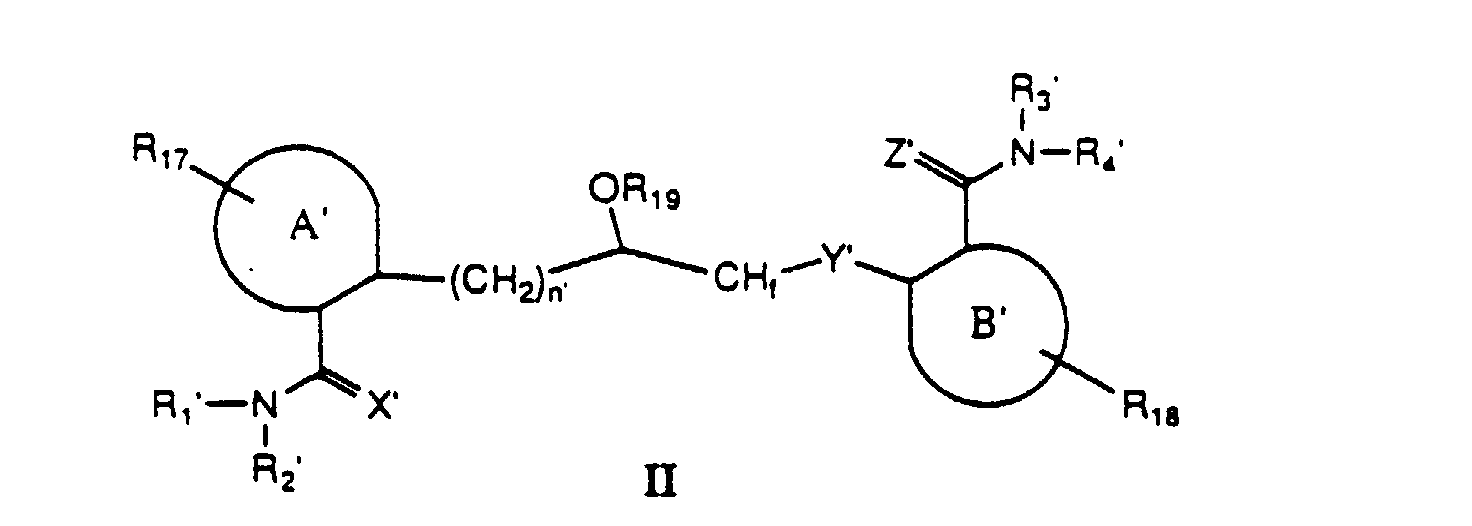
- f is 0, 1, or 2;
- A' and B' are individually selected from carbocyclic or heterocyclic, aromatic, saturated or partially saturated 5, 6 or 7 member rings
- n' is 0, 1 or 2;
- X' and Z' are individually selected from oxygen and sulphur;
- when f is 2, Y' is a substituted or unsubstituted amino group, oxygen, sulphur, or -CH2-;
- when f is 1, Y' is -CH=;
- when f is 0, Y' is -C≡;
- R'1, R'2, R'3 and R'4 are individually selected from hydrogen, alkyl, cycloalkyl, aryl, substituted alkyl, cycloalkyl or aryl, substituted oxygen, hydroxyl, substituted or unsubstituted amino and substituted or unsubstituted non-aryl heterocycle, wherein R'1 and R'2 or R'3 and R'4 can form a ring with the nitrogen atom to which they are attached;
- R17 and R18 are individually selected from hydrogen,
halogen, hydroxyl, substituted or unsubstituted alkoxy,
mercapto, thioether, -NR'1R'2, nitro, alkyl, aryl and substituted
alkyl or aryl, wherein R17 can form a fused ring structure
with A' and R18 can form a fused ring structure with B';
and - R19 is hydrogen or a 1 to 3 carbon substituted or unsubstituted alkyl group; or pharmaceutically acceptable salts thereof.
-
- Typical examples of carbocyclic ring systems represented by A and B include, but are not limited to, phenyl, naphthyl, anthryl, and phenanthryl, either in their aromatic or fully or partially hydrogenated states. Typical heterocyclic ring systems represented by A and B include (1) 5-membered monocyclic ring groups such as thienyl, pyrrolyl, imidazolyl, pyrazolyl, furyl, isothiazolyl, furazanyl, isoxazolyl, thiazolyl and the like; (2) 6-membered monocyclic groups such as pyridyl, pyrazinyl, pyrimidinyl, pyridazinyl, triazinyl and the like; and (3) polycyclic heterocyclic ring groups, such as benzo[b]thienyl, naphtho[2,3-b]thienyl, thianthrenyl, isobenzofuranyl, chromenyl, xanthenyl, phenoxathienyl, indolizinyl, isoindolyl, indolyl, indazolyl, purinyl, isoquinolyl, quinolyl, phthalazinyl, naphthyridinyl, quinoxalinyl, quinazolinyl, benzothiazole, benzimidazole, tetrahydroquinoline cinnolinyl, pteridinyl, carbazolyl, beta-carbolinyl, phenanthridinyl, acridinyl, perimidinyl, phenanthrolinyl, phenazinyl, isothiazolyl, phenothiazinyl, and phenoxazinyl and fully or partially hydrogenated analogs thereof.
- The term "alkyl," as used herein refers to straight or branched chain groups, preferably having one to eight, more preferably one to six, carbon atoms. For example, "alkyl" may refer to methyl, ethyl, n-propyl, isopropyl, butyl, isobutyl, sec-butyl, tert-butyl, pentyl, isopentyl tert-pentyl, hexyl, isohexyl, and the like. Suitable substituents for the substituted alkyl and aryl groups used in the invention include the mercapto, thioether, nitro, amino, aryloxy, halogen, hydroxyl, and carbonyl groups as well as aryl, cycloalkyl and non-aryl heterocyclic groups.
- The term "cycloalkyl" as used herein refers to groups, preferably having three to seven, more preferably, three to six carbon atoms. Suitable cycloalkyls include, but are not limited to, cyclopropyl, cyclobutyl, cyclopentyl, cyclohexyl, cycloheptyl and the like.
- The term "aryl" as used herein refers to both carbocyclic and heterocyclic, substituted or unsubstituted, aromatic residues. Accordingly, the term includes the types of substituents identified hereinabove as typical carbocyclic or heterocyclic ring systems which contain the requisite unsaturation to retain their aromatic character.
- The terms "alkoxy" and "aryloxy" refer to groups as defined hereinabove as alkyl or aryl groups, as the case may be, which also carry an oxygen atom interposed between them and the substrate residue to which they are attached.
- The "halogen" substituent according to the present invention may be a fluoro, chloro, bromo or iodo substituent.
- Some compounds of the invention possess one or more asymmetrically substituted carbon atoms and therefore exist in racemic and optically active forms. The invention is intended to encompass the racemic forms of the compounds as well as any of the optically active forms thereof.
- In the syntheses of the novel HIV inhibiting compounds of this invention, a large number of novel intermediate compounds has also been prepared. These novel intermediate compounds also form part of the invention.
- A class of novel intermediates are compounds of the formula VIwherein:

- c is 0, 1, or 2;
- A' is selected from carbocyclic or heterocyclic, aromatic, saturated or partially saturated 5, 6 or 7 member rings which can be further substituted;
- R17 is selected from hydrogen, halogen, hydroxyl, substituted or unsubstituted alkoxy, mercapto, thioether,-NR'1R'2, nitro, alkyl, aryl and substituted alkyl or aryl, wherein R17 can form a fused ring structure with A';
- R'1 and R'2 are individually selected from hydrogen, alkyl, cycloalkyl, aryl, substituted alkyl, cycloalkyl or aryl, substituted oxygen, hydroxyl, substituted or unsubstituted non-cyclic amino and substituted or unsubstituted non-aryl heterocycle, wherein R'1 and R'2 can form a ring with the nitrogen atom to which they are attached;
- R22 is a substituted or unsubstituted amino group or an alkoxy group;
- R23 is hydrogen, hydroxyl, a substituted or
unsubstituted amino group, or a group of the formula VII
wherein:
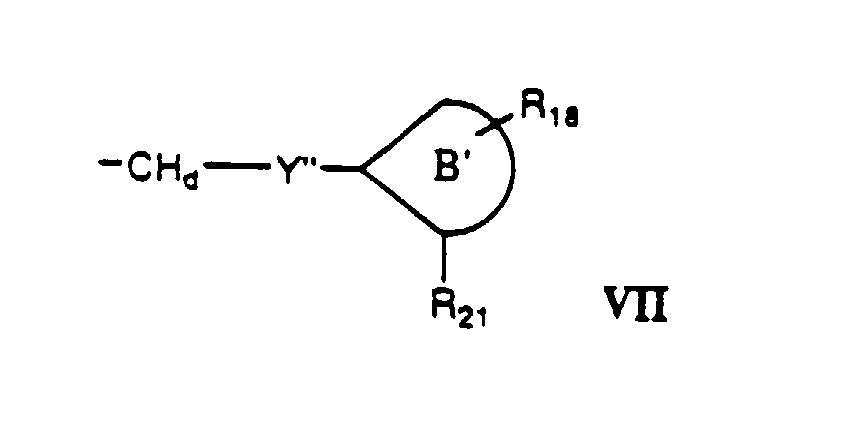
- d is 0, 1, or 2;
- when d is 2, Y" is a substituted or unsubstituted amino group, oxygen, sulphur, or -CH2-;
- when d is 1, Y" is -CH=;
- when d is 0, Y" is -C≡;
- B' is selected from carbocyclic or heterocyclic, aromatic, saturated or partially saturated 5, 6 or 7 member rings which can be further substituted;
- R18 is selected from hydrogen, halogen, hydroxyl, substituted or unsubstituted alkoxy, mercapto, thioether,-NR'1R'2, nitro, alkyl, aryl and substituted alkyl or aryl, wherein R18 can form a fused ring structure with B';
- and R21 is (1) amino, (2) nitro or (3) a group convertible to the group of the formula V, defined above, wherein Z' is oxygen or sulphur; and
- R'3 and R'4 are individually selected from hydrogen, alkyl, cycloalkyl, aryl, substituted alkyl, cycloalkyl or aryl, substituted oxygen, hydroxyl, substituted or unsubstituted non-cyclic amino and substituted or unsubstituted non-aryl heterocycle, wherein R'3 and R'4 can form a ring with the nitrogen atom to which they are attached.
-
- The novel compounds of this invention can be prepared by a number of synthetic routes.
- In many of the compounds of the invention, one or both of R'1 and R'2 are hydroxyalkyl groups. In such cases, it is highly preferred that the hydroxyl group(s) be protected from oxidation during the first synthesis step in which these moieties are present. Such protection is readily provided by reacting the hydroxyl group with conventional protecting groups such as e.g. an alkyl or aryl substituted silane, benzyl, or substituted benzyl group, prior to the oxidation step. The protecting group is readily removed as a final (additional) step in the sequence.
- A useful synthesis for certain compounds according to the invention comprises the reaction sequence B in which all variable groups and substituents are as previously defined:wherein:

- a) the compound of the formula XIII is reacted with a compound of the formula XIV under conditions sufficient to form a compound of the formula XV; and
- b) sequentially reducing and reacting the compound of formula XV with at least one amine selected from R'1R'2 NH and R'3R'4NH under conditions sufficient to form a compound of the formula XVI.
-
- In the first step of this sequence a compound of formula XIII and a compound of formula XIV are coupled to form the lactone of formula XV, preferably in a suitable solvent. Compounds of formula XIII and XIV are readily prepared by known methods. The coupling can be carried out in the presence of lithium diisopropyl amide (LDA) at a temperature ranging from about -60 to -78°C.
- The compound of formula XV is sequentially reduced and reacted with an amine of formula NR'1R'2 or NR'3R'4 to form a compound of formula XVI. Reaction with the amine and reduction can be carried out in either order, i.e. amine reaction followed by reduction or reduction followed by amine reaction. Also, reduction can be full or partial.
- The reaction with the amine can be carried out by first reacting the amine with a trialkyl aluminum compound, preferably trimethyl aluminum, at relative low temperature, e.g. between about room temperature and 0°C to form amino aluminum dialkyl. The reaction is preferably carried out in an aromatic hydrocarbon solvent.
- This amino aluminum dialkyl compound is then reacted with the compound of formula XV, preferably at elevated temperatures, e.g. about 90 to 105°C, preferably for a time sufficient for the reaction to go to completion. This treatment serves both to open the lactone ring and to form an amide on both sides of the molecule.
- Reduction of the triple bond either to a double bond or to complete saturation can be accomplished by use of molecular hydrogen in the presence of known hydrogenation catalysts such as Pd, Raney Nickel or Lindlar catalyst.
- Still other compounds of the invention can be prepared via reaction sequence E in which all variable groups and substituents are as previously defined:wherein the compound of the formula XXVII, wherein R'24 is an alkyl group, is reacted with a compound of the formula XXVIII under conditions sufficient to obtain the compound of the formula XXIX.

- In reaction E, a compound of XXVII is reacted with a compound of formula XXVIII to form a compound of formula XXIX. The compound of formula XXIX can be reacted to open the lactone ring and form an amide as has been taught hereinabove for other lactones.
- The compounds of this invention, as indicated hereinabove, are effective in inhibiting the activity of the HIV protease, which halts the proliferation of the HIV virus. A compound according to the invention may be active per se, or it may be a precursor which is converted in vivo to an active compound. Moreover, many of the compounds of the invention contain functional groups that are capable of forming salts. It is intended that the invention also include such pharmaceutically acceptable salts, e.g. carboxylic acid salts or quaternary salts.
- The compounds according to the invention, as well as the pharmaceutically acceptable salts thereof, can be incorporated into convenient dosage forms such as capsules, tablets, or injectable preparations. Solid or liquid pharmaceutically acceptable carriers can also be employed. Solid carriers can include starch, lactose, calcium sulphate dihydrate, terra alba, sucrose, talc, gelatin, agar, pectin, acacia, magnesium stearate and steric acid. Liquid carriers can include syrup, peanut oil, olive oil, saline solution and water.
- The carrier or diluent can include prolonged release material, such as glyceryl monostearate or glyceryl distearate, alone or with wax. When a liquid carrier is used, the preparation may be in the form of a syrup, elixir, emulsion, soft gelatin capsule, sterile injectable liquid (e.g. solution) or a nonaqueous or aqueous liquid suspension.
- The pharmaceutical preparations can be prepared following conventional techniques of the pharmaceutical chemist involving steps such as mixing, granulating, and compressing when necessary for tablet forms, or mixing, filling and dissolving the ingredient as appropriate to give the desired products for oral, parenteral, topical, intravaginal, intranasal, intrabronchial, intraocular, intraaural and rectal administration or by injection.
- The compositions of the invention may further comprise one or more other compounds which are either HIV inhibitors, such as azidothymidine, or which perform a different pharmaceutically desirable function, such as, for example antibacterial, antifungal, antiparasitic, antiviral, antipsoriatic or anticoccicidal agents. Exemplary antibacterial agents include, for example, sulfonamides such as sulfamethoxazole, sulfadiazine, sulfameter or sulfadoxine.
- An exemplary daily dosage unit comprises an amount up to about one gram of active compound per kilogram of the host, preferably one half gram, more preferably 100 milligrams, and most preferably, about 50 milligrams or less per kilogram of the host weight. The selected dose may be administered to a patient in recognized need of treatment, by any known method of administrating the dose including topically as, for example, an ointment or cream; orally; rectally, for example, as a suppository; parenterally by injection; or continuously by intravaginal, intranasal, intrabronchial, intraaural or intraocular infusion.
- Details and specific embodiments of these syntheses will be presented in the example hereinbelow. In these examples, the structures of all new compounds were confirmed by proton magnetic resonance spectroscopy, infrared spectroscopy, and either elemental microanalysis (C, H, and N to within 0.4%) or by high resolution mass spectrometry. Proton magnetic resonance spectra were determined using a General Electric QE-300 spectrometer operating at a field strength of 300 mHz.
- Most of the examples consist of a sequence of syntheses proceeding from commercially available compounds through a series of intermediates to a final product meeting the limitations of formula II. Each of these steps has actually been carried out and each such intermediate has actually been prepared. However, it must be understood that when a step in a sequence refers to a compound from an earlier step, the physical specimen of that compound that was employed in that step may not be the same physical specimen of that compound that was actually prepared in the cited earlier step. For example, in step 12b of Example 12, the reaction of compound 12a with compound 9e is described. It is believed that although the compound actually reacted with compound 12a was identical in chemical structure to the compound 9e, it is possible that the compound actually reacted with compound 12a was not the same physical specimen of compound 9e as was prepared in Example 9. If the compound actually reacted with compound 12a was not the same physical specimen as compound 9e, it is believed that the compound actually reacted was prepared in the same way as the compound 9e.
- Preparation of

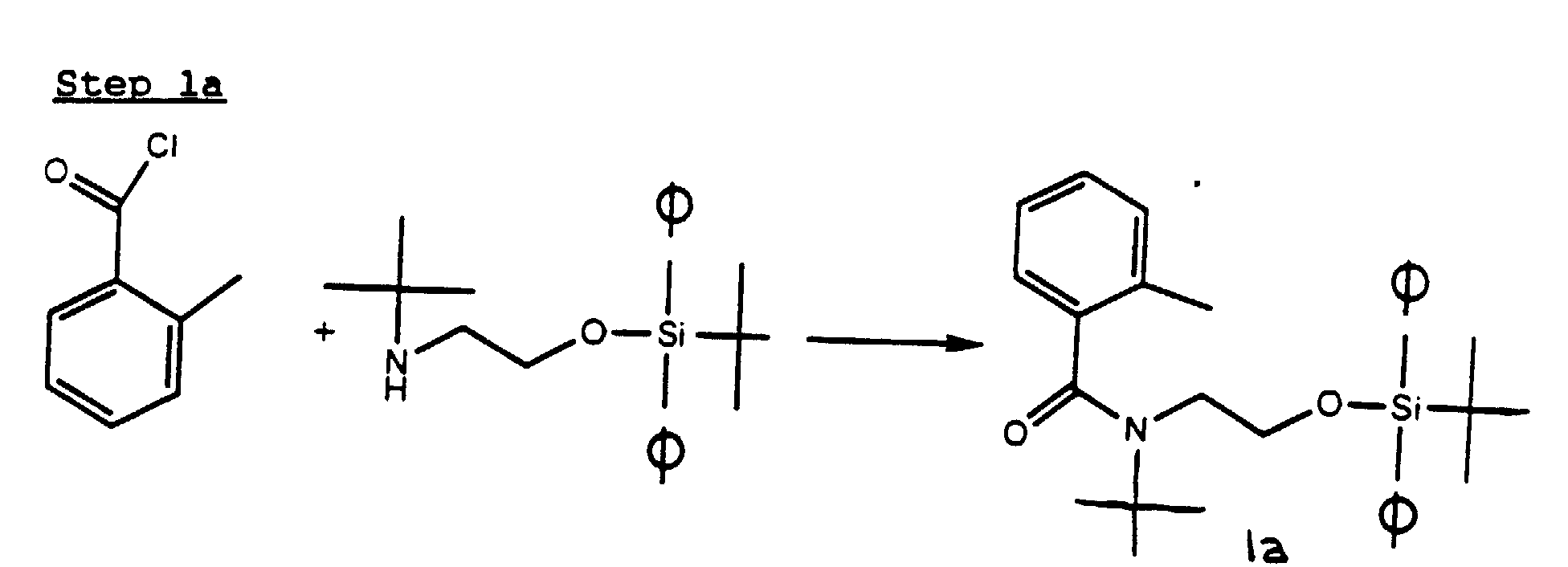
- A reaction flask containing 25.5 gm (71.7 mmol) of silane-protected N-t-butyl ethanol amine dissolved in about 50 ml of methylene chloride, cooled to 0°C with an ice bath, was fitted with an argon balloon and a septum. Over a five minute period, keeping the temperature no higher than 5°C, 13.1g (13 mmol) of o-toluoyl chloride was added. The ice bath was removed and the mixture was stirred for 21 hours, at which point the reaction was quenched with 100 ml of saturated NaHCO3, washed twice with 500 ml of H2O and dried over Na2SO4. The product was treated with charcoal, filtered and concentrated under vacuum, yielding 21.6 gm of an orange oil. After Kugelrohr distillation at about 230°C and 1.9 Torr, 12.6 gm (32% yield) of a viscous orange oil was recovered. NMR showed this material to be contaminated with residual o-toluoyl chloride so it was purified by flash chromatography on silica gel (10% ethyl acetate in hexane as eluent) to elute the acid chloride, then with neat ethyl acetate to recover the product in essentially pure form.

- To a 250 ml round bottom flask, previously flame dried and purged with argon, was added 9.06 gm (19.12 mmol) of compound 1a, 0.29 gm (2.86 mmol) of diisopropyl amine and 100 ml of tetrahydrofuran (THF), to produce a clear, colorless solution. This solution was cooled to -78°C in a dry ice-acetone bath and 19.1 ml of sec-butyl lithium was added via a syringe over a 15 minute period while maintaining the temperature below -70°C. This mixture (now a deep purple color) was stirred for 1.5 hour at -78°C after which 2.53 gm (7.37 mmol) of ethylene oxide was added in a single addition. The mixture was allowed to warm to room temperature without addition of extraneous heat.
- After 16 hours, the murky orange mixture was quenched with 10 ml of 0.5N HCl, then poured into about 600 ml of H2O and extracted twice with 200 ml of ethyl acetate. The organic layers were combined, dried over Na2SO4, treated with charcoal and vacuum dried, yielding 9.84 gm of a viscous, peach colored oil. The oil was purified by flash chromatography on silica gel 60 using 45% ethyl acetate/hexane eluent. Appropriate fractions were combined and concentrated under vacuum, yielding 7.08 gm of a viscous, light yellow oil.

- Seven (7) gm (.0135 mmol) of 1b and 25.43 gm of pyridinium dichromate were dissolved in 50 ml of DMF and stirred under argon. After about 17 hours the solution was poured into 3 liters of H2O and extracted twice with 500 ml of ethyl acetate. The organic phases were combined and washed with 2 liters of H2O, filtered, treated with charcoal and concentrated under vacuum to yield 4.85 gm of a viscous brown product. This product was purified by flash chromatography using 10% methanol in methylene chloride. The appropriate fractions were combined, filtered and dried under vacuum, yielding 2.31 gm (32%) of a brown glassy product.

- A solution of 2.31 gm (4.34 mmol) of compound 1c, 2.02 gm of benzotriazol-l-yloxyl-tris-(dimethylamino)-phosphoniumhexafluoro phosphate (BOP), 0.466 gm (4.78 mmol) of N,O-dimethyl hydroxyl-amine hydrochloride and 1.54 g of Hunig's base in 15 ml of methylene chloride was stirred in an argon atmosphere for about 2 hours. At the end of this time, the reaction mix was washed with 200 ml of H2O, dried over Na2SO4, treated with charcoal, filtered and dried under vacuum, yielding 3.52 gm of a viscous brown oil. The product was purified by flash chromatography using 1 to 1 ethyl acetate/hexane. Appropriate fractions were combined, filtered and dried under vacuum, yielding 1.48 gm (59%) of a clear, colorless viscous oil.

- To a 25 ml round bottom flask, previously flame dried and purged with argon, was added 0.18 gm (0.765 mmol) of azeotropically dried N-t-butyl, N-hydroxyethyl-o-toluamide, 0.01 gm of diisopropylamine and 5 ml of THF, forming a clear, colorless solution. This solution was cooled to -78°C, in a dry ice-acetone bath and 1.76 ml of s-butyl lithium was syringed in over a 10 minute period. The solution was stirred at -78°C for one hour at which time, 0.70 gm (0.696 mmol) of compound 1d in 5 ml of THF was syringed in over a 10 minute period. No color change was noted. The dry ice was allowed to evaporate and the reaction mass was allowed to return to room temperature without addition of any extraneous heat.
- At room temperature, the reaction was quenched with 8 ml of 0.5N NH4Cl, then poured into 25 ml of brine and 25 ml of H2O, then extracted twice with 25 ml of ethyl acetate. The organic layers were combined, dried over Na2SO4, then treated with charcoal, filtered and concentrated under vacuum to give 455 mg of a clear "glass", sticky material suitable for further use.

- To a solution of 0.455 gm (0.607 mmol) of 1e in 5 ml of ethanol, was added 0.69 gm (1.82 mmol) of NaBH4. The mixture was stirred for one hour at room temperature, then quenched with 8 ml of saturated NaHCO3 solution and poured into 25 ml of saturated brine plus 15 ml of H2O. This mixture was extracted twice with 25 ml of ethyl acetate. The organic layers were combined and dried over Na2SO4, then treated with charcoal, filtered and concentrated under vacuum, yielding 0.38 gm of white foam suitable for further use.

- A solution of 0.38 gm (0.506 mmol) of 1f and 1.01 ml of tetrabutyl ammonium fluoride in 5 ml of THF was stirred at room temperature for 15.5 hours, then quenched with 0.8 ml of saturated NaHCO3. The quenched mixture was poured into 50 ml of water and extracted with 25 ml of ethyl acetate. The organic layers were combined, dried over Na2SO4, treated with charcoal, filtered and dried under vacuum, yielding 338 mg of a clear viscous oil. The oil was purified by flash chromatography using ethyl acetate. Appropriate fractions were combined and concentrated under vacuum, yielding 149 mg (58%) of a white foam.
- Preparation of

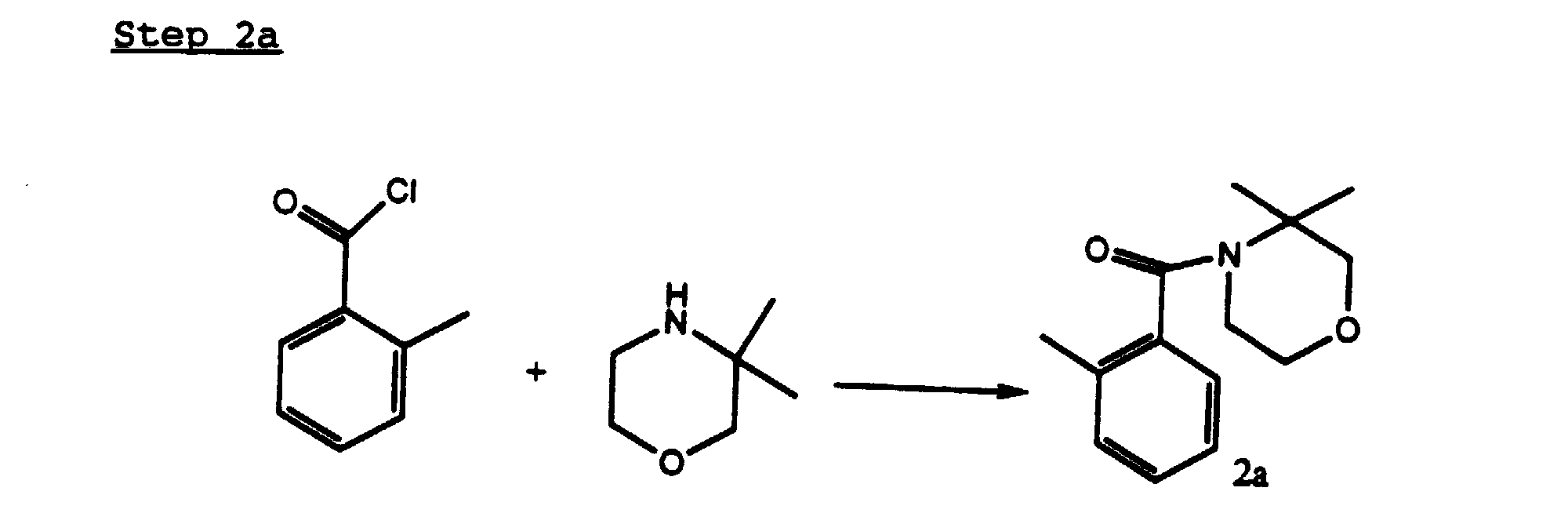
- In a 25 ml 3 neck flask, previously flame dried in vacuo and purged with argon, there was prepared a solution of 1.5 gm (13.02 mmol) of 2,2-dimethyl-morpholine, and 3.95 gm of triethylamine in 10 ml of methylene chloride. This solution was cooled in an ice bath and 2.21 gm (4.32 mmol) of 2-methyl benzoyl chloride were added over a 20 minute period. The temperature was maintained between about 5 and 10°C. Chloride salts formed and precipitated out of the solution. After addition of the 2-methyl benzoyl chloride was complete, the mixture was allowed to sit at room temperature for about 18 hours, then poured into 30 ml of H2O. The chloride salts dissolved. The aqueous mixture was extracted with 10 ml of methylene chloride and the organic extract was dried over Na2SO4. The dried organic phase was filtered and concentrated under vacuum, yielding 2.47 gm of a light brown oil which slowly solidified on standing. The oil was taken up in 5 ml of ethanol, 50 ml of hexane was added and the mixture was stored in a freezer for about 72 hours. White crystals, which formed on freezing, were washed with 20 ml of cold hexane yielding 1.74 gm.
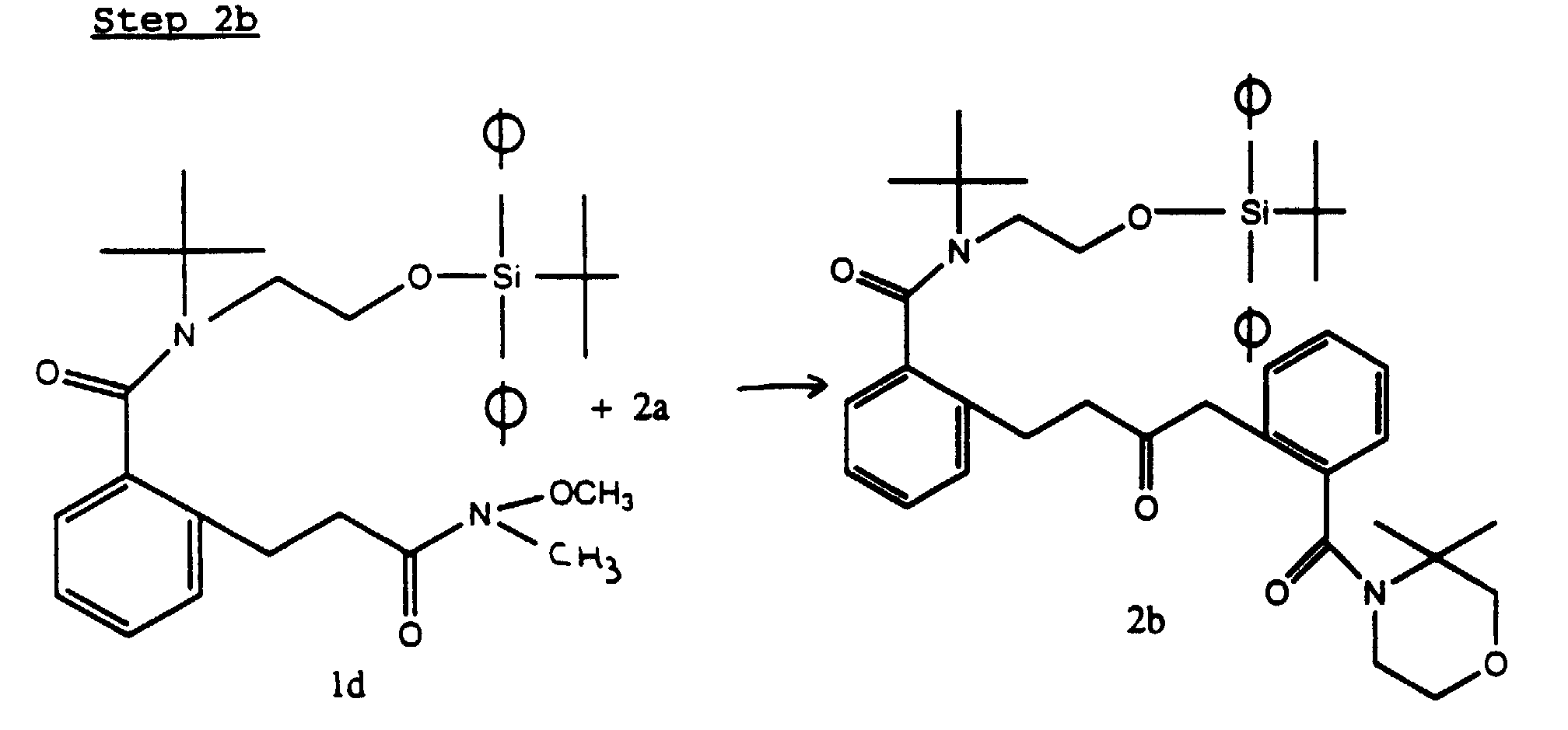
- A 100 ml 3 neck round bottom flask, previously dried and purged with argon, was charged with 0.089 gm (0.383 mmol) of 2a, 0.005 gm of diisopropylethylamine and 5 ml of THF. The mixture was cooled to -78°C in a dry ice/acetone bath and 0.35 ml of 1.2 M s-butyl lithium in cyclohexane was added over about 1 minute while maintaining the temperature below-70°C. The resulting deep purple solution was stirred at -78°C for 1 hour, whereupon a solution of 0.2 gm (0.348 mmol) of ld in 5 ml of THF was added by syringe over a 5 minute period, maintaining the temperature below -60°C. No color change was noted. The dry ice was allowed to evaporate and the mixture warmed to room temperature without extraneous heating. After about one hour and ten minutes, the reaction was quenched with 8 ml of 0.5N NH4Cl, poured into 25 ml of brine and extracted twice with 25 ml of ethyl acetate. The organic extracts were combined, dried over Na2SO4, treated with charcoal, filtered and concentrated under vacuum, yielding 0.251 gm of a clear colorless glass-like product, suitable for further use.

- To a solution of 0.251 gm (0.336 mmol) of 2b in ethanol, was added 0.038 gm (1.008 mmol) of NaBH4 in a single portion. The solution was stirred at room temperature for one hour. At the end of the hour, the mixture was quenched with 8 ml of saturated NaHCO3, poured into 25 ml of brine plus about 15 ml of H2O then extracted twice with 25 ml of ethyl acetate. The organic layers were combined, dried over Na2SO4, treated with charcoal, filtered, and concentrated under vacuum, yielding 0.167 gm of a white foam suitable for further use.

- A solution of 0.167g (0.223 mmol) of 2c, and 0.44 ml of tetrabutyl ammonium fluoride in THF was stirred at room temperature overnight. After about 15.5 hours of stirring, the solution was quenched with about 8 ml of saturated NaHCO3, poured into 50 ml of water, and extracted with 25 ml of ethyl acetate. About 25 ml of brine was added to the aqueous phase, which was then extracted again with 25 ml of ethyl acetate. The extracts were combined, dried over Na2SO4, treated with charcoal, filtered, and concentrated under vacuum, yielding 1.43 gm of a crude, clear oil. This oil was purified by flash chromatography on SiO2 and vacuum dried yielding 72 mg (63%) of a white foam.
- Preparation of


- A heterogeneous mixture of 2 gm (10.75 mmol) of 2-methyl naphthoic acid in toluene was cooled to 0°C and oxalyl chloride was added, dropwise, followed by dropwise addition of 0.236 gm of dimethylformamide (DMF). As the DMF was added, gas was vigorously evolved and the solid 2-methyl naphthoic acid began to go into solution. After 5 minutes, the reaction mixture was allowed to warm to room temperature. The solution was clear and golden with a small amount of white precipitate. After 20 minutes the precipitate had dissolved into the solution and the reaction was monitored by infrared analysis. The reaction mass was concentrated under vacuum. As the oxalyl chloride evaporated, a large amount of a white solid settled out. The solution could not be further concentrated due to the presence of the solid. The mixture was cooled to 0°C and 1.65 gm of t-butylamine was added. A fine white precipitate settled out. The bath was then removed and after 15 minutes at room temperature the reaction mass was poured into water and extracted with ethyl acetate. The organic phases were collected, washed with brine, and dried over MgSO4. The solvent was removed under vacuum. The solid was purified by column chromatography using a 2-1 hexane to ether solution as the eluant. Following chromatography the product was recrystallized from an ether/ hexane mixture. Structure was confirmed by NMR. Yield was 83%.


- To a 25 ml round bottom flask which was previously flame dried under vacuum and purged with argon, was added 5 ml of THF and 0.9 gm (.373 mmol) of compound 3a and 0.095 gm of tetramethyl ethylene diamine (TMEDA). This mixture was cooled to -78°C in a dry ice-acetone bath and over a two minute period 0.313 ml of a 2.5 M solution of n-butyl lithium in hexane was added, yielding a deep purple solution. This solution was stirred at -78°C for one hour and 0.216 gm of compound 1d in 5 ml of THF was added over a three minute period. During addition the deep purple color became a little lighter. Dry ice was allowed to evaporate and the mixture warmed to room temperature without the addition of extraneous heat. After about 2 hours, the yellow reaction mass was poured into 100 ml of H2O and extracted with 25 ml of ethyl acetate. Sodium chloride was added to the aqueous layer and extraction with 25 ml of ethyl acetate was repeated. The organic layers were combined, dried over Na2SO4, filtered and vacuum dried, yielding 265 mg of an amber colored viscous glass suitable for further use.

- A solution was prepared of 0.265 gm (.350 mmol) of compound 3b in 5 ml of ethanol giving a clear solution to which was added 0.04 gm of sodium borohydride in one portion. The mixture was stirred at room temperature for about 45 minutes, quenched with 2 ml of saturated NaHCO3, then poured into 40 ml of brine and extracted twice with 25 ml of ethyl acetate. The organic layers were combined, dried over Na2SO4, filtered and concentrated under vacuum, yielding 197 mg of a white foam.

- To a solution of 0.19 gm (.2506 mmol) of compound 3c in 5 ml of THF was added, in one portion, 0.5 ml of a 1M tetrabutyl ammonium fluoride solution. The mixture was stirred for about 5.5 hours, at which point TLC indicated that all of compound 3c had disappeared. The reaction was quenched with 4 ml of saturated NaHCO3 then poured into 40 ml of brine and extracted twice with 25 ml of ethyl acetate. The organic layers were combined, dried over Na2SO4, filtered and concentrated under vacuum, yielding 0.222 gm of a white foam. This foam was purified by flash chromatography on silica using ethyl acetate. Appropriate fractions were combined, filtered, and vacuum dried, yielding 0.101 gm (78%) of a white foam product.
- Preparation of
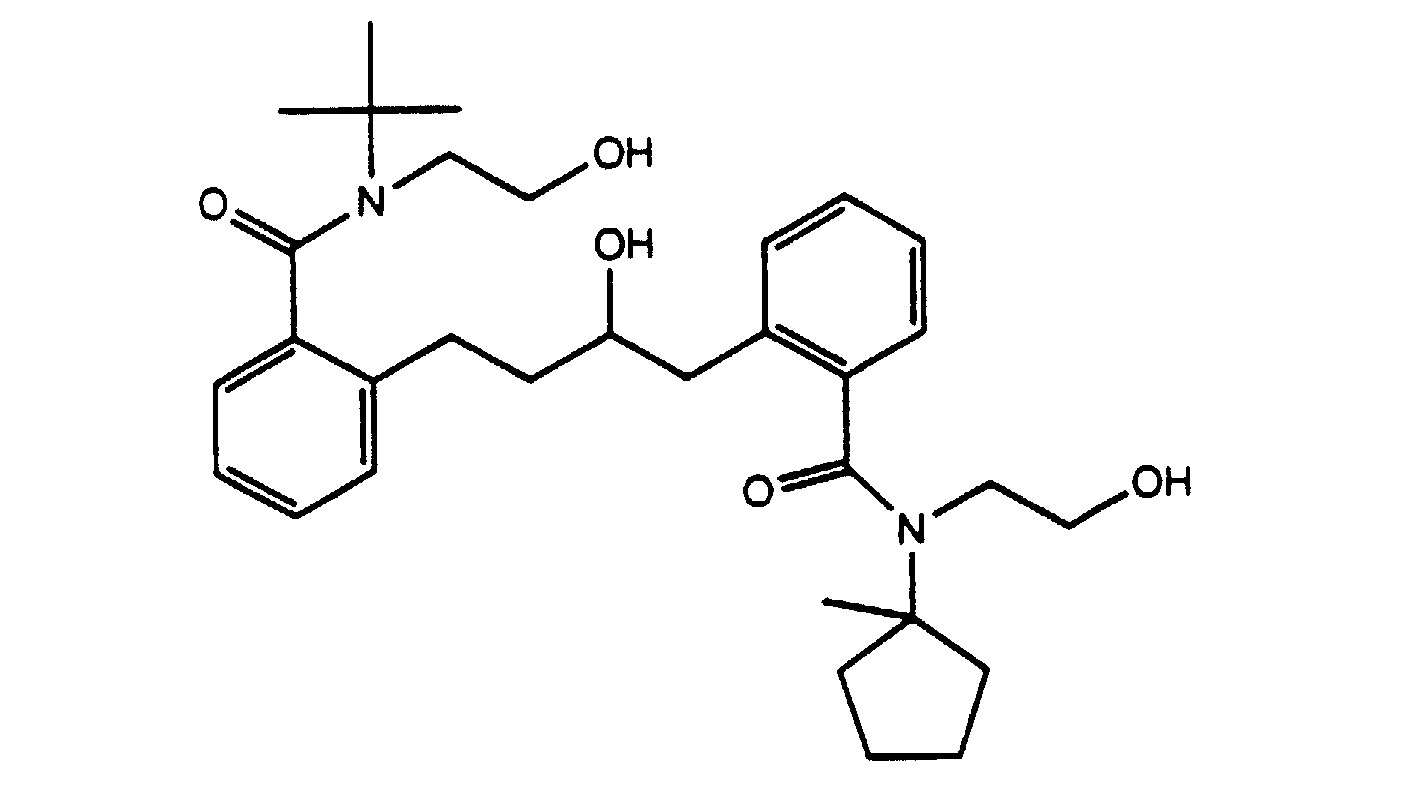
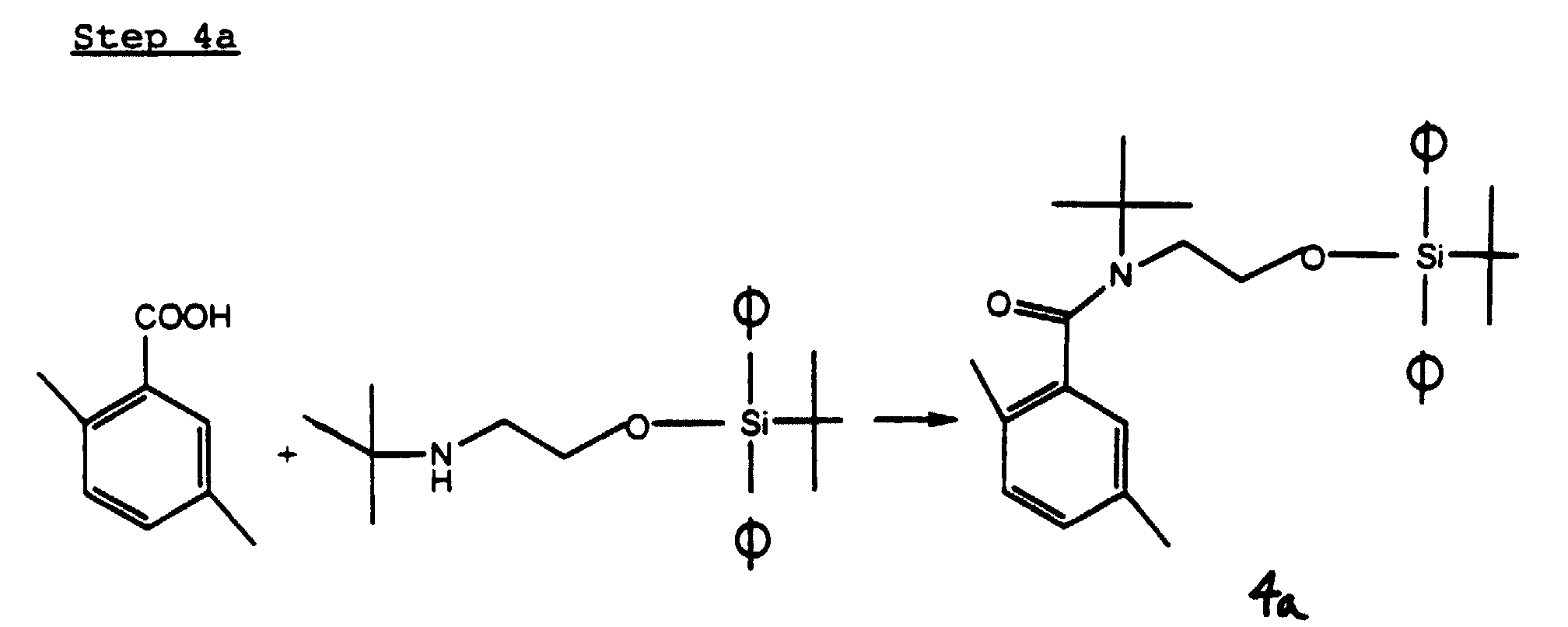
- A suspension of 5 gm of 2,5-dimethyl benzoic acid in 50 ml of toluene was cooled in an ice bath to about 10°C. To this was added 9.3 gm of oxalyl chloride followed by the dropwise addition of 0.73 gm of DMF. Addition of the DMF caused the solution to fizzle, evolving gas. After the completion of the DMF addition, the ice bath was removed and the reaction mass was allowed to warm to room temperature. During the warm-up period all solid material went into solution, which was light and almost colorless in nature. After 40 minutes the solution was concentrated under vacuum to remove excess oxalyl chloride and toluene. To the residue was added 20 ml of THF and this solution was pipetted into an ice cooled solution of 11.8 gm (0.033 mmol) of the silyl protected N-t-butyl hydroxy-ethylamine and 3.71 gm of triethylamine in 50 ml of THF. Addition took place over a 5 minute period during which time the mixture became milky in appearance. Stirring was continued overnight. Then the mixture was poured into 1000 ml of water and extracted twice with 200 ml of ethyl acetate. The organic layers were combined, dried over Na2SO4, filtered and concentrated under vacuum, yielding 20.72 gm of a viscous orange oil. This oil was purified by flash chromatography using 15% ethyl acetate/ hexane. Appropriate fractions were combined, filtered and vacuum dried, yielding 3.75 gm (23%) of a clear, colorless oil.
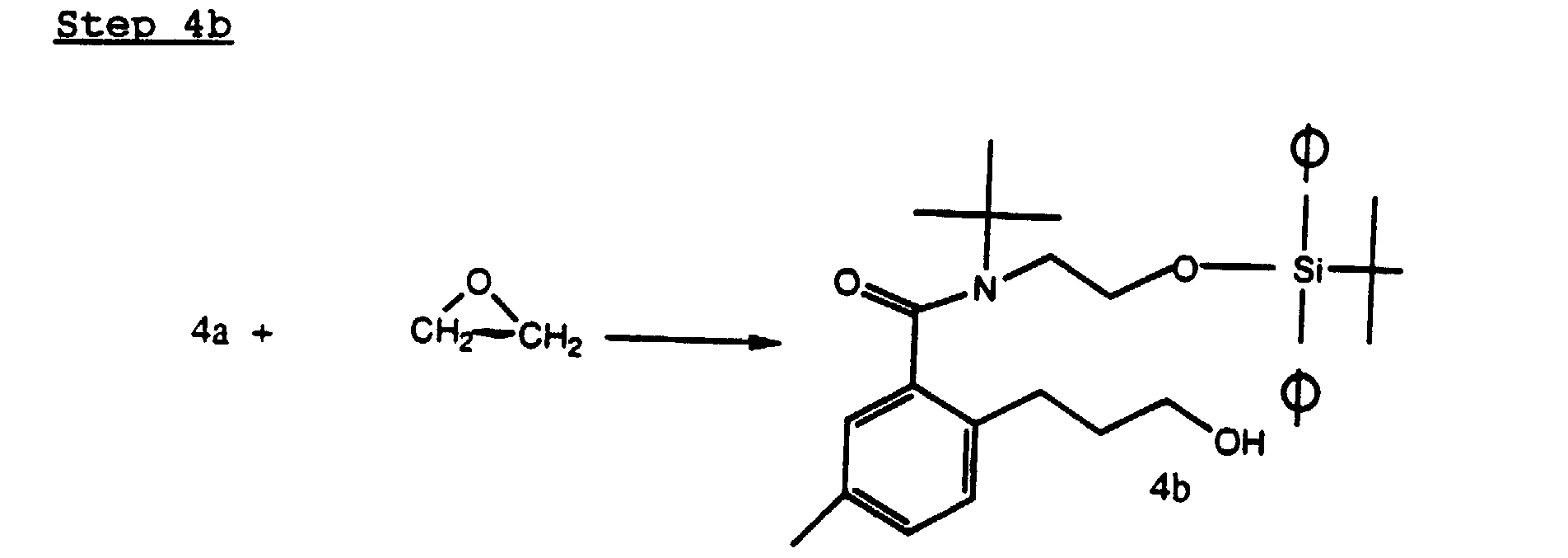
- To a 100 ml round bottom flask, which was previously flame dried and vacuum purged with argon, was added 25 ml of THF, 3.75 gm (7.69 mmol) of compound 4a and 0.117 gm of diisopropyl amine yielding a clear, colorless solution. The solution was cooled in a dry ice/acetone bath to approximately -78°C. Over a 7 minute period, 7.7 ml of a 1.2M solution of s- butyl lithium in cyclohexane was added by syringe while maintaining a temperature no higher than -65°C. The resulting deep purple solution was stirred for one hour and 20 minutes at which time 1.01 gm (23.06 mmol) of ethylene oxide was added at -78°C. The dry ice was allowed to evaporate and the solution was allowed to warm to room temperature without addition of extraneous heat. After about 18 hours, the solution was quenched with 4 ml of 0.5 NHCl, poured into 300 ml of H2O and extracted twice with 50 ml portions of ethyl acetate. The organic layers were combined, dried over Na2SO4, filtered and vacuum dried, yielding 3.7 gm of a viscous green oil. The oil was purified by flash chromatography using 1 to 1 ethyl acetate/hexane. Appropriate fractions were combined and vacuum dried, yielding 2.29 gm (60% yield) of a green glassy product.

- A solution of 2.29 gm (4.3 mmol) of compound 4b, and 8.1 gm of pyridinium dichromate in 20 ml of DMF was stirred at room temperature under argon for about 22 hours. At the end of this time the solution was poured into 500 ml of water and extracted twice with 75 ml of ethyl acetate. The organic layers were combined, dried over Na2SO4, filtered and concentrated under vacuum, yielding 1.83 gm of a brown viscous oil. The oil was purified by flash chromatography on silica gel using 10% methanol in methylene chloride. Appropriate fractions were combined and vacuum dried, yielding 635 mg (27%) of a light brown-orange oil.
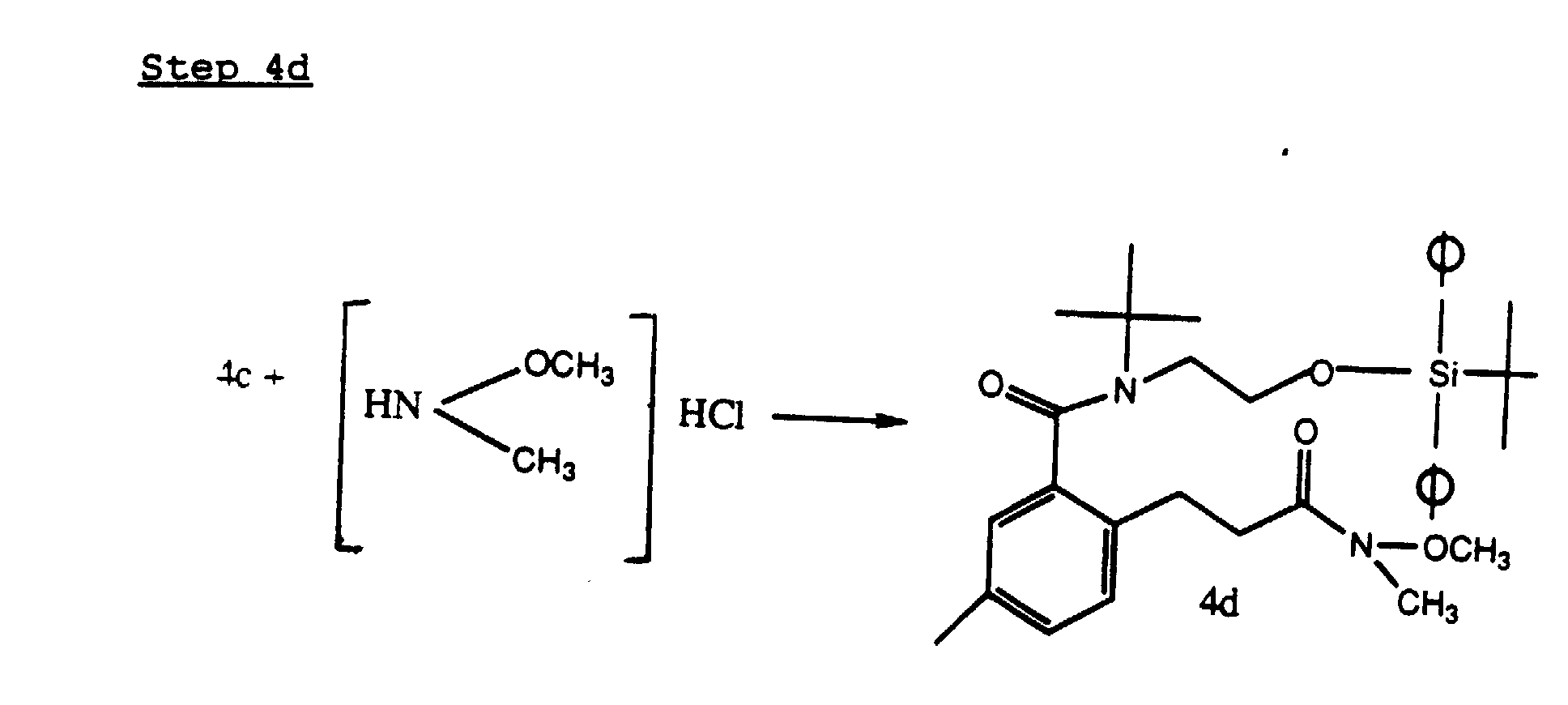
- A solution of 0.635 gm (.00116 mol) of compound 4c, 0.54 gm of BOP, 0.125 gm (.00128 mol) of N,O-dimethyl hydroxylamine hydrochloride and 0.414 gm of Hunig's base in 5 ml of methylene chloride was stirred at room temperature under argon for about 15.5 hours. A mixture of 15 ml of methylene chloride and 125 ml of H2O was added. After shaking, the organic layer was removed, dried over Na2SO4, filtered and vacuum dried, yielding 1.11 gm of a viscous khaki-colored oil.

- To a previously flame dried and argon purged 25 ml round bottom flask was added a solution in 5 ml of THF, of compound 5b, which had previously been azeotroped twice in 2 ml of benzene. This solution was cooled to -78°C and 0.4 ml of a 1.3 M solution of s-butyl lithium in cyclohexane was added, forming a blood red solution. After stirring the solution for one hour and ten minutes, a solution of 1.26 gm (0.214 mmol) of compound 4d which had been azeotroped twice from benzene, in 5 ml of THF was added over 8 minutes. After this addition, the red color was slightly lighter. The dry ice was allowed to evaporate and the solution warmed to room temperature without addition of additional heat.
- After about 16.5 hours the yellow reaction solution was quenched with 2 ml of 0.5N NH4Cl and poured into 100 ml of H2O. The aqueous mass was extracted twice with 25 ml portions of ethyl acetate. The extracts were combined, dried over Na2SO4, filtered and vacuum dried, yielding 170.2 mg of a light orange oil. This oil was purified by flash chromatography using 40% ethyl acetate/hexane. Appropriate fractions were combined and vacuum dried, yielding 56 mg of a clear viscous oil.
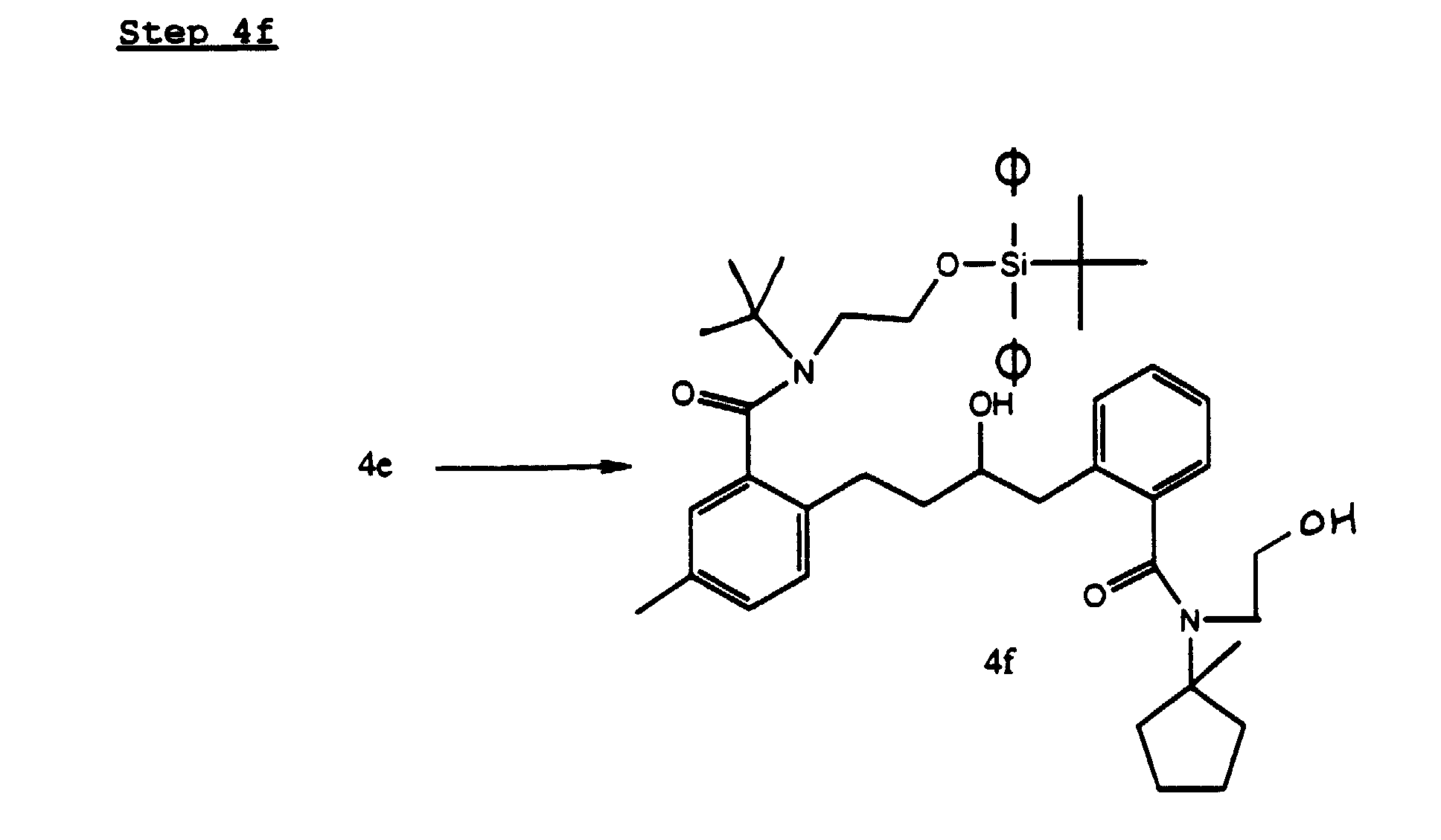
- To a solution of 0.056 gm (.071 mmol) of compound 4e in 2.5 milliliters of ethanol was added, in one step, 0.008 gm of NaBH4. This solution was stirred at room temperature for about 45 minutes then quenched with 4 ml of saturated NaHCO3, poured into 40 ml of brine and extracted twice with 25 ml portions of ethyl acetate. The organic layers were combined, dried over Na2SO4, filtered and concentrated under vacuum, yielding 55 mg (98%) of a crude, viscous oil.
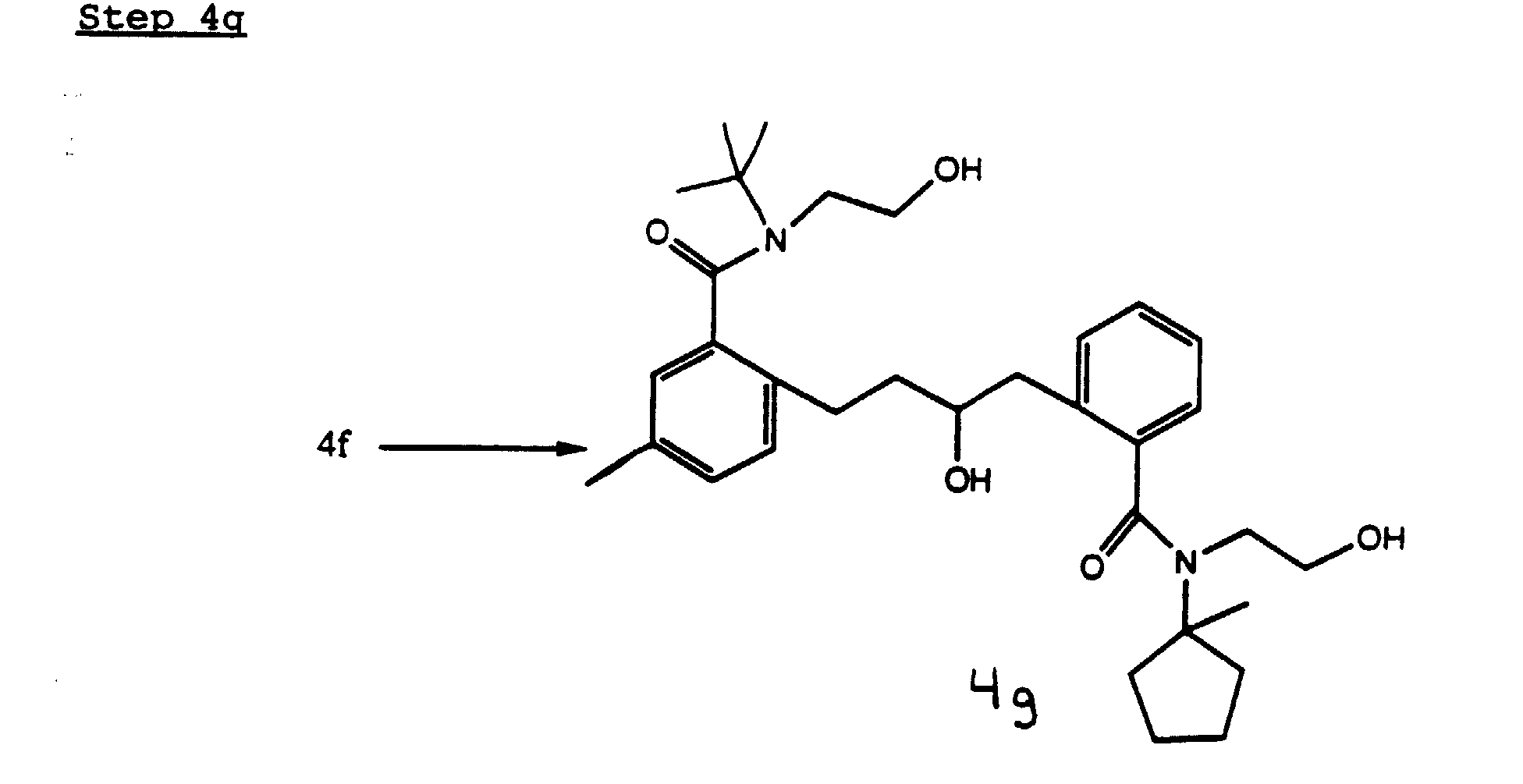
- To a solution of 0.055 gm (.0697 mmol) of compound 4f in 2.5 milliliters of THF was added 0.139 ml of a 1M solution of tetrabutyl ammonium fluoride in THF. This mixture was stirred for 17.5 hours, then quenched with 2 ml of saturated NaHCO3, poured into 40 ml of brine and extracted twice with 15 ml portions of ethyl acetate.
- The organic layers were combined, dried over Na2SO4, filtered and vacuum dried, yielding 61 mg of a crude oil. This oil was purified by flash chromatography using ethyl acetate. Appropriate fractions were combined, filtered and vacuum dried, yielding 24 mg (62%) of a white foam.
- Preparation of


- A suspension of 1.5 gm of Mg(ClO4)2 in 3 ml of THF was cooled in a dry ice/acetone bath to -78°C and 0.345 gm (7.84 mmol) of ethylene oxide was added. In one addition 0.707 gm (7.13 mmol) 1-amino, 1-methyl cyclopentane was added. The mixture was removed from the cooling bath after this addition and the slurry was allowed to stir at room temperature for two hours and forty minutes. It was then poured into 100 ml of water and extracted twice with 50 ml of diethyl ether. The organic layers were combined, washed with 100 ml of water and dried over Na2SO4, filtered and concentrated under vacuum to remove residual ethylene oxide at less than 40°C yielding a slightly viscous liquid which was subjected to Kugelrohr distillation at 150°C and 1.8 Torr to yield 100 mg of product.
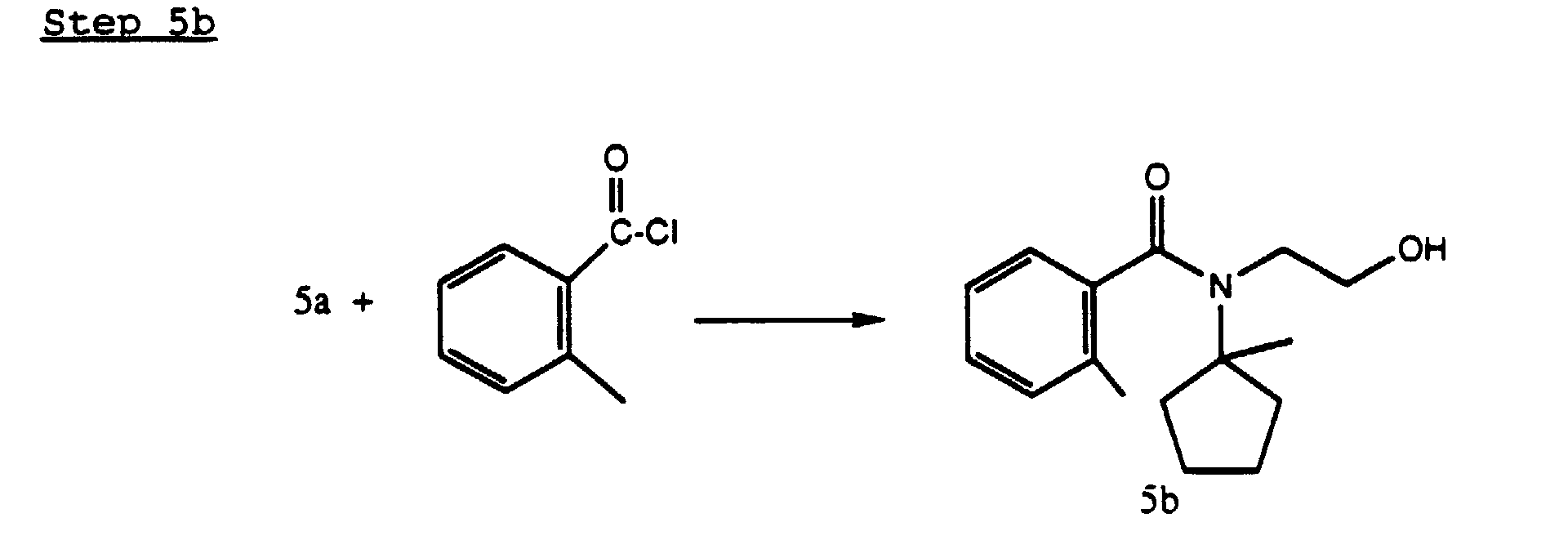
- A solution of 0.221 gm of compound 5a and 0.34 gm of triethylamine in 5 ml of methylene chloride was cooled to 0°C. To this was added 0.52 gm (3.39 mmol) of 1 methyl benzoyl chloride in one portion. After this addition, a white precipitate was formed, the ice bath was removed and the solution was stirred under argon at room temperature. After about 2 hours and 50 minutes the solution was poured into 50 ml of H2O and extracted with methylene chloride. The organic extracts were washed with 10% acetic acid, followed by saturated NaHCO3, then dried over Na2SO4, filtered and vacuum dried, yielding 696 mg of an amber oil which slowly solidified on standing.
- The solidified material was taken up in 12 ml of 10% aqueous methanol, 0.7 ml of 50% NaOH was added and the mass was stirred at room temperature for 35 min. The mass was poured into 50 ml of H2O and extracted twice with 30 ml portions of ether. The combined extracts were dried over Na2SO4, filtered and vacuum dried, yielding 436 mg of an amber oil.


- To a 25 ml round bottom flask which had been previously flame dried and vacuum purged with argon was added 0.056 gm (.214 mmol) of compound 5b in 5 ml of THF. The mixture was cooled to -78°C in a dry ice/acetone bath and 0.2 ml of a 1.3 M-cyclohexane solution of s-butyl lithium was added over a one minute period. The resulting blood red solution was stirred for sixty-five minutes and a solution of 0.123 gm (0.214 mmol) of compound 1d in 5 ml of THF was syringed in over a three minute period.
- After addition of compound 1d, the blood red color became lighter. The dry ice was allowed to evaporate and the reaction mixture warmed to room temperature. After about 16.5 hours, the yellow reaction solution was quenched with 12 ml of 0.5N NH4Cl, poured into 100 ml of H2O and extracted with ethyl acetate. Sodium chloride was added to the aqueous phase and it was extracted again with 25 ml of ethyl acetate. The organic layers were combined, filtered and vacuum dried, yielding 159 mg of a light orange oil. This oil was purified by flash chromatography using 40% ethyl acetate/hexane. Appropriate fractions were combined, filtered and vacuum dried, yielding 68 mg (41%) of a clear oil.

- To a solution of 0.068 gm (0.088 mmol) of compound 5c in 2.5 ml of ethanol was added 0.10 gm of sodium borohydride. The mixture was stirred at room temperature for forty-five minutes, quenched with 2 ml of saturated NaHCO3, then poured into 40 ml of saturated brine and extracted twice with 25 ml portions of ethyl acetate. The organic layers were combined; dried over Na2SO4, filtered and concentrated under vacuum, yielding 0.057 gm (84%) of a clear oil.

- To a solution of 0.657 gm (0.073 mmol) of compound 5d in 2.5 ml of THF was added 0.146 ml of 1M solution of tetrabutyl ammonium fluoride in THF. This light yellow solution was stirred at room temperature for about 5.5 hours when TLC with ethyl acetate showed disappearance of all compound 5d. The reaction was quenched with 4 ml of saturated NaHCO3, poured into 4 ml of a saturated sodium chloride solution and extracted twice with 25 ml of ethyl acetate. The organic layers were combined, dried over Na2SO4, filtered and concentrated under vacuum, yielding 72 mg of a crude viscous oil. This material was purified by flash chromatography on silica using ethyl acetate. Appropriate fractions were combined and concentrated under vacuum to yield 30.7 mg (78%) of the product as a white foam.
- Preparation of
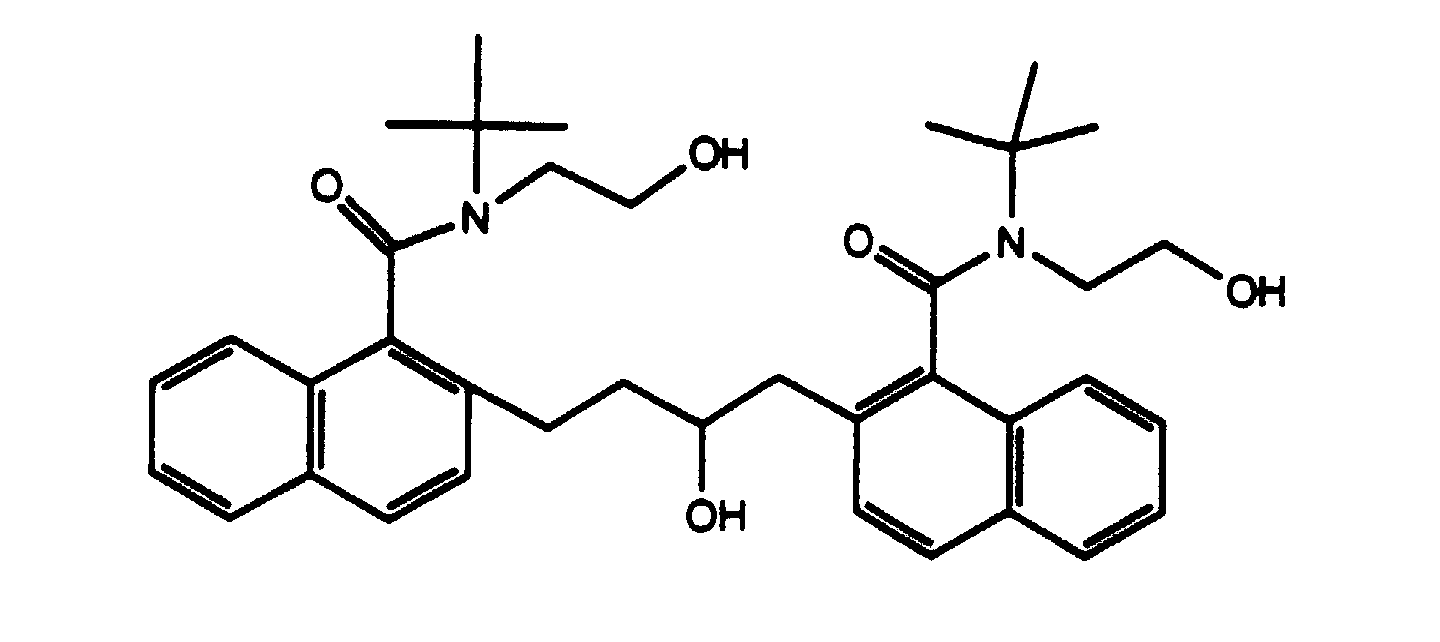

- To a solution of 3.2 gm (31.5 mmol) of triethylamine and 11.2 gm (31.5 mmol) of N-(t-butyl)-N-hydroxyethyl(diphenyl, t-butyl-silyl) amine in 100 ml of THF at 0°C was added 6.0 gm (31.5 mmol) of naphthoyl chloride. Within 5 minutes a white precipitate formed and settled out. The solution was allowed to warm to room temperature and was stirred for one hour. Monitoring by TLC indicated no residual amine was present. The reaction mix was poured into water and extracted with diethyl ether. The organic extracts were washed with brine and dried over MgSO4.
- The organic extract was filtered and solvent was removed under vacuum, yielding 17.15 gm of crude product. The crude product was purified by flash chromatography using 3 to 1 hexane/diethyl ether. 'HNMR confirmed the structure.
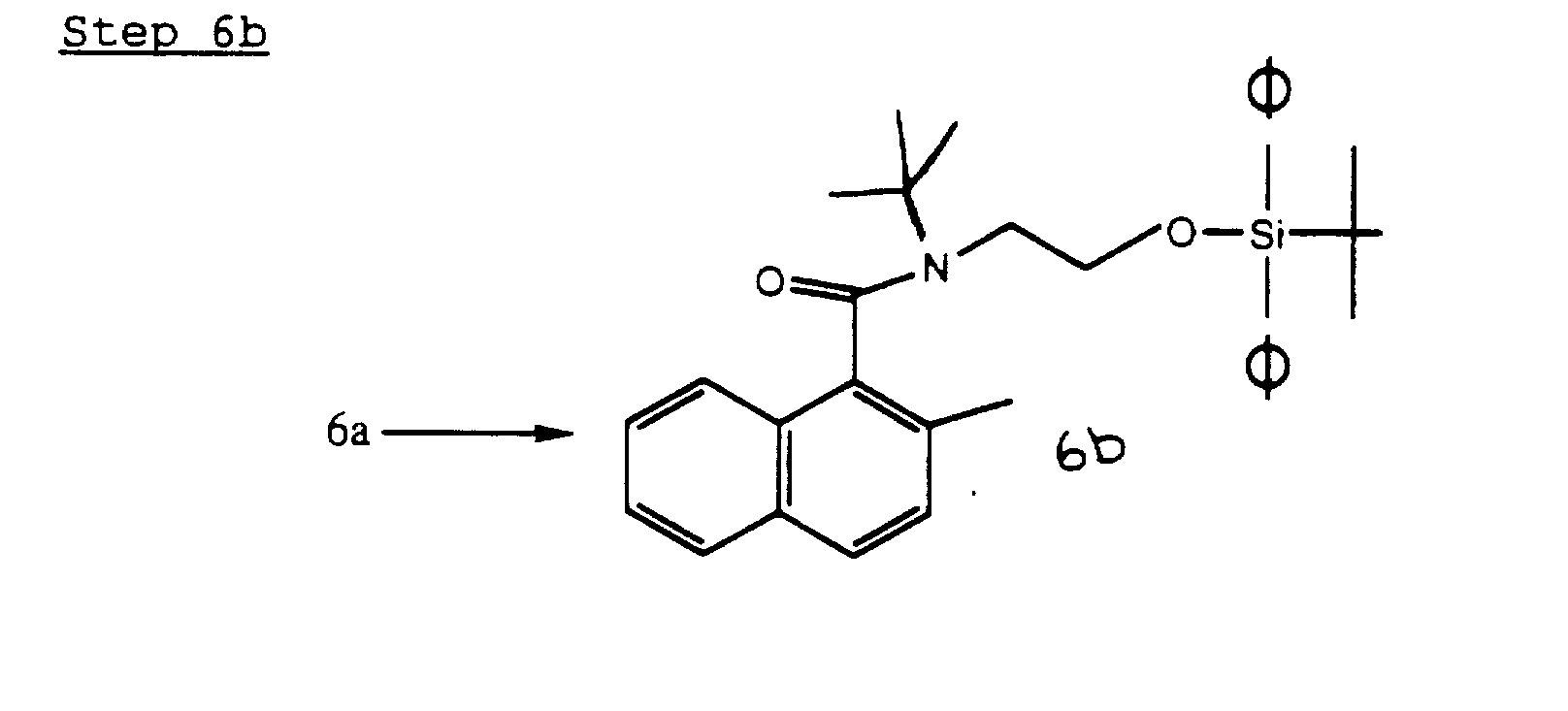
- A solution of 4.5 gm (8.83 mmol) of compound 6a and 1.13 gm of TMEDA in 100 ml of THF was cooled to -78°C in a dry/ice acetone bath. After 15 minutes 8.8 ml of a 1.1 M solution of s-butyl lithium in cyclohexane was added dropwise. The clear solution became a light orange in color and was stirred at -78°C for 1.5 hours. At this time 3.45 gm (24.3 mmol) of methyl iodide (filtered through basic alumina) was added rapidly to the solution. The reaction mass became a lighter orange in color and a white solid appeared. After 1 hour at -78°C, TLC indicated that some residual starting material remained. The reaction mixture was allowed to warm to room temperature and after 1 hour, was monitored again by TLC. At this point, no residual starting material remained. The reaction mixture was poured into diethyl ether, washed with water and then with brine, dried over MgSO4 and filtered. The solvent was removed in vacuum yielding 17.15 gm of a light yellow oil. The oil was purified by flash chromatography using 2:1 hexane/ether. Fractions 14-25 were collected cleanly and the solvent was removed under vacuum. The structure of the product was confirmed by 'HNMR.

- A solution of 2.36 gm (4.51 mmol) of compound 6b, 0.07 gm of diisopropylamine and 40 ml of THF was cooled to -78°C and 4.72 ml of a 1.1M solution of s-butyl lithium in cyclohexane was slowly added. The resulting blood red solution was stirred for 1.5 hours at -78°C at which time 0.6 gm (13.53 mmol) of ethylene oxide was added rapidly to the solution. After 15 minutes no color change was observed. The reaction was allowed to warm to 0°C. As the reaction warmed the solution became dark green and was stirred for 30 minutes at which time monitoring by TLC indicated that no residual starting material was present. The mass was poured into water, extracted with diethylether, washed with brine, dried over MgSO4 and filtered. Solvent was removed under vacuum and the product purified by column chromatography using a 3:1 mixture of diethylether and hexane. Fractions 21-40 were collected cleanly and solvent was removed under vacuum. Yield was 3.43 gm. The structure of the product was confirmed by 'HNMR.

- To a solution of 1.9 gm of pyridine in 30 ml of methylene chloride was added 1.2 gm of chromium trioxide at room temperature. The reddish solid partially dissolved into an orange solution with a brown solid residue. After 10 minutes a solution of 1.14 gm (2.0 mmol) of compound 6c in 6 ml of methylene chloride was added, dropwise. After 15 minutes a small amount was syringed into 1N HCL extracted with diethylether and monitored by TLC which indicated that no starting material remained. The mixture was poured into diethylether, washed twice with NaOH, then with 1N HCL, then with saturated NaHCO3, and finally with brine. The crude product was filtered and the solvent was removed under vacuum. This crude product (1.5 gm) was purified by flash chromatography using a 2:1 ether/hexane solution as eluant. Fractions 36-45 were collected and solvent was removed under vacuum. The structure was proven by 'HNMR.
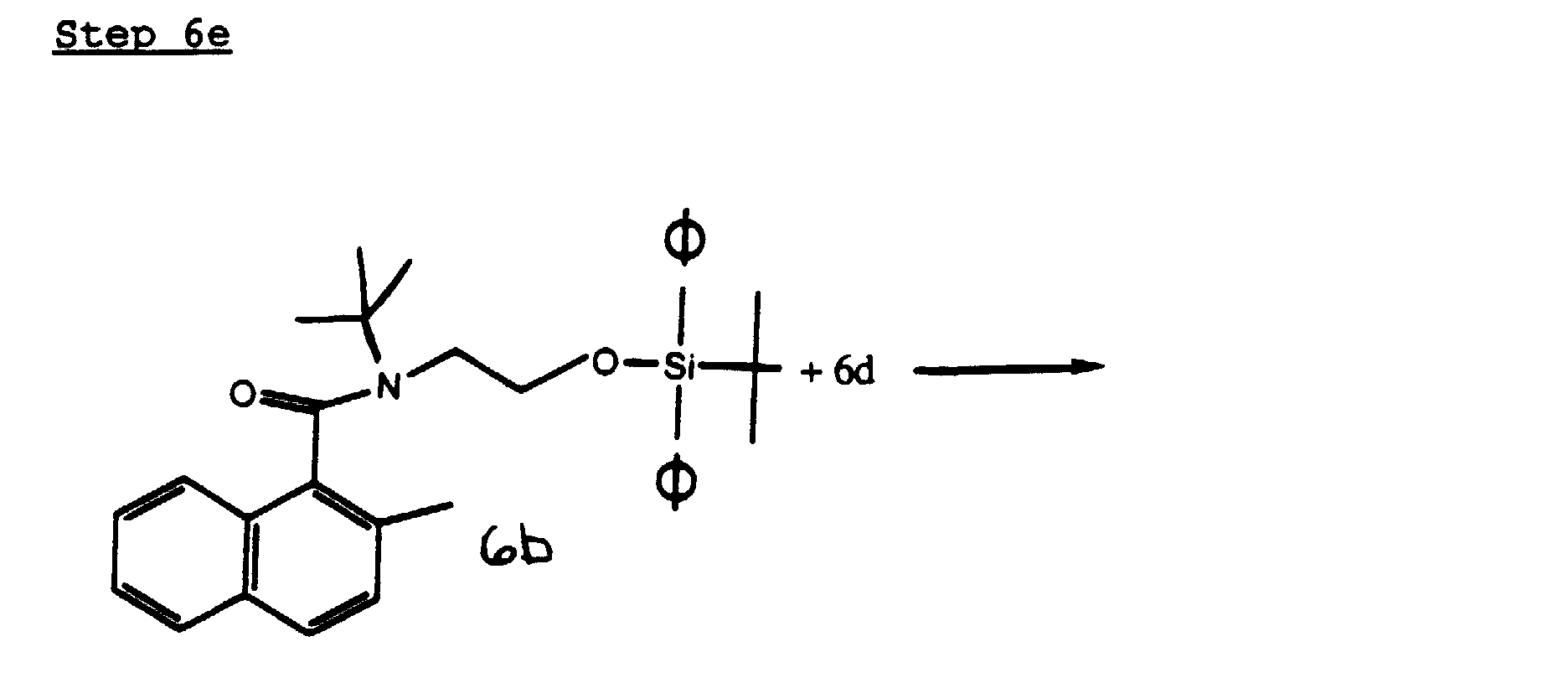

- A solution of 0.176 gm (0.34 mmol) of compound 6b, 0.0052 gm of diisopropylamine and 4 ml of THF was cooled to -78°C and 355.5 microliters of a 1.1 M solution of s-butyl lithium in cyclohexane was added, dropwise. A blood red solution was produced and was allowed to stir for one hour at -78°C. At the end of this hour a solution of 0.192 gm (0.34 mmol) of compound 6d in 1 ml of THF was added in a single addition. The blood red color turned into a light yellow. After 15 minutes, TLC indicated that most of the starting materials had been consumed. The reaction mass was poured into ether, washed with water and brine and then dried over MgSO4. The dried mixture was filtered and solvent was removed under vacuum, yielding a clear oil. This oil was subjected to column chromatography using a 1:1 ether/hexane solution.
- Fractions 23-35 were a mixture of the compound 6d and product. These were resubmitted to chromatography and purified, yielding 0.041 gm of compound 6e. Structure was confirmed by NMR.
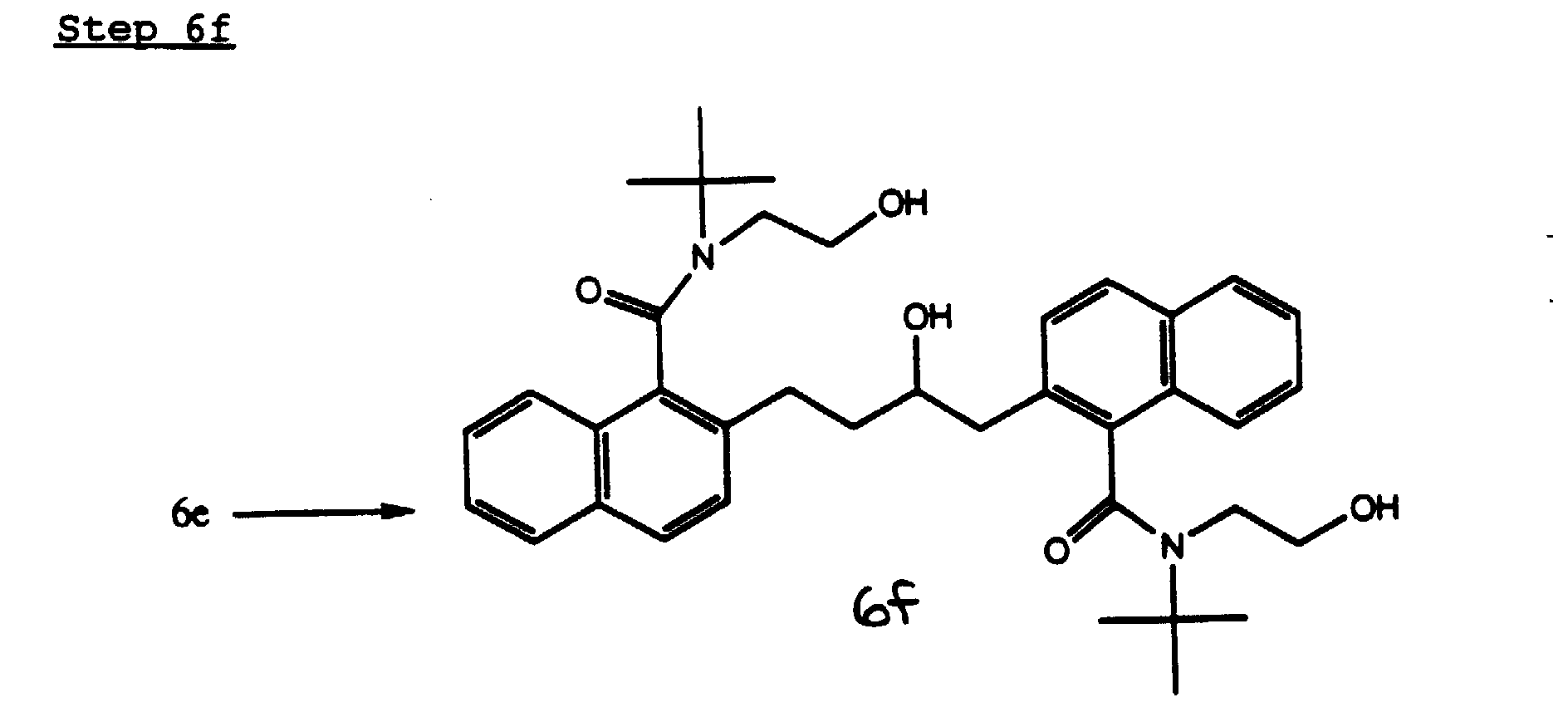
- A solution of 0.15 gm (0.15 mmol) of compound 6e in 1 ml of THF was charged to a 5 ml round bottom flask and 304 microliters of a 1.0M solution of tetrabutyl ammonium fluoride was added, dropwise. The clear solution became light yellow. After 30 minutes, TLC indicated no residual starting material remained. The mixture was poured into ether, washed with water and brine and dried over MgSO4. The organic phase was then filtered and the solvent was removed under vacuum, yielding a clear oil which was purified by flash chromatography. 'HNMR confirmed the structure.
- Preparation of


- To a solution (reddish purple) of 5 gm (33.73 mmol) of p-t-butyl toluene and a catalytic amount of iodine was added 5.66 gm (35.41 mmol) of bromine. The reaction mixture turned bright red within 5 minutes, generating white smoke. The reaction was stirred for 2 hours at room temperature at which time water and ether were carefully added to the mixture. The mixture was poured into a separatory funnel with additional water and ether. The organic layer was separated, washed three times with saturated NaHCO3 and once with brine, then dried over MgSO4 and filtered. The solvent was removed under vacuum. The product was evaporated twice with benzene and subjected to high vacuum to remove all residual solvents. 'HNMR confirmed the product structure.

- Compound 7a was brought to a gentle reflux in 25 ml of ether containing 0.2 gm of lithium wire. After 4 hours the original clear solution was murky and light yellow. The heating bath was removed and the mixture allowed to cool to room temperature whereupon 1.21 gm (14.52 mmol) of t-butyl isocyanate was added. The solution became orange and finally light yellow and refluxed slightly during the addition. After 30 minutes the reaction was monitored by TLC and no residual starting material was present. The mixture was poured into water, extracted with ether and then the organic layers were washed with brine and dried over MgSO4. The extracts were filtered and the solvent was removed under vacuum. A white solid was recovered which was triturated with hexane and collected by vacuum filtration. Yield was 1.1 gm. The entire procedure was repeated with the filtrate and an additional 0.44 gm was recovered. The structure was confirmed by NMR.
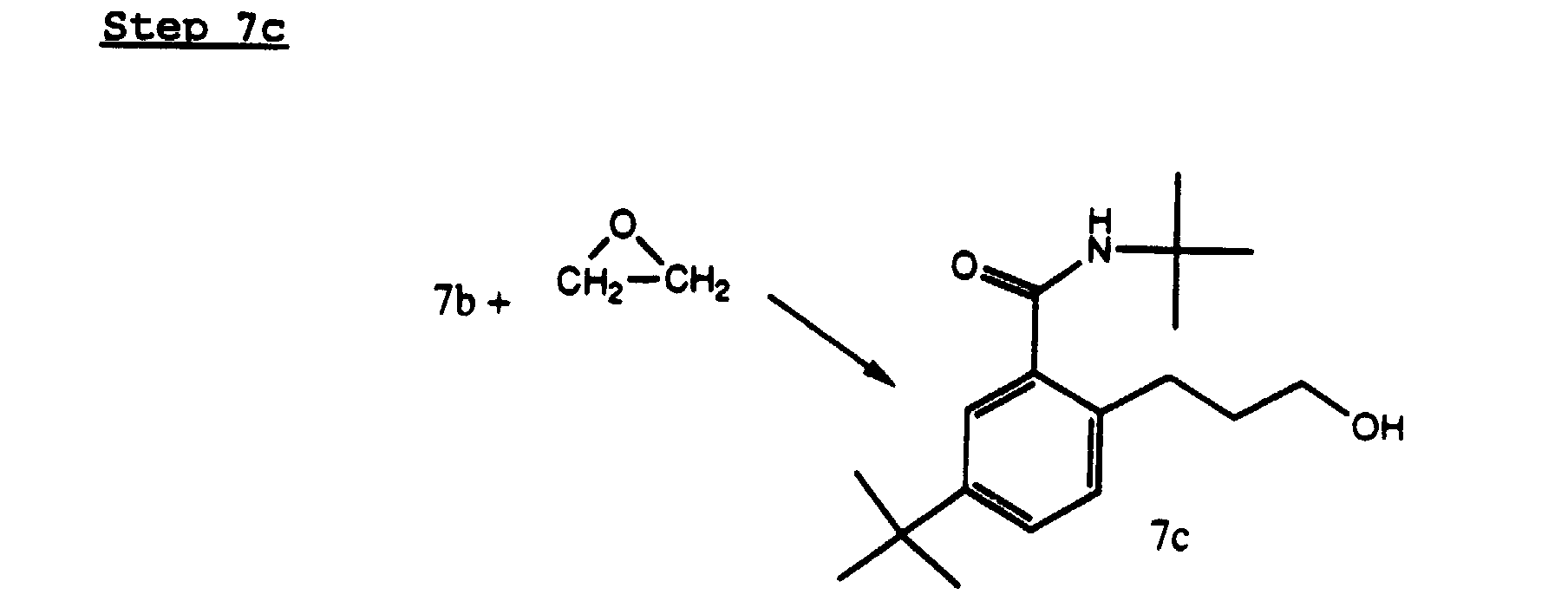
- A solution of 1.45 gm (5.86 mmol) of compound 7b and 1.4 gm of TMEDA was cooled to -78°C and 7.1 ml of a 1.69M solution of n-butyl lithium in hexane was added dropwise. A light orange color formed and disappeared into a clear solution during the addition. This color then developed into a neon orange by the time all of the n-butyl lithium had been added. The mixture was stirred at -78°C for 1 hour. At this time 0.29 gm (6.5 mmol) of ethylene oxide was added rapidly in a single addition. No color change was observed. After 5 minutes at -78°C the reaction mass was allowed to warm to 0°C. As the mass began to warm the color changed to bright yellow, slightly murky. Monitoring by TLC indicated that no residual starting material was present. The reaction mass was then poured into water and extracted with diethylether. The organic phases were washed with brine and dried over MgSO4. The mixture was then filtered and the solvent removed under vacuum. A white solid was recovered which was triturated with hexane and collected by vacuum filtration. The structure was confirmed by 'HNMR.
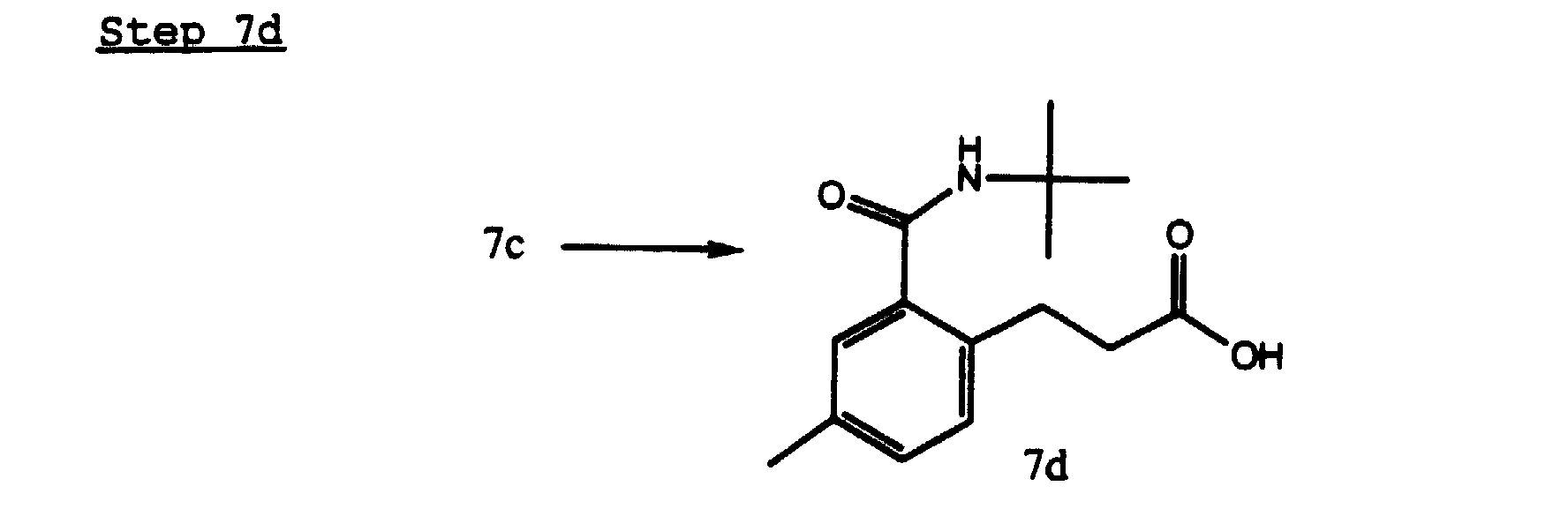
- A solution of 1.21 gm (4.15 mmol) of compound 7c and 7.81 gm of pyridinium dichromate in 16 ml of DMF, was stirred at room temperature overnight. After overnight stirring the mixture was poured into water and extracted twice with ethyl acetate. The organic phases were collected, dried over MgSO4 and filtered. The solvent was removed under vacuum, producing a brown oil. TLC indicated DMF was still present so the oil was dissolved in ether,washed with water and brine, and dried over MgSO4 and filtered. The solvent was removed under vacuum. A white solid product was recovered, triturated with hexane and collected by vacuum filtration. The structure was confirmed bv 'HNMR.
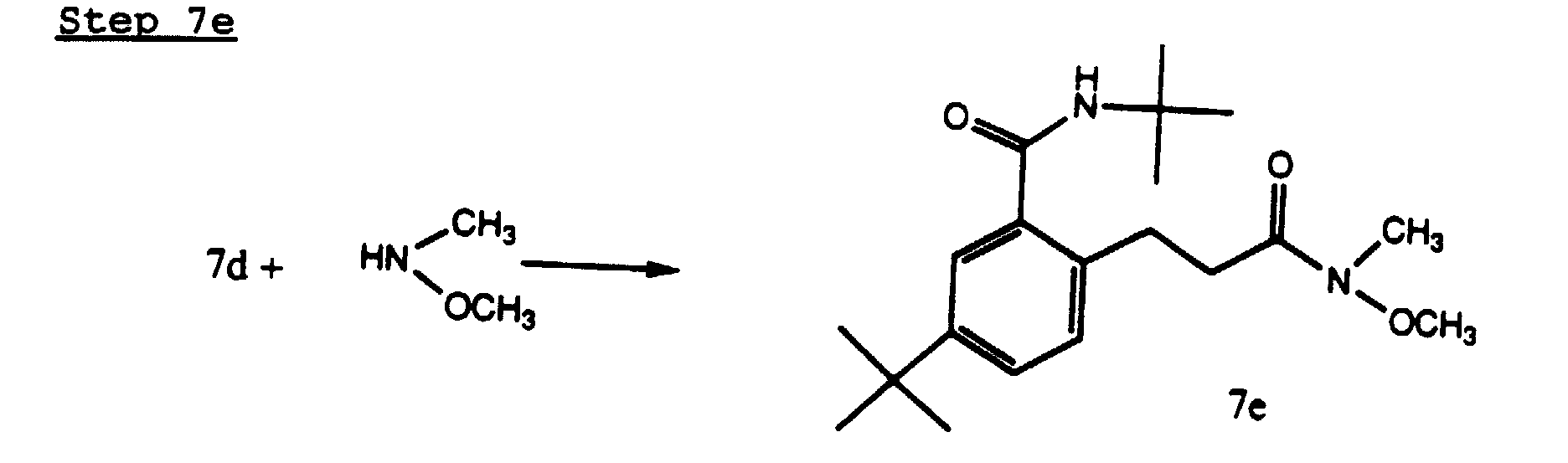
- A solution of 0.305 gm (1 mmole) of compound 7d and 0.098 gm (1 mmole) of N,O-dimethyl hydroxylamine hydrochloride in 2 ml of DMF was cooled to 0°C. To this clear solution 0.135 gm of 1-hydroxy benzotriazole, 0.192 gm of 1-(3-dimethylaminopropyl)-3-ethylcarbodiimide (EDC) and 0.304 gm of triethylamine were added, producing a turbid solution. After sitting 5 minutes the reaction mass was allowed to warm to room temperature and stirred for three hours. After 2 additional hours TLC analysis indicated that no residual starting material was present. The mixture was then poured into ethyl acetate, washed with water, 10% citric acid, saturated sodium bicarbonate and brine and dried over MgSO4. The mixture was then filtered and the solvent was removed under vacuum, producing a clear oil. This oil was purified by column chromatography using a 4:1 ether/hexane mixture. Fractions 13-31 were collected and structure was confirmed by NMR. The yield was 52%.

- A solution of 0.28 gm (1.15 mmol) of compound 3a and 0.272 gm of TMEDA in 10 ml of THF was cooled to -78°C in a dry ice/acetone bath. After 15 minutes at -78°C, 1.4 ml of a 1.69N solution of n-butyl lithium in hexane was added dropwise. A faint purple color changed to turquoise and eventually to purple during the addition of the n-butyl lithium. The deep purple solution was stirred for one hour at -78°C. After 1 hour of stirring, a solution of 0.18 gm (0.52 mmol) of compound 7e in 4 ml of THF was added. After 20 more minutes at -78°C, TLC monitoring indicated that no residual starting material was present. The mixture was poured into water, extracted with ether, washed with brine and dried over MgSO4. Solvent was removed under vacuum and the residue was purified by column chromatography using a 2:1 mixture of ether and hexane. Fractions 25-45 were collected. 'HNMR confirmed the structure. The yield was 81%.
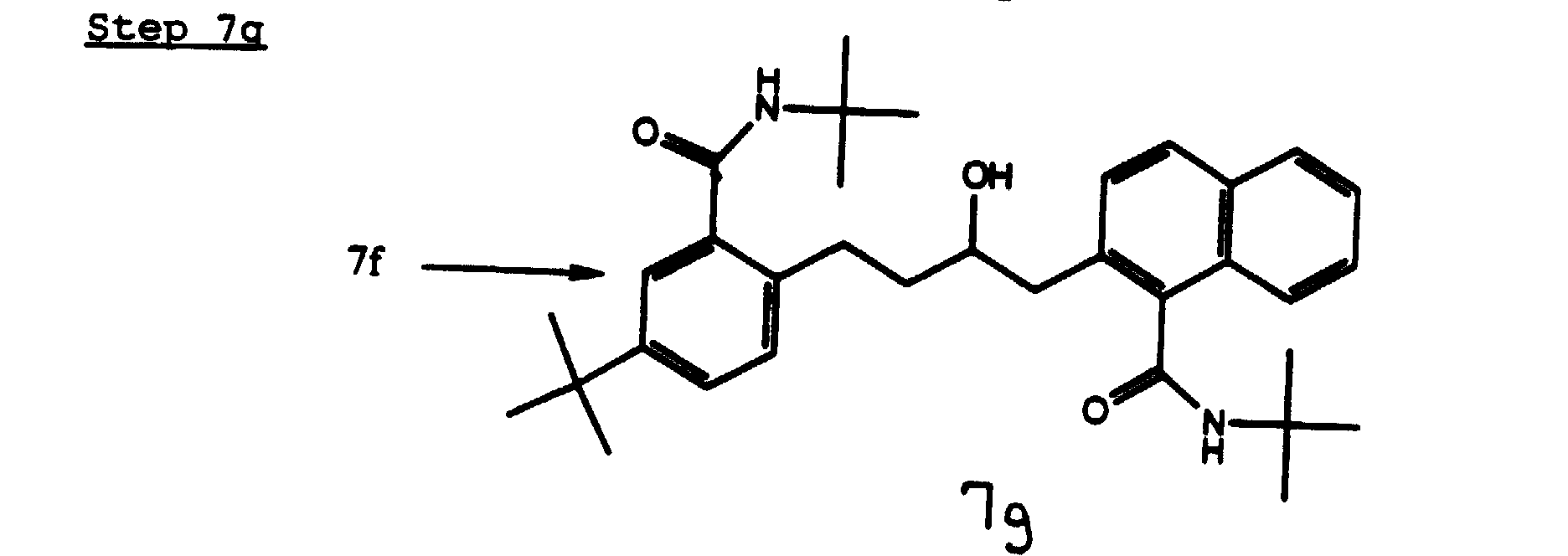
- A solution of 0.1 gm (0.28 mmol) of compound 7f in 1 ml of ETOH was cooled to 0°C and 0.011 gm of sodium borohydride granules was added to the clear solution. After 30 minutes, TLC monitoring indicated that starting material was still present. The reaction was allowed to warm to room temperature and 0.015 gm of additional sodium borohydride was added. After 30 more minutes at room temperature, there appeared to be no more residual starting material present. The reaction mass was poured into saturated sodium bicarbonate, extracted with ether, washed with brine, dried over MgSO4 and filtered. Solvent was removed under vacuum and the white amorphous solid which was recovered was purified by column chromatography using a 2:1 ether/hexane solution. Fractions 5-13 were collected and the structure was confirmed by NMR. Yield was 85.3%.
- Preparation of

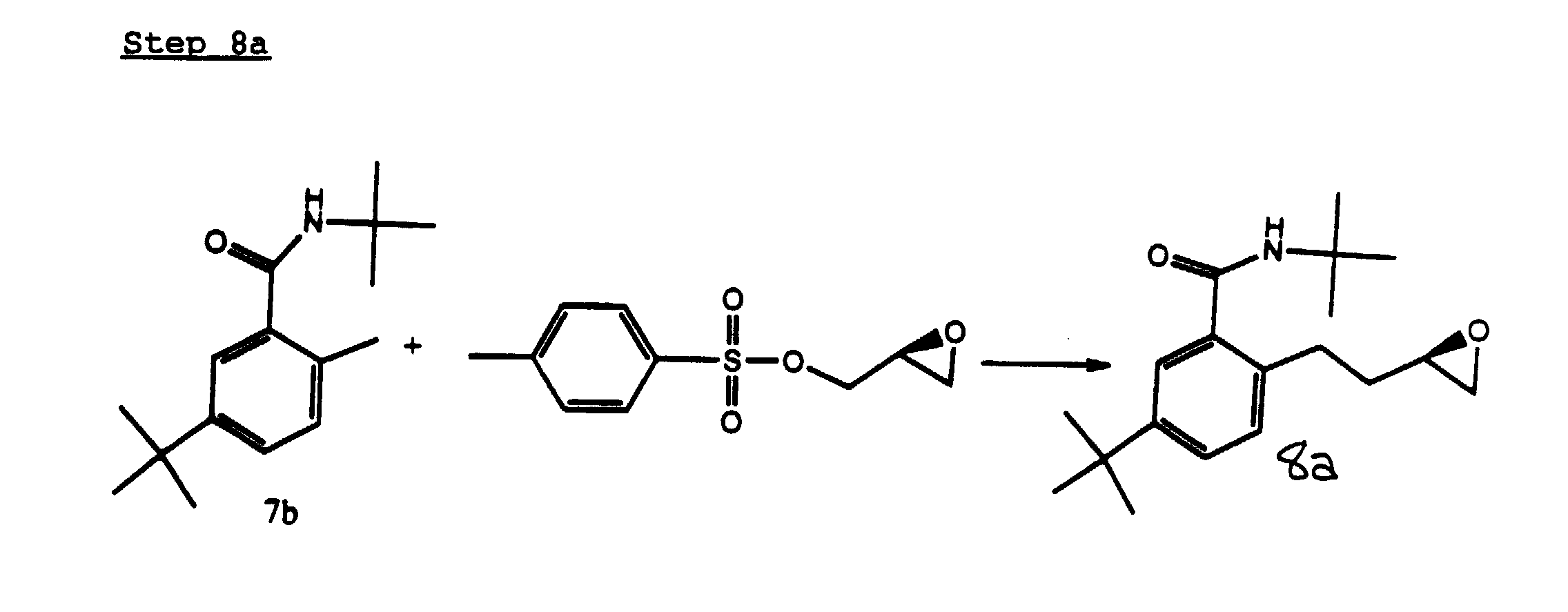
- A solution of 0.5 gm of compound 7b and 0.47 gm of TMEDA in 10 ml of toluene was cooled to -78°C in a dry ice/acetone bath. The mixture was allowed to sit for 15 minutes at -78°C and 2.38 ml of a 1.7M solution of n-butyl lithium in hexane was added dropwise. The color of the reaction mixture changed from light orange to clear and then to a bright orange color during the addition of the n-butyl lithium. The mass was stirred at -78°C for 1 hour and a solution of 0.461 gm (2.02 mmol) of S-glycidyl tosylate in 5 ml of THF was added. The color changed immediately to a light yellow. After an additional 15 minutes at -78°C, TLC indicated only a small amount of starting material remained. The reaction was poured into water and extracted with ether, washed with brine, and dried over MgSO4. The mixture was then filtered and the solvent was removed under vacuum. The yellow oil thus recovered was purified by flash chromatography using a 2:1 solution of hexane and ether. Fractions 45-75 were collected. NMR confirmed the structure of the product. The yield was 52%.
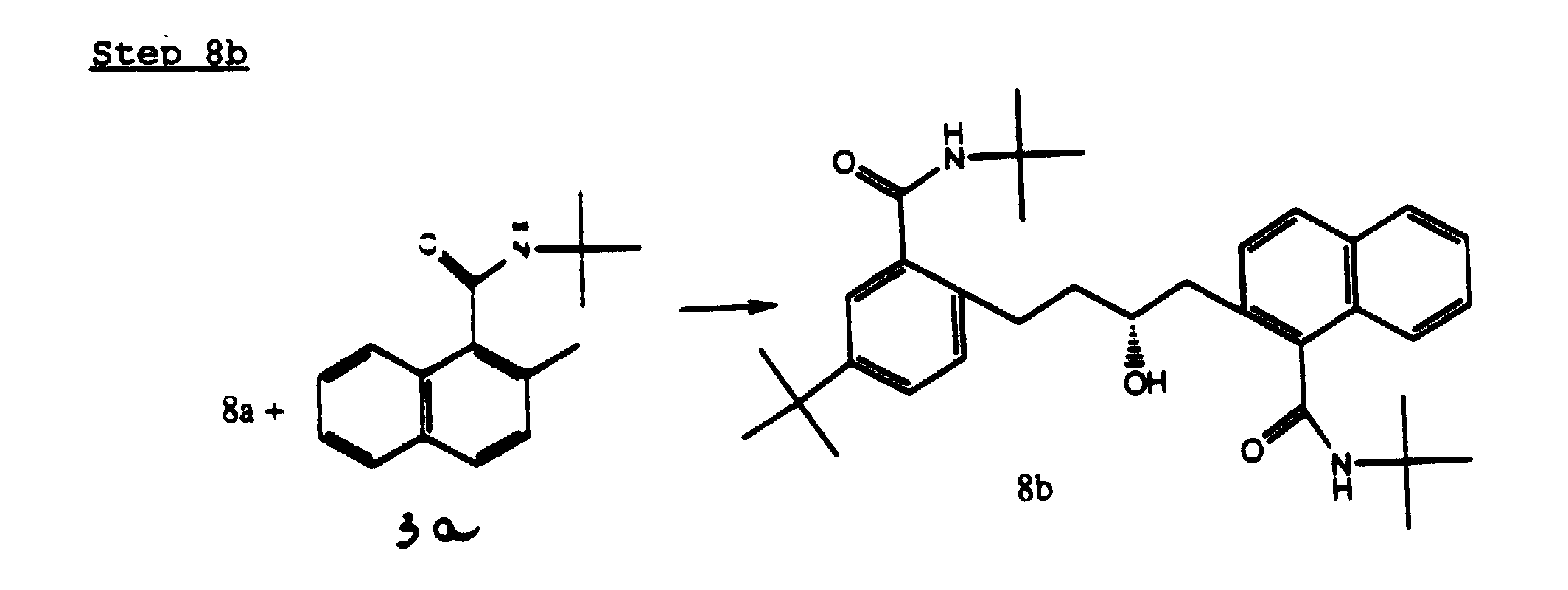
- A solution of 0.3 gm (1.32 mmol) of compound 3a and 0.31 gm of TMEDA in 5 ml of THF was cooled to 0°C. After the solution had stirred at 0°C for 15 minutes, 2.6 ml of a 1.0N solution of s-butyl lithium in cyclohexane was slowly added to it. As the butyl lithium was added, the original orange color changed to clear and then to an orange color which bright red/orange. After 1 more hour at 0°C a solution of 0.2 gm (0.66 mmol) of compound 8a in 1.5 ml of THF was slowly added. No color change was observed. After 15 minutes, TLC indicated no residual starting material. The solution was then poured into ether, washed with water, then brine and dried over MgSO4. The product was then filtered and the solvent was removed under vacuum, yielding a clear oil. This oil was purified by flash chromatography using a 2-1 ether to hexane mixture as the eluant. Fractions 20-30 were collected and the solvent was removed under vacuum. NMR confirmed the structure. Yield was 50%.
- Preparation of


- A solution of 7.96 gm of triethylamine and 5.76 gm (78.7 mmol) of t-butylamine in 140 ml of THF was cooled to 0°C and a solution of 15 gm (78.7 mmol) of 2-naphthoyl chloride in 10 ml of THF was added. A white precipitate formed immediately. After 10 minutes the reaction mass was allowed to warm and was stirred at room temperature for two hours. TLC indicated at this point that no residual starting material was present. The mixture was poured into water, extracted with ether, washed with 10% citrate acid, saturated NaHCO3, then with brine, and finally was dried over MgSO4. The mixture was then filtered and the solvent was removed under vacuum. A white solid precipitated out as the solvent evaporated and 9.8 gm of product were collected by vacuum filtration.
- The above procedure was repeated with the filtrate and an additional 2.2 gm of product were collected. NMR confirmed the structure. Yield was 67%.

- A solution of 3.5 gm (15.41 mmol) of compound 9a and 3.94 gm of TMEDA in 90 ml of THF was cooled to -78°C in a dry ice/acetone bath. After 15 minutes at -78°C, 34 ml of a 1.0N solution of s-butyl lithium in cyclohexane was slowly added. The solution immediately turned yellow and, as the butyl lithium addition continued, turned to bright orange and finally to an opaque butterscotch color. The mixture was then stirred for 1 hour at -78°C, at which time 2.4 gm (16.94 mmol) of iodomethane was added. The solution immediately turned to a light yellow green color with a white precipitate floating in it. The reaction mass was stirred at -78°C for another hour. Although TLC indicated that there was residual starting material still present, the mixture was poured into ether, washed with water and brine, then dried over MgSO4. The mixture was filtered and solvent was removed under vacuum. The product was purified by flash chromatography using a 3:1 hexane/ether solution. Fractions 13-19 were collected and solvent was removed under vacuum yielding 1.35 gm of a white solid material. The procedure was repeated and an additional 0.65 gm was recovered from the second procedure. Structure of the product was confirmed by 'HNMR.

- A solution of 2.21 gm (9.16 mmol) of compound 9b and 2.19 gm of TMEDA in 80 ml of THF was cooled to -78°C in a dry ice/acetone bath. After the solution had cooled for 15 minutes, 11.1 ml of a 1.69M solution of n-butyl lithium in hexane was added dropwise. The original bright purple color disappeared and then reappeared as the butyl lithium addition progressed. The reaction was stirred for another hour at -78°C at which time 0.81 gm (18.32 mmol) of ethylene oxide was added. No color change was observed. After 10 more minutes at -78°C the reaction mass was allowed to warm to 0°C. As it warmed, its color changed to a light orange. TLC analysis indicated that almost no residual starting material was present. The solution was then poured into water, extracted with ether, and washed with brine. The organic portion was dried over MgSO4. The mixture was then filtered and solvent was removed under vacuum. Structure was confirmed by NMR.
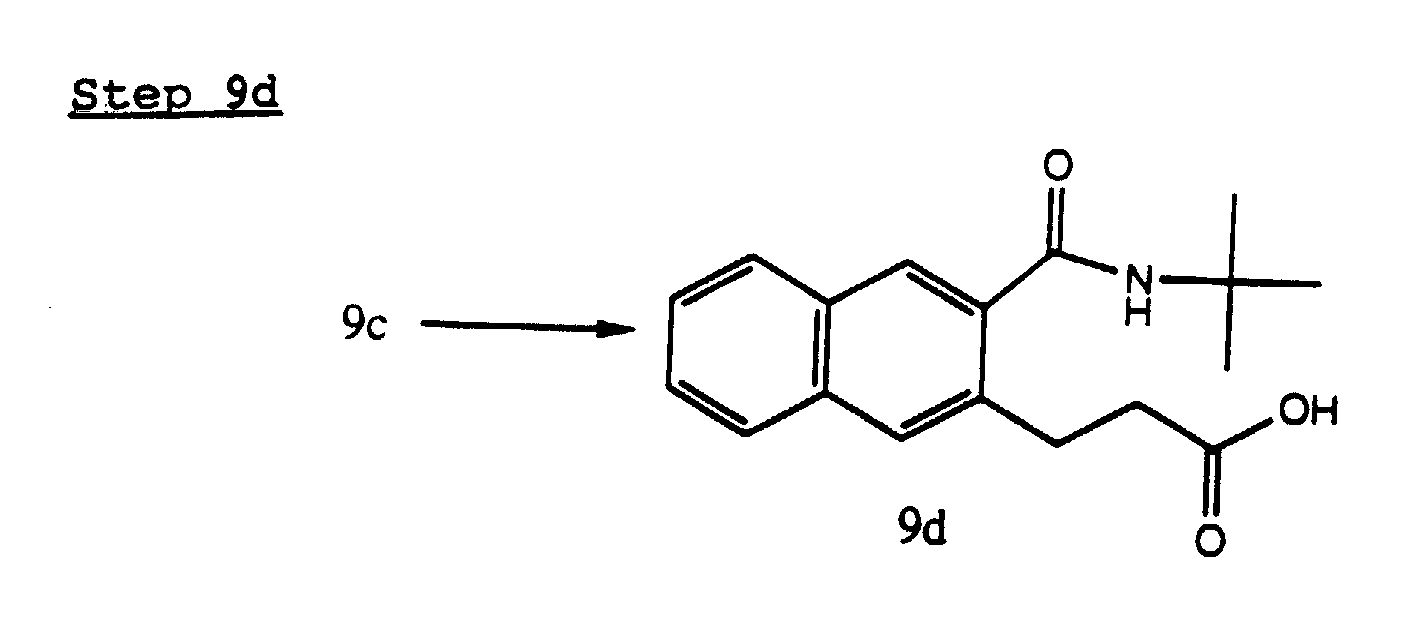
- A solution of compound 9c (about 9.16 mmol) and 17.23 gm of pyridinium dichromate in 35 ml of methylene chloride was stirred at room temperature for 4 hours. TLC indicated that a small amount of aldehyde was present, so the reaction was then allowed to continue with stirring for another 16 hours. At that time, TLC analysis indicated that no aldehyde was present. The mixture was poured into 350 ml of water and extracted twice with 300 ml of ether. The organic layers were combined, washed with water, dried over MgSO4, and filtered. The solvent was then removed under vacuum and a white solid material precipitated out. This was triturated with benzene and 12.08 gm of product was recovered by vacuum filtration. The structure was confirmed by NMR. Yield was about 40% over two steps.

- A solution was prepared consisting of 0.4 gm (1.34 mmol) of compound 9d, 0.131 gm (1.34 mmol) of N,O-dimethylhydroxylamine hydrochloride, 0.405 gm of triethyl amine and 0.6 gm of BOP reagent. The solution was stirred at room temperature for 2 hours at which time TLC indicated that no residual starting material remained. The reaction was poured into ether, washed with water and 10% citric acid, saturated NaHCO3 and brine, then dried over MgSO4. The mixture was filtered and solvent was removed under vacuum, yielding a white oily product. This white oil was purified by flash chromatography using a 3:1 ether/hexane solution. Fractions 34-69 were collected. NMR confirmed the structure of the product. The yield was 78%.
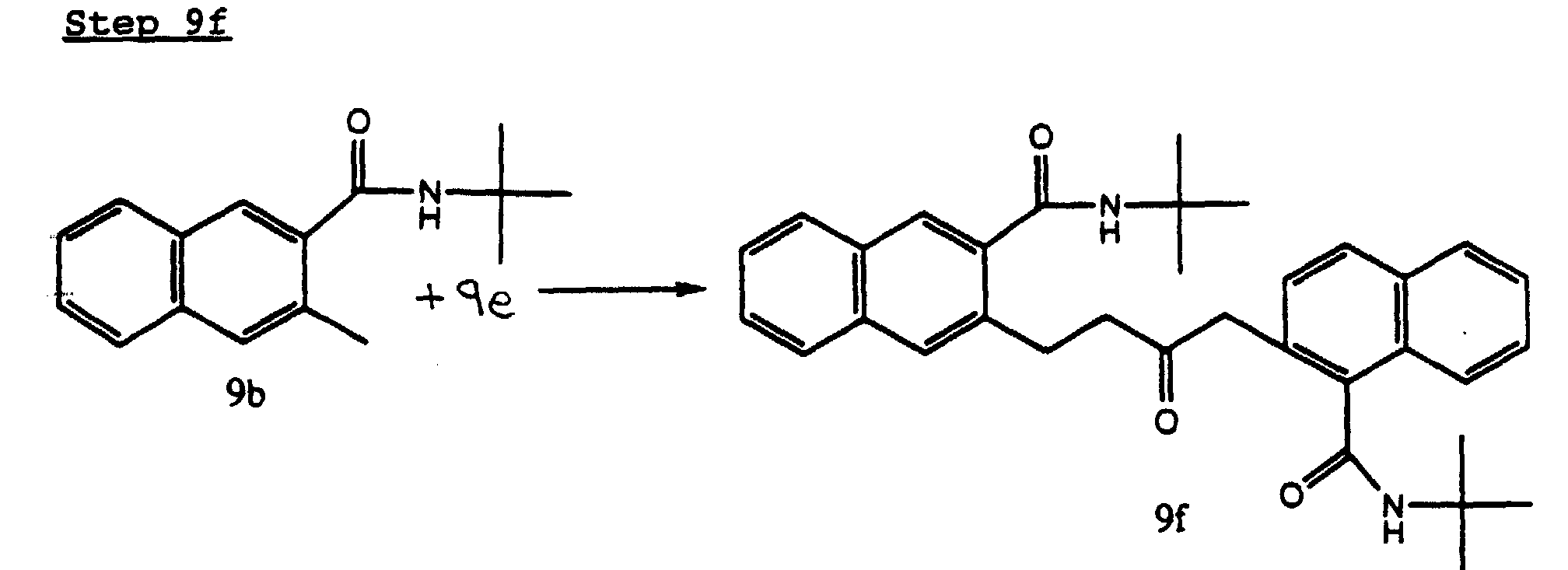
- A solution of 0.148 gm (0.613 mmol) of compound 9b and 0.143 gm of TMEDA in 5 ml of THF was cooled to -78°C in a dry ice/acetone bath. After the solution had cooled at -78°C for 15 minutes, 0.725 ml of a 1.7M solution of n-butyl lithium in hexane was added. The resulting purple solution was stirred at -78°C for 1 hour at which time 0.1 gm (0.292 mmol) of compound 9e in 1 ml of THF was added in a single portion. No color change was observed. The reaction mass was stirred for an additional 15 minutes at -78°C at which time TLC analysis indicated no residual starting material was present. The mixture was then poured into ether, washed sequentially with water and brine, dried over MgSO4, and filtered. Solvent was removed under vacuum. 'H NMR confirmed the structure. Material was not purified further.

- A solution was prepared of product 9f in 5 ml of ethanol and 0.017 gm (0.44 mmol) of sodium borohydride granules was added to the clear solution. After 30 minutes, TLC indicated no residual starting material remained. The reaction mixture was poured into ether, washed sequentially with saturated NaHCO3 and brine, then dried over MgSO4. The dried extracts was filtered and the solvent was removed under vacuum. A yellow oil/solid material was recovered and purified by flash chromatography using a 3 to 2 ether/hexane solution. Fractions 50-90 were collected. NMR confirmed structure of the product.
- Preparation of


- A solution of 0.151 gm (0.61 mmol) of compound 7b and 0.142 gm of TMEDA in 5 ml of THF was cooled to -78°C in a dry ice/acetone bath. After the solution had cooled for 15 minutes at -78°C, 0.47 ml of a 2.6M solution of n-butyl lithium in hexane was added slowly. An orange solution resulted which was stirred at -78°C for 1 hour. At the end of this hour 0.1 gm (0.29 mmol) of compound 7e in 1 ml of THF was added. The solution became light yellow at the end of the addition and was stirred for an additional 15 minutes at -78°C. At this time, TLC indicated no residual starting material was present. The mixture was poured into ether, washed sequentially with water and brine, dried over MgSO4, and filtered. Solvent was removed under vacuum. The product was not further purified.

- The crude product from step 10a (approximately 0.29 mmol) was dissolved in 5 ml of ethanol and 0.017 gm of sodium borohydride granules was added to the clear solution. After 30 minutes, TLC indicated no residual starting material was present. The reaction was poured into ether, washed sequentially with saturated NaHCO3 and brine, then dried over MgSO4. The extracts were filtered, the solvent was removed under vacuum and the residual product was purified by flash chromatography using a 1:1 ether hexane solution as the eluent. Fractions 46-72 were collected and the solvent was removed under vacuum. Yield was 55% over steps a and b and NMR confirmed the structure.
- Preparation of


- A solution of 0.12 gm (0.61 mmol) of 4-methyl-3-(t-butyl) carbamoyl-pyridine and 0.142 gm of TMEDA in 5 ml of THF was cooled to -78°C in a dry ice/acetone bath. After the solution had cooled for 15 minutes at -78°C, 0.47 ml of a 2.6M solution of n-butyl lithium in hexane was slowly added.
- The solution changed to a light yellow color and was allowed to stir at -78°C for an additional hour. At this time a solution of 0.1 gm (0.29 mmol) of compound 9e in 1 ml of THF was rapidly added. After 30 minutes and again at 1 hour, TLC analysis indicated that not all of compound 9e had been consumed. The reaction mass was then poured into ether, washed sequentially with water and brine and dried over MgSO4. The mixture was filtered and the solvent was removed under vacuum, yielding an oil. The oil was purified by column chromatography and fractions 68-78 were collected cleanly. NMR confirmed the structure of these materials.

- Compound 11a was reduced with sodium borohydride in the manner described in previous examples. NMR confirmed the structure.
- Preparation of
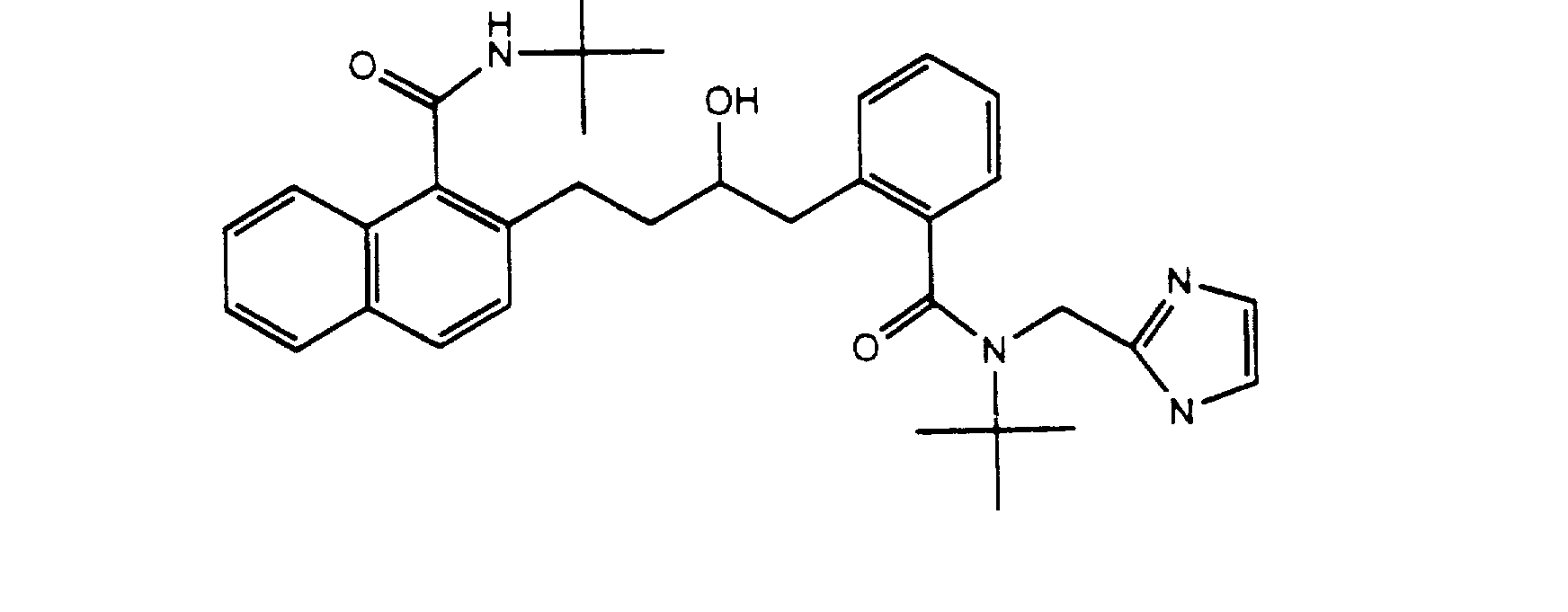
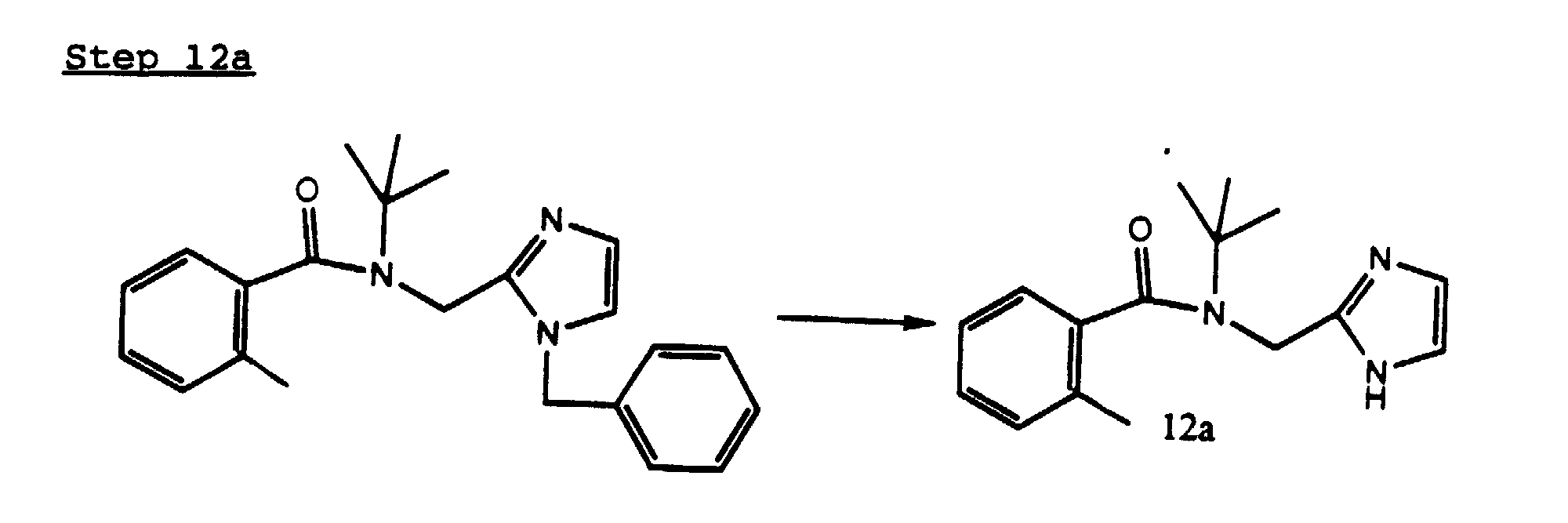
- A solution of 0.21 gm (0.58 mmol) of N-(N-benzyl)-imidazole, N-t-butyl-toluamide was prepared in 2 ml of ethanol. To this solution was added 0.062 gm of palladium black followed by 0.36 gm of ammonium formate. Within 5 minutes, the black solution began to bubble. After 1 hour, TLC indicated that no reaction had taken place as yet. The reaction mixture was warmed to 70°C and, after 1 hour at that temperature, TLC indicated that no residual starting material was present. An additional 0.36 gm of ammonium formate was added and the reaction left at 70°C overnight. The mass was filtered over Celite™ and washed with ethyl acetate and methanol. Solvent was removed under vacuum, producing a white solid. The structure was confirmed by NMR. Yield was 95%.
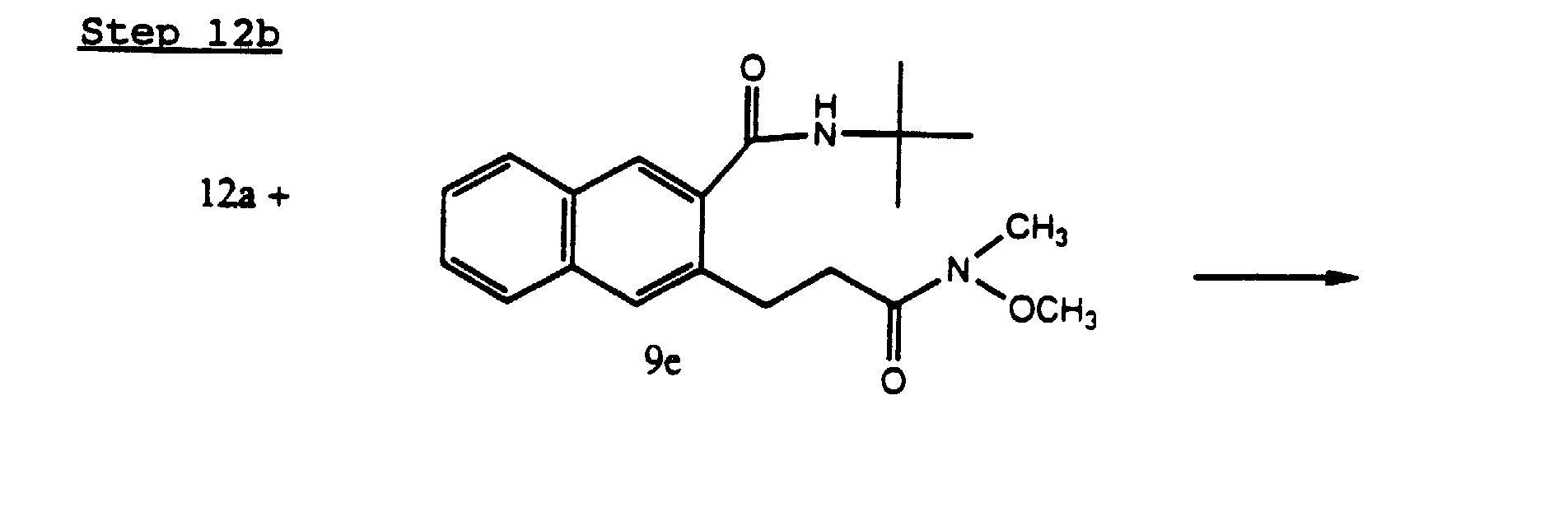

- A solution of 0.15 gm (0.55 mmol) of compound 12a and 0.03 gm (0.33 mmol) of diisopropylamine in 5 ml of THF was cooled to -78°C in a dry ice acetone bath. After the solution had sat at -78°C for 15 minutes, 1.57 ml of a 0.91M solution of s-butyl lithium in cyclohexane was slowly added. A bright blood red color developed and the solution was stirred for 20 additional minutes at -78°C. At this point, a solution of 0.095 gm (0.275 mmol) of compound 9e in 1 ml of THF was quickly added. The color faded to a burgundy red color. TLC indicated almost no residual starting material to be present. The reaction mass was quenched with 1 ml of water, poured into additional water and extracted with 15 ml of ether. The organic phase was washed with 15 ml of brine, dried over MgSO4 and filtered. The solvent was removed under vacuum. The residue was purified by flash chromatography using a 3 to 1 solution of ethyl acetate and hexane as the eluent. Fractions 21-49 were collected and solvent was removed under vacuum. NMR confirmed the structure. Further workup was not carried out at this point.

- A solution of 0.11 gm (0.2 mmol) of crude compound 12b in ethanol was prepared and 0.012 gm of sodium borohydride granules was added to the clear solution. After 30 minutes, TLC indicated that no residual starting material was present. The reaction mixture was quenched with 10 drops of saturated NaHCO3 and the mixture was poured into 10 ml of saturated NaHCO3 and extracted with 15 ml of ethyl acetate. The organic layers were washed with brine and dried over MgSO4. The mixture was filtered and the solvent was removed under vacuum. The residue was purified by flash chromatography using ether as the eluent until the first spot came off and then using ethyl acetate. Fractions 81-102 were collected cleanly. NMR confirmed the structure.
- Preparation of
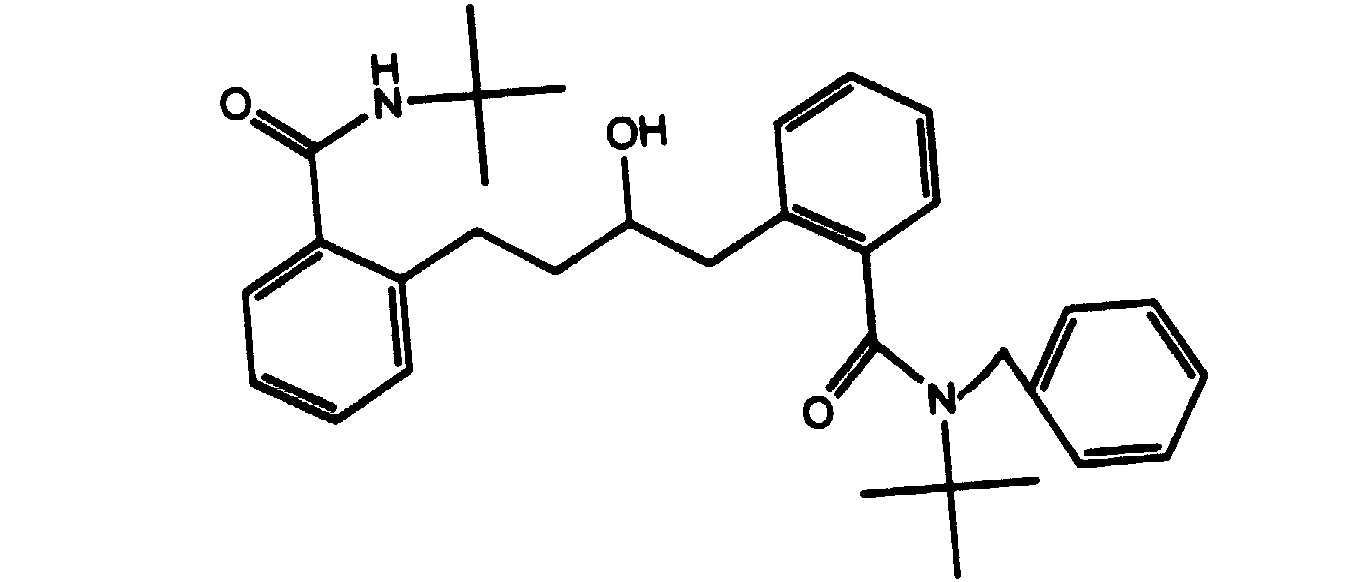
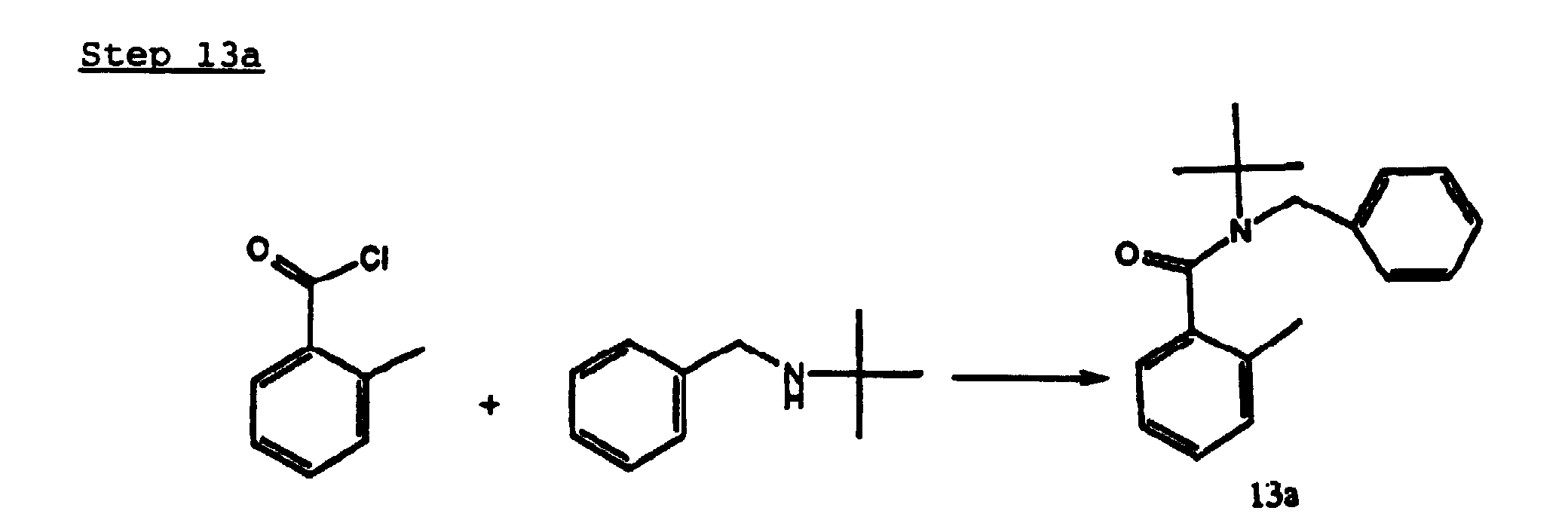
- To a solution of 3.27 gm of triethylamine and 5.28 gm of N-(t-butyl) benzylamine in 40 ml THF at 0°C was added 5.0 gm (33.34 mmol) of O-toluoyl chloride, dropwise, at 0°C. Within 5 minutes, a white precipitate came out of the solution and after an additional 15 minutes the cooling bath was removed and the reaction mixture was stirred for 2 hours. At this time, TLC indicated that no residual starting material was present. The mixture was poured into water and extracted with ether. The organic phase was washed sequentially with saturated NaHCO3, 10% citric acid and brine, and dried over MgSO4. The mixture was filtered and the solvent was removed under vacuum yielding a yellow oil. This oil was purified by flash chromatography. The material was collected and the solvent was removed under vacuum. The clear oil crystallized into a white solid when hexane was added and was collected by filtration. NMR confirms the structure. Yield was 73.5%.

- N-(t-butyl)-toluamide (7.58 gm, 39.6 mmol) was dissolved in 400 ml of THF and 9.96 gm (81.2mmol) of TMEDA was added. The mixture was cooled to -78°C and 31.2 ml of 2.6M n-butyl lithium in hexane was added dropwise. After 1 hour, a solution of 1.92 gm (43.6 mmol) of ethylene oxide was added as a 10% solution in THF. After 15 minutes the solution was warmed to 0°C. A precipitate formed and the reaction mixture turned murky orange. After another 30 minutes, TLC indicated presence of product plus starting material.
- Recrystallization from ether/hexane yielded 3.49 gm of pure product. Flash chromatography of the remainder with 2:1 ether/hexane, yielded another 2.96 gm of pure product. Total yield was 6.45 gm (69%).

- A solution of 3.49 gm (14.8 mmol) of compound 13b in 60 ml of DMF was prepared and 27.9 gm of pyridinium dichromate was added. The solution turned a dark brown/orange color and was stirred overnight at room temperature. The mixture was poured into H2O and extracted once with 150 ml of ether and once with 50 ml of ether, then dried over MgSO4. Solvent was removed under vacuum, yielding a clear, colorless oil, which turned solid after standing. Recrystallization in pure ether yielded white crystals. The product was filtered and washed with hexane. Two crops yielded 1.48 gm (40%) of white powder.
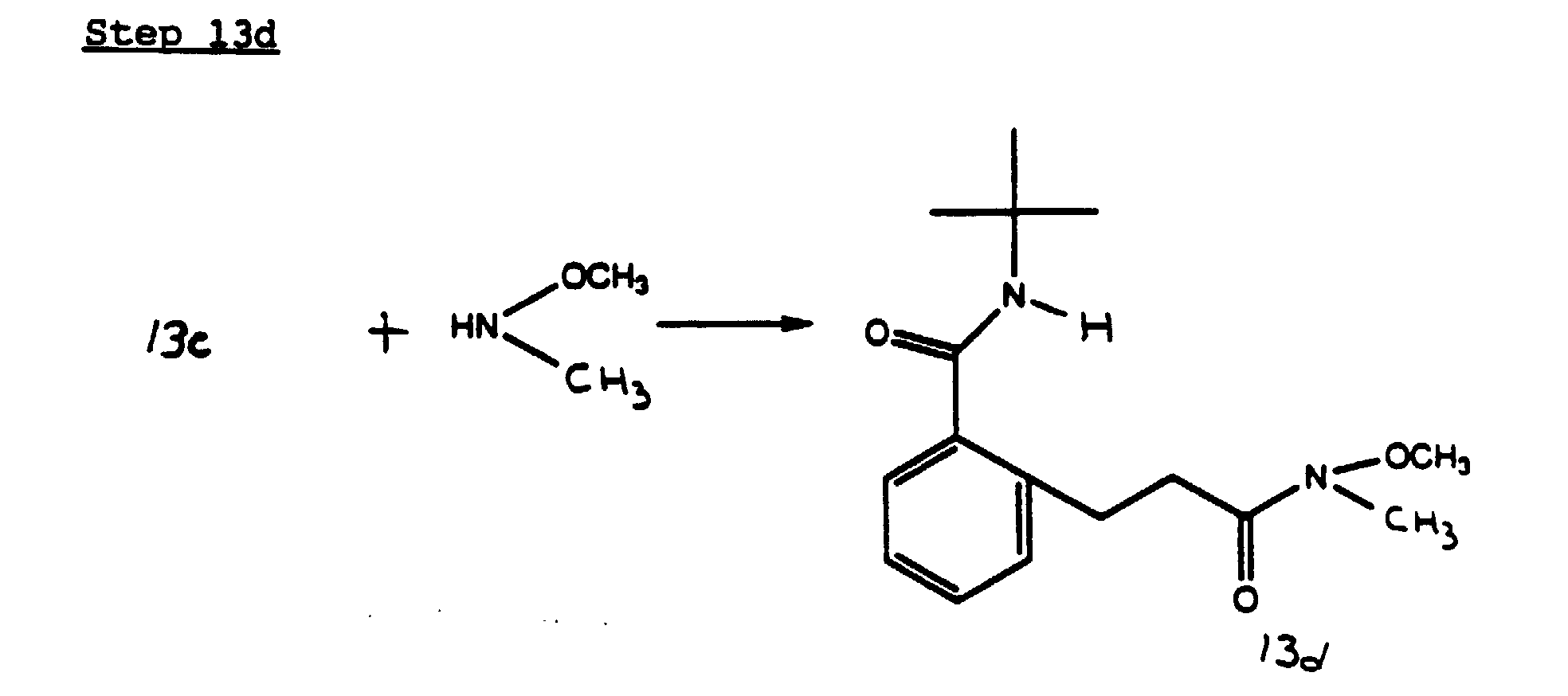
- A solution of 0.8 gm (3.21 mmol) of compound 13c in 40 ml of methylene chloride was prepared. To this solution was added 0.313 gm (3.21 mmol) of N,O-dimethylhydroxyl amine hydrochloride and 1.34 ml of triethylamine. When the amine hydrochloride was completely dissolved, 1.42 gm of BOP reagent was added and the clear solution was stirred for 2 hours at room temperature. TLC indicated that no starting material remained. The reaction mixture was poured into ether and washed with 10% citric acid solution, H2O, saturated NaHCO3 and brine, then dried over MgSO4. Flash chromatography in 2:1:1 methylene chloride/ethyl acetate/hexane yielded 0.539 (57%) of white powder.

- A solution of 0.2 gm (0.7 mmol) of compound 13a and 0.02 gm of diisopropylamine in 5 ml of THF was cooled to -78°C in a dry ice/acetone bath. After the solution had cooled at -78°C for 15 minutes, 1 ml of 0.92M s-butyl lithium was slowly added, producing a bright purple color. A solution of 0.1 gm (0.342 mmol) of compound 13d in 1 ml of THF was added within 10 seconds following the addition of the butyl lithium solution and before the color changed. The addition caused the solution to turn a slight peach color. After 5 minutes, TLC indicated that residual starting materials were still present but the color had all disappeared. The reaction was quenched with 1 ml of water, then poured into 20 ml of water and extracted with ether. The organic extract was washed with 20 ml of brine, dried over MgSO4 and filtered. The solvent was removed under vacuum and the clear residue (280 mg) was purified by column chromatography using a 2 to 1 ether/hexane solution. The product was collected cleanly and NMR confirmed the structure. Yield was about 29%.

- A solution of 0.05 gm (0.10 mmol) of compound 13e in 3 ml of ethanol was prepared and 0.0057 gm of NaBH4 granules was added to the clear solution. After stirring for 30 minutes, TLC indicated that some residual starting material was still present. Another equivalent of NaBH4 was added and the reaction was stirred for an additional 45 minutes. No residual starting material was found at this point. The reaction was quenched with 10 drops of saturated NaHCO3, poured into 10 ml of saturated NaHCO3 and extracted with 15 ml of ether. The extracts were washed with brine, dried over MgSO4 and filtered. Solvent was removed under vacuum and the residue was purified by column chromatography using a 3 to 1 ether/hexane solution. Fractions 21-45 were collected cleanly. NMR confirmed the structure. Yield was about 90%.
- Preparation of

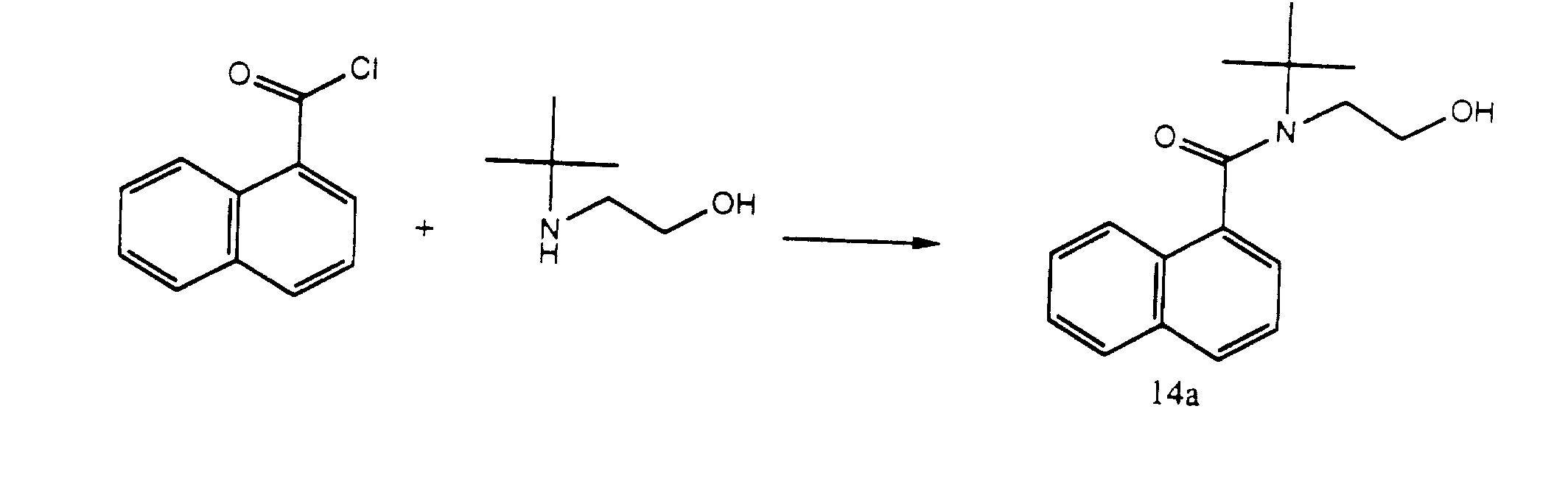
- A solution of 3.07 gm (26.23 mmol) of N-t-butyl amine and 7.96 gm of triethylamine in 60 ml of methylene chloride was cooled to 0°C and 10 gm (52.46 mmol) of naphthoyl chloride was slowly added. The reaction mixture was allowed to warm slowly to room temperature. After 1 hour at room temperature, TLC indicated that residual starting N-t-butyl ethanol amine was still present so the reaction was allowed to sit overnight. The mixture was then poured into ether, washed sequentially with water, 10% citric acid, saturated NaHCO3 and brine. The organic layers were dried over MgSO4 and filtered. The solvent was removed under vacuum yielding a yellow oil. The yellow oil was dissolved in a 9 to 1 methanol/water solution and 5 ml of a 45% KOH solution was added. The solution immediately became turbid with a white solid, which settled to yield a clear solution. After 5 minutes, TLC indicated that no residual starting material was present. The reaction was poured into water and extracted twice with ether. The organic extract was dried over MgSO4 and filtered. The solvent was evaporated under vacuum. The yellow oil solidified upon standing, was triturated with hexanes and collected by filtration. NMR confirmed the structure. The yield was 64%.
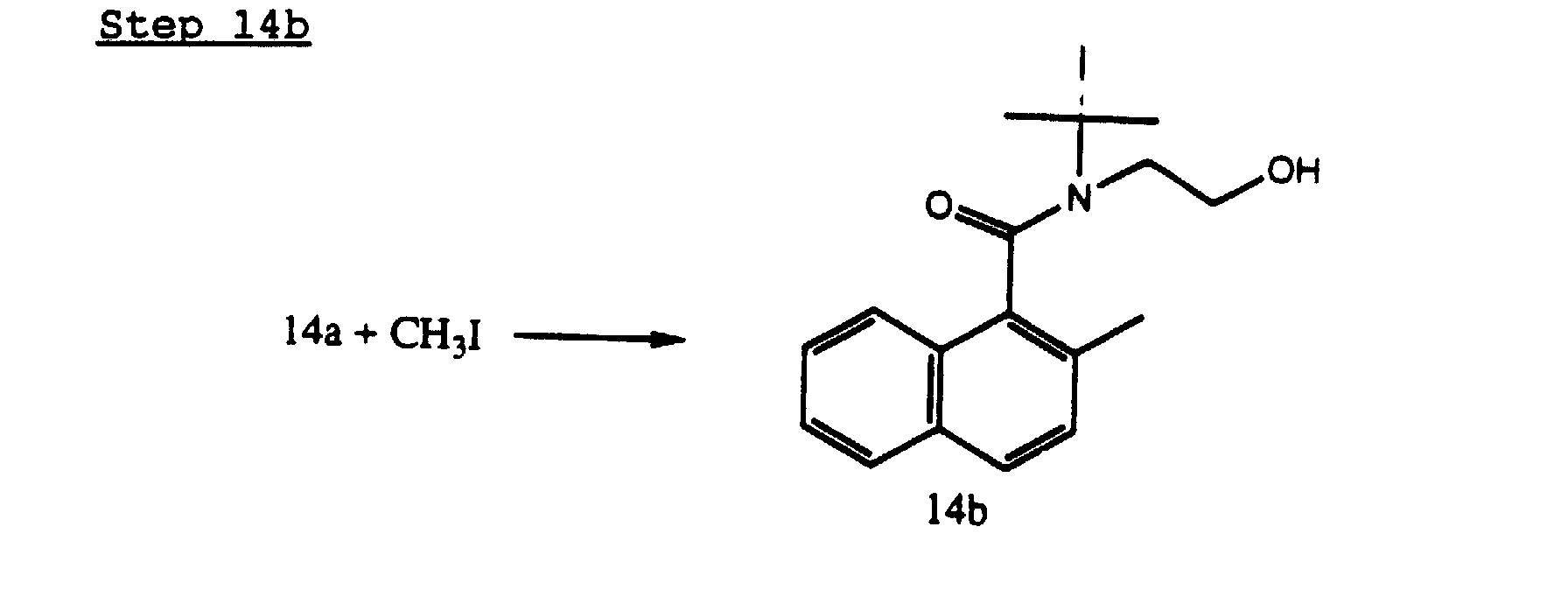
- A solution of 2.5 gm (9.2 mmol) of compound 14a and 2.36 gm of TMEDA in 50 ml of THF was cooled to -78°C in a dry ice/ acetone bath. After the mixture had stirred for 15 minutes at -78°C, 20.27 ml of a 1.0M solution of s-butyl lithium in cyclohexane was added, dropwise. The color changed to yellow and then to green and then to a dark green during this addition. The solution was stirred at -78°C for 1 hour after which 1.3 gm (9.2 mmol) of iodomethane was added in one portion. The reaction mix became yellow with a white precipitate. After 15 minutes TLC indicated that almost no residual starting material was present. The mixture was poured into an ether and water mixture. The organic phase was washed sequentially with water and brine and then dried over MgSO4. The mixture was then filtered and solvent was removed under vacuum, yielding an orange oil. This oil was purified by flash chromatography using a 2 to 1 ether/hexane solution. Fractions 28-46 were collected cleanly. Structure was confirmed by NMR. Yield was approximately 45%.

- A solution of 0.17 gm (0.595 mmol) of compound 14b and 0.0176 gm of diisopropylamine in 5 ml of THF was cooled to -78°C. After the mixture had cooled for 15 minutes at -78°C, 1.33 ml of a 1.0M solution of s-butyl lithium in cyclohexane was slowly added. No color change was apparent at this point, so another 0.4 ml of the solution was added and a blood red color was noted. When the entire amount of the s-butyl lithium had been added the reaction mixture was stirred for an additional 15 minutes at -78°C. At this point, a solution of 0.10 gm (0.29 mmol) of compound 9e in 1 ml of THF was added quickly. No color change was observed. After 15 minutes TLC indicated that no residual starting material was present and 1 ml of water was added to quench the reaction. The mixture was poured into ether and the organic layers were washed sequentially with water and brine, then dried over MgSO4. The mix was then filtered and the solvent was removed under vacuum. The residue was dissolved in 5 ml of ethanol and 0.017 gm of NaBH4 crystals were added. A white precipitate formed in the solution and slowly dissolved, yielding again a clear solution. This solution was poured into saturated NaHCO3 and extracted with ether. The organic extract was washed in brine then dried over MgSO4 and filtered. The solvent was then removed under vacuum. The clear oil was purified by column chromatography. The structure was confirmed by 'HNMR.
- Preparation of

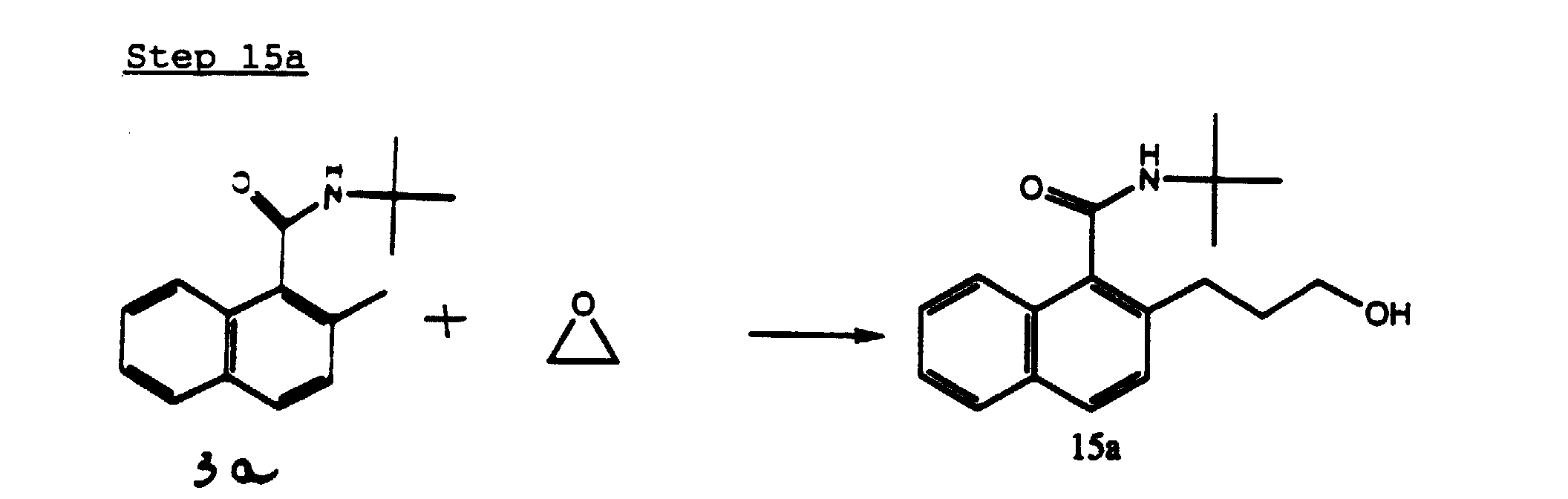
- A solution of 0.8 gm (3.317 mmol) of compound 3a and 0.79 gm of TMEDA and 27 ml of THF was cooled to -78°C in a dry ice/acetone bath. After the solution had cooled for 15 minutes at -78°C, 4.02 ml of a 1.69M solution of n-butyl lithium in hexane was added dropwise to the solution. A deep purple color resulted. The solution was then stirred at -78°C for 1.5 hours. At this point, a solution of 0.292 gm (6.64 mmol) of ethylene oxide in THF (10% in THF) was added. After 15 minutes, TLC indicated that there was residual starting material. Accordingly, another equivalent of ethylene oxide was added. The reaction was monitored again and starting material was still seen so yet another 5 equivalents of ethylene oxide was added. The reaction was then allowed to warm to 0°C and the purple color changed to a light green. The reaction mixture was poured into water, extracted with ether, washed with brine, dried over MgSO4 and filtered. Solvent was removed under vacuum, yielding a yellow oil. The yellow oil was purified by flash chromatography using a 2 to 1 ether/hexane solution. Fractions 6-11 were collected cleanly and the solvent was removed under vacuum. Structure was confirmed by NMR. Yield was 42%.
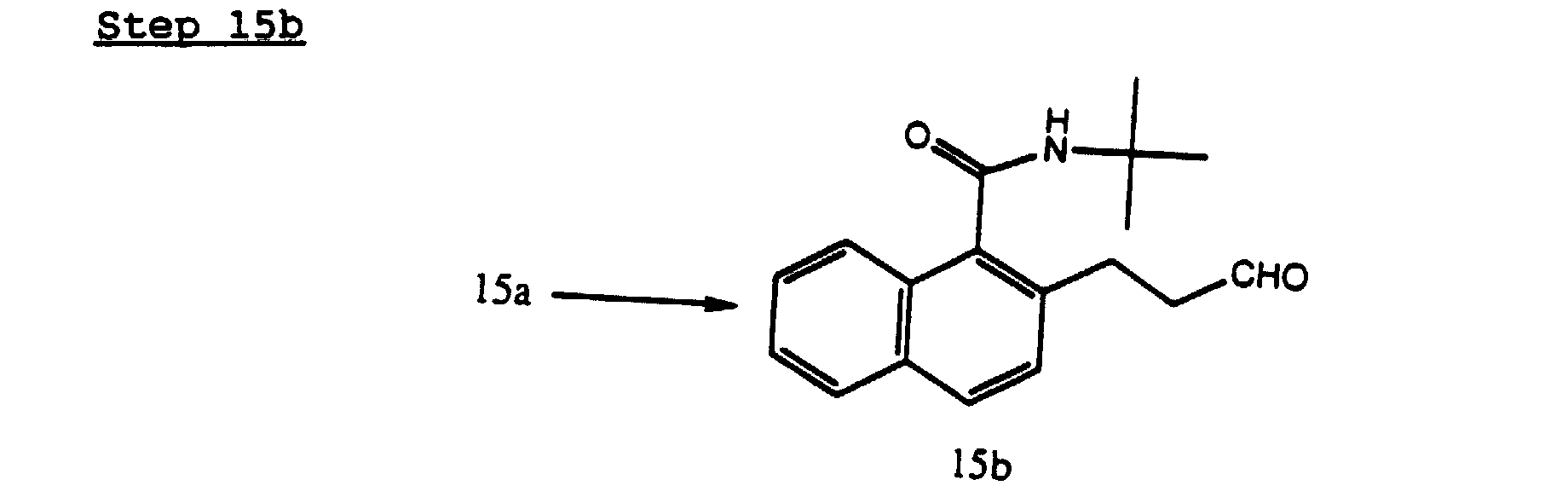
- To a solution of 0.83 gm of pyridine and 15 ml of methylene chloride there was added 0.526 gm of chromium trioxide. The solid partially dissolved into an orange solution with a brown solid settling out. After 60 minutes, a solution of 0.25 gm of compound 15a in 4 ml of methylene chloride was added, dropwise. After 15 minutes, TLC indicated that no residual starting material was present. The mixture was poured into ether, washed twice with 1N NaOH, then sequentially with 1N HCl, saturated NaHCO3 and brine, then dried over MgSO4. The mixture was filtered and the solvent was removed in vacuum yielding a solid product which was then recrystallized from ether and hexane. The structure was confirmed by NMR. Yield was 72.5%.
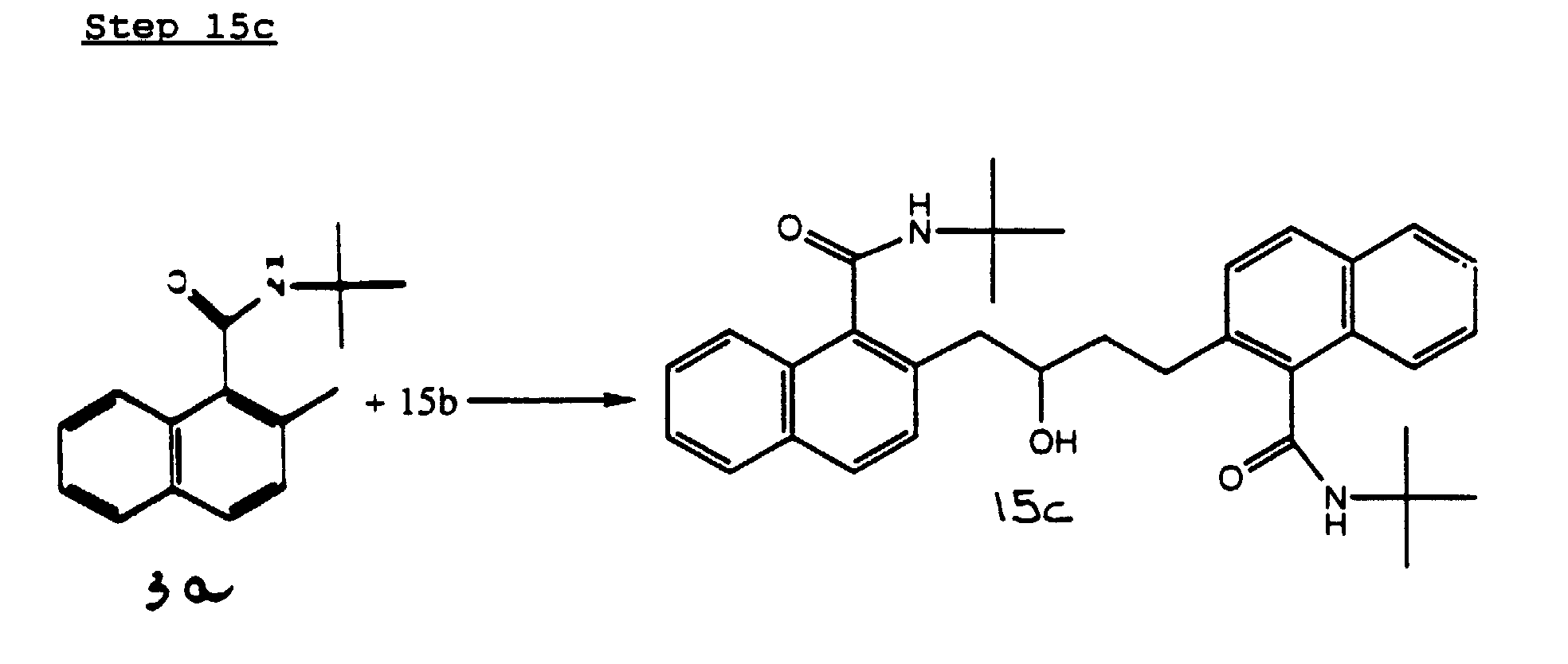
- A solution of 0.136 gm (0.565 mmol) of compound 3a and 0.132 gm of TMEDA in 10 ml THF was cooled to -78°C in a dry ice/acetone bath. After the solution had stirred for 15 minutes at -78°C, 0.34 ml of a 1.69M solution of n-butyl lithium in hexane was added. A purple color developed and the solution stirred at -78°C for 45 minutes. At this time, a solution of 0.08 gms (0.283 mmol) of compound 15b in 2 ml of THF was added. The solution was stirred for an additional 15 minutes at which time some residual starting aldehyde persisted. The reaction was allowed to warm to 0°C and TLC did not indicate whether residual aldehyde still remained. The reaction mixture was allowed to warm to room temperature. After 10 minutes it was poured into water and extracted with ether. The extracts were washed with brine and dried over MgSO4. The mixture was then filtered and the solvent was removed under vacuum and a yellow oil was recovered. This oil was purified by flash chromatography and the desired material was confirmed by NMR.
- Preparation of
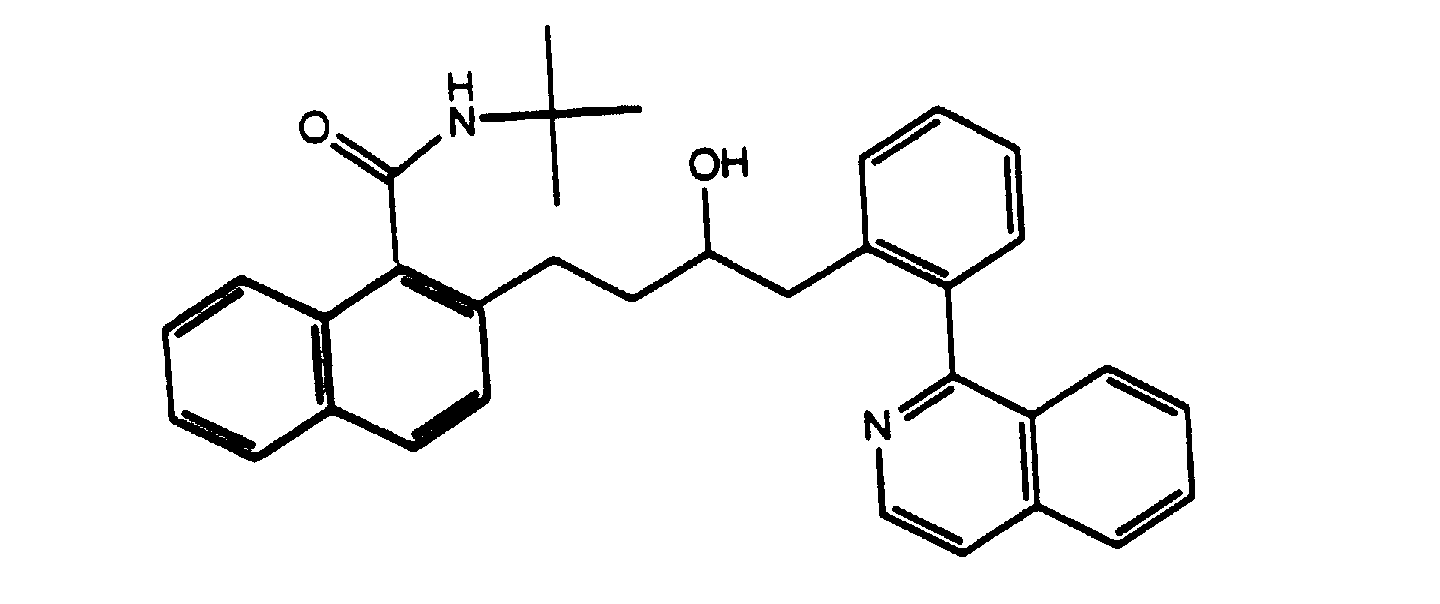
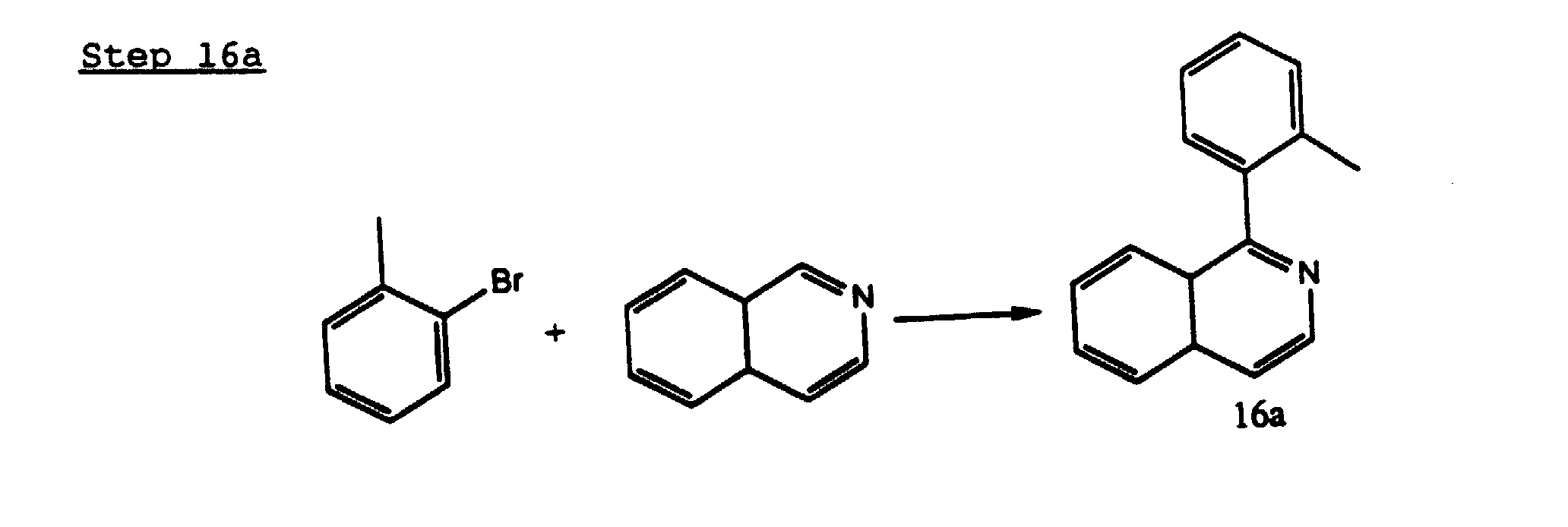
- A solution was prepared of 21.37 gm (0.125 mol) of O-bromotoluene in 100 ml of ether. The solution was stirred and 1.75 gm of lithium wire was added. The mixture was allowed to stir at room temperature. As the lithium dissolved, the solution began to reflux spontaneously. After 1 hour the mixture was murky and brown with a white precipitate. The reaction was then allowed to stir for an additional 3 hours at which time 32.25 gm (0.25 mmol) of isoquinoline and 100 ml of toluene were added through the condenser. As the isoquinoline addition proceeded the solution turned blood red with a yellow precipitate and refluxed spontaneously. The mixture was no longer exothermic after about one-half of the isoquinoline had been added. When the addition was completed the condenser was replaced with a short path distillation apparatus, the reaction mass was concentrated down to 115 ml and reflux was continued for about 2.5 hours. At this time, TLC indicated that no bromotoluene material remained. The reaction was quenched with water and poured into additional water. Organic materials were extracted with ethyl acetate and washed with saturated NaHCO3 and brine. A brown oil (49.01 gm) was collected, dried over MgSO4 and purified by fractional distillation. The desired product distilled at 115-120°C. Yield was 13.5 gm.

- A solution of 0.465 gm of TMEDA in 20 ml of THF was cooled to -78°C. After 10 minutes 2.35 ml of a 1.7M solution of n-butyl lithium in hexane was added. The clear solution which resulted was stirred at -78°C for 30 minutes at which time a solution of 0.85 gm (3.87 mmol) of compound 16a and 5 ml THF was added, dropwise. The solution gradually turned dark green and was allowed to warm to about -30°C and stirred at that temperature for about an hour.
- At the end of this one hour period, a solution of 0.30 gm (1.29 mmol) of compound 15b in 3 ml of THF was rapidly added. The solution immediately turned black and stirring was continued at -30°C for another hour. The mixture was warmed to room temperature and stirring was continued for another hour. TLC indicated the presence of residual starting material so the mass was allowed to stir overnight at room temperature.
- The reaction mass was poured into ether, washed sequentially with water and brine, then extracted with 1N HCl. The organic layer was separated, and the aqueous layer made basic (pH8) with saturated NaHCO3 and extracted with ether. The second organic layer was dried over MgSO4 and filtered. The solvent was removed under vacuum. The organic layer was purified by flash chromatography using 5:1 ether/hexane eluent. The more polar material was collected (0.05g) and the desired material confirmed by NMR.
- Preparation of

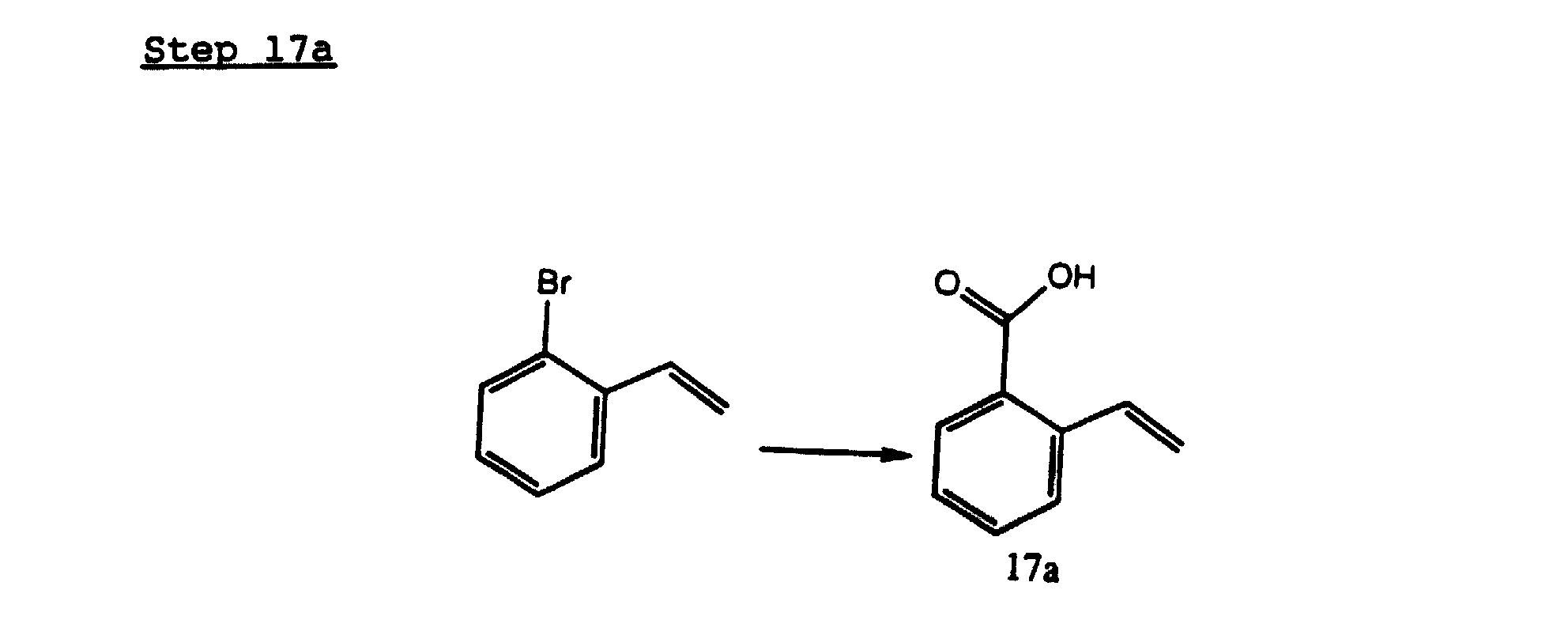
- Mg turnings (1.75g, 0.072 g atom) were placed in an oven dried 250 ml 3 neck flask with condenser and addition funnel (all assembled hot). The entire apparatus was evacuated and filled with argon. The flask was charged with 10 ml of anhydrous THF and the addition funnel was charged with 8.0 gm (43.7 mmol) of 1-bromostyrene in 50 ml of anhydrous THF. Five (5) ml of the 1-bromostyrene solution was added to the Mg turnings and the mixture was heated to 65-70°C and the remainder of the solution was added over 1 hour. The mixture was heated an additional 30 min., then cooled to room temperature over 1 hour, then poured over crushed dry ice and the dry ice was allowed to evaporate. The mixture was made strongly acidic with 150 ml of 10% HCl solution. The organic phase was separated and the aqueous phase was extracted three times with ether. The combined organic phase was poured into 150 ml of 20% KOH solution, the solution was separated and the basic phase was filtered to remove polymer. The basic phase was then acidified with 10% HCl solution and extracted three times with 100 ml portions of ether. The extracts were combined, washed with 100 ml of brine and dried over Na2SO4. The solution was filtered and concentrated to a white solid which was recrystallized from chloroform/hexane solution to yield 6.44g (66%) of 1-vinylbenzoic acid in two crops.

- Iodine (4.12g, 16.22 mmol) was added in a single portion to a degassed solution of 1.20 gm (8.11 mmol) of compound 17a in 12 ml of acetonitrile. The solution was stirred for 1 hour, then poured into 50 ml of saturated sodium thiosulfate solution. The solution was extracted three times with 50 ml portions of ethyl acetate. The combined organic phases were washed sequentially with 40 ml portions H2O, saturated NaHCO3 solution and saturated sodium thiosulfate solution then dried over MgSO4. The solution was filtered and concentrated to a yellow solid (1.87g, 84% yield) which was recrystallized from ethanol.

- To a degassed solution of 0.50 gm (2.95 mmol) of 1-mercapto methyl benzoate in 12 ml of ethanol was added, dropwise, 0.14g, (2.95 mmol) of KOH in 1.5 ml of H2O. The resultant yellow solution was stirred for 10 minutes at room temperature. The solution was cooled to 0°C and 0.80g, (2.92 mmol) of compound 17b in 10 ml ethanol was added over 30 minutes. The reaction mixture was stirred for 19 hours at room temperature. The resultant yellow solution was poured into 40 ml of H2O and extracted three times with 40 ml portions of CH2Cl2. The combined extracts were washed with 30 ml portions of H2O and brine and dried over MgSO4. The solution was filtered and concentrated to a yellow oil which was purified by flash chromatography (110g silica; 25% ethyl acetate/ hexane) to yield 370 mg (40% yield) of product as a white solid.
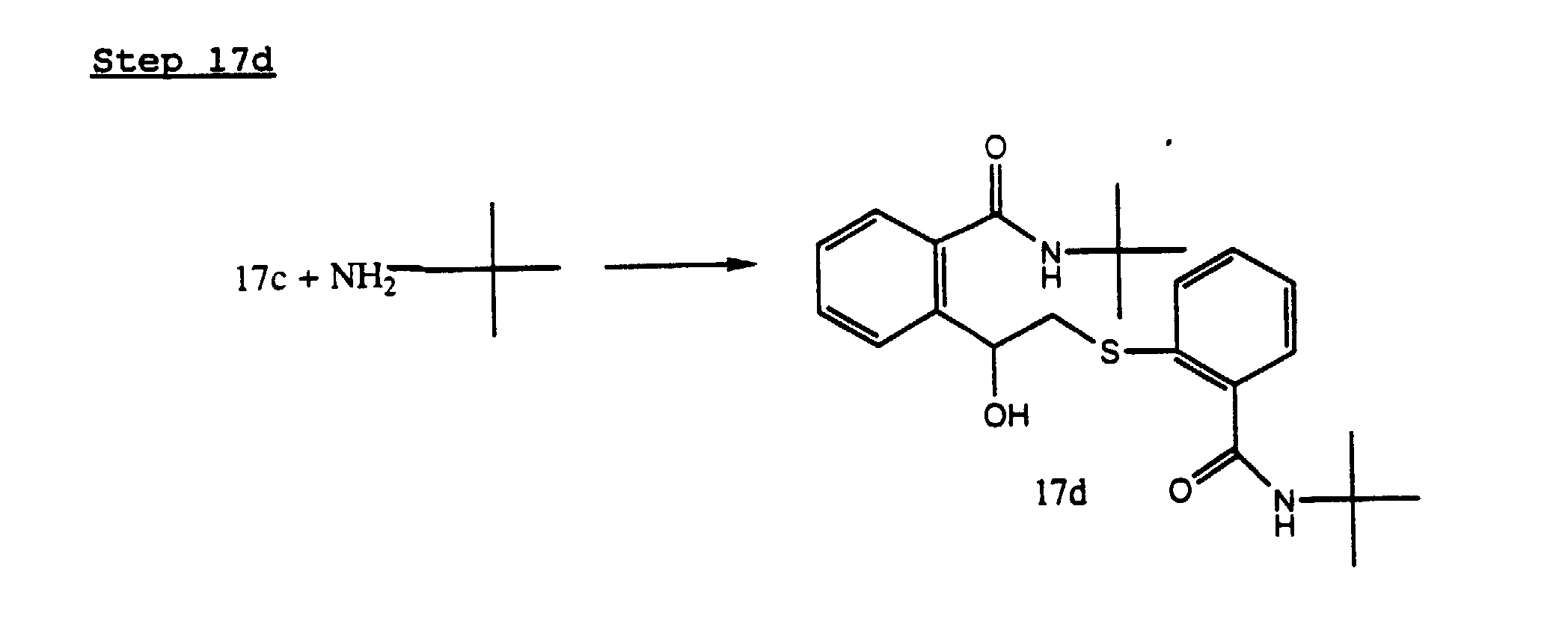
- To a solution of 0.16 ml (1.50 mmol) of t-butylamine in 2 ml of anhydrous THF, cooled to 0°C, was added 0.94 ml of 1.6M m-butyl lithium in THF. The solution was stirred for 15 minutes and a solution of 157 mg, (0.50 mmol) of compound 17c in 2 ml THF was added, dropwise, at 0°C. The mixture was stirred for 2.5 hours at room temperature and was quenched with 10 ml of dilute NH4Cl solution. The mixture was extracted three times with 10 ml portions of ethyl acetate, the combined organic phase was washed with 15 ml of H2O and brine and dried over MgSO4. The solution was filtered, concentrated and the residue was purified by flash chromatography (25g silica; 5-10% ethyl acetate/CH2Cl2) to yield 17 mg (10% yield) of product as a white solid.
- Preparation of


- A mixture of 59.09 gm (0.5 mole) of α-methylstyrene and 65 gm (1.0 mole) of sodium azide in 500 ml of chloroform was cooled in an ice/water mix to about 0°C. A solution of 193 ml trifluoro acetic acid in 500 ml of chloroform was added over one hour. With the temperature remaining below 5°C a very thick white slurry formed during the addition. After the addition, the reaction vessel was removed from the ice bath and allowed to stir at room temperature for about 19 hours. At this point, 300 ml of NH4OH in 250 ml of water was added. After shaking, the organic layer was removed and dried over Na2SO4. The solvent was removed under vacuum yielding 76.05 gm (94%) of a clear liquid. IR confirms the product to be the desired azide.
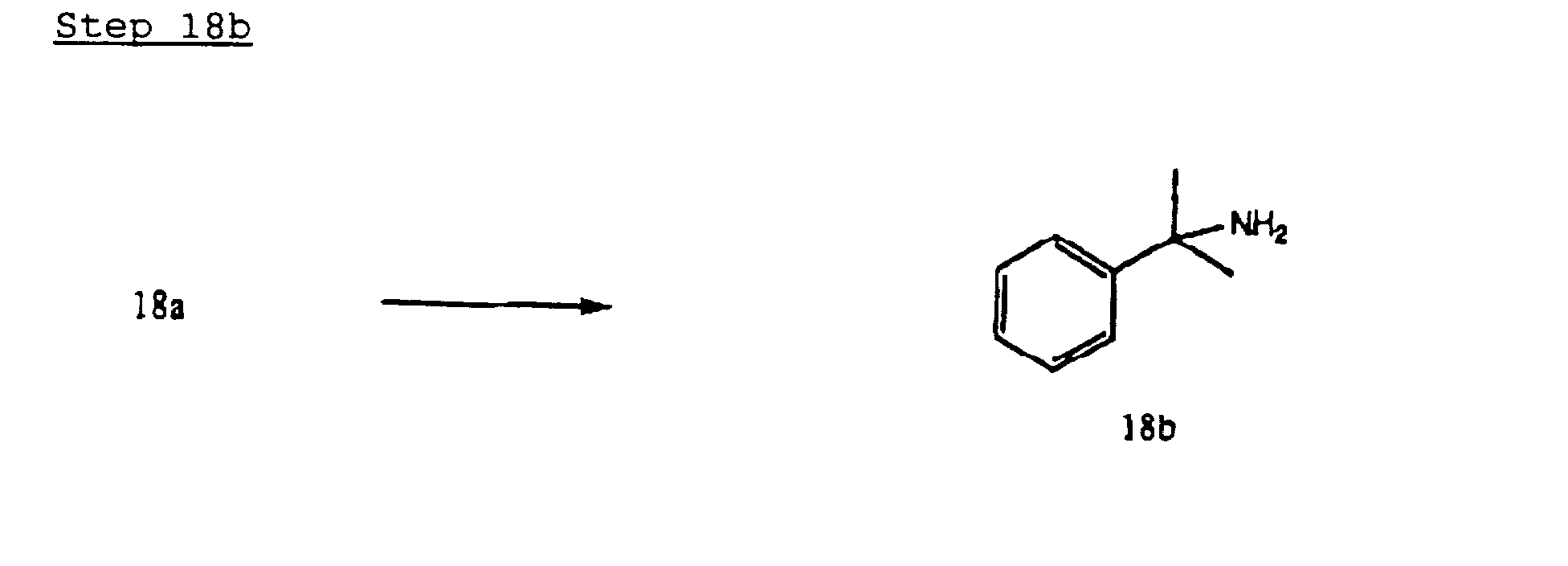
- A 2 liter 3 neck round bottom flask which had previously been flame dried and purged with argon was added 30.43 gm of LiAlH4 and 100 ml of ether. The mixture was cooled with stirring in the ice bath and 76.05 gm of compound 18a was added over a one hour period with stirring. Stirring was continued in the ice bath for about 2.5 hours after which the ice was allowed to melt overnight and the reaction mixture warmed to room temperature. After 16 hours, cooling was resumed in the ice bath and the mixture was quenched with 250 ml of 25% NaOH over a one hour period. The ether layer was removed. To the aluminum salts remaining in the water layer another 400 ml of water was added, followed by extraction with 200 ml of ether. The ether layers were combined, dried with Na2SO4, and the solvents were removed by vacuum at 30°C following which the product was distilled at 60°C and 3.2 Torr, yielding 46.82 gm (74%) of the desired amine.

- To a 100 ml round bottom flask, which had been flame dried and purged with argon, was added 25 ml of THF and the flask and contents were cooled to -78° in a dry ice acetone bath and 4.84 gm (0.11 mole) of ethylene oxide was added followed by 10.64 gm of LiClO4. The flask and contents were switched to an ice/water bath and allowed to stir for 5 to 10 minutes and 13.52 gm (0.1 mole) of compound 18b in CH3CN was added over a two minute period. During the addition everything went into solution. Following the addition the ice bath was removed and the mixture was allowed to stir at room temperature for three hours. The mixture was then poured into 200 ml of brine and extracted twice with 50 ml portions of ether. The combined ether layers were dried, filtered and the solvent was removed under vacuum. The resulting oily residue was distilled at about 180°C and 2 ml of Hg, yielding 10.8 gm (60%) of product as a clear, colorless oil.

- To a 100 ml flame dried and argon purged round bottom flask was added 0.153 gm of 4-dimethylamino pyridine (DMAP), 13 ml of pyridine and 1.5 gm (8.37 mmol) of compound 18c yielding a clear, colorless solution. This solution was cooled to 0°C and over a 5 minute period 5.64 gm (33.5 mmol) of 2,5-dimethyl benzoyl chloride was added. The resulting yellow solution was placed in a 100°C oil bath and allowed to stir overnight. The mixture was then poured into 150 ml of 2N HCl and extracted twice with 50 ml portions of ether. The combined extracts were washed again with 50 ml of water then dried over Na2SO4, filtered and the solvent was removed under vacuum yielding an orange oil. This oil was dissolved in 50 ml of 10% aqueous methanol and 5 ml of 50% NaOH was added. After 35 minutes the mixture was poured into 500 ml of water and extracted with first 100 ml of ether and then with 100 ml of methylene chloride. The organic layers were combined and dried over Ha2SO4. The solvent was removed under vacuum, yielding 2.23 gm of a light, yellow oil. This was taken up in 15 ml of ethyl acetate, 50 ml of hexane was added and the product was placed in a freezer for 2 hours. The resulting light yellow solid was filtered off, washed with 20 ml of a 1:1 hexane/ethyl acetate mixture, followed by 40 ml of hexane, yielding 395 mg of pure product.

- To a solution of 10 gm of 1 ethyl-1-cyclopentanol, 6.9 g of KCN and 13 ml of glacial acetic acid heated to 50°C was added 25 gm of H2SO4 in acetic acid dropwise over 2 hours. The reaction mixture was then heated to 70°C for 4 hours. The product was poured into about 150 ml of ice. When the ice melted, the mixture was extracted three times with 75 ml portions of ether. The organic layers were combined and washed three times with 100 ml portions of water. The combined washings were then extracted once with 50 ml of ethyl acetate, dried over MgSO4, filtered and the solvent was removed under vacuum, yielding about 15 gm of an orange oil. This material was refluxed in 20 ml of concentrated HCl for about 4 hours. TLC indicated that all starting material had been used up. The mixture was cooled, the residual HCl was removed under vacuum taking the material to nearly a dry state. The crude brown solid was slurried in acetone and ether, yielding a white solid which was filtered and dried. This white solid was dissolved in KOH solution and extracted with ether. The ether was removed and a brown oil was recovered. This oil was distilled at atmospheric pressure yielding 3.3 gm (33%) of colorless liquid.

- To a solution of 0.99 gm(0.022 mmol) of ethylene oxide in 6 ml of CH3CN cooled to 0°C was added 2.13 gm of LiClO4. To this was added 2.3 gm (0.020 mmol) of compound 18e dissolved in 3 ml of CH3CN and the mass was allowed to stir at room temperature for about 2 hours. At this time the reaction mixture was concentrated under vacuum and the residue was dissolved in 10 ml of water and saturated sodium chloride solution. It was then extracted with three 25 ml portions of 10% ethyl acetate in ether. The organic phases were combined, dried over Na2SO4, and solvent was removed under vacuum, yielding a colorless liquid. The liquid was distilled under high vacuum at about 70-72°C yielding 1.4 gm 45%) of a colorless, viscous liquid.

- To a solution of 2.1 gm (0.013 mmol) of compound 18f in pyridine was added, dropwise, 8.3 gm (0.054 mmol) of toluoyl chloride and 0.16 gm of DMAP. The mixture was heated to reflux for about 22 hours at 120°C. The reaction mixture was then cooled and poured into 200 ml of water which was acidified with concentrated HCl to a pH of about 1 to 2. It was then extracted with three 20 ml portions of ether and the combined organics layers were washed with water, 5% HCL water and brine, dried over MgSO4, filtered, and the solvent removed under vacuum, yielding a brownish orange oil. This oil was dissolved in 35 ml of 10% aqueous methanol and 1.7 ml of 45% KOH solution was added dropwise. The mixture was allowed to sit at room temperature for two hours, then was concentrated and the residue was dissolved in 50 ml of water and extracted three times with 50 ml portions of ether. The combined organic phases were washed with 50 ml of water, dried over MgSO4, filtered and concentrated to a yellowish orange oil. Flash chromatography using a 50% ethyl acetate/ hexane solution yielded 1.44 gm of a slightly yellow solid.
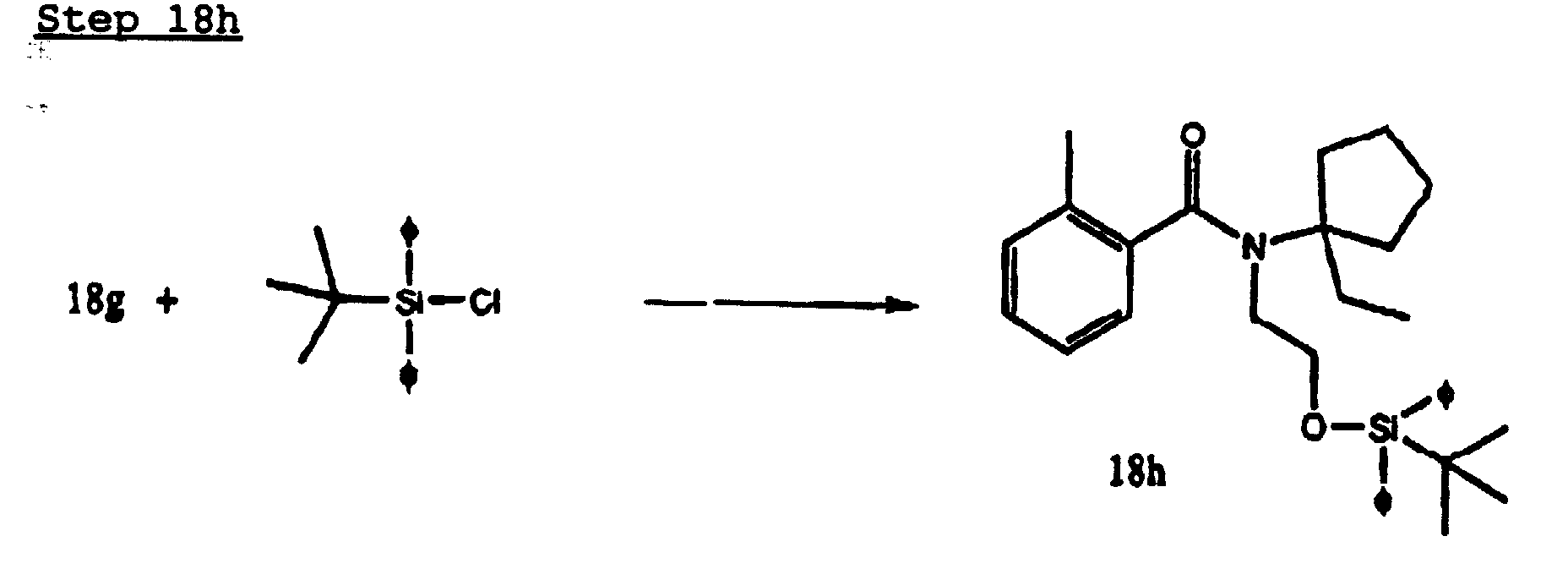
- To a solution of 2.13 gm (7.75 mmol) of compound 18g and 1.16 gm of imidazole in 15 ml of DMF was added 2.34 gm (8.52 mmol) of t-butyldiphenylsilyl chloride. The mixture was allowed to stir at room temperature for about 22 hours after which it was poured into 150 ml of water and extracted three times with 50 ml portions of ether. The combined organic layers were washed twice with 60 ml portions of water, then with brine, then dried over MgSO4, and filtered. The solvent was removed, yielding a slightly yellow oil. The product was purified by flash chromatography using 20% ethyl acetate/hexane mixture. The appropriate fractions were collected as a colorless viscous oil which crystallized on the vacuum pump, yielding 3.7 gm (93%) of product.

- To a solution of 3.6 gm (7.01 mmol) of compound 18h and 0.11 gm of diisopropyl amide in 33 ml of THF cooled to -78°C in a dry ice/acetone bath was added 6.2 ml of s-butyl lithium dropwise over 10 to 15 minutes. The mixture was then stirred at -78°C for 1.5 hours and 0.93 gm of ethylene oxide in 3 ml of THF was added. The mixture was stirred while warming up slowly for about 1 hour, then was quenched with dilute NH4Cl and extracted three times with 30 ml portions of ethyl acetate. The combined organic layers were washed with 30 ml of 10% citric acid solution, then twice with 30 ml portions of water, and then with 30 ml of brine. After drying over MgSO4, the product was filtered and solvent removed under vacuum yielding a brown viscous glassy material. The glassy material was purified by flash chromatography using 50% ethyl acetate/hexane yielding 780 mg (20%) of product.

- To a solution of 530 mg of compound 18i in 7 ml of acetone cooled to 0°C was added 0.99 ml of Jones reagent dropwise. The mixture was stirred at room temperature for about 30 minutes then cooled to 0°C and quenched with 1 ml of isopropyl alcohol. Acetone was decanted and the chromium salts were washed twice with 25 ml portions of acetone. The combined washings were concentrated to a viscous oil which was dissolved in 50 ml of ether and washed twice with 25 ml portions of water. The chromium salts were then dissolved ir 5 ml of water and washed with 20 ml of ether. The combined ether extracts were dried over MgSO4. The solution was then filtered and concentrated under vacuum to a viscous slightly yellow oil which was used as is in the next step. The yield was 534 mg.

- To a solution of 534 mg (0.95 mmol) of compound 18j, 106 mg (1.08 mmol) of N, O-dimethylaminehydrochloride and 0.45 ml of Honigs base in 6 ml of methylene chloride cooled to 0°C was added 455 mg of BOP reagent. The mixture was stirred at room temperature for 6 hours and then diluted with 50 ml of methylene chloride and washed with 50 ml portions of water, 10% citric acid and saturated NaHCO3, then dried over MgSO4 and filtered. The solvent was removed, yielding a yellow viscous oil. This oil was purified by flash chromatography using 50% ethyl acetate/hexane. The appropriate fractions were combined yielding 408 mg (71%) of a yellow viscous oil.

- To a 25 ml round bottom flask which had been flame-dried and purged with argon, was charged 102 mg of compound 18d, 7 mg of diisopropylamide, 4 ml of THF and the mixture was cooled to -78°C. Over a five minute period, 0.56 gm of a 1.29 molar solution of s-butyl lithium in cyclohexane was added yielding a deep crimson solution. The solution was stirred for one hour and 202 mg of compound 18k and 5 ml of THF were added over a five minute period. The dry ice was allowed to evaporate and the solution warmed to room temperature. After 18.5 hours, the reaction was quenched with 4 ml of 0.5N NH4Cl, then poured into 60 ml of brine and extracted with two 20 ml portions of ethyl acetate. The combined organics were then dried over Na2SO4, filtered, and the solvent removed, yielding 0.242 mg (85%) of a white foam.

- To 242 mg of compound 181 and ethanol was added 32 mg of NaBH4. The mixture was stirred at room temperature for about 35 minutes then poured into 100 ml of brine and extracted twice with 25 ml portions of ethyl acetate. The extracts were combined, dried over Na2SO4, filtered and the solvent removed to yield 161 mg (66%) of a white foam.

- To a solution of 161 mg of compound 18m and 5 ml of THF was added 0.56 ml of a one molar solution of tetrabutyl ammonium fluoride in THF. After 30 minutes the mixture was poured into 100 ml of water and extracted with two 25 ml portions of ethyl acetate. The ethyl acetate layers were then dried over MgSO4. The solvent was removed, yielding 149 mg of a crude product. This product was purified by flash chromatography using ethyl acetate. The appropriate fractions were combined, filtered and the solvent removed yielding 43 mg (37%) of the pure product as a white foam.
- Preparation of

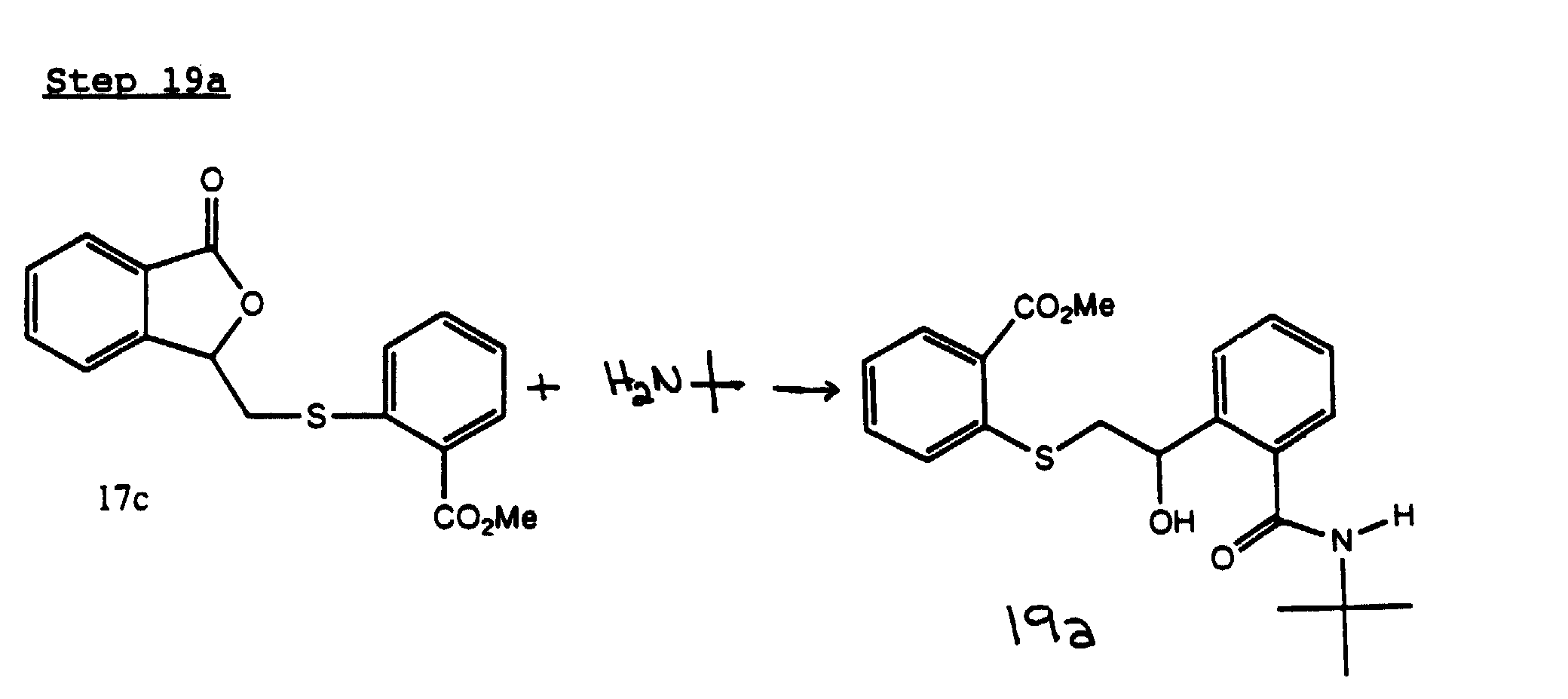
- To a solution of 0.40 ml (3.82 mmol) of t-butylamine in 10 ml of CH2Cl2, cooled to 0°C was added 3.82 ml of a 2.0M solution of trimethyl aluminum in toluene, dropwise, over 5 minutes. The solution was stirred for 45 minutes at room temperature and 400 mg (1.27 mmol) of compound 17c in 5 ml of CH2Cl2 was added, dropwise. The reaction mixture was heated to 40°C for 21 hours, then cooled and carefully quenched by dropwise addition of 15 ml of saturated NH4Cl solution. The mixture was extracted three times with 25 ml portions of CH2Cl2 and the organic extracts were washed with 20 ml of H2O. The solution was dried over MgSO4, filtered and concentrated to a yellow viscous oil which was purified by flash chromatography (80 g silica gel; 20-40% ethyl acetate/ hexane) to yield 350 mg (71% yield) of a colorless glassy material.
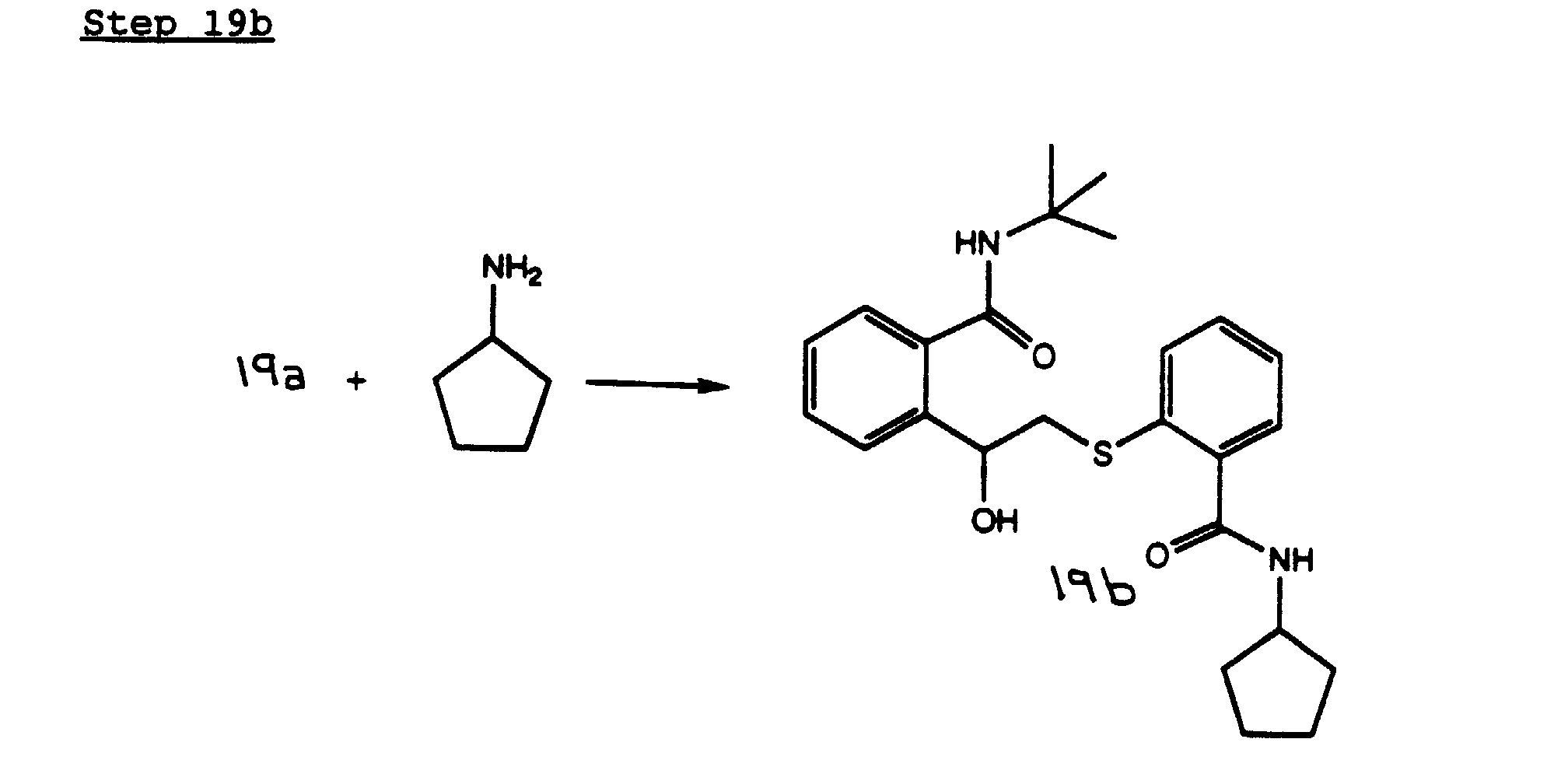
- To a solution of 65 µl (0.65 mmol) of cyclopentylamine in 2 ml of dichloroethane, cooled to 0°C, was added 0.33 ml of a 2.0M solution (0.65 mmol) of trimethyl aluminum in toluene, dropwise, over 5 minutes. The solution was stirred for 45 minutes at room temperature and 50 mg (0.13 mmol) of compound 19a in 2 ml of dichloroethane was added, dropwise. The reaction mixture was heated to 65°C for 20 hours, cooled to room temperature and carefully quenched with saturated NH4Cl solution. The crude mixture was extracted three times with 10 ml portions of ethyl acetate and the combined organic extracts were dried over MgSO4. The solution was filtered and concentrated to a yellow viscous oil which was purified by flash chromatography (20 g silica: 25-35% ethyl acetate/ hexane) to yield 25 mg (44% yield) of the desired product as a white solid.
- Preparation of
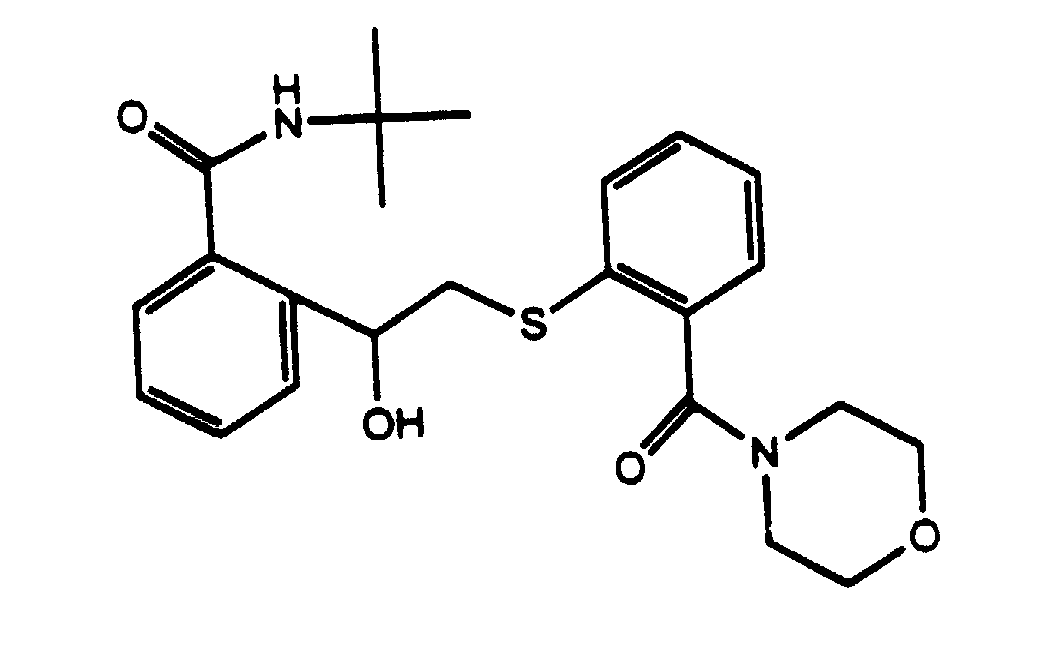
- To a solution of 81 µl, (0.93 mmol) of morpholine in 2 ml of dichloroethane, cooled to 0°C, was added 0.47 ml of a 2.0M solution of trimethylaluminum (0.93 mmol) in toluene, dropwise, over 5 minutes. The solution was stirred for 45 minutes at room temperature and 60 mg (0.16 mmol) of compound 17c in 2 ml of dichloroethane was added, dropwise. The reaction mixture was heated to 65°C for 3 hours, cooled to room temperature and carefully quenched with saturated NH4Cl solution. The crude mixture was extracted three times with 10 ml portions of ethyl acetate and the combined extracts were dried over MgSO4. The solution was filtered and concentrated under vacuum to a viscous oil which was purified by flash chromatography (15 g silica; 30-50% ethyl acetate/hexane) to yield 45 mg (65% yield) of the product as a white solid.
- Preparation of

- To a degassed solution of 0.65g, (4.22 mmol) of 1-mercaptonitrobenzene in 15 ml of ethanol was added, dropwise, 0.28g (4.2 mmol) of KOH in 1.5 ml H2O. The resultant brown solution was stirred for 10-15 minutes at room temperature. The solution was cooled to 0°C and 1.10g (4.02 mmol) of compound 17b in 10 ml of THF was added, dropwise. The mixture was stirred at room temperature for 21 hours, then poured into 70 ml of H2O and the solution was extracted three times with 50 ml portions CH2Cl2. The combined organic phases were washed with 50 ml of H2O and brine and dried over MgSO4. The solution was then filtered and concentrated under vacuum. The residue was purified by flash chromatography (125 g silica gel; 1% ethyl acetate/ chloroform) to yield 0.58g (48% yield) of yellow solid.

- A mixture of 200 mg, (0.67 mmol) of compound 21a and 368 mg (0.73 mmol) of Fe3 (CO)12 in 40 ml of benzene and 0.15 ml of MeOH was heated to reflux for 5.5 hours. The reaction mixture was then cooled and filtered through Celite and the filter pad was washed with 50 ml of benzene/MeOH. The solution was concentrated under vacuum and the orange residue was purified by flash chromatography (40 g silica: 0.25-0.5% ethyl acetate/CH2Cl2). The product (149 mg, 81% yield) was isolated as a colorless, viscous oil.

- To a solution of 149 mg (0.55 mmol) of aniline 21b in 5 ml CH2Cl2 cooled to 0°C, was added 74 µl, (0.61 mmol) of pivaloyl chloride, followed by 98 µl (1.21 mmol) of pyridine. The reaction was stirred for 20 hours at room temperature and then poured into 20 ml of H2O. The mixture was separated and the aqueous phase was extracted once with a 20 ml portion of CH2Cl2. The combined organic phases were washed with 20 ml portions of 5% KHSO4 and saturated NaHCO3 solution and dried over MgSO4. The solution was then filtered and concentrated to a slightly yellow oil which was purified by flash chromatography (30 g silica; 20% ethyl acetate/hexane) to yield 174 mg (89% yield) of product as a colorless viscous oil.
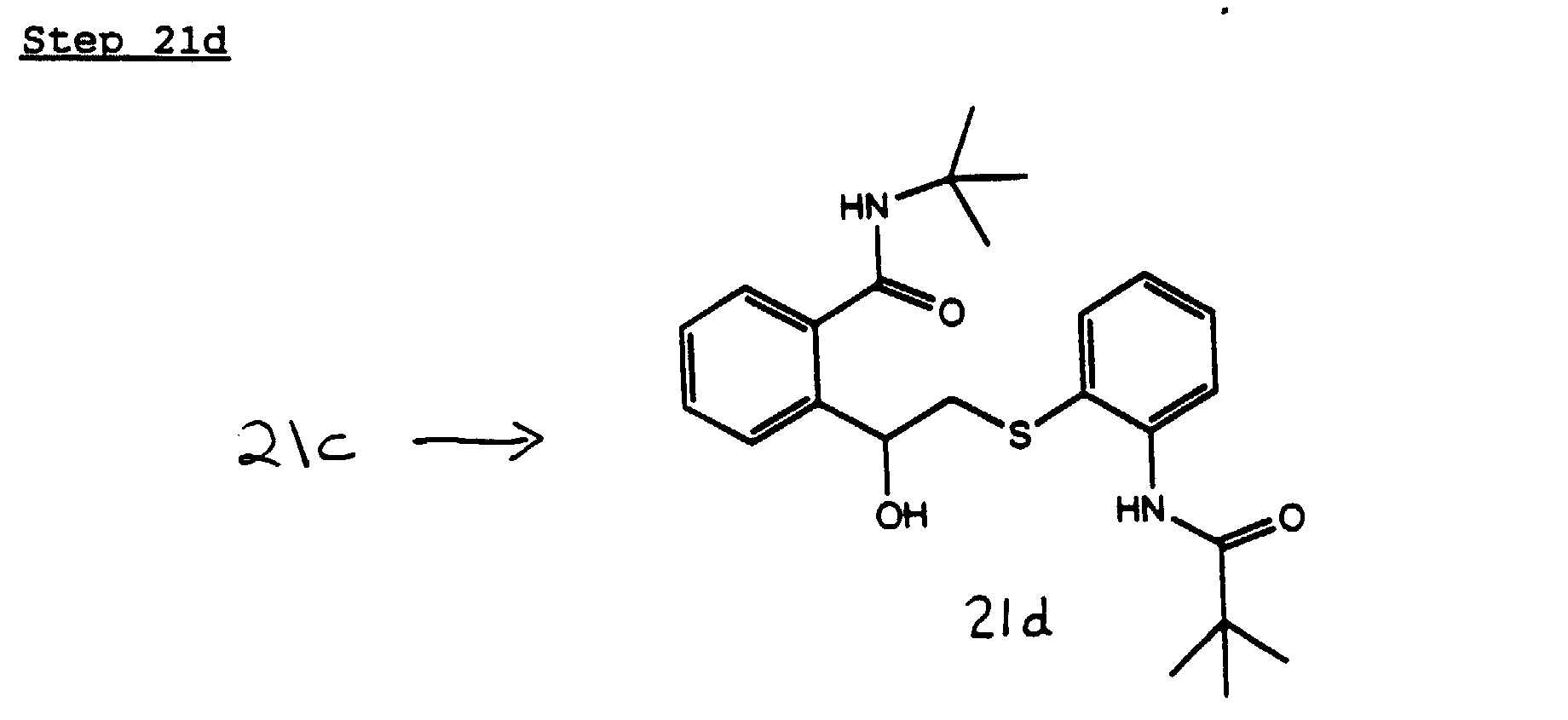
- To a solution of 96 µl (0.92 mmol) of t-butylamine in 2 ml of dichloroethane, cooled to 0°C, was added 0.46 ml of a 2.0M solution of trimethyl aluminum (0.92 mmol) in toluene, dropwise, over 5 minutes and the solution was then stirred for 45 minutes at room temperature. A solution of 65 mg (0.18 mmol) of compound 21c in 2 ml of dichloroethane was added, dropwise, and the mixture was heated to 65°C for 18 hours. The reaction mixture was then cooled and quenched with 10 ml of saturated NH4Cl solution. The mixture was extracted with three 10 ml portions of ethyl acetate and the combined organic phases were dried over MgSO4. The solution was filtered and concentrated and the residue purified by flash chromatography (15g silica; 1.5-3% ethyl acetate/ CH2Cl2) to yield 40 mg (51% yield) of the product as a white solid.
- Preparation of


- A solution of 3.0g (0.018 mol) of 1-mercapto-methylbenzoate and 1.19g of KOH in 27 ml of 50% aqueous ethanol was added to 4.18 ml (0.054 mol) of epichlorohydrin at 0°C. The reaction mixture was allowed to warm to room temperature upon completion of the addition and the mixture was stirred for 3 hours, then poured into 100 ml of H2O. The aqueous phase was extracted three times with 50 ml portions of ethyl acetate. The combined organic phases were washed with 50 ml portions of H2O and brine and dried over Na2SO4. The solution was filtered and concentrated to a tan oil which was purified by kugelrohr distillation (155-160°C 0.5 torr). The product was isolated as a slightly yellow liquid (2.3 g, 57% yield) which solidified in the refrigerator.
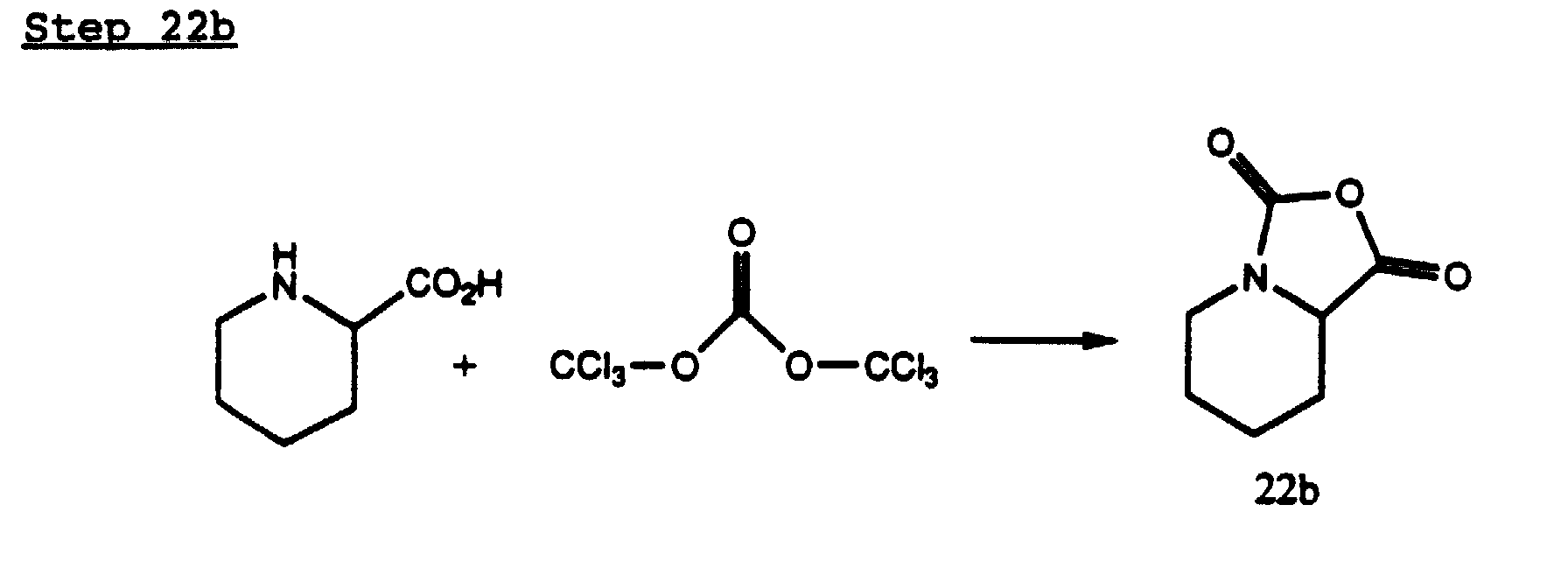
- To a suspension of 90 mg (0.79 mmol) of pipecolinic acid in 2 ml of THF was added a solution of 83 mg (0.28 mmol) of triphosgene in 1 ml of THF. The mixture was heated to 40°C for 20 hours. The now milky suspension was cooled and filtered and the solid was washed with 10 ml of ether. The filtrate was concentrated to a yellow solid (69 mg, 60% yield). No further work-up was carried out on the product.

- To a solution of 69 mg (0.44 mmol) of compound 22b in 1.5 ml of THF, cooled to 0°C, was added a solution of 139 µl (1.33 mmol) of t-butylamine in 0.5 ml of CHCl3. The mixture was stirred for 1 hour at 0°C and 2 hours at room temperature. The mixture was concentrated to a brownish oil under vacuum. This oil was purified by flash chromatography (20 g silica gel, 2.5% MeOH saturated with NH3/CH2Cl2) to yield 41 mg (51% yield) of the product as a colorless solid.
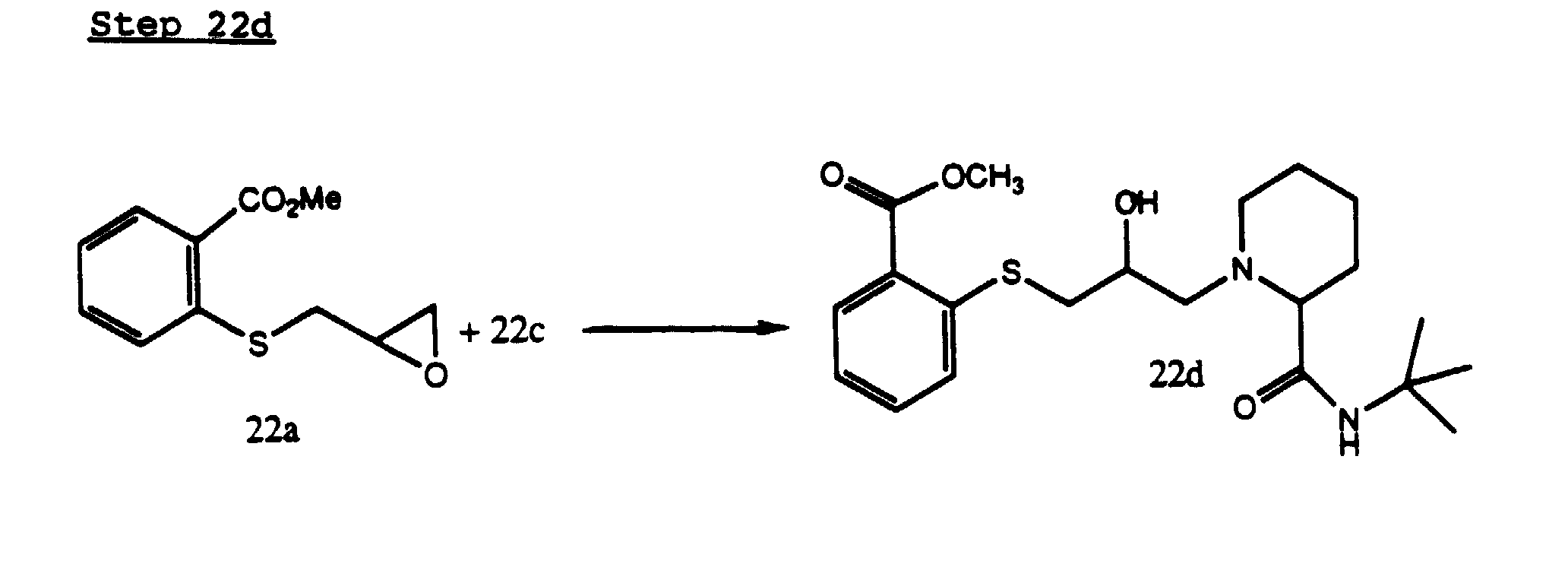
- A solution of 650 mg (2.90 mmol) of compound 22a and 587 mg (3.19 mmol) of compound 22c in 27 ml of ethanol was heated to 70°C for 19 hours. The mixture was concentrated under vacuum to a tan viscous oil which was purified by flash chromatography (175 g silica, 40-50% ethyl acetate/hexane containing a trace of MeOH saturated with NH3) to give the product as two diastereomers. The less polar product was 497 mg of a white solid. The more polar product was 520 mg of a white foam. Total yield was 1.017 gm (89% yield).

- To a 2M solution of 0.62 ml (1.23 mmol) of trimethylaluminum in 4 ml of dichloroethane, cooled to 0°C, was added 130 microliters (1.23 mmol) of t-butylamine, dropwise. The solution was stirred at room temperature for 45 minutes. A solution of 100 mg (0.25 mmol) of the less polar isomer of compound 22d in 2 ml of dichloroethane was added, dropwise, and the mixture was heated to 65°C for 26 hours. The reaction mixture was cooled and quenched with 10 ml of saturated NH4Cl solution. The mixture was then extracted with three 15 ml portions of ethyl acetate and the combined organic phases were dried over MgSO4. The solution was filtered and concentrated under vacuum to a yellow oil which was purified by flash chromatography (20 g silica, 10% ethyl acetate/CH2Cl2 containing a trace of MeOH saturated with NH3) to yield 80 mg (71% yield) of the product as a white solid.
- To 0.47 ml of a 2.0M solution of trimethylaluminum in 4 ml of dichloroethane, cooled to 0°C, 154 microliters (1.47 mmol) of t-butylamine was added, dropwise, and the solution was stirred at room temperature for 45 minutes. A solution of 100 mg (0.25 mmol) of the more polar isomer of compound 22d in 2 ml of dichloroethane was added, dropwise, and the reaction mixture was heated to 70°C for 20 hours. The reaction mixture was cooled and quenched with 10 ml of saturated NH4Cl solution and then extracted with three 15 ml portions of ethyl acetate. The combined organic phases were dried over MgSO4. The solution was filtered and concentrated under vacuum to a yellow solid which was purified by trituration with ether to yield 75 mg (67% yield) of product as a tan solid.
- Preparation of


- A solution of 6.0 ml (41.71 mmol) of 1-bromo methylbenzoate and 16 ml (51.61 mmol) of tributylpropenyl tin in 15 ml of benzene was heated to 100°C and allowed to sit at that temperature overnight in a sealed tube. In the morning the solution was filtered twice through a silica gel plug with hexane, then combined with an equal amount of the product of another run of the same reaction. The combined masses totaled 50.5 g. A portion of this product (10 g) was fractionally distilled at 2 mm and 4 fractions were collected. The distilled products were combined and purified by flash chromatography using a 5% ether/hexane to 10% ether/hexane gradient. Yield was 5.1 gm.

- To a mixture of 1.1 gm (6.28 mmol) of compound 23a and 20 ml of acetonitrile at room temperature was added 3.0 g (12.13 mmol) of iodine. Reaction was completed in 45 minutes and the reaction mixture was poured into saturated sodium NaHSO3, extracted twice with ethyl acetate, washed again with sodium NaHSO3 and dried over MgSO4. Concentration under vacuum yield 1.7 g of amber oil (94%). Structure was confirmed by NMR.

- To a solution of 0.8 ml (5.8 mmol) of 1-mercapto-methyl benzoate and 12 ml of ethanol at 0°C was added to 2 ml of 1N KOH in water. The solution turned yellow. After 20 minutes of stirring, a solution of 1.7 g (5.8 mmol) of compound 23b in 6 ml of ethanol was added, dropwise, over 15 minutes. The reaction mixture was stirred for an additional 15 minutes and then warmed to room temperature. After 2 hours, TLC indicated that residual starting material remained. The mixture was stored in the freezer over a weekend and then allowed to run for 1 hour more at room temperature. When no further change was indicated by TLC, the reaction mixture was poured into 0.5N HCl and extracted twice with ethyl acetate, dried over MgSO4 and concentrated under vacuum. The yield was 2.25 g of a yellow oil. This oil was purified by flash chromatography (20% ethyl acetate/hexane) yielding 1.14 g of sticky oil which was vacuum pumped overnight. The structure was confirmed by NMR.
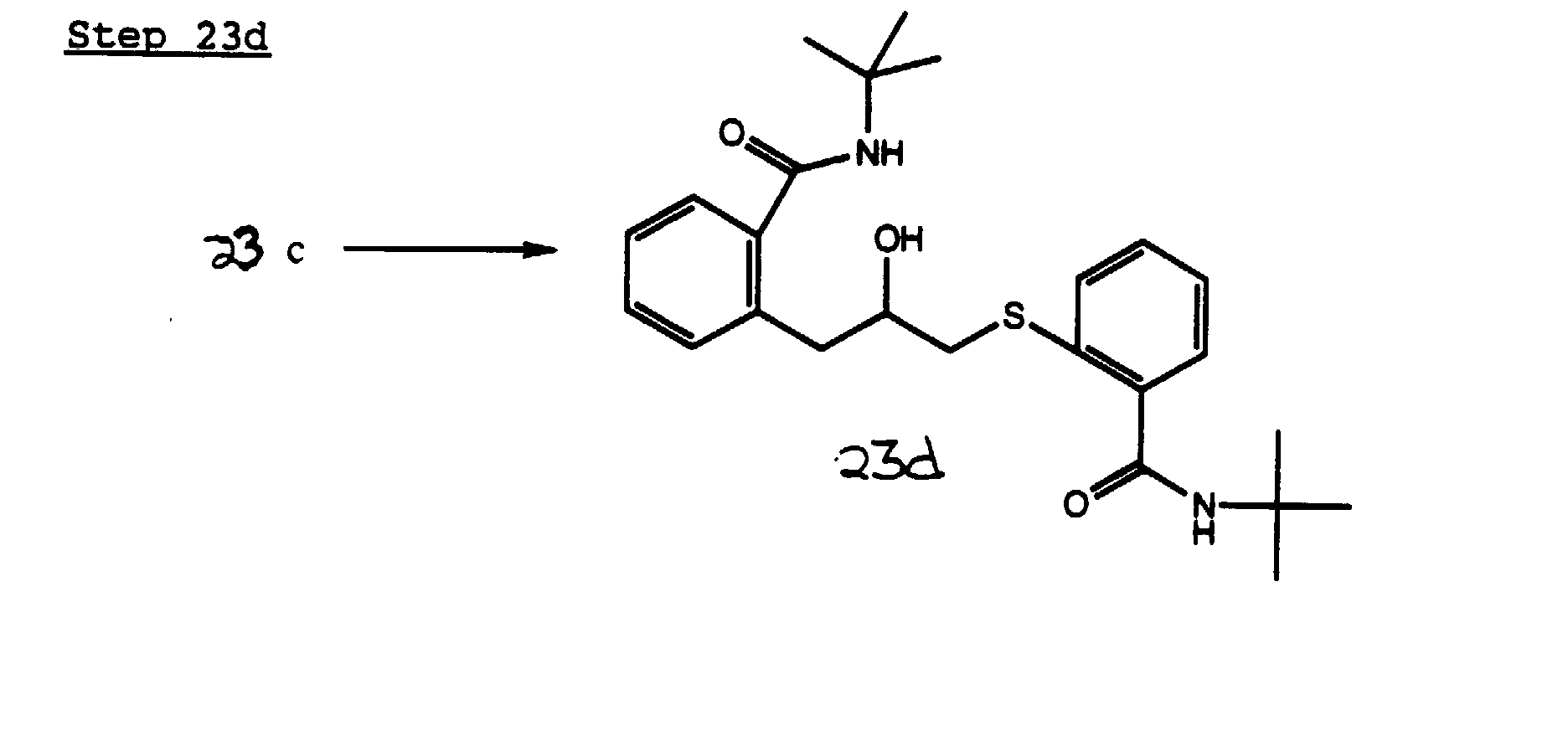
- To a solution of 0.6 ml of trimethyl aluminum and 2 ml of benzene at -10°C was added 0.13 ml (1.24 mmol) of s-butylamine. The solution was warmed to room temperature and stirred for 45 minutes. The solution was then cooled to 0°C and a solution of .08 g of compound 23c in 1 ml of benzene was added. The solution was warmed to room temperature then heated to reflux. The reaction was complete after about 2 hours and 15 minutes. The reaction mixture was poured into 0.5N HCl, extracted twice with ethyl acetate and dried over MgSO4 and concentrated under vacuum. Purification by flash chromatography (50% ethyl acetate/methylene chloride) yielded 0.79 g (73%) of a white solid. Structure was confirmed by NMR.
- Preparation of

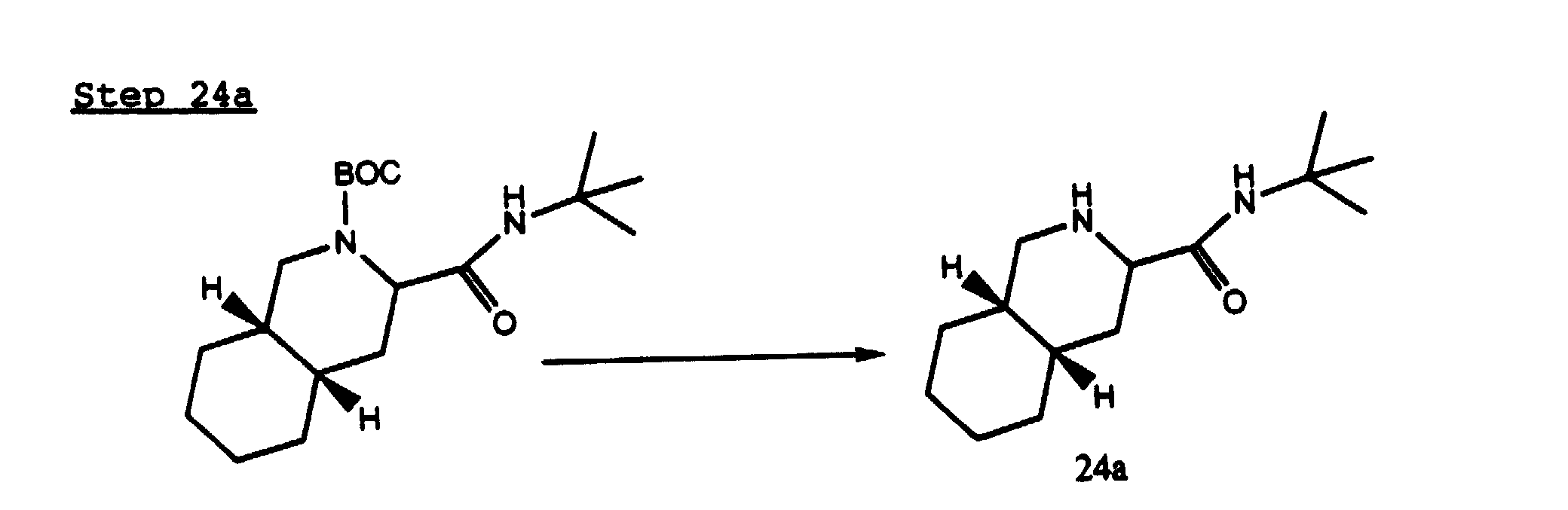
- To a solution of 150 mg (0.44 mmol) of BOC protected decahydro isoquinoline in 3 ml of CH2Cl2, cooled to 0°C, was added 0.5 ml of trifluoroacetic acid. The mixture was stirred at room temperature for 65 minutes and then the reaction mixture was concentrated under vacuum to an oil which was redissolved in 25 ml CH2Cl2. The solution was washed with 25 ml of saturated NaHCO3, the aqueous phase was back extracted with two 10 ml portions of CH2Cl2 and the combined organic phases were dried over MgSO4. The solution was filtered and concentrated under vacuum to a colorless viscous oil which slowly solidified to 100 mg (104% yield) of white solid which was used as is in the next step.
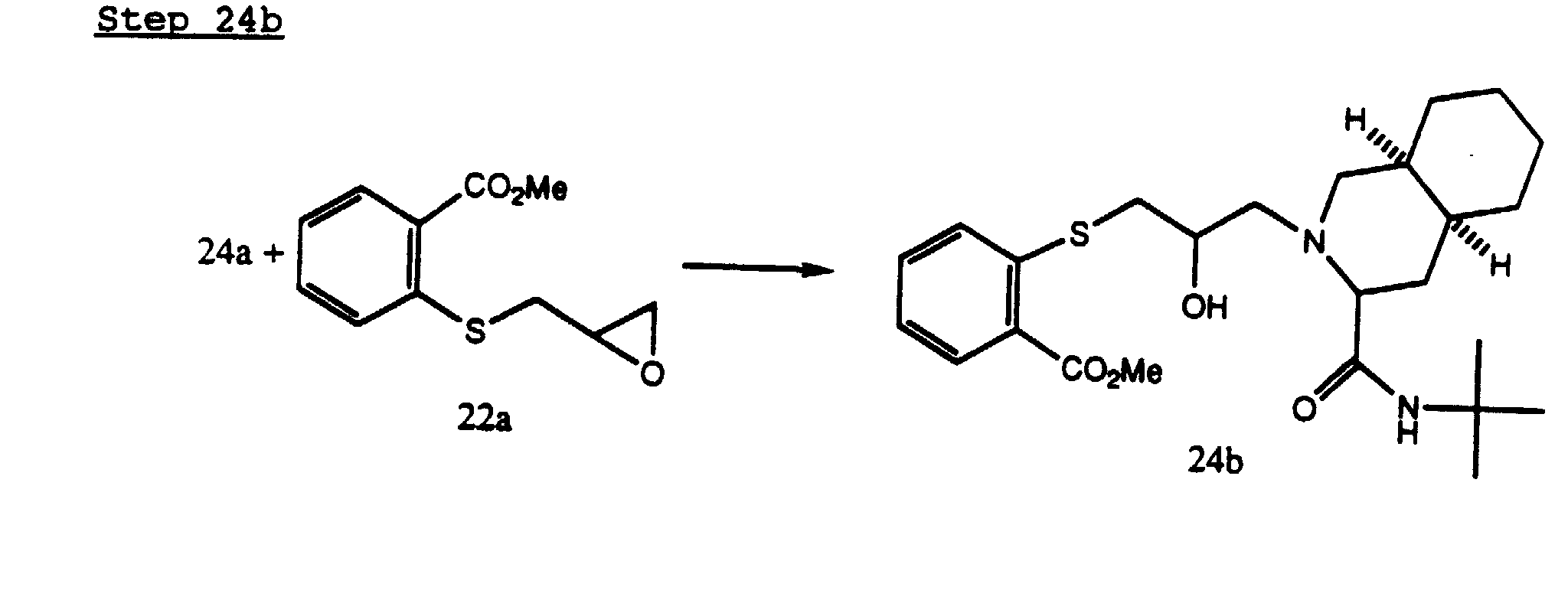
- A solution of 100 mg (0.42 mmol) of compound 24a and 104 mg (0.46 mmol) of compound 22a in 4.5 ml ethanol was heated to 60°C for 23 hours. The reaction mixture was cooled and concentrated under vacuum to a tan oil which was purified by flash chromatography (50 g silica, 30-50% ethyl acetate/ hexane) to yield the product as two diastereomers. The less polar diastereomers (90 mg) was a white solid, the more polar diastereomer (100 mg) was a colorless glass. Total yield was 190 mg (98%).

- t-Butyl amine (86 µl, 0.76 mmol) was added dropwise to 0.38 ml of a 2.OM solution of trimethylaluminum in 3 ml of dichloroethane, cooled to 0°C. The mixture was stirred at room temperature for 45 minutes and a solution of 70 mg (0.15 mmol) of the more polar isomer of compound 24b in 1 ml of dichloroethane was added, dropwise. The mixture was heated for 25 hours at 65°C, cooled and quenched with 10 ml of saturated NH4Cl solution. The mixture was extracted with three 15 ml portions of ethyl acetate and the combined organic phase was dried over MgSO4. The solution was filtered and concentrated under vacuum to a viscous yellow oil which was purified by flash chromatography (20 g silica, 8-10% ethyl acetate/CH2Cl2 containing a trace of MeOH saturated with NH3) to yield 28 mg (36%) of product as a white solid along with 23 mg of recovered starting material.
- T-butyl amine (100µl, 0.91 mmol) was added dropwise to 0.46 ml of a 2.0M solution of trimethylaluminum in 4 ml of dichloroethane, cooled to 0°C. The mixture was stirred at room temperature for 45 minutes and a solution of 60 mg (0.13 mmol) of the less polar isomer of compound 24b in 1 ml of dichloroethane was added, dropwise. The mixture was heated for 17 hours at 65°C, cooled and quenched with 10 ml of saturated NH4Cl solution. The mixture was extracted with three 15 ml portions of ethyl acetate and the combined organic phase was dried over MgSO4. The organic phase was filtered and concentrated under vacuum to a viscous yellow oil which was purified by flash chromatography (20 g silica, 8-10% ethyl acetate/CH2Cl2 containing a trace of MeOH saturated with NH3) to yield 30 mg (46%) of product as a white solid after trituration with ethyl ether.
- Preparation of

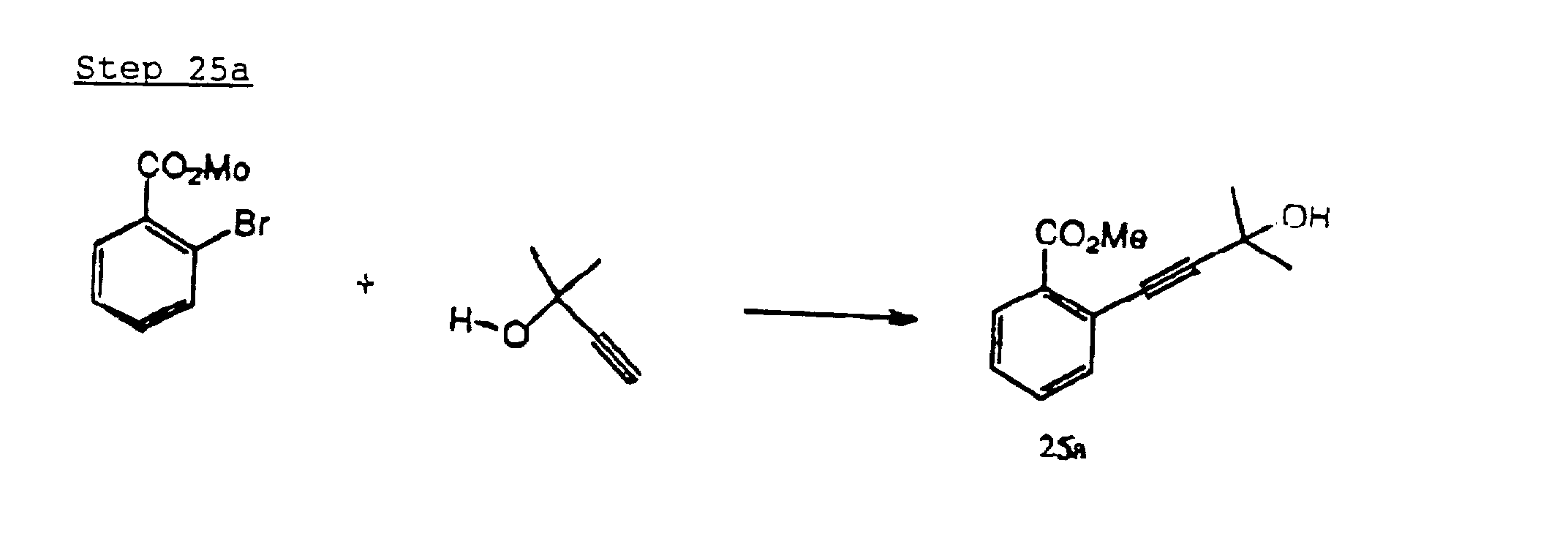
- A mixture of 4.0 g (18.61 mmol) of 1-bromomethylbenzoate, 2.2 ml (22.34 mmol) of 2-methyl-3-butyne-2-ol, palladium catalyst (6.1 mg), cuprous iodide (6.2 mg), and triphenylphosphine (12.3 mg) in 19 ml of triethyl amine was heated to reflux for 5 hours during which time the reaction mixture went from a yellow solution to brown with a thick precipitate. The mixture was cooled and filtered and the solid was washed with 50 ml of ether. The filtrate was concentrated under vacuum to an orange oil which was purified by flash chromatography (200 g silica, 25-35% ethyl acetate/ hexane) to yield 2.97 g (73%) of product as a yellow viscous liquid.

- To a solution of 2.97 gm (13.62 mmol) of compound 25a in 25 ml of toluene, was added 0.033 gm (1.10 mol) of an 80% dispersion of sodium hydride in mineral oil. The mixture was heated to reflux during which time the toluene was allowed to distill off. The reaction was cooled when the still head temperature reached 105°C. The solution was filtered and the solid washed with 20 ml of toluene. The filtrate was concentrated under vacuum, and the residue was dissolved in 100 ml of CH2Cl2. The organic solution was washed with 50 ml portions of dilute NaHCO3 solution and H2O. The organic phase was dried over MgSO4, filtered and concentrated to a brown oil. The product was isolated by kugelrohr distillation (80-85°C, 0.5 torr) to yield 1.10 g (50%) of product as a yellow-orange liquid.
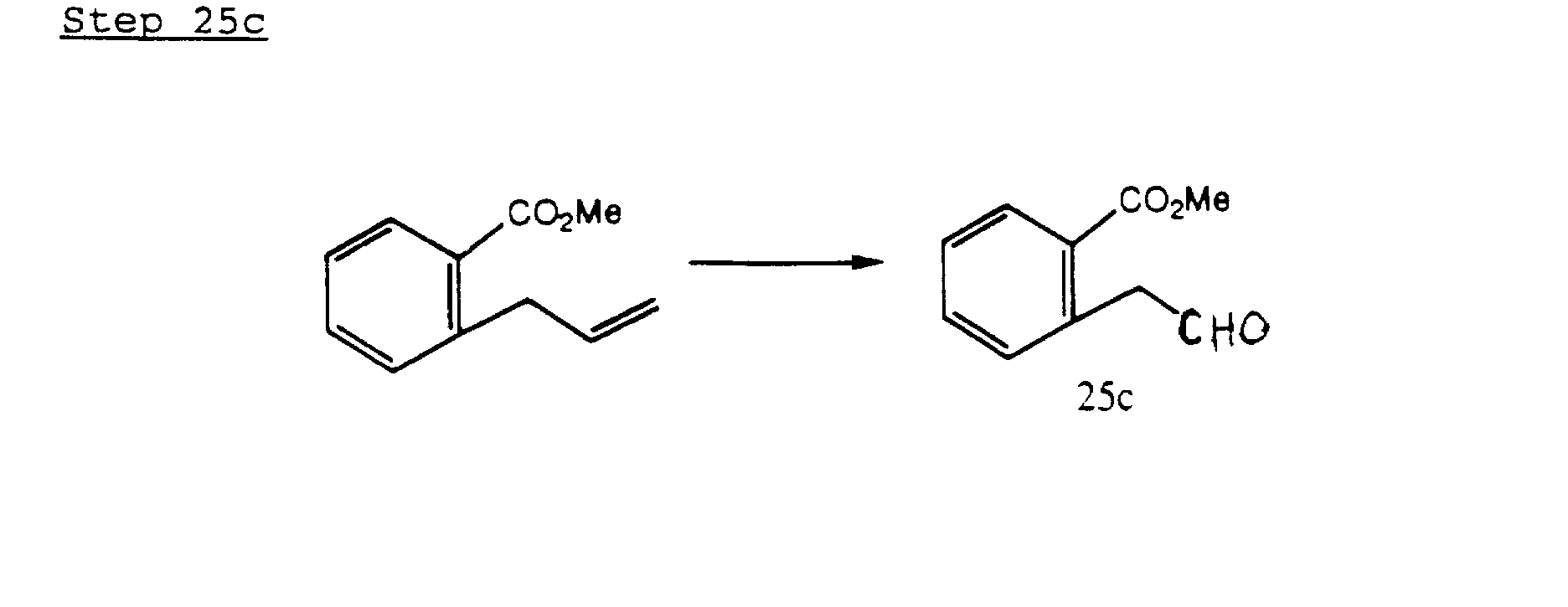
- To a solution of 2.50 g (14.19 mmol) of 2-propenyl-methylbenzoate in 50 ml of dioxane and 16 ml H2O was added 1.44 ml of a 2.5% solution of osmium tetraoxide in t-butyl alcohol. The mixture was stirred for 15 minutes during which time it turned from colorless to brown. NaIO4 (6.07 g, 28.38 mmol) was added in small portions over 30 minutes and the mixture was stirred at room temperature for 2.5 hours during which time a thick white precipitate formed. The reaction mixture was poured into 75 ml of H2O, extracted with three 60 ml portions of ethyl ether, and the combined organic phase was washed with 100 ml of H2O and brine and dried over MgSO4. The solution was filtered and concentrated under vacuum to a tan oil which was purified by flash chromatography (100 g silica, 30% ethyl ether/hexane) to yield 1.25 g (50%) of product as a light yellow liquid.

- To a solution of 146 microliters of diisopropyl amine (1.04 mmol) in 9 ml of anhydrous THF cooled to -78°C was added 0.59 ml of a 1.6M solution of n-butyl lithium, dropwise. The mixture was warmed to 0°C for 20 minutes then cooled back to -78°C. A solution of 151 mg (0.94 mmol) of compound 25b in 1 ml of THF was added dropwise over 5 minutes, producing a yellow solution. The mixture was stirred at -78°C for 45 minutes and a solution of 140 mg (0.79 mmol) of compound 25c in 1 ml of THF was added dropwise over 5 minutes. The mixture was stirred for 1.5 hours at -78°C, warmed to room temperature for 1.5 hours and then quenched with 10 ml of dilute NH4Cl solution.
- The mixture was diluted with 20 ml of H2O and extracted with three 25 ml portions of ether. The organic phase was washed with 25 ml portions of 10% citric acid, H2O, and brine and dried over MgSO4. The solution was filtered and concentrated under vacuum to a brown oil. The residue was purified by flash chromatography (50 g silica, 20-30% ethyl acetate/ hexane) to yield 52 mg (22%) of product as a yellow white solid. A sample was recrystallized from ether/hexane.

- A suspension of 120 mg (0.39 mmol) of compound 25d and 5% palladium on carbon (96 mg) in 12 ml of ethyl acetate was stirred under an atmosphere of H2 for 1.5 hours. The mixture was filtered through a pad of Celite which was washed with 25 ml of ethyl acetate and the solution was concentrated to a yellow viscous oil. The material was purified by flash chromatography (50 g of silica, 25-35% ethyl ether/hexane) to yield 109 mg (89%) of product as a colorless viscous oil.

- To a solution of 0.27 ml (2.58 mmol) of t-butyl amine in 6 ml of toluene at 0°C was added 1.28 ml of a 2M solution of trimethylaluminum in toluene, dropwise over 5 minutes. The mixture was stirred for 45 minutes at room temperature and a solution of 85 mg (0.26 mmol) of compound 25e in 0.5 ml toluene was added dropwise. The solution was heated to 100°C for 5 hours, cooled and quenched with saturated NH4Cl solution. The aqueous phase was extracted three times with 20 ml portions of ethyl acetate. The combined organic phase was dried over MgSO4, filtered and concentrated to a viscous yellow oil. The residue was purified by flash chromatography (40 g silica, 20-40% ethyl acetate/hexane) to yield 91 mg (83%) of product as a colorless viscous oil.
- Preparation of

- To a solution of 0.24 ml (2.3 mmol) of t-butyl amine (0.24 ml, 2.3 mmol) in 4 ml toluene at 0°C was added 1.4 ml of a 2.0M solution of trimethylaluminum in toluene, dropwise over 5 minutes. The mixture was stirred for 45 minutes at room temperature and a solution of 70 mg (0.23 mmol) of compound 25d in 2 ml toluene was added, dropwise. The solution was heated to 70°C for 24 hours, cooled and quenched with saturated NH4Cl solution. The aqueous phase was extracted three times with 20 ml portions of ethyl acetate. The combined organic phase was dried over MgSO4, filtered and concentrated to a viscous orange oil. The residue was purified by flash chromatography (20 g silica, 20-40% ethyl acetate/ hexane) to yield 31 mg (32%) of product 26 as a colorless glass.
- Preparation of
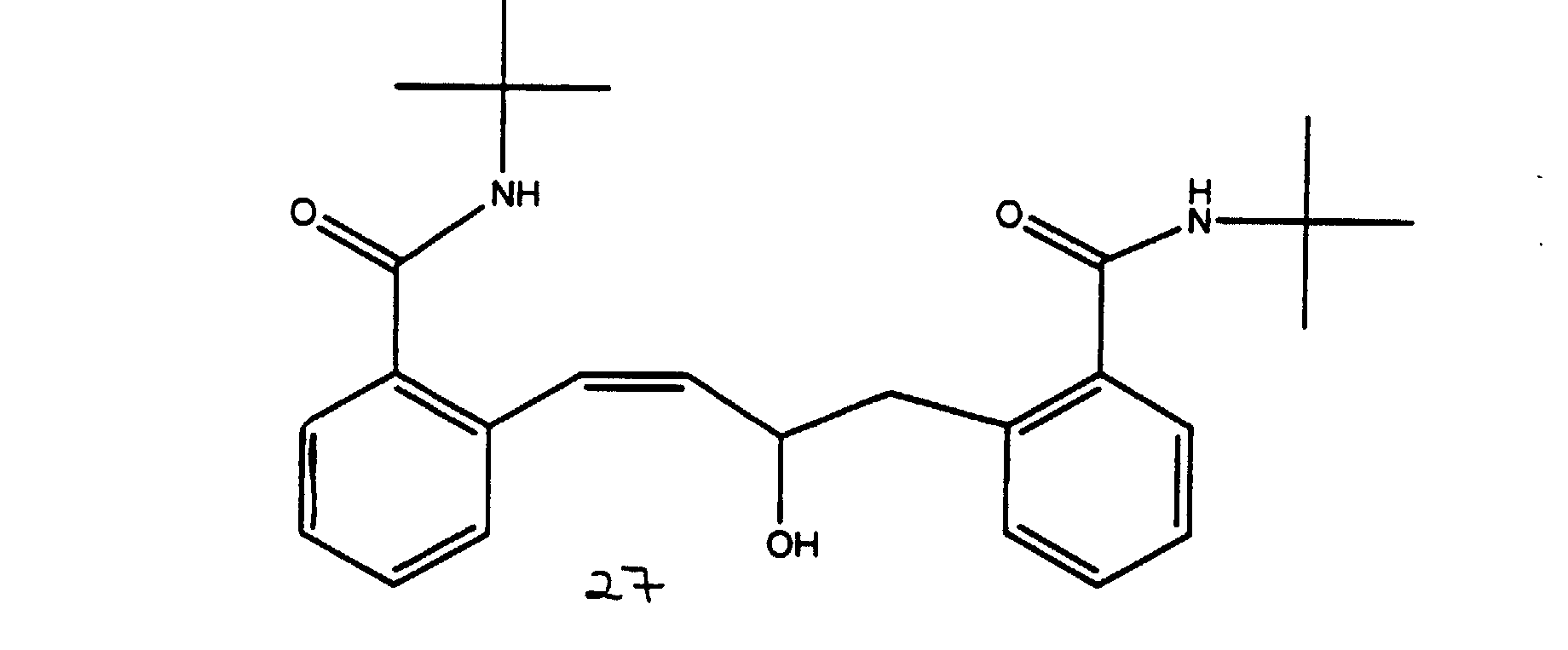
- A suspension of 20 mg (0.0489 mmol) of compound 26, 20 µl of quinoline and Lindlar catalyst (6.0 mg) in 3 ml of ethyl acetate was stirred under an atmosphere of H2 for 4 hours. The mixture was then filtered through Celite and the filter pad washed with 20 ml ethyl acetate. The solution was concentrated under vacuum and purified by flash chromatography (15 g silica, 25-40% ethyl acetate/hexane) to yield 17 mg (84%) of the cis isomer of the product 27 as a white solid.
- Preparation of

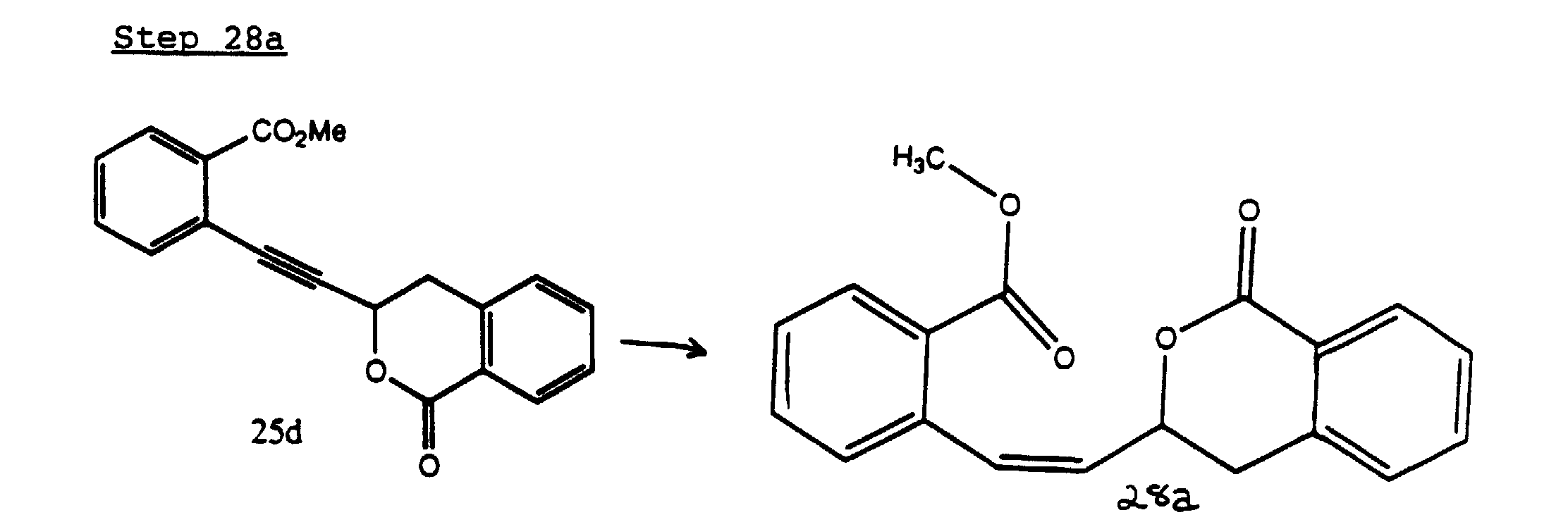
- A suspension of 236 mg (0.77 mmol) of compound 25d, quinoline (60 µl), and Lindlar catalyst (55 mg) in 15 ml of ethyl acetate was stirred under an atmosphere of H2 for 1 hour. The mixture was filtered through Celite and the filter pad washed with 50 ml ethyl acetate. The solution was concentrated to a yellow oil which was purified by flash chromatography (75 g of silica gel, 15-30% ethyl acetate/hexane) to yield a white solid which was triturated with ethyl ether/ hexane (to remove traces of quinoline) to yield 208 mg (87%) of product 28a as a white solid.
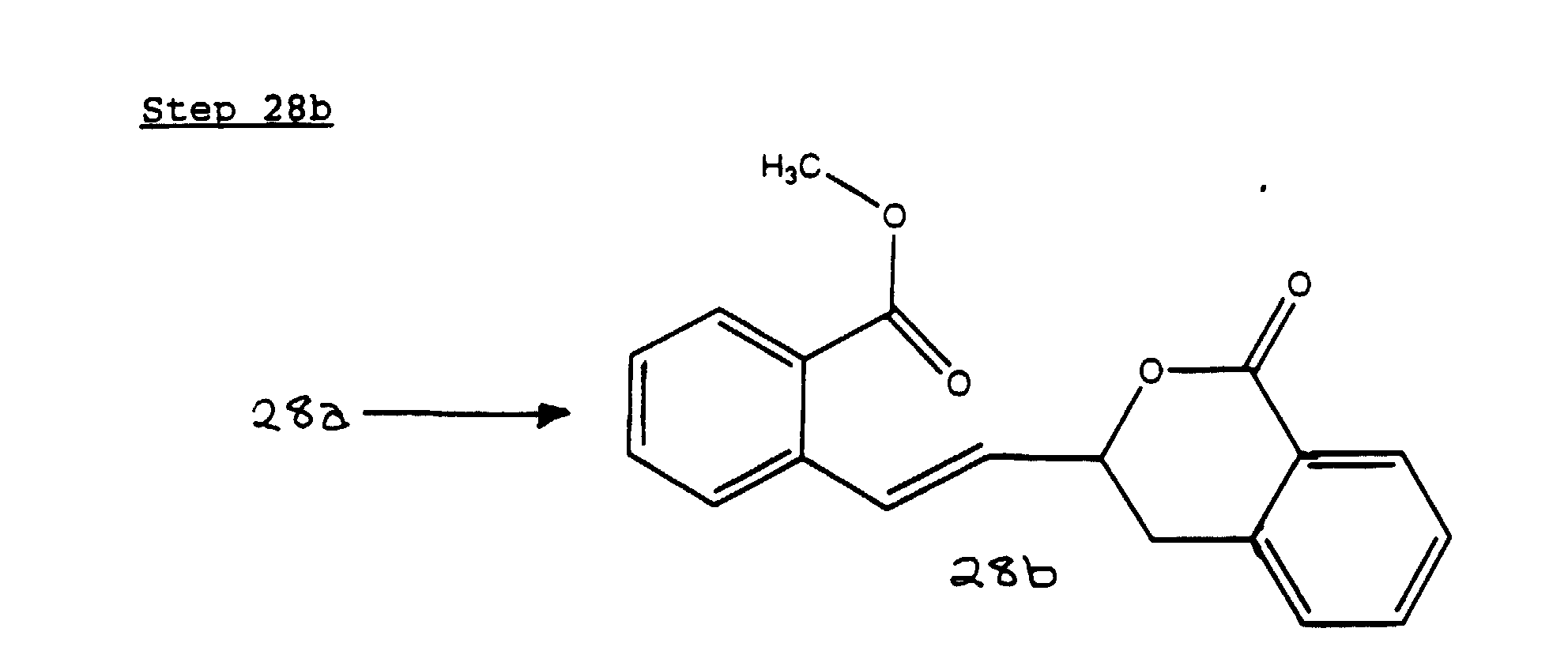
- A solution of 150 mg (0.49 mmol) of compound 28a, 6.5 mg of AIBN, and 80 microliters of thiophenol in 12 ml of benzene was heated to reflux for 4 hours. After 2.5 hours, another portion of AIBN (6 mg) was added. The solution was cooled and concentrated. The residue was purified by flash chromatography (80 g silica, 10-30% ethyl acetate/hexane) to yield 112 mg (77%) of product as a white solid.

- To a solution of 0.17 ml (1.6 mmol) of t-butyl amine in 3 ml of toluene at 0°C was added 0.81 ml of a 2.0M solution of trimethylaluminum (1.6 mmol), dropwise over 5 minutes. The mixture was stirred for 45 minutes at room temperature and 50 mg (0.16 mmol) of compound 28b in 1 ml of toluene was added dropwise. The solution was heated to 70°C for 5 hours, cooled and quenched with saturated NH4Cl solution. The aqueous phase was extracted three times with 20 ml portions of ethyl acetate. The combined organic phase was dried over MgSO4, filtered and concentrated to a viscous orange oil. The residue was purified by flash chromatography (15 g of silica, 20-45% ethyl acetate/hexane) to yield 33 mg (48%) of product as a white solid.
-

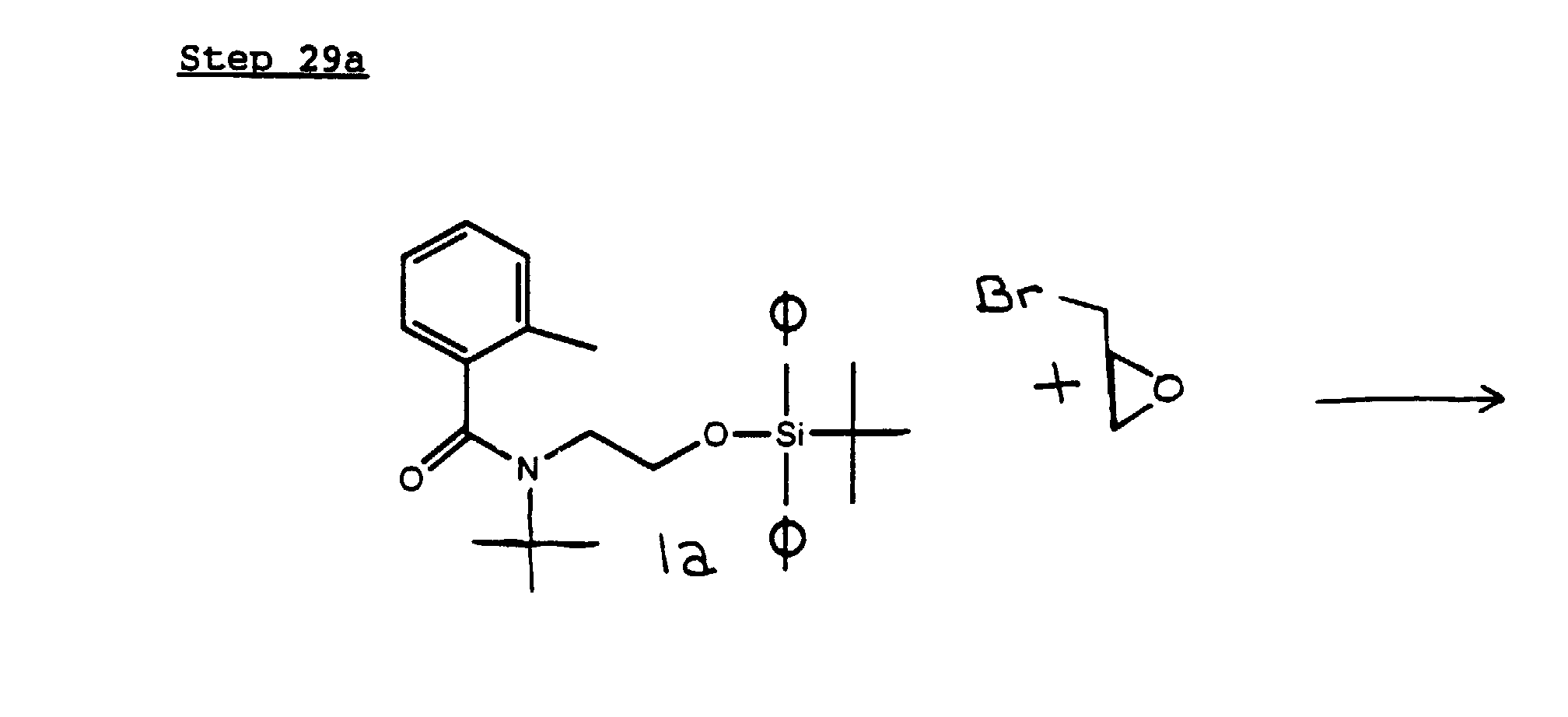
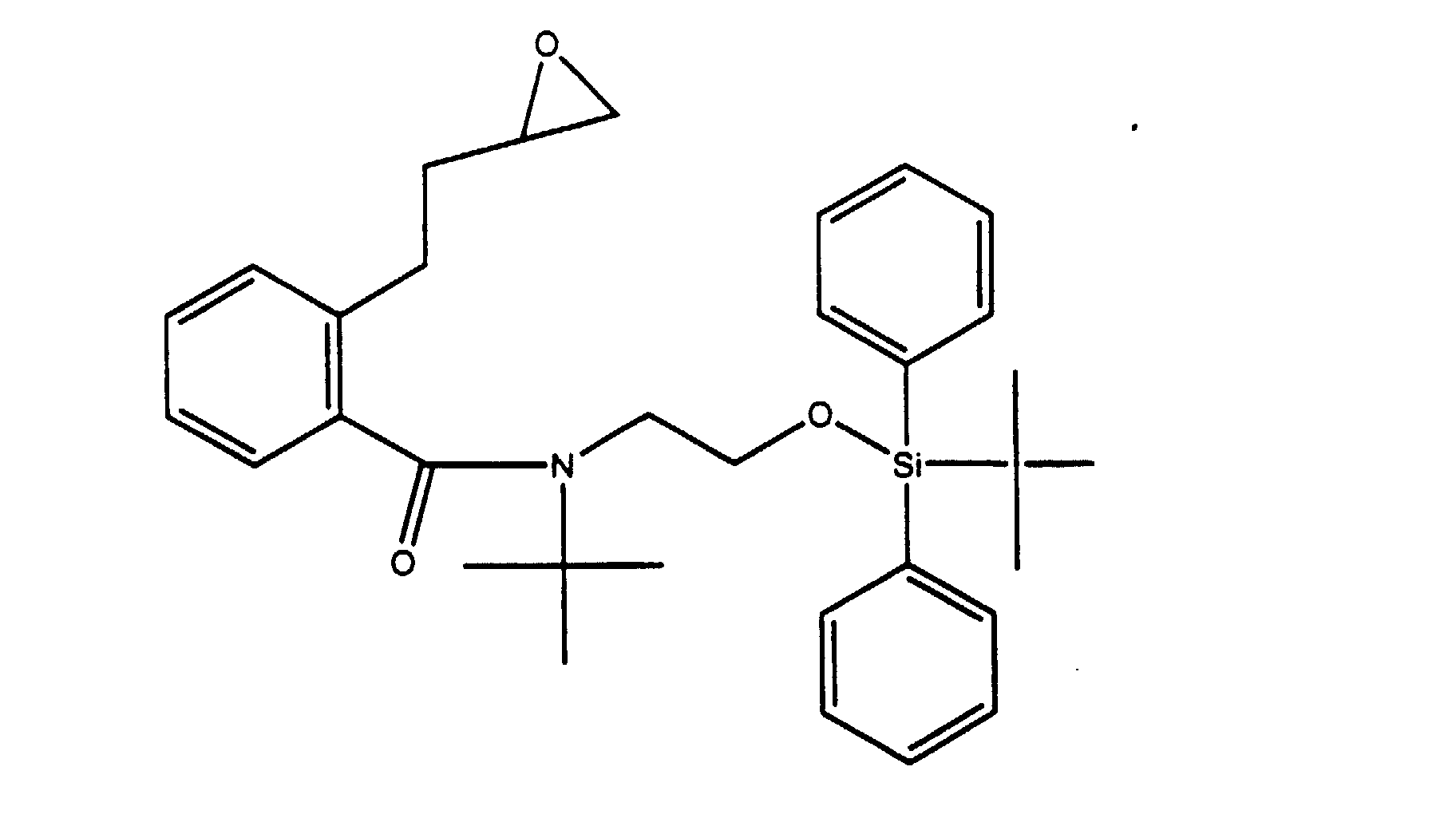
- A solution of 285 mg (0.6 mmol) of compound la and 13 microliters of diisopropyl amine in 8.5 ml of anhydrous THF was cooled to -78°C and 0.53 ml of a 1.3 M solution of s-butyllithium in THF was added slowly over 10 minutes. The resultant purple solution was stirred at -78°C for 1 hour and 0.14 ml (1.69 mmol) of epibromohydrin was added dropwise. The reaction mixture was stirred an additional 1 hour at -78°C, then allowed to warm to room temperature. Total reaction time was 4.5 hours after which the reaction mixture was quenched by pouring into 30 ml of dilute NH4Cl solution. The aqueous phase was extracted with three 20 ml portions of ether. The combined organic phase was washed with 20 ml H2O and dried over MgSO4. The solution was filtered and concentrated under vacuum to a nearly colorless oil which was purified by flash chromatography (60 g of silica, 25-50% ethyl ether/hexane) to yield 180 mg (57%) of product as a colorless viscous oil.

- A solution of 183 mg (0.35 mmol) of compound 29a and 75 mg (0.32 mmol) of compound 24a (decahydro isoquinoline) in 4 ml of ethanol was heated to 60°C for 29 hours. The mixture was then cooled and concentrated under vacuum to a colorless foam. The foam was purified by flash chromatography (50 g silica, 15-40% ethyl acetate/hexane) to yield the product as two separable diastereomers. The less polar product (110 mg) was a colorless, viscous oil. The more polar product (108 mg) was also a colorless, viscous oil. Total yield was 219 mg (91%).
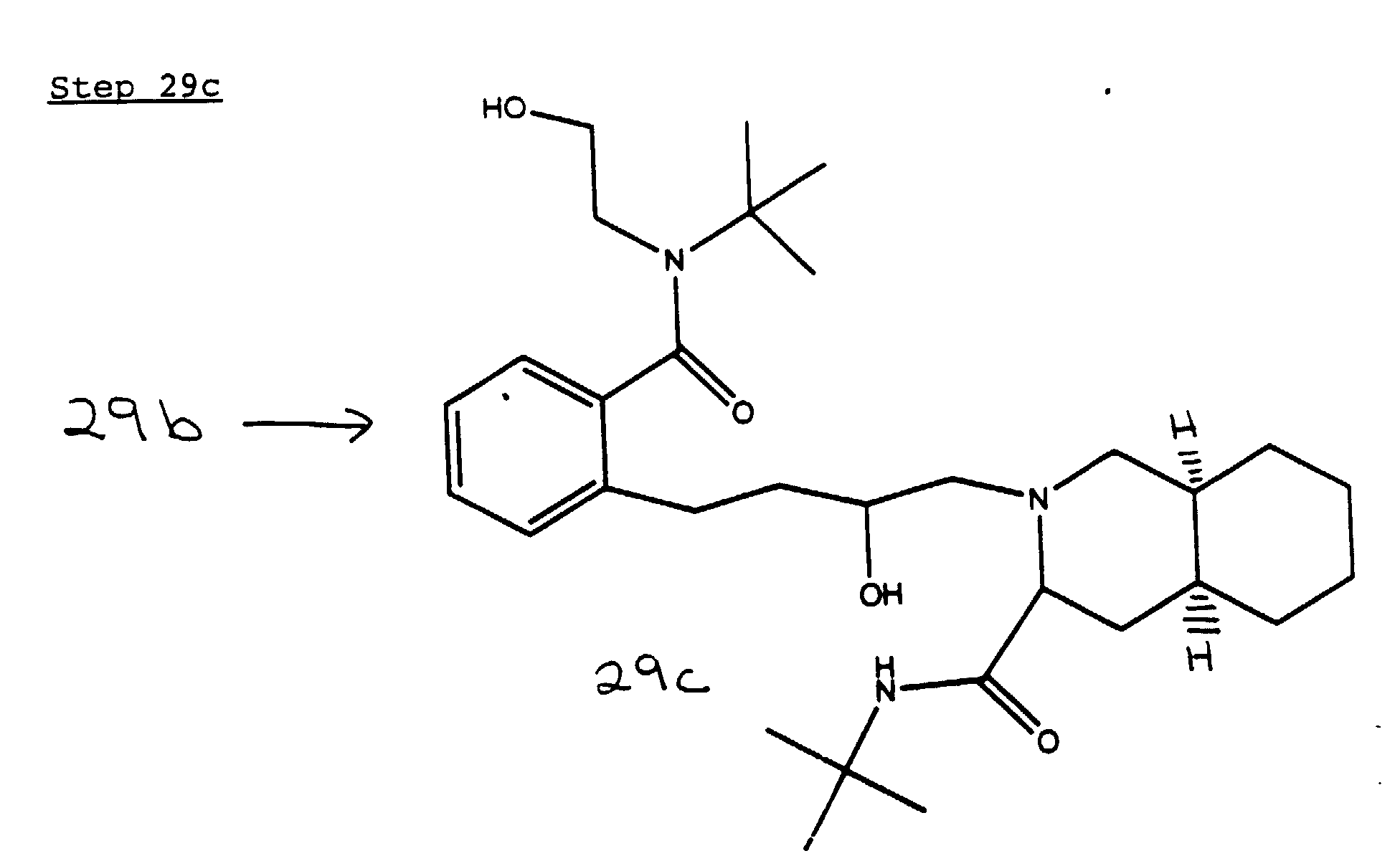
- To a solution of 90 mg (0.12 mmol) of the less polar isomer of compound 29b in 3 ml THF was added 0.23 ml of a 1.0M solution of tetrabutylammonium fluoride in THF and the reaction mixture was stirred at room temperature for 45 minutes. The reaction mixture was then diluted with 25 ml of CH2Cl2. The organic phase was washed with 15 ml portions of H2O, saturated NaHCO3, and brine, then dried over MgSO4. The solution was filtered and concentrated under vacuum to a white foam which was purified by flash chromatography (15 g silica, 2% MeOH/CH2Cl2 containing a trace of MeOH saturated with NH3) to yield 49 mg (79%) of the product as a white stiff foam.
- Preparation of

- To a solution of 90 mg (0.12 mmol) of the more polar isomer of compound 29c in 3 ml THF was added 0.23 ml of 1.0M tetrabutylammonium fluoride in THF and the reaction mixture was stirred at room temperature for 35 minutes, then diluted with 25 ml of CH2Cl2. The organic phase was washed with 15 ml portions of H2O, saturated NaHCO3, and brine, then dried over MgSO4. The solution was filtered and concentrated under vacuum to a white foam which was purified by flash chromatography (10 g of silica, 2% MeOH/CH2Cl2 containing a trace of MeOH saturated with NH3) to yield 38 mg (61%) of the product as a white stiff foam.
- Preparation of

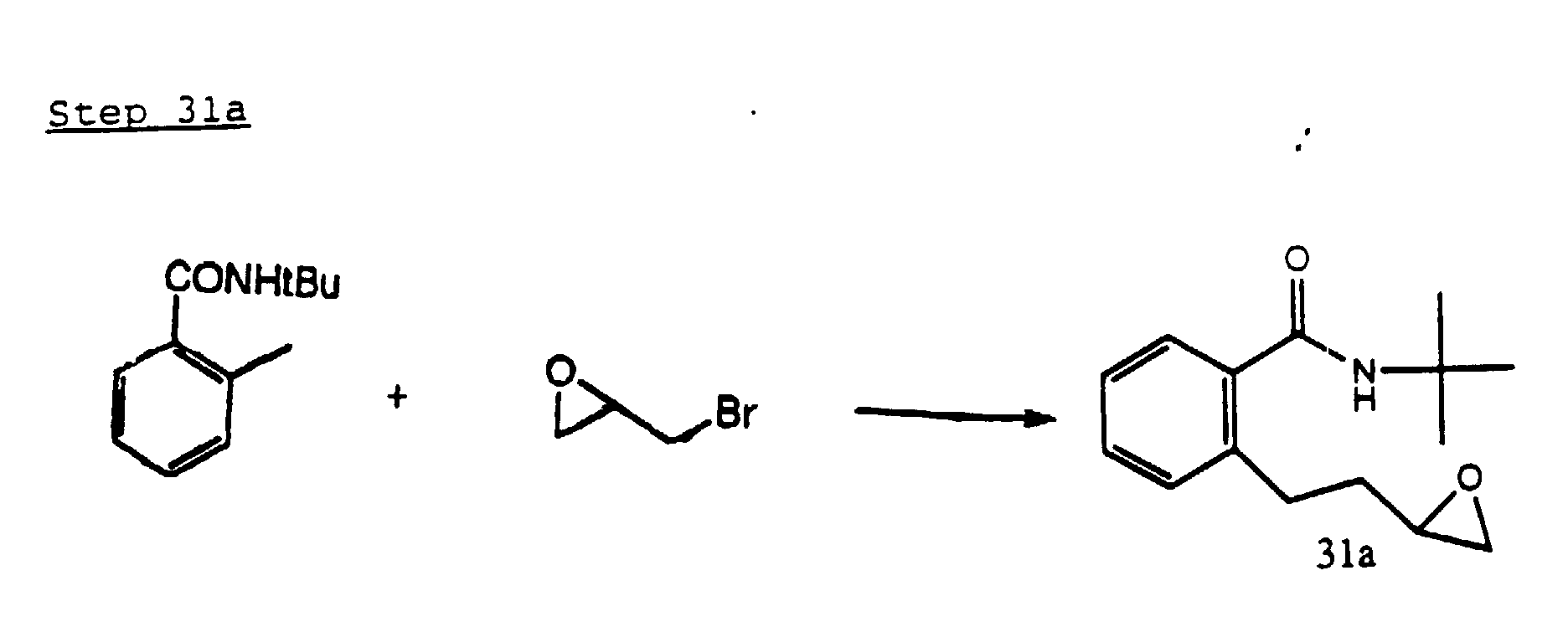
- A flame dried 100 ml 3-neck flask was purged with argon, and charged with 2.0 gm (10.4 mmol) of N-t-butyl toluamide, 3.47 ml of TMEDA and 25 ml of THF. The mixture was cooled in a dry ice/acetone bath and 14.4 ml of a 1.6 M solution of n-butyl lithium in hexane was added over a 20 minute period while maintaining the temperature below -65°C. After an additional hour of stirring at the dry ice/acetone temperature, the now deep orange solution was cannulated over 5 minutes into a solution of 15 ml of 5.7 gm of epibromohydrin in 15 ml of THF. A clear, light orange solution resulted. The reaction flask was transferred to a glycol/dry ice bath (-12: -15°C) and stirred for about 70 minutes. At this time, the reaction was quenched with about 9 ml of 0.5N NH4Cl, then poured into 150 ml brine, extracted twice with 50 ml portions of ethyl acetate and dried over Na2SO4. After filtering and vacuum removal of solvent, 7.38 gm of waxy, orange solid was recovered. This solid was purified by flash chromatography using 20% THF in hexane. Appropriate fractions were combined and filtered and solvent was removed by vacuum, yielding 685 mg (32%) of product.

- A solution of 75 mg (0.3 mmol) of compound 31a and 62 mg (0.33 mmol) of compound 22c in 4 ml of ethanol was heated to reflux for 24 hours. The reaction mixture was cooled and concentrated under vacuum to a yellow foam. The residue was purified by flash chromatography (15 g silica, 40-50% ethyl acetate/hexane containing 1.5% MeOH saturated with NH3) to yield the product as two diastereomers. The less polar isomer, not pure by TLC, was rechromatographed (10 g silica, 40-50% ethyl acetate/hexane containing 0.5% MeOH saturated with NH3) to yield 20 mg as a white solid. The more polar isomer was pure after the first chromatography (35 mg as a white solid). Total yield 55 mg (43%).
- Preparation of
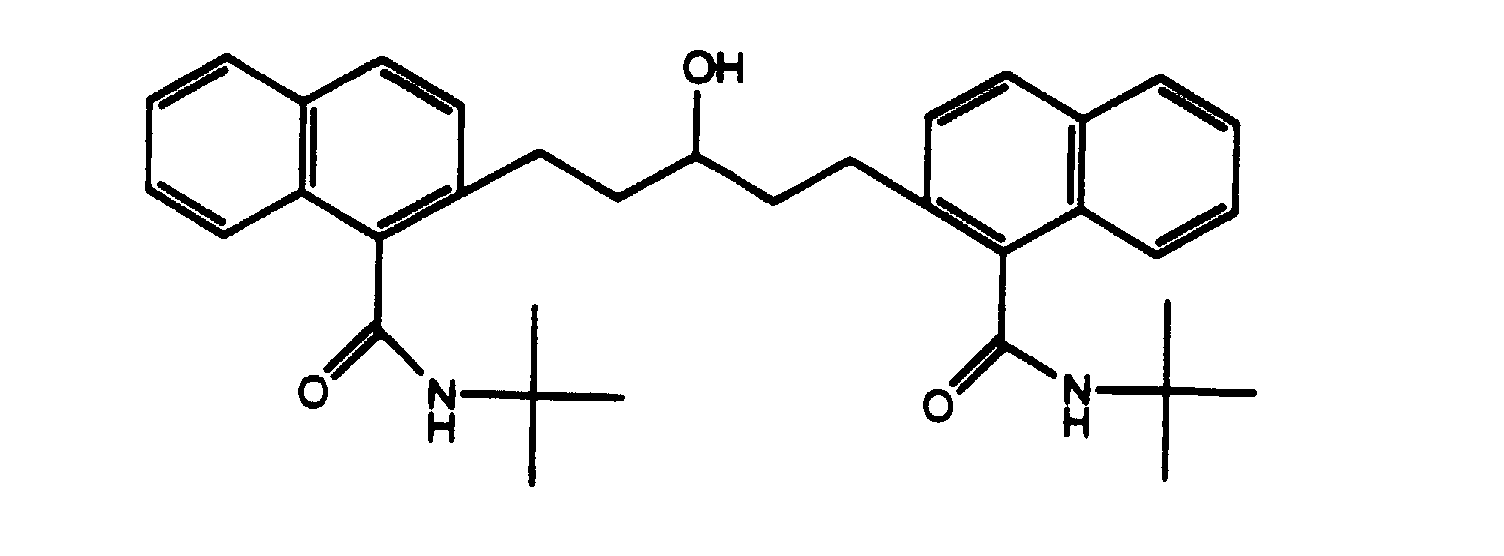
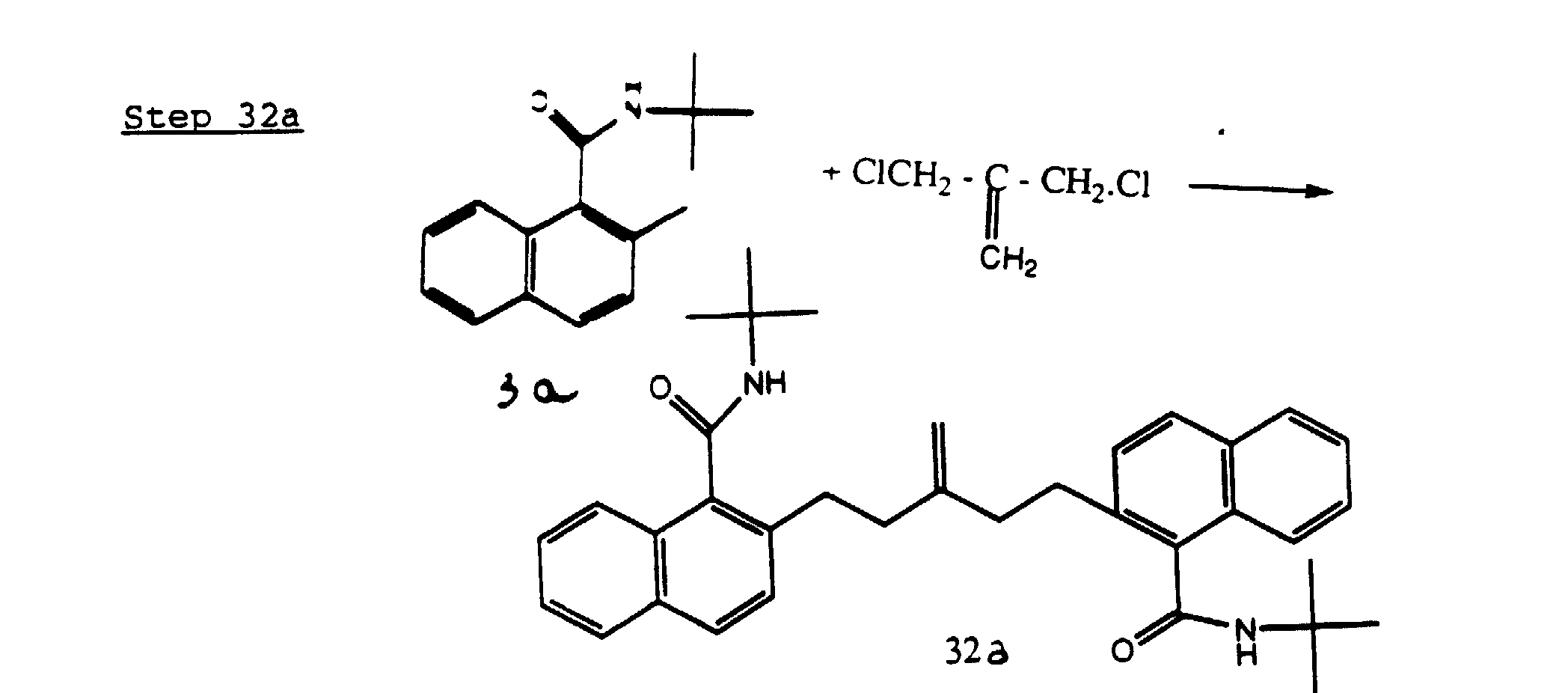
- To a solution of 600 mg (2.49 mmol) of compound 3a and 0.75 ml of tetramethylethylenediamine in 15 ml of anhydrous THF, cooled to -78°C, was added 3.11 ml of a 1.6M solution of n-Buli in hexane, dropwise, over 10 minutes. The solution was stirred at -78°C for 45 minutes and 0.14 ml (1.25 mmol) of 1,3-dichloroisobutene was added, dropwise. The mixture was allowed to warm to -30°C, then poured into 30 ml of dilute NH4Cl solution. The aqueous phase was extracted with three 25 ml portions of ethyl acetate. The combined organic phase was washed with 30 ml portions of 10% citric acid solution, H2O, and brine, then dried over MgSO4. The solution was filtered and concentrated to a yellowish white solid which was purified by flash chromatography (100 g of silica, 1.5-10% ethyl acetate/CH2Cl2) to yield 370 mg (56%) of product as a white solid.
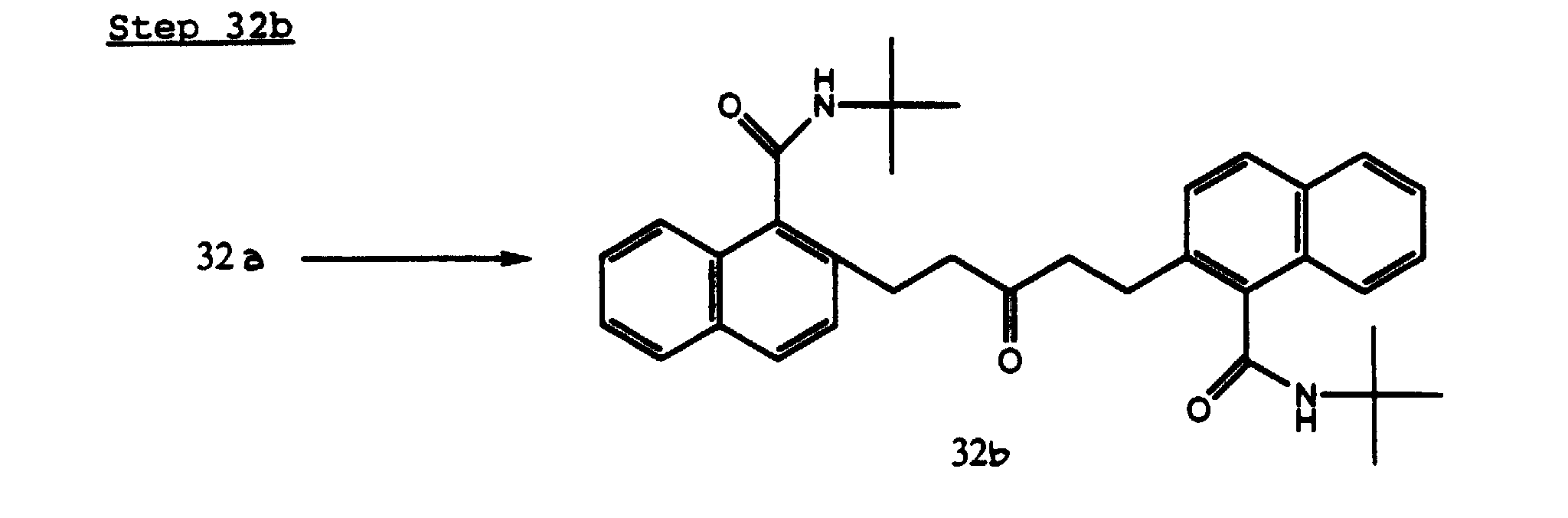
- To a solution of 60 mg (0.11 mmol) of compound 32a in 2 ml dioxane and 0.5 ml H2O, was added one drop of 2.5% OsO4 solution in t-butyl alcohol. The mixture was stirred for 15 minutes and 48 mg (0.22 mmol) of NaIO4 was added in one portion. The mixture was stirred at room temperature for 20 hours, then poured into 15 ml of H2O and the aqueous mixture was extracted with three 15 ml portions of ether. The combined organic phase was washed with 10 ml portions of H2O and brine, then dried over MgSO4. The solution was filtered and concentrated to a viscous yellow oil which was purified by flash chromatography (10 g silica, 30-40% ethyl acetate/ hexane) to yield 40 mg (67%) of product as a white solid.

- To a solution of 35 mg (0.065 mmol) of compound 32b in 2 ml of MeOH was added 3 mg (0.078 mmol) of NaBH4 in one portion. The reaction was stirred for 15 minutes at room temperature, then poured into 10 ml of saturated NaHCO3 solution. The aqueous phase was extracted with two 15 ml portions of ethyl acetate, the combined organic phase was washed with 10 ml of H2O and dried over MgSO4. The organic phase was then filtered and concentrated to a white foam which was purified by flash chromatography (10 g of silica, 30-40% ethyl acetate/hexane) to yield 29 mg (83%) of product as a white solid.
- Preparation of
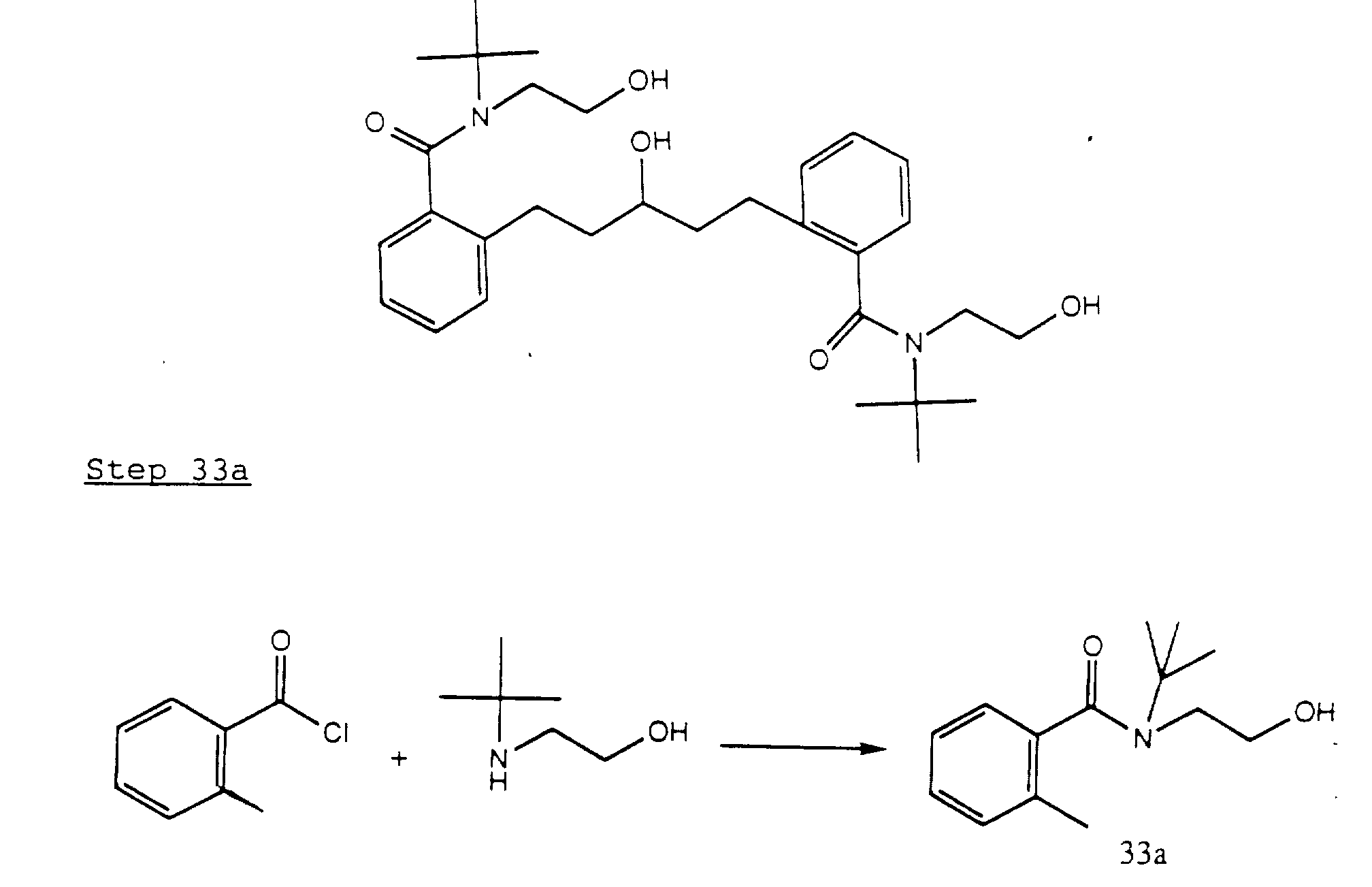
- To a solution of 4.97 gm (0.043 mole) of hydroxyethyl-t-butyl amine and 18 ml of trimethyl amine in 100 ml of CH2Cl2, cooled to 0°C, was added 11 ml (0.085 mole) of o-toluoyl chloride, dropwise. The reaction mixture was allowed to warm to room temperature and was stirred for 24 hours. The reaction was then quenched by pouring the reaction mixture into 100 ml of H2O and extracted once with 100 ml of CH2Cl2. The organic phase was washed with 100 ml portions of H2O, 10% citric acid, H2O, and saturated NaHCO3, then dried over MgSO4. The dried solution was filtered and concentrated under vacuum to a viscous yellow oil which was dissolved in 100 ml of 90% aqueous methanol. To this solution was added 5.5 ml of 45% KOH and the mixture was kept at room temperature for 45 minutes. It was then concentrated under vacuum, diluted with 100 ml of H2O and extracted three times with 100 ml portions of diethyl ether. The combined organic phases were dried over MgSO4, then filtered and concentrated under vacuum to a light yellow oil. This oil was dissolved in a 30% ethyl acetate/hexane mixture. The product was crystallized from this solution in two crops to yield 6.5 gm (64% yield).

- To a solution of 1.58 gm (7.21 mmol) of compound 33a and 0.15 ml of diisopropyl amine in 30 ml of anhydrous THF, cooled to -78°C, was added 14 ml of a 1.3M solution of s-BuLi (1.3M, 14 ml, 15.5 mmol) in hexane, dropwise over 5 minutes. The solution was stirred at -78°C for 45 minutes and 0.42 ml (3.6 mmol) of 1,3-dichloroisobutene was added, dropwise. The solution was stirred at -78°C for 1.5 hours and the reaction was then quenched by the addition of 75 ml of dilute NH4Cl solution and the aqueous phase was extracted with two 60 ml portions of ethyl acetate. The combined organic phase was washed with 50 ml portions of 10% citric acid, H2O and brine, then dried over MgSO4. The solution was filtered and concentrated to a colorless foam which was purified by flash chromatography (200 g silica, 50-65% ethyl acetate/hexane) to yield 0.50 g (28%) of product as a colorless, viscous oil.

- To a solution of 250 mg (0.48 mmol) of compound 33b in 10 ml of dioxane and 5 ml of H2O was added two drops of 2.5% OsO4 solution in t-butyl alcohol. The mixture was stirred for 15 minutes and 308 mg (1.44 mmol) of NaIO4 was added over 30 minutes and the mixture was then stirred at room temperature for 20 hours. The reaction mixture was poured into 30 ml of H2O and the aqueous mixture was extracted with three 20 ml portions of ethyl acetate. The combined organic phase was washed with 25 ml portions of H2O and brine, then dried over MgSO4. The solution was filtered and concentrated to a viscous brown oil which was purified by flash chromatography (50 g silica, 8-15% ethyl acetate/ethyl ether) to yield 180 mg (71%) of product as a viscous oil.
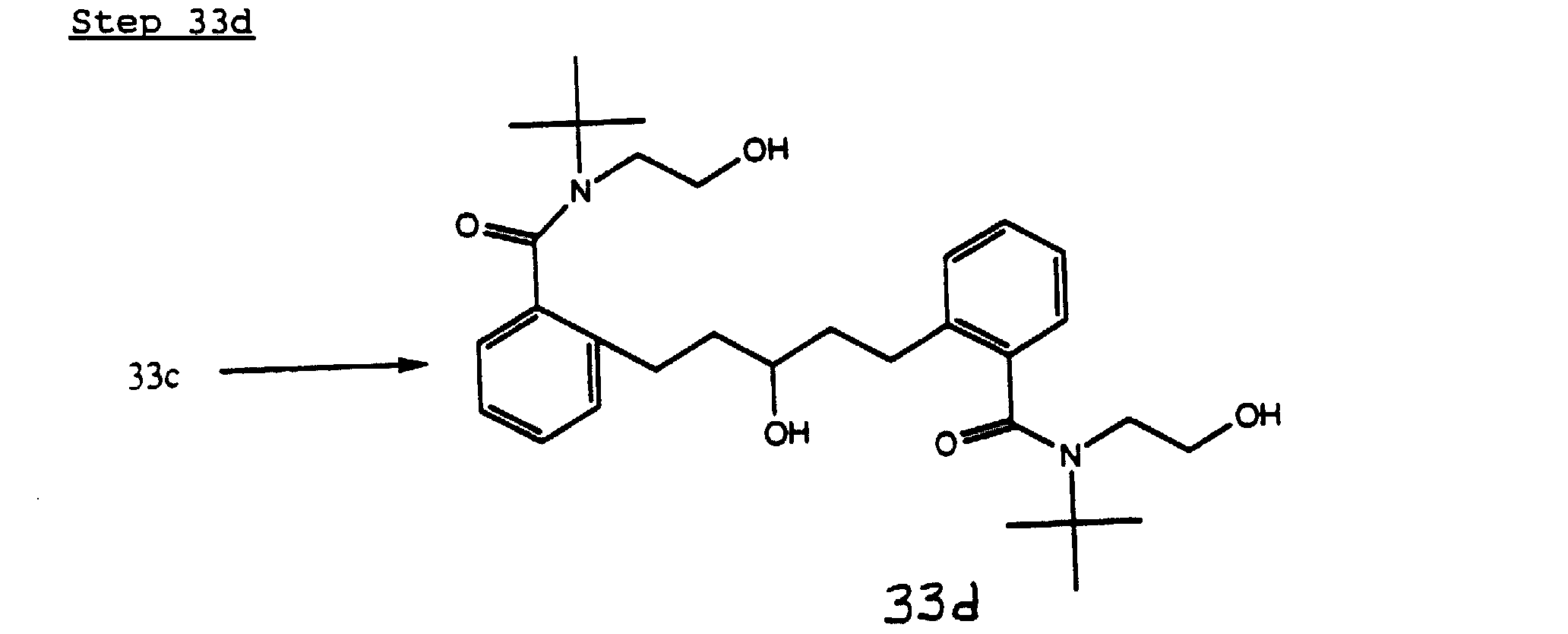
- To a solution of 110 mg (0.21 mmol) of compound 33c in 5 ml of methanol was added 48 mg (1.26 mmol) of NaBH4 in one portion. The reaction mixture was stirred for one hour at room temperature and then poured into 15 ml of saturated NaHCO3 solution. The aqueous phase was extracted three times with 15 ml portions of ethyl acetate. The combined organic phase was washed with 10 ml of water, then dried over MgSO4. The organic solution was filtered and concentrated under vacuum to a white foam. This foam was purified by flash chromatography (15 g silica, 10-25% ethyl acetate/ether) to yield 70 mg (35%) of product as a stiff white foam.
- Preparation of

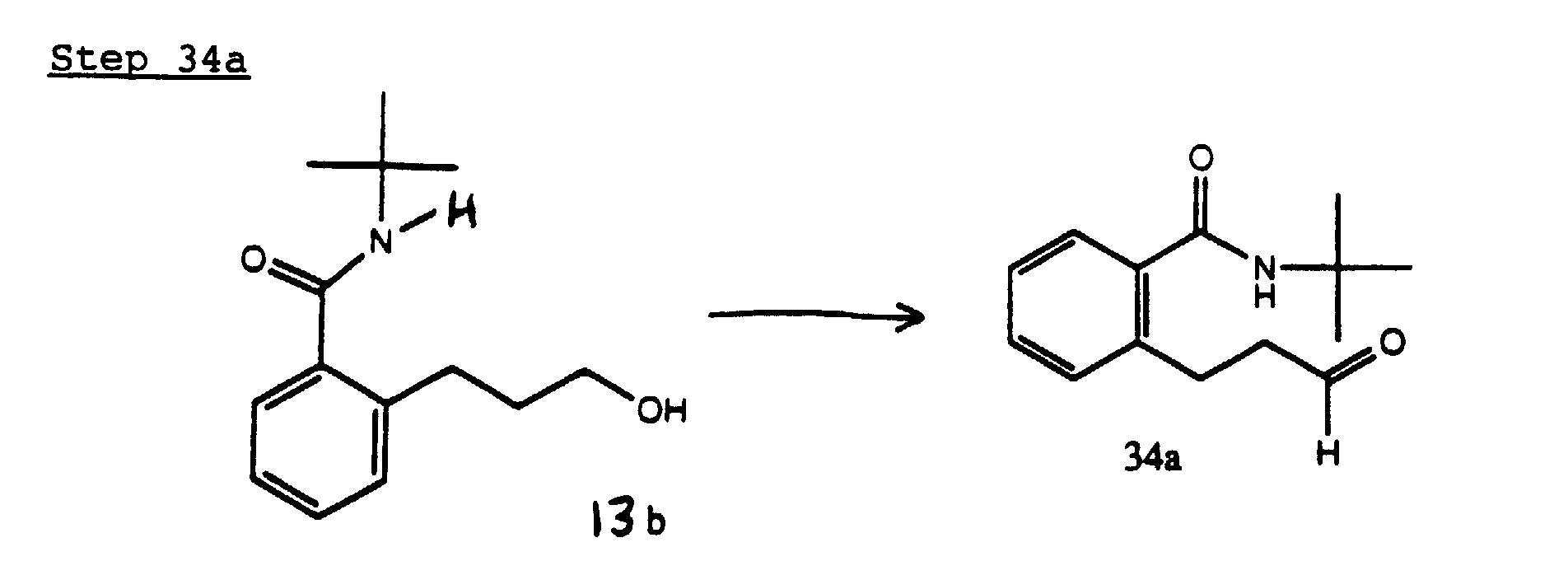
- Chromium trioxide (14.4 gm, 144 mmol) was added slowly to 23.3 ml of pyridine and the mixture was diluted with 300 ml CH2Cl2. The alcohol 13b (6.16 gm, 26.2 mmol) was added to the chromium trioxide solution at 25°C and the reaction was stirred for 2 hours. After dilution with ether, the reaction was washed twice with 150 ml of 1N HCl, 1N NaOH, saturated NaHCO3, and brine. Drying over MgSO4 and concentration afforded a yellow oil, which chromatographed on silica (1:1 ether/hexane), yielding 4 gm (65%) of aldehyde 34a as a white amorphous solid. The structure was confirmed by NMR.

- To 764 mg (6.42 mmol) of methyl magnesium bromide in 10 ml of dry ether was added 500 mg (2.14 mmol) of compound 34a in 15 ml of dry ether at 0°C, resulting in a milky white solution. The ice bath was removed and the mixture was warmed to room temperature. After 1 hour at room temperature, TLC indicated that some starting material remained. Another equivalent (119 mg) of methyl magnesium bromide was added and the solution changed from milky white to clear. The reaction was quenched with ice and 1N HCl, extracted with ethyl acetate and ether, washed with brine, then dried over MgSO4. Concentration under vacuum yielded 576 mg of a clear oil which was then purified by flash chromatography (SiO2: 2/1 ether-hexane) yielding 358 mg (76%) of product.
- The structure was confirmed by 'HNMR.
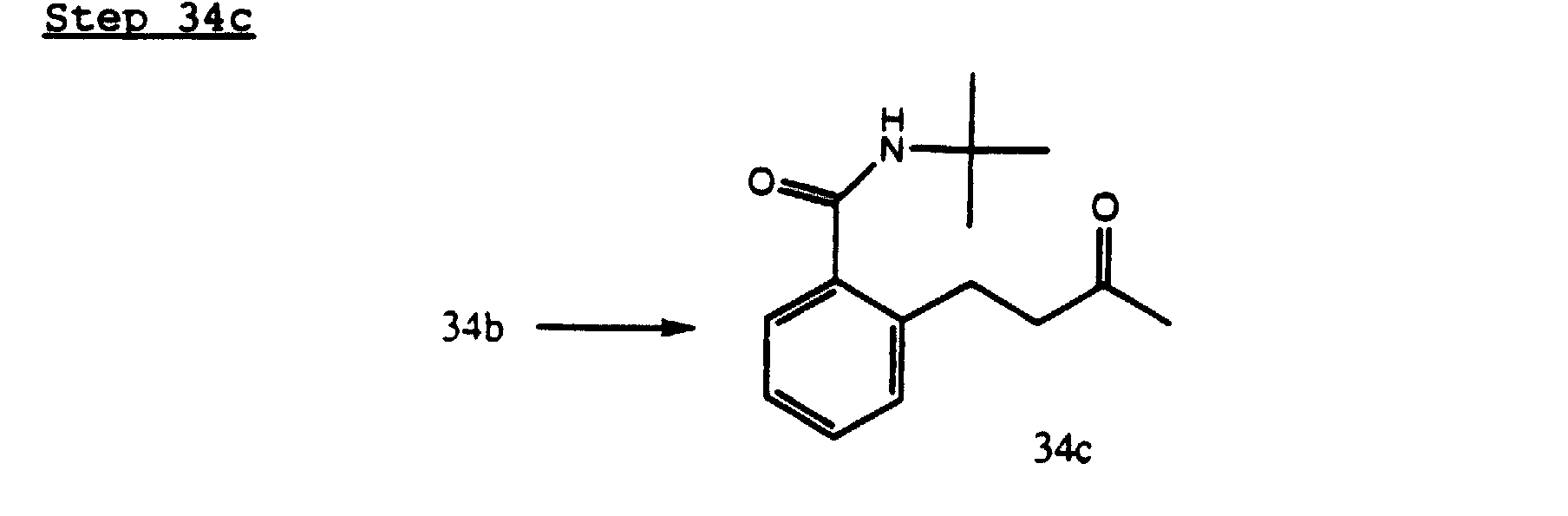
- CrO3 (580 mg - 5.8 mmol) was added to 1 mL of pyridine and a paste formed with exotherm. Three ml of CH2Cl2 were added and the mixture was stirred for 10 minutes more. An additional 12 ml of CH2Cl2 were added (total=15ml) and (360 mg, 1.4 mmol) of compound 34b in 3 ml of CH2Cl2 was added, dropwise. The solution turned dark. After 1 hour, TLC indicated that about 20% of the starting material remained. An additional 2 equivalents of the CrO3/pyridine reagent in 3 mL of CH2Cl2 was added. The reaction was essentially complete after 3 more hours. The reaction mixture was diluted with ether and CH2Cl2 and filtered through SiO2 and concentrated under vacuum to yield 309 mg of a white solid, which was purified by flash chromatography (SiO2, 1:1 ether/hexane) yielding 228 mg (66%) of the product as a white solid.
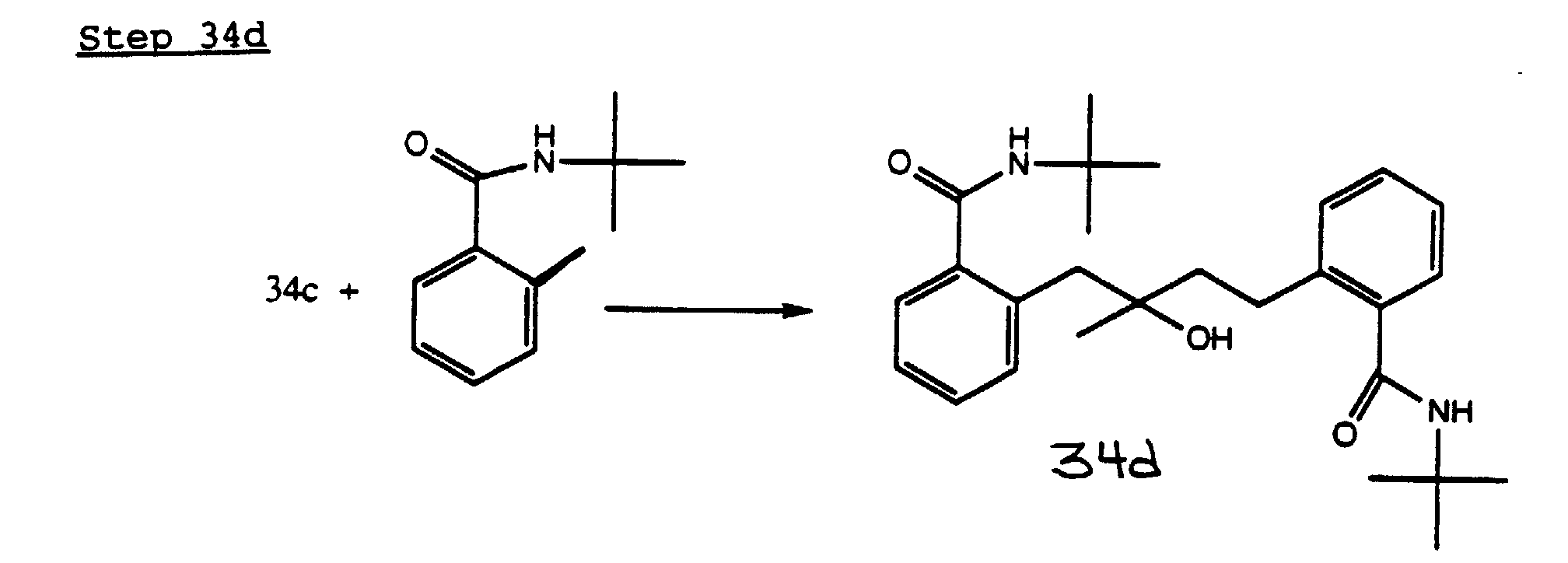
- To 281 mg (1.47 mmol) of N-t-butyl toluamide, which had been pumped down on highvac equipment, was added 341 mg (2.93 mmol) of TMEDA and 8 ml of THF. The mixture was cooled to -78°C using a dry ice/acetone bath, and s-butyl lithium (2.7 ml, 2.93 mmol) was added dropwise. The color turned to deep orange. The mixture was stirred at -78°C for 45 minutes, at which time 165 mg (0.667 mmol) of compound 34c in 5 ml of THF was added via cannula. The color changed to light orange. The temperature was allowed to rise to -30°C at which point the color disappeared. The reaction was quenched with 1N HCl, washed with brine, extracted with CH2Cl2 and dried over MgSO4. Concentration under vacuum yielded 550 mg of clear oil. The oil was purified by flash chromatography using initially 1:1 ether/hexane, changing to 2:1 ether/hexane solvent, yielding 41 mg of product (14% yield).
- Preparation of
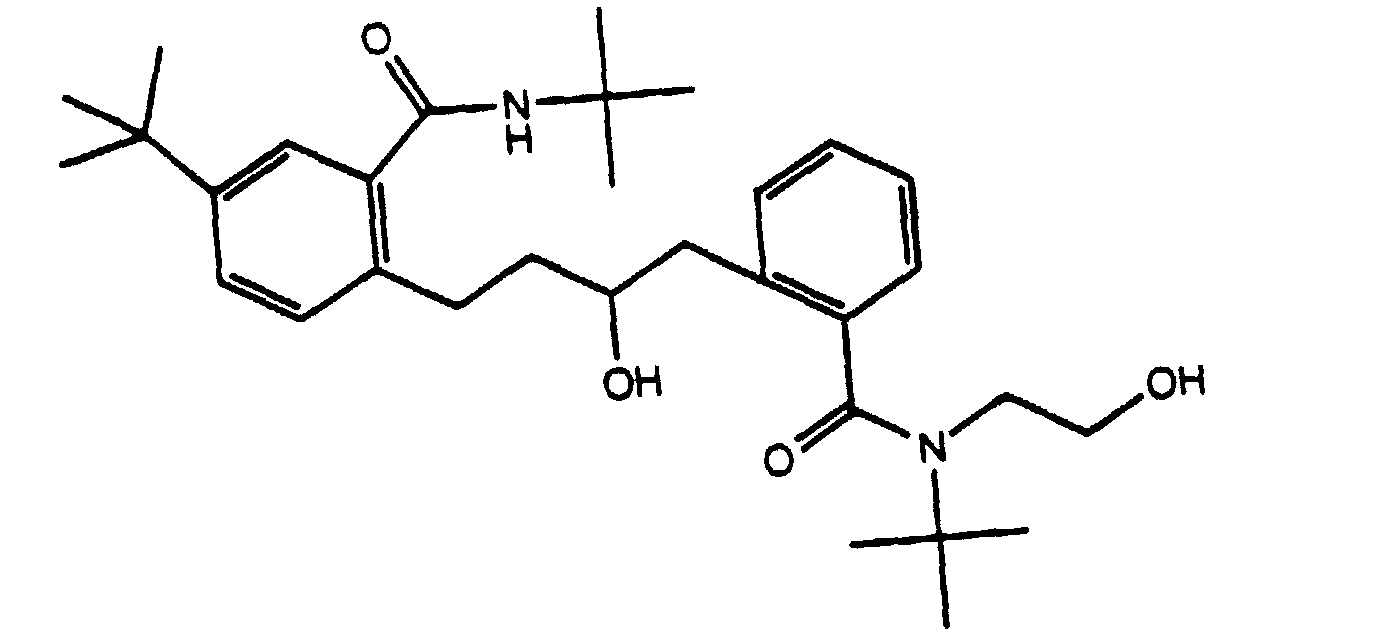

- s-Butyl lithium (1.34 ml, 1.34 mmol) was added to a solution of 0.158 gm (0.67 mmol) of compound 33a and 28 µl of diisopropyl amine in THF at -78°C. A red color started to develop after about 70 µl of s-butyl lithium had been added. After all of the s-BuLi was added, solution became deep blue. The mixture was stirred at -78°C for 1 hour, then 0.117 gm (0.335 mmole) of compound 7e in 1 ml of THF was added, dropwise. After about 30 minutes the solution became less colored (deep blue changed to very light blue). The reaction mixture was quenched 40 minutes later. The product was purified by flash chromatography. The chromatography was carried out twice; first with 70:30 methylene chloride/ethyl acetate, then with 80:20 methylene chloride/acetone. The yield was 87 mg (50%) of product.

- NaBH4 (13.5 mg, 0.3 mmol) was added to a solution of 0.8 gm(0.15 mmol) of compound 35a in 2 ml of EtOH at room temperature and the solution was stirred for 0.5 hour. TLC analysis showed reaction was complete. The mixture was then quenched with H2O and extracted with ethyl acetate and the organic phase was dried over MgSO4. Removal of solvent under vacuum yielded 0.077g of a white solid. Purification by flash chromatography using SiO2 with 70% CH2Cl2/30% ethanol solvent, yielded 44 mg (78.7%) of clean product. 'HNMR confirmed the structure.
- Preparation of
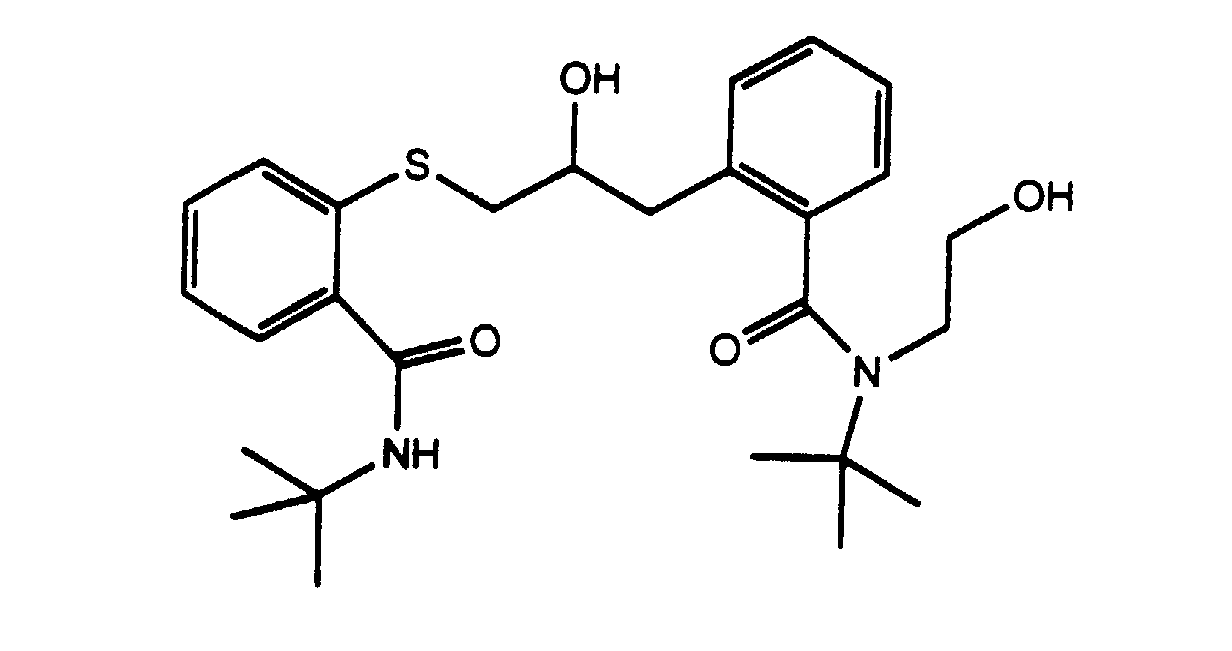
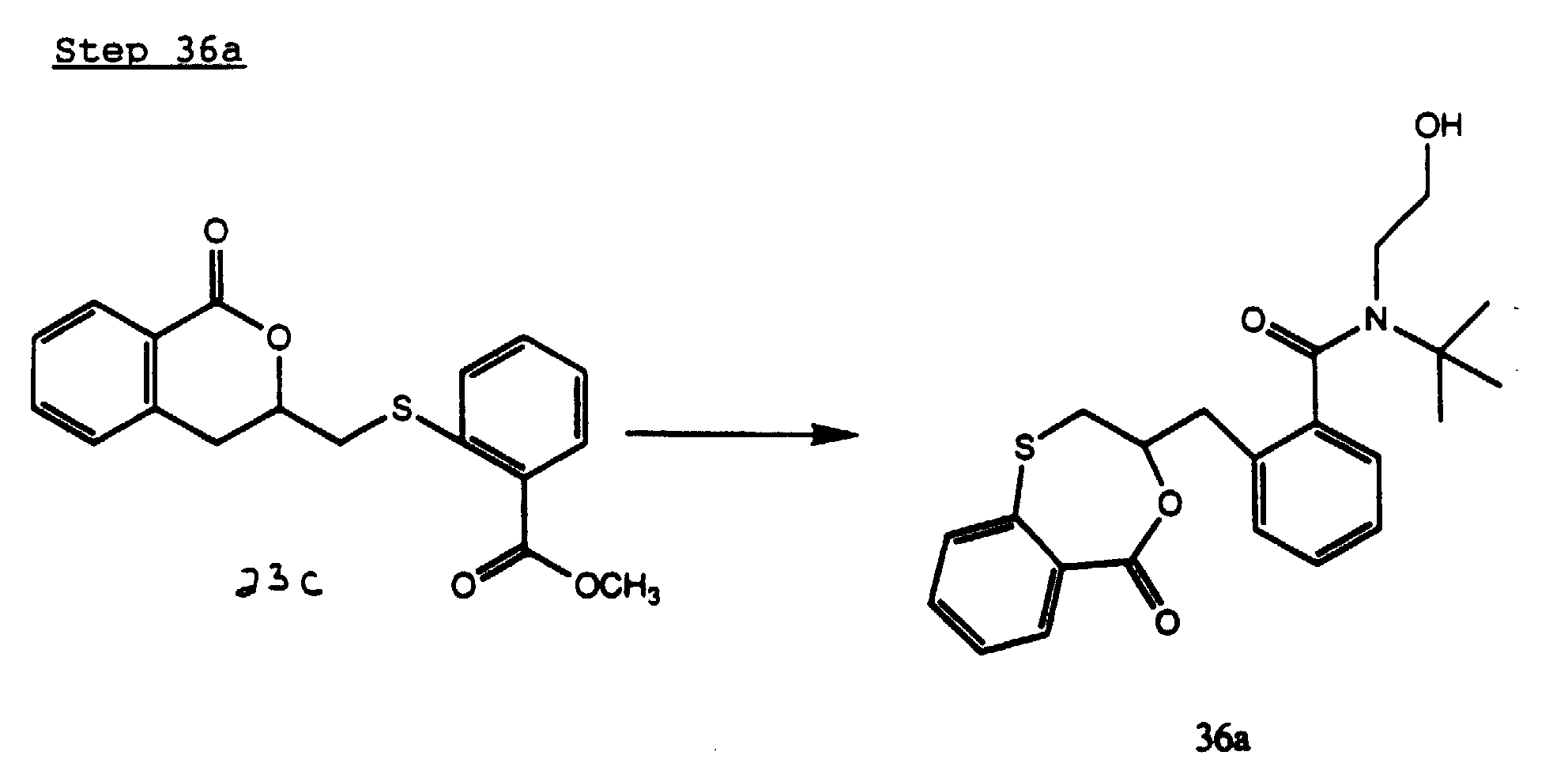
- To a solution of 0.86 g (7.32 mmol) of N-t-butyl-ethanol amine in 30 ml of toluene was added 3.66 ml of a 2M solution of trimethylaluminum at 0°C and the mixture was stirred at room temperature for 45 minutes. A solution of 0.40 g (1.22 mmol) of compound 23c in 5 ml CH2Cl2 was added and the mixture was heated to 90°C for 18 hours. The reaction mixture was cooled and quenched with 20 ml of saturated NH4Cl solution. The mixture was then extracted three times with 30 ml portions of ethyl acetate and the combined organic phase was dried over MgSO4. The solution was filtered and concentrated under vacuum to a yellow viscous oil which was purified by flash chromatography (75 g silica gel, 5-10% ethyl acetate/ CH2Cl2) to yield 0.16 g (32% yield) of the product as a white solid.

- To a solution of 170 mg (1.45 mmol) of t-butyl amine in 5 ml of toluene cooled to 0°C was added, dropwise, 0.73 ml of 2 M solution of trimethylaluminum in toluene. The mixture was stirred at room temperature for 45 minutes and 60 mg (0.5 mmol) of compound 23c in 1 ml of dichloroethane was added, dropwise. The mixture was heated for 5 hours at 110°C, cooled and quenched with 10 ml of saturated NH4CL solution. The mixture was extracted three times with 15 ml portions of ethyl acetate and the combined organic phases were dried over Na2SO4. The solution was filtered and concentrated to a viscous yellow oil, which was purified by flash chromatography using 15-30% ethyl acetate/methylene chloride and 20 gm of silica gel to yield to 45 mg (76%) of product as a viscous oil.
- Preparation of
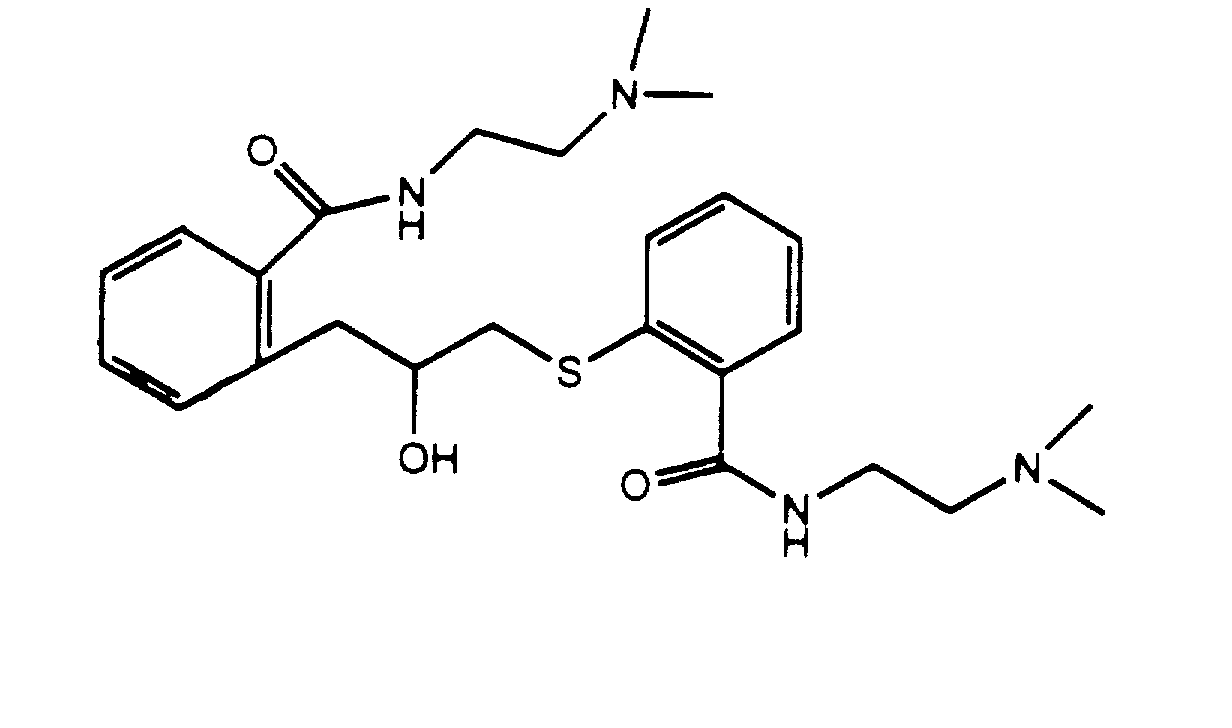
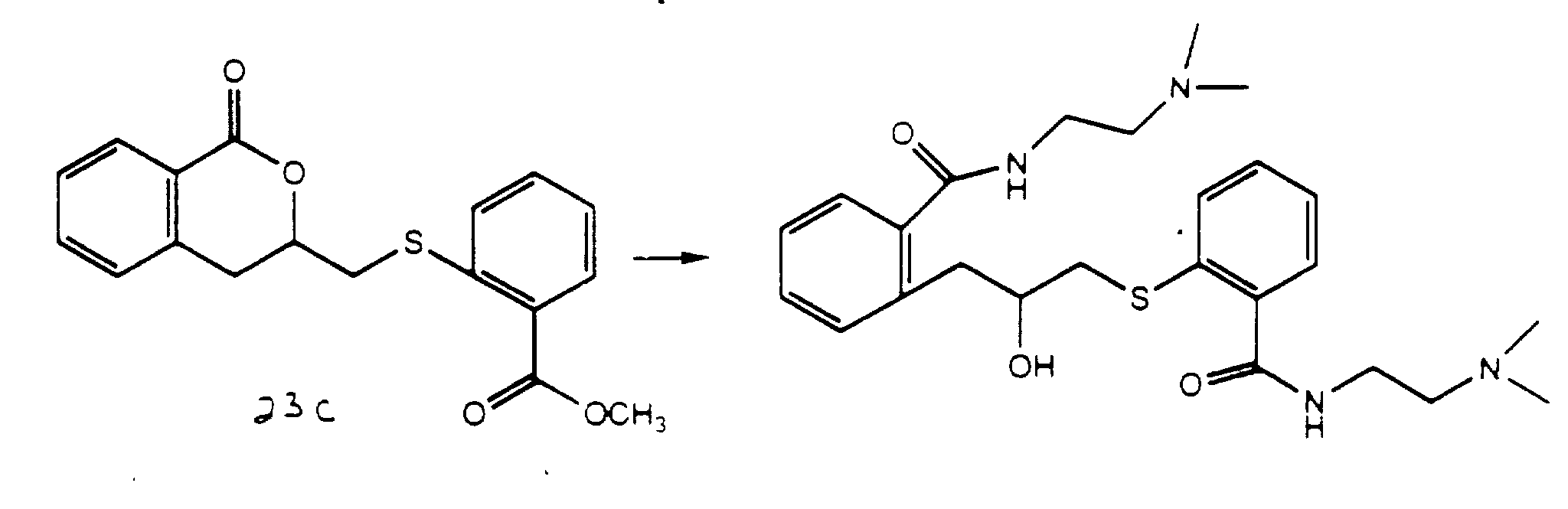
- To a solution of 0.12 ml (1.09 mmol) of TMEDA in benzene at 0°C was added 0.53 ml (1.06 mmol) of trimethyl aluminum and the solution was heated to room temperature for 1 hour. A solution of 0.07 g of compound 23c in 1 ml of benzene was added. The mixture was heated to reflux for about 40 minutes, allowed to cool slowly to room temperature and was then stirred overnight. Reflux was then continued for 2 more hours at which time TLC indicated that the reaction was complete. The reaction mixture was poured into 20 ml of water, extracted twice with 100 ml portions of ethyl acetate, dried over MgSO4 and concentrated under vacuum. Yield was 0.84 g of material which was purified by flash chromatography (8% NH3-methanol/methylene chloride) yielding 0.65 g (65%) of product. The structure was confirmed by NMR.
- Preparation of
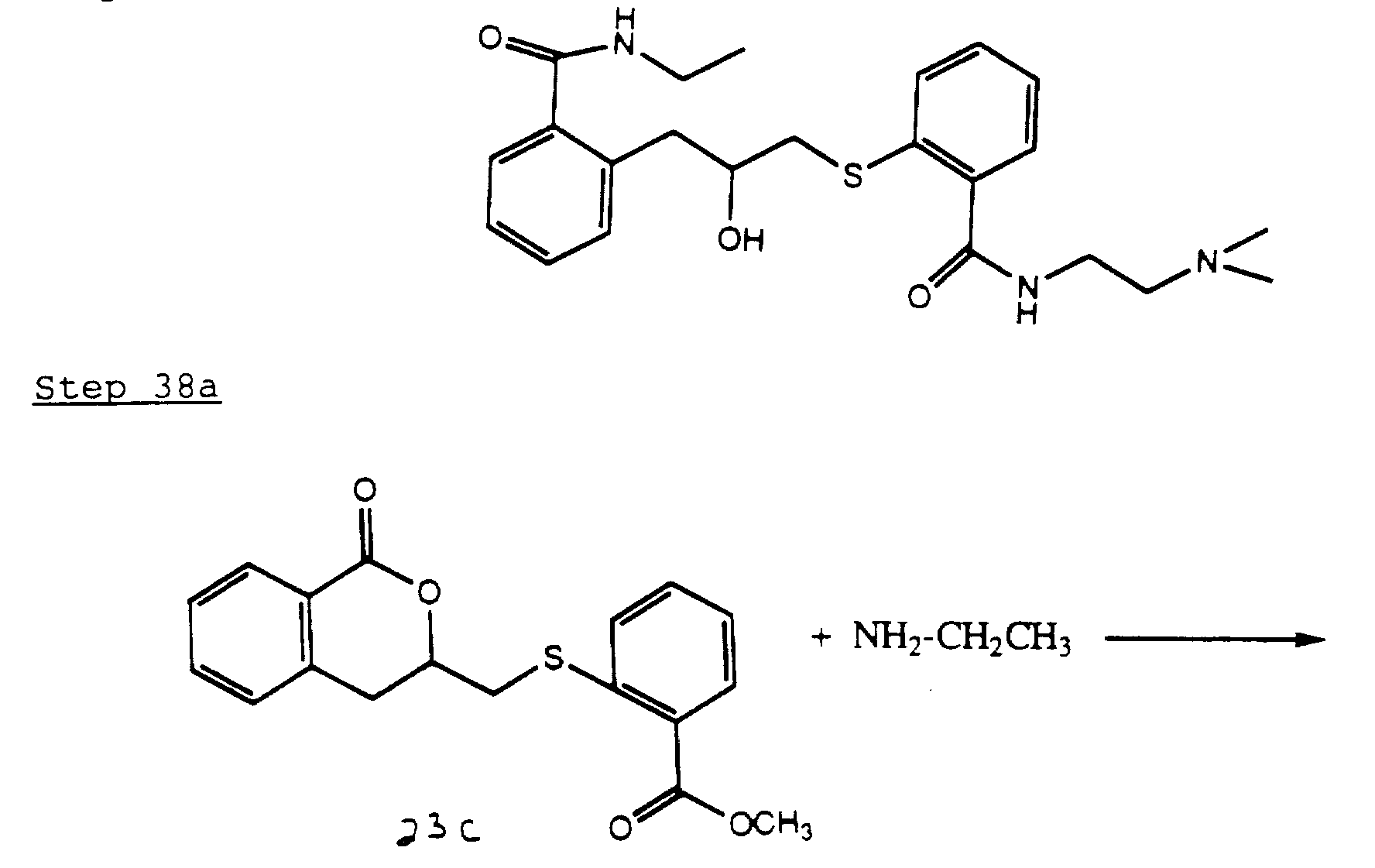
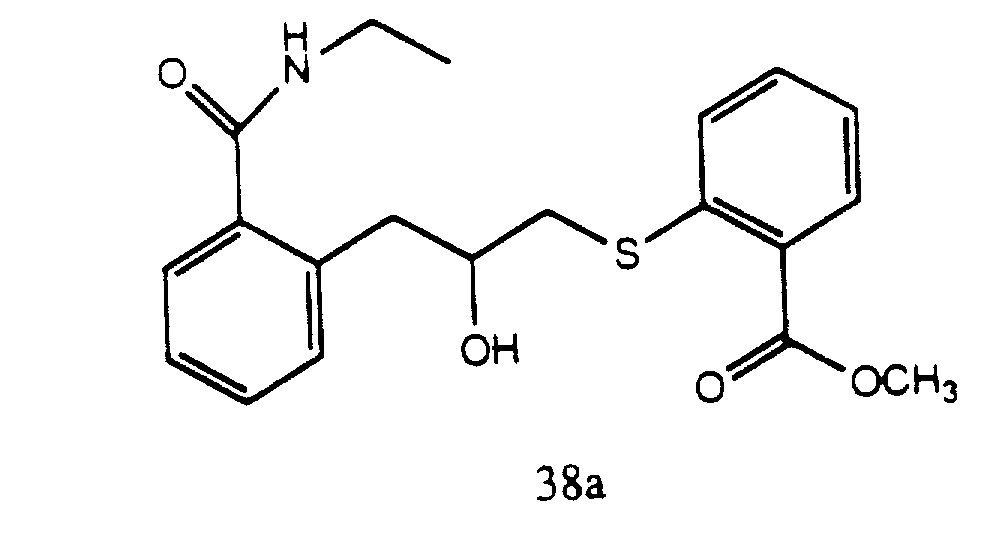
- A suspension of .075 g (.918 mmol) of ethylamine hydrochloride in 2 ml of benzene was cooled to 0°C and 0.46 ml (0.92 mmol) of trimethyl aluminum was added. The solution was warmed to room temperature and stirred for 1 hour. It was then cooled in an ice bath and a solution of 0.15 g (0.461 mmol) of compound 23c in 2 ml of benzene was added. The solution was then warmed to room temperature and the reaction was allowed to continue overnight. The reaction was complete in the morning. It was poured into 0.5N HCl, extracted twice with ethyl acetate, washed with brine, dried over Na2SO4 and concentrated under vacuum. Yield was 0.166 g. The product was purified by flash chromatography (10% ethyl acetate/methylene chloride) yielding 0.133 g (77%) of an oil. NMR confirmed the structure of the product.

- A solution of 0.4 ml (0.364 mmol) of N-N-dimethylethylenediamine in 2 ml of benzene at 0°C was added to 1.8 ml (0.36 mmol) of trimethyl aluminum. The mixture was warmed to room temperature and allowed to stir for 1 hour at which time 0.066 g (0.177 mmol) of compound 38a in 1 ml of benzene was added. The mixture was heated to reflux for 2 hours, at which time TLC indicated the reaction was complete. The mixture was then poured into 20 ml of water, extracted twice with 100 ml portions of ethyl acetate, dried over MgSO4 and concentrated under vacuum, yielding 0.058 g of product which was then purified by flash chromatography (5% methanol/ methylene chloride changing to 1% NH3-methanol/50% methanol/ methylene chloride). The yield was 0.04 g (53% of a white solid). The structure was confirmed by NMR.
- Preparation of
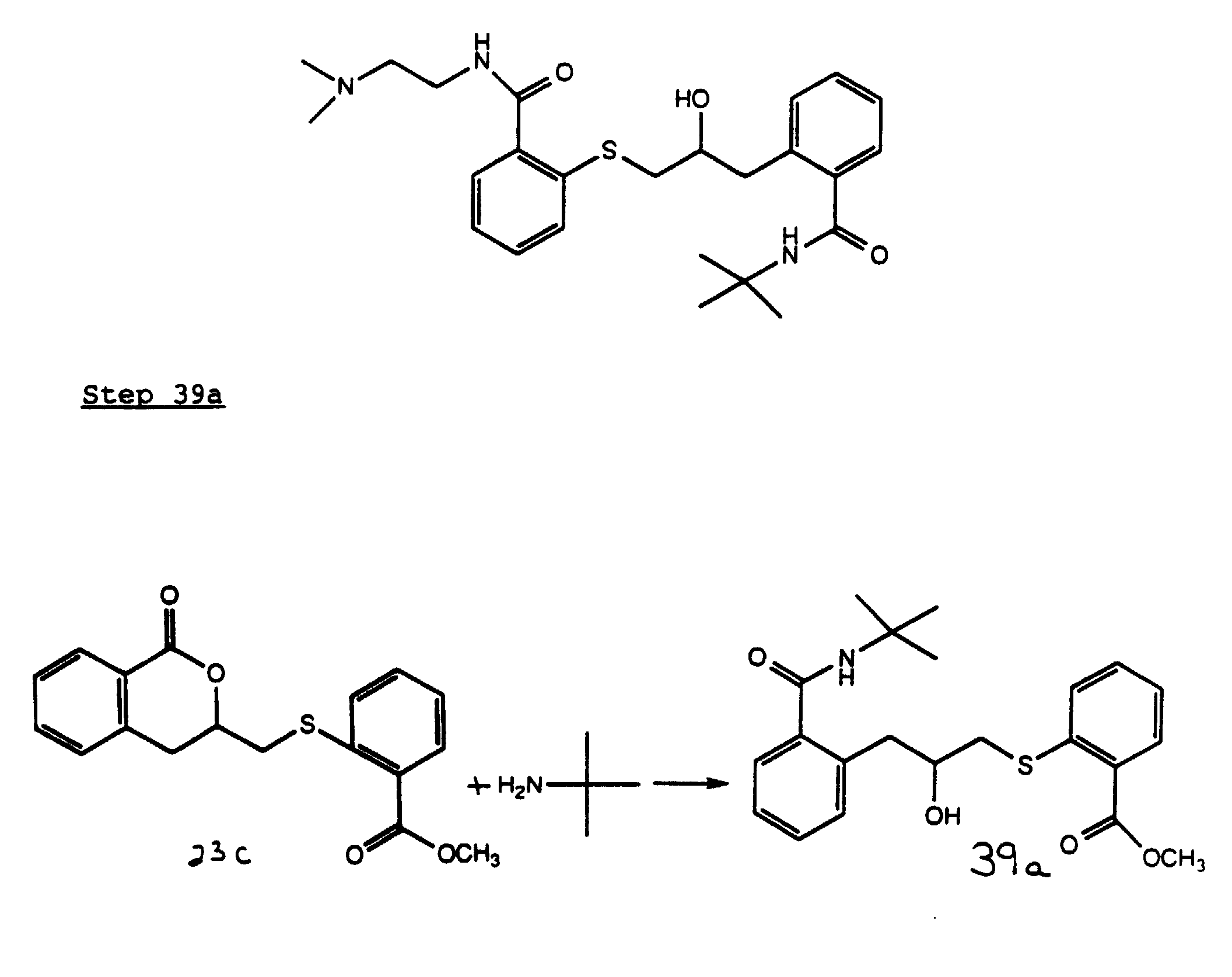
- To a solution of 0.13 ml (1.237 mmol) of t-butylamine in 2 ml of benzene at 0°C was added 0.6 ml (1.2 mmol) of trimethylaluminum. The solution was warmed to room temperature and stirred for 1 hour at which time 0.2 g (0.608 mmol) of compound 23c in 2 ml of benzene was added. After 4 hours, the reaction was warmed to 40°C; after 2 more hours, TLC indicated the reaction about 90% complete. The reaction mixture was then allowed to cool to room temperature overnight and the reaction was complete by morning. The mixture was then poured into 0.5N HCl, extracted twice with ethyl acetate, dried over MgSO4 and concentrated under vacuum. Purification by flash chromatography (10% ethyl acetate/methylene chloride) yielded 0.165 g (68%) of a yellow-white solid. Structure was confirmed by NMR.

- To a solution of 0.05 gm (0.124 mmol) of compound 39a and 0.3 ml (0.273 mmol) of N-N-dimethylethylenediamine in 2 ml benzene at 0°C was added 0.125 ml (0.25 mmol) of trimethylaluminum. The mixture was warmed to room temperature and stirred for 1 hour. A solution of 0.05 gm of compound 39a in 1 ml of benzene was added and the mixture was heated to reflux for about 2 hours. At this time, it was poured into 10 ml of water and extracted twice with 50 ml portions of ethyl acetate, then dried over MgSO4, and concentrated under vacuum. Crude weight of product was 0.064 gm, which was purified by flash chromatography (10% methanol/ methylene chloride) yielding 0.448 gm (78%) of a white solid. Structure of the product was confirmed by NMR.
- Preparation of

- To a solution of 0.42 ml (0.251 mmol) of N-N-dimethylneopentyldiamine in 2 ml of benzene at 0°C was added 0.125 ml (0.25 mmol) of trimethylaluminum. The solution was warmed to room temperature and stirred for 1 hour at which time 0.05 g (0.124 mmol) of compound 39a in 1 ml of benzene was added. The mixture was heated to reflux for about 1 hour and worked up as described for example 39, step b. Purification was effected by flash chromatography, using 8% methanol/methylene chloride. Yield was 0.058 gm (87%) of the product as an oil which solidified after pumping down. The structure was confirmed by NMR.
- Preparation of

- To a solution of 0.0366 g (0.083 mmol) of compound 23 in 0.5 ml of DMSO at room temperature was added 0.1 g (0.151 mmol) of 85% potassium hydroxide solution and 0.1 ml (1.61 mmol) of iodomethane. The reaction mixture was stirred for about 30 minutes then diluted with ethyl acetate, washed twice with water, dried over MgSO4 and concentrated. Purification by flash chromatography (40% ethyl acetate/hexane) yielded 0.33 g (88%) of a white solid. Structure was confirmed by NMR.
- Preparation of

- A solution was prepared of 0.56 ml (1.12 mmol) of trimethylaluminum and 0.1 ml (1.15 mmol) of morpholine in 2 ml of toluene at 0°C. The solution was warmed to room temperature and stirred for 1 hour at which point 0.091 g (0.0225 mmol) of compound 39a in 2 ml of toluene was added. The reaction mixture was heated to reflux for 45 minutes whereupon all starting material had been consumed. The mixture was cooled, poured into water, extracted three times with a total of 100 ml of ethyl acetate, dried over MgSO4 and concentrated under vacuum. The yield was 0.118 g of crude material. Purification by flash chromatography (40% ethyl acetate/hexane) yielded 49 mg of a first product and 35 mg of a second product. Both were yellow-white foams. The products were vacuum pumped overnight and NMR confirmed that the second product was the desired compound.
- Preparation of

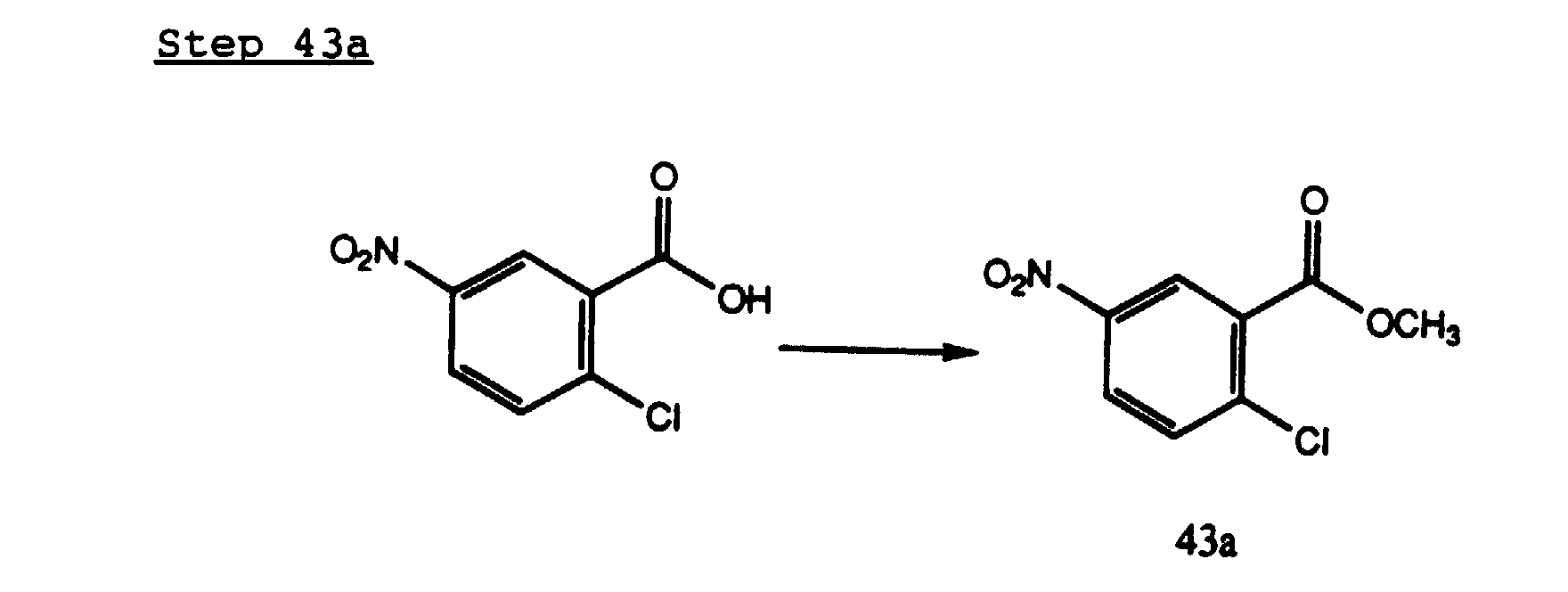
- A mixture of 10 g (50 mmol) of 1 chloro-4-nitrobenzoic acid in 100 ml of 3% HCl in methanol was stirred at room temperature for 1 hour then heated to reflux for a total of 5 hours. At this time the reaction was substantially complete. It was cooled and concentrated under vacuum to a yellow white solid which was dissolved in ethyl acetate, washed sequentially with saturated NaHCO3, water and then brine. The extract was dried over MgSO4, concentrated under vacuum to 9.2 g (45 mmol, 85%) of a white solid. Structure of the solid was confirmed by NMR.

- A solution of 5 g (23.2 mmol) of compound 43a in 50 ml of DMSO was reacted with NaSH at 50° C. A large quantity of solid formed. An additional 20 ml of DMSO was added and the reaction mixture was heated to 80° C. A dark brown mixture was formed and after 6 hours TLC indicated that all of the starting material had been consumed. The mixture was allowed to cool slowly and was stirred over a weekend. A brown sludge was poured slowly into water while stirring, yielding a yellow precipitate. The precipitate was filtered out, dissolved in hot ethyl acetate, reduced under vacuum to 400 ml volume, then purified by flash chromatography (10% ethyl acetate/40% hexane/methylene chloride). No separation occurred and the material was chromatographed once again using 20% hexane/methylene chloride. A yield of 1.75 g (36%) of the disulfide product was recovered. The structure was confirmed by NMR.
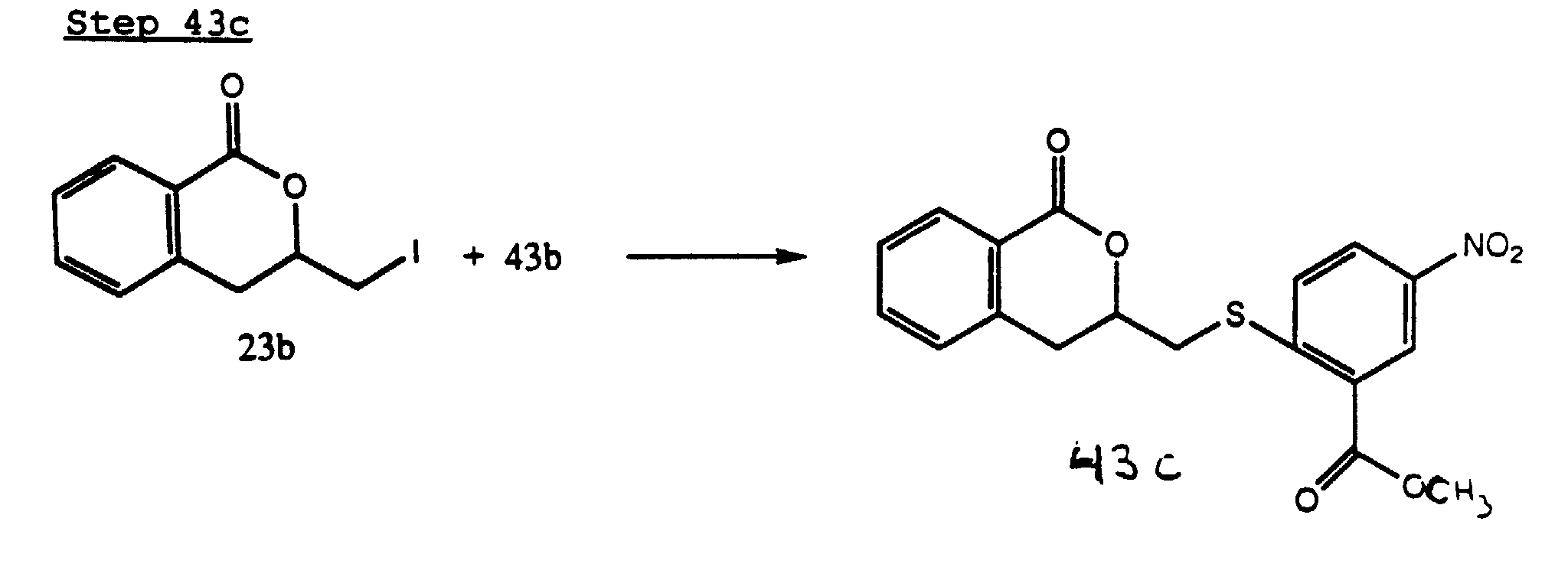
- A solution was prepared of 1.54 g (3.63 mmol) of compound 43b in 40 ml of DMF with heating. The solution was then cooled in an ice bath. Sodium hydroxide was added, whereupon the solution turned dark red. It was stirred for one hour at room temperature. The solution was then cooled to 0° and 2.16 g (7.5 mmol) of compound 23b in 5 ml of ethanol was added and the reaction mixture was warmed to room temperature. After two hours of stirring, TLC showed all compound 43b had reacted. The mixture was poured into 1N HCL and extracted twice with ethyl acetate. The organic layers were washed sequentially with water and brine, dried over MgSO4 and concentrated under vacuum. A crude weight of 4 g was recovered and purified by flash chromatography, in 33% yield, using methylene chloride. NMR confirmed the structure except that an ester interchange had taken place and the ester was now the ethyl ester.
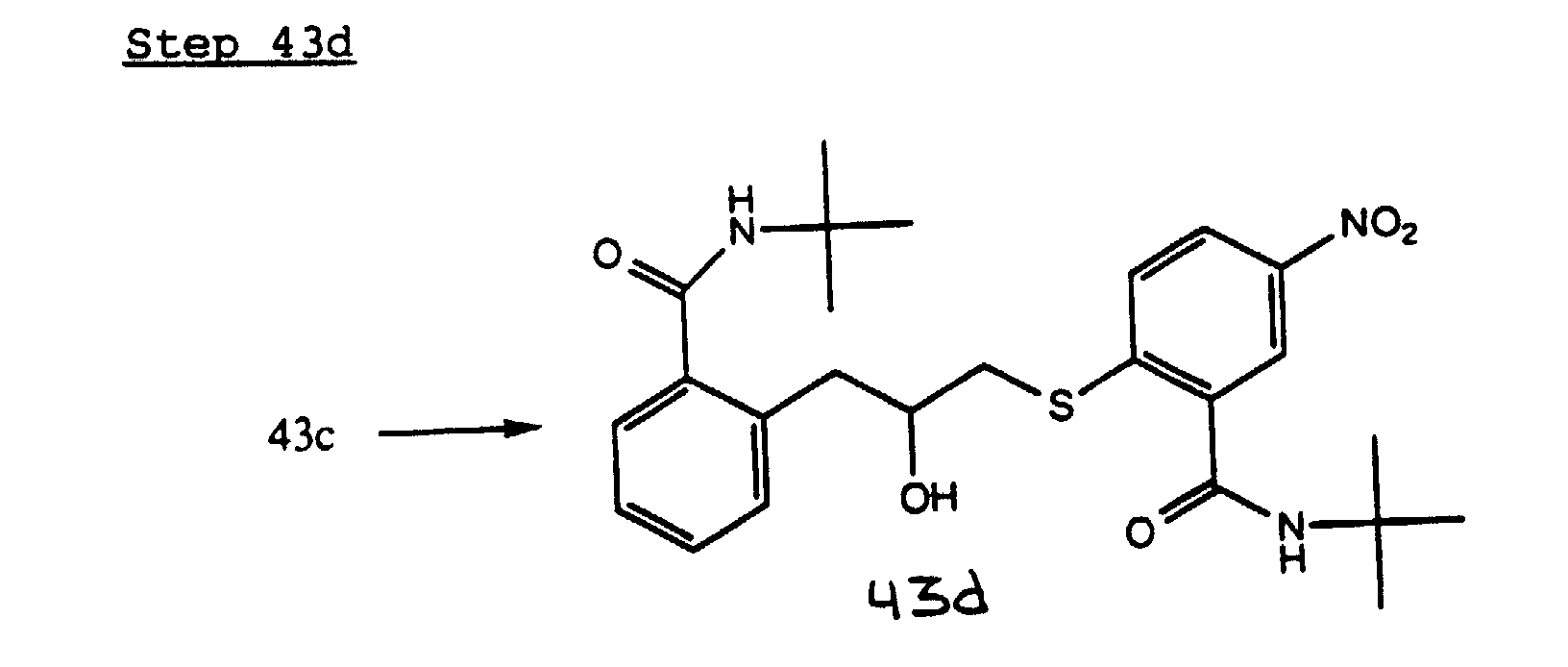
- To a solution of 0.63 ml (1.26 mmol) of trimethylaluminum in 2 ml of toluene at 0°C was added 0.13 ml (1.24 mmol) of t-butyl amine. The temperature was increased to room temperature and the mixture was stirred for 1 hour. Compound 43c (0.94 gm/0.225 mmol) in toluene was added and the mixture was heated to reflux. After 15 minutes, TLC indicated that all compound 43c had been consumed forming two products. After another 30 minutes of heating, the reaction was complete. The reaction mixture was poured into water, extracted twice with ethyl acetate, dried over MgSO4 and concentrated under vacuum. Purification by flash chromatography (50% ethyl acetate/methylene chloride) yielded 0.63 gm (51%) of product. The structure was confirmed by 'HNMR.
- Preparation of
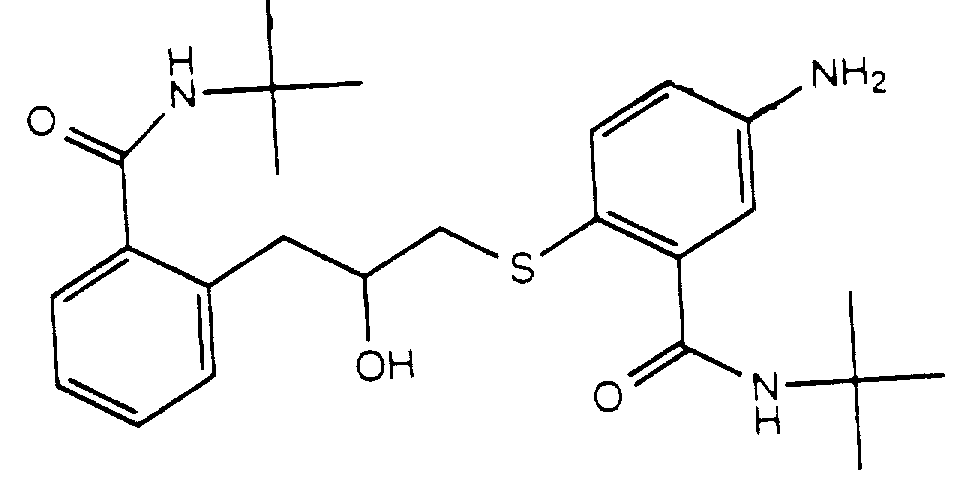
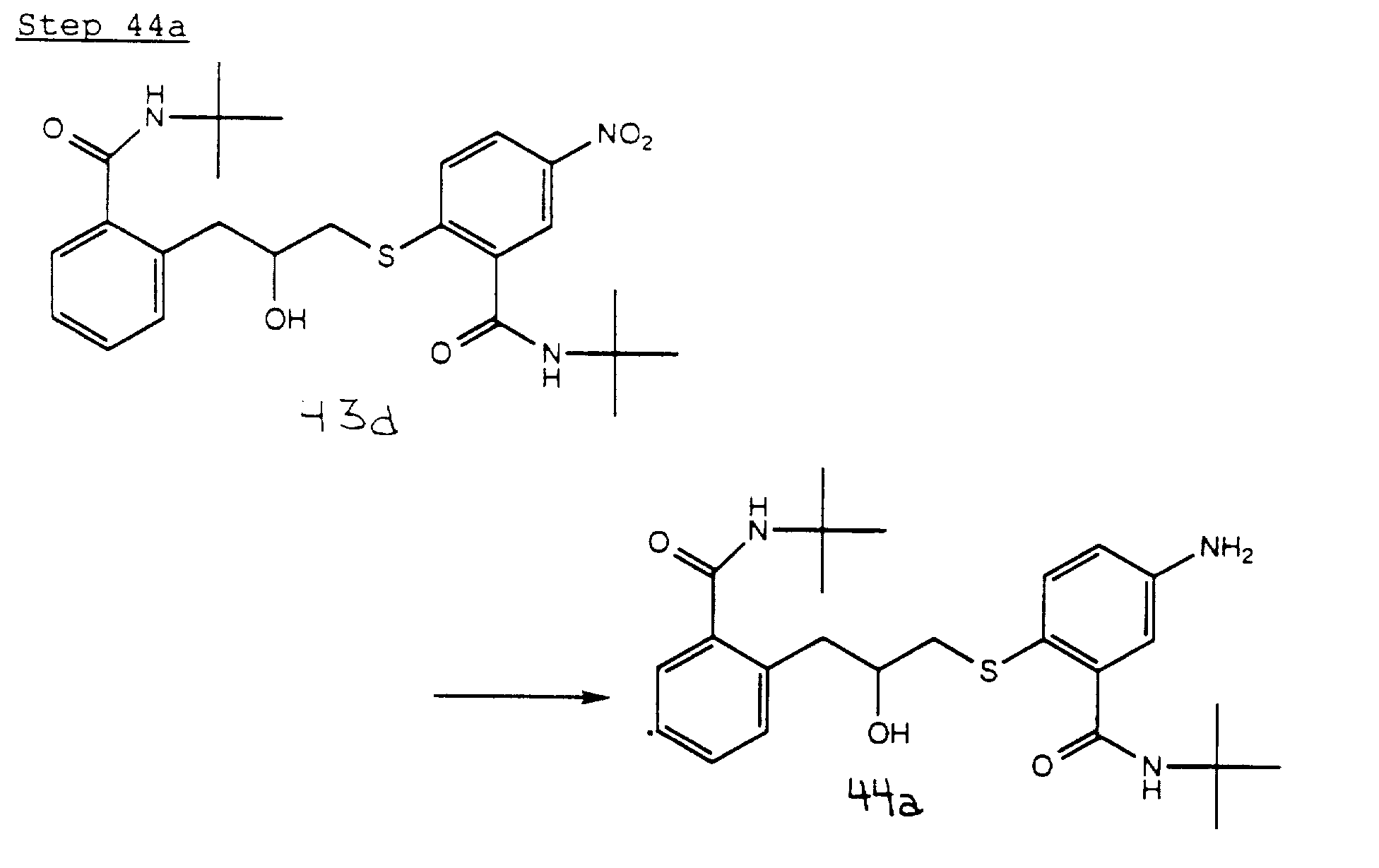
- A solution of 0.03 g (0.061 mmol) of compound 43d in 2 ml of glacial acetic acid was treated with 20 mg of metallic zinc at room temperature. No reaction was noted after one hour so an additional 20 mg of zinc was added. The reaction was complete after 1.5 additional hours. The product was filtered through Celite, concentrated under vacuum, dissolved with ethyl acetate, washed with saturated NaHCO3, dried over MgSO4 and concentrated by vacuum. Purification by flash chromatography, using 50% ethyl acetate/hexane, yielded 7.6 mg of product. Structure was confirmed by NMR.
- Preparation of

- A solution of 0.37 g (0.082 mmol) of compound 44a and 17 microliters of pyridine in 0.5 ml of methylene chloride was cooled to -15°C and reacted with 0.18 gm (0.103 mmol) of 3-pyridine carboxylic acid chloride hydrochloride salt. After 30 minutes, clean conversion to a more polar product had taken place. The reaction mixture was poured into water, extracted twice with ethyl acetate, washed with water, then brine and dried over MgSO4. The extract was concentrated under vacuum to yield 30 mg of a yellow solid. The yellow solid was purified by flash chromatography (5% methanol/ methylene chloride) yielding 0.27 gm (59%) of a yellow white solid. The structure was confirmed by NMR.
- Preparation of
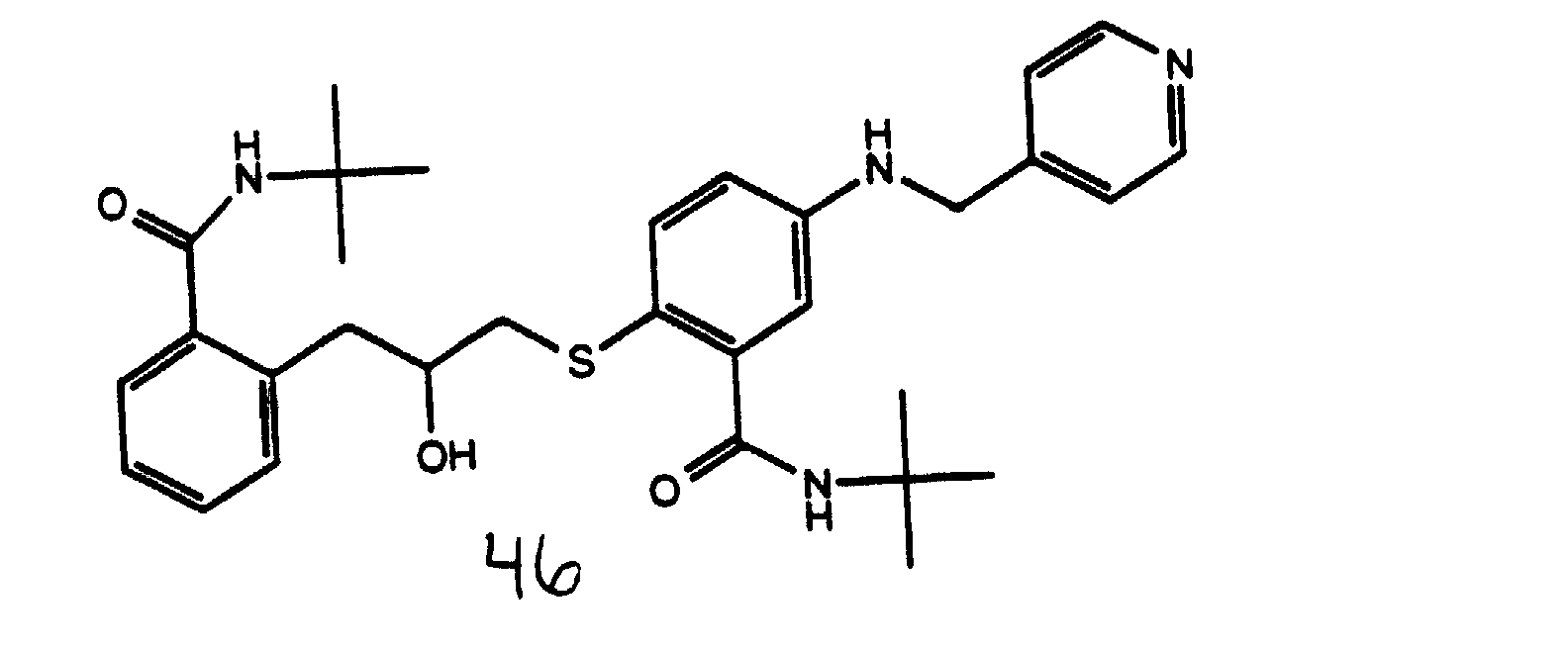
- A solution of 0.5 g (0.108 mmol) of compound 44a, 10 µl of 4-pyridine-carboxaldehyde (0.105 mmol) in 1 ml of methanol and 0.5 ml of 6% hydrochloric acid in methanol was treated at room temperature with NaCNBH3 and was allowed to stir overnight. By morning, a small amount of a polar compound had formed but the mixture was still mostly starting material. An additional 20 µl (2 equivalents) of the 4-pyridine-carboxaldehyde was added and the reaction was allowed to continue stirring at room temperature. After 4 additional hours, TLC indicated that all starting material had been consumed and 2 polar products had been formed. After one more hour of stirring, the reaction mixture was poured into 1N NaOH and extracted twice with ethyl acetate. The extract was dried over Na2SO4 and concentrated under vacuum. Flash chromatography using ethyl acetate yielded 29 mg of a first fraction and 14 mg of a second fraction. NMR confirmed the structure of the larger fraction to be the desired compound. This product was repurified by flash chromatography (3% methanol/methylene chloride) yielding 7 mg of the pure product. NMR confirmed the structure.
- Preparation of
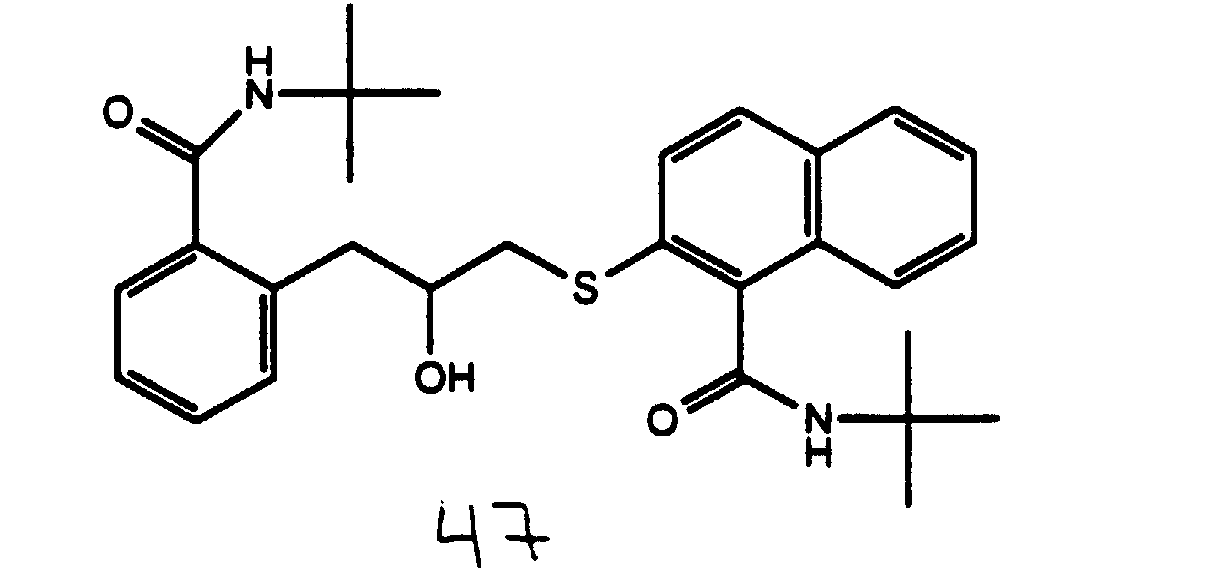
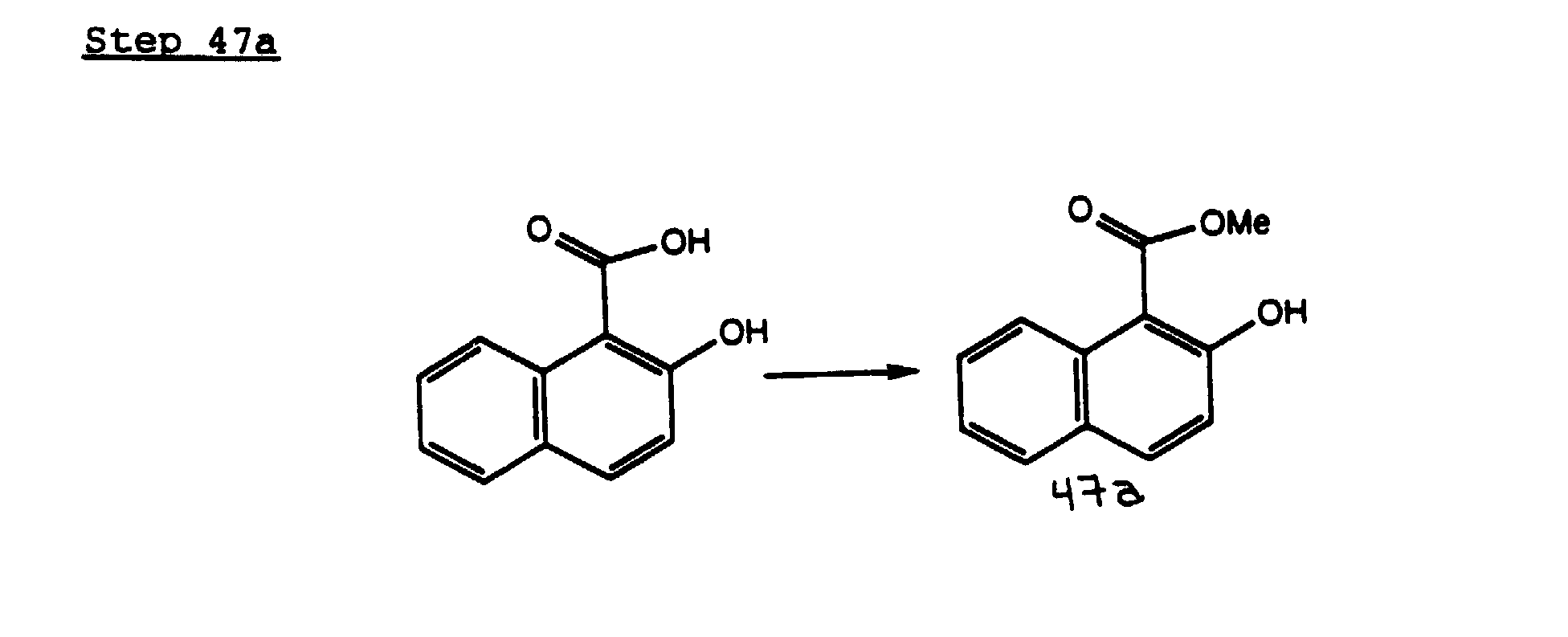
- A solution of 10 g (53 mmol) of 2-hydroxy-naphthalene carboxylic acid in 200 ml of ethanol was added, dropwise, to a solution of excess diazomethane in ether at -5°C. Additional starting material (7.18 g) was added to kill the excess diazomethane. Acetic acid was added, the reaction mixture was diluted with ether and extracted with sodium hydroxide solution at a pH of about 8 to 9. The extract was washed with ether and brine, treated with charcoal and dried over MgSO4. Concentration under vacuum yielded 18 g of crude light yellow solid. Structure of this material was confirmed by NMR. The product was then recrystallized from ether/ hexane yielding a total of 14.94 g (82%).

- A solution of 2 g (9.915 mmol) of compound 47a in 15 ml of DMF was cooled to 0°C and 0.40 g of sodium hydride was slowly added. Gas was evolved and the mixture was stirred for 5 minutes then warmed to room temperature. After ten minutes another 5 ml of DMF was added. The solution was then cooled to 0°C and 1.61 gm of N,N-dimethyl-thio-carbamoyl chloride was added. The mixture was stirred 5 minutes and then warmed back to room temperature. After one hour, the reaction was indicated by TLC to be about 90% complete. The temperature was raised to 50° and the reaction was complete after one more hour. The reaction mixture was poured into ether, extracted with 1N NaOH then with brine. The aqueous layers were then extracted again. The extracts were washed with 1N HCl and dried over MgSO4. The mass was then concentrated under vacuum to about 200 ml and 1.64 gm of a white solid was filtered off. The filtrate was also collected and concentrated under vacuum to 1.08 g of a yellow oil. The crude product was purified by flash chromatography (40% ethanol/hexane loaded on methylene chloride) yielding 0.23 g of a white solid. The 1.64 gms of white solid was also purified by flash chromatography yielding 1.55 gm. The two products were combined. NNR confirmed the structure.

- A mixture of 0.9 gm (3.11 mmol) of compound 47b in 25 ml of sulfolane was subjected to 2 freeze-pump-thaw cycles then heated to 180°C. After approximately 2 hours and 45 minutes of heating, TLC indicated that the reaction was complete and it was allowed to cool. The mixture was then poured into water, extracted twice with ether, washed twice with water, dried over MgSO4 and concentrated under vacuum. The yield was 0.901 g which was purified by flash chromatography in a 1:1 ethyl acetate/hexane. Some impurity remained and the chromatography was repeated yielding a total of 0.46 g (51%). NMR confirmed the structure of the product.

- A solution of 0.206 g (.711 mmol) of compound 47c in 8 ml of methanol was treated at room temperature with 0.35 ml of 10% aqueous sodium hydroxide. When no reaction was observed after 20 minutes, the material was warmed to 40°C for 30 minutes and stored cold overnight. Another ml of the 10% sodium hydroxide was added and the mixture was stirred at room temperature for one hour, at which time, the temperature was increased to 40°C for 3 additional hours. The mixture was then washed with 1N HCl and extracted with ethyl acetate. The reaction was repeated and the products from the two runs were combined and purified by flash chromatography (30% ethyl acetate/hexane) yielding 0.262 g (83%). The structure was confirmed by NMR.

- A solution of 0.08 g of potassium hydroxide in a mixture of 0.8 ml of water and 4 ml of ethanol was cooled to 0°C and a solution of 0.253 g of compound 47d in 1 ml of ethanol was added. The mixture was stirred for 20 minutes and then 0.324 g (1.125 mmol) of compound 23b and 1 ml of ethanol was added. The mixture was allowed to warm overnight. The reaction mixture was then poured into water, extracted twice with ethyl acetate, then washed with brine and dried over MgSO4. Concentration under vacuum yielded 0.381 g. The product was purified by flash chromatography (20% ethyl acetate/hexane) yielding 0.289 g (66%) of product. NMR confirmed the structure.

- To a solution of 0.66 ml (1.32 mmol) of trimethylaluminum in toluene at 0°C was added 0.14 ml (1.33 mmol) of t-butylamine. The mixture was warmed and stirred at room temperature for one hour, at which time a solution of 0.09 g (0.238 mmol) of compound 47e in 2 ml of toluene was added. The reaction mixture was heated to reflux for one hour, at which time, TLC showed complete conversion to a more polar product. The mass was cooled, poured into water, extracted twice with ethyl acetate and dried over MgSO4, yielding a crude weight of 0.118 g. This was purified by flash chromatography (40% ethyl acetate/hexane) yielding 0.089 g (76%) of a white solid. NMR confirmed the structure.
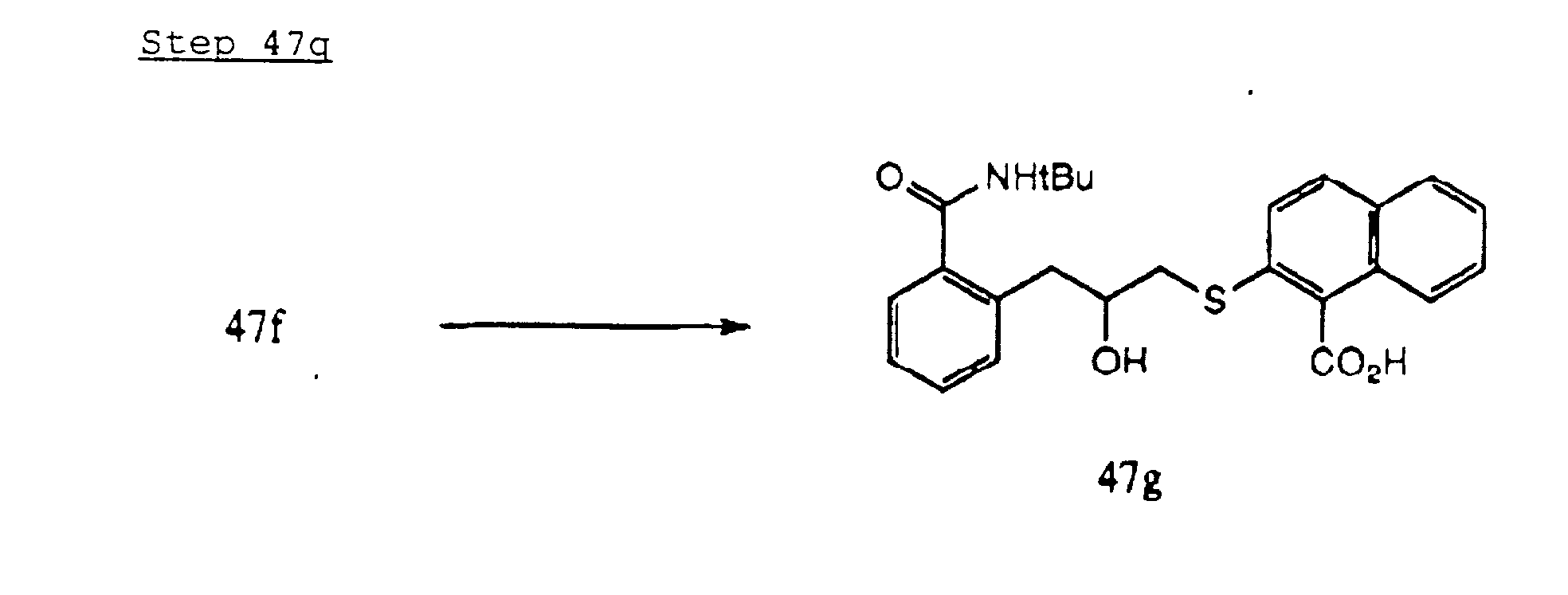
- A solution of 2.35 gm (5.2 mmol) of compound 47f in a mixture 60 ml of methanol and 30 ml of 3N NaOH was heated to 60°C and held at that temperature for about 2.5 hours. The reaction was allowed to cool and was then poured into water and extracted with ethyl acetate. The aqueous layer was acidified and extracted with ethyl acetate. The organic layers were dried over MgSO4 and concentrated. The product was purified by flash chromatography using 50% methanol/ methylene chloride, yielding 1.46 gm (64%) of compound 47g.

- A solution of .0937 gm of dicyclohexyl carbodiimide (DCC) in 4 ml of ethyl acetate was cooled to 0°C and 0.1979 gm of pentafluorophenol in 2 ml of ethyl acetate was added followed by 0.1254 gm of compound 47g. The reaction progressed until about 80% of compound 47g was esterified, at which time an additional 0.629 gm of the pentafluorophenol in 1 ml of ethyl acetate was added. After one hour, very little additional reaction had taken place. The mixture was filtered to remove DCC, washed 3 times with saturated Na2HCO3, dried over MgSO4, concentrated under vacuum. Purification by flash chromatography using 40% ethyl acetate/ hexane yielded 0.107 gm (59%) of the product as a white solid.

- A solution of 0.10 gm (0.168 mmol) of compound 47h in 3 ml of THF was cooled to 0°C and 50 µl (0.476 mmol) of t-butylamine was added. After ten minutes stirring, the mixture was warmed to room temperature for one hour, then heated to reflux for one hour, cooled to room temperature and stirred overnight. The mixture was reheated to reflux, 2 ml of DMF was added and stirring was continued for 24 hours. The mixture was then diluted in ethyl acetate, washed with H2O, then with 1N HCl, then with brine, dried over MgSO4 and concentrated under vacuum. The product was isolated by flash chromatography, yielding 8 mg (10%).
- Preparation of


- A solution of 6.31 g (1.3 mol) of the amidopyridine derivative in 5 ml of THF containing 0.3 ml of TMEDA was cooled to -78°C and 2.6 mmol of s-butyl lithium was added. A yellow color resulted. The mixture was stirred for 1.5 hours at-78°C. At this time 0.247 gm (0.649 mmol) of compound 9e in 7 ml of THF was added. A red/brown solution resulted. This solution was stirred at -78°C for one hour, then quenched with water, extracted with ethyl acetate and concentrated under vacuum. NMR confirmed the structure of the product contaminated with a small amount of residual amidopyridine derivative.
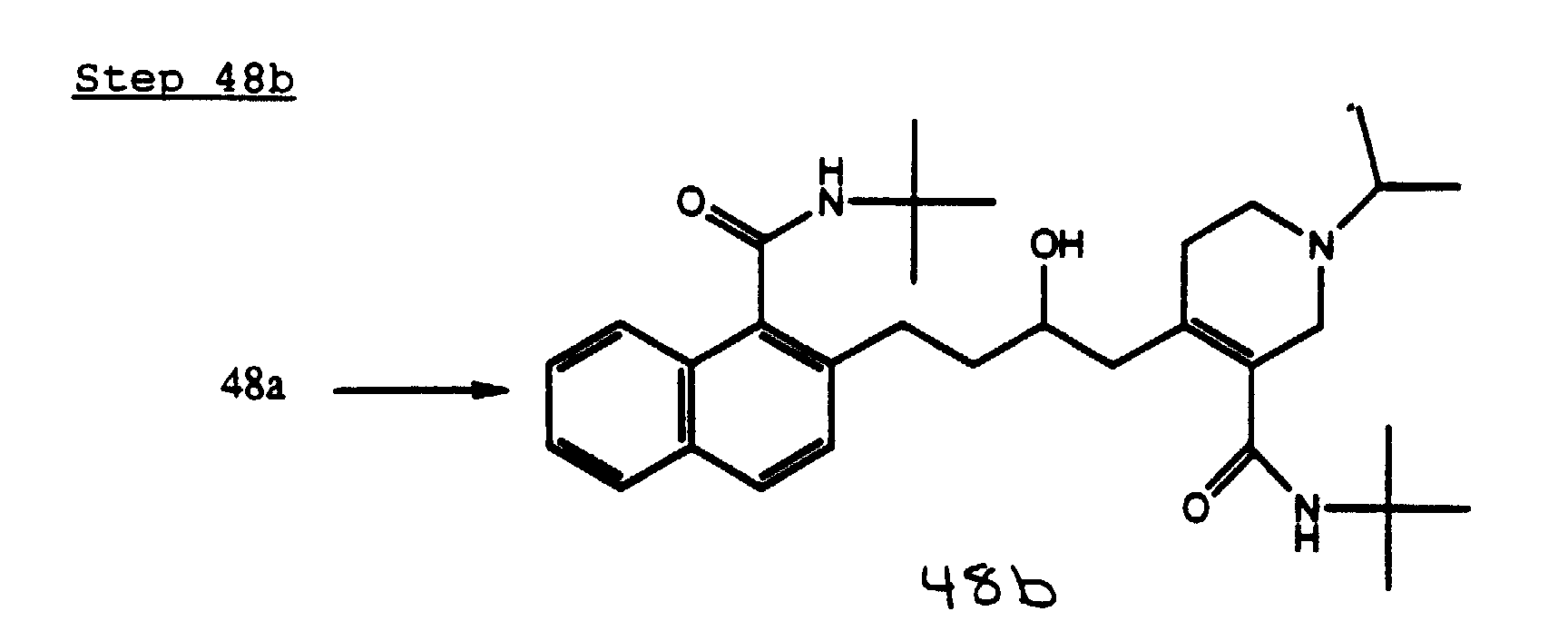
- To a solution of 0.39 g (0.69 mmol) of compound 48a in 3 ml of methanol was added 30 mg of NaBH4. The mixture was stirred at room temperature for two hours and methanol was stripped off under vacuum. The compound was dried over MgSO4. Purification by flash chromatography (15% ethyl acetate/methylene chloride/1% methanol) followed by precipitation with ether yielded 0.02 gm of the product.
- Preparation of

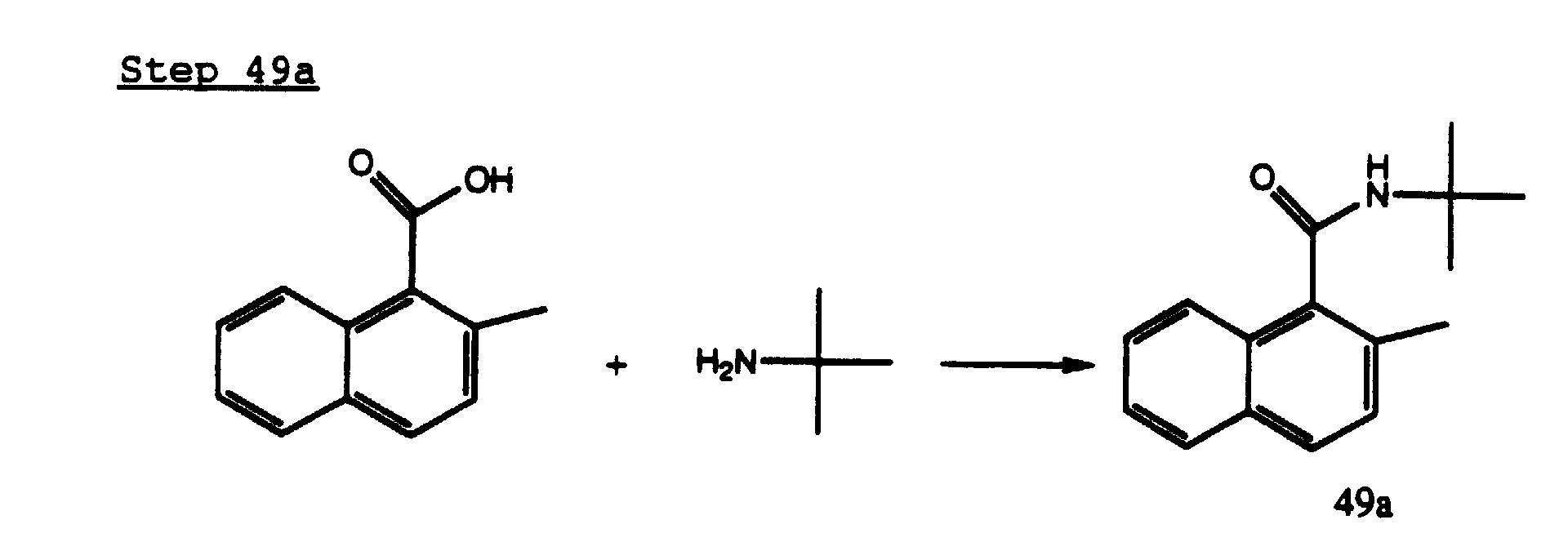
- About 2.2 gm (11.82 mmol) of 2-methyl-1-naphthoic acid was partially dissolved in 30 ml of benzene and the solution was cooled to 0°C. To the cold solution was added 1.34 ml (15.37 mmol) of oxalyl chloride and one drop of DMF. Vigorous bubbling resulted when the solution was warmed to room temperature. Then the temperature was raised to near reflux for a total of 1 hour. TLC indicated fair amount of residual starting material remaining so another equivalent of oxalyl chloride and DMF was added. The temperature was raised back to reflux and allowed to reflux for 20 minutes. The reaction mixture was then concentrated under vacuum to an orange solid. The material was partially redissolved in 30 ml of methylene chloride and 2.73 ml of t-butyl amine was added. Reaction then proceeded cleanly but was allowed to continue overnight. The mass was washed with water and ethyl acetate and purified by flash chromatography using a 4:1 hexane/ether mixture. Yield was 2.6 gm (92%). Structure was confirmed by NMR.

- A solution of 1.2 g of compound 49a and 15 ml of THF was cooled to -78°C and 11.7 ml of s-butyl lithium was added. The solution was stirred for 1.5 hours, at which time 1.14 g (4.97 mmol) of S-glycidyl tosylate was added. The reaction mix was stirred for one half hour at -78°C, then quenched with NH4Cl, extracted with ethyl acetate and washed with water followed by brine and dried over MgSO4. The extract was then concentrated on 7 ml of Florisil and purified by flash chromatography (20% THF/hexane). The yield was 0.75 g of product (51%). Structure was confirmed by NMR.

- To 0.459 g (2.02 mmol) of N-(t-butyl)naphthamide at -12°C was added 4 ml of s-butyl lithium, and the mix was warmed to 0°C and stirred for 45 minutes. A solution of 0.3 g (1.01 mmol) of compound 49b in 10 ml of THF was added. The red solution turned to a milky yellow/brown. In about 18 minutes following addition of compound 49b, 80% of the compound had been consumed. The reaction was then quenched with saturated NH4Cl and extracted with ethyl acetate. The material was purified by flash chromatography in a 1:1 hexane/ ethyl acetate. The mass was then concentrated on 7 ml of Florisil, and subjected again to flash chromatography using THF/hexane. A total of about 0.16 g of product was recovered. NMR confirmed the structure.
- Preparation of
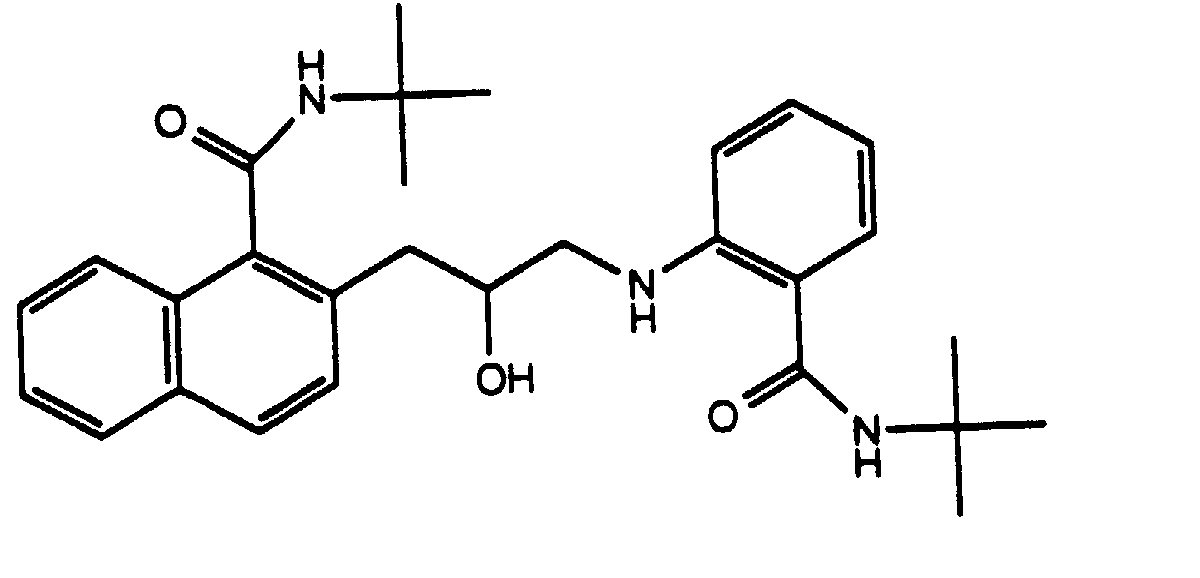
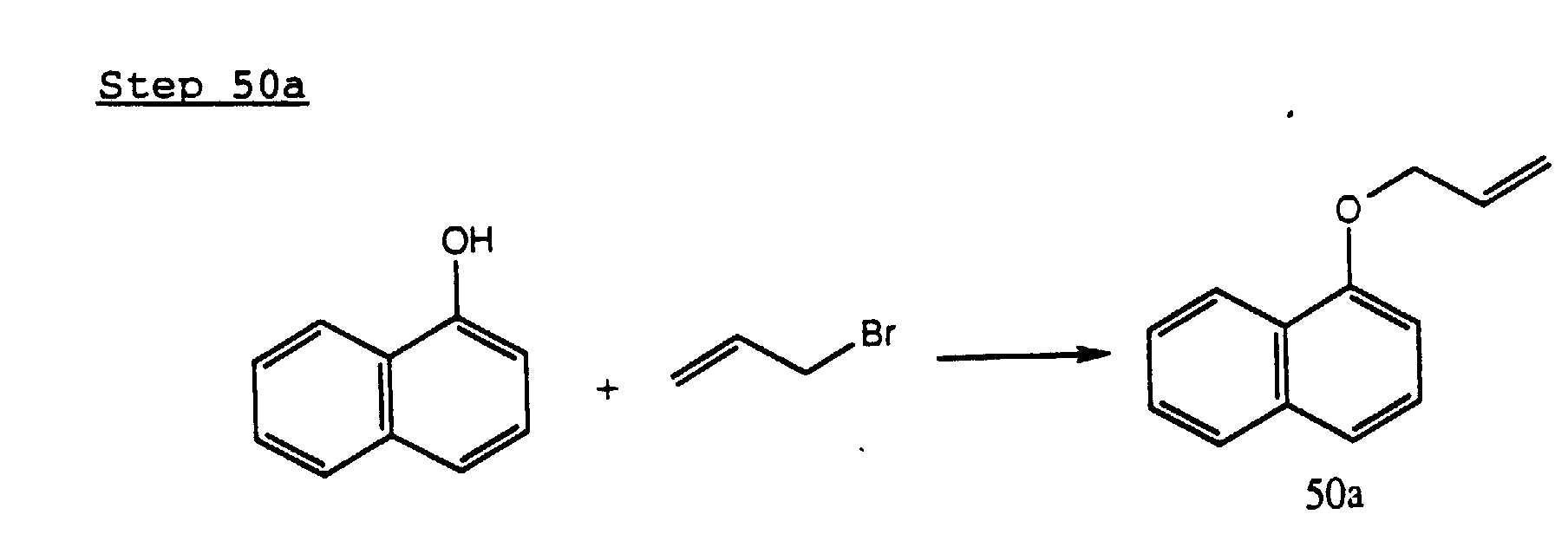
- To a solution of 1 naphthol in 100 ml of acetone was added 13.7 g of K2CO3, then 6.6 ml (76.29 mmol) of allyl bromide. The solution was heated to reflux for four hours, at which time TLC indicated the reaction to be about 80% complete. Another 3.3 ml of allyl bromide was added and the solution was refluxed mildly overnight. The reaction mass was then filtered and concentrated under vacuum, yielding 13.7 g (98%) of product. Structure was confirmed by NMR.

- A solution of 16.32 g of compound 50a in 125 ml of N,N-dimethyl aniline was heated to reflux under an argon atmosphere. Reflux was continued for four hours, at which time TLC showed the reaction to be complete. The reaction mixture was allowed to sit overnight at room temperature, then poured into 100 ml of 3N HCl and then 200 ml of ether were added. The organic layer was separated, washed six times with 100 ml portions of 3N HCl and then four times with 200 ml of 1N HCl. The extract was then washed with four 200 ml portions of water and dried on MgSO4. The dried product was distilled through a short path column at 130°C under an atmosphere of argon. Yield was 15.58 gm of an orange oil which solidified upon standing.
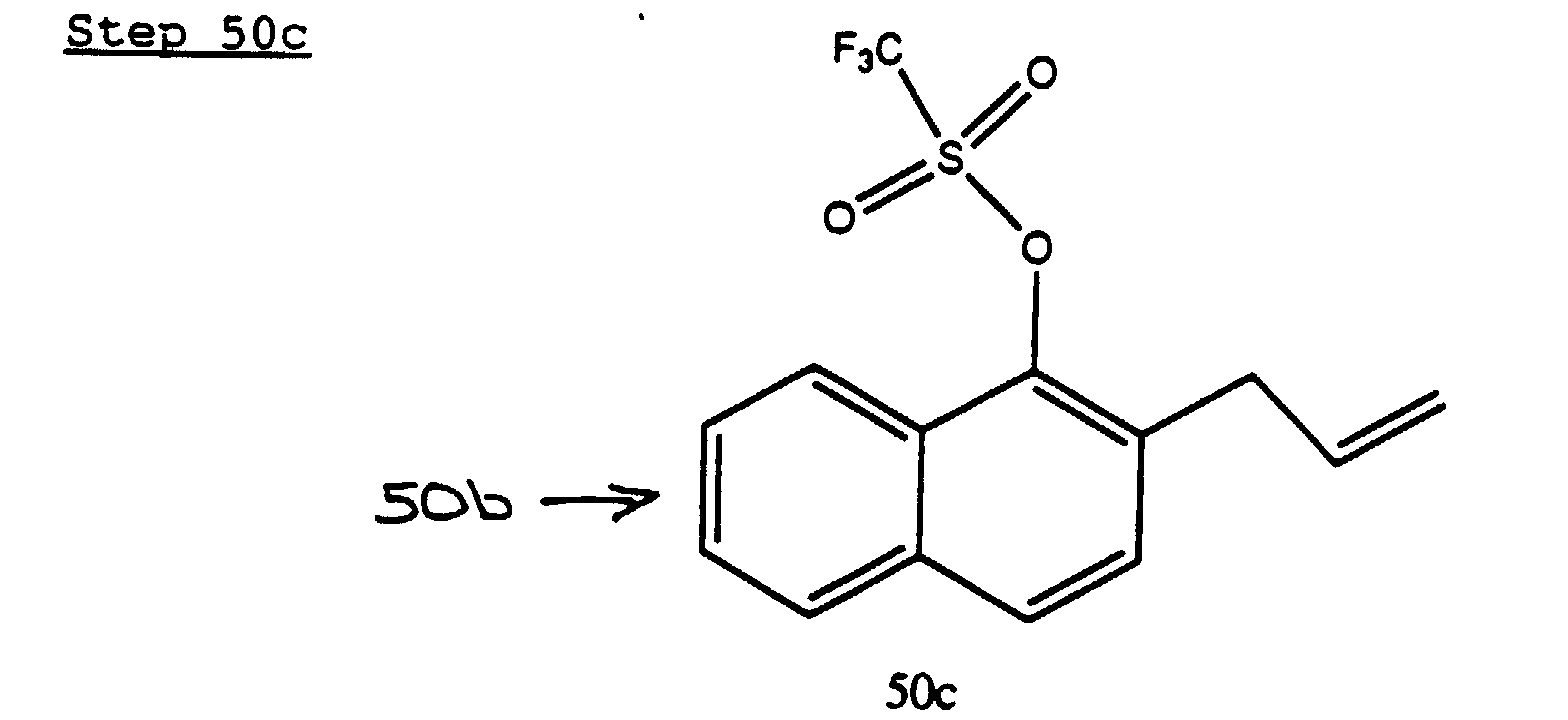
- A solution of 4.1 gm (22.26 mmol) of compound 50b in 50 ml of methylene chloride was cooled to 0°C and 1.89 ml of pyridine was added, followed by dropwise addition of 6.6 g (23.37 mmol) of triflic anhydride. The reaction mixture was stirred for 6 hours, while allowing the temperature to rise from 0°C to room temperature. The mass was poured in 100 ml of 1N HCl and extracted with methylene chloride. The extracts were washed with saturated NaHCO3, then concentrated on 20 ml of Florisil. Flash chromatography using a 20:1 hexane/ethyl acetate yielded 5.60 gm of product.
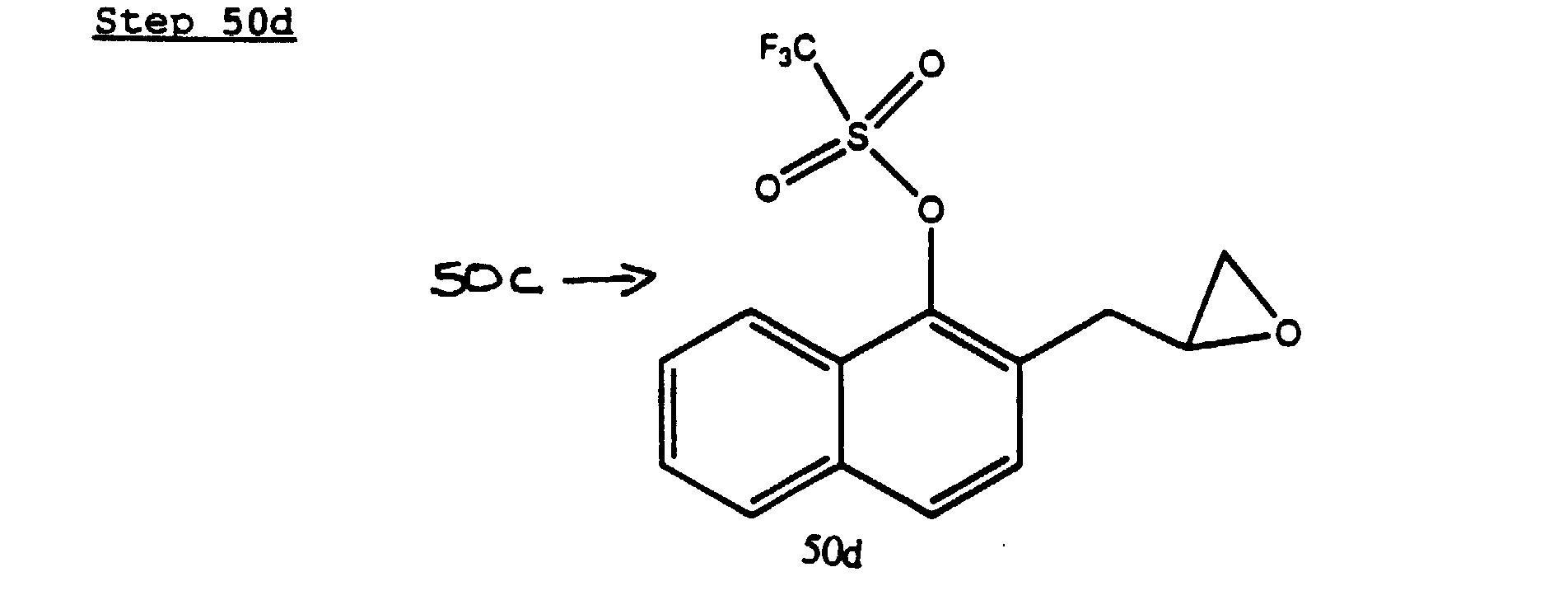
- A solution of 5.6 gm (17.7 mmol) of compound 50c in 60 ml of methylene chloride was cooled to 0°C and 6.11 g of m-chloro-perbenzoic acid (MCPBA) was added. The mixture was stirred for 30 minutes at 0°C, then at room temperature for 5 hours at which time another 1.3 g of MCPBA was added and the solution, warmed to 35°C and allowed to stir overnight. The mixture was then poured into 0.5N NaOH, extracted with two 50 ml portions of methylene chloride, washed, dried and filtered through silica gel, then concentrated under vacuum. Flash chromatography in an 8:1 hexane ethyl acetate mixture yielded 5.4 g of product. The structure was confirmed by NMR.

- A mixture consisting of 1.41 gm (4.42 mmol) of compound 50d, 0.068 gm of palladium (II) acetate, 0.125 gm of 1,3-bis diphenylphosphino propane (DPPP), 1.4 ml of triethyl amine, 15 ml of DMSO and 10 ml of methanol was prepared and heated to 75°C under a carbon monoxide atmosphere. Heating was continued for three hours at which time an additional 17 mg of the palladium acetate and 35 mg of DPPP was added. The mass was heated at 70°C overnight, at which time TLC indicated that the reaction was finished. The mass was poured into 50 ml of water, then into 50 ml of saturated NH4Cl and extracted with ethyl acetate followed by washing with NaHCO3 and brine. Flash chromatography in 4:1 hexane/ethyl acetate yielded 0.25 g (24.3%) of product. Structure was confirmed by NMR.

- To a solution of 0.255 g (1.053 mmol) of compound 50e, 0.353 g of magnesium perchlorate in 3.5 ml of acetonitrile, was added 0.204 ml (1.58 mmol) of 2-amino methyl benzoate. The mixture was stirred overnight at room temperature, then poured into water, extracted with ethyl acetate, then concentrated in 3 ml of Florisil. Flash chromatography in 1:1 hexane/ether solution yielded 0.25 g of a white sticky foam.

- A solution of 2.34 ml of trimethyl aluminum in 4 ml of toluene was cooled to 0°C and .504 ml (4 mmol) of t-butyl amine was added and the mixture was stirred for one hour at room temperature. After an hour, 0.23 g (.0585 mmol) of compound 50f in 3 ml of toluene was added, dropwise, and the solution was heated to 95°C for about 2.5 hours. Temperature was reduced to 65°C and stirring was continued for 4 more hours at which point the heat was turned back up to 120°C and continued at that temperature for a total of 22 hours. The reaction mixture was poured into 1N HCl and then extracted with ethyl acetate, washed with water and concentrated on 3 ml of Florisil. Flash chromatograph yielded 0.075 gm (80%) of product. Structure was confirmed by NMR.
- Preparation of compound 50 by alternate route.


- A solution of 0.068 g (0.205 mmol) of compound 50d and 0.046 g of magnesium perchlorate in 1 ml of acetonitrile was prepared. At room temperature, 26 microliters (0.205 mmol) of 2-amino-methyl benzoate was added. The mixture was stirred at room temperature for one hour at which time another 13 µl of the 2-amino-methyl benzoate was added and another 0.024 g of magnesium perchlorate. The reaction mixture was stirred overnight at room temperature, after which the solution was warmed to 45°C and stirred for 4 more hours. The reaction mix was poured into water, extracted with ethyl acetate, then washed with brine. After concentration on 2 ml of Florisil, the mixture was purified by flash chromatography (hexane/ethyl acetate), yielding 0.068 g (68.7%) of product. NMR confirmed the structure.

- Under a carbon monoxide atmosphere, a mixture consisting of 0.068 g of compound 51a, 3 mg of palladium (II) acetate, 4 mg of DPPP, 70 µl of triethyl amine, 1 ml of DMSO, 0.6 ml of methanol and 250 µl of 1,2-dichloroethane was heated under a carbon monoxide atmosphere to about 65°C for three hours and then for one more hour at 70°C. The reaction mixture was poured into dilute HCl and extracted with ethyl acetate, washed with NaHCO3 and brine and dried over MgSO4, then filtered through Celite and concentrated on 3 ml of Florisil. Flash chromatography in a 3:2 hexane/ether yielded about 0.06 g of a white solid product. NMR confirmed the structure.
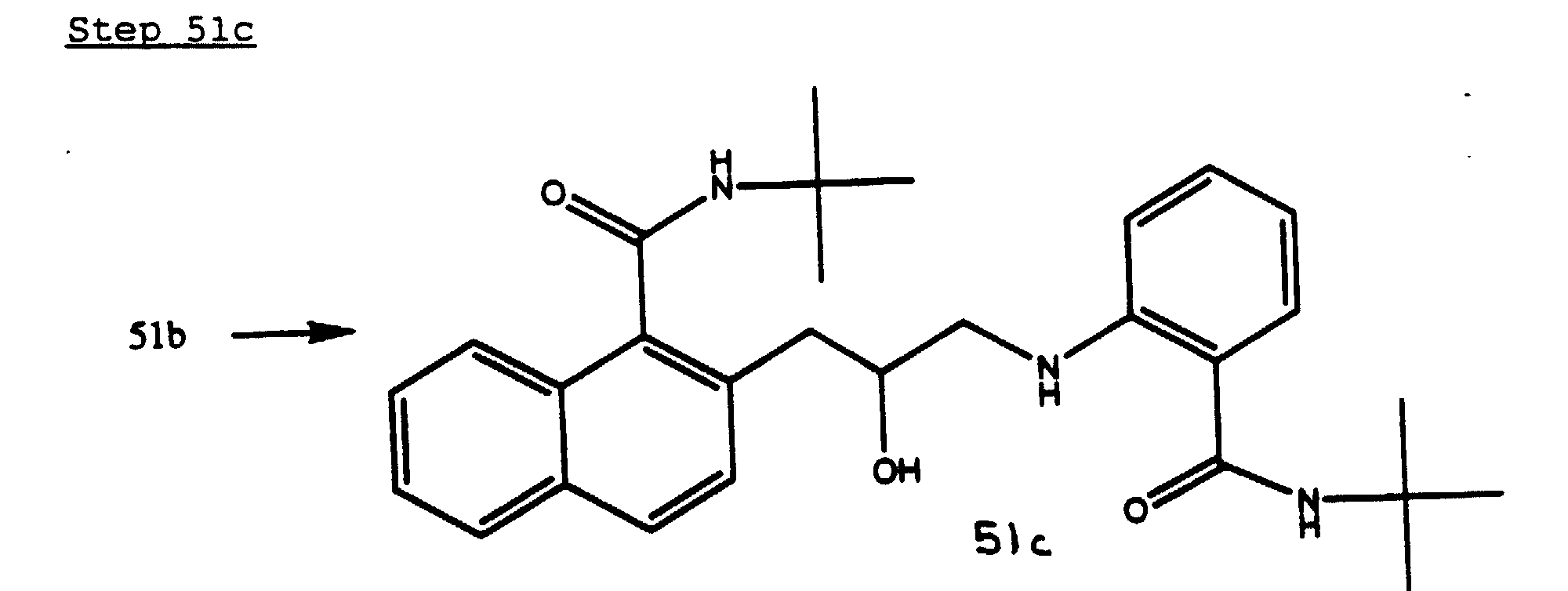
- To 0.44 ml of a 2.OM solution of trimethyl aluminum in toluene at 0°C was added 95 microliters (0.904 mol) of t-butyl amine. The mixture was stirred for one hour at room temperature, at which time a solution of 0.04 g of compound 51b in 2 ml of toluene was slowly added. The mixture was heated at 95°C for 45 minutes, at which time TLC indicated that the reaction was essentially complete. The solution was then refluxed mildly for three hours. Following reflux, the solution was poured into dilute HCl, extracted with ethyl acetate, and washed with water and brine. Following concentration on 2 ml of Florisil, the product was purified by flash chromatography in a 3:2 ethyl hexane solution. Structure was confirmed by NMR.
- Preparation of
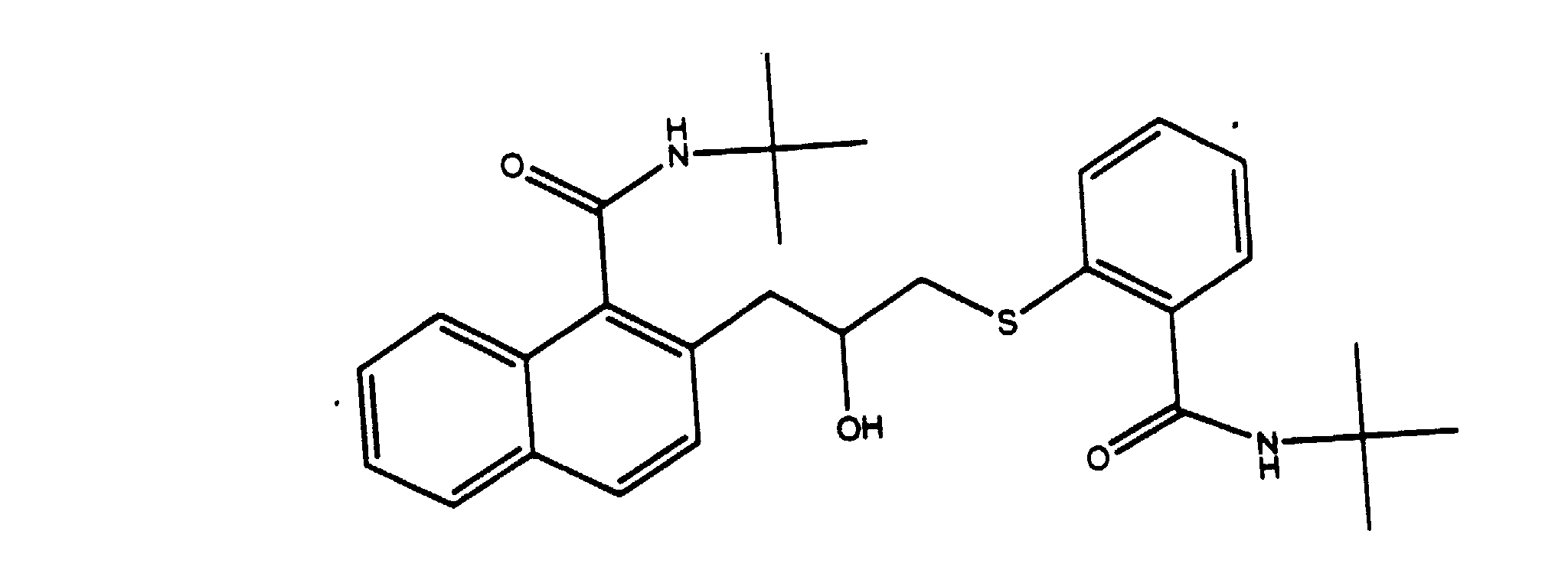
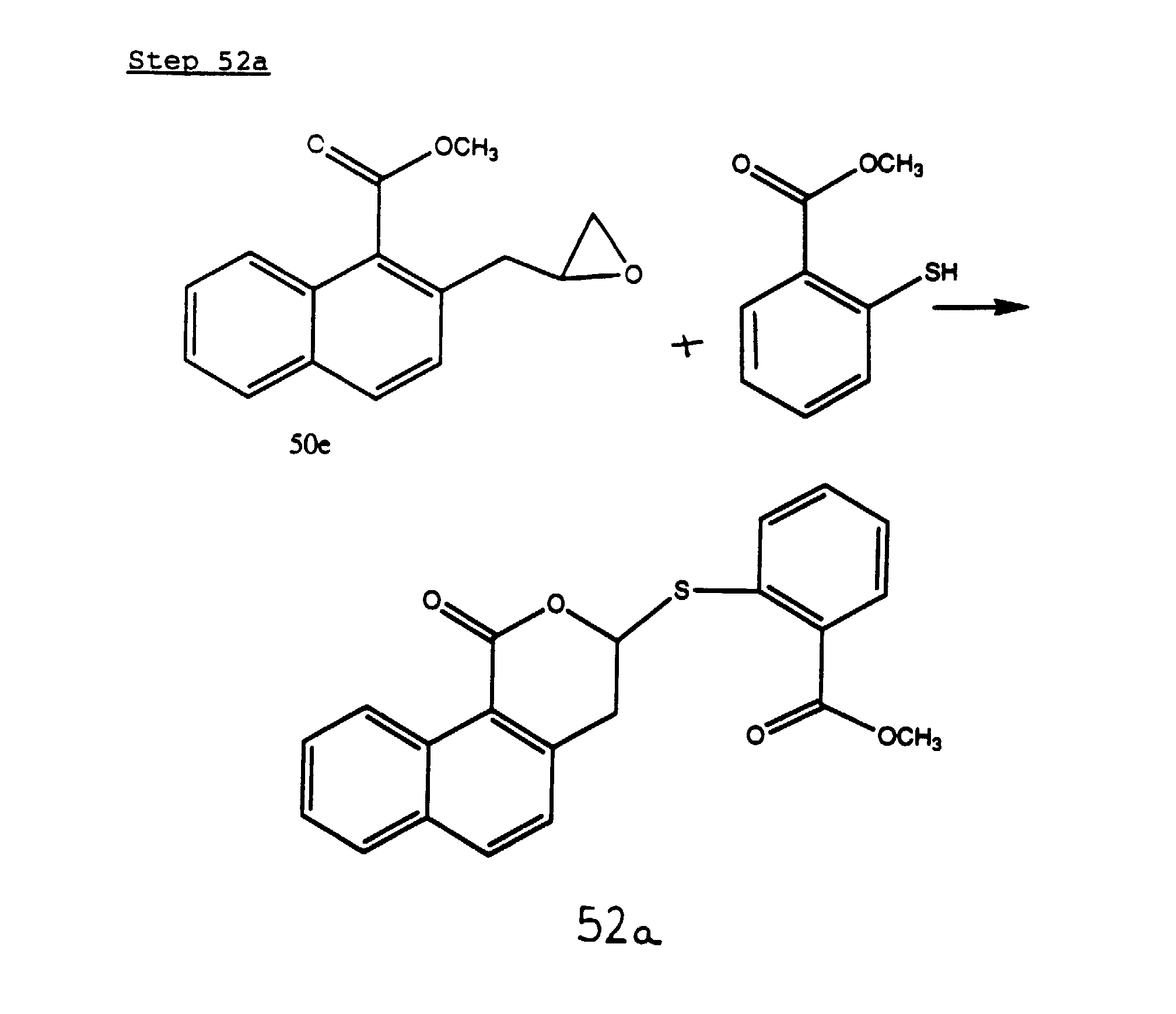
- To a solution of 107 µl (0.776 mmol) of 1-mercapto methylbenzoate in 2 ml of THF was added 23 mg of sodium hydride. Bubbling occurred and the reaction mixture turned yellow and was stirred at room temperature for 45 minutes. A solution of 0.188 g (0.776 mmol) of compound 50e in 1 ml of THF was added to the mass at room temperature. After one hour at 35°C, the mixture was warmed to 55°C. In about 20 minutes, reaction was complete. The reaction mass was worked up with 1N HCl and water and was combined with another portion of the same material derived in an earlier experiment using the same procedure. Flash chromatography in 3:1 hexane/ethyl acetate eluent yielded 0.19 gm of product. Structure was confirmed by NMR.

- To 3 ml of a 2.0 M solution of trimethyl aluminum in toluene at 0°C, was added 0.293 µl (2.78 mmol) of t-butyl amine. The mix was left stirring for one hour at room temperature, at which time 0.17 g (0.449 mmol) of compound 52a in 2 ml of toluene was added, dropwise. The mixture was heated to mild reflux (75-80°C) for about 15 minutes at which time reflux was increased to 100°C. The mixture was then poured into 50 ml of water, extracted with ethyl acetate, dried under vacuum on 3 ml of Florisil, then purified by flash chromatography using a 1:1 hexane ethyl acetate. Structure of the product was confirmed by NMR.
- Preparation of
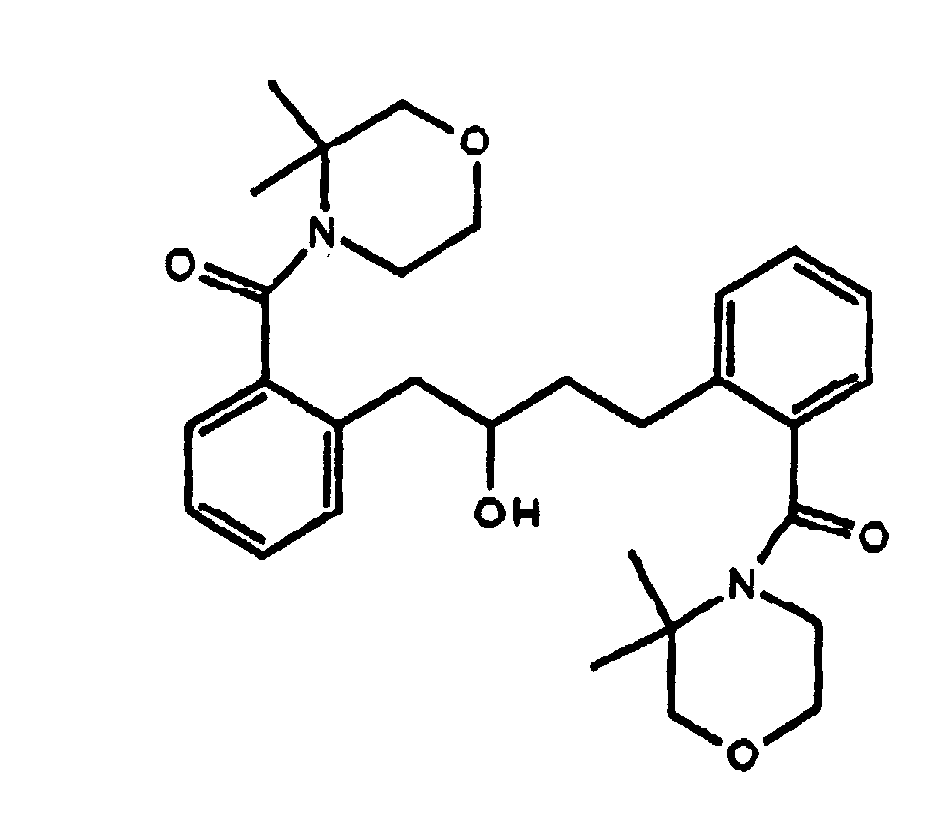
- A 3 neck flask fitted with a septum and a stopper was flame dried in vacuum and purged with argon, after which 0.436 gm (3.78 mmol) of 2,2-dimethyl morpholine in 5 ml of benzene was charged into it. The flask and contents were cooled in an ice bath and 1.9 ml of a 2M solution of trimethyl aluminum was added over 2 minutes while maintaining the temperature between 5 and 8°C. The clear solution was warmed to room temperature and stirred for 45 minutes. In one portion, 0.195 gm (0.63 mmol) of compound 25e in one ml of benzene was added by syringe. The syringe was rinsed with 0.5 ml of benzene, which was also charged to the reaction flask. The mixture was stirred at 50°C under argon for 5 hours at which time the temperature was increased to 70-75°C overnight. The reaction mass quenched with 2 ml of 0.5N NH4Cl, poured into water and extracted twice with 20 ml portions of ethyl acetate. The organic layers were combined, dried and filtered. Solvent was removed under vacuum, yielding 212 mg of a yellow, oily mass. By flash chromatography using 30% hexane/ethyl acetate, 26.1 mg of a first product and 77 mg of a second product were isolated. Following solvent removal, these were identified as compound 53, the title compound, and compound 53a, an amide-ester.
- Following substantially the identical procedure as was used in Example 53, 49.1 mg (0.125 mmol of) compound 53a was reacted with t-butylamine in toluene. Thirty (30) mg (52%) of product was recovered.
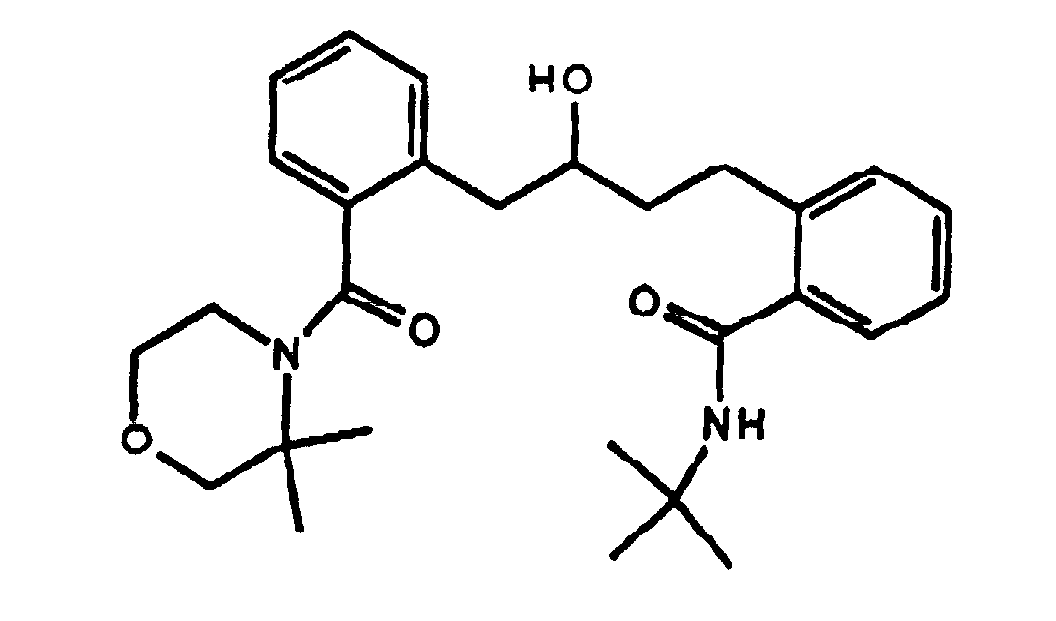
- Preparation of
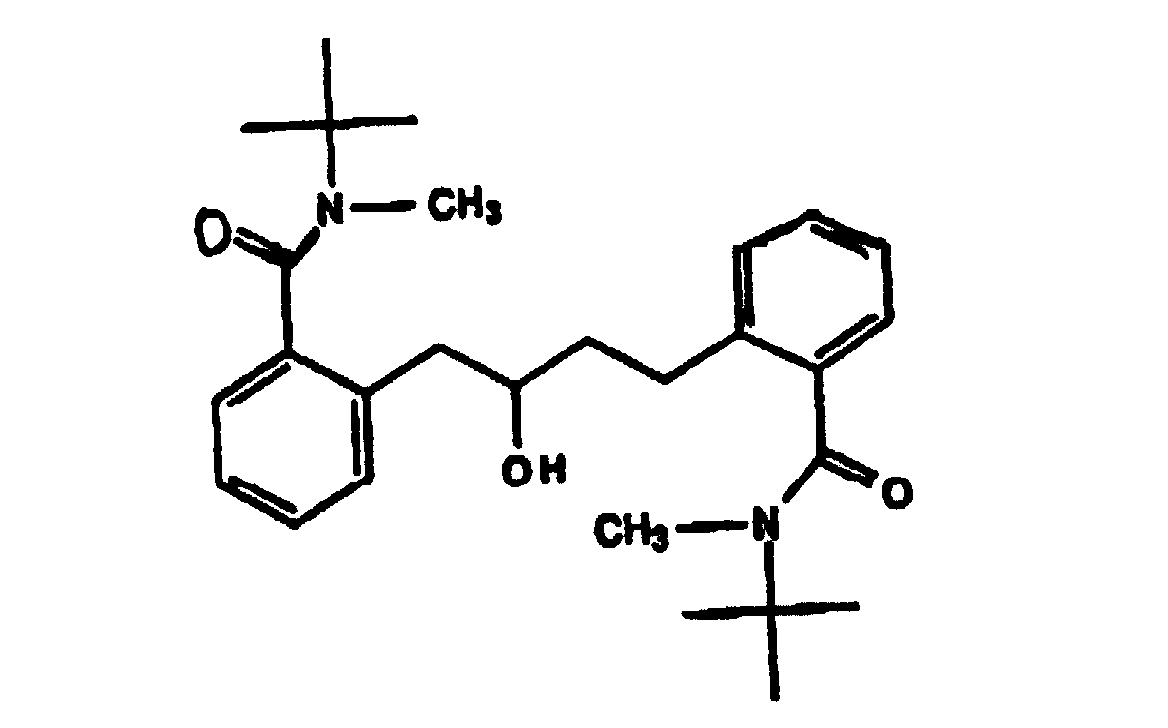
- Following substantially the identical procedure as was used in Example 53, 0.197 gm (0.637 mmol) of compound 25e was reacted with N-methyl-t-butylamine in toluene medium. Yield was 44 mg (19.7%) of the desired product.
- Preparation of
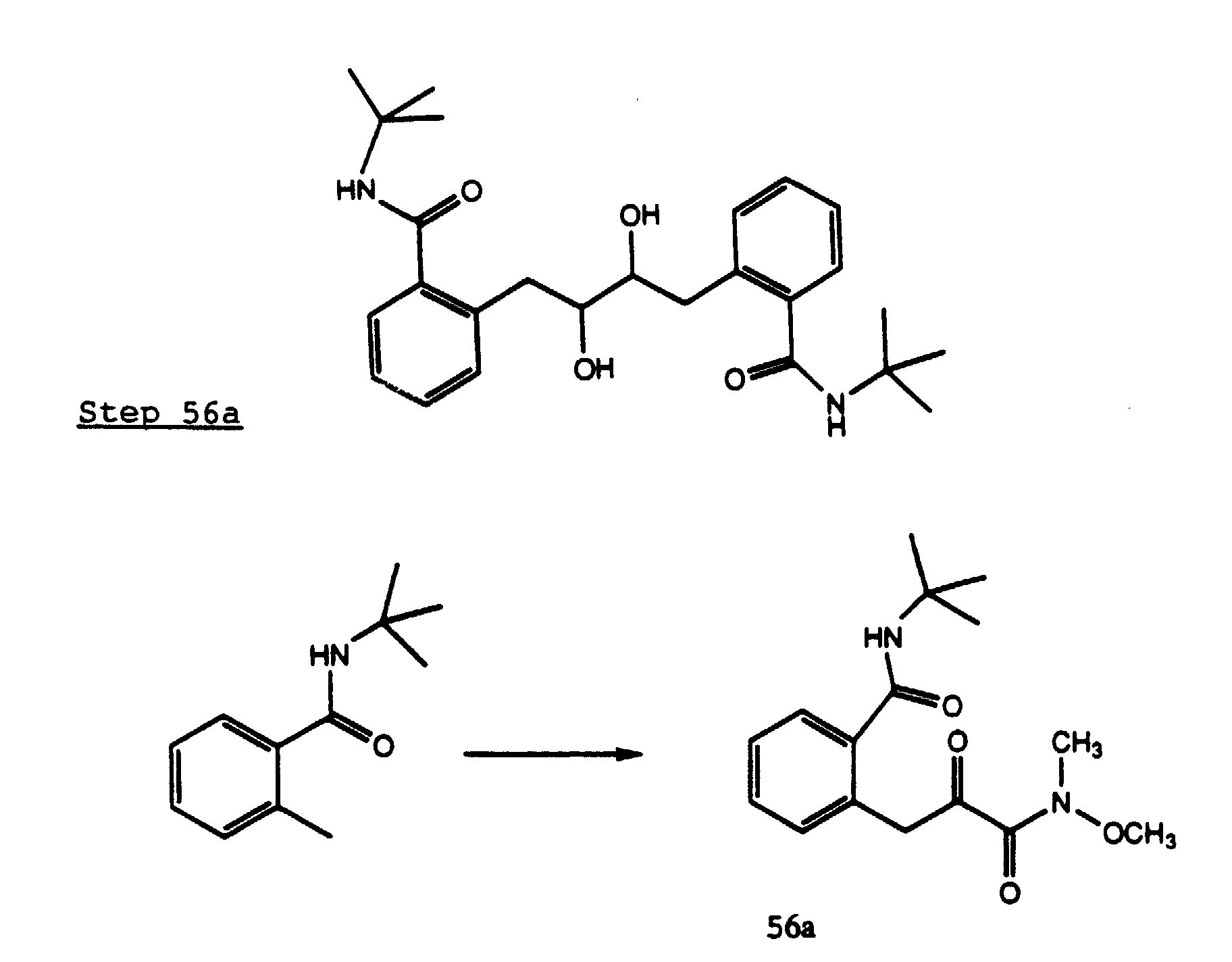
- In a 50 ml 3-neck flask previously flame-dried and purged with argon, 1 gm (5.23 mmol) of N-t-butyl toluamide was dissolved in dry THF. The solution was stirred under argon then cooled to -78°C in a dry ice/acetone bath. Dropwise 0.85 ml of s-butyl lithium was added by syringe over a 15 minute period. The temperature remained below -65°C. The mixture was stirred for one hour at -78°C and 0.92 gm (5.23 mmol) of N, N', -dimethyl-dimethoxyoxalamide was added in one portion at -78°C. The mixture was stirred for one additional hour at -78°C, then was allowed to warm to room temperature over a two hour period. The resulting product was stirred at room temperature overnight, then poured into water and extracted with ethyl acetate. The extracts were washed with saturated NaHCO3, water and brine, then dried over Na2SO4, filtered and concentrated under vacuum. The residue was purified by flash chromatography using a 10% ethyl acetate/hexane solution followed by a 25% ethyl acetate solution. The appropriate fractions were collected and concentrated yielding 1.1 gm of the product.
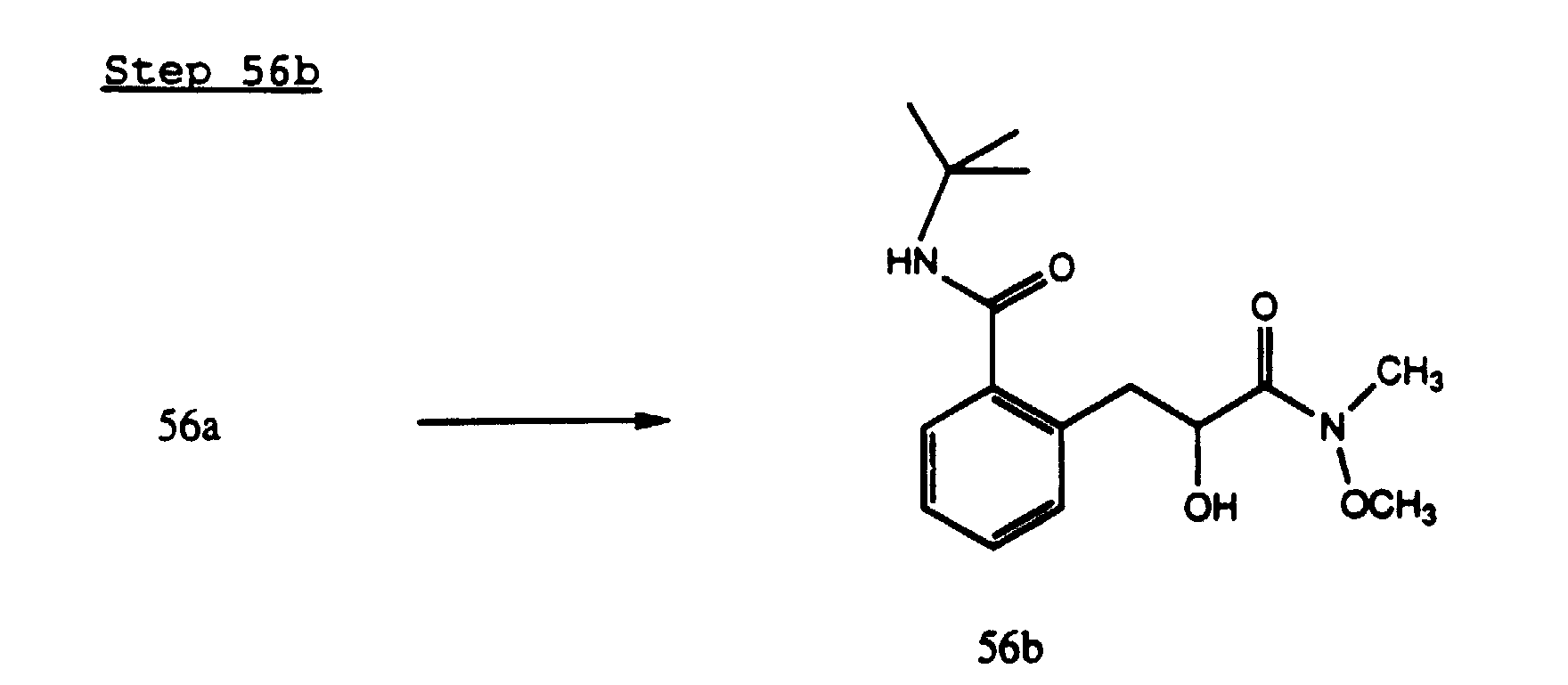
- A solution of 0.7 gm (2.3 mmol) of compound 56a in 15 ml of alcohol was cooled to 0°C in a 50 ml flask. In one portion, 0.086 gm of NaBH4 was added and the mixture stirred for two hours. The reaction mixture was then poured into saturated NaHCO3 and extracted with ethyl acetate. The extracts were washed with water, then with brine and the product was dried over MgSO4, filtered and concentrated under vacuum yielding 0.51 gm of product.

- A solution of 1.55 gm (8.1 mmol) of N-t-butyl-toluamide in 30 ml of THF was stirred under an argon atmosphere and cooled to -78°C. Dropwise, over a ten minute time period, 13.11 ml (17 mmol) of s-butyl lithium was added and the reaction was stirred at -78°C for one hour. After one hour of stirring 0.5 gm (1.6 mmol) of compound 56b in THF was added, dropwise, over a ten minute period. The reaction mixture was stirred at -78°C for two hours, then allowed to warm slowly to room temperature and quenched with saturated NH4Cl. The reaction mixture was then diluted with water and extracted with ethyl acetate. The extracts were washed with saturated brine, dried over MgSO4, filtered and concentrated under vacuum. The product was purified by flash chromatography using a 10% ethyl acetate/hexane solution followed by a 20% solution then by a 30% solution. The appropriate fractions were collected and concentrated under vacuum yielding 0.193 mg of product.
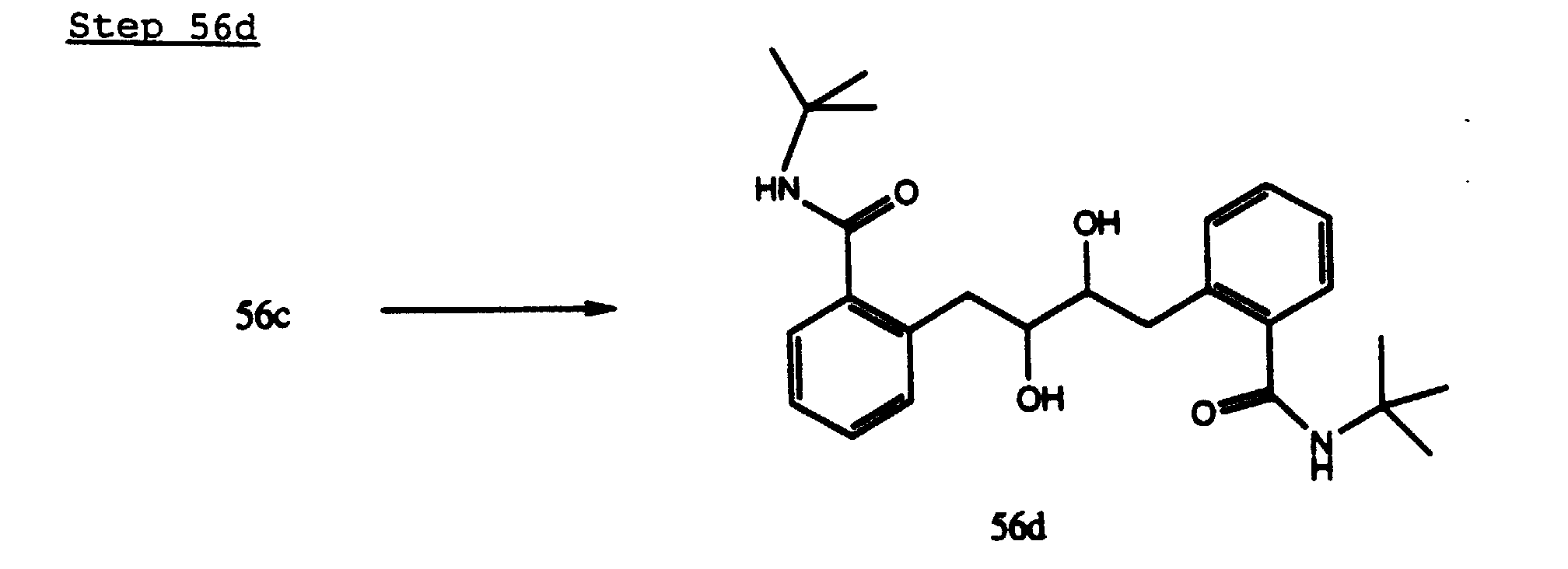
- A solution of 150 mg (.3425 mmol) of compound 56c in 3 ml of alcohol was cooled to 0°C in a 10 ml round bottom flask and 0.013 gm of NaBH4 is added in a single portion. The mixture was stirred at 0°C for two hours then poured into saturated NaHCO3 and extracted with ethyl acetate. The extracts were washed with water, dried over MgSO4, filtered and concentrated under vacuum. The residue was purified using 1.5% methanol in methylene chloride yielding the product as a mixture of diastereomers.
- Preparation of
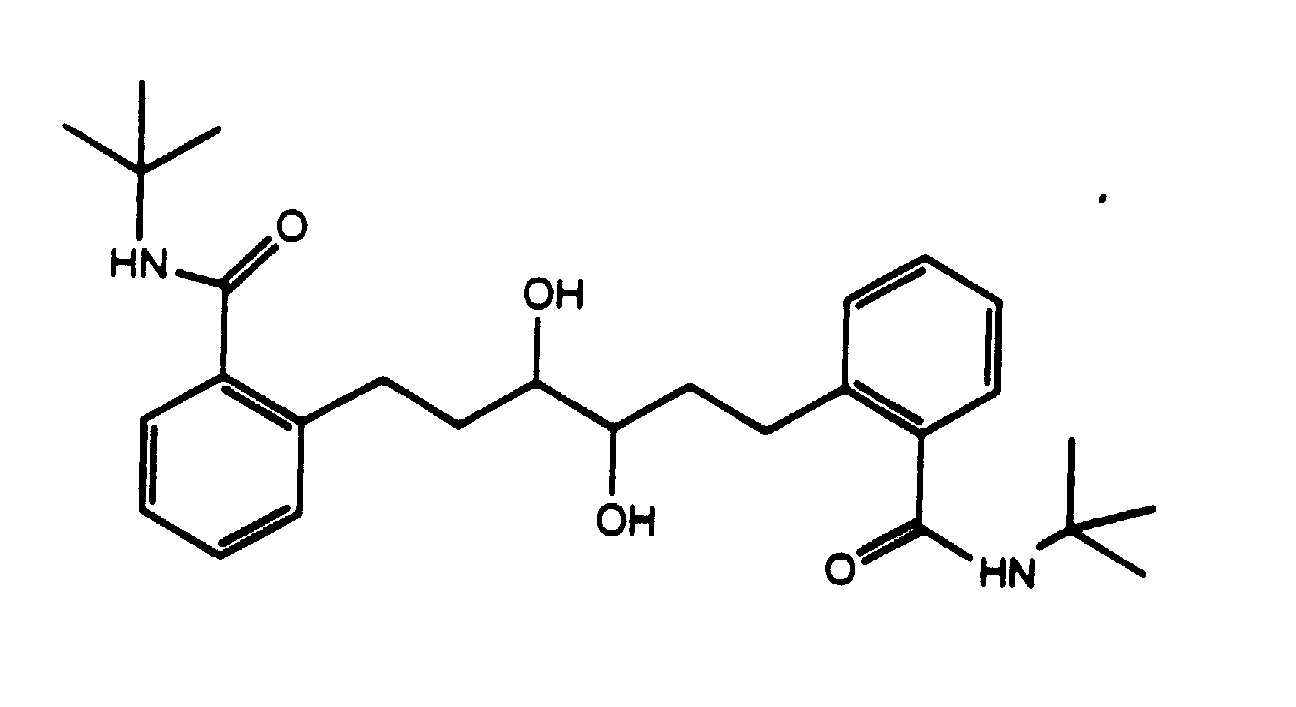

- A solution of 500 mg (2.614 mmol) of N-t-butyl toluamide in 10 ml of THF was cooled to -78°C and treated with 6.2 ml of s-butyl lithium dropwise from a syringe while maintaining temperature below -65°C. After one hour at the low temperature, a solution of 280 mg (1.307 mmol) of 1,4-dibromobut-2-ene and 5 ml of THF was added dropwise while not allowing the temperature to exceed -60°C. After one hour of stirring, the reaction mixture was quenched with saturated NH4Cl solution, diluted with ethyl acetate and washed with water and brine, then dried and concentrated under vacuum yielding a yellow solid.
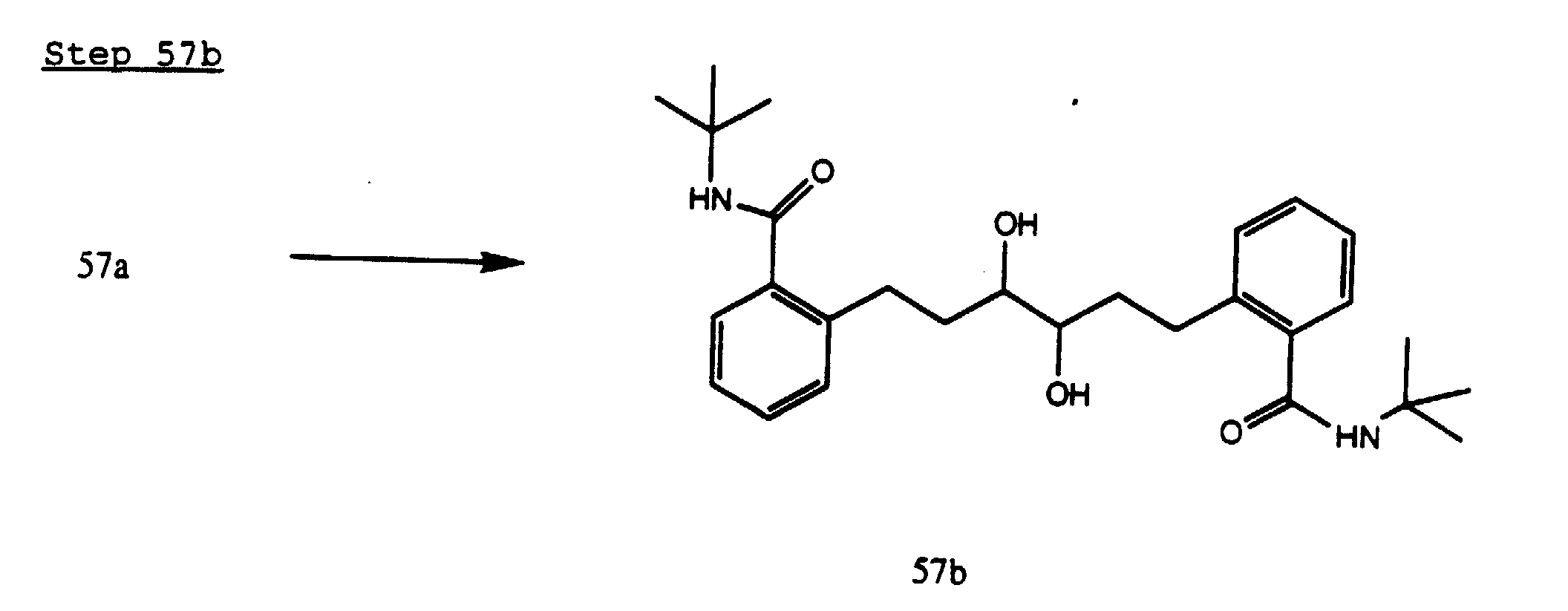
- A solution of 9.3 mg of OsO4 in t-butanol and 43 mg of N-methyl morpholine in a 2:1 acetone/water mixture were mixed. To this was added 160 mg (0.368 mmol) of compound 57a and the mixture was stirred overnight at room temperature. The reaction was then quenched with saturated NH4Cl and extracted with ethyl acetate, washed with water and brine, then dried over MgSO4 and concentrated under vacuum. The product was purified by flash chromatography using 50% ethyl alcohol/hexane, yielding 85 mg (50%) of an oily product.
-
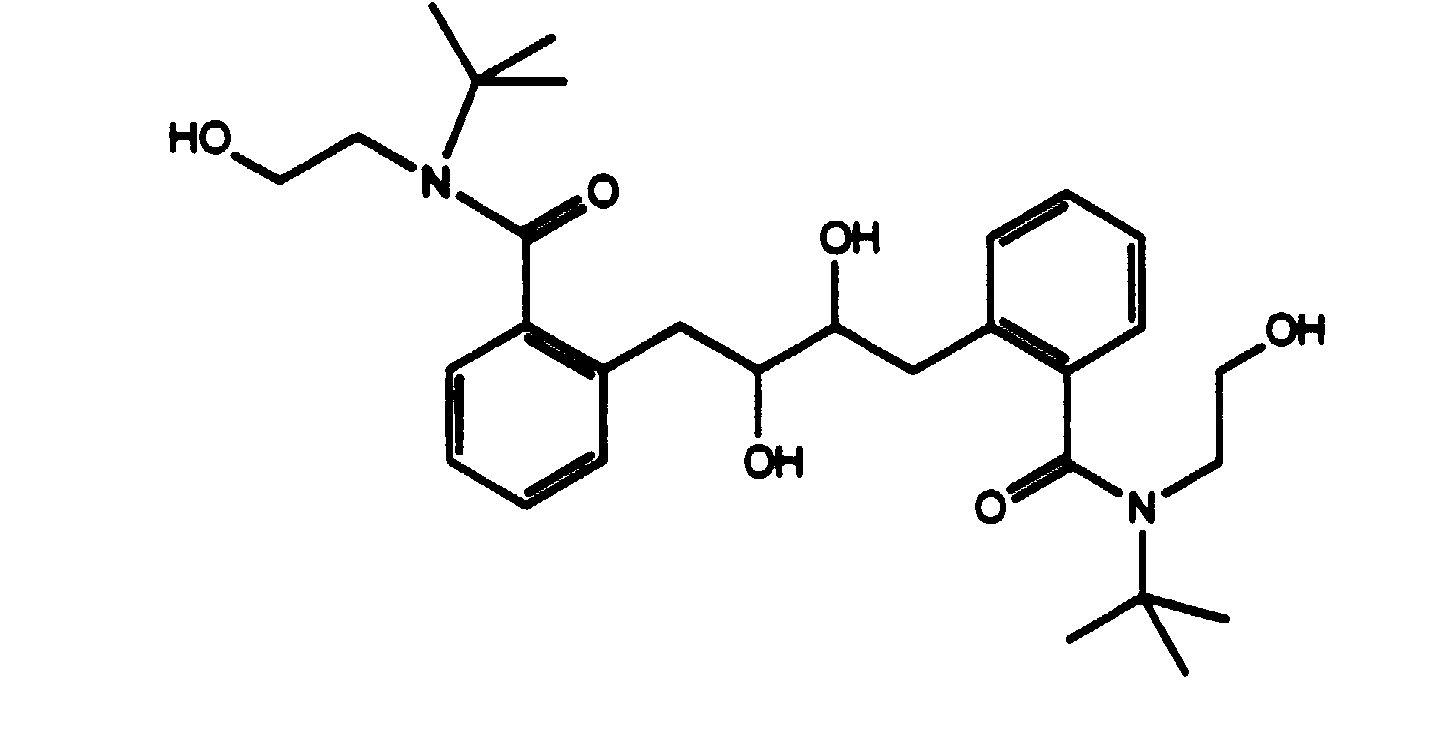

- In a 100 ml round bottom flask, 2.25 gm (9.5 mmol) of compound 33a was dissolved in 22.5 ml of DMF. To this solution was added 4.32 gm (28.7 mmol) of t-butyl-dimethylsilyl chloride and 2.3 gm of imidazole. This reaction mixture was heated to 55°C and stirred for 16 hours. At this time the reaction was completed and the reaction mixture was poured into water and extracted twice with ethyl acetate. The organic phases were washed with water and brine, dried over MgSO4 and concentrated under vacuum. The residue was purified by flash chromatography using 10% ethyl acetate/hexane. The products were concentrated and pumped dry under vacuum yielding 1.6 gm of product.
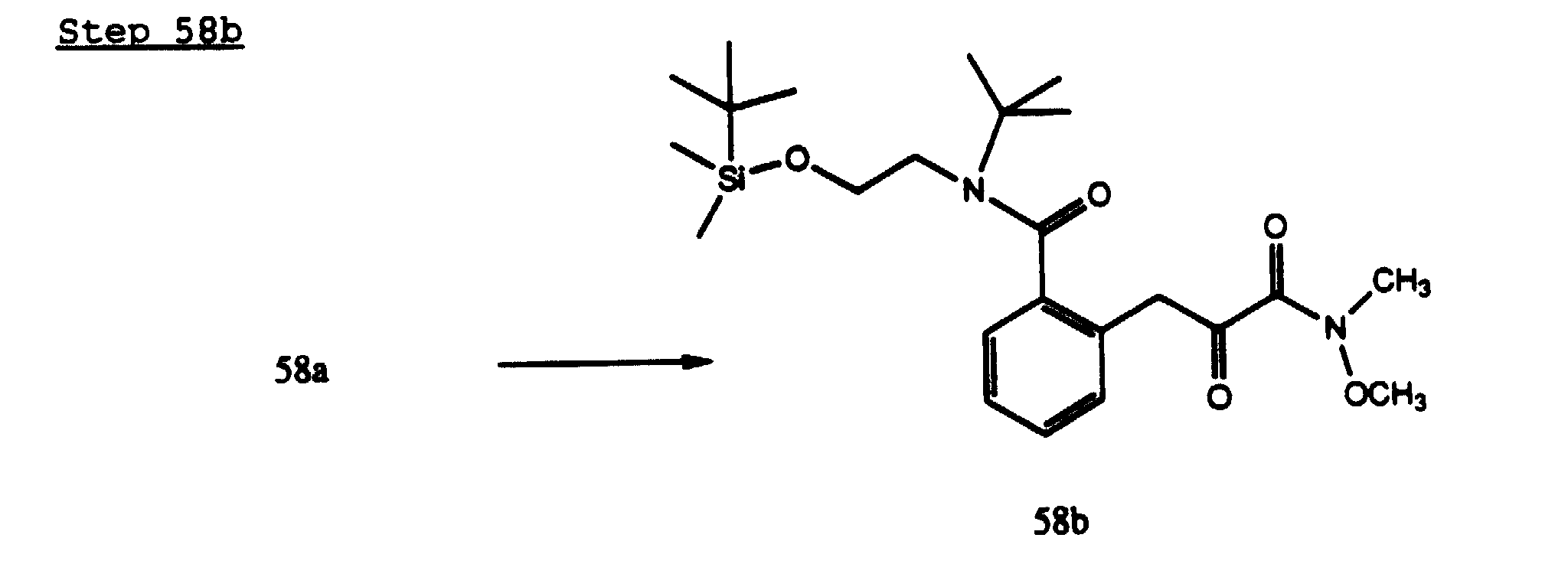
- A solution of 1 gm (2.9 mmol) of compound 58a was dissolved in 10 ml of dry THF, cooled under an argon blanket to -78°C and stirred. In one portion, 43 mg of diisopropylamine was added followed by dropwise addition of 3.9 ml of s-butyl lithium at a rate such that the temperature remains below -65°C. The reaction mass was then stirred for 2 hours at -78°C and a solution of N, N'-dimethyldimethoxyloxalylamide and 2 ml of THF was added dropwise again maintaining the temperature at no greater than -65°C. Stirring was continued for 2.5 hours at which time the reaction was quenched at -78°C with saturated NH4Cl. The quenched reaction mixture was then poured into water and extracted with ethyl acetate. The extracts were washed with water and brine, then concentrated under vacuum. The residue was purified by flash chromatography using 10% ethyl acetate/ hexane. The appropriate fractions were combined and concentrated under vacuum yielding 0.5 gm of product.

- A solution of 0.5 gm (1.1 mmol) of compound 58b in 10 ml of ethyl alcohol was stirred and cooled to 0°C. In a single portion, 0.041 gm of NaBH4 was added and stirring was continued for two hours. The reaction mixture was poured into an excess of saturated NaHCO3 and extracted with ethyl acetate. The extracts were washed with water and brine, and dried over MgSO4. The organic solution was filtered and concentrated under vacuum, yielding 0.45 gm of material suitable for use without further purification.

- Following substantially the same procedure as was used in Step 58b the product from Step 58c was reacted with 0.45 gm (0.96 mmol) of compound 58a. Flash chromatography with a 15% ethyl acetate/hexane solution yielded 0.17 gm of product.

- A solution of 0.17 gm of compound 58d was dissolved in 3.4 ml of ethanol, stirred and cooled to about 0°C. In one portion, 0.01 gm of NaBH4 was added and the mixture was stirred for an additional two hours. The reaction mixture was then poured into saturated brine and extracted with ethyl acetate. The extract was dried over MgSO4 yielding 0.15 gm of product suitable for use without further purification.

- To a solution of 0.15 gm of compound 58e in 2 ml of THF was added 2 equivalents of tetrabutyl ammonium fluoride and the mixture was stirred at room temperature overnight, then poured into 0.5 N HCl and extracted with ethyl acetate. The extract was washed with water and brine, then purified by flash chromatography using 5% ethyl acetate/hexane. The appropriate fractions were combined and concentrated under vacuum, yielding 0.022 gm of product.
- Using essentially the same chemistry and the same reaction sequences described in Examples 1 through 58, the following compounds have also been synthesized:

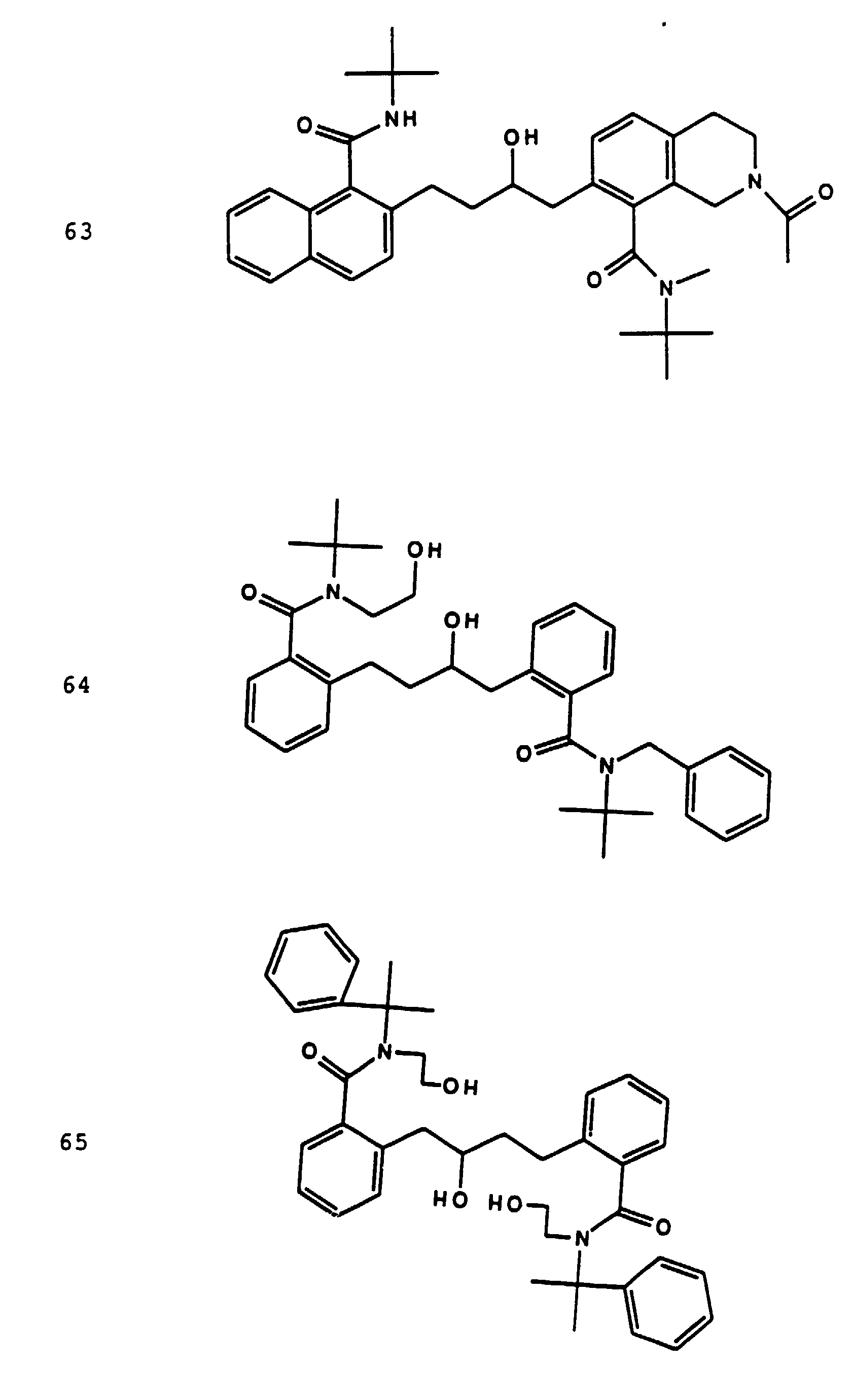


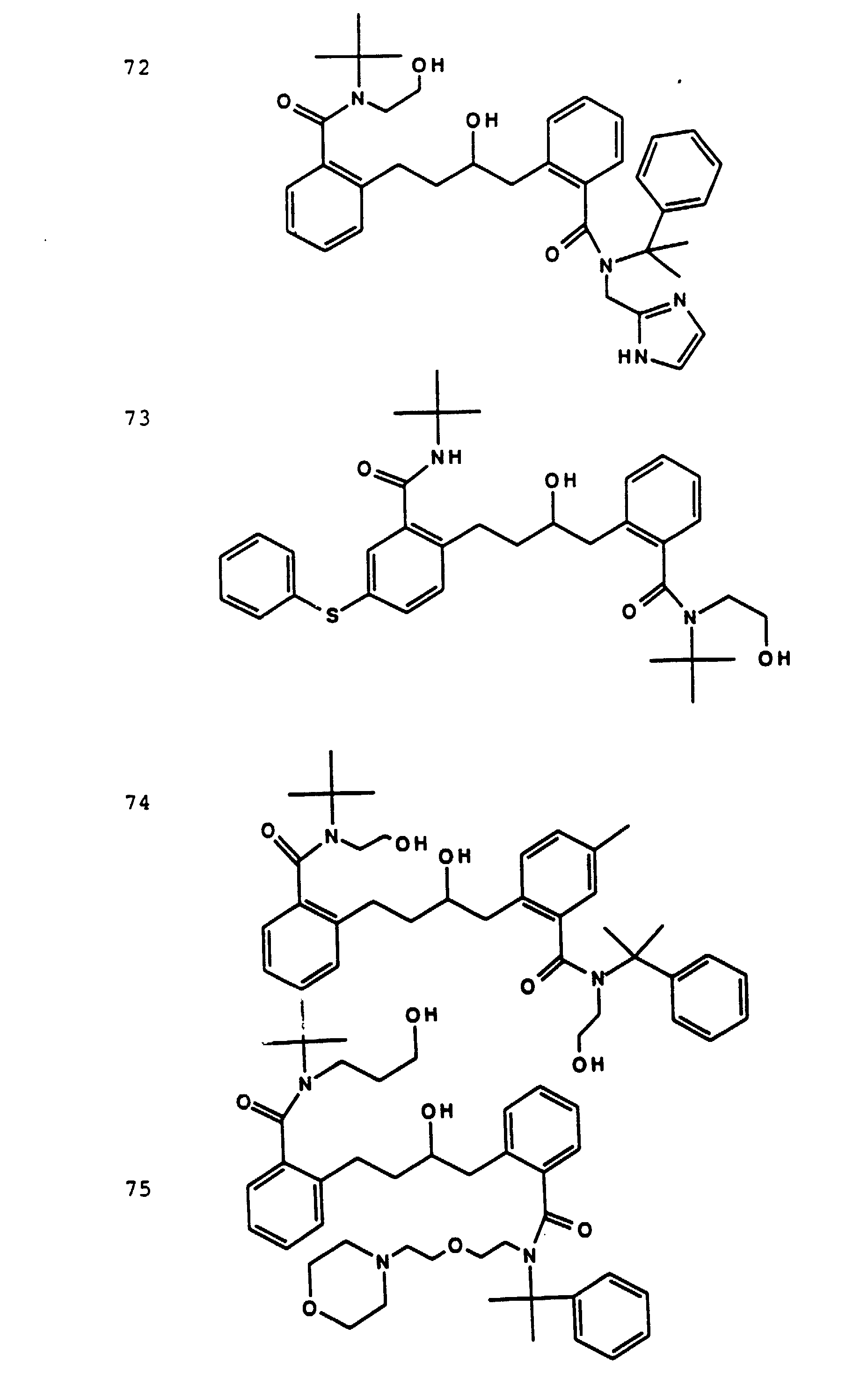


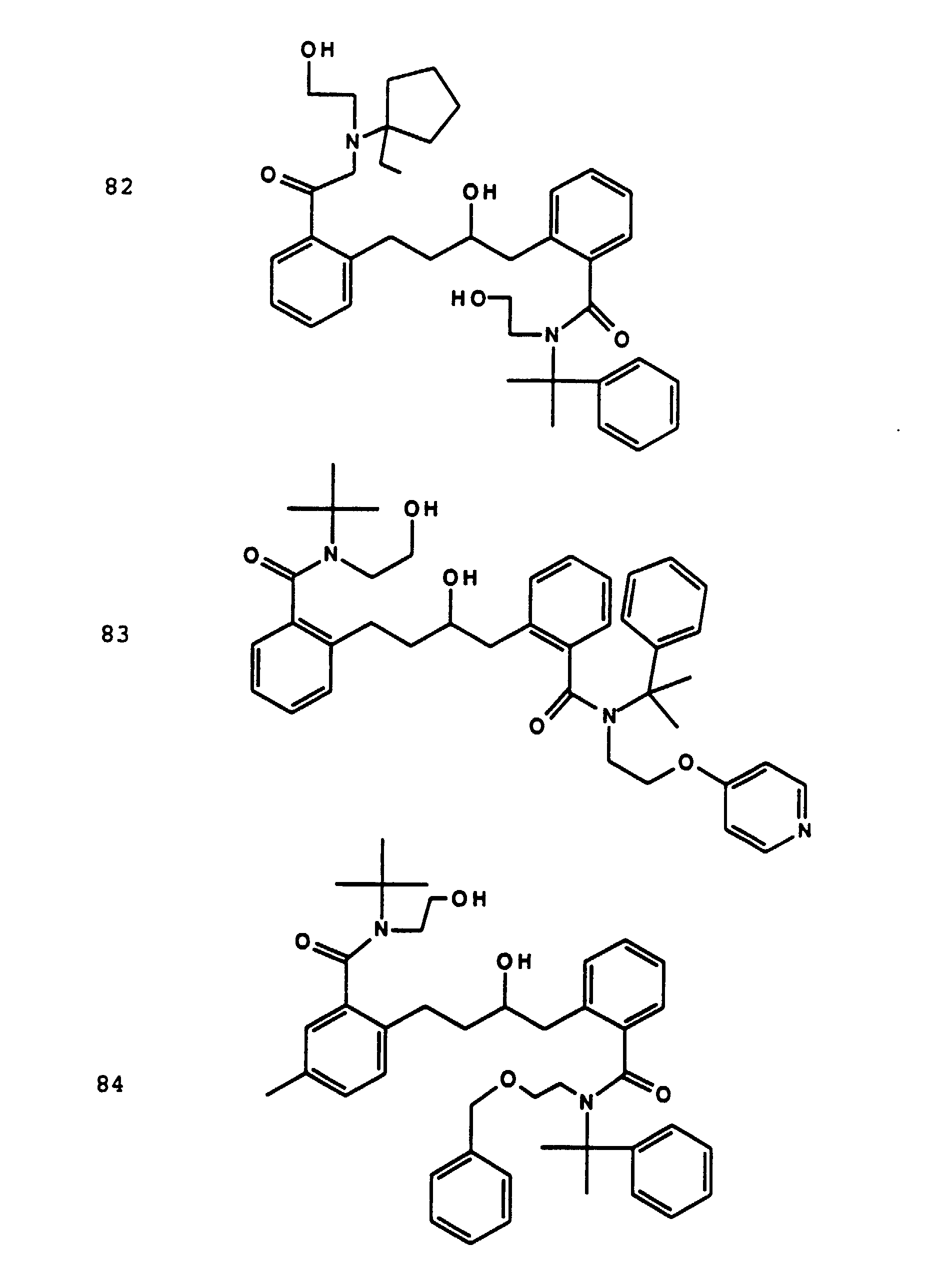
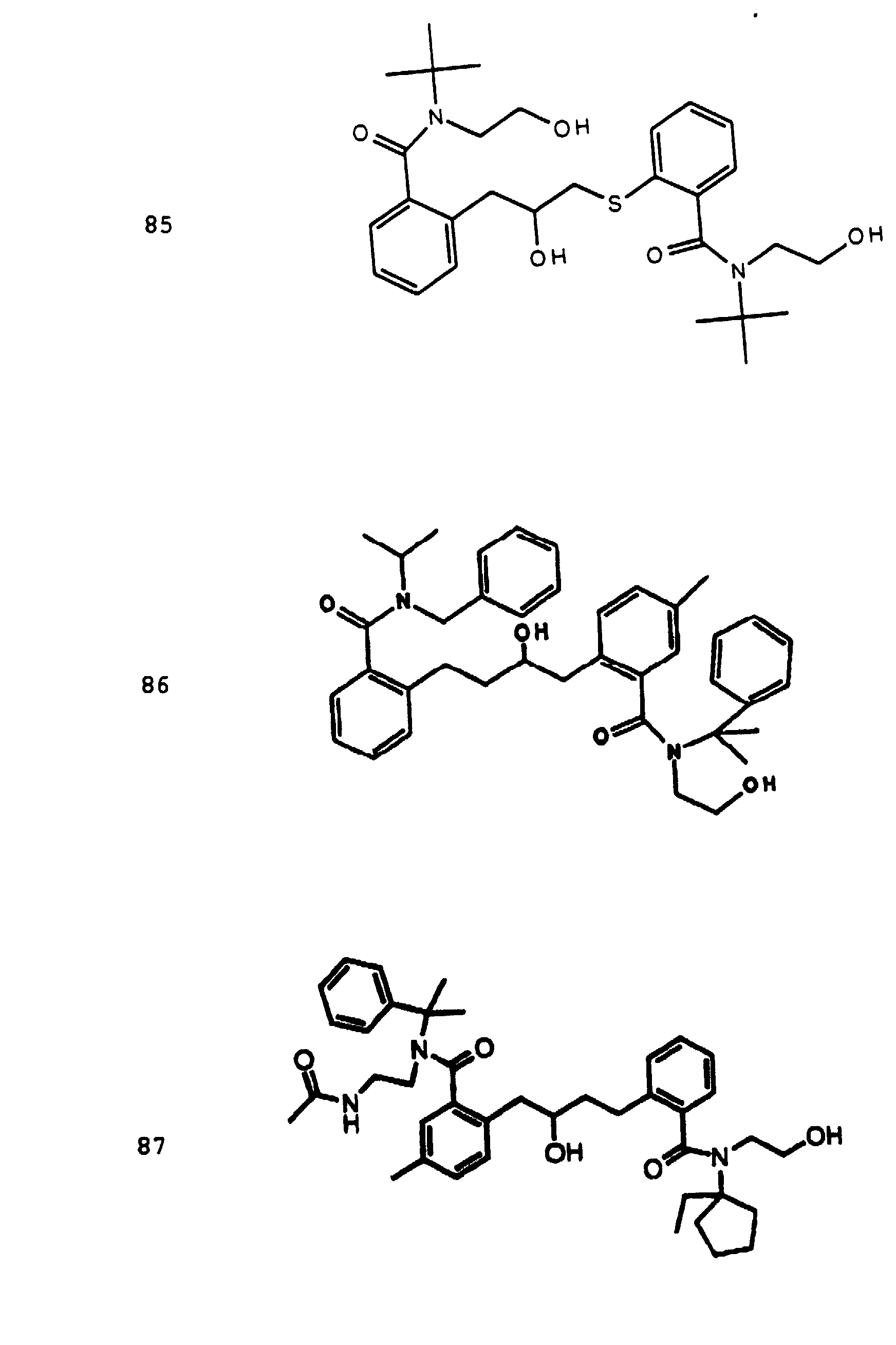


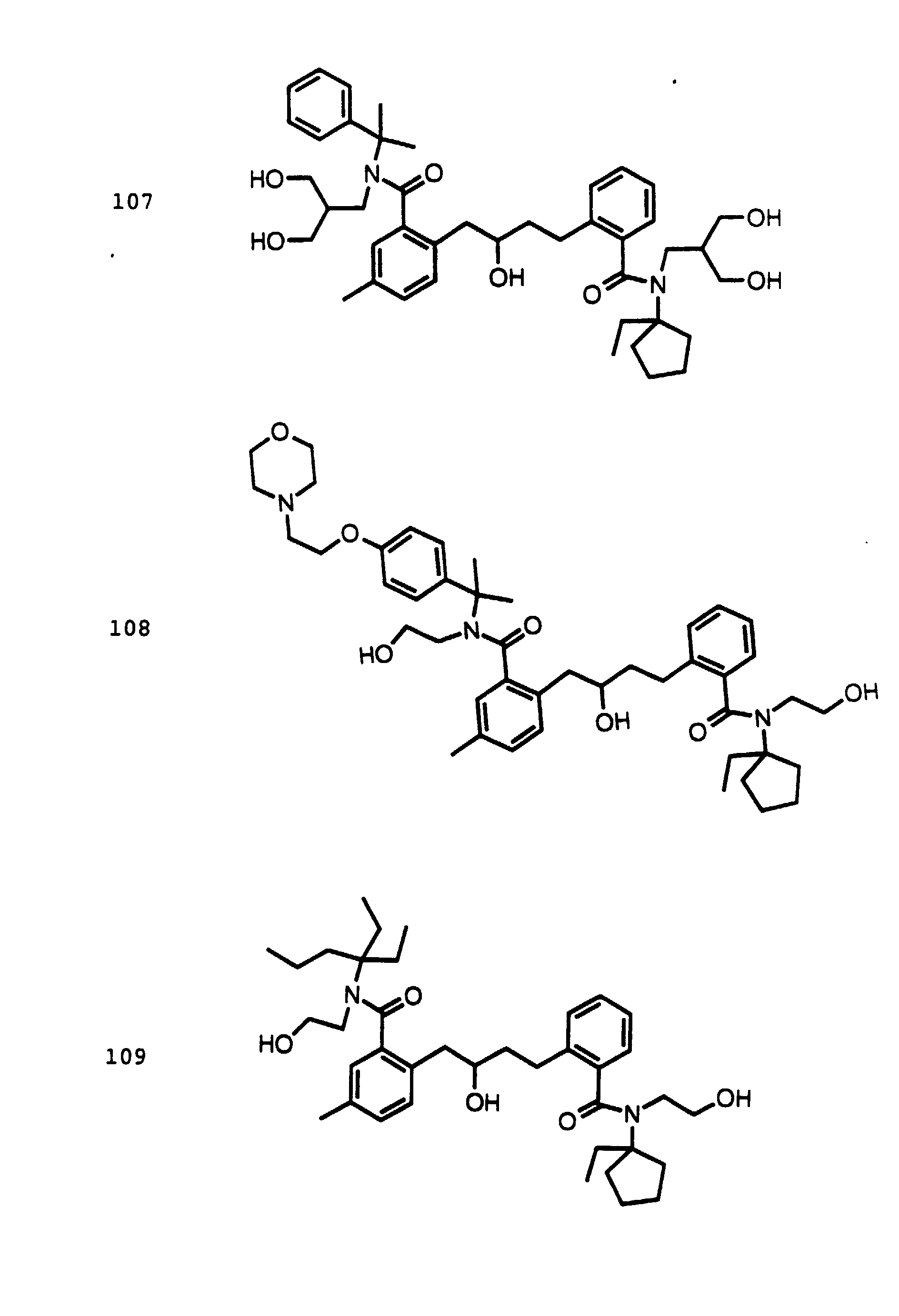
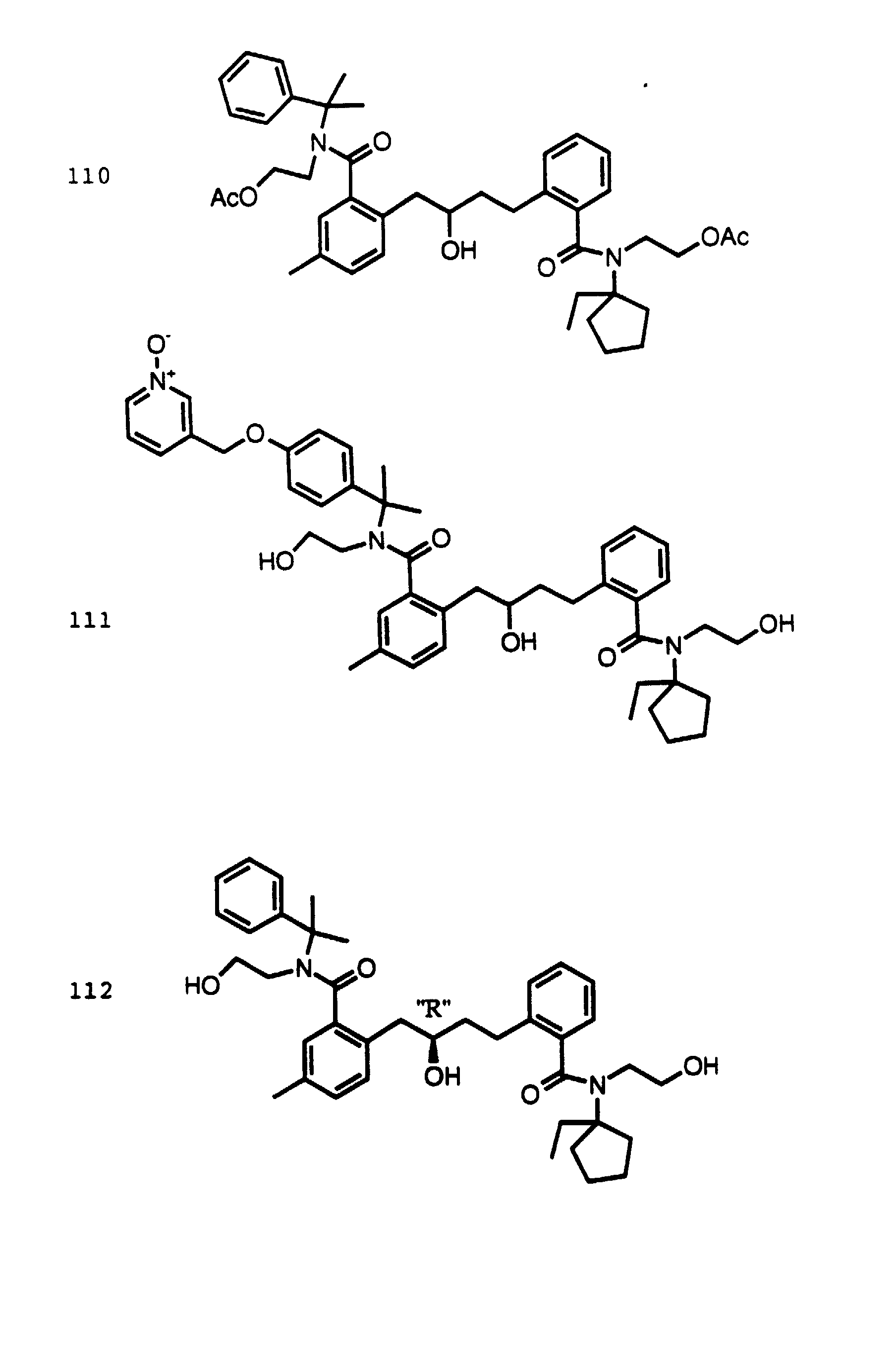
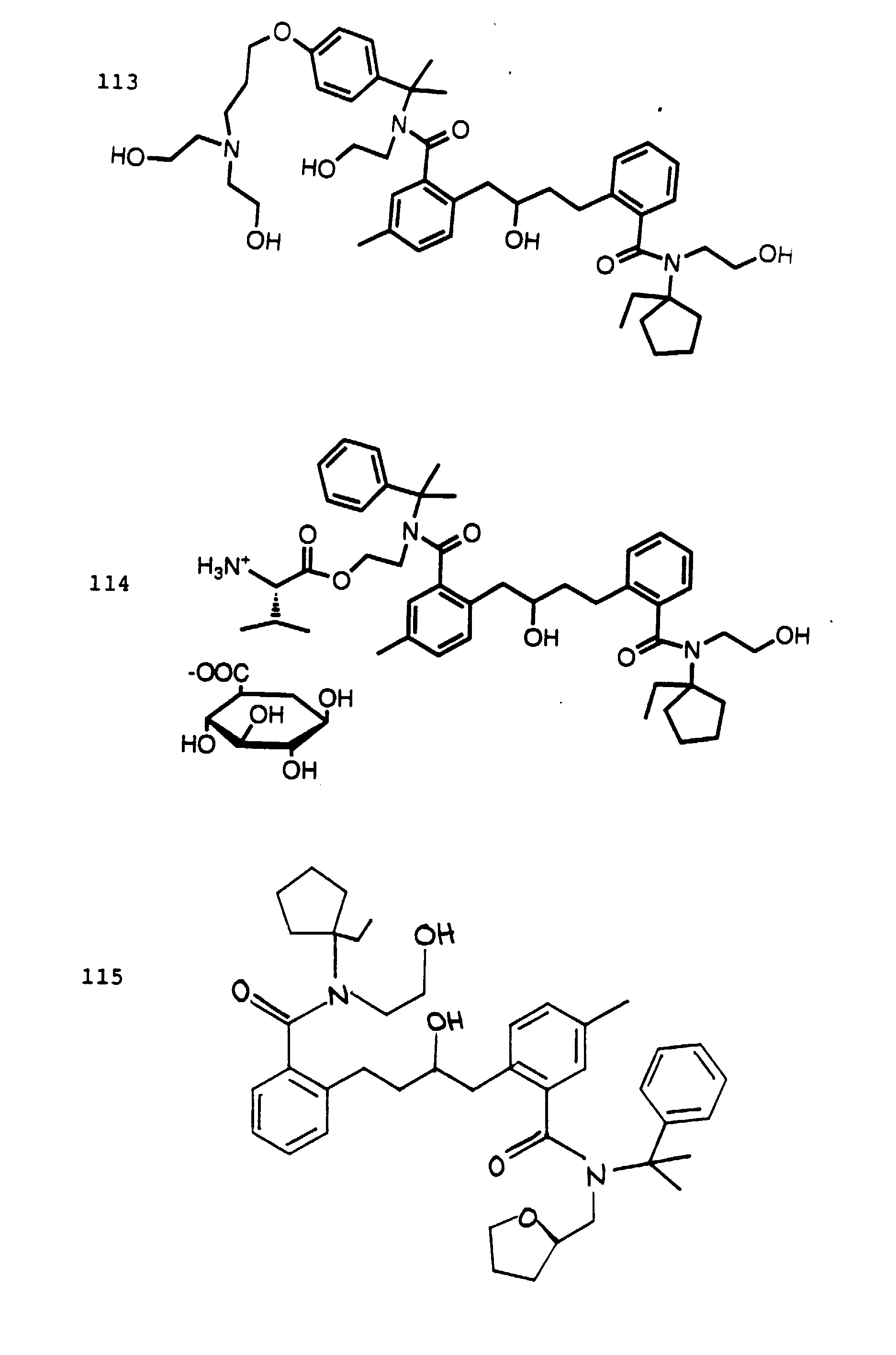
- Using a Chiralcel OD HPLC column (J.T. Baker) and a mobile phase of 90/10 hexane-ethanol and a flow rate of 1 mL/min, racemic 18m was separated into individual pure enantiomers, the more polar compound (HPLC retention = 15.79 min) designated example 116a. This enantiomer was the more active against the HIV protease enzyme and in the antiviral assay (see table 1) relative to example 116b (the less polar, and less active enantiomer, HPLC retention time = 11.26 min). Optical Rotation:
- 116a αD = +9.1 ° [CHCl3]
- 116b αD = 10.9 ° [CHCL3]
-
- The structure of the compound of Example 116a is shown in Example 112.
- The terms "essentially enantiomerically pure" or "essentially diastereomerically pure" mean that a compound so described is essentially free of either its enantiomer or of other diastereomers. Thus, such a compound has a significantly lower Ki than a compound that is not essentially free of its enantiomer or of other diastereomers.
- The compounds of the subject invention also include prodrugs, i.e. Examples 110 and 114.
- As a further embodiment, the present invention also includes a method for preparing a compound of the formula XIIwherein:
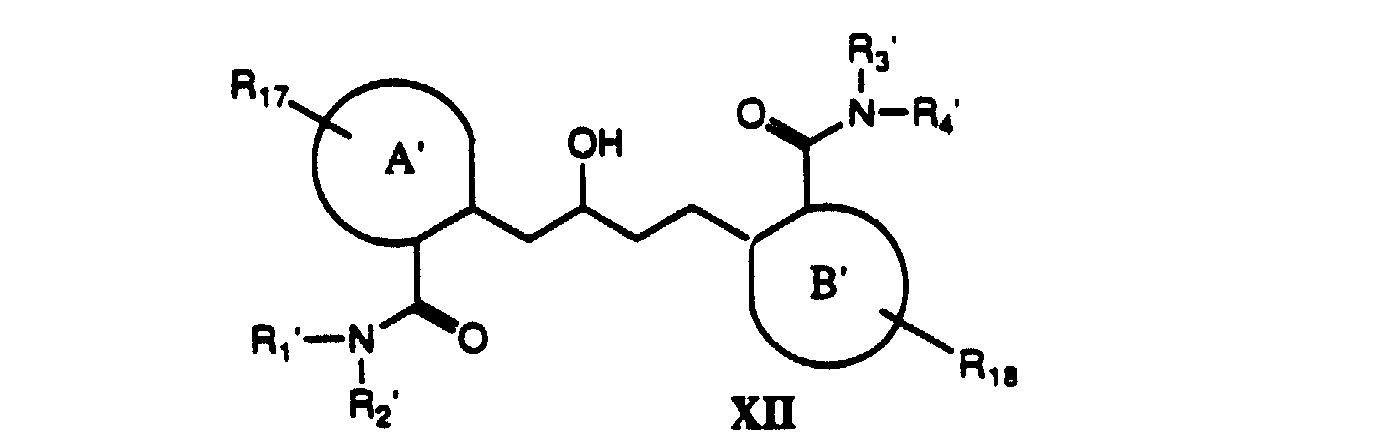
- A' and B' are individually selected from carbocyclic or heterocyclic, aromatic, saturated or partially saturated 5, 6 or 7 member rings which can be further substituted;
- R'1, R'2, R'3 and R'4 are individually selected from alkyl, cycloalkyl, aryl, and substituted alkyl, cycloalkyl or aryl, and R'1 and R'2 or R'3 and R'4 can form a ring with the nitrogen atom to which they are attached;
- R17 and R18 are individually selected from hydrogen, halogen, hydroxyl, substituted or unsubstituted alkoxy, mercapto, thioether, -NR'1R'2, nitro, alkyl, aryl and substituted alkyl or aryl, wherein R17 can form a fused ring structure with A' and R18 can form a fused ring structure with B';
- which method comprises carrying out the following reactions:
 wherein: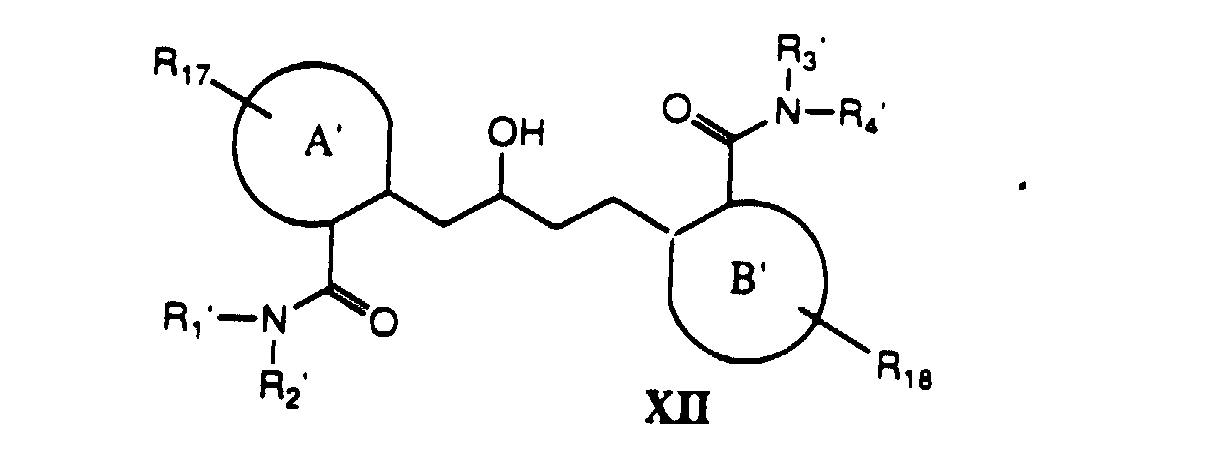
- a) the compound of the formula VIII is oxidized under conditions sufficient to obtain the compound of the formula IX;
- b) the compound of the formula IX is reacted with the compound HN(OR24)R'24 under conditions sufficient to obtain the compound of the formula X, wherein R24 and R'24 are individually selected from alkyl groups;
- c) the compound of the formula X is reacted with the compound of the formula Xa under conditions sufficient to obtain the compound of the formula XI; and
- d) the compound of the formula XI is reduced under conditions sufficient to obtain the compound of the formula XII.
-
- The HIV-protease inhibitory compounds were screened by a variety of assays to determine their biological utility. Among the tests performed were the proteolytic inhibition rates and antiviral effect on HIV-infected cell lines. The procedures for each experiment are described in detail below. the IC50 and Ki data were generated by Agouron scientists, whereas the protease activity with the cell cultures was measured by independent, outside laboratories. The results from these assays for Examples 1-115 are summarized in Table I, which is set forth following the descriptions below of the experimental procedures.
-
- 1. Proteolytic activity of purified HIV-1 protease was routinely measured using the chromogenic assay developed by Richards et al. (J. Biol. Chem. 265: 7733 (1990)). Synthetic peptide His-Lys-Ala-Arg-Val-Leu-Phe (pNO2)-Glu-Ala-Nle-Ser-NH2 (American Peptide Company) was used as the substrate.
- 2. The assay was carried out in 0.5M NaCl, 50mM MES pH 5.6, 2% DMSO (dimethylsulfoxide) at 37°C. Cleavage of the scissile bond between leucine and paranitrophenylalanine (Phe(pNO2)) was assayed by spectrophotometric monitoring of the decrease in absorbance at 305nm. Initial velocity was determined as the rate of decline of absorbance during the first 100 seconds of reaction. Under standard conditions, the Michaelis constant (Km) for this substrate is 52 ± 16 µM.
- 3. For determination of inhibition rates of HIV-1 protease inhibitors, saturated concentration of substrate (200µM) was used. Between 15-25 concentrations of inhibitor were added and velocity of reaction was measured at each of the concentrations, as described above.
- 4. Inhibition constants were calculated using the method of
Jackson et al. (Adv. in Enzyme Regulation 22: 187
(1984)). In the above described assay, Pepstatin A-a
standard inhibitor of aspartic proteases has a Ki app =
3.1 ± 0.1 µM and IC50 = 3.8 ± 0.7 µM.
Primary Drug Screening of Anti-HIV Compounds at Southern Research -
- SRI has an established program for the primary antiviral analysis of compounds in microtiter assays which measure the ability of a selected compound to inhibit HIV-induced cell killing. This assay involves the conversion of the tetrazolium dye MTT to a colored formazan product by mitochondrial enzymes in metabolically active cells. This assay system is presently used at SRI to screen over 30,000 compounds per year. Briefly, the assay involves the infection of CEM or MT2 cells in round bottom 96-well plates. The compound of interest is added just prior to infection. Following 6 days of incubation at 37°C the plates are stained with MTT. The results of the assay are quantitated spectrophotometrically on a Molecular Devices Vmax plate reader.
- The data is analyzed by linear regression utilizing an in-house software program to calculate antiviral Activity. (IC25, IC50, IC95) and toxicity (TC25, TC50, TC95) as well as other values.
- Primary antiviral assays are routinely performed in CEM or MT-2 cells. SRI has found that all active compounds have been identified in CEM cells while experiments performed in the MT-2 cell line miss a small proportion of the active compounds.
- Drugs will be solubilized in the appropriate vehicle such as distilled water or DMSO if necessary. Latex gloves, lab coats and masks are used during all phases of the handling process to prevent exposure to potentially harmful agents. The drug is prepared at the appropriate concentration and stored at -20°C until used by the screening laboratory. The first dilution of each compound is made in a dilution tube with medium to yield a concentration two-fold that of the highest test concentration. Sterile titer tubes are then used to make serial one half-log dilutions of each compound. Following drug dilution, the diluted compound is added to the appropriate well of a 96-well microtiter plate. Up to 12 dilutions can be assayed conveniently in triplicate on a single plate with all appropriate controls including cell control, virus control, toxicity control, drug color control, medium control and plastic (background) control. When testing includes only six dilutions, two drugs can be assayed on a single microtiter plate. The drugs are added to the plate in a final volume of 100 microliters.
- During the time the drug dilutions are prepared, cells are washed and counted. Viability is monitored by trypan blue dye exclusion and assays are not performed if the viability falls below 90%. Cells are maintained in an exponential growth phase and are split 1:2 on the day prior to assay to assure exponential growth rate.
- For the primary screen, the cell lines utilized are CEM and MT-2. Unless otherwise indicated, the medium used is RPMI 1640 with 10% heat-inactivated fetal calf serum (FBS), glutamine and antibiotics.
- Cells are propagated at 37°C in an atmosphere of 5% CO2 in air. The virus employed for this work is HIV-1 isolates IIIB and/or RF, which are prepared by an acute infection process.
- Briefly, virus-infected cells are pelleted on a daily basis beginning at three days post-infection until the virus has killed all of the cells in the culture. Reverse transcriptase activity and p24 ELISA are used to identify pools with the greatest amount of virus.
- These 24-hour harvests are pooled, filtered and frozen at -90°C. Prior to use in the assay, the infectious pool of virus is titered on all available cell lines in order to determine the amount of virus required in the antiviral assay.
- In general, pools produced by the acute infection method require the addition of one microliter of infectious virus per well resulting in the screening of drugs at a multiplicity of infection of 0.01. In this manner enough virus is prepared and frozen to complete over one thousand microtiter plates, allowing the testing of up to two thousand compounds from a single stock of infectious virus. The use of a single stock of virus for a long period of testing has very favorable effects on the repeatability of the assay systems.
- Virus infection of the CEM and MT-2 cells for the antiviral assay is carried out in a bulk infection process. The appropriate number of cells required to complete the assay is mixed with infectious virus in a conical centrifuge tube in a small total volume of 1-2 milliliters.
- Following a 4-hour incubation the infected cells are brought to the appropriate final concentration of 5 x 10⁴ cells per milliliter with fresh tissue culture medium and 100 microliters are added to the appropriate experimental and virus control wells. Uninfected cells at the same concentration are plated for the toxicity controls and for the cell controls. Assays can also be performed using an in-well infection method. In this case, drug, cells and virus are added to the well individually. In each case the MOI is adjusted to give complete cell killing in the virus control wells by Day 6.
- Following the addition of cells and drugs to the microtiter plate the plate is incubated for 6 days at 37°C. Experience has determined that incubation for longer periods of time (7-8 days) or the use of higher input cell numbers (1 x 10⁴) results in significant decreases in cell control viability and a narrowing in the differential in optical density between cell and virus controls upon staining with MTT.
- The method of evaluating the antiviral assay involves the addition of 20 microliters of the tetrazolium salt MTT at Smg/ml to each well of the plate for 4-8 hours. After this incubation period the cells are disrupted by the addition of 50 µl of 20% SDS in 0.01N HCl.
- The metabolic activity of the viable cells in the culture result in a colored reaction product which is measured spectropotometrically in a Molecular Devices Vmax plate reader at 570nm. The optical density (O.D.) value is a function of the amount of formazan product which is proportional to the number of viable cells.
- The plate reader is on-line to the screening laboratory microcomputer which evaluates the plate data and calculates plate data. The plate report provides a rundown of all pertinent information including the raw O.D. values, the calculated mean O.D.'s and the percent reduction in viral CPE as well as calculations including TC50, IC50 and antiviral and specificity indices. Finally, the results include a plot which visually depicts the effect of the compound on uninfected cells (toxicity) and the protective or nonprotective effect of the compound on the infected cells.
Notes about the table:
(1) If IC50 or Ki values are not indicated, the test was not performed for the particular compound.
(2) The anti-viral data are given for 2 cell lines, representing testing done at Southern Research Institute. The first position of each line represents data obtained for the CEM cell line and the second position indicates the viral inhibition of MT-2 cells. If no data are listed, then the compound has not been tested for its anti-viral effects.Ex IC50(µM) Ki(µM) Viral CEM/MT-2 (µg/ml) 1 1.03 0.835 18.6/23 2 5.7 2.2 -/- 3 2.38 1.31 -/- 4 0.72 0.42 -/- 5 0.95 0.84 17.4/32 6 30 - -/- 7 1.02 1.01 -/- 8 ∼20 - -/- 9 40% at 20 - -/- 10 15 - -/- 11 18 - -/- 12 0.82 0.79 29.5/- 13 40% at 10 - -/- 14 5.6 5.4 -/- 15 1.42 0.99 6.01/- 16 20% at 50 - -/- 17 >200 - -/- 18 0.089 0.0016 0.49/0.63 19 - - -/- 20 - - -/- 21 10% at 200 - -/- 22 60 - -/- 23 75-100 - -/- 24 >200 - -/- 5 - -/- 25 18 - -/- 26 >200 - -/- 27 40% at 200 - -/- 28 40% at 200 - -/- 29 55 - -/- 30 38 - -/- 31 20% at 100 - -/- 35% at 100 - -/- 32 7 - -/- 33 6 - -/- 34 40% at 100 - -/- 35 1.19 0.84 -/- 36 25 - -/- 37 >500 - -/- 38 >500 - -/- 39 >500 - -/- 40 >500 - -/- 41 >500 - -/- 42 150-200 - -/- 43 20% at 200 - -/- 44 20% at 200 - -/- 45 60 - -/- 46 200 - -/- 47 50 - -/- 48 70 - -/- 49 0.88 0.48 -/- 50 120 - -/- 51 120 - -/- 52 25 - -/- 53 42 - -/- 54 9 - -/- 55 6.3 - -/- 56 64 56 -/- 57 93% at 200 - -/- 58 9.6 7.7 -/- 59 20% at 100 - -/- 60 4.1 2.7 -/- 61 1.33 1.27 -/- 62 0.169 0.152 2.86/4.98 63 40% at 200 - -/- 64 8.3 7.9 -/- 65 0.082 0.031 0.89/1.76 66 0.250 0.145 4.53/12.71 67 40% at 10 - -/- 68 11.9 5.8 -/- 69 40% at 10 - -/- 70 9 - -/- 71 1.3 0.879 -/- 72 0.326 0.100 5.54/17.9 73 0.68 0.717 >10/>10 74 0.180 0.021 3.69/5.54 75 8.0 - -/- 76 1.74 0.92 -/- 77 1.23 1.01 7.57/16.4 78 0.42 0.32 >10/6.64 79 3.5 3.2 -/- 80 0.089 0.012 0.53/0.68 81 0.23 0.064 4.39/5.58 82 0.104 0.017 0.75/0.64 83 2.5 0.735 >100/>100 84 0.351 0.315 >100/>100 85 36 18.4 -/- 86 0.448 0.379 -/- 87 0.0076 0.085 -/- 88 0.230 0.075 -/- 89 0.144 0.017 1.0/1.79 90 0.200 0.176 -/- 91 0.274 0.172 1.95/5.28 92 0.183 0.088 2.12/5.06 93 0.104 0.0023 1.35/1.67 94 0.141 0.00055 0.52/1.47 95 0.090 0.0015 0.60/1.46 96 0.063 0.004 0.57/1.18 97 0.225 0.038 1.58/>10 98 0.103 0.002 0.48/1.94 99 0.196 0.015 1.62/5.75 100 0.110 0.007 0.48/1.94 101 0.102 0.004 4.16/1.67 102 0.133 0.0023 0.42/0.47 103 0.106 0.010 0.64/1.15 104 0.081 0.0096 0.58/0.55 105 0.086 0.001 0.47/0.49 106 0.067 0.0039 3.91/1.7 107 0.092 0.032 1.44/1.34 108 0.108 0.0098 0.64/0.56 109 0.059 0.0136 0.79/0.59 110 0.068 0.0054 0.69/1.72 111 0.052 0.0080 1.03/1.81 112 0.076 0.0025 0.54/1.47 113 0.103 0.010 1.73/1.58 114 0.398 0.230 2.11/1.75 115 0.290 0.017 4.16/6.34
Claims (68)
- A compound having the formula IIwherein:
 or a pharmaceutically acceptable salt thereof.f is 0, 1, or 2;A' and B' are individually selected from carbocyclic or heterocyclic, aromatic, saturated or partially saturated 5, 6, or 7 member ringsn' is 0, 1 or 2;X' and Z' are individually selected from oxygen and sulphur;when f is 2, Y' is a substituted or unsubstituted amino group, oxygen, sulphur, or -CH2-;when f is 1, Y' is -CH=;when f is 0, Y' is C≡;R'1, R'2, R'3 and R'4 are individually selected from hydrogen, alkyl, cycloalkyl, aryl, substituted alkyl, cycloalkyl or aryl, substituted oxygen, hydroxyl, substituted or unsubstituted amino and substituted or unsubstituted non-aryl heterocycle, wherein R'1 and R'2 or R'3 and R'4 can form a ring with the nitrogen atom to which they are attached;R17 and R18 are individually selected from hydrogen, halogen, hydroxyl, substituted or unsubstituted alkoxy, mercapto, thioether, -NR'1R'2, nitro, alkyl, aryl and substituted alkyl or aryl, wherein R17 can form a fused ring structure with A' and R18 can form a fused ring structure with B'; andR19 is hydrogen or a 1 to 3 carbon substituted or unsubstituted alkyl group;
 - A compound according to claim 1, wherein further substituents on the A' and B' are individually selected from halogen, hydroxyl, substituted or unsubstituted alkoxy, mercapto, thioether -NR'1R'2, nitro, alkyl, aryl and substituted alkyl or aryl.
- A compound according to claim 1, wherein substituents on the Y' amino group are individually selected from those recited for R'1, R'2, R'3 and R'4.
- A compound according to claim 1, wherein X' and Z' are oxygen.
- A compound according to claim 4, wherein R19 is hydrogen.
- A compound according to claim 5, wherein one of R'1 and R'2 is hydrogen and one is an alkyl or substituted alkyl group and one of R'3 and R'4 is hydrogen and one is an alkyl or substituted alkyl group.
- A compound according to claim 5, wherein R'3 and R'4 are joined to form a ring with the nitrogen atom to which they are attached and R'1 and R'2 are individually selected from hydrogen and alkyl groups or substituted alkyl groups.
- A compound according to claim 5, wherein R17 and R18 are both hydrogen.
- A compound according to claim 5, wherein one of R17 and R18 forms a fused ring structure with the ring to which it is attached.
- A compound according to claim 5, wherein each of R17 and R18 forms a fused ring structure with the ring to which it is attached.
- A compound according to claim 5, wherein R'1, R'2, R'3 and R'4 are independently seleted from alkyl or substituted alkyl groups.
- A compound according to claim 5, wherein each of R17 and R18 is independently selected from alkyl, substituted alkyl, mercapto and thioether groups.
- A compound according to claim 12, wherein said thioether group is of the formula S-R, wherein R is substituted or unsubstituted alkyl, aryl, or non-aryl heterocycle and wherein said substituted alkyl is of the formula CH2R.
- A compound according to claim 5, wherein Y' is sulphur.
- A compound according to claim 14, wherein R'1, R'2, R'3 and R'4 are independently selected from alky or substituted alkyl groups.
- A compound according to claim 14, wherein one of R'1 and R'2 is hydrogen and one is an alkyl or substituted alkyl group and one of R'3 and R'4 is hydrogen and one is an alkyl or substituted alkyl group.
- A compound according to claim 14, wherein R'3 and R'4 are joined to form a ring with the nitrogen atom to which they are attached and R'1 and R'2 are individually selected from hydrogen and alkyl groups or substituted alkyl groups.
- A compound according to claim 14, wherein R17 and R18 are both hydrogen.
- A compound according to claim 14, wherein one of R17 and R18 forms a fused ring structure with the ring to which it is attached.
- A compound according to claim 14, wherein each of R17 and R18 forms a fused ring structure with the ring to which it is attached.
- A compound according to claim 14, wherein each of R17 and R18 is independently selected from alkyl, substituted alkyl, mercapto and thioether groups.
- A compound according to claim 21, wherein said thioether group is of the formula S-R, wherein R is substituted or unsubstituted alkyl, aryl, or non-aryl heterocycle and wherein said substituted alkyl is of the formula CH2R.
- A compound according to claim 5, wherein Y' is an amino group.
- A compound according to claim 23, wherein R'1 , R'2, R'3 and R'4 are independently selected from alky or substituted alkyl groups.
- A compound according to claim 23, wherein one of R'1 and R'2 is hydrogen and one is an alkyl or substituted alkyl group and one of R'3 and R'4 is hydrogen and one is an alkyl or substituted alkyl group.
- A compound according to claim 23, wherein R'3 and R'4 are joined to form a ring with the nitrogen atom to which they are attached and R'1 and R'2 are individually selected from hydrogen and alkyl or substituted alkyl groups.
- A compound according to claim 23, wherein R17 and R18 are both hydrogen.
- A compound according to claim 23, wherein one of R17 and R18 forms a fused ring structure with the ring to which it is attached.
- A compound according to claim 23, wherein each of R17 and R18 is independently selected from alkyl, substituted alkyl, mercapto and thioether groups.
- A compound according to claim 29, wherein said thioether group is of the formula S-R, wherein R is substituted or unsubstituted alkyl, aryl, or non-aryl heterocycle and wherein said substituted alkyl is of the formula CH2R.
- A compound according to claim 23, wherein each of R17 and R18 forms a fused ring structure with the ring to which it is attached.
- A compound according to claim 5, wherein Y' is - CH2, -CH= or -C≡.
- A compound according to claim 32, wherein R'1, R'2, R'3 and R'4 are independently selected from alkyl or substituted alkyl groups.
- A compound according to claim 32, wherein one of R'1 and R'2 is hydrogen and one is an alkyl or substituted alkyl group and one of R'3 and R'4 is hydrogen and one is an alkyl or substituted alkyl group.
- A compound according to claim 32, wherein R'3 and R'4 are joined to form a ring with the nitrogen atom to which they are attached and R'1 and R'2 are individually selected from hydrogen and alkyl or substituted alkyl groups.
- A compound according to claim 32, wherein R17 and R18 are both hydrogen.
- A compound according to claim 32, wherein one of R17 and R18 forms a fused ring structure with the ring to which it is attached.
- A compound according to claim 32, wherein each of R17 and R18 forms a fused ring structure with the ring to which it is attached.
- A compound according to claim 32, wherein each of R17 and R18 is independently selected from alkyl, substituted alkyl, mercapto and thioether groups.
- A compound according to claim 39, wherein said thioether group is of the formula S-R, wherein R is substituted or unsubstituted alkyl, aryl, or non-aryl heterocycle and wherein said substituted alkyl is of the formula CH2R.
- A compound having the formula
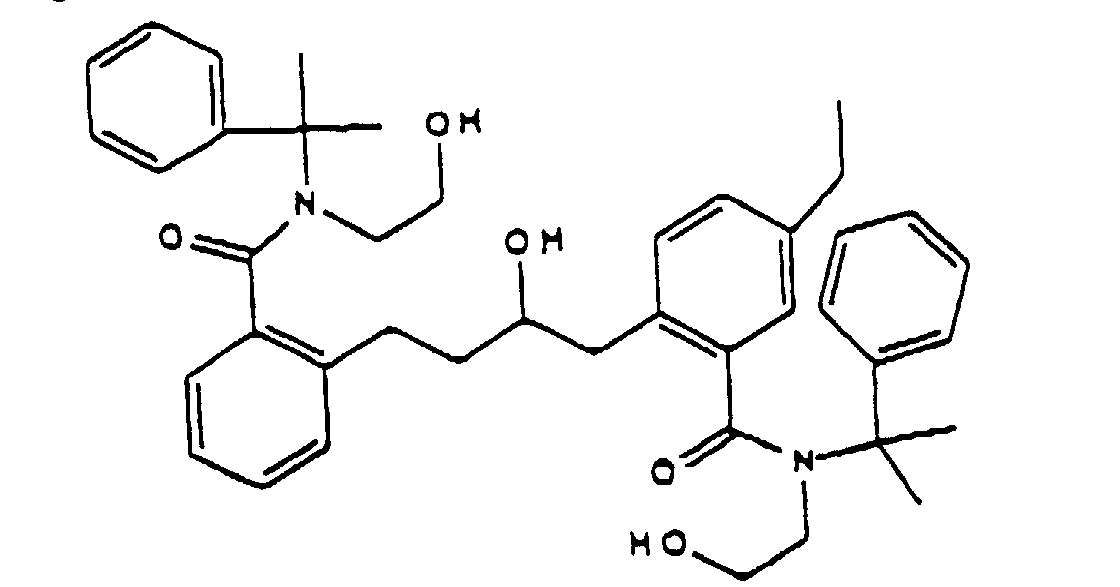
- A compound having the formula
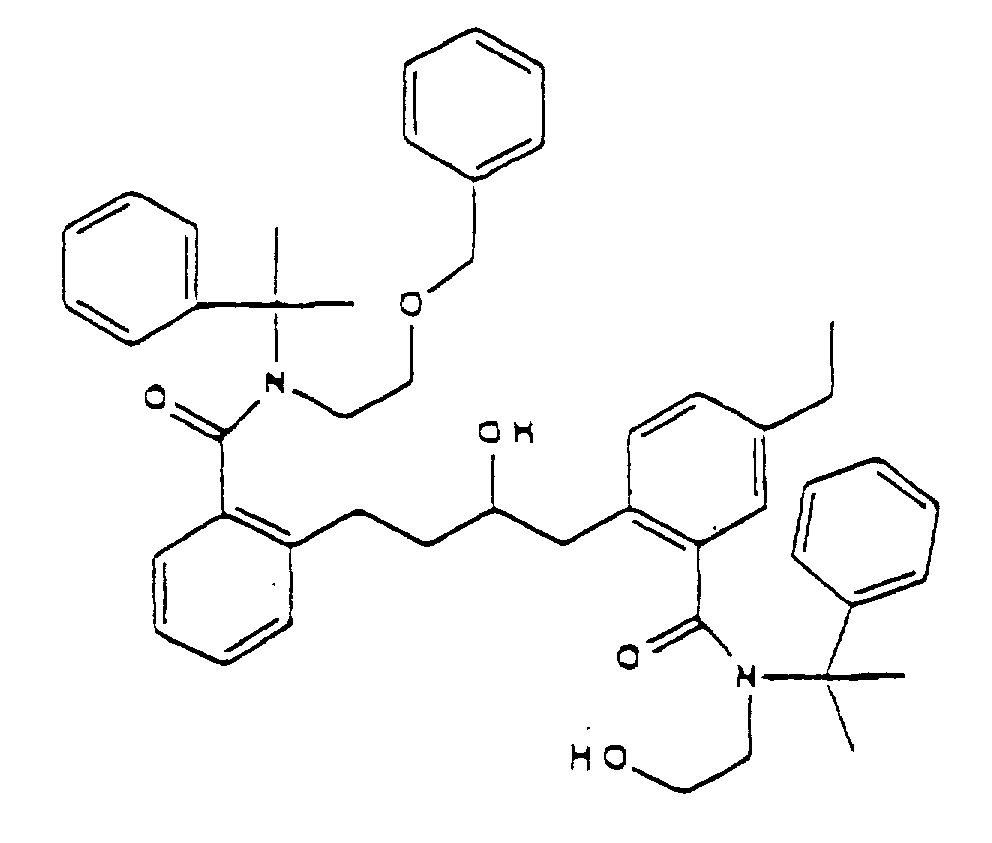
- A compound having the formula
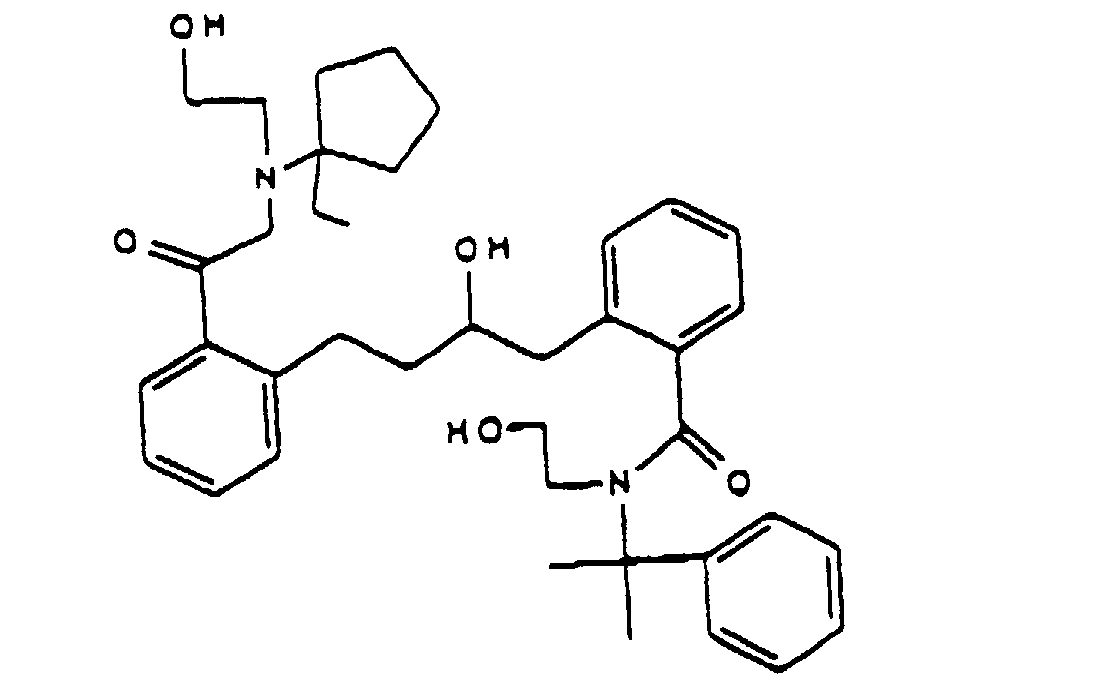
- A compound having the formula

- A compound having the formula
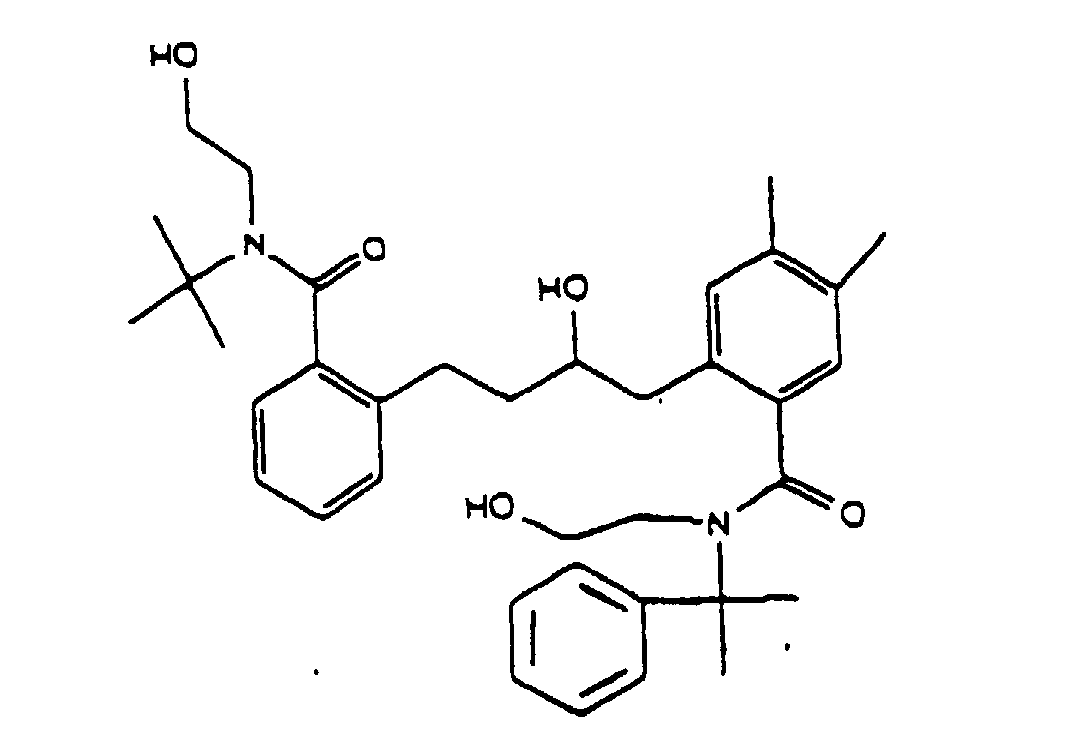
- A compound having the formula

- A compound having the formula
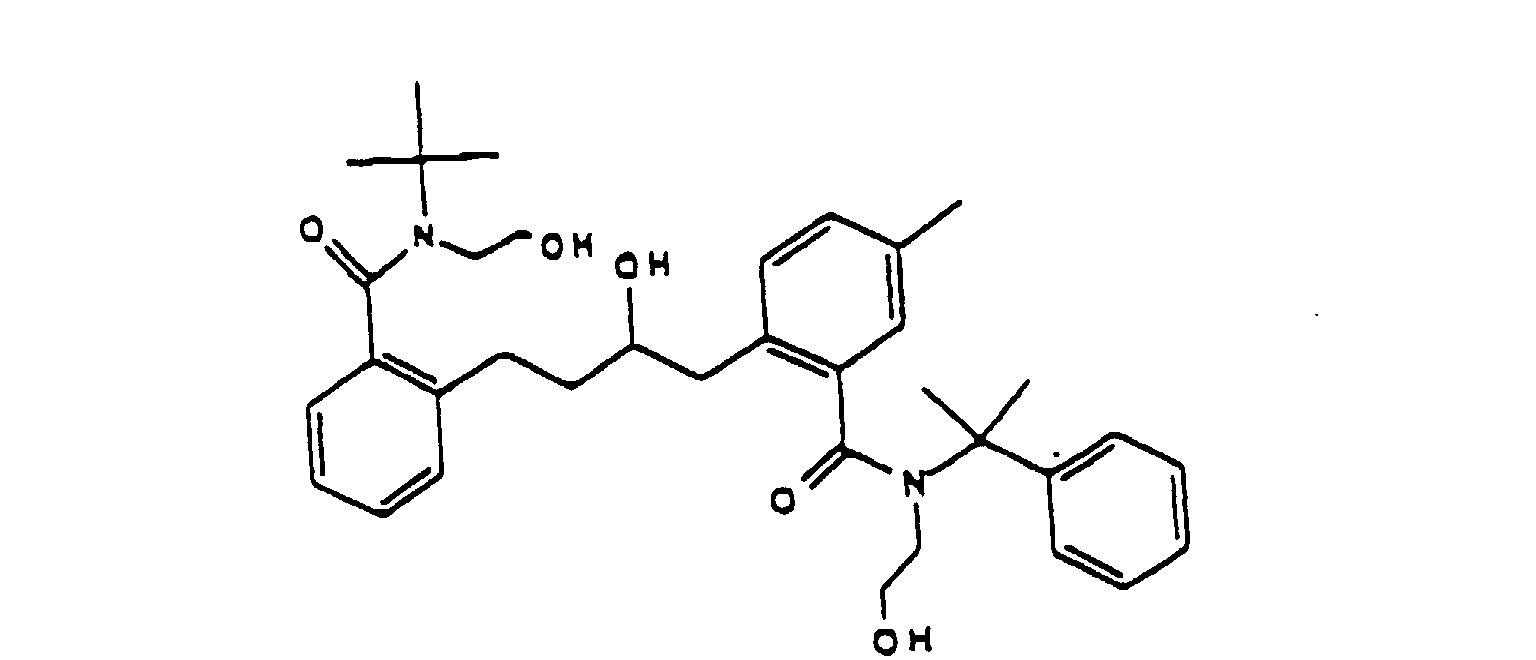
- A compound having the formula

- A compound having the formula
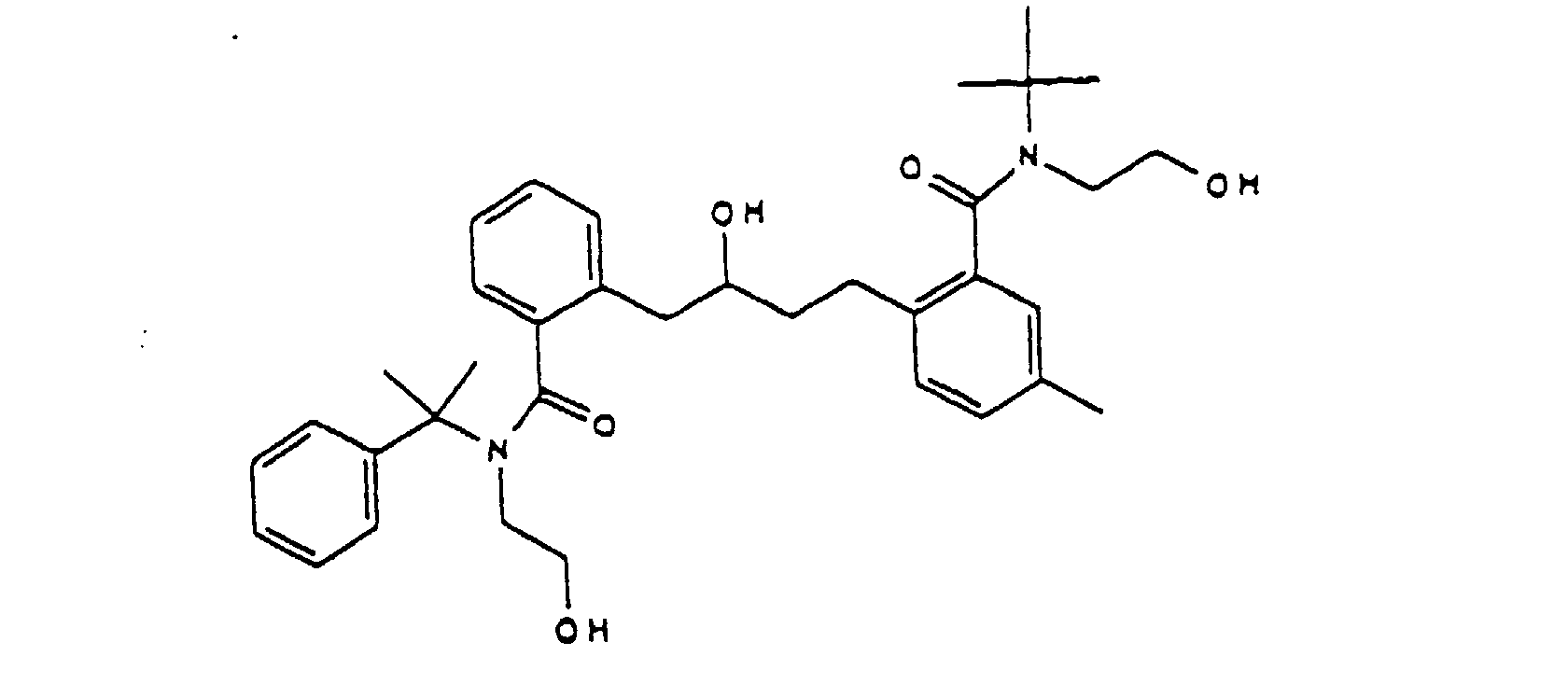
- A compound having the formula
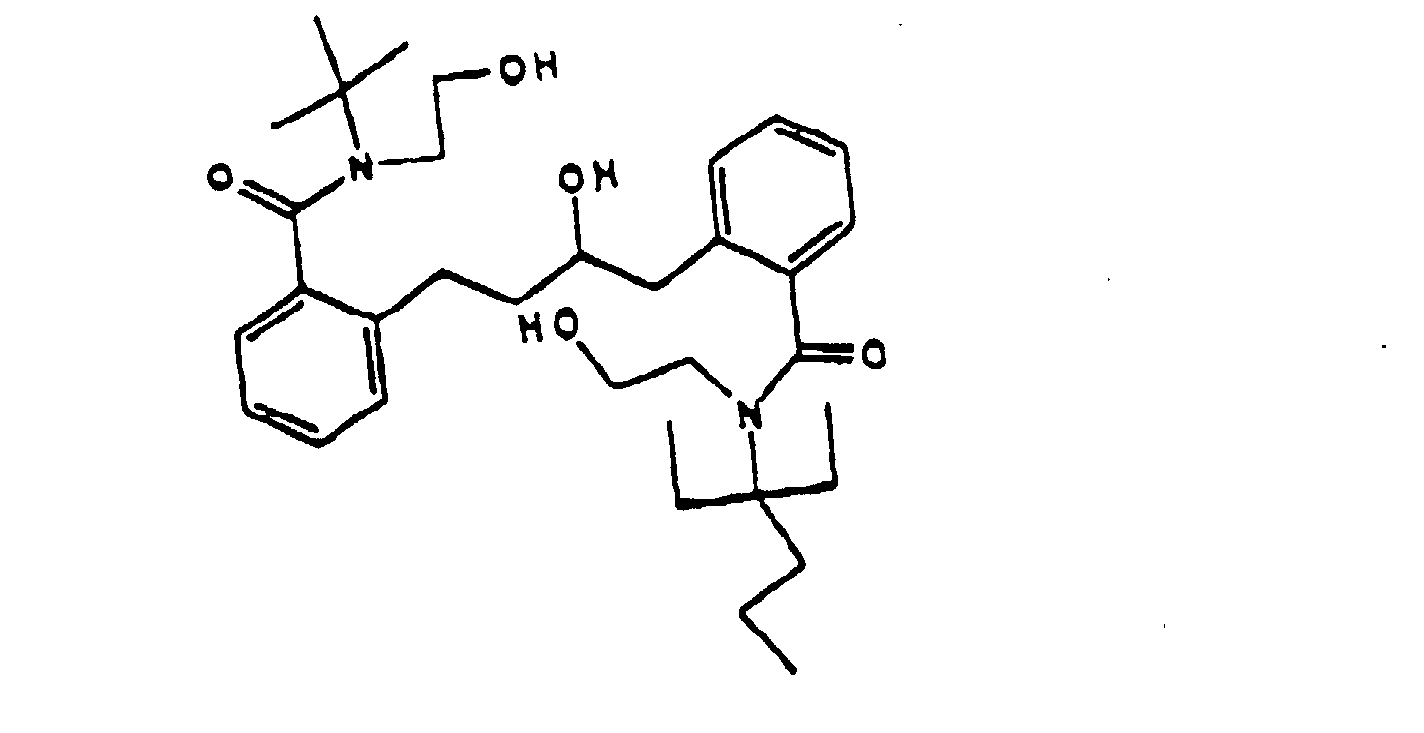
- A compound having the formula

- A compound having the formula
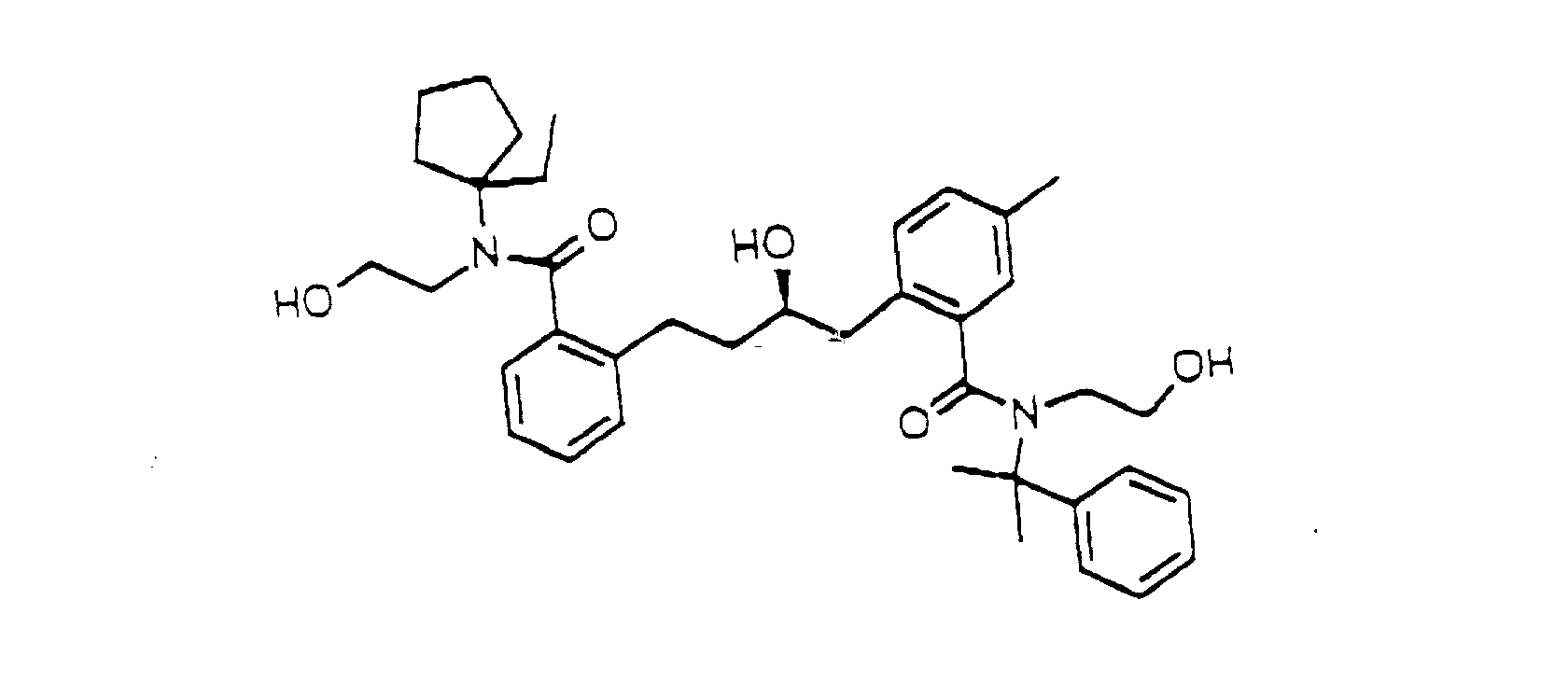
- A compound according to any of claims 1 to 52 for use as a medicament.
- A pharmaceutical composition comprising a compound according to any of claims 1 to 53 and a pharmaceutically acceptable carrier.
- A composition according to claim 54, further comprising at least one other compound that inhibits HIV.
- A composition according to claim 55, wherein said other compound inhibits HIV protease.
- A composition according to claim 54, further comprising at least one other compound that performs a pharmaceutically desirable function different from inhibiting HIV.
- A composition according to claim 56, wherein the compound having the formula II is
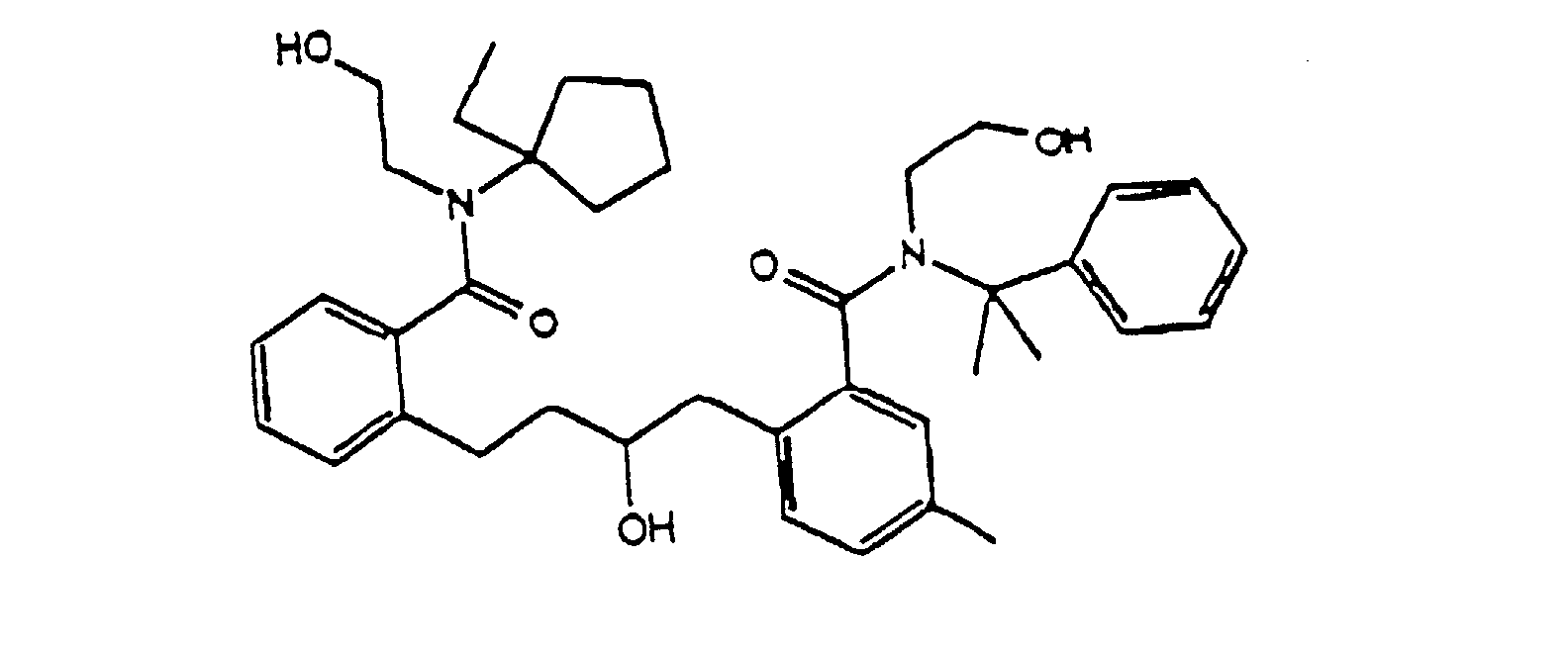
- A composition according to claim 57, wherein the compound having the compound formula II is

- Use of a compound according to claims 1 to 53 or a pharmaceutically acceptable salt thereof in the preparation of a medicament for inhibiting the action of the HIV virus.
- Use of a compound according to claim 60 in conjunction with at least one other compound that inhibits HIV.
- Use according to claim 61 wherein the compound that inhibits HIV is a protease inhibitor.
- Use according to claim 60 in conjunction with at least one other compound that performs a pharmaceutically desirable function different from inhibiting HIV.
- A method for preparing a compound of the formula XVIwherein:
 A' and B' are individually selected from carbocylic or heterocyclic, aromatic, saturated or partially saturated 5, 6 or 7 member rings;R'1, R'2, R'3 and R'4 are individually selected from hydrogen, alkyl, cycloalkyl, aryl, substituted alkyl, cycloalkyl or aryl, substituted oxygen, hydroxyl, substituted or unsubstituted amino and substituted or unsubstituted non-aryl heterocycle, wherein R'1 and R'2 or R'3 and R'4 can form a ring with the nitrogen atom to which they are attached;R17 and R18 are individually selected from hydrogen, halogen, hydroxyl, substituted or unsubstituted alkoxy, mercapto, thioether, -NR'1R'2, nitro, alkyl, aryl and substituted alkyl or aryl, wherein R17 can form a fused ring structure with A' and R18 can form a fused ring structure with B'; which method comprises carrying out the following reactions:wherein:
 a) the compound of the formula XIII, wherein R24 and R'24 are individually selected from alkyl groups, is reacted with a compound of the formula XIV under conditions sufficient to form a compound of the formula XV; andb) the compound of the formula XV is sequentially reduced, followed by reaction of the reduced compound with at least one amine selected from R'1R'2NH and R'3R'4NH under conditions sufficient to form a compound of the formula XVI.
 - The method of claim 64, further comprising the step of converting the compound of formula XVI to a pharmaceutically acceptable salt thereof.
- The method of claim 64, wherein in step b), the reduction is carried out before the reaction of compound XV with said at least one amine to form compound XVI.
- The method of claim 64, wherein in step b), the reaction of compound XV with said at least one amine to form compound XVI is carried out before the reduction.
- The method according to claim 64, wherein in step b), the reduction is continued to form a compound of the formula XVII

Applications Claiming Priority (7)
| Application Number | Priority Date | Filing Date | Title |
|---|---|---|---|
| US515093A | 1993-01-15 | 1993-01-15 | |
| US5150 | 1993-01-15 | ||
| US4226193A | 1993-04-02 | 1993-04-02 | |
| US42261 | 1993-04-02 | ||
| US9937593A | 1993-07-30 | 1993-07-30 | |
| US99375 | 1993-07-30 | ||
| PCT/US1994/000419 WO1994015608A1 (en) | 1993-01-15 | 1994-01-18 | Hiv protease inhibitors |
Publications (3)
| Publication Number | Publication Date |
|---|---|
| EP0695184A1 EP0695184A1 (en) | 1996-02-07 |
| EP0695184A4 EP0695184A4 (en) | 1996-05-22 |
| EP0695184B1 true EP0695184B1 (en) | 1999-04-21 |
Family
ID=27357818
Family Applications (1)
| Application Number | Title | Priority Date | Filing Date |
|---|---|---|---|
| EP94907199A Expired - Lifetime EP0695184B1 (en) | 1993-01-15 | 1994-01-18 | Hiv protease inhibitors |
Country Status (8)
| Country | Link |
|---|---|
| US (2) | US5863950A (en) |
| EP (1) | EP0695184B1 (en) |
| AT (1) | ATE179164T1 (en) |
| AU (2) | AU6087194A (en) |
| CA (1) | CA2153777A1 (en) |
| DE (1) | DE69418035T2 (en) |
| ES (1) | ES2132383T3 (en) |
| WO (2) | WO1994015906A1 (en) |
Families Citing this family (14)
| Publication number | Priority date | Publication date | Assignee | Title |
|---|---|---|---|---|
| AU702661B2 (en) * | 1994-06-29 | 1999-02-25 | Smithkline Beecham Corporation | Vitronectin receptor antagonists |
| MY126358A (en) * | 1996-03-22 | 2006-09-29 | Glaxo Group Ltd | Compositions comprising vx478 and a water soluble tocopherol derivative such as vitamin e-tpgs |
| US6001851A (en) * | 1997-03-13 | 1999-12-14 | Agouron Pharmaceuticals, Inc. | HIV protease inhibitors |
| WO1999059582A1 (en) * | 1998-05-19 | 1999-11-25 | Centaur Pharmaceuticals, Inc. | Amide therapeutics for the treatment of inflammatory bowel disease |
| US6403799B1 (en) | 1999-10-21 | 2002-06-11 | Agouron Pharmaceuticals, Inc. | Methods for the preparation of intermediates in the synthesis of HIV-protease inhibitors |
| WO2001056995A1 (en) * | 2000-01-18 | 2001-08-09 | Nuerogen Corporation | Substituted imidazoles as selective modulators of bradykinin b2 receptors |
| GB0428111D0 (en) * | 2004-12-22 | 2005-01-26 | Kudos Pharm Ltd | Pthalazinone derivatives |
| DK1901731T3 (en) | 2005-06-28 | 2011-06-14 | Merck Sharp & Dohme | Niacin receptor agonists, compositions containing such compounds and methods of treatment |
| US9248122B2 (en) | 2012-11-28 | 2016-02-02 | Grünenthal GmbH | Heteroquinoline-3-carboxamides as KCNQ2/3 modulators |
| US9284286B2 (en) * | 2012-11-28 | 2016-03-15 | Grünenthal GmbH | Specific carboxamides as KCNQ2/3 modulators |
| WO2016126726A1 (en) | 2015-02-02 | 2016-08-11 | Forma Therapeutics, Inc. | Bicyclic [4,6,0] hydroxamic acids as hdac6 inhibitors |
| WO2016126721A1 (en) | 2015-02-02 | 2016-08-11 | Forma Therapeutics, Inc. | 3-aryl-bicyclic [4,5,0] hydroxamic acids as hdac inhibitors |
| EP3472131B1 (en) | 2016-06-17 | 2020-02-19 | Forma Therapeutics, Inc. | 2-spiro-5- and 6-hydroxamic acid indanes as hdac inhibitors |
| CN117069629B (en) * | 2023-07-27 | 2026-03-24 | 五邑大学 | A sulfur-containing acetamide compound, its preparation method and application |
Family Cites Families (17)
| Publication number | Priority date | Publication date | Assignee | Title |
|---|---|---|---|---|
| US2895991A (en) * | 1959-07-21 | New chloromethylated amlides | ||
| DE2337023C3 (en) * | 1973-07-20 | 1979-09-06 | Hoechst Ag, 6000 Frankfurt | Process for the preparation of aldehydes from 2-hydroxynaphthalene-3-carboxylic acid arylamides |
| FR2317922A1 (en) * | 1975-07-15 | 1977-02-11 | Fabre Sa Pierre | SYNTHETIC ISOCOUMARINS WITH ANTI-ALLERGIC ACTION USED IN THE TREATMENT OF ASTHMA |
| DE2533960A1 (en) * | 1975-07-30 | 1977-02-17 | Hoechst Ag | NEW 2-HYDROXYNAPHTHALIN-1-ALDEHYDE, THE METHOD FOR MANUFACTURING IT AND ITS USE |
| ES469020A1 (en) * | 1977-05-10 | 1979-09-01 | Kali Chemie Pharma Gmbh | N1-acyl-N2-phenyldiaminopropanols and pharmaceutical compositions thereof |
| US4299845A (en) * | 1980-04-14 | 1981-11-10 | Schering Corporation | Dermatological compositions and methods of use therefor |
| US4402729A (en) * | 1982-05-07 | 1983-09-06 | Velsicol Chemical Corporation | Heterocyclic amides of phenoxyphenoxyalkanoic acids |
| US4778893A (en) * | 1983-03-14 | 1988-10-18 | Miles Inc. | Optical indicator 3,4-dihydro-2-quinolones |
| US4665193A (en) * | 1984-12-14 | 1987-05-12 | E. R. Squibb & Sons, Inc. | Amino acid ester renin inhibitors |
| US4692455A (en) * | 1985-01-25 | 1987-09-08 | E. R. Squibb & Sons, Inc. | Certain acyclic, alicyclic, aromatic or heterocyclic derivatives of 3-benzoylamino-2-oxo- butyl-amino-carbonyl-oxy-3-propanoic acids, esters thereof, pharmaceutical compositions containing same and their enkephalinase inhibiting properties |
| US4725584A (en) * | 1986-02-19 | 1988-02-16 | Abbott Laboratories | Peptidyl-1-amino-2,4-diols |
| DE3611193A1 (en) * | 1986-04-04 | 1987-10-15 | Bayer Ag | N-SUBSTITUTED BENZAMIDES |
| US5153208A (en) * | 1987-02-10 | 1992-10-06 | Hoechst Aktiengesellschaft | Pyridine-2,4- and -2,5-dicarboxylic acid amides and their medicinal compositions and methods of use |
| US5227511A (en) * | 1988-12-23 | 1993-07-13 | Hodogaya Chemical Co., Ltd. | Benzamide derivatives and plant growth regulants containing them |
| US5175181A (en) * | 1989-12-04 | 1992-12-29 | G. D. Searle & Co. | Imidazolyl/imidazolylalkyl-N-terminal amino hydroxy |
| US5223539A (en) * | 1991-11-22 | 1993-06-29 | G. D. Searle & Co. | N,n-di-alkyl(phenoxy)benzamide derivatives |
| UA49803C2 (en) * | 1994-06-03 | 2002-10-15 | Дж.Д. Сьорль Енд Ко | METHOD FOR TREATMENT OF RETROVIRAL INFECTIONS |
-
1994
- 1994-01-18 AU AU60871/94A patent/AU6087194A/en not_active Abandoned
- 1994-01-18 ES ES94907199T patent/ES2132383T3/en not_active Expired - Lifetime
- 1994-01-18 AU AU61229/94A patent/AU6122994A/en not_active Abandoned
- 1994-01-18 US US08/325,340 patent/US5863950A/en not_active Expired - Fee Related
- 1994-01-18 US US08/325,390 patent/US5714518A/en not_active Expired - Fee Related
- 1994-01-18 WO PCT/US1994/000420 patent/WO1994015906A1/en not_active Ceased
- 1994-01-18 CA CA002153777A patent/CA2153777A1/en not_active Abandoned
- 1994-01-18 EP EP94907199A patent/EP0695184B1/en not_active Expired - Lifetime
- 1994-01-18 DE DE69418035T patent/DE69418035T2/en not_active Expired - Fee Related
- 1994-01-18 AT AT94907199T patent/ATE179164T1/en not_active IP Right Cessation
- 1994-01-18 WO PCT/US1994/000419 patent/WO1994015608A1/en not_active Ceased
Also Published As
| Publication number | Publication date |
|---|---|
| DE69418035T2 (en) | 1999-08-12 |
| WO1994015608A1 (en) | 1994-07-21 |
| EP0695184A4 (en) | 1996-05-22 |
| WO1994015906A1 (en) | 1994-07-21 |
| US5714518A (en) | 1998-02-03 |
| AU6087194A (en) | 1994-08-15 |
| AU6122994A (en) | 1994-08-15 |
| US5863950A (en) | 1999-01-26 |
| EP0695184A1 (en) | 1996-02-07 |
| ATE179164T1 (en) | 1999-05-15 |
| ES2132383T3 (en) | 1999-08-16 |
| CA2153777A1 (en) | 1994-07-21 |
| DE69418035D1 (en) | 1999-05-27 |
Similar Documents
| Publication | Publication Date | Title |
|---|---|---|
| AU718117B2 (en) | Compounds useful to treat retroviral infections | |
| EP1455777B1 (en) | Glyt1 transporter inhibitors and uses thereof in treatment of neurological and neuropsychiatric disorders | |
| EP0677048B1 (en) | Cyclic sulfone containing retroviral protease inhibitors | |
| WO1994015608A1 (en) | Hiv protease inhibitors | |
| US5516784A (en) | Anti-HIV (AIDS) agents | |
| KR100245138B1 (en) | Quinoxaline, preparation method thereof and pharmaceutical composition containing same | |
| JPH09509155A (en) | Protease inhibitor | |
| OA10981A (en) | Substituted n-Ä(aminoiminomethyl or aminomethyl)p henylÜpropyl amides | |
| KR20010101675A (en) | 2h-phthalazin-1-one derivatives and drugs comprising these derivatives as the active ingredient | |
| JP3732858B2 (en) | N- (3-amino-2-hydroxybutyl) sulfonamide derivatives as HIV protease inhibitors | |
| CA2142997A1 (en) | Hydroxyethylamino sulfamic acid derivatives useful as retroviral protease inhibitors | |
| EP0173441B1 (en) | Amino acid derivatives having anti-tumor activity and compositions containing them | |
| CN115572300A (en) | Synthesis method of sulfonamide substituted polycyclic quinazolinone compound | |
| JPH06508146A (en) | Carbocyclic and heterocyclic HIV protease inhibitors | |
| HU211175A9 (en) | 5-oxo-dibenzo(a,d) cyclohepta-1,4-dienes and pharmaceutical compositions comprising them | |
| CN113277991B (en) | Nitrogen heterocyclic ring amino derivative, preparation method thereof and anti-HIV-1 drug | |
| CN115322120A (en) | Small molecule compound and its preparation method application of DHODH mediated disease medicine | |
| JPS61197558A (en) | Novel quinaldic acid amide derivative and production thereof | |
| EP0518904B1 (en) | S-(2-thenoyl)-thiolactic acid derivative having pharmacological activity | |
| KR100245806B1 (en) | Orally administrable selective thrombin inhibitors | |
| CA2459868A1 (en) | Preparation of hiv protease inhibitors | |
| CN118420501A (en) | N-sulfinyl benzoyl hydrazone series compounds and preparation method thereof | |
| JPS60233069A (en) | Benzothiopyranone, manufacture and medicine | |
| CN117362387A (en) | Benzenesulfonamide piperazinone glycine derivatives and preparation methods and applications thereof | |
| JPH09124642A (en) | Novel heterocyclic-substituted pseudopeptides |
Legal Events
| Date | Code | Title | Description |
|---|---|---|---|
| PUAI | Public reference made under article 153(3) epc to a published international application that has entered the european phase |
Free format text: ORIGINAL CODE: 0009012 |
|
| 17P | Request for examination filed |
Effective date: 19950713 |
|
| AK | Designated contracting states |
Kind code of ref document: A1 Designated state(s): AT BE CH DE DK ES FR GB GR IE IT LI LU MC NL PT SE |
|
| RHK1 | Main classification (correction) |
Ipc: C07C235/42 |
|
| A4 | Supplementary search report drawn up and despatched | ||
| AK | Designated contracting states |
Kind code of ref document: A4 Designated state(s): AT BE CH DE DK ES FR GB GR IE IT LI LU MC NL PT SE |
|
| 17Q | First examination report despatched |
Effective date: 19970220 |
|
| GRAG | Despatch of communication of intention to grant |
Free format text: ORIGINAL CODE: EPIDOS AGRA |
|
| GRAG | Despatch of communication of intention to grant |
Free format text: ORIGINAL CODE: EPIDOS AGRA |
|
| GRAH | Despatch of communication of intention to grant a patent |
Free format text: ORIGINAL CODE: EPIDOS IGRA |
|
| GRAH | Despatch of communication of intention to grant a patent |
Free format text: ORIGINAL CODE: EPIDOS IGRA |
|
| GRAA | (expected) grant |
Free format text: ORIGINAL CODE: 0009210 |
|
| AK | Designated contracting states |
Kind code of ref document: B1 Designated state(s): AT BE CH DE DK ES FR GB GR IE IT LI LU MC NL PT SE |
|
| PG25 | Lapsed in a contracting state [announced via postgrant information from national office to epo] |
Ref country code: SE Free format text: THE PATENT HAS BEEN ANNULLED BY A DECISION OF A NATIONAL AUTHORITY Effective date: 19990421 Ref country code: NL Free format text: LAPSE BECAUSE OF FAILURE TO SUBMIT A TRANSLATION OF THE DESCRIPTION OR TO PAY THE FEE WITHIN THE PRESCRIBED TIME-LIMIT Effective date: 19990421 Ref country code: LI Free format text: LAPSE BECAUSE OF FAILURE TO SUBMIT A TRANSLATION OF THE DESCRIPTION OR TO PAY THE FEE WITHIN THE PRESCRIBED TIME-LIMIT Effective date: 19990421 Ref country code: GR Free format text: LAPSE BECAUSE OF NON-PAYMENT OF DUE FEES Effective date: 19990421 Ref country code: CH Free format text: LAPSE BECAUSE OF FAILURE TO SUBMIT A TRANSLATION OF THE DESCRIPTION OR TO PAY THE FEE WITHIN THE PRESCRIBED TIME-LIMIT Effective date: 19990421 Ref country code: BE Free format text: LAPSE BECAUSE OF FAILURE TO SUBMIT A TRANSLATION OF THE DESCRIPTION OR TO PAY THE FEE WITHIN THE PRESCRIBED TIME-LIMIT Effective date: 19990421 Ref country code: AT Free format text: LAPSE BECAUSE OF FAILURE TO SUBMIT A TRANSLATION OF THE DESCRIPTION OR TO PAY THE FEE WITHIN THE PRESCRIBED TIME-LIMIT Effective date: 19990421 |
|
| REF | Corresponds to: |
Ref document number: 179164 Country of ref document: AT Date of ref document: 19990515 Kind code of ref document: T |
|
| REG | Reference to a national code |
Ref country code: CH Ref legal event code: EP |
|
| REG | Reference to a national code |
Ref country code: IE Ref legal event code: FG4D |
|
| REF | Corresponds to: |
Ref document number: 69418035 Country of ref document: DE Date of ref document: 19990527 |
|
| ET | Fr: translation filed | ||
| PG25 | Lapsed in a contracting state [announced via postgrant information from national office to epo] |
Ref country code: DK Free format text: LAPSE BECAUSE OF FAILURE TO SUBMIT A TRANSLATION OF THE DESCRIPTION OR TO PAY THE FEE WITHIN THE PRESCRIBED TIME-LIMIT Effective date: 19990721 |
|
| PG25 | Lapsed in a contracting state [announced via postgrant information from national office to epo] |
Ref country code: PT Free format text: LAPSE BECAUSE OF FAILURE TO SUBMIT A TRANSLATION OF THE DESCRIPTION OR TO PAY THE FEE WITHIN THE PRESCRIBED TIME-LIMIT Effective date: 19990723 |
|
| REG | Reference to a national code |
Ref country code: ES Ref legal event code: FG2A Ref document number: 2132383 Country of ref document: ES Kind code of ref document: T3 |
|
| REG | Reference to a national code |
Ref country code: CH Ref legal event code: PL |
|
| PG25 | Lapsed in a contracting state [announced via postgrant information from national office to epo] |
Ref country code: LU Free format text: LAPSE BECAUSE OF NON-PAYMENT OF DUE FEES Effective date: 20000118 Ref country code: IE Free format text: LAPSE BECAUSE OF NON-PAYMENT OF DUE FEES Effective date: 20000118 |
|
| PG25 | Lapsed in a contracting state [announced via postgrant information from national office to epo] |
Ref country code: MC Free format text: THE PATENT HAS BEEN ANNULLED BY A DECISION OF A NATIONAL AUTHORITY Effective date: 20000131 |
|
| PLBE | No opposition filed within time limit |
Free format text: ORIGINAL CODE: 0009261 |
|
| STAA | Information on the status of an ep patent application or granted ep patent |
Free format text: STATUS: NO OPPOSITION FILED WITHIN TIME LIMIT |
|
| 26N | No opposition filed | ||
| REG | Reference to a national code |
Ref country code: IE Ref legal event code: MM4A |
|
| REG | Reference to a national code |
Ref country code: GB Ref legal event code: IF02 |
|
| PGFP | Annual fee paid to national office [announced via postgrant information from national office to epo] |
Ref country code: GB Payment date: 20041210 Year of fee payment: 12 |
|
| PGFP | Annual fee paid to national office [announced via postgrant information from national office to epo] |
Ref country code: FR Payment date: 20050105 Year of fee payment: 12 |
|
| PGFP | Annual fee paid to national office [announced via postgrant information from national office to epo] |
Ref country code: ES Payment date: 20050121 Year of fee payment: 12 |
|
| PGFP | Annual fee paid to national office [announced via postgrant information from national office to epo] |
Ref country code: DE Payment date: 20050131 Year of fee payment: 12 |
|
| PG25 | Lapsed in a contracting state [announced via postgrant information from national office to epo] |
Ref country code: GB Free format text: LAPSE BECAUSE OF NON-PAYMENT OF DUE FEES Effective date: 20060118 |
|
| PG25 | Lapsed in a contracting state [announced via postgrant information from national office to epo] |
Ref country code: ES Free format text: LAPSE BECAUSE OF NON-PAYMENT OF DUE FEES Effective date: 20060119 |
|
| PG25 | Lapsed in a contracting state [announced via postgrant information from national office to epo] |
Ref country code: FR Free format text: LAPSE BECAUSE OF NON-PAYMENT OF DUE FEES Effective date: 20060131 |
|
| PGFP | Annual fee paid to national office [announced via postgrant information from national office to epo] |
Ref country code: IT Payment date: 20060131 Year of fee payment: 13 |
|
| PG25 | Lapsed in a contracting state [announced via postgrant information from national office to epo] |
Ref country code: DE Free format text: LAPSE BECAUSE OF NON-PAYMENT OF DUE FEES Effective date: 20060801 |
|
| GBPC | Gb: european patent ceased through non-payment of renewal fee |
Effective date: 20060118 |
|
| REG | Reference to a national code |
Ref country code: FR Ref legal event code: ST Effective date: 20060929 |
|
| REG | Reference to a national code |
Ref country code: ES Ref legal event code: FD2A Effective date: 20060119 |
|
| PG25 | Lapsed in a contracting state [announced via postgrant information from national office to epo] |
Ref country code: IT Free format text: LAPSE BECAUSE OF NON-PAYMENT OF DUE FEES Effective date: 20070118 |