EP0693283A1 - Heart failure remedy - Google Patents
Heart failure remedy Download PDFInfo
- Publication number
- EP0693283A1 EP0693283A1 EP94910589A EP94910589A EP0693283A1 EP 0693283 A1 EP0693283 A1 EP 0693283A1 EP 94910589 A EP94910589 A EP 94910589A EP 94910589 A EP94910589 A EP 94910589A EP 0693283 A1 EP0693283 A1 EP 0693283A1
- Authority
- EP
- European Patent Office
- Prior art keywords
- group
- unsubstituted
- substituted
- substituents selected
- halogen atom
- Prior art date
- Legal status (The legal status is an assumption and is not a legal conclusion. Google has not performed a legal analysis and makes no representation as to the accuracy of the status listed.)
- Ceased
Links
- 0 CC(*)(C1O)Oc2cc3n[o]nc3cc2C1N Chemical compound CC(*)(C1O)Oc2cc3n[o]nc3cc2C1N 0.000 description 4
- KNGGVHQGKBNQJC-NPWAICRYSA-N CC(C)(C(C(C1=CC2=N)N3CCCC3)O)OC1=C/C2=N/S Chemical compound CC(C)(C(C(C1=CC2=N)N3CCCC3)O)OC1=C/C2=N/S KNGGVHQGKBNQJC-NPWAICRYSA-N 0.000 description 1
Classifications
-
- A—HUMAN NECESSITIES
- A61—MEDICAL OR VETERINARY SCIENCE; HYGIENE
- A61K—PREPARATIONS FOR MEDICAL, DENTAL OR TOILETRY PURPOSES
- A61K31/00—Medicinal preparations containing organic active ingredients
- A61K31/33—Heterocyclic compounds
- A61K31/395—Heterocyclic compounds having nitrogen as a ring hetero atom, e.g. guanethidine or rifamycins
- A61K31/41—Heterocyclic compounds having nitrogen as a ring hetero atom, e.g. guanethidine or rifamycins having five-membered rings with two or more ring hetero atoms, at least one of which being nitrogen, e.g. tetrazole
- A61K31/415—1,2-Diazoles
-
- C—CHEMISTRY; METALLURGY
- C07—ORGANIC CHEMISTRY
- C07D—HETEROCYCLIC COMPOUNDS
- C07D491/00—Heterocyclic compounds containing in the condensed ring system both one or more rings having oxygen atoms as the only ring hetero atoms and one or more rings having nitrogen atoms as the only ring hetero atoms, not provided for by groups C07D451/00 - C07D459/00, C07D463/00, C07D477/00 or C07D489/00
- C07D491/02—Heterocyclic compounds containing in the condensed ring system both one or more rings having oxygen atoms as the only ring hetero atoms and one or more rings having nitrogen atoms as the only ring hetero atoms, not provided for by groups C07D451/00 - C07D459/00, C07D463/00, C07D477/00 or C07D489/00 in which the condensed system contains two hetero rings
- C07D491/04—Ortho-condensed systems
-
- A—HUMAN NECESSITIES
- A61—MEDICAL OR VETERINARY SCIENCE; HYGIENE
- A61K—PREPARATIONS FOR MEDICAL, DENTAL OR TOILETRY PURPOSES
- A61K31/00—Medicinal preparations containing organic active ingredients
- A61K31/33—Heterocyclic compounds
- A61K31/395—Heterocyclic compounds having nitrogen as a ring hetero atom, e.g. guanethidine or rifamycins
- A61K31/41—Heterocyclic compounds having nitrogen as a ring hetero atom, e.g. guanethidine or rifamycins having five-membered rings with two or more ring hetero atoms, at least one of which being nitrogen, e.g. tetrazole
- A61K31/4164—1,3-Diazoles
- A61K31/4178—1,3-Diazoles not condensed 1,3-diazoles and containing further heterocyclic rings, e.g. pilocarpine, nitrofurantoin
-
- A—HUMAN NECESSITIES
- A61—MEDICAL OR VETERINARY SCIENCE; HYGIENE
- A61K—PREPARATIONS FOR MEDICAL, DENTAL OR TOILETRY PURPOSES
- A61K31/00—Medicinal preparations containing organic active ingredients
- A61K31/33—Heterocyclic compounds
- A61K31/395—Heterocyclic compounds having nitrogen as a ring hetero atom, e.g. guanethidine or rifamycins
- A61K31/41—Heterocyclic compounds having nitrogen as a ring hetero atom, e.g. guanethidine or rifamycins having five-membered rings with two or more ring hetero atoms, at least one of which being nitrogen, e.g. tetrazole
- A61K31/4192—1,2,3-Triazoles
-
- A—HUMAN NECESSITIES
- A61—MEDICAL OR VETERINARY SCIENCE; HYGIENE
- A61K—PREPARATIONS FOR MEDICAL, DENTAL OR TOILETRY PURPOSES
- A61K31/00—Medicinal preparations containing organic active ingredients
- A61K31/33—Heterocyclic compounds
- A61K31/395—Heterocyclic compounds having nitrogen as a ring hetero atom, e.g. guanethidine or rifamycins
- A61K31/41—Heterocyclic compounds having nitrogen as a ring hetero atom, e.g. guanethidine or rifamycins having five-membered rings with two or more ring hetero atoms, at least one of which being nitrogen, e.g. tetrazole
- A61K31/42—Oxazoles
- A61K31/422—Oxazoles not condensed and containing further heterocyclic rings
-
- A—HUMAN NECESSITIES
- A61—MEDICAL OR VETERINARY SCIENCE; HYGIENE
- A61K—PREPARATIONS FOR MEDICAL, DENTAL OR TOILETRY PURPOSES
- A61K31/00—Medicinal preparations containing organic active ingredients
- A61K31/33—Heterocyclic compounds
- A61K31/395—Heterocyclic compounds having nitrogen as a ring hetero atom, e.g. guanethidine or rifamycins
- A61K31/41—Heterocyclic compounds having nitrogen as a ring hetero atom, e.g. guanethidine or rifamycins having five-membered rings with two or more ring hetero atoms, at least one of which being nitrogen, e.g. tetrazole
- A61K31/4245—Oxadiazoles
-
- A—HUMAN NECESSITIES
- A61—MEDICAL OR VETERINARY SCIENCE; HYGIENE
- A61K—PREPARATIONS FOR MEDICAL, DENTAL OR TOILETRY PURPOSES
- A61K31/00—Medicinal preparations containing organic active ingredients
- A61K31/33—Heterocyclic compounds
- A61K31/395—Heterocyclic compounds having nitrogen as a ring hetero atom, e.g. guanethidine or rifamycins
- A61K31/41—Heterocyclic compounds having nitrogen as a ring hetero atom, e.g. guanethidine or rifamycins having five-membered rings with two or more ring hetero atoms, at least one of which being nitrogen, e.g. tetrazole
- A61K31/433—Thidiazoles
-
- A—HUMAN NECESSITIES
- A61—MEDICAL OR VETERINARY SCIENCE; HYGIENE
- A61K—PREPARATIONS FOR MEDICAL, DENTAL OR TOILETRY PURPOSES
- A61K31/00—Medicinal preparations containing organic active ingredients
- A61K31/33—Heterocyclic compounds
- A61K31/395—Heterocyclic compounds having nitrogen as a ring hetero atom, e.g. guanethidine or rifamycins
- A61K31/435—Heterocyclic compounds having nitrogen as a ring hetero atom, e.g. guanethidine or rifamycins having six-membered rings with one nitrogen as the only ring hetero atom
- A61K31/44—Non condensed pyridines; Hydrogenated derivatives thereof
- A61K31/445—Non condensed piperidines, e.g. piperocaine
- A61K31/4523—Non condensed piperidines, e.g. piperocaine containing further heterocyclic ring systems
- A61K31/454—Non condensed piperidines, e.g. piperocaine containing further heterocyclic ring systems containing a five-membered ring with nitrogen as a ring hetero atom, e.g. pimozide, domperidone
-
- A—HUMAN NECESSITIES
- A61—MEDICAL OR VETERINARY SCIENCE; HYGIENE
- A61K—PREPARATIONS FOR MEDICAL, DENTAL OR TOILETRY PURPOSES
- A61K31/00—Medicinal preparations containing organic active ingredients
- A61K31/33—Heterocyclic compounds
- A61K31/395—Heterocyclic compounds having nitrogen as a ring hetero atom, e.g. guanethidine or rifamycins
- A61K31/435—Heterocyclic compounds having nitrogen as a ring hetero atom, e.g. guanethidine or rifamycins having six-membered rings with one nitrogen as the only ring hetero atom
- A61K31/47—Quinolines; Isoquinolines
- A61K31/472—Non-condensed isoquinolines, e.g. papaverine
- A61K31/4725—Non-condensed isoquinolines, e.g. papaverine containing further heterocyclic rings
-
- A—HUMAN NECESSITIES
- A61—MEDICAL OR VETERINARY SCIENCE; HYGIENE
- A61K—PREPARATIONS FOR MEDICAL, DENTAL OR TOILETRY PURPOSES
- A61K31/00—Medicinal preparations containing organic active ingredients
- A61K31/33—Heterocyclic compounds
- A61K31/395—Heterocyclic compounds having nitrogen as a ring hetero atom, e.g. guanethidine or rifamycins
- A61K31/495—Heterocyclic compounds having nitrogen as a ring hetero atom, e.g. guanethidine or rifamycins having six-membered rings with two or more nitrogen atoms as the only ring heteroatoms, e.g. piperazine or tetrazines
- A61K31/496—Non-condensed piperazines containing further heterocyclic rings, e.g. rifampin, thiothixene or sparfloxacin
-
- A—HUMAN NECESSITIES
- A61—MEDICAL OR VETERINARY SCIENCE; HYGIENE
- A61K—PREPARATIONS FOR MEDICAL, DENTAL OR TOILETRY PURPOSES
- A61K31/00—Medicinal preparations containing organic active ingredients
- A61K31/33—Heterocyclic compounds
- A61K31/395—Heterocyclic compounds having nitrogen as a ring hetero atom, e.g. guanethidine or rifamycins
- A61K31/495—Heterocyclic compounds having nitrogen as a ring hetero atom, e.g. guanethidine or rifamycins having six-membered rings with two or more nitrogen atoms as the only ring heteroatoms, e.g. piperazine or tetrazines
- A61K31/505—Pyrimidines; Hydrogenated pyrimidines, e.g. trimethoprim
- A61K31/506—Pyrimidines; Hydrogenated pyrimidines, e.g. trimethoprim not condensed and containing further heterocyclic rings
-
- A—HUMAN NECESSITIES
- A61—MEDICAL OR VETERINARY SCIENCE; HYGIENE
- A61K—PREPARATIONS FOR MEDICAL, DENTAL OR TOILETRY PURPOSES
- A61K31/00—Medicinal preparations containing organic active ingredients
- A61K31/33—Heterocyclic compounds
- A61K31/395—Heterocyclic compounds having nitrogen as a ring hetero atom, e.g. guanethidine or rifamycins
- A61K31/535—Heterocyclic compounds having nitrogen as a ring hetero atom, e.g. guanethidine or rifamycins having six-membered rings with at least one nitrogen and one oxygen as the ring hetero atoms, e.g. 1,2-oxazines
- A61K31/5355—Non-condensed oxazines and containing further heterocyclic rings
-
- A—HUMAN NECESSITIES
- A61—MEDICAL OR VETERINARY SCIENCE; HYGIENE
- A61K—PREPARATIONS FOR MEDICAL, DENTAL OR TOILETRY PURPOSES
- A61K31/00—Medicinal preparations containing organic active ingredients
- A61K31/33—Heterocyclic compounds
- A61K31/395—Heterocyclic compounds having nitrogen as a ring hetero atom, e.g. guanethidine or rifamycins
- A61K31/535—Heterocyclic compounds having nitrogen as a ring hetero atom, e.g. guanethidine or rifamycins having six-membered rings with at least one nitrogen and one oxygen as the ring hetero atoms, e.g. 1,2-oxazines
- A61K31/5375—1,4-Oxazines, e.g. morpholine
- A61K31/5377—1,4-Oxazines, e.g. morpholine not condensed and containing further heterocyclic rings, e.g. timolol
-
- A—HUMAN NECESSITIES
- A61—MEDICAL OR VETERINARY SCIENCE; HYGIENE
- A61P—SPECIFIC THERAPEUTIC ACTIVITY OF CHEMICAL COMPOUNDS OR MEDICINAL PREPARATIONS
- A61P9/00—Drugs for disorders of the cardiovascular system
- A61P9/04—Inotropic agents, i.e. stimulants of cardiac contraction; Drugs for heart failure
-
- C—CHEMISTRY; METALLURGY
- C07—ORGANIC CHEMISTRY
- C07D—HETEROCYCLIC COMPOUNDS
- C07D491/00—Heterocyclic compounds containing in the condensed ring system both one or more rings having oxygen atoms as the only ring hetero atoms and one or more rings having nitrogen atoms as the only ring hetero atoms, not provided for by groups C07D451/00 - C07D459/00, C07D463/00, C07D477/00 or C07D489/00
- C07D491/02—Heterocyclic compounds containing in the condensed ring system both one or more rings having oxygen atoms as the only ring hetero atoms and one or more rings having nitrogen atoms as the only ring hetero atoms, not provided for by groups C07D451/00 - C07D459/00, C07D463/00, C07D477/00 or C07D489/00 in which the condensed system contains two hetero rings
- C07D491/04—Ortho-condensed systems
- C07D491/044—Ortho-condensed systems with only one oxygen atom as ring hetero atom in the oxygen-containing ring
- C07D491/052—Ortho-condensed systems with only one oxygen atom as ring hetero atom in the oxygen-containing ring the oxygen-containing ring being six-membered
-
- C—CHEMISTRY; METALLURGY
- C07—ORGANIC CHEMISTRY
- C07D—HETEROCYCLIC COMPOUNDS
- C07D513/00—Heterocyclic compounds containing in the condensed system at least one hetero ring having nitrogen and sulfur atoms as the only ring hetero atoms, not provided for in groups C07D463/00, C07D477/00 or C07D499/00 - C07D507/00
- C07D513/02—Heterocyclic compounds containing in the condensed system at least one hetero ring having nitrogen and sulfur atoms as the only ring hetero atoms, not provided for in groups C07D463/00, C07D477/00 or C07D499/00 - C07D507/00 in which the condensed system contains two hetero rings
- C07D513/04—Ortho-condensed systems
Definitions
- the present invention relates to the use of pharmaceutically active benzopyran derivatives as a medicine for cardiac insufficiency of mammals including human beings.
- the present inventors intensively studied and investigated various benzopyran derivatives so as to obtain those having a low potassium channel opening activity while having no cardiosuppressing activity but rather having an activity of increasing constriction of heart and, as a result, have found that the compounds of the following formula (I) have a strong cardiotonic activity. On the basis of this finding, the present invention has been completed.
- the present invention is directed to the compounds of the following formula (I), their optical isomers, their stereoisomers and their pharmaceutically acceptable salts when they may form salts.
- X1 and X2 do not exist or represent an oxygen atom
- X represents an oxygen atom, a sulfur atom, a nitrogen atom (said nitrogen atom is unsubstituted or substituted by a hydrogen atom or a C1-C4 alkyl group), C(O), C(S), or C(N-CN)
- A represents a hydrogen atom, a hydroxyl group, or OC(O)R5 (in which R5 represents a C1-C4 alkyl group), or may form a single bond together with B
- B represents a hydrogen atom, or may form a single bond together with A
- R1 and R2 are the same or different from each other and represents hydrogen atom or a C1-C4 alkyl group, or R1 and R2 may together form a 1,4-butylene or 1,5
- the present invention relates to medicines for cardiac insufficiency, containing these compounds as active ingredients.
- the compounds shown in the formula (I) of present invention reinforces constraction of cardiac muscles and are useful for improving cardiac functions. They are therefore usable as a medicine for treating cardiac insufficiency. They not only have a cardiotonic activity, but also have a strong activity of reducing the rate of heart beats.
- n- means normal; "i-” means iso; "sec-” means secondary; “t-” means tertiary-; “c-” means cyclo-; "Me” means methyl; “Et” means ethyl; “Pr” means propyl; “Bu” means butyl; “Pen” means pentyl; “Hex” means hexyl; and “Ph” means phenyl.
- R1 and R2 include a hydrogen atom, Me, Et, n-Pr, i-Pr, n-Bu, i-Bu, sec-Bu and t-Bu.
- R1 and R2 may together form (CH2)4 or (CH2)5 to give spiro-rings.
- Examples of A include OH, OC(O)Me, OC(O)Et, OC(O)-n-Pr, OC(O)-i-Pr, OC(O)-n-Bu, OC(O)-i-Bu, OC(O)-sec-Bu, OC(O)-t-Bu, etc.
- a and B may together form a single bond.
- Examples of X include an oxygen atom, a sulfur atom, C(O), C(S), NH, NMe, NEt, N-n-Pr, N-i-Pr, N-c-Pr, N-n-Bu, N-i-Bu, N-sec-Bu, N-t-Bu, etc.
- R3 and R4 include a hydrogen atom, Me, Et, n-Pr, i-Pr, c-Pr, n-Bu, i-Bu, sec-Bu, t-Bu, n-Pen, c-Pen, n-Hex, c-Hex, Ph, benzyl, para-chlorophenylmethyl, para-fluorophenylmethyl, para-bromophenylmethyl, phenylethyl, para-chlorophenylethyl, para-fluorophenylethyl, para-bromophenylethyl, CH2CO2H, CH2CO2Me, CH2CO2Et, (CH2)2CO2Me, (CH2)2CO2Et, (CH2)2CH(OMe)2, (CH2)2CH(OEt)2, (CH2)3OH, (CH2)3OMe, (CH2)3OEt, (CH2)3Cl, (CH2)3Br, (CH2)
- the preferable one is a medicine for cardiac insufficiency containing, as the active ingredient, at least one of compounds of the formula (II), their optical isomers, their stereoisomers and their pharmacologically acceptable salts when they may form salts: wherein X6 does not exist or represents an oxygen atom; X5 represents an oxygen atom, a sulfur atom, or a nitrogen atom (said nitrogen atom is unsubstituted or substituted by a hydrogen atom or a C1-C4 alkyl group); A1 represents a hydrogen atom, a hydroxyl group, or OC(O)R17 (in which R17 represents a C1-C4 alkyl group); B1 represents a hydrogen atom; R13 and R14 are the same or different each other and represent a hydrogen atom or a C1-C4 alkyl group; R15 and R16 are the same or different to each other and represent a hydrogen atom,
- the medicines for cardiac insufficiency in which R15 and R16 in formula (II) simultaneously represents C1-C6 alkyl groups are one of further preferable ones.
- the compounds of formula (I) of the present invention have asymmetric carbon atoms at the 3- and 4-positions in the pyran ring and therefore include opticallyly active substances based on the asymmetric carbon atoms. Such optically active substances may also be used in the present invention, like the racemic modifications. In addition, stereoisomers based on the 3- and 4-positions in the pyran ring may also be used. If the compounds may form salts, their pharmacologically acceptable salts may also be used as the active ingredients of the present invention.
- the solvent usable for the reaction of the compound (3) and the compound (4) includes, for example, sulfoxide solvents such as dimethylsulfoxide, amide solvents such as dimethylformamide and dimethylacetamide, ether solvents such as ethyl ether, dimethoxyethane and tetrahydrofuran, and alcohol solvents such as methanol, ethanol and isopropanol. Of these, preferred are alcohol solvents.
- the reaction temperature of reacting the two compounds (3) and (4) may be from ice-cooled temperature to the reflux temperature for the reaction solvent used, preferably at the reflux temperature for the solvent used. If desired, the reaction may be conducted under pressure.
- the ratio of compound (4)/compound (3)(by molar ratio) is within the range of from 0.5 to 2.0, preferably from 1.0 to 1.1.
- Either the compound of formula (5) or the compound of formula (6) is obtained by the reaction, depending on the reaction conditions or the conditions for the post-treatment after the reaction which will be mentioned in detail hereunder.
- the compound of formula (6) is obtained by reacting the compound of formula (3) and the compound of formula (4) in tetrahydrofuran in the presence of sodium hydride.
- the compound of formula (5) may also be obtained by the same reaction, depending on the reaction conditions (e.g., reaction time, reaction temperature, etc.).
- the compound of formula (5) obtained by the reaction is often dehydrated, depending on the difference of the post-treatment of the compound formed by the reaction. For instance, when the reaction solution contains an acid or alkali and when it is directly heated and concentrated without removing the acid or alkali by rinsing, the compound formed in the reaction solution will often be dehydrated.
- the dehydrating conditions are apt to be influenced by the kind of the compound formed, the reaction conditions and the conditions for the post-treatment.
- Z represents N(R9) or an oxygen atom or sulfur atom
- W represents a chlorine atom, a bromine atom, an iodine atom, a lower alkylsulfonate, a benzenesulfonate or a toluenesulfonate.
- the compound of formula (14) may be obtained by known methods (for example, refer to the above-mentioned literature).
- the reaction temperature may be from an ice-cooled temperature to the reflux temperature for the raction solvent used, preferably at the reflux temperature for the solvent used. If desired, the reaction may be conducted under pressure.
- compounds in which X is a sulfur atom or a nitrogen atom may be synthesized by a compound of formula (15) via three or four steps.
- the conversion of the compound of formula (15) into a compound of formula (17) is attained, for example, known methods described in Japanese Patent Application Laid-Open No. Sho 56-57785 and No. Sho 56-122 380.
- the compound of formula (17) is then subjected to conventional diazotation, for example, by treating it with sodium nitrite in an aqueous solution in the presence of an inorganic acid such as hydrochloric acid or sulfuric acid or an organic acid such as acetic acid, and thereafter cyclized under heat at 5 to 100°C , preferably at 50 to 100 °C to give a compound of formula (18) where X is a nitrogen atom.
- an inorganic acid such as hydrochloric acid or sulfuric acid or an organic acid such as acetic acid
- a compound of formula (I) in which A and B together form a single bond may often be formed by merely heating the compound of formula (18). Therefore, the former may often be obtained during the synthesis reaction of the compound of formula (18) or during the post-treatment of the same. If desired, it may also be synthesized by dehydrating the compound of formula (18) with an acid anhydride such as benzoic anhydride or acetic anhydride or with a base such as potassium carbonate.
- an acid anhydride such as benzoic anhydride or acetic anhydride
- a base such as potassium carbonate
- a compound of formula (I) in which X is an alkylamino group may be obtained by reacting the compound of formula (18) or its dehydrate with diazomethane or with an alkyl halide in the presence of potassium carbonate.
- the compound of formula (17) may be reacted with thionylaniline in an inert solvent, such as benzene, toluene, xylene or dichlorobenzene, to give a compound of formula (20) in which X is a sulfur atom.
- an inert solvent such as benzene, toluene, xylene or dichlorobenzene
- the reaction temperature for the reactions may be at 5 to 120 °C , preferably 50 to 100 °C.
- a compound of formula (I) in which A and B together form a single bond may often be formed by merely heating the compound of formula (20). Therefore, the former may often be obtained during the synthesis reaction of the compound of formula (20) or during the post-treatment of the same. If desired, it may also be synthesized by dehydrating the compound of formula (20) with an acid anhydride such as benzoic anhydride or acetic anhydride or with a base such as potassium carbonate.
- an acid anhydride such as benzoic anhydride or acetic anhydride
- a base such as potassium carbonate
- Z represents N(R9) or an oxygen or sulfur atom
- W represents a chlorine atom, a bromine atom, an iodine atom, a lower alkylsulfonate, a benzenesulfonate or a toluenesulfonate.
- the solvent to be used for the reaction of the compound of formula (23) and the compound of formula (4) includes, for example, sulfoxide solvents such as dimethylsulfoxide, amide solvents such as dimethylformamide or dimethylacetamide, ether solvents such as ethyl ether, dimethoxyethane or tetrahydrofuran, and alcohol solvents such as methanol, ethanol or isopropanol. Of these, preferred are alcohol solvents.
- the reaction temperature may be from the ice-cooled temperature to the reflux temperature of the reaction solvent used, temperature, the reaction temperature is preferably at the reflux temperature for the solvent used. If desired, the reaction may be conducted under pressure.
- the ratio of compound (4)/compound (23) is within the range of from 0.5 to 2.0, preferably from 1.0 to 1.1.
- a compound of formula (29) in which R3 and R4 together form a ring may be obtained by cyclizing a compound of formula (28), according to the reaction scheme mentioned below.
- the reaction temperature may be from the ice-cooled temperature to the heated reflux temperature, the reaction temperature of the reaction solvent, preferably at the reflux temperature for the solvent used. If desired, the reaction may be conducted under pressure.
- those where A is an acyl group may be obtained by reacting a compound of formula (30) with an acylating agent in an inert solvent in the presence of a suitable base, according to the reaction scheme mentioned below.
- the solvent to be used for the reaction includes, for example, sulfoxide solvents such as dimethylsulfoxide, amide solvents such as dimethylformamide or dimethylacetamide, ether solvents such as ethyl ether, dimethoxyethane or tetrahydrofuran, and halogenated compound solvents such as dichloromethane, chloroform or dichloroethane.
- the reaction may be conducted in the absence of the solvent.
- the base to be used for the reaction includes, for example, triethylamine, pyridine, diisopropylethylamine and DBU (diazabicycloundecene).
- the acylating agent includes acid halides such as acid chlorides and acid bromides, and acid anhydrides.
- the reaction temperature compounds may be from an ice-cooled temperature to the reflux temperature for the reaction solvent used.
- the ratio of the compound of (30) to the acylating agent is within the range of from 0.5 to 2.0, preferably from 1.0 to 1.1.
- compounds in which R4 is NC(N-CN)NHR9 may be obtained according to the reaction scheme mentioned below, in which a compound of formula (32) is reacted with carbodiimide in an inert solvent, then subjected to removing hydrogen sulfide and thereafter reacted with cyanamide to give a compound of formula (33).
- a compound of formula (34) in which R3 and R4 together form a cyclic thiourea may also be led to a compound of formula (35) by the same reaction process.
- optically active isomers may be produced, for example, by methods of optical resolution of racemic modifications (see Japanese Patent Laid-Open Application No. 3-141286, U.S. Patent No. 5,097,037, European Patent No. 409,165) and methods of asymmetric synthesis (see Japanese Patent Application Laid-Open No. 5-301878, European Patent No. 535,377).
- the present inventors have found that the compounds of formula (I) have a strong activity of reinforcing the contraction of cardiac muscles and also have a strong activity of reducing the rate of heart beats. Since the compounds of the present invention have no activity of retarding cardiac functions but rather have an activity of enhancing the contraction of cardiac muscles, they may exert the activity of reducing the rate of heart beats even when they are administered in the same amount as that necessary for expressing the cardiotonic activity. Because of their activities, it is considered that the compounds according to the present invention may reduce the amount of oxygen to be consumed by cardiac muscles to therefore reduce the motility load of cardiac muscles and exert the anti-stenocardiac activity.
- the compounds of the present invention are useful for curing cardiovascular disorders in consideration of the oxygen consumption, the energy consumption or the metabolism caused by the cardiac motility and also for curing other cardiac disorders essentially in consideration of the activity of the compounds of reducing the rate of heart beats.
- the compounds of the present invention are useful as medicines for cardiac insufficiency of mammals including human beings and also as medicines for curing cardiovascular disorders causing cardiac insufficiency of them such as, for example, as medicines for curing ischemic cardiopathy, medicines for curing hypertension, medicines for curing cardiac fluid retention, medicines for curing pulmonary hypertension, medicines for curing valvulitis, medicines for curing congenital cardiac disorders, medicines for curing cardiomuscular disorders, medicines for curing pulmonary edema, medicines for curing angina of effort, medicines for curing myocardial infarction, medicines for curing arrhythmia, and medicines for curing atrial fibrillation.
- medicines for curing ischemic cardiopathy medicines for curing hypertension
- medicines for curing cardiac fluid retention medicines for curing pulmonary hypertension
- medicines for curing valvulitis medicines for curing congenital cardiac disorders
- medicines for curing cardiomuscular disorders medicines for curing pulmonary edema
- medicines for curing angina of effort medicines for curing myo
- the present invention provides pharmaceutical compositions containing an effective amount of the compounds of formula (I) for curing these diseases.
- parenterally administration by injections (subcutaneous, intraveneous, intramuscular or intraperitoneal injection), ointments, suppositories or aerosols, or an oral administration in the form of tablets, capsules, granules, pills, syrups, liquids, emulsions or suspensions.
- compositions of the present invention contain the above-mentioned compounds of the present invention in an amount of from about 0.01 to 99.5 % by weight, preferably from about 0.1 to 30 % by weight, based on the total weight of the composition.
- compositions of the present invention may contain a plurality of the compounds of the present invention.
- the clinical dose of the compounds of the present invention varies depending upon the age, the body weight, the sensitivity or the symptom etc. of the patient. In general, however, the effective daily dose is usually from about 0.003 to 1.5 g, preferably from about 0.01 to 0.6 g for an adult. If necessary, however, an amount outside the above range may be employed.
- the compounds of the invention may be prepared into various suitable formulations depending upon the manner of administration, in accordance with conventional methods commonly employed for the preparations of pharmaceutical formulations.
- tablets, capsules, granules or pills for oral administration may be prepared by using excipients such as white sugar, lactose, glucose, starch or mannitol; binders such as hydroxypropyl cellulose, syrups, arabic gum, gelatin, sorbitol, tragacanth gum, methyl cellulose or polyvinylpyrrolidone; disintegrants such as starch, carboxymethyl cellulose or its calcium salt, crystal cellulose powder or polyethylene glycol; lubricants such as talc, magnesium or calcium stearate, silica, and smoothers such as sodium laurate, glycerol, etc.
- excipients such as white sugar, lactose, glucose, starch or mannitol
- binders such as hydroxypropyl cellulose, syrups, arabic gum, gelatin, sorbitol, tragacanth gum, methyl cellulose or polyvinylpyrrolidone
- disintegrants such as starch, carboxy
- the injections, solutions (liquids), emulsions, suspensions, syrups or aerosol may be prepared using a solvent for the active ingredient such as water, ethyl alcohol, isopropyl alcohol, propylene glycol, 1,3-butylene glycol or polyethylene glycol; surfactants such as sorbitan fatty acid esters, polyoxyethylene sorbitan fatty acid esters, polyoxyethylene fatty acid esters, polyoxyethylene ether of hydrogenated castor oil, lecithin; suspending agents such as cellulose derivatives such as sodium salt of carboxymethyl, cellulose derivatives such as methyl cellulose or natural rubbers such as tragacanth or arabic gum; or preservatives such as para-hydroxybenzoic acid, benzalkonium chloride, salts of sorbic acid, etc.
- a solvent for the active ingredient such as water, ethyl alcohol, isopropyl alcohol, propylene glycol, 1,3-butylene glycol or polyethylene glycol
- surfactants
- Ointments which are an endermic preparation may be be prepared by using, e.g., white vaseline, liquid paraffin, higher alcohols, Macrogol ointment, hydrophilic ointment base or hydrogel base, etc.
- the suppositories may be prepared by using, e.g., cacao butter, polyethylene glycol, lanolin, fatty acid triglycerides, coconut oil, polysorbate, etc.
- the salt had the following properties: m.p.: 160 to 164 °C (decomposition) NMR (CDCl3) ⁇ (ppm): 1.15(6H), 1.26(3H), 1.52(3H), 2.64-3.14(5H), 3,56(1H), 3.85(1H), 6.57(1H), 7.30(1H)
- the whole amount of the diamino compound obtained in the previous step was dissolved in a mixture of 0.13 g of acetic acid and 0.23 g of water, and a solution prepared by dissolving 35 mg (0.51 mmol) of sodium nitrite in 0.15 g of water was added thereto all at a time at room temperature. After the generation of heat was recognized, thus obtained compound was heated on a water bath at 80 °C for one minute. 20 ml of water, 0.13 g of sodium hydroxide and 4.0 g of sodium chloride were added to the reaction mixture, which was then extracted three times each with 40 ml of ethyl acetate.
- the whole amount of the diamino compound obtained in the previous step was dissolved in a mixture of 0.19 g of acetic acid and 0.34 g of water, and a solution prepared by dissolving 52 mg (0.75 mmol) of sodium nitrite in 0.22 g of water was added thereto all at a time at room temperature. After the generation of heat was recognized, the resulting mixture was heated on a water bath at 80 °C for 3 minutes. The compound was thereafter post-treated in the same manner as in Synthesis Example 53 to obtain 160 mg of the intended compound as an yellowish brown powder. The total yield through the two steps was 85 %. MS: 288(M+, 3 %), 270(M+-H2O, 3 %), 216(M+-72, 88 %), 188(M+-100, 100 %), 70 (22 %)
- the whole amount of the diamino compound obtained in the previous step was dissolved in a mixture of 0.19 g of acetic acid and 0.34 g of water, and a solution prepared by dissolving 52 mg (0.75 mmol) of sodium nitrite in 0.22 g of water was added thereto all at a time at room temperature. After the generation of heat was recognized, the resulting mixture was heated on a water bath at 80 °C for 3 minutes. The mixture was thereafter post-treated in the same manner as in Synthesis Example 53 to obtain 70 mg of the intended compound as a pale brown powder. The total yield through the two steps was 37 %. MS(FAB): 291 [(M+H)+]
- reaction liquid was filtered under suction to remove the catalyst therefrom, and the solvent was removed by distillation to obtain 0.24 g (yield: 95 %) of 3,4-dihydro-2,2-dimethyl-3-hydroxy-4-(1-piperidinyl)-6,7-diamino-2H-benzo[b] pyran as a dark red oil.
- 0.12 g (0.86 mmol) of thionylaniline and 4g of benzene were added thereto and heated under reflux for 2.5 hours.
- Capsules Compound (prepared in Synthesis Example 4) 10 g Lactose 440 g Crystal cellulose powder 1000 g Magnesium Stearate 50 g Total 1500 g
- Formulation of Ointment Compound (prepared in Synthesis Example 4) 1.0 g Liquid paraffin 10.0 g Cetanol 20.0 g Whilte vaseline 68.4 g Ethylparaben 0.1 g L-methol 0.5 g Total 100.0 g
- the formulation is prepared by dissolving the compound in distilled water whenever it is required.
- the heart was taken out from a male Hartley guinea pig, and the left atrium cordis was separated from it in a Krebs Henseleit liquid aerated with 95%-O2/5%-CO2.
- the specimen was overhung under tension of 0.5 g in an organ bath filled with anutrient liquid, which was kept at 31 °C .
- electric stimulation was transmularly imparted to the specimen via platinum bipolar electrodes and the tension generated by the contraction of force of cardiac muscles of the specimen was recorded.
- the conditions for the electric stimulation were as follows: Voltage: two times the threshold potential to attain the contraction (V) Time: 3 (m sec.) Frequency: 1 (Hz)
- isoproterenol was accumulatively applied to the specimen to obtain the maximum contraction reaction of the specimen. After, the isoproterenol added was washed out, the specimen was again equilibrated for 60 minutes while exchanging the nutrient liquid. Afterwards, the test compounds mentioned below were applied to the specimen, while its action was observed.
- the action caused by applying 100 ⁇ M and 300 ⁇ M of each compound are expressed by the rate of change (%), on the basis of the maximum contraction (100 %) previously obtained when isoproterenol had been applied.
- test results are shown in the following table, which verifies that the compounds of the present invention have a strong activity of enhancing the contraction of cardiac muscles and that the activity is dependent on the concentration of the compound applied.
- Results of Test 1 - effect on contraction force of cardiac muscles Test compound Synthesis Example No. Rate of change (%) in constraction force of cardiac muscles 100 ⁇ M 300 ⁇ M 1 24.7 52.7 2 44.2 84.0 3 55.7 135.0 36 67.5
- the heart was taken out from a male Hartley guinea pig, and the right atrium cordis was separated from it in a Krebs Henseleit liquid aerated with 95%-O2/5%-CO2.
- the specimen was overhung under tension of 1 g in an organ bath filled with a nutrient liquid, which was kept at 31 °C .
- isoproterenol was accumulatively applied with the spcimen to obtain the maximum reaction of the specimen. After, the isoproterenol applied was washed out, the specimen was again equilibrated for 60 minutes while exchanging the nutrient liquid. Afterwards, the test compounds mentioned below were applied to the specimen, while its reaction was observed.
- test results are shown in the following table, which verifies that the compounds of the present invention have an activity of reducing the rate of heart beats and that the activity is dependent on the concentration of the compound applied.
- Results of Test 2 - effect on the rate of heart beats Text compound (Synthesis Example No.) Variation (%) in the rate of heart beats 100 ⁇ M 300 ⁇ M 1 -17.7 -73.3 2 -12.8 -25.0 4 -15.6 -53.8
- a cannula was inserted into the abdominal aorta through the right crural artery, and the blood pressure of the animal was measured with a strain pressure amplifier via a pressure transducer. The rate of heart beats of the animal was measured on the basis of the moment heart beat wave, using the blood pressure wave as the trigger.
- a catheter pressure-transducer was inserted into the left ventricle from the left carotid artery, and the inner pressure in the left ventricle was measured via a strain pressure amplifier.
- the inner pressure in the left ventricle was differentiated via a differential unit to obtain the primary differentiated value of the inner pressure in the left ventricle (the value corresponds to the leading rate of the systolic pressure of the left ventricle, LV dp/dl max ).
- the test compounds mentioned below was dissolved in a mixed solvent of polyethylene glycol-400, ethanol and water (2 : 3 : 5) and introduced, with bolus dose, through a cannula inserted into the left cephalic vein of the animal. Prior to the test, it was recognized that the mixed solvent alone has no influence on the cardiac function and the blood pressure of the animal.
- test results are shown in the following table, which verifies that the compounds of the present invention have a strong activity of enhancing the contraction of cardiac muscles and a strong activity of reducing the rate of heart beats without having any influence on the blood pressure.
Landscapes
- Health & Medical Sciences (AREA)
- Chemical & Material Sciences (AREA)
- Medicinal Chemistry (AREA)
- Pharmacology & Pharmacy (AREA)
- Life Sciences & Earth Sciences (AREA)
- Animal Behavior & Ethology (AREA)
- General Health & Medical Sciences (AREA)
- Public Health (AREA)
- Veterinary Medicine (AREA)
- Epidemiology (AREA)
- Organic Chemistry (AREA)
- Engineering & Computer Science (AREA)
- Bioinformatics & Cheminformatics (AREA)
- Cardiology (AREA)
- Hospice & Palliative Care (AREA)
- Heart & Thoracic Surgery (AREA)
- Chemical Kinetics & Catalysis (AREA)
- General Chemical & Material Sciences (AREA)
- Nuclear Medicine, Radiotherapy & Molecular Imaging (AREA)
- Pharmaceuticals Containing Other Organic And Inorganic Compounds (AREA)
- Plural Heterocyclic Compounds (AREA)
- Acyclic And Carbocyclic Compounds In Medicinal Compositions (AREA)
- Medicines Containing Material From Animals Or Micro-Organisms (AREA)
Abstract
Description
- The present invention relates to the use of pharmaceutically active benzopyran derivatives as a medicine for cardiac insufficiency of mammals including human beings.
- Japanese Patent Application Laid-Opens No. Hei 2-4791, No. Hei 2-49788, No. Hei 2-152974 and No. Hei 5-43432, U.S. Patent No. 4,900,752, European Patent No. 327,127 and EP-A-492,391 have disclosed the possibility that benzopyran derivatives are usable as a medicine for curing disorders of cardiovascular systems such as hypertension, angina pectoris, arrhythmia, etc. and also as a hair growth stimulants for curing alopecia. However, they do not refer to the possibility that the derivatives might be usable as a medicine for curing diseases associated with cardiac insufficiency.
- The present inventors intensively studied and investigated various benzopyran derivatives so as to obtain those having a low potassium channel opening activity while having no cardiosuppressing activity but rather having an activity of increasing constriction of heart and, as a result, have found that the compounds of the following formula (I) have a strong cardiotonic activity. On the basis of this finding, the present invention has been completed.
- Specifically, the present invention is directed to the compounds of the following formula (I), their optical isomers, their stereoisomers and their pharmaceutically acceptable salts when they may form salts.

wherein X¹ and X² do not exist or represent an oxygen atom;
X represents an oxygen atom, a sulfur atom, a nitrogen atom (said nitrogen atom is unsubstituted or substituted by a hydrogen atom or a C₁-C₄ alkyl group), C(O), C(S), or C(N-CN);
A represents a hydrogen atom, a hydroxyl group, or OC(O)R⁵ (in which R⁵ represents a C₁-C₄ alkyl group), or may form a single bond together with B;
B represents a hydrogen atom, or may form a single bond together with A;
R¹ and R² are the same or different from each other and represents hydrogen atom or a C₁-C₄ alkyl group, or R¹ and R² may together form a 1,4-butylene or 1,5-pentylene group which is unsubstituted or substituted by C₁-C₄ alkyl group(s);
R³ and R⁴ are the same or different from each other and represent a hydrogen atom, a C₁-C₆ alkyl group {said alkyl group is unsubstituted or substituted by one or more substituents selected from a halogen atom, a carboxyl group, a C₂-C₅ alkoxycarbonyl group, a hydroxyl group, a C₁-C₄ alkoxy group, CH(OR)₂ (in which R represents a C₁-C₄ alkyl group), a phenyl group (which is unsubstituted or substituted by one or more substituents selected from a halogen atom, a hydroxyl group and a C₁-C₄ alkoxy group), a formyl group, a cyano group and a nitro group}, a C₂-C₆ alkenyl group {said alkenyl group is unsubstituted or substituted by one or more substituents selected from a halogen atom, a carboxyl group, a C₂-C₅ alkoxycarbonyl group, a hydroxyl group, a C₁-C₄ alkoxy group, CH(OR)₂ (in which R represents a C₁-C₄ alkyl group), a phenyl group (which is unsubstituted or substituted by one or more substituents selected from a halogen atom, a hydroxyl group and a C₁-C₄ alkoxy group), a formyl group, a cyano group and a nitro group}, a C₂-C₆ alkynyl group {said alkynyl group is unsubstituted or substituted by one or more substituents selected from a halogen atom, a carboxyl group, a C₂-C₅ alkoxycarbonyl group, a hydroxyl group, a C₁-C₄ alkoxy group, CH(OR)₂ (in which R represents a C₁-C₄ alkyl group), a phenyl group (which is unsubstituted or substituted by one or more substituents selected from a halogen atom, a hydroxyl group and a C₁-C₄ alkoxy group), a formyl group, a cyano group and a nitro group}, a C₃-C₆ cycloalkyl group {said cycloalkyl group is unsubstituted or substituted by one or more substituents selected from a halogen atom, a carboxyl group, a C₂-C₅ alkoxycarbonyl group, a hydroxyl group, a C₁-C₄ alkoxy group, CH(OR)₂ (in which R represents a C₁-C₄ alkyl group), a phenyl group (which is unsubstituted or substituted by one or more substituents selected from a halogen atom, a hydroxyl group and a C₁-C₄ alkoxy group), a formyl group, a cyano group and a nitro group}, a phenyl group (which is unsubstituted or substituted by one or more substituents selected from a halogen atom, a hydroxyl group and a C₁-C₄ alkoxy group), or C(=Y)ZR⁶ [where Y represents an oxygen atom, a sulfur atom or NR⁷ (in which R⁷ represents a hydrogen atom, a cyano group, a nitro group, a C₁-C₄ alkyl group, a C₁-C₄ alkoxy group or CO₂R⁸ (R⁸ represent a C₁-C₄ alkyl group)); Z represents an oxygen atom, a sulfur atom or NR⁹ (in which R⁹ represents a hydrogen atom, a C₁-C₆ alkyl group {said alkyl group is unsubstituted or substituted by one or more substituents selected from a halogen atom, a carboxyl group, a C₂-C₅ alkoxycarbonyl group, a hydroxyl group, a C₁-C₄ alkoxy group, CH(OR)₂ (in which R represents a C₁-C₄ alkyl group), a phenyl group (which is unsubstituted or substituted by one or more substituents selected from a halogen atom, a hydroxyl group and a C₁-C₄ alkoxy group), a formyl group, a cyano group and a nitro group}, a C₂-C₆ alkenyl group {said alkenyl group is unsubstituted or substituted by one or more substituents selected from a halogen atom, a carboxyl group, a C₂-C₅ alkoxycarbonyl group, a hydroxyl group, a C₁-C₄ alkoxy group, CH(OR)₂ (in which R represents a C₁-C₄ alkyl group), a phenyl group (which is unsubstituted or substituted by one or more substituents selected from a halogen atom, a hydroxyl group and a C₁-C₄ alkoxy group), a formyl group, a cyano group and a nitro group}, a C₂-C₆ alkynyl group {said alkynyl group is unsubstituted or substituted by one or more substituents selected from a halogen atom, a carboxyl group, a C₂-C₅ alkoxycarbonyl group, a hydroxyl group, a C₁-C₄ alkoxy group, CH(OR)₂ (in which R represents a C₁-C₄ alkyl group), a phenyl group (which is unsubstituted or substituted by one or more substituents selected from a halogen atom, a hydroxyl group and a C₁-C₄ alkoxy group), a formyl group, a cyano group and a nitro group}, a C₃-C₆ cycloalkyl group {said cycloalkyl group is unsubstituted or substituted by one or more substituents selected from a halogen atom, a carboxyl group, a C₂-C₅ alkoxycarbonyl group, a hydroxyl group, a C₁-C₄ alkoxy group, CH(OR)₂ (in which R represents a C₁-C₄ alkyl group), a phenyl group (which is unsubstituted or substituted by one or more substituents selected from a halogen atom, a hydroxyl group and a C₁-C₄ alkoxy group), a formyl group, a cyano group and a nitro group}, or a phenyl group (which is unsubstituted or substituted by one or more substituents selected from a halogen atom, a hydroxyl group and a C₁-C₄ alkoxy group));
and R⁶ represents a hydrogen atom, a C₁-C₈ alkyl group {said alkyl group is unsubstituted or substituted by one or more substituents selected from a halogen atom, a carboxyl group, a C₂-C₅ alkoxycarbonyl group, a hydroxyl group, a C₁-C₄ alkoxy group, CH(OR)₂ (in which R represents a C₁-C₄ alkyl group), a phenyl group (which is unsubstituted or substituted by one or more substituents selected from a halogen atom, a hydroxyl group and a C₁-C₄ alkoxy group), a formyl group, a cyano group and a nitro group}, a C₂-C₆ alkenyl group {said alkenyl group is unsubstituted or substituted by one or more substituents selected from a halogen atom, a carboxyl group, a C₂-C₅ alkoxycarbonyl group, a hydroxyl group, a C₁-C₄ alkoxy group, CH(OR)₂ (in which R represents a C₁-C₄ alkyl group), a phenyl group (which is unsubstituted or substituted by one or more substituents selected from a halogen atom, a hydroxyl group and a C₁-C₄ alkoxy group), a formyl group, a cyano group and a nitro group}, a C₂-C₆ alkynyl group {said alkynyl group is unsubstituted or substituted by one or more substituents selected from a halogen atom, a carboxyl group, a C₂-C₅ alkoxycarbonyl group, a hydroxyl group, a C₁-C₄ alkoxy group, CH(OR)₂ (in which R represents a C₁-C₄ alkyl group), a phenyl group (which is unsubstituted or substituted by one or more substituents selected from a halogen atom, a hydroxyl group and a C₁-C₄ alkoxy group), a formyl group, a cyano group and a nitro group}, a C₃-C₆ cycloalkyl group {said cycloalkyl group is unsubstituted or substituted by one or more substituents selected from a halogen atom, a carboxyl group, a C₂-C₅ alkoxycarbonyl group, a hydroxyl group, a C₁-C₄ alkoxy group, CH(OR)₂ (in which R represents a C₁-C₄ alkyl group), a phenyl group (which is unsubstituted or substituted by one or more substituents selected from a halogen atom, a hydroxyl group and a C₁-C₄ alkoxy group), a formyl group, a cyano group and a nitro group}, or a phenyl group (which is unsubstituted or substituted by one or more substituents selected from a halogen atom, a hydroxyl group and a C₁-C₄ alkoxy group))];
or
R³ and R⁴ may together form a 1,4-butylene or 1,5-pentylene group {said 1,4-butylene group and 1,5-pentylene group are unsubstituted or substituted by one or more substituents selected from a C₁-C₄ alkyl group, a phenyl group (which is unsubstituted or substituted by one or more substituents selected from a halogen atom, a hydroxyl group and a C₁-C₄ alkoxy group), a halogen atom, OR¹⁰ (where R¹⁰ represents a hydrogen atom, a C₁-C₄ alkyl group, COR¹¹ (R¹¹ represents a C₁-C₄ alkyl group, a nitro group, SO₃H or PO₃H₂))}; or
R³ and R⁴ may together form (CH₂)mX⁴(CH₂))l [in which m and l each represent 1, 2 or 3 while the sum of them is 3, 4 or 5;
X⁴ represents an oxygen atom, a sulfur atom, or NR¹² {in which R¹² represents a hydrogen atom, a C₁-C₄ alkyl group, or a phenyl group (which is unsubstituted or substituted by one or more substituents selected from a halogen atom, a hydroxyl group and a C₁-C₄ alkoxy group)}]; or
R³ and R⁴ may together form (CH₂)nZC(=Y) (in which n represents 2, 3 or 4; and Z and Y have the same meanings as defined above). - The present invention relates to medicines for cardiac insufficiency, containing these compounds as active ingredients.
- The compounds shown in the formula (I) of present invention reinforces constraction of cardiac muscles and are useful for improving cardiac functions. They are therefore usable as a medicine for treating cardiac insufficiency. They not only have a cardiotonic activity, but also have a strong activity of reducing the rate of heart beats.
- The substituents in the compounds of formula (I) will be explained in more detail hereunder.
- In this specification, "n-" means normal; "i-" means iso; "sec-" means secondary; "t-" means tertiary-; "c-" means cyclo-; "Me" means methyl; "Et" means ethyl; "Pr" means propyl; "Bu" means butyl; "Pen" means pentyl; "Hex" means hexyl; and "Ph" means phenyl.
- Examples of R¹ and R² include a hydrogen atom, Me, Et, n-Pr, i-Pr, n-Bu, i-Bu, sec-Bu and t-Bu. R¹ and R² may together form (CH₂)₄ or (CH₂)₅ to give spiro-rings.
- Examples of A include OH, OC(O)Me, OC(O)Et, OC(O)-n-Pr, OC(O)-i-Pr, OC(O)-n-Bu, OC(O)-i-Bu, OC(O)-sec-Bu, OC(O)-t-Bu, etc.
- A and B may together form a single bond.
- Examples of X include an oxygen atom, a sulfur atom, C(O), C(S), NH, NMe, NEt, N-n-Pr, N-i-Pr, N-c-Pr, N-n-Bu, N-i-Bu, N-sec-Bu, N-t-Bu, etc.
- Examples of R³ and R⁴ include a hydrogen atom, Me, Et, n-Pr, i-Pr, c-Pr, n-Bu, i-Bu, sec-Bu, t-Bu, n-Pen, c-Pen, n-Hex, c-Hex, Ph, benzyl, para-chlorophenylmethyl, para-fluorophenylmethyl, para-bromophenylmethyl, phenylethyl, para-chlorophenylethyl, para-fluorophenylethyl, para-bromophenylethyl, CH₂CO₂H, CH₂CO₂Me, CH₂CO₂Et, (CH₂)₂CO₂Me, (CH₂)₂CO₂Et, (CH₂)₂CH(OMe)₂, (CH₂)₂CH(OEt)₂, (CH₂)₃OH, (CH₂)₃OMe, (CH₂)₃OEt, (CH₂)₃Cl, (CH₂)₃Br, (CH₂)₃F, (CH₂)₃CO₂H, (CH₂)₃CO₂Me, (CH₂)₃CO₂Et, (CH₂)₃CH(Me)₂, (CH₂)₃CH(Et)₂, C(O)OMe, C(O)OEt, C(O)O-n-Pr, C(O)O-i-Pr, C(O)O-c-Pr, C(O)O-n-Bu, C(O)O-i-Bu, C(O)O-sec-Bu, C(O)O-t-Bu, C(O)O-n-Pen, C(O)O-c-Pen, C(O)O-n-Hex, C(O)O-c-Hex, C(O)O(CH₂)₂Cl, C(O)O(CH₂)₂Br, C(O)O(CH₂)₃Cl, C(O)O(CH₂)₃Br, C(O)OPh, C(O)OCH₂Ph, C(O)NHMe, C(O)NHEt, C(O)NH-n-Pr, C(O)NH-i-Pr, C(O)NH-c-Pr, C(O)NH-n-Bu, C(O)NH-i-Bu, C(O)NH-sec-Bu, C(O)NH-t-Bu, C(O)NH-n-Pen, C(O)NH-c-Pen, C(O)NH-n-Hex, C(O)NH-c-Hex, C(O)NH(CH₂)₂Cl, C(O)NH(CH₂)₂Br, C(O)NH(CH₂)₃Cl, C(O)NH(CH₂)₃Br C(O)NHPh, C(O)NHCH₂Ph, C(O)NHC(O)CCl₃, C(S)NHMe, C(S)NHEt, C(S)NH-n-Pr, C(S)NH-i-Pr, C(S)NH-c-Pr, C(S)NH-n-Bu, C(S)NH-i-Bu, C(S)NH-sec-Bu, C(S)NH-t-Bu, C(S)NH-n-Pen, C(S)NH-c-Pen, C(S)NH-n-Hex, C(S)NH-c-Hex, C(S)NH(CH₂)₂Cl, C(S)NH(CH₂)₂Br, C(S)NH(CH₂)₃Cl, C(S)NH(CH₂)₃Br, C(S)NHPh, C(S)NHCH₂Ph, C(N-CN)NHMe, C(N-CN)NHEt, C(N-CN)NH-n-Pr, C(N-CN)NH-i-Pr, C(N-CN)NH-c-Pr, C(N-CN)NH-n-Bu, C(N-CN)NH-i-Bu, C(N-CN)NH-sec-Bu, C(N-CN)NH-t-Bu, C(N-CN)NH-n-Pen, C(N-CN)NH-c-Pen, C(N-CN)NH-n-Hex, C(N-CN)NH-c-Hex, C(N-CN)NH(CH₂)₂Cl, C(N-CN)NH(CH₂)₂Br, C(N-CN)NH(CH₂)₃Cl, C(N-CN)NH(CH₂)₃Br, C(N-CN)NHPh, C(N-CN)NHCH₂Ph, or the following Q1 to Q36 in which nitrogen atoms to which R³ and R⁴ and these substituents are together bound.


Among the medicines for cardiac insufficiency of the present invention, the preferable one is a medicine for cardiac insufficiency containing, as the active ingredient, at least one of compounds of the formula (II), their optical isomers, their stereoisomers and their pharmacologically acceptable salts when they may form salts:
wherein X⁶ does not exist or represents an oxygen atom;
X⁵ represents an oxygen atom, a sulfur atom, or a nitrogen atom (said nitrogen atom is unsubstituted or substituted by a hydrogen atom or a C₁-C₄ alkyl group);
A¹ represents a hydrogen atom, a hydroxyl group, or OC(O)R¹⁷ (in which R¹⁷ represents a C₁-C₄ alkyl group);
B¹ represents a hydrogen atom;
R¹³ and R¹⁴ are the same or different each other and represent a hydrogen atom or a C₁-C₄ alkyl group;
R¹⁵ and R¹⁶ are the same or different to each other and represent a hydrogen atom, a C₁-C₆ alkyl group {said alkyl group is unsubstituted or substituted by one or more substituents selected from a halogen atom, a carboxyl group, a C₂-C₅ alkoxycarbonyl group, a hydroxyl group, a C₁-C₄ alkoxy group, CH(OR)₂ (in which R represents a C₁-C₄ alkyl group), a phenyl group (which is unsubstituted or substituted by one or more substituents selected from a halogen atom, a hydroxyl group and a C₁-C₄ alkoxy group), a formyl group, a cyano group and a nitro group}, a C₃-C₆ cycloalkyl group {said cycloalkyl group is unsubstituted or substituted by one or more substituents selected from a halogen atom, a carboxyl group, a C₂-C₅ alkoxycarbonyl group, a hydroxyl group, a C₁-C₄ alkoxy group, CH(OR)₂ (in which R represents a C₁-C₄ alkyl group), a phenyl group (which is unsubstituted or substituted by one or more substituents selected from a halogen atom, a hydroxyl group and a C₁-C₄ alkoxy group), a formyl group, a cyano group and a nitro group}, a phenyl group (which is unsubstituted or substituted by one or more substituents selected from a halogen atom, a hydroxyl group and a C₁-C₄ alkoxy group), or C(=Y¹)Z¹R¹⁸ [in which Y¹ represents an oxygen atom, a sulfur atom or NR¹⁹ (in which R¹⁹ represents a hydrogen atom, a cyano group, a nitro group, a C₁-C₄ alkyl group or a C₁-C₄ alkoxy group); Z¹ represents an oxygen atom, a sulfur atom or NR²⁰ (in which R²⁰ represents a hydrogen atom, a C₁-C₆ alkyl group {said alkyl group is unsubstituted or substituted by one or more substituents selected from a halogen atom, a carboxyl group, a C₂-C₅ alkoxycarbonyl group, a hydroxyl group, a C₁-C₄ alkoxy group, CH(OR)₂ (in which R represents a C₁-C₄ alkyl group), a phenyl group (which is unsubstituted or substituted by one or more substituents selected from a halogen atom, a hydroxyl group and a C₁-C₄ alkoxy group), a formyl group, a cyano group and a nitro group}, a C₃-C₆ cycloalkyl group {said cycloalkyl group is unsubstituted or substituted by one or more substituents selected from a halogen atom, a carboxyl group, a C₂-C₅ alkoxycarbonyl group, a hydroxyl group, a C₁-C₄ alkoxy group, CH(OR)₂ (in which R represents a C₁-C₄ alkyl group), a phenyl group (which is unsubstituted or substituted by one or more substituents selected from a halogen atom, a hydroxyl group and a C₁-C₄ alkoxy group), a formyl group, a cyano group and a nitro group}, or a phenyl group (which is unsubstituted or substituted by one or more substituents selected from a halogen atom, a hydroxyl group and a C₁-C₄ alkoxy group)); and R¹⁸ represents a hydrogen atom, a C₁-C₈ alkyl group {said alkyl group is unsubstituted or substituted by one or more substituents selected from a halogen atom, a carboxyl group, a C₂-C₅ alkoxycarbonyl group, a hydroxyl group, a C₁-C₄ alkoxy group, CH(OR)₂ (in which R represents a C₁-C₄ alkyl group), a phenyl group (which is unsubstituted or substituted by one or more substituents selected from a halogen atom, a hydroxyl group and a C₁-C₄ alkoxy group), a formyl group, a cyano group and a nitro group}, a C₃-C₆ cycloalkyl group {said cycloalkyl group is unsubstituted or substituted by one or more substituents selected from a halogen atom, a carboxyl group, a C₂-C₅ alkoxycarbonyl group, a hydroxyl group, a C₁-C₄ alkoxy group, CH(OR)₂ (in which R represents a C₁-C₄ alkyl group), a phenyl group (which is unsubstituted or substituted by one or more substituents selected from a halogen atom, a hydroxyl group and a C₁-C₄ alkoxy group), a formyl group, a cyano group and a nitro group}, or a phenyl group (which is unsubstituted or substituted by one or more substituents selected from a halogen atom, a hydroxyl group and a C₁-C₄ alkoxy group)]; or
R¹⁵ and R¹⁶ may together form a 1,4-butylene or 1,5-pentylene group {said butylene and said pentylene are unsubstituted or substituted by one or more substituents selected from a C₁-C₄ alkyl group, a phenyl group (which is unsubstituted or substituted by one or more substituents selected from a halogen atom, a hydroxyl group and a C₁-C₄ alkoxy group), a halogen atom and OR²¹ (in which R²¹ represents a hydrogen atom, a C₁-C₄ alkyl group, COR²² (in which R²² represents a C₁-C₄ alkyl group, a nitro group, SO₃H or PO₃H₂ ))}; or
R¹⁵ and R¹⁶ may together form (CH₂)oX⁷(CH₂)p [in which o and p each is an integer of 1, 2 or 3 while the sum of them is 3, 4 or 5; X⁷ represents an oxygen atom, a sulfur atom, or NR²³ {in which R²³ represents a hydrogen atom, a C₁-C₄ alkyl group, or a phenyl group (which is unsubstituted or substituted by one or more substituents selected from a halogen atom, a hydroxyl group and a C₁-C₄ alkoxy group)}]; or
R¹⁵ and R¹⁶ may together form (CH₂)QZ¹C(=Y¹) (in which Q represents an integer of 2, 3 or 4; and Z¹ and Y¹ have the same meanings as defined above). - The above-mentioned medicines for cardiac insufficiency in which R¹⁵ in formula (II) represents a hydrogen atom, and R¹⁶ represents C(=Y²)NHR²⁴ (in which Y² represents an oxygen atom, a sulfur atom or N-CN; and R²⁴ represents a phenyl group, a benzyl group or a C₁-C₈ alkyl group which may be branched) are further preferable.
- The medicines for cardiac insufficiency in which R¹⁵ and R¹⁶ in formula (II) together form (CH₂)kNHC(=Y³) (in which k is an integer of 2, 3 or 4; and Y³ represents an oxygen atom, a sulfur atom or N-CN) are one of further preferable ones.
- The medicines for cardiac insufficiency in which R¹⁵ and R¹⁶ in formula (II) simultaneously represents C₁-C₆ alkyl groups are one of further preferable ones.
- The medicines for cardiac insufficiency in which R¹⁵ and R¹⁶ in formula (II) together form (CH₂)₄ or (CH₂)₅ are one of further preferable ones.
- Examples of the compounds of formula (I) of the present invention are mentioned below, in which "-" indicates the absence of X¹ and/or X². Qn has the meaning as defined above. (Qn = (R³-)(R⁴-)N-)


- The compounds of formula (I) of the present invention have asymmetric carbon atoms at the 3- and 4-positions in the pyran ring and therefore include opticallyly active substances based on the asymmetric carbon atoms. Such optically active substances may also be used in the present invention, like the racemic modifications. In addition, stereoisomers based on the 3- and 4-positions in the pyran ring may also be used. If the compounds may form salts, their pharmacologically acceptable salts may also be used as the active ingredients of the present invention.
- Methods for producing the compounds of formula (I) of the present invention will be mentioned below.
- Of the compounds of formula (I), compounds in which X is an oxygen atom and R³ and R⁴ do not simultaneously form C(=Y)ZR⁶ are obtained, as shown by the following reaction scheme, by reacting a compound of formula (3) with a compound of formula (4) in an inert solvent. The compounds in which A represents OH are shown in formula (5). The compounds in which A forms a single bond together with B are shown by formula (6).
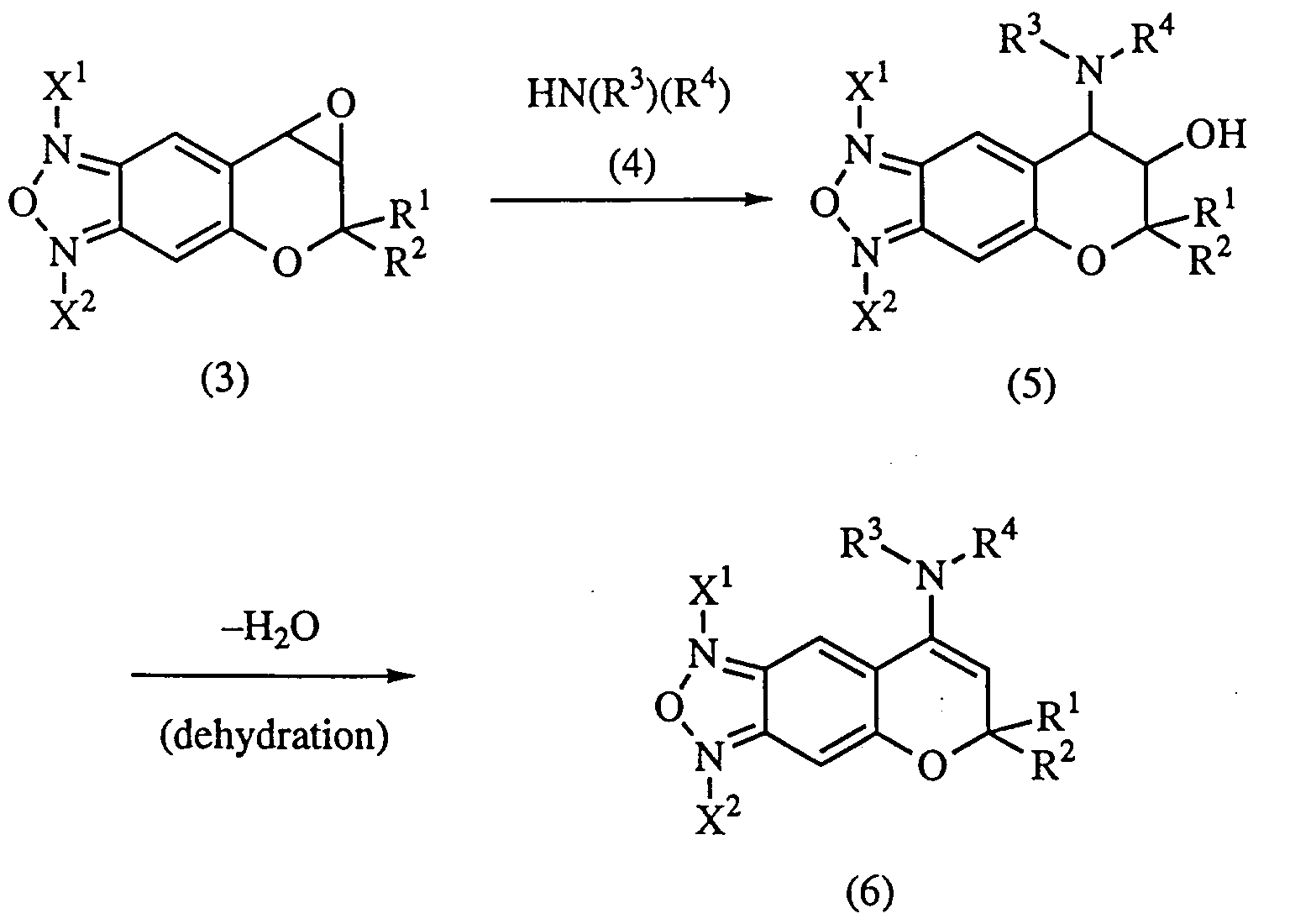
The solvent usable for the reaction of the compound (3) and the compound (4) includes, for example, sulfoxide solvents such as dimethylsulfoxide, amide solvents such as dimethylformamide and dimethylacetamide, ether solvents such as ethyl ether, dimethoxyethane and tetrahydrofuran, and alcohol solvents such as methanol, ethanol and isopropanol. Of these, preferred are alcohol solvents. - The reaction temperature of reacting the two compounds (3) and (4) may be from ice-cooled temperature to the reflux temperature for the reaction solvent used, preferably at the reflux temperature for the solvent used. If desired, the reaction may be conducted under pressure.
- Regarding the molar ratio of the starting compounds, the ratio of compound (4)/compound (3)(by molar ratio) is within the range of from 0.5 to 2.0, preferably from 1.0 to 1.1.
- Either the compound of formula (5) or the compound of formula (6) is obtained by the reaction, depending on the reaction conditions or the conditions for the post-treatment after the reaction which will be mentioned in detail hereunder. Precisely, the compound of formula (6) is obtained by reacting the compound of formula (3) and the compound of formula (4) in tetrahydrofuran in the presence of sodium hydride. However, the compound of formula (5) may also be obtained by the same reaction, depending on the reaction conditions (e.g., reaction time, reaction temperature, etc.).
- As the case may be, the compound of formula (5) obtained by the reaction is often dehydrated, depending on the difference of the post-treatment of the compound formed by the reaction. For instance, when the reaction solution contains an acid or alkali and when it is directly heated and concentrated without removing the acid or alkali by rinsing, the compound formed in the reaction solution will often be dehydrated.
- However, the dehydrating conditions are apt to be influenced by the kind of the compound formed, the reaction conditions and the conditions for the post-treatment.
- Of the compounds of formula (I) of the present invention, the compounds in which X is an oxygen atom and either R³ or R⁴ represents C(=Y)ZR⁶ are obtained according to the reaction scheme mentioned below, in which a compound of formula (3) is reacted with a compound of formula (7) in an inert solvent to give a compound of formula (8) and the compound of formula (8) is reacted with R⁶NCY (R⁶NCO, R⁶NCS) or ClCO₂R⁶ to give a compound of formula (9) or (10).


In the reaction schemes, Z represents N(R⁹) or an oxygen atom or sulfur atom; W represents a chlorine atom, a bromine atom, an iodine atom, a lower alkylsulfonate, a benzenesulfonate or a toluenesulfonate. - According to the reaction scheme mentioned above, a compound in which R³ and R⁴ together form a ring is obtained by cyclizing the compound represented by formula (11).
- The starting compounds of the following formula (3):

wherein R¹ and R² have the same definitions as those in formula (I), may be obtained according to the reaction scheme mentioned below. The whole flow for obtaining them are shown below.
Precisely, a compound of formula (13):
wherein R¹ and R² have the same definitions as those in formula (I), is treated with sodium hypochlorite (NaOCl) to give a compound which is represented by formula (3) and in which X¹ is absent and X² is an oxygen atom (Compound 3 (X¹ = -, X² =O)), the resulting compound is then reacted with a reducing agent having an ability of removing an N-oxide type oxygen, such as typically sodium azide (NaN₃) or triethyl phosphite (P(OEt)₃), to give a compound which is represented by formula (3) and in which X¹ and X² are both absent (Compound 3(X¹ = X² = -)). When Compound 3 (X¹ = X² = -) is treated with about one equivalent amount of a suitable peracid (e.g., m-chloroperbenzoic acid, hydrogen peroxide, peracetic acid - the same shall apply hereunder), then a compound which is represented by formula (3) and in which X¹ is an oxygen atom and X² is absent (Compound 3 (X¹ = O, X² = -)) is obtained. When more than one equivalent of the peracid is used in the reaction, then a compound of formula (3) in which X¹ and X² are both oxygen atoms (Compound 3 (X¹ = X² = O)) is obtained. The compound of formula (13) may be obtained by known methods (for example, refer to J.Med. Chem., 27, 1127(1987)). - Compound 3 (X¹ = O, X² = -) may also be obtained by treating a compound of formula (14):
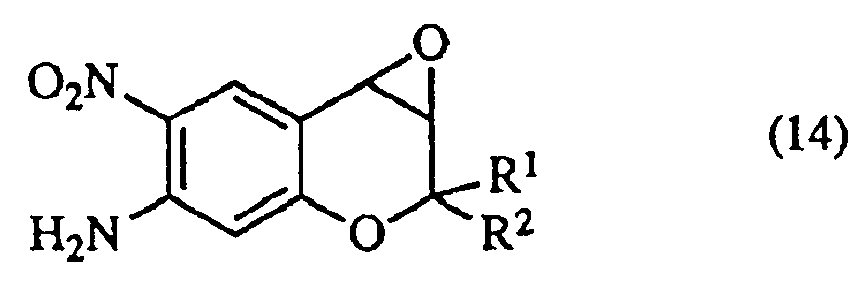
wherein R¹ and R² have the same definitions as those in formula (I), with sodium hypochlorite. The compound of formula (14) may be obtained by known methods (for example, refer to the above-mentioned literature). The solvent usable for the reaction of the compound (8) and the compound of Y=C=N-R⁶ or ClC(O)OR⁶ includes, for example, sulfoxide solvents such as dimethylsulfoxide, amide solvents such as dimethylformamide or dimethylacetamide, ether solvents such as ethyl ether, dimethoxyethane or tetrahydrofuran, and halogen compound solvents such as methylene chloride and chloroform. Of these, preferred are halogen compound solvents. - The reaction temperature may be from an ice-cooled temperature to the reflux temperature for the raction solvent used, preferably at the reflux temperature for the solvent used. If desired, the reaction may be conducted under pressure.
- Regarding the molar ratio of the starting compounds, the ratio of compound (8)/Y=C=N-R⁶ or ClC(O)OR⁶ (by molar ratio) is within the range of from 0.5 to 2.0, preferably from 1.0 to 1.1.
- Of the compounds of formula (I) of the present invention, compounds in which X is a sulfur atom or a nitrogen atom (which is unsubstituted or substituted by a hydrogen atom or a C₁-C₉ alkyl group) may be synthesized by a compound of formula (15) via three or four steps. The conversion of the compound of formula (15) into a compound of formula (17) is attained, for example, known methods described in Japanese Patent Application Laid-Open No. Sho 56-57785 and No. Sho 56-122 380. The compound of formula (17) is then subjected to conventional diazotation, for example, by treating it with sodium nitrite in an aqueous solution in the presence of an inorganic acid such as hydrochloric acid or sulfuric acid or an organic acid such as acetic acid, and thereafter cyclized under heat at 5 to 100°C , preferably at 50 to 100 °C to give a compound of formula (18) where X is a nitrogen atom.
- A compound of formula (I) in which A and B together form a single bond may often be formed by merely heating the compound of formula (18). Therefore, the former may often be obtained during the synthesis reaction of the compound of formula (18) or during the post-treatment of the same. If desired, it may also be synthesized by dehydrating the compound of formula (18) with an acid anhydride such as benzoic anhydride or acetic anhydride or with a base such as potassium carbonate.
- A compound of formula (I) in which X is an alkylamino group may be obtained by reacting the compound of formula (18) or its dehydrate with diazomethane or with an alkyl halide in the presence of potassium carbonate.
- The compound of formula (17) may be reacted with thionylaniline in an inert solvent, such as benzene, toluene, xylene or dichlorobenzene, to give a compound of formula (20) in which X is a sulfur atom.
- The reaction temperature for the reactions may be at 5 to 120 °C , preferably 50 to 100 °C.
- A compound of formula (I) in which A and B together form a single bond may often be formed by merely heating the compound of formula (20). Therefore, the former may often be obtained during the synthesis reaction of the compound of formula (20) or during the post-treatment of the same. If desired, it may also be synthesized by dehydrating the compound of formula (20) with an acid anhydride such as benzoic anhydride or acetic anhydride or with a base such as potassium carbonate.
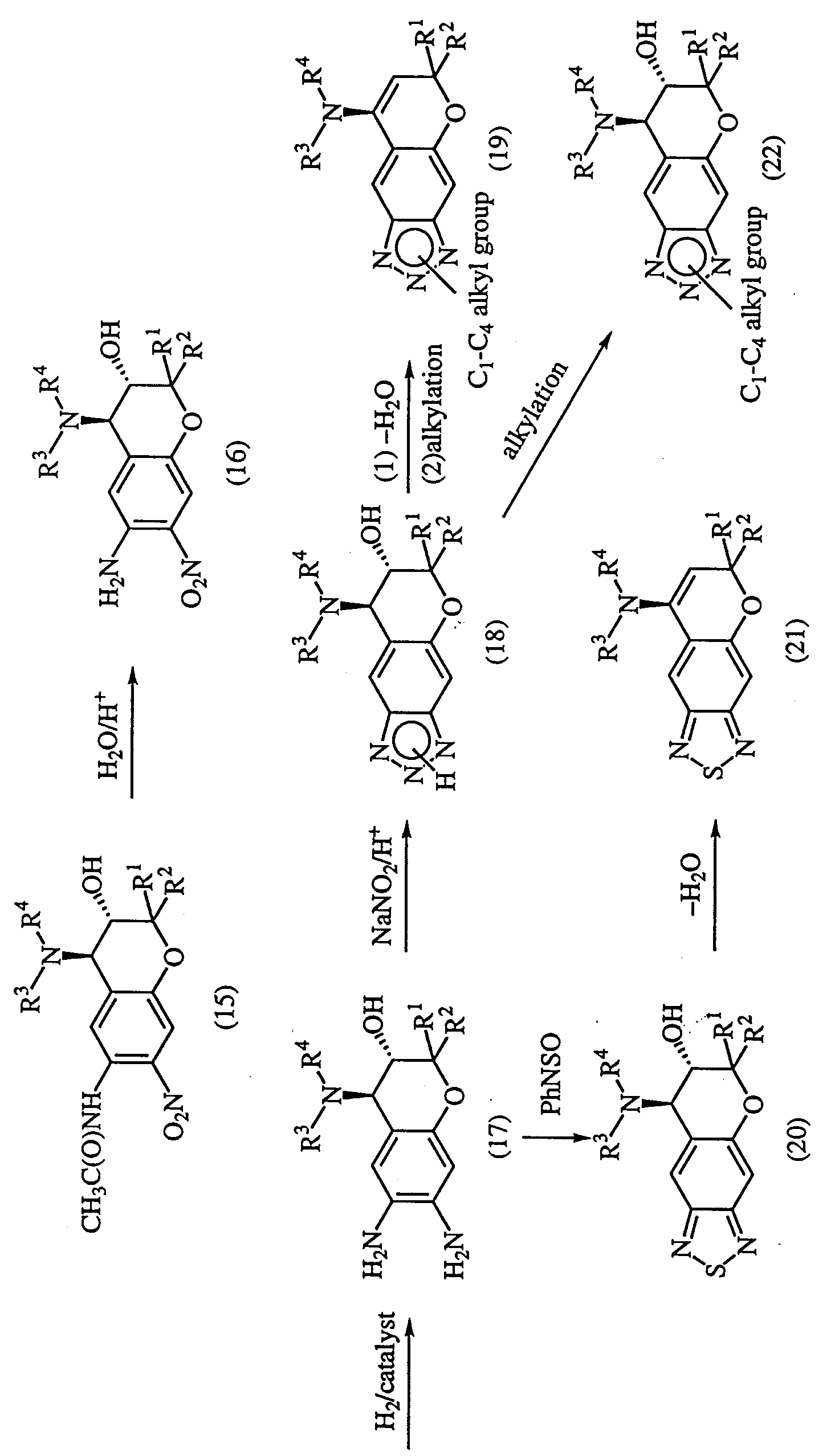

In these reaction schemes, Z represents N(R⁹) or an oxygen or sulfur atom; and W represents a chlorine atom, a bromine atom, an iodine atom, a lower alkylsulfonate, a benzenesulfonate or a toluenesulfonate. - Of the compounds of formula (15), a compound of formula (24) where R³ and R⁴ both do not represent C(=Y)ZR⁶ (R³ and R⁴ in this case do not simultaneously include C(=Y)ZR⁶) may be obtained by reacting a compound of formula (23) and a compound of formula (4) in an inert solvent.
- The solvent to be used for the reaction of the compound of formula (23) and the compound of formula (4) includes, for example, sulfoxide solvents such as dimethylsulfoxide, amide solvents such as dimethylformamide or dimethylacetamide, ether solvents such as ethyl ether, dimethoxyethane or tetrahydrofuran, and alcohol solvents such as methanol, ethanol or isopropanol. Of these, preferred are alcohol solvents.
- The reaction temperature may be from the ice-cooled temperature to the reflux temperature of the reaction solvent used, temperature, the reaction temperature is preferably at the reflux temperature for the solvent used. If desired, the reaction may be conducted under pressure.
- Regarding the molar ratio of the starting compounds, the ratio of compound (4)/compound (23) (by molar ratio) is within the range of from 0.5 to 2.0, preferably from 1.0 to 1.1.
- Of the compounds of formula (15), compounds of formulae (26) and (27) in which either of R³ and R⁴ represents C(=Y)ZR⁶ may be obtained according to the reaction scheme mentioned above, in which a compound of formula (23) is reacted with a compound of formula (7) in an inert solvent to give a compound of formula (25) and the resulting compound is reacted with R⁶NCY (R⁶NCO, R⁶NCS) or with ClCO₂R⁶ to give a compound of formula (26) or (27).
- A compound of formula (29) in which R³ and R⁴ together form a ring may be obtained by cyclizing a compound of formula (28), according to the reaction scheme mentioned below.

The solvent to be used for the reaction of the compound of formula (25) and the compound of Y=C=N-R⁶ or ClC(Y)OR⁶ includes, for example, sulfoxide solvents such as dimethylsulfoxide, amide solvents such as dimethylformamide or dimethylacetamide, ether solvents such as ethyl ether, dimethoxyethane or tetrahydrofuran, and halogenated compound solvents such as methylene chloride or chloroform. Of these, preferred are halogenated compound solvents. - The reaction temperature may be from the ice-cooled temperature to the heated reflux temperature, the reaction temperature of the reaction solvent, preferably at the reflux temperature for the solvent used. If desired, the reaction may be conducted under pressure.
- Regarding the molar ratio of the starting compounds, the ratio of compound (25)/Y=C=N-R⁶ or ClC(Y)OR⁶ (by molar ratio) is within the range of from 0.5 to 2.0, preferably from 1.0 to 1.1.
- Of the compounds of formula (I) of the present invention, those where A is an acyl group may be obtained by reacting a compound of formula (30) with an acylating agent in an inert solvent in the presence of a suitable base, according to the reaction scheme mentioned below.

The solvent to be used for the reaction includes, for example, sulfoxide solvents such as dimethylsulfoxide, amide solvents such as dimethylformamide or dimethylacetamide, ether solvents such as ethyl ether, dimethoxyethane or tetrahydrofuran, and halogenated compound solvents such as dichloromethane, chloroform or dichloroethane. The reaction may be conducted in the absence of the solvent. The base to be used for the reaction includes, for example, triethylamine, pyridine, diisopropylethylamine and DBU (diazabicycloundecene). The acylating agent includes acid halides such as acid chlorides and acid bromides, and acid anhydrides. The reaction temperature compounds may be from an ice-cooled temperature to the reflux temperature for the reaction solvent used. - Regarding the molar ratio of the starting compounds, the ratio of the compound of (30) to the acylating agent is within the range of from 0.5 to 2.0, preferably from 1.0 to 1.1.
- Of the compounds of formula (I) of the present invention, compounds in which R⁴ is NC(N-CN)NHR⁹ may be obtained according to the reaction scheme mentioned below, in which a compound of formula (32) is reacted with carbodiimide in an inert solvent, then subjected to removing hydrogen sulfide and thereafter reacted with cyanamide to give a compound of formula (33). A compound of formula (34) in which R³ and R⁴ together form a cyclic thiourea may also be led to a compound of formula (35) by the same reaction process.

Of the compounds of formula (I) of the present invention, optically active isomers may be produced, for example, by methods of optical resolution of racemic modifications (see Japanese Patent Laid-Open Application No. 3-141286, U.S. Patent No. 5,097,037, European Patent No. 409,165) and methods of asymmetric synthesis (see Japanese Patent Application Laid-Open No. 5-301878, European Patent No. 535,377). - As mentioned above, the present inventors have found that the compounds of formula (I) have a strong activity of reinforcing the contraction of cardiac muscles and also have a strong activity of reducing the rate of heart beats. Since the compounds of the present invention have no activity of retarding cardiac functions but rather have an activity of enhancing the contraction of cardiac muscles, they may exert the activity of reducing the rate of heart beats even when they are administered in the same amount as that necessary for expressing the cardiotonic activity. Because of their activities, it is considered that the compounds according to the present invention may reduce the amount of oxygen to be consumed by cardiac muscles to therefore reduce the motility load of cardiac muscles and exert the anti-stenocardiac activity. In addition, it is also considered that they have an activity of prolonging the effective refractory period to thereby exert an anti-arrhythmic activity. Therefore, it is expected that the compounds of the present invention are useful for curing cardiovascular disorders in consideration of the oxygen consumption, the energy consumption or the metabolism caused by the cardiac motility and also for curing other cardiac disorders essentially in consideration of the activity of the compounds of reducing the rate of heart beats. For example, the compounds of the present invention are useful as medicines for cardiac insufficiency of mammals including human beings and also as medicines for curing cardiovascular disorders causing cardiac insufficiency of them such as, for example, as medicines for curing ischemic cardiopathy, medicines for curing hypertension, medicines for curing cardiac fluid retention, medicines for curing pulmonary hypertension, medicines for curing valvulitis, medicines for curing congenital cardiac disorders, medicines for curing cardiomuscular disorders, medicines for curing pulmonary edema, medicines for curing angina of effort, medicines for curing myocardial infarction, medicines for curing arrhythmia, and medicines for curing atrial fibrillation.
- The present invention provides pharmaceutical compositions containing an effective amount of the compounds of formula (I) for curing these diseases.
- As the manner of administratiion of the compounds of the present invention, there may be mentioned parenterally administration by injections (subcutaneous, intraveneous, intramuscular or intraperitoneal injection), ointments, suppositories or aerosols, or an oral administration in the form of tablets, capsules, granules, pills, syrups, liquids, emulsions or suspensions.
- The above pharmacological or veterinary compositions of the present invention contain the above-mentioned compounds of the present invention in an amount of from about 0.01 to 99.5 % by weight, preferably from about 0.1 to 30 % by weight, based on the total weight of the composition.
- To the compounds of the present invention or to the compositions containing the present compounds, other pharmacologically or veterinarily active compounds may be incorporated. Further, the compositions of the present invention may contain a plurality of the compounds of the present invention.
- The clinical dose of the compounds of the present invention varies depending upon the age, the body weight, the sensitivity or the symptom etc. of the patient. In general, however, the effective daily dose is usually from about 0.003 to 1.5 g, preferably from about 0.01 to 0.6 g for an adult. If necessary, however, an amount outside the above range may be employed.
- The compounds of the invention may be prepared into various suitable formulations depending upon the manner of administration, in accordance with conventional methods commonly employed for the preparations of pharmaceutical formulations.
- Namely, tablets, capsules, granules or pills for oral administration, may be prepared by using excipients such as white sugar, lactose, glucose, starch or mannitol; binders such as hydroxypropyl cellulose, syrups, arabic gum, gelatin, sorbitol, tragacanth gum, methyl cellulose or polyvinylpyrrolidone; disintegrants such as starch, carboxymethyl cellulose or its calcium salt, crystal cellulose powder or polyethylene glycol; lubricants such as talc, magnesium or calcium stearate, silica, and smoothers such as sodium laurate, glycerol, etc.
- The injections, solutions (liquids), emulsions, suspensions, syrups or aerosol may be prepared using a solvent for the active ingredient such as water, ethyl alcohol, isopropyl alcohol, propylene glycol, 1,3-butylene glycol or polyethylene glycol; surfactants such as sorbitan fatty acid esters, polyoxyethylene sorbitan fatty acid esters, polyoxyethylene fatty acid esters, polyoxyethylene ether of hydrogenated castor oil, lecithin; suspending agents such as cellulose derivatives such as sodium salt of carboxymethyl, cellulose derivatives such as methyl cellulose or natural rubbers such as tragacanth or arabic gum; or preservatives such as para-hydroxybenzoic acid, benzalkonium chloride, salts of sorbic acid, etc.
- Ointments which are an endermic preparation may be be prepared by using, e.g., white vaseline, liquid paraffin, higher alcohols, Macrogol ointment, hydrophilic ointment base or hydrogel base, etc.
- The suppositories may be prepared by using, e.g., cacao butter, polyethylene glycol, lanolin, fatty acid triglycerides, coconut oil, polysorbate, etc.
- Now the present invention is explained referring to examples, but it is not to be limited to these examples.
- Synthesis examples of preparing the compounds which are usable as medicines of the present invention are given below.
- To 300 ml of a methylene chloride solution containing 40 g (198 mmol) of 6,6-dimethyl-6H-pyrano[2,3-f]benzo-2,1,3-oxadiazole were added 2.44 g (3.7 mmol) of (R,R)-[1,2-bis[3,5-di-t-butyl-salicylidamino)cyclohexane]-manganese(III) acetate. (The production of the acetate is described in Japanese Patent Application Laid-Open No. Hei 5-507645 and European Patent No. 521,099.) The mixture was added with 1.2 liters of an aqueous solution of sodium hypochlorite (active chlorine content: 5 %). While adjusting the pH of the reaction system at 11.3 with a pH-stat, aqueous solution of 0.5 N-sodium hydroxide was added thereto. The resulting solution was stirred at room temperature for 10 hours. After stopping the stirring, the solution was allowed to stand at room temperature overnight. The reaction solution was extracted with chloroform (300 ml x 1; 200 ml x 1; 50 ml x 1) and dried over anhydrous sodium sulfate, and the solvent was distilled off under reduced pressure. The residue was subjected to silica gel column chromatography (benzene : ethyl acetate = 5 : 1) and again to silica gel column chromatography
(benzene → benzene - ethyl acetate = 5 : 1),
and the crystals obtained were recrystallized from ethanol (60 ml) to obtain 15.7 g of the intended compound. (yield: 36 %)
optical purity > 99 % ee.
Column: Chiralcell OJ (of Daisel Chemical Industries, Ltd.)
Mobile Phase: Hexane : isopropanol = 4 : 1
Detection: UV 254 nm
Flow Rate: One ml/min
Column Temperature: 40 °C
Retention Time: 9.2 min. - An enantiomer of the compound of Reference Example 1 was synthesized in the same manner as in Reference Example 1, using (S,S)-[1,2-bis(3,5-di-t-butylsalicylidamino)cyclohexane]-manganese(III) acetate. The yield of the product was 20.8 g (48%).
Optical purity > 99 % ee
[retention time: 12.5 min]. -
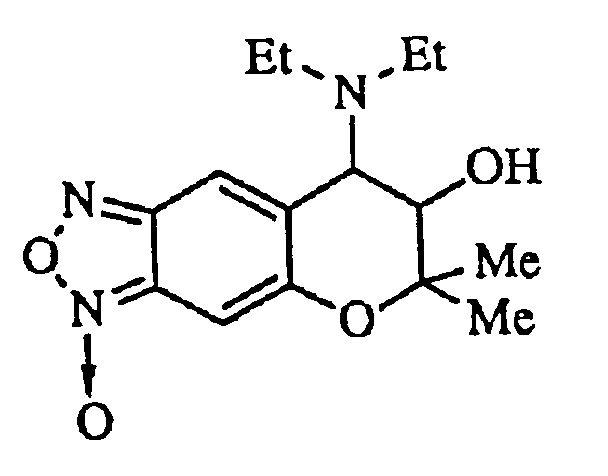
465 mg (1.50 mmol) of 3,4-dihydro-2,2-dimethyl-3-hydroxy-4-diethylamino-6-amino-7-nitro-2H-benzo[b]pyran, 102 mg (2.56 mmol) of sodium hydroxide, 32 ml of ethanol, 6 ml of water and 0.1 ml of polyethylene glycol were stirred at 40 °C , and 2.59g (2.10 mmol) of aqueous 6 % NaOCl solution were added to the resulting solution and stirred for 15 minutes. The reaction liquid was poured into water and extracted thrice with ethyl acetate. The ethyl acetate layers were collected and then washed with water, then saturated saline solution, and dried over anhydrous sodium sulfate. The solvent was distilled off, and the residue was subjected to silica gel column chromatography (eluent: ethyl acetate - hexane = 1 : 2 (v/v)) to obtain 189 mg of the intended compound. (yield: 41 %) A part of the compound thus obtained was dissolved in ethanol, and HCl-EtOH solution and absolute ether were added thereto in order whereupon hydrochloride of the compound was obtained as yellow crystals. The salt had the following properties:
m.p.: 160 to 164 °C (decomposition)
NMR (CDCl₃)δ (ppm): 1.15(6H), 1.26(3H), 1.52(3H), 2.64-3.14(5H), 3,56(1H), 3.85(1H), 6.57(1H), 7.30(1H) -

924 mg (2.88 mmol) of 3,4-dihydro-2,2-dimethyl-3-hydroxy-4-(1-piperidinyl)-6-amino-7-nitro-2H-benzo[b]pyran, 0.7 ml of 50 % potassium hydroxide, 4 ml of dichloromethane and 10 mg of Bu₄N⁺Br- were stirred at room temperature, and 4.97 g (4.03 mmol) of aqueous 6 % NaOCl solution were added thereto and reacted for 9 hours while stirring at room temperature. The organic layer was separated, and the aqueous layer was extracted twice with methylene chloride. The methylene chloride layers were combined, washed with water and dried over anhydrous sodium sulfate, and the solvent was distilled off. The residue was subjected to silica gel column chromatography (eluent: ethyl acetate - hexane = 1 : 3 (v/v)) to obtain 297 mg of the intended compound as oil. (yield: 43 %) A part of the compound thus obtained was dissolved in ethanol and HCl-EtOH and dry ether were added thereto in order whereupon hydrochloride of the intended compound was obtained as yellow crystals.
m.p.: 210 - 213 °C. -

297 mg (0.93 mmol) of 7,8-dihydro-6,6-dimethyl-7-hydroxy-8-(1-piperidinyl)-6H-pyrano[2,3-f]benzo-2,1,3-oxadiazole-3-oxide obtained in Synthesis Example 2, 6 ml of ethylene glycol and 60 mg (0.93 mmol) of NaN₃ were heated at 140 °C and reacted for 1.2 hours. After cooled, the reaction liquid was poured into water and extracted thrice with chloroform. The chloroform layers were combined and dried over anhydrous sodium sulfate, and the solvent was then distilled off. The residue was subjected to column chromatography (eluent: ethyl acetate - hexane = 1 : 3 (v/v)) to obtain 84 mg of the intended compound. (yield: 30 %) A part of the compound thus obtained was dissolved in ethanol/ethyl ether and HCl-EtOH was added thereto whereupon hydrochloride of the compound was obtained as pale yellow crystals.
m.p.: 202 to 205 °C. -
150 mg (0.687 mmol) of 7,8-dihydro-6,6-dimethyl-7,8-epoxy-6H-pyrano[2,3-f]benzo-2,1,3-oxadiazole, 63 µ ℓ (0.756 mmol) of pyrrolidine and 2 ml of ethanol were refluxed for 31 hours while stirring. The solvent was distilled off, and the residue was subjected to partitioning thin-layer chromatography (eluent: ethyl acetate - hexane = 1 : 1 (v/v)) to obtain 120 mg of the intended compound. (yield: 60 %) A part of the compound thus obtained was dissolved in dry ether and HCl-EtOH was added thereto whereupon hydrochloride of the compound was obtained as pale yellow crystals.
m.p.: 208 to 209 °C. -

300 mg (1.37 mmol) of 7,8-dihydro-6,6-dimethyl-7,8-epoxy-6H-pyrano[2,3-f]benzo-2,1,3-oxadiazole, 0.53 g of aqueous 40 % methylamine solution and 15 ml of ethanol were stirred at 60 °C for 3 days, using a pressure tube. After the reaction, the solvent was distilled off, and the residue was subjected to partitioning thin-layer chromatography (eluent: ethyl acetate - methanol = 10 : 1) to obtain 263 mg of the intended compound. (yield: 77 %) A part of the compound thus obtained was dissolved in dry ether and HCl-EtOH was added thereto whereupon hydrochloride of the compound was obtained ascolorless crystals.
m.p.: 244.5 to 260 °C. -
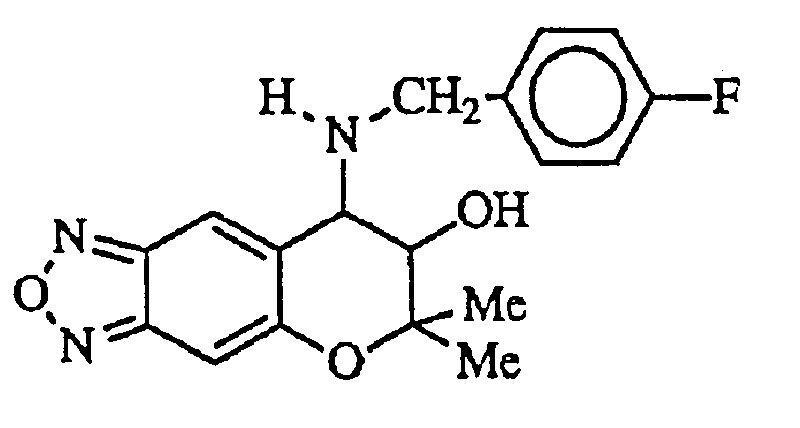
150 mg (0.687 mmol) of 7,8-dihydro-6,6-dimethyl-7,8-epoxy-6H-pyrano[2,3-f]benzo-2,1,3-oxadiazole, 86 µ ℓ (0.756 mmol) of 4-fluorobenzylamine and 2 ml of ethanol were refluxed for 20 hours while stirring. The solvent was distilled off, and the residue was subjected to partitioning thin-layer chromatography (eluent: ethyl acetate - hexane = 1 : 2) to obtain 204 mg of the intended compound as an oil. (yield: 86 %) A part of the compound thus obtained was dissolved in dry ether and HCl-EtOH was added thereto whereupon hydrochloride of the compound was obtained as colorless crystals.
m.p.: 207 to 210 °C. -

Using benzylamine, the intended compound was obtained in the same manner as in Synthesis Example 6.
NMR(60MHz, CDCl₃,δ ppm): 7.77(1H), 7.37-6.92(5H), 6.81(1H), 3.9-3.8(4H), 2.73(2H), 1.51(3H), 1.25(3H) -

Using N-methylbenzylamine, the intended compound was obtained in the same manner as in Synthesis Example 6. Hydrochloride of the intended compound had a melting point of 148 to 150 °C. -

Using cyclohexylamine, the intended compound was obtained in the same manner as in Synthesis Example 6. Hydrochloride of the intended compound had a melting point of 208 to 210 °C. -
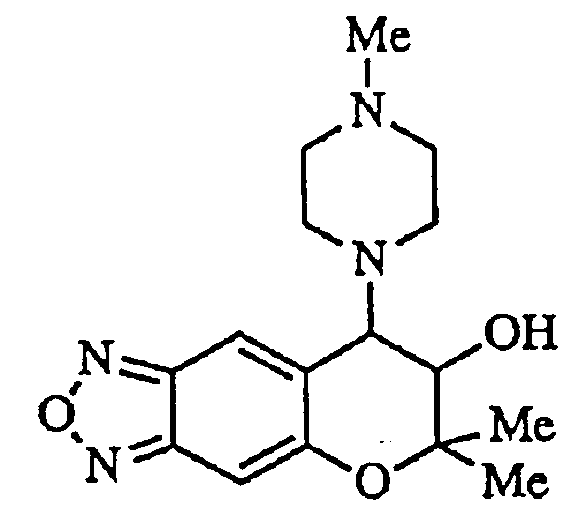
Using N-methylpiperazine, the intended compound was obtained as yellow crystals in the same manner as in Synthesis Example 6. (yield: 75 %)
m.p.: 225 to 226 °C
MS: 70(100 %), 246(56 %), 318(M⁺, 13 %) -

Using piperazine, the intended compound was obtained as pale yellow crystals in the same manner as in Synthesis Example 6. (yield: 72 %)
m.p.: 245 to 246 °C
MS: 56(67 %), 232(100 %), 304(M⁺, 8 %) -

Using N-phenylpiperazine, the intended compound was obtained in the same manner as in Synthesis Example 6. (yield: 75 %)
MS: 132(100 %), 308(36 %), 380(M⁺, 32 %)
Hydrochloride of the compound was obtained as colorless crystals.
m.p.: 198 to 201 °C. -

Using 4-phenylpiperidine, the intended compound was obtained in the same manner as in Synthesis Example 6. (yield: 87 %)
MS: 186(21 %), 307(100 %), 379(M⁺, 4 %)
Hydrochloride of the compound was obtained as colorless crystals.
m.p.: 195 to 197 °C. -

Using 1,2,3,4-tetrahydroisoquinoline, the intended compound was obtained in the same manner as in Synthesis Example 6. (yield: 80 %)
MS: 262(32 %), 279(100 %), 351(M⁺, 4 %)
Hydrochloride of the compound was obtained as colorless crystals.
m.p.: 188.5 to 190 °C. -

Using morpholine, the intended compound was obtained in the same manner as in Synthesis Example 6. (yield: 11 %)
m.p.: 185 to 186.5 °C. -
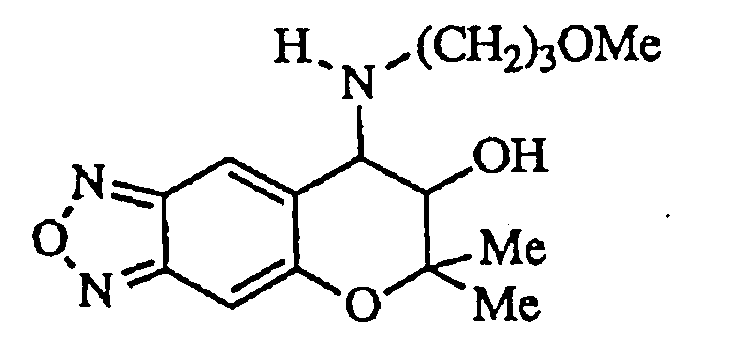
Using 3-methoxypropylamine, the intended compound was obtained in the same manner as in Synthesis Example 6. (yield: 60 %)
MS: 177(100 %), 235(100 %), 289(M⁺-18, 1 %)
m.p.: 175.5 to 178 °C -

Using ethyl 4-aminobutyrate, the intended compound was obtained in the same manner as in Synthesis Example 6. (yield: 38 %)
Hydrochloride of the compound was obtained as colorless crystals.
m.p.: 189 to 191 °C. -

Using glycine ethyl ester, the intended compound was obtained in the same manner as in Synthesis Example 6. (yield: 5 %)
Hydrochloride of the compound was obtained as an orange oil. -

Using 3-chloropropylamine, the intended compound was obtained in the same manner as in Synthesis Example 6. (yield: 20 %)
Hydrochloride of the compound was obtained as colorless crystals.
m.p.: 216 to 220 °C. -

Using ethanolamine, the intended compound was obtained in the same manner as in Synthesis Example 6. (yield: 89 %)
Hydrochloride of the compound was obtained as colorless crystals.
m.p.: 200 to 204 °C. -

0.82 g (3.8 mmol) of 7,8-dihydro-6,6-dimethyl-7,8-epoxy-6H-pyrano[2,3-f]benzo-2,1,3-oxadiazole were dissolved in 25 ml of 16.7 % NH₃-EtOH and reacted for at 60 °C for 48 hours in a pressure glass tube. The solvent was distilled off, and the residue was subjected to silica gel column chromatography (eluent: ethyl acetate - methanol = 5 : 1) to obtain 0.77 g of the intended compound as a brown solid. (yield: 87 %) A part of the product was recrystallized from ethanol to obtain pure colorless crystals of the intended compound.
m.p.: 223 to 225 °C
NMR(CDCl₃ + DMSO-d⁶) δ (ppm): 1.26(3H), 1.49(3H), 2.80-3.30(5H), 3.33(1H), 3.78(1H), 6.82(1H), 7.98(1H),
MS: 133(50 %), 163(100 %), 235(M⁺, 3 %) -
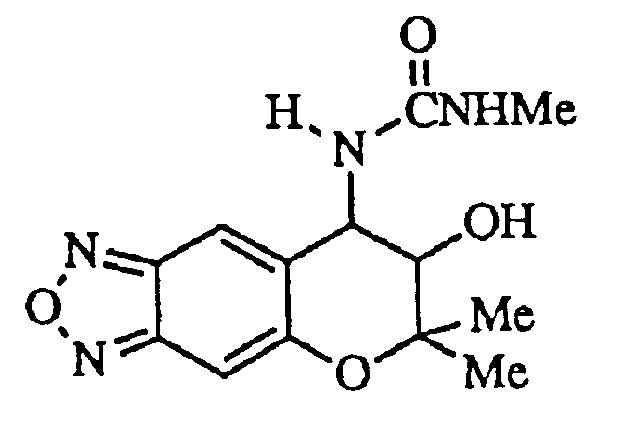
200 mg (0.850 mmol) of 7,8-dihydro-6,6-dimethyl-7-hydroxy-8-amino-6H-pyrano[2,3-f]benzo-2,1,3-oxadiazole and 20 ml of dichloromethane were stirred at room temperature, and 55 µ ℓ (0.935 mmol) of methyl isocyanate were added thereto and stirred for 23 hours. The crystals precipitated were filtered to obtain 227 mg of the intended compound as colorless crystals. (yield: 92 %)
m.p.: 213 to 215 °C
MS: 44, 202(30 %), 274(M⁺-H₂O, 6 %) -

200 mg (0.850 mmol) of 7,8-dihydro-6,6-dimethyl-7-hydroxy-8-amino-6H-pyrano[2,3-f]benzo-2,1,3-oxadiazole and 20 ml of dichloromethane were stirred at room temperature, and 68 mg (0.935 mmol) of methyl isothiocyanate were added thereto and stirred for 23 hours. The crystals precipitated were filtered off to obtain 122 mg of the intended compound as colorless crystals. (yield: 47 %)
m.p.: 213 to 215 °C
MS: 91(62 %), 202(67 %), 290, 308(M⁺, 27 %) -

200 mg (0.850 mmol) of 7,8-dihydro-6,6-dimethyl-7-hydroxy-8-amino-6H-pyrano[2,3-f]benzo-2,1,3-oxadiazole and 20 ml of dichloromethane were stirred at room temperature, and 102 µ ℓ (0.935 mmol) of phenyl isocyanate were added thereto and stirred for 4 hours. The crystals precipitated were filtered off to obtain 203 mg of the intended compound as colorless crystals. (yield: 67 %)
m.p.: 215 to 217 °C
MS: 93, 163(56 %), 321(20 %), 354(M⁺, 10 %) -

200 mg (0.850 mmol) of 7,8-dihydro-6,6-dimethyl-7-hydroxy-8-amino-6H-pyrano[2,3-f]benzo-2,1,3-oxadiazole and 20 ml of dichloromethane were stirred at room temperature, and 100 µ ℓ (0.935 mmol) of trichloroacetyl isocyanate were added thereto and stirred for 5 hours. The crystals precipitated were filtered off to obtain 90 mg of the intended compoundas colorless crystals. (yield: 25 %)
m.p.: 248 to 250 °C
MS: 44, 163(43 %), 422(M⁺, 2 %) -

400 mg (1.70 mmol) of 7,8-dihydro-6,6-dimethyl-7-hydroxy-8-amino-6H-pyrano[2,3-f]benzo-2,1,3-oxadiazole and 40 ml of dichloromethane were stirred at room temperature, and 192 µ ℓ (1.87 mmol) of 3-chloropropyl isocyanate were added thereto and stirred for 5 hours. The crystals precipitated were taken out by filtration to obtain 250 mg of the intended compound as pale yellow crystals. (yield: 41 %)
m.p.: 83 to 85 °C
MS: 41(53 %), 163, 318(93 %), 354(M⁺, 5 %) -

400 mg (1.70 mmol) of 7,8-dihydro-6,6-dimethyl-7-hydroxy-8-amino-6H-pyrano[2,3-f]benzo-2,1,3-oxadiazole and 40 ml of dichloromethane were stirred at room temperature, and 200 µ ℓ (1.87 mmol) of 2-chloroethyl isocyanate were added thereto and stirred for 6 hours. The crystals precipitated were filtered off to obtain 480 mg of the intended compound as colorless crystals. (yield: 83 %).
m.p.: 178 to 180 °C
MS: 87(57 %), 163, 304(78 %), 340(M⁺, 8 %) -

200 mg (0.850 mmol) of 7,8-dihydro-6,6-dimethyl-7-hydroxy-8-amino-6H-pyrano[2,3-f]benzo-2,1,3-oxadiazole and 20 ml of dichloromethane were stirred at room temperature, and 92 µ ℓ (0.935 mmol) of isopropyl isocyanate were added thereto and stirred for 6 hours. The crystals precipitated were filtered off to obtain 120 mg of the intended compound as colorless crystals. (yield: 44 %)
m.p.: 201 to 203 °C
MS: 43(40 %), 202, 302(20 %), 320(M⁺, 12 %) -

200 mg (0.850 mmol) of 7,8-dihydro-6,6-dimethyl-7-hydroxy-8-amino-6H-pyrano[2,3-f]benzo-2,1,3-oxadiazole, 166 µ ℓ (1.19 mmol) of triethylamine and 20 mg of dichloromethane were stirred at room temperature, and 114 µ ℓ (1.19 mmol) of ethyl chloroformate were added thereto and stirred for 21 hours. The reaction liquid was washed thrice with water and then dried over anhydrous sodium sulfate. The solvent was distilled off, and the residue was subjected to silica gel column chromatography (eluent: ethyl acetate - methanol = 20 : 1 (v/v)) to obtain 227 mg of the intended compound as an yellow oil. (yield: 87 %)
MS: 133(48 %), 235, 307(M⁺, 25 %) -

400 mg (1.70 mmol) of 7,8-dihydro-6,6-dimethyl-7-hydroxy-8-amino-6H-pyrano[2,3-f]benzo-2,1,3-oxadiazole, 260 µ ℓ (1.87 mmol) of triethylamine and 40 mg of dichloromethane were stirred at room temperature, and 193 µ ℓ (1.87 mmol) of 2-chloroethyl chloroformate were added thereto and stirred for 21 hours. The reaction liquid was washed thrice with water and then dried over anhydrous sodium sulfate. The solvent was distilled off, and the residue was recrystallized from chloroform to obtain 507 mg of the intended compound as pale yellow crystals. (yield: 87 %)
m.p.: 164 to 166 °C
MS: 133(48 %), 235, 307(M⁺, 25 %) -

400 mg (1.17 mmol) of the compound obtained in Synthesis Example 30, 3.24 g (23.4 mmol) of potassium carbonate, 388 mg (2.34 mmol) of potassium iodide and 50 ml of absolute acetone were heated under reflux at room temperature for 26 hours. After the mixture was cooled to room temperature, the insoluble matters were flitered off, ethyl acetate was added to the resulting filtrate, washed thrice with water. The compound thus obtained was dried over anhydrous magnesium sulfate, and the solvent was distilled off, and the residue was subjected to silica gel column chromatography (eluent: ethyl acetate - methanol = 10 : 1 (v/v)) to obtain 339 mg of the intended compound as a brown oil. (yield: 94 %) A part of the product was recrystallized from ethyl acetate to obtain yellow crystals having the following physical data:
m.p.: 177.5 to 180 °C
MS: 43(25 %), 272, 287(65 %), 305(M⁺, 8 %) -
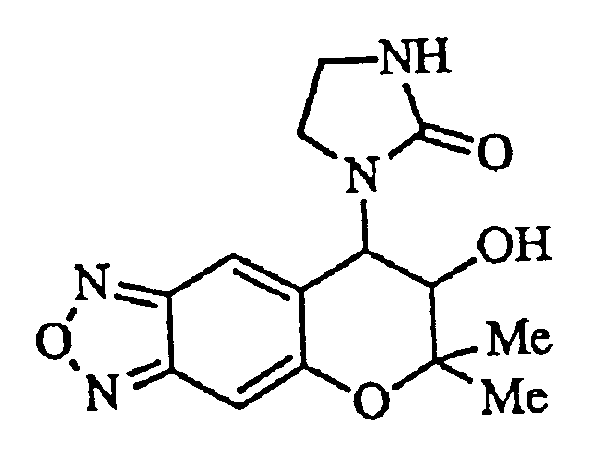
The compound obtained in Synthesis Example 27 was processed in the same manner as in Synthesis Example 31 to obtain the intended compound as colorless crystals. (yield: 34 %)
m.p.: 251 to 252.5 °C. -
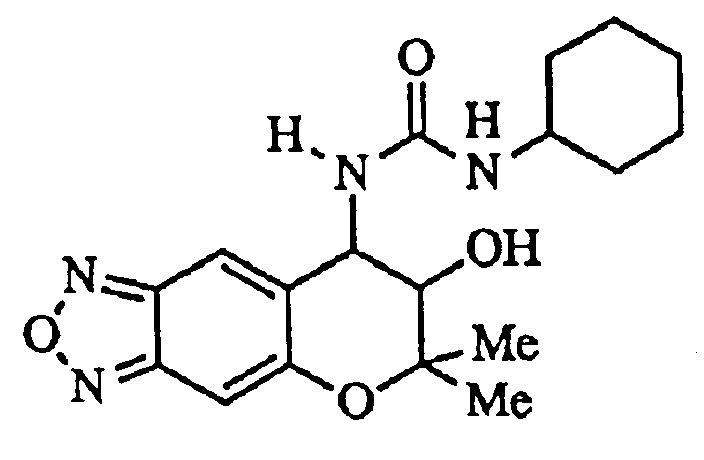
Using cyclohexyl isocyanate, the intended compound was obtained as colorless crystals in the same manner as in Synthesis Example 22. (yield: 28 %)
m.p.: 203 to 206 °C. -

Using t-butyl isocyanate, the intended compound was obtained as colorless crystals in the same manner as in Synthesis Example 22. (yield: 52 %)
m.p.: 203 to 205 °C. -

Using methyl chloroformate, the intended compound was obtained as a yellow oil in the same manner as in Synthesis Example 29. (yield: 19 %) -

Using t-butyl isothiocyanate, the intended compound was obtained in the same manner as in Synthesis Example 23. (yield: 57 %) -

The compound obtained in Synthesis Example 26 was processed in the same manner as in Synthesis Example 31 to obtain the intended compound as colorless crystals. (yield: 39 %)
m.p.: 233 to 234 °C. -

Using 3-chloropropyl chloroformate, the intended compound was obtained as an yellow oil in the same manner as in Synthesis Example 30. (yield: 100 %) -

The compound obtained in Synthesis Example 38 was processed in the same manner as in Synthesis Example 31 to obtain the intended compound as colorless crystals. (yield: 34 %)
m.p.: 220 to 234 °C. -
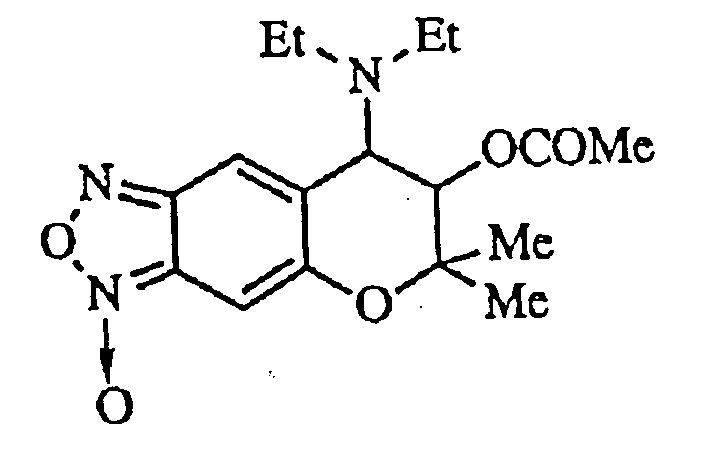
One ml of pyridine and 130 mg (1.27 mmol) of acetic anhydride were added to 103 mg (0.34 mmol) of the compound obtained in Synthesis Example 1 and stirred at 80 to 90 °C for 2 hours. After cooled, the solvent was distilled off under reduced pressure, and the residue was subjected to silicagel column chromatography (eluent: ethyl acetate - n-hexane = 1 : 3 (v/v); Rf = 0.3) to obtain 90.4 mg of the intended compound as an yellow solid. (yield: 77 %) -
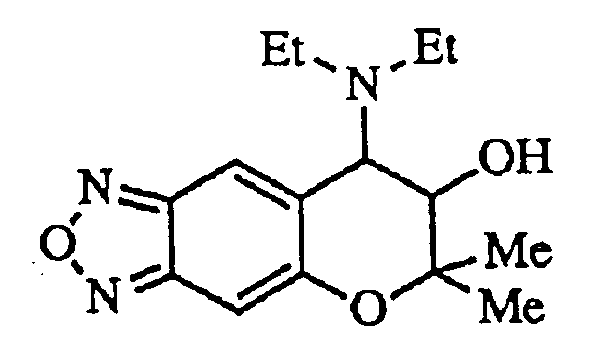
310 mg (1.01 mmol) of the compound obtained in Synthesis Example 1 were dissolved in 3 g of benzene, and 0.20 g (1.2 mmol) of triethyl phosphite were added thereto and heated at 60 °C for one hour. After cooled to room temperature, the compound thus obtained was stirred overnight. The solvent was distilled off under reduced pressure, and the residue was subjected to silicagel column chromatography (eluent: ethyl acetate - n-hexane = 1 : 3 (v/v); Rf = 0.3) to obtain 267 mg of the intended compound as an yellow solid. (yield: 91 %) -

2 ml of pyridine and 0.29 g (2.8 mmol) of acetic anhydride were added to 220 mg (0.75 mmol) of the compound obtained in Synthesis Example 41 and heated at 80 to 90 °C for 2 hours. After cooled, the solvent was distilled off under reduced pressure, and the residue was subjected to silica gel column chromatography (eluent: ethyl acetate - n-hexane = 1 : 3 (v/v); Rf = 0.3) to obtain 209.1 mg of the intended compound as a pale yellow solid. (yield: 83 %) -

The compound obtained in Synthesis Example 3 was processed in the same manner as in Synthesis Example 42 to obtain the intended compound as yellow crystals. (yield: 100 %)
m.p.: 158 to 160 °C -

Using 4-aminobutylaldehyde diethylacetal, the intended compound was obtained as a brown oil in the same manner as in Synthesis Example 6. (yield: 93 %) -

One ml of 2.5 N hydrochloric acid and 2 ml of 1,4-dioxane were added to 316 mg (0.832 mmol) of the compound obtained in Synthesis Example 44 and reacted at room temperature for 3 hours. An aqueous sodium carbonate solution was added thereto so as to hydrate the product, and the resulting hydrate was then extracted with diethyl ether. The ether solution was dried with anhydrous sodium sulfate, and the solvent was distilled off under reduced pressure. The residue was subjected to silica gel column chromatography (eluent: ethyl acetate - n-hexane = 1 : 1 (v/v); Rf = 0.5) to obtain the intended compound as an yellow oil. (yield: 40 %) -

A solution of 18.4 mg (0.460 mmol) of sodium hydroxide, 1 ml of water and 4 ml of ethanol was added to 80.6 mg (0.209 mmol) of the hydrochloride obtained in Synthesis Example 17 and reacted for 3 hours at room temperature. The reaction mixture was made acidic by adding 1 N hydrochloric acid thereto, and then extracted with diethyl ether. This was dried over anhydrous sodium sulfate, and the solvent was distilled off under reduced pressure to obtain the intended compound as a colorless oil. -

240 mg (1.10 mmol) of 7,8-dihydro-6,6-dimethyl-7,8-epoxy-6H-pyramo[2,3-f]benzo-2,1,3-oxadiazole were dissolved in 5 ml of dichloromethane, and 5 ml of acetonitrile and 0.5 ml of BF₃-diethyl ether complex were added thereto. After these were reacted at room temperature for 30 minutes, a saturated aqueous sodium hydrogencarbonate solution was added thereto and the reaction liquid was extracted with chloroform. After the extract was dried over anhydrous sodium sulfate, the solvent was distilled off under reduced pressure. The residue was subjected to silica gel column chromatography (eluent: ethyl acetate - n-hexane = 1 : 1 (v/v); Rf = 0.3) to obtain 152 mg of the intended compound as an yellow oil. (yield: 50 %)
MS: 163(53 %), 188(100 %), 277(M⁺, 4 %) -
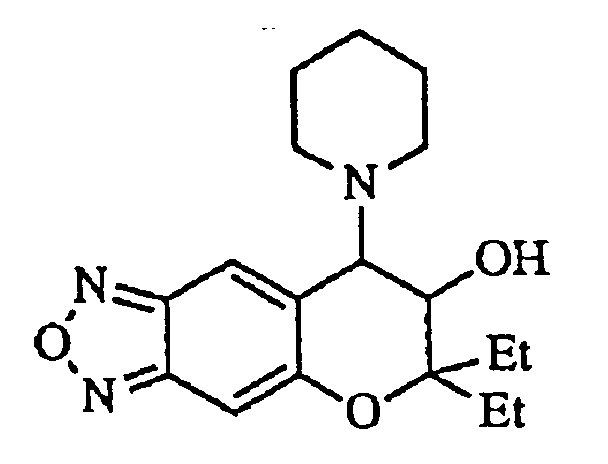
87.7 g (0.36 mmol) of 7,8-dihydro-6,6-diethyl-7,8-epoxy-6H-pyramo[2,3-f]benzo-2,1,3-oxadiazole, 61 mg (0.72 mmol) of piperidine and 2 ml of ethanol were refluxed for 20 hours while stirring. After the solvent was distilled off, the residue was subjected to silica gel column chromatography (eluent: ethyl acetate - n-hexane = 1 : 1 (v/v); Rf = 0.3) to obtain 30 mg of the intended compound as an yellow oil. (yield: 25 %) -

Using 7,8-dihydro-6,6-diethyl-7,8-epoxy-6H-pyrano[2,3-f] benzo-2,1,3-oxadiazole, the intended compound was obtained as colorless crystals in the same manner as in Synthesis Example 21. (yield: 44 %)
m.p.: 122 to 124 °C. -

The compound obtained in Synthesis Example 49 was processed in the same manner as in Synthesis Example 22 to obtain the intended compound as a brown oil. (yield: 89 %) -

Using 7,8-dihydro-6,6-diethyl-7,8-epoxy-6H-pyrano[2,3-f] benzo-2,1,3-oxadiazole, the intended compound was obtained as pale yellow crystals in the same manner as in Synthesis Example 47. (yield: 62 %)
m.p.: 92 to 95 °C -
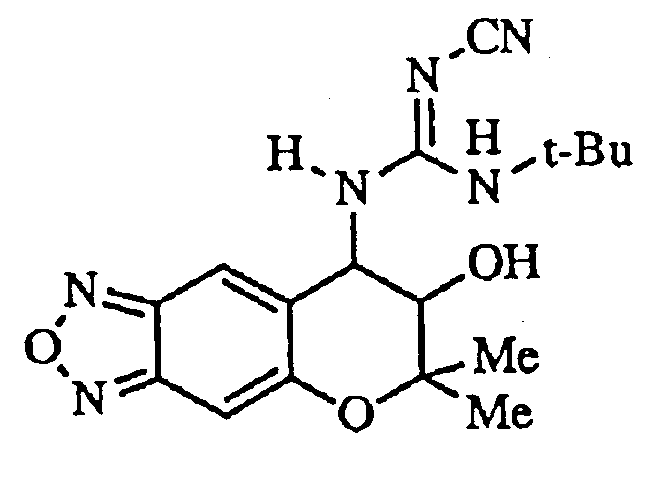
A solution comprised of 100 mg (0.29 mmol) of the compound obtained in Synthesis Example 36, 97 mg (0.37 mmol) of triphenylphosphine, 40µ ℓ of carbon tetrachloride, 40 µ ℓ (0.29 mmol) of triethylamine and 1 ml of dichloromethane was heated under reflux for 4 hours. The solvent was removed by by distillation under reduced pressure, and the residue was subjected to silica gel column chromatography (eluent: ethyl acetate - n-hexane = 1 : 2 (v/v); Rf = 0.1) to obtain 77 mg of pale yellow crystals. - A solution comprised of 122 mg (0.39 mmol) of the compound thus obtained, 21 mg (0.50 mmol) of cyanamide, 2 ml of of tetrahydrofuran and 20 mg of diisopropylethylamine was stirred for 14 hours at room temperature. The crystals precipitated were taken out by filtration to obtain 112 mg of the intended compound as pale yellow crystals. (yield: 80 %)
m.p.: 146 to 148 °C. -

0.14 g (0.44 mmol) of 3,4-dihydro-2,2-dimethyl-3-hydroxy-4-(1-piperidinyl)-6-amino-7-nitro-2H-benzo[b]pyran were dissolved in 23.7 g of ethanol and hydroge gas was blown in the presence of 0.10 g of 5 % palladiumcarbon, as a catalyst, for 3 hours at room temperature under one atmospheric pressure while stirring. The reaction liquid was filtered under suction to remove the catalyst therefrom, and the solvent was distilled off to obtain 0.12 g (yield: 95 %) of 3,4-dihydro-2,2-dimethyl-3-hydroxy-4-(1-piperidinyl)-6-,7-diamino-2H-benzo[b]pyran as a dark red oil. As being unstable, this oil was directly used in the next diazotization. - The whole amount of the diamino compound obtained in the previous step was dissolved in a mixture of 0.13 g of acetic acid and 0.23 g of water, and a solution prepared by dissolving 35 mg (0.51 mmol) of sodium nitrite in 0.15 g of water was added thereto all at a time at room temperature. After the generation of heat was recognized, thus obtained compound was heated on a water bath at 80 °C for one minute. 20 ml of water, 0.13 g of sodium hydroxide and 4.0 g of sodium chloride were added to the reaction mixture, which was then extracted three times each with 40 ml of ethyl acetate. The ethyl acetate layers were combined, dried over anhydrous sodium sulfate and filtered. The solvent was distilled off to obtain 0.10 g of an yellowish red powder. 90 mg of the powder was purified by silica gel column chromatography (ethyl acetate - ethanol = 5 : 1) to obtain 80 mg of the intended compound as a pale yellowish brown powder. The total yield through the two steps was 72 %.
MS: 284(M⁺-H₂O, 18 %), 230(M⁺-72, 100 %), 84(5 %) -
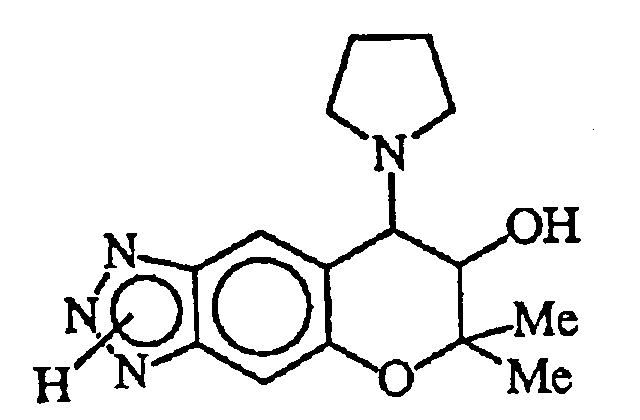
0.20 g (0.65 mmol) of 3,4-dihydro-2,2-dimethyl-3-hydroxy-4-(1-pyrrolidinyl)-6-amino-7-nitro-2H-benzo[b]pyran were dissolved in 34.9 g of ethanol and hydrogen gas was blown in the presence of 0.15 g of 5 % palladium-carbon, as a catalyst, at room temperature for 3 hours under one atmospheric pressure while stirring. The reaction liquid was filtered under suction to remove the catalyst therefrom, and the solvent was distilled off to obtain 170 mg (yield: 94 %) of 3,4-dihydro-2,2-dimethyl-3-hydroxy-4-(1-pyrrolidinyl)-6,7-diamino-2H-benzo[b]pyran as a dark red oil. - The whole amount of the diamino compound obtained in the previous step was dissolved in a mixture of 0.19 g of acetic acid and 0.34 g of water, and a solution prepared by dissolving 52 mg (0.75 mmol) of sodium nitrite in 0.22 g of water was added thereto all at a time at room temperature. After the generation of heat was recognized, the resulting mixture was heated on a water bath at 80 °C for 3 minutes. The compound was thereafter post-treated in the same manner as in Synthesis Example 53 to obtain 160 mg of the intended compound as an yellowish brown powder. The total yield through the two steps was 85 %.
MS: 288(M⁺, 3 %), 270(M⁺-H₂O, 3 %), 216(M⁺-72, 88 %), 188(M⁺-100, 100 %), 70 (22 %) -
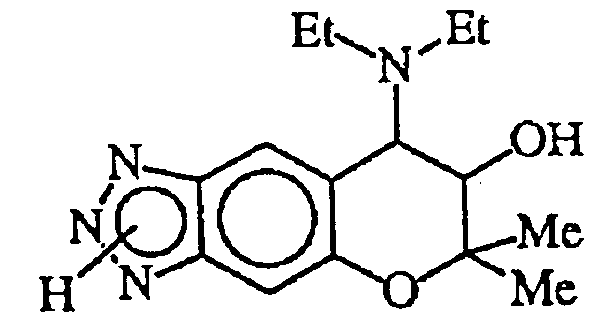
0.20 g (0.65 mmol) of 3,4-dihydro-2,2-dimethyl-3-hydroxy-4-diethylamino-6-amino-7-nitro-2H-benzo[b]pyran were dissolved in 34.9 g of ethanol and hydroge gas blown in in the presence of 0.15 g of 5 % palladium-carbon, as a catalyst, for at room temperture for 2.5 hours under one atmospheric pressure while stirring. The reaction liquid was filtered under suction to remove the catalyst therefrom, and the solvent was distilled off to obtain 0.15 g (yield: 83 %) of 3,4-dihydro-2,2-dimethyl-3-hydroxy-4-diethylamino-6,7-diamino-2H-benzo[b]-pyran as a dark brown oil. - The whole amount of the diamino compound obtained in the previous step was dissolved in a mixture of 0.19 g of acetic acid and 0.34 g of water, and a solution prepared by dissolving 52 mg (0.75 mmol) of sodium nitrite in 0.22 g of water was added thereto all at a time at room temperature. After the generation of heat was recognized, the resulting mixture was heated on a water bath at 80 °C for 3 minutes. The mixture was thereafter post-treated in the same manner as in Synthesis Example 53 to obtain 70 mg of the intended compound as a pale brown powder. The total yield through the two steps was 37 %.
MS(FAB): 291 [(M+H)⁺] -

0.28 g (0.87 mmol) of 3,4-dihydro-2,2-dimethyl-3-hydroxy-4-(1-piperidinyl)-6-amino-7-nitro-2H-benzo[b]pyran was dissolved in 44.8 g of ethanol and hydrogen gas was blown in in the presence of 0.20 g of 5 % palladium-carbon, as a catalyst, at room temperature for 3 hours under one atmospheric pressure while stirring. The reaction liquid was filtered under suction to remove the catalyst therefrom, and the solvent was removed by distillation to obtain 0.24 g (yield: 95 %) of 3,4-dihydro-2,2-dimethyl-3-hydroxy-4-(1-piperidinyl)-6,7-diamino-2H-benzo[b] pyran as a dark red oil. 0.12 g (0.86 mmol) of thionylaniline and 4g of benzenewere added thereto and heated under reflux for 2.5 hours. The solvent was distilled off under reduced pressure, and the residue was subjected to silica gel column chromatography (ethyl acetate - ethanol = 1 : 3) to obtain 60 mg (yield: 23 %) of the intended compound as an yellow solid.
MS: 84(85 %), 247(100 %), 319(M⁺, 2 %) -

3,4-dihydro-2,2-dimethyl-3-hydroxy-4-(1-pyrrolidinyl)-6-amino-7-nitro-2H-benzo[b]pyran was processed in the same manner as in Synthesis Example 56 to obtain the intended compound as pale brown crystals. (yield: 25 %) -

3,4-dihydro-2,2-dimethyl-3-hydroxy-4-diethylamino-6-amino-7-nitro-2H-benzo[b]pyran was processed in the same manner as in Synthesis Example 56 to obtain the intended compound as a brown oil. (yield: 17 %) -

14.7 g (206.2 mmol) of pyrrolidine were added to 60 ml of an ethanol solution containing 15.0 g (68.7 mmol) of the compound of Reference Example 1 and heated under reflux for 2 hours. The solvent was distilled off under reduced pressure, 100 ml of water was added to the residue product, and was then extracted with chloroform (100 ml x 1, 30 ml x 2). After the chloroform solution was dried over anhydrous sodium sulfate, the solvent was distilled off under reduced pressure. The residue was subjected to silica gel column chromatography
(benzene - ethyl acetate = 5 : 1 → 4 : 1),
and the crystals obtained were recrystallized from benzene : hexane (1 : 2) to obtain 13.8 g of the intended compound as yellow crystals. (yield: 69 %)
240 ml of hydrochloric acid-methanol (10 %) were added to 240 ml of a methanol solution containing 13 g (44.9 mmol) of the intended compound and stirred for 3 hours at room temperature. Then, the solvent was distilled off under reduced pressure. The residue was crystallized in 250 ml of 2-propanol to obtain 11.5 g of hydrochloride of the intended compound as colorless crystals. (yield: 78 %)
m.p. > 200 °C (decomposition). -
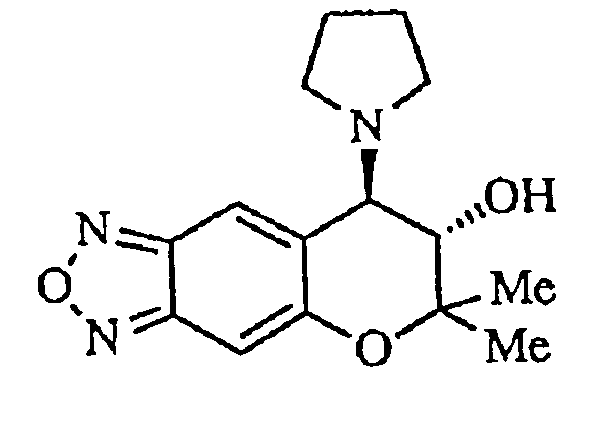
In the same manner as in Synthesis Example 59, 15.0 g (yield: 58 %) of the intended compound were obtained as yellow crystals. Also in the same manner, 12.9 g (yield: 82 %) of hydrochloride of the intended compound were obtained as colorless crystals.
m.p. > 200 °C (decomposition). -
Formulation of Tablets: Compound (prepared in Synthesis Example 4) 10 g Lactose 260 g Crystal cellulose powder 600 g Corn Starch 350 g Hydroxypropyl cellulose 100 g CMC-Ca 150 g Magnesium stearate 30 g Total 1500 g - The above-mentioned components were mixed by a usual and then tabletted to produce 10,000 sugar-coated tablets, each containing one mg of the active ingredient.
-
Formulation of Capsules: Compound (prepared in Synthesis Example 4) 10 g Lactose 440 g Crystal cellulose powder 1000 g Magnesium Stearate 50 g Total 1500 g - The above-mentioned components were mixed by a usual method and then packed in gelatin capsules to obtain 10,000 capsules, each containing one mg of the active ingredient.
-
Formulation of Soft Capsules: Compound (prepared in Synthesis Example 4) 10 g PEG400 479 g Saturated fatty acid triglyceride 1500 g Peppermint Oil 1 g Polysorbate 80 10 g Total 2000 g - The above-mentioned components were mixed and packed in No. 3 soft gelatin capsules by a usual method to obtain 10,000 soft capsules, each containing one mg of the active ingredient.
-
Formulation of Ointment: Compound (prepared in Synthesis Example 4) 1.0 g Liquid paraffin 10.0 g Cetanol 20.0 g Whilte vaseline 68.4 g Ethylparaben 0.1 g L-methol 0.5 g Total 100.0 g - The above-mentioned components were mixed by usual method to obtain 1 % ointment.
-
Formulation of Suppositories: Compound (prepared in Synthesis Example 4) 1 g Witepsol H15* 478 g Witepsol W35* 520 g Polysorbate 80 1 g Total 1000 g (* Trade name for triglyceride compound) - The above-mentioned components were melt-mixed by usual method and poured into suppository containers, followed by cooling for solidification to obtain 1,000 suppositories of 1 g, each containing one mg of the active ingredient.
-
Formulation of Injection: Compound (prepared in Synthesis Example 4) 1 mg Distilled water for injection 5 ml - The formulation is prepared by dissolving the compound in distilled water whenever it is required.
- The heart was taken out from a male Hartley guinea pig, and the left atrium cordis was separated from it in a Krebs Henseleit liquid aerated with 95%-O₂/5%-CO₂. The specimen was overhung under tension of 0.5 g in an organ bath filled with anutrient liquid, which was kept at 31 °C . To determine the force of cardiac muscles of the left atrium corids, electric stimulation was transmularly imparted to the specimen via platinum bipolar electrodes and the tension generated by the contraction of force of cardiac muscles of the specimen was recorded. The conditions for the electric stimulation were as follows:
Voltage: two times the threshold potential to attain the contraction (V) Time: 3 (m sec.) Frequency: 1 (Hz) - After the specimen was equilibrated while exchanging the nutrient liquid, isoproterenol was accumulatively applied to the specimen to obtain the maximum contraction reaction of the specimen. After, the isoproterenol added was washed out, the specimen was again equilibrated for 60 minutes while exchanging the nutrient liquid. Afterwards, the test compounds mentioned below were applied to the specimen, while its action was observed.
- The action caused by applying 100 µ M and 300 µ M of each compound are expressed by the rate of change (%), on the basis of the maximum contraction (100 %) previously obtained when isoproterenol had been applied.
- The test results are shown in the following table, which verifies that the compounds of the present invention have a strong activity of enhancing the contraction of cardiac muscles and that the activity is dependent on the concentration of the compound applied.
Results of Test 1 - effect on contraction force of cardiac muscles Test compound Synthesis Example No. Rate of change (%) in constraction force of cardiac muscles 100 µ M 300 µ M 1 24.7 52.7 2 44.2 84.0 3 55.7 135.0 36 67.5 - The heart was taken out from a male Hartley guinea pig, and the right atrium cordis was separated from it in a Krebs Henseleit liquid aerated with 95%-O₂/5%-CO₂. The specimen was overhung under tension of 1 g in an organ bath filled with a nutrient liquid, which was kept at 31 °C .
- After the specimen was equilibrated while exchanging the nutrient liquid, isoproterenol was accumulatively applied with the spcimen to obtain the maximum reaction of the specimen. After, the isoproterenol applied was washed out, the specimen was again equilibrated for 60 minutes while exchanging the nutrient liquid. Afterwards, the test compounds mentioned below were applied to the specimen, while its reaction was observed.
- The relative variation (%) in the rate of heart beats of the specimen due to the addition of the test compound (100µ M or 300 µ M thereto was obtained, on the basis of the maximum reaction (100 %) previously obtained when isoproterenol had been applied.
- The test results are shown in the following table, which verifies that the compounds of the present invention have an activity of reducing the rate of heart beats and that the activity is dependent on the concentration of the compound applied.
Results of Test 2 - effect on the rate of heart beats Text compound (Synthesis Example No.) Variation (%) in the rate of hart beats 100 µ M 300 µ M 1 -17.7 -73.3 2 -12.8 -25.0 4 -15.6 -53.8 - Female and male mongrel dogs were anesthetized with sodium pentobarbital and kept under artificial respiration. A cannula was inserted into the abdominal aorta through the right crural artery, and the blood pressure of the animal was measured with a strain pressure amplifier via a pressure transducer. The rate of heart beats of the animal was measured on the basis of the moment heart beat wave, using the blood pressure wave as the trigger. A catheter pressure-transducer was inserted into the left ventricle from the left carotid artery, and the inner pressure in the left ventricle was measured via a strain pressure amplifier. The inner pressure in the left ventricle was differentiated via a differential unit to obtain the primary differentiated value of the inner pressure in the left ventricle (the value corresponds to the leading rate of the systolic pressure of the left ventricle, LV dp/dlmax). The test compounds mentioned below was dissolved in a mixed solvent of polyethylene glycol-400, ethanol and water (2 : 3 : 5) and introduced, with bolus dose, through a cannula inserted into the left cephalic vein of the animal. Prior to the test, it was recognized that the mixed solvent alone has no influence on the cardiac function and the blood pressure of the animal.
- The test results are shown in the following table, which verifies that the compounds of the present invention have a strong activity of enhancing the contraction of cardiac muscles and a strong activity of reducing the rate of heart beats without having any influence on the blood pressure.
-
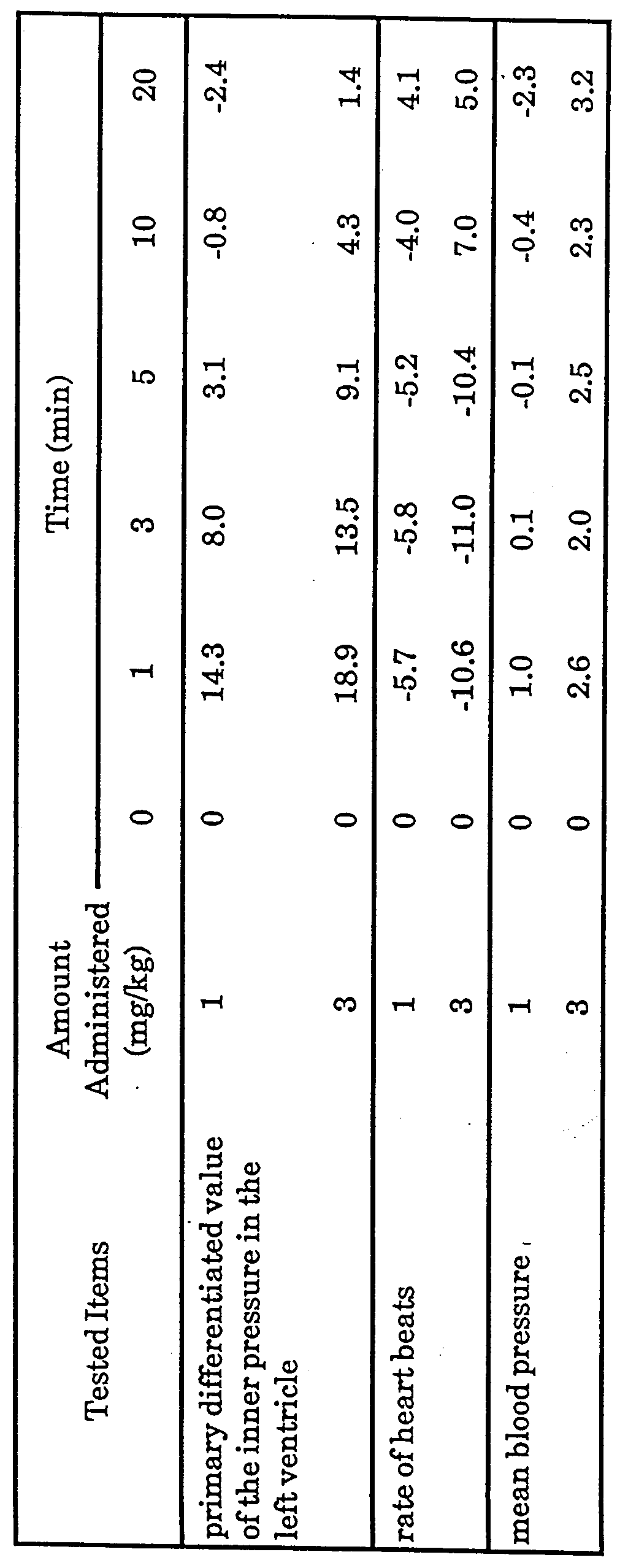
Claims (6)
- A medicine for cardiac insufficiency containing, as an active ingredient, at least one of compounds of the following formula (I), their optical isomers, their stereoisomers and their pharmacologically acceptable salts when they may form salts.

X represents an oxygen atom, a sulfur atom, a nitrogen atom (said nitrogen atom is unsubstituted or substituted by a hydrogen atom or a C₁-C₄ alkyl group), C(O), C(S), or C(N-CN);
A represents a hydrogen atom, a hydroxyl group, or OC(O)R⁵ (in which R⁵ represents a C₁-C₄ alkyl group), or may form a single bond together with B;
B represents a hydrogen atom, or may form a single bond together with A;
R¹ and R² are the same or different from each other and represent a hydrogen atom or a C₁ -C₄ alkyl group, or R¹ and R² may together form a 1,4-butylene or 1,5-pentylene group which is unsubstituted or substituted by a C₁-C₄ alkyl group;
R³ and R⁴ are the same or different from each other and represent a hydrogen atom, a C₁-C₆ alkyl group {said alkyl group is unsubstituted or substituted by one or more substituents selected from a halogen atom, a carboxyl group, a C₂-C₅ alkoxy carbonyl group, a hydroxyl group, a C₁-C₄ alkoxy group, CH(OR)₂ (in which R represents a C₁-C₄ alkyl group), a phenyl group (which is unsubstituted or substituted by one or more substituents selected from a halogen atom, a hydroxyl group and a C₁-C₄ alkoxy group), a formyl group, a cyano group and a nitro group}, a C₂-C₆ alkenyl group {said alkenyl group is unsubstituted or substituted by one or more substituents selected from a halogen atom, a carboxyl group, a C₂-C₅ alkoxycarbonyl group, a hydroxyl group, a C₁-C₄ alkoxy group, CH(OR)₂ (in which R represents a C₁-C₄ alkyl group), a phenyl group (which is unsubstituted or substituted by one or more substituents selected from a halogen atom, a hydroxyl group, and a C₁-C₄ alkoxy group), a formyl group, a cyano group and a nitro group}, a C₂-C₆ alkynyl group {said alkynyl group is unsubstituted or substituted by one or more substituents selected from a halogen atom, a carboxyl group, a C₂-C₅ alkoxycarbonyl group, a hydroxyl group, a C₁-C₄ alkoxy group, CH(OR)₂ (in which R represents a C₁-C₄ alkyl group), a phenyl group (which is unsubstituted or substituted by one or more substituents selected from a halogen atom, a hydroxyl group and a C₁-C₄ alkoxy group), a formyl group, a cyano group and a nitro group}, a C₃-C₆ cycloalkyl group {said cycloalkyl group is unsubstituted or substituted by one or more substituents selected from a halogen atom, a carboxyl group, a C₂-C₅ alkoxycarbonyl group, a hydroxyl group, a C₁-C₄ alkoxy group, CH(OR)₂ (in which R represents a C₁-C₄ alkyl group), a phenyl group (which is unsubstituted or substituted by one or more substituents selected from a halogen atom, a hydroxyl group and a C₁-C₄ alkoxy group), a formyl group, a cyano group and a nitro group}, a phenyl group (which is unsubstituted or substituted by one or more substituents selected from a halogen atom, a hydroxyl group and a C₁-C₄ alkoxy group), or C(=Y)ZR⁶ [in which Y represents an oxygen atom, a sulfur atom or NR⁷ (in which R⁷ represents a hydrogen atom, a cyano group, a nitro group, a C₁-C₄ alkyl group, a C₁-C₄ alkoxy group or CO₂R⁸ (R⁸ represent a C₁-C₄ alkyl group)); Z represents an oxygen atom, a sulfur atom or NR⁹ (in which R⁹ represents a hydrogen atom, a C₁-C₆ alkyl group {said alkyl group is unsubstituted or substituted by one or more substituents selected from a halogen atom, a carboxyl group, a C₂-C₅ alkoxycarbonyl group, a hydroxyl group, a C₁-C₄ alkoxy group, CH(OR)₂ (in which R represents a C₁-C₄ alkyl group), a phenyl group (which is unsubstituted or substituted by one or more substituents selected from a halogen atom, a hydroxyl group and a C₁-C₄ alkoxy group), a formyl group, a cyano group and a nitro group}, a C₂-C₆ alkenyl group {said alkenyl group is unsubstituted or substituted by one or more substituents selected from a halogen atom, a carboxyl group, a C₂-C₅ alkoxycarbonyl group, a hydroxyl group, a C₁-C₄ alkoxy group, CH(OR)₂ (in which R represents a C₁-C₄ alkyl group), a phenyl group (which is unsubstituted or substituted by one or more substituents selected from a halogen atom, a hydroxyl group and a C₁-C₄ alkoxy group), a formyl group, a cyano group and a nitro group}, a C₂-C₆ alkynyl group {said alkynyl group is unsubstituted or substituted by one or more substituents selected from a halogen atom, a carboxyl group, a C₂-C₅ alkoxycarbonyl group, a hydroxyl group, a C₁-C₄ alkoxy group, CH(OR)₂ (in which R represents a C₁-C₄ alkyl group), a phenyl group (which is unsubstituted or substituted by one or more substituents selected from a halogen atom, a hydroxyl group and a C₁-C₄ alkoxy group), a formyl group, a cyano group and a nitro group}, a C₃-C₆ cycloalkyl group {said cycloalkyl group is unsubstituted or substituted by one or more substituents selected from a halogen atom, a carboxyl group, a C₂-C₅ alkoxycarbonyl group, a hydroxyl group, a C₁-C₄ alkoxy group, CH(OR)₂ (in which R represents a C₁-C₄ alkyl group), a phenyl group (which is unsubstituted or substituted by one or more substituents selected from a halogen atom, a hydroxyl group and a C₁-C₄ alkoxy group), a formyl group, a cyano group and a nitro group}, or a phenyl group (which is unsubstituted or substituted by one or more substituents selected from a halogen atom, a hydroxyl group and a C₁-C₄ alkoxy group));
and R⁶ represents a hydrogen atom, a C₁-C₈ alkyl group {said alkyl group is unsubstituted or substituted by one or more substituents selected from a halogen atom, a carboxyl group, a C₂-C₅ alkoxycarbonyl group, a hydroxyl group, a C₁-C₄ alkoxy group, CH(OR)₂ (in which R represents a C₁-C₄ alkyl group), a phenyl group (which is unsubstituted or substituted by one or more substituents selected from a halogen atom, a hydroxyl group and a C₁-C₄ alkoxy group), a formyl group, a cyano group and a nitro group}, a C₂-C₆ alkenyl group {said alkenyl group is unsubstituted or substituted by one or more substituents selected from a halogen atom, a carboxyl group, a C₂-C₅ alkoxycarbonyl group, a hydroxyl group, a C₁-C₄ alkoxy group, CH(OR)₂ (in which R represents a C₁-C₄ alkyl group), a phenyl group (which is unsubstituted or substituted by one or more substituents selected from a halogen atom, a hydroxyl group and a C₁-C₄ alkoxy group), a formyl group, a cyano group and a nitro group}, a C₂-C₆ alkynyl group {said alkynyl group is unsubstituted or substituted by one or more substituents selected from a halogen atom, a carboxyl group, a C₂-C₅ alkoxycarbonyl group, a hydroxyl group, a C₁-C₄ alkoxy group, CH(OR)₂ (in which R represents a C₁-C₄ alkyl group), a phenyl group (which is unsubstituted or substituted by one or more substituents selected from a halogen atom, a hydroxyl group and a C₁-C₄ alkoxy group), a formyl group, a cyano group and a nitro group}, a C₃-C₆ cycloalkyl group {said cycloalkyl group is unsubstituted or substituted by one or more substituents selected from a halogen atom, a carboxyl group, a C₂-C₅ alkoxycarbonyl group, a hydroxyl group, a C₁-C₄ alkoxy group, CH(OR)₂ (in which R represents a C₁-C₄ alkyl group), a phenyl group (which is unsubstituted or substituted by one or more substituents selected from a halogen atom, a hydroxyl group and a C₁-C₄ alkoxy group), a formyl group, a cyano group and a nitro group}, or a phenyl group (which is unsubstituted or substituted by one or more substituents selected from a halogen atom, a hydroxyl group and a C₁-C₄ alkoxy group)];
or
R³ and R⁴ may together form a 1,4-butylene or 1,5-pentylene group {said 1,4-butylene group and 1,5-pentylene group are unsubstituted or substituted by one or more substituents selected from a C₁-C₄ alkyl group, a phenyl group (which is unsubstituted or substituted by one or more substituents selected from a halogen atom, a hydroxyl group and a C₁-C₄ alkoxy group), a halogen atom, OR¹⁰ (in which R¹⁰ represents a hydrogen atom, a C₁-C₄ alkyl group, COR¹¹ (R¹¹ represents a C₁-C₄ alkyl group, a nitro group, SO₃H or PO₃H₂))}; or
R³ and R⁴ may together form (CH₂)mX⁴(CH₂)l [in which m and l each represent 1, 2 or 3 while the sum of them is 3, 4 or 5;
X⁴ represents an oxygen atom, a sulfur atom, or NR¹² {in which R¹² represents a hydrogen atom, a C₁-C₄ alkyl group, or a phenyl group (which is unsubstituted or substituted by one or more substituents selected from a halogen atom, a hydroxyl group and a C₁-C₄ alkoxy group)}];
or R³ and R⁴ may together form (CH₂)nZC(=Y) (in which n represents 2, 3 or 4; and Z and Y have the same meanings as defined above). - A medicine for cardiac insufficiency containing, as the active ingredient, at least one of compounds of the following formula (II), their optical isomers, their stereoisomers and their pharmacologically acceptable salts when they may form salts:
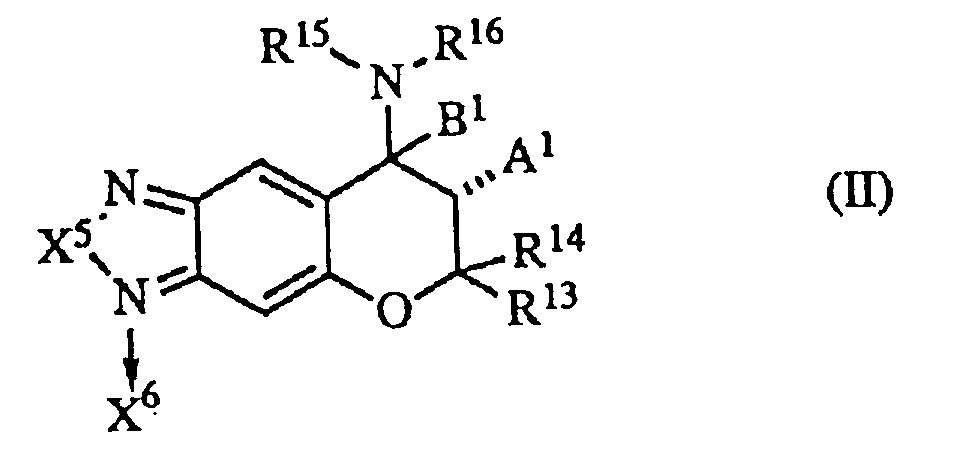
X⁵ represents an oxygen atom, a sulfur atom, or a nitrogen atom (said nitrogen atom is unsubstituted or substituted by a hydrogen atom or a C₁-C₄ alkyl group);
A¹ represents a hydrogen atom, a hydroxyl group, or OC(O)R¹⁷ (in which R¹⁷ represents a C₁-C₄ alkyl group);
B¹ represents a hydrogen atom;
R¹³ and R¹⁴ are the same or different each other and represent a hydrogen atom or a C₁-C₄ alkyl group;
R¹⁵ and R¹⁶ are the same or different to each other and represent a hydrogen atom, a C₁-C₆ alkyl group {said alkyl group is unsubstituted or substituted by one or more substituents selected from a halogen atom, a carboxyl group, a C₂-C₅ alkoxycarbonyl group, a hydroxyl group, a C₁-C₄ alkoxy group, CH(OR)₂ (in which R represents a C₁-C₄ alkyl group), a phenyl group (which is unsubstituted or substituted by one or more substituents selected from a halogen atom, a hydroxyl group and a C₁-C₄ alkoxy group), a formyl group, a cyano group and a nitro group}, a C₃-C₆ cycloalkyl group {said cycloalkyl group is unsubstituted or substituted by one or more substituents selected from a halogen atom, a carboxyl group, a C₂-C₅ alkoxycarbonyl group, a hydroxyl group, a C₁-C₄ alkoxy group, CH(OR)₂ (in which R represents a C₁-C₄ alkyl group), a phenyl group (which is unsubstituted or substituted by one or more substituents selected from a halogen atom, a hydroxyl group and a C₁-C₄ alkoxy group), a formyl group, a cyano group and a nitro group}, a phenyl group (which is unsubstituted or substituted by one or more substituents selected from a halogen atom, a hydroxyl group and a C₁-C₄ alkoxy group), or C(=Y¹)Z¹R¹⁸ [in which Y¹ represents an oxygen atom, a sulfur atom or NR¹⁹ (in which R¹⁹ represents a hydrogen atom, a cyano group, a nitro group, a C₁-C₄ alkyl group or a C₁-C₄ alkoxy group); Z¹ represents an oxygen atom, a sulfur atom or NR²⁰ (in which R²⁰ represents a hydrogen atom, a C₁-C₆ alkyl group {said alkyl group is unsubstituted or substituted by one or more substituents selected from a halogen atom, a carboxyl group, a C₂-C₅ alkoxycarbonyl group, a hydroxyl group, a C₁-C₄ alkoxy group, CH(OR)₂ (in which R represents a C₁-C₄ alkyl group), a phenyl group (which is unsubstituted or substituted by one or more substituents selected from a halogen atom, a hydroxyl group and a C₁-C₄ alkoxy group), a formyl group, a cyano group and a nitro group}, a C₃-C₆ cycloalkyl group {said cycloalkyl group is unsubstituted or substituted by one or more substituents selected from a halogen atom, a carboxyl group, a C₂-C₅ alkoxycarbonyl group, a hydroxyl group, a C₁-C₄ alkoxy group, CH(OR)₂ (in which R represents a C₁-C₄ alkyl group), a phenyl group (which is unsubstituted or substituted by one or more substituents selected from a halogen atom, a hydroxyl group and a C₁-C₄ alkoxy group), a formyl group, a cyano group and a nitro group}, or a phenyl group (which is unsubstituted or substituted by one or more substituents selected from a halogen atom, a hydroxyl group and a C₁-C₄ alkoxy group));
and R¹⁸ represents a hydrogen atom, a C₁-C₈ alkyl group {said alkyl group is unsubstituted or substituted by one or more substituents selected from a halogen atom, a carboxyl group, a C₂-C₅ alkoxycarbonyl group, a hydroxyl group, a C₁-C₄ alkoxy group, CH(OR)₂ (in which R represents a C₁-C₄ alkyl group), a phenyl group (which is unsubstituted or substituted by one or more substituents selected from a halogen atom, a hydroxyl group and a C₁-C₄ alkoxy group), a formyl group, a cyano group and a nitro group}, a C₃-C₆ cycloalkyl group {said cycloalkyl group is unsubstituted or substituted by one or more substituents selected from a halogen atom, a carboxyl group, a C₂-C₅ alkoxycarbonyl group, a hydroxyl group, a C₁-C₄ alkoxy group, CH(OR)₂ (in which R represents a C₁-C₄ alkyl group), a phenyl group (which is unsubstituted or substituted by one or more substituents selected from a halogen atom, a hydroxyl group and a C₁-C₄ alkoxy group), a formyl group, a cyano group and a nitro group}, or a phenyl group (which is unsubstituted or substituted by one or more substituents selected from a halogen atom, a hydroxyl group and a C₁-C₄ alkoxy group)];
or
R¹⁵ and R¹⁶ may together form a 1,4-butylene or 1,5-pentylene group {said butylene and said pentylene are unsubstituted or substituted by one or more substituents selected from a C₁-C₄ alkyl group, a phenyl group (which is unsubstituted or substituted by one or more substituents selected from a halogen atom, a hydroxyl group and a C₁-C₄ alkoxy group), a halogen atom and OR²¹ (in which R²¹ represents a hydrogen atom, a C₁-C₄ alkyl group, COR²² (in which R²² represents a C₁-C₄ alkyl group, a nitro group, SO₃H or PO₃H₂))}; or
R¹⁵ and R¹⁶ may together form (CH₂)oX⁷(CH₂)p [in which o and p each is an integer of 1, 2 or 3 while the sum of them is 3, 4 or 5; X⁷ represents an oxygen atom, a sulfur atom, or NR²³ {in which R²³ represents a hydrogen atom, a C₁-C₄ alkyl group, or a phenyl group (which is unsubstituted or substituted by one or more substituents selected from a halogen atom, a hydroxyl group and a C₁-C₄ alkoxy group)}]; or
R¹⁵ and R¹⁶ may together form (CH₂)QZ¹C(=Y¹) (in which Q represents an integer of 2, 3 or 4; and Z¹ and Y¹ have the same meanings as defined above). - The medicine for cardiac insufficiency as claimed in claim 2, wherein R¹⁵ in formula (II) represents a hydrogen atom, and R¹⁶ represents C(=Y²)NHR²⁴ (in which Y² represents an oxygen atom, a sulfur atom or N-CN; and R²⁴ represents a phenyl group, a benzyl group or a C₁-C₈ alkyl group which may be branched).
- The medicine for cardiac insufficiency as claimed in claim 2, wherein R¹⁵ and R¹⁶ in formula (II) together form (CH₂)kNHC(=Y³) (in which k is an integer of 2, 3 or 4; and Y³ represents an oxygen atom, a sulfur atom or N-CN).
- The medicine for cardiac insufficiency as claimed in claim 2, in which R¹⁵ and R¹⁶ in formula (II) simultaneously represents C₁-C₆ alkyl groups.
- The medicine for cardiac insufficiency as claimed in claim 2, in which R¹⁵ and R¹⁶ in formula (II) together form (CH₂)₄ or (CH₂)₅.
Applications Claiming Priority (5)
| Application Number | Priority Date | Filing Date | Title |
|---|---|---|---|
| JP7686093 | 1993-04-02 | ||
| JP76860/93 | 1993-04-02 | ||
| JP3730394 | 1994-03-08 | ||
| JP37303/94 | 1994-03-08 | ||
| PCT/JP1994/000544 WO1994022442A1 (en) | 1993-04-02 | 1994-04-01 | Heart failure remedy |
Publications (2)
| Publication Number | Publication Date |
|---|---|
| EP0693283A1 true EP0693283A1 (en) | 1996-01-24 |
| EP0693283A4 EP0693283A4 (en) | 1997-07-23 |
Family
ID=26376437
Family Applications (1)
| Application Number | Title | Priority Date | Filing Date |
|---|---|---|---|
| EP94910589A Ceased EP0693283A4 (en) | 1993-04-02 | 1994-04-01 | Heart failure remedy |
Country Status (15)
| Country | Link |
|---|---|
| US (1) | US5919806A (en) |
| EP (1) | EP0693283A4 (en) |
| KR (1) | KR960700713A (en) |
| CN (1) | CN1120313A (en) |
| AU (1) | AU677643B2 (en) |
| CA (1) | CA2158931A1 (en) |
| CZ (1) | CZ254095A3 (en) |
| HU (1) | HUT73971A (en) |
| NO (1) | NO307284B1 (en) |
| NZ (1) | NZ262960A (en) |
| RU (1) | RU2128043C1 (en) |
| SK (2) | SK1766U (en) |
| TW (1) | TW384291B (en) |
| UA (1) | UA27973C2 (en) |
| WO (1) | WO1994022442A1 (en) |
Cited By (1)
| Publication number | Priority date | Publication date | Assignee | Title |
|---|---|---|---|---|
| WO2005090357A1 (en) | 2004-03-23 | 2005-09-29 | Nissan Chemical Industries, Ltd. | Tricyclic benzopyran compound as anti-arrhythmic agents |
Families Citing this family (3)
| Publication number | Priority date | Publication date | Assignee | Title |
|---|---|---|---|---|
| RU2163132C1 (en) * | 2000-06-01 | 2001-02-20 | Научно-исследовательский центр традиционной фитотерапии | Method of treatment of patients with cardiovascular diseases with phytopreparation and medicinal species for treatment of patients with cardiovascular diseases |
| GB0615670D0 (en) * | 2006-08-07 | 2006-09-13 | Syngenta Participations Ag | Chemical compounds |
| AR076524A1 (en) * | 2009-04-30 | 2011-06-15 | Nissan Chemical Ind Ltd | CRYSTALLINE FORM OF A TRICYCLE BENZOPIRAN COMPOUND AND PRODUCTION METHOD OF THE SAME |
Family Cites Families (13)
| Publication number | Priority date | Publication date | Assignee | Title |
|---|---|---|---|---|
| DE3163018D1 (en) * | 1980-02-02 | 1984-05-17 | Beecham Group Plc | Pyrano derivatives, a process for their preparation and antihypertensive compositions containing them |
| US5026712A (en) * | 1985-06-05 | 1991-06-25 | Schering Ag | Novel imidazo[1,5-a]pyridines, useful as cardiovascular and CNS agents |
| JPH0699439B2 (en) * | 1988-02-03 | 1994-12-07 | 日産化学工業株式会社 | Pyranobenzoxadiazole derivative |
| JP2658198B2 (en) * | 1988-06-23 | 1997-09-30 | 日産化学工業株式会社 | Pyranobenzotriazole derivatives |
| JPH02152974A (en) * | 1988-12-02 | 1990-06-12 | Nissan Chem Ind Ltd | Novel chromanol nitrates |
| US5097037A (en) * | 1989-07-17 | 1992-03-17 | Nissan Chemical Industries, Ltd. | Process for the optical resolution of pyranobenzoxadiazole compounds |
| JP2876712B2 (en) * | 1989-07-17 | 1999-03-31 | 日産化学工業株式会社 | Optically active pyranobenzoxadiazole derivative |
| ES2113374T3 (en) * | 1990-03-21 | 1998-05-01 | Res Corp Technologies Inc | CHIRAL CATALYSTS AND EPOXIDATION REACTIONS CATALYZED BY THE SAME. |
| DE4010097A1 (en) * | 1990-03-29 | 1991-10-02 | Basf Ag | UNSATURATED N-BENZOXODIAZOLOPYRANYLLACTAME, THEIR PRODUCTION AND USE |
| US5164509A (en) * | 1990-11-26 | 1992-11-17 | E. R. Squibb & Sons, Inc. | Benzodiazolo analogs |
| EP0492391A3 (en) * | 1990-12-26 | 1993-01-20 | Nissan Chemical Industries Ltd. | Hair growth stimulator |
| US5352814A (en) * | 1991-08-30 | 1994-10-04 | Nissan Chemical Industries, Ltd. | Asymmetric epoxidation reaction |
| JPH05301878A (en) * | 1991-08-30 | 1993-11-16 | Nissan Chem Ind Ltd | Asymmetrically epoxidizing reaction |
-
1994
- 1994-04-01 UA UA95094340A patent/UA27973C2/en unknown
- 1994-04-01 EP EP94910589A patent/EP0693283A4/en not_active Ceased
- 1994-04-01 CN CN94191620A patent/CN1120313A/en active Pending
- 1994-04-01 AU AU62927/94A patent/AU677643B2/en not_active Ceased
- 1994-04-01 HU HU9502875A patent/HUT73971A/en unknown
- 1994-04-01 NZ NZ262960A patent/NZ262960A/en unknown
- 1994-04-01 SK SK197-97U patent/SK1766U/en unknown
- 1994-04-01 SK SK1171-95A patent/SK117195A3/en unknown
- 1994-04-01 KR KR1019950704031A patent/KR960700713A/en not_active Ceased
- 1994-04-01 RU RU95119384A patent/RU2128043C1/en active
- 1994-04-01 WO PCT/JP1994/000544 patent/WO1994022442A1/en not_active Ceased
- 1994-04-01 US US08/530,252 patent/US5919806A/en not_active Expired - Fee Related
- 1994-04-01 TW TW083102877A patent/TW384291B/en not_active IP Right Cessation
- 1994-04-01 CZ CZ952540A patent/CZ254095A3/en unknown
- 1994-04-01 CA CA002158931A patent/CA2158931A1/en not_active Abandoned
-
1995
- 1995-09-29 NO NO953860A patent/NO307284B1/en not_active IP Right Cessation
Cited By (9)
| Publication number | Priority date | Publication date | Assignee | Title |
|---|---|---|---|---|
| WO2005090357A1 (en) | 2004-03-23 | 2005-09-29 | Nissan Chemical Industries, Ltd. | Tricyclic benzopyran compound as anti-arrhythmic agents |
| US7652008B2 (en) | 2004-03-23 | 2010-01-26 | Nissan Chemical Industries, Ltd. | Tricyclic benzopyran compound as anti-arrhythmic agents |
| RU2380370C2 (en) * | 2004-03-23 | 2010-01-27 | Ниссан Кемикал Индастриз, Лтд. | Tricyclic compounds of benzopyran as antiarrhythmic agents |
| AU2005223612B2 (en) * | 2004-03-23 | 2010-06-24 | Nissan Chemical Industries, Ltd. | Tricyclic benzopyran compound as anti-arrhythmic agents |
| KR101019402B1 (en) * | 2004-03-23 | 2011-03-07 | 닛산 가가쿠 고교 가부시키 가이샤 | Tricyclic benzopyran compounds used as antiarrhythmics |
| US7964623B2 (en) | 2004-03-23 | 2011-06-21 | Nissan Chemical Industries Ltd. | Tricyclic benzopyrane compound |
| AU2010202900B2 (en) * | 2004-03-23 | 2011-10-27 | Nissan Chemical Industries, Ltd. | Tricyclic benzopyran compound as anti-arrhythmic agents |
| CN101429200B (en) * | 2004-03-23 | 2012-05-30 | 日产化学工业株式会社 | Tricyclic benzopyran compound as anti-arrhythmic agents |
| NO339495B1 (en) * | 2004-03-23 | 2016-12-19 | Nissan Chemical Ind Ltd | Tricyclic benzopyran compound |
Also Published As
| Publication number | Publication date |
|---|---|
| CA2158931A1 (en) | 1994-10-13 |
| KR960700713A (en) | 1996-02-24 |
| SK117195A3 (en) | 1997-04-09 |
| HU9502875D0 (en) | 1995-11-28 |
| AU6292794A (en) | 1994-10-24 |
| EP0693283A4 (en) | 1997-07-23 |
| SK1766U (en) | 1998-03-04 |
| CN1120313A (en) | 1996-04-10 |
| HUT73971A (en) | 1996-10-28 |
| WO1994022442A1 (en) | 1994-10-13 |
| NZ262960A (en) | 1997-06-24 |
| RU2128043C1 (en) | 1999-03-27 |
| UA27973C2 (en) | 2000-10-16 |
| US5919806A (en) | 1999-07-06 |
| AU677643B2 (en) | 1997-05-01 |
| TW384291B (en) | 2000-03-11 |
| NO953860L (en) | 1995-11-28 |
| NO953860D0 (en) | 1995-09-29 |
| NO307284B1 (en) | 2000-03-13 |
| CZ254095A3 (en) | 1996-01-17 |
Similar Documents
| Publication | Publication Date | Title |
|---|---|---|
| EP2231641B1 (en) | Quinoxaline and quinoline derivatives as kinase inhibitors | |
| EP3328843B1 (en) | 1,3,4-oxadiazole sulfonamide derivative compounds as histone deacetylase 6 inhibitor, and the pharmaceutical composition comprising the same | |
| US6787555B2 (en) | Triazole compounds useful in treating diseases associated with unwanted cytokine activity | |
| EP0758653A1 (en) | Imidazoquinazoline derivatives | |
| PL184824B1 (en) | Novel amidinonaphtyl derivatives or their salts | |
| EP1652847A1 (en) | Quinoline and quinazoline derivatives for the treatment of tumors | |
| BR112012012529B1 (en) | INDOL COMPOUND, PHARMACEUTICAL COMPOSITION, INHIBITORS AND AGENTS INCLUDING SUCH COMPOUND AND ITS USES | |
| CA2176668C (en) | Heterocyclic spiro compounds, process for preparing the same and pharmaceutical compositions containing them | |
| FR2633624A1 (en) | CARBOXAMIDE, PROCESSES FOR PREPARING THE SAME, AND PHARMACEUTICAL COMPOSITION CONTAINING SAME | |
| AU2002338522A1 (en) | Triazole compounds useful in treating diseases associated with unwanted cytokine activity | |
| EP1560826B1 (en) | Pyridopyrimidinone compounds, method for production thereof and medicaments comprising the same | |
| AU2017201415C1 (en) | Process for the preparation of c-fms kinase inhibitors | |
| SG192446A1 (en) | Process for the preparation of benzoimidazol-2-yl pyrimidine derivatives | |
| IE73874B1 (en) | Substituted-4-amino-3-pyridinols a process for their preparation and their use as medicaments | |
| EP0327127B1 (en) | Pyranobenzoxadiazole derivatives, preparation, use and compositions comprising them | |
| US20160046585A1 (en) | Halogenopyrazoles as inhibitors of thrombin | |
| EP0693283A1 (en) | Heart failure remedy | |
| OA10202A (en) | Positive inotropic and lusitropic pyrroloquinolinone derivatives | |
| EP0551527A1 (en) | Pyrroloazepine derivative | |
| EP3686182A1 (en) | Chemically activated water-soluble prodrug | |
| EP0414903A1 (en) | New thioproline derivative | |
| EP0718307A2 (en) | Derivatives of 1-oxo-2-(phenylsulfonyl-amino)-pentylpiperidine, their preparation and therapeutic use | |
| JPH07300414A (en) | Therapeutic agent for cardiac insufficiency | |
| CZ447199A3 (en) | Compounds for inhibiting farnesyl protein transferase, method of their application and pharmaceutical preparations in which they are comprised | |
| JP2013505922A (en) | Novel amino acid derivatives, methods for their preparation, and their therapeutic use as inhibitors of carcinogenic signals by the MET family |
Legal Events
| Date | Code | Title | Description |
|---|---|---|---|
| PUAI | Public reference made under article 153(3) epc to a published international application that has entered the european phase |
Free format text: ORIGINAL CODE: 0009012 |
|
| 17P | Request for examination filed |
Effective date: 19950914 |
|
| AK | Designated contracting states |
Kind code of ref document: A1 Designated state(s): AT BE CH DE DK ES FR GB GR IE IT LI LU MC NL PT SE |
|
| A4 | Supplementary search report drawn up and despatched | ||
| AK | Designated contracting states |
Kind code of ref document: A4 Designated state(s): AT BE CH DE DK ES FR GB GR IE IT LI LU MC NL PT SE |
|
| 17Q | First examination report despatched |
Effective date: 19990709 |
|
| GRAG | Despatch of communication of intention to grant |
Free format text: ORIGINAL CODE: EPIDOS AGRA |
|
| RTI1 | Title (correction) |
Free format text: USE OF BENZOPYRAN DERIVATIVES FOR THE TREATMENT OF CARDIAC INSUFFICIENCY |
|
| RTI1 | Title (correction) |
Free format text: USE OF BENZOPYRAN DERIVATIVES FOR THE TREATMENT OF CARDIAC INSUFFICIENCY |
|
| RTI1 | Title (correction) |
Free format text: USE OF BENZOPYRAN DERIVATIVES FOR THE TREATMENT OF CARDIAC INSUFFICIENCY |
|
| STAA | Information on the status of an ep patent application or granted ep patent |
Free format text: STATUS: THE APPLICATION HAS BEEN REFUSED |
|
| 18R | Application refused |
Effective date: 20010106 |